What I Read, June 2020

The reading month was a tale of two parts: a blissful vacation week, non-stop reading, each book as strong as the last, followed by two weeks teaching a workshop on writing personal statements. Fun, but tons of work and although I read a lot it was all med school and Fulbright applications. In non-reading life, the weather remained surprisingly agreeable, and the COVID situation in Arkansas hadn’t yet deteriorated as it has since (though the mask-less signs were there). I was doing okay at the time, but now that feels like a century ago. I worry about my job, my health, my loved ones’ health, the planet’s health. Let’s talk books instead.

EZS4vdOX0AIBw_H

Tessa Hadley, The Master Bedroom (2007)

Not as terrific as Late in the Day but still pretty damn terrific. Kate Flynn leaves London and her academic career behind and returns home to Wales. Cardiff is small—it’s not long before she runs into the brother of a childhood friend and falls for him. David’s marriage is not falling apart exactly, but something’s going on, his wife has new friends, disappears for days at a time. David is drawn to Kate—or maybe to her childhood home, a ramshackle mansion grandiosely named La Firenze where Kate’s delightful, increasingly senile mother potters about while Kate practices chamber music. Before long, Kate meets Jamie, David’s 17-year-old son from his first marriage, and before she knows it finds herself involved, in different, complicated ways, with both men.

This could be a farce, but poignancy is more Hadley’s thing. But so is passion, with its messy and violent challenge to decorum. By the end of the novel, a lot of things get broken; some new things get made from the pieces. Hadley’s really doing it for me at this stage in my life.

Sarah Moss, Signs for Lost Children (2015)

I’m usually impatient with novels that switch between two perspectives. Just when I’ve fallen into scenario or point of view, I’m jarred by having to return to the other. And I’m usually more interested in one of the stories. But Moss, really hitting her stride as a writer in this, her fourth novel, a sequel to the very fine Bodies of Light, avoids these traps. At the end of the previous novel, Ally Moberley, one of Britain’s first female doctors in the 1880s, married an engineer named Tom Cavendish. Here the newlyweds find themselves separated when she takes on a job as a doctor in an insane asylum in Falmouth and he travels to Japan to build lighthouses. We learn a lot about Ally’s work and almost nothing about Tom’s—the sections in Japan focus on his secondary task of buying fabric and art objects for an English collector (this makes him basically a personal shopper, and part of the way the novel feminizes him, to use Moss’s own description). Moss’s research is impeccable but lightly worn, even oblique—I think Rohan said something about these being modernist Victorian novels. Moss evokes with equal skill Tom’s feelings of foreignness (which turn to admiration for Japanese society) and Ally’s struggles to challenge the norms of a medical world in which she is as much on sufferance as her mentally-ill patients. There’s even an intriguing plot element: will the couple survive the geographic and psychological distance between them?

Above all, though, Signs for Lost Children, like its predecessor, is Ally’s book. For Moss’s main subject is how easily, terribly, and insidiously we internalize the bad emotions other people, often those closest to us, direct at us: whether jealousy, anger, disparagement or contempt. Ally’s struggles to overcome those voices hit me in the gut.

Tanya Talaga, Seven Fallen Feathers: Racism, Deaths, and Hard Truths in a Northern City (2017)

The northern city of Toronto Star reporter Talaga’s title is Thunder Bay, Ontario, but it could be almost anywhere in Canada, a country where indigenous lives matter less than anyone else’s. Which isn’t to deny the particularity of Talaga’s subject. The fallen feathers are seven indigenous teenagers who went missing and were later found dead, mostly pulled from one of the city’s many waterways. The police, Talaga shows, were never too interested in investigating: another missing Indian, probably drunk and careless. In fact it’s likely some of these young people were murdered—indigenous people are regularly attacked and abused in Thunder Bay: the podcast Canadaland, in a powerful series(featuring Talaga), explored this possibility—but Talaga’s interest here is on a whole system built on broken promises, especially when it comes to education. After the terrible legacy of the residential school system, indigenous people were supposed to have more say in their children’s education, and more money to help them build a new system. But if young people in small northern settlements want to continue to high school they need to fly south, which, in Ontario anyway, usually means going to Thunder Bay. Billeted with foster families paid to take them—some good, some not—living in a place many times bigger than anywhere they’ve known before, missing loved ones themselves damaged by generations of abuse, they struggle. Even though organizations, some indigenous-led, exist to help them, resources and cultural will are lacking.

Talaga’s prose is workmanlike, and her choices in structuring the book sometimes confused me. (A moving section on residential schools could have been the basis of a separate book.) But this powerful book should be read by all Canadians, and everyone who idealizes the place. I cried reading the last pages. The prejudices instilled in me growing up white on the prairies in the 1970s an 80s haven’t been uprooted from reading this book, but they’re more obvious to me now.

Anita Brookner, Look at Me (1983)

Justly famous. This novel provoked many responses when I tweeted my love for it, mostly similarly enthusiastic. Many readers seem to think this, Brookner’s third novel, is her first great one. (Her debut was pretty terrific; I’ve yet to read her second.) Frances Hinton works in a medical library, the kind of sleepy, not especially oppressive job that doesn’t seem to exist anymore (and maybe never did, outside books). She lives with her mother’s former servant in a sepulchral apartment she inherited on her parents’ death. She writes, a little, a story is published and admired. Her life is quiet without being desperate. Yet desperation runs through Frances, as suggested by Brookner’s marvelous title, a phrase Frances regularly howls onto the page. “Look at me” could be self-deprecatory, or coquettish, or rebuking. But in France’s narration it’s a demand—for visibility, legibility, intelligibility. A demand kindled when she is taken up by the dashing physician Nick Fraser and his glamorous wife, Alix. Suddenly Frances is eating out and meeting people, including a kindly doctor whom she gets involved with, but in a detached way, until the relationship that blows up in a surprising way. The WASPs are horrible, it’s the beginning of the rise of the City and all that 80s excessive consumption stuff, the kindliest character is a disabled Jew. All strange and marvelous, and offered to us in less than 200-pages. The most marvelous bit of all, the scene everyone on Twitter mentioned, is a hallucinatory walk through nighttime London, incredibly menacing. There’s a lot of menace in this book, in fact (Frances’s previous lover has been cruel, perpetrated some Jamesian obscure hurt alluded to darkly but firmly.) Brookner is often compared to James or Bowen, but the novel’s last line reminded me of the end of Beckett’s Molloy. Brookner is icier, though, and less funny. Icy domesticity? Yes, please! I’m going to read the rest of her books on my sabbatical.

Sybille Bedford, Jigsaw: An Unsentimental Education (1989)

Book of the month! The year? The century?!? Oh who knows but damn this is good. I saw it was shortlisted for the Booker and, amazed that it didn’t win, took a look at what did. (Remains of the Day: worthy for sure and hard to pick but might take Jigsaw.) Clearly some people appreciated it at the time, but I think it reads less strangely now than it might have then—reviews could call it autofiction and have a way to pigeonhole it. Although pigeonholing is everything this book is not. A fictionalized version of Bedford’s extraordinary life, what she called her unsentimental education. From her first memory (being wheeled in a too-small pram through the streets of Copenhagen, then parked outside the apartment of a writer her mother had come to seduce) through her childhood with her father in a chateau in Baden (which sounds amazing, but post WWI the once-noble family was so poor that father and daughter nearly froze to death in the place, with hardly any clothes and little to eat, only a fabulous cellar to console them), on through life with her mother and her mother’s kind younger lover, first in Italy and then on the Côte d’Azur, with interregna in England, all on her own, a teenager making her way in the world, and back to France where she ran with a crowd that included Aldous and Maria Huxley—the whole thing is so incredible. Not glamorous, mostly she was poor and hard done-by, but amazing.

The book belongs to Bedford’s mother: titanic, careless, insecure, lordly, in the end tragic. But there are a ton of other great characters too. Most delightful of all, though, is Bedford’s narrative voice. You get aperçus:

Are all young children unregenerate creatures? Incapable of moral responses? responses of the heart? Can these be awakened? Mine were not. I was unregenerate and self-absorbed.

You get loose-limbed syntax:

He [her grandfather] had died in his nineties at Voss Strasse before the end of the war – I was there: a death in the house.

And you get both at once:

When I am trying to think of those years in NW1, and I haven’t thought of them for a very long time, they seem to have been all of a piece, a uniform round. It can’t have been wholly like that. There must have been some process of growing up, at whatever rate; life does widen and not only by visits to the British museum, the Tate and Winchester Cathedral. Yet the only thing that remains vivid is the physical feel of living in London, young and on very little though sufficient money. The buses—one was always running after, catching or just missing a last bus; the queuing for a play in Shaftesbury Avenue; the Lyons’ Corner House afterwards (poached egg on toast); Bovril at a coffee stall very late at night; the elegance of Mayfair streets at lunch time; how splendid the men, how pretty the girls, how well dressed everyone was, how en fête; the smell of the cheaper Soho restaurants (upholstery, grease, spice, trapped air); my digs.

Read it!

ETn1T_KXsAAGU8h

Susie Steiner, Remain Silent (2020)

Third Manon Bradshaw novel isn’t as suspenseful as the first, but its character development is even better. Such a range of registers: I laughed aloud and wanted to cry. An Eastern European subplot is handled with much more thoroughness than usual. But more important than the book is the news that Steiner is gravely, perhaps terminally ill. It is so terrible, I send a prayer for her healing.

James Alan McPherson, Hue and Cry (1968)

McPherson’s debut includes two terrific stories—“A Matter of Vocabulary” and “A Solo Song: For Doc,” the former about brothers who pick up after-school jobs at a grocery store and learn how much they differ (it’s going straight onto my short fiction syllabus); the latter about the end of the Pullman porter era—a couple of satisfactory ones, and several joyless and unpleasant ones. There’s not a single sensitively portrayed female character in the book and, although the scenarios occasionally reminded of Malamud I missed the sympathy that attends even Malamud’s most miserable characters. Sometimes I think the 60s were a happier time than our own unhappy one, but then I read something like this and think, nope, at least not for everybody. Even Edward P. Jones’s introduction—which I looked forward to, he’s a favourite of mine—feels dutiful. Did McPherson get better?

Dola de Jong, The Tree and the Vine (1954) Trans. Kristen Gehrman (2020)

More curiosity than masterpiece, de Jong’s novel of unconsummated lesbian love in 1930s Holland is given a sprightly translation by Kristen Gehrman. Bea meets Erica, they move in together as friends, Bea is more and more obsessed with her, to the point that her boyfriend leaves her, which Bea isn’t sad about, in part because she’s so sad or conflicted or unsure or something by Erica, who isn’t especially nice to her. Unhappy lesbian stories are pretty common in the first half of the 20th century, though this one has an intriguing frame in which Bea, writing from postwar life in the US, intimates that she has found happiness or at least contentment. But de Jong is pretty haphazard with that retrospection. I dunno, the book didn’t quite work for me; I wanted to like it more than I did.  I’ve a hunch, though, that I might appreciate it more on a second reading.

Megha Majumdar, A Burning (2020)

Ostensibly about the aftermath of a sectarian terrorist attack in Kolkata (fictional, but modelled on a real one in Bangladesh), A Burning is really about how money and a sense of belonging and counting as a human being are connected—in other words, about the reality for most people in the world right now. The novel is structured around different first-person points of view. (Surely some Jameson-inspired critics are writing about how different-walks-of-life-that-get-connected narratives reflect our economic and social ties under late capitalism.) A young woman—who might have abetted the terrorists—posts a mild criticism of the government on Facebook and is arrested. Her former PE teacher happens upon a demonstration organized by a nationalistic political party—drawn there in the first place by the chance to see a movie star speak—and finds himself more valued than at the girls’ school where he has worked, even if that means becoming a fixer and a perjurer (he ends up a Minister, so who’s to say he was wrong?). A hijira—an intersex and/or transgender person—who had been tutored by the arrested woman overcomes obstacles on their way to stardom.

The teacher—called by his classroom nickname, PT Sir—is the most compelling character, but maybe that’s just because he is most developed according to the codes of realism (he does the most doing, incites the most complicated feelings, has the most developed interiority—he reminded me a little of the lead in Daniyal Mueenuddin’s story “Nawab Electrician”). But PT, like Lovely, the hijira, and Jivan, the accused woman, live in a world in which public spectacle and outcry drive success. Individuals only have meaning in relation to the mass (a more fitting term for the world of this novel than public or citizenry IMO). But this reality poses a dilemma for Majumdar. Because novels rely on individual agency, in a world in which such agency (fancy word for willpower), novels have to turn on themselves. Accordingly, the most compelling moments in A Burning are when characters both do and don’t decide something. Its most representative scene, then, shows Jivan’s lawyer being bribed to abandon his client. Gobind—note the suggestion of blindness in his name; to say nothing of the bind he is in—agrees to drop the case. The narration adds, “He is unsure if he chooses this.”

Reading A Burning I was reminded of Vivek Shanbhag’s Ghachar Ghochar, a better because less schematic, more oneiric book, but similarly concerned with the compromises of success in contemporary India. Majumdar’s is a formidable debut; I’ll read the followup with interest.

Paulette Jiles, Simon the Fiddler (2020)

After News of the World I was eager to read Jiles’s new novel, which centers on Simon Boudin, a character who featured briefly in the earlier book. (Because I listened to an audiobook from the library I couldn’t go back to read that scene again—a source of repeated frustration to me as I read Fiddler.) In Texas in the last months of the Civil War, Boudin is conscripted into the Confederate Army, a fate the slight young man had avoided by pretending he was only a teenager. But he is a musician, not a fighter and at the end of the hostilities finds himself playing at a garden party for officers of both sides, a reconciliation event that is unsuccessful—except for Simon, who spots a beautiful young woman and immediately falls in love with her.

The object of his affection, Doris Dillon, an immigrant from Ireland, is an indentured servant to a Union Captain who is posted to San Antonio where he is meant to bring order to the lawless city when in fact he spends most of his time creeping on Doris. Simon the Fiddler is half love story, half picaresque, as Simon and some charmingly idiosyncratic fellow musicians form a scratch band and play their way across Texas. No, it’s not as great a book as News of the World, but Jiles’s descriptions are evocative and you get a happy ending despite some terrible events along the way. This won’t be on my end of year list, but I enjoyed every minute of it.

ERUHqXiW4AI7Wni

There you have it. The year’s more than half over (I’d say good riddance except I’m scared of what’s coming after it). Maybe I’ll look back on the first half, which, reading-wise, hasn’t been too bad, a damn sight better than everything else. Stay safe, friends.

“The Old, Wild Blood”: Henri Bosco’s Malicroix

A while back I suggested a group reading of Henri Bosco’s 1948 novel Malicroix, admirably translated by Joyce Zonana and published by NYRB Classics. Quite a few readers took me up on the suggestion, and some of them wrote about their experiences, either on their blogs or on Twitter (#Malicroix2020). It was great to see so much interest. Here I’ll highlight some of their observations, and then add some of my own.

EahL4OTX0AMWkDa

At the centre of Malicroix is its narrator, Martial de Mégremut, a young man who comes into a mysterious inheritance from a great-uncle on his mother’s side, the last full-fledged member of the Malicroix line. As the man’s only heir, Martial now owns “some marshland, a few livestock, a tumbled down house” on an island in the Rhone, that is, he will if he manages to live there for three months without setting foot on the mainland. He’s not alone, as he has the company of old Malicroix’s servant Balandran, as competent as he is silent, and the latter’s Briard, Bréquillet. (Everyone loves that dog; NYRB should make t-shirts.) From time to time, Malicroix’s lawyer, the sinister Dromiols, and the lawyer’s dogsbody, the oddly named Uncle Rat, drop in to make ominous noises. The lawyer turns out to have a personal interest/vendetta in the matter, and wants Martial to leave; by contrast, Rat turns out to be a mole, helping instead of harming the young man. The first half of the book details Martial’s first months on the island, through autumn fogs and winter storms, but Malicroix is not really a tale of survival—Balandran sees to Martial’s modest needs. It’s more a tale of psychological endurance, in which doing must be replaced by being. After the initial three months, however, Martial learns of a codicil that requires him to perform one more task, to exorcise a past wrong, and the last half of the book describes how he manages it.

Our little band of readers liked Malicroix a lot. (Though people who didn’t might not have felt compelled to write about it, so my sample might be skewed.) My comrades repeatedly described themselves as captivated by the novel’s depiction of isolation. But this atmosphere also made them uneasy. A novel that at first seems to be a primer on mindfulness eventually reveals itself as ominous, even threatening. For Karen, it was “immersive,” “hypnotic,” and “hallucinogenic.” That immersion also resonated with Meredith, who described herself as “living with” the book, not just reading it. Trevor found it “enriching,” but also “inquisitive” (a nice distinction—as if it’s not just readers who are curious about what’s going to happen, but also the text itself). Guy similarly found the novel “mysterious” and “cryptic.” Grant said the book put him on “high-alert”; he admired its “foreboding” and “threat.”

I too was drawn to this solitude. Given the circumstances in which we read it—sheltered in our homes around the world—the topic appealed to me even more strongly than usual. (I’m a sucker for books about people who jump the tracks of their lives to spend time alone—something I always fantasize about but am too frightened and/or constitutionally disinclined to do.) To live alone in a little house on a little island in a great river, with a small but doughty fire to keep off the chill and simple meals of lentils and rough wine to keep one’s spirits up—this minimalist, faux-peasant fantasy appealed to me. (Though I was frankly horrified that Martial has no books with him. None at all! Books, however, would distract from the matter of existing. The Mégremuts might have recourse to books. Books are not for the Malicroix!) The novel even sometimes plays up this minimalist element, as when Martial describes the house as one in which “everything was so clearly reduced to the soberest utility.”

Reading late at night, during a semester unlike any other, I was calmed by this aspect of the novel. I wasn’t the only one to think about it as a nighttime book. Meredith notes how many of its important actions—even if those “actions” are rain, wind, storms—happen at night. As befits this attention to surroundings, Malicroix is a great book of weather. It is atmospheric in the literal sense. The daily changes of Martial’s immediate environment matter a lot. No wonder the philosopher Gaston Bachelard cited it at length in his The Poetics of Space (which is where translator Zonana first encountered it). Bruce—whose erudite thoughts you can read in a comment on my original post—thought of this darkness in both literal and figurative senses. Comparing Malicroix to Bosco’s other work (which, with luck, non-French readers will be able to read before too long), he concluded that Bosco’s primary concern is:

the symbolic power of a lamp or candelabra surrounded by vast darkness; the sanctity and shelter of a building that envelops and protects a human, and which has a spirit of its own; the presence of full-blooded animation in nature all around; and the inner conflicts of blood and family history.

(Note that Bruce has used the term “blood” twice—fittingly, as it is Bosco’s central term; I’ll return to this in a moment.) Like Meredith and Bruce, Trevor also picked up on the novel’s captivating physicality. He writes:

This is a book to read in the late hours, which is also when much of it takes place. There are winter wind storms that will make you pull up the covers no matter what the temperature is in your room. The fire place in Martial’s room will also bring you comfort. Bosco — and his skillful translator Joyce Zonana — helped me to feel the physical and mental strains and comforts with our poor protagonist. I was particularly swept up in Martial’s lonesome Christmas Eve. Normally, surrounded by the Mégremuts who pray and feel the presence of angels, Martial, no matter how skeptical the rest of the year, is lifted by angels himself; not so on this Christmas in the Camargue.

Nighttime can be comforting, if one is inside, by a small fire, especially after coming inside from the elements. Even better if you’ve a dog “sigh[ing] with well-being” by the fire, “long tremors [running] along his spine as he closed his eyes to savor the pleasures of a warm hearth.” But nighttime is also, as Meredith notes, a time of obscurity, and this obscurity can be unsettling, to character and reader alike. For me, the vivid descriptions of night are inversely related to the confusing references to what happens at night: the more I thrilled to those scenes, the less I knew what happened during them. What is the task that Martial is asked to take up on July 16th, the anniversary of a terrible event in the old man’s life? Who is the woman who appears one night to tend to him? Is she real? Is she a figment? How does Martial respond to Malicroix’s final demand? (I mean this literally: what the hell actually happens at the end?)

What I’m saying is that the longer I read, the more confusing I found the book. I was wrongfooted by the turn from plotlessness to plot, and then wrongfooted once again by my inability to comprehend that plot. I was as adrift as the book’s few characters risk becoming any time they venture near the river. But then I read Tom’s series of excellent posts, which helped me see that reading Malicroix as a hymn to the simple life misses the point:

My impression is that readers have been enjoying reading about solitude, watching the fire, and the weather, the wind and rain that keeps Martial from even going for a walk. This is certainly part of the novel. But the mysticism is central to what I take the novel to be, as is the quest story, which I am not seeing anybody mention.

Pulling together otherwise disconnected bits of the text (references to east and west, the appearance of a blind ferryman, the role of a white bull), Tom reads the novel through the lens of Mithraism, the Roman mystery religion. Not only is Tom’s reading textually convincing (he explained stuff in the novel that made no sense to me), it’s also psychologically consoling, at least for me. The reason I was so confused is that the novel is about confusion! Or, more accurately, about the esoteric. Its questions are: who is an initiate—and what is the secret knowledge into which they are being initiated? Its plot forms a quest, undertaken by a hero who completes it in his own spirit, in Tom’s words, “for redemption and rebirth, rather than revenge.”

In making his claim, Tom referenced Frazier’s The Golden Bough, that late 19th century study of comparative religion and mythology that exercised such outsized influence in modernist Europe. That was the clincher for me—it made total sense, and also explained why I liked the book less as it went along. I’ve always been allergic to that sort of key-to-all-mythologies mystical revelation stuff (The Frazier-inspired parts of “The Waste Land” are my least favourite, for example.) But Tom’s reading, as always attuned to the big literary historical picture, allows us to characterize Malicroix as a (late) modernist syncretic text.

Emphasizing Mithraism in particular also brings out the Mediterranean elements of the novel, which fits with Bosco’s own life experiences (he spent decades in Italy and North Africa, as well as southern France). To me, it makes a lot more sense to call Malicroix Mediterranean than French—its Frenchness is evident primarily in the repeated term “wild,” Zonana’s translation of sauvage, which I can’t help hearing as a reference to Rousseau (no idea if that’s accurate).

EZOqcbZXkAIArgV

But the cultural-mystical-philosophical sweep of the novel interested me less than the psychology of the narrator. Tom’s point, I think, is that the latter always leads in this novel to the former. But I was interested in a strange push-pull in Martial’s character. Sometimes he seems passive (he never quite decides to stay on the island; he just doesn’t leave; he is depicted as a child, as exemplified by his first night in the little house, when he awakes to find that someone—Balandran, of course, though he doesn’t know it yet—has pulled a blanket over him). But other times he is active, deliberate, as in his “solution” to the task imposed by the codicil. In this regard, I was drawn to a passage cited by Chris. When Martial stays on after initial difficult days, he tells us:

To stay was becoming my function. It was useless to try to explain my conduct: my arguments seemed laughable. You do not debate your hunger.

“Hunger” is such a fitting word here—in English, at least, it can be used as a synonym for “drive.” But it also refers to a sensation that merely arises, under the right conditions. You don’t say “I think I’ll have hunger now.” The word is both active and passive. It speaks of something that acts upon one. Fittingly, Chris interprets this quote by referring to blood:

[Martial’s] change of heart is related to the centrality of the metonymy of blood for breeding, lineage, and citizenship.

If Malicroix has a politics—as opposed to a mythology—it is centered on the idea of blood. And this is where the novel made me nervous. Even the merest amount of Malicroix blood, we learn, is enough to make Martial not just a satisfactory but in fact a fully-fledged member of the line. (Cue 19th/20th century discourses on race.) The novel believes in blood so insistently, as shown in the way all of its characters speak of it more or less constantly. Old Malicroix, Martial reflects, was “besotted with his blood.” But despite the implied criticism of that “besotted,” Martial is similarly obsessed. Even though he is superficially almost all Mégremut, when it counts he is pure Malicroix. The latter, he explains at the beginning of the book, is “hidden within the darkest part of myself,” but “seemed more alive than all the Mégremuts who inhabited me with such ease.”

Martial and his great-uncle aren’t the only ones taken with blood. The lawyer Dromiols—old Malicroix’s perhaps illegitimate son, the possessor of “a deep, spiteful spirit”—complains about the harshness of the region’s “untamable wildness,” despite having been “shaped by this blood and this land.” Dromiols’ subordinate, the surprising Uncle Rat, has a “passion for secret knowledge” in his blood. Dromiols later thunders on about “the blood that has transmitted the strength, the will, the courage.” Explaining how the mysterious Anne-Madeline (the woman I mentioned earlier, who at first seems imaginary, but then isn’t), Rat tells Martial in a “muted but passionate tone,” “she has the blood.” When Martial asks what blood, Rat replies, “There is only one blood.” Martial himself adds, “the true blood always speaks.” (These italics are all mine.) Maybe the apotheosis of the idea of blood as a force that only slumbers, never dies appears in old Malicroix’s codicil to his will:

For it is through this [the completion of the task Malicroix has set Martial] that you will enter into possession of the blood that is in you, but which most likely still slumbers. Have no fear, my child, it is a blood that always awakens.

Malicroix is steeped in blood. But not in gore. This blood isn’t corporeal; it’s essential, a synonym for value and meaning. Such references litter the novel’s pages. Just a few examples:

[F]or the first time in my life, [I] sensed a darker blood flowing into my peaceful heart, a bitter blood that warmed me.

And [Balandran] had seen in it the strong blood of that old, wild lineage. From that moment on, he was my man, for this is a blood that binds and commands, even in me, who usually would not know how to insist on anything nor how to give an order, so much am I a Mégremut. Yet, through my innate gentleness, Balandran had scented the old, wild blood.

And I have a great deal of Mégremut within me. At every moment their blood speaks to me; at the least emotion, it quickens and throbs. I can hear its gentle murmur at the very tips of my smallest veins. Never has good-natured, stay-at-home tenderness and nonchalance—the legacy of a blood opposed to action—shown such deep-rooted vigor, such overpowering strength. … I bathe in and breathe a Mégremut air. It is as a Mégremut that I drink, eat, sleep, love, think, act, dream. I would be them and not myself were it not for that tiny, entrenched, irreducible something—three drops of Malicroix blood. I had always felt them present, gliding through the Mégremut blood without mingling with it.

Even when we might expect another term, the novel prefers blood. Martial girds himself “to face—without any aid—the five enemies of my name and of my blood” (instead of, say, “my family” or “my people”). He worries, for the nth time, about whether “the gentle blood… would from now on be replaced by the dark, bitter blood I had also inherited” (instead of, say, “my gentleness would be replaced by bitterness”).

The metaphoricity is relentless. The only reference to physiological blood comes when Martial describes his body relaxing after the tension incited by a terrible storm:

My heart was unclenching, regaining a more natural rhythm—the slow, gentle pulse of my peaceful, easily dilated blood. My lungs swelled, and air entered in steady breaths without disturbing the thousands of sensitive veins through which my blood was patiently flowing.

Even here, Martial’s description shades into metaphor—his “peaceful” blood flows “patiently.” These terms have been used earlier to describe the Mégremuts. A later example uses blood as a synonym for body or vitality:

My convalescent blood, sweet with youth, rose from my life’s depths toward my soul, whose outline, taken up again by my body’s flesh, grew firmer.

I’d like readers who know more about Bosco to weigh in on the topic of blood. Because the more I read Bosco’s essentialism—the Mégremuts’ and Malicroix’ respective ways of being: these aren’t just habits and manners, or choices about how to live, or contingent differences based on a tangle of history and happenstance, but fixed essences—the more I thought about fascism. (It seemed fitting that the novel reminded Karen of Ernst Jünger’s On the Marble Cliffs.)

I was especially troubled by these repeated references to blood in a book published just three years after the end of WWII. What, I wondered, had Bosco been up to during the war? Was he a pétainiste? A fascist? An apologist? There doesn’t seem to be much about Bosco in English, but I did learn he was in Morocco from 1931 – 1955, where he taught classics and ran the Alliance Francaise. Born in 1888, Bosco was in his fifties during the war years, too old to fight. (He did serve in WWI, at the front in the former Yugoslavia.) The novel’s set in the early 19th century, well, probably anyway—a teasing prefatory note explains, “A reader who wanted to date this tale could set it during the first three decades of the nineteenth century”—and nothing in it lends itself to being read as an allegory of the French Occupation. In France, Bosco seems to be known as a writer of adventure, of nature (inasmuch as the French go in for that sort of thing, which, I gather, they don’t really), and of the region of the Camargue. All of this information suggests Bosco wasn’t fascist, maybe not even political. Of course, adventure stories can absolutely be political (think Haggard or, more interestingly, Kipling). So I’d love to hear from readers who know more.

3

Grant noted that the title poses the question of inheritance. Is Martial “deserving” of his great-uncle’s name? (It could be called Malicroix?) What is a Malicroix, and is Martial himself one? Again, I can’t help but read this insistence on inheritance, especially when it is insistently figured in terms of blood, as reminiscent of fascist rhetoric of authenticity and nativism. By the end of the book, when we see how the protagonist answers the demand of the codicil in his own particular way, we can see that the answers to these questions are complicated: Yes, he is a Malicroix, but in his own way. What the novel doesn’t answer satisfactorily, for me, is why he might want to be.

One answer comes fromNat, who suggests the novel refuses the oppositions it sets up. (Which is why the end, he writes, intimates “a new order.”) There’s Malicroix in every Mégremut. Extrapolating from those family essences, as they are given to us in the novel, Nat concludes that the novel shows how the rational is always troubled by the irrational. It might be worth adding that the novel inserts gender into this binary: conventionally, it is men who are associated with reason, but here the Mégremuts are the reasonable ones and they are associated with stereotypically female qualities of domesticity. Interesting, too, that Martial’s link to the Malicroix comes through his mother. (When I say “interesting” I mean I don’t know what that means.)

Nat refers to Levinas and Blanchot’s contemporaneous ideas of the power of radical weakness or passivity. Both thinkers are reacting to Heidegger in particular and the ideals, if I can put it that way, of fascism in general. This is a brilliant reading, but I’m left wondering: how abstract is the novel’s investigation of the power of the irrational? And why does it have to be figured in blood? Again, I find the novel’s Gnosticism—its fascination with secret truth that is available only to a selected few—uncomfortably close to the mysticism of fascism.

For me, Malicroix’s ending was unsatisfactory because I was unconvinced by its suggestion of what Grant describes as inheritance, Nat calls a new order, and Tom calls redemption. Ostensibly, the ending is triumphant, a liberal rejection of the atavism of grudges and vengeance. But in practice it feels like a let-down, because, deep down, that unrepentant, old, wild Malicroix blood continues to boil. Martial’s actions might calm the ferment, but I didn’t believe the novel wanted that calm. Who wants calm when you can have a storm, it seems to say—and not one to hide out from, one to exult in.


What I Read, May 2020

Finished the semester, was sad about not getting to see students graduate. Hair grew. Won a teaching award, finally something unequivocally good, a helpful validation. Made occasional trips to pick up groceries and the like, and to drive the car a little so my already temperamental battery didn’t complete die, was bewildered by the apparent alternate reality outside my door: no masks, no distancing, no cares. Hair grew longer. Thought about my upcoming sabbatical, worried over how to use this gift of time. Feared failure more than usual. Read too much news, was despondent, angry, grief-stricken. Hair reached crisis point. And, as always, read, quite a lot, most of it pretty undemanding.

EZIlJ48XYAA-tuGSusie Steiner, Missing, Presumed (2016)

When Lissa Evans and Nina Stibbe tell you to read a book, you don’t fuck about. Happily, this was as delightful and engrossing as promised. Manon Bradshaw is getting on for 40. She’s a bit lonely, but she’s a good cop, she’s funny and sarcastic, and she is just ordinarily neurotic, not hell-bent on self-destruction. Steiner manages the trick of putting the investigator’s personal life front and center and writing a suspenseful plot. Above all, Missing, Presumed is a properly female-centered crime novel (there’s more than one important female character, they don’t hate each other, they aren’t pitted against each other by men). Mostly what I took away from the book is that women’s clothes are often extremely uncomfortable. There’s lots of strap-tugging and pushing and pulling.

Israel Gutman, Resistance: The Warsaw Ghetto Uprising (1994) Trans. Ethel Broido (1994)

Twenty-five years on, Gutman’s history of the Warsaw Ghetto uprising feels dated. It’s filled with detailed information about an extraordinary moment, and is especially good on the various Jewish political and social groups in both pre-war and wartime Poland. But it has a narrow definition of resistance—namely, the use of force, especially the taking up of arms. I don’t reject this in principle—the power of violent resistance is on display across America as I write—and I get that Gutman is presenting events as the actors experienced them (he quotes various documents in which the handful of Jews left after the ghetto’s liquidation in late 1942 exulted in finally feeling human again, once they were able to shoot a gun or set an explosion, etc.). But Gutman also implicitly validates these statements, in part by underplaying other forms of resistance (he has surprisingly little to say about the Ringelblum archive, for example). His take makes sense when you learn that Gutman actually fought in the uprising himself. But you won’t learn that from his book. In fact, I’d no idea of his role until the students I was reading the book with told me. I can’t imagine a book written today that wouldn’t acknowledge the writer’s involvement in the material. Time for a new history of this moment, I say. One more thing bothered me: I’ve never before seen a book that acknowledged its translated status in a brief aside in the acknowledgements. Reprehensible!

Susie Steiner, Persons Unknown (2017)

DI Bradshaw is back, and her life has become more complicated, more exasperating, more fraught, and more joyful. Part Laurie Colwin, part Tana French, these books are terrific. Forgot to mention that Steiner is worth reading in paperback, because each of the two books so far includes a bonus chapter that bridges the current book to the next. I’ve not seen that before.

Maryla Szymiczkowa, Mrs. Mohr Goes Missing (2015) Trans. Antonia Lloyd-Jones (2020)

Maryla Szymiczkowa is the pseudonym of a young Polish gay couple. This is the first of what I imagine has become a series centered on Zofia Turbotynska, a society woman in Cracow in 1893, who feels herself coming alive when she inadvertently begins investigating a series of murders at an almshouse. The novel doesn’t quite avoid the pitfalls involved in stories of amateur detectives, but if like me you can’t get enough of late-19th, early 20th century Galicia, or if you just appreciate a well-drawn character (Zofia isn’t entirely likable, a bit self-satisfied and prim, but we are asked through her to think about our own fascination with investigation, which makes us like her more and ourselves less) you should give this a try. Props to Houghton Mifflin for bringing Szymiczkowa to the US, and to East Bay Books, who put their inventory online for online browsing by section, which is how I stumbled across this.

Kathleen Jamie, Sightlines (2012)

Wonderful essays.

Emiliano Monge, The Arid Sky (2012) Trans. Thomas Bunstead (2018)

Young Mexican novelist plays with temporal order and the relation between narrator and character in telling key events (dire or violent or, most often, both) in the life of a criminal turned priest turned criminal. (At least, I think that’s what’s going on; it’s not always easy and I read it in snatches, when immersion would probably be better, given the style.) Bunstead, I sense, is a great translator (I thought his translation of María Gainza’s Optic Nerve was terrific), and there are some resonant, Bernhardian sentences here. My sample size is small, to be sure, but so much Latin American literature seems to come out of Faulkner, who I don’t much care for. Are there Spanish-language equivalents of Barbara Pym or Tessa Hadley, or is that simply a misguided/stupid question?

Marcie R. Rendon, Murder on the Red River (2017)

Don’t sleep on this one. Jenny Davidson recommended it as the best crime fiction she’d read this year. Cash Blackbear is a nineteen-year-old Anishinabe woman in the Red River Valley in the early 1970s. (The war in Vietnam is a repeated touchstone.) Cash does farm work, mostly driving grain trucks. She adds to that income by hustling pool. And she drinks pretty steadily. She has a close relationship to the local sheriff, who watched over her when she was taken into care as a child, keeping her away from the worst of the foster parents. (They were all pretty bad, and Rendon slips in glimpses of those microaggressions throughout the book.) Cash has an ability to listen to the dead (this dreaming isn’t particularly well-developed, and I’d have liked to hear more about it). So when a native man is found stabbed to death, the sheriff brings Cash in to give him a hand. The resolution of the crime is anticlimactic; suspense is not the reason to read the book. Cash, though, is a great character, dogged and smart and torn apart by her love of a place that has no love for her. As an indigenous woman, Cash has suffered a lot, but the suffering is more constant low-level trauma rather than singular overwhelming moment. When I complained to my wife, who’d already read the book, that the hard-drinking investigator was a cliché, she pointed out that what Cash was doing was medicating. Rendon is good with action scenes (and I appreciate how modest those are—this is not Jack Reacher stuff). The reason they’re so good is that Rendon’s descriptions of Cash’s actions are fascinatingly detailed (yet the book is a short, quick read). We learn about every bath Cash takes in futile attempt to rid herself of wheat chaff, every trip to the bar, every cigarette she smokes, every meal she eats (when she remembers to), every route she takes through the isolated towns of the valley. I wondered about this, and finally it dawned on me that the prose was mimicking Cash’s need to control what she can in life. The repetition, the circumscribed life—these are the analogues of a person always at risk of losing a sense of self.

Cornelia Funke, Inkheart (2003) Trans. Anthea Bell (2003)

My daughter and I read this together over a couple of months (it’s like 500 pages), and I’ve been badgering her to write a review, but so far without luck. Inkheart has a good premise—what if you could read yourself into a book?—and then complicates it by adding the caveat that, every time you did, something from the world of the book came into our own. Meggie lives with her father, Mo, a bookbinder; when a stranger arrives at their door one night and Mo becomes shifty, even frightened, Meggie learns a lot of things, including, eventually, what really happened to her mother. Bell’s translation of Funke’s German text is excellent, and although I didn’t find this as breathtaking as, say, The Golden Compass, I loved how much my daughter loved it. It was too scary for her to read alone, but manageable with me reading it. It’s the first of a trilogy and we’re on the second book now—seeing my daughter’s joy and fascination with the map at the front of the second volume has been a joy in itself.

Daphne Du Maurier, The Flight of the Falcon (1965)

Even second-tier Du Maurier is worth reading.

Marcie R. Rendon, Girl Gone Missing (2019)

Cash returns, and the big development from the end of the first book means her life is different—that change is both an opportunity and a challenge to her always fragile stability. When several young women from different farming communities go missing, Cash follows the trail to Minneapolis, where she has never been before. In my favourite scene she visits the Grain Exchange, walking around the imposing stone building, amazed to find that this name, from which the all-important commodity prices come through farmers’ radios each day, is attached to a physical place where people actually work. Rendon brings Cash into contact with the American Indian Movement (AIM), which allows her explore the idea of whether a loner like Cash, at once attached to her native identity and frustrated by it, can find any meaning in an identity-based movement. A significant hanging thread from the first volume is reintroduced, which I appreciated. Rendon’s going to have to step up the crime aspects of these novels (the plots are thin), but I want many more books about Cash. Great midwestern farm neepery, too. During beet season, the local roads develop “a sheen of mud. This close to the Red River, the mud was mixed with river clay that was slicker than ice if a rainfall or early frost or, god forbid, an early snow coated the road.”

Tessa Hadley, Late in the Day (2019)

It’d been a while since I’d read Hadley, a writer I’ve always liked, but who has exceeded herself here. Late in the Day tells the story of four friends whose lives have been connected since student days. It begins with the death of one of them and goes both forward and backward from this traumatic beginning. Hadley is great with character—she sketches them so clearly (they are among the few literary characters I can actually picture) and lets them change and surprise us. She’s also adept with narrative voice, changing perspective regularly and using omniscience to its potential. There’s a scene when the four friends, drunk and high after celebrating a big accomplishment, almost exchange sexual partners, only to have the moment interrupted by one of the children, who can’t sleep; later, that child, now grown up, tells a sibling about a dream—which we know was real. I found this misunderstanding moving, somehow.

What does it mean to create something? Is a relationship or a friendship a kind of creation? Is middle age the time when creation is most fruitful? These are Hadley’s questions; in her answers I got a strong To the Lighthouse vibe. Hadley is warm, almost fond of her characters, but never indulgent with them. Fittingly, I stayed up late with the book, willing myself to the end but sad to reach the final page. Read Catherine Taylor’s piece in The Financial Times, it’s very good.

Dan Stone, Concentration Camps: A Very Short Introduction (2019)

Historian Stone has written an amazingly lucid and useful book, which covers much historical ground and asks big theoretical questions, all in only a little more than 100 pages. Stone looks at late 19th-early 20th century camps in South Africa, Cuba, and the Philippines, noting how they were designed for non-combatants. He of course considers the camps of the Third Reich (his own area of expertise), which clearly distinguishes the various Nazi camps and, even more interesting, compares them to the institutions set up to create and validate the Volksgemeinschaft (Hitler Youth camps and the like). Camps, Stone argues, were for the Nazis as necessary to those “drilled into” the community as to those excluded from it, given that the regime’s aim was a society modelled on the barracks. To that end, “inclusion and exclusion went hand in hand.” Stone adds a chapter on the Gulag (really helpful to someone like me who knows too little about it), and on camps around the word (in colonial scenarios, within so-called liberal-democracies, under Communism). He concludes by casting a critical but not unsympathetic eye on theorists who make the camp a metaphor for modernity, and then tackles the difficult issue of comparison. In the end, although he says there is no clear line between camps and other sites of incarceration, Stone doesn’t think, for example, the migrant camps at the US border are concentration camps because they offer at least the possibility of the rule of law. I disagree, but I think he’s absolutely right in concluding, “Concentration camps are the compressed and condensed values of the state when it feels itself most threatened.” As if this wasn’t enough, his bibliography is excellent. The book’s a keeper, and I plan to start assigning it in all my Holocaust-related courses.

Ariana Neumann, When Time Stopped: A Memoir of My Father’s War and What Remains (2020)

A frustrating book that tells a gripping story in undistinguished prose. Neumann grew up in Venezuela in the 1970s and 80s with a father, Hans Neumann, who was a magnate of industry, a patron of the arts, and a general force of nature. Hans had a past in Europe—specifically in Czechoslovakia—that he rarely addressed. As a child, Neumann once found a box of papers that included what looked like a passport written in a language she couldn’t read. It had a photo of a man who was clearly her father at a much younger age. But the name underneath the photo was someone else’s. When she asked about it, her parents put her off. The box disappeared. But it came to her after her father’s death, along with some other family papers, which launched Neumann on a years-long project to uncover her father’s story, and to relate what she discovered to otherwise unexplained moments in her past—like when a fellow student in college asserted that she must be Jewish (first Neumann ever heard of it), or when she accompanied her father on a trip back to Prague after the fall of the Wall, a trip in which he refused to visit places from his past. When Time Stopped, in other words, belongs to the genre of the second-generation Holocaust memoir, like Maus or Daniel Mendelsohn’s The Lost (third generation, actually) or Bart van Es’s The Cut-Out Girl.

Neumann’s book is better than van Es’s and not as good as Mendelsohn’s. (No one’s as good as Spiegelman.) I was so irritated by the laxness of Neumann’s descriptions of her own life (I especially wanted to know more about Venezuela) and her trite meditations (on receiving an important letter, for example, she writes, “There is a moment of connection in receiving an object, a physical link, that is lacking in the virtual instantaneity of email”). But if you can get through this stuff, the story Neumann tells about her father and his family is incredible. Plus the book is well-structured, the slow unfolding of the story deftly and engagingly arranged.

Hans was one of only nine people in an extended family of 34 to have survived the war. He did so by having papers that declared him an essential worker at his father’s expropriated paint factory as well as a network of friends who risked their lives for him. The two most incredible stories involve clandestine forays into the world of the perpetrator. His brother’s sister smuggled herself into the ghetto-camp of Theresienstadt twice in order to bring packages to her in-laws. (Neither survived the war.) And Hans himself, once it was clear that no Jew, no matter how “essential,” would be permitted to live in Prague after a certain date, hatched an insanely audacious plan to use a friend’s passport to travel to Berlin in the fall of 1943, where he posed as a Gentile Czech willing to offer his services as a foreign worker. He obtained an identity card and work permit under the assumed name of Jan Sebesta and was hired at a paint factory that made protective polymer coating for German warplanes. It is amazing that Hans was never found out (fortunately for him, he had not been circumcised); it is amazing he did not die in the Allied bombing raids, especially as he was conscripted into the civilian firefighting service; it is especially amazing that he did not go crazy from cognitive dissonance. Except that he kind of did—as is true in so many second-generation stories (Maus again being the great example), “survival” is shown to be an ongoing project that is often incomensurate with a “happy ending.”

Laurie R. King, Justice Hall (2002)

I blow hot and cold on the Mary Russell—Sherlock Holmes series. Not sure what brought me back after not particularly enjoying the previous installment, but this one is better. Russell and Holmes are tasked with finding out what happened to the heir of a grand family fortune in the Great War. It’s an open secret he was court-martialled and executed by firing squad for disobeying an order, but what led to that terrible moment has been a secret until now. Jacqueline Winspear wrote a book on the same topic at about the same time; I wish I’d read King’s first, as she’s a better writer. Anyway, diverting enough, especially if you’re into English country houses, but nothing spectacular.

William Trevor, After Rain (1996)

My first collection of Trevor stories, and, yes, he is as good as everyone says. There are two kinds of stories in this book—New Yorker stories (resonant, rueful, wise, maybe a bit perfect) and uglier ones, which remind me of early Ian McEwan (grubby, a bit horrible). A couple of these stories mix both modes—I liked those best, especially “A Friendship,” which I found shocking (a man discovers his wife’s infidelity: he forgives her but forces her to break with the lifelong friend who had helped her arrange the logistics of the affair) and “Lost Ground,” set in a Protestant farming family in rural Ireland in the 1980s, which I at first took to be an ingenious reworking of Chekhov’s “The Kiss,” but which takes a darker turn. Friends extoled “The Piano Tuner’s Wives” and “The Potato Dealer,” both excellent. I could imagine teaching any number of these stories and learning much more about them that way. (Just great: the last thing I need is another white guy to teach.) I thought Trevor would be nicer than he is. He reminded me a bit of Alice Munro. Both are cold writers, and I can’t warm to them, much as I admire them. For a sense of the whole collection, Jacqui’s overview is really good.ETrQo6eWAAITlxPIn summary: Trevor’s good—no surprise there—and I’ll be reading more of him in the next few months. Jamie is a brilliant essayist; I’m finding her especially enlivening in these times when distancing is our reality rather than our fantasy. Neumann’s book is at once clunky and captivating. But the pick of the month was Hadley’s Late in the Day; a great book of middle age. I hope June brings more good reading, but events being what they are right now—I don’t know if I’m more thrilled or scared that people are finally saying enough is enough—I’ll settle for any reading at all.
 

“A wing’s beat and it’s gone”: Kathleen Jamie’s Sightlines

Sightlines is the second collection by the Scottish writer Kathleen Jamie I’ve read recently. Jamie would be an essayist even if she didn’t write essays—she has the temperament. She approvingly cites a friend, an addiction specialist, who tells her his job “isn’t to provide answers, only more questions.” In Sightlines Jamie’s fundamental question, arising again and again in different guises, is, “What is that we’re just not seeing?”

(This particular formulation comes from a fascinating description of what she learns after spending time with pathologists, who share with her the terrible beauty of the tiny pathogens that unwittingly enact such mighty change.)

EX1nr_4XYAAFQMT

Asking herself what she might not be seeing allows Jamie to undo some longstanding oppositions. Chief among these are the distinctions between what’s remote and what’s central, and what’s wild and what’s cultivated. Jamie visits St. Kilda, Rona, and various other Shetland and Hebridean specks on the map: like so many others she is drawn to their isolation, but she soon begins to wonder why we don’t think of, say, Central London as isolated and remote. (I’ve often felt that way, coming down from the mountains to Banff, Canmore, and finally Calgary: not returning to civilization but rather leaving something vital behind.) Meditating on the corpse of a storm petrel and the metal birding-ring adorning its leg (the glint of which first caught her eye), Jamie argues that only a naïve belief in “a pristine natural world” would find it intrusive to catch a bird and make it wear such a ring. Instead, the man-made object only illuminates the bird’s startling life:

When I got the chart out, traced the route, measured the distance, and understood that yes, of course, on a southwest bearing, you could swoop via certain channels from the North Sea through to the Atlantic, on small dark wings, it was because this one ringed bird had extended my imagination. The ring showed only that it was wedded to the sea and, if anything, the scale of its journeyings made it seem even wilder than before.

This moment exemplifies the conclusions Jamie comes to on the basis of her attentiveness to detail. In this regard, a sentence from the opening essay is emblematic of Jamie’s method:

Once everyone is settled, the guide makes a suggestion: why don’t we keep silent, just for a few minutes, sit still and keep quiet, just listen?

The guide here has taken a group of travelers onshore in Greenland, but it could refer to Jamie herself. Perhaps what it means to be a guide at all is to be in a position to offer to gift of attention. Jamie differs from the tour guide only in that her preferred mode of paying attention is seeing, not listening. After I finished the collection I started to wonder about its title. What exactly is a sightline? An imaginary line from a person’s eye to an object, apparently, especially from the eye of a theatre spectator to the edge of the stage. But also the line representing the horizon in a perspective drawing. In both definitions seeing is connected to representing, to depicting the given, phenomenal world, to imitating it. I was reminded of an aperçu from an essay on observing a lunar eclipse:

Isn’t that what great paintings tell us? That to take the form of flesh, the form of a body, is difficult, vulnerable, and yet—partly because of that—sweetly enviable.

Notice again the importance of having a sightline, a point of view. How do we learn that being embodied is at once risky and desirable? By turning to art. Not because art is greater than nature, but because both partake of the same essence, which, paradoxically, is changeableness. The moon herself is described as “undergoing some Ovidian metamorphosis,” as if “she were one of those gods who want to stop looking down on us all, and instead participate, at least for a while; who want to taste the mutability of earthly existence.”

Mutability—and its accompanying fragility—is again evident in an amazing little essay called “Magpie Moth,” in which Jamie comes across a moth pinned down by the surface tension of the water of a lochan. Jamie decides to intervene, with mixed results, at least for the moth, but with the reminder, for herself, that even on a barren moor millions of tiny creatures are on about their business: “It’s all happening out there, and all you have to do, girl, is get your foot out of your eye.” “Magpie Moth” is Jamie’s contribution to that small but vital genre, the moth essay. In her decision to free the moth, she alludes to but counters the decisions made by Virginia Woolf and, later, Annie Dillard in essays each titled “The Death of the Moth.” Like these predecessors, Jamie begins from an encounter with this evanescent life form (moths seem, in Woolf’s work in particular, to stand in for the idea of the minimal—the basic threshold of intelligibility). And like them she moves from particular observation to abstract comment. Yet she pulls up short—“get your foot out of your eye”—never taking herself too seriously. I’m tempted to think of this down-to-earth quality as particularly Scottish, but I’ve no idea really.

Yet lightness is important to Jamie. It means more than self-deprecation or modesty or piss-taking. In “La Cueva,” an essay on a visit to a complex of caves in Spain filled with Paleolithic and Neolithic drawings, Jamie is led to think about fundamental human tendencies, as expressed in the way we talk about the cave art: “When we distinguish and segregate, we are serious-minded. When we make connections, when we say look, this is like a dress, like an owl, I am like you—then we laugh.”

(This could be John Berger, though, happily, less solemn.)

To make a connection is to acknowledge transience. In an essay on that topic, written in 1915, Freud, spurred by a memory of a walking excursion with the poet Rilke, broods on how constitutionally unable we are to recognize our mortality. Yet unconsciously we are aware of it, for otherwise we would not take such otherwise perverse pleasure in times of death and suffering. We would not find ourselves so stimulated by circumstances that remind us of our finitude. (Freud wrote the essay as the Great War lurched into its first full year.)

EYBchoGXkAEStL_

As noted in the essay on the eclipse, mutability is Jamie’s great theme. The landscapes we admire didn’t always look the way they do now: nor will they persist. Even whalebone—the subject of two wonderful essays—is mutable, no matter how carefully preserved. A naturalist friend debunks the idea of natural harmony—catastrophes happen, people, places, species get wiped out. It is fitting that a book most consistently set along windswept coastlines ends by finding consistency in only two things, themselves of course emblematic of ceaseless change: “The wind and the sea. Everything else is provisional. A wing’s beat and it’s gone.”


What I Read, April 2020

Ugh, April. A terrible month in my line of work at the best of times. Which this April, of course, was not. I was both busy—the last four weeks of the semester are always crunch time—but also, strangely, not. (No commute, far fewer admin obligations, the many office hour meetings vanished to almost nothing.) The month felt like a Zoom class that leaves exhausted but also unsatisfied. (God, I hate looking at myself so much.) Some days the pandemic routine was just fine, even enjoyable. Other days terror and depression pinched hard. On the plus side, we spent so much time together as a family. But on the downside, we spent so much time together as a family.

April is the best month of the year, weather wise, in Little Rock. And in that regard at least 2020 didn’t disappoint, so we were outside in the yard a lot. I fear what will happen when the hot weather sets in, in a couple of weeks or so. So I tried to read outside as much as I could. But what I mostly read this month was undergraduate prose—many, many essay drafts and short writing exercises. Some of that writing was excellent, some not. Either way, it took me away from books, plus I was working away at some chunksters. Thus this meager final tally:

EVnETYeX0Acv3p3

Philip Kerr, Greeks Bearing Gifts (2018)

Ingenious of Kerr to make his rumpled anti-hero Bernie Gunther an insurance adjuster in this last book of the series. (Kerr completed one more before he died, but it is set back in the 1920s, with Bernie a rookie beat cop.) Insurance is a great milieu for non-PI crime investigating, and I’m surprised more writers don’t take advantage of it. (Double Indemnity, of course, and Don Winslow’s California Fire and Life—can you think of others?) Here, Bernie is sent to Greece to investigate a suspicious claim. No surprise, what he finds relates to the Nazi occupation of the 1940s. What is a surprise is the ending, which offers a new, but quite fitting, direction for Bernie, serving an intriguing new set of masters. I would have loved to see Kerr develop these possibilities, but it’s satisfying as it is.

Larry McMurtry, Lonesome Dove (1985)

A damn good book, which kept me company through the first confusing and anxious pandemic weeks, back when things felt both more terrifying and less depressing than now. In the 1870s, down by the Mexican border, a group of cowboys work the Hat Creek ranch under the direction of two former Texas Rangers. The return of an old comrade and a sense that life has become played out convince the men to drive a herd of cattle north to Montana, where they plan to set up the first ranch in the territory.

Lonesome Dove has an exciting plot (McMurtry is good with weather, and he sure knows how to create drama out of a river crossing), but what it really has is a set of great characters. (Be warned: the intersection of these qualities often takes the form of death. You’ll lose several people you’ve become quite attached to.) For me, the book is about the things other people can see about you that you yourself just can’t. (A theme abetted by the novel’s roving omniscience.) Lonesome Dove is about the limits of self-knowledge—limits that abet the uncaringness of the universe that everyone, we learn, runs aground against anyway. Most heartbreaking is the inability of the outfit’s stoic leader, Captain Woodrow Call, to acknowledge that he’s the father of one of its youngest members. (There’s a beautiful, moving, frustrating scene between them at the end: the book’s plenty sentimental, which I like.) Almost as heartbreaking is the story of Call’s partner, Captain Augustus McCrae, as excitable and gregarious as Call is reticent, who is felled not by reencountering the love of his life but by his own stubbornness and vanity.

The novel’s only weakness is that there are almost no women in, only three really, though to be fair they’re important, and McMurtry handles two of them well (especially McCrae’s old flame, Emily). The prostitute Lorena Wood is less successful: what might have seemed a sensitive portrait in the 1980s doesn’t work today. But the book has a sweep, a verve, a love of life (it’s often laugh-out-loud funny) that really captivated me, and I can imagine tit ending up on my end of the year list.

Georges Didi-Huberman, Bark (2011) Trans. Samuel Martin (2017)

I can’t be fussed to look back and see what I wrote when I first read this a couple of years ago. Pretty sure I liked it then; I like it a lot now. I’ve taught it twice, and it’s a keeper. Didi-Huberman—a French academic who has written a lot about photography—juxtaposes photographs he took on a visit to Auschwitz-Birkenau with little essayistic reflections on the experience. I now have a better handle on his argument, viz, we need to see without looking, which is to say, without being guided by preconceptions. Only self-awareness about the limitations of looking can let us do that. Students love the book—that came through even over our less-than-ideal video sessions. On my previous readings, I hadn’t picked up how much Didi-Huberman hates Claude Lanzmann, so that was a nice little bonus for me.

Henri Bosco, Malicroix (1948) Trans. Joyce Zonana (2020)

Strange and compelling, especially in its first half. A young man inherits a small house on a small island in the middle of the Rhone river—or he will if he satisfies the unusual requirements of the bequest. I will have more to say soon!

Sujata Massey, The Widows of Malabar Hill (2018)

First in a crime series set in 1920s Bombay (with detour to Calcutta). Parveen Mistry is the city’s first female solicitor (unlike her father, with whom she practices, she cannot argue in court) and a member of the city’s small but influential Parsi community. (She is modelled on the real-life Cornelia Sorabji.) When the firm is asked to execute the will of a longstanding Muslim client, Parveen’s gender turns into an asset, as the deceased three wives live in purdah. Her ability to speak to the widows directly becomes more pressing when a member of the household is found murdered. As I said about Greeks Bearing Gifts, I enjoy seeing how writers tackle the problems and opportunities offered by non-police or PI characters. It will be interesting to watch Massey deal with this constraint as the series goes forward. The crime takes a backseat to Parveen’s involved history—in this, as well as the period setting and the sensibilities of the main character, Widows reminded me of the first Maisie Dobbs novel; fans of that series will enjoy this one—but the story of her education and the unhappy events that led her to work with her father are compelling enough that I didn’t mind. I’ve already bought the second book, which, I gather, riffs on The Moonstone.

ETrTDYdXsAE-WuB

May is shaping up to be a better reading month, once again with plenty of crime but other things too. Among other things I’ve been plugging away at Vikram Seth’s A Suitable Boy. I’ve read 650 pp, and there are still 800 to go! Sometimes I just laugh at how big it is. Soothing, though. Tune in next time to see if I finish it.

“A Cemetery of Books”: David Fishman’s The Book Smugglers

Remember in 2001 when the Taliban blew up the Buddhas of Bamyan, those giant statues in Afghanistan? Cue handwringing about the desecration of an important cultural treasure. I was in graduate school at the time and I remember one of my professors rejecting that response. People care more about those sculptures than they do other people, he said. Where’s the outcry about everyone the Taliban oppressed, violated, killed?

My tendency to please others, to see the point they’re making, especially in situations I perceive as confrontational, combined with the inescapable servility of grad students toward the professors who have such power over them made me accept this claim, even though there had in fact been plenty of horror at the Taliban’s human targets. And, after all, I could see the man’s point. It is easier to lament cultural rather than human destruction, cultural objects being less difficult than people. Paintings and buildings and books—they’re less annoying, insistent, demanding, less, you know, living than people. Silently, to myself, I worked myself into righteous indignation. Shouldn’t we care more about people than about the things they’ve made? Fuck everyone getting all weepy about, say, a manuscript while they’re resigned to torture or genital mutilation or mass rape. I resolved to take this line from then on, to harden my heart against the loss of “cultural treasures,” especially since this sort of dismay is usually accompanied by the idea that culture is morally improving, something I’ve never been able to stomach.

I maintained my people > objects stance even as, years later, I began to study the Holocaust seriously. But having done so I couldn’t maintain the belief for long. Not because people don’t matter. But because the differences between people and objects are less evident than my professor would have us believe. I’ve written before, for example, about how diaries, Holocaust diaries in particular, treat books as extensions of people. Not just that the book is a synecdoche for the person, but that diary and diarist become indistinguishable, an equation made by the writers themselves. Think of Chaim Kaplan, writing on August 2, 1942, amidst liquidation of Warsaw ghetto, in the last line of his last entry: “If my life ends—what will become of my diary?” Or of Hélène Berr, writing in October 1943: “It makes me happy to think that if I am taken, Andrée [the family’s cook] will have kept these pages, which are a piece of me, the most precious part, because no other material thing matters to me anymore.” Neither Berr nor Kaplan effaces themselves by valuing their writing. Rather, each pays tribute to the reality of experience by affirming its indirection: what’s real is what’s written.

9.YIVO_-1024x640

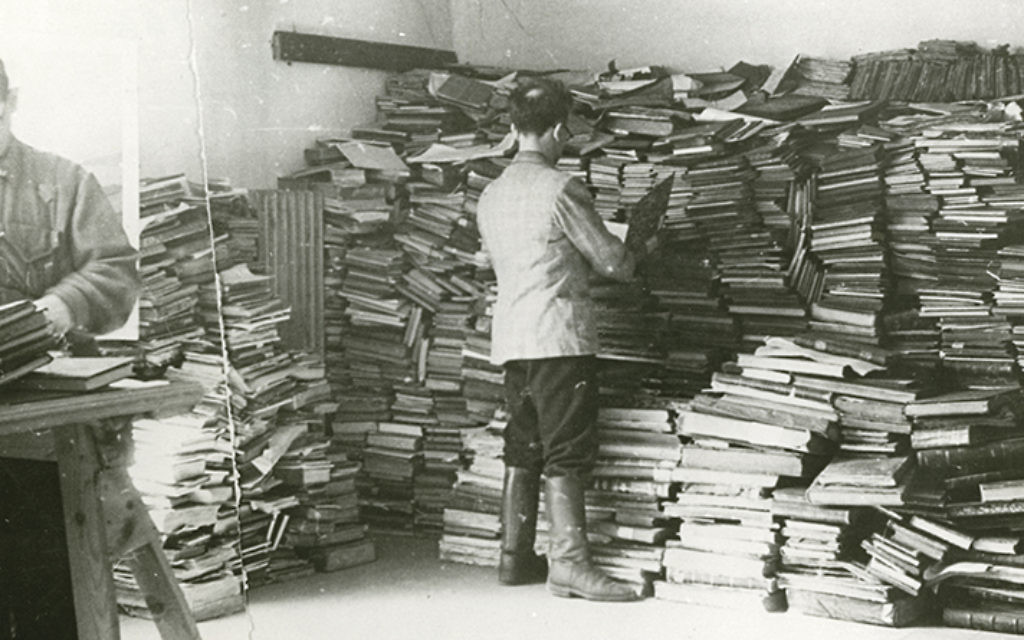
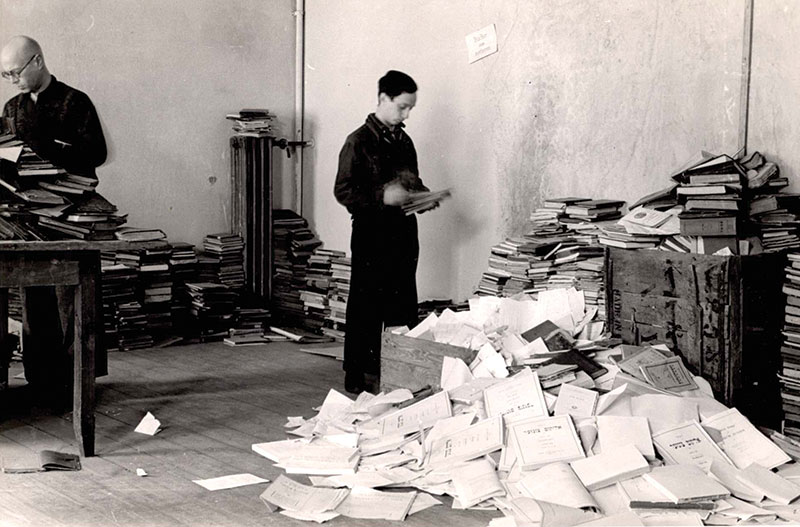
But maybe books—which I’ll use as a synonym for cultural artifacts generally: I mean representations—are different from other things. Do books have a special quality that is either the same as or, if different, then morally equivalent to the one that we rightly assign to people? These thoughts were prompted by my reading of David Fishman’s The Book Smugglers: Partisans, Poets, and the Race to Save Jewish Treasures from the Nazis, a book centered on events in Vilna, Lithuania, known for centuries “the Jerusalem of the North” because of its status as a center of Jewish learning and study.

Fishman’s story begins in the interwar years, when Vilna was part of Poland. (Before WWI, it had been ruled by Russia for 125 years; today, Vilnius is in Lithuania.) Almost 30% of its 193,000 inhabitants were Jewish, making it the fourth largest Jewish city in Poland. But its cultural weight was even greater. Its Great Synagogue, modest looking from the outside (by decree, synagogues had to be shorter than churches), astonished visitors, who descended a staircase and looked up at its marble columns and silver ornaments. Nearby was the home and synagogue of the Vilna Gaon (genius), Rabbi Elijah, an 18th century Talmudist, and spiritual head of the Misnagdim, the opponents of Hasidic Judaism.

But by the 20th century much of Vilna’s Jewish life was secular. The most famous Yiddish play, S. Ansky’s The Dybbuk, was first performed there in 1921. The Strashun Library, “the intellectual hub of Jewish Vilna” contained 40,000 volumes and was open even on Shabbat and Jewish holidays. A Jewish gymnasium (academic high school) taught modern chemistry and physics in Yiddish. Publishing companies and newspapers pumped out Jewish books and reported on Jewish life. Most importantly, Vilna was home to the Yiddish Scientific Institute (YIVO), “a modern research academy that employed the methods of the humanities and social sciences to study Jewish life.” Founded in 1925, by the 1930s YIVO had branches in Berlin, Paris, and New York (the latter is still around). Befitting its status as what Fishman calls “the national academy of a stateless people, the Jews of Eastern Europe,” YIVO held a vast archive of all things related to Jewish life: religious texts, but also folksongs, playbills, posters, you name it. YIVO housed scholars but also offered wide-ranging educational programming for general audiences.

Having introduced the setting, Fishman turns to some of the key players (helpfully introduced in a Dramatis Personae). They include:

Shmerke Kaczerginski (1908—1954), known as the heart of the “Young Vilna” literary group. This poet and sing-songwriter had been orphaned at a young age and educated at night school. After the invasion of Vilna in 1941 he spent seven months roaming the countryside disguised as a Polish deaf-mute, but voluntarily slipped into the ghetto in 1942 where he and Avrom Sutzkever (see below) became inseparable. He participated in the failed ghetto uprising and escaped to the forest where he joined a band of partisans. After the war, Kaczerginski set up the Vilna Jewish museum, the first post-Holocaust Jewish museum. He clashed repeatedly with Soviet authorities, however, and, after ensuring that many of the documents that survived the war were shipped to YIVO in New York, he left Vilna, first for Lodz, then Paris and, in 1950, Argentina, where he died a few years later in a plane crash.

Zelig Kalmanovitch (1885—1944), who held a doctorate from university in Königsberg, became co-director of YIVO in 1928. In midlife, he was increasingly religious and Zionist. Known as “the prophet of the ghetto” for urging those imprisoned to maintain their dignity.

Rachela Krinsky (1910—2002) was a historian and high school teacher whose (first) husband died weeks after the German invasion of Vilna, leaving her with a small child. Krinsky later gave her daughter up to the girl’s Polish nanny in hopes she might survive outside the ghetto. The girl did, and the two were later reunited.

Herman Kruk (1897—1944) had been the director of the largest Jewish library in Warsaw, an ardent Bundist who believed books were central to Jewish flourishing. Kruk fled Warsaw for Vilna after the German invasion of Poland in 1939. He turned down the chance to emigrate to the US in 1940 because he hoped to track down his wife and child, who were trapped in Warsaw. (They perished.) In occupied Vilna, Kruk became the director of the ghetto library, an enormously popular and life-affirming institution. He kept a diary of his experiences in the ghetto and beyond, after he was deported to various labour camps. Miraculously, this document survived, though Kruk did not. (It’s available in English, but it’s very expensive!)

Abraham (Avrom) Sutzkever (1913-2010) is the most famous person in this story: the poet laureate of Young Vilna, and probably the greatest Yiddish poet of the 20th Century (Jakob Glatshteyn would seem to be his main competitor). Sutzkever escaped death many times, first in the ghetto and later with the partisans in the forests of Lithuania. (His infant son, murdered in 1942, was not so lucky.) From there, Sutzkever was brought by special plane to Moscow (the Soviets plucked him out of the forest), but he returned to Vilna at end of war. Sutzkever later testified at Nuremberg trials, made his way to Paris, and eventually settled in Mandate Palestine, later Israel.

All these principals were members of the paper brigade, a work detail founded in February 1942 to sort through Jewish documents for the Nazis. The brigade was founded at the insistence of Johannes Pohl, a former Catholic priest turned Nazi orientalist who worked for the Einsatz Reichsleiter Rosenberg (ERR), the agency in charge of looting cultural treasures in occupied Europe. Much of that plunder was Jewish; Pohl, who had lived and studied in Jerusalem, was appointed a Judaica expert. Soon after, he was named chief librarian at the Institute for Investigation of the Jewish Question in Frankfurt. (The Nazis planned to commemorate the people they had exterminated.)

Pohl had first arrived in Vilna in July 1941, just weeks after the German invasion. At that time, he arranged for a mass of Jewish material to be shipped to Frankfurt. But the YIVO archives were so big a dedicated work detail was needed to sift through the materials. Thus the “paper brigade,” which gave surprising shelter to the intellectuals and artists named above. The brigade was unusual in that it was one of the only all-Jewish work details (no non-Jewish overseers) and that its work took place outside the ghetto, as that’s where the YIVO building was located. As a result, the brigade was a peaceful place to work, with plenty of chances to snatch a cigarette and to hide valuable documents on one’s person for smuggling back into the ghetto. As you can imagine, such smuggling was dangerous; Fishman dramatizes various near catastrophes when workers were searched at the gates. For most of the Jews imprisoned in the ghetto, however, the paper brigade was not a desirable work assignment. Not so much because of their lack of interest in smuggling paper, or their fear of being caught if they did, but because opportunities for the most valuable kind of graft were almost nonexistent. You couldn’t find or trade any food while toiling in the YIVO archives.

Food, of course, was all-important. As was true in all the ghettos the Nazis set up across Eastern Europe, life in the Vilna ghetto was terrible: overcrowding, hunger, and despair were rife; these conditions led to widespread disease. Yet the Jews of Vilna also made heroic efforts at maintaining more than mere life. (That was true in other ghettos as well; Fishman sometimes implies that Vilna was unique in this respect, though I think that implication stems more from his focus: this isn’t a comparative work.)  A distinguishing feature of the Vilna ghetto was its lending library, composed of 45,000 titles, which was extraordinary well used. Fifteen months after its inauguration in September 1941, over 100,000 books had been checked out. Because the director, Kruk, kept detailed statistics, Fishman is able to show what kinds of people used the library and what kind of books they checked out. Users were mostly young, they mostly read novels, and most of those novels were what Fishman dubiously calls “pulp fiction” (Margaret Mitchell and Vicki Baum were especially popular). “Socially mature readers” gravitated to books that resonated with their own wartime experience. Favourite titles included War and Peace, All Quiet on the Western Front and, especially (heartbreakingly, all too pertinently) Franz Werfel’s novel of the Armenian genocide, Forty Days of Musa Dagh.

Kruk hung two signs near the circulation desk. One was prosaic:

Keep the books clean and intact; do not read while eating. Do not write in books; do not dampen them; do not fold pages or break bindings. If a reader has been ill with a contagious disease, he must notify the librarian upon returning the book.

The other exhortatory:

Books are our only comfort in the ghetto!

Books can help you forget your sad reality.

Books can transport you to worlds far away from the ghetto.

Books can still your hunger when you have nothing to eat.

Books have remained true to you, be true to the books.

Preserve our spiritual treasures—books!

Reading these words now, I’m filled with respect for this commitment to literature in the face of suffering. But I’m also filled with doubt—are these sentiments accurate or advisable? Kruk was aware that books in the ghetto were a narcotic, with all the double-edged qualities we might associate with the term. “It often seems to the ghetto librarian that he is a drug pusher,” he wrote, adding that it sometimes seemed what he saw in patrons was not so much reading as “self-intoxication.”

We often find references to fantasy in Holocaust literature: day-dreaming, sleeping, reveries, memories are regularly described as ways to help manage the situations victims found themselves in. It makes sense that books would do so too. But every description of a strategy for removing one’s self from current reality is immediately qualified: fantasy is as dangerous as it is helpful.

Similar ambivalence haunted the members of the paper brigade. “Kalmanovitch and I don’t know if we are gravediggers or saviors,” Kruk confided to his diary. Despite the relatively benign working conditions, workers were often in tears at what they were asked to do. Fishman compellingly shows how the protagonists of his tale regularly compared the fate of the cultural objects they were helping the Nazis spirit away and/or destroy to the fate of the Jewish people. When the brigade was first sent to the YIVO headquarters to begin their mission they found the place a ruin (it had been briefly used as a barracks), which papers piled a meter high in the basement: “It looked like after a real pogrom,” wrote one member. Kruk was even more explicit: “like everything here, [YIVO] dies in a mass grave, along with scores and scores of others … The mass grave, ‘the trash paper,’ grows bigger every minute.” Zelig Kalmanovitch—former YIVO co-director—wrote similarly in his diary. In an entry dated August 26, 1943 he notes:

I sorted books all week. I sent several thousand books to their destruction with my own hands. A mound of books is lying on the floor of the YIVO reading room. A cemetery of books. A mass grave. Books that are victims of the War of Gog and Magog, along with their owners.

Once again we see books equated to people. Both are vulnerable. Both can be murdered. (Even, as was true so often during the Holocaust, by their own—Kalmanovitch speaks of sending books to destruction in the same way members of the Sonderkommandos, for example, spoke or sending people to death.) There is a strong sense that people and books need each other. The paper brigade workers often used their lunch hour to read some of the books they were surrounded by, not idly but desperately. Rachela Krinsky later wrote of this intense experience: “Who knows? These might be the last books we ever read. And the books were also, like us, in mortal danger. For many of them, we were their last readers.”

Kuznitz2

Sorting through material at YIVO, April 1943

Fishman makes his story accessible without sacrificing nuance. Sometimes that informality misfires, as in a present tense reconstruction of smuggling scene at the beginning of the book, or a tour of pre-war Vilna, imaged to be given by Kaczerginski. But the book gets better as it goes along. Readers whose knowledge of the Holocaust is limited might find the topic a bit niche, yet they are exactly who I most wish would read The Book Smugglers. It’s important to understand that resistance took many forms in this period (knowledge that might help us imagine similar forms of resistance in our own, increasingly authoritarian times). It’s important to recognize that Jews suffered under both the Nazis and, after the war, the Soviets (not in the same way, to be sure, but neither regime was interested in enabling Jewish life). It’s important to see how Jewishness remained a problem in a post-war world still defined in nationalist terms, a problem that persists to this day. (A problem that, in a different world, could be taken as an opportunity.) And, finally, it’s important to think, pace my grad school professor, about how the objects we live among, perhaps especially those we use to tell the story of ourselves, are versions of ourselves. We shouldn’t mourn the lost manuscripts of Vilna—or the Buddhas of Bamyan—more than the death of the people who made, read, or otherwise appreciated them. But we shouldn’t disparage that mourning either. The destruction of the one is so tightly connected to the murder of the other.

(I was recently introduced to this footage of Avrom Sutzkever testifying at the Nuremberg trials–in Russian rather than Yiddish, as he desired, because, perversely, Yiddish was not a recognized official language of the trials. Anyway, he’s much more dashing than I expected!)

What I Read, February 2020

February. When was that? Oh yeah, when we were stressed and run into the ground by daily cares. Part of me wants that life back so much. But part of me thinks the world that generated those cares wasn’t all that great. I swing between terror (about illness and death, about financial and economic collapse, about those lines around the block at the gun shop) and hope (maybe things could be different on the other side of this). Mostly I feel paralyzed, with many things to do but little incentive to do them.

So what was happening in that long-ago time? The treadmill of the semester, mostly. Rumblings of the disease. (Would my students and I be able to take our trip to Europe? Long since canceled, of course.) The hockey playoffs drawing ever nearer. (Amazing how much time I spent on that stuff.) And, of course, some reading. To wit:

ESXWUfbX0AEttP1

Ruth Kluger, Still Alive: A Holocaust Girlhood Remembered (2001) One of thegreatest Holocaust memoirs, no, a fucking great book, period. Ruth Kluger is one of the original badasses. Unlike many Holocaust memoirs, Still Alive (even the title is a spit in the face of her persecutors) focuses as much on postwar as prewar and wartime life. Kluger’s persecutors are legion: the Nazis, of course, and all the silent Germans who acquiesced to them. But also all those who insist on minimizing or relativizing her experiences. And then there are the oppressive systems she’s had to live under, not least racism and patriarchy. (Kluger was one of the first to insist that the experience of the Holocaust was thoroughly gendered.) And, most painfully, the people closest to her: her first husband; an old friend (the well-known German writer Martin Walser); a great-aunt who, in prewar Vienna, took away Kluger’s streetcar ticket collection from her, deeming it dirty and vulgar; the distant familial connections in America who wanted little to do with her when she and her mother landed there in the late 1940s. (Kluger is a great hater and knows how to hold a grudge.) But of all these persecutors the greatest is her mother, the woman with whom she experienced the Anschluss, the depredations and degradations of Nazi Vienna, Theresienstadt, Auschwitz, Christianstadt, a death march, the DP camps, and finally postwar life in America. A woman who saved her and protected her, yet also tormented her, dismissed her, ignored her, even, it’s fair to say, hated her.

The more times I read Still Alive the more towering I find its achievement. I think this might be the fourth time I’ve taught it. Plus, I did the best job I’ve done with it yet, which was satisfying and solidified my love for the book. I sense readers are catching up to it. In the past, students have felt intimidated by it, even a little shocked. The new generation, angrier, eats it up.

Paulette Jiles, News of the World (2016) Charming without being cloying. News of the World is one of my finds of the year, and I’m pretty sure it’ll be on my end-of-year list. (Look at me with the optimism.) I’d never read Jiles before, only vaguely been aware of her, but now I’m making my way through the backlist.

 News of the World centers on one Captain Jefferson Kidd, who travels through post-Civil War Texas offering readings from a collection of newspapers that he periodically replenishes whenever he reaches a larger town. (Audience members drop their dimes into an old paint can.) He’s a performer, knowing just how much political news he can offer before tempers flare (Texas in these days is roiled by animosity between those supporting the current governor and those opposed) and offering enough news of far-off explorers and technological inventions to soothe, even entrance the crowds. At one such gig near the Oklahoma border an old friend begs him to take charge of a ten-year-old girl who had been stolen from her family by the Kiowa four years earlier and has now been retaken by the US Army. Kidd is prevailed upon to take the girl to her nearest relations, in the country near San Antonio, four hundred dangerous miles south.

Johanna has forgotten English, has no memory of her parents, is devastated by the loss of her Kiowa family and its culture. The novel considers such matters as cultural difference (which it is much more sensitive about than most of the Westerns I’ve been reading lately) and U.S. history (the Captain has fought in three wars, going back to the war of 1812—he’s in his 70s and his great age is part of the story’s poignancy) and the question of whether law can take root in the wake of years of lawlessness. It’s an adventure story and a guide to the Texas landscape. But mostly it’s the story of the bond that arises between the old man and the young girl. And all of this in less than 250 pages. The Captain becomes ever fonder of the child (not in a creepy way, it’s totally above board in that regard), but the feeling hurts him. He senses nothing but heartbreak can come of the situation, and his heart doesn’t feel up to it. I was moved and delighted and recommend it without reservation—could be just the ticket when you’re stuck inside feeling anxious.

Apparently they’ve made a movie and it stars Tom Hanks and probably everyone’s going to love it but I bet it’ll be as saccharine as shit.

Philip Kerr, Prussian Blue (2017) Regular readers know I’m marching though Kerr’s series. This one is especially despairing and cynical, which for this series is saying something. Moving between 1938 and 1956, it finds Bernie Guenther on the run and reminded of an old case in which he was dragooned into finding out who shot a flunky on the balcony of Hitler’s retreat at Bechtesgaden. Set as they are amid the Third Reich, all of these novels are about corruption, but the stink is especially pervasive here. Not the series’ best, though as always Kerr is great at dramatizing history: in this case he particularly nails the Nazi reliance on amphetamines.

Sarah Gailey, Upright Women Wanted (2020) “Are you a coward or are you a librarian?” Tell me you don’t want to read the book that accompanies this tagline. Yet the problem is that the former seems the product of the latter instead of the other way around. Gailey’s novel of a future run on Handmaid’s Tale lines is engaging but slight. Gailey doesn’t much go in for world-building: it’s unclear what happened to make the former western US states technologically poor, violently misogynistic, hardscrabble and suspicious (not really a stretch). Instead, she focuses on the role of the librarians who make their way by wagon-train through the western desert, officially bringing state-sanctioned propaganda to fortified settlements but unofficially acting as couriers for a fledgling resistance. The librarians are women who get to shoot and ride and swear and live, enticing exceptions to the rigidly prescribed gender roles of the times. Upright Women Wanted is a queer western that includes a non-binary character; its most lasting legacy might be its contribution to normalizing they/them/their pronouns. In the end it was too casual/slapdash for me, but I enjoyed reading it well enough for the hour or two it demanded of me.

Eric Ambler, Epitaph for a Spy (1938) Apparently the amateur who falls into an espionage plot is Ambler’s stock in trade. I’ve actually read one or two of his books, but so long ago that I’d forgotten this description, if I ever knew it. Anyway, the machinery of this formula hums along at high efficiency in this finely executed story of a schoolteacher who gets mistaken for a spy and then has only days to find out who among the guests at his Mediterranean pension is the real culprit. The way states use the precariousness of statelessness (the fate of many of the book’s characters) remains painfully timely. For more, read Jacqui’s review. (I know other bloggers have reviewed this too. Please tag yourself in the comments.)

Magda Szabó, Abigail (1970) Trans. Len Rix (2020) The back cover of this new translation of Hungarian writer Szabó’s most popular novel hits the Jane Austen comparisons hard. At first I found this idea both implausible and annoying (it used to be that publishers and reviewers compared books to Austen when they meant “this is set in the 19th century and includes a love plot” but now it seems to have expanded to mean “this book is by a woman”), but as I read on I started to see the point. For Abigail, like Emma, is focalized through a young woman who thinks she knows more than she does. Yet where Austen’s protagonist misunderstands love, Szabó’s misunderstands politics. Gina is the willful teenage daughter of a general in the Hungarian Army during WWII. She is baffled and hurt when her father abruptly sends her to a convent school far from Budapest. The first half of the book is classic boarding school story—Gina is a haughty outsider, she alienates the other girls, she struggles to become part of their cliques—but, after a failed escape attempt, as the political situation in Hungary changes drastically (the Germans take over their client state in early 1944; Adolf Eichmann is sent to Budapest to oversee the deportation of what was at that point the largest intact Jewish community in Europe), Gina learns how much more is at stake than her personal happiness. That realization is marked in her changed understanding of the book’s titular character, which is, in fact, not a person but a statue on the school grounds with whom the girls leave notes asking for help or advice. Eventually it becomes clear that Abigail—the person who answers those notes—is a member of the resistance, and in real danger. But who is it? Throughout Szabó juxtaposes our knowledge with her heroine’s ignorance—in the end, the effect is like that of her countryman Imre Kertesz’s in his masterpiece Fatelessness. Both novels challenge our reliance on what psychologists call “hindsight bias” (reading the past in light of the future).

Téa Obrecht, Inland (2019) Another one for my little project of westerns written by women (specifically, ones I can get on audiobook from my library). Like a lot of literary fiction today Obrecht’s novel goes all in on voice. She alternates between two first person narrators. Lurie, the son of a Muslim immigrant from the Ottoman Empire, ends up after a picaresque childhood on the lam and is rescued from lawlessness by joining the United States camel corps (a failed but surprisingly long-lasting attempt to use camels as pack animals in the American west). Nora, a homesteader in the Arizona Territory whose husband has gone missing when he went in search of a delayed water delivery, teeters on the verge of succumbing to thirst-induced delirium exacerbated by her guilt over the death of a daughter, some years before, from heat exhaustion. Lurie tells his story to Burke, and it takes a long time before we figure out that Burke is his camel. (I confirmed with some other readers that this wasn’t just an effect of my listening to the audiobook, which, I find, makes it easy to miss important details.) Nora tells her story ostensibly to herself but really to the ghost of her daughter. So the stories—which of course ultimately intersect in a surprising way—are similarly structured as confessions. Nora’s is the more successful—her combination of intelligence and wit and hurt and delusion comes through powerfully. She’s just a great character. Lurie has his moments, too, especially near the end, but I was always a little disappointed when we left Nora for him. The book has a hallucinatory quality—in this it reminded me a bit of Jim Jarmusch’s wonderful film Dead Man—that works the hysterical realism angle more successfully than most. I don’t regret listening to the book and by the end I was pretty moved by it, but I also found it too long and too unsure of itself. In her excellent piece, Rohan really gets the book’s betwixt and betweenness. But boy if you want to feel anxious and thirsty, Obrecht is your woman. Never has the watery juice of a can of tomatoes seemed such a horrible relief.

Vivian Gornick, Unfinished Business: Notes of a Chronic Re-Reader (2020) In this short book about re-reading, Gornick presents re-reading as a way of thinking about our self over time. Unfinished Business begins with an autobiographical chapter about Gornick’s life as a reader, which riffs on and is itself an example of the distinction between situation and story she articulated in a brilliant book of that title several years ago (situation is something like experience, the raw material of our lives; story is the way we articulate that experience, the way we transform it through reflection/writing: I use this distinction in my writing classes all the time). The book then offers several case studies of writers who have meant a lot to Gornick. I found the chapters on D. H. Lawrence and Elizabeth Bowen especially good; not coincidentally these are writers I’ve very familiar with (which bodes well for her readings of writers I don’t know, like Colette and Natalia Ginzburg). Gornick combines the history of her own reading (what she first loved in Sons and Lovers only later to disavow as misguided, what she emphasized in her second reading, and so on) with succinct summaries of what makes each writer tick.

Here she is, having re-read Adrienne Rich’s conclusion about Dickinson—that extreme psychological states can be put into language, but only language that has been forged, never in the words that first come to us—thinking about Bowen:

She had created stories and novels meant to acquaint the reader with the power of the one thing—the extreme psychological state—that she deeply understood: namely, that fear of feeling that makes us inflict on one another the little murders of the soul that anesthetize the spirit and shrivel the heart; stifle desire and humiliate sentiment; make war electrifying and peace dreary.

On Duras:

For years this [buried events, hidden feelings] was Duras’s mesmerizing subject, inscribed repeatedly in those small, tight abstractions she called novels, and written in an associative prose that knifed steadily down through the outer layers of being to the part of oneself forever intent on animal retreat into the primal, where the desire to be at once overtaken by and freed of formative memory is all-enveloping; in fact, etherizing.

On Ginzburg:

Ginzburg’s abiding concern, like that of any serious writer, has always been with identifying the conflicts within us that keep us from acting decently toward one another.

If what Gornick calls the Freudian century is not for you, then give this book a pass. But if the idea that the self we so identify with is only a small part of what we are rings true to you, you’ll find Gornick’s readings sympathetic. I loved the short final chapter describing her shame and bewilderment, on taking up a favourite (unnamed) book, at the passages she had marked in earlier readings. How could that have interested her? Didn’t she see how obvious or trite or embarrassing this aspect of the text was? But then: “My eyes drifted to a sentence on the page opposite where nothing was underlined, and I thought, Now here’s something really interesting, how come this didn’t attract your attention all those years ago.”

May such a life of reading be given to us all.

Robin Wall Kimmerer, Braiding Sweetgrass: Indigenous Wisdom, Scientific Knowledge, and the Teachings of Plants (2013) A book about reciprocity and solidarity; a book for every time, but especially this time.

EPaeo83XUAA4pJ_

In sum, a good month: Kluger, Jiles, Szabó, Gornick, and Kimmerer all excellent. Which is good because so far, social distancing is not given me the promised bump in reading time. Until next time I send you all strength, health, and courage in our new times.

“All Flourishing is Mutual”: Robin Wall Kimmerer’s Braiding Sweetgrass

“All flourishing is mutual.”

I read Robin Wall Kimmerer’s Braiding Sweetgrass: Indigenous Wisdom, Scientific Knowledge, and the Teachings of Plants last month for a faculty, student, and staff reading group organized by one of my colleagues in the Biology department.

That was in the middle of a wave of protests across Canada regarding indigenous rights (more specifically, their absence), prompted by an RCMP raid against the hereditary chiefs of the Wet’suwet’en Nation, who along with their allies are seeking to prevent a pipeline from being built across their unceded territory. To me the Wet’suwet’en protests felt like such an important moment in Canadian political life. Unfortunately, it seemed that the unwillingness of settler Canadians to acknowledge their status as such would once again win the day, but I was heartened by the wide-ranging solidarity shown the protesters.

Now, only a few weeks later, when I’m finally making the time to set down my thoughts about Kimmerer’s remarkable book, that moment seems a lifetime ago. Life has been overturned by COVID-19, and it feels as though we will be lucky if that upheaval lasts only into the medium term.

Yet perhaps even more now than last month, Kimmerer’s teachings feel timely, even urgent. “All flourishing is mutual”: what else are we learning now, unless it is the opposite—when we fail to be mutual we cannot flourish. We are only as vibrant, healthy, and alive as the most vulnerable among us. We see that now, clearly. But can we be wise enough to live that truth?

il_570xN.733550547_a74l

For an example of mutual flourishing, Kimmerer considers mycorrhizae, fungal strands that inhabit tree roots. They connect the trees in a forest, distributing carbohydrates among them: “they weave a web of reciprocity, of giving and taking. In this way, the trees all act as one because the fungi have connected them.”

The particular context of Kimmerer’s conclusion is a discussion of mast fruiting (i.e. nut production). It takes a lot of energy to make nuts, much more than berries or seeds. Mast fruiting trees spend years making sugar, hoarding it in the form of starch in their roots. Only when their stores of carbohydrates overflow do nuts appear. And when one tree in a forest produces nuts they all do—the trees act collectively, never individually.

For Kimmerer, mast fruiting is a metaphor for how to live. As she says, in a phrase that ought to ring out in our current moment, “We make a grave error if we try to separate individual well-being from the health of the whole.”

One name Kimmerer gives to the way of thinking that considers the health of the collective is indigeneity. For me, this is a generous, even awe-inspiring definition. It transcends ethnicity or history and allows all of us to think of ourselves as indigenous, as long as we value the long-term well-being of the collective. “For all of us,” Kimmerer writes, “becoming indigenous to a place means living as if your children’s future mattered, to take care of the land as if our lives, both material and spiritual, depended on it.” Or, similarly, “The more something is shared, the greater its value becomes.” This statement is true both biologically and culturally. The pejorative term “Indian giver” arises, Kimmerer suggests, from a terrible and consequential misunderstanding between an indigenous culture centered on a gift economy and a colonial culture based on the concept of private property. In indigenous cultures, gifts are to be shared, passed around. (Thus it is offensive to keep something you have been given without passing it to others in some form.) But those same cultures insist that gifts aren’t free: they come attached with responsibilities. (She compares these to rights in a property economy.)

The question for me, then, is whether in a market economy we can behave as if the earth were a gift. Reading Braiding Sweetgrass was almost painfully poignant; I couldn’t reconcile what I experienced as the rightness of Kimmerer’s claims with the lived experience of late capitalism. (Someone on Twitter joked recently how touchingly naïve that “late” is.) I just can’t figure out how to get from here (our ravaged planet, our unbridled consumption) to there. Yes, it’s true, Kimmerer offers examples, not least in a chapter in which her students brainstorm ways each of them can give back to the swamp they’ve been on a research field trip to. The people in my reading group pointed out that change has to be local, that we can’t be responsible for the big picture, that we need to avoid paralysis. True enough. But the genuine hopefulness of Kimmerer’s words sometimes had the contradictory effect of making me feel despair.

It is true, though, that Kimmerer offers some practical advice for how to return our world to a gift economy. She urges us to name people, places, and things (especially the things of the natural world), as if they had the same importance. To consider the significance of nonhuman people. To speak of Rock or Pine or Maple as we might of Rachel, Leah, and Sarah. She suggests we emphasize ways to develop ceremonies in our daily lives, for these create belonging. (This could be a moment of meditation in the morning, or a shared weekly meal, or the injunction, as pertained in her family, to never leave a campsite without piling up firewood for the next guests.) In this way we might live in gratitude for the world, and the opportunity we have to contribute to its flourishing. Kimmerer asks that we join in her mindset: “My natural inclination,” she writes in a moment of characteristically lucid self-description, “was to see relationships, to seek the threads that connect the world, to join instead of divide.”

I fear I have not given a good sense of this book. Its essays cover all sorts of topics: from reports of maple sugar seasoning (Kimmerer is from upstate New York) to instructions for how to clear a pond of algae to descriptions of her field studies to meditations on lichen. I particularly love the moments, like her description of mast fruiting, when she teaches us about the natural world. As she says, “sometimes a fact alone is a poem.” (But she also says “that metaphor is a way of telling truth far greater than scientific data.”) Kimmerer is a scientist, a poet, an activist, a lover of the world. She seems fun, if a bit dauntingly competent. She challenges the idea of (scientific) detachment: “For what good is knowing, unless it is coupled with caring?” (I will say, she likes rhetorical questions too much for my taste.)

The book concludes with a meditation on the windigo, the man-eating monstrous spirit from Algonquin mythology. Kimmerer suggests that the windigo rests potentially in all of us, less a monster than an aspect of human being. That aspect can only be thwarted or defeated by a purgation: rather than hoard we must give (back). The world is not inexhaustible; it is finite. But the braiding of reciprocity is a powerful tool that nature and culture alike has given us to stave off that finitude.

Alex-Janvier-Wandering-Child.jpg

I do have quibbles with Braiding Sweetgrass: it’s too long, too diffuse. It’s hard to figure out why it takes the form that it does. I liked that its structure is not chronological or geographical or even cyclical/seasonal. But, reading, I sometimes found myself adrift. We could say that the book moves loosely from theory to action (towards the end, there are a couple of chapters offering what might be called specific case studies—how people have responded to particular ecosystems). It’s possible the book has some more complicated structure—like that of the rhizome perhaps, the forkings of those mycorrhizae invisibly linking tree to tree—that I can’t see. But I found myself, after finishing the book, having a hard time remembering individual essays. The whole matters more than the parts, I think, even though Kimmerer is a good essayist, deft at performing the braiding of ideas demanded by the form.

More significantly, I am not sure how to reconcile Kimmerer’s claim about indigeneity—that it is a way of being in the world that speaks to our actions and dispositions, and not to ethnicity or history—with her more straightforward, and understandable, avowal of her indigenous background. (She is a member of the Potawatomi people and writes movingly about her efforts to learn Anishinaabe.) What, I’m left wondering, is the relationship for her between becoming indigenous and being indigenous? The former seems like a metaphor; the latter an embodied reality. Sometimes Kimmerer opens indigenous ways of being to everybody; more often, though, she limits them to Native people. I’m unconvinced this is an insuperable difference, but it’s not one Kimmerer resolves, or, as best I can tell, even sees.

Yet I’m left convinced, after spending several hundred pages in the company of her authorial persona, that Kimmerer would be more than happy to talk through my confusion, perhaps even be able to show me that what I perceive as a problem might in fact be the way to a solution. So powerful is the sensation of good will and generosity given off by this book. Although the settler in me worries it is grandiose to say so, perhaps my thoughts in this post, however meager, can be taken as my way of giving something back for the gifts Kimmerer has given me. May you accept them as such.

What I Read, January 2020

Although everything else in the world was pretty much shit, January was a good reading month. I was still on break the first two weeks, which certainly helped. I’ve realized that all I need to be happy is to cut out sugar, run twice as much as usual, and not work. Simple! Here’s what the Happy Man read:

EOwvn31WAAAofRf

Vladimir Nabokov, Mary (1926) Trans. Michael Glenny in collaboration with the author (1970) Nabokov’s first novel, really more a novella, is predictably good. His strengths are evident: moments of intense lyricism, typically invoking sensory experience, and ironic reversals of conventional thinking, specifically, here, what it means to be an exile. In his introduction to the English translation (if he didn’t have such tiresome animosity toward Freud his introductions might be on par with James’s), Nabokov notes with possibly genuine surprise that the depiction of exile in this early work aligns closely with the one in the much later and more famous Speak, Memory. As is typical for Nabokov, though, his interest in social-political-material experience is more abstract than concrete. If you want to know details about émigré life in western Europe in the 20s and 30s you would be better to read Berberova, Gazdanov (I’m guessing—haven’t yet actually read him) or the wonderful and too-little known David Vogel. Still, I appreciated the ending’s sly reversal, which suggests that Nabokov was from the beginning a comic writer (not as in funny but as in a writer of texts that end happily, or with their losses repaired or made good, as opposed to tragedy).

I planned to read all of Nabokov’s Russian novels this month, but I didn’t.

Tim Maughan, Infinite Detail (2019) Novel toggling between a Before (plausible and only slightly extrapolated version of life today) and an After (post-apocalyptic), the pivot event being a sudden and seemingly irrevocable loss of the internet, and networks more generally. The story focuses on a group of hackers and activists, whose protests against nonstop surveillance and late capitalism is initially confined to a vibrant, boisterous neighbourhood in Bristol, but who, we slowly learn, become instrumental in the crash, with results none of them expected. This essayaccurately criticizes the novel’s romantic/individualistic ideology (for a book about systems and networks it spends a lot of time thinking about the power of individuals to change the world), but it ignores what I thought was the best part of the book: its nuanced portrayal of the new kinds of intimacy that online life has enabled. These aren’t just feeble versions of “real” face-to-face relationships. Infinite Detail is also optimistic about the kinds of art that survivors of a collapse of capitalism as we know it might engage in (aligning it with something like Kim Stanley Robinson’s New York 2140). The result was too much (if not quite infinite) detail about future pop music for my taste, but I appreciated the idiosyncrasy. (Also, making Bristol the center of things, that’s pretty cool.) I also wondered if Maugham was writing with J. G. Ballard in mind. Consider this passage, describing a character’s return to Bristol several years after the collapse:

She’s strangely embarrassed that part of her had imagined walking out into some huge abandoned space: a bourgeois science-fiction fantasy of a long-lost civilization where she’s the special one, the only survivor that could see past the crass commercialism of the masses and got out in time, the intrepid, educated explorer unearthing this forgotten, archaic relic of barbaric capitalism, an empty cave filled with unfamiliar, alien branding.

Andrew Miller, Now We Shall Be Entirely Free (2018) This is going to be on the end of the year list, I know it already. Now We Shall Be Entirely Free (wasn’t crazy about this title until the very end of the novel, when it became so interesting, so poignant) gave me the kind of reading experience I had more often as a child than I do now. I was enthralled, I was moved, I was anxious (for the fate of the characters), I couldn’t wait to find out what happened next, but I feared leaving the world of the book. It’s that last quality that’s so rare—mostly I’m eager to get on to the next book, but this time I wanted to linger. I would like to read this book again, even though it’s unlikely I would ever teach it, and that too is something I rarely say.

The novel follows John Lacroix, who returns, badly wounded, to England from the war against Napoleon. Something happened to him in Spain—he saw something, did something, knew something—that has damaged his mind as much as illness has damaged his body. Tentatively, almost unwillingly, he returns to life and eventually gets it into his head that he will travel to the Hebrides to gather folk music (he is a violinist in addition to having been a soldier and an aimless son of landed gentry). Two men are sent after him: I won’t say too much about it, since the plot is genuinely suspenseful, but it has been decided that Lacroix must be punished for the events in Spain. One of the men is a bad man. And bad things happen. In the Hebrides, Lacroix stumbles across a small utopian community which he sinks into with, to him, unexpected gratitude. But he is unknowingly bringing danger to those he is becoming close to.

Now We Shall Be Entirely Free concerns violence, trauma, early 19th century politics, and early 19th century medicine without ever being plodding or padded. It’s gorgeously written without striving for “poetic-ness.” In its ability to manifest the foreignness of the past, Miller’s novel reminded me of Penelope Fitzgerald. And that’s pretty much the highest praise I can offer.

Please read Rohan’s review—she says it better than I do.

Dorothy B. Hughes, Dread Journey (1945) I admire Hughes a lot, especially The Expendable Man, but she was an uneven writer. The recently reissued Dread Journey is one of her weaker ones. Set on a transcontinental train (very cool), it has a locked room vibe (less cool), but Hughes is always more interested in the why than the who. But I found the characters mostly uninteresting, even the Canadian (!) ingenue. What Hughes always excels at is creating and exploring terror, dread, fear. So many of her female characters are in a continual state of near-panic. That’s what makes her work still feel timely.

Helen Garner, The Spare Room (2008) I read this in a few hours, loving it from beginning to end. Then I spent the rest of the day following a fascinating conversation about it on Twitter. Garner, it turns out, is a polarizing writer. (Though I sometimes got the sense that the Australians, in particular, who dislike her do so because she takes up too much space in the country’s literary discourse, and that the bien pensant media has anointed her as their literary/national standard bearer. Not Garner’s fault that she’s so great, though!) Anyway, I’ll definitely read more; I’m particularly curious about her nonfiction. (Her true crime writing really divides readers.) The Spare Room reminded me of Doris Lessing, though it’s much more interesting at the sentence level. Two old friends reunite when one comes down to Melbourne from Sydney to stay with the other while she pursues what her friend at first privately and then not so privately deems a dubious (read: completely bullshit) alternative treatment for her advanced cancer. A smart and beautiful book about fear and anger.

Sandra Newman, The Heavens (2019) The strange tale of a woman who is drawn from an alternate version of the present or near-future to 16th Century England, I enjoyed this novel as I was reading it but now I can barely remember it. The more she travels between times the more the present alters, and for the worse. Eventually the world that has banded together to mitigate, even circumvent climate change becomes our own. Each time she visits the past she becomes more intimate with a young man who, in the first iterations of the past, occasionally scribbles verses and, in later ones, becomes William Shakespeare, Famous Playwright. The price of his fame is the brutalization of the world. In retrospect, this premise seems nonsensical, an odd way of asking readers to consider what it means to value individuals over collectives. All I can say is at the time I was under the book’s spell—dreamy and oblique—but now, well, the spell is broken. This review is too harsh, in my opinion, but also on to something. In the end, The Heavens is less interesting than Du Maurier’s The House on the Strand.

Nina Berberova, The Book of Happiness (1996?) Trans. Marian Schwartz (1999) A Russian novel about happiness? Surely not. It’s true, though, and although I was pitting Berberova against Nabokov a moment ago, they share a sense that exile, although enormously destructive in many ways, isn’t just about loss. The Book of Happiness begins with the suicide of Sam Adler, a Russian violinist, in a Paris hotel. He leaves behind a note addressed to a woman he hasn’t seen in years, who herself lives in Paris, and turns out to have been his best friend in childhood. After identifying the body, Vera reflects on their long acquaintance, especially their years as childhood playmates and confidantes. This is the best part of the novel—I found it magical, though it might be a bit Wes Anderson for some tastes (“I’m a violinist. What are you?” Vera replied mechanically, “I’m just me.”). The middle section, describing Vera’s ill-fated marriage and departure from Russia in the wake of the Revolution, flags a bit, but the ending, which is indeed happy, though in a low-key way, worked for me. (Berberova seems to be speaking of herself, or at least her style, when she writes that “Vera regarded everything excessively emotional with embarrassment.”) Berberova doesn’t shy from presenting the recued circumstances of exile, but to say, as a blurb on the edition I read does, that Berberova “rivals Jean Rhys in detailing the sights and smells and despairs of trying to exist as a stranger” in Paris tells me only that the reviewer has never actually read Rhys. Anyway, I read elsewhere that the translator, Marian Schwartz, finds The Book of Happiness ultimately unsuccessful, but I have to disagree.

PS I don’t know when this book was written. 1996 is the date of its publication in France, but Berberova wrote it, I believe, in the 1930s, in Russian, which is the language Schwartz has translated it from. I’m unclear if it was never published at all until the 90s or if with some small exile press or what. Anyone know?

Nate Leipciger, The Weight of Freedom (2015) This is part of the Azrieli Foundation’s extraordinary effort to collect and publish in excellent and pedagogically useful editions (good introductions, glossary of terms students might be unfamiliar with) memoirs by Holocaust survivors who settled in Canada. Leipciger’s book is perhaps best known for his frank description of his experience as a pipel (a messenger boy in the camps—typically, this role, which came with privileges like better rations, also required providing sexual favours). The sexual violence Leipciger experienced naturally left its mark on him, but exactly how is hard to say, as it’s not easy to get a read on his tone. (He is not a professional writer: the flatness of the telling sometimes seems a function of inexperience, and sometimes of (perhaps unconscious) reticence.) Yet as one of the students with whom I read the text pointed out, to single out this aspect (the sexual abuse takes up about 2 or 3 pages in a 350-page book) is to sensationalize the experience, risking further victimizing the victim. Yet sexual violence against both men and women was common during the Holocaust; this fact is not often enough acknowledged. Just as interesting for me, as a Canadian, was Leipciger’s ability to think about his suffering in relation to that experienced by indigenous people.

The Weight of Freedom covers Leipciger’s truncated childhood in Chorzów, Poland; his internment in various ghettos, including a period in hiding; his deportation to Auschwitz-Birkenau, Fünfteichen, Gross-Rosen, Flossenbürg, and eventually a sub-camp of Dachau, from where he was liberated; his time as a DP in post-war Germany (in which he pursued an active sex life that he freely admits involved an element of revenge); his eventual emigration to Canada; and the long years building up a life there, which, as the title of the memoir suggests, was by no means easy, not so much economically as psychologically. Throughout he is accompanied by his father, a man with whom he has a difficult and intense relationship (those who have read Wiesel’s Night will find similarities). In later life, Leipciger settles into a role as a Holocaust educator; one of the things I like best about him is that he loves young people, he has no scorn or distaste for them. Always a good sign if you ask me.

Omer Bartov, Anatomy of a Genocide: The Life and Death of a Town Called Buczacz (2018) Today Buczacz is a nondescript town in western Ukraine. In the past 150 years it’s also been part of the Hapsburg Empire (specifically Galicia), independent Poland, the Nazi Reich, and the Soviet Union. In the first half of the 20th century it was home to Jews, Poles, and Ukrainians (perhaps better called Ruthenians—my one criticism of this book is that Bartov sometimes uses Ruthenian as a synonym for Ukrainian, and sometimes suggests there’s a difference, and I’m still confused about the distinction, which Wikipedia has failed to clear up for me. If you can, please do!). During WWI the front passed through Buczacz several times; during WWII it was similarly occupied by different armies at different times. In this fascinating book, Bartov, whose mother’s family hailed from the town, uses the history of Buczacz to show the intimacy of violence in the so-called Bloodlands of Eastern Europe in the 20th century. In his telling there was a seemingly ineluctable drive on the part of almost every group to reduce the region’s cultural diversity, and that much of the violence required to do so was perpetrated by one neighbour against another. During the Hapsburg times, Poles and Ruthenians agitated for independence. In the wake of WWI Ukrainians chafed under Polish rule, which led them to welcome the Nazis. After WWII the Soviets upheld Ukrainian claims to the area; in one of history’s ironies, that decision furthered the Ukrainian nationalism that Russia is now contesting in its dirty war in the Donbass.

Bartov shows how everyone was at one time both a victim and a perpetrator—everyone except the Jews, who suffered no matter who was in charge (they had it best under the Hapsburgs, leading many of them to defend the Empire ardently—cf Joseph Roth; they had it worst, of course, under the Nazis). Anatomy of a Genocide is at once granular and theoretical—an amazing accomplishment; it had me asking myself why I don’t read more history.

Nina Berberova, The Ladies from St. Petersburg: Three Novellas (1995?) Trans. Marian Schwartz (1998) Uneven but mostly engaging collection, once again detailing life before, during, and after the Russian revolution. The first and second stories (to me they are too slight to be novellas) are the best—the first, set at the very beginning of what people are not yet calling a revolution, depicts a vacation in the country during which a young woman is abruptly forced out of the comforts, and limits, of the life she’d known. The second centers on a woman who has challenged the norms of her culture by leaving her husband and is trying to keep ahead of the conflict between Whites and Reds; as the translator Marian Schwartz notes in her admirable introduction, the irony is that the women of the provincial boarding house she washes up at are much less accepting of the woman’s perceived transgressions than their political sympathies would suggest. The third, an uninteresting failure, is set in what is clearly New York though it is never named. Berberova spent much of her life in the US, but maybe she was never able to write about it convincingly. Probably not the best introduction to Berberova, but worth checking out once you’ve read some of her other stuff.

Carys Davies, West (2018) Many online book friends (and a real life one, the writer Kevin Brockmeier) have extolled this novella, and I decided to make it the first audiobook of the new semester (back to the commute…). Davies is a Welsh writer, but she lived in the US for quite a while, which must have helped her with some of the book’s settings. Cy Bellman is a mule breeder in Pennsylvania in the first part of the 19th century; this reviewsays 1815; I don’t know where that date comes from, nothing in the book says so, though it’s true my knowledge of US history is shamefully hazy so I probably missed something; certainly, events take place after the Lewis & Clark expedition (1804 – 06). In the newspaper Bellman learns that giant bones have been found in Kentucky (presumably from mammoths, or maybe dinosaurs, this was also unclear to me) and becomes obsessed with the idea that the creatures must still be alive, out west, and that it is his destiny to find them. To the disdain of his sister, whom he asks to look after his ten-year-old daughter, Bess, Bellman sets off for the frontier (St. Louis) and beyond. In Missouri, a trader sets him up with a Shawnee teenager, named Old Woman, who guides Bellman as far west as the Rockies. In the meantime—two years pass, then three—Bess fends off the local librarian and the increasingly unwelcome attentions of a neighbour, all of which leads to a dramatic, slightly preposterous happy ending, in which Old Woman plays hero. I admired some things about the novel: it’s spare, and enigmatic in a pleasing enough way, and the descriptions of the landscape are lovely without being overwritten. But I couldn’t get on fully on board, because I found the Shawnee character so troubling. As one might expect of a revisionist Western (I sometimes feel all Westerns are described as revisionist), the book critiques white settler attitudes to indigenous people. And yet it also embraces those attitudes: it’s not just that Bellman and others say that Indians can be bought off with a few shiny beads, but that Old Woman indeed loves shiny beads. Towards the end of the book, Davies shifts focalization from Bellman to Old Woman. Her attempt to inhabit a different way of looking at the world goes awry—Old Woman thinks in a way that seems not foreign but reduced, childlike, naïve. I just didn’t get what she was trying to do here. Maybe an interesting failure, but a failure nonetheless.

EPYaQVXXsAAiJ-K

There you have it. Miller and Bartov were the standouts. Berberova a great discovery (for me; I know others have been reading her for a while). February has already begun promisingly, reading-wise, but I know the pace will slow down as the semester hits full-force.

I was so happy this month to post my friend Nat’s reflections on his year in reading. I know we’re well into 2020 now and maybe nobody cares about 2019 anymore, but I’m happy to post reflections and lists from anyone. (I’ve asked a few folks; no takers so far.) In general, I’d love for EMJ to become more of a salon, so if you have something bookish you want to say, hit me up.


2019 Year in Reading

Looking back, I see that January to June was much better to me than July to December. I read all but one of the nine books that meant the most to me in 2019 in the first half of the year. It could be they’ve had the longest to marinate. It could be I was more tired, distracted, and at times distraught in the second half of the year (I was). It could just be the luck of the Book Gods.

Whatever the reason, I’ve a better record of my reading than ever before because 2019 was the year I started to write monthly reflection pieces. To my own surprise, I was able to keep this strategy up, which means I wrote at least a sentence or two about everything I read this year. Links to the monthly roundups are at the end of this post. If you want to know more about any of the texts I reference below you can always search by author. If you want to see previous year-end reviews, you can find them here: 2014, 2015, 2016, 2017 & 2018.

For those who like that kind of thing, a few stats: I read 136 books in 2019. 74 (54%) were by women; 62 (46%) were by men. 104 (76%) were originally written in English; 32 (24%) were translated. 16 were audiobooks. 7 were re-reads. (I include books I re-read for teaching in my list only if I re-read the whole thing, not if I dip into, skim, or speed re-read it.)

And now some thoughts on the books that made a particular impression on me, for good or ill.

1024px-1877-winslow-homer-the-new-novel

Best of the Bunch

Katherena Vermette, The Break. My Book of the Year. I think about The Break all the time, especially now that I am learning about the violence and injustice perpetrated on Indigenous Canadians, not just in the distant past, but in my own lifetime. I’ve spent my whole life thinking that Canada was a Good Place that has mostly been on the right side of history. It is in ways a good place. But the way its colonial violence (itself inexcusable) continues into the present, the way that violence was happening all around me in my childhood, the way that I was nevertheless able to remain blissfully ignorant—that really gets to me. (I know, I know, “Thanks a lot, privileged White Dude, for all your well-meaning soul-searching.”)

Anyway, I love how Vermette takes my favourite genre, crime fiction, opens it up and turning it inside out, enabling her to write about systemic racism and (sexual) violence while still using fictional conventions (such as strongly developed characters and a keen sense of place) that were developed to propagate ideas of individuality and willpower—ideas that largely shunted the people who experience structural violence to the margins.

I love too that Vermette is able to imagine an affirmative, even joyful ending to her story.

Sarah Moss, Ghost Wall. On first reading I actually wasn’t sure how well this worked, but fortunately I’d been given the chance to write about it for The Mookse & the Gripse, so I read it another couple of times. (It’s really more novella than novel.) And now like everyone else I recognize its brilliance. Timely—it addresses climate change, misogyny, fantasies of national purity—but not didactic. Plausibly harrowing without being a total downer. A book that will last.

Yiyun Li, Where Reasons End. So smart and so sad. Parents in particular might find this tough going. But I also found it joyous. Li isn’t showy, but her style is so compelling.

Virginie Despentes Vernon Subutex I/II. Didn’t think these would be my thing (being into neither pop music nor post 68 radicalism curdled into conservatism), but I fell for them in a big way. I’ll be ordering the third volume from the UK when it’s published there later this year. An indictment of neo-liberalism with the pleasures of a soap opera.

Miriam Toews, Women Talking. Another super-smart book that sneaks up on you. Dramatic events—the women of a Mennonite community in Bolivia find out that for years many of the men they live with have been drugging them at night and raping them—play second fiddle to the attempt to come to a collective response to trauma. The genius of the book lies in its narration: the largely illiterate women recruit the local schoolteacher, a man who grew up in the community but lived apart from it for years, to record their deliberations. Toews shows us, however, that every description is also an interpretation (recording isn’t just a neutral act), leading us to wonder how the self-understanding of an oppressed group (and the efforts of those not in that group to understand them) is affected by disparities in privilege.

Daphne Du Maurier, The House on the Strand. Fascinating and suspenseful story of time-traveler. Postulates that identity is a form of addiction. As in Rule Britannia, her final novel, written just a few years after House, Du Maurier here questions the continuity of Englishness.

María Gainza, Optic Nerve (Translated by Thomas Bunstead). Fragmentary essayistic auto-fiction-type thing of the sort I usually admire more than like. But Gainza’s book won me over, particularly her use of ekphrasis to connect representation and political violence.

 Philip Marsden, The Spirit-Wrestlers: A Russian Journey. The most joyful book I read last year concerns Marsden’s journey through the Caucasus in the early to middle 1990s, a place that fascinates him as a historical refuge for dissenters and schismatics of all sorts. Marsden is a good traveler, respectful of those he meets and their beliefs. But in the endless battle between idealism (which always curdles, murderously, into ideology) and humble materialism (the struggles and pleasures of surviving everyday life) he’s always on the side of the latter.

Sally Rooney, Conversations with Friends. Thoroughly enjoyable and really funny story of two young women in Dublin, best friends, and the older and much richer married couple they get involved with. Great dialogue. Doesn’t go where you think it will. Lots of darkness at its heart, mostly concerning the narrator’s fraught relationship to her own body.

Other Awards

Best backlist deep dive: I read six novels by Esther Freud, all great. I think I still love her first, Hideous Kinky, best, but the next six were all good, some of them excellent, especially Summer at Gaglow and The Wild. Whether she is writing about the late 19th or early 20th centuries or about the 1970s and 80s, Freud always creates characters who know that they don’t know as much as they need to. She reminds me of Anita Brookner, who is really only now getting her due. Will Freud have to die to achieve similar respect? More pressingly, will she write another novel? (It’s been a while.)

Best ending: Henrik Pantoppidan, Lucky Per (Translated by Naomi Lebowitz). The only big 19th century novel I read in 2019 was actually written in the early 20th century. Per is a frustrating, vacillating character (even more than Pantoppidan knew, I think), but what happens to him, the kind of person he becomes, in the book’s final chapters is really moving. Don’t give up on it, is what I’m saying.

Most indelible: Helen Dunmore, The Siege. Literary critics are always saying that books are haunting. But Dunmore’s depiction of the cold and hunger suffered by the people of Leningrad during WWII might actually qualify. Dunmore’s painstaking descriptions are almost physically painful to read, so vivid are they. Turns out, if you boil leather shoes for a really long time you’ll get “broth” with a little nutritional value. Dunmore was a really good writer and I’m glad I have plenty more of her books left to read.

Best portrayal of parenting a small child: Yuko Tsushima, Territory of Light. First published in the 1970s, this book is having its moment in the English-speaking world. And deservedly so. I appreciated Tsushima’s willingness to admit that parenting toddlers in particular can be terrible & enraging.

Most important classic in my field that I only just read: Christopher R. Browning, Ordinary Men: Reserve Police Battalion 101 and the Final Solution in Poland. Browning uses the example of one particular battalion of the Order Police (the Orpo—not members of the SS, but often sent to work alongside them during the eastern campaign) to draw far-reaching conclusions about what makes men do terrible things. Many have found those conclusions too far-reaching, but to me it seems that history offers corroborating examples all the time. Important evidence for challenging the still-prevalent idea that perpetrators must be monsters.

Book that most influenced my teaching: John Warner, Why They Can’t Write: Killing the Five-Paragraph Essay and Other Necessities. Music to my ears. I was already a convert to Warner’s way of thinking before reading his book, but he phrases his objections to conventional writing pedagogy so well that I gained lots of new ammunition for my beliefs. More importantly he offers practical ways to break free of old teaching habits. That’s what made this book so important to me. When we challenge students to write about things that matter to them we let them take the first step to realizing that for writing to be good at all, no matter the genre, the writer needs to have a stake in it. Students need to become thinkers. To do so they need to become writers. To be writers they need to be thinkers. We can make this recursive loop productive by teaching writing as a process. Even readers who are not teachers will gain a lot from this book.

Books I forgot about but when I saw them on my list again I thought, Oh yeah, that was really good: Samantha Harvey, The Western Wind; Vivek Shanbhag, Ghachar Ghochar.

Book Twitter loved it but I didn’t: Sayaka Murata, Convenience Store Woman; Lauren Wilkinson, American Spy, Bart van Es, The Cut Out Girl.

Most irritating: Luce D’Eramo, Deviation; John Williams, Stoner (Hello! He rapes her!).

Creepiest: Michelle McNamara, I’ll Be Gone in the Dark: One Woman’s Obsessive Search for the Golden State Killer (true crime is weird); Georges Simenon, Strangers in the House (finally a Simenon that totally worked for me).

Lousy: Cay Rademacher, The Murderer in Ruins; C. J. Tudor, The Chalk Man, Colin Dexter, Last Bus to Woodstock; Günter Ohnemus, The Russian Passenger.

Tawdry (felt gross for being as drawn into it as I was): Adrian McKinty, The Chain

Best comics: James Sturm, Off Season; Gengoroh Tagame, My Brother’s Husband (sweet, gentle).

Best crime: Jane Harper, The Lost Man (sometimes it pays to stick with an author: Harper’s third book a huge leap forward, an indelible story of the outback; would read again); Dervla McTiernan (best new procedurals I read this year); Laura Lippman, The Lady in the Lake (Lippman goes from strength to strength); Steph Cha, Your House Will Pay (can wrongs ever be made right?). Men, step up your crime game!

Reliable pleasure: Philip Kerr’s Bernie Guenther series is my jam: my preferred historical period (about which Kerr has taught me a lot), my preferred tone (ironic, a little despairing). I only have three Bernies left and am feeling sad about it.

Best surprise: Brantley Hargrove, The Man Who Caught the Storm: The Life of Legendary Tornado Chaser Tim Samaras. Would never have read this had it not been assigned me as part of my duties for the Arkansas Literary Festival. Learned a lot about tornadoes—of which I am especially mindful today, as Arkansas sits under a tornado watch—and was gripped by Hargrove’s description of how the best storm chaser of them all lost his life.

Had its moments: Chia-Chia Lin, The Unpassing (a couple of scenes have stayed with me, but it’s a bit self-consciously “literary novel” for me).

Disappointing: Anthony Horowitz, The Sentence is Death (fine, but without the magic of its predecessor); Marlen Haushofer, The Loft (The Wall is an all-time fave; this one was ok, but I struggled to finish: too dour, I missed the earlier novel’s joy); James Gregor, Going Dutch (could have been in the lousy category TBH; one great character, but a preposterous view of graduate school); Tayari Jones, An American Marriage (better as an essay).

Best spy novel: Len Deighton, Berlin Game (pleasant surprise—nice take on grimy 70s/80s Berlin, which it avoids romanticizing). Honorable mention: Helen MacInnes, Decision at Delphi (Starts off like Highsmith, turns into Lionel Davidson). Plan to read more of both in 2020.

Light reading discovery: Robert Harris (have listened to three so far, all winners).

Best book nobody’s ever read: Hans Eichner, Kahn & Engelmann.

Best memoirs: Fierce Attachments (not my favourite Gornick, but, hey, it’s Gornick, she’s a genius); Tara Westover, Educated (believe the hype); Laura Cumming, Five Days Gone: The Mystery of My Mother’s Disappearance as a Child (family history with a surprise ending); Helen Macdonald, H is for Hawk (believe the hype II). Men, step up your memoir game!

Best Holocaust books (memoirs): Primo Levi, The Reawakening (a.k.a. The Truce) (didn’t expect a picaresque from Levi, but there you go); Max Eisen, By Chance Alone (more people should take heed of the sentiment expressed in Eisen’s title); Solomon Perel, Europa, Europa (every Holocaust survival story is implausible, but this one might take the cake).

Best Holocaust books (history): David E. Fishman, The Book Smugglers: Partisans, Poets, and the Race to Save Jewish Treasures from the Nazis. The publisher must have wanted crossover success, but the attempts to narrate from the viewpoint of the historical figures flop; fortunately, they make up a small part of the book, which details the remarkable efforts of Jewish prisoners to rescue sacred and profane texts from the Vilnius ghetto. I started a post on this last summer and really should finish it.

Best Holocaust books (for children): Esther Hautzig, The Endless Steppe; Judith Kerr, When Hitler Stole Pink Rabbit (plus Rabbit’s two sequels, which aren’t really for children but are fantastic and really deserve to be in print; we lost a giant, not to mention an amazing human being, when Kerr died last May).

Books I wrote about elsewhere: Sarah Moss, Ghost Wall; Margarita Liberaki, Three Summers; Mihail Sebastian, Women.

Classic that revealed itself to me in a totally new way on re-reading: Joseph Roth, The Radetzky March. Thanks to Caroline and Lizzy for the impetus.

Monthly Review Posts

January, February, March, April, May,  June, July/August, September, October, November, December

Coming in 2020

More of the same, probably. These days, with blogging seemingly on the wane, just keeping the lights on feels like an accomplishment. I think the monthly posts worked well, and I plan to keep them. When it comes down to it, I prefer the deep dive (basically: posts that involve close reading), but that takes a lot of time and effort. At least this way I have some kind of record of my responses.

In the spring, I’ll be reading Henri Bosco’s Malicroix, suggested by its publisher as being perfect for fans of Jean Giono. That made me want to get back together the group who read Giono’s Hill a few years ago. Most everyone is enthusiastic, so look for that in May. I welcome all readers to join us, whether you blog or not. In general, I’m always keen to post pieces by other writers, so if you’re looking for somewhere to share your work hit me up.

One of the pleasures of last year was finding a set of kind and thoughtful German book folks on Twitter. Thanks to them, I may find the courage to start reading more in German in again. I’ll definitely keep reading Holocaust literature; and I’ll definitely keep writing about my teaching.

As to what else I’ll be reading, I suspect I will continue to want to be a person who reads only difficult, demanding, and serious books, but who in fact is someone who reads a few of those and lots of relatively undemanding (but still engaging and valuable) ones. I’ll aim to read more widely, in more genres and from more languages, and I probably won’t. I’ll chip away at the frighteningly large number of unread books filling my little house, and undo that good work with new purchases. (Though I did rein my book-buying in a lot last year.) I’m aiming to be less drawn to new or newly published books and concentrate on older titles. But in the end, as always, I’ll go wherever my fancy takes me.

And thanks to all of you who have read my posts and engaged me in dialogue about them I will continue to write about those readerly peregrinations. I wish you all a good year in these dangerous times. From the bottom of my heart, I thank you for helping to sustain me.