On D. H. Lawrence’s Women in Love

I wrote this essay in 2016–O brave old world!–for Open Letters Monthly (of blessed memory–how I miss it). You can still find it in the OLM archives, but when I heard that Karen and Simon had chosen 1920 for their latest Reading Club project, I thought I’d dust it off. Women in Love is my favourite book, and I never miss a chance to talk it up. Thanks to Karen & Simon for their indefatigable hosting of these events. And thanks to the old gang at Open Letters: Sam Sacks, John Cotter, Steve Donoghue, Greg Waldmann, and, especially, Rohan Maitzen. They made this piece better.
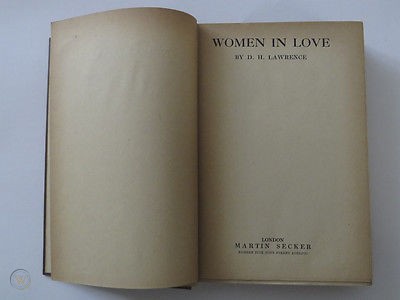
h-lawrence-women-love-1st-edition_360_5cb76c4a333740ab704dec3b081bfc4e

D. H. Lawrence’s masterpiece, Women in Love (1920), is one of the great novels of the twentieth century. It’s also intense and uncompromising, to the point that it daunted even its author. To one of his most supportive friends, the Scottish writer Catherine Carswell, Lawrence admitted, “The book frightens me: it is so end-of-the-world.” Indeed, its working title was Dies Irae (Day of Wrath). Yet the book isn’t apocalyptic. Its grim fascination with endings is balanced by a joyful appreciation of beginnings. The letter to Carswell continues, “But it is, it must be, the beginning of a new world too.” Perhaps that’s why my students love the novel so much. After all, it’s about young, intelligent, talented people figuring out how they want to live in the world, and what they will have to change to make that happen. But you don’t have to be a student to enjoy Women in Love. There’s nothing dutiful or high-minded about it. You’ll race through it, I promise, caught up in its passion, its intensity, its extraordinary prose. Reading it, you’ll feel alive.

That aliveness might be a reaction against the terrible war during which it was written. Although the novel is set in the English Midlands in an unspecified year before WWI and so doesn’t concern the war itself, Lawrence wished “the time to remain unfixed, so that the bitterness of the war may be taken for granted in the characters.” That’s a strange thing to say: it only makes sense if war — or at least its emotional effects, like bitterness — is a natural state of affairs. And that’s in fact true of this novel. The characters might not actually be at war with each other, but they are always at loggerheads. The novel thrives on these arguments: disagreement is a moral force in Women in Love, its highest value.

At the center of those disagreements are two sisters, Ursula and Gudrun Brangwen, a teacher and an artist, respectively. Early in the book, they meet two men who are close friends: Rupert Birkin, an inspector of schools, and Gerald Crich, an “industrial magnate,” heir to a large mining company. As the novel begins, Rupert is extricating himself from a relationship with Hermione Roddice, an avowedly modern and progressive Baronet’s daughter. Eventually Birkin leaves Hermione for Ursula, and Gerald and Gudrun get together. The foursome, sick of England, travel to a snowy valley in the Tyrolean Alps. In this “cradle of snow,” ominously described as “the navel of the world, where the earth belonged to the skies, pure, unapproachable, impassable,” their relationships end badly.

Although the ending is quite dramatic, Lawrence is not much interested in plot. Instead he cares about ideas, specifically, ideas about human relationships. What does it mean to be involved with another person? What characteristics would an ideal relationship have? How do individual relationships combine to create society?

The novel launches us into these considerations from its first sentence: “Ursula and Gudrun Brangwen sat one morning in the window-bay of their father’s house in Beldover, working and talking.” Whereas Lawrence’s earlier novels (The White Peacock and Sons & Lovers) emphasize work, this one emphasizes talk. And talk isn’t just a way of passing time while the day’s work gets done. It’s the main attraction — and a lot rides on it. In this first conversation the sisters consider marriage: is it something they want? Is it anything they could even imagine for themselves? Is there any way for them to avoid it? What begins as speculation rapidly dissolves into enmity and resentment. Marriage, children, managing a household: these conventional female roles seem absurd. But their absence is frightening. The sisters find themselves “confronted by a void, a terrifying chasm, as if they had looked over the edge.” The impasse is only surmounted, ironically, by their decision to watch the guests arriving for a nearby wedding. Standing in the throng outside the church, the sisters catch their first glimpses of Rupert, Gerald, and Hermione. The wedding symbolizes the social norms the characters reject but are nonetheless drawn to. They want to be modern, but they can’t just ignore the past. The uncertainty of their position — knowing that established ways of living are impossible yet not knowing what to replace them with — is what Gudrun responds to when she cries in frustration, “Don’t you find, that things fail to materialize? Nothing materialises! Everything withers in the bud.”

We soon learn that for things to blossom they must be subject to conflict. Despite its title, Women in Love is characterized more by anger, even hatred, than love. It might not be surprising that these self-styled modern women loathe the provincialism of the Midlands, the violent bluster of their father’s patriarchal values, and the contempt they feel emanating from the local miners and their families. But a lot of the time they also hate each other. Even though Gudrun is the one who proposed looking at the wedding as a way to ease the tensions between them, she feels “a friction of dislike” when Ursula readily agrees. The novel captures this ambivalence through competing similes: “The two sisters were like a pair of scissors, snipping off everything that came athwart them; or like a knife and a whetstone, the one sharpened against the other.” In the first, the sisters are a team; in the second they are at odds. Yet in both the relationship is antagonistic, whether they’re fighting the world or each other.

Every important relationship in Women in Love is like this, equal parts attraction and repulsion. These conflicting emotions are invariably expressed violently. Consider a famously tempestuous scene between Hermione and Birkin in which she comes across him in her boudoir, absorbed in a book. Realizing that he is as shut off from her as he is in his reading, Hermione is overcome with rage:

A terrible voluptuous thrill ran down her arms — she was going to know her voluptuous consummation. Her arms quavered and were strong, immeasurably and irresistibly strong. What delight, what delight in strength, what delirium of pleasure! She was going to have her consummation of voluptuous ecstasy at last. It was coming! In utmost terror and agony, she knew it was upon her now, in extremity of bliss. Her hand closed on a blue, beautiful ball of lapis lazuli that stood on her desk for a paper-weight. She rolled it around in her hand as she rose silently. Her heart was a pure flame in her breast, she was purely unconscious in ecstasy. She moved towards him and stood behind him for a moment in ecstasy. He, closed within the spell, remained motionless and unconscious. Then swiftly, in a flame that drenched down her body like fluid lightning, and gave her a perfect, unutterable consummation, unutterable satisfaction, she brought down the ball of jewel stone with all her force, crash on his head.

Hermione wants to be recognized by Birkin as his intellectual equal but the harder she tries the more he disparages her. Their relationship is excruciating. He doesn’t know how to escape her smothering attentions except by retreating into cold detachment. She exasperates him, and everyone else, by always having to know better, but she also suffers cruelly from his disdain and unwillingness to make a clean break. No wonder she is reduced to a desperate, literal attempt at cracking his exterior. No matter how sensual this moment — “the flame that drench[s] down her body like fluid lightning” is obviously orgasmic — what Hermione really wants is to get inside Birkin’s head. The crash of paperweight against skull is really a clash of ideas. Hermione and Birkin’s psychosexual troubles stem from their competing world-views. They are not alone in subordinating sex to philosophy. Everybody in the novel upholds an ideal way of being in the world. Hermione has her need to know and grasp everything; Gerald his love of domination and the will-to-power; Gudrun her elitism; Ursula her ironic deflating of any self-satisfied philosophizing; and Birkin his misanthropic insistence that the human species is at best a nuisance and at worst a menace to be exterminated. In Birkin’s view, the only hope for humanity lies in relationships of tense equilibrium between like-minded souls, like the one he offers Ursula and which he calls “a perfect union” and “a sort of ultimate marriage.”

EU8gWUuXYAM0ue8

As this catalogue suggests, the novel offers a bewildering set of arguments about how to live. But if we think that our job as readers is to choose the best one — that is, if we think we’re supposed to side with one character over another — we’re missing the point. Women in Love is dialogic. What matters is not that one set of beliefs triumphs over another but that these beliefs continually do battle. The novel’s highest value is contestation itself. That’s why it’s filled with so many fights. Characters are always being roused to sudden passions. Nothing is worse than indifference. Reading Women in Love you need to be prepared for wild swings of emotion. Birkin will interrupt a seemingly friendly conversation with Gerald to proclaim, “I rather hate you.” A pages-long bare-knuckle argument with Ursula end abruptly when Birkin, who has been fulminating against the idea that love is a kind of fusion, accepts a flower from Ursula: “It was peace at last. The old, detestable world of tension… passed away at last… they were at peace with each other.” “Peace at last… they were at peace with each other.” Like so many other, this passage demonstrates the novel’s most obvious and contentious stylistic trait: repetition. Remember how often “consummation” and “voluptuous” and “ecstasy” appeared in the paperweight passage. Fittingly, Lawrence’s repetition has incited strong reactions. In her memoirs, Ottoline Morrell — who had been a friend and patron of Lawrence’s before a bitter quarrel ended their relationship permanently — recalls reading the manuscript of Lawrence’s previous novel, The Rainbow:

I was shocked in reading it by what then seemed to me to be the slapdash amateurish style in which it was written, and the habit he then began of repeating the same word about ten times in a paragraph … reading very loose sloppy writing gives me always a feeling of great discomfort, almost shame.

Her reaction to the manuscript of Women in Love was even stronger. “Lawrence has sent me his awful book,” she wrote to the philosopher Bertrand Russell. “It is so loathsome one cannot get clean after it.” Morrell’s forceful response — her shock, her discomfort, her almost-shame, her feeling of having been dirtied — is even more over the top than Lawrence’s prose. (It didn’t help that Lawrence based the character of Hermione on her, a fact she noticed immediately.) What Lawrence wrote in a short Foreword attached to the first edition of Women in Love might have been written in response to criticisms like Morrell’s:

In point of style, fault is often found with the continual, slightly modified repetition. The only answer is that it is natural to the author: and that every natural crisis in emotion or passion or understanding comes from this pulsing, frictional to-and-fro, which works up to culmination.

It’s characteristic that even when he’s writing about his sentences Lawrence seems to be writing about sex. But that’s not because he’s obsessed with sex, as his frankness and impatience with prudishness has sometimes led him to be described. It’s not that everything in Lawrence is about sex; it’s that even sex in Lawrence is about arguing. The “pulsing, frictional to-and-fro which works up to culmination” describes the principle of contestation that characterizes every meaningful relationship in the novel.I believe that Lawrence’s repetition enacts his theory of relationships. In the scene with Hermione and her paperweight, for example, almost every word is repeated, but these repetitions don’t simply reiterate. Instead, they introduce variation. “Voluptuous,” for example, modifies first “thrill,” then “consummation,” then “ecstasy”; the metaphor of flame shifts, first describing Hermione’s heart (“her heart was a pure flame in her breast”), then something more general that it is hard to name — perhaps her way of bringing the paperweight down on his head, or perhaps her entire mode of being (“in a flame that drenched down her body like fluid lightning”). Repetition is Lawrence’s way of dramatizing shifting emotional responses, of making us feel the uncertain, unfinished, even self-contradictory qualities of his characters. That’s because repetition always appears in the guise of continual refinement or qualification. Something has to be said but there is no definitive way of saying it.

Seen in this light Lawrence’s style offers an extraordinary balance between artlessness and carefulness. The former risks clumsiness, the latter artificiality. Some of Lawrence’s contemporaries — James, Joyce, Woolf — are heirs to Flaubert. They strive for the perfection of le mot juste. Lawrence is not like that, and indeed formal perfection of all kinds is suspect in this novel. Birkin describes the neoclassicism of Hermione’s country house as “a snare and a delusion… a horrible dead prison.” Artlessness keeps things alive, ensures emotional truth. But artlessness that doesn’t attend to form at all is simply shapelessness. Too many of Lawrence’s readers have failed to see that attention and thereby missed Lawrence’s interest in structure. Earlier I quoted Morrell’s criticism of Lawrence’s style, her rejection of what she called “very loose sloppy writing.” To my mind this description reads as an unacknowledged expression of her own anxiety: the only reason you might feel shame over what appears to be loose and sloppy writing would be if you were frightened by its vulnerability, its willingness not to conform to accepted standards of literary decorum. Lawrence is loose, yes, out of a belief that truth is only caught on the wing, that imperfection keeps things alive, but he isn’t sloppy. Even his critics admit that his writing can have electrifying power. Morrell, for example, was also alive to its pleasures. Lawrence’s writing, she admitted, contains “passages of such intensity and such passionate beauty that they never leave one’s memory.” Women in Love is filled with such passages. Here’s one I love. It’s the opening of a chapter called “Diver”:

The week passed away. On the Saturday it rained, a soft, drizzling rain that held off at times. In one of the intervals Gudrun and Ursula set out for a walk, going towards Willey Water. The atmosphere was grey and translucent, the birds sang sharply on the young twigs, the earth would be quickening and hastening in growth. The two girls walked swiftly, gladly, because of the soft, subtle rush of morning that filled the wet haze. By the road the blackthorn was in blossom, white and wet, its tiny amber grains burning faintly in the white smoke of blossom. Purple twigs were darkly luminous in the grey air, high hedges glowed like living shadows, hovering nearer, coming into creation. The morning was full of a new creation. When the sisters came to Willey Water, the lake lay all grey and visionary, stretching into the moist, translucent vista of trees and meadow. Fine electric activity in sound came from the dumbles below the road, the birds piping one against the other, and water mysteriously plashing, issuing from the lake.

In his appreciation of Lawrence, Out of Sheer Rage, the essayist Geoff Dyer says that Lawrence was the kind of person who knows the name of every flower, every tree. We see that knowledge here, the sense of being rooted in a particular place (for example, in the reference to dumbles, Midlands idiom for a little valley with a stream). But Lawrence, who spent the last decade of his life restlessly travelling through Australia, Ceylon, Mexico, and the American Southwest, doesn’t simply chronicle provincial English life. Nor does he unthinkingly extol nature against the depredations of modernity. Lawrence doesn’t love birds and flowers more than mines and dams, and in fact he uses the language of the second to describe the first: recall the “fine electric activity” of the dumbles. What he admires is nature’s ceaseless change, all those high hedges “glow[ing]” and “hovering” and “coming into creation.” The incessant coming into being of new life is the reason the passage’s phrase “a new creation” isn’t a solecism. Purple twigs notwithstanding, this isn’t a purple passage, though one thing we might say about Lawrence’s writing is that you have to risk some purple passages to write ones that shimmer with the intensity of the ones I’ve quoted here. “Darkly luminous”: this isn’t just a paradox, but rather an example of what the critic James Wood calls Lawrence’s “anti-pictorial” style. Yes, the scene is vivid, glowing even. We can just picture it. But Lawrence’s language is as antagonistic to simple depiction as his quarrelling characters are to each other. In phrases like “darkly luminous” Lawrence shows us, says Wood, that language “at its densest becomes its own medium, like night. At such moments one feels language’s lack of transparency as a new kind of visibility; and this also enables us to see the old transparency as a new kind of obstruction.”

In its preoccupation with the new, Lawrence’s novel shares something with the literary modernism with which he is sometimes aligned. Lawrence is an uneasy modernist, however. He is less concerned with sensation and perception than writers like Woolf and Mansfield, more invested than they in a tradition of literary realism he nonetheless contests. The works of Lawrence’s contemporaries, no matter how brilliant, sometimes feel to me like period pieces. But Lawrence feels vital, relevant, not just modern but contemporary, and in Women in Love most of all.Nowhere is this more evident than in its preoccupation with forms of life. By that I mean both the biological quiddity shared by all living beings and the structures that make up human society. The first is evident in the novel’s vivid descriptions of something like a life force, as when a rabbit resisting capture is described as a “black-and-white tempest,” “lunging wildly, its body flying like a spring coiled and released, as it lashed out.” The second is evident in the array of possible permutations for human relationships. Just when we’ve convinced ourselves that Birkin and Ursula’s relationship is the best because it’s the most balanced, if not the most harmonious, we’re forced to revise our ideas completely. In the novel’s final pages, Birkin realizes that his “sheer intimacy” with Ursula needs “an eternal union with a man, too: another kind of love.” Ursula rejects this claim, saying. “You can’t have two kinds of love” and the novel finishes with one of the great unresolved endings in fiction, another version of the “terrifying chasm” that Ursula and Gudrun faced in the opening scene. Women in Love, then, is a queer novel, not just in the sense Lawrence’s contemporaries would have used it (strange, odd) but in our own. It refuses normative sexual relationships and personal identities, whether through the same-sex love Birkin evinces for Gerald, or Ursula’s tortured relationship with her sister, or Gudrun’s eventual refusal to enter into any kind of relationship at all. How to live, how to be alive; who can you love, what makes something living: these are Lawrence’s great concerns, and in this age of same-sex marriage and animal rights activism they feel like our own.

1920-club

It’s easy to speak of writers as rebels or misfits. But Lawrence truly was out of step with his time. That was especially true during the war. Just weeks after its publication in September 1915, his previous novel, The Rainbow, which he rightly considered the pinnacle of his career to that point, was banned for obscenity. This was the great trauma of Lawrence’s life. All copies were pulped, and for the next five years Lawrence, whose poor health precluded him from regular work, who had no inherited wealth to rely on, who lived only on the income brought in by his writing, who owned almost nothing, not even any copies of his own books, couldn’t find anyone willing to publish him. He and his wife, Frieda, a German national — a woman who left her respectable husband to be with him at the price of never seeing her children again — were suspected of being spies by British authorities. He was at odds with the jingoistic nationalism of the time. And his masterpiece, which he recognized Women in Love to be, languished in obscurity, not published until 1920 and even then only in the US and only in a private, limited edition. Yet he knew what he had done in writing it and took great joy in it. “It is the book of my free soul,” he told a friend. To read it is to experience that freedom. In its time this extraordinary work went through extraordinary difficulties. But perhaps its true time has finally come. What Gudrun fears — that things wither in the bud — is certainly not true of this brilliant bloom of a book.

 

Malicroix Readalong

9781681374109

A nice young man, of stolidly unimaginative, good bourgeois stock, is surprised to inherit a house on an island in the Rhône, in the famously desolate and untamed region of the Camargue. The terms of his great-uncle’s will are even more surprising: the young man must take up solitary residence in the house for a full three months before he will be permitted to take possession of it. With only a taciturn shepherd and his dog for occasional company, he finds himself surrounded by the huge and turbulent river (always threatening to flood the island and surrounding countryside) and the wind, battering at his all-too-fragile house, shrieking from on high. And there is another condition of the will, a challenging task he must perform, even as others scheme to make his house their own. Only under threat can the young man come to terms with both his strange inheritance and himself.

That’s how the good people at NYRB Classics summarize Henri Bosco’s Malicroix, first published in 1948 and now available in English in a translation by Joyce Zonana. Bosco (1888—1976) was born in Provence but spent much of his life abroad, teaching in Algeria, Italy, and Morocco. Maybe all that moving around is why he’s known as a great writer of place.

Bosco is sometimes thought of as kin to his near contemporary Jean Giono, who grew up just a bit to the north. A few years ago, several bloggers and I read and wrote about Giono’s Hill, a wonderful novel (also published by NYRB). Doubtless that’s why the publisher reached out to us to encourage us to read Malicroix. Most of us didn’t need much convincing: after all, what could be more relevant than a novel about isolation? Yet the novel also gives us a taste of what so many of us are missing these days: freedom. Like Malicroix’s first-person narrator, our lives have been suddenly upended, but unlike for him the upheaval hasn’t been of our choosing. If the first ten pages are any indication, the novel is both exciting and philosophical. The perfect book for a time when so many of us are thinking a lot about place.

Frances of Nonsuchbook, Meredith of Dolce Bellezza, Grant of 1streading, Nat Leach (@gnatleech), and Scott of seraillon will join me in blogging about the novel in the second half of April. We encourage you to join us: either at your own blog or by writing a guest post here at mine. We’re using the hashtag #malicroix2020 on Twitter if you prefer to participate that way. We hope to arrange some other Malicroix-inspired material, perhaps an interview with translator Zonana. Stay tuned, and drop me a note in the comments if you’d like to join our little group!

What I read, March 2020

The month began in full mid-semester throttle. I taught a colleague’s class at a university at the other end of the State—preparing for that was a lot of work. Then I organized a visit to campus from a friend who presented on his work in progress. And almost the minute I dropped him at the airport, things started being canceled: our daughter’s school; then mine; then we were hunkering down for the foreseeable. And the month kept on going, stretching out endlessly, a disorienting expanse of fear and stress and, strangely, intimacy and, oh I don’t know, not languor or relaxation, but time. (To be able to experience is a sign of our privilege.) During all of it, I was reading, I hear a lot about people being unable to read at the moment. I get that, but since reading, for me, is a way to keep the world at bay I’ve been struggling with the opposite problem. I need reading even more than usual, but life (switching to remote teaching, figuring out how to handle our daughter’s homeschooling) is making that harder. Still, my family and I are safe, we’re mostly enjoying our time together, our dogs think this is the best thing that’s ever happened.

EN4tpoTUUAAx13q

Louise Erdrich, The Round House (2012)

The narrator of Erdrich’s novel, thirteen-year-old Joe Coutts, lives on a rez in North Dakota in the late 80s. At the beginning of the summer during which the book is set, Joe’s mother is violently attacked and raped, plunging the family into a tailspin from which it recovers only at great cost. Frustrated at the lack of progress in finding and arresting the perpetrator—a frustration that has much to do with the disparity between Federal and Tribal law, and the insufficiencies of the latter as enshrined by the callousness of the former: a frustration felt even more strongly by Joe’s father, a judge on the rez—Joe and his best friends try to solve the crime. That could sound cute, but although often funny and filled with a large and sometimes larger than life cast of characters, the novel is sorrowful, especially when two more instances of unexpected violence bring matters to a chastened conclusion. I was surprised at Erdrich’s decision to narrate this story of violence against indigenous women from the point of view of a teenage boy, but one of her points, I think, is that such violence is everyone’s problem. I listened to the audiobook—the last of this semester’s commuting, as it turned out—and another pleasure was the actor Gary Farmer’s reading: I loved his cadence and emphases. My first Erdrich, but not my last.

Paulette Jiles, Enemy Women (2002)

You may remember me rhapsodizing over Jiles’s News of the World. I didn’t quite like this earlier novel as much, but I still liked it a lot. I’m so ignorant about the Civil War (I’m Canadian, sue me), but I bet even many American readers might not know that women from Confederate families (or even families who supported neither side) were jailed for (supposedly) abetting the enemy. Enemy Women is set in Missouri, especially the hills between Rolla and the Bootheel, land I’ve driven through plenty of times on my way from Little Rock to St. Louis, which I’ll now never think of in the same way. (Usually I try not to think of it, finding it incredibly dull. It certainly wasn’t in the 1860s.) Missouri wasn’t just swept across by the Union and Confederate Armies; it was also ravaged by militia on both sides. The women of Jiles’s title were mostly arrested by the Missouri Union Militia. As The New York Times reviewer resonantly put it, “the Ozarks became a wilderness of free-floating entrepreneurs of violence.” 18-year-old Adair Colley is arrested and sent to a jail in St. Louis after her family’s farm is burned, her father taken away, and her siblings scattered. In prison Adair draws the attention of her interrogator, Major William Neumann. The two begin a romance but are soon separated: Neumann is reassigned to Alabama while Adair escapes and tries to return to what’s left of her farm. Jiles switches between the storylines: Neumann is interesting, but Adair is the star. I found the first part of the novel slow, but I read the last third in a long rush that left me tired (but unrepentant!) the next morning. (There’s a bit in which she shakes off a dangerous pursuer that’s real heart-in-the-throat stuff.) This was Jiles’s first novel (she had published several books of poetry before that) and she’s certainly improved a lot since then. Even so Enemy Women is definitely worth your time.

Rennie Airth, The Decent Inn of Death (2020)

Latest installment of a crime series that (a) does not have too many books in it and (b) is worth reading even though later books don’t reach the heights of the first ones. Interestingly, Airth has let the characters age: their inabilities are central to this case, which riffs on the classic country-house murder.

Friedrich Gorenstein, Redemption (1967) Trans. Andrew Bromfield (2018)

The last text I taught in person before we switched to remote learning. A few months ago, I worried students might find this novel of postwar Russia difficult and off-putting. Proving once again that even twenty years into the gig I know nothing about teaching, they loved it. Many said it was their favourite text so far. (And we’d read Ruth Kluger and Art Spiegelman!) Students were rightly fascinated by Gorenstein’s ambivalent portrayal of his teenage protagonist, Sashenka, who veers between cruelty and kindness and isn’t sure what she wants, just that she feels everything a lot. (The word the book most often uses about her is “spite.”) Gorenstein veers between realism and religious/philosophical abstraction; to me, he’s more compelling when writing in the former mode. What’s hard to figure out is how Gorenstein would have us reconcile psychology with sociology. His presentation of the Holocaust is strikingly non-ideological. On the one hand, he acknowledges the murder of Jews (rare in Soviet literature); on the other, he presents those murders as personal and local rather than systematic and genocidal. He’s good, though, on the terrible intimacy and physicality of such killing.

Attica Locke, Bluebird, Bluebird (2017)

Set on and around Highway 59 in east Texas—the very route we were planning to take on a canceled Spring Break trip to Houston—the first in a new series for Locke is atmospheric and interesting. (She’s writing about Texas, but it could easily be Arkansas. Normally I’m allergic to all things Southern/Arkansan, even though I’ve landed here; that Locke kept me engaged with this material says something.) Darren Mathews, her hero, is a black Texas Ranger who grew up in east Texas, left as soon as he could, but was drawn home again. He’s got a complicated family background that Locke uses to good effect and a predictably failing marriage that is less interesting. The book is best on race relations in the South (less straightforward than many non-Southerners like to imagine). It is weakest in hewing to conventions of the procedural (renegade cop, troubles with alcohol). According to her bio, Locke has been writing for TV a lot. More power to her—it’s where the money is—but the book manifests a certain sheen or glibness, an unwillingness to let scenes linger, that smacks of the more disappointing qualities of television pacing. I found Steph Cha’s recent take on how to write crime fiction that challenges the institutional racism of policing more compelling.

Attica Locke, Heaven, My Home (2019)

Sequel to Bluebird (they could be read as a single novel). Competent, but I’m not convinced Locke has yet figured out what she wants to do with the series. Most interesting when it addresses how quickly life changed for minorities—including those in the police—after Trump got elected.

Ruth Prawer Jhabvala, Heat and Dust (1975)

Cool, even icy, novel about a woman who travels to India to learn about her grandfather’s first wife, who left him for an Indian prince in the 1920s. I didn’t care for it, but Tom’s review made me appreciate it more. He really helped me think about the novel’s narration. The 1970s material takes the form of the narrator’s diary; the 1920s material is in third person. Where’s it coming from? Is the narrator writing it? If so, why/how does it include material the narrator surely couldn’t have known? Or is it omniscient? If so, what’s the relationship between the two timelines? What information should we trust? Is the narrator any different than the hippies surging through India on the hunt for spiritual enlightenment? Is she any different than her not-quite grandmother? What does it mean that her life begins to imitate her ancestor’s? These are interesting questions, but they’re more interesting than the novel itself. You certainly can’t accuse it of romanticizing India. If anything, it dislikes the place. In that sense, it’s still a colonial text—India observed from the outside. And I found the willingness of both female characters to have sex with men despite having no real interest in doing so troubling. (Quite a strange aspect of the novel: sex isn’t about liberation or pleasure or, conversely, violence or trauma. It’s a blank.) In the end, Heat and Dust gave off more dust than heat—I like my fiction warmer. But those with different tastes might feel differently. Not sure I’d try any of Prawer Jhabvala’s other novels. Are they all like this?

Kathleen Jamie, Surfacing (2019)

I loved this essay collection, which Stephen Sparks of Point Reyes Books, who sold it to me, said is not even her best. (Naturally, I ordered her first two from him immediately.) I read most of it outside on the back porch in those days after face-to-face teaching stopped and before remote learning started—a dead, anxious, weird time that happened to coincide with that short time in Arkansas when the weather is gorgeous, the humidity low, and the mosquitoes not yet swarming. With less traffic on the roads (but not that much less: shamefully, Arkansas still does not have a Stay at Home order), the birds were louder and more frolicsome than usual. The azaleas in full bloom, the irises coming out, the redbuds just moving from that gorgeous pink blossom to their ordinary ugly leaves. I mention all this because Jamie is so attuned to place; reading her essays helped me be more so too. What made this an especially good book to read now is that many of its essays are about sojourns Jamie made to remote, isolated places that are nonetheless characterized by strong senses of community. We see that in a remembrance of travelling to the Chinese border with Tibet during the time of Tiananmen, a three-part piece on the excavation of a Neolithic settlement in the Orkneys, and, especially, in a long, magnificent essay about a summer spent in a Yup’ik village on the Alaskan coast, where the thawing tundra is bringing forth revelations about the area’s ancient hunter gatherer culture. (I am a sucker for all things northern, dream of traveling north of 60, so this essay was Extremely My Shit, but I also think it’s just objectively gorgeous and moving.) In all cases, Jamie shows that for things to surface, change has to happen, and that change isn’t always good. In the case of climate change, it’s terrifying. But these are hopeful, not hopeless essays. Not naïve, but sustaining. And boy that is what I need right now.

Sarah Kofman, Rue Ordener, Rue Labat (1994) Trans. Ann Smock (1996)

A book I’ve read many times. Even though I stand by most of the things I say here, my sense of the memoir has evolved over the years. And it changed yet again this month: students always like it, but this was the best experience I’d had with it, all the more astonishing because we studied it together remotely. This group helped me see how obviously Rue Ordener is a traumatized text, so different, for example, from self-reflective Holocaust texts like Kluger’s Still Alive or Spiegelman’s Maus. Kofman forgoes retrospection, making it hard to decide how she feels about her experiences, especially what it was like to be torn between her mother and the casually antisemitic Frenchwoman who hid her in occupied Paris. Yet as a student pointed out the very raw, unprocessed, or traumatized quality of the text might itself be an illusion, a stealth way of exerting control by challenging us not to interpret. Highly recommended.

DdRLg6TX0AAsyjF

Surfacing was my book of the month, followed by Enemy Women and The Round House. Rue Ordener I know so well I can’t even rank it here. Maybe I’ll read a little more in April. Or maybe not. At any rate, I’ve finished a very long cowboy novel that’s been keeping me entertained. Let me know what you’ve been reading during the pandemic, if you’ve been reading at all. And most importantly stay well, friends.

Nat Leach’s 2019 Year in Reading

I invited my friend and sometime EMJ contributor, Nat Leach, to write about the highlights of his year in reading. Not only did he write about his favourites, he also described his idiosyncratic reading project. Enjoy! (I couldn’t help but add a few editorial comments along the way.)

When Dorian suggested that I consider writing a review post on my reading for the year, I was keen to share some of my thoughts, but also felt the need to preface it with a confession of sorts, so here goes:

Candida_Hofer_Philip_Johnson_Library_New_Canaan

I have never been the sort of person who could read just one book at a time. When I was an undergraduate student, I kept a pile of books beside my bed. I would read a chapter from the top book, place it in a new pile beside the first one and repeat until the pile was empty. Then, I would repeat the same process in reverse. This had the benefit of keeping my reading fresh, never getting bogged down in one thing, and allowing me to continually be surprised. It took me a little longer to finish books, but I quite enjoyed this too; when I really liked them, I wanted to savour them, and when I didn’t like them, I was soon able to switch to something else.

The problem came when I entered graduate school, moved to a city with excellent used book stores (London, Ontario) [have to say, this does not correlate to my memory of London! – DS] and started to become more broadly curious about literature, theory, philosophy, and just about everything else, than I ever had been before. One pile became two, then three, and eventually I had a long coffee table covered with nothing but book piles. My system became more sophisticated, but the basic principle of moving from one book to the next did not change. Over the years, I made compromises (my wife insisted on bookshelves to replace that coffee table, for example) but I never changed my ways. I continued to enjoy picking up books with no preconceived decision-making process in mind. Thomas de Quincey’s excellent essay on sortilege and astrology influenced my thinking on this point; he accepts that connections exist between things that cannot be rationally understood, so sees value in allowing chance to bring them to light. And indeed, I have often felt that I was reading just the right book at just the right time, some kind of synchronicity between my reading and my life, or between two books I happened to be reading at the same time.

It wasn’t until I joined Twitter two years ago that I began to take stock of my reading life. For one thing, I joined Twitter to participate in the great book conversations that I discovered there, but it’s hard to join in conversations when you have only read parts of so many books. How many times can you say “Oh yeah, I read the first quarter of that book! It’s really good!”? For another thing, I realized that I’m not as young as I used to be, and in the face of inevitable mortality, I’d rather die having finished a few good books as opposed to having started a whole bunch.

It was at this point that I realized that the only way to overcome the negative effects of an absurd and ill-advised reading strategy, I was going to need another absurd and ill-advised reading strategy. I hit on the idea of methodically working my way through all of those never-completed books one at a time from A to Z (from Achebe to Zola, if you will). I already tended to arrange my reading alphabetically, so this simply built in the requirement that I had to finish a book before moving on to the next one.

Of course, this doesn’t mean that I now read only one book at a time. But at least I’m now cycling between 20-30 books rather than hundreds, and focusing primarily on a single book. Nor does it mean that I am entirely rigid in my system; it initially intended to involve only books that I had already started, but gradually I have allowed alluring new books to slip into their place in the alphabetical queue. I have also made exceptions for borrowed/library books and communal Twitter events, all of which slow my progress somewhat, but since the pleasure is in the journey, I also enjoy these diversions and side-trips.

All of which is to explain why most of my reading for the year falls within a fairly small alphabetical range. In 2018, I got through A, B and most of C. This year, I finished C and got through D, E and most of F. If I keep this pace of almost 3 letters per year, I’ll be done this project by 2027 (and then I’ll probably just start again). Statistically speaking, I completed 39 books last year and 31 this year; not huge totals, but since I hadn’t even cracked 30 since 2000, I think I can say my new system is showing progress. Also, 9 of the 31 were over 500 pages, which partly accounts for the slower pace. These 31 books were written by authors from 15 different countries, which I thought was a pretty remarkable ratio considering the arbitrariness of my system, although this diversity primarily comes from various countries in Europe; I may need to work on exploring other continents. I read 18 books by men and 13 by women.

0067


Having said all that, I present thumbnail sketches of my 2019 reading:

Couperus, Louis- Eline Vere

Technically, my last book of 2018, but I finished it on January 3, and it’s so good, I’m including it. It’s a book with a personal connection for me, since my Dutch grandmother had numerous figurines of the title character around her house in The Hague; she explained that because this book was so famous, Eline had become a sort of figure of pride for the city. Once I finished the book, this puzzled me a little, since Eline is not exactly the heroic sort of character one would expect to be commemorated in this way, but the book is fantastic in its depiction both of its social world and Eline’s disaffection and alienation from it. [I really love this book too, and wish it were better known! — DS]

Crummey, Michael- Galore

A magical realist novel set in Newfoundland (think One Hundred Years of Solitude but with a whole lot more ice). Crummey incorporates the folklore and history of the island into a compelling and fantastical multi-generational narrative (this is one of those novels where you are very grateful that there is a family tree included at the beginning of the book). It also features that rarest of things, an ending that is totally unexpected and yet a perfectly appropriate way of resolving the narrative.

Dante- The Divine Comedy

There’s not much new that I can say about Dante, but I do think that reading this book is an experience that everyone should have at least once in their life. Even a lapsed Unitarian like me has to appreciate the thoroughness of his cosmology, even if I’d be very afraid of someone who actually believed all of it. It does inevitably suffer from Milton’s problem, that what happens in Hell is so much more interesting than what happens in Heaven.

David, Filip- The House of Remembering and Forgetting

I had high hopes for this book after reading some early reviews, but in the end was disappointed with it. There are some powerful moments, but it ultimately reads as an awkward mishmash of Holocaust narrative and mysticism (two things that, frankly, do not go together). [Might explain why I never finished this book. — DS]

DeLillo, Don- Falling Man

I count White Noise among my favourite novels of all time, and it didn’t seem surprising that the author of a book that depicts mundane American life being punctured by disaster would choose to write a novel about 9/11. DeLillo represents the traumatic aftermath of the event on one man and his family in a thoughtful and nuanced way. This narrative is juxtaposed with a number of scenes focalized through one of the hijackers which seem to offer a broader perspective, though these segments seem rather under-developed compared to the main plot. I enjoyed the book, although in the end, I found myself wondering if it had really gone anywhere (but maybe I shouldn’t have expected it to?)

Dickens, Charles- Hard Times

This is a book that my younger self didn’t get on with very well because of its overt didacticism, but this time I enjoyed it a great deal, having a better sense of its context. Still not my favourite Dickens, but that’s not really a criticism.

Dostoevsky, Fyodor- Crime and Punishment

Another literary experience that I think everyone should undergo, harrowing though it is. I was already about halfway through the book, having read the crime and was awaiting the punishment. I was somewhat surprised by how long I had to wait, as the book seems quite digressive, but that may also be the point, that the consequences of the crime infiltrate every aspect of Raskolnikov’s life.

Drndic, Dasa- Belladonna

Another book I was very much looking forward to, and this one did not disappoint; it’s fiercely written and utterly compelling. Andreas Ban’s body is deteriorating in a way that mirrors the corruption he sees in his country, Croatia, and his memories and experiences frame the book’s reflections on history, politics, theory, and culture. Much of the book recounts Nazi and Ustase persecution of Jews in WWII and condemns the post-independence government of Croatia for its complicity in rehabilitating war criminals (both from WWII and from the Balkan genocides). Its attacks include a lengthy screed that will cure you of ever wanting to read Jonathan Littel’s The Kindly Ones. [I’m a big fan of Littel’s novel, so now I’ve got to read this. — DS]

Du Maurier, Daphne- My Cousin Rachel

This is a perfect book of its kind. Is Rachel a kindly relative or a cynical gold-digger? Is Philip a paranoid misogynist or a potential victim? Du Maurier keeps the pendulum swinging between these options, building suspense and cultivating uncertainty so that we’re never entirely sure of the truth, but compelled to keep reading. So good it sent me on a Du Maurier book-buying binge after finishing it. [And rightly so! I too loved this one. — DS]

Duncan, Sara Jeanette- The Imperialist

This Canadian classic from 1904 begins as a domestic drama about the Murchison family in a small town in Ontario, but widens into tackling broader economic and political issues. The family’s eldest son, Lorne, becomes an advocate for a preferential trade agreement with Great Britain, and runs for political office on that platform. The novel does get a bit bogged down in economic minutiae of a past era, but its concerns with British isolationism, election fraud, and the exploitation of Canada’s Indigenous people all seem disturbingly current.

Duncker, Patricia- Hallucinating Foucault

In the 1990’s, I think this was an obligatory book for theory-heads like me, but despite touching on Foucaultian themes such as madness and incarceration, it doesn’t really have much to do with him. The book starts with an interesting academic mystery, a graduate student searching for a French author with an oblique connection to Foucault, but fizzles out once he actually finds him. It just feels like the book tries too hard, culminating with an overtly symbolic character death that I couldn’t help laughing at. [Wow, now I need to re-read it. I loved it when I read it as the theory-head graduate student Nat describes, and have always wondered what happened to Duncker. Could I have been so wrong? (Yes.) — DS]

Edgeworth, Maria- Ormond

Edgeworth was much admired by Jane Austen, but her books have not achieved as wide a readership as Austen’s. The perceived regionalism of her Irish settings is no doubt one cause, but this book is at its strongest in its early scenes depicting the tension between Irish and Anglo-Irish ways of life. This novel begins in a picaresque mode, with Harry Ormond sent to live with an Irish relative after nearly killing a man in a quarrel and aspiring to become “an Irish Tom Jones”.  Ormond does improve morally, and the narrative loses some of its energy in the later scenes in Paris which demonstrate his reformed character. Perhaps this didacticism is another reason for Edgeworth’s neglect, but it does not negate this book’s many charms.

Eliot, George- Daniel Deronda

This one was quite a commitment, but was definitely the best book I read all year. From its in medias res opening that takes hundreds of pages to untangle to its swerve in the second half of the book away from concerns with individual relationships towards larger cultural, religious and moral issues, I found it thoroughly compelling both in narrative terms and in ethical ones.

Esquivel, Laura- Like Water for Chocolate

This is as close to light vacation reading as I get; magic realism with a feminist kick. Tita is expected by family tradition to remain unmarried in order to take care of her mother until her death, and the narrative is about overcoming the weight of these expectations. Tita’s creative energies are channeled into cooking, and a recipe accompanies each chapter, making this a potentially very tasty read (although most of them seemed too advanced for my culinary abilities).

Fallada, Hans- Every Man Dies Alone

This book about one couple’s small acts of resistance against Nazism drew me in from the very start and the ensuing cat and mouse narrative raises ethical questions about the obligation and the capacity to resist injustice. These questions become more ponderous as the book goes on, and the stakes are raised, but we never lose sight of the message that each individual must make these choices in ways both big and small. [So, so good! — DS]

Farrell, M.J. (Molly Keane)- Young Entry

I didn’t know whether to file this under F (for the author’s pen name) or K (for her real name), but chose the former simply because I was keen to read it. One of my favourites of the year for sheer reading pleasure; much as the plot about teenage girls coming of age against the backdrop of hunting culture in early 20th century Ireland sometimes bewildered me as I lack the vocabulary for hunting, horse riding and ladies’ underthings, the writing is so sharp and witty, I just went along for the ride. There are, for example, some wonderful passages presented from the point of view of the dog, or take this description of a runaway bicycle: “As the slope grew steeper, and consequently their progress faster, Prudence made the interesting discovery that Mr. Bennet’s bicycle entirely lacked brakes.”

Findley, Timothy- Headhunter

I remember wanting to read this book when it was first published (1993) because I had just read Heart of Darkness and was intrigued by the book’s initial premise, that Mr. Kurtz escapes from the pages of the book and terrorizes Toronto. That is quickly revealed as the delusion of a mentally ill character (Kurtz and Marlow are, coincidentally, the names of two psychologists), however, and what is depicted in this book is actually more horrifying (as readers of Findley might well expect.) Exploitation of the mentally ill, a child pornography ring, graphic violence against humans and animals: it’s not a book for the squeamish. In the end, I’m not sure it really holds together, as it tries to do way too much (and is already over 600 pages), but it sure is prescient on topics such as fake news and climate change denial.

Fink, Ida- A Scrap of Time

I read this book on Dorian’s recommendation, and he’s much better equipped than I am to explain the brilliance of these Holocaust stories. What impresses me most about them is the way that Fink dramatizes the complex dimensions of impossible moral situations. By showing, for example, a father remembering his attempt to hide while his children are being taken away (“Crazy”), or a woman being asked to suppress her past in order to keep a new lover (“Night of Surrender”), Fink makes us see the horrifying ways in which the persecutions of the Holocaust are perpetuated and internalized by survivors. [Yes, these stories are indispensable. — DS]

Flaubert, Gustave- Sentimental Education

When I mentioned on Twitter that I was reading this book, I got about as wide a range of responses as possible; some people love the book, others hate it, and some feel completely indifferent about it. Upon reading it, I can understand all those responses; it’s a chaotic novel that challenges readerly expectations in ways that might seem exhilarating, annoying, or tedious depending on the reader. I liked the book for the most part; even though the protagonist, Frédéric is often quite obnoxious, and his desire for the unattainable Madame Arnoux so excessive, I was still interested in him as a somewhat exaggerated exemplar of the human condition. His single-minded commitment to the object of his passion and his vacillation on every other desire seem painful, but typical human weaknesses. [Oh man, do I have mixed feelings about this one. — DS]

Fleming, Ian- You Only Live Twice

This was the first Bond novel I had ever read, and was not at all what I expected; the first half reads as a travelogue of Japan, and only in the second half do we get into some (fairly tame) spy stuff. The villain’s diabolical plan is somewhat limited in scope, but his “suicide garden” of toxic plants is evocative and terrifying. I liked it much better than the film, which used almost no material from the book, aside from some character names.

Gaskell, Elizabeth- Cranford

I must confess that I read this one out of order because it was the next book up on my e-reader while I was on vacation. I already knew that I loved Gaskell’s writing, her perceptive analysis of human character and her ability to produce powerfully emotional scenes. What I learned from this book is that she can also be laugh-out-loud funny. These vignettes about women in an English village are sweet, heartbreaking, and humourous by turns; my favourite moment is when a rather hyperbolic panic caused by a suspected wave of break-ins sweeps the town.

Best of the rest:

Levi, Primo- The Monkey’s Wrench

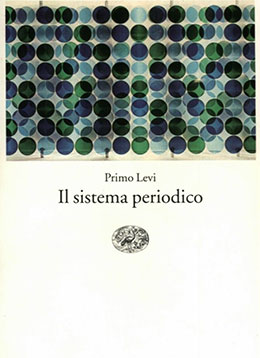
I re-read (and wrote about) The Periodic Table in commemoration of Levi’s centenary, and had intended to write about it in conjunction with The Monkey’s Wrench, but realized it would have been too much. The two books have much in common, including Levi’s characteristically keen eye for the nuances of human character, and a belief in the ennobling power of work. Where The Periodic Table celebrates the chemist’s ability to solve mental challenges, The Monkey’s Wrench often celebrates the more physical aspects of work in stories told by Libertino Faussone, a fictional character whom Levi identifies as a composite of many real men, and the narrator, a version of Levi himself. The most interesting parts of the book, though, are the many places where this manual labour is compared to, and aligned with, the act of story-telling itself.

Pontoppidan, Henrik- Lucky Per

This book intrigued me and frustrated me by turns, but it certainly did make me think. Most of my frustrations came from the book’s seeming uncertainty about how it felt about the protagonist. I enjoyed the beginning of the book, in which Per is a rebel against the soul-destroying form of Christianity practiced by his family, but as Per’s behaviour becomes more reprehensible, the book seems to lack a critical distance from him so that it’s not clear how we are supposed to react to his egotism. This book inspired me to re-read Ibsen’s Peer Gynt, a favourite of mine which seemed a clear model for this novel, although the possibility of redemption is handled very differently in the two works. Despite my frustrations, this is a book that has stuck with me.

Vermette, Katerina- The Break

I read this fantastic, troubling book because Dorian told me to and you should too!

November 2019 in Review

O grim November. The semester at its most grinding. Thousands of leaves to bag. Even the Thanksgiving break busier than usual with several grant and conference applications sadistically due in the same week. On the plus side, crisp, even cold weather (at least for Arkansas). Which would have to console me, since I sure didn’t get much from my reading.

D6cUbdSWsAE4pH6

Günter Ohnemus, The Russian Passenger (2002) Trans. John Brownjohn (2004) I’d had this around for ages and took it from the shelf thinking it would be a quick read to ease me into German Literature Month. And it was quick. But it was also terrible. Ostensibly a crime novel about a cabbie who falls into lawlessness when he picks up a woman running away from her Russian Mafiosi husband, whom she has just defrauded of a lot of ill-gained money. I knew this novel was really going to stink when the pair (they never really get together, which is kind of interesting) head to San Francisco, the city that incarnates a certain European idea of American chic that I can’t stand (the way Europeans go bananas for Blue Velvet: ugh). I guess Ohnemus has pretentions to “exceed” the genre, because the last third of the book is about the guy’s rekindled relationship with an American woman he loved as a teenager (he was either on exchange or his family moved to SF for a bit: I forget, and I gave the book away, and who cares anyway). A ho hum thriller, a tedious relationship novel: stay far away.

Lee Child, The Affair (2011) It wasn’t until I was most of the way through that I realized this is sort of a Reacher prequel. Having only read two or three of this vast series so far, I wasn’t the right audience. Underwhelming.

Sarah Manguso, The Two Kinds of Decay (2008) Manguso’s memoir of the seven years she suffered from an autoimmune condition that attacked the myelin around her nerves, rendering her numb, weak, even (fortunately temporarily) paralyzed, is worth reading. I was a fan when it came out, and subsequently taught it a few times, to good effect. (Manguso was an undergrad at Harvard when she fell ill: students relate to her life situation and her subsequent efforts to (over)compensate for the years her younger self thought of as missed—i.e. sleeping around a lot.) A few years ago I even had the privilege of meeting her and having her teach one of my classes (this was around the time of Ongoingness, her book about her diary): she was thoughtful, patient, wonderful with the students. I’ve been teaching introductory composition this semester for the first time in several years, and so I decided to assign it again. Although the students weren’t great at discussing the book (to be fair, it’s a writing course, not a literature course, so they hadn’t had much practice), but judging from their essays they enjoyed it well enough. I, on the other hand, found it less compelling this time. I wonder if Manguso would too. Definitely a young person’s book.

Robert Harris, An Officer and a Spy (2013) Terrific novel about the Dreyfus Affair. The audiobook—wonderfully read by David Rintoul—kept me enthralled for a couple of weeks’ worth of commutes. Many, many, many years ago, in my Grade 11 History IB class, I wrote a term paper on the injustice done to Captain Alfred Dreyfus, falsely accused (in no small part because of his Jewishness) of passing secrets to Germany. So the story wasn’t exactly new to me. But I’d forgotten a ton, and it was fun to hear a name—Major Henry or General Boisdeffre, say—and wonder, Now, is that the really bad guy? (Not spoilt for choice in this business.) Harris’s narrator is George Picquart, the army officer who unwittingly began the slow and costly process of exposing the corruption and mendacity that had led to Alfred Dreyfus’s wrongful conviction and imprisonment. Picquart is an interesting character: we thrill to his persistence in uncovering Dreyfus’s innocence, but in Harris’s careful rendering we aren’t allowed to forget that he was never motivated by strong feelings for Dreyfus (he never liked the man, and was pretty antisemitic himself, though nothing like the main conspirators). That leads to a bitter concluding scene when the two men finally meet in which Picquart proves himself to have been telling the truth all those years in avowing that his search for the truth was prompted by his total commitment to the French army. Harris has found another milieu in which he can pretty much avoid writing female characters altogether, which sucks but given what we see here probably for the best. (Picquart’s love interest isn’t a cliché, she’s actually quite interesting, but she’s definitely underwritten.) The guy’s a genius, though, with suspense and back story. He knows how to pace. I even forgave him the present tense narration (a bête noire). Highly recommended.

Hans Eichner, Kahn & Engelmann (2000) Trans. Jean M. Snook (2009) Actually wrote a post about this! Tl; dr: not perfect, but impressive, with a few nice Yiddish jokes.

Friedrich Gorenstein, Redemption (1967) Trans. Andrew Bromfield (2018) Difficult but fascinating book set in the immediate aftermath of WWII (opens on New Year’s Eve 1945/6) offering a rare description of the Holocaust from the Soviet perspective. (Rare to those of us in the so-called West, but also rare in the former USSR, as the topic was pretty much forbidden (“do not divide the dead”).) This first English translation—from what I can tell, beautifully handled by Andrew Bromfield—is in Columbia UP’s newish Russian Library series. It has a useful but frustratingly narcissistic introduction by Emil Draitser, who cites his own memoir repeatedly, but nonetheless explains pertinent background and details Gorenstein’s life. Best known in the West at any rate for his film scripts (including Tarkovsky’s Solaris), Gorenstein left Russia for Germany in the 1980s.

After a fair bit of mental back and forth, I decided to assign Redemption for my course Literature after Auschwitz next semester. I know already that my students are going to find it hard: it’s very Russian, bits of it remind me of Dostoyevsky, and a lot of it isn’t about the Holocaust, at least not in the ways they’re used to thinking about it. (Which is the point of assigning this text.) But I decided to go for it. Not only is a challenge a good thing, but I’m bringing in a ringer to teach it. My friend, Marat Grinberg, who teaches at Reed and has written at the blog before, will be visiting campus next semester and I know he’ll be able to contextualize the work much better than I can.

Anyway, read this book to learn more about the prevalence of American goods in Russia just after the war, the vicissitudes of denunciation, and, above all, the way in which someone who lived for years next door to someone else could suddenly up and murder them, and the way the Soviet government did and didn’t want to know about it afterwards.

Philip Kerr, A Man Without Breath (2013) I complained a little about the previous installment of the Bernie Gunther series. But here Kerr’s back in form. Dark and absorbing, A Man Without Breath has Bernie sent to investigate the Katyn massacre (the murder of over 20,000 Polish officers and intellectuals in a forest near Smolensk by the NKVDS, the Soviet secret police, in the spring of 1940). The Nazis hope to use the discovery of the giant mass grave as a way to galvanize international outrage and drive a wedge between the Allies. Pretty rich, of course, given the atrocities they themselves were busily pursuing. Sordid events, but the book doesn’t feel that way. Kerr was just brilliant with historical thrillers. I’m starting to feel keenly how few of these books I have left.

D9Ir-l7X4AA2aTU

In sum: two good thrillers, and two good novels about the Europe’s terrible 20th century. But a totally underwhelming month, and it is clear to me that the problem is that I read way too many books by men. Will see what I can do about that in December.

Not Sleeping, Speculating: Hans Eichner’s Kahn & Engelmann

Longtime readers will know how much the stories of Central and Eastern European Jews in the years from 1880-1945 mean to me. (In addition to my posts on Holocaust-related topics, too numerous to link to here, you might look at this piece on Roth’s Radetzky March or this one on Eleanor Perényi’s More Was Lost.) Less clear might be how seduced I am by literary late bloomers, but as an inveterate late bloomer in all things I confess: it is so.

Imagine my delight, then, when I plucked from my shelves Hans Eichner’s novel Kahn & Engelmann. I’ve had this book—published in a nice-looking edition by the outstanding folks at the Canadian publisher Biblioasis—lying around for ages; I can’t even remember where I first learned of it. Not only is Kahn & Engelmann an absorbing saga of a family of Hungarian Jews who make their way to Vienna in the late 19th century and succeed in the clothing business as much as the vicissitudes of antisemitism allow them to, but it was also published when its author was 79 years old. Eichner was born in Vienna in 1921 and escaped to England after the Anschluss (that escape didn’t exempt him from being interned as an enemy alien in a camp in Australia). He taught at various Canadian universities for many years, and wrote the novel in his first language, German, in his retirement. It was about to be published in this English translation (nicely rendered by Jean M. Snook) when Eichner died in 2009 at age 87: the first copies arrived from the publisher just days after his death.

W1siZiIsIjI1NjA0MiJdLFsicCIsImNvbnZlcnQiLCItcmVzaXplIDIwMDB4MjAwMFx1MDAzZSJdXQ

I have the feeling no one knows this book (I’ve never heard anyone mention it). But they should! Kahn & Engelmann offers both the immersive pleasures of a 19th century family saga and the self-reflection of the modernist reaction against that kind of storytelling. Reading it, I was frequently reminded of Roth’s The Emperor’s Tomb, which offers a similar balancing act, though Eichner is more sweeping. As he mentions in an afterward, the novel is based on his own experiences, yet everything is modified: “there is little that didn’t actually happen, but also little that happened as it is reported here.”

Eichner was born in Vienna, in the predominantly Jewish district of Leopoldstadt; he was of that generation of Viennese Jews who felt particularly betrayed by Austria’s greedy embrace of Nazism. (Ruth Kluger would be another such writer, though she was ten years younger.) It is said that Eichner, who spent his career teaching German literature and philosophy, was tormented by the fact that he made his living through the language and culture of those who had tried to murder him, his family, and his people.

The novel begins with the narrator, Peter Engelmann, rummaging through a box of photographs. He alights on one of the oldest, from 1880, which shows his grandmother wearing a pair of beautiful boots made for her by the shoemaker she would soon marry against her family’s wishes. This is in Talpoca, near Lake Balaton in Hungary. Sidonie Róth persuades her mild, unambitious, but loving husband Jószef Kahn to move to Vienna; after various trials, their children become established in the garment industry, but not without many quarrels, the most consequential and long-running of which is between the narrator’s uncle Jenö (the Kahn of the title) and his father, Sandor (the Engelmann). We learn too of the narrator’s escape from Europe and a little about how he established his postwar life, which eventually leads him to Israel. Eichner does not, however, relate these stories chronologically: the logic is much more associative, even essayistic (“since the chronology of this account is any case completely confused, I’m going to leave telling about my childhood years for another time, and continue now with how it really was in 1938.”).

I read somewhere a review that rightly observed how the Holocaust hangs over the text like a terrible threat. Interestingly, though, the characters largely manage to avoid it, whether through intermarriage, emigration, or death. The reckoning with its devastation doesn’t come until later. Unfortunately, that belated recognition is the least compelling part of the book; Peter (unlike his creator) gives up his academic career as a result of a crisis over teaching the language of his culture’s oppressors, and makes Aliyah, becoming a veterinarian in Haifa, but the decision is presented hastily; indeed, the scenes of Peter as an adult are the weakest in the book, filled with tedious womanizing. Luckily, they occupy only a few pages.

In one sense, then, the novel is less dire than it might seem. (It’s not a Holocaust text by any means.) Yet in another, it is surprisingly dark. The richly textured depiction of Peter’s ancestors, especially the generation of his parents and their siblings, is larded with hostility, petty aggression, and misunderstanding, the regular bullshit of family life which, as is so often the case, is more consequential than its usual minor beginnings suggest it should be. At the heart of the novel are a series of exquisitely polite but increasingly bitter business letters between the narrator’s father and uncle, leading to the former’s suicide, an action surely modeled on Eichner’s father’s similar fate.

All of which is to say, yes, opera and Sachertorte make obligatory appearances, but the novel is more than just kitsch. Especially fascinating are its descriptions of how to make clothes into fashions, how to arrange space to get customers to buy, how to turn soiled or poorly cut outfits into pieces people are eager to wear. Without making a big deal of it, the novel makes an implicit comparison between the coaxing, dealing, and passing off of one thing as another needed to succeed in the shmatte business and the similar contortions forced upon Jews even in the openness of the last decades of the Hapsburg Empire.

bell_255_wr_bellmer_photograph2797

I would say the novel’s tone is best mirrored in the Jewish jokes it’s so in love with. How you get on with the novel can be predicted by how you feel about this sort of thing:

If a Jewish peasant gets chicken to eat, either he is sick, or the chicken is.

Or this, in which a rabbi and a priest are alone in a carriage:

The priest asked, “Tell me, Colleague, have you ever eaten pork?”

“To tell the truth, yes,” said the rabbi.

“Good, isn’t it?” said the priest.

“Tell me, colleague,” asked the rabbi, “have you ever slept with a girl?”

“To tell the truth, yes,” said the priest.

“Better than pork, isn’t it?” said the rabbi.

Or this, probably my favourite, about the rabbi of Tarnopol and the trip he made to Warsaw in 1782. Halfway home, he stops at an inn for lunch while the coachman Moische keeps an eye on the horses:

After a while the rabbi looked out the door, which was standing open because of the early onset of summer weather, and noticed that Moische was asleep.

“Moische, are you asleep?” called the rabbi.

“I’m not asleep, I’m speculating.”

“Moische, what are you speculating?” asked the rabbi.

“I’m speculating, if you drive a stake into the earth, where does the earth go?”

“Moische, don’t sleep, so the horses won’t be stolen.”

A while later, when the rabbi had just finished eating his borsht, he looked out the door again and saw that the coachman was doxing.

“Moische, are you asleep?”

“I’m not sleeping, I’m speculating.”

“Moische, what are you speculating?”

“I’m speculating, if you drive a stake into the earth, where does the earth go?”

“Moische, don’t sleep, so the horses won’t be stolen.”

When the rabbi was finishing up his meal with his coffee, the coachman had already shut his eyes again.

“Moische, are you asleep?”

“I’m not asleep, I’m speculating.”

“Moische, what are you speculating?”

“Rabbi, I’m speculating how we can get to Tarnopol without a horse.”

It’s all a bit Leo Rosen’s Hooray for Yiddish, but I’ve a very high tolerance for this sort of thing. If you do too, and if you want something unsung but good, something part Proust, part Roth, part Mann, then you’ll like Kahn & Engelmann as much as I did.

FCDAEDB6-1BAA-4A57-8AA2-DA576B8CF582

I read Kahn & Engelmann as a contribution to German Literature Month. Thanks to Lizzy and Caroline for hosting for the ninth (!) year running.

A Personal Anthology: 12 (More) Favourite Stories

I recently added my thoughts on twelve favourite short stories to The Personal Anthology. I thank Jonathan Gibbs, the editor of this valuable project, for the invitation to contribute. (Do browse the archives—you’ll find all kinds of things worth reading.) I made my choices based on my experience teaching short fiction. In doing so, I had to leave off many worthy candidates. So even though nobody asked for it, here’s a baker’s dozen more wonderful stories.

QaaHL

“Nervous” by Robert Walser, translated by Christopher Middleton

Walser’s little prose texts, scribbled on bits of paper, published in feuilletons across German-speaking Europe, are one of the glories of 20th century literature. Amazingly, they are finally getting their due in English. But thanks especially to the efforts of poet and translator Christopher Middleton, some of his work already appeared in English in the 1980s, including one of my favourites, “Nervous.” Walser’s writing is characterized by what I think of as a very Swiss mixture of sweetness and snark: its coziness soon goes off the rails. Here, in a text not coincidentally written in the middle of WWI, Walser is more anguished than gentle. But the reversals, hesitations, and self-cancellations of his prose are clearly evident.

I’ve often taught “Nervous” together with Jamaica Kincaid’s “Girl” (1983) another bravura exercise in narrative voice (in her case, in the imperative). Both texts undermine the coherence of the speaker, leading us to ask whether the very idea of identity is a fantasy of writing. Because both pieces are so short, they’re ideal for forcing students to linger over details. Students can even read them for the first time in class, which, in my experience, typically generates the best conversations.

First published in German in June 1916 in Neue Zürcher Zeitung. Published in English in Selected Stories Farrar, Straus & Giroux 1982. You can read an excerpt here and the German (with facing Dutch translation) here.

“The Demon Lover” by Elizabeth Bowen

It hurt to cut this from my original list, just as it hurt to cut it from my syllabus a few years ago. Students never loved it the way I do, and that disparity was getting me down. To be sure, it’s not straightforward. Bowen’s brilliant ghost story centers on Kathleen Drover, who has returned to London during the first Blitz to check on the house she and her children have left behind for shelter in the country. She finds a letter pushed under the door, a curt missive reminding her that the writer has not forgotten the troth she plighted, the promise she made. “Today is the day we said” it says, ominously. The letter takes her back to the Great War, and the man she fell in love with, the man she promised to marry, a cruel man, a man who returned to the front from leave and never returned. (The students have a hard time distinguishing between the two wars.) The letter sends Mrs. Drover into a panic, and she collects what she came to get as quickly as she can and runs away to hail a taxi. But you can’t outrun the past. This is a story of trauma, about physical and mental stains and strains. I can never shake the image of the weal on Kathleen’s hand when her fiancée presses it hard against the buttons of his uniform. One thing my students and I always agreed on, though: the editors of Bowen’s Collected Stories must have had a lot of fun when they made sure the story ended on p 666.

First published in The Demon Lover and Other Stories, Jonathan Cape, 1945. Available in The Collected Stories of Elizabeth Bowen, Ecco, 1989. Read the story here.

“The Bear Came over the Mountain” by Alice Munro

Maybe it’s because I’m Canadian, where we are All Munro All the Time—I remember reading “Boys and Girls” in middle school and having “the symbolism of the foxes” drilled into me—but I am lukewarm on our Nobelist. I mean, I recognize her greatness. But for me she’s so cold, and not just because that’s the emotional register of the largely Scottish and English WASPs that comprise a certain idea of “Old Canada,” fictional versions of which populate Munro’s stories. I find the stories themselves chilly, almost clinical in their attitudes to these figures. (No accident that so many of her editions have a reproduction of an Alex Colville painting on the cover.)

They do teach well, though. And this one in particular works for me. “The Bear Came over the Mountain” intertwines two couples: elegant Fiona, whose forgetfulness grows into dementia, and bien pensant Grant, who is not as nice as he thinks he is, on the one hand, and Aubrey, a former sweetheart of Fiona’s who she reconnects with in the facility Grant reluctantly moves her to, and Marian, Grant’s seemingly unsophisticated but in fact defiant and shrewd wife, on the other.

As the couples re-arrange, our suspicion grows that Fiona has orchestrated the events. The story asks: what is true, in the life of a couple and even in life itself? Epistemological uncertainty isn’t just something faced (with terror, stoicism, even grace) by the patients who lose their memories, but by readers as well.

First published in The New Yorker, December 27, 1999. Collected in Hateship, Friendship, Courtship, Loveship, Marriage McClelland & Stewart, 2001. You can read the story here.

“The Bad News” by Margaret Atwood

Atwood, by contrast, is another CanLit big shot whose work I do admire. (For whatever reason, her chilliness doesn’t bother me as much as Munro’s.) Although best known for her novels, Atwood’s written plenty of stories; the ones I’ve read are good. For a while I taught this story regularly, highlighting, in particular, its narrative structure and use of time. Like “The Bear Came over the Mountain,” “The Bad News” is about (the fear of) dementia. But I don’t think memory loss explains the story’s structure, which reminds me of a möbius strip. The narrator and her husband live in a dystopic near-future (if I were to read the story now, I’d probably just think it was set in the present) but part-way through the narrator remembers a trip they took to Glanum, the Roman ruins in the South of France. The memory sparks a fantasy that, at some point, becomes the present of the narrative itself. It ends with the couple, living in what to them is simply an outpost of Rome, nothing ancient at all, talking themselves out of worrying about the barbarian invasions (“They won’t be here for a long time. Not in our lifetime, perhaps. Glanum is in no danger, not yet”). We’re left wondering if the modern couple, similarly obsessed with but in denial about bad news, is perhaps a dream of the ancient one, rather than the other way ‘round. “We don’t like bad news, but we need it. We need to know about it in case it’s coming our way.”

First published in The Guardian, 2005. Collected in Moral Disorder and Other Stories, Nan A. Talese, 2006.

IMG_1632

“Indian Giver” by Max Apple

Probably the least famous writer on this list, which is a damn shame. Especially as he is probably the nicest (admittedly, the only one I’ve met, but man what a mensch). Apple is a worthy heir to Malamud (which, if you’ve read my original list, you’ll know is high praise). Seymour Rubin owns an automotive junkyard, but the only person who can work the baler that keeps the place going, a man named Alonso Johnson, has just converted to Islam and needs to pray on his lunch hour every Friday. Seymour, incensed at what he sputteringly calls “once a week anti-Semitism,” fires Alonso, which leads to his near ruin. (“Indian Giver” is a take on Malamud’s “The First Seven Years.”) Everyone begs Seynour to take Alonso back, especially Seymour’s son, Chuckie, who calls from the reservation in the South West where he is working with indigenous people. When a rival Jewish recycling firm offers to buy him out, Seymour has no choice but to go back to Alonso. Who, Apple’s story asks, is a Jew? And what does that mean? Are the identities we live by enabling or disabling? Funny, too!

First published in Story and collected in The Jew of Home Depot and Other Stories, Johns Hopkins, 2007.

“The Night Rhonda Ferguson was Killed” by Edward P. Jones

Now that I think of it, I briefly met Edward P. Jones at a reading from his novel The Known World. And he too was lovely, so soft-spoken and introverted, clearly a man uninterested in platitudes or bullshit. I warmed to him immediately. Though I’ve yet to read that book, I love his early stories, especially this one, which I use in teaching literary realism. This is a beautiful and very sad story about an angry, vulnerable teenage girl, Cassandra G. Lewis, whose best friend, the Rhonda Ferguson of the title, is about to sign with a record label. Rhonda almost never appears in the story—instead we follow Cassandra and some of her other friends as they spend a flirty, chaste, emotional, ordinary Friday evening that is upended by tragedy. By the time we learn of Rhonda’s death, so much has happened we’ve forgotten all about it, and we’re shocked despite the title. I love how one of the girls, a quiet soul Cassandra hardly knew before the fateful night, becomes the story’s central focus. And its last line is heartbreaking: “She sang on into the night for herself alone, pushing back everything she did not yet understand.”

Collected in Lost in the City, William Morrow, 1992.

“Tapka” by David Bezmozgis

A bittersweet, funny, but ultimately rather ominous story about a family of Latvian Jews who emigrate to Canada in the early 1980s as part of the exodus of Soviet Jews. (In this sense clearly autobiographical.) Mark Berman is in first grade at George Best Elementary School in his new home of Toronto. Together with his slightly older sister, he is tasked with walking a neighbour’s dog every day at lunch. Tapka is spoiled; her owners, also Russian emigres, though of a lower social class than the Bermans, have no children. Tapka is their everything. While the adults struggle through English classes by day, the children learn through osmosis (the narrator likens his brain to a catchment basin, with rivulets of language steadily accumulating into a pool). Pride of place goes to schoolyard insults, like “shithead” and “gaylord” (how it pains me to remember that we used to say things like that). The children love Tapka. But they also hate her, for inscrutable reasons that have to do with their powerlessness and general sense of being lost in a new place. So they start calling her the names they’ve learned, maybe felt the lash of; Mark feels the thrill and shame at having violated something. One thing leads to another, and the kids let the dog off the leash, whereupon it dashes into traffic and is hit by a car. Everything ends okay, except nothing will ever be okay again.

I also use this story to teach my American students the correct pronunciation of Toronto and what a washroom is. I think of it as a duty.

First published in The New Yorker in 2003. Collected in Natasha and Other Stories, Harper Collins, 2004.

IMG_1630

“The Knock at the Manor Gate” by Franz Kafka and translated by Willa and Edwin Muir

My favourite Kafka to teach is “A Hunger Artist” (though I confess I don’t love to teach Kafka—he is too hard, too much about the resistance to interpretation), but my favourite Kafka altogether might be this little text, which is perfectly Kafkan, but, more importantly, for me, comes unbidden to me every time we chant the v’ahavta in synagogue. That’s the prayer in which we name the ways we shall love G-d. Tell them to your children, think of them when you wake and when you sleep. And, finally, “bind them as a sign on your hand and let them serve as a symbol on your forehead; inscribe them on the doorposts of your house and on your gates.” Kafka would have known this prayer (it comes just after the sh’ma, Judaism’s affirmation of monotheism); every week I wonder if he had it in mind in writing this enigmatic work.

First published posthumously in Beim Bau der Chinesischen Mauer in 1931. Collected in English in The Complete Stories of Franz Kafka, edited by Nahum Glatzer, Schocken, 1971. You can read the story here.

“The Use of Force” by William Carlos Williams

Although only four pages long, this story is so rich, it’s easy to spend an hour talking about it and still have plenty to say. Based on Williams’s own experience as a doctor in Rutherford, NJ, it tells the story of a doctor summoned by a poor, terrified couple who suspect their daughter has diphtheria. To confirm his diagnosis—which will lead only to quarantine, there being nothing else the man can do: the story is from the 1930s; there are no antibiotics—the doctor needs her to open her mouth. Which the girl refuses to do. The result is a battle not just of wits but of strength. The title doesn’t just describe the doctor’s actions; it also poses a question: what is the use of force? What purpose does it serve? Can we diagnose a condition without causing harm? And if we think about the similarities between diagnosis and interpretation, we might extrapolate to ask, can we read a text without doing violence to it?

First published in 1933 in Blast and collected in Life Along the Passaic River, New Directions, 1938 and The Doctor Stories, New Directions, 1984. You can read the story here.

“A Family Supper” by Kazuo Ishiguro

Rohan Maitzen tipped me on to this story, one of only a few by Ishiguro. Although it would be terrific for any lesson on unreliable narrators, I always teach “A Family Supper” on the second day of the semester to help students begin the semester-long process of learning to support claims with textual evidence. For the central question demanded by this story of a young man who returns after the death of his mother to his home in Japan from a new life in America is whether his father has poisoned their supper of fish soup. (The first thing we learn is that the mother died from eating improperly prepared fugu.) Students always have strong opinions, but they’re not always sure why they think what they think. Ishiguro has a fine way with dread and unease. In addition to everything else, this is good ghost story.

First published in Firebird 2 in 1982. Collected in Malcolm’s Bradbury’s anthology The Penguin Book of Modern British Short Stories, Penguin, 1989. You can read the story here.

“Drown” by Junot Díaz

The narrator’s former best friend Beto is back in town, but the narrator doesn’t want to see him. We learn that Beto once gave him a blow job, which the narrator both liked and hated. “Drown” is a story of repression, confused masculinity, and growing up in a society that has no expectations for you (note the imperative of the title). My students and I often linger on this early passage, where we can already see the rivalrous relationship between the boys. Along with the rest of the kids in the neighbourhood, the boys have climbed the fence at the local pool:

I sit near the sign that runs the pool during the day. No Horse-Play, No Running, No Defecating, No Urinating, No Expectorating. At the bottom someone has scrawled in No Whites, No Fat Cbiks and someone else has provided the missing c. I laugh. Beto hadn’t known what expectorating meant though he was the one leaving for college. I told him, spitting a greener by the side of the pool.

At night the pool runs by other rules: the difference between no expectorating and a greener by the poolside. Nighttime pool has vitality, but what is that worth compared to the power of daytime rules?

First published in The New Yorker, January 29, 1996 and collected in Drown, Riverhead, 1996. Read the story here.

“The Marquise of O” by Heinrich von Kleist, translated by David Luke and Nigel Reeves

A crazy, long story about a woman, the Marquise of the title, who becomes pregnant after being raped during the Napoleonic wars. The scholar Mary Jacobus has a nice essay about how everyone sees the Marquise as an empty O just waiting to be filled (literally or figuratively). The story’s told with Kleist’s characteristic indirection, which means students have a hard time with it—it doesn’t help that the central event is elided in a dash—but they often get into rousing discussions of contemporary slut-shaming that makes them see things haven’t changed as much as they like to think. For me the big question is: can we read the Marquise as having any control over her circumstances? Does she have any agency?

First published in German in Phöbus in 1808. Available in English in The Marquise of O and Other Stories, Penguin 1978.

“Bartleby, the Scrivener: A Story of Wall-Street” by Herman Melville

What is there to say? A stone-cold masterpiece. “I would prefer not to” doesn’t mean no. It’s much more destabilizing (or insidious, depending on how much you side with the narrator). A wonderful story about men at work.

First published in Putnam’s Monthly Magazine in November and December 1853. Collected in The Piazza Tales, 1856. Read the story here.

IMG_1629

Now you tell me: what would be on your list?

September 2019 in Review

Enervating month. Endless heat, relentless bullshit in the news cycle, demanding semester, various personal and professional irritants. And hardly any time to read, as you’ll see in this meagre list.

D9c_0rGWwAEhRkS

James Gregor, Going Dutch (2019) Recommended to me as literary fiction written in both third person and past tense—increasingly rare!—Gregor’s debut is a strange one. I often said to myself, Why am I still reading this, I don’t really like it. But then I’d read another chapter. Going Dutch is about Richard, a grad student studying Italian Renaissance literature at Columbia whose personal and academic lives are a mess. He’s completely blocked in his writing, and all the guys he meets disappoint him. Then he falls in with a brilliant fellow grad student, Anne, who coaxes him back into academic life (by basically writing his papers for him) just as Blake, a lawyer he’d had a disastrous first date with, comes back into his life. Pretty soon Richard is intimate with both, while trying to keep each secret from the other. I found this scenario crazily stressful. And although the sense of ennui and diffuse anxiety rang totally true, in general the novel’s depiction of grad school is ludicrous. Anne is a great character—I wanted a book about her. Not for me, then, but YMMV.

Colin Dexter, Last Bus to Woodstock (1975) I love Endeavour as much as the next PBS-loving, Viking Cruise-aspirer. Watching the latest series this summer, I thought I would give the books that gave us Morse a try. Big disappointment! The first in the series is tolerable enough as a procedural, I guess (nothing fancy: Morse is irascible without being endearing, which could in theory be interestingly against type but didn’t read that way to me), but its casual misogyny is icky and disheartening. Many series start slowly, so I suppose I could always give Dexter another chance. I see no real reason why I should—Last Bus likely my last Dexter—but let me know if you have strong feelings.

Len Deighton, Berlin Game (1983) This summer, a question I asked on Twitter about what books to take on vacation sparked an interesting discussion about Deighton and Le Carré. The verdict is in: I’m Team Deighton. Berlin Game was my first Deighton since adoring SS-GB as a teenager in the 80s. And it’s so good! I loved its evocation of late 70s, early 80s Berlin (and London for that matter). (Funny how the 80s now seem like the 60s—so old fashioned.) The spy story is suitably but not overly complicated. (That’s my rap on most spy fiction—I’m not smart enough to keep all the double agents and moles straight.) The final explanation didn’t completely surprise me, but Deighton’s chutzpah in going through with it did. I listened to an old audiobook, enjoyably narrated by someone whose name I’ve forgotten: a perfect commute book. Pity my library only has the sequels in print form. Let the Deighton revival begin!

Kit Pearson, The Lights Go on Again (1993) This summer I enjoyed the first two books in Kit Pearson’s trilogy about two English children sent to Canada during WWII. Since my public library didn’t have the third, I figured I’d either have to wait until my next trip home or find it via ILL. Imagine my delight, then, when my daughter and I, finally tackling the long overdue job of cleaning her room, found this on her shelf! (I think my mom bought it at a garage sale or something.) Anyway, I devoured it that same day, particularly appreciating Pearson’s decision to switch focus from Norah (the elder sibling) to Gavin (the younger). In the final volume, the war is in its last weeks, and a series of terrible events and big decisions make for anxious times for the Stoakes children and their guardians. I was genuinely surprised by the ending, which I imagine the publishers might have resisted. Suitably ambivalent. Can’t recommend this series enough, either for children (probably 10+) or adults.

Liana Millu, Smoke over Birkenau (1947) Trans. Lynne Sharon Schwartz (1991) I’ve written about this Holocaust memoir before. Fifth or sixth time I’ve read it; with this last reading I feel confident I won’t have to re-read it every semester any more. (Though I see I wrote that last semester too.) Millu’s been a fabulous addition to my class. Students love her, and I keep finding new things to say about her. Of interest to anyone who wants to know more about the female experience of the camp system—and anyone interested in a memoir that has the pacing, structure, and textual grain of a fine short story.

Ngaio Marsh, Death at the Bar (1940) I had this lying around, I’d enjoyed the first couple of books in the series when I read them three or four years ago, and the first pages grabbed me. But before long I was finding it a slog. Not enough Alleyn. Could it be that the only “Golden Age” crime writer I like is Josephine Tey?

Robert Harris, The Conclave (2016) The inimitable Jenny Davidson recommended Harris to me; I started with this one because my local library had a copy of the audiobook. I’ve rarely given the mechanics of how Pope’s come to power a second’s thought; it is one of my failings that I find books on Jewish topics engrossing, but books on Christian topics irritating or, at best, alienating. But I was caught up in this book from the start. It helps that it’s more about politics (gossip, ambition, the use, even manipulation of procedures to get something done) than about religion. But I also appreciated that Harris takes the faith of his characters seriously. He helped me imagined how someone could devote their lives to God in what to a Jew is such an unusual, even off-putting way (cloistering the self from the world, I just don’t get that). But where Harris really excels is in telling a suspenseful story. The Conclave follows Cardinal Lomelli, Dean of the College of Cardinals, (as such, responsible for running Papal elections), from the time he receives the news of the death of the Holy Father until white smoke finally ascends through the Vatican chimney. It should tell you everything you need to know about how much I enjoyed this book that for the week and a half it took me to listen to it, I eagerly awaited my daily commute. No idea whether Harris is always this good, but I’m definitely going to find out.

Andrea Camilleri, The Other End of the Line (2016) Trans. Stephen Sartarelli (2019) My first Montalbano since Camilleri’s death, which lent the whole thing extra poignancy: the number of this reliably pleasing series is now finite. This is an especially good installment. It includes the usual shenanigans (great food, amusing banter, clueless supervisors), but an important subplot about the nightly arrival of hundreds of desperate refugees on Sicilian shores lends the book unusual gravitas. Montalbano and his colleagues find themselves on the front lines, working almost every night, in addition to their day jobs, to “process” exhausted and frightened people.

Tony Judt, The Memory Chalet (2010) Amazing that we even have the essays collected in this volume, as Judt wrote them (via, I gather, a difficult process of dictation, having composed them in his mind during many sleepless hours) while his body was inexorably overtaken by ALS. I’ve had his huge history Postwar on my shelves for a long time; I’m daunted just looking up at the thing. These essays were a much more manageable introduction to his work. But I’m guessing a not particularly representative one. Judt is a good memoirist, but not a great one. For understandable reasons, the book is quite fragmented, and some essays are better than others. Being of Swiss background, I appreciated his defense of Switzerland (a small hotel in the Berner Oberland, site of a memorable childhood family vacation, gives the book its title). I especially liked his piece on public transportation, and how much he loved it as a child. Judt rightly marvels that his parents thought nothing of his setting out for day-long journeys across and around London as a child of only 10 or so. And I admired his midlife decision to learn Czech (a language he had no previous familiarity with), thereby launching himself on his way to becoming, in mid-career, an expert on Central and Eastern Europe. But I’m never that impressed by academics who don’t seem to like teaching (which, judging by its almost total absence here, would seem to include Judt). And some of his chapters criticizing the kids today for their snowflake tendencies are downright irritating. Might be hard pressed to remember this one in a year’s time.

7e15e7a6d142867be34547b84bf769ac

There you have it. Deighton and Harris win the light reading sweepstakes. Millu is a writer for the ages. October’s gotta be better, right?

July & August 2019 in Review

Been a long time since I wrote anything here, and two months since my last reading update. What have I been doing? Took a long vacation back home the end of July and early August. Then school started up again. (We’re through the first two weeks: I’m surviving, but the whole thing doesn’t feel quite real yet. The entering class seems sharp, though, which is heartening.) And my wife and I finally gave in to our daughter’s pleas: we got a puppy (exhausting, even though our older dog is doing a lot of the work). I’ve found it hard to make time to write, but I did do a fair bit of reading, especially on holiday, mostly light stuff. Much of it was enjoyable, but I’m not sure too much here will be on the end of the year list.

D8E6Ho8XoAAH0m1

July

Ian Thomson, Primo Levi: A Life (2002) Not especially captivating (the writing was surprisingly pedestrian), but a great way to learn a lot about Levi. He could be joyful, caring, and inquisitive, but the older he grew the more those sides of him struggled to get out from under serious depression. At the end of his life he despaired about the resurgence of fascism. This was in the mid 80s. Think how unhappy he’d be today.

As part of my centenary celebration of Levi’s life and work, I made a list of Levi facts.

Esther Freud, Lucky Break (2011) My summer project to make it through Freud’s backlist (see May and June’s posts) continued with this, her second-most-recent novel. It begins at an acting school in London in the late 70s, early 80s, almost certainly modelled on the one Freud herself attended. (She’s written about this milieu before, most notably in Peerless Flats.) What’s different here is that Freud continues past the adolescent/early-adult years and tracks the fates of several characters into middle age. She moves between perspectives, showing us who makes it, who doesn’t, who never gets over that formative drama school experience, who brushes it off or takes it in stride in becoming their mature self. What is a lucky break? When you get what you want? When you make a narrow escape? Not Freud’s best, but I don’t think she has a bad book in her.

Margarita Liberaki, Three Summers (1946) Trans. Karen van Dyck (1995) You can read my thoughts here. Short version: good!

Inge Auerbach, I Am a Star: Child of the Holocaust (1986) Illustrations Israel Bernbaum A Holocaust memoir for young readers (I’d say maybe 9-12). For me, the primary appeal was the unusualness of the writer’s circumstances. Auerbach grew up in a small town near the Black Forest, surprising because Germany had a Jewish population of only half a million before the war, and few lived in the south-west. Auerbach was deported to Theresienstadt, a former military barrack turned Potemkin village, from which she was fortunate not to have been deported to Auschwitz. She was there at the time of the infamous Red Cross visit (the Germans spruced the place up to show the world how much they had the interests of Jews at heart) and she clearly remembered the production of the children’s opera Brundibar. I Am a Star would be a good introduction to the Holocaust (unusually for a book of its time it is not centered on a Gentile child who witnesses events at second hand), but I must confess it hasn’t particularly stayed with me. (I had to look up most of these details.) What is vivid is a scene in which the six-year-old Auerbach has to take the train, all alone, to the not-so-nearby city of Stuttgart in order to go to the only school in the area for Jews. She’s wearing the star, which I believe was instituted in Germany proper only in 1941, which means this was happening when preparations for the full implementation of the “Final Solution” were gaining speed rapidly; the adults around her are hostile, indifferent, or mutely embarrassed.

I’ve just learned I’m going to get to meet her this fall. It will be an honour.

Vivian Gornick, Fierce Attachments (1987) Impelled to read this by the NYT poll that listed it as the best memoir of the past 50 years. Well, who knows about that, but it’s definitely great. Personally, I found it less fascinating than her much more recent The Odd Woman (crazily underrated), but I still liked it a lot. Even if you’re less fascinated than I am by American (aka Jewish) communism of the 1930s and its long, mostly sad aftermath you’re bound to find much to love here. Who doesn’t love a great tale of generational conflict? Gornick’s mother is a monster, and a delight, and a show-stealer. (Gornick has the grace not to begrudge this.) The book moves between memories of Gornick’s childhood and descriptions of the long walks she takes with her mother in the present (now long past) day. These walks are the venues for a life-long argument about how women should understand their lives. As Gornick explains so usefully in the first half of her book The Situation and the Story (I teach it all the time), good writing doesn’t so much depend on what you’re writing about (the situation) as it does how you frame it, how you tell it, how you organize it (the story). Fierce Attachments gives an old situation (which is why people from all kinds of backgrounds will likely relate to it) a killer story.

Ross Macdonald, The Moving Target (1949) The first Archer novel, notable mostly for showing how much Macdonald improved as a writer over his career. The book has its moments—Macdonald was always terrific with California geography (here best expressed in two harrowing drives, one along the coast in thick fog and one through the mountains at night), and his fascination with misunderstandings between generations is already evident—but on the whole it’s fairly thin. For completists only.

Georges Simenon, The Strangers in the House (1940) Trans. Geoffrey Sainsbury w. David Watson & others (1951) I’ve read a few Simenons (a couple Maigrets, a couple romans durs), but I’ve never really got on with him. My attention wanders, even though they’re so short. But everyone loves them, so I keep trying. With The Strangers in the House everything finally clicked. Hector Loursat has given up: he holes up in his crumbling house, whole floors of which are boarded up, where he lives alone except for some servants and his adult daughter, Nicole, emerging from his room only for meals and trips to the cellar for more Burgundy. Drinking and reading is all that’s left in his life. (Honestly, is that so bad?) His law career is abandoned, his reputation in tatters (not that he cares). But one day he hears a gunshot from inside the house. He investigates: there’s a dead man upstairs. Nicole admits that she and some friends had run over a man during a drunken late-night joyride. Her boyfriend, Emile, was the one driving the car, but the young couple insist they didn’t kill him. In fact, they’d brought him into the house and tended to him in the hopes he would heal. The police don’t believe a word of it, and they arrest Emile. To everyone’s surprise, even his own, Hector decides to defend the boy, which brings him closer to his daughter than he’d been for years.

I loved three things about this book: its atmosphere (perennially foggy, drizzly, and grey); its refusal of redemption (it teases us with the possibility before foreclosing it abruptly); and its hair-raising depiction of a man who just wants to be left alone being brought out into the world. A frightening parable for introverts everywhere.

Alex Beer, The Second Rider (2017) Trans. Tim Mohr (2018) Had high hopes for this Viennese crime novel set in the immediate aftermath of WWI, but, although diverting enough for a plane ride, it’s disappointingly clunky. The series might improve (at least two installments remain untranslated), but doubt I’ll follow up. The more historical crime fiction I read, the more I realize no one can touch Philip Kerr.

Dorothy Baker, Cassandra at the Wedding (1962) They don’t write them like this anymore. I don’t really know what I mean by that. Maybe it’s the tone—kind of old-fashioned, but not in a bad way. Maybe it’s the self-confidence of the world it depicts (Berkley and a ranch in rural California), even though the main character has no such assurance. Ingeniously narrated in three parts, the first and last by the eponymous Cassandra, and the middle by her twin sister, Judith, the book is set in the days before Judith is to be married. Cassandra doesn’t want her to. She wants to be with Judith forever. Baker’s trying to do something really complex. We have to be drawn to Cassandra, but we have to see that there’s something monstrous about her, too. Yet if we demonize her we risk capitulating to some pretty conventional ideas of what life should be like, especially for women. But we also have to recognize that someone could desire to be conventional without being in bad faith. Baker pulls it off—always keeping us off balance, always make us think further. She ends with a beautiful, vivid, and enigmatic image, a shoe spiraling from the Golden Gate bridge into the water. Intimation of release or premonition of bad things to come? Jacqui has a good review. Please link to others in the comments.

Sally Rooney, Conversations with Friends (2017) I confess I started this as a hate-read. A number of readers I trust had disparaged it (thin gruel, overrated, the kids today). But I loved it. And not just the book, but the reading of the book. Sometimes reading feels like work, or like something I steal from the rest of life. But every once in a while it’s pure pleasure and amazement. I stayed up much too late, as compelled to read just one more chapter as if it had been the most suspenseful thriller. Although initially unimpressive at the level of the sentence—an impression I increasingly questioned and that I look forward to revising when I read it again, as I’m sure I will—the novel really impresses in its depiction of new models of relationships. (I was reminded of Women in Love, which is pretty much the highest praise I can give!) As soon as I finished I started thinking about how well it would fit at the end of my 20th Century Experimental British Fiction course. Rooney’s depiction of relationships would complement Lawrence and Ballard, while her use of narrative voice could be juxtaposed to Woolf (in The Waves) and Beckett (in Molloy). Conversations with Friends is contemporary without being topical. (It’s not the inclusion of text message strings that makes it of our moment.) By all means read this essay by Claire Jarvis: she has so many interesting things to say about Rooney. For example: “She is baring her teeth at the group of female writers she closely resembles. Masochistic elements run through her fiction, not exactly as fully fledged fetishes or desires, more as evidence of the baseline structure of heterosexuality.”

Can’t wait to read Normal People (after three months on the library waiting list I’ve finally cracked the top 20!).

John Le Carré, Tinker, Tailor, Soldier, Spy (1974) I didn’t love this book, but I did come to admire it. Le Carré tells his story with impressive vagueness. Imagine a spy novel in which all the action is told second or third hand. (In this way, Le Carré is the anti-Lionel Davidson.) As I read I kept seeing Smiley as Alec Guiness—but, since I dozed through most of that lengthy British mini-series when my wife and I watched it years ago (she loved it; I recognized it was good but found it a powerful soporific), the ending hadn’t been ruined for me. And as the book went on (it’s not short) I grew increasingly invested in who the mole in the British service might be, and how Smiley’s duel with Soviet string-puller Karla would turn out. Probably spy stories are not my preferred genre (I’m too stupid—all the double and triple crossing confuses me), but I can see that this is good stuff. And I’m interested enough to read more Le Carré, especially the rest of the Karla trilogy. But not so interested that I’m dropping everything to do so.

D9mfDf8WsAI6K9t

August

Kit Pearson, The Sky is Falling (1989) While on vacation I read three books by the Canadian children’s writer Kit Pearson. They were perfect choices. (I hadn’t read her before; I was just too old for her books when she started writing.) Pearson doesn’t seem well known in the US. (Or in the UK?) But she should be. The Sky is Falling is the first of The Guests of War trilogy, which focuses on child evacuees from England to Canada during WWII. Norah and Gavin Stokes, ten and five years old in this first book, are sent along with hundreds of other English children in a convoy across the North Atlantic to safety in Canada. Especially for Norah, through whose eyes we experience events, the journey is a mixed blessing. She misses her friends and family, she fears she has been made by her parents to be a coward, and she resents the superiority of the Canadians she meets (she resents their security). The Stokes children are taken in by the old-moneyed Ogilvies, who live in Toronto’s tony Rosedale neighbourhood. Florence Ogilvie, the family’s matriarch, is bossy, used to getting her way, and blinded by grief at the death of her son in WWI. Florence’s chief victim is her gentle but cowed daughter, Mary—that is, until she shifts her attention to trying to rein in Norah. I was impressed by the profound moral dilemma Pearson considers here: what happens when learning to make your way in a new life comes at the cost of losing the old one? What do children and parents owe each other? Lots to chew on here: I recommend for readers of all ages 10 and up.

Vivek Shanbhag, Ghachar Chochar (2013) Trans. Srinath Perur (2017) Wonderful novella about a family in Bangalore who are much richer than they used to be, but who aren’t willing to acknowledge what they had to do to get there. Shanbhag doesn’t judge them for it, but he makes the cost clear. He’s a genius at suggesting something’s wrong without telling us what exactly (like Ishiguro, but less mystical). A friend of mine, talking about college donors, says there’s no clean money. More books today should be about money. If I were Fredric Jameson I might say something about how only a so-called Third World country—only a country that has the particular vexed relationship to capitalism that so-called emerging economies have—could take up the mantle of the 19th century European realists. I’m most left haunted by the untranslated title, an expression made up by a family peripheral to the story to describe something tangled beyond repair. A beautiful, mysterious book. Read Joe’s review for a more detailed take.

Kit Pearson, Looking at the Moon (1991) The second volume of the Guests of War trilogy is set at the Ogilvies’ summer place in Muskoka, the genteelly shabby Gairloch. A couple of years have passed since the first book (it’s now 1943), and Norah is becoming a teenager. The war is more in the backdrop here than in the previous book, but it matters all the same, especially when a cousin of the family, dashing 19-year-old Andrew, arrives for summer vacation. Norah has her first crush, but she can’t understand why he is terrified of enlisting. Even in this perfect summer book—if you want to know about a certain kind of Old Canadian life, real Group of Seven stuff, sort of New England patrician transported to the Canadian shield, complete with lots of canoeing and sailing and fishing and blueberry pies, this is the book for you—difficult problems arise.

Kit Pearson, A Handful of Time (1987) Not part of the trilogy (the last book was checked out at the library: now that I’m back in the States I’ll have to track it down via interlibrary loan), but another enjoyable read from Pearson. Twelve-year-old Patricia’s parents are getting divorced, and her brittle, accomplished mother (a news anchor) sends her West for the summer. Leaving Toronto—where she is used to cooking sophisticated meals with her father and going to art classes she doesn’t particularly enjoy—Patricia arrives in Edmonton and is immediately taken to a nearby lake where her relatives summer. As she fears, Patricia (a more immediately likeable character than Norah) is scorned by her outdoorsy cousins; taking refuge in a disused cabin she finds an old watch that takes her back to the 1950s, and the summer when her mother was twelve. Another terrific summer read.

Marlen Haushofer, The Loft (1969) Trans. Amanda Prantera (2011) Last year I read Haushofer’s The Wall for Women in Translation month. I loved it, and thought I’d follow up with The Loft, Haushofer’s final novel. (She died of cancer shortly before her 50th birthday, leaving only a handful of works.) Maybe it wasn’t the right book to read on holiday. Maybe the translation isn’t quite up to snuff. (Shaun Whiteside did a wonderful job with The Wall; not sure I can say the same for Amanda Prantera here. The book felt awkward to me in ways the earlier one didn’t. The syntax is straightforward enough that I could have a go at the original, just to see.) But in the end, I think it’s that The Wall, despite its post-apocalyptic setting, is simply a more generous book. Haushofer’s subject is the crippling conformity of post-war Austria (she’s a less histrionic Bernhard).

The loft of the title is the narrator’s atelier, where she works on her drawings of insects for children’s books, and pursues her endless quest to draw a bird that doesn’t look as though it is the only one in the world. Mostly, though, it’s the place where she hides away to read entries from her own diaries, which begin arriving mysteriously by post. The diaries are from a two-year period in her life, shortly after the war, when she was sent away by her husband to recuperate in the countryside (with only the company of two differently vexing and surly men, nursemaids and confidantes of a sort) from an unnamed traumatic event and sudden attendant deafness. (Hysterical in the true sense of the term: that is, her deafness is a way to express in bodily form feelings that can’t otherwise come out.) Pleasingly, the arrival of the diaries is just as non-cathartic as the event is undescribed. (It presumably has something to do with the legacy of the war, but I appreciate Haushofer’s unwillingness to spell that out.) Yet the book feels cramped and airless in a way The Wall doesn’t. Which makes sense of course: the conceit of the earlier work is that it would take a vast destructive event (an event even more traumatic than a war) to liberate women. (And even that liberation would be on temporary, on sufferance). In this regard, The Loft is the kind of book it has to be. I just like the kind of book The Wall is better.

Daphne Du Maurier, The Glass-Blowers (1963) Pretty different from the other Du Mauriers I’ve read. Historical, yes, but neither a romance nor Gothic. Written apparently in a fallow time in Du Maurier’s life, when she decided to spend time in France researching the origins of her mother’s family. (While there she became inspired to write The Scapegoat, one of her best books. It’s unclear if Du Maurier really understood what it was to be fallow.) At any rate, this is a book about the years before, during, and after the French revolution centered on a family of glass-blowers. It has always been a shame of mine how poorly I understand the revolution. I’ve never read Tale of Two Cities or The Scarlet Pimpernel or even Mantel’s A Place of Greater Safety. In her excellent introduction to this recent Virago edition, Michelle de Kretser (I loved The Lost Dog) uses the term “dutiful” to describe parts of the book. Accurate, but as de Kretser says, not because Du Maurier has written a bad book. Rather, Du Maurier’s interestingly taking on herself here—aiming to write a realist novel different in tone, style, and premise from the books that made her famous. De Kretser suggests that the best parts of the book are the ones in which Du Maurier can’t hold herself to her task, or, to say it another way, when she can’t help but be her herself. (I was particularly struck by the book’s ambivalent exploration—part condemnation, part fascination—with rumour-mongering as a political tactic. Rumours and gossip are presented as monstrous, taking on a life of their own with grim results.) The Glass-Blowers isn’t Du Maurier’s best book, and I’d never suggest anyone start with it, but it’s never dull. It’s more muted than her other work, but still highly readable. I do wish there’d been more actual discussion of glass blowing, though. Du Maurier uses it as a metaphor for shape- and sense-making more generally. Which, when a society moves from a time when meaning is monarchical (fixed and guaranteed) to one in which it is arbitrary (arbitrary and relational), is no small matter.

Adrian McKinty, The Chain (2019) High-concept crime novel that starts fabulously but fades badly. The idea is pretty genius: a shadowy cabal creates a demonic chain letter. The parents of a kidnapped child don’t get their child back until they kidnap another child, and so on down the list. The idea is terrifying, and almost plausible. But the resolution is antic and overdrawn. By the end of the day—yes, I read it in a single day, almost against my own wishes—I felt tawdry and bloated, as if I’d eaten nothing but junk food.

Dervla McTiernan, The Ruin (2018) By contrast, a much quieter and more successful crime novel, an old-fashioned procedural, with echoes of Tana French (partly from the Irish setting, partly from the mistrust among members of the murder squad). A pleasant surprise.

Philip Kerr, Prague Fatale (2010) Not the best Bernie Guenther, but solid nonetheless. Kerr has always included historical figures in the series, but usually in walk-on parts. Here Reinhard Heydrich, known as the Blond Beast, the primary architect of the Final Solution, takes center stage, and this seems to hamper Kerr. The Guenther books are always despairing, but they’re usually leavened with laugh-out loud humour. Here things felt sour.

Dervla McTiernan, The Scholar (2019) The second in the Cormac Reilly series isn’t quite as good as the first, but it’s still better than your average procedural. McTiernan is fleshing out the other members of the murder squad admirably, which promises even better things from the third installment, due next year. (One of the things that made Mankell’s Wallander series so good—aside from their suspense—is that the other cops mattered too.)

Laura Lippman, Lady in the Lake (2019) The first audiobook of the semester was a doozy. I loved last year’s Sunburn (still think about it all the time), but Lippman has outdone herself here. True, I’ve only read four or five of her many books, so my sample size isn’t huge, but I can easily imagine this is her best book. Like all her work, it’s set in Baltimore. But it’s also about Baltimore, and, by extension, plenty of other cities that are in fact really more like small towns. She’s so good at showing how various parts of the city—journalism, politics, the police—and various groups, especially Jews and Blacks, intertwine. There’s a sociological or anthropological quality, fascinating in itself, but even better in that it serves a suspenseful and moving plot, about a 30-something Jewish woman in 1966 who leaves married life and sets out to become a newspaper reporter. Added bonus: Lippman writes sex really well.

Georges Simenon, The Train (1958? 1961?) Trans. Robert Baldick (1964) Strange book, from the bibliographic information on down. (The copyright page of my edition has no original pub date, and an online search revealed conflicting information. Any ideas, people?) After enjoying Strangers so much (see above), I thought I’d make my way through some more of my Simenon backlog. (I own a lot of books by him, considering how lukewarm I am on him.) This started promisingly, another quasi-everyman (but maybe a bit of a wrong un) dropped into extreme circumstances. But the circumstance here is the German invasion of France. In June 1940 Marcel Féron escapes his northern French town for points south together with his pregnant wife and small child. But they are soon separated, and his convoy, mostly filled with Belgian refugees, becomes a version of the transports taking Jews to death in the East. Marcel meets a woman on the train, they get involved, they live for a while in a refugee camp in the south. Their relationship ends as suddenly as it began: Marcel gets word of his family’s whereabouts and returns to them. He sees the woman once more, and only then do we learn her full name, Anna Kupfer, and her particular war work. The idea is that’s she’s Jewish, and Marcel’s unwillingness to get involved with her or her resistance work is perhaps a metaphor for French quietism. But the book works neither on its own terms nor as a political allegory. And so my interest in Simenon has waned once again. Maybe we’re just not meant to be.

There you have it. The highlights were Baker, Liberaki, Gornick, Shanbhag, the McTiernans and, above all, Sally Rooney. How was your summer, reading or otherwise?


“Antidote to Fascism”: Primo Levi, Chemist and Writer (Guest Post, Nathaniel Leach)

“Ah, yes, you’re the fellow who wrote a book,” a customer tells Primo Levi in The Periodic Table, Levi’s third memoir, a book about his first career, chemistry. Levi stifles his annoyance at this comment under his professional exterior in a way that reminds us that Levi, too, sees his career as a writer as secondary, a historical accident that sometimes either interferes with or assists his professional endeavours. Despite these occasional self-deprecatory references, The Periodic Table invites us to see connections between his two “careers,” both of which require careful observation and an inquiring mind that is willing to revise its initial hypotheses about the world.

primo-levi-sitema-periodico260px

Of course, the book being referred to is his first memoir, Se questo è un uomo, notoriously translated in the U.S. as Survival in Auschwitz, but literally If this is a Man. Levi notes that if it had not been for his deportation to Auschwitz, he may never have become a writer in the first place, but the book’s careful descriptions, thoughtful analyses and avoidance of simplistic explanations or judgments anticipate a long writing career that would only gradually start to supplant his life as a chemist. The title of this first book, in fact, provides an appropriate orientation towards The Periodic Table; the question posed by Auschwitz, Levi suggests, is whether its victims (or its perpetrators) have been completely dehumanized, reduced to the level of mere physical matter, or whether something ennobling or redeeming persists in the midst of such horror. In The Periodic Table, this question is taken up in its descriptions of the human attempt to come to terms with the materiality of the world.

In each chapter of The Periodic Table Levi presents this struggle via an anecdote related to one of the elements of the periodic table. The chapters are arranged in a loose chronological order, starting with Argon, the “inert” or “noble” gas used as a metaphor for Levi’s Jewish-Italian ancestors and ending with Carbon, a seemingly whimsical “micro-history” of an atom of carbon. In between, most chapters are autobiographical, describing an incident in the life of Levi, the chemist, although he includes two short stories written in his youth and two brief stories in which Levi does not appear (and which therefore seem to be fictional). In describing these experiences, Levi suggests resonances between the rulebound world of chemical interactions and the less predictable world of human interactions. At the heart of these parallels lies the question of Levi’s earlier book, the question of humanity; are human beings simply physical matter composed of the chemical elements discussed in the book, or something more? And in what might that something more consist?

It is characteristic of Levi that there are no simple answers offered; from the outset of the book, he calls attention to the complexity of the “human condition, since man is a centaur, a tangle of flesh and mind, divine inspiration and dust”. Chemistry itself becomes emblematic of this division, as Levi’s chapters illustrate both the human desire for scientific knowledge, mastery and overcoming of the physical world and the recalcitrance of matter to even the most inspired human stratagems. As an example of the former, the chapter on “Chromium” is structured much like a detective story in which a problem (the production of faulty paint) presents itself and Levi must use his powers of deduction to solve it. In this case, Levi does indeed come up with an ingenious solution, but many other chapters describe dismal failures—explosions, escaped rabbits, chicken shit that refuses to give up its valuable chemicals, to name a few—that remind us of the limits of human science.

While Levi describes his younger self’s attraction to chemistry as idealistic (if confused), the book’s seemingly disconnected chapters illustrate many different perspectives on this science. His initial attraction to chemistry, Levi says, came from a sense “That the nobility of Man, acquired in a hundred centuries of trial and error, lay in making himself the conqueror of matter, and that I had enrolled in chemistry because I wanted to remain faithful to this nobility. That conquering matter is to understand it, and understanding matter is necessary to understanding the universe and ourselves…” And later, in the “Chromium” chapter, he asks: “It is the spirit that dominates matter, is that not so? Was it not this that they had hammered into my head in the Fascist and Gentile liceo? I threw myself into the work with the same intensity that, at not so distant a period, we had attacked a rock wall; and the adversary was still the same, the not-I, the Button-Molder, the hyle: stupid matter, slothfully hostile as human stupidity is hostile, and like it strong because of its obtuse passivity.”

Levi himself points out the fascist undertones of this rhetoric of conquering and domination, which is perhaps softened by his equation of “conquering” with “understanding,” but the book raises the question of whether understanding can take place in a way that does not equate to such a violent metaphor. As his schooling progresses, he changes his position: “Matter was our ally precisely because the Spirit, dear to Fascism, was our enemy; but, having reached the fourth year of Pure Chemistry, I could no longer ignore the fact that chemistry itself, or at least that which we were being administered, did not answer my questions.” Levi criticizes the apparent alliance between the fascist and the scientific spirit, but also holds out hope that science may be thought of in other terms by noting that it is “that which we were being administered” that is harmful, not chemistry in itself. Indeed, Levi’s book presents the sciences as tentative, speculative pursuits, often quixotic in their aims, and alternately satisfying and disappointing.

In fact, one of the dominant threads that can be traced through this book is the idea that chemistry is fundamentally anti-fascist both in its humbling of the human spirit and in its illumination of the disproof the material world offers to fascist rhetoric. He notes that the sciences may be seen as an “antidote to Fascism… because they were clear and distinct and verifiable at every step, and not a tissue of lies and emptiness, like the radio and newspapers”. Chemistry, above all, is not “fake news”; its results will always reveal truth at an elemental level, even if this truth is not the desired result.

But Levi values chemistry for reasons beyond its factuality; in an early passage describing his study of chemistry in fascist Italy, he suggests that the lesson we can learn from chemistry is that the natural world itself resists the simplistic, uniform ideals that fascism stands for: “In order for the wheel to turn, for life to be lived, impurities are needed… Dissension, diversity, the grain of salt and mustard are needed: Fascism does not want them, forbids them, and that’s why you’re not a Fascist; it wants everybody to be the same, and you are not. But immaculate virtue does not exist either, or if it exists it is detestable.” Levi uses chemistry to form a positive metaphor for “impurity”; rather than the Nazi metaphors drawn from the field of biology that compared Jews to a virus or to vermin, he identifies his own otherness with the catalysts in a chemical reaction. In this metaphor, difference and diversity are needed in order to propel progress forward.

=FFAML_L00003

Levi (foreground, right) during his study of chemistry at the university in Turin, 1940

From this point of view, then, perhaps it is most useful to see The Periodic Table as the place where Levi’s two careers collide, and produce something original. Levi describes his early, idealistic self as feeling that “Mendeleev’s Periodic Table, which just during those weeks we were laboriously learning to unravel, was poetry, loftier and more solemn than all the poetry we had swallowed down in liceo; and come to think of it, it even rhymed! That if one looked for the bridge, the missing link, between the world of words and the world of things, one did not have to look far: it was there in our Autenrieth [textbook], in our smoke-filled labs, and in our future trade.” Chemistry, like writing, Levi suggests, is the transformation of the material world into a communicable form, a means of making some kind of harmony or understanding out of the raw “world of things”. In The Periodic Table, Levi is both a chemist who writes, as in “Chromium,” and a writer who uses chemistry as a metaphor, as in “Argon,” or to examine minutely the nature of the world, as in “Carbon,” which ends the book on a point that quite literally fuses the fields of chemistry and writing.

Or, as in the case of “Vanadium,” the penultimate chapter, to explore the complex relationships between Levi’s lives as professional chemist and author, and between his present and his past. Levi’s professional activities bring him into contact with a Dr. Müller, whom he confirms that he met in Auschwitz. Levi assesses him with his characteristic clarity of vision: “Neither infamous nor a hero: after filtering off the rhetoric and the lies in good or bad faith there remained a typically gray human specimen, one of the not so few one-eyed men in the kingdom of the blind.” Levi is reluctantly drawn into a personal correspondence while trying to resolve a professional problem, and the chapter suggests both the power and the limitations of writing as a means of making human connections and resolving the issues of the past. As with chemistry, so with human relations; imperfections and failed connections are an inherent part of the process.

Levi suggests towards the end of the book that “matter is matter, neither noble nor vile, infinitely transformable, and its proximate origin is of no importance whatever.” This is what much of the book, and especially the final chapter on “Carbon” seems to suggest; the power of the chemist, like that of the writer, is to transform things, change them from one state to another without ascribing to them a single stable value. This, perhaps, is the great skill exhibited by Levi in both his careers: the power to transform matter into meaning without the hubris of claiming to have ever spoken the final word.