Ricardo Chavira’s Year in Reading, 2023

Excited to once again present reading reviews from some of my favourite readers. Today’s installment, his first, is by Ricardo Chavira (@waryenthusiast). Ricardo is a reader, not a writer, but he thinks writers are cool. When he’s not reading, running, cooking for friends and family, building even more bookcases, or making maple syrup, he makes his living in sunny CT. Having done graduate work in philosophy, he, naturally, works in IT.

Edvard Munch, Kragero in Spring, 1929

A few years ago, I started keeping track of my reading with a detailed list. I wanted a handy list I could consult (likely on my phone) if and when a friend would ask what I’d been reading lately. Too often, my mind would freeze and I’d maybe utter one title from 3 months ago, only later kicking myself for not recalling the wonderful books I’d just read in the last few weeks. [Ed. – Relieved to know I’m not the only one. “Uh… books… I read some books.”] What started as a mental crutch has evolved into a comprehensive spreadsheet, tracking title, author name & gender, genre (fiction, non-fiction, poetry), date I finished the book (which also gets written on the last page of the book), where I finished the book (city, but often on a plane or train), whether it was an audio book, library book, read by my book group, etc.

In my non-book-reading profession, there is an adage that “what gets measured gets improved.” [Ed. – Hmm.] Perhaps that applies here as well. In recent years, I’ve sought to diversify my reading palate, reading more books written by women and persons of color, reading more non-fiction (left to my devices, it’s overwhelmingly fiction), borrowing more books from my local library, reading more from “the backlist” (as I tend to get excited by recent releases). Being aware of what I’m reading allows me to be more deliberate about what I read. It’s also fun to run the numbers each January, look for trends, chastise myself (for not reading enough poetry), feel good about myself (for reading more works in translation), and make plans for the coming year (which are never followed through completely).

My other book tradition is the annual reshelving that takes place shortly after New Year’s. Every year, I put the books I read on their own shelf. Audiobooks, library books, and books on loan are not there, of course, but it’s fun to watch that empty shelf slowly fill up and, eventually, spill over to the next. [Ed. – Wait, what did you say?? I drifted away when you said “empty shelf.”] And after the new year, the year’s reads get shelved into the general mix of the library. It’s an opportunity to reflect again on these books, but really an excuse to muck around with my library. For whatever reason, it’s a very satisfying activity and one I’ve come to look forward to. [Ed. – What a lovely tradition!]

<insert obligatory comment about how awful the year was> Yes, 2023 was a dumpster fire of a year in so many ways, but not a bad year for books and reading. The year began with anticipated titles from many of my favorite contemporary writers*, some of which are mentioned below.

(*a partial list of authors with 2023 releases that had me worked up: Nana Kwame Adjei-Brenyah, Colson Whitehead, Rebecca Makkai, Luis Alberto Urrea, Hilary Leichter, Matthew Desmond, Rebecca Solnit, Zadie Smith, Lauren Groff, Emily Wilson (trans.), Jesmyn Ward, Jhumpa Lahiri – whew!)

So let’s get on with it. Herewith, some rambling thoughts on many of the books I read. Enjoy and happy reading.

Some highlights – Loved these books, here’s why.

  • Chain-gang All-Stars, by Nana Kwame Adjei-Brenyah

A highlight of the year for me was Adjei-Brenyah’s follow up to Friday Black, his fantastic debut of short stories. Chain-gang is set in a near future where prisoners are given the option of joining “chain gangs,” teams that fight in gladiatorial hand-to-hand combat in exchange for a shot at freedom. These so-called “hard sports” have corporate sponsors, stadiums full of shrieking fans, and lucrative online steaming shows. Despite all this, we’re somehow given a story of love and humanity amidst the chaos. Calling it satire or dystopia only hints at Adjei-Brenyah’s brilliance, as he approaches his set-up as more than just a sendup of current society and the role of the carceral state. At a public reading, I asked him how he threads the line between plausibility and seemingly improbable exaggeration (a televised reality show with prisoners fighting to the death? no, but I can kinda see that …). [Ed. – Alas, I can totally see it.] As I recall, he said the trick is not just coming up with a dramatic story, it’s having a twist that makes it work. He’s not just stepping on the gas, exaggerating the status quo. Rather, he takes something away or adds to make the story stick. Here, the conceit is not that prisoners are being violently exploited for public/private profit. The conceit of the novel is that it’s happening out in the open, and we not only don’t care, we consume it. As terrifying as that sounds, there’s an urgency to this novel that can’t be ignored.

  • Crook Manifesto, by Colson Whitehead

We’re living in the age of Colson Whitehead, in case you’re wondering. A follow up to Harlem Shuffle, we get to revisit Ray Carney, the furniture store owner and erstwhile fence of stolen goods. Unable to score Jackson 5 tickets for his daughter, Ray calls in a few favors and one thing leads to another… The depiction of Harlem in the 70s is spot on; and Whitehead has such an ear for the rhythms of speech, music, and street noise that do so much to convey the bygone era. Whitehead is deft as ever in exploring matters of race and society. Musing on a performance in which a young Michael Jackson wants to talk about the blues, “Carney chuckled – the kid was ten.” But after a moment’s reflection, “Carney shouldn’t have laughed. What ten-year-old black child didn’t know about the blues?” This is the second in a projected trilogy and my arrangement with Whitehead is simple – you keep writing them, I’ll keep reading them. [Ed. – Ha, love that! Loved Shuffle; look forward to this one; excited to hear about the third.]

  • Lucky Jim, by Kingsley Amis

I love the campus novel and this is one of the best. I recently came across a copy of the NYRB edition, so took it as a sign to revisit an old favorite. Happily, it mostly holds up. The old school misogyny felt tired and dated (as it should). Margaret may be a manipulative drama queen (says so right there in the margins of my old copy), but it hardly justifies her treatment. Still, Amis is such a good writer, tossing off lines such as: “It was from this very bottle that Welch had, the previous evening, poured Dixon the smallest drink he’d ever been seriously offered.” On the whole, the novel still works and neither characters nor readers emerge unscathed. Coda: Happily, I received another copy for Christmas, as Hatchard’s, the venerable London bookseller, has issued a gorgeous limited edition of Lucky Jim. Anyone want an old paperback copy? [Ed. – Good offer, friends!]

  • Milkman, by Anna Burns

I was excited to read this book when it came out and finally got around to it (only 6 years later). I knew it was going to be good, but it’s always a thrill when a book so wildly exceeds your expectations. The psychological depth, the suffocating closeness of the tight-knit community, the deadly gossip, and the rapid-fire language make for a heady combination. So many passages were chock full twists, descriptors, and fulsome lists that I feared she’d run out of words. But she never did. So grateful.

  • The Netanyahus, by Joshua Cohen

On one level it’s a campus novel (and you know how I love a good campus novel), but also an incisive depiction of antisemitism, and a scathing indictment of the powers that be. It’s also a riot. Cohen guides us with such a steady hand through the myriad offenses endured by our humble protagonist, Ruben Blum, the only Jewish professor on a small upstate New York campus. Describing a note from Blum’s obtuse department chair: “’Rube,’ it read, in his characteristic mélange of the casual and turgid.” [Ed. – Heh] But Cohen also doesn’t hold back in depicting the flaws and hubris of his characters. The Jewish professor, and titular patriarch, whom Blum is asked to host is none other than the father of the current Israeli prime minister. This book should be read and appreciated despite, and because of, its association with current affairs.

  • The Monsters of Templeton, by Lauren Groff
  • The Vaster Wilds, by Lauren Groff

This is also the age of Lauren Groff. This year I read her first and latest novels to achieve my Groff completist status. [Ed. – Ooh, did you get the button??] I love how varied her writing is; she never writes the same book twice. A grad student trying to make her way in the world and learning you can’t come home again (except when you do). A young woman fleeing an early American colonial settlement and trying to survive in the wilderness. As with Whitehead, I will read everything she writes. Keep em coming. She’s also opening a bookstore! [Ed. — !]

  • Phantoms, by Christian Kiefer

By all accounts (viz., a scroll through his Twitter feed), Kiefer is a busy man, juggling teaching, a large family, and crazy rock & ice climbing expeditions. [Ed. – No joke, that climbing stuff is insane.] He also manages to write some wonderful novels. Phantoms tells the story of Japanese and American families torn apart by WWII and the shameful internment camps. Years later, the story is refracted by the memory of a young writer who is slowly uncovering the truth, while dealing with his own trauma as a Vietnam veteran. A story of secrets, lies, bigotry, war, and other American values, Phantoms is truthful without being cynical, and just hopeful enough without giving in to sentimentality. And Kiefer gets bonus points for having joined our book group discussion via zoom!

Found in Translation – I don’t know why translated literature is such a hard sell in this country. It’s the literary equivalent of yelling at children “eat your vegetables, they’re good for you!” With publishers such as NYRB, Europa, Charco (and many other wonderful indie presses), it’s so easy to find good translated lit. Try it, you’ll like it.

  • Translating Myself and Others, by Jhumpa Lahiri

I just can’t say enough good things about Lahiri, she’s the bee’s knees, the cat’s pajamas. I get giddy thinking about her work. [Ed. – Paging @bibliopaul!] Long story short for those not keeping track at home: In recent years, Jhumpa Lahiri has been writing in Italian and translating (herself and others). Never fully at home in English (the language of her upbringing) or Bengali (the language of her parents), she learns Italian in college. Years later, she returns to it by packing up the family and moving to Rome (as one does), where she immerses herself in language study. Before long, she’s hanging out with Italian writers and translating their work. And she stops writing in English as her primary language. These essays are both critical (such an ear for how other writers work) and personal (artfully exploring her technique and motivations behind her writing and translations).

  • Roman Stories, by Jhumpa Lahiri, translated by Jhumpa Lahiri and Todd Portnowitz

New short stories from Lahiri (her best form, in my opinion) is cause for celebration. These don’t disappoint. Set in a contemporary Rome and populated by people who look and speak differently from the locals, these stories remind us the beauty and coarseness of the human condition. And yes, she wrote them in Italian and later translated (all but two of them) into English.

  • Ties, by Domenico Starnone, translated by Jhumpa Lahiri

Starnone is a luminary in the Italian literary scene and not known well enough here in the States. And is translated by Lahiri. And published by Europa. What’s not to like?

  • The Door, by Magda Szabó, translated by Len Rix

I often saw this book cited as a favorite NYRB, so was thrilled when I found a used copy. And even more thrilled when I began to read it. Szabó gives us Emerence, a housekeeper, street sweeper, and eminence grise of a small Hungarian community. At first, Emerence seems aloof, secretive, even arrogant. She’s all of these things, but also insecure and vulnerable, as slowly emerges from her complicated relationship with Magda, her employer (and enabler). The depth of the characters and complexity of their relationships carries on to the end, giving us a stunning portrayal of people at their best, worst, and most human. [Ed. – Incredible book, now I want to read it all over again.]

  • A Mountain to the North, a Lake to the South, Paths to the West, a River to the East, by László Krasznahorkai, translated by Ottilie Mulzet

Krasznahorkai is a wizard. It would be too easy to say this story is like a dream. But there is an ethereal quality to this book that evokes so much thought and feeling, and yet remains just out of one’s grasp. Long, wonderful discursive passages on weather, architecture, and math that evoke sheer longing. There’s a short chapter on the wind and air that has passed through this temple that’s just a joy to read. A great way to end the year for me.

  • Fantastic Night, by Stefan Zweig, translated by Anthea Bell

These stories of reversals, betrayals, misunderstandings, and moral discoveries are a delight. To contemporary readers, he has a certain Old World charm, and it’s not surprising he’s come back into vogue recently as both literary and pleasure reading. I’ve been told that with Zweig’s unique voice, you’re either in or you’re out. Count me in.

  • At Night All Blood is Black, by David Diop, translated by Anna Moschovakis

Diop does so much in this short novel. In the trenches of World War I, our protagonist takes revenge on enemy troops after his best friend is killed. A grisly descent into madness ensues that terrifies even his fellow soldiers, making him an outcast in every way. The narrative feels like something out of Camus, but darker, and stayed with this reader for a long time.

Good Genre – Another absurdity of the reading community which I cannot abide are the knee-jerk slights often directed towards so-called genre fiction. [Ed. – We do not allow that sort of thing here at EMJ.] Here are some standouts in fantasy, sci-fi, and crime fiction.

  • Hell Bent, by Leigh Bardugo

In Bardugo’s world, magic is real and practiced by students at Yale University’s secret societies, such as Skull and Bones. (Campus novel alert!) A sequel to her blockbuster Ninth House, Hell Bent picks right up where the action left off and doesn’t stop. I’ll admit to a local bias that adds to my enjoyment of these books as I studied there, live nearby, and my wife is friends with the author (read the acknowledgments!). [Ed. – What?!?!?!] But even without any extraneous connections, it’s great fun. Alex Stern is part of an organization that is supposed to keep the secret societies in check, but she has a way of making things worse and/or better and pretty soon things are literally going to hell. Along the way, Bardugo gives us more esoteric history (some it speculative) and plenty of her trademark creativity in the magic, spells, and monsters that populate this world (demons and vampires, yes, but not exactly like what you’ve seen before). I always love the second part of a trilogy (what can I say, I’m a middle child), but I am eager for the next installment.

  • Babel: Or the Necessity of Violence: An Arcane History of the Oxford Translators’ Revolution, by R. F. Kuang

Another Yalie (along with Bardugo), Kuang has written 5 novels, is working on a PhD (to complement her Oxford and Cambridge degrees), and hasn’t bothered to turn 30 yet. Wunderkind bio aside, Babel is a lot of fun. We’re at Oxford in the 1830s, but in this version, magic is real and harnessed by scholars at the Royal Institute of Translation who manipulate silver bars inscribed with translation. The effects of this magic power the British empire and are the source of its global domination. Not all sits well with a group of young students, most of whom are foreign-born and recruited for their language skills. Plenty of action, intrigue, and wrestling with moral and political dilemmas make for an engaging read. And did I mention it’s a campus novel? [Ed. – I’m gonna give this one another try. I abandoned ship, but I think I missed something good.]

  • Bloodchild and Other Stories, by Octavia E. Butler

Who knew Butler also wrote short stories? Not many (stories, that is), but those collected in this volume are bangers. [Ed. – Such bangers.] Part of the fun of short stories is delivering a punch, a great insight, or deep emotion in just a few pages. And sci-fi is great at creating alternate worlds where the rules are different and you get to decode those new norms. Doing both of those things well at the same time is no small feat. Happily, Butler doesn’t skimp on her trademark thought-provoking imagination. More than once I felt equal parts excited and unsettled as I figured out the premise of each story. “Ah, so that’s what’s going on. Yikes, that’s what’s going on.” [Ed. – Well put, R]

  • Lessons in Birdwatching, by Honey Watson

I hadn’t read a solid sci-fi novel in a while and this one really satisfied that itch. At first, I felt out of practice, trying to decipher which way was up in this new world. “That can’t be right, is that really happening? I often said to myself. And oh, yes, it was happening. Whether it’s right or not is up to you, dear reader, to decide. In the meantime, Watson has a ball with political intrigue, war, sex, drugs, violence, resurrecting an ancient god, and giving us some really manipulative characters you can’t help feel guilty rooting for. A sequel is necessary, as I have a feeling it’s going to get worse before it gets better. And I can’t wait.

  • Small Mercies, by Dennis Lehane

Solid storytelling, plenty of violence, salty characters, and local color keep the pages turning. Is this a screenplay masquerading as a novel? Given Lehane’s novels’ track record, the adaptation can’t be far behind.

A Family Affair – Few things in life are more satisfying than enjoying books with your family, especially children. Scratch that, there’s nothing better.

  • The Handmaid’s Tale, by Margaret Atwood

This was at the top of my wife’s Leigh Bardugo’s friend’s “books I love that I can’t believe you haven’t read” list. Feel lucky to have such a great reading partner. [Ed. – Aww, love this.]

  • Slaughterhouse Five, by Kurt Vonnegut, Ryan North, Albert Monteys (graphic novel)

As my son continues to develop his literary tastes, his current go-to list includes Steinbeck, Murakami, and Vonnegut. He recently acquired this lovely graphic novel version of Slaughterhouse Five, one of his favorites. It’s a wonderful version with fantastic artwork, remains true to the novel, and made for great conversation.

  • Afterparties, by Anthony Veasna So

So was a wonderful writer whose life sadly ended far too soon. My niece loved these interconnected short stories of Cambodian Americans in California and wouldn’t rest until I read them. Loved the book and love having such passionate and discerning readers in the family. [Ed. – Lucky man!]

Kinda wacky, but good! – A very ad hoc collection of books that were unconventional in form and/or content.

  • The Memory Police, by Yoko Ogawa, translated by Stephen Snyder

Ogawa gives us a world where words are gradually erased from society, forbidden from use, after which their referents disappear from the world and, eventually, from memory. Birds are erased from language, then trees, then collective memory. Gradually, more and more of the world is removed from experience and memory, making even the most modest forms of resistance heroic. Haunting and imaginative in its use of language, I couldn’t stop thinking about it when I was done. It brought to mind the parts I most loved about Orwell’s 1984. More frightening than an oppressive, totalitarian government is the devious control and manipulation of language. If someone controls the words people can use, they’ve already won. Excited to hear there’s a movie adaptation in the works!

  • Pure Colour, by Sheila Heti

Heti gives us a world that is just a first draft, in which Mira’s love for Annie and her father give her different experiences and perspectives on being in the world. When her father dies, his spirit goes into Mira and they live as a leaf on a tree, until Mira remembers her other modes of existence. None of that really explains the novel, but that doesn’t matter, because Heti is not encumbered by conventional expectations of what a novel should do or be about. That alone is reason enough to read it. [Ed. – Plus, she spells “colour” correctly.]

  • Gibbons, or One Bloody Thing After Another, by James Morrison

Morrison, that irascible voice of reason on #BookTwitter, has given us a splendid book that hops across centuries and generations of a family, giving us one bloody thing after another. Such is life. Each chapter is a separate short story, all loosely interconnected and featuring glass eyes, a fake mermaid, and culminates in a Sydney Opera House set aflame. [Ed. – Indeed. So good!]

  • Memoirs of a Polar Bear, by Yoko Tawada, translated by Susan Bernofsky

Three generations of polar bears who are heroes of the revolution, dissidents, expats, and celebrities. These are their stories. As original as it is improbable, it was fun to let go and go along for the ride.

Make Way For Poets – Never enough poetry, but here are two I enjoyed.

  • Her Whole Bright Life, by Courtney LeBlanc

LeBlanc brings joy, anger, sorrow, and love into her work in ways that make you want to read, reflect, and read again. That is to say, she’s a wonderful poet. When she curses North Dakota for the difficult life it inflicted on her hard-working, dying father, her rage is palpable and as beautiful and terrifying as anything the Greeks knew. But she’s equally adept giving us tenderness, as when she describes her husband rescuing an injured bird:

He carried it to a tree at the edge of our

property, gentled it onto a branch

Love the verb “gentled”!

  • Poems [For, About, Because] My Friends, by Hattie Hayes

Hayes’ first collection of poems is, as the title suggests, centered around her friendships and is a wonderful evocation of the time of life when friends serve as a chosen family and are deeply pivotal to one’s life. Hayes matches those emotions with some lovely turns of phrase:

You sign every letter “yours,” as though I needed a reminder

and

I have all this faith I’d never dream of cashing in

I’m also grateful to her for introducing me to Hilary Leichter. Will keep an eye on Hayes’s work to come.

Good, But Didn’t Change My Life – These books were fine, well-written, and loved my many. I enjoyed them, but I wasn’t as overwhelmed as I’d hope to be.

  • Hamnet, by Maggie O’Farrell

Love the subject, the writing was great, but I somehow didn’t connect with the story for much of the book. It seemed too distant and diffuse, somehow. But the ending had such beauty and moral clarity, it seemed to make up for it.

  • Nocturnes, by Kazuo Ishiguro

Am working my way through Ishiguro. I enjoyed these short stories, but they didn’t bowl me over, as much of his work has done. Bonus points for the interconnected short stories. Always love that.

  • I Have Some Questions for You, by Rebecca Makkai

I loved The Great Believers, so was ready for more Makkai. And while it was a pleasant and enjoyable read, it just didn’t have the same depth as her previous work. To be fair, not every novel can (or should) be The Great Believers, but I was left wanting more. And yes, bonus points are awarded for another campus novel.

Didn’t Quite Work For Me – Some books that left me cold and a bit disappointed; didn’t hate them, they just didn’t work for me. These are three great writers who will continue to do just fine without my approbation, so let’s not lose any sleep here.

  • Birnam Wood, by Eleanor Catton

Catton is a great writer and weaves a wonderful story setting up a conflict between a scrappy, left-wing, environmental collective and a billionaire tycoon with shifty motives. The dialogue is tight and snappy, with some great bits on the shortcomings of liberalism, failures of capitalism, and dismal state of the environment. Loved those passages. The problem (ok, my problem) is that the villain is so rich and powerful, with unlimited resources, weapons, and technology, and utterly devoid of scruples, that it makes for an uneven conflict. Wait, maybe that’s the way of the world! Even so, it makes for a lopsided novel, and ultimately detracts from its enjoyment.

  • The Heaven & Earth Grocery Store, by James McBride

Love McBride. And there’s much to love in this novel. But it feels like three different stories, which ultimately don’t come together as a cohesive whole. The many colorful characters, the fascinating slices of history, and the clever plot twists are fun, but they seem more anecdotal and don’t really add up. Much preferred Deacon King Kong.

  • The Gathering, by Anne Enright

I’ve enjoyed other Enright books (esp. Yesterday’s Weather), so was glad when our book group chose this. Unfortunately, this book never took off for me. We’re introduced to a large Irish family mourning the loss of their son/brother by suicide, mostly from the perspective of a close sister. It made me feel a bit churlish, but I kept waiting for something to happen. And when the revelations were disclosed, they were late in coming and seemed so predictable as to have lost some of their moral weight. But hey, it won the Booker, so what do I know.

Quick, Fun Reads – Because sometimes you just want an easy, fun read.

  • Daisy Jones and the Six, by Taylor Jenkins Reid

The rise and fall of a fictional band (Fleetwood Mac, basically) is told as a series of interviews years after they collapsed at the peak of their fame and success. It’s a good rock and roll story, with the requisite amount of sex and drugs. The story breezes through the haze of the 70s and makes you care about the main characters without getting too nostalgic. The tv adaptation was also good fun, but as always, read the book first.

  • The Wife of Willesden, by Zadie Smith

Zadie Smith taking on a modern adaption of Chaucer’s The Wife of Bath? Yes, please! A raunchy playfulness comes through (how could it not?) and you know Smith is having fun updating the material to modern sensibilities while keep true to the source material. And the account she gives in the introduction about haphazardly falling into the assignment of writing a play is equally hilarious.

  • The Fraud, by Zadie Smith

OK, not quick (pretty long, actually), but since we’re talking about Smith, it was fun to read her 19th Century novel (she also narrates the audiobook). Her take on a sensational trial and its ensuing wild publicity was enjoyable. And I know she’s also making some comments on the state of the novel, but I don’t have the energy right now to unpack all that, let alone be upset by it.

Glad I Finally Got Around to Reading Them – I had heard so much about how great these books were (especially from some very ardent fans of Light) that I finally caved in and read them. Glad I did.

  • All the Light We Cannot See, by Anthony Doerr
  • Cloud Cuckoo Land, by Anthony Doerr

OK, I see what the fuss is all about. Doerr is a wonderful storyteller, especially adept at slowly weaving together seemingly disparate strands across time and place. So much fun to see him work. Also, I stupidly avoided Cloud Cuckoo Land because of the goofy title. Joke’s on me, because a novel featuring a long lost Greek story name-checked by Aristophanes is right up my alley!

Edward Hopper, Barn and Silo, Vermont, 1929

So that’s what I got. Not everything I read and not everything there is to say about what I read. But enough for now. And you? [Ed. – Thanks, Ricardo! Quite a year.]

James Morrison’s Year in Reading, 2023

Excited to once again present reading reviews from some of my favourite readers. Kicking things off is the one and only James Morrison, back for his third installment. James lives and works in Adelaide, Australia, on unceded Kaurna Country. For many years he has written about book design as the Caustic Cover Critic. He has too many books. He’s online at @Unwise_Trousers (Twitter) or @causticcovercritic.bsky.social (Bluesky). His first novel, Gibbons, or One Bloody Thing After Another, was published in 2023 by Orbis Tertius Press.

‘Tonight too / does my woman’s pitch-black hair / trail upon the floor / where she sleeps without me?’
Masayuki Miyata

[We push through the crowded train station and step up into the carriage, compulsively checking you have your ticket several times in the process. You find a seat and open your mouth to speak, but I suddenly launch into a monologue.]

So, yes, it was a tremendously crappy year, both personally and globally, but at least I got some books read. Indeed, that’s pretty much all I did. I scythed through 296 books, and only a few of them were terrible, so that’s some sort of achievement right there. Right? Right??? [Ed. – Holy shit yes.]

DENSE SLICES OF TIME

Two of the most fascinating non-fiction books I read this year both took the same approach—densely researched group portraits of the lives of interconnected writers and artists over the period of a month or so—applied to two very different eras. Alethea Hayter’s A Sultry Month (1965) covers the world of literary London in June 1846, from Robert Browning and Elizabeth Barrett planning their elopement to Jane and Thomas Carlyle driving each other round the bend, all joined together by the last acts of now-forgotten artist Benjamin Robert Haydon as he prepares his suicide. Uwe Wittstock’s February 1933: The Winter of Literature, translated by Daniel Bowles (2021/23), uses the same close focus on the writers, filmmakers, dancers and actors of Germany in the first month of Hitler’s power, from Joseph Roth wisely fleeing, via Thomas Mann being unbelievably naïve, to Gottfried Benn enthusiastically Nazifying himself. It’s chilling and depressing in equal measures, what with [points helplessly at everything]. [Ed. – *nods glumly *]

As a pendant to the Wittstock, Lion Feuchtwanger’s The Oppermanns (1933), translated by James Cleugh, is hard to beat, detailing the rise of the Nazis through the story of a successful Jewish Berlin family. Written when the events it details were still ongoing, and with much worse to come, it is a perceptive and still timely book. [Ed. – Amen]

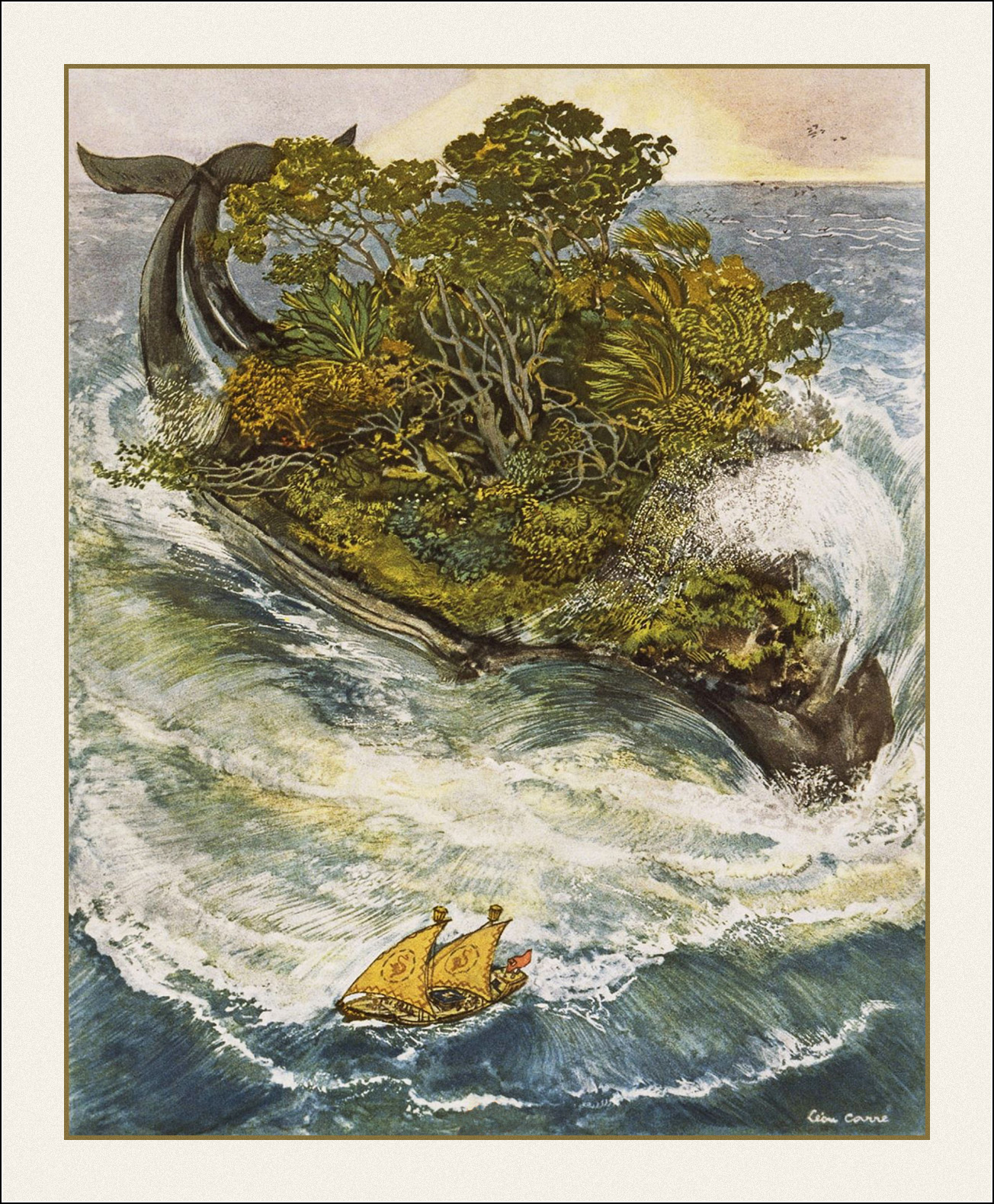
From ‘The adventures of Sindbad’
Leon Carre

AUSTRALIANS

It’s wonderful to have been one of the many readers who finally got hold of the books of Jen Craig this year, and fell in love with them. Intensely, almost claustrophobically, looping narratives of communication breakdowns, troublesome families, injuries, art, eating disorders, and the irritation of being named Jenny Craig when that’s the name of the country’s most famous dieting pyramid scheme. The experience of reading each book—Since the Accident (2013) and Panthers and the Museum of Fire (2015)—is something like peering closely at the back of an incredibly detailed tapestry, trying to guess at the structure, and then with the last few pages suddenly flipping it over to discover a masterpiece. I also read her third novel, Wall (2023), but that was earlier this month so just imagine me saying something similar in 12 months about that.

Susan McCreery’s All the Unloved (2023) is a wonderful novella about the inhabitants of a block of flats in 1990s beachside Sydney, centred on a teenaged girl’s coming of age. Amanda Lohrey’s Vertigo (2009) is another small gem, the story of a traumatised couple fleeing to a new home on the rural coast, and ending in bushfire and terror, told in an engagingly odd way. The two most recent collections of Greg Egan’s short stories, Instantiation (2020) and Sleep and the Soul (2023), demonstrate with impressive depth just why he is widely regarded as one of the world’s best science-fiction writers, especially at this length—story after story will use an amazing idea that a lesser writer would spend a 1200p trilogy on, and then move on to something else even more mind-boggling in just a couple of dozen pages.

Adam Ouston’s Waypoints (2022) is a splendid example of one of my favourite genres of book—an obsessive monologue by an unreliable narrator, in this case somewhat pinned to reality through the disappearance of airliner MH370 in 2014 and Harry Houdini’s attempts to be the first person to fly an airplane over Australia in 1910. Finally, Tommi Parrish’s newest graphic novel, Men I Trust (2023), is a drably beautiful exploration of parasitic friendship, and I really am trying to get over the fact that they mistakenly include a Walmart in an Australian setting. [Ed. – Oh I just picked this up—had no idea it was Australian!]

[The conductor passes down the corridor, bellowing in a monotone. “This train is about to depart, all visitors please leave! Ticketholders only!” A small, relieved smile passes over your face as I step down from the carriage onto the platform, still talking.]

HUNGARIANS

Anyone who has read one of my year-in-readings before knows how I go on about the Hungarians. And here I am doing it again. The best Hungarian literature I read this year was Magda Szabó’s The Fawn (1959/2023), translated by Len Rix, the story of the career and personal life of increasingly enraged actress through Hungary’s tumultuous mid-twentieth Century. Spadework for a Palace by László Krasznahorkai (2018/2022), translated by John Batki, is another tremendous example of the obsessive monologue/unreliable narrator mentioned above. And Ágota Kristóf’s Yesterday (1995/2019), translated by David Watson, was sadly the last book of hers I had left unread: an illegitimate small-town child flees his past by moving to the city, but the reappearance of his now-married childhood love throws everything into chaos.

‘Hare 2’
Jan Pypers

OUTER SPACE, INNER SPACE

Samantha Harvey’s Orbital was just my cup of tea, a quiet and thoughtful 24-hour slice of the lives of six people at work, where said work is in the International Space Station in its final days. In Ascension by Martin MacInnes goes further afield, from the ocean depths to the Oort Cloud, in search of First Contact, strange dreams, and the dawn of life. I loved it, but not unreservedly—there were occasional weird glitches, like MacInnes’s childlike idea that as you travel through the Solar System you pass the planets one by one in a neat line, the way they are drawn in a kids’ encyclopaedia. [Ed. – Wait, that’s not what they’re like???]

The This (2022) by the always interesting, and ludicrously underrated, Adam Roberts, is a hugely entertaining extrapolation from the near into the far future, taking us from the Next Big Thing in social media to humanity as a hive mind. And an end-of-year treat was the new collection Selected Nonfiction 1962-2007 (2023) by J. G. Ballard, a chunky and tremendously entertaining mix of reviews, articles, memoirs, lists and rants.

[The train begins to move, very slowly at first. I’m standing at your carriage window, still talking, and I begin to walk along the platform, keeping pace with the train. You glance at your fellow passengers, blushing.] [Ed. – Ugh shit like this is sooo embarrassing… What a weirdo right I don’t even know that guy!]

ENDS

There were lots of excellent cataclysms in this year’s reading. How I’d taken this long to read David Markson’s Wittgenstein’s Mistress is both mysterious and an indictment on me, but this beautiful book from the point of view of possibly the last woman on Earth is full of gorgeous writing and vivid images. [Ed. – Is she thrilled to be free of bros at long last?] I absolutely loved it. I also loved Oana Aristide’s Under the Blue, a particularly well-done plague-and-after novel, so I was very sad to get in a fight and end up blocking the author online because of her being an anti-trans bigot. Why are authors all so unpleasant?

Pink Slime (2020/2023) is an Uruguayan novel of toxic miasma and slow societal collapse by Fernanda Trías, translated by Heather Cleary, another weird case of a book being written pre-COVID that foreshadows and refracts the weirdness we all then went through. Rebecca Campbell’s Arboreality (2022) is a Canadian novel in stories that takes us further and further into our future of rising waters and collapsing ecosystems, offering no cheap false hope but still providing a glimpse of something worth being alive for. [Ed. – I keep hearing about this book. Gotta check that out.]

And turning from global to personal cataclysm, there was Lorrie Moore’s I Am Homeless If This Is Not My Home (2023), where one of the two main characters is very, very dead. But readers of Anagrams will know well that a character doesn’t have to exist for them to be vividly, hilariously rendered by Moore.

STORIES

There were so many resurrections and collections of great short story writers this year. Among the best were Rattlebone (1994) by Maxine Clair and Lover Man (1959) by Alston Anderson, both beautifully observed interconnected collections about Black American communities. No Love Lost (2023) collects the incredible novellas of Rachel Ingalls, and if there’s a richer, stranger book than this out there, send it to me now!

Jean Stafford’s Children Are Bored on Sunday (1945) is as brilliant as the title promises. [Ed. – Great fucking title.] I also read her novel The Mountain Lion (1947), and fucking hell could she write. Weird misfit children, unhappy loves, badly behaved artists. Have at it!

Tessa Yang’s The Runaway Restaurant (2022) and Madeline Cash’s Earth Angel (2023) were two of the best new story collections I came across this year. Both are peculiar and fizzing with ideas, completely happy to depart reality for the depths of weirdness at the drop of a hat, and very moving—imagine George Saunders if he was actually as good as everyone thinks he is. [Ed. – Heh, you’re not wrong, James…]

And then there was The Collected Works of Jo Ann Beard (2023), which was an absolute revelation. Stories, autofiction, memoir, reportage, not of it conventional, all of it astonishing in its quality and death-haunted eccentric brilliance.

[The train accelerates. You try to pretend the man running along at the window, now bellowing, has nothing to do with you. Not paying attention to where I’m going, I run full-tilt into a metal bin with a resounding clang.] [Ed. — *snort *]

‘Nature Takes Over’
Thomas Strogalski

RANDOM OTHERS

Some books you just can’t shoehorn awkwardly into a category, and there are still too many good ones left to mention. In brief:

Elspeth Barker’s O Caledonia (1991) pairs perfectly with The Mountain Lion, a black comedy about a strange and unloved daughter.

James Hannaham’s Didn’t Nobody Give a Shit What Happened to Carlotta (2022) is a delicious exercise in capturing a voice, in which a trans woman gets out of prison and tries to reconnect with her family and normal life.

Szilvia Molnar’s The Nursery (2023) is an unnerving and convincing novel of fear-of-everything from the point-of-view of a new mother.

Nigel Balchin’s Simple Life (1935) starts off like a mild comedy mocking get-back-to-the-land types, but quickly turns into a fascinating and alarming study of a fraught ménage à trois in a cottage in the middle of nowhere.

And finally, the complete Diaries of Franz Kafka, translated by Ross Benjamin (2023): a monolith of a book, a treasure trove, a heartbreaking testament.

From ‘L’Ange’
Patrick Bokanowski

[You glance back, caught between relief and embarrassment, as I leap to my feet and charge like a maniac after the repeating train, still yelling. Then I reach the end of the platform and plunge into the shrubbery, vanishing from sight. You exhale, and pull out your book to start reading in blessed peace.] [Ed. – Not true, I’d do almost anything to spend a train ride talking books with you, James!]

Bryce Sears’s Year in Reading, 2022

Today’s reflection on a year in reading, his second for the blog, is by Bryce Sears (@BryceSears5). Bryce, one of the nicest people on Book Twitter (which is saying something), is an avid reader and writer who lives in Oakland.

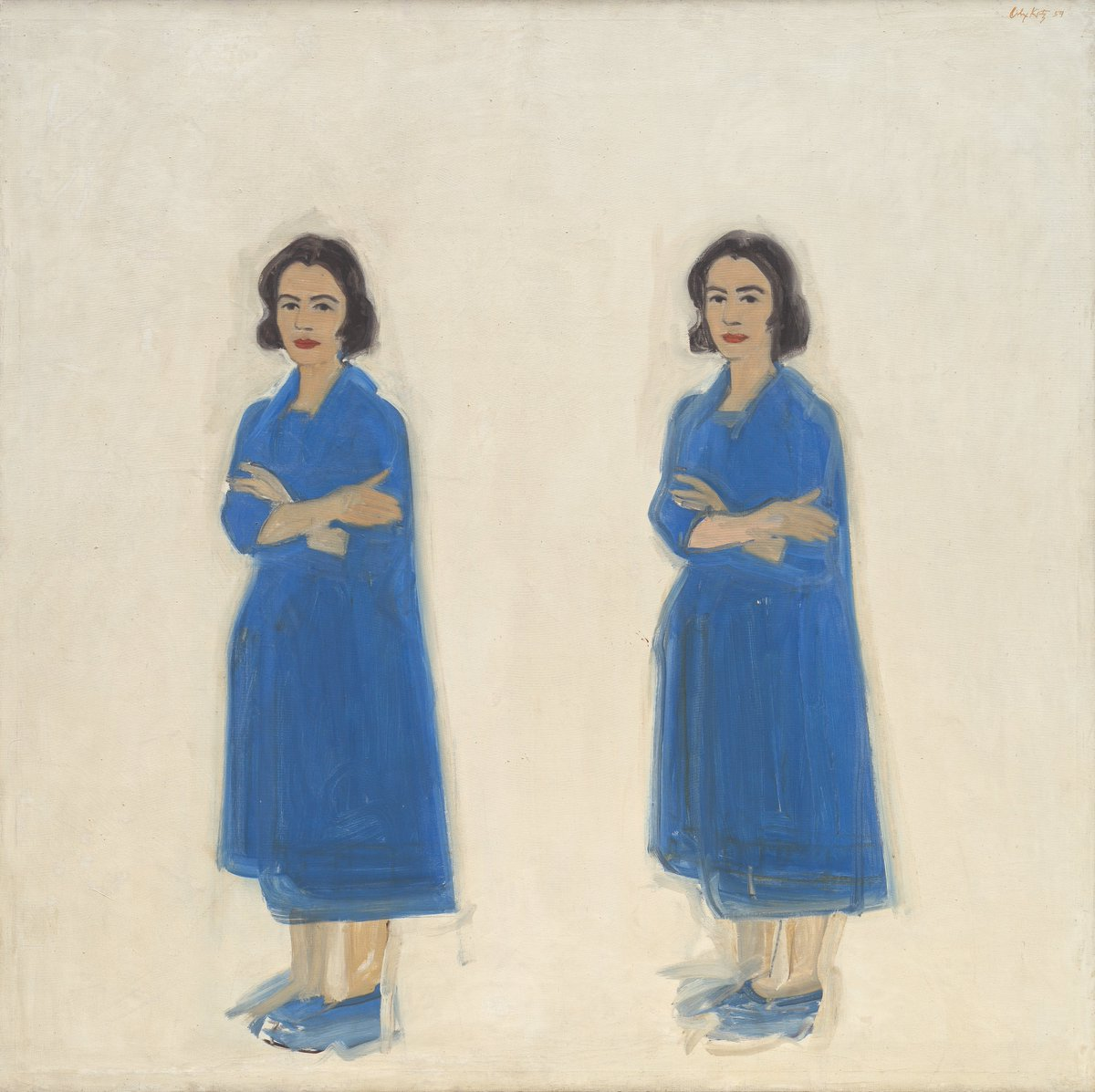
Alex Katz, Ada Ada (1959)

It looks like I read about a book a week in 2022. Notable also that about four books in every five or so I read last year were by women. I favored women writers by about the same margin the year before last, too. I’m not sure why I’ve been reading mostly women. I haven’t planned to do so – not as a habit. Like anyone else, I’m just following my own interests in reading. Years ago, I spent a lot more time reading men, perhaps favoring them by as lopsided a ratio. Months of reading Nabokov, Bellow, Naipaul, Coetzee. So, maybe I’m bringing things back into balance? I wonder too, as I think about reading Fosse and Knausgaard in 2023, if I might be going back to reading more men. We’ll see. It has been exciting reading more women. I think that, not being the primary beneficiaries of a patriarchy, the women I’ve been reading have tended to see the world as more dangerous than did the men I used to read more of.

The Book of Goose, and some other works by Yiyun Li

Yiyun Li and Shirley Jackson top the list of writers I read the most of last year. I had previously read only a little of both. With Li, I had read her second story collection, Gold Boy, Emerald Girl. Then, last year, I read the first collection, A Thousand Years of Good Prayers. [Ed. – I feel like those early collections don’t get enough love these days.] With that, I had a feeling something had clicked for me with her writing. I read her third novel, Where Reasons End, as well as her collection of memoir essays, Dear Friend, from My Life I Write to You in Your Life. These are both pretty somber books. Li has spoken in interviews about her own attempts to commit suicide and she wrote, in Dear Friend, about these attempts. In 2017 her son, at 16, took his own life. She writes, in Where Reasons End, a work of fiction, about a mother’s grieving following the suicide of her son. Toward the end of last year, I read The Book of Goose, Li’s most recent novel and my favorite of hers. More recently, finishing in January of 2023 (I’d like to call this part of a “long 2022”), I read The Vagrants, her first novel, which is very good and very bleak.   

I realize this may all make Li sound like a writer of mostly bleak stories. And her work is often quite somber, at least in these books I’ve read. But it isn’t always. The Vagrants, which deals, among other things, with the oppression of free speech in China, struck me as bleak mostly for political reasons. Dear Friend has chapters about suicide, as mentioned, but is mostly about reading (Maxim Gorky, Elizabeth Bowen, Ivan Turgenev, Thomas McGahern, William Trevor, Marianne Moore, among others). The stories are terrific and varied. The Book of Goose is dark and delightful.  

I like how Li describes the human predicament. She doesn’t go in much for metaphor. She uses short sentences and short paragraphs. She has written about reading Tolstoy, and her writing can remind me of his in moments when humanity seems to shine out of her paragraphs. I had that sense while reading The Vagrants, especially, but also while reading The Book of Goose. The latter has the feel of a fable. I wouldn’t describe it as a funny book. But it did, like The Vagrants, strike me as having deep wells of humor. Consider its narrator, 13-year-old Agnès, thinking here about her friend Fabienne, and questioning her own belief in god:

Fabienne loved making nonsense about god. She claimed she believed in god, though what she meant, I thought, was that she believed in a god that was always available for her to mock. I did not know if I believed in god – my father was an atheist and my mother was the opposite of an atheist. If I had been closer to one or the other, it would be easier for me to choose. But I was close only to Fabienne. Perturbatrice of god, she called herself, and said I was one, too, because I was always on her side. In that sense we were not atheists. You had to believe that god existed so you could make mischief and upend his plans.

What I love here, especially, is that “If I had…” bit. Yes, it is a little bleak how casually Li has her narrator put her religious belief up for grabs. It is as if Li is saying, Yes, that is how we build our identities. But isn’t that mostly true? And isn’t it funny that we are like that?

We Have Always Lived in the Castle, and some other works by Shirley Jackson

I can’t believe I waited so long to read Shirley Jackson. [Ed. – You’re ahead of me! I know, it’s a scandal.] But here, at last, I’ve made a start. My summer last year was the summer of Shirley Jackson. It wasn’t planned, not (again) as a habit. On a whim, I read We Have Always Lived in the Castle, Jackson’s last novel. I had always assumed it was a kind of haunted house story, like The Haunting of Hill House. Somehow – very likely from the Backlisted podcast, as Castle is the subject of their 52nd episode – I wised up. A house figures prominently in Castle, as in much of Jackson’s work. But Castle is about siblinghood and mass hysteria, not to mention the anxieties of adolescence. It has Gothic elements. It resembles a haunted house story. But it isn’t supernatural. Not in the least. Just a tale about the remnants of your average family getting by after one of them has murdered the others with some arsenic in the fruit salad.

If you haven’t read Castle, don’t wait. I wish I hadn’t. I followed it with a binge. I reread The Lottery, which I hadn’t read in decades. It’s still a knockout. I read The Haunting of Hill House, then The Road Through the Wall, then Hangsaman. Haunting struck me as a little dull, perhaps because its approach has been used so often elsewhere since its publication. I should have read it when I was younger. I liked Road a lot, but Hangsaman came closest for me to the thrill of Castle, which is still my favorite Jackson. I read Dark Tales, another story collection (“The Summer People” is a stunner in that one). I read The Sundial, too, in which Jackson turns her knack for foreboding tension into comedic gold. (Pitch-black comedic gold, if that makes sense.) Another Do as I Say Not as I Did? Don’t sleep on The Sundial.

Somewhere along the way, I read A Rather Haunted Life, the Ruth Franklin biography. It is a sad thing about our time with Jackson, who died in 1965 at age 49, only a few years after Castle was published. Her most popular book in her lifetime – her biggest seller by some margin – wasn’t Castle, or any of the world-famous books mentioned above. It was a book called Life Among the Savages, the best, I gather, of the comical chronicles of everyday family life Jackson wrote for the women’s magazines of her day (another collection of these chronicles is called Raising Demons). I’m not here to speak ill of comical family chronicles. I have copies of both of these books and look forward to reading them. Still, new to her work as I am, aware I’m only the latest of many to have this thought, I can’t help but wish we’d gotten more time with Jackson. I can’t help but wish she had seen her reputation rise based on the books we celebrate her for now, or other books she might have written. Had she lived even into her 80s, she would have been alive and presumably writing in the 1990s. Crazy-making, thinking of what she might have come up with in those years.

The Dominant Animal and Kick the Latch, by Kathryn Scanlan

I read two books by Kathryn Scanlan last year. Earlier in the year, after loving a story of hers (called “As the Dick Would Have It”) in Southwest Review [Ed. – Ok that is a a good title], I picked up The Dominant Animal, a collection of very short stories. I read it quickly and liked it a lot. I’d recommend it anyone who doesn’t need a story to convey a meaning of some sort that is especially clear. Some of the stories in this collection were published, I believe, in Noon, the journal Diane Williams founded. Probably everyone knows this, but Williams is famous for writing very short stories. People write of her stories that they skirt meaning in interesting ways. I find her stories interesting. Her narrators often strike me as shocking, even horrifying. Most of them I find comical. I experience the people in her stories speaking and behaving in ways I think, at first, people never speak or behave in real life. Then, sometimes, I start to think people do sometimes talk and act like that. In any case, even as I think now that Scanlan is portraying characters in a somewhat more realistic way than I read Williams as doing, or intending to do, my read of The Dominant Animal at the time (a somewhat shallow read, I hope I’m making clear, though I hope it may help readers new to her work) was along these lines – that Scanlan was doing a similar sort of thing to what Williams is doing.

Kick the Latch, which I read in September, is a quite different sort of book from The Dominant Animal. It is a kind of novel. A single, first person narrative of the life of a horse trainer named Sonia, a woman Scanlan interviewed whose voice (I’m quoting here from the afterward and the French flaps) she transcribed and amplified and “used to write the book, which is a work of fiction.” In some ways, the book reads like a memoir written by Sonia. It would feel very much like a memoir, I think, if it had included more details that identify her, like her last name. As it is, Sonia can feel at times like an everywoman. That isn’t a bad thing, to my thinking. The book is terrific. Moving, at times harrowing, odd, above all interesting. Scanlan has a wonderfully taught prose style. Producing a book in this way raises ethical questions. I can imagine someone trying this technique – producing a novel based on interviews with a working-class person who doesn’t want credit as a cowriter – in a way I’d consider exploitative. The hosts of the Literary Friction podcast interviewed Scanlan and wondered, as a kind of thought experiment, how our reaction to the book might change if Sonia were suing Scanlan over some kind of misrepresentation. That would change things for me, certainly. So, I count myself lucky nothing of the sort seems to be happening. The book is so good. Just thinking of it again now, I want to reread it. All the while I was reading it, I wished my grandparents – my grandparents! – were alive so that I might convince them to read it. If you knew them you’d get the emphasis. They were open-minded about literature, but weren’t great readers. My grandmother was a big Danielle Steel fan. But they were Texans who retired to a horse-racing life in New Mexico. They could sound at times like Sonia does in Kick the Latch. And the storytelling in the book is so naturally done. My grandparents would have loved it. I bet you would too. [Ed. – Been hearing a lot about this, but this has sold me! Thanks, Bryce.]

In Memory of Memory, by Maria Stepanova (tr. Sasha Dugdale)

I’m a sucker for the “meditation on” label in book marketing. Give me Fernando Pessoa journaling for five hundred pages about nostalgia, and his daily life at the office. Give me Claudio Magris, traveling the Danube, letting its scenery take his thinking where it will. Give me Nathalie Léger, on a three-book quest to understand herself through the lives of other artists. If the feeling of a mind letting itself wander a bit aimlessly thrills you too, you may love In Memory of Memory as I did. The book is a kind of tribute Stepanova is writing to her family. The digressive nature of this tribute may make it difficult to track what exactly is happening to her family. I could find myself losing threads. Still, I didn’t mind. The digressions are wonderful. They’re most of the book. The family history, in some sense, is a frame to support them. Stepanova writes about Sebald and Joseph Cornell, Tsvetaeva, Walter Benjamin, Francesca Woodman, among other writers and artists. She writes about history. Her family had better luck than many other Jewish families did in Russia during the 19th and 20th centuries. [Ed. – Low bar…] In Memory of Memory isn’t about the worst human suffering of those years. It’s about some people who escaped it. This is a source of some tension for Stepanova. She writes with some regret that she had no heroes in her family, that they all “appeared to live utterly apart from grinding mills of the era.” In this sense, the book strikes me a tribute to ordinary people, too, as well as to art and literature.

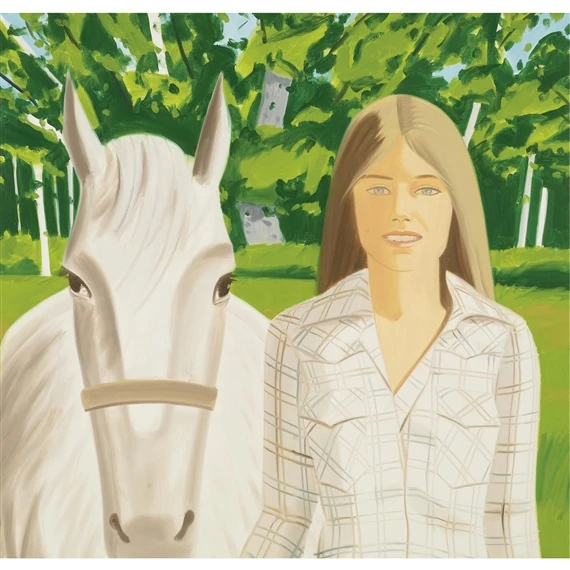
AlexKatz, Jean Standing (1976)

How can I only have read a book a week last year and I’m still running out of space for this piece? (Because I’m longwinded, that’s how.) [Ed. – Haha I’ll see you and raise you…]

I don’t want to miss saying that I read and loved J.A. Baker’s The Peregrine last year, too – a somber book of perfect sentences. You won’t read it without planning to reread it. It is that good.  

I loved Leonora Carrington’s The Hearing Trumpet, one of the funniest books I read last year. Did you know she was friends with Jodorowsky? I didn’t until a few months ago, when someone said so on Twitter (so it must be true). I want to read everything by her now. I want to learn all about her life, too.

I loved Elif Batuman’s The Possessed. Another book that had me laughing. It was one a very few non-fiction books I read last year. I loved Jenny Erpenbeck’s Visitation (tr. Susan Bernofsky), and Magda Szabó’s The Door (tr. Len Rix). I hope to read a lot more of both writers. I read, spread out over most of the year, the seasonal quartet of Ali Smith. I want to read more of her work. And Sleepless Nights – I can’t not mention Sleepless Nights! My first Elizabeth Hardwick. I see a lot more of her work in my future. [Ed. – Thanks, Bryce. So many writers, right???]

My Year in Reading, 2020

I feel bad saying it, it is a mark of my privilege and comfort, but 2020 was not the most terrible year of my life. In many ways, it was even a good year. I have secure employment, about as secure as can be found these days, and what’s more I spent half the year on sabbatical, and even before then I was working from home from mid-March and didn’t miss my commute for a minute. Thanks to the sabbatical, I avoided the scramble to shift my teaching to a fully online schedule—watching colleagues both at Hendrix and elsewhere do this work I was keenly aware of how luck I’d been to have avoided so much work. I do worry, however, that I’m hopelessly behind the curve, clueless about various technologies and best practices; I expect elements of the shift to virtual will persist.

My family spent a lot of time together last year; among other things, I watched my daughter grow into someone who edits YouTube videos with aplomb. (At not-quite ten she is already the house IT person.) As an introvert, I found staying home all the time the opposite of a burden. (Last week I had to be somewhere relatively crowded, for the first time in months, and boy am I going to be in for a rude awakening when this is all over.) I missed seeing friends, but honestly my social circle here is small, and I continued to connect with readers from all over the world on BookTwitter. Most excitingly, I had a lot of time to read. I’ve heard many people say their concentration was shot last year, and understandably, but that wasn’t my experience. For good or for ill my response to bad times is the same as to good—to escape this world and its demands into a book.

But sometimes, usually on my run, I’ll wonder if I’m mistaken in my assessment of the year. I suspect a deep sadness inside me hasn’t come out yet: sadness at not seeing my parents for over a year; at not being able to visit Canada (I became a US citizen at the end of the year, but Canada will always be home; more importantly, our annual Alberta vacations are the glue that keep our little family together); at all the lives lost and suffering inflicted by a refusal to imagine anything like the common good; at all the bullying and cruelty and general bullshit that the former US President, his lackeys, and devoted supporters exacted, seldom on me personally, but on so many vulnerable and undeserving victims, which so coarsened life in this country.

I think back to the hope I sometimes felt in the first days of the pandemic that we might change our ways of living—I mean, we will, in more or less minor ways, but not, it seems, in big ones. I feel hopelessness at the ongoingness of the pandemic, the sense that we may still be closer to the beginning than the end. And a despair fills me, affecting even such minor matters, in the grand scheme of things, as this manuscript I’m working on—could it possibly interest anyone?

I suppose what most concerns me when I say that 2020 was not a terrible year is my fear of how much more terrible years might soon become. My anxiety about the climate-change-inspired upheavals to come sent me to books, too, more in search of hope than distraction. A few of the titles below helped with that. Mostly, though, reading books is just what I do. I am reader more than anything else, and I expect to be for as long as that’s humanly possible.

For the second straight year, I managed to write briefly about every book I read. You can catch up on my monthly review posts here:

January February March April May June July August September October November December

All told, I finished 133 books in 2020, almost the same as the year before (though, since some of these were real doorstoppers, no doubt I read more pages all told). Of these 45 (34%) were by men, and 88 (66%) by women. 35 were nonfiction (26%), and 98 (74%) were fiction. Sadly—if predictably—I read no collections of poetry or plays last year. I didn’t read much translated stuff: only 30 (23%) were not originally written in English. Only 4 were re-reads; no surprise, given how little I was teaching.

Highlights:

These are the books that leap to mind, the ones I don’t need to consult my list to remember, the ones that, for whatever reason, I needed at this time in my life, the ones that left me with a bittersweet feeling of regret and joy when I ran my hands consolingly over the cover, as I find I do when much moved. These are the books a reader reads for.

Larry McMurtry, Lonesome Dove

My book of the year. A road novel about a cattle-drive from the Mexican border to Montana around 1870. Thrilling, funny, epic, homely. Characters to love and hate and roll your eyes at and cry over and pound your fists in frustration at. And landscapes to swoon over, described in language that is never fussy or mannered or deliberately poetic, and all the better able to capture grandeur for that. I think about the river crossings all the time. And those last scenes in wintry Montana. Lonesome Dove is good for people who love Westerns. It’s good for people who don’t love Westerns. Recently someone asked me to recommend a 20th century Middlemarch. Crazy, I know, but I immediately thought of this book, which, albeit in a different register and in a different location, is similarly fascinated by the webs that form community, and why we might want to be enmeshed in them. (A goal for 2021 is to re-read Eliot’s masterpiece to see if this comparison has any merit.) If you read novels for character, plot, and atmosphere—if you are, in other words, as unsophisticated a reader as me—then Lonesome Dove will captivate you, maybe even take you back to the days when you loved Saturdays because you could get up early and read and read before anyone asked you to do anything.

Kapka Kassabova, To the Lake

I loved Kassabova’s previous book, Border, and was thrilled that my high expectations for its follow-up were met. Lake Ohrid and Lake Prespa, connected by underground rivers, straddle the borders of Greece, Albania, and the newly-independent North Macedonia. This book is about these places, but as the singular noun in the title suggests, “lake” here primarily concerns a mindset, one organized around the way place draws together different peoples. Like Border, To the Lake is at first blush a travelogue, with frequent forays into history, but closer inspection reveals it to be an essayistic meditation on the different experiences provoked by natural versus political boundaries. Unlike Border, To the Lake is more personal: Kassabova vacationed here as a child growing up in 1970s Bulgaria, as her maternal family had done for generations. But Kassabova seems more comfortable when the spotlight is on others, and the people she encounters are fascinating—especially as there is always the possibility that they might be harmful, or themselves have been so harmed that they cannot help but exert that pain on others. In Kassabova’s depiction, violence and restitution are fundamental, competing elements of our psyche. One way that struggle manifests is through the relationships between men and women. As a woman from the Balkans who no longer lives there, as a woman travelling alone, as an unmarried woman without children, Kassabova is keenly aware of how uncomfortable people are with her refusal of categorization, how insistently they want to pigeonhole her. (No one writes ill-defined, menacing encounters with men like she does.) People have been taking the waters in these lakes for centuries—the need for such spaces of healing is prompted by seemingly inescapable violence. I’ve heard that Kassabova is at work on a book about spas and other places of healing, and it’s easy to see how the forthcoming project stems from To the Lake. I can’t wait.

Kate Clanchy, Some Kids I Taught and What They Taught Me & Antigona and Me

Clanchy first earned a place in my heart with her book based on her life as a teacher, Some Kids I Taught and What They Taught Me. She is particularly good on how we might teach poetry writing—not by airily invoking “inspiration” but by offering students the chance to imitate good poems. These models will inspire students to write amazing poems of their own, and offer students whose background is from outside the UK (where Clanchy lives) the chance to refract their own experiences into art. Clanchy is committed to the idea that students have things to gain from their education, if they are allowed to pursue one. But she is equally adamant that students have things to give to the institutions where they spend so much of their lives. Thinking about what a child might bring to her school reminds us that education is a public good first and not just a credentialing factory or a warehouse to be pillaged on the way to some later material success. It’s an idea that might begin to redistribute the social and economic inequalities attendant in neoliberalism.

I’m sure I liked Some Kids as much as I did because I’m also a teacher. Which doesn’t mean I don’t think non-teachers (and non-parents) will enjoy it too. But I do think Clanchy’s earlier book Antigona and Me is an even greater accomplishment, with perhaps wider appeal. Antigona is Clanchy’s pseudonym for a Kosovan refugee who became her housekeeper and nanny in the early 2000s. The two women’s lives became as intertwined as their different backgrounds, classes, and values allowed them. Yet for all their differences, they are linked by the shame that governs their lives as women. Antigona’s shame—her escape from the code of conduct that governed her life in the remote mountains of Kosovo, and the suffering that escape brought onto her female relatives—is different from Clanchy’s—her realization that her own flourishing as a woman requires the backbreaking labour of another—and it wouldn’t be right to say that they have more in common than not. What makes the book so great is what fascinating an complex characters both Antigona and Clanchy are. Riveting.

Andrew Miller, Now We Shall Be Entirely Free

A brilliant historical novel. My knowledge of the Napoleonic wars is thin—though having just finished War and Peace I can say it is less thin than it used to be—and I appreciated learning about both the campaign on the Iberian peninsula and the various milieu in England, ranging from medicine to communal living, that were both far removed from and developed in response to that war. (Miller has Penelope Fitzgerald’s touch with the telling detail, conjuring up the mud and blood-spattered viscera of the past while also showing its estrangement from the present.) But what has really stayed with me in this book about a traumatized soldier on the run from both his memories and, more immediately, a pair of contract killers hired to silence the man before he can reveal a wartime atrocity is its suggestion that the past might be mastered, or at least set aside. Reading the last fifty pages, I felt my heart in my throat. Such anxiety, such poignancy. This book really needs to be better known.

Helen Garner, The Spare Room

Garner is a more stylistically graceful Doris Lessing, fizzing with ideas, fearless when it comes to forbidden female emotions. Old friends Helen and Nicola meet again when Helen agrees to host Nicola, who has come to Melbourne to try out an alternative therapy for her incurable, advanced cancer. Garner brilliantly presents Helen’s rage at the obviously bogus nature of the therapy—and Nicola’s blithe (which is to say, deeply terrified) unwillingness to acknowledge that reality. Helen is resentful, too, about the demanding and disgusting job of taking care of Nicola (seldom have sheets been stripped, washed, and remade as often as in this novel). Emotions about which of course she also feels guilty. Nicola expresses her own rage, in her case of the dying person when faced with the healthy. In the end, Nicola has to be tricked into accepting her death; the novel lets us ask whether this really is a trick. Has Nicola gained enlightenment? Is false enlightenment, if it gets the job of accepting reality still enlightenment? What does enlightenment have to do with the failure of the body, anyway? I loved the novella’s intellectual and emotional punch.

Robin Wall Kimmerer, Braiding Sweetgrass: Indigenous Wisdom, Scientific Knowledge, and the Teachings of Plants

Kathleen Jamie, Surfacing

Kim Stanley Robinson, The Ministry for the Future

I’ve grouped these titles together, not because they’re interchangeable or individually deficient, but because the Venn diagram of their concerns centers on their conviction that being attuned to the world might save it and our place on it. These are great books about paying attention. Whether describing summer days clearing a pond of algae or noting the cycles nut trees follow in producing their energy-laden crop, Kimmerer reminds us that “all flourishing is mutual.” We are only as vibrant, healthy, and alive as the most vulnerable among us. The past year has taught us the truth of this claim—even though so far we have failed to live its truth. Jamie observes a moth trapped on the surface of the water as clearly as an Alaskan indigenous community whose past is being brought to light by the very climactic forces that threaten its sustainability. Robinson imagines a scenario in which dedicated bureaucrats, attentive to procedure and respectful of experts, bring the amount of carbon in the atmosphere down to levels not seen since the 19th century. Even though Robinson writes fiction, he shares with Kimmerer and Jamie an interest in the essay. We need essayistic thinking—with its associative leaps and rhizomatic structure—more than ever. These generous books made me feel hopeful, a feeling I clung to more than ever this year.

Best of the rest:

Stone cold modern classics: Sybille Bedford’s Jigsaw (autofiction before it was a thing, but with the texture of a great realist novel, complete with extraordinary events and powerful mother-daughter drama—this book could easily have won the Booker); Anita Brookner’s Look at Me (Brookner’s breakout: like Bowen with clearer syntax and even more damaged—and damaging—characters); William Maxwell, They Came Like Swallows (a sensitive boy, abruptly faced with loss; a loving mother and a distant father; a close community that is more dangerous than it lets on: we’ve read this story before, but Maxwell makes it fresh and wondering).

Stone cold classic classics: Buddenbrooks (not as heavy as it sounds), Howells’s Indian Summer (expatriate heartache, rue, wit).

Thoroughly enjoyed, learned a lot (especially about hair): Chimamanda Ngozi Adichie’s Americanah

Best deep dive: I read four novels by Tessa Hadley this year, two early ones and the two most recent. Since I’ve read a few of her books before I now only have two more to go before I’ve finished them all. That will be a sad day, though with luck we will get a new one before too long. Hadley has been good from the start, but The Past and Late in the Day show her hitting new heights of wisdom and economy. Her characters are arty types or professionals who learn things they don’t always like about what they desire, especially since those desires they are so convinced by often turn out later to have been wrongheaded (like Proust’s Swann, they spend their lives running after women who are not their types, except “women” here includes men, friends, careers, family life, their very sense of self). I can imagine the future day when young literary hipsters rediscover Hadley’s books and wonder why she wasn’t one of the most famous writers of her time.

Did not totally love at the time, but bits and pieces of which would not quite let me alone: Tim Maugham’s Infinite Detail (struck especially by the plight of people joined by contemporary technology when that technology fails: what is online love when the internet disappears?); Henri Bosco’s Malicroix translated by Joyce Zonana (so glad this is finally in English; even if I was not head-over-heels with it, I’ll never forget its descriptions of weather. Do you like wind? Have I got a book for you!).

Loved at the time but then a conversation with a friend made me rethink: Paulette Jiles’s The News of the World. I was a big fan of this book back in the spring—and its rendering on audio book, beautifully rendered by a gravelly-voiced Grover Gardner—and I still think on it fondly. But a Twitter friend argued that its portrayal of a girl “rescued” from the Kiowa who had taken her, years earlier, in a raid is racist. I responded that the novel is aware of the pitfalls of its scenario, but now I’m not so sure.

Maybe not earth-shattering, but deeply satisfying: Lissa Evans’s V for Victory, Clare Chambers’s Small Pleasures, two novels that deserve more readers, especially in the US, where, as far as I know, neither has yet been published.

Most joyful, biggest belly laughs: Rónán Hession’s Leonard and Hungry Paul. That bit in the supermarket! Priceless.

Best Parul Seghal recommendation: Seghal elicits some of the feelings in middle-aged me that Sontag did to my 20-year-old self, with the difference that I now have the wherewithal to read Seghal’s recommendations in a way I did not with Sontag’s. Anyway, I’ll follow her pretty much anywhere, which sometimes leads me to writers I would otherwise have passed on. Exhibit A in 2020 was Barbara Demnick, whose Eat the Buddha is about heartrending resistance, often involving self-immolation, bred by China’s oppression of Tibetans. In addition to its political and historical material, this is an excellent book about landscape and about modern surveillance technology.

Ones to watch out for (best debuts): Naoisie Dolan’s Exciting Times; Megha Majumdar’s A Burning; and Hilary Leichter’s Temporary. Have I ever mentioned that Leichter was once my student?

Longest book: Vikram Seth’s A Suitable Boy. Almost 1500 pages of easy reading pleasure that I look on with affection (perhaps more than when I first finished it) rather than love. Although now that I have finished War & Peace I see that Seth frequently nods to it. Wolf hunts!

Longest book (runner up): Dickens’s Our Mutual Friend A mere 900-pager. As I said back in November, “I read it mostly with pleasure and always with interest, but not avidly or joyfully.” Most interesting as a story about “revenants and ghosts, about corpses that don’t stay hidden, about material (junk, trash, ordure, tidal gunk, or whatever the hell “dust” is supposed to be) that never comes to the end of its life, being neither waste nor useful, or, rather, both.” Happy to have read it, but don’t foresee reading it again anytime soon.

Slow burn: Magda Szabó, Abigail (translated by Len Rix). Bit irritated by this at first but then realized the joke was on me—the narrator’s self-absorption is a function of her ignorance. All-too soon ignorance becomes experience. Not as gloriously defiant as The Door, but worth your time.

Frustrating: Carys Davies, West. Ostensibly revisionist western that disappoints in its hackneyed indigenous characters. I do still think of bits of it almost a year later, though, so it’s not all bad.

Left me cold: James Alan McPherson, Hue and Cry; Fleur Jaeggy, These Possible Lives (translated by Minna Zallman Procter); Ricarda Huch, The Last Summer (translated by Jamie Bulloch) (the last is almost parodically my perfect book title, which might have heightened my disappointment).

Not for me, this time around (stalled out maybe 100 pages into each): The Corner That Held Them; Justine; The Raj Quartet; Antal Szerb’s Journey by Moonlight. Promise to try these again another time.

Stinkers: Géraldine Schwarz, Those Who Forget: My Family’s Story in Nazi Europe—A Memoir, a History, a Warning (translated by Laura Marris); Jessica Moor, The Keeper; Patrick DeWitt, French Exit; Ian Rankin, A Song for the Dark Times

Writer I read a lot of, mostly very much enjoying and yet whose books do not stay with me: Annie Ernaux. I suspect to really take her measure I would need to re-read her, or, better yet, teach her, which I might do next year, using Happening. As I said in regards to the latest Sigrid Nunez, I think I do not have the right critical training to fully appreciate autofiction. I enjoy reading it, but I cannot fix on it, somehow.

Good crime fiction: Above all, Liz Moore’s Long Bright River, an impressive inversion of the procedural. Honorable mentions: Susie Steiner; Marcie R. Rendon; Ann Cleeves, The Long Call (awaiting the sequel impatiently); Tana French, The Searcher; Simenon’s The Flemish House (the atmosphere, the ending: good stuff). In spy fiction, I enjoyed three books by Charles Cumming, and will read more. In general, though, this was an off-year for crime fiction for me. What I read mostly seemed dull, average. Maybe I’ve read too much the last decade or so?

Inspiring for my work in progress: Daniel Mendelsohn’s Three Rings: A Tale of Exile, Narrative, and Fate. Mendelsohn excels at structure—and in these three linked lectures he tackles the subject head on.

Best Holocaust books (primary sources): I was taken by two memoirs of Jewish women who hid in Berlin during the war: Marie Jalowicz Simon’s Underground in Berlin (translated by Anthea Bell) and Inge Deutschkron’s Outcast: A Jewish Girl in Wartime Berlin (translated by Jean Steinberg). Gerda Weissmann Klein’s memoir All But my Life is worthwhile, with a relatively rare emphasis on forced labour camps. In her novel Other People’s Houses, closely based on her own experience as a child brought from Vienna to England on the Kindertransport, Lore Segal takes no prisoners. Uri Shulevitz’s illustrated memoir, Chance: Escape from the Holocaust, is thoroughly engrossing, plus it shines a spotlight on the experience of Jewish refugees in Central Asia. Of all these documents, I was perhaps most moved by the life of Lilli Jahn, a promising doctor abandoned in the early war years by her non-Jewish husband, as told by her grandson Martin Doerry through copious use of family letters. My Wounded Heart: The Life of Lilli Jahn, 1900 – 1944 (translated by John Brownjohn) uses those documents to powerful effect, showing how gamely her children fended for themselves and how movingly Jahn, arrested by an official with a grudge, contrary to Nazi law that excepted Jewish parents of non or half-Jewish children from deportation, hid her suffering from them.

Best Holocaust books (secondary sources): I was bowled over by Mark Roseman’s Lives Reclaimed: A Story of Rescue and Resistance in Nazi Germany. Fascinating material, elegantly presented, striking the perfect balance between historical detail and theoretical reflection. To read is to think differently about our misguided ideas of what rescue and resistance meant both in the time of National Socialism and also today. His earlier work, A Past in Hiding: Memory and Survival in Nazi Germany, which focuses on a part of the larger story told in the new book, is also excellent. Omer Bartov’s Anatomy of a Genocide: The Life and Death of a Town Called Buczacz is another fine example of the particular used to generate general conclusions. Considering the fate of the Galician town of his ancestors in the first half of the 20th century, Bartov uses the history of Buczacz, as I put it back in January, “to show the intimacy of violence in the so-called Bloodlands of Eastern Europe in the 20th century. In his telling there was a seemingly ineluctable drive on the part of almost every group to reduce the region’s cultural diversity, and that much of the violence required to do so was perpetrated by one neighbour against another.” Dan Stone’s Concentration Camps: A Very Short Introduction does exactly what the title offers. It covers an impressive amount of material—Nazi and Stalinist camps feature most prominently, no surprise, but they are by no means the sole focus—in only a few pages. Rebecca Clifford’s Survivors: Children’s Lives after the Holocaust skillfully combines archival and anthropological material (interviews with twenty child survivors) to show how much effort postwar helpers, despite their best intentions, put into taking away the agency of these young people.

In addition to reviews of the things I read, I wrote a couple of personal things last year that I’m pleased with: an essay about my paternal grandmother, and another about my love for the NYRB Classics imprint.

You can find my reflections on years past here:
2019 2018 2017 2016 2015 2014

Coming in 2021:

Because my sense of how long things will take me to do is so terrible (it’s terrible), I’m always making plans I can’t keep. I should either stop or become more of a time realist. I do have a couple of group readings lined up for the first part of the year: Minae Mizumura’s A True Novel in February, and L. P. Hartley’s Eustace and Hilda trilogy in March. I’ve enjoyed, these past months, having a long classic on the go, and will keep that up until the end of my sabbatical. Having just completed War and Peace—guaranteed to be on this list in a year’s time—I might read more Russians. We’ll see. I want to read more Spanish-language literature—though I’ve been saying that for years and mostly not doing it. I want to read more writers of colour, especially African American writers. I took a course in college but have so many gaps to fill. I’m reading more nonfiction with greater pleasure than ever before—the surest sign of middle age I know; I’m sure that will continue in 2021. I read almost no comics/graphic novels last year, unusual for me, but I’m already rectifying that omission. I’ll read more science fiction in 2021, I suspect; it feels vital in a way crime fiction hasn’t much, lately. My two prime candidates for “deep dives” this year are Edith Wharton and Toni Morrison. Now that I am an American I should know the literature better!

What I’ll probably do, though, is butterfly my way through the reading year, getting distracted by shiny new books and genre fiction and things that aren’t yet even on my radar. No matter what, though, I’ll keep talking about it with you. That is, I’ll put my thoughts out here, and hope you’ll find something useful in them, and maybe even that you’ll be moved to share your own with me. Thanks to all my readers. Your comments and reactions and opinions—that connection—means everything to me.

What I Read, February 2020

February. When was that? Oh yeah, when we were stressed and run into the ground by daily cares. Part of me wants that life back so much. But part of me thinks the world that generated those cares wasn’t all that great. I swing between terror (about illness and death, about financial and economic collapse, about those lines around the block at the gun shop) and hope (maybe things could be different on the other side of this). Mostly I feel paralyzed, with many things to do but little incentive to do them.

So what was happening in that long-ago time? The treadmill of the semester, mostly. Rumblings of the disease. (Would my students and I be able to take our trip to Europe? Long since canceled, of course.) The hockey playoffs drawing ever nearer. (Amazing how much time I spent on that stuff.) And, of course, some reading. To wit:

ESXWUfbX0AEttP1

Ruth Kluger, Still Alive: A Holocaust Girlhood Remembered (2001) One of thegreatest Holocaust memoirs, no, a fucking great book, period. Ruth Kluger is one of the original badasses. Unlike many Holocaust memoirs, Still Alive (even the title is a spit in the face of her persecutors) focuses as much on postwar as prewar and wartime life. Kluger’s persecutors are legion: the Nazis, of course, and all the silent Germans who acquiesced to them. But also all those who insist on minimizing or relativizing her experiences. And then there are the oppressive systems she’s had to live under, not least racism and patriarchy. (Kluger was one of the first to insist that the experience of the Holocaust was thoroughly gendered.) And, most painfully, the people closest to her: her first husband; an old friend (the well-known German writer Martin Walser); a great-aunt who, in prewar Vienna, took away Kluger’s streetcar ticket collection from her, deeming it dirty and vulgar; the distant familial connections in America who wanted little to do with her when she and her mother landed there in the late 1940s. (Kluger is a great hater and knows how to hold a grudge.) But of all these persecutors the greatest is her mother, the woman with whom she experienced the Anschluss, the depredations and degradations of Nazi Vienna, Theresienstadt, Auschwitz, Christianstadt, a death march, the DP camps, and finally postwar life in America. A woman who saved her and protected her, yet also tormented her, dismissed her, ignored her, even, it’s fair to say, hated her.

The more times I read Still Alive the more towering I find its achievement. I think this might be the fourth time I’ve taught it. Plus, I did the best job I’ve done with it yet, which was satisfying and solidified my love for the book. I sense readers are catching up to it. In the past, students have felt intimidated by it, even a little shocked. The new generation, angrier, eats it up.

Paulette Jiles, News of the World (2016) Charming without being cloying. News of the World is one of my finds of the year, and I’m pretty sure it’ll be on my end-of-year list. (Look at me with the optimism.) I’d never read Jiles before, only vaguely been aware of her, but now I’m making my way through the backlist.

 News of the World centers on one Captain Jefferson Kidd, who travels through post-Civil War Texas offering readings from a collection of newspapers that he periodically replenishes whenever he reaches a larger town. (Audience members drop their dimes into an old paint can.) He’s a performer, knowing just how much political news he can offer before tempers flare (Texas in these days is roiled by animosity between those supporting the current governor and those opposed) and offering enough news of far-off explorers and technological inventions to soothe, even entrance the crowds. At one such gig near the Oklahoma border an old friend begs him to take charge of a ten-year-old girl who had been stolen from her family by the Kiowa four years earlier and has now been retaken by the US Army. Kidd is prevailed upon to take the girl to her nearest relations, in the country near San Antonio, four hundred dangerous miles south.

Johanna has forgotten English, has no memory of her parents, is devastated by the loss of her Kiowa family and its culture. The novel considers such matters as cultural difference (which it is much more sensitive about than most of the Westerns I’ve been reading lately) and U.S. history (the Captain has fought in three wars, going back to the war of 1812—he’s in his 70s and his great age is part of the story’s poignancy) and the question of whether law can take root in the wake of years of lawlessness. It’s an adventure story and a guide to the Texas landscape. But mostly it’s the story of the bond that arises between the old man and the young girl. And all of this in less than 250 pages. The Captain becomes ever fonder of the child (not in a creepy way, it’s totally above board in that regard), but the feeling hurts him. He senses nothing but heartbreak can come of the situation, and his heart doesn’t feel up to it. I was moved and delighted and recommend it without reservation—could be just the ticket when you’re stuck inside feeling anxious.

Apparently they’ve made a movie and it stars Tom Hanks and probably everyone’s going to love it but I bet it’ll be as saccharine as shit.

Philip Kerr, Prussian Blue (2017) Regular readers know I’m marching though Kerr’s series. This one is especially despairing and cynical, which for this series is saying something. Moving between 1938 and 1956, it finds Bernie Guenther on the run and reminded of an old case in which he was dragooned into finding out who shot a flunky on the balcony of Hitler’s retreat at Bechtesgaden. Set as they are amid the Third Reich, all of these novels are about corruption, but the stink is especially pervasive here. Not the series’ best, though as always Kerr is great at dramatizing history: in this case he particularly nails the Nazi reliance on amphetamines.

Sarah Gailey, Upright Women Wanted (2020) “Are you a coward or are you a librarian?” Tell me you don’t want to read the book that accompanies this tagline. Yet the problem is that the former seems the product of the latter instead of the other way around. Gailey’s novel of a future run on Handmaid’s Tale lines is engaging but slight. Gailey doesn’t much go in for world-building: it’s unclear what happened to make the former western US states technologically poor, violently misogynistic, hardscrabble and suspicious (not really a stretch). Instead, she focuses on the role of the librarians who make their way by wagon-train through the western desert, officially bringing state-sanctioned propaganda to fortified settlements but unofficially acting as couriers for a fledgling resistance. The librarians are women who get to shoot and ride and swear and live, enticing exceptions to the rigidly prescribed gender roles of the times. Upright Women Wanted is a queer western that includes a non-binary character; its most lasting legacy might be its contribution to normalizing they/them/their pronouns. In the end it was too casual/slapdash for me, but I enjoyed reading it well enough for the hour or two it demanded of me.

Eric Ambler, Epitaph for a Spy (1938) Apparently the amateur who falls into an espionage plot is Ambler’s stock in trade. I’ve actually read one or two of his books, but so long ago that I’d forgotten this description, if I ever knew it. Anyway, the machinery of this formula hums along at high efficiency in this finely executed story of a schoolteacher who gets mistaken for a spy and then has only days to find out who among the guests at his Mediterranean pension is the real culprit. The way states use the precariousness of statelessness (the fate of many of the book’s characters) remains painfully timely. For more, read Jacqui’s review. (I know other bloggers have reviewed this too. Please tag yourself in the comments.)

Magda Szabó, Abigail (1970) Trans. Len Rix (2020) The back cover of this new translation of Hungarian writer Szabó’s most popular novel hits the Jane Austen comparisons hard. At first I found this idea both implausible and annoying (it used to be that publishers and reviewers compared books to Austen when they meant “this is set in the 19th century and includes a love plot” but now it seems to have expanded to mean “this book is by a woman”), but as I read on I started to see the point. For Abigail, like Emma, is focalized through a young woman who thinks she knows more than she does. Yet where Austen’s protagonist misunderstands love, Szabó’s misunderstands politics. Gina is the willful teenage daughter of a general in the Hungarian Army during WWII. She is baffled and hurt when her father abruptly sends her to a convent school far from Budapest. The first half of the book is classic boarding school story—Gina is a haughty outsider, she alienates the other girls, she struggles to become part of their cliques—but, after a failed escape attempt, as the political situation in Hungary changes drastically (the Germans take over their client state in early 1944; Adolf Eichmann is sent to Budapest to oversee the deportation of what was at that point the largest intact Jewish community in Europe), Gina learns how much more is at stake than her personal happiness. That realization is marked in her changed understanding of the book’s titular character, which is, in fact, not a person but a statue on the school grounds with whom the girls leave notes asking for help or advice. Eventually it becomes clear that Abigail—the person who answers those notes—is a member of the resistance, and in real danger. But who is it? Throughout Szabó juxtaposes our knowledge with her heroine’s ignorance—in the end, the effect is like that of her countryman Imre Kertesz’s in his masterpiece Fatelessness. Both novels challenge our reliance on what psychologists call “hindsight bias” (reading the past in light of the future).

Téa Obrecht, Inland (2019) Another one for my little project of westerns written by women (specifically, ones I can get on audiobook from my library). Like a lot of literary fiction today Obrecht’s novel goes all in on voice. She alternates between two first person narrators. Lurie, the son of a Muslim immigrant from the Ottoman Empire, ends up after a picaresque childhood on the lam and is rescued from lawlessness by joining the United States camel corps (a failed but surprisingly long-lasting attempt to use camels as pack animals in the American west). Nora, a homesteader in the Arizona Territory whose husband has gone missing when he went in search of a delayed water delivery, teeters on the verge of succumbing to thirst-induced delirium exacerbated by her guilt over the death of a daughter, some years before, from heat exhaustion. Lurie tells his story to Burke, and it takes a long time before we figure out that Burke is his camel. (I confirmed with some other readers that this wasn’t just an effect of my listening to the audiobook, which, I find, makes it easy to miss important details.) Nora tells her story ostensibly to herself but really to the ghost of her daughter. So the stories—which of course ultimately intersect in a surprising way—are similarly structured as confessions. Nora’s is the more successful—her combination of intelligence and wit and hurt and delusion comes through powerfully. She’s just a great character. Lurie has his moments, too, especially near the end, but I was always a little disappointed when we left Nora for him. The book has a hallucinatory quality—in this it reminded me a bit of Jim Jarmusch’s wonderful film Dead Man—that works the hysterical realism angle more successfully than most. I don’t regret listening to the book and by the end I was pretty moved by it, but I also found it too long and too unsure of itself. In her excellent piece, Rohan really gets the book’s betwixt and betweenness. But boy if you want to feel anxious and thirsty, Obrecht is your woman. Never has the watery juice of a can of tomatoes seemed such a horrible relief.

Vivian Gornick, Unfinished Business: Notes of a Chronic Re-Reader (2020) In this short book about re-reading, Gornick presents re-reading as a way of thinking about our self over time. Unfinished Business begins with an autobiographical chapter about Gornick’s life as a reader, which riffs on and is itself an example of the distinction between situation and story she articulated in a brilliant book of that title several years ago (situation is something like experience, the raw material of our lives; story is the way we articulate that experience, the way we transform it through reflection/writing: I use this distinction in my writing classes all the time). The book then offers several case studies of writers who have meant a lot to Gornick. I found the chapters on D. H. Lawrence and Elizabeth Bowen especially good; not coincidentally these are writers I’ve very familiar with (which bodes well for her readings of writers I don’t know, like Colette and Natalia Ginzburg). Gornick combines the history of her own reading (what she first loved in Sons and Lovers only later to disavow as misguided, what she emphasized in her second reading, and so on) with succinct summaries of what makes each writer tick.

Here she is, having re-read Adrienne Rich’s conclusion about Dickinson—that extreme psychological states can be put into language, but only language that has been forged, never in the words that first come to us—thinking about Bowen:

She had created stories and novels meant to acquaint the reader with the power of the one thing—the extreme psychological state—that she deeply understood: namely, that fear of feeling that makes us inflict on one another the little murders of the soul that anesthetize the spirit and shrivel the heart; stifle desire and humiliate sentiment; make war electrifying and peace dreary.

On Duras:

For years this [buried events, hidden feelings] was Duras’s mesmerizing subject, inscribed repeatedly in those small, tight abstractions she called novels, and written in an associative prose that knifed steadily down through the outer layers of being to the part of oneself forever intent on animal retreat into the primal, where the desire to be at once overtaken by and freed of formative memory is all-enveloping; in fact, etherizing.

On Ginzburg:

Ginzburg’s abiding concern, like that of any serious writer, has always been with identifying the conflicts within us that keep us from acting decently toward one another.

If what Gornick calls the Freudian century is not for you, then give this book a pass. But if the idea that the self we so identify with is only a small part of what we are rings true to you, you’ll find Gornick’s readings sympathetic. I loved the short final chapter describing her shame and bewilderment, on taking up a favourite (unnamed) book, at the passages she had marked in earlier readings. How could that have interested her? Didn’t she see how obvious or trite or embarrassing this aspect of the text was? But then: “My eyes drifted to a sentence on the page opposite where nothing was underlined, and I thought, Now here’s something really interesting, how come this didn’t attract your attention all those years ago.”

May such a life of reading be given to us all.

Robin Wall Kimmerer, Braiding Sweetgrass: Indigenous Wisdom, Scientific Knowledge, and the Teachings of Plants (2013) A book about reciprocity and solidarity; a book for every time, but especially this time.

EPaeo83XUAA4pJ_

In sum, a good month: Kluger, Jiles, Szabó, Gornick, and Kimmerer all excellent. Which is good because so far, social distancing is not given me the promised bump in reading time. Until next time I send you all strength, health, and courage in our new times.