A Shelf of Promises: My Starter Library

A recent episode of The Mookse and the Gripes podcast got me thinking. Hosts Trevor and Paul were joined by John Williams of the Washington Post (mensches one and all). John had proposed a fascinating topic: starter libraries. The idea was to imagine your response to someone who asked you for ten titles they absolutely had to have in their collection. Probably this person is someone new to literature, a teenager or a student, but maybe they are someone who used to read more than they do now and are looking to get back to that part of their life. What would you recommend?

The important part of the assignment, as I understand it, is that the person is asking you. They know you well enough (parasocially or otherwise) to trust your taste. They respect you enough to be curious about anything you recommend. But they’re not asking for your ten favourite books. Presumably you like the titles on your list. But you’re not just offering them out of personal predilection. You think of them as representative for aspects of literature that matter to you.

Personal but not only personal, might be one way of putting it. Or, in the words of the episode’s subtitle, your choices could be thought of as a shelf full of promises.

Do listen to the episode, it’s terrific. Great lists, fascinating insights into the recommenders. And sure to get you thinking about your own answer. That’s what happened to me: I set aside the laundry I was folding and jotted some notes on my phone, which I’ve now expanded into this list, complete with categories (and alternate choices, because ten books is not many books).

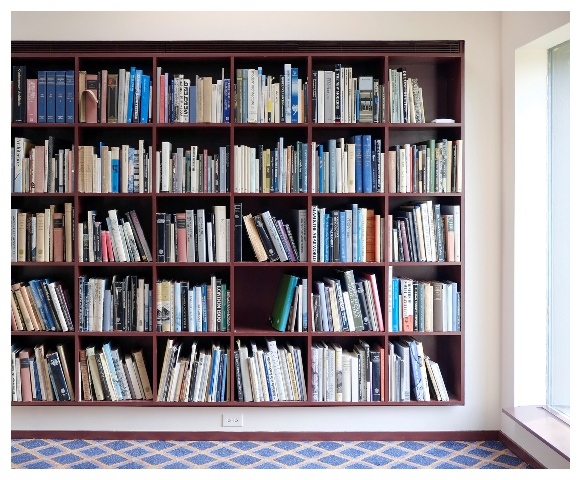
Candida Höfer, Bibliothèque Nationale de France Paris XXI 1998

Books to grow into but also to love when you’re young:

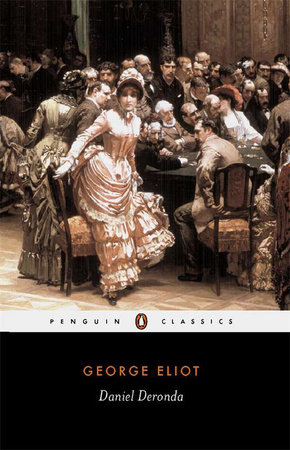
George Eliot, Middlemarch

The only novel in English for adults, Virginia Woolf famously said. Not sure what she meant, but doesn’t it sound good? Having reread it recently, I think you need to be middle aged (and thus an adult… hmm well never mind) to get the most from this story of English provincial life around 1830. But having first read it in college, I can also attest that Middlemarch hits for young people. As with any rich text, what you pay attention to and who you sympathize with shifts each time you read it.

Eliot is known for moral seriousness (maybe that’s why as stylistically different a writer as D. H. Lawrence was a fan), but Middlemarch is also surprisingly funny. Mostly, it’s supremely moving. It covers so much of life, and asks the big questions. What makes a good life? How can we live with purpose? How can we think of ourselves in relation to everyone else? Where do we fit into the web of life?

[Alternate choice: Leo Tolstoy, War & Peace. Never read it until about five years ago, but feel confident it dazzles as much at 20 as at 50. You want novelistic sweep? This one’s as big as Russia… Freemasons and wolf hunts and returns from the dead and slow-burning love affairs lasting across the decades: everything, really.]

Books that master close third-person perspective

Nella Larsen, Passing

Set in Harlem and Chicago in the late 1920s among a set of well-to-do light-skinned Black women who can pass as white, Passing is a great novel of queer frenemies. It hews closely to the perspective of a single character, Irene, whose orderly life as the mother of two boys and wife to a (dissatisfied) doctor falls apart when she runs into a childhood friend, the brave and dangerous Clare. Unless we attend to how events are only offered through Irene’s perspective, we are likely to miss how much the book asks us to question the judgments it only seems to offer.

[Alternate choice: Henry James, What Maisie Knew. In book after book, James wrote about people behaving badly. Yet even among this vast canvas of cruelty, this novel stands out: the people doing the harm are parents who use their young child to hurt each other and, of course, the child. In the preface to the New York Edition James explained that he chose to narrate the book in third person but to limit the perspective to Maisie’s often baffled but also wondering sense of the world in order to offer readers the extra pathos of being able to understand what she could not. It’s quite a trick.]

Books about the Holocaust

Primo Levi, If This Is a Man

If someone is asking me what books they simply must own, they’re absolutely gonna get one about the Holocaust. Hell, I could make them a whole list. But knowing that not everyone shares my fascination, I’ll stick to one of the earliest and most famous instances of Holocaust literature. (Levi composed part of it already while in the camps.) Like all memoirs, If This is a Man (known in the US under the travesty title Survival in Auschwitz) details its author’s particular experience—which took the form it did by his having had “the great good fortune” to have been deported only in 1944, when the turning tide of the war and subsequent internal battle among top Nazis meant that more deportees were selected for slave labour. That phrasing gives you a sense of Levi’s matter-of-fact irony. But something that distinguishes If This Is a Man is Levi’s decision to use “we” even more than “I”: he aims to give a sense of the structure and meaning of the collective victim experience, at least within a subcamp of Auschwitz.

[Alternate choice: Ida Fink, A Scrap of Time and Other Stories. Too little known among English speakers, but, happily, available in a terrific translation by Madeline Levine and Francine Prose, Fink’s heartbreaking stories depict part of the Holocaust most people don’t know about: the mass murder performed by the Einsatzgruppen in Galicia in the summer and fall of 1941. Fink couldn’t find a publisher for these stories until the 1980s; they were deemed of no interest. Another devastating failure on the part of literary opinion. Fink has been called the Chekhov of the Holocaust. Grotesque as this sounds, it’s accurate. Quiet and heartbreaking.]

Members of YIVO New York examine crates of books rescued from the Vilna Ghetto

Books about how to read books:

Roland Barthes, S/Z

Barthes spent a year reading Balzac’s story “Sarrasine” with some students. (Oh to have been in that seminar!) That labour resulted in this extraordinary book, organized around line-by-line readings of the source text, not, as critics usually do, to figure out what it means, but rather how it means. To do so, Barthes offers five “codes”—fundamental elements of realist fiction, of which “Sarrasine” is considered only as a representative example—that readers unconsciously rely on (typically by having imbibed many examples of the genre) in making the text intelligible. The codes are things like references to historical events, people, and places, or attributes and actions that cohere into what we call characters and, in the case of realist literature, think of as if they were people. Barthes Intersperses his step-by-step redescription of the Balzac story with theoretical meditations on the operation of the codes, which readers can extrapolate to other texts.

S/Z is tough. I probably taught it five or six times before I felt I had a real handle on it. But as Barthes says, it’s valuable to be able to distinguish between real and superficial ideas of difference. We might think that the best way to know about books is to read a lot of them. But if we do so without thinking about what underlies their intelligibility (i.e. what we need to be able to read them), then we are mere consumers, doomed to reading the same thing over and over. Only by reading one text over and over can real difference, that is the difference within the text, show itself—which in turn will make our other reading more meaningful. All of which is to say, the effort of tackling Barthes’s analysis offers big rewards.

[No alternate choice. S/Z for everyone.]

Books with pictures:

Alison Bechdel, Fun Home

Comics, graphic novels, whatever you want to call them are important to me, and I think any reader needs at least one example in their library. Such a rich form, so many gorgeous and moving texts to choose from. As with my Holocaust choice, I resisted the temptation to go niche here. Bechdel’s memoir of her relationship with her closeted, self-destructive, talented father deserves its fame. Probably more than any book I regularly taught, Fun Home elicited the strongest positive reactions in the widest range of students. Family disfunction runs deep. A great book about how books can connect people who can’t otherwise open up to each other—and how they can further separate them too. Funny, ominous, bittersweet.

[Alternate choice: Nick Drnaso, Sabrina. Dark, powerful. Reading it gave me a bit of the ick. And yet its subject matter just seems more relevant. I guess this is about the manosphere, except no one was using that hideous term at the time.]

Books of ideas [fiction]

Thomas Mann, The Magic Mountain

Sometimes I want a book that dramatizes the back and forth of thinking. In The Magic Mountain, Mann literalizes this by surrounding his protagonist, the well-meaning, hearty Hans Castorp, with some of the most indefatigable talkers ever to appear in a novel. The whole intellectual landscape of pre-WWI Europe is here (liberal humanist, communist, militarist, hedonist, you name it), and everyone battles for Hans’s soul, even as the former engineer mostly wants to desire a woman from afar, a woman who reminds him of a boy from his schooldays…

The other great thing about this book is how well it depicts Davos and environs. I’m a sucker for mountains and mountains in books. Bring on the snow!

[Alternate choice: Proust. Honestly, if you can only put one book in your starter library, choose this one. I assume it’s already there, but if not then get stuck into this deeply philosophical book, which has so much to say about perception, time, cruelty, and control over others.]

Books of ideas [nonfiction]

W. E. B. DuBois, The Souls of Black Folk

Every American should read it. But non-Americans should too. The idea of double-consciousness—the way a minority must measure themselves by the tape of the majority, as DuBois so memorably puts it in his first pages—explains so much of our contemporary sense of identity.

In addition to its ideas, Souls is a fascinatingly hybrid book, presumably stranger in 1903 than today. Each chapter is prefaced by a bar of music, often from the sorrow songs. Most chapters are essayistic, but some are fictional. Each is written in resonant cadence. Hasn’t dated much. Alas.

[Alternate choice: Hannah Arendt’s The Origins of Totalitarianism. Explains how Nazism and Stalinism came to be so accepted and do so much harm. Especially interesting for (1) its “boomerang” theory of imperial violence, in which what the metropole does in the colony comes back to bite it at home, and (2) its argument that modern antisemitism arose from the waning of Empire and the rise of nationalism. Hasn’t dated much. Alas.]

Monomaniac books

The strand from writers like Kafka, Knut Hamsun, or Robert Walser to someone like Lydia Davis, via the high point of Thomas Bernhard, has been enormously influential in the Anglo-American sphere. At this point, annoyingly so. (And weird, too, given that none of the most important precursors wrote in English.) But I get it because literature excels at tracing the vagaries of a mind, especially one spinning through reversals, paradoxes, and hobby-horses. A starter library should have an example of this sort of thing, and Bernhard might be the best. When the only thing that stands between a psyche adrift or worse is the chance that someone might respond to its voice—that’s when you’re in Bernhard territory. I’ve chosen The Voice Imitator because the title says it all. Read these 104 short texts to get a sense of Bernhard’s bitter, misanthropic, and, oddly, funny vibe.

[Alternate choice: I just named like five other writers!]

Funny books

P. G. Wodehouse, The Code of the Woosters

As implied in what I said about Bernhard, voice-driven books don’t have to be grim. They can make us laugh, whether from the gap between what the narrator claims and what we know, or the sheer verve of their style. The fun only increases when those narrators get embroiled in elegant plots. Wodehouse is the master of this terrirtory and everyone’s library is the better for including him. (I feel like he’s fading a bit from memory? Sad.) You can jump in anywhere—my entry point was the distinctly not-famous-but oh-so-representatively-titled Eggs, Beans, and Crumpets which baffled and delighted me at age 12—but if you’re at a loss start with this wonderful episode in the Jeeves and Bertie series, which Tim Waltz would enjoy, since it’s an early example of the “I condemn the fascists by unflinchingly stating how weird they are” school of responding to authoritarianism. (As Bertie says, appalled by the realization that the Saviours of Britain are simply grown men marching in black shorts: “how perfectly foul!”)

[Alternate choice: for an American version of this phenomenon, reach for Charles Portis, especially the marvelous True Grit.]

Books about crime

Dolores Hitchens, Sleep with Strangers & Sleep with Slander

Since at least Oedipus Rex, literature has used crime to understand fundamental concerns like identity, political organization, and moral value. Crime fiction can be smart, is what I’m saying. And it can also carry us away by inciting our desire to have enigmas explained. (Interestingly, it often makes us realize how much more compelling it is to ask a question than to answer it.) Like any genre, then, crime fiction satisfies at both the intellectual and emotional level. Having stayed with well-known titles so far, I’m diving deep for this last category. Not enough readers, even lovers of crime fiction, have read the mid-century American writer Dolores Hitchens. She wrote a lot of books under a lot of names. But only two about a PI named Jim Spader. Which is sad—but also good because they’re even more special. These make for pretty despairing reading, even for noir. So be warned. But you won’t regret seeking them out.

[Alternate choice: Hundreds! Thousands! Sticking with mid-century American women writers, I’ll plump for Dorothy B. Hughes’s The Expendable Man. Don’t read anything about it beforehand!]
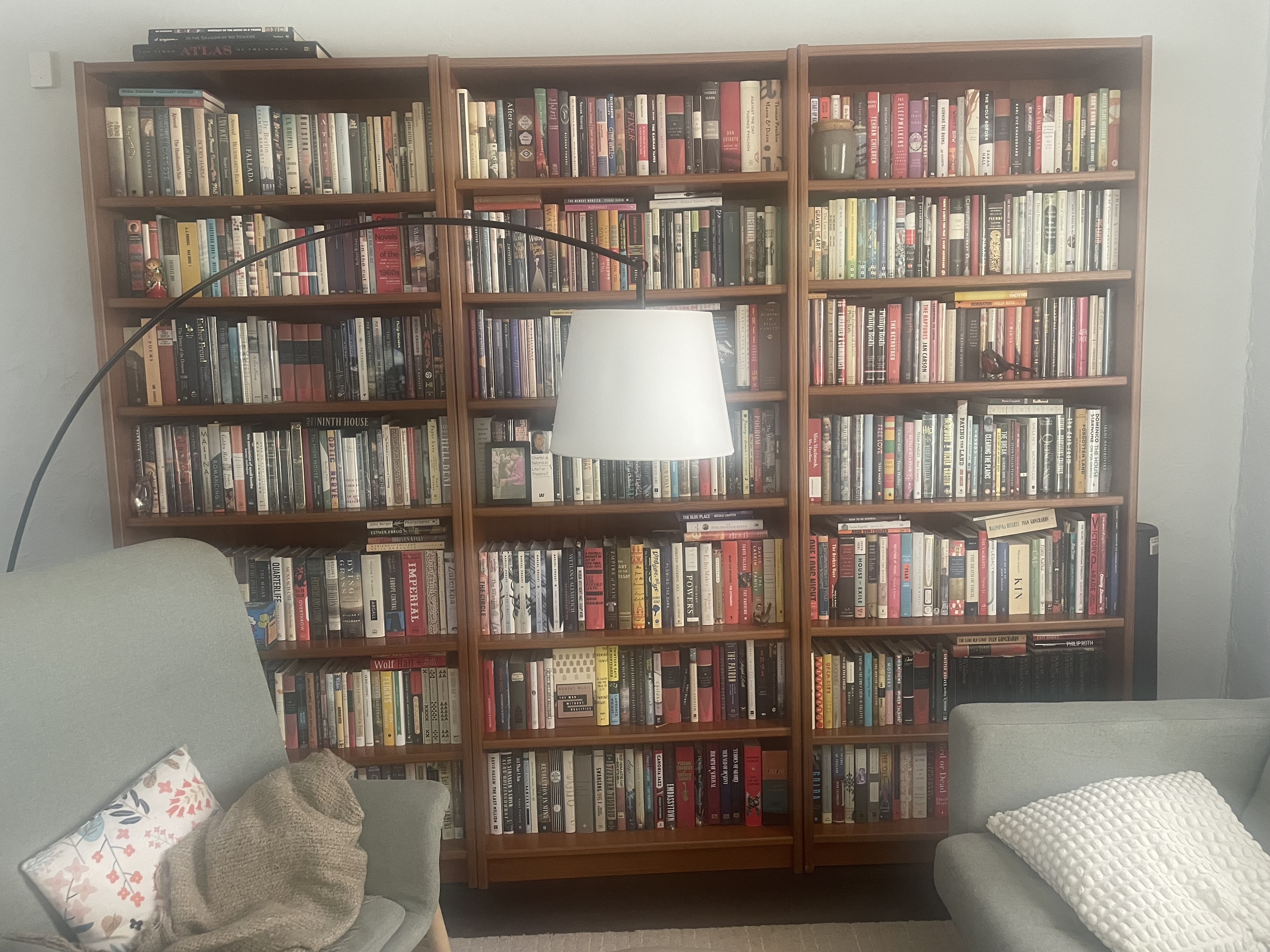
I tried not to think too long in coming up with my choices. Next month or next year I’d choose differently. And I’m aware of some big lapses. No poetry?? No plays?? No Torah?? (Everyone should read the Five Books of Moses.) But that’s ok. Gives you all the more room to think about how you’d create a starter library of your own. What would be on your shelf of promises?
My Year in Reading, 2023

I wouldn’t say I had a great reading year. I was on my phone too much, I was being anguished or avoiding being anguished about the myriad injustices of the world, which I knew too much and could do too little about. I travelled—maybe not too much but an awful lot, for me—which was often energizing and enjoyable, but also got in the way of reading.

I felt, in other words, that I had frittered away my one wild and precious reading life. I bottomed out in the middle of the year, regularly tossing aside books unfinished after having spent more time with them than they deserved or that I could find patience for. A querulous reading year, you could say.

And yet some things stood out. Links to previous posts, if I managed to write about it.

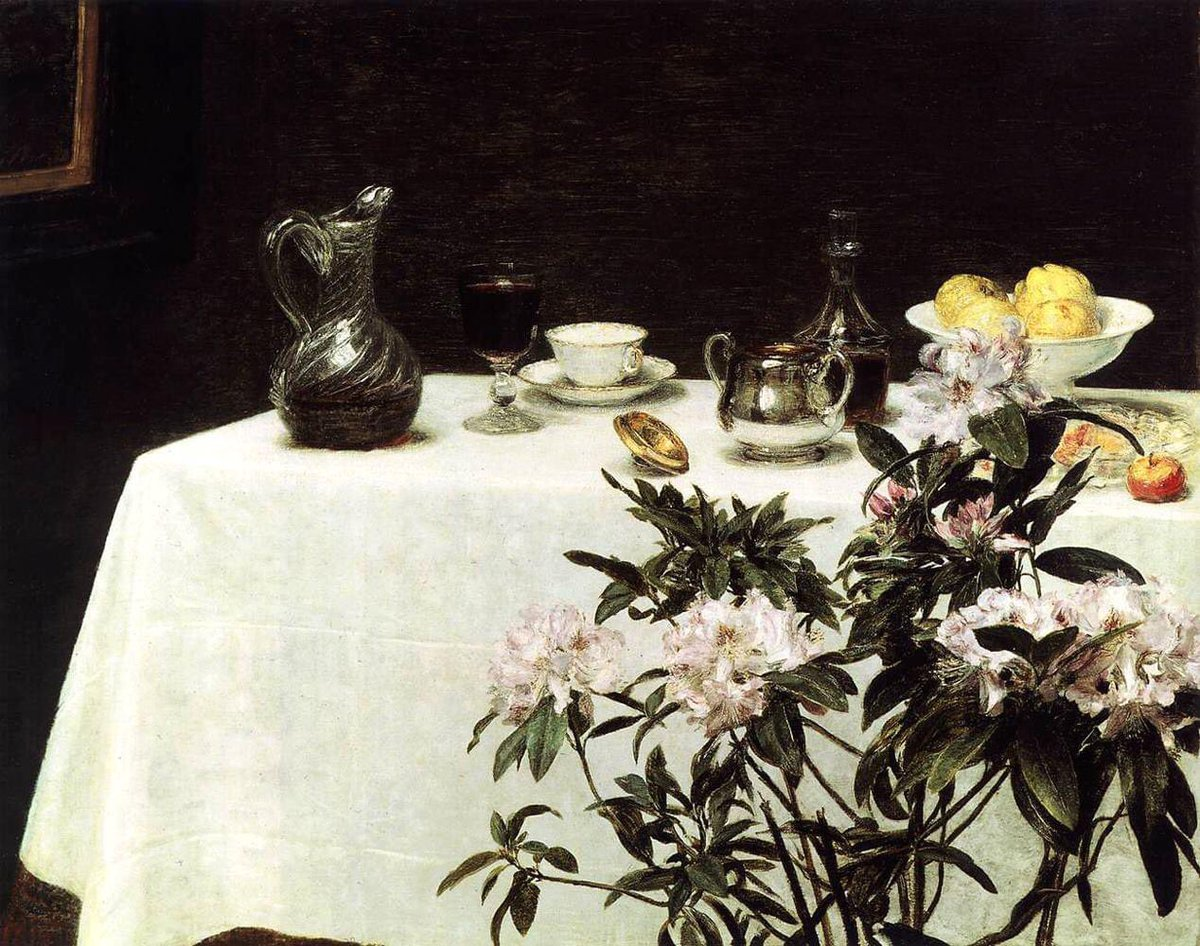
Henri Fantin-Latour, Le coin de la table (1872)

Dwyer Murphy, The Stolen Coast

A rare heist novel where the heist, though satisfying, isn’t the main attraction. I loved this stylish, smart, funny tale of a man who has put his Ivy League law degree to use in taking over the family business: giving new identities to guys on the run and getting them the hell over the border. A great book of off-season resort towns.

Simon Jimenez, The Vanished Birds

I’m still getting my bearing in contemporary sff so take these comments for what they’re worth, but it seems rare to me that a book takes as many swerves as this one: the narrative moves back and forward in time and all over the place, from a near-future nearly uninhabitable earth to a galaxy far-away in space and time. You get invested in a storyline and then it ends but sometimes it comes back. But even more than the structure I loved this book for its emotional seriousness: its many relationships are doomed to fail because of their constitutive circumstances. For example: a man ages fifteen years between each meeting with his beloved, while she, thanks to intricacies of stellar time travel, has only aged a few months. The emotions might be bigger than the ideas, but I was totally okay with that.

Two novels by Katherena Vermette

One of the greatest working Canadian writers. This year, fresh off the thrill of teaching The Break to smart, appreciative students, I read The Strangers and The Circle, a bleak and beautiful trilogy of indigenous life in the aftermath of the cultural trauma of the residential school system.

Four novels by Kent Haruf

It should tell you something that in early April, one of the worst times in the academic year, I read four novels by Kent Haruf in just over a week. I loved Plainsong the most but enjoyed Eventide, Benediction, and Ours Souls at Night almost as much. Easy reading, sure: plain syntax rising to gentle arias, nothing fancy, maybe a little sentimental. But these books are so warm and kind. Each is set in Holt, Colorado, out on the eastern plains, where the mountains are a smudge on the western horizon and it’s sometimes hot and sometimes cold but always dry. The people are ranchers and school teachers and social workers and hardware store owners and ne’er-do-wells and retirees. Everyone is white and no one thinks that’s worth noticing. The time is hard to pin down. Sometimes I thought the 70s or early 80s but we’re probably talking the 90s. Things were different before the internet. The characters’ lives are modest and they seem fine with that. They go about their business, do their work, make good choices and bad ones. People look out for each other, but they judge each other, too. Little kids get lost biking, but they come home again. It’s not all roses, though. High school boys bully girls into having sex, over in that abandoned house just down from where the math teacher lives. People get sick, go hungry, lose jobs. Some characters get what the preacher will call a good death, some die unreconciled to their kin, some without warning, too soon. Life just keeps happening, you know?

Some readers will call this hokum, but I ate it up. Haruf won my heart. I thought him especially good on second chances and unexpected turns of fate. Of all the stories that weave through these loosely connected novels, the best concerns two brothers, old bachelors, ranchers, who agree to take in a pregnant teenage girl and who, to everyone’s surprise, not least their own, form a new family with her. That scene where they take into the next town over to get things for the baby and insist on buying the best crib in the store? Magic.

Garth Greenwell, Cleanness

Smart, sexy, stylish books about how we relate to bodies privately and publically, and whether we can recast the narratives that have shaped aka deformed our understanding of what it is to live in those bodies. Greenwell’s Substack is worth subscribing too; he makes me curious about whatever he’s curious about. Can’t wait for the essay collection he’s writing.

Emeric Pressburger, The Glass Pearls

Yep, that Pressburger. Closer to Michael Powell’s Peeping Tom than any of the (indelible) films they made together. Karl Braun, a German émigré, arrives at a boarding house in Pimlico on a summer morning in 1965. A piano tuner who never misses a concert, a cultured man, a fine suitor for the English girl he meets through work. I’m not spoiling anything to say that Karl isn’t just quiet: he’s haunted—and hunted. For Karl Braun is really Otto Reitmüller, a former Nazi doctor who performed terrible experiments, a past he does not regret even as he mourns the death of his wife and child in the Hamburg air raids. Now the noose is tightening and Otto/Karl goes on the run… Suspenseful stuff; most interesting in this play with our sympathies. Not that we cheer for the man. But his present raises our blood pressure as much as his past.

Toni Morrison, A Mercy

A short book that covers as much ground as an epic; a historical novel that feels true to the differences of the past but that is clearly about the present; a classic modernist Morrison text, where the first page tells you everything that’s going to happen except that it makes no sense at the time and the rest of the reading experience clarifies, expands, revises. Such beauty and mystery in so few pages.

Roy Jacobsen’s Barrøy series (Translated by Don Bartlett and Don Shaw)

Cheating a bit since I read the first one in December 2022. I’m a huge fan of these novels about a family and the remote Norwegian island they call home from 1900 to 1950. I like books where people do things with their hands, maybe because I can’t do much with mine. The characters bring sheep into the upper field, fish with nets and line, salt cod, keep the stove burning all through the year, row through a storm, carry an unconscious man through sleet. It’s all a little nostalgic, a little sentimental, but not too much. Just how I like it.

Two Books by Walter Kempowski (Translated, respectively, by Michael Lipkin and Anthea Bell)

Fresh on my mind so it’s possible I’ve overvalued them but I don’t think so. All for Nothing, especially, is something special.

George Eliot, Middlemarch

Last read in college—under the expert tutelage of Rohan Maitzen, this can only be called one of the highlights of my undergraduate experience. This time I listened to Juliet Stevenson’s recording, which perfectly filled a semester’s commuting. True, Arkansas traffic is not the ideal venue for some of Eliot’s more complex formulations, but Stevenson (as much a genius as everyone says, she do the police in different voices, etc.) clarifies the novel’s elegant syntax and famous images. The book’s the same, but I’m not; a whole new experience this time around. Much funnier, especially its early sections. (Celia is a triumph.) More filled with surprising events: that whole Laure episode (a Wilkie Collins novel in miniature), it was as if I’d never read it. And more heartbreaking: in 1997, I hated Rosamond, and I admit I still felt for Lydgate this time around, but I had so much sympathy for her, a character I’d only been able to see as grasping and venal. Speaking of sympathy, one of the glories of English literature lies in watching Dorothea as she matures from excitable near-prig to wiser and sadder philanthropist. Amidst all this change, though, some things stayed the same. Mary Garth still won my heart; the suspense at the reading of Featherstone’s will gripped me just as much.

It’s good to read Middlemarch in college. It’s better to re-read Middlemarch in middle age. It’s best to read Middlemarch early and often.

Konstantin Paustovsky, The Story of a Life (translated by Douglas Smith)

Six-volume autobiography of Soviet writer and war correspondent Paustovsky, a Moscow-born, Ukrainian-raised enthusiast of the Revolution who somehow made it through Stalinism to become a feted figure of the 1960s. The new edition from NYRB Classics contains the first three volumes. I only read the first two, not because I didn’t enjoy them (I loved them) but because I set the book down to read something else and the next thing I knew it was a year later. Paustovsky had something of a charmed life. His childhood was largely downwardly mobile, and he lived through so much terror and upheaval. And yet he always seems to have landed on his feet. Maybe as a result—of maybe as a cause—he looks at the world with appreciation. He can sketch a memorable character in a few lines. He writes as well about ephemera (lilacs in bloom) as about terror (I won’t soon forget his time as an orderly on an undersupplied hospital train in WWI). He can do old-world extravagance (the opening scene is about a desperate carriage ride across a river raging in spate to the otherwise inaccessible island where his grandfather lies dying) and the brittle glamour of the modern (for a while he drives a tram in Moscow). Trevor Barrett, of Mookse & Gripes fame, said it best: Paustovsky is good company. I really ought to read that third book.

Félix Vallotton, Still Life with Flowers, 1925

A few other categories:

Didn’t quite make the top, but such pleasurable reading experiences: Adania Shibli, Minor Detail; Paulette Jiles, Chenneville; Abdulrazek Gurnah, By the Sea; Jamil Jan Kochai, The Haunting of Hajji Hotak and Other Stories (teaching “Return to Sender” was a revelation: fascinating how even students who had seemed immune to literature shook themselves awake for this one).

Read with dread and mounting desperation, don’t get me wrong it’s a banger, but couldn’t in good conscience call it a pleasure to read: Ann Petry, The Street. Barry Jenkins adaptation when?

Maybe not standouts, but totally enjoyable: Margaret Drabble, The Millstone; K Patrick, Mrs. S; Yiyun Li, The Vagrants; Elif Batuman, Either/Or

Best dip into the Can-con vaults: Margaret Laurence, The Stone Angel. Got more about of this now than I did in high school, lemme tell you.

Best book by a friend: James Morrison, Gibbons or One Bloody Thing After Another: Not damning by faint praise. It’s terrific!

Book the excellence of which is confirmed by having taught it: Bryan Washington, Lot. Maybe the great Houston book. I get that novels sell but I wish he’d write more stories.

Grim, do not recommend: Larry McMurtry, Horseman, Pass By; Girogio Bassani, The Heron

Not for me: Jenny Offill, Weather; Annie Ernaux, Happening; Yiyun Li, The Book of Goose

Planned on loving it, but couldn’t quite get there: Julia Armfield, Our Wives Under the Sea. Sold as metaphysical body horror, this novel about a woman who goes to pieces when her wife returns from an undersea voyage gone catastrophically wrong as a kind of sea creature didn’t give me enough of the metaphysics or the horror. I figured it would be perfect for my course Bodies in Trouble but I couldn’t find my way to assigning it. Possibly a mistake: teaching it might have revealed the things I’d missed. Gonna trust my instincts on this one, tho.

The year in crime (or adjacent) fiction:

Disappointments: new ones from Garry Disher, Walter Mosley, and S. A. Cosby (this last was decent, but not IMO the triumph so many others deemed it; he’s a force, but I prefer his earlier stuff).

Standouts: Celia Dale, A Helping Hand: evil and delightful, can’t wait to read more Dale; Lawrence Osborne, On Java Road: moody, underappreciated; Christine Mangan, The Continental Affair: moody, underappreciated; Allison Montclair, The Right Sort of Man: fun; Joseph Hansen: wonderful to have the Dave Brandsetter books back in print, hope to get to more in 2024; Richard Osman: as charming, funny, and moving as everyone says.

Maigrets: Of the six I read this year, I liked Maigret and the Tramp best. Unexpectedly humane.

Giants: Two Japanese crime novels towered above the rest this year. I didn’t write about volume 2 of Kaoru Takamura’s Lady Joker (translated by Marie Iida and Allison Markin Powell) but maybe my thoughts on volume 1 will give you a sense. Do you need a 1000+ page book in which a strip of tape on a telephone poll plays a key role? Yes, yes you do. (Also, it has one of the most satisfying endings of any crime novel I’ve ever read.) More on Hideo Yokoyama’s Six Four (translated by Jonathan Lloyd-Davies) here. Do you need an 800+ page book in which phone booths play a key role? Yes, yes you do.

The year in horror:

Victor LaValle, Lone Woman: horror Western with a Black female lead and not-so-metaphorical demon, enjoyable if a bit forgettable; Jessica Johns, Bad Cree: standout Indigenous tale, also with demons; Leigh Bardugo, Hell Bent: serious middle-volume-of-trilogy syndrome. Many demons, tho.

The year in sff:

In addition to Simon Jimenez, I liked Ann Leckie’s Translation State, Nick Harkaway’s Titanium Noir, and, above all, the three novels by Guy Gavriel Kay I read this summer, which gave me so much joy and which I still think about all the time.

The year in poetry:

Well, I read some, so that’s already a change. Only two collections, but both great: Wisława Szymborska’s Map: Collected and Last Poems (Translated by Clare Cavanaugh and Stanislaw Baranczak), filled with joy and sadness and wit, these poems made a big impression, and Ilya Kaminsky’s Deaf Republic (fortunate to have met him, a mensch; even more fortunate to have heard his indelible performance).

The year in German books: I read two, liked them both. Helga Schubert, Vom Aufstehen: Ein Leben in Geschichten (On Getting Up: A Life in Stories), vignettes by an octogenarian former East German psychotherapist who had fallen into oblivion until this book hit a nerve, most impressive for the depiction of her relationship to her mother, which reminded me of the one shared by Ruth Kluger in her memoir; Dana Vowinckel, Gewässer im Ziplock (Liquids go in a Ziplock Bag): buzzy novel from a young Jewish writer that flits between Berlin, Jerusalem, and Chicago. The American scenes failed to convince me, and the whole thing now feels like an artefact from another time, given November 7 and its aftermath. I gulped it down on the plan ride home, though. Could imagine it getting translated.

Everyone loved it; what’s wrong with me? (literary fiction edition):

Made it about 200 pages into Elsa Morante’s 800-page Lies and Sorcery, newly translated by Jenny McPhee. Some of those pages I read raptly. Others I pushed through exhaustedly. And then I just… stopped. The publisher says it’s a book “in the grand tradition of Stendhal, Tolstoy, and Proust,” and I love those writers. (Well, I’ve yet to read Stendahl, but based on my feelings for the other two I’m sure I’ll love him too.) Seemed like my social media feeds were filled with people losing it over this book. Increasingly, I see that—for me, no universal judgment here—such arias of praise do more harm than good; I experience them as exhortations, even demands that just make me feel bad or inadequate. Increasingly, too, I realize how little mental energy I have for even mildly demanding books during the semester. (A problem, since that’s ¾ of the year…) I might love this book in other circumstances —I plan to find out.

Everyone loved it; what’s wrong with me? (genre edition):

Billed as True Grit set on Mars in alternate version of the 1930s, Nathan Ballingrud’s The Strange indeed features a young female protagonist on a quest to avenge the destruction of her family, but Ballingrud is no Portis when it comes to voice. True, I was in the deepest, grumpiest depths of my slough of despondent reading when I gave this a try, so I wasn’t doing it any favours. But that’s a nope from me.

Other failures:

Mine, not the books. Once again, I read the first hundred or so pages of Anniversaries. It’s terrific. Why can’t I stick with it? I read even more hundreds of pages of Joseph and His Brothers, as part of a wonderful group of smart readers, most of whom made it to the end of Thomas Mann’s 1500-page tetralogy. I loved the beginning: fascinating to see Mann’s take on the stories of Genesis; interesting to speculate on why Mann would write about this subject at that time. (For me, Mann is in dialogue with Freud’s Moses and Monotheism, another oblique response to fascism through stories from Torah.) My friends tell me it got a lot more boring shortly after I left off (the end of volume 2), but that’s not why I gave up. Turns out, I don’t do well if I’m supposed to read something in regular, little bits. I need to tear into books—and I wasn’t willing to make the time for this chunkster. Sorry, guys.

Odds & Ends:

A few albums that stood out: Roy Brooks, Understanding (reissued in 2022, but I’m not over it: this quintet, man, unfuckingbelievable); Taylor Swift, Midnights (I love her, haters go away); Sitkovetsky Trio, Beethoven’s Piano Trios [volume 2] (a late addition, but pretty much listened to it nonstop in December and now January).

After a decade hiatus, I started watching movies again. Might do more of that this year!

I was lucky enough to travel to Germany in late spring with a wonderful set of students. While there, I met so many people from German Book Twitter who have become important to me, including the group chat that got me through covid and beyond. (Anja and Jules, y’all are the best.) All these folks were lovely and generous, but I want to give special thanks to Till Raether and his (extremely tolerant) family, who took me in and showed me around Hamburg. (Great town!) Have you ever met someone you hardly know only to realize they are in fact a soulmate? That’s Till for me. What a mensch. Cross fingers his books make it into English soon. In the meantime, follow him on the socials!

Reading plans for 2024? None! I need fewer plans. I can’t read that way, turns out, and maybe I’ll avoid disappointment by committing less. Gonna be plenty of other disappointments this year, I figure. No need to add any self-inflicted ones. At the end of last year, I joined a bunch of groups and readalongs, because I want to hang with all the cool kids, but I can already see I need to extricate myself from most of them. One good thing I did for myself in 2023, though, was to stop counting how many books I read. I was paying too much attention to that number. Fewer statistics in 2024!

Piet Mondrian, Oranges and Decorated Plate, 1900

Finally, to everyone who’s read the blog, left a comment or a like, and generally supported my little enterprise (which turns 10 in a week or two…), my heartfelt. I do not know many readers in real life. You all are a lifeline.

What I Read, June 2022

Plenty busy chez EMJ last month. Two weeks studying Holocaust photographs in a faculty seminar (inspiring, transformative, draining). One week teaching an online class (enjoyable, tiring). One week doing absolutely nothing but reading and chilling (bliss). And one week trying to catch up on all the things (I know this makes for five weeks, not sure what to tell you).

Although much of my reading concerned the history of atrocity photographs, I made time for a number of other things. I got into a good rhythm: get up early, read something demanding for an hour or so; crash in the afternoon and evening, read fluff. Spent much of the month in St Louis: nice to be somewhere where you can sit outside in the summer. Also: Ted Drewes FTW!

Gilad Seliktar, from But I Live

Richard Wright, Black Boy (American Hunger) (1945/1991)

In the first pages of his autobiography, Wright, a bored four-year-old, almost burns his grandmother’s house down, and the rest of the book is seldom less incendiary. Amazing that Wright survived not just that errant moment but his childhood at all. So much abuse, contempt, despair. Wright wanted to call the book American Hunger, a resonant title that suggests not just the hunger that African Americans have felt to belong to their country but also the hunger with which America has devoured them. Most of all, though, the title is literal: Wright was seriously undernourished much of his life, even into adulthood. (He was turned down for a good job with the post office because he didn’t weight enough.) In one indelible scene, Wright, who has been deposited in an orphanage because his mother temporarily can’t take care of him, is dizzy with hunger. He and the other children were fed only twice a day—before bed they received a thin slice of bread with a smear of molasses—but that didn’t save them from having to work. For example, they had to “mow” the orphanage’s grounds: a herd of children on their hands and knees, pulling the grass out in clumps, often too lightheaded to make any headway.

Wright changed the title to Black Boy after the Book of the Month club, which had selected the title—as it had done some years before with Native Son—declined to publish the manuscript’s second half, which describes Wright’s experiences after escaping the South for Chicago, specifically his involvement with the communist party. (I gather the party pressured the BMOC to make the changes, which suggests an America so different from the one we live in I don’t even know what to say.) I sort of agree that the parts about Wright’s childhood and early adulthood in Mississippi, Arkansas, and Tennessee are more compelling. They’re certainly more reducible to a narrative of suffering that makes sense to (white) readers. (And ending with the train ride to Chicago implies an overcoming that the rest of the book belies.) But I found the cruel political machinations described in the second half engrossing—excommunication, quasi-Stalinist show trials, oof. Wright believes there is something essential to communism that cannot be quashed by its instantiation, whether in the Soviet Union or south side Chicago. It emphasized self-sacrifice in a way his own life had prepared him to understand.

What stands out to me about Black Boy is its almost complete lack of joy. Wright’s life was hard, his upbringing mean, in both senses of the world, his horizons cramped by racism and the strict religion of his family. There’s nothing here to compare, for example, to the meaningful pleasures described in Henry Louis Gates, Jr.’s Colored People. (Admittedly, Gates was of a different class and writing about the 1950s not the 20s and 30s.) The funniest scene concerns his job as a janitor at a Chicago hospital. Not that this was a good time. Together with three other men, all Black, Wright worked without thanks and almost without recompense: his description of mopping stairs that people immediately muck up, offering what they think is an amusing quip about how work is never done or, as is more often the case, not even seeing him at all will make your blood boil. The basement of the hospital contained a lab where white scientists performed experiments on animals (afflicting mice with diabetes and other horrors). One day, two of the janitors, who hate each other, get into a fight that turns into a brawl—the cages are knocked to the floor, and most of the animals escape. With only minutes to go before the scientists are due back from lunch, Wright and the others chase the animals, tossing the animals into cages willy-nilly. Who knows, Wright wryly speculates, what medical advances were made that day. Yet this scene, which in another writer’s hands could be laugh out loud funny, is tense, terrifying. The consequences of discovery for Wright and the others are simply too great.

Poverty is corrosive, yet Wright’s escape carries with it regret, loss, sorrow, and rage. In a riff on Du Bois’s idea of double consciousness, Wright describes his literary self-education—he used the library card of a sympathetic white co-worker to check out books—as a mixed blessing:

In buoying me up, reading also cast me down, made me see what was possible, what I had missed. My tension returned, new, terrible, bitter, surging, almost too great to be contained. I no longer felt that the world about me was hostile, killing; I knew it. A million times I asked myself what I could do to save myself, and there were no answers. I seemed forever condemned, ringed by walls.

Communist party meddling or no, I can see why white publishers were wary of the book’s refusal of uplift. To me, the characteristic Wright note here is that added “killing”—Wright suffers plenty of physical violence, but his mental anguish is even worse.

Audrey Magee, The Colony (2022)

In the summer of 1979, two men arrive on an island off the west coast of Ireland. One, an English painter, is running away from a failing marriage and doubts about his artistic relevance, and in search of fabled light. The other, a French academic, is returning to complete the field work for his anthropological and linguistic dissertation on Gaelic. The story of how their competing presences—expressed in dinner-table arguments about whether English and the modernity it is the vehicle for is ruinous—shape the lives of the family that has rented them their rooms is interspersed by short chapters that detail, in neutral language, killings perpetrated by Protestant and Catholic paramilitaries back on the mainland.

I’m a sucker for windswept northern landscapes, and any story in which the making of tea is a repeated and central element will always be meat and drink to me. But I liked Colony for other reasons too. It’s a think-y book that never feels plodding. Magee argues that the depredations of colonialism take many forms—the fantasy of linguistic purity as harmful as airy invocations of progress. The latter, so Magee, always require someone be exploited. She tackles a lot here, and I wasn’t always convinced by the juggling act (a backstory about the Frenchman’s childhood as the son of a pied noir needed to be better integrated), but I appreciated her ambition.

Thanks to John Self for turning me on to this one.

Sylvia Townsend Warner, Lolly Willowes , or The Loving Huntsman (1926)

An unmarried woman in England between the wars becomes a witch. Or decides to live as the witch she has always been. Frances, Rebecca, and I talk about this on Episode 5 of One Bright Book—I loved it less than they did, was not quite swept away with it as I’d hoped, but I definitely recommend. Warner is perhaps a little chilly for me, and I do wonder about the implications of emphasizing (only?) a magical solution to a political problem—what will it take for women to be left alone? Prefer Comyns’s The Vet’s Daughter, for a not dissimilar English magic-realist admixture.

Check out these pieces by Rebecca and Rohan for more thoughts on what Warner is up to.

Garry Disher, The Way It Is Now (2021)

Diverting crime novel with good surfing scenes. The son of a cop, himself recently a cop—he fell in love with a witness and has been suspended—has never stopped trying to find out what happened to his mother, who disappeared twenty years ago. New evidence comes to light, and things look even worse than ever for his father, who has always maintained his innocence.

Not the best Disher I’ve read, but he’s so damn competent, not sure he can write a bad book.

Charlotte Schallié, Ed. But I Live: Three Stories of Child Survivors of the Holocaust (2022)

[Created by Miriam Libicki and David Schaffer; Gilad Seliktar and Nico & Rolf Kamp; Barbara Yelin and Emmie Arbel]

Beautiful & moving collaboration between child Holocaust survivors and graphic novelists, with impressive critical and historical appendices. Libicki fittingly illustrates Schaffer’s story of hiding in the forests of Transnistria—what horrible things happened in that benighted territory—in the style of an edition of the Grimms. The minimalist Seliktar (he reminds me of Manuele Fior) uses a palette of purple/blue + yellow/brown and delicate shading to accompany the story of the Kamp brothers’ time in hiding (in thirteen different lodgings, including a chicken coop) in Holland. Yelin, whose marvelous Irmina I raved about last year, tells the bleak story of Emmie Arbel’s terrifying experiences as a five-year-old in Ravensbrück and Bergen-Belsen, where she had to watch her mother starve to death as a result of dividing her meager rations among her children (all three survived, miraculously). After a long recuperation in Sweden, the siblings immigrated to Israel, where Emmie struggled again, especially in the kibbutz system of education/neglect. All three artists include their exchanges with their subjects in their comics, but Yelin’s self-reflection is the most extensive. In the process she shows how thoroughly Arbel was damaged by her experiences, to the point of passing her trauma on to her children.

The project is a triumph. Schallié deserves credit for bringing together survivors, artists, and scholars—and for securing the funding from the Social Sciences and Humanities Reseach Council of Canada that supported the collaborative project of which this book must be the centerpiece. In addition to the three comics, there’s a further comic describing the artists’ cooperation, a brief statement from each of the survivors themselves, and lucid, informative short essays expanding on the context of each survivor’s experiences by scholars. I especially appreciated Alexander Korb’s piece on the Holocaust in Transnistria.

Did I mention that But I Live is gorgeously produced and printed, too? A must read if you have any interest in the topic.

Kim Stanley Robinson, Aurora (2015)

Excellent novel about a spaceship—outfitted with twenty-four complete biomes and about two thousand people—on a mission to an earth-like moon in the Tau Ceti system. Despite having been slingshotted from Saturn at who knows how much the speed of light (Robinson does know, and goes into detail, but I can’t follow him when he gets all engineer-y), the trip takes 160 years, and so the people on board as the ship approaches Aurora are several generations removed from the ones who set off.

Two women are at the center of the novel—Devi, the ship’s de-facto chief engineer, and Freya, her daughter. (Robinson’s great theme is the power of the engineering mindset, its ingenuity and improvisation, when tied to a politics of care.) The other protagonist is Ship itself, whose AI comes to self-consciousness through long conversations with Devi, and her command that Ship write a narrative of the voyage. (The meditations of the relation of narrative to consciousness are the least successful part of the book.)

The travelers begin the process of terraforming the moon, but it turns out that it is inhabited, at minimum, by a prion that is fatal to humans. The crew faces a decision—turn their efforts to a nearby moon in the hope that it’s more hospitable, or return to earth, something Ship was not designed for. The dilemma almost leads to civil war—only Ship’s intervention as The Rule of Law permits a non-violent resolution of the situation. Most decide to return, but a large minority opt for the unknown. We never learn what happens to them. Probably nothing good, but Robinson leaves their experience as a tantalizing possibility and a symbol for all that can’t be known.

The voyage home is perilous for many reasons—the biomes are failing, the crew is starving, authorities on earth respond too late to slow Ship down, necessitating a dangerous twelve-year journey through the solar system where, theoretically, the gravitational forces of the planets create will enough drag for the crew to splash down.

Aurora is moving, suspenseful, and thought-provoking. As a book about politics and the insatiable human demand to make and do—which, Robinson suggests, ought to be confined to our own planet—it made a fascinating and unexpected pairing with the other book I was reading at the same time, namely…

Guido Morselli, The Communist (1976) Trans. Frederika Randall (2017)

Published after his death, like all his novels, Morselli’s The Communist was written in 1964 – 65. It’s set a half-decade earlier, at a time when the Communist party in Italy boasted the third-largest membership in the world, after only the USSR and China. Its success stemmed from its active role in the resistance to fascism, and translated, in the first decade or so after the war, into parliamentary success, although its members were divided about participating in the act of governing. Would that not legitimate the system they wished to overthrow? The Communist is about one of these new parliamentarians, Walter Ferranini, a man whose life has been devoted to the left, even if the left has not been devoted to him. The son of an anarchist railwayman, Ferranini served in Spain before finding his way to the US, where, despite himself, in a manner that seems to emulate the bourgeois striving he abhors, he marries the daughter of his boss and allows himself to dream of the family’s place in the country. But when his wife turns reactionary, throwing herself into a nativist movement, and with the war over, he returns to Italy and throws himself into labour activism in Reggio Emilia.

It is on the basis of his success in these practical matters, and his genuine commitment to improving the lives of the workers, that Ferranini is elected a deputy in the national parliament. Although he lives to serve, he is unhappy: his dream of introducing a bill to expand worker safety is met with hostility and derision by members of his own party; he feels increasingly unable to discipline colleagues who call out hypocrisy among party leaders; he falls afoul of party orthodoxy when he writes an article for a journal headed by Alberto Moravia; and his affair with married but separated single-mother is used by the party as an excuse to discipline him. No wonder his health is so bad. And then comes a telegram from the US—Nancy, his wife (they never divorced), is seriously ill. He gets a flight, arriving in Philadelphia in an epic snowstorm that incites the novel’s satisfying denouement.

Ferranini is a sad, lonely, and, yes, noble character (he’d despise that description, though, and the book sympathizes but never romanticizes him). Morselli writes with deep interest, if not tenderness, but entirely without sarcasm or satire about the tendency of belief systems and institutional structures to obscure the insights that sparked them. Ferranini’s article, the one that gets him in trouble with the party bosses, is about the inescapable reality of toil. Contra Marx, he argues, not even achieved socialism will be able to undo this reality. (Hannah Arendt would approve!) Workers don’t feel alienated; they feel tired. As he says:

Admit it, there are things that technology cannot achieve. There is a law that can’t be breached, a physical and biological law that says life can’t arise and survive without sweat and struggle. And especially not without struggling against the environment, the surrounding material reality, and labor is part of this.

The Communist, one of the best books I’ve read this year, so thoughtful and, oh I don’t know, solid, though never turgid, presents activism and labor organizing as real labor, less exhausting and dangerous than work in a mine or factory or agricultural cooperative, but exhausting and dangerous nonetheless. Most of the people who do that work are not dedicated to it—some are outright cynics, former fascists who became fervent communists when they saw which way the wind was blowing; Ferranini is exceptional. Morselli allows us to believe in his integrity even as he also shows us that the system the man works within ultimately holds him in contempt. It would be easy to conclude that Ferranini is a dupe. Morselli refuses that temptation. Neither does he make the man a true believer. He is something rarer: someone who does the work, because the work is good, if, as it is supposed to, it eases our exhaustion.

Nora inspired me to read this, and am I ever glad. Grateful too to the late Frederika Randall for bringing this book into such lovely English.

K. C. Constantine, The Man Who Liked to Look at Himself (1973)

The second Mario Balzic mystery is a step-down from the first—less interesting, plot-wise, and dismayingly retrograde in its use of slurs, to say nothing of its portrayal of queerness—but Constantine is good with the snappy dialogue and Balzic is shaping up to be a great character. I’ll give the series a little more rope.

Sally Rooney, Beautiful World, Where are You (2021)

Loved it! Still think Conversations with Friends is the one to beat, but I’m appreciating the maturing of Rooney’s characters as she herself ages, and I just think she gets “the whole meeting smart friends when you are young and then sticking with them for years even as your lives change” thing. Also, a great writer of sex.

Setting down to write what became The Rainbow, Lawrence said in a letter that he was going to follow the master, Eliot, and do what she did: take two couples and set them against each other. Rooney does the same here. Of her four protagonists, the non-intellectual Felix interested me the most, there’s a Mephistophelean quality there that is directed outward rather than inward (most of the bad things in her other books have involved self-harm), though I think Rooney took the easy way out at the end and tamed him, made him just curmudgeonly when he might have been something else.

This was great on audio, by the way, Rooney’s Irishness much more evident.

Kotaro Isaka, Bullet Train (2010) Trans. Sam Malissa (2021)

Extravagant thriller with more plot twists than any five books need, let alone one. The premise is cool—a bunch of assassins and other thugs are stuck on a bullet train from Tokyo to Morioka. Their various errands center on a suitcase full of money and the son of a mobster who winds up dead a few pages into the book. At first I was into it, the reversals were clever and the characters intriguing. But then the book spoils the fun by taking take itself seriously—there’s a running question of why people think it’s ok to kill other people, what makes for evil in the world, etc. Because I don’t respect myself, I finished it, all 432 pages.

Barbara Yelin, from But I Live

There you have it, folks. Began with a bang, ended with a whimper, but, really, this was the most solid reading month in ages. Almost everything was good, but special shout-outs to the Wright, Robinson, and Morselli. Three best-of-the-year candidates right there. Marginal consolation in a time of the rampaging new American illiberalism. I hope you all are well and not too disheartened.

Daniel Syrovy’s Year in Reading, 2021

Today’s reflection on a year in reading is by Daniel Syrovy, his first for the blog. Daniel is Senior Lecturer in Comparative Literature at the University of Vienna, Austria; he tweets at @daniel_syrovy.

Look for more reflections from a wonderful assortment of readers every day this week and into next. Remember, you can always add your thoughts to the mix. Just let me know, either in the comments or on Twitter (@ds228).

Maria Lassnig, Necessary Understanding, 1998

The last book I finished in 2021 was Milo Dor’s Tote auf Urlaub (called Dead Men on Leave in an out-of-print 1962 translation; some used copies can be found). Despite a number of reprints after 1952, it’s not a well-known novel. Set mostly in Belgrade and the surrounding countryside (and, eventually, in Vienna), it focuses on the Serbian Resistance to Nazi Germany between 1941 and 1945. Its ostensible protagonist, with hints of autobiography, is Mladen Raikow, but a character list included in the 500-page book lists forty characters in addition to “communists, Trotskyists, dreamers, cowards, traitors, real and false heroes, fallen angels, idiots, bootlickers, liars, drunkards, gluttons, whores, blackmailers, and torturers.”

This is not light reading, and despite a good pinch of gallows humor, the novel offers a rather bleak view of humanity. There is not much by way of a plot, but the novel is crammed with short scenes that depict small gestures of solidarity as well as acts of depravity. Dor must have been compelled to put everything into his manuscript, sparing no-one, and it is telling that even my 1992 edition quotes reviews that question whether this should properly be called a novel at all. Of course it’s a novel—but it must have been uncomfortably close to lived experience just after the war.

In fact, I first learned about it in Evelyne Polt-Heinzl’s reassessment of Austrian postwar literature, Die grauen Jahre (2018), which I re-read this past year for a work-related project. One of her central theses is that Austrians in the 1950s mostly rejected realistic texts about the war, but that such texts did exist. I had already spent a summer with a number of books unearthed by this indefatigable scholar, but it turned out there were quite a few interesting titles I had overlooked (including Dor’s collaborations with Reinhard Federmann: a series of crime novels from the 1950s; Federmann’s own novels Das Himmelreich der Lügner and Chronik einer Nacht; books by Hertha Pauli, Dorothea Zeemann, Hans Flesch-Brunningen, Hans Weigel). I’m going to stop naming names in a minute. [Ed. – I hope not!]

With me, such reading projects seem to crop up unexpectedly from time to time, and for the most part they are neither completely work-related (I am a literary scholar and I teach at university) nor exactly spare-time reading. But I do enjoy filling gaps in my knowledge of different literatures, so I follow loose reading lists, for instance on the Celtic Revival: several plays by Yeats, Lady Gregory, Synge, and related material occupied me this past summer. Austrian literature often figures large, too. In 2021, I reread some Thomas Bernhard, and was surprised at the intermittent tenderness of the first half of Correction (1975). I also read Friederike Mayröcker, Helmut Zenker, Alexander Lernet-Holenia and Leo Perutz. Yet, much of this reading follows rather obvious patterns like stepping stones. In preparing these notes, I kept asking myself whether I couldn’t come up with some more interesting observations. [Ed. – Yeah, enough of this boring stuff filled with enticing, new-to-me names.]

It turns out, I loved reading some new old books (a series of newly rediscovered and partly very funny Proust manuscripts published as Les soixante-quinze feuillets in March) and some brand new ones (especially Lisa McInerney’s brilliant third volume of her Cork-based crime trilogy, The Rules of Revelation, Emine Sevgi Özdamar’s autofictional Ein von Schatten begrenzter Raum, and Shida Bazyar’s mindblowing Drei Kameradinnen, reviewed in English here); I also enjoyed some classics – which I would mostly read in bed chapter by chapter over longer stretches of time (from Olivia Manning’s Balkan and Levant Trilogies to Middlemarch to Samuel Butler’s The Way of All Flesh). I took my cues from friends and Twitter-friends [Ed. – Wait, so we’re not like your real friends?], from the LRB, from other books. I was happy to break open volumes I already owned (Yoko Tawada’s Memoirs of a Polar Bear; Susanna Clarke’s Piranesi; Bely’s Petersburg) and to pick up new ones (Pola Oloixarac’s Mona; Percival Everett’s Erasure). Hopping between languages and centuries was always something of a comparatist’s credo with me [Ed. — Comparatists 4eva!]. But I hesitate to call this a noteworthy pattern.

It does not escape my attention that despite buying new books at a steady rate, I picked up stacks of books from the library as well, often going there twice a week. A reduced social life will do that sometimes. And perhaps it is true that during the pandemic I was a more restless reader than usual. Unsurprisingly, there are quite a few books I did not finish. Looking at my rather disparate and unsystematic notes (I have neither a Goodreads account nor physical lists), I can’t come to any definitive conclusions. I know that I listened to an incredible amount of Grateful Dead live shows in 2021, something I had never done before. But to relate all of my reading habits to the state of the world and my own preoccupations? To quote from a recent read, Anna Wood’s book of short stories Yes Yes More More, “I kn[o]w better than to think for too long about my internal organs after taking acid.”

Helene Funke, Dreams, 1913

Maybe, one day such patterns will emerge more clearly, and I’ll be the wiser for it. In the meantime, I’d rather mention another discovery that is already turning into a reading project. I always liked concrete poetry (well-established in Austria with writers such as Ernst Jandl, seen here performing at the Royal Albert Hall in 1965), and between that interest and preparing an introductory lecture about poetry, I came across a recent volume by the Brooklyn-based publisher Primary Information, Women in Concrete Poetry 1959–1979. Since overlooked women writers are always a high priority, I couldn’t resist, and the volume doesn’t disappoint. It features 50 poets from all over the world (from Sonja Åkesson to Chima Sunada to Rosmarie Waldrop), with a selection that mostly follows a 1978 Venice Biennale exhibition curated by Mirella Bentivoglio. Accordingly, the volume looks very much like an exhibition catalogue, with thick glossy paper. The nature of the poetry lends itself to it, as well, written as it is in many languages, partly in color, with striking visual aspects and often presented as collages with repurposed images. Standing out for me were a few pages by the American Madeline Gins, in particular a page showing layers of text thickly typed over one another with a typewriter that I tweeted about in early December. The page ends with the lines “The body is composed 98% of water. This page contains every word in the book.” So I read on. The passage comes from Gins’s book Word Rain (1969) which is reproduced in full in the 2020 Madeline Gins Reader The Saddest Thing is That I Have Had To Use Words (Siglio Press; ed. Lucy Ives), which I have only skimmed so far. Some of this is not exactly concrete poetry, but it is very appealing, so who cares. And anyway, filling some gaps in my knowledge of the contemporary Austrian writer Ann Cotten (herself a poet, novelist, and translator of Rosmarie Waldrop), especially the wonderful lecture series Was geht (2018), I was alerted to Liesl Ujvary, a Viennese poet who started out with a very funny volume in 1977, Sicher & Gut,some of which would certainly be classified as concrete poetry. These converging patterns are what keep me going. Ideally, two or three of them at once.

Anja Willner’s Year in Reading, 2020

In the next week or so I’ll be writing up my reflections on my 2020 reading year. In the meantime, I’ve solicited guest posts from friends and fellow book lovers about their own literary highlights. I’m always looking for new contributors; let me know here or on Twitter (@ds228) if you have something you want to share.

The fifth post is by Anja Willner (@WillnerAnja). Anja lives in Munich, where she has a running argument with herself about what she likes best: reading books, hunting after books, or talking about both.

In 2020, I read 70 books, which is quite a lot for me and certainly more than in recent years. Probably due to less work-related stress and more inspiration by Twitter folks (thank you, Book Twitter)! As I’m German, I’ve got quite a few German books or books translated into German on my list. I tried to provide the English title whenever possible, but some books unfortunately aren’t (yet?) available in English. I hope you’ll bear with me nonetheless!

•           Toni Morrison: Love

What is there to say about Toni Morrison you do not already know? Not much probably, so I’Il just say I’ve yet to pick up a Morrison novel that is not good.

•           Elizabeth Taylor: Blick auf den Hafen (translator: Bettina Ababarnell) [English original, A View of the Harbour]

Pretty much the same goes for Elizabeth Taylor: how in the world did she manage to write such impeccable novels? It is and probably will remain a mystery to me. Anyway, my plan for the years to come is to read all of her work.

           Angie Thomas: On the Come Up

Great writing here, especially the dialogues. Also, I learned a lot about hip hop and feel I appreciate this genre of music more now. Love her!

•           Marcelle Sauvageot: Fast ganz die Deine (translator: Claudia Kalscheuer; English title, Commentary)

Kudos to Asal Dardan (@asallime) for pointing me towards Marcelle Sauvageot! I’m always thankful for suggestions of female authors to rediscover. In case you are not familiar with this little gem (I hadn’t heard of it until a year ago), the backstory here is quite interesting. It’s Sauvageot’s only published literary work as she died very young. Fast ganz die Deine is a letter to a man that left her – the story goes that it circulated among friends who persuaded Sauvageot to have it published. No wonder everyone who read it was enchanted by this work, given its perfection. (Good book to start your reading year off, if you ask me. Far better than the Bely dungeon I’ve locked myself into this January. Got out recently and will brag about it for years, so there’s that.)

•           Annie Ernaux: Erinnerung eines Mädchens (translator: Sonja Finck; English title, A Girl’s Story)

Okay, no surprises here: everybody seems to read and love Ernaux and indulge in autobiographical/pseudo-autobiographical writing at the moment (the “moment” stretching back several years, I guess?), and I’m no exception.

The reason why I’ve long avoided Ernaux’s works is simply I’m so ashamed of my practically non-existent French that I haven’t read many (translated) French books recently. I remember struggling with French pronunciation and comprehension, but some part of me insists it might be the language of my heart. (Probably not true at all and sorry, Russian. We’re still dating, right?)

•           Chris Kraus: I Love Dick

Forever gender-confused here as there is a German (male, cis) filmmaker who goes by the same name. Similarly, I felt confused at times by I Love Dick, but largely liked it very much. Also, I made a lot of screenshots of the text I will probably never look at again.

•           Павел Санаев: Похороните меня за плинтусом (Pavel Sanaev: Bury me behind the baseboard)

There are some rules in my life. For example, I’ll read anything recommended by my lovely and witty Russian teacher, Rita. If you’re into Soviet culture, especially the films, this small novel will particularly interest you, for the author is the son of the actress Elena Sanaeva and the stepson of famous actor Rolan Bykov.

If you’re not into Soviet culture and the personal dramas between actors and actresses (I learned to care, it’s so interesting once you start), don’t worry: It’s sufficient to be a human being to care for this little book. Bury me behind the baseboard is as heartbreaking as it is autobiographical.

The author, Pavel Sanaev, spent most of his childhood with his grandparents–here comes the heartbreaking part—against his mother’s will. The grandparents simply refused for years to give him back to his mother, while persuading the child his mother, Elena, had abandoned and forgotten him. I really cannot describe the feelings I have about how his grandmother treated him, a then small child. I don’t have kids, but the sheer thought anybody could be like that to a kid makes me sick. (There is no physical abuse, though.)

Everything is told from the perspective of the child. Okay, we’re all familiar with this trick, I guess. And maybe we can agree that telling a story from a child’s perspective can either add strength to your story or make it extra cringy. Here, the former is the case. Have I already said how heartbreaking all this is? It is—but it’s also a very funny and sad and wise book.

•           George Eliot: Middlemarch

I know a thing or two about literature written in German and quite a lot less about 19th century Russian literature, but apart from that, my reading biography consists of gaps I sometimes find hard to forgive in myself. To catch up on classic English literature, one has to start somewhere, so I started here and did not regret it. What a rich book, and so funny! Huge thanks to author, translator, and literature lover Nicole Seifert (@nachtundtagblog) whose enthusiasm made me pick it up.

•           Marlen Haushofer: Die Wand (The Wall)

Should you really recommend a novel about near-total isolation in the wilderness to anyone in a pandemic? Not sure, but it worked for me. One of the greatest texts about nature and the question of what it means to be a human being I’ve come across so far. Also, finally a writer who really, really gets cats! But be warned, cat lovers, you will come across some gruesome scenes. 

•           Marlen Haushofer: Wir töten Stella (We Murder Stella)

Great novella by the same author which sadly doesn’t seem to have been translated yet. The casual seduction and destruction of a young girl is not a new motif in literature, but here it shows post-war Austria (could have taken place in Germany as well in my opinion) at its coldest. The non-communication of the family and the cool tone of the narrator were killing me.

•           Andy Miller: The Year of Reading Dangerously

I’m so thankful for book twitter and about twice as thankful for Andy Miller still/again being on Twitter, because I rely on “Backlisted Pod” recommendations so much. And well, I knew even before I picked it up that there was no way I wouldn’t love The Year of Reading Dangerously!

Personally, I’m a fan of tackling the classics no matter what. They are not being stored in some holy shrine, they are for everyone. Maybe not for everyone to enjoy, but, for me, that’s another matter: one has to learn to appreciate literature as an art. The more you read and think about what you read, the more you get out of your reading. And if you don’t understand everything, what’s the matter with that if you’re enjoying yourself? I’m all for critical debates on how a canon is established and how we can include works by women, people of Color and other marginalized groups better. At the same time, I enjoy discovering the classics and reading them (often this is a critical look back, but mostly it’s enjoyable).

Andy’s book was so much fun to read for me and inspired me to make even more lists of books I love to talk about reading someday. Great inspiration!

•           Theodor Fontane: Der Stechlin (The Stechlin; reread)

I come from Brandenburg, in Eastern Germany, the region Fontane wrote so often about; his works were always around when I was a kid (most households there own at least one book by him). I guess that makes Fontane the most admired and unread author of that part of Germany.

Fontane himself used to joke that in this novel, not much happens. It’s true, at least if you’re reading for the plot, of which there is not much. Der Stechlin really is a novel that for me is the perfect fit for the landscape of Brandenburg. Not much there to entertain the eye. Until you learn what to look out for.

           Olivia Wenzel: 1000 Serpentinen Angst (A Thousand Coils of Fear)

Really strong debut novel dealing with problems such as racism. I liked the novel’s experimental form: at first, the reader doesn’t always get who is talking und what’s going on, but it’s not an annoying l’art pour l’art thing. Just a very fresh approach. I noticed some parts (really not many!) I would have wanted edited in a slightly different way, but that is a matter of taste. Overall, I’d advise everyone interested in contemporary German literature to read this novel and follow the work of Olivia Wenzel closely. (I hope there will be a translation soon!)

           Deborah Levy: Was das Leben kostet (translator: Barbara Schaden; English title: The Cost of Living)

Another “late to the party” entry. I like Levy’s writing a lot; I’m not so sure about some of her political beliefs, but nothing I couldn’t live with. Will probably need to read a lot more by her!

•           Rachel Cusk: Lebenswerk (translator: Eva Bonné; English title: Motherhood)

Until a few years ago, I couldn’t be bothered reading new fiction. I was busy with the classics and my work schedule—at least this is my excuse for having never heard about Rachel Cusk until Asal Dardan recommended her works to me (maybe two years ago?). Since then, I have read nearly everything by Cusk. Yes, she is fashionable, but for good reasons.

I had circled around Motherhood for a while and 2020 was the year I finally got around to it. My hunger for books about having children has been irritating for me initially as I don’t have kids and don’t feel particularly drawn to them. (It’s such a difficult topic.) I just feel that these kinds of stories have been marginalized and silenced for so long I have some catching up to do.

What I loved about Motherhood was how honest it felt to me. I remember sending screenshots to my sister (mother to one of the few exceptions I make when it comes to engaging with children), who agreed with almost everything Cusk wrote, allowing us to share a few socially very-distanced chuckles. (We live more than 300 miles apart.)

•           Simone Hirth: Bananama

The author Saša Stanišić (@sasa_s) recommended this book on Twitter and I’m so happy I didn’t just make a screenshot of the book cover and then forget about it. Instead, I put the author’s name on a list of books of interest on my smartphone (I later discovered I took down her name and the novel’s title about three times), checked it out from my local library and – here it comes! – actually read it!

In the book, a small girl lives a super eco-friendly lifestyle with her parents, with the latter taking things clearly too far. I liked the topic, but what I liked even more is what is hardest to describe: what a writer Simone Hirth is! She builds a world you follow her into, even though you maybe don’t completely understand where she is heading, because understanding is just not what matters. Just stunning, sometimes funny.

•           Marlene Streeruwitz: Verführungen (Seductions)

There don’t seem to be any translations of Streeruwitz’s work into English which is a shame if true. Verführungen was her debut novel and it’s a strong one! At first, I struggled a bit with the “Streeruwitz sound”: she uses a lot of really short sentences. As an editor, I usually tell writers off for this sort of thing, but here it is art and it achieves something. Once you let the text lead you, it’s like a maelstrom and pulls and drags you with it, letting go only after you have turned the last page.

When it first came out, the novel was criticized by some as concentrating too much on “trivial” aspects of a woman’s live: caring for children, menstruation, and so on. One doesn’t have to be a genius to understand at least some of this criticism was fueled by underlying misogyny.

There is a very insightful interview with Streeruwitz (in German, sorry) on Nicole Seifert’s blog. If you read German and are interested in overlooked female authors, I would really advise you to follow Nicole on Twitter (@nachtundtagblog)! (I’m aware I mentioned her before, can’t stop, won’t stop.)

Oh, one more thing about Streeruwitz: she recently compared measures for containing Covid-19 with the “Nuremberg Laws” of the Nazis. It goes without saying I find this comparison as historically inaccurate as it is disgusting. Let’s hope she’ll recognize her mistake and apologize – it really hurts to lose a Feminist icon and brilliant writer to the Corona deniers.

•           Bernadine Evaristo: Girl, Woman, Other

Very late to the party, I know. But yet: a well written novel offering interesting perspectives – I’d recommend it to (not only) male white friends. Yep, multiperspective narration has been in fashion for ages, but you have to be a really good writer to give it a fresh feeling. Evaristo certainly delivers here.

•           Benjamin Quaderer: Für immer die Alpen (The Alps Forever)

I think this is one of the strongest first novels I’ve read in recent years. Daring and funny, with a narrator that plays around with you. Also, you’ll learn a lot about the tiny, tiny kingdom of Liechtenstein! Minor disadvantage: there are some graphic descriptions of violence I found hard to stomach, but you can easily omit those few pages.

More books I enjoyed a lot in 2020:

  • Franziska Gräfin zu Reventlow: Von Paul zu Pedro
  • Ruth Klüger: weiter leben (English title: Still Alive), unterwegs verloren, Frauen lesen anders
  • Brigitte Reimann: Franziska Linkerhand (reread)
  • Antonia White: Frost in May
  • Fran Ross: Oreo (translator: Pieke Biermann)
  • Marguerite Anderson: Ich, eine schlechte Mutter (translator: Patricia Klobusiczky; English title: A Bad Mother)
  • Candice Carty-Williams: Queenie
  • Inge Deutschkron: Ich trug den gelben Stern (English title: Outcast: A Jewish Girl in Wartime Berlin)
  • Sarah Moss: Ghost Wall
  • Sjón: Schattenfuchs (translator: Victoria Cribb; English title: The Blue Fox)
  • Marguerite Duras: Der Liebhaber (translator: Ilma Rakusa; English title: The Lover)
  • Virginia Woolf: To the Lighthouse
  • Mary Wesley: A Sensible Life

Nat Leach’s 2019 Year in Reading

I invited my friend and sometime EMJ contributor, Nat Leach, to write about the highlights of his year in reading. Not only did he write about his favourites, he also described his idiosyncratic reading project. Enjoy! (I couldn’t help but add a few editorial comments along the way.)

When Dorian suggested that I consider writing a review post on my reading for the year, I was keen to share some of my thoughts, but also felt the need to preface it with a confession of sorts, so here goes:

Candida_Hofer_Philip_Johnson_Library_New_Canaan

I have never been the sort of person who could read just one book at a time. When I was an undergraduate student, I kept a pile of books beside my bed. I would read a chapter from the top book, place it in a new pile beside the first one and repeat until the pile was empty. Then, I would repeat the same process in reverse. This had the benefit of keeping my reading fresh, never getting bogged down in one thing, and allowing me to continually be surprised. It took me a little longer to finish books, but I quite enjoyed this too; when I really liked them, I wanted to savour them, and when I didn’t like them, I was soon able to switch to something else.

The problem came when I entered graduate school, moved to a city with excellent used book stores (London, Ontario) [have to say, this does not correlate to my memory of London! – DS] and started to become more broadly curious about literature, theory, philosophy, and just about everything else, than I ever had been before. One pile became two, then three, and eventually I had a long coffee table covered with nothing but book piles. My system became more sophisticated, but the basic principle of moving from one book to the next did not change. Over the years, I made compromises (my wife insisted on bookshelves to replace that coffee table, for example) but I never changed my ways. I continued to enjoy picking up books with no preconceived decision-making process in mind. Thomas de Quincey’s excellent essay on sortilege and astrology influenced my thinking on this point; he accepts that connections exist between things that cannot be rationally understood, so sees value in allowing chance to bring them to light. And indeed, I have often felt that I was reading just the right book at just the right time, some kind of synchronicity between my reading and my life, or between two books I happened to be reading at the same time.

It wasn’t until I joined Twitter two years ago that I began to take stock of my reading life. For one thing, I joined Twitter to participate in the great book conversations that I discovered there, but it’s hard to join in conversations when you have only read parts of so many books. How many times can you say “Oh yeah, I read the first quarter of that book! It’s really good!”? For another thing, I realized that I’m not as young as I used to be, and in the face of inevitable mortality, I’d rather die having finished a few good books as opposed to having started a whole bunch.

It was at this point that I realized that the only way to overcome the negative effects of an absurd and ill-advised reading strategy, I was going to need another absurd and ill-advised reading strategy. I hit on the idea of methodically working my way through all of those never-completed books one at a time from A to Z (from Achebe to Zola, if you will). I already tended to arrange my reading alphabetically, so this simply built in the requirement that I had to finish a book before moving on to the next one.

Of course, this doesn’t mean that I now read only one book at a time. But at least I’m now cycling between 20-30 books rather than hundreds, and focusing primarily on a single book. Nor does it mean that I am entirely rigid in my system; it initially intended to involve only books that I had already started, but gradually I have allowed alluring new books to slip into their place in the alphabetical queue. I have also made exceptions for borrowed/library books and communal Twitter events, all of which slow my progress somewhat, but since the pleasure is in the journey, I also enjoy these diversions and side-trips.

All of which is to explain why most of my reading for the year falls within a fairly small alphabetical range. In 2018, I got through A, B and most of C. This year, I finished C and got through D, E and most of F. If I keep this pace of almost 3 letters per year, I’ll be done this project by 2027 (and then I’ll probably just start again). Statistically speaking, I completed 39 books last year and 31 this year; not huge totals, but since I hadn’t even cracked 30 since 2000, I think I can say my new system is showing progress. Also, 9 of the 31 were over 500 pages, which partly accounts for the slower pace. These 31 books were written by authors from 15 different countries, which I thought was a pretty remarkable ratio considering the arbitrariness of my system, although this diversity primarily comes from various countries in Europe; I may need to work on exploring other continents. I read 18 books by men and 13 by women.

0067


Having said all that, I present thumbnail sketches of my 2019 reading:

Couperus, Louis- Eline Vere

Technically, my last book of 2018, but I finished it on January 3, and it’s so good, I’m including it. It’s a book with a personal connection for me, since my Dutch grandmother had numerous figurines of the title character around her house in The Hague; she explained that because this book was so famous, Eline had become a sort of figure of pride for the city. Once I finished the book, this puzzled me a little, since Eline is not exactly the heroic sort of character one would expect to be commemorated in this way, but the book is fantastic in its depiction both of its social world and Eline’s disaffection and alienation from it. [I really love this book too, and wish it were better known! — DS]

Crummey, Michael- Galore

A magical realist novel set in Newfoundland (think One Hundred Years of Solitude but with a whole lot more ice). Crummey incorporates the folklore and history of the island into a compelling and fantastical multi-generational narrative (this is one of those novels where you are very grateful that there is a family tree included at the beginning of the book). It also features that rarest of things, an ending that is totally unexpected and yet a perfectly appropriate way of resolving the narrative.

Dante- The Divine Comedy

There’s not much new that I can say about Dante, but I do think that reading this book is an experience that everyone should have at least once in their life. Even a lapsed Unitarian like me has to appreciate the thoroughness of his cosmology, even if I’d be very afraid of someone who actually believed all of it. It does inevitably suffer from Milton’s problem, that what happens in Hell is so much more interesting than what happens in Heaven.

David, Filip- The House of Remembering and Forgetting

I had high hopes for this book after reading some early reviews, but in the end was disappointed with it. There are some powerful moments, but it ultimately reads as an awkward mishmash of Holocaust narrative and mysticism (two things that, frankly, do not go together). [Might explain why I never finished this book. — DS]

DeLillo, Don- Falling Man

I count White Noise among my favourite novels of all time, and it didn’t seem surprising that the author of a book that depicts mundane American life being punctured by disaster would choose to write a novel about 9/11. DeLillo represents the traumatic aftermath of the event on one man and his family in a thoughtful and nuanced way. This narrative is juxtaposed with a number of scenes focalized through one of the hijackers which seem to offer a broader perspective, though these segments seem rather under-developed compared to the main plot. I enjoyed the book, although in the end, I found myself wondering if it had really gone anywhere (but maybe I shouldn’t have expected it to?)

Dickens, Charles- Hard Times

This is a book that my younger self didn’t get on with very well because of its overt didacticism, but this time I enjoyed it a great deal, having a better sense of its context. Still not my favourite Dickens, but that’s not really a criticism.

Dostoevsky, Fyodor- Crime and Punishment

Another literary experience that I think everyone should undergo, harrowing though it is. I was already about halfway through the book, having read the crime and was awaiting the punishment. I was somewhat surprised by how long I had to wait, as the book seems quite digressive, but that may also be the point, that the consequences of the crime infiltrate every aspect of Raskolnikov’s life.

Drndic, Dasa- Belladonna

Another book I was very much looking forward to, and this one did not disappoint; it’s fiercely written and utterly compelling. Andreas Ban’s body is deteriorating in a way that mirrors the corruption he sees in his country, Croatia, and his memories and experiences frame the book’s reflections on history, politics, theory, and culture. Much of the book recounts Nazi and Ustase persecution of Jews in WWII and condemns the post-independence government of Croatia for its complicity in rehabilitating war criminals (both from WWII and from the Balkan genocides). Its attacks include a lengthy screed that will cure you of ever wanting to read Jonathan Littel’s The Kindly Ones. [I’m a big fan of Littel’s novel, so now I’ve got to read this. — DS]

Du Maurier, Daphne- My Cousin Rachel

This is a perfect book of its kind. Is Rachel a kindly relative or a cynical gold-digger? Is Philip a paranoid misogynist or a potential victim? Du Maurier keeps the pendulum swinging between these options, building suspense and cultivating uncertainty so that we’re never entirely sure of the truth, but compelled to keep reading. So good it sent me on a Du Maurier book-buying binge after finishing it. [And rightly so! I too loved this one. — DS]

Duncan, Sara Jeanette- The Imperialist

This Canadian classic from 1904 begins as a domestic drama about the Murchison family in a small town in Ontario, but widens into tackling broader economic and political issues. The family’s eldest son, Lorne, becomes an advocate for a preferential trade agreement with Great Britain, and runs for political office on that platform. The novel does get a bit bogged down in economic minutiae of a past era, but its concerns with British isolationism, election fraud, and the exploitation of Canada’s Indigenous people all seem disturbingly current.

Duncker, Patricia- Hallucinating Foucault

In the 1990’s, I think this was an obligatory book for theory-heads like me, but despite touching on Foucaultian themes such as madness and incarceration, it doesn’t really have much to do with him. The book starts with an interesting academic mystery, a graduate student searching for a French author with an oblique connection to Foucault, but fizzles out once he actually finds him. It just feels like the book tries too hard, culminating with an overtly symbolic character death that I couldn’t help laughing at. [Wow, now I need to re-read it. I loved it when I read it as the theory-head graduate student Nat describes, and have always wondered what happened to Duncker. Could I have been so wrong? (Yes.) — DS]

Edgeworth, Maria- Ormond

Edgeworth was much admired by Jane Austen, but her books have not achieved as wide a readership as Austen’s. The perceived regionalism of her Irish settings is no doubt one cause, but this book is at its strongest in its early scenes depicting the tension between Irish and Anglo-Irish ways of life. This novel begins in a picaresque mode, with Harry Ormond sent to live with an Irish relative after nearly killing a man in a quarrel and aspiring to become “an Irish Tom Jones”.  Ormond does improve morally, and the narrative loses some of its energy in the later scenes in Paris which demonstrate his reformed character. Perhaps this didacticism is another reason for Edgeworth’s neglect, but it does not negate this book’s many charms.

Eliot, George- Daniel Deronda

This one was quite a commitment, but was definitely the best book I read all year. From its in medias res opening that takes hundreds of pages to untangle to its swerve in the second half of the book away from concerns with individual relationships towards larger cultural, religious and moral issues, I found it thoroughly compelling both in narrative terms and in ethical ones.

Esquivel, Laura- Like Water for Chocolate

This is as close to light vacation reading as I get; magic realism with a feminist kick. Tita is expected by family tradition to remain unmarried in order to take care of her mother until her death, and the narrative is about overcoming the weight of these expectations. Tita’s creative energies are channeled into cooking, and a recipe accompanies each chapter, making this a potentially very tasty read (although most of them seemed too advanced for my culinary abilities).

Fallada, Hans- Every Man Dies Alone

This book about one couple’s small acts of resistance against Nazism drew me in from the very start and the ensuing cat and mouse narrative raises ethical questions about the obligation and the capacity to resist injustice. These questions become more ponderous as the book goes on, and the stakes are raised, but we never lose sight of the message that each individual must make these choices in ways both big and small. [So, so good! — DS]

Farrell, M.J. (Molly Keane)- Young Entry

I didn’t know whether to file this under F (for the author’s pen name) or K (for her real name), but chose the former simply because I was keen to read it. One of my favourites of the year for sheer reading pleasure; much as the plot about teenage girls coming of age against the backdrop of hunting culture in early 20th century Ireland sometimes bewildered me as I lack the vocabulary for hunting, horse riding and ladies’ underthings, the writing is so sharp and witty, I just went along for the ride. There are, for example, some wonderful passages presented from the point of view of the dog, or take this description of a runaway bicycle: “As the slope grew steeper, and consequently their progress faster, Prudence made the interesting discovery that Mr. Bennet’s bicycle entirely lacked brakes.”

Findley, Timothy- Headhunter

I remember wanting to read this book when it was first published (1993) because I had just read Heart of Darkness and was intrigued by the book’s initial premise, that Mr. Kurtz escapes from the pages of the book and terrorizes Toronto. That is quickly revealed as the delusion of a mentally ill character (Kurtz and Marlow are, coincidentally, the names of two psychologists), however, and what is depicted in this book is actually more horrifying (as readers of Findley might well expect.) Exploitation of the mentally ill, a child pornography ring, graphic violence against humans and animals: it’s not a book for the squeamish. In the end, I’m not sure it really holds together, as it tries to do way too much (and is already over 600 pages), but it sure is prescient on topics such as fake news and climate change denial.

Fink, Ida- A Scrap of Time

I read this book on Dorian’s recommendation, and he’s much better equipped than I am to explain the brilliance of these Holocaust stories. What impresses me most about them is the way that Fink dramatizes the complex dimensions of impossible moral situations. By showing, for example, a father remembering his attempt to hide while his children are being taken away (“Crazy”), or a woman being asked to suppress her past in order to keep a new lover (“Night of Surrender”), Fink makes us see the horrifying ways in which the persecutions of the Holocaust are perpetuated and internalized by survivors. [Yes, these stories are indispensable. — DS]

Flaubert, Gustave- Sentimental Education

When I mentioned on Twitter that I was reading this book, I got about as wide a range of responses as possible; some people love the book, others hate it, and some feel completely indifferent about it. Upon reading it, I can understand all those responses; it’s a chaotic novel that challenges readerly expectations in ways that might seem exhilarating, annoying, or tedious depending on the reader. I liked the book for the most part; even though the protagonist, Frédéric is often quite obnoxious, and his desire for the unattainable Madame Arnoux so excessive, I was still interested in him as a somewhat exaggerated exemplar of the human condition. His single-minded commitment to the object of his passion and his vacillation on every other desire seem painful, but typical human weaknesses. [Oh man, do I have mixed feelings about this one. — DS]

Fleming, Ian- You Only Live Twice

This was the first Bond novel I had ever read, and was not at all what I expected; the first half reads as a travelogue of Japan, and only in the second half do we get into some (fairly tame) spy stuff. The villain’s diabolical plan is somewhat limited in scope, but his “suicide garden” of toxic plants is evocative and terrifying. I liked it much better than the film, which used almost no material from the book, aside from some character names.

Gaskell, Elizabeth- Cranford

I must confess that I read this one out of order because it was the next book up on my e-reader while I was on vacation. I already knew that I loved Gaskell’s writing, her perceptive analysis of human character and her ability to produce powerfully emotional scenes. What I learned from this book is that she can also be laugh-out-loud funny. These vignettes about women in an English village are sweet, heartbreaking, and humourous by turns; my favourite moment is when a rather hyperbolic panic caused by a suspected wave of break-ins sweeps the town.

Best of the rest:

Levi, Primo- The Monkey’s Wrench

I re-read (and wrote about) The Periodic Table in commemoration of Levi’s centenary, and had intended to write about it in conjunction with The Monkey’s Wrench, but realized it would have been too much. The two books have much in common, including Levi’s characteristically keen eye for the nuances of human character, and a belief in the ennobling power of work. Where The Periodic Table celebrates the chemist’s ability to solve mental challenges, The Monkey’s Wrench often celebrates the more physical aspects of work in stories told by Libertino Faussone, a fictional character whom Levi identifies as a composite of many real men, and the narrator, a version of Levi himself. The most interesting parts of the book, though, are the many places where this manual labour is compared to, and aligned with, the act of story-telling itself.

Pontoppidan, Henrik- Lucky Per

This book intrigued me and frustrated me by turns, but it certainly did make me think. Most of my frustrations came from the book’s seeming uncertainty about how it felt about the protagonist. I enjoyed the beginning of the book, in which Per is a rebel against the soul-destroying form of Christianity practiced by his family, but as Per’s behaviour becomes more reprehensible, the book seems to lack a critical distance from him so that it’s not clear how we are supposed to react to his egotism. This book inspired me to re-read Ibsen’s Peer Gynt, a favourite of mine which seemed a clear model for this novel, although the possibility of redemption is handled very differently in the two works. Despite my frustrations, this is a book that has stuck with me.

Vermette, Katerina- The Break

I read this fantastic, troubling book because Dorian told me to and you should too!

Lucky Per (May 2019 Readalong)

9781101908099

The only thing I do more than read–and honestly I do it much more–is to trawl the internet looking for new books to read. This is insane, because I have hundreds of unread books. And more are coming into and through the house all the time. My problem, I’ve recently learned, is that I am a time fantasist. I have a poor sense of how long things will take or what I can reasonably accomplish. (My wife, by contrast, is a space fantasist: for example, she thinks there’s always room for everything in the house, her car, etc. Luckily, she is a time realist and I am a space realist. Of such balances are happy marriages made.)

Anyway, one way I’ve found to commit to a reading project is to invite others to join me, so that I’m accountable to them. The strategy doesn’t always work: I’ve flaked out on plenty of group readings. But sometimes it does.

All of which is to say that I recently learned that Everyman’s Library will be publishing what I think might be the first English translation of Henrik Pontoppidan’s Lucky Per. Published in installments between 1898 — 1904 (which seems a long time; there must be a story there), the novel was lauded by the likes of Thomas Mann and Ernst Bloch. Naomi Lebowitz has brought it to English; I gather a film version was recently made, though I’ve no idea if it was released in the US/UK.

Here’s what the publisher has to say:

Lucky Per is a bildungsroman about the ambitious son of a clergyman who rejects his faith and flees his restricted life in the Danish countryside for the capital city. Per is a gifted young man who arrives in Copenhagen believing that “you had to hunt down luck as if it were a wild creature, a crooked-fanged beast . . . and capture and bind it.” Per’s love interest, a Jewish heiress, is both the strongest character in the book and one of the greatest Jewish heroines of European literature. Per becomes obsessed with a grand engineering scheme that he believes will reshape both Denmark’s landscape and its minor place in the world; eventually, both his personal and his career ambitions come to grief. At its heart, the story revolves around the question of the relationship of “luck” to “happiness” (the Danish word in the title can have both meanings), a relationship Per comes to see differently by the end of his life.

I’m always intrigued by what the philosophers Gilles Deleuze and Felix Guattari called “minor literature,” whether that be literature from less well-known languages or languages written by minorities within a well-known language (their example is Kafka’s German, inflected by Yiddish and written in a predominantly Czech-speaking city). And the idea of a doorstop always appeals to me (it’s almost 700 pages). But mostly I am curious about the (lamentably unnamed) love interest, the Jewish heiress. I’m especially curious to compare Pontoppidan’s portrayal of Jewishness to George Eliot’s in Daniel Deronda, which I read about ten years ago.

9780140434279

Why am I telling you all this? Because I want you to join in! If you have experience with and knowledge of 19th century literature, Danish culture, Jewishness, novels of development, or either luck or happiness, so much the better. But no worries if you don’t!

The book comes out in April; I plan to read it once my semester ends in early May, with a view to discussing it in late May. So check your calendar. Are you game? Are you free? Can you help me a time realist here? Let me know in the comments!