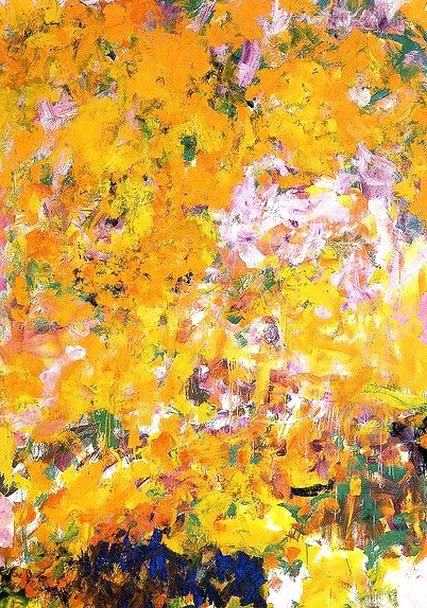
My Year in Reading, 2023

I wouldn’t say I had a great reading year. I was on my phone too much, I was being anguished or avoiding being anguished about the myriad injustices of the world, which I knew too much and could do too little about. I travelled—maybe not too much but an awful lot, for me—which was often energizing and enjoyable, but also got in the way of reading.

I felt, in other words, that I had frittered away my one wild and precious reading life. I bottomed out in the middle of the year, regularly tossing aside books unfinished after having spent more time with them than they deserved or that I could find patience for. A querulous reading year, you could say.

And yet some things stood out. Links to previous posts, if I managed to write about it.
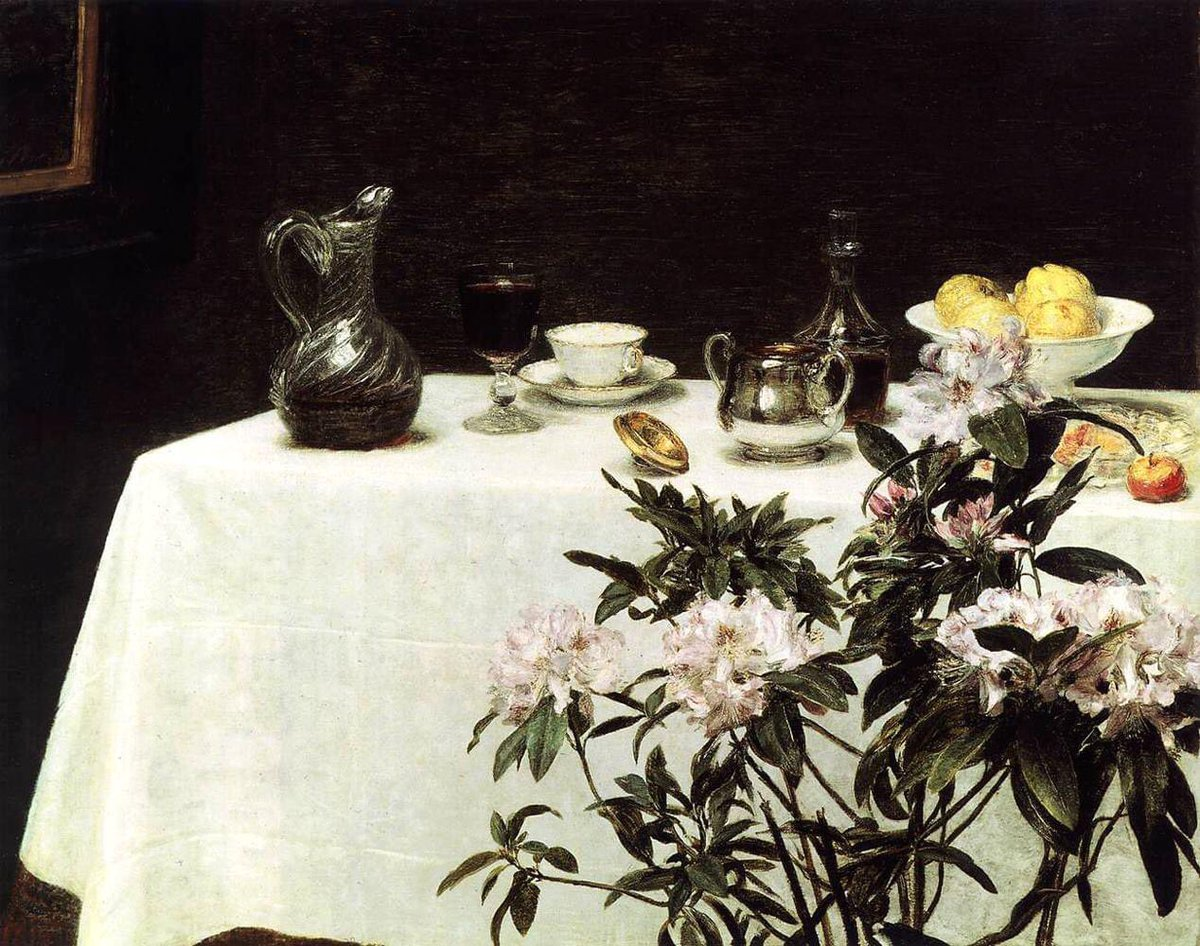
Henri Fantin-Latour, Le coin de la table (1872)

Dwyer Murphy, The Stolen Coast

A rare heist novel where the heist, though satisfying, isn’t the main attraction. I loved this stylish, smart, funny tale of a man who has put his Ivy League law degree to use in taking over the family business: giving new identities to guys on the run and getting them the hell over the border. A great book of off-season resort towns.

Simon Jimenez, The Vanished Birds

I’m still getting my bearing in contemporary sff so take these comments for what they’re worth, but it seems rare to me that a book takes as many swerves as this one: the narrative moves back and forward in time and all over the place, from a near-future nearly uninhabitable earth to a galaxy far-away in space and time. You get invested in a storyline and then it ends but sometimes it comes back. But even more than the structure I loved this book for its emotional seriousness: its many relationships are doomed to fail because of their constitutive circumstances. For example: a man ages fifteen years between each meeting with his beloved, while she, thanks to intricacies of stellar time travel, has only aged a few months. The emotions might be bigger than the ideas, but I was totally okay with that.

Two novels by Katherena Vermette

One of the greatest working Canadian writers. This year, fresh off the thrill of teaching The Break to smart, appreciative students, I read The Strangers and The Circle, a bleak and beautiful trilogy of indigenous life in the aftermath of the cultural trauma of the residential school system.

Four novels by Kent Haruf

It should tell you something that in early April, one of the worst times in the academic year, I read four novels by Kent Haruf in just over a week. I loved Plainsong the most but enjoyed Eventide, Benediction, and Ours Souls at Night almost as much. Easy reading, sure: plain syntax rising to gentle arias, nothing fancy, maybe a little sentimental. But these books are so warm and kind. Each is set in Holt, Colorado, out on the eastern plains, where the mountains are a smudge on the western horizon and it’s sometimes hot and sometimes cold but always dry. The people are ranchers and school teachers and social workers and hardware store owners and ne’er-do-wells and retirees. Everyone is white and no one thinks that’s worth noticing. The time is hard to pin down. Sometimes I thought the 70s or early 80s but we’re probably talking the 90s. Things were different before the internet. The characters’ lives are modest and they seem fine with that. They go about their business, do their work, make good choices and bad ones. People look out for each other, but they judge each other, too. Little kids get lost biking, but they come home again. It’s not all roses, though. High school boys bully girls into having sex, over in that abandoned house just down from where the math teacher lives. People get sick, go hungry, lose jobs. Some characters get what the preacher will call a good death, some die unreconciled to their kin, some without warning, too soon. Life just keeps happening, you know?

Some readers will call this hokum, but I ate it up. Haruf won my heart. I thought him especially good on second chances and unexpected turns of fate. Of all the stories that weave through these loosely connected novels, the best concerns two brothers, old bachelors, ranchers, who agree to take in a pregnant teenage girl and who, to everyone’s surprise, not least their own, form a new family with her. That scene where they take into the next town over to get things for the baby and insist on buying the best crib in the store? Magic.

Garth Greenwell, Cleanness

Smart, sexy, stylish books about how we relate to bodies privately and publically, and whether we can recast the narratives that have shaped aka deformed our understanding of what it is to live in those bodies. Greenwell’s Substack is worth subscribing too; he makes me curious about whatever he’s curious about. Can’t wait for the essay collection he’s writing.

Emeric Pressburger, The Glass Pearls

Yep, that Pressburger. Closer to Michael Powell’s Peeping Tom than any of the (indelible) films they made together. Karl Braun, a German émigré, arrives at a boarding house in Pimlico on a summer morning in 1965. A piano tuner who never misses a concert, a cultured man, a fine suitor for the English girl he meets through work. I’m not spoiling anything to say that Karl isn’t just quiet: he’s haunted—and hunted. For Karl Braun is really Otto Reitmüller, a former Nazi doctor who performed terrible experiments, a past he does not regret even as he mourns the death of his wife and child in the Hamburg air raids. Now the noose is tightening and Otto/Karl goes on the run… Suspenseful stuff; most interesting in this play with our sympathies. Not that we cheer for the man. But his present raises our blood pressure as much as his past.

Toni Morrison, A Mercy

A short book that covers as much ground as an epic; a historical novel that feels true to the differences of the past but that is clearly about the present; a classic modernist Morrison text, where the first page tells you everything that’s going to happen except that it makes no sense at the time and the rest of the reading experience clarifies, expands, revises. Such beauty and mystery in so few pages.

Roy Jacobsen’s Barrøy series (Translated by Don Bartlett and Don Shaw)

Cheating a bit since I read the first one in December 2022. I’m a huge fan of these novels about a family and the remote Norwegian island they call home from 1900 to 1950. I like books where people do things with their hands, maybe because I can’t do much with mine. The characters bring sheep into the upper field, fish with nets and line, salt cod, keep the stove burning all through the year, row through a storm, carry an unconscious man through sleet. It’s all a little nostalgic, a little sentimental, but not too much. Just how I like it.

Two Books by Walter Kempowski (Translated, respectively, by Michael Lipkin and Anthea Bell)

Fresh on my mind so it’s possible I’ve overvalued them but I don’t think so. All for Nothing, especially, is something special.

George Eliot, Middlemarch

Last read in college—under the expert tutelage of Rohan Maitzen, this can only be called one of the highlights of my undergraduate experience. This time I listened to Juliet Stevenson’s recording, which perfectly filled a semester’s commuting. True, Arkansas traffic is not the ideal venue for some of Eliot’s more complex formulations, but Stevenson (as much a genius as everyone says, she do the police in different voices, etc.) clarifies the novel’s elegant syntax and famous images. The book’s the same, but I’m not; a whole new experience this time around. Much funnier, especially its early sections. (Celia is a triumph.) More filled with surprising events: that whole Laure episode (a Wilkie Collins novel in miniature), it was as if I’d never read it. And more heartbreaking: in 1997, I hated Rosamond, and I admit I still felt for Lydgate this time around, but I had so much sympathy for her, a character I’d only been able to see as grasping and venal. Speaking of sympathy, one of the glories of English literature lies in watching Dorothea as she matures from excitable near-prig to wiser and sadder philanthropist. Amidst all this change, though, some things stayed the same. Mary Garth still won my heart; the suspense at the reading of Featherstone’s will gripped me just as much.

It’s good to read Middlemarch in college. It’s better to re-read Middlemarch in middle age. It’s best to read Middlemarch early and often.

Konstantin Paustovsky, The Story of a Life (translated by Douglas Smith)

Six-volume autobiography of Soviet writer and war correspondent Paustovsky, a Moscow-born, Ukrainian-raised enthusiast of the Revolution who somehow made it through Stalinism to become a feted figure of the 1960s. The new edition from NYRB Classics contains the first three volumes. I only read the first two, not because I didn’t enjoy them (I loved them) but because I set the book down to read something else and the next thing I knew it was a year later. Paustovsky had something of a charmed life. His childhood was largely downwardly mobile, and he lived through so much terror and upheaval. And yet he always seems to have landed on his feet. Maybe as a result—of maybe as a cause—he looks at the world with appreciation. He can sketch a memorable character in a few lines. He writes as well about ephemera (lilacs in bloom) as about terror (I won’t soon forget his time as an orderly on an undersupplied hospital train in WWI). He can do old-world extravagance (the opening scene is about a desperate carriage ride across a river raging in spate to the otherwise inaccessible island where his grandfather lies dying) and the brittle glamour of the modern (for a while he drives a tram in Moscow). Trevor Barrett, of Mookse & Gripes fame, said it best: Paustovsky is good company. I really ought to read that third book.

Félix Vallotton, Still Life with Flowers, 1925

A few other categories:

Didn’t quite make the top, but such pleasurable reading experiences: Adania Shibli, Minor Detail; Paulette Jiles, Chenneville; Abdulrazek Gurnah, By the Sea; Jamil Jan Kochai, The Haunting of Hajji Hotak and Other Stories (teaching “Return to Sender” was a revelation: fascinating how even students who had seemed immune to literature shook themselves awake for this one).

Read with dread and mounting desperation, don’t get me wrong it’s a banger, but couldn’t in good conscience call it a pleasure to read: Ann Petry, The Street. Barry Jenkins adaptation when?

Maybe not standouts, but totally enjoyable: Margaret Drabble, The Millstone; K Patrick, Mrs. S; Yiyun Li, The Vagrants; Elif Batuman, Either/Or

Best dip into the Can-con vaults: Margaret Laurence, The Stone Angel. Got more about of this now than I did in high school, lemme tell you.

Best book by a friend: James Morrison, Gibbons or One Bloody Thing After Another: Not damning by faint praise. It’s terrific!

Book the excellence of which is confirmed by having taught it: Bryan Washington, Lot. Maybe the great Houston book. I get that novels sell but I wish he’d write more stories.

Grim, do not recommend: Larry McMurtry, Horseman, Pass By; Girogio Bassani, The Heron

Not for me: Jenny Offill, Weather; Annie Ernaux, Happening; Yiyun Li, The Book of Goose

Planned on loving it, but couldn’t quite get there: Julia Armfield, Our Wives Under the Sea. Sold as metaphysical body horror, this novel about a woman who goes to pieces when her wife returns from an undersea voyage gone catastrophically wrong as a kind of sea creature didn’t give me enough of the metaphysics or the horror. I figured it would be perfect for my course Bodies in Trouble but I couldn’t find my way to assigning it. Possibly a mistake: teaching it might have revealed the things I’d missed. Gonna trust my instincts on this one, tho.

The year in crime (or adjacent) fiction:

Disappointments: new ones from Garry Disher, Walter Mosley, and S. A. Cosby (this last was decent, but not IMO the triumph so many others deemed it; he’s a force, but I prefer his earlier stuff).

Standouts: Celia Dale, A Helping Hand: evil and delightful, can’t wait to read more Dale; Lawrence Osborne, On Java Road: moody, underappreciated; Christine Mangan, The Continental Affair: moody, underappreciated; Allison Montclair, The Right Sort of Man: fun; Joseph Hansen: wonderful to have the Dave Brandsetter books back in print, hope to get to more in 2024; Richard Osman: as charming, funny, and moving as everyone says.

Maigrets: Of the six I read this year, I liked Maigret and the Tramp best. Unexpectedly humane.

Giants: Two Japanese crime novels towered above the rest this year. I didn’t write about volume 2 of Kaoru Takamura’s Lady Joker (translated by Marie Iida and Allison Markin Powell) but maybe my thoughts on volume 1 will give you a sense. Do you need a 1000+ page book in which a strip of tape on a telephone poll plays a key role? Yes, yes you do. (Also, it has one of the most satisfying endings of any crime novel I’ve ever read.) More on Hideo Yokoyama’s Six Four (translated by Jonathan Lloyd-Davies) here. Do you need an 800+ page book in which phone booths play a key role? Yes, yes you do.

The year in horror:

Victor LaValle, Lone Woman: horror Western with a Black female lead and not-so-metaphorical demon, enjoyable if a bit forgettable; Jessica Johns, Bad Cree: standout Indigenous tale, also with demons; Leigh Bardugo, Hell Bent: serious middle-volume-of-trilogy syndrome. Many demons, tho.

The year in sff:

In addition to Simon Jimenez, I liked Ann Leckie’s Translation State, Nick Harkaway’s Titanium Noir, and, above all, the three novels by Guy Gavriel Kay I read this summer, which gave me so much joy and which I still think about all the time.

The year in poetry:

Well, I read some, so that’s already a change. Only two collections, but both great: Wisława Szymborska’s Map: Collected and Last Poems (Translated by Clare Cavanaugh and Stanislaw Baranczak), filled with joy and sadness and wit, these poems made a big impression, and Ilya Kaminsky’s Deaf Republic (fortunate to have met him, a mensch; even more fortunate to have heard his indelible performance).

The year in German books: I read two, liked them both. Helga Schubert, Vom Aufstehen: Ein Leben in Geschichten (On Getting Up: A Life in Stories), vignettes by an octogenarian former East German psychotherapist who had fallen into oblivion until this book hit a nerve, most impressive for the depiction of her relationship to her mother, which reminded me of the one shared by Ruth Kluger in her memoir; Dana Vowinckel, Gewässer im Ziplock (Liquids go in a Ziplock Bag): buzzy novel from a young Jewish writer that flits between Berlin, Jerusalem, and Chicago. The American scenes failed to convince me, and the whole thing now feels like an artefact from another time, given November 7 and its aftermath. I gulped it down on the plan ride home, though. Could imagine it getting translated.

Everyone loved it; what’s wrong with me? (literary fiction edition):

Made it about 200 pages into Elsa Morante’s 800-page Lies and Sorcery, newly translated by Jenny McPhee. Some of those pages I read raptly. Others I pushed through exhaustedly. And then I just… stopped. The publisher says it’s a book “in the grand tradition of Stendhal, Tolstoy, and Proust,” and I love those writers. (Well, I’ve yet to read Stendahl, but based on my feelings for the other two I’m sure I’ll love him too.) Seemed like my social media feeds were filled with people losing it over this book. Increasingly, I see that—for me, no universal judgment here—such arias of praise do more harm than good; I experience them as exhortations, even demands that just make me feel bad or inadequate. Increasingly, too, I realize how little mental energy I have for even mildly demanding books during the semester. (A problem, since that’s ¾ of the year…) I might love this book in other circumstances —I plan to find out.

Everyone loved it; what’s wrong with me? (genre edition):

Billed as True Grit set on Mars in alternate version of the 1930s, Nathan Ballingrud’s The Strange indeed features a young female protagonist on a quest to avenge the destruction of her family, but Ballingrud is no Portis when it comes to voice. True, I was in the deepest, grumpiest depths of my slough of despondent reading when I gave this a try, so I wasn’t doing it any favours. But that’s a nope from me.

Other failures:

Mine, not the books. Once again, I read the first hundred or so pages of Anniversaries. It’s terrific. Why can’t I stick with it? I read even more hundreds of pages of Joseph and His Brothers, as part of a wonderful group of smart readers, most of whom made it to the end of Thomas Mann’s 1500-page tetralogy. I loved the beginning: fascinating to see Mann’s take on the stories of Genesis; interesting to speculate on why Mann would write about this subject at that time. (For me, Mann is in dialogue with Freud’s Moses and Monotheism, another oblique response to fascism through stories from Torah.) My friends tell me it got a lot more boring shortly after I left off (the end of volume 2), but that’s not why I gave up. Turns out, I don’t do well if I’m supposed to read something in regular, little bits. I need to tear into books—and I wasn’t willing to make the time for this chunkster. Sorry, guys.

Odds & Ends:

A few albums that stood out: Roy Brooks, Understanding (reissued in 2022, but I’m not over it: this quintet, man, unfuckingbelievable); Taylor Swift, Midnights (I love her, haters go away); Sitkovetsky Trio, Beethoven’s Piano Trios [volume 2] (a late addition, but pretty much listened to it nonstop in December and now January).

After a decade hiatus, I started watching movies again. Might do more of that this year!

I was lucky enough to travel to Germany in late spring with a wonderful set of students. While there, I met so many people from German Book Twitter who have become important to me, including the group chat that got me through covid and beyond. (Anja and Jules, y’all are the best.) All these folks were lovely and generous, but I want to give special thanks to Till Raether and his (extremely tolerant) family, who took me in and showed me around Hamburg. (Great town!) Have you ever met someone you hardly know only to realize they are in fact a soulmate? That’s Till for me. What a mensch. Cross fingers his books make it into English soon. In the meantime, follow him on the socials!

Reading plans for 2024? None! I need fewer plans. I can’t read that way, turns out, and maybe I’ll avoid disappointment by committing less. Gonna be plenty of other disappointments this year, I figure. No need to add any self-inflicted ones. At the end of last year, I joined a bunch of groups and readalongs, because I want to hang with all the cool kids, but I can already see I need to extricate myself from most of them. One good thing I did for myself in 2023, though, was to stop counting how many books I read. I was paying too much attention to that number. Fewer statistics in 2024!

Piet Mondrian, Oranges and Decorated Plate, 1900

Finally, to everyone who’s read the blog, left a comment or a like, and generally supported my little enterprise (which turns 10 in a week or two…), my heartfelt. I do not know many readers in real life. You all are a lifeline.

What I Read, September 2023

Don’t ask me what happened in September, it was a long time ago. I’m amazed I’m even writing this post.

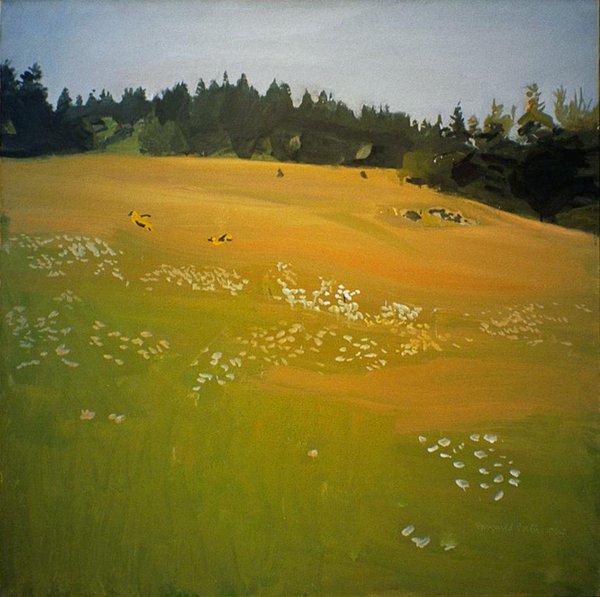
Alex Katz, Lake Light (1992)

Dwyer Murphy, The Stolen Coast (2023)

I liked Murphy’s debut, An Honest Living. But I liked the follow-up even more. So much so that I’d have to call this my most enjoyable reading experience of the year. Murphy seems to know stuff: how to use the law to do things that aren’t really kosher, how to order in a dive bar, how to post in a pickup game. Jack, our narrator, has a pedigreed law degree, but he lives in his hometown, an appealingly ramshackle Massachusetts coastal town that is for sure not the Cape. He works with his father in the family business: helping people shed their identities and giving them new ones so they can start over. People on the run from criminal outfits, companies they’ve stolen intellectual property from, pasts that got too hot. I loved this premise and wanted even more of it.

Here’s Jack reflecting on how you can’t start totally from scratch in creating a new identity—everyone’s been damaged and that’s important:

You want to preserve a little trace of that damage. From parents, boyfriends, husbands, estranged siblings, jilted nobodies, pissed-off bosses who put a credit check on you ten years back for no good reason except you were leaving with two weeks’ notice. A past is a string of resentments and grievances. Grudges that never amounted to anything but were felt for a time. I paid a kid in Iceland to handle the digital traces. It might have been a pack of kids for all I knew. Healthy wind-kissed boys in front of computers, Viking aggression moving through their blood and no lands left to pillage, but they wanted money to walk around with and this was the work they had chosen.

That old-fashioned reference to “walking around money” turns those wind-kissed boys into something from the Rat Pack. Love it.

The quote gives you get a sense of Jack’s voice (Murphy keeps on like he started, he’s gonna be our next Portis.) And he’s not the only great character, either. Jack’s father is a delight, a man who knows how to eat, and chat up the ladies, and perform spycraft: he may be suffering from an incurable illness, though, and maybe things are going to change in Jack’s life.

When an old flame/best friend/absolute pistol, herself a lawyer working at the edge of the law, comes home for the summer, things definitely change. Jack gets involved in an elaborate heist, the machinations of which are pure pleasure. Speaking of pleasure, the main appeal of the book is Dwyer’s prose, which snaps with epigrams (“sincerity unmans me”) and jokes that don’t try too hard:

I went inside for a while and sat at the bar. It was a long block of wood nailed into legs and looked like something you might build in your basement and then forget about for several years.

I read this book over Labour Day weekend and that was a nice thing I did for myself.

Yiyun Li, The Book of Goose (2022)

After getting along with Li’s first novel, I turned to her most recent. I disliked it! Rohan’s take mirrors mine. I really didn’t understand why this novel had to be set in France. On the one hand, Frenchness seems to matter to it a lot. On the other hand, not at all. Feels like Emperor’s New Clothes to me.

Christine Mangan, The Continental Affair (2023)

If “atmospheric” as a term of literary praise means “set in European locales, especially those off the beaten track,” then this is a highly atmospheric novel.

In other words, we get Paris, yes, but we get more of Belgrade. Still more unexpected are Grenada and the peripherally European spaces of Istanbul and Algiers. But Mangan’s latest is more Hitchcock than Bourne. The best literary comp might be Highsmith.

A woman enters a train compartment otherwise occupied only by a ruggedly handsome man. They exchange pleasantries, watch the countryside of 1960s Europe flash by from the windows of the dining car, and warily seek to move past each other’s defenses. Part meet cute, part slow burn. But they’re acting. They know each other already. In fact, the man has been following the woman across the continent, tasked with retrieving some stolen money—something he could have done ten times over already, but can’t find it in him to do.

Brainy thrillers with nice locales are catnip to me, even though Mangan freights her characters a little heavily: they share a dramatic past neither can let go of. But she nails the ending, and even if The Continental Affair is a mere diversion—the title is so generic it’s like a parody—it’s adeptly done. Can’t wait for Cate Blanchett to star in the inevitable adaptation. Get this for the dad in your life who fancies himself a man of taste: he won’t be able to resist.

Simon Jimenez, The Vanished Birds (2020)

I can’t remember who put me on to this remarkable space opera. Adam Roberts? (Google search drew a blank.) I do remember where I bought it: a little shop in Missoula a couple of years ago. (Not the Shakespeare one. The other one.) I don’t remember what made me take it off the shelf. (I went back and forth between the audio and the paper book. Good narrator.)

I can say that The Vanished Birds will be on my end of year list. It’s that moving, that smart, that surprising.

It’s a long, complicated book. (Though not a patch on his most recent, The Spear Cuts Through Water, which I had to give up listening to, it was just too hard for my commute, but that book too astonishes right from its kickass dedication, “This one’s for me.”) My summary won’t do it justice. But here goes. In a galaxy owned by a single company, a spaceship arrives every five years on a small “resource planet” to take the accumulated harvest to the galaxy’s central planet. At the festival celebrating the ship’s arrival, the captain, Nia, hooks up with a local. They meet each time she returns, but the thing is that, thanks to time manipulation technology, what’s five years to him is only 15 months to her. She barely changes while he leaps forward in age.

But this poignant story is only the beginning of Jimenez’s tale. One year, in between spaceship arrivals, an unknown ship crashes into the fields. The man who loves Nia takes in the only survivor, a mute young boy, before passing him on to her on her next visit (the last one the now elderly man will live to see). Nia names the boy Ahro. It takes years before he speaks, but his musical abilities suggest there’s something special about him. That quality is recognized by Fumiko Nakajima, the lead designer/engineer/physicist of the company that runs the galaxy. Thanks to cryogenic technology, Fumiko is thousands of years old; Jimenez diverts us to her story, which begins on a near-future earth that she escapes just before it collapses due to climate change, but not without leaving behind her lover, a woman determined to see the place through to its end. Fumiko suspects that Ahro has a talent that could undo her past mistakes—but she knows the company that owns everything, even her, would subject him to vivisectionist experiments if it knew what the boy is capable of. She hires Nia on a mission to keep the boy, now a young man, on the fringes of the galaxy, away from company patrols. In the process, Nia becomes his parent. When Ahro is captured despite her efforts, only she can save him…

That’s a lot, right? The Vanished Birds is a novel of found family, colonialism, ecological change, time the revelator. Big stuff. It’s bold and beautiful (the prose is a cut above) and too carefully constructed to be called sprawling. I think about it a lot, several months after having read it, not least the section set on a planet that has bought by the company and stripped of its people, populated now by dozens of feral dogs and one last man, left behind to man the radio tower. I shed a tear at the end, I tell ya.

Garth Greenwell, Cleanness (2020)

I first read Cleanness in March—I never wrote up that month, and I probably never will. I’m glad of the chance to say something here, because I love this book. I already thought it was great the first time, but having had the chance to teach it, I’m convinced it’s brilliant. Like “we will read this in a hundred years” brilliant.

A companion piece to his wonderful debut, What Belongs to You, Cleanness is also narrated by an American teaching in Bulgaria. But the new novel is richer, its power coming from the montage of its seemingly disparate, almost stand-alone sections. To my mind, it is also better in that its references to the narrator’s childhood are cut to the bone. The handful of references hit that much harder than the extended section in the previous book.

I read Cleanness as a novel about different ways bodies can come together. Readers are most often drawn to the scenes of anonymous BDSM sex, but several chapters feature the narrator’s more placid relationship with another foreigner, a student from the Azores. Others describe a writing retreat, two describe encounters with current and former students in which the narrator wrestles with what it means to be a gay role model in a country where LGBTQ life is harshly penalized. A particularly fascinating chapter describes a series of spontaneous street protests that convulse Sofia, and the narrator’s admiration and fear of the unpredictable power of masses of bodies in public space. Even when we try to reduce ourselves to pure flesh, Greenwell implies, we can’t escape identity. But identity isn’t fixed; the roles we’ve been given are just that, roles. They can change, we can push against them even when their forms are ossified and seemingly inescapable. (That’s what politics is for.) This idea comes across most clearly in a chapter called “The Little Saint,” whose titular character, a bottom who lets men bareback him, gently explains to the narrator that the violence he begs the narrator to unleash upon him, which brings the narrator to tears, since the sounds of the whipping he lays on the young man seem to have turned him into a version of his father, who was never shy with his belt, the violence that is demanded by one person of another, can never be the same as violence enacted in hate or rage.

The book ends with a beautiful scene involving an elderly dog who wanders the campus of the international school where the narrator teaches. The narrator, drunk and alone, having narrowly avoided making a mess of some important things, takes the dog into his rooms even though it’s strictly forbidden to bring her inside because she’s meant to have fleas. He makes up a bed for her and then lies down next to her. An indelible scene. Here I take Greenwell to be saying that we can’t take the cleanness granted by the Little Saint and wished for by the protestors who want to sweep a corrupt government out of power too seriously. Cleanness but not too much: it’s good to lie down with beings, human or not, that others think of as dirty.

Seriously, this book is something else. Greenwell has such intelligence and such beautiful prose. Thrilling.

Sadly, most of my students did not feel the same way, though some of them were big enough to admit that they were kink shaming. No matter, Imma teach it again!

Georges Simenon, Cécile is Dead (1942) Trans. Anthea Bell (2015)

Day after day Cécile Pardon waits for Maigret at police headquarters, unwilling to see anyone but the great man, and when she does she has nothing more definitive to report than a suspicion that someone has been in the apartment she shares with an elderly aunt. When he sees her in the waiting room (the lads call it “the aquarium”) on a day when he’s just not feeling it, he slips out the back. She’s gone when he gets back to the office. But then the aunt is reported dead, and Cécile is nowhere to be found. (You can guess the rest; the title is not a metaphor.) Plottier than the average Maigret, this early-ish installment is further enlivened by the presence of an American detective who comes to see how the big man does his thing. (Simenon liked this idea: there’s one where someone from Scotland Yard does the same thing.)

The investigation centers on the apartment building where Cécile lived with her aunt. You could read Cécile is Dead, with its depiction of the space and the people who inhabit it, as a slantwise homage to Zola’s Pot Luck.

Annie Ernaux, Happening (2000) Trans. Tanya Leslie (2001)

Having taught Happening this semester in a class called Bodies in Trouble, I was interested to go back and read what I had to say about it three years ago. I see that I was damning with faint praise already then; spending a lot more time with the book didn’t make me care for it more. As for my students, they seemed to like it well enough. Understandably they couldn’t help but read it in terms of their post Dobbs American life; more surprisingly, they were mostly worked up by what they perceived as Ernaux’s class striving: they saw her as both a victim of and complicit in the denigration of working class lives. Their end of semester feedback revealed that they could take it or leave it as a course text. Good to hear, since I’d already decided not to repeat the experiment. I get that Ernaux is doing a thing; I just don’t care much for the thing. And her prose, as shaped by her various no doubt able translators (here Tanya Leslie), does not lend itself to the kind of close reading that is my pedagogical bread-and-butter. Whatever, Ernaux will get along just fine without my reservations.

Joseph Hansen, Troublemaker (1975)

I thought I wrote about the first novel in the Dave Brandstetter series, Fade Out, when I read it a couple of years ago but now I can’t find it in the perhaps-not-reliable index of this blog. In this, the third book (they’re all being reissued but the store didn’t have the second one in stock), the owner of a local gay bar is found naked and dead. A local hustler is found next to him. An open and shut case. Not to insurance agent Brandstetter. Surprise, surprise, he’s right, and soon he’s neck-deep in a twisty plot that once again makes the 70s seem both shitty and terrific.

These books are great above and beyond any talk of “pioneering representation” (tho that matters), it’s great that they’re back in print, it sucks that my local library does not have them.

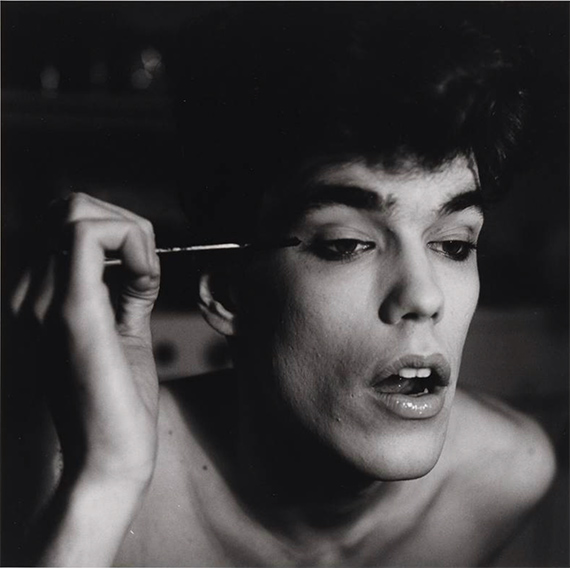
David Brintzenhofe Applying Makeup (II) (1982)

There you have it, friends. Have at me, Ernaux lovers, The Book of Goose partisans, and anyone who thinks all the books I liked are overrated…

Melanie Nicholls’s Year in Readng, 2022

Today’s reflection on a year in reading is by Melanie (Mel) Nicholls. Mel is a bookseller at Barnes and Noble from Georgia. You can follow her on Twitter @nichollsm86 where she often tweets about…books!

Rineke Dijkstra, Self portrait, Marnixbad, Amsterdam, 1991

I was pleased when Dorian asked to do a write up of my 2022 reading, as I enjoyed reading the entries from last year. My reading in 2022 was mainly fiction in translation and short stories. When choosing what to read I mostly pick up books I think I’ll enjoy. And this past year I definitely succeeded! Here are some of the standouts.

January started strong with two books that are new favorites. The haunting Ganbare! Workshops on Dying is by Katarzyna Boni (tr. Mark Ordon). Boni reports on the March 11, 2011 earthquake and tsunami in the Tōhoku region of Japan and its aftermath. She offers accounts of the effects on survivors such as learning to scuba dive to help find bodies, a gripping account of the Fukushima nuclear disaster, and stories of other devastating earthquakes in Japan’s history. A heartbreaking and timely work. I followed this with the NYRB Classics edition of Edith Wharton’s ghost stories, unsettling and eerily quiet hauntings. A book I could read every year. The novel Written on the Body by Jeanette Winterson and the stories in Cars on Fire by Mónica Ramón Ríos (tr. Robin Myers), continued my excellent streak of reading for the first month of the year. 

In February I began the readalong of Dorothy Richardson’s thirteen book sequence Pilgrimage. I really started to click with Miriam’s journey with book three and my top reading goal in 2023 is to finish the sequence. Other highlights include the classic Passing by Nella Larsen [Ed. – GOAT!] and the absolute gem Byobu by Ida Vitale (tr. Sean Manning), two books I’m sure I’ll find new meaning in each time I read them. 

In March I read another top book of 2022, Blood Feast: The Complete Short Stories of Malika Moustadraf. These stories about gender and class in society are expertly translated by Alice Guthrie. The outstanding translator’s notes make this a book I hope to study more and highly recommend. April was another strong month with the beautiful novel When I Sing, Mountains Dance by Irene Solà (tr. Mara Faye Lethem) and the terrific History of a Disappearance: The Forgotten Story of a Polish Town by Filip Springer (tr. Sean Gasper Bye). I ended this month with the masterpiece Woman Running in the Mountains by Yūko Tsushima (tr. Geraldine Harcourt) which I often think of with Lolly Willowes by Sylvia Townsend Warner. Both novels portray a woman’s yearning for freedom and Dorian’s podcast One Bright Pod has superb episodes for both books. [Ed. – Thank you! Of course, Frances and Rebecca are the really important members of the team.]

May and June were the months of absolute banger short books: 

Yesterday by Juan Emar (tr. Megan McDowell)

They by Kay Dick

Cold Enough for Snow by Jessica Au

Spear by Nicola Griffith [Ed. – Curious to check this one out.]

An Ideal Presence by Eduardo Berti (tr. Daniel Levin Becker)

Permafrost by Eva Baltasar (tr. Julia Sanches)

Violets by Kyung-Sook Shin (tr. Anton Hur)

Pollak’s Arm by Hans von Trotha (tr. Elisabeth Lauffer)

The Employees: A Workplace Novel of the 22nd Century by Olga Ravn. (tr. Martin Aitken)

July’s standout is A Month in the Country by J.L. Carr, a perfect novel. [Ed. – Absolutely agree.] August is one I look forward to every year because it is Women in Translation month. I continued this year with four writers whose translated work I am slowly making my way through: Annie Ernaux, Yoko Tawada, Natalia Ginzburg, and Banana Yoshimoto. Another highlight was the collection Panics by Barbara Molinard (tr. Emma Ramada). Molinard was a close friend of Marguerite Duras and would destroy most of her writing. [Ed. – Thanks, uh, “friend”…] These bizarre and grotesque stories are a must read. Two books translated from Croatian, Call Me Esteban by Lejla Kalamujic (tr. Jennifer Zoble) and Divine Child by Tatjana Gromača (tr. Will Firth) from the new small press of translated fiction Sandorf Passage, were also excellent. 

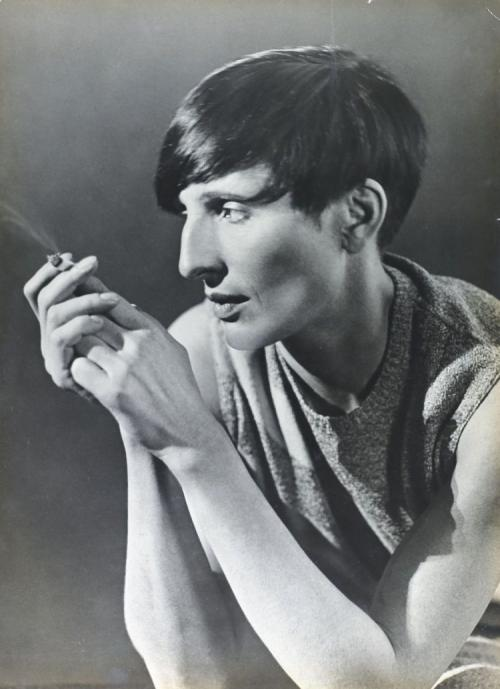
Gerty Simon, Renée Sintenis ca. 1929 – 32

The last few months of the year offered standouts in nonfiction. I love Elaine Castillo’s debut novel America is Not the Heart and she delivers again with the essays in How to Read Now. This book, along with A Ghost in the Throat by Doireann Ní Ghríofa, This Little Art by Kate Briggs, The Missing Pieces by Henri Lefebvre (tr. David L. Sweet), and Voice of the Fish by Lars Horn, left me with a new appreciation for reading, translation, writing, and art. All are books I will come back to often. Other wonders at the end of the year include some short-but-mighty translated novellas: Space Invaders by Nona Fernández (tr. Natasha Wilmer), Baron Bagge by Alexander Lernet-Holenia (trs. Richard and Clara Winston), A Woman’s Battles and Transformation by Édouard Louis (trs. Tash Aw) and Rogomelec by Leonor Fini (trs. William Kulik and Serena Shanken Skwersky). I’ll close with Nettleblack by Nat Reeves, a playful novel of queer awakening among strange crimes in a Victorian rural town.The most fun I had reading in a while, just a joy to read. [Ed. – Sounds great!] My reading has changed over the last couple of years as I have discovered more translated fiction, small press, and Book Twitter. I am excited to see where my 2023 reading will take me and to share the wonders. [Ed. – You’re welcome back next year, Mel!]

Brad Bigelow’s Year in Reading, 2022

Today’s reflection on a year in reading is by Brad Bigelow. Brad writes http://NeglectedBooks.com and edits the Recovered Books series for Boiler House Press.

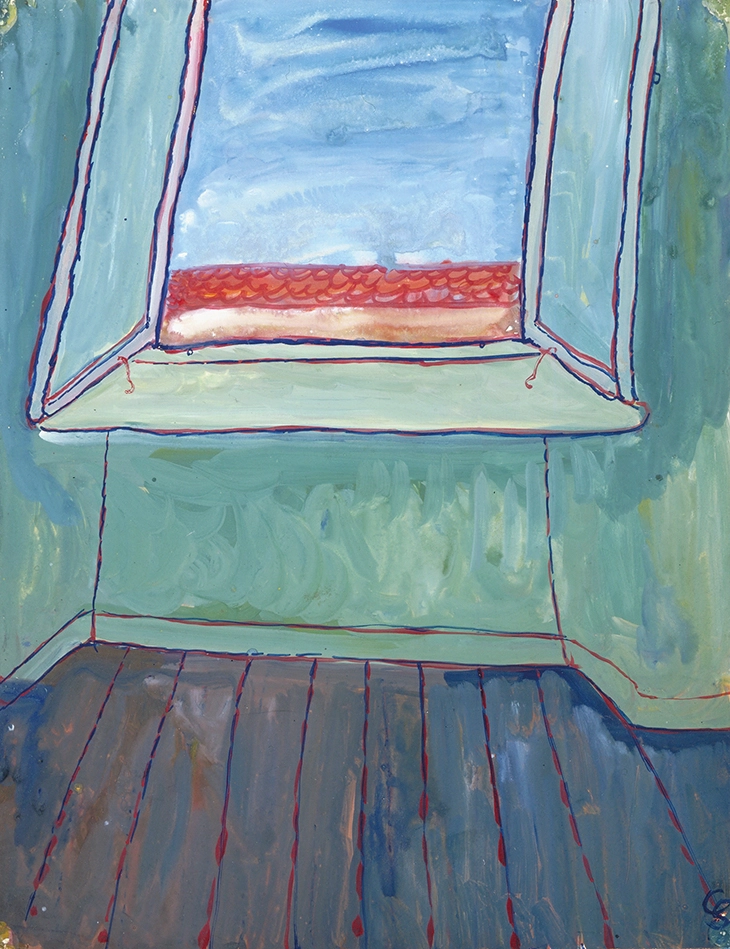
Charlotte Salomon, No. 134 from Life? Or Theater? (1941 – 42)

When I finished college forty-some years ago, I started writing down every book I read in a little spiral notebook. I kept up this habit for over twenty years and then stopped for some forgotten reason. Since starting The Neglected Books Page, most of my reading has been of long-forgotten books and most of these I’ve recorded by writing about them on the site. But as time goes on, I’m falling ever further behind in this writing. And to make matters worse for the purposes of this piece, I keep no record of my non-neglected reading. So, this is a fairly unreliable review of my reading in 2022, but I hope it’s worth your time nonetheless.

(It’s a good thing I never went into marketing.) [Ed. – No kidding!]

Among my neglected reads, easily the most memorable was Charlotte Salomon’s Life or Theater? Although Salomon told her life through paintings, it operates at an unforgettable level of intensity. There are at least three narratives winding through the hundreds of paintings in this book: the psychological breakdown of her family; her own troubled emotional development; and the trauma of Germany, and of German Jews in particular, with the rise of Nazism and Hitler. As I wrote back in April, “the book is presented as an art book – large and very heavy with its hundreds of pages of full-color images. But I think this does the book as a book some disservice. For it can also be seen as a graphic novel.” And I think it would benefit from being repackaged as a graphic novel, since today’s readers are now so accustomed not just to the language of graphic novels but to the very idea of considering them as literature. [Ed. – Absolutely. Her drawings look like they come from a graphic novel, too, as your post with its generous illustrations suggests.]

Easily the most enjoyable was Madeleine Masson’s memoir, I Never Kissed Paris Goodbye.Though we know from its opening line—“It was a beautiful day in June 1940”—that this story will have a sad ending, most of Masson’s account of Paris in the 1930s is as frothy and delightful as a glass of champagne. It’s full of the infidelity, excess, and manic energy of Jean Renoir’s classic film The Rules of the Game, and highly recommended to anyone who loves that film. [Ed. – You’re trying to tell me there are people who don’t love that film? Nonsense! This book sounds excellent, BTW.]

My deepest archaeological dig of the year was locating a copy of Carola Ernst’s Silhouettes crèpusclaires, and then dusting off my French to read it, based on nothing more than a brief reference in a magazine from 1921. This modest account of the journey Ernst took in the Fall of 1914 to return a French officer blinded in an early battle of the First World War to his family is a touching portrait of a world in the midst of a radical transformation. The pair are able to travel via Belgium, Germany, Switzerland, and France thanks more than anything to a spirit of chivalry that had not yet been destroyed in the industrial machinery of the war.

Another highlight was the chance to spend several weeks with some of the many volumes of poetry penned by Raymond Souster, the bard of Toronto. Souster’s longevity and disciplined dedication to his art enabled him to amass an account of one city’s life that may be unparalleled in the 20th century. Souster lived and wrote to the age of 91, worked in the same bank for over 40 years, was married to the same woman for over 60 years, and, as their only child, cared for his parents until they died in their late nineties. Though Souster claims he never wrote any great work (“I’m not sure I’m ready for epics/there are far too many little songs/the rest have left unsung”), the body of his work is sort of an epic in itself. [Ed. – Fascinating! I’ve even lived in Toronto and have never heard of Souster.] Someone needs to go through the thousands of pages of Souster’s poetry and distill it into an autobiography along the lines of what Ruth Limmer did with Louise Bogan’s work in Journey Around My Room.  

Finally, I must mention Nina Warner Hooke’s Biff and Netta trilogy: Striplings (1934); Close of Play (1936); and Own Wilderness (1938). These novels follow a half-brother and sister, Biff and Netta, from their early to mid-teens, as their already unconventional and decaying family collapses completely. The first volume received tremendous critical praise and was most commonly compared to the work of P. G. Wodehouse. Warner Hooke said she had no plans for further books at first, but when you finish the trilogy, its narrative arc seems almost predestined. She could no more leave off her story than you could get off a rollercoaster after the first drop. It is deeply strange, not solely because of its theme of incest, and deserves much closer examination than I was able to give it in my post. At 900-some pages, it’s far too long to expect anyone to ever reissue it unless some editor finds the courage to do some substantial posthumous abridgement, but it’s a work that I continue to process months after finishing it.

I tend to rely on audiobooks for my non-neglected reading. For years, I had a daily commute of over an hour each way and I racked up thousands of hours of listening, which enabled me to catch up on many classics I’d skipped. Now, my commute is just a staircase [Ed. – Bliss!], but I still get in an hour or so of listening each day. One of my projects was to go back through the works of Thornton Wilder, who is arguably both recognized and neglected. Aside from “Our Town”, most folks have only a vague notion of what he did, and even the once-ubiquitous The Bridge of San Luis Rey is not a familiar title. Wilder is the only writer to have received a Pulitzer in two genres, fiction and drama, has several volumes in the Library of America, and most of his work never falls out of print for long. I wrote about The Eighth Day, his most ambitious—and, to be honest, most flawed—novel years ago, and loved Heaven’s My Destination and Theophilus North when I first read them. This year, I went back and listened to all his novels in chronological order (an exercise I highly recommend for novelists who particularly interest you), starting with The Cabala.

The experience was both a revelation and a disappointment. I found several of the books suffered from an earnestness that became particularly apparent when considered back-to-back. On the other hand, I was astonished at the innovation of The Ides of March, his novel of Caesar’s last months. It’s a collage of fictional letters, excerpts from actual Latin texts, and even graffiti from the streets of Rome in the first century BC. Why is this book not acclaimed as a milestone in the fictional form? [Ed. – Sounds like time for a reissue?]

Aside from Wilder, most of my listening has been focused on Russian history and literature. I’ve long been fascinated by Russia, even though I’ve deliberately avoided my few opportunities to visit there. There’s something about the darkness of so much of the Russian experience that seems to reassure me that my own life really isn’t all that bad. This might be one of the reasons that I read so many books about Stalin when I was working for the two worst bosses I’ve had to suffer. I listened to two historical surveys by Orlando Figes: A People’s Tragedy, about the Russian Revolution, which occasionally bogged down in the minutiae of political infighting, and Natasha’s Dance, which I would recommend to anyone looking for a historical context to much of the Russian art, literature, and music of the last 200+ years. There were also several biographies—Alex Christofi’s Dostoevsky in Love, Alexandra Popoff’s book on Vasily Grossman, Donald Rayfield’s Chekhov—all richly illuminating. But by far the most enjoyable and impressive listen was Nabokov’s The Gift, which managed to weave so many of the threads from these other books together and remind me yet again of the fact that Nabokov worked at a level miles above so many of the 20th century’s greats.

Of the more recently-published books I’ve read, few really stand out. I found a number of the more acclaimed ones forgettable and will skip over them. Although I’ve read that it’s not the place to start, I loved Annie Ernaux’s The Years, in part because it described a world very familiar to me after 18 years of living in Belgium and working closely with many French men and women. And Gwendolyn Riley’s My Phantoms could have described some of our neighbors on the little street in Norwich where my wife and I lived for two years. [Ed. – Yikes!] I wish I could say that the books I’ve read by American writers were half as evocative, but I guess I’m still getting used to a country that’s so different from the one we left just before 9-11.

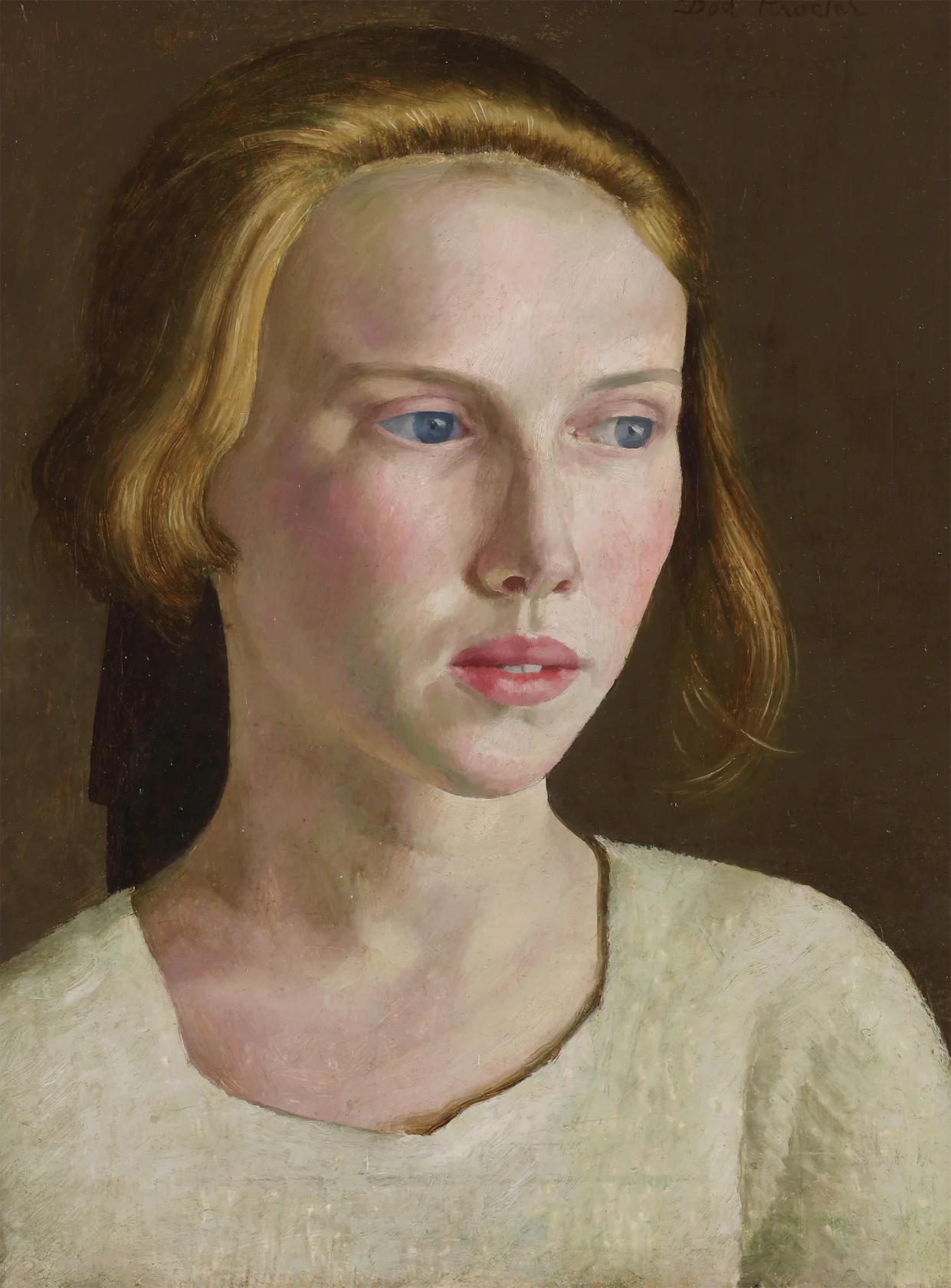
Dod Procter, Lydia, ca. 1926

And it would be remiss of me not to mention the brightest highlight of 2022, which was the #PilgrimageTogether reading group. Starting in January, a group of us worked our way through the thirteen “chapter-volumes” of Dorothy Richardson’s masterpiece, Pilgrimage, aided by a wonderful cast of Richardson scholars who agreed to take part in our monthly discussions. I first read Pilgrimage in 2016 as part of a two-year project of reading only the work of neglected women writers (complemented by two years of only listening to audiobooks by women) and ever since have been an evangelist on its behalf. Not to denigrate Proust, but I find it astonishing that thousands of people read Remembrance of Things Past each year while Pilgrimage, which speaks directly to so many aspects of life that are still part of our everyday world today, is barely known and even less read. Like others in the group, I found Pilgrimage both so challenging and so rewarding that other books seem somehow diminished in comparison. It’s a novel I know I’ll be returning to again — and, I hope, with another group of readers. [Ed. – This is good to hear, since I regret not joining in. It would be great if you could time it with my next sabbatical, thanks.] Until then, I encourage folks to take up Pilgrimage and spend some months with Dorothy Richardson’s insistently individualistic Miriam Henderson, aided by the Reading Pilgrimage website. [Ed. – Thanks for the post, Brad, and congratulations on that site. What a resource!]

Isaac Zisman’s Year in Reading, 2022

Today’s reflection on a year in reading, poetic and stormy, is by Isaac Zisman. Isaac is a writer and editor based in Oakland, CA. Find him on all socials @octopus_grigori and at http://isaaczisman.com.

Ori Sherman, from The Creation (1986)

I confess to having a reticent memory. I keep few records. I should be more organized. Twenty-twenty-two was a year of reading—haven’t they all been? as well as I can recall—and yet I’m not sure it was a year of overmuch finishing. The year began in an overheated apartment in Manhattan. It could’ve been storming. Maybe lightning struck the tall building that everyone knows, everyone sees, the most witnessed building in history, perhaps, but whose name I here elide. A website I’ve never come across before says it was 55 degrees and raining at noon. It says nothing about thunder. I had Covid then, which meant I was on the couch under an old blanket. My partner prepared a small bite of caviar on toast the night before and I remember it only as texture.

I type in “books” into my phone’s camera roll and 534 images pop up. I add “2022” and the number drops to 136. Tapping “see all” brings them up in chronological order and so I can see I began the year with a small stack, my hand gripping the three books together above the sloping parquet of the apartment’s floor.

The first is I am writing you from afar: a novel graphic, by moyna pam dick, a gift from my friend Jared Fagen, a writer and the publisher of Black Sun Lit, the press who released the novel. My favorite page was one of four artful squiggles that appear to have been drawn with a weak Bic pen. Next in my hand is the Pevear and Volokhonsky translation of The Brothers Karamazov by Dostoevsky. I don’t think I made it past Father Zosima this go around. My copy of Crime and Punishment, ibid. trans. etc., sits next to it on the shelf now and I recall that in high school I thought it was a minor victory to take to the cover with a sharpie in order to change FYODOR DOSTOEVSKY into ODOR TOE. [Ed. – Big D would have been proud.] Thank god I left the spine clean. The third book is Janet Malcolm’s In the Freud Archives, in which a post-it note roughly lodged suggests I didn’t progress very far at all. [Ed. – Shame, it’s terrific!] I have the faint impression of a war between critics for mantle of Freud’s inheritance. I remember laughing at that.

Scrolling forward, my phone offers up mostly domestic scenes in which books appear. My partner eating soup at our little table next to the bookcase; the dog sprawled out beneath the same, his toys arranged on top of him in what was probably my idea of a joke; a giant pile of nachos at a friend’s apartment next to an edition of the Hokusai Manga, the astonishing book of figuration, expression, and Edo period garments by the painter of “The Great Wave Off Kanagawa.” In the background, the Los Angeles Rams square off against the Cincinnati Bengals, projected to nearly life size on the far wall. [Ed. – Ah, sportsball!]

On Feburary 2nd, I took a photo of single page of Ulysses (p. 489 in the Gabler edition, I discover, pulling down the book now from a high shelf). I’ve highlighted a name: “Isaac Butt.” [Ed. – Heh.]

Two weeks later I took a picture of String of Beginnings, the memoir of Michael Hamburger, translator of Paul Celan and basis of the character Michael Hamburger in Sebald’s The Rings of Saturn—for no representation can claim more than resemblance. I strikes me that I could steal the title for this little essay.

In March, friends online directed me to Guy Davenport—I’m sure you know these friends, perhaps you can count yourself among them. I picked up a copy of the guy davenport reader, primarily for the story “The Aeroplanes at Bescia,” a glorious assemblage of the fictional lives of Franz Kafka, the brothers Otto and Max Brod, and an atmospherically distant Ludwig Wittgenstein. For some reason, my hardback copy came wrapped in four identical dust jackets. I read around in Questioning Minds, Davenport’s lifetime of correspondence with the critic Hugh Kenner. My used edition of Apples and Pears, purchased later,contains a clipping—the author’s obituary in the Washington Post.

Late May found me in a strange version of a doctor’s office, a sort of wellness situation that goes beyond the purview of this text that I am writing now. The walls are adorned in a garish wallpaper and in my hand is a copy of the Zohar, though I can’t read Hebrew beyond sounding out the letters. I remember we spoke of being and becoming and that the doctor gave an impression of someone coming to poetry for the first time, his mind rigid with math and chemistry suddenly loosened at the core by the concept of metaphor. He liked to imagine beneficent angels, he told me.

On June 5th I bought another bookcase and took the stacks off the floor.

On June 10th I received a copy of Gordon Lish’s Peru from a seller on eBay. It smelled so rank I couldn’t bear to open it.

On June 16th I took a photo of an epigraph. “The first memory is of memory itself” –GIORGIO AGAMBEN. I have no idea to which book this quote attends.

In late June, we spent a week at a rental, a house on the New York State historic registry as it was once the home of Lincoln Barnett, a science journalist and editor for Life Magazine and the first to write a popular account of Einstein’s relativity for an American audience. It is possible that the great man, Einstein himself may have sat in this house, I thought as I leaned, head in hands at the old desk with its view of Lake Champlain and the sweet mildew smell of old books. Next to me sat my stack of Romanians—Mihail Sebastian, Dumitru Tsepeneag, Norman Manea, translations by Philip Ó Ceallaigh, Alistair Ian Blyth, Linda Coverdale. I composed half a chapter of my own book, adrift down a Dâmbovița of the mind.

By August I was reading Fosse again, this time Morning and Evening, trans. Damion Searls. I could not yet return to the Septology, also via Searls, the first volume of which had been my companion in the first weeks of the pandemic. If for Merve Emre reading Jon Fosse’s Septology was “the closest I have come to feeling the presence of God here on earth,” for me it was something different. The particular had exploded into the particulate. I have only been able to open it again now, but that is a reflection for next year. I am reminded, too, of the great Jewish mystic painter Ori Sherman and his series The Creation which depicts the seven days of Genesis. The last image is of the verdancy of the world, fecundity in potentia. God is at rest and emerging from the algal depths, from the swirling mass of green and blue signifying life and growth and wildness and all that is to come, ascends a radiant sphere. But it is neither the sun, nor the light of the world, nor of God, nor the gnostic light of secret knowledge. It is a crowned sphere inchoate, a virus. [Ed. — !]

Finding myself one of the few remaining residents at the end of a writing conference later that month, I laid claim to a stack of books abandoned by the side of a path. One of the novels was The Hundred Year House by Rebecca Makkai, who taught at the conference. At that moment, I saw her boarding a van to the airport and rushed over to greet her. I asked for an inscription, something I’ve rarely done. “To Isaac,” she obliged, “who stole this book!”

I returned to Lincoln Barnett’s house on the lake where I read Samantha Hunt’s mysterious essay collection, The Unwritten Book: An Investigation. Two days later, a cyclone descended, its epicenter the little spit of rock and soil on which the house perches above the lake. The windows blew in off their frames. Trees fell. Power lines draped across the road. The event lasted less than a minute, but we were trapped for days. We played scrabble and drank whisky and ate grilled hot dogs, the dented Weber, which the storm had flung across the yard and tipped to the edge of the small cliff at the far edge of the property, being our only method for cooking. I read Amit Chaudhuri’s Sojurn and dreamed of Berlin.

September was spent reading apartment listings. The Covid deals were gone. Rents had doubled, tripled. Our building had sold and was to become condos. We left Manhattan under a brilliant sky and headed back to California. In my backpack came a copy of Javier Marías’s A Heart So White, trans. Margaret Jull Costa, and as we drove toward the west, the smell of wildfire and dry grass, terrible and familiar, returned.

We arrived back in Oakland at the beginning of October, to the place where we’d lived before moving to New York, to the plague house of the first of the Covid years, and, before that, to nearly a decade of our lives. I returned to Bolaño and he carried me through the fall.

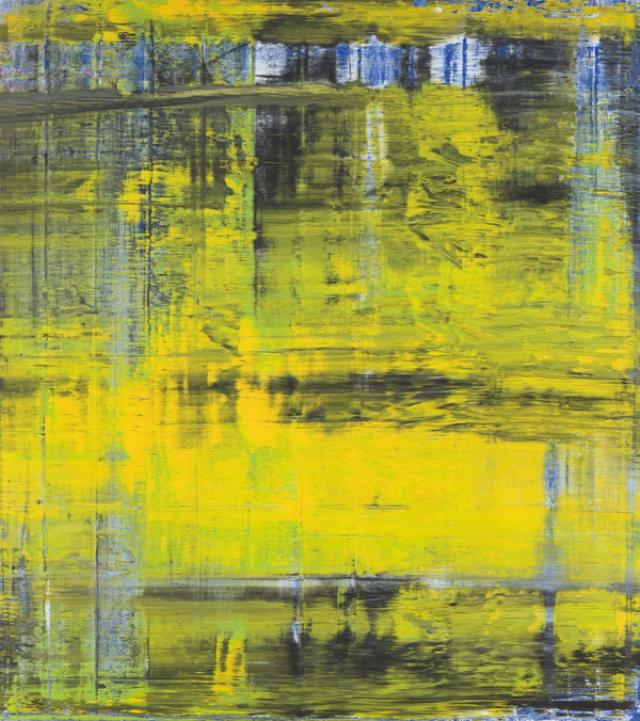
Gerhard Richter, Abstraktes Bild (1994)

There were other things read, I’m sure, though the question of when exactly eludes me. I know, for instance, that I loved Emily Hall’s The Longcut, Jessica Au’s Cold Enough for Snow, Sublunary Edition’s magisterial edition of Marguerite Young’s Collected Poems. That I reread swaths of Hans Magnus Enzenberger’s Tumult, trans. Mike Mitchell, after his passing. That I read a long-travelled copy of Grimmish by Michael Winkler, sat enthralled by Sergio Chejfec’s My Two Worlds, trans. Margaret B. Carson, inhaled December by Alexander Kluge and Gerhard Richter, translation by Martin Chalmers. That I read the fictions of friends, sworn to secrecy until their much deserving publication. That I read essays and poems, criticism, lists of albums, cookbooks, articles, manuals, comics, menus, books of photography, road signs. The work of my new, online companions—how good it feels to have such talented peers. [Ed. – heart emoji] I see the silvered spines of the New Directions Storybook editions on the shelf beside me, I see the bookmark wedged somewhere in the first third of Mircea Cărtărescu’s Solenoid, trans. Sean Cotter—the image of twine emerging from the narrator’s belly button producing a shudder once again. On my desk the piles begin to grow once more—the books I pulled off the shelf to remember, the two translations of Clarice Lispector’s The Hour of the Star, Giovanni Pontiero and Benjamin Moser, respectively, the copy of Annie Ernaux’s Happening, trans. Tanye Leslie, that I read breathless in a single sitting as December closed. And the Septology, arriving again to start anew. It was a messy year, but edifying. What emerges next, I’m not sure.

Benita Berthmann’s Year in Reading, 2021

Today‘s reflection on a year in reading is by Benita Berthmann (@moodboardultra) Benita studies literature in Marburg, Germany, where she is a full time book enthusiast, part time smoker and existentialist.

Look for more reflections from a wonderful assortment of readers every day this week. Remember, you can always add your thoughts to the mix. Just let me know, either in the comments or on Twitter (@ds228).

Helene Schjerfbecek, G***y Woman, 1919

In 2021 I read more books than ever before. 175, to be exact. [Ed. – Damn girl!] I could do it because I was in a very relaxed last semester of my Bachelor’s degree with heaps of free time (which I have since finished) and also because we were and still are in a pandemic. Being advised to stay at home does have its advantages. [Ed. – Introverts of the world unite! But not too closely!]

How can I select a number of favorites from all these books? I cannot. I can only offer you a glimpse into my (reading) life, a tiny selection. Of course, there are books from 2021 that stuck with me more than others, that touched or repulsed me differently, that I catch myself returning to in my thoughts over and over again.

When I think about the most memorable books of the past year, DIE WOHLGESINNTEN (Les bienveillantes/The Kindly Ones, German translation by Hainer Kober) by JONATHAN LITTELL immediately comes to mind. Little manages to show us each and every realm, every tiny corner of the Nazi brain of his protagonist and narrator, Maximilian Aue, over almost 1400 pages. [Ed. – Shoulda read it in English, only 992.] He is able to portray a character that is not just a Nazi, not just morally ruined, but a human being, a terrible, guilty, one, but one we do not necessarily dislike. [Ed. – Hmm…] One that allows us to see that even the most intellectual, the most cultivated (however we might define that term) people are not exempt from pursuing the most evil crimes against humanity. Not exempt from committing genocide. It is difficult to find the right words for what this book did to and with me. Yet, it is clear to me that DIE WOHLGESINNTEN is a major work that will continue to make its way into the cultural memory and leave a lasting impact on all its readers.

I am not too big on audiobooks—I listen to the same ones over and over again to help me fall asleep at night because, apparently, I can only sleep when someone basically talks my ear off—but there is one that kept me company throughout the whole year: THE SECRET HISTORY by DONNA TARTT. Probably no surprise that I, a semi-pretentious lit-student, enjoyed the tale of a very pretentious, flamboyant yet secretive group of classics students who decide to kill their friend. The novel has all of my favorite tropes: Dark academia, an obsession with aesthetics, a compelling way of story telling, mystery, and a healthy amount of death and homoerotic subtext. The language is complex and clever, snobby and charming all in the same instant, proving to me that Donna Tartt is indeed the most skillful contemporary American writer. Her talents lie not only in writing, but also in reading her own novel as an audiobook, her southern accent just adds that little extra sprinkle. Also, I have a soft spot for Richard Papen. Fight me. [Ed. — Totally fair.]

A book that has been important for me for years and that I became even more fond of in 2021 was HERTA MÜLLER’S HERZTIER (English title: THE LAND OF GREEN PLUMS, English translator: Michael Hofmann). HERTA MÜLLER, Nobel Prize winner of 2009, is my most revered author—her description of life under Ceausescu’s dictatorship in 1970s and 80s Romania never ceases to leave me in awe of both her writing skills and her personal integrity. It is brutal, relentlessly honest and poetic. In HERZTIER, we get a close view of a group of students trying to evade political persecution, eventually having to escape the government—either by fleeing to Germany or by death.

Why is this novel so important to me? In the summer of 2021, I wrote by bachelor’s thesis on its figurations of death, an experience that taught me how to look at literature even more closely and how to present an argument on my own. I feel lucky I got to have these experiences with my favorite author. [Ed. – Heart emoji!]

It’s not always easy to read a novel by Müller, neither thematically nor stylistically, but I would argue that it is a memorable and most rewarding experience –her unusual prose, the (sometimes jarringly) accurate and detailed descriptions of seemingly minor incidents open up, at least for me, perspectives I would otherwise never have imagined exist. She is a minority writer (German-speaking Banat Swabian, having grown up in Romania), an uncompromising political activist, using her voice and her reputation as a Nobel laureate especially to help censored and blacklisted writers forced to live under dictatorial rule, and someone whom I admire for both their writing and their personal integrity. Safe to say, Herta Müller is my muse. [Ed. – Benita, you are a Herta Müller Ultra!]

A huge and somewhat daunting project of mine was to read UWE JOHNSON’S (pronounced more like Yohn-Zohn in German) JAHRESTAGE (ANNIVERSARIES, translated by Damion Searls): the German version is a whopping 1700 pages. I aimed for 50 pages a day, which roughly worked out. As the title already indicates, the narration follows every day in the life of the protagonist Gesine Cresspahl, originally from Jerichow, Mecklenburg, GDR, now a citizen of New York. Anniversaries is a cleverly interwoven literary montage consisting of Gesine’s current life with her daughter in NY in 1967 and 68, her and her family’s history (fascism in 1930s Germany and such…) and, interestingly, snippets of The New York Times. I recently attended a seminar on Literary Patronage that shed light on how much Johnson was struggling to finish the final quarter of the novel. The first three parts were published in 1970, 71 and 73, but he went through a rough patch health-wise, got divorced and amassed debts at his publishing house Suhrkamp amounting to roughly 250,000 DM (around $105,000 at that time, my quick research reveals), thus, he only managed to complete his main work in 1983, a year before his untimely death from a heart attack (while he tried to open his third bottle of wine that evening). [Ed. – Let that be a lesson to me.] Rumor has it that his publisher Siegfried Unseld, trying to get his money’s worth as he was supporting the author with a monthly paycheck of 3000 DM, pushed Johnson to his breaking point by demanding that the novel be completed by March 1983 or else he would suspend the monthly support. Unfortunately, we will probably never know if this is true, but it’s an interesting backstory to the novel either way.

Thinking about all the other books I also got through, it’s impossible to name, properly review, and shed light on all of them, but there are a few honorable mentions I would like to announce at the very least:

Anything I have read by THOMAS BERNHARD, my favorite angry Austrian. This year, I got around to: FROST (translated by Michael Hofmann), WATTEN. EIN NACHLASS (published in English in THREE NOVELLAS, translated by P. Jansen and K. Northcott), MEINE PREISE (MY PRIZES, translated by Carol Brown Janeway), HOLZFÄLLEN (WOODCUTTERS, translated by David McLintock) and DIE URSACHE (part one of his autobiographical writings, I could not find an English translation for it [Ed. – It’s in Gathering Evidence] – all worth reading. I look forward to discovering even more of Bernhard’s works in 2022.

ANNIE ERNAUX: EINE FRAU (UNE FEMME/A WOMAN’S STORY (English translations all by Tanya Leslie, German translations by Sonja Finck), DIE SCHAM (LA HONTE/SHAME) and DAS EREIGNIS (L’ÉVÉNEMENT/HAPPENING) found their way into my bookshelf and my reading year 2021. The last one especially made its way into my literary heart and memory: It deals with an abortion in early 1960s France—a dangerous and shameful endeavor at that time that Ernaux dissects into fragments of memory showing pain, shame, secrecy and the essential danger of being a woman. Safe to say I am glad was born in a time and a country that makes abortions, should one be needed, at least semi-accessible. Abortion rights are not perfect in modern day Germany, but I have the feeling it’s still better than what the author describes so hauntingly and directly.

For 2022, I hope that SHIDA BAZYAR’S novel DREI KAMERADINNEN (roughly: Three (female) Comrades) will be translated into English. It challenges white majority perspectives on Germany and the country’s ongoing problems with fascism, the rising political right and xenophobia. Bonus point: It is an absolute page-turner.

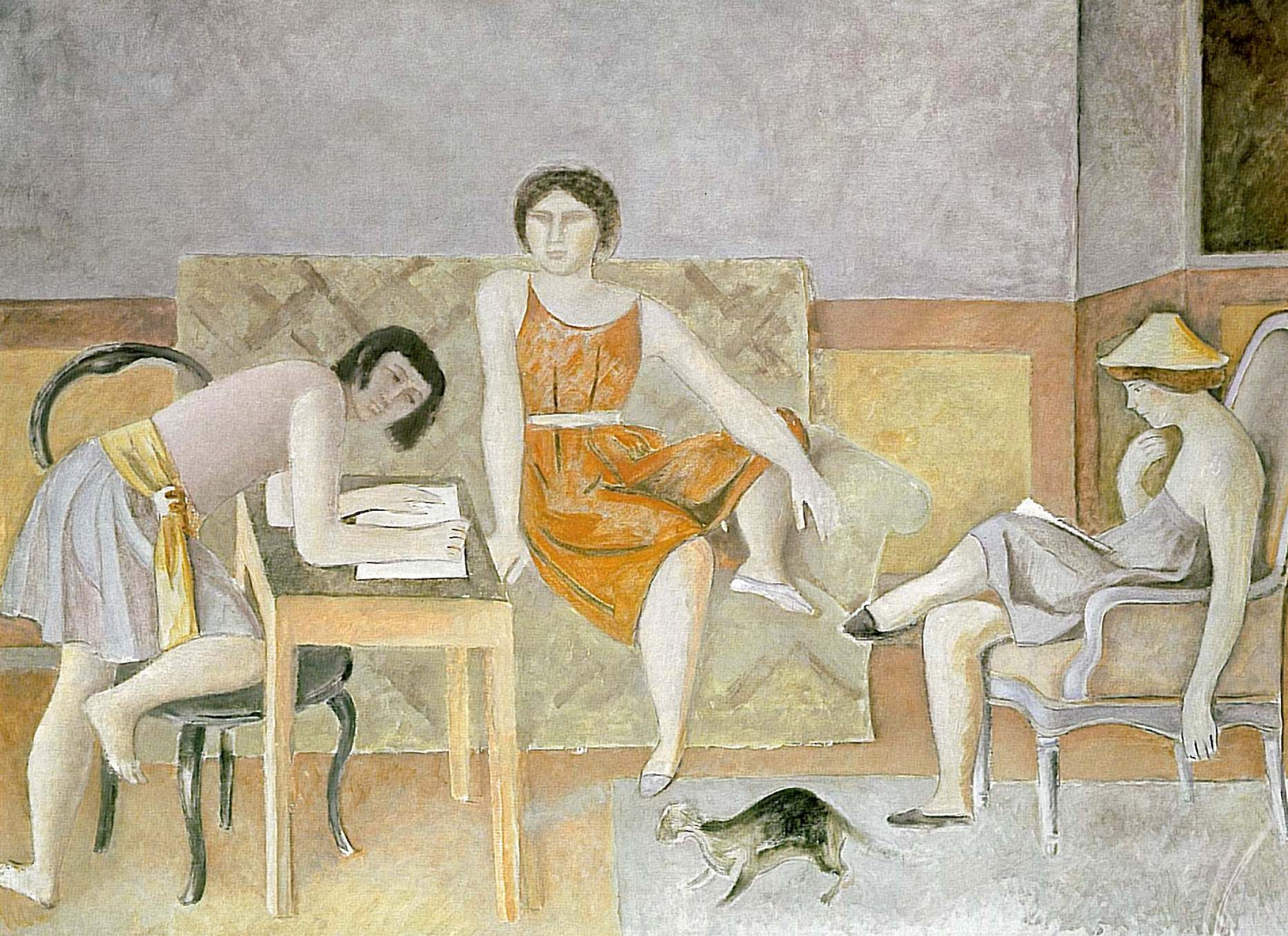
Balthus, Three Sisters and a Cat, 1965

Ok, now, finally and shortly, a couple of books that were awesome as well:

Marieke Lucas Rijneveld – The Discomfort of the Evening/Was man sät (T: Michele Hutchison/Helga van Beuningen)

Evelyn Waugh – Brideshead Revisited

Anne Weber – Annette, ein Heldinnenepos (English translation forthcoming later in 2022)

Margaret Atwood – The Blind Assassin

Patti Smith – Just Kids

Günter Grass – Der Butt/The Flounder (T: Ralph Manheim (I have read both the German original and the English translation and I can confirm that Manheim did a superb job!))

Kurt Vonnegut – Slaughterhouse Five

Maggie O’Farrell – Hamnet

I will probably not manage 175 books again this year (doing a master’s degree and all), but I hope I will still be able to discover new favorites. Keep on reading, folks.

And let’s hope Dorian keeps on giving us the chance to post these, so that I can put even more books on either my wish list or my tbr stack(s). [Ed. – I’ve already penciled you in for next year, Benita!]

Bryce Sears’s Year in Reading, 2021

Today’s reflection on a year in reading is by Bryce Sears (@BryceSears5). Bryce, one of the nicest people on Book Twitter (which is saying something), is an avid reader and writer who lives in Oakland.

Look for more reflections from a wonderful assortment of readers every day this week and next. Remember, you can always add your thoughts to the mix. Just let me know, either in the comments or on Twitter (@ds228).

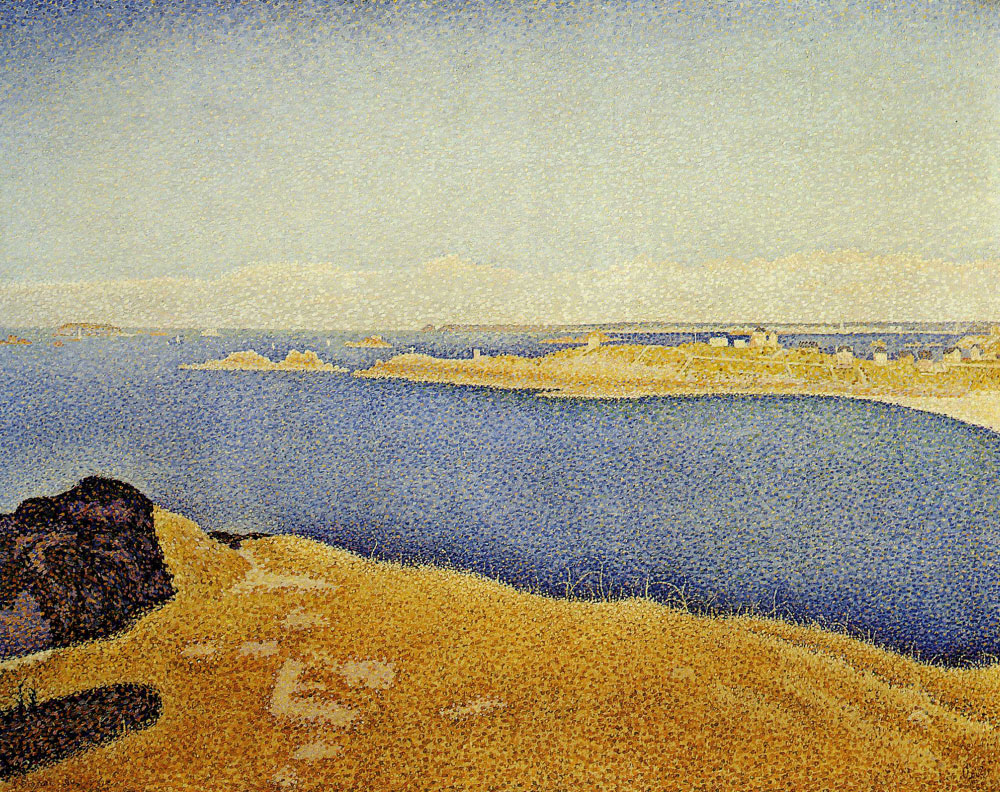
Paul Signac, Saint-Briac. La Garde Guérin. Opus 211, 1890

I kept up in 2021 a trend toward escapism in my reading. I’ve been on this kick about five years – a habit of reading a lot more fiction and a lot less non-fiction than I used to. I used to read a lot of history; the one piece of non-fiction I read last year was a travelogue – Kapka Kassabova’s Border. It was terrific, to my thinking, as you can see below. [Ed. – Straight up honest to God terrific, Bryce; it’s not just you!] Later, reading a few pages of its follow-up, To the Lake, I found it all a bit depressing, thinking about facts and history. It was this thing I’m dealing with. My view, I guess, is that the world is on fire. In a dozen different ways at least. So I’m voting to put it out. I’m volunteering and protesting. [Ed. – I admire you!] But also, for the sake of my own mental health, I might need more breaks from thinking about our predicament.      

Such a cheery opening! The other thing helping with my mental health is my homelife. Two years ago my wife and I bought a house in Oakland. So, we’re doing a lot of work digging up strange things in our back yard, etc. [Ed. – Uh, how strange? Like dead body strange???] We have a three-year-old son who is delightful. His interest in books has really taken off. I spend a lot of time reading with him when I’m not writing or reading books for myself.  

The Vet’s Daughter, and some other works by Barbara Comyns

Barbara Comyns is the writer I was most thrilled to discover this year. I was surprised. I tend to like best stories about people (to paraphrase Diane Williams in her recent interview with Merve Emre) dealing with the life we’re all stuck in. For a long time now, I haven’t tended to go in much for stories with magical or supernatural elements. If this sounds like you, too, don’t let it keep you from Comyns. Somehow, the supernatural in her stories isn’t startling (or at least I don’t find it so). It might be her prose, which is both cool and somehow scintillating. It might be the way she links the supernatural elements in her stories to the mental health of her protagonists. In The Vet’s Daughter, my favorite of the books of hers I’ve read, the supernatural in the story appears (at least as I read it) to come as a reaction the protagonist is having to a pervasive threat of violence. Which is to say it feels like a state of shock. It adds something to our sense of what the protagonist is feeling.

Or it could be my tastes are changing.

In any case, in addition to The Vet’s Daughter, the other books I read by Comyns this year are The Juniper Tree, Our Spoons Came from Woolworths, and Who Was Changed and Who Was Dead. They’re all quite different from one another. I liked The Juniper Tree best, but ask me again tomorrow. Saying I like this Comyns better than this other Comyns is almost no better than saying ‘I prefer apples to oranges’.       

The Remains of the Day, and some other works by Kazuo Ishiguro

I’m not sure when I would have read Ishiguro if not for Book Twitter. Somehow, years ago, I got it into my head that I’d find his work cinematic in some off-putting way. The Anthony Hopkins, Emma Thompson adaptation of The Remains of the Day was so famous. Before I got around to reading that one an adaptation of Never Let Me Go came out, and it also got a big hoopla. I got the sense Ishiguro’s work must be reductive, somehow. Well, as I’m sure everyone else knew, it isn’t. The books behind these two movies are so very much better than the movies. I should have had more faith in literature.  

My first Ishiguro, The Remains of the Day, was likely the first book I finished in 2021, going by my Twitter history. And what a revelation it was. Later in the year I read An Artist of the Floating World, and Never Let Me Go. Now I have five additional, as yet unread, Ishiguros in a stack on the shelves next to me. They make me feel rich.   

Happening, and some other works by Annie Ernaux

I was a bit obsessed with Annie Ernaux in 2021. I read Happening, A Man’s Place, A Woman’s Story, and I Remain in Darkness (all translated by Tanya Leslie). I read The Possession (tr. Anna Moschovakis). Over a period of months I reread Happening, A Girl’s Story (tr. Alison L. Strayer), and Simple Passion (tr. Tanya Leslie). These are all short, auto-fictional stories that feel like memoirs.       

The confessional quality of these books is one thing that draws me to them. Another is the skepticism Ernaux displays in her writing. She tries to make clear, as she writes about events in her past, how little she knows of the women she used to be, how false it would be to pretend to walk in the shoes of these younger selves. [Ed. – Nicely put!] She goes out of her way to avoid exaggeration. And I find this humility so refreshing.    

One last word on Ernaux. My favorite work of hers is Happening. It is quite harrowing – the story of an abortion Ernaux had in 1963, when she was 23 and abortion hadn’t yet been decriminalized in France. If I could I’d have everyone in the US read this book. It strikes me we could do worse here, where many women will likely face choices soon like the ones Ernaux faced, than encourage people to understand what it was like for this particular woman – a white woman, highly educated, in 1960s France. I’m not a teacher, but I think it’d make a nice class discussion, a group of close readers considering how the situation might vary in the US for people of color, for people with less access to information of the sort Ernaux had, etc.

Lonesome Dove, by Larry McMurtry

West Texas, where I grew up, is the part of Texas where all the worst Texas clichés come to life. The whitest, most reactionary part. I always wanted out of it. I might have become a reader in part to avoid it. Which is all by way of an excuse for not having read a western before last year. Still, I picked a great book to begin with.  

Lonesome Dove was the most absorbing book I read in 2021. It’s a big, twisty story, rich with joyful writing (I mean, it is often dark, but you can tell McMurtry enjoyed writing it). It struck me as escapist in the plainest sense of the word – it took me to a very different world from my own. The jokes worked for me. Consider the wry twist of this line that comes when Gus, the protagonist (I think, it could be Call), gives a junior partner money for a prostitute, then reminisces (in free indirect): “Best to help boys have their moment of fun, before life’s torments snatched them away.” Or this line, Gus again (he gets a lot of the best jokes), talking to Call, claiming he indulges in remorse for his mistakes so often that the pain on each indulgence isn’t “much worse than a dry shave.” Or these lines, near the climax of the story, when another character (called Pea Eye – his name is its own joke), is on the run: “His feet were swollen to twice their size, besides being cut here and there. Yet they were the only feet he had, and after dozing for an hour in the sun, he got up and hobbled on.” You can see McMurtry building out his characters with these jokes. You can see him building the world they live in, which he leans into the hardness of. One character lives with a leaky gunshot wound in his stomach. The book begins with two pigs “having a fine tug-of-war” with a rattlesnake they’ve found.

Slowly, drawn along by the humor and descriptive power of the writing, I think most readers of Lonesome Dove will find themselves hooked by its story. I did. It can worry me sometimes, the feeling I’ve been hooked. I’ve read a lot of bad writing in books after finding myself interested in a story (the writing was often bad in the beginning of these books, when I wasn’t hooked and should have given them up). Here, reading Lonesome Dove, I found myself wanting to know what would happen when the big cattle drive got underway. What would happen with Gus, who had seemed to have a pretty empty life in Lonesome Dove. I wanted to know if Newt would find out about his parentage. If Laurie would make it to San Francisco. It worried me, the sense I was getting hooked, letting my guard down. But I don’t think it should have. I read Lonesome Dove last summer. Time has passed, and now I’m flipping through it again. And already want to reread it. 

Other writers I enjoyed in 2021

Anita Brookner tops the list of writers I discovered last year, and loved, but am still just getting to know. I read Look at Me, Hotel du Lac, and Latecomers. They’re all terrific. [Ed. — “Hartmann, a voluptuary, lowered a spoonful of brown sugar crystals into his coffee cup, then placed a square of bitter chocolate on his tongue, and, while it was dissolving, lit his first cigarette.”]

Another writer I greatly enjoyed reading is Tove Jansson. I read The True Deceiver last year and The Summer Book the year before (I think). I’d really like to read Fair Play soon and her stories (and maybe the Moomin stories, too).

I reread Beckett’s Molloy last year. I read Clarice Lispector’s The Hour of the Star. Thinking of these books gave me pause in saying Lonesome Dove was the most absorbing book I read last year. I was locked into both from the start.     

I read The Copenhagen Trilogy, the three-part memoir by Tove Ditlevsen, which is devastating. I read Drive Your Plow Over the Bones of the Dead, my first Tokarczuk. And now I want to read everything she has written, or will write.

I read, as mentioned above, Kapka Kassabova’s Border last year. It is so good. I think I sold it short above calling it a travelogue. Border strikes me as meditative work. Its use of language is gorgeous. Dorian recommended this one, and I read it as a group read with Kim McNeill, Catherine Eaton, and Naguib Mechawar. I benefited greatly from their thoughts on it. The next Kassabova I’d like to read is To the Lake: a Balkan Journey of War and Peace. Just need to find the nerve. [Ed. – It’s worth it!]

I read Toni Morrison’s Jazz for the first time last year, and Arundhati Roy’s The God of Small Things. Both are phenomenal. NoViolet Bulawayo’s We Need New Names is so good, and I wanted live forever in the strange mysteries of The Taiga Syndrome (tr. Suzanne Jill Levine and Aviva Kana), by Christina Rivera Garza.   

Richard Diebenkorn, Ocean from a Window, 1959

I could go on – I haven’t mentioned Natalia Ginzburg’s Family Lexicon, or Grace Paley’s Enormous Changes at the Last Minute, or Layli Long Soldier’s Whereas, or Cynan Jones’s The Dig, or Andrea Bajani’s If You Kept a Record of Sins,  …, or … or …. But I have to make myself quit.

I’ve really enjoyed writing this. Thanks for reading.

My Year in Reading, 2020

I feel bad saying it, it is a mark of my privilege and comfort, but 2020 was not the most terrible year of my life. In many ways, it was even a good year. I have secure employment, about as secure as can be found these days, and what’s more I spent half the year on sabbatical, and even before then I was working from home from mid-March and didn’t miss my commute for a minute. Thanks to the sabbatical, I avoided the scramble to shift my teaching to a fully online schedule—watching colleagues both at Hendrix and elsewhere do this work I was keenly aware of how luck I’d been to have avoided so much work. I do worry, however, that I’m hopelessly behind the curve, clueless about various technologies and best practices; I expect elements of the shift to virtual will persist.

My family spent a lot of time together last year; among other things, I watched my daughter grow into someone who edits YouTube videos with aplomb. (At not-quite ten she is already the house IT person.) As an introvert, I found staying home all the time the opposite of a burden. (Last week I had to be somewhere relatively crowded, for the first time in months, and boy am I going to be in for a rude awakening when this is all over.) I missed seeing friends, but honestly my social circle here is small, and I continued to connect with readers from all over the world on BookTwitter. Most excitingly, I had a lot of time to read. I’ve heard many people say their concentration was shot last year, and understandably, but that wasn’t my experience. For good or for ill my response to bad times is the same as to good—to escape this world and its demands into a book.

But sometimes, usually on my run, I’ll wonder if I’m mistaken in my assessment of the year. I suspect a deep sadness inside me hasn’t come out yet: sadness at not seeing my parents for over a year; at not being able to visit Canada (I became a US citizen at the end of the year, but Canada will always be home; more importantly, our annual Alberta vacations are the glue that keep our little family together); at all the lives lost and suffering inflicted by a refusal to imagine anything like the common good; at all the bullying and cruelty and general bullshit that the former US President, his lackeys, and devoted supporters exacted, seldom on me personally, but on so many vulnerable and undeserving victims, which so coarsened life in this country.

I think back to the hope I sometimes felt in the first days of the pandemic that we might change our ways of living—I mean, we will, in more or less minor ways, but not, it seems, in big ones. I feel hopelessness at the ongoingness of the pandemic, the sense that we may still be closer to the beginning than the end. And a despair fills me, affecting even such minor matters, in the grand scheme of things, as this manuscript I’m working on—could it possibly interest anyone?

I suppose what most concerns me when I say that 2020 was not a terrible year is my fear of how much more terrible years might soon become. My anxiety about the climate-change-inspired upheavals to come sent me to books, too, more in search of hope than distraction. A few of the titles below helped with that. Mostly, though, reading books is just what I do. I am reader more than anything else, and I expect to be for as long as that’s humanly possible.

For the second straight year, I managed to write briefly about every book I read. You can catch up on my monthly review posts here:

January February March April May June July August September October November December

All told, I finished 133 books in 2020, almost the same as the year before (though, since some of these were real doorstoppers, no doubt I read more pages all told). Of these 45 (34%) were by men, and 88 (66%) by women. 35 were nonfiction (26%), and 98 (74%) were fiction. Sadly—if predictably—I read no collections of poetry or plays last year. I didn’t read much translated stuff: only 30 (23%) were not originally written in English. Only 4 were re-reads; no surprise, given how little I was teaching.

Highlights:

These are the books that leap to mind, the ones I don’t need to consult my list to remember, the ones that, for whatever reason, I needed at this time in my life, the ones that left me with a bittersweet feeling of regret and joy when I ran my hands consolingly over the cover, as I find I do when much moved. These are the books a reader reads for.

Larry McMurtry, Lonesome Dove

My book of the year. A road novel about a cattle-drive from the Mexican border to Montana around 1870. Thrilling, funny, epic, homely. Characters to love and hate and roll your eyes at and cry over and pound your fists in frustration at. And landscapes to swoon over, described in language that is never fussy or mannered or deliberately poetic, and all the better able to capture grandeur for that. I think about the river crossings all the time. And those last scenes in wintry Montana. Lonesome Dove is good for people who love Westerns. It’s good for people who don’t love Westerns. Recently someone asked me to recommend a 20th century Middlemarch. Crazy, I know, but I immediately thought of this book, which, albeit in a different register and in a different location, is similarly fascinated by the webs that form community, and why we might want to be enmeshed in them. (A goal for 2021 is to re-read Eliot’s masterpiece to see if this comparison has any merit.) If you read novels for character, plot, and atmosphere—if you are, in other words, as unsophisticated a reader as me—then Lonesome Dove will captivate you, maybe even take you back to the days when you loved Saturdays because you could get up early and read and read before anyone asked you to do anything.

Kapka Kassabova, To the Lake

I loved Kassabova’s previous book, Border, and was thrilled that my high expectations for its follow-up were met. Lake Ohrid and Lake Prespa, connected by underground rivers, straddle the borders of Greece, Albania, and the newly-independent North Macedonia. This book is about these places, but as the singular noun in the title suggests, “lake” here primarily concerns a mindset, one organized around the way place draws together different peoples. Like Border, To the Lake is at first blush a travelogue, with frequent forays into history, but closer inspection reveals it to be an essayistic meditation on the different experiences provoked by natural versus political boundaries. Unlike Border, To the Lake is more personal: Kassabova vacationed here as a child growing up in 1970s Bulgaria, as her maternal family had done for generations. But Kassabova seems more comfortable when the spotlight is on others, and the people she encounters are fascinating—especially as there is always the possibility that they might be harmful, or themselves have been so harmed that they cannot help but exert that pain on others. In Kassabova’s depiction, violence and restitution are fundamental, competing elements of our psyche. One way that struggle manifests is through the relationships between men and women. As a woman from the Balkans who no longer lives there, as a woman travelling alone, as an unmarried woman without children, Kassabova is keenly aware of how uncomfortable people are with her refusal of categorization, how insistently they want to pigeonhole her. (No one writes ill-defined, menacing encounters with men like she does.) People have been taking the waters in these lakes for centuries—the need for such spaces of healing is prompted by seemingly inescapable violence. I’ve heard that Kassabova is at work on a book about spas and other places of healing, and it’s easy to see how the forthcoming project stems from To the Lake. I can’t wait.

Kate Clanchy, Some Kids I Taught and What They Taught Me & Antigona and Me

Clanchy first earned a place in my heart with her book based on her life as a teacher, Some Kids I Taught and What They Taught Me. She is particularly good on how we might teach poetry writing—not by airily invoking “inspiration” but by offering students the chance to imitate good poems. These models will inspire students to write amazing poems of their own, and offer students whose background is from outside the UK (where Clanchy lives) the chance to refract their own experiences into art. Clanchy is committed to the idea that students have things to gain from their education, if they are allowed to pursue one. But she is equally adamant that students have things to give to the institutions where they spend so much of their lives. Thinking about what a child might bring to her school reminds us that education is a public good first and not just a credentialing factory or a warehouse to be pillaged on the way to some later material success. It’s an idea that might begin to redistribute the social and economic inequalities attendant in neoliberalism.

I’m sure I liked Some Kids as much as I did because I’m also a teacher. Which doesn’t mean I don’t think non-teachers (and non-parents) will enjoy it too. But I do think Clanchy’s earlier book Antigona and Me is an even greater accomplishment, with perhaps wider appeal. Antigona is Clanchy’s pseudonym for a Kosovan refugee who became her housekeeper and nanny in the early 2000s. The two women’s lives became as intertwined as their different backgrounds, classes, and values allowed them. Yet for all their differences, they are linked by the shame that governs their lives as women. Antigona’s shame—her escape from the code of conduct that governed her life in the remote mountains of Kosovo, and the suffering that escape brought onto her female relatives—is different from Clanchy’s—her realization that her own flourishing as a woman requires the backbreaking labour of another—and it wouldn’t be right to say that they have more in common than not. What makes the book so great is what fascinating an complex characters both Antigona and Clanchy are. Riveting.

Andrew Miller, Now We Shall Be Entirely Free

A brilliant historical novel. My knowledge of the Napoleonic wars is thin—though having just finished War and Peace I can say it is less thin than it used to be—and I appreciated learning about both the campaign on the Iberian peninsula and the various milieu in England, ranging from medicine to communal living, that were both far removed from and developed in response to that war. (Miller has Penelope Fitzgerald’s touch with the telling detail, conjuring up the mud and blood-spattered viscera of the past while also showing its estrangement from the present.) But what has really stayed with me in this book about a traumatized soldier on the run from both his memories and, more immediately, a pair of contract killers hired to silence the man before he can reveal a wartime atrocity is its suggestion that the past might be mastered, or at least set aside. Reading the last fifty pages, I felt my heart in my throat. Such anxiety, such poignancy. This book really needs to be better known.

Helen Garner, The Spare Room

Garner is a more stylistically graceful Doris Lessing, fizzing with ideas, fearless when it comes to forbidden female emotions. Old friends Helen and Nicola meet again when Helen agrees to host Nicola, who has come to Melbourne to try out an alternative therapy for her incurable, advanced cancer. Garner brilliantly presents Helen’s rage at the obviously bogus nature of the therapy—and Nicola’s blithe (which is to say, deeply terrified) unwillingness to acknowledge that reality. Helen is resentful, too, about the demanding and disgusting job of taking care of Nicola (seldom have sheets been stripped, washed, and remade as often as in this novel). Emotions about which of course she also feels guilty. Nicola expresses her own rage, in her case of the dying person when faced with the healthy. In the end, Nicola has to be tricked into accepting her death; the novel lets us ask whether this really is a trick. Has Nicola gained enlightenment? Is false enlightenment, if it gets the job of accepting reality still enlightenment? What does enlightenment have to do with the failure of the body, anyway? I loved the novella’s intellectual and emotional punch.

Robin Wall Kimmerer, Braiding Sweetgrass: Indigenous Wisdom, Scientific Knowledge, and the Teachings of Plants

Kathleen Jamie, Surfacing

Kim Stanley Robinson, The Ministry for the Future

I’ve grouped these titles together, not because they’re interchangeable or individually deficient, but because the Venn diagram of their concerns centers on their conviction that being attuned to the world might save it and our place on it. These are great books about paying attention. Whether describing summer days clearing a pond of algae or noting the cycles nut trees follow in producing their energy-laden crop, Kimmerer reminds us that “all flourishing is mutual.” We are only as vibrant, healthy, and alive as the most vulnerable among us. The past year has taught us the truth of this claim—even though so far we have failed to live its truth. Jamie observes a moth trapped on the surface of the water as clearly as an Alaskan indigenous community whose past is being brought to light by the very climactic forces that threaten its sustainability. Robinson imagines a scenario in which dedicated bureaucrats, attentive to procedure and respectful of experts, bring the amount of carbon in the atmosphere down to levels not seen since the 19th century. Even though Robinson writes fiction, he shares with Kimmerer and Jamie an interest in the essay. We need essayistic thinking—with its associative leaps and rhizomatic structure—more than ever. These generous books made me feel hopeful, a feeling I clung to more than ever this year.

Best of the rest:

Stone cold modern classics: Sybille Bedford’s Jigsaw (autofiction before it was a thing, but with the texture of a great realist novel, complete with extraordinary events and powerful mother-daughter drama—this book could easily have won the Booker); Anita Brookner’s Look at Me (Brookner’s breakout: like Bowen with clearer syntax and even more damaged—and damaging—characters); William Maxwell, They Came Like Swallows (a sensitive boy, abruptly faced with loss; a loving mother and a distant father; a close community that is more dangerous than it lets on: we’ve read this story before, but Maxwell makes it fresh and wondering).

Stone cold classic classics: Buddenbrooks (not as heavy as it sounds), Howells’s Indian Summer (expatriate heartache, rue, wit).

Thoroughly enjoyed, learned a lot (especially about hair): Chimamanda Ngozi Adichie’s Americanah

Best deep dive: I read four novels by Tessa Hadley this year, two early ones and the two most recent. Since I’ve read a few of her books before I now only have two more to go before I’ve finished them all. That will be a sad day, though with luck we will get a new one before too long. Hadley has been good from the start, but The Past and Late in the Day show her hitting new heights of wisdom and economy. Her characters are arty types or professionals who learn things they don’t always like about what they desire, especially since those desires they are so convinced by often turn out later to have been wrongheaded (like Proust’s Swann, they spend their lives running after women who are not their types, except “women” here includes men, friends, careers, family life, their very sense of self). I can imagine the future day when young literary hipsters rediscover Hadley’s books and wonder why she wasn’t one of the most famous writers of her time.

Did not totally love at the time, but bits and pieces of which would not quite let me alone: Tim Maugham’s Infinite Detail (struck especially by the plight of people joined by contemporary technology when that technology fails: what is online love when the internet disappears?); Henri Bosco’s Malicroix translated by Joyce Zonana (so glad this is finally in English; even if I was not head-over-heels with it, I’ll never forget its descriptions of weather. Do you like wind? Have I got a book for you!).

Loved at the time but then a conversation with a friend made me rethink: Paulette Jiles’s The News of the World. I was a big fan of this book back in the spring—and its rendering on audio book, beautifully rendered by a gravelly-voiced Grover Gardner—and I still think on it fondly. But a Twitter friend argued that its portrayal of a girl “rescued” from the Kiowa who had taken her, years earlier, in a raid is racist. I responded that the novel is aware of the pitfalls of its scenario, but now I’m not so sure.

Maybe not earth-shattering, but deeply satisfying: Lissa Evans’s V for Victory, Clare Chambers’s Small Pleasures, two novels that deserve more readers, especially in the US, where, as far as I know, neither has yet been published.

Most joyful, biggest belly laughs: Rónán Hession’s Leonard and Hungry Paul. That bit in the supermarket! Priceless.

Best Parul Seghal recommendation: Seghal elicits some of the feelings in middle-aged me that Sontag did to my 20-year-old self, with the difference that I now have the wherewithal to read Seghal’s recommendations in a way I did not with Sontag’s. Anyway, I’ll follow her pretty much anywhere, which sometimes leads me to writers I would otherwise have passed on. Exhibit A in 2020 was Barbara Demnick, whose Eat the Buddha is about heartrending resistance, often involving self-immolation, bred by China’s oppression of Tibetans. In addition to its political and historical material, this is an excellent book about landscape and about modern surveillance technology.

Ones to watch out for (best debuts): Naoisie Dolan’s Exciting Times; Megha Majumdar’s A Burning; and Hilary Leichter’s Temporary. Have I ever mentioned that Leichter was once my student?

Longest book: Vikram Seth’s A Suitable Boy. Almost 1500 pages of easy reading pleasure that I look on with affection (perhaps more than when I first finished it) rather than love. Although now that I have finished War & Peace I see that Seth frequently nods to it. Wolf hunts!

Longest book (runner up): Dickens’s Our Mutual Friend A mere 900-pager. As I said back in November, “I read it mostly with pleasure and always with interest, but not avidly or joyfully.” Most interesting as a story about “revenants and ghosts, about corpses that don’t stay hidden, about material (junk, trash, ordure, tidal gunk, or whatever the hell “dust” is supposed to be) that never comes to the end of its life, being neither waste nor useful, or, rather, both.” Happy to have read it, but don’t foresee reading it again anytime soon.

Slow burn: Magda Szabó, Abigail (translated by Len Rix). Bit irritated by this at first but then realized the joke was on me—the narrator’s self-absorption is a function of her ignorance. All-too soon ignorance becomes experience. Not as gloriously defiant as The Door, but worth your time.

Frustrating: Carys Davies, West. Ostensibly revisionist western that disappoints in its hackneyed indigenous characters. I do still think of bits of it almost a year later, though, so it’s not all bad.

Left me cold: James Alan McPherson, Hue and Cry; Fleur Jaeggy, These Possible Lives (translated by Minna Zallman Procter); Ricarda Huch, The Last Summer (translated by Jamie Bulloch) (the last is almost parodically my perfect book title, which might have heightened my disappointment).

Not for me, this time around (stalled out maybe 100 pages into each): The Corner That Held Them; Justine; The Raj Quartet; Antal Szerb’s Journey by Moonlight. Promise to try these again another time.

Stinkers: Géraldine Schwarz, Those Who Forget: My Family’s Story in Nazi Europe—A Memoir, a History, a Warning (translated by Laura Marris); Jessica Moor, The Keeper; Patrick DeWitt, French Exit; Ian Rankin, A Song for the Dark Times

Writer I read a lot of, mostly very much enjoying and yet whose books do not stay with me: Annie Ernaux. I suspect to really take her measure I would need to re-read her, or, better yet, teach her, which I might do next year, using Happening. As I said in regards to the latest Sigrid Nunez, I think I do not have the right critical training to fully appreciate autofiction. I enjoy reading it, but I cannot fix on it, somehow.

Good crime fiction: Above all, Liz Moore’s Long Bright River, an impressive inversion of the procedural. Honorable mentions: Susie Steiner; Marcie R. Rendon; Ann Cleeves, The Long Call (awaiting the sequel impatiently); Tana French, The Searcher; Simenon’s The Flemish House (the atmosphere, the ending: good stuff). In spy fiction, I enjoyed three books by Charles Cumming, and will read more. In general, though, this was an off-year for crime fiction for me. What I read mostly seemed dull, average. Maybe I’ve read too much the last decade or so?

Inspiring for my work in progress: Daniel Mendelsohn’s Three Rings: A Tale of Exile, Narrative, and Fate. Mendelsohn excels at structure—and in these three linked lectures he tackles the subject head on.

Best Holocaust books (primary sources): I was taken by two memoirs of Jewish women who hid in Berlin during the war: Marie Jalowicz Simon’s Underground in Berlin (translated by Anthea Bell) and Inge Deutschkron’s Outcast: A Jewish Girl in Wartime Berlin (translated by Jean Steinberg). Gerda Weissmann Klein’s memoir All But my Life is worthwhile, with a relatively rare emphasis on forced labour camps. In her novel Other People’s Houses, closely based on her own experience as a child brought from Vienna to England on the Kindertransport, Lore Segal takes no prisoners. Uri Shulevitz’s illustrated memoir, Chance: Escape from the Holocaust, is thoroughly engrossing, plus it shines a spotlight on the experience of Jewish refugees in Central Asia. Of all these documents, I was perhaps most moved by the life of Lilli Jahn, a promising doctor abandoned in the early war years by her non-Jewish husband, as told by her grandson Martin Doerry through copious use of family letters. My Wounded Heart: The Life of Lilli Jahn, 1900 – 1944 (translated by John Brownjohn) uses those documents to powerful effect, showing how gamely her children fended for themselves and how movingly Jahn, arrested by an official with a grudge, contrary to Nazi law that excepted Jewish parents of non or half-Jewish children from deportation, hid her suffering from them.

Best Holocaust books (secondary sources): I was bowled over by Mark Roseman’s Lives Reclaimed: A Story of Rescue and Resistance in Nazi Germany. Fascinating material, elegantly presented, striking the perfect balance between historical detail and theoretical reflection. To read is to think differently about our misguided ideas of what rescue and resistance meant both in the time of National Socialism and also today. His earlier work, A Past in Hiding: Memory and Survival in Nazi Germany, which focuses on a part of the larger story told in the new book, is also excellent. Omer Bartov’s Anatomy of a Genocide: The Life and Death of a Town Called Buczacz is another fine example of the particular used to generate general conclusions. Considering the fate of the Galician town of his ancestors in the first half of the 20th century, Bartov uses the history of Buczacz, as I put it back in January, “to show the intimacy of violence in the so-called Bloodlands of Eastern Europe in the 20th century. In his telling there was a seemingly ineluctable drive on the part of almost every group to reduce the region’s cultural diversity, and that much of the violence required to do so was perpetrated by one neighbour against another.” Dan Stone’s Concentration Camps: A Very Short Introduction does exactly what the title offers. It covers an impressive amount of material—Nazi and Stalinist camps feature most prominently, no surprise, but they are by no means the sole focus—in only a few pages. Rebecca Clifford’s Survivors: Children’s Lives after the Holocaust skillfully combines archival and anthropological material (interviews with twenty child survivors) to show how much effort postwar helpers, despite their best intentions, put into taking away the agency of these young people.

In addition to reviews of the things I read, I wrote a couple of personal things last year that I’m pleased with: an essay about my paternal grandmother, and another about my love for the NYRB Classics imprint.

You can find my reflections on years past here:
2019 2018 2017 2016 2015 2014

Coming in 2021:

Because my sense of how long things will take me to do is so terrible (it’s terrible), I’m always making plans I can’t keep. I should either stop or become more of a time realist. I do have a couple of group readings lined up for the first part of the year: Minae Mizumura’s A True Novel in February, and L. P. Hartley’s Eustace and Hilda trilogy in March. I’ve enjoyed, these past months, having a long classic on the go, and will keep that up until the end of my sabbatical. Having just completed War and Peace—guaranteed to be on this list in a year’s time—I might read more Russians. We’ll see. I want to read more Spanish-language literature—though I’ve been saying that for years and mostly not doing it. I want to read more writers of colour, especially African American writers. I took a course in college but have so many gaps to fill. I’m reading more nonfiction with greater pleasure than ever before—the surest sign of middle age I know; I’m sure that will continue in 2021. I read almost no comics/graphic novels last year, unusual for me, but I’m already rectifying that omission. I’ll read more science fiction in 2021, I suspect; it feels vital in a way crime fiction hasn’t much, lately. My two prime candidates for “deep dives” this year are Edith Wharton and Toni Morrison. Now that I am an American I should know the literature better!

What I’ll probably do, though, is butterfly my way through the reading year, getting distracted by shiny new books and genre fiction and things that aren’t yet even on my radar. No matter what, though, I’ll keep talking about it with you. That is, I’ll put my thoughts out here, and hope you’ll find something useful in them, and maybe even that you’ll be moved to share your own with me. Thanks to all my readers. Your comments and reactions and opinions—that connection—means everything to me.

Anja Willner’s Year in Reading, 2020

In the next week or so I’ll be writing up my reflections on my 2020 reading year. In the meantime, I’ve solicited guest posts from friends and fellow book lovers about their own literary highlights. I’m always looking for new contributors; let me know here or on Twitter (@ds228) if you have something you want to share.

The fifth post is by Anja Willner (@WillnerAnja). Anja lives in Munich, where she has a running argument with herself about what she likes best: reading books, hunting after books, or talking about both.

In 2020, I read 70 books, which is quite a lot for me and certainly more than in recent years. Probably due to less work-related stress and more inspiration by Twitter folks (thank you, Book Twitter)! As I’m German, I’ve got quite a few German books or books translated into German on my list. I tried to provide the English title whenever possible, but some books unfortunately aren’t (yet?) available in English. I hope you’ll bear with me nonetheless!

•           Toni Morrison: Love

What is there to say about Toni Morrison you do not already know? Not much probably, so I’Il just say I’ve yet to pick up a Morrison novel that is not good.

•           Elizabeth Taylor: Blick auf den Hafen (translator: Bettina Ababarnell) [English original, A View of the Harbour]

Pretty much the same goes for Elizabeth Taylor: how in the world did she manage to write such impeccable novels? It is and probably will remain a mystery to me. Anyway, my plan for the years to come is to read all of her work.

           Angie Thomas: On the Come Up

Great writing here, especially the dialogues. Also, I learned a lot about hip hop and feel I appreciate this genre of music more now. Love her!

•           Marcelle Sauvageot: Fast ganz die Deine (translator: Claudia Kalscheuer; English title, Commentary)

Kudos to Asal Dardan (@asallime) for pointing me towards Marcelle Sauvageot! I’m always thankful for suggestions of female authors to rediscover. In case you are not familiar with this little gem (I hadn’t heard of it until a year ago), the backstory here is quite interesting. It’s Sauvageot’s only published literary work as she died very young. Fast ganz die Deine is a letter to a man that left her – the story goes that it circulated among friends who persuaded Sauvageot to have it published. No wonder everyone who read it was enchanted by this work, given its perfection. (Good book to start your reading year off, if you ask me. Far better than the Bely dungeon I’ve locked myself into this January. Got out recently and will brag about it for years, so there’s that.)

•           Annie Ernaux: Erinnerung eines Mädchens (translator: Sonja Finck; English title, A Girl’s Story)

Okay, no surprises here: everybody seems to read and love Ernaux and indulge in autobiographical/pseudo-autobiographical writing at the moment (the “moment” stretching back several years, I guess?), and I’m no exception.

The reason why I’ve long avoided Ernaux’s works is simply I’m so ashamed of my practically non-existent French that I haven’t read many (translated) French books recently. I remember struggling with French pronunciation and comprehension, but some part of me insists it might be the language of my heart. (Probably not true at all and sorry, Russian. We’re still dating, right?)

•           Chris Kraus: I Love Dick

Forever gender-confused here as there is a German (male, cis) filmmaker who goes by the same name. Similarly, I felt confused at times by I Love Dick, but largely liked it very much. Also, I made a lot of screenshots of the text I will probably never look at again.

•           Павел Санаев: Похороните меня за плинтусом (Pavel Sanaev: Bury me behind the baseboard)

There are some rules in my life. For example, I’ll read anything recommended by my lovely and witty Russian teacher, Rita. If you’re into Soviet culture, especially the films, this small novel will particularly interest you, for the author is the son of the actress Elena Sanaeva and the stepson of famous actor Rolan Bykov.

If you’re not into Soviet culture and the personal dramas between actors and actresses (I learned to care, it’s so interesting once you start), don’t worry: It’s sufficient to be a human being to care for this little book. Bury me behind the baseboard is as heartbreaking as it is autobiographical.

The author, Pavel Sanaev, spent most of his childhood with his grandparents–here comes the heartbreaking part—against his mother’s will. The grandparents simply refused for years to give him back to his mother, while persuading the child his mother, Elena, had abandoned and forgotten him. I really cannot describe the feelings I have about how his grandmother treated him, a then small child. I don’t have kids, but the sheer thought anybody could be like that to a kid makes me sick. (There is no physical abuse, though.)

Everything is told from the perspective of the child. Okay, we’re all familiar with this trick, I guess. And maybe we can agree that telling a story from a child’s perspective can either add strength to your story or make it extra cringy. Here, the former is the case. Have I already said how heartbreaking all this is? It is—but it’s also a very funny and sad and wise book.

•           George Eliot: Middlemarch

I know a thing or two about literature written in German and quite a lot less about 19th century Russian literature, but apart from that, my reading biography consists of gaps I sometimes find hard to forgive in myself. To catch up on classic English literature, one has to start somewhere, so I started here and did not regret it. What a rich book, and so funny! Huge thanks to author, translator, and literature lover Nicole Seifert (@nachtundtagblog) whose enthusiasm made me pick it up.

•           Marlen Haushofer: Die Wand (The Wall)

Should you really recommend a novel about near-total isolation in the wilderness to anyone in a pandemic? Not sure, but it worked for me. One of the greatest texts about nature and the question of what it means to be a human being I’ve come across so far. Also, finally a writer who really, really gets cats! But be warned, cat lovers, you will come across some gruesome scenes. 

•           Marlen Haushofer: Wir töten Stella (We Murder Stella)

Great novella by the same author which sadly doesn’t seem to have been translated yet. The casual seduction and destruction of a young girl is not a new motif in literature, but here it shows post-war Austria (could have taken place in Germany as well in my opinion) at its coldest. The non-communication of the family and the cool tone of the narrator were killing me.

•           Andy Miller: The Year of Reading Dangerously

I’m so thankful for book twitter and about twice as thankful for Andy Miller still/again being on Twitter, because I rely on “Backlisted Pod” recommendations so much. And well, I knew even before I picked it up that there was no way I wouldn’t love The Year of Reading Dangerously!

Personally, I’m a fan of tackling the classics no matter what. They are not being stored in some holy shrine, they are for everyone. Maybe not for everyone to enjoy, but, for me, that’s another matter: one has to learn to appreciate literature as an art. The more you read and think about what you read, the more you get out of your reading. And if you don’t understand everything, what’s the matter with that if you’re enjoying yourself? I’m all for critical debates on how a canon is established and how we can include works by women, people of Color and other marginalized groups better. At the same time, I enjoy discovering the classics and reading them (often this is a critical look back, but mostly it’s enjoyable).

Andy’s book was so much fun to read for me and inspired me to make even more lists of books I love to talk about reading someday. Great inspiration!

•           Theodor Fontane: Der Stechlin (The Stechlin; reread)

I come from Brandenburg, in Eastern Germany, the region Fontane wrote so often about; his works were always around when I was a kid (most households there own at least one book by him). I guess that makes Fontane the most admired and unread author of that part of Germany.

Fontane himself used to joke that in this novel, not much happens. It’s true, at least if you’re reading for the plot, of which there is not much. Der Stechlin really is a novel that for me is the perfect fit for the landscape of Brandenburg. Not much there to entertain the eye. Until you learn what to look out for.

           Olivia Wenzel: 1000 Serpentinen Angst (A Thousand Coils of Fear)

Really strong debut novel dealing with problems such as racism. I liked the novel’s experimental form: at first, the reader doesn’t always get who is talking und what’s going on, but it’s not an annoying l’art pour l’art thing. Just a very fresh approach. I noticed some parts (really not many!) I would have wanted edited in a slightly different way, but that is a matter of taste. Overall, I’d advise everyone interested in contemporary German literature to read this novel and follow the work of Olivia Wenzel closely. (I hope there will be a translation soon!)

           Deborah Levy: Was das Leben kostet (translator: Barbara Schaden; English title: The Cost of Living)

Another “late to the party” entry. I like Levy’s writing a lot; I’m not so sure about some of her political beliefs, but nothing I couldn’t live with. Will probably need to read a lot more by her!

•           Rachel Cusk: Lebenswerk (translator: Eva Bonné; English title: Motherhood)

Until a few years ago, I couldn’t be bothered reading new fiction. I was busy with the classics and my work schedule—at least this is my excuse for having never heard about Rachel Cusk until Asal Dardan recommended her works to me (maybe two years ago?). Since then, I have read nearly everything by Cusk. Yes, she is fashionable, but for good reasons.

I had circled around Motherhood for a while and 2020 was the year I finally got around to it. My hunger for books about having children has been irritating for me initially as I don’t have kids and don’t feel particularly drawn to them. (It’s such a difficult topic.) I just feel that these kinds of stories have been marginalized and silenced for so long I have some catching up to do.

What I loved about Motherhood was how honest it felt to me. I remember sending screenshots to my sister (mother to one of the few exceptions I make when it comes to engaging with children), who agreed with almost everything Cusk wrote, allowing us to share a few socially very-distanced chuckles. (We live more than 300 miles apart.)

•           Simone Hirth: Bananama

The author Saša Stanišić (@sasa_s) recommended this book on Twitter and I’m so happy I didn’t just make a screenshot of the book cover and then forget about it. Instead, I put the author’s name on a list of books of interest on my smartphone (I later discovered I took down her name and the novel’s title about three times), checked it out from my local library and – here it comes! – actually read it!

In the book, a small girl lives a super eco-friendly lifestyle with her parents, with the latter taking things clearly too far. I liked the topic, but what I liked even more is what is hardest to describe: what a writer Simone Hirth is! She builds a world you follow her into, even though you maybe don’t completely understand where she is heading, because understanding is just not what matters. Just stunning, sometimes funny.

•           Marlene Streeruwitz: Verführungen (Seductions)

There don’t seem to be any translations of Streeruwitz’s work into English which is a shame if true. Verführungen was her debut novel and it’s a strong one! At first, I struggled a bit with the “Streeruwitz sound”: she uses a lot of really short sentences. As an editor, I usually tell writers off for this sort of thing, but here it is art and it achieves something. Once you let the text lead you, it’s like a maelstrom and pulls and drags you with it, letting go only after you have turned the last page.

When it first came out, the novel was criticized by some as concentrating too much on “trivial” aspects of a woman’s live: caring for children, menstruation, and so on. One doesn’t have to be a genius to understand at least some of this criticism was fueled by underlying misogyny.

There is a very insightful interview with Streeruwitz (in German, sorry) on Nicole Seifert’s blog. If you read German and are interested in overlooked female authors, I would really advise you to follow Nicole on Twitter (@nachtundtagblog)! (I’m aware I mentioned her before, can’t stop, won’t stop.)

Oh, one more thing about Streeruwitz: she recently compared measures for containing Covid-19 with the “Nuremberg Laws” of the Nazis. It goes without saying I find this comparison as historically inaccurate as it is disgusting. Let’s hope she’ll recognize her mistake and apologize – it really hurts to lose a Feminist icon and brilliant writer to the Corona deniers.

•           Bernadine Evaristo: Girl, Woman, Other

Very late to the party, I know. But yet: a well written novel offering interesting perspectives – I’d recommend it to (not only) male white friends. Yep, multiperspective narration has been in fashion for ages, but you have to be a really good writer to give it a fresh feeling. Evaristo certainly delivers here.

•           Benjamin Quaderer: Für immer die Alpen (The Alps Forever)

I think this is one of the strongest first novels I’ve read in recent years. Daring and funny, with a narrator that plays around with you. Also, you’ll learn a lot about the tiny, tiny kingdom of Liechtenstein! Minor disadvantage: there are some graphic descriptions of violence I found hard to stomach, but you can easily omit those few pages.

More books I enjoyed a lot in 2020:

  • Franziska Gräfin zu Reventlow: Von Paul zu Pedro
  • Ruth Klüger: weiter leben (English title: Still Alive), unterwegs verloren, Frauen lesen anders
  • Brigitte Reimann: Franziska Linkerhand (reread)
  • Antonia White: Frost in May
  • Fran Ross: Oreo (translator: Pieke Biermann)
  • Marguerite Anderson: Ich, eine schlechte Mutter (translator: Patricia Klobusiczky; English title: A Bad Mother)
  • Candice Carty-Williams: Queenie
  • Inge Deutschkron: Ich trug den gelben Stern (English title: Outcast: A Jewish Girl in Wartime Berlin)
  • Sarah Moss: Ghost Wall
  • Sjón: Schattenfuchs (translator: Victoria Cribb; English title: The Blue Fox)
  • Marguerite Duras: Der Liebhaber (translator: Ilma Rakusa; English title: The Lover)
  • Virginia Woolf: To the Lighthouse
  • Mary Wesley: A Sensible Life

What I Read, September 2020

After initial discontent—how will I write anything when I’m always asking my kid if she’s done her math, especially since I hate writing anyway?—the month turned better, better than better, actually, really good, in fact, like those crisp, perfect days in the Rockies after the first brief snowfall. And to fair, that rise in spirits came about because of Corona-time. Since we’re all working remotely we were able to visit my in-laws for the Jewish High Holidays. Spending those important, soulful, introspective days with family (especially family who will cook for you) was meaningful, even joyous. The joy of seeing our daughter spend time with her grandparents was exceeded, for me, only by the joy of having a lot of extra time to read. Here’s what I got through this month:

Annie Ernaux, Happening (2000) Trans. Tanya Leslie (2001)

Perhaps my favourite Ernaux so far, despite the disturbing subject matter. The writer remembers how she found herself, age 23, pregnant. She didn’t want the child; the father, who was no longer in the picture, expressed neither interest nor responsibility. Fearing her life will end before it has begun, though having to rouse herself from initial paralysis, Ernaux sought out an abortion—then illegal in France. (This was 1963.) The abortion is as terrible and dangerous as Ernaux’s reflections about it are cool and acute. A worthy autofictional accompaniment to Jean Rhys’s classic novel Voyage in the Dark.

Barbara Demick, Eat the Buddha: Life and Death in a Tibetan Town (2020)

I’m ashamed to admit I’ve never paid attention to China’s occupation of Tibet, beyond vaguely registering it as wrong. Demick—a journalist who has been based in the Balkans, Korea, and, latterly, China—moves between the dangerous present and the bleak history of the 20th Century in describing the experience of Tibetans under Chinese rule. I’m currently reading her first book, about the siege of Sarajevo, so I know that the technique in evidence here—telling a big story by focusing on a handful of individuals—is one she has used from the beginning of her career. (Both Parul Sehgal and Anne Fadiman in their reviews of the book—both good, but if you only have time to read one choose Sehgal’s—note that John Hersey pioneered this form of reportage in Hiroshima.) Eat the Buddha—a reference to how the starving Chinese Communists ravaged Tibet in the 1930s, eating even votive offerings made of barley flour and butter, and thus also a metaphor for what Han Chinese have done to Tibetans—follows a similar path, concentrating above all on a woman whose father was one of the last Tibetan kings and whose subsequent life has been a via dolorosa orchestrated by the Chinese communist party to punish her for those origins.

Demick focuses her study on Ngaba, a city in the eastern plateau of Sichuan, which in the last decade has become a center of Tibetan resistance, most dramatically and tragically by the self-immolation of several monks. (Most Tibetans live not in the Tibet Autonomous Region but in four Chinese provinces.) Reporting there is largely prohibited; Demick is understandably cagey about how she managed to spend as much time there as she did, but I would have liked to hear more about those efforts, which must have been substantial. Security may be tighter in this one-stoplight town than anywhere else on earth: 50,000 officers watch over 15,000 people. Demick ranges beyond Ngaba, as well, offering glimpses into Tibet proper, specifically Lhasa, and Dharamshala, India, where the current Dalai Lama and many other Tibetans live in exile.

I learned so much from Demick’s careful book. Did you know, for example, that traditional Tibetan society had evolved a delicate, necessary balance between those who farmed (barley, mostly, as not much else will grow at that altitude) and those who herded? People needed both skills to survive the harsh climate, and marriages were designed to ensure families included people who could do both. Communism and planned economy destroyed that balance—climate change, exacerbated by rampant capitalism, has put it further at risk.

Finishing the book, I felt even more anger than usual the companies and citizens (i.e. us) so eager for money they readily overlook China’s human rights abuses.

Charles Cumming, A Foreign Country (2012)

Better than average spy novel, more Lionel Davidson (lots of action; interest in the details of how spies do their job) than John Le Carré (more interest in the telling than in the told; labyrinthine).

Stephan Talty, The Good Assassin: How a Mossad Agent and a Band of Survivors Hunted Down the Butcher of Latvia (2020)

The Butcher of Latvia was Herbert Cukurs, an internationally renowned aviator revered in his native Latvia. As late as 1939 his speaking tours included a sold-out event at Riga’s Jewish Club. Two years later, though, Cukurs was one of the most notorious members of the bands of roving Latvian nationalists who gleefully did the Nazis’ bidding after they occupied the country in the summer of 1941. Talty observes that this fury stemmed less from deep-seated antisemitism, though he doesn’t discount that either, and more from hatred of the Soviets who had brutally occupied the country as part of the Hitler-Stalin pact. Jews were equated with Bolshevism; Cukurs and his ilk saw no contradiction between this claim and the wealth of Latvia’s Jewish bourgeoisie.

Talty’s book purports to explore Cukurs’s about-face, but it’s in fact more interested in the plot the Mossad organized in 1965 to assassinate him. Like many perpetrators, Cukurs fled to Brazil after the war but, unlike them, he lived under his own name. Why the Israelis didn’t kidnap him and bring him to trial, as they had done three years previously with Adolf Eichmann, is never made clear, though the answer seems to be that there was less evidence against Cukurs. There was still plenty, though, some of it recorded by a woman named Zelma Shepshelovich, a Jewish woman hidden in Riga by a Latvian officer. Kept to an apartment the officer shared with two other men, who bragged about the atrocities they had committed, she spent her time committing names, places, and deeds to memory. Escaping to Sweden after a dangerous journey across the Baltic in 1944, Zelma wrote a 50-page memo detailing this information and gave it to the Americans and British, neither of whom wanted anything to do with it.

As you can see, this short book is about many things: Cukurs’s life before the war; the atrocities in Latvia after the German invasion; the plot to kill Cukurs, which took months and required an agent to survive a lengthy, tense cat-and-mouse game with the paranoid and violent Cukurs, who even at age 64 remained a sharpshooter; and Zelma’s life during and after the war, when she and her protector suffered terribly at the hands of the Soviets (the latter was sent to the Gulag; Zelma didn’t know peace until she was able to emigrate to Israel in 1979). Talty tries hard to tie it all together, but it’s tricky because the Mossad team knew nothing of Zelma (her role in the book is to be an exemplary victim).

As if this wasn’t enough, the most interesting part of the book is something else altogether: the reason the Israelis were so keen on getting to Cukurs when they did. The statute of limitations on Nazi perpetrators was about to expire in mid-1965. Two men, one of them famed Nazi hunter Simon Wiesenthal, led an international campaign to convince the West German parliament to extend the period under which Nazis could be brought to trial. Many Germans wanted to let the statute expire—as one politician put it, “We have to accept living among a few murderers.” But the tide turned, punctuated by a stirring surprise speech in the Bundestag by the Social Democrat Adolf Arndt, who shocked the country by insisting that everyone in Germany had known what was going on in their name.

Talty suggests the assassination of Cukurs turned the tide (Arndt’s speech referenced details that can be connected to Cukurs’s actions), but the connection is strained. The Good Assassin isn’t perfect—at once overstuffed and thin (much of what he presents has been published elsewhere)—but it contains some gripping material, even if a bit breathlessly presented.

Hadley Freeman, House of Glass: The Story and Secrets of a Twentieth-Century Jewish Family (2020)

Another third-generation Holocaust memoir, in which a writer uncovers the experiences of their grandparents. I read these obsessively, for professional reasons, but also, I’ve realized, out of an obscure and unfair resentment: I have no similar story, and sometimes I wish I did (which I realize is insane in many ways). It would give me an easy answer to a question I struggle with: why do you study/teach/have such interest in the Holocaust.

House of Glass is like most of these books: the story of the past is fascinating, always heartbreaking and usually unputdownable, but the story of the telling is weak, clunky, uninteresting. The reason that Daniel Mendelsohn’s The Lost is the ne plus ultra of this genre is that he’s a scholar of narrative, so he knows how to structure a book, making comparisons if not equivalences between the two narrative levels. Holocaust stories, after all, are always as much about finding out what happened as telling what happened.

Freeman, a British-based journalist who has written a lot on fashion, which serves her well in a family story that revolves to a surprising degree on that industry, tells the story of her paternal grandmother Sarah Glass, born Sala Glahs in early 20th-century Galicia. Sala’s three brothers, Jehuda, Jakob, and Sender immigrated to Paris after WWI and the death of their father. There the brothers became Henri, Jacques, and Alex, and to varying degrees assimilated to French culture. Two of the brothers survived the war, one having pioneered a photoimaging technology that the Allies used in fighting the war, and the other having launched himself through sheer force of will into a career in fashion that saw him become friends with Christian Dior and, late in life, Picasso. The third was murdered at Auschwitz. Sarah, as Sala became known, was married off to an American and spent a life of quiet desperation on Long Island.

I really did not care for Freeman’s clunky insertions re: the rise of antisemitism in Europe and America today (as if it ever went away, and as if today’s antisemitism had the same roots and causes as it did in the 1930s); I did, however, liked that she at least imagines why the brother who was deported did not take the opportunities that, in retrospect, could have saved him. (I say “imagine” because she is not immune to the language of passivity that is so often used to blame victims.)

Jacqui liked this book a lot; her take is worth listening to, especially if you are not a grumpy scholar of Holocaust lit!

Candice Carty-Williams, Queenie (2019)

Breezy, enjoyable, but also sad novel about a young black British woman looking for love while clinging to a journalism career. I especially liked the group texts with her friends. Various kinds of male shittiness, mostly sexual, are exposed in ways that may or may not have hit home with this reader. Thanks to Berlin bookseller Magda Birkmann for the recommendation.

Thomas Mann, Buddenbrooks (1901) Trans. John E. Woods (1995)

It’s a classic for a reason.

Ricarda Huch, The Last Summer (1910) Trans. Jamie Bulloch (2017)

After Buddenbrooks, I thought I would stay in the Baltic, though this time further east, in the countryside near Saint Petersburg. I like epistolary novels, I’m fascinated by the end Czarist Russia, and I like suspense, so Huch’s novella should have been just my thing. But I found the story—about a family that retreats to their dacha after death threats have been made against the father, the minister for education, only to be infiltrated by an anarchist—thin and dull. I couldn’t understand why all the letters sounded the same, despite ostensibly being from different characters, and I don’t know if the author or the translator is to blame. Bulloch’s translation feels pedestrian, and I know Huch is much loved in her native Germany, so maybe the problem is his. Regardless, the book left basically no impression on me.

Aharon Appelfeld, Badenheim 1939 (1978) Trans. Dalya Bilu (1980)

I don’t like Aharon Appelfeld, and I didn’t want to read this, his most famous novel, in which Jews find themselves willingly marooned in a fictional Austrian spa town in the months leading up to their final destruction. I realize this is the worst possible, least charitable reading mindset. I expected to dislike it, and I did, but I thought it would give me material for something I’m writing, and it did, so I guess it was worth it. Nothing about it changed my verdict: Appelfeld’s dream-like style (cod Kafka) irritates me, but his victim-judging is what really pisses me off.

Tessa Hadley, Accidents in the Home (2002)

Hadley’s first novel, and, although it occasionally falters (as in the title, just a little too cute), her particular magic is already evident. We get the complicated families she loves so much, with plenty of step-siblings and remarriages; we get the sudden life upheavals, which people gamely try to surmount, sometimes successfully, sometimes not, but always without making too much of a fuss; we get that satisfying sense of someone capturing ordinary bits of middle-class life. Catching up with Hadley—only three left to go now—has been a highlight of my reading year.

Martin Doerry (ed), My Wounded Heart: The Life of Lilli Jahn, 1900 – 1944 (2002) Trans. John Brownjohn (2004)

David Cesarani is bullish on this text in his invaluable history of the Holocaust, and now I see why. Lilli Jahn’s life and fate is both unusual and typical, and terribly moving. Jahn, née Schlüchterer, was born in Köln 1900 to an assimilated, middle-class family. She studied medicine and received her medical degree in 1924. During this time, she fell in love with a fellow medical student, Ernst Jahn, neither Jewish nor, it seems, as gifted a doctor as she. Plus, he couldn’t quite abandon a former girlfriend (my sense from the letters between them is that he liked Lilli a lot but didn’t find her hot). Lilli, a singularly kind soul, babied Ernst through his cold feet; the two married in 1926. The letters between them and between him and his future father-in-law regarding the marriage are fascinating; her parents had understandable reservations, and mixed marriages, though not unheard of, were still not terribly common in Germany.

Impossible to read the book and not wonder what might have happened had Lilli given up on Ernst. Maybe she would have gone to England with her younger sister, a chemist. Instead, the couple settled in a town near Kassel, where Ernst had taken a practice. (Lilli gave up a much better opportunity to do so.) They briefly practiced together but soon the first of their five children arrived and that was the end of Lilli’s medical career.

Life for the growing family wasn’t always easy, but they were close, and we get the full panoply of German (Jewish) bourgeois life: hiking holidays, evenings with the one or two educated families in town, an almost painful belief in the power of literature and culture more generally. Lilli suffered from being apart from her family, and from city life. The children were raised Lutheran, but as National Socialism took hold life even for them became more complicated. They couldn’t, for example, join the Hitler Youth or the League of German Girls.

Although Lilli was more protected than most German Jews, thanks to her marriage, by the late 1930s she rarely left the house. Her life got even worse when Ernst fell in love with the female doctor who become his locum in the summer of 1939. For a while the three lived unhappily together, but eventually the woman became pregnant and Ernst travelled back and forth between two households. In 1942 he asked Lilli for a divorce, which she granted despite the risks it opened her too. By now she was the only Jew left in the town, and the Nazi mayor, who had long wanted her gone, took her divorced status as an opportunity to kick her out. She and the children found an apartment in Kassel, where she put up a visiting card next to the doorbell stating “Dr. med. Lilli Jahn.” This contravened laws requiring all Jewish women take the middle name Sara and prohibiting Jews from calling themselves doctor. Someone reported her to Gestapo and in late August 1943 Lilli was arrested and sent to a corrective labour camp in a former Benedictine monastery called Breitenau, about 45 minutes away. Most of her fellow prisoners were Eastern European labour conscripts or else Germans who had violated Nazi laws of decency (usually by having affairs with Jews or so-called Slavs). Breitenau was no concentration camp, but it was harsh and unpleasant. The inmates worked hard, usually in nearby fields, had little to eat, and were often sick.

For the rest of the war, Lilli’s children were left to fend for themselves (their father had been called up and was busy with his new family). This was hard on them all—the youngest was only three—but especially on the eldest daughter, fifteen-year-old Ilse. (Her older brother was manning anti-aircraft stations.) Most of the book consists of heartbreaking letters between Lilli and her children, in which both sides tried to hide the reality of their situations; Lilli was reduced to asking the children for food parcels and advising them how to keep the home together. Ilse and her siblings had to combine school with finding enough to eat—all of this before the allied air raids started in the fall. Eventually the children were bombed out of their house; it was all poor Ilse could do to keep the siblings together.

Lilli, her friends, and the children begged Ernst to work on obtaining her release. It is unclear that he did anything; as always, he equivocated, and if he did make any efforts they were unsuccessful. In March 1944 Lilli was deported to Auschwitz-Birkenau. She managed to write a letter to the children while her convoy changed trains at Dresden, and later, already sick and weak, to dictate one from the camp itself. She died sometime in June.

Martin Doerry, the editor—really, the writer: he hasn’t just compiled the letters reproduced here but written the engrossing text that links them—is one of Jahn’s grandchildren; he keeps himself and the rest of the third generation out of the picture, making his approach quite different to Freeman’s (see above). Historians like Cesarani value the book for its glimpse into the period, specifically its wealth of primary documents unencumbered by retrospection (though even here, as Doerry frequently notes, letter writers were often softening the reality of their situation to protect their addressee). It’s a shame that this book, another of the millions of fascinating stories of persecution under the Third Reich, is out of print.

Rónán Hession, Leonard and Hungry Paul (2019)

Balm for the soul. See my reviews here and here.

William Dean Howells, Indian Summer (1886)

I took this off the shelf thinking it would be perfect for the end of September, but the title is metaphorical not seasonal, so it’s perfect for any time of year.

Theodore Colville, in his early 40s, has sold his midwestern newspaper and returned to Florence, a city where he spent some formative years in his twenties. And by formative I mean he longed for a girl who rejected him; back in Italy he bumps into Lina Bowen, the girl’s former best friend. Lina, now widowed, is accompanied by her nine-year-old daughter, Effie (how I loved this character) and her charge, “the incandescently beautiful, slightly dense Imogene Graham,” as Wendy Lesser puts it in her introduction to the edition I read. Imogene is twenty years old and not stupid, as Lesser’s “dense” implies, but emotionally immature, even if well-meaning. One way to read the book, in fact, is as a warning about meaning well, especially when that’s motivated by dishonesty about one’s feelings. Colville is funny, the narration is witty (even making a joke about its author), Lina is extraordinary, the dialogue is sparkling (the whole thing is just waiting to be made into a movie). There’s a wonderful New England cleric who’s not really interested in anyone’s shit. So good!

Indian Summer is a novel that is, although not dismissive towards youth, unimpressed by it: music to my middle-aged ears. For a time, it looks as though things will end terribly, but then they don’t, but Howells reminds us that some wrongs can’t ever be quite righted, persistently irritating grains of sand: “It was a thing that happened, but one would rather it had not happened.”

I’d never read Howells before—I’m shockingly ill-read in 19th-century American literature—but I already have The Rise of Silas Lapham lined up for November. Let me know if you enjoyed any of his 35 other novels.

I usually end these reports by singling out some reading favourites, but that’s hard to do this month. Buddenbrooks, I suppose, but the Howells, the Hadley, the Demick, Doerry’s book about Lilli Jahn were all excellent too. 5780 ended strong, book-wise (though not in any other, unless you’re a coronavirus); here’s to more good reading, and more good things generally, in 5781.