Today‘s reflection on a year in reading is by Brooke Randel (@brookerandel). Brooke is a writer and associate creative director in Chicago. The granddaughter of a Holocaust survivor, she writes about memory, trauma, family, and history.
Look for more reflections from a wonderful assortment of readers every day this week. Remember, you can always add your thoughts to the mix. Just let me know, either in the comments or on Twitter (@ds228).
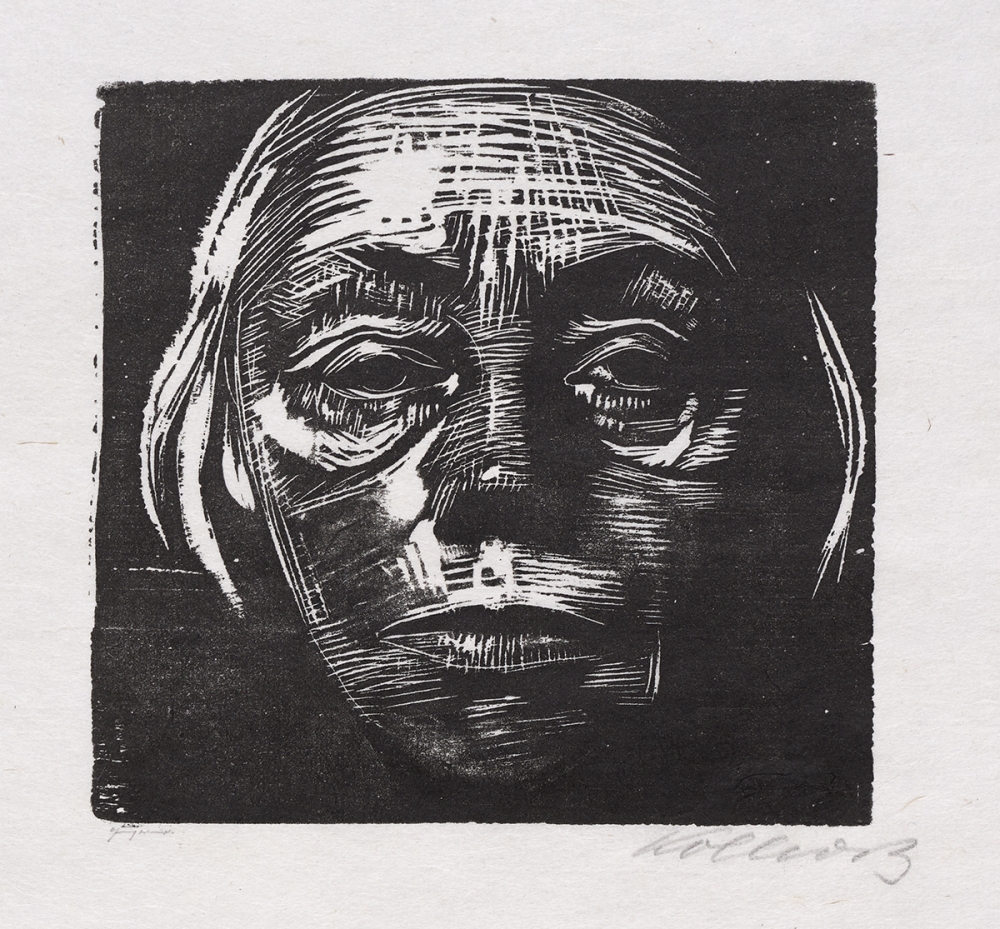
Käthe Kollwitz, Frontal Self-Portrait, 1922 – 23
My reading can be fairly evenly split into two categories: Holocaust-y and not. [Ed. – Same, Brooke, same.]
As both the granddaughter of a Holocaust survivor and a writer working on a memoir about my grandma, literacy, and the legacy of the Holocaust, I read a lot about the topic. But when I’m not reading about it, I like the wild variety of contemporary fiction, part escape-hatch, part mood-lifter. Does it work? Sometimes. Sometimes, it really does.
Here’s a sampling of what I read, organized in a way it certainly wasn’t while reading.
NONFICTION, HOLOCAUST
I learned about Liana Millu’s Smoke Over Birkenau through Twitter, likely from Dorian, then wondered why I hadn’t heard of it before. [Ed. – Could be–I do love this book. If you don’t listen to me—and why don’t you?—listen to Brooke.] It’s astounding in its clarity and starkness, its focus on women and their experiences in the camps, including prostitution and pregnancy. The prose feels brutally honest, offering no set-up before catapulting the reader into the everyday horrors of a Nazi concentration camp.
Most Holocaust books fill me with a certain amount of sadness, but The Light of Days by Judy Batalion contains so much action and agency that something new came over me. A sense of pride? Badassery? Straight fury? The book tells the true story of female resistance fighters in Poland, which is to say, Jewish teenage girls turned weapons smugglers and intelligence agents. It’s gripping to read, even as it jumps around between so many people and places. I’m not surprised it’s already been optioned for a film (by Spielberg, of course). Everyone craves the feel-good war story, as rare and unlikely as they are.
We Share the Same Sky by Rachael Cerrotti is a much quieter book. Cerrotti traces her grandma Hana Dubova’s story of survival through travel, following where she fled, including a stay with the descendants of the woman who took her grandma in during the war. Dubova and Cerotti’s stories become enmeshed, voices and experiences layering on top of one another just as they do in the mess of real life. Like me, Cerotti is part of the third generation, and she smartly uses her distance from the war to draw thoughtful connections. The book leans toward the uplifting—Hana’s story is one of escape after all, a Czech swept up into the incredible rescue of the Danish Jews—without evading the hard truths of Cerrotti’s own life. A feat, if you ask me.
Side note: If you know of more third-gen Holocaust memoirs, tell me. I want to read them. Plunder by Menachem Kaiser is next on my list. [Ed. – One of the best third gen, IMO. I have my issues with this genre, as detailed elsewhere on the blog. Mendelsohn’s The Lost is great.]
In a similar yet opposite vein, I read two third-gen memoirs from descendants of Nazis, Julie Lindahl’s The Pendulum and Nora Krug’s Belonging. Lindahl, who was born in Brazil, grew up not knowing her family’s ties to the SS. Some scenes in her memoir, so proper and precise, so steeped in denial, felt foreign to me, but many echoed the same silence and pain I’ve seen in my own family. Lindahl ponders the weight of unclaimed guilt and what it takes to unearth hard family truths. Belonging, a graphic memoir, takes on similar themes. (Whenever I fall into a reading rut, I turn to graphic novels and memoirs. Highly recommended.) Krug balances a dark family history—her father, we learn, was given the same name as his older brother, a Nazi killed in the war—with bright, evocative watercolor illustrations. Krug’s work also introduced me to the German word Heimat, meaning the place that first forms us. A place, I suspect, we do not always know so well.
NONFICTION, OTHER THINGS
I think about the suburbs a lot. If I’m thinking about them in my past, it’s with nostalgia. If I’m thinking about them in my future, it’s with dread. The Sprawl by Jason Diamond helped me unpack that a bit. Consider their design: the conformity, the utopian ideals, the racism, the way the streets curl in on themselves rather than connect. The byproduct? Loneliness, resentment, and, possibly, American creativity. Diamond notes how many artists have roots in the burbs, but the argument doesn’t entirely convince me. While reading The Sprawl, I stumbled upon the idea of non-places in Adam Morgan’s excellent newsletter, The Frontlist. A non-place, as defined by Marc Augé in his 1995 book Non-Places, is a space unconcerned with identity. Morgan notes these are places “where people are anonymous and don’t relate to the space with any sense of intimacy.” Not all suburbs are non-places, but I think The Sprawl shows how easily they can be.
I need more time in the day and light in the week to write about all the other non-fiction books I read this year, but I do want to say I read Minor Things by Cathy Park Hong and you should too.
CONTEMPORARY FICTION
I adore Aimee Bender. I had the chance to hear her read the first chapter of The Butterfly Lampshade at a virtual reading and had to get the book immediately afterward to find out where the story went next. There’s such magic and rupture in her prose.
Motherest by Kristen Iskandrian—I ate this book up with a spoon. Agnes, away at college, writes letters to her mom who has disappeared. (There’s something about letters I cannot resist.) [Ed. – Same! A letter in a novel makes my heart sing. And yet an entire novel of letters, not so much…] The book is, in turns, funny, dark, thoughtful, fractured and smart. Must seek out more Iskandrian.
Jeff Chon’s Hashtag Good Guy with a Gun is the exact opposite of escapism. It’s look-directly-into-the-sun-ism. I haven’t read anything that touches upon current events, misinformation, toxic masculinity, and male violence quite like this book does. A punch to the gut but the fist is your own.
I had no idea what I was reading for the first third of The Idiot by Elif Batuman. Then I sunk into it. I swam in the prose. I’m still not sure what I read, but I enjoyed the swim.
Mona at Sea by Elizabeth Gonzalez James captures the strangeness of 2008 through a former overachiever let down by a lousy job market. It’s as funny as it is weird: she becomes a meme, endures a horrific interview at a dive bar, and lands a job at a call center. And it led to one of my weirdest reading moments of the year: I was at the bus stop (Chicago, early winter) when a car pulled up and a woman asked what I was reading. I showed her. As the light turned green, she yelled out the window, “Is it good?” and I yelled back, “Yeah!” Feels appropriate that moment happened with this book. [Ed. – How great is that?!]
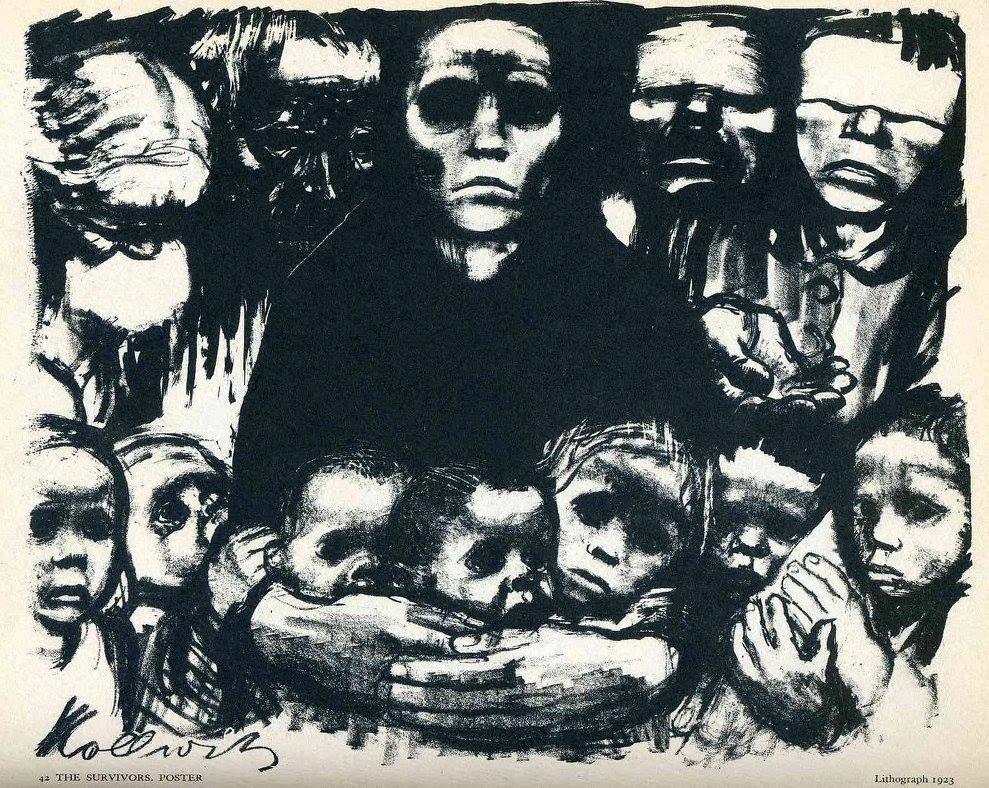
Käthe Kollwitz, The Survivors, 1923
In total, I read 36 books, which broke out something like this: 18 books of nonfiction, 18 fiction. 4 graphic novels. 28 books by women. 14 by Jewish writers. 8 by writers of color. Far more small press books than in years past. Not bad for year two of a pandemic. What did you read while staying alive?
Today‘s reflection on a year in reading is by Nicie Panetta (@nicie_panetta). Nicie lives north of Boston with her husband, their frisky orange cat, and her lazy but lovable paint pony. She used to have some empty space on her bookshelves. That is no longer the case.
Look for more reflections from a wonderful assortment of readers every day this week. Remember, you can always add your thoughts to the mix. Just let me know, either in the comments or on Twitter (@ds228).
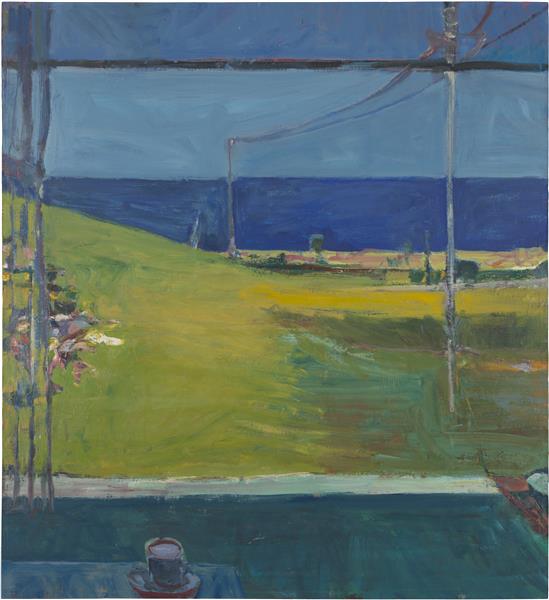
Richard Diebenkorn, Ocean from a Window, 1959
The Anthropocene
Almost a year ago, I started a weekly newsletter called Frugal Chariot. I write about books that I believe have something special to say about the troubled role of humans in the non-human world. I guess you could say that the fate of the earth and all that dwell within its embrace is my subject, but that books written by humans are my vehicle. “How frugal is the Chariot/ that bears a Human soul.” Thank you, Dorian for a chance to reflect here on my reading as a whole in 2021. [Ed – The pleasure is all mine!]
From the standpoint of literary merit and depth of meaning, my favorite book on the Anthropocene, which I haven’t yet written about for the newsletter, is Arctic Dreams by Barry Lopez. I ardently recommend it for the magisterial precision of his writing, for the prophetic nature of his insights, and for the great fighting heart that you can feel beating within the rather strict container of his style and tone. I did write about Lopez’s Horizonhere.
From the standpoint of environmental news you can use, I would press into your hands Silent Earth: Averting the Insect Apocalypse by Dave Goulson. The author, a leading entomologist, explains carefully and without histrionics why bugs are vitally important to all life on earth, and what we do know and don’t yet know about the extent and causes of insect population declines. He also has practical suggestions for individuals and for industry and government. This is an indispensable guide for the general reader to the way that the climate and biodiversity interrelate, and it’s also full of delight and discovery.
A quick request, if I may. I would be very grateful for any suggestions that EMJ readers might have for nature, place, and climate writing (does not have to be in book form) from underrepresented geographies, marginalized communities, and Indigenous writers. [Ed. – Cherie Dimaline, The Marrow Thieves and Waubgeshig’s Moon of Crusted Snow: two novels by Indigenous Canadians, dystopian clifi that foreground indigenous ways of knowing.] I am concerned that there are not enough voices from outside the Anglosphere and outside the OECD countries getting heard. My DMs are open and my email is nicie.panetta@gmail.com. Thanks in advance.
The Thing Is . . .
Because I am starting work on a climate-related place writing project [Ed. – Ooh, tease!], I have devoted much attention over the past year to treatments of the non-human, across my reading. The books that resonated most deeply for me often had a commitment to the thing-ness of things, to quiddity, to description. What follows are just a few examples of writings that I felt were exceptional on this score. Many if not most of these books came from recommendations provided by Learned Book Folks (LBFs) on Twitter, and I am so grateful.
Two Writers’ Memoirs
Last year I read nearly forty memoirs. [Ed. — !] Deborah Levy’s Autobiographical Trilogy truly knocked my socks off. How could I never have heard of this writer! Thank you to Rebecca Hussey, for sending her my way. In the first volume, Levy makes highly effective use of narrative shear: a simple question from a stranger causes the floor of the present to buckle and give way to the past. In the two subsequent volumes, she uses totems of the everyday to represent the new phase of her life that begins after the end of her long marriage: a shed for writing, a heater for the shed, an electric bike to get around, a green pair of shoes for walking in Paris.
It’s the basics: food, shelter, clothing, transportation. These objects, as they appear and reappear, create a syncopated rhythm that feels so true to the way we pass through time. Levy writes well about many things, including the closeness and strangeness of friendship, the commitments of motherhood (including the commitment to let go), the practicalities of being a writer, and most of all, what it is to be awake to life. Utterly captivating is this voyage on the inland sea of her mind:
To walk towards danger, to strike on something that might just open its mouth and roar and tip the writer over the edge was part of the adventure of language.
Another writer’s memoir that is much less well known is Blue Remembered Hills by Rosemary Sutcliff, the author of classics of historical fiction for children (including The Eagle of the Ninth). [Ed. – Just taking a moment here to remember how much that book meant to me.] Her account of growing up as an only child with chronic illness and disability is both sharp and glowing. Sutcliff’s portrait of her intense relationship with her mother is one of the best I’ve read, and the village communities of her childhood are brilliantly evoked. Heartbreak finds her, and she finds her way to a writing life. Aces. [Ed. – Sold to the man with too many books already!]
A Poet’s Playlist
Reading poetry has been a central preoccupation of my adult life. Because of my current interests and commitments, I am actually reading less poetry than I have in the past. But I did just finish Rita Dove’s Playlist for the Apocalypse, her first collection in over a decade. The book is made up of distinct groupings of poems, including an ars poetica with the poet as spring cricket, a group about American history that serves as the text for a new song cycle, A Standing Witness, and eight very flashy “angry odes.” Here’s a poem from the final, quietly personal section, Dove’s translation of perhaps the most famous German poem:
Wayfarer’s Night Song
Above the mountaintops
all is still.
Among the treetops
you can feel
barely a breath—
birds in the forest, stripped of song.
Just wait: before long
you, too, shall rest.
Johann Wolfgang von Goethe, 1776
The World Wars
A surprise. After toting things up, literature in translation accounted for nearly 40% of the books I read in 2021. I think this was due to a combustion reaction between my obsession with the period that encompasses the two world wars and the constant stream of relevant book ideas from the LBFs. [Ed. – Vowing to make this acronym take off.] Those years set the courses of my parents’ lives. My parents were born in the 1920s and died when I was young. Reading about this era keeps me in touch with them. Each of these books changed me in some small or larger way.
In poetry, I read a lot of Rilke thanks to an epistolary seminar offered by Mark Wunderlich (look for his forthcoming book on Rilke). I keep returning to Rilke’s work, in which the non-human vibrates without cease, and the moment of the poem zaps into the eternal. Prosodic whiz Don Paterson dresses the Orpheus sonnets in a new formal fabric in Orpheus: A Version of Rilke.
Enthroned one: in the ancient understanding,
You were no more than a cup with a plain rim.
But for us you are the full-blown, infinite bloom,
The wholly indefatigable thing
From “Rose”
My parents loved the word “indefatigable.” They were activists, and it was a mark of highest esteem if they used it to characterize someone. It’s a good word to keep in your pocket. See also, “staunch.”
In fiction, Visitation by Jenny Erpenbeck (translated by Susan Bernofsky) tells the story of the strange life and dumpster-filling death of a German lake house near Berlin, across the entire twentieth century. Erpenbeck is very good with lists of ordinary stuff (building materials, bath towels, regulations), inventories that are transformed into incantantions of frightening power. As we grapple with our direction as a species, stories with non-human protagonists and with plots that extend beyond the human lifespan have much to offer. Visitation is a notable example. There is also a brilliant novel about a medieval convent in East Anglia, but I read that in 2020. [Ed. – The editor cannot help but feel attacked by this reference to That Book He is Unable to Finish. YMMV.]
Natalia Ginzburg’s essays about her family’s tragic experiences in Fascist and postwar Italy, The Little Virtues (translated by Dick Davis) was also a revelation of style for me. Her tonal restraint and the apparent simplicity of her sentences make the heavy chords truly plangent when she strikes them. “And perhaps even for learning to walk in worn-out shoes, it is as well to have dry, warm feet when we are children.”
Salt Waterby Josep Pla (translated by Peter Bush) is a travelogue of his adventures on the Spanish and French coasts in the early 20th century. This book features shipwrights, bandits, taverns, sardines, and bracing quaffs that mingle caffeine with alcohol. The book, written under house arrest and a censorship regime, might be an instruction manual for those writing in a time of rising authoritarianism. There is something to be said for going rogue, or at least knowing a few rogues. Pla says it.
Most of all, the discovery of Joseph Roth thanks to the crew at the Backlisted podcast truly made my reading year. Many EMJ readers (and certainly the editor) know his work far better than I do. [Ed. – The editor is overestimated.] But What I Saw (translated by Michael Hofman), The Hotel Years(ditto), and On the End of the World (translated by Will Stone) have set a high-water mark for me as to what is possible from a journalist writing in a short form to deadline. Roth was a Galician Jew who made it to Vienna for university, served in the Austrian army in WWI, and then moved to Berlin to write for newspapers. He also wrote fiction, including Job and The Radetsky March.
What I Saw, which collects his feuilletons about Weimar Berlin, is a book not so much of vignettes, but of micro-sagas. He makes fun of skyscrapers (“We will make ourselves comfortable among the clouds . . . They will hear the clatter of typewriters and the ringing of telephones”), visits Berlin’s refugees (“Their garments were a weird and wonderful hodgepodge of uniforms. In their eyes I saw millennial sorrow”), makes regular forays to the demimonde (“Albert’s Cellar has regulars of such fixed habits that they even have their mail sent there”), and charts the collapse of the Republic with rising alarm and grief (“It is not true that a murder is just a murder”). His farewell column of 1933, written fresh from his flight into exile in Paris, is almost unbearable reading. So many observers were blind to what Roth saw, or failed to report what they saw. All the books I have mentioned here make the case for the necessity of style, and how style gives writing access to power. Roth’s work is exemplary in this regard. I read in awe, and salute his legacy:
Month on month, week on week, day by day, hour by hour, it becomes ever more impossible to give expression to the inexpressible nature of this world. The circle of lies that the miscreants draw around their crimes paralyses the word and the writers who employ it. Yet a common obligation makes you persist to the last moment: that is to say to the last drop of ink . . .
Earbuds
I’m gradually working my way through Juliet Stevenson’s catalog (N.B. she reads the Levy trilogy brilliantly), and she never fails to bring clarity and spirit to a text. Other major delights have been Thandiwe Newton reading Jane Eyre (I’m excited for her War and Peace), Doc Brown reading Zadie Smith’s Grand Union (underrated, I aver), Chiwetel Ljiofor’s performance of Piranesi, and Prunella Scales’ reading of The Railway Children by E. Nesbit.
Campus Duds
I read two campus novels that were cruel about women. Lucky Jim (despite one of the great hangover scenes in 20th-century literature) was chalk on a blackboard with its hatchet job on Monica Jones. Pictures of an Institution is also extravagantly mean about Mary McCarthy, who, to be fair, probably gave as good as she got. But who needs it? I’m with Pnin all day long. [Ed. – Amen!] Haven’t read Stoner yet. [Ed. – Don’t do it.]
Unclassifiable Wisdom
Alice Oswald’s Oxford Poetry Lectures on YouTube have been landmark events for me. Water, a pebble, Ainu epics: whatever the topic, she is riveting, incisively lyrical, somehow in touch with worlds beyond our ken.
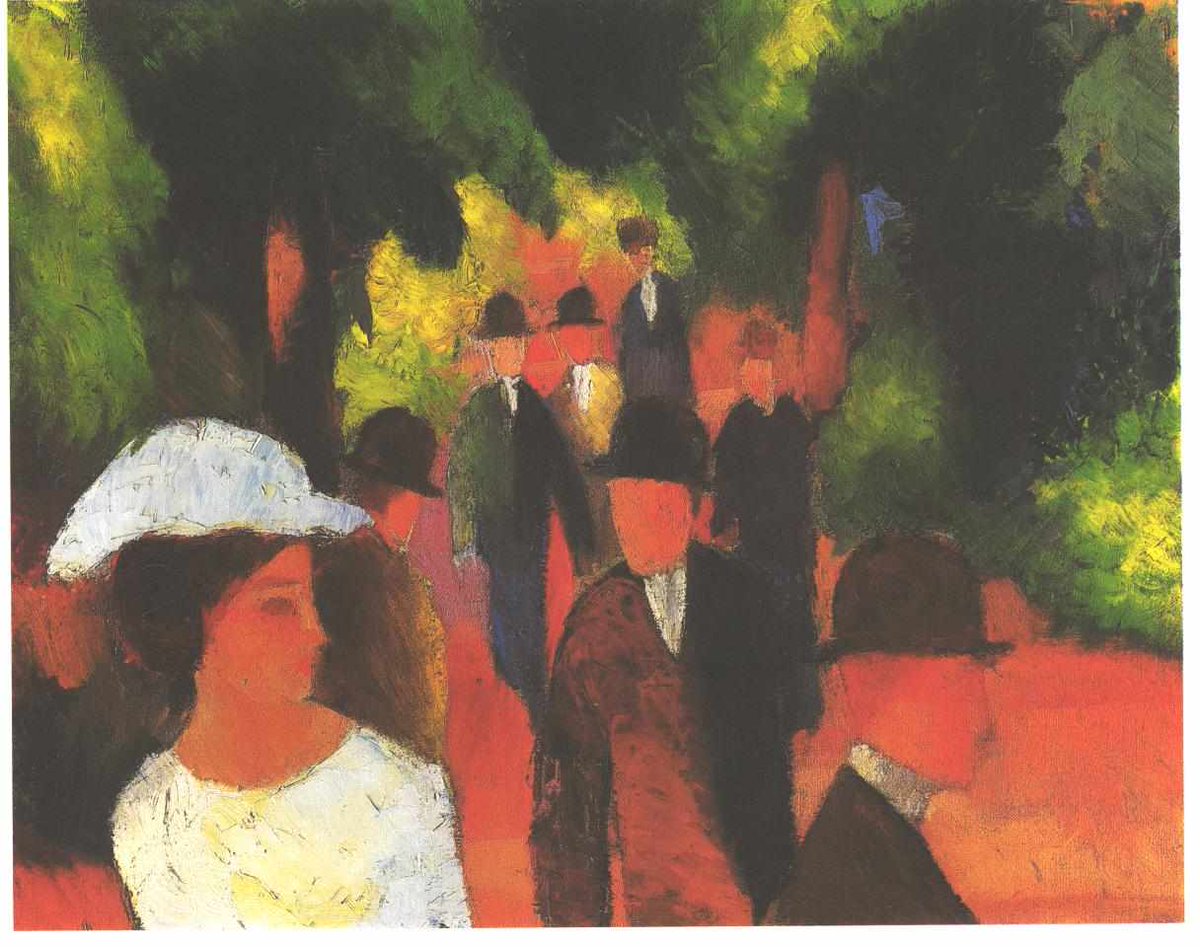
August Macke, Promenade II, 1913
2022
This year I will be paying special attention to structure, so if you have books that you think are brilliantly structured, please do be in touch.
In addition to reading for Frugal Chariot, and I have the following projects on deck:
Re-reads of The Iliad, The Odyssey and a few other classical texts
Fiction of Joseph Roth and the forthcoming biography by Keiron Pim [Ed. — Can’t wait for that one.]
Dorothy Richardson’s Pilgrimage (I have to admit that I’m not wowed by Pointed Roofs so far, but I am giving it a fair hearing)
The Love Songs of W. E. B. Du Bois
Lonesome Dove (you rave, I read!) [Ed. – Thumbs up emoji]
Moby Dick with #APSTogether
Louise Erdrich
Teju Cole
More poetry!
I wish you all wonderful years of reading in 2022, and look forward to ongoing fellowship. May we be wholly indefatigable!
Today’s reflection on a year in reading is by R. Nicht (@Sediziose_Voci).R. is a reader who lives in the southern U.S.
Look for more reflections from a wonderful assortment of readers every day this week. Remember, you can always add your thoughts to the mix. Just let me know, either in the comments or on Twitter (@ds228).
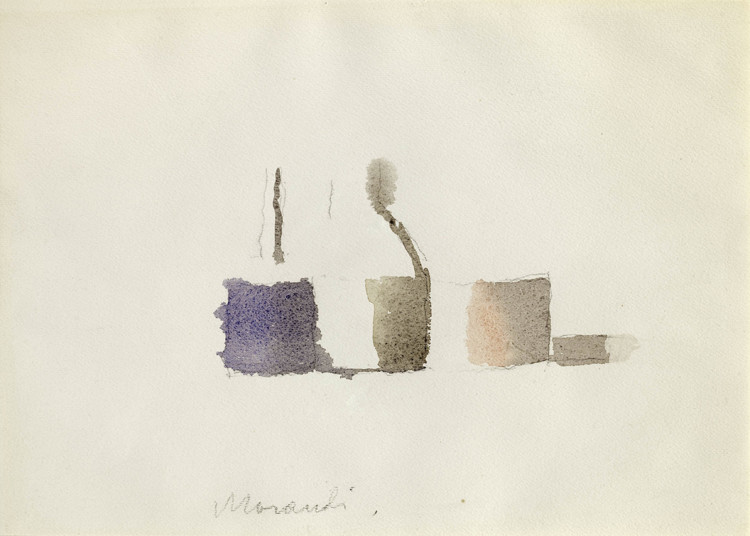
Girogio Morandi, Still Life, 1960
William Gardner Smith, The Stone Face
This terse novel of brutal images and elegant concision, as forceful as a punch in the face, depicts the effects of personal and collective racial trauma in the life of an African American journalist who takes refuge from the corrosive racism of American life in the bohemian expat culture of Paris in the days of the Algerian conflict. Smith casts a disapproving eye on this celebrated cultural milieu, which fostered such talents as James Baldwin, Richard Wright, and Miles Davis and whose creative ferment has been the subject of admiring studies by Tyler Stovall and others, depicting its members not as artistic mavericks but as an idle group of lotus-eaters who fritter their time away in futile creative projects and vaporous dreams of Pan-Africanism. Briefly tempted by the escape they offer from the crushing burdens and responsibilities of African American selfhood, the protagonist ultimately rejects it after befriending a group of Algerians and witnessing the events of the 1961 Paris Massacre, when French National Police violently attacked a pro-FLN demonstration, killing more than 100 protesters.
Paradoxically, the protagonist’s experience of cross-racial solidarity with another persecuted minority and his affair with a Holocaust survivor (perhaps the least convincing character in the book) propel him into a commitment to a harsh racial sectarianism at odds with the racial ecumenicism the novel seems to hold out as an alluring but ultimately unachievable dream. In another time, another place, perhaps, the author seems to suggest, such a vision of cross-racial struggle might be realizable, but in the exigent moment of armed conflict and brutal racial oppression the novel depicts, the only moral option for members of subaltern groups is dedication to their separate, geographically delimited battles: the Algerians to armed conflict against the French occupiers in Algeria, the narrator to a militant fight against racism in the U.S. It is a bleak vision, but one that Smith dramatizes with undeniable power.
Frances Stonor Saunders, The Cultural Cold War: The CIA and the World of Arts and Letters
A swashbuckling classic that documents the CIA’s tentacular reach into multiple areas of cultural production in the West during the “hot” period of the Cold War from the late 1940s to the 1960s. Charting the tortured ideological trajectory that left-leaning writers and intellectuals followed after they broke with communism in the late 1930s following the Molotov-Ribbentrop Pact and Stalinist show trials and became willing conscripts in a cultural struggle against the Soviet Union that relied as much on mendacity and ratfucking as the ruthless counteroffensive waged behind the Iron Curtain, Saunders’ book is an indictment not so much of the cultural crusade against Stalinism itself but of the brutal and reckless way it was waged. The hasty denazification of prominent cultural figures who would be “wins” for the West, the persecution of artists and writers with suspect communist pasts, the sidelining of dissenting voices unwilling to celebrate the new pax Americana, the sclerotic intellectual culture of the Cold War period that resulted—such things were neither necessary for victory nor inevitable, Saunders argues.
The book offers a useful intellectual genealogy of Cold War cultural liberalism, a force that still makes its presence felt—30 years after the fall of the Berlin Wall—in certain sectors of the American and British intelligentsia in the form of a disenchanted but loyal statism, a florid reverence for “democratic norms” and the elites who supposedly safeguard them, and a genteel form of literary and cultural criticism that floats free from all questions of political economy. Left-leaning intellectuals may have broken with the CIA and its anti-communist crusade during the Vietnam War, but the distinctive intellectual style they developed during the heady days of that alliance has had a long afterlife.
Hazel Carby, Imperial Intimacies: A Tale of Two Islands
A worthy contribution to life writing about the Black Atlantic, this memoir breaks the conventions of the form to offer a sweeping account of colonialism, empire, capitalism, and the construction of racialized subjects that relies as heavily on archival evidence as it does on personal and familial memory. Roving from suburban London to Bristol and Kingston and back to Britain again, Carby’s narrative shows how both strands of her family—proletarianized Welsh farmers displaced from their lands and mixed-race Jamaicans who ended up on the wrong side of the line that divided “white” Carbys from “black” Carbys—were conscripted into the British Empire’s race-making project, some as slaves, some as working-class whites in Bristol who came to identify themselves as proud subjects and beneficiaries of empire even as it brutally extracted their labor.
The book is above all an eloquent elegy for Carby’s parents, a bookish, soft-spoken Jamaican and a white Englishwoman from a hardscrabble background whose lives were destroyed, Carby makes clear, when they crossed forbidden racial boundaries during a period of illusory wartime sexual freedom. That their half-caste daughter also paid a severe penalty for their transgression is made clear in Carby’s narrative of her own childhood, which was evidently so painful that she refers to herself in the book in the third person as “the girl,” and then only glancingly (she does not, however, spare the reader the details of her rape by a white neighbor). Imperial Intimacies concludes with a perfectly cadenced sentence of stinging irony that encapsulates the entire book and returns the reader to the beginning pages. [Ed. – Now of course I have to read this. Impressively effective, R.]
Igiaba Scego, Oltre Babilonia
In this fiercely exuberant novel, Scego, an Italian of Somali descent, throws the doors and windows of Italian fiction wide open to admit silenced voices from Italy’s horrific colonial past in East Africa and Argentina’s Dirty War. The stories of trauma and loss they tell cross boundaries of continents and language to enrich and trouble Italy’s multiracial present, personified most vividly in the novel by the irrepressibly candid Zuhra, a daughter of the African diaspora in Italy who speaks Romanesco but yearns to learn Arabic and whose own psychic and physical maladies can be traced directly to the silences and omissions of her immigrant family’s tormented history and to her own experience of childhood sexual abuse. The novel’s recuperation of long-suppressed family stories is a work not simply of therapeutic healing but of regeneration—the attempt to build a living present out of the scattered fragments of the past and fashion a self in which memory and bodily health, pleasure and sexuality, are fully integrated. The novel has recently been translated into English by Aaron Robertson with the title Beyond Babylon.
Marta Barone, Città Sommersa
A daughter’s efforts to fill in the lacunae in the life of her recently deceased father, an enigmatic, secretive man who served a prison term for giving medical assistance to a member of a terrorist group in the 1970s, broadens to become a forensic reconstruction of the Years of Lead (gli anni di piombo), a period of convulsive political violence on the right and the left in Italy and in Turin, the author’s home city, that has been explored in fiction and non-fiction alike by Nadia Terranova, Giovanni De Luna, and others but still remains imperfectly understood. De Luna has suggested that the very term “years of lead” has been used to erase the complexities of a decade that saw Autonomist labor militancy, peaceful protest, and violent attacks against jurists and journalists by members of the Red Brigades and Prima Linea, the last of which involved only a fraction of the many people who were caught up in the political ferment of the time. Offering a harrowing account of one man’s personal and political journey through those tumultuous years as well as a narrative of her own present-day reconnoitering of her father’s past, Barone brings light and a searching intelligence to an era whose intricacies and contradictions have been buried under that unilluminating epitaph.
What Barone seems less assured at providing is any real understanding of the impassioned commitments and ambitions of the political actors of those years, which are perhaps apt to seem outsized and extravagant (Vogliamo tutto!) to one brought up in a neoliberal era of technocratic governance and constricted horizons of political possibility. Yet it is the tension created by the irreducible distance between her own present and her father’s past—the sense that the past is, despite all her efforts to recover it, a foreign country, they do things differently there—that is part of the allure of Barone’s mysterious and elegiac book, which will appear in English under the title Sunken City this spring courtesy of Serpent’s Tail Press and translator Julia MacGibbon.
Natalia Ginzburg, Tutti i Nostri Ieri
Sandra Petrignani, La Corsara: Ritratto di Natalia Ginzburg
Having recently reread Ginzburg’s substantial 1952 novel, which deals with, among other topics, teenage sexuality, abortion, suicide, war, bombings, displacement, fascism, the Nazi invasion after the armistice, and the violent deaths of several key characters, I found it a bit disconcerting to hear one of the author’s English translators seemingly reinforce the view in a recent podcast that Ginzburg is a writer of slight domestic fictions, all short in length. It made me wonder if there is a sneaking tendency or perhaps marketing strategy to present women writing in languages other than English, particularly those published during the recent translation boom (with a few notable exceptions), as practitioners of exiguous and rarified rarefied fictional forms—peripheral, approachable, decidedly minor. [Ed. – Intriguing. I want to know what Rebecca Hussey thinks.]
There is certainly nothing small-scale about this panoramic work, the only novel in Ginzburg’s oeuvre written in the third person; if it lacks the technical finesse and playfulness with form of Family Lexicon, for which it is many ways the fictional antecedent, it makes up for these qualities in its scope, its variegated plot and settings, and dramatic power. At the center of the novel, which deals with the wartime experiences of two families in an industrial northern city much like Turin, one bourgeois, one “respectable” but down at the heels, stands the charismatic, rumbustious figure of Cenzo Rena, who seems a composite of Leone Ginzburg and several other heroic figures of Ginzburg’s Torinese youth. The only character in the book who has the inner resources to resist the deadening influence of fascism and rise to the moral challenges of the war, he is at the same time—and this is one of the book’s painful ironies—part of a transient, dying world, belonging to Italy’s past, who will not live to see the defeat of the Axis powers or the advent of the shattered postwar world that the surviving characters, among them Anna, the novel’s protagonist, gropingly confront in the concluding pages.
Sandra Petrignani’s La Corsara, a freeform biographical portrait of Ginzburg, offers a welcome corrective to the view of Ginzburg in the English-speaking world as a minor, grandmotherly author of piquant domestic fictions (one must of course guard against the tendency to see “domestic fiction” as a minor genre), presenting her as a major writer of prodigious output in multiple genres over several decades. The book is also a liberating example of literary biographical writing that departs from the two forms that have come to dominate the genre in the Anglophone world: the exhaustively documented doorstop biography by a literary scholar and the brief memoir by a family member or fellow writer that confines itself to small-scale portraiture and personal anecdote. Combining standard chronological exposition of biographical facts with interviews, personal reflections, memories of her own meetings with Ginzburg, and even a charming digression on her astrological chart, Petrignani creates a complex, vivid portrait that is no less authoritative for having violated in significant respects the conventions of contemporary literary biography. The English-language literary biography, a tradition that did not always adhere to the rigidities of present-day practice (think of Gaskell’s biography of Charlotte Brontë, or De Quincey’s portraits of the Lake Poets), could benefit, it seems to me, from Petrignani’s example. Her book is currently being translated into English.
Walter Kempowski, All for Nothing; translated by Anthea Bell
One of the principal questions that Kempowski’s astonishing novel seems to ask is just how much sympathy the reader can allow herself to feel for its characters, comfortable Germans of the landed upper-middle classes living in a shrinking enclave of calm in East Prussia during the last days of World War II as the Soviet Army moves towards them. How much will the reader’s reflexive tendency to identify and empathize with characters be tempered by her desire to judge them, to adjudicate what measure of blame they deserve for their relative comfort amidst the horrors of wartime and their silent complicity with Hitler’s regime, with Auschwitz and Treblinka and the ruins of the Warsaw ghetto not far to the south of them? Do the characters “earn” the terrible fate that befalls most of them at the novel’s conclusion? Kempowski’s master stroke in the novel seems to me to understand that negotiating these complex questions—writing about characters whom the reader at some level opposes from the outset—is as much a technical as it is a moral problem, a problem of style and technique, as it were.
The technical approach Kempowski chooses is a sequence of brief scenes—quick sketches, brief dashing episodes and asides—and a tone that is playfully ironic, interrogative, sly, detached, almost harmonium-like, with the fictional “camera” pulled back at a chilly distance to expose the characters’ foibles and weaknesses (Katharina’s idleness and indolence, the aging schoolmaster’s homoerotic reveries of long-ago hiking expeditions). Kempowski makes no effort to excuse or condemn his characters. He lets the reader see that Katharina’s decision to shelter a fugitive Jewish musician in her house for one night springs more from ennui than from sympathy or principle. The coarse working-class Nazi in the housing development across the road is a harried, put-upon figure with a sick wife, but Kempowski makes no overt efforts to humanize him. Seduced by the astringent lightness of the narration, a complicitous partner in the author’s drily ironic observation, the reader imagines that she can watch with a certain pleasurable detachment as the characters are overtaken by the terrible events that surely await them and that they may even in some way “deserve.”
And yet the operations of sympathy and identification with characters begin their stealthy work inside the reader once Katharina’s young son, a peripheral character until the book’s midpoint, takes a central role. For it turns out that All for Nothing is, at least obliquely, an autobiographical novel, a chronicle of Kempowski’s own horrific childhood experience of the same historical events the novel describes, and the reader cannot resist the pull of emotion that slowly accumulates around the character that is his fictional surrogate. Entangled by these skeins of feeling, the reader finds herself unexpectedly invested in his fate and, through it, in the fates of all those on whom the boy’s safety and life depend, particularly when the novel’s setting shifts from the family’s manor house to apocalyptic scenes of devastation and carnage. The novel’s playfully ironic tone, it turns out, has been a lure and a trap. Summoned to watch what had initially seemed an interwar comedy of manners, the reader finds herself at the novel’s conclusion a witness to a human calamity on an overpowering scale—a calamity to which she can properly respond only with those emotions that an authentic artistic experience of catharsis can arouse: pity and fear. This novel shook me; I read the last 50 or so pages seemingly with one held breath.
Wolfgang Hilbig, The Interim; translated by Isabel Fargo Cole
This ribald, lacerating exploration of the psychological and territorial scissions of postwar Europe, which I read in Isabel Fargo Cole’s marvelously assured translation, seems to me the real deal: a major European novel of wild, idiosyncratic ambition that merits comparison with the works of Bernhard and Sebald. I would follow its wastrel writer protagonist—priapic one moment, impotent the next, a narcissist, a drunk, a philanderer, a genius, a failure, at home neither in the catastrophically failed “actually existing socialism” of the GDR nor in the vapid consumer society of the FRG—anywhere. Hilbig is a magisterial commander of both interior and exterior space, expertly guiding his narrative through multiple excursuses with the same efficiency as the trains that conduct the protagonist across the border to West Germany and back to the East, taking us through horrific flame-lit industrial landscapes and scenes of domestic squalor and in and out of nightmares and states of inner torment with equal ease. He does it all with grace and a perfectly tuned sense of fictional pacing: the restless narrative never stalls out in rhetorical excess even during the most lurid passages, and the reader somehow keeps her bearings through multiple flashbacks and digressions. The plot, such as it is, follows the wanderings and tergiversations of an East German writer in the throes of a full-blown artistic and sexual crisis, exacerbated by abject alcoholism, while overstaying his visa to West Germany. As the reader comes to understand, the narrator’s restless transits from East to West and his circuitous inner journeys of memory and imagination trace and retrace the contours of a European map set in place by a century of devastating war, partition, displacement, drawn and redrawn national boundaries, and genocide.
Mary Fulbrook, The People’s State: East German Society from Hitler to Honecker
Fulbrook’s book was a useful companion during my reading of Hilbig. Departing from the “Stasicentric” (as Paul Betts has called it) totalitarian model of GDR scholarship, this revisionist social history of East Germany doesn’t excuse the regime’s many calamitous failures, but neither does it engage in pointless sermonizing. Rather, it attempts to explore the paradox that while East German society was undoubtedly repressive in the extreme (the GDR’s citizens were quite literally caged, subject to surveillance and numerous intrusions on their personal liberty), many former citizens recall living “perfectly ordinary lives” there, a sentiment that can’t be chalked up to simple Ostalgie or to a kind of false consciousness in reverse. Combing through archival evidence and interview transcripts, Fulbrook looks at women’s rights, labor, childcare, recreation and leisure, and other facets of life in East Germany and concludes that the GDR was not a monolithic tyranny in which citizens cowered, silent and passive, under despotic rule, but an evolving, changing, albeit extraordinarily repressive society in which ordinary people shaped the culture around them as much as they were shaped by it. What Fulbrook makes clear is that it was Honecker’s decision to attempt the beat the West on its own terms through a “consumer socialist” model that ultimately led to East Germany’s demise. Plausible perhaps in the early 1970s, when East Germany might be said to have been at its zenith, the regime’s aspiration to provide material plenty for its people in any way comparable to that enjoyed in the West became less and less viable in the 1980s, when shortages of food and other basic supplies, together with increasing repression by state security services and ongoing environmental collapse, sounded the death knell for the GDR.
Today’s reflection on a year in reading is by Anne Cohen (@aecnyc). Anne is a lifelong reader (preferably stretched out on couch or bed), retired lawyer, and former reporter. She lives in New York City with part of her family and two dogs and is firmly convinced that Book Twitter saved her from homicidal behavior in 2021.
Look for more reflections from a wonderful assortment of readers every day this week. Remember, you can always add your thoughts to the mix. Just let me know, either in the comments or on Twitter (@ds228).
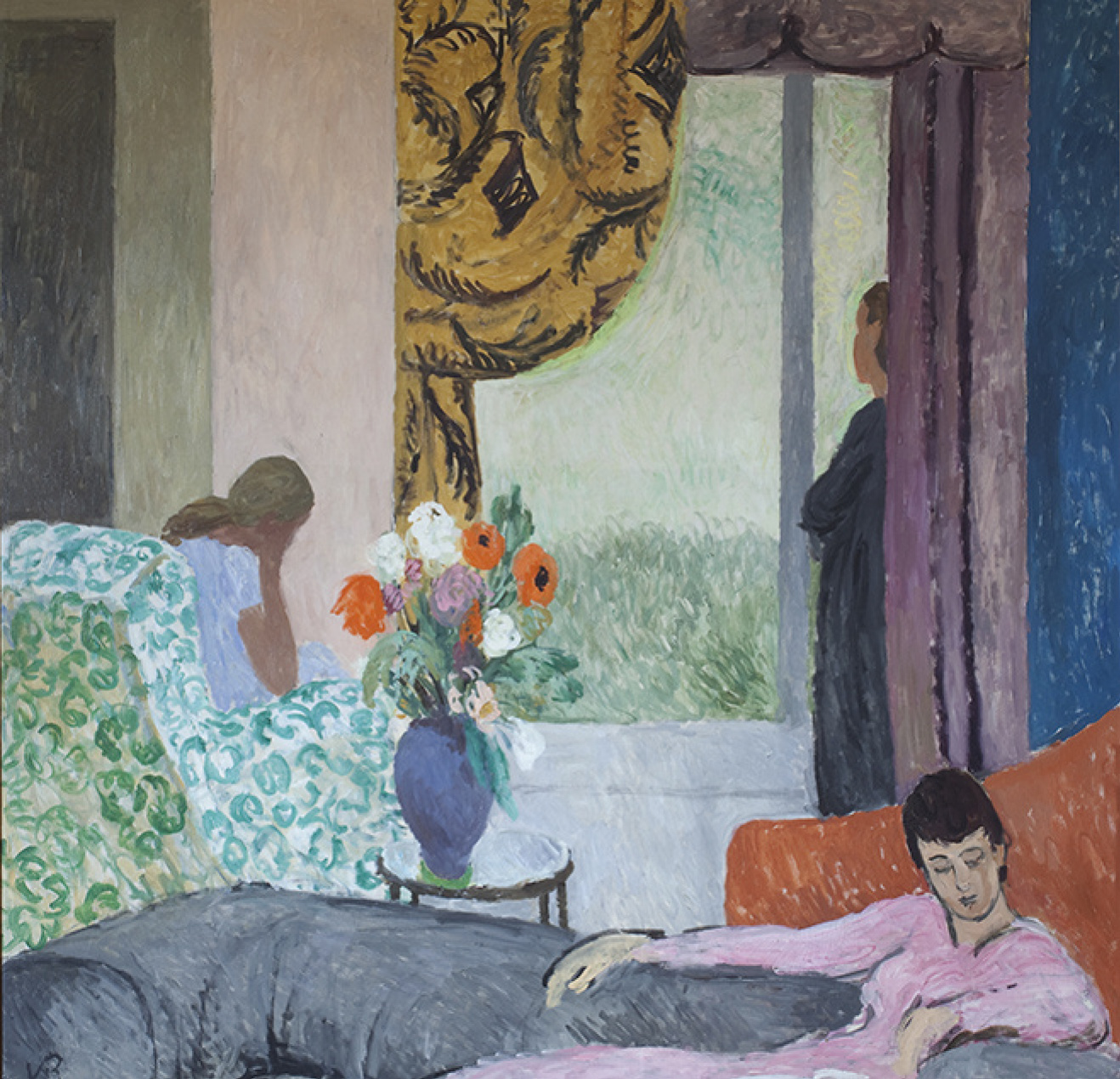
Vanessa Bell, In the Other Room (late 1930s)
Most beautifully-written book: Transit of Venusby Shirley Hazzard was the most exquisitely-written novel I read in 2021 but also one of the most frustrating. It was as if the plot and the characters were unworthy of the prose.
Am trying avoid spoilers, but the coyness of the last page infuriated me and even drove me to the internet for clarification. “WTF” endings don’t bother me; reader and narrator of The Sense of an Ending share the same information and deluded memories and are equally gobsmacked at the conclusion, and Kate Atkinson, whose A God in Ruins had a similarly tricksy ending, is a master of showing but not telling. Although the language was gorgeous, the last paragraph of Transit felt cheap.
(You still should read it.)
Second most beautifully-written book: Daddy’s Gone A’Hunting written by Penelope Mortimer and published in 1958 was also the most frightening book I read this year. Daddy is the story of Ruth, an upper-middle-class woman in her late 30’s trying to navigate the potential termination of her college-age daughter’s pregnancy (whose pre-marital conception was the impetus for Ruth’s own marriage).
The scary part was not just the ordinary shivers of recognition present in most good novels about families. Perhaps it is a function of my age and gender—Daddy and I were both born in the middle of the baby boom—but I was horrified by the sight of Ruth, already feeling old at 38!, being shamed as she searched for a physician who might be willing to terminate the pregnancy on behalf of her clueless and nasty daughter.
This year, I also read Mortimer’s biography of the Queen Mother, which is not scary, and her first volume of memoirs, About Time, which has as a central character her impious cleric father. (Maybe read it as a double feature with Priestdaddy.) I recently located a copy of her second volume, About Time Too, and it’s on my TBR stack.
Other wonderful fiction: Cathedral, by Ben Hopkins, hasn’t gotten as much attention as it deserves. I can’t get into The Constant Nymph, but Margaret Kennedy’s The Feast was enormous fun, beautifully written, and (spoiler alert) the right people survive; I also enjoyed her contemporaneous account of the early days of World War II, Where Stands a Winged Sentry, a country companion of sorts to a similar book about London read last year, Chelsea Concerto, by Frances Flavell. Daisy and The Six made me laugh when I was sick.
Lolly Willowes entranced me [Ed. – Paging Frances Evangelista!], as did both Scenes From Childhood, Sylvia Townsend Warner’s memoir and her collected letters. (Have not yet finished The Corner that Held Them or Summer Will Show.)
Also read and liked Cassandra at the Wedding by Dorothy Baker, The Tortoise and the Hare by Elizabeth Jenkins, A Month in the Country, by J.L. Carr and several pieces of fiction by Tove Jansson. I was thrilled by parts of Gerard Reve’s The Evenings and wondered when other sections would end, which may have been the sensation the author intended.
Molly Keane’s Good Behaviour offered an instructive counterpoint to Transit: annoying characters, obsessive conduct, and an ending that made me want to go back to the beginning, but without feeling as if I’d been snookered along the way.
Not fiction but an elegant presentation of how an interesting woman’s actual life was commandeered by fiction and biography: The True History of the First Mrs. Meredith by Diane Johnson.
Biggest project of the year: Diaries and letters have always fascinated me and taken up significant space shelf. Their proportion in my reading diet has increased over the last 22 months, as I’m comforted by the notion that their authors didn’t know what was going to happen to them any more than we do now. [Ed. – Nicely put!]
Someone who was often wrong about the future was Henry “Chips” Channon, an American-born writer, pal of the rich, royal and merely titled from his late teens onward, member of the British Parliament, and from 1938 to 1941 a senior cabinet aide in the Foreign Office. The first two volumes (total 2000+ pages) of his unexpurgated diaries were published in 2021 and edited brilliantly by Simon Hefner, whose dazzling footnotes include some tart asides and everyone’s courtesy titles.
“Chips” knew everyone, and everyone appears in the diaries. He was a wrong-headed bigot, a sniveling acolyte of Neville Chamberlain, a toady to almost anyone with a royal title, and a nasty, insecure, self-important snob, who occasionally recognized his reputation as a well-connected lightweight.
What makes the diaries worth £35 each plus postage to the States is the astonishing range of Channon’s access and the detail of his descriptions— his failing marriage to a rich and titled woman, who left him for a horse dealer; events, including his dinner for Edward VIII, and Mrs. Simpson a month before the abdication; his crushes on a series of other well-connected men and his schemes to marry them off to “suitable” women; changes in society during the war, including his mother-in-law (“the richest woman in England”) doing without a cook; and the perfidy of his enemies of the moment. [Ed. – Ok, that sounds really good.]
My fascination with these books is more than historical. As someone who annually orders but doesn’t always use a big Smythson daybook, I’m reluctantly moved by dogged if not heroic maintenance of a diary for decades and even more by the willingness to write down so much of one’s deepest and often foolish feelings in real time.
A year for letters:Love From Nancy: The Letters of Nancy Mitford; The Letters of Nancy Mitford and Evelyn Waugh; Letters from Tove [Jansson]; Letters of Sylvia Townsend Warner; Letters of E.B. White; and A Whole World: Letters From James Merrill.
Not surprisingly, there were many connections among Channon, Mitford and Waugh, who lived in a small world they thought was the whole.
But other connections were less expected—the Merrill letters were terrific, and not just because his frequently-mentioned mother and daughter Connecticut neighbors were novelist Grace Zaring Stone and Eleanor Stone Perenyi, author of both More Was Lost [Ed. – A long-time EMJ favourite!] and Green Thoughts: A Writer in The Garden, which I’d consulted only days before about dahlias.
The best connection came when I was alternating books—Hermione Lee’s biography of Willa Cather and the E. B. White letters—and suddenly realized the same “character” appeared in both: Cather’s good friend Elizabeth Sargent was also White’s sister-in-law Elsie, older sister of New Yorker editor and garden writer Katherine White. [Ed. — !]
Mysteries: Spine for spine, I probably read mysteries more than other category and can inhale a whole series of 10-15 books in a week. (Hey, I’m retired and read fast.) [Ed. – Goals!] This year, in addition to rereading half a dozen of Simenon’s Maigret books and the first few chapters of Busman’s Honeymoon, and adding to my list of books by E. C. R. Lorac, John Rhode, and Patricia Wentworth, I was introduced to Jane Haddam’s Gregor Demarkian, Craig Rice’s John Malone and pals, Delano Ames’s Jane and Dagobert Brown, and Elizabeth Daly’s Henry Gamadge.
Of these my favorite was probably the last, not for the quality of the story or the story-telling, but for the flavor of New York City in the early 1940s and the depiction of people for whom the world had changed since the turn of the century. Part of my attraction to mysteries, and especially those of the “Golden Age,” is the way they incidentally reflect the details of their time, whether clothes, food, manners, or relationships.
Vanessa Bell, Composition, ca. 1914
Audiobooks: I’m not snobbish about the idea of audiobooks but I’m picky about both the sound of the voice generally and the rightness of it for a specific work. These are obviously very subjective criteria; most people were probably thrilled by Patti Smith’s reading of Just Kids but I ripped off my headphones during the foreword.
I read quickly, sometimes too quickly (see possible explanation for my reaction to Transit of Venus), and so have been fascinated by my reaction to hearing books I’ve previously read. Listening to The Age of Innocence made me much more aware of Wharton’s humor and devastating nuance.
Some books—like The Thursday Murder Club—can be aural candy, perfect for walking the dogs; this is not a put down, at least from me. It’s also when I listen to the Backlisted podcast, whose fingerprints are all over this list.
What I Didn’t/Haven’t Finished: There are mystery tropes I can’t abide (especially the protagonist as suspect), and if one of those sneaks by my “blurb” filter, I’ll let it go. [Ed. – Almost as bad as “investigator’s loved one in danger”…]
Books not finished in 2021 but still open are Hamnet (and I loved I AM I AM I AM), as well as Klara and the Sun, Our Spoons Came From Woolworth’s, Shuggie Bain, and Mrs. Palfrey at the Claremont. I couldn’t get into Adam Thorpe’s 1921, which broke my heart, because his work is so varied and usually so very good.
Best reading experience: Not the “best” book or the most interesting or important—but an almost out-of-body moment late one night propped up in bed with the five-book Percy Jackson series, which I’m reading along with an 11-year-old friend.
The apartment was quiet. Maybe it was Percy’s adolescent demi-god angst, but for a sudden moment, I was in my childhood bedroom, trying not to wake up my sister and hearing my father’s voice at the door, telling me to go to sleep. Sam died almost 25 years ago, and it was nice to have him back for that instant.
Today’s reflection on a year in reading is by Martin Schneider, a freelance copyeditor (of books!) who lives in Cleveland, tweets at @wovenstrap, and used to write for Dangerous Minds. He’s part-Austrian and can occasionally can be found in that country.
Look for more reflections from a wonderful assortment of readers every day this week and next. Remember, you can always add your thoughts to the mix. Just let me know, either in the comments or on Twitter (@ds228).
Charles E. Martin
The global pandemic has been very good for my reading life.
I’ve read novels my entire adult life but the raw totals in any given year might not have been very high, maybe 30 per year. When COVID-19 arrived, I had an empty work patch in my freelance schedule and I responded by attempting to read one novel per day for 30 days (!) as a way of distracting myself from the fact that I might have a hard time finding freelance work. I made it to Day 19 but some work came in, thank god, and I didn’t get to Day 30. That stretch sparked a period of high novel consumption: I read 72 novels in 2020 and 70 novels in 2021. Those are very high totals for me.
I’m grateful for the particular cluster on Twitter that orbits around Caustic Cover Critic and Damian Kelleher and of course Dorian for improving my general experience on Twitter as well as giving me inspiration for new books and a community of like-minded people, etc. I should also say a word about the Backlisted podcast as additional inspiration (obviously that also overlaps with Twitter in some ways). I appreciate the monthly bookstack photographs and other visual ephemera that Book Twitter is always providing me with.
I’m a volume whore, by which I mean I favor reading short novels so that the raw book count stays as high as possible and I don’t get stuck for a month reading Moby-Dick or whatever. [Ed. — Ah, but what a month it would be!] 275 pages already begins to seem a high total to me, my sweet spot is about 191. ABC, always be churning. [Ed. – Hahaha!]
It goes without saying that 2021 was a very good reading year for me, cycling through 70 books in a calendar year is pretty close to an ideal way for me to spend my free time.
OK, here are about 20 books I wanted to say something about, listed in chronological order except where books are joined.
Michaela Roessner, Vanishing Point
The first read of the year for me, and one of the year’s finest. Vanishing Point is hard to track down but this exemplar of heady, sinuous ’80s sci-fi is worthwhile for those who like that kind of thing. The setup has much in common with Tom Perrotta’s The Leftovers — it also came first — which most likely is what drew me to seek it out. I don’t want to divulge too much about it, but I greatly enjoyed this intelligent, immersive book, and I think about it often.
Josephine Tey, The Franchise Affair
I’ve never been much enamored of The Daughter of Time, which has always seemed implausible and overbaked. This left me unprepared for the astonishing authorial control of The Franchise Affair. I think you’d be hard-pressed to find a better representation of midcentury England than this book; the sheer exuberance of the jolly/obliging/diffident/snappish voices — literally, speaking voices — is tough to top. What’s the cricket equivalent of “a home run”? [Ed. – Knocked it out of the oval here, my friend: such a good book.]
Gilbert Adair, Love and Death on Long Island
Quite simply, my #1 read of 2021. I adore thinking about this book. Every page is a treat. I would urge those who like their fiction subtle and incisive to consume this immediately. Adair’s performance — and it is definitely a performance — feels thoroughly under-heralded. I had seen bits of the movie years ago and had always found the central predicament original and delicious and rich. Who can fail to relate to the sorrows/joys of being a bookish hideaway in a world that produces, almost unthinkingly, Hotpants College II?? [Ed. – Admittedly, not a patch on Hotpants I.] The ways Giles and Ronnie fail to comprehend each other are a wellspring of comedy that will never stop nourishing me. I never reread books but will likely return to this “jewel-like” 1930s-type book set in the age of the vulgar teenage sex farce (rented from the local video shop, natch); those 1980s details are decisively additive, at least for me. I sorely crave books like this but alas, strong comps are surely thin on the ground…… [Ed. – Ooh, a challenge: do your best, Team. Whatcha got for Martin?]
Colson Whitehead, The Underground Railroad
I am a fan of Whitehead’s, but I was disappointed by The Underground Railroad. It seems unusually weak for a Pulitzer winner (then again, there is The Goldfinch, oof). I appreciated the comparative tour of antebellum contexts, but the failure to develop the literalized choo-choos nagged at me. Does that metaphor explain anything to anybody? I can’t see how. It’s such a great idea but also a massive missed opportunity. This is the rare case of a book that needs another 200 pages, I think. I also worry that Whitehead has bought into the hype surrounding him. Give me another John Henry Days, man — please!
C.S. Forester, The African Queen
In 2020 I read The Good Shepherd and found it utterly compelling. Then dang if the same thing didn’t happen all over again with The African Queen. I am a little leery of the Hornblower books — I prefer the 20th century, thanks — but Forester’s way of imparting information really does it for me.
Patricia Lockwood, No One Is Talking About This
Jonathan Lethem, The Arrest
No One Is Talking About This is a relatively celebrated recent novel that I cluster together with the works of Jenny Offill and Rachel Khong, and not in a positive way. I think of all of these books as jammed with clever, postmodern witticisms/jokes that you could rearrange in any order and it wouldn’t make much difference to the narrative. That’s a little unfair to No One Is Talking About This, which Lockwood does take pains to instill with an Act I/Act II structure, but I still found it a complete failure in terms of ordinary novel-building. Meanwhile, Lethem is not much in fashion lately, especially after The Feral Detective, which did not work. I suspect there was scant interest in his stab at Post-Apocalypse, but I still found The Arrest as intelligent, engaging, and sharp as much of his stuff — I admire Chronic City particularly. His books don’t always hang together, but on the paragraph and thematic levels, Lethem seems to me the equal of anyone out there right now and, as such, under-appreciated.
Arthur Getz
Margaret Drabble, The Millstone
Oh, boy. I was more than a little surprised how conventional and bourgeois (and therefore tiresome) I found this book, which in 1965 represented such a brave “new” perspective — or did it? From the perspective of 2021 it reads as so much more aligned to Drabble’s (presumably) hated predecessors than to us. To the reader of today, I submit, so many of Rosamund’s choices are unintelligible, particularly that of concealing the existence of her child from her parents. Rosamund’s whole setup (enormous apartment, rent-free) is so contrived and refuses to serve as the societal basis for anything (as I think was intended or at least was regarded). Jerusalem the Golden, a humble tale of growth about a woman from humble origins I read and esteemed decades ago, seems the antithesis of this. Drabble really leans into her privilege here, thus undoing the point. Next! [Ed. – *popcorn gif *]
Quentin Tarantino, Once Upon a Time in Hollywood
The last few years I have found myself increasingly disenchanted with the MFA-influenced “well-crafted” masterpieces that dominate (say) the Tournament of Books. The writing is frequently too tidy and pristine and there’s too much overlap/groupthink in the authors. In my mind, these books are not composed by individuals; too many of the nasty, idiosyncratic details have been sanded off. An antidote to this is Once Upon a Time in Hollywood, far from a great book but I found its termite-ish perambulations entirely refreshing and (am I crazy for believing this?) an explicit callback to the shaggy-dog ways of Dickens. I do suspect that Tarantino thought of this “novelization” (a favorite form of his) as an attack on all the bloodless hifalutin volumes that get adopted by reading groups. I’m ready to sign on to this agenda; modern fiction could surely stand to ingest the unkempt, untoward essence of this book.
Elena Ferrante, The Lost Daughter
I admire the guts it took to be so unflinching about the unvirtuous aspects of shirked motherhood. The Lost Daughter dares you to dislike its protagonist, which I did not — or not very much; Ferrante works in the class signifiers to make her readers side with her heroine over the swinish, unreaderly family that intrudes on her interlude — and then forces those same readers to think about that. It’s encouraging that a writer of Ferrante’s gifts has found such widespread success.
Susanna Clarke, Piranesi
Everybody’s favorite recent puzzle box, it seems. The first half of this book constituted one of the reading high points of the year for me. Nothing wrong with the second half, to be sure, but you just can’t top the sheer blazing WTF “where is this going?” quality of this book’s setup. [Ed. – Yeah, can’t argue with that.] As with Love and Death on Long Island, I desperately want to find books with this vibe, but I doubt that any are out there (I did think of David Mitchell’s Slade House, however).
Joseph Hansen, Fadeout
One of my top reads of 2021. I learn from the internet that Hansen was a pioneer of the gay detective novel. This book introduced Dave Brandstetter, Hansen’s recurring hero of a dozen or so mysteries. The gay angle functions as the lever that furnishes Hansen’s situation/solution with complexity, but it wasn’t just that; Hansen also had the ability and the interest to write textured, complex thrillers. That’s the kind of shit I live for! This was published in 1970, but I thought it stood up dazzlingly well today.
Eugene Mihaesco
Percival Everett, Cutting Lisa
This somehow pairs with The Lost Daughter in the author seeking out, nay, embracing unpleasantness to spectacular effect. This was on my shortlist of reading experiences for the year, a strikingly original work that forthrightly countenanced negativity while resisting the impulse to pin everything on a villain. Every character has corners; every situation is layered. My first Everett, Cutting Lisa has a chewiness I associate with the finest output of the 80s, and I can’t wait to read more by him.
William Maxwell, So Long, See You Tomorrow
Katherine Anne Porter, Noon Wine
So Long, See You Tomorrow is one of those “writerly” novellas that hit me entirely the wrong way. Maxwell was a smalltown escapee who later found tenure at The New Yorker and thereby invested himself of the power to imbue these “simple midwestern people” (yuck) with meaning. If ever a narrative should have dispensed with the pretentious framing device of the events filtered through the memories of a child, it’s this one. I guess I can see why people admire this book, but for me it was just a succession of false notes. [Ed. – Ooh, fighting words!] Noon Wine reveals the falsity of Maxwell’s methods; another short novel — Porter, it seems, detested the term novella — but in this case authentically empathetic towards its figures, in contrast to Maxwell’s self-serving projections/lies. Noon Wine has the guts to put real people on the page — and real stakes.
William Lindsay Gresham, Nightmare Alley
One of the much-mentioned texts of 2021, due to the Guillermo del Toro adaptation that landed late in the year. Later on, I found it significant that Gresham is not celebrated for any other work. This book is certainly adept and not devoid of virtues, but I found it labored and tiresome, every point underlined in every paragraph, nothing allowed to breathe, as a real novelist would do it. I resorted to a new strategy: just grind through 10 pages per day until done, just to get it behind me (while starting a different novel, I seldom double dip). I should go back and finish Geek Love as an antidote (not that Dunn let things breathe, either).
Louise Erdrich, The Sentence
Simply put, I cannot think of another novel as generous-minded as this.
Today’s reflection on a year in reading is by Karen Naughton. Karen, a lifelong reader whose tastes range from popular fiction to classics across almost all genres, has a Ph.D. in British and American literature and divides her time between Texas and Maine with her husband and two dogs. She tweets @barkerforbooks.
Look for more reflections from a wonderful assortment of readers every day this week and next. Remember, you can always add your thoughts to the mix. Just let me know, either in the comments or on Twitter (@ds228).
Gabriele Münter, Woman in an Armchair, Writing, 1929
In 2021, nonfiction featured prominently in my list of favorite reads. Of these, The Path to Power, Robert Caro’s first volume in his multi-volume biography of Lyndon Johnson, stands above the rest. The work is the marriage of a master story teller with a subject who defies categorization—one of my all-time favorite biographies. I also loved discovering the writer Pam Houston, whose memoir Deep Creek inspired me with its wisdom acquired through adversity. The most memorable scene in that book involves Houston sharing with two younger women her experiences expending emotional energy on men and dating. Finally, Trent Preszler’s memoir Little and Often also impressed me. Preszler is a gay man who honors his deceased estranged father by building a canoe using hand tools his father bequeathed him. Preszler’s ability to convey affection and gratitude despite his father’s failings sets this work apart.
Three novels made my year’s best-reads list. He depiction of emotional abuse in Dorothy Whipple’s They Were Sisters is among the best I’ve read. Chimamanda Ngozi Adiche’s Half of a Yellow Sun, set during the Nigerian civil war of the late 1960s, moved me with its deft portrayal of war’s devastations. Since Houston, Texas, where I’ve lived most of my life, is home to a large community of people of Nigerian heritage, this history fascinated me. Finally, I’ve always had success with Julia Alvarez’s books and her latest, Afterlife, did not disappoint. It investigates the boundaries between what individuals owe to themselves and to their communities.
My favorite poetry collection was Shuly Xóchitl Cawood’s Trouble Can Be So Beautiful in the Beginning. Lyrical and accessible, these poems use images of domesticity to explore themes of loneliness and connection.
Two short story collections proved memorable. Mavis Gallant’s The Cost of Living [Ed. — Canada, represent!] expertly plumbs the circuitry of domestic relationships, a category of fiction that usually works for me. Somewhat in contrast, the stories in Chris Gonzalez’s I’m Not Hungry but I Could Eat focus more on loneliness than on connection. Many have a melancholy tone, but Gonzalez peppers the narratives with such wit that the book is as humorous as it is poignant.
Taking a cue from NancyKay Shapiro’s guest post, my least favorite read of the year (surprising no one, perhaps) is Outlander by Diana Gabaldon. I read it because I like to have my own opinion about popular books. I didn’t expect to love it, but I did think it would at least be a page turner. The sexualized violence was a resounding “no” for this reader… and it was long. [Ed. — And yet you finished it! Amazing fortitude.] If you loved this book (many, many people do), no shade. It’s just not for me at this point in my reading life.
To end on a more positive note, I was able to make dents in two of my reading goals for 2021. I purposely reduced my Goodreads reading goal in order to encourage me to tackle some of the larger tomes on my TBR. In addition to the lengthy books named above, I read JR by William Gaddis and The Tale of Genji by Marusaki Shikibu and translated by Royall Tyler. I cannot say I loved either of these works, but I am glad I read them and certainly feel that they have added to my literary and cultural knowledge. My favorite novelist is Thomas Hardy. My other goal this year was to get to the novels of his I hadn’t read before. I read three: Dangerous Remedies, Under the Greenwood Tree, and The Hand of Ethelberta. Reading these in order of publication, I can trace his growth as a novelist. Of them, Ethelberta is a hidden gem. It’s in no way a perfect novel, but the characterization and fate of Ethelberta gobsmacked me. I highly encourage anyone pursuing Victorian studies to check out this novel, rich for analysis.
Ben Nicholson, June 11-49 (Cornish Landscape)
Thanks to the Twitter bookish community for inspiring much of my 2021 reading year, and thanks to Dorian for inviting me to interrupt his regular programming. [Ed. – Interruption? This is the regular programming! Thank you, Karen!]
Today’s reflection on a year in reading is by Matt Keeley, a marketer and freelance editor who reads too much. He lives in Massachusetts. You can find him on Twitter at @mattkeeley.
Look for more reflections from a wonderful assortment of readers every day this week and next. Remember, you can always add your thoughts to the mix. Just let me know, either in the comments or on Twitter (@ds228).
Vija Celmins, Night Sky #2, 1991
My favorite of all the books I read in 2021 was John Crowley’s Little, Big. Like my favorite book from 2020, Sylvia Townsend Warner’s chronicle of medieval life The Corner That Held Them, I believe it to be a masterpiece but hesitate to recommend it widely. Crowley’s 1981 novel follows the fortunes of the Drinkwater family through the twentieth century and into a bleakly imagined twenty-first. The family is connected, Somehow (Crowley always capitalizes this word), to the fairies and to a mysterious Tale (again, capitalized) that may encompass more worlds than ours. While no one, the author included, would deny that it’s a fantasy novel, it’s far different from and much superior to most everything published in the genre since Tolkien. It’s a long, beautiful, stately, and oblique novel; I look forward to returning to it.
Alan Garner’s Treacle Walker was a surprise and felt like a gift: When he published his memoir Where Shall We Run To? in 2018, Garner was already in his mid-eighties, and he’s a slow writer. Although I read it in just a few hours, Treacle Walker is precisely as long as it needs to be. I wouldn’t recommend it as an introduction to Garner, but it’s a fine (apparent) capstone to his six-decade career.
I read two books by Janet Malcolm in close succession early in the year; Two Lives is about Gertrude Stein and Alice B. Toklas: their lives, their love, their art, and the mystery of their survival as Jewish lesbians in occupied France. Malcolm’s précis of Stein’s The Making of Americans is particularly wonderful; I had no idea how strange, unmannered, and unedited that pseudo-novel is. I wouldn’t want to brave its nine hundred pages of dropped plots, failed experiments, and abandoned philosophical musings, but I’m glad to know what’s in there. The other Malcolm title was Iphigenia in Forest Hills, true crime about a murder, more sad than sordid, in Queens. I don’t think either book achieves the heights of The Journalist and the Murderer, but both titles are exemplary models of craft and sympathy.
Dorothy Dunnett’s The Spring of the Ram is the second novel in the House of Niccolò series. While her books, with their dense prose, unglossed allusions, and cunningly withheld character motivations, aren’t for everyone, I’m happy to reflect that I have a whole six more books in this series to read.
I went on a minor Philip Roth kick as the pre-scandal publicity around Blake Bailey’s biography kicked into gear. The Factsand The Dying Animal were minor, but Sabbath’s Theater is a masterpiece, the most exhausting, most dyspeptic, and most sinisterly compassionate novel I read this year.
Colson Whitehead’s The Colossus of New York comprises thirteen impressionistic essays about life in New York. Although it’s a distinctly minor work by a major writer, it was a balm for me at a moment when I was missing the city I’d made my home for six pre-pandemic years.
Rachel Eisendrath’s Gallery of Cloudsis a book about, among other things, Sir Philip Sidney’s mostly forgotten sixteenth-century poetry, academic life, manuscripts, Walter Benjamin, and Virginia Woolf. I admit that I remember the book’s mood more than its matter — I had to consult the book’s publicity page to recall which writers feature in it. Perhaps that’s my failure as a reader. Or, if there really is something evanescent about Gallery of Clouds, maybe that’s only appropriate for a book of wisps and reverie and free association?
The Trial of Lady Chatterley’s Loverby Sybille Bedford is a brief account, just under a hundred pages long, of the 1960 British lawsuit against Penguin Books, which had published the unexpurgated version of D.H. Lawrence’s novel. Bedford attended the trial; sixty years on, her account remains witty and infuriating.
Odilon Redon, Buddha, 1904
Some final thoughts and suggestions:
I think Dorian told me about the Willem Frederik Hermans novella An Untouched House, which was as good as I’d been led to believe. [Ed. – Not me, sadly. It’s still on Mount TBR. Will Matt’s recommender please step forward?] I finally got around to reading Frank Herbert’s Dune, which I’d tried and failed to read when I was eleven or so.As someone who is occasionally paid to review science fiction, it’s a relief to finally cross this off my reading list. The prose isn’t great, but the novel is more than the sum of its parts. I don’t think that The Trees, Percival Everett’s comic guignol procedural about America’s history of racism, with bonus zombies,entirely succeeds, but I now have a whole stack of other Everett novels to read. Adam Mars-Jones’s Batlava Lakeis extremely funny until, on the last page, it isn’t. Anthony Doerr’s Cloud-Cuckoo Land might be too commercial for some readers of this blog, but is absolutely enthralling. [Ed. –For some maybe, but the editor is willing to try all the things.] Small Things Like These by Claire Keegan lived up to the reviewers’ unanimous praise.
Today’s reflection on a year in reading, his second annual contribution, is by Paul Wilson (@bibliopaul). Paul lives in Colorado with his wife, two sons and lots of books. He also co-hosts The Mookse and the Gripes podcast.
Look for more reflections from a wonderful assortment of readers every day this week and next. Remember, you can always add your thoughts to the mix. Just let me know, either in the comments or on Twitter (@ds228).
I’m happy to say that coming up with a list of my favorite books read in 2021 was no easy task. For one thing, I read more books this year than I ever have before. Why? My best guess is a combination of the ongoing impacts of a quieter pandemic life, the fact that my wife and I now share our house with two teenage boys who are often doing their own things, and a conscious effort on my part to simply spend more time reading.
Creating my list was made even more tricky by countless recommendations from so many wonderful and generous friends on Twitter and elsewhere. It’s like I have a team of top-notch curators sending me a constant stream of great books. I started with a stack of around 30 titles that could have made the list, but here are 10 favorites.
Tomás González, Difficult Light, translated from the Spanish by Andrea Rosenberg
This is a mesmerizing and melancholy book about time and memory. The narration often jumps across decades, sometimes within a single paragraph or even sentence, creating fascinating and often somber insights into aging and the far-reaching effects of our pasts. A quiet reflection on art, loss and family that offers yet another example of why Archipelago Books remains one of the most exciting and important publishers out there.
I am surprised once more by how supple words are—how all by themselves, or practically by themselves, they can express the ambiguity, the changeability, the fickleness of things. And yet I long for the aroma of oils or the powdery feel of charcoal in my fingers, and I miss the pang—like the pang of love—that you feel when you sense you have touched infinity; captured an elusive light, a difficult light, with a bit of oil mixed with ground-up metals or stones.
Nathalie Léger, Suite For Barbara Loden, translated from the French by Natasha Lehrer
Can it really be true that I hadn’t heard of Nathalie Léger before 2021? In a year filled with wonderful literary discoveries, she was one of my very favorites. I read her triptych of novels all in a row and loved each of them, but, to me, Suite for Barbara Loden was the standout.Ostensibly about the film Wanda, its creator Barbara Loden, and Léger’s attempt to write a short entry for a film encyclopedia, this book becomes a mesmerizing blend of biography, autofiction, film analysis, and Dyer-esque reflections on the slippery process of creation.
I find myself increasingly drawn to books that are hard to pin down or define and this one certainly fits that description in all the best ways. If you’re looking for a project for 2022, I would highly recommend spending some time with Wanda and Léger. I think about them both often.
“How difficult can it be to tell a story simply?” my mother asks again. I have to stay calm, slow down and lower my voice: what does it mean, “to tell a story simply”? … You think that you’re dealing with pure formalities, footnotes, short texts, table, prefaces, indexes or annexes—an orderly organized abundance of works that you just need to spend a morning assembling into a few sentences; a straightforward administration of language—and then somehow you end up with endless decisions to make, with abandoned hopes and collapsed hypotheses.
Jhumpa Lahiri, Whereabouts, translated from the Italian by the author
Lahiri has long been one of my very favorite writers, so when I heard she had a new book coming out, I went through the usual blend of anticipation and anxiety that precedes a highly anticipated work by a beloved author. I needn’t have worried.
The unnamed narrator is a prickly, unmarried writer and lit professor who has lived in the same Italian city for her entire life. Through a series of episodes that take place over the course of a year, she shares her meditative and sometimes melancholy perspectives on isolation, solitude and the movement of time. Although a dramatic departure in many ways from the subject and style of Lahiri’s previous works, Whereabouts is an example of a master at the top of her game. I can’t wait to see what she does next.
Solitude: it’s become my trade. As it requires a certain discipline, it’s a condition I try to perfect. And yet it plagues me, it weighs on me in spite of my knowing it so well.
Robert Walser, The Tanners, translated from the Swiss German by Susan Bernofsky
After years of sitting unread on my shelves, this book was becoming one of the spines my eyes unconsciously skipped over while I scanned for my next read [Ed. – that is a thing, isn’t it?]. Fortunately, my good friend Trevor (@mookse) saved it from obscurity by sharing his contagious love of Walser during our conversations this year. Tragedy averted!
This was my first foray into Walser’s work, but it certainly won’t be my last. Reading him is like jumping into a raging river—you can fight it and become overwhelmed, or you can relax, let it carry you along and just enjoy the ride. This was the most exuberant and joyful thing I read this year.
I must find myself a life, a new life, even if all of life consists only of an endless search for life. What is respect compared to this other thing: being happy and having satisfied the heart’s pride. Even being unhappy is better than being respected. I am unhappy despite the respect I enjoy; and so in my own eyes I don’t deserve this respect; for I consider only happiness worthy of respect. Therefore I must try whether it is possible to be happy without insisting on respect.
T. J. Clark, The Sight Of Death
I never would have discovered this gem if I hadn’t stumbled across a tweet by Lauren Groff: “I’m so broken down by isolation that I can’t get four pages into T.J. Clark’s The Sight of Death without weeping. Just—the patience and persistence and love it takes to visit the same painting day after day and see new things, better things, how the light changes, it’s so moving.”
In 2000, two paintings by Poussin were hung in a room in the Getty Museum. Clark found himself hypnotically drawn to them, returning day after day to sit quietly in the room and record his observations in a series of journals. His subtle blend of passion and patience is fascinating and contagious. I read it back in March and still think about it almost every day. Its laser focus on obsession, solitude, and time haunt me.
I believe the distance of visual imagery from verbal discourse is the most precious thing about it. It represents one possibility of resistance in a world saturated by slogans, labels, sales pitches, little marketable meaning-motifs.
Olivia Manning, Balkan Levant Trilogies
When I think about the books that gave me the most pleasure in 2021, there’s no way I could leave Olivia Manning off the list. [Ed. – The man speaks truth.] I joined my first ever Twitter reading groups this year while making my way through her two trilogies: I had a blast, connected with many great readers, and had so much fun seeing the various historical images everyone shared and reading their reactions and insights about these wonderful books. The experience was a reminder of how art and literature foster community and conversation.
On top of all that, Manning’s trilogies are incredibly compelling, masterfully balancing the epic scope and horror of war with the countless ways it impacts the individual lives caught up in its wake.
For several nights, Simon was worried not only by the lack of cover but the intrusive magnificence of the Egyptian night. The stars were too many and too bright. They were like eyes: waking in mid-sleep, finding them staring down on him, he was unnerved, imagining they questioned what he was doing there.
David Albahari, Götz and Meyer, translated from the Serbian by Ellen Elias-Bursać
This book came very highly recommended by Mark Haber and, yes, Dorian Stuber. [Ed. – Paul, you seem to have omitted “the one and only” before my name. Imma put that back in.] I’m so grateful to them both for bringing it to my attention. An unnamed narrator seeks information about his extended family, almost all of whom were killed in gas vans near Belgrade back in 1942. During the course of his research, he comes across the names of two drivers of the truck in which his family was likely put to death: Götz and Meyer.
The narrator becomes increasingly fixated on these men; his obsession is reflected in the convoluted way in which the story is told. The fictional lives he creates for the two men, along with the book’s increasingly unreliable narrative style, create a growing tension and make the reader less certain about which parts are true and which are invented.
How is this book not better known? I will happily join Mark and Dorian in spreading the word about this slim and haunting masterpiece. [Ed. – It really is fantastic; wrote about it a little more here.]
I must say here that it is entirely possible in the case of Götz , or possibly Meyer, that God was more present than one usually thinks, because Götz, or possibly Meyer, survived the explosion of a bomb that killed at least nine soldiers from his company, thanks only, as he often said, to God’s will, somewhere on the Eastern Front. Because of that Götz, or possibly Meyer, thanked God everyday for his goodness, especially while they were jouncing along in the truck on their way to Jajinci, while in the same truck, in the back Jews were screaming at God with their last breath, asking him why why he wasn’t there, why he wasn’t there yet, why he was never there?
William Faulkner, Absalom, Absalom!
Like Götz and Meyer, this book concerns the fallibility of memory and the impossible task of trying to make sense of horrific and violent events from the past.
A multigenerational story touching on myth, memory and truth, it features multiple narrators sharing their interpretations of a tragedy. Like much of Faulkner’s work, it reflects the strong cultural ideas of the American South, where the past is still an indelible part of the present that is continually being revised and rewritten through stories told and retold.
The narrative consists almost entirely of flashbacks that shift in time and between various points of view, creating a fragmented and often disorienting experience. I know many readers have come to think of Faulkner as an academic chore that they’re happy to have left behind, but I would urge anyone who feels that way to reconsider. This is storytelling on a grand scale. A magical book.
“We have a few old mouth-to-mouth tales, we exhume from old trunks and boxes and drawers letters without salutation or signature, in which men and women who once lived and breathed are now merely initials or nicknames out of some now incomprehensible affection which sound to us like Sanskrit or Chocktaw; we see dimly people, the people in whose living blood and seed we ourselves lay dormant and waiting, in this shadowy attenuation of time possessing now heroic proportions, performing their acts of simple passion and simple violence, impervious to time and inexplicable … They are there, yet something is missing; they are like a chemical formula exhumed along with the letters from that forgotten chest, carefully, the paper old and faded and falling to pieces, the writing faded, almost indecipherable, yet meaningful, familiar in shape and sense, the name and presence of volatile and sentient forces; you bring them together in the proportions called for, but nothing happens; you re-read, tedious and intent, poring, making sure that you have forgotten nothing, made no miscalculation; you bring them together again and again nothing happens: just the words, the symbols, the shapes themselves, shadowy inscrutable and serene, against that turgid background of a horrible and bloody mischancing of human affairs.”
Miguel De Cervantes, Don Quixote, translated from the Spanish by Edith Grossman
Last year’s top reads for me were Proust’s In Search Of Lost Time and Joyce’s Ulysses. Both joined a short list of the very best books I’ve ever read. I found it incredibly rewarding to engage with these masterpieces and wanted to keep that momentum going this year by reading Don Quixote. I’m happy to report that Cervantes has now taken his rightful place with Proust and Joyce on my all-time list. [Ed. – In so doing, Paul earned himself the nickname DQ, and I encourage you all to call him that.]
As Harold Bloom puts it, “This great book contains within itself all the novels that have followed in its sublime wake. Like Shakespeare, Cervantes is inescapable for all writers who have come after him. Dickens and Flaubert, Joyce and Proust reflect the narrative procedures of Cervantes, and their glories of characterisation mingle strains of Shakespeare and Cervantes. Don Quixote may not be scripture, but it so contains us that, as with Shakespeare, we cannot get out of it to achieve perspectivism. We are inside the vast book, privileged to hear the superb conversations between the knight and his squire, Sancho Panza. Sometimes we are fused with Cervantes, but more often we are invisible wanderers who accompany the sublime pair in their adventures and debacles.” I couldn’t have put it better myself.
A work I was expecting to require patience and hard work instead turned out to be a hilarious and compelling page turner, and a perfect holiday companion to close out the year. It’s amazing how modern this book is, and Edith Grossman’s stellar translation is a masterpiece of its own. As the pages flew by, I could hardly believe it was written 500 years ago. If you’re on the fence, I would urge you to give it a try. My guess is you’ll quickly find yourself immersed, impatiently awaiting the next time you can pick it up and once again take your place beside Don Quixote and Sancho Panza.
When life itself seems lunatic, who knows where madness lies? Perhaps to be too practical is madness. To surrender dreams — this may be madness. Too much sanity may be madness — and maddest of all: to see life as it is, and not as it should be!
Thomas Mann, The Magic Mountain, translated from the German by H.T. Lowe-Porter
Each year, when I look back over all the titles I’ve read, it’s always fascinating to see which ones stand out. I loved The Magic Mountain when I was reading it, but the intervening months solidified the enormous impression it made on me. I read most of this wintry book in our backyard hammock during the height of summer, creating some of my favorite memories of the entire year in the process. [Ed. – Love it!]
The plot is relatively straightforward: Hans Castorp is about to start a career as a shipbuilder in Hamburg, but first, he plans a short trip to a sanatorium in the Swiss Alps to visit his tubercular cousin. But as he is drawn into the strange insular world of the hospital and its strange patterns and people, he begins to subscribe to the same rituals and treatment as the patients. Meanwhile, time just keeps slipping away.
I loved the ambiguity and the fact that I never knew exactly how to think or feel. Mann recommended that those who wished to understand it should read it twice. And even though it’s a huge book that took up a significant part of my reading year, I already find myself drawn back to it and ready to be lost again.
Time drowns in the unmeasured monotony of space. Where uniformity reigns, movement from point to point is no longer movement; and where movement is no longer movement, there is no time.
Today’s reflection on a year in reading is by Nat Leach, a longtime friend of mine and of this blog. Nat now lives and works in Peterborough, after returning home to Ontario from Cape Breton last year. He tweets @Gnatleech.
Look for more reflections from a wonderful assortment of readers every day this week and next. Remember, you can always add your thoughts to the mix. Just let me know, either in the comments or on Twitter (@ds228).
John Henry Twachtman, Round Hill Road, ca. 1890 — 1900
Readers who may have caught my annual posts over the last couple of years know that I am trying to work through all the partially read books on my shelves and am proceeding methodically, in alphabetical order. I’ve just wrapped up my fourth year, and I must admit that I have not been entirely happy with my progress lately; I spent all last year on “G” and this year I didn’t even finish “H”. Of course, given the year that I’ve had—getting a new job, working remotely for half the year, then moving halfway across the country during a pandemic—it’s a minor miracle that I’ve read anything at all. [Ed. – The country is Canada. Halfway is like all the way across twelve ordinarily sized countries.] And indeed, when I think back to the last time I had a similarly challenging year, when my daughter was born a few months before I was made Chair of my department, I recall that at that time I really did read absolutely nothing that was not work-related, so maybe I’m not really doing too badly. [Ed. – Absolutely!]
One of the key differences between then and now is that I joined Twitter four years ago, right at the start of my project, and was able to connect with a wonderful and supportive group of readers who frequently entice me into joining in collective reading endeavours [Ed. — Please admire this correct spelling] and who tacitly encourage me to take some time—however little—out of my day to read. Even though I never keep pace with any proposed reading schedule, the idea of reading collectively keeps me going, and I do always finish eventually. So, while I may joke about Twitter distracting me from my project, feeling like part of a reading community has really helped to keep me grounded and to make sure that I take time for myself in the midst of a chaotic schedule, and for that I am very grateful.
And besides, I’m not sure that it is true that these group reads are delaying my progress; fortuitously, I was able to participate in three reads of “H” authors (Hartley, Hasek, Hrabal), and besides, as will become clear, I was also able to put a pretty large dent in my “M” shelf, which will surely save me some time later on. In total, I finished 28 books this year, 18 from the “H” shelf, in addition to sampling some 19th century poetry (Hardy, Heine, Hemans, Hogg, Hölderlin), non-fiction (Hazlitt), and drama (Ralph Hamilton, J.G. Holman), not to mention a smattering of philosophy/theory (Hegel, Heidegger, Geoffrey Hartman).
Looking ahead to next year, I still have some significant “H” books ahead of me (Homer promises to be a highlight) and hope to get through “I” and “J” as those shelves are much less populated, so if anybody has any 2022 group reads planned for that particular alphabetical neighbourhood, just let me know.
Alex Colville, Traveller, 1992
In the mean time, here is a brief summary of my 2021 reading:
A Walk through H
Hardwick, Michael – The Private Life of Dr. Watson (1983)
I was given this book as a child when I was a young Sherlock Holmes enthusiast, but it didn’t really catch my interest, as it seemed too “grown up” for me at the time. Many years later, I have come to realize that it just isn’t a very interesting book. It doesn’t flesh out Watson’s character in any meaningful way, and in fact Watson just seems a vehicle to incorporate various famous Victorian individuals (Henry Ward Beecher, Sarah Bernhardt) and contexts (gold mining in Australia, war in Afghanistan), sometimes prompted by the most minimal of hints in Conan Doyle’s stories.
Hardy, Thomas – Jude the Obscure (1894-95)
I have long cited this as my favourite Hardy novel; I read it as an undergraduate and its representation of its protagonist as an aspiring intellectual and frustrated social outsider certainly resonated with me at the time. Re-reading it in middle age, I still think it is a great book, but was slightly less satisfied with it. I couldn’t help perceiving, in the midst of Jude’s tragic fate, the web of artifice behind his sufferings. The most inconvenient things happen at the most inopportune times, and characters change their minds about things just at the moment when it will do the most damage. Such misfortunes are the nature of tragedy, of course, and Hardy writes it very effectively—it’s just that those moments where I could see him pulling the strings felt more disruptive to me this time around. Hardy gave up novel-writing after this one because he was accused of immorality after having written what he thought was a morally didactic novel, and I’m starting to think he was a little bit too right about that.
Hartley, L.P. – The Eustace and Hilda Trilogy (1944-49)
Hartley is one of the authors I’ve read the most, and when he’s good, he’s brilliant, but when he’s not, he can be infuriating. Reading this trilogy, I experienced plenty of both. Readers of The Go-Between know how good Hartley is at representing children, and the first book of the trilogy, The Shrimp and the Anemone, amply demonstrates this strength. Eustace and Hilda are brother and sister living in a seaside town in Norfolk in the early 20th century; most of the book is focalized through Eustace (who stands in for Hartley himself in this semi-autobiographical trilogy) and his anxieties and misunderstandings of the adult world are highly poignant because they ring true to the way children think (or at least to the way I thought as a child). The second two books, which deal with Eustace and Hilda as young adults, did not seem as strong to me, and I think part of the reason is that while the characters age, they do not seem to change or grow from their experience. Part of this is no doubt deliberate— Eustace receives an inheritance that shelters him from having to deal with many real-world problems— but Eustace’s thought processes no longer have the same ring of truth in a grown adult. And in the final book, Hilda’s extreme physical debilitation in reaction to a failed love affair seems so absurd (if not anti-feminist) that it strains all credulity.
Hartley, L.P. – Simonetta Perkins (1925)
In the final book of the trilogy, while vacationing in Venice, Eustace more or less accidentally writes a book (his hostess tells everyone he is a writer, so he feels obliged to write something to live up to it). [Ed. – Maybe this should be my strategy. Please help me by inviting me to Venice.] A publisher accepts the book, but warns Eustace not to expect it to sell because it’s too long to be a short story and too short to be a novel. Interestingly, this description closely fits Hartley’s own first book, Simonetta Perkins, which is also set in Venice, and is about a young American woman who becomes infatuated with a gondolier. It’s a powerful, if slight, exploration of the nature of desire, which is even suggested by the title; the woman’s name is Lavinia Johnson not Simonetta Perkins— that’s the name she makes up when she seeks advice about her situation and claims to be “asking for a friend.” The title thus gives prominence to what might otherwise have been a minor scene in the book; Simonetta is the desiring alter ego upon whom Lavinia’s suppressed sexual urges are projected.
Hašek, Jaroslav – The Good Soldier Švejk (1921-23) (Trans. Cecil Parrott)
I had not intended to read this, but a Twitter reading group was starting just after I finished Hartley, so it was alphabetical fate. The book is a satire about World War I, but its satire is wide-ranging and sometimes a bit ambiguous. Švejk is zealously patriotic, but, as his superiors incessantly point out, he is also an idiot who screws up every task he is assigned; so is he really a “good” soldier, or is that moniker ironic? Or is the implication that the qualities of a “good” soldier (mindless obedience and patriotic fervor) are inherently idiotic? Moreover, Švejk’s overzealous efforts for the cause very often have subversive effects, whether intended or not, so it can be hard to separate incompetence from sabotage; for this reason, Švejk is often suspected of being a traitor, though we have no indication that this is actually the case. As for the satire, sometimes, the joke is on Švejk, but he always manages to get out of the scrapes he gets himself into. More often, the joke is on the absurdity of military bureaucracy, which appears to be the primary target of the book’s satire; Švejk’s idiocy is nothing compared to the massive failures of logic and planning attributed to so-called “military intelligence.” It’s a pity Hašek died before he could finish the book, as it breaks off in the middle of the war, leaving me wanting more of Švejk.
Hays, Mary – The Victim of Prejudice (1799)
I first read this as an undergraduate, and was less than charitable towards it, but later read Hays’s Memoirs of Emma Courtney (a better book) and resolved to give this one another chance. The titular character, Mary, narrates her progression from a child of mysterious parentage, raised by a benevolent father figure, through a period of young love, to her persecution by a vicious and lustful landowner. It reads as a feminist take on the Richardsonian seduction narrative with a bleak vision of a victim-blaming culture that really hasn’t changed in 200+ years.
Haywood, Eliza – Eovaii (1736)
This was my first introduction to Haywood, and possibly not the best choice, since it does not seem to be characteristic of her work, but it was the only one I had. If Hays’s book is a feminist version of Richardson, this is a feminist version of Gulliver’s Travels:the titular princess loses her kingdom, is abducted by an evil magician and goes through a number of weird, magical adventures in order to return to her rightful place. It’s all meant as political satire, as the evil magician stands for Sir Robert Walpole, but most of the topical allusions are now quite obscure. Still an enjoyable, fantastical, narrative.
Hébert, Anne – Kamouraska (1970) (Trans. Norman Shapiro)
Over the years, I’ve written quite a bit about the Gothic, and the texts that interest me the most are the ones that represent the instability of human identity not just at the level of content (e.g. ghosts and monsters that disrupt our belief that the world—and our place in it—is rational) but also at the level of form. If Gothic phenomena disrupt what we think we know about our place in the world, they must also disrupt our attempts to represent that world to ourselves and to others. Hébert’s novel is exemplary in this regard. Its content is Gothic in that it represents extremes of passion and revolves centrally around a murder, but it has no supernatural trappings. Rather, it is Hébert’s narrative devices that convey the Gothic haunting that afflicts the protagonist, a woman whose first husband was murdered, and whose second husband is on his deathbed. The novel’s fluid shifts between past and present tense and between first and third person convey her struggles with her memories, which seem to come unbidden and which challenge the identity she has crafted for herself since childhood. She is haunted not by ghosts but by her past selves and the persistence of her memories. An intense and breathtaking narrative, and quite possibly my favourite book of the year.
Hession, Rónán – Leonard and Hungry Paul (2019)
I don’t read a lot of contemporary fiction, but when I do, it’s usually because Dorian has recommended a book highly, as with this one. And, as usual, I didn’t regret it; reading this was just good for my soul. [Ed. – I love to hear it!] It’s a gentle book with simple problems, heart-warming solutions and socially awkward characters that I could relate to far more than I’d like to admit. It’s also very funny, in its low-key way.
Hillesum, Etty – An Interrupted Life/Letters from Westerbork (1941-43) (Trans. Arnold J. Pomerans)
I first read Hillesum’s diary describing her life in the Nazi-occupied Netherlands when I was a graduate student, and fear I was quite uncharitable to the book at the time. (Noticing a theme yet? Student Nat was quite a mean reader.) Her philosophical approach, which involves accepting evil, forgiving Nazis, and refusing to resist, seemed infuriatingly defeatist to me at the time, and while I certainly can’t wish that more people shared this view, with age has come a greater appreciation for the moral strength required to hold this position. I had not read the letters appended to her diary before; these were written during Hillesum’s time in the Westerbork camp before being deported to Auschwitz where she was killed. These letters deal mostly with practical matters: begging friends for food, thanking them for sending it, and apologizing for being such a burden on them (she had an extensive network that helped keep her and her family alive in terrible conditions). There are, however, some surprisingly poetic moments, as Hillesum proves able to see beauty even in a concentration camp, and some predictably brutal ones; her last long letter is a harrowing description of the preparations for the transport prior to the one on which she herself was forced to leave. She tries to help where she can, but recounts commenting to a companion, in a way that is both painfully matter-of-fact and as close to violent passion as Hillesum gets: “this is what hell is like.”
Hoess, Rudolf – Commandant of Auschwitz (1946) (Trans. Constantine FitzGibbon)
By an appalling coincidence in my alphabetical system, I went from Etty Hillesum to this, the autobiography of Hoess, the Commandant of Auschwitz, written while awaiting his execution, a book that Primo Levi in his introduction describes as “filled with evil” and as having “no literary quality” and as being “agony” to read. [Ed. – Too fuckin right.] It is probably pointless to attempt to add to that description except to say that it was somehow even worse than I expected. Obviously, that’s a low bar for a book written by a Nazi, but having read some of Albert Speer’s diaries, I know that some degree of post-war self-reflection was possible. But Levi is right; the degree of disingenuousness and refusal to take responsibility for his actions is utterly appalling. The passive voice does a lot of heavy lifting in this book (things “were done” to prisoners, nobody did them) and ditto formulations involving the imperative (Hoess “had to” do the things he describes, he never has any agency). Despite his plea of loyalty to the Reich, he spends most of the book throwing his superiors under the bus; to read his account, Auschwitz would have been a model camp if he had just been given the resources to run it properly along with competent underlings who would not have behaved with such unsanctioned brutality towards prisoners (and this is not even to mention the casually awful throwaway bits he chooses to include, such as his extensive explanation of his theories about how to cure homosexuality.) [Ed. – ugh]
Holcroft, Thomas – Anna St. Ives (1792)
I certainly understand why Holcroft is no longer widely read; his novels are highly political responses to philosophical and social debates specific to the late eighteenth century. If that doesn’t put you off, though, there’s a great deal to admire in his work. Like his contemporary, William Godwin, Holcroft uses his narratives to explore the concrete implications of radical philosophical ideals, often teasing out resolutions much more complex than those of other political radicals of the time. Anna St. Ives is an epistolary novel that details a love triangle between the title character, and Frank Henley, a Godwinian idealist who believes in the perfectibility of the human species in its gradual development towards an ever-increasing level of truth, and Coke Clifton, a libertine and all-around cad. [Ed. – Those libertines, why they always gotta be cads?] That this novel is as engaging as it is, is in itself a challenge to Frank’s principles, as the truth is nowhere near as obvious as Frank hopes it should be. Like Hays, Holcroft rewrites the Richardsonian narrative didactically. Preachiness notwithstanding, the book culminates in a suspenseful and action-packed sequence that kept me on the edge of my seat. If I have a quibble, it’s with the way that characters, as so often in epistolary novels, just happen to have access to writing implements in the most unlikely of places, deciding to write their narratives even when there is nobody within the book likely to be able to read them.
Hornby, Nick – High Fidelity (1995)
I admit that I can be quite grumpy about film adaptations of good books, but I was grumpy about the film version of High Fidelity long before I ever read the book. It sounded like a great concept, was being made by a director I like a lot (Stephen Frears), but turned out to be a mess. Part of the problem, no doubt, was the Hollywood tendency to cast characters who are supposed to lack charm, charisma and good looks with Hollywood stars who embody those very qualities. It’s hard to find a character unlikeable when he’s played by John Cusack. [Ed. – Truth.] By contrast, I ended up liking the book a great deal, as it does a much better job of keeping its protagonist/narrator/second-rate record store owner/obsessive list-maker/terrible boyfriend teetering on the edge of unlikeability just enough to keep you rooting for him, not to simply get what he wants (whatever that is) but to become a better person. The book is just very smart about the flaws in conventional standards of masculinity, and about relationships more generally.
Hrabal, Bohumil – Too Loud a Solitude (1976) (Trans. Michael Henry Heim)
Although they are very different kinds of book, it really helped to have read Švejk before this, as Hrabal’s narrator echoes Švejk’s garrulity, and gossipy tone about Czech life. The book also inherits a satirical strain from Hašek, as both criticize the unthinking inefficiency of political authorities. The brief narrative reads very allegorically: it is narrated by a man who works crushing paper, and incidentally rescues much classic literature, but his manual process is ultimately supplanted by modern methods, which embody both the modern socialist state and the ephemeral nature of popular culture, both of which threaten the more enduring forms of literature and knowledge for which the narrator stands.
Christopher Pratt, Placentia Bay: A Boat in Winter, 1996
Best of the Rest
Barthes, Roland – A Lover’s Discourse (1977) (Trans. Richard Howard)
I was excited to participate in a theory-based Twitter group read, although I admit that I found it rather difficult to say something sensible about the book in that forum, needing a bit more time to process theoretical texts. I happened to be reading this book at the same time as I was revisiting Éric Rohmer’s Six Moral Tales on film, and I think I’ve come to understand this book better by opposition. Rohmer’s characters are all very discursive lovers (lots of talk, little action) but in a different way to that described by Barthes. In each of the tales, a male protagonist engages in a tentative kind of relationship with an inappropriate female partner (inappropriate because of age, disposition or worldview, but most importantly for the tautological reason that they are not the appropriate partner). By working through these relationships and avoiding the potential entanglements they entail, the protagonist in most of the films becomes free to pursue, or return to, the genuine object of his passion. Rohmer’s characters calculate and overthink their relationships in a way entirely antithetical to the discourse that Barthes writes about, which is that of the desperate, passionate lover of whom Goethe’s Werther is presented as the archetype. We do see a few moments of passion in Rohmer’s tales, but for the most part, that kind of love is the absent centre around which the action takes place. Barthes writes, “most often, I am in the very darkness of my desire” and it is from this darkness that this “lover’s discourse” originates. Barthes structures the book as a series of fragments based on various discursive positions taken by the lover (e.g. jealousy, languor, ravishment et cet.), all of which are ways of expressing in some way the maddening delusions of love. But these forms of expression do not fully enlighten the “darkness of my desire”; rather, they express the position of the lover in all its irrationality. The “lover’s discourse” is thus at the limits of language, challenging the systems of language that structure the world in a rational way, even as it cannot entirely escape those systems.
Bennett, Arnold – The Old Wives’ Tale (1908)
This book was not on my radar until Dorian & Rohan suggested it for a group read; I found it intriguing and mostly enjoyable, though not exactly what I expected. Not that I’m sure just what I expected except that the book begins in a manner reminiscent of a Victorian novel that made me feel that it was establishing some kind of moral framework through which I was supposed to read it. Hence, when the narrative diverges, telling the separate stories of two sisters, one who stays home and runs the family business in the Midlands of England, while the other runs off to Paris, I was expecting some kind of moral judgment to be attached to the two stories. In the end, though, I’m not sure that ever happened. The novel speaks to the inevitability of aging and death and to the value of the experiences that take place in the course of that process, but it doesn’t seem to reflect on the relative value of those experiences. [Ed. – Well put!] Both sisters experience happiness and sadness, successes and failures, and perhaps, despite their many differences, we are meant to see how much they actually have in common. So maybe it was just more modern than I expected? (But knowing Woolf’s hate for Bennett, maybe I shouldn’t say that.)
It wasn’t until I was halfway through this book that I realized what it was really about, and I’m not sure I grasped all of the intricacies of the plot even by the end. The book is a convoluted web of intrigues, which take to an extreme the typical Dostoyevskyian representation of characters who embody extreme challenges to conventional moral values. I probably shouldn’t be shocked by Dostoevsky any more, but the title really isn’t an exaggeration: the book is filled with unpleasant, violent, and diabolically evil characters. Moreover, I wasn’t prepared for the political angle, although it spurred me on to learn a lot about 19th century Russia along the way.
Lowry, Malcolm – Under the Volcano (1947)
As a student, I tended to avoid literature of the early 20th century, in part because I had little interest in the seemingly wide swath of canonical literature (especially American) that either romanticizes the lives of over-privileged alcoholics, or treats their sufferings as some kind of archetype of the human condition. This book falls squarely in the latter camp, and is certainly a superior example of the genre; it’s brilliantly written and cleverly plotted (in a way that calls for a reread to piece together all the details), but I just couldn’t muster up the sympathy — or even much of the interest—- that I thought I was supposed to feel for the protagonists.
Manning, Olivia – The Balkan Trilogy (1960-65) and The Levant Trilogy (1976-80)
I had read (and loved!) Manning’s School for Love, so was eager to read more by her, although I doubt that I would have had the focus to get through these six books had I not been reading in the company of an intrepid group of Twitterers, whose companionship in this journey was greatly appreciated. And quite a journey it is too, as we follow Guy and Harriet Pringle, who are forced, during the course of World War II, from Bucharest to Athens to Cairo. They are more acted upon than acting, forced to adapt to circumstances beyond their control, but because we are made to care so much about the characters, even descriptions of their everyday activities remain absolutely gripping. [Ed. – Also well put.] These books are sheer character-based narrative pleasure; we come to know the characters intimately and become entirely immersed in their world despite the general lack of highly dramatic events (which do come occasionally, and always shockingly, out of the blue). To be completely honest, I still have about 100 pages of the Levant Trilogy left to go, and I am not rushing to finish it; judging by the responses of some of my companions, I will feel quite bereft without Harriet & Co. and I’m not quite ready for that yet.
Musil, Robert – The Man Without Qualities (1930-43) (Trans. Sophie Wilkins)
After 18 months, numerous library renewals, and ultimately photographing the last 200 pages of notes and fragments, I finally finished this book. I’m not sure how to do the experience justice, though I can say it was entirely worthwhile. No plot summary would be adequate, especially as Musil died before completing the book, and the edition I read was filled with drafts which sketch out very different directions for the characters. In any case, the plot felt entirely secondary to Musil’s powerful ability to sum up the incipient crises of the emerging modern age with devastating clarity; the book feels shockingly current.
Today‘s reflection on a year in reading is by Yelena Furman, her first for the blog. Yelena (@YelenaFurman) lives in Los Angeles and teaches Russian literature at UCLA. She has published academic articles, book reviews in the Los Angeles Review of Books and The Baffler, and fiction in Narrative. She and Olga Zilberbourg (@bowlga) co-run Punctured Lines, a feminist blog on post-Soviet and diaspora literatures.
Look for more reflections from a wonderful assortment of readers every day this week and next. Remember, you can always add your thoughts to the mix. Just let me know, either in the comments or on Twitter (@ds228).
Alexander Deineka, Textile Workers, 1927
When Dorian asked me to compile my reading list for 2021, I was honored and it sounded like a lot of fun, but I did point out that everyone was going to make fun of me for how little I’d read in a year compared to how much other BookTwitter folks read in a month (including Dorian). [Ed. –Only a jerk would do this. There are jerks on Twitter, it is true. But they should at least know what they are.] I’ve always been a slow reader, and between technology, exhaustion, life in general, and now the pandemic, my concentration is shot. But as this post gives me a chance to promote works by contemporary Russian women writers that I taught this fall, the ridicule will be worth it. This list references a number of Twitter group reads in which I participated, and my sincere thanks go to their organizers, whom I hope I’ve credited correctly, and all the group members; your comments and camaraderie were wonderful parts of my reading year. Finally, there may be something I’ve left off or misremembered as having read last year, but what follows is as accurate a summary as my fried brain, and Goodreads evidence, suggest.
Marie Benedict, The Mystery of Mrs. Christie
A gift from my mom, who knows and shares my love of detective fiction and its foremost practitioner. No one would accuse it of being an intellectual work, but this fictional account of Agatha Christie’s real-life temporary disappearance was a page-turner and good escapist fun, and who couldn’t use that in an endless pandemic. [Ed. – Amen.]
Vladimir Nabokov, Adaor Ardor: A Family Chronicle
On the opposite end, this one’s beyond intellectual. I could never include Ada in my Nabokov course, not because of its theme of brother-sister incest but rather because its length and complexity make it impossible to fit into an already reading-intensive syllabus. For those not dealing with syllabi restrictions, this homage to eternal love and of course literature will give your brain a definite workout (this work’s meant to be reread) and is gorgeously written and often humorous to boot. I can’t say I love it, but as always with Nabokov’s English-language novels, I am in absolute awe of his dexterity as a writer for whom English wasn’t a native tongue.
Narine Abgaryan, S neba upali tri iabloka (Three Apples Fell from the Sky, trans. Lisa Hayden)
I read this novel as part of a Twitter group read, which was, like so many others, organized by the queen of collective Twitter readings, @ReemK10. [Ed. – All hail the Queen!] I read this in Russian, while the rest of the group had @LizoksBooks’ marvelous translation. Abgaryan is a contemporary Russian-language Armenian writer, and the novel takes place in a fictionalized remote Armenian village in an unspecified historical moment. The few villagers who are left should be dying out, but as this charming and poignant novel shows, one is never too old or too isolated for life and hope. Everyone in the group loved it, and I gifted it to one of my closest friends for her birthday.
Seishi Yokomizo, The Honjin Murders (trans. Louise Heal Kawai)
My thanks to @kaggsy59 for the review of this title on her wonderful book blog, which is where I think I first heard about it. I was dying (I know) to read it, and then it arrived as a birthday gift from the same friend to whom I gifted the Abgaryan. A locked-room mystery, The Honjin Murders is the first in Yokomizo’s series with the brilliant detective Kosuke Kindaichi, who figures things out when it seems impossible to. The murders are gruesome, the story suspenseful, and the solution fantastically done. I don’t know Japanese literature and was very glad to enter this world at least a little bit. Really looking forward to reading the other books in this series that have been translated into English.
Marcel Proust, Remembrance of Things Past (trans. C.K. Scott Moncrieff and Terence Kilmartin)
Fair warning: most of you will hate what you’re about to read; unfollow me if you have to. I started this before the pandemic and eventually found the #ProustTogether group spearheaded by @literatureSC. [Ed. – How nice!] This wonderful group was hands down the best thing about reading Proust (I’m easing everyone in slowly for what’s coming). [Ed. – Wait what?] What can be said about this book that hasn’t been said before? How about: I was bored to tears reading it? [Ed. — *sputters*] (Actually, that has been said before. By my dad, who years ago also slogged through every word. It must be genetic.) Of course, there were some strikingly beautiful images, several things the narrator said about human beings rang true, and this work’s importance in terms of literary development is undeniable. But the unbearably neurotic narrator kept saying things for thousands of pages with precious few paragraph breaks [Ed. – She seems to be saying this like it’s a bad thing??] in the amount of excruciating detail that had me screaming in my head that I don’t care what French high society wears, while wishing badly for a recognizable plot. [Ed. – But but…] The screaming was loudest with the Albertine volumes, where if I had to hear about his narcissistic obsession one more time … oh, wait. His sleep-assaulting her with his tongue didn’t help matters. [Ed. – Okay, that is genuinely awful.] Also the lack of editing, whereby characters kept dying and coming back to life in subsequent volumes. Proust’s own death before final edits is a cautionary tale for all who write. I could go on, but that would just be taking a page, or several hundred, out of Proust. During the group read, I managed to royally piss off one (several?) of the group members with my comments, as I’m sure I’m pissing off most people reading this now, but since everyone knows I have no qualms about verbalizing distaste for major male writers, so be it. [Ed. – I’m not angry, Yelena, just… need to have a quiet sit for a minute…]
Jaroslav Hašek, Pokhozhdeniia bravogo soldata Shveika (The Good SoldierŠvejk; Russian translation by Petr Bogatyrev)
Another group Twitter read, also headed by @literatureSC; reading this alongside Proust provided the best antidote! Czech was my second Slavic literature in grad school [Ed. – Let’s all just pause and savour how awesome that is], and I’m so grateful for the several Twitter group reads that led me back to this rich body of work. The most popular Czech novel and one of my dad’s favorite books, Švejk is a hilarious and poignant indictment of the brutality of war that never resolves the question whether the screwball protagonist is a simpleton or someone much more profound. The novel is illustrated by Josef Lada, and the Russian-language edition, which came with us from the Soviet Union, has his color illustrations; I had to post them in a Twitter thread because they are so wonderful. I’d started this book twice before, in both Russian and English, so I’m happy to be able to say it is finally finished, even if the book itself remains unfinished due to its author’s death, which in this case, makes it no less fantastic for that. [Ed. – Oh now it’s ok for an author to die…]
Bohumil Hrabal, I Served the King of England (trans. Paul Wilson); Too Loud a Solitude (trans. Michael Henry Heim); Closely Watched Trains (trans. Edith Pargeter)
These were all rereads, the first two with a Twitter group led by @ReemK10, the third because I had it on my bookshelf along with the other two and went for the trifecta. All feature ordinary protagonists doing not so ordinary things, in Hrabal’s blend of absurd humor and deeply human emotions. Too Loud a Solitude, a love letter to books that uses imagery from the Holocaust, is one of my favorite novels, translated by my very much missed graduate advisor, who I think would be thrilled about all the Czech group reads and BookTwitter in general.
Zdena Salivarová, Ashes, Ashes, All Fall Down (trans. Jan Drábek)
Another reread, this one on my shelf next to the Hrabals. I think I picked it both because it was written by a woman and because I needed something as physically compact as this edition to bring on my only and very short trip during the pandemic to beautiful central California. Ashes, Ashes is the doomed love story of the Czech female protagonist and a Latvian basketball player whose team comes to play in communist Czechoslovakia. A straightforward, quick read that shows how the communist system devastated people’s personal lives. Salivarová immigrated to Canada after Prague Spring, where she and her husband, writer Josef Škvorecký, founded 68 Publishers, which was instrumental in publishing Czech writers banned in their own country.
Frances Burney, Evelina
Another Twitter group read, led by @Christina5004, and a reread of a novel that threw me back to my fantastic eighteenth-century British women writers class in college. Even though Burney squarely divides characters into good and bad with no shades of gray, this epistolary novel about Evelina coming of age and learning how to be in the world is engrossing and often hilarious. Reading the notes my twenty-one-year-old self left in the margins in a bright purple pen made me nostalgic: no one will be surprised to hear that feminism has been a constant throughout my life.
J.L. Carr, A Month in the Country
I’d never heard of this novel (I know, I know) until several people talked about it on Twitter. I was especially intrigued because it has the same title as Turgenev’s play, but it actually reminded me of Chekhov’s “House with a Mezzanine.” I loved the setting of post-WWI England and the wistfulness of the writing, but most of all, I loved that I was reading a novel outside of my usual material. BookTwitter was right about how good it was. BookTwitter is fabulous. [Ed. – Amen!]
Zinaida Serebriakova, House of Cards, 1916
The rest of the titles come from the syllabus of my class on contemporary Russian women writers and writing the body; I read them in Russian alongside the students, who read the translations below. The class is based on my dissertation, which discusses the explosion of women’s writing in the late Soviet/early post-Soviet periods, writing that went radically against the patriarchy and puritanism of Soviet and Russian literature. For the first time, women writers were producing works in which female bodies burdened and engendered by sexuality, violence, disease, abortion, miscarriage, etc. were at the center of the texts. I can talk everyone’s ear off about this topic, so I’ll stop, but if anyone is interested, I’d be happy to send the syllabus and/or the pdfs of some of the harder to find titles. We also read essays by the feminist theorists associated with the theory of writing the body: Hélène Cixous’s “The Laugh of the Medusa” (trans. Keith Cohen and Paula Cohen), selections from Luce Irigaray’s This Sex Which Is Not One (trans. Catherine Porter with Carolyn Burke), and an excerpt from Trinh T. Minh-ha’s Woman, Native, Other: Writing Postcoloniality and Feminism; those are readily available.
Liudmila Petrushevskaia, The Time: Night and “Our Circle” (both trans. Sally Laird)
During Soviet times, Petrushevskaia could get very little published, not because of politics but because her texts revel in exposing the dark, awful side of human beings, which went squarely against Soviet ideology. When she started getting published after the Soviet Union’s collapse, many readers and critics were dismayed by her frankness. Things have fortunately changed, and she is now one of Russia’s most famous and critically acclaimed writers. The Time: Night is her Russian Booker-nominated masterpiece of familial dysfunction, and “Our Circle” is one of her most well-known short stories showcasing the same, but this time with alcohol. [Ed. – I refuse to believe there is no alcohol in the novel. I mean, it’s Russian, right?] One of the many things I appreciate about her is that her work goes radically against the idea, propagated by both Soviet and post-Soviet culture and literature, that women are naturally maternal. Rather, maternal bodies are prime perpetrators of abuse. In general, bodies suffer all manner of abuse and violence in Petrushevskaia. In her hands, it makes for phenomenal literature.
It wasn’t on my syllabus, but I also read Petrushevskaia’s The New Adventures of Helen (trans. Jane Bugaeva) and the collection from which this new translation comes,Nastoiashchie skazki (Real Fairy Tales), but as this was for a forthcoming review, I’ll save the discussion for then.
Marina Palei, “The Losers’ Division” (trans. Jehanne Gheith)
From St. Petersburg, Palei now lives in the Netherlands and writes in Russian. “The Losers’ Division,” an early work, is part of a four-story cycle that has a hospital setting; like Chekhov, Palei is a writer with a medical degree. This story is set in an obgyn ward handling both pregnancy and abortion in a Soviet backwater town, which should give an idea about what happens to women’s bodies in this story.
Yelena Tarasova, “She Who Bears No Ill”(trans. Masha Gessen)
At the center of Tarasova’s text is a woman whose body and mind are being ravaged by a debilitating illness. The story approaches the body/mind divide in a non-traditional way, while breaking stereotypes surrounding femininity and female attractiveness. Gruesome and powerful.
Svetlana Vasilenko, Shamara (trans. Daria A. Kirjanov and Benjamin Sutcliffe) and “Going after Goat-Antelopes” (trans. Elisabeth Jezierski)
I got to interview Vasilenko when I was doing dissertation research in Moscow; in addition to her own writing, she also spearheaded the publication of two all-women anthologies in the early 1990s when male editors wouldn’t publish these writers, thus helping to institutionalize contemporary Russian women’s literature. Shamara is the story of a woman living under unrelentingly brutal conditions with her rapist/husband who finds a way to endure, while “Going after Goat-Antelopes” starts out as a story of a married woman’s attempted tryst and then plays a complicated game with the reader about what’s actually going on. Sexuality and violence are very present in Vasilenko’s work, but hers is a unique approach in that female bodies also sometimes navigate both the physical and non-material realms.
Iuliia Voznesenskaia, excerpts from The Women’s Decameron (trans. W.B. Linton)
I’ve written both an academic article and a Punctured Lines blog post on this novel I love beyond words, so anything I say here would be repeating myself, but at the risk of repeating myself: this novel in which ten women find themselves quarantined (ahem) for ten days in a Leningrad maternity ward and tell each other stories to pass the time looks unflinchingly at violence against women and celebrates female sexuality and female friendship. It is heart-wrenching, hysterical, raunchy, and consistently beloved by students in this class. A feminist riff on Boccaccio, The Women’s Decameron is writing the body in all its glory, Soviet-style. Read it, read it, read it.
Liudmila Ulitskaia, “Gulia” (trans. Helena Goscilo)
Like Petrushevskaia, Ulitskaia is one of Russia’s most famous writers, who’s incredibly prolific; this very short story is a small but wonderful part of her oeuvre. The protagonist, Gulia, is a woman of advanced age with a body that shows it, which in no way prevents her from seducing and having a one-night stand with her best friend’s much younger son. Unique for its celebration of older women’s sexuality, this story is a delightful illustration that age is no barrier and women definitely want it.
Valeria Narbikova, In the Here and There (trans. Masha Gessen)
In the Here and There is the first part of a short three-part novel, but stands on its own. Narbikova was the other writer I interviewed during my dissertation research trip, and it was such a pleasure to meet this unique, in-her-own-world individual, even if I had my wallet stolen in the Moscow metro on the way to her apartment. When Narbikova came onto the literary scene in the late Soviet period, some called her a writer of erotica (she isn’t), and all took notice, often with dismay, of her highly experimental, stream-of-consciousness style. There’s definitely a lot of open depictions of female sexuality in her work, including In the Here and There, which has a (brief) orgasm scene, but Narbikova’s real flirtation is with the Russian language, which she twists and shapes into her own medium that’s happy to disregard the rules of orthography and punctuation. Her works often eschew chronology, traditional structure, etc. in an effort to find new ways of saying things and therefore of living, and loving, differently. I’m not usually a fan of experimental writing, but I really love her.
Jeanette Winterson, Written on the Body
There are other choices for the “token Westerner on the syllabus to show that writing the body is something women writers from many literary traditions do,” but how could I notinclude this title? The novel, which recounts the narrator’s frantic search for their cancer-stricken lover who has gone away, does not specify the narrator’s gender, thereby challenging readers’ assumptions and making them confront their own stereotypes. It’s exuberantly written, with a sharp sense of humor. A good way to end the class and this list.