What I Read, February 2026

February in St Louis was warmish but not dismayingly so. We could still pretend winter is a thing. Lots of good running weather. I beavered away at my various gigs. I probably saw some movies but now I can’t remember. I should start writing those down. My review of Gabriele Tergit’s Effingers was published in The Wall Street Journal. Canada lost both gold medal Olympic hockey games, and that really hurt. I also read some books.
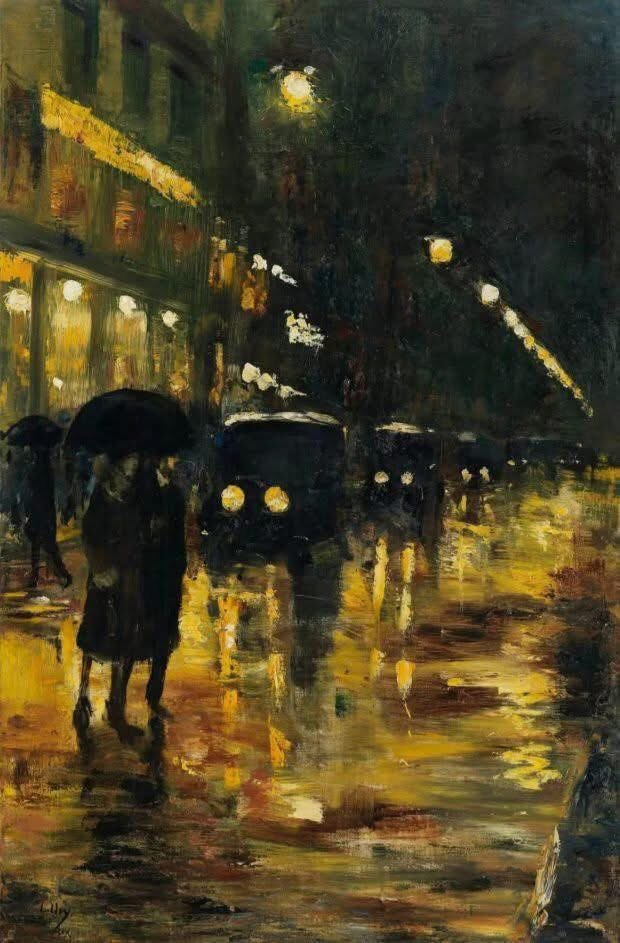
Leo Lesser Ury, Cafe König at Night, 1925

Qntm, There is no Antimemetics Division (2025)

We live in a world of memes. Internet jokes, catch phrases, bits of culture that spread with the persistence of an earworm. But what if there were such things as antimemes? Ideas, cultish beliefs, even malevolent forces that circulate with similar force except that they have the power of being forgotten, such that we are unable to recall their effect on us. And what if a governmental organization had been set up to protect us from these antimemes, which seek to crush us with their own dark virality?

That’s the premise of this brilliant novel, which broke my brain in all the best ways. The scientists and operatives in the Antimemtic Division routinely forget everything they’ve done, requiring elaborate protocols and dangerous actions to make sure that the world is kept safe from REDACTED and REDACTED. Author qntm, pronounced “quantum,” the pen name of British writer Sam Hughes, concludes that the human ability to forget anything is both what keeps us going and our greatest vulnerability.

Robert Jackson Bennett, A Drop of Corruption (2024)

Ana and Din are back! This time they venture into the most forbidding and dangerous place in the Empire: the Shroud. In this floating station off the coast (part oil derrick, part Pequod), a handful of Alchemists process leviathan corpses, harvesting the raw material from which all-powerful bodily modifications stem. In addition to avoiding the dreaded “middle volume sag” and offering another satisfying tale of detection, A Drop of Corruption picks up the hints in the first volume about stakes larger than this one case, which will presumably be developed in the third book in the series, due later this year.

Lea Ypi, Indignity: A Life Reimagined (2025)

It starts with a photo.

A young couple enjoy the snow and sunshine of the Italian Dolomites. They look at the camera with quite different expressions. He seems wary: eyes narrowed, perhaps against the glare, two furrows etched on his forehead; she, nestled in a fur, smiles broadly. It’s early 1941. These newlyweds are on their honeymoon. How could they be enjoying themselves while the war rages and the Balkans, including Albania, where they have made their home, has been plunged into factionalism? And why hadn’t Yea Lpi, professor of philosophy and the subjects’ granddaughter, ever seen this picture before? As the photo circulates online, people make all sorts of claims. Her grandmother was a communist spy; she was a fascist collaborator. Is any of this true?

The photo turns out to be a red herring—Ypi doesn’t even reproduce it in the book, save in highly cropped form on the (beautiful) cover of the US edition. (It’s easy to find online, though.) Instead, her book reconstructs her grandmother Leman’s life, from her childhood in an Albanian family long devoted to the Ottoman Empire in Greek Salonica, through her decision, as a young woman of 18, to move to Tirana, where she found a career and, briefly, a husband, a man recently returned from studying law in Paris where he knew, though did not particularly like, another expatriate, a young striver named Enver Hoxha. Ypi’s grandfather’s decency and reformist leftist tendencies put him at odds with the postwar Communist government. He was branded an enemy of the state and imprisoned for 15 years, during which time Leman and their young son (Ypi’s father) were forced to work at manual labour far from their home in the capital

Central to the story are the documents in Leman’s secret service file at the formidably named Authority for Information Concerning Documentation of the Former State Security Service. As always, documents turn out to be fundamentally inconclusive, especially when a late revelation prompts Ypi to wonder if anything in them is at all trustworthy. It doesn’t help that Ypi is researching her grandmother (as opposed to her grandfather or any other male relative). As a fellow scholar puts it, women and archives don’t go together: when woman appear at all, it is almost always with their husband’s name. Better, the man tells Ypi, to write a novel.

Which Ypi has done, sort of. Her treatment of Leman’s life is novelistic: filled with thoughts and feelings she could have had no access to, even though Leman was a beloved figure in her upbringing in Communist Albania in the 1980s and 90s. Most impressive is her glorious evocation of the multicultural world of early 20th century Thrace, tragically destroyed by successive waves of ethnic cleansing, from forced population transfers between Greece and Turkey in the wake of WWI to the Nazi eradication of Jewish Salonica.

Beneath this personal and political history is a philosophical investigation. From its epigraphs, citing Kant and Schiller, to its closing pages, the book considers the idea of dignity and its titular opposite. Dignity is the drive to “rule over adversity with moral force,” a tendency that Ypi argues, following Schiller, is fundamentally human. Dignity is what allows a person to decide to suffer, rather than instinctively to seek to free themselves from pain. And people most suffer, Ypi concludes, when they want to acknowledge both that the meaning of their lives both incorporates and exceeds the larger identities of family and nation and gender and religion of which they are part. (Ypi is a modern day Kanitian.) In this way, Ypi has given us a way to think not just about her grandmother but all the ordinary people who live through history, as she puts it, the first time as tragedy and the second time as even greater tragedy.

Ray Nayler, Palaces of the Crows (2026)

After enjoying Where the Axe is Buried last month, I was excited to get my hands on an advanced copy of Nayler’s forthcoming novel. And when I learned it was set in the forests of Lithuania (or perhaps Belarus) in WWII I was even more intrigued. Why had the sff writer Nayler chosen to write historical fiction? The answer is that he has found another way to investigate the animating question of his fiction: what kinds of relationships can exist between human and non-human animal societies? His first book considered octopuses. His second, elephants and mastodons. Here it’s crows.

Four teenagers—one Jewish, one Roma, one a Pole who has enlisted in the Red Army to help his family survive their forced exile in Siberia, and one a mute boy whose origins are uncertain—find each other in the chaos of the German advance into the Soviet Union in summer 1941. The Jewish girl, Neriya, whose family has always, in the years before he war, left their home in Vilnius each summer to vacation in a country village, and whose doctor parents have encouraged her to read Darwin and von Uexhüll, has over the years befriended a crow she names Buster. Buster is smart, even for a crow. He remembers Neriya from year to year, and masters the various games and puzzles she sets for him. He introduces her to other crows, each of whom has their own personalities. When she hides from the Germans in the forest, the birds appear at times of trouble, helping her and the other teens survive. For although the forest is vast, it is peopled with all sorts of threats: partisans, Germans, Russians who have gone AWOL, and others who, like our protagonists, are simply trying to survive. These other people are dangerous—though not as much as the terrible winters. The teens need all the help they can get.

The crows have created an avian city in the heart of the forest—more than a city, a real society, in which they look out for the most vulnerable members, much more than humans do. Chapters set during the war are interspersed with others from the 1970s, when the teens, now adults, each of whom has navigated life in the USSR in a different way, return to the forest. How can they protect the descendants of the crows who once protected them? Palace of the Crows might wrongfoot or disappoint some of Nayler’s earlier readers, especially those expecting a book a set in the future, but those who persist will see that this book, too, is about how we tell the stories of who we are, both within and between species. I hope Nayler keeps up his current writing pace!

Beryl Bainbridge, An Awfully Big Adventure (1989)

Stella Bradshaw is a working-class teenager in Liverpool in 1950. Her dream is to be in the theater, so she’s pleased in her closemouthed way when she is hired as an assistant stage manager in a regional playhouse. As the troupe prepares for a production of Peter Pan (the novel’s title comes from that play’s description of what death is sure to be), Stella becomes embroiled in its complicated relationships. She falls for the director, oblivious to what is obvious to readers: he’s gay. What at least this reader was oblivious to—surprising, because I’d seen the film, though admittedly not since it was in theaters in the late 90s—was the novel’s turn from comedy to tragedy. That ending! (And, yes, it’s all explained on the first page, Toni Morrison-style, but I’m slow.) Excellent stuff. Could have taken the Booker from A. S. Byatt if you ask me.

I’ll be reading this again soon: it’s the June title for the Leviathan book club. If you’re in St Louis, please join!

Miklós Bánffy, They Were Found Wanting [The Transylvanian Trilogy: Volume II] (1937) Trans. Patrick Thursfield and Katalin Bánffy-Jelen (2000)

See my thoughts on volume I. This continued to be excellent. Plenty of heartbreak, though. Things not going great for Laszlo.

Barbara Pym, The Sweet Dove Died (1977)

A moment ago, I mentioned a forthcoming meeting of the Leviathan book club. Pym’s late, great novel was our first selection. And what a terrific choice that turned out to be! I was thrilled to lead a discussion with such a smart and energetic group. I’d actually read this last August (one of those months I never got around to writing about) when NYRB released its beautiful edition. My first Pym, and from what I gather not the most representative, but absolutely terrific. I would say it even improved on re-reading. A woman coming up on 50—cool, elegant, manipulative, as Jacqui puts it in her review—meets an antique dealer and his 24-year-old nephew, who he’s training in the business. The antique dealer imagines a future with the woman, but she has designs (of what sort is never quite clear, even to herself) on the younger man. People behave badly—but, also, everyone has their reasons. The title, from Keats, is about the anguish—or is it the thrill?—of loving something to death. I would call The Sweet Dove Died Jamesian in the sense of being a study in cruelty. And an object lesson for any of us obsessed with the idea that the surroundings and events of our lives must be just so.

Isabel Cañas, Vampires of El Norte (2023)

Historical romance and vampire story set in the early part of the Mexican – American War (aka the US invasion of Mexico). As children, Nena and Néstor are inseparable, even though she’s the daughter of the patrón of a hacienda and he’s the son of a vaquero. Everything changes one night, when their expedition in search of buried Spanish silver coins goes terribly awry. Something, some creature, eyeless, all teeth and silent destruction, attacks Nena. The boy fights off the beast and carries the girl to the main house, but convinced he is responsible for her death he runs away never to be seen again. Until ten years later, that is, when he returns to join the forces the local ranchers are putting together to fight the Yanquis. When he sets eyes on Nena—who eventually recovered from her mysterious wounds—he freaks out. As does she, but for a different reason. She’s furious that he never wrote and can’t understand that he thought she was dead. This sets off an enemies-to-lovers story during a desperate mission in the wilds of northern Mexico: conveniently, the two become separated from the rest of the auxiliary cavalry during a battle. (Nena is there because in the intervening years and under the tutelage of Néstor’s grandmother she has become a curandera or healer.) Can the two overcome their differences to admit their love for each other? If so, what will happen when they return to the rigidly stratified world of the hacienda? And what are the terrible creatures the Yanquis have captured and forced to fight for them? You can probably guess the answers to all these questions. Vampires of El Norte doesn’t ever surprise, but it’s plenty satisfying. I do think Cańas needed to get a better handle on her allegory: those damn Yanquis are indeed vampiric but in the book’s most interesting moments the vampires are literal creatures, not just symbols. Just where did these vampires come from, anyway? It’s all a bit fast and loose. Still, I enjoyed this enough to seek out Cańas’s other books. Thanks to Hope for putting this on my radar.
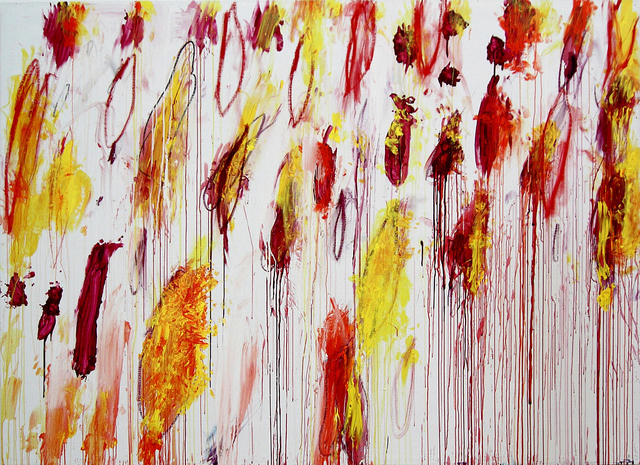
Cy Twombly, Lepanto Part IV (2001)

March roundup coming soon!

What I Read, January 2026

Gonna knock out some posts on this year’s reading before we hit the half-way mark of 2026. Here’s what I remember about January in St Louis. A snow storm came through near the end of the month. It was cold for a while. That was great. I ran as often as the street cleaning allowed. I spent some time applying for a job that I would later get. That was very good. And I read these books.

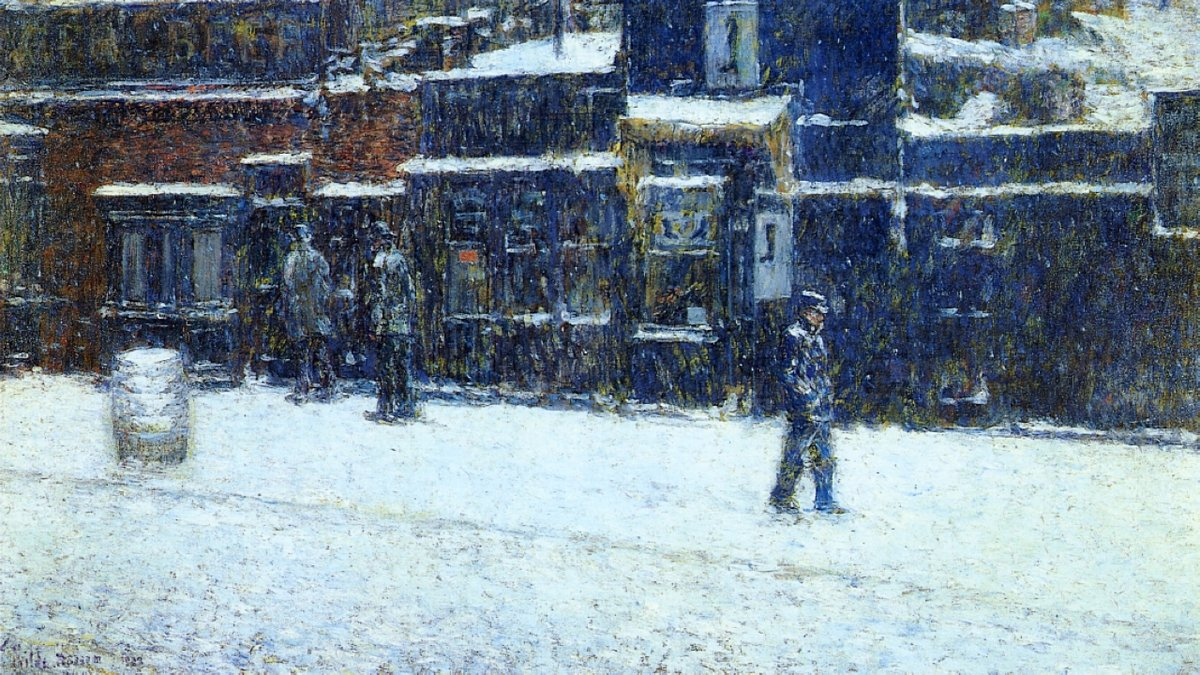
Childe Hassam, Messenger Boy (1902)

Georges Simenon, The Two-Penny Bar (1932) Trans. David Watson (2014)

What, you expect me to remember the plot of a Simenon I read five months ago? What I do remember is that this is one of the atmospheric-outskirts-of-Paris Maigrets. The search for the killer of a moneylender (Jewish, natch, boo) whose body has been seen being dumped in the river leads Maigret to a group of friends who spend weekends and holidays at an inn (the bar of the title) near Morsang, a village on the Seine about 40 km from the capital. They fish, paddle about, play cards, chase children, eat fulsomely, drink a hell of a lot, and sleep with each other. Maigret insinuates himself into the group, which is no trouble for him since he loves all those things too. (Except the adultery part. Maigret could never.) The vibes are immaculate, and the crime gets solved too.

Seichō Matsumoto, Tokyo Express (1958) Trans. Jesse Kirkwood (2022)

Born in 1909 in Japan’s Fukoka prefecture, Seichō Matsumoto did not publish until 1950. But then he made up for lost time, publishing over 450 books in the next four decades. These range from procedurals to psychological slow-burns in the vein of Patricia Highsmith or Celia Dale. Until recently, Matsumoto was hard to find in English. Happily, Modern Library (following on the heels of Penguin UK) has launched a program of reissues and they’ve started with one of his best. Tokyo Express (1958) begins with the discovery of the bodies of a man and a woman on a remote beach. Investigators rule the deaths a lovers’ suicide. But two detectives—one local to the scene, older, out of fashion; the other from the city, young, full of new ideas—aren’t buying it. Before long, they think they know who did it—but not how. Part odd-couple buddy story, part oblique criticism of a society desperate to repress its wartime past, the novel is famous for its plot, which centers on the detailed scrutiny of train time-tables. Trust me, this is a lot more exciting than it sounds. Tokyo Express is so clever you’ll be left shaking your head in appreciation at Matsumoto’s skill—and counting down the days until the next reissue appears.

Ray Nayler, Where the Axe is Buried (2025)

Nayler’s second full-length novel—after the excellent The Mountain in the Sea, about octopus intelligence—offers what are coming to seem his trademark elements: compelling characters; clear explanations of how systems function, whether these be ecological, political, or technological; and deep knowledge of political organizations and local customs gained from his other career in the foreign service. Set in an unspecified future in which many parts of the world are run by AI systems designed to maximize resources and human flourishing whereas others rely on more old-fashioned methods of coercion and surveillance, Where the Axe is Buried is a compendium of authoritarian strategies—and the resistances they inevitably provoke. Whether you read for the heart or the head, you’ll find much to appreciate here.

Anthony Trollope, The Way We Live Now (1875)

The subject of Episode 42 of One Bright Book. In my introduction to the episode, I said:

The central concepts of this terrific novel are cowardice and cruelty. Which is not to say it is a cruel or cowardly novel. How could it be, given Trollope’s amused interest in even the worst of the rogue’s gallery that makes up its cast of characters? But there sure is a lot of cruelty in its pages. Maybe we should be glad that even its worst characters don’t seem to take pleasure in their cruelty. (They are not Stephen Miller cruel.) But they are cowards, and in their desire to have things go their own way they will say or do anything, especially if it means they can avoid making a hard choice. Saying enough’s enough to someone else’s bad behaviour; taking responsibility for one’s own actions: these are things almost no one in this novel will do. That cowardice is what leads to cruelty. Something to think about re: our own day. Turns out The Way We Live Now is also about the way we live now.

Anne Youngson, Meet Me at the Museum (2018)

Anne Youngson was unknown to me when I noticed her two novels on the shelves of Leviathan. I figured James had a good reason for stocking them, so I asked him to tell me more. His response: “Light reading that doesn’t insult your intelligence.” Since that is my favourite kind of reading, I immediately moved them to the top of the TBR pile.

I started with Meet Me at the Museum because I love epistolary novels. As a teenager, Tina Hopgood wrote a letter to Professor P. V. Glob at the Silkeborg Museum in Denmark about the Tollund Man, which he had recently gained fame for identifying after the 2500-year-old body was found, perfectly preserved, by two peat-cutters in a bog. Glob—a real guy: his book was reissued by NYRB a while ago—wrote back, prompting the young woman to promise herself that she would visit the museum one day. Since then forty years have passed. Tina, now a middle-aged English farmwife with grown children, writes the professor again, this time because the friend she had planned to take the trip with all those years ago has just died. A reply to her lament for lost time arrives—but not from Glob, because he too is dead.

The letter writer is a curator named Anders Larson, who expresses mild interest in her past encounter with his famous predecessor and condolences on her recent loss. From this kind but detached beginning stems a lengthy correspondence in which two modest and decent people open up to each other about their shared puzzlement at how they came to have more life behind than ahead of them. The obvious comparison to Meet Me at the Museum is 84 Charing Cross Road and if you liked that one you’ll like this too. Like its more famous forbearer, Meet Me is gentle and modest in its ambitions and prose—but thrilling precisely because it doesn’t try to do too much. Its sincerity becomes it. As usual, James is right: it never insults your intelligence.

Youngson was in her 70s when she published this, her first book, written after her retirement from a career as an executive in the car industry. I’ve written before about how much the idea of the late bloomer means to me. (Maybe I’ll still do something with my life!) Learning about the author’s circumstances made me enjoy this lovely book all the more. I think a number of you would dig it, too.

Robert Jackson Bennett, The Tainted Cup (2024)

Rex Stout with monsters. The most dangerous place in Khanum is its sea-walls, where soldiers and engineers must constantly guard the empire from malevolent leviathans that inflict terrible damage any time they manage to breach the defenses. Yet these monsters don’t just threaten Khanum. They are also the source of its most powerful technologies. Alchemists have figured out how to synthesize the beasts’ blood and organs into bodily modifications that grant supernatural abilities and are thus coveted by the Empire’s citizens even though they are so powerful they often cause early death.

The narrator, Dinios “Din” Kol, has chosen to be modified as an Engraver: he remembers everything he ever hears, sees, smells, tastes, and touches. For obvious reasons, Engravers serve in law enforcement, typically serving as assistants to Investigators. At the beginning of The Tainted Cup, Din meets Anagosa “Ana” Dolraba. She is brilliant, idiosyncratic, vaguely disreputable. And she has asked for Din by name. Ana needs an Engraver more than most Investigators, because her agoraphobia and neurodivergence (she is so easily sensorily overstimulated she needs to wear a blindfold) generally keep her inside and away from crime scenes. (See what I mean about Nero Wolfe? And Sherlock Holmes for that matter.)

The pair have been tasked with solving the murder of a prominent Engineer. The man was found dead while visiting the home of a powerful oligarch, killed by dapplegrass, a modified plant that explodes from the inside anything that inhales or consumes it. Shortly thereafter, a section of seawall is breached and several of the Engineers responsible for protecting it are found dead in the same way.

I loved The Tainted Cup from start (a wonderful map) to finish (a teaser for the next volume). The solution to the crime is as good as the world-building: an impressive feat. A lot of books that try to do just one of those things don’t succeed. This is Bennett’s third series. I’ll be getting to them all.

Hans Peter Richter, Friedrich (1961) Trans. Edite Kroll (1970)

Postwar German children’s classic about the persecution of a Jewish child in 1930s Germany. The unnamed narrator has a best friend named Friedrich: the boys, born one week apart in 1925, grow up in the same apartment building, in an out of each other’s lives. At times, the narrator wishes he were part of Friedrich’s family. He looks up to his friend’s parents, warmer and wiser than his own. But the boys diverge as they age and Nazism takes hold on German life. For a time, the narrator manages—like his father, who remains friendly to Friedrich’s parents even after throwing in his lot with the Nazis, thanks to whom he has found work after long-term unemployment—to reconcile his friendship with the new norms of public life. But the contradiction can’t hold: the best part of the book concerns Kristallnacht, when Friedrich finds himself, in a moment of genuine ecstasy, that is, of being thrown outside himself, joining in with the destruction of Jewish property and life, starting with Friedrich’s home.

Richter served in the German army (he lost an arm on the Eastern front); after the war he studied psychology and sociology, but found his calling as a writer for children. Friedrich, the best known of his books, was for years a classroom staple in Germany. It’s easy to see why: it exemplifies the universalist school of representing Jewish life in the Nazi period: that is, it believes German Jews were as ordinary and as German as anyone else; their Jewishness was contingent and incidental to their lives. (In the guise of openness and acceptance, this view manages to reject the idea of Jewishness as meaningful in its own right.) It is also frank about German culpability. Which makes sense, given the audience it was written for. For the same reason, though, it’s not the book contemporary readers, especially non-German ones, are likely to most want on the subject. We might expect a book on the Holocaust to foreground Jewish experience, for example. We might want such a novel to have a Jewish main character. But that doesn’t mean the book isn’t worth reading. It is a document of its time, and carries its own interest, especially its willingness to suggest that there might be a thrilling element to destruction and persecution. A middle-grade book today probably wouldn’t do that, either. And that might be a loss.

Edith Wharton, A Backward Glance (1934)

The past couple of years I’ve been part of a group, headed by Shawn of the Shawn Breathes Books YouTube channel, reading Edith Wharton’s collected works. Regular readers will know I think she’s a genius. I was excited to learn more about where that brilliance came from, and enthusiastically agreed when someone suggested we tackle her autobiography. By the end of the book, I wasn’t so enthusiastic anymore. I didn’t quite expect a tell-all, but I certainly thought it would be more personal than it is. Which makes sense: A Backward Glance predates the era of personal writing. Wharton is discrete to the point of obliquity about her failed marriage to the Boston Brahmin Teddy Wharton and silent about her lengthy love affair with the journalist Morton Fuller. Her look into the past is glancing indeed.

Still, I remember a number of moments, including:

Wharton’s claim that she was taught only two things as a child (she had, to put it mildly, erratic schooling): modern languages and good manners.

Her further claim—which you can see motivating a book like Age of Innocence—that her childhood was worth remembering only because the New York of that time is as vanished a world as Atlantis.

What William Dean Howells told her when the dramatization of The House of Mirth flopped: “What the American public always wants is a tragedy with a happy ending.”

Little Edith, carrying around a book and making up stories from it even before she could read.

A nearly silent visit with Henry James to the aged George Meredith, in the grip of locomotor ataxia and deafness.

Countless drives in an open car through the English countryside with a profusely sweating Henry James, who adored motoring, though of course never drove himself.

What I took most from the book is that Edith Wharton was an excellent, devoted friend. Her shyness and social anxiety caused many to ignore or be disappointed by her. But those who got to know her were richly rewarded. Readers of this book, however, can only glimpse that person. A Backward Glance is interesting but underwhelming. Certainly not the place to start with Wharton, who just looms larger and larger for me as a great 20th century writer.

Alex Katz, Winter Branch (1993)

More soon on February’s reading!

“Running in Wide Curves”: Tana French’s The Keeper

With The Keeper, French concludes her trilogy about Cal Hooper, a former cop from Chicago who settles in a village in west Ireland, a place where young women find jobs in the city and old men worry about who will take over the farm.

Anthony Haughey, “The Edge of Europe” (1996)

The book begins when a body is fished out of the river; the death roils the vicious and tender emotional undercurrents that structure the life of any rural community. Not least because the victim was the fiancée of the scion of the local grandee. The latter is a businessman who has been buying up property for reasons that are uncertain but unlikely to bring anything good. (He is variously described as immobilizing, as a straitjacket, as a substrate in the soil under the town’s very walls: images like these imply that his superficial efforts at ingratiating himself with the people he’s grown up around hide something more ominous.) Hooper has never had much to do with the man, but now he finds himself unable to ignore or dismiss him. That’s because, although he’ll never be a local, Cal has forged ties to the place: surrogate father to a local teenager, a girl he has mentored from near-feral distrust to righteous confidence; partner to a middle-aged widow, a woman who wanted to get away from the place but never quite could; and friend to some of the guys down the pub, a gang led by his cantankerous neighbour, Mart. 

The lads’ banter is one of the books’ reliable pleasures, as is their depictions of dogs. French writes brilliantly about the relationships between dogs and people, at once attuned to each other and separate. Look at this beautiful sentence:

 Off in the distance, a man tramps steadily behind a wheelbarrow, his dog running in wide curves around him.

How vivid this picture, which pivots on the opposition of its verbs: the man “tramp[ing] steadily,” the dog “running in wide curves”; the man at work, the dog at play, two forms of aliveness; the one a line, the other a circle. French writes some of the most fully realized dogs in literature. They’re always bringing the offering of a sodden toy into a room charged with human argument, huffing as they roll over onto their other side in front of a fireplace, or questing off after the scent of a small creature they’ll never catch. 

The dogs are pure joy, but The Keeper, although as pleasurable as all the rest of French’s work, is a nervy book. When Mart asks Cal to look into the death, officially ruled a suicide, though the antifreeze in the victim’s system might suggest otherwise, Cal finds himself taking sides in what he didn’t realize was a conflict, a fight between differing visions of the town’s future. As always, French’s plotting is impeccable, but even back when she was writing her Dublin Murder Squad novels, she was always more interested in the challenges of living and working with others than in solving crimes. Her novels are populated by colleagues, neighbors, and mentors, categories that approach without ever quite assuming friendship. Think about the title. Does it refer to a gamekeeper? Someone who protects a place on behalf of someone else, someone more powerful? Or to the keeper of tradition? Or to a good boyfriend? (“He’s a keeper, that one.”) Cal could be taken to be any or all of these roles. But whatever the referent—and whoever fills it: I’ve been assuming Cal, but maybe I’m being too obvious—I think the term’s connotations are more ominous than protective. A terrific example of how crime fiction can chart its post-copaganda future, The Keeper will delight anyone who has exchanged their old life for a new one—or wanted to but never could.

Scott Walters’s Year in Reading, 2025

Regular readers will know that for the last several years I’ve solicited Year in Reading reflections from friends and trusted readers. Here, belatedly, is the last entry in this series. It comes from friend of the blog and reader extraordinaire, Scott Walters. The tardiness is all mine: I’ve been sitting on this, unconscionably, for months. I think you will agree, though, that some things are worth the wait. Scott, whose piece here is his fifth, launched the much-lamented blog seraillon in 2010, and expects to return to it one of these days. He largely follows Primo Levi’s model of “occasional and erratic reading, reading out of curiosity, impulse or vice, and not by profession.” He lives with his partner in San Francisco.

Nan Goldin, Self-Portrait in Blue Bathroom, London (1980)

Though I’m becoming increasingly picky about my reading choices, that didn’t stop me in 2025 from mostly following my nose – and allowing for books to choose me rather than the other way around. I made no concrete plans but still managed to read some books that had long been on my list and some marvelous new surprises. Highlights and more below.

Three Big Books

Three fat tomes structured my reading year. First was Thomas Mann’s The Magic Mountain (1924, trans. John E. Woods), the tale of the young Hans Castorp, whose brief visit to a tubercular relative in a sanitarium in the Swiss Alps turns into a long-term stay when he is trapped there after his own diagnosis. To read this book is to go on a long journey, arduous at times and tested by low oxygen, but offering spectacular views, inner alpenglow, and snowy literary heights nothing short of thrilling (okay, okay, enough of that). It is a deeply strange book, which Mann refers to it in his preface as a kind of fairy tale, and also a great one, borrowing freely from other models but prescient regarding both history and literary form. The near linear narrative, obsessed with time, teeters on boring the reader, breaks into a few background chapters, devotes 200 pages to three weeks, takes 500 to speed through the next seven years, then abruptly leap-frogs more years, indulges in dialectical (even trialectical) philosophical conversations, and near the end keeps introducing important characters into this European antechamber on the eve of World War I. An unnamed omniscient narrator occasionally interrupts to use the royal “we” and reference his own anxieties, which readers may share, Mann’s anticipatory novel serving as a kind of measuring stick between its time and our own. [Ed. – Yes, it is a truly great book.]

Little of the Dickens I had read prepared me for Bleak House (1853). This grand conception, capacious and constantly surprising, forming an indignant portrait of a city and country, roars for something to be done about poverty and injustice, pleads for beginning the world anew. Bleak House also seems a kind of spring, irrigating the literature that would follow it, anticipating modernism and some of the later movements of 20th century literature (the influence on Joyce, for example, is clear). [Ed. – Say more!] Even the often dismissed-as-novelty instance of human combustion, near the exact center of the book, comes across as exploding the hinges. To the right and left are human splatter, the human stain and residue, presented in a gem of literary black comedy. Joining a friend’s book club when I learned that Bleak House was on the menu, I was dismayed to find some who viewed Esther Summerson as merely a saccharine goody two-shoes. Is she not one of the great characters in literature? [Ed. – She is.]

A reader acquaintance in town for an evening mentioned Jon Fosse’s Septology (2019-2021, trans. Damion Searls). I’d read one Fosse work and had no intention of reading more, but Septology had other ideas: from a box of books I spied on the sidewalk the following morning, a pristine copy offered itself up, and I quickly found myself needing to read it each evening. Septology’s three novels form a triptych, the three sections of the central book flanked by two sections in each in the first and third novels. “The Other Name” in the first novel’s title is the same as the first name, Asle, held by both the narrator, a painter, and another Asle, a despondent alcoholic, both living alone near Bergen, one with his paintings and memories and the other with his bottles and memories. One scarcely knows where one Asle ends and the other begins, these doppelgängers, manifestations perhaps of divergent and not-so-divergent paths in the same life. It’s a nifty narrative device: the reader wanders in and about the one and/or two Asles and even more variations on the name, including Ales, the painter’s late wife, and Asleik, his neighbor. Past and present mingle. The discursive repetitions of Asle’s narrative seemed like the looping curlicues in a Cy Twombly painting: thoughts turn back on themselves, run on the same tracks for pages, return like waves, new and familiar. The frequent absence of page and paragraph breaks and the total absence of periods further a narrative relentlessness, as though we’re listening to an extended monologue, even when two people speak. [Ed. – Gotta say, that sounds dismayingly hard!] Ruminations range freely, from quotidian minutiae to explorations of art and faith, from meditations on social responsibility to the virtues and vices of solitude. A Nordic coldness blows through Fosse, but I came away from Septology knowing I’d encountered something new, unforgettable, and, in another iteration of hazy identities, now a part of me.

Playing with History

I was surprised to find so much historical fiction—not a genre I often deliberately seek out—among my standout works from 2025. Here they are, each approaching history in its own inimitable way.

Manuel Mujica-Lainez’s Mysterieuse Buenos Aires (1950, French trans. Catherine Ballestero) uses 42 fictional vignettes, in chronological order, to relate the history of Argentina’s largest city. A well-known translator from Spanish to English once said Mujica-Lainez was the author whose works they most wanted to see in English, and as a fan of Bomarzo (recently republished by New York Review Books for the first time since it appeared in English in 1969), I was thrilled to find another of his works, even if in French. Mujica-Lainez daringly pushes borders by fusing fact and fantasy, relying largely on figures from history’s margins, never passing up the opportunity to make a scene flourish in a dense riot of glorious language. The book opens in 1536 with a Boschian hellscape of famine and guerilla ambushes as the native population greets the Spanish invaders and continues through to 1904. I especially loved the longest tale, an “autobiography” by a tattered edition of Bernardin de Saint-Pierre’s roman à l’eau de rose, Paul et Virginie, as it gets passed along from Europe to the New World.

Anja Wilner’s 2024 Year in Reading post sent me to Christoph Ransmayr’s The Terrors of Ice and Darkness (1984, trans. John E. Woods), in which fiction and historical documents relating to an ill-fated 1872 Arctic expedition [Ed. – is there any other kind?] merge into an obsessive account of explorers confronting the elements. A parallel narrative follows the story of a young Italian fixated enough on the 1872 effort to book passage on an Arctic research ship in 1981, only to vanish mysteriously once back on Spitzbergen. The unnamed narrator is himself obsessed with the Italian’s disappearance. Various texts propel the narrative – logs, letters, lists, diary excerpts, tales of other expeditions, failures, vanishings – accompanied by black & white images. The overall effect is bewitching, as Ransmayr uses the explorers’ own words to probe their motivations, as shifting as the ice: a try for the pole, discovery of new lands, fame for the homeland, a promised payout. But the terrors of ice and darkness surge forth everywhere. Frostbitten-hands-down the most affecting work I’ve ever read on polar exploration.

A past Year in Reading post by Brad Bigelow led me to Thornton Wilder’s The Ides of March (1948), as superb as Brad had promised, standing above most contemporary American novels in its densely researched, inventive treatment of historical material that expands the epistolary form to incorporate everything from mandates by Caesar to clandestine notes passed between conspirators to graffiti on a Roman wall.

Adam and Eve in Paradise, by Eça de Queiros (1897). What a treasure, this 55-page novella by the wonderful de Queiros, translated into English for the first time by the wonderful Margaret Jull Costa. De Queiros’s take on Genesis has ape-like Adam sliding down from a branch “on the twenty-eighth day of October at two o’clock in the afternoon,” and had me laughing throughout, astonished that no one else seems to have approached such an absurd creation myth in such an inside-out, satirical manner. I gave out copies to friends like candy.

My Italian discovery of the year was Sicilian writer Annie Messina in The Myrtle and the Rose (1982, trans. Jessie Bright)and Le Palmier de Rusafa (1989, French trans. Jocelyne Sephord, unavailable in English), two of three novels Messina wrote, all towards the end of her long life (the third remains untranslated). Though the characters and locales differ, the novels tell similar tales of a Middle Eastern warlord developing an intense relationship with a rescued slave boy. The rather spare Myrtle seems almost a draft, sowing seeds that in Rusafa blossom into an extravagantly exotic baroque masterpiece. This is extraordinary, riveting fiction, fiercely red in tooth and claw and shrinking from nothing. [Ed. – Intriguing!]

Other Italian Journeys

You, Bleeding Childhood, by Michele Mari (2009, trans. Brian Moore) left me embarrassed that I’d never before heard of Mari, apparently among Italy’s living literary treasures. The 13 tales here center on characters who encounter literature at a young age. In “The Black Arrow,” the narrator steals his father’s copy of Stevenson’s novel of the same name, then is thrust into a moral conundrum when his father returns from a trip bearing another copy of the book as a gift. The child’s discovery of textual differences due to the gift being a different translation opens a world. In “Eight Writers,” the child’s obsession with sea adventures by eight famous authors encounters a case of mal-de-mer when he begins to mark their stylistic and thematic differences. In a favorite piece, “The Covers of Urantia,” Mari considers the impact of cover art, as his young reader reminisces on the covers of a popular series of horror magazines. Never let it be said that you can’t judge a book by its cover. Terrific stuff. 

L’Île des âmes (The Island of Souls), by Piergiorgio Pulixi (2019, French trans. Anatole Pons-Reumaux):a mystery of the “Sardinian Giallo” genre, concerning the reopening of a couple of cold cases involving ritualistic murders of two women following the more recent disappearance of another. The twist is that the cases are now being investigated by two women detectives, seemingly as an effort to sideline them. One might suspect the author of trying to be Sardinia’s answer to Sicily’s Andrea Camillieri, but Pulixi seems after something different: I was transfixed by his panorama of Sardinian culture, geography, and centuries-old mysteries – a great introduction to the island as well as the first novel in a series.

Other Italian gems: Behind Closed Doors: Her Father’s House and Other Stories of Sicily, by Maria Messina (Annie’s aunt) (1909-1928, trans. Elise Magistro), memorable tales of the rough lives of Sicilian village women in the early 20th century; Ignazio Silone’s Fontamara (1933, trans. William Weaver) featuring impoverished villagers wrestling defiantly with a Fascist landowner diverting their water for his own uses; a timely reread of Silone’s The School for Dictators (1939, trans. William Weaver), a quasi-novel/political treatise in which an American Presidential aspirant travels to Mussolini’s Italy to learn how to import fascism to the U.S.; Vincenzo Latronico’s bestseller Perfection (2022, trans. Sophie Hughes), a biting treatment of today’s digital nomads which, as a portrayal of work culture, brought to mind Arthur Miller’s Death of a Salesman; the first volume of self-described “leader of strange dolts” Ser Giovanni Fiorentino’s Il Pecorone (The Big Sheep, 1378, trans. W. H. Waters), a Boccaccio impersonation with infectiously fun tales stitched together by the dopiest of framing stories: two young lovers meet each day, tell one another a story, then slink off after this literary foreplay; the metafictional delights of Giorgio Manganelli’s To Those Gods Beyond (1989, trans. Marvin McLaughlin), from which I learned that while fiction is a prison, one can always invent a horse to make one’s escape; and finally Daniele del Giudice’s A Fictional Inquiry (1983, trans. Anne Appel), which I discovered the day after dreaming about an earlier del Giudice novel I’d read years ago only to find this one later in the day in a bookshop. [Ed. — !] To my further astonishment, A Fictional Inquiry pursues Italian critic Roberto Bazlen in a clever exploration of how one might have an outsized influence on literature without ever having published a thing.

“American” Literature

After all these decades I finally got to another Wilder in addition to Thornton above: Laura Ingalls, in Little House on the Prairie (1935). [Ed. – Genuinely curious how you managed to miss them in childhood, Scott!] I admired Wilder’s knack for creating limpid scenes using only the briefest descriptive sentences, as when the family reaches the grassland and young Laura sees that “In a perfect circle, the sky curved down to the level land, and the wagon was in the circle’s exact middle.”  For all the mockery generated by the related TV series, Little House struck me as practical and even “woke” to an extent that a lot of reactionary parents might miss (to the benefit of their bookworm children). [Ed. – Now read Eula Biss’s essay “No Man’s Land.”]

U.S.A., A Dramatic Review, by Paul Shyre and John Dos Passos (1960): I read John Dos Passos’s U.S.A. Trilogy decades ago, completely oblivious to the existence of this stage adaptation that compresses 1,000 pages into a mere 75. This small marvel of theatrical writing nonetheless manages to convey the sound and sense of the trilogy, including newsreel footage in the performance, and features several striking scenes, in particular a magnificent monologue by Isabella Duncan.

Thanks to Alta magazine’s assessment of 25 great works of California fiction, I read two that were new to me. Mecca, by Susan Straight (2022) was an especially welcome discovery, its entwined stories linking diverse communities of Southern California around the nexus where Los Angeles, Orange and San Bernardino counties meet. The Alta piece also prompted me to take down from the shelf an unread copy of Thomas Pynchon’s Vineland (1990), discovering only after finishing that it had inspired One Battle After Another. It’s easy to see why this narrative would resonate today; Vineland’s outlandish tale of a young woman coming to terms with her vanished mother, a radical activist from the 1960s, takes a long view of the competing tensions between American democracy and the forces of reaction taking aim at it. I also enjoyed Christopher Tradowsky’s Midnight in the Cinema Palace (2025), a solid contribution to literature about San Francisco in its glimpse into the culture of the Castro neighborhood in the 1990’s.

Passing, by Nella Larsen (1929): How had I missed the boat on this unexpected window into the world of Black women able to “pass” for white? Reading it made me feel a gaping hole in my knowledge of American literature had begun to be filled. Indispensable. Thanks, Dorian! [Ed. – Another satisfied customer!]

The most compelling American fiction I read last year was, um, British: Cahokia Jazz, by Francis Spufford (2023). Spufford’s stunning conception is the star in this speculative allo-historical thriller in which First Nations people govern a semi-autonomous U.S. state located around the city of Cahokia, today ruins of what was once the largest city in North America, but in Spufford’s vision an important 20th-century metropolis eclipsing the tiny village of St. Louis across the river. The book brilliantly uses a popular genre to explore race, religion, and the construction of history, and adds to an expanding list of great works about the United States not written by U.S. authors. Thanks again, Dorian! Iksho Itala! [Ed. – A pleasure!]

Odds and Ends

Aside from scattered poems, Raymond Radiguet’s two novels, Le Bal de Comte Orgel and Le Diable au corps, comprise his entire literary output. But what an output! His death at 20 drew thousands to his funeral; his patron, Jean Cocteau, was said to be inconsolable for years. These two tales, each involving a transgressive love affair between an adolescent boy and a married woman, burn with life, wit, insight, and defiant assertion of youth. Le Diable au corps, with its betrayed husband a French soldier, so affronted French nationalists after World War I that even a film version of it appearing decades later was met with indignation.  

Someone here last year mentioned Sally Rooney’s Conversations with Friends, so I picked it up and read this class-conscious dissection of an affair with admiration of her keen ability to needle in under people’s rationalizations and excuses and – like her occasionally self-mutilating narrator Frances – get under the skin and draw blood. [Ed. – Good description!]

The Prague Coup (2018), by Jean-Luc Fromenthal and Miles Hyman (trans. Lara Vergnaud), the only graphic novel on my list, recounts the story of Graham Greene’s trip to Vienna in 1948, ostensibly to consult on Carol Reed’s film The Third Man. Fromenthal unveils the story of Greene’s involvement in intelligence work and reframes The Third Man in its intelligence context as in part a coded message from Greene to double-agent Kim Philby. Bonus: the end pages sent me down a deep rabbit hole to learn about fascinating figure Elizabeth Montagu, Greene’s guide in Vienna, and to the remarkable film Four Men in a Jeep, shot in a Vienna still under rotating command by the U.S., U.K., France and the Soviet Union. [Ed. – This sounds great! First time I’m hearing of it.]

Perhaps my most moving re-read of last year was of Leo Tolstoy’s The Death of Ivan Ilyich, this time in the magnificent Peter Carson translation (Carson died a mere two days after finishing it).

Vivian Maier, Jul, 1953

Odder Odds and Ends

I’m not sure where I draw the line between books I consider odd and those I don’t. I read the first book of Solvej Balle’s On the Calculation of Volume (2020, trans. Barbara J. Haveland), about a woman trapped in a single day that endlessly repeats, and did not think to put it in this category. But Quebecoise writer Gabrielle Filteau-Chiba’s feminist eco-thriller Sauvagines (2022, available in English translation as Feral) swept me up into discomfiting aspects of an otherwise straightforward tale of a young woman serving a season as game warden in remote Kamouraska and finding herself squared off against a vicious, likely murderous, poacher. [Ed. – Ordering now!]

The Gardener Who Saw God, by Edward James (1937), stuck out no doubt because its author did. This too-hefty work by one of the patrons of Surrealism, a British lord who ended up in the jungles of Michoacan where he built his own surreal folly garden, Las Pozas [Ed. – This sentence has already contained many improbable things—where will it go next?], may not be stellar as literature, but it contains at least two major attractions: a fictionally-tweaked glimpse into the early world of Surrealism (Magritte, Dalí and others were guests at James’s estate), and a stunning spiritual conversion scene with the force of a Blake painting. I learned of the novel’s existence from Eve Babitz, perhaps one reason the book proved nearly impossible to find.

More solidly in the oddities category, Poe’s The Narrative of Arthur Gordon Pym of Nantucket (1838) had trailed me since university, when those who had read it seemed dismissive. My expectations were not high, but I ended up deliriously checking off the oddities of this bizarre, messy tale of a ship stowaway’s adventures. One lengthy passage takes place entirely in the dark of a ship’s hold (I kept trying to imagine it on a stage). There is a magnificent description of water that evokes all the magic water can evoke. But with its frequent alterations of black and white seeming to anticipate Melville’s Moby Dick and a disturbing set of scenes pitting the ship’s crew against “savages,” the novel’s treatment of race makes it one of the strangest literary artifacts of American slavery and racial phobia.

Perhaps the oddest book I’ve ever encountered [Ed. — !], David Lindsey’s A Voyage to Arcturus (1920) begins in sordid circumstances on Earth and moves to other such circumstances on Terra, a planet orbiting the binary system of Arcturus. In a confusing sort of pilgrimage, its louche main character sets out across the planet in search of illumination (think: the quest in Mount Analogue meets the ghastliness of M. P. Shiel’s The Purple Cloud), encountering surprising planetscapes, a plethora of strange beings, several impossible colors to which Lindsey gives names, and even a population of creatures who use gender-neutral pronouns. The violence of the book, however, came as a shock; I could not help but think of it as an oblique reaction to World War I. [Ed. – Readers, this is the kind of content you don’t get just anywhere.]

Good Trouble

Several works resonated more directly with the challenges of our times and served to ground and put into perspective whatever else I read.

Vasily Grossman’s Everything Flows(unfinished, last worked on in 1964, trans. Robert and Elizabeth Chandler), concerning Stalin’s purges and the incarceration of millions, may be less powerful than his two-volume World War II magnum opus, Stalingrad and Life and Fate, but incisively depicts the paranoid totalitarian state that resulted in informers and victims, seen through the lens of one such victim upon his release after 30 years in the gulag.

Étienne de la Boétie’s Discours de la servitude volontière (Discourse on Voluntary Servitude – 1548), a brief disquisition on why human beings voluntarily surrender agency to accept the tyrants who oppress them, seemed as timely as ever. Moreover, it contains some of the most lucid prose I have read in French, especially impressive given that de la Boétie, bosom friend of Michel de Montaigne, wrote it between the ages of 16 and 18.

Finally, Crooked Cross (1934) by British writer Sally Carson, who lived in Germany during the beginning of the Third Reich, unfurls as though in real time. Carson zooms in on the Kluger family of Kranach, an alpine village above Munich, the novel playing out like a granular study of how quickly and corrosively Nazi fanaticism took hold: the novel takes place entirely within the six months following Hitler’s assumption of power. Popular upon its publication, the book vanished until the recent discovery of a single extant copy. Thanks to Persephone Books, Carson’s novel contrasting acquiescence and resistance to totalitarianism has been revived – and at the right moment. [Ed. – I have dallied so long in putting up this post that Persephone’s reissue of the sequel is now available…]

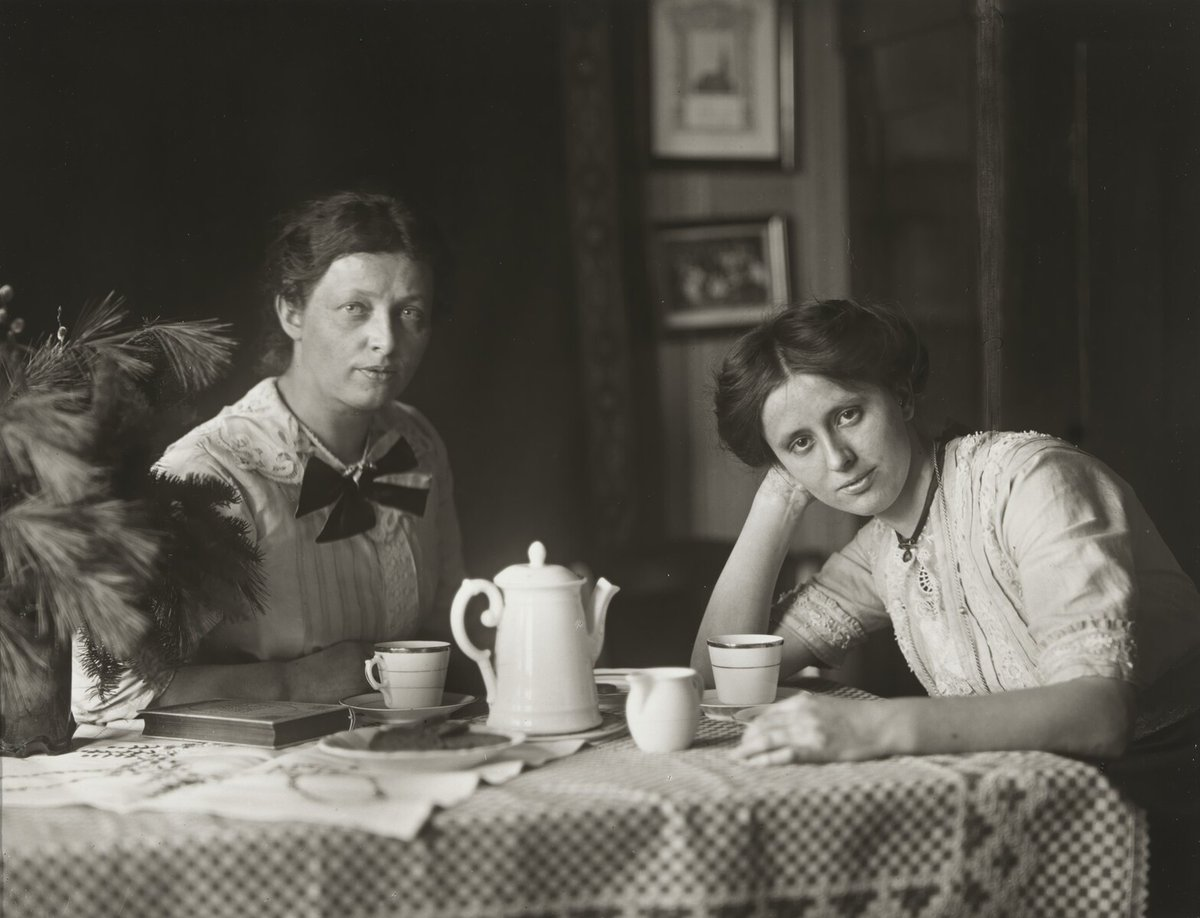
August Sander, Small-Town Women (ca. 1913)

Thank you for reading, safe passage and felicitous literary adventures to all in 2026. [Ed. – Thank you, Scott! So many riches here.]