“So we are both bereaved!” Olivia Manning’s Levant Trilogy

The most powerful and consequential scene in Olivia Manning’s Levant Trilogy (1977-80) occurs early in the first volume, The Danger Tree. A young Englishwoman, Harriet Pringle, is the primary observer of the scene. Manning detailed Harriet’s experiences in Romania and Greece with her feckless husband, Guy, a teacher attached to the British Council, in three wonderful novels published in the 1960s as the Balkan Trilogy. At the end of those books, Harriet and Guy, on the run from fascism, had been pushed from Bucharest to Athens and, finally, across the Mediterranean in two ancient, creaky, and overcrowded ships to safety in Egypt.

Manning couldn’t let go of her characters (another way to say this is that she couldn’t keep from revisiting her own life, since Harriet and Guy are modeled on Manning herself and her husband, Reggie, and their wartime experiences). In the last years of her life, she took up their story again, adding a new character, Simon Boulderstone, to the mix. In the opening chapter Simon, a twenty-year-old recruit freshly arrived in Egypt to fight Rommel’s army, gets separated from his regiment and falls in with Harriet and her circle of fellow refugees.

Cairo, Manning explains, “had become the clearinghouse of Eastern Europe”:

Kings and princes, heads of state, their followers and hangers-on, free governments with all their officials, everyone who saw himself committed to the allied cause, had come to live here off the charity of the British government. Hotels, restaurants and cafes were loud with the squabbles, rivalries, scandals, exhibitions of importance and hurt feelings that occupied the refugees while they waited for the war to end and the old order to return.

Except it might not. Things in Cairo are tense. The Germans aren’t far away, though no one knows for sure where exactly. The darkest rumours suggest they’ll take the city in a matter of days. Many exiles have chosen to leave for points east. The Egyptians, by contrast, are sanguine, even welcoming the possibility of German takeover, so much resentment is there of the British. The Anglo-Egyptians, by contrast, are incensed. One of them, Sir Clifford, an agent for an oil company, explains, with unpleasant distaste, “The gypo porters are having a high old time at the station. I was there yesterday, saw them chucking the luggage about, roaring with laughter, bawling, “Hitler come.’”

In the midst this turmoil, Clifford leads a group that includes Simon and Harriet on an excursion to the Fayoum, an oasis region about sixty miles from the city. The self-proclaimed Egyptologist leads the motley and mostly listless group through various tombs and a fly-ridden picnic in the heat of the day. Towards evening, they pass the home of Sir Desmond and Angela Hooper, and, despite the group’s protestations, Clifford decides to drop in to see if the couple has heard any news.
Agnes-Martin-009.jpg

As the group waits awkwardly in a living room “as large as a ballroom” they hear a car shrieking on the drive and a terrible commotion in the hall. A woman runs into the room, calling for Sir Desmond, “her distracted appearance made more wild by her disarranged black hair and the torn, paint-covered overalls that protected her dress.” This is Lady Hooper, returned from a sketching session that ends abruptly after a terrible accident.

Behind her, two servants carry in “the inert body of a boy”:

He lay prone and motionless, a thin, small boy of eight or nine with the same delicate features as his mother: only something had happened to them. One eye was missing. There was a hole in the left cheek that extended into the torn wound which had been his mouth. Blood had poured down his chin and was caked on the collar of his open-necked shirt. The other eye, which was open, was lackluster and blind like the eye of a dead rabbit.

Manning conveys horror through simple repetition, as if her language were shocked by what it had to describe. “Eye,” for example, is repeated three times, twice in a single sentence, which includes a meagre yet highly effective simile (the boy’s open eye is blind like the eye of a dead rabbit’s—an eye is like an eye). The idea of a hole or orifice is similarly repeated. There are the eyes and the mouth, of course, and the terrible opening in what had been the cheek. But there is also a painful contrast between these unnatural openings and the ordinary one of the “open-necked shirt.”

The Hoopers’ child—as best I can tell, he is never named—had picked up an explosive hidden in the sand while playing in the desert. The guests are horrified and fascinated by the scene. Sir Desmond and Angela react with stoic calm, but they are clearly in shock. They decide the boy should have something to eat, “a little nourishment, light and easy to swallow.”

A servant brings a bowl of gruel and Sir Desmond, “bending tenderly over the boy,” attempts to feed him:

The mouth was too clogged with congealed blood to permit entry so the father poured a spoonful of gruel into the hole in the cheek. The gruel poured out again. This happened three times before Sir Desmond gave up and, gathering the child in his arms, said, ‘He wants to sleep. I’ll take him to his room.’

I’d actually read The Danger Tree before, right after I devoured The Balkan Trilogy. Returning to it now, almost ten years later, I’d forgotten most of it, except this utterly indelible scene. The parents’ decision is so insane, so deluded—the boy is clearly dead, obviously beyond any “wants”—and yet so understandable. The matter-of-factness of the telling (that terrible sentence, “The gruel poured out again”) lends dignity to the disbelieving parents.

untitled_1977_private_collection_1

In one way, the child’s death is a minor event. It doesn’t involve Harriet, Guy, or Simon directly; it has no direct connection to the war (though that’s presumably why live explosives are lying around). Simon, once he finally makes his way to the Front, has even forgotten all about it until a Signals man warns him about minefields and other booby traps: he broods on the information “until suddenly, like a returning dream, he remembered the dead boy in the Fayoum house.” Everything about the day has become distant, the people “beings of an unreal world.” Yet he muses on the moment; similarly, this minor moment echoes and ricochets across the books’ 500 pages. Like Simon, Manning keeps coming back to the boy’s death. In particular, she develops the character of his mother, Angela Hooper. In the death scene, she is a cipher: partly desperate, partly clueless. Later, she becomes a joke among the Cairo expatriates (Clifford, nasty little snake, dines out on the story for months; soon everyone knows it). Angela moves to Cairo, where, having separated from her husband and abandoned her previous life as an artist, mother, and hostess, she is a Brett Ashley figure who drinks too much and doesn’t seem to care about anything, so traumatized is she by the past.

Yet as the trilogy continues, Angela becomes increasingly complex. Her relationship with an alcoholic poet, Bill Castlebar, reveals itself not to have been the tawdry joke everyone initially took it to be but a sustaining, if not sustained, quasi-marriage of equals. She becomes especially important to Harriet, who gains in her something she has never had before: a friend of her own. Previously Harriet has always had to make do with her husband’s numerous hangers-on. (Guy attracts almost everyone he meets, men anyway, because he seems to take such interest in them, and he does, but only insofar as they are a problem for him to solve or a vessel for him to fill with knowledge or advice; besides, he is chronically over-committed, probably as a way to keep real intimacy, real friendships, at bay, and so he carelessly foists everyone who clamours for a slice of his attention on to his wife. She doesn’t want to look after them and they don’t want to be looked after by her.) When Angela first re-encounters her, Harriet is sure the bereaved woman won’t remember their first meeting. But she does:

‘I brought in my boy and the room was full of people. He was a beautiful boy, wasn’t he? His body was untouched—there was only that wound in his head. A piece of metal had gone into the brain and killed him. He was almost perfect, a small, perfect body, yet he was dead. We couldn’t believe it, but next day of course… We had to bury him.’

Harriet isn’t ready for this confidence, misreading it as some combination of delusion (and what does that ellipsis signify?) and over-sharing: “wishing this would end,” she redirects the conversation. Harriet is our hero, but as we see here she’s not always sympathetic. Her ability to see through other people’s bullshit is refreshing (she sees through Guy’s, but won’t leave him: frustrating!), but she can brusque—sometimes that makes us cheer, as when she admits she is “never unwilling to disquiet” a man who had once left Guy in the lurch, but sometimes that makes us wonder, as when she dismisses a man’s anxiety about whether he will ever be able to take up his career again once the way is over (he is an actor, and fears his moment has passed) by heartlessly replying, “We’re all displaced persons these days.”

Most of the time, though, Harrier is sensitive and perceptive. There’s nothing Proustian about Manning’s style or approach or concerns, but over the course of these novels she does something I’ve only seen in Proust: she reveals characters to each other over an extended period of time, so that by the end they only barely resemble our initial sense of them. Just as Marcel comes to see Charlus entirely differently over the course of the lifetime described by his book, so too Harriet finds entirely unpredictable depths to Angela. The same is true of Castelbar. At first, he seems merely an unpleasant, no longer young man on the make, who has attached himself to Angela because she is rich and will buy all his drinks and even, rather unaccountably, even to himself, wants to screw him. But the relationship is for real. And we learn, with Harriet, how kind he is, and Harriet, at any rate (with luck we already know this, but we can never be reminded too often), learns how important kindness is in the people we love—and how little of it she gets from Guy:

He was kind, and not only to Angela. He carried his kindness over to Harriet so she, an admirer of wit, intelligence, and looks in a man, was beginning to realize that kindness, if you had the luck to find it, was an even more desirable quality.

Harriet even comes to see the actor, a man named Aidan Pratt, the one whose worries about his career she had dismissed, in a completely other light, such that he demands her sympathy. He tells her the story of his war, which consists of two traumas: one, referenced only obliquely and never developed, concerns the death of a lover; the other concerns his experiences as a conchie, a conscientious objector, early in the war. He was put to work on a liner transporting orphans to Canada, but the boat was torpedoed by the Germans and he the only survivor, having spent days adrift in the ocean in a life-raft full of children he was unable to save, an experience that did away with his pacifism.

Over and over, Manning gives us glimpses into the extraordinary yet commonplace terrors faced by people at war. Flipping again through Deirdre David’s workmanlike but comprehensive recent biography of Manning, I’m reminded that many of the Levant Trilogy’s first readers liked the Simon sections of the book best. They were impressed with Manning’s ability to describe the confusion and terror of desert tank warfare. I suspect sexism played a part in this response—the books were most valued when Manning proved able to move past her own experiences to depict the male experience of fighting. I think these scenes are good, too, but, as I’ve suggested, they’re not what most interests me. Besides, I think the distinction between what happens at and behind the Front misses Manning’s point. These worlds are connected by a shared experience of loss and trauma, as Simon himself recognizes when, having learned that his brother has died, he is given a week’s leave in Cairo, where he meets Angela again. She remembers him immediately, even apologizing for what the scene with her son must have looked like to an observer:

‘We didn’t know he was dead, you know: or perhaps we couldn’t bear to know. It must have been upsetting for you. I’m sorry.’

In what could be a motto for the books, Angela observes that she and Simon now share the most profound and inescapable experience, of loss: “So we are both bereaved!”
8e89872c2aea009c929c3bfbb893f225

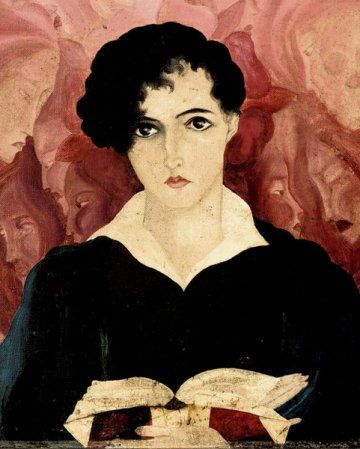
Olivia Manning, self-portrait c. 1930

I could say a lot more about these books, but this post is long enough. I’ll end by listing a few other favourite moments. Harriet is given the chance at a new life when, having almost died from amoebic dysentery, she finds a place on a ship taking women and children back to England. At the last moment, though, she decides not to get on the boat, a lucky thing too, since it is sunk shortly after entering the Indian ocean. Guy and everyone in Cairo think she is dead (some sections of the last volume are focalized through Guy; it is interesting that this doesn’t make us sympathize with him any more), whereas Harriet has no idea what has happened to the boat. Blissfully unaware, she sets out on an adventure, first to Damascus and then Palestine. These sections are fascinating, but underdeveloped. (Perhaps Manning thought she had mined her experiences in Jerusalem sufficiently in my favourite of her novels, School for Love.) More than the novel’s travelogue of the Levant, what stays with me are its arresting observations (watching a porter manage piles of luggage, Harriet “saw that from bearing so much eight, his feet had become almost circular and appeared to have toes all round”), vivid characterization, even of minor roles (who can forget Lister, who in his cups always returns to memories of his childhood nurse, who used to pull down his underwear and beat him with a hairbrush: “Bristle side. Used to pull down little kickers and beat little bum. Poor little bum!”), and striking, often violent scenes, whether of a bar in Tiberias destroyed by violent, maudlin, drunken Australian soldiers on leave, of a collapsed house after an air-raid in Cairo, where, for days afterward, survivors can be heard wailing to be released, though no one will do anything about it, or of a miserable polar bear in the sweltering Cairo zoo, with which Harriet tries to bond “through the medium of her intense pity.” She tells the bear, “’If I could do anything for you, I would do it with my whole heart. But the world is against us. All I can do, is go away.’”

Harriet’s rather despairing conclusion isn’t quite the book’s. People do care for each other, though it almost always ends badly (they get blown up, they take another lover, they get sick and die). (Maybe the only exceptions are a pair of lesbian ambulance drivers–I wanted a whole book about them–though it’s unclear whether their relationship can survive the war.) Nor is it clear that going away is as practicable a solution as Harriet here seems to think. After all, she is returned to Guy, and, in a way to life, having been presumed dead. Fittingly, this reunion is more moving to the people watching it than to the novel itself. Harriet and Guy are delighted to be together again, but Harriet, at least, now has no illusions that she will ever come first with her husband. Her tart observation that marriage is “knowing too much about each other” is fitting for novels in which the most profound togetherness comes only through loss.

I read these books alongside Scott of the blog seraillon. Please read his excellent essay.

“Hey, let me in!” Nick Drnaso’s Sabrina

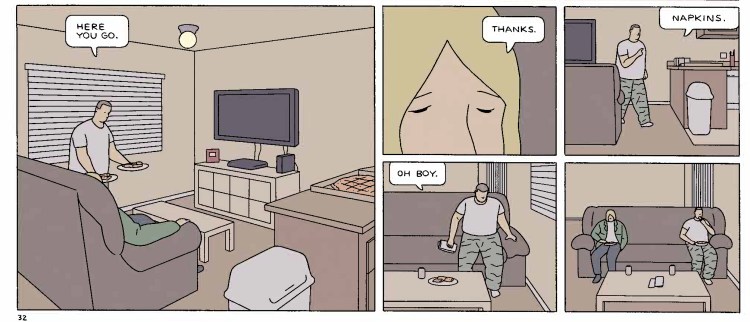
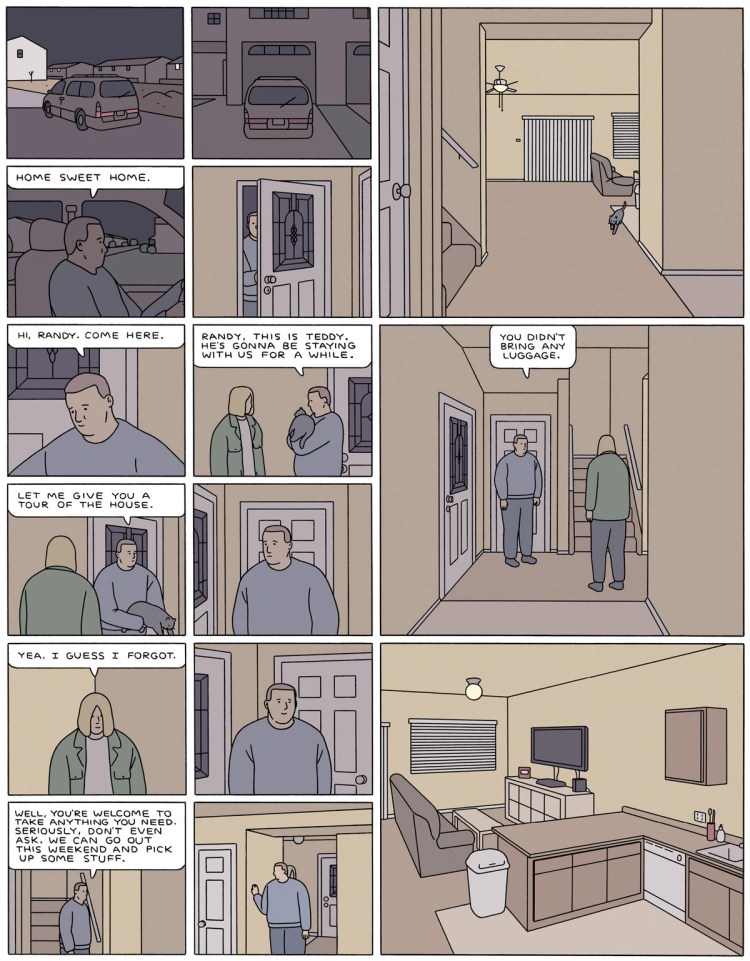
A lot happens in Nick Drnaso’s Sabrina. A woman named Sabrina disappears; her distraught boyfriend, Teddy, goes to stay with his best friend from high school, Calvin, who now works with computers for the military; the woman’s sister, Sandra, struggles with her grief; a cat goes missing. But we rarely see these events directly. We see instead their after-effects, which, given the extremity of the events (the most drastic of which I am eliding here so that it stays a surprise), are traumatizing. Most often, those responses take the form of an almost wordless sinking into the anesthetizing commonplaces of middle American life. Characters sit in silence—whether they’re alone or not—watching tv, playing video games, wasting time online.

Here are some examples of what I mean:

NickDrnaso-Sabrina-Illustration-ItsNiceThat-269781783784905-8pizza-1

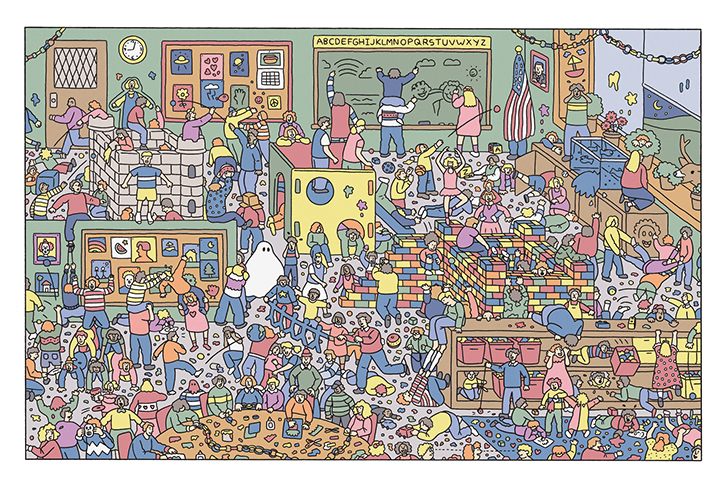
The style of Sabrina is at odds with Calvin’s young daughter’s favourite book. (She’s in Florida with her mother as the couple experiments with a trial separation, but she’s left a lot of toys behind in the bedroom Teddy uses.) Its pages overflowing with hectic, garish drawings, the children’s book is nothing like the one we’re reading. After all, it has a key: each page lists the names of the items young readers are meant to find in its pictures. Perhaps that promise of fixed meaning is why Teddy is so drawn to it.

NickDrnaso-Sabrina-Illustration-ItsNiceThat-4

Sabrina, by contrast, feels empty. It would be easy to turn this observation into judgment, to say something like: Sabrina is about a hopeless, denuded world, “the indigenous American berserk” as a form of numbing. Or: its characters are lost, helpless, incapable of self-reflection.

But talking about the book this way—as I find myself inclined to do—is wrong. I suspect most interpretations of the book will take the form of sociological diagnoses (what is wrong with America?). Sabrina connives with this way of thinking, because of the apparent affectlessness of its presentation, and its lack of interest in interiority or psychology. (In this sense, its totemic object is the psychological evaluation form Calvin and his co-workers are required to fill out at the beginning of each shift: What is your stress level, on a scale of one to five? How many units of alcohol did you consume last night? And at the bottom, three questions about whether you want to talk to anyone about anything, questions it is clear the answer to which should always be no.) But if Sabrina leads us to read in certain ways, that isn’t because it necessarily agrees with those ways, but because it wants us to ask why we read that way.

Every text is about interpretation in some way, but Sabrina foregrounds interpretation more than most. Which might seem funny because its characters say and do so little. (What’s to interpret, you might ask.) But the emptiness I mentioned earlier has an unexpected effect. Not that we need to ignore or undo it by unduly filling it but that we have to slow down, look closely, think about this only apparent blankness. Drnaso’s emptiness is a spur to thinking, not a convenient way to shut thinking down (as would be the case if we were to dismiss these people, this world). I’m reminded of Caché, Michael Haneke’s film about surveillance, and the way it makes viewers into paranoid readers, alert to the possibility that every quotidian scene could be sinister, every seemingly empty or boring frame of surveillance video could reveal significant horror. Not that Sabrina incites paranoia, but, like Caché, it turns the very way we look at (and therefore consume) it into the thing we most need to pay attention to, instead of, as we do too often, ignoring it as simply a neutral vehicle for receiving its themes.

On Twitter, Tony from Messenger’s Booker said he was uncertain about the book. He noted how hard it was to tell characters from one another, especially early on, and I certainly agree. In fact, at first, I often wasn’t sure if many of the characters were men or women. This uncertainty bothered me. But why? What was I doing in wanting distinctions when the book apparently didn’t? For whatever reason, I found this uncertainty more of a barrier than the book’s complete lack of exposition. You only find out important information—who characters are, how they know each other, where they live, what’s happened to them—retrospectively, or sometimes not at all. And the only suspenseful sequence—a lovely bit in which Teddy finally leaves his Calvin’s house in search of that missing cat; wandering the empty suburban roads he’s eventually given a lift by a guy in a truck—resolves benignly: we expect Truck Guy to take Teddy out to some deserted stretch of highway and murder him, but, nope, he just drives him right to the Humane Society. No cat there, though.

Drasno’s way of organizing his pages is similarly unsettling. He alternates between smaller, regular shaped panels and larger ones that are two or sometimes more rows high. When that happens, do we read the top row, then the second row, and finally the big panel? Or do we read the big panel in between the first and second rows? It’s not always easy to tell.

Drnaso8

That I took these narrative and visual ellipses and involutions in stride but was bothered that I couldn’t distinguish characters surely says something about me as a reader: I have plenty of experience with narrative experimentation, after all, but my resistance to corporeal uncertainty apparently runs deeper. Yet in the end neither of these modes of uncertainties matters much in themselves. They are just two possible examples of something much more important: the book’s ability to disquiet readers.

But more than unsettled or disquieted, Sabrina made me very, very sad. Even the final pages, which (assuming they aren’t a fantasy—always a possibility) suggest something like fulfillment for one of the characters, didn’t change my mood. At first, I responded to this sadness by explaining it away. I don’t need to be so sad, I said to myself, because life isn’t as hopeless as this book suggests. Most people, I insisted, aren’t quite this unable to communicate, aren’t quite this isolated, aren’t quite this close to the brink of absolute desperation. (Most people aren’t quite this traumatized, either, we might also like to think.) But I realized that this was a lousy response. A better way was to be true to my feelings. The most accurate response to contemporary reality, the philosopher Theodor Adorno once wrote, is to acknowledge all the anxiety, all the sadness, our culture legitimately incites.

Besides, exaggerated or not, the book speaks truth. I felt this most strongly in its depiction of the relationship between anonymity and communication. Connection is routinely sterile, oblique, and failed; instead we are offered the echo-chamber of talk radio, the violence of online forums, the broken sentences of people under duress. When Sabrina’s fate is revealed, Calvin and Teddy are faced with virulent, cruel, hateful responses that I might have found unbelievable were I not on Twitter every other minute.

I wonder what J. G. Ballard would have made of this book. Surely, he would have recognized its landscape of empty spaces: office corridors, housing tracts, rest-stop fast-food joints. But he would have admired, even thrilled to see those anonymous non-spaces put at the center of such a powerful work. Drnaso is more circumspect. He’s not critiquing this homogeneous world, nor the people who live in it. But neither is he championing it as unsung or transformative. Even when Calvin takes a new job, packs up his life, stops on his way out of town to visit Teddy at his own new job, and hits the road (cue more rest stops, more empty restaurants, more generic motels), it’s hard to see these developments as new beginnings.

methode-sundaytimes-prod-web-bin-30549ea8-6e4f-11e8-b8aa-6e92c706c88b

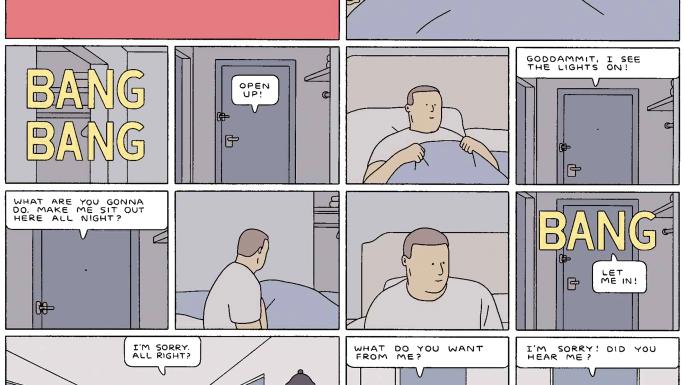
On every page, the narrative and visual point of view of Sabrina is strikingly neutral. Perhaps the very form of comics allows this to be so. We can see things that the characters cannot; we can see things from a point of view that can more properly be called omniscient than anything in ordinary fiction. Take Calvin’s cross-country journey. In his hotel he is awoken by someone banging at the door. He stays in bed, but in the following panels we see what he can’t (though presumably he hears at least some of it): a man at first apologizing and then turning belligerent when his apology isn’t rewarded. Then we see the man’s partner calling to him from down the hall. The man—maybe he’s drunk, or just drunk on anger and self-righteousness—has the wrong room, is banging on the wrong door. The woman shuts the door in his face, and we’re left with a panel of the man in an empty corridor, standing to the side of the frame, as so often in this book. “Hey, let me in!” he shouts. No response. Good for the woman, we think. But isn’t she running a risk? Will she be okay? This resistance to the man’s violence feels dangerous in a book where violence comes so often to the surface. What does the book want us to think here? Is it critiquing Calvin for huddling in his room? Or the man for being a shit? Is it valuing the brave woman? Can anything change when people can’t talk to each other? Is talking so great anyway? Couldn’t that just be another ruse for the violent to get their way? It’s hard not to read a scene in which we are grateful that loud BANGs come only from a fist on a door and not a gun to the head as anything other than a critique of America today. But maybe the real lesson of this beautiful and disturbing book is that any diagnosis of contemporary America’s ills is just part of the problem.


“The Life We Knew Here Is Gone”: Philip Marsden’s The Bronski House

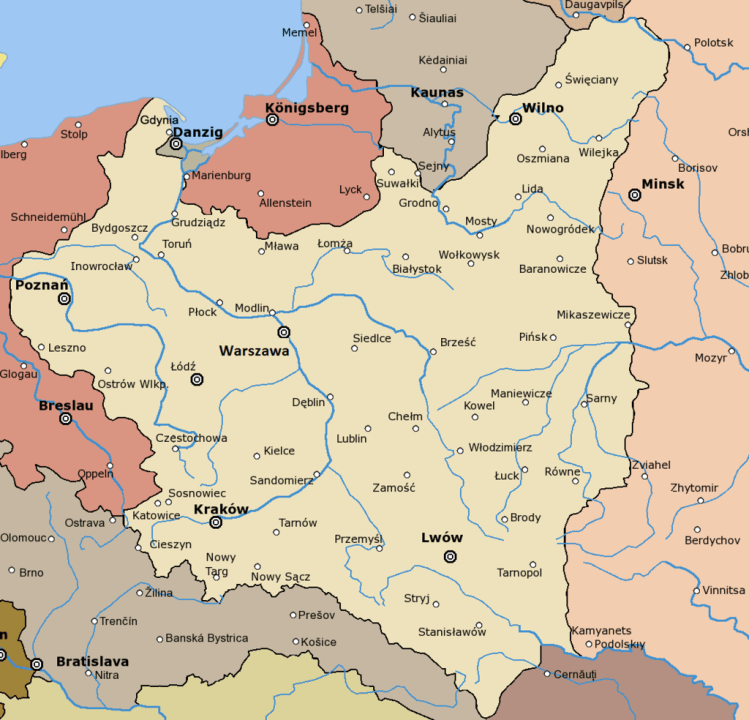
In the years after the fall of communism, Zofia Illinska, an elegant, erudite Polish woman, an émigré who at that point had lived in England for fifty years, returned to the estate she and her mother fled in 1939 when the Soviets and the Germans divided Poland. Zofia was accompanied by an Englishman half her age, the author of this remarkable book; having befriended him when, as a boy he stayed with his family in her hotel in Cornwall, the two stayed in contact ever since. The Bronski House A Return to the Borderlands (1995) is a story about home and exile amid the violence of the 20th century. It is a meditation on the idea of return. And it is a portrait of a sweet and moving friendship that crosses generations, sexes, and cultures.

41YMPEHSKBL._SR600,315_PIWhiteStrip,BottomLeft,0,35_SCLZZZZZZZ_

Few of the places that mattered in Zofia’s life exist anymore. She was born in 1921 in Polish Wilno, today Vilnius in Lithuania, and grew up at a house called Mantuski, in modern-day Belarus. Her story, like that of so many people in the past century (and in our own), is one of enforced change, driven by the violent dreams of others. The results of those dreams, more often than not, are sickness, death, and misery. As Marsden puts it, describing Minsk in the fall of 1917:

Stooped figures shuffled about, collecting water from puddles. Illness hung over that place like the thunder-clouds. Everyone was ill—ill from dysentery, ill from typhus, ill and widowed from other people’s war, other people’s ideas, other people’s revolutions.

Although the words are Marsden’s, it’s unclear whose sentiments these are. I’ve been speaking of Zofia, but the book is not only or even primarily hers; it’s at least as much the story of her mother, Helena. Helena is the one who experienced Minsk at the end of the First World War; Zofia, undreamed of by her mother, wasn’t yet born. The bulk of the book is based on diaries, letters, and notebooks Helena kept over the years, but for the most part Marsden is telling the story. (We are given excerpts from the diaries, allowing us to see that Helena was a gifted, if somewhat exuberant writer; little surprise that her daughter became a poet.) Marsden hews closely to Helena’s viewpoint—he tells us what she experienced and what she felt—but at times we sense his perspective.

In the Minsk passage, for example, the terrible, indelible image of the stooped figures and the puddles must come from Helena. The simile of illness hanging over the city like thunder-clouds is likely hers as well. (It fits with the language we find in her diaries.) But the final sentence, with its anaphora and its ringing condemnation of the harm done to blameless victims by ideologies and governments, feels like Marsden’s.

Indeed, if Marsden has a philosophy, a take on the material he is describing, this is probably it. There is nothing as damaging as an idea: ideologies are experienced by those who live under them primarily as violence and deprivation. To be sure, the 20th century gave us more than enough evidence to support this idea. I’m reminded of Primo Levi, who, describing Hans Biebow, the Nazi in control of the Lodz ghetto—“a small jackal too cynical to take seriously the demonizing of the race”—concluded that a pragmatist is always preferable to a theorist.

Marsden’s humanism has a lot to recommend it, though it skirts sententiousness. As I read the book—utter catnip to me; I swallowed it in a single day, and loved every minute of it—I wondered a little uneasily what is at stake when we read about vanished worlds, and about the suffering of others. It’s easy to romanticize lost worlds. They have a pathos and a dignity that our own seems to lack. (Here’s hoping someone eventually says that about us—though God only knows what that will mean for the present they are feeling bludgeoned and degraded by.) But we oughtn’t to forget that these lost worlds weren’t just the victims of history. They contained, even perpetrated, suffering too. (Zofia’s parents’ families were landowners on both sides, not tremendously wealthy, but privileged. On her mother’s side, she was an O’Breifne, descended from an Irish Catholic who came to fight for the Czars in the 17th century.) The Bronski House gives us a few indications of that inequality. One such moment is a brief standoff in 1926, when the local peasants refuse to allow the Bronskis’ timber carts to pass through the village, claiming that the wood belongs to them. The situation almost turns violent, before Zofia’s father exerts his landowning privilege and the villagers back down, for the moment anyway. In general, though, the book hews to the landowners’ perspective, which doesn’t so much disdain or disparage the peasantry as ignore them.

1024px-RzeczpospolitaII

Marsden, however, is too smart a writer not to have thought about these questions. Early on, he describes two photographs of Helena, one a studio portrait from 1919, taken in Warsaw, showing an almost twenty-year-old young woman in “a white high-collared dress,” and the other a candid from 1936, taken on the estate of Mantuski. (Curiously, there are no photos or other images in this book, other than a helpful map on the endpapers. Unlikely that would be true in a book released today. I’m puzzled by the omission; likely Zofia wanted them kept out. Whatever the reason, the absence of images increases the mystery of the lives retold here.)

Marsden wonders why these photos cast such a hold on him:

It was the way this woman, Helena O’Breifne, had crossed the steepest contours of our age; that for me, living in flatter decades, in a quieter corner of Europe, her world represented everything that had been lost, a place of slow villages, muddy livestock and unfenced fields, of time passing with only the backdrop of the seasons, of lives exaggerated—exaggerated in wealth, in poverty, in suffering—lives buffeted by a history no one seemed to control: Helena’s was a bigger world, a crueler world, a world of half-mad nobles living on borrowed time, of noble peasants living outside time, another Europe, an older Europe.

This is beautifully—but also slyly—put: as the sentence amasses its clauses it veers into cliché (the half-mad nobles, the noble peasants), and knowingly so. For as Marsden goes on to admit, the truth is simpler: Helena is beautiful and he has fallen a little in love with her, as so many men will do in this book. (Helena’s lack of interest in men, until she wanders haphazardly into a marriage that to her own surprise brings her much joy, is interesting, and more might have been made of Helena as a desiring (or, often, non-desiring) being, though that would have meant speculating in a way Marsden typically refrains from. This is no psycho-biography.)

Marsden’s love for Helena is of course connected to his love for Zofia. It is refreshing to see how much respect he has for this much older woman. Zofia can occasionally be eccentric—she loves to sail, though she doesn’t know how, and often needs to be rescued—but primarily she is characterized by intelligence, mildness, and remarkable good sense. The trip she and Marsden undertake is quite fraught, especially given what she finds in a newly-independent and terribly impoverished Belarus: Mantuski, her childhood home is gone, burned to ground in the early days of the war; Klepawicze, her husband’s childhood home, has become a communal farm, complete with an alarming Geiger counter that continually tests the air for radiation (Chernobyl happened not long before and not far away); worst of all, the Bronski chapel, containing her father’s grave (Adam died of complications of scarlet fever in 1936), has been ransacked and looted.

But Zofia is never bitter; she never displays rancor to those who chased her family away. (Yes, the past is past, but some of the people she meets were alive at that time, making her forbearance all the more impressive.) After returning to England, Zofia begins raising money to repair and reconsecrate the chapel. Two years later she and Philip return to dedicate it. At the ceremony, Zofia makes a speech extolling her father’s love of the land he spent working and fighting for. Then she adds:

‘But there is one thing you must understand. For more than half a century now, no Bronski has lived here. Once this was our home, but not any more. The family is scattered around the world and the life we knew here is gone. The restoration of the chapel is not for us; it is not for my family, but for you, for all of you—Belorussian and Pole, Orthodox and Catholic. You must look after it as your own home. You must use it. Come here and pray whenever you want, whenever you can—even if there is no priest to officiate; you must say the rosary and in the spring cut back the forest around the building.

‘And be warned,’ she smiled, ‘that if the chapel again falls into disrepair, it will be my ghost that comes back to haunt you.’

It’s a generous gesture, a superb acknowledgement of the inevitability of change and all that is lost. It doesn’t dig up old grudges or wounds. Yet it also ends with a sting—a gentle one, but a sting nonetheless. The past never does fully go away; it always threatens to haunt us.

ww1-austria-belarus-nowogrodek-vintage-postcard-with-feldpost-to-kolozsvar-hungary-0

Before I end, a few scattered observations:

Marsden makes himself scarce in the book, and it’s all the better for his restraint. He is a translator, a Sherpa, sometimes a dogsbody; he is not the main attraction. There’s a lovely scene in which he and Zofia visit an old woman, Pani Wala Dobralowicz, Zofia and her mother’s former dressmaker, who lives with her chickens in a small cabin near the place where the great house once stood. The three have lunch—there are plates of potatoes and kielbasa and herring, and a bottle of vodka. Afterwards, the three sleep off the lunch “in the close heat of the afternoon—the two widows on beds behind a screen, me on an old sofa next to the stove.” Later he “hears the two women talking behind their screen long into the night.” A sweet moment, from which we, like Marsden, are quite properly barred. Their conversation is private.

So sweetness and gentleness, yes, but that isn’t the whole tone of the book. I’m not sure I’ve made it clear how dramatic, even exciting it is. The family’s escape from Poland at the beginning of the war, across the border into Lithuania and eventually to England, is the stuff of a spy novel. And the book is shrewd enough to admit that traumatic upheaval can be the making of a person. Here is Marsden’s description of Helena’s escape eastwards to Minsk and eventually Saint Petersburg with her mother and their servants and livestock during the First World War:

The forest banished all thoughts of war. Helena felt happy, exhilarated. Each day was different. Her mother withdrew the barbed constraints that normally surrounded her. She relaxed; the progress of the convoy imposed its own loose authority and, in years to come, Helena looked back on those weeks in the forest, seeing the horses’ twitching ears, the arc of the wooden hames, hearing the creak of carts, and knew that this was the closest she ever came to any sort of freedom.

It’s a melancholy conclusion (which is belied by the contentment she finds later in life at Mantuski—though of course contentment isn’t the same as freedom), which captures just how confined life could be for a gifted young woman in that time and place.

I noted earlier that Marsden helps us consider the risks of romanticizing the past. His point well taken, but I am a sucker for this particular past, and The Bronski House is filled with swoony period details, like this one that seems super Slavic and wintry and almost nineteenth century novelistic: in defiance of everything that has just happened, Helena’s aunt holds a ball on a December evening in Wilno at the end of the war. There are no horses in the city; they have all died in the war. So there are no sledges, no carriages; the guests arrive on foot. Marsden gives us this grace note: “In the portico of Aunt Marynia’s home, a great puddle spread out around the rows of felt boots.” (It’s the kind of detail you’d find in a Penelope Fitzgerald novel. No accident that hers is the only blurb on my edition.)

One last thing—and quite a different note: I found it extraordinary to read a book about this time & place that has almost nothing to say about Jews. (They are referred to once or twice, but only in passing, it’s really minimal.) I’m not sure how I feel about this. On one hand, it’s a relief to have a break from those particular terrors, especially given my academic work on the Holocaust. On the other hand, it feels like a huge effacement. Notice that Zofia doesn’t mention Jews in her speech at the chapel. Even she wanted to, she couldn’t. Not because they couldn’t pray there, but because there aren’t any of them around to address. Even in a story filled with loss, then, there are even further layers of despair, even more ghosts who don’t get their due. In the end, I prefer to think of this as a sign of the book’s modesty on the part of the book (Jews simply didn’t factor much into Zofia’s daily life—but could this be true?—and of course the worst atrocities against Jews happened after she and her family fled) rather than a sign of its values.

Too bad The Bronski House is out of print. Some enterprising publisher should reissue it. It would pair terrifically well with the NYRB Classics edition of Eleanor Perenyi’s More Was Lost (hint, hint). I’ll even volunteer to write the introduction. In the meantime, search your library or AbeBooks. This one’s a keeper.