June 2019 in Review

Kid in day camp; working from home; weather more than tolerable for Little Rock summer: June was a pretty big reading month. Some work stuff, but a few other things too, including a satisfying run of Esther Freud novels.
D7uybHXW4AAs-if

Dorothy Sayers, Have his Carcase (1932) The opening line kills, and I loved seeing the development of Wimsey and Vane’s relationship, but I do find Sayers a bit frivolous. That’s the point, I get it, I’m just starting to think I’m not the right reader for these books. All the code-breaking stuff went right over my head. I guess I am more for suspense than puzzles. Better as a romance than a crime novel. Rohan’s review is unimprovable.

Peter Gay, My German Question: Growing Up in Nazi Berlin (1998) I owe this recommendation to Alok (@alokranj): a while ago, he wrote up a great thread on memoirs by German historians. Very glad I read this, even if I did find it a bit oh I don’t know withholding maybe. Born Peter Fröhlich in Berlin to assimilated Jewish parents, Gay (the name he took after emigrating to America: frölich means happy or cheerful) went on to become a prominent historian of 19th Century Europe and, in particular, psychoanalysis. I like psychoanalysis much more than the average person, but I wished Gay’s interpretations of his own behaviour wasn’t quite so orthodox. He’s much less interesting than Freud himself (which makes me wonder about his biography of Freud, generally, I believe, considered his masterpiece). Anyway, Gay’s is a fascinating story, and his eventual escape from Germany is hair-raising (the family made it out very late, in 1939, first to Cuba and then to America, thanks to the support of a paternal uncle who lived in Florida). They were booked on the infamous St. Louis (the ship that was not allowed to dock in Havana, that FDR refused to give sanctuary to, and that had to return to Europe), but his father had something like a premonition and found a way to get on an earlier ship. Gay spends a lot of time combating the accusation that German Jews of his milieu should have known better and left earlier (a ridiculous contention, and one that’s largely abated, but hasn’t completely vanished). Anyway, I’m not sure I’m in love with Gay as he presents himself (a little pompous), but I’d have enjoyed this even if I hadn’t been reading it for work.

Esther Freud, Summer at Gaglow (1997) The UK edition is called simply Gaglow, a weirder, better title. Gaglow is a house in Germany  . The first of Freud’s novels with a dual narrative, Gaglow switches between two generations of a family, one around the time of WWI and the other in contemporary London. The protagonist in the present is having her first baby; ostensibly she’s an actress, but she’s not especially committed to it. To make ends meet she sits for her father, a famous painter clearly modelled on Freud’s own father, Lucian. (Freud sat for him in her younger days.) Gaglow is the Bellgards beloved summer home. Or it was: as they are Jewish it was eventually taken from them; in the post-unification present, the house may return to the family. Freud’s themes of belonging and transience are evident here, explored on her widest canvas yet. Very satisfying.

Anthony Horowitz, The Sentence is Death (2018) Clever and amusing, but not as clever and amusing as The Word is Murder.

Esther Freud, The Wild (2000) We’re back in Hideous Kinky/Peerless Flats territory, with more children caught between absent fathers and overwhelmed mothers, with the added interest of complicated blended family dynamics and an amusing portrait of a 1970s Steiner school, where the only subject seems to be Norse mythology. Freud’s up to her classic “this is funny but also you will have your heart in your mouth because surely something terrible is about to happen” shtick. (That’s a compliment.) I don’t think this was ever published in the US, and that’s a damn shame.

David E. Fishman, The Book Smugglers: Partisans, Poets, and the Race to Save Jewish Treasures from the Nazis (2017) A study of the so-called Paper Brigade, a Jewish work commando tasked by the Nazis to sort through the precious manuscripts of Vilna, Lithuania, once known as “the Jerusalem of the North.” The Nazis wanted material for their planned museum of murdered Jewry; they pulped the rest. At great personal risk, members of the Brigade smuggled documents into hiding in the hopes they would survive the war; surprisingly, some did. One of the remarkable people conscripted into this heartbreaking work was Avrom Sutzkever, probably the greatest Yiddish poet of the 20th Century. Although Fishman’s style sometimes grates, the material is fascinating, and gave me some ideas about the comparison of people to written documents that I’ll try to work out in a future post.

María Gainza, Optic Nerve (2014) Trans. Thomas Bunstead (2019) What a pleasant surprise! I’ve wanted for some time to become better versed in the recent tidal wave of Spanish-language writing, especially from Central and South America, but haven’t really known where to start. I’ve no idea what Spanish-language literary traditions Gainza fits into, if any (she reminded me of Sebald/Berger/Bernard—autofiction-y writers who are smart about art), but I was completely taken with these quasi essayistic quasi fictional pieces, each of which centers on a painting or sculpture that the Gainza never shows us. A triumph of ekphrasis, then. (And there’s always Google.)

Smart, witty, engaging:

“Not for nothing did it say on my seventh grade report: ‘When she applies herself, she excels. Only she hardly ever applies herself.’”

“It is my view that any artist too dependent on either seeking or presenting new and astonishing experiences will cease to be effective once he or she succeeds in, as it were, apportioning that sense of discovery.”

“I listened in as the adults held forth. It was like the soothing sound of rain on windows, my favorite lullaby, reassuring confirmation that the world was still going on even as I turned away from it.”

“Anytime I believe I recognize a fellow renegade, something in me instinctively draws back.”

“I have also realized that being good with quotations means avoiding having to think for yourself.”

Translator Bunstead seems to have done a marvelous job. Highly recommended.

C. R. Lorac, Murder by Matchlight (1945) There are always several of these reissued British Crime Classics on the New Books shelves of my local library. I’ve read a few, but abandoned more. Turns out I’m more drawn to the covers than the content. A Blitz mystery ought to be up my street, but this didn’t engage me.

Philip Marsden, The Spirit-Wrestlers: A Russian Journey (1998) Loved it. You can read more here.

Isabella Leitner, Fragments of Isabella: A Memoir of Auschwitz (1978) That’s me, reading all the Holocaust memoirs so you don’t have to.

Reminds me in some ways of Night. Both are constructed in short fragments, emphasize the Death March, and focus on importance of family. Leitner and Wiesel both lived in the Hungarian countryside, and were deported about the same time (early 1944). Their tone is similar, too, and frankly it drives me nuts: portentous sacralizing. Like all survivor stories, Leitner’s is remarkable: she was able to stay with three of her sisters in Auschwitz, later a work camp called Birnbaumel (where they dug anti-tank traps against the coming Russian invasion), and finally on a death march to Bergen-Belsen, where one of the four sisters got separated from the others. Like Wiesel in Night, Leitner offers no context: works like these are responsible for the common understanding of the Holocaust as a terrible thing characterized by cattle cars, barbed wire, gas chambers, and the triumph of the human spirit. The most interesting aspects of her experience go unspoken—for example, Leitner’s father had left the family behind to go to America early in the war; after the war they were reunited. What was that like?

The afterword is the most interesting part of the book. It’s written by Irving Leitner, her husband, not because it is better written (though it’s more ordinarily competent, he having been a professional writer) but because of an anecdote about a visit to Paris in 1960 where the Leitners and their two teenage children are surrounded by tables of German tourists, retirees old enough to have participated in the war. Leitner has a panic attack: she writes the names of various camps on a piece of paper, intending to give it to them; later, her husband slips back into the café and delivers it to the table in the guise of the check. Lots of things going on there: panic, rage, revenge, none of which we see in the memoir itself.

Bart van Es, The Cut Out Girl (2018) Competent, compelling. But not “inside baseball” enough for me. My thoughts here.

Esther Freud, The Sea House (2003) Something of a companion to Gaglow, in that it’s also set in the present (2000: cell phones are still clunky and annoying and largely useless outside London—I miss those days) and the past (1953). Once again, Freud mines her remarkable family history: one of the characters, Klaus Lehmann, is an émigré architect closely modelled on her grandfather Ernst Freud (Sigmund’s fourth child). Lehmann appears mostly through the letters he wrote his wife during their various periods of separation in the 1930s. He is paired in the novel by a similarly absent Nick, an architect in the present, and the sometime boyfriend of Lilly Brennan. Lily has come to a village on the Suffolk coast to work on her dissertation on Lehmann in the town where he summered. Got all that? While she learns something about Lehmann, we learn more, because the “past” half of the novel is centered on Max Meyer, an émigré painter who mourns both his lost family home in Germany and his sister, who escaped the Nazis with him but who has just died after a long illness. (In this way, the novel is also an investigation on the difference between history and fiction.) Max is invited to Suffolk by a friend of the family, an analyst in the mode of Melanie Klein, who has plans to help the man work through his traumas, but whom he largely avoids in favour of an affair with Lehmann’s wife.

Probably the most plotty of Freud’s novels, but like the others its real power comes from its investigation of domestic space. Do homes center us or do they imprison us? Do we in the end prefer to mourn their passing? Can we appreciate the natural world if we don’t have a home to return to? Totally engrossing.

Esther Freud, Love Falls (2007) It’s the summer of 1982. As England prepares for Charles and Diana’s wedding, Lara is invited by her father—a figure straight from an Anita Brookner novel: European, Jewish, displaced, intellectual, vague, a bit ruthless—to holiday in Italy, specifically to visit an old friend of his who, it turns out, is dying. (The father, an historian, is apparently modelled on Lucien Freud.) Lara gets taken up by a louche expat set, falls in love, grows up a little, and is terribly hurt. (There’s a shocking scene that resonates even more today—at least for me, clueless cis male reader—than it would have ten years ago.) Probably the weakest of the Freuds I’ve read (a long set piece on the Palio involves some unusually clunky exposition), but it’s still pretty great. The title is the name of a dangerous waterfall and a description of what happens to all of us. Worth reading.

Judith Kerr, The Other Way Round (1975) The second of Kerr’s autobiographical trilogy. (I read When Hitler Stole Pink Rabbit last month.) Her stand-in Anna is 15 and living in London during the Phony War and then the Blitz. She’s desperate to help her family stay afloat and to gain some independence, and enrolls in a secretarial college, which leads to a suitably eccentric job in an organization that collects donated fabric to be made into new uniforms and, more somberly, donates the clothes of soldiers who have died to other young men. Anna begins to separate herself from her family, plunging with joy into night classes in painting and a love affair. But what does this ordinary teenage distance mean for an refugee family whose motto has been something like “Home is wherever we are when we’re together”?

Judith Kerr, A Small Person Far Away (1978) In the final volume of Kerr’s trilogy, we jump ahead to 1956. Anna is married to a coming screenwriter and starting herself to become a writer. But her efforts in this regard are interrupted by a phone call from Germany. Her mother’s lover, an official with a Jewish relief agency in Berlin, tells her that she has attempted suicide. Anna flies to her mother’s bedside—for most of the short novel she is in a coma—and grapples with her guilt over her own reluctance to be there, her mother’s long shadow over her life, the uneven responsibilities assigned to her and her brother, and, in addition to everything else, her mixed feelings about being back in Berlin, where things are at once familiar and unfamiliar, and it doesn’t take long for officially repressed anti-Semitism to reappear.

One reason the last two parts of the trilogy have fallen out of print, I suspect, is that they aren’t quite children’s books (without being anything like what we know as YA). But with the benefit of hindsight we can read the novel as a contribution to the burgeoning phenomenon at that time (70s/80s) of second-generation stories. A Small Person Far Away isn’t the same as, say, Maus, because Anna’s mother hasn’t experienced the Holocaust directly. But she is still traumatized by her wartime experiences as a refugee, and Anna, like Art Spiegelman, has to cope with the fallout. I probably should write an essay about this. Reprint these books dammit!

Cressida Connolly, After the Party (2018) Did you know many followers of Oswald Mosley (the leader of the British Union of Fascists) were held without charge in 1940 and eventually interned on the Isle of Man for much of the war? I didn’t, and one of the tricks of Connolly’s novel is the make us feel sympathy, almost outrage, at this suspension of habeas corpus and the rule of law. It helps, as it were, that her protagonist is a seemingly apolitical family woman who gets pulled into the Union through her sisters. (The family isn’t quite modelled on the Mitfords, but it’s that social set.) I enjoyed After the Party about as much as I found it distasteful. I think Connolly’s going for the Ishiguro Special: a protagonist whose cluelessness we are meant to read against, and find sinister in a way they cannot. But unlike his books, this one is (mostly) in third person. Which left me unsure if it’s Phyllis who misreads her own life, or whether it’s Connolly. I honestly couldn’t tell how much distance Connolly wants us to take from her protagonist. If anyone’s read it and has any ideas, do share.

So that was June. Esther Freud is great. Judith Kerr is great. But the book that won my heart this month was Marsden’s The Spirit-Wrestlers. I’ve got two weeks until the big annual Canada vacation. Before then I’m going to try to read this. My only vacation reading plans are to avoid everything Holocaust for a few weeks…



Sarah Moss’s Ghost Wall

I wrote about Sarah Moss’s excellent short novel Ghost Wall at The Mookse and the Gripse.

D0rXyF2WkAABBji

Here’s a short bit from near the beginning that gives you a sense of what the book’s about:

That story is told by seventeen-year-old Silvie, who, together with her parents and an anthropology professor and three of his students, spends two weeks in the summer of 1991 reenacting the lives of the Iron Age inhabitants of Northumberland. Britons, her father calls them; Celts, the professor demurs, citing the current preferred terminology. In making this distinction, the professor ineffectually pushes back against Silvie’s father’s desire to imagine a purely British origin story. Silvie’s own name is short for Sulevia, a local goddess of springs and pools, or, as Silvie, quoting her father, half-reluctantly, half-defensively puts it, “A proper British native name.” As that “proper” suggests, her father’s idea of authenticity is moralizing at best, overtly racist at worst: describing the Picts’ resistance to the Romans (“the Romans are the end of what he likes”), he says “there weren’t dark faces in these parts for nigh on two millennia after that, were there?” (he’s already rejected Indian food as “Paki muck”). Her father, Silvie concludes, “wanted his own ancestry, a claim on something, some tribe sprung from English soil like mushrooms in the night.” What he has instead is a job as a bus-driver that supports his amateur archaeology and survivalist escapades, and a wife and daughter whom he terrorizes.

It’s a terrific book, a riposte to today’s rise in nativism.

My thanks to Trevor Barrett, the original Mookse, for the opportunity!

May 2019 in Review

In contrast to last month, May was a good reading month. No surprise: April is the worst month of the year for my schedule; May is one of the best. Plus, I had a lovely few days at my in-laws’ farm, where there’s nothing for me—a person who avoids bush-hogging (it’s a thing, look it up) as if his life depended on it—to do but sit on the porch swing and read.

D6ogWr6W0AES07o

David Downing, Diary of a Man on Leave (2019) The new standalone from Downing is about a German-born Soviet spy who is sent back to Germany in 1938 to see if any of the members of the now-suppressed Communist party can be enticed into sabotage or resistance work. As is often the case with Downing, the historical background is more compelling than the writing or the story. But I also didn’t give this book my best. I bet I would have enjoyed it more if I’d read it in a couple of sittings, instead of in dribs and drabs over the last week of the semester.

Miriam Toews, Women Talking (2018) Lots of people have already written about this excellent novel, including Parul Seghal in this very nice essay about #Metoo in fiction. It’s based on a true story: in a Mennonite community in Bolivia, women of all ages were regularly drugged with animal anesthetic and raped by men they lived among and knew well. In Toews’s novel, the men of the community have gone to the city to bail out the culprits. The women have two days to decide what to do: stay, leave, or fight. The novel consists of their debates, as recorded by August, a man who in his younger years left the community (his parents were expelled) and has now returned. August is an educated man, a man useless at farming, and, as such, in the eyes of the women as well as his own, not really a man at all.

I loved this smart, slippery novel, and I suspect I would get a lot more out of it on a second reading. I don’t think I’ve come close to plumbing its depths. I’ll simply note for now that the use of the male transcriber (the women are illiterate) is brilliant—it lets us see how even an ostensibly “good,” that is, sympathetic man, is complicit in patriarchy. When August describes the underside of a woman’s arm as “very smooth and white, like the keel of a new canoe,” my first response was to admire this simple but effective simile. My second was to wonder over the nature of the comparison. Is it neutral? (And what would that even mean?) Appreciative? Objectifying? Can there be appreciation without objectification? Relatedly, can there be forgiveness without complicity? What is forgiveness even for? By evoking these sorts of questions, Women Talking reminded me of Virginia Woolf’s Three Guineas, another rhetorically complex investigation into social structures, gender politics, and the uses and abuses of violence.

I’ve a longstanding aversion to Canadian literature that I perceive to be worthy but dull (i.e. most mainstream English-language Canadian fiction of the past thirty years). I’d never read Toews before because I thought she fit that bill. On the basis of this book, anyway, I was totally wrong, and I look forward to looking into her backlist. Anyone have preferences?

Katherine Marsh, The Night Tourist (2007) This one is special to me because my daughter and I read it together (mostly me to her, but sometimes her to me), and it’s a pretty sophisticated book, probably best suited for middle readers or even teenagers. It reworks the Orpheus myth (and as such gave my daughter her first consistent exposure to Greek myth—another milestone). Jack Perdu is a teenager who experiences mysterious visions that eventually lead him to experience a whole New York underworld full of ghosts. These recently and not-so-recently dead people must come to terms with their past before they can, in the language of the novel, “move on” to Elysium. Befriended by a girl named Euri, Jack learns why he, a mortal, can see ghosts and at what cost. In so doing, he uncovers the truth about his mother’s death, about which his father has always been so tight-lipped. And he reenacts his own version of the Orpheus story. Along the way he travels through all kinds of unusual New York landmarks—it’s a good city novel—and meets all kinds of people, like the poet Dylan Thomas and the psychoanalyst and early translator of Freud Abraham Brill. In other words, The Night Tourist was as much fun for me to read as for my daughter. I’m grateful to a colleague who teaches Classics and Children’s literature for turning me on to this book.

John Warner, Why They Can’t Write: Killing the Five-Paragraph Essay and Other Necessities (2018) Catnip to me, since I spend much of my professional life decrying the five-paragraph essay, teaching students why it’s boring and awful, and supporting them through the realization that a skill they had to master in order to get to college now means nothing at all.

Warner, who is clear that his teaching discoveries have been possible because he hasn’t had a full-time, secure academic position (which is to say, he is the most common kind of academic there is today), is funny without being cutesy. He’s clear and thoughtful. And best of all, he’s inspiring. I’ll be changing my teaching this Fall based on his suggestions. His practical advice is great—and his sample exercises even better. I could have done without some of the sections demolishing what has passed as educational reform in the last decades—mostly because I already agree with Warner, but also because these sections feel a bit padded—but on the whole this is a book anyone who writes or, especially, teaches others to write should take a look at. It opens with a great bit on the reactions Warner gets when people learn about his job (It’s the phones! It’s that they’re snowflakes!). Warner says, it’s not the phones, and it’s not the snowflakes: it’s that students are doing exactly what we’ve trained them to do.

Andrew Taylor, The Anatomy of Ghosts (2010) My last audiobook of the semester was a good one. I’ve read some of Taylor’s historical fiction before (always crime-ish, sometimes Gothic, a bit pastiche-y), and although some are better than others, he’s always good light reading. This is a story of secrets and corruption in 18th century Cambridge. Some appealing characters, some dastardly ones, some nice twists. Good stuff.

Ben Aaronovitch, Whispers Under Ground (2012) I really liked Midnight Riot, the first book in Aaronovitch’s urban fantasy Rivers of London series. In the first book, PC Peter Grant learns to his surprise that he has an affinity for the supernatural and is assigned to a unit of the Met dealing with all things inexplicable to reason. (I especially like the personification of the various rivers and streams in and under London that gives the series its name.) A while ago, I read the second book, and it was ok. Now I took a flier on the third, and I’m realizing that I like crime a lot more than fantasy. There’s always a climactic bit in these books with some kind of monster or supernatural creature that I find tedious. So maybe these books aren’t really my thing. They’re funny, though. Maybe I’ll pick up the fourth in a year or so.

Nathan Englander, kaddish.com (2019) Englander is the heir to Bernard Malamud, which is some of the highest praise I can offer. My appreciation for his (admittedly a bit uneven) work only grew when I got to host him for a few days several years ago. The man’s a prince.

I liked kaddish.com a lot, but this review in The Nation made me doubt my response. (I respect Nathan Goldman’s taste.) I agree with Goldman that the book (which is really a novella—a form that, happily, seems to be making a comeback: thinking of Moss’s Ghost Wall for example) is more expanded short story than fully-fledged novel. But I don’t think it’s padded or slight or overworked. I appreciated how it used the kind of temporal shifts more common to a story than a novel. There’s a big, and to my mind fascinating, shift about 30 pages in: some readers characterize it as undeserved or ill-explained, but I think it’s important for making sense of the book, which is about persistence or, better, the inexpungable, whether that takes the form of pop up windows or Torah study.

What’s this book about? The eponymous website, of course, which promises to exploit a Talmudic loophole in order for users to hire someone to say kaddish (the prayers for the dead) for a deceased loved one for the year prescribed by Jewish law. Englander’s protagonist, who has taken advantage of this service, spends most of the book trying to meet the shadowy and perhaps unreal person who took on that burden. Like so much of Englander’s work, kaddish.com simultaneously challenges and appreciates Jewish tradition. (Again like Malamud.) It also asks to be read in tandem with his last book, the similarly short The Dinner at the Center of the World: both are about Israel around the turn of the century; the first political, the second religious.

James Sturm, Off Season (2019) Melancholy comic, which I wrote about here.

Judith Kerr, When Hitler Stole Pink Rabbit (1971) I’d been thinking about how I first learned about the Holocaust, and I remembered this book, which—along with Anne Holm’s I Am David (does anyone read that anymore? I should track it down)—was one of the first places I got even a hint about the fate of Europe’s Jews under Nazism. (How old was I? 10 maybe?) Re-reading When Hitler Stole Pink Rabbit was a revelation. For one thing, I realized it’s not really about the Holocaust: it’s indirectly about the Nazi persecution of Jews, and directly about exile.

Anna, the protagonist, clearly modelled on Kerr herself, is nine when Hitler takes power. Her father is a well-known writer critical of National Socialism. (As was Kerr’s father, Alfred Kerr, nicknamed the Kulturpapst (cultural Pope) of Weimar Germany.) Just before the fateful elections in January 1933, Anna’s father is tipped off that he should leave the country, as he is likely to be arrested should the Nazis win. What he hopes will be a short vacation turns into a life-long exile, in which he is joined by his family, first in Switzerland, then Paris, and finally London.

Kerr writes piercingly of what it means to have no home other than one’s immediate family (“If you haven’t got a home, you’ve got to be with your people”—lucky for her, and her character, that she could). Being a refugee is hard, the book suggests, but it also has its benefits. (Maybe this is the difference between exiles and refugees. Only the former can look on their experiences so philosophically.)

There’s an especially moving subplot about a family friend, a naturalist and a Luftmensch who laughs off the idea that he should leave Germany. (One of his grandparents was Jewish.) When Uncle Julius is forced out of his job and can only find work as a sweeper in a factory, his only pleasure is his daily visit to the Berlin zoo, where, Anna’s father notes sadly, the monkeys recognize him not just for the peanuts he brings but also for his gentleness. If only the people were as perceptive. When the zoo is decreed off-limits to Jews, Julius swallows a bottle of sleeping pills.

Yet despite such stories, the book is very funny. The family’s pluck is heartening, and their dry wit a pleasurable, if necessarily limited, fuck you to fascism. (The title comes from Anna’s decision to leave behind her favourite stuffed animal, a pink rabbit, with all the rest of the family’s possessions, in favour of a new toy that she later recognizes she doesn’t love at all. The family’s things are sent “into storage,” but of course, none of it is ever seen again.) Reading Kerr’s delightful book, I sometimes laughed out loud, which I really didn’t expect.

Kerr wrote two more books about the family’s experiences, taking up Anna’s story after her arrival in England. These are out of print, but I’ve tracked them down in various local libraries. Just a few days after finishing Rabbit, I learned of Kerr’s death at the age of 95. (Judging from the stories circulating on Twitter, she was a delight.) I’ll be reading the rest of the trilogy soon: maybe an essay will come of it.

Chia-Chia Lin, The Unpassing (2019) Contemporary American literary fiction is not my thing, but I like Garth Greenwell, and he’s been saying good things about this book. So I plucked it from the library’s New Book shelf. I almost quit on the first page:

During an uneventful part of my childhood, my mother walked into the room with a plate of loose washed grapes. She collapsed. Grapes thudded dully on the carpet. One rolled under the couch. The plate lay overturned, and my mother’s body was beside it, limbs splayed.

This is just the sort of in medias res, flatly written, and ominously portentous sort of thing I associate with American literary fiction. So annoying. (At least it’s in past tense. Why does everyone feel they have to write in present tense?)

Anyway, I persevered, and I’m glad I did. It turns out the mother is testing her kids, checking to see whether they would call for an ambulance. (They didn’t.) This gives you some idea of the fraught family dynamic at the heart of Lin’s debut novel, which is narrated by a sensitive child, alert to some of the nuances of what’s going on around him, but blind to others, which we glimpse by reading against his limited perspective.

Not a particularly unusual scenario for a literary novel. But who the child is and where he tells his story from is more unusual. Gavin, ten years old in 1986, is the middle child in an immigrant family. His parents are from Taiwan; he grows up in Alaska. His father is a wastewater engineer, but whether from bad luck or incompetence, he makes a mistake and a child dies from a poisoned well. (The motif of poisoning returns at the end of the book, with a reference to the Exxon Valdez disaster/fiasco.) The child who dies barely figures in the book—though the event has consequences for the narrator’s family, which spirals into severe poverty—but that fate echoes in another, significant way: Gavin’s younger sister dies of meningitis, and we see how each member of the family struggles with the repercussions of that terrible event. It’s all made worse in that no one in the family is able or willing to talk about their feelings.

Even though the book’s not especially long I thought it could have been shorter: I think it would have been better as a novella. Especially as Lin is better with set pieces than sustained narration. Two in particular stand out: one in which Gavin and his mother encounter a beached whale (it’s not as crassly symbolic as it sounds), and another in which the family’s youngest child goes missing during a violent storm. (That scene is so suspenseful I could feel my hands clutching the pages.)

As a child of immigrants, I’m captivated by stories of children forced to become the interpreters of a new land for their elders. I was surprised, and interested, to find that racism isn’t central to the story. Gavin’s family is different from most everyone around them, no question, and those differences embarrass and confuse the children, but the white Alaskans in the novel—admittedly few in number: the family is isolated, more by choice than geography—are more puzzled than hostile when they encounter the narrator and his siblings and parents. But then there’s the title, with its ungainly nonce noun, which I can’t quite figure out. Does “unpassing” suggest their inability to fit in? What isn’t being passed? I couldn’t make much of it.

It’s neither here nor there, but I was also surprised by the affinities between Lin’s novel and David Vann’s Legend of a Suicide (2008). Moral of the story: try not to grow up with emotionally distant parents in Alaska.

Daphne Du Maurier, The House on the Strand (1969) A great time travel novel! Richard Young is invited to stay at a house on the Cornish coast owned by his friend Magnus Lane, a scientist who has secretly invented a concoction that takes whoever swallows it back to the fourteenth century. Richard, who agrees to test it, experiences a different moment in the lives of the local gentry on each trip. As befits a novel from the 60s, Du Maurier explicitly plays up the analogy between time travel and drugtaking, not least because the professor’s tincture turns out to be addictive. Richard’s visits to the past are momentary, and he cannot intervene in events. But even mere observation is risky.

I happened to read The House on the Strand as I was writing about Sarah Moss’s recent novel Ghost Wall, which concerns an anthropology study course, in which participants try to live as the Celts of Northumberland did in the years before the Roman invasion of Britain. Both novels investigate the power—and danger—of the desire to inhabit the past. Although Du Maurier’s narrator is more generous in his relationship to the past than most of Moss’s characters, he experiences the fantasy of direct connection to the past just as intensely as they do: “Imagination was not enough, I craved the living experience which had been denied me.”

The drug means Du Maurier’s narrator can experience what Moss’s characters cannot. Yet the opportunity comes at great cost. Madness results when the boundary between past and present dissolves. Which is really not that different from what we see in Moss’s novel. Moreover, both writers are equally convinced that the desire to control and dominate the past, rather than just to know it, is particularly male. The most disagreeable thing about The House on the Strand is the way Richard bullies his wife. (I think Du Maurier is critiquing this behavior, but I’m actually not sure. I find her gender politics hard to figure out.)

Anyway, you can read The House on the Strand without reading Ghost Wall. It’s a great book, a highlight in the Du Maurier canon, in my opinion, one I am steadily exploring with great pleasure (six books so far, and not a dud among them).

I read this for Ali’s #DDMreadingweek, which was a big success: I wish I’d been in time to write about it. But she promises to run it again next year, which gives me the excuse to read more Du Maurier!

Henrik Pantoppidan, Lucky Per (1898 – 1904, rev. 1918) Trans. Naomi Lebowitz (2010) I made a big deal about asking everyone to read this, and some of you even did. What I haven’t done is written anything about the experience yet. Will rectify this week.

Esther Freud, Peerless Flats (1993) I’ve long been a fan of Freud’s first novel, Hideous Kinky, which I gather is closely based on her own childhood experiences in Morocco, where she and her sister were taken by her clever, free-spirited, feckless, Hippie (choose your modifier) mother. But I’ve never read any of her others, even though I’ve collected most of them. I’ve long had the idea to catch up with them, and I think this is the summer for it.

Peerless Flats (you’ve got to admit, she has a way with titles) is, by all accounts, another fairly autobiographical novel, though this time with an older protagonist. In 1979, Lisa is sixteen and newly arrived in London where she’s just started an acting course. She lives with her mother (a version of the mother in Hideous) and much younger (and hilariously anarchic) brother. She’s also trying to keep tabs on her half-sister, who is into punk and drugs and lousy men; Lisa is the sensible one in the family, with all the travails that entails.

Two passages I liked a lot:

In the first, Lisa is in a pub, waiting for an older man she’s not sure she’s in love with. She’s ordered a drink she doesn’t want because she’s convinced ordering a soft drink would be a tip-off that she’s underage. She thinks about how late it’s getting:

Lisa began to worry about her mother. She imagined her waiting up. Listening for every tread on the stairs. She knew from experience that the more she worried about her mother, the less anxious her mother seemed when she did finally appear. But it didn’t stop her. Maybe this was what people meant by sensible.

In the second, she starts a new term to find that Brecht has replaced Stanislavsky on the syllabus:

Lisa felt completely thrown. For her the whole point of acting was the license it gave you to become another person, protected by a stage set and someone else’s words. … ‘What kind of actress are you going to be, Brechtian or Stanislavskian?’ [her friend] Janey asked Lisa in the canteen.

Lisa wasn’t sure. Really she just wanted to be Julie Christie in Doctor Zhivago and wear a fur hat and a tailored coat with buttons down the front.

Right?!?

It seems to me that Freud is the link between a writer like Barbara Comyns and one like Nina Stibbe. All are exemplars of a British tradition of female experience—predominantly realist in expression, but where the Gothic is never far away—in which stoicism is leavened by humour, and competent haplessness is, maybe not a value, but a totally okay way to be. Anita Brookner might fit somewhere here too.

Yuko Tsushima, Territory of Light (1979) Trans. Geraldine Harcourt (2018) Evocative 1970s Japanese novella about a woman who separates from her husband and lives with her small daughter. As the title hints, the book is as much about patterns and sensations as about emotions: or, rather, the latter are mostly evoked through the former. (The particular territory of light is a fourth-floor apartment, but it’s surely also the psyche.) My sense is that single mothers were unusual in Japan at the time, and the narrator deals with a certain amount of animus and hardship. But the book is really about resilience, about making a life which is sometimes exhilarating and sometimes imprisoning. (I especially loved a bit where the mother loses it on her tantrum-y child in a park and wants nothing more than to leave her behind.) Territory of Light was initially published in a newspaper in twelve monthly installments. No doubt that’s why there’s the chapters repeat themselves a bit, but I liked this: it captured that crushing sense of getting though daily life that characterizes life with small children, even as the change in seasons makes the book more fluid than stagnant. The only thing I wondered at was the portrayal of the daughter, who seemed not so much precocious (thank God, that’s the worst) but developmentally older than I expected. She said and did things I don’t associate with three-year-olds. Regardless, Tsushima is an impressive writer, and it’s great to see her in English: I’ve got Child of Fortune and will read that soon.

Helen Dunmore, The Siege (2001) Last year, I read the late Helen Dunmore’s last novel, Birdcage Walk. I liked it a lot, and I think about it often. I liked The Siege even better, mostly because it is set in the period of my intellectual interests/obsessions (the 1930s and 40s in Europe). The title refers to the terrible siege of Leningrad by the Nazis, especially its horrifying first months during the winter of 1941-2.

Dunmore sometimes reminds me of Penelope Fitzgerald in her use of unusual and vivid details to evoke the foreignness of the past. In the end, she’s a less surprising writer than Fitzgerald (I mean, who isn’t?), but still a very good one. Especially memorable here is her depiction of what prolonged hunger does to bodies, both metaphorical (the body politic, which bends and often breaks) and, most interestingly, literal.

Hearts palpitate after the simplest actions (climbing a flight of stairs, to say nothing of chopping a hole in the frozen Neva or dragging a pailful of its water back to an apartment). Legs swell. Teeth fall out. Short-term memory fades. Breath stinks. Sexual desire evaporates. I’d need to think more about whether the book ignores important political and historical distinctions by emphasizing the body (not in itself an ahistorical concept, but presented here as such), but that focus is certainly powerful.

The Siege isn’t a short book. And aside from some important chapters at the beginning set during the summer of 41, when Germany invaded the USSR, it concentrates on the months between September 1941 and April 1942. That level of detail is impressive—and sometimes hard to take. We watch a family’s precious supplies dwindle (we ache when the very last teaspoon of honey is meted out to a little boy; we wonder how many times tea can be made from the same dried nettles) and we wring our hands in anticipation—in a way I have often considered with my students of Holocaust literature—of an end we know, with the benefit of hindsight, is coming. Just hold out a little longer, I silently urged the characters, even as I worried because there were so many more years of the siege to go. How could they survive?  Dunmore’s decision to elide the rest of the war and leap to its end in the final chapters worked for me. Only a different kind of book—and probably not a novel—could cover the whole event in such detail. Plus, although life remained terribly hard for Leningraders, it was never as bad as that first winter, since the authorities were eventually able to fly supplies in—plus every available inch of the city was turned into a vegetable garden.

More Dunmore is in my future, no question. Maybe I’ll start with her sort-of sequel to The Siege, The Betrayal. Anyone have any other suggestions?

D686ZKqW0AcEEDk

Judith Kerr’s story of exile & Dunmore’s depiction of the siege of Leningrad aside, I deliberately took a break from all things fascism/Holocaust-related this month. In June, though, I’ll be returning to my regular fare. In particular, I’ll be reading and writing about Primo Levi, as a way to commemorate his centenary. More on that in a separate post soon.

Wearing the Mask: James Sturm’s Off Season

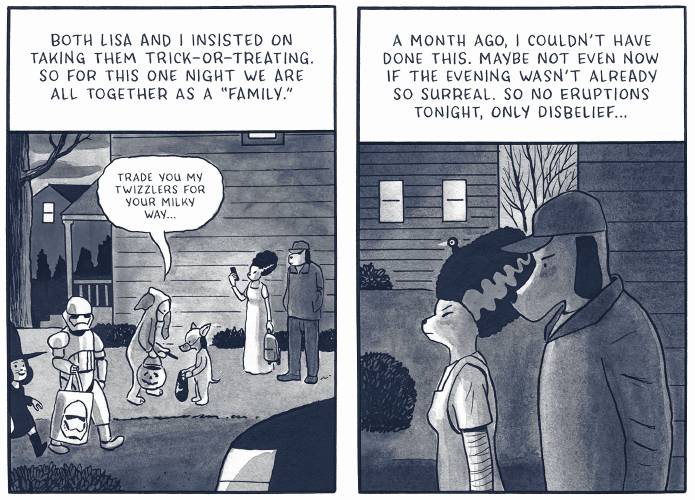
Off Season, the title of James Sturm’s latest comic, refers to New England in winter, as experienced on a trip that the main character, Mark, newly separated from his wife, Lisa, takes with their kids to Maine one blustery November weekend. It’s off season: most of the stores and restaurants are closed; the beach is freezing; the kids hungry and restive. The only place open is a 7-11. Walking past an art gallery, Mark remembers that he and Lisa bought a painting there in happier days. He was shocked, and pleased, to find himself becoming the kind of guy who buys art. But now he wonders if that decision was all Lisa’s. He imagines coming back to the seaside town in the summer, to find out what he really wants. Maybe he is a guy who buys art.

Not that he can afford any. Lisa has, as he sourly puts it, “the house, the rich parents, and plenty of time to volunteer for ol’ crooked Hillary” (he supported Bernie). Mark, a contractor who can fix anything, has had to sell his truck, which means that instead of being independent, he now works for a shady guy named Mick, a Bernie Bro with a BMW who does good work when he gets around to it, but gives Mark the runaround, writes bad checks, and eventually spreads lies about him. We don’t know enough about Mick to say for sure, he’s probably a shit all the time, but Mark’s hard time, at least, is an aberration from the life he thought he had been living.

imageedit_2_9783197801

Which brings us to the second meaning of Sturm’s title.  Not the off-season, but an off-season. A spell of bad luck and despair that can happen to anyone, anytime. And not just anyone: even countries can have off seasons. Mark’s trip with his kids to the shore doesn’t happen in any old November. It’s November 2016. Trump, seen only once in the book, haunts the book: his oleaginous, bullying, smug, thoughtless bluster seems at once a threat to some basic American decency and a confirmation that the very idea of decency was a fantasy, told by a few for a few. (We can’t just console ourselves by thinking that Trump and the selfishness and hatred he’s emboldened is an aberration.)

Sturm draws Trump as a piggy-faced dog–everyone in the book is a dog. Or a person-dog. Sturm’s choice nods to Art Spiegelman’s Maus, where the characters are humanoid animals, one for each ethnic or national group. The use of animals in place of people will always prompt questions of empathy and identification—and those are important questions to ask in a time when difference is even more demonized than usual. (Sturm alludes to the issue in a chapter showing how Mark and Lisa met: they worked backstage at a summer theater on the Cape, helping with a production of Orwell’s 1984 in which the actors wore masks: from off-screen, as it were, we hear the director and actors participating in a Q & A with the audience: “Using animals as human stand-ins is as old as storytelling…” one says; another asserts, “As an actor, it’s liberating to wear the mask.” Here Sturm at once acknowledges and ironizes what he’s up to.) But where Spiegelman’s conceit is tied to the world view of his father, a Holocaust survivor, Sturm’s feels less subjective. That is, the dogs don’t symbolize Mark’s views. It’s pretty amazing how much variety Sturm gets from his dog characters, and if I knew my breeds as well as my daughter does I could hazard some connections between how the characters look and what they’re like. But that would be to miss the point. The book isn’t schematic—most of these dogs aren’t pure breeds, I don’t think, they’re mutts.

4bfb08f6740d4aed852f9d596661cd9a

Off Season is unhappy about American politics. But it has nicer, and more nuanced, things to say about Americans. This comes up in its depiction of parenting, which might be its real subject. (Perhaps the idea is that Trump’s America is an unruly, even monstrous child, and good-enough—sympathetic but firm—parenting is what it needs.) The book is filled with parents trying to do their best, and mostly but of course not always succeeding. Mark and Lisa try hard not to take out their marital problems on their kids, though they sometimes fight through them. The best parent in the book is a minor character named Kirsten, the mother of a friend of Mark and Lisa’s son, and who, it is intimated, voted for Trump. In a memorable chapter, Mark and his daughter drive through a blizzard to pick the boy up from his friend’s house. The car spins off the road: they are unhurt but by the time they’ve trudged through the snow to the shelter of the house they’re cold and wet. Mark spends an enjoyable evening playing board games and eating chili with Kirsten and the various neighbourhood children who’ve gathered at her house, while he waits for her boyfriend to get home from work.

Barry gets Mark out of the ditch: when Mark thanks him, he replies, “Thank Jesus. He has our backs whether we know it or not.” That feels a little much (it’s not a totally implausible response, but in my experience people who think like this are usually more circumspect when first meeting someone—they will, however, say “Have a blessed day” to you all the time), but the point, maybe not subtle but also not wrong, is that we shouldn’t reduce people to their political convictions or opinions, shouldn’t be so quick to pigeon hole them. Maybe Mark is, after all, both a builder and an art lover. What would be so weird about that? (Or maybe the point is that we should consider the material and social conditions that allow people to live in cognitive dissonance: generous to individuals, even ones they don’t know, but hostile to groups. Or, maybe, hostile to individuals who don’t look like them.)

Apparently Sturm first published the book serially online in the wake of the 2016 election. But his concerns here aren’t only topical; he’s been thinking about them for a while. Sturm wrote one of my favourite comics, Market Day, set in the Pale of Settlement in the early 20th century, I. B. Singer, Sholem Aleichem territory, but shorn of anything folksy or sentimental. Its Yiddishkeit is as somber as Sturm’s palette—and as moving. I disagree with the Times reviewer who finds Off Season more vibrant than his earlier books because, unlike them, it’s set in the present. That’s a spurious distinction. It’s been several years since I read Market Day, so I may be misremembering, but both it and Off Season want us to think about how people—men, really: Sturm isn’t bad with women, but they are never center stage in his books—can make a living in economies that don’t value them. (Market Day is about a rug maker who can’t sell his work anymore; machine-made rugs cost a lot less.) In both books, the main characters respond to their precarity with violence, directed at others and at themselves. When Mark loses his cool, he doesn’t hurt anyone (at least not directly) but his response (he vandalizes the house he’s been building with Mitch) is disturbing. My criticism of Sturm is that he’s not sure what to make of violence. Is it an understandable, if regrettable, response to an intolerable situation? An intolerable response? Secretly exciting and laudable?

20100312bookssturm

Off Season ends in oblique, low-key optimism. Which is maybe the best we can hope for right now. It’s a beautiful, pensive, involving work: you can read it in an hour but you’ll want to linger longer. My only wish is that in his next book Sturm thought a little more about violence, frustration, anxiety, loathing, all kinds of bad affects. Are they what’s off this season? Or are they with us all the year long?

March 2019 in Review

March is a long time ago now, but I wanted to say a few words about my monthly reading. A better than average set.

D1LJGPEXgAA60s8

Yiyun Li – Where Reasons End (2019) Sad, funny, wise, painful. I quoted bits here.

Christopher R. Browning – Ordinary Men: Reserve Police Battalion 101 and the Final Solution in Poland (1992/98) This Holocaust scholar could have won plenty of rounds of Humiliation for not having read Browning’s classic microhistory of the actions of Order Police Battalion 101 near Lublin in 1942. Sometimes books you feel just have to have read disappoint. Not Ordinary Men, which remains as eye-opening now as then. (Browning has written a thoughtful essay for the 25th anniversary edition, bringing the latest research, especially concerning the photograph record of the unit, to bear on his original conclusions.)

The book begins with a sobering statistic: in March 1942, 70—80% of the eventual victims of the Holocaust were still alive, and 20—30% had been murdered; by February 1943, the proportions were reversed. 1942 was the darkest year in Jewish history; Browning examines one example of the men who perpetrated that darkness. The average age of the 500 men in the battalion was in the upper 30s, meaning that they had come of age before the Nazis came to power, and they were working- and lower middle class men from Hamburg, an area and the social classes famously antipathetic to National Socialism—facts which, taken together, suggest these men would have been among the least likely to be drawn to fascism. Yet they readily participated in mass executions, round-ups, and deportations.

Browning notes that 10—20% refused to partake in atrocities (and they had the benefit of a commander who actually asked before the first action if anyone wanted out—rather than a death sentence or a transfer to the front, these dissenters were moved into clerical positions or even sent back home); 20—30% participated avidly in atrocities; while the majority (50—70%), although reluctant, participated anyway. For the men in this last category, it was easier to follow along, and too unpleasant to risk the scorn of their more hateful colleagues. These are sobering numbers, with implications beyond Browning’s specific example. What makes us think we wouldn’t number among the majority in a similar scenario?

Leslie Morris, The Translated Jew: German Jewish Culture Outside the Margins (2018) I had a realization as I reviewed Morris’s book on the idea of translation in postwar German Jewish culture: academic monographs make me grumpy and I should stop writing about them. Thus, I’ve given up reviewing books for Choice, a publication designed to help libraries decide what to buy. (I wrote for them for 10 years.) Morris, whom I have not met even though the field we work in is small, probably deserves a more charitable reviewer. I did my best to point out the inspiring range of her material—ranging from a defunct Berlin sculpture park to Jewish body art to the poets Raymond Federman and Rose Ausländer. But her insistence, so typically academic, that we think, read, or engage “in new ways,” without explaining how or why, grated on me. As I concluded: “her description of Jewishness as an endlessly deferred cipher, at once spurring and spurning interpretation, is as unexceptional as it is unexceptionable.”

Andrea Camilleri – The Overnight Kidnapper (2015) Trans. Stephen Sartarelli (2019) Of course, the crime itself has vanished from my memory, but I recall the latest Montalbano as a decent effort. I didn’t want any surprises, and I didn’t get any.

Gengoroh Tagame – My Brother’s Husband [Volume 2] (2016) Trans. Anne Ishii (2018) I read Volume 1 last month; happy to say that the conclusion doesn’t disappoint. It plays a trick on us, but a fair one: leading us to believe in an impossible ending, then gently showing us why the all-too-possible one, however melancholy, is the right choice.

Ian Rankin – In a House of Lies (2018) The latest Rebus—once again improved, I suspect, by the audiobook’s excellent narrator—is one of the best in a while, featuring a rich set of storylines, plus better use of Brillo the dog (see my February complaint). The détente between Rebus and Edinburgh crime boss Big Ger Cafferty suggested in the previous installments is gone. This despite the fact that Rebus is coming to terms with a COPD diagnosis. Has anyone written about the pathos of ailing detectives?

H. F. Heard – A Taste for Honey (1941) I admit, I did not do this book justice. I read it on a Friday night when I was exhausted and should have gone to bed. But even in a better frame of mind, I think I would have found this tale of Holmes in retirement thin gruel. You better like Holmes a lot more than suspense if you’re going to enjoy it.

Virginie Despentes – Vernon Subutex I & II (both 2015) Trans. Frank Wynne (2017 & 2018) Not sure how long they’ll stay with me, but I liked these books a lot. I tried to articulate why—and the issue I take with the conclusion they seem to be coming to—here.

Mihail Sebastian – Women (1933) Trans. Philip Ó Ceallaigh (2019) More anon.

Solomon Perel – Europa, Europa (1990) Trans. Margot Bettauer Dembo (1997) Almost on a whim, I decided to teach Agnieska Holland’s adaptation of Perel’s extraordinary Holocaust memoir this semester. It went well—I’m finding the movie more interesting the longer I spend with it (always a good sign). The film is plenty unusual, but Perel’s memoir even more so. His story is stranger than fiction: after escaping the Nazi advance by fleeing east of the Bug river (the part of Poland annexed by the Soviet Union in the Hitler—Stalin pact) and finding refuge as a Komsomol in an orphanage in Grodno, the Jewish Perel passed himself off as an Ethnic German when the Nazis invaded the Soviet Union in 1941. (He had been born in Germany before moving to Poland with his parents as a child.) Perel found himself honoured for fighting at the Front and then shipped to a boarding school for elite members of the Hitler Youth, where he spent most of his time worrying someone would notice his circumcision. (Tonally, both book and film are crazy: sort of funny, sort of campy, sort of moving.) Remarkably, Perel survived the war surrounded by Nazi true believers, and at war’s end found himself reunited with his elder brother, the only other member of the family to survive. Perel’s story is even more unlikely than most survivor tales. What is most interesting is the way his cognitive dissonance features in odd switches between first and third person. At heart there seems something fundamentally incurious about Perel. An effect of his experiences? Or a predisposition towards surviving them?

Michelle McNamara — I’ll Be Gone in the Dark: One Woman’s Obsessive Search for the Golden State Killer (2018) I don’t read much True Crime. But I do read a ton of crime fiction. So, I naively assumed, when I started listening to McNamara’s acclaimed description of her pursuit of the serial rapist she named the Golden State Killer, that I knew what I was in for. Nope. I was shocked by how visceral, graphic, and uncomfortably voyeuristic this book—and, I suspect, its genre—turns out to be. It’s creepy as shit. To her credit, McNamara is aware of these difficulties, and doesn’t shy from highlighting her obsessive interest. Sadly, McNamara couldn’t finish her book: she died about three-quarters of the way through, and the finished version has been pieced together from notes. (The editors clearly describe when and how they’ve reconstructed.) Still, I did find the book repetitive and confusingly structured—perhaps a fitting response to the relentlessness of the crimes, dozens and dozens of them, perpetrated over a decade all over California. (If I had a better sense of California’s geography I might have had an easier time of it.) The tension between what we know—the killer was finally caught (in part thanks to McNamara’s efforts—and what she didn’t gives the book a macabre poignancy. Not for the faint of heart.

Lissa Evans — Their Finest Hour and a Half (2009) Read my take, if you like, but be sure to read this novel. There’s a dog that understands Yiddish!

David Bezmozgis — Immigrant City: Stories (2019) Bezmozgis is one of my favourites, the heir to Bernard Malamud. I snapped up his new collection on a recent weekend in Canada (why no US pub date?) and finished it before I was even home. I’m not sure Bezmozgis has ever written anything as rich as his first novel, The Free World (the great novel of the emigration of Soviet Jewry), but most of these stories are the equal of those in his terrific first collection, Natasha and Other Stories. Of course, some stories are stronger than others. “A New Gravestone for an Old Grave,” for example, is a bit travelogue-y. But “Immigrant City” breaks new ground for Bezmozgis (not sure the attempt to juxtapose earlier generations of Jewish immigrants to newer ones from Syria and Somalia completely works, but it’s thought provoking—I suspect it would hold up to rereading). And “Little Rooster” is a classic that is going straight onto the syllabus of my course on postwar representations of the Holocaust.

More before too long, I hope, about April reading, which is proving decidedly more unavailing.

Diversify your Delusions: Yiyun Li’s Where Reasons End

agnestheseaattate

A parent’s folly, I thought, is to want to give a child what she does not have. A parent has to be quixotic. The word reminded me what I had forgotten all these weeks, that on the day Nikolai had died, when I had not known it would happen, I had been listening to Don Quixote on a long drive. I had been laughing to myself in the car. I had laughed at times since then, but that laughter in the car—quixotic—would never be mine again. [Does the “she” in the first sentence refer to the child or the parent? The narrator mentions Nikolai, so the answer is probably the parent. But if so, why parent and not mother? I’m interested in the push and pull between specific and general here.]

***

Are some days more special than others, or are we giving them names and granting them meaning because days are indifferent, and we try to wrangle a little love out of them as we tend to do with uncaring people?

***

Where should I go from here?

Oh you know you’re doing fine.

I didn’t know it. I wasn’t feeling fine. I had but one delusion, which I held on to with all my willpower: We once gave Nikolai a life of flesh and blood; and I’m doing it over again, this time by words.

A good tactic is to diversify your delusions, he said. Don’t keep all your eggs in one basket kind of thing.

I couldn’t refrain from pointing out that he had used a cliché.

Whatever, he said.

Sorry, I said. Still, please enlighten me.

Oh, do what squirrels do. Dig a hole and store a handful of delusions there, and dig another one and store more. Some delusions are for today. Some are for tomorrow. Some take a few months to ripen. Keep them dry so they don’t get moldy. Keep them private so others don’t step on them by accident or dig them up and steal them. Be patient. Delayed gratification is the key to a successful life of delusions. And if you’re lucky, some delusions become self-seeded. Some even go wild like dandelions.

Are you making fun of me?

Indeed I am, he said. Nobody needs to be taught how to live under delusions. It’s like sleeping.

There is a condition called insomnia, I said.

malevich.black-red-square

Some representative passages from Yiyun Li’s Where Reasons End (2019).

The narrator, a writer and a teacher, conducts a series of conversations with her oldest son, who has recently killed himself. These are interspersed with meditations, as in the first two examples. Over and over the two of them return to language, playing with it, acting as guardians of it (the contest over cliché here, for example).

This is a very sad book, but wise and even sometimes joyful, though a joy always on the verge of despair. You can see it in the narrator’s claim that she is giving life to her lost child, once again, but this time in words. The book wants to believe in this beautiful sentiment, but it also recognizes it as fatuous: a delusion. (And what about that “we” in her sentence? What does her husband, the boy’s father, think? This is one of the only times the narrator mentions him.) And yet delusions might be good things to live under, especially if they disseminate, no matter how much an even brilliant teenager derides the idea. For delusions are connected, Li suggests, to imagination to thinking, to the life of the mind. And the mind—even or especially a mind in distress—can go off in all sorts of directions. Which might be a way to counter the terrible reality that time can only go in one.

Speaking of terrible reality, the book’s composure is even more striking when you find out that, like her narrator, Li had a teenage son who killed himself.

A couple of years ago I read one or two of Li’s early story collections. I found them uneven, sometimes exciting, sometimes too careful. She’s made the quite the leap in the intervening years, and I’ll be seeking out the books I missed.

February 2019 in Review

Short month, short books. Verdict: plenty of decent reading, some even better than that. Here’s what I read in February 2019.

C63BkZuU0AE8tQi

Gengoroh Tagame – My Brother’s Husband [Volume 1] (2014) Trans. Anne Ishii (2017) Gentle manga about Yaichi, a single parent raising a delightful, rambunctious daughter, Kana. Their lives are interrupted by the arrival of Yaichi’s brother-in-law, a white Canadian named Mike Flanagan, who visits Japan in the wake of his husband’s (Yaichi’s brother’s) death. Yaichi spares no effort to welcome Mike—aided by Kana’s joy in the sudden appearance of this unexpected uncle—but his not-so-latent homophobia keeps getting in the way. Lots of secrets, lots of emotion, but all handled lightly. I was engrossed and moved and have the sequel from the library ready to go. Plus, who doesn’t like a hunky Canadian hero?

Ken Krimstein – The Three Escapes of Hannah Arendt: A Tyranny of Truth (2018) I enjoyed this comic, which combines Arendt’s biography with her political philosophy. Maybe I found the experiment so compelling because I don’t really know my Heidegger. (I’ve been avoiding him since college; my undergraduate institution was regrettably besotted by the thinker of Being.) At least that’s how I felt after reading the TLS review, which called out Krimstein for his misleading summary of Arendt’s erstwhile lover’s philosophy. I agree that Krimstein rather hurried over Arendt’s report on the Eichmann trial, and maybe he does spend too much time offering potted biographies of the many intellectuals, artists, and otherwise famous people Arendt came across, but Three Escapes gave me a clearer sense of Arendt’s life, especially the years before the war, and made me thrill to the capacious generosity of her ideas. A book could do worse.

Hana Demetz – The House on Prague Street (1970) Trans. Hana Demetz (1980) Score another one for open stacks. While at the United States Holocaust Memorial Museum archive earlier this year, I was browsing the shelves when my eye was drawn to the cornflower blue spine of Demetz’s book, written in German and later translated into English by the author herself. Happily, my local library had a copy, which, I suspect, no one had checked out for years. Which is a shame: The House on Prague Street is really good. It tells the story of Helene Richter, who grows up in eastern Czechoslovakia in the 1930s but whose life revolves around the summers she spends in the small town in Bohemia where her maternal grandparents live in the house that gives the book its title.

Her mother’s Jewish family are successful industrialists, the classic success story of Austro-Hungarian emancipation. (The first pages might have come from a Joseph Roth novel.) Imagine their unhappiness when Helene’s mother marries a law clerk from a Sudeten German family. This makes Helenka, as she is affectionately known, half Jewish, which has important consequences for her after 1938. Unlike the rest of her mother’s family she is not deported to Theresienstadt or further east. Instead she comes of age in wartime Prague, where she experiences plenty of privations but nothing like those suffered by her mother. Imagine her mother’s anguish when Helenka falls in love with a German soldier, on leave for a few days from the eastern front. That Gerd seems to be a genuinely kind person, and no Nazi, does nothing to assuage the mother’s hurt. These scenes are riveting—the tone is different from, say, the bitterness of Ruth Kluger’s fights with her mother in her memoir Still Alive; Demetz’s bitterness is always mixed with sweetness—and only become more poignant in light of the traumas that descend upon the family.

The mother dies of a sudden illness because she cannot be taken to the Jewish hospital after curfew. Gerd is declared missing, presumed dead. The father survives the war, only to be murdered in a street fight between German sympathizers and communists in the weeks after armistice. At the end, Helene returns to her grandparents’ house, which has been taken over by Orthodox Jews returned from the death camps. They are suspicious and resentful of her; she respects their claim on the house, but has no respect for them, describing them as uncouth, even primitive. Not even genocide, we learn, will necessarily bring people together. Demetz offers no vision of Jewish solidarity. And why should she? After all, it was the perpetrators who defined the victims as much as or even more than the victims themselves.

The neatness of the book’s narrative structure—it ends with Helene on the station platform, awaiting the train back to Prague, standing under the same swaying begonias that so imprinted themselves on her mind as a child—reminds readers that The House on Prague Street is a novel, not a memoir. Yet it reads more like the latter than the former. It has the feeling of coming directly from the life of the author.  It’s not perfect, sometimes it strains a little for effect, but it’s captivating and moving. Some enterprising publisher ought to reissue it.

Anthony Horowitz – The House of Silk (2011) (Audiobook) Enjoyable Holmes novel, improved by Derek Jacobi’s peerless narration. It’s true, I did guess the ending (a subplot fooled me, though I also found it a bit silly), but the book’s real pleasure lies in its subtle characterization of Watson, nothing like the “sack stuffed with straw” so derided by Virginia Woolf. As always, Horowitz brings the stuff.

Hana Demetz – The Journey from Prague Street (1990) After so enjoying Demetz’s earlier novel I had to read its sequel, which sees Helene and her husband escape Czechoslovakia and build a life in America. Unfortunately, Journey isn’t a patch on its predecessor. Maybe the problem is that Demetz wrote it in English. But I think it’s more that the situations—infidelity, divorce, the trials of starting over in mid-life—are tired and their handling uninspired. Maybe Demetz only had one book in her. (I believe, actually, she wrote some others before House, but I don’t think they’ve been translated.)

Sarah Moss – Ghost Wall (2018) I’m writing about this for another outlet, so will only say: I liked it, sometimes quite a lot, but I wasn’t as crazy about it as so many people on Book Twitter seem to have been.

Liana Millu, Smoke over Birkenau (1947/1986) Trans. Sharon Lynne Schwartz (1991) Brilliant, evenhanded, non-judgmental and unsparing narrative memoir (what I mean is that Millu tells her experience in Birkenau through a series of stories about other inmates, stories that have the texture of fiction—not that their made up, but that their telling is literary). I’ve written about Smoke before. How good is it? Well, this is the fourth or fifth time in the last couple of years I’ve read it, and it gets better and better. I now know it well enough that I won’t have to read it from cover to cover each semester, but I’ll look forward to dipping into it.

Cay Rademacher, The Murderer in Ruins (2011) Trans. Peter Millar (2015) My high hopes for this mystery, set in the rubble of immediate postwar Hamburg, were dashed almost immediately. The writing is pedestrian, and the murderer pretty obvious. The use of the setting is good, and I learned what people did to survive the brutal winter of 1947. I’d have been better off reading a history, though. I believe it’s a first novel, and it might be that Rademacher improves (there are two sequels plus a whole other series), but I’m not inclined to give him a chance. (Especially since I got the book from the UK.) No Philip Kerr, let me tell you.

Laurie R. King, O Jerusalem (1999) My third audiobook of the semester was the fifth in the Holmes/Mary Russell series. It looks back to the first book, The Beekeeper’s Apprentice (still the best so far), and expands upon an interlude referred to there in which the leads find themselves in Mandate Palestine. I’m really interested in that time and place, and I enjoyed learning about General Allenby, who seems to have been quite a character, but this book is much too long and much too dull. King hasn’t lost me entirely, Russell is still a good character, and I’ll continue with the series, but plan to take a break for a while.

Katherena Vermette, The Break (2016) Not only the book of the month, but the book of the year so far, and one of the best I’ve read in a long time. I want to write a proper post about it, so for now will just say that it’s about an indigenous family in Winnipeg, specifically its female members, and their response to the countless aggressions (micro and macro) they endure. (The Break is a strip of land, a hydro corridor, in the city’s North End). The highest praise I can give books is that I still remember them weeks later, and The Break passes that test easily.

Lauren Wilkinson – American Spy (2018) Wilkinson’s debut novel, conversely, does not. I enjoyed it as I was reading it, and I found its central conceit—that African Americans are like spies in enemy country, nicely formulated in an epigraph from Ellison’s Invisible Man—fascinating and timely. Marie Mitchell is an African American woman in the FBI in the late 1980s. She ends up working for the CIA in the then-newly renamed Burkina Faso on a mission to ingratiate herself with its charismatic President, Thomas Sankara. Until reading this novel I was completely ignorant of Sankara’s revolutionary Marxist and anti-imperialist program, which seems to have transformed life for the country’s poor. In the novel—and I suspect in life—the CIA wanted him gone; when Marie is sent on a mission of the kind she has always wanted she is forced to reconcile her love of the work with her feelings that the country she is working for isn’t really her own.

The sections in Africa are nicely handled: the book never feels like a travelogue. Yet even though I was impressed by what Wilkinson was trying to do I didn’t feel she quite pulled it off. There are two reasons for that: one, she’s trying to do too much, and, two, she doesn’t do the genre justice. In addition to everything I’ve mentioned the book also tells a family story, involving Marie’s divorced parents (one a cop and one, it turns out, a former spy) and her sister, who had tried to forge a path into intelligence work and couldn’t. Wilkinson ties this together with the political story, but it’s too much. As Wilkinson admits in this interview, she isn’t that well versed in spy fiction. I appreciate her efforts to queer/diversify the genre—it needs it!—but I want that effort to be accompanied by a better sense of suspense, pacing, etc.  For me, a fascinating misfire.

Primo Levi – The Reawakening (1963) Trans. Stuart Woolf (1965) (The proper title is The Truce.) Although I have taught a short excerpt from this for years in my Holocaust Lit class, I’d never read the whole thing. I read it with some students, and their appreciation of it increased my own. It’s a picaresque, describing the eleven months it took Levi to return to his home in Turin from Auschwitz-Birkenau. We enjoyed comparing The Reawakening to the much more famous Survival in Auschwitz (a.k.a. If This is a Man: Levi’s American publishers didn’t do him any favours). The sequel is markedly different in style, tone, and structure. It is ordered chronologically, for one thing, unlike its much more essayistic predecessor. “Picaresque” is misleading: it suggests scrapes and hijinks and ne’er-do-wells (all of which feature here), when in fact the book contains at least as much that is somber as triumphant. But it’s a book about coming back to life: hard, painful, but ultimately affirming. Levi is sometimes even funny, especially in his appreciation for Soviet organization, or lack thereof. At one point, describing a Soviet DP camp, he says something like (I don’t have the book in front of me), “There was no organization, but we got fed every day. It was a perfect system.” At moments like this, my students and I were reminded of the well-known encounter between Levi and a man named Steinlauf in Survival in Auschwitz. Steinlauf, a WWI veteran, perseveres even in the Lager he with a diligent regime of personal cleanliness, even though in those conditions hygiene was impossible. The point, he explains to Levi, urging him to wash in the ice-cold dirty water provided the prisoners, is to maintain one’s self as a human. Levi sees the man’s point, but he admits himself incapable of following another man’s system. This is the Levi we see in The Reawakening, a man who is finally free yet not forced to navigate the chaotic, ramshackle, uncoordinated but ultimately inescapable Allied bureaucracy.

Although short, The Reawakening is full to bursting with vivid characters and outlandish scenarios. Through a series of misadventures, Levi and the handful of Italian deportees who survived with him are sent east, through the Ukraine and almost up to Minsk, before making their way back down through Romania, Hungary, Austria, even Munich (where Levi refuses to leave the train station) and finally home to Italy. Maybe the thing that made the biggest impression on my students was how fraught the immediate months after the war were. We tend to think that liberation brought a return to normal life; Levi makes it clear, however, that this concept didn’t survive the war.

Looking back, February’s highlights were The House on Prague Street, The Reawakening and, above all, The Break. Anyone read them?


“Peddle your philanthropic bullshit to someone else”: Luce D’Eramo’s Deviation

As Hannah Arendt tells it, Adolf Eichmann, on trial in Jerusalem for his role in organizing the Final Solution, was given a copy of Lolita by one of his jailers. The gift did not go over well. Two days later, Eichmann, “visibly indignant,” returned it, unfinished. His verdict? “‘Quite an unwholesome book’—‘ Das ist aber ein sehr unerfreuliches Buch.”

I’m baffled by this story. What motivated the Israeli official? Was he making a joke? Setting a test? Teaching a lesson? (Lolita is framed as a jailhouse confession, after all.) Why did Eichmann reject the book? Did he take Humbert Humbert’s tale at face value—that is, did he fail to see the book’s critique of pedophilia? Or on the contrary did he see his own evasions in the narrator’s? Was he rejecting the joke, test or lesson? Above all, why “unwholesome”? (Unerfreulich can also mean unpleasant.)

Arendt offers no explanation for her inclusion of the anecdote. (It’s literally a parenthesis.) But she places it in a discussion of what she calls Eichmann’s aphasia—his inability to wield language without resorting to cliché. The man himself apologized for his inarticulateness to the court, saying that his only language was Amtsprache, bureaucratese. According to Arendt, anyway, Eichmann had no critical faculties. He saw the world through ready-made phrases and shopworn ideas. No wonder wholesomeness was his recourse. He knew what he liked because he liked what he knew.

But maybe in this case he was on to something. Lolita is disreputable. It relishes that designation, of course, asking us to decide what we mean when we reject something as immoral. The point of that challenge isn’t to expand what counts as acceptable behavior but to make us realize how easily we accept, even condone abuse. The novel’s glittering language—the fancy prose style Humbert warns us about in its first pages—only exacerbates the sordidness of its subject matter, so that even our pity and horror for what happens to twelve-year-old Dolores Haze comes to seem tainted by having to be earned from reading against the grain.

I thought about Eichmann and Lolita as I wondered how to respond to Luce D’Eramo’s Deviation (1979), certainly the most unpleasant and maybe the most unwholesome book I’ve read in a long time.

italianfuturistsexibition

It’s all the publisher’s fault. When I read the promotional copy—which also appears on the dust jacket—describing Deviation as “a seminal work in Holocaust literature” I was immediately intrigued. (“Seminal” should have tipped me off—I thought we retired that word.) I even managed to convince Scott—who knows Italian literature much better than I do—to read it with me. (Sorry, Scott!)

But Deviation is not about the Holocaust. About fascism, yes, about forced labour camps, definitely, about the relationship between industry and Nazi expansionism, quite interestingly, and about moral equivocation most definitely. But not about the Holocaust, and to suggest this is, frankly, disgusting and disrespectful.

The publisher’s bait and switch has certainly coloured my view of the book, but even without that aggravation I think I’d be hard-pressed to know what to make of Deviation. I’ll let D’Eramo—in the guise of her narrator, basically a version of D’Eramo herself—explain what the book is about. Lucia, like her author born and partially raised in France before returning to Italy as a teenager, is an ardent Fascist. With the establishment of the Republic of Salò in September 1943 and the rise of partisan resistance to fascism, believers like Lucia were left “feeling as though their earlier ideals were crimes” (they were!). Eighteen-year-old Lucia comes to a decision:

I realized that the only way to learn the truth for myself about Fascists and anti-Fascists—many said that they could no longer figure it out [note the resemblance to Trump’s pet expression “People are saying”]—was to ascertain it firsthand. Understanding this, I had to go to the places about which the most outrageous stories were told: the Nazi concentration camps. That’s why I ran away from home on February 8, 1944, and went to Germany as a simple volunteer worker, with pictures of Mussolini and Hitler in my backpack, sure about what I was doing. But after spending a few months in a labor camp near Frankfurt am Main, my comrades organized a strike at the factory, the IG Farben, where I worked in the Ch 89, the chemical division. As a result, I was jailed, then later transferred and detained in Dachau. In order to survive, I escaped from there in October, and for a couple of months I remained hidden in Munich. Then I left, following the death of the friends who were helping me … I headed back to my first Lager [the IG Farben camp at Frankfurt-Höchst], travelling partway by train without a ticket, crouched in the toilets of the cars, partway on foot, spending the night in bomb shelters, in abandoned cattle cars, in foreigners’ barracks … in mid-February [1945] I arrived in Mainz.

Basically, the book is about Lucia’s attempt to come to terms with the evasions and lies in this story. What she first tells us is that on December 4, 1945 she finally returned to Italy, and did so as a paraplegic, her legs having been paralyzed when a wall fell on her as she was helping to dig survivors out of the rubble of a bombed-out building. But this first return was in fact her second.

It’s true, Lucia was involved in the brief and ultimately unsuccessful strike led by both volunteer and forced labourers at the IG Farben camp. And it’s also true that she was arrested. But after a failed suicide attempt—she took rat poison, and only survived because she took too much too quickly, and vomited it up: a nice metaphor for her life, where excess always turns in her favour—she was repatriated by the Italian consul and sent back to Italy.

As far as Lucia is concerned, the only good thing about this outrageous bit of good fortune is that her father, a bigshot in Fascist Italy whom she hates, had nothing to do with it. In fact, he refused to pull any strings for her. But in Verona, waiting for the train that will take her to Como, and home, she rebels. (That’s not the right word. She does something remarkably stupid.) She throws away her papers and arranges to get arrested by some SS men taking a convoy of political prisoners to the station. In this way, she is sent to Dachau, from which she eventually escapes after she volunteers to be part of the shit commando—a work detail sent around Munich to unclog sewage pipes (there are some memorable descriptions of this work in the book’s first pages). When the work detail is caught in an air raid, she slips off into the pandemonium, eventually ending up at a makeshift transit camp for displaced foreigners located in an old brewery. And from there she makes her way, in the manner described in the long quote above, to IG Farben and later to Mainz, where she has her accident.

woman-at-the-café-antonio-donghi-680x937

The novel—it’s really autofiction avant la lettre—was written over a period of about 25 years, and its distinct sections are dated to show us this progress. D’Eramo usually tells the story in first person, but sometimes switches to third person, suggesting, as translator Anne Milano Appel suggests in her introduction, how foreign to D’Eramo that person now seems to her. (I’m using author and narrator interchangeably in a way I normally never would, but D’Eramo invites the equivalence.)

In the second half of the book, D’Eramo asks why she repressed the memory of returning voluntarily to Germany. But what she presents as an attempt at self-understanding reads as delusory exculpation. Even her big theory about Nazism and its camp system (she regularly distinguishes between Fascism, by which she means Italian Fascism, and Nazism; this distinction is her most interesting idea) fails to make us think better of her. In D’Eramo’s view, the camp system was a form of class warfare, in which only the working classes were made to suffer. Her evidence is that she never met any rich people in her various forms of voluntary incarceration. (Leading her to offer an anti-Semitic canard about Jewish wealth: “The big financiers, the truly wealthy were sheltered abroad.” Bollocks.)

Here and indeed everywhere in the book, D’Eramo comes across as a terrible person, describing “defenseless masses [that] huddle like sheep,” remembering concentration camp inmates as “a swarm of horrible, wonderful insects” (what the hell is “wonderful” translating here?), and criticizing an old woman’s desperate grief at the realization of her impending death as “a kind of greediness that was more irritating than moving.”  She is revolted by the coarseness of her fellow inmates, repulsed by their way of eating, and eventually driven to exclaim, “I despise victims.”

Readers will surely agree with Martine, one of the narrator’s co-conspirators in fomenting the IG Farben strike, who sees through D’Eramo’s political awakening: “So shut your mouth and peddle your philanthropic bullshit to someone else. Why do you try to excuse yourself? You are who you are.” Specifically, she’s someone who, Martine adds, wants the privileges of being a fascist student in the camp (better food and living conditions) without any of the drawbacks (D’Eramo is hurt that others hate her so much).

The most generous reading of Deviance I can muster is that at least D’Eramo is honest enough to show herself in a bad light. But that honesty feels so self-serving. She’s proud of it, like the student who thinks that his honesty in admitting he hasn’t done the reading for class is enough for him to be excused from any consequences. After all, at least he hasn’t tried to bullshit the instructor. But the fact is he’s merely swallowed his own bullshit. So too D’Eramo, whose great struggle in life—the thing she wrestles with for decades—is the lie she tells anyone who will listen, mostly herself, that she was sent to Dachau for her part in organizing the IG Farben strike, when in fact she chose to be sent there. Finally acknowledging that lie, she seems to think, is a courageous thing to do. (Amazingly, she never refers to her real courage, which consists of living with constant pain from her injury, and refusing to use her disability as an excuse for not doing what she wants to do—having a child, writing her books, etc. Except maybe that doesn’t take courage, just determination.)

Admittedly, D’Eramo does wrestle with the hold that the concept of willpower has over her—she sees this as a legacy of her upbringing and she believes more than anything in the need to overcome the prejudices of her bourgeois milieu. Not because she regrets her commitment to fascism. Nor even because she sees the terrible ends to which a belief in willpower can be put (demonizing anyone unlucky in any way or lacking the advantages of her class position as weak and second-rate). Only, as far as I can tell, because she hates her family so much.  And even that rejection relies on the attributes of her middle-class childhood: she wills herself to overcome the idea of willpower. This is akin to the fetishization of toughness that the philosopher Theodor Adorno called one of the most damaging attributes of the fascist mindset. Even if D’Eramo regrets her past beliefs (and I’m not clear she ever does), she maintains the very attitudes that undergirded that belief.

One of the prisoners in the train taking her to Dachau, a partisan (that is, someone brave enough to resist the regime), tells her, after he finds out how D’Eramo came to be in the freight car with the rest of them, “The performance is over. You can go home.” As much as I sympathize with the man, he’s wrong. D’Eramo’s performance, aimed at much at herself as us, is never over, even when she later acknowledges her own act. Because in the end the acknowledgement is the performance.

And I don’t know what we’re supposed to make of that performance. When she calls herself “an inveterately elite worm,” should we applaud her self-awareness? When she describes how she failed in turning what she thinks could have been the most socially aware moment of her life (choosing to be sent to Dachau) into a mere moral act, adding that, even if she can be excused for what she did at the time, given her youth, her upbringing, etc., can she be excused now, are we supposed to admire the question?

No way. After all, she never gets beyond asking it. D’Eramo regularly points out her mistakes—yet she keeps making them. She offers what she knows is a false analogy between her own experience in the hospital after her accident, waiting for the paperwork to come through so she can leave Germany, to the travails of deportees in the cattle cars. But saying it’s a shitty analogy doesn’t make it less shitty.

Nor is she winning me over when, writing in the mid 1970s, she explains that she “agonized retroactively for the children of the Osten [Slavic prisoners of war, both military and civilian, mostly Russian, whom she encountered in the IG Farben camp] and Jews whom I could see clustered behind the barbed wire when I skirted the transit camps in search of shelter, and who, in my distorted memory, stared at me with the dark eyes of my son.” Thanks for nothing, lady. It’s almost as bad as the anti-Semitism and historical inaccuracy in her description of a gold necklace she continues to wear for decades after the war, which she “snatched from a body, like the Jewish Sonderkommando [the prisoners forced to operate the crematoria] did at Auschwitz.”

lucederamo

Really, the only thing that didn’t make my gorge rise while reading Deviation is D’Eramo’s use of scabrous details: she tells us of men aroused in the disinfection shower; of the chest burns she suffers when she’s assigned to carry blocks of sulfuric acid in the IG Farben camp, as punishment for demanding equal food for Eastern and Western prisoners; of the aftermath of her injury, when her buttock splits open, “emitting copious putrid matter with an unbearable stench”; and of a nurse in the hospital where recovers from that injury who, receiving a letter from a man asking for money to start up a toilet paper factory, since it is sure to be in short supply in post-war Germany, uses the letter to wipe herself.

These details are the only things in this book that don’t stink. They’re gross, but honestly so. They’re not bullshit. The unwholesomeness of the book lies in D’Eramo’s mental gymnastics not her bodily suffering. Adolf Eichmann was wrong about Lolita: the unpleasantness of its events is not something readers are invited to pat themselves on the back for navigating. But his judgment wouldn’t be inappropriate for Deviation. Who do I give my copy back to?


Hiding in Poland: Two Holocaust Texts

Dry Tears: The Story of a Lost Childhood, Nechama Tec (1982, revised 1984)

The Journey, Ida Fink, Translated by Joanna Weschler and Francine Prose (1990)

Here we have two books about Jews living in hiding during WWII. Dry Tears is a memoir; The Journey is a novel, yet one based on its author’s experiences. I read them back to back, which people who don’t feel compelled to study the Holocaust probably shouldn’t do. But both are well worth reading, especially if you believe Holocaust survivor stories must include cattle cars, barbed wire fences, and concentration camps.

Tec was born in 1931 in Lublin to Roman Bawnik and Esther (Hachamoff) Bawnik. Her father—maybe the most important person in her life—had been groomed to become a rabbi, but suddenly broke with religion around the time he turned 14, around the same time he was orphaned. A period of hard years followed; eventually he found work in a candle factory, where he began, rather audaciously, given their class and religious differences, to court the owner’s daughter. Tec’s mother was from an Orthodox family and they looked askance at Bawnik, but he had excellent business sense, and it wasn’t long before he was running a factory himself. His shrewdness, tact, and measured approach to situations helped the family many times over during the war.

Tec begins her memoir with the invasion of Poland in September 1939. Rather than military defeats and political upheavals, however, she focuses on education. With the beginning of the war, school was interrupted, never to be resumed for Jewish children. The family engages a tutor for Tec and her older sister, a young woman named Hela Trachtenberg, who they nickname Czuczka (“piglet”) because they love her so. Czuczka engages Tec’s interest and sparks in her a desire to learn, if only because she dotes on her tutor. Tec, who became a sociologist and academic in America after the war, clearly spent a lifetime learning. Yet Dry Tears, like most Holocaust stories, details an unusual, perhaps more pragmatic but certainly more drastic education; once the Jews of Lublin and the surrounding areas are forced into a ghetto, the formal education stops. Tec will learn many things over the course of the book, but they will be of the order of how to lose herself in another identity, how to sell on the black market, and how to ingratiate herself with people who are taking a risk in hiding her and could turn on her at any moment.

lublinpoland

Lublin, 1940

Where Dry Tears is unusual in the corpus of Holocaust memoirs is in describing life before the war. We don’t see these in the canonical texts by Levi, Millu, Wiesel, etc., which either begin with deportation or imprisonment. This difference might be because Tec’s reminiscences came later than those others (it was first published in 1982 and then reissued with a new epilogue in 1984). But the more important reason is that the ruptures in Tec’s life weren’t quite as drastic as the ones experienced by those other survivors. Amazingly, everyone in her immediate family survived the war.

Don’t get me wrong, though: Tec suffers plenty of trauma. Like any book about the Holocaust, Dry Tears is full of terrible, indelible images, ones that Tec assures us she has spent a lifetime haunted by. Some of these are terribly poignant, like this early scene, when the family is hiding in their factory, and Tec finds a hole in the wall separating their hideout from the convent school next door:

I found a small opening in the wall from which, unobserved, I could watch the girls at play. To me they seemed so content, so carefree, and I envied them their fun. Did they know that a war was on? At times, as I watched them, I too became engrossed in their games and almost forgot about the war. But the bell that called them back to class called me back to reality, and at such moments I became more acutely aware of my loneliness. These small excursions made me feel, in the end, more miserable than ever.

Here we have in miniature the tension that will structure Tec’s life for the next several years. Her ability to become engrossed in the lives of others will help her when she needs to become someone else. But such loss of awareness carries risks, not least the threat of losing one’s self. Or of becoming careless—though of course her identification with others can never be fully complete; she is never just a Pole. The bell doesn’t toll for her. She is always marked by difference, yet her life depends on not showing it.

Other images are more violent. Tec hears about the children of her father’s business partner, forced to cut their father’s body into pieces in order to smuggle it out of their hiding place, when the man takes a cyanide pill in the mistaken belief the Nazis are at the door. Even more viscerally, a family friend describes the death of Czuczka, murdered in a raid:

she was lying on the ground beside the house in which she had been hiding, her hair disarrayed, her glasses missing, and without eyes. The birds had attended to her body. The picture he drew was vivid and merciless. We were spared no details.

Don’t forget, Tec is 11 years old. How merciless that verb “attended,” which only reminds us of the attention she and millions of other victims didn’t get—the ritual observances that ought to have attended their bodies in the hours after death.

Maybe most terrible of all, for me at least, is the description of the partial liquidation of the Lublin ghetto in summer 1942. Tec’s mother rouses her in the middle of the night and as they make their way to a new hiding place, Tec sees baby carriages in the almost abandoned streets. But the carriages aren’t empty: “There was no place for them [the babies]. No one would allow them in to hiding for fear they would cry and lead to the discovery of others.” The next day, Tec looks into one of the carriages and sees “an unrecognizable bloody mass, that seemed strangely alive.”

The family realizes they cannot continue to hide in the factory. From summer 1942 they leave Lublin—the girls to a village called Otwock, and the parents to the city of Kielce. The girls can pass as Poles because of their looks and their fluency in Polish. The parents, whose Polish is heavy accented (their language is Yiddish), cannot be in the open.

Tec takes on new identity: her name is Christina, nicknamed Krysia, and like all Poles she is Catholic. She must learn to think of herself as Krysia, even with her family. The girls study up on Catholic ritual. Most importantly, they learn to behave like a Christian, which means, Tec tells us, to move with assurance. In hiding, her father explains, they no longer have the luxury of being afraid. They must be cautious, but they must be assured. No easy task for a young child, especially since her parents are unable to leave the house which puts a huge amount of responsibility on her. After several months in which the family is separated, the girls are able to join their parents in Kielce, where a family named Homar has taken them in, in exchange for which risk the Bawniks will pay the rent and all the food. Tec becomes entwined with the Homars and their extended family, as she is sent out first to work the black market and later to sell the rolls her mother makes in their hidden annex. (Her sister has a good but risky job in the canteen of a club for German officers.)

Time and again, Tec is faced with the anti-Semitism of her hosts, which is general rather than personal (“Don’t be a nosy Jew,” “Don’t be clumsy like a Jew,” they tell her, responding to her hurt looks by assuring her, “You are not really Jewish.”) Her father explains that this cognitive dissonance is useful, even essential for the family: were the Homars to realize they really were sheltering Jews they would likely be unwilling to continue taking the risk.

The Homars can live blissfully in contradiction, but Tec can’t. The most fascinating parts are the discussions of the psychological toll of living openly in hiding:

An extra layer of secretiveness, combined with a fear of discovery, became part of my being. All my life revolved around hiding; hiding thoughts, hiding feelings, hiding my activities, hiding information.

Everything has to be held in—when the girls are finally on the way to being reunited with their parents, her sister orders Tec: “Cry quietly!” Ideally these tears would be as invisible as the dry ones named in the book’s title. But dry tears aren’t the same as no tears. Complete repression is impossible—and undesirable.

Sometimes it almost seems to work, though:

And eventually I grew oddly accustomed to anti-Semitic remarks. A slow transformation was taking place in me. It was as if in certain circumstances I lost track of who I really was and began to see myself as a Pole. I became a double person, one private and one public. When I was away from my family I became so engrossed in my public self that I did not have to act the part; I actually felt like the person I was supposed to be. … I never talked about these changes to anyone. I was not proud of them. I felt guilty and embarrassed. I felt like a traitor. It was as if, as I gave up my old self, I was giving up my family as well.

There’s that word again, “engrossed,” the same one she used in describing the experience of watching the convent girls. But this is no war-time Stockholm syndrome. It’s more complicated. Tec needs to become a part of the Homars. And she even enjoys it. But she also doesn’t want to, and even recoils from them. That distance becomes complete when, at the end of the war, when everyone has to hide as low from the conquering Russians soldiers as they have from the Germans, the Homars ask them to leave, and moreover not to tell anyone that they hid a Jewish family for almost three years. Not out of modesty, but out of fear and shame. The Homars are worried what their neighbours and friends would say.

No wonder, then, when, in the last pages of the book, Tec returns to Lublin, pressed in the back of a military truck, she refuses to look, afraid that what she sees would confirm her sense that she no longer belongs there. The last sentence reads, “I closed my eyes instead.”

That liberation isn’t liberatory is a common conclusion in Holocaust texts. In the epilogue added two years later, Tec shows that her teenage self was right. Home wasn’t home any more. The family realized they would have to leave Poland and set off on another dangerous journey, this time into defeated Germany in order to reach the American sector. The details of that trip, and what happened after, remain untold. Even happy Holocaust stories are shattered, governed by silence, evasion, and elision.

Fragmentation is even more apparent in Ida Fink’s The Journey. I’ve written about Fink before. If you’ve never read her, start with her two volumes of short stories, especially A Scrap of Time. Fink has been called the Chekhov of the Holocaust, which sounds like a terrible, nonsensical description, but is actually quite apt. She has his mixture of poignancy and acidity, and she works so well with a short form. (She’s actually much more of a miniaturist than Chekhov, many of whose stories are really long. I doubt Fink ever wrote one more than 20 pages, and most are well under ten.) When I teach her stories, as I regularly do, I follow the scholar Sara Horowitz’s suggestion that Fink is perhaps the most brilliant writer of the Holocaust when it comes to showing what literature can do that history cannot. She plays with the order of events, mimicking how hard it is to narrate a traumatic experience, and she jumps from one perspective to another, allowing us to see what individual characters cannot, even to tell us the experiences of those who were murdered.

Because I love Fink’s stories so much, I came to The Journey with high expectations. It tells, as is to be expected, an extraordinary story. (All stories of survival are extraordinary. There were not supposed to be any such stories.) And I was fascinated by it as a guide to what Fink went through in the war. (I don’t know exactly how autobiographical it is, but it is always presented as such. Details about Fink’s life are hard to come by. That mystery, plus the fact that she was a very late starter as a writer, which I always find endearing, exert a strong pull on me. If I had any Polish, I would drop everything and write her biography.)

But I also found it a difficult book. Fink’s stories are, not warm exactly, that would be crazy, but poignant and pathos-laden, in the best possible sense. I am so moved by them. The Journey, by contrast, is distant, as if guided by the unconscious decision taken by the narrator and her sister (like Tec and her sister they are teenagers, but a few years older) not to let themselves be emotional with each other:

I said “Lie down, try to sleep. And don’t start bawling like an idiot,” I added, even though she wasn’t crying at all; she just had a pained expression on her face. And that’s how it would be between us from now on: no gestures of tenderness. The more we needed to be tender to each other, the colder and more distant we were.

Unlike Tec, the narrator uses her false papers to leave Poland, by joining a convoy of Ostarbeiter, Workers from the East, basically slave labourers used by the Germans to prop up the war effort, both in factories or on farms. What follows is a journey through Germany in wartime, not the crazed Germany of the Nuremberg rallies nor the bombed-out Germany of the end of the war, but rather a rural, almost bucolic, but poor, hardscrabble, and suspicious Germany. At every turn the girls (and the others they encounter who are like them) fear being taken for Jews. Perhaps because they experience that fear—that is, perhaps because they can’t follow the advice of Roman Bawnik—they are continually found out, sometimes by people sympathetic to them, but more often not. It is a life on the run, and it is always very, very dangerous, even though it is mostly characterized by boredom and backbreaking work.

IG-Farbenwerke Auschwitz

Ostarbeiterin

The narrator never really knows where she is—we have references to the Ruhr and the Rhine, but nothing concrete, nothing like the certainty Tec has about at least her geographic, if not her emotional whereabouts—and she starts losing her sense of who she is. Unlike in Tec’s book (and here we see the difference in genre playing a role), the narrator doesn’t reflect on how this loss makes her feel. Instead Fink makes us feel that confusion, by calling the character sometimes by her real name but sometimes by her (shifting) aliases. Even more complicatedly, Fink mostly narrates in first person but sometimes switches to third, so our perspective on events is also undermined. I’m pretty good at following complicated texts, but I often lost track of who was who in this novel. And it’s not like it has a thousand characters.

The Journey, in other words, is a confusing book, but, again, this confusion is performative, offering us some semblance of the characters’ experiences. The paradox here is that even though the narrator must inhabit her new identity as fully as possible, she is never in Tec’s situation. She can’t ever really pass. Despite her Aryan looks, remarked on by almost everyone she meets, people sense her Jewishness, which is ineradicable in a way Tec’s doesn’t seem to be. And even more than Tec, Fink emphasizes luck, especially in a climactic scene when she on the point of being sold out to the Gestapo when a chance, banal occurrence intervenes and saves her life. Like Tec’s memoir, Fink’s novel ends with an epilogue, in which the narrator returns to the scene of that moment, only to find it as impossible, as meaningless as the first time.

If I could put it this way, I would say that Dry Tears is realist and The Journey modernist. But a realist Holocaust text is a contradiction in terms. Still, Tec’s memoir was a lot easier to get a handle on than Fink’s novel. I suspect if I read The Journey again I’d get more out of it, but I can’t imagine teaching it. Much too hard. Dry Tears, on the other hand, would probably teach well, and I’m thinking of adding it to my class. (Though then I’ll need to figure out what to cut to make room…) Taken together, though, these texts, no matter how difficult and desperate, expanded my understanding of what happened in those terrible years, and how writers have found ways to describe them.

Ripeness is All:Sofka Zinovieff’s Putney

The Putney of the title of Sofka Zinovieff’s novel is a district in southwest London where, in the late 1970s, the Greenslay family live in a grand but ramshackle house. Edmund, the father, is a successful novelist. Ellie, the mother (short for Eleftheria), is a political activist, keen on reclaiming her Greek homeland from the generals who rule it; occasionally she takes time out from her cause to provide excellent food and gnomic advice to her children and the various other friends and hangers-on who shuffle through the house. The children are Theo, who plays almost no role in the novel, as if to symbolize the possibility that someone could escape their past, and Daphne, who is nine when the novel opens but a teenager during its most important years.

b913342e01dc1843af0c3a83cca177cc

If Daphne is modelled on her mythical counterpart, then Apollo must be Ralph Boyd, a composer who first comes to the house to work on a project with her father (he is writing the score for a theatrical version of one of Edward’s novels). The relationship between the two men is fruitful, the production a success, the composer (then aged 30 with a wife—herself Greek—and a young child) installed as a friend of the household.

Another book might have focused on the collaboration between the two men, but artistic creativity, though omnipresent (Daphne later becomes an artist herself, sewing intricate fabric collages based on her life experiences), is always in the background. Instead Putney is about desire: the moment Ralph sets eyes on Daphne he wants her, even though at first he doesn’t know if she is a boy or a girl. “A sprite,” he concludes, relishing the fantastic, even mythological qualities of that designation. Then he gets a closer look:

She was dressed in ripped shorts and a striped T-shirt and wore no shoes. Ralph took in the grubby feet, the burnished skin that must have recently seen more than English sunshine, the muscular limbs and unbrushed, almost black hair. Teasing, moving like mercury, she knew how to disappear before you could get a grip. She laughed, skipped and slithered past them [Ralph and her father], through the front door that was still ajar and out along the garden path to the road. Without turning, she flicked one of her hands as if dismissing both men.

His intestines juddered. Then, bewilderingly and somewhat shockingly, the beginning of a hard-on. He squatted down to the floor and opened up the backpack to gain time and distract Edmund, who was gazing after his daughter and laughing.

“Daphne’s a free spirit. As you can see.”

Ralph smiled, trying to disguise his turmoil … Ralph had never been attracted to children, or at least not since school. He had not ogled young girls or prowled in parks. This was something different from anything he he’d known. Beautiful and pure and powerful. The beginnings of love.

This cataclysm is immediately compared to the more ordinary coup de foudre that comprises the story of how Edward and Ellie met: here, and throughout the novel, inappropriate feelings and experiences are set against appropriate ones; the juxtaposition serves a dual function—what’s appropriate both hides and highlights what’s inappropriate. This play of hiding and revealing is a bit like the use of free-indirect discourse. We might mistake a sentence like this one from the middle of the passage—“Teasing, moving like mercury, she knew how to disappear before you could get a grip”—as omniscient, but on closer examination we see that the sentiment must be Ralph’s (that “you” is his way of trying to generalize his response—he is the one who needs to get a grip). Although sexual desire is present in his first response to Daphne, for several years their relationship is odd, unsettling, intense, but not fully or clearly wrong. That changes when he begins sleeping with her when she turns 13.

The distinction between what is acceptable and what isn’t gets to the heart of the book’s concerns. Zinovieff is interested less in the nature of desire than in the permissiveness of a bohemianism that itself was about to vanish with the advent of neoliberalism. A good thing about Putney is Zinovieff’s refusal to simply satirize or critique that bohemian milieu, so proud of its apparent transgressiveness that it countenances child abuse, even if only by ignoring or being unable to see what is happening right in front of it. Which isn’t to say that Zinovieff excuses that blindness. But she considers both the enabling and disabling aspects of permissiveness. As the novelist Esther Freud puts it in her blurb, the book’s subject matter is “the blurred area between consent and abuse.”

In this regard, the novel is more hopeful than the myth to which it occasionally but not dogmatically alludes. The fate of the nymph in the myth is, as is typical of such stories, double-edged at best: Daphne escapes Apollo’s pursuit only by becoming a tree. (A laurel, which in a move that transforms suffering into art, becomes the symbol of poetry.) Putney offers its Daphne a better fate. Although her early adult life is unhappy, even desperate, in ways that she only later realizes are connected to her experiences with Ralph, she comes through these travails to a place of acceptance. This conclusion is abetted by her own teenage daughter, Libby, who has found her own meaning by dedicating herself to working with her father, himself Greek, to help the refugees from the Middle East who wash up on the shores of Europe. (What is it, by the way, with all these sensible teenage girls? Maybe I have this on the brain because I’m still making my way through Anniversaries. But my sense is that teenagers are more often than not sources of wisdom and levelheadedness in the books I’ve been reading. Where are all the sullen, pain-in-the-ass teenagers?)

More ambivalent is the fate of Daphne’s childhood friend Jane, who is a figure without any counterpart in the myth, but important to the novel. Regrettably, her importance is mostly mechanical. Jane’s home life is the opposite of Daphne’s: ordinary, sensible, unimaginative, loving in a more dependable way than her friend’s. Each is drawn to the other’s life. But Jane much more so than Daphne. Daphne takes Ralph’s attentions—which, as Jane later points out, is really grooming, that is, the way the adult predator prepares the underage object of their desire for sex—as her due. Elaborate, (seemingly) spontaneous gifts aren’t out of place in her world. Neither is the waywardness of adult attention—which makes her all the more drawn to Ralph’s constancy. We don’t see much of Jane’s life—only enough to see the contrast to Daphne. But we know that physically Jane is more ungainly, more like an actual teenager than Daphne. No one would confuse Jane for a sprite. Even as an adult—thinner, highly competent, a successful scientist with two well-adjusted grown children—she tends to clump through the world, as Zinovieff’s descriptions of her as a dedicated but plodding runner suggest. She has the same graceless function in the novel: to make things happen, to keep secrets before revealing them at the right moment for the plot to take its next turn. She is more function than character.

When Jane and Daphne reconnect in middle age—the present of the book; the past is offered in reflections that occasionally become full-on flashbacks, as if Zinovieff can’t quite decide how directly she wants to present the past—Jane is the one who encourages Daphne to reassess her relationship with Ralph. Initially, Daphne thinks fondly of her relationship with Ralph: it was something special, the high note of a sometimes feral, sometimes magical, but always free-spirited childhood. At Jane’s prodding, she begins to reassess these experiences, especially once Jane asks her the question she somehow has never asked herself: what would she think if a man Ralph’s age spent so much time with Libby?

nan-goldin-7

Zinovieff convincingly portrays the way people can seemingly suddenly reverse their most-cherished opinions, even their very sense of who they are. There’s a nice scene in which Daphne sees Libby and her best friend getting ready to go to a party—she sees that the girls have a sexual power they don’t yet understand and aren’t ready to wield; reconsidering the experiences Ralph forced her into (not just the sex, but a whole repertoire of roles she was asked to fill: muse, vagrant, seductress, delinquent), she now understands them as having been more harmful than exciting.

The portrayal of Ralph is similarly cunning, though here we have, instead of a sudden moment of enlightenment, a continual, though increasingly hard to maintain, blindness to the consequences of his actions. Ralph is a master of compartmentalization. Zinovieff pulls off quite a trick in convincing us of his initial claims—offered as much to himself as to Daphne—that his passion for the girl is simply different from his love for his wife and family. They’re both valuable, he insists, both necessary to him, both beautiful. As I write these words now, I see how self-serving and creepy they are. But for a surprisingly long time Zinovieff keeps us open to the possibility that Ralph isn’t harming the child. Eventually, as we learn more about him, we see him as a damaged and harmful person who is caught up not, as he prefers to believe, by changing, increasingly puritanical times, but by an inability to maintain the compartmentalization that has governed his whole life.

three-sisters-by-balthus-1954

There’s a lot to like about Putney. It takes a “ripped from the headlines” situation (prominent artist revealed as a pedophile, a sexual aggressor, a predator who used the power of his age and experience to abuse his victims) and turns it into a consideration of social and sexual liberalism. The most interesting moments, for me, are when Daphne asks herself (and even, in one scene, her father) what her parents had been thinking the whole time. Why did it suit them to let a man escort their teenage daughter on a thirty-hour bus trip across Europe? What did they make of the little presents he regularly brought their daughter? Of the afternoons they spent together wandering the streets and parks of Putney? The answers are unclear: Ellie is dead, from cancer, and Edmund unable to comprehend what Daphne is asking him.

I don’t think the novel would have been better if Zinovieff had given us an answer—if she had, for example, included sections from the parents’ point of view. It matters that we don’t know, because it insists on the necessity for interpretation but also the impossibility of final judgment. (Which is different from the legal and emotional need for certainty and judgment experienced by those who have been abused.) If anything, what the novel needs is a little more clarity about its own interest in obscurity.

DARGER_At-Wickey-Sansinia_13b-720x275

Earlier, I quoted Esther Freud’s praise for the novel. I suspect I might have thought of her even if I hadn’t read her blurb. For Putney reminded me of Freud’s wonderful novel Hideous Kinky (1992), an autobiographical depiction of a bohemian mother who takes her young children to Morocco in the early 1970s in search of spiritual and sexual enlightenment. Hideous Kinky isn’t doing quite the same thing as Putney. There’s no question of sexual abuse in the earlier book, for example. But it too explores the costs and gains of an unconventional, non-bourgeois childhood. Yet it has more to say about the ambivalence of such unconventionality for children’s well-being.

Freud’s book is better than Zinovieff’s because it makes more of uncertainty. It is narrated by a very young child—she’s only about five. Amazingly, Freud never makes this scenario cute or cloying. Instead, she asks that we read with and against her narrator, so that we have a more rounded sense of what is behind the child’s vivid but inchoate experiences of wonder, fascination, and abandonment. Our response to her mother is more complicated than our response to Ralph; more akin to our response to Edward and Ellie, except that Freud pays more attention to her than Zinovieff does to them.

Probably because I used to teach it, I think of Hideous Kinky quite often (and I wonder why I haven’t read the rest of Freud’s work—I really should rectify that). I’m not sure I would teach Putney (even setting aside any worries about how difficult some students might find the subject matter). I’m not sure it’s as intelligent a book. Ultimately, I couldn’t help but feel that Zinovieff is even more taken with the Greenslays than Jane is. Yes, most of the time she is even-handed when it comes to their world, showing us both its pleasures and its failures. But I don’t think she really countenances Jane’s ordinary life as a real substitute. It’s not even that the life she has built for herself is in some way scarred by what we learn Ralph did to her. Rather, it’s that this life just isn’t very interesting to Zinovieff. She does her best to be dispassionate about bohemia, at once celebrating and critiquing, but in the end she’s in thrall to it: the former triumphs over the latter. There are, after all, plenty of descriptions like this one:

He followed her down a staircase, past walls plastered with photographs, postcards and newspaper clippings in an open-ended collage. They entered a spacious, bright yellow room where maybe a dozen people sat at a refectory table or sprawled in armchairs. The scene spoke of unhurried pleasures: bottles of red wine, coffee cups, ashtrays, orange peel, the remains of a circle of Brie in its balsawood box. Open French doors looked out through a mass of overgrown honeysuckle towards the river.

I see nothing here asking us to question these pleasures: the passage seems to value the leisure (“unhurried”) that attends them. The life that is made out of these pleasures—along with the very idea that life is a product of pleasure—is characterized by plenitude and creativity: the making of something like art from everyday materials (that collage, which can always be added on to, “open-ended”); the “spacious: room in which people “sprawl,” even the “mass” of honeysuckle, which seems carefree and luxuriant rather than ill-kempt and oppressive.

x800

Zinovieff isn’t saying that the world which foregrounds these sensual pleasures (the Brie in its little box) has in some way caused the sexual abuse that is carried on in its midst. Nor does she say that those pleasures excuse that abuse, quite. But she does say the pleasures are real pleasures that she likes a lot. Like the brilliant cover of its American edition (so much better than this horror), Putney wants to separate the pleasures of succulence (here, a perfect strawberry) from the possibility of decay. But this is the very separation that in its most compelling moments it demands that we challenge.