Scott Walters’s Year in Reading, 2023

Excited to once again present reading reviews from some of my favourite readers. Today’s installment, his third, is by Scott Walters. Scott launched a litblog, seraillon, in 2010, and expects to return to it one of these days. He largely follows Primo Levi’s model of “occasional and erratic reading, reading out of curiosity, impulse or vice, and not by profession.” He lives with his partner in San Francisco.

Barring a couple of possible late entries, here ends the 2023 edition of the EMJ Year in Reading series. Thanks to everyone who contributed–and all who read these engaging lists.
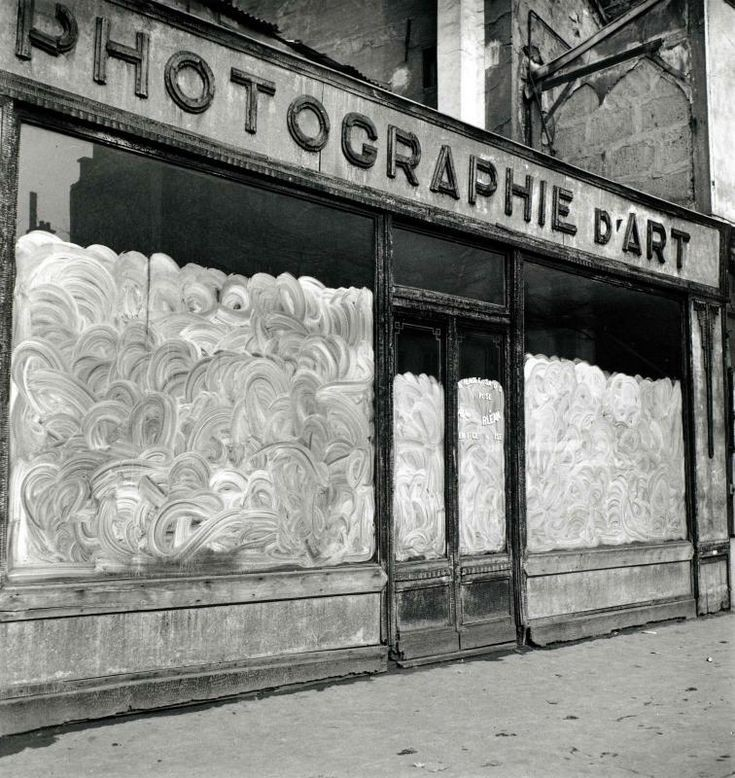
Édouard Boubat, Paris, 1949

Year in Reading 2023: 50 Books, Fat and Thin

Like several others who have already posted about 2023, I had a less than stellar reading year, finishing a little over half the number of books I did in 2022. On the other hand, several doubled as barbells for building up my muscles. On the third hand, some were slim. And on the fourth hand, some were slim pickings; I can’t recall ever reading so many works I didn’t especially like. I’m not sure to what to attribute that deflating phenomenon, but I hardly seem to be alone.

Best Quasi-Rereading

Michael Moore’s effervescent new translation marked my fourth time reading Alessandro Manzoni’s The Betrothed (1827/1842). As Moore explained at a reading I attended, he deliberately aimed his translation at an American audience lamentably unfamiliar with this 19th century masterpiece. An ingenious framing story cocoons this long tale of Renzo and Lucia, the affianced young couple whose wedding plans are dashed by the machinations of a lascivious warlord, forcing the couple to separate and flee into spiraling trials that challenge them (and several other characters) into becoming larger than themselves. Starting a beloved book in a new translation requires adjustment, but I was won over by Moore’s energetic, nimble, vivid and playful version, almost certainly the place to start for any American reader approaching this grand work for the first time. [Ed. – This book looks at me reproachfully from the shelf…]

Other Italian Explorations

Giovanni Boccaccio: The Decameron

G. W. McWilliams’ translation of Boccaccio’s 1353 classic accompanied me throughout the year as the perfect post-pandemic [Ed. – sic] companion. You know the framing story: five young women during the Florentine plague of 1348 abandon the city and invite along five male friends to an empty villa in the hills where, each day for ten days, each tells a story to entertain the others. The depiction of the plague in the book’s opening is terrific, and the 100 stories, splendidly diverse, are by turns tender, ribald, moving, pointed. So is the warm banter between the young people as they introduce their stories and encourage one another’s efforts, the whole serving as a kind of instruction manual on storytelling (and as a model for confronting calamity). Boccaccio has become a favorite; I also spent time this year with his Famous Women and Genealogy of the Pagan Gods, the latter especially highlighting Boccaccio’s talent as a great writer of prefaces. [Ed. – Ok, you sold me on this!]

Dominic Starnone: The House on the Via Gemita (2023)

The two short Starnone Neapolitan novels I’d read had impressed me, so I was excited to discover a fat new 500-page work also set in Naples. Starnone’s narrator recounts the history of his father, digging so thoroughly into strained father/son relationship that I can’t imagine The House on the Via Gemita not taking its place as a classic of the genre. To my surprise, the book also turned out to be an excellent novel about painting, in that the son must address both his father’s abusive personality and role as a peripheral figure in mid-century Italian art, a career layered on top of a day job as a railroad worker and the family responsibilities he largely leaves to others. Starnone gives us a brief history of postwar Italian art while exploring the qualities that make paintings great or mediocre and making personal an issue of our time: disentangling (or not) an artist from their art. I also noted the geographical precision employed by Starnone as a quality common to several contemporary Neapolitan novels; one can use a map to follow the narrative’s peregrinations around the city.

Maria Attanasio: Concetta et ses femmes

Concetta et ses femmes, written in 2021 when Attanasio was 80, sets out as a documentary rescue mission to obtain the story of Concetta la Ferla, organizer in the late 1960s, in Caltagirone, Sicily, of the first women’s branch of the Italian Communist Party (then the third largest in the world). Concetta’s grassroots project develops out of frustration with the municipality’s diversion of water to its wealthiest citizens, but runs into predictable obstacles in the form of chauvinistic attitudes in the city administration, in the Party, and at home. The story would be interesting enough simply as historical artifact. But Attanasio’s structuring of her novel, the first part narrated by Maria herself from the perspective of 20 years after the effort to preserve Concetta’s tale, and the second the tale itself in Concetta’s words, plays with questions of authorship and feminist solidarity, and emphasizes the continual nature of the struggle to gain legitimacy, to advance the advances of the past, to never go back.

Other Italian/Italy-related works included an Italian/French collection of short stories (Nouvelles italiennes contemporaines), with Tomas Landolfi, Massimo Bontempelli and especially Elisabetta Rasy’s contributions as standouts. Indian-American-now-Italian writer Jhumpa Lahiri’s Roman Stories (2023) revisits Alberto Moravia’s 1959 Roman Tales (Racconti Romani in the original Italian for both books), exchanging Moravia’s focus on Roman men in recognizable neighborhoods for immigrants, ex-pats, and tourists vaguely on the city’s periphery. Renato Serra’s Examination of Conscience of a Man of Letters (1915) presents a searing treatise on the relationship of literature and war, written three months before Serra perished in battle in World War I (read in French; while the essay has never gone out of print in Italy, it has not been translated into English). I devoured Janet Abramowicz’s monograph, Giorgio Morandi: The Art of Silence (1964), a deep appreciation of the Bolognese artist into whose family Abramowicz was essentially adopted. Despite this proximity, Abramowicz treats her former teacher judiciously and even unsparingly when it comes to Morandi’s blemishes, in particular his tacit involvement with fascism. German writer Esther Kinsky’s Rombo (2022), a polyphonic novel exploring the impact of a series of earthquakes on remote villages in the north of Italy, grew on me during my reading, with its Polaroid-like narrative approach in which the lives of the villagers gradually become more vivid and saturated. Finally, in Etruscan Places (posthumous publication 1932), D. H. Lawrence and a companion identified as “B” voyage through central Italy, exploring sites of the ancient Etruscan “12 cities.” Lawrence’s incisive, infectiously enthusiastic observations about Etruscan art and life turned me into a fan of this fascinating people whose culture was absorbed/obliterated by the Roman Empire. The narrative doubles as a travelogue through Mussolini’s Italy and, adding yet another layer, Lawrence’s views lay out an entire philosophy that has me determined to revisit his fiction this year. [Ed. – I support this plan!]

Stalingrad

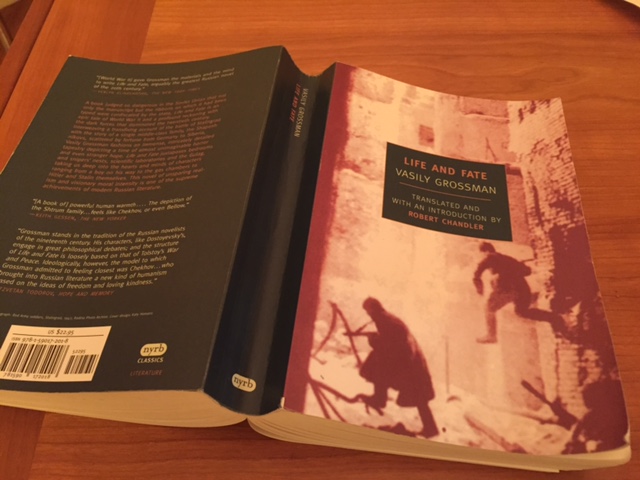
I came away from Vasily Grossman’s Life and Fate convinced I’d encountered one of the essential literary documents of the 20th century’s experience of fascism. I did not know that the book was but a second volume in Grossman’s monumental effort to write the great World War II novel. The first, Stalingrad (1952), with still no definitive Russian edition, has only recently been translated into English by Robert and Elizabeth Chandler. As highly as I esteem Life and Fate, I believe Stalingrad may well be the superior novel [Ed. — !] in its immediacy and the sheer grandeur of its conception (but as the books were intended to form a whole, one need not set them against one another). Grossman, present at Stalingrad as a journalist, related some of his experiences in Life and Fate, but Stalingrad sets out to capture the whole story of the war’s most decisive battle, from August 23, 1942 to February 2, 1943. Grossman’s acute consciousness of his literary precursor, Leo Tolstoy, leads him to take his main character on two pilgrimages to Tolstoy’s house, Yasnya Polynka, and to muse on Tolstoy’s accomplishments: 

Krymov looked at the wounded who had fallen by the wayside, at their grim, tormented faces, and wondered if these men would ever enter the pages of books. This was not a sight for those who wanted to clothe the war in fine robes. He remembered a night-time conversation with an elderly soldier whose face he had been unable to see. They had been lying in a gully, with only a greatcoat to cover them. The writers of future books had better avoid listening to conversations like that. It was all very well for Tolstoy – he wrote his great and splendid books decades after 1812, when the pain felt in every heart had faded and only what was wise and bright was remembered.

With Life and Fate, Stalingrad now gives us one of the great documents of World War II – and one of the greatest works of fiction about war ever written.

An Essential Holocaust Novel

The Talmudic concept of the Lamed-Vov, the 36 righteous people on whom the continuity of the world depends, fascinated me when first I read about it. Only when I started André Schwarz-Bart’s 1956 Prix Goncourt-winning novel, The Last of the Just, did I realize that the Lamed-Vov were central to the book. Schwartz-Bart takes the reader though a thousand years of Lamed-Vov succession to arrive at Germany in the 1930s, where the narrative pace slows dramatically. His restrained, almost clinically factual language provides devastating testament as much as fiction. Some of its scenes are completely indelible, and Ernie Levy, Schwarz-Bart’s protagonist for this last half of the book, struck me one of the most remarkable characters I’ve encountered in a lifetime of reading. [Ed. – It feels like a professional failing that I have not read this book!]

José Revueltas: The Hole

A tiny but shockingly powerful novella, taut and tight with not a word out of place. [Ed. – Funny, that’s how people usually describe me!] The Mexican writer and activist Revueltas’s 1969 book, based on the author’s own 12-year experience as a political prisoner, resembles a Piranesi prison drawing in narrative form, an intensely concentrated exploration of incarceration. Everything in the narrative is compressed – time, space, hope, even the reader’s attention and the size of the book itself. An absolute masterpiece of prison literature.
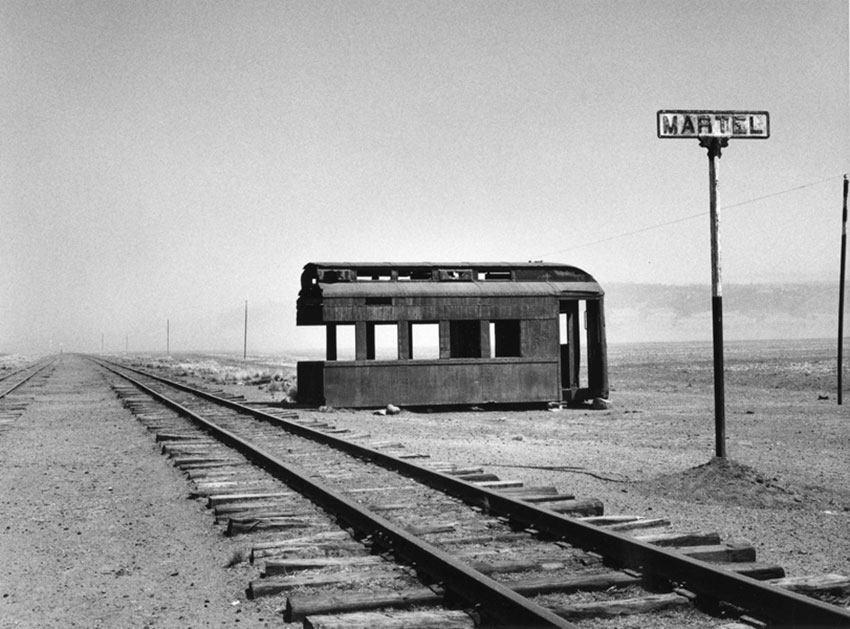
Mariana Yampolsky, Estación Martell, 1988

Good King Xavier, Reino de Redonda

Spanish novelist Javier Marías died at age 70 on September 11, 2022. I encountered his work four times this past year, first in his final novel Tomás Nevinson (2022) which appeared last May in Margaret Jull Costa’s translation. I had come to anticipate each new Marías translation as nearly an annual tradition, so knowing that this his last novel made reading it deeply bittersweet. Tomás Nevinson follows up 2018’s Berta Isla, but also resurrects characters from Marías’s Your Face Tomorrow trilogy, most notably Bertram Tupra. Where Your Face Tomorrow engaged Spain’s experience of Franco and of the civil war, Tomás Nevinson takes as its starting point the Basque separatist terrorist attacks of the 1990s. As Nevinson is enlisted by Tupra to come out of retirement to track down a woman involved in the most heinous of these attacks, Marías uses the narrative to explore questions about our responsibility for seeking justice, how we deal with repentance and redemption, what justice seekers owe to their own loved ones, whether there may be some informal statute of limitations on bringing the guilty to account and how long justice should be sought – time being among the most prominent fixtures in Marías’s fiction. We are fortunate to have this novel; Marías’s time having run out seems completely unjust.

When I picked up Tomás Nevinson at Point Reyes Books, the literary mecca cultivated by Molly Parent and Stephen Sparks, Sparks asked if I’d read the new book about Redonda. I must have stared at him blankly, as, having not yet read Marías’s Oxford novels, I knew nothing. Thanks to Michael Hingston’s marvelously strange Try Not to Be Strange (2023), I now know quite a lot, including the fact that Marías had been, up until his untimely death, King Xavier I, monarch of this tiny nation, which, despite having no inhabitants, does have territory, a flag, its own currency and postage stamps, and a plethora of dukes and princesses, counts and ambassadors, and multitudes of other titles held by what seems a who’s-who of 20th century writers. This was by far my most fun book of the year, uncovering a great story, offering up a charming tale of obsession (including Hingston’s own), and digging a dizzying warren of rabbit holes for one to scurry down, which led to my filling quite a bit of empty shelf space with related works. [Ed. – Well, this all seems quite insane!]

One of those works, of course, was All Souls (1992), the Marías Oxford novel in which the author first mentions Redonda. I expect to have more to say about this book after I’ve read its sequel, Dark Back of Time, on deck for 2024.

Another addition, Cuentos únicos (1996), came from Reino de Redonda, Marías’s own Spanish-language imprint.This collection of 22 translated English language short stories selected by Marías presented a way to practice my poor Spanish and get to know some writers I didn’t know. Nugent Barker? Oswell Blakeston? Percival Landon? [Ed. – Are these imaginary???] My Spanish proved inadequate to the task, but I understood enough to have made the effort – to be continued this year – worthwhile.

The Ascent of Rum Doodle Mont Analogue

My next-to-most-fun book of the year, René Daumal’s Mont Analogue (1952), tells the story of Père Solgon’s organization of an expedition aboard the ship “Impossible” to find the rumored tallest peak on earth, mysteriously as yet undiscovered due to its isolation (guesstimated to be in the vast South Pacific) as well as certain tricks of light that keep it invisible except at a certain hour and from a certain approach. With a crew including such luminaries as an American painter of alpine scenes, one Judith Pancake, the voyage is half tongue-in-cheek, half mystical imponderables (Daumal had been a follower of Gurdjieff), half Jules Verne. Yes, I know that’s three halves, but that suggests the shape and character of this delightful novel, one of the rare “unfinished” works that actually ends mid-sent-….

(Note: for French readers: a lovely new hardcover illustrated edition of Mont Analogue comes with an introduction by musician Patti Smith).

Weak in Comparison to Dreams

I got to know art historian/theorist James Elkins’s work some 25 years ago while researching text and image for a conference paper. So it came as quite a shock to discover a 600-page novel by Elkins, especially as I’d recalled his having announced in an Amazon book review his intention to stop adding to an accretion of texts. Presumably Elkins only meant Amazon reviews, because Weak in Comparison to Dreams (2023) is a welcome contribution to contemporary literature and among the most unusual novels I’ve read in a long time.  In the book’s continuation of Elkins’s explorations of text/image interactions, I felt both that I was right back where I’d left off and in a whole new world. Incorporating scores of black and white images and increasingly nutty charts and graphs, the narrative follows its narrator, Samuel Emmer, a bacterial biologist for the city of Guelph, Ontario, on a series of visits to zoos around the world to evaluate mammalian behaviors and health protocols as Guelph plans its own zoo. [Ed. – The Guelph connection is… unexpected.] A dozen interchapters present Emmer’s dreams while on this mission, these too accompanied by images that suggest an intensifying fugue state. By turns sobering and hilarious, thematically touching on everything from animal welfare and incarceration to climate change and bureaucracy, from pseudo-science to contemporary experimental music, and playing in a space similar to that occupied by conceptual artist David Wilson’s Museum of Jurassic Technology, Elkins’s absorbing novel is… not at all what it seems. A 100-page final section entitled “Notes” delivers not so much “notes” as a surprising reframing of the first narrative, much in the way a caption might reframe an image. I can’t get the book out of my head, and shouldn’t, as Elkins has completed four other novels since 2008 that form a quintet of which Weak in Comparison to Dreams, though the first to be published, is volume three. I cannot wait to see what he does in the other four. [Ed. – How the hell do you find this stuff???]

The Queen of L.A. Noir

My familiarity with Dorothy Hughes’s In a Lonely Place (1947) had been limited to Nicholas Ray’s 1950 film starring Humphrey Bogart. Finally reading the novel left me incensed about the movie, a fairly egregious desecration of its source material. Fortunately, I felt no indignation in response to Hughes’s novel, which floored me as not just a masterpiece of Southern California noir, but perhaps the masterpiece of Southern California noir. I fell for it in the first pages, which captures the foggy, seeping chill of the California coast at night in a manner precise and true. She shies away from nothing in this penetrating psychological drama in which [Ed. – SPOILER INCOMING!] the narrator himself is the killer – presumably the quality that kept the studios from allowing Humphrey Bogart to be tarnished by such a role. Hughes covers the postwar L.A. noirscape exquisitely while managing to keep her narrator entirely human, a subtle literary feat that reads like one of Freud’s case studies. Raymond Chandler might be King of L.A. Noir, but if you asked me to pick a monarch, I’d go with Hughes on the basis of this novel alone.

Other mysteries included the marvelous Margaret Millar in Stranger in my Grave, a disappointing end to the Montalbano series in Andrea Camilleri’s Riccardino, and dismay as regards Mignon Eberhart, an author I’ve liked, whose Family Affair, in this year of too many books I did not like, marked the nadir.

Poetry

Aside from individual poems here and there, I read just three books of poetry. Reginald Dwayne Betts in Felon (2019) gives us a powerful collection of poems that go well beyond the experience of incarceration to address convict life beyond prison. I found Argentine poet Alexandra Piznarik’s Removing the Stone of Madness, Poems 1962-72 (Yvette Siegert, translator), relevatory. I did not know Piznarik, who, as the collection’s title suggests, fought a terrible battle with mental illness which she chronicled in short, sui generis poems as hard-edged and clean as crystals, powerful poem-objects one could almost hold in one’s hand. Finally, I loved Greg Hewitt’s intimate, resonant poems in Blindsight, structurally based on composer Olivier Messiaen’s prime-number system and which brought to mind Frank O’Hara’s personal poetic school of “Personism” (a mutual friend sent me Greg’s book).

Odds and Ends

The rest, an unorganized, mostly enjoyable mess, included Willa Cather, more Eve Babitz, Sándor Márai, Tatsuo Hori, Euripides, Chinua Achebe, Raphael Sánchez Ferlosio, more César Aira (an annual need), Daisy Hildyard and others. Larry McMurtry’s Lonesome Dove (1985) gave me exercise, as with Stalingrad in one hand, I built up my other bicep by hefting McMurtry’s 850-page narrative in late-night installments at approximately the same pace as the Texas border to northern Montana cattle drive the story depicts. I found it terrific fun, amplified by my subsequent reading of the story of a poor Texas legislator who made the mistake of trying to ban Texas’s national novel. No one should want to be that guy. A bit further south I ate up Charles Portis’s Gringos (1991), set in the Yucatan where rumpled ex-pat Americans are involved in archeological dealings and mis-dealings. Are all of Portis’s novels his best novel? I think so. I think so.  [Ed. – Well put!] Art historian Alexander Nemerov’s The Forest (2023), a collection of essays and corresponding plates, uses forests of the American frontier to cull idiosyncratic tales of 1830’s American art and culture, rescuing some fascinating figures from historical oblivion. I finally got around to reading Maggie Nelson, in Bluets (2009) and The Argonauts (2015) – respectively, musings on the color blue (with a towel snap at William Gass’s bare cheeks), and raw meditations on sex, gender and motherhood that I sent off to goddaughter pursuing gender studies. I’d been curious for some time about Michael McDowell six-volume Blackwater, and gorgeous and affordable new French paperback editions provided an opportunity to dive in. Blackwater 1: La Crue (1983) proved a Southern Gothic slow drip horror tale peeling away the veneer of Southern gentility. For the first time since high school, I revisited J. D. Salinger, in Raise High the Roof Beam, Carpenters (1955) and Seymour: An Introduction (1959). Salinger himself may not have aged well, but these two novels were far better than I expected them to be.  I found Tove Jansson’s The True Deceiver (1982) to be a stunningly good novella about truth, trust and deceit, not necessarily in that order, set in a fishing village on the Finnish coast. There seems to have been nothing Jansson couldn’t do right. While somewhat confined in a house in the mountains, I found appropriate companionship in Count Xavier de Maistre’s A Journey Round My Room (1795), a book born of boredom, a curious meditation on escaping it, created when, following a duel, de Maistre was put under house arrest for some six weeks. Alleviating boredom, Roy Lewis’s The Evolution Man, or How I Ate My Father (1960), though clearly dated, was still pretty damned funny as comedies about pre-history go. Finally, a couple of books with which I struggled still held enough of interest for me to get through them. Justin Torres’s Blackouts (2023) relies heavily on photographs, drawings, redacted text, dialogue as film script, and other novelties that I found a bit overcooked (in a way I did not with the Elkins novel). But the story Torres unearths of a 1942 study of homosexuality, and of the lesbian couple who helped drive the project and were betrayed by it, is remarkable. I had a tougher time with Gerald Reve’s The Evenings (1947) acclaimed by some as the great 20th century Dutch novel. A disaffected young man lives with his numbed parents in 1946 Amsterdam and battles his claustrophobic life with dark, acrid humor. I admired Reve’s allowing the war to drip into the narrative bit by bit, the horrors of the recent past seeping into normal life. But I couldn’t wait for the book to end.
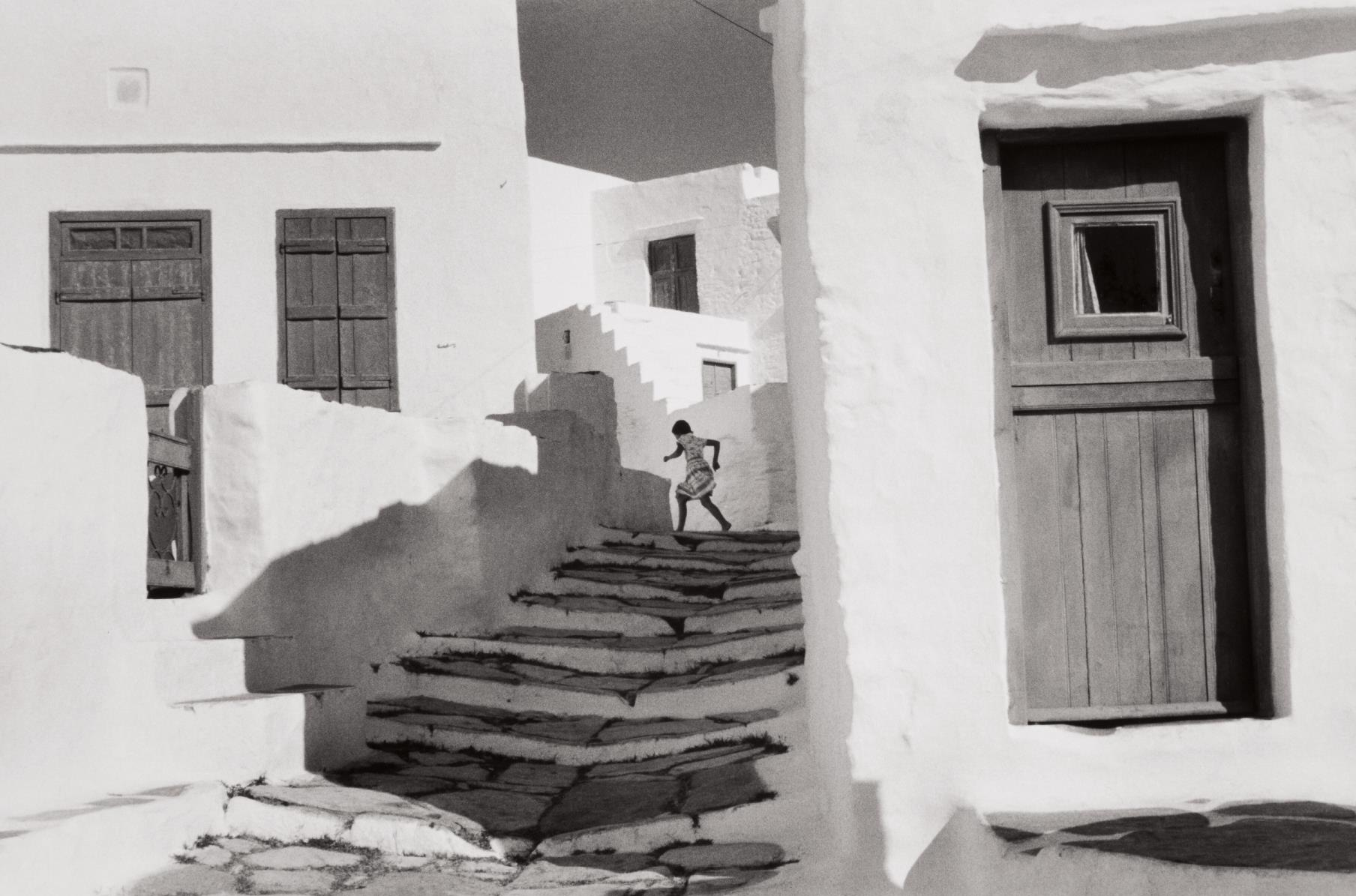
Henri Cartier-Bresson, Naples, 1960

I’ll conclude with a dream. In a cluttered bookshop, I found a tattered but astounding volume amended with striking collages, vivid watercolor sketches, and dense margin notes. The (dream) author’s name seemed familiar, so upon waking I looked up James Gould Cozzens and plunged down a trail that led me to Dwight MacDonald’s 1958 review of Cozzens’ late novel, By Love Possessed.  I did not read Cozzens. I’m not sure I will ever read Cozzens. But I’m grateful to odd dreams for having pointed me to MacDonald’s review, which takes to task a generation of critics who, with log-rolling fealty and conformity to one another’s uncritical opinions, lavished praise on the novel. Eviscerating, illuminating, even necessary, his review models close textual analysis with an eye towards criticism’s larger role, relevant today when writer-critics blurb one another’s books and award prizes to mediocre works.  A pretty good way to end the reading year, and a better way to start off a new one which, I am happy to say, as far as books go, is off to a tremendous start. Thank you for reading. [Ed. –Thanks for writing, Scott! A delight as always.]
Brad Bigelow’s Year in Reading, 2022

Today’s reflection on a year in reading is by Brad Bigelow. Brad writes http://NeglectedBooks.com and edits the Recovered Books series for Boiler House Press.

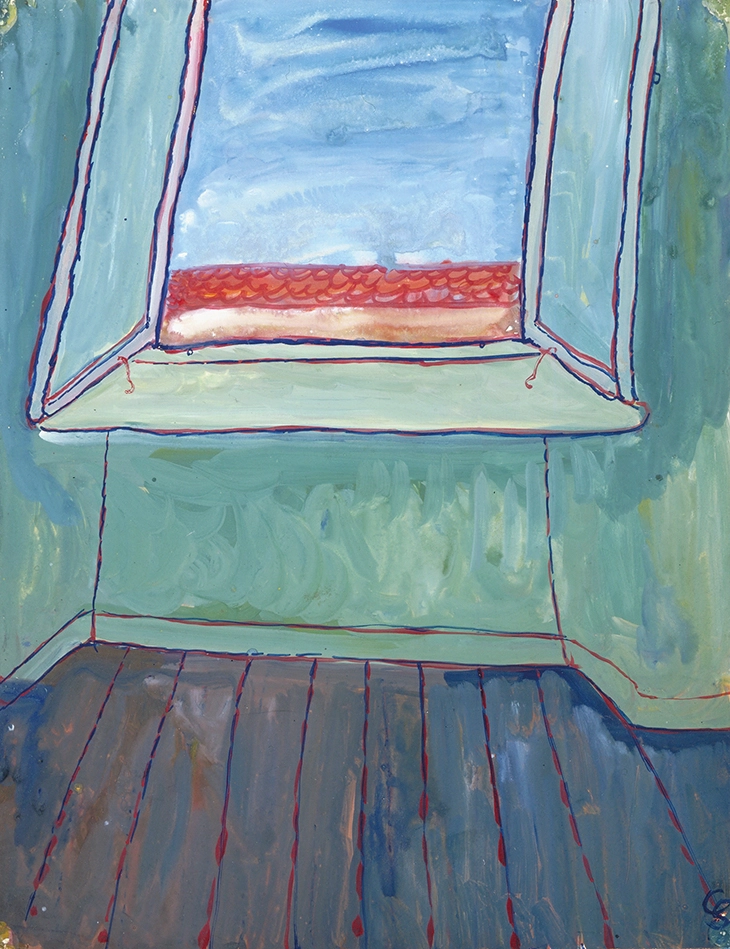
Charlotte Salomon, No. 134 from Life? Or Theater? (1941 – 42)

When I finished college forty-some years ago, I started writing down every book I read in a little spiral notebook. I kept up this habit for over twenty years and then stopped for some forgotten reason. Since starting The Neglected Books Page, most of my reading has been of long-forgotten books and most of these I’ve recorded by writing about them on the site. But as time goes on, I’m falling ever further behind in this writing. And to make matters worse for the purposes of this piece, I keep no record of my non-neglected reading. So, this is a fairly unreliable review of my reading in 2022, but I hope it’s worth your time nonetheless.

(It’s a good thing I never went into marketing.) [Ed. – No kidding!]

Among my neglected reads, easily the most memorable was Charlotte Salomon’s Life or Theater? Although Salomon told her life through paintings, it operates at an unforgettable level of intensity. There are at least three narratives winding through the hundreds of paintings in this book: the psychological breakdown of her family; her own troubled emotional development; and the trauma of Germany, and of German Jews in particular, with the rise of Nazism and Hitler. As I wrote back in April, “the book is presented as an art book – large and very heavy with its hundreds of pages of full-color images. But I think this does the book as a book some disservice. For it can also be seen as a graphic novel.” And I think it would benefit from being repackaged as a graphic novel, since today’s readers are now so accustomed not just to the language of graphic novels but to the very idea of considering them as literature. [Ed. – Absolutely. Her drawings look like they come from a graphic novel, too, as your post with its generous illustrations suggests.]

Easily the most enjoyable was Madeleine Masson’s memoir, I Never Kissed Paris Goodbye.Though we know from its opening line—“It was a beautiful day in June 1940”—that this story will have a sad ending, most of Masson’s account of Paris in the 1930s is as frothy and delightful as a glass of champagne. It’s full of the infidelity, excess, and manic energy of Jean Renoir’s classic film The Rules of the Game, and highly recommended to anyone who loves that film. [Ed. – You’re trying to tell me there are people who don’t love that film? Nonsense! This book sounds excellent, BTW.]

My deepest archaeological dig of the year was locating a copy of Carola Ernst’s Silhouettes crèpusclaires, and then dusting off my French to read it, based on nothing more than a brief reference in a magazine from 1921. This modest account of the journey Ernst took in the Fall of 1914 to return a French officer blinded in an early battle of the First World War to his family is a touching portrait of a world in the midst of a radical transformation. The pair are able to travel via Belgium, Germany, Switzerland, and France thanks more than anything to a spirit of chivalry that had not yet been destroyed in the industrial machinery of the war.

Another highlight was the chance to spend several weeks with some of the many volumes of poetry penned by Raymond Souster, the bard of Toronto. Souster’s longevity and disciplined dedication to his art enabled him to amass an account of one city’s life that may be unparalleled in the 20th century. Souster lived and wrote to the age of 91, worked in the same bank for over 40 years, was married to the same woman for over 60 years, and, as their only child, cared for his parents until they died in their late nineties. Though Souster claims he never wrote any great work (“I’m not sure I’m ready for epics/there are far too many little songs/the rest have left unsung”), the body of his work is sort of an epic in itself. [Ed. – Fascinating! I’ve even lived in Toronto and have never heard of Souster.] Someone needs to go through the thousands of pages of Souster’s poetry and distill it into an autobiography along the lines of what Ruth Limmer did with Louise Bogan’s work in Journey Around My Room.  

Finally, I must mention Nina Warner Hooke’s Biff and Netta trilogy: Striplings (1934); Close of Play (1936); and Own Wilderness (1938). These novels follow a half-brother and sister, Biff and Netta, from their early to mid-teens, as their already unconventional and decaying family collapses completely. The first volume received tremendous critical praise and was most commonly compared to the work of P. G. Wodehouse. Warner Hooke said she had no plans for further books at first, but when you finish the trilogy, its narrative arc seems almost predestined. She could no more leave off her story than you could get off a rollercoaster after the first drop. It is deeply strange, not solely because of its theme of incest, and deserves much closer examination than I was able to give it in my post. At 900-some pages, it’s far too long to expect anyone to ever reissue it unless some editor finds the courage to do some substantial posthumous abridgement, but it’s a work that I continue to process months after finishing it.

I tend to rely on audiobooks for my non-neglected reading. For years, I had a daily commute of over an hour each way and I racked up thousands of hours of listening, which enabled me to catch up on many classics I’d skipped. Now, my commute is just a staircase [Ed. – Bliss!], but I still get in an hour or so of listening each day. One of my projects was to go back through the works of Thornton Wilder, who is arguably both recognized and neglected. Aside from “Our Town”, most folks have only a vague notion of what he did, and even the once-ubiquitous The Bridge of San Luis Rey is not a familiar title. Wilder is the only writer to have received a Pulitzer in two genres, fiction and drama, has several volumes in the Library of America, and most of his work never falls out of print for long. I wrote about The Eighth Day, his most ambitious—and, to be honest, most flawed—novel years ago, and loved Heaven’s My Destination and Theophilus North when I first read them. This year, I went back and listened to all his novels in chronological order (an exercise I highly recommend for novelists who particularly interest you), starting with The Cabala.

The experience was both a revelation and a disappointment. I found several of the books suffered from an earnestness that became particularly apparent when considered back-to-back. On the other hand, I was astonished at the innovation of The Ides of March, his novel of Caesar’s last months. It’s a collage of fictional letters, excerpts from actual Latin texts, and even graffiti from the streets of Rome in the first century BC. Why is this book not acclaimed as a milestone in the fictional form? [Ed. – Sounds like time for a reissue?]

Aside from Wilder, most of my listening has been focused on Russian history and literature. I’ve long been fascinated by Russia, even though I’ve deliberately avoided my few opportunities to visit there. There’s something about the darkness of so much of the Russian experience that seems to reassure me that my own life really isn’t all that bad. This might be one of the reasons that I read so many books about Stalin when I was working for the two worst bosses I’ve had to suffer. I listened to two historical surveys by Orlando Figes: A People’s Tragedy, about the Russian Revolution, which occasionally bogged down in the minutiae of political infighting, and Natasha’s Dance, which I would recommend to anyone looking for a historical context to much of the Russian art, literature, and music of the last 200+ years. There were also several biographies—Alex Christofi’s Dostoevsky in Love, Alexandra Popoff’s book on Vasily Grossman, Donald Rayfield’s Chekhov—all richly illuminating. But by far the most enjoyable and impressive listen was Nabokov’s The Gift, which managed to weave so many of the threads from these other books together and remind me yet again of the fact that Nabokov worked at a level miles above so many of the 20th century’s greats.

Of the more recently-published books I’ve read, few really stand out. I found a number of the more acclaimed ones forgettable and will skip over them. Although I’ve read that it’s not the place to start, I loved Annie Ernaux’s The Years, in part because it described a world very familiar to me after 18 years of living in Belgium and working closely with many French men and women. And Gwendolyn Riley’s My Phantoms could have described some of our neighbors on the little street in Norwich where my wife and I lived for two years. [Ed. – Yikes!] I wish I could say that the books I’ve read by American writers were half as evocative, but I guess I’m still getting used to a country that’s so different from the one we left just before 9-11.

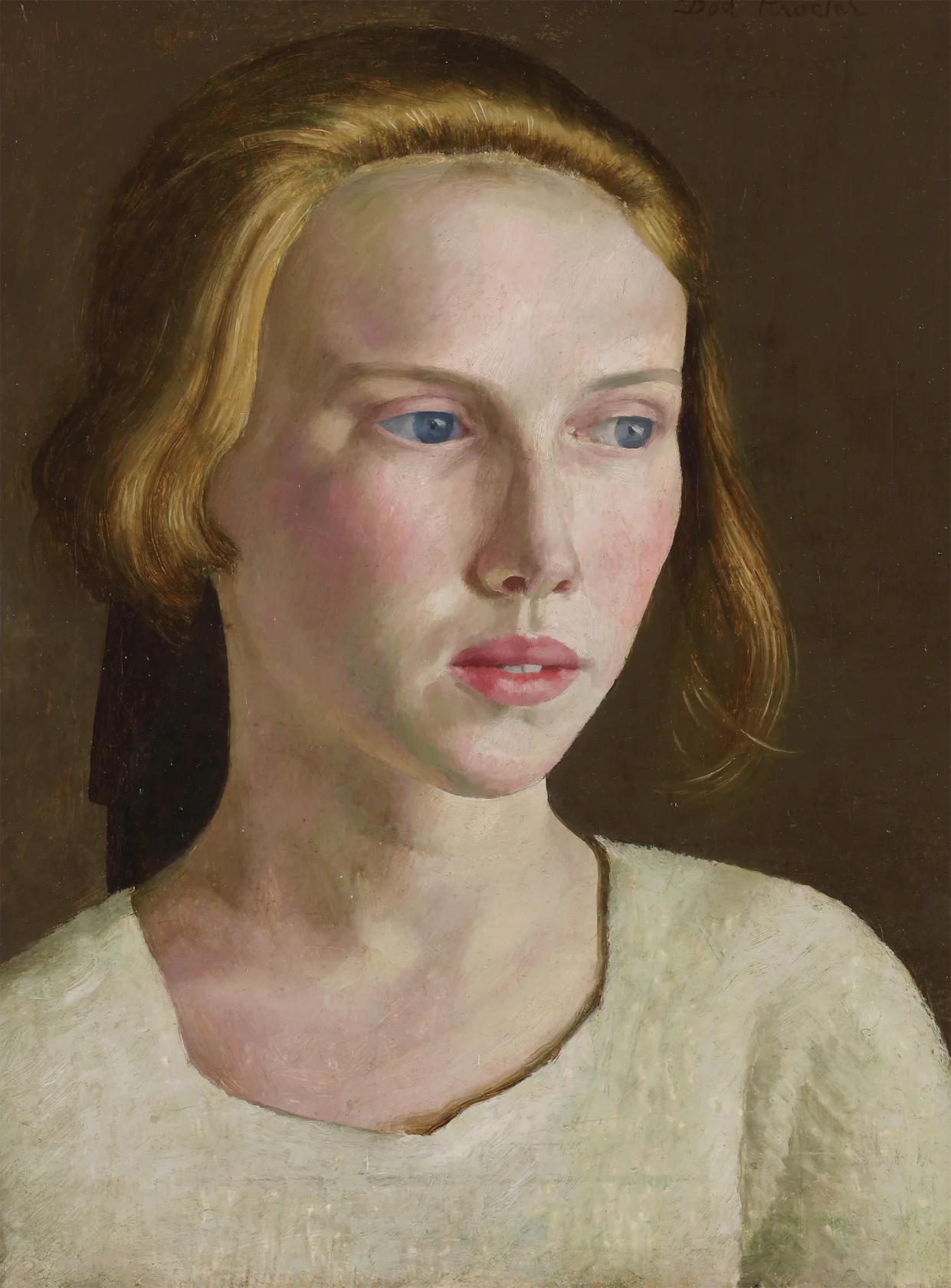
Dod Procter, Lydia, ca. 1926

And it would be remiss of me not to mention the brightest highlight of 2022, which was the #PilgrimageTogether reading group. Starting in January, a group of us worked our way through the thirteen “chapter-volumes” of Dorothy Richardson’s masterpiece, Pilgrimage, aided by a wonderful cast of Richardson scholars who agreed to take part in our monthly discussions. I first read Pilgrimage in 2016 as part of a two-year project of reading only the work of neglected women writers (complemented by two years of only listening to audiobooks by women) and ever since have been an evangelist on its behalf. Not to denigrate Proust, but I find it astonishing that thousands of people read Remembrance of Things Past each year while Pilgrimage, which speaks directly to so many aspects of life that are still part of our everyday world today, is barely known and even less read. Like others in the group, I found Pilgrimage both so challenging and so rewarding that other books seem somehow diminished in comparison. It’s a novel I know I’ll be returning to again — and, I hope, with another group of readers. [Ed. – This is good to hear, since I regret not joining in. It would be great if you could time it with my next sabbatical, thanks.] Until then, I encourage folks to take up Pilgrimage and spend some months with Dorothy Richardson’s insistently individualistic Miriam Henderson, aided by the Reading Pilgrimage website. [Ed. – Thanks for the post, Brad, and congratulations on that site. What a resource!]

Nat Leach’s Year in Reading, 2020

In the next week or so I’ll be writing up my reflections on my 2020 reading year. In the meantime, I’ve solicited guest posts from friends and fellow book lovers about their own literary highlights. I’m always looking for new contributors; let me know here or on Twitter (@ds228) if you have something you want to share.

The fourth post is by Nat Leach (@Gnatleech). Nat has written several posts for the blog over the years, all wonderful. He lives and works on Cape Breton Island.

An Alphabetical Odyssey: Year 3

Like so many things in 2020, my reading did not exactly go according to plan. Readers of my Year in Review post from last year will know that my current project is to work through my shelves alphabetically in order to finish the many partially-read books on them. But while I managed to work my way through almost three letters of the alphabet during each of my first two years of this project, I ended up devoting most of this year to the letter “G”. There are a number of reasons for this: my own tendency to expand this project by creating mini-projects (e.g. exploring 6 translations of Goethe’s Faust or almost 2000 pages of Vasily Grossman) or by adding new books to my shelves thanks to a number of irresistible NYRB Classics titles and some very strong recommendations from Dorian (a Venn diagram of which would basically be a circle), and, of course, my Achilles heel—Twitter read-alongs (Malicroix, Our Mutual Friend, The Man Without Qualities). But if this sounds like complaining, it’s absolutely not—if ever there was a project where the point was the journey and not the destination, it’s this one. After all, what’s going to happen when I reach “Z” (assuming I live that long)? I’m just going to start all over again.

Over the course of the year, I realized something about myself that might help to account for my previous system of rotating my reading between an excessively large number of books: I enjoy beginnings a lot more than endings. A new book introduces us to a new world populated by new characters whom we desire to know better. The potential is boundless. But the closer a book gets to its end, the more it forecloses the possibilities it has opened up, and (often), the more we feel that nothing can surprise us, or, worse, that the ending is not consistent with what went before. Put another way, endings are a lot harder than beginnings; creating the broad outline of a narrative world and its characters is one thing, but sketching in the detail and bringing it to a satisfying conclusion is quite another. Over the years, I think I’ve enjoyed having read only a few chapters of certain books, and having their potential frozen in place like Keats’s urn. But now that I’m getting older, the impulse for completion is getting stronger.

Maybe this is all pretty obvious, but this year really brought it home to me, as I was enticed by the openings of a number of books only to find my interest lagging in the second half. If I could have stopped reading at a certain point, my memories of some of these books would be fonder. Fortunately, I still had mostly positive reading experiences this year; I read 33 books from 11 countries (including 6 from France, making me wonder if there is something about the letter “G” and French surnames), and enjoyed most of them. Here are some short synopses:

Ford, Richard- The Sportswriter (1986)

The only thing I learned from this book is that this middle-aged white guy has no patience for the angst of other middle-aged white guys. The protagonist of this book, Frank Bascombe, is divorced because he has been horrible to his wife, continues to be horrible throughout the entire book, and somehow I’m supposed to care about his faux-profound reflections on life? I could have tolerated this book if there was some sense of distance between its author and his protagonist, but from the light way the book tosses off Frank’s casual sexism and racism to (spoiler alert, if anyone cares) the way he is rewarded at the end of the book with an incipient relationship with a seemingly interesting, intelligent, and attractive 20-year old woman, I can’t help feeling that Ford is thoroughly endorsing Frank’s perspective. I hate to use sophisticated literary-critical terms, but this book was just too “icky” for me. In fairness, Dorian warned me not to read it, but would I listen? I know it’s a bad start to be this grumpy about my first book of the year, but at least if I get a bullet in the mail, I’ll know who it’s from.

Garner, Hugh– Cabbagetown (1968)

Another book from my list of Canadian classics, this novel focuses on the life of an impoverished community in Toronto during the Great Depression. The book’s strength comes from its powerful, vivid depiction of the struggles of its characters as each of them attempts to come to terms with the reality of the Depression in a different way. Here’s a typically great descriptive passage, of a chocolate factory at which one character is fortunate enough to be employed:

The mixing room was heavy with the smell of chocolate. The walls, the floor, the machinery, even Billy, reeked of it. It permeated his clothing, hair, and even his comb, nailfile and wallet, so that he was a permanent olfactory advertisement for Besty-Tasty products. His appetite for chocolate had been satisfied forever during his first week in the mixing room. He had imbibed his fill, not only by mouth and gullet but by absorption through his pores. Now he could no longer even smell chocolate, for it was his own body odour.

It’s far from the bleakest passage in the book, but given the unfortunate fate this character suffers in the mixing room, it appropriately attests to the way in which characters are victims of their concrete circumstances.

Genet, Jean- Our Lady of the Flowers (1943) (trans. Bernard Frechtman)

Usually, when an author has a reputation for being shocking, I find myself highly disappointed when I actually read them. Genet, however, completely lives up to his reputation. Written clandestinely in prison, the book challenges all conventions and taboos. But, going beyond Genet’s detailed and explicit attention to bodily emissions and his multiple slang terms for “penis,” two things particularly struck me. 1) The guy can write. Given his subject matter, it’s hard to call his writing beautiful, but it has a rhythm and flow that captivates, even as his digressive style is continually shifting narrative tracks. 2) At the root of the narrative is actually a very sensitive story of someone who would today be called a trans youth, told without embellishment or censorship.

Gide, André- The Immoralist (1902) (trans. Dorothy Bussy)

Call this Exhibit A of the phenomenon I mentioned above; this book captured me at the beginning, but lost much of my interest by the end. It’s an appropriate book for this year, I suppose, insofar as it is concerned with the way that illness—and recovery—test relationships. I enjoyed this book, but I somehow expected it to go further than it did. Maybe I’ve just become jaded by subsequent anti-heroes, but the climax of the book did not particularly shock me, nor did it inspire much moral reflection. In his Preface, Gide says, “I have not tried to prove anything, but only to paint a picture well”; he does that much, but I couldn’t help wanting something more.

Ginzburg, Natalia- Family Lexicon (1963) (trans. Jenny McPhee)

Call this one Exhibit B: I liked this book a lot, but I loved the first half of it and felt it ran out of steam a little bit towards the end. It opens in a really interesting way, exploring how a family’s language constructs its own particular place in the world. This thread carries through the book, of course, but at a certain point, Ginzburg becomes much more informational, describing what happened to each member of the family and its associated friends. Not coincidentally, this point is the outbreak of World War II, and the various traumas and divisions in the family are noted without being extensively described. Given that Ginzburg notoriously recommended the rejection of Primo Levi’s seminal Holocaust memoir, If This is a Man, because of its subject matter, it is perhaps not surprising to find that she is reticent about describing her own war experiences, including her husband being tortured to death by the Nazis. I liked it enough to give the book to my mother for her birthday, and her take was that the book starts from a child’s perspective, so you don’t expect very much interpretation, but once it shifts to an adult’s perspective, we feel that absence of context a lot more. Which I thought was a good point. All of this is by way of explaining why I felt the latter half of the book somewhat flatter than the first part, but I still enjoyed it a lot.

Giono, Jean- Hill (1929) (trans. Paul Eprile)

This was a late addition to my list, thanks to the recommendation of Dorian, and others on Twitter, and was certainly one of my favourite books of the year. Written in 1929, it reads in a very contemporary way because of its treatment of environmental concerns. I jokingly referred to it as “The Rime of the Ancient Mariner” meets Picnic at Hanging Rock because it involves a violation of nature that is punished, but in a mysterious, uncanny way. The events take place in a tiny village in Provence, where the inhabitants struggle with the forces of nature, and the book wonderfully illustrates the precarious coexistence of the human and natural worlds.

Gissing, George- The Odd Women (1893)

This book had been sitting on my shelf for some 20 years, and now that I’ve finally gotten around to reading it I could kick myself for waiting so long. Another book that feels very contemporary despite its age, and that rarest of things, a book that deals with social issues (in this case, the Victorian “woman question”) without sounding preachy. Clearly, there are characters we are expected to identify with more than others, but Gissing brings great sensitivity and understanding even to the characters who are clearly shown to be ideologically flawed. My one criticism of this book would be its use of implausible coincidences to move the plot along; for example, when complete strangers meet and realize that they live in exactly the same building in the huge and bustling city of London, you just know that plot complications are going to follow. (On the other hand, I forgive Dickens for stuff like this ten times in a single book, so I guess I can’t really complain.) This is one of the exceptions to my tendency of the year, since it actually gets the ending just right, which is especially difficult for novels about social problems; a happy ending is liable to make readers complacent about real social ills, while an overly tragic ending makes them feel hopeless. Gissing strikes just the right balance between hope for the future and mourning for what might have been.

Godwin, William- Deloraine (1833)

Having read all of Godwin’s “mature” novels (I haven’t read his three “juvenile” novels) except this, his last, I figured it was time. It’s far from his best, and might be accused of being a re-tread of Godwin’s dominant themes: social alienation, class injustice, the haunted perspective of a pursued criminal, and an abrupt reversal of philosophical perspective at the end. He does, however, also do a characteristically good job of using conventional melodramatic situations to raise deeper philosophical questions. Is it worth saving your life, Godwin asks, if you lose your identity in the process?

Gogol, Nikolai- The Inspector General (1836) (trans. B.G. Guerney)

Sadly, this nineteenth century satire on political corruption and deceptive appearances is just as relevant now as it was then. A buffoonish but minor civil servant is mistaken for an important government inspector in disguise; hilarity ensues as local officials seek to conceal their misdeeds and appease the fake inspector, but as the play’s conclusion reminds us, the subject is not all that funny.

Goethe- Faust, Parts 1 and 2 (1808, 1832) (various translators)

I embarked on an ambitious project of beginning 6 translations, and ended up finishing 2 (the Bayard Taylor and Charles Passage versions). Part of the reason for this is that Part 1 has been much more frequently translated than Part 2; two of my translations were of Part 1 only. To summarize briefly, Part 1 was pretty much exactly what I expected it to be (Faust makes deal with Mephistopheles, seduces Gretchen, lots of witches and devilish imagery et cet.), and Part 2 was utterly and completely not (complex allegory about everything from contemporary politics to poetry to geology). I would say that it completely changed my view of Goethe, but now that I think about it, I had a similar reaction to Wilhelm Meister’s Apprenticeship, so maybe I should just admit that I have no idea what to expect from him.

Goethe- The Sorrows of Young Werther (1774) (trans. Elizabeth Mayer and Louise Brogan)

When I was an undergraduate, my classmates and I created a list of “big idiots of English literature,” to which virtually every character in every book we read would be added for one reason or another. Werther would probably have earned his own category on that list. I actually suspect that undergraduate me would have totally loved this book, but given the suicide craze that it sparked in Germany on its publication, it’s probably just as well that I did not read it until I was older and wiser. Now, I’m more inclined to say that it’s a good book, but man, that guy is a big idiot.

Gracq, Julien- Chateau d’Argol (1938) (trans. Louise Varèse)

I had heard such wonderful things about Gracq that I was very keen to read one of his books. Having received this one (his first, as it happens) as a gift some years ago, I chose it, which may not actually have been the best place to start. The writing is gorgeous, the plot minimal—a  man buys a remote castle in Brittany, his frenemy comes to visit, and brings a woman, leading to a love triangle of sorts—and some of the chapters are utterly compelling. One in which the three protagonists swim too far out into the sea and struggle to return to shore was particularly gripping. Given my interest in the Gothic, I was also intrigued by the exploration of the castle and the vivid, often grotesque, imagery, but, finally, I wasn’t sure if the book adds up to much. It gave the impression of housing some hermetic secret, but search me what that might be. But the writing itself is enough to make me want to explore Gracq further.

Grass, Günter- The Tin Drum (1959) (trans. Ralph Manheim)

Exhibit C? At least I’d been warned that the first half of this book is much better than the second. And having seen Volker Schlöndorff’s film adaptation three times, I certainly had some vivid memories of the beginning: Oskar Matzerath—unreliable narrator extraordinaire—tells the improbable story of his mother’s conception, eventually arriving at his own birth, and the novel’s pivotal event: he is given a drum for his third birthday and decides to stop growing. I was a bit puzzled that I had no recollection of any events from the second half of the book, but after watching the film for a fourth time, I realized that Schlöndorff only adapted the first 2 of the novel’s 3 books. Probably a wise choice since the third book is pretty forgettable, and Schlöndorff ends his film by foregrounding the Holocaust context that Grass himself has been accused of minimizing. As Ernestine Schlant puts it, “there is an ingrained obtuseness and insensitivity to those who suffered and died, evident in a language where silence is veiled in verbal dexterity and a creative exuberance rooted in pre-Holocaust aesthetics.” Schlöndorff does a much better job of addressing this context in his film, foregrounding German anti-Semitism; having Charles Aznavour sympathetically portray Sigismund Markus, the store owner who supplies Oskar with his drums, and one of the few Jewish characters in the book; and, finally, ending with the arrival of Fajngold, a camp survivor who displaces Oskar’s family. I liked the book well enough, but I think Schlant has a point: Grass loves his own creativity in a way that overshadows his book’s troubling subject matter.

Gray, Alasdair- Poor Things (1992)

A playfully postmodern riff on Frankenstein in particular and nineteenth century fiction more generally, this book starts with “Alasdair Gray” discovering and surreptitiously pocketing a manuscript written by a Victorian physician and gets progressively wilder from there. Impossible to write too much about without giving something away, but brilliant in the way that each successive level of documentation works to throw into question what has come before.

Green, Henry- Loving (1945)

This book bucked the trend of the year: it grabbed me from the beginning and never let go. The plot concerns the servants in an Irish manor during World War II, and depicts their lives with a remarkable fullness, rarely showing much of the lives of the upper-class characters at all. Highly recommended to anybody except those who can’t stand when adjectives are used as adverbs.

Greene, Graham- The Heart of the Matter (1948)

This was my third Greene novel (after The Power and the Glory and A Burnt-Out Case) and certainly the one I enjoyed the most. I suspect this has as much to do with my age as anything else; I read those first two in my 20’s, but Greene’s heroes always seem to be world-weary and cynical, a position with which I am becoming increasingly sympathetic. I could certainly feel for Scobie, a morally upright but generally insignificant colonial policeman whose conscience gets tested both in his public and his private life. The other challenge I find with reading Greene is the centrality of the Catholic beliefs of many of his characters; in this case, the entire final third of the book hinges on Scobie’s Catholic definition of sin, and even though one of the women in his life points out the inconsistency between his actions and beliefs, it is clear that readers are supposed to be aligned with Scobie’s views. George Orwell disliked the book for this reason, dismissing Scobie’s character as implausible (that, and the fact that the book is set in Africa, but is exclusively concerned with “white people problems”). So, I did enjoy the book, but also felt that I couldn’t sufficiently engage with its moral problem.

Greenwood, Walter- Love on the Dole (1933)

Another very fitting book to read this year, this account of life in a Northern English city during the Great Depression is filled with simmering, impotent frustration with the system, and one very explosive protest. Greenwood does an excellent job of showing the texture of life within the limiting constraints of “Hanky Park,” the slum neighbourhood where the characters live, from the cradle to the grave. We see highs as well as lows, but are always reminded that the system is designed in precisely this way, as the lows get progressively lower.

Grossman, Vasily- Stalingrad (1952) (trans. Robert Chandler and Elizabeth Chandler) and Life and Fate (1960) (trans. Robert Chandler)

I bought Life and Fate on Dorian’s recommendation, but before I could read it, I heard about NYRB’s publication of Stalingrad. I tried to decide which to read first, as there seem to be many opinions on that question. In his introduction to Life and Fate, Robert Chandler says that it is “better seen as a separate novel that includes some of the same characters,” but in his Introduction to Stalingrad, he refers to the two novels as a closely connected “dilogy.” I can certainly see the logic in both claims; one does not need to have read Stalingrad to appreciate Life and Fate. As a stand-alone novel, the latter can simply be seen as opening in medias res, and its ideological perspective is markedly different from the earlier novel anyway. However, I ended up reading the “dilogy” in sequence, which did help me to feel the continuity of Grossman’s intricately depicted world. In fact, Life and Fate begins with characters who had been captured by the Germans about halfway through Stalingrad, and whom I had almost forgotten already, so I’m sure that if I had read them separately, I would have missed many of the connections between them. I enjoyed both books, although Stalingrad is much more ideologically orthodox than Life and Fate, which is more complex (and subversive) in its exploration of the dynamics of totalitarianism, both in Germany and in Russia.

Grushin, Olga- The Dream Life of Sukhanov (2005)

This was a wonderful follow-up to Grossman, exploring the history and psychology of the Soviet era with a specific lens on visual art. The novel positions surrealism as an imaginative artistic movement repressed by the official dictates of socialist realism; that repression returns with a vengeance in the psyche of the main character. The book is narratively breath-taking and deftly switches from third-person to first-person at significant moments, building to a remarkable crescendo.

Haasse, Hella- The Scarlet City (1952) (trans. Anita Miller)

Normally, I’m a sucker for all forms of historical fiction, but this one gets mixed reviews from me. Its central narrative revolves around Giovanni Borgia, who is searching for answers to the mysteries of his birth (Is he really a Borgia? And if so, through which member (or members!) of the Borgia line can he trace his lineage?) It’s interesting to note that this character does seem to be based on a real historical figure, albeit one who was murdered before the events of this narrative begin, and who does not seem to have had such mysterious parentage; so the narrative is counter-factual, but not in a way that an average reader would recognize. Giovanni explains that he writes his narrative because there is nobody in Rome he can trust. So far, so good—and this part of the narrative was quite enjoyable—but interspersed with Giovanni’s narrative are the stories of a number of other related characters, presented in a weird combination of omniscient third person narrative and unmotivated first person reflections. The fact that Giovanni’s narrative situation is explained, but these others are not, was confusing enough, but to top it off, Haasse breaks the Sir Walter Scott rule, and makes actual historical personages central figures in a way that feels very jarring from a historical point of view (Michelangelo is the focus of two segments, and we also read letters supposedly written by Machiavelli). Those parts really did not work for me, nor did the whole thing come together in any meaningful way at the end, as I had hoped, although the vivid and brutal depiction of the Sack of Rome of 1527 was a powerful segment.

Hamsun, Knut- Hunger (1890) (trans. Robert Bly)

This book does exactly what it says on the tin: there really is an awful lot of hunger in it. It is psychologically gripping, as the narrator attempts in various ways to get money for food and very often finds reasons to reject it or give it away when he is fortunate enough to have the opportunity to get some. I took issue with the translator’s Afterword, in which Bly claims that the trajectory of the narrative is one in which the narrator comes to learn what he needs. I question whether any learning takes place in this book at all; the last event seems like yet another in a series, not a resolution. One interesting note from the Afterword, though, is that Hamsun apparently cured himself of tuberculosis by riding on the roof of a train to fill his lungs with air; I wonder what he would have done if he were alive this year.

Haushofer, Marlen- The Wall (1963/1968) (trans. Shaun Whiteside)

Possibly my favourite book of the year, but I’m not sure how to do it justice. It’s impossible to write a plot summary that doesn’t make it sound a little bit boring: woman thinks she is the last person on earth, tries to survive along with her animals. But it is absolutely riveting to follow the narrator’s thought processes, which are both practical in nature (how to accomplish the necessary tasks to survive) and very human in her need for affection and interaction (provided mostly by her dog, but also cats and cows) and in her reflection on her past life, thrown into perspective by her current situation. I knew I wouldn’t do it justice, but it’s a fantastic book.

Best of the Rest

Bosco, Henri- Malicroix (1946)(trans. Joyce Zonana)

It feels like a long time since I read and wrote about this book, but it still ranks as one of my favourite reading experiences of the year.

Dickens, Charles- Our Mutual Friend (1864-1865)

I had read this in my youth and was very pleased that it held up as well as I remembered. I know some people complain that the ending comes off as artificial and contrived, but as someone with a great fondness for melodrama, I appreciate a good melodramatic revelation scene when it is well done, and Dickens does indeed do it very well.

Musil, Robert- The Man Without Qualities (trans. Sophie Wilkins and Burton Pike)

Technically, I haven’t finished this book yet, but any time I read 1053 pages of a book, I’m going to mention it. Very good so far.

Smith, Charlotte- The Young Philosopher (1798)

Charlotte Smith is a Romantic period author who never seems to get the recognition she deserves. She thought of herself as a poet (and her 1784 Elegiac Sonnets enjoyed a great deal of popularity) but she wrote novels to pay the bills. Her novels combine radical politics and melodrama; the “young philosopher” of the title is George Delmont, who offends society by believing that a person’s merit can be determined by their actions not their status. But the novel’s focus is on his beloved, Medora Glenmorris, and her mother, embattled heroines relentlessly pursued and tormented by representatives of patriarchal culture. The melodramatic situations may be conventional, but the political use to which they are put is pointed.

2019 Mid-Year Review

Here we are, halfway through the year. It’s a quiet 4th of July here in Little Rock, hot and sticky as usual. I’m trying to get over a sinus infection and feeling beaten down by the news—arctic melting in the hottest June ever, children interned in camps across the US, xenophobia and inequality everywhere. I’m switching between three books–Grossman’s Stalingrad, Liberaki’s Three Summers, and Esther Freud’s Lucky Break–and reflecting on the reading year so far.

D-ko9HQW4AIS9ga

I’ve read quite a bit—76 books so far: increased time being one compensation for my growing daughter’s growing tendency to eye-roll—and enjoyed most of them. (Do you ever worry you’re too easy to please? I do.) Inspired by other bloggers, I vowed this year to write monthly recaps of my reading. I’m surprised—and proud—that I’ve actually kept up with this. If you want to catch up with my reading, you can read these updates here:

January

February

March

April

May

June

The books that have stayed with me so far the most are:

Moss’s Ghost Wall (which I wrote about here), Vermette’s The Break, Despentes’s Vernon Subutex, DuMaurier’s The House on the Strand, and Marsden’s The Spirit-Wrestlers.

The next tier includes Li’s Where Reasons End, Toews’s Women Talking, and all the Esther Freud. Favourite re-read: Roth’s The Radetzky March.

Most influential work stuff (Holocaust/fascism related): Hautzig’s The Endless Steppe, Judith Kerr, Browning’s Ordinary Men, Dunmore’s The Siege, and Fishman’s The Book Smugglers.

D7xnO84W4AIjVXm

So here’s to more good reading in the second half of 2019, not as an escape from these enervating (when not terrifying) days, but as an aid to practicing the habits of attention and mindfulness that might help us survive them.

2017 Year in Reading

Although traumatic and anxious-making in so many ways, 2017 was a good year for reading. I read more books last year than in any year since I started keeping a list in 2014. I was freed of an onerous work responsibility halfway through the year, which helped, as did my decision to switch to audio books on my commute, once I realized that even my beloved NPR was raising my stress levels. (I don’t mind audio books, it turns out, though I learned what most of you probably already knew: the narrator matters a lot.)

Of the 115 books I completed, 50% were by women and 50% by men (one was co-authored). 37% were translated and 63% were originally written in English. (I read one book in German.) Only 13% were non-fiction. The glib explanation might be that reality is bad enough right now without reading about it; the better one is that we need fiction to understand reality.

I wrote about my books of the year in the final issue of Open Letters Monthly. If you don’t want to click the link, I’ll repeat what I said at the beginning of my reflection:

The books that meant the most to me this year recount the rise of—and resistance to—fascism in 1930s and 40s. These might be books from the past, but they feel all too timely.

Mihail Sebastian, For Two Thousand Years. Trans. Philip Ó Ceallaigh. My god, this book is good! I had a lot to say about it at OLM.

Hans Keilson, 1944 Diary. Trans. Damion Searls. Keilson was a mensch. I wrote about him for Numéro Cinq.

Girogio Bassani, The Garden of the Finzi-Continis. Trans. William Weaver. Together with Scott and Nat, I enjoyed this wistful but definitely not precious remembrance of pre-war Jewish life in Ferrara.

And best of all, the highlight of my reading year:

Vasily Grossman, Life and Fate. Trans. Robert Chandler. For several weeks I was consumed by this extraordinary book about the pivotal months of late 1942 and early 1943 in the Soviet Union. At OLM I said, “But Life and Fate isn’t just a work to respect. It’s also a book to love. What Life and Fate has in spades is flow, momentum, energy. It has life. Combining the warmth of Chekhov with the scope of Tolstoy, Grossman’s magnum opus is that paradoxical thing, an intimate epic.” I wrote several posts about it, too.

Other highlights:

Carl Seelig, Walks with Robert Walser. Trans. Anne Posten. I wrote about it here. This is a joyous book. Couldn’t you use some joy right about now?

Roger Lewinter, The Attraction of Things and Story of Love and Solitude. Trans. Rachel Careau. Thanks to Scott Esposito for giving me the chance to write about these enigmatic but indelible syntax-destroying books.

Liana Millu, Smoke Over Birkenau. Trans. Lynne Sharon Schwartz. This memoir of Holocaust survivor Millu was a revelation to me. We don’t hear enough about women’s experiences in the Shoah. So impressed that I added it to my course this coming semester.

Nathan Englander, Dinner at the Center of the Earth. Is it the lousy title that’s kept people from talking about this book? Or is it that Englander has written a smart, balanced, non-polemical/non-hysterical novel about Israel likely to alienate readers with entrenched opinions about the situation there? The best review I’ve read is shigekuni’s. Englander’s second novel is short and deceptively simple. I bet it took him ages to write. I’m looking forward to re-reading it soon.

Nina Allan, The Race and The Rift. Speaking of shigekuni, he turned me on to these wonderful SF novels. Both brilliant; I liked The Race best. For fans of Doris Lessing and David Mitchell, and especially people who think they don’t like SF.

Joseph Roth, The Emperor’s Tomb. Trans. Michael Hofmann. A nominal sequel to Roth’s famous Radetzky March (which I read so long ago that I can’t remember a thing about it), this is a fascinating example of that rare species, the modernist historical novel. I planned to write about it for German Literature Month but I left it too late and then I got the stomach flu… This book is amazing, though: it tempts us to wallow in Hapsburg nostalgia before pulling the rug out from under us, as it details first the hardscrabble aftermath of WWI and then finally taking an unexpected swerve into the even worse depredations of an incipient WWII. The philosophers Deleuze and Guattari were fond of the enigmatic term “line of flight.” I never understood what they meant, but Roth’s novel embodies what I think it might. The Emperor’s Tomb is a book on the run from itself, jumping forward temporally and stylistically in unexpected ways; it is a late work by an author who refuses to give readers what they have come to expect from him.

Daphne du Maurier, The Scapegoat, Rule Britannia and My Cousin Rachel. I wrote about these here and here. All wonderful, especially The Scapegoat.

Willa Cather, My Antonia. Late to that party! It’s amazing! More here.

Some bests:

Best comic with disagreeable characters: A surprisingly competitive field, including the first two volumes of Riad Sattouf’s The Arab of the Future, the first two volumes of Jason Lutes’s Berlin serial, and the winner, Manuele Fior’s 5,000 km per Second, which I wrote about here in what is surely the least-visited post in the history of this blog.

Best non-apocalyptic SF: Kim Stanley Robinson’s 2140. It’s too long and some of the characters are flat/embarrassing, but I was fascinated by Robinson’s carefully detailed vision of New York after a huge rise in sea levels. Maybe not plausible when it comes to climate (though I sure want it to be) but definitely when it comes to capitalism. “Wherever there’s a commons there’s enclosure. And enclosure always wins.”

Series that most kept my spirits up: Jacqueline Winspear’s Maisie Dobbs. I listened to or read the first eight this year, and I’m starting to worry what I’ll do when I’ve finished them all (at least she’s still writing them). Maisie calls herself a psychological investigator: she’s a former WWI nurse who is trained by a philosophical/medical/psychological/political éminence grise and social reformer to do PI work and, as the series develops, a whole lot more. (That sounds preposterous and it is a little preposterous, but not that much, or not enough to bother me, anyway.) The books aren’t particularly suspenseful, and sometimes Maisie is a little too good, but I love the period details, I’m willing to believe in the centrality of trauma (maybe the books’ abiding belief), and most of all I’m captivated by the way Maisie wrestles with the combination of ability, work, and good fortune that let her succeed at a time when so many equally deserving people did not.

Best unpretentious essayistic biography: Marie Darrieussecq, Being There: The Life of Paula Modersohn-Becker. I blogged about this terrific book here.

Book I most regret not posting about: Anita Brookner, A Start in Life. Seems like a lot of people are (re)discovering Brookner’s charms. And why wouldn’t readers be in love with a writer whose first book begins: “Dr. Weiss, at forty, knew that her life had been ruined by literature”? Maybe many of those readers share my fascination with the late 70s/early 80s, a period that still seems to me at least to be relatively recent but is actually closer to WWII than the present. Brookner has an old-fashioned gravitas and authorial certainty, yet she doesn’t read like a mid-century author. I plan to read more of her this year.

Best use of modernist literary style to tell a Victorian story: Sarah Moss, Bodies of Light. Read this early in the year: it stayed with me, and I look forward to reading the sequel.

Best first half of a book: Philip Pullman, The Book of Dust Volume I: La Belle Sauvage. I agree 100% with Michael Orthofer: the brilliant, insidious first half devolves into an overly long chase/pilgrimage sequence (I don’t care if it’s modeled on Spenser: still fundamentally boring). I’ll read the next one eagerly, though.

Best WWII spy story no one seems to know about: William Christie, A Single Spy. Double agents. Soviets and Nazis. Dramatic escapes. Strong writing. Perfect light reading.

Best romance novel: Jennifer Crusie, Bet Me. Admittedly, the only one I read, but Rohan steered me right here. Like Laurie Colwin, but hot. I’ll read more.

Funniest book of the year: Elif Batuman, The Idiot. Hoping to post about this before my copy is due back at the library. I laughed to the point of tears many times: “We learned about people who had lost the ability to combine morphemes, after having their brains perforated by iron poles. Apparently there were several such people, who got iron poles stuck in their heads and lived to tell the tale—albeit without morphemes.” If you went to college in the 90s, this book is for you. Don’t worry, it’s not really a college novel.

Reliable pleasures: The Cadfael series continues to delight; the Montalbano books are back in form after some mediocre episodes; three books by Maurizo de Giovanni impressed me (would have read a lot more if only my library carried them). I finally read the first three Bernie Guenther books by Philip Kerr: fantastic!

Not-so reliable pleasures: The latest Lahlum disappointed—the bloat that crept into the last one is in full force here; I read my first book by John Lawton, in the Inspector Troy series: unpleasant; the new Indridason series: the jury is still out.

Good but maybe overrated: Jane Harper, The Dry (I’ll read the next, but it faded fast in memory); Don Winslow, The Force (part of me adored this Richard Price/George Pelecanos/David Simon novel of New York corruption, but part of me thought it was getting away with validating the homophobia, misogyny, and racism of its main characters in the guise of being cool/anthropological).

*

I published a number of pieces in 2017, and I look forward to doing so again this year. (Apologies to any editors reading this—I am working on your piece, I promise.) Sadly, though, the two venues I have written for the most, Numéro Cinq and Open Letters Monthly shut down this year. Together with Tom’s change of pace at Wuthering Expectations, my reading and writing year ended up feeling somber and end-of-an-era-ish.

But I’ll end on a happy note: I was lucky to share reading and writing experiences with several friends. Jacqui and I read Elizabeth Bowen’s The Hotel. Scott and Nat and I read Bassani’s The Garden of the Finzi-Continis (as mentioned above). Marat helped me out with Grossman. Nat and I read L. P. Hartley’s The Boat, which was fun even if we didn’t much like it. Thanks to them, and to everyone who read what I had to say at this space, however erratically, especially those who commented either here or on social media. You make doing this worthwhile. Best wishes in 2018.

My plans for the year are to make very few plans. But if you want to read something with me, just drop me a note in the comments or on Twitter. And if you want to see my reflections on the last few years, you can read about 2014, 2015 & 2016.

“A Soviet Critic from Within”: a Vasily Grossman Q & A with Marat Grinberg

307b3c_f8cfffb6fb784b45a48b966c7e256df9~mv2

Over the last couple of weeks I’ve posted several times on Vasily Grossman’s epic novel Life and Fate. You can read my introductory thoughts on the novel, my thoughts on Grossman’s use of character and lists, and the place of the Holocaust in the novel.

Although I’ve spent a lot of time with this book and even have some expertise with its subject matter, especially its use of the Holocaust, I don’t know much about Soviet writing, and I can’t read Russian. So I was eager to reach out to a friend who is an expert on these things.

Marat Grinberg received his Ph.D. from the University of Chicago and is Associate Professor of Russian and Humanities at Reed College. He is the author of “I am to Be Read not from Left to Right, but in Jewish: from Right to Left”: The Poetics of Boris Slutsky (2011) and co-editor of Woody on Rye: Jewishness in the Films and Plays of Woody Allen (2013). His most recent essays on literature and cinema have appeared in the LA Review of Books, Commentary, Tablet Magazine, and Cineaste. His latest book is Aleksandr Askol’dov: The Commissar, a study of the great banned Soviet film.

I emailed Marat some questions I had about the novel, and he was kind enough to reply. I hope you enjoy his thoughtful responses as much as I did.

 Dorian Stuber: I’d appreciate some context for understanding Grossman. Where does he fit among other Soviet writers of the time? Would you say he is a Jewish writer?

Marat Grinberg: I would hesitate in calling Grossman a Jewish writer, although that, of course, depends on how one defines this contentious category. Clearly he was a Jew who never denied his Jewishness and was invested in figuring out the place of Jews in history. The Holocaust and post-war Stalin’s anti-Semitic campaigns made this awareness stronger as well as more profound, tragic, and personal. At the same time, if we think of a Jewish writer as someone who engages in dialogue with Jewish textual universe, both sacred and secular, and comments upon it, this would describe Grossman only to a limited extent. First and foremost, he was a Soviet Russian writer, shaped by the Soviet project, which is precisely why his eventual denunciation of it after the war was so stark and unpredictable. A celebrated writer in the 30s and even early 50s and a legendary war journalist, Grossman was always a Soviet critic from within and from the depth of Russian history.

DS: One of the most striking aspects of Life and Fate is the way it links Nazism and Stalinism. Specifically, it suggests these ideologies are linked through their treatment of Jews. Is Grossman arguing that totalitarianism is anti-Semitic?

MG: I don’t think Grossman is arguing in Life and Fate or in other works dealing with the nature of totalitarianism, such as Everything Flows, that totalitarianism is inherently anti-Semitic. What fascinates him about Nazism and Stalinism and what makes them so similar in his eyes is how they both sacralize ideology and deny any value to individual human life. Like Hannah Arendt later in Origins of Totalitarianism, he views anti-Semitism as a convenient tool of totalitarianism, but I also think his understanding of anti-Semitism is limited by how he ties it to totalitarianism. Anti-Semitism is for him essentially a hatred of the other – Sartre’s “Anti-Semite and the Jew” comes to mind – but he overlooks the deeper roots of it in the polemical wars between Judaism and Christianity. The secular humanist that he was, he could never quite decide in Life and Fate whether the Nazi (and others’) hate of the Jew was an aberration or an ingrained part of human psyche and its capacity for evil.

DS: Can you tell English-speaking readers about the connotations of the two terms that give Grossman his title—and that he uses all the time?

My hunch is that fate is not simply a neutral term—not just the name for things that happen to us—but rather a way of referring to some kind of larger structure that makes human life intelligible and that even acts as a kind of judgment or way of making sense of that life.

By contrast, I sense that life is, if not antithetical to fate, then at least in some kind of struggle with it. Life is where value resides for Grossman. But is it possible to think of life without fate?

MG: I think you’re absolutely right, fate for Grossman “is not simply a neutral term—not just the name for things that happen to us—but rather a way of referring to some kind of larger structure that makes human life intelligible and that even acts as a kind of judgment or way of making sense of that life” and “life is where value lies for Grossman.” In this, he, of course, is following very consciously in the footsteps of Tolstoy. Life and fate is in many respects a paraphrase of war and peace, keeping in mind that the proper translation of Tolstoy’s epic would be War and World. Grossman mimics Tolstoy structurally, thematically and philosophically – Tolstoy also thinks of history as governed by larger structures, grand fate or destiny of a sort. It should be noted that War and Peace was the book that Russian intelligentsia and writers, in particular, turned to during the war. Boris Slutsky would later write a poem about how everyone was incessantly rereading and memorizing War and Peace in those years. So Grossman’s choice is not accidental, but what is also interesting is how he critiques the great novelistic projects of Russian literature, by Tolstoy as well as Dostoevsky and Turgenev, co-opted by the Soviet regime. He locates in them precisely the same obsession with totalizing explanations of human history which he identifies in totalitarianism and which invalidates the individual. Thus, the other key term in his novel, apart from life and fate, is freedom, which very much implies the individual’s ability to make choices and resist evil even when that evil becomes history’s organizing principle. It is through this type of phenomenological freedom that life can be salvaged for Grossman. In terms of Russian history and literature, he locates the potential for it in Chekhov, the least totalizing of Russian writers. Ultimately Grossman wants to have his cake and eat it too: write the 20th century version of War and Peace and question the very foundations of epic novelistic writing.

DS: Viktor Shtrum, one of the main characters, often said to be a stand-in for Grossman, is a particle physicist. Grossman himself trained as an engineer. Do you think Grossman’s background as a scientist affected his writing of the novel? (I’m especially wondering about its structure.) Or does science function in the novel mostly as a way of critiquing the Soviet state’s ability to politicize every aspect of life?

MG: So it’s Tolstoy’s proclivity toward discerning structures in history that mainly impacts Grossman’s systematizing thinking in the novel, but his engineer background might very well have had something to do with it. Overall the link between art and science is at the core of early utopian Soviet vision and the later Stalinist version of it. As a nuclear physicist, Viktor serves the state, which turns against him as a Jew, and exemplifies both the potential and the horror of human progress. Russian literary thinker Lydia Ginzburg defined Tolstoy’s characters, such as Levin in Anna Karenina, for instance, not as auto-biographical, but auto-psychological, in other words their task is to replicate the author’s psychology and his intellectual, moral and spiritual crises. Viktor is very much a character in that mold. His rediscovery of his Jewishness in the context of anti-Semitic assaults and the split he experiences as a result between being a member of Russian intelligentsia and a Jew reconstructs Grossman’s own trajectory in this regard.

DS: Do you think there are qualities to Grossman’s writing—in Life and Fate in particular, but more generally too—that are underrated? Are there aspects of his style or even of his preoccupations that don’t come across well in translation?

MG: In Russian criticism of Grossman there’s a tendency to view him as a great thinker, but not a great writer and because of that, some believe, he does not lose much in translation. The moral courage and breadth of his project in Life and Fate make discussing it as an aesthetic work almost impossible or at least very difficult. Certainly there are parts in it that are much more psychologically nuanced than others and it can be overly sentimental and sociological, which can be explained by his uneasy relationship with the genre of the novel. Hence some prefer his shorter works, such as Everything Flows and “The Hell of Treblinka.” Perhaps it’s the Greek and Roman historians, such as Thucydides and Tacitus, both artful writers intent on figuring out structure within history and how the human variable fits into it, that Grossman resembles most closely.

MG

Thank you, Marat! So interesting to get your expert opinion on these questions.


“Yes, Here I Am”: Life and Fate’s Holocaust

Among other things, Life and Fate is an important contribution to the literature of the Holocaust. The Holocaust touched Grossman personally. I’ve referred now a couple of times in these posts on the novel to his essay “The Hell of Treblinka.” Grossman was with the Red Army when it arrived at the former killing center, which the Germans had largely abandoned in 1943. His investigative journalism, including interviews with many of the local Poles, produced one of the earliest documents we have about the camps. But the Holocaust touched Grossman in a much more personal way. His mother was murdered in their hometown of Berdichev when the Germans invaded the Ukraine in the summer of 1941.

One of the novel’s most famous chapters contains the text of a letter from Anna Semyonovna, Viktor’s mother, to her son. Smuggled out just before the Berdichev ghetto is liquidated, the letter is a clear, careful, and enormously moving description of how quickly life turned upside down for the Jews of Ukraine in the summer of 1941. It is also Grossman’s homage to his mother; she was never able to send him anything comparable. Like his stand-in, Viktor, Grossman was plagued his whole life by guilt that he wasn’t able to get her to safety in Moscow before the German invasion.

The letter shows how fast life was overturned for the Jews of Berchidev. No sooner had the Germans arrived than many of the locals—even former friends and neighbours—feel emboldened to take over their apartments and steal their things. In a matter of days, the Germans announce the construction of a ghetto where all Jews are required to move. The ghetto is horrible—everyone hungry, sick, despairing. But it’s better than that brief period before. Anna concludes: “Now I’m no longer a beast deprived of rights—simply an unfortunate human being. And that’s easier to bear.”

Anna’s letter is filled with similar heartbreaking and pithy claims. “Nowhere is there so much hope as in the ghetto,” she writes. Anna describes herself seeing patients (she is an eye doctor) and saying “Now bathe your eye regularly with the lotion and it will be better in two or three weeks” when the signs are clear they will all be murdered soon:

The Jews who were sent to dig potatoes are digging deep ditches four versts from the town, near the airfield, on the road to Romanovka. Remember that name, Vitya—that’s where you’ll find the mass grave where your mother is buried.

She imagines herself becoming nothing but a faint memory, imagines some of her non-Jewish neighbours saying: “‘And there was a doctor who used to sit there, beneath that old pear-tree—I can’t remember her surname but once I went to her to have my eyes treated. After she finished world she use to bring out a wickerwork chair and sit there with a book.’ Yes, Vitya, that’s how it will be.”

I defy anyone to read this chapter with a dry eye.

1280px-Jew_Killings_in_Ivangorod_(1942)

In addition to showing the complicity of the local population in the Nazi murder of Ukrainian Jews and daring to suggest that the crimes of Nazism and Stalinism were no so different, Grossman’s other big crime, as far as the Soviet authorities were concerned, was to assert that Jews suffered inordinately in the German invasion. That might seem obvious to us, but it was a brave, dangerous thing to say in the USSR in the 1950s. As translator Robert Chandler notes in his introduction, this was the time of the slogan “Do not divide the dead!” That is, all victims of fascism were supposed to be the same: all Soviets suffered together. Grossman challenges this orthodoxy in Life and Fate.

Indeed, one of the tragedies of the Holocaust in the Soviet Union is that many Jews there no longer or had never thought of themselves as Jewish. (This was true elsewhere in Europe too.) Viktor and his mother feel this way, as did Grossman himself. In a characteristically fine review of the novel, Adam Kirsch points out how Soviet modernity had transformed Jewish life, taking people out of the shtetls that persisted elsewhere in Eastern Europe (and in the USSR as well), bringing them to cities like Berdichev (prewar population 60,000, half of them Jewish), and allowing them access to all sorts of professions.

This transformation of Jewish life is evident in the novel. After being captured by the Germans outside Stalingrad, Sofya Levinton, an army doctor who is the other main Jewish character in the novel, is eventually deported to a concentration camp. In the cattle-car she studies her fellow prisoners and reflects on how the world of her childhood has changed:

The cattle-wagon was full of workers from different co-operatives, girls at teacher-training college, teachers from a school for trade unionists; there was a radio technician, an engineer who worked at a canned-food factory, a livestock expert, and a girl who worked as a vet. Previously, such professions had been unheard of in the shtetl.

As you can see from this example, the lists I discussed last time are present in the Holocaust sections of the book as well. Grossman uses them to show the enormous scope of Jewish persecution, as well as to remind readers that the Nazi-sponsored genocide affected Jews from across Europe and from all walks of life. In a powerful scene, Grossman depicts a meeting between (the fictional) SS Obersturmbannführer Liss and Adolf Eichmann, who reveals to him the plans for the Final Solution:

‘Can you give me some idea—just a rough estimate—of the number of Jews we’re talking about?’ …

Eichmann answered his question.

What?’ Liss gasped in astonishment. ‘Millions?’

Eichmann shrugged his shoulders.”

Riding in a limousine on the way to the meeting, Liss dreams of his future. Grossman interrupts his reverie with a kind of documentary overview of the coming destruction that is clearly not from Liss’s point of view:

Smolevichi [today in Belarus] is full of quiet little houses with gardens; grass grows on the pavements. In the slums of Berchidev there are dirty hens running around in the dust, their yellow legs marked with red and violet ink. In Kiev—on Vassilievskaya Avenue and in the Podol—there are tall buildings with dirty windows, staircases whose steps have been worn down by millions of children’s shoes and old men’s slippers.

In yards all over Odessa stand tall plane trees with peeling bark. Brightly-coloured clothes and linen are drying on the line. Pans of cherry jam are steaming on cookers. New-born babies with swarthy skin—skin that has yet to see the sun—are screaming in cradles.

On the six floors of a gaunt, narrow-shouldered building in Warsaw live seamstresses, book-binders, private tutors, cabaret-singers, students and watchmakers…

In Stalindorf [a Jewish agricultural colony in the Ukraine, established in 1924] people light fires in their huts in the evening. The wind blows from Perekop [on the isthmus between Ukraine and Crimea], smelling of salt and warm dust. Cows shake their heavy heads and moo…

In Budapest and Fastov [Ukraine], in Vienna, Melitopol [Ukraine] and Amsterdam, in detached houses with sparkling windows, in hovels swathed in factory smoke, lived people belonging to the Jewish nation.

The barbed wire of the camps, the clay of the anti-tank ditches and the walls of the gas ovens brought together millions of people of different ages, professions and languages, people with different material concerns and different spiritual belies. All of them—fanatical believers and fanatical atheists, workers and scroungers, doctors and tradesmen, sages and idiots, thieves, contemplatives, saints and idealists—were to be exterminated.

This passage is a good example of Grossman’s tendency to intersperse the narrative with little mini-essays or pieces of reportage (I gather Tolstoy does something similar with his writings on history in War & Peace). It’s also a clear statement of Jewish identity, really extraordinary given the ideological dreams and political realities of Soviet life.

Eventually, it becomes clear that Sofya not Victor is the novel’s main stand-in for the Jewish people. She is just as vivid, sympathetic, and moving a character as Viktor’s mother, Anna. Shortly after the passage I cited earlier about all the professions represented in the cattle-car, Sofya begins to think of herself as a member of a communal Jewish identity, addressing the others on the transport as Brider yidn (Fellow Jews). (Compare Anna: “But now, during these terrible days, my heart has become filled with a maternal tenderness towards the Jewish people. I never knew this love before.”)

Many pages later, when Sofya and the others are forced into the gas chamber, we’re given a passage that moves from individual Jewish bodies to the collective body of the Jewish people, from corporeal to historical continuity:

When a man has no clothes on, he draws closer to himself. ‘God, the hairs on my chest are thicker and wirier than ever—and what a lot of grey!’ ‘How ugly my fingernails look!’ There’s only one thing a naked man can say as he looks at himself: ‘Yes, here I am. This is me!’ He recognizes himself and identifies his ‘I’, an ‘I’ that remains always the same. A little boy crosses his skinny arms over his bony chest, looks at his frog-like body and says, ‘This is me’; fifty years later he looks at a plump, flabby chest, at the blue, knotted veins on his legs and says, ‘This is me’.

But Sofya Levinton noticed something else. I was as though the body of a whole people, previously covered over by layers of rags, was laid bare in these naked bodies of all ages: the skinny little boy with the big nose over whom an old woman had shaken her head and said, ‘Poor little Hassid!’; the fourteen-year old girl who was admired even here by hundreds of eyes; the feeble and deformed old men and women who aroused everyone’s pitying respect; men with strong backs covered in hair; women with large breasts and prominently veined legs. It was as though she felt, not just about herself, but about her whole people: ‘Yes, here I am.’ This was the naked body of a people: young and old, robust and feeble, with bright curly hair and with pale grey hair.

The scholar Marat Grinberg—more from him next time!—has observed that Sofya here references the hineni (Here I am!) of Abraham’s response to God in the story of the Akedah, that is, the binding of Isaac. It’s amazing to see the secular, atheist, Communist Grossman, who grew up without a traditional Jewish education, cite this central moment from what might be the most powerful and puzzling story in all of Torah. It’s even harder to know how to understand this choice. Is Grossman suggesting, via the biblical allusion, that even in the hell of the camps God will somehow look out for, even validate Jewish suffering? What could that possibly mean? These people are about to be murdered—unlike in “The Hell of Treblinka,” where Grossman also imagines a scene in the gas chamber but pulls away at the last moment, as if to say the moment of the death is beyond representation, here he actually depicts the death of Sofya and the rest:

Her heart, however, still had life in it: it contracted, ached and felt pity for all of you, both living and dead; Sofya Osipovna felt a wave of nausea. She pressed David [a little boy she cares for on the journey to death], now a doll, to herself; she became dead, a doll.

Is the “you” in this powerful passage meant to refer to Jews? To all human beings, even those who are on the other side of the doors, peeping through the porthole window? To us as readers?

Or is the reference to the hinenei supposed to be ironic? Is Grossman saying, despairingly, contemptuously: This is what has happened to the faith in the 20th century? I don’t think so. I think Grossman is wrestling with the relation between individual human life, which he values so much, as I’ve shown over and over in these posts, and group identity, which he wasn’t allowed to value except through the idea of Soviet or communist identity.

Although there’s a lot more to say about the role of the Holocaust in Grossman’s self-understanding and in the novel, I’ll finish by simply pointing out a few of the moving characters Grossman offers us.

There’s Rebekkah Bukhman, who strangles her baby when it begins crying in the hiding place from which she and her family are nonetheless wrenched during a house-to-house search in a ghetto. There’s Naum Rozenberg, an accountant forced to become a Brenner, one who burned the bodies of those shot by the SS Einsatzgruppen; Rozenberg has miraculously survived the liquidation of his unit only to be recaptured by the Germans and deported to Treblinka; he spends the train ride in a fugue state, calculating exactly how many bodies he was forced to burn. There’s an unnamed man, distinguished only by his raised collar, who suddenly shrugs his shoulders as the column of new arrivals is marched to the crematorium and “with a sudden nimble jump, as though he had spread his wings… punche[s] an SS guard in the face and knock[s] him to the ground.”

Grossman is too honest to simply ennoble the victims. Take a look at this passage, describing a husband and wife who are separated on the ramp and then by the so-called selection process. He is sent to work; she is sent to death. The passage starts out conventionally enough, just skirting piousness, but then takes a swerve that leaves false emotion far behind:

How can one convey the feelings of a man pressing his wife’s hand for the last time> How can one describe that last, quick look at a beloved face? Yes, and how can a man live with the merciless memory of how, during the silence of parting, he blinked for a moment to hide the crude joy he felt at having managed to save his life? How can he ever bury the memory if his wife handing him a packet containing her wedding ring, a rusk and some sugar-lumps? How can he continue to exist, seeing the glow in the sky flaring up with renewed strength? Now the hands he had kissed must be burning, now the eyes that had admired him, now the hair whose smell he could recognize in the darkness, now his children, his wife, his mother.

Yet he doesn’t blame the victims, either. That passage is like a punch to the gut because it acknowledges how the drive to live trumps every decent human emotion, even as it suggests how terrible it is that a person in that situation can, indeed must, become so callous. At the same time, though, the questions posed by the narrator aren’t just rhetorical. Grossman doesn’t let us forget that those of us who weren’t there struggle to understand. (Which isn’t the same as saying we can’t.) In an earlier passage, describing how the Nazis relied on their victims’ unwillingness to countenance what was happening to them “(A man cannot believe that he is about to be destroyed”), the narrator explains:

It is important to consider what a man must have suffered and endured in order to feel glad at the thought of his impending execution. It is especially important to consider this if one is inclined to moralize, to reproach the victims for their lack of resistance in conditions of which one has little conceptions.

In the vast and powerful literature of the Holocaust, few writers can convey more forcefully than Grossman the desire for life, which is as much physiological as metaphysical. In the gas chamber, the victims aren’t even animals—the way they squeeze into the room isn’t the way people move, not even the way “the lowest form of animal life moved”:

It was a movement without sense or purpose, with no trace of a living will being it. The stream of people flowed into the chamber; the people going in pushed the people already inside, the latter pushed their neighbours, and all these countless shoves and pushes with elbows, shoulders and stomachs gave rise to a form of movement identical in every respect to the streaming of molecules.

Yet even as, perversely, the air the victims desperately drive into their lungs only drives life out they remain human. The boy David, the one Sofya looks after, stands for them all. In the last minute, thinking of his summer with relatives in Ukraine, brutally interrupted by the Nazi invasion, David can’t let go of this life:

This world, where a chicken could run without its head, where there was milk in the morning and frogs he could get to dance by their front feet—this world still preoccupied him.

Next time, look for one last post on Life and Fate, a conversation with someone who really understands this book.

“Melting Snow in Saucepans”: Grossman’s Lists

Grossman likes lists.

His lists are strictly accumulative. They aren’t for qualifications, hesitations, or refinements. They are always about saying more: a fitting rhetorical technique for this epic work.

Sometimes the lists in Life and Fate are as minimal as can be. One of the most straightforward is in a discussion of Russian literature. Viktor’s colleague Sokolov extols Chekhov’s virtues, especially “the mass of different people” he brought “into the consciousness of society”:

Just think! Doctors, engineers, lawyers, teachers, lecturers, landlords, shopkeepers, industrialists, nannies, lackeys, students, civil servants of every rank, cattle-dealers, tram-conductors, marriage-brokers, sextons, bishops, peasants, workers, cobblers, artists’ models, horticulturalists, zoologists, innkeepers, gamekeepers, prostitutes, fishermen, lieutenants, corporals, artists, cooks, writers, janitors, nuns, soldiers, midwives, prisoners on the Sakhalin Islands…

This is the zero-degree literary list: pure inventory. It could be a shopping list. But for me it’s still thrilling. Grossman doesn’t offer quite this many kinds of people in Life and Fate but not for lack of interest. (Grossman, who was a war reporter during the period he writes about in this novel—today we would say he was embedded with the troops—was famously good at getting people to open up, probably because he really was interested in what they had to say.). The difference is that his Russia is more impoverished than Chekhov’s. Maybe not materially, though that’s difficult to say, but perhaps spiritually. That’s not really the word I want: what I mean is that the war has reduced life’s possibilities. Of course, it’s made some things possible that weren’t before (movement and mixing of people, the rise and fall of various characters’ fortunes, etc) but in terms of professions or occupations or walks of life, most people have been subsumed by the war effort.

Imagen 067

At any rate, I think Grossman uses his lists in two ways.

The first is to indicate scope, specifically how big, overwhelming, or extensive something is. The Chekhov example is of this kind, but mostly when Grossman uses lists in this first sense he’s doing so to convey the enormity of Soviet history.

Here are 3 examples. The first comes from a scene with Major Yershov, a captured officer interned in a German concentration camp. Yershov is remembering what his father told him about what happened when he and the rest of the family (Yershov himself was at military academy) were deported to the Northern Urals in 1930 after having been denounced as kulaks:

[Yershov’s father] described their fifty-day journey, in winter, in a cattle-wagon with a leaking roof; day after day, the dead had travelled on alongside the living. They had continued the journey on foot, the women carrying their children in their arms. Yershov’s mother had been delirious with fever. They had been taken to the middle of the forest where there wasn’t a single hut or dug-out; in the depths of winter they had begun a new life, building camp-fires, making beds out of spruce-branches, melting snow in saucepans, burying their dead…

The parallelism of the final sentence’s list is ambivalent: its ordering and symmetrical properties threaten to domesticate the terror of the historical reality, as if what were being described were a camping trip; yet those same shaping or aestheticizing tendencies are undermined by the sly way Grossman includes “burying the dead” alongside the more mundane chores, as a way to highlight, even amplify, the horror of what the deportees experienced: death was as ordinary as cooking and cleaning.

A second example suggests that lists sometimes serve as an elegant way to give important historical background, by using representative examples of a large-scale event, without resorting to clumsy info-dump. Here’s Viktor thinking back to the purges of 1937:

The daily roll-call of people arrested during the night; people phoning each other up with the news, ‘Anna Andreevna’s husband has fallen ill tonight’; people answering the phone on behalf of a neighbour who had been arrested and saying, ‘He’s gone on a journey, we don’t know when he’ll be back.’ And the stories about the circumstances of those arrests: ‘they came for him just as he was giving his little boy a bath’; ‘they came for him at work… at the theatre… in the middle of the night’; ‘the search lasted forty-eight hours, they turned everything upside down, they even took up the floorboards’; ‘they hardly looked at anything at all, they just leafed through a few books for show.’

Particular examples stand in for general trends. The pathos of those examples (the man giving his child a bath, the books that are desultorily paged through) is also important in highlighting our sense of outrage. But what are we to do with that outrage? It’s unclear Grossman knows, other than to pursue the vitally important task of recording and remembering. Notice how these sentences aren’t really sentences: the list takes the form of evidence, of examples, offered as if only for their own sake.

The third example is similarly fragmented. The apparatchnik Krymov, now imprisoned as a traitor to the cause, thinks back, in stream of consciousness fashion, to some of the things he saw in Stalingrad:

A dead soldier, a note in his gas-mask that he’d written before the attack: ‘I died for the Soviet way of life, leaving behind a wife and six children…’ A member of a tank-crew who had burned to death—he had been quite black, with tufts of hair still clinging to his young head… A people’s army, many millions strong, marching through bogs and forests, firing artillery and machine guns…

The lack of predication to complete this list of extended noun phrases is similar to what we see in the previous example, but here the ambiguity is even stronger. I’m not sure whether this is a criticism of the propaganda and cant of the regime, using its own language of cliché (“many millions strong,” etc) or a hymn to individual sacrifice in the fight against fascism.

A.+I.+Vovk+-+The+New+Order

The second way Grossman uses lists is less ambivalent than the first. In fact, the second is a reaction against the first. And we already see it peering out at us from the last example. Against the memorializing function of the lists depicting the scope of history is the second we also find lists that adduce the significance of ordinary individual human lives. I’ll conclude with three examples of this second tendency.

The first is the odd digression imagining “the machine of future ages and millennia.” The narrator wonders whether there is anything such a machine won’t be able to do. “Is there a limit to its perfection? Can it be compared to man [sic]? Will it surpass him?” The enigmatic answer:

Childhood memories …. tears of happiness … the bitterness of parting …love of freedom … feelings of pity for a sick puppy … nervousness … a mother’s tenderness … thoughts of death … sadness … friendship … love of the weak … sudden hope … a fortunate guess … melancholy … unreasoning joy … sudden embarrassment …

We might think the narrator is telling us this because he thinks these are things the machine will never experience. But it turns out the machine will be able to recreate these emotions. And yet the human still wins, because to mimic even one person—“ to reproduce the peculiarities of mind and soul of an average, inconspicuous human being”—the machine would need to be so sophisticated it would be bigger than the earth itself.

The next sentence—“Fascism annihilated tens of millions of people”—suggests Grossman’s real target isn’t AI, but rather the dehumanizing ideologies of his time; his aim is to champion the value of humanity.

When Grossman gets going, when he sets out to name his highest values, it sometimes seems he can only list them. Perhaps it is hard enough—and important enough—simply to name the things politics wants to destroy. I’m reminded of a long section in his essay “The Hell of Trebinka” where he simply lists, at length, half a page or so, the possessions the Jewish arrivals at the extermination camp would have left behind them on the ramp.

The way humanity inheres in people’s relationship to ordinary, domestic objects appears in the second example. Katya Vengrova is a radio-operator sent to a bunker under daily fire from the Germans. She is rightly frightened the enemy will appear through the hole in the ceiling at any moment:

To calm herself down, she tried to picture the list of tenants on the door of her house: ‘Tikhimirov – 1 ring; Dzyga – 2 rings; Cheremushkin – 3 rings; Feinberg – 4 rings; Vengrova – 5 rings; Andryushenko – 6 rings; Pegov – 1 long ring.” She tried to imagine the Feinbergs’ big saucepan standing on the kerosene stove with its plywood cover, Anastasya’s washing tub with its cover made of sacking, the Tikhimirovs’ chipped enamel basin hanging from its piece of string … Now she would make her bed; where the springs were particularly sharp, she would spread out an old torn coat, a scrap of quilt and her mother’s brown shawl.

To the destructiveness of the historical forces of fascism Grossman opposes saucepans, washing tubs, and enamel basins—and the people who are made human by their use of these tools.

Finally, one last example, here are some soldiers drinking vodka and chewing on old bread to celebrate their victory at Stalingrad:

Their heads grew hazy, but somehow the haziness left them clear-headed. The taste of bread, the crunch of onion, the weapons piled beside the mud wall, the Volga, this victory over a powerful enemy, a victory won by the same hands that had stroked the hair of their children, fondled their women, broken bread and rolled tobacco in scraps of newspaper—they experienced all this with extraordinary clarity.

Here Grossman rescues a grammatically clear sentence from what threatens to be another floating list of valued but disparate and not necessarily logically connected objects. Like the example of the man imprisoned in the Lubyanka, this final passage is also hard for me to get a handle on. It’s never easy to avoid kitsch when singing hymns to the idea of humanity, yet Grossman almost always manages to avoid such unearned piety. (It’s one of the things that make this book so impressive.) But here I’m less convinced—this is pretty kitschy stuff (what with the mighty Volga, fondled women, broken bread, etc), and could probably have passed muster as Soviet propaganda.

And yet even though this example is less satisfying than the others, it still shows, even if more problematically, Grossman’s humanism, which is always more powerful the more modestly it’s expressed, as in Katya’s memory of the humble apartment building she grew up in (and, not incidentally, the suggestion of a “multicultural,” for lack of a better term, idea of Soviet life—notice the Jewish family, the Feinbergs, living among the Slavic or “ethnically Russian” ones). This example is problematic because it shows how humanism can be taken up and distorted by political ideologies that don’t care about, in fact actively threaten, the human.

But at their best, Grossman’s lists are a prime technique for generating the warmth, fellow feeling, and menschy-ness that are such central to the novel’s appeal.

Next time, a post on Life and Fate as a Holocaust novel, and then one last post, a special Q & A with a Grossman expert. Stay tuned!

“Gone Crazy”: Life and Fate’s Characters

cad88d2266987fc1ea82b49bc1691ada

Thesis: in Life and Fate there are only minor characters.

Yes, the family Shaposhnikova is at the center of the book. Yes, Viktor is modeled on Grossman and his fall from and return to political favour is compellingly detailed. Yet even the characters we might be tempted to call central feel secondary. Not because they’re imperfectly or casually developed. We know them well, get inside their heads, feel for them. Nor is it because the “hero” of the book is really some abstraction like the Soviet Union, or the Russian soul, or even the war effort.

Grossman learned from Chekhov how to draw us towards characters while also distancing us from them. (I’m thinking here of someone like Gurov in “The Lady with the Little Dog.”) Honestly, I’m talking through my hat here because I don’t know enough about Chekhov, but I do know Life and Fate reminded me of him. And that was even before one of the characters declaimed at length about Chekhov’s genius. (“Chekhov brought Russia into our consciousness in all its vastness—with people of every estate, every class, every age…. He said—and no one had said this before, not even Tolstoy—that first and foremost we are all of us human beings. Do you understand? Human beings!”)

This passage, in which some air force pilots who have been ordered to leave the village where they’ve been billeted decide to spend one last night on the town, as it were, reminded me of “The Kiss”:

Everything—the river, the fields, the forest—was so beautiful, so peaceful, that hatred, betrayal and old age seemed impossible; nothing could exist but love and happiness. The moon shone down though the grey mist that enveloped the earth. Few pilots spent the night in their bunkers. On the edge of the village you could glimpse white scarves and hear quiet laughter. Now and then a tree would shake, frightened by a bad dream; the water would mumble something and return to silence.

The uncertainty of who speaks the opening sentence, which gives way to the speculation that the narrator is ventriloquizing the collective sentiments of the pilots and thereby gently satirizing them (gently, gently, though: after all, so much suffering awaits them at the front: for most of them, old age really is impossible); the juxtaposition of the slumbering landscape and the sexual possibility of the evening’s entertainment, so reminiscent of the regiment’s nighttime walk from the country home past the brothel in “The Kiss”; that amazing and amazingly strange image of the tree “frightened by a bad dream”: all of this is pure Chekhov!

But I didn’t want to talk about Chekhov. I wanted to talk about minor characters. I said yesterday that Life and Fate contains dozens, even hundreds of characters. Some appear only once without serving any important narrative function. Yet Grossman makes them all vivid.

For example: In a scene just a few pages before the one I cited above, Lieutenant Viktorov is gathering his belongings in preparation for being deployed for active duty. The scene is ostensibly about the Lieutenant—whose lover is the daughter of one of the Shaposhnikova sisters—but he finds himself remembering the old woman he had been billeted with until just a few days ago, “a dreadful landlady, a woman with a high forehead and protuberant yellow eyes,” who filled her home with smoke in an attempt to get rid of her tenant:

He walked past the hut Yevdokiya Mikheevna had smoked him out of; he could see her expressionless face behind the dirty window-panes. No one ever talked to her when she stopped for a rest as she carried her two wooden buckets back from the well. She had no cows and no sheep; she didn’t even have any house-martins in the eaves. Golub [the Lieutenant’s friend] had asked questions about her, hoping to bring to light her kulak background [which would allow him to denounce her], but she turned out to be from a very poor family. The women in the village said she had gone crazy after her husband’s death: she had walked into a lake in cold autumn weather and sat there for days. But she had been taciturn even before that, even before her marriage.

That’s the first and last we ever hear of Yevdokiya Mikheevna. But don’t you want more? What could be more Russian than sitting in a freezing lake for days crazed with grief? What’s typical here is the way a character who had seemed entirely one-dimensional—she is mean, stubborn, possibly disloyal to or uninterested in the war effort—suddenly gains unexpected depth. I’m not even sure why Grossman thought to include her. We don’t need to see the Lieutenant chased out of a billet by a disagreeable landlady. (And in fact we don’t; we only hear about it in retrospect.) The only function this anecdote seems to serve is to reinforce what a good guy Viktorov is—he doesn’t report her to the authorities even though his friend Golub wants him to.

So what is she doing here? Is she supposed to remind us of the suffering of the Russian people? Or is the brief, intense glimpse of her life story intended to allow us to recognize the transience of any given moment? Especially in wartime, people brush past each other, coming into contact in ways they otherwise wouldn’t, though that contact doesn’t necessarily lead to anything.

Thinking about it some more, I suspect what Grossman really wants from this scene is to remind us that Yevdokiya Mikheevna is a human being, with a past, with value, with her own reasons for her actions even though his novel can’t pause to make more of them.

stalin70th_pppa

It seems important that for Grossman humanity is best expressed through fiction. To understand the thing that (for him, at any rate) is most real we need recourse to a thing that is fake. But what happens when that fiction is based on real life? And especially when it includes real historical figures? Life and Fate famously includes a number of such characters, including German and Soviet military leaders, like General Paulus of the 6th Army, who we may or may not know, as well as the Heads of State that we surely will. Yes, Stalin and Hitler get their own brief sections, scenes in which they aren’t just mentioned or pass by in the background, but which are narrated from their perspective.

In thinking about these scenes I was reminded of the bit in S/Z where Roland Barthes, citing Proust on Balzac’s weighting of fictional and historical characters (in the Comédie humaine Napoleon is much less important than Rastingnac, say), notes that realist fiction must introduce historical characters only in passing:

It is precisely this minor importance which gives the historical character its exact weight of reality: this minor is the measure of authenticity… for if the historical character were to assume its real importance [if the novel was about Napoleon, or in our case, Stalin or Hitler, that is, made them central to the text, tried to get inside their heads, etc] the discourse would be forced to yield it a role which would, paradoxically, make it less real (thus the characters in Balzac’s Catherine de Médicis, Alexandre Dumas’s novels, or Sacha Guitry’s plays: absurdly improbable): they would give themselves away.

I think this is a pretty sound critique of historical fiction, and one reason why something like Hilary Mantel’s wonderful Cromwell novels work precisely because they are about Cromwell (little known) rather than about Henry—imagine them from the King’s perspective: impossible.

At any rate, some critics, I gather, have indeed found the Hitler & Stalin sections of the novel (they’re very brief, only a few pages each) absurdly improbable. I think it’s telling, and a further sign that Barthes is on to something, that Grossman does better with Hitler than with Stalin, because he’s much more familiar with the latter. It’s easier for Grossman to imagine Hitler as fully fictional, Hitler has much less reality for him; for this reason, his depiction of Hitler taking a solitary walk in the forest of Görlitz, near the border with Lithuania, and falling prey to a sudden terror (“Without his body guards and aides, he felt like a little boy in a fairy tale lost in a dark, enchanted forest”) is quite convincing. The final thought he gives Hitler, however—“For the first time, he felt a sense of horror, human horror, at the thought of the crematoria in the camps”—is not. Not because Hitler wasn’t human, but because this sentiment isn’t prepared for by anything that comes before.

The Stalin section is similarly kitschy: the Great Leader imagines “all those he thought he had brought low, chastised and destroyed… climbing out of the tundra, breaking through the layer of permafrost that had closed over them, forcing their way through the entanglements of barbed wire.” But this rather Grand Guignol vision of Stalin’s victim’s coming back to assault him isn’t the real problem with this section. Instead, the Stalin section fails because Grossman turns it into a meditation on all the future glories (“jetplanes, intercontinental missiles, space rockets”) and horrors (the oppression of Eastern Europe, the show trials of various writers and artists) that were to come after the war.

Unlike the other characters—unlike Viktor Shtrum, unlike Lieutenant Viktorov, unlike Yevdokiya Mikheevna—neither Hitler nor, especially, Stalin are minor enough.

Next time: Grossman’s lists.


“An Extraordinary Warmth”: Vasily Grossman’s Life and Fate

I spent the first part of June reading Vasily Grossman’s extraordinary WWII epic Life and Fate and ever since I’ve been in a reading slump. It’s hard to match Grossman’s accomplishment, especially his way of combining big picture and small details.

Before this I’d only read Grossman’s essay “The Hell of Treblinka,” which I teach regularly. It’s a fascinating, impassioned, and beautiful text. But Life and Fate is of a different order of magnitude. By any measure, it must be reckoned one of the great books of the twentieth century.

IMG_0627

That we even have this book at all is amazing. As translator Robert Chandler writes in his informative introduction, Grossman spent much of the late 1950s writing Life and Fate, eventually submitting it for publication in October 1960. Friends had warned him not to, fearing its critique of the Soviet system was too challenging to authorities. But Grossman thought it would find favour in the changed political climate after Stalin’s death. He was wrong. The KGB came to Grossman’s apartment to confiscate the manuscript and anything related to it, including typewriter ribbons. Fortunately, Grossman had already given copies to various friends, including one who had no connections to the Soviet literary scene. Eventually, in the early 1970s, one of these copies was smuggled to the West, where it was eventually published, in France, about a decade later. It took even longer for it to appear in Russian. Sadly, Grossman didn’t live to see any of these editions. He died of stomach cancer in 1964.

So the story of the book’s creation is almost as epic as the story it tells. Set during the pivotal months of late 1942 and early 1943, Life and Fate is centered on the Battle of Stalingrad. The Soviet point of view predominates, but we sometimes see events from the German viewpoint. Indeed, the worst aspects of both regimes—their totalitarian tendencies instantiated in their respective systems of labour and concentration camps—are depicted in detail.

Although the book has dozens of marvelous and vivid scenes—scenes set in a power station at Stalingrad; in an otherwise abandoned factory building in Stalingrad where a group of Russian soldiers hold out against the German onslaught in the deep cellars; in the notorious Lubyanka prison in Moscow; in Kazan, Tartarstan, where whole laboratories of scientists are evacuated as the Germans close in on the capital; and even on the Kalymlk steppe—its real accomplishment lies in putting the scenes together, in giving us the big picture. In doing so, it makes its main ideological point (surely the most contentious things about the book at the time it was written): that Nazism and Stalinism were, if not identical, then not so different.


I’ve been struggling with how to write about Life and Fate. It’s so big that a lot of it escaped me on a first reading. And I’m not sure how to organize the things that did strike me. My plan is to write a series of haphazard posts touching on the aspects that most impressed me. Today, a few words about structure and warmth.

*

Life and Fate models itself on Tolstoy’s War and Peace. Not having read the Tolstoy, I can’t say anything useful about the comparison, though I bet knowing the earlier book would have made reading the Grossman an even richer experience. If you’ve read them both, feel free to elaborate.

Life and Fate puts a single family, the Shaposhnikovs, at its center, but it’s anything but a domestic story. Rather, it’s a story that expands the idea of domesticity or familial life, showing these things to be inseparable from their opposites, history and politics. Sometimes we are zooming in and sometimes we are zooming out. Yet this cinematic metaphor doesn’t seem quite right. I’m not sure what a better one would be. Of a carpet, where the disparate strands weave together to form a whole? Or maybe physics gives us a clue. Viktor Shtrum, who might be said to be the main character and who is apparently modeled on Grossman himself, is a particle physicist. Early in the novel he considers how physics has changed in the new century. He imagines 19th century physicists as “men in suits… crowded around a billiard table.” Whereas the older physics “measured speeds and accelerations and determined the masses of the resilient spheres which filled a universe of green cloth,” modern quantum physics thinks about probability, “the laws of a special statistics that rejected the concept of an individual entity and acknowledged only aggregates.”

Could this comparison help us read the novel? As we’ll see there are plenty of individuals in Life and Fate. And I don’t think they are meaningless in themselves. That is, I don’t think Grossman only cares about “aggregates.” (Indeed, aggregates might be what socialist realism cares about, with its interest in types and classes.) But at the same time, Grossman also doesn’t believe that individuals are simply in control of their own destiny. Rather, they’re buffeted by forces much larger and more powerful than themselves. Shtrum notes that physics considers the very smallest units of meaning (subatomic particles, for example) as a way to explain the very largest (the structure of the universe). Just as physicists explain the very big by the very small, and vice versa, so too Grossman oscillates among these differing registers.

trapped-in-stalingrad-marshal-georgi-zhukovs-operation-uranus-03

Take, for example, a scene in which a commander of a tank unit looks over his men who are preparing to depart for the front. They’re all the same—the system they live in has made them that way, and the war they’re being sent to fight is about to reduce them even further. And yet they’re all different, even if the differences are quotidian, even banal. But the commander can’t see this difference. Only readers can, thanks to the text’s shifts in narrative point of view:

My God… What a lot of them there were, all wearing black overalls with wide belts. They had been chosen for their broad shoulders and short stature—so they could climb through the hatches and move about inside the tanks. How similar the answers on their forms had been—to questions about their fathers and mothers, their date of birth, the number of years they had completed at school, their experience as tractor drivers. The shiny green T-34s, hatches open, tarpulins strapped to their armour-plating, seemed to blend into one.

One soldier was singing; another, his eyes half-closed, was full of dire forebodings; a third was thinking about home; a fourth was chewing some bread and sausage and thinking about the sausage; a fifth, his mouth wide open, was trying to identify a bird on a tree; a sixth was worrying about whether he’d offended his mate by searing at him the previous night; a seventh, still furious, was dreaming of giving his enemy—the commander of the tank in front—a good punch on the jaw; an eighth was composing a farewell poem to the autumn forest; a ninth was thinking about a girl’s breasts; a tenth was thinking about his dog—sensing that she was about to be abandoned among the bunkers, she had jumped up onto the armour-plating, pathetically wagging her tail in an attempt to win him over; an eleventh was thinking how good it would be to live alone in a hut in the forest, drinking spring-water, eating berries and going about barefoot; a twelfth was wondering whether to feign sickness and have a rest in the hospital; a thirteenth was remembering a fairy-tale he had heard as a child; a fourteenth was remembering the last time he had talked to his girl—he felt glad they had now separated for ever; a fifteenth was thinking about the future—after the war he would like to run a canteen.

Notice how complicated these different registers are here. We move from exterior to interior, from undifferentiated mass, where the men are nothing more than updated canon-fodder, to individuated specificity, and yet although we know something important, if not necessarily surprising or striking about each of these men, we don’t really know them as individuals. They never re-appear in the novel as such, are never further developed. The individual revolves into something like its opposite—or maybe it would be better to say that we have a paradoxical epic of individuality here.

*

Considering that we met fifteen characters in a single passage, you can only imagine how many there are in the novel as a whole. The Shaposhnikovs have some connection, however tangential, to most of the subplots. But even though we keep coming back to a single family, Grossman also wants to give an overview of Soviet society. Which means lots of characters. Eight pages worth, in the list at the back. (The tank soldiers don’t make the list.) It’s not always easy to keep everyone straight. But even though I had to keep flipping to the list to keep track of who was who, not always successfully, it didn’t matter.

I soon learned it was okay to be disoriented; it didn’t matter if I’d forgotten who someone was or how they were related to everyone else. I just had to immerse myself in the book and let myself plunge into its stream.

What Life and Fate has in spades is flow, momentum, energy. It has life. I found it a real page-turner, even though it’s not really suspenseful: we know how the battle will turn out, we know the tide is turning against the Nazis, we know the Red Army will win a great yet terribly costly victory that it would use as justification for the superiority of its system. Yet something about seeing these events play out is riveting.

Grossman’s style contributes to that sense of pace and movement. Edwin Frank, the editor of the New York Review of Books Classics series, which has published Life and Fate in the US, has said, “Vasily Grossman is not a writer of particularly brilliant sentences. They are pretty flat and functional sentences.” (He adds: “He’s a writer, though, with an incredible empathy for human beings and an incredible troubled sense of history.”) On the whole I think this is true, though it’s worth looking at some of these sentences in more detail. (Subject for another post.) For now, suffice it to say that the straightforwardness of the syntax keeps us moving along.

But we aren’t simply shunted along, like the railway cars approaching a German concentration camp with which the novel begins. We aren’t forced marched to our destination, as if in the corridor of some vast prison. If we were we would be succumbing to fate rather than holding fast to life. As one character, a former apparatchik who finds his life turned upside down when he is denounced as a traitor to the cause, notes on being interned in the very prison to which he once blithely condemned people: “Life itself was so confusing—with all its winding paths, its bogs, streams and ravines, its dust-covered steppes, its unharvested corn… You squeezed your way through or made long detours—but fate ran straight as an arrow. Just corridors and corridors and doors in corridors.”

In squeezing our way or making long detours through the winding paths of this novel we find ourselves drawn to the characters we encounter.Grossman’s style might be plain, even simple, but its emotional power is tremendous. It’s a tremendously warm book.

On the Sofa circa 1916 by Leonid Pasternak 1862-1945

A few hundred pages into the novel, I started to notice how often Grossman uses the term “warmth.” Sometimes this is literal—it’s winter, the notorious winter of 1942-43 in which so many of the soldiers at Stalingrad froze to death—but more often it’s metaphorical. Warmth is connected to life, to being human, to everything that’s important in this book. Ordinary people, says an Old Tolstoyan, imprisoned by the Germans, “prefer the warmth of the hearth to a bonfire in the public square.”

Here are two scenes where the emotional warmth I’m talking about is important. These are anything but important scenes, almost throwaways. (On the other hand, Grossman is a genius with throwaway scenes; they end up making the novel what it is. I’ll try to mention a few such moments in another post.)

In the first scene, a man finds his lover after they’ve been separated:

He rang; the door opened and he felt the closeness inside. Then, in a corridor littered with trunks and broken baskets, he caught sight of Yvgenia Nikolaevna. He saw her, but he didn’t see her black dress or the white scarf round her head, he didn’t even see her eyes and face, her hands and her shoulders. It was as though he saw her not with his eyes but with his heart. … He walked towards her, his eyes closed. He felt happy; at the same time he felt ready to die then and there. He sensed the warmth of her body.

Warmth eventually becomes literal in this passage, but I think it’s more importantly figurative, a quality that the prose itself generates. Grossman is a genius of emotion. I love how the man enacts what his (or the narrator’s) reflections have already suggested: he closes his eyes, after realizing that he has already had them closed in some important way (when he has seen Yvgenia with his heart). I also love the detail of the trunks and broken baskets—amidst signs of impermanence, one glance at (which is to say, one intuition of) his lover is all it takes to assure him of the permanence and certainty of his feelings.

In the second scene, the Shaposhnikovs, prompted by news of the fate of a family member who’s been held in a labour camp, turn on each in a series of increasingly painful recriminations that mix politics with personal foibles. As the narrator puts it: “Everything that lies half-buried in almost every family, stirring up now and then only to be smoothed over by love and trust, had now come to the surface.”

Suddenly, Alexandra Vladimirovna, the family matriarch, collapses with her head in hands. The whole feeling in the room changes:

Viktor looked at his wife’s somber face. He went over to Alexandra Vladimirovna, took her hands and kissed them. Then he bent down to stroke [his daughter’s] head.

To an outsider it would seem as though nothing had changed in those few moments; the same people were in the same room, oppressed by the same grief and led by the same destiny. Only they knew what an extraordinary warmth had suddenly filled their embittered hearts….

Over and over in this extraordinary novel, Grossman makes us feel this extraordinary warmth.

Tomorrow I’ll talk about lists. Or maybe about minor characters. Two more ways that Grossman’s warmth comes through.