On Reading Alice Munro Now

We devoted Episode 45 of One Bright Book to Alive Munro’s Open Secrets. I wrote these remarks to introduce our conversation.
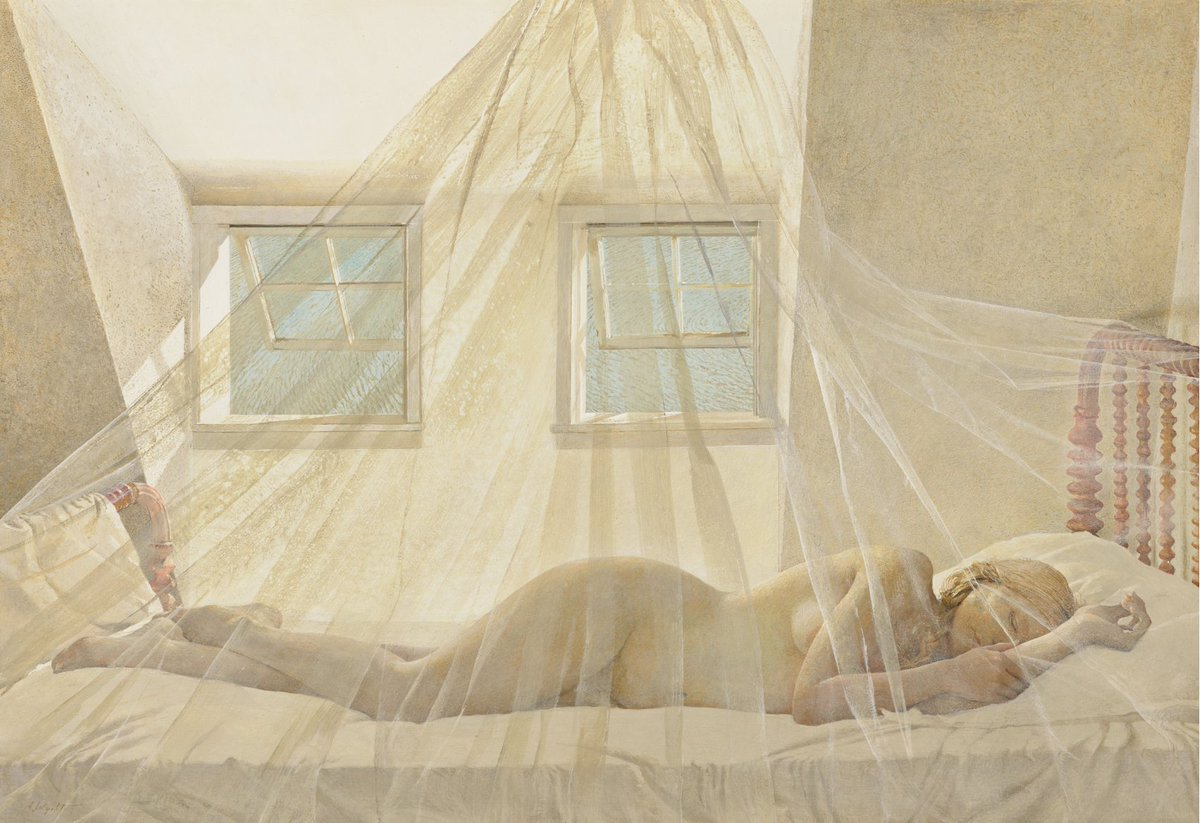
Andrew Wyeth, Day Dream, 1980

Hello and welcome to One Bright Book, the podcast where three friends real ALL the books, taking it one book at a time. My name is Dorian Stuber and I’m here as always with Rebecca Hussey and Frances Evangelista, this time to discuss Alice Munro’s short story collection Open Secrets, first published in 1994.

Before we go any further, I want to give an important content warning. Today’s episode will contain discussions of sexual violence, abuse, and rape, specially the sexual abuse of children.

Our podcast has always been focused closely on whatever book we’ve chosen to talk about. We bring biography and critical reception and historical context into the conversation, but usually only as secondary approaches to our encounter with the text.

Today, I suspect, will be different.

The outlines of Munro’s career are well-known. Born in 1931 in southwestern Ontario, near Lake Huron, the setting of so many of her stories, Munro went to university on a scholarship but left after two years to move to British Columbia with her husband, James Munro. The couple started a bookstore which is still in business. The couple had three children, but the marriage was difficult and they divorced in 1972. Four years later, Munro married a man named Gerald Fremlin, a retired geographer who had served in the Air Force in WWII and with whom she lived on a farm in rural Ontario. Munro had started writing already in university; as a young mother on the west coast she focused on short stories, claiming it was the only form she had time for. That may be true, but it’s also the case that from the start she was preoccupied by the possibilities of the form. How much time can be contained in something “short”? How many points of view can it offer? How many different ways can it be constructed? Beginning with Dance of the Happy Shades in 1968, Munro published 14 short story collections. As the years passed and the books accumulated, so too did her literary fame. The stories were published in places like The Paris Review, The Atlantic, and Harper’s, but above all in The New Yorker, where more than 60 first appeared.

She won many prizes, both in Canada and internationally, capped off by the Nobel Prize for Literature in 2013. In her last years, she suffered from dementia, a fate prefigured by her mother’s experience with Parkinson’s and the subject of one of her most famous stories, “The Bear Came Over the Mountain.” At her death in 2024 she had settled into a position as a writer both lauded and loved: a grandmotherly figure whose stories were psychologically sharp and brilliantly structured.

That status was shattered a few months after her death when Munro’s youngest daughter, Andrea Skinner, revealed that Gerald Fremlin, her stepfather, had sexually abused her starting in 1976, the year he married Munro: Skinner was 9 years old at the time. The abuse continued for several years. Skinner told Munro about it in 1992: after briefly separating from Fremlin, Munro returned to him, effectively choosing her husband over her child. In 2005, Fremlin pleaded guilty to sexual assault and received a suspended sentence. The rest of the family, as well as others in Munro’s close personal and professional circle, including her Canadian publisher, knew what had happened to Skinner but kept quiet. Nobody knew, but a lot of people knew. It was an open secret.

I wanted to discuss Munro on the podcast because, as a Canadian and a reader, she has been in my life for a long time. The revelations of her failure as a parent adds so much complexity to what was, for me, already a complicated relationship. I first encountered her in junior high when we read her famous story “Boys and Girls,” from her debut collection. It’s about a girl whose father raises foxes for their pelts and whose ability to help with that work is curtailed by expectations of what a girl should be or do once she reaches puberty. I remember a note in our textbook, something about how the girl is like the foxes, how their pens symbolize the narrator’s own imprisonment. That interpretation, though in retrospect pretty obvious, made a big impression on me. It was one of the first times I thought of a story as something made, the first inkling I had of the truth that each text teaches its readers how to read it.

Later I would veer away from Munro. The more famous she got, the more she became a Canadian writer loved around the world, the more I looked at her askance. That’s just my own pigheaded personality, but I did find her, on the occasions when I read one of her stories, such a chilly writer, a bit heartless really. She seemed to me to epitomize the emotional detachment, even stuntedness of the white Anglo Protestant settler Canadian class. (Even though, in stories like “The Wilderness Station” in the collection we’ll be talking about, she is also a critic of that mindset, the more powerful for being of that world.) In her Nobel address she talks about growing up among Scots-Irish immigrants and their descendants, a world in which it was considered poor form to have an emotional life and even worse to admit to any accomplishments. The title of her collection Who Do You Think You Are summarized that world.

In more recent years I would often teach some of Munro’s stories and came increasingly to admire their richness and strangeness. They are made to be re-read, in my opinion. Then Andrea Skinner told her story. For me, there is no way to separate this part of Munro’s life from her work. After all, the stories are so often about bad things—moral wrong, pain, hurt, betrayal—lurking in plain sight. I chose Open Secrets as the collection for us to talk about because that phrase seems to be the motto of her whole work. And I was genuinely shocked when I read the last story in the book. It’s called “Vandals,” and it’s about a man who abuses two young children and his partner, the woman who failed to care for them. It’s probably useless to speculate on a writer’s motivations, but I really wonder what Munro was thinking when she wrote it. Was she processing? Gloating? Apologizing? Was she not thinking at all? It’s past time for me to finish this introduction, so I’ll only say that despite what we know now and without excusing her in any way, I find myself captivated by the stories. I don’t know what that says about me or how I feel about that. I do think it’s important that we talk about them and about her, even at the risk of causing further hurt to Andrea Skinner and the legions of other child victims. For if we don’t—if we stop reading Alice Munro or if we separate art from artist—then we are back in the world of half-told truths. We are back in that dangerous world of open secrets.

What I Read, May 2024

What a terrific month! Yes, the first ten days were busy: bringing the semester to a close; dealing with the fallout of the lousy previous months; celebrating with our graduates. But then the pace shifted entirely. Amazing how much better I feel when I exercise regularly, eat better, sleep well, and sit on the back deck with a fantasy novel for an hour just because.

It occurred to me recently that in my moaning about last month I forgot something amazing. The eclipse! Little Rock in the totality for something like two and a half minutes, and the experience was as incredible as everyone said it would be. How lucky to simply walk down the block to an open space for an incredible view of the thing. How amazing that people in our neighbourhood (who normally never have anything to say to each other) were out and about, portable lawn chairs and to go cups in hand. Strong school’s out for summer vibes. 10/10, absolutely recommend.

Here are the books I read:

Franz Marc, Two Women on the Hillside, 1906

Arnaldur Indridason, The Darkness Knows (2017) Trans. Victoria Cribb (2021)

In wintery Iceland, retired cop Konrad is pulled into an ongoing investigation that to his surprise helps him learn more about the mysterious death of his father.

Arnaldur Indridason, The Girl by the Bridge (2018) Trans. Philip Roughton (2023)

In summery Iceland, retired cop Konrad is pulled into an ongoing investigation that to his surprise helps him learn more about the mysterious death of his father.

Look, sometimes you need to read something as undemanding as possible.

Guy Gavriel Kay, Lord of Emperors (2000)

Longer and even more satisfying sequel to Sailing to Sarantium, which I read a few months ago. This will sound weird, but I get the same feeling reading Kay as I do watching David Simon shows: intense investment on my part in the characters, sighs of bittersweet pleasure when things come to a close. Like its predecessor, Lord of Emperors is modelled on Byzantium under Justinian and Theodora. The mosaicist hero of the first volume—summoned to Sarantium to tile a version of the Hagia Sophia—is joined in this book by a doctor from lands to the east. Political upheaval leads to changing religious and artistic standards; the eventual fall of the Empire is hinted at. (Kay develops this unthinkable outcome in his more recent books.) There’s an exciting chariot race, too.

Christine Lai, Landscapes (2023)

Matt Keeley calls this the Sebaldian country house novel you didn’t know you needed. Which is a good description. Set in England in the near-future in an isolated house among desiccated fields and dead woods, Landscapes centers on an art historian who is first brought to the house by one of a pair of wealthy brothers only to flee from his violence into the arms of the other. Lai’s world-building won’t win any awards—it’s clearly not what she’s most interested in, though her description of literal zones of climate-controlled safety around city centers and other wealthy enclaves feels all-too plausible—and her characterization is uneven. (The only vivid character is the empty, preening, vain cruel brother.) But the book had me thinking anew about the role of art in an era of climate catastrophe and the Benjaminian claim that every document of culture is also a document of barbarism.

Megan Abbott, Beware the Woman (2023)

My first Abbott, unaccountably. But not my last.

Thriller with a side of body horror about a pregnant woman who accompanies her husband to his family’s summer place in Michigan’s upper peninsula for the first time. Plenty of Gothic accoutrements: kindly father, a former doctor still grieving his wife’s death decades ago, who might not be what he seems; mysterious housekeeper; isolated home. Abbott excels at creating menace, unease, and doubt. A story about what men will do to control women’s bodies: very much of our time.

Perfect reading for the first hot Sunday of the summer.

Émile Zola, La Bête Humaine (1890) Trans. Roger Pearson (1996)

“Too many trains, too many murders,” an early critic wrote, preposterously, of this terrific late novel in Zola’s Rougon-Macquart cycle. As if a book could have too much of either!

Although I still have plenty of Zola ahead of me—I’ve read about half of the RMs now—I’m willing to say that this is the most Zola-esque Zola of all. The train system, with its switches, branches, tunnels, wheelhouses, and miles of track, is the perfect metaphor for the books’ obsession with the interconnected systems and institutions of Second Empire France, especially because it affords new expressions of crime, sexual desire, and violence.

Reading La Bête Humaine, I was reminded of the opening of Peter Brooks’s argument that sight is the realist sense par excellence; of the many descriptive set pieces in this novel, Zola’s favourites seem to be the ones depicting the railyards of the Gare St Lazare as seen from the balcony of an apartment building inhabited by railway workers. In the opening scene a railyard supervisor named Roubaud awaits the return of his wife, Séverine, in a borrowed apartment in that building. She’s been shopping while he’s been getting a dressing down from his superior, a pickle he escapes thanks to the influence of a man named Grandmorin, a former judge who is on the board of the railway and has taken Roubaud on as a protégé because of his fondness for/guilt toward Séverine, whom he knew as a child. What promises to be a cozy tête-à-tête between newlyweds turns ugly, when a change remark by Séverine’s reveals that the judge had sexually abused her for years. Roubaud sees red and after nearly throttling his wife immediately plots to kill the judge, forcing Séverine to send the man a note asking him to meet her in a private car on the evening train to Rouen. This violence unfolds against a backdrop of gaiety and hilarity rising from the apartment below, where two sisters run a non-stop party of singing, dancing, and drinking.

Over the course of four-hundred increasingly intense pages—filled with one sensational, over-the-top scene after another—Zola builds to an indelible ending in which the strains of violence, misogyny, wounded male pride, hilarity, and excess that are already present in the beginning return in reconfigured form: a runaway train, its driver and fireman thrown off after a terrible fight, filled with drunken, bawling recruits headed to the front of what will be the disastrous Franco-Prussian War, hurtles unchecked and to certain disaster under a full head of steam.

I couldn’t get enough of the novel’s proto-Freudian and phrenological-criminological-eugenicist ways of thinking about human behavior. The other main character—the connection to the Rougon-Mcquart family—is the train driver Jacques Lantier (whose mother and brothers appear in The Assommoir, The Masterpiece, and Germinal, respectively), who literally sees red when he is aroused by a woman, wanting only to dismember her. (A long time ago I saw the Renoir film—though I remembered almost nothing; it must be so different from the book—and I could only picture Lantier as Jean Gabin, which is unfortunate because he’s much more like Peter Lorre.) And lest I make it sound like this is a book about men, that’s only partly true. In addition to Séverine, there are two other terrific female characters. The one who broke my heart was Flore, an operator at an isolated railway crossing, and whose unrequited love for her cousin Lantier leads to a disastrous outcome.

I could say a lot more about this book. Check out our conversation at One Bright Book to hear more. And speaking of more, I feel compelled to read more Rougon-Maquart before long. Summer of Zola, anyone?

Karl Ove Knausgaard, The Morning Star (2020) Trans. Martin Aitken (2021)

The reason I so seldom follow through on reading plans like the one I just suggested is that I just cannot stop from being distracted by unexpected things that come my way. I’d been paying even more attention than usual to Brandon Taylor’s reading because he’s been championing Zola lately. So when he tweeted repeatedly about this latest series from Knausgaard, I thought maybe I should investigate. I hadn’t paid any attention to this, other than to vaguely note Jeez, that Norwegian guy has another set of books. If I expected anything it was that the books would be autofiction in the vein of My Struggle. (I read the first two of those with great pleasure a long time ago and then… just didn’t keep up: now I want to close that loop, too.) But The Morning Star is a proper novel, in the sense that it is composed of long sections narrated by different first-person narrators, most of whom link up in sometimes unexpected ways. The action takes place in a hot summer in and around Bergen, in something like 2016. There is plenty of the deep ordinariness of middle-class Norwegian life that I found compelling in My Struggle (cabins to close for the season, impromptu dinner parties to arrange, elderly parents to look after, marriages to keep on life-support). But there’s also a lot of weird stuff: a priest conducts a funeral for a man who turns out to look identical to the one who asked her an impertinent question in the airport the night before; a creature, whether human or not is unclear, roams the forest, possibly in connection to the disappearance of a man from a mental institution and a shocking satanic cult murder; and, most powerfully of all, a dazzlingly bright star suddenly appears in the sky.

The novel seems to be about the relation between the mundane and the extraordinary: I say seems because for me Knausgaard incites a delicious reading fugue state, where undistinguished sentences roll on into compelling blocks of text and the pages keep turning as if by themselves. As soon as I reached the end of its 600+ pages I ordered the 800+-page sequel…

Berthe Morisot, In England (Eugène Manet on the Isle of Wight), 1875

Honestly I enjoyed all these books, even those Indridasons. See anything you fancy here?