What I Read, February 2026

February in St Louis was warmish but not dismayingly so. We could still pretend winter is a thing. Lots of good running weather. I beavered away at my various gigs. I probably saw some movies but now I can’t remember. I should start writing those down. My review of Gabriele Tergit’s Effingers was published in The Wall Street Journal. Canada lost both gold medal Olympic hockey games, and that really hurt. I also read some books.
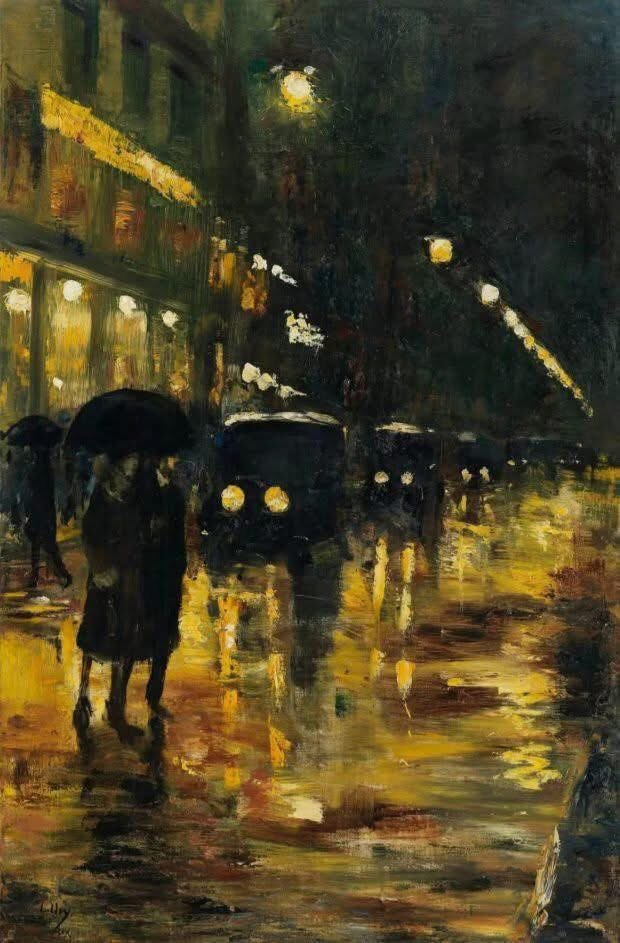
Leo Lesser Ury, Cafe König at Night, 1925

Qntm, There is no Antimemetics Division (2025)

We live in a world of memes. Internet jokes, catch phrases, bits of culture that spread with the persistence of an earworm. But what if there were such things as antimemes? Ideas, cultish beliefs, even malevolent forces that circulate with similar force except that they have the power of being forgotten, such that we are unable to recall their effect on us. And what if a governmental organization had been set up to protect us from these antimemes, which seek to crush us with their own dark virality?

That’s the premise of this brilliant novel, which broke my brain in all the best ways. The scientists and operatives in the Antimemtic Division routinely forget everything they’ve done, requiring elaborate protocols and dangerous actions to make sure that the world is kept safe from REDACTED and REDACTED. Author qntm, pronounced “quantum,” the pen name of British writer Sam Hughes, concludes that the human ability to forget anything is both what keeps us going and our greatest vulnerability.

Robert Jackson Bennett, A Drop of Corruption (2024)

Ana and Din are back! This time they venture into the most forbidding and dangerous place in the Empire: the Shroud. In this floating station off the coast (part oil derrick, part Pequod), a handful of Alchemists process leviathan corpses, harvesting the raw material from which all-powerful bodily modifications stem. In addition to avoiding the dreaded “middle volume sag” and offering another satisfying tale of detection, A Drop of Corruption picks up the hints in the first volume about stakes larger than this one case, which will presumably be developed in the third book in the series, due later this year.

Lea Ypi, Indignity: A Life Reimagined (2025)

It starts with a photo.

A young couple enjoy the snow and sunshine of the Italian Dolomites. They look at the camera with quite different expressions. He seems wary: eyes narrowed, perhaps against the glare, two furrows etched on his forehead; she, nestled in a fur, smiles broadly. It’s early 1941. These newlyweds are on their honeymoon. How could they be enjoying themselves while the war rages and the Balkans, including Albania, where they have made their home, has been plunged into factionalism? And why hadn’t Yea Lpi, professor of philosophy and the subjects’ granddaughter, ever seen this picture before? As the photo circulates online, people make all sorts of claims. Her grandmother was a communist spy; she was a fascist collaborator. Is any of this true?

The photo turns out to be a red herring—Ypi doesn’t even reproduce it in the book, save in highly cropped form on the (beautiful) cover of the US edition. (It’s easy to find online, though.) Instead, her book reconstructs her grandmother Leman’s life, from her childhood in an Albanian family long devoted to the Ottoman Empire in Greek Salonica, through her decision, as a young woman of 18, to move to Tirana, where she found a career and, briefly, a husband, a man recently returned from studying law in Paris where he knew, though did not particularly like, another expatriate, a young striver named Enver Hoxha. Ypi’s grandfather’s decency and reformist leftist tendencies put him at odds with the postwar Communist government. He was branded an enemy of the state and imprisoned for 15 years, during which time Leman and their young son (Ypi’s father) were forced to work at manual labour far from their home in the capital

Central to the story are the documents in Leman’s secret service file at the formidably named Authority for Information Concerning Documentation of the Former State Security Service. As always, documents turn out to be fundamentally inconclusive, especially when a late revelation prompts Ypi to wonder if anything in them is at all trustworthy. It doesn’t help that Ypi is researching her grandmother (as opposed to her grandfather or any other male relative). As a fellow scholar puts it, women and archives don’t go together: when woman appear at all, it is almost always with their husband’s name. Better, the man tells Ypi, to write a novel.

Which Ypi has done, sort of. Her treatment of Leman’s life is novelistic: filled with thoughts and feelings she could have had no access to, even though Leman was a beloved figure in her upbringing in Communist Albania in the 1980s and 90s. Most impressive is her glorious evocation of the multicultural world of early 20th century Thrace, tragically destroyed by successive waves of ethnic cleansing, from forced population transfers between Greece and Turkey in the wake of WWI to the Nazi eradication of Jewish Salonica.

Beneath this personal and political history is a philosophical investigation. From its epigraphs, citing Kant and Schiller, to its closing pages, the book considers the idea of dignity and its titular opposite. Dignity is the drive to “rule over adversity with moral force,” a tendency that Ypi argues, following Schiller, is fundamentally human. Dignity is what allows a person to decide to suffer, rather than instinctively to seek to free themselves from pain. And people most suffer, Ypi concludes, when they want to acknowledge both that the meaning of their lives both incorporates and exceeds the larger identities of family and nation and gender and religion of which they are part. (Ypi is a modern day Kanitian.) In this way, Ypi has given us a way to think not just about her grandmother but all the ordinary people who live through history, as she puts it, the first time as tragedy and the second time as even greater tragedy.

Ray Nayler, Palaces of the Crows (2026)

After enjoying Where the Axe is Buried last month, I was excited to get my hands on an advanced copy of Nayler’s forthcoming novel. And when I learned it was set in the forests of Lithuania (or perhaps Belarus) in WWII I was even more intrigued. Why had the sff writer Nayler chosen to write historical fiction? The answer is that he has found another way to investigate the animating question of his fiction: what kinds of relationships can exist between human and non-human animal societies? His first book considered octopuses. His second, elephants and mastodons. Here it’s crows.

Four teenagers—one Jewish, one Roma, one a Pole who has enlisted in the Red Army to help his family survive their forced exile in Siberia, and one a mute boy whose origins are uncertain—find each other in the chaos of the German advance into the Soviet Union in summer 1941. The Jewish girl, Neriya, whose family has always, in the years before he war, left their home in Vilnius each summer to vacation in a country village, and whose doctor parents have encouraged her to read Darwin and von Uexhüll, has over the years befriended a crow she names Buster. Buster is smart, even for a crow. He remembers Neriya from year to year, and masters the various games and puzzles she sets for him. He introduces her to other crows, each of whom has their own personalities. When she hides from the Germans in the forest, the birds appear at times of trouble, helping her and the other teens survive. For although the forest is vast, it is peopled with all sorts of threats: partisans, Germans, Russians who have gone AWOL, and others who, like our protagonists, are simply trying to survive. These other people are dangerous—though not as much as the terrible winters. The teens need all the help they can get.

The crows have created an avian city in the heart of the forest—more than a city, a real society, in which they look out for the most vulnerable members, much more than humans do. Chapters set during the war are interspersed with others from the 1970s, when the teens, now adults, each of whom has navigated life in the USSR in a different way, return to the forest. How can they protect the descendants of the crows who once protected them? Palace of the Crows might wrongfoot or disappoint some of Nayler’s earlier readers, especially those expecting a book a set in the future, but those who persist will see that this book, too, is about how we tell the stories of who we are, both within and between species. I hope Nayler keeps up his current writing pace!

Beryl Bainbridge, An Awfully Big Adventure (1989)

Stella Bradshaw is a working-class teenager in Liverpool in 1950. Her dream is to be in the theater, so she’s pleased in her closemouthed way when she is hired as an assistant stage manager in a regional playhouse. As the troupe prepares for a production of Peter Pan (the novel’s title comes from that play’s description of what death is sure to be), Stella becomes embroiled in its complicated relationships. She falls for the director, oblivious to what is obvious to readers: he’s gay. What at least this reader was oblivious to—surprising, because I’d seen the film, though admittedly not since it was in theaters in the late 90s—was the novel’s turn from comedy to tragedy. That ending! (And, yes, it’s all explained on the first page, Toni Morrison-style, but I’m slow.) Excellent stuff. Could have taken the Booker from A. S. Byatt if you ask me.

I’ll be reading this again soon: it’s the June title for the Leviathan book club. If you’re in St Louis, please join!

Miklós Bánffy, They Were Found Wanting [The Transylvanian Trilogy: Volume II] (1937) Trans. Patrick Thursfield and Katalin Bánffy-Jelen (2000)

See my thoughts on volume I. This continued to be excellent. Plenty of heartbreak, though. Things not going great for Laszlo.

Barbara Pym, The Sweet Dove Died (1977)

A moment ago, I mentioned a forthcoming meeting of the Leviathan book club. Pym’s late, great novel was our first selection. And what a terrific choice that turned out to be! I was thrilled to lead a discussion with such a smart and energetic group. I’d actually read this last August (one of those months I never got around to writing about) when NYRB released its beautiful edition. My first Pym, and from what I gather not the most representative, but absolutely terrific. I would say it even improved on re-reading. A woman coming up on 50—cool, elegant, manipulative, as Jacqui puts it in her review—meets an antique dealer and his 24-year-old nephew, who he’s training in the business. The antique dealer imagines a future with the woman, but she has designs (of what sort is never quite clear, even to herself) on the younger man. People behave badly—but, also, everyone has their reasons. The title, from Keats, is about the anguish—or is it the thrill?—of loving something to death. I would call The Sweet Dove Died Jamesian in the sense of being a study in cruelty. And an object lesson for any of us obsessed with the idea that the surroundings and events of our lives must be just so.

Isabel Cañas, Vampires of El Norte (2023)

Historical romance and vampire story set in the early part of the Mexican – American War (aka the US invasion of Mexico). As children, Nena and Néstor are inseparable, even though she’s the daughter of the patrón of a hacienda and he’s the son of a vaquero. Everything changes one night, when their expedition in search of buried Spanish silver coins goes terribly awry. Something, some creature, eyeless, all teeth and silent destruction, attacks Nena. The boy fights off the beast and carries the girl to the main house, but convinced he is responsible for her death he runs away never to be seen again. Until ten years later, that is, when he returns to join the forces the local ranchers are putting together to fight the Yanquis. When he sets eyes on Nena—who eventually recovered from her mysterious wounds—he freaks out. As does she, but for a different reason. She’s furious that he never wrote and can’t understand that he thought she was dead. This sets off an enemies-to-lovers story during a desperate mission in the wilds of northern Mexico: conveniently, the two become separated from the rest of the auxiliary cavalry during a battle. (Nena is there because in the intervening years and under the tutelage of Néstor’s grandmother she has become a curandera or healer.) Can the two overcome their differences to admit their love for each other? If so, what will happen when they return to the rigidly stratified world of the hacienda? And what are the terrible creatures the Yanquis have captured and forced to fight for them? You can probably guess the answers to all these questions. Vampires of El Norte doesn’t ever surprise, but it’s plenty satisfying. I do think Cańas needed to get a better handle on her allegory: those damn Yanquis are indeed vampiric but in the book’s most interesting moments the vampires are literal creatures, not just symbols. Just where did these vampires come from, anyway? It’s all a bit fast and loose. Still, I enjoyed this enough to seek out Cańas’s other books. Thanks to Hope for putting this on my radar.
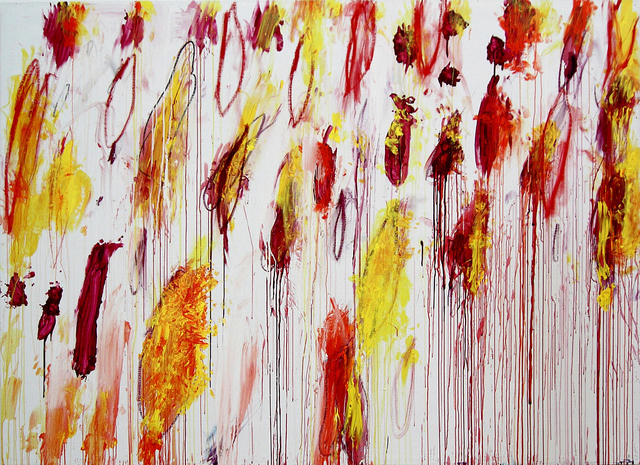
Cy Twombly, Lepanto Part IV (2001)

March roundup coming soon!

What I Read, January 2026

Gonna knock out some posts on this year’s reading before we hit the half-way mark of 2026. Here’s what I remember about January in St Louis. A snow storm came through near the end of the month. It was cold for a while. That was great. I ran as often as the street cleaning allowed. I spent some time applying for a job that I would later get. That was very good. And I read these books.

Childe Hassam, Messenger Boy (1902)

Georges Simenon, The Two-Penny Bar (1932) Trans. David Watson (2014)

What, you expect me to remember the plot of a Simenon I read five months ago? What I do remember is that this is one of the atmospheric-outskirts-of-Paris Maigrets. The search for the killer of a moneylender (Jewish, natch, boo) whose body has been seen being dumped in the river leads Maigret to a group of friends who spend weekends and holidays at an inn (the bar of the title) near Morsang, a village on the Seine about 40 km from the capital. They fish, paddle about, play cards, chase children, eat fulsomely, drink a hell of a lot, and sleep with each other. Maigret insinuates himself into the group, which is no trouble for him since he loves all those things too. (Except the adultery part. Maigret could never.) The vibes are immaculate, and the crime gets solved too.

Seichō Matsumoto, Tokyo Express (1958) Trans. Jesse Kirkwood (2022)

Born in 1909 in Japan’s Fukoka prefecture, Seichō Matsumoto did not publish until 1950. But then he made up for lost time, publishing over 450 books in the next four decades. These range from procedurals to psychological slow-burns in the vein of Patricia Highsmith or Celia Dale. Until recently, Matsumoto was hard to find in English. Happily, Modern Library (following on the heels of Penguin UK) has launched a program of reissues and they’ve started with one of his best. Tokyo Express (1958) begins with the discovery of the bodies of a man and a woman on a remote beach. Investigators rule the deaths a lovers’ suicide. But two detectives—one local to the scene, older, out of fashion; the other from the city, young, full of new ideas—aren’t buying it. Before long, they think they know who did it—but not how. Part odd-couple buddy story, part oblique criticism of a society desperate to repress its wartime past, the novel is famous for its plot, which centers on the detailed scrutiny of train time-tables. Trust me, this is a lot more exciting than it sounds. Tokyo Express is so clever you’ll be left shaking your head in appreciation at Matsumoto’s skill—and counting down the days until the next reissue appears.

Ray Nayler, Where the Axe is Buried (2025)

Nayler’s second full-length novel—after the excellent The Mountain in the Sea, about octopus intelligence—offers what are coming to seem his trademark elements: compelling characters; clear explanations of how systems function, whether these be ecological, political, or technological; and deep knowledge of political organizations and local customs gained from his other career in the foreign service. Set in an unspecified future in which many parts of the world are run by AI systems designed to maximize resources and human flourishing whereas others rely on more old-fashioned methods of coercion and surveillance, Where the Axe is Buried is a compendium of authoritarian strategies—and the resistances they inevitably provoke. Whether you read for the heart or the head, you’ll find much to appreciate here.

Anthony Trollope, The Way We Live Now (1875)

The subject of Episode 42 of One Bright Book. In my introduction to the episode, I said:

The central concepts of this terrific novel are cowardice and cruelty. Which is not to say it is a cruel or cowardly novel. How could it be, given Trollope’s amused interest in even the worst of the rogue’s gallery that makes up its cast of characters? But there sure is a lot of cruelty in its pages. Maybe we should be glad that even its worst characters don’t seem to take pleasure in their cruelty. (They are not Stephen Miller cruel.) But they are cowards, and in their desire to have things go their own way they will say or do anything, especially if it means they can avoid making a hard choice. Saying enough’s enough to someone else’s bad behaviour; taking responsibility for one’s own actions: these are things almost no one in this novel will do. That cowardice is what leads to cruelty. Something to think about re: our own day. Turns out The Way We Live Now is also about the way we live now.

Anne Youngson, Meet Me at the Museum (2018)

Anne Youngson was unknown to me when I noticed her two novels on the shelves of Leviathan. I figured James had a good reason for stocking them, so I asked him to tell me more. His response: “Light reading that doesn’t insult your intelligence.” Since that is my favourite kind of reading, I immediately moved them to the top of the TBR pile.

I started with Meet Me at the Museum because I love epistolary novels. As a teenager, Tina Hopgood wrote a letter to Professor P. V. Glob at the Silkeborg Museum in Denmark about the Tollund Man, which he had recently gained fame for identifying after the 2500-year-old body was found, perfectly preserved, by two peat-cutters in a bog. Glob—a real guy: his book was reissued by NYRB a while ago—wrote back, prompting the young woman to promise herself that she would visit the museum one day. Since then forty years have passed. Tina, now a middle-aged English farmwife with grown children, writes the professor again, this time because the friend she had planned to take the trip with all those years ago has just died. A reply to her lament for lost time arrives—but not from Glob, because he too is dead.

The letter writer is a curator named Anders Larson, who expresses mild interest in her past encounter with his famous predecessor and condolences on her recent loss. From this kind but detached beginning stems a lengthy correspondence in which two modest and decent people open up to each other about their shared puzzlement at how they came to have more life behind than ahead of them. The obvious comparison to Meet Me at the Museum is 84 Charing Cross Road and if you liked that one you’ll like this too. Like its more famous forbearer, Meet Me is gentle and modest in its ambitions and prose—but thrilling precisely because it doesn’t try to do too much. Its sincerity becomes it. As usual, James is right: it never insults your intelligence.

Youngson was in her 70s when she published this, her first book, written after her retirement from a career as an executive in the car industry. I’ve written before about how much the idea of the late bloomer means to me. (Maybe I’ll still do something with my life!) Learning about the author’s circumstances made me enjoy this lovely book all the more. I think a number of you would dig it, too.

Robert Jackson Bennett, The Tainted Cup (2024)

Rex Stout with monsters. The most dangerous place in Khanum is its sea-walls, where soldiers and engineers must constantly guard the empire from malevolent leviathans that inflict terrible damage any time they manage to breach the defenses. Yet these monsters don’t just threaten Khanum. They are also the source of its most powerful technologies. Alchemists have figured out how to synthesize the beasts’ blood and organs into bodily modifications that grant supernatural abilities and are thus coveted by the Empire’s citizens even though they are so powerful they often cause early death.

The narrator, Dinios “Din” Kol, has chosen to be modified as an Engraver: he remembers everything he ever hears, sees, smells, tastes, and touches. For obvious reasons, Engravers serve in law enforcement, typically serving as assistants to Investigators. At the beginning of The Tainted Cup, Din meets Anagosa “Ana” Dolraba. She is brilliant, idiosyncratic, vaguely disreputable. And she has asked for Din by name. Ana needs an Engraver more than most Investigators, because her agoraphobia and neurodivergence (she is so easily sensorily overstimulated she needs to wear a blindfold) generally keep her inside and away from crime scenes. (See what I mean about Nero Wolfe? And Sherlock Holmes for that matter.)

The pair have been tasked with solving the murder of a prominent Engineer. The man was found dead while visiting the home of a powerful oligarch, killed by dapplegrass, a modified plant that explodes from the inside anything that inhales or consumes it. Shortly thereafter, a section of seawall is breached and several of the Engineers responsible for protecting it are found dead in the same way.

I loved The Tainted Cup from start (a wonderful map) to finish (a teaser for the next volume). The solution to the crime is as good as the world-building: an impressive feat. A lot of books that try to do just one of those things don’t succeed. This is Bennett’s third series. I’ll be getting to them all.

Hans Peter Richter, Friedrich (1961) Trans. Edite Kroll (1970)

Postwar German children’s classic about the persecution of a Jewish child in 1930s Germany. The unnamed narrator has a best friend named Friedrich: the boys, born one week apart in 1925, grow up in the same apartment building, in an out of each other’s lives. At times, the narrator wishes he were part of Friedrich’s family. He looks up to his friend’s parents, warmer and wiser than his own. But the boys diverge as they age and Nazism takes hold on German life. For a time, the narrator manages—like his father, who remains friendly to Friedrich’s parents even after throwing in his lot with the Nazis, thanks to whom he has found work after long-term unemployment—to reconcile his friendship with the new norms of public life. But the contradiction can’t hold: the best part of the book concerns Kristallnacht, when Friedrich finds himself, in a moment of genuine ecstasy, that is, of being thrown outside himself, joining in with the destruction of Jewish property and life, starting with Friedrich’s home.

Richter served in the German army (he lost an arm on the Eastern front); after the war he studied psychology and sociology, but found his calling as a writer for children. Friedrich, the best known of his books, was for years a classroom staple in Germany. It’s easy to see why: it exemplifies the universalist school of representing Jewish life in the Nazi period: that is, it believes German Jews were as ordinary and as German as anyone else; their Jewishness was contingent and incidental to their lives. (In the guise of openness and acceptance, this view manages to reject the idea of Jewishness as meaningful in its own right.) It is also frank about German culpability. Which makes sense, given the audience it was written for. For the same reason, though, it’s not the book contemporary readers, especially non-German ones, are likely to most want on the subject. We might expect a book on the Holocaust to foreground Jewish experience, for example. We might want such a novel to have a Jewish main character. But that doesn’t mean the book isn’t worth reading. It is a document of its time, and carries its own interest, especially its willingness to suggest that there might be a thrilling element to destruction and persecution. A middle-grade book today probably wouldn’t do that, either. And that might be a loss.

Edith Wharton, A Backward Glance (1934)

The past couple of years I’ve been part of a group, headed by Shawn of the Shawn Breathes Books YouTube channel, reading Edith Wharton’s collected works. Regular readers will know I think she’s a genius. I was excited to learn more about where that brilliance came from, and enthusiastically agreed when someone suggested we tackle her autobiography. By the end of the book, I wasn’t so enthusiastic anymore. I didn’t quite expect a tell-all, but I certainly thought it would be more personal than it is. Which makes sense: A Backward Glance predates the era of personal writing. Wharton is discrete to the point of obliquity about her failed marriage to the Boston Brahmin Teddy Wharton and silent about her lengthy love affair with the journalist Morton Fuller. Her look into the past is glancing indeed.

Still, I remember a number of moments, including:

Wharton’s claim that she was taught only two things as a child (she had, to put it mildly, erratic schooling): modern languages and good manners.

Her further claim—which you can see motivating a book like Age of Innocence—that her childhood was worth remembering only because the New York of that time is as vanished a world as Atlantis.

What William Dean Howells told her when the dramatization of The House of Mirth flopped: “What the American public always wants is a tragedy with a happy ending.”

Little Edith, carrying around a book and making up stories from it even before she could read.

A nearly silent visit with Henry James to the aged George Meredith, in the grip of locomotor ataxia and deafness.

Countless drives in an open car through the English countryside with a profusely sweating Henry James, who adored motoring, though of course never drove himself.

What I took most from the book is that Edith Wharton was an excellent, devoted friend. Her shyness and social anxiety caused many to ignore or be disappointed by her. But those who got to know her were richly rewarded. Readers of this book, however, can only glimpse that person. A Backward Glance is interesting but underwhelming. Certainly not the place to start with Wharton, who just looms larger and larger for me as a great 20th century writer.

Alex Katz, Winter Branch (1993)

More soon on February’s reading!