What I Read, February 2026

February in St Louis was warmish but not dismayingly so. We could still pretend winter is a thing. Lots of good running weather. I beavered away at my various gigs. I probably saw some movies but now I can’t remember. I should start writing those down. My review of Gabriele Tergit’s Effingers was published in The Wall Street Journal. Canada lost both gold medal Olympic hockey games, and that really hurt. I also read some books.
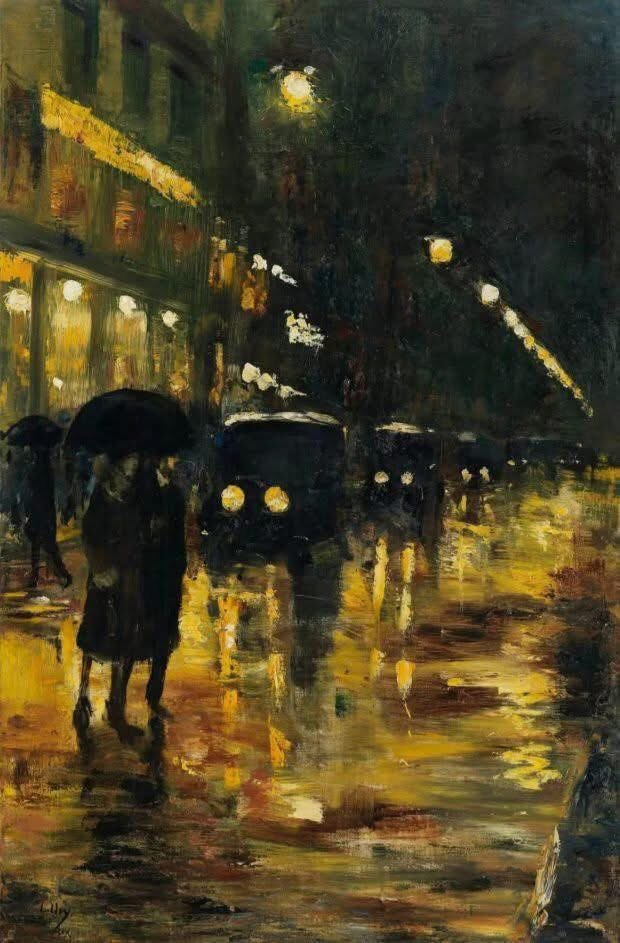
Leo Lesser Ury, Cafe König at Night, 1925

Qntm, There is no Antimemetics Division (2025)

We live in a world of memes. Internet jokes, catch phrases, bits of culture that spread with the persistence of an earworm. But what if there were such things as antimemes? Ideas, cultish beliefs, even malevolent forces that circulate with similar force except that they have the power of being forgotten, such that we are unable to recall their effect on us. And what if a governmental organization had been set up to protect us from these antimemes, which seek to crush us with their own dark virality?

That’s the premise of this brilliant novel, which broke my brain in all the best ways. The scientists and operatives in the Antimemtic Division routinely forget everything they’ve done, requiring elaborate protocols and dangerous actions to make sure that the world is kept safe from REDACTED and REDACTED. Author qntm, pronounced “quantum,” the pen name of British writer Sam Hughes, concludes that the human ability to forget anything is both what keeps us going and our greatest vulnerability.

Robert Jackson Bennett, A Drop of Corruption (2024)

Ana and Din are back! This time they venture into the most forbidding and dangerous place in the Empire: the Shroud. In this floating station off the coast (part oil derrick, part Pequod), a handful of Alchemists process leviathan corpses, harvesting the raw material from which all-powerful bodily modifications stem. In addition to avoiding the dreaded “middle volume sag” and offering another satisfying tale of detection, A Drop of Corruption picks up the hints in the first volume about stakes larger than this one case, which will presumably be developed in the third book in the series, due later this year.

Lea Ypi, Indignity: A Life Reimagined (2025)

It starts with a photo.

A young couple enjoy the snow and sunshine of the Italian Dolomites. They look at the camera with quite different expressions. He seems wary: eyes narrowed, perhaps against the glare, two furrows etched on his forehead; she, nestled in a fur, smiles broadly. It’s early 1941. These newlyweds are on their honeymoon. How could they be enjoying themselves while the war rages and the Balkans, including Albania, where they have made their home, has been plunged into factionalism? And why hadn’t Yea Lpi, professor of philosophy and the subjects’ granddaughter, ever seen this picture before? As the photo circulates online, people make all sorts of claims. Her grandmother was a communist spy; she was a fascist collaborator. Is any of this true?

The photo turns out to be a red herring—Ypi doesn’t even reproduce it in the book, save in highly cropped form on the (beautiful) cover of the US edition. (It’s easy to find online, though.) Instead, her book reconstructs her grandmother Leman’s life, from her childhood in an Albanian family long devoted to the Ottoman Empire in Greek Salonica, through her decision, as a young woman of 18, to move to Tirana, where she found a career and, briefly, a husband, a man recently returned from studying law in Paris where he knew, though did not particularly like, another expatriate, a young striver named Enver Hoxha. Ypi’s grandfather’s decency and reformist leftist tendencies put him at odds with the postwar Communist government. He was branded an enemy of the state and imprisoned for 15 years, during which time Leman and their young son (Ypi’s father) were forced to work at manual labour far from their home in the capital

Central to the story are the documents in Leman’s secret service file at the formidably named Authority for Information Concerning Documentation of the Former State Security Service. As always, documents turn out to be fundamentally inconclusive, especially when a late revelation prompts Ypi to wonder if anything in them is at all trustworthy. It doesn’t help that Ypi is researching her grandmother (as opposed to her grandfather or any other male relative). As a fellow scholar puts it, women and archives don’t go together: when woman appear at all, it is almost always with their husband’s name. Better, the man tells Ypi, to write a novel.

Which Ypi has done, sort of. Her treatment of Leman’s life is novelistic: filled with thoughts and feelings she could have had no access to, even though Leman was a beloved figure in her upbringing in Communist Albania in the 1980s and 90s. Most impressive is her glorious evocation of the multicultural world of early 20th century Thrace, tragically destroyed by successive waves of ethnic cleansing, from forced population transfers between Greece and Turkey in the wake of WWI to the Nazi eradication of Jewish Salonica.

Beneath this personal and political history is a philosophical investigation. From its epigraphs, citing Kant and Schiller, to its closing pages, the book considers the idea of dignity and its titular opposite. Dignity is the drive to “rule over adversity with moral force,” a tendency that Ypi argues, following Schiller, is fundamentally human. Dignity is what allows a person to decide to suffer, rather than instinctively to seek to free themselves from pain. And people most suffer, Ypi concludes, when they want to acknowledge both that the meaning of their lives both incorporates and exceeds the larger identities of family and nation and gender and religion of which they are part. (Ypi is a modern day Kanitian.) In this way, Ypi has given us a way to think not just about her grandmother but all the ordinary people who live through history, as she puts it, the first time as tragedy and the second time as even greater tragedy.

Ray Nayler, Palaces of the Crows (2026)

After enjoying Where the Axe is Buried last month, I was excited to get my hands on an advanced copy of Nayler’s forthcoming novel. And when I learned it was set in the forests of Lithuania (or perhaps Belarus) in WWII I was even more intrigued. Why had the sff writer Nayler chosen to write historical fiction? The answer is that he has found another way to investigate the animating question of his fiction: what kinds of relationships can exist between human and non-human animal societies? His first book considered octopuses. His second, elephants and mastodons. Here it’s crows.

Four teenagers—one Jewish, one Roma, one a Pole who has enlisted in the Red Army to help his family survive their forced exile in Siberia, and one a mute boy whose origins are uncertain—find each other in the chaos of the German advance into the Soviet Union in summer 1941. The Jewish girl, Neriya, whose family has always, in the years before he war, left their home in Vilnius each summer to vacation in a country village, and whose doctor parents have encouraged her to read Darwin and von Uexhüll, has over the years befriended a crow she names Buster. Buster is smart, even for a crow. He remembers Neriya from year to year, and masters the various games and puzzles she sets for him. He introduces her to other crows, each of whom has their own personalities. When she hides from the Germans in the forest, the birds appear at times of trouble, helping her and the other teens survive. For although the forest is vast, it is peopled with all sorts of threats: partisans, Germans, Russians who have gone AWOL, and others who, like our protagonists, are simply trying to survive. These other people are dangerous—though not as much as the terrible winters. The teens need all the help they can get.

The crows have created an avian city in the heart of the forest—more than a city, a real society, in which they look out for the most vulnerable members, much more than humans do. Chapters set during the war are interspersed with others from the 1970s, when the teens, now adults, each of whom has navigated life in the USSR in a different way, return to the forest. How can they protect the descendants of the crows who once protected them? Palace of the Crows might wrongfoot or disappoint some of Nayler’s earlier readers, especially those expecting a book a set in the future, but those who persist will see that this book, too, is about how we tell the stories of who we are, both within and between species. I hope Nayler keeps up his current writing pace!

Beryl Bainbridge, An Awfully Big Adventure (1989)

Stella Bradshaw is a working-class teenager in Liverpool in 1950. Her dream is to be in the theater, so she’s pleased in her closemouthed way when she is hired as an assistant stage manager in a regional playhouse. As the troupe prepares for a production of Peter Pan (the novel’s title comes from that play’s description of what death is sure to be), Stella becomes embroiled in its complicated relationships. She falls for the director, oblivious to what is obvious to readers: he’s gay. What at least this reader was oblivious to—surprising, because I’d seen the film, though admittedly not since it was in theaters in the late 90s—was the novel’s turn from comedy to tragedy. That ending! (And, yes, it’s all explained on the first page, Toni Morrison-style, but I’m slow.) Excellent stuff. Could have taken the Booker from A. S. Byatt if you ask me.

I’ll be reading this again soon: it’s the June title for the Leviathan book club. If you’re in St Louis, please join!

Miklós Bánffy, They Were Found Wanting [The Transylvanian Trilogy: Volume II] (1937) Trans. Patrick Thursfield and Katalin Bánffy-Jelen (2000)

See my thoughts on volume I. This continued to be excellent. Plenty of heartbreak, though. Things not going great for Laszlo.

Barbara Pym, The Sweet Dove Died (1977)

A moment ago, I mentioned a forthcoming meeting of the Leviathan book club. Pym’s late, great novel was our first selection. And what a terrific choice that turned out to be! I was thrilled to lead a discussion with such a smart and energetic group. I’d actually read this last August (one of those months I never got around to writing about) when NYRB released its beautiful edition. My first Pym, and from what I gather not the most representative, but absolutely terrific. I would say it even improved on re-reading. A woman coming up on 50—cool, elegant, manipulative, as Jacqui puts it in her review—meets an antique dealer and his 24-year-old nephew, who he’s training in the business. The antique dealer imagines a future with the woman, but she has designs (of what sort is never quite clear, even to herself) on the younger man. People behave badly—but, also, everyone has their reasons. The title, from Keats, is about the anguish—or is it the thrill?—of loving something to death. I would call The Sweet Dove Died Jamesian in the sense of being a study in cruelty. And an object lesson for any of us obsessed with the idea that the surroundings and events of our lives must be just so.

Isabel Cañas, Vampires of El Norte (2023)

Historical romance and vampire story set in the early part of the Mexican – American War (aka the US invasion of Mexico). As children, Nena and Néstor are inseparable, even though she’s the daughter of the patrón of a hacienda and he’s the son of a vaquero. Everything changes one night, when their expedition in search of buried Spanish silver coins goes terribly awry. Something, some creature, eyeless, all teeth and silent destruction, attacks Nena. The boy fights off the beast and carries the girl to the main house, but convinced he is responsible for her death he runs away never to be seen again. Until ten years later, that is, when he returns to join the forces the local ranchers are putting together to fight the Yanquis. When he sets eyes on Nena—who eventually recovered from her mysterious wounds—he freaks out. As does she, but for a different reason. She’s furious that he never wrote and can’t understand that he thought she was dead. This sets off an enemies-to-lovers story during a desperate mission in the wilds of northern Mexico: conveniently, the two become separated from the rest of the auxiliary cavalry during a battle. (Nena is there because in the intervening years and under the tutelage of Néstor’s grandmother she has become a curandera or healer.) Can the two overcome their differences to admit their love for each other? If so, what will happen when they return to the rigidly stratified world of the hacienda? And what are the terrible creatures the Yanquis have captured and forced to fight for them? You can probably guess the answers to all these questions. Vampires of El Norte doesn’t ever surprise, but it’s plenty satisfying. I do think Cańas needed to get a better handle on her allegory: those damn Yanquis are indeed vampiric but in the book’s most interesting moments the vampires are literal creatures, not just symbols. Just where did these vampires come from, anyway? It’s all a bit fast and loose. Still, I enjoyed this enough to seek out Cańas’s other books. Thanks to Hope for putting this on my radar.
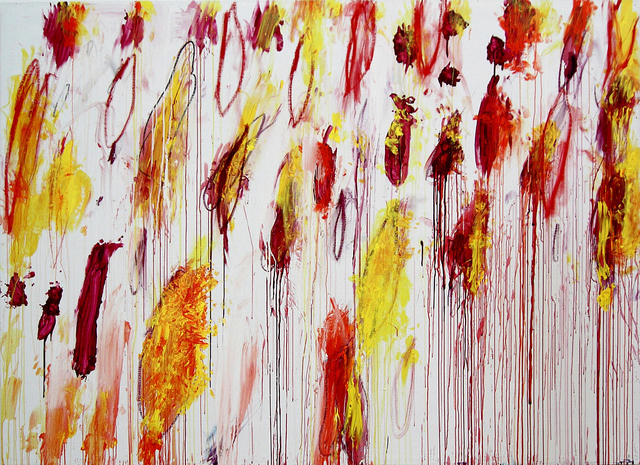
Cy Twombly, Lepanto Part IV (2001)

March roundup coming soon!

James Morrison’s Year in Reading, 2022

I still hope to write up my reflections on my 2022 reading year. (Though look how well that worked last year…) In the meantime, I’ve solicited guest posts from friends and fellow book lovers about their own literary highlights. First up is James Morrison, an Australian reader and editor (sadly, not of books) who tweets at @unwise_trousers and blogs (increasingly infrequently) at http://causticcovercritic.blogspot.com. His novel Gibbons, Or One Bloody Thing After Another will be published later this year by Orbis Tertius Press

Look for more reflections from a wonderful assortment of readers in the days to come. And remember, you can always add your thoughts to the comments.

Woman committing suicide by jumping off of a bridge – George Cruikshank [1848]

First, a bit of throat-clearing. When I started to try to work out what my favourite books that I had read in 2022 were, I had a list 84 books long, out of nearly 300 read. This is obviously insane, possibly even psychopathic, so I have winnowed it down a bit. Secondly, I have now learned that two of my favourite books were also on Barack Obama’s list, which means after this I presumably need to become a boring centrist and do some war crimes. In any case, I’ve tried to force things into various fairly elastic categories in order to give this article the illusion of clarity.

[Audience: Get on with it!]

THE BIG BASTARDS

I finally joined the people-who-have-read-James-Joyce’s-Ulysses club this year, something which was ridiculously overdue. And what can I usefully say about this astonishing, hilarious, brilliant, occasionally tedious (hello, ‘Oxen of the Sun’) and quietly heartbreaking book? “It’s great!” I could tell you, unhelpfully, but you already knew that. It’s also one of the most amazing evocations of being embodied, of living a human fleshy existence with all its joys and ills and excrescences, that has ever been written. I also read Terence Killeen’s Ulysses Unbound, and found it to be a hugely welcoming, informative, and wise companion.

Another massive tome was Jon Fosse’s Septology (translated by Damion Searls), which the publishers and many reviews will tell you is really seven short novels, which is, in turn, a lie (though one which makes tackling such a big book seem much more approachable). It’s more accurately described as seven periods of minutely annotated consciousness, from waking to prayerful drowsiness, full of repetitions and art and small acts of kindness and weirdly commingling parallel universes and a (frankly bonkers) girlfriend. I didn’t find it to be the transformative work of art that many others did, but I did enjoy it tremendously.

The third giant was Osebol: Voices from a Swedish Village, by Marit Kapla (translated by Peter Graves), a polyphonic oral history in prose-poem form of a dying Swedish village, drawn from interviews with every inhabitant. It’s a book that takes a simple idea that somehow has never been had before, and applies it perfectly.

GINZBURG & CO.

More than any other writer, Natalia Ginzburg was the one I kept returning to this year. She is just phenomenal, and I devoured a bunch of her shorter books like popcorn. The Road to the City (translated by Frances Frenaye), Voices in the Evening (translated by DM Low), Valentino and Sagittarius (both translated by Avril Bardoni) are all near-as-damnit perfect novellas, mostly about Italy during or just after World War II, full of frustrating families, political activism and romantic fuck-ups. 

Two other writers I read multiple books by were Maylis de Kerangal and Gwendoline Riley. De Kerangal’s Birth of a Bridge is something like an Arthur Hailey blockbuster condensed to 300 pages and written by a genius [Ed. – sold!]: an exploration of all the people and organisations and objects involved in the construction of a massive bridge project, while Eastbound is a compact novella about a fraught encounter between a Russian fleeing conscription and a French tourist on the Trans-Siberian Railway. Both these books were translated by Jessica Moore. Riley’s most recent novels, First Love and My Phantoms, are perfect, hilarious [Ed. – uh that is uh weird, James] examinations of the awfulness of families and relationships.

Self Portrait on Statue, Gouges – Polly Penrose [2020]

MY BODY BETRAYED ME

Anna Deforest’s A History of the Present Illness is a startling novel about grief and the terrible things that can happen to a human body, told from the point of view of a student doctor. Szilvia Molnar’s The Nursery (due this coming March) is a fine addition to the ‘new mothers who may be losing their minds’ library. What Are You Going Through by Sigrid Nunez is a brilliant, telegraphic novel about helping and failing to help a dying friend have a good death. Imogen Binnie’s Nevada is a simultaneously hilarious and dispiriting book about gender dysphoria and about being a well-meaning but really terrible wise elder trying to help someone else deal with their trans-ness. Abi Palmer’s Sanatorium is a fascinating diary/essay about her experiences dealing with physical rehab in both a Budapest thermal bath and a crappy inflatable pool in London

And then there’s Naben Ruthnum’s Helpmeet. If Edith Wharton had started one of her excellent wintry ghost stories, but then been overcome by the body-horror vibes of a time-travelling David Cronenberg without losing any of her prose style or piercing insights, this is the novella she might have written. [Ed. – Hell to the yeah!] Strange but true.

IMAGINED WORLDS, FUCKED-UP PHYSICS

Writing a high-concept science-fiction airport thriller is not something you expect a President of the Oulipo group to do, but that’s exactly what we have in The Anomaly by Hervé Le Tellier (translated by Adriana Hunter). And it’s really good! A passenger jet survives a storm and lands safely. Then, months later, the exact same jet (and all its passengers) lands safely again, introducing hundreds of duplicate people to the world. The weirdness spirals from there, but Le Tellier plays it dead straight.

Simon (or S. J.) Morden is a British science-fiction writer quietly producing a fascinating body of work. His newest novel, The Flight of the Aphrodite, is an excellent dark tale of an exploratory ship crew going to pieces in the face of the possibility of First Contact, and an older book, Bright Morning Star, is a moving novel about an autonomous alien AI drone landing in the middle of a Ukraine forest as Russians invade [Ed. — !].

I was predisposed to ignore the work of ‘qntm’ because, let’s face it, that pseudonym is extremely irritating. Annoyingly, I have to report that There Is No Antimemetics Division is kind of brilliant: a group of specialists are charged with stopping malignant alien antimemes, which are ideas and concepts and things which by their very nature cannot be communicated or remembered.

Julia Armfield’s Our Wives Under the Sea is a scary, absorbing story of loving someone who is going through a very horrible change after suffering an accident on an exploratory deep-sea dive. Humidly, damply intense. And finally, there’s Audrey Schulman’s The Dolphin House, which is fiction about science being done, rather than science-fiction, and both completely convincing and compelling.

THE TUMOUR AT THE HEART OF HUMAN HISTORY

The Investigation: Oratorio in Eleven Cantos by Peter Weiss (translated by Alexander Gross) is a play based on the testimony Weiss observed at the Frankfurt Auschwitz trials in the mid-1960s. Riveting and horrifying and an excellent one-book summary should you ever need to rustle up evidence for use in damning the entire human race. Ernst Weiss’s The Eyewitness (translated by Ella R. W. McKee) is a posthumous novel about a psychiatrist called in to treat a young Austrian ex-soldier, initials A.H., which seems to have been based on Hitler’s actual psychiatric reports, which Weiss had brief access to.

James Kestrel’s Five Decembers is, despite its pulpy cover, an unexpected and thoughtful crime novel about regret and missed opportunities, through the prism of the attacks by and on Japan during World War Two. Clouds Over Paris by Felix Hartlaub (translated by Simon Beattie) is perhaps the most self-effacing diary ever, as well as being beautifully written. Hartlaub was a reluctant and mildly embarrassed Nazi stationed in newly Occupied Paris. He was still a Nazi, though, despite the prose quality, so let’s shed no tears over his death and disappearance in 1945.

Lacertilia [Lizards] – Ernst Haeckel [1904]

[Audience: He does fucking go on, doesn’t he?]

GRAPHIC!

The fact that several of the best graphic novels I read this year were about adolescents having much more interesting times than I ever did should not be taken as an indicator that I am having a mid-life crisis or am extremely boring. [Ed. – Ah good that you said that, because I was thinking _exactly* that…] Skim by Gillian and Mariko Tamaki is about a Japanese-Canadian Goth failing to fit in at a Catholic School. Giulia Sagramola’s Summer Fires (translated by Brahm Revel) is about a group of teenagers connected to a pair of fractious sisters in a Spanish summer where the landscape keeps bursting into flames. And Andi Watson and Simon Gane’s Sunburn perfectly captures being old enough to be involved in adult’s relationship game-playing, but not old enough to know what the hell you’re doing.

Sara Del Giudice’s Behind the Curtain (translated by M.B. Valente) is a gorgeously rendered story, all pale colours and intricate fabric textures, about Jewish sisters in Paris as the Nazis take over, with a nasty kick in the guts at the end. And last of all there’s Ducks by Kate Beaton, her big, funny and moving memoir of working in the Canadian oil sands, with all the awful sexual pressure and violence that involved.

From ‘A.C.2020’ – Mirko Ilic [2020]

POEMS THAT MOSTLY DON’T RHYME

Verse novels, baby, that’s where it’s at with the cool kids these days! If you want to fit in at the top table, why not read Sickle by Ruth Lillegraven (translated by May-Brit Akerholt), a tiny family saga about inheritance, books and change set in nineteenth-century Norway. Or for something far more depressing [Ed. – pretty rich, given this list so far], let me recommend Greg McLaren’s Camping Underground, in which a former undercover political provocateur gives her fragmented testimony about the terrible things that have reduced a future Australia into a scavenger-economy wasteland. It has some really good jokes!

Lisa Robertson’s The Baudelaire Fractal is a prose-poem-novel-something about a woman who wakes up one day to find she’s the author of Baudelaire’s collected works. Body Braille by Beth Gylys is a beautiful collection about how bloody hard it is to live in a body, with sections for each of the senses.

And then there’s The Lascaux Notebooks, ostensibly by Jean-Luc Champerret and translated by Philip Terry, which claim to be a series of translations of Lascaux cave paintings into poetry. It’s mad and clever and fun and I fell for it for much longer than I should have.

TINY WEE HUNGARIANS [Ed. – That’s nice, isn’t it? They don’t get much, the wee Hungarians.]

The three best books from the literary wonderland that is Hungary that I read this year were all tiny. Agota Kristof’s The Illiterate (translated by Nina Bogin) is a compressed, bleak and reliably brilliant memoir of moving from Hungary to France and trying to learn a new and unrelated language. The Manhattan Project (translated by John Batki) is a slender but oversized thing of beauty, full of photos by Ornan Rotem, in which László Krasznahorkai meanders through the work and worlds of Melville, Lowry, and Lebbeus Woods. And In a Bucolic Land by Szilárd Borbély (translated by Ottilie Mulzet) is a brilliant and autobiographical posthumous collection of poems describing the author’s childhood as part of a despised family, being raised by parents who would later be violently murdered. 

MEDIUMN-SIZED JAPANESE

The book I was looking forward to most in 2022 was Woman Running in the Mountains by Yūko Tsushima (translated by Geraldine Harcourt), which takes the Tsushima constants (young single Japanese mother, awful mother, vanished father, deadbeat ex) and yet again spins them into gold. Her ability to get infinite artistic variety from the same initial ingredients remains amazing.

Mieko Kawakami continues her series of novels about Japanese misfits with All the Lovers in the Night (translated by Sam Bett and David Boyd), which manages the rare feat of making the story of a withdrawn person with an uneventful life absolutely compelling.

[Audience: Sweet fancy Moses, shut up!]

(REACHING DESPERATELY) UM, BOOKS WITH PLANES ON THE COVER [Ed. – Oh come on!]

Gertrude Trevelyan is one of those nearly lost writers I had never read before, but on the basis of Two Thousand Million Man-Power I am now seeking out the rest of her work: this novel is told in an experimental/modernist-yet-highly-readable voice, swooping from the frenetic global to the low-key personal, sometimes multiple times a sentence, with vertiginous ease. And Elleston Trevor’s Squadron Airborne is a quietly impressive and downbeat novel about the RAF in WW2, a spiritual forerunner to the work of the still-alive but still-neglected Derek Robinson. No Churchillian Imperialistic bullshit to be found here.

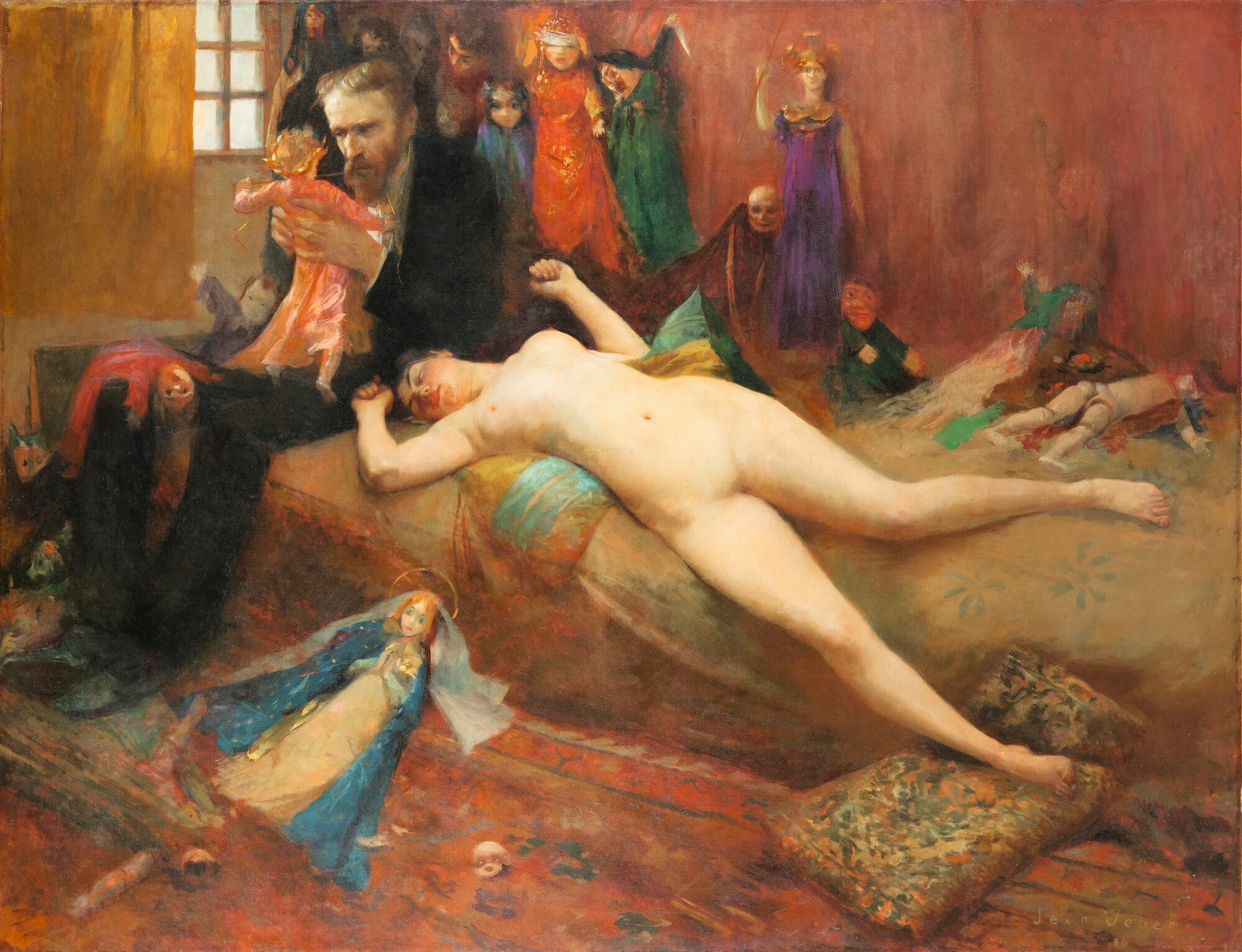
The Doll Man – Jean Veber [1896]

WON’T FIT INTO ANY ARBITRARY CATEGORY WITH EACH OTHER [Ed. – At least that’s honest.]

Squarely in the Olivia Manning/Elizabeth Jane Howard sweet spot is the Good Daughters trilogy by Mary Hocking (Good Daughters, Indifferent Heroes, Welcome Strangers), following three sisters from the 1930s to the years after WW2. They’re basically Platonic ideal books for people like me who reflexively buy the old green-spined Virago Modern Classics on sight.

The Friendly Young Ladies by Mary Renault was delightful: a wonderful 1930s summery sexy atmosphere, beautifully written, and nobody was punished by the plot for being gay. (In fact, someone wrecked their life by not being gay enough.) [Ed. — *nodding sagely * seen it happen many a time.]

Keith Ridgway’s A Shock is brilliant and sui generis; a sporadically sinister set of linked stories in multiple styles—a worthy follow-up to his Hawthorn & Child, though shooting out in completely different directions.

Awake by Harald Voetmann (translated by Johanne Sorgenfri Ottosen) is fragmented, which I have seen some people complain about, saying it doesn’t add up to a story. I guess that’s true, but I really didn’t care. A novel about Pliny the Elder, his nephew, and his slave, it’s great on the sentence level, and so interesting. And deeply, deeply horrible.

Hagar Olsson’s Chitambo (translated by Sarah Death) deserves to be much better known: a modernist Finnish masterpiece about a young girl whose life is wrecked by a father who is at first her ally in an imaginative world, and who then loses interest in her as he moves on to other, madder utopian schemes.

[Audience: GET HIM OFF! GET HIM OFF!]

The Trouble with Happiness is a collection of short stories by Tove Ditlevsen (translated by Michael Favala Goldman), and is as good as you’d hope from the author of the Copenhagen Trilogy. The Devastation of Silence by João Reis (translated by Adrian Minckley) is an exemplary example of one of my favourite genres of novel—the mildly unhinged monologue from a monomaniacal narrator, in this case a Portuguese POW in a German camp in WW1. Helen DeWitt’s The English Understand Wool is a really funny novella of subverted expectations. And Ed Yong’s An Immense World is a brilliantly and subtly written survey of the latest science in animal perception, including senses that humans cannot even begin to rival. OK, OK, I’m going, what is that thing, a crook, you do know they don’t actually use them to haul people off the stage anym–

[Ed. — Don’t tell James, but I could have read even more from him!]