Regular readers will know that for the last several years I’ve solicited Year in Reading reflections from friends and trusted readers. Here, belatedly, is the last entry in this series. It comes from friend of the blog and reader extraordinaire, Scott Walters. The tardiness is all mine: I’ve been sitting on this, unconscionably, for months. I think you will agree, though, that some things are worth the wait. Scott, whose piece here is his fifth, launched the much-lamented blog seraillon in 2010, and expects to return to it one of these days. He largely follows Primo Levi’s model of “occasional and erratic reading, reading out of curiosity, impulse or vice, and not by profession.” He lives with his partner in San Francisco.
Nan Goldin, Self-Portrait in Blue Bathroom, London (1980)
Though I’m becoming increasingly picky about my reading choices, that didn’t stop me in 2025 from mostly following my nose – and allowing for books to choose me rather than the other way around. I made no concrete plans but still managed to read some books that had long been on my list and some marvelous new surprises. Highlights and more below.
Three Big Books
Three fat tomes structured my reading year. First was Thomas Mann’s The Magic Mountain (1924, trans. John E. Woods), the tale of the young Hans Castorp, whose brief visit to a tubercular relative in a sanitarium in the Swiss Alps turns into a long-term stay when he is trapped there after his own diagnosis. To read this book is to go on a long journey, arduous at times and tested by low oxygen, but offering spectacular views, inner alpenglow, and snowy literary heights nothing short of thrilling (okay, okay, enough of that). It is a deeply strange book, which Mann refers to it in his preface as a kind of fairy tale, and also a great one, borrowing freely from other models but prescient regarding both history and literary form. The near linear narrative, obsessed with time, teeters on boring the reader, breaks into a few background chapters, devotes 200 pages to three weeks, takes 500 to speed through the next seven years, then abruptly leap-frogs more years, indulges in dialectical (even trialectical) philosophical conversations, and near the end keeps introducing important characters into this European antechamber on the eve of World War I. An unnamed omniscient narrator occasionally interrupts to use the royal “we” and reference his own anxieties, which readers may share, Mann’s anticipatory novel serving as a kind of measuring stick between its time and our own. [Ed. – Yes, it is a truly great book.]
Little of the Dickens I had read prepared me for Bleak House (1853). This grand conception, capacious and constantly surprising, forming an indignant portrait of a city and country, roars for something to be done about poverty and injustice, pleads for beginning the world anew. Bleak House also seems a kind of spring, irrigating the literature that would follow it, anticipating modernism and some of the later movements of 20th century literature (the influence on Joyce, for example, is clear). [Ed. – Say more!] Even the often dismissed-as-novelty instance of human combustion, near the exact center of the book, comes across as exploding the hinges. To the right and left are human splatter, the human stain and residue, presented in a gem of literary black comedy. Joining a friend’s book club when I learned that Bleak House was on the menu, I was dismayed to find some who viewed Esther Summerson as merely a saccharine goody two-shoes. Is she not one of the great characters in literature? [Ed. – She is.]
A reader acquaintance in town for an evening mentioned Jon Fosse’s Septology (2019-2021, trans. Damion Searls). I’d read one Fosse work and had no intention of reading more, but Septology had other ideas: from a box of books I spied on the sidewalk the following morning, a pristine copy offered itself up, and I quickly found myself needing to read it each evening. Septology’s three novels form a triptych, the three sections of the central book flanked by two sections in each in the first and third novels. “The Other Name” in the first novel’s title is the same as the first name, Asle, held by both the narrator, a painter, and another Asle, a despondent alcoholic, both living alone near Bergen, one with his paintings and memories and the other with his bottles and memories. One scarcely knows where one Asle ends and the other begins, these doppelgängers, manifestations perhaps of divergent and not-so-divergent paths in the same life. It’s a nifty narrative device: the reader wanders in and about the one and/or two Asles and even more variations on the name, including Ales, the painter’s late wife, and Asleik, his neighbor. Past and present mingle. The discursive repetitions of Asle’s narrative seemed like the looping curlicues in a Cy Twombly painting: thoughts turn back on themselves, run on the same tracks for pages, return like waves, new and familiar. The frequent absence of page and paragraph breaks and the total absence of periods further a narrative relentlessness, as though we’re listening to an extended monologue, even when two people speak. [Ed. – Gotta say, that sounds dismayingly hard!] Ruminations range freely, from quotidian minutiae to explorations of art and faith, from meditations on social responsibility to the virtues and vices of solitude. A Nordic coldness blows through Fosse, but I came away from Septology knowing I’d encountered something new, unforgettable, and, in another iteration of hazy identities, now a part of me.
Playing with History
I was surprised to find so much historical fiction—not a genre I often deliberately seek out—among my standout works from 2025. Here they are, each approaching history in its own inimitable way.
Manuel Mujica-Lainez’s Mysterieuse Buenos Aires (1950, French trans. Catherine Ballestero) uses 42 fictional vignettes, in chronological order, to relate the history of Argentina’s largest city. A well-known translator from Spanish to English once said Mujica-Lainez was the author whose works they most wanted to see in English, and as a fan of Bomarzo (recently republished by New York Review Books for the first time since it appeared in English in 1969), I was thrilled to find another of his works, even if in French. Mujica-Lainez daringly pushes borders by fusing fact and fantasy, relying largely on figures from history’s margins, never passing up the opportunity to make a scene flourish in a dense riot of glorious language. The book opens in 1536 with a Boschian hellscape of famine and guerilla ambushes as the native population greets the Spanish invaders and continues through to 1904. I especially loved the longest tale, an “autobiography” by a tattered edition of Bernardin de Saint-Pierre’s roman à l’eau de rose, Paul et Virginie, as it gets passed along from Europe to the New World.
Anja Wilner’s 2024 Year in Reading post sent me to Christoph Ransmayr’s The Terrors of Ice and Darkness (1984, trans. John E. Woods), in which fiction and historical documents relating to an ill-fated 1872 Arctic expedition [Ed. – is there any other kind?] merge into an obsessive account of explorers confronting the elements. A parallel narrative follows the story of a young Italian fixated enough on the 1872 effort to book passage on an Arctic research ship in 1981, only to vanish mysteriously once back on Spitzbergen. The unnamed narrator is himself obsessed with the Italian’s disappearance. Various texts propel the narrative – logs, letters, lists, diary excerpts, tales of other expeditions, failures, vanishings – accompanied by black & white images. The overall effect is bewitching, as Ransmayr uses the explorers’ own words to probe their motivations, as shifting as the ice: a try for the pole, discovery of new lands, fame for the homeland, a promised payout. But the terrors of ice and darkness surge forth everywhere. Frostbitten-hands-down the most affecting work I’ve ever read on polar exploration.
A past Year in Reading post by Brad Bigelow led me to Thornton Wilder’s The Ides of March (1948), as superb as Brad had promised, standing above most contemporary American novels in its densely researched, inventive treatment of historical material that expands the epistolary form to incorporate everything from mandates by Caesar to clandestine notes passed between conspirators to graffiti on a Roman wall.
Adam and Eve in Paradise, by Eça de Queiros (1897). What a treasure, this 55-page novella by the wonderful de Queiros, translated into English for the first time by the wonderful Margaret Jull Costa. De Queiros’s take on Genesis has ape-like Adam sliding down from a branch “on the twenty-eighth day of October at two o’clock in the afternoon,” and had me laughing throughout, astonished that no one else seems to have approached such an absurd creation myth in such an inside-out, satirical manner. I gave out copies to friends like candy.
My Italian discovery of the year was Sicilian writer Annie Messina in The Myrtle and the Rose (1982, trans. Jessie Bright)and Le Palmier de Rusafa (1989, French trans. Jocelyne Sephord, unavailable in English), two of three novels Messina wrote, all towards the end of her long life (the third remains untranslated). Though the characters and locales differ, the novels tell similar tales of a Middle Eastern warlord developing an intense relationship with a rescued slave boy. The rather spare Myrtle seems almost a draft, sowing seeds that in Rusafa blossom into an extravagantly exotic baroque masterpiece. This is extraordinary, riveting fiction, fiercely red in tooth and claw and shrinking from nothing. [Ed. – Intriguing!]
Other Italian Journeys
You, Bleeding Childhood, by Michele Mari (2009, trans. Brian Moore) left me embarrassed that I’d never before heard of Mari, apparently among Italy’s living literary treasures. The 13 tales here center on characters who encounter literature at a young age. In “The Black Arrow,” the narrator steals his father’s copy of Stevenson’s novel of the same name, then is thrust into a moral conundrum when his father returns from a trip bearing another copy of the book as a gift. The child’s discovery of textual differences due to the gift being a different translation opens a world. In “Eight Writers,” the child’s obsession with sea adventures by eight famous authors encounters a case of mal-de-mer when he begins to mark their stylistic and thematic differences. In a favorite piece, “The Covers of Urantia,” Mari considers the impact of cover art, as his young reader reminisces on the covers of a popular series of horror magazines. Never let it be said that you can’t judge a book by its cover. Terrific stuff.
L’Île des âmes (The Island of Souls), by Piergiorgio Pulixi (2019, French trans. Anatole Pons-Reumaux):a mystery of the “Sardinian Giallo” genre, concerning the reopening of a couple of cold cases involving ritualistic murders of two women following the more recent disappearance of another. The twist is that the cases are now being investigated by two women detectives, seemingly as an effort to sideline them. One might suspect the author of trying to be Sardinia’s answer to Sicily’s Andrea Camillieri, but Pulixi seems after something different: I was transfixed by his panorama of Sardinian culture, geography, and centuries-old mysteries – a great introduction to the island as well as the first novel in a series.
Other Italian gems: Behind Closed Doors: Her Father’s House and Other Stories of Sicily, by Maria Messina (Annie’s aunt) (1909-1928, trans. Elise Magistro), memorable tales of the rough lives of Sicilian village women in the early 20th century; Ignazio Silone’s Fontamara (1933, trans. William Weaver) featuring impoverished villagers wrestling defiantly with a Fascist landowner diverting their water for his own uses; a timely reread of Silone’s The School for Dictators (1939, trans. William Weaver), a quasi-novel/political treatise in which an American Presidential aspirant travels to Mussolini’s Italy to learn how to import fascism to the U.S.; Vincenzo Latronico’s bestseller Perfection (2022, trans. Sophie Hughes), a biting treatment of today’s digital nomads which, as a portrayal of work culture, brought to mind Arthur Miller’s Death of a Salesman; the first volume of self-described “leader of strange dolts” Ser Giovanni Fiorentino’s Il Pecorone (The Big Sheep, 1378, trans. W. H. Waters), a Boccaccio impersonation with infectiously fun tales stitched together by the dopiest of framing stories: two young lovers meet each day, tell one another a story, then slink off after this literary foreplay; the metafictional delights of Giorgio Manganelli’s To Those Gods Beyond (1989, trans. Marvin McLaughlin), from which I learned that while fiction is a prison, one can always invent a horse to make one’s escape; and finally Daniele del Giudice’s A Fictional Inquiry (1983, trans. Anne Appel), which I discovered the day after dreaming about an earlier del Giudice novel I’d read years ago only to find this one later in the day in a bookshop. [Ed. — !] To my further astonishment, A Fictional Inquiry pursues Italian critic Roberto Bazlen in a clever exploration of how one might have an outsized influence on literature without ever having published a thing.
“American” Literature
After all these decades I finally got to another Wilder in addition to Thornton above: Laura Ingalls, in Little House on the Prairie (1935). [Ed. – Genuinely curious how you managed to miss them in childhood, Scott!] I admired Wilder’s knack for creating limpid scenes using only the briefest descriptive sentences, as when the family reaches the grassland and young Laura sees that “In a perfect circle, the sky curved down to the level land, and the wagon was in the circle’s exact middle.” For all the mockery generated by the related TV series, Little House struck me as practical and even “woke” to an extent that a lot of reactionary parents might miss (to the benefit of their bookworm children). [Ed. – Now read Eula Biss’s essay “No Man’s Land.”]
U.S.A., A Dramatic Review, by Paul Shyre and John Dos Passos (1960): I read John Dos Passos’s U.S.A. Trilogy decades ago, completely oblivious to the existence of this stage adaptation that compresses 1,000 pages into a mere 75. This small marvel of theatrical writing nonetheless manages to convey the sound and sense of the trilogy, including newsreel footage in the performance, and features several striking scenes, in particular a magnificent monologue by Isabella Duncan.
Thanks to Alta magazine’s assessment of 25 great works of California fiction, I read two that were new to me. Mecca, by Susan Straight (2022) was an especially welcome discovery, its entwined stories linking diverse communities of Southern California around the nexus where Los Angeles, Orange and San Bernardino counties meet. The Alta piece also prompted me to take down from the shelf an unread copy of Thomas Pynchon’s Vineland (1990), discovering only after finishing that it had inspired One Battle After Another. It’s easy to see why this narrative would resonate today; Vineland’s outlandish tale of a young woman coming to terms with her vanished mother, a radical activist from the 1960s, takes a long view of the competing tensions between American democracy and the forces of reaction taking aim at it. I also enjoyed Christopher Tradowsky’s Midnight in the Cinema Palace (2025), a solid contribution to literature about San Francisco in its glimpse into the culture of the Castro neighborhood in the 1990’s.
Passing, by Nella Larsen (1929): How had I missed the boat on this unexpected window into the world of Black women able to “pass” for white? Reading it made me feel a gaping hole in my knowledge of American literature had begun to be filled. Indispensable. Thanks, Dorian! [Ed. – Another satisfied customer!]
The most compelling American fiction I read last year was, um, British: Cahokia Jazz, by Francis Spufford (2023). Spufford’s stunning conception is the star in this speculative allo-historical thriller in which First Nations people govern a semi-autonomous U.S. state located around the city of Cahokia, today ruins of what was once the largest city in North America, but in Spufford’s vision an important 20th-century metropolis eclipsing the tiny village of St. Louis across the river. The book brilliantly uses a popular genre to explore race, religion, and the construction of history, and adds to an expanding list of great works about the United States not written by U.S. authors. Thanks again, Dorian! Iksho Itala! [Ed. – A pleasure!]
Odds and Ends
Aside from scattered poems, Raymond Radiguet’s two novels, Le Bal de Comte Orgel and Le Diable au corps, comprise his entire literary output. But what an output! His death at 20 drew thousands to his funeral; his patron, Jean Cocteau, was said to be inconsolable for years. These two tales, each involving a transgressive love affair between an adolescent boy and a married woman, burn with life, wit, insight, and defiant assertion of youth. Le Diable au corps, with its betrayed husband a French soldier, so affronted French nationalists after World War I that even a film version of it appearing decades later was met with indignation.
Someone here last year mentioned Sally Rooney’s Conversations with Friends, so I picked it up and read this class-conscious dissection of an affair with admiration of her keen ability to needle in under people’s rationalizations and excuses and – like her occasionally self-mutilating narrator Frances – get under the skin and draw blood. [Ed. – Good description!]
The Prague Coup (2018), by Jean-Luc Fromenthal and Miles Hyman (trans. Lara Vergnaud), the only graphic novel on my list, recounts the story of Graham Greene’s trip to Vienna in 1948, ostensibly to consult on Carol Reed’s film The Third Man. Fromenthal unveils the story of Greene’s involvement in intelligence work and reframes The Third Man in its intelligence context as in part a coded message from Greene to double-agent Kim Philby. Bonus: the end pages sent me down a deep rabbit hole to learn about fascinating figure Elizabeth Montagu, Greene’s guide in Vienna, and to the remarkable film Four Men in a Jeep, shot in a Vienna still under rotating command by the U.S., U.K., France and the Soviet Union. [Ed. – This sounds great! First time I’m hearing of it.]
Perhaps my most moving re-read of last year was of Leo Tolstoy’s The Death of Ivan Ilyich, this time in the magnificent Peter Carson translation (Carson died a mere two days after finishing it).
Vivian Maier, Jul, 1953
Odder Odds and Ends
I’m not sure where I draw the line between books I consider odd and those I don’t. I read the first book of Solvej Balle’s On the Calculation of Volume (2020, trans. Barbara J. Haveland), about a woman trapped in a single day that endlessly repeats, and did not think to put it in this category. But Quebecoise writer Gabrielle Filteau-Chiba’s feminist eco-thriller Sauvagines (2022, available in English translation as Feral) swept me up into discomfiting aspects of an otherwise straightforward tale of a young woman serving a season as game warden in remote Kamouraska and finding herself squared off against a vicious, likely murderous, poacher. [Ed. – Ordering now!]
The Gardener Who Saw God, by Edward James (1937), stuck out no doubt because its author did. This too-hefty work by one of the patrons of Surrealism, a British lord who ended up in the jungles of Michoacan where he built his own surreal folly garden, Las Pozas [Ed. – This sentence has already contained many improbable things—where will it go next?], may not be stellar as literature, but it contains at least two major attractions: a fictionally-tweaked glimpse into the early world of Surrealism (Magritte, Dalí and others were guests at James’s estate), and a stunning spiritual conversion scene with the force of a Blake painting. I learned of the novel’s existence from Eve Babitz, perhaps one reason the book proved nearly impossible to find.
More solidly in the oddities category, Poe’s The Narrative of Arthur Gordon Pym of Nantucket (1838) had trailed me since university, when those who had read it seemed dismissive. My expectations were not high, but I ended up deliriously checking off the oddities of this bizarre, messy tale of a ship stowaway’s adventures. One lengthy passage takes place entirely in the dark of a ship’s hold (I kept trying to imagine it on a stage). There is a magnificent description of water that evokes all the magic water can evoke. But with its frequent alterations of black and white seeming to anticipate Melville’s Moby Dick and a disturbing set of scenes pitting the ship’s crew against “savages,” the novel’s treatment of race makes it one of the strangest literary artifacts of American slavery and racial phobia.
Perhaps the oddest book I’ve ever encountered [Ed. — !], David Lindsey’s A Voyage to Arcturus (1920) begins in sordid circumstances on Earth and moves to other such circumstances on Terra, a planet orbiting the binary system of Arcturus. In a confusing sort of pilgrimage, its louche main character sets out across the planet in search of illumination (think: the quest in Mount Analogue meets the ghastliness of M. P. Shiel’s The Purple Cloud), encountering surprising planetscapes, a plethora of strange beings, several impossible colors to which Lindsey gives names, and even a population of creatures who use gender-neutral pronouns. The violence of the book, however, came as a shock; I could not help but think of it as an oblique reaction to World War I. [Ed. – Readers, this is the kind of content you don’t get just anywhere.]
Good Trouble
Several works resonated more directly with the challenges of our times and served to ground and put into perspective whatever else I read.
Vasily Grossman’s Everything Flows(unfinished, last worked on in 1964, trans. Robert and Elizabeth Chandler), concerning Stalin’s purges and the incarceration of millions, may be less powerful than his two-volume World War II magnum opus, Stalingrad and Life and Fate, but incisively depicts the paranoid totalitarian state that resulted in informers and victims, seen through the lens of one such victim upon his release after 30 years in the gulag.
Étienne de la Boétie’s Discours de la servitude volontière (Discourse on Voluntary Servitude – 1548), a brief disquisition on why human beings voluntarily surrender agency to accept the tyrants who oppress them, seemed as timely as ever. Moreover, it contains some of the most lucid prose I have read in French, especially impressive given that de la Boétie, bosom friend of Michel de Montaigne, wrote it between the ages of 16 and 18.
Finally, Crooked Cross (1934) by British writer Sally Carson, who lived in Germany during the beginning of the Third Reich, unfurls as though in real time. Carson zooms in on the Kluger family of Kranach, an alpine village above Munich, the novel playing out like a granular study of how quickly and corrosively Nazi fanaticism took hold: the novel takes place entirely within the six months following Hitler’s assumption of power. Popular upon its publication, the book vanished until the recent discovery of a single extant copy. Thanks to Persephone Books, Carson’s novel contrasting acquiescence and resistance to totalitarianism has been revived – and at the right moment. [Ed. – I have dallied so long in putting up this post that Persephone’s reissue of the sequel is now available…]
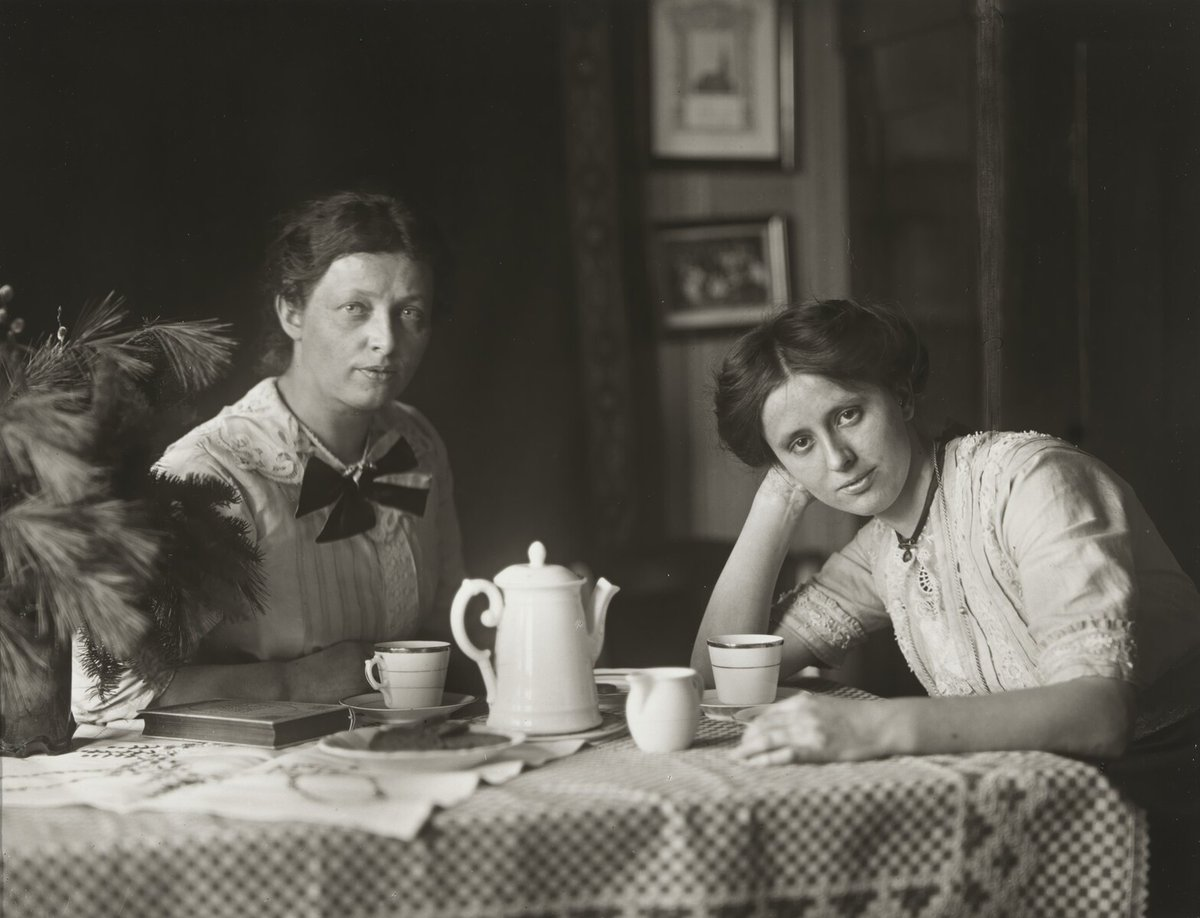
August Sander, Small-Town Women (ca. 1913)
Thank you for reading, safe passage and felicitous literary adventures to all in 2026. [Ed. – Thank you, Scott! So many riches here.]
Pleased to once again present reading reviews from some of my favourite readers. Today’s installment, his fourth, is byScott Walters. Scott launched the much-lamented blog seraillon in 2010, and expects to return to it one of these days. He largely follows Primo Levi’s model of “occasional and erratic reading, reading out of curiosity, impulse or vice, and not by profession.” He lives with his partner in San Francisco.
Barring surprises, here ends the 2024 edition of the EMJ Year in Reading series: except, I hope, for my own. (Gotta write that…) Thanks to everyone who contributed–and all who read these engaging lists.
Balthus, The Passage of Commerce Saint-Andre (1954)
Thank you, Dorian, for inviting me again to participate in The Year in Reading. [Ed. – Pleasure all mine, Scott!] Mine meandered mostly pleasurably through some 60 books. I abandoned others, was surprised to have read fewer Italian works than in previous years, and experienced a number of unpremeditated pairings, reading two works each by a dozen authors plus more thematic linkages. I’ll get straight to 2024’s highlights:
The Woman in White, Wilkie Collins (1860)
I nearly lost my head when I interrupted my spouse’s reading of the final pages of The Woman in White, but her abrupt “Ssh!” made total sense as I plunged into the book myself the next day. Abstracted, the “detective-ish” book’s nutty plot—starting with its mysterious woman in white and moving to family secrets, confused identities, unlikely coincidences, shady interlopers, and convoluted inheritances—would hardly seem encouraging. But over 650 pages Collins never lets drop any of the knots of intrigue he has in the air, a master class in plotting with the ending so neatly and satisfyingly resolving the novel’s myriad conflicts that the book should have come tied up with a pretty bow. I found equally impressive his crafting of splendid characters, including the flamboyantly louche and unforgettable Count Fosco and Marian Holcombe, the novel’s moral center, surely one of the great characters in English literature. [Ed. – Now read No Name!]
[Paired with Collins’s The Moonstone].
The Purple Cloud, M. P. Shiel (1901)
If The Woman in White stands at the peak of the Victorian era, Shiel’s The Purple Cloud levels the period to the ground: an apocalyptic horror story, to be sure, with a body count beyond reckoning, but also an existential tale that takes Jules Verne’s brand of adventure in the direction of Lovecraft (and maybe even Kafka and Beckett). Into the tale of the sole-surviving member of a polar expedition returning to find worldwide catastrophe, Shiel mixes dazzling epic catalogues with itinerant wanderings—by dogsled, boat, rail, and on foot—that make Odysseus seem nearly an armchair tourist. A magnificently macabre tour of England unfolds from the coasts to the moors to the mines to the vacant house of Arthur Machen (to pay a literary debt) before the novel’s agonist traverses the infernal hellscape as far as Tokyo and San Francisco. Adding to the panorama of ghastliness is the misogynistic unpleasantness of the narrator himself, though having a murderer inherit such a lonely place is certainly a twist on the “last man” genre. Shiel lightens his grotesqueries by upscaling his inventiveness and gallows humor, even taking a few swipes at the Empire’s Victorian sensibilities. His idiosyncratic, nimble writing prompted me to mark down passages, though left me wondering whether the “purple” in his title may have referenced florid elements infecting his sheer writing bravura. Half-way through I wondered why the book didn’t regularly appear on English literature reading lists. Two-thirds of the way through, an abrupt turn sent the tone spiraling from Brueghel’s Triumph of Death into the schmalz of W. H. Hudson’s Green Mansions, underscoring a built-in problem of last man narratives: how to bring things to a close, what with destruction being so easy and rebuilding such a struggle. Shiel regained his footing towards the end but stumbled again on his way out the door. Maybe some goody-two-shoes editor had stuck their nose in. Still, The Purple Cloud’s grandiose conception and relentlessly ghastly anti-pleasures made it a singular reading experience—and fitting B-side to Collins.
Bel-Ami, Guy de Maupassant (1885)
At age 4, my French goddaughter presented me with a paper “cootie-catcher” featuring appealing green designs on three sides and a frightening mess of scribbled red and black on the fourth. I inquired. “This is a flower, and this is a tree, and this is grass, and this is a vampire.” [Ed. – Reasonable.] Now that she’s 21 I’ve come to expect this kind of thing regularly, but when she insisted that I read Guy de Maupassant’s Bel-Ami, I fell right into her trap. The story of a down-on-his-luck former soldier, Georges Duroy, whose life is transformed by a chance meeting with a war buddy who helps get him into journalism, is a superb depiction of the writing life; an existential examination of class, morality and gender relations; and one of the most sordid narratives I’ve come across. Duroy is a terrific antagonist, an arriviste with attractive qualities tinged by inexperience and raw ambition, not above prevarication and cruelty when it suits him. Maupassant manages the story so skillfully that I naively believed it to be heading towards a treatment of the subject of friendship between men and women, the source of Duroy’s “Bel-Ami” nickname—an ironic one, I was soon to realize, as what Maupassant does with Duroy makes Zola’s take on human debauchery look like a Sunday school picnic. [Ed. — !] The novel contains great set pieces, including a drawn-out death scene where a post-mortem odor drifts off the page like something out of D’Annunzio, and a party in a mansion on the Champs-Elysée that contrasts with the grim lives of Duroy’s rentier parents rotting away in Rennes. Maupassant levels the world of journalism too, its appetite for influencing public opinion, its writers seeking short-cuts to fame—a subject altogether too relevant today. Duroy’s talent, which emerges bit by bit, takes flight in social situations, where during one visit with a group of women he extemporizes on the writing of the French Academy. Maupassant, of course, was writing against the Academy grain, and few writers have woven a French of such sublime beauty from a tissue of such splendid decadence. [Ed. – Well, damn!]
[Paired with Manon Lescaut (1731), by the Abbé de Prevost].
Dark Back of Time, Javier Marías (1998) (Esther Allen, translator)
It would be unjust to pigeonhole Dark Back of Time –“a book of digressions”—as a campus novel, and equally unjust to separate it from its co-joined twin, All Souls (1992). But taken together as a campus novel, these two works, set at Oxford, slay all comers. Someone once quipped that the campus novel was about settling scores. Dark Back of Time seems aimed at undoing any barbs present in All Souls and even any notion of that book’s having been a roman à clef (this too, of course, may be a fiction). While the first part of Dark Back of Time engages weighty questions about fictional representation of real people, the joyousness of the novel’s explorations often had me in stitches, including a scene in which an academic negotiates with the narrator/author how he will be represented in the new novel, and another in which the narrator/author, timidly attempting to clarify for owners of an Oxford bookshop that what he’d written in All Souls was not about them, finds that the couple revel in their fame and petition to be included as themselves in a film version. It seems fitting in these books that Marías, Spain’s late greatest novelist, has evoked echoes of the most iconic of Spanish fictions, for, like the first and second books of Don Quixote, the two novels form an essential unit in which one could read only the first volume and miss out dramatically on what the second volume does with the first. (I’d love one day to see All Souls and Dark Back of Time boxed as a set; Cervantes would approve.) I don’t think it’s an exaggeration to suggest that these volumes, taken together, may be the finest contemporary literary work to address the question, “What is fiction?” Two other elements to recommend the book: The first is Marías’s inclusion of the fascinating story of Redonda, the “literary” nation of which Marías served as most recent and presumably final King (M. P. Shiel had been the first). [Ed. – Wait, that dude you just wrote about?? Is this real? Am I being punked??] The second is that Dark Back of Time contains some of Marías’s most exhilarating writing; I think immediately of a moving passage about the dawn crepuscule and streetlights that persist for a time into the day. Time having ever been one of Marías’s great preoccupations, I also winced at his narrator imagining life at age 85—a full 15 years past the premature end of Marías’s own. Unconscionably, The New York Times left Marías off of its recent list of the 100 Best Books of the 21st Century to date, but it is certain that the lamp of Marías’s work will live on to see its day.
[Paired with Marías’s short travel book, Venice: An Interior (2016)].
The Charwoman’s Shadow, Lord Dunsany (1926)
Fantasy is not among my favorite genres, but I’ve been fond of everything I’ve read by Edward Morton John Dax Plunkett, a.k.a. Lord Dunsany. Dunsany’s stories seem more like a new model of fairy tales, exploring interstices between reality and the imagination and dealing with moral issues without being moralizing. The Charwoman’s Shadow features a young Spaniard sent by his family to learn alchemy from a woodland magician, and exhibits Dunsany qualities in abundance: a deep gratitude for the richness of life, where nothing can be taken for granted; a genial wit and wordplay; a careful attention to nuance. The centerpiece of the novel is the value of one’s own shadow, the disappearance of which, through a Faustian bargain, produces unexpectedly dire consequences. Another Dunsany treasure is the lyrical quality of his writing, for example when he takes on that most magical of hours, l’heure bleue:
bright over the lingering twilight the first star appeared. It was the hour when Earth has most reverence, the hour when her mystery reaches out and touches the hearts of her children at such a time if at all one might guess her strange old story; such a time she might choose at which to show herself, in the splendour that decked her then, to passing comet or spirit, or whatever stranger would travel across the paths of the planets.
And then there is the book’s splendid ending, which I will not spoil other than to say that with no apparent thought of producing endless sequels like some contemporary writers of fantasy fiction, Dunsany gently places his chief protagonist off stage and sweeps into a realm of wistfulness drenched in the glow of a glorious sun setting at the height of Spain’s Golden Age.
[Paired with Dunsany’s The King of Elfland’s Daughter (1924)].
At 163 pages, Aira’s Fulgentius straddles novella and novel, and not simply as matter of length. Aira’s intimate, vividly imagined tale of a Legate of the Roman Empire who also happens to be a playwright expands as it follows the aging Fulgentius and his 6,000 soldiers from Rome to reconquer Pannonia. Along the way, Fulgentius mounts performances of his sole work, a tragedy written when he was an adolescent, starring himself as tragic hero—and most important audience member. As Fulgentius has already written—or thinks he has already written—the tragic outcome of his own story, the plot tension is carried by a familiar Aira conceit around the entwining of fiction and reality. As a prime example one of Aira’s works that graft a fictional character onto history, Fulgentius offers a vivid sense of what such a march must have been like for the soldiers, the general, and the populations in their path. Deviating from the author’s more typical surrealist gymnastics, the language here takes on an unusually elegant lyrical register.
[Paired with Aira’s Alexandra Pizarnik (2001), an appreciation of the Argentine poet].
The Catherine Wheel, Jean Stafford (1952)
I found a copy of Jean Stafford’s The Catherine Wheel when I was 18. Had I read it then, I doubt I would have fully appreciated its adult nature—for it really is an adult book, dealing with adult things, things terrifying enough that I approached the novel’s final pages with a shudder of complete dread (completely vindicated). But in The Catherine Wheel Stafford also reckons with youth, entwining her two main characters, 38-year-old Katherine Congreve and her 12-year-old cousin Andrew Shipley. Devastated in love at an earlier age when Andrew’s father John married her sister Maeve, Katherine now occupies a position as the town’s most prominent unmarried curiosity, but also a magnet to John and Maeve’s children, left behind while the parents “summer” in Europe. Twin betrayals connected to this departure have set both cousins spinning: John’s surprise declaration of love for Katherine and determination to divorce Maeve while abroad, and the disappearance of Andrew’s playmate of previous summers, Victor, now entirely occupied with the post-war return of an older brother. Dually abandoned, the cousins shift focus to one another. Stafford thus sets up an unusual device in which youth attempts to divine the mysteries of adulthood while adulthood frets over the crises of youth, in a marriage story focused on impacts beyond the absent couple’s own strife. [Ed. – This feels like some Henry James-level melodrama!] A kind of third eye—that of the people of Hawthorne, who notice when Katherine’s light stays on into the wee hours—levies its own social pressure on the house’s inhabitants. Stafford’s densely poetic sentences frequently had me reading her aloud, relishing her words, marveling at the perfect limning of some little thing or creation of a resonance that rippled out towards subjects beyond the proximate ones. Though rooted in a realist, formalist literature that prioritized and exalted language, the novel still felt raw and new, bursting out of old molds, totally unsettling. Not a novel for the squeamish, but certainly one for any reader ready to appreciate some of the finest American writing of the period.
[Paired with Stafford’s The Mountain Lion (1947)].
whose names are unknown, Sanora Babb (1936/2004)
Sanora Babb’s novel has been highlighted in recent articles recounting editor Bennett Cerf’s decision that two Dust Bowl novels in a single year would not stand. The other, of course, was The Grapes of Wrath, allegedly constructed in part on notes Babb had collected concerning hardscrabble farmers in her native Oklahoma, and which Cerf provided to Steinbeck. Though Babb published other well-received works, her Dust Bowl novel languished unpublished for nearly 70 years. whose names are unknown borrows its title from an eviction notice served on a family of Oklahoma farmers. What the novel may lack compared to Steinbeck’s elegant structure and majestic sweep, it makes up for in granularity of detail and visceral impact relating the farmers’ desperation and poverty, with particular attention to the lives of women, whose interactions give the work some of its strongest scenes. Babb’s direct, declarative sentences come across as hard as the land worked by her characters. She describes the knife-edge on which her people live, where even small luxuries—such as butter for the biscuits—must be used sparingly “so that it will last until the next churning.” Where Steinbeck set his novel on the back of hope for a better life in California, Babb spends a long time in Oklahoma before heading west, zeroing in on the encroachment of the Dust Bowl, poor farming practices colliding with a change in climate and the shifts within and without people as they try to wrestle with such environmental change. Babb’s powerful novel deserves at least to be taught alongside Steinbeck’s, or rather, as the debt is all his, the other way around. [Ed. – Pretty telling/damning that I’d never heard of it.]
Écoute, Boris Razon (2018)
It’s clear from which chapter of French journalist Boris Razon’s novel Écoute (“Listen”) Jacques Audiard plucked the seed for his film Emilia Perez, but Écoute differs almost entirely from the film. As the book’s title suggests, Razon focuses here on listening, various forms of which coalesce the book’s entwined stories and capture the complex, fraught texture of contemporary communications. Set mostly on a single block near Place d’Italie in Paris (with detours to Mexico City and Lisbon), and with the November 2015 terror attacks continuing to resonate, the novel touches on the surveillance state by encompassing listener, the listened-to, privacy, and identity (here’s where Emilia Perez came in, but so, to my surprise, did Fernando Pessoa). In conveying the rapid-fire chatter and laconic banality of so many electronic communications, Razon employs a good deal of verlan, texts and texting abbreviations, and emoticons, prompting one character to muse on the absence of a dictionary adequate to capture today’s modes of information sharing. Running beneath this surface noise is a current of desire to disappear from a world in which privacy has all but vanished. The stunning first chapter presents a scene of the Paris street that surely ranks among the richest in that city’s literature, an “audioscape” as experienced from the inside of a police surveillance van by an officer quietly being undone by his job of attempting to cull signal from the noise and by the uncanny valley between electronic input and what he perceives with his own senses. [Not yet available in English translation, though that may well change should Emilia Perez win the Oscar for best film].
Edward Hopper, Solitary Figure in a Theater (1903)
Oak Flat: A Fight for Sacred Land (2020) and Thunder and Lightning: Weather Past, Present and Future (2015), Lauren Redniss
2024 was the year I came late to Lauren Redniss’s party, pairing her powerful Oak Flat with her larger format Thunder and Lightning. The former explores the fight around the proposed Resolution mine on tribal lands in Arizona, while the latter treats weather phenomena both straightforwardly (i.e. Rain, Heat, Wind) and in more abstract terms (i.e. Chaos, Dominion, Profit, War). Using an anecdotal approach, Redniss displays in both books a knack for ferreting out the most interesting possible interviewees and unearthing fascinating hidden tales. But what makes the work of this MacArthur award winner stand out is its exploration of text and image. Using full page illustrations, Redniss skillfully advances her story through images of such impact that I found myself gasping at turning a page and being confronted with an image perfectly tuned to the tone she had set. The large format of Thunder and Lightning lends itself particularly well to her subject. In Fog, the text crawls along the bottom of pages of vast gray. Redniss’s deliberateness in matching image to text and letting the image carry the narrative feels like a new form of text/image interaction. In a section about cloud seeding, she describes a proposal to use weather balloons to heft a pipe with multiple nozzles to spray chemicals that could help cool the planet. I could not help see this as a metaphor for the way her illustrations lift her text in air. These images, easily mistaken for colored pencil washes, are in fact mostly acid etchings in black and white that Redniss has hand-colored (Thunder and Lightning includes a description of her processes). I read Redness not long after finishing James Elkins’s novel, Weak in Comparison to Dreams, another work that relies heavily on images, by a leading theorist of text/image interaction, no less, and now find myself dreaming of a Redniss/Elkins collaboration. Come on, you two. Make it so. [Ed. – Either way, I’m tracking down these Redniss books!]
Moonlight Elk, Christie Green (2024)
I know Christie Green but was wholly unprepared for her first book. Each time I put Moonlight Elk aside, I could not waitto get back out into it. That awkward prepositional formulation feels apt, as Moonlight Elk, a book framed around Green’s experiences in across New Mexico hunting wild game, largely for sustenance, takes one to wild spaces in an intensely intimate manner. Exploring the borders between interiority and exteriority, animal and human, life and death, the book’s dozen interlocking pieces, indexed to a hand-drawn map of the state, might well be the New Mexico state book of the year (if such a thing exists). With solid research behind her narrative, Green leverages her experience as hunter, mother, landscape architect, land use expert, designer, naturalist, activist, and writer to traverse territory of essay, short story, meditation, and what one might call an anthropology of relationship. Memoir might also come to mind, but resistant to definability, Moonlight Elk seems more like an exorcism, a courageous self-interrogation in quest of a “free range” existence that refutes facile answers, upends convention, moves into spaces predominantly occupied by men, and attempts to rid the cultural body of a toxic detachment from nature. Hunting—particularly as a woman alone—foregrounds the narrative, but Green is after larger game. She inhabits the lives of animals, their cycles and patterns, how they move, what they sense, how they see her. The mysterious, miraculous complexity of bodies, not least Green’s own, forms the beating heart of the book: details of muscular structure and bone, of blood and feathers and sex, the quickness of eyes, the sharp sense of smell. Her hunts force self-reckoning, as when she discovers a fetus moving within the abdomen of a cow elk she has shot, or when she ends the suffering of another cow that comes to her after being gruesomely wounded by poachers. Green, who grew up in Alaska, integrates into her experiences a wealth of issues impacting the American West, from private vs. public land and water use to tribal and border concerns (in the boot heel of New Mexico, a quail hunt collides with Border Patrol conducting their own kind of hunting). Only at the narrative’s end did I grasp the extent of the subjects Green had covered. More personally affecting, as she moves through forest, desert and chapparal, shadowed by cliffs and trees, illuminated by dreams and the changes of the moon, she offers, with keen animal sense and without escapism, an orthogonal, conscientious response to received ideas, convenient consumerism, and mediated experience. Hyper-alert, alive, intuitively creating her path, Green renders wilderness almost otherworldly. I emerged from Moonlight Elk seeing this world anew, as though a physical alteration had taken place. [Ed. – Sold! Might pair well with Joanna Pocock’s Surrender.]
Gallery of Clouds, Rachel Eisendrath (2024)
The title: irresistible. The cover too, a fresco of clouds at sunrise or sunset from the ceiling of the Rose Main Reading Room in the New York Public Library. And the opening especially, the author recounting a dream of carrying her manuscript through heaven and meeting: Virginia Woolf. Both ostensibly and in fact, the subject of Gallery of Clouds is Sir Philip Sidney’s 16th century, 900-page pastoral romance, Arcadia, about which I knew nothing and which overwhelms even Eisendrath, a Sidney scholar: “I find that my memory of the plot has already started to dim, to blur…I can no longer keep track of the basics…” I say “ostensibly” because Eisendrath uses the obstacle, Arcadia serving here as a nexus to send her fertile mind wandering down winding paths, from observations on the genre of Romance to the use of images, Shakespeare to Little Nemo, Poussin to Walter Benjamin, Montaigne to manicules (!), the marriage of hunting with desire to the cat dozing on Eisendrath’s bed.
But these seemingly inexhaustible spin-offs never seem gratuitous. Eisendrath subtly constructs an Arcadia of our own era, her black & white photos echoing the pastoral romance’s means of advancing its airy infinities through “images in words,” her “clouds” of thought (which she pointedly distinguishes from mere fragments) paralleling the episodic nature of the romance, her grounding her observations on Sidney in a relatable contemporary manner underscoring the genre as a response to grim realities. At the same time, Eisendrath engages proliferating modes in contemporary writing, such as the use of the fragmentary, the merging of the academic and the personal, the punctuation of text with images, the grappling, through a need to say, with an unraveling world. Though she is writing about a 16th century romance, her small, enthralling, sui generis book has volumes to say about how we read and write. And in Eisendrath’s few references to her own teaching, Gallery of Clouds, more than anything I have read in decades, has me wanting to be a student again.
The Waves, Virginia Woolf (1931)
Rereading The Waves 40+ years after I first read it and in the same copy I’d used then, my margin notes served to measure the distance between that young reader and this old one. I experienced pride regarding the young stranger’s underlining of particular lines; I noted too that he’d missed a lot. Passages of time of this sort span The Waves, entwined temporal arcs that longitudinally capture Woolf’s six characters through alternating interior soliloquies as they move from childhood to university [ed. – well, some of them get to go to university…] to the workplace to middle age and beyond, while brief impressionistic pieces preface each chapter and, over the course of the novel, trace the sun’s path across the sky during a single day at the shore. Here as in many of her works, Woolf, the great writer of immediacy, obsesses over capturing sensations, gestures, glances, discreet moments, the wave at the point of breaking, of ebbing. Rafts of glorious sentences ride Woolf’s exquisite phrasing, as she simultaneously questions the inadequacies of language, frustration with these limits reaching a crescendo as mortality nears for her characters, and a voice longs for:
some little language such as lovers use, broken words, inarticulate words, like the shuffling of feet on the pavement. I begin to seek some design more in accordance with those moments of humiliation and triumph that come now and then undeniably. Lying in a ditch on a stormy day, when it has been raining, then enormous clouds come marching over the sky, tattered clouds, wisps of cloud. What delights me then is the confusion, the height, the indifference and the fury. Great clouds always changing, and movement; something sulphurous and sinister, bowled up, helter-skelter; towering, trailing, broken off, lost, and I forgotten, minute, in a ditch. Of story, of design I do not see a trace then.
[Ed. – Is this Bernard? Sounds like Bernard.] Woolf described The Waves as a “playpoem,” but its approach to polyphony is unusual. In the first chapter, she goes inside the heads of her characters as young children while at the same time supplying them a vocabulary beyond their years, a device through which they speak both as themselves and as the writer, the latter’s presence made manifest when the children catch a glimpse through a window of a woman writing. Throughout the novel, her six characters’ voices float like spheres governed by gravity, now apart, now coalescing, as waves gather force and crash, exploding in spray and froth. But her characters also serve to question the nature of identity: clearly creations of the writer and facets of her circle (the roman à clef aspects interested me little), they are also beings in whom a “self” is merged inextricably with other selves. For all of its prose-poeminess, The Waves stands as a remarkable and grounded philosophical inquiry into what constitutes a self—and whether it even makes sense to speak of a “self.” [Ed. – Yes, the latter especially!]
In my first reading, I scarcely noticed the centrality to the novel of the death of Percival, a “seventh” character never given a voice. But in Paris shortly after finishing The Waves, I caught director Elise Vigneron’s theatrical adaptation of the novel, an extraordinary work employing both live actors and corresponding marionettes made of ice, such that as the play progressed, these figures melted, with much of the later action occurring in a resulting pool center stage. [Ed. — !] The physical presence of these characters and their doubles rendered Percival’s invisible presence powerful, a black center in Woolf’s “six-sided flower; made of six lives.” As with the shell-shocked Septimus Smith in Mrs. Dalloway, Percival represents a generation of young people damaged or lost to conflict and war. The cumulative effect of Woolf’s meditation on loss, whether through ordinary aging or via the injustice of an early death—and a palpable sense of darkness again descending upon Europe—left me overwhelmed by emotion at the story’s close.
What attracted me to Woolf at age 18 held firm: her sumptuous sentences; the tension between a love of people and aloof solitariness; the desperation of time passing fused with the fever to glean something lasting from the fleeting and ineffable. Also: recognition at last of Woolf’s lament for life lost at an early age, for the unshakable impact on those left behind, pushing The Waves into a work far greater than I’d registered the first time around. I’ve been thrilled, moved, and humbled by revisiting this extraordinary novel while the sun sinks toward a darkening horizon, so many years after I first read it, when the sun still mounted the sky. [Ed. – Beautifully put, Scott.]
[Paired with Woolf’s final novel, Between the Acts (1941)].
Felix Edouard Vallotton,The Sunny Street (1922)
Others works I could have included: D. H. Lawrence’s powerful Sons and Lovers [Ed. – Ph hell yeah]; Italian critic Cristina Campo’s The Unforgiveable; the Strugatsky brothers’ The Snail on the Slope; Georges Simenon’s Arizona noir La Fond de la Bouteille; Shakespeare’s The Winter’s Tale; a pair of short books by Helen DeWitt (may she please complete her novel-in-progress set in Flin Flon, Manitoba) [Ed. – Wait what now]; Andrés Barba’s Two Small Hands and Andrés Neuman’s The Things We Don’t Do; poet Susan Nguyen’s second gen take on the American South in Dear Diaspora and other of her poems on-line; and, Most Unexpected Literary Object, the first volume of Ahmed Fāris Al-Shidyāq’s Leg Over Leg, a daring four-volume novel completed in 1885 with the modest ambition of catapulting the whole of Arabic language and literature into the modern age. In sum, a Year in Reading that elicited joy, snark, bon courage, resolve, humility, and defiance for challenging times ahead.
[Ed. – To which I can only summon both the raised fist and the thank you hand emojis: this is wonderful, Scott. May we draw on those good emotions in 2025!]