If you’re reading this, you are faithful indeed. And I am grateful. Long silence here, I know. As my adopted country tumbles into authoritarianism, things have also been changing, though more positively, chez EMJ.

My wife, daughter, and I are moving to St Louis in a month’s time! We’ve spent quite a bit of time there these past few years, and we like it a lot. We’ll have a little more space in our new home (which, combined with some collective efforts to tame my unruly library, might mean that our house will at least briefly not be overflowing with books), and, best of all, we’ll be living in a walkable neighbourhood with sidewalks, which is something we’ve been missing these past 18 years in Little Rock.
The other big transition concerns my career. I’m leaving my job at Hendrix, of course, but I’m also leaving academia in general. People keep asking how I’m feeling about this and I keep saying: Terrific! I was pretty burned out and starting to get a little Old Man Yells at Clouds about All the Changes that affected the classroom experience: the pervasiveness of AI and LLMs (something no one, as far as I know, ever asked for), and, more distressingly, the difficulty even the best-prepared students are having reading sustained works of literature, by which I mean, an entire book, no matter how straightforward the prose. This isn’t about their intelligence, or even their phones. It’s about the strictures placed on secondary school teachers. As instruction moves ever more toward preparing for testing centered on multiple choice reading comprehension questions about utterly decontextualized chunks of texts, teachers aren’t assigning much reading, which means students simply don’t have much practice at it.
(I also have a pet theory that for all its flaws Harry Potter (to be clear: it sucks) helped Millennials think of reading as both exciting and habitual, and Gen Z hasn’t had anything like that. The Harry Potter to Jane Austen to English Major pipeline kept our department afloat for a lot of years. These days, students dislike both Rowling and Austen…)
I still love many things about teaching, and it’s possible I’ll miss it so much that I’ll return to it in some fashion. (I’m never getting another job like this one, though. Those don’t exist anymore.) But for now, I feel relief, and curiosity—along with a lot of trepidation—about the chance to try something new. For now, it feels a bit unreal. Because the academic year is cyclical—summer is always a time of collapse and, if lucky, regeneration—I don’t yet feel as a though I’ve made much of a change. Talk to me in the fall, or next spring, or five years from now.
Luckily—and this is another reason for the silence around here—I’ve been working as a consultant for the Educator Programs arm of the William Levine Family Institute of Holocaust Education at the United States Holocaust Memorial Museum in DC. The people I work with are absolutely fabulous: smart, funny, kind, devoted to their work without having delusions of grandeur about it. It’s eye-opening—and fun—to work as part of a team, after decades of the isolation of academic life. I’ve helped them create resources for K – 12 English Language Arts classrooms, and have taken great satisfaction in the work.
I’ll need full-time work sooner rather than later, though, so if you have any ideas or leads, hit me up! Like, what are some jobs people do? What do y’all do all day? I need advice!
What I’m saying is, I had a lot going on these last months. But I did manage to keep reading. Maybe not as much as usual, but whenever I could make time. I get that it’s ridiculous to offer a 2024 reflection halfway through 2025, but FWIW here are the things that stuck with me last year.
Eight standouts
Francis Spufford, Cahokia Jazz (2023)
So much to love in this novel about an alternate 1920s in which a sizeable indigenous population thrives in a nation called Deseret centered on the bustling city of Cahokia. Spufford weaves his world-building throughout a procedural, in which our hero, a cop who moonlights as a jazz pianist, investigates a murder with vast political implications, to the point of threatening Deseret’s independence.
Cahokia Jazz is the most referenced title in the Year in 2024 Reading pieces I posted earlier this year, which means either that everybody loves this book, or that people like me love this book. Anyway, given my upcoming move to Missouri, it won’t surprise you to hear that the scene that most sticks in my mind is when Barrow pursues a lead in a village at the end of the Cahokia streetcar line, a fly-swept place he can’t wait to leave. Its name? St Louis…
I look forward to visiting the ruins of the actual Cahokia, once the biggest city north of Mexico City.
Katrina Carrasco, The Best Bad Things (2019)
Fabulous and underrated crime novel set in 1880s Port Townsend, where the most valuable commodity passing through the busy port is opium smuggled in from north of the border. Alma Rosales, who once worked for the now-shuttered Woman’s Bureau of the Pinkerton Detective Agency, has left San Francisco for Washington Territory to work for the seductive, brilliant, coolly calculating Delphine Beaumond, who runs most of the drug smuggling on the west coast.
When product goes missing, Delphine puts Alma on the case. Alma goes undercover as a dockworker—not a problem, because Alma is also Jack Camp, a slight yet wiry man who can hold their liquor and likes ladies and men equally. Did I mention that Alma and Delphine are lovers? Or that Jack starts a torrid affair with the man they’re investigating? Or that they’re also still working as a Pinkerton agent—in a desperate attempt to get their old job back?
Cue double-, triple-, even quadruple-crossing; witty repartee; and some pretty hot sex. Most crime novels are let down by their endings, but this one… let me tell you, friends, I literally gasped. A brilliant debut. I want everyone to read it.
Émile Zola, La Bête Humaine (1890, translated by Roger Pearson) and The Assommoir (1877) Trans Brian Nelson (2021)
Even by Zola’s lofty standards, these two are bangers. Push comes to shove, I guess I’d choose Bête over Assommoir, just because I love the crime story trappings, but the latter might be the more impressive accomplishment, especially if you could read it in French to see what Zola does with the argot of his lumpenprotelariat characters. They’re equally—which is to say, tremendously—depressing, but also viciously alive. Zola’s naturalist doom is regularly leavened by his prose, which zips from one brilliant set-piece to another. I’m talking about stuff like the bruising fight between two laundresses in front of an audience of delighted, shouting onlookers in the opening scene of The Assommoir, or the berserk vision of a driverless train, filled with drunk soldiers in full war frenzy heading to their doom at the hands of the Prussians, in the last pages of La Bête Humaine. Feels like a good time to study Zola’s fascinated descriptions of all things irrational.
Hernán Diaz, In the Distance (2017)
Quasi-Western in which the protagonist—a hulking, nearly mute Swede named Håkan whose only goal is to find the brother he was separated from on the voyage to the New World, and whose body and psyche seem to be able to take any amount of suffering—travels east, south, and north as much as west. This is a brainy book: Diaz riffs on Frankenstein, and probably a lot of other stuff I missed. But its allegories are always concrete. In this novel of a man stubbornly going against the westward direction of Manifest Destiny, I most remember the section in which, after suffering a terrible loss, Håkan literally burrows into the ground, eventually building a maze-like underground shelter where he lives in ambivalent isolation for years.
I read Diaz’s Trust last year too: also great. Probably not telling you anything you don’t know. But if like me you are late to Diaz, move him up your list. Smart guy and beautiful writer.
Leah Hagar Cohen, To & Fro (2024)
Last year I served as a judge for the US Republic of Consciousness Prize, which honors literature published by small presses. Yes, I tossed aside some duds and waded through many competent but unexceptional novels, but I also discovered some terrific stuff I wouldn’t have otherwise read. My favourite was this delightful and thoughtful literary experiment, a novel written in two halves that can be read in either order. You can start with “To” and flip the book over halfway through to read “Fro,” or do the reverse. You could call this a Jewish Alice in Wonderland (I love how deeply and unapologetically Jewish the book is: it takes such pleasure in asking questions), but that wouldn’t give you the sense of how the book is both realist and fantastic, a genre-bender that sometimes reads like a middle-grade book and sometimes like a historical “what if” novel, if those were written by someone whose lodestar was Maimonides. Magic!
Thanks to Lori Feathers, the genius behind this award, and to my fellow judges, who always brought it. Serving on this panel was time well spent.
Elizabeth Bowen, The House in Paris (1935)
A book of arrivals and departures, whether longed-for, dreaded, or uncertain. It feels both constricted and expansive: a neat trick. Bowen often gets called Jamesian. That is true not in style but only in a shared preoccupation with cruelty. Hard to say which fictional universe is meaner. Another thing I liked about The House in Paris is that it offers further evidence for my theory that British modernism is just another name for Gothic literature about children.
Martin MacInnes, In Ascension (2023)
Here we have two sisters. One becomes a scientist who explores the depths of the ocean floor and the vastness of space (she develops nutrition-dense and fast-growing algae for interstellar travel); the other sets aside her career as an international lawyer to find out what happened to the first. I can’t remember everything that happened in the book, but I do remember being enthralled from start to finish. (This is another long book that never felt slow.) The final scene, set in the remotest place on earth, Ascension Island, foregrounds another kind of foreign place: our memories. “A family”, MacInnes writes, showcasing his epigrammatic mode, “is a group of strangers with a destructive desire for common nostalgia.” MacInnes’s big question, asked as much of a sibling relationship as of humanity’s ability to inhabit the stars, is whether the only way to get beyond the destructiveness of the human species is to destroy the individual self Beejay Silcox, one of my favourite critics, gets it right when she calls the book “a primer to marvel.”

Thoughts on the rest
Ones I keep thinking about: Manjula Martin’s The Last Fire Season (2024): I still haven’t prepped a go-bag—how foolish is that? Catherine Leroux’s The Future (2020, translated by Susan Ouriou): What if the French had never lost Detroit? What if climate change and resultant socioeconomic crises meant that most of the trappings of a functioning state had fallen away? And what if bands of roving children built hardscrabble lives in overgrown parks? Peter Heller’s The Last Ranger (2023): Conventional but satisfying novel about a ranger in Yellowstone, filled with scenes in which the hero drinks early morning coffee on the porch of his cabin: Heller knows the landscape and describes it beautifully. (Given what the chuckleheads at DOGE did, this title resonates differently now…) Jill Ciment’s Consent (2024): Revelatory memoir in which the author reassesses her decades-long marriage to her now deceased husband, with whom she took a painting class when she was 17 and he was 47. Can the relationship really have been good given that they met when she was a child?
Best study of xenophobia, told in an atmosphere of creeping dread: Georges Simenon’s The Little Man from Archangel (1956, translated by Sian Reynolds).
A Russian Jew, brought to rural France as a child, French in every way, has his life turned upside down because of a casual remark. Chilling. Best Simenon I’ve read.
Best study of deprogramming: Emily Tesh, Some Desperate Glory (2023).
Maybe useful these days.
Best case of “it’s not you, it’s me”: Nisi Shawl’s Everfair (2016)
Steampunk set in an alternate late 19th century in which the Fabians buy tracts of land from King Leopold to protect refugees fleeting the horrors of Belgium’s rule in the Congo. At first, this new nation—Everfair—prospers. European benefactors and missionaries work with Africans to create trade networks based on clean airship technology. They develop intelligence networks to navigate the region’s politics. They promote or at least allow social experiments concerning family structure, marriage, and sexual politics. But the internal tensions become too much, and the utopia falls apart. Even as I’m writing this I’m thinking, Honestly this sounds pretty good, maybe I’ve misjudged the book. And at the level of idea it’s intriguing. The execution, though: that’s the problem. The prose is leaden, the relation between action and exposition awkward. Maybe the book actually needed to be longer? A strange thing to say since I felt like it was never going to end. This book is a darling to many (Jo Walton loves it, for example). Probably just the wrong time for me. Can’t imagine giving it another try, though.
Best (and most) coffee: Mark Haber’s Lesser Ruins (2024).
Things are not going well for the narrator of this Bernhardian novel, ever since his wife died and he lost his job. That’s a tough spot. And he tries to do the right thing, sometimes. He reaches out to his son, whose passion for house music means he will dilate on the perfect set list for as long as his father will hold the phone near his ear. Like so many of us (me, anyway), he struggles to surmount the gap between idea and execution, endlessly trying to write something good. You’d think we might like the guy. But… He’s a terrible snob. He lambastes his students, neglecting his work to the point of installing an espresso machine under the desk in classroom. (That an instructor at a community college would have a dedicated classroom is the book’s only false note.) His unfinished, maybe unfinshable, book on Montaigne is probably not really going to be all that. So he ain’t easy to like.
All of this is beside the point, though, because this novel is about the way sentences can mimic the swerves and circles of a mind endlessly thinking. One of the things our narrator thinks about most is coffee. He drinks a lot of coffee. Long sections concern the various roasts, the preparation, the anticipation, the enjoyment. I’m not a coffee snob on his level, but I found nothing to ironize or criticize in the man’s love for the perfectly pulled shot. Lesser Ruins is great for other reasons, too (it’s Haber’s best IMO), but if you like coffee at all, you gotta read this.
Most ingenious conceit: Kenneth Fearing’s The Big Clock (1946)
A drudge at a magazine publisher modelled on Time-Life is tasked with finding—for purposes of eliminating—a witness to a crime. Only thing is, he is that witness…
Dark and boozy. This is the good stuff.
Best crime fiction: Carrasco, obviously. Also obviously, the latest Tana French. (At least I can say I was alive while Tana French was writing novels that will be read in a hundred years…) The latest Garry Disher, Sanctuary (2023), is a satisfying standalone about theft and friendship. I read a couple of Gary Phillips’s books about a Black Korean-war vet turned crime-scene photographer: good stuff. (I learned a lot about Watts.) Start with One-Shot Harry (2022). Years ago I devoured Scandinavian crime novels: seemed like the most exciting thing in the genre. Bloom’s been off that rose for a while, but Cristoffer Carlsson’s Blaze Me a Sun (2021, translated by Rachel Wilson-Broyles) took me back. Marcie R. Rendon’s Where They Last Saw Her (2024) is her first book set in the present, and much as I love the Cash Blackbear series, probably her best. How nice to read a book about an indigenous woman who has a good man in her life. I regularly think about the scenes of women jogging through the snowy Minnesota woods.
Best sff: In addition to MacInnes and Tesh, I most enjoyed Ann Leckie’s Ancillary Justice (2013), Shelley Parker-Chan’s She Who Became the Sun (2021), and various works by Guy Gavriel Kay, who continues to be a source of reliable pleasure, even if no one would call his books cutting edge. (So humane, though! I need that right now.) Alas, I am not yet a dedicated enough sff reader to have figured out how to overcome the “stalling out in a series because I didn’t get to the next one right away and then forgetting what happened” problem.
Best poetry: Louise Glück’s The Wild Iris (1992). Ok, the only poetry collection I read, but I liked it enough to assign it this past semester and the students loved it. Teaching it made me both appreciate it more and notice its limitations (it hoes rather a narrow furrow). I ought to read some of her later stuff: I bet it’s even better.
Best book of the kind I could imagine myself writing and yet am mostly allergic to reading: A tie between Jakuta Alikavazovic’s Like a Sky Inside (published 2021 and translated by Daniel Levin Becker) and Chris Bachelder & Jennifer Habel’s Dayswork (2023).
The whole quasi-essay, quasi-memoir with novelistic elements thrown in for good measure—mostly that stuff leaves me cold. But these two won my heart. Alikavozovic describes a night she spent in the Louvre, a place that she often visited with her father, a ne’er-do-well from the former Yugoslavia. After each excursion, her father would ask, How would you go about stealing the Mona Lisa? This question, and the reflections on her father’s life of petty crime and her own experience growing up in a culture and language that he never perfected, lies at the heart of this beautiful little book.
Bachelder and Habel have done something remarkable: written a book together, about themselves as a couple, that feels written in a single voice. The text centers on the Habel character’s fascination with Herman Melville: it’s about his life, and their lives, and what it means to write a life, with copious references to the man they call The Biographer, Herschel Parker, who seems to have been really something. And by that I mean kind of a dogged genius, but also a pain in the ass.
Best literary fiction:
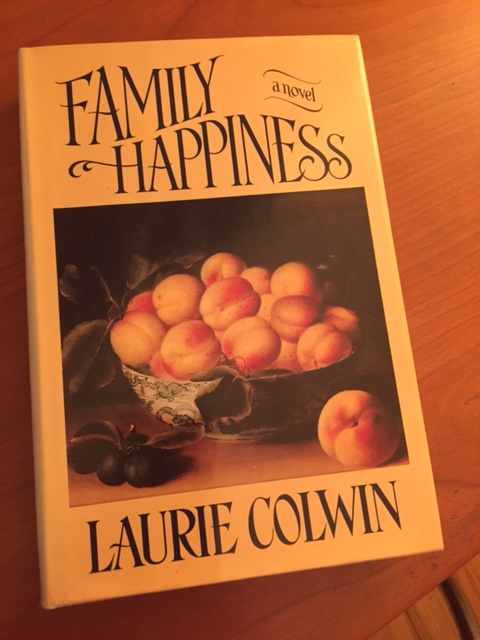
Laurie Colwin’s Shine On, Bright and Dangerous Object (1975) is sad and delightful, filled with loving anger. A splendid beginning to a marvelous though much too short career. William Maxwell’s So Long, See You Tomorrow (1980) is famous for good reason. Audacious structure and play with time, heartbreaking story, even a section told from the point of view of a dog. Joan Chase’s During the Reign of the Queen of Persia (1983) deserves its resurrection thanks to the good people at NYRB. Another story of childhood in the American Heartland, at once bucolic and traumatic.
You can see I am deep into the “my favourite artworks are the ones created while I was a child and too young to experience at the time” years. I read new things too, though, and the best of these was Kaliane Bradley’s The Ministry of Time (2024), which I finished in a cabin at the Grand Canyon during a thunderstorm that had the rain pounding on the metal roof. The book is as memorable as the setting of my reading: an experiment in time travel, in which a 19th century Arctic explorer is brought to a near-future UK and given to a handler from the titular government agency whose background happens to be Cambodian. In addition to its speculative elements, and a terrific love story, the novel considers differing cultural responses to trauma. More Bradley soon, please!

Short story collection: Only read one, but it was a good one. I liked all the stories in Jamel Brinkley’s Witness (2023), but “At Barstow Station” is an all-timer. Even a class full of students who did not care much for reading agreed.
Most unexpected page-turner: Karl Ove Knausgaard’s The Morning Star (2020, translated by Martin Aitken) blends his signature interest in mundane middle-class life with some weird shit (a blazing star that no one can explain, a ritual murder, shenanigans at a mental institution). I raced through it and bee-lined for the bookstore to but the next one (in an expensive and gigantic hardcover edition), only to ignore it for the rest of the year. Honestly, the hardcover might be the problem. Most of the time I’m a “give me the paperback” guy. Anyway, will read the others in this series.
Most fun: The audiobook of Jesse Q. Sutanto’s Vera Wong’s Unsolicited Advice for Murderers (2023), read with obvious affection by Eunice Wong, made me laugh aloud. As I feared, the strains of keeping the conceit going already show in the second book, which I listened to a couple of months ago. But I’ll stick with Vera a while longer; she’s a treat.
Best sequel: Waubgeshig Rice’s Moon of the Turning Leaves (2023) is a big advance over its predecessor, Moon of the Crusted Snow. A rare case of a longer book being better. It’s ten years since the mysterious event down south that sent the grid down. The small indigenous community at the heart of the first book has been thriving, but its inhabitants realize they have reached the limit of the resources in their immediate area. After painful debate, they send a search party to find out if anyone else is out there—specifically, anyone indigenous. Exciting, well-drawn, and smart about the cost of giving up part of your identity to gain the benefits of joining something. (a community, a culture) larger.
Grimmest ending: Edith Wharton’s Summer (1917), really a hell of a book. Even if you haven’t read Wharton before you know things aren’t going to end well. But I at least did not anticipate them to end quite that dispiritingly. Thanks to Shawn Mooney and the rest of the Wharton gang for the invitation to read.
Hurts so good: Elliott Chaze, Black Wings Has My Angel (1953)
Liked at the time, but has now faded from memory:
Jean Giono’s Fragments of a Paradise (1944/48 and newly translated by Paul Éprile); Suzumi Suzuki’s Gifted (2022, translated by Allison Markham Powell); Ariane Koch’s Overstaying (2021, translated by Damion Searls);and Jón Kalman Stefansson’s Your Absence is Darkness (2020, translated by Philip Roughton). Don’t get me wrong: these are all good books (especially the Giono). I don’t regret reading any of them. Just not top-notch, for me.
Meh:
These did nothing for me, and even left me a little grumpy. Ari Richter’s Never Again Will I Visit Auschwitz: A Graphic Family Memoir of Trauma & Inheritance (2024): you’d think I’d be the perfect reader for this, but honestly I did not think this book was very smart. Dorothy West’s The Wedding (1995): I get it, she was old when she wrote this. Plus, the existence of a Black elite on Martha’s Vineyard was news to me: interesting stuff. But this felt wispy, and not in that good Belle and Sebastian way. Two crime novels by Arnaldur Indridason: sometimes you just want to turn pages and remember your Iceland vacation but at the same time you know you’ll never get these hours back.
Most ambivalent toward:
Tried to explain why I felt this way about Lily Tuck’s The Rest is Memory in The Washington Post.
It wouldn’t be an end-of-year list from me without some thoughts on Holocaust-related books, which I’ve divided into categories:
History: Dan Stone’s The Holocaust: An Unfinished History (2023). All due respect to Doris Bergen, this is the best single-volume history of the event I know, and it’s pretty short too. I went long on it for On the Seawall. Honorable mentions: Linda Kinstler’s Come to this Court and Cry: How the Holocaust Ends (2022), and Rebecca Donner’s All the Frequent Troubles of Our Days (2021). The latter admittedly not a Holocaust book, but rather a resistance to the Third Reich book. Pretty damn good tho.
Memoir: József Debreczeni’s Cold Crematorium: Reporting from the Land of Auschwitz (1950, translated by Paul Olchváry). If I could legislate that people had to read one Holocaust book, I’d choose this one. Indelible. You think the Holocaust was bad? You don’t know from. Honorable mention: Michael Frank’s One Hundred Saturdays: Stella Levi and the Search for a Lost World (2022), which I wrote about in 2023 but read again for a book group last fall. If anything, it was even better the second time. To read about Stella is to love her.
YA: Elana K. Arnold’s The Blood Years (2023). Gonna do what I can to see that this one gets more traction.
Comic: Emil Ferris’s My Favorite Thing is Monsters [Vol 1] (2017). What an accomplishment! Your heart will hurt but you won’t be able to stop turning the pages. Ten-year-old Karen Reyes lives in Chicago in the late 1960s. She adores her brother, who is sometimes a gentle artistic soul but sometimes a man pushed to violence by racism and poverty, almost as much as she loves monsters. (She draws herself as a werewolf.) She’s fallen in love with her best friend, Missy, who now shuns her at school while being drawn to her in private. Her mother is diagnosed with cancer, leaving the family’s fortunes ever more precarious. When Karen’s upstairs neighbour, Anka Silverberg, a married Holocaust survivor with whom her brother had been having an affair, is found dead under mysterious circumstances, Karen takes it upon herself to investigate. She stumbles on some cassette tapes, in which the woman tells her life story, a lurid and painful one: Anka was brought up in a brothel by her abusive mother, a sex worker, and then sold into a child prostitution ring from which she is “rescued” by a client who later abandons her when she gets too old for him. After the fall of the Weimar Republic and the rise to power of the Nazis, Anka is persecuted for her Jewishness and eventually deported to the camps. How she survived, how she made her way to America, and what led to her death—these questions are presumably answered in volume 2, which was released last fall. Volume 1 is 400 pages, with plenty of tiny lettering. It would be an effort to read it even without its distressing subject matter. But it’s damn good and deserves more attention than it’s got. Ferris uses dense cross-hatching to give her images texture: I don’t how else to say it other than the images seem tense. Amazingly the book is drawn almost entirely with Bic ballpoints. The whole story of its creation, which took six years, is remarkable, starting with Ferris’s partial paralysis after contracting West Nile disease.
Holocaust-adjacent text: Svetlana Alexievich”s Last Witnesses: An Oral History of the Children of World War II (1985, translated by Richard Peaver and Larissa Volokhonsky) impressed me with the pathos of its subject matter (children, many orphaned either permanently or temporarily when Germany invaded the USSR in 1941) and the success of its method (her now well-known quasi-anthropological style, in which witnesses speak for themselves, with seemingly little input or shaping from Alexievich herself, other than the ordering and structuring, not to mention the selecting of excerpts from what are presumably much longer testimonies: which is to say, thoroughly shaped…)
Book I Never Expected to Spend This Much Time With:
Lois Lowry’s Number the Stars (1989), the classic middle-grade novel about the (anomalous) experience of Danish Jews during the Holocaust. I created a lot of materials about this book for teachers. Yes, it has certain limitations, but I’m honestly impressed by how much richness I’ve found in this text. It seems to be fading a bit from the classroom—but not anymore, if I can help it!

There you have it. I don’t know what my life is going to look like going forward—but I hope at least in the short term to have more time for this poor little blog. Thanks as always for reading! I would love to hear your thoughts on anything I wrote about here.




 Susie Steiner, Missing, Presumed (2016)
 In summary: Trevor’s good—no surprise there—and I’ll be reading more of him in the next few months. Jamie is a brilliant essayist; I’m finding her especially enlivening in these times when distancing is our reality rather than our fantasy. Neumann’s book is at once clunky and captivating. But the pick of the month was Hadley’s Late in the Day; a great book of middle age. I hope June brings more good reading, but events being what they are right now—I don’t know if I’m more thrilled or scared that people are finally saying enough is enough—I’ll settle for any reading at all.







 Eiger, Mönch & Jungfrau