March 2019 in Review

March is a long time ago now, but I wanted to say a few words about my monthly reading. A better than average set.

D1LJGPEXgAA60s8

Yiyun Li – Where Reasons End (2019) Sad, funny, wise, painful. I quoted bits here.

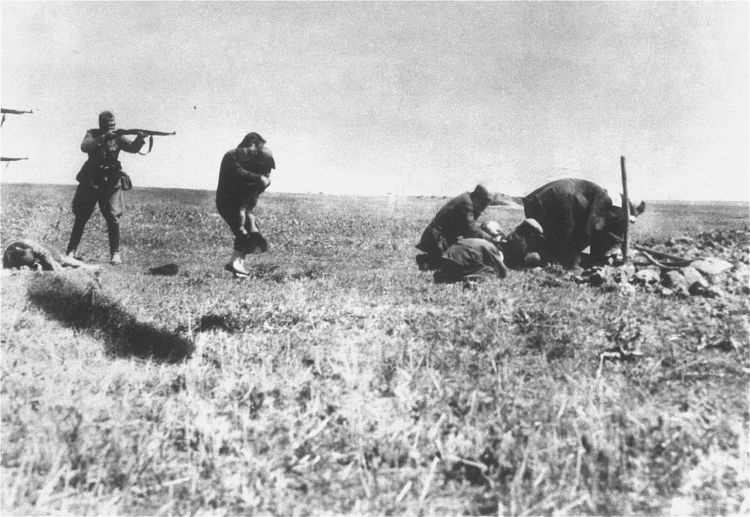
Christopher R. Browning – Ordinary Men: Reserve Police Battalion 101 and the Final Solution in Poland (1992/98) This Holocaust scholar could have won plenty of rounds of Humiliation for not having read Browning’s classic microhistory of the actions of Order Police Battalion 101 near Lublin in 1942. Sometimes books you feel just have to have read disappoint. Not Ordinary Men, which remains as eye-opening now as then. (Browning has written a thoughtful essay for the 25th anniversary edition, bringing the latest research, especially concerning the photograph record of the unit, to bear on his original conclusions.)

The book begins with a sobering statistic: in March 1942, 70—80% of the eventual victims of the Holocaust were still alive, and 20—30% had been murdered; by February 1943, the proportions were reversed. 1942 was the darkest year in Jewish history; Browning examines one example of the men who perpetrated that darkness. The average age of the 500 men in the battalion was in the upper 30s, meaning that they had come of age before the Nazis came to power, and they were working- and lower middle class men from Hamburg, an area and the social classes famously antipathetic to National Socialism—facts which, taken together, suggest these men would have been among the least likely to be drawn to fascism. Yet they readily participated in mass executions, round-ups, and deportations.

Browning notes that 10—20% refused to partake in atrocities (and they had the benefit of a commander who actually asked before the first action if anyone wanted out—rather than a death sentence or a transfer to the front, these dissenters were moved into clerical positions or even sent back home); 20—30% participated avidly in atrocities; while the majority (50—70%), although reluctant, participated anyway. For the men in this last category, it was easier to follow along, and too unpleasant to risk the scorn of their more hateful colleagues. These are sobering numbers, with implications beyond Browning’s specific example. What makes us think we wouldn’t number among the majority in a similar scenario?

Leslie Morris, The Translated Jew: German Jewish Culture Outside the Margins (2018) I had a realization as I reviewed Morris’s book on the idea of translation in postwar German Jewish culture: academic monographs make me grumpy and I should stop writing about them. Thus, I’ve given up reviewing books for Choice, a publication designed to help libraries decide what to buy. (I wrote for them for 10 years.) Morris, whom I have not met even though the field we work in is small, probably deserves a more charitable reviewer. I did my best to point out the inspiring range of her material—ranging from a defunct Berlin sculpture park to Jewish body art to the poets Raymond Federman and Rose Ausländer. But her insistence, so typically academic, that we think, read, or engage “in new ways,” without explaining how or why, grated on me. As I concluded: “her description of Jewishness as an endlessly deferred cipher, at once spurring and spurning interpretation, is as unexceptional as it is unexceptionable.”

Andrea Camilleri – The Overnight Kidnapper (2015) Trans. Stephen Sartarelli (2019) Of course, the crime itself has vanished from my memory, but I recall the latest Montalbano as a decent effort. I didn’t want any surprises, and I didn’t get any.

Gengoroh Tagame – My Brother’s Husband [Volume 2] (2016) Trans. Anne Ishii (2018) I read Volume 1 last month; happy to say that the conclusion doesn’t disappoint. It plays a trick on us, but a fair one: leading us to believe in an impossible ending, then gently showing us why the all-too-possible one, however melancholy, is the right choice.

Ian Rankin – In a House of Lies (2018) The latest Rebus—once again improved, I suspect, by the audiobook’s excellent narrator—is one of the best in a while, featuring a rich set of storylines, plus better use of Brillo the dog (see my February complaint). The détente between Rebus and Edinburgh crime boss Big Ger Cafferty suggested in the previous installments is gone. This despite the fact that Rebus is coming to terms with a COPD diagnosis. Has anyone written about the pathos of ailing detectives?

H. F. Heard – A Taste for Honey (1941) I admit, I did not do this book justice. I read it on a Friday night when I was exhausted and should have gone to bed. But even in a better frame of mind, I think I would have found this tale of Holmes in retirement thin gruel. You better like Holmes a lot more than suspense if you’re going to enjoy it.

Virginie Despentes – Vernon Subutex I & II (both 2015) Trans. Frank Wynne (2017 & 2018) Not sure how long they’ll stay with me, but I liked these books a lot. I tried to articulate why—and the issue I take with the conclusion they seem to be coming to—here.

Mihail Sebastian – Women (1933) Trans. Philip Ó Ceallaigh (2019) More anon.

Solomon Perel – Europa, Europa (1990) Trans. Margot Bettauer Dembo (1997) Almost on a whim, I decided to teach Agnieska Holland’s adaptation of Perel’s extraordinary Holocaust memoir this semester. It went well—I’m finding the movie more interesting the longer I spend with it (always a good sign). The film is plenty unusual, but Perel’s memoir even more so. His story is stranger than fiction: after escaping the Nazi advance by fleeing east of the Bug river (the part of Poland annexed by the Soviet Union in the Hitler—Stalin pact) and finding refuge as a Komsomol in an orphanage in Grodno, the Jewish Perel passed himself off as an Ethnic German when the Nazis invaded the Soviet Union in 1941. (He had been born in Germany before moving to Poland with his parents as a child.) Perel found himself honoured for fighting at the Front and then shipped to a boarding school for elite members of the Hitler Youth, where he spent most of his time worrying someone would notice his circumcision. (Tonally, both book and film are crazy: sort of funny, sort of campy, sort of moving.) Remarkably, Perel survived the war surrounded by Nazi true believers, and at war’s end found himself reunited with his elder brother, the only other member of the family to survive. Perel’s story is even more unlikely than most survivor tales. What is most interesting is the way his cognitive dissonance features in odd switches between first and third person. At heart there seems something fundamentally incurious about Perel. An effect of his experiences? Or a predisposition towards surviving them?

Michelle McNamara — I’ll Be Gone in the Dark: One Woman’s Obsessive Search for the Golden State Killer (2018) I don’t read much True Crime. But I do read a ton of crime fiction. So, I naively assumed, when I started listening to McNamara’s acclaimed description of her pursuit of the serial rapist she named the Golden State Killer, that I knew what I was in for. Nope. I was shocked by how visceral, graphic, and uncomfortably voyeuristic this book—and, I suspect, its genre—turns out to be. It’s creepy as shit. To her credit, McNamara is aware of these difficulties, and doesn’t shy from highlighting her obsessive interest. Sadly, McNamara couldn’t finish her book: she died about three-quarters of the way through, and the finished version has been pieced together from notes. (The editors clearly describe when and how they’ve reconstructed.) Still, I did find the book repetitive and confusingly structured—perhaps a fitting response to the relentlessness of the crimes, dozens and dozens of them, perpetrated over a decade all over California. (If I had a better sense of California’s geography I might have had an easier time of it.) The tension between what we know—the killer was finally caught (in part thanks to McNamara’s efforts—and what she didn’t gives the book a macabre poignancy. Not for the faint of heart.

Lissa Evans — Their Finest Hour and a Half (2009) Read my take, if you like, but be sure to read this novel. There’s a dog that understands Yiddish!

David Bezmozgis — Immigrant City: Stories (2019) Bezmozgis is one of my favourites, the heir to Bernard Malamud. I snapped up his new collection on a recent weekend in Canada (why no US pub date?) and finished it before I was even home. I’m not sure Bezmozgis has ever written anything as rich as his first novel, The Free World (the great novel of the emigration of Soviet Jewry), but most of these stories are the equal of those in his terrific first collection, Natasha and Other Stories. Of course, some stories are stronger than others. “A New Gravestone for an Old Grave,” for example, is a bit travelogue-y. But “Immigrant City” breaks new ground for Bezmozgis (not sure the attempt to juxtapose earlier generations of Jewish immigrants to newer ones from Syria and Somalia completely works, but it’s thought provoking—I suspect it would hold up to rereading). And “Little Rooster” is a classic that is going straight onto the syllabus of my course on postwar representations of the Holocaust.

More before too long, I hope, about April reading, which is proving decidedly more unavailing.

February 2019 in Review

Short month, short books. Verdict: plenty of decent reading, some even better than that. Here’s what I read in February 2019.

C63BkZuU0AE8tQi

Gengoroh Tagame – My Brother’s Husband [Volume 1] (2014) Trans. Anne Ishii (2017) Gentle manga about Yaichi, a single parent raising a delightful, rambunctious daughter, Kana. Their lives are interrupted by the arrival of Yaichi’s brother-in-law, a white Canadian named Mike Flanagan, who visits Japan in the wake of his husband’s (Yaichi’s brother’s) death. Yaichi spares no effort to welcome Mike—aided by Kana’s joy in the sudden appearance of this unexpected uncle—but his not-so-latent homophobia keeps getting in the way. Lots of secrets, lots of emotion, but all handled lightly. I was engrossed and moved and have the sequel from the library ready to go. Plus, who doesn’t like a hunky Canadian hero?

Ken Krimstein – The Three Escapes of Hannah Arendt: A Tyranny of Truth (2018) I enjoyed this comic, which combines Arendt’s biography with her political philosophy. Maybe I found the experiment so compelling because I don’t really know my Heidegger. (I’ve been avoiding him since college; my undergraduate institution was regrettably besotted by the thinker of Being.) At least that’s how I felt after reading the TLS review, which called out Krimstein for his misleading summary of Arendt’s erstwhile lover’s philosophy. I agree that Krimstein rather hurried over Arendt’s report on the Eichmann trial, and maybe he does spend too much time offering potted biographies of the many intellectuals, artists, and otherwise famous people Arendt came across, but Three Escapes gave me a clearer sense of Arendt’s life, especially the years before the war, and made me thrill to the capacious generosity of her ideas. A book could do worse.

Hana Demetz – The House on Prague Street (1970) Trans. Hana Demetz (1980) Score another one for open stacks. While at the United States Holocaust Memorial Museum archive earlier this year, I was browsing the shelves when my eye was drawn to the cornflower blue spine of Demetz’s book, written in German and later translated into English by the author herself. Happily, my local library had a copy, which, I suspect, no one had checked out for years. Which is a shame: The House on Prague Street is really good. It tells the story of Helene Richter, who grows up in eastern Czechoslovakia in the 1930s but whose life revolves around the summers she spends in the small town in Bohemia where her maternal grandparents live in the house that gives the book its title.

Her mother’s Jewish family are successful industrialists, the classic success story of Austro-Hungarian emancipation. (The first pages might have come from a Joseph Roth novel.) Imagine their unhappiness when Helene’s mother marries a law clerk from a Sudeten German family. This makes Helenka, as she is affectionately known, half Jewish, which has important consequences for her after 1938. Unlike the rest of her mother’s family she is not deported to Theresienstadt or further east. Instead she comes of age in wartime Prague, where she experiences plenty of privations but nothing like those suffered by her mother. Imagine her mother’s anguish when Helenka falls in love with a German soldier, on leave for a few days from the eastern front. That Gerd seems to be a genuinely kind person, and no Nazi, does nothing to assuage the mother’s hurt. These scenes are riveting—the tone is different from, say, the bitterness of Ruth Kluger’s fights with her mother in her memoir Still Alive; Demetz’s bitterness is always mixed with sweetness—and only become more poignant in light of the traumas that descend upon the family.

The mother dies of a sudden illness because she cannot be taken to the Jewish hospital after curfew. Gerd is declared missing, presumed dead. The father survives the war, only to be murdered in a street fight between German sympathizers and communists in the weeks after armistice. At the end, Helene returns to her grandparents’ house, which has been taken over by Orthodox Jews returned from the death camps. They are suspicious and resentful of her; she respects their claim on the house, but has no respect for them, describing them as uncouth, even primitive. Not even genocide, we learn, will necessarily bring people together. Demetz offers no vision of Jewish solidarity. And why should she? After all, it was the perpetrators who defined the victims as much as or even more than the victims themselves.

The neatness of the book’s narrative structure—it ends with Helene on the station platform, awaiting the train back to Prague, standing under the same swaying begonias that so imprinted themselves on her mind as a child—reminds readers that The House on Prague Street is a novel, not a memoir. Yet it reads more like the latter than the former. It has the feeling of coming directly from the life of the author.  It’s not perfect, sometimes it strains a little for effect, but it’s captivating and moving. Some enterprising publisher ought to reissue it.

Anthony Horowitz – The House of Silk (2011) (Audiobook) Enjoyable Holmes novel, improved by Derek Jacobi’s peerless narration. It’s true, I did guess the ending (a subplot fooled me, though I also found it a bit silly), but the book’s real pleasure lies in its subtle characterization of Watson, nothing like the “sack stuffed with straw” so derided by Virginia Woolf. As always, Horowitz brings the stuff.

Hana Demetz – The Journey from Prague Street (1990) After so enjoying Demetz’s earlier novel I had to read its sequel, which sees Helene and her husband escape Czechoslovakia and build a life in America. Unfortunately, Journey isn’t a patch on its predecessor. Maybe the problem is that Demetz wrote it in English. But I think it’s more that the situations—infidelity, divorce, the trials of starting over in mid-life—are tired and their handling uninspired. Maybe Demetz only had one book in her. (I believe, actually, she wrote some others before House, but I don’t think they’ve been translated.)

Sarah Moss – Ghost Wall (2018) I’m writing about this for another outlet, so will only say: I liked it, sometimes quite a lot, but I wasn’t as crazy about it as so many people on Book Twitter seem to have been.

Liana Millu, Smoke over Birkenau (1947/1986) Trans. Sharon Lynne Schwartz (1991) Brilliant, evenhanded, non-judgmental and unsparing narrative memoir (what I mean is that Millu tells her experience in Birkenau through a series of stories about other inmates, stories that have the texture of fiction—not that their made up, but that their telling is literary). I’ve written about Smoke before. How good is it? Well, this is the fourth or fifth time in the last couple of years I’ve read it, and it gets better and better. I now know it well enough that I won’t have to read it from cover to cover each semester, but I’ll look forward to dipping into it.

Cay Rademacher, The Murderer in Ruins (2011) Trans. Peter Millar (2015) My high hopes for this mystery, set in the rubble of immediate postwar Hamburg, were dashed almost immediately. The writing is pedestrian, and the murderer pretty obvious. The use of the setting is good, and I learned what people did to survive the brutal winter of 1947. I’d have been better off reading a history, though. I believe it’s a first novel, and it might be that Rademacher improves (there are two sequels plus a whole other series), but I’m not inclined to give him a chance. (Especially since I got the book from the UK.) No Philip Kerr, let me tell you.

Laurie R. King, O Jerusalem (1999) My third audiobook of the semester was the fifth in the Holmes/Mary Russell series. It looks back to the first book, The Beekeeper’s Apprentice (still the best so far), and expands upon an interlude referred to there in which the leads find themselves in Mandate Palestine. I’m really interested in that time and place, and I enjoyed learning about General Allenby, who seems to have been quite a character, but this book is much too long and much too dull. King hasn’t lost me entirely, Russell is still a good character, and I’ll continue with the series, but plan to take a break for a while.

Katherena Vermette, The Break (2016) Not only the book of the month, but the book of the year so far, and one of the best I’ve read in a long time. I want to write a proper post about it, so for now will just say that it’s about an indigenous family in Winnipeg, specifically its female members, and their response to the countless aggressions (micro and macro) they endure. (The Break is a strip of land, a hydro corridor, in the city’s North End). The highest praise I can give books is that I still remember them weeks later, and The Break passes that test easily.

Lauren Wilkinson – American Spy (2018) Wilkinson’s debut novel, conversely, does not. I enjoyed it as I was reading it, and I found its central conceit—that African Americans are like spies in enemy country, nicely formulated in an epigraph from Ellison’s Invisible Man—fascinating and timely. Marie Mitchell is an African American woman in the FBI in the late 1980s. She ends up working for the CIA in the then-newly renamed Burkina Faso on a mission to ingratiate herself with its charismatic President, Thomas Sankara. Until reading this novel I was completely ignorant of Sankara’s revolutionary Marxist and anti-imperialist program, which seems to have transformed life for the country’s poor. In the novel—and I suspect in life—the CIA wanted him gone; when Marie is sent on a mission of the kind she has always wanted she is forced to reconcile her love of the work with her feelings that the country she is working for isn’t really her own.

The sections in Africa are nicely handled: the book never feels like a travelogue. Yet even though I was impressed by what Wilkinson was trying to do I didn’t feel she quite pulled it off. There are two reasons for that: one, she’s trying to do too much, and, two, she doesn’t do the genre justice. In addition to everything I’ve mentioned the book also tells a family story, involving Marie’s divorced parents (one a cop and one, it turns out, a former spy) and her sister, who had tried to forge a path into intelligence work and couldn’t. Wilkinson ties this together with the political story, but it’s too much. As Wilkinson admits in this interview, she isn’t that well versed in spy fiction. I appreciate her efforts to queer/diversify the genre—it needs it!—but I want that effort to be accompanied by a better sense of suspense, pacing, etc.  For me, a fascinating misfire.

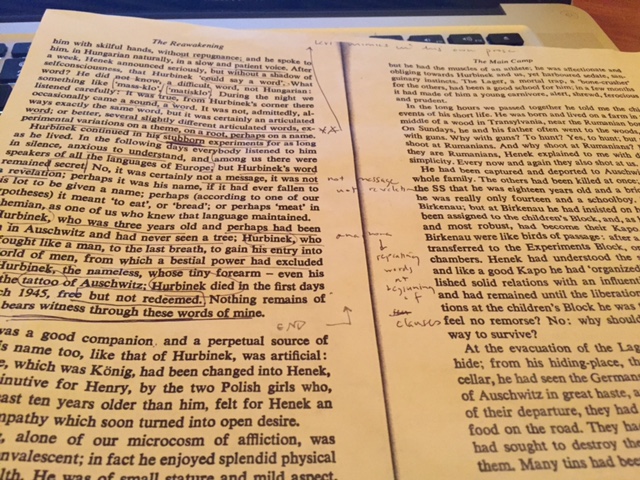
Primo Levi – The Reawakening (1963) Trans. Stuart Woolf (1965) (The proper title is The Truce.) Although I have taught a short excerpt from this for years in my Holocaust Lit class, I’d never read the whole thing. I read it with some students, and their appreciation of it increased my own. It’s a picaresque, describing the eleven months it took Levi to return to his home in Turin from Auschwitz-Birkenau. We enjoyed comparing The Reawakening to the much more famous Survival in Auschwitz (a.k.a. If This is a Man: Levi’s American publishers didn’t do him any favours). The sequel is markedly different in style, tone, and structure. It is ordered chronologically, for one thing, unlike its much more essayistic predecessor. “Picaresque” is misleading: it suggests scrapes and hijinks and ne’er-do-wells (all of which feature here), when in fact the book contains at least as much that is somber as triumphant. But it’s a book about coming back to life: hard, painful, but ultimately affirming. Levi is sometimes even funny, especially in his appreciation for Soviet organization, or lack thereof. At one point, describing a Soviet DP camp, he says something like (I don’t have the book in front of me), “There was no organization, but we got fed every day. It was a perfect system.” At moments like this, my students and I were reminded of the well-known encounter between Levi and a man named Steinlauf in Survival in Auschwitz. Steinlauf, a WWI veteran, perseveres even in the Lager he with a diligent regime of personal cleanliness, even though in those conditions hygiene was impossible. The point, he explains to Levi, urging him to wash in the ice-cold dirty water provided the prisoners, is to maintain one’s self as a human. Levi sees the man’s point, but he admits himself incapable of following another man’s system. This is the Levi we see in The Reawakening, a man who is finally free yet not forced to navigate the chaotic, ramshackle, uncoordinated but ultimately inescapable Allied bureaucracy.

Although short, The Reawakening is full to bursting with vivid characters and outlandish scenarios. Through a series of misadventures, Levi and the handful of Italian deportees who survived with him are sent east, through the Ukraine and almost up to Minsk, before making their way back down through Romania, Hungary, Austria, even Munich (where Levi refuses to leave the train station) and finally home to Italy. Maybe the thing that made the biggest impression on my students was how fraught the immediate months after the war were. We tend to think that liberation brought a return to normal life; Levi makes it clear, however, that this concept didn’t survive the war.

Looking back, February’s highlights were The House on Prague Street, The Reawakening and, above all, The Break. Anyone read them?


Five Years Later

I posted my first review here at Eiger, Mönch & Jungfrau five years ago last week. A satisfying milestone, especially as more people visited last year than ever before. And surely not all of them are trying to plan a trip to Switzerland…

In preparing these comments, I looked back at last year’s anniversary post. Most of the things I said there remain true. Most of all I still wish I wrote more regularly. But I’m doing better about not beating myself up about it. And overall I’m feeling more optimistic about lit blogs in general. I know there was that recent piece about how book blogs are dead, and I know some smart bloggers wrote rebuttals. I’m grateful to my comrades for doing so, but I confess I didn’t read either the original take or the responses. Maybe some people think blogs are over, but that’s not the way it feels to me. There are still plenty of people out there, ploughing their various fields, and giving me all kinds of new things to think about and titles to hunt down. (I’ve said it before, but I swear to God the first thing I’m going to do this summer is add a blog roll.) Without exception, the people I’ve come to know through the online lit community have been smart, funny, warm, and generous. And best of all, they are real readers. Although I’ve been lucky enough to meet a few in person, most I know only in the spectral way of the internet. And yet I do feel I know them. At a time in my life when I don’t interact with many readers on a daily basis (which might surprise you, given that I’m an academic, but there you have it), I really cherish that community.

As for the coming year on the blog, I suspect it will be much like the last: a series of too occasional, too long meditations on stuff I’ve been reading. I plan to add a few things. For example, I’m writing monthly round-up posts. I’ve pledged to host a group reading of a long nineteenth-century Danish novel in May (please join!). And when the semester ends I will try, as I did last year, to write a few essayistic pieces.

Until I re-read the plans I made last year, I’d forgotten I suggested coordinating a celebration of Primo Levi’s centenary. (I’m puzzled that no one seems to be talking about this milestone.) Having committed to the Big Danish Novel in what is prime reading and writing time (just when the semester ends) I’m not sure when this going to happen, but I think it’s important to commemorate this wonderful writer, so I will devise some kind of plan, however modest. Let me know if you have suggestions. In fact, if you would like to help me (primarily by keeping me accountable) I would be ecstatic. Levi’s hardly forgotten, but his oeuvre is more varied than you might think. Plus, as a writer of witness, and as a person who found the worlds of science and literature mutually enlivening rather than entirely separate, he remains as relevant as ever.

And then there’s Uwe Johnson’s Anniversaries, which I have sadly neglected after such a strong start. I hope to get back to it. But I know the siren-song of another giant NYRB release will be calling my name come summer.

If I can get my act together, the long-suffering Keith and I will continue our slow tour through Zola’s Rougon-Macquart cycle. I’ve loved sharing Keith’s writing, as I have Nat’s. Reading Olivia Manning with Scott was typically satisfying. If you’re looking for a (very modest) platform for your bookish writing, let me know. I’d love to have more contributors here, either regularly or as a one-off.

Before I close, let me list a few highlights from the past year:

Heartfelt thanks to everyone who stopped by the site this year. Your interest and support mean so much.

Onwards! That book mountain isn’t going to climb itself.

“Peddle your philanthropic bullshit to someone else”: Luce D’Eramo’s Deviation

As Hannah Arendt tells it, Adolf Eichmann, on trial in Jerusalem for his role in organizing the Final Solution, was given a copy of Lolita by one of his jailers. The gift did not go over well. Two days later, Eichmann, “visibly indignant,” returned it, unfinished. His verdict? “‘Quite an unwholesome book’—‘ Das ist aber ein sehr unerfreuliches Buch.”

I’m baffled by this story. What motivated the Israeli official? Was he making a joke? Setting a test? Teaching a lesson? (Lolita is framed as a jailhouse confession, after all.) Why did Eichmann reject the book? Did he take Humbert Humbert’s tale at face value—that is, did he fail to see the book’s critique of pedophilia? Or on the contrary did he see his own evasions in the narrator’s? Was he rejecting the joke, test or lesson? Above all, why “unwholesome”? (Unerfreulich can also mean unpleasant.)

Arendt offers no explanation for her inclusion of the anecdote. (It’s literally a parenthesis.) But she places it in a discussion of what she calls Eichmann’s aphasia—his inability to wield language without resorting to cliché. The man himself apologized for his inarticulateness to the court, saying that his only language was Amtsprache, bureaucratese. According to Arendt, anyway, Eichmann had no critical faculties. He saw the world through ready-made phrases and shopworn ideas. No wonder wholesomeness was his recourse. He knew what he liked because he liked what he knew.

But maybe in this case he was on to something. Lolita is disreputable. It relishes that designation, of course, asking us to decide what we mean when we reject something as immoral. The point of that challenge isn’t to expand what counts as acceptable behavior but to make us realize how easily we accept, even condone abuse. The novel’s glittering language—the fancy prose style Humbert warns us about in its first pages—only exacerbates the sordidness of its subject matter, so that even our pity and horror for what happens to twelve-year-old Dolores Haze comes to seem tainted by having to be earned from reading against the grain.

I thought about Eichmann and Lolita as I wondered how to respond to Luce D’Eramo’s Deviation (1979), certainly the most unpleasant and maybe the most unwholesome book I’ve read in a long time.

italianfuturistsexibition

It’s all the publisher’s fault. When I read the promotional copy—which also appears on the dust jacket—describing Deviation as “a seminal work in Holocaust literature” I was immediately intrigued. (“Seminal” should have tipped me off—I thought we retired that word.) I even managed to convince Scott—who knows Italian literature much better than I do—to read it with me. (Sorry, Scott!)

But Deviation is not about the Holocaust. About fascism, yes, about forced labour camps, definitely, about the relationship between industry and Nazi expansionism, quite interestingly, and about moral equivocation most definitely. But not about the Holocaust, and to suggest this is, frankly, disgusting and disrespectful.

The publisher’s bait and switch has certainly coloured my view of the book, but even without that aggravation I think I’d be hard-pressed to know what to make of Deviation. I’ll let D’Eramo—in the guise of her narrator, basically a version of D’Eramo herself—explain what the book is about. Lucia, like her author born and partially raised in France before returning to Italy as a teenager, is an ardent Fascist. With the establishment of the Republic of Salò in September 1943 and the rise of partisan resistance to fascism, believers like Lucia were left “feeling as though their earlier ideals were crimes” (they were!). Eighteen-year-old Lucia comes to a decision:

I realized that the only way to learn the truth for myself about Fascists and anti-Fascists—many said that they could no longer figure it out [note the resemblance to Trump’s pet expression “People are saying”]—was to ascertain it firsthand. Understanding this, I had to go to the places about which the most outrageous stories were told: the Nazi concentration camps. That’s why I ran away from home on February 8, 1944, and went to Germany as a simple volunteer worker, with pictures of Mussolini and Hitler in my backpack, sure about what I was doing. But after spending a few months in a labor camp near Frankfurt am Main, my comrades organized a strike at the factory, the IG Farben, where I worked in the Ch 89, the chemical division. As a result, I was jailed, then later transferred and detained in Dachau. In order to survive, I escaped from there in October, and for a couple of months I remained hidden in Munich. Then I left, following the death of the friends who were helping me … I headed back to my first Lager [the IG Farben camp at Frankfurt-Höchst], travelling partway by train without a ticket, crouched in the toilets of the cars, partway on foot, spending the night in bomb shelters, in abandoned cattle cars, in foreigners’ barracks … in mid-February [1945] I arrived in Mainz.

Basically, the book is about Lucia’s attempt to come to terms with the evasions and lies in this story. What she first tells us is that on December 4, 1945 she finally returned to Italy, and did so as a paraplegic, her legs having been paralyzed when a wall fell on her as she was helping to dig survivors out of the rubble of a bombed-out building. But this first return was in fact her second.

It’s true, Lucia was involved in the brief and ultimately unsuccessful strike led by both volunteer and forced labourers at the IG Farben camp. And it’s also true that she was arrested. But after a failed suicide attempt—she took rat poison, and only survived because she took too much too quickly, and vomited it up: a nice metaphor for her life, where excess always turns in her favour—she was repatriated by the Italian consul and sent back to Italy.

As far as Lucia is concerned, the only good thing about this outrageous bit of good fortune is that her father, a bigshot in Fascist Italy whom she hates, had nothing to do with it. In fact, he refused to pull any strings for her. But in Verona, waiting for the train that will take her to Como, and home, she rebels. (That’s not the right word. She does something remarkably stupid.) She throws away her papers and arranges to get arrested by some SS men taking a convoy of political prisoners to the station. In this way, she is sent to Dachau, from which she eventually escapes after she volunteers to be part of the shit commando—a work detail sent around Munich to unclog sewage pipes (there are some memorable descriptions of this work in the book’s first pages). When the work detail is caught in an air raid, she slips off into the pandemonium, eventually ending up at a makeshift transit camp for displaced foreigners located in an old brewery. And from there she makes her way, in the manner described in the long quote above, to IG Farben and later to Mainz, where she has her accident.

woman-at-the-café-antonio-donghi-680x937

The novel—it’s really autofiction avant la lettre—was written over a period of about 25 years, and its distinct sections are dated to show us this progress. D’Eramo usually tells the story in first person, but sometimes switches to third person, suggesting, as translator Anne Milano Appel suggests in her introduction, how foreign to D’Eramo that person now seems to her. (I’m using author and narrator interchangeably in a way I normally never would, but D’Eramo invites the equivalence.)

In the second half of the book, D’Eramo asks why she repressed the memory of returning voluntarily to Germany. But what she presents as an attempt at self-understanding reads as delusory exculpation. Even her big theory about Nazism and its camp system (she regularly distinguishes between Fascism, by which she means Italian Fascism, and Nazism; this distinction is her most interesting idea) fails to make us think better of her. In D’Eramo’s view, the camp system was a form of class warfare, in which only the working classes were made to suffer. Her evidence is that she never met any rich people in her various forms of voluntary incarceration. (Leading her to offer an anti-Semitic canard about Jewish wealth: “The big financiers, the truly wealthy were sheltered abroad.” Bollocks.)

Here and indeed everywhere in the book, D’Eramo comes across as a terrible person, describing “defenseless masses [that] huddle like sheep,” remembering concentration camp inmates as “a swarm of horrible, wonderful insects” (what the hell is “wonderful” translating here?), and criticizing an old woman’s desperate grief at the realization of her impending death as “a kind of greediness that was more irritating than moving.”  She is revolted by the coarseness of her fellow inmates, repulsed by their way of eating, and eventually driven to exclaim, “I despise victims.”

Readers will surely agree with Martine, one of the narrator’s co-conspirators in fomenting the IG Farben strike, who sees through D’Eramo’s political awakening: “So shut your mouth and peddle your philanthropic bullshit to someone else. Why do you try to excuse yourself? You are who you are.” Specifically, she’s someone who, Martine adds, wants the privileges of being a fascist student in the camp (better food and living conditions) without any of the drawbacks (D’Eramo is hurt that others hate her so much).

The most generous reading of Deviance I can muster is that at least D’Eramo is honest enough to show herself in a bad light. But that honesty feels so self-serving. She’s proud of it, like the student who thinks that his honesty in admitting he hasn’t done the reading for class is enough for him to be excused from any consequences. After all, at least he hasn’t tried to bullshit the instructor. But the fact is he’s merely swallowed his own bullshit. So too D’Eramo, whose great struggle in life—the thing she wrestles with for decades—is the lie she tells anyone who will listen, mostly herself, that she was sent to Dachau for her part in organizing the IG Farben strike, when in fact she chose to be sent there. Finally acknowledging that lie, she seems to think, is a courageous thing to do. (Amazingly, she never refers to her real courage, which consists of living with constant pain from her injury, and refusing to use her disability as an excuse for not doing what she wants to do—having a child, writing her books, etc. Except maybe that doesn’t take courage, just determination.)

Admittedly, D’Eramo does wrestle with the hold that the concept of willpower has over her—she sees this as a legacy of her upbringing and she believes more than anything in the need to overcome the prejudices of her bourgeois milieu. Not because she regrets her commitment to fascism. Nor even because she sees the terrible ends to which a belief in willpower can be put (demonizing anyone unlucky in any way or lacking the advantages of her class position as weak and second-rate). Only, as far as I can tell, because she hates her family so much.  And even that rejection relies on the attributes of her middle-class childhood: she wills herself to overcome the idea of willpower. This is akin to the fetishization of toughness that the philosopher Theodor Adorno called one of the most damaging attributes of the fascist mindset. Even if D’Eramo regrets her past beliefs (and I’m not clear she ever does), she maintains the very attitudes that undergirded that belief.

One of the prisoners in the train taking her to Dachau, a partisan (that is, someone brave enough to resist the regime), tells her, after he finds out how D’Eramo came to be in the freight car with the rest of them, “The performance is over. You can go home.” As much as I sympathize with the man, he’s wrong. D’Eramo’s performance, aimed at much at herself as us, is never over, even when she later acknowledges her own act. Because in the end the acknowledgement is the performance.

And I don’t know what we’re supposed to make of that performance. When she calls herself “an inveterately elite worm,” should we applaud her self-awareness? When she describes how she failed in turning what she thinks could have been the most socially aware moment of her life (choosing to be sent to Dachau) into a mere moral act, adding that, even if she can be excused for what she did at the time, given her youth, her upbringing, etc., can she be excused now, are we supposed to admire the question?

No way. After all, she never gets beyond asking it. D’Eramo regularly points out her mistakes—yet she keeps making them. She offers what she knows is a false analogy between her own experience in the hospital after her accident, waiting for the paperwork to come through so she can leave Germany, to the travails of deportees in the cattle cars. But saying it’s a shitty analogy doesn’t make it less shitty.

Nor is she winning me over when, writing in the mid 1970s, she explains that she “agonized retroactively for the children of the Osten [Slavic prisoners of war, both military and civilian, mostly Russian, whom she encountered in the IG Farben camp] and Jews whom I could see clustered behind the barbed wire when I skirted the transit camps in search of shelter, and who, in my distorted memory, stared at me with the dark eyes of my son.” Thanks for nothing, lady. It’s almost as bad as the anti-Semitism and historical inaccuracy in her description of a gold necklace she continues to wear for decades after the war, which she “snatched from a body, like the Jewish Sonderkommando [the prisoners forced to operate the crematoria] did at Auschwitz.”

lucederamo

Really, the only thing that didn’t make my gorge rise while reading Deviation is D’Eramo’s use of scabrous details: she tells us of men aroused in the disinfection shower; of the chest burns she suffers when she’s assigned to carry blocks of sulfuric acid in the IG Farben camp, as punishment for demanding equal food for Eastern and Western prisoners; of the aftermath of her injury, when her buttock splits open, “emitting copious putrid matter with an unbearable stench”; and of a nurse in the hospital where recovers from that injury who, receiving a letter from a man asking for money to start up a toilet paper factory, since it is sure to be in short supply in post-war Germany, uses the letter to wipe herself.

These details are the only things in this book that don’t stink. They’re gross, but honestly so. They’re not bullshit. The unwholesomeness of the book lies in D’Eramo’s mental gymnastics not her bodily suffering. Adolf Eichmann was wrong about Lolita: the unpleasantness of its events is not something readers are invited to pat themselves on the back for navigating. But his judgment wouldn’t be inappropriate for Deviation. Who do I give my copy back to?


Beyond Night: A Holocaust Remembrance Reading List

January 27th is International Holocaust Remembrance Day; it was on that date in 1945 that Soviet troops liberated Auschwitz-Birkenau.

A powerful way to commemorate the Holocaust is to read its literature: the letters, diaries, memoirs, essays, poems, and fiction created during the events and since. A handful of these texts are well-known: Anne Frank’s Diary, Elie Wiesel and Primo Levi’s memoirs Night and Survival in Auschwitz, Art Spiegelman’s comic Maus. These are rightly famous, and well worth reading (even if Night drives me crazy).

But what if you’ve read them and are looking for more?

Here are 15 less-familiar titles that will deepen your understanding of the Holocaust:

David Albahari, Götz and Meyer (1998) Translated by Ellen Elias-Bursac (2004)

In this novel, a teacher in Belgrade traces the fate of his relatives, uncovering the circumstances of their deaths in a gas van driven by the SS officers of the title. A novel about the limits of history and the possibilities and perils of the imagination.

Molly Applebaum, Buried Words: The Diary of Molly Applebaum (2017)

Why read this out of the many fascinating and heartbreaking Holocaust diaries? For one thing, the story is extraordinary: together with a cousin, Applebaum took refuge on a farm near Tarnapol, Poland. For much of their time in hiding, the two young women were buried in a wooden box, about the size of a wardrobe, able to come out only for an hour or two each night. More vexingly still, both women had sex with their protector, events described obliquely yet excitedly by Applebaum, yet which can’t help but lead us to ask questions about consent and abuse. Another quality that distinguishes this diary is that it’s paired with a memoir written much later, in which Applebaum describes her new life in Canada and reflects on her wartime experiences, yet in ways that seem at odds with the way she told them in the diary.

Heimrad Bäcker, transcript (1986) Translated by Patrick Greaney and Vincent Kling (2010)

Conceptual poetry, writes the scholar Leslie Morris, “seeks to create texts that disavow the very act of creation.” Bäcker’s poems are taken from official documents and eyewitness testimony. Here’s one, taken from a postwar record of criminal proceedings:

whereas he had to prepare breakfast each morning for about 300 prisoners in camp III, he had to provide a midday meal for only about 150.

Jurek Becker, Jacob the Liar (1969) Translated by Leila Vennewitz (1990)

Maybe the most brilliant ghetto novel, written by one who survived the Lodz ghetto and two concentration camps. At the beginning of the novel, Jacob happens to overhear a bulletin on German radio describing a Russian advance. Having let slip the news, Jacob, who is too frightened to explain how he came by this knowledge, pretends that he has a radio (strictly forbidden in the ghetto) and invents the news. Amazingly, the book is funny, as well as very, very sad. Jacob’s inventions are an allegory for our own desires as readers of traumatic events.

Tadeusz Borowski, This Way for the Gas Ladies and Gentlemen and Other Stories (written 1946-48) Translated by Barbara Vedder (1967)

Dark. So dark. These stories are more or less loosely based on Borowski’s own experiences as a non-Jewish political prisoner at Auschwitz and Dachau, most famously about his time as a member of the “Canada Kommando,” the prisoners tasked with separating the new arrivals from their belongings. Desperate.

Georges Didi-Huberman, Bark (2011) Translated by Samuel E. Martin (2017)

The bark of the title comes from a birch tree at Birkenau, peeled off by Didi-Huberman on a recent visit. These same trees can be seen in the four famous photographs taken (at great risk and with daring subterfuge) by a member of the Sonderkommando (the “special squad”—the name given by the Nazis to the groups of Jews they selected to take the bodies from the gas chambers to the crematoria) in the summer of 1944; these comprise the only images of the Holocaust taken by its victims. In this little book, Didi-Huberman intersperses his own amateur photographs of the Auschwitz-Birkenau site with essayistic meditations on the paradoxes of commemorating mass murder.

Ida Fink, A Scrap of Time and Other Stories (1983) Translated by Madeline Levine and Francine Prose (1987)

Ah, these stories! I’m in awe of how much Fink packs into just a few pages. Plus, she turns each text into a meditation on the stakes of representing and interpreting traumatic events. You would think the allegories of reading would get in the way of the emotional power of the stories. But no, Fink’s genius is to combine self-awareness with heart. Maybe the greatest Holocaust writer.

Imre Kertész, Fatelessness (1975) Translated by Tim Wilkinson (2004)

The most difficult but also the most brilliant Holocaust novel I know. Fourteen-year-old György is deported from Budapest in the summer of 1944 to a series of camps and (barely) lives to tell the tale. He tells his story in a fussy, roundabout style that is more amazed than horrified. What makes the book so challenging is that Kertész never allows his narrator the benefit of hindsight. Which allows us to experience the events of the Final Solution as its victims would have: as bewildering, boring, even at times exciting. An amazing accomplishment.

Ruth Kluger, Still Alive: A Holocaust Girlhood Remembered (2001)

Kluger’s bitter insights spare no one: she’s as scathing about the Vienna of her childhood as of the Jim Crow America she arrived in shortly after the war. And her portrait of her relationship with her mother—together, the two women survived Theresienstadt, Auschwitz, and a sub-camp of Gross-Rosen—is similarly unflinching. The memoir is highly self-reflexive; no surprise, perhaps, for Kluger, who re-wrote the book in English after writing a version of it in German, became a professor of literature.

Sarah Kofman, Rue Ordener, Rue Labat (1994) Translated by Ann Smock (1996)

Enigmatic and fragmentary memoir by an eminent philosopher of Nietzsche and Freud about her experiences as a hidden child in Paris after her beloved father, a rabbi, is deported. The heart of the story is the triangular relationship between Kofman, her mother, and the loving yet anti-Semitic woman who took them in. I blogged about it here.

Liana Millu, Smoke over Birkenau (1947) Translated by Lynne Sharon Schwartz (1991)

Brilliant memoir in which Millu tells heartbreaking stories of life in the women’s Lager in Birkenau. Here we find stories of pregnancy, prostitution, maternal love, self-sacrifice, sabotage, and gossip, told in unshowy, elegant prose. I’ve no idea why this book isn’t much more famous.

Jona Oberski. Childhood (1978) Translated by Ralph Mannheim (1983)

Spare, memorable novel based on Oberski’s own experience: born in 1938 in Amsterdam to German Jewish refugees, then deported first to the Westerbork transit camp and then Bergen-Belsen, where he was orphaned and cared for by a family friend. Much of its power comes from the point of view—we see what the child sees, we know what the child knows, leaving us often in the dark. I wrote about the effects of its style when the book was reissued a few years ago.

Göran Rosenberg, A Brief Stop on the Road from Auschwitz (2012) Translated by Sarah Death (2015)

Rosenberg, a Swedish journalist, uncovers his parents’ story: how they respectively survived the war and built a life in Sweden after being miraculously reunited. As the title suggests, though, that life, although successful in many ways, was always lived in the shadow of the Holocaust. Rosenberg, as I wrote here, excels at depicting the scope of the concentration camp system, and the similarity between it and the Displaced Persons camps that replaced it.

Rachel Seiffert, A Boy in Winter (2017)

Proving that great books about the Holocaust can still be written, Seiffert’s novel has several things going for it: its discrete, matter-of-fact style, which is nonetheless beautiful, even at times incantatory; its focus on an underexamined (at least in the English-speaking world) facet of the Shoah, the depredations of the Einsatzgruppen in the Ukraine in 1941/42; and its braiding together of stories of victims, perpetrators, and so-called bystanders.

Nechama Tec, Dry Tears: The Story of a Lost Childhood (1982, revised 1984)

A recent discovery for me: an absorbing account of Tec’s wartime experiences, in which she lived with a Polish family and passed as a Gentile.

Do you have favourite Holocaust texts? Particular omissions you want to rectify? Let me know! And take a moment to thank the translators of these books; the Holocaust was a multilingual phenomenon: we need translators to understand its true dimensions.

Hiding in Poland: Two Holocaust Texts

Dry Tears: The Story of a Lost Childhood, Nechama Tec (1982, revised 1984)

The Journey, Ida Fink, Translated by Joanna Weschler and Francine Prose (1990)

Here we have two books about Jews living in hiding during WWII. Dry Tears is a memoir; The Journey is a novel, yet one based on its author’s experiences. I read them back to back, which people who don’t feel compelled to study the Holocaust probably shouldn’t do. But both are well worth reading, especially if you believe Holocaust survivor stories must include cattle cars, barbed wire fences, and concentration camps.

Tec was born in 1931 in Lublin to Roman Bawnik and Esther (Hachamoff) Bawnik. Her father—maybe the most important person in her life—had been groomed to become a rabbi, but suddenly broke with religion around the time he turned 14, around the same time he was orphaned. A period of hard years followed; eventually he found work in a candle factory, where he began, rather audaciously, given their class and religious differences, to court the owner’s daughter. Tec’s mother was from an Orthodox family and they looked askance at Bawnik, but he had excellent business sense, and it wasn’t long before he was running a factory himself. His shrewdness, tact, and measured approach to situations helped the family many times over during the war.

Tec begins her memoir with the invasion of Poland in September 1939. Rather than military defeats and political upheavals, however, she focuses on education. With the beginning of the war, school was interrupted, never to be resumed for Jewish children. The family engages a tutor for Tec and her older sister, a young woman named Hela Trachtenberg, who they nickname Czuczka (“piglet”) because they love her so. Czuczka engages Tec’s interest and sparks in her a desire to learn, if only because she dotes on her tutor. Tec, who became a sociologist and academic in America after the war, clearly spent a lifetime learning. Yet Dry Tears, like most Holocaust stories, details an unusual, perhaps more pragmatic but certainly more drastic education; once the Jews of Lublin and the surrounding areas are forced into a ghetto, the formal education stops. Tec will learn many things over the course of the book, but they will be of the order of how to lose herself in another identity, how to sell on the black market, and how to ingratiate herself with people who are taking a risk in hiding her and could turn on her at any moment.

lublinpoland

Lublin, 1940

Where Dry Tears is unusual in the corpus of Holocaust memoirs is in describing life before the war. We don’t see these in the canonical texts by Levi, Millu, Wiesel, etc., which either begin with deportation or imprisonment. This difference might be because Tec’s reminiscences came later than those others (it was first published in 1982 and then reissued with a new epilogue in 1984). But the more important reason is that the ruptures in Tec’s life weren’t quite as drastic as the ones experienced by those other survivors. Amazingly, everyone in her immediate family survived the war.

Don’t get me wrong, though: Tec suffers plenty of trauma. Like any book about the Holocaust, Dry Tears is full of terrible, indelible images, ones that Tec assures us she has spent a lifetime haunted by. Some of these are terribly poignant, like this early scene, when the family is hiding in their factory, and Tec finds a hole in the wall separating their hideout from the convent school next door:

I found a small opening in the wall from which, unobserved, I could watch the girls at play. To me they seemed so content, so carefree, and I envied them their fun. Did they know that a war was on? At times, as I watched them, I too became engrossed in their games and almost forgot about the war. But the bell that called them back to class called me back to reality, and at such moments I became more acutely aware of my loneliness. These small excursions made me feel, in the end, more miserable than ever.

Here we have in miniature the tension that will structure Tec’s life for the next several years. Her ability to become engrossed in the lives of others will help her when she needs to become someone else. But such loss of awareness carries risks, not least the threat of losing one’s self. Or of becoming careless—though of course her identification with others can never be fully complete; she is never just a Pole. The bell doesn’t toll for her. She is always marked by difference, yet her life depends on not showing it.

Other images are more violent. Tec hears about the children of her father’s business partner, forced to cut their father’s body into pieces in order to smuggle it out of their hiding place, when the man takes a cyanide pill in the mistaken belief the Nazis are at the door. Even more viscerally, a family friend describes the death of Czuczka, murdered in a raid:

she was lying on the ground beside the house in which she had been hiding, her hair disarrayed, her glasses missing, and without eyes. The birds had attended to her body. The picture he drew was vivid and merciless. We were spared no details.

Don’t forget, Tec is 11 years old. How merciless that verb “attended,” which only reminds us of the attention she and millions of other victims didn’t get—the ritual observances that ought to have attended their bodies in the hours after death.

Maybe most terrible of all, for me at least, is the description of the partial liquidation of the Lublin ghetto in summer 1942. Tec’s mother rouses her in the middle of the night and as they make their way to a new hiding place, Tec sees baby carriages in the almost abandoned streets. But the carriages aren’t empty: “There was no place for them [the babies]. No one would allow them in to hiding for fear they would cry and lead to the discovery of others.” The next day, Tec looks into one of the carriages and sees “an unrecognizable bloody mass, that seemed strangely alive.”

The family realizes they cannot continue to hide in the factory. From summer 1942 they leave Lublin—the girls to a village called Otwock, and the parents to the city of Kielce. The girls can pass as Poles because of their looks and their fluency in Polish. The parents, whose Polish is heavy accented (their language is Yiddish), cannot be in the open.

Tec takes on new identity: her name is Christina, nicknamed Krysia, and like all Poles she is Catholic. She must learn to think of herself as Krysia, even with her family. The girls study up on Catholic ritual. Most importantly, they learn to behave like a Christian, which means, Tec tells us, to move with assurance. In hiding, her father explains, they no longer have the luxury of being afraid. They must be cautious, but they must be assured. No easy task for a young child, especially since her parents are unable to leave the house which puts a huge amount of responsibility on her. After several months in which the family is separated, the girls are able to join their parents in Kielce, where a family named Homar has taken them in, in exchange for which risk the Bawniks will pay the rent and all the food. Tec becomes entwined with the Homars and their extended family, as she is sent out first to work the black market and later to sell the rolls her mother makes in their hidden annex. (Her sister has a good but risky job in the canteen of a club for German officers.)

Time and again, Tec is faced with the anti-Semitism of her hosts, which is general rather than personal (“Don’t be a nosy Jew,” “Don’t be clumsy like a Jew,” they tell her, responding to her hurt looks by assuring her, “You are not really Jewish.”) Her father explains that this cognitive dissonance is useful, even essential for the family: were the Homars to realize they really were sheltering Jews they would likely be unwilling to continue taking the risk.

The Homars can live blissfully in contradiction, but Tec can’t. The most fascinating parts are the discussions of the psychological toll of living openly in hiding:

An extra layer of secretiveness, combined with a fear of discovery, became part of my being. All my life revolved around hiding; hiding thoughts, hiding feelings, hiding my activities, hiding information.

Everything has to be held in—when the girls are finally on the way to being reunited with their parents, her sister orders Tec: “Cry quietly!” Ideally these tears would be as invisible as the dry ones named in the book’s title. But dry tears aren’t the same as no tears. Complete repression is impossible—and undesirable.

Sometimes it almost seems to work, though:

And eventually I grew oddly accustomed to anti-Semitic remarks. A slow transformation was taking place in me. It was as if in certain circumstances I lost track of who I really was and began to see myself as a Pole. I became a double person, one private and one public. When I was away from my family I became so engrossed in my public self that I did not have to act the part; I actually felt like the person I was supposed to be. … I never talked about these changes to anyone. I was not proud of them. I felt guilty and embarrassed. I felt like a traitor. It was as if, as I gave up my old self, I was giving up my family as well.

There’s that word again, “engrossed,” the same one she used in describing the experience of watching the convent girls. But this is no war-time Stockholm syndrome. It’s more complicated. Tec needs to become a part of the Homars. And she even enjoys it. But she also doesn’t want to, and even recoils from them. That distance becomes complete when, at the end of the war, when everyone has to hide as low from the conquering Russians soldiers as they have from the Germans, the Homars ask them to leave, and moreover not to tell anyone that they hid a Jewish family for almost three years. Not out of modesty, but out of fear and shame. The Homars are worried what their neighbours and friends would say.

No wonder, then, when, in the last pages of the book, Tec returns to Lublin, pressed in the back of a military truck, she refuses to look, afraid that what she sees would confirm her sense that she no longer belongs there. The last sentence reads, “I closed my eyes instead.”

That liberation isn’t liberatory is a common conclusion in Holocaust texts. In the epilogue added two years later, Tec shows that her teenage self was right. Home wasn’t home any more. The family realized they would have to leave Poland and set off on another dangerous journey, this time into defeated Germany in order to reach the American sector. The details of that trip, and what happened after, remain untold. Even happy Holocaust stories are shattered, governed by silence, evasion, and elision.

Fragmentation is even more apparent in Ida Fink’s The Journey. I’ve written about Fink before. If you’ve never read her, start with her two volumes of short stories, especially A Scrap of Time. Fink has been called the Chekhov of the Holocaust, which sounds like a terrible, nonsensical description, but is actually quite apt. She has his mixture of poignancy and acidity, and she works so well with a short form. (She’s actually much more of a miniaturist than Chekhov, many of whose stories are really long. I doubt Fink ever wrote one more than 20 pages, and most are well under ten.) When I teach her stories, as I regularly do, I follow the scholar Sara Horowitz’s suggestion that Fink is perhaps the most brilliant writer of the Holocaust when it comes to showing what literature can do that history cannot. She plays with the order of events, mimicking how hard it is to narrate a traumatic experience, and she jumps from one perspective to another, allowing us to see what individual characters cannot, even to tell us the experiences of those who were murdered.

Because I love Fink’s stories so much, I came to The Journey with high expectations. It tells, as is to be expected, an extraordinary story. (All stories of survival are extraordinary. There were not supposed to be any such stories.) And I was fascinated by it as a guide to what Fink went through in the war. (I don’t know exactly how autobiographical it is, but it is always presented as such. Details about Fink’s life are hard to come by. That mystery, plus the fact that she was a very late starter as a writer, which I always find endearing, exert a strong pull on me. If I had any Polish, I would drop everything and write her biography.)

But I also found it a difficult book. Fink’s stories are, not warm exactly, that would be crazy, but poignant and pathos-laden, in the best possible sense. I am so moved by them. The Journey, by contrast, is distant, as if guided by the unconscious decision taken by the narrator and her sister (like Tec and her sister they are teenagers, but a few years older) not to let themselves be emotional with each other:

I said “Lie down, try to sleep. And don’t start bawling like an idiot,” I added, even though she wasn’t crying at all; she just had a pained expression on her face. And that’s how it would be between us from now on: no gestures of tenderness. The more we needed to be tender to each other, the colder and more distant we were.

Unlike Tec, the narrator uses her false papers to leave Poland, by joining a convoy of Ostarbeiter, Workers from the East, basically slave labourers used by the Germans to prop up the war effort, both in factories or on farms. What follows is a journey through Germany in wartime, not the crazed Germany of the Nuremberg rallies nor the bombed-out Germany of the end of the war, but rather a rural, almost bucolic, but poor, hardscrabble, and suspicious Germany. At every turn the girls (and the others they encounter who are like them) fear being taken for Jews. Perhaps because they experience that fear—that is, perhaps because they can’t follow the advice of Roman Bawnik—they are continually found out, sometimes by people sympathetic to them, but more often not. It is a life on the run, and it is always very, very dangerous, even though it is mostly characterized by boredom and backbreaking work.

IG-Farbenwerke Auschwitz

Ostarbeiterin

The narrator never really knows where she is—we have references to the Ruhr and the Rhine, but nothing concrete, nothing like the certainty Tec has about at least her geographic, if not her emotional whereabouts—and she starts losing her sense of who she is. Unlike in Tec’s book (and here we see the difference in genre playing a role), the narrator doesn’t reflect on how this loss makes her feel. Instead Fink makes us feel that confusion, by calling the character sometimes by her real name but sometimes by her (shifting) aliases. Even more complicatedly, Fink mostly narrates in first person but sometimes switches to third, so our perspective on events is also undermined. I’m pretty good at following complicated texts, but I often lost track of who was who in this novel. And it’s not like it has a thousand characters.

The Journey, in other words, is a confusing book, but, again, this confusion is performative, offering us some semblance of the characters’ experiences. The paradox here is that even though the narrator must inhabit her new identity as fully as possible, she is never in Tec’s situation. She can’t ever really pass. Despite her Aryan looks, remarked on by almost everyone she meets, people sense her Jewishness, which is ineradicable in a way Tec’s doesn’t seem to be. And even more than Tec, Fink emphasizes luck, especially in a climactic scene when she on the point of being sold out to the Gestapo when a chance, banal occurrence intervenes and saves her life. Like Tec’s memoir, Fink’s novel ends with an epilogue, in which the narrator returns to the scene of that moment, only to find it as impossible, as meaningless as the first time.

If I could put it this way, I would say that Dry Tears is realist and The Journey modernist. But a realist Holocaust text is a contradiction in terms. Still, Tec’s memoir was a lot easier to get a handle on than Fink’s novel. I suspect if I read The Journey again I’d get more out of it, but I can’t imagine teaching it. Much too hard. Dry Tears, on the other hand, would probably teach well, and I’m thinking of adding it to my class. (Though then I’ll need to figure out what to cut to make room…) Taken together, though, these texts, no matter how difficult and desperate, expanded my understanding of what happened in those terrible years, and how writers have found ways to describe them.

On Holocaust Diaries

I gave this paper as a talk the other day at the University of Arkansas at Fayetteville. The next day I taught three hour-long sessions using passages from three of the diaries I reference in the talk  to middle- and high-school students and their teachers. Both events were part of the 27th annual Arkansas Holocaust Education Conference. My thanks go to the conference organizer and Chair of the Arkansas Holocaust Education Committee, Grace Donoho, and, especially, Dr. Jennifer Hoyer of the German Department and Chair of the Jewish Studies Program at Fayetteville.

783904

I want to focus today on our fascination with Holocaust diaries, and I want to suggest that the reasons they typically fascinate us are not actually the reasons why they are so important.

We tend to privilege diaries, and especially Holocaust diaries, for their seemingly immediate access to experience. We are getting events as they happened and so are placed directly in the midst of a historical event to which we might otherwise not have access. So the thinking goes, anyway. Holocaust diaries can be considered Exhibit A in the category of testimonial literature that Elie Wiesel, writing in the late 1970s, deemed the genre of his generation, and that critics writing in the wake of Wiesel have described as the kind of writing most commensurate to the traumas of the 20th century.

In this context, let’s consider the following statement by survivor Primo Levi, who incidentally did not write a diary [other than the “retrospective” diary at the end of Survival in Auschwitz]:

We, the survivors, are not the true witnesses. … We survivors are not only an exiguous but also an anomalous minority: we are those who by their prevarications or abilities or good luck did not touch bottom. Those who did so, those who saw the Gorgon, have not returned to tell about it or have returned mute, but they are… the complete witnesses, the ones whose deposition would have a general significance. They are the rule, we are the exception.

Survivors, he adds, “speak in their stead, by proxy.”

The Final Solution was designed to be just that—final; there weren’t supposed to be any survivors. Survivors can thus be considered as a kind of noise or static, or, to change the metaphor, as the flaw that inheres in any system or machine. Exceptional, and interesting as such, but hardly representative. And because it is the case that many diarists did not survive the war—to use Levi’s language, those who did are the exception rather than the rule—these writers could be said to be what he calls “the complete witnesses” and therefore to offer us something even more valuable than survivor memoirs. But what interests me about Levi’s claim extends beyond the distinction between who lived and who died. To my mind, what Levi is really pointing to is something more fundamental about the very nature of experience, namely, that there is an inescapable surrogacy at the heart of experience.

I’m arguing, on the basis of reading Holocaust diaries, that all experience is characterized by indirection, by proxy-ness. To rephrase this in terms given to us by literary criticism, there is always a distinction between the “I” that narrates and the “I” that experiences.

Here, for example, is Hélène Berr, a 20-year-old student of literature at the Sorbonne, writing on June 24, 1942 about the traumatic events of the previous day, when her father, a prominent industrialist, had been arrested:

The first time I awoke and saw the morning light through the blinds, it occurred to me that this morning Papa would not have his usual breakfast, that he would not be coming to the breakfast table to get his toast and pour his cup of coffee. The thought was immensely painful.

That was only my first awakening, and gradually (I often drifted back to sleep) other thoughts came to me, making me realize what had happened. I am still waiting for the sound of keys jangling in his pocket, of him opening the shutters in his bedroom; I am still waiting for them [her parents] to get up, because he’s the one who turns on the gas. At those moments I can grasp it. At this moment of writing, I am not managing very well.

In her description of how she feels when expecting her father, she can grasp the fact of his arrest—via absence, via what’s not happening, and who isn’t there—but in the actual act of writing, she cannot grasp the situation at all. In other words, what the narrating I grasps is that it cannot really grasp what has happened to it.

Later, on October 10, 1943, taking up her diary after a year-long hiatus, Berr describes this split even more clearly:

Then there is the considerable repugnance I feel at thinking of myself as “someone who writes”, because for me, perhaps mistakenly, writing implies a split personality, probably a loss of spontaneity and abdication. [Not mistakenly!]

The split between narrating I and experiencing I allows us to see that even the testimony of direct witnesses to the Holocaust is indirect. The record of experience is at a remove from experience itself. That doesn’t mean these records are fictional or biased or untrustworthy. But it does mean that no one, not even the person doing the experiencing, has unmediated access to direct experience.

[Riff on James Young: the things diarists say are said from within the frame of their world-view: contrast Frank with Flinker—I absolutely agree but my point is more about experience itself.]

Moreover, even the very diaries themselves, irrespective of what is in them, are themselves examples of mediation, documents that stand in for the life of the person who wrote them, a person that is often no longer present, even alive once we are reading their entries.

86061

Published Holocaust diaries usually begin with an introduction explaining how the diary came down to us. Some of these stories are almost as well-known as the diaries themselves.

For example, many people know that Miep Gies, Otto Frank’s secretary, searched through the secret annex after the Gestapo raided it and retrieved Anne’s diary, which she kept in case any of the family returned from deportation.

Anne Frank had no way of knowing her writing would be preserved. Others were more deliberate about attempting to enact that preservation. Often, they relied on non-Jewish friends to keep their pages safe. Hélène Berr passed hers on to the family cook with instructions that she get them to Berr’s lover, who was fighting with the Free French. Victor Klemperer similarly gave his to a sympathetic friend.

Other stories are more haphazard, even dramatic. Dawid Serakowiak’s notebooks were found stacked on a stove, ready to be burned, when the Lodz ghetto was liberated. And consider the case of the diaries of Petr Ginz—a Czech teenager who wrote and illustrated adventure stories in the mode of Jules Verne, and whose entries are usually laconic descriptions of which of his friends are no longer at school, but who also wrote a heartbreakingly detailed description of the day he received his deportation notice, a description that focused on the delicate task of disassembling typewriters to clean their keys (this was his after-school job) (it’s a remarkable example of disassociation or of preserving one’s dignity, depending on how you look at it). Ginz’s diaries resurfaced when a man remembered some papers and drawings he had inexplicably kept after he bought an old house in Prague. He was reminded of the documents because of a news story about the explosion of the space shuttle Columbia. Among the crew was an Israeli astronaut who had taken with him a drawing of the moon by a teenager deported from Prague to Theresienstadt and then to Auschwitz—the same Petr Ginz.

There’s something avid in the way these stories are described by editors and readers alike. (I confess I share this sentiment.) I think that hunger, that fascination is worth thinking about, because it allows us to consider more fully the relationship between the diarist and the diary.

Diaries often seem to be direct replacements for the writers themselves. Perhaps even to be more important than the writer.

Think of Anne Frank naming her diary Kitty—turning it into an other, and, even more importantly, into an authority that legitimates her writing by being not only confidante but also judge.

Think of Chaim Kaplan, writing on August 2, 1942, amidst liquidation of Warsaw ghetto, in the last line of his last entry: “If my life ends—what will become of my diary?”

Think of Hélène Berr, writing in October 1943: “It makes me happy to think that if I am taken, Andrée [the family’s cook] will have kept these pages, which are a piece of me, the most precious part, because no other material thing matters to me anymore.”

Think of Molly Appelbaum, writing from near Tarnów, Poland, on March 1, 1942: “I look at each written page [of my diary] with respect. Why, these are the pages of my existence, my life.” (Even though her emphasis is on herself, the proof of the value of that life lies only in the diary.)

Think too of Artie Spiegelman, in the autobiographical comic Maus, listening to his father tell him about his separation from his wife, Artie’s mother, upon their arrival at Aushwitz-Biurkenau after months in hiding. Artie exclaims, “This is where Mom’s diaries will come in especially useful. They’ll give me some idea of what she went through when you were apart.” (But he finds out his father burned them, at which point he bursts out, accusingly, “God damn you, you murderer!”, as if the diary was in fact a person.) (It might be worth noting that these dairies were themselves reconstructions: they were lost in the war and she re-wrote them once settled in America.)

These are all instances in which the person seems subordinate to the diary.

Holocaust diarists are often convinced—usually rightly—that they will not survive. (The last line of Sierakowiak’s diary” “There is really no way out for this for us.”) But they want their diaries to survive. We might say that the narrating I triumphs over the experiencing I.

What does that mean, then, about the status of diaries as witnesses if the experience contained within them is never as direct as we assume?  Have we fetishized diaries at the expense of the actual lives involved?

The diarists themselves offer a response:

Klemperer famously writes, on May 27, 1942, “I shall go on writing. That is my heroism. I will bear witness, precise witness!”

Berr says something similar on October 10, 1943: “I have a duty to write because other people must know. Every hour of every day there is another painful realization that other folk do not know, do not even imagine, the suffering of other men, the evil that some of them inflict. And I am still trying to make the painful effort to tell the story. Because it is a duty, it is maybe the only one I can fulfill.”

And Samuel Golfard, in hiding in Eastern Galicia, begins his diary on January 23, 1943:

I am not composing these words for myself. They are intended for those who will survive and who might quickly forget what they had lived through not so long ago. Let these words refresh in their memory the moments of horror, the bloody scenes that took place before their eyes, the black night of savagery.

These statements are directed outwards, beyond the self. There’s even a sense that the writers don’t want to keep writing any more, or do so only at great cost or against all odds. Berr says as much: “I’m not even keeping this diary anymore, I’ve no willpower left, I’m just putting down the salient facts so as to remember them” (September 10, 1942). Sierakowiak doesn’t say it in so many words, but the terseness of his entries, coupled with his laments over his weakening concentration, failing health, and ebbing vitality, indirectly indicate to us how much the writing takes out of him.

On this way of thinking, the diary is an instrument, a tool of survival. Moreover, it is the often the only means of survival, and the only way it survives is by becoming separated and distanced from its writer. It is the very distinction between the writer’s experience and the diaries’ representation (their being a form of representation) that allows us to have access to these historical events at all.

Diaries, then, substitute for people who aren’t there any longer. [Even prey upon them? Cf Berr: I’m not even writing this diary anymore, but I have to.]

This is a melancholy, even dismal state of affairs. And inasmuch as we replace the reality of loss, suffering, and death—starvation, terror, dehumanization, typhus, tuberculosis, all the terrible traumas suffered by Frank and Berr and Sierakowiak and Klemperer, to name only a few—with the survival of the diaries themselves then it’s worse than that. To do so is to emphasize triumph where there is in reality only loss, a loss we’re literally papering over by fetishizing the miracle that the documents have come to us at all.

But this doesn’t have to be the only way to think about diaries as proxies for their authors. We can take the distance between diary and diarist not as a replacement of the latter by the former, but as a tribute the former pays to the latter.

Because if it weren’t for the mediated-ness of representation we wouldn’t have witnessing at all. The distance between person and diary is necessary. Sometimes that distance is physical (the two get separated: think of Frank’s pages scattered on the floor of the secret annex; think of Sierakowiak’s stacked on the stove, that narrow escape from the funeral pyre) but it is always structural (as I’ve been arguing, it’s constitutive of the form).

The separation of the diary from the diarist—sometimes a contingent fact of the vicissitudes of history but always an inescapable fact that is constitutive of the very act of writing—does two things at the same time: it keeps us from accessing direct experience but that very separation allows us to have any access to experience at all.

For Elie Wiesel, the legitimacy of the literature of testimony lies in its urgency:

We have all been witnesses and we all feel we have to bear testimony for the future. And that became an obsession, the single most powerful obsession that permeated all the lives, all the dreams, all the work of those people. One minute before they died they thought that was what they had to do.

The “we” in Wiesel’s first sentence refers to Holocaust survivors. But, like Levi, although less consciously, he distinguishes between those who survived and those who were murdered. Beginning with “we” Wiesel moves to “they” and “those people.” Holocaust diaries, I have hoped to show, show us in action what Wiesel can only unconsciously recognize, the fundamentally mediated quality of supposedly immediate or direct testimony.

“Yes, Here I Am”: Life and Fate’s Holocaust

Among other things, Life and Fate is an important contribution to the literature of the Holocaust. The Holocaust touched Grossman personally. I’ve referred now a couple of times in these posts on the novel to his essay “The Hell of Treblinka.” Grossman was with the Red Army when it arrived at the former killing center, which the Germans had largely abandoned in 1943. His investigative journalism, including interviews with many of the local Poles, produced one of the earliest documents we have about the camps. But the Holocaust touched Grossman in a much more personal way. His mother was murdered in their hometown of Berdichev when the Germans invaded the Ukraine in the summer of 1941.

One of the novel’s most famous chapters contains the text of a letter from Anna Semyonovna, Viktor’s mother, to her son. Smuggled out just before the Berdichev ghetto is liquidated, the letter is a clear, careful, and enormously moving description of how quickly life turned upside down for the Jews of Ukraine in the summer of 1941. It is also Grossman’s homage to his mother; she was never able to send him anything comparable. Like his stand-in, Viktor, Grossman was plagued his whole life by guilt that he wasn’t able to get her to safety in Moscow before the German invasion.

The letter shows how fast life was overturned for the Jews of Berchidev. No sooner had the Germans arrived than many of the locals—even former friends and neighbours—feel emboldened to take over their apartments and steal their things. In a matter of days, the Germans announce the construction of a ghetto where all Jews are required to move. The ghetto is horrible—everyone hungry, sick, despairing. But it’s better than that brief period before. Anna concludes: “Now I’m no longer a beast deprived of rights—simply an unfortunate human being. And that’s easier to bear.”

Anna’s letter is filled with similar heartbreaking and pithy claims. “Nowhere is there so much hope as in the ghetto,” she writes. Anna describes herself seeing patients (she is an eye doctor) and saying “Now bathe your eye regularly with the lotion and it will be better in two or three weeks” when the signs are clear they will all be murdered soon:

The Jews who were sent to dig potatoes are digging deep ditches four versts from the town, near the airfield, on the road to Romanovka. Remember that name, Vitya—that’s where you’ll find the mass grave where your mother is buried.

She imagines herself becoming nothing but a faint memory, imagines some of her non-Jewish neighbours saying: “‘And there was a doctor who used to sit there, beneath that old pear-tree—I can’t remember her surname but once I went to her to have my eyes treated. After she finished world she use to bring out a wickerwork chair and sit there with a book.’ Yes, Vitya, that’s how it will be.”

I defy anyone to read this chapter with a dry eye.

1280px-Jew_Killings_in_Ivangorod_(1942)

In addition to showing the complicity of the local population in the Nazi murder of Ukrainian Jews and daring to suggest that the crimes of Nazism and Stalinism were no so different, Grossman’s other big crime, as far as the Soviet authorities were concerned, was to assert that Jews suffered inordinately in the German invasion. That might seem obvious to us, but it was a brave, dangerous thing to say in the USSR in the 1950s. As translator Robert Chandler notes in his introduction, this was the time of the slogan “Do not divide the dead!” That is, all victims of fascism were supposed to be the same: all Soviets suffered together. Grossman challenges this orthodoxy in Life and Fate.

Indeed, one of the tragedies of the Holocaust in the Soviet Union is that many Jews there no longer or had never thought of themselves as Jewish. (This was true elsewhere in Europe too.) Viktor and his mother feel this way, as did Grossman himself. In a characteristically fine review of the novel, Adam Kirsch points out how Soviet modernity had transformed Jewish life, taking people out of the shtetls that persisted elsewhere in Eastern Europe (and in the USSR as well), bringing them to cities like Berdichev (prewar population 60,000, half of them Jewish), and allowing them access to all sorts of professions.

This transformation of Jewish life is evident in the novel. After being captured by the Germans outside Stalingrad, Sofya Levinton, an army doctor who is the other main Jewish character in the novel, is eventually deported to a concentration camp. In the cattle-car she studies her fellow prisoners and reflects on how the world of her childhood has changed:

The cattle-wagon was full of workers from different co-operatives, girls at teacher-training college, teachers from a school for trade unionists; there was a radio technician, an engineer who worked at a canned-food factory, a livestock expert, and a girl who worked as a vet. Previously, such professions had been unheard of in the shtetl.

As you can see from this example, the lists I discussed last time are present in the Holocaust sections of the book as well. Grossman uses them to show the enormous scope of Jewish persecution, as well as to remind readers that the Nazi-sponsored genocide affected Jews from across Europe and from all walks of life. In a powerful scene, Grossman depicts a meeting between (the fictional) SS Obersturmbannführer Liss and Adolf Eichmann, who reveals to him the plans for the Final Solution:

‘Can you give me some idea—just a rough estimate—of the number of Jews we’re talking about?’ …

Eichmann answered his question.

What?’ Liss gasped in astonishment. ‘Millions?’

Eichmann shrugged his shoulders.”

Riding in a limousine on the way to the meeting, Liss dreams of his future. Grossman interrupts his reverie with a kind of documentary overview of the coming destruction that is clearly not from Liss’s point of view:

Smolevichi [today in Belarus] is full of quiet little houses with gardens; grass grows on the pavements. In the slums of Berchidev there are dirty hens running around in the dust, their yellow legs marked with red and violet ink. In Kiev—on Vassilievskaya Avenue and in the Podol—there are tall buildings with dirty windows, staircases whose steps have been worn down by millions of children’s shoes and old men’s slippers.

In yards all over Odessa stand tall plane trees with peeling bark. Brightly-coloured clothes and linen are drying on the line. Pans of cherry jam are steaming on cookers. New-born babies with swarthy skin—skin that has yet to see the sun—are screaming in cradles.

On the six floors of a gaunt, narrow-shouldered building in Warsaw live seamstresses, book-binders, private tutors, cabaret-singers, students and watchmakers…

In Stalindorf [a Jewish agricultural colony in the Ukraine, established in 1924] people light fires in their huts in the evening. The wind blows from Perekop [on the isthmus between Ukraine and Crimea], smelling of salt and warm dust. Cows shake their heavy heads and moo…

In Budapest and Fastov [Ukraine], in Vienna, Melitopol [Ukraine] and Amsterdam, in detached houses with sparkling windows, in hovels swathed in factory smoke, lived people belonging to the Jewish nation.

The barbed wire of the camps, the clay of the anti-tank ditches and the walls of the gas ovens brought together millions of people of different ages, professions and languages, people with different material concerns and different spiritual belies. All of them—fanatical believers and fanatical atheists, workers and scroungers, doctors and tradesmen, sages and idiots, thieves, contemplatives, saints and idealists—were to be exterminated.

This passage is a good example of Grossman’s tendency to intersperse the narrative with little mini-essays or pieces of reportage (I gather Tolstoy does something similar with his writings on history in War & Peace). It’s also a clear statement of Jewish identity, really extraordinary given the ideological dreams and political realities of Soviet life.

Eventually, it becomes clear that Sofya not Victor is the novel’s main stand-in for the Jewish people. She is just as vivid, sympathetic, and moving a character as Viktor’s mother, Anna. Shortly after the passage I cited earlier about all the professions represented in the cattle-car, Sofya begins to think of herself as a member of a communal Jewish identity, addressing the others on the transport as Brider yidn (Fellow Jews). (Compare Anna: “But now, during these terrible days, my heart has become filled with a maternal tenderness towards the Jewish people. I never knew this love before.”)

Many pages later, when Sofya and the others are forced into the gas chamber, we’re given a passage that moves from individual Jewish bodies to the collective body of the Jewish people, from corporeal to historical continuity:

When a man has no clothes on, he draws closer to himself. ‘God, the hairs on my chest are thicker and wirier than ever—and what a lot of grey!’ ‘How ugly my fingernails look!’ There’s only one thing a naked man can say as he looks at himself: ‘Yes, here I am. This is me!’ He recognizes himself and identifies his ‘I’, an ‘I’ that remains always the same. A little boy crosses his skinny arms over his bony chest, looks at his frog-like body and says, ‘This is me’; fifty years later he looks at a plump, flabby chest, at the blue, knotted veins on his legs and says, ‘This is me’.

But Sofya Levinton noticed something else. I was as though the body of a whole people, previously covered over by layers of rags, was laid bare in these naked bodies of all ages: the skinny little boy with the big nose over whom an old woman had shaken her head and said, ‘Poor little Hassid!’; the fourteen-year old girl who was admired even here by hundreds of eyes; the feeble and deformed old men and women who aroused everyone’s pitying respect; men with strong backs covered in hair; women with large breasts and prominently veined legs. It was as though she felt, not just about herself, but about her whole people: ‘Yes, here I am.’ This was the naked body of a people: young and old, robust and feeble, with bright curly hair and with pale grey hair.

The scholar Marat Grinberg—more from him next time!—has observed that Sofya here references the hineni (Here I am!) of Abraham’s response to God in the story of the Akedah, that is, the binding of Isaac. It’s amazing to see the secular, atheist, Communist Grossman, who grew up without a traditional Jewish education, cite this central moment from what might be the most powerful and puzzling story in all of Torah. It’s even harder to know how to understand this choice. Is Grossman suggesting, via the biblical allusion, that even in the hell of the camps God will somehow look out for, even validate Jewish suffering? What could that possibly mean? These people are about to be murdered—unlike in “The Hell of Treblinka,” where Grossman also imagines a scene in the gas chamber but pulls away at the last moment, as if to say the moment of the death is beyond representation, here he actually depicts the death of Sofya and the rest:

Her heart, however, still had life in it: it contracted, ached and felt pity for all of you, both living and dead; Sofya Osipovna felt a wave of nausea. She pressed David [a little boy she cares for on the journey to death], now a doll, to herself; she became dead, a doll.

Is the “you” in this powerful passage meant to refer to Jews? To all human beings, even those who are on the other side of the doors, peeping through the porthole window? To us as readers?

Or is the reference to the hinenei supposed to be ironic? Is Grossman saying, despairingly, contemptuously: This is what has happened to the faith in the 20th century? I don’t think so. I think Grossman is wrestling with the relation between individual human life, which he values so much, as I’ve shown over and over in these posts, and group identity, which he wasn’t allowed to value except through the idea of Soviet or communist identity.

Although there’s a lot more to say about the role of the Holocaust in Grossman’s self-understanding and in the novel, I’ll finish by simply pointing out a few of the moving characters Grossman offers us.

There’s Rebekkah Bukhman, who strangles her baby when it begins crying in the hiding place from which she and her family are nonetheless wrenched during a house-to-house search in a ghetto. There’s Naum Rozenberg, an accountant forced to become a Brenner, one who burned the bodies of those shot by the SS Einsatzgruppen; Rozenberg has miraculously survived the liquidation of his unit only to be recaptured by the Germans and deported to Treblinka; he spends the train ride in a fugue state, calculating exactly how many bodies he was forced to burn. There’s an unnamed man, distinguished only by his raised collar, who suddenly shrugs his shoulders as the column of new arrivals is marched to the crematorium and “with a sudden nimble jump, as though he had spread his wings… punche[s] an SS guard in the face and knock[s] him to the ground.”

Grossman is too honest to simply ennoble the victims. Take a look at this passage, describing a husband and wife who are separated on the ramp and then by the so-called selection process. He is sent to work; she is sent to death. The passage starts out conventionally enough, just skirting piousness, but then takes a swerve that leaves false emotion far behind:

How can one convey the feelings of a man pressing his wife’s hand for the last time> How can one describe that last, quick look at a beloved face? Yes, and how can a man live with the merciless memory of how, during the silence of parting, he blinked for a moment to hide the crude joy he felt at having managed to save his life? How can he ever bury the memory if his wife handing him a packet containing her wedding ring, a rusk and some sugar-lumps? How can he continue to exist, seeing the glow in the sky flaring up with renewed strength? Now the hands he had kissed must be burning, now the eyes that had admired him, now the hair whose smell he could recognize in the darkness, now his children, his wife, his mother.

Yet he doesn’t blame the victims, either. That passage is like a punch to the gut because it acknowledges how the drive to live trumps every decent human emotion, even as it suggests how terrible it is that a person in that situation can, indeed must, become so callous. At the same time, though, the questions posed by the narrator aren’t just rhetorical. Grossman doesn’t let us forget that those of us who weren’t there struggle to understand. (Which isn’t the same as saying we can’t.) In an earlier passage, describing how the Nazis relied on their victims’ unwillingness to countenance what was happening to them “(A man cannot believe that he is about to be destroyed”), the narrator explains:

It is important to consider what a man must have suffered and endured in order to feel glad at the thought of his impending execution. It is especially important to consider this if one is inclined to moralize, to reproach the victims for their lack of resistance in conditions of which one has little conceptions.

In the vast and powerful literature of the Holocaust, few writers can convey more forcefully than Grossman the desire for life, which is as much physiological as metaphysical. In the gas chamber, the victims aren’t even animals—the way they squeeze into the room isn’t the way people move, not even the way “the lowest form of animal life moved”:

It was a movement without sense or purpose, with no trace of a living will being it. The stream of people flowed into the chamber; the people going in pushed the people already inside, the latter pushed their neighbours, and all these countless shoves and pushes with elbows, shoulders and stomachs gave rise to a form of movement identical in every respect to the streaming of molecules.

Yet even as, perversely, the air the victims desperately drive into their lungs only drives life out they remain human. The boy David, the one Sofya looks after, stands for them all. In the last minute, thinking of his summer with relatives in Ukraine, brutally interrupted by the Nazi invasion, David can’t let go of this life:

This world, where a chicken could run without its head, where there was milk in the morning and frogs he could get to dance by their front feet—this world still preoccupied him.

Next time, look for one last post on Life and Fate, a conversation with someone who really understands this book.

“Mysterious, Statuary Fatality”: A Conversation on The Garden of the Finzi-Continis

Wise-Writers-Tomb-of-Words-1200-630-15185458-1

A while ago I convinced Scott of seraillon to help me host a discussion of Giorgio Bassani’s The Garden of the Finzi-Continis (1962). I hope others will join in, and as they do I’ll link to their posts here:

Meredith at Dolce Bellezza

Jacqui at Jacquiwinejournal 

Grant at 1streading’s Blog

Nathaniel Leach

I’ve written up my thoughts on what for me are some of the key aspects of this fascinating and beautiful novel. Scott has responded and added some of the issues that most struck him. In a separate post at Scott’s blog we’ll reverse the roles.

Thanks, Dorian! Since you’ve divided your thoughts into discrete sections, I’ll respond in italics after each one.

First, a brief summary of the book:

On a Sunday in April 1957, the unnamed narrator is on a day trip from Rome with friends. They unexpectedly end up at some Etruscan tombs. A little girl in the party asks her father why ancient tombs are not as sad as new ones. With those who have been dead so long, he replies, it’s as if they never lived. To which the girl rather precociously (one of the book’s few false notes) responds:

‘But now, if you say that’, she ventured softly, ‘you remind me that the Etruscans were also alive once, and so I’m fond of them, like everyone else.’

He doesn’t say so directly, but the narrator seems to be moved by these remarks. We might even say that he is unsealed. The Etruscan tombs remind him of the grandiose tomb of the Finzi-Contini family in his native Ferrara. Perhaps emboldened by the girl’s insistence that everyone who is dead deserves to be remembered, the narrator thinks of the fate of Italy’s Jews during the war. He tells the story—a story it seems he has held inside for a long time: that’s what I mean by his coming unsealed—of his relationship to the Finzi-Contini family in the years before the war. (Interestingly, he only tells us, not his traveling companions. I’m not sure what to make of this, other than to suggest that, as befits this tightly wound character, even emotional catharsis is restrained.)

Beginning with the end, the narrator explains that the story of the Finzi-Continis is one of catastrophe. Of all the members of the family the narrator “had known and loved” only one had managed to find the eternal rest promised by the tomb:

In fact the only one buried there is Alberto, the older son, who died in 1942 of a lymphogranuloma. Whereas for Micòl, the second child, the daughter, and for her father, Professor Ermanno, and her mother, Signora Olga, and Signora Regina, Signora Olga’s ancient, paralytic mother, all deported to Germany in the autumn of ’43, who could say if they found any sort of burial at all?

The plot then shifts to the narrator’s childhood, highlighting his occasional encounters with the Finzi-Continis, before moving forward to 1938 and the promulgation of racial laws in Italy. When the wealthy Jews of Ferrara are forced out of the tennis club, Micòl and Alberto invite the younger set to play on the court on the estate surrounding the family home.

The narrator, who had always been drawn to the mysterious family, quickly falls in love with the Finzi-Continis and especially with Micòl, and over the following year they become increasingly close but never intimate. Micòl evades and eventually rejects the narrator. He is distraught and eventually forces himself or is forced to get over it. And then the war begins and this idyllic (if that’s the right word) time in the narrator’s life ends. That’s the story he wants to tell—the story of the days in the garden of the Finzi-Continis’ estate—not the story of what happened to them all later.

When I put it like this, the book might sound dull, but I found it completely riveting. Whoever chooses to read along with us in the coming days will help us build a picture of the novel. For now I want to talk about three things that struck me, and then mention a fourth.

I too found The Garden of the Finzi-Continis beautiful and riveting – so much so, in fact, that I’ve now read it twice since January, first in the Jamie McKendrick translation and now in the translation you read by William Weaver. I can well understand why this could be someone’s favorite novel; it is moving, exquisitely constructed and has a delicacy and sense of closeness to lived experience that few novels attain from one end to the other. Both times I’ve read it I came away unable to think about much of anything else for days.

 Bassani’s choice to place his “end” of the novel at the beginning, the revelation of the fate of the Finzi-Continis, signals to the reader that the author’s interest lies not in depicting the horrors of the Holocaust but elsewhere: in the world(s) that it destroyed. One might argue that the novel shouldn’t be categorized as “Holocaust literature” because it deals more directly with Italian Fascism, but I’d counter that Bassani is aiming precisely at overturning the sentiment that if Mussolini had not formed an alliance with Hitler, the country’s situation might have been tolerable. Something of this view gets conveyed in the intense political discussions the narrator has towards the end of the novel with his friend Malnate, one of the novel’s only non-Jews, but Bassani clearly wants to lay bare Italian culpability. For all of the peace that Bassani portrays within the walls of Edenic garden of the Finzi-Contini family, he also provides increasingly palpable glimpses of the hell that is growing beyond the garden walls, of the insidious, creeping intolerance and oppression that are alluded to subtly but frequently for much of the novel. For me this worked brilliantly – focusing on the bright lives at the center of an encroaching darkness rather than on the darkness itself. At the end one feels – but only afterwards, after the gentle impression of the final words have subsided – the colossal weight of all that has been pressing inward. The effect is devastating.

Hilltop at Evening 1928 by Giorgio Morandi 1890-1964

I. (Jewish) Outsiders

I really love books about outsiders who fall into (or maybe insinuate themselves into) worlds that are different—and, in their perception, better, richer, more enlivening, more satisfying—than their own. L. P. Hartley’s The Go-Between is a fine example. Alan Hollinghurst’s The Line of Beauty is another.

I think I’m drawn to this scenario because, as a child of immigrants, I was tasked with helping my parents find their way in a new place. At the same time, I wanted to escape that role by finding worlds or social situations that were just for me. Literature has of course been for me the most important and all encompassing of those worlds. But my decision to move to another country is another example as is, more pertinently to Bassani’s novel, my conversion to Judaism.

I fell in love with Judaism for many reasons, mostly generous and anything but self-serving, but certainly one reason was the sense I had of it as a kind of refined minority. I realize this way of thinking verges perilously close to anti-Semitic stereotypes of secret cabals. But I understood the narrator’s attraction to—what he calls his “deep solidarity” with—the Finzi-Continis. The comparison I’m making is inexact. The narrator isn’t a Gentile, drawn by some sort of philo-Semistism to this Jewish family. No, he’s Jewish too. So in what sense is he attracted to something other or foreign in the Finzi-Continis? The Jewish community in the Ferrara of the novel is small—a handful of families—but as in all Jewish communities (and the smaller they are the truer this seems to be) divisions are as important as similarities.

In his introduction to the Everyman Edition, Tim Parks notes, “One of the curiosities of Bassani’s writing is that, while deploring persecution, he actually seems to relish the phenomenon of social division, that fizz of incomprehension that occurs when people of different cultures, backgrounds, and pretensions are obliged to live side by side.” I agree, though “deploring” seems too unequivocal, too dutiful, too mildly liberal and progressive for Bassani’s narrator, who is a slippery figure.

At any rate, the narrator’s family prides itself on being modern. The father joined the Fascist Party already in 1919. That might sound crazy to us, but Italian fascism was not initially anti-Semitic and might never have been had Hitler not pushed Mussolini in that direction, leading to the Nuremberg-style racial laws of 1938 that I mentioned in my plot summary.

The Finzi-Continis, by contrast, are conservative; Professor Ermanno refuses to join the Fascists, not out of any anti-Fascist or progressive/communist/socialist conviction but because he doesn’t want to join anything, not least the modern world. (It’s interesting that Micòl more than anyone else in the family shares her father’s views, more than her brother, that’s for sure, who is all about his gramophone and modern design, though Micòl also avails herself of certain privilege of modernity, like taking a university degree for example.)

Yet the narrator’s family and the Finzi-Continis are united in their form of worship: they belong to the Italian rather than the German synagogue (these differing congregations meet on different floors of the same building, a wonderful example of what Freud called “the narcissism of small differences.”) I’m confused by Bassani’s distinction here: I think it might be something like Orthodox (Italian) versus Reform (German) (Reform Judaism started in Germany in the 19th Century), but I’m not sure. Later, the Finzi-Continis and one or two other families (but not the narrator’s) decide to worship at even more exclusive synagogue (they call it the Spanish). I wondered if the suggestion was that they were Sephardic rather than Ashkenazi. Can anyone shed light here?

This wonderful essay by Adam Kirsch is smart on the paradoxical function of Judaism in the novel. He doesn’t explain the different congregations, but he has a lot to say about how the Finzi-Continis are positioned as “the Jews of the Jews,” an elite within an elite. The narrator’s father is convinced that the Finzi-Continis are in fact anti-Semites, adducing as proof their rejection, or, more accurately, lack of interest in the rest of the Ferranese Jewish community, as symbolized by the walls that surround their estate.

And yet the narrator’s father also thinks it’s embarrassing, even wrong, to be too devoutly or overtly Jewish: he barely speaks Hebrew, knows only a little of the liturgy, thinks of himself more as a freethinker than anything else. And yet that doesn’t contradict his strong sense of being a Jew, and his conviction that all Jews share a kinship he faults the Finzi-Continis for rejecting.

This sort of complicated emotional response—veering between pride and self-loathing—manifests itself in the narrator too, as in the scene where he runs into a Jewish boy of his own age: “Rapidly, between him and me, there passed the inevitable glance of Jewish complicity that, with anxiety and disgust, I had already foreseen.” The complicity might be good, but the anxiety and disgust sure aren’t.

The narrator remembers how, as a child, he would gather with the rest of his family under his father’s talit (prayer shawl) for the benediction. Because the shawl, which had belonged to the narrator’s grandfather, is so old and full of holes, the narrator is able to look out from, perhaps even to plot his escape from, what in the words of the blessing is the loving embrace of the family.

And what he looks out at is of course the Finzi-Continis performing the same ritual. He is drawn to the father—a scholar, a mild man, perhaps ineffectual but, we learn, genuinely kind, someone who will eventually become almost a colleague to the narrator—but even more so to the children. Yet where Professor Ermanno is the emblem of everything the narrator wants (what he calls “culture and rank”), his children, Alberto and Micòl, are at once more appealing and more off-putting:

I looked up, with always renewed amazement and envy, at Professor Ermanno’s wrinkled, keen face, as if transfigured at that moment, I looked at his eyes, which behind his glasses, I would have said were filled with tears. His voice was faint and chanting, with perfect pitch his Hebrew pronunciation, frequently doubling the consonants, and with the z, the s, and the h much more Tuscan than Ferranese, could be heard, filtered through the double distinction of culture and rank…

I looked at him. Below him, for the entire duration of the blessing, Alberto and Micòl never stopped exploring, they too, the gaps in their tent [the prayer-shawl]. And they smiled at me and winked at me, both curiously inviting: especially Micòl. (Ellipsis in original)

The narrator always wants to penetrate the closed-off space that is the life of the Finzi-Continis (the children don’t go to school, for example, and when they do have to appear for the end-of-year exams they arrive in a coach from the last century). The family, especially Micòl, seems to encourage him in doing so. But in the end he is just there on sufferance. Of course the ultimately irony is that whatever distinctions Jews make among themselves will be leveled by the terrorizing hate of National Socialism.

I’m drawn to your personal response to the work and how it resonated with you as an outsider, an immigrant and as someone who chose Judaism. The outsider element resonated with me too, and probably with many readers. I love how Bassani constantly literalizes this sense of exclusion, from the narrator seeing the Finzi-Contini children’s eyes peeking out from beneath the talit, to his initial inability to penetrate the Finzi-Contini estate during the beautiful young adolescent scene at the garden wall, to the lengthy, almost To the Lighthouse–like postponement of his entry onto the grounds then only much later into the house, and the remoteness of Micòl’s own room, which he is forced to conjure through imagination until he finally, too late, gets to see it for himself. Incidentally, that slow attainment of this “inner sanctum” appears to have as its countermeasure the slow encroachment of Fascism into the garden.

Of course another element that drew me into the novel is one you mention here: “At the same time, I wanted to escape that role by finding worlds or social situations that were just for me. Literature has of course been for me the most important and all encompassing of those worlds.” On the second read through, I was astounded at all the literature in this novel, which in addition to providing something of a crash course in late 19th century Italian poetry alludes to an astonishing variety of works, from Ariosto, to Stendhal (and the narrator, if anything, is a Stendalian figure), to Dumas, to Melville (I can’t recall whether Enrique Vila-Matas makes use of the “Bartleby” discussion in his Bartleby and Co., but if not, he missed a stellar example) and even possibly invents – in a curious passage – a Jewish poetess of 17th century Venice. A central literary figure is the renowned poet Giosuè Carducci, some letters of whom have come into the possession of Professor Ermanno, and around whom literary discussion sometimes revolves, especially arguments over Carducci’s nationalist sentiments and Republicanism (putting aside for a moment the characters’ religion, there is also in the novel an examination of their Italian-ness as relates to a glorified past now threatened by Fascism). Both the narrator and Micòl are by choice literature scholars, he in Bologna, she in Venice, he writing a dissertation on Enrico Panzzachi, a poet in Carducci’s vein, and she on Emily Dickinson. It’s telling that Micòl prefers “real novels” like The Three Musketeers to contemporary works like Cocteau’s Les Enfants terribles. It’s also telling that so little of what was transpiring in literature during the explosive literary decade of the 1930’s Italy appears in the novel. For all their obsession with literature, the narrator and Micòl seem little aware of what is being written around them, at least until the narrator argues with his father, towards the end, that “the only living literature” is contemporary literature. But again he names no names. Another thing I appreciate about Bassani is his avoidance of “literariness” by cleverly making his characters literary scholars themselves, thus allowing him to bring in discussion of all kinds of literature without having to shoehorn it awkwardly into the narrative. I can think of few novels with more literature in them – okay, maybe Roberto Bolaño’s The Savage Detectives.

Your dissection of the Jewish inter-relationships is fascinating. I assumed that the Finzi-Continis were Sephardic because of their obvious Spanish roots – the two uncles Herrera from Venice who are Spanish, their tendency to speak “Finzi-Continian” as the narrator calls it, a hybrid of Ferrarese and Tuscan Italian peppered with Spanish words. I don’t really subscribe to Tim Parks’ notion that Bassani “seems to relish” the idea of social division. Rather, I think this is part and parcel of a style that pushes things apart so as to make them more distinct, to gain some clarity. The remarkable Chapter IV of the first part, for instance, that portrays the inside of the synagogue, possesses the same kind of clarity with regard to the divisions among Ferrara’s Jews that Bassani applies to spaces and interiors, which he almost treats like staging. In addition, the use of such distinctions helps underscore Bassani’s emphasis on the democratizing, leveling force of death. Ironically, I think he’s actually more interested in commonality than in division, since from the beginning, with the visit to the Etruscan tombs in the Prologue, he stresses the universality of death and of remembrance. One could write an entire essay on the description of the Finzi-Contini tomb, with its weirdly international Greek, Egyptian and Roman features and garish conglomeration of materials that seem to come from all over.

II. Telephones

Telephones are really important in this book. Why? One idea is that telephones are a way to combine intimacy with distance. In another novel, characters might write letters to each other. But here they call each other—at least until they know each other well enough to simply drop in. (Well, the narrator drops in on the Finzi-Continis; they never come to his family’s apartment. That would be unthinkable.)

Telephones also a sign of wealth and privilege. Malnate, for example, a friend of Alberto’s, an engineer, a Gentile, a communist, and a rival to the narrator in a way he doesn’t foresee, doesn’t have one; the narrator has to wait outside his rooms when he wants to see him. Maybe it’s important that only the Jewish characters have telephones (though admittedly, there aren’t very many non-Jews in this book). I seem to recall reading someone—maybe it was the philosopher Jacques Derrida—who argued that the telephone is a particularly Jewish mode of communication because it concerns the voice: Derrida or whoever connected it to the Jewish prohibition on representations of God. In the Torah, God speaks (to Moses, to Abraham, etc), but is never seen, indeed, is not to be seen.

These speculations aren’t meant to suggest that the telephone is some kind of divine technology—yes, it facilitates important narrative events (Micòl invites the narrator to the inaugural tennis party over the phone; later, after Micòl decamps for university, Alberto invites him over for what become regular evenings with Malnate and the family) but it can also foil them (as when the narrator misses Micòl’s call to tell him she is leaving town).

So telephones can keep people apart as much as bring them together. But perhaps their most important function is as yet another way that otherwise inaccessible spaces can be entered. But always in mediated form. The telephone is a form of intimacy that is never too intimate: talking on the phone is different than talking to someone in person. Yet talking on the phone, especially to Micòl, is surprisingly intimate, or at least promises intimacy, because the Finzi-Continis have separate extensions in their rooms, so that when the narrator talks to Micòl she is typically in bed. And the narrator wants badly to know what that room looks like. Micòl refuses to tell him. The narrator always wants—and assumes—more intimacy with the Finzi-Continis than he is given.

What a great element to zero in on! I’d of course noticed the phones, but frankly hadn’t given them much thought other than as appurtenances of a wealthy family that wants to be up with the latest technology. I especially like your observation of them as “yet another way that otherwise inaccessible spaces can be entered.” This novel is chock full of inaccessible spaces, and/or of spaces that seem enclosed yet endless, Piranesian tunnels and abysses (I’m thinking in particular of the strange mounds near the city walls that had served as munitions caches, into one of which the narrator enters, at Micòl’s insistence, in order to hide his bicycle, but also of the configuration of the Finzi-Contini house, which like something in a dream the reader can never quite puzzle out – I couldn’t anyway). I found it almost painful how Micòl, who nearly always answers the phone, later lets others answer when she is avoiding the narrator – even that tenuous line to her cut off.

Material objects in general inhabit a strange space in this novel. Some – like the American elevator in the house or the ancient but still meticulously maintained carosse in the garage, appear to stretch the Finzi-Continis mystical aura temporally similar to how the vastness of the house and estate stretches it spatially.
5d102a0b310d054f2b1db28229253f7e

III. The Narrator

For me, the narrator is the crux of this novel. The more I read, the more uncertain I became about him. I didn’t like or trust him. (So what could it mean that I identified so strongly with his desire to be accepted?) I couldn’t figure out what we’re supposed to make of him. He reminded me of the narrators of Kazuo Ishiguro’s novels—not showily or vertiginously unreliable (like Humbert Humbert in Lolita, say), but profoundly blind to himself, his emotions, and the world around him. Clueless, but with more menace.

Actually, by the end of the novel, I sensed we were supposed to think he’s been hard done by. But I couldn’t quite manage to sympathize with him, despite the one thing we learn about what happened to him during the war.

This piece of information comes at the end of an apparently heartwarming scene. The narrator has been kicked out of the public library (Jews are banned), and this is particularly humiliating because he’s completing a dissertation on 19th Century Italian literature. Once he learns the news, Professor Ermanno invites the narrator to use the family library. With its twenty thousand (!) volumes, the professor wryly notes, he should be able to make good progress. The narrator works in the library every morning, and he and the professor, whose study is next door, fall into a routine of checking in on each other:

Through the door, when it was open, we even exchanged a few sentences: ‘What time is it?’ ‘How’s the work progressing?’ and so on. A few years later, during the spring of ’43, the words I was to exchange with the unknown man in the next cell, shouting them towards the ceiling, towards the air vent, would be of that sort: uttered like that, chiefly through the need of hearing one’s own voice, of feeling alive.

The narrator, we learn here, becomes a member of the Resistance (perhaps by being jailed for that reason he avoids being deported as a Jew—that almost happened to Primo Levi, for example). And his political commitment to fighting fascism should make us admire him. But I’m unconvinced. Even here the language is typically solipsistic. It’s probably more a commentary on the nature of imprisonment and the tactics the fascists used to crush their opposition than a criticism of his personality, but notice how the narrator’s prison “conversation” is really a monologue, practiced for selfish, though admittedly important, reasons, “the need of hearing one’s own voice.”

I can feel myself being unjust to the narrator here. But I wonder why this is the only reference to the narrator’s wartime experiences. Why not make more of it? After all, in the years after the war, everyone in Italy, it seemed, claimed to have been in the Resistance. It seems an obvious way to make us feel more strongly for the narrator. To me, it’s suggestive that Bassani downplays the option he’s given himself. Instead, he chooses to portray the narrator much more ambiguously.

Here’s a passage that stood out to me as particularly hard to parse. The narrator is celebrating Passover at home with his family. It’s 1939, and life for Italy’s Jews is getting ever more restricted. So what should be a joyous occasion is somber. The irony of celebrating the Israelites’ journey to freedom in a climate of anti-Semitism isn’t lost on anyone. But these societal concerns are less important—less irritating—to the narrator than his reluctance to be there. He chafes at his family; he wants to be with the Finzi-Contins. (Later, on Alberto’s invitation, he steals over to the Finzi-Contini’s Seder and notes that the same pastries he’d eaten with reluctance at home now taste delicious.)

Looking over the family members who have gathered to celebrate the holiday, the narrator sees faces that are “sad and pensive like the dead”:

I looked at my father and mother, both aged considerably in the last few months; I looked at Fanny [his sister], who was now fifteen, but, as if an occult fear had arrested her development, she seemed no more than twelve; one by one, around me, I looked at uncles and cousins, most of whom, a few years later, would be swallowed up by German crematory ovens: they didn’t imagine, no, surely not, that they would end in that way, but all the same, already, that evening, even if they seemed so insignificant to me, their poor faces surmounted by their little bourgeois hats or framed by their bourgeois permanents, even if I knew how dull-witted they were, how incapable of evaluating the real significance of the present or of reading into the future, they seemed to me already surrounded by the same aura of mysterious, statuary fatality that surrounds them now, in my memory…. Why didn’t I evade, at once, that desperate and grotesque assembly of ghosts, or at least stop my ears so as to hear no more talk of ‘discrimination’ and ‘patriotic merits’ and ‘certificates of services,’ of ‘blood quotients,’ and so on, not to hear the petty lamenting, the monotonous, gray futile threnody that family and kin were softly intoning around me?

What are we supposed to make of this? Even though the passage is divided between past and present, even though the responses at the time are coloured by the knowledge of how things would turn out, I don’t sense much compassion for the past.

It’s a trope of Holocaust literature to juxtapose past innocence to present knowledge, and some writers are famous for their ruthless and judgmental hindsight (Elie Wiesel in Night and Aharon Appelfeld in almost all of his works are classic examples). The narrator is similarly callous here: “The same aura of mysterious, statuary fatality that surrounds them now” isn’t much of a compliment. In fact, the whole logic here is hard to fathom. The narrator is saying: Even though they were so ignorant of what was to come, they nonetheless already had the same kind of fatality that they now have for me in my memory of them. It’s not that they were once vital, nor that their obliviousness has been ennobled or mitigated by the horrors that befell them. It’s that they haven’t even changed.

Is the idea then that the narrator’s prolepses—his flash forwards to future events—don’t make any difference? (Here’s an example from early in the book when as a boy he wanders around the walls of Finzi-Contini estate: “I stopped under a tree: one of those ancient trees… that a dozen years later, in the icy winter of Stalingrad, would be sacrificed to make firewood, but which in ’29 still held high.”)

I don’t know about you but I can’t warm to someone who listens to his frightened relatives and hears only “petty lamenting.” What does he want from them? Is it to be as blithely uninterested in the future as the Finzi-Continis? Maybe so: the scorn at the little bourgeois hats and hairdos sounds like something the Finzi-Continis might think, though would never say. Or, actually, it sounds like something they wouldn’t even concern them with. If anything, this is the narrator seeking—and failing—to ape what he thinks of as his betters.

It’s hard for me to excuse the narrator because of his youth: rather than callow he seems callous. Or somehow emotionally deadened, almost a bit autistic, though I’m uneasy at applying that kind of anachronistic diagnostic label. The novel often compares the narrator to Perotti, the Finzi-Continis’ servant, who disparages modernity even more than the family he has spent his life working for. You’d think that the suggestion that he is only a retainer to the family he admires so much—and possibly so pointlessly? I’m not sure what the novel wants us to think about them—would make us sympathetic to him. But I don’t think it does.

Not even the final “revelation” of why Micòl has spurned his often clumsy, even violent advances doesn’t change my feelings—SPOILER ALERT: he thinks Micòl has been having an affair with her brother’s friend Malnate—especially because I don’t see any evidence that this outcome is anything other than a self-serving construction on the part of the narrator.

Please tell me what you make of the narrator. Why is it that he doesn’t seem to have any present-day (that is, post-war) existence? He’s just a ghost in that opening section, as if he lives only to tell this story of the past.

I’m a little surprised by the degree of your negative reaction to the narrator, as I found him more sympathetic than not. True, he displays a great deal of immaturity – it’s not at all difficult to understand Micòl’s rejection of his groveling, possessive behavior – but at the same time he seems to grow in ways that the other characters do not. Micòl seems to retreat further and further into her Finzi-Continism. Alberto fades almost literally, recusing himself from the intense political discussions the narrator and Malnate engage in together and then, of course, slipping into terminal illness. And Malnate adheres to a fairly strict and pat Communist party line (despite his unexpected appreciation of poetry as revealed near the end; one other minor reason to read Garden is that one gets a rare English translation of Milanese poet Carlo Porta!). The narrator, despite having changed his dissertation interest from Italian Renaissance painting to Panzacchi, in the end advocates for living, contemporary literature, pushes back against those who seem to be inhabiting the past and lacking in foresight as regards the dangers Fascism poses for the future. And yet I agree that it’s unclear how much of the narrator’s “awareness” of that danger is supplied through his backwards glance. Still, if one thinks of Garden as a Holocaust novel, then the narrator plays the essential role of witness, one for whom the question of reliability is almost beside the point. It’s not as though the Finzi-Continis’ fate or the ravages of the Racial Laws are in question. Bassani’s own father disappeared into the camps, and it’s significant – almost irresistible to a writer, I would think, a Jewish writer from Ferrara no less – that of the 183 Ferrarese Jews rounded up and deported to Germany, only one survived. The narrator is obviously not that one, but he plays a role one could imagine that person playing, of having alone survived to tell the tale.

While I also thought the Passover supper scene complicated and puzzling, the narrator’s attitude made some sense to me given the dark constellation of tensions under which he had fallen: the rupture with Micòl; the somber, empty celebration given the dinner talk of increasing restrictions; the abeyance in which he finds himself after completing his dissertation yet – partly because of those restrictions – having no clear option for his future; and perhaps above all his complicated attraction to the Finzi-Continis, who have appeared from the beginning to represent for him wealth, culture, education, beauty even, and perhaps most of all what he refers to early on – and I can’t find the quotation – to their isolation, an aloofness, an outsider quality, that he himself feels almost as a privilege. Though at this point of the novel, the Passover dinner, the narrator is in his mid-twenties, I almost see him as a rebellious teen just itching to get out of the house and go where he’s understood – or perhaps more accurately where he’s among people with whom he aspires to belong.

There’s another element to this behavior hinted at not very obliquely in the remarkable father/son scene near the end of the novel and given a significant clue in light of that scene’s mention of the incident with “Dr. Fadeghi,” which must strike some readers as puzzling since it’s never explained and seems gratuitous. This is a reference to Bassani’s The Gold-Rimmed Spectacles, and thus to the narrator’s possible, even probable homosexuality. His father is on the cusp of suggesting as much but can’t say it. Suddenly the narrator’s timid, aloof, unconsummated attraction to Micòl makes sense. I wondered about this too in relation to the prologue, where he’s traveling with “friends” from Rome as a lone man in a car with a family. There’s a second car of friends too, but who is in it? Why is the narrator stuck with the family? What’s his relation to them? They’re likely not Jewish, as we suspect from the father, laughing, telling his the daughter to ask the man in the back seat to answer a question she has about the Jews. I’m not sure that helps with your questions.

IV The Translation

William Weaver’s translation seemed to me excellent, but I don’t have any Italian, and I’m eager to hear your thoughts. I’m especially curious to hear how other translators have dealt with the text’s references to Hebrew and Yiddish, in particular, and Jewish custom and tradition in general.

I can only address the translations to the extent of my ability amateur opining, so I’ll only say that they struck me as quite different. McKendrick’s seems more precise, formal and elegant, which I suspect might be the right fit for Bassani. But Weaver’s seems warmer, more casual, closer to the blood that pulses through Bassani’s young characters. In the end, I could toss a coin and be content either way it landed, though I might hope slightly that it would land with McKendrick face-up. I took a look at the Hebrew/Yiddish language references in both translations, and while neither translator resorts to awkward English equivalents, McKendrick uses quite a bit more of the Hebrew/Yiddish terminology than does Weaver. I certainly get the sense that McKendrick is more careful than Weaver.

To summarize my main points: I’m really drawn to a novel narrated by a character I’m skeptical, even, it’s not too much to say, repulsed by. What’s especially weird about that is that I really sympathize with the narrator’s desire to be accepted by a family and a social world not his own. Maybe what I can’t take is the rejection of his background entailed by what at its best is not mere social climbing but rather a way to express who he most fully wants to be.

I did not get a sense of the narrator engaging in “social climbing” so much as wanting to escape from a relatively limiting environment – and in this regard the novel did have personal resonance, since I could not wait, as an adolescent, to escape the confines of a bourgeois home and find others interested in art, literature, travel, a wider view. So we have different takes – and therein lies the value of doing this sort of collaborative reading. I’d like to continue the discussion, and may send you a few meditations of my own about Bassani’s novel and ask for your responses. I’m eager now to go see what others have written.
Holocaust Lit Fall 2016: Week 1

Last fall I blogged about my Short Fiction class. (You can read the first entry here.) I couldn’t keep it up all semester, and there’s no reason to think this year will be any different. But I’m going to try again, this time with the course I have taught the most, and that means the most me: English 248, The Holocaust in Literature, Theory, and Film.

So far this group (18 students) has impressed me with its energy and intelligence. We’re only in the second week, of course. But the beginning has been promising.

Today I thought I’d share with you the text we worked through on the second day of class, a short excerpt from The Reawakening, one of Primo Levi’s extraordinary memoirs of his experiences during the war.

Levi, a secular Jew from Turin who had trained as a chemist, was arrested in the Italian Alps in December of 1943 where he had joined a small band of partisans in the nascent Italian Resistance movement. Once it was discovered that he was a Jew, Levi was deported first to a transit camp called Fossoli and then to Auschwitz in February 1944. Thanks to his scientific background, Levi avoided the gas chamber and was sent to work in a sub-camp of Auschwitz, called Buna-Monowitz, where the Germans were trying to synthesize rubber. Through good fortune and the care of a Gentile Italian prisoner, who slipped him extra food when he could, Levi survived the bitter depredations of camp life. He was lucky to have been in the camp infirmary when the Germans abandoned it in January 1945 shortly before the Red Army arrived. In this way he avoided being sent on one of the so-called Death Marches, in which the Germans force-marched the remaining prisoners to other camps in Germany proper. Thousands of the malnourished and weakened prisoners died that way.

Primo Levi in his studio, Turin, 1981

Primo Levi in his studio, Turin, 1981

The passage we worked through begins with a description of the change in camp life after liberation:

Outside the windows, despite the steady snowfall, the mournful roads of the camp were no longer deserted, but teemed with a brisk, confused and noisy ferment, which seemed to be an end in itself. Cheerful or wrathful calls, shouts and songs rang out till late at night. All the same, my attention, and that of my neighbours in the near-by beds, rarely managed to escape from the obsessive presence, the mortal power of affirmation of the smallest and most harmless among us, of the most innocent, of a child, of Hurbinek.

Hurbinek was a nobody, a child of death, a child of Auschwitz. He looked about three years old, no one knew anything of him, he could not speak and he had no name; that curious name, Hurbinek, had been given to him by us, perhaps by one of the women who had interpreted with those syllables one of the inarticulate sounds that the baby let out now and again. He was paralysed from the waist down, with atrophied legs, as thin as sticks; but his eyes, lost in his triangular and wasted face, flashed terribly alive, full of demand, assertion, of the will to break loose, to shatter the tomb of his dumbness. The speech he lacked, which no one had bothered to teach him, the need of speech charged his stare with explosive urgency; it was a stare both savage and human, even mature, a judgment, which none of us could support, so heavy was it with force and anguish.

None of us, that is, except Henek; he was in the bunk next to me, a robust and hearty Hungarian boy of fifteen. Henek spent half his day beside Hurbinek’s pallet. He was maternal rather than paternal; had our precarious coexistence lasted more than a month, it is extremely probably that Hurbinek would have learned to speak from Henek; certainly better than from the Polish girls who, too tender and too vain, inebriated him with caresses and kisses, but shunned intimacy with him.

Henek, on the other hand, calm and stubborn, sat beside the little sphinx, immune to the distressing power he emanated; he brought him food to eat, adjusted his blankets, cleaned him with skillful hands, without repugnance; and he spoke to him, in Hungarian naturally, in a slow and patient voice. After a week, Henek announced seriously, but without a trace of selfconsciousness, that Hurbinek ‘could say a word.’ What word? He did not know, a difficult word, not Hungarian: something like ‘mass-klo,” ‘mastiklo.” During the night we listened carefully: it was true, from Hurbinek’s corner there occasionally came a sound, a word. It was not, admittedly, always exactly the same word, but it was certainly an articulated word; or better, several slightly different articulated words, experimental variations on a theme, on a root, perhaps on a name.

Hurbinek continued in his stubborn experiments for as long as he lived. In the following days everybody listened to him in silence, anxious to understand, and among us there were speakers of all the languages of Europe; but Hurbinek’s word remained secret. No, it was certainly not a message, it was not a revelation; perhaps it was his name, if it had ever fallen to his lot to be given a name; perhaps (according to one of our hypotheses) it meant ‘to eat,” or ‘bread’; or perhaps ‘meat’ in Bohemian, as one of us who knew that language maintained.

Hurbinek, who was three years old and perhaps had been born in Auschwitz and had never seen a tree; Hurbinek, who had fought like a man, to the last breath, to gain his entry into the world of men, from which a bestial power had excluded him; Hurbinek, the nameless, whose tiny forearm—even his—bore the tattoo of Auschwitz; Hurbinek died in the first days of March 1945, free but not redeemed. Nothing remains of him: he bears witness through these words of mine.

What is it about Hurbinek, I asked the class, that so gets to Levi and the others? What is the source of “the distressing power he emanate[s]”? It’s that he can’t speak but he wants to, said one student. It’s his need for language, said another. It’s because he’s judging them, said a third. So already we see the power of language and expression, as something fiercely desired but perhaps unattainable. Note what doesn’t surprise or horrify them: that a toddler is here in Auschwitz. The chasm between our expectations and the victims’ experiences is immense—we will encounter this again and again in the course.

Does Hurbinek freak everyone in the camp out, I asked. Not Henek. What’s different about Henek? He cares for him. Does any one else? The Polish girls, one student noted. But what does Levi say about the Polish girls? They don’t really care for him, answered one. They fuss over him, but they don’t like him, said another. He’s like a mascot to them, one concluded. Like a puppy or something. Right, I agreed. Levi distinguishes between false and true intimacy. Something about Hurbinek’s lack of language keeps almost everyone at a distance. Note that he sleeps on a pallet, like an animal. He has his own corner. He’s separate. And yet he isn’t an object of disgust or scorn. He fascinates the others. They follow his efforts to wield language with something like avidity.

How old is Hurbinek, I asked, switching gears. Three, a couple of people said at once. He looks three, one immediately added. That’s when I really first started having hopes for this class. Most readers don’t notice that Levi does something strange here: he begins with uncertainty—“he looked about three”—but ends with conviction: “Hurbinek, who was three years old.” I think this redescription is important—it’s a version in miniature of the speaking by proxy that Levi, in an essay we’ll read in a couple of weeks, will describe as central to the survivor experience. The survivor always testifies to an experience that isn’t the “true” or “ultimate” experience of the camp, which of course was to murder everyone in it. For now I noted that Levi’s descriptions of Hurbinek are unstable. He calls him a baby at one point. But his stare is also called “mature.” In an especially resonant phrase, Levi calls him “the little sphinx.”

Why? And what’s a sphinx? A couple of students cobbled together an accurate enough description of the Theban sphinx. Does anyone know the riddle he posed to travelers? The one only Oedipus could solve? “What goes on four legs in the morning, two at noon, and three in the evening?” Right—and the answer of course is a person, a human being.

In some ways, Hurbinek, who is paralyzed from the waist down, doesn’t fit the terms of the riddle at all. In that sense, he could be taken to be some kind of non-human other. But it’s clear that Levi values Hurbinek, even if he’s a little afraid of him. The literature of the Holocaust, I argued, is regularly preoccupied by what it means to be human. It will be important for us to see both victims and perpetrators as humans—it is as bad to demonize the latter as it is to demean the former. If we do so, we might falsely be able to convince ourselves that the events we’re studying have nothing to do with us, as we are neither angelic martyrs nor inhuman monsters.

The reference to the sphinx also tells something about Levi and his values. What can we tell about him based on his use of the term? He’s smart, he’s well read. Yes, and in a tradition that isn’t only or primarily Jewish. (We’ll say a lot more about Levi’s classical, humanist upbringing when we read his most famous memoir, Survival in Auschwitz starting in the second week of class.)

IMG_0444


Time was getting short and there were still a number of things I wanted to get through. I hurried us along. Let’s go back to Henek for a second, I said. Notice that Levi uses the same word to describe him that he does to talk about Hurbinek. Henek is “calm and stubborn”; Hurbinek continues “in his stubborn experiments.” Repetition is always significant in interpreting literature, I told the class. When we see the same images, the same metaphors, the same formulations or sentence structures, the same words, we should take note. Patterns are suggestive and meaningful.

By using the same word in reference to each figure, Levi cements the connection between them. But why this word? What does it suggest to us that they are stubborn? I can’t remember how they responded to this question. Not particularly helpfully, as I recall. But I was also going for something here, and so the question wasn’t particularly useful. Stubborn suggests persistence, I said, it suggests working away at something difficult. Anyone who writes about the Holocaust—and by extension anyone who reads about it—has to be stubborn. In fact, “stubborn experiments” could be a name for Holocaust literature itself, which is dogged in its attempt to describe what has been called indescribable. Holocaust literature is necessarily experimental literature. But the persistence connoted by the word “stubborn” promises attainment or completion or at least possibility. I want students to finish the course thinking that the Holocaust can in fact be represented.

I thus offer Hurbinek as a figure for the struggle to put traumatic experience into language. He does, after all, say a word. It’s not a message, it’s not a revelation. The word remains secret, though it’s open to, and in fact even demands, interpretation.

In the end, then, the real writer here, the one who wields language with extraordinary finesse, is not Hurbinek but Levi. In the last few minutes of class I turned our attention to the final phrase of the passage, one I’ve always found strange: “he bears witness through these words of mine.” Shouldn’t that be: I bear witness to him through these words of mine? Once again Levi points towards the necessarily proximate status of witnesses. The survivor is always a surrogate for those who didn’t survive.

The most significant way Levi can speak for Hurbinek—that is to say, be that surrogate—is to mimic in his own language the child’s struggle to express himself. I pointed students to the striking syntax of so many of Levi’s sentences:

All the same, my attention, and that of my neighbours in the near-by beds, rarely managed to escape from the obsessive presence, the mortal power of affirmation of the smallest and most harmless among us, of the most innocent, of a child, of Hurbinek.

Hurbinek was a nobody, a child of death, a child of Auschwitz.

Hurbinek, who was three years old and perhaps had been born in Auschwitz and had never seen a tree; Hurbinek, who had fought like a man, to the last breath, to gain his entry into the world of men, from which a bestial power had excluded him; Hurbinek, the nameless, whose tiny forearm—even his—bore the tattoo of Auschwitz; Hurbinek died in the first days of March 1945, free but not redeemed.

In each of these examples, I said, as the hour came to an end, Levi seems to do what he says Hurbinek did, when in his groping toward language he offered “several slightly different articulated words, experimental variations on a theme.” Levi seems compelled to re-describe Hurbinek. It’s never enough to say one thing about him (he was a nobody). He has to say three things about him (he was a child of death, a child of Auschwitz). Clusters of adjectival phrases and ramifying clauses cascade forward in these elongated and elegant sentences. We read of “the obsessive presence, the mortal power of affirmation” of Hurbinek, who is variously described as “the smallest and most harmless among us,” “the most innocent,” “a child,” “Hurbinek.”

Levi’s technique here might be a function of the way Hurbinek escapes definition. Which would return us to the suggestion we considered earlier that he is some kind of unknown being, some non- or a-human creature, a little sphinx indeed. But we could instead say that it is the best way for Levi to honour Hurbinek. In offering his own version of linguistic experimentation and variation he seeks to do justice to the child’s experience, and his ambivalent effect on his listeners. In this way, perhaps, Hurbinek does indeed bear witness through Levi’s words.