Anne Cohen’s Year in Reading, 2022

Today’s reflection on a year in reading, her second for the blog, is by Anne Cohen (@aecnyc). Anne is a lifelong reader (preferably stretched out on couch or bed), retired lawyer, and former reporter. She lives in New York City with part of her family and two dogs, and continues to believe that the existence of Book Twitter saves her from homicidal and other anti-social behavior.
Man Ray, Glass Tears, 1932

I first got my glasses in the second grade, at almost the beginning of my reading life, and for the next 60 years, couldn’t function without them. A year ago, after repeatedly misreading price tags and after having lost several years of ophthalmologist appointments to the pandemic, I had cataract surgery in March and April, followed by several months of significant light sensitivity.

So when I looked back at my reading, I shouldn’t have been surprised (but was) that 2022 was a year of audiobooks.

These included the Anthony Trollope Barsetshire books (except Framley Parsonage, yet to be started), as well as Can You Forgive Her? and The Eustace Diamonds from the Palliser series, all read by Timothy West; Olivia Manning’s Balkan Trilogy, read by Harriet Walter; Elizabeth Gaskell, Cranford; Anne Tyler, French Braid; Amy Bloom, In Love; Fintan O’Toole, We Don’t Know Ourselves; Ferdinand Mount, Kiss Myself Goodbye; and Richard Osman, The Bullet That Missed.

Barsetshire and Palliser. Loving the Trollope was perhaps the biggest surprise of my year (or second biggest, after the realization, right after the first cataract was removed, that the trim around my bathroom mirror was actually white and not a yellowy cream). I had slogged partway through Phineas Finn for a book group several years ago and was bored stiff and, worse, annoyed.

My experience of the Barsetshire novels was entirely different, and I would often find myself grabbing print versions when I couldn’t wait to get to the rest of a chapter (and even when I already knew what happened, I still wanted to find out now how Trollope got his characters there).  

I had not expected the novels to be so wryly funny and spot on, even in apparently throwaway descriptions of barely-named characters, especially but not only members of the gentry and Parliament:

Sir Cosmo had a little party [i.e., a following] of his own in the House, consisting of four or five other respectable country gentlemen, who troubled themselves little with thinking, and who mostly had bald heads. [Ed. – The hair keeps the head warm enough to think, you see.]

Nor did I expect the characters to be so richly drawn, with even the least sympathetic of them humanly presented.

“It cannot be said that she was a bad woman, though she had in her time done an indescribable amount of evil,” Trollope writes of Mrs. Proudie, the bishop’s wife. Bad things happen in Trollope but not so much outright evil, and so his word choice here—not misfortune, or unhappiness, or even disaster—is meaningful.

But even as Trollope demonstrates this woman has been an engine of ruin in the lives of others, he also shows Mrs. Proudie’s realization that her own life is among the debris: “At the bottom of her heart she knew that she had been a bad wife. And yet she had meant to be a pattern wife! She had meant to be a good Christion; but she had so exercised her Christianity that not a soul in the world loved her, or would endure her presence if it could be avoided!”

The unapologetic havoc Mrs. Proudie causes may make her an outlier in Barsetshire, but at least so far as I’ve read all the novels are about characters coming to grips with their limitations—whether of birth (ancestry, gender, class, nationality, education, family dynamics); money (having, getting, losing, and the manner of doing either); and personal characteristics (intelligence, pride, diffidence, physical and mental health).

While I’m looking forward to finishing The Prime Minister and onward, I still find both Phineas Finn and Phineas Redux tedious and unfinishable, maybe because the books focus so completely on a single character, without the switches within a skein of stories that, for example, makes The Rev. Josiah Crawley’s continual self-abnegation in The Last Chronicle of Barset less tedious.

The Balkan and Levant Trilogies. Olivia Manning’s account of a young married-but-hardly-know-themselves-let-alone-each-other couple during World War II supposedly mirrors much of her own life, which makes one wonder about her marriage. [Ed. – She married Guy, no question.] Harriet Walter’s reading of the first trilogy (alas, she hasn’t recorded the second) is remarkable; thinking back, I had to remind myself that she voiced all the characters, who are richly drawn and deeply flawed. I enjoyed both trilogies, despite a deep desire to smack most of the characters upside the head; I even missed Prince Yakimov. [Ed. – Yaki! One of the great characters in 20th Century British literature!]

Other audiobooks. I’m a big Amy Bloom fan, especially her short stories, which I’ve always thought of as small jewels. In Love recounts her mid-life marriage to Brian Ameche, a terrific guy who develops early onset Alzheimer’s, and his determination to end his life while he’s still competent to make the decision to do so. Two points I keep turning back to—that Brian Ameche died at Dignitas in Switzerland on January 30, 2020, just before the world shut down, and that a relatively early Bloom short story is about a woman whose married lover has Parkinson’s and wants her to promise to help him die when the time comes. Bloom reads In Love herself, and it’s funny and angry and heartbreaking.

We Don’t Know Ourselves, although non-fiction, is great story-telling.  Using his own life as a hook, O’Toole goes year-by-year through recent Irish history, starting in 1958. Highly recommend.

Cranford was non-superficial fun (and led me to order Mrs. Gaskell’s letters, which I’ve not yet started); French Braid was fine if not memorable; and The Thursday Murder Club books are made for audiobook (in a good way).

Some other novels. Miriam Toews, All My Puny Sorrows (another potential trip to Dignitas, but blackly funny all the same); Barbara Comyns, Who Was Changed and Who was Dead and The Vet’s Daughter; Margery Sharp, Harlequin House (always entertaining but I don’t remember a single detail); Georgette Heyer, The Grand Sophy; Rivka Galchen, Atmospheric Conditions; Herve Le Tellier, The Anomaly; Haldor Laxness, Fish Can Sing; Nina Stibbe, One Day I Shall Astonish the World (don’t bother—sorry Dorian) [Ed. – No worries]; Gwendoline Riley, My Phantoms (well-written but sterile and mean—sorry again, DS) [Ed. – Definitely mean. Not sterile, IMO, but I get where you’re coming from]; Willa Cather, The Lost Lady; and Kate Atkinson, Shrines of Gaiety (lacks the gut punch how-did-I-miss-that moment of her best, but her “not best” beats out the best of a lot of others).

And speaking of gut punches, the best single novel of my year was probably Beyond Black by Hilary Mantel, about an overweight psychic named Alison and her relationships with others, especially her non-psychic assistant, Collette, and nasty spirit guide, Morris. (Thank you again, Backlisted.) 

There’s a lot going on here, as in much of Mantel’s work, about memory and the interplay of the living and the dead. Especially interesting were Alison’s musings about the connection of her physical size and her psychic work and whether they might echo the novelist’s sense of how her own body. “I try my best with the diets, she said to herself; but I have to house so many people. My flesh is so capacious; I am a settlement, a place of safety, a bombproof shelter.” Alison’s size is also a form of self-protection against Morris and his ilk. “What the doctors fail to realize is you need some beef, you need some heft, you need some solid substance to put up against the demons.”

This is one I’ll read again.

Mysteries. I’m always taken aback at how many mysteries I’ve read in a given year. (A lot.)

As I was finishing this, Dorian and his One Bright Book podcast colleagues were talking about how hard it sometimes can be to settle into a new novel; to become used to the rhythm of that specific universe. For me, a pleasure of mysteries, and mystery series in particular, is the absence of some of that acclimatization. [Ed. – Nicely put! Helps me see why genre fiction can be so comforting.] Mysteries are like sonnets—the typicality or transparency of their framework makes it fun to see how well a writer sets up character and plot; the bad or lazy writing can be howlingly obvious and the clever more enjoyable. [Ed. – Absolutely!]

This year, I read bunch of books by: Francis Vivian (Inspector Knollis); E. C. R. Lorac (always a treat); Margo Bennett; Brian Flynn (Anthony Bathhurst); John Dickson Carr (Gideon Fell—meh, am not a locked room person); Martin Walker (Bruno Courrèges, sadly not improving with age); Anthony Horowitz (Magpie Murders, not nearly as well-told as TV series); Christopher Bush (Ludovic Travers); Derek Miller (Sheldon Horowitz); and Rosalie Knecht (Vera Kelly). [Dorian, there’s one more, with a name a can’t remember about a gay guy in Scotland] [Ed. – Ann Cleves’s The Long Call?] [Ed. — We figured it out! Louise Welsh’s The Cutting Room!]

Two very different series stood out for me, both written from the 1930s through the 50’s: Nicholas Blake (pen name for Cecil Day-Lewis, former British Poet Laureate), featuring Oxford-educated Nigel Strangeways, and Stuart Palmer’s series featuring middle-aged school teacher “spinster” Hildegarde Withers, working with NYPD homicide Inspector Oscar Piper.  The Blake books are arguably “better” written, but the Withers are more fun, and she gains in wisdom as the books progress.  

Four Lost Ladies, published in 1949, could have been a standard bad-guy-preys-on-vulnerable women, but Palmer (in Hildegarde’s voice) imbues the story with a deeper meaning, about women who “haven’t importance enough to be missed, they haven’t any close friends or near relatives, so nothing is ever done about it.” Everything starts with a former neighbor from whom Hildegarde did not receive an annual Christmas card:

Miss Withers began absently to fold and refold her napkin. “Oscar, do you happen to know just how many lonely, middle-aged, unattached women disappear right here in this city every year?”

“Not nearly enough,” Piper answered promptly. [Ed. – Hiss, boo!]

She let that one go by. “More than three thousand, according to recent estimates by the YWCA and the Travelers Aid Society.” …

He put a breadstick in his mouth. . . .”Relax, Hildegarde. … [W]e don’t get three thousand unidentified female stiffs in the city morgues in the course of a year—no, nor a tenth that number. Almost all the ones we do get are victims of accident, disease, or suicide. No, you’re barking up the wrong tree again. Those women you’re so worried about, they probably just got bored with the big city and went home. Or else they wanted to skip out on a husband or boy-friend, or beat some bills.”

Hildegarde, no big spoiler alert necessary, of course is right. (Check out the movies made about Hildegarde and Oscar, which unfortunately don’t include Four Last Ladies; available on Internet Archive.)

Diaries, letters and memoirs. Sylvia Townsend Warner diaries and correspondence with David Garnett; James Lees-Milnes early diaries; Paul Theroux, Kingdom by The Sea; Natalia Ginzburg, Family Lexicon; and Dervla Murphy, Full Tilt, Wheels Within Wheels, and A Place Apart: Northern Ireland in 1970’s; and the first two volumes of Diary of A Wimpy Kid, which helped prepare me for my 50th high school reunion. [Ed. — !]

Diaries of Chips Channon.  Last year, I wrote about the first two volumes of the interminable but somehow addictive Diaries of Chips Channon, a snobbish, American-born, royalty-and-luxury loving, anti-almost-everyone-else Member of Parliament, who was close to power in the late 1930s and early 1940s.

In addition to an antisemitism barely tempered by knowledge of the Holocaust (to say nothing of people of color, whom he doesn’t even begin to notice), the Channon diaries are filled with hateful invective towards ‘my enemies,’ who seem to be legion.

The third and last volume was released this year, and Chips is largely unchanged, except for more frankly (but still obliquely) writing about his sex life; homosexual activity was illegal in Britain until a decade after Channon’s death, and the diaries suggest a mixture of discretion and bravado in his public conduct.
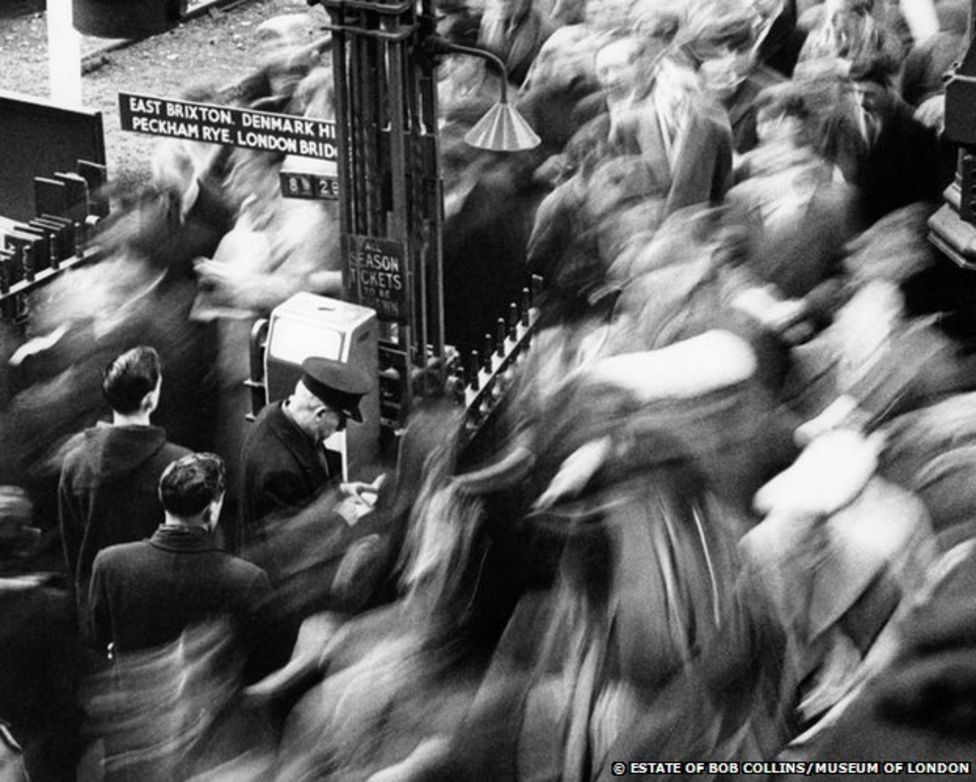
Bob Collins, The Morning Rush Hour, Victoria Station, 1960

Nella Last’s War and The Diaries of Nella Last.  Channon wrote for a posterity he assumed would be interested in the placement and menus at his dinner parties, the trinkets he gave to and received from royalty, and his conviction that Neville Chamberlain was right. 

Nella Last, on the other hand, was a housewife from the northwest of England; her diary was created in response to a request for volunteers from Mass-Observation, the groundbreaking social research project which sought information about the lives of ‘ordinary’ Britons. She could not have known her submissions to M-O would have a life beyond the study’s archive.

Reading the two in tandem was disorienting. It’s hard to believe—except for a few references by Channon to scarcity of turkeys and competent household staff and an occasional trip by train rather than in his Rolls—that he and Nella Last lived through and wrote about the same war and post-conflict austerity.

Her journals are filled with descriptions of eking out a supply of eggs or cream and the most useful cuts of whatever meat was available, of making rag dolls to sell at the Women’s Voluntary Service shop to raise Red Cross funds or to donate to local hospitals, of being unable for years of fuel rationing to make simple Sunday drives to a nearby lake.

Beyond their historical value, the diaries record someone once plagued by depression and self-doubt (“the rather retiring woman who had such headaches and used to lie down so many afternoons”) blossoming with her wartime volunteer work and with the incentive to record not just her observations of the world around her but of the changes in herself and her relationships. “After all these peaceful years, I discover I’ve a militant suffragette streak in me” and “[I] peel off the layers of ‘patience,’ ‘tact,’ ‘cheerfulness and sweetness’ that smother me like layers of unwanted clothes.” 

Nella’s tolerance for almost anything but hypocrites and bullies was particularly welcome after Channon’s spitefulness. She refused to shun unwed mothers, and while she’s not thrilled to see ‘conchies’ (conscientious objectors) on work teams who come to her volunteer canteen, she recognizes their humanity. Despite a single reference to “the ‘Jewish’ stamp’” of dresses gotten off-coupon while clothes were rationed, she describes her religion as “a mixture of wishful thinking and nature worship and a stern belief that God is Jewish” [Ed. — !]  and is “astonished at the mistrust and real hatred of Jews, in quite ordinary men on the street.” 

Nella was also aware of, and abashed by, what she recognized as her own biases. The local medical community includes several Africans, and she is surprised but pleased to see “chummy” interaction among the nurses of different backgrounds, “as if colour and race were one.” But after a pleasant chat on the street with one of the African nurses, who knows Nella from her hospital volunteer work, “my little happy feeling seemed to sour” at the sight of the white wife and biracial children of the local African eye doctor:

“Whatever the views I hold of ‘some day, one colour, one creed,’ the sight of half-caste children seems to strike at something deep down in me. I say I’ve no ‘colour bar,’ but wonder if I’ve a very deep rooted one. I could work with coloured people, enjoy their society, attend their wants in canteen, fully admit them to positions of trust and service, but know, finally, I’d have died before I could have married one, or borne coloured children. So perhaps I have a colour bar.” [Ed. – Oof, impressive attempt at self-knowledge; also, gross.]

I hope—wherever she is—that she’s not appalled at being read so intently; I would have liked the chance to know her better. [Ed. – A woman worth knowing. Just like you, Anne. Thanks!]
Brad Bigelow’s Year in Reading, 2022

Today’s reflection on a year in reading is by Brad Bigelow. Brad writes http://NeglectedBooks.com and edits the Recovered Books series for Boiler House Press.

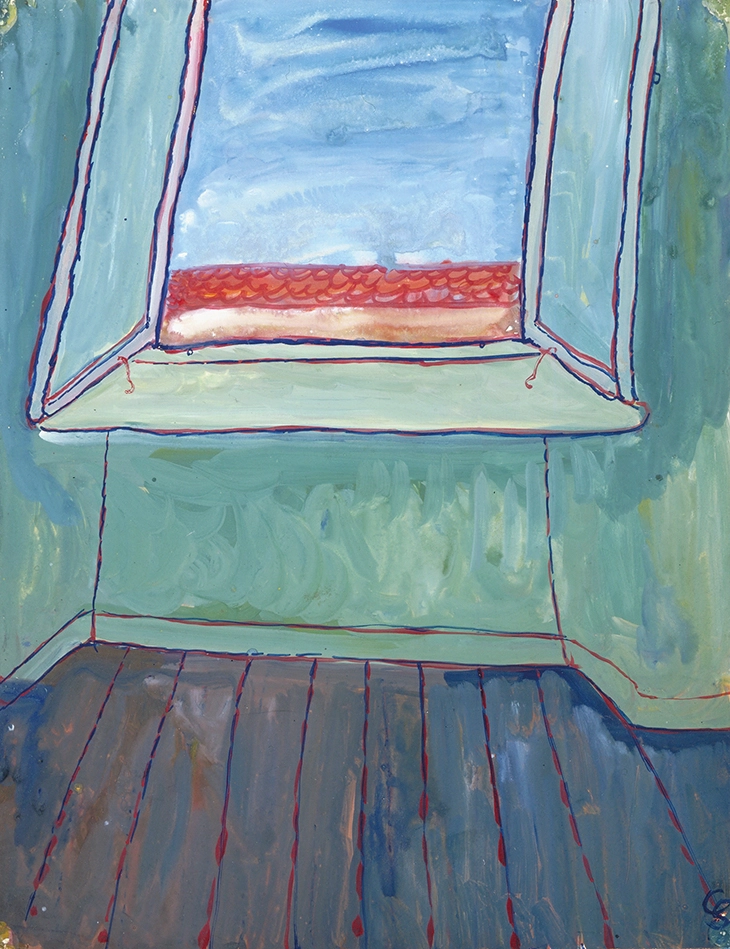
Charlotte Salomon, No. 134 from Life? Or Theater? (1941 – 42)

When I finished college forty-some years ago, I started writing down every book I read in a little spiral notebook. I kept up this habit for over twenty years and then stopped for some forgotten reason. Since starting The Neglected Books Page, most of my reading has been of long-forgotten books and most of these I’ve recorded by writing about them on the site. But as time goes on, I’m falling ever further behind in this writing. And to make matters worse for the purposes of this piece, I keep no record of my non-neglected reading. So, this is a fairly unreliable review of my reading in 2022, but I hope it’s worth your time nonetheless.

(It’s a good thing I never went into marketing.) [Ed. – No kidding!]

Among my neglected reads, easily the most memorable was Charlotte Salomon’s Life or Theater? Although Salomon told her life through paintings, it operates at an unforgettable level of intensity. There are at least three narratives winding through the hundreds of paintings in this book: the psychological breakdown of her family; her own troubled emotional development; and the trauma of Germany, and of German Jews in particular, with the rise of Nazism and Hitler. As I wrote back in April, “the book is presented as an art book – large and very heavy with its hundreds of pages of full-color images. But I think this does the book as a book some disservice. For it can also be seen as a graphic novel.” And I think it would benefit from being repackaged as a graphic novel, since today’s readers are now so accustomed not just to the language of graphic novels but to the very idea of considering them as literature. [Ed. – Absolutely. Her drawings look like they come from a graphic novel, too, as your post with its generous illustrations suggests.]

Easily the most enjoyable was Madeleine Masson’s memoir, I Never Kissed Paris Goodbye.Though we know from its opening line—“It was a beautiful day in June 1940”—that this story will have a sad ending, most of Masson’s account of Paris in the 1930s is as frothy and delightful as a glass of champagne. It’s full of the infidelity, excess, and manic energy of Jean Renoir’s classic film The Rules of the Game, and highly recommended to anyone who loves that film. [Ed. – You’re trying to tell me there are people who don’t love that film? Nonsense! This book sounds excellent, BTW.]

My deepest archaeological dig of the year was locating a copy of Carola Ernst’s Silhouettes crèpusclaires, and then dusting off my French to read it, based on nothing more than a brief reference in a magazine from 1921. This modest account of the journey Ernst took in the Fall of 1914 to return a French officer blinded in an early battle of the First World War to his family is a touching portrait of a world in the midst of a radical transformation. The pair are able to travel via Belgium, Germany, Switzerland, and France thanks more than anything to a spirit of chivalry that had not yet been destroyed in the industrial machinery of the war.

Another highlight was the chance to spend several weeks with some of the many volumes of poetry penned by Raymond Souster, the bard of Toronto. Souster’s longevity and disciplined dedication to his art enabled him to amass an account of one city’s life that may be unparalleled in the 20th century. Souster lived and wrote to the age of 91, worked in the same bank for over 40 years, was married to the same woman for over 60 years, and, as their only child, cared for his parents until they died in their late nineties. Though Souster claims he never wrote any great work (“I’m not sure I’m ready for epics/there are far too many little songs/the rest have left unsung”), the body of his work is sort of an epic in itself. [Ed. – Fascinating! I’ve even lived in Toronto and have never heard of Souster.] Someone needs to go through the thousands of pages of Souster’s poetry and distill it into an autobiography along the lines of what Ruth Limmer did with Louise Bogan’s work in Journey Around My Room.  

Finally, I must mention Nina Warner Hooke’s Biff and Netta trilogy: Striplings (1934); Close of Play (1936); and Own Wilderness (1938). These novels follow a half-brother and sister, Biff and Netta, from their early to mid-teens, as their already unconventional and decaying family collapses completely. The first volume received tremendous critical praise and was most commonly compared to the work of P. G. Wodehouse. Warner Hooke said she had no plans for further books at first, but when you finish the trilogy, its narrative arc seems almost predestined. She could no more leave off her story than you could get off a rollercoaster after the first drop. It is deeply strange, not solely because of its theme of incest, and deserves much closer examination than I was able to give it in my post. At 900-some pages, it’s far too long to expect anyone to ever reissue it unless some editor finds the courage to do some substantial posthumous abridgement, but it’s a work that I continue to process months after finishing it.

I tend to rely on audiobooks for my non-neglected reading. For years, I had a daily commute of over an hour each way and I racked up thousands of hours of listening, which enabled me to catch up on many classics I’d skipped. Now, my commute is just a staircase [Ed. – Bliss!], but I still get in an hour or so of listening each day. One of my projects was to go back through the works of Thornton Wilder, who is arguably both recognized and neglected. Aside from “Our Town”, most folks have only a vague notion of what he did, and even the once-ubiquitous The Bridge of San Luis Rey is not a familiar title. Wilder is the only writer to have received a Pulitzer in two genres, fiction and drama, has several volumes in the Library of America, and most of his work never falls out of print for long. I wrote about The Eighth Day, his most ambitious—and, to be honest, most flawed—novel years ago, and loved Heaven’s My Destination and Theophilus North when I first read them. This year, I went back and listened to all his novels in chronological order (an exercise I highly recommend for novelists who particularly interest you), starting with The Cabala.

The experience was both a revelation and a disappointment. I found several of the books suffered from an earnestness that became particularly apparent when considered back-to-back. On the other hand, I was astonished at the innovation of The Ides of March, his novel of Caesar’s last months. It’s a collage of fictional letters, excerpts from actual Latin texts, and even graffiti from the streets of Rome in the first century BC. Why is this book not acclaimed as a milestone in the fictional form? [Ed. – Sounds like time for a reissue?]

Aside from Wilder, most of my listening has been focused on Russian history and literature. I’ve long been fascinated by Russia, even though I’ve deliberately avoided my few opportunities to visit there. There’s something about the darkness of so much of the Russian experience that seems to reassure me that my own life really isn’t all that bad. This might be one of the reasons that I read so many books about Stalin when I was working for the two worst bosses I’ve had to suffer. I listened to two historical surveys by Orlando Figes: A People’s Tragedy, about the Russian Revolution, which occasionally bogged down in the minutiae of political infighting, and Natasha’s Dance, which I would recommend to anyone looking for a historical context to much of the Russian art, literature, and music of the last 200+ years. There were also several biographies—Alex Christofi’s Dostoevsky in Love, Alexandra Popoff’s book on Vasily Grossman, Donald Rayfield’s Chekhov—all richly illuminating. But by far the most enjoyable and impressive listen was Nabokov’s The Gift, which managed to weave so many of the threads from these other books together and remind me yet again of the fact that Nabokov worked at a level miles above so many of the 20th century’s greats.

Of the more recently-published books I’ve read, few really stand out. I found a number of the more acclaimed ones forgettable and will skip over them. Although I’ve read that it’s not the place to start, I loved Annie Ernaux’s The Years, in part because it described a world very familiar to me after 18 years of living in Belgium and working closely with many French men and women. And Gwendolyn Riley’s My Phantoms could have described some of our neighbors on the little street in Norwich where my wife and I lived for two years. [Ed. – Yikes!] I wish I could say that the books I’ve read by American writers were half as evocative, but I guess I’m still getting used to a country that’s so different from the one we left just before 9-11.

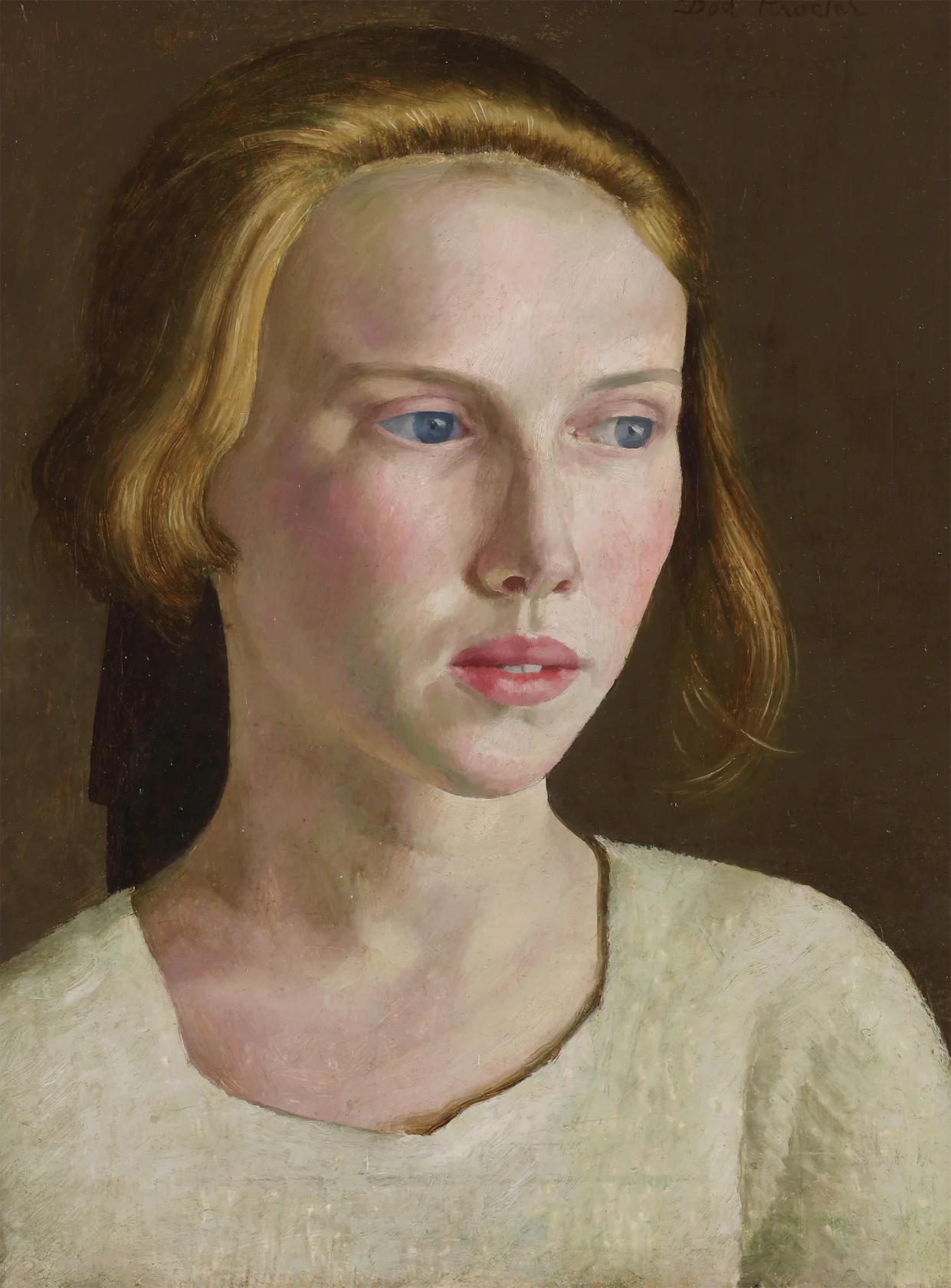
Dod Procter, Lydia, ca. 1926

And it would be remiss of me not to mention the brightest highlight of 2022, which was the #PilgrimageTogether reading group. Starting in January, a group of us worked our way through the thirteen “chapter-volumes” of Dorothy Richardson’s masterpiece, Pilgrimage, aided by a wonderful cast of Richardson scholars who agreed to take part in our monthly discussions. I first read Pilgrimage in 2016 as part of a two-year project of reading only the work of neglected women writers (complemented by two years of only listening to audiobooks by women) and ever since have been an evangelist on its behalf. Not to denigrate Proust, but I find it astonishing that thousands of people read Remembrance of Things Past each year while Pilgrimage, which speaks directly to so many aspects of life that are still part of our everyday world today, is barely known and even less read. Like others in the group, I found Pilgrimage both so challenging and so rewarding that other books seem somehow diminished in comparison. It’s a novel I know I’ll be returning to again — and, I hope, with another group of readers. [Ed. – This is good to hear, since I regret not joining in. It would be great if you could time it with my next sabbatical, thanks.] Until then, I encourage folks to take up Pilgrimage and spend some months with Dorothy Richardson’s insistently individualistic Miriam Henderson, aided by the Reading Pilgrimage website. [Ed. – Thanks for the post, Brad, and congratulations on that site. What a resource!]

James Morrison’s Year in Reading, 2022

I still hope to write up my reflections on my 2022 reading year. (Though look how well that worked last year…) In the meantime, I’ve solicited guest posts from friends and fellow book lovers about their own literary highlights. First up is James Morrison, an Australian reader and editor (sadly, not of books) who tweets at @unwise_trousers and blogs (increasingly infrequently) at http://causticcovercritic.blogspot.com. His novel Gibbons, Or One Bloody Thing After Another will be published later this year by Orbis Tertius Press

Look for more reflections from a wonderful assortment of readers in the days to come. And remember, you can always add your thoughts to the comments.

Woman committing suicide by jumping off of a bridge – George Cruikshank [1848]

First, a bit of throat-clearing. When I started to try to work out what my favourite books that I had read in 2022 were, I had a list 84 books long, out of nearly 300 read. This is obviously insane, possibly even psychopathic, so I have winnowed it down a bit. Secondly, I have now learned that two of my favourite books were also on Barack Obama’s list, which means after this I presumably need to become a boring centrist and do some war crimes. In any case, I’ve tried to force things into various fairly elastic categories in order to give this article the illusion of clarity.

[Audience: Get on with it!]

THE BIG BASTARDS

I finally joined the people-who-have-read-James-Joyce’s-Ulysses club this year, something which was ridiculously overdue. And what can I usefully say about this astonishing, hilarious, brilliant, occasionally tedious (hello, ‘Oxen of the Sun’) and quietly heartbreaking book? “It’s great!” I could tell you, unhelpfully, but you already knew that. It’s also one of the most amazing evocations of being embodied, of living a human fleshy existence with all its joys and ills and excrescences, that has ever been written. I also read Terence Killeen’s Ulysses Unbound, and found it to be a hugely welcoming, informative, and wise companion.

Another massive tome was Jon Fosse’s Septology (translated by Damion Searls), which the publishers and many reviews will tell you is really seven short novels, which is, in turn, a lie (though one which makes tackling such a big book seem much more approachable). It’s more accurately described as seven periods of minutely annotated consciousness, from waking to prayerful drowsiness, full of repetitions and art and small acts of kindness and weirdly commingling parallel universes and a (frankly bonkers) girlfriend. I didn’t find it to be the transformative work of art that many others did, but I did enjoy it tremendously.

The third giant was Osebol: Voices from a Swedish Village, by Marit Kapla (translated by Peter Graves), a polyphonic oral history in prose-poem form of a dying Swedish village, drawn from interviews with every inhabitant. It’s a book that takes a simple idea that somehow has never been had before, and applies it perfectly.

GINZBURG & CO.

More than any other writer, Natalia Ginzburg was the one I kept returning to this year. She is just phenomenal, and I devoured a bunch of her shorter books like popcorn. The Road to the City (translated by Frances Frenaye), Voices in the Evening (translated by DM Low), Valentino and Sagittarius (both translated by Avril Bardoni) are all near-as-damnit perfect novellas, mostly about Italy during or just after World War II, full of frustrating families, political activism and romantic fuck-ups. 

Two other writers I read multiple books by were Maylis de Kerangal and Gwendoline Riley. De Kerangal’s Birth of a Bridge is something like an Arthur Hailey blockbuster condensed to 300 pages and written by a genius [Ed. – sold!]: an exploration of all the people and organisations and objects involved in the construction of a massive bridge project, while Eastbound is a compact novella about a fraught encounter between a Russian fleeing conscription and a French tourist on the Trans-Siberian Railway. Both these books were translated by Jessica Moore. Riley’s most recent novels, First Love and My Phantoms, are perfect, hilarious [Ed. – uh that is uh weird, James] examinations of the awfulness of families and relationships.

Self Portrait on Statue, Gouges – Polly Penrose [2020]

MY BODY BETRAYED ME

Anna Deforest’s A History of the Present Illness is a startling novel about grief and the terrible things that can happen to a human body, told from the point of view of a student doctor. Szilvia Molnar’s The Nursery (due this coming March) is a fine addition to the ‘new mothers who may be losing their minds’ library. What Are You Going Through by Sigrid Nunez is a brilliant, telegraphic novel about helping and failing to help a dying friend have a good death. Imogen Binnie’s Nevada is a simultaneously hilarious and dispiriting book about gender dysphoria and about being a well-meaning but really terrible wise elder trying to help someone else deal with their trans-ness. Abi Palmer’s Sanatorium is a fascinating diary/essay about her experiences dealing with physical rehab in both a Budapest thermal bath and a crappy inflatable pool in London

And then there’s Naben Ruthnum’s Helpmeet. If Edith Wharton had started one of her excellent wintry ghost stories, but then been overcome by the body-horror vibes of a time-travelling David Cronenberg without losing any of her prose style or piercing insights, this is the novella she might have written. [Ed. – Hell to the yeah!] Strange but true.

IMAGINED WORLDS, FUCKED-UP PHYSICS

Writing a high-concept science-fiction airport thriller is not something you expect a President of the Oulipo group to do, but that’s exactly what we have in The Anomaly by Hervé Le Tellier (translated by Adriana Hunter). And it’s really good! A passenger jet survives a storm and lands safely. Then, months later, the exact same jet (and all its passengers) lands safely again, introducing hundreds of duplicate people to the world. The weirdness spirals from there, but Le Tellier plays it dead straight.

Simon (or S. J.) Morden is a British science-fiction writer quietly producing a fascinating body of work. His newest novel, The Flight of the Aphrodite, is an excellent dark tale of an exploratory ship crew going to pieces in the face of the possibility of First Contact, and an older book, Bright Morning Star, is a moving novel about an autonomous alien AI drone landing in the middle of a Ukraine forest as Russians invade [Ed. — !].

I was predisposed to ignore the work of ‘qntm’ because, let’s face it, that pseudonym is extremely irritating. Annoyingly, I have to report that There Is No Antimemetics Division is kind of brilliant: a group of specialists are charged with stopping malignant alien antimemes, which are ideas and concepts and things which by their very nature cannot be communicated or remembered.

Julia Armfield’s Our Wives Under the Sea is a scary, absorbing story of loving someone who is going through a very horrible change after suffering an accident on an exploratory deep-sea dive. Humidly, damply intense. And finally, there’s Audrey Schulman’s The Dolphin House, which is fiction about science being done, rather than science-fiction, and both completely convincing and compelling.

THE TUMOUR AT THE HEART OF HUMAN HISTORY

The Investigation: Oratorio in Eleven Cantos by Peter Weiss (translated by Alexander Gross) is a play based on the testimony Weiss observed at the Frankfurt Auschwitz trials in the mid-1960s. Riveting and horrifying and an excellent one-book summary should you ever need to rustle up evidence for use in damning the entire human race. Ernst Weiss’s The Eyewitness (translated by Ella R. W. McKee) is a posthumous novel about a psychiatrist called in to treat a young Austrian ex-soldier, initials A.H., which seems to have been based on Hitler’s actual psychiatric reports, which Weiss had brief access to.

James Kestrel’s Five Decembers is, despite its pulpy cover, an unexpected and thoughtful crime novel about regret and missed opportunities, through the prism of the attacks by and on Japan during World War Two. Clouds Over Paris by Felix Hartlaub (translated by Simon Beattie) is perhaps the most self-effacing diary ever, as well as being beautifully written. Hartlaub was a reluctant and mildly embarrassed Nazi stationed in newly Occupied Paris. He was still a Nazi, though, despite the prose quality, so let’s shed no tears over his death and disappearance in 1945.

Lacertilia [Lizards] – Ernst Haeckel [1904]

[Audience: He does fucking go on, doesn’t he?]

GRAPHIC!

The fact that several of the best graphic novels I read this year were about adolescents having much more interesting times than I ever did should not be taken as an indicator that I am having a mid-life crisis or am extremely boring. [Ed. – Ah good that you said that, because I was thinking _exactly* that…] Skim by Gillian and Mariko Tamaki is about a Japanese-Canadian Goth failing to fit in at a Catholic School. Giulia Sagramola’s Summer Fires (translated by Brahm Revel) is about a group of teenagers connected to a pair of fractious sisters in a Spanish summer where the landscape keeps bursting into flames. And Andi Watson and Simon Gane’s Sunburn perfectly captures being old enough to be involved in adult’s relationship game-playing, but not old enough to know what the hell you’re doing.

Sara Del Giudice’s Behind the Curtain (translated by M.B. Valente) is a gorgeously rendered story, all pale colours and intricate fabric textures, about Jewish sisters in Paris as the Nazis take over, with a nasty kick in the guts at the end. And last of all there’s Ducks by Kate Beaton, her big, funny and moving memoir of working in the Canadian oil sands, with all the awful sexual pressure and violence that involved.

From ‘A.C.2020’ – Mirko Ilic [2020]

POEMS THAT MOSTLY DON’T RHYME

Verse novels, baby, that’s where it’s at with the cool kids these days! If you want to fit in at the top table, why not read Sickle by Ruth Lillegraven (translated by May-Brit Akerholt), a tiny family saga about inheritance, books and change set in nineteenth-century Norway. Or for something far more depressing [Ed. – pretty rich, given this list so far], let me recommend Greg McLaren’s Camping Underground, in which a former undercover political provocateur gives her fragmented testimony about the terrible things that have reduced a future Australia into a scavenger-economy wasteland. It has some really good jokes!

Lisa Robertson’s The Baudelaire Fractal is a prose-poem-novel-something about a woman who wakes up one day to find she’s the author of Baudelaire’s collected works. Body Braille by Beth Gylys is a beautiful collection about how bloody hard it is to live in a body, with sections for each of the senses.

And then there’s The Lascaux Notebooks, ostensibly by Jean-Luc Champerret and translated by Philip Terry, which claim to be a series of translations of Lascaux cave paintings into poetry. It’s mad and clever and fun and I fell for it for much longer than I should have.

TINY WEE HUNGARIANS [Ed. – That’s nice, isn’t it? They don’t get much, the wee Hungarians.]

The three best books from the literary wonderland that is Hungary that I read this year were all tiny. Agota Kristof’s The Illiterate (translated by Nina Bogin) is a compressed, bleak and reliably brilliant memoir of moving from Hungary to France and trying to learn a new and unrelated language. The Manhattan Project (translated by John Batki) is a slender but oversized thing of beauty, full of photos by Ornan Rotem, in which László Krasznahorkai meanders through the work and worlds of Melville, Lowry, and Lebbeus Woods. And In a Bucolic Land by Szilárd Borbély (translated by Ottilie Mulzet) is a brilliant and autobiographical posthumous collection of poems describing the author’s childhood as part of a despised family, being raised by parents who would later be violently murdered. 

MEDIUMN-SIZED JAPANESE

The book I was looking forward to most in 2022 was Woman Running in the Mountains by Yūko Tsushima (translated by Geraldine Harcourt), which takes the Tsushima constants (young single Japanese mother, awful mother, vanished father, deadbeat ex) and yet again spins them into gold. Her ability to get infinite artistic variety from the same initial ingredients remains amazing.

Mieko Kawakami continues her series of novels about Japanese misfits with All the Lovers in the Night (translated by Sam Bett and David Boyd), which manages the rare feat of making the story of a withdrawn person with an uneventful life absolutely compelling.

[Audience: Sweet fancy Moses, shut up!]

(REACHING DESPERATELY) UM, BOOKS WITH PLANES ON THE COVER [Ed. – Oh come on!]

Gertrude Trevelyan is one of those nearly lost writers I had never read before, but on the basis of Two Thousand Million Man-Power I am now seeking out the rest of her work: this novel is told in an experimental/modernist-yet-highly-readable voice, swooping from the frenetic global to the low-key personal, sometimes multiple times a sentence, with vertiginous ease. And Elleston Trevor’s Squadron Airborne is a quietly impressive and downbeat novel about the RAF in WW2, a spiritual forerunner to the work of the still-alive but still-neglected Derek Robinson. No Churchillian Imperialistic bullshit to be found here.

The Doll Man – Jean Veber [1896]

WON’T FIT INTO ANY ARBITRARY CATEGORY WITH EACH OTHER [Ed. – At least that’s honest.]

Squarely in the Olivia Manning/Elizabeth Jane Howard sweet spot is the Good Daughters trilogy by Mary Hocking (Good Daughters, Indifferent Heroes, Welcome Strangers), following three sisters from the 1930s to the years after WW2. They’re basically Platonic ideal books for people like me who reflexively buy the old green-spined Virago Modern Classics on sight.

The Friendly Young Ladies by Mary Renault was delightful: a wonderful 1930s summery sexy atmosphere, beautifully written, and nobody was punished by the plot for being gay. (In fact, someone wrecked their life by not being gay enough.) [Ed. — *nodding sagely * seen it happen many a time.]

Keith Ridgway’s A Shock is brilliant and sui generis; a sporadically sinister set of linked stories in multiple styles—a worthy follow-up to his Hawthorn & Child, though shooting out in completely different directions.

Awake by Harald Voetmann (translated by Johanne Sorgenfri Ottosen) is fragmented, which I have seen some people complain about, saying it doesn’t add up to a story. I guess that’s true, but I really didn’t care. A novel about Pliny the Elder, his nephew, and his slave, it’s great on the sentence level, and so interesting. And deeply, deeply horrible.

Hagar Olsson’s Chitambo (translated by Sarah Death) deserves to be much better known: a modernist Finnish masterpiece about a young girl whose life is wrecked by a father who is at first her ally in an imaginative world, and who then loses interest in her as he moves on to other, madder utopian schemes.

[Audience: GET HIM OFF! GET HIM OFF!]

The Trouble with Happiness is a collection of short stories by Tove Ditlevsen (translated by Michael Favala Goldman), and is as good as you’d hope from the author of the Copenhagen Trilogy. The Devastation of Silence by João Reis (translated by Adrian Minckley) is an exemplary example of one of my favourite genres of novel—the mildly unhinged monologue from a monomaniacal narrator, in this case a Portuguese POW in a German camp in WW1. Helen DeWitt’s The English Understand Wool is a really funny novella of subverted expectations. And Ed Yong’s An Immense World is a brilliantly and subtly written survey of the latest science in animal perception, including senses that humans cannot even begin to rival. OK, OK, I’m going, what is that thing, a crook, you do know they don’t actually use them to haul people off the stage anym–

[Ed. — Don’t tell James, but I could have read even more from him!]

What I Read, May 2022

May finally brought the end of the semester. Man, that was a tough one. As always, I thought it would be a relatively easy month, now that I no longer needed to have something to say in the classroom every day. As always, I forgot how much energy it takes to get through the final administrative tasks. Squeezed in a little reading on the side, though.

Sam Gilliam, Wave, 1972

Abdulrazak Gurnah, The Last Gift (2011)

Sometimes I’m struck with amazement when I consider exactly how I have found myself here. But then I suppose many people can say that about their lives. It may be that events constantly take us by surprise, or perhaps traces of what is to become of us are present in our past, and we only need to look behind us to see what we have become, and there is really no need for amazement.

An elderly man, arrived from Uganda in England in 1960 to study journalism, reflects on his experiences to thee young man who has moved in next door. The young man, Jamal, is himself the son of an immigrant, who came from Zanzibar at around the same time, literally coming ashore as a sailor before meeting his soon-to-be-English wife. But Jamal’s father, Abbas, has told his family almost nothing about his life before England. Now Abbas, weakened by a series of strokes, begins to reveal the past that has gnawed at him in silence for years.

It is typical of the novel’s structure that the son is more easily able to have a conversation about immigration with someone other than his father. This is a book of echoes and doublings, of stories told circumspectly and in layers. That indirection fits with the dislocation that comes from making a new life in a strange place, even when that rupture has been freely chosen.

And while Harun, the retired journalist, implies that choice may be overrated—perhaps in looking back we will see intimations of what was to come, though if that is true it is strange to use the word “traces,” implying as it does that those causes are themselves effects—elsewhere the book reminds us of something irrepressible in life, something that resists order and control, which appears in moments both great and small. Take Abbas’s reflections on his schooldays in Zanzibar:

The teachers worked so hard to keep them [he and his fellow students] quiet and obedient, like it was a point of honour for them to do so. Sometimes it was as if they failed as teachers if the children so much as twisted or scratched themselves. How their teachers loved that deep submissive silence. But they could not make that silence endure. They could not quite keep the children in check. Something always happened, some small insurrection, irrepressible laughter, an undaunted boy whose cheek could not be suppressed.

The two Gurnahs I’ve read—and I’ll read them all, eventually—seem to me to be about the difference between insurrections that oppress and insurrections that free: the latter are minor, like irrepressible laughter, but vital, subversive.

Abdulrazak Gurnah, Gravel Heart (2017)

Had plenty to say about this on Episode 4 of One Bright Book. Suffice it say, I liked it a lot, and it’s only grown on me since. Nobel committee did something right for a change.

Martha Wells, All Systems Red (The Murderbot Diaries) (2017)

Murderbot is a cyborg SecUnit (Security Unit) that has hacked itself to override its governance programming. What Murderbot wants to do is watch tv (soap operas, basically); what it finds itself having to do, thanks to an inconveniently developing conscience and self-awareness, is help humans who are too stupid and frail not to get into trouble. The second-best thing about All Systems Red is Wells’s insistence that the need comes from the desire, awareness from soaps: these books are smart about the power of representation to shape consciousness. The first-best thing is Murderbot’s wry narration. A few examples:

I needed to a) keep them here or b) kill them. Let’s go with option b.

Oh right, I often have complex emotional reactions which I can’t easily interpret.

I thought I had gotten good at controlling my expression, but apparently only when I wasn’t feeling actual emotions.

(The lesson was: if you’re going to fuck with something bigger and meaner than you, use a quick targeted attack and then run away really fast. This is the way I always try to operate, too.) [Wells is good with the parentheses.]

Having returned the book to the library, I have taken these examples—not all from the first book—from the Twitter account @MurderBotBot. Give it a follow!

I already named two best things, but I could also have talked about the books’ depiction of being autistic—which is basically how Murderbot experiences the world. Its anxiety around humans and their complex demands for emotional interaction is movingly depicted. Reading Murderbot’s sighs of relief when it can lower its face shield, or engage with people via mirrors or screens gave me new insight into this mode of experiencing the world.

There’s a plot, too, about a corporation intent on regaining control over its intellectual property (aka Murderbot) and some terrible things Murderbot may have done in its past thanks to that corporation. The events are compelling enough, especially since Wells has gone on to draw out their consequences in subsequent books, but the narrative voice is the real appeal. (And props to sff writers & publishers for embracing the novella form.)

Thanks to Elle and Liz and the other Murderbot fans who came out of the woodwork to champion the series.

Jeremy Denk, Every Good Boy Does Fine: A Love Story, in Music Lessons (2022)

Jeremy Denk is a classical pianist known for his wide-ranging repertoire, including 20th and 21st century music. He is also something of a genius: MacArthur and Avery Fisher prize winner, a soloist who travels the world playing recitals and concerts, the holder of a doctorate and a liberal arts degree, a one-time science and mathematics prodigy, and, on the basis of his thoughtful references to Roland Barthes and Herman Melville, a hell of a reader too. Every Good Boy Does Fine—a mnemonic for the lines on the treble clef—is a midlife memoir that takes us from his childhood in New Jersey through his upbringing in New Mexico and on to Oberlin, Indiana, Julliard, and other exalted spots of American musical life.

I loved Denk’s attention to his many teachers—his piano teachers, of course, but also those who alternately inspired, coached, and browbeat him in his official and unofficial life as a student. Denk, now himself a teacher and not, he admits, at least at first a good one, shows how important it is to be taught by lots of different people. Everyone offers him something different, and most of those approaches contradict each other, leading to much insecurity but also eventually a sense of self. Although open-hearted, though, the book is more realistic and idealistic about teaching. Denk shows how the things a teacher offers come at the cost of something they can’t. (Paul de Man: every moment of insight carries with it a corresponding area of blindness.) The same is true of learning. Denk doesn’t shy from showing his own failures as a student: lessons he refused to take until it was (almost) too late, obstinacies that got in his own way, needs (for praise mostly) that set him back.

Of the many remarkable teachers Denk has had the privilege to work with, the greatest was his mentor at Indiana, the Hungarian pianist György Sebók. A prodigy who like Denk excelled in many fields, Sebók entered the conservatory in pre-war Budapest already as a teenager and studied with an extraordinary array of musicians. As a Jew Sebók could not fight in the army but still had to serve: he did road work and was interned in what was basically a concentration camp, from which he escaped in 1944 after which he spent the rest of the war under the protection of the Swiss embassy. (Lucky for him, given what happened to half a million Hungarian Jews in the summer and fall of that year.) After the war he remained in Budapest, keeping up a concert career in Eastern Europe, but he left in 1957 after the Revolution, first for Paris and then, in 1962, for Indiana, where his countrymen, friend, and musical partner, Janos Starker, had invited him. Sebók is like a character from a Lubitsch or Wilder film and his world-weary, urbane Mitteleuropean outlook both captivated and bewildered the American provincial Denk.

Denk’s portrait of Sebók—and indeed all his teachers—is generous and forgiving. Unfortunately, his self-portrayal is murkier. He admits he can be difficult, especially when it comes to hurting other people, mostly thanks to his years-long inability to admit his sexuality, and he presents plenty of evidence for how his family, his father in particular, damaged him. But he offers no comprehensive reckoning re: those harms. Maybe because the book isn’t really about that, it’s about music. But it also sort of is. Denk bypasses the question of whether you need to be self-obsessed to be a success in a field as rarified, competitive, and unforgiving as music. But he shows us enough of himself, sometimes unwittingly, to let us see that Denk can be a bit of a dink.

Denk reads the audiobook himself, and while I would not call his narration distinctive (he seems to take perverse pleasure in barely stopping between chapters), he is a dab hand at an accent. I learned about Every Good Boy from this thoughtful review, and I’m glad I did. I learned a lot—I haven’t even mentioned the theoretical interludes on rhythm, harmony, and melody. These are fascinating—at once metaphorical, lyrical, and conceptual.

Martha Wells, Artificial Condition (The Murderbot Diaries) (2018)

Murderbot is also good on audio.

Martha Wells, Rogue Protocol (The Murderbot Diaries) (2018)

There can never be a love interest, can there? Like, Murderbot is never gonna get with Dr. Mensah. Right? Right?

Judith McCormack, The Singing Forest (2021)

More on this elsewhere.

Nina Stibbe, One Day I Shall Astonish the World (2022)

The title is the motto of the university that Susan, the narrator of Stibbe’s latest novel, ends up working at—not as a professor, which is what she imagined before she dropped out of college after getting pregnant, but as the indispensable and indefatigably cheerful PA to the Vice Chancellor. Instead it’s her best friend, Norma, whom Susan once coached in English literature, back when they first met and Norma was a science major who had tired of geology, who gets the job she once dreamed of.

That’s the way things go between them. Susan is a puzzle—easy to dismiss but shrewder than we are likely to credit. Life—by which I mean the most important people in her life—always seems to be pulling one over on her, and it’s true Susan does not always see what is in front of her. But we dismiss her at our peril. Here’s Susan thinking about how someone she’s known for a long time but not intimately wouldn’t make a good friend:

You’d never know what she was really thinking which is what I dislike about nice people: having to wonder if they secretly despise you or feel bitterly jealous, or just think you common but want someone to go to the cinema with or need help with their computer or for you to befriend their child.

Reading this, we realize, ah, perhaps Susan does know how terrible Norma is to her. (I’m not sure Norma quite works, as a character, her motivations are too opaque.) Maybe Susan’s a “devil you know” kind of person. But she’s nice—she’s the sort of person people are always asking favours of, expecting help from, unthinkingly demanding time of. Does she dislike herself? Or is she perhaps not as nice as she seems? Is her agreeableness—which, no question, keeps a torrent of despair at bay—fake?

Maybe because of this unexpected complexity, One Day I Shall Astonish the World made me think of Gwendoline Riley’s My Phantoms. Weird comparison, I know: an arty darling and a seemingly determinedly middlebrow book club novel. But both demand that we read against their female narrators, revising our initial opinions. Unlike Riley, Stibbe makes us like her narrator more. Riley’s is the more vivid novel, the one I will remember better in a year. But I appreciated how Stibbe reminded of my tendency to disparage someone whose default mode is not irony or skepticism. These days, especially, Stibbe’s generosity feels like a gift.

One Day I Shall Astonish the World is occasionally laugh-out loud funny, but only occasionally, a surprise given Stibbe was once responsible for getting me kicked out of the bedroom for laughing too much. I’m doing my best not to be like the people in Woody Allen’s Stardust Memories who want the director character to leave off his arthouse aspirations and get back to his early, funny stuff (God those movies meant a lot to me, and now I can’t imagine watching a single one); I’m trying not to wish Stibbe would just keep doing what she’s always done. And yet, and yet—this book could have been funnier.

Jacqueline Winspear, A Sunlit Weapon (2022)

Prissy, self-satisfied.

Ken Krimstein, When I Grow Up: The Lost Autobiographies of Six Yiddish Teenagers (2021) Trans. by Ellen Cassedy

In 2017, 180,000 pages worth of documents were found by a construction crew in a decommissioned cathedral in Vilnius, Lithuania. The pages, written in Yiddish, had been through a lot: collected by YIVO, the institute for the study of Yiddish language and culture; plundered by the Nazis; rescued by Jewish forced labourers who hid them in the ghetto; disinterred after the arrival of the Red Army; stored in the newly created Vilna Jewish Museum; and eventually walled up in the cathedral by a non-Jewish Lithuanian librarian who refused Stalin’s order to pulp them. (This was in 1949, after Stalin had ratcheted up his antisemitic attacks once the State of Israel turned to the West rather than to the USSR.)

Ken Krimstein tells this story in the opening pages of his fascinating graphic nonfiction narrative. The book comprises six excerpts from diaries written by young people across Yiddish speaking Eastern Europe. The diaries were among the more than 700 entered into a competition sponsored by YIVO in the 1930s (first prize: 150 Zlotys; about US $1000 today). The contest aimed to generate an ethnographic study of Yiddish youth: their hopes, dreams, fears, resentments. To ensure truthfulness, entries were anonymous. (An elaborate system ensured that winners could receive their prizes.) In a fittingly Jewish irony, the grand prize was to be awarded on September 1, 1939.

Krimstein’s book brings these stories to light for the first time since they were submitted almost a century ago. The writers and their lives are so vivid. A girl cannot help but love her father, despite his terrible behaviour (he drank away the family’s money, stole from the children’s mother, abandoned his family, and remarried a non-Jew after converting to Russian Orthodoxy). A boy enters yeshiva because he thinks it will impress a girl (she has deemed him not serious enough), only for her to get together with his best friend. Another girl sees her dreams of attending the gymnasium foiled by a faux pas; she quits school, becomes a nanny and only finds freedom on her weekly evening off, when she goes skating. We meet Bundists and Zionists and religious Jews. In addition to failed marriages and broken families we hear of foiled attempts to get a visa to America. So much failure—yet so much life.

The stories are briskly told, offered in Krimstein’s spindly lettering and illustrated by almost abstract, spidery black and white drawings enlivened with splashes of an odd orange colour. They are not beautiful, but the book is lovely nonetheless.

What isn’t lovely—downright sketchy, actually—is Krimstein’s lack of clarity re: the texts. Has he abridged or edited them? He never says. (He does annotate references to the period and to Jewish ritual, often wittily.) Worse, he only names the translator in the acknowledgements page at the end. Shame on Bloomsbury for presenting the book as though Ellen Cassedy doesn’t exist.

Ruth Minsky Sender, The Cage (1986)

Memoir for teens about the author’s Holocaust experiences. Born Rifkele Riva Minska in Lodz in 1926, Sender was the fourth of seven children. When Germany invaded Poland, her older siblings fled to Russia (happily, she would be reunited with them after the war), while Sender, her younger siblings, and her mother were interned in the Lodz ghetto. (Her father had died when she was just a child.) After her mother was deported in September 1942, Sender looked after her younger brothers, especially the gentle Laibele, who had contracted tuberculosis. Despite heroic efforts, notably adopting her brothers so they wouldn’t be dispersed into orphanages or other families, Sender can neither save Laibele, who dies of his illness (the fate of so many in the ghetto), nor ward off deportation for herself. Together with most of the rest the Jews of Lodz, Sender and her remaining brothers are sent to Auschwitz, where they are separated; she never sees them again. After a week in camp, Sender is selected for labour at Mittelsteine, an all-female subcamp of Gross-Rosen in the mountains of southern Silesia. There she continues the habit she had begun in the ghetto of recording her experience, writing poems that she whispers to the other inmates. She becomes a sort of camp mascot, a status that rescues her: the camp doctor persuades the commandant to send the teenager, who has contracted blood poisoning from an infected cut, to the civilian hospital in a nearby town because her poetry is good for camp morale and therefore productivity. Sender recovers from the near-fatal sepsis and survives a subsequent deportation further west, where she is liberated in March 1945. She returns to Lodz, but the family home has been taken over (the new occupants threaten her), and, like so many Polish survivors, she departs Poland for a DP camp in the American sector.

I appreciated the extraordinary aspects of Sender’s story, but The Cage (her name for the various locations of her suffering) didn’t do much for me. Sender hits the “where there’s life there’s hope” note hard and strains for uplift. Arriving at her final place of internment, a camp named Grafenort, she is informed by a fellow inmate that the name means “a place for nobles.” Stroking Sender’s face, the woman adds: “We are nobles, broken in body but still alive.” Maybe this happened, but the book’s insistence on values that the experience itself was daily destroying rings false.

I read The Cage because one of my better recently graduated students had been assigned it in high school. I’m not convinced it’s the best choice for those readers—I’d go with Tec’s Dry Tears, which contextualizes its events more clearly and doesn’t insist on human uplift—but it’s better than a lot of things my students have read. (Looking at you, Striped Pajama Boy.)

Len Deighton, Mexico Set (1984)

Thinking Deighton might be the spy writer for me. Not so twisty or circumlocutionary that I can’t tell what’s happening, but stylish, clever, exciting, as good on character as on plot. Mexico Set is the second Bernie Sampson book—I listened to the first one a while ago, and now I’m thinking it’s time to go on a binge. (There’s 9 all told, I think.) Here Sampson—under suspicion after the bombshell revelation at the end of Berlin Game—is tasked with turning a Soviet agent. As the title implies, the book is partly set in Mexico, and those scenes were much less exoticizing than I’d feared. But Deighton, like Sampson, likes Berlin best, and the book kicked into gear when it returned to the coal-fired atmosphere of the muttering, shabby heart of the 20th century. (That’s me being flowery, the books aren’t like that.) The cliché that the middle part of a trilogy is the weakest doesn’t hold here. Porch reading at its finest.

McArthur Binion, History of Application: Talking to You, 1977

 As you can see, light reading ruled the day—much that was enjoyable, nothing too heavy. (The Gurnahs the richest of the lot, by far.) But that’s what I needed in bringing the semester to a close, and I set myself up for a pretty stellar June. More on that soon. In the meantime, thoughts on any of these?

What I Read, August 2021

I know, I know, this thing is late. Here it is, almost October and me still going on about August. Had a lot going on, though. Back to full-time work after a year’s sabbatical (the Sunday night of all Sunday nights, let me tell you). Plus my wife moved temporarily to St. Louis to complete an MSW degree. So August was split between setting her up in her place there—St. Louis is so great!—and starting the new academic year, for me and our daughter (last year of elementary, how did that happen?). I fit reading in where I could—I go nuts if I don’t—but it wasn’t the top priority. Here’s how that shook down.

Childe Hassam, Clouds (also known as Rain Clouds over Oregon Desert), 1908

Dolores Hitchens, Sleep with Slander (1960)

When I wrote last month about the first Jim Sader PI novel, which I liked a lot, I alluded to its sequel, in my opinion a genuine masterpiece that anyone with even a passing interest in PI novels should read. In sleep with Slander, Sader is hired to find a kidnapped child. The boy’s grandfather has received an anonymous letter explaining that the child has been taken from the people the grandfather put him with (his daughter had the child out of wedlock) and is now being abused. Things get complicated fast, as Sader runs up against one closed door after another. Unlike in some detective stories, where the complexity becomes an end in its own right (Chandler, say, even Hammett), here the plot never obscures the hurt at the heart of the matter. The book feels urgent, even more so than in Ross Macdonald, whose Archer novels Sleep with Slander shares a preoccupation with, specifically, the way families pass along their hatreds. Hitchens contributes her share to the California rhapsodies sung by generations of crime writers—when Sader turns his car from the ocean at Laguna Beach and up into a canyon “the sea wind followed, funneling through the narrow cleft in the coastal hills”; here as elsewhere Sader is more pursued than pursuer, mocked even by the elements: “he heard it whistle against the window” (it’s like he’s being cat-called by the environment)—but Hitchens really shines with her deft character portraits, even in the most minor characters. I was especially struck by a real estate man whose habit of silently beating out hymns on his empty desk strikes a plaintive note of discord with the dreams of happiness his profession traffics in. Leaving the man after a revealing interview, Sader sees him, silent, alone, “sitting with fingers poised, ready to strike an opening chord on the rim of the desk.”

Hitchens never wrote another Sader novel, though given the melancholy perfection of the ending of Sleep with Slander it’s really no surprise.

Elizabeth Jane Howard, The Light Years (1990)

Howard’s novels about the Cazalet family have been on my radar for a while, enthused over by readers I trust. I was surprised to find they were published in the 90s; I’d vaguely assumed they were from the 50s. And they are a bit old fashioned, sort of soapy, though not, I’d say melodramatic. (Not that there’s anything wrong with melodrama!) The Cazalets have made their money importing wood from the colonies. In 1937, when The Light Years begins, the business is run by the two eldest sons, Hugh (a good soul, wounded both physically and emotionally in the Great War) and Edward (jolly, lover of the good things in life, bit of a cad), even though their father, known to all by a typically ridiculous upper-class British nickname, The Brig, remains nominally in charge. In practice, though, he spends his time at their seat in Sussex, where his increasing blindness don’t stop him from advancing many improvement schemes in the neighbourhood, which require a lot of work from everyone else, especially his unmarried (and possibly gay, though she seems unsure about that) daughter, Rachel. (His wife, the family matriarch, known as the Duchy, is both steely and vague—I could read a whole book about her but she floats around the edges of this one.) Hugh and Edward’s younger brother, Rupert, a schoolteacher and artist, is being pressured to join the firm. Zoë, Rupert’s young second wife—his first having died (I think in childbirth, but maybe I made that up and I’m too lazy to look it up)—is young, beautiful, rather out of her depth, though Howard deepens her portrait satisfyingly. She feels shut out by Sybil and Villy, Hugh and Edward’s wives, who are close, though not enough for Sybil to share her ambivalence at getting pregnant again or Villy to admit her fears (barely expressed even to herself) about her husband’s affairs, and her thwarted ambitions (she was once a ballet dancer).

As good as Howard is with these adults—and she’s very good—she really shines with the children, who range in age from about 5 – 15: Hugh and Sybil’s two, Polly and Simon; Edward and Villy’s three, Louise, Teddy, and Lydia; and Rupert’s two, Clary and Neville. (I won’t even get into their cousins, Villy’s sister’s children, but they’re important, too.) Each is wonderful, though I think I like Polly and Clary best. (Clary, the would-be writer, might be Howard’s younger self. She’s funny, too. When her aunt, tucking her into bed one night, asks if she’s warm enough, the girl looks surprised: “I don’t know. How do I feel?”)

Each summer, the clan gathers in Sussex; The Light Years describes the events of two summers, 1937 and 1938, the latter governed by the specter of war, relieved at the last moment by the events of Munich. The novel is leisurely, engrossing, delightful if you like an unflashy but pleasing style and incisive psychological insight. As a co-dependent, I’m particularly compelled by Hugh and Sybil’s marriage—a good one, but spoiled a little by each partner’s desire to please each the other so much that they end up doing things neither really likes, in the mistaken belief that they’re doing a kindness to their partner:

This duel of consideration for one another that they had conducted for the last sixteen years involved shifting the truth about between them or withholding it altogether and was called good manners or affection, supposed to smooth the humdrum or prickly path of everyday married life. Its tyranny was apparent to neither.

“This duel of consideration”! Ouch!

Anyway, I’m currently stuck into volume 2 and anticipating a fruitful autumn of Cazalets.

Naomi Hirahara, Clark and Division (2021)

Frustrating crime novel: fascinating premise, mediocre execution. In 1944, the narrator, Aki, and her parents arrive in Chicago after being interned in the Manzanar War Relocation Camp. There they plan to reunite with the family’s elder daughter, Rose, who, having been deemed a loyal Nisei, had been released the year before. But Rose fails to meet the train; soon they learn she is dead, hit by a subway train at the station that gives the book its name. The official verdict is suicide; Aki is convinced it was murder. As her parents retreat into grief, Aki sets out to find the truth of her sister’s death, following in Rose’s footsteps whenever possible, but also creating a new life for herself, with a job (at the Newberry Library) and love interest.

I wanted to like Clark and Division more than I did. I appreciated the history lesson and the attention to characters who don’t usually appear in crime fiction. But the plot is creaky and the writing wooden. The book reads like mediocre YA, filled with leaden lines and obvious questions: “Pages had been ripped out [of Rose’s diary] and I couldn’t help but wonder if they had held some secrets to why my sister was now dead”; “Was I, in fact, hurting my sister’s legacy by being consumed by it?” Yeah, yeah, we get it.

Gwendoline Riley, My Phantoms (2021)

Total banger. Ostensibly a story about a woman’s terrible parents—blustering, bullying father; needy, demanding mother—but actually about the woman’s own terribleness, her contempt and lack of interest in others, her mother especially. The way Riley uses the woman’s narration against herself (she reveals herself as unpleasant only slowly) is, as the kids say, chef’s kiss.

Mick Herron, London Rules (2018)

For a thing I wrote about the Slough House series, I read two Herron novels this month. I quite liked this one, maybe because I was paying more attention to Herron’s style, trying to get a handle on how he does what he does.

Esther Freud, I Couldn’t Love You More (2021)

Huge fan of Freud, starting with her brilliant debut, Hideous Kinky, which you should read immediately. (Terrific example of a non-treacly first-person child narrator—its protagonist is only five.) She hasn’t published a novel in quite a while, so when I heard about this one I ordered it from the UK so I could have a hardcover.

I spent a pleasant weekend with it, enjoying the feeling of being in Freud’s quiet, assured hands. The new novel is a bit different from the earlier ones, which fall into two camps: stories of children at the hands of hapless, almost but not quite neglectful adults (versions of her own childhood, perhaps), and stories of early 20th century Europe and its connections via exile, war, and displacement to England (versions of her family’s history: Sigmund Freud was her great-grandfather; the painter Lucien Freud her father—though as I read around a little online to write this blurb, I learned that the new book imagines what might have happened to her mother, Bernardine Coverley, born in Brixton to Irish Catholic parents, had her own teenage pregnancy led to unhappier results).

I Couldn’t Love You More shares with the latter books an interest in the aftereffects of the past on the present; the setting is Ireland and the UK between the late 1930s and the 90s. The story moves between three generations of women: Aoife, who, sitting at the bedside of her dying husband, remembers their life together; Rosaleen, who leaves Ireland for London in the 60s and gets involved with sculptor; Kate, who, stuck in 90s London with a small child and an alcoholic husband, sets out to uncover the identity of her birth mother, a journey that takes her to Ireland and the remains of the Magdalene Asylum system.

As I said, I liked the book plenty as I was reading it. But now, a month later, I realize I don’t remember much about that. Not that it’s bad—but certainly much less vivid than her others. The Kate storyline works best—Freud is brilliant with children, and the chaos and drudgery of living with them—but I’d rank this as minor work. Not the place to start if you’ve not read Freud before. I will say, though, that the title is pretty great: its double meaning (I love you as much as it is possible to love someone; I loved you no more than I was able) captures the painful ambivalence of all the story’s relationships.

Judith Hermann, Summerhouse, Later (1998) Trans. Margot Bettauer Dembo (2001)

I really flaked out when it came to Women in Translation month. Plucking Hermann off the shelf was my nod to that fine event; sadly, I chose poorly. When my wife and I spent a fair bit of time in Germany at the beginning of the century, Hermann was talked about as a big deal, a hip, young writer who was invigorating German literature with her Carver-esque prose and her descriptions of life after die Wende. Reading it twenty-five years after publication, I didn’t understand the fuss. It’s too dated to appeal to the current moment and not dated enough to become interesting again. The stories about Wessis taking over the East interested me the most, but that socio-political material is well in the background; the focus is on lives and listless love affairs of young, vaguely arty types. If I want that, I’ll dig out my Doris Dörrie collections. Anyone remember her?

John Darnielle, Universal Harvester (2017)

Darnielle fronts The Mountain Goats, and I’ve wondered whether his book deals came from that fame as opposed to his talent. But a trusted former student raves about him, so I finally gave him a chance. Thank God I did! Universal Harvester wowed me with its combination of menace and warmth. A young man working in a video store in small-town Iowa in the late 90s—among other things, the novel sings a low-key hymn to that time before the internet changed everything—gets complaints from customers: something is on the cassette they watched, like another bit of a movie, something weird. They can’t or won’t say more, act disturbed and uneasy. The man watches the movies—and becomes disturbed and uneasy himself. Someone has spliced footage—some innocuous (an empty barn), some frightening (a hooded figure tied to a chair)—into the disposable Hollywood products of the 80s and 90s. Reluctantly, the man is drawn into an investigation of sorts, propelled by two women (one owns the store, one is a customer). He gets involved with neither, just one way Darnielle subverts expectations. Another, more striking, is by breaking the storyline off to tell the story of a woman in 1960s eastern Iowa who joins a cult and the effect her decision has on her husband and daughter. A third storyline, closer in time to the present-say, links the two earlier ones.

Raving about the book on Twitter I learned, to my delight, how many of my mutuals love this book. Someone who was prompted to read it based on our praise later tweeted something like: “Not what I expected. Thought it would be Videodrome, but it turned out to have a lot more heart.” Perfect description. As much as I like Cronenberg—Long live the new flesh!—I agree that it is Darnielle’s kindness—modest, never sappy—mixed with his rueful self-awareness of the pleasures and limitations of midwestern politeness that really made the book work for me. Darnielle knows the Midwest; his descriptions chimed with what my wife has told me about her own childhood in Missouri.

Now that I have to commute again, I’m back to listening to audio books. (Alas, during the pandemic the local library system stopped buying CDs, which I totally get, but my car is old and not Bluetooth-enabled. So I’ll be making my way through their older stuff, hopefully before they get around to deaccessioning them all…) Darnielle reads Universal Harvester himself and he is wonderful (I mean, he is also a performer, singer, and musician so I shouldn’t be surprised). I loved his voice so much, he seems so kind and gentle. I just want to be his friend! He includes some cool music—which I assume he composed—between sections, too. I’m sure the book is wonderful on its own, but experiencing it in audio form made me love it even more.

Mick Herron, Joe Country (2019)

The Slow Horses briefly leave London for Wales, which to them is as exotic as Siberia. Ends with quite the cliff-hanger.

Tommy Orange, There There (2018)

Much-fêted novel by a young indigenous writer about twelve characters converging on a powwow in Oakland, CA. Each section is told from one of their viewpoints. In addition to this dozen first-person narrators, Orange includes a prologue and interlude told in first-person plural. I liked these two sections best, actually: their essayistic and choral mode suits Orange, who’s better at letting his intelligence and cultural references loose directly than at creating a character with a similar academic background to his own. (For those who’ve read the book: Dene Oxendene is the least interesting character, IMO.) Oakland is famously the place where there’s no there there; Orange gives Oxendene an admittedly good riff on how misunderstood this passage of Gertrude Stein’s is, and how the loss invoked by the phrase is also the story of Native Americans. Orange evokes the city with love mixed with anger at its gentrification. I agree with the many readers who’ve said that it’s bracing to read a book about urban Natives. As with Esther Freud’s latest, though, I enjoyed Orange’s novel more in the reading than in the reflection. Unlike, say, The Break, Katherena Vermette’s novel of indigenous Winnipeg (which similarly splits its narrative between a set of connected characters), a book I seldom go a week without thinking about, I’ve barely thought about There There since finishing it.

Georges Seurat, Alfalfa, St. Denis, 1885-86

Maybe I’d have remembered these books more if I’d been in a better head-space, but a person can’t always be at the top of their game. Besides, between the Hitchens, the Howard, the Riley, and the Darnielle it was still a pretty good reading month. I can tell you already, September will bring more of the reading-around-the-edges same… How about you? Was your August a good month?