A Shelf of Promises: My Starter Library

A recent episode of The Mookse and the Gripes podcast got me thinking. Hosts Trevor and Paul were joined by John Williams of the Washington Post (mensches one and all). John had proposed a fascinating topic: starter libraries. The idea was to imagine your response to someone who asked you for ten titles they absolutely had to have in their collection. Probably this person is someone new to literature, a teenager or a student, but maybe they are someone who used to read more than they do now and are looking to get back to that part of their life. What would you recommend?

The important part of the assignment, as I understand it, is that the person is asking you. They know you well enough (parasocially or otherwise) to trust your taste. They respect you enough to be curious about anything you recommend. But they’re not asking for your ten favourite books. Presumably you like the titles on your list. But you’re not just offering them out of personal predilection. You think of them as representative for aspects of literature that matter to you.

Personal but not only personal, might be one way of putting it. Or, in the words of the episode’s subtitle, your choices could be thought of as a shelf full of promises.

Do listen to the episode, it’s terrific. Great lists, fascinating insights into the recommenders. And sure to get you thinking about your own answer. That’s what happened to me: I set aside the laundry I was folding and jotted some notes on my phone, which I’ve now expanded into this list, complete with categories (and alternate choices, because ten books is not many books).

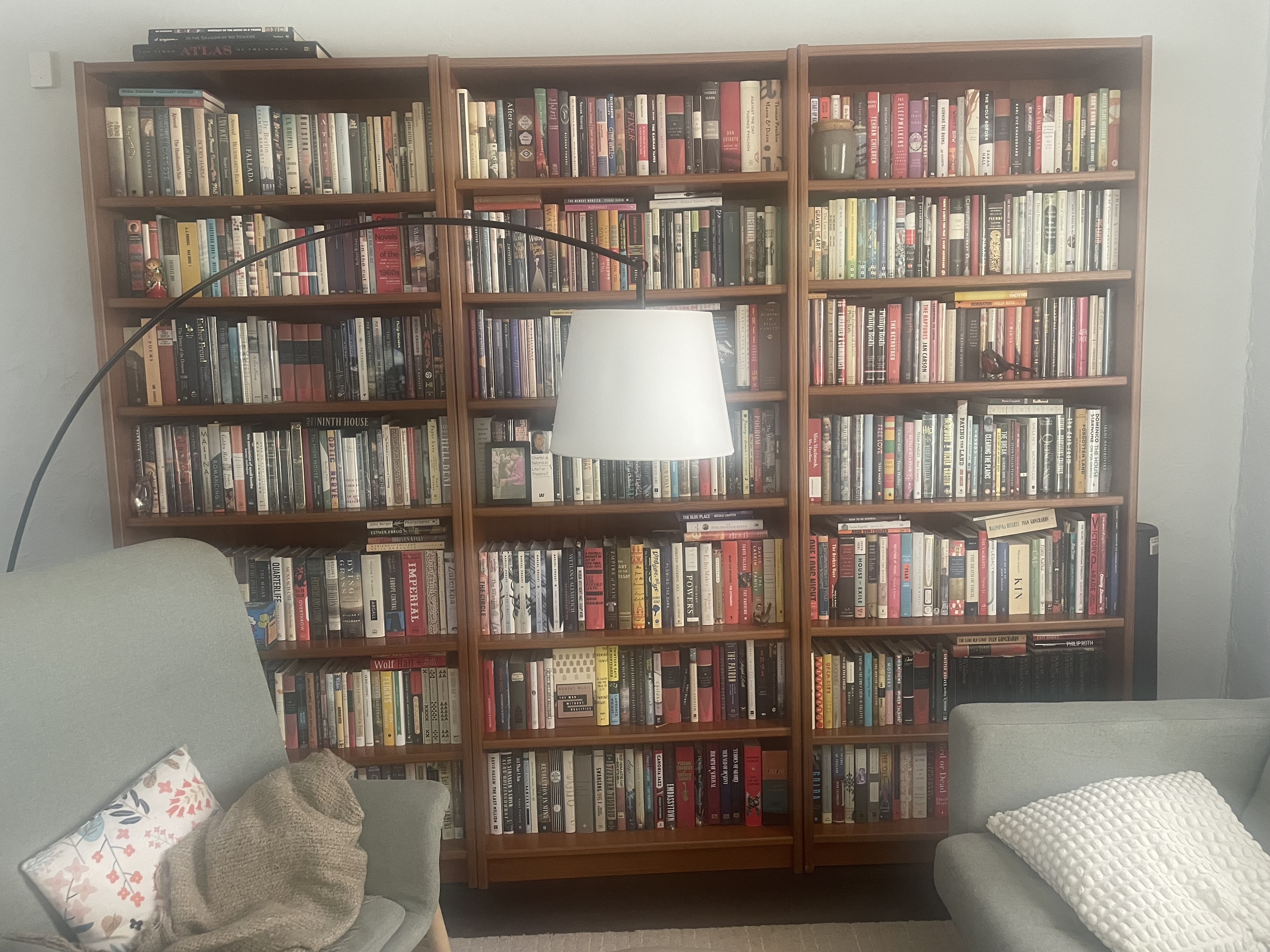
Candida Höfer, Bibliothèque Nationale de France Paris XXI 1998

Books to grow into but also to love when you’re young:

George Eliot, Middlemarch

The only novel in English for adults, Virginia Woolf famously said. Not sure what she meant, but doesn’t it sound good? Having reread it recently, I think you need to be middle aged (and thus an adult… hmm well never mind) to get the most from this story of English provincial life around 1830. But having first read it in college, I can also attest that Middlemarch hits for young people. As with any rich text, what you pay attention to and who you sympathize with shifts each time you read it.

Eliot is known for moral seriousness (maybe that’s why as stylistically different a writer as D. H. Lawrence was a fan), but Middlemarch is also surprisingly funny. Mostly, it’s supremely moving. It covers so much of life, and asks the big questions. What makes a good life? How can we live with purpose? How can we think of ourselves in relation to everyone else? Where do we fit into the web of life?

[Alternate choice: Leo Tolstoy, War & Peace. Never read it until about five years ago, but feel confident it dazzles as much at 20 as at 50. You want novelistic sweep? This one’s as big as Russia… Freemasons and wolf hunts and returns from the dead and slow-burning love affairs lasting across the decades: everything, really.]

Books that master close third-person perspective

Nella Larsen, Passing

Set in Harlem and Chicago in the late 1920s among a set of well-to-do light-skinned Black women who can pass as white, Passing is a great novel of queer frenemies. It hews closely to the perspective of a single character, Irene, whose orderly life as the mother of two boys and wife to a (dissatisfied) doctor falls apart when she runs into a childhood friend, the brave and dangerous Clare. Unless we attend to how events are only offered through Irene’s perspective, we are likely to miss how much the book asks us to question the judgments it only seems to offer.

[Alternate choice: Henry James, What Maisie Knew. In book after book, James wrote about people behaving badly. Yet even among this vast canvas of cruelty, this novel stands out: the people doing the harm are parents who use their young child to hurt each other and, of course, the child. In the preface to the New York Edition James explained that he chose to narrate the book in third person but to limit the perspective to Maisie’s often baffled but also wondering sense of the world in order to offer readers the extra pathos of being able to understand what she could not. It’s quite a trick.]

Books about the Holocaust

Primo Levi, If This Is a Man

If someone is asking me what books they simply must own, they’re absolutely gonna get one about the Holocaust. Hell, I could make them a whole list. But knowing that not everyone shares my fascination, I’ll stick to one of the earliest and most famous instances of Holocaust literature. (Levi composed part of it already while in the camps.) Like all memoirs, If This is a Man (known in the US under the travesty title Survival in Auschwitz) details its author’s particular experience—which took the form it did by his having had “the great good fortune” to have been deported only in 1944, when the turning tide of the war and subsequent internal battle among top Nazis meant that more deportees were selected for slave labour. That phrasing gives you a sense of Levi’s matter-of-fact irony. But something that distinguishes If This Is a Man is Levi’s decision to use “we” even more than “I”: he aims to give a sense of the structure and meaning of the collective victim experience, at least within a subcamp of Auschwitz.

[Alternate choice: Ida Fink, A Scrap of Time and Other Stories. Too little known among English speakers, but, happily, available in a terrific translation by Madeline Levine and Francine Prose, Fink’s heartbreaking stories depict part of the Holocaust most people don’t know about: the mass murder performed by the Einsatzgruppen in Galicia in the summer and fall of 1941. Fink couldn’t find a publisher for these stories until the 1980s; they were deemed of no interest. Another devastating failure on the part of literary opinion. Fink has been called the Chekhov of the Holocaust. Grotesque as this sounds, it’s accurate. Quiet and heartbreaking.]

Members of YIVO New York examine crates of books rescued from the Vilna Ghetto

Books about how to read books:

Roland Barthes, S/Z

Barthes spent a year reading Balzac’s story “Sarrasine” with some students. (Oh to have been in that seminar!) That labour resulted in this extraordinary book, organized around line-by-line readings of the source text, not, as critics usually do, to figure out what it means, but rather how it means. To do so, Barthes offers five “codes”—fundamental elements of realist fiction, of which “Sarrasine” is considered only as a representative example—that readers unconsciously rely on (typically by having imbibed many examples of the genre) in making the text intelligible. The codes are things like references to historical events, people, and places, or attributes and actions that cohere into what we call characters and, in the case of realist literature, think of as if they were people. Barthes Intersperses his step-by-step redescription of the Balzac story with theoretical meditations on the operation of the codes, which readers can extrapolate to other texts.

S/Z is tough. I probably taught it five or six times before I felt I had a real handle on it. But as Barthes says, it’s valuable to be able to distinguish between real and superficial ideas of difference. We might think that the best way to know about books is to read a lot of them. But if we do so without thinking about what underlies their intelligibility (i.e. what we need to be able to read them), then we are mere consumers, doomed to reading the same thing over and over. Only by reading one text over and over can real difference, that is the difference within the text, show itself—which in turn will make our other reading more meaningful. All of which is to say, the effort of tackling Barthes’s analysis offers big rewards.

[No alternate choice. S/Z for everyone.]

Books with pictures:

Alison Bechdel, Fun Home

Comics, graphic novels, whatever you want to call them are important to me, and I think any reader needs at least one example in their library. Such a rich form, so many gorgeous and moving texts to choose from. As with my Holocaust choice, I resisted the temptation to go niche here. Bechdel’s memoir of her relationship with her closeted, self-destructive, talented father deserves its fame. Probably more than any book I regularly taught, Fun Home elicited the strongest positive reactions in the widest range of students. Family disfunction runs deep. A great book about how books can connect people who can’t otherwise open up to each other—and how they can further separate them too. Funny, ominous, bittersweet.

[Alternate choice: Nick Drnaso, Sabrina. Dark, powerful. Reading it gave me a bit of the ick. And yet its subject matter just seems more relevant. I guess this is about the manosphere, except no one was using that hideous term at the time.]

Books of ideas [fiction]

Thomas Mann, The Magic Mountain

Sometimes I want a book that dramatizes the back and forth of thinking. In The Magic Mountain, Mann literalizes this by surrounding his protagonist, the well-meaning, hearty Hans Castorp, with some of the most indefatigable talkers ever to appear in a novel. The whole intellectual landscape of pre-WWI Europe is here (liberal humanist, communist, militarist, hedonist, you name it), and everyone battles for Hans’s soul, even as the former engineer mostly wants to desire a woman from afar, a woman who reminds him of a boy from his schooldays…

The other great thing about this book is how well it depicts Davos and environs. I’m a sucker for mountains and mountains in books. Bring on the snow!

[Alternate choice: Proust. Honestly, if you can only put one book in your starter library, choose this one. I assume it’s already there, but if not then get stuck into this deeply philosophical book, which has so much to say about perception, time, cruelty, and control over others.]

Books of ideas [nonfiction]

W. E. B. DuBois, The Souls of Black Folk

Every American should read it. But non-Americans should too. The idea of double-consciousness—the way a minority must measure themselves by the tape of the majority, as DuBois so memorably puts it in his first pages—explains so much of our contemporary sense of identity.

In addition to its ideas, Souls is a fascinatingly hybrid book, presumably stranger in 1903 than today. Each chapter is prefaced by a bar of music, often from the sorrow songs. Most chapters are essayistic, but some are fictional. Each is written in resonant cadence. Hasn’t dated much. Alas.

[Alternate choice: Hannah Arendt’s The Origins of Totalitarianism. Explains how Nazism and Stalinism came to be so accepted and do so much harm. Especially interesting for (1) its “boomerang” theory of imperial violence, in which what the metropole does in the colony comes back to bite it at home, and (2) its argument that modern antisemitism arose from the waning of Empire and the rise of nationalism. Hasn’t dated much. Alas.]

Monomaniac books

The strand from writers like Kafka, Knut Hamsun, or Robert Walser to someone like Lydia Davis, via the high point of Thomas Bernhard, has been enormously influential in the Anglo-American sphere. At this point, annoyingly so. (And weird, too, given that none of the most important precursors wrote in English.) But I get it because literature excels at tracing the vagaries of a mind, especially one spinning through reversals, paradoxes, and hobby-horses. A starter library should have an example of this sort of thing, and Bernhard might be the best. When the only thing that stands between a psyche adrift or worse is the chance that someone might respond to its voice—that’s when you’re in Bernhard territory. I’ve chosen The Voice Imitator because the title says it all. Read these 104 short texts to get a sense of Bernhard’s bitter, misanthropic, and, oddly, funny vibe.

[Alternate choice: I just named like five other writers!]

Funny books

P. G. Wodehouse, The Code of the Woosters

As implied in what I said about Bernhard, voice-driven books don’t have to be grim. They can make us laugh, whether from the gap between what the narrator claims and what we know, or the sheer verve of their style. The fun only increases when those narrators get embroiled in elegant plots. Wodehouse is the master of this terrirtory and everyone’s library is the better for including him. (I feel like he’s fading a bit from memory? Sad.) You can jump in anywhere—my entry point was the distinctly not-famous-but oh-so-representatively-titled Eggs, Beans, and Crumpets which baffled and delighted me at age 12—but if you’re at a loss start with this wonderful episode in the Jeeves and Bertie series, which Tim Waltz would enjoy, since it’s an early example of the “I condemn the fascists by unflinchingly stating how weird they are” school of responding to authoritarianism. (As Bertie says, appalled by the realization that the Saviours of Britain are simply grown men marching in black shorts: “how perfectly foul!”)

[Alternate choice: for an American version of this phenomenon, reach for Charles Portis, especially the marvelous True Grit.]

Books about crime

Dolores Hitchens, Sleep with Strangers & Sleep with Slander

Since at least Oedipus Rex, literature has used crime to understand fundamental concerns like identity, political organization, and moral value. Crime fiction can be smart, is what I’m saying. And it can also carry us away by inciting our desire to have enigmas explained. (Interestingly, it often makes us realize how much more compelling it is to ask a question than to answer it.) Like any genre, then, crime fiction satisfies at both the intellectual and emotional level. Having stayed with well-known titles so far, I’m diving deep for this last category. Not enough readers, even lovers of crime fiction, have read the mid-century American writer Dolores Hitchens. She wrote a lot of books under a lot of names. But only two about a PI named Jim Spader. Which is sad—but also good because they’re even more special. These make for pretty despairing reading, even for noir. So be warned. But you won’t regret seeking them out.

[Alternate choice: Hundreds! Thousands! Sticking with mid-century American women writers, I’ll plump for Dorothy B. Hughes’s The Expendable Man. Don’t read anything about it beforehand!]

I tried not to think too long in coming up with my choices. Next month or next year I’d choose differently. And I’m aware of some big lapses. No poetry?? No plays?? No Torah?? (Everyone should read the Five Books of Moses.) But that’s ok. Gives you all the more room to think about how you’d create a starter library of your own. What would be on your shelf of promises?

Scott Walters’s Year in Reading, 2023

Excited to once again present reading reviews from some of my favourite readers. Today’s installment, his third, is by Scott Walters. Scott launched a litblog, seraillon, in 2010, and expects to return to it one of these days. He largely follows Primo Levi’s model of “occasional and erratic reading, reading out of curiosity, impulse or vice, and not by profession.” He lives with his partner in San Francisco.

Barring a couple of possible late entries, here ends the 2023 edition of the EMJ Year in Reading series. Thanks to everyone who contributed–and all who read these engaging lists.

Édouard Boubat, Paris, 1949

Year in Reading 2023: 50 Books, Fat and Thin

Like several others who have already posted about 2023, I had a less than stellar reading year, finishing a little over half the number of books I did in 2022. On the other hand, several doubled as barbells for building up my muscles. On the third hand, some were slim. And on the fourth hand, some were slim pickings; I can’t recall ever reading so many works I didn’t especially like. I’m not sure to what to attribute that deflating phenomenon, but I hardly seem to be alone.

Best Quasi-Rereading

Michael Moore’s effervescent new translation marked my fourth time reading Alessandro Manzoni’s The Betrothed (1827/1842). As Moore explained at a reading I attended, he deliberately aimed his translation at an American audience lamentably unfamiliar with this 19th century masterpiece. An ingenious framing story cocoons this long tale of Renzo and Lucia, the affianced young couple whose wedding plans are dashed by the machinations of a lascivious warlord, forcing the couple to separate and flee into spiraling trials that challenge them (and several other characters) into becoming larger than themselves. Starting a beloved book in a new translation requires adjustment, but I was won over by Moore’s energetic, nimble, vivid and playful version, almost certainly the place to start for any American reader approaching this grand work for the first time. [Ed. – This book looks at me reproachfully from the shelf…]

Other Italian Explorations

Giovanni Boccaccio: The Decameron

G. W. McWilliams’ translation of Boccaccio’s 1353 classic accompanied me throughout the year as the perfect post-pandemic [Ed. – sic] companion. You know the framing story: five young women during the Florentine plague of 1348 abandon the city and invite along five male friends to an empty villa in the hills where, each day for ten days, each tells a story to entertain the others. The depiction of the plague in the book’s opening is terrific, and the 100 stories, splendidly diverse, are by turns tender, ribald, moving, pointed. So is the warm banter between the young people as they introduce their stories and encourage one another’s efforts, the whole serving as a kind of instruction manual on storytelling (and as a model for confronting calamity). Boccaccio has become a favorite; I also spent time this year with his Famous Women and Genealogy of the Pagan Gods, the latter especially highlighting Boccaccio’s talent as a great writer of prefaces. [Ed. – Ok, you sold me on this!]

Dominic Starnone: The House on the Via Gemita (2023)

The two short Starnone Neapolitan novels I’d read had impressed me, so I was excited to discover a fat new 500-page work also set in Naples. Starnone’s narrator recounts the history of his father, digging so thoroughly into strained father/son relationship that I can’t imagine The House on the Via Gemita not taking its place as a classic of the genre. To my surprise, the book also turned out to be an excellent novel about painting, in that the son must address both his father’s abusive personality and role as a peripheral figure in mid-century Italian art, a career layered on top of a day job as a railroad worker and the family responsibilities he largely leaves to others. Starnone gives us a brief history of postwar Italian art while exploring the qualities that make paintings great or mediocre and making personal an issue of our time: disentangling (or not) an artist from their art. I also noted the geographical precision employed by Starnone as a quality common to several contemporary Neapolitan novels; one can use a map to follow the narrative’s peregrinations around the city.

Maria Attanasio: Concetta et ses femmes

Concetta et ses femmes, written in 2021 when Attanasio was 80, sets out as a documentary rescue mission to obtain the story of Concetta la Ferla, organizer in the late 1960s, in Caltagirone, Sicily, of the first women’s branch of the Italian Communist Party (then the third largest in the world). Concetta’s grassroots project develops out of frustration with the municipality’s diversion of water to its wealthiest citizens, but runs into predictable obstacles in the form of chauvinistic attitudes in the city administration, in the Party, and at home. The story would be interesting enough simply as historical artifact. But Attanasio’s structuring of her novel, the first part narrated by Maria herself from the perspective of 20 years after the effort to preserve Concetta’s tale, and the second the tale itself in Concetta’s words, plays with questions of authorship and feminist solidarity, and emphasizes the continual nature of the struggle to gain legitimacy, to advance the advances of the past, to never go back.

Other Italian/Italy-related works included an Italian/French collection of short stories (Nouvelles italiennes contemporaines), with Tomas Landolfi, Massimo Bontempelli and especially Elisabetta Rasy’s contributions as standouts. Indian-American-now-Italian writer Jhumpa Lahiri’s Roman Stories (2023) revisits Alberto Moravia’s 1959 Roman Tales (Racconti Romani in the original Italian for both books), exchanging Moravia’s focus on Roman men in recognizable neighborhoods for immigrants, ex-pats, and tourists vaguely on the city’s periphery. Renato Serra’s Examination of Conscience of a Man of Letters (1915) presents a searing treatise on the relationship of literature and war, written three months before Serra perished in battle in World War I (read in French; while the essay has never gone out of print in Italy, it has not been translated into English). I devoured Janet Abramowicz’s monograph, Giorgio Morandi: The Art of Silence (1964), a deep appreciation of the Bolognese artist into whose family Abramowicz was essentially adopted. Despite this proximity, Abramowicz treats her former teacher judiciously and even unsparingly when it comes to Morandi’s blemishes, in particular his tacit involvement with fascism. German writer Esther Kinsky’s Rombo (2022), a polyphonic novel exploring the impact of a series of earthquakes on remote villages in the north of Italy, grew on me during my reading, with its Polaroid-like narrative approach in which the lives of the villagers gradually become more vivid and saturated. Finally, in Etruscan Places (posthumous publication 1932), D. H. Lawrence and a companion identified as “B” voyage through central Italy, exploring sites of the ancient Etruscan “12 cities.” Lawrence’s incisive, infectiously enthusiastic observations about Etruscan art and life turned me into a fan of this fascinating people whose culture was absorbed/obliterated by the Roman Empire. The narrative doubles as a travelogue through Mussolini’s Italy and, adding yet another layer, Lawrence’s views lay out an entire philosophy that has me determined to revisit his fiction this year. [Ed. – I support this plan!]

Stalingrad

I came away from Vasily Grossman’s Life and Fate convinced I’d encountered one of the essential literary documents of the 20th century’s experience of fascism. I did not know that the book was but a second volume in Grossman’s monumental effort to write the great World War II novel. The first, Stalingrad (1952), with still no definitive Russian edition, has only recently been translated into English by Robert and Elizabeth Chandler. As highly as I esteem Life and Fate, I believe Stalingrad may well be the superior novel [Ed. — !] in its immediacy and the sheer grandeur of its conception (but as the books were intended to form a whole, one need not set them against one another). Grossman, present at Stalingrad as a journalist, related some of his experiences in Life and Fate, but Stalingrad sets out to capture the whole story of the war’s most decisive battle, from August 23, 1942 to February 2, 1943. Grossman’s acute consciousness of his literary precursor, Leo Tolstoy, leads him to take his main character on two pilgrimages to Tolstoy’s house, Yasnya Polynka, and to muse on Tolstoy’s accomplishments: 

Krymov looked at the wounded who had fallen by the wayside, at their grim, tormented faces, and wondered if these men would ever enter the pages of books. This was not a sight for those who wanted to clothe the war in fine robes. He remembered a night-time conversation with an elderly soldier whose face he had been unable to see. They had been lying in a gully, with only a greatcoat to cover them. The writers of future books had better avoid listening to conversations like that. It was all very well for Tolstoy – he wrote his great and splendid books decades after 1812, when the pain felt in every heart had faded and only what was wise and bright was remembered.

With Life and Fate, Stalingrad now gives us one of the great documents of World War II – and one of the greatest works of fiction about war ever written.

An Essential Holocaust Novel

The Talmudic concept of the Lamed-Vov, the 36 righteous people on whom the continuity of the world depends, fascinated me when first I read about it. Only when I started André Schwarz-Bart’s 1956 Prix Goncourt-winning novel, The Last of the Just, did I realize that the Lamed-Vov were central to the book. Schwartz-Bart takes the reader though a thousand years of Lamed-Vov succession to arrive at Germany in the 1930s, where the narrative pace slows dramatically. His restrained, almost clinically factual language provides devastating testament as much as fiction. Some of its scenes are completely indelible, and Ernie Levy, Schwarz-Bart’s protagonist for this last half of the book, struck me one of the most remarkable characters I’ve encountered in a lifetime of reading. [Ed. – It feels like a professional failing that I have not read this book!]

José Revueltas: The Hole

A tiny but shockingly powerful novella, taut and tight with not a word out of place. [Ed. – Funny, that’s how people usually describe me!] The Mexican writer and activist Revueltas’s 1969 book, based on the author’s own 12-year experience as a political prisoner, resembles a Piranesi prison drawing in narrative form, an intensely concentrated exploration of incarceration. Everything in the narrative is compressed – time, space, hope, even the reader’s attention and the size of the book itself. An absolute masterpiece of prison literature.

Mariana Yampolsky, Estación Martell, 1988

Good King Xavier, Reino de Redonda

Spanish novelist Javier Marías died at age 70 on September 11, 2022. I encountered his work four times this past year, first in his final novel Tomás Nevinson (2022) which appeared last May in Margaret Jull Costa’s translation. I had come to anticipate each new Marías translation as nearly an annual tradition, so knowing that this his last novel made reading it deeply bittersweet. Tomás Nevinson follows up 2018’s Berta Isla, but also resurrects characters from Marías’s Your Face Tomorrow trilogy, most notably Bertram Tupra. Where Your Face Tomorrow engaged Spain’s experience of Franco and of the civil war, Tomás Nevinson takes as its starting point the Basque separatist terrorist attacks of the 1990s. As Nevinson is enlisted by Tupra to come out of retirement to track down a woman involved in the most heinous of these attacks, Marías uses the narrative to explore questions about our responsibility for seeking justice, how we deal with repentance and redemption, what justice seekers owe to their own loved ones, whether there may be some informal statute of limitations on bringing the guilty to account and how long justice should be sought – time being among the most prominent fixtures in Marías’s fiction. We are fortunate to have this novel; Marías’s time having run out seems completely unjust.

When I picked up Tomás Nevinson at Point Reyes Books, the literary mecca cultivated by Molly Parent and Stephen Sparks, Sparks asked if I’d read the new book about Redonda. I must have stared at him blankly, as, having not yet read Marías’s Oxford novels, I knew nothing. Thanks to Michael Hingston’s marvelously strange Try Not to Be Strange (2023), I now know quite a lot, including the fact that Marías had been, up until his untimely death, King Xavier I, monarch of this tiny nation, which, despite having no inhabitants, does have territory, a flag, its own currency and postage stamps, and a plethora of dukes and princesses, counts and ambassadors, and multitudes of other titles held by what seems a who’s-who of 20th century writers. This was by far my most fun book of the year, uncovering a great story, offering up a charming tale of obsession (including Hingston’s own), and digging a dizzying warren of rabbit holes for one to scurry down, which led to my filling quite a bit of empty shelf space with related works. [Ed. – Well, this all seems quite insane!]

One of those works, of course, was All Souls (1992), the Marías Oxford novel in which the author first mentions Redonda. I expect to have more to say about this book after I’ve read its sequel, Dark Back of Time, on deck for 2024.

Another addition, Cuentos únicos (1996), came from Reino de Redonda, Marías’s own Spanish-language imprint.This collection of 22 translated English language short stories selected by Marías presented a way to practice my poor Spanish and get to know some writers I didn’t know. Nugent Barker? Oswell Blakeston? Percival Landon? [Ed. – Are these imaginary???] My Spanish proved inadequate to the task, but I understood enough to have made the effort – to be continued this year – worthwhile.

The Ascent of Rum Doodle Mont Analogue

My next-to-most-fun book of the year, René Daumal’s Mont Analogue (1952), tells the story of Père Solgon’s organization of an expedition aboard the ship “Impossible” to find the rumored tallest peak on earth, mysteriously as yet undiscovered due to its isolation (guesstimated to be in the vast South Pacific) as well as certain tricks of light that keep it invisible except at a certain hour and from a certain approach. With a crew including such luminaries as an American painter of alpine scenes, one Judith Pancake, the voyage is half tongue-in-cheek, half mystical imponderables (Daumal had been a follower of Gurdjieff), half Jules Verne. Yes, I know that’s three halves, but that suggests the shape and character of this delightful novel, one of the rare “unfinished” works that actually ends mid-sent-….

(Note: for French readers: a lovely new hardcover illustrated edition of Mont Analogue comes with an introduction by musician Patti Smith).

Weak in Comparison to Dreams

I got to know art historian/theorist James Elkins’s work some 25 years ago while researching text and image for a conference paper. So it came as quite a shock to discover a 600-page novel by Elkins, especially as I’d recalled his having announced in an Amazon book review his intention to stop adding to an accretion of texts. Presumably Elkins only meant Amazon reviews, because Weak in Comparison to Dreams (2023) is a welcome contribution to contemporary literature and among the most unusual novels I’ve read in a long time.  In the book’s continuation of Elkins’s explorations of text/image interactions, I felt both that I was right back where I’d left off and in a whole new world. Incorporating scores of black and white images and increasingly nutty charts and graphs, the narrative follows its narrator, Samuel Emmer, a bacterial biologist for the city of Guelph, Ontario, on a series of visits to zoos around the world to evaluate mammalian behaviors and health protocols as Guelph plans its own zoo. [Ed. – The Guelph connection is… unexpected.] A dozen interchapters present Emmer’s dreams while on this mission, these too accompanied by images that suggest an intensifying fugue state. By turns sobering and hilarious, thematically touching on everything from animal welfare and incarceration to climate change and bureaucracy, from pseudo-science to contemporary experimental music, and playing in a space similar to that occupied by conceptual artist David Wilson’s Museum of Jurassic Technology, Elkins’s absorbing novel is… not at all what it seems. A 100-page final section entitled “Notes” delivers not so much “notes” as a surprising reframing of the first narrative, much in the way a caption might reframe an image. I can’t get the book out of my head, and shouldn’t, as Elkins has completed four other novels since 2008 that form a quintet of which Weak in Comparison to Dreams, though the first to be published, is volume three. I cannot wait to see what he does in the other four. [Ed. – How the hell do you find this stuff???]

The Queen of L.A. Noir

My familiarity with Dorothy Hughes’s In a Lonely Place (1947) had been limited to Nicholas Ray’s 1950 film starring Humphrey Bogart. Finally reading the novel left me incensed about the movie, a fairly egregious desecration of its source material. Fortunately, I felt no indignation in response to Hughes’s novel, which floored me as not just a masterpiece of Southern California noir, but perhaps the masterpiece of Southern California noir. I fell for it in the first pages, which captures the foggy, seeping chill of the California coast at night in a manner precise and true. She shies away from nothing in this penetrating psychological drama in which [Ed. – SPOILER INCOMING!] the narrator himself is the killer – presumably the quality that kept the studios from allowing Humphrey Bogart to be tarnished by such a role. Hughes covers the postwar L.A. noirscape exquisitely while managing to keep her narrator entirely human, a subtle literary feat that reads like one of Freud’s case studies. Raymond Chandler might be King of L.A. Noir, but if you asked me to pick a monarch, I’d go with Hughes on the basis of this novel alone.

Other mysteries included the marvelous Margaret Millar in Stranger in my Grave, a disappointing end to the Montalbano series in Andrea Camilleri’s Riccardino, and dismay as regards Mignon Eberhart, an author I’ve liked, whose Family Affair, in this year of too many books I did not like, marked the nadir.

Poetry

Aside from individual poems here and there, I read just three books of poetry. Reginald Dwayne Betts in Felon (2019) gives us a powerful collection of poems that go well beyond the experience of incarceration to address convict life beyond prison. I found Argentine poet Alexandra Piznarik’s Removing the Stone of Madness, Poems 1962-72 (Yvette Siegert, translator), relevatory. I did not know Piznarik, who, as the collection’s title suggests, fought a terrible battle with mental illness which she chronicled in short, sui generis poems as hard-edged and clean as crystals, powerful poem-objects one could almost hold in one’s hand. Finally, I loved Greg Hewitt’s intimate, resonant poems in Blindsight, structurally based on composer Olivier Messiaen’s prime-number system and which brought to mind Frank O’Hara’s personal poetic school of “Personism” (a mutual friend sent me Greg’s book).

Odds and Ends

The rest, an unorganized, mostly enjoyable mess, included Willa Cather, more Eve Babitz, Sándor Márai, Tatsuo Hori, Euripides, Chinua Achebe, Raphael Sánchez Ferlosio, more César Aira (an annual need), Daisy Hildyard and others. Larry McMurtry’s Lonesome Dove (1985) gave me exercise, as with Stalingrad in one hand, I built up my other bicep by hefting McMurtry’s 850-page narrative in late-night installments at approximately the same pace as the Texas border to northern Montana cattle drive the story depicts. I found it terrific fun, amplified by my subsequent reading of the story of a poor Texas legislator who made the mistake of trying to ban Texas’s national novel. No one should want to be that guy. A bit further south I ate up Charles Portis’s Gringos (1991), set in the Yucatan where rumpled ex-pat Americans are involved in archeological dealings and mis-dealings. Are all of Portis’s novels his best novel? I think so. I think so.  [Ed. – Well put!] Art historian Alexander Nemerov’s The Forest (2023), a collection of essays and corresponding plates, uses forests of the American frontier to cull idiosyncratic tales of 1830’s American art and culture, rescuing some fascinating figures from historical oblivion. I finally got around to reading Maggie Nelson, in Bluets (2009) and The Argonauts (2015) – respectively, musings on the color blue (with a towel snap at William Gass’s bare cheeks), and raw meditations on sex, gender and motherhood that I sent off to goddaughter pursuing gender studies. I’d been curious for some time about Michael McDowell six-volume Blackwater, and gorgeous and affordable new French paperback editions provided an opportunity to dive in. Blackwater 1: La Crue (1983) proved a Southern Gothic slow drip horror tale peeling away the veneer of Southern gentility. For the first time since high school, I revisited J. D. Salinger, in Raise High the Roof Beam, Carpenters (1955) and Seymour: An Introduction (1959). Salinger himself may not have aged well, but these two novels were far better than I expected them to be.  I found Tove Jansson’s The True Deceiver (1982) to be a stunningly good novella about truth, trust and deceit, not necessarily in that order, set in a fishing village on the Finnish coast. There seems to have been nothing Jansson couldn’t do right. While somewhat confined in a house in the mountains, I found appropriate companionship in Count Xavier de Maistre’s A Journey Round My Room (1795), a book born of boredom, a curious meditation on escaping it, created when, following a duel, de Maistre was put under house arrest for some six weeks. Alleviating boredom, Roy Lewis’s The Evolution Man, or How I Ate My Father (1960), though clearly dated, was still pretty damned funny as comedies about pre-history go. Finally, a couple of books with which I struggled still held enough of interest for me to get through them. Justin Torres’s Blackouts (2023) relies heavily on photographs, drawings, redacted text, dialogue as film script, and other novelties that I found a bit overcooked (in a way I did not with the Elkins novel). But the story Torres unearths of a 1942 study of homosexuality, and of the lesbian couple who helped drive the project and were betrayed by it, is remarkable. I had a tougher time with Gerald Reve’s The Evenings (1947) acclaimed by some as the great 20th century Dutch novel. A disaffected young man lives with his numbed parents in 1946 Amsterdam and battles his claustrophobic life with dark, acrid humor. I admired Reve’s allowing the war to drip into the narrative bit by bit, the horrors of the recent past seeping into normal life. But I couldn’t wait for the book to end.

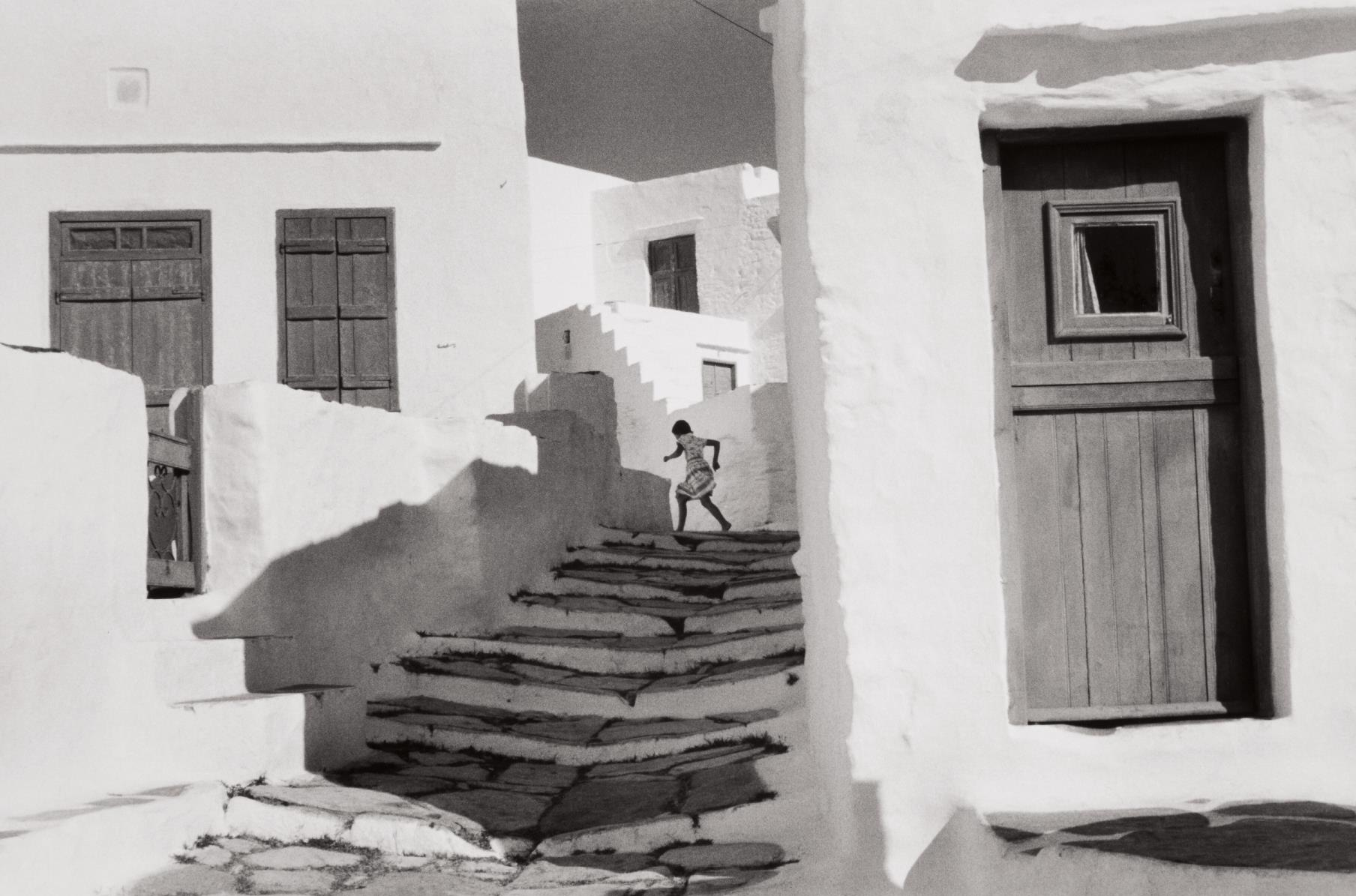
Henri Cartier-Bresson, Naples, 1960

I’ll conclude with a dream. In a cluttered bookshop, I found a tattered but astounding volume amended with striking collages, vivid watercolor sketches, and dense margin notes. The (dream) author’s name seemed familiar, so upon waking I looked up James Gould Cozzens and plunged down a trail that led me to Dwight MacDonald’s 1958 review of Cozzens’ late novel, By Love Possessed.  I did not read Cozzens. I’m not sure I will ever read Cozzens. But I’m grateful to odd dreams for having pointed me to MacDonald’s review, which takes to task a generation of critics who, with log-rolling fealty and conformity to one another’s uncritical opinions, lavished praise on the novel. Eviscerating, illuminating, even necessary, his review models close textual analysis with an eye towards criticism’s larger role, relevant today when writer-critics blurb one another’s books and award prizes to mediocre works.  A pretty good way to end the reading year, and a better way to start off a new one which, I am happy to say, as far as books go, is off to a tremendous start. Thank you for reading. [Ed. –Thanks for writing, Scott! A delight as always.]

My Year in Reading, 2023

I wouldn’t say I had a great reading year. I was on my phone too much, I was being anguished or avoiding being anguished about the myriad injustices of the world, which I knew too much and could do too little about. I travelled—maybe not too much but an awful lot, for me—which was often energizing and enjoyable, but also got in the way of reading.

I felt, in other words, that I had frittered away my one wild and precious reading life. I bottomed out in the middle of the year, regularly tossing aside books unfinished after having spent more time with them than they deserved or that I could find patience for. A querulous reading year, you could say.

And yet some things stood out. Links to previous posts, if I managed to write about it.

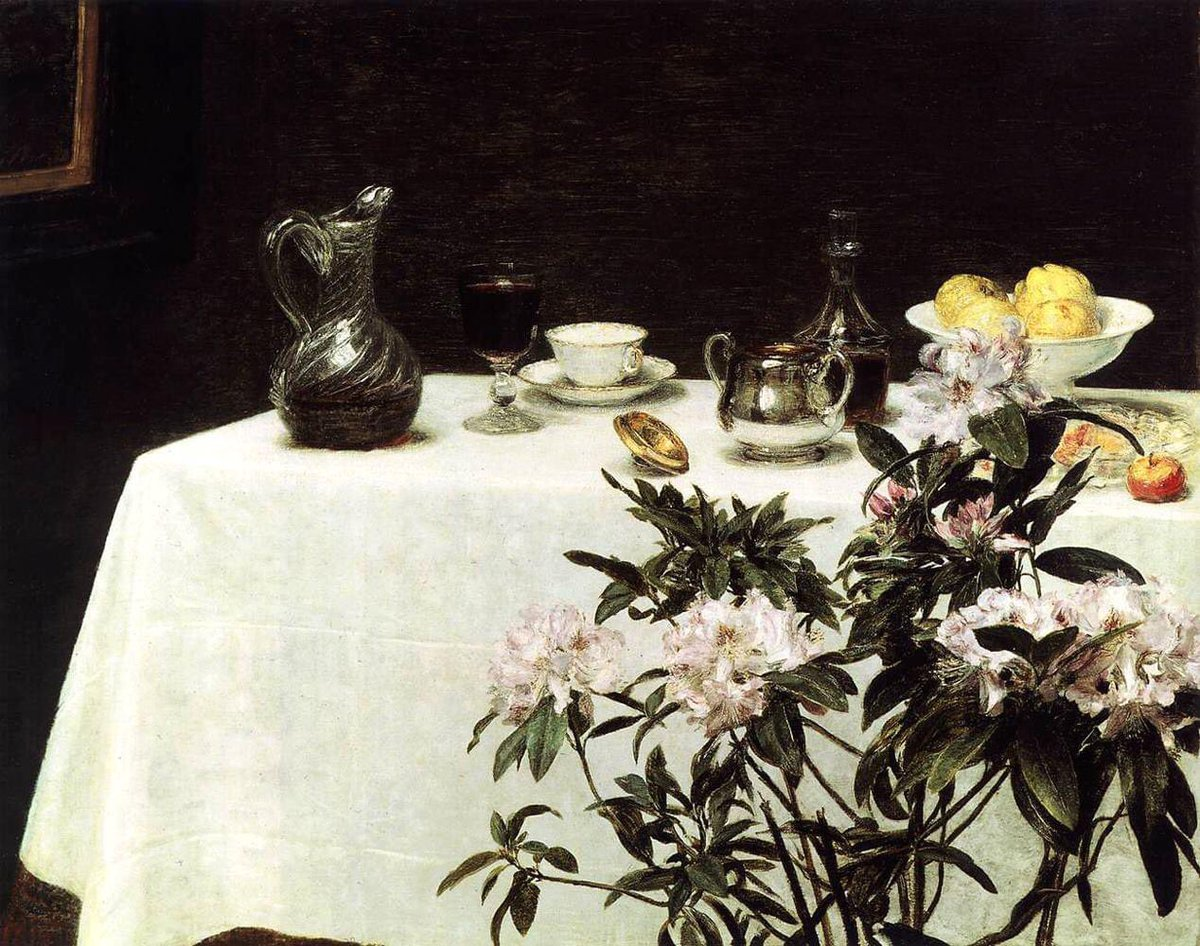
Henri Fantin-Latour, Le coin de la table (1872)

Dwyer Murphy, The Stolen Coast

A rare heist novel where the heist, though satisfying, isn’t the main attraction. I loved this stylish, smart, funny tale of a man who has put his Ivy League law degree to use in taking over the family business: giving new identities to guys on the run and getting them the hell over the border. A great book of off-season resort towns.

Simon Jimenez, The Vanished Birds

I’m still getting my bearing in contemporary sff so take these comments for what they’re worth, but it seems rare to me that a book takes as many swerves as this one: the narrative moves back and forward in time and all over the place, from a near-future nearly uninhabitable earth to a galaxy far-away in space and time. You get invested in a storyline and then it ends but sometimes it comes back. But even more than the structure I loved this book for its emotional seriousness: its many relationships are doomed to fail because of their constitutive circumstances. For example: a man ages fifteen years between each meeting with his beloved, while she, thanks to intricacies of stellar time travel, has only aged a few months. The emotions might be bigger than the ideas, but I was totally okay with that.

Two novels by Katherena Vermette

One of the greatest working Canadian writers. This year, fresh off the thrill of teaching The Break to smart, appreciative students, I read The Strangers and The Circle, a bleak and beautiful trilogy of indigenous life in the aftermath of the cultural trauma of the residential school system.

Four novels by Kent Haruf

It should tell you something that in early April, one of the worst times in the academic year, I read four novels by Kent Haruf in just over a week. I loved Plainsong the most but enjoyed Eventide, Benediction, and Ours Souls at Night almost as much. Easy reading, sure: plain syntax rising to gentle arias, nothing fancy, maybe a little sentimental. But these books are so warm and kind. Each is set in Holt, Colorado, out on the eastern plains, where the mountains are a smudge on the western horizon and it’s sometimes hot and sometimes cold but always dry. The people are ranchers and school teachers and social workers and hardware store owners and ne’er-do-wells and retirees. Everyone is white and no one thinks that’s worth noticing. The time is hard to pin down. Sometimes I thought the 70s or early 80s but we’re probably talking the 90s. Things were different before the internet. The characters’ lives are modest and they seem fine with that. They go about their business, do their work, make good choices and bad ones. People look out for each other, but they judge each other, too. Little kids get lost biking, but they come home again. It’s not all roses, though. High school boys bully girls into having sex, over in that abandoned house just down from where the math teacher lives. People get sick, go hungry, lose jobs. Some characters get what the preacher will call a good death, some die unreconciled to their kin, some without warning, too soon. Life just keeps happening, you know?

Some readers will call this hokum, but I ate it up. Haruf won my heart. I thought him especially good on second chances and unexpected turns of fate. Of all the stories that weave through these loosely connected novels, the best concerns two brothers, old bachelors, ranchers, who agree to take in a pregnant teenage girl and who, to everyone’s surprise, not least their own, form a new family with her. That scene where they take into the next town over to get things for the baby and insist on buying the best crib in the store? Magic.

Garth Greenwell, Cleanness

Smart, sexy, stylish books about how we relate to bodies privately and publically, and whether we can recast the narratives that have shaped aka deformed our understanding of what it is to live in those bodies. Greenwell’s Substack is worth subscribing too; he makes me curious about whatever he’s curious about. Can’t wait for the essay collection he’s writing.

Emeric Pressburger, The Glass Pearls

Yep, that Pressburger. Closer to Michael Powell’s Peeping Tom than any of the (indelible) films they made together. Karl Braun, a German émigré, arrives at a boarding house in Pimlico on a summer morning in 1965. A piano tuner who never misses a concert, a cultured man, a fine suitor for the English girl he meets through work. I’m not spoiling anything to say that Karl isn’t just quiet: he’s haunted—and hunted. For Karl Braun is really Otto Reitmüller, a former Nazi doctor who performed terrible experiments, a past he does not regret even as he mourns the death of his wife and child in the Hamburg air raids. Now the noose is tightening and Otto/Karl goes on the run… Suspenseful stuff; most interesting in this play with our sympathies. Not that we cheer for the man. But his present raises our blood pressure as much as his past.

Toni Morrison, A Mercy

A short book that covers as much ground as an epic; a historical novel that feels true to the differences of the past but that is clearly about the present; a classic modernist Morrison text, where the first page tells you everything that’s going to happen except that it makes no sense at the time and the rest of the reading experience clarifies, expands, revises. Such beauty and mystery in so few pages.

Roy Jacobsen’s Barrøy series (Translated by Don Bartlett and Don Shaw)

Cheating a bit since I read the first one in December 2022. I’m a huge fan of these novels about a family and the remote Norwegian island they call home from 1900 to 1950. I like books where people do things with their hands, maybe because I can’t do much with mine. The characters bring sheep into the upper field, fish with nets and line, salt cod, keep the stove burning all through the year, row through a storm, carry an unconscious man through sleet. It’s all a little nostalgic, a little sentimental, but not too much. Just how I like it.

Two Books by Walter Kempowski (Translated, respectively, by Michael Lipkin and Anthea Bell)

Fresh on my mind so it’s possible I’ve overvalued them but I don’t think so. All for Nothing, especially, is something special.

George Eliot, Middlemarch

Last read in college—under the expert tutelage of Rohan Maitzen, this can only be called one of the highlights of my undergraduate experience. This time I listened to Juliet Stevenson’s recording, which perfectly filled a semester’s commuting. True, Arkansas traffic is not the ideal venue for some of Eliot’s more complex formulations, but Stevenson (as much a genius as everyone says, she do the police in different voices, etc.) clarifies the novel’s elegant syntax and famous images. The book’s the same, but I’m not; a whole new experience this time around. Much funnier, especially its early sections. (Celia is a triumph.) More filled with surprising events: that whole Laure episode (a Wilkie Collins novel in miniature), it was as if I’d never read it. And more heartbreaking: in 1997, I hated Rosamond, and I admit I still felt for Lydgate this time around, but I had so much sympathy for her, a character I’d only been able to see as grasping and venal. Speaking of sympathy, one of the glories of English literature lies in watching Dorothea as she matures from excitable near-prig to wiser and sadder philanthropist. Amidst all this change, though, some things stayed the same. Mary Garth still won my heart; the suspense at the reading of Featherstone’s will gripped me just as much.

It’s good to read Middlemarch in college. It’s better to re-read Middlemarch in middle age. It’s best to read Middlemarch early and often.

Konstantin Paustovsky, The Story of a Life (translated by Douglas Smith)

Six-volume autobiography of Soviet writer and war correspondent Paustovsky, a Moscow-born, Ukrainian-raised enthusiast of the Revolution who somehow made it through Stalinism to become a feted figure of the 1960s. The new edition from NYRB Classics contains the first three volumes. I only read the first two, not because I didn’t enjoy them (I loved them) but because I set the book down to read something else and the next thing I knew it was a year later. Paustovsky had something of a charmed life. His childhood was largely downwardly mobile, and he lived through so much terror and upheaval. And yet he always seems to have landed on his feet. Maybe as a result—of maybe as a cause—he looks at the world with appreciation. He can sketch a memorable character in a few lines. He writes as well about ephemera (lilacs in bloom) as about terror (I won’t soon forget his time as an orderly on an undersupplied hospital train in WWI). He can do old-world extravagance (the opening scene is about a desperate carriage ride across a river raging in spate to the otherwise inaccessible island where his grandfather lies dying) and the brittle glamour of the modern (for a while he drives a tram in Moscow). Trevor Barrett, of Mookse & Gripes fame, said it best: Paustovsky is good company. I really ought to read that third book.

Félix Vallotton, Still Life with Flowers, 1925

A few other categories:

Didn’t quite make the top, but such pleasurable reading experiences: Adania Shibli, Minor Detail; Paulette Jiles, Chenneville; Abdulrazek Gurnah, By the Sea; Jamil Jan Kochai, The Haunting of Hajji Hotak and Other Stories (teaching “Return to Sender” was a revelation: fascinating how even students who had seemed immune to literature shook themselves awake for this one).

Read with dread and mounting desperation, don’t get me wrong it’s a banger, but couldn’t in good conscience call it a pleasure to read: Ann Petry, The Street. Barry Jenkins adaptation when?

Maybe not standouts, but totally enjoyable: Margaret Drabble, The Millstone; K Patrick, Mrs. S; Yiyun Li, The Vagrants; Elif Batuman, Either/Or

Best dip into the Can-con vaults: Margaret Laurence, The Stone Angel. Got more about of this now than I did in high school, lemme tell you.

Best book by a friend: James Morrison, Gibbons or One Bloody Thing After Another: Not damning by faint praise. It’s terrific!

Book the excellence of which is confirmed by having taught it: Bryan Washington, Lot. Maybe the great Houston book. I get that novels sell but I wish he’d write more stories.

Grim, do not recommend: Larry McMurtry, Horseman, Pass By; Girogio Bassani, The Heron

Not for me: Jenny Offill, Weather; Annie Ernaux, Happening; Yiyun Li, The Book of Goose

Planned on loving it, but couldn’t quite get there: Julia Armfield, Our Wives Under the Sea. Sold as metaphysical body horror, this novel about a woman who goes to pieces when her wife returns from an undersea voyage gone catastrophically wrong as a kind of sea creature didn’t give me enough of the metaphysics or the horror. I figured it would be perfect for my course Bodies in Trouble but I couldn’t find my way to assigning it. Possibly a mistake: teaching it might have revealed the things I’d missed. Gonna trust my instincts on this one, tho.

The year in crime (or adjacent) fiction:

Disappointments: new ones from Garry Disher, Walter Mosley, and S. A. Cosby (this last was decent, but not IMO the triumph so many others deemed it; he’s a force, but I prefer his earlier stuff).

Standouts: Celia Dale, A Helping Hand: evil and delightful, can’t wait to read more Dale; Lawrence Osborne, On Java Road: moody, underappreciated; Christine Mangan, The Continental Affair: moody, underappreciated; Allison Montclair, The Right Sort of Man: fun; Joseph Hansen: wonderful to have the Dave Brandsetter books back in print, hope to get to more in 2024; Richard Osman: as charming, funny, and moving as everyone says.

Maigrets: Of the six I read this year, I liked Maigret and the Tramp best. Unexpectedly humane.

Giants: Two Japanese crime novels towered above the rest this year. I didn’t write about volume 2 of Kaoru Takamura’s Lady Joker (translated by Marie Iida and Allison Markin Powell) but maybe my thoughts on volume 1 will give you a sense. Do you need a 1000+ page book in which a strip of tape on a telephone poll plays a key role? Yes, yes you do. (Also, it has one of the most satisfying endings of any crime novel I’ve ever read.) More on Hideo Yokoyama’s Six Four (translated by Jonathan Lloyd-Davies) here. Do you need an 800+ page book in which phone booths play a key role? Yes, yes you do.

The year in horror:

Victor LaValle, Lone Woman: horror Western with a Black female lead and not-so-metaphorical demon, enjoyable if a bit forgettable; Jessica Johns, Bad Cree: standout Indigenous tale, also with demons; Leigh Bardugo, Hell Bent: serious middle-volume-of-trilogy syndrome. Many demons, tho.

The year in sff:

In addition to Simon Jimenez, I liked Ann Leckie’s Translation State, Nick Harkaway’s Titanium Noir, and, above all, the three novels by Guy Gavriel Kay I read this summer, which gave me so much joy and which I still think about all the time.

The year in poetry:

Well, I read some, so that’s already a change. Only two collections, but both great: Wisława Szymborska’s Map: Collected and Last Poems (Translated by Clare Cavanaugh and Stanislaw Baranczak), filled with joy and sadness and wit, these poems made a big impression, and Ilya Kaminsky’s Deaf Republic (fortunate to have met him, a mensch; even more fortunate to have heard his indelible performance).

The year in German books: I read two, liked them both. Helga Schubert, Vom Aufstehen: Ein Leben in Geschichten (On Getting Up: A Life in Stories), vignettes by an octogenarian former East German psychotherapist who had fallen into oblivion until this book hit a nerve, most impressive for the depiction of her relationship to her mother, which reminded me of the one shared by Ruth Kluger in her memoir; Dana Vowinckel, Gewässer im Ziplock (Liquids go in a Ziplock Bag): buzzy novel from a young Jewish writer that flits between Berlin, Jerusalem, and Chicago. The American scenes failed to convince me, and the whole thing now feels like an artefact from another time, given November 7 and its aftermath. I gulped it down on the plan ride home, though. Could imagine it getting translated.

Everyone loved it; what’s wrong with me? (literary fiction edition):

Made it about 200 pages into Elsa Morante’s 800-page Lies and Sorcery, newly translated by Jenny McPhee. Some of those pages I read raptly. Others I pushed through exhaustedly. And then I just… stopped. The publisher says it’s a book “in the grand tradition of Stendhal, Tolstoy, and Proust,” and I love those writers. (Well, I’ve yet to read Stendahl, but based on my feelings for the other two I’m sure I’ll love him too.) Seemed like my social media feeds were filled with people losing it over this book. Increasingly, I see that—for me, no universal judgment here—such arias of praise do more harm than good; I experience them as exhortations, even demands that just make me feel bad or inadequate. Increasingly, too, I realize how little mental energy I have for even mildly demanding books during the semester. (A problem, since that’s ¾ of the year…) I might love this book in other circumstances —I plan to find out.

Everyone loved it; what’s wrong with me? (genre edition):

Billed as True Grit set on Mars in alternate version of the 1930s, Nathan Ballingrud’s The Strange indeed features a young female protagonist on a quest to avenge the destruction of her family, but Ballingrud is no Portis when it comes to voice. True, I was in the deepest, grumpiest depths of my slough of despondent reading when I gave this a try, so I wasn’t doing it any favours. But that’s a nope from me.

Other failures:

Mine, not the books. Once again, I read the first hundred or so pages of Anniversaries. It’s terrific. Why can’t I stick with it? I read even more hundreds of pages of Joseph and His Brothers, as part of a wonderful group of smart readers, most of whom made it to the end of Thomas Mann’s 1500-page tetralogy. I loved the beginning: fascinating to see Mann’s take on the stories of Genesis; interesting to speculate on why Mann would write about this subject at that time. (For me, Mann is in dialogue with Freud’s Moses and Monotheism, another oblique response to fascism through stories from Torah.) My friends tell me it got a lot more boring shortly after I left off (the end of volume 2), but that’s not why I gave up. Turns out, I don’t do well if I’m supposed to read something in regular, little bits. I need to tear into books—and I wasn’t willing to make the time for this chunkster. Sorry, guys.

Odds & Ends:

A few albums that stood out: Roy Brooks, Understanding (reissued in 2022, but I’m not over it: this quintet, man, unfuckingbelievable); Taylor Swift, Midnights (I love her, haters go away); Sitkovetsky Trio, Beethoven’s Piano Trios [volume 2] (a late addition, but pretty much listened to it nonstop in December and now January).

After a decade hiatus, I started watching movies again. Might do more of that this year!

I was lucky enough to travel to Germany in late spring with a wonderful set of students. While there, I met so many people from German Book Twitter who have become important to me, including the group chat that got me through covid and beyond. (Anja and Jules, y’all are the best.) All these folks were lovely and generous, but I want to give special thanks to Till Raether and his (extremely tolerant) family, who took me in and showed me around Hamburg. (Great town!) Have you ever met someone you hardly know only to realize they are in fact a soulmate? That’s Till for me. What a mensch. Cross fingers his books make it into English soon. In the meantime, follow him on the socials!

Reading plans for 2024? None! I need fewer plans. I can’t read that way, turns out, and maybe I’ll avoid disappointment by committing less. Gonna be plenty of other disappointments this year, I figure. No need to add any self-inflicted ones. At the end of last year, I joined a bunch of groups and readalongs, because I want to hang with all the cool kids, but I can already see I need to extricate myself from most of them. One good thing I did for myself in 2023, though, was to stop counting how many books I read. I was paying too much attention to that number. Fewer statistics in 2024!

Piet Mondrian, Oranges and Decorated Plate, 1900

Finally, to everyone who’s read the blog, left a comment or a like, and generally supported my little enterprise (which turns 10 in a week or two…), my heartfelt. I do not know many readers in real life. You all are a lifeline.

Scott Walters’s Year in Reading, 2021

Today‘s reflection on a year in reading, I’m delighted to say, is by Scott Walters. Scott launched a litblog, seraillon, in 2010, and expects to return to it one of these days. He largely follows Primo Levi’s model of “occasional and erratic reading, reading out of curiosity, impulse or vice, and not by profession” (profession in his own case being academic administration). He lives with his partner in San Francisco and tries to visit family in France as often as possible.

seraillon has long been a favourite blog: in the past year or so I’ve checked in regularly, half disconsolate, half hopeful, looking for new content. You can imagine, then, how happy I am to feature Scott here in his return to blogging. I hear rumours that more may be afoot at the site!

With Scott’s post, this run of Year in Reading posts comes to an end–except, of course, for my own, which I hope to write soon… The project grew into something bigger than I’d ever imagined; it’s been a delight to showcase the work of so many thoughtful readers. Thanks to everyone who wrote, read, and commented on these pieces. (If you’d talked with me about writing a piece but haven’t sent it to me yet, it’s not too late. Just be in touch and we’ll make a plan.)

Milton Avery, Green Sea, 1954

How gracious of Dorian to invite me to submit an end-of-year post! I have been avidly following the others he’s posted, which now have my to-be-read list runnething over. So thank you Dorian, and everyone, and hello. [Ed. – Such a pleasure!]

I’ve written nothing on the seraillon blog for more than two years—”hellacious times and I’ve slipped between the cracks,” as a character says in David Greenberg’s play, The Assembled Parties. But I have been reading, finishing 42 books in 2021. Though about half my typical yearly volume, I also read much more in books, most of which I intend to finish: The astounding Autobiography of Benvenuto Cellini. Milton’s “Paradise Lost.” Chateaubriand’s Mémoires d’outre tombe (to be continued in the original French, no knock on Anka Muhlstein’s translation). A re-read of Wuthering Heights. Franz Werfel’s monumental novel of resistance against the Armenian genocide, The Forty Days of Musa Dagh. Gaston Bachelard’s The Poetics of Space, following an interest in Henri Bosco. Henri Bosco himself, in his novels Le Mas Théotime and Sabinus. A book about book designer Robert Massin, who designed these French Bosco editions. There are others, down other rabbit holes.

Here are ten highlights of works I did finish in 2021, plus honorable mentions:

The Ministry for the Future, by Kim Stanley Robinson

Hugo and Nebula Award winner Robinson has shouldered a massive responsibility: digesting everything we know about climate change as well as everything we know about how we might address it, then packing it into a stunningly wide-ranging geopolitical thriller interspersed with chapters that concretize climate change’s multivarious, cascading impacts. The novel is also one of few I’ve encountered (Vincent McHugh’s 1943 pandemic novel I Am Thinking of My Darling being another) that explore competent administration of a crisis. [Ed. – Yes! This is a book about competency. Maybe that’s why it feels so comforting.] Robinson’s book appeared in October 2020, a date to fix precisely given the furious pace of change as regards the book’s subject. In fact, the novel seemed a kind of sundial around which shadows spun and deepened rapidly as I read, some elements already obsolete as others swam into view. This is no criticism; I marveled at the real-time context while reading as well as at Robinson’s courage in being able to place a period on his final sentence, and I’ve been pushing the work on everyone for its articulation of the enormity of the challenges facing us, some lovely conceits such as the return of airships, and a bracing radicalism that makes Edward Abbey’s The Monkey Wrench Gang seem like a Sunday School picnic. Despite offering a path forward, Robinson eschews easy answers and offers little in the way of reassurance, seeming to have taken as the novel’s departure point Greta Thunberg’s memorable warning: “I don’t want you to feel hopeful. I want you to panic.” [Ed. – On my 2020 list; still think about it daily.]

Last Summer in the City, by Gianfranco Calligarich (translation by Howard Curtis)

The cover blurbs’ promise of a resurrected 20th century Italian classic certainly delivered; Calligarich’s short, tight, engaging 1973 novel of dissolution in 1960’s Rome seems to pick up where Alberto Moravia left off in depicting modern Italian existential malaise. The story follows the peripatetic wanderings around Rome of Leo Gazzara, an impecunious, alcoholic, bookish young Roman who becomes embroiled in a tumultuous on-again/off-again love affair. The energy of Calligarich’s automobile-driven narrative and the drifting yet fascinating tour he offers of Rome—the city itself a “particular intoxication that wipes out memory”—help balance out the novel’s bleakness, and a frequent invocation of books provides both literary diversion and dark warning of Bovary-esque entrapment in fictions. One might easily envision a film version by an Italian neo-realist director such as Dino Rossi or Antonio Pietrangeli.

Norwood, by Charles Portis

Considerably brightening a dark year, Norwood (1966) edged out Portis’s True Grit and The Dog of the South as the funniest book I read all year [Ed. – Arkansas, represent!], and even topped W. E. Bow’s The Ascent of Rum Doodle and Patrick Dennis’s Genius. A howling road trip and love story that begins when Norwood Pratt of Ralph, Arkansas gets a job tandem-towing a couple of hot cars to Brooklyn, Norwood limns the seedy, grifty, free-wheeling side of American life with caustic, irreverent humor; splendid dialogue; and unforgettable characters. I have Jacqui to thank for this introduction to Portis and will certainly read his remaining two novels and collection of short pieces, a literary cornucopia inversely proportional to the author’s small output, and no doubt as delicious as a biscuit and Bre’r Rabbit Syrup sandwich.

Stories With Pictures, by Antonio Tabucchi (translation by Elizabeth Harris)

“From image to voice, the way is brief, if the senses respond,” writes Antonio Tabucchi in his preface to 2011’s Stories with Pictures, a collection of 30-some short pieces sparked by a particular painting or drawing. Inspired by his having spent an entire day in the Prado (I did the same thing on the one day I spent in Madrid), Tabucchi writes at an angle about the pictures, riffing on them in a dazzling range of ways, from mediations to letters to what seem at times multi-page, arabesque-like captions. As in much of Tabucchi’s work, motifs connected to Fernando Pessoa abound. Most of the artworks come from 20th century Italian or Portuguese artists, all but a few new to me. As if the posthumous appearance in English of a Tabucchi work wasn’t reason enough to celebrate, the Archipelago Books edition, featuring color plates of each picture, make this a volume with a presentation as lovely as the author’s concept.

Bear, by Marion Engel

“Is a life that can now be considered an absence a life?” Marion Engel’s Bear (1976) has made so many end-of-year lists here and elsewhere that Dorian should get a medal for this revival of interest. [Ed. – Aw shucks. No medal, though. I want cash.] Thanks to a new edition from London’s Daunt Books, I finally got in on Engel’s singularly odd tale of Lou, an archivist cataloging the contents of a deceased eccentric’s isolated mansion in Ontario’s remote north—and falling maw over claws for its resident bear. [Ed. – Ha! Maw over claws! That’s good! Gonna steal that.] Literally going wild in shaking herself loose of “the flaws in her plodding private world” and the various civilized confines that have entrapped her, Lou exults in a rebirth as liberating as it is perturbing. Bear’s atmosphere of isolation made it seem readymade for pandemic reading; I suspect that most of us are more than ready to go a little wild ourselves. [Ed. – Sounds pretty good to me!]

Dissipation H. G., by Guido Morselli (translation by Frederika Randall)

My terrific excitement at seeing another Morselli novel appear in English received an abrupt check upon my learning that Frederika Randall, one of the finest of Italian to English translators, had died shortly after finishing the translation. Readers of seraillon may know of my interest in Morselli; this short novel, his last, takes a common theme in which a person suddenly discovers that they are alone on earth. Morselli spins the conceit into a bittersweet, moving and darkly humorous exploration of isolation and the need for human contact. The “H. G.” in the title refers to humani generis and the dissipation “not in the moral sense” but rather from “the third and fourth century Latin dissipatio,” meaning “evaporation, nebulization, some physical process like that.”  In other words, Dissipation H. G. turned out to be another work suited for pandemic reading—if perhaps in the manner of providing solace through affirmation of one’s sense of reality.

Malacarne, by Giosué Caliciura (French translation by Lise Chapuis)

Sicilian writer Giosué Caliciura has yet to be translated into English, a pity, as his fierce, inventive, densely baroque novels, delving into the lives of those on society’s margins, are among the most original and powerful I’ve found in contemporary Italian literature. Malacarne (1999) presents a ferocious testimonial from a Sicilian malacarne (literally “bad flesh”), one of the young hoods employed to do the Mafia’s dirty work.  Palermo—and at the same time a vaguely defined post-mortem space—provide the setting(s) for the malacarne’s reckoning, before a judge, with the brutal details of a violent, savage life. Caliciura’s use of a deliberately impossible narrative voice, an articulation both belonging to and channeled through the late malacarne, adds to the novel’s otherworldly, underworld atmosphere. But the story the malacarne relates is as worldly, gripping and linguistically spectacular as a story could be, a profound exploration of the forces that perpetuate organized crime and engulf the youth it attracts, manipulates, and destroys.

Giorgio Morandi. Paesaggio Levico, 1957.

Okla Hannali, by R. A. Lafferty

I did not know of R. A. Lafferty (apparently revered in science fiction circles), nor had I heard of this novel (not a work of science fiction), and so little suspected what I was about to get into. I found Okla Hannali (1972) astonishing. The author called its initial appearance “a torturous undertaking even though it wasn’t much more than an overflowing of crammed notebooks.” Something of the “crammed notebooks” quality seems to remain in this revised, shaggy final version, but small matter: why this vastly-larger-than-life legend of fictional Choctaw “mingo” (king) Hannali Innominee isn’t a standard feature of the American literary canon is beyond me. Lafferty turns the historical telescope around, viewing early 19th century frontier history from the Choctaw perspective. We know we’re in the realm of legend when the novel begins with a creation myth, which swiftly moves to the early life of Hannali, a “big man who would fill almost a century” and who, during one of the several forced resettlements of the Choctaw, abruptly picks out a plot of land in what is today eastern Oklahoma, “a place less no damn good than other land.”  At this nexus where many elements of 19th century American history converged, the reader witnesses, through Hannali, the westward European expansion, the enactment of genocidal policies towards indigenous populations, the flight of escaped slaves (some of whom become slaves of the Choctaw and/or members of the tribe), the lingering resonances of the Louisiana Purchase, the inauguration of new states, the misunderstood “Jacksonian Revolution” that amounted to little more than “a war of the rich against the poor,” and finally the American Civil War and the grim destruction of the Choctaw republic. Hannali is a magnificent character: defiant, stubborn, courageous, wise, irreverent, a folk hero of magnitudes. Big, boisterous, hilarious, indignant, heart-breaking tales like this don’t come along often; one mourns the unrealized project Lafferty intended to call “Chapters in American History,” of which Okla Hannli, his “Indian [sic] chapter,” is the only one he completed. [Ed. – Wow! Sounds amazing!]

The Transit of Venus, by Shirley Hazzard

“The calculations were hopelessly out…Calculations about Venus often are.” Australian writer Shirley Hazzard and Graham Greene were close friends, and I thrilled to find Greene-like elements in this exceptional, elegant, psychologically penetrating work. But The Transit of Venus (1980) is something all its own, a dense, intimate, furiously compelling narrative tracing the life trajectories and romantic entanglements of two Australian sisters orphaned at a young age. Tracking the sisters’ moves to England (and one to New York), with events of the tumultuous 20th century backgrounding their stories, Hazzard describes, in exacting prose, the psychological nuances of human interactions. Henry James, another obvious influence here, seems constricted by comparison [Ed. – hmm]; The Transit of Venus did more to put in perspective James’s limitations with regard to women characters than any other work I’ve read [Ed. – hmm]. Hazzard’s antecedents range from Greek tragedies to Goethe to 19th century Realism, resulting in a story almost classical in form and style, yet palpably burning with a sense of lived experience—from a writer who led an utterly improbable life. I’ll be reading more.

A True Novel, by Minae Mizumura (translation by Juliet Winters Carpenter)

“…I still could not feel at home, either in the new country or in the new language,” states the narrator on the first page of Mizumura’s 2002 novel (to which I was steered by Dorian – thank you, Dorian!). [Ed. – So welcome! Delighted to see this here.] This might be a line from any work addressing displacement, but it scarcely begins to hint at the extraordinary directions Mizumura will take over the ensuing 853 pages. I harbored some doubts about descriptions of the novel as a Japanese Wuthering Heights, but Mizumura evinces little interest in simply grafting Emily Bronte’s work onto a Japanese setting. Instead, her ambitions aim broadly and deeply. Taking the coinciding of the 19th century western novel’s golden age with Japan’s opening to western influence as her beginning, Mizumura then uses her own transnational experience (with formative years spent in the US before a permanent return to Japan) to explore, through both western and Japanese literary and linguistic lenses, multiple questions of transnational identity, cultural cross-pollination, Japanese post-war history, and – through her mysterious character Taro, a kind of Japanese Heathcliff/Gatsby amalgam – issues of class and otherness. A True Novel takes its title from a prevailing style of Japanese literature in which works like Wuthering Heights were held up as an ideal form, “where the author sought to create an independent fictional world outside his own life.” But meta-fictional elements in Mizumura’s narrative also link it to the later Japanese style of the “I-Novel” (also the title of another, more personal Mizumura work), close to memoir and hewing to the author’s personal experience. Through concatenations of narrative (the prologue alone to A True Novel goes on for 165 pages) and using black and white photographs to heighten sense of place in the mountainous Karuizawa area where much of the story unfolds, Mizumura aligns the substrate of the Japanese literary enzyme with that of its Western counterpart, sparking a catalysis that creates something strikingly original. While it’s rare enough to find something that seems new in fiction, it’s more unusual still to find a work also incorporating something old and familiar and—by means of steady, crystalline, superbly atmospheric prose—so completely absorbing. Re-reading this true novel, my favorite book of 2021, will be a goal for 2022.

Milton Avery, Offshore Island, 1958

Honorable mentions:

  • Isak Dinesen’s Winter’s Tales;
  • Miklós Bánffy’s The Enchanted Night, an excellent collection of short stories that aligned surprisingly with Dinesen (great to see more of Bánffy’s work emerging in translation);
  • Federico Fellini’s The Journey of G. Mastorna, the director’s screenplay for what many consider to be the greatest film never made;
  • N. Scott Momaday’s House Made of Dawn, an American classic, gorgeous and heartbreaking;
  • Claire Keegan’s Small Things Like These, a marvel of concision concerning Ireland’s Magdalen laundries;
  • Henri Bosco’s Le Trestoulas, affirming Bosco as a writer I will certainly keep reading;
  • Joseph Roth’s The Radetzky March.

(And in the noir/polar/mystery realm):

  • Georges Simenon’s Chez Krull [Ed. – So good!];
  • Eric Ambler’s Journey into Fear and A Coffin for Demetrios;
  • Seishi Yokomizo’s The Inagumi Curse, terrific to read directly after Mizumura so as to linger a bit in a Japanese mountain atmosphere.

Thanks for reading, and felicitous reading to all in 2022!

What I Read, November 2021

Ah, November, we hardly knew ye. Wait—November?! What about October? Well spotted, eagle-eyed reader—I know you and many others have been refreshing this page daily in the hopes of getting your EMJ fix. Sorry to disappoint. Trust me, I feel bad about it. A two-year streak of monthly reading reviews broken, just like that. Still hope to catch up, but what can I say, October was a cluster. November was better, which is surprising since it’s usually one of the worst months of the academic calendar. This semester has been one of my lightest ever, though, a blessing since it’s allowed me to keep the rest of my life ticking along, just barely. I had a lot going on. My mother visited, the first time we’d seen each other in two years. There was Thanksgiving to celebrate. And leaves piled up steadily on our tree-lined corner lot, those things don’t rake themselves. But I read some stuff too.

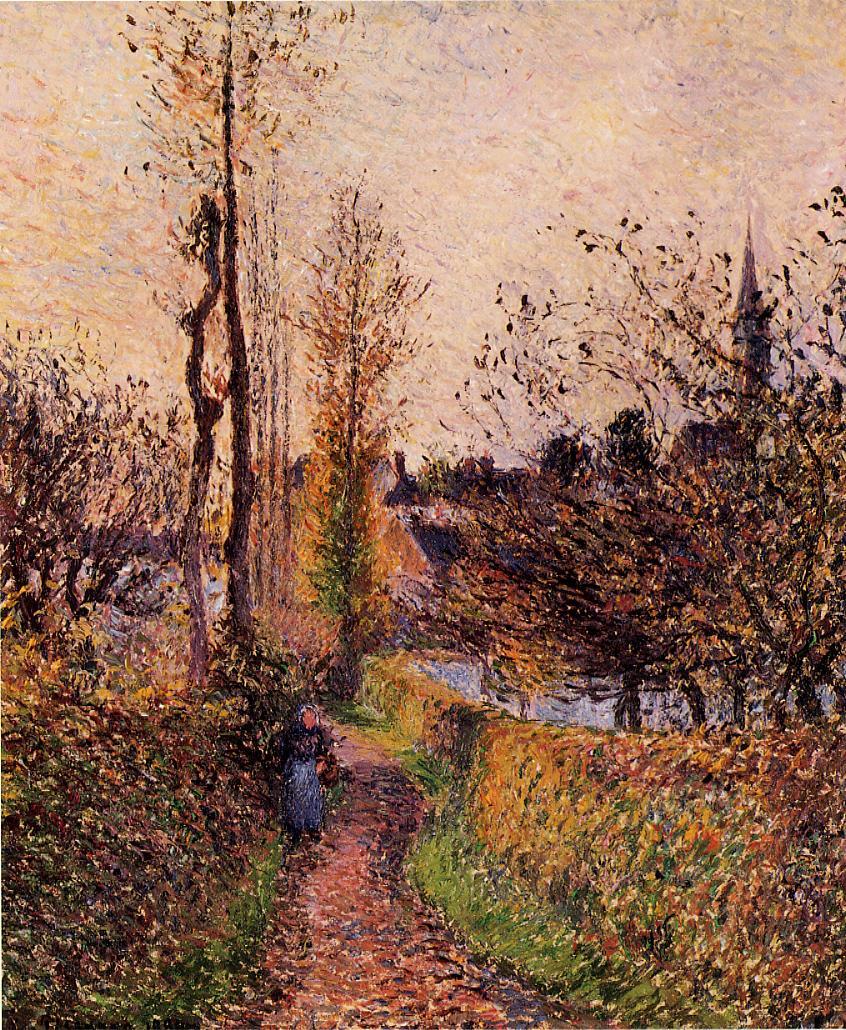
Camille Pissarro, The Path at Basincourt, 1884

Sarah Hall, Burntcoat (2021)

Preordered this even though the idea of “pandemic novels” doesn’t appeal because I’m a Hall fan. Burntcoat is narrated by Edith Harkness, a sculptor—the resonant title is the name of her studio—who, after studying the Japanese art of shou sugi ban (charred or burned wood) has become one of the UK’s premier landscape artists. Some short flashbacks describe an apprenticeship in Japan, but these moments are underdeveloped, serving more as a metaphor—the technique is counterintuitive, “damaging wood to protect it”—than as detailed reality. There are many damaged people in the novel, mostly those infected by a virulent disease, much worse than a coronavirus, that either kills quickly or lies dormant for years after infection. But the most important damaged person in the novel, certainly one who has been protected by that harm, is Edith’s mother, a writer felled by a brain disease that transforms her personality and, for a time, makes her unable to speak or write. She recovers from the trauma to become an outsider artist, whose experimental works are underappreciated until after her death. Before that she had taken her young daughter, Edith, to live in the Cumbrian fells. As always, Hall is great with northern landscapes, but where Burntcoat really shines is in her other area of descriptive specialty. Hall writes great (cishet) sex scenes—exciting, never cringe-y, hot. Quite a feat. The sex in this novel is between Edith and her lover Halit, a migrant from Turkey who works as a chef in a middle eastern restaurant. Their relationship has no sooner begun, though, than the pandemic hits and Halit gets sick. Burntcoat is about making and healing, about losing and grieving, about the depredations and losses of time’s passing that can also become transformations and developments. It’s a good if not great novel, a bit suggestive, sometimes more a sketch of something than the thing itself. Curious how it will fit in her body of work twenty years on.

Nastassja Martin, In the Eye of the Wild (2019) Trans. Sophie R. Lewis (2021)

In 2015, Martin, a French anthropologist with deep knowledge of the indigenous people of Kamchatka, was mauled by a bear while conducting field work. After initial treatment in Russia, she is flown back to France, and suffers from further, supposedly superior, operations and treatments, one of which almost kills her. She suffers, physically and emotionally. Eventually she decides she must return to Siberia, to learn, as the jacket copy of the newly released English-language translation has it, “what it means to have become, as the Even people call it, medka, a person who is half human, half bear.”

From the time Magda first told me about this book, I’ve been psyched to read it, devoted fan that I am of another book about a woman and a bear. (In that one, incidentally, the main character, a librarian cataloguing the books in a great house in northern Ontario, learns that Kamchatkans use the sharpened shoulder blade of a bear as a scythe.) Nathan Goldman brings the two books together in his terrific essay on In the Eye of the Wild. Even more valuably, he points out the central tension in Martin’s memoir/essay: on the one hand, she resists attempts to explain or understand her experience, whether the lens be therapeutic, medical, or cultural (one of Martin’s Evenk friends, for example says the bear left her, the friend, a gift by keeping Martin alive); on the other, she writes in a language of abstraction that feels quintessentially French, especially that of post-Hegelian (i.e. post-Kojève) philosophy: structuralism, poststructuralism, deconstruction, etc., language that values nothing more than explanation and understanding, even if only to resist those very concepts. Take this passage for example:

To be the human who sees the bear (or to be the bear who sees the human) is to embody reversibility: it is to describe a face-to-face encounter in which a necessarily radical alterity is actually revealed as the greatest proximity.

Let’s just say I recognize several tics of my own writing in this sentence. (And, yes, Nathan quotes the same line, but I swear I marked it in my copy before reading his piece!) I was trained as a theorist in the 90s, and I still have a lot of time for its insights, if not always its language (though I’m mindful of what Barthes said: between jargon and platitude, take jargon every time). All of which is to say I think I’d have loved In the Eye of the Wild even more had I been able to read it twenty years ago. The whole books isn’t as abstract as that quote, but it’s pretty abstract. I kept waiting for a description of the attack—the encounter as she styles it—but it never happens, not even indirectly, Grizzly Man style.

Some of Martin’s resistance to explanation stems from her experience on the land: “In the heart of these frozen woods, you don’t ‘find’ answers: first you learn to suspend your reasoning and allow yourself to be caught up in the rhythms of an existence entirely organized around staying alive in a forest in winter.” Some of it comes from her anthropological training. Elaborating on her friend’s idea that the bear gave her a gift of Martin’s survival, Martin writes:

I know that this encounter was planned. I had marked out the path that would lead me into the bear’s mouth, to his kiss, long ago. I think: who knows, perhaps he had too.

That “kiss,” I dunno. Maybe I’m just irredeemably Canadian, and want my bear kisses to be literal, or, like Lou, the librarian in Bear, to realize that however necessary the fantasy has been, when bears get kissed things have gone too far. Kiss feels a little dramatic to me. (Lacan: the word kills the thing. Kills it?) I’ve been presenting In the Eye of the Wild and Bear as opposites, and in their representational strategies and general MO they are. But they agree, fundamentally, that, as Martin puts it, “a bear and a woman is too big an event.” The challenges posed by the female-ursine conjunction aren’t the same in each text—which after all were written in different circumstances and in different genres—but both Engel and Martin consider what it means to be a self, and whether one sealed off from the world is worth anything at all.

Dervla McTiernan, The Good Turn (2020)

The third book in Australian McTiernan’s Irish-based Cormac Reilly detective series is skillfully done—less engrossing as the first but absolutely engaging. (I spent a happy Saturday on the couch with it.) Yet the police procedural is a genre in crisis—books about heroic inspectors and their harried, money-conscious superiors just don’t cut it any more for readers faced with the violence and racism of the police-incarceration complex. McTiernan isn’t immune to this crisis. She circumvents it by placing the two investigations at the forefront of the book against the backdrop of a larger narrative arc concerning police corruption. But then a wise and trustworthy superintendent of police has to step in last minute to save the day, which keeps intact the myth of rogue agents within a sound system.

Charles Portis, The Dog of the South (1979)

Ray Midge leaves Little Rock, Arkansas for Mexico, on the trail of his wife, Norma, and her ex-husband, with whom she has taken up again. Before she split, Norma palmed Ray’s credit card. Using the receipts, he tracks the pair south of the border all the way to Belize, which at the time had only recently changed its name from British Honduras. (I’d no idea.) Along the way Ray meets Dr. Reo Symes, a hard-luck case/charlatan whose medical license has been revoked for fraud and who has since poured his energies into grandiose dreams of developing an island in the Mississippi owned by mother. All he needs is for her to give him the deed. To this end, he’s on his way to Belize, where the woman runs a Christian charity, but the old school bus he commandeered somewhere along the way has broken down, and Ray is his only hope for completing the journey. Classic odd couple stuff: unlike the disreputable and excitable conman Symes, Ray is a pedant with strong opinions about Civil War strategy and plenty of observations about human behaviour (“Most children are close with their money”); the men squabble about most everything, including, hilariously, who invented the clamp—a guy from Louisiana or the Sumerians? Finally they fetch up in Belize, where a lot of dramatic things happen quite suddenly before events trail off meekly, in the way of many foolhardy adventures.

The Dog of the South is not a long book, but maybe because the quest itself never feels urgent (we get little sense of Norma until the end, except that she is both long-suffering and careless—the Midges are anything but a match made in heaven) the book drags at times. The first third is comic gold, though, real laugh-out-loud stuff, including some loving disparagement of Little Rock. Plus, Portis’s way with bit characters is unbeatable. My favourite was Melba, a friend of Symes’s mother who helps run the orphanage. A real hoot, that Melba. An insufferable Canadian hippie in Mexico runs a close second.

I listened to the audio book narrated by Edward Lewis (which is different from the version on Audible, FYI), and his intonations and pacing were perfect. Really hits that strange note between smart aleck and stick-up-the-ass that characterizes Ray. I only wish Lewis’s accent were more Arkansan. He avoids generic Southern (it feels specific, though I can’t pin-point it) but that weird Arkansan combination of flatness and drawl escapes him.

Andrea Camilleri, The Cook of the Halcyon (2019) Trans. Stephen Sartarelli (2021)

Preposterous.

Grete Weil, Aftershocks (1992) Trans. John S. Barrett (2008)

Grete Weil née Dispeker was born to a privileged bourgeois intellectual household near Munich in 1906. Her father was a well-known lawyer, her elder brother a hero of the Great War; the family believed profoundly, tenaciously, unrequitedly in German-Jewish togetherness. As a Young Person, Grete palled around with Erika and Klaus Mann, Thomas Mann’s children, and climbed a lot of mountains. In 1932 she married the dramaturg Erich Weil; he was arrested shortly after the Nazi takeover and fled to Holland on his release to found a branch of his father’s chemical company. Grete followed in 1935: the couple settled in Amsterdam, where Grete opened a photography studio. Their circle included fellow émigrés Max Beckmann and Bruno Walter. After Holland was occupied, the Weils tried but failed to get to England. They turned their efforts to Cuba. The night before Edgar was to pick up their visas, he was arrested in a roundup and deported to KZ Mauthausen, where he was murdered in September 1941.

Weil was forced to give up her business—she lent her photography skills to the underground, helping to forge documents—and took a job in the Dutch Jewish Council, which helped her evade deportation. When her notice finally came, in summer 1943, she and her mother, who had been with all this time. went into hiding. For almost a year and half they lived on a mattress in a small space behind a bookshelf in a friend’s apartment. There Weil took up writing again—it had been one of the passions of her childhood. After the war, she felt comfortable neither in Holland nor in England, where her brother had settled. To the consternation of Klaus Mann, who tried to talk her out of it, she returned to Germany in 1946. She received her husband’s family’s pharmaceutical company as restitution (one of the only instances I know of in which that process actually did anyone any good) and devoted herself to writing, including opera libretti and translations from the English (including John Hawkes). She published various novels, collections of short prose, and memoirs in the years before her death in 1999.

Before coming across this book, I’d never heard of Weil, which surprises me, given my research and teaching interests, plus the fact that Godine published three of her books in the early 2000s. Aftershocks is the third, a collection of stories and memoiristic pieces about the long afterlife of the Shoah. I was not always gripped by the book, Weil does not seem the most graceful writer (that may be down to Barrett, the translator, not sure), but I admired her unwillingness to ingratiate herself with her audience. In this she reminded me of Ruth Kluger, a writer I also did not fall in love with straight away but who has since become a lodestar. I plan to keep reading Weil, not to mention (the ultimate test) teaching her, so look for a more informed opinion in several years.

Like Kluger, Weil was willing to think the Holocaust together with American state-sponsored racism. In a text called “The House in the Desert,” the narrator, a figure much like Weil herself, arrives in Los Angeles to visit an aunt and uncle who, having settled in America, are determined to laud the place as the land of milk and honey. Walking through the city—her first mistake—she thinks that if she were Black she would rather live in the desert. Even if the chances of getting away “if things really got bad” were slim, they would be better than in LA itself; the desert would be an easier place to run from. For she is an expert in running away. Even though the war’s been over for years she isn’t likely to ever forget:

As if you could simply put aside a habit that had gotten into your very fiber. Once a body’s picked up momentum, it doesn’t just stop suddenly. It doesn’t matter that there are no more Gestapo agents asking for your papers, that no trucks are driving through the streets to pick up people [her husband’s fate]; that no one’s ringing your doorbell at night, that the concentration camps have been turned into museums where cut-off hair and knocked-out teeth are displayed in glass cases, that there’s no reason to run away any more. The running away goes on. Running away from the name. when Auschwitz wasn’t yet a name, you didn’t need to run away, but who’s going to take the name back? Who’s going to tell me it’s not my hair, my teeth. They meant it for me.

She proceeds to eviscerate the white people, her relatives among them, who inform her, with useless regret, that “it’s not possible to solve the race problem from one day to the next.” Weil is nothing if not clearsighted, speculating, in a final text, almost an afterword, which is clearly about her own experiences, that “maybe I’ve remained alive simply because I didn’t witness enough. I witnessed the persecution, but not the deportations, really, let alone the horrors of the concentration camps.”  

I’ve got another of Weil’s books here, and I’m on the lookout for her (as-yet-untranslated) autobiography.

Wallace Stegner, Crossing to Safety (1987)

Two couples arrive in 1930s Madison where the men, an aspiring poet from money and a newly-minted scholar from nowhere, have landed jobs at the university; the women meet and the four become lifelong friends. The framing action takes place in the 70s, when they gather in Vermont, as they regularly did for many years, to say farewell to one of their number, who is dying, furiously, of cancer, though that hasn’t stopped her from orchestrating their time together the way she always has. The narrator, Larry Morgan, the scholar, though he has left that behind and become a novelist, moves between the present and the past, unfolding the story of the couples’ lives together.

I read Crossing to Safety because Paul spoke of it so enticingly on The Mookse and Gripes podcast. I’m afraid I didn’t love it as much as he does (though I love how much he loves it) but I did appreciate a lot of things about it. The book really is about both couples, the women as important as the men (though I wanted more about Larry’s wife, Sally). Each marriage matters on its own, of course—maybe the most moving thing in the novel is the disconnect between what the poet’s wife wants for her husband and what he wants for himself, compounded by his deeply held wish not to disappoint anyone, her most importantly—but it’s really a novel about friendship: between two men, two women, and between two couples. As Larry notes (he talks to us, his readers, regularly), you’d expect a situation like this to get derailed by sexual desire: by someone falling in love with someone else, maybe an affair, a great smash of hurt and regret. But that’s not what happens: the book is much quieter, though there are plenty of things to grieve amid the joy they take in each other’s company. Stegner is good on the rituals of comfortable WASP American life. He’s even better on the natural world: though he is known as a writer of the West, he must have spent a lot of time in Vermont; he clearly loved the place. And he can do a fine dramatic set-piece: a difficult birth; a boat-ride in the Wisconsin winter that almost ends in tragedy; a last family bonfire, with delightedly screeching children sheering in packs through the summer night.

Why then, after offering such praise, do I say I didn’t love the novel? (I read it over a weekend, after all: it definitely kept my interest.) Not sure, but it might have something to do with the WASPs I mentioned earlier. Despite its insistence on maintaining connection and husbanding memory—the title comes from a Frost poem in which the speaker exults in protecting the things that “while the Customs slept/I have crossed to Safety with”—the novel felt remote. The characters tend to be arch and gay with each other—in this world, to be heartfelt is to be vulnerable, and being vulnerable for these characters is never good. I think it’s the complacent assumption of how life is supposed to work for (certain kinds of) Americans that grated on me, though this isn’t a Boomer novel, the characters are a generation older. And I definitely did not love the depiction of Jewishness (part and parcel of its chilliness IMO). There’s a disturbing scene early on where a striving Jewish husband and wife embarrass themselves at a faculty party—reflecting on how he and the others treated Marvin Ehrlich, Larry says, “Maybe we were all anti-Semitic in some sneaky residual way, but I don’t think so.” Well I do! Especially when he adds, “I think we simply felt that the Ehrlichs didn’t permit themselves to be part of the company.” I don’t see the novel putting much distance between itself and Larry here. Later there’s a Jewish son-in-law, a kind economist (natch) who stutters, literally tripping over himself to ingratiate himself into the family. Not crazy about any of that.

This was the second Stegner that left me ambivalent: he might just not be my guy. Haven’t tried Angle of Repose yet, though, which I gather is the masterpiece, so if I do go back to the Stegner well, that’ll be the one.

Garry Disher, Bitter Wash Road (2013)

Constable Paul Hirschhausen, known to all as Hirsch, has been demoted and sent to the middle of nowhere, three-hours’ drive from Adelaide, because he blew the whistle on some corrupt cops. No one likes him for having done this, himself included. Now he’s enduring the petty hazing of his new colleagues and keeping an eye on a mysterious person who is trying to frame him as bent. Then there’s a crime to solve, a murder made to look like a hit-and-run. That’s on top of the regular work he does: stopping desperate farmers from beating their wives and children, checking in on invalids, keeping the town quiet on football nights. Hirsch is a pleasingly ambivalent figure (he gets nicer toward the end: disappointing); Disher’s prose better than serviceable, with plenty of great Australianisms. He’s no Peter Temple, but who is? Recommended.

Natasha Brown, Assembly (2021)

The writer Olivia Sudjic bizarrely describes this debut novel as Mrs. Dalloway mixed with Citizen. The Rankine, yes, definitely (the poet is cited in the novel’s end notes—yes, you read that right). But the Woolf? Makes no sense. The action does not take place over a single day, various characters do not intersect by passing one another, the narration is not even in close third person (with the exception of a short initial section). Who cares about blurbs, I know, but my reaction to this description was like my reaction to the novel itself: I don’t get it. Bits of Assembly are really good: the descriptions of aggressions, some micro, some decidedly not, faced by people of colour will make you wince; the narrator’s boyfriend, able to be dedicated to a meaningful life thanks to great wealth, inherited wealth, wealth that comes in part from England’s colonization of places like Jamaica, which to the consternation even of immigrants the narrator is not from, knows only from family stories, is perfectly delineated: that foppish, well-meaning, smart-but-mustn’t-be-too-obviously-smart, knows-his-way-about-a-wine list insouciance that characterizes many English men of a certain class. The narrator, though, who works hard in finance, doing things with data, making a lot of money, more money than her boyfriend, he likes to joke—she is harder to pin down. She’s just been promoted, an event she has to share with another member of the firm, a white man, who is spiteful about it, muttering about “diversity.” Not even he can tarnish the good news completely, though, and she allows herself a moment to take a break from the endless climb up the ladder, a brief respite from the fear of having nothing beneath her. But only for a moment: even when she receives some lifechanging news, she can’t stop doing and worrying and putting her head down. Most immediately, there’s a party to attend, it’s not hers, though, she isn’t Clarissa, it’s a party being given by a Clarissa, her boyfriend’s parents, who are grudgingly tolerant in a way, I suppose, not dissimilar to the Peter Walshes and the Richard Dalloways.

Assembly is fine, interesting enough, but too short to make a real impression, not nearly as formally innovative as critics are making out.

Susanna Clarke, Piranesi (2020)

Most everybody loves this book, and most everybody is right. Or, I am like most everybody. My experience matches Rohan’s almost exactly: failed at reading Jonathan Norrell and Mr. Strange, donated it to the library sale, gave the new book a whirl, was captivated by it and convinced I should try her doorstopper again. As to Piranesi, I won’t say much about the plot, for that would ruin it, but I will say how much I loved the descriptions of the world inhabited by the narrator—called by The Other, the only other person he knows, Piranesi, a name he has adopted for himself, even though he is convinced it is not really his—a lonely place of sea and stone and shrieking seabirds that felt joyful and sustaining rather than bleak and damp (though it’s those things too).

In its unraveling of unraveled minds, Piranesi reminded me of Beckett’s Molloy but the better, if at first glance stranger, comparison might be to J. G. Ballard’s wonderful little story “The Autobiography of J.G.B.” (which you can read here if you can get the damn New Yorker site to work). Ballard’s text and Clarke’s novel are happy Robinson Crusoe stories, in which solitude is pleasurable and plenitude rules the day. Piranesi’s plenitude takes the form not of the physical things that wash ashore, as in Defoe, but of experiential connection: he speaks to his world and his world speaks to him. In the end, this communing is, indirectly, what does eventually bring loss into the story.

I’m not explaining this well, you really have to read the book for yourself. Piranesi lends itself to allegorizing, but it warns readers against doing so. It challenges the separation of human and world enacted by science qua knowing without romanticizing the numinous. It describes the life of those, like its author, who are shut off from the world (Clarke suffers from a chronic illness), yet who have gained something from that experience even if it doesn’t mitigate what they have lost. Mostly, though, it tells the story of a man who is alone but not lonely, a distinction it preserves even when the man’s life is, once again, turned inside-out.

Georges Simenon, My Friend Maigret (1949) Trans. Shaun Whiteside (2016)

Getting the hang of these Maigrets. The crime hardly matters, the outcome certainly doesn’t. Mostly Maigret just vibes. My Friend Maigret is pleasingly meta about this state of affairs. Maigret is tasked with showing an English colleague how he solves crimes, which incites some embarrassment on his part—he doesn’t actually want to conduct any interviews, or do any deducting, he just wants to hang out on the island in the Mediterranean he has escaped rainy and cold springtime Paris for on the flimsiest of rationales. For a while he does what he thinks the Scotland Yard inspector would want him to. But he quickly realizes that guy just wants to swim and drink and vibe too. It’s all very entertaining, and I am thankful to John Wilson for recommending it to me as an especially good installment in the series.

Charles Cumming, The Moroccan Girl (aka The Man Between) (2018)

Cumming takes on Eric Ambler’s favourite gambit—ordinary guy tumbles into espionage—and gives it a twist: his ordinary guy, C. K. (Kit) Carradine, is a successful spy novelist who is recruited to run an errand for the Service. All he has to do is pass an envelope to a woman while he attends a literary festival in Marrakesh. Of course, Kit gets more than he bargained for, and proves himself, in his naïve way, good at spying. Cumming has fun with the differences between espionage in fiction and in fact. At its best. The Moroccan Girl is pleasantly dizzying and self-referential while still offering the thrills and other pleasures of the genre. I’ve noted before that Cumming is great with tradecraft; I love how exciting his action scenes are without being flashy. (Every car chase takes place in a taxi.) Without being heavy-handed about it, Cumming makes us think about what we do when we read spy stories: Kit is never sure if what’s happening to him is ordinary or suspicious, whether an event is coincidental or conspiratorial. He’s an endless reader of events, just as spy novels ask us to be. Unfortunately, not everything succeeds in this stand-alone (though Cumming leaves himself the chance to write more if he chooses: this would be a mistake). The woman Cumming meets—and of course falls in love in, though at least that’s discreetly and non-cringingly handled—has been involved in an anarchist leftist Occupy-type group called Resurrection, which leads to a number of tedious scenes in which characters debate whether violence is ever necessary. In the end, the novel is ploddingly middle-of-the-road liberal, aghast at “excesses.”

Kiku Hughes, Displacement (2020)

YA comic about a teenager, Kiku, who travels back in time, finding herself interned in a camp in Utah. One of the other prisoners is her grandmother. Before this Kiku had known almost nothing about what her relatives had gone through—which means readers learn a lot, too: I now know where the expression “no-no boy/girl” comes from, for example. In the book’s most interesting development, Kiku tells her mother about her experience, expecting to be disbelieved, only to learn that the same thing happened to her. The mother calls them “displacements,” and thinks of them as a way to correct the shame and silence experienced by Japanese Americans in the decades after the war, responses displaced into the dive to become “a model minority.” (The book is good at explaining intergenerational trauma.) The comic is beautiful, evocatively illustrated—a cloud of cigarette smoke as enervated as the man who’s breathed it out; Kiku’s mother, eyes glued to the television as Trump stampedes to the Republican nomination, a study in disdain, all crossed arms and silent judgment. I must admit that even as I devoured Displacement I did say to myself, well this is all well and good but it’s no Kindred, only to be chagrined when I read Hughes’s hymn to Butler in her acknowledgements. Anyway, worth reading, even if you’re no longer a young adult.

Isaac Levitan, Autumn, 1899

Some perfectly good things this month, but not many standouts. Piranesi was the winner, I’d say. Here’s hoping for a more memorable December. I have several exciting things lined up, including some group reads. How about you? Did your November reading make an impression?

What I Read, April 2021

April in Arkansas, azaleas in blossom, reading at the table under the trees. April in Arkansas: this is a feeling no one can reprise. Even though I’m making no progress on this book project, I wrote a lot last month, including essays on teaching the Holocaust and on a favourite book of mine that I once considered a secret. I wrote some other things that might come to anything, but I found the process useful and I also got a small piece of good news. I bumbled along, in other words. Here’s what I read.

Héctor Abad, The Farm (2014) Trans. Anne McLean (2018)

Three siblings take turns telling this story, which centers on La Oculta, a farm in the mountains of Columbia that has been in their family’s hands for generations. Pilar has kept the place going, even as she’s also worked alongside her mother in the family bakery; she has lived the life closest to the older generations, bearing children, married to her teenage sweetheart, a woman both capable and strong, good at everything from cooking to embalming. Eva has forged her own path, building a career, surviving various marriages and love affairs, becoming a single parent later in life. Antonio has escaped to New York, where he has made his way as a musician and settled down with a good man, yet despite, or because, of that distance he is the most drawn to the farm, making annual visits and taking on the task of unraveling the family history.

In alternating chapters, the siblings tell us about their pasts, their beliefs, their relationships to others. Put together, their narratives allow us to consider the competing forces of inheritance and invention. How much of who we are comes from the people and ways of life that came before us, and how much do we generate for ourselves? The novel delights in showing continuity—but it soars when depicting rupture. Even if the farm originated in a utopian attempt to generate community, Columbia’s violent past regularly interrupts daily life. This intrusion is most vividly evident in Eva’s memory of narrowly escaping a rebel attack on the homestead. (Terrific set piece.) Abad is a marvelous writer, and McLean a marvelous translator. I sunk into this sprawling novel—the beauty of the Archipelago edition adding extra sensory pleasure to the experience—and was sad when it ended.

Vanessa Springora, Consent (2020) Trans. Natasha Lehrer (2021)

Powerful memoir about the abusive sexual relationship between Springora and a famous writer whom she calls G. M. but is widely known to be Gabriel Matzneff. (Apparently, he was a big deal in the French literary scene; I’d never heard of him.) His identity as a “lover” of children was widely known too, at least among French artistic and political elites. These overlap much more than I, as a North American, would have expected; Matzneff had a letter in his wallet from Mitterand, lauding his artistic daring; he seems to have thought of it as a get out of jail card, except nobody ever put him in jail.

Matzneff’s career—he published several novels, all autobiographical, many overtly about pedophilia, as well as regular installments of his diaries—was built on the suffering of children and adolescents. Signora was one of many boys and girls he slept with, both in France and on sex tours in Asia; he was quite open about all of this. Springora met Matzneff in 1986, when she was 14. He seduced her intellectually, emotionally, and sexually; they were together for two years; the relationship damaged her badly, could, in some senses, have been said to have destroyed her life. This memoir proves it didn’t—but shows the cost. In fact, it was not until Springora realized that the way to get justice for herself was to speak in the only language that could touch Matzneff—that of writing itself—that she found any relief from her trauma. As she puts it, in a formulation comprising the grace and irony of classic French intellectual style, “Why not ensnare the hunter in his own trap, ambush him within the pages of a book?”

In so doing, she has had some effect, not only on Matzneff (he remains unrepentant, but the government took away a sinecure and his publisher dropped him) but on France more generally, where the book has been a best-seller and led people to acknowledge the ills that can be cloaked the mantle of freedom. In this regard, France’s so-called intellectual elite have a lot to answer for. The mantra of the 68ers, “it is forbidden to forbid,” was used by Matzneff to present child abuse as liberation, care, even love. A real who’s-who of the literary and philosophical scene signed open letters in support of these ideas back in the 70s. (Interesting that Foucault refused. Sad that Barthes did not.)

Consent, Springora observes, is an ambivalent term, sometimes signifying volition but often connoting something less than full agreement. After all, consent can be given on behalf of others, especially minors. Ultimately, consent is a mirage, a fig-leaf allowing those with cultural and literal capital to sweep away the reality of power imbalances. Consent is a sobering read, valuable for its indictment of the world that looked on while its writer suffered—from leering teachers to her overwhelmed and willfully blind parents. Its tone is uneven, sometimes epigrammatic, sometimes abstract, sometimes lyrical, but Springora doesn’t pretend to be a literary artist. That’s what she wanted to be, before Matzneff dispossessed her of her own words, not least by training her to write in a style he deemed timeless and elevated. (They sent each other hundreds of letters; he later published some of hers without permission.) To even consider Springora’s style feels fraught: to critique it is to risk playing the same game as her abuser (and his enablers), who argued that artistic beauty, passion, and fearlessness mattered above all. Yet it’s also important to advocate for style without thereby agreeing that its value trumps anything else.

Consent ends with a brief, illuminating afterword by translator Lehrer; I wish more books let us hear from the translator.

Flynn Berry, Under the Harrow (2016)

First of the three psychological thrillers by Berry I devoured this month. Under the Harrow is a fine debut; its tricksy narration makes it the most Highsmithian of her books. Berry’s prose is plain but not flat. Here the narrator looks out the window of a train:

Land streams by the window. Sheep arranged on the stony flank of a hill. The troubling clouds surging behind it. A firehouse with a man doing exercises in its yard. He pulls himself above a bar, lowers himself, vanishes.

The disembodied man, swallowed up by movement and perspective, is a suitably unsettling touch, offering a glimpse of what’s to come: the world the narrator thinks she knows is about to become similarly unmoored.

Guzel Yakhina, Zuleikha (2015) Trans. Lisa C. Hayden (2019)

My second Hayden translation in as many months; again, I read this as part of a Twitter reading group, and, again, I was glad I did. Zuleikha is a page-turner that comes at its historical events—the dekulakization of the peasantry under Stalin and the creation of the Gulag system—from what, I believe, is an unusual perspective. The heroine, who lends her name to the title, is a Tatar, a culture I knew basically nothing about; when I think of the famines of the late 1920s and early 30s, I think primarily of Ukraine, not Soviet Tatarstan. And since that culture is shown to be harshly patriarchal, Zuleikha is an even more intriguing, marginalized character. Too bad that the novel seems to find no way for Zuleikha to leave behind her status as “pitiful hen” and become as strong and independent as she does other than to abandon her Tatar identity.

Zuleikha is engrossing historical fiction that is never quite predictable. For example, it is more interested in relationships between mothers and children than between men and women. Its descriptions of the landscape are loving and evocative. Its plot is both eventful and uneventful: much of the action centers on how to survive—how to cut trees when your tools are bad; what to grow in a northern climate; how to hunt and gather on the land; even, in the days before exile, how to prepare the bathhouse for a steam session—but those everyday tasks take place against a backdrop where terrible events always threaten to intrude. In the end, I thought the “band of misfits pitches together against all odds” aspect of the story of the settlement was a bit cute. (Even though I still loved it.) And Yakhina’s use of focalization didn’t always work. We are mostly in close third person (present tense, natch, ugh), but that sometimes becomes implausible when Yakhina needs to tell us stuff that her heroine might not need or care to think about. Here she is in prison in Kazan, before being transported to Siberia:

The Tatar language is even constructed so you could live your whole life without once saying “I.” No matter what tense you use to speak about yourself, the verb will go in the necessary form and the ending will change, making the use of that vain little word superfluous. It’s not like that in Russian, where everybody goes out of their way to put in “I” and “me” and then “I” again.

There might be a point here about the role of the individual in resisting a collective system. Or maybe a critique of the project of Russianizing the Soviet Union’s plurality. Mostly though this moment is clunky. But I hope Yakhina’s second novel is translated soon. Hayden, who again generously offered her expertise to the Twitter group, would be the obvious choice to take on the project. Are you listening, Oneworld?

Henia Karmel and Ilona Karmel, A Wall of Two: Poems of Resistance and Suffering from Kraków to Buchenwald and Beyond Introduction and Adaptations by Fanny Howe Trans. Arie A. Galles and Warren Niesłuchowski (2007)

More about the Karmel sisters and their poetry here.

Flynn Berry, A Double Life (2018)

Berry’s take on the Lord Lucan case. Creepy and satisfying. Berry’s best, IMO.

Anna Goldenberg, I Belong to Vienna (2018) Trans. Alta L. Price (2020)

Another third generation Holocaust memoir. The difference here is that Goldenberg’s grandparents, after a short postwar dalliance in upstate New York, returned to Vienna, where their children and grandchildren still live. When Goldenberg herself moves to New York to study for an MA, people, other Jews mostly, ask her in appalled fascination: How can you [i.e., Jews] live there [i.e., among the killers]? Which prompts Goldenberg to speculate—not as interestingly as I’d have hoped—on what it means to belong, both to family and to place.

The other noteworthy thing about the story is that the most interesting person in it isn’t technically even in the family. When Goldenberg’s then 17-year-old grandfather, Hansi, received his deportation papers he ripped off his star, hopped on the streetcar, and made his way to a close friend, the pediatrician Josef Feldner. (Hansi had his parents’ blessing: they rightly suspected his chances were better in hiding. Indeed, he never saw them again.) Feldner, a Catholic child psychologist, was a remarkable man. He kept Hansi safe for the rest of the war, and prompted the previously mediocre student into his future medical career by taking the boy with him to see his patients, which he treated in a gentle, humane, and courteous manner that would be rare today, to say nothing of then. Pepi, as Goldenberg’s grandfather came to call him, eventually adopted Hansi. For the rest of his life the two men were inseparable: even after Hansi married Goldenberg’s grandmother, herself a doctor, the two ate breakfast together every morning (Pepi lived downstairs) and took vacations together. In the original German the book is called Versteckte Jahre: Der Mann, der meinen Großvater rettet (Hidden Years: The Man who Saved my Grandfather), which rightly captures its emphasis. Anyway, while I don’t regret reading this book, I note that until I sat down to write this review I’d forgotten all about it.

Flynn Berry, Northern Spy (2021)

The wider political backdrop of the novel—set in Northern Ireland at an unspecified time that seems like it could be just before the Good Friday agreement, but which also can’t be (technology doesn’t match up, for example)—gives Berry’s new novel extra heft. Impressively, she does this without any bloat. I just love how short her books are. She’s such an efficient writer.

In Northern Spy—turns out this is also a kind of apple, fitting for a book which shows the domestic and the political to be so entwined—Tessa, a BBC producer just back from maternity leave, is shocked when she sees her sister in footage from the latest IRA attack (a gas station hold up). She’s floored by this revelation, of course, but things prove to be even more complicated. Before long, Tessa is volunteering to infiltrate the IRA. In a tense interrogation, she is asked by the man she will report to why she wants to become an IRA informer. Tessa experiences no cognitive dissonance in the moment:

This isn’t so difficult. I’m a woman, after all, so I’ve had a lifetime of practice guessing what a man wants me to say, or be.

Berry’s smart and engrossing thrillers are among my favourite discoveries of the year.

Robin Stevens, Murder is Bad Manners (UK title: Murder Most Unladylike) (2014)

British boarding school crime fiction written for middle-grade readers but with wide appeal. I bought this for my daughter a few years ago when I read about it in the TLS (their irregular children’s column is excellent; I hope the new editor won’t get rid of it). Something made her pull it off the shelf last month and she immediately got stuck into it. Then she raced through the other four titles available in the US. While we waited for the others to arrive from the UK we decided to read them together, aloud. And they are a delight: suspenseful in themselves, though not too scary (even as they are thoughtful about the toll that even playacting as a detective could take) but with plenty of nods to Golden Age sleuthing that older readers are likely to enjoy. Set in the 1930s at a school called Deepdean, the books are narrated by Hazel Wong, who at the time of the first volume is newly arrived in England from her home in Hong Kong. Hazel plays Watson to Daisy Wells, the book’s beautiful, brainy, incorrigible Sherlock and self-appointed President of the Wells & Wong Detective Society.

After earning their stripes in dull but useful cases like The Case of Lavinia’s Missing Tie (Clementine took it in revenge for Lavinia hitting her during lacrosse practice, after Clementine said Lavinia came from a Broken Home), the girls take on a crime of a much greater magnitude when Hazel stumbles on the dead body of a teacher—a body that disappears in the time it takes her to find help. The headmistress thinks nothing is amiss because she finds a resignation letter from the teacher on her desk the next morning. But Wells & Wong know better. And things soon get pretty hairy. Will they solve the case before the killer strikes again?

Hazel is much smarter than Watson and Daisy less unerring than Sherlock. Which makes the books often funny, but also moving, especially in their depiction of a friendship between a popular girl who seems to have everything together and a shy one who seems to be a bit hopeless. Each needs the other—for me, the books are about shared vulnerability—and I’m looking forward to seeing how Stevens develops their story.

Ruth Rendell, One Across, Two Down (1971)

Someone on Twitter put this on their highlights of 2020 list—please remind me who you are—and I was intrigued enough to check out a copy from the library. At which point it sat around the bedroom for months until, at a time when I was supposed to be reading something else, I realized I absolutely could not live another minute without taking it up. And I was glad I did: it’s an impressive book.

Vera lives with her layabout husband, Stanley, and nagging mother, Maud. Stanley and Maud hate each other and make poor Vera’s life even worse with their endless arguments. But when Stanley learns that Maud has socked away a lot of money and plans to leave it all to Vera, he swaps her stroke medication with saccharine pills, just to see if he can hurry the process along. Pretty soon, though, events escalate, in ways he never expected. Although technically not responsible for the old woman’s death—I won’t give away the details here—in all the ways that count he’s absolutely responsible. Most of the novel is about how he gets found out. Stanley’s awful; spending time with him is not pleasant. But Vera gets a surprisingly happy ending, so the book isn’t entirely grim. Along the way, Rendell asks us to think about what draws readers to crime fiction. Is it any different from the many seemingly harmless but ultimately consuming obsessions—like the crossword puzzles Stanley wants not only to solve but to set—that litter the book? Lots going on here, in unfussy but quality prose. If One Across, Two Down is anything to go by, early Rendell is the real deal.

Becky Chambers, To Be Taught, If Fortunate (2019)

Standalone novella in the Wayfarers series, which I have not read but definitely will, as soon as my library holds come in. Recommended to me by a brilliant former student now in graduate school who has just taken a course on science fiction. Someone online described Chambers’s books as sf cozies, which makes sense to me. Some might take this as criticism, and maybe that’s how it was meant, but what I liked most about To Be Taught, If Fortunate is its fundamental kindness. This is a book fascinated by otherness and worried about how vulnerable it is to even well-intentioned encounters.

In 2045, four astronauts are sent to explore the life forms—some quite minimal, all hard for us to fathom, all valuable in their own right—on the moons of a distant planet. At some point in their exploration—and because of the distances involved, time is passing much more slowly for them than it is back home: taking on the mission means that none of them will see their families again—they realize that they aren’t getting messages from earth anymore. A companion mission, sent elsewhere in the galaxy, confirms that they too have lost contact. Should they try to return to what might be a destroyed home, or continue on, knowing that once they do there’s no going back?

The descriptions of the alien lifeforms are fantastic. I really thought this was a wise book. The only sour note is a coda referencing the title. The phrase comes from a welcome speech made by then-UN Secretary Kurt Waldheim and placed on board the Voyager spacecraft. If you’re going to mention Waldheim in a book about respecting difference, you should mention his Nazi past.

Jacqueline Winspear, The Consequences of Fear (2021)

I have to stop reading these. The circle of recurring characters has become so wide that keeping up with them means the crimes (never Winspear’s strength, or, to be fair, interest) are solved much too offhandedly. For whatever reason, the thing about the series that first drew me to it—its investigation of responsibility—just irritated me this time. I could see what Winspear was doing with the concept of fear—asking whether our duty to a nation is enough to make us repress our feelings; wondering if personal responsibilities outweigh political demands—but I couldn’t bring myself to care. Maybe because I saw the novel’s depiction of WWII as the product of philosophical liberalism, which I was feeling frustrated by because I was just coming to end of reading…

Hannah Arendt, The Origins of Totalitarianism (1951, revised 1958)

I spent a lot of time this month with Arendt’s quasi-history, quasi-philosophy of totalitarianism. It’s long and hard. I was sometimes frustrated by Arendt—she’s from a different philosophical tradition than the one I was trained in; she’s completely uninterested in psychology, which is baffling to me; our thinking isn’t the most sympatico—but I was often amazed. In the end, this was such a rewarding reading experience.

Which I would not have had if I hadn’t signed up for a course offered through the Brooklyn Institute of Social Research, taught by Samantha Rose Hill, who teaches at several schools in the New York area, runs a center for Arendt Studies at Bard, and has a book about Arendt coming out this summer. (Her recent Five Books interview on Arendt is exemplary.) The ideal teacher, in other words, and she taught us a lot. I enjoyed being in a class again, although I noted that some of the same anxieties that plagued me in college and graduate school resurfaced. I still fear the things I have to say are beside the point and unhelpful—but I’m not as shy anymore and say them anyway.

But what’s important here are the ideas, not my reading experience. In nearly 500 small-font pages, Arendt unfolds a sweeping argument about the connection between antisemitism, imperialism, and totalitarianism.

Alas, I don’t fully understand Arendt’s take on antisemitism. I had to miss most of the class in which we discussed this—fittingly (?) to run a Holocaust memorial program—and I haven’t finished the section. But a key idea is that, counterintuitively, Jews thrived in Europe as long as nations did. (Well, thrived, I don’t know about that, and the Jews Arendt talks about comprised a thin stratum of rich, Western European Jews. Of the Jews in Eastern Europe and the Pale of Settlement, i.e., almost all European Jews, she has little to say: Arendt was always what the Israelis call a Yekke.) The cosmopolitanism of Jews, so often held against them, and forced upon them by the fate of their diaspora, paradoxically enabled them to flourish as bankers to nation states. But when nations were replaced with Empires, specifically in the 19th Century, that relationship failed. Jews were then taken to have privilege tethered to neither role nor responsibility, earning them even greater enmity. They were left to become either parvenu (upstarts who try to fit in everywhere) or pariahs (those defiant rejects who don’t fit in anywhere). Arendt is sympathetic but disdainful to the parvenu, and fascinated by the pariah.

Both positions are responses to statelessness, an affliction that Jews especially in the 1930s but that others too throughout the 20th century experienced as the nation state came under crisis. Moreover, as Jews had been granted equality over the course of the 19th century, they proved that otherness persisted despite putative equality. (They were equal under the law but they maintained their traditions and beliefs.) Because the nation state—government by consent—is predicated on homogeneity, it responds poorly to pluralism. As pluralism increased in the 19th century, nations responded by looking beyond their borders. The result is modern imperialism, which is not the integrated pluralism of Rome but a fractious destabilized agglomeration that eventually turns on itself.

Modern imperialism mostly took place overseas (Africa, the Middle East.) It occurred as a combined political and economic crisis. After centuries of increasing economic power, the bourgeoisie finally wanted political power as well. In a brilliant reading, Arendt says that the bourgeoisie found its philosophical underpinning in the ideas of Hobbes (or, put differently, that Hobbes had prophesized the bourgeoisie). In Hobbes’s “war of all against all” the only possible “philosophy” is individual growth, resulting eventually in tyranny. The bourgeois worldview is fundamentally destructive, because fundamentally acquisitive. It believes only in endless growth: more has to become more. (Sound familiar?)  Overseas imperialism allowed this antihumanist thinking to flourish, at least temporarily, and at the cost of great suffering and destruction to the local or “native” people. (Which Arendt is frankly pretty uninterested in.) The imperialist encounter with non-European others led to the development of racism from what had previously been race thinking. That is, individual instances of prejudice became turned into an ideology. Race became weaponized by the state as a form of violence. (Racism is totalized race thinking.) As an ideology, racism must be understood as necessary/inevitable, not like race thinking, which was the result of individual instances of prejudice, bias, or domination.

When the domination of racism combined with the inherently metastatic avarice of imperialist capitalism, an inherently unstable contradiction arose. (We think the world is infinite, but its resources are finite—we live every day the dawning realization of that contradiction—this is the kind of instability Arendt has in mind.) Eventually the instability of racist imperialism, which had been a kind of safety valve for the European nation (now Empire), bounced back, such that the tactics of violence, oppression, and power previously used overseas were perpetrated on civilians in the homeland. (The power of police and paramilitary forces rose greatly in this period.) Unlike nations, empires are no longer organized around classes—that structure collapses, and along with it the primary way we have developed of organizing people so that individuals feel they belong and find meaning. The loss of this meaning is, Arendt warns, very bad. With it the distinction between public and private life that is the foundation of freedom vanishes. Those realms are replaced by what Arendt calls “the social,” which is an atomized levelling: no more classes, only masses. The masses are desperate to regain the meaningful experience they have been cut off from. Enter totalitarianism. Totalitarian regimes work on people who have no meaning. Totalitarianism—the governmental form of imperialism—is what happens when expansionism takes political form. The belief in endless growth, avarice, accumulation is turned to conquering and subordinating every subject of the regime.  

As far as Arendt is concerned, from her vantage point in the 1950s, there have only ever been two totalitarian regimes: Nazi Germany (from its inception, perhaps, but certainly from 1935 – 45) and Stalinist Russia (from about 1930 to Stalin’s death). Totalitarianism is not, for her, a synonym for autocracy, tyranny, or even dictatorship. Totalitarian regimes are barely regimes at all: they are movements. Neither nation nor empire is their real focus. Instead they focus on the party. Nazism and Stalinist Communism are at stake, not the Reich or the USSR. When a totalitarianism movement comes to power, they do everything they can to change reality. The ideologies animating totalitarian movements are about what will be, not what is. Totalitarian movements promise a future but they are not in fact interested in attaining it. Or, rather, their philosophy of aggression and accumulation, their inexorable drive to dominate, means that they cannot in fact countenance any final or complete end.

An important consequence of this mindset is that the enemies of the movement are never final. Strikingly, Arendt argues that the Jews, although the primary victims of the way Nazism played out, were not the Nazis’ sole or even primary enemy. It’s true that, historically, Jews were not the first victims: those were communists and socialists and, importantly, the mentally and physically disabled: the latter was the first group singled out for being killed tout court. The refusal of ordinary citizens to accept this state of affairs meant that the party delayed the plan, but they never shelved it. And there were definite plans to exterminate what the Nazis called “the Slavs” after they conquered Russia and finished with the Jews. (A genocide they began in Poland in 1940.) Arendt also points to memoranda and bits in Mein Kampf where bureaucrats and Hitler muse about eliminating people with various incurable illnesses, or even predilections toward them, like cancer. Arendt’s point is that regardless of what the Party says publicly there will always be more victims. It is in the nature of totalitarianism to find them.

In doing so, totalitarianism relies on a belief in secret meanings. That is how it begins to change reality. What you see is not the real truth of things. (To use one of Samantha’s examples—you think you see a pizza place in DC but really you see a front for child sexual exploitation; how much Arendt’s diagnoses pertain to the US today exercised the class a lot, but that’s a different topic.) Totalitarianism forces its adherents, and everyone who lives under it, to affirm the false. Experience, under totalitarianism, only affirms ideology. It has no meaning in itself. The result: thinking is replaced by thought (the already known, the prepackaged, the tidy explanations of ideology). For Arendt, that is one of the worst things that can happen to human beings. (Note, by the way, that those who wield thought can be smart, and they’re not cynical either (which is terrifying, IMO). But they are incapable of thinking. Which, it seems to me, means that for Arendt they are barely human.

It’s all fascinating, and quite compelling. For me, Arendt fails to consider how power creates as much as represses. (She is not Foucault). That is, she fails to account for the meaning people find in even hateful or oppressive thinking. She also ignores the effort totalitarian movements put into creating a community of believers. (There’s nothing in her book about, say, the Hitler Youth or the Bund deutscher Mädel or the Kraft durch Freude vacations or any of the myriad ways Nazism, to take only the example I know best, created the Volksgemeinschaft (the community of the people).

Plus, Arendt’s understanding of the camp system comes too much from the model of Buchenwald (and to some extent Auschwitz). No surprise, given her background and sources, and the reality of what she was able to read in the late 40s and early 50s. And her knowledge is impressively nuanced for the time. But she is led astray, in my opinion, by relying so heavily on the work of David Rousset, whose fascinating book about his time in Buchenwald I want someone to reissue in English ASAP, but whose experience as a communist prisoner in that particular camp (there was strong communist leadership, even a kind of resistance movement, in Buchenwald) is anomalous in comparison to the general KZ experience.  

Anyway, as Samantha put it, Arendt asks key questions. Is there a way of thinking that’s not tyrannical? How can we protect spaces of freedom? How can we live under something other than imperialism or totalitarianism? These remain resonant, indeed urgent. The Origins of Totalitarianism gave me so much to think about; I’m grateful to have had the opportunity to read it closely.

Charles Portis, True Grit (1968)

I wanted to spend my birthday with some good light reading, so I chose three possible contenders from my massive TBR pile and put up a Twitter poll to help me decide where to start. Portis’s novel about a teenager avenging her father’s death in Reconstruction-era Arkansas and the Indian Territory of Oklahoma won by a landslide. And the people knew what they were talking about! True Grit is a delight, often laugh-out-loud funny. I would have loved it even more had I not seen the movie (the Coen Brothers version), as some of the best jokes and the plot came back to me as I read. But the film can only approximate the novel’s primary pleasure: Portis’s masterful use of voice, evident in both Mattie’s narration and the characters’ conversations. (This is not a Western about strong, silent types: nobody ever shuts up.) An added pleasure was reading about Arkansas locations (and types) I know; I noticed that some of the bit characters even had last names I recognized from living and teaching here.

I suspect that a second reading—which the novel definitely merits—would give me a lot more to think about. But even on a relaxed first reading I recognized that much of what makes the book so interesting comes from the difference between the time of the telling and the time of the events. Mattie is fourteen when she sets out to find Frank Chaney, but an old woman when she tells us about it. In part it explains, or makes us wonder about, Mattie’s engaging but puzzling mixture of naivete and pursed-lipped moral certainty. Is that the difference between the girl and the old woman, or did she always combine these contrary aspects? The disparity between past and present is especially evident in a final scene at a traveling fair in 1920s Memphis: the “wild west” of the novel’s main action has become fully commodified. But was it ever any different? After all, the novel’s many crimes are prompted by money, even if they hide under the veil of honour. Too many guns, too much economic inequality: in this sense, True Grit still rings painfully true.

Let me quote a couple of choice bits, just because.

Here’s Rooster Cogburn, the one-eyed US Marshall Mattie hires to help her find Chaney, complaining about paperwork:

If you don’t have no schooling you are up against it in this country, sis. That is the way of it. No sir, that man has no chance any more. No matter if he has got sand in his craw, others will push him aside, little thin fellows that have won spelling bees back home. [Little thin fellows! Much funnier than “thin little fellows.”]

Here’s Rooster, on first meeting a Texas Ranger named LaBoeuf who is also on Chaney’s trail of, learning that there’s a bounty out on the man because he’s also shot a Texas senator:

“Anyhow, it sounds queer. Five hundred dollars is mighty little for a man that killed a senator.”

“Bibbs was a little senator,” said LaBoeuf. “They would not have put up anything except it would look bad.”

And here’s Rooster telling about the time he ran an eating place called The Green Frog, but had to give it up after his wife left him:

“I tried to run it myself for a while but I couldn’t keep good help and I never did learn how to buy meat. I didn’t know what I was doing. I was like a man fighting bees.”

Fighting bees. Perfect. Reading True Grit is the opposite of fighting bees. Easy, full of sweet and honey.

So that was a pretty damn good month. Arendt: titanic. Abad: deeply satisfying. Portis: such fun. Rendell and Berry: old and new masters of suspense. The Karmel sisters: what have you done to my heart?