What I Read, January 2026

Gonna knock out some posts on this year’s reading before we hit the half-way mark of 2026. Here’s what I remember about January in St Louis. A snow storm came through near the end of the month. It was cold for a while. That was great. I ran as often as the street cleaning allowed. I spent some time applying for a job that I would later get. That was very good. And I read these books.
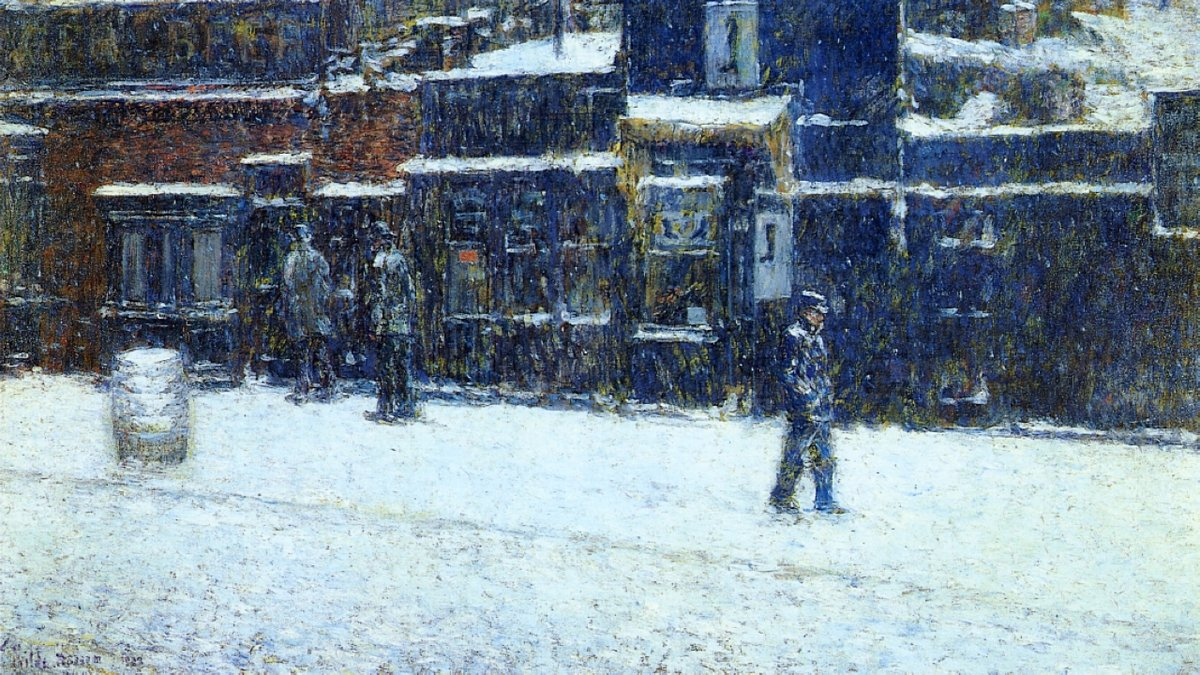
Childe Hassam, Messenger Boy (1902)

Georges Simenon, The Two-Penny Bar (1932) Trans. David Watson (2014)

What, you expect me to remember the plot of a Simenon I read five months ago? What I do remember is that this is one of the atmospheric-outskirts-of-Paris Maigrets. The search for the killer of a moneylender (Jewish, natch, boo) whose body has been seen being dumped in the river leads Maigret to a group of friends who spend weekends and holidays at an inn (the bar of the title) near Morsang, a village on the Seine about 40 km from the capital. They fish, paddle about, play cards, chase children, eat fulsomely, drink a hell of a lot, and sleep with each other. Maigret insinuates himself into the group, which is no trouble for him since he loves all those things too. (Except the adultery part. Maigret could never.) The vibes are immaculate, and the crime gets solved too.

Seichō Matsumoto, Tokyo Express (1958) Trans. Jesse Kirkwood (2022)

Born in 1909 in Japan’s Fukoka prefecture, Seichō Matsumoto did not publish until 1950. But then he made up for lost time, publishing over 450 books in the next four decades. These range from procedurals to psychological slow-burns in the vein of Patricia Highsmith or Celia Dale. Until recently, Matsumoto was hard to find in English. Happily, Modern Library (following on the heels of Penguin UK) has launched a program of reissues and they’ve started with one of his best. Tokyo Express (1958) begins with the discovery of the bodies of a man and a woman on a remote beach. Investigators rule the deaths a lovers’ suicide. But two detectives—one local to the scene, older, out of fashion; the other from the city, young, full of new ideas—aren’t buying it. Before long, they think they know who did it—but not how. Part odd-couple buddy story, part oblique criticism of a society desperate to repress its wartime past, the novel is famous for its plot, which centers on the detailed scrutiny of train time-tables. Trust me, this is a lot more exciting than it sounds. Tokyo Express is so clever you’ll be left shaking your head in appreciation at Matsumoto’s skill—and counting down the days until the next reissue appears.

Ray Nayler, Where the Axe is Buried (2025)

Nayler’s second full-length novel—after the excellent The Mountain in the Sea, about octopus intelligence—offers what are coming to seem his trademark elements: compelling characters; clear explanations of how systems function, whether these be ecological, political, or technological; and deep knowledge of political organizations and local customs gained from his other career in the foreign service. Set in an unspecified future in which many parts of the world are run by AI systems designed to maximize resources and human flourishing whereas others rely on more old-fashioned methods of coercion and surveillance, Where the Axe is Buried is a compendium of authoritarian strategies—and the resistances they inevitably provoke. Whether you read for the heart or the head, you’ll find much to appreciate here.

Anthony Trollope, The Way We Live Now (1875)

The subject of Episode 42 of One Bright Book. In my introduction to the episode, I said:

The central concepts of this terrific novel are cowardice and cruelty. Which is not to say it is a cruel or cowardly novel. How could it be, given Trollope’s amused interest in even the worst of the rogue’s gallery that makes up its cast of characters? But there sure is a lot of cruelty in its pages. Maybe we should be glad that even its worst characters don’t seem to take pleasure in their cruelty. (They are not Stephen Miller cruel.) But they are cowards, and in their desire to have things go their own way they will say or do anything, especially if it means they can avoid making a hard choice. Saying enough’s enough to someone else’s bad behaviour; taking responsibility for one’s own actions: these are things almost no one in this novel will do. That cowardice is what leads to cruelty. Something to think about re: our own day. Turns out The Way We Live Now is also about the way we live now.

Anne Youngson, Meet Me at the Museum (2018)

Anne Youngson was unknown to me when I noticed her two novels on the shelves of Leviathan. I figured James had a good reason for stocking them, so I asked him to tell me more. His response: “Light reading that doesn’t insult your intelligence.” Since that is my favourite kind of reading, I immediately moved them to the top of the TBR pile.

I started with Meet Me at the Museum because I love epistolary novels. As a teenager, Tina Hopgood wrote a letter to Professor P. V. Glob at the Silkeborg Museum in Denmark about the Tollund Man, which he had recently gained fame for identifying after the 2500-year-old body was found, perfectly preserved, by two peat-cutters in a bog. Glob—a real guy: his book was reissued by NYRB a while ago—wrote back, prompting the young woman to promise herself that she would visit the museum one day. Since then forty years have passed. Tina, now a middle-aged English farmwife with grown children, writes the professor again, this time because the friend she had planned to take the trip with all those years ago has just died. A reply to her lament for lost time arrives—but not from Glob, because he too is dead.

The letter writer is a curator named Anders Larson, who expresses mild interest in her past encounter with his famous predecessor and condolences on her recent loss. From this kind but detached beginning stems a lengthy correspondence in which two modest and decent people open up to each other about their shared puzzlement at how they came to have more life behind than ahead of them. The obvious comparison to Meet Me at the Museum is 84 Charing Cross Road and if you liked that one you’ll like this too. Like its more famous forbearer, Meet Me is gentle and modest in its ambitions and prose—but thrilling precisely because it doesn’t try to do too much. Its sincerity becomes it. As usual, James is right: it never insults your intelligence.

Youngson was in her 70s when she published this, her first book, written after her retirement from a career as an executive in the car industry. I’ve written before about how much the idea of the late bloomer means to me. (Maybe I’ll still do something with my life!) Learning about the author’s circumstances made me enjoy this lovely book all the more. I think a number of you would dig it, too.

Robert Jackson Bennett, The Tainted Cup (2024)

Rex Stout with monsters. The most dangerous place in Khanum is its sea-walls, where soldiers and engineers must constantly guard the empire from malevolent leviathans that inflict terrible damage any time they manage to breach the defenses. Yet these monsters don’t just threaten Khanum. They are also the source of its most powerful technologies. Alchemists have figured out how to synthesize the beasts’ blood and organs into bodily modifications that grant supernatural abilities and are thus coveted by the Empire’s citizens even though they are so powerful they often cause early death.

The narrator, Dinios “Din” Kol, has chosen to be modified as an Engraver: he remembers everything he ever hears, sees, smells, tastes, and touches. For obvious reasons, Engravers serve in law enforcement, typically serving as assistants to Investigators. At the beginning of The Tainted Cup, Din meets Anagosa “Ana” Dolraba. She is brilliant, idiosyncratic, vaguely disreputable. And she has asked for Din by name. Ana needs an Engraver more than most Investigators, because her agoraphobia and neurodivergence (she is so easily sensorily overstimulated she needs to wear a blindfold) generally keep her inside and away from crime scenes. (See what I mean about Nero Wolfe? And Sherlock Holmes for that matter.)

The pair have been tasked with solving the murder of a prominent Engineer. The man was found dead while visiting the home of a powerful oligarch, killed by dapplegrass, a modified plant that explodes from the inside anything that inhales or consumes it. Shortly thereafter, a section of seawall is breached and several of the Engineers responsible for protecting it are found dead in the same way.

I loved The Tainted Cup from start (a wonderful map) to finish (a teaser for the next volume). The solution to the crime is as good as the world-building: an impressive feat. A lot of books that try to do just one of those things don’t succeed. This is Bennett’s third series. I’ll be getting to them all.

Hans Peter Richter, Friedrich (1961) Trans. Edite Kroll (1970)

Postwar German children’s classic about the persecution of a Jewish child in 1930s Germany. The unnamed narrator has a best friend named Friedrich: the boys, born one week apart in 1925, grow up in the same apartment building, in an out of each other’s lives. At times, the narrator wishes he were part of Friedrich’s family. He looks up to his friend’s parents, warmer and wiser than his own. But the boys diverge as they age and Nazism takes hold on German life. For a time, the narrator manages—like his father, who remains friendly to Friedrich’s parents even after throwing in his lot with the Nazis, thanks to whom he has found work after long-term unemployment—to reconcile his friendship with the new norms of public life. But the contradiction can’t hold: the best part of the book concerns Kristallnacht, when Friedrich finds himself, in a moment of genuine ecstasy, that is, of being thrown outside himself, joining in with the destruction of Jewish property and life, starting with Friedrich’s home.

Richter served in the German army (he lost an arm on the Eastern front); after the war he studied psychology and sociology, but found his calling as a writer for children. Friedrich, the best known of his books, was for years a classroom staple in Germany. It’s easy to see why: it exemplifies the universalist school of representing Jewish life in the Nazi period: that is, it believes German Jews were as ordinary and as German as anyone else; their Jewishness was contingent and incidental to their lives. (In the guise of openness and acceptance, this view manages to reject the idea of Jewishness as meaningful in its own right.) It is also frank about German culpability. Which makes sense, given the audience it was written for. For the same reason, though, it’s not the book contemporary readers, especially non-German ones, are likely to most want on the subject. We might expect a book on the Holocaust to foreground Jewish experience, for example. We might want such a novel to have a Jewish main character. But that doesn’t mean the book isn’t worth reading. It is a document of its time, and carries its own interest, especially its willingness to suggest that there might be a thrilling element to destruction and persecution. A middle-grade book today probably wouldn’t do that, either. And that might be a loss.

Edith Wharton, A Backward Glance (1934)

The past couple of years I’ve been part of a group, headed by Shawn of the Shawn Breathes Books YouTube channel, reading Edith Wharton’s collected works. Regular readers will know I think she’s a genius. I was excited to learn more about where that brilliance came from, and enthusiastically agreed when someone suggested we tackle her autobiography. By the end of the book, I wasn’t so enthusiastic anymore. I didn’t quite expect a tell-all, but I certainly thought it would be more personal than it is. Which makes sense: A Backward Glance predates the era of personal writing. Wharton is discrete to the point of obliquity about her failed marriage to the Boston Brahmin Teddy Wharton and silent about her lengthy love affair with the journalist Morton Fuller. Her look into the past is glancing indeed.

Still, I remember a number of moments, including:

Wharton’s claim that she was taught only two things as a child (she had, to put it mildly, erratic schooling): modern languages and good manners.

Her further claim—which you can see motivating a book like Age of Innocence—that her childhood was worth remembering only because the New York of that time is as vanished a world as Atlantis.

What William Dean Howells told her when the dramatization of The House of Mirth flopped: “What the American public always wants is a tragedy with a happy ending.”

Little Edith, carrying around a book and making up stories from it even before she could read.

A nearly silent visit with Henry James to the aged George Meredith, in the grip of locomotor ataxia and deafness.

Countless drives in an open car through the English countryside with a profusely sweating Henry James, who adored motoring, though of course never drove himself.

What I took most from the book is that Edith Wharton was an excellent, devoted friend. Her shyness and social anxiety caused many to ignore or be disappointed by her. But those who got to know her were richly rewarded. Readers of this book, however, can only glimpse that person. A Backward Glance is interesting but underwhelming. Certainly not the place to start with Wharton, who just looms larger and larger for me as a great 20th century writer.
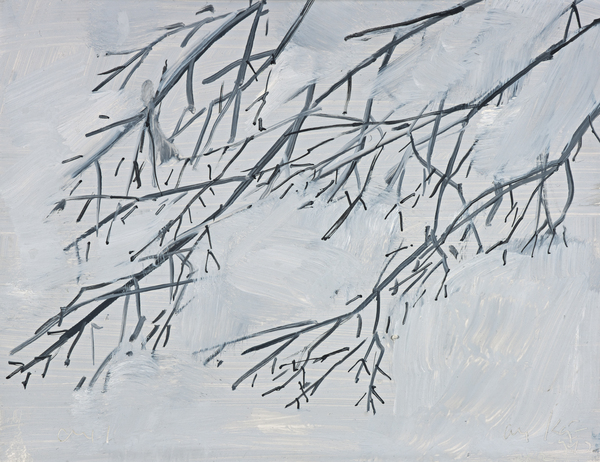
Alex Katz, Winter Branch (1993)

More soon on February’s reading!
Anne Cohen’s Year in Reading, 2022

Today’s reflection on a year in reading, her second for the blog, is by Anne Cohen (@aecnyc). Anne is a lifelong reader (preferably stretched out on couch or bed), retired lawyer, and former reporter. She lives in New York City with part of her family and two dogs, and continues to believe that the existence of Book Twitter saves her from homicidal and other anti-social behavior.

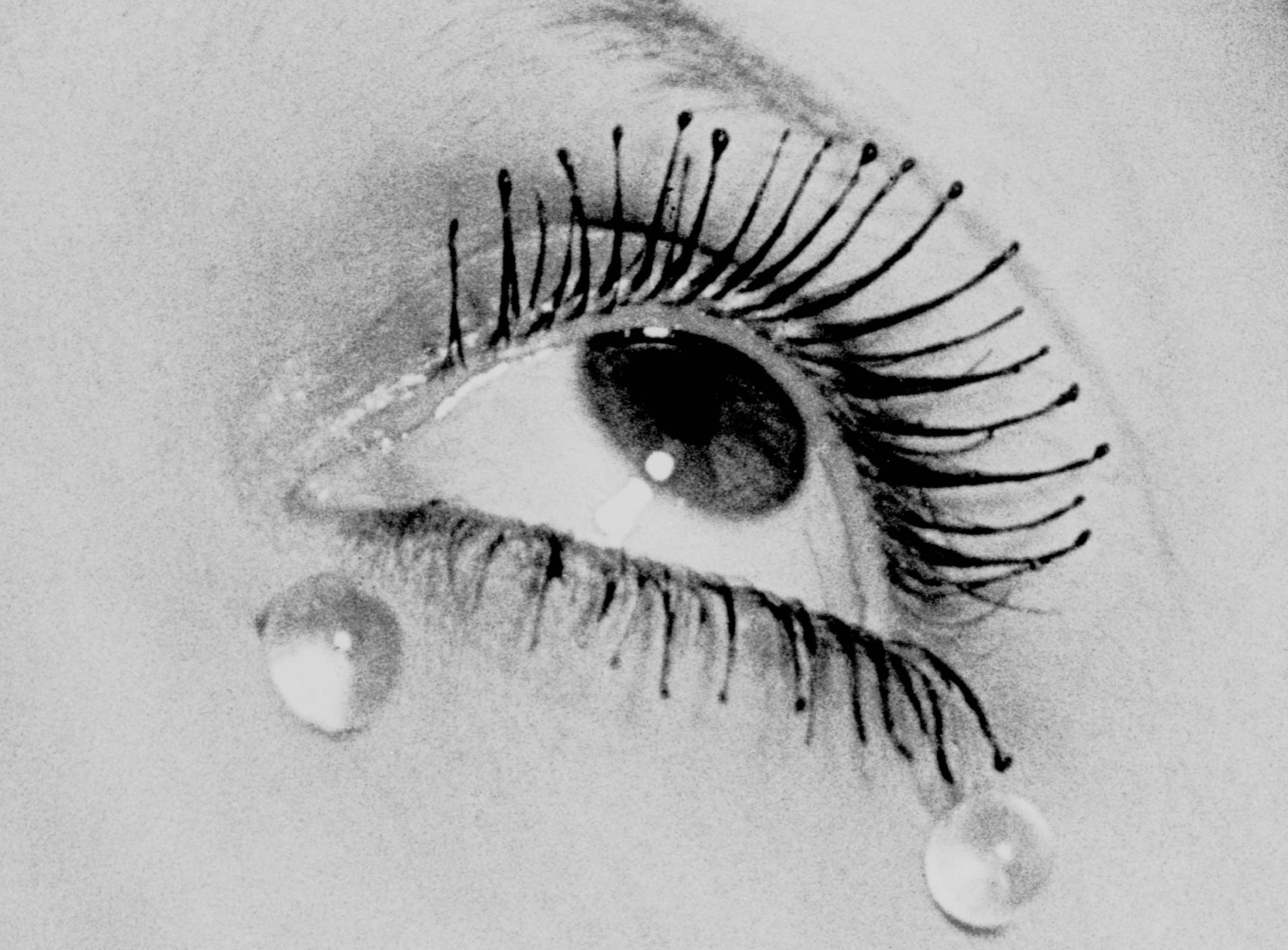
Man Ray, Glass Tears, 1932

I first got my glasses in the second grade, at almost the beginning of my reading life, and for the next 60 years, couldn’t function without them. A year ago, after repeatedly misreading price tags and after having lost several years of ophthalmologist appointments to the pandemic, I had cataract surgery in March and April, followed by several months of significant light sensitivity.

So when I looked back at my reading, I shouldn’t have been surprised (but was) that 2022 was a year of audiobooks.

These included the Anthony Trollope Barsetshire books (except Framley Parsonage, yet to be started), as well as Can You Forgive Her? and The Eustace Diamonds from the Palliser series, all read by Timothy West; Olivia Manning’s Balkan Trilogy, read by Harriet Walter; Elizabeth Gaskell, Cranford; Anne Tyler, French Braid; Amy Bloom, In Love; Fintan O’Toole, We Don’t Know Ourselves; Ferdinand Mount, Kiss Myself Goodbye; and Richard Osman, The Bullet That Missed.

Barsetshire and Palliser. Loving the Trollope was perhaps the biggest surprise of my year (or second biggest, after the realization, right after the first cataract was removed, that the trim around my bathroom mirror was actually white and not a yellowy cream). I had slogged partway through Phineas Finn for a book group several years ago and was bored stiff and, worse, annoyed.

My experience of the Barsetshire novels was entirely different, and I would often find myself grabbing print versions when I couldn’t wait to get to the rest of a chapter (and even when I already knew what happened, I still wanted to find out now how Trollope got his characters there).  

I had not expected the novels to be so wryly funny and spot on, even in apparently throwaway descriptions of barely-named characters, especially but not only members of the gentry and Parliament:

Sir Cosmo had a little party [i.e., a following] of his own in the House, consisting of four or five other respectable country gentlemen, who troubled themselves little with thinking, and who mostly had bald heads. [Ed. – The hair keeps the head warm enough to think, you see.]

Nor did I expect the characters to be so richly drawn, with even the least sympathetic of them humanly presented.

“It cannot be said that she was a bad woman, though she had in her time done an indescribable amount of evil,” Trollope writes of Mrs. Proudie, the bishop’s wife. Bad things happen in Trollope but not so much outright evil, and so his word choice here—not misfortune, or unhappiness, or even disaster—is meaningful.

But even as Trollope demonstrates this woman has been an engine of ruin in the lives of others, he also shows Mrs. Proudie’s realization that her own life is among the debris: “At the bottom of her heart she knew that she had been a bad wife. And yet she had meant to be a pattern wife! She had meant to be a good Christion; but she had so exercised her Christianity that not a soul in the world loved her, or would endure her presence if it could be avoided!”

The unapologetic havoc Mrs. Proudie causes may make her an outlier in Barsetshire, but at least so far as I’ve read all the novels are about characters coming to grips with their limitations—whether of birth (ancestry, gender, class, nationality, education, family dynamics); money (having, getting, losing, and the manner of doing either); and personal characteristics (intelligence, pride, diffidence, physical and mental health).

While I’m looking forward to finishing The Prime Minister and onward, I still find both Phineas Finn and Phineas Redux tedious and unfinishable, maybe because the books focus so completely on a single character, without the switches within a skein of stories that, for example, makes The Rev. Josiah Crawley’s continual self-abnegation in The Last Chronicle of Barset less tedious.

The Balkan and Levant Trilogies. Olivia Manning’s account of a young married-but-hardly-know-themselves-let-alone-each-other couple during World War II supposedly mirrors much of her own life, which makes one wonder about her marriage. [Ed. – She married Guy, no question.] Harriet Walter’s reading of the first trilogy (alas, she hasn’t recorded the second) is remarkable; thinking back, I had to remind myself that she voiced all the characters, who are richly drawn and deeply flawed. I enjoyed both trilogies, despite a deep desire to smack most of the characters upside the head; I even missed Prince Yakimov. [Ed. – Yaki! One of the great characters in 20th Century British literature!]

Other audiobooks. I’m a big Amy Bloom fan, especially her short stories, which I’ve always thought of as small jewels. In Love recounts her mid-life marriage to Brian Ameche, a terrific guy who develops early onset Alzheimer’s, and his determination to end his life while he’s still competent to make the decision to do so. Two points I keep turning back to—that Brian Ameche died at Dignitas in Switzerland on January 30, 2020, just before the world shut down, and that a relatively early Bloom short story is about a woman whose married lover has Parkinson’s and wants her to promise to help him die when the time comes. Bloom reads In Love herself, and it’s funny and angry and heartbreaking.

We Don’t Know Ourselves, although non-fiction, is great story-telling.  Using his own life as a hook, O’Toole goes year-by-year through recent Irish history, starting in 1958. Highly recommend.

Cranford was non-superficial fun (and led me to order Mrs. Gaskell’s letters, which I’ve not yet started); French Braid was fine if not memorable; and The Thursday Murder Club books are made for audiobook (in a good way).

Some other novels. Miriam Toews, All My Puny Sorrows (another potential trip to Dignitas, but blackly funny all the same); Barbara Comyns, Who Was Changed and Who was Dead and The Vet’s Daughter; Margery Sharp, Harlequin House (always entertaining but I don’t remember a single detail); Georgette Heyer, The Grand Sophy; Rivka Galchen, Atmospheric Conditions; Herve Le Tellier, The Anomaly; Haldor Laxness, Fish Can Sing; Nina Stibbe, One Day I Shall Astonish the World (don’t bother—sorry Dorian) [Ed. – No worries]; Gwendoline Riley, My Phantoms (well-written but sterile and mean—sorry again, DS) [Ed. – Definitely mean. Not sterile, IMO, but I get where you’re coming from]; Willa Cather, The Lost Lady; and Kate Atkinson, Shrines of Gaiety (lacks the gut punch how-did-I-miss-that moment of her best, but her “not best” beats out the best of a lot of others).

And speaking of gut punches, the best single novel of my year was probably Beyond Black by Hilary Mantel, about an overweight psychic named Alison and her relationships with others, especially her non-psychic assistant, Collette, and nasty spirit guide, Morris. (Thank you again, Backlisted.) 

There’s a lot going on here, as in much of Mantel’s work, about memory and the interplay of the living and the dead. Especially interesting were Alison’s musings about the connection of her physical size and her psychic work and whether they might echo the novelist’s sense of how her own body. “I try my best with the diets, she said to herself; but I have to house so many people. My flesh is so capacious; I am a settlement, a place of safety, a bombproof shelter.” Alison’s size is also a form of self-protection against Morris and his ilk. “What the doctors fail to realize is you need some beef, you need some heft, you need some solid substance to put up against the demons.”

This is one I’ll read again.

Mysteries. I’m always taken aback at how many mysteries I’ve read in a given year. (A lot.)

As I was finishing this, Dorian and his One Bright Book podcast colleagues were talking about how hard it sometimes can be to settle into a new novel; to become used to the rhythm of that specific universe. For me, a pleasure of mysteries, and mystery series in particular, is the absence of some of that acclimatization. [Ed. – Nicely put! Helps me see why genre fiction can be so comforting.] Mysteries are like sonnets—the typicality or transparency of their framework makes it fun to see how well a writer sets up character and plot; the bad or lazy writing can be howlingly obvious and the clever more enjoyable. [Ed. – Absolutely!]

This year, I read bunch of books by: Francis Vivian (Inspector Knollis); E. C. R. Lorac (always a treat); Margo Bennett; Brian Flynn (Anthony Bathhurst); John Dickson Carr (Gideon Fell—meh, am not a locked room person); Martin Walker (Bruno Courrèges, sadly not improving with age); Anthony Horowitz (Magpie Murders, not nearly as well-told as TV series); Christopher Bush (Ludovic Travers); Derek Miller (Sheldon Horowitz); and Rosalie Knecht (Vera Kelly). [Dorian, there’s one more, with a name a can’t remember about a gay guy in Scotland] [Ed. – Ann Cleves’s The Long Call?] [Ed. — We figured it out! Louise Welsh’s The Cutting Room!]

Two very different series stood out for me, both written from the 1930s through the 50’s: Nicholas Blake (pen name for Cecil Day-Lewis, former British Poet Laureate), featuring Oxford-educated Nigel Strangeways, and Stuart Palmer’s series featuring middle-aged school teacher “spinster” Hildegarde Withers, working with NYPD homicide Inspector Oscar Piper.  The Blake books are arguably “better” written, but the Withers are more fun, and she gains in wisdom as the books progress.  

Four Lost Ladies, published in 1949, could have been a standard bad-guy-preys-on-vulnerable women, but Palmer (in Hildegarde’s voice) imbues the story with a deeper meaning, about women who “haven’t importance enough to be missed, they haven’t any close friends or near relatives, so nothing is ever done about it.” Everything starts with a former neighbor from whom Hildegarde did not receive an annual Christmas card:

Miss Withers began absently to fold and refold her napkin. “Oscar, do you happen to know just how many lonely, middle-aged, unattached women disappear right here in this city every year?”

“Not nearly enough,” Piper answered promptly. [Ed. – Hiss, boo!]

She let that one go by. “More than three thousand, according to recent estimates by the YWCA and the Travelers Aid Society.” …

He put a breadstick in his mouth. . . .”Relax, Hildegarde. … [W]e don’t get three thousand unidentified female stiffs in the city morgues in the course of a year—no, nor a tenth that number. Almost all the ones we do get are victims of accident, disease, or suicide. No, you’re barking up the wrong tree again. Those women you’re so worried about, they probably just got bored with the big city and went home. Or else they wanted to skip out on a husband or boy-friend, or beat some bills.”

Hildegarde, no big spoiler alert necessary, of course is right. (Check out the movies made about Hildegarde and Oscar, which unfortunately don’t include Four Last Ladies; available on Internet Archive.)

Diaries, letters and memoirs. Sylvia Townsend Warner diaries and correspondence with David Garnett; James Lees-Milnes early diaries; Paul Theroux, Kingdom by The Sea; Natalia Ginzburg, Family Lexicon; and Dervla Murphy, Full Tilt, Wheels Within Wheels, and A Place Apart: Northern Ireland in 1970’s; and the first two volumes of Diary of A Wimpy Kid, which helped prepare me for my 50th high school reunion. [Ed. — !]

Diaries of Chips Channon.  Last year, I wrote about the first two volumes of the interminable but somehow addictive Diaries of Chips Channon, a snobbish, American-born, royalty-and-luxury loving, anti-almost-everyone-else Member of Parliament, who was close to power in the late 1930s and early 1940s.

In addition to an antisemitism barely tempered by knowledge of the Holocaust (to say nothing of people of color, whom he doesn’t even begin to notice), the Channon diaries are filled with hateful invective towards ‘my enemies,’ who seem to be legion.

The third and last volume was released this year, and Chips is largely unchanged, except for more frankly (but still obliquely) writing about his sex life; homosexual activity was illegal in Britain until a decade after Channon’s death, and the diaries suggest a mixture of discretion and bravado in his public conduct.

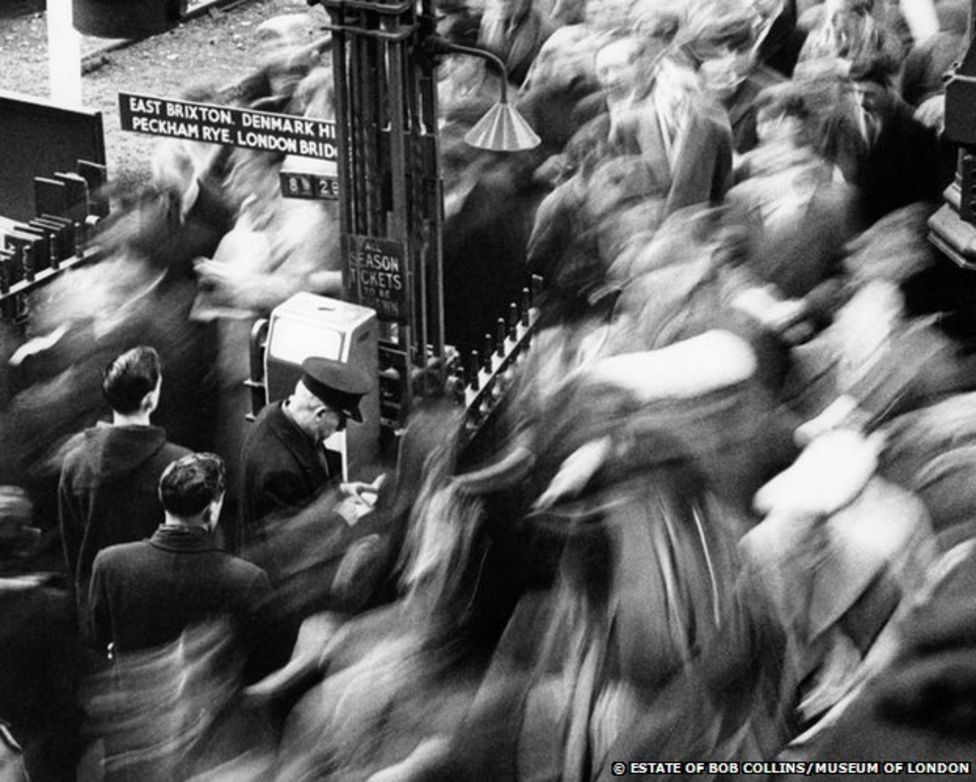
Bob Collins, The Morning Rush Hour, Victoria Station, 1960

Nella Last’s War and The Diaries of Nella Last.  Channon wrote for a posterity he assumed would be interested in the placement and menus at his dinner parties, the trinkets he gave to and received from royalty, and his conviction that Neville Chamberlain was right. 

Nella Last, on the other hand, was a housewife from the northwest of England; her diary was created in response to a request for volunteers from Mass-Observation, the groundbreaking social research project which sought information about the lives of ‘ordinary’ Britons. She could not have known her submissions to M-O would have a life beyond the study’s archive.

Reading the two in tandem was disorienting. It’s hard to believe—except for a few references by Channon to scarcity of turkeys and competent household staff and an occasional trip by train rather than in his Rolls—that he and Nella Last lived through and wrote about the same war and post-conflict austerity.

Her journals are filled with descriptions of eking out a supply of eggs or cream and the most useful cuts of whatever meat was available, of making rag dolls to sell at the Women’s Voluntary Service shop to raise Red Cross funds or to donate to local hospitals, of being unable for years of fuel rationing to make simple Sunday drives to a nearby lake.

Beyond their historical value, the diaries record someone once plagued by depression and self-doubt (“the rather retiring woman who had such headaches and used to lie down so many afternoons”) blossoming with her wartime volunteer work and with the incentive to record not just her observations of the world around her but of the changes in herself and her relationships. “After all these peaceful years, I discover I’ve a militant suffragette streak in me” and “[I] peel off the layers of ‘patience,’ ‘tact,’ ‘cheerfulness and sweetness’ that smother me like layers of unwanted clothes.” 

Nella’s tolerance for almost anything but hypocrites and bullies was particularly welcome after Channon’s spitefulness. She refused to shun unwed mothers, and while she’s not thrilled to see ‘conchies’ (conscientious objectors) on work teams who come to her volunteer canteen, she recognizes their humanity. Despite a single reference to “the ‘Jewish’ stamp’” of dresses gotten off-coupon while clothes were rationed, she describes her religion as “a mixture of wishful thinking and nature worship and a stern belief that God is Jewish” [Ed. — !]  and is “astonished at the mistrust and real hatred of Jews, in quite ordinary men on the street.” 

Nella was also aware of, and abashed by, what she recognized as her own biases. The local medical community includes several Africans, and she is surprised but pleased to see “chummy” interaction among the nurses of different backgrounds, “as if colour and race were one.” But after a pleasant chat on the street with one of the African nurses, who knows Nella from her hospital volunteer work, “my little happy feeling seemed to sour” at the sight of the white wife and biracial children of the local African eye doctor:

“Whatever the views I hold of ‘some day, one colour, one creed,’ the sight of half-caste children seems to strike at something deep down in me. I say I’ve no ‘colour bar,’ but wonder if I’ve a very deep rooted one. I could work with coloured people, enjoy their society, attend their wants in canteen, fully admit them to positions of trust and service, but know, finally, I’d have died before I could have married one, or borne coloured children. So perhaps I have a colour bar.” [Ed. – Oof, impressive attempt at self-knowledge; also, gross.]

I hope—wherever she is—that she’s not appalled at being read so intently; I would have liked the chance to know her better. [Ed. – A woman worth knowing. Just like you, Anne. Thanks!]

Ten From My Shelves

I stole this idea from someone on Twitter, but now I can’t remember from whom. Let me know if it was you so that I can credit you! [Note: It was Simon from Stuck in a Book. Thanks, Simon!]

IMG_0581

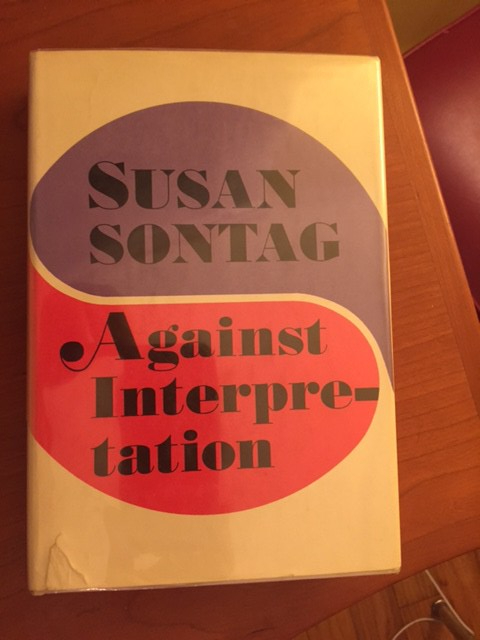
Susan Sontag, Against Interpretation

In my early to mid-twenties I was deeply infatuated with Sontag. Still am, really. I thrilled to her erudition—she’d read everything—and her elegant prose. Essays like hers are still the kind of writing I most admire. The title essay impressed me most of all, especially its famous, hortatory, gnomic last line: “In place of a hermeneutics we need an erotics of art.”

IMG_0582

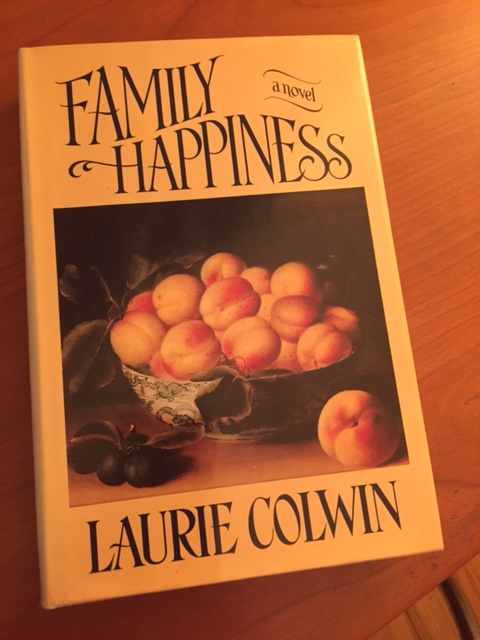
Laurie Colwin, Family Happiness

Another favourite from my twenties. I read all of Colwin’s books the summer between my Junior and Senior year; I was working as a bookseller then, and I hand-sold a ton of them. A few years ago I found this lovely hardcover at a library sale. I was a bit worried about re-reading it—would it hold up?—but I needn’t have. Not only was it as bittersweet as it had been then, but now I could see what at the time I couldn’t: I thought the book was about New Yorkers but it was really about (thoroughly assimilated) Jews. At the time I’d never have imagined that twenty years later I too would be Jewish, but I like to think my philo-Semitism was unconsciously at work. Colwin is so funny, but also so sad.

IMG_0583

David Bezmozgis, The Free World

Speaking of Jewishness, I’ve loved each of Bezmozgis’s three books, but I think this one might be the best. It’s about the Soviet Jews who were allowed to emigrate in the 1970s. Three generations of the Krasnansky family (like Bezmozgis, Latvian Jews) wait in Italy for visas to come through from Canada, the US, Australia, anywhere that will take them. Rather than focusing on the young children—that is, the characters who would have been the same age as he was when his family left the USSR for Canada—Bezmozgis focuses on their parents and grandparents. We see what the Soviet Union meant to each of them and how differently they experience even this tentative experience of the ironically named Free World. Smart, funny, no schmaltz.

IMG_0585

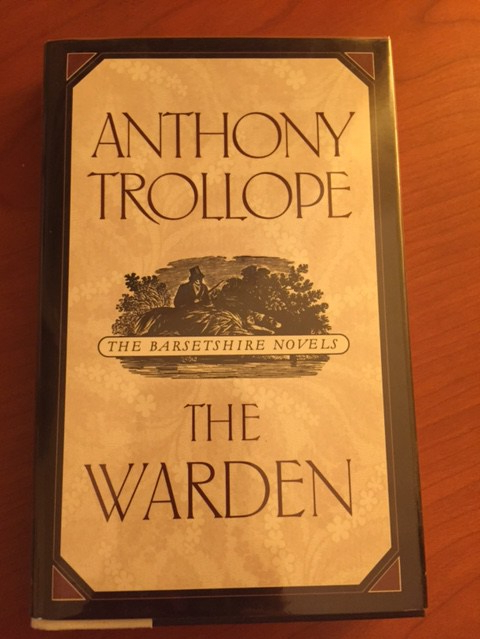
Anthony Trollope, The Warden

I read this in college and liked it well enough but I think I’d appreciate it a lot more now. Might have been a bit too subtle for me back then. I really want to tackle Trollope soon and the Barsetshire novels seem like a good place to begin.

IMG_0586

Olivia Manning, The Balkan Trilogy

Three wonderful novels, pretty closely based on Manning’s own experiences, about a British couple in Romania and Greece before and during WWII. The scenes of denuded, starving Athens haunt me still. Yaki is one of the great characters in 20th century literature.

IMG_0590

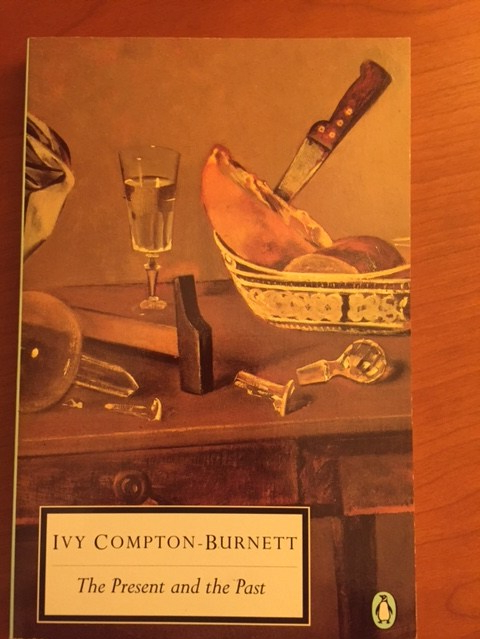
Ivy Compton-Burnett, The Present and the Past

Do you have writers you’re convinced you love but have never actually read? Probably you are less crazy than I am. But I have at least five or six books by Compton-Burnett around here and haven’t read a one.

Here’s what the publishers say about this one:

Nine years after her divorce from Cassius Clare, Catherine re-enters his life in order to re-establish contact with her children. Her arrival causes a dramatic upheaval in the Clare family, and its implications are analyzed and redefined not only in the drawing room but also in the children’s nursery and the servants’ quarters.

(Sounds like Henry Green!) Anyway, odd, uncanny women 20th Century British writers (Comyns, Rhys, Bowen, etc) are my thing, so I really ought to get around to reading Compton-Burnett soon.

IMG_0584

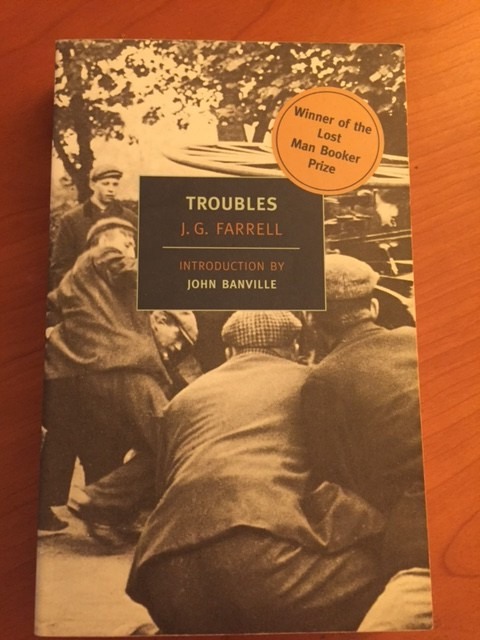
J. G. Farrell, Troubles

A great, great novel set during the Anglo-Irish war and featuring an English Major, Brendan Archer, who comes to Ireland to claim a bride he can’t quite remember proposing to. Angela Spencer is the eldest daughter of an Anglo-Irish family who lives with her family in a once glorious seaside hotel called, no longer quite appropriately, the Majestic. At once funny and macabre, Troubles sets itself the task of trying to figure out how to represent decline. I had a lot to say about this terrific, engrossing book here.

IMG_0587

Ben Aaronovitch, Midnight Riot

First in the Urban Fantasy Rivers of London series. Peter Grant is a rookie cop who can speak to the dead and stumbles into a little-known unit of the Met that deals with magic and the uncanny. Perfect light reading.

IMG_0589

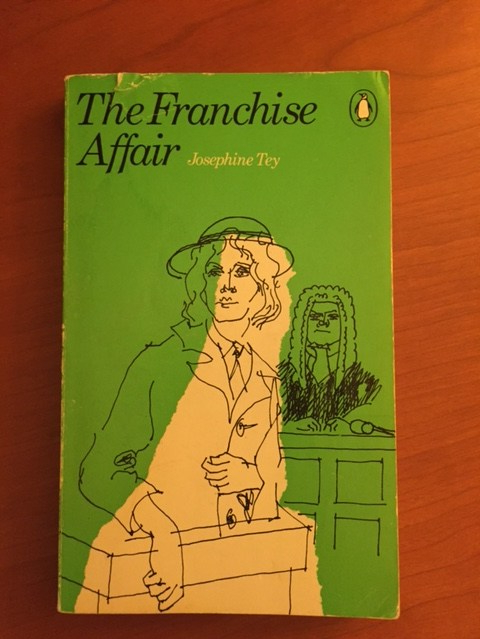
Josephine Tey, The Franchise Affair

My favourite Tey (though admittedly I have rationed them and kept a couple in reserve), an unsettling novel about a woman and her mother who are accused by a fifteen-year old schoolgirl of having locked her up in their attic for a month. Have they been falsely accused? If so, how will they be acquitted when all evidence points toward their guilt? Can justice be done without prejudice? Unconventional, suspenseful, and thought provoking.

IMG_0588

Giorgio Bassani, The Heron

Regular readers know that together with some fellow bloggers, I recently read Bassani’s The Garden of the Finzi-Continis. This, Bassani’s last novel, is the newest addition to my library. I started reading the first page just now and it was all I could do to stop. Elegant mournfulness really does it for me.

IMG_0591

There you have it, ten books plucked from the many thousands in this too-small house. Do you have thoughts about any of them? Let me know if you’re inspired to share some from your shelves.