“Antidote to Fascism”: Primo Levi, Chemist and Writer (Guest Post, Nathaniel Leach)

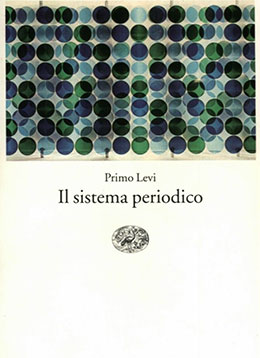
“Ah, yes, you’re the fellow who wrote a book,” a customer tells Primo Levi in The Periodic Table, Levi’s third memoir, a book about his first career, chemistry. Levi stifles his annoyance at this comment under his professional exterior in a way that reminds us that Levi, too, sees his career as a writer as secondary, a historical accident that sometimes either interferes with or assists his professional endeavours. Despite these occasional self-deprecatory references, The Periodic Table invites us to see connections between his two “careers,” both of which require careful observation and an inquiring mind that is willing to revise its initial hypotheses about the world.

primo-levi-sitema-periodico260px

Of course, the book being referred to is his first memoir, Se questo è un uomo, notoriously translated in the U.S. as Survival in Auschwitz, but literally If this is a Man. Levi notes that if it had not been for his deportation to Auschwitz, he may never have become a writer in the first place, but the book’s careful descriptions, thoughtful analyses and avoidance of simplistic explanations or judgments anticipate a long writing career that would only gradually start to supplant his life as a chemist. The title of this first book, in fact, provides an appropriate orientation towards The Periodic Table; the question posed by Auschwitz, Levi suggests, is whether its victims (or its perpetrators) have been completely dehumanized, reduced to the level of mere physical matter, or whether something ennobling or redeeming persists in the midst of such horror. In The Periodic Table, this question is taken up in its descriptions of the human attempt to come to terms with the materiality of the world.

In each chapter of The Periodic Table Levi presents this struggle via an anecdote related to one of the elements of the periodic table. The chapters are arranged in a loose chronological order, starting with Argon, the “inert” or “noble” gas used as a metaphor for Levi’s Jewish-Italian ancestors and ending with Carbon, a seemingly whimsical “micro-history” of an atom of carbon. In between, most chapters are autobiographical, describing an incident in the life of Levi, the chemist, although he includes two short stories written in his youth and two brief stories in which Levi does not appear (and which therefore seem to be fictional). In describing these experiences, Levi suggests resonances between the rulebound world of chemical interactions and the less predictable world of human interactions. At the heart of these parallels lies the question of Levi’s earlier book, the question of humanity; are human beings simply physical matter composed of the chemical elements discussed in the book, or something more? And in what might that something more consist?

It is characteristic of Levi that there are no simple answers offered; from the outset of the book, he calls attention to the complexity of the “human condition, since man is a centaur, a tangle of flesh and mind, divine inspiration and dust”. Chemistry itself becomes emblematic of this division, as Levi’s chapters illustrate both the human desire for scientific knowledge, mastery and overcoming of the physical world and the recalcitrance of matter to even the most inspired human stratagems. As an example of the former, the chapter on “Chromium” is structured much like a detective story in which a problem (the production of faulty paint) presents itself and Levi must use his powers of deduction to solve it. In this case, Levi does indeed come up with an ingenious solution, but many other chapters describe dismal failures—explosions, escaped rabbits, chicken shit that refuses to give up its valuable chemicals, to name a few—that remind us of the limits of human science.

While Levi describes his younger self’s attraction to chemistry as idealistic (if confused), the book’s seemingly disconnected chapters illustrate many different perspectives on this science. His initial attraction to chemistry, Levi says, came from a sense “That the nobility of Man, acquired in a hundred centuries of trial and error, lay in making himself the conqueror of matter, and that I had enrolled in chemistry because I wanted to remain faithful to this nobility. That conquering matter is to understand it, and understanding matter is necessary to understanding the universe and ourselves…” And later, in the “Chromium” chapter, he asks: “It is the spirit that dominates matter, is that not so? Was it not this that they had hammered into my head in the Fascist and Gentile liceo? I threw myself into the work with the same intensity that, at not so distant a period, we had attacked a rock wall; and the adversary was still the same, the not-I, the Button-Molder, the hyle: stupid matter, slothfully hostile as human stupidity is hostile, and like it strong because of its obtuse passivity.”

Levi himself points out the fascist undertones of this rhetoric of conquering and domination, which is perhaps softened by his equation of “conquering” with “understanding,” but the book raises the question of whether understanding can take place in a way that does not equate to such a violent metaphor. As his schooling progresses, he changes his position: “Matter was our ally precisely because the Spirit, dear to Fascism, was our enemy; but, having reached the fourth year of Pure Chemistry, I could no longer ignore the fact that chemistry itself, or at least that which we were being administered, did not answer my questions.” Levi criticizes the apparent alliance between the fascist and the scientific spirit, but also holds out hope that science may be thought of in other terms by noting that it is “that which we were being administered” that is harmful, not chemistry in itself. Indeed, Levi’s book presents the sciences as tentative, speculative pursuits, often quixotic in their aims, and alternately satisfying and disappointing.

In fact, one of the dominant threads that can be traced through this book is the idea that chemistry is fundamentally anti-fascist both in its humbling of the human spirit and in its illumination of the disproof the material world offers to fascist rhetoric. He notes that the sciences may be seen as an “antidote to Fascism… because they were clear and distinct and verifiable at every step, and not a tissue of lies and emptiness, like the radio and newspapers”. Chemistry, above all, is not “fake news”; its results will always reveal truth at an elemental level, even if this truth is not the desired result.

But Levi values chemistry for reasons beyond its factuality; in an early passage describing his study of chemistry in fascist Italy, he suggests that the lesson we can learn from chemistry is that the natural world itself resists the simplistic, uniform ideals that fascism stands for: “In order for the wheel to turn, for life to be lived, impurities are needed… Dissension, diversity, the grain of salt and mustard are needed: Fascism does not want them, forbids them, and that’s why you’re not a Fascist; it wants everybody to be the same, and you are not. But immaculate virtue does not exist either, or if it exists it is detestable.” Levi uses chemistry to form a positive metaphor for “impurity”; rather than the Nazi metaphors drawn from the field of biology that compared Jews to a virus or to vermin, he identifies his own otherness with the catalysts in a chemical reaction. In this metaphor, difference and diversity are needed in order to propel progress forward.

=FFAML_L00003

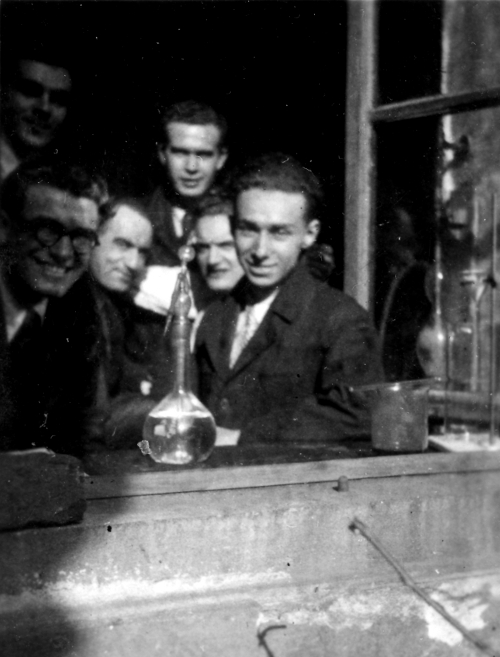
Levi (foreground, right) during his study of chemistry at the university in Turin, 1940

From this point of view, then, perhaps it is most useful to see The Periodic Table as the place where Levi’s two careers collide, and produce something original. Levi describes his early, idealistic self as feeling that “Mendeleev’s Periodic Table, which just during those weeks we were laboriously learning to unravel, was poetry, loftier and more solemn than all the poetry we had swallowed down in liceo; and come to think of it, it even rhymed! That if one looked for the bridge, the missing link, between the world of words and the world of things, one did not have to look far: it was there in our Autenrieth [textbook], in our smoke-filled labs, and in our future trade.” Chemistry, like writing, Levi suggests, is the transformation of the material world into a communicable form, a means of making some kind of harmony or understanding out of the raw “world of things”. In The Periodic Table, Levi is both a chemist who writes, as in “Chromium,” and a writer who uses chemistry as a metaphor, as in “Argon,” or to examine minutely the nature of the world, as in “Carbon,” which ends the book on a point that quite literally fuses the fields of chemistry and writing.

Or, as in the case of “Vanadium,” the penultimate chapter, to explore the complex relationships between Levi’s lives as professional chemist and author, and between his present and his past. Levi’s professional activities bring him into contact with a Dr. Müller, whom he confirms that he met in Auschwitz. Levi assesses him with his characteristic clarity of vision: “Neither infamous nor a hero: after filtering off the rhetoric and the lies in good or bad faith there remained a typically gray human specimen, one of the not so few one-eyed men in the kingdom of the blind.” Levi is reluctantly drawn into a personal correspondence while trying to resolve a professional problem, and the chapter suggests both the power and the limitations of writing as a means of making human connections and resolving the issues of the past. As with chemistry, so with human relations; imperfections and failed connections are an inherent part of the process.

Levi suggests towards the end of the book that “matter is matter, neither noble nor vile, infinitely transformable, and its proximate origin is of no importance whatever.” This is what much of the book, and especially the final chapter on “Carbon” seems to suggest; the power of the chemist, like that of the writer, is to transform things, change them from one state to another without ascribing to them a single stable value. This, perhaps, is the great skill exhibited by Levi in both his careers: the power to transform matter into meaning without the hubris of claiming to have ever spoken the final word.

2019 Mid-Year Review

Here we are, halfway through the year. It’s a quiet 4th of July here in Little Rock, hot and sticky as usual. I’m trying to get over a sinus infection and feeling beaten down by the news—arctic melting in the hottest June ever, children interned in camps across the US, xenophobia and inequality everywhere. I’m switching between three books–Grossman’s Stalingrad, Liberaki’s Three Summers, and Esther Freud’s Lucky Break–and reflecting on the reading year so far.

D-ko9HQW4AIS9ga

I’ve read quite a bit—76 books so far: increased time being one compensation for my growing daughter’s growing tendency to eye-roll—and enjoyed most of them. (Do you ever worry you’re too easy to please? I do.) Inspired by other bloggers, I vowed this year to write monthly recaps of my reading. I’m surprised—and proud—that I’ve actually kept up with this. If you want to catch up with my reading, you can read these updates here:

January

February

March

April

May

June

The books that have stayed with me so far the most are:

Moss’s Ghost Wall (which I wrote about here), Vermette’s The Break, Despentes’s Vernon Subutex, DuMaurier’s The House on the Strand, and Marsden’s The Spirit-Wrestlers.

The next tier includes Li’s Where Reasons End, Toews’s Women Talking, and all the Esther Freud. Favourite re-read: Roth’s The Radetzky March.

Most influential work stuff (Holocaust/fascism related): Hautzig’s The Endless Steppe, Judith Kerr, Browning’s Ordinary Men, Dunmore’s The Siege, and Fishman’s The Book Smugglers.

D7xnO84W4AIjVXm

So here’s to more good reading in the second half of 2019, not as an escape from these enervating (when not terrifying) days, but as an aid to practicing the habits of attention and mindfulness that might help us survive them.

June 2019 in Review

Kid in day camp; working from home; weather more than tolerable for Little Rock summer: June was a pretty big reading month. Some work stuff, but a few other things too, including a satisfying run of Esther Freud novels.

D7uybHXW4AAs-if

Dorothy Sayers, Have his Carcase (1932) The opening line kills, and I loved seeing the development of Wimsey and Vane’s relationship, but I do find Sayers a bit frivolous. That’s the point, I get it, I’m just starting to think I’m not the right reader for these books. All the code-breaking stuff went right over my head. I guess I am more for suspense than puzzles. Better as a romance than a crime novel. Rohan’s review is unimprovable.

Peter Gay, My German Question: Growing Up in Nazi Berlin (1998) I owe this recommendation to Alok (@alokranj): a while ago, he wrote up a great thread on memoirs by German historians. Very glad I read this, even if I did find it a bit oh I don’t know withholding maybe. Born Peter Fröhlich in Berlin to assimilated Jewish parents, Gay (the name he took after emigrating to America: frölich means happy or cheerful) went on to become a prominent historian of 19th Century Europe and, in particular, psychoanalysis. I like psychoanalysis much more than the average person, but I wished Gay’s interpretations of his own behaviour wasn’t quite so orthodox. He’s much less interesting than Freud himself (which makes me wonder about his biography of Freud, generally, I believe, considered his masterpiece). Anyway, Gay’s is a fascinating story, and his eventual escape from Germany is hair-raising (the family made it out very late, in 1939, first to Cuba and then to America, thanks to the support of a paternal uncle who lived in Florida). They were booked on the infamous St. Louis (the ship that was not allowed to dock in Havana, that FDR refused to give sanctuary to, and that had to return to Europe), but his father had something like a premonition and found a way to get on an earlier ship. Gay spends a lot of time combating the accusation that German Jews of his milieu should have known better and left earlier (a ridiculous contention, and one that’s largely abated, but hasn’t completely vanished). Anyway, I’m not sure I’m in love with Gay as he presents himself (a little pompous), but I’d have enjoyed this even if I hadn’t been reading it for work.

Esther Freud, Summer at Gaglow (1997) The UK edition is called simply Gaglow, a weirder, better title. Gaglow is a house in Germany  . The first of Freud’s novels with a dual narrative, Gaglow switches between two generations of a family, one around the time of WWI and the other in contemporary London. The protagonist in the present is having her first baby; ostensibly she’s an actress, but she’s not especially committed to it. To make ends meet she sits for her father, a famous painter clearly modelled on Freud’s own father, Lucian. (Freud sat for him in her younger days.) Gaglow is the Bellgards beloved summer home. Or it was: as they are Jewish it was eventually taken from them; in the post-unification present, the house may return to the family. Freud’s themes of belonging and transience are evident here, explored on her widest canvas yet. Very satisfying.

Anthony Horowitz, The Sentence is Death (2018) Clever and amusing, but not as clever and amusing as The Word is Murder.

Esther Freud, The Wild (2000) We’re back in Hideous Kinky/Peerless Flats territory, with more children caught between absent fathers and overwhelmed mothers, with the added interest of complicated blended family dynamics and an amusing portrait of a 1970s Steiner school, where the only subject seems to be Norse mythology. Freud’s up to her classic “this is funny but also you will have your heart in your mouth because surely something terrible is about to happen” shtick. (That’s a compliment.) I don’t think this was ever published in the US, and that’s a damn shame.

David E. Fishman, The Book Smugglers: Partisans, Poets, and the Race to Save Jewish Treasures from the Nazis (2017) A study of the so-called Paper Brigade, a Jewish work commando tasked by the Nazis to sort through the precious manuscripts of Vilna, Lithuania, once known as “the Jerusalem of the North.” The Nazis wanted material for their planned museum of murdered Jewry; they pulped the rest. At great personal risk, members of the Brigade smuggled documents into hiding in the hopes they would survive the war; surprisingly, some did. One of the remarkable people conscripted into this heartbreaking work was Avrom Sutzkever, probably the greatest Yiddish poet of the 20th Century. Although Fishman’s style sometimes grates, the material is fascinating, and gave me some ideas about the comparison of people to written documents that I’ll try to work out in a future post.

María Gainza, Optic Nerve (2014) Trans. Thomas Bunstead (2019) What a pleasant surprise! I’ve wanted for some time to become better versed in the recent tidal wave of Spanish-language writing, especially from Central and South America, but haven’t really known where to start. I’ve no idea what Spanish-language literary traditions Gainza fits into, if any (she reminded me of Sebald/Berger/Bernard—autofiction-y writers who are smart about art), but I was completely taken with these quasi essayistic quasi fictional pieces, each of which centers on a painting or sculpture that the Gainza never shows us. A triumph of ekphrasis, then. (And there’s always Google.)

Smart, witty, engaging:

“Not for nothing did it say on my seventh grade report: ‘When she applies herself, she excels. Only she hardly ever applies herself.’”

“It is my view that any artist too dependent on either seeking or presenting new and astonishing experiences will cease to be effective once he or she succeeds in, as it were, apportioning that sense of discovery.”

“I listened in as the adults held forth. It was like the soothing sound of rain on windows, my favorite lullaby, reassuring confirmation that the world was still going on even as I turned away from it.”

“Anytime I believe I recognize a fellow renegade, something in me instinctively draws back.”

“I have also realized that being good with quotations means avoiding having to think for yourself.”

Translator Bunstead seems to have done a marvelous job. Highly recommended.

C. R. Lorac, Murder by Matchlight (1945) There are always several of these reissued British Crime Classics on the New Books shelves of my local library. I’ve read a few, but abandoned more. Turns out I’m more drawn to the covers than the content. A Blitz mystery ought to be up my street, but this didn’t engage me.

Philip Marsden, The Spirit-Wrestlers: A Russian Journey (1998) Loved it. You can read more here.

Isabella Leitner, Fragments of Isabella: A Memoir of Auschwitz (1978) That’s me, reading all the Holocaust memoirs so you don’t have to.

Reminds me in some ways of Night. Both are constructed in short fragments, emphasize the Death March, and focus on importance of family. Leitner and Wiesel both lived in the Hungarian countryside, and were deported about the same time (early 1944). Their tone is similar, too, and frankly it drives me nuts: portentous sacralizing. Like all survivor stories, Leitner’s is remarkable: she was able to stay with three of her sisters in Auschwitz, later a work camp called Birnbaumel (where they dug anti-tank traps against the coming Russian invasion), and finally on a death march to Bergen-Belsen, where one of the four sisters got separated from the others. Like Wiesel in Night, Leitner offers no context: works like these are responsible for the common understanding of the Holocaust as a terrible thing characterized by cattle cars, barbed wire, gas chambers, and the triumph of the human spirit. The most interesting aspects of her experience go unspoken—for example, Leitner’s father had left the family behind to go to America early in the war; after the war they were reunited. What was that like?

The afterword is the most interesting part of the book. It’s written by Irving Leitner, her husband, not because it is better written (though it’s more ordinarily competent, he having been a professional writer) but because of an anecdote about a visit to Paris in 1960 where the Leitners and their two teenage children are surrounded by tables of German tourists, retirees old enough to have participated in the war. Leitner has a panic attack: she writes the names of various camps on a piece of paper, intending to give it to them; later, her husband slips back into the café and delivers it to the table in the guise of the check. Lots of things going on there: panic, rage, revenge, none of which we see in the memoir itself.

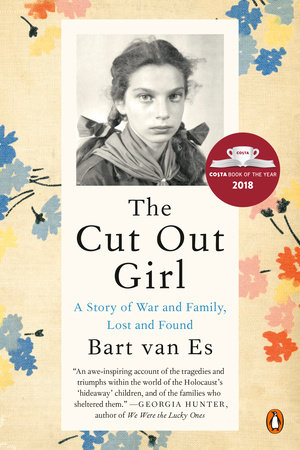
Bart van Es, The Cut Out Girl (2018) Competent, compelling. But not “inside baseball” enough for me. My thoughts here.

Esther Freud, The Sea House (2003) Something of a companion to Gaglow, in that it’s also set in the present (2000: cell phones are still clunky and annoying and largely useless outside London—I miss those days) and the past (1953). Once again, Freud mines her remarkable family history: one of the characters, Klaus Lehmann, is an émigré architect closely modelled on her grandfather Ernst Freud (Sigmund’s fourth child). Lehmann appears mostly through the letters he wrote his wife during their various periods of separation in the 1930s. He is paired in the novel by a similarly absent Nick, an architect in the present, and the sometime boyfriend of Lilly Brennan. Lily has come to a village on the Suffolk coast to work on her dissertation on Lehmann in the town where he summered. Got all that? While she learns something about Lehmann, we learn more, because the “past” half of the novel is centered on Max Meyer, an émigré painter who mourns both his lost family home in Germany and his sister, who escaped the Nazis with him but who has just died after a long illness. (In this way, the novel is also an investigation on the difference between history and fiction.) Max is invited to Suffolk by a friend of the family, an analyst in the mode of Melanie Klein, who has plans to help the man work through his traumas, but whom he largely avoids in favour of an affair with Lehmann’s wife.

Probably the most plotty of Freud’s novels, but like the others its real power comes from its investigation of domestic space. Do homes center us or do they imprison us? Do we in the end prefer to mourn their passing? Can we appreciate the natural world if we don’t have a home to return to? Totally engrossing.

Esther Freud, Love Falls (2007) It’s the summer of 1982. As England prepares for Charles and Diana’s wedding, Lara is invited by her father—a figure straight from an Anita Brookner novel: European, Jewish, displaced, intellectual, vague, a bit ruthless—to holiday in Italy, specifically to visit an old friend of his who, it turns out, is dying. (The father, an historian, is apparently modelled on Lucien Freud.) Lara gets taken up by a louche expat set, falls in love, grows up a little, and is terribly hurt. (There’s a shocking scene that resonates even more today—at least for me, clueless cis male reader—than it would have ten years ago.) Probably the weakest of the Freuds I’ve read (a long set piece on the Palio involves some unusually clunky exposition), but it’s still pretty great. The title is the name of a dangerous waterfall and a description of what happens to all of us. Worth reading.

Judith Kerr, The Other Way Round (1975) The second of Kerr’s autobiographical trilogy. (I read When Hitler Stole Pink Rabbit last month.) Her stand-in Anna is 15 and living in London during the Phony War and then the Blitz. She’s desperate to help her family stay afloat and to gain some independence, and enrolls in a secretarial college, which leads to a suitably eccentric job in an organization that collects donated fabric to be made into new uniforms and, more somberly, donates the clothes of soldiers who have died to other young men. Anna begins to separate herself from her family, plunging with joy into night classes in painting and a love affair. But what does this ordinary teenage distance mean for an refugee family whose motto has been something like “Home is wherever we are when we’re together”?

Judith Kerr, A Small Person Far Away (1978) In the final volume of Kerr’s trilogy, we jump ahead to 1956. Anna is married to a coming screenwriter and starting herself to become a writer. But her efforts in this regard are interrupted by a phone call from Germany. Her mother’s lover, an official with a Jewish relief agency in Berlin, tells her that she has attempted suicide. Anna flies to her mother’s bedside—for most of the short novel she is in a coma—and grapples with her guilt over her own reluctance to be there, her mother’s long shadow over her life, the uneven responsibilities assigned to her and her brother, and, in addition to everything else, her mixed feelings about being back in Berlin, where things are at once familiar and unfamiliar, and it doesn’t take long for officially repressed anti-Semitism to reappear.

One reason the last two parts of the trilogy have fallen out of print, I suspect, is that they aren’t quite children’s books (without being anything like what we know as YA). But with the benefit of hindsight we can read the novel as a contribution to the burgeoning phenomenon at that time (70s/80s) of second-generation stories. A Small Person Far Away isn’t the same as, say, Maus, because Anna’s mother hasn’t experienced the Holocaust directly. But she is still traumatized by her wartime experiences as a refugee, and Anna, like Art Spiegelman, has to cope with the fallout. I probably should write an essay about this. Reprint these books dammit!

Cressida Connolly, After the Party (2018) Did you know many followers of Oswald Mosley (the leader of the British Union of Fascists) were held without charge in 1940 and eventually interned on the Isle of Man for much of the war? I didn’t, and one of the tricks of Connolly’s novel is the make us feel sympathy, almost outrage, at this suspension of habeas corpus and the rule of law. It helps, as it were, that her protagonist is a seemingly apolitical family woman who gets pulled into the Union through her sisters. (The family isn’t quite modelled on the Mitfords, but it’s that social set.) I enjoyed After the Party about as much as I found it distasteful. I think Connolly’s going for the Ishiguro Special: a protagonist whose cluelessness we are meant to read against, and find sinister in a way they cannot. But unlike his books, this one is (mostly) in third person. Which left me unsure if it’s Phyllis who misreads her own life, or whether it’s Connolly. I honestly couldn’t tell how much distance Connolly wants us to take from her protagonist. If anyone’s read it and has any ideas, do share.

So that was June. Esther Freud is great. Judith Kerr is great. But the book that won my heart this month was Marsden’s The Spirit-Wrestlers. I’ve got two weeks until the big annual Canada vacation. Before then I’m going to try to read this. My only vacation reading plans are to avoid everything Holocaust for a few weeks…


Teaching Survival in Auschwitz (II)

In my first post on teaching Primo Levi’s Holocaust memoir Survival in Auschwitz, I discussed the conclusions I help students come to in regards to what I take to be the two most important chapters in the book. In this post I’ll list some of the other aspects I address. I never get to all of this material; there just isn’t enough time. Take this then as a menu of options, from which I choose based on our conversations:

md30291748512

1. Levi’s aims—reading the preface:

Survival in Auschwitz begins with a short author’s preface. It’s easy to skip, but you shouldn’t. It tells us interesting things about what Levi thinks he is up to in his book. The first phrase—“It was my good fortune to be deported to Auschwitz only in 1944” and the last sentence—“It seems to me unnecessary to add that none of the facts are invented”—offer good opportunities to think about tone and rhetoric (the irony of the opening, the preterition of the closing). More than that though I want students to think about Levi’s aims. As the final line suggests, Levi is at least in part motivated by the impulse to document. The things he will relate really happened. Levi was often asked whether the Holocaust could happen again. His response: it happened once, thus it can happen again.

But Levi isn’t only a documentarian. Yes, he wrote the book, he explains, not to accuse but rather “to furnish documentation for a quiet study of certain aspects of the human mind.” Yet in the very next paragraph, Levi apologizes for “the structural defects of the book,” which date to his time in the camp, where the need not just to tell his story to others but to make them participate in it had already taken on “the character of an immediate and violent impulse.” On one hand, Survival is sober and reasoned (that quiet study of the mind: Levi refers to syllogisms and logic); on the other, it’s an emotional outpouring. This isn’t some kind of failure on Levi’s part; it’s typical of the fractured quality of so much Holocaust literature. These texts struggle with its very textuality. Every text has some kind of shape or form. But what happens when the subject matter of that form is destruction, terror, violence, in a word, formlessness? Each work of Holocaust literature answers this question in a different way, but, I tell my students, it’s one we’ll come back to again and again.

2. Author as character:

I’ll often start our second session, by which time students have read most of the book, by asking these questions: Who is Primo Levi? How does he present himself? What do we learn about him from his memoir?

He’s Italian. He’s Jewish. What does Jewishness mean to him? He doesn’t seem to be very Jewish. How can you tell? He’s not religious. (This is a useful place for a mini-lecture on Jewishness as both religion and culture: my students, almost none of whom are Jewish, often have many questions.) How does he end up at Auschwitz? That is, what brings on his deportation? He’s arrested. For what? For fighting as a partisan. (Mini-lecture on the partisans, and the situation in Italy before and during the war, especially 1943-44.) Right, he’s arrested as an anti-fascist. And when he is arrested, he prefers to admit, as he puts it, his “status of ‘Italian citizen of Jewish race,’” believing, wrongly as it turns out, that it would be more dangerous to confess to being a partisan. To me this suggests that he thinks of his Jewishness as a kind of bargaining chip: not that he doesn’t care about it, but that it isn’t central to his sense of self.

What else do we know? How old is he? 24. Why is that important? He tells us that he was neither too old nor too young—adducing as an example of the latter a teenage prisoner known simply as Null Achtzehn (Zero Eighteen, the last digits of his tattooed number). No one likes to work with Null Achtzehn because he has no sense of proportion. He doesn’t husband his strength. He works flat out until he collapses, invariably bringing trouble on whomever happens to be his partner that day. (Their job in this particular anecdote is moving “sleepers,” railway ties frozen into the Silesian mud.)

What about Levi’s background? Can we tell anything about who he’s been before deportation? I’ll often have us look at a passage where Levi mentions how, for days after his arrival at Auschwitz, he would reflexively look at his wrist, and find, instead of a watch, a tattoo. What does this anecdote suggest? Dehumanization, of course—his name has been taken away (along with his clothes, his hair, his belongings, his dignity), he has been entered into a vast bureaucracy. (Which requires us to complicate the consoling idea that the Nazis are monsters, irrational, barbarians, etc. They are efficient, methodical, all-too-human.) All true. But what else? What kind of person looks at their watch? (Tricky question, getting more abstruse every year, as watches fade from memory.) Students will offer hesitant replies. An anxious person? A punctual person? A detailed-oriented person? (Levi was all of these things.) How about, I say, a person who understands time in a certain way: a person who doesn’t work in the fields. Levi is bourgeois, a middle class professional. The Italian Jews—secular, assimilated—are known throughout the camp for being professionals (doctors, lawyers, etc.). What do other prisoners think of them? They laugh at them, think of them as useless, hopeless. Right. Levi notes they can’t do anything practical, they are not long for this world.

What is Levi’s own training? He is a scientist, a chemist. Why is that important? It saves his life: he is transferred to a work detail, a chemical unit, which gets slightly better rations and, just as importantly, works inside, out of the worst of the cold. Some students will suggest that we can see Levi’s scientific background in his style. I am always a little resistant to this idea, which always seems to me based on a crude idea of science, but they adduce his matter-of-factness, almost brusqueness, the absence of showy stylistic flourishes. I admit they have a point, especially when we think of how thoroughly Lei effaces himself in the text, and, more generally, how much he downplays agency, that is, willpower.

But I want us to get back to the matter of Levi’s style as a function of his background. Does Levi only know about science? Does he have other knowledge that appears in his writing? Those questions don’t always go anywhere right away. So I’ll point to the passage about the guard on the truck taking the “lucky” prisoners from the ramp to the labour camp at Monowitz: Levi calls him “our Charon.” We discuss who Charon is, and briefly consider the implied comparison of Auschwitz to the underworld. My point, though, is that this is a classical allusion, an example of Levi’s humanist education, which we will consider in detail when reading the Canto of Ulysses chapter. Levi is as much a humanist as a scientist. He is well-rounded, a real liberal arts guy. Levi is interested in everything pertaining to the human.

3. Levi’s style:

An exercise that always gets good results is to ask students to find a passage they consider representative of Levi’s style and to free write why. I’ll choose a few students to share their examples, selecting students who’ve been quiet so far. (This is usually in the second week of the semester.) I always have my own example in reserve. Depending on how much time we have, we sometimes work through it. (Sometimes students even select it: always a happy occasion.) Levi is describing the arrival of his transport at Auschwitz:

The door opened with a crash, and the dark echoed with outlandish orders in that curt, barbaric barking of Germans in command which seems to give vent to a millennial anger. A vast platform appeared before us, lit by reflectors. A little beyond it, a row of lorries. Then everything was silent again. Someone translated: we had to climb down with our luggage and deposit it alongside the train. In a moment the platform was swarming with shadows. But we were afraid to break that silence: everyone busied himself with his luggage, searched for someone else, called to somebody, but timidly, in a whisper.

A dozen SS men stood around, legs akimbo, with an indifferent air. At a certain moment, they moved among us, and in a subdued tone of voice, with faces of stone, began to interrogate us rapidly, one by one, in bad Italian. They did not interrogate everybody, only a few: “How old? Healthy or ill?” And on the basis of that reply they pointed in two different directions. […]

In less than ten minutes all the fit men had been collected together in a group. What happened to the others, to the women, to the children, to the old men, we could establish neither then nor later: the night swallowed them up, purely and simply. Today, however, we know that in that rapid and summary choice each one of us had been judged capable or not of working usefully for the Reich; we know that of our convoy no more than ninety-six men and twenty-nine women entered the respective camps of Monowitz-Buna and Birkenau, and that of all the others, more than five hundred in number, not one was living two days later.

Here is Levi’s version of a scene central to so many Holocaust memoirs—the scene of arrival at the camp, with its sudden shift from limbo to hell. One of the most surprising things about Levi’s depiction is how calm, almost silent is a scene that other writers describe as a cacophonous tumult. After the opening crash of the transport doors and the barked orders, there is only silence. This is matched by the casualness, even indifference of the SS, their legs akimbo. There is no sadism here. And the scene is the more terrible for its absence. (Though Levi will certainly experience that later, not least in a famous scene when, tormented by thirst, he has tried to grab an icicle from a window only to have it snatched away. Why? he asks. The guard responds, chillingly: Here there is no why.)

The unexpected calmness is further conveyed by Levi’s unadorned, modest prose. In this passage (as elsewhere), he is chary with metaphor. The SS men have faces of stone, the night swallows up those sent to the gas chambers, but those are the only examples. The description in the first paragraph of the ramp swarming with shadows is probably literal, given the glare of the lights.

I suggest the scene is more report than narrative. Notice Levi’s pronouns. He doesn’t use I at all here, and quite seldom in the text, which is surprising since he’s writing a memoir. That effacement of the self by the group reflects Levi’s wish to consider the event in its larger significance. It’s not just about him. Sometimes students want to take is use of “we” as a gesture of solidarity, which is a fine thought, though neither here nor elsewhere is that a real possibility. Besides, the “we” doesn’t, in fact, just refer to the deportees. In the excerpt’s last sentence, it expands to refer maybe not to everyone but to all who have studied these events. And Levi makes it clear that each of us must take up the task.

Perhaps for this reason—his desire to record the truth about an experience the significance of which extends beyond himself—Levi often writes in the kind of judging, assessing, almost omniscient style we might find in Balzac, or, more pertinently, Manzoni. Look at the end of the first sentence: orders are uttered in “that curt, barbaric barking of Germans in command which seems to give vent to a millennial anger.” The orders aren’t just barked; they are barked the way Germans bark them, expressing a thousand-year-old rage. (Maybe there is a buried reference to the thousand-year Reich here, too.)

What most concerns Levi in this passage is the speed with which human beings can be turned into what the philosopher Martin Heidegger, himself seduced by Nazism, called “standing reserve”: an inability to see anyone or anything in anything except for their use value. Levi and his fellows are so many kilojoules, units of work to be extracted before their bodies are discarded as useless husks.

img-1

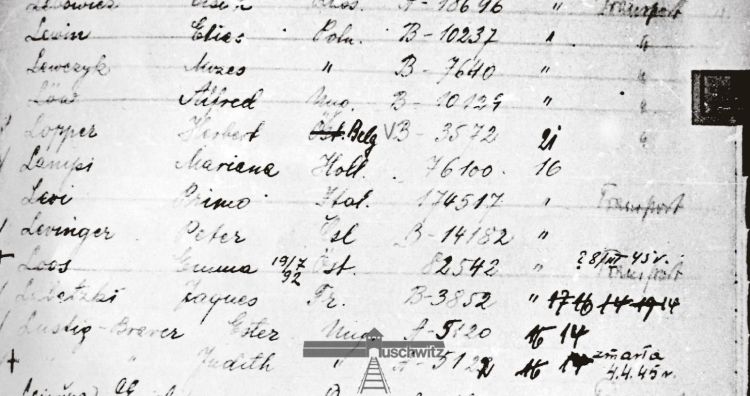
Arrival records from Auschwitz. Levi’s name is seventh from the top.

4. Kraus, or, Friendship in Auschwitz:

I often devote time to short chapter called “Kraus.” Unusually, Levi is at the center of the action. Kraus is one of the thousands of Hungarians who flood Auschwitz and its sub-camps in the summer of 1944. By now it is November and it is raining. The veterans, like Levi, who counts as one after having survived nine months, fear the onset of winter. Kraus, though, is still a newbie. Kraus can’t march in step and he risks bringing the Kapo’s ire on the rest of the work detail. For some reason, which he cannot or will not explain, Levi suddenly addresses the man in pidgin German. He tells Kraus he dreamt about him. In the dream, the war was over and Kraus visited Levi in Italy, bringing a warm loaf of bread with him. Levi puts him up for the night, introduces him to his family, they share good fellowship.

Then comes this:

What a good boy Kraus must have been as a civilian: he will not survive very long here, one can see it at the first glance, it is as logical as a theorem. … Poor silly Kraus. If only he knew that it is not true, that I have really dreamt nothing about him, that he is nothing to me except for a brief moment, nothing like everything is nothing down here, except the hunger inside and the cold and the rain around.

Why, I’ll ask the class, does Levi include this moment? He wants to show a full picture of himself, that he’s not just good. What, is he bad? Well, no, not bad. The situation is bad. So that’s what he wants to show? The whole book is about that. Why this moment? Discussion ensues. He’s mean to Kraus, someone will say. Yeah, the way all the veterans are mean to the new arrivals, retorts another. I don’t know if he’s mean, he’s trying to encourage Kraus. But he doesn’t mean it, it’s just a trick, cynical even. I’ll jump in: so is this like “bless your heart”? I always ask this question, because I can’t help playing to the gallery and it always gets a laugh. (I lived in the South for several years before I realized just how double-edged this expression is, which mostly means something like “What an idiot,” but can sometimes mean “Poor you.”) Then I’ll add: has Levi become like the prisoners he condemned in an earlier chapter, people who’ll use anyone in any way to aid their own survival? Depending on time, I’ll juxtapose this scene to Levi’s descriptions of two people who were really like friends, as much as possible in that place, anyway. Alberto was another Jewish deportee from northern Italy; Leonardo a civilian worker sent from Italy to support the war effort. As a non-Jew, he lived in a different kind of camp, had access to food parcels, and received a much greater ration. The two encountered each other by chance one day and realized they were both Piedmontese. For six months Leonardo left a pint of soup each day for Levi.

By comparing these descriptions of friendship to the example of Kraus we can think further about whether solidarity is a meaningful concept in the world of the camp. Since everything in the book goes back to the concept of the human, we can think about how solidarity might preserve humanity.

5 “The Story of the Last Ten Days”: The end of Survival in Auschwitz:

Why does the book end as it does? Why is the last chapter presented as a diary, unlike anything else in the book? (Even though it is clear that the diary is fake—that is, written retrospectively. Interestingly, Levi wrote this chapter first.) Why does it end so abruptly? The last entry concludes by stating the fate of two Frenchmen with whom Levi formed a trio dedicated to helping each other in the newly-liberated camp: “Arthur has reached his family happily and Charles has taken up his teacher’s profession again; we have exchanged long letters and I hope to see him again one day.”

The students and I note that liberation is presented neither as a triumph nor an invitation to resume life. The abrupt ending suggests that something has ended, but nothing has yet replaced it. (Levi would write another book about the many months it took him to return home.) The only hint that humanity will be a part of whatever that new state turns out to be is the fact that Levi’s last lines reference communication and connection. The last chapter describes the stages by which the prisoners slowly inch towards becoming human again, the best evidence of which is their willingness to help each other.

As part of the process of reawakening, the dated “entries” reintroduce ordinary time to the text. Which is where the book begins: the first line is “I was captured by the Fascist Militia on 13 December 1943.” But that’s one of the last references to time. Survival in Auschwitz is organized thematically, not chronologically. This decision is a function of Levi’s interest in structure, in analysis, in the big picture. As we’ve already noted, he isn’t just telling his own story. But it is also a function of the way time changes in the camp. The days are all the same, only the weather is a little better or a little worse. The linearity we attach so much importance to in thinking about our lives is gone. There is no beginning, middle, and end. The final chapter, then, is important as a marker of change. Liberation returns Levi to time.

That’s hardly everything there is to say about this important book. But we return to Levi throughout the semester. He becomes our touchstone, not so much the arbiter of how to think about the camps, but the one most interested in documenting it as scrupulously as possible. Levi sometimes bridled at the term “witness.” In the book’s first reviews—basically uninterested: the book was not initially a success—Levi is often called a witness, a term explicitly contrasted to writer. As if Levi were merely transcribing, rather than also shaping experience. But Levi came more and more to embrace the term. As he wrote to Jean Samuel, immortalized in the book as the Pikolo in “The Canto of Ulysses,” who remained a close friend after the war: “Whether we like it or not, we are witnesses and we bear the weight of it.” Studying Survival in Auschwitz is one of the first ways my students learn what it might mean to bear that weight.

Teaching Survival in Auschwitz (I)

This month I’m reading and writing about Primo Levi. Here’s the first of two posts on my experience teaching his most famous work.

62436d73ad6c06d1edffe9b73e9fc2e3

Along with Art Spiegelman’s Maus, the only book to have remained constant on my Holocaust Literature syllabus is Primo Levi’s Survival in Auschwitz. It sounds grandiose, but Levi’s memoir is one the most important books in my life. It drew me to the field of Holocaust literature in the first place, but it would be a desert island book for me even if I didn’t do what I do for a living. One of the key testimonies of the 20th century, it is the book I recommend when people ask me what they should read to learn about the Holocaust.

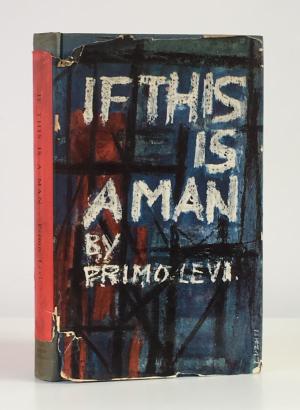
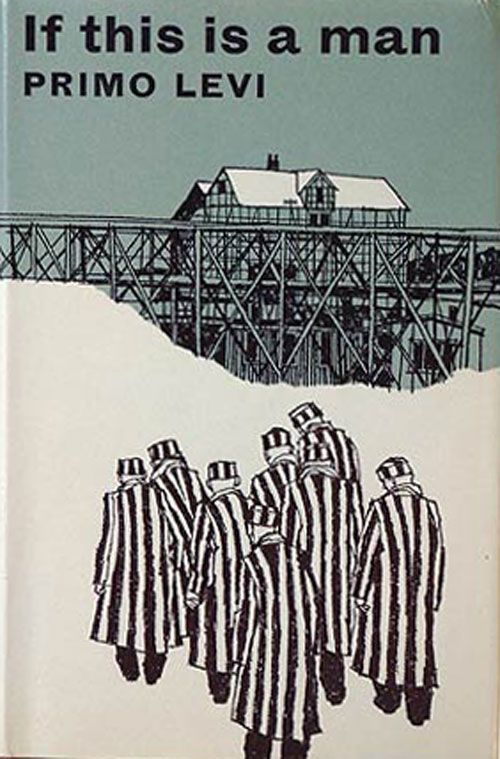
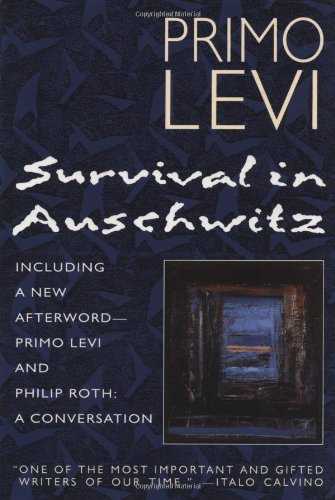
I’ve taught the book often enough (12-15 times, I’d say) that I thought it might be worthwhile to offer a sense of how I teach it, usually over three 50-minute class periods. Not enough time, but what can you do, there’s so much other material to get to, plus I typically spend two more days on two important essays by Levi, which gives me some extra time to squeeze in a few more bits of the memoir. By the way, the book I am calling Survival in Auschwitz is really called If This is a Man. (Readers in the UK know it under that title.) Unfortunately, for all the predictable reasons (sales, expectations of what American readers want from a text, etc), Levi’s US publishers changed the title. It’s one of the great publishing travesties, but since that’s what it’s come to be known in the US, that’s the title I use in class. Plus we can have a useful conversation about the differences implied by the titles.

What follows is likely more useful for those who have read the book. If you haven’t, I hope you will. It’s not long, and it’s really powerful.

Over the years I’ve varied my teaching approach, partly to keep things fresh and partly because my ideas about the book have changed. (Not fundamentally, but the more time you spend with a book the more clearly you see how its parts fit together.) But despite those refinements, I’ve always spent a lot of time on two chapters. They are central to Levi’s project, and they’re what I’ll talk about in this post, adding a second one about some of the other topics I like to get to.

The first of the two chapters is called “The Drowned and the Saved,” which is Levi’s way of distinguishing between two types of prisoners. For whatever reason, the alpine Levi, born and raised in Turin, always used water metaphors to conceptualize the fate of the Nazis’ victims. He uses the terms sinking and touching bottom when speaking of death in the camps. He gives the name “the drowned” to those who are not dead yet, but will be soon. Even if physiologically alive they are mentally and spiritually dead. They are barely human. In the argot of Auschwitz, the drowned are Musselmänner, Muslims. (The term in no way refers to actual Muslims; scholars still don’t know where the term came from, though some speculate it is connected to the concept of submission that is one of the pillars of Islam. But this would be a terrible distortion of what Muslims mean by that term.) No prisoner could live much more than three months on the rations they were given without succumbing, without drowning. Only those who could find a way to cheat the system, to gain some small privilege that will result in an extra half slice of bread, an extra ration of soup had a chance of surviving.

When he talks about “the saved,” Levi does not mean the elect. The saved are not better than the drowned. In fact, in an essay written much later, Levi argued they were in fact worse, because they had to have compromised their morals in some way. He does not exempt himself from this charge. (Students struggle with this. They really want Levi to be saying that the saved are morally superior: in this way, they reflect our culture’s poor understanding of Darwin, who was describing not prescribing when he spoke of the survival of the fittest.)

We spend a long time on Levi’s distinction, not least because it preoccupied Levi his whole life. I want students to figure out Levi’s attitude to the drowned. To that end, I ask them to close read this sentence:

All the musselmanns who finished in the gas chambers have the same story, or more exactly, have no story; they followed the slope down to the bottom, like streams that run down to the sea.

I’ll begin by asking, What are the implications of this metaphor? If that doesn’t generate anything useful, I’ll break it down. Why do streams go to the sea? Gravity, someone will say. That’s just the way it is, says another. It’s the nature of the universe. It’s natural. What, then, is the implication of these answers for our understanding of the drowned? Is it in their nature to drown? Is Levi describing something like fate? Is the universe just made for them to succumb? If so, what about Levi’s many claims that chance was the main determination of who survived? Is Levi judging the drowned?

Later passages make it clear that he is not. Take this resonant, stern assertion:

If I could enclose all the evil of our time in one image, I would choose this image which is familiar to me: an emaciated man with head dropped and shoulders curved, on whose face and in whose eyes not a trace of a thought is to be seen.

What he judges is the universe in which it is natural for the drowned to sink to the bottom, which is to say, the universe of the camps. That last sentence is further evidence of a tendency we will by this point in our conversation already have talked about, namely, how highly Levi values thought and reason. To be able to reason is to be human. But to reason in the camps is painful—it reminds the prisoner of all he has lost. That is the ambivalence of the camp infirmary: it spares prisoners from the back-breaking labour for a time (assuming they recover), but it gives them the opportunity to reflect on what has happened to them.

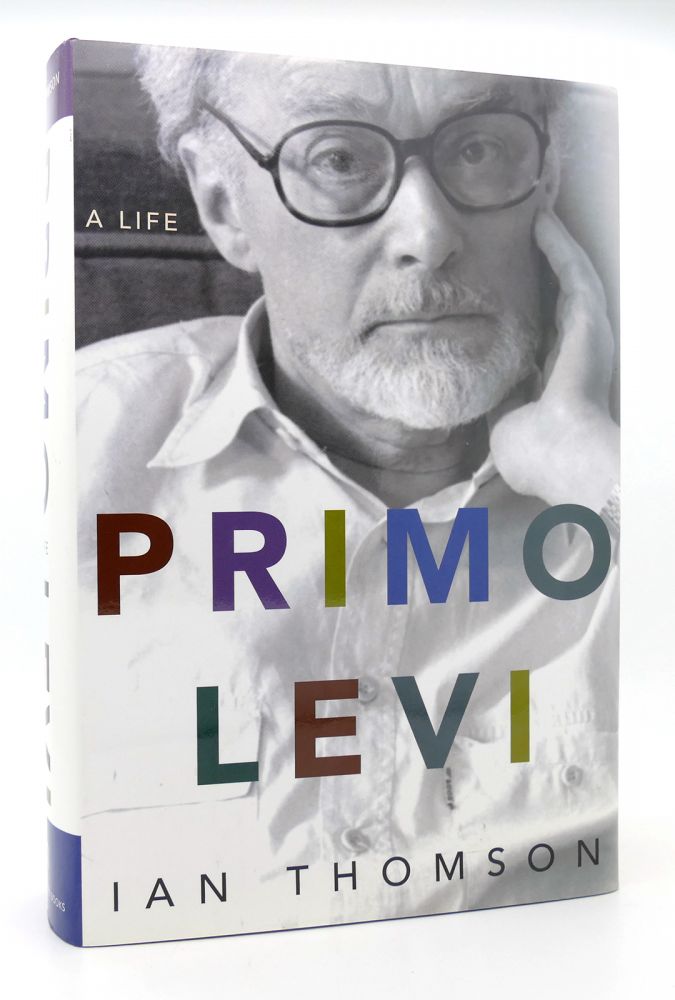
An even more complex consideration of the double-edged quality of reason lies at the heart of the book’s most magisterial chapter, “The Canto of Ulysses,” the second I emphasize. (In recently learned from Ian Thomson’s biography of Levi that he wrote it in a single 30-minute lunch break at his first job after returning home to Turin.) Here Levi submits reason to the most intense and consequential scrutiny.

“The Canto of Ulysses” concerns Levi’s relationship with his work kommando’s Pikolo, a young man named Jean. A Pikolo (also known as a Pipel) was a kind of messenger boy/mascot selected by the Kapo or head of the commando. (Kapos were themselves prisoners, but almost always criminals or sometimes political prisoners.) A Pikolo was typically a teenage boy, who was often used sexually by the Kapo; either way, he had a higher status than ordinary prisoners and received certain privileges. Jean’s full name was Jean Samuel: after the war, he and Levi maintained a decades-long friendship. Jean, an Alsatian, speaks French and German equally well. Mindful of the importance of languages in the camps, he asks Levi, on a day when he has selected the older man to accompany him from the work site to the kitchen to fetch the day’s cauldron of soup, to teach him some Italian. The chapter describes what counts as an idyll in Auschwitz. The task takes about an hour, in which the two men are free from hard labour and the threat of punishment.

Levi makes the unusual decision—which Samuel later said bemused him at the time—of granting Jean his wish by reciting for him a canto from Dante’s Inferno. He readily admits he does so more for himself than for Jean: being able to turn his mind to the foundational text of Italian literature imbues him with new life. But the canto Levi chooses—in class I pass out a copy of the relevant section, as only some lines are quoted in the chapter, and in the process offer a quick summary of Dante’s aims and achievement in the Divine Comedy—is surprising.

In the poem, Dante is surprised to find Ulysses in Hell (as opposed to in Limbo with other virtuous pagans). What, he wonders, has Ulysses done to deserve this fate? Ulysses answers by telling the story of how, having escaped the enchantments of Circe, he goaded his men into sailing across the Mediterranean, through the straits of Gibraltar and past the edge of the known world. He trespassed the boundaries of human accomplishment—and was punished for that audacity. Levi makes a clear parallel between the expedition he and Jean are making and Ulysses’s own, which the wily Ithacan launched in a rousing speech: you are men, and thus made for wisdom, he tells the sailors, mere beasts of burden. The canto matters to Levi because the story it tells “has to do with us two, who dare to reason of these things with the poles for the soup on our shoulder.”

They are not the oxen they appear to be. In using the phrase “dare to reason,” Levi echoes the Latin sapere aude, dare to know, the credo of Enlightenment philosopher Immanuel Kant. Even this early in the semester, students hunger for a positive moment. They welcome the message that humanity can’t so easily be destroyed.

To complicate this wishful thinking, I assign an activity in which half the students make connections between the excerpt from Dante and Levi’s chapter, and other half close the chapter’s final paragraph in order to figure out how it’s related to what’s come before. In pushing them past the obvious comparisons between the rousing Ulysses and the valiant camp inmates, I focus on how Ulysses gets his men to do what he wants. (They are rightly reluctant.) The poem says that his speech about how knowing is central to being human is an example of zeal. We consider the ambivalence of this word, which can be used as much to condemn as to praise. Zeal is almost always too much. It’s irrational (think of the way we use “zealot”). What I want students to see how reason is compromised by the very intensity with which it’s upheld. Ulysses is irrational in his praise of reason. Think about our own culture’s unreasoning and often unreasonable belief in the importance of science and technology, of progress, of improvement. It’s not that these are fictions. It’s that they are hollowed out when they are fetishized. This contradiction is important, because too often the Holocaust is taken to be an aberration from Western culture, when it is, if not its logical conclusion, completely in keeping with the way the West has thought about the world.

That’s why the chapter’s final paragraph, which is set off from what’s come before by a break, is so important. Levi and the Pikolo have reached the kitchen before their language lesson can be completed. Their idyll is over; the reality of camp life returns:

We are now in the soup queue, among the sordid, ragged crowd of soup-carriers from other Kommandos. Those just arrived press against our backs. ’Kraut und Rüben? Kraut und Rüben.’ The official announcement is made that the soup today is of cabbages and turnips: ’Choux et navets. Kaposzta és répak.’

‘And over our heads the hollow seas closed up.’

The last line is Ulysses’s description of his expedition’s fate. This language resonates with the references to sinking and drowning I mentioned earlier. Levi’s language (“sordid, ragged”), his description of the crowd that swallows the two men, putting paid to their conversation about Dante, and his use of foreign languages to talk not about poetry but about food combine to return is to reality. What matters is what’s in the soup today. But what about that final line from Dante. Should we read it as a final irony, a dismissal of what Levi and Jean have achieved? Or as an insistence, however faint, that poetry (and human accomplishment more generally) can persist? What does it mean to describe the press of starving men in the language of Dante? Does it elevate the scene? Does it denigrate Dante? Does the scene even need elevation?

Our difficulty in answering these questions—a result of the text’s complexity, nuance, and appreciation of paradox—challenges any consoling beliefs about the human spirit.

51aYAZexLwL._SL500_

Next time, notes on some of the other questions I ask in teaching Survival in Auschwitz.

“Without Families You Don’t Get Stories”: Bart van Es’s The Cut Out Girl

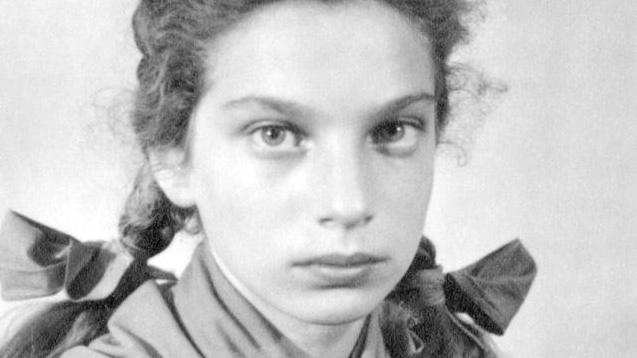
In The Cut Out Girl (2018), the Dutch-born English academic Bart van Es investigates his family’s past. At its heart is Lien de Jong, who in August 1942 was given into the safekeeping of van Es’s grandparents by her desperate Jewish parents.

Van Es’s title refers to a paper silhouette that Lien pastes into an album that surprisingly survived the war. Such albums were common in Holland (the famous diary Anne Frank received for her 12th birthday, less than two months before Lien joined her new family, was probably an album of this sort). Friends, family, and neighbours would fill the pages with well-wishes, typically phrased as achingly sententious poetry.

But the title also refers to Lien herself, who is sliced away from life as she has known it—and then, many years later, cut out again, this time by her adopted family. Van Es’s detective work is prompted by the confusion and resentment, the whole no-go zone that surrounds Lien’s place in his family. Is Lien his aunt or not? What happened between her and his grandmother? Most families suffer from blights of this kind: some fight or hurt the causes of which no one is even sure any more but the effects of which persist through the generations. In this case, though, that ordinary event is complicated by war, displacement, and trauma.

9780735222267

In their first meeting, Lien tells van Es, “Without families you don’t get stories.” For Lien, stories are important because they ensure continuity. They let you make sense of yourself by connecting you to those around you. Van Es would agree, but for him the act of telling is as important as the substance of what’s told. After all, the word Lien uses is stories not story: stories compete with but also complete each other. The plural implies richness, motivation, complexity.

Midway through his researches, van Es is shown a book called Bennekom: Jewish Refuge, detailing the fates of the 166 Jews who were hidden in the town, more than 80% of whom survived. (This is particularly remarkable, since the death rate for Jews in Holland was the exact opposite of Bennekom’s—80% were murdered, higher than anywhere else in Western Europe.) With trembling fingers, van Es finds the entry for Lien:

At Algemeer 33 with Gijs van Laar there was a Jewish girl, Lientje [a diminutive of Lien], in hiding. Lientje belonged to the family and was a total part of it. She attended the Reformed School. She survived the war.

The Cut Out Girl is an attempt to replace this brusque—and, we learn, misleading—narrative with a fuller picture; to take this quasi-official story and to show what it doesn’t or cannot tell; to expose what is self-serving or misguided in it. For van Es also recognizes that stories can blind us. They can confer a false sense of mastery. Which is why he aims to be as self-aware as possible in reconstructing Lien’s story.

That story begins in 1933 in The Hague, when Lien is born to Charles de Jong and Catharine de Jong-Spiero. In the handful of surviving photos, Lien’s parents are attractive, sporty, carefree. That can’t have been the whole story: there was some sort of trouble between her parents when Lien was very small, and she was sent to live with relatives for a year. But her parents reconcile, and Lien grows up an ordinary child living an ordinary life, even after Germany invades Holland in May 1940. But by the next year life is more difficult for Dutch Jews, even ones like the de Jongs who do not identify as such. By 1942, deportation notices are widespread. Lien’s parents look for a way to send her into hiding; in August they entrust her to a resistance organization headed by a couple named Heroma (who seem absolutely heroic and deserve a book of their own). Mrs. Heroma brings Lien to the van Es home in Dordrecht, and later ferries her to the many safe houses she passes through.

Despite some initial difficulties—Lien has always been a finicky eater and her new family has no patience for that sort of thing; she has never slept in a room with other people; her upbringing has been more sheltered and more emotional than the world she now enters—Lien fits in well with the family, who have children close to her age. At first she calls Jans and Henk van Es Auntie and Uncle; later it will be Ma and Pa. Van Es includes heartbreaking letters smuggled from Lien’s parents to their daughter congratulating her on her ninth birthday. By the time she receives them, both have been deported to Auschwitz. Neither survive.

Lien does, though it is a near thing. One day in early 1943 two policemen arrive at the house, looking for Jews. (Holland was the only country to offer cash rewards to those who turned in Jews.) Lien narrowly escapes: Auntie sends her to a neighbour where she cowers in the unused sitting room). Thus begins the most difficult phase of her time in hiding. She is moved from one safe house to another, often staying only a day or two in any one place. Eventually, she is placed with a family in Bennekom. The van Laars are pious and self-righteous. Yes, they have taken a risk by accepting Lien into their home, but they also treat her as a servant. Lien spends the rest of the war with the van Laars. By this time, events have taken a toll on her. She loses a clear sense of who she is: her life was on low heat, she tells van Es. She lived in a dreamworld, she sometimes felt herself flying over her surroundings. She regresses, wetting her bed, losing weight. She becomes numb, disassociated, feelings that only intensify when Gijs van Laar’s charismatic but violent brother, a man she has also learned to call Uncle, sexually abuses her. The van Laars turn a blind eye—it is understood that Lien and her Uncle have a special friendship. What this means is that the man takes her into the forest and rapes her.

Lien is desperate to escape. When the war ends, Mrs. Heroma asks her what she wants to do. She wants only to return to the van Esses. At first they refuse. It is a great blow. In the time Lien has been away they have had another child; Henk is increasingly involved in socialist politics and the postwar reconstruction effort; bringing Lien back into the house would just be too much. But Mrs. Heroma senses it is a matter of life and death, and eventually the family relents.

A happy ending? Not quite. Lien is happy, she becomes one of the family again, even more so than before. But she never fully fits in. There’s an unhappy incident when the van Esses basically browbeat her into not applying for the gymnasium, the academic high school: the practical school was always good enough for them. But Lien finds her way. She trains to be a social worker, specializing in troubled children. Unsurprisingly, she is perfectly suited to the work. One day, in 1953, she is at home for a few days from school and falls ill. Dozing on the sofa, she is awakened by Pa kissing and stroking her. It is yet another terrible hurt, but, amazingly, this incident, which Lien keeps to herself, doesn’t separate her from the van Esses. That happens later, around 1980, after Lien has married and had children and gotten divorced. The ostensible reason for the falling out is banal, but presumably it’s just a stand-in for the sense both Lien and Ma have long felt that she never quite fit with them. Ma writes Lien an icy letter: she doesn’t want to see her again. Lien becomes part of murky family lore: thirty years pass until Bart van Es reaches out to her.

*

I certainly enjoyed The Cut Out Girl, reading it in a single day, drawn into the mystery van Es sets out to solve. But I wasn’t only reading for the plot. I had another agenda, another question in mind. Would I teach this book? On the face of it, The Cut Out Girl fits perfectly with the concerns of a course I teach called Literature after Auschwitz, which explores “postmemory,” Marianne Hirsch’s influential term for the experience of those who did not live through the Holocaust but whose lives have nonetheless been strongly shaped, often disfigured, by what those close to them (usually their parents) did experience.

Van Es’s memoir would usefully add a third-generation perspective to the class, plus one that isn’t Jewish. My interest in it as a teaching tool lies elsewhere, though. Ever since Helen Epstein first wrote about the children of survivors in the 1970s, the language of generations has dominated scholarship on the after-effects of trauma. Last year I was at a conference where Erin McGlothlin suggested that we retire or at least question this language, which she finds unnecessarily biologizing, as if there were a genetic component to trauma. Recent neurological research suggests this might in fact be true, but we should consider the relationship between these findings and the racism and biological essentialism of fascism. And what do we lose if we emphasize neuroscience? What happens to history, personal or otherwise, if we think about generations in a primarily genetic sense? What would be narrative’s place in understanding trauma? What would happen to Lien’s stories?

The Cut Out Girl adds to this conversation by advocating a non-biological sense of family. Movingly, at the end of the book Lien introduces van Es to her friends as her nephew, the man who is going to tell her story. (Too bad van Es dilutes this moment by adding an epilogue, though it’s lovely to read that in her 80s Lien has formed a relationship with a man she knew briefly as a child.) I think the book’s expansive, generous definition of family (or at least its willingness to challenge the dominance of biology in our thinking of family) will interest students.

As will its unflinching portrayal of sexual abuse during wartime, which emphasizes how easily victims can be re-victimized. This aspect of the book is so relevant to our own time, as we finally begin to acknowledge the scope of abuse and assault in society writ large. Van Es’s frankness fits with a sea change in Holocaust studies: in the past many Holocaust stories would have passed over such material in silence, though we are learning how common such experiences were. (I could usefully contextualize this material by assigning an Ida Fink story and brief selections from Molly Appelbaum’s diary that also depict the sexual abuse of Holocaust victims.)

methode-times-prod-web-bin-e012a4ce-f889-11e8-8f64-ec083420809b

As you can see, then, there is a lot to like from both a readerly and a pedagogic perspective about The Cut Up Girl. Yet I also have reservations, particularly about its style and structure. I found it pedestrian at the level of the sentence, and I’m always nervous about teaching texts that I don’t think are especially amenable to close reading. (I’ve barely quoted from the book, because it’s the content much more than the expression that’s interesting.) In terms of structure, van Es does a few things well. At times, he doubles back when narrating Lien’s experiences, explaining that she has no memory of the events he’s just told. He’s forthright about how he put the story together, how he supplemented Lien’s telling with other sources, where he is speculating, etc. His telling is self-aware, which is an essential component of Holocaust literature. (But why oh why must he write in the present tense? I hate that it’s become the default narrative mode.)

But van Es’s own story is not very interesting. Of course, it’s never going to match Lien’s, nor should it. But his exercise routine, his trips to the archives, his nights clubbing with his cousin, they are all so prosaic. The point of including his own story, I think, is to assert how easily familiar terrain can become unfamiliar. How could this village have been filled with hidden people? How could this pleasantly anodyne fitness center have been the home of a family dispersed and destroyed? Sudden revelations—where what you think you know vertiginously reveals a hidden face—are as much a part of family history as of geography.

But for this conceit to really work the book would need more of van Es’s past. We would need to know more about his childhood memories, more about his own (much more modest) dislocation, between England and Holland, more about what being Dutch means to him. And we would definitely need to know more about his relationship with his stepdaughter Josie, which has been fraught in ways that, he hints, resonate compellingly with Lien’s experiences. (Not the abuse part; the having a hard time accepting someone who is thrown into your life part.) I totally get why he won’t tell us more, but it’s frustrating to be asked to imagine these connections.

But if in talking about himself van Es is too elliptical, in telling Lien’s story he uses indirection to good effect. He ably delays the big reveal (what happened between Lien and Ma?) And, more interestingly, when the answer turns out to be pretty underwhelming, he is smart about the significance of what it means that we feel let down. In other words, he has a lot to say about our desire to explain and understand. On the one hand, order is central to self-understanding. As Lien says, once she understood her own experiences as part of a pattern (a sentiment she thinks of in Buddhist terms) she was able to live more fully and freely. But on the other, we can value order too much. Patterns can become templates, sense can become cliché. The villains in The Cut Out Girl—aside from the obvious ones of the Nazis, who, true to the experience of most of their victims, barely figure in the story, or the Dutch collaborators (and there are quite a lot of these)—are those, like Mother van Laar and even Ma, who live with unshakeable conviction about how the world works. Rigidity can be a way to handle the troubles the world throws at you, not least when you’re risking your life to hide someone in your home, but it can also cause further trouble. (This paradox is similar to the one van Es proposes when he considers the Dutch tradition of tolerance, which has involved staying out of other people’s business, leading to the creation of a siloed society comprised of “pillars” (Protestants, Catholics, liberals, etc.) that seldom overlap. Could that very separateness, he asks, have been what allowed the Germans to act as they did in Holland?)

In this regard van Es’s use of the poems from Lien’s album is interesting. At first I wondered why he felt the need to include so many of them. They’re objectively terrible. Here’s one:

Roses big and roses small

Soft as velvet on a wall

But the softest petal part

Is the rose of Lietje’s heart.

But the contrast between the sentiments they express—the things Lien’s loved ones wish for her: health, happiness, success, long life—and the reality of her experience is important, and not just because of their ironic juxtaposition. Instead van Es explores an analogy: conventional form is to idealized (that is, false) sentiments as unconventional form is to accurate experience. The clunky poetry of the well wishes is so kitschy because it can’t express actual experience. To do so, especially in a time of war and disruption, would require a more unconventional way of telling.

In the end, I’m unconvinced van Es has found such a form. His book is nothing like those poems, but neither is it like the daring comparison of the story of a family and the story of a people that structures Daniel Mendelsohn’s The Lost: A Search for Six of the Six Million or the elegant prose of Edmund de Waal’s The Hare with the Amber Eyes, to name two books doing similar work to The Cut Out Girl. In the end, van Es’s book reminds me a bit of the doggerel that Lien’s friend Lily, who copied the lines I cited above, added at the bottom of the page: “I lay in bed and mucked about / so mum got cross and started to shout.” A lot better than the canned poem, and an engaging and daring act of non-conformism in a conformist society, but not exactly great art.

Still and all, I think I’ve talked myself into assigning the book. Do you agree? A couple of years ago I did something similar with Sara Kofman’s memoir of her time as a hidden child in Paris, Rue Ordener, Rue Labat. And Kofman has been a staple of the class for years. Students love it. Indeed, I might describe it as the book Lien might have written. That is, it is totally fractured, cryptic, and fragmented. It’s like an expression of trauma, whereas van Es’s book is a consideration of trauma, if that makes sense. The latter is less striking, but also, perhaps, more necessary. Certainly more healthy.


Rohan’s post on The Cut Out Girl is well worth reading. She liked it more than I did, but in general we agree about its merits. She also mentions an important sub-plot, as it were, when van Es visits the street where Lien first lived in Dordrecht, which has now become public housing inhabited mostly by Muslim immigrants. A man gets upset at him for taking pictures—van Es agrees that coming to look and not to tell is a problem. Which leads me to wonder: when does a story end? What would happen if we juxtaposed that man’s story with Lien’s?


“Look what the Bolsheviks have done to the horses!”: Philip Marsden’s The Spirit-Wrestlers

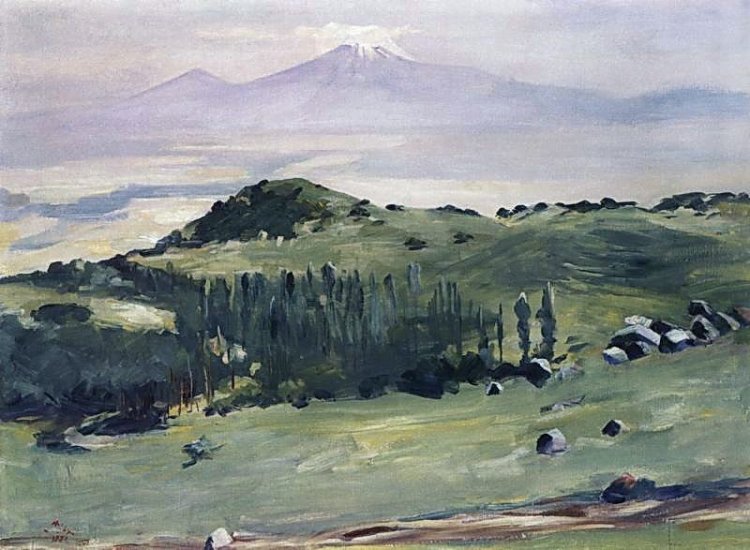
Sometime in the mid-90s, Philip Marsden spends a winter in Moscow, researching the Cossacks and the Old Believers—dreaming, in other words, of the Caucasus.

When spring comes Marsden goes to Rostov. There he begins the meandering journey across the land between the Black and Caspian seas that is the subject of The Spirit-Wrestlers. Marsden describes the territory as “Russia’s Vendée, where serfs and schismatics fled to become Cossacks … where the perennial urge to conformity seems at its weakest—the place where the sea-like flatness of the steppe breaks against the Caucasus and all its scatterings of non-Russian peoples.”

D9RvhNoWwAE6W9H

Some of these people are long-vanished, like the Scythians, whom the Cossacks have styled as their forbearers (a claim Marsden dismisses as nonsense), and the Alans, another vanished Steppe group famous for its warrior temperament, and whose descendants are likely today’s Ossetians. In addition to sojourns among Cossacks, Ossetians, Georgians, and Armenians, Marsden also tracks down some more obscure peoples, like the Molokans (the milk drinkers, named after an epistle from Peter that describes believers desiring the Word as babies do milk), whose numbers at one point reached a million and were important in the movement to abolish serfdom in the 19th century, and one of whose subgroups were the first to call themselves “communists” after pooling their resources.

The people he’s most interested in, though, are the Doukhobors (the “spirit-wrestlers” of the title). Their origins—like those of pretty much every group in this book and, indeed, the world—are unclear, but they date to the late 18th century. The sect’s adherents distanced themselves from what they saw as the corruption of the Church; instead they “tried to live in the way most likely to release the spark that lives in each individual.” In the 19th Century their most famous leader was imprisoned in Siberia and the rest were exiled to the southern edge of the empire. Above all it was their pacifism that got them in trouble—they refused to serve in the army—but this was what brought them to the attention of Tolstoy, who donated the proceeds from his last novel, Resurrection, to them, which allowed many Doukhobors to emigrate to Canada in the early 20th century. (They settled in the prairies, and flitted on the periphery of my childhood, but only as a kind of joke: their reputation for espousing a kind of hippie millenarianism stemmed from their tendency to avow nudism. I remember them being portrayed to me as something like grubby Hutterites. It was useful—and not a little shaming—to learn the meaningful context for people and practices I’d only known as derisive.)

Yet as its division into parts named Steppe and Mountain suggests, The Spirit-Wrestlers is as much about landscape—sometimes verdant, sometimes stony, always seemingly inexhaustible—as about the stormy co-existence of religious and ethnic groups.

Last year I read Marsden’s The Bronski House, about a similarly contested border region in Eastern Europe, this time to the north-west of Russia (Poland, Lithuania, Belarus). I loved it. But I think I might like The Spirit-Wrestlers even more. Which surprises me, since the subject matter isn’t immediately appealing to me. I’m not really that religious a person, and non-Abrahamic religions interest me least of all. (Many of the people Marsden interacts with are Christians, but they are typically dissenters: the Doukhobors, for example, do not recognize the authority of the Church.) Yet despite its concern with spiritualism, Marsden’s true interest is ordinary material life, in all its pains and pleasures.

That dogma is his enemy is clear throughout. But in his final pages, Marsden allows himself to editorialize a little. In Armenia he goes looking the Yezidi, a group that recognizes evil as an integral part of creation. He concludes:

Our universe is naturally flawed, they say, and to deny it is to miss an elemental truth. I could not help being drawn to this idea. It was a riposte to all those dreamers—from Christians to Communists—who clog their thinking with the way things should be and ignore the way they are, who gaze for too long at their own glittering visions and fail to see the glories in the twists and bumps that make up the real world.

The Yezidi—the long history of whose suffering took a further, terrible turn a few years ago when they were genocidally persecuted by ISIS—don’t try to purge the world of evil. They just try to avoid it. In so doing, Marsden argues, “they sidestep one of the great paradoxes of our earthly existence. For as any dictator learns, it is precisely what you try to purge that becomes your downfall.”

These conclusions explain Marsden’s epigraph, attributed to Russian villagers, who, when camels were brought to their collective farms, exclaimed: “Look what the Bolsheviks have done to the horses!” The joke might at first seem to be on the villagers, rubes who can’t tell a horse from a camel. But really it’s on the Bolsheviks, and anyone who tries to mash square pegs into round holes. Or, more painfully, on those who take on the role of the pegs, who suffer the murderous grandiosity of conviction forced on life from on high. Can we even call it a joke? So much pain lies behind it: a classic if-you-don’t-laugh-you’ll-cry scenario.

D9OvUmjXUAACHS-

Suffering also explains the importance of food in the book, for food, Marsden suggests, is the preeminent way of bringing people together peacefully. In the steppe and the mountains, food (and peace) has so often been in short supply. When Marsden talks to old people he hears terrible stories of starvation, mostly due to Stalin’s forced collectivism. They remember eating grass and birch bark, boiling leather shoes for a desperate soup, devouring the seed-corn. These stories are from long ago, but they resonate into the present. In Maikop, in the Russian Adygei Republic, a fraught conversation about ethnic nationalism is brought to a peaceful conclusion only when it’s time for lunch:

The whole subject was too serious to be taken seriously in public. They unpacked more food, and with the food the harmless chatter resumed; in Russia there is no anxiety so great that it cannot find relief in a full table.

As this passage suggests, food matters less for its own sake (the book is pre-Foodie, thank God) and more for its ability to bring people together.

Rather unusually for a travel writer, Marsden likes people. He’s curious about everyone and everything, without being credulous. He stays just the right side of folksy in his observations, some of which are quite funny:

I left Fyodor Mikhailovich sitting on a bench outside his gate. He was waiting for something to happen so that he could watch it. Nothing had happened yet and it probably wouldn’t that day.

In South Ossetia he meets a doctor nicknamed Pushkin, “a tireless walker, not fast, but who walked without really being aware he was walking.” They discuss the famously long-lived people of the Caucasus, people who lived not just into their 120s but, apparently, into their 170s. Why aren’t there such people anymore? We eat yeast, Pushkin says, adding, “Everything’s different now.”

The doctor, who visits tiny villages on foot, bringing only the comfort of his presence (he hasn’t had medicine since the fall of the Soviet Union), experiences change only as loss:

To Pushkin, these elongated lives were just one of the vanished riches of the Soviet past, like a full medicine cabinet, like the kolkhoz sheep, like peace between the peoples of the union.

But the Union brought pain, too. In Kidlovodsk, a spa town in the mountains, he rents a room from Natalya Petrovna, a “teacher of ideology” who is at first presented almost as a figure of fun, an eccentric anyway: “She was also an expert on local buses.” He sleeps on her balcony, under “a canopy of fresh walnut leaves.” In the morning he listens to Natalya toss “scraps of bread to the dogs in the yard: ‘Maronchik! Sobachka!’” She spends her days working in the garden at her dacha, which she reaches by taking the Number 52 to the post office, then changing to the Number 10. It’s all gentle and sweet. Then we learn about her two sons, who appear “loose-hipped and laughing” in a photo on the kitchen wall.

They had gone to Afghanistan together. They had written long letters home. They had sent photographs of themselves in uniform. Natalya’s sons had returned separately, each one in a box.

The tone darkens all in a moment. The life of the lonely woman suddenly seems different: the precision of the bus routes becomes a way of salvaging sense from senselessness. And her repeated lament “They’ve drunk Russia away…” becomes not a quixotic railing against the Russian national pastime but fury at the generals who stole her boys.

As these examples suggest, Marsden isn’t a showy writer. But he’s a good one. That “loose-hipped and laughing” is a fine example. “Loose-hipped”: I’d never have thought of it, but I can just see it. Or take this description of a sudden rainstorm: “Women scuttled into doorways with handbags over their heads; dogs ran flat-furred through the water.” I love that “flat-furred.” Marsden’s good with dogs. In Armenia, “warm Asiatic winds were blowing unchecked across [the land’s] grassy tracts, flicking the neck-fur of the dogs.”

Marsden is like his style: impressive but modest. He keeps to the edge of the story. We learn almost nothing about him. (By comparison The Bronski House is practically an autobiography.) He cuts an appealing figure: modest, uncomplaining, able to find a place for himself no matter where he goes. When things go wrong, as they always do, he doesn’t fuss. I especially wondered what language he speaks to the people he meets, many of whom have little formal education. (Which of course isn’t incompatible with the ability to speak several languages.) It’s clear his Russian is excellent, and that’s presumably the language of choice. But did that work in Ossetia, Georgia, and Armenia?

Similarly, I wondered what such a trip would be like now. Even more difficult to accomplish, I assume. Marsden is kicked off a bus by Russian security forces the first time he tries to get to Georgia, and he worries about being shot at night in Tbilisi. But I suspect these places are even more dangerous for Westerners now. I would imagine the rise of Islam in the area has changed things a lot (Marsden only meets one Muslim, a convert who is the source of bemused contempt by his family.) Wherever he goes, he records everyday examples of Islamophobia (plus the casual anti-Semitism you’d expect).

These changes notwithstanding The Spirit-Wrestlers didn’t seem dated, despite being written twenty years ago. Not that its concerns are timeless. But the battle between idealism and ordinary life (which I admit I am romanticizing, as, perhaps, does Marsden) is endless. And it’s clear Marsden has influenced later writers. The Spirit-Wrestlers, for example, reminded me of Kapka Kassabova’s Border, a similarly intelligent and sensuous investigation of a place where cultures collide, in that case Thrace and the Rhodope.

october-in-yerevan-1961.jpg!Large

If I haven’t already enticed you to give The Spirit-Wrestlers a try, I’ll add two last notes. One, it’s got a great map. Who doesn’t love a map? Two, it’s a perfect summer book, filled with descriptions of people sitting outside late into the night eating and, especially, drinking. And with a new set of true believers causing trouble all across the world what’s not to like about that?

Primo Levi: A Centenary Celebration

The Italian writer and scientist Primo Levi was born 100 years ago in Turin, Italy. He spent his entire life there, except for the months he spent imprisoned by the Nazis in a sub-camp of Auschwitz, Buna-Monowitz, and the year it took him to make his way home. Although Levi’s actual birthday is not until next month (he lived from July 31, 1919 – April 11, 1987), I’ve decided to spend much of June reading and writing about him.

italy-literature-primo_levi_23904106

Levi is a writer close to my heart. It would not be wrong to say that I am in love with him. Which is of course a preposterous thing to say. But from the time I first read Levi, in my second year at university, I was smitten with his secular humanism. I admired the way he bridged the so-called “two cultures” (not an idea, I suspect, he would have had much time for). And mostly I sensed that he was a decent, kind person—a mensch of the first order. Of course, I gleaned that sense from his autobiographical writings, and, like all memoirists, the persona Levi offers us in writing is related to but not the same as his actual person. I have long had Ian Thomson’s biography on my shelves, and this seems the perfect time to read that alongside Levi’s own works.

(Thomson is a great writer, and I’m really looking forward to his book, but I know there are at least two other biographies in English, one by Carole Angier and one by Berel Lang. I won’t have time to read them, but if anyone has read one or both, I’d like to know what you think. I’m dimly aware that Thomson and Angier come to different conclusions about Levi, particularly, I believe, about his mysterious death.)

When I speak to groups about the Holocaust, I am often asked what books I would most recommend for people who want to learn more. It’s a question to which there are so many possible, equally worthy answers. There are so many urgent Holocaust books. But I always list Survival in Auschwitz (as it is frustratingly titled in the US: a much better, and more accurate title would be If This is a Man) first. For me, it is one of the most indispensable books of the twentieth century.

Here’s what I have in mind at the moment for my centenary celebrations:

  • A post on Survival in Auschwitz, specifically how I teach it. [Note: this turned into two long posts: here and here.]
  • A post on his genre-defying The Periodic Table, which I read 25 years ago and look forward to revisiting. [Note: Didn’t do this, but my friend Nat did–he’s thoughtful as always.]
  • A post on If Not Now, When?, a novel in which Levi takes on the Eastern Jewish experience that wasn’t his own (it’s about a band of partisans making their way from Russia to Palestine, perhaps loosely based on the Bielski partisans).
  • A post on some of Levi’s non-Jewish writing: I’m thinking Other People’s Trades and some of the stories
  • A post on some of the things I learned from Thomson’s biography

That’s an ambitious schedule, and who knows how much of it I’ll get to. In the meantime, you could check out a couple of things I’ve already written on Levi. Here at the blog I wrote about how I always begin my introductory Holocaust Lit course with a close reading of a passage from the second of Levi’s memoirs, The Reawakening. And a couple of years ago I reviewed an interesting new book about Levi’s time as a partisan in the Italian Alps in 1943. (It was for this resistance work, rather than his being Jewish, that Levi was first arrested.)

I’d be thrilled if anyone wanted to join me in reading Levi—no need to match my choices, especially since I’m not even sure I know what they’ll be yet. And if you feel compelled to write about your responses to those works, I’ll gladly post your thoughts on the blog.

Sarah Moss’s Ghost Wall

I wrote about Sarah Moss’s excellent short novel Ghost Wall at The Mookse and the Gripse.

D0rXyF2WkAABBji

Here’s a short bit from near the beginning that gives you a sense of what the book’s about:

That story is told by seventeen-year-old Silvie, who, together with her parents and an anthropology professor and three of his students, spends two weeks in the summer of 1991 reenacting the lives of the Iron Age inhabitants of Northumberland. Britons, her father calls them; Celts, the professor demurs, citing the current preferred terminology. In making this distinction, the professor ineffectually pushes back against Silvie’s father’s desire to imagine a purely British origin story. Silvie’s own name is short for Sulevia, a local goddess of springs and pools, or, as Silvie, quoting her father, half-reluctantly, half-defensively puts it, “A proper British native name.” As that “proper” suggests, her father’s idea of authenticity is moralizing at best, overtly racist at worst: describing the Picts’ resistance to the Romans (“the Romans are the end of what he likes”), he says “there weren’t dark faces in these parts for nigh on two millennia after that, were there?” (he’s already rejected Indian food as “Paki muck”). Her father, Silvie concludes, “wanted his own ancestry, a claim on something, some tribe sprung from English soil like mushrooms in the night.” What he has instead is a job as a bus-driver that supports his amateur archaeology and survivalist escapades, and a wife and daughter whom he terrorizes.

It’s a terrific book, a riposte to today’s rise in nativism.

My thanks to Trevor Barrett, the original Mookse, for the opportunity!

May 2019 in Review

In contrast to last month, May was a good reading month. No surprise: April is the worst month of the year for my schedule; May is one of the best. Plus, I had a lovely few days at my in-laws’ farm, where there’s nothing for me—a person who avoids bush-hogging (it’s a thing, look it up) as if his life depended on it—to do but sit on the porch swing and read.

D6ogWr6W0AES07o

David Downing, Diary of a Man on Leave (2019) The new standalone from Downing is about a German-born Soviet spy who is sent back to Germany in 1938 to see if any of the members of the now-suppressed Communist party can be enticed into sabotage or resistance work. As is often the case with Downing, the historical background is more compelling than the writing or the story. But I also didn’t give this book my best. I bet I would have enjoyed it more if I’d read it in a couple of sittings, instead of in dribs and drabs over the last week of the semester.

Miriam Toews, Women Talking (2018) Lots of people have already written about this excellent novel, including Parul Seghal in this very nice essay about #Metoo in fiction. It’s based on a true story: in a Mennonite community in Bolivia, women of all ages were regularly drugged with animal anesthetic and raped by men they lived among and knew well. In Toews’s novel, the men of the community have gone to the city to bail out the culprits. The women have two days to decide what to do: stay, leave, or fight. The novel consists of their debates, as recorded by August, a man who in his younger years left the community (his parents were expelled) and has now returned. August is an educated man, a man useless at farming, and, as such, in the eyes of the women as well as his own, not really a man at all.

I loved this smart, slippery novel, and I suspect I would get a lot more out of it on a second reading. I don’t think I’ve come close to plumbing its depths. I’ll simply note for now that the use of the male transcriber (the women are illiterate) is brilliant—it lets us see how even an ostensibly “good,” that is, sympathetic man, is complicit in patriarchy. When August describes the underside of a woman’s arm as “very smooth and white, like the keel of a new canoe,” my first response was to admire this simple but effective simile. My second was to wonder over the nature of the comparison. Is it neutral? (And what would that even mean?) Appreciative? Objectifying? Can there be appreciation without objectification? Relatedly, can there be forgiveness without complicity? What is forgiveness even for? By evoking these sorts of questions, Women Talking reminded me of Virginia Woolf’s Three Guineas, another rhetorically complex investigation into social structures, gender politics, and the uses and abuses of violence.

I’ve a longstanding aversion to Canadian literature that I perceive to be worthy but dull (i.e. most mainstream English-language Canadian fiction of the past thirty years). I’d never read Toews before because I thought she fit that bill. On the basis of this book, anyway, I was totally wrong, and I look forward to looking into her backlist. Anyone have preferences?

Katherine Marsh, The Night Tourist (2007) This one is special to me because my daughter and I read it together (mostly me to her, but sometimes her to me), and it’s a pretty sophisticated book, probably best suited for middle readers or even teenagers. It reworks the Orpheus myth (and as such gave my daughter her first consistent exposure to Greek myth—another milestone). Jack Perdu is a teenager who experiences mysterious visions that eventually lead him to experience a whole New York underworld full of ghosts. These recently and not-so-recently dead people must come to terms with their past before they can, in the language of the novel, “move on” to Elysium. Befriended by a girl named Euri, Jack learns why he, a mortal, can see ghosts and at what cost. In so doing, he uncovers the truth about his mother’s death, about which his father has always been so tight-lipped. And he reenacts his own version of the Orpheus story. Along the way he travels through all kinds of unusual New York landmarks—it’s a good city novel—and meets all kinds of people, like the poet Dylan Thomas and the psychoanalyst and early translator of Freud Abraham Brill. In other words, The Night Tourist was as much fun for me to read as for my daughter. I’m grateful to a colleague who teaches Classics and Children’s literature for turning me on to this book.

John Warner, Why They Can’t Write: Killing the Five-Paragraph Essay and Other Necessities (2018) Catnip to me, since I spend much of my professional life decrying the five-paragraph essay, teaching students why it’s boring and awful, and supporting them through the realization that a skill they had to master in order to get to college now means nothing at all.

Warner, who is clear that his teaching discoveries have been possible because he hasn’t had a full-time, secure academic position (which is to say, he is the most common kind of academic there is today), is funny without being cutesy. He’s clear and thoughtful. And best of all, he’s inspiring. I’ll be changing my teaching this Fall based on his suggestions. His practical advice is great—and his sample exercises even better. I could have done without some of the sections demolishing what has passed as educational reform in the last decades—mostly because I already agree with Warner, but also because these sections feel a bit padded—but on the whole this is a book anyone who writes or, especially, teaches others to write should take a look at. It opens with a great bit on the reactions Warner gets when people learn about his job (It’s the phones! It’s that they’re snowflakes!). Warner says, it’s not the phones, and it’s not the snowflakes: it’s that students are doing exactly what we’ve trained them to do.

Andrew Taylor, The Anatomy of Ghosts (2010) My last audiobook of the semester was a good one. I’ve read some of Taylor’s historical fiction before (always crime-ish, sometimes Gothic, a bit pastiche-y), and although some are better than others, he’s always good light reading. This is a story of secrets and corruption in 18th century Cambridge. Some appealing characters, some dastardly ones, some nice twists. Good stuff.

Ben Aaronovitch, Whispers Under Ground (2012) I really liked Midnight Riot, the first book in Aaronovitch’s urban fantasy Rivers of London series. In the first book, PC Peter Grant learns to his surprise that he has an affinity for the supernatural and is assigned to a unit of the Met dealing with all things inexplicable to reason. (I especially like the personification of the various rivers and streams in and under London that gives the series its name.) A while ago, I read the second book, and it was ok. Now I took a flier on the third, and I’m realizing that I like crime a lot more than fantasy. There’s always a climactic bit in these books with some kind of monster or supernatural creature that I find tedious. So maybe these books aren’t really my thing. They’re funny, though. Maybe I’ll pick up the fourth in a year or so.

Nathan Englander, kaddish.com (2019) Englander is the heir to Bernard Malamud, which is some of the highest praise I can offer. My appreciation for his (admittedly a bit uneven) work only grew when I got to host him for a few days several years ago. The man’s a prince.

I liked kaddish.com a lot, but this review in The Nation made me doubt my response. (I respect Nathan Goldman’s taste.) I agree with Goldman that the book (which is really a novella—a form that, happily, seems to be making a comeback: thinking of Moss’s Ghost Wall for example) is more expanded short story than fully-fledged novel. But I don’t think it’s padded or slight or overworked. I appreciated how it used the kind of temporal shifts more common to a story than a novel. There’s a big, and to my mind fascinating, shift about 30 pages in: some readers characterize it as undeserved or ill-explained, but I think it’s important for making sense of the book, which is about persistence or, better, the inexpungable, whether that takes the form of pop up windows or Torah study.

What’s this book about? The eponymous website, of course, which promises to exploit a Talmudic loophole in order for users to hire someone to say kaddish (the prayers for the dead) for a deceased loved one for the year prescribed by Jewish law. Englander’s protagonist, who has taken advantage of this service, spends most of the book trying to meet the shadowy and perhaps unreal person who took on that burden. Like so much of Englander’s work, kaddish.com simultaneously challenges and appreciates Jewish tradition. (Again like Malamud.) It also asks to be read in tandem with his last book, the similarly short The Dinner at the Center of the World: both are about Israel around the turn of the century; the first political, the second religious.

James Sturm, Off Season (2019) Melancholy comic, which I wrote about here.

Judith Kerr, When Hitler Stole Pink Rabbit (1971) I’d been thinking about how I first learned about the Holocaust, and I remembered this book, which—along with Anne Holm’s I Am David (does anyone read that anymore? I should track it down)—was one of the first places I got even a hint about the fate of Europe’s Jews under Nazism. (How old was I? 10 maybe?) Re-reading When Hitler Stole Pink Rabbit was a revelation. For one thing, I realized it’s not really about the Holocaust: it’s indirectly about the Nazi persecution of Jews, and directly about exile.

Anna, the protagonist, clearly modelled on Kerr herself, is nine when Hitler takes power. Her father is a well-known writer critical of National Socialism. (As was Kerr’s father, Alfred Kerr, nicknamed the Kulturpapst (cultural Pope) of Weimar Germany.) Just before the fateful elections in January 1933, Anna’s father is tipped off that he should leave the country, as he is likely to be arrested should the Nazis win. What he hopes will be a short vacation turns into a life-long exile, in which he is joined by his family, first in Switzerland, then Paris, and finally London.

Kerr writes piercingly of what it means to have no home other than one’s immediate family (“If you haven’t got a home, you’ve got to be with your people”—lucky for her, and her character, that she could). Being a refugee is hard, the book suggests, but it also has its benefits. (Maybe this is the difference between exiles and refugees. Only the former can look on their experiences so philosophically.)

There’s an especially moving subplot about a family friend, a naturalist and a Luftmensch who laughs off the idea that he should leave Germany. (One of his grandparents was Jewish.) When Uncle Julius is forced out of his job and can only find work as a sweeper in a factory, his only pleasure is his daily visit to the Berlin zoo, where, Anna’s father notes sadly, the monkeys recognize him not just for the peanuts he brings but also for his gentleness. If only the people were as perceptive. When the zoo is decreed off-limits to Jews, Julius swallows a bottle of sleeping pills.

Yet despite such stories, the book is very funny. The family’s pluck is heartening, and their dry wit a pleasurable, if necessarily limited, fuck you to fascism. (The title comes from Anna’s decision to leave behind her favourite stuffed animal, a pink rabbit, with all the rest of the family’s possessions, in favour of a new toy that she later recognizes she doesn’t love at all. The family’s things are sent “into storage,” but of course, none of it is ever seen again.) Reading Kerr’s delightful book, I sometimes laughed out loud, which I really didn’t expect.

Kerr wrote two more books about the family’s experiences, taking up Anna’s story after her arrival in England. These are out of print, but I’ve tracked them down in various local libraries. Just a few days after finishing Rabbit, I learned of Kerr’s death at the age of 95. (Judging from the stories circulating on Twitter, she was a delight.) I’ll be reading the rest of the trilogy soon: maybe an essay will come of it.

Chia-Chia Lin, The Unpassing (2019) Contemporary American literary fiction is not my thing, but I like Garth Greenwell, and he’s been saying good things about this book. So I plucked it from the library’s New Book shelf. I almost quit on the first page:

During an uneventful part of my childhood, my mother walked into the room with a plate of loose washed grapes. She collapsed. Grapes thudded dully on the carpet. One rolled under the couch. The plate lay overturned, and my mother’s body was beside it, limbs splayed.

This is just the sort of in medias res, flatly written, and ominously portentous sort of thing I associate with American literary fiction. So annoying. (At least it’s in past tense. Why does everyone feel they have to write in present tense?)

Anyway, I persevered, and I’m glad I did. It turns out the mother is testing her kids, checking to see whether they would call for an ambulance. (They didn’t.) This gives you some idea of the fraught family dynamic at the heart of Lin’s debut novel, which is narrated by a sensitive child, alert to some of the nuances of what’s going on around him, but blind to others, which we glimpse by reading against his limited perspective.

Not a particularly unusual scenario for a literary novel. But who the child is and where he tells his story from is more unusual. Gavin, ten years old in 1986, is the middle child in an immigrant family. His parents are from Taiwan; he grows up in Alaska. His father is a wastewater engineer, but whether from bad luck or incompetence, he makes a mistake and a child dies from a poisoned well. (The motif of poisoning returns at the end of the book, with a reference to the Exxon Valdez disaster/fiasco.) The child who dies barely figures in the book—though the event has consequences for the narrator’s family, which spirals into severe poverty—but that fate echoes in another, significant way: Gavin’s younger sister dies of meningitis, and we see how each member of the family struggles with the repercussions of that terrible event. It’s all made worse in that no one in the family is able or willing to talk about their feelings.

Even though the book’s not especially long I thought it could have been shorter: I think it would have been better as a novella. Especially as Lin is better with set pieces than sustained narration. Two in particular stand out: one in which Gavin and his mother encounter a beached whale (it’s not as crassly symbolic as it sounds), and another in which the family’s youngest child goes missing during a violent storm. (That scene is so suspenseful I could feel my hands clutching the pages.)

As a child of immigrants, I’m captivated by stories of children forced to become the interpreters of a new land for their elders. I was surprised, and interested, to find that racism isn’t central to the story. Gavin’s family is different from most everyone around them, no question, and those differences embarrass and confuse the children, but the white Alaskans in the novel—admittedly few in number: the family is isolated, more by choice than geography—are more puzzled than hostile when they encounter the narrator and his siblings and parents. But then there’s the title, with its ungainly nonce noun, which I can’t quite figure out. Does “unpassing” suggest their inability to fit in? What isn’t being passed? I couldn’t make much of it.

It’s neither here nor there, but I was also surprised by the affinities between Lin’s novel and David Vann’s Legend of a Suicide (2008). Moral of the story: try not to grow up with emotionally distant parents in Alaska.

Daphne Du Maurier, The House on the Strand (1969) A great time travel novel! Richard Young is invited to stay at a house on the Cornish coast owned by his friend Magnus Lane, a scientist who has secretly invented a concoction that takes whoever swallows it back to the fourteenth century. Richard, who agrees to test it, experiences a different moment in the lives of the local gentry on each trip. As befits a novel from the 60s, Du Maurier explicitly plays up the analogy between time travel and drugtaking, not least because the professor’s tincture turns out to be addictive. Richard’s visits to the past are momentary, and he cannot intervene in events. But even mere observation is risky.

I happened to read The House on the Strand as I was writing about Sarah Moss’s recent novel Ghost Wall, which concerns an anthropology study course, in which participants try to live as the Celts of Northumberland did in the years before the Roman invasion of Britain. Both novels investigate the power—and danger—of the desire to inhabit the past. Although Du Maurier’s narrator is more generous in his relationship to the past than most of Moss’s characters, he experiences the fantasy of direct connection to the past just as intensely as they do: “Imagination was not enough, I craved the living experience which had been denied me.”

The drug means Du Maurier’s narrator can experience what Moss’s characters cannot. Yet the opportunity comes at great cost. Madness results when the boundary between past and present dissolves. Which is really not that different from what we see in Moss’s novel. Moreover, both writers are equally convinced that the desire to control and dominate the past, rather than just to know it, is particularly male. The most disagreeable thing about The House on the Strand is the way Richard bullies his wife. (I think Du Maurier is critiquing this behavior, but I’m actually not sure. I find her gender politics hard to figure out.)

Anyway, you can read The House on the Strand without reading Ghost Wall. It’s a great book, a highlight in the Du Maurier canon, in my opinion, one I am steadily exploring with great pleasure (six books so far, and not a dud among them).

I read this for Ali’s #DDMreadingweek, which was a big success: I wish I’d been in time to write about it. But she promises to run it again next year, which gives me the excuse to read more Du Maurier!

Henrik Pantoppidan, Lucky Per (1898 – 1904, rev. 1918) Trans. Naomi Lebowitz (2010) I made a big deal about asking everyone to read this, and some of you even did. What I haven’t done is written anything about the experience yet. Will rectify this week.

Esther Freud, Peerless Flats (1993) I’ve long been a fan of Freud’s first novel, Hideous Kinky, which I gather is closely based on her own childhood experiences in Morocco, where she and her sister were taken by her clever, free-spirited, feckless, Hippie (choose your modifier) mother. But I’ve never read any of her others, even though I’ve collected most of them. I’ve long had the idea to catch up with them, and I think this is the summer for it.

Peerless Flats (you’ve got to admit, she has a way with titles) is, by all accounts, another fairly autobiographical novel, though this time with an older protagonist. In 1979, Lisa is sixteen and newly arrived in London where she’s just started an acting course. She lives with her mother (a version of the mother in Hideous) and much younger (and hilariously anarchic) brother. She’s also trying to keep tabs on her half-sister, who is into punk and drugs and lousy men; Lisa is the sensible one in the family, with all the travails that entails.

Two passages I liked a lot:

In the first, Lisa is in a pub, waiting for an older man she’s not sure she’s in love with. She’s ordered a drink she doesn’t want because she’s convinced ordering a soft drink would be a tip-off that she’s underage. She thinks about how late it’s getting:

Lisa began to worry about her mother. She imagined her waiting up. Listening for every tread on the stairs. She knew from experience that the more she worried about her mother, the less anxious her mother seemed when she did finally appear. But it didn’t stop her. Maybe this was what people meant by sensible.

In the second, she starts a new term to find that Brecht has replaced Stanislavsky on the syllabus:

Lisa felt completely thrown. For her the whole point of acting was the license it gave you to become another person, protected by a stage set and someone else’s words. … ‘What kind of actress are you going to be, Brechtian or Stanislavskian?’ [her friend] Janey asked Lisa in the canteen.

Lisa wasn’t sure. Really she just wanted to be Julie Christie in Doctor Zhivago and wear a fur hat and a tailored coat with buttons down the front.

Right?!?

It seems to me that Freud is the link between a writer like Barbara Comyns and one like Nina Stibbe. All are exemplars of a British tradition of female experience—predominantly realist in expression, but where the Gothic is never far away—in which stoicism is leavened by humour, and competent haplessness is, maybe not a value, but a totally okay way to be. Anita Brookner might fit somewhere here too.

Yuko Tsushima, Territory of Light (1979) Trans. Geraldine Harcourt (2018) Evocative 1970s Japanese novella about a woman who separates from her husband and lives with her small daughter. As the title hints, the book is as much about patterns and sensations as about emotions: or, rather, the latter are mostly evoked through the former. (The particular territory of light is a fourth-floor apartment, but it’s surely also the psyche.) My sense is that single mothers were unusual in Japan at the time, and the narrator deals with a certain amount of animus and hardship. But the book is really about resilience, about making a life which is sometimes exhilarating and sometimes imprisoning. (I especially loved a bit where the mother loses it on her tantrum-y child in a park and wants nothing more than to leave her behind.) Territory of Light was initially published in a newspaper in twelve monthly installments. No doubt that’s why there’s the chapters repeat themselves a bit, but I liked this: it captured that crushing sense of getting though daily life that characterizes life with small children, even as the change in seasons makes the book more fluid than stagnant. The only thing I wondered at was the portrayal of the daughter, who seemed not so much precocious (thank God, that’s the worst) but developmentally older than I expected. She said and did things I don’t associate with three-year-olds. Regardless, Tsushima is an impressive writer, and it’s great to see her in English: I’ve got Child of Fortune and will read that soon.

Helen Dunmore, The Siege (2001) Last year, I read the late Helen Dunmore’s last novel, Birdcage Walk. I liked it a lot, and I think about it often. I liked The Siege even better, mostly because it is set in the period of my intellectual interests/obsessions (the 1930s and 40s in Europe). The title refers to the terrible siege of Leningrad by the Nazis, especially its horrifying first months during the winter of 1941-2.

Dunmore sometimes reminds me of Penelope Fitzgerald in her use of unusual and vivid details to evoke the foreignness of the past. In the end, she’s a less surprising writer than Fitzgerald (I mean, who isn’t?), but still a very good one. Especially memorable here is her depiction of what prolonged hunger does to bodies, both metaphorical (the body politic, which bends and often breaks) and, most interestingly, literal.

Hearts palpitate after the simplest actions (climbing a flight of stairs, to say nothing of chopping a hole in the frozen Neva or dragging a pailful of its water back to an apartment). Legs swell. Teeth fall out. Short-term memory fades. Breath stinks. Sexual desire evaporates. I’d need to think more about whether the book ignores important political and historical distinctions by emphasizing the body (not in itself an ahistorical concept, but presented here as such), but that focus is certainly powerful.

The Siege isn’t a short book. And aside from some important chapters at the beginning set during the summer of 41, when Germany invaded the USSR, it concentrates on the months between September 1941 and April 1942. That level of detail is impressive—and sometimes hard to take. We watch a family’s precious supplies dwindle (we ache when the very last teaspoon of honey is meted out to a little boy; we wonder how many times tea can be made from the same dried nettles) and we wring our hands in anticipation—in a way I have often considered with my students of Holocaust literature—of an end we know, with the benefit of hindsight, is coming. Just hold out a little longer, I silently urged the characters, even as I worried because there were so many more years of the siege to go. How could they survive?  Dunmore’s decision to elide the rest of the war and leap to its end in the final chapters worked for me. Only a different kind of book—and probably not a novel—could cover the whole event in such detail. Plus, although life remained terribly hard for Leningraders, it was never as bad as that first winter, since the authorities were eventually able to fly supplies in—plus every available inch of the city was turned into a vegetable garden.

More Dunmore is in my future, no question. Maybe I’ll start with her sort-of sequel to The Siege, The Betrayal. Anyone have any other suggestions?

D686ZKqW0AcEEDk

Judith Kerr’s story of exile & Dunmore’s depiction of the siege of Leningrad aside, I deliberately took a break from all things fascism/Holocaust-related this month. In June, though, I’ll be returning to my regular fare. In particular, I’ll be reading and writing about Primo Levi, as a way to commemorate his centenary. More on that in a separate post soon.