“You really are a character,” Annie Marantz said. Annie was a wiry woman, barely five feet tall; at thirty, she was only four years older than Rhoda, but she was sinewy all over; she looked as though someone had chewed on her like an orange.
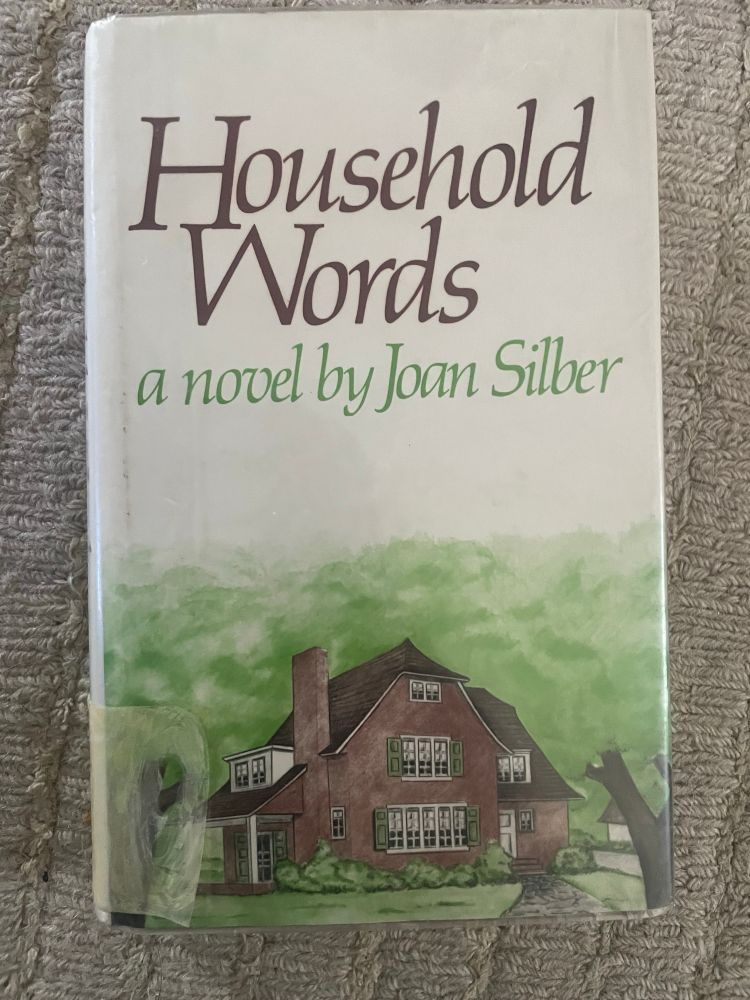
This passage from the beginning of Joan Silber’s debut novel, Household Words (1980), struck me as the kind of thing you don’t see much anymore. Feels like novels rooted in descriptions of the world, and told in third-person past tense (glorious past tense, how I miss it) have become rare, even old-fashioned. Of course, Silber might have had that sense herself: after all, she titled her first novel, as the jacket copy of the first edition puts it, after the magazine published by Charles Dickens.
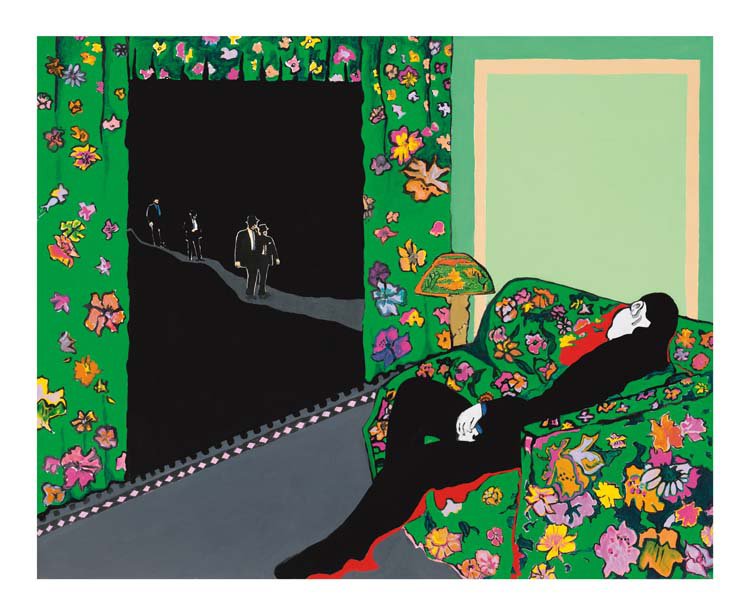
Rosalyn Drexler, Night Visitors (1988)
Silber, as I am starting to learn, having fallen into a deep dive of her works, is an unshowy and excellent writer. Look at what she does in these two sentences. She knows how to use a semi-colon, for one thing. The three clauses of the second sentence move briskly from description to judgment: “Annie was a wiry woman, barely five feet tall; at thirty, she was only four years older than Rhoda, but she was sinewy all over; she looked as though someone had chewed on her like an orange.” To be wiry is not necessarily to be small, but Silber implies that this is the case by mentioning Annie’s height, a seemingly unnecessary qualifier of the first independent clause. “Wiry” sometimes connotes toughness, but at this point in the sentence, we don’t yet have any indication that the adjective is meant to elucidate personality rather than merely describe physical appearance.
The second clause refines our thinking, though. From size we move to age (indirectly learning Rhoda’s). I kind of love the little storm of numbers in this sentence. Annie is thirty: not old by our lights today but older then than now. And older than Rhoda. But what matters to Silber is how the years show themselves on the body. Annie is “sinewy all over”: tough, indigestible. “Sinewy” made me return to “wiry,” forced me to think about the difference between these near synonyms. In this case, it seems worse to be sinewy than wiry. We’re not talking about Annie’s muscles. This isn’t a description of her fortitude. We’re talking about someone whose vitality has been squeezed out. Annie is pulp. She seems to have taken a licking from life already. This is all made clear in the third clause, the simile that compares the woman to a chewed-on orange. Juicy oranges don’t need much chewing. They go down easy. But when they dry out and their pith thickens, they’re harder to enjoy. I picture Annie with a bad tan: probably a fanciful association sparked by the colour orange.
Annie is a recurrent character, but not an especially important one. Even here she serves mostly to help us see Rhoda more clearly. Let’s not forget what Annie says before she’s described: “You really are a character.” It’s not just Annie who thinks so. The novel thinks about Rhoda this way. While Annie seems to speak half-admiringly, half-condescendingly, something like “Oh, Rhoda, you are just not like any of the women in our circle, and frankly that makes me a little uneasy,” the text offers the claim as a simple statement of fact. Rhoda really is a character—the character. We follow her through twenty eventful years, focusing on her experiences and responses, even as we never get fully inside her head. And yet the novel is being more than matter of fact here. Not just describing, but prescribing. It’s saying that Rhoda is worthy of being a character, of being the main character. Coming at the end of several decades of flourishing Jewish American literature, much of it written by men and famously invested in that point of view, Silber gives us something new. After Herzog and Augie March and Zuckerman and Alexander Portnoy Silber offers Rhoda Taber, a housewife living through the first stages of postwar American Jewish assimilation and suburban living.
Rhoda, who speaks Yiddish with her father and English with her social set and thoroughly Americanized daughters, is fascinatingly contradictory. She leaves her job as a schoolteacher when she has children, but her time as a teacher of French shapes her whole life, symbolizing her difference. [Careful, spoiler incoming!] After her husband’s untimely death, she returns to work, even though she doesn’t need the money. Nor does she remarry, even though friends fall over themselves to set her up, and even though she meets a man she enters a longish relationship with. She won’t sleep with him, though, because he’s not desirable to her. Not physically, but emotionally. She thinks of him as uncouth, even violent when she witnesses him doing business.
But this doesn’t mean Rhoda rejects conventions. She’s not like her friend Harriet, an unmarried no-fucks-to-give woman who encourages Rhoda to take art classes with her, even though she has no illusions about her abilities. (“Let’s face it,” Harriet says flatly, about her efforts to sculpt a dog, “it looks like a turd.”) Harriet and Rhoda vacation in the Catskills. Is Harriet gay? We never get the chance to find out. Despite her homophobia (she worries about her older daughter’s friendships in unpleasant ways) Rhoda feels queer to me. Don’t get me wrong, she’s conformist. But only superficially. In the things that matter, she’s out of step with everyone around her. Rhoda has an ugly side, for sure. She responds with disgust to the rumor that her neighbor has been having it off with a delivery boy: not because of the age discrepancy (though we don’t know how old he is) or the class difference, but because she cannot countenance the woman’s sexual desire. She struggles with her daughters, never abusing them outright, but picking fights or welcoming the fights they pick, despairing at the older one’s inability or unwillingness to follow Rhoda’s own life path and contemptuous of the younger’s need to make others like her. At the same time, she admires their independence, their unwillingness to be forced, by men in particular, into situations they don’t want to be in. The book I thought of most as I read Household Words was Vivian Gornick’s Fierce Attachments, another important Jewish book od the1980s. Silber’s novel feels like the fictional version of Gornick’s memoir of postwar American Jewish female rebellion, but in this case written from the mother’s side.
In the end, it’s not family life or economic success or cultural assimilation that Rhoda struggles most with but her own body: she spends the last years of the 1950s, and thus the last sections of the book, increasingly ill and at the mercy of the medical establishment. We leave her as she is leaving everything she knows. It’s a stark ending—and fitting. Rhoda Taber is not a nice woman. Nor a shrewish or disagreeable one. An interesting one. A real character.
Here is my introduction to Episode 38 of the podcast I co-host with Rebecca Hussey and Frances Evangelista, One Bright Book.
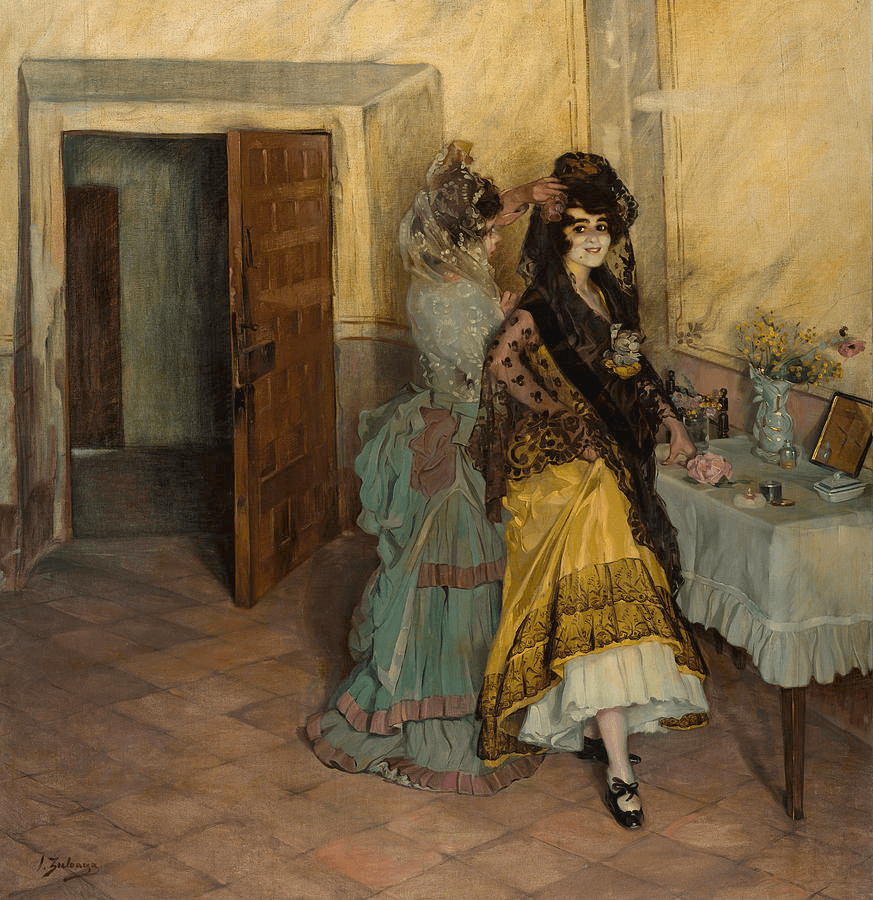
Ignacio Zuloaga y Zabaleta, Preparation for a Bullfight (1903)
Our book today is Miaow, written in 1888 by the great Spanish 19th-century realist Benito Pérez Galdós and recently published by NYRB Classics in a lively new translation by Margaret Jull Costa.
Galdós, whose long and productive life lasted from 1843 – 1920, was born in the Canary Islands, which perhaps gave him an outsider’s perspective on the Madrid society he scrutinized in more than 80 novels.
Miaow has a cast of, well, maybe not thousands but a lot of characters. Ramón Villaamil has served the state his whole life, but he’s lost his job in the tax office due to changing political fortunes just two months short of qualifying for his pension. He solicits possible patrons and haunts his old office, not just to get a job but also to escape his household, where he lives in an uneasy truce with his wife, Doña Pura, their adult daughter, Abelarda, and his sister-in-law Milagros. Completing the ménage is Luis, the son of a second daughter who died young. Luis’s father is a man named Victor, a bad penny who has never been in the picture, indeed whose name is never spoken in the home. The novel kicks into gear when Victor turns up and inveigles his way into the household, eventually sowing great unhappiness. (Victor is a breathtakingly bad guy—I hope we’ll talk about this.)
These are all interesting characters—so why isn’t the book named after any of them? That would be the usual 19th-century thing. (Jane Eyre, Daniel Deronda, Eline Vere, Anna Karenina,l etc., etc.) Why does it have such an odd title? Who or what does “miaow” refer to, anyway? Well, lots of things. It’s the nickname given by the local wags to the women of the Villaamil household, after their supposedly feline features. I think it’s important, though, that the book isn’t called The Miaows. For the title also extends to Ramón, the paterfamilias—not because of how he looks but of what he believes. MIAOW is an acronym for his mantra that Spain can only be saved by Morality, Income Tax, Additional Import Tariffs, Overhaul of the National Debt, and Work. So already “miaow” references both physiognomy and economy. But there’s more. In addition to being a noun, miaow is also a verb, a sound, an onomatopoeia, and a sarcastic, acidic, or bitchy commentary, as when we call someone out for being catty: Mee-ow! It’s this last meaning I thought of most as I considered the harsh disdain so often expressed by the characters toward each other and the gentle satire of the narrative voice toward all of them.
Once we see that “miaow” is something like a mood or attitude or state of mind, we’re able to recognize how unusually Galdós uses characterization. In my description of the book a minute ago, I made it sound like a family story. But it’s not, quite. The critic Fredric Jameson, who really loved Galdós and thought his unfamiliarity in the English-reading world a real travesty, says that Galdós offers “a deterioration of protagonicity,” an admittedly unlovely phrase that he glosses as “the movement of the putative heroes and heroines to the background, whose foreground is increasingly dominated by minor or secondary characters.” As a Marxist, Jameson attributes this not just to Galdós’s predilection or “genius” but to his position as a person living in late 19th century Spain and its strangely non-modern political landscape following the failed “Glorious Revolution” of 1867 (they deposed the monarchy and then brought it back, sort of). To depict the social reality of his society, Galdós had to “strike[ ] an uneasy compromise between the atomized individualism of more fully bourgeois societies with their nuclear families, and the more archaic traces of the older feudal class and castes.” To me, this explains why Galdós feels like an uncanny version or simulacrum of canonical realists like Balzac or Zola, with whom Galdós shares an interest in recurring characters and the desire to explore an entire society. Miaow reminded me of Père Goriot or La Bête Humaine. But also not. Jameson notes that Galdós’s novels are not organized around families, even extended families, but rather around households, an ambiguous term that includes servants, neighbours, and other families who circulate in and out of the story. (In Miaow, Doña Pura is always hosting friends, acquaintances, people who may or may not respect or like; Ramón is always trying to hide from them.) The household thus includes the Mendizábals, a couple who live downstairs and take pity on the much-neglected Luis; the Cabreras, the sister and brother-in-law of that cad Victor, who want to adopt Luis; as well as a whole series of characters at Don Ramón’s former office, some of whom are, to me at least, hard to keep track of, but to whom the novel devotes so much attention, in their various sympathy to or ridicule of Don Ramón, that it doesn’t make sense to just call them “minor.”
All of which is to say that Miaow, though not especially long (it’s like 300 pages) is very busy. To that end I was struck by a word that appears in the first sentence and reappears near the end. Here’s how the novel begins: “At four o’clock in the afternoon, the kids from the school on Plazuela del Limón erupted out of the classroom, making the very devil of a racket.” 250 pages later, a disconsolate, embittered Don Ramón observes a flood of civil servants clattering out of the workplaces at the tax office on payday: “The stairs were almost overwhelmed by this human torrent, which made a tremendous racket as it flowed on down, the sound of heavy footsteps mingling with all the cheerful, sparkling, payday chatter.”
The repetition of racket reminds us that bureaucrats are just overgrown schoolboys. Here we see Galdós’s satirical side. (And by the way, surely the opening scene of the schoolchildren, who, as they pile into the streets, tease little Luis with the nickname of his aunts and grandmother, miaow, miaow, miaow, refers to the opening of Madame Bovary, where a different set of schoolboys taunt a nice enough if also hapless pupil.) But more importantly the repetition of racket speaks to its modus operandi., maybe what we’d now call its vibe. This book too makes a tremendous racket, in the best possible way, with clever dogs, opera singers, officious bureaucrats, raw army recruits, shopkeepers, and a score of others contributing their two cents. Mee-ow indeed.
Have any of you read this book? Or anything else by Galdós? What do you think?
Pleased to once again present reading reviews from some of my favourite readers. Today’s installment, his fourth, is byScott Walters. Scott launched the much-lamented blog seraillon in 2010, and expects to return to it one of these days. He largely follows Primo Levi’s model of “occasional and erratic reading, reading out of curiosity, impulse or vice, and not by profession.” He lives with his partner in San Francisco.
Barring surprises, here ends the 2024 edition of the EMJ Year in Reading series: except, I hope, for my own. (Gotta write that…) Thanks to everyone who contributed–and all who read these engaging lists.
Balthus, The Passage of Commerce Saint-Andre (1954)
Thank you, Dorian, for inviting me again to participate in The Year in Reading. [Ed. – Pleasure all mine, Scott!] Mine meandered mostly pleasurably through some 60 books. I abandoned others, was surprised to have read fewer Italian works than in previous years, and experienced a number of unpremeditated pairings, reading two works each by a dozen authors plus more thematic linkages. I’ll get straight to 2024’s highlights:
The Woman in White, Wilkie Collins (1860)
I nearly lost my head when I interrupted my spouse’s reading of the final pages of The Woman in White, but her abrupt “Ssh!” made total sense as I plunged into the book myself the next day. Abstracted, the “detective-ish” book’s nutty plot—starting with its mysterious woman in white and moving to family secrets, confused identities, unlikely coincidences, shady interlopers, and convoluted inheritances—would hardly seem encouraging. But over 650 pages Collins never lets drop any of the knots of intrigue he has in the air, a master class in plotting with the ending so neatly and satisfyingly resolving the novel’s myriad conflicts that the book should have come tied up with a pretty bow. I found equally impressive his crafting of splendid characters, including the flamboyantly louche and unforgettable Count Fosco and Marian Holcombe, the novel’s moral center, surely one of the great characters in English literature. [Ed. – Now read No Name!]
[Paired with Collins’s The Moonstone].
The Purple Cloud, M. P. Shiel (1901)
If The Woman in White stands at the peak of the Victorian era, Shiel’s The Purple Cloud levels the period to the ground: an apocalyptic horror story, to be sure, with a body count beyond reckoning, but also an existential tale that takes Jules Verne’s brand of adventure in the direction of Lovecraft (and maybe even Kafka and Beckett). Into the tale of the sole-surviving member of a polar expedition returning to find worldwide catastrophe, Shiel mixes dazzling epic catalogues with itinerant wanderings—by dogsled, boat, rail, and on foot—that make Odysseus seem nearly an armchair tourist. A magnificently macabre tour of England unfolds from the coasts to the moors to the mines to the vacant house of Arthur Machen (to pay a literary debt) before the novel’s agonist traverses the infernal hellscape as far as Tokyo and San Francisco. Adding to the panorama of ghastliness is the misogynistic unpleasantness of the narrator himself, though having a murderer inherit such a lonely place is certainly a twist on the “last man” genre. Shiel lightens his grotesqueries by upscaling his inventiveness and gallows humor, even taking a few swipes at the Empire’s Victorian sensibilities. His idiosyncratic, nimble writing prompted me to mark down passages, though left me wondering whether the “purple” in his title may have referenced florid elements infecting his sheer writing bravura. Half-way through I wondered why the book didn’t regularly appear on English literature reading lists. Two-thirds of the way through, an abrupt turn sent the tone spiraling from Brueghel’s Triumph of Death into the schmalz of W. H. Hudson’s Green Mansions, underscoring a built-in problem of last man narratives: how to bring things to a close, what with destruction being so easy and rebuilding such a struggle. Shiel regained his footing towards the end but stumbled again on his way out the door. Maybe some goody-two-shoes editor had stuck their nose in. Still, The Purple Cloud’s grandiose conception and relentlessly ghastly anti-pleasures made it a singular reading experience—and fitting B-side to Collins.
Bel-Ami, Guy de Maupassant (1885)
At age 4, my French goddaughter presented me with a paper “cootie-catcher” featuring appealing green designs on three sides and a frightening mess of scribbled red and black on the fourth. I inquired. “This is a flower, and this is a tree, and this is grass, and this is a vampire.” [Ed. – Reasonable.] Now that she’s 21 I’ve come to expect this kind of thing regularly, but when she insisted that I read Guy de Maupassant’s Bel-Ami, I fell right into her trap. The story of a down-on-his-luck former soldier, Georges Duroy, whose life is transformed by a chance meeting with a war buddy who helps get him into journalism, is a superb depiction of the writing life; an existential examination of class, morality and gender relations; and one of the most sordid narratives I’ve come across. Duroy is a terrific antagonist, an arriviste with attractive qualities tinged by inexperience and raw ambition, not above prevarication and cruelty when it suits him. Maupassant manages the story so skillfully that I naively believed it to be heading towards a treatment of the subject of friendship between men and women, the source of Duroy’s “Bel-Ami” nickname—an ironic one, I was soon to realize, as what Maupassant does with Duroy makes Zola’s take on human debauchery look like a Sunday school picnic. [Ed. — !] The novel contains great set pieces, including a drawn-out death scene where a post-mortem odor drifts off the page like something out of D’Annunzio, and a party in a mansion on the Champs-Elysée that contrasts with the grim lives of Duroy’s rentier parents rotting away in Rennes. Maupassant levels the world of journalism too, its appetite for influencing public opinion, its writers seeking short-cuts to fame—a subject altogether too relevant today. Duroy’s talent, which emerges bit by bit, takes flight in social situations, where during one visit with a group of women he extemporizes on the writing of the French Academy. Maupassant, of course, was writing against the Academy grain, and few writers have woven a French of such sublime beauty from a tissue of such splendid decadence. [Ed. – Well, damn!]
[Paired with Manon Lescaut (1731), by the Abbé de Prevost].
Dark Back of Time, Javier Marías (1998) (Esther Allen, translator)
It would be unjust to pigeonhole Dark Back of Time –“a book of digressions”—as a campus novel, and equally unjust to separate it from its co-joined twin, All Souls (1992). But taken together as a campus novel, these two works, set at Oxford, slay all comers. Someone once quipped that the campus novel was about settling scores. Dark Back of Time seems aimed at undoing any barbs present in All Souls and even any notion of that book’s having been a roman à clef (this too, of course, may be a fiction). While the first part of Dark Back of Time engages weighty questions about fictional representation of real people, the joyousness of the novel’s explorations often had me in stitches, including a scene in which an academic negotiates with the narrator/author how he will be represented in the new novel, and another in which the narrator/author, timidly attempting to clarify for owners of an Oxford bookshop that what he’d written in All Souls was not about them, finds that the couple revel in their fame and petition to be included as themselves in a film version. It seems fitting in these books that Marías, Spain’s late greatest novelist, has evoked echoes of the most iconic of Spanish fictions, for, like the first and second books of Don Quixote, the two novels form an essential unit in which one could read only the first volume and miss out dramatically on what the second volume does with the first. (I’d love one day to see All Souls and Dark Back of Time boxed as a set; Cervantes would approve.) I don’t think it’s an exaggeration to suggest that these volumes, taken together, may be the finest contemporary literary work to address the question, “What is fiction?” Two other elements to recommend the book: The first is Marías’s inclusion of the fascinating story of Redonda, the “literary” nation of which Marías served as most recent and presumably final King (M. P. Shiel had been the first). [Ed. – Wait, that dude you just wrote about?? Is this real? Am I being punked??] The second is that Dark Back of Time contains some of Marías’s most exhilarating writing; I think immediately of a moving passage about the dawn crepuscule and streetlights that persist for a time into the day. Time having ever been one of Marías’s great preoccupations, I also winced at his narrator imagining life at age 85—a full 15 years past the premature end of Marías’s own. Unconscionably, The New York Times left Marías off of its recent list of the 100 Best Books of the 21st Century to date, but it is certain that the lamp of Marías’s work will live on to see its day.
[Paired with Marías’s short travel book, Venice: An Interior (2016)].
The Charwoman’s Shadow, Lord Dunsany (1926)
Fantasy is not among my favorite genres, but I’ve been fond of everything I’ve read by Edward Morton John Dax Plunkett, a.k.a. Lord Dunsany. Dunsany’s stories seem more like a new model of fairy tales, exploring interstices between reality and the imagination and dealing with moral issues without being moralizing. The Charwoman’s Shadow features a young Spaniard sent by his family to learn alchemy from a woodland magician, and exhibits Dunsany qualities in abundance: a deep gratitude for the richness of life, where nothing can be taken for granted; a genial wit and wordplay; a careful attention to nuance. The centerpiece of the novel is the value of one’s own shadow, the disappearance of which, through a Faustian bargain, produces unexpectedly dire consequences. Another Dunsany treasure is the lyrical quality of his writing, for example when he takes on that most magical of hours, l’heure bleue:
bright over the lingering twilight the first star appeared. It was the hour when Earth has most reverence, the hour when her mystery reaches out and touches the hearts of her children at such a time if at all one might guess her strange old story; such a time she might choose at which to show herself, in the splendour that decked her then, to passing comet or spirit, or whatever stranger would travel across the paths of the planets.
And then there is the book’s splendid ending, which I will not spoil other than to say that with no apparent thought of producing endless sequels like some contemporary writers of fantasy fiction, Dunsany gently places his chief protagonist off stage and sweeps into a realm of wistfulness drenched in the glow of a glorious sun setting at the height of Spain’s Golden Age.
[Paired with Dunsany’s The King of Elfland’s Daughter (1924)].
At 163 pages, Aira’s Fulgentius straddles novella and novel, and not simply as matter of length. Aira’s intimate, vividly imagined tale of a Legate of the Roman Empire who also happens to be a playwright expands as it follows the aging Fulgentius and his 6,000 soldiers from Rome to reconquer Pannonia. Along the way, Fulgentius mounts performances of his sole work, a tragedy written when he was an adolescent, starring himself as tragic hero—and most important audience member. As Fulgentius has already written—or thinks he has already written—the tragic outcome of his own story, the plot tension is carried by a familiar Aira conceit around the entwining of fiction and reality. As a prime example one of Aira’s works that graft a fictional character onto history, Fulgentius offers a vivid sense of what such a march must have been like for the soldiers, the general, and the populations in their path. Deviating from the author’s more typical surrealist gymnastics, the language here takes on an unusually elegant lyrical register.
[Paired with Aira’s Alexandra Pizarnik (2001), an appreciation of the Argentine poet].
The Catherine Wheel, Jean Stafford (1952)
I found a copy of Jean Stafford’s The Catherine Wheel when I was 18. Had I read it then, I doubt I would have fully appreciated its adult nature—for it really is an adult book, dealing with adult things, things terrifying enough that I approached the novel’s final pages with a shudder of complete dread (completely vindicated). But in The Catherine Wheel Stafford also reckons with youth, entwining her two main characters, 38-year-old Katherine Congreve and her 12-year-old cousin Andrew Shipley. Devastated in love at an earlier age when Andrew’s father John married her sister Maeve, Katherine now occupies a position as the town’s most prominent unmarried curiosity, but also a magnet to John and Maeve’s children, left behind while the parents “summer” in Europe. Twin betrayals connected to this departure have set both cousins spinning: John’s surprise declaration of love for Katherine and determination to divorce Maeve while abroad, and the disappearance of Andrew’s playmate of previous summers, Victor, now entirely occupied with the post-war return of an older brother. Dually abandoned, the cousins shift focus to one another. Stafford thus sets up an unusual device in which youth attempts to divine the mysteries of adulthood while adulthood frets over the crises of youth, in a marriage story focused on impacts beyond the absent couple’s own strife. [Ed. – This feels like some Henry James-level melodrama!] A kind of third eye—that of the people of Hawthorne, who notice when Katherine’s light stays on into the wee hours—levies its own social pressure on the house’s inhabitants. Stafford’s densely poetic sentences frequently had me reading her aloud, relishing her words, marveling at the perfect limning of some little thing or creation of a resonance that rippled out towards subjects beyond the proximate ones. Though rooted in a realist, formalist literature that prioritized and exalted language, the novel still felt raw and new, bursting out of old molds, totally unsettling. Not a novel for the squeamish, but certainly one for any reader ready to appreciate some of the finest American writing of the period.
[Paired with Stafford’s The Mountain Lion (1947)].
whose names are unknown, Sanora Babb (1936/2004)
Sanora Babb’s novel has been highlighted in recent articles recounting editor Bennett Cerf’s decision that two Dust Bowl novels in a single year would not stand. The other, of course, was The Grapes of Wrath, allegedly constructed in part on notes Babb had collected concerning hardscrabble farmers in her native Oklahoma, and which Cerf provided to Steinbeck. Though Babb published other well-received works, her Dust Bowl novel languished unpublished for nearly 70 years. whose names are unknown borrows its title from an eviction notice served on a family of Oklahoma farmers. What the novel may lack compared to Steinbeck’s elegant structure and majestic sweep, it makes up for in granularity of detail and visceral impact relating the farmers’ desperation and poverty, with particular attention to the lives of women, whose interactions give the work some of its strongest scenes. Babb’s direct, declarative sentences come across as hard as the land worked by her characters. She describes the knife-edge on which her people live, where even small luxuries—such as butter for the biscuits—must be used sparingly “so that it will last until the next churning.” Where Steinbeck set his novel on the back of hope for a better life in California, Babb spends a long time in Oklahoma before heading west, zeroing in on the encroachment of the Dust Bowl, poor farming practices colliding with a change in climate and the shifts within and without people as they try to wrestle with such environmental change. Babb’s powerful novel deserves at least to be taught alongside Steinbeck’s, or rather, as the debt is all his, the other way around. [Ed. – Pretty telling/damning that I’d never heard of it.]
Écoute, Boris Razon (2018)
It’s clear from which chapter of French journalist Boris Razon’s novel Écoute (“Listen”) Jacques Audiard plucked the seed for his film Emilia Perez, but Écoute differs almost entirely from the film. As the book’s title suggests, Razon focuses here on listening, various forms of which coalesce the book’s entwined stories and capture the complex, fraught texture of contemporary communications. Set mostly on a single block near Place d’Italie in Paris (with detours to Mexico City and Lisbon), and with the November 2015 terror attacks continuing to resonate, the novel touches on the surveillance state by encompassing listener, the listened-to, privacy, and identity (here’s where Emilia Perez came in, but so, to my surprise, did Fernando Pessoa). In conveying the rapid-fire chatter and laconic banality of so many electronic communications, Razon employs a good deal of verlan, texts and texting abbreviations, and emoticons, prompting one character to muse on the absence of a dictionary adequate to capture today’s modes of information sharing. Running beneath this surface noise is a current of desire to disappear from a world in which privacy has all but vanished. The stunning first chapter presents a scene of the Paris street that surely ranks among the richest in that city’s literature, an “audioscape” as experienced from the inside of a police surveillance van by an officer quietly being undone by his job of attempting to cull signal from the noise and by the uncanny valley between electronic input and what he perceives with his own senses. [Not yet available in English translation, though that may well change should Emilia Perez win the Oscar for best film].
Edward Hopper, Solitary Figure in a Theater (1903)
Oak Flat: A Fight for Sacred Land (2020) and Thunder and Lightning: Weather Past, Present and Future (2015), Lauren Redniss
2024 was the year I came late to Lauren Redniss’s party, pairing her powerful Oak Flat with her larger format Thunder and Lightning. The former explores the fight around the proposed Resolution mine on tribal lands in Arizona, while the latter treats weather phenomena both straightforwardly (i.e. Rain, Heat, Wind) and in more abstract terms (i.e. Chaos, Dominion, Profit, War). Using an anecdotal approach, Redniss displays in both books a knack for ferreting out the most interesting possible interviewees and unearthing fascinating hidden tales. But what makes the work of this MacArthur award winner stand out is its exploration of text and image. Using full page illustrations, Redniss skillfully advances her story through images of such impact that I found myself gasping at turning a page and being confronted with an image perfectly tuned to the tone she had set. The large format of Thunder and Lightning lends itself particularly well to her subject. In Fog, the text crawls along the bottom of pages of vast gray. Redniss’s deliberateness in matching image to text and letting the image carry the narrative feels like a new form of text/image interaction. In a section about cloud seeding, she describes a proposal to use weather balloons to heft a pipe with multiple nozzles to spray chemicals that could help cool the planet. I could not help see this as a metaphor for the way her illustrations lift her text in air. These images, easily mistaken for colored pencil washes, are in fact mostly acid etchings in black and white that Redniss has hand-colored (Thunder and Lightning includes a description of her processes). I read Redness not long after finishing James Elkins’s novel, Weak in Comparison to Dreams, another work that relies heavily on images, by a leading theorist of text/image interaction, no less, and now find myself dreaming of a Redniss/Elkins collaboration. Come on, you two. Make it so. [Ed. – Either way, I’m tracking down these Redniss books!]
Moonlight Elk, Christie Green (2024)
I know Christie Green but was wholly unprepared for her first book. Each time I put Moonlight Elk aside, I could not waitto get back out into it. That awkward prepositional formulation feels apt, as Moonlight Elk, a book framed around Green’s experiences in across New Mexico hunting wild game, largely for sustenance, takes one to wild spaces in an intensely intimate manner. Exploring the borders between interiority and exteriority, animal and human, life and death, the book’s dozen interlocking pieces, indexed to a hand-drawn map of the state, might well be the New Mexico state book of the year (if such a thing exists). With solid research behind her narrative, Green leverages her experience as hunter, mother, landscape architect, land use expert, designer, naturalist, activist, and writer to traverse territory of essay, short story, meditation, and what one might call an anthropology of relationship. Memoir might also come to mind, but resistant to definability, Moonlight Elk seems more like an exorcism, a courageous self-interrogation in quest of a “free range” existence that refutes facile answers, upends convention, moves into spaces predominantly occupied by men, and attempts to rid the cultural body of a toxic detachment from nature. Hunting—particularly as a woman alone—foregrounds the narrative, but Green is after larger game. She inhabits the lives of animals, their cycles and patterns, how they move, what they sense, how they see her. The mysterious, miraculous complexity of bodies, not least Green’s own, forms the beating heart of the book: details of muscular structure and bone, of blood and feathers and sex, the quickness of eyes, the sharp sense of smell. Her hunts force self-reckoning, as when she discovers a fetus moving within the abdomen of a cow elk she has shot, or when she ends the suffering of another cow that comes to her after being gruesomely wounded by poachers. Green, who grew up in Alaska, integrates into her experiences a wealth of issues impacting the American West, from private vs. public land and water use to tribal and border concerns (in the boot heel of New Mexico, a quail hunt collides with Border Patrol conducting their own kind of hunting). Only at the narrative’s end did I grasp the extent of the subjects Green had covered. More personally affecting, as she moves through forest, desert and chapparal, shadowed by cliffs and trees, illuminated by dreams and the changes of the moon, she offers, with keen animal sense and without escapism, an orthogonal, conscientious response to received ideas, convenient consumerism, and mediated experience. Hyper-alert, alive, intuitively creating her path, Green renders wilderness almost otherworldly. I emerged from Moonlight Elk seeing this world anew, as though a physical alteration had taken place. [Ed. – Sold! Might pair well with Joanna Pocock’s Surrender.]
Gallery of Clouds, Rachel Eisendrath (2024)
The title: irresistible. The cover too, a fresco of clouds at sunrise or sunset from the ceiling of the Rose Main Reading Room in the New York Public Library. And the opening especially, the author recounting a dream of carrying her manuscript through heaven and meeting: Virginia Woolf. Both ostensibly and in fact, the subject of Gallery of Clouds is Sir Philip Sidney’s 16th century, 900-page pastoral romance, Arcadia, about which I knew nothing and which overwhelms even Eisendrath, a Sidney scholar: “I find that my memory of the plot has already started to dim, to blur…I can no longer keep track of the basics…” I say “ostensibly” because Eisendrath uses the obstacle, Arcadia serving here as a nexus to send her fertile mind wandering down winding paths, from observations on the genre of Romance to the use of images, Shakespeare to Little Nemo, Poussin to Walter Benjamin, Montaigne to manicules (!), the marriage of hunting with desire to the cat dozing on Eisendrath’s bed.
But these seemingly inexhaustible spin-offs never seem gratuitous. Eisendrath subtly constructs an Arcadia of our own era, her black & white photos echoing the pastoral romance’s means of advancing its airy infinities through “images in words,” her “clouds” of thought (which she pointedly distinguishes from mere fragments) paralleling the episodic nature of the romance, her grounding her observations on Sidney in a relatable contemporary manner underscoring the genre as a response to grim realities. At the same time, Eisendrath engages proliferating modes in contemporary writing, such as the use of the fragmentary, the merging of the academic and the personal, the punctuation of text with images, the grappling, through a need to say, with an unraveling world. Though she is writing about a 16th century romance, her small, enthralling, sui generis book has volumes to say about how we read and write. And in Eisendrath’s few references to her own teaching, Gallery of Clouds, more than anything I have read in decades, has me wanting to be a student again.
The Waves, Virginia Woolf (1931)
Rereading The Waves 40+ years after I first read it and in the same copy I’d used then, my margin notes served to measure the distance between that young reader and this old one. I experienced pride regarding the young stranger’s underlining of particular lines; I noted too that he’d missed a lot. Passages of time of this sort span The Waves, entwined temporal arcs that longitudinally capture Woolf’s six characters through alternating interior soliloquies as they move from childhood to university [ed. – well, some of them get to go to university…] to the workplace to middle age and beyond, while brief impressionistic pieces preface each chapter and, over the course of the novel, trace the sun’s path across the sky during a single day at the shore. Here as in many of her works, Woolf, the great writer of immediacy, obsesses over capturing sensations, gestures, glances, discreet moments, the wave at the point of breaking, of ebbing. Rafts of glorious sentences ride Woolf’s exquisite phrasing, as she simultaneously questions the inadequacies of language, frustration with these limits reaching a crescendo as mortality nears for her characters, and a voice longs for:
some little language such as lovers use, broken words, inarticulate words, like the shuffling of feet on the pavement. I begin to seek some design more in accordance with those moments of humiliation and triumph that come now and then undeniably. Lying in a ditch on a stormy day, when it has been raining, then enormous clouds come marching over the sky, tattered clouds, wisps of cloud. What delights me then is the confusion, the height, the indifference and the fury. Great clouds always changing, and movement; something sulphurous and sinister, bowled up, helter-skelter; towering, trailing, broken off, lost, and I forgotten, minute, in a ditch. Of story, of design I do not see a trace then.
[Ed. – Is this Bernard? Sounds like Bernard.] Woolf described The Waves as a “playpoem,” but its approach to polyphony is unusual. In the first chapter, she goes inside the heads of her characters as young children while at the same time supplying them a vocabulary beyond their years, a device through which they speak both as themselves and as the writer, the latter’s presence made manifest when the children catch a glimpse through a window of a woman writing. Throughout the novel, her six characters’ voices float like spheres governed by gravity, now apart, now coalescing, as waves gather force and crash, exploding in spray and froth. But her characters also serve to question the nature of identity: clearly creations of the writer and facets of her circle (the roman à clef aspects interested me little), they are also beings in whom a “self” is merged inextricably with other selves. For all of its prose-poeminess, The Waves stands as a remarkable and grounded philosophical inquiry into what constitutes a self—and whether it even makes sense to speak of a “self.” [Ed. – Yes, the latter especially!]
In my first reading, I scarcely noticed the centrality to the novel of the death of Percival, a “seventh” character never given a voice. But in Paris shortly after finishing The Waves, I caught director Elise Vigneron’s theatrical adaptation of the novel, an extraordinary work employing both live actors and corresponding marionettes made of ice, such that as the play progressed, these figures melted, with much of the later action occurring in a resulting pool center stage. [Ed. — !] The physical presence of these characters and their doubles rendered Percival’s invisible presence powerful, a black center in Woolf’s “six-sided flower; made of six lives.” As with the shell-shocked Septimus Smith in Mrs. Dalloway, Percival represents a generation of young people damaged or lost to conflict and war. The cumulative effect of Woolf’s meditation on loss, whether through ordinary aging or via the injustice of an early death—and a palpable sense of darkness again descending upon Europe—left me overwhelmed by emotion at the story’s close.
What attracted me to Woolf at age 18 held firm: her sumptuous sentences; the tension between a love of people and aloof solitariness; the desperation of time passing fused with the fever to glean something lasting from the fleeting and ineffable. Also: recognition at last of Woolf’s lament for life lost at an early age, for the unshakable impact on those left behind, pushing The Waves into a work far greater than I’d registered the first time around. I’ve been thrilled, moved, and humbled by revisiting this extraordinary novel while the sun sinks toward a darkening horizon, so many years after I first read it, when the sun still mounted the sky. [Ed. – Beautifully put, Scott.]
[Paired with Woolf’s final novel, Between the Acts (1941)].
Felix Edouard Vallotton,The Sunny Street (1922)
Others works I could have included: D. H. Lawrence’s powerful Sons and Lovers [Ed. – Ph hell yeah]; Italian critic Cristina Campo’s The Unforgiveable; the Strugatsky brothers’ The Snail on the Slope; Georges Simenon’s Arizona noir La Fond de la Bouteille; Shakespeare’s The Winter’s Tale; a pair of short books by Helen DeWitt (may she please complete her novel-in-progress set in Flin Flon, Manitoba) [Ed. – Wait what now]; Andrés Barba’s Two Small Hands and Andrés Neuman’s The Things We Don’t Do; poet Susan Nguyen’s second gen take on the American South in Dear Diaspora and other of her poems on-line; and, Most Unexpected Literary Object, the first volume of Ahmed Fāris Al-Shidyāq’s Leg Over Leg, a daring four-volume novel completed in 1885 with the modest ambition of catapulting the whole of Arabic language and literature into the modern age. In sum, a Year in Reading that elicited joy, snark, bon courage, resolve, humility, and defiance for challenging times ahead.
[Ed. – To which I can only summon both the raised fist and the thank you hand emojis: this is wonderful, Scott. May we draw on those good emotions in 2025!]
Pleased to once again present reading reviews from some of my favourite readers. Today’s installment, her third, is bymy friendAnja Willner. Anja lives and works in Berlin.
Lizzie Borden (no, not that one), Agnes Martin (1970s)
I’ve been logging my reading for seven years now. (A fairy-tale number, seven. I can’t name any other thing I’ve been doing for that long.)
2024 was different because burnout and depression ate up most of my year. [Ed. – So sorry to hear it, Anja. Lots of things to be depressed about and burned out by.] But thank god there’s always a but: And that’s the books that made it through the mind fog (doesn’t that make a great blurb) and stood out for me:
Christoph Ransmayr: The Terrors of Ice and Darkness (Die Schrecken des Eises und der Finsternis, 1984)
A great book about the price of discovery and adventure. The title is accurate, and if after reading it you still feel like starting your day with an icy shower or in a barrel filled with ice, I cannot help you. [Ed. – Ha! No fear there on my part!]
So you have this story about the Austro-Hungarian North Pole expedition going terribly wrong (skip this book if you feel strongly about dogs…) and getting almost no viable results, strung together with the story of a young Italian who goes missing while researching the same expedition more than a hundred years later. Some nice playing around with what is fact and what is fiction included.
(If you read this in winter, and your winters are still cold, make sure your heating works so you don’t get too authentic a reading experience.)
“Quiet” heroes
Something that almost always gets me is what you might call a “third row” hero: The protagonist is, at least on the surface, some ordinary person leading an uneventful life.
Of course, this only works if two requirements are met: First, the protagonist not really being dull (or so dull it’s already entertaining), and second, the writer is skillful enough to carry off this kind of story.
Claire Keegan’s Small Things Like These was such a read for me. A quiet hero, a quiet life, but so much going on under the surface it’s almost impossible to lay the book aside. [Ed. – You hear people say „I read this book in one sitting a lot, and I feel like that must mostly be exaggeration, but I actually did that with this one!]
I’m also a sucker for narrators looking back on things not said or done in the right time. For me, J.L. Carr’s A Month in the Country is a gem full of wistfulness and melancholy (without self-pity), and musings about craftsmanship and memory, art and history. (It’s not so widely read here in Germany as it probably is in English-speaking countries.) [Ed. – Just going to leave this here…]
But hey, I don’t want this to sound dull (depression and books with hardly any plot, duh!) or as if I don’t like action-packed novels.
There was also my first Henry James! I had planned that ages ago, but I also wanted to read 300 hundred other things, and then… umm… life. [Ed. – We all know how that goes!]
Anyway, Portrait of a Lady. Wow. So many twisted marriage offers turned down in queer ways. So many plot turns, so many multi-layered characters (and the super creepy girl)! [Ed. – An action-packed novel indeed! So good, so pulpy, in its own way.]
I can’t help thinking James would have been great at scripting reality shows, and he’d also have to be in charge of the casting. Just imagine, a reality dating show written and produced by Henry James! I’d be so addicted I’d hardly get anything else done.
But back to supposedly “dull” books and on to one of my private reading obsessions: Anita Brookner novels. Despite crying for two days after reading my first Brookner in 2022, I’ve been sticking with her strange books.
Strange because often, they read like an abstract summarizing a novel or like a construction plan rather than like a novel in the flesh. Not to speak of her heroines (and occasionally heroes) whose rigidly organized lonely lives are so similar to one another I’m not always sure what happened in which book (not that it would matter very much, it’s not Henry James). Yet somehow, it works out great – at least for me. [Ed. – Amen!]
In 2024, I added three more Brookner novels to my reading log: Lewis Percy, Bay of Angels, and A Friend from England. Of those three, I liked Bay of Angels best (presumably the Brookner with the most sun, but that’s just the weather). Of course not as much as Look at Me, my all-time favourite of hers. [Ed. — Look at Me is hard to top!]
Gwen John, Self Portrait with Letter (1907)
And finally, out of the brain fog emerges Nicole Seifert’s book about the women writers of “Gruppe 47” (group 47), an influential post-war German literary coterie. I already was familiar with some of the female members of “Gruppe 47”, but so many of them I was taught not to take as seriously as the alpha males who were the stars of the group, like Günter Grass.
In my reading log, I wrote down a single word about Seifert’s Einige Herren sagten etwas dazu (“Some gentlemen said something about it”): Brilliant. And I’ll stick with that. And boy, this book has led to some serious running after backlisted books! Meaning that I can never* buy a book again because I’ve still got two packages of literature waiting to be rediscovered standing around in my apartment. [Ed. — Tell us what they are in the comments, Anja!!!!!]
*never = not before the end of February 2025 or something like that [Ed. – That is modest indeed. I mean, it’s almost the end of February now! You can probably start reordering… Thanks for this lovely piece, Anja!]
A few months, when I was too busy to do anything about it, WordPress told me I’ve been writing this blog for ten years.
André Brasilier, Blue Cavalcade, 1981
I’ve not always been the most diligent blogger, sometimes falling silent for months at a time, but I’ve always returned to it, and that’s not nothing. In fact, since I started keeping monthly logs in January 2019 (halfway through the blog’s life, which bewilders me, since surely that was just a couple of years ago) I’ve written a little something about almost every book I’ve read.
It is quite likely that some things will change in my life next year. Fear not, though, I’ve no plans to shutter the blog. I’ll probably be happy for the continuity. But I do wonder if there are other kinds of writing I might do here. Like many writers, I write best when I’m working on more than one project. I’m using part of my summer to craft a proposal for a book on teaching Holocaust literature at this moment in US history: I recently finished a course from the wonderful Anne Trubek of Belt Publishing that has given me a good start. (Agents and publishers, all my forms of communication are open lol.)
[My daughter says using lol is cringe. Sorry. But how else am I supposed to indicate “I know that is preposterous and I am kidding except that I would really love for it to happen”? Hahahahaha or something?]
I’ve been wondering how I might bring some of that writing variety to this space. When I first started EMJ, I wrote about one book at a time. No surprise to anyone who reads me, these posts were long. Often really long. They really helped me figure out what I thought of a book, though I’m not sure people wanted to read them as much as they did my still-long but shorter responses to a month’s worth of reading. I’m still fond of those early pieces, especially the first one, on a book I still think about a lot, Caleb Crain’s Necessary Errors. Here are a few more that hardly anyone read, but might be worth dusting off. On Irmgard Keun’s After Midnight. On Philip Marsden’s The Bronski House. And, way long, on A Little Life. There’s a ton more in the archives.
I have to admit, though, that the rhythm of the last five years has worked well. The monthly reviews offer a balance between breadth and depth, but would you prefer more pieces about just one book? And what about non-book topics? I’ve always shared writing created for other occasions (like becoming Jewish or reflecting to new students on old friendships). For a while I wrote regularly about my teaching, which I loved doing: I’m basing the book project on some of that stuff. Honestly, I don’t know how I wrote all that stuff, though. My daughter was young then and needed a lot more from me and my wife. Where did the time come from? I guess I was younger too. And that was all pre-covid. I think people overstate the changes between then and now (rather: they overstate the wrong things and ignore the main thing: we still live in a pandemic, we still don’t value the most important kinds of work, our way of life is killing us and the world). But I feel my working life has changed a lot. I don’t think I’m just being middle-aged when I say that it’s harder to be in a helping profession than it used to be. Anyway, I don’t know that I’ll have enough to say about teaching for me to write about it here and in the book. But who knows? Maybe writing about other kinds of art might be fun. The obvious example is film, which used to be a huge part of my life but fell away in the press of family life and career pressures. I’m returning to movies, though: slowly but ever more surely. I might write more about what I’ve been watching. (I think this is the only film-related post at the blog?) Another idea is to invite others to contribute. I’ve had many guests over the years, whether through readalongs (remember those?), shared reading projects, or year in review lists. I love hosting other views, voices, and perspectives. Maybe I could do more in that vein.
What else? Obviously, the look needs refreshing. And yet I am so lazy about that kind of thing. Is it actively off-putting? I admire M. A. Orthofer for many reasons, one being his indifference to graphic design. His site looks the way it looks, the content is what matters, and now it’s so iconic I for one would be crushed if he changed things. This place is no Literary Saloon, but maybe I am inching toward “so old-fashioned it’s actually cool” status. Thoughts?
As you can see, this post is a mixture of questions and ideas: what I wonder about and what I might do. But really what I’m writing here is both a plea for feedback and an expression of gratitude. What do you want to see here? More of the same? Something new? Like what? Whatever your answer, I want to thank you for reading. Blogs are so out of date; social media had made other kinds of communities, other forms of interaction; so many platforms share the thinking of so many smart readers and writers. That you’ve taken an interest in what I think means so much to me. As I’ve written before, I don’t know many passionate readers in real life; this community of readers around the world has meant the world to me. Thank you for everything you’ve taught me, the reading suggestions you’ve made, and the support you’ve offered. I’m filled with gratitude.
April sucked shit. I’d had it with everything: the semester grind, how hard it’s become to teach these last few years, and a lot of my colleagues, especially the administrators of my place of employment. I didn’t sleep enough, saw the height of the Arkansas spring blooms only through windows, and drank too much coffee. Gotta make some changes in my life.
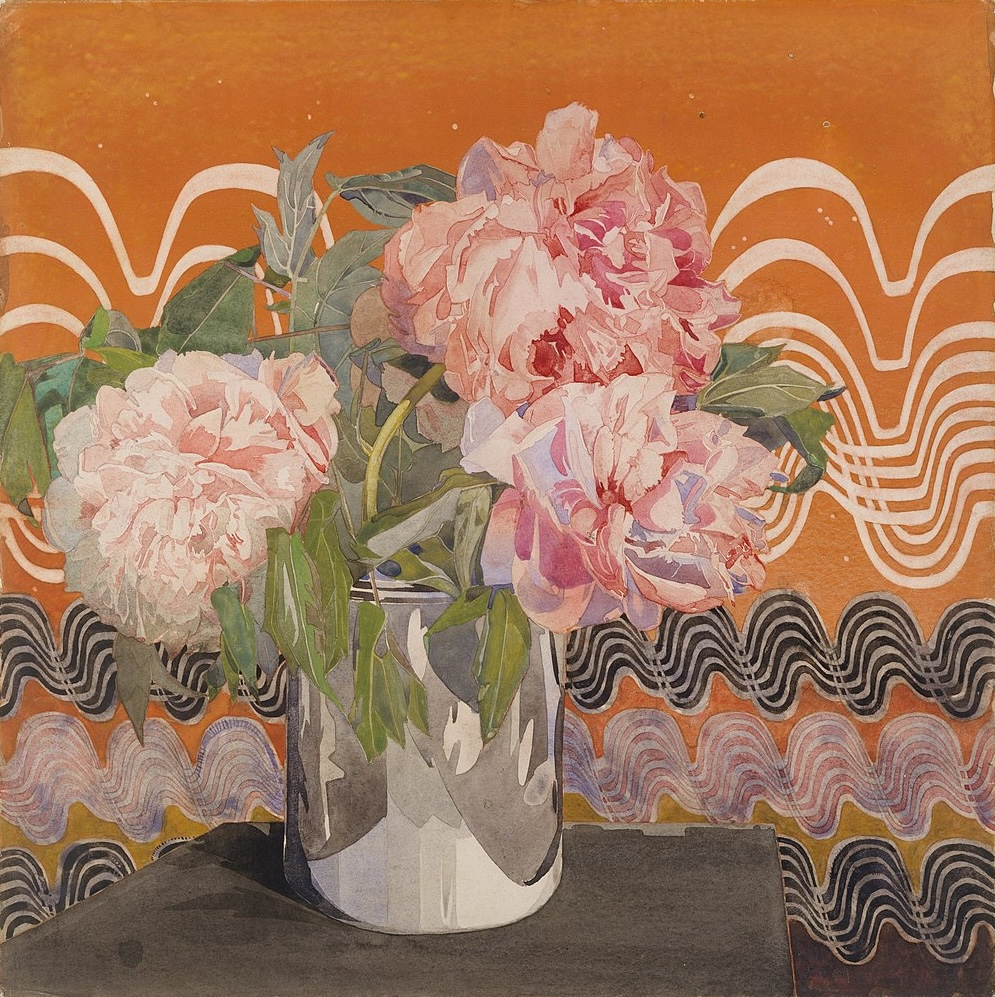
Charles Rennie Mackintosh, Peonies, ca. 1920
Edith Wharton, Summer (1917)
Wharton continues to be one of my happiest discoveries of the last few years. (A personal discovery: I know everybody else already knows her.) Shawn Mooney, host of the Shawn Breathes Books YouTube channel, asked a few of his many bookish friends to read this novella from the middle of Wharton’s career. What a terrific book! Charity Royall, the adopted daughter of a lawyer and his now-late wife, might be in the upper echelon of her New England village’s society, but that doesn’t mean much. She’s bored to death. When a young architect comes up from New York to summer with a relative—to sketch the local country houses, ostensibly, but mostly to loaf—Charity is smitten by the glimpse of another world he offers. And by him, too: the book is impressively sexually frank for its time. Before long, Charity and Lucius have made a love-nest out of an abandoned house halfway up a nearby mountain. When Charity gets pregnant, a lot of troubling and surprising things happen in a short time. I won’t spoil the ending, but oof what a gut punch. Recommended!
Folks who have read this novel (others, look away): do you think Royall might be Charity’s father? Am I crazy to think so??? The circumstances around Charity’s coming to the Royalls seem… murky.
Andrey Kurkov, The Silver Bone (2020) Trans. Boris Dralyuk (2024)
Kurkov, whose delightful Death and the Penguin I laboriously read in German way back in the day and whose subsequent many, many books I have failed to keep up with, has written the first of a series set in Kyiv in 1919. The Great War might be over, but peace is nowhere to be found in Ukraine. Various factions vie for control: unaffiliated war lords, the Bolsheviks, the Whites, and the embattled Ukrainian People’s Republic, one of the first nations in Eastern Europe to deem Jews a protected minority, which didn’t stop it from countenancing a wave of pogroms under its brief rule. (I’m slowly making my way through Jeffrey Veidlinger’s history of these events, In the Midst of Civilized Europe, which is retrospectively clearing up a lot of the context.)
On the novel’s first pages, Kurkov’s protagonist, Samson Kolechko, a would-be engineer, loses his ear in an attack by Cossacks. (His father, alas, is murdered.) Samson, an upside-down low-rent version of his biblical namesake, manages to keep the ear, which turns out to have fantastical powers, allowing him to hear things he otherwise couldn’t. This comes in handy when the two Red Army soldiers who have usurped his apartment plot to kill him. He goes to police to turn them in and in a pleasingly preposterous turn of events is taken on as a detective himself. Along the way, he relies on the help of a young woman employed by the newly-established department of statistics. Kurkov vividly evokes the danger, scarcity, and uncertainty of Kyiv in this period: atmosphere is the book’s strong suit.
As for the crime element, well, let’s say it’s on the shambolic side. Perhaps more generously: it’s about what it means to investigate crime in a place where the political situation is changing so fast that the law threatens to be even more nakedly a fig leaf for power than usual.
In Boris Dralyuk, Kurkov has found a translator who gets his goofy side—and, I suspect, has even improved the book a little. He tells me the second Samson novel will be out in English next year. Count me in.
József Debreczeni, Cold Crematorium: Reporting from the Land of Auschwitz (1950) Trans. Paul Olchváry (2023)
Extraordinary. I do read a fair few Holocaust memoirs, and even though I’m interested to see how similar they are, how much they trade in the same tropes, I’m usually caught short in horrified wonder by at least one scene or detail. Cold Crematorium—now translated into English for the first time, more than 70 years after its publication in communist Yugoslavia—gave me that feeling from start to finish.
Debreczeni, the penname of József Bruner, was born in Budapest but moved to the Vojvodina, the largely Hungarian-speaking part of what is now Serbia, after WWI, where he worked as a journalist and newspaper editor. Like most Hungarian Jews he was deported to Auschwitz in 1944. Having survived the initial selection, he volunteered to be transported further west in Silesia to a camp that was then under construction. Falkenberg, as the Germans named it, was part of the vast Gross-Rosen camp system. Conditions in that archipelago of suffering were so bad that far fewer victims survived its array of satellite camps than did Auschwitz; it is much less well known today than its role in the Holocaust would demand. (Menachem Kaiser’s excellent third-generation memoir Plunder also considers this lacunae.) From there he was sent to the work camp at Fürstenberg, and finally to Dörnhau, the “hospital” ward of which was known to inmates as the cold crematorium because so many died within its frigid walls. He was liberated in May 1945, barely alive. After a lengthy recuperation, he returned to Belgrade, where he lived and worked until his death in 1978.
Indulge me as I share some of this remarkable book with you. It is the most visceral, corporeal description of the Holocaust that I know:
Here’s a passage from Fürstenberg, where Debreczeni labored, under dire conditions, to build an underground tunnel system (the so-called Project Riese, the eventual purpose of which remains a source of debate among historians):
Dysentery takes hold me of me yet again. Swelling spreads frighteningly over my entire body. Over the course of these days I am lugging sacks of cement to the mixers, and I become hopelessly dirty. The cement dust swirling nonstop in the air forms a thick layer of sediment upon my clean-shaved head. It collects on my gums and seeps into my nose, my eyes, my ears. Not even Sani Róth [former mobster who takes Debreczeni under his wing] can get his hands on soap. I hang my rags on the nail above me. The pants and tunic are literally moving from the thousands of squirming lice. Destroying them is hopeless to begin with, so lately we haven’t even been trying.
Here’s one from the “hospital” unit at Dörnhau, where Debreczeni spent eight miserable months:
The November cold pours in through the broken windows, and yet the stench is unbearable all the same. A suffocating stink oozes from the walls. Rising between the rows of bunks, several centimeters high, is an odious yellow slurry of dung. Naked skeletons are sloshing through the putrid river.
At one point, that slurry was knee height (for the few who could still walk). I will never get that detail out of my mind. This is the kind of thing I mean when I say Cold Crematorium makes other Holocaust memoirs seem tame.
And here’s another one from Dörnhau, about a man named Miklós Nagy, who scrabbled to the position of chief functionary of the medics who “treated” the patients, some with good will and others with pure cynicism, in an environment completely lacking medical supplies that was also, as we have seen, utterly unhygienic.
I once saw this lightweight man jump up and down on a patient’s chest like a rubber ball, stomping on him with bloodshot eyes until he was worn out. The victim’s crime: he’d tried conniving his way to a second helping of soup.
Remember, Nagy was a prisoner of the Nazis, too. The pitiless depiction of camp functionaries is just one of the things that makes this book such a valuable testimonial document.
I am seriously thinking about assigning this book instead of Primo Levi in my intro Holocaust Lit course. (Shouldn’t be one or the other, but syllabi are zero-sum games…) If you think you have the fortitude, I urge you to read this book.
Joan Chase, During the Reign of the Queen of Persia (1983)
I chose this novel by the hitherto unknown-to-me Joan Chase for the April episode of One Bright Book simply because it was reissued by NYRB in 2014 and I’ve had it on my shelf ever since. (I’m trying to use the podcast to get to some of the hundreds of unread books around here…) Reading it was a happy surprise: it’s excellent, although, in my opinion, awfully sad. Somehow Chase tells the well-worn story of a vanished childhood—shot through with depictions of women’s limited lives in this time and place—in a way that feels new.
During the Reign of the Queen of Persia tells the story of three generations of the Krauss family, who mostly live on a farm near an unnamed county seat in northern Ohio probably modelled on Wooster, where Chase was born. The family is made up almost entirely of women: its matriarch, Lil, known as Gram (the titular Queen, so named as a joke about her similarity to a family pony who loves to run wild), has five daughters, two of whom have two daughters each. These girls, all born within two years of each other, and now in their mid to late teens, think of themselves as a collective: their responses to the vicissitudes that life throws the family’s way make up the core of the novel’s events.
Listen to the episode for more about this terrific book. For now, I’ll just say that if you’re intrigued by a first-person plural narrator that never feels gimmicky, and you like domestic fiction that also dabbles in the Gothic, you’re going to love this.
Amy Pease, Northwoods (2024)
(Not to be confused with Daniel Mason’s North Woods; that must have annoyed Pease and her publisher…)
Set in Shaky Lake, WI (which the internet suggests is a real place???), Pease’s debut crime novel concerns a former fish and wildlife investigator, Eli North, who returns from Afghanistan with PTSD and is taken on as a charity case by his mother, the local sheriff. Eli is at the end of his rope: drinking too much, losing contact with his son (his wife threw him out of the house), scared and ashamed most of the time. When a teenage boy is found dead and the girl he’s been seeing disappears, Eli fights for the right to take on the case and maybe regain his footing. The most interesting thing about this book is that Pease has chosen to put the exasperated, anguished, loving relation between Eli and his mother at its center. How things work out between them is ultimately more compelling than the whodunit.
All told, Northwoods is totally satisfactory debut; I’ll keep an eye on Pease. I listened to the audio, and I was excited each day to catch the next installment, sometimes even forsaking my hockey podcasts. So that tells you something.
Willard Metcalf, May Pastoral, 1907
All I can say is: IT’S SUMMER BITCHES. A fuller reading slate returns in May.
Excited to once again present reading reviews from some of my favourite readers. Today’s installment, her third, is by Benita Berthman (@moodboardultra). Benita studies literature in Marburg, Germany, where she is a full-time book enthusiast, part-time smoker, and occasional existentialist.
Enikő Katalin Eged (b. 1992) – Black Cat White Cat
Anyone who knows me knows that there is nothing I love more than talking everyone’s ear off about books, reading, my favorite authors and how I never find enough time for literature because I’m too busy doomscrolling. [Ed. – Benita, we are the same person.] Nonetheless, I did read quite a lot last year and I’m so thankful to Dorian for once again letting my write about some of the stuff I’ve read in 2023. [Ed. – It’s my pleasure!]
First things first, the statistics (I just love diagrams and numbers, I’m sorry): I managed to read a whopping 160 books with 51,299 pages in total (which is, coincidentally, almost exactly the same as the year before lol). I’ve read three quarters of these books in German, the remaining quarter in English. Storygraph, the app I use for tracking, also tells me that an overwhelming number of books I’ve read are set in a reflective mood, whatever that means. [Ed. – It means, Holy shit that’s a lot of books, I need to sit and process that.]
Enough of the numbers, most of you find them boring, I’m sure, so I’ll bore you no longer and move on to the interesting stuff.
I’m currently writing my master’s thesis on Bob Dylan and the Nobel Prize and in preparation I’ve read quite a few texts that are considered ‘canonical’ among literary scholars and, believe it or not, I’ve actually discovered I like pushing through texts that seem enigmatic, impenetrable at first and require you to really work through and with them to get even the semblance of having an idea what the authors are talking about. Enduring difficult sections, slowly getting the gist, and being able to connect the dots just a little bit better—all of this is incredibly rewarding to me.
One of the most important texts of the 20th century, I believe, is Sigmund Freud’s Interpretation of Dreams (different translations available, I read it in the original German): I am interested in psychoanalysis not just as a therapeutic approach but also with regards to the interpretation of literature. Freud, by relying heavily on classical literature, synthesizes the conscious, the unconscious, dreams and their symbolism and both medical/psychoanalytical as well as literary aspects of dreams and how to work with them, dreaming, and interpretation. Even though this might not have been what Freud intended with his seminal work, I do feel like reading it can help you understand yourself and all that might be hidden in your mind and soul just a bit better. Just as an afterthought: of course there are certain thoughts and opinions given by Freud that have long been overruled by now, but I personally believe it is more fruitful to actually engage with these (especially patriarchal) thoughts and work with them, confront them with more accurate and more modern research than to flat out refuse to even read about them. [Ed. – Amen, sister. You’ll get no complaints from this card-carrying Freudian!]
I also started delving into Foucault’s work. The Archaeology of Knowledge (English translation by A.M. Sheridan Smith; I read the German version by Ulrich Köppen) was the first of his seminal works that I read last year. For me, it was the perfect starting point to get into Foucault’s way of thinking, to understand what he is referring to when he is speaking of a discourse or a discursive meaning and how and why knowledge and language are important when it comes to understanding concepts of power. And, not to forget, I simply like how Foucault writes – to me, it seems way more literary than, say, Pierre Bourdieu whom I have come to know as a very sterile writer (sorry, Pierre!). I’m looking forward to exploring more of his work in 2024. [Ed. – Just wait for The History of Sexuality! I also agree re: Foucault’s style.]
As a Herta Müller stan I need to feature one of her books in my review, that much is for sure, and how lucky was I that I got to read a new essay collection of hers in the summer! Eine Fliege kam durch einen halben Wald [Ed. – A Fly Came Through Half a Forest?] has not yet been translated into English, unfortunately, but a number of Müller’s essays have been published by Granta under the title Cristina and Her Double, translated by Geoffrey Mulligan, and I highly suggest you check them out if you’re interested in getting a deeper understanding of Müller’s works. She writes mainly about the traumatic experiences of having grown up in communist Romania and being oppressed by the Government and the Secret Service, all in a highly metaphorical and touching poetic language. Sometimes her novels are a bit enigmatic for those who, thankfully, haven’t had her experiences, but her essays offer a more straightforward glimpse into her life, her way of thinking, and how she understands her own writing and literature. I do hope these essays will be translated into English as well, also because they highlight Müller’s commitment to the planned Museum of Exile in Berlin (and, on a personal note, I get to give a presentation on said commitment at a conference in London in April, woohoo).
I share my aforementioned interest in psychoanalysis with Siri Hustvedt whose book The Shaking Woman or A History of My Nerves investigates a seizure the author experiences at a memorial service for her father. Essentially, she can’t stop shaking; her seizures become a more or less recurring phenomenon. She starts looking into reasons why and how she loses control and fearlessly questions both her own psyche as well as the status quo of psychoanalytical and neurological research. What made the book so very gripping for me was that Hustvedt is relentlessly honest with herself, not afraid to look into the abyss that a human being can be, honest and precise in her writing, sharp-witted with every sentence. I’m glad there are still quite a few of her books to explore. [Ed. – I liked her debut, The Blindfoldway back in the day.]
Last but not least, a few honorable mentions:
Asako Yuzuki – Butter (German translation by Ursula Gräfe, no English translation yet afaik) [Ed. – Insert that eye emoji thing I’m still not sure I’m using right.]
Taylor Jenkins Reid – The Seven Husbands of Evelyn Hugo (a true page turner if there ever was one, the TikTok kids were right for once) [Ed. — They’re always right]
Ellie Eaton – The Divines (teenagers scare me) [Ed. – So scary]
Yasmina Reza – Serge (German translation by Frank Heibert and Hinrich Schmidt-Henkel, apparently, there’s no English translation yet, which seems weird to me, considering Reza’s critical acclaim)
Dorothy L. Sayers – Gaudy Night (love me a good campus novel)
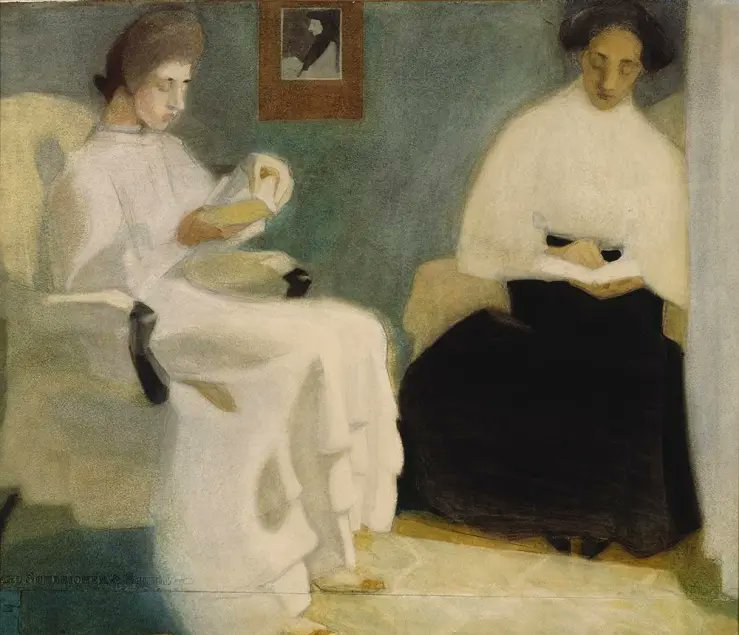
Helene Schjerfbeck, Lukevat tytöt (Reading Girls), 1907
I could probably name at least twenty more books, but I don’t want to be responsible if y’all break your book buying ban or you never finish your TBR stacks. [Ed. – You clearly do not understand the demographic of this blog’s readership, B…] My reading year 2024 has been off to a good start already and I am excited to tell you about it in a year! [Ed. – Imma hold you to it! Thanks, Benita!]







 Eiger, Mönch & Jungfrau