Regular readers will know that for the last several years I’ve solicited Year in Reading reflections from friends and trusted readers. As we’re well into February, I’ve scaled the project back considerably this time, but I’ve got some good stuff coming your way over the next few days. Today’s installment,her fifth, is by Hope Coulter, my friend and former colleague. Hope is a writer in Little Rock.
Robert Gober, Bag of Donuts, 1989
Like Dorian, I retired from Hendrix College last May. One of the joys of retirement has been more time to read. With more free hours in the day and no class prep I’ve been able to read gluttonously, leisurely-ly, reminding me of how I read as a child in our long low house on the bayou—stretched out for hours at a time with a book, changing position whenever a propping arm got tired. Once, I remember, I was performing the cliché of reading late into the night with a flashlight under the covers (I’m not sure where I even got this idea) when my father walked in and flipped on the light. “What in the world are you doing? We don’t mind if you stay up and read, but for heaven’s sake don’t strain your eyes.” [Ed. – Good Dad.] My body is bigger and creakier now, but the sense of abandon, of decadent pleasure in reading, is much the same.
In 2025 a third of the books I read happened to be memoirs, and of these, as I followed my nose and my algorithms, one-third were by chefs, restaurateurs, or gastronomes [Ed. – gastrognomes, you say???]. My favorites are as good a way as any to start off this list.
Best food-related memoirs:
Most Likely To Make You Hungry, Make You Laugh, and Make You Want To Cook: Stanley Tucci, Taste: My Life Through Food and What I Ate in One Year (and related thoughts) – Pure delight. I love this guy. He’s unpretentious, exuberant, and funny.
Most Likely To Make You Wince: Keith McNally, I Regret Almost Everything – Frank, well-written, painful and witty by turns. An inside scoop on the restaurant business.
Most Likely To Make You Drop Everything and Move to Southern France: Peter Mayle, A Year in Provence, Twenty-Five Years in Provence, Toujours Provence [Ed. – Blasts from the 90s past!]
Best non-foodie memoir:
Amy Liptrot, The Outrun – The narrator leaves her dissipated twenties in London and returns to Orkney, in far northern Scotland, to find her footing. Interesting setting, well written.
Best novels:
Kiran Desai, The Loneliness of Sonia and Sunny – For many years Desai’s previous book, The Inheritance of Loss (2006), has been my favorite novel; I’ve waited with much anticipation to see what she would do next. The wait was not short. But Loneliness, which was shortlisted for the Booker Prize, is so worth every bit of time Desai took to conceive and compose it. It’s a big, complicated book about art and identity and love and family and borders. Along with the big themes, she remains fantastic at rendering small moments: passing observations and exchanges so apt and droll you want to keep them at your fingertips.
In fact, this book has many of the same qualities that shone in Inheritance: sly humor, exasperating minor characters who unexpectedly endear themselves to you, and tensions between isolation and community, truth and cant, haves and have-nots. But over two decades those polarities have become more extreme and their effects more pernicious. Desai’s sensibility has grown more weary and embittered (hasn’t everyone’s?) [Ed. – yes], and to encompass all it sets out to, this new novel is necessarily larger, messier, more brooding and less ebullient.
Kevin Barry, The Heart in Winter – Irish love story meets American Western. [Ed. – Good description, good book.]
Niall Williams, This Is Happiness and The Time of the Child – Wonderful reads, with an Irish lilt to the prose that only deepens enjoyment. These are connected and I recommend starting with This Is Happiness.
Megha Majumdar, A Guardian and a Thief – A nail-biter set in the all-too-believable near future; the writing is strong and fresh. For instance: I happen to be aware that there are lots of saccharine quotations out there about hope (even by Dickinson!—“‘Hope’ is the thing with feathers…”—ugh). [Ed. – Surprising fighting words!] Majumdar’s take on hope is gloriously unsweet:
Hope for the future was no shy bloom but a blood-maddened creature, fanged and toothed, with its own knowledge of history’s hostilities and the cages of the present. Hope wasn’t soft or tender. It was mean. It snarled. It fought. It deceived. On this day, hope lived in the delivery of gold to a man who might be a scammer, and, perhaps, hope lived also in opening the doors to a thief.
Another great line:
He [the interloper] smelled of the soap Dadu [the protagonist’s father] had used, palming old sliver to new bar, decade after decade.
“Palming old sliver to new bar, decade after decade”—I know Dadu from that line, as well as if I smelled his soap scent. [Ed. – Indeed! And “palming,” which I only usually hear in reference to cards, makes it sound like he’s doing something a bit disreputable.]
Runners-up: Another near-sweep for the Irish!
John Boyne, Mutiny: A Novel of the Bounty [Ed. – Allowing this only because it’s you, Hope. We don’t like the Striped PJ man around here.]
Cólm Toibín, Nora Webster
Mary Costello, Academy Street
Weike Wang, Rental House
Most Unusual Best Novels:
Isabel Cañas, Vampires of El Norte – I thought I didn’t like vampire novels. Yawn. But this novel serves them up veiled in themes of colonialism and environmental exploitation, while also working well as a love story and as plain old horror. [Ed. – Horror one of the most vital genres right now!]
Samantha Harvey, Orbital – Great premise for a novel, and so many stunning descriptions—but too many plotlines are left flying at the end.
Best Classic That Stands Up to Time:
Willa Cather, Death Comes for the Archbishop – Bestowing superlatives in literature is kind of silly, ever more so as time goes by. Still, if I were forced to name the Greatest American Novelist, I would say Willa Cather. In this novel Father Jean Latour, a French-born priest, gets appointed to serve a vast area of New Mexico just after its annexation. His life in Santa Fe provides the central narrative, and on this armature Cather strings a number of side stories that she took in during her long visits to the area—some harrowing, some strange, stories of depravity or folly or pity, but all told with her characteristic quietness and exactitude. A lesser writer might have expanded one or two of these to fashion a more conventional main plot, say the story of the lost El Greco, or Father Latour’s lifelong dream of building the Santa Fe Cathedral. But Cather avoids imposing such a goal-driven form. The more organic structure that she chooses instead keeps our attention on the place and its inhabitants, emerging gradually into solidity. [Ed. – Such an enticing description!]
One of the book’s brilliant strokes is its prelude on a terrace in Rome, where over dinner three Cardinals and a Bishop are hashing out the jurisdiction of these territories so remote they might as well be on another planet. After this the novel returns to Europe only in brief flashes. Yet these bits of Old World context, in a novel about the relentless development of the American West, are somehow key to its power.
Louise Catherine Breslau, Young Girl Reading by a Window, 1912
Series That Never Disappoint:
Robert Galbraith,* Cormoran Strike series | new in 2025: The Hallmarked Man
Michael Connelly, Harry Bosch and Renée Ballard series | new series in 2025 set on Catalina Island: Nightshade
These series are my jam: character-driven investigator mysteries possessed of zest and depth. Authentic settings, dialogue that people would actually say, multiple unfolding plots.
*Yes, Galbraith is aka J. K. Rowling, and yes, she is toxic on the subject of trans rights. I’m shocked by how a writer with her insight and empathy into human character can be so hateful toward an entire subjugated group of people… yet I continue to love her books. Read Monsters: A Fan’s Dilemma by Claire Dederer if you judge me for this or if you too struggle with this conundrum. [Ed. – I don’t judge you, but I had to give up these books, which I very much enjoyed because she really seems a terrible person, and TERFs suck. I would like to read the Dederer, though.]
Best Potato Chip Fiction:
This is my husband’s term for books that may not be the highest order of literature, but they’re well done and so satisfying to read that you just keep ingesting them like potato chips that you can’t stop eating.
Lian Dolan, Abigail and Alexa Save the Wedding – I’ve gone on to read a few more of Dolan’s books, but this one is my favorite, with little gems of observation such as:
Alexa was one of those women who had aged in place, meaning that Abigail could still see the eighties undergrad and the focused career gal and the bold single mom in her sixty-something face. Some people disappeared into their later years’ appearance, no trace of their young days left, thanks to injectables and surgery. But not Alexa. She was all she had been.
Lisa Jewell, The Night She Disappeared, Don’t Let Him In, etc. [Ed. – I have been eyeing these…]
Best Nonfiction:
Lynne Olson, Madame Fourcade’s Secret War: The Daring Young Woman Who Led France’s Largest Spy Network Against Hitler
Elizabeth Letts, The Ride of Her Life: The True Story of a Woman, Her Horse, and Their Last-Chance Journey Across America
Liza Mundy, The Sisterhood: The Secret History of Women at the CIA
Jordan LaHaye Fontenot, Home of the Happy: Murder on a Cajun Prairie
Most Depressing Nonfiction:
Kirk Johnson, The Feather Thief: Beauty, Obsession, and the Natural History Heist of the Century – Just typing the title, I get depressed all over again. [Ed. – Well, you made me look this up and now I’m intrigued. We really need a moratorium on these nonfiction book subtitles, though.]
Nonfiction Most Guaranteed to Make You Grip the Arms of Your Chair and Be Relieved They’re Not the Gunwales of a Boat:
Hampton Sides, The Wide Wide Sea: Imperial Ambition, First Contact and the Fateful Final Voyage of Captain James Cook
Children’s Notables:
For a middle-grade novel I’m writing, I’ve been reading some classics of that genre. Here are three that I read or reread last year that wowed me.
William Pène duBois, The Twenty-one Balloons – I loved this inventive book as a kid, and turns out I still do.
Marguerite de Angeli, The Door in the Wall – How did I miss this one during my middle-grade years? Maybe I thought I didn’t like medieval settings: they’re so often gussied up with stale trappings of fantasy. But here the world-building feels solid and genuine. Good read.
Ann Petry, Harriet Tubman: Conductor on the Underground Railroad – Before reading this I knew only the broad outlines of Tubman’s life, and the fuller story blew me away. It’s billed as a young adult book, but nothing about it felt juvenile. Highly recommend. [Ed. – Fascinating! I did not know Petry wrote for children, too. I will pick this up.]
Wayne Thiebaud, Food Bowls, 2005
Thanks for reading; I welcome your comments on any of the above! And thank you, Dorian, for keeping this wonderful blog and for giving me a turn in your bully pulpit. [Ed. – Ha, nowhere near influential enough for that! Thanks for this piece, Hope!]
Here is my introduction to Episode 35 of the podcast I co-host with Rebecca Hussey and Frances Evangelista, One Bright Book.
Ben Sahm, “Child Labor” 1940 – 42. Part of the four-part mural The Meaning of Social Security (1940 – 42) Cohen Federal Building, Washington, D.C.
Our book today is Willa Cather’s O Pioneers!, first published in 1913.
O Pioneers! was Cather’s second novel, and her first big success. It’s a short book, episodic in structure, centered on Alexandra Bergson, a Swedish immigrant who lives on a struggling farm in southern Nebraska with her ailing father, her stoic mother, and her three brothers. On his deathbed, the father entrusts the farm to Alexandra, not only as the eldest child, but also and more importantly as the only one likely to make a success of it. By blending confidence, daring, and hard work, Alexandra does just that, becoming a successful landowner and a linchpin of the community of European immigrants forging new lives around the town of Hanover. Many of these new Americans are Scandinavian—some of the old timers still only speak Swedish—but others are French or Czech.
The title comes from one of Walt Whitman’s hymns to the glory of the American experiment. As its plural noun suggests, the novel is something of a group portrait. The first half centers on economic struggle and the fantasy of bending landscape and climate to human wishes. The second half foregrounds two love stories: the muted relationship between Alexandra and a childhood friend, Carl, who has gone away to seek his fortune and returns to visit years later., and the passionate, doomed affair between Emil, Alexandra’s youngest brother, and Marie, a married woman who lives on the neighboring farm.
This ending is already prefigured in the beginning, when Cather writes: “The history of every country begins in the heart of a man or a woman.” I might not have paid much attention to that sentence were it not for the circumstances in which I came across it. I happened to read the early chapters of O Pioneers! in the Little Rock Social Security office, where I had business earlier this week.
It turns out all kinds of people come to the Social Security office. I sat alongside new immigrants and elderly couples, family members with their adult disabled children and new parents with babies in tow. The room we occupied had the slightly sterile quality of many bureaucratic offices, yet it felt more functional than alienating. Most everyone’s attention was fixed on a large board which told us supplicants which window to visit when our number flashed up. But that didn’t stop us from doing other things too. People chatted with the people sitting next to them, and with the security officers who, despite the sign declaring that they were not to be bothered with official questions, easily and casually dispensed advice. They played on their phones, shuffled nervously through their paperwork, shushed their children, even read 20th century American novels.
I wished that the people who believe government is evil, maybe people like our current President and Vice President, whose photos glared malevolently from the wall of the hallway outside the waiting room, could see the place in action. Is it somewhere you would want to spend a lot of time? Certainly not. But is it a demoralizing vortex of inefficiency aimed at squandering the hard-won gains of “real” Americans? Absolutely not. It’s a place filled with people doing their best, a place dedicated to helping others, no matter how tattered the American social net might be.
I wondered what Willa Cather would think of that room. I thought of the communal spirit expressed by the Nebraska farmers who populate the pages of O Pioneers!, most of them either first or second generation Americans. I thought of the marginalized characters Alexandra protects—a man named Ivar prone to fits and unwilling to wear shoes but good with horses who she keeps on to her brothers’ dismay, a Swedish widow who loves to visit Alexandra’s farm because the younger woman listens to her stories and doesn’t demand that the old woman speak English. Would Cather be willing to shift the onus of care from individual to collective? Would she agree that a dignified life belonged to all citizens regardless of their beliefs or abilities, and that this opportunity should be given by the people to each other through the government rather than through the mercy of an individual? I remembered a counter tendency to Alexandra’s charity and large-mindedness, namely a tendency to judge behaviors deemed deviant or non-normative, as when Alexandra scours her body in the bath after indulging in sexual fantasy or denounces Emil and Marie’s illicit relationship.
Most of all, I looked at the faces in the room, many, perhaps most of which, were not white. I thought about who counts among the pioneers of the title, and which kinds of Americans did not seem to be imagined by the book. (Having finished the book, I’m especially struck by its absolute silence about indigenous people, who are not even present as frightening tales from the time before the frontier was settled.)
I hoped, and this is fanciful I know, that, despite the changes between then and now, Willa Cather would enjoy sitting in that room, would view its goings on with interest, would be curious about if not necessarily approving of the America present among its plastic chairs and scuffed linoleum flooring.
Robert Adams, “North of Keota, Colorado”
I’ll never know, of course, but I will know what my co-hosts thought of it, which is something I am even more curious about.
Friends, what did you make of O Pioneers! ?
Listen to the episode for their answers: but feel free to chime in below. We’re all friends here.
Excited to once again present reading reviews from some of my favourite readers. Today’s installment, his third, is byScott Walters. Scott launched a litblog, seraillon, in 2010, and expects to return to it one of these days. He largely follows Primo Levi’s model of “occasional and erratic reading, reading out of curiosity, impulse or vice, and not by profession.” He lives with his partner in San Francisco.
Barring a couple of possible late entries, here ends the 2023 edition of the EMJ Year in Reading series. Thanks to everyone who contributed–and all who read these engaging lists.
Édouard Boubat, Paris, 1949
Year in Reading 2023: 50 Books, Fat and Thin
Like several others who have already posted about 2023, I had a less than stellar reading year, finishing a little over half the number of books I did in 2022. On the other hand, several doubled as barbells for building up my muscles. On the third hand, some were slim. And on the fourth hand, some were slim pickings; I can’t recall ever reading so many works I didn’t especially like. I’m not sure to what to attribute that deflating phenomenon, but I hardly seem to be alone.
Best Quasi-Rereading
Michael Moore’s effervescent new translation marked my fourth time reading Alessandro Manzoni’s The Betrothed (1827/1842). As Moore explained at a reading I attended, he deliberately aimed his translation at an American audience lamentably unfamiliar with this 19th century masterpiece. An ingenious framing story cocoons this long tale of Renzo and Lucia, the affianced young couple whose wedding plans are dashed by the machinations of a lascivious warlord, forcing the couple to separate and flee into spiraling trials that challenge them (and several other characters) into becoming larger than themselves. Starting a beloved book in a new translation requires adjustment, but I was won over by Moore’s energetic, nimble, vivid and playful version, almost certainly the place to start for any American reader approaching this grand work for the first time. [Ed. – This book looks at me reproachfully from the shelf…]
Other Italian Explorations
Giovanni Boccaccio: The Decameron
G. W. McWilliams’ translation of Boccaccio’s 1353 classic accompanied me throughout the year as the perfect post-pandemic [Ed. – sic] companion. You know the framing story: five young women during the Florentine plague of 1348 abandon the city and invite along five male friends to an empty villa in the hills where, each day for ten days, each tells a story to entertain the others. The depiction of the plague in the book’s opening is terrific, and the 100 stories, splendidly diverse, are by turns tender, ribald, moving, pointed. So is the warm banter between the young people as they introduce their stories and encourage one another’s efforts, the whole serving as a kind of instruction manual on storytelling (and as a model for confronting calamity). Boccaccio has become a favorite; I also spent time this year with his Famous Women and Genealogy of the Pagan Gods, the latter especially highlighting Boccaccio’s talent as a great writer of prefaces. [Ed. – Ok, you sold me on this!]
Dominic Starnone: The House on the Via Gemita (2023)
The two short Starnone Neapolitan novels I’d read had impressed me, so I was excited to discover a fat new 500-page work also set in Naples. Starnone’s narrator recounts the history of his father, digging so thoroughly into strained father/son relationship that I can’t imagine The House on the Via Gemita not taking its place as a classic of the genre. To my surprise, the book also turned out to be an excellent novel about painting, in that the son must address both his father’s abusive personality and role as a peripheral figure in mid-century Italian art, a career layered on top of a day job as a railroad worker and the family responsibilities he largely leaves to others. Starnone gives us a brief history of postwar Italian art while exploring the qualities that make paintings great or mediocre and making personal an issue of our time: disentangling (or not) an artist from their art. I also noted the geographical precision employed by Starnone as a quality common to several contemporary Neapolitan novels; one can use a map to follow the narrative’s peregrinations around the city.
Maria Attanasio: Concetta et ses femmes
Concetta et ses femmes, written in 2021 when Attanasio was 80, sets out as a documentary rescue mission to obtain the story of Concetta la Ferla, organizer in the late 1960s, in Caltagirone, Sicily, of the first women’s branch of the Italian Communist Party (then the third largest in the world). Concetta’s grassroots project develops out of frustration with the municipality’s diversion of water to its wealthiest citizens, but runs into predictable obstacles in the form of chauvinistic attitudes in the city administration, in the Party, and at home. The story would be interesting enough simply as historical artifact. But Attanasio’s structuring of her novel, the first part narrated by Maria herself from the perspective of 20 years after the effort to preserve Concetta’s tale, and the second the tale itself in Concetta’s words, plays with questions of authorship and feminist solidarity, and emphasizes the continual nature of the struggle to gain legitimacy, to advance the advances of the past, to never go back.
Other Italian/Italy-related works included an Italian/French collection of short stories (Nouvelles italiennes contemporaines), with Tomas Landolfi, Massimo Bontempelli and especially Elisabetta Rasy’s contributions as standouts. Indian-American-now-Italian writer Jhumpa Lahiri’s Roman Stories (2023) revisits Alberto Moravia’s 1959 Roman Tales (Racconti Romani in the original Italian for both books), exchanging Moravia’s focus on Roman men in recognizable neighborhoods for immigrants, ex-pats, and tourists vaguely on the city’s periphery. Renato Serra’s Examination of Conscience of a Man of Letters (1915) presents a searing treatise on the relationship of literature and war, written three months before Serra perished in battle in World War I (read in French; while the essay has never gone out of print in Italy, it has not been translated into English). I devoured Janet Abramowicz’s monograph, Giorgio Morandi: The Art of Silence (1964), a deep appreciation of the Bolognese artist into whose family Abramowicz was essentially adopted. Despite this proximity, Abramowicz treats her former teacher judiciously and even unsparingly when it comes to Morandi’s blemishes, in particular his tacit involvement with fascism. German writer Esther Kinsky’s Rombo (2022), a polyphonic novel exploring the impact of a series of earthquakes on remote villages in the north of Italy, grew on me during my reading, with its Polaroid-like narrative approach in which the lives of the villagers gradually become more vivid and saturated. Finally, in Etruscan Places (posthumous publication 1932), D. H. Lawrence and a companion identified as “B” voyage through central Italy, exploring sites of the ancient Etruscan “12 cities.” Lawrence’s incisive, infectiously enthusiastic observations about Etruscan art and life turned me into a fan of this fascinating people whose culture was absorbed/obliterated by the Roman Empire. The narrative doubles as a travelogue through Mussolini’s Italy and, adding yet another layer, Lawrence’s views lay out an entire philosophy that has me determined to revisit his fiction this year. [Ed. – I support this plan!]
Stalingrad
I came away from Vasily Grossman’s Life and Fate convinced I’d encountered one of the essential literary documents of the 20th century’s experience of fascism. I did not know that the book was but a second volume in Grossman’s monumental effort to write the great World War II novel. The first, Stalingrad (1952), with still no definitive Russian edition, has only recently been translated into English by Robert and Elizabeth Chandler. As highly as I esteem Life and Fate, I believe Stalingrad may well be the superior novel [Ed. — !] in its immediacy and the sheer grandeur of its conception (but as the books were intended to form a whole, one need not set them against one another). Grossman, present at Stalingrad as a journalist, related some of his experiences in Life and Fate, but Stalingrad sets out to capture the whole story of the war’s most decisive battle, from August 23, 1942 to February 2, 1943. Grossman’s acute consciousness of his literary precursor, Leo Tolstoy, leads him to take his main character on two pilgrimages to Tolstoy’s house, Yasnya Polynka, and to muse on Tolstoy’s accomplishments:
Krymov looked at the wounded who had fallen by the wayside, at their grim, tormented faces, and wondered if these men would ever enter the pages of books. This was not a sight for those who wanted to clothe the war in fine robes. He remembered a night-time conversation with an elderly soldier whose face he had been unable to see. They had been lying in a gully, with only a greatcoat to cover them. The writers of future books had better avoid listening to conversations like that. It was all very well for Tolstoy – he wrote his great and splendid books decades after 1812, when the pain felt in every heart had faded and only what was wise and bright was remembered.
With Life and Fate, Stalingrad now gives us one of the great documents of World War II – and one of the greatest works of fiction about war ever written.
An Essential Holocaust Novel
The Talmudic concept of the Lamed-Vov, the 36 righteous people on whom the continuity of the world depends, fascinated me when first I read about it. Only when I started André Schwarz-Bart’s 1956 Prix Goncourt-winning novel, The Last of the Just, did I realize that the Lamed-Vov were central to the book. Schwartz-Bart takes the reader though a thousand years of Lamed-Vov succession to arrive at Germany in the 1930s, where the narrative pace slows dramatically. His restrained, almost clinically factual language provides devastating testament as much as fiction. Some of its scenes are completely indelible, and Ernie Levy, Schwarz-Bart’s protagonist for this last half of the book, struck me one of the most remarkable characters I’ve encountered in a lifetime of reading. [Ed. – It feels like a professional failing that I have not read this book!]
José Revueltas: The Hole
A tiny but shockingly powerful novella, taut and tight with not a word out of place. [Ed. – Funny, that’s how people usually describe me!] The Mexican writer and activist Revueltas’s 1969 book, based on the author’s own 12-year experience as a political prisoner, resembles a Piranesi prison drawing in narrative form, an intensely concentrated exploration of incarceration. Everything in the narrative is compressed – time, space, hope, even the reader’s attention and the size of the book itself. An absolute masterpiece of prison literature.
Mariana Yampolsky, Estación Martell, 1988
Good King Xavier, Reino de Redonda
Spanish novelist Javier Marías died at age 70 on September 11, 2022. I encountered his work four times this past year, first in his final novel Tomás Nevinson (2022) which appeared last May in Margaret Jull Costa’s translation. I had come to anticipate each new Marías translation as nearly an annual tradition, so knowing that this his last novel made reading it deeply bittersweet. Tomás Nevinson follows up 2018’s Berta Isla, but also resurrects characters from Marías’s Your Face Tomorrow trilogy, most notably Bertram Tupra. Where Your Face Tomorrow engaged Spain’s experience of Franco and of the civil war, Tomás Nevinson takes as its starting point the Basque separatist terrorist attacks of the 1990s. As Nevinson is enlisted by Tupra to come out of retirement to track down a woman involved in the most heinous of these attacks, Marías uses the narrative to explore questions about our responsibility for seeking justice, how we deal with repentance and redemption, what justice seekers owe to their own loved ones, whether there may be some informal statute of limitations on bringing the guilty to account and how long justice should be sought – time being among the most prominent fixtures in Marías’s fiction. We are fortunate to have this novel; Marías’s time having run out seems completely unjust.
When I picked up Tomás Nevinson at Point Reyes Books, the literary mecca cultivated by Molly Parent and Stephen Sparks, Sparks asked if I’d read the new book about Redonda. I must have stared at him blankly, as, having not yet read Marías’s Oxford novels, I knew nothing. Thanks to Michael Hingston’s marvelously strange Try Not to Be Strange (2023), I now know quite a lot, including the fact that Marías had been, up until his untimely death, King Xavier I, monarch of this tiny nation, which, despite having no inhabitants, does have territory, a flag, its own currency and postage stamps, and a plethora of dukes and princesses, counts and ambassadors, and multitudes of other titles held by what seems a who’s-who of 20th century writers. This was by far my most fun book of the year, uncovering a great story, offering up a charming tale of obsession (including Hingston’s own), and digging a dizzying warren of rabbit holes for one to scurry down, which led to my filling quite a bit of empty shelf space with related works. [Ed. – Well, this all seems quite insane!]
One of those works, of course, was All Souls (1992), the Marías Oxford novel in which the author first mentions Redonda. I expect to have more to say about this book after I’ve read its sequel, Dark Back of Time, on deck for 2024.
Another addition, Cuentos únicos (1996), came from Reino de Redonda, Marías’s own Spanish-language imprint.This collection of 22 translated English language short stories selected by Marías presented a way to practice my poor Spanish and get to know some writers I didn’t know. Nugent Barker? Oswell Blakeston? Percival Landon? [Ed. – Are these imaginary???] My Spanish proved inadequate to the task, but I understood enough to have made the effort – to be continued this year – worthwhile.
The Ascent of Rum Doodle Mont Analogue
My next-to-most-fun book of the year, René Daumal’s Mont Analogue (1952), tells the story of Père Solgon’s organization of an expedition aboard the ship “Impossible” to find the rumored tallest peak on earth, mysteriously as yet undiscovered due to its isolation (guesstimated to be in the vast South Pacific) as well as certain tricks of light that keep it invisible except at a certain hour and from a certain approach. With a crew including such luminaries as an American painter of alpine scenes, one Judith Pancake, the voyage is half tongue-in-cheek, half mystical imponderables (Daumal had been a follower of Gurdjieff), half Jules Verne. Yes, I know that’s three halves, but that suggests the shape and character of this delightful novel, one of the rare “unfinished” works that actually ends mid-sent-….
(Note: for French readers: a lovely new hardcover illustrated edition of Mont Analogue comes with an introduction by musician Patti Smith).
Weak in Comparison to Dreams
I got to know art historian/theorist James Elkins’s work some 25 years ago while researching text and image for a conference paper. So it came as quite a shock to discover a 600-page novel by Elkins, especially as I’d recalled his having announced in an Amazon book review his intention to stop adding to an accretion of texts. Presumably Elkins only meant Amazon reviews, because Weak in Comparison to Dreams (2023) is a welcome contribution to contemporary literature and among the most unusual novels I’ve read in a long time. In the book’s continuation of Elkins’s explorations of text/image interactions, I felt both that I was right back where I’d left off and in a whole new world. Incorporating scores of black and white images and increasingly nutty charts and graphs, the narrative follows its narrator, Samuel Emmer, a bacterial biologist for the city of Guelph, Ontario, on a series of visits to zoos around the world to evaluate mammalian behaviors and health protocols as Guelph plans its own zoo. [Ed. – The Guelph connection is… unexpected.] A dozen interchapters present Emmer’s dreams while on this mission, these too accompanied by images that suggest an intensifying fugue state. By turns sobering and hilarious, thematically touching on everything from animal welfare and incarceration to climate change and bureaucracy, from pseudo-science to contemporary experimental music, and playing in a space similar to that occupied by conceptual artist David Wilson’s Museum of Jurassic Technology, Elkins’s absorbing novel is… not at all what it seems. A 100-page final section entitled “Notes” delivers not so much “notes” as a surprising reframing of the first narrative, much in the way a caption might reframe an image. I can’t get the book out of my head, and shouldn’t, as Elkins has completed four other novels since 2008 that form a quintet of which Weak in Comparison to Dreams, though the first to be published, is volume three. I cannot wait to see what he does in the other four. [Ed. – How the hell do you find this stuff???]
The Queen of L.A. Noir
My familiarity with Dorothy Hughes’s In a Lonely Place (1947) had been limited to Nicholas Ray’s 1950 film starring Humphrey Bogart. Finally reading the novel left me incensed about the movie, a fairly egregious desecration of its source material. Fortunately, I felt no indignation in response to Hughes’s novel, which floored me as not just a masterpiece of Southern California noir, but perhaps the masterpiece of Southern California noir. I fell for it in the first pages, which captures the foggy, seeping chill of the California coast at night in a manner precise and true. She shies away from nothing in this penetrating psychological drama in which [Ed. – SPOILER INCOMING!] the narrator himself is the killer – presumably the quality that kept the studios from allowing Humphrey Bogart to be tarnished by such a role. Hughes covers the postwar L.A. noirscape exquisitely while managing to keep her narrator entirely human, a subtle literary feat that reads like one of Freud’s case studies. Raymond Chandler might be King of L.A. Noir, but if you asked me to pick a monarch, I’d go with Hughes on the basis of this novel alone.
Other mysteries included the marvelous Margaret Millar in Stranger in my Grave, a disappointing end to the Montalbano series in Andrea Camilleri’s Riccardino, and dismay as regards Mignon Eberhart, an author I’ve liked, whose Family Affair, in this year of too many books I did not like, marked the nadir.
Poetry
Aside from individual poems here and there, I read just three books of poetry. Reginald Dwayne Betts in Felon (2019) gives us a powerful collection of poems that go well beyond the experience of incarceration to address convict life beyond prison. I found Argentine poet Alexandra Piznarik’s Removing the Stone of Madness, Poems 1962-72 (Yvette Siegert, translator), relevatory. I did not know Piznarik, who, as the collection’s title suggests, fought a terrible battle with mental illness which she chronicled in short, sui generis poems as hard-edged and clean as crystals, powerful poem-objects one could almost hold in one’s hand. Finally, I loved Greg Hewitt’s intimate, resonant poems in Blindsight, structurally based on composer Olivier Messiaen’s prime-number system and which brought to mind Frank O’Hara’s personal poetic school of “Personism” (a mutual friend sent me Greg’s book).
Odds and Ends
The rest, an unorganized, mostly enjoyable mess, included Willa Cather, more Eve Babitz, Sándor Márai, Tatsuo Hori, Euripides, Chinua Achebe, Raphael Sánchez Ferlosio, more César Aira (an annual need), Daisy Hildyard and others. Larry McMurtry’s Lonesome Dove (1985) gave me exercise, as with Stalingrad in one hand, I built up my other bicep by hefting McMurtry’s 850-page narrative in late-night installments at approximately the same pace as the Texas border to northern Montana cattle drive the story depicts. I found it terrific fun, amplified by my subsequent reading of the story of a poor Texas legislator who made the mistake of trying to ban Texas’s national novel. No one should want to be that guy. A bit further south I ate up Charles Portis’s Gringos (1991), set in the Yucatan where rumpled ex-pat Americans are involved in archeological dealings and mis-dealings. Are all of Portis’s novels his best novel? I think so. I think so. [Ed. – Well put!] Art historian Alexander Nemerov’s The Forest (2023), a collection of essays and corresponding plates, uses forests of the American frontier to cull idiosyncratic tales of 1830’s American art and culture, rescuing some fascinating figures from historical oblivion. I finally got around to reading Maggie Nelson, in Bluets (2009) and The Argonauts (2015) – respectively, musings on the color blue (with a towel snap at William Gass’s bare cheeks), and raw meditations on sex, gender and motherhood that I sent off to goddaughter pursuing gender studies. I’d been curious for some time about Michael McDowell six-volume Blackwater, and gorgeous and affordable new French paperback editions provided an opportunity to dive in. Blackwater 1: La Crue (1983) proved a Southern Gothic slow drip horror tale peeling away the veneer of Southern gentility. For the first time since high school, I revisited J. D. Salinger, in Raise High the Roof Beam, Carpenters (1955) and Seymour: An Introduction (1959). Salinger himself may not have aged well, but these two novels were far better than I expected them to be. I found Tove Jansson’s The True Deceiver (1982) to be a stunningly good novella about truth, trust and deceit, not necessarily in that order, set in a fishing village on the Finnish coast. There seems to have been nothing Jansson couldn’t do right. While somewhat confined in a house in the mountains, I found appropriate companionship in Count Xavier de Maistre’s A Journey Round My Room (1795), a book born of boredom, a curious meditation on escaping it, created when, following a duel, de Maistre was put under house arrest for some six weeks. Alleviating boredom, Roy Lewis’s The Evolution Man, or How I Ate My Father (1960), though clearly dated, was still pretty damned funny as comedies about pre-history go. Finally, a couple of books with which I struggled still held enough of interest for me to get through them. Justin Torres’s Blackouts (2023) relies heavily on photographs, drawings, redacted text, dialogue as film script, and other novelties that I found a bit overcooked (in a way I did not with the Elkins novel). But the story Torres unearths of a 1942 study of homosexuality, and of the lesbian couple who helped drive the project and were betrayed by it, is remarkable. I had a tougher time with Gerald Reve’s The Evenings (1947) acclaimed by some as the great 20th century Dutch novel. A disaffected young man lives with his numbed parents in 1946 Amsterdam and battles his claustrophobic life with dark, acrid humor. I admired Reve’s allowing the war to drip into the narrative bit by bit, the horrors of the recent past seeping into normal life. But I couldn’t wait for the book to end.
Henri Cartier-Bresson, Naples, 1960
I’ll conclude with a dream. In a cluttered bookshop, I found a tattered but astounding volume amended with striking collages, vivid watercolor sketches, and dense margin notes. The (dream) author’s name seemed familiar, so upon waking I looked up James Gould Cozzens and plunged down a trail that led me to Dwight MacDonald’s 1958 review of Cozzens’ late novel, By Love Possessed. I did not read Cozzens. I’m not sure I will ever read Cozzens. But I’m grateful to odd dreams for having pointed me to MacDonald’s review, which takes to task a generation of critics who, with log-rolling fealty and conformity to one another’s uncritical opinions, lavished praise on the novel. Eviscerating, illuminating, even necessary, his review models close textual analysis with an eye towards criticism’s larger role, relevant today when writer-critics blurb one another’s books and award prizes to mediocre works. A pretty good way to end the reading year, and a better way to start off a new one which, I am happy to say, as far as books go, is off to a tremendous start. Thank you for reading. [Ed. –Thanks for writing, Scott! A delight as always.]
Excited to once again present reading reviews from some of my favourite readers. Today’s installment, her fourth, is by Hope Coulter, (@hopester99), whom I’m lucky to call a colleague. A fiction writer and poet, Hope directs the Hendrix-Murphy Foundation at Hendrix College.
Eveelyn Hofer, Girl with Bicycle, Dublin, 1966
2023 may have been my Year of the Binge. A quarter of the books I read were by a single author, Michael Connelly, as I continued a 2022 obsession and chowed through the rest of his Harry Bosch and Lincoln Lawyer series. Now I’m left with the dregs of the feast and plenty of questions. Has Bosch retired for good? Is cancer going to polish him off? And how am I going to get by without a steady intake of seedy murder scenes, sandwich shop tips, and Bosch’s saturnine musings floating over the lights of L.A. from his cantilevered deck? Sigh. No regrets for this gluttonous spree; I only wish I could find another such homicide cop to devour.
Speaking of, Robert Galbraith’s majorly enjoyable detective novels continued strong for me last year. I read The Ink-Black Heart via audiobook, parceling it to myself morsel by morsel so as not to rip through it too fast. Much of the novel unfolds through tweets, which are hard to follow either by ear or on the page, so that one wasn’t my favorite, but the series is overall terrific. If Strike and Robin settle into domestic tranquility and draw the curtain of privacy over their agency door (please no spoilers; I’m still finishing up Book Seven), I’ll be in a bad way indeed. [Ed. – I loved the first few of these books, but I must confess I had to give up on them, the author’s politics having so soured me…]
I went on a lesser bender with John Boyne, starting with The Heart’s Invisible Furies, which I happened to read while traveling in Dublin and southwest Ireland—moving through some of the very settings of the novel in a pleasurable kind of Binx Bolling-esque rotation. That sent me to a handful of other Boyne books. All the Broken Places, The House of Special Purpose, and The Absolutist were highlights, though none of them surpassed the dark, funny, moving experience of Furies.
Completing previous years’ jags, I knew I had to get hold of Paulette Jiles’s latest, Chenneville, reviewed here by Dorian late last year. All Jiles’s books have won me over. This one wrapped up too fast for my taste, but like her other works, it flares a light onto regional history with convincing detail and taut storytelling. [Ed. – Agree, especially re: the ending.]
Eh, maybe here my conceit ends. Although I regularly teach Zadie Smith’s “The Embassy of Cambodia” and have read several of her novels, I can’t really call that a tear. Even so, I was intrigued to hear that Smith had turned to historical fiction and couldn’t wait to check out The Fraud, which is based on a 19th-century trial, little known now but sensational in its time. The book gripped me in unexpected ways. Every character was so believable, so not-a-type, so idiosyncratically shaped by their history and personality—supremely so in the case of the main character, Eliza Touchet. Mrs Touchet’s epiphanies in the course of the novel involve -isms of race, class, and sex that quietly echo our own era. At the same time her keen intelligence, her self-understanding, her fierceness and restraint, and her willingness to examine the tangles within her own heart are quintessentially Victorian.
As I read I found myself marking passages the way I do in my old copy of Middlemarch, quotes with a similar sage quality. (Even though Dickens and Thackeray feature as characters in the book, the sensibility that saturates it is really Eliot’s.) Here Eliza considers her long, complicated relationship with her cousin: “Theirs was a fellowship in time, and this, in the view of Mrs Touchet, was among the closest relations possible in this fallen world. Bookended by two infinities of nothing, she and William had shared almost identical expanses of being. They had known each other such a long time. She still saw his young face. He still saw hers, thank God.” And here she ponders how women often can’t see their own beauty for what it is at the time, not appreciating their appearance until looking back on a younger stage after a lapse of years: “But it is the perverse business of mirrors never to inform women of their beauty in the present moment, preferring instead to operate on a system of cruel delay.” Introspective moments like these, combined with the unspooling action of the trial plot, place this book at the top of the literary heap for my year’s reading.
Other newish novels that I loved last year were Donal Ryan’s The Queen of Dirt Island—a multigenerational saga of tough Irish women, inspired by the kitchen storytelling of his mother and grandmother—and Gabrielle Zevin’s Tomorrow, and Tomorrow, and Tomorrow, about a love triangle that arises and devolves in unpredictable ways. I also enjoyed Jeanine Cummins’s American Dirt. I had steered clear after hearing critics call it appropriative, but when a friend told me it held up well for her I gave it a try. I found the story compelling and plausible. Cummins addresses the criticism directly in her afterword, and I’m persuaded by her account of the writing and her authentic connection to the material.
I also read, and loved, Viet Tranh Nguyen’s short story collection The Refugees, tales of Vietnamese migrants resettled in southern California: this is art on a level with Lahiri’s Interpreter of Maladies and Unaccustomed Earth. And I returned to some old favorites that thankfully not only proved to hold up over time but blew me away all over again: Gabriel García Marquez’s Love in the Time of Cholera; Willa Cather’s O Pioneers and A Lost Lady; Evan S. Connell’s Mrs. Bridge (which Donal Ryan mentioned as inspiration for the super-short chapters in The Queen of Dirt Island), and Robert Crichton’s The Secret of Santa Vittoria.
Then the nonfiction. Oh, the nonfiction. Fiction is great when it’s great, but it disappoints so often and in so many different ways—by trying too hard, being too earnest, too arch or too tough-guy, or showing something nobody would say or do (on the human level I mean, not that it’s surreal or fantastic), or just plain old getting on my nerves. For some reason nonfiction is less prey to these faults. More and more I find myself turning to nonfiction for that “ah” of relief when I can settle into a writer’s style and voice and relax into the story at hand, losing the awareness that I’m reading. Last year I took in some wonderful memoirs. There was Javier Zamora’s Solito, about his experiences as a nine-year-old traveling solo from El Salvador to the United States (it’s like the nonfiction version of American Dirt). There was Monica Potts’s The Forgotten Girls: A Memoir of Friendship and Lost Promise in Rural America, which looks at the deterioration of American small towns based on her growing-up in Clinton, Arkansas, not many miles from where I teach. [Ed. – Definitely on my list. Heard her read at the Lit Fest last year and I still remember the opening scene.] Tracing the divergent life stories of herself, her sister, and her close friend, Potts narrates a tale of narrowing prospects for many young women in this climate. There was Jane Ferguson’s No Ordinary Assignment, chronicling her life as a reporter in the war zones of the Middle East (no forgotten girl she, determined as she was to get out of Dodge after an emotionally deprived childhood in northern Ireland).
I’m chagrined that I had never read the slender Narrative of the Life of Frederick Douglass, an American Slave until this year. As many have said, it’s profound: unforgettable not only for its first-person testimony to the horrors of the slave system in its heyday but also the candor, economy, and precision of the writing. Acquiring even baseline literacy was a miracle in that context—and an interesting story within the story—but Douglass’s literary prowess vaults so far beyond that initial limit, and is so supremely suited to relaying his experiences, that it’s humbling to take in his words.
A mid-year bookshelf cleanout led me to another, far different memoir that I’d somehow missed before, J.R. Moehringer’s The Tender Bar, about the New Jersey barflies who were his surrogate family growing up (and including one of the funniest sexual initiation scenes I’ve ever read). My enjoyment of that book sent me back to current times and a brand-new book that Moehringer ghost-wrote: Prince Harry’s memoir Spare. Come for the royals’ dirty laundry; stay for the Shakespeare allusions that, alas, are probably attributable to Moehringer rather than Harry.
In the realm of general nonfiction, meaning not memoir, there were three standouts this year, two by 30-something Irish writers whom I heard in person at the West Cork Literary Festival last summer (thank you, Hendrix College and the Hendrix-Murphy Foundation). In My Fourth Time, We Drowned: Seeking Refuge on the World’s Deadliest Migration Route, the Irish journalist Sally Hayden details the grim migration sagas happening in the seas north of Libya and makes a case for the EU’s complicity in perpetuating devastating outcomes. Cal Flyn turns to a different crisis, that of environmental havoc and habitat destruction, in Islands of Abandonment: Nature Rebounding in a Post-Human World. The book examines many sites around the globe that toxic damage of various kinds has rendered uninhabitable—or at least not prey to further human disturbance—and where, curiously, plant and animal forms are rapidly speciating. It’s probably too much to call the book hopeful; as Flyn says, it’s not like she’s advocating for toxic damage in order to foster speciation. Still, I can’t think of another environmental book in recent years that has left me with a flicker of optimism. [Ed. – Agreed!]
Edward Burtynsky, Sawmills #1, Lagos, Nigeria, 2016
Poets and poetry fans who have borne with me this far may be wondering, what about verse? I tend to read poetry less systematically and don’t track it as I do prose. With that said, a number of poetry books meant a lot to me as I spent time with them this year, including works by Garrett Hongo, Sharon Olds, Katie Farris, Ilya Kaminsky, A. Van Jordan, Phillip Howerton, and Ada Limón. Dorian’s comments on Wisława Szymborska here, as well as his fellow podcasters’ insights, sent me back to her work with pleasure. Individual poems sometimes linger with me for days.
My final read of 2023 was Claire Dederer’s Monsters: A Fan’s Dilemma. In it she takes up the question of what we as readers, moviegoers, concertgoers, and art audiences do with the knowledge that makers of works we love have committed terrible deeds. Starting with Roman Polanski, she touches on artist wrongdoers of many times and places, along the way considering art theory, cancel culture, liberalism, men, childcare, consumerism, celebrity and fandom, asshole-osity, motherhood, beauty, effort, and love. [Ed. – the asshole-osity is really going around these days.] She inventories her own aesthetic and emotional responses and reckons with the old biography-versus-art-alone conundrum. Dederer does not land in a simple place or tie this all up neatly. As much as her conclusion, I like her forthrightness, the searching quality of her mind, her unwillingness to rest with skewed or kneejerk reactions. Worthy of Eliza Touchet, you might say.
Alex Prager, Applause, 2016
Thank you for reading this—I welcome your opinions on any of these books and writers!—and to Dorian for inviting me to share. This virtual alp of books is something I enjoy throughout the year. [Ed. – Thnk you, Hope: always a pleasure to have you here.]
Today’s reflection on a year in reading, her second for the blog, is by Anne Cohen (@aecnyc). Anne is a lifelong reader (preferably stretched out on couch or bed), retired lawyer, and former reporter. She lives in New York City with part of her family and two dogs, and continues to believe that the existence of Book Twitter saves her from homicidal and other anti-social behavior.
Man Ray, Glass Tears, 1932
I first got my glasses in the second grade, at almost the beginning of my reading life, and for the next 60 years, couldn’t function without them. A year ago, after repeatedly misreading price tags and after having lost several years of ophthalmologist appointments to the pandemic, I had cataract surgery in March and April, followed by several months of significant light sensitivity.
So when I looked back at my reading, I shouldn’t have been surprised (but was) that 2022 was a year of audiobooks.
These included the Anthony Trollope Barsetshire books (except Framley Parsonage, yet to be started), as well as Can You Forgive Her? and The Eustace Diamonds from the Palliser series, all read by Timothy West; Olivia Manning’s Balkan Trilogy, read by Harriet Walter; Elizabeth Gaskell, Cranford; Anne Tyler, French Braid; Amy Bloom, In Love; Fintan O’Toole, We Don’t Know Ourselves; Ferdinand Mount, Kiss Myself Goodbye; and Richard Osman, The Bullet That Missed.
Barsetshire and Palliser. Loving the Trollope was perhaps the biggest surprise of my year (or second biggest, after the realization, right after the first cataract was removed, that the trim around my bathroom mirror was actually white and not a yellowy cream). I had slogged partway through Phineas Finn for a book group several years ago and was bored stiff and, worse, annoyed.
My experience of the Barsetshire novels was entirely different, and I would often find myself grabbing print versions when I couldn’t wait to get to the rest of a chapter (and even when I already knew what happened, I still wanted to find out now how Trollope got his characters there).
I had not expected the novels to be so wryly funny and spot on, even in apparently throwaway descriptions of barely-named characters, especially but not only members of the gentry and Parliament:
Sir Cosmo had a little party [i.e., a following] of his own in the House, consisting of four or five other respectable country gentlemen, who troubled themselves little with thinking, and who mostly had bald heads. [Ed. – The hair keeps the head warm enough to think, you see.]
Nor did I expect the characters to be so richly drawn, with even the least sympathetic of them humanly presented.
“It cannot be said that she was a bad woman, though she had in her time done an indescribable amount of evil,” Trollope writes of Mrs. Proudie, the bishop’s wife. Bad things happen in Trollope but not so much outright evil, and so his word choice here—not misfortune, or unhappiness, or even disaster—is meaningful.
But even as Trollope demonstrates this woman has been an engine of ruin in the lives of others, he also shows Mrs. Proudie’s realization that her own life is among the debris: “At the bottom of her heart she knew that she had been a bad wife. And yet she had meant to be a pattern wife! She had meant to be a good Christion; but she had so exercised her Christianity that not a soul in the world loved her, or would endure her presence if it could be avoided!”
The unapologetic havoc Mrs. Proudie causes may make her an outlier in Barsetshire, but at least so far as I’ve read all the novels are about characters coming to grips with their limitations—whether of birth (ancestry, gender, class, nationality, education, family dynamics); money (having, getting, losing, and the manner of doing either); and personal characteristics (intelligence, pride, diffidence, physical and mental health).
While I’m looking forward to finishing The Prime Minister and onward, I still find both Phineas Finn and Phineas Redux tedious and unfinishable, maybe because the books focus so completely on a single character, without the switches within a skein of stories that, for example, makes The Rev. Josiah Crawley’s continual self-abnegation in The Last Chronicle of Barset less tedious.
The Balkan and Levant Trilogies. Olivia Manning’s account of a young married-but-hardly-know-themselves-let-alone-each-other couple during World War II supposedly mirrors much of her own life, which makes one wonder about her marriage. [Ed. – She married Guy, no question.] Harriet Walter’s reading of the first trilogy (alas, she hasn’t recorded the second) is remarkable; thinking back, I had to remind myself that she voiced all the characters, who are richly drawn and deeply flawed. I enjoyed both trilogies, despite a deep desire to smack most of the characters upside the head; I even missed Prince Yakimov. [Ed. – Yaki! One of the great characters in 20th Century British literature!]
Other audiobooks. I’m a big Amy Bloom fan, especially her short stories, which I’ve always thought of as small jewels. In Love recounts her mid-life marriage to Brian Ameche, a terrific guy who develops early onset Alzheimer’s, and his determination to end his life while he’s still competent to make the decision to do so. Two points I keep turning back to—that Brian Ameche died at Dignitas in Switzerland on January 30, 2020, just before the world shut down, and that a relatively early Bloom short story is about a woman whose married lover has Parkinson’s and wants her to promise to help him die when the time comes. Bloom reads In Love herself, and it’s funny and angry and heartbreaking.
We Don’t Know Ourselves, although non-fiction, is great story-telling. Using his own life as a hook, O’Toole goes year-by-year through recent Irish history, starting in 1958. Highly recommend.
Cranford was non-superficial fun (and led me to order Mrs. Gaskell’s letters, which I’ve not yet started); French Braid was fine if not memorable; and The Thursday Murder Club books are made for audiobook (in a good way).
Some other novels. Miriam Toews, All My Puny Sorrows (another potential trip to Dignitas, but blackly funny all the same); Barbara Comyns, Who Was Changed and Who was Dead and The Vet’s Daughter; Margery Sharp, Harlequin House (always entertaining but I don’t remember a single detail); Georgette Heyer, The Grand Sophy; Rivka Galchen, Atmospheric Conditions; Herve Le Tellier, The Anomaly; Haldor Laxness, Fish Can Sing; Nina Stibbe, One Day I Shall Astonish the World (don’t bother—sorry Dorian) [Ed. – No worries]; Gwendoline Riley, My Phantoms (well-written but sterile and mean—sorry again, DS) [Ed. – Definitely mean. Not sterile, IMO, but I get where you’re coming from]; Willa Cather, The Lost Lady; and Kate Atkinson, Shrines of Gaiety (lacks the gut punch how-did-I-miss-that moment of her best, but her “not best” beats out the best of a lot of others).
And speaking of gut punches, the best single novel of my year was probably Beyond Black by Hilary Mantel, about an overweight psychic named Alison and her relationships with others, especially her non-psychic assistant, Collette, and nasty spirit guide, Morris. (Thank you again, Backlisted.)
There’s a lot going on here, as in much of Mantel’s work, about memory and the interplay of the living and the dead. Especially interesting were Alison’s musings about the connection of her physical size and her psychic work and whether they might echo the novelist’s sense of how her own body. “I try my best with the diets, she said to herself; but I have to house so many people. My flesh is so capacious; I am a settlement, a place of safety, a bombproof shelter.” Alison’s size is also a form of self-protection against Morris and his ilk. “What the doctors fail to realize is you need some beef, you need some heft, you need some solid substance to put up against the demons.”
This is one I’ll read again.
Mysteries. I’m always taken aback at how many mysteries I’ve read in a given year. (A lot.)
As I was finishing this, Dorian and his One Bright Book podcast colleagues were talking about how hard it sometimes can be to settle into a new novel; to become used to the rhythm of that specific universe. For me, a pleasure of mysteries, and mystery series in particular, is the absence of some of that acclimatization. [Ed. – Nicely put! Helps me see why genre fiction can be so comforting.] Mysteries are like sonnets—the typicality or transparency of their framework makes it fun to see how well a writer sets up character and plot; the bad or lazy writing can be howlingly obvious and the clever more enjoyable. [Ed. – Absolutely!]
This year, I read bunch of books by: Francis Vivian (Inspector Knollis); E. C. R. Lorac (always a treat); Margo Bennett; Brian Flynn (Anthony Bathhurst); John Dickson Carr (Gideon Fell—meh, am not a locked room person); Martin Walker (Bruno Courrèges, sadly not improving with age); Anthony Horowitz (Magpie Murders, not nearly as well-told as TV series); Christopher Bush (Ludovic Travers); Derek Miller (Sheldon Horowitz); and Rosalie Knecht (Vera Kelly). [Dorian, there’s one more, with a name a can’t remember about a gay guy in Scotland] [Ed. – Ann Cleves’s The Long Call?] [Ed. — We figured it out! Louise Welsh’s The Cutting Room!]
Two very different series stood out for me, both written from the 1930s through the 50’s: Nicholas Blake (pen name for Cecil Day-Lewis, former British Poet Laureate), featuring Oxford-educated Nigel Strangeways, and Stuart Palmer’s series featuring middle-aged school teacher “spinster” Hildegarde Withers, working with NYPD homicide Inspector Oscar Piper. The Blake books are arguably “better” written, but the Withers are more fun, and she gains in wisdom as the books progress.
Four Lost Ladies, published in 1949, could have been a standard bad-guy-preys-on-vulnerable women, but Palmer (in Hildegarde’s voice) imbues the story with a deeper meaning, about women who “haven’t importance enough to be missed, they haven’t any close friends or near relatives, so nothing is ever done about it.” Everything starts with a former neighbor from whom Hildegarde did not receive an annual Christmas card:
Miss Withers began absently to fold and refold her napkin. “Oscar, do you happen to know just how many lonely, middle-aged, unattached women disappear right here in this city every year?”
She let that one go by. “More than three thousand, according to recent estimates by the YWCA and the Travelers Aid Society.” …
He put a breadstick in his mouth. . . .”Relax, Hildegarde. … [W]e don’t get three thousand unidentified female stiffs in the city morgues in the course of a year—no, nor a tenth that number. Almost all the ones we do get are victims of accident, disease, or suicide. No, you’re barking up the wrong tree again. Those women you’re so worried about, they probably just got bored with the big city and went home. Or else they wanted to skip out on a husband or boy-friend, or beat some bills.”
Hildegarde, no big spoiler alert necessary, of course is right. (Check out the movies made about Hildegarde and Oscar, which unfortunately don’t include Four Last Ladies; available on Internet Archive.)
Diaries, letters and memoirs. Sylvia Townsend Warner diaries and correspondence with David Garnett; James Lees-Milnes early diaries; Paul Theroux, Kingdom by The Sea; Natalia Ginzburg, Family Lexicon; and Dervla Murphy, Full Tilt, Wheels Within Wheels, and A Place Apart: Northern Ireland in 1970’s; and the first two volumes of Diary of A Wimpy Kid, which helped prepare me for my 50th high school reunion. [Ed. — !]
Diaries of Chips Channon. Last year, I wrote about the first two volumes of the interminable but somehow addictive Diaries of Chips Channon, a snobbish, American-born, royalty-and-luxury loving, anti-almost-everyone-else Member of Parliament, who was close to power in the late 1930s and early 1940s.
In addition to an antisemitism barely tempered by knowledge of the Holocaust (to say nothing of people of color, whom he doesn’t even begin to notice), the Channon diaries are filled with hateful invective towards ‘my enemies,’ who seem to be legion.
The third and last volume was released this year, and Chips is largely unchanged, except for more frankly (but still obliquely) writing about his sex life; homosexual activity was illegal in Britain until a decade after Channon’s death, and the diaries suggest a mixture of discretion and bravado in his public conduct.
Bob Collins, The Morning Rush Hour, Victoria Station, 1960
Nella Last’s War and The Diaries of Nella Last. Channon wrote for a posterity he assumed would be interested in the placement and menus at his dinner parties, the trinkets he gave to and received from royalty, and his conviction that Neville Chamberlain was right.
Nella Last, on the other hand, was a housewife from the northwest of England; her diary was created in response to a request for volunteers from Mass-Observation, the groundbreaking social research project which sought information about the lives of ‘ordinary’ Britons. She could not have known her submissions to M-O would have a life beyond the study’s archive.
Reading the two in tandem was disorienting. It’s hard to believe—except for a few references by Channon to scarcity of turkeys and competent household staff and an occasional trip by train rather than in his Rolls—that he and Nella Last lived through and wrote about the same war and post-conflict austerity.
Her journals are filled with descriptions of eking out a supply of eggs or cream and the most useful cuts of whatever meat was available, of making rag dolls to sell at the Women’s Voluntary Service shop to raise Red Cross funds or to donate to local hospitals, of being unable for years of fuel rationing to make simple Sunday drives to a nearby lake.
Beyond their historical value, the diaries record someone once plagued by depression and self-doubt (“the rather retiring woman who had such headaches and used to lie down so many afternoons”) blossoming with her wartime volunteer work and with the incentive to record not just her observations of the world around her but of the changes in herself and her relationships. “After all these peaceful years, I discover I’ve a militant suffragette streak in me” and “[I] peel off the layers of ‘patience,’ ‘tact,’ ‘cheerfulness and sweetness’ that smother me like layers of unwanted clothes.”
Nella’s tolerance for almost anything but hypocrites and bullies was particularly welcome after Channon’s spitefulness. She refused to shun unwed mothers, and while she’s not thrilled to see ‘conchies’ (conscientious objectors) on work teams who come to her volunteer canteen, she recognizes their humanity. Despite a single reference to “the ‘Jewish’ stamp’” of dresses gotten off-coupon while clothes were rationed, she describes her religion as “a mixture of wishful thinking and nature worship and a stern belief that God is Jewish” [Ed. — !] and is “astonished at the mistrust and real hatred of Jews, in quite ordinary men on the street.”
Nella was also aware of, and abashed by, what she recognized as her own biases. The local medical community includes several Africans, and she is surprised but pleased to see “chummy” interaction among the nurses of different backgrounds, “as if colour and race were one.” But after a pleasant chat on the street with one of the African nurses, who knows Nella from her hospital volunteer work, “my little happy feeling seemed to sour” at the sight of the white wife and biracial children of the local African eye doctor:
“Whatever the views I hold of ‘some day, one colour, one creed,’ the sight of half-caste children seems to strike at something deep down in me. I say I’ve no ‘colour bar,’ but wonder if I’ve a very deep rooted one. I could work with coloured people, enjoy their society, attend their wants in canteen, fully admit them to positions of trust and service, but know, finally, I’d have died before I could have married one, or borne coloured children. So perhaps I have a colour bar.” [Ed. – Oof, impressive attempt at self-knowledge; also, gross.]
I hope—wherever she is—that she’s not appalled at being read so intently; I would have liked the chance to know her better. [Ed. – A woman worth knowing. Just like you, Anne. Thanks!]
Today’s reflection on a year in reading is by Anne Cohen (@aecnyc). Anne is a lifelong reader (preferably stretched out on couch or bed), retired lawyer, and former reporter. She lives in New York City with part of her family and two dogs and is firmly convinced that Book Twitter saved her from homicidal behavior in 2021.
Look for more reflections from a wonderful assortment of readers every day this week. Remember, you can always add your thoughts to the mix. Just let me know, either in the comments or on Twitter (@ds228).
Vanessa Bell, In the Other Room (late 1930s)
Most beautifully-written book: Transit of Venusby Shirley Hazzard was the most exquisitely-written novel I read in 2021 but also one of the most frustrating. It was as if the plot and the characters were unworthy of the prose.
Am trying avoid spoilers, but the coyness of the last page infuriated me and even drove me to the internet for clarification. “WTF” endings don’t bother me; reader and narrator of The Sense of an Ending share the same information and deluded memories and are equally gobsmacked at the conclusion, and Kate Atkinson, whose A God in Ruins had a similarly tricksy ending, is a master of showing but not telling. Although the language was gorgeous, the last paragraph of Transit felt cheap.
(You still should read it.)
Second most beautifully-written book: Daddy’s Gone A’Hunting written by Penelope Mortimer and published in 1958 was also the most frightening book I read this year. Daddy is the story of Ruth, an upper-middle-class woman in her late 30’s trying to navigate the potential termination of her college-age daughter’s pregnancy (whose pre-marital conception was the impetus for Ruth’s own marriage).
The scary part was not just the ordinary shivers of recognition present in most good novels about families. Perhaps it is a function of my age and gender—Daddy and I were both born in the middle of the baby boom—but I was horrified by the sight of Ruth, already feeling old at 38!, being shamed as she searched for a physician who might be willing to terminate the pregnancy on behalf of her clueless and nasty daughter.
This year, I also read Mortimer’s biography of the Queen Mother, which is not scary, and her first volume of memoirs, About Time, which has as a central character her impious cleric father. (Maybe read it as a double feature with Priestdaddy.) I recently located a copy of her second volume, About Time Too, and it’s on my TBR stack.
Other wonderful fiction: Cathedral, by Ben Hopkins, hasn’t gotten as much attention as it deserves. I can’t get into The Constant Nymph, but Margaret Kennedy’s The Feast was enormous fun, beautifully written, and (spoiler alert) the right people survive; I also enjoyed her contemporaneous account of the early days of World War II, Where Stands a Winged Sentry, a country companion of sorts to a similar book about London read last year, Chelsea Concerto, by Frances Flavell. Daisy and The Six made me laugh when I was sick.
Lolly Willowes entranced me [Ed. – Paging Frances Evangelista!], as did both Scenes From Childhood, Sylvia Townsend Warner’s memoir and her collected letters. (Have not yet finished The Corner that Held Them or Summer Will Show.)
Also read and liked Cassandra at the Wedding by Dorothy Baker, The Tortoise and the Hare by Elizabeth Jenkins, A Month in the Country, by J.L. Carr and several pieces of fiction by Tove Jansson. I was thrilled by parts of Gerard Reve’s The Evenings and wondered when other sections would end, which may have been the sensation the author intended.
Molly Keane’s Good Behaviour offered an instructive counterpoint to Transit: annoying characters, obsessive conduct, and an ending that made me want to go back to the beginning, but without feeling as if I’d been snookered along the way.
Not fiction but an elegant presentation of how an interesting woman’s actual life was commandeered by fiction and biography: The True History of the First Mrs. Meredith by Diane Johnson.
Biggest project of the year: Diaries and letters have always fascinated me and taken up significant space shelf. Their proportion in my reading diet has increased over the last 22 months, as I’m comforted by the notion that their authors didn’t know what was going to happen to them any more than we do now. [Ed. – Nicely put!]
Someone who was often wrong about the future was Henry “Chips” Channon, an American-born writer, pal of the rich, royal and merely titled from his late teens onward, member of the British Parliament, and from 1938 to 1941 a senior cabinet aide in the Foreign Office. The first two volumes (total 2000+ pages) of his unexpurgated diaries were published in 2021 and edited brilliantly by Simon Hefner, whose dazzling footnotes include some tart asides and everyone’s courtesy titles.
“Chips” knew everyone, and everyone appears in the diaries. He was a wrong-headed bigot, a sniveling acolyte of Neville Chamberlain, a toady to almost anyone with a royal title, and a nasty, insecure, self-important snob, who occasionally recognized his reputation as a well-connected lightweight.
What makes the diaries worth £35 each plus postage to the States is the astonishing range of Channon’s access and the detail of his descriptions— his failing marriage to a rich and titled woman, who left him for a horse dealer; events, including his dinner for Edward VIII, and Mrs. Simpson a month before the abdication; his crushes on a series of other well-connected men and his schemes to marry them off to “suitable” women; changes in society during the war, including his mother-in-law (“the richest woman in England”) doing without a cook; and the perfidy of his enemies of the moment. [Ed. – Ok, that sounds really good.]
My fascination with these books is more than historical. As someone who annually orders but doesn’t always use a big Smythson daybook, I’m reluctantly moved by dogged if not heroic maintenance of a diary for decades and even more by the willingness to write down so much of one’s deepest and often foolish feelings in real time.
A year for letters:Love From Nancy: The Letters of Nancy Mitford; The Letters of Nancy Mitford and Evelyn Waugh; Letters from Tove [Jansson]; Letters of Sylvia Townsend Warner; Letters of E.B. White; and A Whole World: Letters From James Merrill.
Not surprisingly, there were many connections among Channon, Mitford and Waugh, who lived in a small world they thought was the whole.
But other connections were less expected—the Merrill letters were terrific, and not just because his frequently-mentioned mother and daughter Connecticut neighbors were novelist Grace Zaring Stone and Eleanor Stone Perenyi, author of both More Was Lost [Ed. – A long-time EMJ favourite!] and Green Thoughts: A Writer in The Garden, which I’d consulted only days before about dahlias.
The best connection came when I was alternating books—Hermione Lee’s biography of Willa Cather and the E. B. White letters—and suddenly realized the same “character” appeared in both: Cather’s good friend Elizabeth Sargent was also White’s sister-in-law Elsie, older sister of New Yorker editor and garden writer Katherine White. [Ed. — !]
Mysteries: Spine for spine, I probably read mysteries more than other category and can inhale a whole series of 10-15 books in a week. (Hey, I’m retired and read fast.) [Ed. – Goals!] This year, in addition to rereading half a dozen of Simenon’s Maigret books and the first few chapters of Busman’s Honeymoon, and adding to my list of books by E. C. R. Lorac, John Rhode, and Patricia Wentworth, I was introduced to Jane Haddam’s Gregor Demarkian, Craig Rice’s John Malone and pals, Delano Ames’s Jane and Dagobert Brown, and Elizabeth Daly’s Henry Gamadge.
Of these my favorite was probably the last, not for the quality of the story or the story-telling, but for the flavor of New York City in the early 1940s and the depiction of people for whom the world had changed since the turn of the century. Part of my attraction to mysteries, and especially those of the “Golden Age,” is the way they incidentally reflect the details of their time, whether clothes, food, manners, or relationships.
Vanessa Bell, Composition, ca. 1914
Audiobooks: I’m not snobbish about the idea of audiobooks but I’m picky about both the sound of the voice generally and the rightness of it for a specific work. These are obviously very subjective criteria; most people were probably thrilled by Patti Smith’s reading of Just Kids but I ripped off my headphones during the foreword.
I read quickly, sometimes too quickly (see possible explanation for my reaction to Transit of Venus), and so have been fascinated by my reaction to hearing books I’ve previously read. Listening to The Age of Innocence made me much more aware of Wharton’s humor and devastating nuance.
Some books—like The Thursday Murder Club—can be aural candy, perfect for walking the dogs; this is not a put down, at least from me. It’s also when I listen to the Backlisted podcast, whose fingerprints are all over this list.
What I Didn’t/Haven’t Finished: There are mystery tropes I can’t abide (especially the protagonist as suspect), and if one of those sneaks by my “blurb” filter, I’ll let it go. [Ed. – Almost as bad as “investigator’s loved one in danger”…]
Books not finished in 2021 but still open are Hamnet (and I loved I AM I AM I AM), as well as Klara and the Sun, Our Spoons Came From Woolworth’s, Shuggie Bain, and Mrs. Palfrey at the Claremont. I couldn’t get into Adam Thorpe’s 1921, which broke my heart, because his work is so varied and usually so very good.
Best reading experience: Not the “best” book or the most interesting or important—but an almost out-of-body moment late one night propped up in bed with the five-book Percy Jackson series, which I’m reading along with an 11-year-old friend.
The apartment was quiet. Maybe it was Percy’s adolescent demi-god angst, but for a sudden moment, I was in my childhood bedroom, trying not to wake up my sister and hearing my father’s voice at the door, telling me to go to sleep. Sam died almost 25 years ago, and it was nice to have him back for that instant.
In the next week or so I’ll be writing up my reflections on my 2020 reading year. In the meantime, I’ve solicited guest posts from friends and fellow book lovers about their own literary highlights. I’m always looking for new contributors; let me know here or on Twitter (@ds228) if you have something you want to share.
The second post is by Paul Wilson (@bibliopaul), one of the nicest folks on Book Twitter. (Which is saying something.) Paul lives with his wife in a small house in Colorado filled with boys, books and a Basset.
In spite of everything, 2020 turned out to be a great reading year for me. I’ve been fortunate enough to come across some books this year that will stick with me for a long time. Here are my favorite reads of 2020.
Some Tame Gazelle – Barbara Pym
Barbara Pym has become one of my favorite authors in recent years and her first novel, detailing the lives of two sisters in a small village in post-war England, was a perfect read amidst the chaos and uncertainty of 2020.
Sons And Lovers – D.H. Lawrence
Lawrence’s ability to capture the complicated tides and eddies of family lives and relationships is staggering. I read and admired Lady Chatterley’s Lover a few years ago, but this book is on a whole different level. I’m already contemplating which of his books I’ll read next. Perhaps The Rainbow? [Ed—yes!]
My Ántonia – Willa Cather
I wish I could travel back in time and tell my slacker high school self to actually read this instead of skimming the CliffsNotes version. Then again, given its wide lens on the cycles of nature and of human lives, maybe this is one of those books you only truly appreciate with age. [Ed–Makes sense.] I plan to read it often in the coming years and I’m sure I’ll discover something new every time.
The Go-Between – L.P. Hartley
In the wrong hands, a child narrator can be disastrous. But when done well, as in The Go-Between, it can perfectly capture the magic, mystery and confusion of being young in a world you don’t fully understand. I’ve heard people rave about this book for years, and now it’s my turn to join the chorus. Don’t ignore it any longer.
The Mountain Lion – Jean Stafford
Speaking of stunning childhood narrators… A pair of siblings get a reprieve from their cloistered routines and protective mother when they spend a summer in the backcountry of Colorado. The descriptions of landscape and pitch perfect immersion into the tenderness and brutality of childhood blew me away. This book is devastating.
Weather – Jenny Offill
There’s always a mix of excitement and foreboding when one of my favorite authors comes out with a new book. For years now, I have recommended Offill’s Dept. Of Speculation as often as any other book I can think of, so I wasn’t sure what to expect from her follow up. Let’s just say I’m now more of an Offill evangelist than ever. Have you heard the good news?
Piranesi – Susanna Clarke
Few books have made a larger impact on me than Susanna Clarke’s first novel, Jonathan Strange & Mr. Norrell. I still remember certain scenes and images I read 10+ years ago far more vividly than those from books I’ve read in the past few months. As with Offill, I was both thrilled and a bit queasy when I heard Clarke had a new one on the way. Again, I needn’t have worried. Piranesi is very much its own book, but it contains the magic, mystery, and spectacular settings that are everything I could have hoped for. It was definitely worth the wait.
The Unreality Of Memory – Elisa Gabbert
I’ve found myself reading more essays in recent years, and this is one of the best collections I’ve come across. Given the subject matter—“disaster culture, climate anxiety, and our mounting collective sense of doom”—I was afraid that 2020 might be the wrong time to pick this one up. Instead, it was strangely cathartic to stare directly into the sun, guided by Gabbert’s masterful hand.
Winter Morning Walks – Ted Kooser
I first came across Kooser through Braided Creek, a wonderful “conversation in poetry” between Kooser and author Jim Harrison that often left me feeling like I was eavesdropping on an intimate conversation between friends. Winter Morning Walks is made up of 100 poems that Kooser sent to Harrison on postcards after Kooser developed cancer in the late 90s. Written and sent over the course of 12 months, these early morning ruminations are by turns elegiac, humorous, and contemplative. Accompanying Kooser during his year of doubt, fear, and hope made for perfect 2020 reading.
Sightlines – Kathleen Jamie
Over the past 10 years, I’ve begun to collect a handful of treasured nature writers: Robert Macfarlane, Terry Tempest Williams, Barry Lopez, Edward Abbey, Rebecca Solnit. This year, I added Kathleen Jamie to the list. This collection displays an impressive range, focusing on everything from microscopic cellular landscapes to mammoth whale skeletons hanging in the rafters of museums. As with the other authors on my list, I plan to slowly parcel out Jamie’s remaining books to make them last, despite the strong temptation to gobble them up as quickly as I can.
Hurricane Season – Fernanda Melchor
This is one of several books I read this year that felt like jumping into a raging river and holding on for dear life. Dark, grimy, violent and incredibly compulsive, it refuses to provide the reader with any relief, even once you’ve turned the last page.
Ulysses – James Joyce
As I get older, I am increasingly drawn toward what Roberto Bolaño describes as “the great, imperfect, torrential works, books that blaze a path into the unknown.” Ulysses is all of those things and more. What can I say? It’s breathtaking. I highly recommend reading it while simultaneously listening to Jim Norton’s incredible narration.
Ducks, Newburyport – Lucy Ellman
How can a book that has received so much attention and hype still deserve more? I have never read anything like it. Even after nearly 1,000 pages, I didn’t want to leave the narrator’s troubled, compulsive, and familiar head. She was a much-needed companion during the darkest parts of this year. The fact that I can’t stop thinking about this book. The fact that I may just read it again in 2021. The fact that you should, too.
In Search Of Lost Time – Marcel Proust
Like many others, I’ve spent years warily circling Proust’s masterpiece, simultaneously fascinated and intimidated. I should have started sooner. Spending the last few months making my way through the first four books of In Search Of Lost Time has been wonderfully immersive. As I make my way through the last two volumes, I find myself slowing down, savoring every word, reluctant to see it end.
How I’ve lived 45 years without reading Willa Cather I do not know. But now that I’ve read My Ántonia (1918)—some impulse made me slip it into my suitcase just before leaving for vacation last month—I plan to make up for lost time. Because if this book is anything to go by, Cather is the real deal. As much as I’m chagrined to have taken so long to read her, I’m excited that there’s quite a lot of her to read.
(The other night I read the first 30 pages of O Pioneers!—clearly, she was a genius right from the start. If you have a favourite, let me know in the comments.)
Two things about My Ántonia really struck me: its descriptions of the Nebraskan prairie in the late 19th century, and its unusual narrative structure.
The book is narrated by a man named Jim who shares Cather’s biography; like Cather, Jim leaves his home in Virginia at age nine or ten (unlike Cather, he is orphaned) and goes to live with relatives in Nebraska, back when the land was barely plowed and not at all fenced in. My Ántonia is filled with evocative descriptions of the landscape, in its beauty and menace.
Consider this famous passage, from the end of the first chapter. Jim has arrived in the middle of the night at the station in Black Hawk, Nebraska, where he’s met by his grandfather’s hired man. He’s tucked into a kind of bed in the straw of a farm wagon and sets out on the long journey to his grandparents’ homestead:
Cautiously I slipped from under the buffalo hide, got up on my knees and peered over the side of the wagon. There seemed to be nothing to see; no fences, no creeks or trees, no hills or fields. If there was a road, I could not make it out in the faint starlight. There was nothing but land: not a country at all, but the material out of which countries are made. No, there was nothing but land—slightly undulating, I knew, because often our wheels ground against the brake as we went down into a hollow and lurched up again on the other side. I had the feeling that the world was left behind, that we had got over the edge of it, and were outside man’s jurisdiction. I had never before looked up at the sky when there was not a familiar mountain ridge against it. But this was the compete dome of heaven, all there was of it. I did not believe that my dead father and mother were watching me from up there; they would still be looking for me at the sheep-fold down by the creek, or along the white road that led to the mountain pastures. I had left even their spirits behind me. The wagon jolted on, carrying me I knew not wither. I don’t think I was homesick. If we never arrived anywhere, it did not matter. Between that earth and that sky I felt erased, blotted out. I did not say my prayers that night: here, I felt, what would be would be.
This is such a careful melding of physical and emotional geography, the featureless but evocative and powerful landscape mirroring, even inciting, a kind of acceptance of fate and loss. There’s something artless about the prose here, helped by the child’s perspective, though Cather doesn’t stay entirely within this point of view: that brilliant description of the prairie—“not a country at all, but the material out of which countries are made”—seems to come from a more mature perspective. But the vivid descriptions of the landscape here and elsewhere in the book (terrible blizzards, glorious sunsets, lazy summer days by the river) aren’t simply offered for their own sake. Instead they are central to the book’s narration. Writing about a place in which indistinction or lack or differentiation is one of the dominant features seems to have allowed Cather to think in interesting ways about what it means to structure a story. Could she write a novel that didn’t follow the usual landmarks of fiction?
In the introduction to the Penguin edition I read, editor John J. Murphy cites what I expect is a famous passage in Cather studies. Reflecting on her life, Cather describes how she took the advice of the famous New England writer Sarah Orne Jewett, who, when they met in1908, urged her to write about Nebraska:
From the first chapter, I decided not to “write” at all—simple to give myself up to the pleasure of recapturing in memory people and places I had believed forgotten. This was what my friend Sarah Orne Jewett had advised me to do. She said to me that if my life had lain in a part of the world that was without a literature, and I couldn’t tell it truthfully in the form I most admired, I’d have to make a kind of writing that would tell it, no matter what I lost in the process.
Reading these lines after having finished the book, I thought they helped explain the uncertainty My Ántonia had incited in me. What kind of a book is this, I kept asking myself. I loved it from the start—it seemed like a more sophisticated and less politically troubling version of the Laura Ingalls Wilder books I’d adored as a child—but once I reached the halfway point I became increasingly puzzled. Why was the book telling me what it was telling me?
Jim’s ostensible purpose is to tell the story of the oldest daughter of the other family that had disembarked at Black Hawk with him that night, the Shimerdas, immigrants from Bohemia. From the start Jim is smitten with Ántonia, who has a kind of vivacity, a life force, for lack of a better term, that almost singlehandedly allows her family to survive the difficult and dangerous first years in a new country.
But as the book continues, Jim becomes more important to the story; as a man he has opportunities the many women in the novel (the characters it actually cares about) don’t. (Although this is a novel filled with powerful female characters.) Jim grows up, becomes enmeshed in the social life of the town his family moves too when he is a teenager, and eventually, as Cather did, makes his way to Lincoln to attend university. As Jim’s experience takes center stage, I thought the book might become a kind of second-rate Bildungsroman. I say second-rate because Jim isn’t a particularly interesting character. For a time he is involved with another eldest daughter of an immigrant family, a woman named Lena who Jim and Ántonia had known from childhood. For a time I thought maybe the book was going to become about her. (She’s quite fascinating.) But when that didn’t happen, I couldn’t figure out where Cather was trying to go. There didn’t seem to be any forward momentum, and the vivid descriptions of survival on the prairie that had so captivated me faded as the characters gained greater economic and cultural security.
At about this time I was lucky enough to have lunch with Joe from Roughghosts. Over pancakes and eggs, I started complaining about Jim. Why did Cather need him as a narrator? If Ántonia couldn’t tell her own story—and her inarticulateness, which is never understood by the book as a failure, suggests she couldn’t—why didn’t Cather make someone even more like herself the narrator? Specifically, why didn’t she use a female narrator?
Joe gently pointed out that I was missing the point—through Jim’s relation to Ántonia, Cather, who loved women all her life, possibly unrequitedly, I don’t know enough about her to say for sure, had found a way to queer her tale. Jim allows her to tell the book’s real story—about her own love for women, especially women like Anna Sadilek, the model for Ántonia—in a way that is at once more socially acceptable but also ultimately more interesting. Jim never gets together with Ántonia, never gets together with Lena, who for a time seems like a more or less satisfactory replacement for Ántonia (though, as I said, who is plenty interesting in her own right and exceeds our or at least my expectations for her). In other words, My Ántonia entirely avoids compulsory heterosexual romance. Well, almost. In the last chapters we return to Ántonia, who has, after a terrible experience, found a lovely, gentle man, married him, and produced a whole brood of children who the grown up Jim, now an unhappy Eastern sophisticate, spends his summers visiting, even becoming something like a sibling to them.
But this heterosexuality is almost invisible. (It is the privilege of heterosexuality to be invisible in the sense of being normalized, that is, accepted as the default state of things, but what I mean here is that it is invisible in and unimportant to the workings of the plot.) Ántonia’s remarkable fecundity is divorced from sexuality—her magnificent brood seems to have sprung directly from her own vivacity. I was struck by this description from the scene in which Jim first re-encounters Ántonia:
Ántonia and I went up the stairs first, and the children waited. We were standing outside talking, when they all came running up the steps together, big and little, tow heads and gold heads and brown, and flashing little naked legs; a veritable explosion of life out of the dark cave into the sunlight. It made me dizzy for a moment.
If sexuality is anywhere here it is in the bodies of the children (“flashing little naked legs”), but I don’t think we’re to imagine that Jim desires them—as I said, if anything he desires to be them, and in fact does so, I would argue, at the end of the book. Indeed, sexuality is almost always bad in this book—a sub-plot involving an attempted seduction, leading to a murder suicide brings this fact home.
What is valued instead is something like friendship or admiration, ostensibly between men and women but actually, it seems, between women and women. Yet even as I say that, I don’t think it’s correct. The book doesn’t just use Jim as a way to disguise Cather’s love for women. The book’s weirder than that. It’s about intense emotional currents, strong affections that don’t have any name. Friendship is the best we have but it’s a pretty paltry term for the relationship between Jim and Ántonia, who mean so much to each other but who spend most of the book living such different lives. And yet the book never presents their relationship as a missed opportunity. It’s not that they were meant for each other and should really have got together. After all, Ántonia seems perfectly content, inasmuch as that matters, with her husband. The more I think about the book the more strange, intense relationships it seems to contain: a lot could be said about Peter and Pavel, two Russians who flee to America after a terrible (and incredibly exciting, as well as stylistically distinctive—folkloric rather than realist) incident in which a wedding party is chased and mostly devoured by wolves. What’s going on with those guys?
I suppose this interpretation, if I can grace these thoughts with that term, would need to take into account the book’s title. What’s implied by the possessive? (My Ántonia.) We tend to think of ownership as being connected to domination. Certainly Jim has a lot more conventional societal clout (money, education, status) than Ántonia. But is she really his? She doesn’t seem to need him, or to be subservient to him. How does the non-normativity I’m arguing for include the possessiveness of the title?
Writing this post has made me want to read the book again, this time with pencil in hand in a more determined effort to understand its various parts. (I was on vacation when I read it, after all.) But I stand by my sense that the book’s depiction of landscape is connected to its interest in non-normative relationships, which leads it to take up a seemingly haphazard, even careless, and ultimately fascinating narrative form. I loved My Ántonia for the way it kept wrong-footing me and entertaining me as it did so.

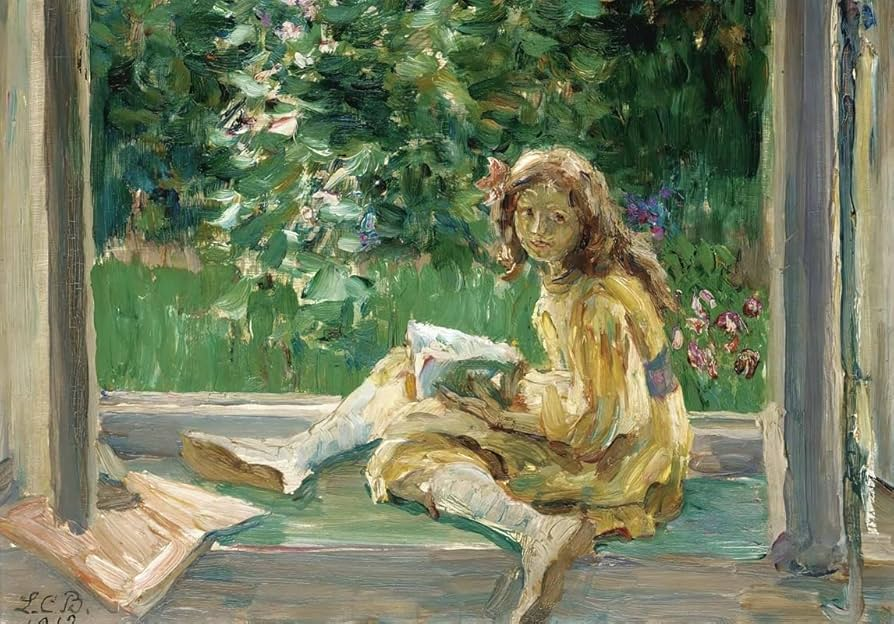
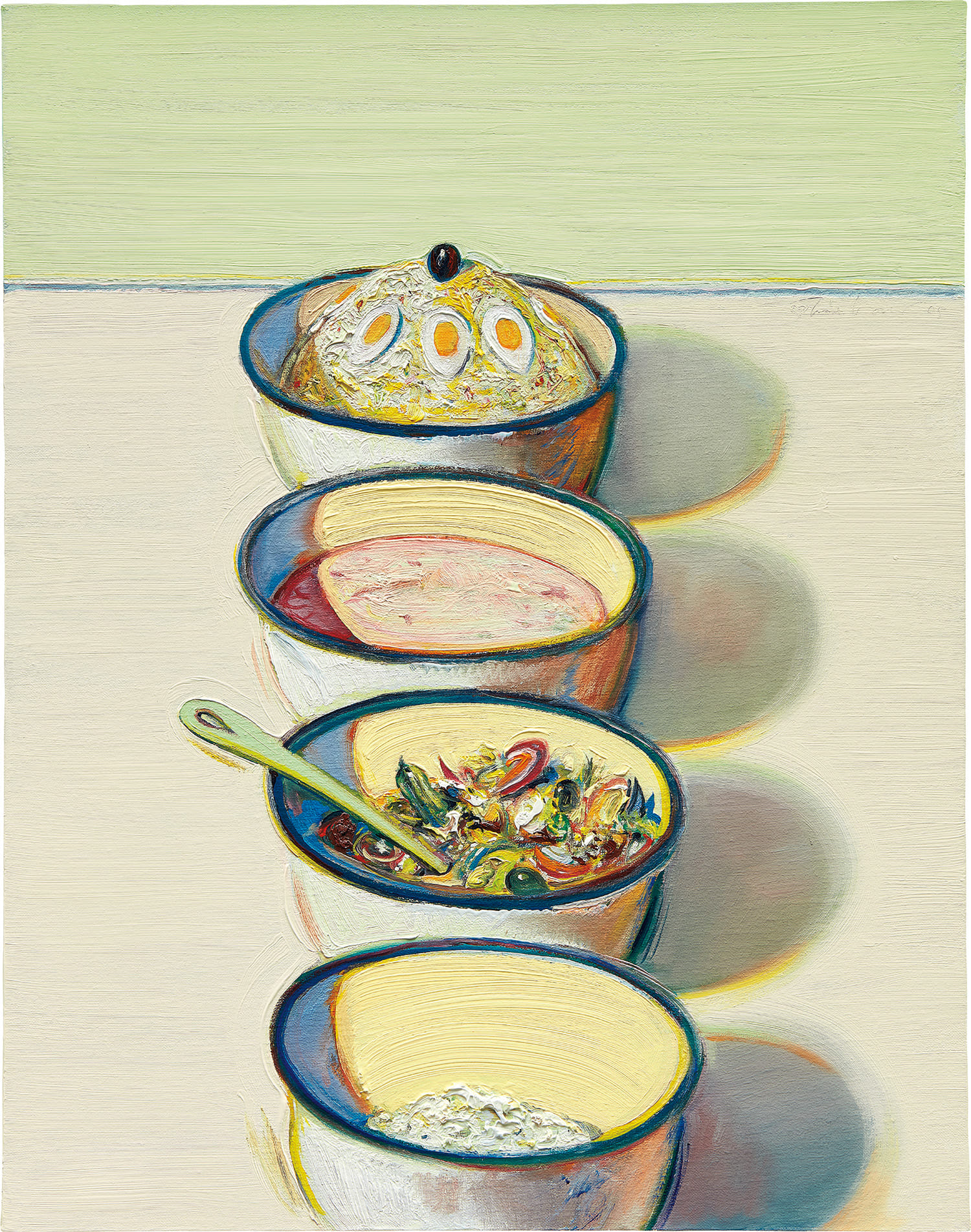
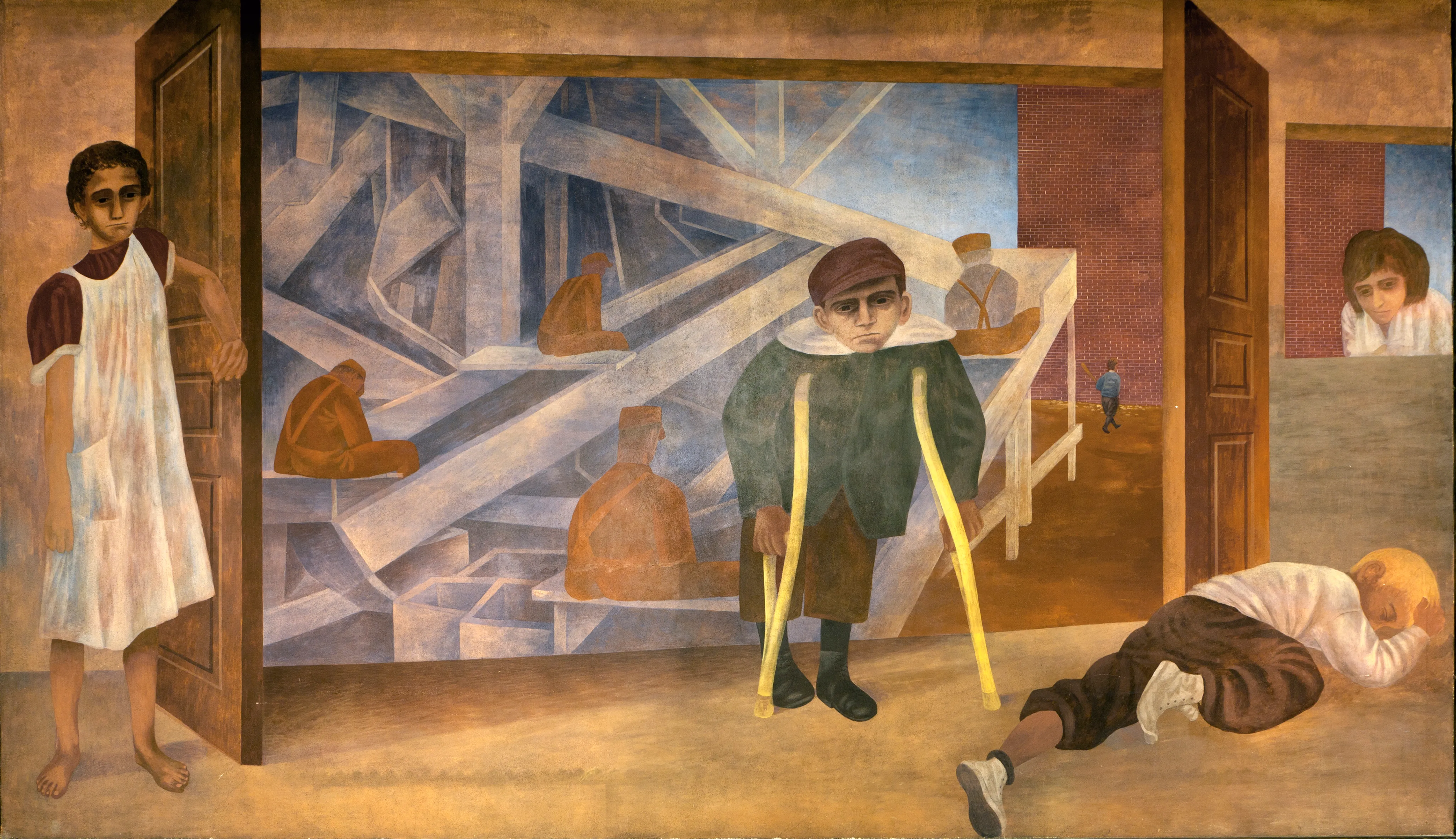




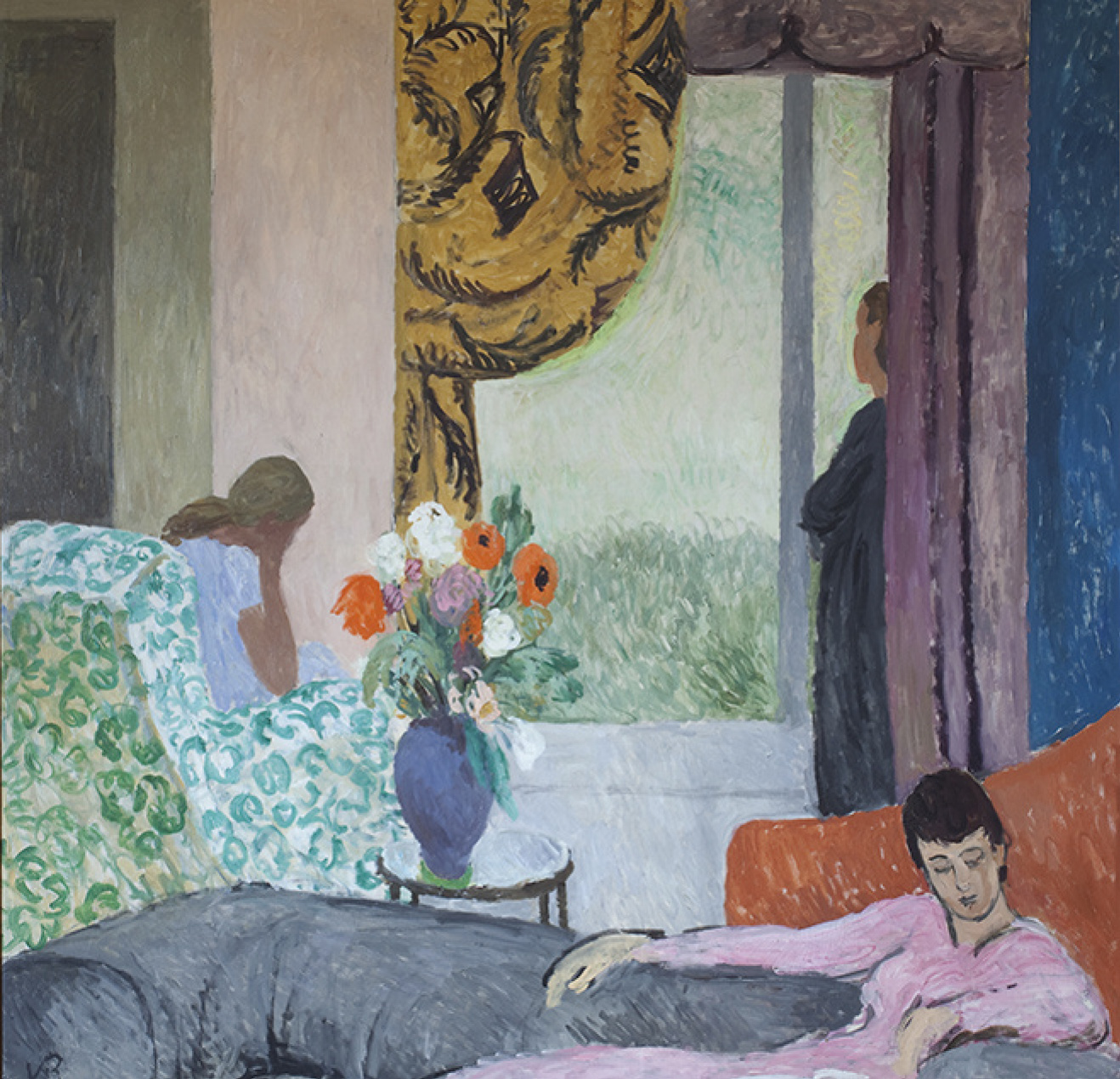


 Eiger, Mönch & Jungfrau