A Shelf of Promises: My Starter Library

A recent episode of The Mookse and the Gripes podcast got me thinking. Hosts Trevor and Paul were joined by John Williams of the Washington Post (mensches one and all). John had proposed a fascinating topic: starter libraries. The idea was to imagine your response to someone who asked you for ten titles they absolutely had to have in their collection. Probably this person is someone new to literature, a teenager or a student, but maybe they are someone who used to read more than they do now and are looking to get back to that part of their life. What would you recommend?

The important part of the assignment, as I understand it, is that the person is asking you. They know you well enough (parasocially or otherwise) to trust your taste. They respect you enough to be curious about anything you recommend. But they’re not asking for your ten favourite books. Presumably you like the titles on your list. But you’re not just offering them out of personal predilection. You think of them as representative for aspects of literature that matter to you.

Personal but not only personal, might be one way of putting it. Or, in the words of the episode’s subtitle, your choices could be thought of as a shelf full of promises.

Do listen to the episode, it’s terrific. Great lists, fascinating insights into the recommenders. And sure to get you thinking about your own answer. That’s what happened to me: I set aside the laundry I was folding and jotted some notes on my phone, which I’ve now expanded into this list, complete with categories (and alternate choices, because ten books is not many books).

Candida Höfer, Bibliothèque Nationale de France Paris XXI 1998

Books to grow into but also to love when you’re young:

George Eliot, Middlemarch

The only novel in English for adults, Virginia Woolf famously said. Not sure what she meant, but doesn’t it sound good? Having reread it recently, I think you need to be middle aged (and thus an adult… hmm well never mind) to get the most from this story of English provincial life around 1830. But having first read it in college, I can also attest that Middlemarch hits for young people. As with any rich text, what you pay attention to and who you sympathize with shifts each time you read it.

Eliot is known for moral seriousness (maybe that’s why as stylistically different a writer as D. H. Lawrence was a fan), but Middlemarch is also surprisingly funny. Mostly, it’s supremely moving. It covers so much of life, and asks the big questions. What makes a good life? How can we live with purpose? How can we think of ourselves in relation to everyone else? Where do we fit into the web of life?

[Alternate choice: Leo Tolstoy, War & Peace. Never read it until about five years ago, but feel confident it dazzles as much at 20 as at 50. You want novelistic sweep? This one’s as big as Russia… Freemasons and wolf hunts and returns from the dead and slow-burning love affairs lasting across the decades: everything, really.]

Books that master close third-person perspective

Nella Larsen, Passing

Set in Harlem and Chicago in the late 1920s among a set of well-to-do light-skinned Black women who can pass as white, Passing is a great novel of queer frenemies. It hews closely to the perspective of a single character, Irene, whose orderly life as the mother of two boys and wife to a (dissatisfied) doctor falls apart when she runs into a childhood friend, the brave and dangerous Clare. Unless we attend to how events are only offered through Irene’s perspective, we are likely to miss how much the book asks us to question the judgments it only seems to offer.

[Alternate choice: Henry James, What Maisie Knew. In book after book, James wrote about people behaving badly. Yet even among this vast canvas of cruelty, this novel stands out: the people doing the harm are parents who use their young child to hurt each other and, of course, the child. In the preface to the New York Edition James explained that he chose to narrate the book in third person but to limit the perspective to Maisie’s often baffled but also wondering sense of the world in order to offer readers the extra pathos of being able to understand what she could not. It’s quite a trick.]

Books about the Holocaust

Primo Levi, If This Is a Man

If someone is asking me what books they simply must own, they’re absolutely gonna get one about the Holocaust. Hell, I could make them a whole list. But knowing that not everyone shares my fascination, I’ll stick to one of the earliest and most famous instances of Holocaust literature. (Levi composed part of it already while in the camps.) Like all memoirs, If This is a Man (known in the US under the travesty title Survival in Auschwitz) details its author’s particular experience—which took the form it did by his having had “the great good fortune” to have been deported only in 1944, when the turning tide of the war and subsequent internal battle among top Nazis meant that more deportees were selected for slave labour. That phrasing gives you a sense of Levi’s matter-of-fact irony. But something that distinguishes If This Is a Man is Levi’s decision to use “we” even more than “I”: he aims to give a sense of the structure and meaning of the collective victim experience, at least within a subcamp of Auschwitz.

[Alternate choice: Ida Fink, A Scrap of Time and Other Stories. Too little known among English speakers, but, happily, available in a terrific translation by Madeline Levine and Francine Prose, Fink’s heartbreaking stories depict part of the Holocaust most people don’t know about: the mass murder performed by the Einsatzgruppen in Galicia in the summer and fall of 1941. Fink couldn’t find a publisher for these stories until the 1980s; they were deemed of no interest. Another devastating failure on the part of literary opinion. Fink has been called the Chekhov of the Holocaust. Grotesque as this sounds, it’s accurate. Quiet and heartbreaking.]

Members of YIVO New York examine crates of books rescued from the Vilna Ghetto

Books about how to read books:

Roland Barthes, S/Z

Barthes spent a year reading Balzac’s story “Sarrasine” with some students. (Oh to have been in that seminar!) That labour resulted in this extraordinary book, organized around line-by-line readings of the source text, not, as critics usually do, to figure out what it means, but rather how it means. To do so, Barthes offers five “codes”—fundamental elements of realist fiction, of which “Sarrasine” is considered only as a representative example—that readers unconsciously rely on (typically by having imbibed many examples of the genre) in making the text intelligible. The codes are things like references to historical events, people, and places, or attributes and actions that cohere into what we call characters and, in the case of realist literature, think of as if they were people. Barthes Intersperses his step-by-step redescription of the Balzac story with theoretical meditations on the operation of the codes, which readers can extrapolate to other texts.

S/Z is tough. I probably taught it five or six times before I felt I had a real handle on it. But as Barthes says, it’s valuable to be able to distinguish between real and superficial ideas of difference. We might think that the best way to know about books is to read a lot of them. But if we do so without thinking about what underlies their intelligibility (i.e. what we need to be able to read them), then we are mere consumers, doomed to reading the same thing over and over. Only by reading one text over and over can real difference, that is the difference within the text, show itself—which in turn will make our other reading more meaningful. All of which is to say, the effort of tackling Barthes’s analysis offers big rewards.

[No alternate choice. S/Z for everyone.]

Books with pictures:

Alison Bechdel, Fun Home

Comics, graphic novels, whatever you want to call them are important to me, and I think any reader needs at least one example in their library. Such a rich form, so many gorgeous and moving texts to choose from. As with my Holocaust choice, I resisted the temptation to go niche here. Bechdel’s memoir of her relationship with her closeted, self-destructive, talented father deserves its fame. Probably more than any book I regularly taught, Fun Home elicited the strongest positive reactions in the widest range of students. Family disfunction runs deep. A great book about how books can connect people who can’t otherwise open up to each other—and how they can further separate them too. Funny, ominous, bittersweet.

[Alternate choice: Nick Drnaso, Sabrina. Dark, powerful. Reading it gave me a bit of the ick. And yet its subject matter just seems more relevant. I guess this is about the manosphere, except no one was using that hideous term at the time.]

Books of ideas [fiction]

Thomas Mann, The Magic Mountain

Sometimes I want a book that dramatizes the back and forth of thinking. In The Magic Mountain, Mann literalizes this by surrounding his protagonist, the well-meaning, hearty Hans Castorp, with some of the most indefatigable talkers ever to appear in a novel. The whole intellectual landscape of pre-WWI Europe is here (liberal humanist, communist, militarist, hedonist, you name it), and everyone battles for Hans’s soul, even as the former engineer mostly wants to desire a woman from afar, a woman who reminds him of a boy from his schooldays…

The other great thing about this book is how well it depicts Davos and environs. I’m a sucker for mountains and mountains in books. Bring on the snow!

[Alternate choice: Proust. Honestly, if you can only put one book in your starter library, choose this one. I assume it’s already there, but if not then get stuck into this deeply philosophical book, which has so much to say about perception, time, cruelty, and control over others.]

Books of ideas [nonfiction]

W. E. B. DuBois, The Souls of Black Folk

Every American should read it. But non-Americans should too. The idea of double-consciousness—the way a minority must measure themselves by the tape of the majority, as DuBois so memorably puts it in his first pages—explains so much of our contemporary sense of identity.

In addition to its ideas, Souls is a fascinatingly hybrid book, presumably stranger in 1903 than today. Each chapter is prefaced by a bar of music, often from the sorrow songs. Most chapters are essayistic, but some are fictional. Each is written in resonant cadence. Hasn’t dated much. Alas.

[Alternate choice: Hannah Arendt’s The Origins of Totalitarianism. Explains how Nazism and Stalinism came to be so accepted and do so much harm. Especially interesting for (1) its “boomerang” theory of imperial violence, in which what the metropole does in the colony comes back to bite it at home, and (2) its argument that modern antisemitism arose from the waning of Empire and the rise of nationalism. Hasn’t dated much. Alas.]

Monomaniac books

The strand from writers like Kafka, Knut Hamsun, or Robert Walser to someone like Lydia Davis, via the high point of Thomas Bernhard, has been enormously influential in the Anglo-American sphere. At this point, annoyingly so. (And weird, too, given that none of the most important precursors wrote in English.) But I get it because literature excels at tracing the vagaries of a mind, especially one spinning through reversals, paradoxes, and hobby-horses. A starter library should have an example of this sort of thing, and Bernhard might be the best. When the only thing that stands between a psyche adrift or worse is the chance that someone might respond to its voice—that’s when you’re in Bernhard territory. I’ve chosen The Voice Imitator because the title says it all. Read these 104 short texts to get a sense of Bernhard’s bitter, misanthropic, and, oddly, funny vibe.

[Alternate choice: I just named like five other writers!]

Funny books

P. G. Wodehouse, The Code of the Woosters

As implied in what I said about Bernhard, voice-driven books don’t have to be grim. They can make us laugh, whether from the gap between what the narrator claims and what we know, or the sheer verve of their style. The fun only increases when those narrators get embroiled in elegant plots. Wodehouse is the master of this terrirtory and everyone’s library is the better for including him. (I feel like he’s fading a bit from memory? Sad.) You can jump in anywhere—my entry point was the distinctly not-famous-but oh-so-representatively-titled Eggs, Beans, and Crumpets which baffled and delighted me at age 12—but if you’re at a loss start with this wonderful episode in the Jeeves and Bertie series, which Tim Waltz would enjoy, since it’s an early example of the “I condemn the fascists by unflinchingly stating how weird they are” school of responding to authoritarianism. (As Bertie says, appalled by the realization that the Saviours of Britain are simply grown men marching in black shorts: “how perfectly foul!”)

[Alternate choice: for an American version of this phenomenon, reach for Charles Portis, especially the marvelous True Grit.]

Books about crime

Dolores Hitchens, Sleep with Strangers & Sleep with Slander

Since at least Oedipus Rex, literature has used crime to understand fundamental concerns like identity, political organization, and moral value. Crime fiction can be smart, is what I’m saying. And it can also carry us away by inciting our desire to have enigmas explained. (Interestingly, it often makes us realize how much more compelling it is to ask a question than to answer it.) Like any genre, then, crime fiction satisfies at both the intellectual and emotional level. Having stayed with well-known titles so far, I’m diving deep for this last category. Not enough readers, even lovers of crime fiction, have read the mid-century American writer Dolores Hitchens. She wrote a lot of books under a lot of names. But only two about a PI named Jim Spader. Which is sad—but also good because they’re even more special. These make for pretty despairing reading, even for noir. So be warned. But you won’t regret seeking them out.

[Alternate choice: Hundreds! Thousands! Sticking with mid-century American women writers, I’ll plump for Dorothy B. Hughes’s The Expendable Man. Don’t read anything about it beforehand!]
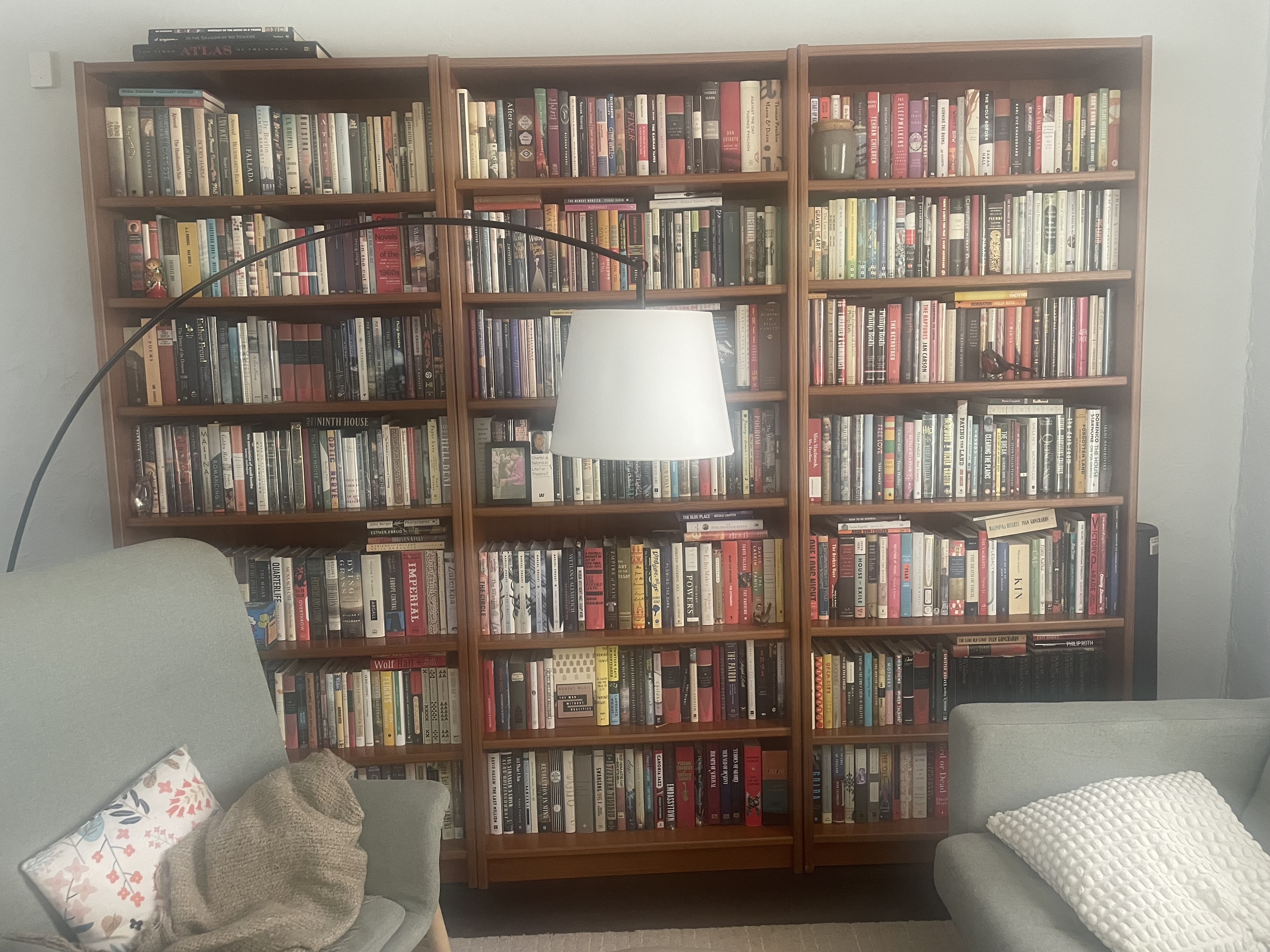
I tried not to think too long in coming up with my choices. Next month or next year I’d choose differently. And I’m aware of some big lapses. No poetry?? No plays?? No Torah?? (Everyone should read the Five Books of Moses.) But that’s ok. Gives you all the more room to think about how you’d create a starter library of your own. What would be on your shelf of promises?

My Year in Reading, 2024

If you’re reading this, you are faithful indeed. And I am grateful. Long silence here, I know. As my adopted country tumbles into authoritarianism, things have also been changing, though more positively, chez EMJ.

Igor Razdrogin, Book Bazar (1975)

My wife, daughter, and I are moving to St Louis in a month’s time! We’ve spent quite a bit of time there these past few years, and we like it a lot. We’ll have a little more space in our new home (which, combined with some collective efforts to tame my unruly library, might mean that our house will at least briefly not be overflowing with books), and, best of all, we’ll be living in a walkable neighbourhood with sidewalks, which is something we’ve been missing these past 18 years in Little Rock.

The other big transition concerns my career. I’m leaving my job at Hendrix, of course, but I’m also leaving academia in general. People keep asking how I’m feeling about this and I keep saying: Terrific! I was pretty burned out and starting to get a little Old Man Yells at Clouds about All the Changes that affected the classroom experience: the pervasiveness of AI and LLMs (something no one, as far as I know, ever asked for), and, more distressingly, the difficulty even the best-prepared students are having reading sustained works of literature, by which I mean, an entire book, no matter how straightforward the prose. This isn’t about their intelligence, or even their phones. It’s about the strictures placed on secondary school teachers. As instruction moves ever more toward preparing for testing centered on multiple choice reading comprehension questions about utterly decontextualized chunks of texts, teachers aren’t assigning much reading, which means students simply don’t have much practice at it.

(I also have a pet theory that for all its flaws Harry Potter (to be clear: it sucks) helped Millennials think of reading as both exciting and habitual, and Gen Z hasn’t had anything like that. The Harry Potter to Jane Austen to English Major pipeline kept our department afloat for a lot of years. These days, students dislike both Rowling and Austen…)

I still love many things about teaching, and it’s possible I’ll miss it so much that I’ll return to it in some fashion. (I’m never getting another job like this one, though. Those don’t exist anymore.) But for now, I feel relief, and curiosity—along with a lot of trepidation—about the chance to try something new. For now, it feels a bit unreal. Because the academic year is cyclical—summer is always a time of collapse and, if lucky, regeneration—I don’t yet feel as a though I’ve made much of a change. Talk to me in the fall, or next spring, or five years from now.

Luckily—and this is another reason for the silence around here—I’ve been working as a consultant for the Educator Programs arm of the William Levine Family Institute of Holocaust Education at the United States Holocaust Memorial Museum in DC. The people I work with are absolutely fabulous: smart, funny, kind, devoted to their work without having delusions of grandeur about it. It’s eye-opening—and fun—to work as part of a team, after decades of the isolation of academic life. I’ve helped them create resources for K – 12 English Language Arts classrooms, and have taken great satisfaction in the work.

I’ll need full-time work sooner rather than later, though, so if you have any ideas or leads, hit me up! Like, what are some jobs people do? What do y’all do all day? I need advice!

What I’m saying is, I had a lot going on these last months. But I did manage to keep reading. Maybe not as much as usual, but whenever I could make time. I get that it’s ridiculous to offer a 2024 reflection halfway through 2025, but FWIW here are the things that stuck with me last year.

Eight standouts

Francis Spufford, Cahokia Jazz (2023)

So much to love in this novel about an alternate 1920s in which a sizeable indigenous population thrives in a nation called Deseret centered on the bustling city of Cahokia. Spufford weaves his world-building throughout a procedural, in which our hero, a cop who moonlights as a jazz pianist, investigates a murder with vast political implications, to the point of threatening Deseret’s independence.

Cahokia Jazz is the most referenced title in the Year in 2024 Reading pieces I posted earlier this year, which means either that everybody loves this book, or that people like me love this book. Anyway, given my upcoming move to Missouri, it won’t surprise you to hear that the scene that most sticks in my mind is when Barrow pursues a lead in a village at the end of the Cahokia streetcar line, a fly-swept place he can’t wait to leave. Its name? St Louis…

I look forward to visiting the ruins of the actual Cahokia, once the biggest city north of Mexico City.

Katrina Carrasco, The Best Bad Things (2019)

Fabulous and underrated crime novel set in 1880s Port Townsend, where the most valuable commodity passing through the busy port is opium smuggled in from north of the border. Alma Rosales, who once worked for the now-shuttered Woman’s Bureau of the Pinkerton Detective Agency, has left San Francisco for Washington Territory to work for the seductive, brilliant, coolly calculating Delphine Beaumond, who runs most of the drug smuggling on the west coast.

When product goes missing, Delphine puts Alma on the case. Alma goes undercover as a dockworker—not a problem, because Alma is also Jack Camp, a slight yet wiry man who can hold their liquor and likes ladies and men equally. Did I mention that Alma and Delphine are lovers? Or that Jack starts a torrid affair with the man they’re investigating? Or that they’re also still working as a Pinkerton agent—in a desperate attempt to get their old job back?

Cue double-, triple-, even quadruple-crossing; witty repartee; and some pretty hot sex. Most crime novels are let down by their endings, but this one… let me tell you, friends, I literally gasped. A brilliant debut. I want everyone to read it.

Émile Zola, La Bête Humaine (1890, translated by Roger Pearson) and The Assommoir (1877) Trans Brian Nelson (2021)

Even by Zola’s lofty standards, these two are bangers. Push comes to shove, I guess I’d choose Bête over Assommoir, just because I love the crime story trappings, but the latter might be the more impressive accomplishment, especially if you could read it in French to see what Zola does with the argot of his lumpenprotelariat characters. They’re equally—which is to say, tremendously—depressing, but also viciously alive. Zola’s naturalist doom is regularly leavened by his prose, which zips from one brilliant set-piece to another. I’m talking about stuff like the bruising fight between two laundresses in front of an audience of delighted, shouting onlookers in the opening scene of The Assommoir, or the berserk vision of a driverless train, filled with drunk soldiers in full war frenzy heading to their doom at the hands of the Prussians, in the last pages of La Bête Humaine. Feels like a good time to study Zola’s fascinated descriptions of all things irrational.

Hernán Diaz, In the Distance (2017)

Quasi-Western in which the protagonist—a hulking, nearly mute Swede named Håkan whose only goal is to find the brother he was separated from on the voyage to the New World, and whose body and psyche seem to be able to take any amount of suffering—travels east, south, and north as much as west. This is a brainy book: Diaz riffs on Frankenstein, and probably a lot of other stuff I missed. But its allegories are always concrete. In this novel of a man stubbornly going against the westward direction of Manifest Destiny, I most remember the section in which, after suffering a terrible loss, Håkan literally burrows into the ground, eventually building a maze-like underground shelter where he lives in ambivalent isolation for years.

I read Diaz’s Trust last year too: also great. Probably not telling you anything you don’t know. But if like me you are late to Diaz, move him up your list. Smart guy and beautiful writer.

Leah Hagar Cohen, To & Fro (2024)

Last year I served as a judge for the US Republic of Consciousness Prize, which honors literature published by small presses. Yes, I tossed aside some duds and waded through many competent but unexceptional novels, but I also discovered some terrific stuff I wouldn’t have otherwise read. My favourite was this delightful and thoughtful literary experiment, a novel written in two halves that can be read in either order. You can start with “To” and flip the book over halfway through to read “Fro,” or do the reverse. You could call this a Jewish Alice in Wonderland (I love how deeply and unapologetically Jewish the book is: it takes such pleasure in asking questions), but that wouldn’t give you the sense of how the book is both realist and fantastic, a genre-bender that sometimes reads like a middle-grade book and sometimes like a historical “what if” novel, if those were written by someone whose lodestar was Maimonides. Magic!

Thanks to Lori Feathers, the genius behind this award, and to my fellow judges, who always brought it. Serving on this panel was time well spent.

Elizabeth Bowen, The House in Paris (1935)

A book of arrivals and departures, whether longed-for, dreaded, or uncertain. It feels both constricted and expansive: a neat trick. Bowen often gets called Jamesian. That is true not in style but only in a shared preoccupation with cruelty. Hard to say which fictional universe is meaner. Another thing I liked about The House in Paris is that it offers further evidence for my theory that British modernism is just another name for Gothic literature about children.  

Martin MacInnes, In Ascension (2023)

Here we have two sisters. One becomes a scientist who explores the depths of the ocean floor and the vastness of space (she develops nutrition-dense and fast-growing algae for interstellar travel); the other sets aside her career as an international lawyer to find out what happened to the first. I can’t remember everything that happened in the book, but I do remember being enthralled from start to finish. (This is another long book that never felt slow.) The final scene, set in the remotest place on earth, Ascension Island, foregrounds another kind of foreign place: our memories. “A family”, MacInnes writes, showcasing his epigrammatic mode, “is a group of strangers with a destructive desire for common nostalgia.” MacInnes’s big question, asked as much of a sibling relationship as of humanity’s ability to inhabit the stars, is whether the only way to get beyond the destructiveness of the human species is to destroy the individual self Beejay Silcox, one of my favourite critics, gets it right when she calls the book “a primer to marvel.”

Sally Michel Avery, Father and Daughter, 1963

Thoughts on the rest

Ones I keep thinking about: Manjula Martin’s The Last Fire Season (2024): I still haven’t prepped a go-bag—how foolish is that? Catherine Leroux’s The Future (2020, translated by Susan Ouriou): What if the French had never lost Detroit? What if climate change and resultant socioeconomic crises meant that most of the trappings of a functioning state had fallen away? And what if bands of roving children built hardscrabble lives in overgrown parks? Peter Heller’s The Last Ranger (2023): Conventional but satisfying novel about a ranger in Yellowstone, filled with scenes in which the hero drinks early morning coffee on the porch of his cabin: Heller knows the landscape and describes it beautifully. (Given what the chuckleheads at DOGE did, this title resonates differently now…) Jill Ciment’s Consent (2024): Revelatory memoir in which the author reassesses her decades-long marriage to her now deceased husband, with whom she took a painting class when she was 17 and he was 47. Can the relationship really have been good given that they met when she was a child?

Best study of xenophobia, told in an atmosphere of creeping dread: Georges Simenon’s The Little Man from Archangel (1956, translated by Sian Reynolds).

A Russian Jew, brought to rural France as a child, French in every way, has his life turned upside down because of a casual remark. Chilling. Best Simenon I’ve read.

Best study of deprogramming: Emily Tesh, Some Desperate Glory (2023).

Maybe useful these days.

Best case of “it’s not you, it’s me”: Nisi Shawl’s Everfair (2016)

Steampunk set in an alternate late 19th century in which the Fabians buy tracts of land from King Leopold to protect refugees fleeting the horrors of Belgium’s rule in the Congo. At first, this new nation—Everfair—prospers. European benefactors and missionaries work with Africans to create trade networks based on clean airship technology. They develop intelligence networks to navigate the region’s politics. They promote or at least allow social experiments concerning family structure, marriage, and sexual politics. But the internal tensions become too much, and the utopia falls apart. Even as I’m writing this I’m thinking, Honestly this sounds pretty good, maybe I’ve misjudged the book. And at the level of idea it’s intriguing. The execution, though: that’s the problem. The prose is leaden, the relation between action and exposition awkward. Maybe the book actually needed to be longer? A strange thing to say since I felt like it was never going to end. This book is a darling to many (Jo Walton loves it, for example). Probably just the wrong time for me. Can’t imagine giving it another try, though.

Best (and most) coffee: Mark Haber’s Lesser Ruins (2024).

Things are not going well for the narrator of this Bernhardian novel, ever since his wife died and he lost his job. That’s a tough spot. And he tries to do the right thing, sometimes. He reaches out to his son, whose passion for house music means he will dilate on the perfect set list for as long as his father will hold the phone near his ear. Like so many of us (me, anyway), he struggles to surmount the gap between idea and execution, endlessly trying to write something good. You’d think we might like the guy. But… He’s a terrible snob. He lambastes his students, neglecting his work to the point of installing an espresso machine under the desk in classroom. (That an instructor at a community college would have a dedicated classroom is the book’s only false note.) His unfinished, maybe unfinshable, book on Montaigne is probably not really going to be all that. So he ain’t easy to like.

All of this is beside the point, though, because this novel is about the way sentences can mimic the swerves and circles of a mind endlessly thinking. One of the things our narrator thinks about most is coffee. He drinks a lot of coffee. Long sections concern the various roasts, the preparation, the anticipation, the enjoyment. I’m not a coffee snob on his level, but I found nothing to ironize or criticize in the man’s love for the perfectly pulled shot. Lesser Ruins is great for other reasons, too (it’s Haber’s best IMO), but if you like coffee at all, you gotta read this.

Most ingenious conceit: Kenneth Fearing’s The Big Clock (1946)

A drudge at a magazine publisher modelled on Time-Life is tasked with finding—for purposes of eliminating—a witness to a crime. Only thing is, he is that witness…

Dark and boozy. This is the good stuff.

Best crime fiction: Carrasco, obviously. Also obviously, the latest Tana French. (At least I can say I was alive while Tana French was writing novels that will be read in a hundred years…) The latest Garry Disher, Sanctuary (2023), is a satisfying standalone about theft and friendship. I read a couple of Gary Phillips’s books about a Black Korean-war vet turned crime-scene photographer: good stuff. (I learned a lot about Watts.) Start with One-Shot Harry (2022). Years ago I devoured Scandinavian crime novels: seemed like the most exciting thing in the genre. Bloom’s been off that rose for a while, but Cristoffer Carlsson’s Blaze Me a Sun (2021, translated by Rachel Wilson-Broyles) took me back. Marcie R. Rendon’s Where They Last Saw Her (2024) is her first book set in the present, and much as I love the Cash Blackbear series, probably her best. How nice to read a book about an indigenous woman who has a good man in her life. I regularly think about the scenes of women jogging through the snowy Minnesota woods.

Best sff: In addition to MacInnes and Tesh, I most enjoyed Ann Leckie’s Ancillary Justice (2013), Shelley Parker-Chan’s She Who Became the Sun (2021), and various works by Guy Gavriel Kay, who continues to be a source of reliable pleasure, even if no one would call his books cutting edge. (So humane, though! I need that right now.) Alas, I am not yet a dedicated enough sff reader to have figured out how to overcome the “stalling out in a series because I didn’t get to the next one right away and then forgetting what happened” problem.

Best poetry: Louise Glück’s The Wild Iris (1992). Ok, the only poetry collection I read, but I liked it enough to assign it this past semester and the students loved it. Teaching it made me both appreciate it more and notice its limitations (it hoes rather a narrow furrow). I ought to read some of her later stuff: I bet it’s even better.

Best book of the kind I could imagine myself writing and yet am mostly allergic to reading: A tie between Jakuta Alikavazovic’s Like a Sky Inside (published 2021 and translated by Daniel Levin Becker) and Chris Bachelder & Jennifer Habel’s Dayswork (2023).

The whole quasi-essay, quasi-memoir with novelistic elements thrown in for good measure—mostly that stuff leaves me cold. But these two won my heart. Alikavozovic describes a night she spent in the Louvre, a place that she often visited with her father, a ne’er-do-well from the former Yugoslavia. After each excursion, her father would ask, How would you go about stealing the Mona Lisa? This question, and the reflections on her father’s life of petty crime and her own experience growing up in a culture and language that he never perfected, lies at the heart of this beautiful little book.

Bachelder and Habel have done something remarkable: written a book together, about themselves as a couple, that feels written in a single voice. The text centers on the Habel character’s fascination with Herman Melville: it’s about his life, and their lives, and what it means to write a life, with copious references to the man they call The Biographer, Herschel Parker, who seems to have been really something. And by that I mean kind of a dogged genius, but also a pain in the ass.

Best literary fiction:

Laurie Colwin’s Shine On, Bright and Dangerous Object (1975) is sad and delightful, filled with loving anger. A splendid beginning to a marvelous though much too short career. William Maxwell’s So Long, See You Tomorrow (1980) is famous for good reason. Audacious structure and play with time, heartbreaking story, even a section told from the point of view of a dog. Joan Chase’s During the Reign of the Queen of Persia (1983) deserves its resurrection thanks to the good people at NYRB. Another story of childhood in the American Heartland, at once bucolic and traumatic.

You can see I am deep into the “my favourite artworks are the ones created while I was a child and too young to experience at the time” years. I read new things too, though, and the best of these was Kaliane Bradley’s The Ministry of Time (2024), which I finished in a cabin at the Grand Canyon during a thunderstorm that had the rain pounding on the metal roof. The book is as memorable as the setting of my reading: an experiment in time travel, in which a 19th century Arctic explorer is brought to a near-future UK and given to a handler from the titular government agency whose background happens to be Cambodian. In addition to its speculative elements, and a terrific love story, the novel considers differing cultural responses to trauma. More Bradley soon, please!  

Henri Matisse, Woman Reading in a Violet Dress, 1898

Short story collection: Only read one, but it was a good one. I liked all the stories in Jamel Brinkley’s Witness (2023), but “At Barstow Station” is an all-timer. Even a class full of students who did not care much for reading agreed.

Most unexpected page-turner: Karl Ove Knausgaard’s The Morning Star (2020, translated by Martin Aitken) blends his signature interest in mundane middle-class life with some weird shit (a blazing star that no one can explain, a ritual murder, shenanigans at a mental institution). I raced through it and bee-lined for the bookstore to but the next one (in an expensive and gigantic hardcover edition), only to ignore it for the rest of the year. Honestly, the hardcover might be the problem. Most of the time I’m a “give me the paperback” guy. Anyway, will read the others in this series.

Most fun: The audiobook of Jesse Q. Sutanto’s Vera Wong’s Unsolicited Advice for Murderers (2023), read with obvious affection by Eunice Wong, made me laugh aloud. As I feared, the strains of keeping the conceit going already show in the second book, which I listened to a couple of months ago. But I’ll stick with Vera a while longer; she’s a treat.

Best sequel: Waubgeshig Rice’s Moon of the Turning Leaves (2023) is a big advance over its predecessor, Moon of the Crusted Snow. A rare case of a longer book being better. It’s ten years since the mysterious event down south that sent the grid down. The small indigenous community at the heart of the first book has been thriving, but its inhabitants realize they have reached the limit of the resources in their immediate area. After painful debate, they send a search party to find out if anyone else is out there—specifically, anyone indigenous. Exciting, well-drawn, and smart about the cost of giving up part of your identity to gain the benefits of joining something. (a community, a culture) larger.

Grimmest ending: Edith Wharton’s Summer (1917), really a hell of a book. Even if you haven’t read Wharton before you know things aren’t going to end well. But I at least did not anticipate them to end quite that dispiritingly. Thanks to Shawn Mooney and the rest of the Wharton gang for the invitation to read.

Hurts so good: Elliott Chaze, Black Wings Has My Angel (1953)

Liked at the time, but has now faded from memory:

Jean Giono’s Fragments of a Paradise (1944/48 and newly translated by Paul Éprile); Suzumi Suzuki’s Gifted (2022, translated by Allison Markham Powell); Ariane Koch’s Overstaying (2021, translated by Damion Searls);and Jón Kalman Stefansson’s Your Absence is Darkness (2020, translated by Philip Roughton). Don’t get me wrong: these are all good books (especially the Giono). I don’t regret reading any of them. Just not top-notch, for me.

Meh:

These did nothing for me, and even left me a little grumpy. Ari Richter’s Never Again Will I Visit Auschwitz: A Graphic Family Memoir of Trauma & Inheritance (2024): you’d think I’d be the perfect reader for this, but honestly I did not think this book was very smart. Dorothy West’s The Wedding (1995): I get it, she was old when she wrote this. Plus, the existence of a Black elite on Martha’s Vineyard was news to me: interesting stuff. But this felt wispy, and not in that good Belle and Sebastian way. Two crime novels by Arnaldur Indridason: sometimes you just want to turn pages and remember your Iceland vacation but at the same time you know you’ll never get these hours back.

Most ambivalent toward:

Tried to explain why I felt this way about Lily Tuck’s The Rest is Memory in The Washington Post.

It wouldn’t be an end-of-year list from me without some thoughts on Holocaust-related books, which I’ve divided into categories:

History: Dan Stone’s The Holocaust: An Unfinished History (2023). All due respect to Doris Bergen, this is the best single-volume history of the event I know, and it’s pretty short too. I went long on it for On the Seawall. Honorable mentions: Linda Kinstler’s Come to this Court and Cry: How the Holocaust Ends (2022), and Rebecca Donner’s All the Frequent Troubles of Our Days (2021). The latter admittedly not a Holocaust book, but rather a resistance to the Third Reich book. Pretty damn good tho.

Memoir: József Debreczeni’s Cold Crematorium: Reporting from the Land of Auschwitz (1950, translated by Paul Olchváry). If I could legislate that people had to read one Holocaust book, I’d choose this one. Indelible. You think the Holocaust was bad? You don’t know from. Honorable mention: Michael Frank’s One Hundred Saturdays: Stella Levi and the Search for a Lost World (2022), which I wrote about in 2023 but read again for a book group last fall. If anything, it was even better the second time. To read about Stella is to love her.

YA: Elana K. Arnold’s The Blood Years (2023). Gonna do what I can to see that this one gets more traction.

Comic: Emil Ferris’s My Favorite Thing is Monsters [Vol 1] (2017). What an accomplishment! Your heart will hurt but you won’t be able to stop turning the pages. Ten-year-old Karen Reyes lives in Chicago in the late 1960s. She adores her brother, who is sometimes a gentle artistic soul but sometimes a man pushed to violence by racism and poverty, almost as much as she loves monsters. (She draws herself as a werewolf.) She’s fallen in love with her best friend, Missy, who now shuns her at school while being drawn to her in private. Her mother is diagnosed with cancer, leaving the family’s fortunes ever more precarious. When Karen’s upstairs neighbour, Anka Silverberg, a married Holocaust survivor with whom her brother had been having an affair, is found dead under mysterious circumstances, Karen takes it upon herself to investigate. She stumbles on some cassette tapes, in which the woman tells her life story, a lurid and painful one: Anka was brought up in a brothel by her abusive mother, a sex worker, and then sold into a child prostitution ring from which she is “rescued” by a client who later abandons her when she gets too old for him. After the fall of the Weimar Republic and the rise to power of the Nazis, Anka is persecuted for her Jewishness and eventually deported to the camps. How she survived, how she made her way to America, and what led to her death—these questions are presumably answered in volume 2, which was released last fall. Volume 1 is 400 pages, with plenty of tiny lettering. It would be an effort to read it even without its distressing subject matter. But it’s damn good and deserves more attention than it’s got. Ferris uses dense cross-hatching to give her images texture: I don’t how else to say it other than the images seem tense. Amazingly the book is drawn almost entirely with Bic ballpoints. The whole story of its creation, which took six years, is remarkable, starting with Ferris’s partial paralysis after contracting West Nile disease.

Holocaust-adjacent text: Svetlana Alexievich”s Last Witnesses: An Oral History of the Children of World War II (1985, translated by Richard Peaver and Larissa Volokhonsky) impressed me with the pathos of its subject matter (children, many orphaned either permanently or temporarily when Germany invaded the USSR in 1941) and the success of its method (her now well-known quasi-anthropological style, in which witnesses speak for themselves, with seemingly little input or shaping from Alexievich herself, other than the ordering and structuring, not to mention the selecting of excerpts from what are presumably much longer testimonies: which is to say, thoroughly shaped…)

Book I Never Expected to Spend This Much Time With:

Lois Lowry’s Number the Stars (1989), the classic middle-grade novel about the (anomalous) experience of Danish Jews during the Holocaust. I created a lot of materials about this book for teachers. Yes, it has certain limitations, but I’m honestly impressed by how much richness I’ve found in this text. It seems to be fading a bit from the classroom—but not anymore, if I can help it!

Edouard Vuillard, Madame Losse Hessel in Vuillard’s Studio (1915)

There you have it. I don’t know what my life is going to look like going forward—but I hope at least in the short term to have more time for this poor little blog. Thanks as always for reading! I would love to hear your thoughts on anything I wrote about here.

Benita Berthmann’s Year in Reading, 2022

Today’s post is from Benita Berthmann (@moodboardultra). Benita studies literature in Marburg, Germany, where she is a full time book enthusiast, part time smoker and occasional existentialist.

Balthus, The Game of Patience, 1954

Once again, Dorian was gracious enough to allow me to write about My Year in Reading 2022, thank you, Dorian, nothing I love more than talking about books!

First of all, the hard facts: In the past year, I’ve managed to read 158 books, which is a bit less than the year before, but in terms of pages, I’ve gone up a bit, having read a whopping 51,308 pages over the course of 365 days. [Ed. – JFC, B!]  I’m glad I was able to spend that much time on my favorite hobby and thankful for always being able to find distraction, solace, amusement and everything else I need in books. That is a great gift, methinks. [Ed. – Amen.]

Enough of the boring statistics, which I track via TheStorygraph by the way, on to the more interesting stuff. It is impossible to talk about all the books I’ve read, so I’ve selected a handful of extraordinary texts to talk about.

Dorian and Magda, you are chiefly responsible for this one: BEAR by Marian Engel, which, apart from being a story about loneliness, nature, and Canadian history, features a female archivist having intercourse with, you might have guessed it, a bear. No, that’s not a metaphor. Consequently, Magda (@theruraljuror) coined the hashtag #bärensexbuch on German twitter which means, literally, book about having sex with a bear. God bless German compound words. [Ed. – I only wish English had a handy noun for this important concept.] Apart from our protagonist having sex with a bear, I enjoyed the atmosphere that I’d deem far more important than the plot. It is calm, yet unhinged, something is lurking in the dark, but for now, we’re lingering on a remote island, pleasantly detached from normalcy. Thank you, D and M, for being so adamant about BEAR, it was the perfect read for a hot and hazy afternoon in late July. [Ed. – I love to hear it.]

In 2022, I have also discovered an author that is right on track to become a new favorite of mine: Haruki Murakami. Yeah, I know, totally basic of me, but from the very first page of KILLING COMMENDATORE (German translation by Ursula Gräfe, English by Philipp Gabriel and Ted Goosen), I was hooked. The story about an unnamed painter trying to figure out what to do with his life after having been left by his wife has everything I love: magical realism, mystery and suspense, obscurity, art and culture. The title refers to a painting that plays a major role in the novel and I physically couldn’t stop reading until I knew what would happen. A novel to fall in love with reading and the magic of storytelling if there ever was one.

At university, I took part in a seminar dealing with literature that has been subject to judicial conflict. One of the books we talked about was ESRA by Maxim Biller, which deals with the relationship and subsequent breakup of Adam, a Jewish writer, and Esra, a German-Turkish actress, troubled and traumatized. None of the characters are particularly likeable, nor is the story itself innovative. [Ed. – Really selling this…] What makes the novel interesting, though, is that one can easily draw parallels between Maxim Biller and his alter ego Adam, not least because of the court case following a lawsuit filed by the woman who was clearly the model for Esra and her mother, both of whom claimed that Biller had violated their privacy rights. In the seminar, we talked about to what degree literature can take inspiration from real life, how German courts have decided these questions, and how they came to their decisions, the discrepancy between scholars of literature and of law and, of course, the question whether it was the lawsuit itself that drew attention to an otherwise rather mediocre novel, whether it is – Streisand effect – at least partly the plaintiffs’ fault that they found themselves subject to public scrutiny. To this day, the novel remains forbidden in Germany, a decision made by the highest German court, and it is nearly impossible to get one’s hand on a copy – except if you’re reading it “for scientific reasons” as we did in class. Unfortunately, I am not allowed to pass on the text, sorry, folks. [Ed. – Fascinating!]

One of the authors I revere most is Simone de Beauvoir, ever since I read The Mandarins almost five years ago. This year, I finally managed to read the second part of her autobiography, THE PRIME OF LIFE (German translation by Rolf Soellner, English by Peter Green). The story begins right where the previous volume, Memoirs of a Dutiful Daughter, left us: It’s the late 1920s, de Beauvoir studies philosophy, hangs out with Sartre, they become the founders of existentialism and important public figures in France after having made their respective debuts as writers. They survive the war; the book ends in 1944. I loved reading about the extraordinary life of an absolute fucking legend, an intelligent woman; her philosophy and clever wit allowed my thoughts to flourish while reading and I felt incredibly enriched afterwards. Not just from an intellectual perspective, either. Fun and the absurd aren’t neglected either. For example, the book involves an incident where Beauvoir and Sartre encounter a woman smoking a cigarette with her vagina during their travels. [Ed. – But how is that…] Oh, how I long to be THAT cool. [Ed. – Still struggling with this one, B.] In 2023, I really need to read the two remaining volumes of her autobiography.

Balthus, from the series Mitsou, 1919

Even though I’m too lazy to write about them in detail, a couple of books and authors that deserve at least an honorable mention:

First and foremost, Thomas Bernhard, my most-read author 2022, and also my favorite rage-mode Austrian. [Ed. – Hell yeah!] If you need the healing powers of incandescent rage, Bernhard is your man. I’d especially recommend the drama HELDENPLATZ (English translation by Gitta Honneger) that talks about the Austrian Nazi past kept secret.

ON EARTH WE’RE BRIEFLY GORGEOUS by Ocean Vuong. Has queer prose ever been more thoughtful, more touching, more well-written? I doubt it.

LAPVONA by Ottessa Moshfeg wins the prize for the most disgusting book in 2022. Not much else to say except steer clear of it if gore, organs and cannibalism upset your stomach.

EMPIRE OF PAIN: THE SECRET HISTORY OF THE SACKLER DYNASTY. I am pretty sure that Patrick Radden Keefe is the best contemporary non-fiction writer there is.

Marlene Streeruwitz, an Austrian feminist writer. When will her work finally be translated? Looks like I need to take care of that. [Ed. – Yes you do! That would be a real service.]

The PERCY JACKSON series by Rick Riordan, he is sort of an unproblematic JKR.

Last but not least, Julia Kristeva’s REVOLUTION IN POETIC LANGUAGE (English translation by Margaret Waller, German by Reinhold Werner) deserves the final spot on my list, even though I have not fully finished it in 2022, just because she made me lose my mind. [Ed. – Do Powers of Horror next!]

For 2023, I hope we will all make enough time for reading and find new favorites. Never stop reading. Let’s hope Dorian continues this series for many more years to come so that we have an excuse to create never ending TBR stacks. [Ed. I don’t think anyone reading this needs my say-so to create a giant TBR… Thank you, Benita!]

Benita Berthmann’s Year in Reading, 2021

Today‘s reflection on a year in reading is by Benita Berthmann (@moodboardultra) Benita studies literature in Marburg, Germany, where she is a full time book enthusiast, part time smoker and existentialist.

Look for more reflections from a wonderful assortment of readers every day this week. Remember, you can always add your thoughts to the mix. Just let me know, either in the comments or on Twitter (@ds228).

Helene Schjerfbecek, G***y Woman, 1919

In 2021 I read more books than ever before. 175, to be exact. [Ed. – Damn girl!] I could do it because I was in a very relaxed last semester of my Bachelor’s degree with heaps of free time (which I have since finished) and also because we were and still are in a pandemic. Being advised to stay at home does have its advantages. [Ed. – Introverts of the world unite! But not too closely!]

How can I select a number of favorites from all these books? I cannot. I can only offer you a glimpse into my (reading) life, a tiny selection. Of course, there are books from 2021 that stuck with me more than others, that touched or repulsed me differently, that I catch myself returning to in my thoughts over and over again.

When I think about the most memorable books of the past year, DIE WOHLGESINNTEN (Les bienveillantes/The Kindly Ones, German translation by Hainer Kober) by JONATHAN LITTELL immediately comes to mind. Little manages to show us each and every realm, every tiny corner of the Nazi brain of his protagonist and narrator, Maximilian Aue, over almost 1400 pages. [Ed. – Shoulda read it in English, only 992.] He is able to portray a character that is not just a Nazi, not just morally ruined, but a human being, a terrible, guilty, one, but one we do not necessarily dislike. [Ed. – Hmm…] One that allows us to see that even the most intellectual, the most cultivated (however we might define that term) people are not exempt from pursuing the most evil crimes against humanity. Not exempt from committing genocide. It is difficult to find the right words for what this book did to and with me. Yet, it is clear to me that DIE WOHLGESINNTEN is a major work that will continue to make its way into the cultural memory and leave a lasting impact on all its readers.

I am not too big on audiobooks—I listen to the same ones over and over again to help me fall asleep at night because, apparently, I can only sleep when someone basically talks my ear off—but there is one that kept me company throughout the whole year: THE SECRET HISTORY by DONNA TARTT. Probably no surprise that I, a semi-pretentious lit-student, enjoyed the tale of a very pretentious, flamboyant yet secretive group of classics students who decide to kill their friend. The novel has all of my favorite tropes: Dark academia, an obsession with aesthetics, a compelling way of story telling, mystery, and a healthy amount of death and homoerotic subtext. The language is complex and clever, snobby and charming all in the same instant, proving to me that Donna Tartt is indeed the most skillful contemporary American writer. Her talents lie not only in writing, but also in reading her own novel as an audiobook, her southern accent just adds that little extra sprinkle. Also, I have a soft spot for Richard Papen. Fight me. [Ed. — Totally fair.]

A book that has been important for me for years and that I became even more fond of in 2021 was HERTA MÜLLER’S HERZTIER (English title: THE LAND OF GREEN PLUMS, English translator: Michael Hofmann). HERTA MÜLLER, Nobel Prize winner of 2009, is my most revered author—her description of life under Ceausescu’s dictatorship in 1970s and 80s Romania never ceases to leave me in awe of both her writing skills and her personal integrity. It is brutal, relentlessly honest and poetic. In HERZTIER, we get a close view of a group of students trying to evade political persecution, eventually having to escape the government—either by fleeing to Germany or by death.

Why is this novel so important to me? In the summer of 2021, I wrote by bachelor’s thesis on its figurations of death, an experience that taught me how to look at literature even more closely and how to present an argument on my own. I feel lucky I got to have these experiences with my favorite author. [Ed. – Heart emoji!]

It’s not always easy to read a novel by Müller, neither thematically nor stylistically, but I would argue that it is a memorable and most rewarding experience –her unusual prose, the (sometimes jarringly) accurate and detailed descriptions of seemingly minor incidents open up, at least for me, perspectives I would otherwise never have imagined exist. She is a minority writer (German-speaking Banat Swabian, having grown up in Romania), an uncompromising political activist, using her voice and her reputation as a Nobel laureate especially to help censored and blacklisted writers forced to live under dictatorial rule, and someone whom I admire for both their writing and their personal integrity. Safe to say, Herta Müller is my muse. [Ed. – Benita, you are a Herta Müller Ultra!]

A huge and somewhat daunting project of mine was to read UWE JOHNSON’S (pronounced more like Yohn-Zohn in German) JAHRESTAGE (ANNIVERSARIES, translated by Damion Searls): the German version is a whopping 1700 pages. I aimed for 50 pages a day, which roughly worked out. As the title already indicates, the narration follows every day in the life of the protagonist Gesine Cresspahl, originally from Jerichow, Mecklenburg, GDR, now a citizen of New York. Anniversaries is a cleverly interwoven literary montage consisting of Gesine’s current life with her daughter in NY in 1967 and 68, her and her family’s history (fascism in 1930s Germany and such…) and, interestingly, snippets of The New York Times. I recently attended a seminar on Literary Patronage that shed light on how much Johnson was struggling to finish the final quarter of the novel. The first three parts were published in 1970, 71 and 73, but he went through a rough patch health-wise, got divorced and amassed debts at his publishing house Suhrkamp amounting to roughly 250,000 DM (around $105,000 at that time, my quick research reveals), thus, he only managed to complete his main work in 1983, a year before his untimely death from a heart attack (while he tried to open his third bottle of wine that evening). [Ed. – Let that be a lesson to me.] Rumor has it that his publisher Siegfried Unseld, trying to get his money’s worth as he was supporting the author with a monthly paycheck of 3000 DM, pushed Johnson to his breaking point by demanding that the novel be completed by March 1983 or else he would suspend the monthly support. Unfortunately, we will probably never know if this is true, but it’s an interesting backstory to the novel either way.

Thinking about all the other books I also got through, it’s impossible to name, properly review, and shed light on all of them, but there are a few honorable mentions I would like to announce at the very least:

Anything I have read by THOMAS BERNHARD, my favorite angry Austrian. This year, I got around to: FROST (translated by Michael Hofmann), WATTEN. EIN NACHLASS (published in English in THREE NOVELLAS, translated by P. Jansen and K. Northcott), MEINE PREISE (MY PRIZES, translated by Carol Brown Janeway), HOLZFÄLLEN (WOODCUTTERS, translated by David McLintock) and DIE URSACHE (part one of his autobiographical writings, I could not find an English translation for it [Ed. – It’s in Gathering Evidence] – all worth reading. I look forward to discovering even more of Bernhard’s works in 2022.

ANNIE ERNAUX: EINE FRAU (UNE FEMME/A WOMAN’S STORY (English translations all by Tanya Leslie, German translations by Sonja Finck), DIE SCHAM (LA HONTE/SHAME) and DAS EREIGNIS (L’ÉVÉNEMENT/HAPPENING) found their way into my bookshelf and my reading year 2021. The last one especially made its way into my literary heart and memory: It deals with an abortion in early 1960s France—a dangerous and shameful endeavor at that time that Ernaux dissects into fragments of memory showing pain, shame, secrecy and the essential danger of being a woman. Safe to say I am glad was born in a time and a country that makes abortions, should one be needed, at least semi-accessible. Abortion rights are not perfect in modern day Germany, but I have the feeling it’s still better than what the author describes so hauntingly and directly.

For 2022, I hope that SHIDA BAZYAR’S novel DREI KAMERADINNEN (roughly: Three (female) Comrades) will be translated into English. It challenges white majority perspectives on Germany and the country’s ongoing problems with fascism, the rising political right and xenophobia. Bonus point: It is an absolute page-turner.

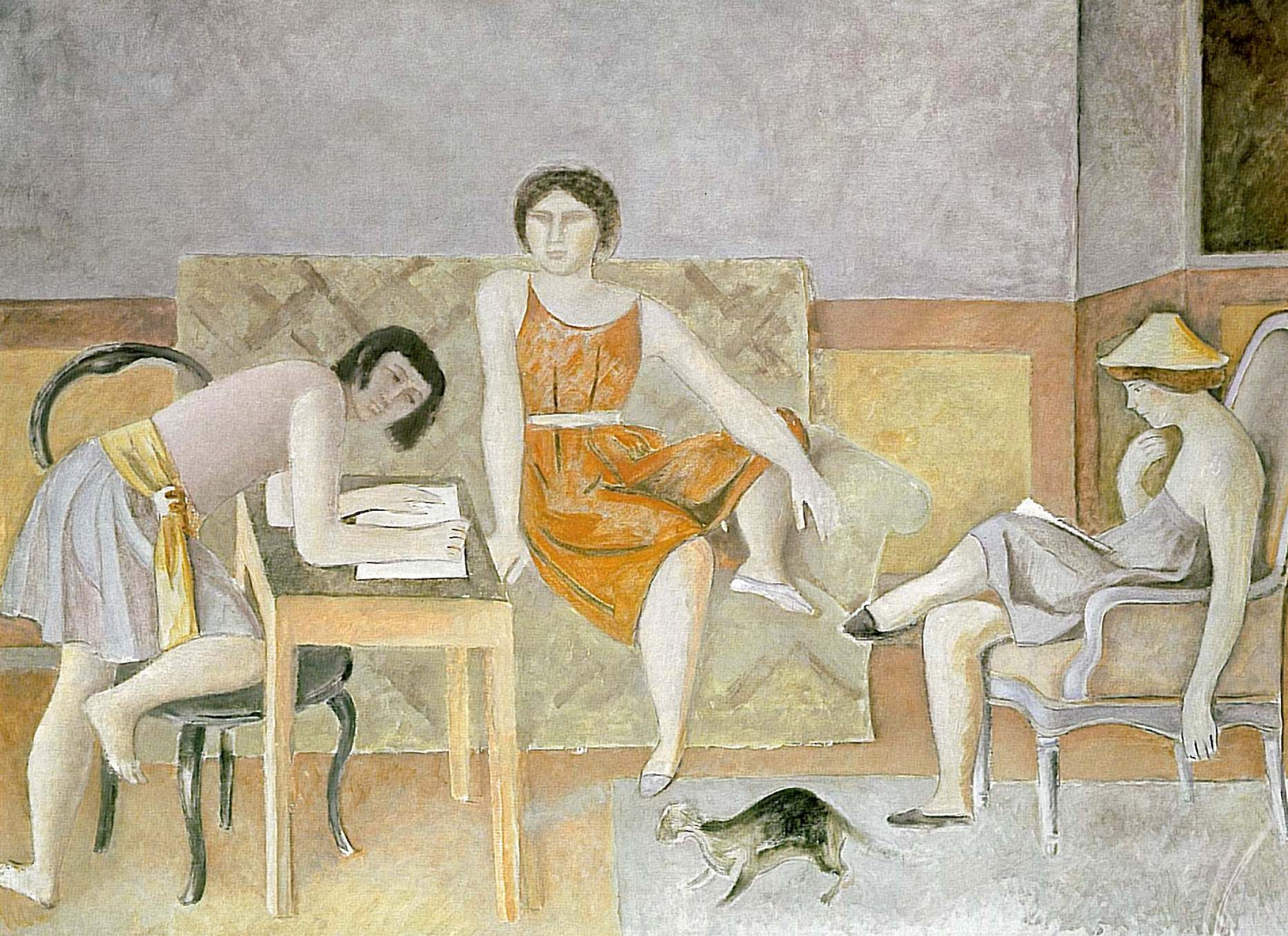
Balthus, Three Sisters and a Cat, 1965

Ok, now, finally and shortly, a couple of books that were awesome as well:

Marieke Lucas Rijneveld – The Discomfort of the Evening/Was man sät (T: Michele Hutchison/Helga van Beuningen)

Evelyn Waugh – Brideshead Revisited

Anne Weber – Annette, ein Heldinnenepos (English translation forthcoming later in 2022)

Margaret Atwood – The Blind Assassin

Patti Smith – Just Kids

Günter Grass – Der Butt/The Flounder (T: Ralph Manheim (I have read both the German original and the English translation and I can confirm that Manheim did a superb job!))

Kurt Vonnegut – Slaughterhouse Five

Maggie O’Farrell – Hamnet

I will probably not manage 175 books again this year (doing a master’s degree and all), but I hope I will still be able to discover new favorites. Keep on reading, folks.

And let’s hope Dorian keeps on giving us the chance to post these, so that I can put even more books on either my wish list or my tbr stack(s). [Ed. – I’ve already penciled you in for next year, Benita!]

R. Nicht’s Year in Reading, 2021

Today’s reflection on a year in reading is by R. Nicht (@Sediziose_Voci). R. is a reader who lives in the southern U.S.

Look for more reflections from a wonderful assortment of readers every day this week. Remember, you can always add your thoughts to the mix. Just let me know, either in the comments or on Twitter (@ds228).

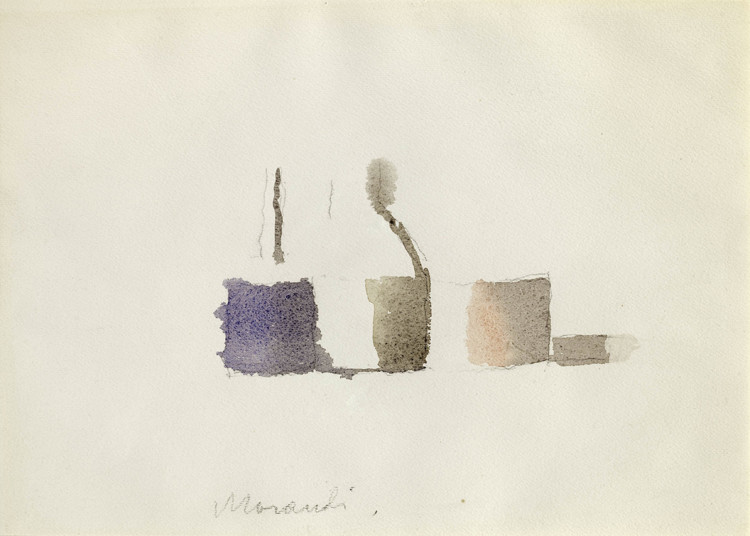
Girogio Morandi, Still Life, 1960

William Gardner Smith, The Stone Face

This terse novel of brutal images and elegant concision, as forceful as a punch in the face, depicts the effects of personal and collective racial trauma in the life of an African American journalist who takes refuge from the corrosive racism of American life in the bohemian expat culture of Paris in the days of the Algerian conflict. Smith casts a disapproving eye on this celebrated cultural milieu, which fostered such talents as James Baldwin, Richard Wright, and Miles Davis and whose creative ferment has been the subject of admiring studies by Tyler Stovall and others, depicting its members not as artistic mavericks but as an idle group of lotus-eaters who fritter their time away in futile creative projects and vaporous dreams of Pan-Africanism. Briefly tempted by the escape they offer from the crushing burdens and responsibilities of African American selfhood, the protagonist ultimately rejects it after befriending a group of Algerians and witnessing the events of the 1961 Paris Massacre, when French National Police violently attacked a pro-FLN demonstration, killing more than 100 protesters.

Paradoxically, the protagonist’s experience of cross-racial solidarity with another persecuted minority and his affair with a Holocaust survivor (perhaps the least convincing character in the book) propel him into a commitment to a harsh racial sectarianism at odds with the racial ecumenicism the novel seems to hold out as an alluring but ultimately unachievable dream. In another time, another place, perhaps, the author seems to suggest, such a vision of cross-racial struggle might be realizable, but in the exigent moment of armed conflict and brutal racial oppression the novel depicts, the only moral option for members of subaltern groups is dedication to their separate, geographically delimited battles: the Algerians to armed conflict against the French occupiers in Algeria, the narrator to a militant fight against racism in the U.S. It is a bleak vision, but one that Smith dramatizes with undeniable power.

Frances Stonor Saunders, The Cultural Cold War: The CIA and the World of Arts and Letters

A swashbuckling classic that documents the CIA’s tentacular reach into multiple areas of cultural production in the West during the “hot” period of the Cold War from the late 1940s to the 1960s. Charting the tortured ideological trajectory that left-leaning writers and intellectuals followed after they broke with communism in the late 1930s following the Molotov-Ribbentrop Pact and Stalinist show trials and became willing conscripts in a cultural struggle against the Soviet Union that relied as much on mendacity and ratfucking as the ruthless counteroffensive waged behind the Iron Curtain, Saunders’ book is an indictment not so much of the cultural crusade against Stalinism itself but of the brutal and reckless way it was waged. The hasty denazification of prominent cultural figures who would be “wins” for the West, the persecution of artists and writers with suspect communist pasts, the sidelining of dissenting voices unwilling to celebrate the new pax Americana, the sclerotic intellectual culture of the Cold War period that resulted—such things were neither necessary for victory nor inevitable, Saunders argues.

The book offers a useful intellectual genealogy of Cold War cultural liberalism, a force that still makes its presence felt—30 years after the fall of the Berlin Wall—in certain sectors of the American and British intelligentsia in the form of a disenchanted but loyal statism, a florid reverence for “democratic norms” and the elites who supposedly safeguard them, and a genteel form of literary and cultural criticism that floats free from all questions of political economy. Left-leaning intellectuals may have broken with the CIA and its anti-communist crusade during the Vietnam War, but the distinctive intellectual style they developed during the heady days of that alliance has had a long afterlife.  

Hazel Carby, Imperial Intimacies: A Tale of Two Islands

A worthy contribution to life writing about the Black Atlantic, this memoir breaks the conventions of the form to offer a sweeping account of colonialism, empire, capitalism, and the construction of racialized subjects that relies as heavily on archival evidence as it does on personal and familial memory. Roving from suburban London to Bristol and Kingston and back to Britain again, Carby’s narrative shows how both strands of her family—proletarianized Welsh farmers displaced from their lands and mixed-race Jamaicans who ended up on the wrong side of the line that divided “white” Carbys from “black” Carbys—were conscripted into the British Empire’s race-making project, some as slaves, some as working-class whites in Bristol who came to identify themselves as proud subjects and beneficiaries of empire even as it brutally extracted their labor.

The book is above all an eloquent elegy for Carby’s parents, a bookish, soft-spoken Jamaican and a white Englishwoman from a hardscrabble background whose lives were destroyed, Carby makes clear, when they crossed forbidden racial boundaries during a period of illusory wartime sexual freedom. That their half-caste daughter also paid a severe penalty for their transgression is made clear in Carby’s narrative of her own childhood, which was evidently so painful that she refers to herself in the book in the third person as “the girl,” and then only glancingly (she does not, however, spare the reader the details of her rape by a white neighbor). Imperial Intimacies concludes with a perfectly cadenced sentence of stinging irony that encapsulates the entire book and returns the reader to the beginning pages. [Ed. – Now of course I have to read this. Impressively effective, R.]

Igiaba Scego, Oltre Babilonia

In this fiercely exuberant novel, Scego, an Italian of Somali descent, throws the doors and windows of Italian fiction wide open to admit silenced voices from Italy’s horrific colonial past in East Africa and Argentina’s Dirty War. The stories of trauma and loss they tell cross boundaries of continents and language to enrich and trouble Italy’s multiracial present, personified most vividly in the novel by the irrepressibly candid Zuhra, a daughter of the African diaspora in Italy who speaks Romanesco but yearns to learn Arabic and whose own psychic and physical maladies can be traced directly to the silences and omissions of her immigrant family’s tormented history and to her own experience of childhood sexual abuse. The novel’s recuperation of long-suppressed family stories is a work not simply of therapeutic healing but of regeneration—the attempt to build a living present out of the scattered fragments of the past and fashion a self in which memory and bodily health, pleasure and sexuality, are fully integrated. The novel has recently been translated into English by Aaron Robertson with the title Beyond Babylon.

Marta Barone, Città Sommersa

A daughter’s efforts to fill in the lacunae in the life of her recently deceased father, an enigmatic, secretive man who served a prison term for giving medical assistance to a member of a terrorist group in the 1970s, broadens to become a forensic reconstruction of the Years of Lead (gli anni di piombo), a period of convulsive political violence on the right and the left in Italy and in Turin, the author’s home city, that has been explored in fiction and non-fiction alike by Nadia Terranova, Giovanni De Luna, and others but still remains imperfectly understood. De Luna has suggested that the very term “years of lead” has been used to erase the complexities of a decade that saw Autonomist labor militancy, peaceful protest, and violent attacks against jurists and journalists by members of the Red Brigades and Prima Linea, the last of which involved only a fraction of the many people who were caught up in the political ferment of the time. Offering a harrowing account of one man’s personal and political journey through those tumultuous years as well as a narrative of her own present-day reconnoitering of her father’s past, Barone brings light and a searching intelligence to an era whose intricacies and contradictions have been buried under that unilluminating epitaph.

What Barone seems less assured at providing is any real understanding of the impassioned commitments and ambitions of the political actors of those years, which are perhaps apt to seem outsized and extravagant (Vogliamo tutto!) to one brought up in a neoliberal era of technocratic governance and constricted horizons of political possibility. Yet it is the tension created by the irreducible distance between her own present and her father’s past—the sense that the past is, despite all her efforts to recover it, a foreign country, they do things differently there—that is part of the allure of Barone’s mysterious and elegiac book, which will appear in English under the title Sunken City this spring courtesy of Serpent’s Tail Press and translator Julia MacGibbon.      

Natalia Ginzburg, Tutti i Nostri Ieri

Sandra Petrignani, La Corsara: Ritratto di Natalia Ginzburg

Having recently reread Ginzburg’s substantial 1952 novel, which deals with, among other topics, teenage sexuality, abortion, suicide, war, bombings, displacement, fascism, the Nazi invasion after the armistice, and the violent deaths of several key characters, I found it a bit disconcerting to hear one of the author’s English translators seemingly reinforce the view in a recent podcast that Ginzburg is a writer of slight domestic fictions, all short in length. It made me wonder if there is a sneaking tendency or perhaps marketing strategy to present women writing in languages other than English, particularly those published during the recent translation boom (with a few notable exceptions), as practitioners of exiguous and rarified rarefied fictional forms—peripheral, approachable, decidedly minor. [Ed. – Intriguing. I want to know what Rebecca Hussey thinks.]

There is certainly nothing small-scale about this panoramic work, the only novel in Ginzburg’s oeuvre written in the third person; if it lacks the technical finesse and playfulness with form of Family Lexicon, for which it is many ways the fictional antecedent, it makes up for these qualities in its scope, its variegated plot and settings, and dramatic power. At the center of the novel, which deals with the wartime experiences of two families in an industrial northern city much like Turin, one bourgeois, one “respectable” but down at the heels, stands the charismatic, rumbustious figure of Cenzo Rena, who seems a composite of Leone Ginzburg and several other heroic figures of Ginzburg’s Torinese youth. The only character in the book who has the inner resources to resist the deadening influence of fascism and rise to the moral challenges of the war, he is at the same time—and this is one of the book’s painful ironies—part of a transient, dying world, belonging to Italy’s past, who will not live to see the defeat of the Axis powers or the advent of the shattered postwar world that the surviving characters, among them Anna, the novel’s protagonist, gropingly confront in the concluding pages.

Sandra Petrignani’s La Corsara, a freeform biographical portrait of Ginzburg, offers a welcome corrective to the view of Ginzburg in the English-speaking world as a minor, grandmotherly author of piquant domestic fictions (one must of course guard against the tendency to see “domestic fiction” as a minor genre), presenting her as a major writer of prodigious output in multiple genres over several decades. The book is also a liberating example of literary biographical writing that departs from the two forms that have come to dominate the genre in the Anglophone world: the exhaustively documented doorstop biography by a literary scholar and the brief memoir by a family member or fellow writer that confines itself to small-scale portraiture and personal anecdote. Combining standard chronological exposition of biographical facts with interviews, personal reflections, memories of her own meetings with Ginzburg, and even a charming digression on her astrological chart, Petrignani creates a complex, vivid portrait that is no less authoritative for having violated in significant respects the conventions of contemporary literary biography. The English-language literary biography, a tradition that did not always adhere to the rigidities of present-day practice (think of Gaskell’s biography of Charlotte Brontë, or De Quincey’s portraits of the Lake Poets), could benefit, it seems to me, from Petrignani’s example. Her book is currently being translated into English.

Walter Kempowski, All for Nothing; translated by Anthea Bell

One of the principal questions that Kempowski’s astonishing novel seems to ask is just how much sympathy the reader can allow herself to feel for its characters, comfortable Germans of the landed upper-middle classes living in a shrinking enclave of calm in East Prussia during the last days of World War II as the Soviet Army moves towards them. How much will the reader’s reflexive tendency to identify and empathize with characters be tempered by her desire to judge them, to adjudicate what measure of blame they deserve for their relative comfort amidst the horrors of wartime and their silent complicity with Hitler’s regime, with Auschwitz and Treblinka and the ruins of the Warsaw ghetto not far to the south of them? Do the characters “earn” the terrible fate that befalls most of them at the novel’s conclusion? Kempowski’s master stroke in the novel seems to me to understand that negotiating these complex questions—writing about characters whom the reader at some level opposes from the outset—is as much a technical as it is a moral problem, a problem of style and technique, as it were.

The technical approach Kempowski chooses is a sequence of brief scenes—quick sketches, brief dashing episodes and asides—and a tone that is playfully ironic, interrogative, sly, detached, almost harmonium-like, with the fictional “camera” pulled back at a chilly distance to expose the characters’ foibles and weaknesses (Katharina’s idleness and indolence, the aging schoolmaster’s homoerotic reveries of long-ago hiking expeditions). Kempowski makes no effort to excuse or condemn his characters. He lets the reader see that Katharina’s decision to shelter a fugitive Jewish musician in her house for one night springs more from ennui than from sympathy or principle. The coarse working-class Nazi in the housing development across the road is a harried, put-upon figure with a sick wife, but Kempowski makes no overt efforts to humanize him. Seduced by the astringent lightness of the narration, a complicitous partner in the author’s drily ironic observation, the reader imagines that she can watch with a certain pleasurable detachment as the characters are overtaken by the terrible events that surely await them and that they may even in some way “deserve.”

And yet the operations of sympathy and identification with characters begin their stealthy work inside the reader once Katharina’s young son, a peripheral character until the book’s midpoint, takes a central role. For it turns out that All for Nothing is, at least obliquely, an autobiographical novel, a chronicle of Kempowski’s own horrific childhood experience of the same historical events the novel describes, and the reader cannot resist the pull of emotion that slowly accumulates around the character that is his fictional surrogate. Entangled by these skeins of feeling, the reader finds herself unexpectedly invested in his fate and, through it, in the fates of all those on whom the boy’s safety and life depend, particularly when the novel’s setting shifts from the family’s manor house to apocalyptic scenes of devastation and carnage. The novel’s playfully ironic tone, it turns out, has been a lure and a trap. Summoned to watch what had initially seemed an interwar comedy of manners, the reader finds herself at the novel’s conclusion a witness to a human calamity on an overpowering scale—a calamity to which she can properly respond only with those emotions that an authentic artistic experience of catharsis can arouse: pity and fear. This novel shook me; I read the last 50 or so pages seemingly with one held breath.

Wolfgang Hilbig, The Interim; translated by Isabel Fargo Cole

This ribald, lacerating exploration of the psychological and territorial scissions of postwar Europe, which I read in Isabel Fargo Cole’s marvelously assured translation, seems to me the real deal: a major European novel of wild, idiosyncratic ambition that merits comparison with the works of Bernhard and Sebald. I would follow its wastrel writer protagonist—priapic one moment, impotent the next, a narcissist, a drunk, a philanderer, a genius, a failure, at home neither in the catastrophically failed “actually existing socialism” of the GDR nor in the vapid consumer society of the FRG—anywhere. Hilbig is a magisterial commander of both interior and exterior space, expertly guiding his narrative through multiple excursuses with the same efficiency as the trains that conduct the protagonist across the border to West Germany and back to the East, taking us through horrific flame-lit industrial landscapes and scenes of domestic squalor and in and out of nightmares and states of inner torment with equal ease. He does it all with grace and a perfectly tuned sense of fictional pacing: the restless narrative never stalls out in rhetorical excess even during the most lurid passages, and the reader somehow keeps her bearings through multiple flashbacks and digressions. The plot, such as it is, follows the wanderings and tergiversations of an East German writer in the throes of a full-blown artistic and sexual crisis, exacerbated by abject alcoholism, while overstaying his visa to West Germany. As the reader comes to understand, the narrator’s restless transits from East to West and his circuitous inner journeys of memory and imagination trace and retrace the contours of a European map set in place by a century of devastating war, partition, displacement, drawn and redrawn national boundaries, and genocide.  

Mary Fulbrook, The People’s State: East German Society from Hitler to Honecker

Fulbrook’s book was a useful companion during my reading of Hilbig. Departing from the “Stasicentric” (as Paul Betts has called it) totalitarian model of GDR scholarship, this revisionist social history of East Germany doesn’t excuse the regime’s many calamitous failures, but neither does it engage in pointless sermonizing. Rather, it attempts to explore the paradox that while East German society was undoubtedly repressive in the extreme (the GDR’s citizens were quite literally caged, subject to surveillance and numerous intrusions on their personal liberty), many former citizens recall living “perfectly ordinary lives” there, a sentiment that can’t be chalked up to simple Ostalgie or to a kind of false consciousness in reverse. Combing through archival evidence and interview transcripts, Fulbrook looks at women’s rights, labor, childcare, recreation and leisure, and other facets of life in East Germany and concludes that the GDR was not a monolithic tyranny in which citizens cowered, silent and passive, under despotic rule, but an evolving, changing, albeit extraordinarily repressive society in which ordinary people shaped the culture around them as much as they were shaped by it. What Fulbrook makes clear is that it was Honecker’s decision to attempt the beat the West on its own terms through a “consumer socialist” model that ultimately led to East Germany’s demise. Plausible perhaps in the early 1970s, when East Germany might be said to have been at its zenith, the regime’s aspiration to provide material plenty for its people in any way comparable to that enjoyed in the West became less and less viable in the 1980s, when shortages of food and other basic supplies, together with increasing repression by state security services and ongoing environmental collapse, sounded the death knell for the GDR.   

Alighiero Boëtti, Non parto non resto, ca. 1979

Other Favorites:

Noo Saro-Wiwa, Looking for Transwonderland

Enzo Traverso, The Origins of Nazi Violence

Edmund Morgan, American Slavery, American Freedom

Herman Melville, Redburn

Achille Mbembe, Critique of Black Reason

Christina Stead, Cotter’s England

Tsitsi Dangarembga, Nervous Conditions [Ed. — Fascinating book.]

Pier Paolo Pasolini, Scritti Corsari

Edward Said, Music at the Limits

Daniel Syrovy’s Year in Reading, 2021

Today’s reflection on a year in reading is by Daniel Syrovy, his first for the blog. Daniel is Senior Lecturer in Comparative Literature at the University of Vienna, Austria; he tweets at @daniel_syrovy.

Look for more reflections from a wonderful assortment of readers every day this week and into next. Remember, you can always add your thoughts to the mix. Just let me know, either in the comments or on Twitter (@ds228).

Maria Lassnig, Necessary Understanding, 1998

The last book I finished in 2021 was Milo Dor’s Tote auf Urlaub (called Dead Men on Leave in an out-of-print 1962 translation; some used copies can be found). Despite a number of reprints after 1952, it’s not a well-known novel. Set mostly in Belgrade and the surrounding countryside (and, eventually, in Vienna), it focuses on the Serbian Resistance to Nazi Germany between 1941 and 1945. Its ostensible protagonist, with hints of autobiography, is Mladen Raikow, but a character list included in the 500-page book lists forty characters in addition to “communists, Trotskyists, dreamers, cowards, traitors, real and false heroes, fallen angels, idiots, bootlickers, liars, drunkards, gluttons, whores, blackmailers, and torturers.”

This is not light reading, and despite a good pinch of gallows humor, the novel offers a rather bleak view of humanity. There is not much by way of a plot, but the novel is crammed with short scenes that depict small gestures of solidarity as well as acts of depravity. Dor must have been compelled to put everything into his manuscript, sparing no-one, and it is telling that even my 1992 edition quotes reviews that question whether this should properly be called a novel at all. Of course it’s a novel—but it must have been uncomfortably close to lived experience just after the war.

In fact, I first learned about it in Evelyne Polt-Heinzl’s reassessment of Austrian postwar literature, Die grauen Jahre (2018), which I re-read this past year for a work-related project. One of her central theses is that Austrians in the 1950s mostly rejected realistic texts about the war, but that such texts did exist. I had already spent a summer with a number of books unearthed by this indefatigable scholar, but it turned out there were quite a few interesting titles I had overlooked (including Dor’s collaborations with Reinhard Federmann: a series of crime novels from the 1950s; Federmann’s own novels Das Himmelreich der Lügner and Chronik einer Nacht; books by Hertha Pauli, Dorothea Zeemann, Hans Flesch-Brunningen, Hans Weigel). I’m going to stop naming names in a minute. [Ed. – I hope not!]

With me, such reading projects seem to crop up unexpectedly from time to time, and for the most part they are neither completely work-related (I am a literary scholar and I teach at university) nor exactly spare-time reading. But I do enjoy filling gaps in my knowledge of different literatures, so I follow loose reading lists, for instance on the Celtic Revival: several plays by Yeats, Lady Gregory, Synge, and related material occupied me this past summer. Austrian literature often figures large, too. In 2021, I reread some Thomas Bernhard, and was surprised at the intermittent tenderness of the first half of Correction (1975). I also read Friederike Mayröcker, Helmut Zenker, Alexander Lernet-Holenia and Leo Perutz. Yet, much of this reading follows rather obvious patterns like stepping stones. In preparing these notes, I kept asking myself whether I couldn’t come up with some more interesting observations. [Ed. – Yeah, enough of this boring stuff filled with enticing, new-to-me names.]

It turns out, I loved reading some new old books (a series of newly rediscovered and partly very funny Proust manuscripts published as Les soixante-quinze feuillets in March) and some brand new ones (especially Lisa McInerney’s brilliant third volume of her Cork-based crime trilogy, The Rules of Revelation, Emine Sevgi Özdamar’s autofictional Ein von Schatten begrenzter Raum, and Shida Bazyar’s mindblowing Drei Kameradinnen, reviewed in English here); I also enjoyed some classics – which I would mostly read in bed chapter by chapter over longer stretches of time (from Olivia Manning’s Balkan and Levant Trilogies to Middlemarch to Samuel Butler’s The Way of All Flesh). I took my cues from friends and Twitter-friends [Ed. – Wait, so we’re not like your real friends?], from the LRB, from other books. I was happy to break open volumes I already owned (Yoko Tawada’s Memoirs of a Polar Bear; Susanna Clarke’s Piranesi; Bely’s Petersburg) and to pick up new ones (Pola Oloixarac’s Mona; Percival Everett’s Erasure). Hopping between languages and centuries was always something of a comparatist’s credo with me [Ed. — Comparatists 4eva!]. But I hesitate to call this a noteworthy pattern.

It does not escape my attention that despite buying new books at a steady rate, I picked up stacks of books from the library as well, often going there twice a week. A reduced social life will do that sometimes. And perhaps it is true that during the pandemic I was a more restless reader than usual. Unsurprisingly, there are quite a few books I did not finish. Looking at my rather disparate and unsystematic notes (I have neither a Goodreads account nor physical lists), I can’t come to any definitive conclusions. I know that I listened to an incredible amount of Grateful Dead live shows in 2021, something I had never done before. But to relate all of my reading habits to the state of the world and my own preoccupations? To quote from a recent read, Anna Wood’s book of short stories Yes Yes More More, “I kn[o]w better than to think for too long about my internal organs after taking acid.”

Helene Funke, Dreams, 1913

Maybe, one day such patterns will emerge more clearly, and I’ll be the wiser for it. In the meantime, I’d rather mention another discovery that is already turning into a reading project. I always liked concrete poetry (well-established in Austria with writers such as Ernst Jandl, seen here performing at the Royal Albert Hall in 1965), and between that interest and preparing an introductory lecture about poetry, I came across a recent volume by the Brooklyn-based publisher Primary Information, Women in Concrete Poetry 1959–1979. Since overlooked women writers are always a high priority, I couldn’t resist, and the volume doesn’t disappoint. It features 50 poets from all over the world (from Sonja Åkesson to Chima Sunada to Rosmarie Waldrop), with a selection that mostly follows a 1978 Venice Biennale exhibition curated by Mirella Bentivoglio. Accordingly, the volume looks very much like an exhibition catalogue, with thick glossy paper. The nature of the poetry lends itself to it, as well, written as it is in many languages, partly in color, with striking visual aspects and often presented as collages with repurposed images. Standing out for me were a few pages by the American Madeline Gins, in particular a page showing layers of text thickly typed over one another with a typewriter that I tweeted about in early December. The page ends with the lines “The body is composed 98% of water. This page contains every word in the book.” So I read on. The passage comes from Gins’s book Word Rain (1969) which is reproduced in full in the 2020 Madeline Gins Reader The Saddest Thing is That I Have Had To Use Words (Siglio Press; ed. Lucy Ives), which I have only skimmed so far. Some of this is not exactly concrete poetry, but it is very appealing, so who cares. And anyway, filling some gaps in my knowledge of the contemporary Austrian writer Ann Cotten (herself a poet, novelist, and translator of Rosmarie Waldrop), especially the wonderful lecture series Was geht (2018), I was alerted to Liesl Ujvary, a Viennese poet who started out with a very funny volume in 1977, Sicher & Gut,some of which would certainly be classified as concrete poetry. These converging patterns are what keep me going. Ideally, two or three of them at once.

A Pure Soul: Robert Seethaler’s A Whole Life (2014)

I’m always urging my students to be governed by the principle of interpretive charity. I want them to take the text for what it is, not what it could or ought to be. I want them to be able to explain what makes the works they’re studying what they are. I exhort them not to smooth away the strangeness of the books we read. And although I believe our emotional responses to books matter a lot, I also think our primary task isn’t to grade them, to give them a thumbs up or thumbs down.

Usually I follow this advice here at the blog. Today I’m going to ignore it.

I can’t remember now where I first heard about Robert Seethaler’s Ein ganzes Leben, translated by Charlotte Collins as A Whole Life. Probably on Twitter, where else do I hear anything these days? As an Albertan of Swiss heritage, mountains run deep in my blood, so a novel about a man who with one important exception spends his entire life in a remote valley in the Austrian Alps seemed like just my thing.

So obviously I snapped up the book when I came across it on a recent trip to Canada—it will be published in the US later this year—and I read it in a couple of sittings this weekend. (It’s really a novella, not even 150 pp in this generously spaced edition.) Although the ominous words “The International Bestseller” on the front cover put me on my guard, I started the book, as I do almost every book, prepared to like it.

That didn’t last long.

A Whole Life is an example of my least favourite genre: worthy middlebrow pap. I can only imagine Thomas Bernhard, probably the greatest Austrian writer since the war, author of plenty of books set in the Alps, fulminating against it, though he’d probably decide it wasn’t even worth his time. It’s possible this book will soon disappear into the oblivion it deserves. But I can imagine it becoming a “surprise hit,” “the most talked-about book of the season,” “a darling of book clubs everywhere.” I’m the sort of person who burns with rage in anticipation of things that might not happen. I’m ready for people to tell me how moving and beautiful and life affirming they found A Whole Life, how I simply have to read it. I’m ready for the book to be an undeserved success. Hey, haters gonna hate.

s-l300

A Whole Life is about Andreas Egger, who arrives as a small child at the beginning of the 20th century in the unnamed alpine valley that becomes his home. The boy is unceremoniously deposited with a small-minded, vicious farmer named Hubert Kranzstocker. Egger is the child of one of Kranzstocker’s sisters-in-law, whose dissolute life in the city (which is to say, her life in the city) has led ineluctably to her death by consumption. Egger never really becomes part of his adopted family, he’s more hired hand than anything, which is lucky for Kranzstocker, whose other children aren’t very good at farm work and have besides a worry tendency to be felled by childhood diseases. Egger, by contrast, is strong, so strong that he survives the beatings Kranzstocker metes out to him, even when Kranzstocker goes too far and breaks the boy’s leg, an injury that leaves him crippled.

Seethaler has no time for lingering—the point of his book seems to be that everything passes if you’re stoic enough—and so before long we’re following the adult Egger as he builds a small home for himself high up the mountain on a bit of grass too rocky to pasture any animals on. In short order he tentatively courts the new serving girl at the inn, marries her, and takes on more permanent work with Bittermann & Sons, a construction and blasting company recently arrived in the valley to build its first cable car.

We’re in the early 1930s now and the most interesting parts of the book are the descriptions of Egger and his mates at their dangerous work of modernization. Unfortunately, Seethaler isn’t really interested in cable cars as anything more than a symbol, so these descriptions are far too cursory. Nothing here to match, for example, Philip Roth’s description of the glove-making factory in American Pastoral. You won’t learn how to build a cable car from this book.

After a terrible accident destroys his brief domestic happiness, Egger has nothing but his work to console and occupy him. His wife’s death sends him into a kind of fugue state that might be one way of explaining why we never hear any reference to events in the world beyond the valley until one evening Egger enters his boarding house to find his landlady crying before a silent wireless set, which is strange because “at this hour [it] was usually blasting out brass-band music or Adolf Hitler’s furious tirades.” War has been declared; Egger tries to join up (we’ve no idea why) but is rejected because of his leg.

But three years later even crippled men are being conscripted. Egger is sent to the Caucasus because of his expertise in mountain engineering. There he’s ordered to man a remote outpost where he never fires a shot, and which he leaves once his supplies are no longer replenished weekly, an ominous sign he rightly interprets as  an indication that things are not going well for his side. On the way back to the front, he’s captured by Soviet forces and spends several years as a POW.

Egger isn’t able to return home until 1951, but the years pass so briskly it doesn’t seem that much of a hardship. Here for example is Seethaler describing how nothing changes for Egger and his fellow prisoners once the war ends:

The work remained the same, the millet soup was thinner than ever, and the flies still circled unperturbed around the beams of the latrine.

A page and a half later we’re given this meager summary—laconic to the point of bathos—of these years: “It was almost another six years before Egger’s time in Russia came to an end.” His time in Russia: as if it were fated or preordained. Everything in this book is described in the same clipped, blasé manner. It’s just one damn thing after another.

Returning home, Egger finds things only a little changed. The mayor doesn’t display swastikas anymore, but he’s still the mayor. Franzstocker is still around, but older and frailer and he dies before long. Bittermann & Sons has gone belly up, but Egger makes do on a war pension until he stumbles into a new career guiding tourists, a new breed of people called into being by those cable cars (and postwar affluence). Egger has always loved the mountains, feels better when he’s on his feet all day, despite his limp. Sometimes the tourists are annoying or irritating, spoiled or sententious or smart alecky, but mostly they’re grateful for the beauty he shows him and besides we never have much sense of what Egger thinks other than that he apparently doesn’t think that much, not that he’s stupid, just not reflective.

Wankbahn_poster

Egger keeps getting older. He misses his late wife, almost gets involved with an older female teacher but can’t. (Her response to his spurning of her advances is the only moment of true emotion in this book. Too bad she disappears after only five pages.) Television is the latest thing, but it doesn’t do much for Egger. He remembers only two moments: one (sadly undeveloped, and not quite strange enough to be really interesting) showing Grace Kelly getting off a plane, the other the moon landing.

Egger gets too old to guide anymore and retreats to a little hut high above the village. One night in February, sitting by candlelight at his little table, thinking about the coming snowmelt, Egger is

overcome by a feeling of warmth at the thought of his leg, that piece of rotten wood that had carried him through the world for so long [a puzzling image, since his leg is not actually a prosthetic]. At the same time he was no longer sure whether he was still thinking this, or was already dreaming. He heard a sound, very close to his ear: a gentle whisper, as if someone were speaking to a little child. “I suppose it is late,” he heard himself say, and it was as if his own words hovered in the air in front of him for a few moments before bursting in the light of the little moon in the window. He felt a bright pain in his chest, and watched as his body sank slowly forwards and his head came to rest with his cheek on the tabletop. He heard his own heart. And he listened to the silence when it stopped beating. Patiently he waited for the next heartbeat. And when none came, he let go and died.

A good death for a good man. That “patiently” says it all, characterizes everything Seethaler wants to say about Egger. Not that he’s passive or a spectator in his life. (All the language of observing the self in this passage, all that out of body stuff, is actually quite unusual in the book, though again I don’t think Seethaler does anything much with it.) Egger’s end isn’t the book’s, though. Seethaler gives us a little coda, a story from a few months earlier, when Egger suddenly decides to take the bus to the town at the bottom of the valley. Here too nothing happens: he’s a bit disoriented, unsure what he’s done or why he’s come. After wandering aimlessly around the square for a minute, he is helped by the driver back on to the bus that takes him home and it’s not until he’s in the thinner air again that he recovers. Arriving home, he heads not for his hut but for the trails. He’s filled with a blurred nameless memory, probably of the opening scene, which describes a failed wintertime rescue of a different old man, one we are invited to see that Egger has become, an old man who deliberately lost himself in the snow rather than suffer any more. Egger responds to this “fleeting recollection of something very long ago, little more than a blurred image”: “ ‘Not just yet,’ he said, quietly.” And in this way the story of a good, unassuming life gets prolonged beyond its end. A quietly triumphant conclusion to this quiet book.

IMG_0318

Yet that very restraint seems to me nothing but self-satisfied bullshit. Take the book’s attitude towards history. I appreciate that it’s not constructed with the certainty of hindsight: this isn’t one of those historical novels where characters are always running into people or experiencing events that we’ve decided were significant. After all, what later generations decide to call history usually passes us by in the moment. So I’m willing to believe fascism passed Egger by. Well, I’m not, really–the almost total ellison of fascism is more than a little convenient. But what really gets me is the complete flattening away of history, the absence of any sense that what makes a life meaningful or what counts as suffering is historically inflected if not constructed. This absence makes the book so flat as to seem not even autistic, but catatonic. I can’t even tell if we’re meant to understand Egger as an average person, a representative man of the century. I think he’s supposed to be more than that, a kind of model we might aspire to if only we could make our own lives as simple as his. But it’s hard to know for sure because Egger is a total blank, not even interesting enough to be a cipher.

Seethaler’s narrative decisions are largely responsible for making Egger such a nonentity. We’re so seldom inside his head—so much so that I was drawn up short by this passage:

The weeks and months after the opening ceremony at the top station [the successful completion of the first cable car] were the happiest of Andreas Egger’s life. [The unnecessary use of his full name signals that what comes next might be free indirect discourse: we might be getting access to his interior life.] He saw himself as a small but not unimportant cog [that litotes doesn’t fit with his way of thinking and speaking—plus, a cog, get it? Just like he used in building the cable car!] in a gigantic machine called Progress, and sometimes, before falling asleep, he would picture himself sitting in the belly of this machine as it ploughed inexorably through forests and mountains, contributing, with the heat and sweat of his brow, to its ongoing advance. He had taken the words with the heat and sweat of his brow from a tattered magazine Marie has found under one of the benches in the inn, and from which she would sometimes read to him in the evenings.

That clumsy reference to “the heat and sweat of his brow,” that obstreperous explanation of how he came to use these words: this is the first time we’ve been led to believe that Egger himself is lending anything to the narration of the story. It feels unearned and unnecessary, a piece of authorial clumsiness that reminds me of the much later description of the day the schoolteacher rejected by Egger leaves the village:

One cold morning, before sunrise, she climbed aboard the post bus with two suitcases, sat down in the back seat, closed her eyes, and, as the driver later reported, didn’t open them again once throughout the journey.

Seethaler is so keen to make a point about the woman’s utter defeat—the possibility that those close eyes could indicate resistance never enters into the picture—that he’s willing to offer this implausible description: no one driving a bus down a mountain road would be looking at his passenger the whole time. The sentiment is uttered only for us; Seethaler doesn’t even try to make it organic to the story.

A Whole Life studiously rejects reflection—the closest we get is the dime-store existentialism of Egger’s sudden outburst to a tourist he’s had to rescue from near death, “Each one of us limps alone!” One night Egger awakes suddenly to find his window “clouded by hundreds of moths”: “For a moment Egger thought their appearance must be a sign, but he didn’t know what it was supposed to mean, so he closed his eyes and tried to go back to sleep.” I don’t think the book is poking even gentle fun at him here. It’s not that he’s dim, not that he’s missing out on some significant, even portentous moment. There’s really nothing to make of that evanescence.

In so steadily agreeing with Egger’s even-keeled banality, the book ends up presenting him as an exemplar of a life well lived. Early in his days on the cable car, Egger falls in with a would-be philosopher named Mattl. Mattl dies an absurd death—he falls asleep in a bath tub and catches pneumonia—and the foreman, who hardly knows him “cobble[s] together” a short funeral address, “which talked about the hard work on the mountain and Mattl’s pure soul.” The foreman is being disparaged here, but Seethaler ends up presenting exactly what he’s ironized, giving us a story of hard work on the mountains and Egger’s pure soul.

To paraphrase that peerless old New Yorker cartoon, I say A Whole Life is nothing but unearned redemption and I say the hell with it.