Benita Berthman’s Year in Reading, 2023

Excited to once again present reading reviews from some of my favourite readers. Today’s installment, her third, is by Benita Berthman (@moodboardultra). Benita studies literature in Marburg, Germany, where she is a full-time book enthusiast, part-time smoker, and occasional existentialist.

Enikő Katalin Eged (b. 1992) – Black Cat White Cat

Anyone who knows me knows that there is nothing I love more than talking everyone’s ear off about books, reading, my favorite authors and how I never find enough time for literature because I’m too busy doomscrolling. [Ed. – Benita, we are the same person.] Nonetheless, I did read quite a lot last year and I’m so thankful to Dorian for once again letting my write about some of the stuff I’ve read in 2023. [Ed. – It’s my pleasure!]

First things first, the statistics (I just love diagrams and numbers, I’m sorry): I managed to read a whopping 160 books with 51,299 pages in total (which is, coincidentally, almost exactly the same as the year before lol). I’ve read three quarters of these books in German, the remaining quarter in English. Storygraph, the app I use for tracking, also tells me that an overwhelming number of books I’ve read are set in a reflective mood, whatever that means. [Ed. – It means, Holy shit that’s a lot of books, I need to sit and process that.]

Enough of the numbers, most of you find them boring, I’m sure, so I’ll bore you no longer and move on to the interesting stuff.

I’m currently writing my master’s thesis on Bob Dylan and the Nobel Prize and in preparation I’ve read quite a few texts that are considered ‘canonical’ among literary scholars and, believe it or not, I’ve actually discovered I like pushing through texts that seem enigmatic, impenetrable at first and require you to really work through and with them to get even the semblance of having an idea what the authors are talking about. Enduring difficult sections, slowly getting the gist, and being able to connect the dots just a little bit better—all of this is incredibly rewarding to me.

One of the most important texts of the 20th century, I believe, is Sigmund Freud’s Interpretation of Dreams (different translations available, I read it in the original German): I am interested in psychoanalysis not just as a therapeutic approach but also with regards to the interpretation of literature. Freud, by relying heavily on classical literature, synthesizes the conscious, the unconscious, dreams and their symbolism and both medical/psychoanalytical as well as literary aspects of dreams and how to work with them, dreaming, and interpretation. Even though this might not have been what Freud intended with his seminal work, I do feel like reading it can help you understand yourself and all that might be hidden in your mind and soul just a bit better. Just as an afterthought: of course there are certain thoughts and opinions given by Freud that have long been overruled by now, but I personally believe it is more fruitful to actually engage with these (especially patriarchal) thoughts and work with them, confront them with more accurate and more modern research than to flat out refuse to even read about them. [Ed. – Amen, sister. You’ll get no complaints from this card-carrying Freudian!]

I also started delving into Foucault’s work. The Archaeology of Knowledge (English translation by A.M. Sheridan Smith; I read the German version by Ulrich Köppen) was the first of his seminal works that I read last year. For me, it was the perfect starting point to get into Foucault’s way of thinking, to understand what he is referring to when he is speaking of a discourse or a discursive meaning and how and why knowledge and language are important when it comes to understanding concepts of power. And, not to forget, I simply like how Foucault writes – to me, it seems way more literary than,
say, Pierre Bourdieu whom I have come to know as a very sterile writer (sorry, Pierre!). I’m looking forward to exploring more of his work in 2024. [Ed. – Just wait for The History of Sexuality! I also agree re: Foucault’s style.]

As a Herta Müller stan I need to feature one of her books in my review, that much is for sure, and how lucky was I that I got to read a new essay collection of hers in the summer! Eine Fliege kam durch einen halben Wald [Ed. – A Fly Came Through Half a Forest?] has not yet been translated into English, unfortunately, but a number of Müller’s essays have been published by Granta under the title Cristina and Her Double, translated by Geoffrey Mulligan, and I highly suggest you check them out if you’re interested in getting a deeper understanding of Müller’s works. She writes mainly about the traumatic experiences of having grown up in communist Romania and being oppressed by the Government and the Secret Service, all in a highly metaphorical and touching poetic language. Sometimes her novels are a bit enigmatic for those who, thankfully, haven’t had her experiences, but her essays offer a more straightforward glimpse into her life, her way of thinking, and how she understands her own writing and literature. I do hope these essays will be translated into English as well, also because they highlight
Müller’s commitment to the planned Museum of Exile in Berlin (and, on a personal note, I get to give a presentation on said commitment at a conference in London in April, woohoo).

I share my aforementioned interest in psychoanalysis with Siri Hustvedt whose book The Shaking Woman or A History of My Nerves investigates a seizure the author experiences at a memorial service for her father. Essentially, she can’t stop shaking; her seizures become a more or less recurring phenomenon. She starts looking into reasons why and how she loses control and fearlessly questions both her own psyche as well as the status quo of psychoanalytical and neurological research. What made the book so very gripping for me was that Hustvedt is relentlessly honest with herself, not afraid to look into the abyss that a human being can be, honest and precise in her writing, sharp-witted with every sentence. I’m glad there are still quite a few of her books to explore. [Ed. – I liked her debut, The Blindfold way back in the day.]

Last but not least, a few honorable mentions:

Asako Yuzuki – Butter (German translation by Ursula Gräfe, no English translation yet afaik) [Ed. – Insert that eye emoji thing I’m still not sure I’m using right.]

Taylor Jenkins Reid – The Seven Husbands of Evelyn Hugo (a true page turner if there ever was one, the TikTok kids were right for once) [Ed. — They’re always right]

Ellie Eaton – The Divines (teenagers scare me) [Ed. – So scary]

Yasmina Reza – Serge (German translation by Frank Heibert and Hinrich Schmidt-Henkel, apparently, there’s no English translation yet, which seems weird to me, considering Reza’s critical acclaim)

Dorothy L. Sayers – Gaudy Night (love me a good campus novel)
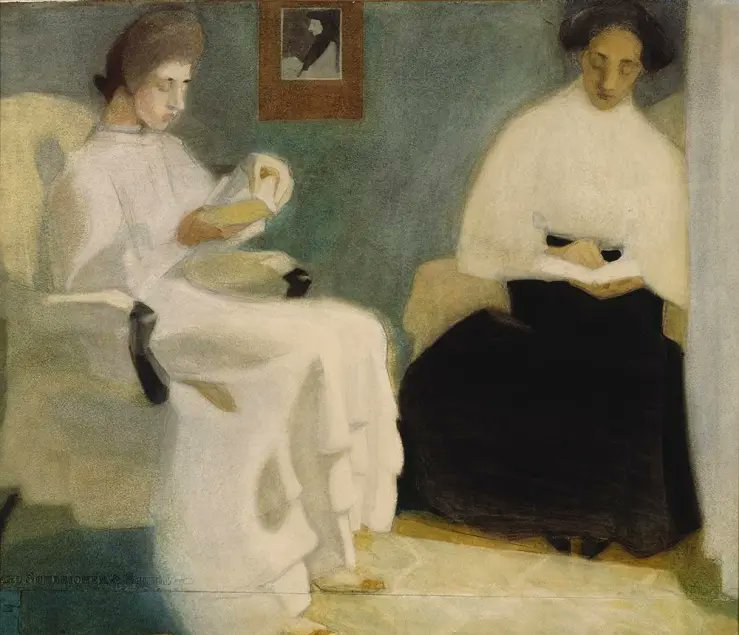
Helene Schjerfbeck, Lukevat tytöt (Reading Girls), 1907


I could probably name at least twenty more books, but I don’t want to be responsible if y’all break your book buying ban or you never finish your TBR stacks. [Ed. – You clearly do not understand the demographic of this blog’s readership, B…] My reading year 2024 has been off to a good start already and I am excited to tell you about it in a year! [Ed. – Imma hold you to it! Thanks, Benita!]

What I Read, September 2022

September was so long ago, I can’t remember what was going on, except a tough semester that began as it meant to go on, and the beginning of the High Holidays. I was back and forth between Little Rock and St Louis a couple of times. Squeezed some of these in as audio books.

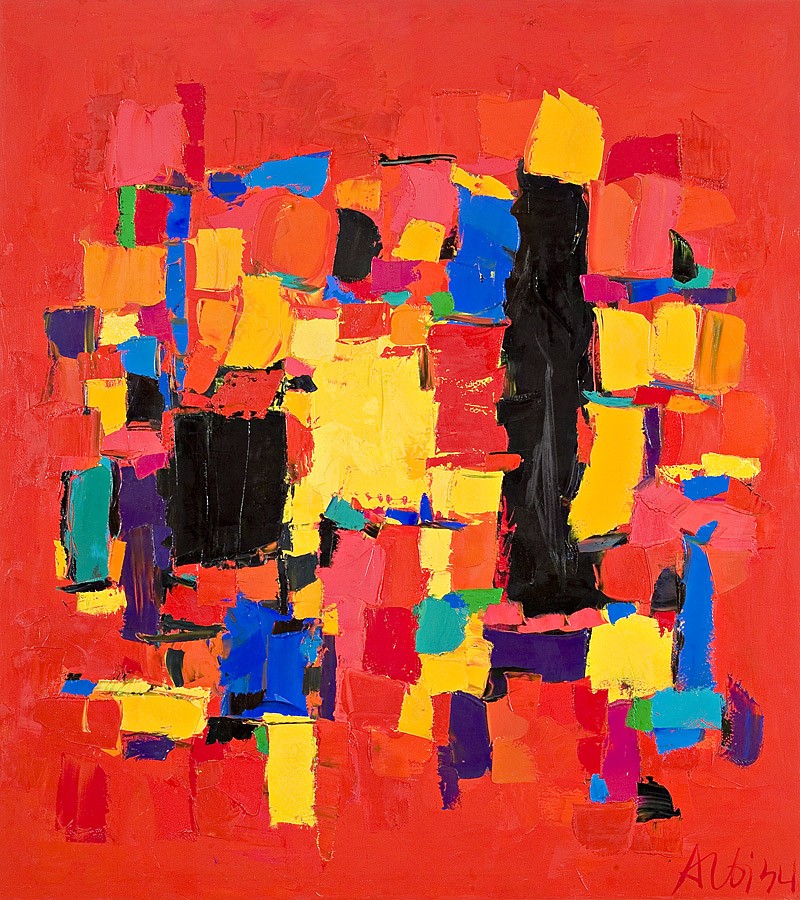
Olga Albizu, “Red 103” (n.d.)

Lilliam Rivera, Never Look Back (2020)

Audacious and entertaining YA retelling of Orpheus and Eurydice, set in the Bronx with a mostly Puerto Rican cast. Rivera melds the Greek story with Taino mythology (the goddess Guabancek features prominently), adding Catholicism and the musical tradition/genre of bachata as significant elements. Pheus, a bit of a playa but at heart a good kid, and (natch) a brilliant musician, has come to spend the summer with his father in the Bronx. A friend lives downstairs—she introduces him to her cousin, who has been sent to the city from Florida to recuperate. Something bad happened to Eury, which started even before they left PR in the wake of hurricane Maria. Only Pheus believes her when she finally explains about Ato, a demon who insinuated himself into her life after her father left the family when she was a baby. Ato claims to love her but he is jealous, and wants to take her away to what initially seems like a paradise. Only Pheus has the ability to try to win her back.

I read this for a faculty-staff book group, and I’m so glad I did: I’d never have come across it otherwise. Rivera manages to hold her blend of cultures together; similarly, she balances psychological explanations (Eury has PTSD) with magical ones (she has been captured by a demon). And she plays with our knowledge of the classical myth, following it closely but upending it in important ways. With the exception perhaps of Pheus’s mother—almost entirely offstage, but unsympathetic nonetheless—the characters are presented with kindness, rising above types. (Pheus’s on-again, off-again girlfriend is a great example.) Neve Look Back is a generous novel about terrible things (climate change, sexual abuse, gaslighting, racism). Worth your time.

Hanif Abdurraqib, A Little Devil in America: Notes in Praise of Black Performance (2021)

Like all great nonfiction writers, Abdurraqib makes me care for things I thought I had no interest in: his essay on Whitney Houston in this collection on Black performance is a revelation. The book’s range is impressive. Even more so is its cohesion. These aren’t just a bunch of disconnected riffs on a topic. The book itself is a performance, linked by the writer’s reflection on his own abilities and inabilities. And it taught me so much. I knew nothing about Depression-era dance marathons, Buster Douglas’s upset of Mike Tyson, Merry Clayton’s essential but tragic part in “Gimme Shelter,” or Beyoncé’s Super Bowl performance. (What can I say, I’m pretty clueless.) And without this book I’d never have discovered Aretha Franklin’s Amazing Grace—for that alone I would be grateful.

I listened to this one; no surprise that a book about performance is great on audio?. My only regret is that I wasn’t able to underline the author’s many aphorisms; I really ought to buy a copy. Abdurraqib read at my college this fall: so smart, so funny.

Nadine Fresco, On the Death of Jews: Photographs and History (2008) Trans. Sarah Clift (2021)

Fresco close-reads the Liepaja photos (eight images of Jewish women and children being shot by a Nazi death squad and local collaborators on a beach in Latvia in December 1941), explains the erratic journey of these images in the postwar era, and reflects on atrocity photography more generally. Since I’d spent part of the summer studying Holocaust photography, I wasn’t as overwhelmed by the book as I might have otherwise been. (Cursory research suggests this book was taken from a larger collection published in France: maybe it’s more impressive in context.) But things take a surprising and moving turn in the last pages, when Fresco reveals a familial connection to the photos (a relative interned in a nearby ghetto helped preserve the negatives). In the end, though, it falls between two stools: perhaps too specialized for general readers, but too cursory for specialists.

Jane Austen, Persuasion (1818)

What can I say? It’s terrific! Anne Elliot is a champ. Jane Austen dug the Navy and makes it seem A-OK. The Musgroves are a delight. Lyme Regis can be dangerous. The Crofts anticipate Dickens, every scene with them is a joy. Sir Walter is a pain in the ass. Penelope Clay does what she has to do. You’ve probably read this book, but if not, get on it. Who doesn’t love a second chance?

Marcie R. Rendon, Sinister Graves (2022)

Regular readers will know how much I like the Cash Blackbear series. Now with a larger publisher, Rendon is back with the third installment of this terrific series set in North Dakota and Minnesota in the early 1970s. As usual, Cash stumbles on a crime—literally (?) demonic, a turn I initially resisted until I realized how apt that metaphor is for white settler actions towards indigenous children—but mostly she drives around in her truck, drinks beer, and shoots pool. I can’t get enough of that lonely aimlessness—though Cash makes two friends I suspect we’ll hear more about in future. I was lucky enough to meet Rendon this fall—she’s lovely—and she confirmed there’ll be at least two more books in the series. Woot!

Norton Juster, The Phantom Tollbooth (1961) Illus. Jules Feiffer

When he was in school he longed to be out, and when he was out he longed to be in. On the way he thought about coming home, and coming home he thought about going. Wherever he was he wished he were somewhere else, and when he got there he wondered why he’d bothered. Nothing really interested him — least of all the things that should have. …
As he and his unhappy thoughts hurried along (for while he was never anxious to be where he was going, he liked to get there as quickly as possible) it seemed a great wonder that the world, which was so large, could sometimes feel so small and empty.

Can you believe I’d never read this before? Grateful to Frances for choosing it for One Bright Book. Listen to the episode for more, including my undigested thoughts about how Jewish this book is. I mean, how neurotic is Milo? Never anxious to be where he’s going but wanting to get there as quickly as possible: I feel you, kid, I feel you.

Dwyer Murphy, An Honest Living (2022)

Satisfying quasi-crime novel about a lawyer who has left corporate law (in the most satisfying way) and become the legal version of a PI, to supplement his shifts at night court. Murphy apparently was a lawyer, he knows that world, and I could have used even more detail about it. The main story, though, is about a book dealer and his much younger wife, a reclusive but renowned novelist. She hires the narrator to help her divorce him, which he does, but then a strange woman shows up at his door, claiming to be the novelist and wanting to know what the hell he’s done. The plot is capably done—with plenty of references to how he has stumbled into a low-rent Chinatown—but the real thing about the book is it’s hymn to pre-financial crisis New York.

An Honest Living is like Paul Auster if he were actually as good as I thought he was in my early 20s, or, better, like the first novel of his second wife (the man has good taste in wives, I’ll give him that), Siri Hustvedt’s The Blindfold. Grateful to Levi Stahl for the rec—this one doesn’t seem to be getting the attention it deserves. (But just today I read Marisa Greizenko’s take—you subscribe to her newsletter, right?—and it is spot on. I love how she compares it to mumblecore.)

Nan Goldin, Seascape at sunset, Camogli, Italy, 2000

A light month, but not a bad one. Don’t sleep on that Austen lady. I think she could be big.