“You really are a character,” Annie Marantz said. Annie was a wiry woman, barely five feet tall; at thirty, she was only four years older than Rhoda, but she was sinewy all over; she looked as though someone had chewed on her like an orange.
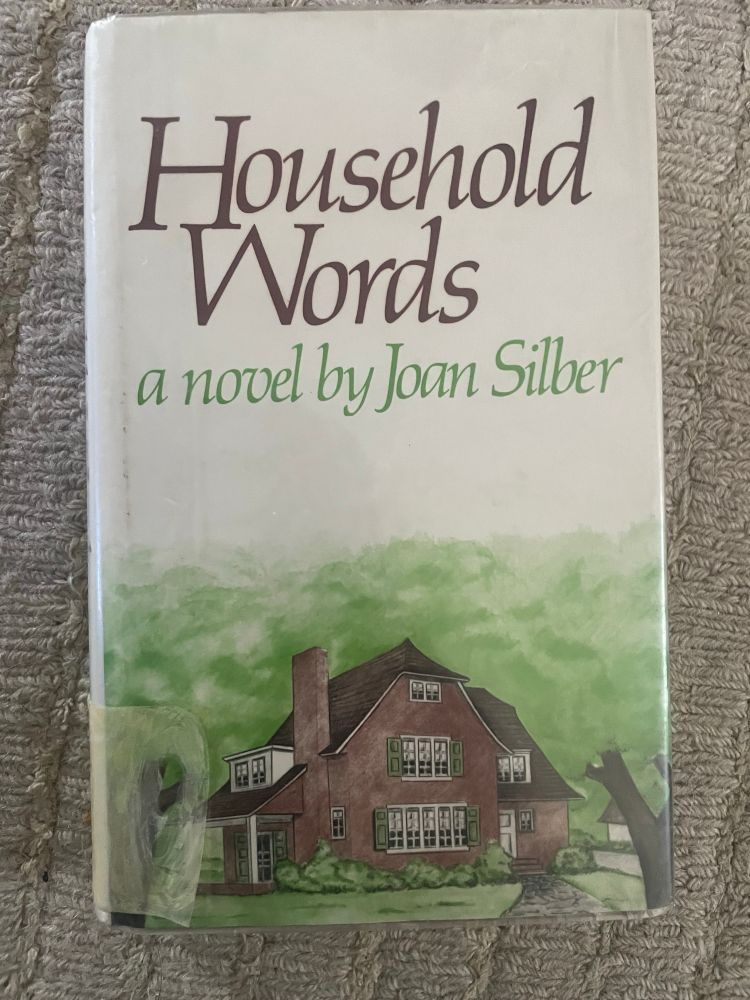
This passage from the beginning of Joan Silber’s debut novel, Household Words (1980), struck me as the kind of thing you don’t see much anymore. Feels like novels rooted in descriptions of the world, and told in third-person past tense (glorious past tense, how I miss it) have become rare, even old-fashioned. Of course, Silber might have had that sense herself: after all, she titled her first novel, as the jacket copy of the first edition puts it, after the magazine published by Charles Dickens.
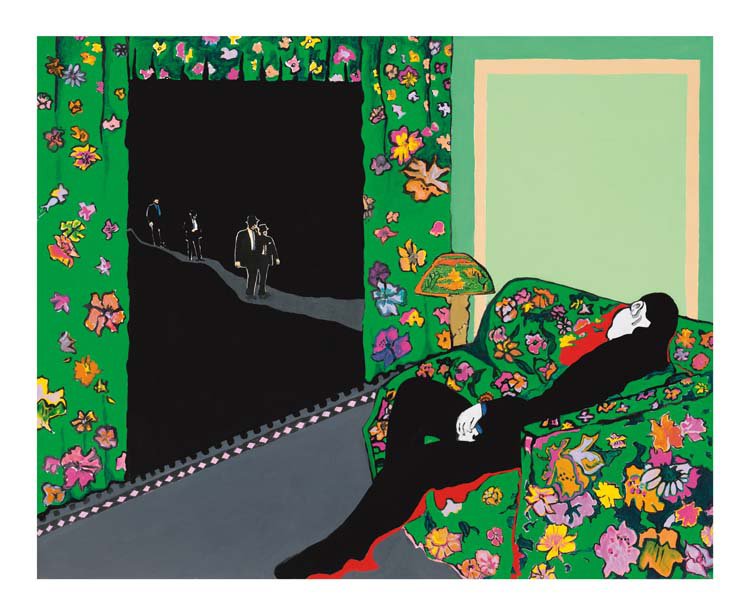
Rosalyn Drexler, Night Visitors (1988)
Silber, as I am starting to learn, having fallen into a deep dive of her works, is an unshowy and excellent writer. Look at what she does in these two sentences. She knows how to use a semi-colon, for one thing. The three clauses of the second sentence move briskly from description to judgment: “Annie was a wiry woman, barely five feet tall; at thirty, she was only four years older than Rhoda, but she was sinewy all over; she looked as though someone had chewed on her like an orange.” To be wiry is not necessarily to be small, but Silber implies that this is the case by mentioning Annie’s height, a seemingly unnecessary qualifier of the first independent clause. “Wiry” sometimes connotes toughness, but at this point in the sentence, we don’t yet have any indication that the adjective is meant to elucidate personality rather than merely describe physical appearance.
The second clause refines our thinking, though. From size we move to age (indirectly learning Rhoda’s). I kind of love the little storm of numbers in this sentence. Annie is thirty: not old by our lights today but older then than now. And older than Rhoda. But what matters to Silber is how the years show themselves on the body. Annie is “sinewy all over”: tough, indigestible. “Sinewy” made me return to “wiry,” forced me to think about the difference between these near synonyms. In this case, it seems worse to be sinewy than wiry. We’re not talking about Annie’s muscles. This isn’t a description of her fortitude. We’re talking about someone whose vitality has been squeezed out. Annie is pulp. She seems to have taken a licking from life already. This is all made clear in the third clause, the simile that compares the woman to a chewed-on orange. Juicy oranges don’t need much chewing. They go down easy. But when they dry out and their pith thickens, they’re harder to enjoy. I picture Annie with a bad tan: probably a fanciful association sparked by the colour orange.
Annie is a recurrent character, but not an especially important one. Even here she serves mostly to help us see Rhoda more clearly. Let’s not forget what Annie says before she’s described: “You really are a character.” It’s not just Annie who thinks so. The novel thinks about Rhoda this way. While Annie seems to speak half-admiringly, half-condescendingly, something like “Oh, Rhoda, you are just not like any of the women in our circle, and frankly that makes me a little uneasy,” the text offers the claim as a simple statement of fact. Rhoda really is a character—the character. We follow her through twenty eventful years, focusing on her experiences and responses, even as we never get fully inside her head. And yet the novel is being more than matter of fact here. Not just describing, but prescribing. It’s saying that Rhoda is worthy of being a character, of being the main character. Coming at the end of several decades of flourishing Jewish American literature, much of it written by men and famously invested in that point of view, Silber gives us something new. After Herzog and Augie March and Zuckerman and Alexander Portnoy Silber offers Rhoda Taber, a housewife living through the first stages of postwar American Jewish assimilation and suburban living.
Rhoda, who speaks Yiddish with her father and English with her social set and thoroughly Americanized daughters, is fascinatingly contradictory. She leaves her job as a schoolteacher when she has children, but her time as a teacher of French shapes her whole life, symbolizing her difference. [Careful, spoiler incoming!] After her husband’s untimely death, she returns to work, even though she doesn’t need the money. Nor does she remarry, even though friends fall over themselves to set her up, and even though she meets a man she enters a longish relationship with. She won’t sleep with him, though, because he’s not desirable to her. Not physically, but emotionally. She thinks of him as uncouth, even violent when she witnesses him doing business.
But this doesn’t mean Rhoda rejects conventions. She’s not like her friend Harriet, an unmarried no-fucks-to-give woman who encourages Rhoda to take art classes with her, even though she has no illusions about her abilities. (“Let’s face it,” Harriet says flatly, about her efforts to sculpt a dog, “it looks like a turd.”) Harriet and Rhoda vacation in the Catskills. Is Harriet gay? We never get the chance to find out. Despite her homophobia (she worries about her older daughter’s friendships in unpleasant ways) Rhoda feels queer to me. Don’t get me wrong, she’s conformist. But only superficially. In the things that matter, she’s out of step with everyone around her. Rhoda has an ugly side, for sure. She responds with disgust to the rumor that her neighbor has been having it off with a delivery boy: not because of the age discrepancy (though we don’t know how old he is) or the class difference, but because she cannot countenance the woman’s sexual desire. She struggles with her daughters, never abusing them outright, but picking fights or welcoming the fights they pick, despairing at the older one’s inability or unwillingness to follow Rhoda’s own life path and contemptuous of the younger’s need to make others like her. At the same time, she admires their independence, their unwillingness to be forced, by men in particular, into situations they don’t want to be in. The book I thought of most as I read Household Words was Vivian Gornick’s Fierce Attachments, another important Jewish book od the1980s. Silber’s novel feels like the fictional version of Gornick’s memoir of postwar American Jewish female rebellion, but in this case written from the mother’s side.
In the end, it’s not family life or economic success or cultural assimilation that Rhoda struggles most with but her own body: she spends the last years of the 1950s, and thus the last sections of the book, increasingly ill and at the mercy of the medical establishment. We leave her as she is leaving everything she knows. It’s a stark ending—and fitting. Rhoda Taber is not a nice woman. Nor a shrewish or disagreeable one. An interesting one. A real character.
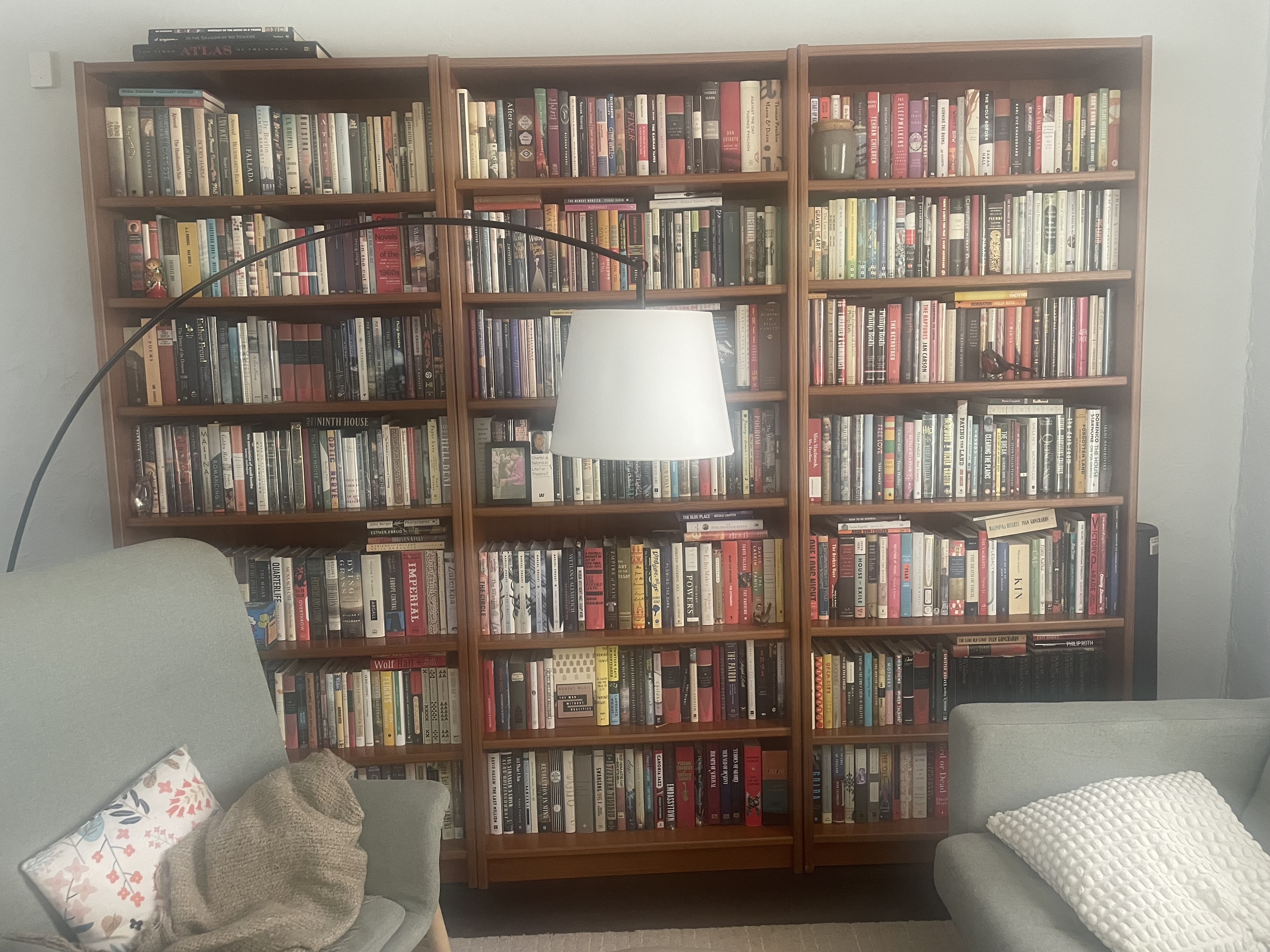
A recent episode of The Mookse and the Gripes podcast got me thinking. Hosts Trevor and Paul were joined by John Williams of the Washington Post (mensches one and all). John had proposed a fascinating topic: starter libraries. The idea was to imagine your response to someone who asked you for ten titles they absolutely had to have in their collection. Probably this person is someone new to literature, a teenager or a student, but maybe they are someone who used to read more than they do now and are looking to get back to that part of their life. What would you recommend?
The important part of the assignment, as I understand it, is that the person is asking you. They know you well enough (parasocially or otherwise) to trust your taste. They respect you enough to be curious about anything you recommend. But they’re not asking for your ten favourite books. Presumably you like the titles on your list. But you’re not just offering them out of personal predilection. You think of them as representative for aspects of literature that matter to you.
Personal but not only personal, might be one way of putting it. Or, in the words of the episode’s subtitle, your choices could be thought of as a shelf full of promises.
Do listen to the episode, it’s terrific. Great lists, fascinating insights into the recommenders. And sure to get you thinking about your own answer. That’s what happened to me: I set aside the laundry I was folding and jotted some notes on my phone, which I’ve now expanded into this list, complete with categories (and alternate choices, because ten books is not many books).
Candida Höfer, Bibliothèque Nationale de France Paris XXI 1998
Books to grow into but also to love when you’re young:
George Eliot, Middlemarch
The only novel in English for adults, Virginia Woolf famously said. Not sure what she meant, but doesn’t it sound good? Having reread it recently, I think you need to be middle aged (and thus an adult… hmm well never mind) to get the most from this story of English provincial life around 1830. But having first read it in college, I can also attest that Middlemarch hits for young people. As with any rich text, what you pay attention to and who you sympathize with shifts each time you read it.
Eliot is known for moral seriousness (maybe that’s why as stylistically different a writer as D. H. Lawrence was a fan), but Middlemarch is also surprisingly funny. Mostly, it’s supremely moving. It covers so much of life, and asks the big questions. What makes a good life? How can we live with purpose? How can we think of ourselves in relation to everyone else? Where do we fit into the web of life?
[Alternate choice: Leo Tolstoy, War & Peace. Never read it until about five years ago, but feel confident it dazzles as much at 20 as at 50. You want novelistic sweep? This one’s as big as Russia… Freemasons and wolf hunts and returns from the dead and slow-burning love affairs lasting across the decades: everything, really.]
Books that master close third-person perspective
Nella Larsen, Passing
Set in Harlem and Chicago in the late 1920s among a set of well-to-do light-skinned Black women who can pass as white, Passing is a great novel of queer frenemies. It hews closely to the perspective of a single character, Irene, whose orderly life as the mother of two boys and wife to a (dissatisfied) doctor falls apart when she runs into a childhood friend, the brave and dangerous Clare. Unless we attend to how events are only offered through Irene’s perspective, we are likely to miss how much the book asks us to question the judgments it only seems to offer.
[Alternate choice: Henry James, What Maisie Knew. In book after book, James wrote about people behaving badly. Yet even among this vast canvas of cruelty, this novel stands out: the people doing the harm are parents who use their young child to hurt each other and, of course, the child. In the preface to the New York Edition James explained that he chose to narrate the book in third person but to limit the perspective to Maisie’s often baffled but also wondering sense of the world in order to offer readers the extra pathos of being able to understand what she could not. It’s quite a trick.]
Books about the Holocaust
Primo Levi, If This Is a Man
If someone is asking me what books they simply must own, they’re absolutely gonna get one about the Holocaust. Hell, I could make them a whole list. But knowing that not everyone shares my fascination, I’ll stick to one of the earliest and most famous instances of Holocaust literature. (Levi composed part of it already while in the camps.) Like all memoirs, If This is a Man (known in the US under the travesty title Survival in Auschwitz) details its author’s particular experience—which took the form it did by his having had “the great good fortune” to have been deported only in 1944, when the turning tide of the war and subsequent internal battle among top Nazis meant that more deportees were selected for slave labour. That phrasing gives you a sense of Levi’s matter-of-fact irony. But something that distinguishes If This Is a Man is Levi’s decision to use “we” even more than “I”: he aims to give a sense of the structure and meaning of the collective victim experience, at least within a subcamp of Auschwitz.
[Alternate choice: Ida Fink, A Scrap of Time and Other Stories. Too little known among English speakers, but, happily, available in a terrific translation by Madeline Levine and Francine Prose, Fink’s heartbreaking stories depict part of the Holocaust most people don’t know about: the mass murder performed by the Einsatzgruppen in Galicia in the summer and fall of 1941. Fink couldn’t find a publisher for these stories until the 1980s; they were deemed of no interest. Another devastating failure on the part of literary opinion. Fink has been called the Chekhov of the Holocaust. Grotesque as this sounds, it’s accurate. Quiet and heartbreaking.]
Members of YIVO New York examine crates of books rescued from the Vilna Ghetto
Books about how to read books:
Roland Barthes, S/Z
Barthes spent a year reading Balzac’s story “Sarrasine” with some students. (Oh to have been in that seminar!) That labour resulted in this extraordinary book, organized around line-by-line readings of the source text, not, as critics usually do, to figure out what it means, but rather how it means. To do so, Barthes offers five “codes”—fundamental elements of realist fiction, of which “Sarrasine” is considered only as a representative example—that readers unconsciously rely on (typically by having imbibed many examples of the genre) in making the text intelligible. The codes are things like references to historical events, people, and places, or attributes and actions that cohere into what we call characters and, in the case of realist literature, think of as if they were people. Barthes Intersperses his step-by-step redescription of the Balzac story with theoretical meditations on the operation of the codes, which readers can extrapolate to other texts.
S/Z is tough. I probably taught it five or six times before I felt I had a real handle on it. But as Barthes says, it’s valuable to be able to distinguish between real and superficial ideas of difference. We might think that the best way to know about books is to read a lot of them. But if we do so without thinking about what underlies their intelligibility (i.e. what we need to be able to read them), then we are mere consumers, doomed to reading the same thing over and over. Only by reading one text over and over can real difference, that is the difference within the text, show itself—which in turn will make our other reading more meaningful. All of which is to say, the effort of tackling Barthes’s analysis offers big rewards.
[No alternate choice. S/Z for everyone.]
Books with pictures:
Alison Bechdel, Fun Home
Comics, graphic novels, whatever you want to call them are important to me, and I think any reader needs at least one example in their library. Such a rich form, so many gorgeous and moving texts to choose from. As with my Holocaust choice, I resisted the temptation to go niche here. Bechdel’s memoir of her relationship with her closeted, self-destructive, talented father deserves its fame. Probably more than any book I regularly taught, Fun Home elicited the strongest positive reactions in the widest range of students. Family disfunction runs deep. A great book about how books can connect people who can’t otherwise open up to each other—and how they can further separate them too. Funny, ominous, bittersweet.
[Alternate choice: Nick Drnaso, Sabrina. Dark, powerful. Reading it gave me a bit of the ick. And yet its subject matter just seems more relevant. I guess this is about the manosphere, except no one was using that hideous term at the time.]
Books of ideas [fiction]
Thomas Mann, The Magic Mountain
Sometimes I want a book that dramatizes the back and forth of thinking. In The Magic Mountain, Mann literalizes this by surrounding his protagonist, the well-meaning, hearty Hans Castorp, with some of the most indefatigable talkers ever to appear in a novel. The whole intellectual landscape of pre-WWI Europe is here (liberal humanist, communist, militarist, hedonist, you name it), and everyone battles for Hans’s soul, even as the former engineer mostly wants to desire a woman from afar, a woman who reminds him of a boy from his schooldays…
The other great thing about this book is how well it depicts Davos and environs. I’m a sucker for mountains and mountains in books. Bring on the snow!
[Alternate choice: Proust. Honestly, if you can only put one book in your starter library, choose this one. I assume it’s already there, but if not then get stuck into this deeply philosophical book, which has so much to say about perception, time, cruelty, and control over others.]
Books of ideas [nonfiction]
W. E. B. DuBois, The Souls of Black Folk
Every American should read it. But non-Americans should too. The idea of double-consciousness—the way a minority must measure themselves by the tape of the majority, as DuBois so memorably puts it in his first pages—explains so much of our contemporary sense of identity.
In addition to its ideas, Souls is a fascinatingly hybrid book, presumably stranger in 1903 than today. Each chapter is prefaced by a bar of music, often from the sorrow songs. Most chapters are essayistic, but some are fictional. Each is written in resonant cadence. Hasn’t dated much. Alas.
[Alternate choice: Hannah Arendt’s The Origins of Totalitarianism. Explains how Nazism and Stalinism came to be so accepted and do so much harm. Especially interesting for (1) its “boomerang” theory of imperial violence, in which what the metropole does in the colony comes back to bite it at home, and (2) its argument that modern antisemitism arose from the waning of Empire and the rise of nationalism. Hasn’t dated much. Alas.]
Monomaniac books
The strand from writers like Kafka, Knut Hamsun, or Robert Walser to someone like Lydia Davis, via the high point of Thomas Bernhard, has been enormously influential in the Anglo-American sphere. At this point, annoyingly so. (And weird, too, given that none of the most important precursors wrote in English.) But I get it because literature excels at tracing the vagaries of a mind, especially one spinning through reversals, paradoxes, and hobby-horses. A starter library should have an example of this sort of thing, and Bernhard might be the best. When the only thing that stands between a psyche adrift or worse is the chance that someone might respond to its voice—that’s when you’re in Bernhard territory. I’ve chosen The Voice Imitator because the title says it all. Read these 104 short texts to get a sense of Bernhard’s bitter, misanthropic, and, oddly, funny vibe.
[Alternate choice: I just named like five other writers!]
Funny books
P. G. Wodehouse, The Code of the Woosters
As implied in what I said about Bernhard, voice-driven books don’t have to be grim. They can make us laugh, whether from the gap between what the narrator claims and what we know, or the sheer verve of their style. The fun only increases when those narrators get embroiled in elegant plots. Wodehouse is the master of this terrirtory and everyone’s library is the better for including him. (I feel like he’s fading a bit from memory? Sad.) You can jump in anywhere—my entry point was the distinctly not-famous-but oh-so-representatively-titled Eggs, Beans, and Crumpets which baffled and delighted me at age 12—but if you’re at a loss start with this wonderful episode in the Jeeves and Bertie series, which Tim Waltz would enjoy, since it’s an early example of the “I condemn the fascists by unflinchingly stating how weird they are” school of responding to authoritarianism. (As Bertie says, appalled by the realization that the Saviours of Britain are simply grown men marching in black shorts: “how perfectly foul!”)
[Alternate choice: for an American version of this phenomenon, reach for Charles Portis, especially the marvelous True Grit.]
Books about crime
Dolores Hitchens, Sleep with Strangers & Sleep with Slander
Since at least Oedipus Rex, literature has used crime to understand fundamental concerns like identity, political organization, and moral value. Crime fiction can be smart, is what I’m saying. And it can also carry us away by inciting our desire to have enigmas explained. (Interestingly, it often makes us realize how much more compelling it is to ask a question than to answer it.) Like any genre, then, crime fiction satisfies at both the intellectual and emotional level. Having stayed with well-known titles so far, I’m diving deep for this last category. Not enough readers, even lovers of crime fiction, have read the mid-century American writer Dolores Hitchens. She wrote a lot of books under a lot of names. But only two about a PI named Jim Spader. Which is sad—but also good because they’re even more special. These make for pretty despairing reading, even for noir. So be warned. But you won’t regret seeking them out.
[Alternate choice: Hundreds! Thousands! Sticking with mid-century American women writers, I’ll plump for Dorothy B. Hughes’s The Expendable Man. Don’t read anything about it beforehand!]
I tried not to think too long in coming up with my choices. Next month or next year I’d choose differently. And I’m aware of some big lapses. No poetry?? No plays?? No Torah?? (Everyone should read the Five Books of Moses.) But that’s ok. Gives you all the more room to think about how you’d create a starter library of your own. What would be on your shelf of promises?
Pleased to once again present reading reviews from some of my favourite readers. Today’s installment, his fourth, is bythat titanic reader, the one and only James Morrison. James lives and works in Adelaide, on unceded Kaurna territory.
John H. Glenn Jr., “Fireflies Outside Friendship 7; First Human-Taken Color Photograph from Space”, 1962
BEST BOOKS READ IN 2024: An Annotated Index of Limited Utility
Books—there’s never any end to them, despite my attempts to read them all. Of the 280-odd I read in 2024 (no, you get a life!), these are the best of those that were new to me. In order to make this as useful(?) as possible, in in the endless quest for cheap novelty, they are presented as annotation to an index of themes. [Ed. – Sorry, missed that last bit. Still thinking about the 280…] Four writers appear twice (Kate Kruimink, Joseph Roth, Percival Everett and Walter Kempowski) and for what I think is the first time, both parties in an extant marriage also make the list (Everett again, with Danzy Senna).
Age, Coming of: Gwendolyn Brooks, Maud Martha & Diane Josefowicz, L’Air du Temps
Two opposing approaches to stories of young girls growing up. Brooks’s 1953 novel is a collage of vignettes stretching over years, the growing up of a Black girl in Chicago, unlucky but resilient, dreaming of a high-class life in the face of her own limited opportunities, Josefowicz’s novella covers just a short period of time in the life of a 13-year-old girl, when the shooting of a neighbour proves to be the catalyst for the peeling back of various local secrets. Brooks was primarily a poet and Josefowicz is a historian, but both of them show themselves to be tremendous fiction writers.
Art, Making of and Prehistory of: Maylis de Kerangal, Painting Time (translated by Jessica Moore)
De Kerangal is a personal favourite, and her best books usually involve a deep dive into some fascinating technical process (organ transplants, restaurant-level cooking, infrastructure engineering, or, in this case, both ancient cave art and trompe-l’œil painting), balanced with beautifully judged explorations of its human pressures and consequences. A compressed, deeply involving history of visual trickery and the impulse to make art.
Art, Making of from Deceased Father’s House: Jen Craig, Wall
In 2023 Craig’s two earlier novels were among my most loved discoveries, and I wasn’t wrong in thinking her third book would also be fantastic. A woman who is and isn’t Craig herself returns home to Australia to empty out her dead father’s house, with an eye to making the contents into an art exhibition. Multiple levels of consciousness rooted in different frames of time, deftly handled so as to be both convincing and presented with clarity, Craig’s prose is a wonder. I was lucky enough to be able to speak with her about one of her earlier books as part of the Wafer-Thin Books discussion series I co-hosted with Brad Bigelow of Neglected Books (neglectedbooks.com) through 2024—video here.
Biracialism, Literature of, Now an Award-Winning TV Series: Danzy Senna, Colored Television
Breezier in style than most of the books here, but far from shallow, Senna’s book features a protagonist obsessed with her own mixed-race nature, author of an undisciplined manuscript that’s becoming “the mulatto War and Peace.” She makes the mistake of getting involved with the Hollywood “prestige TV” world, and complications, as they say, ensue. Race, art, theft, infidelity; it’s all in there, making the sort of book that’s likely to be a big commercial success. Except this time it’s actually a good book. And yes, it does pain me to have to keep spelling the title the (wrong, but in this case “correct”) American way. [Ed. – They’re wrong, the Americans. And they will never admit it, James.]
George Hendrik Breitner, “Marie Jordan Nude, Seen from the Back”, 1889
Black Hole, Haunted by in Silicon Valley: Sarah Rose Etter, Ripe
A Silicon Valley satire—no, wait, come back! It’s well worth your time, and not just because the main character is haunted by her own personal tiny black hole, a physical manifestation of her depression. Things are not improved by her getting pregnant, nor by her various other ill-conceived life choices. A downbeat comedy of unforced errors.
Blitz: Francis Cottam, The Fire Fighter
Look, I have a weakness for Blitz fiction—people trying to go about their ordinary lives each day while having their world hammered each night by bombs is something I’m apparently able to read about endlessly. [Ed. – Same!] Cottam’s 2001 novel about a man given the task of protecting five specific London buildings from firebombs, without knowing why these sites are so important, is vividly convincing about the textures of daily life at the time, as well as exploring duty and treachery under ludicrously extreme circumstances. I’ve not read any of Cottam’s other books, which mostly seem to be supernatural fiction, but if they’re as strong as this they will not disappoint. (For more Blitz fiction, see Norah Hoult under Brains, below)
Boxing, Junior, Internal Thought Processes During: Rita Bullwinkel, Headshot
I enjoyed but didn’t love Bullwinkel’s story collection Belly Up, so if I hadn’t already bought Headshot I might have given it a miss. Yet again, incontinent book purchasing saves the day! [Ed. – As is so often the case!] Basically a series of internal monologues (though in the third person), from each of the teenaged girl contestants in an ill-attended second-rate female boxing tournament in a dusty gym over the course of one weekend, it’s a marvel. Kicks your Hemingway-style boxing crap out the door.
Brains, Decaying: Norah Hoult, There Were No Windows (also Cocktail Bar)
One of the Persephone Books rediscoveries that I can no longer afford due to most British people being dickheads and causing Brexit, thus making it prohibitively expensive to have British books sent to Australia, this 1944 novel by an Irish writer was both depressing and very funny, in the way that you can laugh afterwards about an awful relative, though their physical presence makes you squirm. It’s a pitch-perfect rendering of a deluded snob, hit with encroaching dementia and lowered circumstances, as the German bombs fall on London and servants become scarce. [Ed. – Oof, this sounds like something that might be called “unflinching”!] It was so good I immediately bought her story collection Cocktail Bar, from 1950, and it was similarly full of great things.
British People, Fucking Up Overseas in the Face of Imminent Implied Arachnid Apocalypse: Olivia Manning, The Rain Forest
Olivia Manning, man, such a great writer. Why isn’t all her stuff in print, instead of mainly just the (admittedly brilliant) two Fortunes of War trilogies? The Rain Forest, from 1974, is an intriguing twist on her common theme of a not entirely well-matched married couple doing duty for Britain overseas, in this case in a thinly disguised Madagascar (there are lemurs). Well-meaning ineptness in the face of political intrigue shades into an unexpected hint of global catastrophe to come from humans encroaching into a reservoir of toxic biology deep in an unexplored forest. Wonderful stuff. [Ed. – Wow! Sounds amazing! I, for one, welcome our imminent arachnid overlords.]
Johann August Ephraim Goeze, “Little Water Bear”, 1773
Century, Twentieth, Horrors and Absurdity of: Patrik Ouředník, Europeana (translated by Gerald Turner)
When spellcheck can’t cope with the author name or the title, you’re doing something right. Europeana is a brief but rambling survey of the Twentieth Century in all its ghastliness, where every fact, major or minor, is given equal weight, like a lecture by the most brilliant autistic raconteur in the world. If, like me, you buy the Dalkey Archive Essentials edition, you can also enjoy the brutally trimmed pages that slice off the outer edges of the marginalia.
Convicts, Female, Transcontinental Aquatic Journey of: Kate Kruimink, Astraea
The first of two Kruiminks on this list (see Grief, below), and the inaugural winner of the Weatherglass Novella Prize, this is the entirely shipbound story of a group of women being transported to New South Wales (not Tasmania, as every single review incorrectly states) in the early 1800s, to be servants and breeding stock in the new colony. Plagued by overbearing and/or predatory men in the shape of ship’s captain, crew, and minister, and haunted by their own miseries and guilts, their story is nevertheless a darkly funny one, full of unexpected insights and, for the reader, delights. [Ed. – Yep, getting this one for sure.]
Displacement, Linguistic, Psychological Aftereffects of: Antigone Kefala, The Island
Antigone Kefala is a (deep breath) ethnically Greek Romanian cum Australian via post-WWII refugee resettlement camps, writing in English, her fourth language. This 1984 book, being reprinted in North America this year, is, inevitably, out of print in Australia. It’s a subtle, destabilising, discursive meditation on place and belonging and language; very hard to pin down and quite unusual. [Ed. – Yep, getting this one for sure.]
Domestic Life, Oppressive Atmosphere Within: Fumiko Enchi, The Waiting Years (translated by John Bester)
A wife forced to choose and manage her husband’s concubine, who is still effectively a girl and not an adult, is the core of this disturbing but unsensationalised brief novel from 1957. Enchi was a distinguished, prizewinning novelist, and one of the great female writers of Japan. It’s criminal how little of her work is translated into English. [Ed. – Yep, getting this one for sure.]
Ineko Arima in Tokyo Twilight (Tôkyô boshoku) (Yasujirô Ozu, 1957)
Epics, Tiny and Incomplete: Joseph Roth, Perlefter (translated by Richard Panchyk)
This was the year that, despite pacing myself carefully, I ran out of Joseph Roth fiction. He was one of the greats, a genius and an alcoholic of astonishing powers, and the supreme chronicler of the Habsburg Empire, its collapse, and the darkness that followed. Perlefter is an incomplete novella, found in his papers and published posthumously, yet still substantial enough to hold its own. A wealthy Austrian, observed by an orphaned relative, enthusiastically grapples with the technological and social developments of the early Twentieth Century, all observed with Roth’s characteristically subtle and quirky eye and voice. See also Napoleon, below.
Failure, Artistic, Afterlives of: A. Valliard, The City of Lost Intentions: A Guide for the Artistically Waylaid
I can guarantee you’ve not read anything like this: a consistently inventive tourists’ guide to a netherworld of endless artistic failure and pretension, packed with more ideas per square inch than most books could even dream of, and written with a style recalling the sarcastically decadent fin-de-siècle classics. You’ll probably see yourself in it, and not be happy about it.
Grief, All-Enveloping Nature and Absurdity of: Kate Kruimink, Heartsease
Kruimink’s other novel of 2024 was the longer Heartsease, set in modern Tasmania [Ed. – Sure you don’t mean New South Wales???], and spikily hilarious even though it’s all about loss and grief and neglect. Wryly, unsentimentally Australian in the best way, and including a fine joke about musk sticks. [Ed. – Probably lands better if you know what that is.]
Lesbians, Ancient and Fragmented: Sappho, If Not, Winter: Fragments of Sappho (translated by Anne Carson)
As when trying to describe Ulysses in a previous one of these round-ups, sometimes there’s not a lot you can usefully say about a great book; you just have to point at it and marvel. I’ve read other translations of Sappho before, and loved them, but this really must be the ultimate take in English.
Life, Viewed Askew, in Small Portions: Jessica Westhead, And Also Sharks & Percival Everett, Half an Inch of Water
Two wide-ranging short story collections from the back catalogues of writers I deeply admire. Westhead is Canadian and belongs more to the George Saunders school of fiction (though better and more inventive), while Everett is much harder to pin down—if there’s any American writer working today with a broader, less predictable bibliography then I’ll eat any number of hats. Both books are full of gems, and are frequently genuinely funny.
Nanotechnology, Inadvertent Consequences of treating Cancer with: Anton Hur, Toward Eternity
An industrious and talented translator into and out of Korean, Hur’s first novel is cheeringly excellent: a full-on literary science-fiction exploration of nanotechnology, identity, social collapse, cloning, warfare, and the possibility of a human future, no matter how altered that definition of ‘human’ might be. It’s really enjoyable to see someone so talented engage with the genre in such a serious, productive way, though the results are often pretty bleak. [Ed. – Now I’m mad I had to return it to the library before I could read it.]
Napoleon: Joseph Roth, The Hundred Days (translated by Richard Panchyk)
The second Joseph Roth in this list, and something of an outlier in his work, being a fictional patchwork view of Napoleon through minor figures in his orbit, rather than being set in the Austro-Hungarian Empire. Roth was always great, though, and stepping outside his usual area doesn’t dim his powers one bit. That I now have no fiction by him left unread is a cause of great psychological pain for me. Financial donations to ease my distress will be accepted. [Ed. – Please contribute to James’s GoFundMe. He asks so little.]
Nazis, Fleeing From in Company of Unreliable Man: Helen Wolff, Background for Love (translated by Tristram Wolff)
How did a book this good end up sitting for decades in a drawer, unpublished? Imagine a lost Jean Rhys novel, only with a female protagonist who has agency (alright, so it’s not an exact match) [Ed. – genuine lol], beginning with a couple fleeing to the Côte d’Azur one hot summer to get away from the growing Nazi power at home in Germany. Wolff wrote this book in 1932, but never tried to publish it, even though she later went on to found Pantheon Books in America with her husband. What other masterpieces like this are out there, sitting unpublished in a world where Haruki Murakami and Dan Browns’ every fart gets the hardcover treatment? Truly we live in a fallen world.
Nazis, Revenge on Collaborators with: Martha Albrand, Remembered Anger
In many ways this is ‘just’ an above-average crime/espionage novel, about an American man imprisoned by the Nazis who gets out at the war’s end and tries to find out who sold him out. But what lifts it above that is the fact it was written just as the events it was describing were happening, in the early months of 1945, as Paris wobbled back to the start of normality, by an author (born Heidi Huberta Freybe Loewengard) who was herself politically active against and then a refugee from the Fascists, and it beautifully captures the numerous little details of its time and place to give it a real kick of verisimilitude. [Yep, I’ll be getting this one, and actually reading it!]
Nazis, Rise and Collapse of: Walter Kempowski, All for Nothing (translated by Anthea Bell) & An Ordinary Youth (translated by Michael Lipkin)
A pair of stone-cold masterpieces, looking at Germans in World War II from opposite ends, geographically and temporally. Youth is about boyhood under growing Fascist power and then war, sneaking jazz records and trying to get out of the Nazi Youth, not for political reasons but because you don’t like enforced physical activity. Nothing, on the other hand, is the tale of the slow destruction of a German household on the Eastern Front as the Russians draw closer and closer. Both are wonderfully written, and attempt no form of exculpation of the author or the characters. These are people who didn’t like the Nazis because they were not their social class of person, not because of any ethical qualms. Youth is apparently part of a whole series of books Kempowski wrote in German, and we need all the rest translated NOW. [Ed. – Amen]
Palestine, Staging Hamlet in: Isabella Hammad, Enter Ghost
Even at the best of times trying to stage Hamlet in with an all-Palestinian cast under Israeli rule seems like a logistical nightmare, and these are not the best of times. A Palestinian-born, London-based actress returns to her birthplace and her sister, and almost involuntarily gets caught up in the theatrical project of a distant acquaintance, as well as attempting to reckon with her family and its history. It made me immediately buy Hammad’s first novel, The Parisian, though I haven’t read it yet because it’s huge. [Ed. – I just bought this too, and it’s so huge!]
Sanatorium, Satire of Male Attitudes Within: Olga Tokarczuk, The Empusium (translated by Antonia Lloyd-Jones)
I get the feeling not everyone loved Tokarczuk’s latest book translated into English, but it was very much my kind of thing. A bunch of guys, self-deluded and not as smart as they think they are, discussing the issues of the day and their philosophies, while living in a tuberculosis sanatorium? A strange, supernatural observer/narrator? Sign me up!
Slavery, Literature Of, Remixed: Percival Everett, James
On the other hand, pretty much everyone seems to have loved this, and rightly so. As I mentioned above, Everett is one of the least predictable writers alive, and his take on Huckleberry Finn from Jim’s code-switching point of view is a gripping, funny masterclass in rewriting a classic without redundancy. This is an angry, exciting and surprising book that doesn’t always match the original’s plot. I hope this gets the author the huge audience he deserves, though it’ll also be funny to see this bigger audience attempt to process some of his earlier books.
Unknown photographer, Cat, Year unknown [Ed. — Spooky-ass cat]
Smallpox, Alternative History of World Due to: Francis Spufford, Cahokia Jazz
You know those stories where what begins with a couple of beat cops investigating a crime scene ends up being a whole-of-society-spanning investigation of conspiracy and political intrigue? Well, imagine one of those, written with the perfect mix of style, insight and originality. And it’s set in a version of history where it was the less virulent form of smallpox that was brought to the Americas by Europeans, meaning what has become the United States has done so in the face of much vaster, stronger First Nations. And imagine it’s a huge amount of fun. That’s Cahokia Jazz, baby. [Ed. – Look for this on my year-end list too!]
Troubles, The, Childhood During: Jennifer Johnston, Shadows on OurSkin
Jennifer Johnston is a writer who I idiotically ignored for years because her current UK publisher cursed her with the sort of soft-focus-photo-of-a-woman-in-a-fancy-dress-turned-away-from-the-camera-with-her-head-cropped-off cover photos more commonly found on flimsy commercial fiction. [Ed. – I prefer house-lit-from-within-against-a-nighttime-sky myself.] But then I came across a copy of How Many Miles to Babylon? with a good cover, read it, and was hooked. She’s phenomenally good, a brilliant and unsentimental Irish writer whose particular interest is the way the British occupation of Ireland leaks into and impacts upon the lives of ordinary people. Shadows is one of her best, following the life of a young boy in Derry in the 1970s, half in love with a school teacher who in turn is half in love with the boy’s older brother, who has come back home from England with big ideas and a gun in his back pocket. [Ed. – Damn, I just looked her up and she has so many books!]
Wildfire, Californian: George R Stewart, Fire
A Californian wilderness on fire, with the fire itself as the main character, and telling the story of all the people arrayed against or caught by it. Stewart, who also wrote Earth Abides (a wonderful novel and now a terrible TV series), describes everything with a dispassionate but not cruel eye, and the result, published in 1948, is all too horribly relevant now.
[Ed. — Ladies and gentlemen, give it up for James Morrison, always all too horribly relevant! Seriously, thanks James, this was amazing and budget-busting, as usual.]
A few months, when I was too busy to do anything about it, WordPress told me I’ve been writing this blog for ten years.
André Brasilier, Blue Cavalcade, 1981
I’ve not always been the most diligent blogger, sometimes falling silent for months at a time, but I’ve always returned to it, and that’s not nothing. In fact, since I started keeping monthly logs in January 2019 (halfway through the blog’s life, which bewilders me, since surely that was just a couple of years ago) I’ve written a little something about almost every book I’ve read.
It is quite likely that some things will change in my life next year. Fear not, though, I’ve no plans to shutter the blog. I’ll probably be happy for the continuity. But I do wonder if there are other kinds of writing I might do here. Like many writers, I write best when I’m working on more than one project. I’m using part of my summer to craft a proposal for a book on teaching Holocaust literature at this moment in US history: I recently finished a course from the wonderful Anne Trubek of Belt Publishing that has given me a good start. (Agents and publishers, all my forms of communication are open lol.)
[My daughter says using lol is cringe. Sorry. But how else am I supposed to indicate “I know that is preposterous and I am kidding except that I would really love for it to happen”? Hahahahaha or something?]
I’ve been wondering how I might bring some of that writing variety to this space. When I first started EMJ, I wrote about one book at a time. No surprise to anyone who reads me, these posts were long. Often really long. They really helped me figure out what I thought of a book, though I’m not sure people wanted to read them as much as they did my still-long but shorter responses to a month’s worth of reading. I’m still fond of those early pieces, especially the first one, on a book I still think about a lot, Caleb Crain’s Necessary Errors. Here are a few more that hardly anyone read, but might be worth dusting off. On Irmgard Keun’s After Midnight. On Philip Marsden’s The Bronski House. And, way long, on A Little Life. There’s a ton more in the archives.
I have to admit, though, that the rhythm of the last five years has worked well. The monthly reviews offer a balance between breadth and depth, but would you prefer more pieces about just one book? And what about non-book topics? I’ve always shared writing created for other occasions (like becoming Jewish or reflecting to new students on old friendships). For a while I wrote regularly about my teaching, which I loved doing: I’m basing the book project on some of that stuff. Honestly, I don’t know how I wrote all that stuff, though. My daughter was young then and needed a lot more from me and my wife. Where did the time come from? I guess I was younger too. And that was all pre-covid. I think people overstate the changes between then and now (rather: they overstate the wrong things and ignore the main thing: we still live in a pandemic, we still don’t value the most important kinds of work, our way of life is killing us and the world). But I feel my working life has changed a lot. I don’t think I’m just being middle-aged when I say that it’s harder to be in a helping profession than it used to be. Anyway, I don’t know that I’ll have enough to say about teaching for me to write about it here and in the book. But who knows? Maybe writing about other kinds of art might be fun. The obvious example is film, which used to be a huge part of my life but fell away in the press of family life and career pressures. I’m returning to movies, though: slowly but ever more surely. I might write more about what I’ve been watching. (I think this is the only film-related post at the blog?) Another idea is to invite others to contribute. I’ve had many guests over the years, whether through readalongs (remember those?), shared reading projects, or year in review lists. I love hosting other views, voices, and perspectives. Maybe I could do more in that vein.
What else? Obviously, the look needs refreshing. And yet I am so lazy about that kind of thing. Is it actively off-putting? I admire M. A. Orthofer for many reasons, one being his indifference to graphic design. His site looks the way it looks, the content is what matters, and now it’s so iconic I for one would be crushed if he changed things. This place is no Literary Saloon, but maybe I am inching toward “so old-fashioned it’s actually cool” status. Thoughts?
As you can see, this post is a mixture of questions and ideas: what I wonder about and what I might do. But really what I’m writing here is both a plea for feedback and an expression of gratitude. What do you want to see here? More of the same? Something new? Like what? Whatever your answer, I want to thank you for reading. Blogs are so out of date; social media had made other kinds of communities, other forms of interaction; so many platforms share the thinking of so many smart readers and writers. That you’ve taken an interest in what I think means so much to me. As I’ve written before, I don’t know many passionate readers in real life; this community of readers around the world has meant the world to me. Thank you for everything you’ve taught me, the reading suggestions you’ve made, and the support you’ve offered. I’m filled with gratitude.
Fell behind on these updates during the semester, as usual. Hard to remember that month beyond the usual—the semester taking hold, mostly warm days from the ever-earlier Arkansas spring—but I do know that mostly we were busy getting ready for my daughter’s bat mitzvah in early March. Along the way I squeezed in these books.
Richard Serra (2001)
Thien Pham, Family Style: Memories of an American fromVietnam (2023)
Autobiographical comic about Pham’s family’s journey from Vietnam to the US in the early 1980s via a Thai refugee camp. Each chapter is named after an important dish, ranging from the ball of rice and fish his mother saves for him on their flight from Vietnam to the baffling Salisbury steak of the school cafeteria to the co’m tâm dac biêt (a combo plate, as best I can tell) that he eats with his high school friends.
The palette is somber, mostly browns and greens, but the tone is lively: this is the classic story of American immigrant success, a story none of us can take for granted, which explains, I’d say, why the final chapter concerns the then-41-year-old author’s decision, in 2016, to finally take citizenship, prompted by Trump’s increasingly hostile anti-immigrant rhetoric. Thien and his family go through a lot of hard things: bureaucratic delays, poverty, language barriers, exhausting work that nearly tears the parents apart, and, most of all, at the very beginning of their journey, a harrowing attack by pirates on the way to Thailand, starkly presented by Pham in a series of black pages containing only the sentences his mother whispered into his ears, “It will be ok,” “I’m here,” “I’m right here with you.” But the Phams do more than survive; they thrive. I was delighted to see the haggard, exhausted, frightened yet determined young parents of the opening chapters settle into the gently bickering, food-pushing older couple of the last ones. Pham finishes with “end notes,” in which he answers questions readers are likely to have, like “What do you parents think of this story?”. In his answer, Pham draws his mother popping her head from another room into his studio and shouting (accurately) “I am the hero!”
Samantha Shannon, The Priory of the Orange Tree (2019)
Epic fantasy of two worlds, one based on medieval Europe, one on ancient China and Japan. In the former, dragons are abhorred; in the latter, they are venerated. Those dragons are beautiful and wise creatures of air and sea, nothing like the monsters that nearly destroyed civilization centuries ago before being bound into an endless chasm. The spell that cast the bad dragons there, however, is reaching its thousand-year-end, and they’re determined not to be defeated this time. Can our heroes convince the leaders of the kingdoms and free states and empires to band together to defeat the enemy? (Yes.)
Priory has a satisfying heft. The first 2/3 especially move with satisfying deliberateness; the end, alas, is rushed. I loved falling into the world of the book, though, and was grumpy any time I had to set it aside for anything else.
Herta Müller, The Passport (1986) Trans. Martin Chalmers (1989)
I enjoyed this angular little book about the German-speaking minority in Romanian under Ceausescu, but I hardly remember a thing about it. Does this happen to you? What I remember: 80s rural Romania is grim; men are bad to women; people who leave come home to lord it over those left behind, to compensate for how hard it is in the new land.
Jesse Q. Sutanto, Vera Wong’s Unsolicited Advice for Murderers (2023)
Vera Wong gets up early. Really early. She takes a brisk long walk, being sure to protect her skin from that harmful sun. She makes breakfast and texts her son to ask why he’s still in bed. (Tilly is a layer, very accomplished, but he doesn’t seem to understand how fast life passes you by.) Then, the day well advanced (it must be almost 8), she walks downstairs to open her business, Vera Wang’s World-Famous Teahouse. (She named it after the designer because people love a famous name—Vera is smart like that.) She tends to her sole regular customer, a man whose wife has Alzheimer’s, meaning he can never stay as long as Vera would like, and then settles into long, quiet hours that weigh on her, almost forcing her to recognize that the shop is failing.
Then one morning she comes down to find a man dead on the shop floor. He’s clutching a flash drive, which she takes (for safekeeping, what you think???) before outlining the body, just like on CSI. She uses a sharpie so it will be nice and clear. The police are oddly unhappy about this. Misadventure, the police declare. But Vera knows: this is murder. In the next days four people come by the tea house—very suspicious. Vera slyly gets into conversation with them and learns they all knew the victim, Marshall Chan, who turns out to have been a bad man. Through a combination of bullying, passive-aggressiveness, sheer chutzpah, and plying them with food, Vera gathers what she insists on calling her suspects, forming them into an unlikely friend group and insinuating herself into their lives. She hasn’t had so much fun in years. They are all so nice—but they really need her help getting their lives together. Still, that doesn’t stop Vera from being clear-sighted: one of them is killer!
Vera Wong’s Unsolicited Advice for Murderers is funny, sweet, moving, and even a bit suspenseful. Vera is your classic delightful piece of parental work. Sutanto lets her share her wisdom while also admitting she could be a bit less… intense. I loved this book. My daughter loved this book. Maybe my wife will love this book (she is reading it next). The audio, read by Eunice Wong, is a delight. Don’t sleep on this perfect piece of light reading.
The temptation for a series must be immense. Sutanto should resist, but I hope she doesn’t.
Elana K. Arnold, The Blood Years (2023)
Impressive YA Holocaust novel for young adults that I would recommend to readers of all ages.
What happened to the Jews of Romania is one of the most significant stories of the Holocaust, sadly still too seldom told. The Blood Years, based on the life of the author’s grandmother, begins to rectify that. This is a novel of Czernowitz, that former Austro-Hungarian center of Jewish life in Bukovina. Frederike Teitler and her older sister Astra live a cossetted life: yes, their father left them, plunging their mother into a deep depression that led their grandfather to take the women into his apartment, but things have since settled down. Although Astra increasingly gets up to things her sister knows nothing about, life for the young women still revolves around daily ballet lessons and evocatively rendered summer vacations in the Carpathians. But then comes the war. The antisemitism that had been mostly a hurtful annoyance turns virulent, especially after the interregnum of Soviet rule in 1940 – 41, when Jews were briefly given full rights. When the Germans take over the city in the first wave of Hitler’s war in the east, with the enthusiastic support of most of the locals, Jews suffer pogroms and dispossession. The family is briefly forced into a ghetto and narrowly avoids deportation to Transnistria—a territory across the Dniester that was a hellhole for Jews even by the standards of the Holocaust—only because Astra’s doctor husband, whom she has married against everyone’s will, is deemed an essential worker. Arnold vividly evokes the hunger, illness, and terror of the following years. She organizes the book, as her title implies, around differing instances of blood, from a first period to violence in the streets to tubercular coughing.
I read The Blood Years in a day: it’s well-written, dramatic, sensitive, and, perhaps most importantly, unwilling to sugarcoat its story of survival. The iconography of the Holocaust, which mostly comes from a reductive idea of what happened to the Jews of Poland and western Europe, doesn’t apply to the Romanian story. For this reason alone, I hope lots of people read this book. High school teachers, please consider assigning it!
Binjamin Wilkomirski, Fragments: Memories of a Wartime Childhood (1995) Trans. Carol Brown Janeway (1996)
Infamous text, unsurprisingly now out of print, purporting to be a memoir of the author’s experiences as a very young child during the Holocaust, primarily in Majdenk. Except that Binjamin Wilkomirski is really Bruno Grosjean, whose unwed mother was forced to give up her child to the Swiss foster system in the 1940s. Wilkomirski—that’s the name he’s taken, so I’ll use it too: we are dealing with something other than a pseudonym here—is not Jewish, never lived in Poland, did not survive the Holocaust. When the book was first published—by an imprint of the prestigious Suhrkamp Verlag and by Schocken, the most prominent Jewish American publisher—it received notices that can only be called rapturous. The NYT rave is typical: Wilkomirski “recalls the Holocaust with the powerful immediacy of innocence, injecting well-documented events with fresh terror and poignancy.”
A year or two after its release, Daniel Ganzfried, a Swiss journalist, read Fragments and felt something was amiss. Ganzfried interviewed friends and family of the author, trawled through Holocaust repositories and Swiss archives. He published his findings—a (self) righteous condemnation of Wilkomirski as a fraud—in a prominent Swiss weekly. The German publisher responded by hiring a researcher, Stefan Maechler, to follow up on Ganzfried’s discoveries. Two years later, Maechler, agreed with the allegations, adding even more proof to that already collected. The book was withdrawn; scholars and ordinary readers felt shame and disappointment; no one talked about it anymore.
I was one of those early readers. This was before my interest in the Holocaust turned into my livelihood. I followed the ruckus with interest—I read the flurry of pieces (an especially good one by Elena Lappin ran in Granta) that speculated on why someone would do such a thing—but I was perfectly willing to put the book out of my mind.
Come twenty-five years later to find one of my best students wanting to write her senior thesis on the book, after having read it in a class she took while studying abroad. The student was fascinated by the text, intrigued by the silence surrounding it, and curious about what we might learn from that silence and from reading the text, even knowing it to be fake. I knew I would be teaching a course on the afterlife of the Holocaust this semester, and we decided she should take the opportunity to teach the text. Abroad, her instructor had prefaced the reading by explaining the background. After much discussion, my student and I decided not to tell the students in my class the truth beforehand. This experiment proved fruitful, even if some of the students were rightly un-thrilled by our decision. (We explained the rationale, which allayed most concerns.) Fascinating to see how strongly the text resonated with students, and, concomitantly, how betrayed they felt when they learned the truth. The first day’s conversation about how Wilkomirski represented trauma pivoted, the second day, to an impassioned discussion of whether anyone should ever read this book, and, most importantly, to my mind, how neatly the text matches our expectations of what trauma means.
(On the course feedback forms I asked whether I should teach this again, and, if so, whether I should spill the beans beforehand. They all said I should and no I shouldn’t. Not what I expected.)
Jona Oberski, Childhood (1978) Trans. Ralph Mannheim (1983)
Moving and angry Holocaust story, presented as fiction but closely modeled on the author’s life. (I wrote about it here.) I was interested to compare Wilkomirski’s grotesque exaggerations of Oberski’s reality, and assigned it this semester for the first time, but less obsessed readers can appreciate it all on its own.
James Buchan, Heart’s Journey in Winter (1995)
Baffling, weird spy novel set in West Germany in 1983 amid the furor and fear incited by the decision to place Pershing missiles on German soil.
Buchan’s novel is as thorny in its syntax and structure as a poem. The interlingual pun of the title references Goethe’s “Harzreise im Winter” (A Journey through the Harz Mountains in Winter), playing on the near euphony of Harz and Herz, meaning heart. Readers who struggle to understand what’s going on are just following the lead of the characters. Secret meetings in secluded hunting lodges, cryptic conversations where people tell each other things without saying anything outright, lovers on the run, adultery as a metaphor for spycraft: Buchan uses many of the tropes of the genre, but slantwise, ruthlessly excising exposition. No heroes or resolution here. Imagine a Len Deighton novel, with its sympathy for cold war German seediness, but stripped of the belief that the rules of the game must be followed, however exhaustedly or ironically, and instead replaced with the feverishness of a lieder cycle.
I often forget plots soon after reading; in the case of Heart’s Journey in Winter I forgot it while reading. Like, I mostly had no clue what was going on. I remember instead the descriptions of trout fishing, and evenings at a country inn, where couples drive up from Bonn to sit in mismatched chairs in a newly mown field drinking cold local Riesling. Is this a good book? No idea! Should you read it? No clue!
Svetlana Alexievich, Last Witnesses: An Oral History of the Children of World War II (1985) Trans. Richard Peaver and Larissa Volokhonsky (2019)
Y’all, this book! Finally read Alexievich, and I get the hype. Last Witnesses is a series of vignettes: each chapter the story, told from the position of middle or late age and in their own words with only the lightest editorial commentary, of what the tellers experienced as children during the German invasion of the Soviet Union in WWII. Most begin with that quiet unassuming day in late June 1941 when the country found itself under attack. They begin with the essentials of their family: how many siblings, maybe their ages, sometimes a father (though these are often already away or soon to be called up), and almost always a mother. The mothers leave too, more often than not, whether through death or the choice to join the war effort. Last Witnesses is about loss: families broken apart, loved ones murdered by tank, by gun-shot, by bombs from the air, by hanging. To a lesser degree it’s about resilience: roles and responsibilities taken on much earlier than anyone would ever have expected. But above all it’s about trauma. Decades later, the story-tellers break down, or trail off, or acknowledge how much they suffered from the rupture of their world. The cumulative effect feels important to the project, but it’s not easy on the reader. So much heartbreak. For that reason, it would be weird to say I loved this book, but I sure was impressed. And I was fascinated by a recurring subplot, if you will: the events here narrated are also the story of the Holocaust in Belarus, but in the best Soviet tradition that’s never acknowledged.
Cristoffer Carlsson, Blaze Me a Sun (2021) Trans. Rachel Wilson-Broyles (2023)
Superior Swedish crime fiction. Time was I couldn’t get enough of that stuff: I remember some pleasant weeks in graduate school plowing through Mankell. (A few of those Wallander books are hard to beat for suspense.) But eventually the Scandi-noir boom became a glut: most things are mediocre, after all, and with seemingly every crime writer from Rejkavik to Helsinki available in English I oughtn’t to have been surprised that a lot of it wasn’t that great. But this one made Sarah Weinman’s best of 2023 list and the audiobook was available at the library, so I gave it a try. And I’m glad I did. The structure, pacing, and ambition of the book quickly won me over, and I looked forward to my commute each day. (The narrator seems to know Swedish—judging from his pronunciation of names and places anyway—which compensated for his decision to voice female characters in falsetto. That always makes me crazy.)
The still-unsolved assassination of Olaf Palme seems a trauma from which Sweden has not recovered, so often does it figure in the country’s crime fiction. Carlsson’s novel, set in rural western Sweden, far from Stockholm, concerns a violent crime that takes place on the night of the Palme killings. To his credit, Carlsson keeps the “what has happened to our decent country” hand-wringing/sociological soul searching to a minimum, emphasizing instead how the drive to understand can cascade through generations. Using three narrative levels, the outermost one about a writer who returns from the capital to his hometown in midlife and finds himself drawn to that unsolved crime from the mid 80s, Carlsson pays as much attention to the narration as the discourse. And I didn’t figure out who did it until right before the big reveal. Win all round.
Georgia O’Keeffe, Light Coming Over the Plains, No. II (1917)
Good month, right? (Wilkomirski aside—that’s a special case.) That Buchan tho. What the hell? Anyone ever read that? Other than John Self, I mean.
Excited to once again present reading reviews from some of my favourite readers. Today’s installment, his third, is by Scott Lambridis (@slambridis). Before completing his MFA, Scott earned a degree in neurobiology, and co-founded Omnibucket.com, through which he co-hosts the Action Fiction! performance series. Read more at scottlambridis.com.
Each year I have a reading goal of at least 52 books. This year I read 151, including 37 new countries. Out of those, here’s the top ten, in the order in which they were read.
Edward Hopper, Tramp Steamer, 1908
1. Still No Word from You / Peter Orner (US, non-fiction)
A mix of short (often very short) stories, many centered on growing up in Chicago in a Jewish family, but Orner’s biggest gift is his ever-present love of books and reading. His soliloquys on books he loves, and his skill at tying life memories to the books and stories that resonate with him still are the most captivating and infectious. At the prose level, Orner can shatter you in a sentence. [Ed. – Sounds painful!] And yet if you listen to him talk about stories (his or others’), you’ll notice he’s laughing the entire time. How can you deny that delight?
2. The Ice Palace / Tarjei Vesaas(Norway, fiction)
A Norwegian child takes a walk in the woods after school to see a frozen waterfall, and never returns. Seems simple, but no book has immediately filled me with a sense of coldness and vague menace, and kept it going like this one. The prose is sparse and spare, the story distilled to the very essence of wonder, mystery, and heartbreak. In memory, the book feels like an ice crystal itself. [Ed. – I hear so many wonderful things about this book: keen to read it!]
3. The Summer Book / Tove Jansson(Finland, fiction)
A girl spends a summer with her grandmother, sharing little moments of wonder and delight, in this collection of interconnected stories (technically a novel, but each story is self-contained). It’s hard to explain why I love Jansson so much, but everything she touches is strange and delightful. She’s most known as the creator of the Moomins, that blob-like cast of characters for children, first appearing as a comic strip that swept through Europe and inspired not just a series of wonderful children’s novels, but the Disney-like Moominland (which I must visit some day). There’s also a great documentary on her as a “failed” artist called, simply, Tove. Her magical children’s stories can surprise you with their adult-ish realism, and her “realistic” adult stories read like fairy tales. Start anywhere: you may fall in love.
4. People from Bloomington / Budi Darma(Indonesia, fiction)
A collection of short stories based on the author’s time at Indiana University for grad school. Ho hum, you say? They’re absolutely crazy though! The utter strangeness of them, the people, the absurd human interactions, the grotesque portrayals of common human nature — I’ve never read anything like it. A simple mundane event sets off a series of events leading to completely unpredictable endings. The narrators in particular (or maybe “the” narrator, since they have similar voices) observe and make note of the most unusual things. The narrator in one story falls and smashes a cake and when he opens the box he says “it looked worse than Mrs Ellison’s face,” a face never mentioned before or after. In another: “Good thing her big ears didn’t fall off.” Hilarious and bizarre! The friend who recommended it said it best: “The book is described as a realistic world portrayed through an absurdist frame, but I would add that even the way he achieves this is unique.” This is a weird book where weird things happen to weird people, revealing the deep strangeness waiting beneath seemingly tranquil suburban life. Beware though: you’ll probably never want to visit Bloomington.
5. Treasures of The Thunder Dragon: A Portrait of Bhutan / Ashi Dorji Wangmo Wangchuck (Bhutan, non-fiction)
Written by the current Queen Mother of Bhutan! [Ed. – Probably the only book from Bhutan ever mentioned on this site—and absolutely the only book from Bhutanese royalty.] Bhutan is fascinating in its own right, as a mostly isolated piece of protected land in the Himalayas most notable for prioritizing Gross National Happiness over Gross National Product. Why is this important to them, how did they come to it, how do they legislate and realize this drive towards happiness day to day, and what does that mean for the rest of us? The Queen Mother weaves the answers to these questions as takes you along her own tour of the country, its villages, its wonders, and its people. Her love of this unique country, at once more primitive and further evolved than our own (and a great many others) is so gently omnipresent that you’ll start looking for flights before you finish.
6. Death and the Penguin / Andrey Kurkov(Ukraine, fiction)
I picked this up on the recommendation of a Russian friend just after the war in the Ukraine began. I normally don’t rank my top 10s, but I will dub this one my favorite of the year without hesitation. An aspiring writer is offered a job writing obituaries for a newspaper, for people whom it turns out aren’t dead yet. Oh and he also lives with a melancholic penguin named Misha he’s adopted from the local zoo. It’s a noir mystery in flavor, full of dark humor as the two of them are thrown into a mafia intrigue the protagonist never fully understands or even appreciates. There’s a sequel too, but this one was so good I’m scared to read it. [Ed. – Agree, terrific book. I too have had the sequel sitting here for years, unread…]
7. The English Understand Wool / Helen DeWitt(US, fiction)
What was this book? Who is this author? [Ed. – A genius!] A novella from my favorite publisher, New Directions, coming in at barely 70 pages, and dubbed a fairy tale by Google (it is not a fairy tale), it’s the story of a sassy 17-year-old girl obsessed with extreme taste and avoiding mauvais ton in all situations, who loses her family, and all her money, and must weigh her wits single-handedly against the sharks of the New York publishing world who want to sign a deal with her and sell her story. Brutal, savage, artfully heartless, absolutely precise, and with an ending that’s pure genius.
8. The Royal Game / Stefan Zweig(Austria, fiction)
RIYL The Queen’s Gambit, Zweig’s classic chess story written 80 years earlier tells the tale of an unnamed narrator who discovers a Russian chess master is traveling in the same boat from New York to Buenos Aires in the midst of WWII, and attempts to lure him into a casual game the narrator is sure to lose. He begins receiving whispered advice from a watching businessman, and what unfolds over the course of three matches that challenge the pompous Russian master’s assumptions and abilities is the parallel tale of this Austrian’s businessman’s arrest, imprisonment, and torture by the Gestapo. Memorizing chess moves in solitary confinement is his only means of survival and, as Zweig deftly describes in only 100 pages, both his triumph and undoing.
9. Every Man For Himself and God Against All / Werner Herzog(Germany, non-fiction)
The south German drawl of this prolific director of both documentaries (Grizzly Man) and features (Aguirre the Wrath of God) is legendary, narrating his films with metered precision the wondrous horror of existence (“Even the stars up here in the sky look like a mess; there is no harmony in the universe” is a classic, but my fav is the YouTube of an interview with him in which he’s shot and when asked about it simply waves the question away and remarks, “It was not a significant bullet”), so I highly recommend listening to this autobiography with Herzog reading it. [Ed. – Agreed that’s a classic, but don’t sleep on his retellings of Curious George, also on YouTube.] His films are renowned for the unique point of view of his protagonists, and the singularity of his images, but it’s challenging to have a conversation about him without addressing or succumbing to the mystique of his deeds as a filmmaker. The shit this guy puts himself through for a shot! For “truth”! So when he describes episodes from his life (filming or not), you start to wonder how much he’s nurturing his own myth. My favorite moments: nearly killing himself on skis on a dare, reading dead letters sent to the town of Northpole (it exists), and meeting a pair of identical twin diagnosed nymphomaniacs who finish each other’s sentences and stare into each other’s eyes instead of a mirror to fix their hair and makeup. The book will make you want to see every film, and imagine the ones he hasn’t gotten to make, but even more you might just find yourself envying (kinda) such a superhuman life. Enjoy it as an autobiography of an artist with a singular vision, or as a larger-than-life caricature of a man who is probably fully aware of his own mythology and how to keep it alive.
Edward Burtynsky, Shipyard #12, Qili Port, Zhejiang Province, China (2005)
10. Maniac / Benjamín Labatut(Chile, non-fiction) [Ed. – Listed by many as a novel, FWIW]
Last year, this science-loving essayist made my top 10 with When We Cease To Understand the World, his series of vignettes on famous physicists and mathematicians staring into the abyss in the act of or as a consequence of their insights and creations, each which reads more like dramatization than documentary. In Maniac, he narrows his focus and dives into one of the most singularly brilliant minds of all time, Hungarian John von Neumann, the one-man think tank behind everything from the atomic bomb to the invention of computing, game theory, genetics, and artificial intelligence, a genius coveted by the US government for his necessity in national security even more than Oppenheimer, and a guy many have heard of (including myself; there are math constants named after him), but couldn’t say much about. Heavily researched, and told through a chorus of voices, Maniac recreates a man everyone should know of, and captures with propulsive momentum the ascent of modernity alongside the decline of a mind too ineffable to endure. The last section leaps away from von Neumann and dramatizes the moment when AI categorically shifts its capabilities from chessmaster to confounding the masters of the world’s most esoteric ancient game, Go, and becomes something beyond a simple calculating machine, something new, and beyond our comprehension. Whether you believe the hype and horror of those who believed a computer could never a master the art of a game so complex as Go, it’s Labatut’s primary interest in and his ability to render our human fear of science and technology that makes this book stand out [Ed. – Thanks, Scott!]
Excited to once again present reading reviews from some of my favourite readers. Kicking things off is the one and only James Morrison, back for his thirdinstallment. James lives and works in Adelaide, Australia, on unceded Kaurna Country. For many years he has written about book design as the Caustic Cover Critic. He has too many books. He’s online at @Unwise_Trousers (Twitter) or @causticcovercritic.bsky.social (Bluesky). His first novel, Gibbons, or One Bloody Thing After Another, was published in 2023 by Orbis Tertius Press.
‘Tonight too / does my woman’s pitch-black hair / trail upon the floor / where she sleeps without me?’ Masayuki Miyata
[We push through the crowded train station and step up into the carriage, compulsively checking you have your ticket several times in the process. You find a seat and open your mouth to speak, but I suddenly launch into a monologue.]
So, yes, it was a tremendously crappy year, both personally and globally, but at least I got some books read. Indeed, that’s pretty much all I did. I scythed through 296 books, and only a few of them were terrible, so that’s some sort of achievement right there. Right? Right??? [Ed. – Holy shit yes.]
DENSE SLICES OF TIME
Two of the most fascinating non-fiction books I read this year both took the same approach—densely researched group portraits of the lives of interconnected writers and artists over the period of a month or so—applied to two very different eras. Alethea Hayter’s A Sultry Month (1965) covers the world of literary London in June 1846, from Robert Browning and Elizabeth Barrett planning their elopement to Jane and Thomas Carlyle driving each other round the bend, all joined together by the last acts of now-forgotten artist Benjamin Robert Haydon as he prepares his suicide. Uwe Wittstock’s February 1933: The Winter of Literature, translated by Daniel Bowles (2021/23), uses the same close focus on the writers, filmmakers, dancers and actors of Germany in the first month of Hitler’s power, from Joseph Roth wisely fleeing, via Thomas Mann being unbelievably naïve, to Gottfried Benn enthusiastically Nazifying himself. It’s chilling and depressing in equal measures, what with [points helplessly at everything]. [Ed. – *nods glumly *]
As a pendant to the Wittstock, Lion Feuchtwanger’s The Oppermanns (1933), translated by James Cleugh, is hard to beat, detailing the rise of the Nazis through the story of a successful Jewish Berlin family. Written when the events it details were still ongoing, and with much worse to come, it is a perceptive and still timely book. [Ed. – Amen]
From ‘The adventures of Sindbad’ Leon Carre
AUSTRALIANS
It’s wonderful to have been one of the many readers who finally got hold of the books of Jen Craig this year, and fell in love with them. Intensely, almost claustrophobically, looping narratives of communication breakdowns, troublesome families, injuries, art, eating disorders, and the irritation of being named Jenny Craig when that’s the name of the country’s most famous dieting pyramid scheme. The experience of reading each book—Since the Accident (2013) and Panthers and the Museum of Fire (2015)—is something like peering closely at the back of an incredibly detailed tapestry, trying to guess at the structure, and then with the last few pages suddenly flipping it over to discover a masterpiece. I also read her third novel, Wall (2023), but that was earlier this month so just imagine me saying something similar in 12 months about that.
Susan McCreery’s All the Unloved (2023) is a wonderful novella about the inhabitants of a block of flats in 1990s beachside Sydney, centred on a teenaged girl’s coming of age. Amanda Lohrey’s Vertigo (2009) is another small gem, the story of a traumatised couple fleeing to a new home on the rural coast, and ending in bushfire and terror, told in an engagingly odd way. The two most recent collections of Greg Egan’s short stories, Instantiation (2020) and Sleep and the Soul (2023), demonstrate with impressive depth just why he is widely regarded as one of the world’s best science-fiction writers, especially at this length—story after story will use an amazing idea that a lesser writer would spend a 1200p trilogy on, and then move on to something else even more mind-boggling in just a couple of dozen pages.
Adam Ouston’s Waypoints (2022) is a splendid example of one of my favourite genres of book—an obsessive monologue by an unreliable narrator, in this case somewhat pinned to reality through the disappearance of airliner MH370 in 2014 and Harry Houdini’s attempts to be the first person to fly an airplane over Australia in 1910. Finally, Tommi Parrish’s newest graphic novel, Men I Trust (2023), is a drably beautiful exploration of parasitic friendship, and I really am trying to get over the fact that they mistakenly include a Walmart in an Australian setting. [Ed. – Oh I just picked this up—had no idea it was Australian!]
[The conductor passes down the corridor, bellowing in a monotone. “This train is about to depart, all visitors please leave! Ticketholders only!” A small, relieved smile passes over your face as I step down from the carriage onto the platform, still talking.]
HUNGARIANS
Anyone who has read one of my year-in-readings before knows how I go on about the Hungarians. And here I am doing it again. The best Hungarian literature I read this year was Magda Szabó’s The Fawn (1959/2023), translated by Len Rix, the story of the career and personal life of increasingly enraged actress through Hungary’s tumultuous mid-twentieth Century. Spadework for a Palace by László Krasznahorkai (2018/2022), translated by John Batki, is another tremendous example of the obsessive monologue/unreliable narrator mentioned above. And Ágota Kristóf’s Yesterday (1995/2019), translated by David Watson, was sadly the last book of hers I had left unread: an illegitimate small-town child flees his past by moving to the city, but the reappearance of his now-married childhood love throws everything into chaos.
‘Hare 2’ Jan Pypers
OUTER SPACE, INNER SPACE
Samantha Harvey’s Orbital was just my cup of tea, a quiet and thoughtful 24-hour slice of the lives of six people at work, where said work is in the International Space Station in its final days. In Ascension by Martin MacInnes goes further afield, from the ocean depths to the Oort Cloud, in search of First Contact, strange dreams, and the dawn of life. I loved it, but not unreservedly—there were occasional weird glitches, like MacInnes’s childlike idea that as you travel through the Solar System you pass the planets one by one in a neat line, the way they are drawn in a kids’ encyclopaedia. [Ed. – Wait, that’s not what they’re like???]
The This (2022) by the always interesting, and ludicrously underrated, Adam Roberts, is a hugely entertaining extrapolation from the near into the far future, taking us from the Next Big Thing in social media to humanity as a hive mind. And an end-of-year treat was the new collection Selected Nonfiction 1962-2007 (2023) by J. G. Ballard, a chunky and tremendously entertaining mix of reviews, articles, memoirs, lists and rants.
[The train begins to move, very slowly at first. I’m standing at your carriage window, still talking, and I begin to walk along the platform, keeping pace with the train. You glance at your fellow passengers, blushing.] [Ed. – Ugh shit like this is sooo embarrassing… What a weirdo right I don’t even know that guy!]
ENDS
There were lots of excellent cataclysms in this year’s reading. How I’d taken this long to read David Markson’s Wittgenstein’s Mistress is both mysterious and an indictment on me, but this beautiful book from the point of view of possibly the last woman on Earth is full of gorgeous writing and vivid images. [Ed. – Is she thrilled to be free of bros at long last?] I absolutely loved it. I also loved Oana Aristide’s Under the Blue, a particularly well-done plague-and-after novel, so I was very sad to get in a fight and end up blocking the author online because of her being an anti-trans bigot. Why are authors all so unpleasant?
Pink Slime (2020/2023) is an Uruguayan novel of toxic miasma and slow societal collapse by Fernanda Trías, translated by Heather Cleary, another weird case of a book being written pre-COVID that foreshadows and refracts the weirdness we all then went through. Rebecca Campbell’s Arboreality (2022) is a Canadian novel in stories that takes us further and further into our future of rising waters and collapsing ecosystems, offering no cheap false hope but still providing a glimpse of something worth being alive for. [Ed. – I keep hearing about this book. Gotta check that out.]
And turning from global to personal cataclysm, there was Lorrie Moore’s I Am Homeless If This Is Not My Home (2023), where one of the two main characters is very, very dead. But readers of Anagrams will know well that a character doesn’t have to exist for them to be vividly, hilariously rendered by Moore.
STORIES
There were so many resurrections and collections of great short story writers this year. Among the best were Rattlebone (1994) by Maxine Clair and Lover Man (1959) by Alston Anderson, both beautifully observed interconnected collections about Black American communities. No Love Lost (2023) collects the incredible novellas of Rachel Ingalls, and if there’s a richer, stranger book than this out there, send it to me now!
Jean Stafford’s Children Are Bored on Sunday (1945) is as brilliant as the title promises. [Ed. – Great fucking title.] I also read her novel The Mountain Lion (1947), and fucking hell could she write. Weird misfit children, unhappy loves, badly behaved artists. Have at it!
Tessa Yang’s The Runaway Restaurant (2022) and Madeline Cash’s Earth Angel (2023) were two of the best new story collections I came across this year. Both are peculiar and fizzing with ideas, completely happy to depart reality for the depths of weirdness at the drop of a hat, and very moving—imagine George Saunders if he was actually as good as everyone thinks he is. [Ed. – Heh, you’re not wrong, James…]
And then there was The Collected Works of Jo Ann Beard (2023), which was an absolute revelation. Stories, autofiction, memoir, reportage, not of it conventional, all of it astonishing in its quality and death-haunted eccentric brilliance.
[The train accelerates. You try to pretend the man running along at the window, now bellowing, has nothing to do with you. Not paying attention to where I’m going, I run full-tilt into a metal bin with a resounding clang.] [Ed. — *snort *]
‘Nature Takes Over’ Thomas Strogalski
RANDOM OTHERS
Some books you just can’t shoehorn awkwardly into a category, and there are still too many good ones left to mention. In brief:
Elspeth Barker’s O Caledonia (1991) pairs perfectly with The Mountain Lion, a black comedy about a strange and unloved daughter.
James Hannaham’s Didn’t Nobody Give a Shit What Happened to Carlotta (2022) is a delicious exercise in capturing a voice, in which a trans woman gets out of prison and tries to reconnect with her family and normal life.
Szilvia Molnar’s The Nursery (2023) is an unnerving and convincing novel of fear-of-everything from the point-of-view of a new mother.
Nigel Balchin’s Simple Life (1935) starts off like a mild comedy mocking get-back-to-the-land types, but quickly turns into a fascinating and alarming study of a fraught ménage à trois in a cottage in the middle of nowhere.
And finally, the complete Diaries of Franz Kafka, translated by Ross Benjamin (2023): a monolith of a book, a treasure trove, a heartbreaking testament.
From ‘L’Ange’ Patrick Bokanowski
[You glance back, caught between relief and embarrassment, as I leap to my feet and charge like a maniac after the repeating train, still yelling. Then I reach the end of the platform and plunge into the shrubbery, vanishing from sight. You exhale, and pull out your book to start reading in blessed peace.] [Ed. – Not true, I’d do almost anything to spend a train ride talking books with you, James!]