Keith Bresnahan’s Year in Reading, 2024

Pleased to once again present reading reviews from some of my favourite readers. Today’s installment, his third, is by my longtime friend Keith Bresnahan. He is a self-described harrumphing scrivener who lives and works in Toronto.

Roger Deakins, The Rail to Grants, New Mexico (2014)

2024 was a difficult year, marked by personal loss. In July, an old friend from graduate school, a brilliant and feisty scholar of the Horn of Africa, succumbed to the cancer that she had been living with on and off for the past decade. And then in October, another death. My oldest and closest friend, with whom I’d been friends since kindergarten, died of an aggressive cancer he’d been diagnosed with only 11 months earlier. I’d managed to get down to Atlanta, where he’d recently taken on a new academic position, a few times to see him—the last just weeks before his passing—but it still felt inadequate, and very sad.

Throughout all this, I was working on writing my own book, on architectural destruction and emotion in late-nineteenth century France. Despite spending the last half of the year on sabbatical from teaching, I didn’t manage to finish it, which was also difficult. But: I’m still here, and the work continues amid the usual teaching and service. I’m casting an envious eye on those colleagues leaving academia for greener or at least other pastures. But for now, this is where I’m at.

Apart from the reading I did for my own book project, which was substantial, my extracurricular reading this year was not insignificant: 65 books, if my list is correct.

I read a lot of mysteries, by French, Irish, English, Japanese authors. I read a lot of Georges Simenon, though not the Inspector Maigret series. (I read the last of these—75 novels and three short-story collections—a few years back. Would that there were more.) Unusually for me, I read quite a few Canadian authors, and a couple American ones, and one Sicilian. A bunch of French graphic novels/comics. And I finished my reading, begun many years ago, of Zola’s 20-voume Rougon-Macquart saga.

Here are the ones that stayed with me:

In the first days of 2024 (feels like a lifetime ago), I read Geoffrey Household’s Rogue Male, which was as great as everyone says. An Englishman, having attempted to assassinate an unnamed European dictator (Hitler, quite obviously) is now being pursued by agents across the continent. It’s a white-knuckle ride that in its second act switches pace to a two-person détente, in which our hero slowly plays out becoming-animal (the ‘rogue male’) in a kind of homemade burrow. Super-weird, I loved it. My only complaint is with the book’s end, which reveals a deeply personal rationale for the assassination attempt, practically undoing the whole perversely-unmotivated-action-begets-tragic-outcomes schema of all that had come before. Still, highly recommended.

Seicho Matsumoto, Point Zero. I had read his mystery A Quiet Place a couple years back and loved it. [Ed. – Agreed, so good.] Point Zero, like that one, is translated by Louise Heal Kawai for Bitter Lemon Press. As I progressed in the book, I started wondering: had I read this before? It all had a vaguely familiar ring. It turns out I had not; but I had watched Yoshitarō Nomura’s excellent 1961 film adaptation, Zero Focus. It’s an excellent, propulsive tale of a woman whose new husband has gone missing, and her search to find the truth. I figured out (or remembered?) who ‘did it’ about 2/3 of the way through, but it hardly mattered. Great, though A Quiet Place still has the edge for me. More Matsumoto in English, please!! [Ed. – I gather there’s a ton of him. Sort of like Simenon.]

Other Japanese books I read this year: Seishi Yokomizo, The Devil’s Flute Murders and The Little Sparrow Murders (fine, if workmanlike, mysteries); Jun’ichirō Tanizaki, Naomi (a striking tale of manic obsession and cuckoldry, but the main characters aggravated me to no end).

I also read Yoel Hoffmann’s edited anthology Japanese Death Poems, which I received as a tongue-in-cheek birthday gift (although they knew I’d also love it). It’s what it sounds like: a collection of short poems, mostly haiku, written over centuries by monks and poets and ordinary folks on the verge of death, or in anticipation of dying. Fascinating stuff. I read it in the fall, in the midst of grief. Good to meditate on, and dip in and out of.

Also in the mystery vein, I continued to work my way through Magdalen Nabb’s Marshal Guarnaccia books, set in Florence. I like every one of these I’ve read, and this year I went back to the beginning, to read (new to me) the first in the series, Death of an Englishman. Excellent and atmospheric, and I loved that Guarnaccia has the flu and only shows up at the very end for this first book in his own saga. [Ed. – Intriguing!]

My last read of the year was also a mystery (they really do seem to fit the winter holidays in a way I can’t explain): John Banville’s The Lock-Up. This is a late book in his Quirke series (originally published under the pseudonym ‘Benjamin Black’), but the first I’ve read. For whatever reason, I’ve never got on with Banville’s literary fiction (I know, shame on me). [Ed. – I dunno, I’m not sure he’s all that, actually.] But this hit the spot. Quirke, a weary alcoholic pathologist, investigates the murder of a young Jewish woman in 1950s Dublin. All sorts of side-narratives here: former Nazis escaping justice with the help of the Church, arms dealings in Israel, romantic entanglements, struggles with work colleagues. Yes, aspects of it are clichéd and feel dated, despite being published in 2023. What can I say? I liked it enough to immediately reserve four other books in the series at my local library branch, so watch this space for more in my 2025 round-up.

George Simenon: since finishing the Maigrets, I’ve been slowly working through some of his other output: these 300-odd standalone books are often gathered under the rubric of ‘romans durs’ (‘hard novels’). They’re hard looks at human nature, alright, though not always violent or murderous. I read 19 of these this year, including a bunch of the ones he wrote while living in the USA in the 1950s, and set there (for whatever reason these have never struck me with the same truth as his French-set novels). Some leitmotifs: voyeurism, small-town prejudice, frustrated men, philandering men, sensual women, penny-pinching women, family squabbles, and men who suddenly realize that their wives resemble their mothers. Nothing if not Freudian, this guy.

My favourites: The Krull House; The Venice Train; Account Unsettled; Striptease; The Little Saint; The Man with the Little Dog; The Little Man from Arcangel. For me, this last one was the best: A Russian-Jewish bookseller and philatelist, assimilated to France since arriving there as a young boy and living in a small town’s market district, marries a promiscuous younger woman from the town. She leaves one evening and does not return, and suspicion slowly falls on him. It’s a masterful study in the vicious closedness and rumor-mill of a community against a person they had superficially but never deeply accepted, driving to an inevitably sad conclusion. I’d put this up against any literary study of othering and alienation, any day of the week. [Ed. – 100: this one will be on my year in review list, too.]

I also read Pedigree, Simenon’s memoir of his life from birth to age 15 in Belgium (Liège, to be precise), focused mostly on his mother and her family. The basic elements of his other books seem to pretty much have their origins here, except the murders. A note about his mother, whom he felt never sufficiently loved him: from the 1930s to the early 1970s Simenon wrote fiction with compulsive mania, averaging 10-15 books a year. Then his mother died, and he never wrote another novel. Did I already mention Freud?

My Can-Lit year:

I like Canadian literature as much as the next guy, provided the next guy likes it but doesn’t make a habit of it. [Ed. – Handshake emoji.] But, I was a visiting fellow at Massey College at the University of Toronto this past year, where the spirit of Robertson Davies flows through the corridors, and where I had some interesting discussions of Canadian literature with my fellow fellows — including David Chariandy, whose very fine reflection on race and parenthood in Canada, I’ve Been Meaning to Tell You, I also read this year. All of which prompted me to pick up some books:

Helen Humphreys, Coventry: I really enjoyed this short novel set during the burning of Coventry Cathedral in November 1940, with intersecting stories of two women. Canadian author, if not Canadian content. Also a bit of a cheat, since I read it for another academic project on ruins. But everything counts!

Robertson Davies, The Deptford Trilogy. One of the landmarks of Can-Lit. I’d read Fifth Business (the first novel in the series) decades ago, but never the other two, The Manticore and World of Wonders. I read them all in quick succession in the depths of a Toronto winter. Fifth Business, set in small-town Ontario and then Toronto (with a side-swerve to WWI Europe) is seriously great. I would read it again right now. The Manticore: was I surprised that the next book in the series sees our hero undertaking Jungian analysis in Switzerland? Yes. Did I like it? Also yes, but decidedly less than the first book. The third, World of Wonders, picks up threads from the other two, and set in the world of circuses and magic. There is thus a lot here about stagecraft, circus life, and stage magicians, all of which are things that repel me, frankly. [Ed. – We are the same person, Keith.] So, not my bag. But still, a satisfying enough conclusion.

Marian Engel, The Tattooed Woman. Well, we know how we feel about a certain book by Engel, don’t we? [Ed. – We feel grrrrreat about it.] Bear has been featured here on occasion, including the last time I did one of these year-in-reviews. Here we have her last published work (from 1985), a collection of short stories featuring women at middle age, dealing with children and partners and aging. A mixed bag, with some standouts. Not a patch on Bear, but worth a look. [Ed. – Totally agree with this assessment.]

Helen Weinzweig, Basic Black with Pearls. Thanks to the folks at NYRB Classics for bringing this 1980 book back into print. [Ed. – Also available from the good folks at Anansi Press.] An unexpected treat. A woman, estranged from her husband and family, wanders through Toronto, maybe looking for her mysterious lover, who may be a spy (and who also may not exist) and then maybe goes home where another woman maybe now lives in her place. A psychological novel in the best sense. As a local, I loved the street-level view of my city. However, I feel compelled to add an editorial note: you can’t get to Dundas from Queen going south on McCaul, lady.

Following this, I read an earlier Weinzweig, her first: Passing Ceremony. An episodic, fragmentary exercise in which varied voices unfold in non-linear fashion a wedding and its reception. Everyone seems to have a past and beef with the bride, while the gay groom in it for the social beard pines for a lost love. Fine, but I liked it less.

Brian Moore, Catholics. A fine short novel of faith and orders and the world, set in a remote Irish abbey in the wake of Vatican II. The Abbot, no zealot, has in fact has lost his faith, serving as mere manager of a group of working monks. The interactions between him and the young American priest sent from Rome to compel him to conform to the changed rituals are excellent. It compelled me, let me tell you. And it didn’t stay a minute past its welcome. It was one of the last books I discussed with my very Catholic friend—himself a great reader—in his dying months. Again, there’s no mention of Canada in the book, though this was (Irish) Moore’s adopted country, so I’ll count it here.

Zola:

As I’ve mentioned, this was the year I finished in Zola’s monumental Rougon-Macquart series, following two branches of this family through the whole of Second Empire France (1852-1870; the novels themselves were written 1871–1893). The books themselves vary, but I would recommend these to anyone. One of the great reading experiences of my life. Look forward to revisiting it in, oh, 30 years or so. You in, Dorian? [Ed. – Your faith in my longevity is touching, Keith. I still need to finish my first go-round. But, yes, if I’m still here and able in my 80s, you got it.]

Here are the ones I read this year, in the order in which I read them.

Money. Took me a while to finish this: kept putting it down and then coming back to it. The rise and fall of a speculative bank in 1860s Paris and those who are brought up and laid low by it. Beneath it all, Zola’s usual interest in ambition, passion, crisis, and heredity.

Earth. More disagreeable people. Really disagreeable. Maybe the worst people in the whole series. Zola’s great novel of peasant life. The earth is the great character here (the title gives it away), but it’s often obscured by the endless wretched goings-on of these stingy and promiscuous bastards. Wears its King Lear heavily on its sleeve. There’s no redemption here, and I was glad to be done with its characters, but it’s undeniably impressive.

The Dream. An abrupt shift from Earth. [Ed. – Yeah, dreams and earth do not seem to go together, lately.] A childless couple engaged in the family business of embroidery in a northern cathedral town take in an abandoned young girl, eventually adopting her; she is prone to religious passions and flights of fantasy, which eventually coalesce in her idealized love for the rich son of a local lord (and bishop!). The religious background and hagiographic details, as well as the highly detailed particulars of embroidery (hey, you were the one who picked up a naturalist novel) made for an interesting contrast with all the recent scheming bastards. (R-M connection: Angélique, the girl, is the illegitimate daughter of Sidonie Rougon of La Curée, in a plot point not developed except to assert the link to the rest of the series). Brandon Taylor, in his much-discussed recent take on Les Rougon-Macquart, wrote that this was his least favourite, the one on which he got stuck. Not me.

That would be:

The Bright Side of Life. This took me forever, despite being relatively short. My least favorite R-M novel. Technically speaking, there’s nothing wrong with it! All the components of the series are there: the family drama, the scheming and obsession with money, the kind-hearted soul exploited by unscrupulous others, the hint of martyrdom, and the scientific explorations of the age. Lazare’s constant flitting from one new artistic or scientific enterprise to another made me think of Bouvard et Pécuchet. Pauline’s passivity drove me crazy. But overall, this tale of family and striving and love on the Normandy coast left me without a sense of life, bright or dark, that vitality that’s usually there in Zola even in the descriptions of weather or mechanical objects. (R-M connection: Pauline is the orphaned daughter of Lisa Quenu, née Macquart, in Belly of Paris—ironically maybe my favourite of all these books).

Germinal. The last of my years-long reading of the Rougon-Macquart. Did I save the best for last? Almost. I still prefer the Parisian masterpieces Belly of Paris and L’Assommoir, and even Au Bonheur des Dames, but for epic tragic scope you can’t match this tale of cruel life in a northern French mining town. Zola depicts the crushing poverty and squalid forms of barely-human life (there’s a lot of comparing people to animals here), of an uprising and strike and the inevitable(?) ‘retour à la normale’—albeit one that ends with a germ of revolutionary hope, rising from the soil, of a future world in which the workers have their day. Still waiting on that one. Anyway, it speeds the reader along with propulsive force, in which sense it reminded me more of La Bête humaine than its more obvious counterpart, Earth. Zola is at his best here. Déprimant, bien sûr; mais quelle grandeur!

I also read Zola’s standalone Therese Raquin. Enough with the miserableness, Émile! Just unrelenting, goddamn. It’s great, of course, but I would recommend reading it on a day when you can immediately go for a picnic in the sun and pet some kittens and eat a bag of marshmallows. [Ed. – Unrelenting is the word. Grim.]

Other things:

Kent Haruf, Benediction. My first Haruf. An elderly man in a small town dies from cancer. A moving read, especially in this year.

Frank Tuohy, The Ice Saints. Thank the gods for the Head of Apollo imprint: so many great forgotten books in this now-defunct series. In this one, a young English woman, Rose, visits communist Poland in 1964 to see her sister, her sister’s Polish husband, and their teenage son. Lots of sadness and disillusionment to go around, and some nice reflections on the outsider’s pitying gaze and well-meaning help being not without illusions of its own. Rose is not particularly likeable, but neither is anyone else. Highly recommended. [Ed. – Entirely new to me! I’m intrigued.]

Walker Percy, The Moviegoer. Folks online seem preoccupied with the fact that it, and not Catch-22, won the National Book Award in 1961. But I’ve never read Catch-22, and I have now read this, and I liked it a lot. [Ed. – Plus we know by now that the folks online don’t know shit.] A recommendation of my friend when I visited him in Atlanta last summer, I didn’t get around to reading it until after he’d died, but I thought of him the whole time I was in it. I read the Library of America edition, and I am a sucker for that series’ size, typesetting, and lovely thin pages, so perhaps I was already well-disposed to like it. [Ed. – I confess, that font size stresses me out.] At the same time, I was surprised by it. A man who does not feel a great deal of attachment to much, but is on some kind of secret undisclosed ‘quest’ that gives his life meaning, spends a week or so around Mardi Gras flirting with (and maybe sleeping with) women, arguing with his aunt, worrying over (and definitely sleeping with) his cousin-on-the-verge-of-a-breakdown, and spending time with his much younger step-siblings. There’s sex, death, driving, movies watched. And not much else, except that somewhere in there is also the whole of life. It reminded me strangely of memories of reading J.D. Salinger, but also less precious and more mature. Fragments of this one have returned to me often since finishing it.

Claire Keegan, Small Things Like These. An exceptional short read, but you all know that by now.

Henri Alain-Fournier, Le Grand Meaulnes. Finally got around to reading this, which I consumed in a single short burst. A magical fairy-tale of old France, caught just before the old ways gave way to automobiles and telephones. It’s all faintly ridiculous, but somehow also great?

Peter Matthiessen, Nine Headed Dragon River. I’ve had an on-again, mostly off-again, relationship to Zen Buddhism over the years, trying and failing to establish a regular meditation practice, but feeling a real connection to the culture and writings it has produced. I really enjoyed this memoir of the author’s engagements (and struggles) with Zen Buddhism in America, Nepal, and Japan from the late 1960s to the mid-1980s. Ymmv, but it spoke directly to some long-dormant yearnings in me.

Marguerite Duras, The Vice-Consul. A strange, enigmatic, hallucinatory book about foreigners in India. Who knows what is true? What happened in Lahore with the Vice-Consul? The whole thing here is about others’ stories being told by others, telling their own false stories, lies and fabulations replacing whatever might be conceived of as a ‘truth’ — ultimately inaccessible if it exists at all. Annoying, also somehow memorable? [Ed. – Sounds annoying, truth be told.]

Fran Ross, Oreo. First published in 1974 and recently rediscovered. Lots of clever wordplay in this recreation of Theseus’s journey through the eyes of a young Black Jewish woman. If Ulysses were a hip trip through 1970s Philly and NYC instead of 1904 Dublin, it might be something like this.

I read a bunch of French comics/bandes dessinées this year, both in translation and not. Among these, I recommend Riad Sattouf, Esther’s Notebooks. Folks might recall my love for his autobiographical series The Arab of the Future. Here, he follows a young girl, the daughter of his friends, through the vicissitudes of elementary and junior-high school. I laughed out loud, a lot, at a time when I especially needed it. Also recommended are Julie Delporte, This Woman’s Work and Portrait of a Body, autobiographical graphic memoirs of trauma, friendship, sexuality, Tove Jansson, Chantal Ackerman, and much besides. Her pencil-crayon drawings, both lush and hesitant, perfectly match the tone.

Maybe the best book I read this year, though, was a bonafide classic: Giuseppe Tomasi di Lampedusa, The Leopard. Holy shit. As good as everyone says. Better. Every word in this book is covered in a layer of dust. It evokes the overwhelming stillness of a class (the Sicilian aristocracy) in decline, while the world moves around them. The central characters here are as immobile as a daguerreotype or Walter Benjamin’s nineteenth-century inhabitants sunk into their own velvet compass-cases. Deserving of all the praise.

Edward Hopper, Yonkers (1916)

There were lots of other books I read this year: some fine, others bad, others I started but did not finish, that didn’t make this list. One can’t say everything.

Plans for next year: I’ve got an ambitious lineup of French literary classics to boost my woeful education: Flaubert, Stendhal, Hugo, Proust. I’d also like to read more works by 20th-century women writers: luckily, I’ve got a dozen or so Virago editions sitting on the shelf here. Others: Banine’s Parisian Days, Litvinoff’s The Lost Europeans, all those Charco Press books I bought years ago. Those Banville mysteries. More Simenon, probably. And whatever else provides intelligent fodder and distraction as our world continues its shockingly precipitous slide into fascism. [Ed. – We read, we resist, we read as resistance. Thank you, Keith!]

What I Read, November 2023

Thanksgiving is the best time at the farm. You can walk without fear of ticks. Down to the creek—entirely dry at the end of a year of terrible drought—then up Acorn Hill and along the ridge. Contour down past the old and new ponds to the cornfield and take the long flat path back to the creek. At Thanksgiving, you can see the bones of the land: the rolling hills, the sharp edges between scrub forest and fields, everything clear now that the leaves have fallen. This year a big pin oak was down over the Acorn Hill trail; my father- and brother-in-law cleared it, happily messing about with chainsaws. The days were more cold than warm with a sharp northwest wind: good weather for running the gravel road to the blacktop and back. At night you can see a heap of stars. If you leave the cozy house to crane your neck at the sky the barn cat sometimes comes out of his little house to check on you. He is a meeower, a winder through the legs; one day he’s going to kill someone. You can stay inside and read too. That’s what I did.

Lowell Birge Harrison, A Wintry Walk (undated)

Marian Engel, The Tattooed Woman (1985) 

Even more of a mixed bag than most story collections. Engel’s stories do not hit me the way her novels The Honeyman Festival and of course Bear do. But even though the latter is much the most interesting thing she ever wrote, I don’t think she’s a one-hit wonder.

I read The Tattooed Woman because I was meant to talk about it with James and Shawn in our continuing series of Engel conversations, but then we collectively decided we weren’t sure how much we liked the book and I was too exhausted from the semester to find out. I regret that now, though; I suspect we would have talked our way into liking it more than we did on our individual readings.

Engel died young of cancer (this collection was published shortly after her death) and some of the best stories here feature characters with that illness—or, in “Two Rosemary Road, Toronto,” the one I liked best, a man whose wife has died from it. The narrator writes a letter responding to one he’s recently received from a neighbor, a screed insisting that the narrator’s wife must have brought the illness on herself. The narrator reacts to this vitriol with understandable scorn but as he fulminates he gives in to his own loneliness and the suggestion of sexual intimacy hinted at by the letter writer, a possibility he is willing to explore, despite, or perhaps because of, the aggression he imagines such a relationship would involve.

Unsettling stuff.

I shivered pleasantly at “The Country Doctor,” a ghost story about a woman sent by a Toronto-based magazine to an unnamed but easily recognizable St John’s, Newfoundland, who is taken up by a doctor who might a Bluebeard. I liked “The Smell of Sulphur,” about a woman who returns to a faded resort on Lake Huron where she spent a summer as a solitary teenager.

What struck me most about the book is how foreign the 60s, 70s, and 80s Canadian settings felt to me, even though I lived through much of them. A function, I suppose, of Engel’s enmeshment in an adult world I wasn’t yet part of.

I’m not saying you need to run out and find this collection. Nor that Mavis Gallant or Alice Munro need worry about being dethroned as the champions of Canadian short fiction. I’m guessing Engel wrote these stories for money, writers could still do that back then, and too many feel, well, maybe not listless but a little pat. But when she gets her strange on, she’s good.

Celia Dale, A Helping Hand (1966) 

Disquieting and gripping novel à la Highsmith or Rendell and just as good. A married couple holiday in Italy as a reward after the rigors of taking care of an elderly aunt. Josh ogles every woman he meets, especially one of the chambermaids at their pensione; Maisie ignores this, as she has other fish to fry and knows how to turn her husband’s roving eye to advantage. The pair fall in with a young woman and her elderly aunt by marriage, two more Brits squabbling their way through a holiday of piazzas, frescoes, and, to their sensitive tummies, too-greasy food. (Bowel movements and bedpans feature prominently.) I say “fall in” but “latch on” would be more accurate. The couple has its routine down: Josh courts the old woman with little attentions that remind her of her late husband, while Maisie commiserates with the niece, who feels her life wasting away with nights spent pouring out tea. Working together as ruthlessly as a pair of collies with a flock, they separate the women, leading to their final move: they offer to take in the old woman as a PG, a paying guest. It’s enough to make you wonder what happened to that other woman, the aunt who turns out to have been an “aunt”…

Dale wrote a lot of books, seems like, but went forgotten until Daunt started reissuing her books. (The valiant folks at Valancourt have brought some back into print in the US, but I’m ashamed to say I plumped for the Daunt because I liked the cover better.) If A Helping Hand, with its brilliantly ominous title, is any guide, that neglect is a scandal. Dale mixes a palpable atmosphere of menace—she savages suburban England even more than Rendell in, say, One Across, Two Down—with a hint of decency, just enough to keep our gorge down. But then comes a stunning ending, a real stinger, that reverses much of what we thought we knew.

A perfect book for a November weekend.

Ann Petry, The Street (1946) 

The title of Petry’s debut—the first novel by an African-American woman to sell a million copies—refers to 116th Street in Harlem. The beautiful Lutie Johnson, separated from her husband after a job as maid to a rich couple in Connecticut put too much distance between them, moves into a dingy tenement with her young son, Bub. She hates the place, no amount of scrubbing ever gets anything clean. but it’s all she can afford, and she’ll do anything to save enough to move somewhere better.

Well, not anything. She rejects with frosty contempt the offer of a woman on the main floor—stocky, bewigged, inscrutable Mrs. Hedges, always at the window—to work at her brothel. But her desperate economies never get her ahead, and before long she’s spending too much of her energy fending off the incoherent, animalistic advances of the building’s super, Jones. (I wonder what Richard Wright made of that guy—did he see an homage to his own work there?) Meanwhile, Min, the woman who lives with Jones (I don’t know what to call her: not his lover: kept woman maybe; she is more a slave than anything else), seeks out a rootworker to keep her man. The cross and powder work on Jones, but even more on Min, who finds the strength to leave. She is the most fascinating character in what, as I hope my summary suggests, is a novel filled with vivid characters.

At the only bar on the street, run by an enigmatic white man named Junto who has a history with Mrs. Hedges, Lutie meets a jazz musician who offers her the chance to sing with his band. Finally, a different life lies within reach, the life promised by Lutie’s to-me surprising guiding star, Benjamin Franklin, in which hard work and talent will be rewarded. That’s good, because Bub is spending too much time with Jones. Trouble looms. And then things get a whole lot worse.

The Street is one of the more exciting works of social realism I’ve read. Picture the milieu of Bernard Malamud’s early stories—I’m thinking the likes of “The Bill” or “The Mourners”—but with more hopelessness and even less upward mobility and you’ll have a sense of this depressing, riveting novel.

I started Petry’s other well-known novel, The Narrows, a year or two back, but it wasn’t the right time and I couldn’t get on with it. Seems like it’s time to try again.

Nick Harkaway, Titanium Noir (2023) 

Sf/noir mashup in which our dogged PI protagonist, Cal Sounder, is called in to investigate a murder. (He plumbs the depths, like.) The victim seems to have been a mild-mannered academic but two things suggest otherwise: he’s over seven feet tall and doesn’t look a day over 30, even though he’s actually 90.

That means he’s a Titan, and Titans don’t get murdered. These genetically modified humans basically live forever and grow each time they take one of the patented T7 infusions, operations that send their bodies into such paroxysms that are incapacitated for months afterward. To undergo more than two or three such procedures is beyond risky. Too bad that a side effect is a corresponding change in personality. Titan appetites are typically as gargantuan as their bodies. There are only a thousand or so Titans; the technology is carefully guarded by its developer. (Titanium Noir allegorizes the predations of our own global oligarchy.) Cal is a Titan expert: his ex is the developer’s daughter. Ex because he refused the chance to get the shot

Like Marlow, Spade, Archer, and dozens before him, Cal stirs up some shit: gigantic, immortal shit, to be precise. Good fun.

I’d tried Harkaway once before and it didn’t stick. But I might have to revise that opinion. Quality non-taxing stuff.

Ed Park, Same Bed Different Dreams (2023) 

I devoured this epic, Pynchonesque novel over Thanksgiving. I can’t even remember all the multitudes it contains, but its central conceit imagines that the Korean Provisional Government (KPG), a real-life group founded in 1919 by exiles in China to protest Korea’s occupation by Japan, continued past the Japanese surrender in 1945. Its goal? A free, independent, reunited Korea. The KPG’s machinations—some real, many invented—are revealed in a series of enigmatic manuscripts that fall into the hands of a Korean American writer named Soon Sheen who works for a tech behemoth, half-Amazon, half-Google, known by its “acronym” GLOAT. The letters don’t stand for anything; much of Soon’s job is to create similar acronyms for company practices and products.

As in early Pynchon, the idea of meaning—something we need and will do anything to create even though doing so often leads us astray—lies at the heart of Park’s novel. Fascinatingly, many of the strands woven into the shape of this novel feature Park’s home town of Buffalo: the assassination of President McKinley at the Pan-American Exhibition at the hand of an anarchist in love with Emma Goldman; an African American fighter pilot who returns to the city after being shot down in MIG alley and imprisoned by the Communists, whereupon he works the family appliance repair shop and writes paranoia-infused science fiction that goes unnoticed in the mainstream but gains a cult following, not least by the KPG which sees in the lurid texts secrets to political change; the history of board games and how they contributed to the early development of AI; the downing of Korean Airlines flight 007 by the Soviets in 1983, an event I was sure would launch nuclear war; and, most delightful to me, the history of the Buffalo Sabres, including a close reading of the notorious Brett Hull goal that cost that often-luckless team the Stanley Cup in 1999. (He was in the blue paint!)

Who knows if this book will stay with me long term—but I relished its exuberant ride through painful 20th century history. The title refers to a Korean maxim about the projections foisted by foreigners on that peninsula for centuries. But it also reminds us that everything can be different than it is: we never dream in the same bed twice, that sort of thing.

Maybe that paean to dreaming and imaged futures is the reason the novel is filled with fathers who, no matter how feckless or absent, dote on their precocious daughters. (The number of precocious daughters in contemporary American fiction is all out of proportion, it seems to me. But as a father who dotes on a precocious daughter, I’m hardly one to complain.)

Thanks to Levi Stahl for repping this.

Adania Shibli, Minor Detail (2017) Trans. Elisabeth Jaquette (2020) 

Many of you will know that Adania Shibli was due to receive a prize for this novel at this year’s Frankfurt Book Fair when organizers postponed it indefinitely due to the situation in Gaza. (If it walks like cancellation, talks like cancellation etc., etc.) Don’t get me started on the upside-down world of “memory culture” in Germany today, of which this ignominious decision is part. The only good news is that a lot of people went out and read the book (or bought it, anyway). I’d had it sitting on the shelf for a couple of years and was glad when a new book club I’m part of made it our first selection. Several in the group had read it before: I benefited enormously from their familiarity with the text and thoughtful interpretations. I’m grateful to them all. As the title suggests, in Minor Detail every little thing counts; it’s a book that invites re-reading—even as it points out the dangers of definitive interpretations (obsession, paranoia, the fantasy that constant vigilance can make ideology come true).

Precisely divided into two obliquely-connected halves, the novel tells two stories. The first, set in August 1949, concerns a squad of Israeli soldiers who happen upon a Bedouin family in a “mopping up” mission in the Negev. The encounter ends disastrously: the entire family is murdered, even its camels, except for a teenage girl, who is brought back to the soldiers’ camp, where she is raped and eventually murdered. The second centers on a woman in near-present day Ramallah whose obsession with the crime has everything to do with its having happened exactly 25 years before her birth. Her quest to uncover the details (which as readers we already know) leads her to undertake a dangerous journey outside the West Bank, one that ends in failure and tragedy.

Shibli’s book might be short, but the questions it provokes are not. Are representations of traumatic history (including this very novel) fundamentally different from official representations of a violently conquered space (maps and archives)? Can the past be told in a way that evades representation’s tendency toward reduction, circumscription, and closure? When we read can we avoid the fantasy of conclusiveness? (No accident that this so carefully shaped text opens and closes with references to the atmospheric phenomenon of the mirage.)

It’s too late for next semester, but I’ll teach this important book in my Literature after Auschwitz class going forward.

Isaac Levitan, Landscape (1892)

That was November. More on December soon.

What I Read, August 2023

We went east through southern Alberta and Saskatchewan, where the drought is bad, all the sloughs empty and cracked, the occasional cattle herds dazed under unrelenting sun. Farther south they’d had more rain; we crawled for an hour or so through a pelting storm near the South Dakota Iowa line. Towns that depress you from the highway reveal unexpected delights when you stop for a minute. The perfectly preserved 50s downtown of Swift Current. A hipster café in Fargo on market day. The sophistication of Omaha. (Love that town.) And then we were back home, where it hasn’t rained in weeks and the wet bulb readings have been frightening. The trees shed leaves by the minute. We probably lost the plum. I hope the cherry makes it.

Nothing for it but to stay inside and read.

Agnes Martin, Buds ca. 1959

Helen Dunmore, A Spell of Winter (1995)

This Gothic WWI-era novel about a girl and her brother raised in a crumbling manor house by their grandfather after their mother absconds and their father goes mad won the inaugural Orange Prize. As the siblings grow to adulthood, they live in dreamy/nightmarish seclusion, seeing only a governess they hate and eventually get rid of and the housemaid, a young Irish woman whose perspicacity fails only at one crucial moment. Some pretty heavy-duty and salaciously over-the-top things (I said it was Gothic, right?) make for gripping reading, but in the end, I don’t know that it amounts to much. It hasn’t stayed with me the way Dunmore’s Birdcage Walk and The Siege have; it’s not as brilliant as, say, Andrew Miller’s Now We Shall Be Entirely Free. But it’s plenty enjoyable, especially on a hot day when all you want to do is read about drafty English houses.

Elizabeth Jane Howard, Something in Disguise (1969)

Novel about a misguided second marriage and the couple’s adult children who mostly fail to find their way through life. I cannot improve on Jacqui’s deft summary of its busy events: do take a look. Like her, I was unpersuaded by the book, though to be fair the title drops what in retrospect should seem a glaring clue that things aren’t as they first seem. It’s impossible to say anything about this book without spoiling things, so look away friends if that sort of thing bothers you. I was certainly shocked by the ending—props to any reader who isn’t—and admired (but didn’t appreciate) the sudden swerve not just to the macabre but something closer to sadism. Quite the trick to turn a novel of manners into something like Cammell and Roeg’s Performance. Normally that kind of uncanny reversal would be just my thing. But Howard doesn’t play fair. Maybe if I read the book again I’d see the breadcrumbs, but on a first reading, anyway, I felt she’d pulled a bait and switch. Impressively so, maybe, but I still felt duped.

I gather the team at Backlisted likes the book a lot; if anyone can convince me to think better of the book it’s them. (Breaking news: apparently Jacqui reread it and liked it much more…) But for now the jury is out for me on this writer. I enjoyed the first Cazalet, but abandoned the second. Maybe Howard, despite being a midcentury British novelist named Elizabeth, isn’t for me.

Guy Gavriel Kay, The Children of Earth and Sky (2016)

The book that spawned the two prequels I loved so much last month. It won’t surprise you when I tell you I loved it too. Did I mention these books have maps? Goddamn I love maps.

Jessica Johns, Bad Cree (2023)

Mackenzie left her home in northern Alberta a couple of years ago after the sudden death of her beloved sister. She’s made a quiet life in Vancouver: a steady if soul-destroying job at Whole Foods, a close friend who looks out for her, the anonymity of the city after her small-town childhood. But lately she’s been having dreams. Bad dreams. And the boundaries between waking and dreaming are getting harder to parse. Why are all these crows outside her window all the time? Maybe because she woke up one morning with the severed head of a bird in her bed. There’s nothing for it: she’ll have to beg for time off and fly home to come to terms with everything there she ran away from.

The set-up for Johns’s debut novel is actually the weakest part. I almost it down about thirty pages in—despite its extreme events nothing about the book felt urgent. But when Mackenzie comes home the book gets going. I loved its depiction of the northern Alberta bush, the town where a trip to the Seven Eleven is a big deal, the lake where her family picnics, the silent oil rigs, abandoned when crude fell below $100 / barrel. Johns’s depiction of Mackenzie’s extended family is terrific: bring on the cups of tea, the card games, the pots of mac and cheese, the good dogs sighing under the table, I can’t get enough of that shit. And the story’s horror elements—Mackenzie is possessed by a windigo—make so much sense as an allegory for the depredations and violence of a resource extraction economy.

Pair with Kate Beaton’s Ducks, the white settler version of this story, or simply enjoy on its own.

K. Patrick, Mrs. S (2023)

As a dogsbody at a girls’ boarding school in England in the 90s, the narrator of K. Patrick’s smart and sensual debut novel does whatever she’s told. One of her jobs is to supervise prep, the two hours after dinner when the girls work on their homework. Sitting in a classroom, the day’s Latin lesson still on the board, she muses with her customary acuity on the relationship between bodies and language:

On the chalkboard behind, an exercise in a grammar of belonging, he or she or we or they, the types of bodies changing the next word. It looks difficult. Pointless.

That mingling of the staccato and the sinuous is characteristic of the narrator. She is known only as Miss, just as other characters are referred to by their function: the Housemistress, the Art Teacher, the Vicar. Only the headmaster and his wife have names, but even they are known only in abbreviation (Mr. and Mrs. S.), as if they’d stepped from one of Freud’s case studies. The narrator is unimportant to the life of the school—Miss is there only for a year, fresh from the Australian Outback—which means she goes everywhere, sees everything, is seen by no one, bolstered by the freedom of her insignificance.

Patrick pulls off a difficult trick: her narrator is often inarticulate to others, scrubbed and raw, at sea in this foreign place, yet also as nuanced in her observations and interpretations as a character from Henry James.

Maybe it’s this juxtaposition between empty surface and full interior that proves attractive to the woman who gives the book its title. Over the course of a dry, burning summer, the narrator sets herself to seducing Mrs. S. It won’t spoil much to say that she does; it spoils more to say that she does so not in the way Mrs. S does, governed as the older woman is by a love of transgression she is allowed thanks to her privilege, nor in the way of her friend, the Housemistress, a butch lesbian whose bravado must be kept closeted to keep the job she both needs and loves. The narrator instead is a queer Bartleby, though her preferring not to does not extend to her sex life, which is lusciously depicted. (The book is hot.) (Also, Bartleby was already queer.)

Patrick’s strategy of embedding dialogue within the interior monologue without attribution forces us to slow down, to go backward in the light of new information to re-read earlier sentences, to play a detective game: who speaks to whom? As Frances put it in our conversation about the novel on One Bright Book, Mrs. S is fascinated by scripts: what it means to follow one, what it means to live without one.

An impressive debut that can go in the pantheon of great summertime novels (Bear, The Go-Between, A Month in the Country).

Garry Disher, Day’s End (2022)

Regular readers will know that I’m a huge Hirsch fan, my favourite procedural series of the moment. But despite featuring some of the books’ regular pleasures—Hirsch himself of course, his morning walks around his south-central Australian town, and the long drives along fearsome backroads to check in on his far-flung community members—Disher tries to do too much here. True, this is the most effective use of life during covid I’ve seen in a crime novel (the cops actually put on masks!), and believe me I am alive to the dangers of authoritarianism, extremism, and illiberalism that our time is giving rise to, but the last third of the novel is too schematic. It’s a lot to show in just a couple hundred pages how online bullying, drug dealing, and alt-right militarism combine, to say nothing of how some ordinary people, a little bored and frightened and underemployed could be seduced by the new fascism. I’m a Disher fan for life but if you don’t know him yet don’t start here.

Ann Leckie, Translation State (2023)

Having done a little reading around I now realize that Leckie’s latest sf novel is set in a universe she has already detailed in earlier books. Possibly I would have had an even richer experience had I read them first. But I still thought this was terrific. It won me over even though it switches among three narrators (a structure that usually gets on my nerves).

Leckie’s universe is a place of many genders. As this smart review puts it:

Leckie uses both sie/hir/hirs and e/em/eir as pronouns for nonbinary genders in this setting, in contrast to they/them pronouns, which designate agendered or genderless identities.

We meet Enae (sie/hir) after the death of her grandmaman, a fearsome character who made Enae’s life difficult, not least when it is posthumously revealed that the old woman had sold her estate and title to an upstart years ago to save herself from financial ruin. Enae no longer has a home; sie does, however, have a new purpose. The person who displaced hir is required by the terms of the sale to provide for Enae, which she does by sending hir on what she imagines will be a fruitless investigation: to find someone who went missing 200 years ago. But Enae has more guts and abilities than anyone credits hir for; sie finds the offspring of the missing person, a man named Reet who grew up with three adopted parents (two of whom use female pronouns and one nonbinary), a likeable misfit who spends much of his time watching a serial called Pirate Exiles of the Death Moon, which helps him damp down an alarming desire to bite people. Reet, it turns out, is what’s called a Presger Translator, a version of the alien Presger bred to interact with humans. (The backdrop of the book is the re-negotiation of a longstanding peace treaty between humans and the Presger.) When Reet’s background is revealed, he falls prey to political machinations, the gist of which is that he is expected to “match” (biologically and psychologically meld with) another Presger Translator, Qven (they/them), who is recovering from an assault and struggling with their desire, encouraged by Reet, to self-dentify as human. As part of this process, they begin using e/em/eir pronouns: as the LARB essay notes, pronouns are a big deal in this book, misgendering being a form of violence. The plot hinges on whether Reet (who has never known any other life) and Qven will be granted their wish to be accepted as human, with grave consequences for the political situation of Leckie’s universe, and clear analogues to our own cultural moment, where a vicious backlash against trans and nonbinary people teeters on the edge of full-scale murderousness.

My sense is that Leckie is in line with a lot of the coolest stuff going on in sff these days (though she might be a bit brainier than some), but this sure isn’t the kind of thing the genre has historically been associated with. I hope readers who don’t read a lot of sff will give it a try. It’s also quite funny, I don’t think I made that clear!

I listened to the audiobook narrated by British actress Adjoah Andoh (Lady Danbury in Bridgerton), and if the book interests you at all, I recommend her rendition highly. Her accents, ranging from Scottish to gorgeous West African, are a delight.

Yiyun Li, The Vagrants (2009)

Li’s absorbing, despairing novel of post-Maoist China gripped me from the start. The setting is a provincial city hundreds of miles from Beijing, where the Democracy Wall Movement briefly promises change of the sort Li’s characters cannot imagine, caught up as they are in navigating the broken social structures left to them by the Maoist Revolution: families at odds with each other, domestic violence, hunger, fear. The Vagrants of the title are its central characters, more or less loosely connected, in large part because they live in an especially impoverished neighbourhood in the (fictional) city of Muddy River. Many of them are children, perhaps because Li, born in 1972, grew up in the China of the period, and perhaps because children are the ones least able to exert their own agency (under the tyranny of their parents and the indoctrination of their schools) but also the most free from strictures, in the way of a kid who can take the long way home from school without anyone asking where they’ve been.

We meet the schoolboy Tong, who loses his dog, his only companion, and inadvertently ruins his feckless but innocent father’s life. And twelve-year-old Nini, disabled from birth, perhaps because her mother was beaten by an apparatchik while pregnant (that very true believer is the woman who, having fallen from favour, has been condemned and whose execution is the occasion of the public holiday with which the book opens), Nini’s bleak life of toil and punishment seems to change when a privileged young man named Bashi takes an interest in her that is equal parts prurient, exploitative, and touching. The adult characters include Kai, a radio broadcaster who joins an underground movement at enormous cost to everyone around her, and the former teacher Gu, whose daughter is the condemned woman , and who retreats in pain and shame into memories of pre-revolutionary life even as his second wife, his former student, is radicalized by her child’s fate. Wonderful characters all, portrayed with the clarity of Chekov.

I don’t hear Li’s early work talked about much: based on the two of her more recent books I’ve read she now writes in a different vein, less realist, more first-person fabulist a la Lydia Davis or Sigrid Nunez. But when it was published The Vagrants got some thoughtful reviews. True, the framing of Pico Iyer’s New York Times review, for example, is preposterous in its vapid hymn to multiculturalism—” All the world’s stories are America’s stories now, and this is the current glory of our literature”: did we believe that stuff even then?—but he offers some impressive readings of the novel, noting how Li equates the moral failings of the nation with the violation of Gu Shan’s body, which is cut apart for reasons of punishment, graft, and perversion (vocal cords severed before execution so she cannot shout out, kidneys given to an aging military leader, breasts and genitals hacked out by the man hired to bury her). And I’m interested, if not fully convinced, by Iyer’s suggestion that The Vagrants is less a novel than a “counter-document of sorts, a private, unsanctioned portrait of those interiors (in every sense) that are always left out of the grand official picture.” I mean, yes, that’s true, but I don’t see why Iyer’s imagined genre of the “counter-document” would be at odds with the novel.

Anyway, the older I get the more I want fiction to teach me about times and places I don’t know, and The Vagrants succeeded brilliantly on this front. (I’d love to hear if readers who know more about 20th-century China than I do—all of you probably—feel similarly.) Even more than its historical realism, though, I appreciated its evenhandedness about the possibility of solidarity or connection under an oppressive regime. The bonds between society’s vagrants, the refuse left behind by the unrelenting violence of ideology, are built on the sandy foundation of fear but their buildings stand nonetheless. Li has what I take to be the novelist’s quintessential ability to ironize but not demonize. There’s no one to like in this book, but everyone to feel for.

Georges Simenon, The Judge’s House (1942) Trans. Howard Curtis (2015)

Maigret has been exiled to the Vendée because he pissed off his superiors in some unexplained fashion and now he’s bored. The smell of his colleague’s Brillantine is making him crazy and just how many mussels can he eat? (Quite a few, actually.) But then some local busy-bodies, husband and wife, come to him with a story about a dead body in the upper room of the manor house of the local grandee, a former judge, a room the married couple can see from a tree in their garden, a tree they just happened to be climbing.

Sure enough, there’s a body; Maigret catches the judge trying to dispose of it under cover of stormy night. The man claims to have no idea who it is, which preposterous right? turns out to be true. A complicated plot involving the judge’s adult children, his daughter’s lover, the judge’s own criminal past, and his ex-wife ensues. Maigret unravels it all, of course, and presumably gets back to Paris (I can’t even remember). Not my favourite Maigret, but it has its moments. Be warned, though, it’s at least a 6/10 on the misogyny scale.

Agnes Martin, Friendship, 1963

Fun reading month! See anything you like here?

Hope Coulter’s Year in Reading, 2022

Today’s reflection on a year in reading, her third, is by Hope Coulter(@hopester99), whom I’m lucky to call a colleague. A fiction writer and poet, Hope directs the Hendrix-Murphy Foundation at Hendrix College.

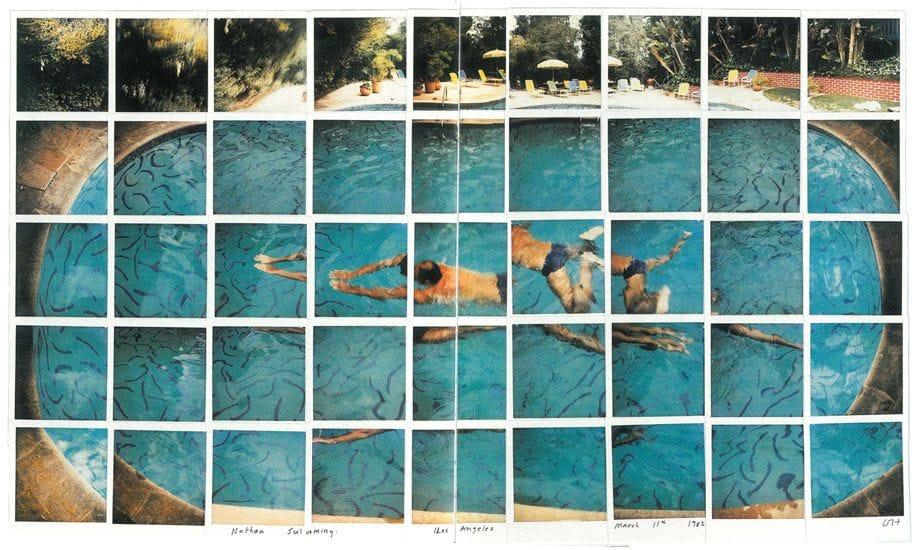
David Hockney, Nathan Swimming Los Angeles, 1982

2022 turned out to be a good reading year. I got a wider shot at e-book availability by joining a second public library in the adjacent city. [Ed. – “city.”] Then, by pecking through recommendation lists and hopping from screen to screen, I was able to keep my library hold shelves reassuringly filled—staving off that dire malady known as Running Out of Something Good To Read. [Ed. – Extremely bad. Jenny Davidson writes about some psychological studies done on this phenomenon in Reading Style.] Along the way I ran across some new obsessions.

Starting with nonfiction, I enjoyed and was moved by Suleika Jaouad’s Between Two Kingdoms: A Memoir of a Life Interrupted. It’s a cancer narrative that stands out on account of Jaouad’s youth, frankness, and writing chops, as well as the fact that the second half becomes a road-trip book. Jaouad discovered her cancer right after graduating from Princeton. In the flash of an eye the promising, carefree prospect of her twenties became a hellish ordeal. She’s still fighting cancer, and I wish her all the best for recovery. This book is a gift.

Thinking of memoirs by feisty young women, Crying in H-Mart, by Michelle Zauner got a lot of attention this year. For me it was an okay read, but not as memorable as Jaouad’s book. On the other hand, I recommend Lynne Cox’s Swimming to Antarctica: Tales of a Long-Distance Swimmer not for any particular magic in the telling but for the extraordinary nature of Cox herself—her athletic prowess, her ability to connect with people around the world, the cheerful way she greets challenges of all kinds.

Another thoroughly satisfying memoir was Marcus Samuelsson’s Yes, Chef, ghostwritten by Veronica Chambers. Samuelsson is the Ethiopian-born, Swedish-raised culinary phenom who co-founded the Red Rooster restaurant in Harlem. His account of his Scandinavian upbringing; his rise through some of the most demanding restaurant kitchens in Europe, under despotic chefs; and his lifelong love affair with food and culture make this a book to relish on many levels. [Ed. – I see what you did there!]

George Saunders’s A Swim in the Pond in the Rain: In Which Four Russians Give a Master Class on Writing, Reading, and Life is a terrific read for anyone who wants to dive deep into the craft minutiae of great short fiction. What questions does a story ask, and how do they pull us along? Is it what’s left in or what’s left out that makes a masterpiece? Of the analyses Saunders offers, his take on three of Chekhov’s stories were my favorite. On the other hand, if you’re not minutely interested in the technical and creative decisions behind a narrative—the tied-off loops on the back of the tapestry—you might as well just read the stories themelves.

Last but not least in nonfiction, fans of Skyfaring: A Journey with a Pilot by Mark Vanhoenacker, won’t want to miss his latest, Imagine a City: A Pilot’s Journey across an Urban World. Imagine a City includes lots of the lyrical, novel description that makes Skyfaring wonderful, this time swirled into memoir and a flâneur’s takes on cities around the world. By the nature of his work as a long-distance commercial pilot, Vanhoenacker often finds himself with two days to spend near any metropolitan destination that he flies. He bides the mandatory rests in exploration and writing. This book not only features slices of such urban-scapes, but recurring takes on the author’s growing-up in Pittsfield, Massachusetts: the town, his family, his coming-out, and the globe-spinning reveries that led to his vocation.

Now to fiction. One novel that blew me away this year was Julie Otsuka’s The Swimmers. As someone who loves pools and water I was initially attracted to the title and cover (I know, I know, like buying wine for the label; I confess). [Ed. – I strongly support buying books for their covers.] Then when I started to read, I fell hard for the voice. Exactly who is speaking with such quiet authority, unspooling list after list about the lap swimmers with such close, cool knowledge? A crack appears in the bottom of their pool, and it’s like Jane Alison’s Nine Island meets Tim O’Brien’s The Things They Carried… The novel suddenly widens into a more familiar and pain-steeped story that I won’t spoil; sprint [Ed. – missed metaphor opportunity!] to your nearest book source and see for yourself.

My enthusiasm for The Swimmers sent me to Otsuka’s earlier novels, When the Emperor Was Divine and Buddha in the Attic, which in different ways chronicle the experiences of Japanese American immigrants. They’re well worth the read, though to me not consummate in their artistry like The Swimmers.

Way different stylistically from The Swimmers was a book at least as magnificent: Anna Burns’s Milkman, the densest and strangest novel I read last year. A student in my Irish short stories tutorial recommended it, and I’m so glad she did: this book made me understand as never before what it was like to live in the middle of the Troubles, no, to live the Troubles, to contain their gaslighting and violence in one’s marrow. The narrator has one of those unforgettable voices—drenched in idiom, funny, idiosyncratic—that at first seems impossible to understand. There are few paragraph changes, and few characters are called by actual names. All these might put you off, might seem like obstructions to grasping the story… and yet. Somehow it galvanizes a world as you read, a world that tumbles around you and into you, changing you.

Another surprise and pleasure was Mrs. Palfrey at the Claremont, by Elizabeth Taylor, first published in 1971.It opens on a rainy Sunday in January (is there anything more depressing?) in a London lodging hotel just affordable and respectable enough for old folks not yet decrepit or destitute. You might judge this an unpromising start—till you find yourself immersed, riveted by Mrs. Palfrey and her fortunes: the aches, yearnings, miscues, and irritations of ordinary human life, rendered with nothing less than mastery.

Also of seventies vintage was Marian Engel’s Bear (1976), which Dorian has touted for years. I loved it: the boreal setting, the understated tone, a fusion of real with surreal that’s so seamless I question “surreal” even as I type it. The book is alluring and disconcerting at once—shoving me into uncomfortable encounters with my own relationships to sex, animals, and self—and resists interpretation at every turn. In fact, it’s highly entertaining to browse through reader takes on this book anywhere from Amazon to scholarly platforms. What is this thing: feminist text, postcolonial critique, an ursine-Canadian Lady Chatterley’s Lover, or a portrait of a “phallic mother”? Don’t miss Dorian’s delightful conversation with Shawn and James on Shawn the Book Maniac, which includes a clip from an interview with Engel herself. Mind you, as the interviewer admonishes, “This is no kinky, porno Pooh-Bear!” so prepare yourself for . . . something else thereof. [Ed. – Music to my ears, natch. But really 70s books are the best books…]

Thanks again to Dorian I reread Lonesome Dove, by Larry McMurtry, and was relieved to find that it still has its magic: it had been so long (or my memory so bad) that the plot twists surprised me all over again. This big novel is good for what ails you, a bracing tonic, just like the big skies and open roads out West. [Ed. – So glad it held up! Every time I see it on my shelf I brighten up a little.]

Jonathan Evison’s Lawn Boy is about Mike Muñoz, a southern California guy who can’t seem to catch the brass ring. His voice is canny, believable, often funny, and a little hoarse with pain, and there’s never a false note or a missed beat narrating his adventures through emotional and economic labyrinths. This is a fresh take on the American dream, as broken down for disillusioned 21st century folks, and it deserves to endure. Highly recommend.

Mercy Street by Jennifer Haigh is a gritty novel that revolves around a Boston abortion clinic where the protagonist works and various other characters who intersect there. I read it before the mid-year overturn of Roe, but it’s at least as relevant now: it remains on my mind for its multidimensional treatment of people on different sides of the abortion issue. Creepy, scary, and all too credible, in the case of a couple of anti-abortionist characters; but as I said, granting a multidimensionality that at least seeks to understand the sources of the venom that animates them. As Mohsin Hamid says, one thing literature does is “recomplicate what has been oversimplified,” and a novelist’s nuance is too often missing from the violent discord around this issue.

Elizabeth Strout’s Lucy by the Sea brings her Oh William! characters forward through the first year of the coronavirus pandemic—moving those inveterate New Yorkers up to Maine. Anyone who has liked Strout’s earlier novels won’t be disappointed.

Speaking of disappointments, even though Emily St. John Mandel’s Sea of Tranquillity made a lot of people’s best-of lists last year, for me it was pretty forgettable—way less gripping than Station Eleven, the post-pandemic novel she wrote a few years before Covid struck. I was likewise underwhelmed by The Flight of Gemma Hardy, Margot Livesy’s attempt at a modern retelling of Jane Eyre. I did finish it, but it annoyingly lacked a couple of key plot underpinnings as well as some of the major elements that make Bronte’s novel so great.

Edward Ruscha, Pool # 9, 1968

Last, and monumentally, I come to a series that dominated the last half of my reading year—and which I’m still devouring as we move into 2023: Michael Connelly’s Harry Bosch novels, which chronicle the LAPD detective’s cases across more than twenty years in L.A. Formerly a reporter, including a last stint on the crime beat at the Los Angeles Times, Connelly is steeped in knowledge of the criminal legal system, LAPD culture, and police-reporter relations—not to mention southern California history and culture in general. So the books take place against a backdrop studded not only with physical landmarks but landmark events, O.J. to Rodney King to Robert Blake to COVID. Oh, and there’s also the iconic food of the greater L.A. area—specific BLTs and tacos and martinis that may have you keeping notes for the next time you make it out to the Golden State with an appetite.

In Heironymous (yes, named after the painter by his mother) Bosch, Connelly has created a laconic, jazz-listening, relationship-tending-to-screw-up hero in the best noir tradition: a SoCal Don Quixote perpetually battling the forces of darkness on his quest to put the bad guys (and women) behind bars. Fortunately, uh, but only for us as readers I mean, in the sweep of the sprawling metropolis there’s no shortage of evil out there for him to take on—from its crumbling bungalows to its gated MCM mansions, from seaside to outlying deserts, and sometimes within the halls of justice and press rooms and inter-warring police precinct headquarters themselves. The writing is spot-on: tough, perfectly paced, with lots of plot and action, of course, and salted just right with description and character. I’ve consumed these books the way I used to read beloved series as a kid, binge-reading with abandon, and now I see with dread that I’m closing in on the end of even the prolific Connelly’s output. [Ed. – Ah, that feeling! It’s really a thing, isn’t it?] He’s written several spinoff books involving sometime partners of Bosch, and a shorter series about a criminal defense lawyer who works from the back seat of his Lincoln, and those are good as well—but alas, they too are finite.

For what it’s worth, I read the series completely out of order, and it wasn’t a problem. When I did make my way back to the first couple of Bosch books, I found them a little stilted and trying too hard on the tough-guy front, in contrast to the grace and understatement of the later ones. In a way, though, the fact that the writing wasn’t impeccable was heartening: it showed that not even Connelly came to fiction-writing already with his skill set complete, but built his command over time. [Ed. — Glad to hear this, because I was underwhelmed by the first when I read it many years ago. Maybe I’ll grab one from later in the series.]

No, I haven’t watched the TV version of the Bosch books, and I doubt that I will; my mind’s-eye picture of the characters is too strong for me to want to sully it with a screen version, even though the author did consult on set. But next time I’m in L.A. I do plan to drive Mulholland Drive, and I’ll be looking for #7203, the modest cantilevered house with the deck on the back, where Bosch gazes down on the lights of the city in pensive moments. I have more to say on this topic, but excuse me, I’d rather go read now. We’re about to find out where the bodies are buried.

Benita Berthmann’s Year in Reading, 2022

Today’s post is from Benita Berthmann (@moodboardultra). Benita studies literature in Marburg, Germany, where she is a full time book enthusiast, part time smoker and occasional existentialist.

Balthus, The Game of Patience, 1954

Once again, Dorian was gracious enough to allow me to write about My Year in Reading 2022, thank you, Dorian, nothing I love more than talking about books!

First of all, the hard facts: In the past year, I’ve managed to read 158 books, which is a bit less than the year before, but in terms of pages, I’ve gone up a bit, having read a whopping 51,308 pages over the course of 365 days. [Ed. – JFC, B!]  I’m glad I was able to spend that much time on my favorite hobby and thankful for always being able to find distraction, solace, amusement and everything else I need in books. That is a great gift, methinks. [Ed. – Amen.]

Enough of the boring statistics, which I track via TheStorygraph by the way, on to the more interesting stuff. It is impossible to talk about all the books I’ve read, so I’ve selected a handful of extraordinary texts to talk about.

Dorian and Magda, you are chiefly responsible for this one: BEAR by Marian Engel, which, apart from being a story about loneliness, nature, and Canadian history, features a female archivist having intercourse with, you might have guessed it, a bear. No, that’s not a metaphor. Consequently, Magda (@theruraljuror) coined the hashtag #bärensexbuch on German twitter which means, literally, book about having sex with a bear. God bless German compound words. [Ed. – I only wish English had a handy noun for this important concept.] Apart from our protagonist having sex with a bear, I enjoyed the atmosphere that I’d deem far more important than the plot. It is calm, yet unhinged, something is lurking in the dark, but for now, we’re lingering on a remote island, pleasantly detached from normalcy. Thank you, D and M, for being so adamant about BEAR, it was the perfect read for a hot and hazy afternoon in late July. [Ed. – I love to hear it.]

In 2022, I have also discovered an author that is right on track to become a new favorite of mine: Haruki Murakami. Yeah, I know, totally basic of me, but from the very first page of KILLING COMMENDATORE (German translation by Ursula Gräfe, English by Philipp Gabriel and Ted Goosen), I was hooked. The story about an unnamed painter trying to figure out what to do with his life after having been left by his wife has everything I love: magical realism, mystery and suspense, obscurity, art and culture. The title refers to a painting that plays a major role in the novel and I physically couldn’t stop reading until I knew what would happen. A novel to fall in love with reading and the magic of storytelling if there ever was one.

At university, I took part in a seminar dealing with literature that has been subject to judicial conflict. One of the books we talked about was ESRA by Maxim Biller, which deals with the relationship and subsequent breakup of Adam, a Jewish writer, and Esra, a German-Turkish actress, troubled and traumatized. None of the characters are particularly likeable, nor is the story itself innovative. [Ed. – Really selling this…] What makes the novel interesting, though, is that one can easily draw parallels between Maxim Biller and his alter ego Adam, not least because of the court case following a lawsuit filed by the woman who was clearly the model for Esra and her mother, both of whom claimed that Biller had violated their privacy rights. In the seminar, we talked about to what degree literature can take inspiration from real life, how German courts have decided these questions, and how they came to their decisions, the discrepancy between scholars of literature and of law and, of course, the question whether it was the lawsuit itself that drew attention to an otherwise rather mediocre novel, whether it is – Streisand effect – at least partly the plaintiffs’ fault that they found themselves subject to public scrutiny. To this day, the novel remains forbidden in Germany, a decision made by the highest German court, and it is nearly impossible to get one’s hand on a copy – except if you’re reading it “for scientific reasons” as we did in class. Unfortunately, I am not allowed to pass on the text, sorry, folks. [Ed. – Fascinating!]

One of the authors I revere most is Simone de Beauvoir, ever since I read The Mandarins almost five years ago. This year, I finally managed to read the second part of her autobiography, THE PRIME OF LIFE (German translation by Rolf Soellner, English by Peter Green). The story begins right where the previous volume, Memoirs of a Dutiful Daughter, left us: It’s the late 1920s, de Beauvoir studies philosophy, hangs out with Sartre, they become the founders of existentialism and important public figures in France after having made their respective debuts as writers. They survive the war; the book ends in 1944. I loved reading about the extraordinary life of an absolute fucking legend, an intelligent woman; her philosophy and clever wit allowed my thoughts to flourish while reading and I felt incredibly enriched afterwards. Not just from an intellectual perspective, either. Fun and the absurd aren’t neglected either. For example, the book involves an incident where Beauvoir and Sartre encounter a woman smoking a cigarette with her vagina during their travels. [Ed. – But how is that…] Oh, how I long to be THAT cool. [Ed. – Still struggling with this one, B.] In 2023, I really need to read the two remaining volumes of her autobiography.

Balthus, from the series Mitsou, 1919

Even though I’m too lazy to write about them in detail, a couple of books and authors that deserve at least an honorable mention:

First and foremost, Thomas Bernhard, my most-read author 2022, and also my favorite rage-mode Austrian. [Ed. – Hell yeah!] If you need the healing powers of incandescent rage, Bernhard is your man. I’d especially recommend the drama HELDENPLATZ (English translation by Gitta Honneger) that talks about the Austrian Nazi past kept secret.

ON EARTH WE’RE BRIEFLY GORGEOUS by Ocean Vuong. Has queer prose ever been more thoughtful, more touching, more well-written? I doubt it.

LAPVONA by Ottessa Moshfeg wins the prize for the most disgusting book in 2022. Not much else to say except steer clear of it if gore, organs and cannibalism upset your stomach.

EMPIRE OF PAIN: THE SECRET HISTORY OF THE SACKLER DYNASTY. I am pretty sure that Patrick Radden Keefe is the best contemporary non-fiction writer there is.

Marlene Streeruwitz, an Austrian feminist writer. When will her work finally be translated? Looks like I need to take care of that. [Ed. – Yes you do! That would be a real service.]

The PERCY JACKSON series by Rick Riordan, he is sort of an unproblematic JKR.

Last but not least, Julia Kristeva’s REVOLUTION IN POETIC LANGUAGE (English translation by Margaret Waller, German by Reinhold Werner) deserves the final spot on my list, even though I have not fully finished it in 2022, just because she made me lose my mind. [Ed. – Do Powers of Horror next!]

For 2023, I hope we will all make enough time for reading and find new favorites. Never stop reading. Let’s hope Dorian continues this series for many more years to come so that we have an excuse to create never ending TBR stacks. [Ed. I don’t think anyone reading this needs my say-so to create a giant TBR… Thank you, Benita!]

Scott Walters’s Year in Reading, 2021

Today‘s reflection on a year in reading, I’m delighted to say, is by Scott Walters. Scott launched a litblog, seraillon, in 2010, and expects to return to it one of these days. He largely follows Primo Levi’s model of “occasional and erratic reading, reading out of curiosity, impulse or vice, and not by profession” (profession in his own case being academic administration). He lives with his partner in San Francisco and tries to visit family in France as often as possible.

seraillon has long been a favourite blog: in the past year or so I’ve checked in regularly, half disconsolate, half hopeful, looking for new content. You can imagine, then, how happy I am to feature Scott here in his return to blogging. I hear rumours that more may be afoot at the site!

With Scott’s post, this run of Year in Reading posts comes to an end–except, of course, for my own, which I hope to write soon… The project grew into something bigger than I’d ever imagined; it’s been a delight to showcase the work of so many thoughtful readers. Thanks to everyone who wrote, read, and commented on these pieces. (If you’d talked with me about writing a piece but haven’t sent it to me yet, it’s not too late. Just be in touch and we’ll make a plan.)

Milton Avery, Green Sea, 1954

How gracious of Dorian to invite me to submit an end-of-year post! I have been avidly following the others he’s posted, which now have my to-be-read list runnething over. So thank you Dorian, and everyone, and hello. [Ed. – Such a pleasure!]

I’ve written nothing on the seraillon blog for more than two years—”hellacious times and I’ve slipped between the cracks,” as a character says in David Greenberg’s play, The Assembled Parties. But I have been reading, finishing 42 books in 2021. Though about half my typical yearly volume, I also read much more in books, most of which I intend to finish: The astounding Autobiography of Benvenuto Cellini. Milton’s “Paradise Lost.” Chateaubriand’s Mémoires d’outre tombe (to be continued in the original French, no knock on Anka Muhlstein’s translation). A re-read of Wuthering Heights. Franz Werfel’s monumental novel of resistance against the Armenian genocide, The Forty Days of Musa Dagh. Gaston Bachelard’s The Poetics of Space, following an interest in Henri Bosco. Henri Bosco himself, in his novels Le Mas Théotime and Sabinus. A book about book designer Robert Massin, who designed these French Bosco editions. There are others, down other rabbit holes.

Here are ten highlights of works I did finish in 2021, plus honorable mentions:

The Ministry for the Future, by Kim Stanley Robinson

Hugo and Nebula Award winner Robinson has shouldered a massive responsibility: digesting everything we know about climate change as well as everything we know about how we might address it, then packing it into a stunningly wide-ranging geopolitical thriller interspersed with chapters that concretize climate change’s multivarious, cascading impacts. The novel is also one of few I’ve encountered (Vincent McHugh’s 1943 pandemic novel I Am Thinking of My Darling being another) that explore competent administration of a crisis. [Ed. – Yes! This is a book about competency. Maybe that’s why it feels so comforting.] Robinson’s book appeared in October 2020, a date to fix precisely given the furious pace of change as regards the book’s subject. In fact, the novel seemed a kind of sundial around which shadows spun and deepened rapidly as I read, some elements already obsolete as others swam into view. This is no criticism; I marveled at the real-time context while reading as well as at Robinson’s courage in being able to place a period on his final sentence, and I’ve been pushing the work on everyone for its articulation of the enormity of the challenges facing us, some lovely conceits such as the return of airships, and a bracing radicalism that makes Edward Abbey’s The Monkey Wrench Gang seem like a Sunday School picnic. Despite offering a path forward, Robinson eschews easy answers and offers little in the way of reassurance, seeming to have taken as the novel’s departure point Greta Thunberg’s memorable warning: “I don’t want you to feel hopeful. I want you to panic.” [Ed. – On my 2020 list; still think about it daily.]

Last Summer in the City, by Gianfranco Calligarich (translation by Howard Curtis)

The cover blurbs’ promise of a resurrected 20th century Italian classic certainly delivered; Calligarich’s short, tight, engaging 1973 novel of dissolution in 1960’s Rome seems to pick up where Alberto Moravia left off in depicting modern Italian existential malaise. The story follows the peripatetic wanderings around Rome of Leo Gazzara, an impecunious, alcoholic, bookish young Roman who becomes embroiled in a tumultuous on-again/off-again love affair. The energy of Calligarich’s automobile-driven narrative and the drifting yet fascinating tour he offers of Rome—the city itself a “particular intoxication that wipes out memory”—help balance out the novel’s bleakness, and a frequent invocation of books provides both literary diversion and dark warning of Bovary-esque entrapment in fictions. One might easily envision a film version by an Italian neo-realist director such as Dino Rossi or Antonio Pietrangeli.

Norwood, by Charles Portis

Considerably brightening a dark year, Norwood (1966) edged out Portis’s True Grit and The Dog of the South as the funniest book I read all year [Ed. – Arkansas, represent!], and even topped W. E. Bow’s The Ascent of Rum Doodle and Patrick Dennis’s Genius. A howling road trip and love story that begins when Norwood Pratt of Ralph, Arkansas gets a job tandem-towing a couple of hot cars to Brooklyn, Norwood limns the seedy, grifty, free-wheeling side of American life with caustic, irreverent humor; splendid dialogue; and unforgettable characters. I have Jacqui to thank for this introduction to Portis and will certainly read his remaining two novels and collection of short pieces, a literary cornucopia inversely proportional to the author’s small output, and no doubt as delicious as a biscuit and Bre’r Rabbit Syrup sandwich.

Stories With Pictures, by Antonio Tabucchi (translation by Elizabeth Harris)

“From image to voice, the way is brief, if the senses respond,” writes Antonio Tabucchi in his preface to 2011’s Stories with Pictures, a collection of 30-some short pieces sparked by a particular painting or drawing. Inspired by his having spent an entire day in the Prado (I did the same thing on the one day I spent in Madrid), Tabucchi writes at an angle about the pictures, riffing on them in a dazzling range of ways, from mediations to letters to what seem at times multi-page, arabesque-like captions. As in much of Tabucchi’s work, motifs connected to Fernando Pessoa abound. Most of the artworks come from 20th century Italian or Portuguese artists, all but a few new to me. As if the posthumous appearance in English of a Tabucchi work wasn’t reason enough to celebrate, the Archipelago Books edition, featuring color plates of each picture, make this a volume with a presentation as lovely as the author’s concept.

Bear, by Marion Engel

“Is a life that can now be considered an absence a life?” Marion Engel’s Bear (1976) has made so many end-of-year lists here and elsewhere that Dorian should get a medal for this revival of interest. [Ed. – Aw shucks. No medal, though. I want cash.] Thanks to a new edition from London’s Daunt Books, I finally got in on Engel’s singularly odd tale of Lou, an archivist cataloging the contents of a deceased eccentric’s isolated mansion in Ontario’s remote north—and falling maw over claws for its resident bear. [Ed. – Ha! Maw over claws! That’s good! Gonna steal that.] Literally going wild in shaking herself loose of “the flaws in her plodding private world” and the various civilized confines that have entrapped her, Lou exults in a rebirth as liberating as it is perturbing. Bear’s atmosphere of isolation made it seem readymade for pandemic reading; I suspect that most of us are more than ready to go a little wild ourselves. [Ed. – Sounds pretty good to me!]

Dissipation H. G., by Guido Morselli (translation by Frederika Randall)

My terrific excitement at seeing another Morselli novel appear in English received an abrupt check upon my learning that Frederika Randall, one of the finest of Italian to English translators, had died shortly after finishing the translation. Readers of seraillon may know of my interest in Morselli; this short novel, his last, takes a common theme in which a person suddenly discovers that they are alone on earth. Morselli spins the conceit into a bittersweet, moving and darkly humorous exploration of isolation and the need for human contact. The “H. G.” in the title refers to humani generis and the dissipation “not in the moral sense” but rather from “the third and fourth century Latin dissipatio,” meaning “evaporation, nebulization, some physical process like that.”  In other words, Dissipation H. G. turned out to be another work suited for pandemic reading—if perhaps in the manner of providing solace through affirmation of one’s sense of reality.

Malacarne, by Giosué Caliciura (French translation by Lise Chapuis)

Sicilian writer Giosué Caliciura has yet to be translated into English, a pity, as his fierce, inventive, densely baroque novels, delving into the lives of those on society’s margins, are among the most original and powerful I’ve found in contemporary Italian literature. Malacarne (1999) presents a ferocious testimonial from a Sicilian malacarne (literally “bad flesh”), one of the young hoods employed to do the Mafia’s dirty work.  Palermo—and at the same time a vaguely defined post-mortem space—provide the setting(s) for the malacarne’s reckoning, before a judge, with the brutal details of a violent, savage life. Caliciura’s use of a deliberately impossible narrative voice, an articulation both belonging to and channeled through the late malacarne, adds to the novel’s otherworldly, underworld atmosphere. But the story the malacarne relates is as worldly, gripping and linguistically spectacular as a story could be, a profound exploration of the forces that perpetuate organized crime and engulf the youth it attracts, manipulates, and destroys.

Giorgio Morandi. Paesaggio Levico, 1957.

Okla Hannali, by R. A. Lafferty

I did not know of R. A. Lafferty (apparently revered in science fiction circles), nor had I heard of this novel (not a work of science fiction), and so little suspected what I was about to get into. I found Okla Hannali (1972) astonishing. The author called its initial appearance “a torturous undertaking even though it wasn’t much more than an overflowing of crammed notebooks.” Something of the “crammed notebooks” quality seems to remain in this revised, shaggy final version, but small matter: why this vastly-larger-than-life legend of fictional Choctaw “mingo” (king) Hannali Innominee isn’t a standard feature of the American literary canon is beyond me. Lafferty turns the historical telescope around, viewing early 19th century frontier history from the Choctaw perspective. We know we’re in the realm of legend when the novel begins with a creation myth, which swiftly moves to the early life of Hannali, a “big man who would fill almost a century” and who, during one of the several forced resettlements of the Choctaw, abruptly picks out a plot of land in what is today eastern Oklahoma, “a place less no damn good than other land.”  At this nexus where many elements of 19th century American history converged, the reader witnesses, through Hannali, the westward European expansion, the enactment of genocidal policies towards indigenous populations, the flight of escaped slaves (some of whom become slaves of the Choctaw and/or members of the tribe), the lingering resonances of the Louisiana Purchase, the inauguration of new states, the misunderstood “Jacksonian Revolution” that amounted to little more than “a war of the rich against the poor,” and finally the American Civil War and the grim destruction of the Choctaw republic. Hannali is a magnificent character: defiant, stubborn, courageous, wise, irreverent, a folk hero of magnitudes. Big, boisterous, hilarious, indignant, heart-breaking tales like this don’t come along often; one mourns the unrealized project Lafferty intended to call “Chapters in American History,” of which Okla Hannli, his “Indian [sic] chapter,” is the only one he completed. [Ed. – Wow! Sounds amazing!]

The Transit of Venus, by Shirley Hazzard

“The calculations were hopelessly out…Calculations about Venus often are.” Australian writer Shirley Hazzard and Graham Greene were close friends, and I thrilled to find Greene-like elements in this exceptional, elegant, psychologically penetrating work. But The Transit of Venus (1980) is something all its own, a dense, intimate, furiously compelling narrative tracing the life trajectories and romantic entanglements of two Australian sisters orphaned at a young age. Tracking the sisters’ moves to England (and one to New York), with events of the tumultuous 20th century backgrounding their stories, Hazzard describes, in exacting prose, the psychological nuances of human interactions. Henry James, another obvious influence here, seems constricted by comparison [Ed. – hmm]; The Transit of Venus did more to put in perspective James’s limitations with regard to women characters than any other work I’ve read [Ed. – hmm]. Hazzard’s antecedents range from Greek tragedies to Goethe to 19th century Realism, resulting in a story almost classical in form and style, yet palpably burning with a sense of lived experience—from a writer who led an utterly improbable life. I’ll be reading more.

A True Novel, by Minae Mizumura (translation by Juliet Winters Carpenter)

“…I still could not feel at home, either in the new country or in the new language,” states the narrator on the first page of Mizumura’s 2002 novel (to which I was steered by Dorian – thank you, Dorian!). [Ed. – So welcome! Delighted to see this here.] This might be a line from any work addressing displacement, but it scarcely begins to hint at the extraordinary directions Mizumura will take over the ensuing 853 pages. I harbored some doubts about descriptions of the novel as a Japanese Wuthering Heights, but Mizumura evinces little interest in simply grafting Emily Bronte’s work onto a Japanese setting. Instead, her ambitions aim broadly and deeply. Taking the coinciding of the 19th century western novel’s golden age with Japan’s opening to western influence as her beginning, Mizumura then uses her own transnational experience (with formative years spent in the US before a permanent return to Japan) to explore, through both western and Japanese literary and linguistic lenses, multiple questions of transnational identity, cultural cross-pollination, Japanese post-war history, and – through her mysterious character Taro, a kind of Japanese Heathcliff/Gatsby amalgam – issues of class and otherness. A True Novel takes its title from a prevailing style of Japanese literature in which works like Wuthering Heights were held up as an ideal form, “where the author sought to create an independent fictional world outside his own life.” But meta-fictional elements in Mizumura’s narrative also link it to the later Japanese style of the “I-Novel” (also the title of another, more personal Mizumura work), close to memoir and hewing to the author’s personal experience. Through concatenations of narrative (the prologue alone to A True Novel goes on for 165 pages) and using black and white photographs to heighten sense of place in the mountainous Karuizawa area where much of the story unfolds, Mizumura aligns the substrate of the Japanese literary enzyme with that of its Western counterpart, sparking a catalysis that creates something strikingly original. While it’s rare enough to find something that seems new in fiction, it’s more unusual still to find a work also incorporating something old and familiar and—by means of steady, crystalline, superbly atmospheric prose—so completely absorbing. Re-reading this true novel, my favorite book of 2021, will be a goal for 2022.

Milton Avery, Offshore Island, 1958

Honorable mentions:

  • Isak Dinesen’s Winter’s Tales;
  • Miklós Bánffy’s The Enchanted Night, an excellent collection of short stories that aligned surprisingly with Dinesen (great to see more of Bánffy’s work emerging in translation);
  • Federico Fellini’s The Journey of G. Mastorna, the director’s screenplay for what many consider to be the greatest film never made;
  • N. Scott Momaday’s House Made of Dawn, an American classic, gorgeous and heartbreaking;
  • Claire Keegan’s Small Things Like These, a marvel of concision concerning Ireland’s Magdalen laundries;
  • Henri Bosco’s Le Trestoulas, affirming Bosco as a writer I will certainly keep reading;
  • Joseph Roth’s The Radetzky March.

(And in the noir/polar/mystery realm):

  • Georges Simenon’s Chez Krull [Ed. – So good!];
  • Eric Ambler’s Journey into Fear and A Coffin for Demetrios;
  • Seishi Yokomizo’s The Inagumi Curse, terrific to read directly after Mizumura so as to linger a bit in a Japanese mountain atmosphere.

Thanks for reading, and felicitous reading to all in 2022!

Sarah Raich’s Year in Reading, 2021

Today‘s reflection on a year in reading is by Sarah Raich (@geraeuschbar). Sarah is a writer who studied comparative literature, North American studies, and criminal law. A volume of short stories, dieses makellose Blau, was published by mikrotext and the dystopian YA novel All that’s left by Piper. Two of her stories have appeared in English translation by Eilidh Johnstone in https://no-mans-land.org/article/that-i. She lives in Munich.

Look for more reflections from a wonderful assortment of readers every day this week. Remember, you can always add your thoughts to the mix. Just let me know, either in the comments or on Twitter (@ds228).

Ernst Ludwig Kirchner, Street Scene at Night, 1926-7

2021 was a special year for me as a reader, because it was the first year my own books—ones I’d written and published–were being read. Not just by my doting husband and proud parents – but by real readers. [Ed. – Ouch! Tough on that “fake reader” husband!] And, yes, that changed things for my reading. I became gentler in my judgement. And yes, sometimes I was envious while reading as a published writer.

2021 also was the year I tried to read more diversely, meaning less white, and that is how I came across my favorite book of the year: Tsitsi Dangarembga’s This Mournable Body. I don’t know if I would have read this if I hadn’t made the conscious decision to diversify my reading. I remember buying the book in Cologne at the event Insert Female Artist, a little reluctantly because I found the cover so unappealing (yeah, I’m superficial). [Ed. – Same!] And then I started reading it and couldn’t stop because it was like being severely punched and gently caressed at the same time. And to me those are the very best books. The story is set in Zimbabwe and has in Tambudzai one absolutely loathsome protagonist. [Ed. – So interesting! I’ve only read Nervous Conditions, where Tambu is not loathsome, IMO, but certainly hard to like…] And Dangarembga manages the magic trick of showing the very many dark sides of her character—and still making the reader feel for her. Suffering didn’t make Tambudzai good. It made her selfish and greedy and needy. And the story doesn’t end well: how could it? Dangarembga tells this story in such fierce language in an unusual second person account that my brain got rattled in a way only brilliant books can do. (That her work appears in Germany from a niche publishing house speaks volumes by the way.)

What This Mournable Body shared with many books I read this year is its dark humor. And maybe that was just the right thing for the sobering and dragging experience of living through a second year of a global pandemic. Take for example Sarah Moss’s Ghost Wall, which I read in the supreme translation by Nicole Seifert, which describes severe physical and psychological abuse – and yet I laughed so hard. Because the most brutal things contain humor and patriarchs are clowns with bloody swords and dirty underwear they need to have washed. [Ed. – Ah to be a patriarch! Seriously, though, this really gets at an important aspect of the book.]

For me, Bear by Marian Engel also falls in this category. [Ed. – Hell to the yeah!] A book that was wildly discussed and promoted on Twitter—to a considerable extent by the owner of this blog. [Ed. – “To a considerable extent” = German for “What a fucking nut that guy is, always banging on about that book!] I liked the unforgiving yet loving eye Engel casts on the protagonist which also leads to weirdly comical passages while the librarian stumbles through her life in a “molelike existence”, a phrasing I will never forget. In a way this librarian has a lot in common with the heroine in Ghost Wall. They both live a life they haven’t chosen, pushed around and overseen—and view this miserable situation with an acidic view on themselves and the world, and then one of them (Silvie in Ghost Wall) finds friends, the other one (the librarian in Bear) finds, well, Bear.

And yes, while writing this down, I realize my taste for this kind of book grew strong during this year of reading. Books that intertwine the horrible with the comical. One of those books was Adas Raum by Sharon Dodua Otoo who has the admirable audacity to throw her mostly German readers into a whirlwind of perspectives, places, and times. Ranging from rebirth and gods and eternal entities that hope for liberation from earthly existence while quarreling with God, into the overburdened subjects of the Shoah, racism, and colonialism, Otoo blasts established narrative boundaries and writes down the shiny pieces. Which left many German critics profoundly confused. I enjoyed the ride very much and I am very curious how the English-speaking audience will respond to this text.

The book contains my favorite quote of the year 2021:

Gott rollte als Steppenpflanze an mir vorbei.

(Einfach so.)

(Als wäre ich gar nicht da.)

(Eine Frechheit.)

Ich ließ alles –  no fee no [im Original in phonetischen Alphabet] – auf mich einwirken, in der Hoffnung, dass diese Sensation aller abendländlichen Farben zeitnah nachlassen würde. Hinter meiner Hoffnung steckte ein Hauch Erwartung. Ich gestand es mir aber selbst nicht ein. Ich wollte solchen banalen Gefühle längst hinter mir gelassen haben. Ich wartete.

God rolled past me as a tumbleweed.

(Just like that.)

(As if I was not even there.)

(The nerve.)

I allowed myself to be moved by everything—nɔ fɛɛ nɔ—hoping that the sensation of these occidental colors would soon wane. A breath of expectation cowered behind my hope. But I could not admit it to myself. I had wanted to leave such banal feelings far behind me. I waited.

(Translated by Jon Cho-Polizzi; translation forthcoming)

One more theme flows through my 2021 reading year, now that I look at it: the difference between serious and entertaining literature, as we put it in German. A difference which part of the cultural establishment in Germany seems obsessed by.

It affects my own writing, as I‘ve published one book of short stories, which some consider one of the intellectual forms of writing, and a second book that’s a dystopian YA novel, which the same people consider a rather grimy genre (unless Margaret Atwood writes it—then it’s different). As a very nice and slightly drunk person from the literary establishment told me once: the problem is, your book doesn’t really fit in anywhere.

Maybe being in this position has made me more sensitive to writers writing books that are misfits. But this feeling was also influenced by the work of Nicole Seifert, especially as expressed in her book Frauen Literatur, published in 2021. In it she describes so many books by female writers being belittled and shoved aside. Seifert’s book was eye-opening, even though I had already read so much of her blog posts, articles, and tweets. And the most important thing I learned from this superb work is how systemic the degradation of female writing is.

One of my most precious serendipities of books being labeled pure entertainment was the writing of Shirley Jackson, starting with Hangsaman. In Germany, Jackson has been considered a horror genre writer, which she is, but through this genre she writes pure literature. [Ed. – Hmm this does seem to uphold that literature/entertainment binary…] Jackson died without experiencing the literary appreciation she should have received. I don’t know why, but this realization really got to me. That a woman of her abilities got overlooked so brutally during her life time. (I rejoiced at the Wikipedia article describing how her otherwise shitty husband fought for her recognition and ranted ferociously against the literary establishment unwilling to give Jackson credit for her genius.)

But the list of undervalued writers goes on, leading to the books of Vicki Baum, whom I had always considered easy entertainment. But when I read them they proved to be epic. I cherished Hotel Shanghai: the vastness of the tableau she created leaves me awestruck.

Jeanne Mammen, Self-portrait, ca. 1926

So this is what I will carry into my year of reading 2022: a thirst for misfits and dark humor. Very dark.

M. F. Corwin’s Year in Reading, 2021

Today’s reflection on a year in reading is by M. F. Corwin, who tweets as @eudamonis. Corwin, a person of mystery, currently lives in the Pacific Northwest.

Look for more reflections from a wonderful assortment of readers every day this week and next. Remember, you can always add your thoughts to the mix. Just let me know, either in the comments or on Twitter (@ds228).

Isaac Levitan, The Lake. Gray Day, 1895

M: How can one talk about one’s entire year of reading?

E: Well, that’s why you keep a list, right?

M: That’s just a list of books finished.

E: …and of course there’s more to reading than finishing books.

M: Yes. There are the books abandoned, and the reading done but not completed in the year.

E: There’s no shame in not reading to deadline.

M: Why would the end of the year be a deadline? The calendar’s arbitrary; reading’s continuous. 

E: To a point. Anyway. What books didn’t you finish last year?

M: A lot! Two that stand out are Polly Barton’s Fifty Sounds and Arsenyev’s Across the Ussuri Kray, both of which I’ve been reading slowly, because I’m not quite ready to leave them behind.

E: Why?

M: For the Barton, it’s the combination of the clever conceit of organizing a memoir around onomatopoeic vocabulary with the keen analysis of culture shock and the tenderness towards her younger self, towards all younger selves. For the Arsenyev, well, it just pushes a lot of buttons. It’s Siberia, so that’s inherently interesting, but there’s also the pairing of naturalist observation with early twentieth-century exploration and adventure after the Russo-Japanese War. It doesn’t hurt that it has some background for Kurosawa’s Dersu Uzala and was translated by the guy who wrote that book on Siberian owls.

E: Did you read the owl book?

M: I tried, but the tone was too close to a Peace Corps memoir, a sort of magazine slick. Good in its way, but not what I wanted from it.

E: What other books didn’t you read last year?

M: That’s a really important question – for me at least. The books I didn’t (or don’t) read have a huge impact on the books that I choose to read and/or finish, although the relationship can be complicated.

E: What would be an example?

M: Well, I meant to reread War and Peace last year, given that I found a collection of the Oxford World Classics hardcovers of Tolstoy while looking for butter knives. [Ed. – Like, in your house?] I was planning to read his works more or less in order, and War and Peace comes surprisingly early.

E: Just to address what is clearly a side point: Are all of your book purchases failed attempts at housekeeping?

M: … hm. Probably. But, as you say, not important. I was reading Tolstoy’s early short stories and got kind of stuck on the Sevastopol stories, which were really fascinating: keen observation, a brutal eye for military matters, and the veneer of cheap morality really showing some deliberate wear. It got me wondering about the background to War and Peace; obviously as a historical novel, it’s somewhat different, but it made me want more context. I’d already been interested in reading The Life of the Archpriest Avvakum, Written by Himself, as it had been translated by Jane Ellen Harrison and Hope Mirrlees during their Russian kick (which also led to The Book of the Bear, which in turn was part of what convinced me to get around to Marian Engel’s Bear [Ed. — Oh, that sounds interesting], although they are not at all related); I had heard, perhaps erroneously, that Avvakum’s style in some ways influenced Tolstoy’s. So I read that, in a more recent translation, which I didn’t quite care for, though the introduction was very firm about its authenticity.

E: And then?

M: Well, that led me to Janet Martin’s history of medieval Russia, which is a very decent introduction and confirmed my opinion that I needed to get to know a bit more history before I could get back to Tolstoy. I picked up some books that seemed like they might be relevant (Kollman’s The Russian Empire 1450–1801 and Seton-Watson’s The Russian Empire, 1801–1917), but before I got to those I felt I really needed to know a bit more about Lithuania, because it just kept cropping up in Martin’s book. So I read a history of the Polish-Lithuanian Union and it was tremendously illuminating.

E: How so?

M: It was one of those wonderful moments when one, as a reader, has the opportunity to see how perfectly ignorant one is. [Ed. — Would that more of us thought this way!] An entire vista, previously unknown, appears with all of its possibilities. Not just an unknown vista, but an entirely unimagined one, a rich field of arguments in every footnote. It’s deeply satisfying to read something that does not confirm one’s suspicions, not least because one did not know enough to have any.

E: So did you get to the Russian history books?

M: Not yet! I mean, I could go through the same sort of scenario with other books I didn’t read: Duras, whom I keep trying to work myself up to liking [Ed. – Same! Speak truth to power!] (which led to Sara Mesa’s Four by Four, Elisa Shua Dusapin’s Winter in Sokcho, Chantal Akerman’s My Mother Laughs, and the Léger trilogy published by the Dorothy Project) or Locke’s Treatise on Human Understanding (Hamann, Gadamer’s Enigma of Health, and Toril Moi’s Revolution of the Ordinary). Sometimes when I try to rev myself up to read something I get distracted – and perhaps the distraction is more interesting than the intention. Like I was working through Shakespeare’s plays last year as well, and I rather wonder if I might not have had more fun with the project, as a project, if I had allowed myself to be distracted from it, about it, more. There’s always a pleasure, though, in rereading something familiar from high school that will stand up to (and reward) attentive rereading – like putting on a mental bathrobe that one has had forever only to find it much finer than one had remembered. The same thing kind of happened in reverse while rereading Civilization and Its Discontents: I had the uncomfortable sensation of (re)discovering the forgotten source for some of my mental furniture, which was a bit embarrassing.

E: Are these distractions always just a way of sneaking up on a reading project?

M: Sadly, no. There’s a lot of the magpie, too. Someone will mention something on Twitter, or there will be a sale from Rixdorf or Open Letter or pretty much any small or university press, and, well, I am easily distracted. Or perhaps I was just ready to be distracted. 

E: What was the best distraction you encountered last year?

M: Paul Valéry’s Dialogues and Idée Fixe, without a doubt – charming without being cloying. I picked them up at random on my first trip back to Powell’s since the start of the pandemic and, even though I had previously disliked the dialogue form, they led me to rethink my position. 

E: So, when will you be rereading War and Peace?

M: Eventually.

Isaac Levitan, Vladimir’s Road, 1892

James Morrison’s Year in Reading, 2021

Today’s reflection on a year in reading is by James Morrison, an Australian reader and editor (sadly, not of books) who tweets at @unwise_trousers and blogs (increasingly infrequently) at http://causticcovercritic.blogspot.com.

Look for more reflections from a wonderful assortment of readers every day this week and into next. It’s a stellar lineup. Remember, you can always add your thoughts to the mix. Just let me know, either in the comments or on Twitter (@ds228).

Francesa Woodman, Untitled, Rome, Italy 1977 – 78

2021 was like much of the rest of my life: I didn’t accomplish much, but I did read a shitload of books. If you take as true the dubious proposition that literature makes us better people, then virtue must positively drip from my pores. Sadly, the behaviour of nearly every great writer shows instead that constant contact with great literature makes you absolutely repellent.

Reading a lot can mean that when you look back on what you’ve read over the course of a year there are a number of surprises. I read that this year? It feels like a lifetime ago. What book is that? I have no memory of it at all. I only gave that three stars on Goodreads? It’s really hung around in my brain, more so than some of the obvious winners.

Some people have reading plans they stick to. I have no plans, or at least none that last more than a day or two in the face of the constant deluge of new and old books that keep yelling out for attention. I’m also a sucker for pretty books—I will absolutely fall for a book with a clever or beautiful cover design, knowing nothing else about it. [Ed. – Hard same, I’ll often ignore a book with an ugly cover and then decide I have to have it if it’s released in a better design.] Despite this, I will pretend not to be shallow as I talk about some of the things I read last year, in loosely thematic clumps.

Magyars

One of my favourite literary sources is Hungary. Little Hungarian writing gets translated compared to that from most other European countries, but the main reason I like it is that the general quality of what does get translated into English is astonishingly high. Three books from Hungary particularly struck me this year.

Progressive Transylvanian aristocrat Count Miklós Bánffy is best remembered for his massive They Were Counted/Divided/Found Wanting trilogy, but was also excellent on a small scale; and two collections of his short stories came out at roughly the same time from two different publishers, with some overlap. Probably the better of the two is The Enchanted Night, translated by Len Rix, full of elusive stories that range from brutal military realism to strange and spooky Transylvanian folktales.

The selected short stories of Tibor Déry, who was imprisoned for political reasons both before and during the Communist regime, are collected in Love, translated by George Szirtes. Life in Budapest under the Nazis and the Stalinists is beautifully, if bleakly, rendered.

László Krasznahorkai is easily the best-known Hungarian writer on the world stage today, and his novella-with-music (each chapter has a QR code you can scan to summon the accompanying track) Chasing Homer is a compressed marvel of paranoia, pursuit and weapons-grade bile. Surely one day they’ll run out of overrated Sixties singers and lovers of war criminals and give him the Nobel. [Ed. – Could be a while though; spoilt for choice there.]

Egon Schiele, Seated Woman with Bent Knee, 1917

Poets

Speaking of the Nobel, I finally read Louise Glück for the first time, and her Averno is genuinely wonderful, so I suppose they don’t only give the prize to the undeserving. Even more marvellous and long-neglected by me was Inger Christensen’s Alphabet, translated from the Danish by Susanna Nied, a book in which the poetry really does attain the qualities of music, pure and wise and breathtaking.

Homecoming by Magda Isanos, translated from Romanian by Christina Tudor-Sideri, was another small revelation, full of the fog and ghosts and forests of interwar Central Europe. And then there was Notes on the Sonnets by Luke Kennard: if you’re not intrigued by a collection of funny/sad prose poems, each set at the same deranged house party and each taking as its launching point one of Shakespeare’s sonnets, then I can’t help you.

Novels in verse are one of my many obsessions, and there were two that stood out. Fighting Is Like a Wife by Eloisa Amezcua (due out in April) uses as raw material the life and marriage of a historical boxing champion and his wife in formally clever and emotionally moving ways. And then there is Deep Wheel Orcadia by Harry Josephine Giles. How a major publishing house was persuaded to take a gamble on a hard science-fiction verse novel written in the Scottish-Norse hybrid Orkney dialect is a mystery to me, but that it happened shows this is not yet an entirely fallen world.

Tom Roberts, In a Corner on the Macintyre, 1895

Space

The host of this blog doesn’t give a shit about space [Ed. – correct], because he is Wrong [Ed. – possibly correct], but I’m going to talk about it a bit here anyway because Dorian made the mistake of giving me the microphone [Ed. – absolutely incorrect; no mistake was made]. Continuing the astro-poetry theme we have Ken Hunt’s The Lost Cosmonauts, a collection about the accidents and deaths of the Space Race, much of it constructed from the texts of official reports and radio transcripts. Then there’s Omon Ra by Victor Pelevin, a bleak black comedy about the Soviet space program.

Pushing further into the future was the story collection Terminal Boredom by Izumi Suzuki (multiple translators), a downbeat set of 1970s/1980s Japanese countercultural tales of sexual and pharmaceutical weirdness. Further still takes us to Olga Ravn’s The Employees, translated from Danish by Martin Aitken, a genuine little masterpiece of a “workplace novel” set on a Generation Starship.

Finally, the biggest thing I read in 2021 was XX by Rian Hughes, a 1000-page monster about first contact and artificial intelligence. It’s a beautifully designed book in which the spirit of the 19th Century talks in multi-typeface pamphlets and that of the 20th in Futurist broadsides, which includes an entire pulp SF novella serialised in magazines that never existed, and which is the first book I have ever seen with a reversible dustjacket designed to make it look like a shelf of the fictional publications contained within the text [Ed. — !].

World War Two

Dutch genius Willem Frederik Hermans is having something of a revival, and A Guardian Angel Recalls (translated by David Colmer) is a great book new to English: a public prosecutor, weak and lovelorn, races around Holland as the Nazis invade, wreaking inadvertent havoc as he tries to save himself, protected and frustrated in equal measure by his similarly flawed guardian angel.

The Passenger by Ulrich Alexander Boschwitz (translated from German by Philip Boehm) is from 1938: perhaps too late to be called prescient, but even years later people were denying its truths. Otto Silbermann is a Jewish German who fought for his country in World War One, too slow to realise that what is happening to other Jews will happen to him too. Finally he has to go on the run, trying to find a way to escape across the border to safety.

Marga Minco’s The Glass Bridge (translated by Stacey Knecht) is another Dutch novel, a tangential look at the Holocaust in fragments from the life of Stella, a Jewish artist hiding out under a dead woman’s name, moving from safe house to safe house, fending off the advances of a sexually predatory ‘protector’.

David Piper’s Trial by Battle (originally published in 1959 as by Peter Towry) is a deeply anti-triumphalist novel about Britain in Asia during World War Two, outclassed and outfought, living on a faltering diet of nationalistic smugness. Frances Faviell’s A Chelsea Concerto is a fascinating memoir of the first few months of the Blitz in London. Finally, Donald Henderson’s 1943 novel Mister Bowling Buys a Newspaper, despite its religiose ending, is a fine black comedy about a polite serial killer for people who have read all of Patrick Hamilton and now have a sad void in their lives.

Frederick McCubbin, Lost, 1907

Random Others

Marian Engel’s Bear has no greater champion than the management of this blog, so I shall say nothing other than that Dorian is absolutely right about it in every way, despite the ludicrousness of the premise. [Ed. – THANK YOU! Another satisfied customer! You can watch James admit this truth to me here.] Another weirdly charged masterpiece is Denton Welch’s In Youth is Pleasure, a strange and astonishing novel about a boy helpless in the grip of his aesthetic and sensual needs.

I don’t even like boxing, yet Michael Winkler’s Grimmish is the second boxing novel on this list: a wonderful and weird book about masculinity and physical pain, full of great jokes which I have stolen: There are two types of people: those who can extrapolate from incomplete data. [Ed. – But that’s only one… ohhh…] Checkout 19 by Claire-Louise Bennett, which is sort of about the disparity between literature and life but also about everything else, is a genuine marvel. Minae Mizumura’s An I-Novel (translated by Juliet Winters Carpenter) is the story of two Japanese sisters transplanted to New York, a deep and rich and perceptive work enriched by numerous photographs. It’s not quite the equal of her A True Novel, but then what is?

Jeffrey Smart, Cahill Expressway, 1962

[DISTANT, MUFFLED NOISE]

The Surprise Party Complex by Ramona Stewart, criminally out of print for decades, is a beautiful and hilarious bit of work about a group of neglected and eccentric teenagers at a loose end in Hollywood. The deeply weird Mount Analogue: A Novel of Symbolically Authentic Non-Euclidean Adventures in Mountain Climbing by René Daumal (translated by Roger Shattuck) was never finished, but what we do have is a surrealist masterpiece. Flesh by Brigid Brophy is a near-as-damnit perfect novel about appetites, both sexual and gastronomic. And everybody who enjoys the atmosphere of a good grotty 1950s London boarding house needs to read Babel Itself by Sam Youd (better known as science-fiction writer John Christopher), another unjustly forgotten bit of comic brilliance about a group of lodgers running spiritualist experiments, having affairs and betraying each other.

[SOUND OF SECURITY FORCES BANGING ON DOOR, YELLS OF ‘YOUR TIME IS UP!’]

Then there’s the Patricia Lockwood’s No One is Talking About This, which really is as good as everyone says, and Jim Shepard’s Phase Six, an unfortunately timed global pandemic novel that’s also a splendidly moving look at female friendship, and Hilma Wolitzer’s career-summary story collection Today a Woman Went Mad in the Supermarket, and…

[DOOR BREAKS DOWN]

..and Nathalie Sarraute’s Tropisms, which I finally read years after everybody else, and Giorgio Bassani’s The Heron, the only book of his I’d never read, and…

[MUFFLED SHOUTING, SOUNDS OF SOMEONE BEING DRAGGED AWAY]

Anja Willner’s Year in Reading, 2021

Today’s reflection on her year in reading, her second annual contribution, is by Anja Willner. Anja insists on reading Russian books in the original even though it takes her way longer than in English or her native German. She lives and works in Munich, and tweets @WillnerAnja.

Look for more reflections from a wonderful assortment of readers every day this week and into next. It’s a stellar lineup. Remember, you can always add your thoughts to the mix. Just let me know, either in the comments or on Twitter (@ds228).

Kazimir Malevich, Red House, 1932

I’ve always thought of myself as a reader. Ever since I was able to read on my own, I’ve been a fan of libraries, reading, and books. It took only two pandemic years to question this identity. I mean, how many brain fog afternoons, Netflix hours (and we’re not talking the documentaries I still pretend to myself I will someday watch), minutes spent staring into the void or at my cats grooming themselves (very soothing, can recommend) until I must stop calling myself a reader?

Maybe I will find the answer this year and maybe I will find it on Twitter making silly jokes, writing lists of book recommendations, and losing them.

As to 2021, I finished 66 books read for pleasure and some more for not-so-much pleasure. That sounds like a lot to the non-readers in my life (greetings to my fellow guilty pleasure streamers and starers into the void) and is probably somewhere in the middle for Book Twitter.

It might be more telling to offer the number of books abandoned, unfinished or purchased but still unread, but I never counted these. Probably better for my peace of mind! One almost successful rereading project was Crime and Punishment with about 200 pages of maybe 600 read, curiously on a smartphone.

Reading C&P while waiting for the metro or having home office lunch staring on a rather small screen seemed weird but also strangely suitable. If living in a pandemic taught me one thing, it is this: Sometimes things you used to do with ease are just not possible anymore. Some of these things will come back, some will not. And that is probably okay.

Anyway, some reading projects did work out in 2021 and I’m all the more thankful for these experiences. Some of my highlights:

Minae Mizumura – A True Novel (translation: Juliet Winters)

Thank you, Dorian and Jules (who decided to tackle ‘A True Novel’ in the original Japanese!) [Ed. – Jules; not me], for pointing me towards this novel! Mizumura brought back that pure pleasure of childhood reading. I remember how I had entirely different plans when it was delivered but could not stop reading once I opened the package, so I just stayed on the floor of my apartment with book one (of two) for hours.

I now feel under pressure – but think of the loveliest, tiniest, tenderest kind of pressure you can imagine – to finally read Wuthering Heights, which the novel is loosely modeled on.

Mikhail Bulgakov – Flight, The White Guard, The Days of the Turbins

I’ve been meaning to read The White Guard ever since being the only person during a tour of Bulgakov’s family’s former apartment in Kyiv who didn’t know the novel intimately. I’m not even exaggerating: It was a Russian-language tour and I’m quite sure everybody who went to school in Ukraine or Russia is familiar with the novel. Finally reading it in 2021, I understood three things:

1. Why everyone on the tour went “ah” (the satisfied, approving kind of “ah”) when the guide switched off the lights in the apartment.

2. Why everyone who read the novel is absolutely crazy about it.

3. That recommending The White Guard to readers I consider worthy might be what fate had in mind for me.

Only joking! Well, half-joking. The White Guard is one of those books I want to start reading again right after finishing them. And then again, again, and again. The many layers, the adorable and not-so adorable characters, the (often bitter) jokes, the apocalyptic atmosphere. The understanding that huge changes we read about in history books mean mostly confusion and often bloodshed for the people experiencing them. The wild mixture of Russian, Ukrainian and everything in between, a nightmare for any translator. A language at times so hypnotizing you forget there is a world outside, making you want to memorize parts or read entire passages out loud.

If you want to give Bulgakov a try in 2022 but are more into plays and have less time, The Days of the Turbins is practically the same story with funnier dialogue. It was said to be Stalin’s favorite play until it wasn’t, causing a lot of trouble for Bulgakov. But that’s already a different story.

Flight, another play, has memorable main characters and is darkly funny but might be difficult to get at times if you are not familiar with a) the early parts of Soviet history and b) the language of orthodoxy. But you still have The White Guard or you can turn to the available film adaptions, so you’re not entirely lost for my cause!

Louise Kapp Howe – Pink Collar Workers

This is not a novel, but after the many academic papers I had to read last year Howe’s study of women who work in low-paid and underestimated jobs was such a relief that I have to share it with you. Howe watched women work and talked to them. A lot. It took months and she even worked a retail job to better understand the conditions there. It might be cliché, but I think every (male) reporter turning such experiences into a book would boast about them.

Howe does not do that. She tells the stories of the women she encountered. And she does not care for ‘scientific’ language or the kind of approach that is usually expected for such studies.

Howe in her own words:

[The women I have talked to] included nurses, receptionists, keypunch operators, legal secretaries, domestic workers, medical technologists, teachers, dental assistants, sewers, telephone operators, supermarket cashiers, among others in female-dominated jobs. … I can’t tell you how many there were because I never kept count. Maybe there were 123. Maybe 180. Maybe 206. It doesn’t really matter, does it? They’re women, not data.

The book is from the 1970s and of course not every single sentence has aged well. I like to think that Howe – if she were alive today – would reconsider the way she describes women hitting their children to teach them a lesson. (Note to my fellow readers of medium-ancient books: there is at least no trace of the kind of blatant racism one often encounters in books from that period.)

Marian Engel – Bear

Ah yes, that one – the bear sex book Dorian keeps raving about! [Ed. – I do.] And what can I say, the man is right. [Ed. – she really makes a good point.] Sign me up for the Cult of Bear! [Ed. – Another satisfied customer!] This was lovely, raw, weird and had me google the wildest things. Yes, there is real bear sex, there are a lot of books mentioned for intertextual fun, there is a heroine liberating herself and great nature writing, there is thinking about what it means to lead a successful life, to be remembered, what literature can do. I love it when a book is so thickly layered (but not overloaded language-wise!) that it can convey more on less than 200 pages than some doorstop will after some 700 pages. [Ed. – I did not coach Anja to say any of these things. Genuine testimonial.]

Ivan Turgenev – Asya

Speaking of short: if you feel like you need some good old 19th century reading but your pandemic brain cannot stomach the ‘great’ novels by Tolstoy, Dostoevsky and the like, go for Asya, a novella by Turgenev. There are all the ingredients one loves (or does not, depends) about 19th century literature: sad love story, passive hero you can project all your negative feelings onto, better kitchen psychology, great but not too much nature writing, social critique – but all within just a couple of pages. Meaning you will be able to finish reading it quickly. Plus, you won’t have to remember 127 names, only three main characters and even fewer minor ones. Double win!

Unknown Ukrainian cubist artist, Portrait of Woman, 1920s — 30s

I’m looking forward to another year of discussing books, chasing after books, and sometimes – when I’m in the right head space, let’s face it – even reading them.