My Year in Reading, 2023

I wouldn’t say I had a great reading year. I was on my phone too much, I was being anguished or avoiding being anguished about the myriad injustices of the world, which I knew too much and could do too little about. I travelled—maybe not too much but an awful lot, for me—which was often energizing and enjoyable, but also got in the way of reading.

I felt, in other words, that I had frittered away my one wild and precious reading life. I bottomed out in the middle of the year, regularly tossing aside books unfinished after having spent more time with them than they deserved or that I could find patience for. A querulous reading year, you could say.

And yet some things stood out. Links to previous posts, if I managed to write about it.
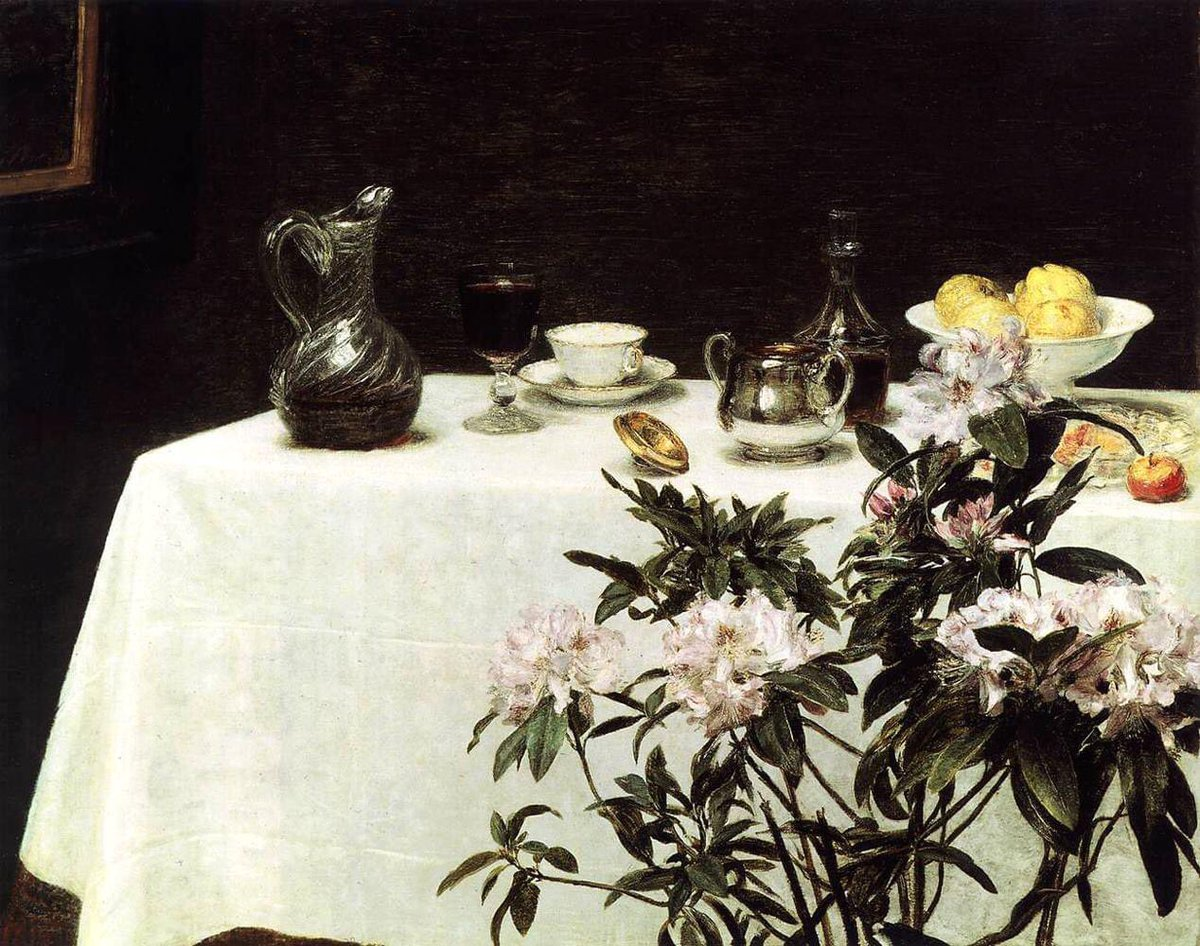
Henri Fantin-Latour, Le coin de la table (1872)

Dwyer Murphy, The Stolen Coast

A rare heist novel where the heist, though satisfying, isn’t the main attraction. I loved this stylish, smart, funny tale of a man who has put his Ivy League law degree to use in taking over the family business: giving new identities to guys on the run and getting them the hell over the border. A great book of off-season resort towns.

Simon Jimenez, The Vanished Birds

I’m still getting my bearing in contemporary sff so take these comments for what they’re worth, but it seems rare to me that a book takes as many swerves as this one: the narrative moves back and forward in time and all over the place, from a near-future nearly uninhabitable earth to a galaxy far-away in space and time. You get invested in a storyline and then it ends but sometimes it comes back. But even more than the structure I loved this book for its emotional seriousness: its many relationships are doomed to fail because of their constitutive circumstances. For example: a man ages fifteen years between each meeting with his beloved, while she, thanks to intricacies of stellar time travel, has only aged a few months. The emotions might be bigger than the ideas, but I was totally okay with that.

Two novels by Katherena Vermette

One of the greatest working Canadian writers. This year, fresh off the thrill of teaching The Break to smart, appreciative students, I read The Strangers and The Circle, a bleak and beautiful trilogy of indigenous life in the aftermath of the cultural trauma of the residential school system.

Four novels by Kent Haruf

It should tell you something that in early April, one of the worst times in the academic year, I read four novels by Kent Haruf in just over a week. I loved Plainsong the most but enjoyed Eventide, Benediction, and Ours Souls at Night almost as much. Easy reading, sure: plain syntax rising to gentle arias, nothing fancy, maybe a little sentimental. But these books are so warm and kind. Each is set in Holt, Colorado, out on the eastern plains, where the mountains are a smudge on the western horizon and it’s sometimes hot and sometimes cold but always dry. The people are ranchers and school teachers and social workers and hardware store owners and ne’er-do-wells and retirees. Everyone is white and no one thinks that’s worth noticing. The time is hard to pin down. Sometimes I thought the 70s or early 80s but we’re probably talking the 90s. Things were different before the internet. The characters’ lives are modest and they seem fine with that. They go about their business, do their work, make good choices and bad ones. People look out for each other, but they judge each other, too. Little kids get lost biking, but they come home again. It’s not all roses, though. High school boys bully girls into having sex, over in that abandoned house just down from where the math teacher lives. People get sick, go hungry, lose jobs. Some characters get what the preacher will call a good death, some die unreconciled to their kin, some without warning, too soon. Life just keeps happening, you know?

Some readers will call this hokum, but I ate it up. Haruf won my heart. I thought him especially good on second chances and unexpected turns of fate. Of all the stories that weave through these loosely connected novels, the best concerns two brothers, old bachelors, ranchers, who agree to take in a pregnant teenage girl and who, to everyone’s surprise, not least their own, form a new family with her. That scene where they take into the next town over to get things for the baby and insist on buying the best crib in the store? Magic.

Garth Greenwell, Cleanness

Smart, sexy, stylish books about how we relate to bodies privately and publically, and whether we can recast the narratives that have shaped aka deformed our understanding of what it is to live in those bodies. Greenwell’s Substack is worth subscribing too; he makes me curious about whatever he’s curious about. Can’t wait for the essay collection he’s writing.

Emeric Pressburger, The Glass Pearls

Yep, that Pressburger. Closer to Michael Powell’s Peeping Tom than any of the (indelible) films they made together. Karl Braun, a German émigré, arrives at a boarding house in Pimlico on a summer morning in 1965. A piano tuner who never misses a concert, a cultured man, a fine suitor for the English girl he meets through work. I’m not spoiling anything to say that Karl isn’t just quiet: he’s haunted—and hunted. For Karl Braun is really Otto Reitmüller, a former Nazi doctor who performed terrible experiments, a past he does not regret even as he mourns the death of his wife and child in the Hamburg air raids. Now the noose is tightening and Otto/Karl goes on the run… Suspenseful stuff; most interesting in this play with our sympathies. Not that we cheer for the man. But his present raises our blood pressure as much as his past.

Toni Morrison, A Mercy

A short book that covers as much ground as an epic; a historical novel that feels true to the differences of the past but that is clearly about the present; a classic modernist Morrison text, where the first page tells you everything that’s going to happen except that it makes no sense at the time and the rest of the reading experience clarifies, expands, revises. Such beauty and mystery in so few pages.

Roy Jacobsen’s Barrøy series (Translated by Don Bartlett and Don Shaw)

Cheating a bit since I read the first one in December 2022. I’m a huge fan of these novels about a family and the remote Norwegian island they call home from 1900 to 1950. I like books where people do things with their hands, maybe because I can’t do much with mine. The characters bring sheep into the upper field, fish with nets and line, salt cod, keep the stove burning all through the year, row through a storm, carry an unconscious man through sleet. It’s all a little nostalgic, a little sentimental, but not too much. Just how I like it.

Two Books by Walter Kempowski (Translated, respectively, by Michael Lipkin and Anthea Bell)

Fresh on my mind so it’s possible I’ve overvalued them but I don’t think so. All for Nothing, especially, is something special.

George Eliot, Middlemarch

Last read in college—under the expert tutelage of Rohan Maitzen, this can only be called one of the highlights of my undergraduate experience. This time I listened to Juliet Stevenson’s recording, which perfectly filled a semester’s commuting. True, Arkansas traffic is not the ideal venue for some of Eliot’s more complex formulations, but Stevenson (as much a genius as everyone says, she do the police in different voices, etc.) clarifies the novel’s elegant syntax and famous images. The book’s the same, but I’m not; a whole new experience this time around. Much funnier, especially its early sections. (Celia is a triumph.) More filled with surprising events: that whole Laure episode (a Wilkie Collins novel in miniature), it was as if I’d never read it. And more heartbreaking: in 1997, I hated Rosamond, and I admit I still felt for Lydgate this time around, but I had so much sympathy for her, a character I’d only been able to see as grasping and venal. Speaking of sympathy, one of the glories of English literature lies in watching Dorothea as she matures from excitable near-prig to wiser and sadder philanthropist. Amidst all this change, though, some things stayed the same. Mary Garth still won my heart; the suspense at the reading of Featherstone’s will gripped me just as much.

It’s good to read Middlemarch in college. It’s better to re-read Middlemarch in middle age. It’s best to read Middlemarch early and often.

Konstantin Paustovsky, The Story of a Life (translated by Douglas Smith)

Six-volume autobiography of Soviet writer and war correspondent Paustovsky, a Moscow-born, Ukrainian-raised enthusiast of the Revolution who somehow made it through Stalinism to become a feted figure of the 1960s. The new edition from NYRB Classics contains the first three volumes. I only read the first two, not because I didn’t enjoy them (I loved them) but because I set the book down to read something else and the next thing I knew it was a year later. Paustovsky had something of a charmed life. His childhood was largely downwardly mobile, and he lived through so much terror and upheaval. And yet he always seems to have landed on his feet. Maybe as a result—of maybe as a cause—he looks at the world with appreciation. He can sketch a memorable character in a few lines. He writes as well about ephemera (lilacs in bloom) as about terror (I won’t soon forget his time as an orderly on an undersupplied hospital train in WWI). He can do old-world extravagance (the opening scene is about a desperate carriage ride across a river raging in spate to the otherwise inaccessible island where his grandfather lies dying) and the brittle glamour of the modern (for a while he drives a tram in Moscow). Trevor Barrett, of Mookse & Gripes fame, said it best: Paustovsky is good company. I really ought to read that third book.

Félix Vallotton, Still Life with Flowers, 1925

A few other categories:

Didn’t quite make the top, but such pleasurable reading experiences: Adania Shibli, Minor Detail; Paulette Jiles, Chenneville; Abdulrazek Gurnah, By the Sea; Jamil Jan Kochai, The Haunting of Hajji Hotak and Other Stories (teaching “Return to Sender” was a revelation: fascinating how even students who had seemed immune to literature shook themselves awake for this one).

Read with dread and mounting desperation, don’t get me wrong it’s a banger, but couldn’t in good conscience call it a pleasure to read: Ann Petry, The Street. Barry Jenkins adaptation when?

Maybe not standouts, but totally enjoyable: Margaret Drabble, The Millstone; K Patrick, Mrs. S; Yiyun Li, The Vagrants; Elif Batuman, Either/Or

Best dip into the Can-con vaults: Margaret Laurence, The Stone Angel. Got more about of this now than I did in high school, lemme tell you.

Best book by a friend: James Morrison, Gibbons or One Bloody Thing After Another: Not damning by faint praise. It’s terrific!

Book the excellence of which is confirmed by having taught it: Bryan Washington, Lot. Maybe the great Houston book. I get that novels sell but I wish he’d write more stories.

Grim, do not recommend: Larry McMurtry, Horseman, Pass By; Girogio Bassani, The Heron

Not for me: Jenny Offill, Weather; Annie Ernaux, Happening; Yiyun Li, The Book of Goose

Planned on loving it, but couldn’t quite get there: Julia Armfield, Our Wives Under the Sea. Sold as metaphysical body horror, this novel about a woman who goes to pieces when her wife returns from an undersea voyage gone catastrophically wrong as a kind of sea creature didn’t give me enough of the metaphysics or the horror. I figured it would be perfect for my course Bodies in Trouble but I couldn’t find my way to assigning it. Possibly a mistake: teaching it might have revealed the things I’d missed. Gonna trust my instincts on this one, tho.

The year in crime (or adjacent) fiction:

Disappointments: new ones from Garry Disher, Walter Mosley, and S. A. Cosby (this last was decent, but not IMO the triumph so many others deemed it; he’s a force, but I prefer his earlier stuff).

Standouts: Celia Dale, A Helping Hand: evil and delightful, can’t wait to read more Dale; Lawrence Osborne, On Java Road: moody, underappreciated; Christine Mangan, The Continental Affair: moody, underappreciated; Allison Montclair, The Right Sort of Man: fun; Joseph Hansen: wonderful to have the Dave Brandsetter books back in print, hope to get to more in 2024; Richard Osman: as charming, funny, and moving as everyone says.

Maigrets: Of the six I read this year, I liked Maigret and the Tramp best. Unexpectedly humane.

Giants: Two Japanese crime novels towered above the rest this year. I didn’t write about volume 2 of Kaoru Takamura’s Lady Joker (translated by Marie Iida and Allison Markin Powell) but maybe my thoughts on volume 1 will give you a sense. Do you need a 1000+ page book in which a strip of tape on a telephone poll plays a key role? Yes, yes you do. (Also, it has one of the most satisfying endings of any crime novel I’ve ever read.) More on Hideo Yokoyama’s Six Four (translated by Jonathan Lloyd-Davies) here. Do you need an 800+ page book in which phone booths play a key role? Yes, yes you do.

The year in horror:

Victor LaValle, Lone Woman: horror Western with a Black female lead and not-so-metaphorical demon, enjoyable if a bit forgettable; Jessica Johns, Bad Cree: standout Indigenous tale, also with demons; Leigh Bardugo, Hell Bent: serious middle-volume-of-trilogy syndrome. Many demons, tho.

The year in sff:

In addition to Simon Jimenez, I liked Ann Leckie’s Translation State, Nick Harkaway’s Titanium Noir, and, above all, the three novels by Guy Gavriel Kay I read this summer, which gave me so much joy and which I still think about all the time.

The year in poetry:

Well, I read some, so that’s already a change. Only two collections, but both great: Wisława Szymborska’s Map: Collected and Last Poems (Translated by Clare Cavanaugh and Stanislaw Baranczak), filled with joy and sadness and wit, these poems made a big impression, and Ilya Kaminsky’s Deaf Republic (fortunate to have met him, a mensch; even more fortunate to have heard his indelible performance).

The year in German books: I read two, liked them both. Helga Schubert, Vom Aufstehen: Ein Leben in Geschichten (On Getting Up: A Life in Stories), vignettes by an octogenarian former East German psychotherapist who had fallen into oblivion until this book hit a nerve, most impressive for the depiction of her relationship to her mother, which reminded me of the one shared by Ruth Kluger in her memoir; Dana Vowinckel, Gewässer im Ziplock (Liquids go in a Ziplock Bag): buzzy novel from a young Jewish writer that flits between Berlin, Jerusalem, and Chicago. The American scenes failed to convince me, and the whole thing now feels like an artefact from another time, given November 7 and its aftermath. I gulped it down on the plan ride home, though. Could imagine it getting translated.

Everyone loved it; what’s wrong with me? (literary fiction edition):

Made it about 200 pages into Elsa Morante’s 800-page Lies and Sorcery, newly translated by Jenny McPhee. Some of those pages I read raptly. Others I pushed through exhaustedly. And then I just… stopped. The publisher says it’s a book “in the grand tradition of Stendhal, Tolstoy, and Proust,” and I love those writers. (Well, I’ve yet to read Stendahl, but based on my feelings for the other two I’m sure I’ll love him too.) Seemed like my social media feeds were filled with people losing it over this book. Increasingly, I see that—for me, no universal judgment here—such arias of praise do more harm than good; I experience them as exhortations, even demands that just make me feel bad or inadequate. Increasingly, too, I realize how little mental energy I have for even mildly demanding books during the semester. (A problem, since that’s ¾ of the year…) I might love this book in other circumstances —I plan to find out.

Everyone loved it; what’s wrong with me? (genre edition):

Billed as True Grit set on Mars in alternate version of the 1930s, Nathan Ballingrud’s The Strange indeed features a young female protagonist on a quest to avenge the destruction of her family, but Ballingrud is no Portis when it comes to voice. True, I was in the deepest, grumpiest depths of my slough of despondent reading when I gave this a try, so I wasn’t doing it any favours. But that’s a nope from me.

Other failures:

Mine, not the books. Once again, I read the first hundred or so pages of Anniversaries. It’s terrific. Why can’t I stick with it? I read even more hundreds of pages of Joseph and His Brothers, as part of a wonderful group of smart readers, most of whom made it to the end of Thomas Mann’s 1500-page tetralogy. I loved the beginning: fascinating to see Mann’s take on the stories of Genesis; interesting to speculate on why Mann would write about this subject at that time. (For me, Mann is in dialogue with Freud’s Moses and Monotheism, another oblique response to fascism through stories from Torah.) My friends tell me it got a lot more boring shortly after I left off (the end of volume 2), but that’s not why I gave up. Turns out, I don’t do well if I’m supposed to read something in regular, little bits. I need to tear into books—and I wasn’t willing to make the time for this chunkster. Sorry, guys.

Odds & Ends:

A few albums that stood out: Roy Brooks, Understanding (reissued in 2022, but I’m not over it: this quintet, man, unfuckingbelievable); Taylor Swift, Midnights (I love her, haters go away); Sitkovetsky Trio, Beethoven’s Piano Trios [volume 2] (a late addition, but pretty much listened to it nonstop in December and now January).

After a decade hiatus, I started watching movies again. Might do more of that this year!

I was lucky enough to travel to Germany in late spring with a wonderful set of students. While there, I met so many people from German Book Twitter who have become important to me, including the group chat that got me through covid and beyond. (Anja and Jules, y’all are the best.) All these folks were lovely and generous, but I want to give special thanks to Till Raether and his (extremely tolerant) family, who took me in and showed me around Hamburg. (Great town!) Have you ever met someone you hardly know only to realize they are in fact a soulmate? That’s Till for me. What a mensch. Cross fingers his books make it into English soon. In the meantime, follow him on the socials!

Reading plans for 2024? None! I need fewer plans. I can’t read that way, turns out, and maybe I’ll avoid disappointment by committing less. Gonna be plenty of other disappointments this year, I figure. No need to add any self-inflicted ones. At the end of last year, I joined a bunch of groups and readalongs, because I want to hang with all the cool kids, but I can already see I need to extricate myself from most of them. One good thing I did for myself in 2023, though, was to stop counting how many books I read. I was paying too much attention to that number. Fewer statistics in 2024!

Piet Mondrian, Oranges and Decorated Plate, 1900

Finally, to everyone who’s read the blog, left a comment or a like, and generally supported my little enterprise (which turns 10 in a week or two…), my heartfelt. I do not know many readers in real life. You all are a lifeline.


What I Read, July 2023

How good to escape summer in the South! How good for the soul to be back in the mountains! How good for the body to be somewhere with paths and trails and sidewalks! About halfway through July I realized I’d been in a reading slump for a long time, most of the year really. I’d been reading, but from compulsion not joy. Books were like ash in my mouth. What I needed was to do the opposite of what I’d been doing—slow down the reading, do some other things, occupy my body more than my mind. And then a chance encounter gave me my reading mojo back.

Peter Whyte, Mount Rundle from Vermilion Lakes, n.d.

Hideo Yokoyama, Six Four (2012) Trans. Jonathan Lloyd-Davies (2017)

The second terrific long novel about the failure of Japanese political and social institutions disguised as a procedural I’ve read in the past year. For a while I thought Yokoyama was more despairing, even more cynical than Takamura in Lady Joker about the possibility that institutions like the press, the police, and the political system could be reformed. But by the end of the Six Four I’d changed my mind. In the end, I think Takamura’s is the more coruscating and thorough-going treatment. But Six Four is the more conventionally suspenseful book.

Named after the last year of the Shōwa era (1989), when, in the first days of January, coincidentally the last of Hirohito’s life, a seven-year-old girl is kidnapped and murdered when the ransom drop goes haywire. Fourteen years later the case remains unsolved. Mikami, one of the detectives on the original team and the novel’s protagonist, has become his department’s press officer. As a result of some truly complicated inter-organizational machinations, he reinvestigates the case in secret. These efforts take on extra resonance because his own (much older) daughter has disappeared. Among other things, this is a novel about shame: national, cultural, and personal, the latter exhibited in Mikami’s painful near-inability to open up to his wife, a former cop. (One of the indirect lessons of this book, even more than in Lady Joker is to not be a woman in Japan.) If you like intricate and satisfying plots and/or the minutiae of bureaucratic politics, you’ll love this chunky boi.

I read it under a canopy in a friend’s backyard in Salt Lake City, and that was very nice.

Margaret Drabble, The Millstone (1965)

When I chose The Millstone from among three or four orange-spined Penguin Drabbles at a used bookstore I wasn’t thinking of the scene in which a toddler eats several pages of her mother’s novelist roommate’s typescript, which Ursula LeGuin quotes to memorable effect in one of the essays I’d read the month before. Nor was I thinking ahead to the decision I’d have to make a week later about what book to schlep with me on the ten-mile-hike to Shadow Lake Lodge for a glorious hiking vacation, though it turned out that this slender book—made possible by some truly excruciatingly tiny type—was perfect.

No, what I was thinking at the time was that I’d been meaning to read Drabble for a while and the Nic Roeg-Don’t Look Now-psychosexual-horror vibe of the cover was calling to my 1970s soul. No sooner had I returned to cell range from the mountains than I learned that Backlisted had just released an episode on this very book. So the whole thing was clearly Bashert. (This was not my favourite episode of the podcast, to be honest, even though my secret celebrity crush Lucy Scholes is a guest, but I did appreciate the panel’s thoughts on how important the NHS is to the novel—not an angle I’d have considered.)

Besides, how could I not have bought a book that starts with a line of positively Brooknerian perfection:

My career has always been marked by a strange mixture of confidence and cowardice: almost, one might say, made by it.

I do love me a nice hedge—that “strange mixture,” that “almost,” the circumlocutionary “one might say.” Funnily enough, the character making this statement is anything but cowardly or unconfident in her professional life, where she moves through an academic career with unflagging industry. Her personal life, though, is another story. There she is hapless and diffident—but also, in the end, in her way, satisfyingly triumphant. As Rosamund Stacey tells us on the final page, she has “lost the taste for half-knowledge.” Gone is the woman who carries on uninspiring and unconsummated relationships with two men at the same time, neither of whom she likes as more than a friend, if that, and who, with seemingly the worst luck in the world, falls pregnant after an absurd one-night stand with a gay man. Gone too is the woman whose hapless attempt at a bathtub abortion is foiled when some friends descend on her flat, drink most of the gin she’d bought for the deed, and then traipse off to a Fellini film. That woman is replaced by one who decides to have the child, who navigates a patronizing and patriarchal medical system, and who falls deeply in love with her baby, all the while balancing mothering and working. She’s no super-woman: she has the luxury of a flat left her by parents who are pursuing mildly Fabian-inspired good works abroad, a lodger (the writer whose pages get eaten and who is a pretty good sport about it: how differently Doris Lessing would have written that scene!) to help make ends meet, and, when the baby gets badly ill, a specialist who takes a special interest in the case thanks to family connections. But Rosamund stands up for herself and finds all the affection she needs from her child; we aren’t meant to think she is deluded or lacking.

A pleasant surprise—more Drabble is in my future.

Guy Gavriel Kay, A Brightness Long Ago (2019)

Guy Gavriel Kay has flitted along the edges of my reading life. Back in the 80s I had a copy of his first fantasy novel but I couldn’t make much headway: it was too sophisticated for the boy who was deeply into Dragonlance and Piers Anthony and David Eddings. (Pretty sure these were all in fact terrible books.) Later as a bookseller I worked with people who counted Kay a friend and raved about each new book. But I was disavowing fantasy then and even though I respected my friends as readers I felt the need to define myself by other kinds of books. I was older then, though; I’m younger than that now. I’ve been coming back to sff lately, convinced it’s the most vital genre of the moment. Plus I remember Levi Stahl repping this book and that’s usually all the recommendation I need.

So when I saw A Brightness Long Ago on the shelf of a Calgary bookstore I knew now was the time. What I didn’t know was how much joy I’d take from it; how much pleasure of the “leave me alone I’m reading I just gotta finish these last 200 pages” variety I’d set myself up for.

If you tuned out when you heard the word “fantasy” maybe I can get you back by admitting that I don’t actually understand why Kay’s books are categorized this way. To me they feel more like historical fiction, only the history is of an invented world, albeit one similar to the early modern period in Europe and the Near East. Specifically, the events of Brightness are modelled on the Italian Wars of the 15the century. (I think I read Kay say somewhere, or maybe someone saying it about him, I can’t remember now, that Dorothy Dunnett is a model. As I’ve yet to read Dunnett I can’t say.) Anyway, Kay has two great strengths: complex world building that reveals itself gradually and organically, and dramatic set-pieces that carry you away. Together they make him compelling conceptually and exciting narratively. Plus, his general mode seems to be rueful—in full awareness of the sadness of mortal life. And boy am I a sucker for rue. From the first scene—an assassination that I can only describe by the cliché “fiendishly clever”—I was enchanted. And feeling all the feels: sorrow, fear, exhilaration, and genuine surprise. (Good ending.)

Turns out this book (and the one that followed it, which of course I immediately read) is a prequel to his previous novel, but that didn’t make any difference.

Guy Gavriel Kay, All the Seas of the World (2022)

Features the same world and some of the same characters as A Brightness Long Ago. Also, pirates!

Sarah Shun-Lien Bynum, Ms. Hempel Chronicles (2008)

Many of Ms. Hempel’s students were performing in the show that evening, but to her own secret disappointment, she would not be appearing.

The opening sentence of Shun-Lien Bynum’s collection of linked stories tugged at me when I picked it off the half-price shelf at the bookstore in Canmore, AB. (Check it out, very cute!). I identify with that feeling of wanting to be seen (even as I also fear it), so that was part of the appeal. But what really drew me in was that second comma. Technically speaking unnecessary, right? To me, the effect is to create a greater sense of privacy (one of course open to readers), as if Ms. Hempel’s desires are kept from everyone but herself. A comma of self-knowledge. And these tales of a young middle-school teacher’s experiences in and around the classroom do contain a matter-of-fact wisdom. In this regard, Shun-Lien Bynum’s stories reminded me a little of Laurie Colwin’s descriptions of young New Yorkers in love, but I’m having a hard time articulating why: I mean more than the shared setting, more the way big events—breaking up with a fiancée, say—happen almost without comment while minor ones prompt lengthy reflection.

I’ll admit I wasn’t always equally engaged by Ms. Hempel’s travails. (The first and last pieces are the strongest.) But I loved the book’s depiction of teaching, of the mixture of pleasure and pain and gentle dismissal that teachers feel toward their students. Shun-Lien Bynum gets it. Ms. Hempel’s students are never cute or worldly wise or bleak ciphers symbolizing anomie. She cares for them in a free-floating, genuine, but distanced way that felt right to me; all the more striking for her, and for readers, when years later a chance encounter gives her a vertiginous glimpse into what that relationship had felt like from the other side.

The book’s all heart, without being cheaply heartfelt. Take this passage, again from the first page, a description of Adelaide Burr, “an avid appreciator of dance,” whose excitement about her upcoming performance in the school talent show burns in her so wildly she has to corner her teacher to tell her about it:

[Adelaide’s] first book report had celebrated in a collage (dismembered limbs; blue glitter) the life and contributions of Martha Graham, and her second, a dramatic monologue, was based on a bestseller written by a ballerina who had suffered through several disastrous affairs and then developed a serious cocaine habit. Adelaide seemed excited by the lurid possibilities. “Just imagine!” she said to Ms. Hempel, and clapped her hands rapturously against her thighs, as though her shorts had caught fire. The bodies of Ms. Hempel’s students often did that: fly off in strange directions, seemingly of their own accord. Now Adelaide told her that she had choreographed a solo piece to Beethoven’s Moonlight Sonata. Balancing precariously, she said, on a kitchen footstool, she had peeled the glow-in-the-dark stars off the ceiling above her bed. “I have incorporated them into my dance,” she said mysteriously.

Isn’t that great? That parenthesis! Gotta be a nod to Lolita, right? Except from the point of view of someone who actually cares for children.

I read The Ms. Hempel Chronicles fast, on my mother’s back deck, but I suspect that the book would repay re-reading. I might teach it someday.

Catharine Robb Whyte, Bow Peak, Bow Lake, ca. 1945

A small but not slim reading month if you know what I mean. I was glad to have read all of these books. And I owe Guy Gavriel Kay for making me fall back in love with the whole enterprise. More anon!

What I Read, June 2023

I know, I wasn’t sure if I’d be back either! The first half of the year kind of sucked. Writing here would have helped my mood, but I didn’t have the energy. The classic conundrum. Here’s hoping for better things in the fall semester. As to June, well, it feels like a long time ago, but here’s what I’ve reconstructed. Not my most enjoyable reading month ever, but considering that I spent almost two weeks in Newfoundland (it’s amazing, go if you can, take sweaters) I’m impressed I got through as much as I did.

Robert Longo, Study of Greenland Iceberg, 2020

Ursula K. LeGuin, The Space Crone Eds. So Meyer and Sarah Shin (2023)

Can you believe I’ve never read LeGuin? She must be pretty terrific, because I enjoyed this collection of essays, addresses, and stories even though I doubt it’s the best way into her work. Ranging from the 1970s to the mid 2010s, these pieces cover a lot of ground, but they return to the topic of women’s writing. LeGuin surprised me by writing about Woolf, Mrs. Oliphant, and Margaret Drabble rather than female sf or fantasy writers; I bet she’d say that realism, modernism, and fantasy are equally relevant modes of representing experience. Which isn’t to say that she ignores the fantastic: there’s a fun Borgesian story about an all-female polar expedition, and the title piece convincingly argues that the person best suited to head off into space to represent humanity would be an older woman (crones have seen and done it all, are (too) modest, and, because they best represent the experience of change, represent the best of us). As she writes in the essay’s immortal closing line, “Into the space ship, Granny.”

LeGuin wrote that when she was only 47—hardly a crone, except perhaps by temperament, and of course that’s what counts. But maybe she knew she was on her way to being one. This volume shows her to be wise, witty, and angry. Definitely a “no fucks to give” vibe to this collection. I haven’t even mentioned the piece I liked best, “What It was Like”, about the need to protect the right to abortion. How painful to read this memoir of life before Roe post Dobbs.

You can hear more on episode 15 of One Bright Book.

This book is published by Silver Press out of the UK and they do make a fine-looking book.

Susanna Moore, The Lost Wife (2023)

Moore’s novel concerns Sarah Brinton, who abandons her abusive husband in Rhode Island in 1855 and heads west in search of a childhood friend. In a matter of pages, Moore sketches out a long and unpleasant journey to Minnesota by train, line-boat (a barge pulled by mules), steamboat, wagon train, and riverboat. The opening of this novella is brief but not cursory; Moore’s descriptions of deprivation are sharp and evocative. Here’s Sarah describing her passage along the Galena River to the Mississippi:

The boat is meant for stock rather than passengers, and freight rather than stock. I sleep in a slatted chair in the bow, the hem of my dress stiff with dried mud, which has the advantage of keeping my legs warm at night. My cape covers the rest of me, including my head. Even so, my face and hands are swollen with mosquito bites. There are rats too, and I keep my feet tucked under me. The cattle, trapped in their sodden pens, moan through the night.

Unpleasantness, even misery all around, not least in those moaning cows. And things get worse before they get better: Sarah’s friend has died, likely of cholera. The man from the riverboat authority speculates she was buried in a sandbank; with malicious pleasure, he warns Sarah, “You won’t want the river to drop too low this summer.”

She must find a way to pull herself out of her grief and make a new life, always in fear that her husband might arrive to take her home. Before long meets a Yale-educated, laudanum-addicted doctor, John Brinton. Keeping her bigamy to herself, she marries the doctor and has two more children. The family moves west to the settlement of Yellow Medicine, where John has been hired by the Indian Agency to serve the adjoining Sioux (Dakota) reservation. Unlike the handful of other white women in Yellow Medicine, Sarah invites indigenous women into her home, befriends them, learns Dakota, even smokes a pipe. In this way, Sarah is like the protagonist of Moore’s otherwise totally different best-known novel, the sort-of-terrible but also fascinating quasi-noir In the Cut: a woman who is always “too much.”

 You can imagine how she is looked at askance, especially as tensions rise between the Sioux and the settlers. By the summer of 1862, the Sioux are starving, increased hunting having reduced the available game. Then comes word that the annuity promised by the US government has failed to arrive. (The money only enriches the white settlers, from whom the natives were forced to buy food.) Thousands of Dakota descend on the settlement, demanding provisions, but the Major in charge releases only the bare minimum. Several weeks later, Dakota attack settlers throughout the region, ultimately killing more than 350 and taking a similar number hostage. Some months later, the uprising is stopped by government troops, who kill an unknown number of Sioux and arrest hundreds more, mostly non-combatants. A military commission sentences 300 to death; 38 are hanged after Lincoln himself reviews the charges.

Sarah’s experience is the vehicle for this history lesson: she is briefly taken hostage but then rescued by a warrior whose mother had been treated by her husband. Chaksa, the warrior, hides Sarah and her children; Sarah, although terrified much of the time, rather likes living with Dakota. She especially likes Chaksa himself, not only for his kindness but for his strong, beautiful body. The exact nature of their relationship remains opaque, but at the end of the book, after so many of the people who cared for her have been killed or arrested, when she has been released and reunited with John, and nothing is as it was before, Sarah says that she has three husbands.

Moore handles this terrible historical moment with grace, sorrow, and irony. (For example, in his abolitionist zeal, John longs to join the Union Army, even as he is unable to see the oppression around him; and all of this despite his appreciation for indigenous medicine, which he even incorporates into his own practice.) I learned a lot from the book without feeling lectured to. Moore describes the landscape, especially its birds and plants, with pleasure and anguish at its increasing destruction. And she sympathizes with the Dakotas’ situation without taking on their perspective. It’s about as deft a story of settler-indigenous conflict that one could imagine being written by a white person. But I can’t say that we really need this particular story, told from this particular point of view.

The Lost Wife is based on Sarah F. Wakefield’s account of her abduction by Mdewakanton warriors in 1862, Six Weeks in the Sioux Teepees: A Narrative of Indian Captivity. Anyone read it?

Katherena Vermette, The Strangers (2021)

Vermette’s follow-up to her brilliant first novel, The Break (a book I loved when I first read it and which I love even more now that I’ve started teaching it), is named after an extended Indigenous family, one of whose characters plays a central role in the earlier book. The Strangers are aptly-named: strangers to white settler society, to each other, and to themselves, estrangement compounded by the neglect, disregard, and abuse they’ve suffered from the institutions that have forced themselves upon their lives.

People don’t seem to like The Strangers much—if they’re even reading it. I haven’t heard it discussed much (I don’t think it’s had US or UK release, which doesn’t help). The most compelling response I’ve read is this one by Rohan. I always appreciate her interpretations, but my experience of this book was so different to hers. It’s tough reading, no question—from its opening white-knuckle description of a female prisoner transferred to hospital where she gives birth to a child must immediately give into custody (where nurses and prison guards negotiate whether she should be handcuffed) to its repeated depiction of women whose anger and pain make them unable to keep hurting themselves. In that sense, it’s relentless. The Strangers is bleaker than The Break: whereas the members of its central family had the emotional resources to look out for each other, despite everything the world threw at them, here the characters have been so damaged by hurt, shame, and pain that their emotional ties are terribly frayed. And the institutions meant to help them (peopled in the book by social workers, guidance counsellors, law professors, and others) mostly hurt them more. Not everything is awful: a man reaches out to a woman in prison, bringing her a little out of herself; a girl reconnects with her birth father and finds a new, imperfect, but stable family which leads to a grace note in the final pages, where she begins a new chapter in life by going off to university where her roommate is someone readers of The Break will remember. But damage far outweighs repair.

And yet I was captivated by the book. As I thought about Rohan’s criticism that the book “just plods unhappily along,” I wondered if that was the point: after all, it was one of Freud’s early insights that trauma destroys narrative; victims of trauma can’t tell the story of their lives because trauma, as compulsive repetition and reliving, is the antithesis of narrative ordering. The Strangers is full of incident, but not much change. I found this sad and enraging, but not artless. I’m so curious to see what Vermette does next. I’m not done with these characters; I hope she isn’t either.

Richard Osman, The Thursday Murder Club (2020)

When I first learned the premise of British television personality Osman’s foray into crime fiction I rolled my eyes: four friends in a posh retirement complex meet on Thursdays to put skills honed in their past professional lives (psychiatrist, labour leader, nurse, and, it would seem, spy) to use in solving cold cases. How could that possibly be any good? Well, when the writing is tight, the jokes actually funny, and the plots both twisty and suspenseful anything works. But as the four characters move from cold cases to a very live one, Osman does something surprising: he makes us feel the pathos of regret, loss, and increasing debility, even as he shows his characters to be unstoppable.

I’m grateful to my daughter for tipping me off to this book. Since then both my wife and I have devoured it. I enjoyed the book even more because we all enjoyed it so much. Highly recommended!

Richard Osman, The Man Who Died Twice (2021)

Just as good as the first. Ibrahim forever!

Minae Mizumura, An I-Novel (1995) Trans Juliet Winters Carpenter (2021)

I love Mizumura and even though this early work isn’t as memorable as Inheritance from Mother or A True Novel I still liked it a lot. If you listen to our discussion on One Bright Book you’ll see that Frances and Rebecca agreed. As English-speaking readers we lost some of the force of the book (famous in Japan for its liberal inclusion of English words and horizontal typesetting, as well as its renovation of the confessional form of the I-Novel, a kind of precursor to today’s autofiction), but we appreciated its reflections on loneliness, nationality, and identity.

A great novel of the pleasures of old-school telephone conversations.

S. A. Cosby, All the Sinners Bleed (2023)

Less extravagant than its two immediate predecessors, but still plenty violent and gory, Cosby’s most recent novel blends horror tropes with contemporary race politics. This is the first of his books that I’ve read that focus on law enforcement—surprising, perhaps, for someone who’s been drawn to ordinary guys led by circumstance to become outlaws. Titus Crown, the first Black Sheriff in his rural Virginia County, is a strong character: committed to his home but despairing of its ability to change. All the Sinners Bleed joins other recent crime novels that challenge the genre’s tendency to value law and order. In other words, this is mature Cosby, and I liked the book just fine. But I missed the humour and orneriness of Razorblade Tears and Blacktop Wasteland. More a sideways step than a leap forward.

Larry McMurtry, Horseman, Pass By (1961)

A grave disappointment. How could the author of that warm and wise wonder, Lonesome Dove, have started with this bitter, disagreeable work? A teenage boy, Lonnie, works his grandfather’s ranch in 1950s Texas: he fantasizes unpleasantly about the family’s Black maid, and looks on with fear and fascination at his step-uncle, who’d rather race around in his roadster than help with the cattle. This short book is filled with terrible things, most notably two extended scenes of violence: a rape described at excruciating length and with too much covert interest to make its overt disapproval convincing, and the liquidation of the ranch’s herd due to an epidemic of Foot and Mouth disease, described at even greater length. The cattle are herded into a series of pits before being shot:

The biggest old cows fell like they had been sledge-hammered; they kicked a time or two, belched blood into the dust, lay still. Not one in my pit got up. A calf dashed toward us and the man swung the gun and knocked it back on the body of a horned cow, its hind legs jerking. The old cows rolled their eyes and spun around and around. Not for a minute did the dust or the noise settle. Finally the last animal in the pit stood facing us, a big heifer. She was half hemmed in by the sprawled carcasses. She took one step toward us, head up, and the man fired, slamming her backward like a telephone pole had bashed her between the eyes. She lay on her side, one foreleg high in the air. The man took out his clip and went quickly to another pit, to help. I was as tight as my horse; I was sick of the heat, and of the dust smells and gunpowder and thin manure. I tried to spit the putrid taste out of my mouth, and couldn’t.

The first-person narration might explain that clumsy metaphor (the telephone pole), but I’m not buying it: a lot of it is just not that well written. Which is fine, most books aren’t. But what I really didn’t like is how its pretense at telling the hard facts of life is a cover for lurid excess.

In the end villainy disguised as grim reality carries the day. Lonnie, distraught, lights out of the territory. Demystifying the West is well and good, but the pleasure this novel takes in hurt made me feel sullied. Is all early McMurtry like this?

Robert Longo, Untitled (The Crown), 2021

Despite Vermette and Mizumura and some top-quality light reading in the Osmans, I wouldn’t call this a banner reading month. Tune in to find out if I got out of the slump in July!

Martin Schneider’s Year in Reading, 2021

Today’s reflection on a year in reading is by Martin Schneider, a freelance copyeditor (of books!) who lives in Cleveland, tweets at @wovenstrap, and used to write for Dangerous Minds. He’s part-Austrian and can occasionally can be found in that country.

Look for more reflections from a wonderful assortment of readers every day this week and next. Remember, you can always add your thoughts to the mix. Just let me know, either in the comments or on Twitter (@ds228).

Charles E. Martin

The global pandemic has been very good for my reading life.

I’ve read novels my entire adult life but the raw totals in any given year might not have been very high, maybe 30 per year. When COVID-19 arrived, I had an empty work patch in my freelance schedule and I responded by attempting to read one novel per day for 30 days (!) as a way of distracting myself from the fact that I might have a hard time finding freelance work. I made it to Day 19 but some work came in, thank god, and I didn’t get to Day 30. That stretch sparked a period of high novel consumption: I read 72 novels in 2020 and 70 novels in 2021. Those are very high totals for me.

I’m grateful for the particular cluster on Twitter that orbits around Caustic Cover Critic and Damian Kelleher and of course Dorian for improving my general experience on Twitter as well as giving me inspiration for new books and a community of like-minded people, etc. I should also say a word about the Backlisted podcast as additional inspiration (obviously that also overlaps with Twitter in some ways). I appreciate the monthly bookstack photographs and other visual ephemera that Book Twitter is always providing me with.

I’m a volume whore, by which I mean I favor reading short novels so that the raw book count stays as high as possible and I don’t get stuck for a month reading Moby-Dick or whatever. [Ed. — Ah, but what a month it would be!] 275 pages already begins to seem a high total to me, my sweet spot is about 191. ABC, always be churning. [Ed. – Hahaha!]

It goes without saying that 2021 was a very good reading year for me, cycling through 70 books in a calendar year is pretty close to an ideal way for me to spend my free time.

OK, here are about 20 books I wanted to say something about, listed in chronological order except where books are joined.

Michaela Roessner, Vanishing Point

The first read of the year for me, and one of the year’s finest. Vanishing Point is hard to track down but this exemplar of heady, sinuous ’80s sci-fi is worthwhile for those who like that kind of thing. The setup has much in common with Tom Perrotta’s The Leftovers — it also came first — which most likely is what drew me to seek it out. I don’t want to divulge too much about it, but I greatly enjoyed this intelligent, immersive book, and I think about it often.

Josephine Tey, The Franchise Affair

I’ve never been much enamored of The Daughter of Time, which has always seemed implausible and overbaked. This left me unprepared for the astonishing authorial control of The Franchise Affair. I think you’d be hard-pressed to find a better representation of midcentury England than this book; the sheer exuberance of the jolly/obliging/diffident/snappish voices — literally, speaking voices — is tough to top. What’s the cricket equivalent of “a home run”? [Ed. – Knocked it out of the oval here, my friend: such a good book.]

Gilbert Adair, Love and Death on Long Island

Quite simply, my #1 read of 2021. I adore thinking about this book. Every page is a treat. I would urge those who like their fiction subtle and incisive to consume this immediately. Adair’s performance — and it is definitely a performance — feels thoroughly under-heralded. I had seen bits of the movie years ago and had always found the central predicament original and delicious and rich. Who can fail to relate to the sorrows/joys of being a bookish hideaway in a world that produces, almost unthinkingly, Hotpants College II?? [Ed. – Admittedly, not a patch on Hotpants I.] The ways Giles and Ronnie fail to comprehend each other are a wellspring of comedy that will never stop nourishing me. I never reread books but will likely return to this “jewel-like” 1930s-type book set in the age of the vulgar teenage sex farce (rented from the local video shop, natch); those 1980s details are decisively additive, at least for me. I sorely crave books like this but alas, strong comps are surely thin on the ground…… [Ed. – Ooh, a challenge: do your best, Team. Whatcha got for Martin?]

Colson Whitehead, The Underground Railroad

I am a fan of Whitehead’s, but I was disappointed by The Underground Railroad. It seems unusually weak for a Pulitzer winner (then again, there is The Goldfinch, oof). I appreciated the comparative tour of antebellum contexts, but the failure to develop the literalized choo-choos nagged at me. Does that metaphor explain anything to anybody? I can’t see how. It’s such a great idea but also a massive missed opportunity. This is the rare case of a book that needs another 200 pages, I think. I also worry that Whitehead has bought into the hype surrounding him. Give me another John Henry Days, man — please!

C.S. Forester, The African Queen

In 2020 I read The Good Shepherd and found it utterly compelling. Then dang if the same thing didn’t happen all over again with The African Queen. I am a little leery of the Hornblower books — I prefer the 20th century, thanks — but Forester’s way of imparting information really does it for me.

Patricia Lockwood, No One Is Talking About This

Jonathan Lethem, The Arrest

No One Is Talking About This is a relatively celebrated recent novel that I cluster together with the works of Jenny Offill and Rachel Khong, and not in a positive way. I think of all of these books as jammed with clever, postmodern witticisms/jokes that you could rearrange in any order and it wouldn’t make much difference to the narrative. That’s a little unfair to No One Is Talking About This, which Lockwood does take pains to instill with an Act I/Act II structure, but I still found it a complete failure in terms of ordinary novel-building. Meanwhile, Lethem is not much in fashion lately, especially after The Feral Detective, which did not work. I suspect there was scant interest in his stab at Post-Apocalypse, but I still found The Arrest as intelligent, engaging, and sharp as much of his stuff — I admire Chronic City particularly. His books don’t always hang together, but on the paragraph and thematic levels, Lethem seems to me the equal of anyone out there right now and, as such, under-appreciated.

Arthur Getz

Margaret Drabble, The Millstone

Oh, boy. I was more than a little surprised how conventional and bourgeois (and therefore tiresome) I found this book, which in 1965 represented such a brave “new” perspective — or did it? From the perspective of 2021 it reads as so much more aligned to Drabble’s (presumably) hated predecessors than to us. To the reader of today, I submit, so many of Rosamund’s choices are unintelligible, particularly that of concealing the existence of her child from her parents. Rosamund’s whole setup (enormous apartment, rent-free) is so contrived and refuses to serve as the societal basis for anything (as I think was intended or at least was regarded). Jerusalem the Golden, a humble tale of growth about a woman from humble origins I read and esteemed decades ago, seems the antithesis of this. Drabble really leans into her privilege here, thus undoing the point. Next! [Ed. – *popcorn gif *]

Quentin Tarantino, Once Upon a Time in Hollywood

The last few years I have found myself increasingly disenchanted with the MFA-influenced “well-crafted” masterpieces that dominate (say) the Tournament of Books. The writing is frequently too tidy and pristine and there’s too much overlap/groupthink in the authors. In my mind, these books are not composed by individuals; too many of the nasty, idiosyncratic details have been sanded off. An antidote to this is Once Upon a Time in Hollywood, far from a great book but I found its termite-ish perambulations entirely refreshing and (am I crazy for believing this?) an explicit callback to the shaggy-dog ways of Dickens. I do suspect that Tarantino thought of this “novelization” (a favorite form of his) as an attack on all the bloodless hifalutin volumes that get adopted by reading groups. I’m ready to sign on to this agenda; modern fiction could surely stand to ingest the unkempt, untoward essence of this book.

Elena Ferrante, The Lost Daughter

I admire the guts it took to be so unflinching about the unvirtuous aspects of shirked motherhood. The Lost Daughter dares you to dislike its protagonist, which I did not — or not very much; Ferrante works in the class signifiers to make her readers side with her heroine over the swinish, unreaderly family that intrudes on her interlude — and then forces those same readers to think about that. It’s encouraging that a writer of Ferrante’s gifts has found such widespread success.

Susanna Clarke, Piranesi

Everybody’s favorite recent puzzle box, it seems. The first half of this book constituted one of the reading high points of the year for me. Nothing wrong with the second half, to be sure, but you just can’t top the sheer blazing WTF “where is this going?” quality of this book’s setup. [Ed. – Yeah, can’t argue with that.] As with Love and Death on Long Island, I desperately want to find books with this vibe, but I doubt that any are out there (I did think of David Mitchell’s Slade House, however).

Joseph Hansen, Fadeout

One of my top reads of 2021. I learn from the internet that Hansen was a pioneer of the gay detective novel. This book introduced Dave Brandstetter, Hansen’s recurring hero of a dozen or so mysteries. The gay angle functions as the lever that furnishes Hansen’s situation/solution with complexity, but it wasn’t just that; Hansen also had the ability and the interest to write textured, complex thrillers. That’s the kind of shit I live for! This was published in 1970, but I thought it stood up dazzlingly well today.

Eugene Mihaesco

Percival Everett, Cutting Lisa

This somehow pairs with The Lost Daughter in the author seeking out, nay, embracing unpleasantness to spectacular effect. This was on my shortlist of reading experiences for the year, a strikingly original work that forthrightly countenanced negativity while resisting the impulse to pin everything on a villain. Every character has corners; every situation is layered. My first Everett, Cutting Lisa has a chewiness I associate with the finest output of the 80s, and I can’t wait to read more by him.

William Maxwell, So Long, See You Tomorrow

Katherine Anne Porter, Noon Wine

So Long, See You Tomorrow is one of those “writerly” novellas that hit me entirely the wrong way. Maxwell was a smalltown escapee who later found tenure at The New Yorker and thereby invested himself of the power to imbue these “simple midwestern people” (yuck) with meaning. If ever a narrative should have dispensed with the pretentious framing device of the events filtered through the memories of a child, it’s this one. I guess I can see why people admire this book, but for me it was just a succession of false notes. [Ed. – Ooh, fighting words!] Noon Wine reveals the falsity of Maxwell’s methods; another short novel — Porter, it seems, detested the term novella — but in this case authentically empathetic towards its figures, in contrast to Maxwell’s self-serving projections/lies. Noon Wine has the guts to put real people on the page — and real stakes.

William Lindsay Gresham, Nightmare Alley

One of the much-mentioned texts of 2021, due to the Guillermo del Toro adaptation that landed late in the year. Later on, I found it significant that Gresham is not celebrated for any other work. This book is certainly adept and not devoid of virtues, but I found it labored and tiresome, every point underlined in every paragraph, nothing allowed to breathe, as a real novelist would do it. I resorted to a new strategy: just grind through 10 pages per day until done, just to get it behind me (while starting a different novel, I seldom double dip). I should go back and finish Geek Love as an antidote (not that Dunn let things breathe, either).

Louise Erdrich, The Sentence

Simply put, I cannot think of another novel as generous-minded as this.

Other books I enjoyed:

Powers of Attorney by Louis Auchincloss

Asylum by Patrick McGrath

Mrs. Caliban by Rachel Ingalls

Trustee from the Toolroom by Nevil Shute

The Mosquito Coast by Paul Theroux

Figures in a Landscape by Barry England

The Small Back Room by Nigel Balchin

The Blessing by Nancy Mitford

A Favourite of the Gods by Sybille Bedford

Excellent Women by Barbara Pym

After Leaving Mr. Mackenzie by Jean Rhys

Voyage in the Dark by Jean Rhys

The Easter Parade by Richard Yates

Two Serious Ladies by Jane Bowles

The Country Girls by Edna O’Brien

The Last Policeman by Ben H. Winters

Rose Under Glass by Elizabeth Berridge

The Quiet American by Graham Greene

On the Beach by Nevil Shute

An Unsuitable Job for a Woman by P.D. James

The Power of the Dog by Thomas Savage

Black Wings Has My Angel by Elliott Chaze

Amigo, Amigo by Francis Clifford

Something in Disguise by Elizabeth Jane Howard

Five Decembers by James Kestrel

A Disorder Peculiar to the Country by Ken Kalfus