A Shelf of Promises: My Starter Library

A recent episode of The Mookse and the Gripes podcast got me thinking. Hosts Trevor and Paul were joined by John Williams of the Washington Post (mensches one and all). John had proposed a fascinating topic: starter libraries. The idea was to imagine your response to someone who asked you for ten titles they absolutely had to have in their collection. Probably this person is someone new to literature, a teenager or a student, but maybe they are someone who used to read more than they do now and are looking to get back to that part of their life. What would you recommend?

The important part of the assignment, as I understand it, is that the person is asking you. They know you well enough (parasocially or otherwise) to trust your taste. They respect you enough to be curious about anything you recommend. But they’re not asking for your ten favourite books. Presumably you like the titles on your list. But you’re not just offering them out of personal predilection. You think of them as representative for aspects of literature that matter to you.

Personal but not only personal, might be one way of putting it. Or, in the words of the episode’s subtitle, your choices could be thought of as a shelf full of promises.

Do listen to the episode, it’s terrific. Great lists, fascinating insights into the recommenders. And sure to get you thinking about your own answer. That’s what happened to me: I set aside the laundry I was folding and jotted some notes on my phone, which I’ve now expanded into this list, complete with categories (and alternate choices, because ten books is not many books).

Candida Höfer, Bibliothèque Nationale de France Paris XXI 1998

Books to grow into but also to love when you’re young:

George Eliot, Middlemarch

The only novel in English for adults, Virginia Woolf famously said. Not sure what she meant, but doesn’t it sound good? Having reread it recently, I think you need to be middle aged (and thus an adult… hmm well never mind) to get the most from this story of English provincial life around 1830. But having first read it in college, I can also attest that Middlemarch hits for young people. As with any rich text, what you pay attention to and who you sympathize with shifts each time you read it.

Eliot is known for moral seriousness (maybe that’s why as stylistically different a writer as D. H. Lawrence was a fan), but Middlemarch is also surprisingly funny. Mostly, it’s supremely moving. It covers so much of life, and asks the big questions. What makes a good life? How can we live with purpose? How can we think of ourselves in relation to everyone else? Where do we fit into the web of life?

[Alternate choice: Leo Tolstoy, War & Peace. Never read it until about five years ago, but feel confident it dazzles as much at 20 as at 50. You want novelistic sweep? This one’s as big as Russia… Freemasons and wolf hunts and returns from the dead and slow-burning love affairs lasting across the decades: everything, really.]

Books that master close third-person perspective

Nella Larsen, Passing

Set in Harlem and Chicago in the late 1920s among a set of well-to-do light-skinned Black women who can pass as white, Passing is a great novel of queer frenemies. It hews closely to the perspective of a single character, Irene, whose orderly life as the mother of two boys and wife to a (dissatisfied) doctor falls apart when she runs into a childhood friend, the brave and dangerous Clare. Unless we attend to how events are only offered through Irene’s perspective, we are likely to miss how much the book asks us to question the judgments it only seems to offer.

[Alternate choice: Henry James, What Maisie Knew. In book after book, James wrote about people behaving badly. Yet even among this vast canvas of cruelty, this novel stands out: the people doing the harm are parents who use their young child to hurt each other and, of course, the child. In the preface to the New York Edition James explained that he chose to narrate the book in third person but to limit the perspective to Maisie’s often baffled but also wondering sense of the world in order to offer readers the extra pathos of being able to understand what she could not. It’s quite a trick.]

Books about the Holocaust

Primo Levi, If This Is a Man

If someone is asking me what books they simply must own, they’re absolutely gonna get one about the Holocaust. Hell, I could make them a whole list. But knowing that not everyone shares my fascination, I’ll stick to one of the earliest and most famous instances of Holocaust literature. (Levi composed part of it already while in the camps.) Like all memoirs, If This is a Man (known in the US under the travesty title Survival in Auschwitz) details its author’s particular experience—which took the form it did by his having had “the great good fortune” to have been deported only in 1944, when the turning tide of the war and subsequent internal battle among top Nazis meant that more deportees were selected for slave labour. That phrasing gives you a sense of Levi’s matter-of-fact irony. But something that distinguishes If This Is a Man is Levi’s decision to use “we” even more than “I”: he aims to give a sense of the structure and meaning of the collective victim experience, at least within a subcamp of Auschwitz.

[Alternate choice: Ida Fink, A Scrap of Time and Other Stories. Too little known among English speakers, but, happily, available in a terrific translation by Madeline Levine and Francine Prose, Fink’s heartbreaking stories depict part of the Holocaust most people don’t know about: the mass murder performed by the Einsatzgruppen in Galicia in the summer and fall of 1941. Fink couldn’t find a publisher for these stories until the 1980s; they were deemed of no interest. Another devastating failure on the part of literary opinion. Fink has been called the Chekhov of the Holocaust. Grotesque as this sounds, it’s accurate. Quiet and heartbreaking.]

Members of YIVO New York examine crates of books rescued from the Vilna Ghetto

Books about how to read books:

Roland Barthes, S/Z

Barthes spent a year reading Balzac’s story “Sarrasine” with some students. (Oh to have been in that seminar!) That labour resulted in this extraordinary book, organized around line-by-line readings of the source text, not, as critics usually do, to figure out what it means, but rather how it means. To do so, Barthes offers five “codes”—fundamental elements of realist fiction, of which “Sarrasine” is considered only as a representative example—that readers unconsciously rely on (typically by having imbibed many examples of the genre) in making the text intelligible. The codes are things like references to historical events, people, and places, or attributes and actions that cohere into what we call characters and, in the case of realist literature, think of as if they were people. Barthes Intersperses his step-by-step redescription of the Balzac story with theoretical meditations on the operation of the codes, which readers can extrapolate to other texts.

S/Z is tough. I probably taught it five or six times before I felt I had a real handle on it. But as Barthes says, it’s valuable to be able to distinguish between real and superficial ideas of difference. We might think that the best way to know about books is to read a lot of them. But if we do so without thinking about what underlies their intelligibility (i.e. what we need to be able to read them), then we are mere consumers, doomed to reading the same thing over and over. Only by reading one text over and over can real difference, that is the difference within the text, show itself—which in turn will make our other reading more meaningful. All of which is to say, the effort of tackling Barthes’s analysis offers big rewards.

[No alternate choice. S/Z for everyone.]

Books with pictures:

Alison Bechdel, Fun Home

Comics, graphic novels, whatever you want to call them are important to me, and I think any reader needs at least one example in their library. Such a rich form, so many gorgeous and moving texts to choose from. As with my Holocaust choice, I resisted the temptation to go niche here. Bechdel’s memoir of her relationship with her closeted, self-destructive, talented father deserves its fame. Probably more than any book I regularly taught, Fun Home elicited the strongest positive reactions in the widest range of students. Family disfunction runs deep. A great book about how books can connect people who can’t otherwise open up to each other—and how they can further separate them too. Funny, ominous, bittersweet.

[Alternate choice: Nick Drnaso, Sabrina. Dark, powerful. Reading it gave me a bit of the ick. And yet its subject matter just seems more relevant. I guess this is about the manosphere, except no one was using that hideous term at the time.]

Books of ideas [fiction]

Thomas Mann, The Magic Mountain

Sometimes I want a book that dramatizes the back and forth of thinking. In The Magic Mountain, Mann literalizes this by surrounding his protagonist, the well-meaning, hearty Hans Castorp, with some of the most indefatigable talkers ever to appear in a novel. The whole intellectual landscape of pre-WWI Europe is here (liberal humanist, communist, militarist, hedonist, you name it), and everyone battles for Hans’s soul, even as the former engineer mostly wants to desire a woman from afar, a woman who reminds him of a boy from his schooldays…

The other great thing about this book is how well it depicts Davos and environs. I’m a sucker for mountains and mountains in books. Bring on the snow!

[Alternate choice: Proust. Honestly, if you can only put one book in your starter library, choose this one. I assume it’s already there, but if not then get stuck into this deeply philosophical book, which has so much to say about perception, time, cruelty, and control over others.]

Books of ideas [nonfiction]

W. E. B. DuBois, The Souls of Black Folk

Every American should read it. But non-Americans should too. The idea of double-consciousness—the way a minority must measure themselves by the tape of the majority, as DuBois so memorably puts it in his first pages—explains so much of our contemporary sense of identity.

In addition to its ideas, Souls is a fascinatingly hybrid book, presumably stranger in 1903 than today. Each chapter is prefaced by a bar of music, often from the sorrow songs. Most chapters are essayistic, but some are fictional. Each is written in resonant cadence. Hasn’t dated much. Alas.

[Alternate choice: Hannah Arendt’s The Origins of Totalitarianism. Explains how Nazism and Stalinism came to be so accepted and do so much harm. Especially interesting for (1) its “boomerang” theory of imperial violence, in which what the metropole does in the colony comes back to bite it at home, and (2) its argument that modern antisemitism arose from the waning of Empire and the rise of nationalism. Hasn’t dated much. Alas.]

Monomaniac books

The strand from writers like Kafka, Knut Hamsun, or Robert Walser to someone like Lydia Davis, via the high point of Thomas Bernhard, has been enormously influential in the Anglo-American sphere. At this point, annoyingly so. (And weird, too, given that none of the most important precursors wrote in English.) But I get it because literature excels at tracing the vagaries of a mind, especially one spinning through reversals, paradoxes, and hobby-horses. A starter library should have an example of this sort of thing, and Bernhard might be the best. When the only thing that stands between a psyche adrift or worse is the chance that someone might respond to its voice—that’s when you’re in Bernhard territory. I’ve chosen The Voice Imitator because the title says it all. Read these 104 short texts to get a sense of Bernhard’s bitter, misanthropic, and, oddly, funny vibe.

[Alternate choice: I just named like five other writers!]

Funny books

P. G. Wodehouse, The Code of the Woosters

As implied in what I said about Bernhard, voice-driven books don’t have to be grim. They can make us laugh, whether from the gap between what the narrator claims and what we know, or the sheer verve of their style. The fun only increases when those narrators get embroiled in elegant plots. Wodehouse is the master of this terrirtory and everyone’s library is the better for including him. (I feel like he’s fading a bit from memory? Sad.) You can jump in anywhere—my entry point was the distinctly not-famous-but oh-so-representatively-titled Eggs, Beans, and Crumpets which baffled and delighted me at age 12—but if you’re at a loss start with this wonderful episode in the Jeeves and Bertie series, which Tim Waltz would enjoy, since it’s an early example of the “I condemn the fascists by unflinchingly stating how weird they are” school of responding to authoritarianism. (As Bertie says, appalled by the realization that the Saviours of Britain are simply grown men marching in black shorts: “how perfectly foul!”)

[Alternate choice: for an American version of this phenomenon, reach for Charles Portis, especially the marvelous True Grit.]

Books about crime

Dolores Hitchens, Sleep with Strangers & Sleep with Slander

Since at least Oedipus Rex, literature has used crime to understand fundamental concerns like identity, political organization, and moral value. Crime fiction can be smart, is what I’m saying. And it can also carry us away by inciting our desire to have enigmas explained. (Interestingly, it often makes us realize how much more compelling it is to ask a question than to answer it.) Like any genre, then, crime fiction satisfies at both the intellectual and emotional level. Having stayed with well-known titles so far, I’m diving deep for this last category. Not enough readers, even lovers of crime fiction, have read the mid-century American writer Dolores Hitchens. She wrote a lot of books under a lot of names. But only two about a PI named Jim Spader. Which is sad—but also good because they’re even more special. These make for pretty despairing reading, even for noir. So be warned. But you won’t regret seeking them out.

[Alternate choice: Hundreds! Thousands! Sticking with mid-century American women writers, I’ll plump for Dorothy B. Hughes’s The Expendable Man. Don’t read anything about it beforehand!]
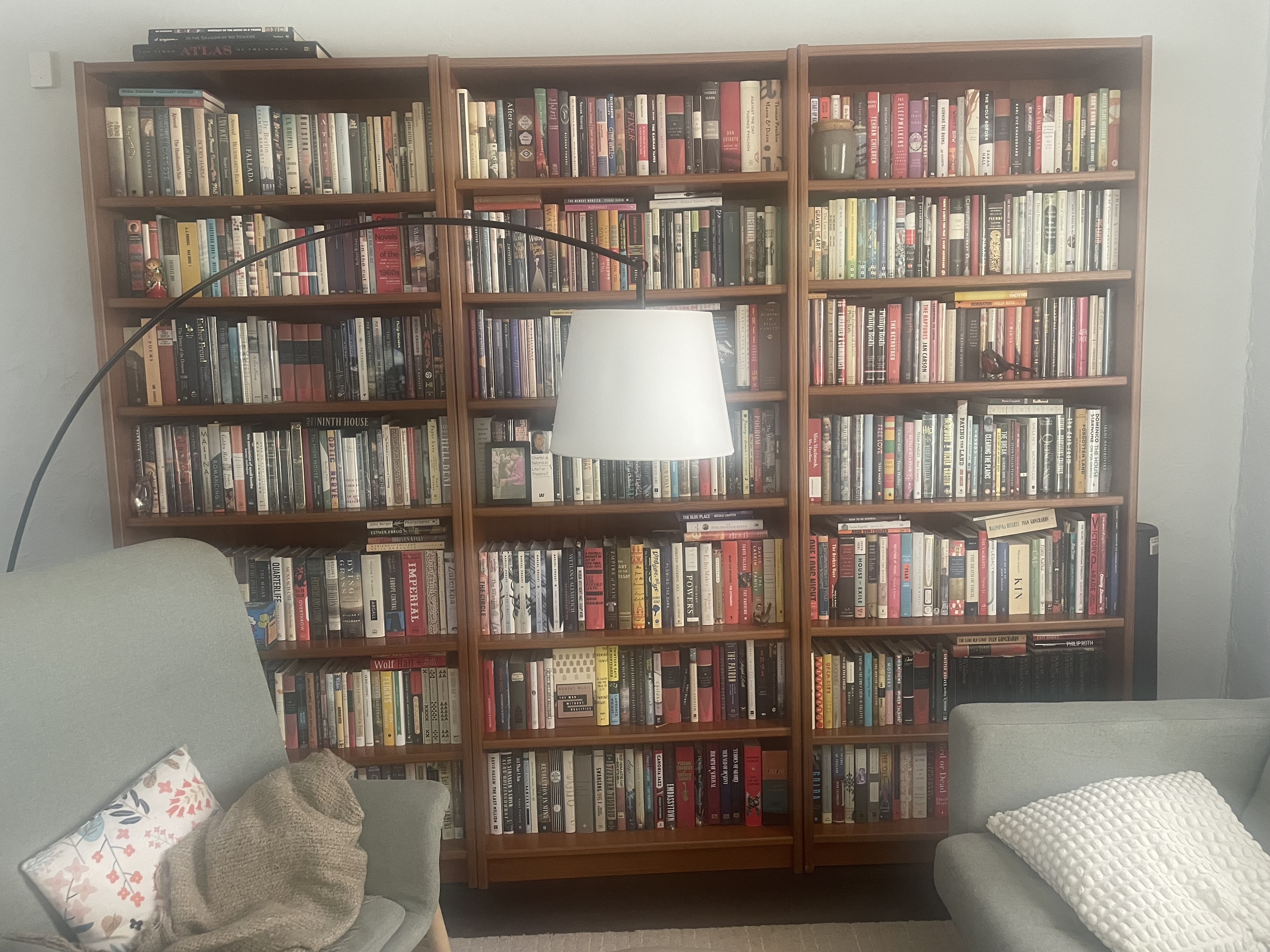
I tried not to think too long in coming up with my choices. Next month or next year I’d choose differently. And I’m aware of some big lapses. No poetry?? No plays?? No Torah?? (Everyone should read the Five Books of Moses.) But that’s ok. Gives you all the more room to think about how you’d create a starter library of your own. What would be on your shelf of promises?
Hope Coulter’s Year in Reading, 2021

Today’s reflection on a year in reading, her second, is by Hope Coulter(@hopester99), whom I’m lucky to call a colleague. A fiction writer and poet, Hope directs the Hendrix-Murphy Foundation at Hendrix College.

Look for more reflections from a wonderful assortment of readers every day this week and next. Remember, you can always add your thoughts to the mix. Just let me know, either in the comments or on Twitter (@ds228).

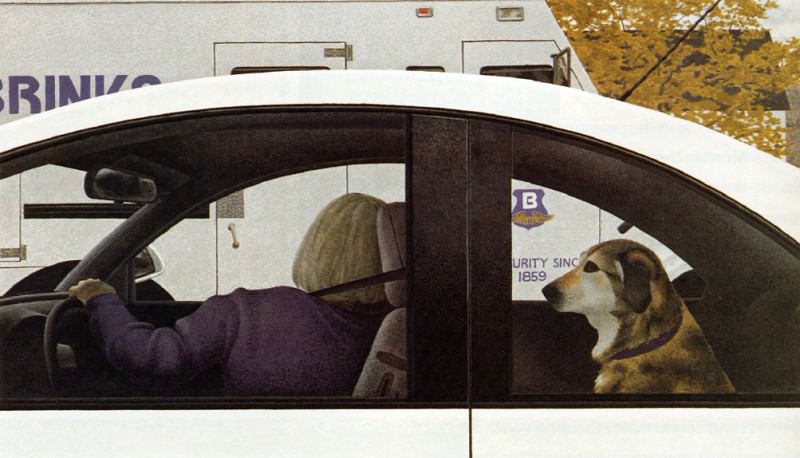
Alex Colville, Dog in Car, 1999

I tend to read erratically, not methodically, and my favorite books of a given year are always an eclectic list. For 2021 this was more the case than usual. I’m at a loss to discern any overall theme, what my college professors would call an organizing principle, in my reading life of the past twelve months. I seemed to bounce between serious works that might help me make sense of the grim circumstances overtaking the globe and marvelous, much-needed diversions from the same.

In nonfiction, one stand-out read was Barack Obama’s Promised Land. America’s 44th President is simply a terrific writer, with an ear for the rhythms of language and an eye for telling detail. This memoir tacks back and forth between two main narrative lines, one a chronicle of the administration’s initiatives and setbacks and the other—thankfully—the more personal side of life in the White House. The latter sections, relating everything from travel and cultural thrills to trying to find some kind of normalcy as the First Family, were merciful oases after long slogs through the housing crisis, the auto bailout, and never-ending Congressional acrimony, which kindled angst that not even Obama’s elegant telling could dispel. This book doesn’t touch the greatness of his earlier memoir, Dreams from my Father. Still, it wowed me, and I flagged many passages about race and democracy as keepers.

Slight but strong, and thoroughly entertaining, was The Actor’s Life: A Survival Guide by Jenna Fischer (aka Pam from the U.S. version of The Office). It’s fresh, unaffected, and utterly absorbing—fun reading not just for aspiring actors or anyone interested in an inside view of Hollywood, but for creative artists of any type who have to cope with rejection, ignominy, and professional jealousy. Along with a frank account of her own loopy path to success and some behind-the-scenes stories from The Office, Fischer gives practical tips on how to persevere.

In the surprising-oldie category of nonfiction, I stumbled upon Isabella Bird’s A Lady’s Life in the Rocky Mountains, an Englishwoman’s account of her 1873 travels through the Rocky Mountains of Colorado. What a woman! What adventures! Bird was tough as nails, a skilled equestrian who dismissed injury, privation, and subfreezing conditions with less complaint than most of us bestow on two seconds’ delay in our Netflix buffering. [Ed. – But it’s so fucking irritating, Hope!]  The edition that I read provided zilcho context to her prose—no editor’s note, no prologue, no afterward, no jacket copy—and the utter absence of context made me somehow enjoy her acquaintance even more. Bird is an efficient narrator who knows what to skip over or leave out and what to leave in, and a good describer, if one excuses a bit of 19th-century excess when her sunset rhapsodies go a bit over the top.

Jessica Bruder’s Nomadland: Surviving America in the 21st Century absorbed me from start to finish. I had not appreciated the extent of the nomadic van culture that has swelled since the 2008 economic collapse, and was struck by so many slices of that experience that are portrayed here, from jobs in national parks and Amazon warehouses, to ad hoc communities that have sprung up around this culture, to the Earthship vision that is gaining attention as the climate worsens. The movie starring Frances McDormand was based on this, and while I admired her performance, I’m not sure I could have made much sense of the movie if I hadn’t already read the book.

I enjoyed Edwidge Danticat’s The Art of Death: Telling the Final Story, another in Graywolf’s fine series of craft books commissioned from current writers; but then I’m a Danticat fan and love pretty much everything she writes. [Ed. – Hmm, that seems a bit backhanded…]

My final nonfiction standout was Gene Lyons’s Widow’s Web, which I reread last year for the first time since its publication in 1993. [Ed. – Arkansas, represent!] A riveting true crime story, it also exposes a fascinating picture of Arkansas politics of that era: jockeying police and sheriff’s departments, ambitious prosecutors and defense attorneys, criminal lowlifes, and, yes, venal liars, evildoers, and demagogues. This time around I was more aware of the challenge Lyons faced in figuring out how to pace, frame, and sequence all the byzantine storylines (I remember running into him frequently in the late 1980s in the aisles of the then-Safeway in Little Rock’s Hillcrest neighborhood, and hearing him air the difficulties of his process while my ice cream melted in my cart). This book proved as zesty and trenchantly told as I remembered from my first reading nearly thirty years ago. (Gene, if you read this, I don’t begrudge the ice cream.)

Segueing into fiction, let me lift up Ayad Akhtar’s Homeland Elegies, which dazzled me at first, though my enthusiasm cooled some as the chapters wore on. Memoir, novel, autofiction? Who cares? I liked the hero less by the end of the book; but then again one has to admire a writer honest enough to present an obviously autobiographical self on the page warts and all, allowing readers like me to sit back and make judgments about them. As one more take on the migrant search for identity—arrivees simultaneously attracted by American ideals and repelled by the failure to live them out—it was a fine read. Two more terrific novels about migration that I read last year are The Beekeeper of Aleppo by Christy Lefteri and The Year of the Runaways by Sunjeev Sahota. I also reread some of Mohsin Hamid’s work in connection with his April visit to my campus: How To Get Filthy Rich in Rising Asia is a wonderful read; and Exit West remains one of my top-tier favorite novels, debonair, quietly funny, and bearing much significance for our time.

Other memorable novels from the past year: Hans Fallada’s Every Man Dies Alone(1947), a story of Nazi resistance that’s just as grim as the title suggests [Ed. – God I love that book]; Emily St. John Mandel’s Station Eleven, a post-pandemic apocalypse novel, dark fun and strangely prescient of our current plague, although published in 2014; and Elizabeth Strout’s Oh William—not as good as her Olive Kitteridge novels, in my opinion, but still enjoyable.

Thanks to Our Fearless Blogmeister [Ed. – Please, call me OFB], I read Arnold Bennett’s Old Wives’ Tales (bad title, good book) for an online group-discussion experience that he co-led with Rohan Maitzen last summer. I enjoyed it for two main reasons. First, if you like 19th-century fiction at all you probably have a soft spot for description, and Bennett is a top-notch describer: he serves up well-chosen, well-rendered detail of both the mundane and the weird, affording us the sheer pleasure of learning how things were in certain times and places. Second, there are the character arcs. One advantage of getting older is the ability to see more and more of the complete trajectories of the lives transpiring around you. Sometimes this is surprising (who would think she would ever have become XYZ?) and sometimes it’s droll because so completely predictable (of course that person would turn out ABC, they were just the same way in kindergarten). Either way, long observance of the crooks and bends and straightaways of other people’s fates, not to mention one’s own, is something I value in fiction as well as real life. Bennett chronicles the lives of the two protagonist sisters and their circles with this sort of long-view verisimilitude. In his effort to represent entire lives, wielding omissions and foreshortenings and jumps in perspective, it seemed he was feeling his way toward modernism.

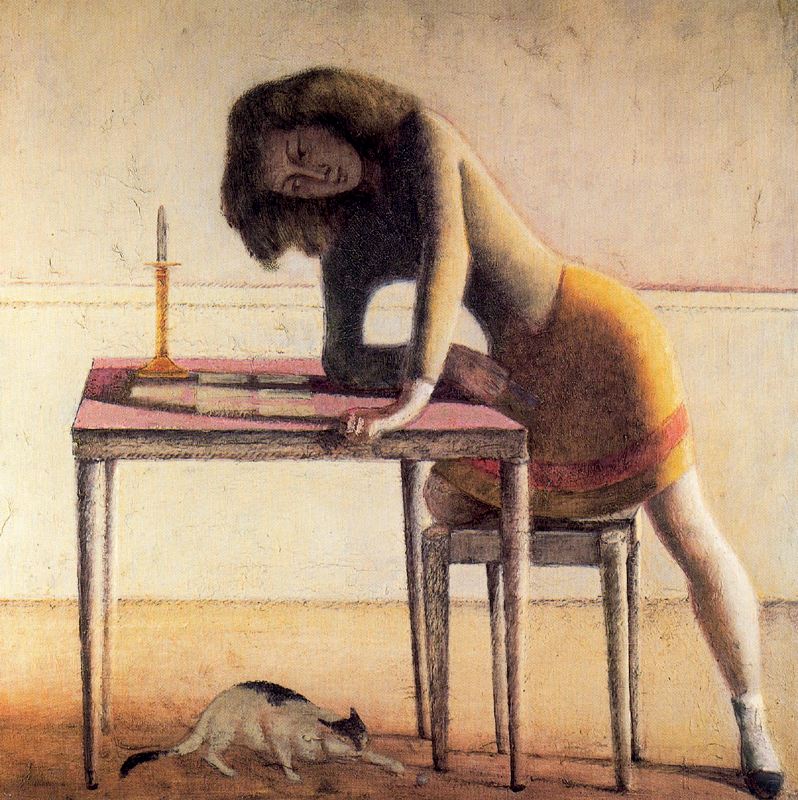
Balthus, The Game of Patience, 1954

Audiobooks, for me, are reserved for dog walks (this pairing helps keep my dog and me well exercised, and my commutes are long enough that listening in the car would gulp up the chapters way too fast). [Ed. – Too fast? These words seem to be English, but I do not recognize them.] In March I finished Troubled Blood, the fifth in the Cormoran Strike series by Robert Galbraith, aka J. K. Rowling. If you admire the Harry Potter series and want to see Rowling’s talents applied to adult material, check these out: for plot, wit, and rich evocations of contemporary Britain, they’re unbeatable. (If you don’t admire the Harry Potter series, well… just… oh, go talk to someone about Proust instead.) [Ed. – It’s me, she means me.] Robert Glenister, who reads the audio version, is on a par with Jim Dale, Grammy-winning reader of the HP series. [Ed. – Glenister makes the Strike books a thousand times better, IMO; I loved them, but I confess the worse Rowling gets, the less taste I have for anything she touches.]

What do you call the fear of running out of something good to read? Bibliolackaphobia? or maybe it’s not a phobia but an addictive behavior. At any rate, I was afflicted with a fresh bout of this particular anxiety around Thanksgiving, and desperately downloaded as many books as I could from the library as an antidote. Out of this batch there were a few passable reads, several that deserved the Dorothy Parker treatment (“not a book to be tossed aside lightly—it should be thrown with great force”), and one absolute delight: Hilma Wolitzer’s new collection, Today a Woman Went Mad in the Supermarket. The stories span a number of years, from 1966 to 2020. In their understatedness, their quizzical humor, their recurrent portraiture of New York women in different roles, they are reminiscent of, say, Grace Paley, and I became a Wolitzer fan by the time I was a few pages in.

In the last and most moving story, “The Great Escape,” the protagonist mentions a book she’s eager to discuss with her book club. The title didn’t ring a bell, but because I liked the sensibility of the collection so much I looked up this novel and ordered it, too, from the library. It was Evan S. Connell’s Mrs. Bridge, which became my final great discovery of the year. The novel concerns a post-World War I Kansas City housewife, a woman whose life is circumscribed by wealth, enforced idleness, and the rigid values of her social set; who senses something lacking from her life that she cannot even express. It’s told in very short chapters that refrain from plot contrivance or heavy-handedness and are often funny, in an oblique, Lydia Davis sort of way. [Ed. – I’m listening…] There are sharp observations about race and feminism, and stirrings of change on the horizon, but at every point the novel resists collapsing into the artifice of having a theme or Social Meaning. (It was made into a movie starring real-life wife and husband Joanne Woodward and Paul Newman, but of course the book’s artistry and restraint were savaged when they went through the sausage-grinder of screenplay adaptation. So if you’ve seen the movie don’t hold it against the novel.) I can’t think of another instance when I’ve sought out a book based on the recommendation of a fictional character, but this one turned out so well that I might have to consult other made-up people for their tips.

Meanwhile, you real people out there are serving quite well too. Thank you for your guest columns and your comments, and thanks, Dorian, for inviting me to chime in. I’m humbled by the opportunity. [Ed. – Nonsense, the pleasure is all ours!]

Short Fiction Week 1: Lydia Davis

I mentioned last time that I’m teaching a course on short fiction each semester this year. It’s been a while since I’ve taught it and I’m quite looking forward to it. I love novels, but it’s a relief to have a course without any. Short Fiction falls under my department’s Introduction to Literary Studies category, and is intended for Freshmen and Sophomores. These courses satisfy two of the general education requirements all students at my institution need to fulfill: Literary Studies and Writing Level 1 (W1). Thus although I hope to entice some of these students into at least thinking about majoring in English, the reality is that this is the only English course most of them will take.

It’s not easy teaching students how to develop their interpretive skills by reading attentively. But it’s even more challenging when I’ve also got to combine that task with teaching them how to write. Reading and writing go together, of course, but turning students into proficient writers takes a lot of time, both in class and in individual conferences with me. All of the assignments are structured into stages emphasizes revision. The dual aims—complementary but each daunting in its own right—make these classes hard to teach. (Fortunately, we were recently able to limit these classes to 18 students (it used to be 25) which helps quite a bit.) But I usually enjoy my introductory level courses a lot, especially in the fall semester. There’s nothing quite like the excitement—however undisciplined—of a first semester college student.

It doesn’t take long for the semester to get to the point where day-to-day survival is the only thing that matters. One of the first things to go by the wayside, at least for me, is my own writing, including here at the blog. I want to change that, and so this year I’ve decided to write each week about one of the stories we’re studying in class. I hope my dozens of loyal readers will keep me accountable. I welcome all gestures of support!

73024233-davis_41391c

Class met for the first time today, and I reserved the tedious business of going over class procedures & the syllabus for the last ten minutes and spent the rest of the time on a short piece by the contemporary American writer Lydia Davis. I’ve often taught her absolutely wonderful story “A Mown Lawn,” but this year I decided to go with something different, the first story in her most recent collection, Can’t and Won’t (2014). Davis is known for writing very short, very smart, often very funny stories, and this one is no exception. It’s called “A Story of Stolen Salamis” and here it is in its entirety:

A Story of Stolen Salamis

My son’s Italian landlord in Brooklyn kept a shed out back in which he cured and smoked salamis. One night, in the midst of a wave of petty vandalism and theft, the shed was broken into and the salamis were taken. My son talked to his landlord about it the next day, commiserating over the vanished sausages. The landlord was resigned and philosophical, but corrected him: “They were not sausages. They were salamis.” Then the incident was written up in one of the city’s more prominent magazines as an amusing and colorful urban incident. In the article, the reporter called the stolen goods “sausages.” My son showed the article to his landlord, who hadn’t known about it. The landlord was interested and pleased that the magazine had seen fit to report the incident, but he added: “They weren’t sausages. They were salamis.”

I started by asking the class what wasn’t in the story. Answers came pretty quickly: defined characters, description of the setting or much of anything else, and most importantly, details about the crime and its upshot. As one student cleverly put it—and this was by far way my favourite observation today—the story “leaves out the meat.” (That kid’s going far.)

Students were readily able to recognize the story’s obliquity, though it was a bit harder for them to see how much of that effect comes from Davis’s decision to tell the story in first person but without telling us very much about that person. We know only that she is the parent of a son who lives in Brooklyn and the possessor of both a good vocabulary and a wry, detached way of looking at the world, in short, that she is someone rather like Davis herself, which is why I use “she” here though there’s no indication of the narrator’s gender in the text itself, and it really doesn’t matter whether she’s like Davis at all. The narrator’s presence in the text is so minimal that it’s as if the story is taking the piss out of the convention that first person narrators are the heroes of their own stories. But that indirect, mediated quality is central to understanding the story.

I asked the class why the story was called “A Story of Stolen Salamis” rather than, say, “Stolen Salamis.” Isn’t the introductory phrase redundant, implied by the very existence of the text? And why “a” and not “the”? One student observed that “the” would mean there was only one story. But in this case there are at least two. There’s the story as a whole, and there’s the story within the story, the one reported in “one of the city’s more prominent magazines.” I reminded students that we use “story” to refer both to fiction and to fact. What links these uses are narrative and rhetorical conventions of the kind we’ll be studying in class. Certainly fiction seems to trump fact here, since the reporter—echoing the son (though it’s unclear how directly—the passive construction “the incident was written up” doesn’t tell us how the reporter found out about it—from the crime blotter, maybe?)—wrongly calls the stolen objects “sausages.” And although we didn’t actually talk about it, the quotation marks matter a lot. “Sausages” isn’t in quotation marks the first time the word appears in the story. Here the narrator is aligning herself—in her words, commiserating—with her son, as if to suggest that she too would have made that mistake. But the later reference to sausages—“In the article, the reporter called the stolen goods ‘sausages’”—is clearly not the narrator’s. Yet the sentence would have worked just fine without the quotation marks. We’d still know it was the reporter who had used the offending word. But in setting “sausages” off like that, the narrator distances herself from the glib and patronizing magazine.

She respects the landlord, who, thanks to his perhaps absurd but ultimately noble insistence on distinguishing salamis from sausages, is definitely the hero of the story. Preparing for class (how did anyone do that before the internet?) I looked up the difference between these terms, and everything I found said a salami is a kind of sausage, just one that is cured longer and is therefore drier. The difference, then, is subtle, but subtle differences matter a lot, especially when we’re reading literary texts. The main reason I wanted to start the course with this text—besides the fact that I like it so damn much—is that it’s such an elegant parable of interpretation, of how words matter, how we must always respect the specificity of whatever it is we’re interpreting. This precision can have other ends than linguistic ones, too, as one student noted by saying, when I asked them why the guy cares so much about the distinction anyway, that he might be asserting his Italian or Italian-American identity.

A fair point, but the identity the story really cares about isn’t ethnic or nationalistic but rather linguistic. Returning to the title, we can see that the most important word in it is not, as we might have expected, “stolen” (in other words, the drama of its narrative events, however absurd—the alliteration of the “stolen salamis” is like something from a Post headline:   “Stolen Salamis!”) but rather “salamis” (in other words, language itself, the importance of naming). In the end, I can’t quite figure what eh story wants to say about linguistic precision—after all, insisting that they were salamis doesn’t keep them from being stolen. Maybe, then, the joke is on the landlord? But I think the story presents him as a man of integrity rather than a pedant. And certainly not clichéd or casual like the reporter, a tone the story itself always seems to be skirting in its use of ready-made phrases like “a wave of petty vandalism and theft” or “an amusing and colorful urban incident.” For these phrases reduce the specificity of what exists in a way that completely opposes the landlord’s insistence on his salamis.

IMG_0205

There’s even more to be said about this story, I’m sure. But we said a lot in a short time—we got to most of these points, and I was pleased about that. I was less happy about how uneven the participation was—some students seemed much more engaged than others. But it’s too early to come to any conclusions as to what this group will be like. I’ll report back next week about how we’re getting on as we tackle stories by Balzac, Kipling, and Chekov. Stick around—that is, if you can stand to see how the sausages are made.