A Shelf of Promises: My Starter Library

A recent episode of The Mookse and the Gripes podcast got me thinking. Hosts Trevor and Paul were joined by John Williams of the Washington Post (mensches one and all). John had proposed a fascinating topic: starter libraries. The idea was to imagine your response to someone who asked you for ten titles they absolutely had to have in their collection. Probably this person is someone new to literature, a teenager or a student, but maybe they are someone who used to read more than they do now and are looking to get back to that part of their life. What would you recommend?

The important part of the assignment, as I understand it, is that the person is asking you. They know you well enough (parasocially or otherwise) to trust your taste. They respect you enough to be curious about anything you recommend. But they’re not asking for your ten favourite books. Presumably you like the titles on your list. But you’re not just offering them out of personal predilection. You think of them as representative for aspects of literature that matter to you.

Personal but not only personal, might be one way of putting it. Or, in the words of the episode’s subtitle, your choices could be thought of as a shelf full of promises.

Do listen to the episode, it’s terrific. Great lists, fascinating insights into the recommenders. And sure to get you thinking about your own answer. That’s what happened to me: I set aside the laundry I was folding and jotted some notes on my phone, which I’ve now expanded into this list, complete with categories (and alternate choices, because ten books is not many books).

Candida Höfer, Bibliothèque Nationale de France Paris XXI 1998

Books to grow into but also to love when you’re young:

George Eliot, Middlemarch

The only novel in English for adults, Virginia Woolf famously said. Not sure what she meant, but doesn’t it sound good? Having reread it recently, I think you need to be middle aged (and thus an adult… hmm well never mind) to get the most from this story of English provincial life around 1830. But having first read it in college, I can also attest that Middlemarch hits for young people. As with any rich text, what you pay attention to and who you sympathize with shifts each time you read it.

Eliot is known for moral seriousness (maybe that’s why as stylistically different a writer as D. H. Lawrence was a fan), but Middlemarch is also surprisingly funny. Mostly, it’s supremely moving. It covers so much of life, and asks the big questions. What makes a good life? How can we live with purpose? How can we think of ourselves in relation to everyone else? Where do we fit into the web of life?

[Alternate choice: Leo Tolstoy, War & Peace. Never read it until about five years ago, but feel confident it dazzles as much at 20 as at 50. You want novelistic sweep? This one’s as big as Russia… Freemasons and wolf hunts and returns from the dead and slow-burning love affairs lasting across the decades: everything, really.]

Books that master close third-person perspective

Nella Larsen, Passing

Set in Harlem and Chicago in the late 1920s among a set of well-to-do light-skinned Black women who can pass as white, Passing is a great novel of queer frenemies. It hews closely to the perspective of a single character, Irene, whose orderly life as the mother of two boys and wife to a (dissatisfied) doctor falls apart when she runs into a childhood friend, the brave and dangerous Clare. Unless we attend to how events are only offered through Irene’s perspective, we are likely to miss how much the book asks us to question the judgments it only seems to offer.

[Alternate choice: Henry James, What Maisie Knew. In book after book, James wrote about people behaving badly. Yet even among this vast canvas of cruelty, this novel stands out: the people doing the harm are parents who use their young child to hurt each other and, of course, the child. In the preface to the New York Edition James explained that he chose to narrate the book in third person but to limit the perspective to Maisie’s often baffled but also wondering sense of the world in order to offer readers the extra pathos of being able to understand what she could not. It’s quite a trick.]

Books about the Holocaust

Primo Levi, If This Is a Man

If someone is asking me what books they simply must own, they’re absolutely gonna get one about the Holocaust. Hell, I could make them a whole list. But knowing that not everyone shares my fascination, I’ll stick to one of the earliest and most famous instances of Holocaust literature. (Levi composed part of it already while in the camps.) Like all memoirs, If This is a Man (known in the US under the travesty title Survival in Auschwitz) details its author’s particular experience—which took the form it did by his having had “the great good fortune” to have been deported only in 1944, when the turning tide of the war and subsequent internal battle among top Nazis meant that more deportees were selected for slave labour. That phrasing gives you a sense of Levi’s matter-of-fact irony. But something that distinguishes If This Is a Man is Levi’s decision to use “we” even more than “I”: he aims to give a sense of the structure and meaning of the collective victim experience, at least within a subcamp of Auschwitz.

[Alternate choice: Ida Fink, A Scrap of Time and Other Stories. Too little known among English speakers, but, happily, available in a terrific translation by Madeline Levine and Francine Prose, Fink’s heartbreaking stories depict part of the Holocaust most people don’t know about: the mass murder performed by the Einsatzgruppen in Galicia in the summer and fall of 1941. Fink couldn’t find a publisher for these stories until the 1980s; they were deemed of no interest. Another devastating failure on the part of literary opinion. Fink has been called the Chekhov of the Holocaust. Grotesque as this sounds, it’s accurate. Quiet and heartbreaking.]

Members of YIVO New York examine crates of books rescued from the Vilna Ghetto

Books about how to read books:

Roland Barthes, S/Z

Barthes spent a year reading Balzac’s story “Sarrasine” with some students. (Oh to have been in that seminar!) That labour resulted in this extraordinary book, organized around line-by-line readings of the source text, not, as critics usually do, to figure out what it means, but rather how it means. To do so, Barthes offers five “codes”—fundamental elements of realist fiction, of which “Sarrasine” is considered only as a representative example—that readers unconsciously rely on (typically by having imbibed many examples of the genre) in making the text intelligible. The codes are things like references to historical events, people, and places, or attributes and actions that cohere into what we call characters and, in the case of realist literature, think of as if they were people. Barthes Intersperses his step-by-step redescription of the Balzac story with theoretical meditations on the operation of the codes, which readers can extrapolate to other texts.

S/Z is tough. I probably taught it five or six times before I felt I had a real handle on it. But as Barthes says, it’s valuable to be able to distinguish between real and superficial ideas of difference. We might think that the best way to know about books is to read a lot of them. But if we do so without thinking about what underlies their intelligibility (i.e. what we need to be able to read them), then we are mere consumers, doomed to reading the same thing over and over. Only by reading one text over and over can real difference, that is the difference within the text, show itself—which in turn will make our other reading more meaningful. All of which is to say, the effort of tackling Barthes’s analysis offers big rewards.

[No alternate choice. S/Z for everyone.]

Books with pictures:

Alison Bechdel, Fun Home

Comics, graphic novels, whatever you want to call them are important to me, and I think any reader needs at least one example in their library. Such a rich form, so many gorgeous and moving texts to choose from. As with my Holocaust choice, I resisted the temptation to go niche here. Bechdel’s memoir of her relationship with her closeted, self-destructive, talented father deserves its fame. Probably more than any book I regularly taught, Fun Home elicited the strongest positive reactions in the widest range of students. Family disfunction runs deep. A great book about how books can connect people who can’t otherwise open up to each other—and how they can further separate them too. Funny, ominous, bittersweet.

[Alternate choice: Nick Drnaso, Sabrina. Dark, powerful. Reading it gave me a bit of the ick. And yet its subject matter just seems more relevant. I guess this is about the manosphere, except no one was using that hideous term at the time.]

Books of ideas [fiction]

Thomas Mann, The Magic Mountain

Sometimes I want a book that dramatizes the back and forth of thinking. In The Magic Mountain, Mann literalizes this by surrounding his protagonist, the well-meaning, hearty Hans Castorp, with some of the most indefatigable talkers ever to appear in a novel. The whole intellectual landscape of pre-WWI Europe is here (liberal humanist, communist, militarist, hedonist, you name it), and everyone battles for Hans’s soul, even as the former engineer mostly wants to desire a woman from afar, a woman who reminds him of a boy from his schooldays…

The other great thing about this book is how well it depicts Davos and environs. I’m a sucker for mountains and mountains in books. Bring on the snow!

[Alternate choice: Proust. Honestly, if you can only put one book in your starter library, choose this one. I assume it’s already there, but if not then get stuck into this deeply philosophical book, which has so much to say about perception, time, cruelty, and control over others.]

Books of ideas [nonfiction]

W. E. B. DuBois, The Souls of Black Folk

Every American should read it. But non-Americans should too. The idea of double-consciousness—the way a minority must measure themselves by the tape of the majority, as DuBois so memorably puts it in his first pages—explains so much of our contemporary sense of identity.

In addition to its ideas, Souls is a fascinatingly hybrid book, presumably stranger in 1903 than today. Each chapter is prefaced by a bar of music, often from the sorrow songs. Most chapters are essayistic, but some are fictional. Each is written in resonant cadence. Hasn’t dated much. Alas.

[Alternate choice: Hannah Arendt’s The Origins of Totalitarianism. Explains how Nazism and Stalinism came to be so accepted and do so much harm. Especially interesting for (1) its “boomerang” theory of imperial violence, in which what the metropole does in the colony comes back to bite it at home, and (2) its argument that modern antisemitism arose from the waning of Empire and the rise of nationalism. Hasn’t dated much. Alas.]

Monomaniac books

The strand from writers like Kafka, Knut Hamsun, or Robert Walser to someone like Lydia Davis, via the high point of Thomas Bernhard, has been enormously influential in the Anglo-American sphere. At this point, annoyingly so. (And weird, too, given that none of the most important precursors wrote in English.) But I get it because literature excels at tracing the vagaries of a mind, especially one spinning through reversals, paradoxes, and hobby-horses. A starter library should have an example of this sort of thing, and Bernhard might be the best. When the only thing that stands between a psyche adrift or worse is the chance that someone might respond to its voice—that’s when you’re in Bernhard territory. I’ve chosen The Voice Imitator because the title says it all. Read these 104 short texts to get a sense of Bernhard’s bitter, misanthropic, and, oddly, funny vibe.

[Alternate choice: I just named like five other writers!]

Funny books

P. G. Wodehouse, The Code of the Woosters

As implied in what I said about Bernhard, voice-driven books don’t have to be grim. They can make us laugh, whether from the gap between what the narrator claims and what we know, or the sheer verve of their style. The fun only increases when those narrators get embroiled in elegant plots. Wodehouse is the master of this terrirtory and everyone’s library is the better for including him. (I feel like he’s fading a bit from memory? Sad.) You can jump in anywhere—my entry point was the distinctly not-famous-but oh-so-representatively-titled Eggs, Beans, and Crumpets which baffled and delighted me at age 12—but if you’re at a loss start with this wonderful episode in the Jeeves and Bertie series, which Tim Waltz would enjoy, since it’s an early example of the “I condemn the fascists by unflinchingly stating how weird they are” school of responding to authoritarianism. (As Bertie says, appalled by the realization that the Saviours of Britain are simply grown men marching in black shorts: “how perfectly foul!”)

[Alternate choice: for an American version of this phenomenon, reach for Charles Portis, especially the marvelous True Grit.]

Books about crime

Dolores Hitchens, Sleep with Strangers & Sleep with Slander

Since at least Oedipus Rex, literature has used crime to understand fundamental concerns like identity, political organization, and moral value. Crime fiction can be smart, is what I’m saying. And it can also carry us away by inciting our desire to have enigmas explained. (Interestingly, it often makes us realize how much more compelling it is to ask a question than to answer it.) Like any genre, then, crime fiction satisfies at both the intellectual and emotional level. Having stayed with well-known titles so far, I’m diving deep for this last category. Not enough readers, even lovers of crime fiction, have read the mid-century American writer Dolores Hitchens. She wrote a lot of books under a lot of names. But only two about a PI named Jim Spader. Which is sad—but also good because they’re even more special. These make for pretty despairing reading, even for noir. So be warned. But you won’t regret seeking them out.

[Alternate choice: Hundreds! Thousands! Sticking with mid-century American women writers, I’ll plump for Dorothy B. Hughes’s The Expendable Man. Don’t read anything about it beforehand!]
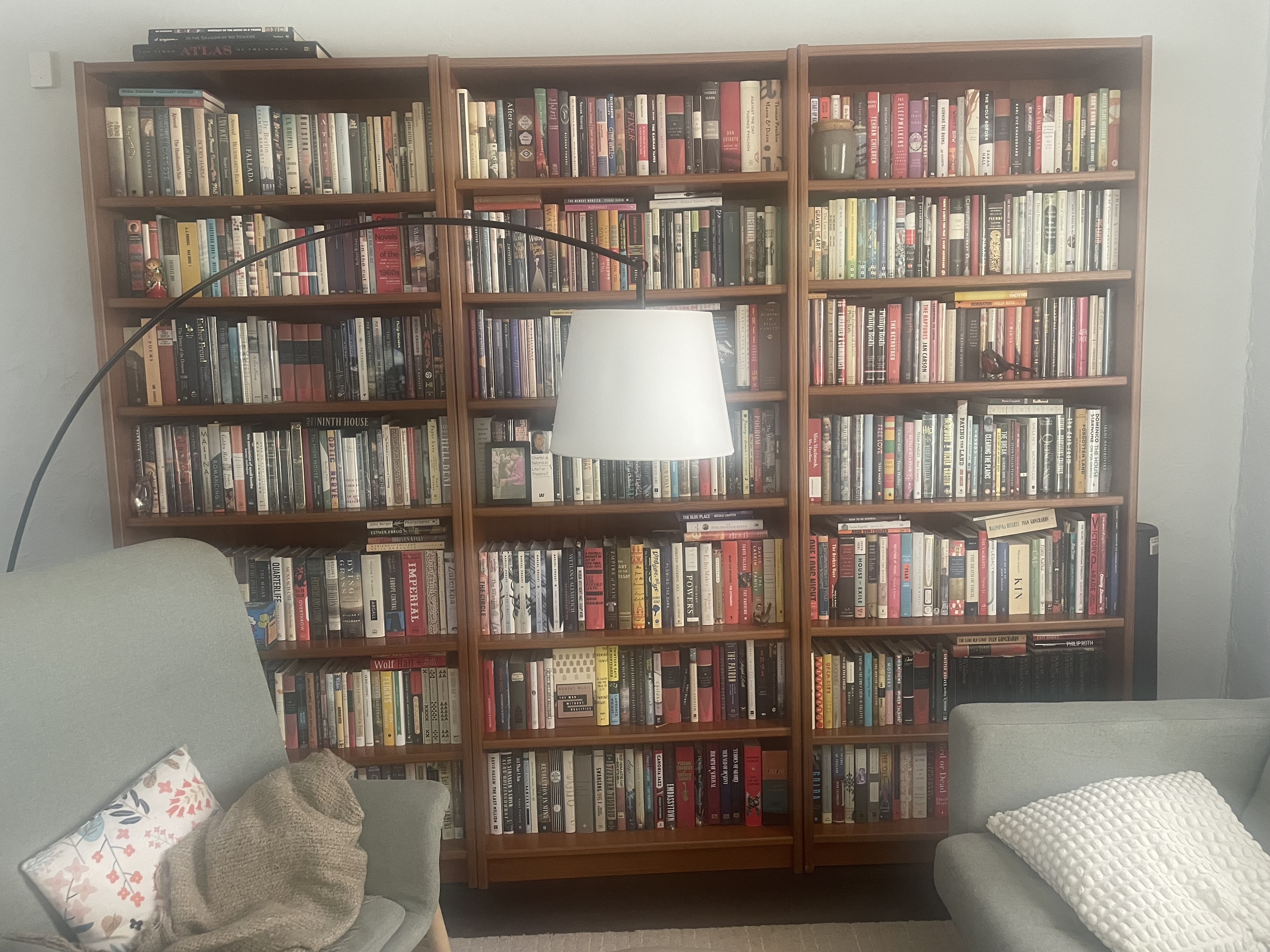
I tried not to think too long in coming up with my choices. Next month or next year I’d choose differently. And I’m aware of some big lapses. No poetry?? No plays?? No Torah?? (Everyone should read the Five Books of Moses.) But that’s ok. Gives you all the more room to think about how you’d create a starter library of your own. What would be on your shelf of promises?

Nat Leach’s Year in Reading, 2020

In the next week or so I’ll be writing up my reflections on my 2020 reading year. In the meantime, I’ve solicited guest posts from friends and fellow book lovers about their own literary highlights. I’m always looking for new contributors; let me know here or on Twitter (@ds228) if you have something you want to share.

The fourth post is by Nat Leach (@Gnatleech). Nat has written several posts for the blog over the years, all wonderful. He lives and works on Cape Breton Island.

An Alphabetical Odyssey: Year 3

Like so many things in 2020, my reading did not exactly go according to plan. Readers of my Year in Review post from last year will know that my current project is to work through my shelves alphabetically in order to finish the many partially-read books on them. But while I managed to work my way through almost three letters of the alphabet during each of my first two years of this project, I ended up devoting most of this year to the letter “G”. There are a number of reasons for this: my own tendency to expand this project by creating mini-projects (e.g. exploring 6 translations of Goethe’s Faust or almost 2000 pages of Vasily Grossman) or by adding new books to my shelves thanks to a number of irresistible NYRB Classics titles and some very strong recommendations from Dorian (a Venn diagram of which would basically be a circle), and, of course, my Achilles heel—Twitter read-alongs (Malicroix, Our Mutual Friend, The Man Without Qualities). But if this sounds like complaining, it’s absolutely not—if ever there was a project where the point was the journey and not the destination, it’s this one. After all, what’s going to happen when I reach “Z” (assuming I live that long)? I’m just going to start all over again.

Over the course of the year, I realized something about myself that might help to account for my previous system of rotating my reading between an excessively large number of books: I enjoy beginnings a lot more than endings. A new book introduces us to a new world populated by new characters whom we desire to know better. The potential is boundless. But the closer a book gets to its end, the more it forecloses the possibilities it has opened up, and (often), the more we feel that nothing can surprise us, or, worse, that the ending is not consistent with what went before. Put another way, endings are a lot harder than beginnings; creating the broad outline of a narrative world and its characters is one thing, but sketching in the detail and bringing it to a satisfying conclusion is quite another. Over the years, I think I’ve enjoyed having read only a few chapters of certain books, and having their potential frozen in place like Keats’s urn. But now that I’m getting older, the impulse for completion is getting stronger.

Maybe this is all pretty obvious, but this year really brought it home to me, as I was enticed by the openings of a number of books only to find my interest lagging in the second half. If I could have stopped reading at a certain point, my memories of some of these books would be fonder. Fortunately, I still had mostly positive reading experiences this year; I read 33 books from 11 countries (including 6 from France, making me wonder if there is something about the letter “G” and French surnames), and enjoyed most of them. Here are some short synopses:

Ford, Richard- The Sportswriter (1986)

The only thing I learned from this book is that this middle-aged white guy has no patience for the angst of other middle-aged white guys. The protagonist of this book, Frank Bascombe, is divorced because he has been horrible to his wife, continues to be horrible throughout the entire book, and somehow I’m supposed to care about his faux-profound reflections on life? I could have tolerated this book if there was some sense of distance between its author and his protagonist, but from the light way the book tosses off Frank’s casual sexism and racism to (spoiler alert, if anyone cares) the way he is rewarded at the end of the book with an incipient relationship with a seemingly interesting, intelligent, and attractive 20-year old woman, I can’t help feeling that Ford is thoroughly endorsing Frank’s perspective. I hate to use sophisticated literary-critical terms, but this book was just too “icky” for me. In fairness, Dorian warned me not to read it, but would I listen? I know it’s a bad start to be this grumpy about my first book of the year, but at least if I get a bullet in the mail, I’ll know who it’s from.

Garner, Hugh– Cabbagetown (1968)

Another book from my list of Canadian classics, this novel focuses on the life of an impoverished community in Toronto during the Great Depression. The book’s strength comes from its powerful, vivid depiction of the struggles of its characters as each of them attempts to come to terms with the reality of the Depression in a different way. Here’s a typically great descriptive passage, of a chocolate factory at which one character is fortunate enough to be employed:

The mixing room was heavy with the smell of chocolate. The walls, the floor, the machinery, even Billy, reeked of it. It permeated his clothing, hair, and even his comb, nailfile and wallet, so that he was a permanent olfactory advertisement for Besty-Tasty products. His appetite for chocolate had been satisfied forever during his first week in the mixing room. He had imbibed his fill, not only by mouth and gullet but by absorption through his pores. Now he could no longer even smell chocolate, for it was his own body odour.

It’s far from the bleakest passage in the book, but given the unfortunate fate this character suffers in the mixing room, it appropriately attests to the way in which characters are victims of their concrete circumstances.

Genet, Jean- Our Lady of the Flowers (1943) (trans. Bernard Frechtman)

Usually, when an author has a reputation for being shocking, I find myself highly disappointed when I actually read them. Genet, however, completely lives up to his reputation. Written clandestinely in prison, the book challenges all conventions and taboos. But, going beyond Genet’s detailed and explicit attention to bodily emissions and his multiple slang terms for “penis,” two things particularly struck me. 1) The guy can write. Given his subject matter, it’s hard to call his writing beautiful, but it has a rhythm and flow that captivates, even as his digressive style is continually shifting narrative tracks. 2) At the root of the narrative is actually a very sensitive story of someone who would today be called a trans youth, told without embellishment or censorship.

Gide, André- The Immoralist (1902) (trans. Dorothy Bussy)

Call this Exhibit A of the phenomenon I mentioned above; this book captured me at the beginning, but lost much of my interest by the end. It’s an appropriate book for this year, I suppose, insofar as it is concerned with the way that illness—and recovery—test relationships. I enjoyed this book, but I somehow expected it to go further than it did. Maybe I’ve just become jaded by subsequent anti-heroes, but the climax of the book did not particularly shock me, nor did it inspire much moral reflection. In his Preface, Gide says, “I have not tried to prove anything, but only to paint a picture well”; he does that much, but I couldn’t help wanting something more.

Ginzburg, Natalia- Family Lexicon (1963) (trans. Jenny McPhee)

Call this one Exhibit B: I liked this book a lot, but I loved the first half of it and felt it ran out of steam a little bit towards the end. It opens in a really interesting way, exploring how a family’s language constructs its own particular place in the world. This thread carries through the book, of course, but at a certain point, Ginzburg becomes much more informational, describing what happened to each member of the family and its associated friends. Not coincidentally, this point is the outbreak of World War II, and the various traumas and divisions in the family are noted without being extensively described. Given that Ginzburg notoriously recommended the rejection of Primo Levi’s seminal Holocaust memoir, If This is a Man, because of its subject matter, it is perhaps not surprising to find that she is reticent about describing her own war experiences, including her husband being tortured to death by the Nazis. I liked it enough to give the book to my mother for her birthday, and her take was that the book starts from a child’s perspective, so you don’t expect very much interpretation, but once it shifts to an adult’s perspective, we feel that absence of context a lot more. Which I thought was a good point. All of this is by way of explaining why I felt the latter half of the book somewhat flatter than the first part, but I still enjoyed it a lot.

Giono, Jean- Hill (1929) (trans. Paul Eprile)

This was a late addition to my list, thanks to the recommendation of Dorian, and others on Twitter, and was certainly one of my favourite books of the year. Written in 1929, it reads in a very contemporary way because of its treatment of environmental concerns. I jokingly referred to it as “The Rime of the Ancient Mariner” meets Picnic at Hanging Rock because it involves a violation of nature that is punished, but in a mysterious, uncanny way. The events take place in a tiny village in Provence, where the inhabitants struggle with the forces of nature, and the book wonderfully illustrates the precarious coexistence of the human and natural worlds.

Gissing, George- The Odd Women (1893)

This book had been sitting on my shelf for some 20 years, and now that I’ve finally gotten around to reading it I could kick myself for waiting so long. Another book that feels very contemporary despite its age, and that rarest of things, a book that deals with social issues (in this case, the Victorian “woman question”) without sounding preachy. Clearly, there are characters we are expected to identify with more than others, but Gissing brings great sensitivity and understanding even to the characters who are clearly shown to be ideologically flawed. My one criticism of this book would be its use of implausible coincidences to move the plot along; for example, when complete strangers meet and realize that they live in exactly the same building in the huge and bustling city of London, you just know that plot complications are going to follow. (On the other hand, I forgive Dickens for stuff like this ten times in a single book, so I guess I can’t really complain.) This is one of the exceptions to my tendency of the year, since it actually gets the ending just right, which is especially difficult for novels about social problems; a happy ending is liable to make readers complacent about real social ills, while an overly tragic ending makes them feel hopeless. Gissing strikes just the right balance between hope for the future and mourning for what might have been.

Godwin, William- Deloraine (1833)

Having read all of Godwin’s “mature” novels (I haven’t read his three “juvenile” novels) except this, his last, I figured it was time. It’s far from his best, and might be accused of being a re-tread of Godwin’s dominant themes: social alienation, class injustice, the haunted perspective of a pursued criminal, and an abrupt reversal of philosophical perspective at the end. He does, however, also do a characteristically good job of using conventional melodramatic situations to raise deeper philosophical questions. Is it worth saving your life, Godwin asks, if you lose your identity in the process?

Gogol, Nikolai- The Inspector General (1836) (trans. B.G. Guerney)

Sadly, this nineteenth century satire on political corruption and deceptive appearances is just as relevant now as it was then. A buffoonish but minor civil servant is mistaken for an important government inspector in disguise; hilarity ensues as local officials seek to conceal their misdeeds and appease the fake inspector, but as the play’s conclusion reminds us, the subject is not all that funny.

Goethe- Faust, Parts 1 and 2 (1808, 1832) (various translators)

I embarked on an ambitious project of beginning 6 translations, and ended up finishing 2 (the Bayard Taylor and Charles Passage versions). Part of the reason for this is that Part 1 has been much more frequently translated than Part 2; two of my translations were of Part 1 only. To summarize briefly, Part 1 was pretty much exactly what I expected it to be (Faust makes deal with Mephistopheles, seduces Gretchen, lots of witches and devilish imagery et cet.), and Part 2 was utterly and completely not (complex allegory about everything from contemporary politics to poetry to geology). I would say that it completely changed my view of Goethe, but now that I think about it, I had a similar reaction to Wilhelm Meister’s Apprenticeship, so maybe I should just admit that I have no idea what to expect from him.

Goethe- The Sorrows of Young Werther (1774) (trans. Elizabeth Mayer and Louise Brogan)

When I was an undergraduate, my classmates and I created a list of “big idiots of English literature,” to which virtually every character in every book we read would be added for one reason or another. Werther would probably have earned his own category on that list. I actually suspect that undergraduate me would have totally loved this book, but given the suicide craze that it sparked in Germany on its publication, it’s probably just as well that I did not read it until I was older and wiser. Now, I’m more inclined to say that it’s a good book, but man, that guy is a big idiot.

Gracq, Julien- Chateau d’Argol (1938) (trans. Louise Varèse)

I had heard such wonderful things about Gracq that I was very keen to read one of his books. Having received this one (his first, as it happens) as a gift some years ago, I chose it, which may not actually have been the best place to start. The writing is gorgeous, the plot minimal—a  man buys a remote castle in Brittany, his frenemy comes to visit, and brings a woman, leading to a love triangle of sorts—and some of the chapters are utterly compelling. One in which the three protagonists swim too far out into the sea and struggle to return to shore was particularly gripping. Given my interest in the Gothic, I was also intrigued by the exploration of the castle and the vivid, often grotesque, imagery, but, finally, I wasn’t sure if the book adds up to much. It gave the impression of housing some hermetic secret, but search me what that might be. But the writing itself is enough to make me want to explore Gracq further.

Grass, Günter- The Tin Drum (1959) (trans. Ralph Manheim)

Exhibit C? At least I’d been warned that the first half of this book is much better than the second. And having seen Volker Schlöndorff’s film adaptation three times, I certainly had some vivid memories of the beginning: Oskar Matzerath—unreliable narrator extraordinaire—tells the improbable story of his mother’s conception, eventually arriving at his own birth, and the novel’s pivotal event: he is given a drum for his third birthday and decides to stop growing. I was a bit puzzled that I had no recollection of any events from the second half of the book, but after watching the film for a fourth time, I realized that Schlöndorff only adapted the first 2 of the novel’s 3 books. Probably a wise choice since the third book is pretty forgettable, and Schlöndorff ends his film by foregrounding the Holocaust context that Grass himself has been accused of minimizing. As Ernestine Schlant puts it, “there is an ingrained obtuseness and insensitivity to those who suffered and died, evident in a language where silence is veiled in verbal dexterity and a creative exuberance rooted in pre-Holocaust aesthetics.” Schlöndorff does a much better job of addressing this context in his film, foregrounding German anti-Semitism; having Charles Aznavour sympathetically portray Sigismund Markus, the store owner who supplies Oskar with his drums, and one of the few Jewish characters in the book; and, finally, ending with the arrival of Fajngold, a camp survivor who displaces Oskar’s family. I liked the book well enough, but I think Schlant has a point: Grass loves his own creativity in a way that overshadows his book’s troubling subject matter.

Gray, Alasdair- Poor Things (1992)

A playfully postmodern riff on Frankenstein in particular and nineteenth century fiction more generally, this book starts with “Alasdair Gray” discovering and surreptitiously pocketing a manuscript written by a Victorian physician and gets progressively wilder from there. Impossible to write too much about without giving something away, but brilliant in the way that each successive level of documentation works to throw into question what has come before.

Green, Henry- Loving (1945)

This book bucked the trend of the year: it grabbed me from the beginning and never let go. The plot concerns the servants in an Irish manor during World War II, and depicts their lives with a remarkable fullness, rarely showing much of the lives of the upper-class characters at all. Highly recommended to anybody except those who can’t stand when adjectives are used as adverbs.

Greene, Graham- The Heart of the Matter (1948)

This was my third Greene novel (after The Power and the Glory and A Burnt-Out Case) and certainly the one I enjoyed the most. I suspect this has as much to do with my age as anything else; I read those first two in my 20’s, but Greene’s heroes always seem to be world-weary and cynical, a position with which I am becoming increasingly sympathetic. I could certainly feel for Scobie, a morally upright but generally insignificant colonial policeman whose conscience gets tested both in his public and his private life. The other challenge I find with reading Greene is the centrality of the Catholic beliefs of many of his characters; in this case, the entire final third of the book hinges on Scobie’s Catholic definition of sin, and even though one of the women in his life points out the inconsistency between his actions and beliefs, it is clear that readers are supposed to be aligned with Scobie’s views. George Orwell disliked the book for this reason, dismissing Scobie’s character as implausible (that, and the fact that the book is set in Africa, but is exclusively concerned with “white people problems”). So, I did enjoy the book, but also felt that I couldn’t sufficiently engage with its moral problem.

Greenwood, Walter- Love on the Dole (1933)

Another very fitting book to read this year, this account of life in a Northern English city during the Great Depression is filled with simmering, impotent frustration with the system, and one very explosive protest. Greenwood does an excellent job of showing the texture of life within the limiting constraints of “Hanky Park,” the slum neighbourhood where the characters live, from the cradle to the grave. We see highs as well as lows, but are always reminded that the system is designed in precisely this way, as the lows get progressively lower.

Grossman, Vasily- Stalingrad (1952) (trans. Robert Chandler and Elizabeth Chandler) and Life and Fate (1960) (trans. Robert Chandler)

I bought Life and Fate on Dorian’s recommendation, but before I could read it, I heard about NYRB’s publication of Stalingrad. I tried to decide which to read first, as there seem to be many opinions on that question. In his introduction to Life and Fate, Robert Chandler says that it is “better seen as a separate novel that includes some of the same characters,” but in his Introduction to Stalingrad, he refers to the two novels as a closely connected “dilogy.” I can certainly see the logic in both claims; one does not need to have read Stalingrad to appreciate Life and Fate. As a stand-alone novel, the latter can simply be seen as opening in medias res, and its ideological perspective is markedly different from the earlier novel anyway. However, I ended up reading the “dilogy” in sequence, which did help me to feel the continuity of Grossman’s intricately depicted world. In fact, Life and Fate begins with characters who had been captured by the Germans about halfway through Stalingrad, and whom I had almost forgotten already, so I’m sure that if I had read them separately, I would have missed many of the connections between them. I enjoyed both books, although Stalingrad is much more ideologically orthodox than Life and Fate, which is more complex (and subversive) in its exploration of the dynamics of totalitarianism, both in Germany and in Russia.

Grushin, Olga- The Dream Life of Sukhanov (2005)

This was a wonderful follow-up to Grossman, exploring the history and psychology of the Soviet era with a specific lens on visual art. The novel positions surrealism as an imaginative artistic movement repressed by the official dictates of socialist realism; that repression returns with a vengeance in the psyche of the main character. The book is narratively breath-taking and deftly switches from third-person to first-person at significant moments, building to a remarkable crescendo.

Haasse, Hella- The Scarlet City (1952) (trans. Anita Miller)

Normally, I’m a sucker for all forms of historical fiction, but this one gets mixed reviews from me. Its central narrative revolves around Giovanni Borgia, who is searching for answers to the mysteries of his birth (Is he really a Borgia? And if so, through which member (or members!) of the Borgia line can he trace his lineage?) It’s interesting to note that this character does seem to be based on a real historical figure, albeit one who was murdered before the events of this narrative begin, and who does not seem to have had such mysterious parentage; so the narrative is counter-factual, but not in a way that an average reader would recognize. Giovanni explains that he writes his narrative because there is nobody in Rome he can trust. So far, so good—and this part of the narrative was quite enjoyable—but interspersed with Giovanni’s narrative are the stories of a number of other related characters, presented in a weird combination of omniscient third person narrative and unmotivated first person reflections. The fact that Giovanni’s narrative situation is explained, but these others are not, was confusing enough, but to top it off, Haasse breaks the Sir Walter Scott rule, and makes actual historical personages central figures in a way that feels very jarring from a historical point of view (Michelangelo is the focus of two segments, and we also read letters supposedly written by Machiavelli). Those parts really did not work for me, nor did the whole thing come together in any meaningful way at the end, as I had hoped, although the vivid and brutal depiction of the Sack of Rome of 1527 was a powerful segment.

Hamsun, Knut- Hunger (1890) (trans. Robert Bly)

This book does exactly what it says on the tin: there really is an awful lot of hunger in it. It is psychologically gripping, as the narrator attempts in various ways to get money for food and very often finds reasons to reject it or give it away when he is fortunate enough to have the opportunity to get some. I took issue with the translator’s Afterword, in which Bly claims that the trajectory of the narrative is one in which the narrator comes to learn what he needs. I question whether any learning takes place in this book at all; the last event seems like yet another in a series, not a resolution. One interesting note from the Afterword, though, is that Hamsun apparently cured himself of tuberculosis by riding on the roof of a train to fill his lungs with air; I wonder what he would have done if he were alive this year.

Haushofer, Marlen- The Wall (1963/1968) (trans. Shaun Whiteside)

Possibly my favourite book of the year, but I’m not sure how to do it justice. It’s impossible to write a plot summary that doesn’t make it sound a little bit boring: woman thinks she is the last person on earth, tries to survive along with her animals. But it is absolutely riveting to follow the narrator’s thought processes, which are both practical in nature (how to accomplish the necessary tasks to survive) and very human in her need for affection and interaction (provided mostly by her dog, but also cats and cows) and in her reflection on her past life, thrown into perspective by her current situation. I knew I wouldn’t do it justice, but it’s a fantastic book.

Best of the Rest

Bosco, Henri- Malicroix (1946)(trans. Joyce Zonana)

It feels like a long time since I read and wrote about this book, but it still ranks as one of my favourite reading experiences of the year.

Dickens, Charles- Our Mutual Friend (1864-1865)

I had read this in my youth and was very pleased that it held up as well as I remembered. I know some people complain that the ending comes off as artificial and contrived, but as someone with a great fondness for melodrama, I appreciate a good melodramatic revelation scene when it is well done, and Dickens does indeed do it very well.

Musil, Robert- The Man Without Qualities (trans. Sophie Wilkins and Burton Pike)

Technically, I haven’t finished this book yet, but any time I read 1053 pages of a book, I’m going to mention it. Very good so far.

Smith, Charlotte- The Young Philosopher (1798)

Charlotte Smith is a Romantic period author who never seems to get the recognition she deserves. She thought of herself as a poet (and her 1784 Elegiac Sonnets enjoyed a great deal of popularity) but she wrote novels to pay the bills. Her novels combine radical politics and melodrama; the “young philosopher” of the title is George Delmont, who offends society by believing that a person’s merit can be determined by their actions not their status. But the novel’s focus is on his beloved, Medora Glenmorris, and her mother, embattled heroines relentlessly pursued and tormented by representatives of patriarchal culture. The melodramatic situations may be conventional, but the political use to which they are put is pointed.