What I Read, October 2022

October 2022 was months ago, I just remember we headed into the heart of semester, and it was still too hot a lot of the time, except at the end. I had a lot going on, but I managed to read quite a lot somehow. (A few of these had been on the go for a long time, though.) This is the last of these 2022 months I’ll complete. I’m missing July and August, which were good reading months, but some of those titles will appear on my Year in Review piece, which I’ll finally turn to now…
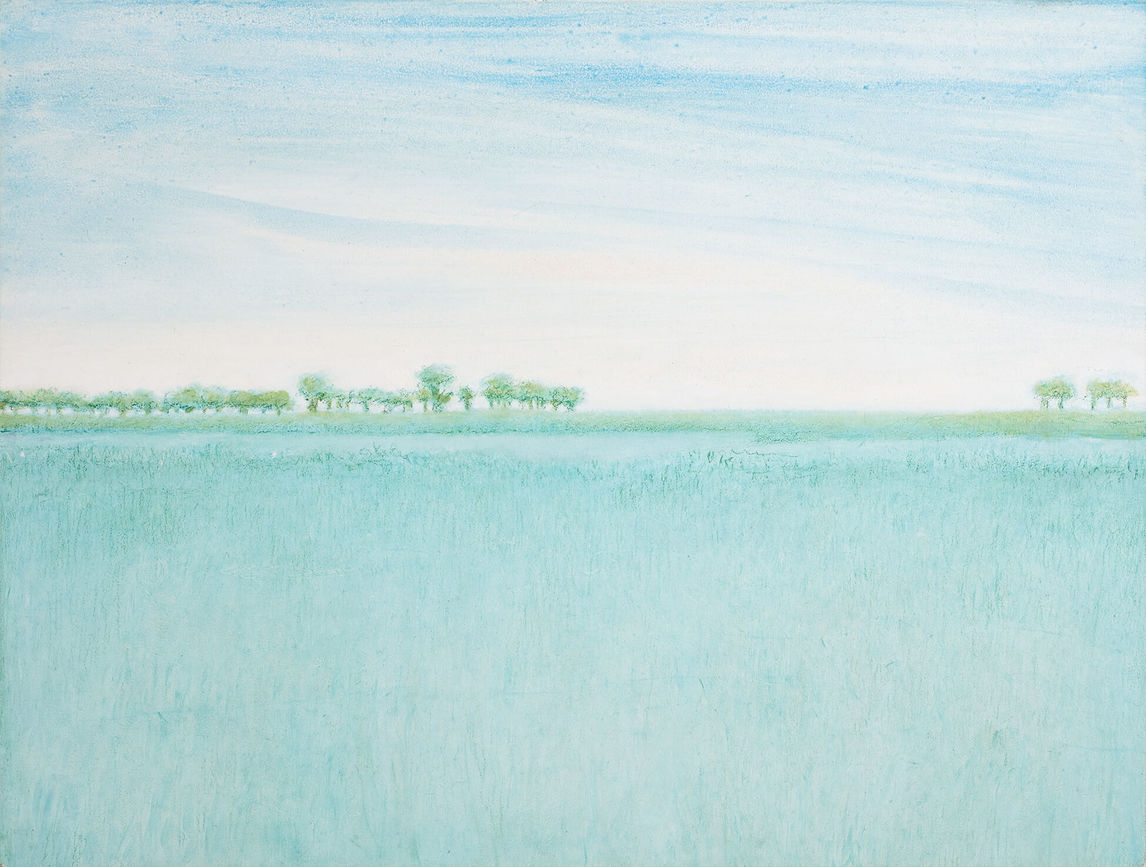
Robert Houle, Sandy Bay, 2007

Larry McMurtry, Streets of Laredo (1993)

After finishing Lonesome Dove a couple of years ago, I asked Twitter if the book McMurtry later wrote with many of the same characters were as purely enjoyable. The answer was a resounding no, with a few even warning me not to read them, as their joylessness would retrospectively taint my feelings about LD. That was a flag to a bull, of course, and a friend and I decided to start with the book McMurtry wrote as a sequel.

It is, predictably, grimmer and more valedictory. The mythic West, already shown to be faded and false at the end of Dove, is really no more in The Streets of Laredo. And any book without Gus McCrae is going to be more a downer than one with him in it. The former heroes are old and failing, the new young’uns are clueless or vicious. But characters who didn’t shine in that earlier world get their due here: who knew that Pea Eye would grow to have so much self-knowledge? And women are important in this book, Lorena in particular is magnificent. The primary indigenous character, though, well, less two-dimensional than in Dove, and intended, I suspect, as a tribute, is an embarrassment, there’s no way around it.

Laredo is a violent book, much more so than Dove, verging even at times on Blood Meridian levels. It’s not a nihilistic book, though, unlike McCarthy’s, and indeed in the end a peaceable, fallible one. I loved it, and didn’t regret reading it for a second, and will give the two prequels a try soon enough.

Keum Suk Gendry-Kim, The Waiting (2021) Trans. Janet Hong (2021)

Every year on Yom Kippur, in the hours between morning services and ne’ila, when I’m too hungry and headache-y to sleep, I pick up a book that has nothing to do with work. Bonus points if it’s not too taxing, but also on the somber side. The Waiting fit the bill: a beautifully drawn and told comic about a family separated during the Korean War, and the aftermath of that trauma. Every year hundreds of people in South Korea—all of them now old, most frail—apply to meet relatives who found themselves in what became North Korea after the freezing of hostilities in the 1950s. The exchange is tightly controlled by both sides; only a handful who apply are chosen. The meetings happen at special facilities on the border: people who haven’t seen loved ones in decades are given a few hours together, an opportunity that can be almost as painful as not being selected. I knew nothing of this, and would, I’m sure, have been overwhelmed by sadness even without the somberness of the day.

Michael Frank, One Hundred Saturdays: Stella Levi and the Search for a Lost World (2022) Illus. Maira Kalman

A wonderful book, that rare thing, a Holocaust text that is as much about the world that was destroyed as the events of the destruction. In Stella Levi’s case that world was fragile to begin with, though absolutely vibrant. Only two thousand Jews lived on the island of Rhodes in 1939, and, since the island had been controlled by Italy since the end of the last war, life for the community did not change much until the Germans took over in September 1943. (Which isn’t to say the Italians leveled no strictures on the Jewish population: in 1938, for example, Jews were expelled from the universities.) Almost the entire population, save a handful who could claim Turkish citizenship, were deported to Auschwitz-Birkenau in 1944. Only 150 returned. And most of those were unwilling to live in Rhodes again: a community that had flourished for over 2000 years, and in its final, Sephardic incarnation since the 16th century, was gone.

Stella Levi, born in 1923 as the youngest of seven children to a merchant family, is one of the last people alive who experienced life in the Juderia, the Jewish quarter of Rhodes, a place where people knew their Greek and Turkish neighbours, did business with them, lived in harmony, but mostly ignored them; it was inward-focused life, and, until the arrival of the Italians, resistant to modernity.

Michael Frank met Levi one evening in 2015 when, arriving late for a talk at the Italian cultural center in New York, he dropped into the only available seat. The elegant woman next to him asked him where he was coming from in such a rush. His weekly French lesson, Frank replied, to which Levi replied, Would you like to know how French saved my life?

The short answer was that in Auschwitz, where she and her entire family and community had been deported, no one had ever met Judaeo-Spanish speakers. They were met with consternation, from the perpetrators and other victims alike. Did she know Yiddish? Polish? German? No, no, no. French? Yes, French she knew—which meant that she was placed with women from France and Belgium, women who knew enough of those other languages to help themselves, and by extension, Levi, get by.

The full answer took longer to uncover. Over six years, Frank would arrive with pastries at Levi’s apartment most Saturday mornings and listen, with occasional questions, as Levi felt her way into telling her life story. Her many reservations about doing so are at the heart of the book: Levi, who had kept these experiences to herself, rightly feared being reduced to an Auschwitz survivor. In Frank she found the right teller: careful, receptive, deferential, but no pushover. Their pas-de-deux is a lovely love story. Levi herself, you might already have guessed, is a remarkable person, with plenty of wisdom but no life lessons, if you know what I mean.

As if this book weren’t awesome enough, it also has illustrations by the great Maira Kalman. They are of course stunning. I read this book from the library, and I may need to get my own copy, and I never say that. An end-of-year title, for sure.

Jessica Au, Cold Enough for Snow (2022)

Disquieting, beautiful novella about an Australian woman who takes her mother on a trip to Japan. They walk around Tokyo, have dinner, visit a bookshop, attend an art exhibition. It all sounds nice enough, and the narrator’s attentiveness makes the journey vivid but not fetishistic. Yet the more I read, the more uneasy I became. In the guise of being helpful, the narrator in fact bullies her mother, insists upon having things her own way, force-marches the old woman through a series of sites and visits she has no particular interest in. Riley’s My Phantoms is getting all the love, but in the Bad-Daughter sweepstakes, Au takes the crown. Her control is impressive and I’m excited for her next book. [Attention, spoiler alert! I know some readers say the mother has in fact already died, that the narrator is accompanying a ghost, and I see where they’re coming from. I suppose I just don’t want this reading to be true: it seems less interesting to me.]

Namwali Serpell, Stranger Faces (2020)

I read the first pages of Serpell’s book-length essay online last spring and impulsively ordered it for my composition class this fall, since I planned to do a unit on writing about photographs. Those pages were so good! Serpell brilliantly close-reads the sentence “Look at me”; I imagined working through these pages with my class, using it to confirm the practice we’d already have done in learning to paying attention. I couldn’t wait to read the rest of the book, which was bound to be just as good.

Well.

It’s fine. A little labored. I appreciate Serpell’s insistence that we value so-called strange or other faces—those faces, the ones we are inclined to turn away from, have more to tell us about what it means to be human than any others. She’s good on the various writers and filmmakers she writes about (Joseph Merrick, Hannah Crafts, Alfred Hitchcock, and Werner Herzog), though too inclined to use puns and riffs structure her analyses. She’s most interesting in her final chapter on non-artistic practices, especially emojis and gifs (which prompted a class discussion in which I learned that only olds use gifs). Stranger Faces is like one of those restaurants where only the appetizers and desserts are any good.

Less good, in fact, not at all good, was the class I read it with. Probably the most challenging group I’ve ever taught. The book, I realized, wasn’t really pitched right for the class (that’s on me): not enough about photography per se, and too difficult, despite its reasonably straightforward prose, for the group. Pretty sure some of them didn’t read it, or read it quickly (that’s on them).

In a different context I might feel differently about the book, but I still think I’d find it underwhelming.

Andrea Barrett, The Air We Breathe (2007)

Old-fashioned novel about a tuberculosis sanitarium in the Adirondacks during WWI. Wealthy patients live in what are called cure cottages run by private families. Poor patients, mostly recent immigrants from Europe, are sent as wards of the state to a public facility. Written mostly in the months after 9/11 (Barrett apparently started a fellowship at the NYPL on September 10th), the novel compares the war against tuberculosis with the patriotic fever whipped up as America prepared to enter the war, concerns that became newly relevant as she sat down to write. In each case, a “pure,” “healthy” body politic defined itself by ejecting an “impure” “unhealthy” other.

A wealthy man, manager of a munition factory, decides he will bring culture to the sanitarium’s residents by starting a weekly conversation group. What starts as a way for him to dilate on his passion for paleontology becomes something more inspiring—and dangerous. As the patients, many of whom have skills and knowledge unsuspected by the officials and orderlies who see them as unwashed immigrants, share the most important parts of themselves, larger passions intrude. All of this occurs against a backdrop of wartime jingoism, industrial production, and labour unrest. And of course, people fall in (almost always unrequited) love. The rich man loves a nurse who loves a patient who loves another nurse who is taken under the wing of a female scientist, the facility’s x-ray technician. The political and emotional tensions amp up; terrible things happen.

I loved this book. Sitting outside on the back steps in the mild weather on my Fall Break when I should have been doing other things, I delighted in its novelistic sweep, its warmth, its intelligence, and its deft use of narrative voice (Barrett’s choice to swerve between close third person and the first-person plural in which the patients speak as one impresses). I started by saying this is an old-fashioned book, but like a lot of old-fashioned books it offers a lot of surprises.

My first Barrett, but not my last.

Kate Zambreno, To Write as if Already Dead (2021)

Rebecca selected this for the October episode of One Bright Book. Not something I would have read otherwise; that’s one of the pleasures of the podcast. To Write as if Already Dead is Zambreno’s effort to write about Hervé Guibert’s To the Friend Who Did Not Save My Life, a roman-à-clef about the narrator’s AIDS diagnosis and friendship with Michel Foucault. My halfhearted plan to read the Guibert first came to naught, but I didn’t sense (and my cohosts confirmed) that having done so would have made much difference. Zambreno tells us enough of what we need to know about the writer and his most famous work, the one she circles around in her own book. She’s supposed to be writing an appreciation of Friend, but she struggles with the task, asking herself why she isn’t writing about David Wojnarowicz, whom she actually likes more than Guibert, but the bulk of the book, fortunately, isn’t about her inability to write her book. Instead it’s composed in two sections: one a “novella” about a first-person narrator who is surely Zambreno and the complicated, envious relationship she had with another female writer back in the days when blogging was a going concern (and not just something a few us old heads persist in doing), the other a set of notes written in response to (usually in the widest sense of the term) Guibert’s text. I could discern no tonal or stylistic differences between the two parts—which maybe is the point?—and in general rubbed against the book at every turn.

Reading Zambreno, hearing my cohosts’ quite different response to the book, feeling puzzled at my resistance to this book and others like it, I wondered not for the first time what it is about autofiction that doesn’t do much for me. I worry that I’m missing out—if this is the defining literature of the day, what would it mean to be, at best, ambivalent about it? My uncertainty sent me back to one of the passages that stayed with me, in which Zambreno writes, in the voice of a friend, a friend she can name, to whom she in fact dedicates the book, a friend different than the complicated, bad friend of the first part of the book, a friend who has indeed saved her (intellectual) life. The friend writes that

she has been reading contemporary autofiction in translation, Knausgaard, Éduoard Louis, Annie Ernaux. I’m making a study of coherence, she writes me. The extreme confidence of these writers, in the status of their art form, she writes. I’m obsessed with cracking the code of this security.

The cracked mirror of this passage feels like a key to Zambreno’s book, which enacts a struggle with coherence, offers itself as modest, the opposite of confident, unsure what her art form even is, or if it is art. Can a set of notes be art? Maybe the only time I cracked a smile while reading this book was when Zambreno, writing, I think, to the same friend, worries that Guibert and his coterie (Foucault in particular, who, after all, couldn’t stand Susan Sontag) would despise her. Who is she anyway? “I’m just a mom on a couch!” she wails, in not quite mock despair.

But that mom on the couch writes books that many of the best readers I know thrill to. Like other writers of autofiction, she seems to have taken up Barthes’s cry for books that offer “the novelistic without the novel” (throwing away the supposedly ungainly crutches of character and plot). Perhaps I am hopelessly devoted to what he calls “the readerly,” the classic text, replete to the point of self-satisfaction with meaning. (Viz my thoughts on Barrett.) Yet I can’t for the life of me see what the relation between the two parts of Zambreno’s book is supposed to be, or if it would matter if their order was reversed. The passage about autofiction seems implies that Zambreno, if her friend speaks for her, is similarly unsure. Or maybe the point is that it’s not Zambreno, but her friend, who feels this way. Is coherence—here a stand-in for the idea of aesthetic form—a plausible or laudable goal anymore? Or is it one of those things you can’t escape, in the way that Barthes, who haunts Zambreno’s book as much as he did Guibert’s life, put it in Writing Degree Zero: even the absence of style is a style?

The big questions might be insoluble, but thank god there’s always gossip, bitchiness, being catty. Guibert loved all of those things, and Zambreno traffics in them too, a little. Yet I found her anger more convincing than her snark. That anger is directed at economic life in America today: shitty insurance plans; he risks of pregnancy that are made more dangerous than they have to be by the forced precarity of so much work, like her adjunct teaching; the struggle for childcare and the way being a parent, especially a mother, in a society that pays lip-service to that labour without doing anything to make it bearable, saps the self and makes you hate everything and everyone. [As I revise these words, I read of a GoFundMe campaign to help Zambreno and her family escape an apartment where illegal levels of lead paint have harmed her young children. Heartbreaking. Infuriating.]

As much as I wish it were otherwise, I must confess that To Write as if Already Dead left me cold. Coming back to the book six weeks after reading it [when I first drafted this piece], I find I have things to say. But I’ve barely thought about it once since we recorded the podcast. Do you ever find yourself out of synch with other readers, including ones you respect a lot? What do you do then?

Jane Austen, Mansfield Park (1814)

The greatest books are the hardest to write about, especially months after the fact. What can I say? It’s Mansfield Park, it’s incredible! Honestly, despite the autumnal pleasures of Persuasion, I have to plump for MP as the Austen MVP. True, I’ve yet to read Northanger Abby but surely that’s not taking the award. I think it was Jenny Davidson who said that Mansfield is the great novel of graduate school, or the one that graduate students are most likely to identify with, being as it is about someone who lives on the sufferance of more powerful people. Fanny Price, c’est moi. (I’m no grad student anymore, but it’s taking me a lifetime to get out from under that mindset.)

Let me just rhapsodize/free associate a little. I’ll start with the characters. Tom Bertram, what a scoundrel, what else could he come to but a bad end? Maria and Julia, ugh. Edmund, oof, tough one, I mean he’s kindly, he really is, even when he can’t see what’s in front of him—but how can that relationship work? (Austen is nicely ambivalent about this in the last chapter.) Lady Bertram, greatest of all time. She leant Fanny Chapman! Pretty damn nice of her! Pug! Wonderful Pug! Sir Thomas, I kind of dug him even though I don’t think that shows me in much of a good light. Aunt Norris, what a piece of work, hiss boo! The Prices, bad fucking news, I knew it the moment they came on the scene.

The chapters in Portsmouth, in the crowded, absentmindedly loving, all at sixes-and-sevens house, such good stuff! The scene in the ha ha, tremendous suspense, perfect allegory for the perils of interpretation! All the stuff about theatre, preposterous and yet compelling: sometimes we get so into something that our passion becomes a problem. And Fanny, oh Fanny! What’s not to love?

Georges Simenon, Maigret and the Ghost (1964) Trans. Ros Schwartz (2018)

One of Maigret’s colleagues is shot dead. Turns out he’d been doing some off-the-books stakeout work. He’d been acting like a man who was on to something big. He’d never been a great cop, was always looking for a case that could really make him. Looks like he found it—but then it found him, as it were. Maigret investigates—as does Madame Maigret, who’s quite a presence here (they have a memorable lunch together), for she must console the dead cop’s widow, whom she doesn’t much like. There’s a lot more by-the-book police work than usual in a Maigret. Which I liked. I managed to sneak a few hours in the backyard with this book on a work day. I liked that even more.

Mark Haber, Saint Sebastian’s Abyss (2022)

Having had the chance to hang out with Mark a couple of times in the last months, I’d like to think of him as a friend, and so I can’t be objective here. But I’ll say that this story of two art historians, who start as comrades and end as enemies, after falling out over how to interpret the masterpiece of a (fictive) Flemish master, and indeed how to interpret at all, seems to start as a Bernhard or Albahari pastiche, but rises to become a moving depiction of mortality.

Lan Samantha Chang, The Family Chao (2022)

I don’t read much American literary fiction, a lot of it seems worthy and labored. And long! Takes ages to read those books, who has time for that? And who could be more at the center of American literary fiction today than Lan Samantha Chang? She directs the Iowa Writer’ Workshop, ferchissake! But this book, this book I loved. The Chaos have ended up in small town Wisconsin, where their restaurant has been embraced by all. Big success: hard work, enough money, three sons, what could be better? Well, a few things. The sons have been given expensive educations that they have variously squandered or made good on or are just setting out on. Dagou has become a chef and come back home. He’s a good chef, maybe a great chef, but that’s not what this restaurant needs. Ming works in finance in New York, cutting himself to the bone to be perfect. Baby James is a floundering pre-med who wants to make everyone happy. Winnie, the matriarch, has left her husband and moved into a monastery. And Leo, the patriarch, continues to dangle the prize of inheritance in front of his sons, especially his eldest, while relentlessly mocking them. He’s a shit, is Leo. When he gets locked into the old walk-in freezer that he has refused to get up to code and dies a cold, lonely death, everyone is shocked, but maybe also a little relieved. Except then Dagou is charged with murder. The family rallies around him even as the community recoils. A lot of secrets get spilled, especially a last-minute one that I didn’t see coming.

The Family Chao riffs on The Brothers Karamazov. I read the Dostoyevsky too long ago and with too little attention to be sure. But the comparison comes up in the novel itself, through salacious media interest, Chang thereby signaling that this shared structure shouldn’t be taken too seriously.

A fine novel about belonging with plenty of melodrama and narrative drive and some really mouthwatering dinner scenes—and one that is… not.

I had the pleasure of meeting Chang at the Six Bridges Literary Festival—she is brisk, smart, a little uninterested in others; this, her third novel, deserves its plaudits and more.

Elmore Leonard, Pronto (1993)

Since I’m doing this all out of order, check out my November review of its sequel to get a sense of what Pronto is like. This wasn’t bad—I most enjoyed how the main character shifts from likeable rogue to pain-in-the-ass loafer. Unusual.

Robert Houle, Red is Beautiful, 1970

Oscar Hokeah, Calling for a Blanket Dance (2022)

At a powwow in Oklahoma, the emcee calls for a blanket dance for his nephew, Ever, a single parent of three young children who has recently lost his job. Ever’s great-aunt watches with pride:

I’ve seen many blanket dances in my day, growing up Gkoi, but there was something especially heartbreaking about a single parent down on their luck. Many of us, most of us, could see ourselves in Ever, like we had either been where he was or feared we’d end up there. We were taught to give or else more would be taken. Streams of people walked into the arena, while drumbeats and voices filled Red Buffalo Hall. We crumpled bills in our hands and tossed them on to the blanket. We stood next to Ever and has three kids and danced alongside. Must have been a good thirty people out there. The line of people made a half circle around the drum. Ever and his kids stood to one side with the Pendleton blanket spread in front of them. Some gourd dancers moved through the arena, while the singers’ heavy and low voices carried through our bodies. We danced, the way Kiowas danced, when called by our people, by our ancestors, to help each other heal.

To help each other heal. That’s what Oscar Hokeah wrote in my copy of his book when he signed it for me, after the panel I moderated at the local literary festival. As with The Family Chao—Chang shared the bill with Hokeah—I wouldn’t have read Calling for a Blanket Dance if I hadn’t agreed to run the session. And that would have been a loss. This linked-story-collection-cum-novel is equally funny and full of hurt. Set in two towns in eastern Oklahoma, the book concerns the Geimausaddle family, part Cherokee, part Kiowa, part Mexican (all aspects of the writer’s own background). Hokeah, a real mensch, works for Indian Child Welfare in Oklahoma, experience that surely informed some of the most moving parts of the book. “Sometimes a blanket dance can fill up your spirit, and this was one of those moments,” the great-aunt concludes. I felt the same way about this debut.

Frédéric Dard, The Gravediggers’ Bread (1956) Trans. Melanie Florence (2018)

My memory of this is that it nods to Lost Illusions by way of Simenon, but I’ve basically forgotten all about it.

Good reading month, eh? McMurtry, Frank, Au, Barrett, Austen. And a bunch of others that were also worth reading. Talk me down on the autofiction thing, friends. Or do you agree?

Alina Stefanescu’s Year in Reading, 2022

Today’s reflection on a year in reading, her second for the blog, is by the inimitable Alina Stefanescu (@aliner). Alina was born in Romania and lives in Birmingham, Alabama with her partner and several intense mammals. Recent books include a creative nonfiction chapbook, Ribald (Bull City Press Inch Series, Nov. 2020) and Dor, which won the Wandering Aengus Press Prize (September, 2021). She is currently working on a novel-like creature. More at www.alinastefanescuwriter.com.

Hervé Guibert, Self-portrait, in front of the Christ mirror

Maurice Blanchot: The Thought From Outside and Michel Foucault as I Imagine Him by Michel Foucault and Maurice Blanchot, trans. Brian Massumi and Jeffrey Mehlman (Zone Books, 1987)

Imagine Michel Foucault and Maurice Blanchot sitting down to portrait the silences in each other’s texts. [Ed. – Lowly editor finds “portrait” an… odd verb here; writer prefers to be a “terrible poet” and keep it. Editor concedes that she’s the artist. P.S. terrible poet as in poete terrible…] Imagine Foucault smoothing his plaid pants and typing:

In ancient times, this simple assertion was enough to shake the foundations of Greek truth: “I lie.” “I speak,” on the other hand, puts the whole of modern fiction to the test.

Speech about speech, or speaking, leads us to what Foucault calls “the outside in which the speaking subject disappears.” In trying to explain why Blanchot’s fiction is indiscernible from his essays and reviews, Foucault also probes what exactly it is that fiction does differently. He locates the “peril” of fiction’s vocabulary in its reliance on familiarity, or its evocation of meanings that “stitch the old fabric of interiority back together in the form of an imagined outside.”

The window is the problem here. Like his description of Blanchot, it is language that speaks around its frame. Although Monoskop gives us Foucault’s part of the book, Blanchot’s is hidden. One could mine this for metaphors or resort to buying the print version, as I did. Either way, this book gives us both thinkers at their best—at their most exposed, visceral, and dangerous.

Kate Colby’s Reverse Engineer  (Ornithopeter Press, 2022)

This poetry collection felt like riding an abandoned rollercoaster in a desert haunted by Edmond Jabes’s silences and Rosmarie Waldrop’s close attention to language. I lingered over it, and marked how it circles the question of silence as in the Foucault-Blanchot book, where Foucault wrote: “Literature is not language approaching itself until it reaches the point of its fiery manifestation; it is rather language getting as far away from itself as possible.”

To “reverse engineer” is to study by deconstructing, or to take apart a finished object in order to build it back and understand how it is made. Is the book the reverse engineer – or is it the poet?

The title poem, “Reverse Engineer,” rubs the definition, or the act of defining, in order to draw closer to meaning and language. Borrowing apophatic strategies from mystical theology, Kate Colby approaches the real by negation, by speaking only of what cannot be said. Each word is a mystery, and attempting to speak of the human condition leads to this sort of repetitive negation. The mode of defining by undoing is visible in “Integer,” for example, where an asterisk in the poem (“*a thing complete in itself “) doesn’t designate a note at the bottom of the page. Here, the asterisk is the thing complete in itself, rather than serving its usual referential role. The asterisk signals something, but gives us nothing. I still can’t get over it.

“I Want to Keep Smashing Myself Until I Am Whole”: An Elias Canetti Reader by Elias Canetti, as edited by Joshua Cohen (Macmillan, 2022)

Joshua Cohen’s acuity finally gives us a compilation of Elias Canetti’s extensive opus in small form. His introduction to Canetti’s work is wickedly well-written and engaging. To quote, to note, to invoke:

I might take counsel from Canetti’s wife Veza, herself a novelist of high accomplishment, who once wrote in a letter to Canetti’s brother Georg: “No document that gives access to Canetti’s inmost being must be allowed to survive.”

Or I might take counsel from Georg, who, when Veza asked him to destroy that letter—to destroy all her letters—did not.

And that, I’m realizing, is the best approach: to address myself to the destructions that did happen, to address myself to the burnings.

Included are various excerpts from Canetti’s memoirs, his meditations on family, friends and frenemies—Hermann Broch, Karl Kraus (“a master of accusing people with their own words”), Thomas Mann, Robert Musil—as well as his previously untranslated aphorisms addressed to death.

At one point, Canetti describes his growing awareness of what he called the “acoustic masks” of each person’s voice and way of seeing, particularly their repetitions, intonation, relationship to language. He sits in a bar with his face to a wall and listened as voices moved around him, as they withdrew and returned and misunderstood each other. [Ed. – Sounds like Henry Green, who might have been in the same pub. They were in London at the same time, right?] The solipsism of subjectivity surrounds us at high volume. “It all depends on this: with whom we confuse ourselves,” Canetti whispers.

It’s the End of the World, My Love by Alla Gorbunova, trans. Elina Alter(Deep Vellum, 2023)

“The world cannot be captured by a net,” Alla Gorbunova told Alexandra Tkacheva in an interview in Punctured Lines. Like the world, Gorbunova’s recent book and its surreal St. Petersburg, refuses to be classified or captured. Haunted by folklore, baba-energy, apparatchiks, nomenbratura [ed. – Had to look that one up!], and freshly-minted billionaires, the speakers lose the thread of their thoughts only to find them in the mouth of another. Humor, malice, and agony are indistinguishably betrothed in these linked tales. One senses the chaos of the postsocialist period in Russia in the sheer opportunism and magical thinking of the female speakers. There is no distance between the past and present, Gorbunova seems to insist, the costumes have changed but the lies are the same, as in “Treasures in Heaven: A Tale of God and the Billionaire,” where God drops by to ask the billionaire for a loan. “A story unfolds, often retold,” Gorbunova writes:

“Like this,” said the billionaire, “in my heart there is a needle, it has an eye, in the eye is the gate to heaven.” As soon as the billionaire’s wife heard this, she decided that she wanted to live in heaven, thinking that everything is expensive there, they have all kinds of things, and she climbed into the billionaire’s heart, found the needle, and tried to pass through, but she couldn’t.

Narrative tension builds from the impossible hope to escape the past. One is struck by the eternal pageant of misogyny, and the extent to which no ideology has managed to improve life for Russian women. Elina Alter’s translation brings these defamiliarized scenes to life.

I could see Daniil Kharms grinning at what Gorbunova has wrought, for, as it is written in the final paragraph of “Lord of the Hurricane”:

We don’t know what goes on in the apartment upstairs. We’ve never known. We walk around our apartment in little tin-foil hats. There’s a tornado in Moscow. Our neighbor is a bastard.

Nothing is clarified or explained. We paint our bodies blue to protect ourselves from the curse of whatever comes next in the ashes of failed religion and ideologies. We are all mad, somehow. What does it mean to survive or thrive under such circumstances? What sort of human can be successful as the world ends?

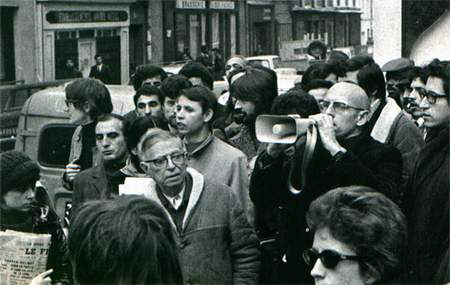
Michel Foucault, with a bullhorn

Foucault in Warsaw  by Remigiusz Ryziński, trans. Sean Gasper Bye (Open Letter Books, 2021)

Obsession authors extraordinary literature. In 1959, French theorist Michel Foucault was mysteriously expelled from Poland. The archival silence, the absence of documents explaining Foucault’s Polish chapter, so obsessed Remigiusz Ryziński that he wrote a book about it. Foucault in Warsaw is driven by this search for what, if anything, the Polish government had on Foucault. [Eed. – He was ordered to leave Poland in 1958 after possibly having been entrapped by a Polish secret agent; homosexuality was technically legal in Poland at the time, but much condemned.] Shifting between intellectual history and descriptions of his search on the ground, Ryziński chases the mystery of Foucault’s secrecy regarding the Warsaw chapter, when he wrote most of his doctoral dissertation (though it was published in France in 1961). In the preface to the first French edition of The History of Madness, Foucault described the dissertation as beginning on a “a Swedish night” and being “finished in the stubborn bright sun of Polish liberty.” Like Ryziński, Foucault was doing archival research for this book which developed into his first poststructuralist work. To know, for Foucault, is to study, to subject to rigorous, microscopic examination. “Madness is the lack of knowledge,” writes Ryziński, which he takes as central to understanding why Foucault’s dissertation doesn’t provide a history of madness or knowledge—since neither really exists—but focuses instead on “the archaeology of silence,” the articulation of the unspeakable. Gaining knowledge of that which defies knowledge (or unreason) exposes the tension between reason and madness, which is to say, the “normal” cannot “know madness, and so madness remains unthinkable, and light shed on it cannot dispel ignorance.” [Ed. – He had a big fight about Derrida over what the latter took as Foucault’s romantic idea of madness. Anyway, this book sounds great!]

Ryziński knows that Foucault was gay. And he knows that homosexuality was not welcomed by the Polish communist state. Although he suspects that this is the reason for Foucault’s disgrace, he wants evidence—the sort of knowledge that enables the past to become part of what we call history. He finds that homosexuality wasn’t technically a criminal offense, but sex work and prostitution were crimes punishable by law. The writer’s education transpires in this intellectual kinship which leads a reader to hide the archives for a missing history (I don’t want to give away the ending). Foucault’s attention to “conspicuous silences” troubled the balance between binaries—madness or sanity, female or male, heterosexual or gay—and the ontology of freedom, I think, which can only exist alongside prisons, slavery, and repression. The theorist deconstructs and builds nothing to replace what has been ruined, but there is no prescriptive menu, the normative states as the handmaiden of power.

“Knowledge about madness is the illusion of knowledge about anything,” Ryziński argues. This reflects on Foucault’s amoral and limited idea of freedom. At some point, Foucault went to Gdańsk and Krakow to lecture on Apollinaire. The handwritten draft of this lecture, currently housed in Foucault’s archives, is one of the few things he brought back from Poland. It has never been published. Ryziński’s relentless fascination becomes one’s own.

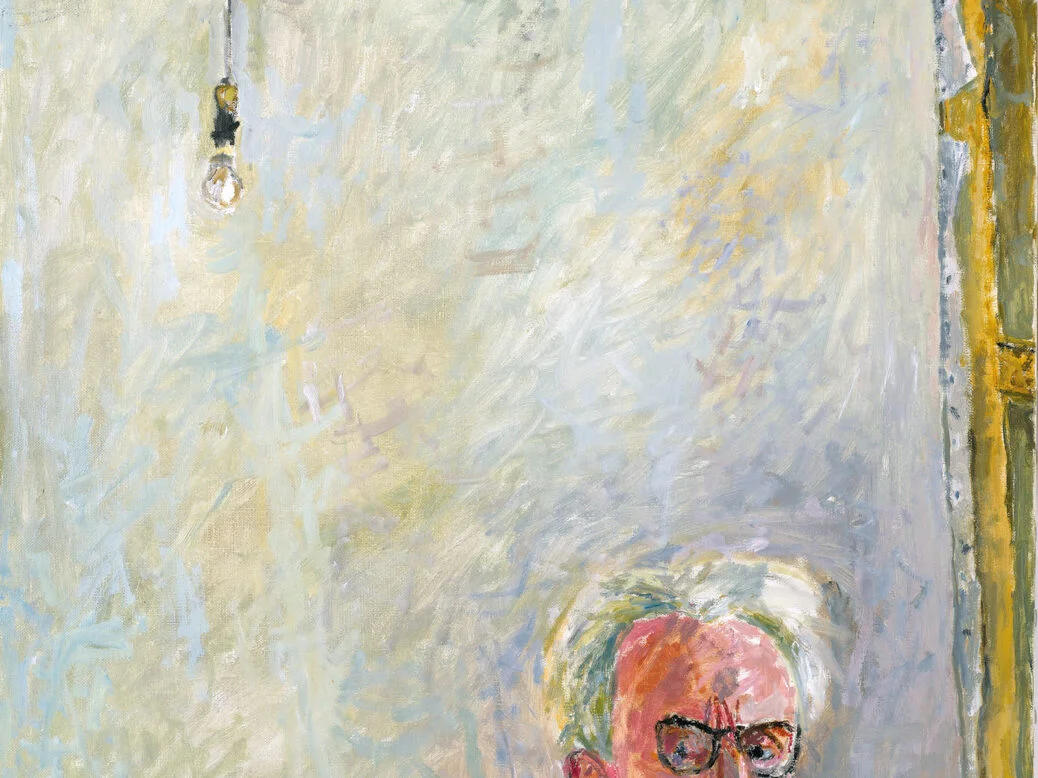
Jósef Czapski, Self-portrait with Lightbulb, 1958

Inhuman Land: Searching for the Truth in Soviet Russia, 1941-1942 by Jozef Czapski, trans. Antonia Lloyd-Jones (NYRB Classics, 2018)

Only the sky can save us, I thought after reading Inhuman Land: Searching for the Truth in Soviet Russia, 1941-1942 byJozef Czapski, a Polish painter, committed pacifist, and involuntary witness who survived incarceration in a Soviet prison camp and lived long enough to look back on a life between prisons, borders, and 20th century horrors. With Proust in one hand and Gide in another, Czapski details the kindness of strangers, the friendships that bloomed in carceral spaces, the devastation of war. While fighting to defend Poland, Czapski was captured by the Soviets. He was one of the few officers to survive the Katyn massacre of 1940. To forget would be a crime against those whose mouths had been frozen shut by death.

The Inhuman Land was translated into English in 1951 because, to quote the dread wiki, this “first-hand account of contemporaneous negotiations with the Soviets over the missing Polish officers . . . became an important document until Russian guilt for the massacres was acknowledged.” Czapski also testified before the US Congress on what Soviet troops had done. This documentary record traces his journey through Soviet Russia trying to find out what happened to the officers of his former regiment. The faces of the living and dead torment Czapski. He remembers; he looks for documents; he takes notes; he gets sick. There is a part where his recollections pause near the hospital window, in the room where he almost died, roiled by fevers and excruciating pain—there, in that room, lacking a metaphysic, he longs for nothing except to exist at less agonized pitch. How is it, Czapski wondered, that respected humans are capable of egotism and self-protection? What does it mean to exist without feeling for others?

One can teach oneself self protective egoism by being standoffish for years on end, and if not egoism, then perhaps to be more detached toward fragile personal affections, more abstract. But what use is that, if I have never been able to see things other than through people. Even Poland has always been embodied for me by a few faces of the living and the dead.

As Czapski convalesced in that hospital room, “the cream white window frame against a pure blue, almost always cloudless sky, very bright in the mornings, then gradually darker, then brightening again, taking on a greenish hue.” [Ed. – I’m reminded of Sebald’s description of the sky outside his hospital window at the beginning of The Rings of Saturn.] This “evocation of a pure blue sky with objects set against it” segues to a recollection of Matisse’s paintings of southern Morocco, and then Gordi’s Piazza San Marco, a sort of mental gallery exhibit provoked by memories of colors and hues. There is a gallery in his mind. Czapski thought about “how a painter could pick out the “sound of that perfect blue, the shout of the white window frame against the azure sky.” From there, in that hospital bed, the remembered world appeared “totally unattainable,” yet it is these moments, gathered into vignettes and vistas, that form the material of the writer’s mind. It was the painter’s eye that saved him, the words on the brush, and the window with a view of the sky. [Ed. – OMG you put this so well; I gotta move this up Mount TBR.]

Although Czapski was intensely Catholic, his commitment to living in conscience was complicated by his religious affiliation. He doesn’t mention, for example, his love affair with Vladimir Nabokov’s younger brother, the poet Sergey Nabokov, from 1924 to 1926, which ended when Czapski went to London seeking medical assistance with his typhoid fever. (One wonders how hospital windows coincide in reverie, in silence, in commemoration.) [Ed. – Sergey died in Neuengammen in 1945, murdered by the Nazis.] When World War II began, Czapski was living in Józefów with the writer Ludwik Hering. The war separated them, and then Czapski moved to Paris, but their love affair continued by correspondence, and one wishes that this epistolary existence would be translated as well.

The Mirador: Dreamed Memories of Irene Nemirovsky By Her Daughter by Elisabeth Gille, trans. Marina Harss (NYRB Classics, 2011)

Irene Nemirovsky’s novel, David Golder, came out in 1929. She had left Russia to live in France with her husband. While living in France, Nemirovsky was arrested by the Gestapo when her daughter was five. She was deported to her death at Auschwitz in July 1942. (Her husband, Michael Epstein, died on the same Nazi transit in November of that year.) 

The orphaned daughter, Elisabeth Gille, published The Mirador: Dreamed Memoirs of Irene Nemirovsky By Her Daughter as a biography of her mother, narrated by the mother in first-person, as dreamt or imagined by Gille. In recording her mother’s memoirs as she imagined them, the daughter creates the child, Irene, raised in Kyiv who becomes a writer that refuses to identify as Jewish. There is a direct correspondence between Nemirovsky’s own letters and writings and the character “created” by Gille’s assiduous study of her mother. 

Central to these imaginings is the tension between Nemirovsky’s literary dreams and her own mother’s lavish lifestyle-hunger. Nemirovsky’s mother (who is technically Gille’s grandmother) pouted when she wasn’t gifted jewels. [Ed. — I mean, same…] In her daughter’s imagined memoirs, the young Nemirovsky scorns the Russian exiles of 1924 who gather in Paris like nihilistic, pleasure-seeking teenagers living for the moment, refusing to imagine the future. The Whites don’t believe the worst can happen—reality hovers, over-aerated, somewhere in the motion between floating and fleeting. The exiles ignore “the monuments, columns, steles, cenotaphs, each more pompous than the last, that were being erected everywhere, even in the smallest village.” Her glamorous mother, the status-seeking socialite, represents the world of the exiled elite to her; whose extravagant displays of luxury could not read the room. Nostrodamus prophesied that the end of the diaspora’s troubles would come in 1944, but the troubles continue. 

World War I taught the young that their elders had died for nothing: “There was nothing left of them but the path of extremism,” according to Gille’s Nemirovsky. The bourgeoisie had nothing to believe in apart from war, domination, and fear. One hears the auspices of Canetti’s later work on crowds when Gille writes that the schoolboy “prefers to be oppressed by a single bully rather than have complete freedom” and be abandoned to the unclear hierarchy of “the crowd.” The dreams written from the author’s longing to know her mother have not aged; the syntax skips across space and time seamlessly. One senses a “lever of love” (Vladimir Nabokov’s neologism for “the diabolical method of tying a rebel to his wretched country by his own twisted heartstrings”) wrestling within the portrayal of Nemirovsky. The heart aches for—and admires—the portrait a daughter creates of her defiant mother, in dialogue with her mother’s rejection of 19th-century high-status femininity which we consume in the present via Hollywood’s latest glam. 

The Mirador was published in French in 1992, several years before Irene Nemirovsky’s own Suite Française (which existed in manuscript form) was finally published posthumously in 2004. Unfortunately, Gille did not live to see her mother’s literary reputation secured. But she left a portrait that testifies to love’s studious imaginings and faithfulness.

Wonderlands: Essays on the Life of Literature by Charles Baxter (Graywolf Press, 2022)

Baxter’s Wonderlands is a craft book that doesn’t read like a craft book. The range is profound and immediate, as in the section where Baxter discusses how the lies of politicians affect us when they become narratives which guide lives. The concept of deniability is political but also functions to normalize ignorance or subterfuge. (Gertrude Stein’s references to the thrill of unsubstantiated generalities apply.)

Baxter takes the absence of accountability in fiction as a contribution to conspiracy theory (I’d bracket this with an insistence on religion’s role in privileging belief as a form of knowledge that eschews evidence). Defining the “dysfunctional narrative” as a sort of key to the psyche in the novel where everything is caused by past trauma, Baxter observes that the story isn’t about the story but about the therapy that didn’t happen. The “political culture of disavowals” leads to the “fiction of finger-pointing.” Thus, the responsibility for therapy becomes part of the narrative task, and some of us feel this is too much to ask.

Why is the character unhappy? This matters to us because today happiness is an expectation. Since we can’t blame the abstract corporation, we blame the family who lived and labored under the myth of consumerism. We laugh at them as we consume ourselves. To Baxter, fictions which lack an antagonist “tend to formally mirror the protagonist’s unhappiness and confusion.” Daytime television, particularly talk-shows, make it seem as if family can carry the burden of individual unhappiness, Baxter observes. In their “therapeutic narration… no verdict ever comes in “and no one has the right to judge.” But what about the “poetry of a mistake,” the action’s meaning in time, “its sordid origin, its obscenity,” Baxter wonders. Not for him the glib shrug of Shit happens. Not for him the evasive structural gesture or the “moralizing” which has replaced ethics and self-reflexivity. The therapeutic narrative (or the “already moralized story”) steps in to relieve us from thinking while simultaneously depriving the characters’ actions of meaning. “The injury takes for itself all the meaning”; the injury claims the centerfold. Are we interested in victimization because we are ambivalent about our own desires for power and unequipped to acknowledge them? Error. Baxter suggests, is as true as success.

I relished Baxter’s discussion of performance anxiety in modern life, and how the pressure to perform an appropriate grief, joy, gratitude, etc., corrugates the scene of family reunions, weddings, funerals, etc. Is everyone at the reunion taking notes for their therapist? How do we navigate the extraordinary anxiety of being alive at a time when so much media and language purports to deliver variations on the correct script, the right thing to say when someone dies, the best, the ideal? Is one playing a role on a stage rather than living—is one waiting for the clap or the thunderous clap-back? Nothing anyone says can kill my mother more, but it’s easier for me to be furious at you for saying the wrong thing than to rage against the anonymity and haphazard injustice of loss. What Romanian writer Norman Manaea called “compulsory happiness” is similar to what Charles Baxter calls “compulsory sincerity,” the requirement that one feel a certain way and display it physically and verbally. Maybe even the interpreters are exhausted. Certainly, the literature could use a cold shower and a refresh.

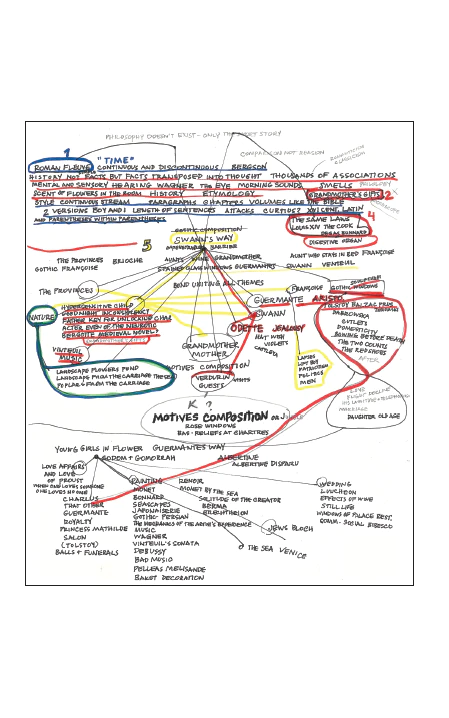
Czapski’s lecture notes on Proust

In conclusion, a few books I found to be profoundly intriguing— and which I feel compelled to mention because critical attention often leapfrogs the intriguing in order to focus on the historically significant, the aesthetically attractive, or the well-marketed.

My Manservant and Me by Hervé Guibert, trans. by Jeffrey Zuckerman (Nightboat Books, 2022) for Zuckerman’s splendid translation of Guibert’s controversial book, and for the controversy that Guibert made of writing, personhood, and literary genre.

Disembodied by Christina Tudor-Sideri (Sublunary Editions, 2022) for the unique forests of Tudor-Sideri’s language, and the radical, interstitial resonances of her disembodied writing at a time when embodiment seems to be trending.

Chimeras by Daniella Cascella (Sublunary Editions, 2022) for reasons I’ve given elsewhere. [Ed. – I dunno, google it.]

Dead Souls by Sam Riviere (Catapult, 2021) for its Bernhardian self-implication and provocations, and for its thorough dethroning of the poet’s heroic self-mythos. “A fever of commemoration activity ensued,” the protagonist says— and the poets posed for selfies. For who is more commemorated in contemporary poetics than the poets, themselves? I appreciate being dragged through the mud by Riviere.

Death by Landscape: Essays by Elvia Elk (Soft Skull Press, 2019) for its rigorous interrogation of trauma and self-help bootstraps in the contemporary landscape.

Suicide by Édouard Levé, trans. by Jan Steyn (Dalkey Archive, 2011) because I cannot stop thinking about how epistolarity tangles with fiction, or how the last book we write before dying may be our suicide note. Levé is formidable, heart-breaking, and deeply beloved by this human.

Paradiso by Gillian Rose (Shearsman, 2015) for its vigorous beauty and painstaking attention to mortality, or what it means to live a thinking life.

Lost Time: Lectures on Proust in a Soviet Prison Camp by Józef Czapski, trans. by Eric Karpeles (NYRB Classics, 2018) for the tenderness of encountering Proust in a carceral environment, and for the reminder that carceral systems remain spaces in which literature has the potential to save lives.

Falling Hour by Geoffrey Morrison (Coach House, 2023) [Ed. — Imma let a 2023 title on a 2022 year in review because it’s Alina and because this book is Canadian.] This was one of the most luscious, immersive, and mind-blowing literary journeys of my adult life. Morrison begins with poetry and wanders through globalization’s alienations in this lyrical, disembodied novel to which I return often, in a somewhat futile though diligent effort to uncover its multiple mysteries.