Nat Leach’s Year in Reading, 2024

Excited to once again present reading reviews from some of my favourite readers. Today’s installment, his sixth, is by my longtime friend Nat Leach. Nat is a nineteenth-century scholar turned college administrator who has spent the last 7 years reading the books on his shelves in alphabetical order. He lives in Ontario.

Saul Leiter, 1961

After complaining about my reading in 2023 in this space last year, 2024 was, on the surface, a much better year. I read 30 books as opposed to 20 in the previous year, and was on pace for an even higher total before hitting a wall at the end of the year (of which more anon). However, if we get into what the sports statisticians call “advanced metrics,” the numerical advantage is diminished; 6 of those books were either less than 100 pages or only slightly more, and 9 were works of theory, criticism, and/or anthologies that I had been working on for years and just completed this year. So, probably my actual reading for 2024 was not much better than 2023 in terms of quantity, but the quality was high, and that’s what really matters, right? [Ed. – Right!]

As for my overall reading project of working through my unread books alphabetically, now in its 7th year, I once again only progressed by one letter of the alphabet, finishing “L” and making a very small start on “M”. If I’m able to get through “M” in 2025 (a big if- it’s a pretty immense shelf), I will hit the halfway point of the alphabet and surely it’s gotta be downhill after that, right? [Ed. – Surely! Well, probably. Possibly?] The second half of the alphabet has the likes of “Q”, “X” and “Z” so there is hope! [Ed. – Insert Zola side-eye gif here.] In fact, of the 298 books on my list, exactly 200 are “A-M” so I’m actually closing in on the 2/3 mark of my project (although that list keeps growing every year, so who really knows?)

More importantly, for the purposes of this piece, I actually found some time, in the early part of the year at least, to write capsules for each book that I finished as I went along. Which is just as well, because I can scarcely remember what I read last January right now, and as I write this opening, I’m just as curious as you to see what comes next (probably more so).

Larsen, Nella – Passing (1929)

I had seen this book recommended so widely, I couldn’t resist adding it to this project, and it certainly does live up to the hype. The book is about the tensions in racial ideologies in early 20th century America, and seems no less relevant today. Clare Kendry “passes” as white despite a mixed-race bloodline that would see her excluded from white society. The very fact that she is able to do this so successfully mocks the white supremacist ideology that believes that racial differences are fixed and self-evident. The book’s focus also demonstrates the problematic intersection of these racial tensions with similarly oppressive gender expectations. Irene Redfield’s love/hate relationship with Clare is at the core of the book, so that it demonstrates also the ways in which expectations around “racial purity” are particularly focused on women. In this respect, Passing reminds me of another book I wrote about on here some years ago, Morley Callaghan’s The Loved and the Lost; although that book focuses on a white woman who circulates in black society in Montreal, the similarly tragic outcomes both speak to the violence and panic produced in white society by such blurring of racial lines. [Ed. – About to teach this tomorrow for the nth time: it’s an all-timer!]

Laski, Marghanita – The Victorian Chaise-Longue (1953)

When I received this book as a gift (in a lovely Persephone Books edition), I assumed, because of the title, that it was because of my academic interest in the nineteenth century. It didn’t take long for me to realize that it was in fact because of my academic interest in the Gothic. The plot itself smacks of the absurd: a tubercular new mother is transported back in time to the Victorian period while lying on the titular piece of furniture during her recovery. But this does not do justice to the book, which explores (as so many Gothic texts do) the relationship between mind and body, and the nature of identity. A fascinating read. [Ed. – Sounds great!]

Lathom, Francis – Italian Mysteries (1820) and The Midnight Bell (1797)

These days, Francis Lathom is little more than an answer to a literary trivia question (Name the authors of the 7 “horrid novels” on the reading list of Isabella Thorpe and Catherine Morland in Jane Austen’s Northanger Abbey!) but he was a successful novelist and playwright in his time. The Midnight Bell is the book mentioned in Austen’s novel, while Italian Mysteries was written considerably later. Both make extensive use of the Gothic conventions popularized by Ann Radcliffe in The Mysteries of Udolpho (and spoofed in Northanger Abbey), including apparently supernatural activity explained by natural means, banditti inhabiting abandoned castles [Ed. – They do be inhabiting the abandoned castles, the banditti], and lustful noblemen pursuing innocent heroines, who invariably faint whenever captured (By my count, Lauretta, heroine of The Midnight Bell, faints five times in the course of a single abduction!) [Ed. – Maybe some iron pills for that girl?] Lathom’s use of these conventions is, at least, skillful and coherent, which is more than can be said of many Radcliffe imitators of this period. As David Punter points out in his fascinating introduction to the Valancourt Books edition of The Midnight Bell, Lathom’s works are heavy on events, to the exclusion of character development, and his plots are so extensive and intricate that they invariably require quite elaborate explanations—indeed, the entirety of the 3rd and final volume of Italian Mysteries is essentially an extensive explanation of all the mysteries developed of the first two volumes. While both books owe much to Radcliffe, there are certain predilections of Lathom’s own that show through as well; for example, his books include many siblings who function as doubles of each other, and are usually moral opposites of one another. The books are a pleasure to read, though not, perhaps, especially notable examples of the genre. [Ed. – Look, you’re not getting this kind of content anywhere else, are you?]

Laurence, Margaret – This Side Jordan (1960)

Like every good Canadian of my generation, my literary education was steeped in Margaret Laurence; I read The Stone Angel in high school, and The Diviners in university. [Ed. – Same! I wonder what they read now?] And if that weren’t enough, I now find myself living just 15 minutes away from the small town of Lakefield, Ontario, where Laurence spent the last years of her life, and wrote The Diviners. All that being said, I really didn’t know what to expect from this book, Laurence’s first novel, which is much less recognizable in the canon of CanLit, not least because of its foreign setting. Laurence’s husband was an engineer who worked in Africa in the 1950s, so she spent some years living in what was then called the “Gold Coast” but was soon to become the independent country of Ghana. The book is largely about the difficulties posed by this transition, both for the British colonizers and for the people of Ghana, equally caught between a past they cannot return to and a future in which they cannot yet find their place (hence the biblical allusion of the book’s title; the characters are all looking ahead to a “promised land” they cannot enter). The book focuses on Johnnie Kestoe, a British accountant in a textile company; Miranda Kestoe, his well-meaning but sometimes clueless wife; and Nathaniel Amegbe, a struggling Ghanaian schoolteacher. Johnnie, following Miranda’s advice, tries to get ahead by supporting the company’s “Africanization” of its workforce, which his racist bosses refuse to accept, while Nathaniel tries to modernize his family and move away from the tribal customs that he sees as belonging to the past. The future, though, is not easy for any of them to grasp. It’s a strong debut novel, though it does not entirely show the brilliance that was yet to come from Laurence. As an aside, this book also scores points for having a main character named Nathaniel, a literary feature notable by its absence in all the other books on this list. [Ed. – Ha! Justice for Nathaniels!]

Le Fanu, Sheridan – Carmilla (1872) and “A Chapter in the History of a Tyrone Family” (1839)

There are not many classic Gothic texts of the 19th century that I have not read, so it was time that I finally read Carmilla. All I knew about it was that it was about a lesbian vampire and, yeah, it’s pretty much what it says on the tin, using the familiar conventions of the genre, with that added twist. As for “A Chapter in the History of a Tyrone Family,” my first thought upon reading it was “was this written before or after Jane Eyre?” There are many parallels, including a bigamous marriage and a potentially murderous first wife being kept in concealment. Turns out the answer is “before”. This story apparently influenced Brontë’s novel, and in turn, after the success of Jane Eyre, Le Fanu developed this story into a longer work in order to capitalize on it.

Le Guin, Ursula K. – The Left Hand of Darkness (1969)

Another book that I added because of a large number of recommendations, I must admit that I went back and forth on this one a bit. The author’s preface is one of the smartest things I have read about science fiction (or about fiction full stop!), but then the first chapter seemed so replete with science fiction clichés that I started to question what all the fuss was about. I also wonder if science fiction just isn’t my genre, or if I am just overly picky about the details of world-building; much as I admire the carefully prepared appendix on the “Gethenian Calendar and Clock,” which differ significantly from those of Earth, I also find it slightly off-putting that this entirely foreign world not only measures temperature in degrees (in itself not necessarily natural), but it uses a scale that seems strikingly similar to the Fahrenheit scale (with no additional context or explanation). [Ed. – Fahrenheit sucks!] Nevertheless, the book certainly grew on me as it increasingly developed the more philosophical implications of its sf premise. Le Guin claims not to be attempting to predict the future, but this book from 1969 is quite prescient in exploring the idea of gender fluidity, as the inhabitants of the planet on which the book is set share male and female characteristics and can transform into either. Less prescient than oddly coincidental is the fact that the narrator’s name is Genly Ai; it occurs to me that it would be impossible to include a character of that name in a book written today without readers assuming that he was some kind of embodied form of generative artificial intelligence. [Ed. – AI sucks! Like, a lot more than Fahrenheit. Which sucks, to be clear.]

Levi, Primo – Moments of Reprieve (1981) Trans. Ruth Feldman

Levi’s American publishers have been consistent, at least, in their dogged attempts to make his books sound as optimistic as possible; If This is a Man becomes Survival in Auschwitz, The Truce becomes The Reawakening, and Lilith, and other Stories becomes Moments of Reprieve. While it is true that to a certain extent, the stories recounted in this book have a lighter tone than his earlier memoirs, there is really very little “reprieve” to be had here. [Ed. – Yup. That piece about the Roma inmate he meets? Dark.] The book consists of descriptions of people and incidents from Levi’s time in Auschwitz which had not been included in the two earlier memoirs, as well as narratives that follow up on the post-war experiences of individuals who are mentioned in those books. And certainly, all of the qualities that make the earlier books so great are still on display here, especially Levi’s keen eye for character and his deep understanding of moral complexity. And yet, everybody seems to want more optimism, from the publishers to Chumbawamba, who recorded a song based on one of the most optimistic anecdotes herein, “Rappoport’s Testament” about a man who uses a very philosophical theory of life to endure Auschwitz, arguing that his previous pleasures in life are simply being counter-balanced by the horrors of the camp, and therefore he has nothing to complain about in the grand scheme of things. [Ed. – I did not know this!!!!] An admirable perspective, perhaps, but just one of the many that Levi explores—yet the only one to get a song written about it, with an incessant chorus of “I never gave up” as though this were the only praiseworthy, or even acceptable, attitude. (Having said that, I have to admit that I actually love this song. I mean, how critical can you be about a rousing anti-Nazi anthem? Look it up.)

Lindsay, Joan – Picnic at Hanging Rock (1967)

I was already very familiar with Peter Weir’s 1975 film adaptation of this novel, so I fully expected this book to be as good as it is. I found that Weir adapted the book quite faithfully; in both the book and the film, the plot about the uncanny disappearance of Australian boarding school girls is perhaps secondary to the reflections on the connectedness of people and things that are triggered by this incident. The most significant differences come from the fact that the novel is able to demonstrate more links in this web of inter-connectedness; from my perspective of having seen the film first, I was quite fascinated to see how Lindsay connects some of the more minor characters to each other and to the mysterious themes of the book in ways not shown in the film. Ultimately, what makes both book and film work so well is how expertly they manage the fantastic in Tzvetan Todorov’s sense of the term, hesitating between rational and supernatural responses to the mystery, but never fully embracing either perspective. [Ed. – Now I want to read this and see the movie again.]

Lively, Penelope – Moon Tiger (1987)

I’m at a bit of a loss as to how to describe this fascinating tour through both world history and the personal history of a dying historian, Claudia Hampton. These histories are linked and predictably (and unpredictably!) take many twists and turns along the way. But the most interesting thing about the novel is the way it plays with point of view, emphasizing that history depends on perspective as we move between Claudia’s first-person perspective, a more “objective” narrative voice, and the points of view of other characters. It may defy description, but it really works.

Lodge, David – Changing Places (1975), Small World (1984), Nice Work (1988)

I must admit that I felt that I had missed the cultural moment in which I should have read this trilogy. After all, any satirical work on academia these days would surely have to focus on the absurdities of governmental policies and the excesses of administrative oversight rather than the hijinks of carefree globetrotting academics (seriously, is there even any such thing as a carefree, globetrotting academic any more?) [Ed. – There is not.] Not to mention the fact that cultural values have shifted significantly in ways that make these books somewhat uncomfortable to read at times (thinking especially of the distressingly casual way that the idea of professors sleeping with their students is treated in these books). Despite all this, though, there is something enduring about these books, not only for their humour—based in the first book on the incongruities between Morris Zapp, brilliant but obnoxious American professor, and Philip Swallow, reserved English lecturer, and developed in many different directions from there—but also for their satisfying use of the conventions of comic narrative. Lodge is particularly knowing about this, and all three novels are highly self-referential (or “meta” as the kids say). [Ed. – I fear they do not actually say this anymore, at least judging from the blank stares I get…] Changing Places features a number of quotations from a (fictional) textbook that Swallow wants to use for his course on novel-writing, and which provides rules for writing a good novel—rules that Lodge himself proceeds to break in every instance. Small World (subtitled “an academic romance”) employs the conventions of the grail quest romance, adapted comically to the academic context. And Nice Work is an adaptation of, and contains frequent references to, the genre of the Victorian industrial novel. Moreover, in each book, the threads are pulled together in improbable but highly satisfying ways, as if Lodge is acknowledging both the artificiality of the conventions and the fact that we still desire such conclusions despite our awareness of their artifice. I learned recently that Lodge passed away on New Year’s Day, 2025, so I guess there was indeed some timeliness to my reading of these books. I also learned in the course of my reading that Lodge had been at the University of Birmingham while my parents were graduate students there. It really is a small world, I guess.

MacIntyre, Linden – The Bishop’s Man (2009)

Having lived on Cape Breton Island for 15 years, I found that this book resonated with me, not because of the plot about the sexual abuse scandal in the Catholic church, but because of the settings, the feelings of isolation brought about by the landscape and the weather, and the descriptions of tightly-knit but also highly insular communities. All very familiar to me. The plot that unfolds against this backdrop revolves around the titular character, Father Duncan MacAskill, who acts on behalf of his Bishop to address situations involving abuse committed by priests. He initially believes that he is helping to rehabilitate perpetrators and support victims, but struggles with his conscience as he increasingly realizes that he is just the front line of an extensive cover up operation. MacIntyre is a native of Cape Breton, and a prominent journalist so perhaps not surprisingly his fictionalization of these real situations and characters is believable and powerful.

WOMEN IN TRANSLATION MONTH

I always try to set aside two books for Women in Translation month in August (given that 2 is pretty much my monthly average, this makes sense to me). However, since my reading project as a whole has slowed down, I’m finding that I’m reaching further forward on my shelves each year. This year, I read a couple of books from further along the “M” shelf.

Millu, Liana – Smoke Over Birkenau (1947) Trans. Lynne Sharon Schwartz

Dorian recommended this book a few years ago and of course he is right about what a tremendous book it is. [Ed. – Damn right he is. That guy really knows a thing or two.] Millu recounts the stories of six women whom she encountered in the women’s camps at Auschwitz. In many ways, the content of these tales is not unlike other Holocaust testimonies in the brutality, suffering and impossible moral situations that they depict, but it is also quite different in its specific focus on female experience in the camps. It must also be said that the stories are well crafted as stories. In both respects, the book reminded me in a strange way of the stories of Ida Fink, even though the latter are fictional. [Ed. – Absolutely!] Both writers provide keen observations of the brutality and suffering caused by Nazi oppression, particularly as it affects women. There is probably something more to be said about the relationship between the fictional and the non-fictional here, but that’s more Dorian’s territory. [Ed. – Certainly true that Millu uses an overtly narrative style in these pieces. Maybe Sara Horowitz’s idea about the Fink stories—that we sometimes need fiction to tell us what nonfiction can’t (it’s smarter than that, but that’s the gist)—might be useful here.]

Müller, Herta – The Passport (1986) Trans. Martin Chalmers

I had never read Müller before, so I didn’t really know what to expect, nor do I really know how to describe the experience of reading this book but here goes: it is a series of dark prose poems that build a feeling much more than they build the plot, which is ostensibly about the efforts of a miller to emigrate to West Germany. The images, though, vividly construct a picture of a hostile natural world, and the tensions of living amongst a foreign people. I commented earlier on the changes of Levi’s titles for an English-speaking audience; in this case, the effect of calling the book The Passport seems to be a rather banal attempt to focus on the plot, unlike the original German title, Der Mensch ist ein großer Fasan auf der Welt (“Man is a Great Pheasant in the World”) which better captures the poetic feel and the tension between the human and the natural world developed throughout the book.

IN PROGRESS

So, about that wall I mentioned… things were going swimmingly (yes, for me, the above is what swimmingly looks like) until the end of October/beginning of November. In the space of a fateful week, I began three new books. Little did I know that 2 ½ months later, despite putting almost all of my reading time and energy into them, all three would remain unfinished. Anyway, here’s a brief report on the books I didn’t quite finish in 2024 (with up to date completion percentages as of early 2025)

Lessing, Doris – The Golden Notebook (1962) Completed: 26%

First, not having included Doris Lessing in my original project, I was tempted to join a readalong of The Golden Notebook organized by the ever-encouraging @paperpills10.bsky.social. However, a combination of my usual lack of time, my inability to get my hands on a good physical copy of the book, and my struggles with the book itself led to my dismal failure to keep up. As for the book itself, it seems to me very original in terms of form (3rd person narration combined with 1st person in the form of notebooks kept by one of the characters) while seeming quite mundane (thus far) in terms of content and style. Perhaps that is what I’m struggling with, though I also wonder if it is part of the point (this is what notebooks are like). I will persist with this, but I have quite a way to go yet. [Ed. – Hmm I like this one: not sure you’re going to change your mind if you aren’t into it yet.]

Mann, Thomas – Doctor Faustus (1948) Trans. H.T. Lowe-Porter Completed: 73%

At about the same time, I was starting this book, which I had bought at a time when I was collecting Faust stories, but I had only managed to read the first few chapters at that time. I have done better this time, and what I have learned from this experience is that 1) I need to read more of Mann’s novels and 2) I may not have enough years left in me to read them all. This is a tremendous book, but one that requires much time and focus. I have been making slow but consistent progress, and there is now at least some light at the end of the tunnel. Despite the title, the Faustian theme is more an undercurrent than the book’s focus, which has more to do with reflections on the nature of art and its relation to culture. But what has perhaps most struck me about this book is its descriptions of the rise of Nazism and the psychology behind it, all of which feel chillingly contemporary.

Márai, Sandor – Embers (1942) Trans. Carol Brown Janeway Completed: 67%

Now this wonderful little (at least, comparatively) book is one that I would have finished long ago, had I not been saving it to cleanse my palate after working on the previous two books (gotta respect the alphabetical order after all). It is a much quicker, and highly engaging read. Last year, I commented on how my reading system often provides me with strange and unexpected correlations, and it has been somewhat strange reading this book alongside Doctor Faustus. Both books are written in the 1940’s but make use of a dual time frame split between the narrative present and a past in the late 19th and early 20th centuries. Both are set in central Europe and are thus framed against the background of the wars in these time periods, and both focus heavily on the relationship of a pair of male friends, one of whom is musical and artistic, the other more material and practical. But they are of course very different books; Embers tells the story of a friendship broken in youth that comes to a reckoning in old age. I’m still not sure what this reckoning is going to look like, but the suspense is building. So far, this is pretty great.

James Whistler, View across the Lagoon (1879 – 80)

LOOKING AHEAD TO 2025

My one final comment on all of the above is that one of the benefits of writing these entries shortly after finishing the books is that I can look back and see how my immediate response to the book varies from what my memory of it is now. For example, despite the lukewarm write-up, I thought about the Le Guin a lot after I finished it, and despite really loving the Lively, I haven’t really thought about it at all since then. I’m not sure that this is necessarily a measure of a book’s quality, but it is a measure of something. [Ed. – Yes! But what? I think about this a lot too.]

As for next year, I did have a fleeting desire to join a Proust reading group, since that is probably the book that I am most looking forward to on my remaining list, but my recent track record with group reads and the fact that I am probably not in the right head space at the moment has caused me to hold off (it’ll probably be a couple of years before I get to “P”)

So, my goal will be to try to get through “M” this year, although as I said, it’s a pretty formidable letter. I will at least see the benefits of having participated in group reads of some of the chunkier books on this shelf over the past few years (The Balkan Trilogy, The Levant Trilogy, Moby Dick, The Man Without Qualities) but I still have a lot to look forward to, from Gabriel Garcia Marquez to Cormac McCarthy to Brian Moore to Toni Morrison to Iris Murdoch and many more in between. Wish me luck, and let me know if there are any indispensable M authors that you think I need to make sure I read this year. [Ed. – Thank you as always, Nat!]


What I Read, February 2024

Fell behind on these updates during the semester, as usual. Hard to remember that month beyond the usual—the semester taking hold, mostly warm days from the ever-earlier Arkansas spring—but I do know that mostly we were busy getting ready for my daughter’s bat mitzvah in early March. Along the way I squeezed in these books.

Richard Serra (2001)

Thien Pham, Family Style: Memories of an American from Vietnam (2023)

Autobiographical comic about Pham’s family’s journey from Vietnam to the US in the early 1980s via a Thai refugee camp. Each chapter is named after an important dish, ranging from the ball of rice and fish his mother saves for him on their flight from Vietnam to the baffling Salisbury steak of the school cafeteria to the co’m tâm dac biêt (a combo plate, as best I can tell) that he eats with his high school friends.

The palette is somber, mostly browns and greens, but the tone is lively: this is the classic story of American immigrant success, a story none of us can take for granted, which explains, I’d say, why the final chapter concerns the then-41-year-old author’s decision, in 2016, to finally take citizenship, prompted by Trump’s increasingly hostile anti-immigrant rhetoric. Thien and his family go through a lot of hard things: bureaucratic delays, poverty, language barriers, exhausting work that nearly tears the parents apart, and, most of all, at the very beginning of their journey, a harrowing attack by pirates on the way to Thailand, starkly presented by Pham in a series of black pages containing only the sentences his mother whispered into his ears, “It will be ok,” “I’m here,” “I’m right here with you.” But the Phams do more than survive; they thrive. I was delighted to see the haggard, exhausted, frightened yet determined young parents of the opening chapters settle into the gently bickering, food-pushing older couple of the last ones. Pham finishes with “end notes,” in which he answers questions readers are likely to have, like “What do you parents think of this story?”. In his answer, Pham draws his mother popping her head from another room into his studio and shouting (accurately) “I am the hero!”

Samantha Shannon, The Priory of the Orange Tree (2019)

Epic fantasy of two worlds, one based on medieval Europe, one on ancient China and Japan. In the former, dragons are abhorred; in the latter, they are venerated. Those dragons are beautiful and wise creatures of air and sea, nothing like the monsters that nearly destroyed civilization centuries ago before being bound into an endless chasm. The spell that cast the bad dragons there, however, is reaching its thousand-year-end, and they’re determined not to be defeated this time. Can our heroes convince the leaders of the kingdoms and free states and empires to band together to defeat the enemy? (Yes.)

Priory has a satisfying heft. The first 2/3 especially move with satisfying deliberateness; the end, alas, is rushed. I loved falling into the world of the book, though, and was grumpy any time I had to set it aside for anything else.

Herta Müller, The Passport (1986) Trans. Martin Chalmers (1989)

I enjoyed this angular little book about the German-speaking minority in Romanian under Ceausescu, but I hardly remember a thing about it. Does this happen to you? What I remember: 80s rural Romania is grim; men are bad to women; people who leave come home to lord it over those left behind, to compensate for how hard it is in the new land.

Jesse Q. Sutanto, Vera Wong’s Unsolicited Advice for Murderers (2023)

Vera Wong gets up early. Really early. She takes a brisk long walk, being sure to protect her skin from that harmful sun. She makes breakfast and texts her son to ask why he’s still in bed. (Tilly is a layer, very accomplished, but he doesn’t seem to understand how fast life passes you by.) Then, the day well advanced (it must be almost 8), she walks downstairs to open her business, Vera Wang’s World-Famous Teahouse. (She named it after the designer because people love a famous name—Vera is smart like that.) She tends to her sole regular customer, a man whose wife has Alzheimer’s, meaning he can never stay as long as Vera would like, and then settles into long, quiet hours that weigh on her, almost forcing her to recognize that the shop is failing.

Then one morning she comes down to find a man dead on the shop floor. He’s clutching a flash drive, which she takes (for safekeeping, what you think???) before outlining the body, just like on CSI. She uses a sharpie so it will be nice and clear. The police are oddly unhappy about this. Misadventure, the police declare. But Vera knows: this is murder. In the next days four people come by the tea house—very suspicious. Vera slyly gets into conversation with them and learns they all knew the victim, Marshall Chan, who turns out to have been a bad man. Through a combination of bullying, passive-aggressiveness, sheer chutzpah, and plying them with food, Vera gathers what she insists on calling her suspects, forming them into an unlikely friend group and insinuating herself into their lives. She hasn’t had so much fun in years. They are all so nice—but they really need her help getting their lives together. Still, that doesn’t stop Vera from being clear-sighted: one of them is killer!

Vera Wong’s Unsolicited Advice for Murderers is funny, sweet, moving, and even a bit suspenseful. Vera is your classic delightful piece of parental work. Sutanto lets her share her wisdom while also admitting she could be a bit less… intense. I loved this book. My daughter loved this book. Maybe my wife will love this book (she is reading it next). The audio, read by Eunice Wong, is a delight. Don’t sleep on this perfect piece of light reading.

The temptation for a series must be immense. Sutanto should resist, but I hope she doesn’t.

Elana K. Arnold, The Blood Years (2023)

Impressive YA Holocaust novel for young adults that I would recommend to readers of all ages.

What happened to the Jews of Romania is one of the most significant stories of the Holocaust, sadly still too seldom told. The Blood Years, based on the life of the author’s grandmother, begins to rectify that. This is a novel of Czernowitz, that former Austro-Hungarian center of Jewish life in Bukovina. Frederike Teitler and her older sister Astra live a cossetted life: yes, their father left them, plunging their mother into a deep depression that led their grandfather to take the women into his apartment, but things have since settled down. Although Astra increasingly gets up to things her sister knows nothing about, life for the young women still revolves around daily ballet lessons and evocatively rendered summer vacations in the Carpathians. But then comes the war. The antisemitism that had been mostly a hurtful annoyance turns virulent, especially after the interregnum of Soviet rule in 1940 – 41, when Jews were briefly given full rights. When the Germans take over the city in the first wave of Hitler’s war in the east, with the enthusiastic support of most of the locals, Jews suffer pogroms and dispossession. The family is briefly forced into a ghetto and narrowly avoids deportation to Transnistria—a territory across the Dniester that was a hellhole for Jews even by the standards of the Holocaust—only because Astra’s doctor husband, whom she has married against everyone’s will, is deemed an essential worker. Arnold vividly evokes the hunger, illness, and terror of the following years. She organizes the book, as her title implies, around differing instances of blood, from a first period to violence in the streets to tubercular coughing.

I read The Blood Years in a day: it’s well-written, dramatic, sensitive, and, perhaps most importantly, unwilling to sugarcoat its story of survival. The iconography of the Holocaust, which mostly comes from a reductive idea of what happened to the Jews of Poland and western Europe, doesn’t apply to the Romanian story. For this reason alone, I hope lots of people read this book. High school teachers, please consider assigning it!

Binjamin Wilkomirski, Fragments: Memories of a Wartime Childhood (1995) Trans. Carol Brown Janeway (1996)

Infamous text, unsurprisingly now out of print, purporting to be a memoir of the author’s experiences as a very young child during the Holocaust, primarily in Majdenk. Except that Binjamin Wilkomirski is really Bruno Grosjean, whose unwed mother was forced to give up her child to the Swiss foster system in the 1940s. Wilkomirski—that’s the name he’s taken, so I’ll use it too: we are dealing with something other than a pseudonym here—is not Jewish, never lived in Poland, did not survive the Holocaust. When the book was first published—by an imprint of the prestigious Suhrkamp Verlag and by Schocken, the most prominent Jewish American publisher—it received notices that can only be called rapturous. The NYT rave is typical: Wilkomirski “recalls the Holocaust with the powerful immediacy of innocence, injecting well-documented events with fresh terror and poignancy.”

A year or two after its release, Daniel Ganzfried, a Swiss journalist, read Fragments and felt something was amiss. Ganzfried interviewed friends and family of the author, trawled through Holocaust repositories and Swiss archives. He published his findings—a (self) righteous condemnation of Wilkomirski as a fraud—in a prominent Swiss weekly. The German publisher responded by hiring a researcher, Stefan Maechler, to follow up on Ganzfried’s discoveries. Two years later, Maechler, agreed with the allegations, adding even more proof to that already collected. The book was withdrawn; scholars and ordinary readers felt shame and disappointment; no one talked about it anymore.

I was one of those early readers. This was before my interest in the Holocaust turned into my livelihood. I followed the ruckus with interest—I read the flurry of pieces (an especially good one by Elena Lappin ran in Granta) that speculated on why someone would do such a thing—but I was perfectly willing to put the book out of my mind.

Come twenty-five years later to find one of my best students wanting to write her senior thesis on the book, after having read it in a class she took while studying abroad. The student was fascinated by the text, intrigued by the silence surrounding it, and curious about what we might learn from that silence and from reading the text, even knowing it to be fake. I knew I would be teaching a course on the afterlife of the Holocaust this semester, and we decided she should take the opportunity to teach the text. Abroad, her instructor had prefaced the reading by explaining the background. After much discussion, my student and I decided not to tell the students in my class the truth beforehand. This experiment proved fruitful, even if some of the students were rightly un-thrilled by our decision. (We explained the rationale, which allayed most concerns.) Fascinating to see how strongly the text resonated with students, and, concomitantly, how betrayed they felt when they learned the truth. The first day’s conversation about how Wilkomirski represented trauma pivoted, the second day, to an impassioned discussion of whether anyone should ever read this book, and, most importantly, to my mind, how neatly the text matches our expectations of what trauma means.

(On the course feedback forms I asked whether I should teach this again, and, if so, whether I should spill the beans beforehand. They all said I should and no I shouldn’t. Not what I expected.)

Jona Oberski, Childhood (1978) Trans. Ralph Mannheim (1983)

Moving and angry Holocaust story, presented as fiction but closely modeled on the author’s life. (I wrote about it here.) I was interested to compare Wilkomirski’s grotesque exaggerations of Oberski’s reality, and assigned it this semester for the first time, but less obsessed readers can appreciate it all on its own.

James Buchan, Heart’s Journey in Winter (1995)

Baffling, weird spy novel set in West Germany in 1983 amid the furor and fear incited by the decision to place Pershing missiles on German soil.

Buchan’s novel is as thorny in its syntax and structure as a poem. The interlingual pun of the title references Goethe’s “Harzreise im Winter” (A Journey through the Harz Mountains in Winter), playing on the near euphony of Harz and Herz, meaning heart. Readers who struggle to understand what’s going on are just following the lead of the characters. Secret meetings in secluded hunting lodges, cryptic conversations where people tell each other things without saying anything outright, lovers on the run, adultery as a metaphor for spycraft: Buchan uses many of the tropes of the genre, but slantwise, ruthlessly excising exposition. No heroes or resolution here. Imagine a Len Deighton novel, with its sympathy for cold war German seediness, but stripped of the belief that the rules of the game must be followed, however exhaustedly or ironically, and instead replaced with the feverishness of a lieder cycle.

I often forget plots soon after reading; in the case of Heart’s Journey in Winter I forgot it while reading. Like, I mostly had no clue what was going on. I remember instead the descriptions of trout fishing, and evenings at a country inn, where couples drive up from Bonn to sit in mismatched chairs in a newly mown field drinking cold local Riesling. Is this a good book? No idea! Should you read it? No clue!

Svetlana Alexievich, Last Witnesses: An Oral History of the Children of World War II (1985) Trans. Richard Peaver and Larissa Volokhonsky (2019)

Y’all, this book! Finally read Alexievich, and I get the hype. Last Witnesses is a series of vignettes: each chapter the story, told from the position of middle or late age and in their own words with only the lightest editorial commentary, of what the tellers experienced as children during the German invasion of the Soviet Union in WWII. Most begin with that quiet unassuming day in late June 1941 when the country found itself under attack. They begin with the essentials of their family: how many siblings, maybe their ages, sometimes a father (though these are often already away or soon to be called up), and almost always a mother. The mothers leave too, more often than not, whether through death or the choice to join the war effort. Last Witnesses is about loss: families broken apart, loved ones murdered by tank, by gun-shot, by bombs from the air, by hanging. To a lesser degree it’s about resilience: roles and responsibilities taken on much earlier than anyone would ever have expected. But above all it’s about trauma. Decades later, the story-tellers break down, or trail off, or acknowledge how much they suffered from the rupture of their world. The cumulative effect feels important to the project, but it’s not easy on the reader. So much heartbreak. For that reason, it would be weird to say I loved this book, but I sure was impressed. And I was fascinated by a recurring subplot, if you will: the events here narrated are also the story of the Holocaust in Belarus, but in the best Soviet tradition that’s never acknowledged.

Cristoffer Carlsson, Blaze Me a Sun (2021) Trans. Rachel Wilson-Broyles (2023)

Superior Swedish crime fiction. Time was I couldn’t get enough of that stuff: I remember some pleasant weeks in graduate school plowing through Mankell. (A few of those Wallander books are hard to beat for suspense.) But eventually the Scandi-noir boom became a glut: most things are mediocre, after all, and with seemingly every crime writer from Rejkavik to Helsinki available in English I oughtn’t to have been surprised that a lot of it wasn’t that great. But this one made Sarah Weinman’s best of 2023 list and the audiobook was available at the library, so I gave it a try. And I’m glad I did. The structure, pacing, and ambition of the book quickly won me over, and I looked forward to my commute each day. (The narrator seems to know Swedish—judging from his pronunciation of names and places anyway—which compensated for his decision to voice female characters in falsetto. That always makes me crazy.)

The still-unsolved assassination of Olaf Palme seems a trauma from which Sweden has not recovered, so often does it figure in the country’s crime fiction. Carlsson’s novel, set in rural western Sweden, far from Stockholm, concerns a violent crime that takes place on the night of the Palme killings. To his credit, Carlsson keeps the “what has happened to our decent country” hand-wringing/sociological soul searching to a minimum, emphasizing instead how the drive to understand can cascade through generations. Using three narrative levels, the outermost one about a writer who returns from the capital to his hometown in midlife and finds himself drawn to that unsolved crime from the mid 80s, Carlsson pays as much attention to the narration as the discourse. And I didn’t figure out who did it until right before the big reveal. Win all round.

Georgia O’Keeffe, Light Coming Over the Plains, No. II (1917)

Good month, right? (Wilkomirski aside—that’s a special case.) That Buchan tho. What the hell? Anyone ever read that? Other than John Self, I mean.

Benita Berthman’s Year in Reading, 2023

Excited to once again present reading reviews from some of my favourite readers. Today’s installment, her third, is by Benita Berthman (@moodboardultra). Benita studies literature in Marburg, Germany, where she is a full-time book enthusiast, part-time smoker, and occasional existentialist.

Enikő Katalin Eged (b. 1992) – Black Cat White Cat

Anyone who knows me knows that there is nothing I love more than talking everyone’s ear off about books, reading, my favorite authors and how I never find enough time for literature because I’m too busy doomscrolling. [Ed. – Benita, we are the same person.] Nonetheless, I did read quite a lot last year and I’m so thankful to Dorian for once again letting my write about some of the stuff I’ve read in 2023. [Ed. – It’s my pleasure!]

First things first, the statistics (I just love diagrams and numbers, I’m sorry): I managed to read a whopping 160 books with 51,299 pages in total (which is, coincidentally, almost exactly the same as the year before lol). I’ve read three quarters of these books in German, the remaining quarter in English. Storygraph, the app I use for tracking, also tells me that an overwhelming number of books I’ve read are set in a reflective mood, whatever that means. [Ed. – It means, Holy shit that’s a lot of books, I need to sit and process that.]

Enough of the numbers, most of you find them boring, I’m sure, so I’ll bore you no longer and move on to the interesting stuff.

I’m currently writing my master’s thesis on Bob Dylan and the Nobel Prize and in preparation I’ve read quite a few texts that are considered ‘canonical’ among literary scholars and, believe it or not, I’ve actually discovered I like pushing through texts that seem enigmatic, impenetrable at first and require you to really work through and with them to get even the semblance of having an idea what the authors are talking about. Enduring difficult sections, slowly getting the gist, and being able to connect the dots just a little bit better—all of this is incredibly rewarding to me.

One of the most important texts of the 20th century, I believe, is Sigmund Freud’s Interpretation of Dreams (different translations available, I read it in the original German): I am interested in psychoanalysis not just as a therapeutic approach but also with regards to the interpretation of literature. Freud, by relying heavily on classical literature, synthesizes the conscious, the unconscious, dreams and their symbolism and both medical/psychoanalytical as well as literary aspects of dreams and how to work with them, dreaming, and interpretation. Even though this might not have been what Freud intended with his seminal work, I do feel like reading it can help you understand yourself and all that might be hidden in your mind and soul just a bit better. Just as an afterthought: of course there are certain thoughts and opinions given by Freud that have long been overruled by now, but I personally believe it is more fruitful to actually engage with these (especially patriarchal) thoughts and work with them, confront them with more accurate and more modern research than to flat out refuse to even read about them. [Ed. – Amen, sister. You’ll get no complaints from this card-carrying Freudian!]

I also started delving into Foucault’s work. The Archaeology of Knowledge (English translation by A.M. Sheridan Smith; I read the German version by Ulrich Köppen) was the first of his seminal works that I read last year. For me, it was the perfect starting point to get into Foucault’s way of thinking, to understand what he is referring to when he is speaking of a discourse or a discursive meaning and how and why knowledge and language are important when it comes to understanding concepts of power. And, not to forget, I simply like how Foucault writes – to me, it seems way more literary than,
say, Pierre Bourdieu whom I have come to know as a very sterile writer (sorry, Pierre!). I’m looking forward to exploring more of his work in 2024. [Ed. – Just wait for The History of Sexuality! I also agree re: Foucault’s style.]

As a Herta Müller stan I need to feature one of her books in my review, that much is for sure, and how lucky was I that I got to read a new essay collection of hers in the summer! Eine Fliege kam durch einen halben Wald [Ed. – A Fly Came Through Half a Forest?] has not yet been translated into English, unfortunately, but a number of Müller’s essays have been published by Granta under the title Cristina and Her Double, translated by Geoffrey Mulligan, and I highly suggest you check them out if you’re interested in getting a deeper understanding of Müller’s works. She writes mainly about the traumatic experiences of having grown up in communist Romania and being oppressed by the Government and the Secret Service, all in a highly metaphorical and touching poetic language. Sometimes her novels are a bit enigmatic for those who, thankfully, haven’t had her experiences, but her essays offer a more straightforward glimpse into her life, her way of thinking, and how she understands her own writing and literature. I do hope these essays will be translated into English as well, also because they highlight
Müller’s commitment to the planned Museum of Exile in Berlin (and, on a personal note, I get to give a presentation on said commitment at a conference in London in April, woohoo).

I share my aforementioned interest in psychoanalysis with Siri Hustvedt whose book The Shaking Woman or A History of My Nerves investigates a seizure the author experiences at a memorial service for her father. Essentially, she can’t stop shaking; her seizures become a more or less recurring phenomenon. She starts looking into reasons why and how she loses control and fearlessly questions both her own psyche as well as the status quo of psychoanalytical and neurological research. What made the book so very gripping for me was that Hustvedt is relentlessly honest with herself, not afraid to look into the abyss that a human being can be, honest and precise in her writing, sharp-witted with every sentence. I’m glad there are still quite a few of her books to explore. [Ed. – I liked her debut, The Blindfold way back in the day.]

Last but not least, a few honorable mentions:

Asako Yuzuki – Butter (German translation by Ursula Gräfe, no English translation yet afaik) [Ed. – Insert that eye emoji thing I’m still not sure I’m using right.]

Taylor Jenkins Reid – The Seven Husbands of Evelyn Hugo (a true page turner if there ever was one, the TikTok kids were right for once) [Ed. — They’re always right]

Ellie Eaton – The Divines (teenagers scare me) [Ed. – So scary]

Yasmina Reza – Serge (German translation by Frank Heibert and Hinrich Schmidt-Henkel, apparently, there’s no English translation yet, which seems weird to me, considering Reza’s critical acclaim)

Dorothy L. Sayers – Gaudy Night (love me a good campus novel)

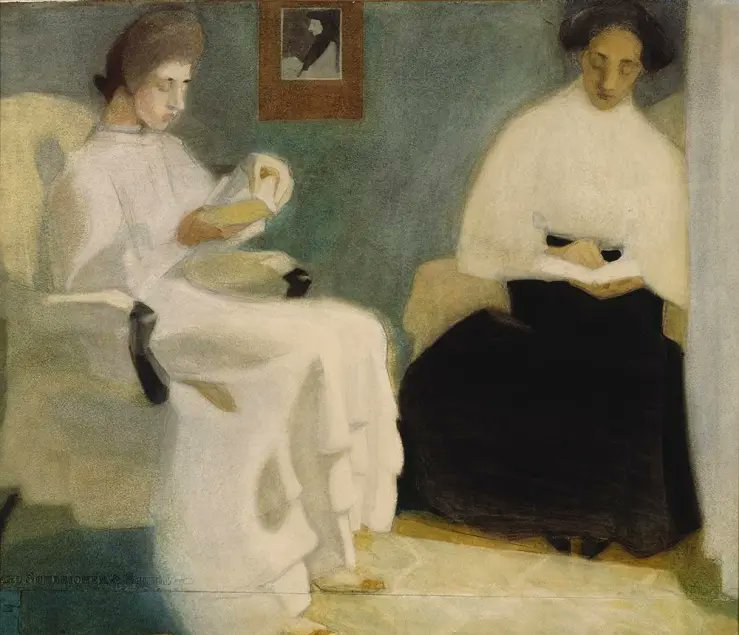
Helene Schjerfbeck, Lukevat tytöt (Reading Girls), 1907


I could probably name at least twenty more books, but I don’t want to be responsible if y’all break your book buying ban or you never finish your TBR stacks. [Ed. – You clearly do not understand the demographic of this blog’s readership, B…] My reading year 2024 has been off to a good start already and I am excited to tell you about it in a year! [Ed. – Imma hold you to it! Thanks, Benita!]

Benita Berthmann’s Year in Reading, 2021

Today‘s reflection on a year in reading is by Benita Berthmann (@moodboardultra) Benita studies literature in Marburg, Germany, where she is a full time book enthusiast, part time smoker and existentialist.

Look for more reflections from a wonderful assortment of readers every day this week. Remember, you can always add your thoughts to the mix. Just let me know, either in the comments or on Twitter (@ds228).

Helene Schjerfbecek, G***y Woman, 1919

In 2021 I read more books than ever before. 175, to be exact. [Ed. – Damn girl!] I could do it because I was in a very relaxed last semester of my Bachelor’s degree with heaps of free time (which I have since finished) and also because we were and still are in a pandemic. Being advised to stay at home does have its advantages. [Ed. – Introverts of the world unite! But not too closely!]

How can I select a number of favorites from all these books? I cannot. I can only offer you a glimpse into my (reading) life, a tiny selection. Of course, there are books from 2021 that stuck with me more than others, that touched or repulsed me differently, that I catch myself returning to in my thoughts over and over again.

When I think about the most memorable books of the past year, DIE WOHLGESINNTEN (Les bienveillantes/The Kindly Ones, German translation by Hainer Kober) by JONATHAN LITTELL immediately comes to mind. Little manages to show us each and every realm, every tiny corner of the Nazi brain of his protagonist and narrator, Maximilian Aue, over almost 1400 pages. [Ed. – Shoulda read it in English, only 992.] He is able to portray a character that is not just a Nazi, not just morally ruined, but a human being, a terrible, guilty, one, but one we do not necessarily dislike. [Ed. – Hmm…] One that allows us to see that even the most intellectual, the most cultivated (however we might define that term) people are not exempt from pursuing the most evil crimes against humanity. Not exempt from committing genocide. It is difficult to find the right words for what this book did to and with me. Yet, it is clear to me that DIE WOHLGESINNTEN is a major work that will continue to make its way into the cultural memory and leave a lasting impact on all its readers.

I am not too big on audiobooks—I listen to the same ones over and over again to help me fall asleep at night because, apparently, I can only sleep when someone basically talks my ear off—but there is one that kept me company throughout the whole year: THE SECRET HISTORY by DONNA TARTT. Probably no surprise that I, a semi-pretentious lit-student, enjoyed the tale of a very pretentious, flamboyant yet secretive group of classics students who decide to kill their friend. The novel has all of my favorite tropes: Dark academia, an obsession with aesthetics, a compelling way of story telling, mystery, and a healthy amount of death and homoerotic subtext. The language is complex and clever, snobby and charming all in the same instant, proving to me that Donna Tartt is indeed the most skillful contemporary American writer. Her talents lie not only in writing, but also in reading her own novel as an audiobook, her southern accent just adds that little extra sprinkle. Also, I have a soft spot for Richard Papen. Fight me. [Ed. — Totally fair.]

A book that has been important for me for years and that I became even more fond of in 2021 was HERTA MÜLLER’S HERZTIER (English title: THE LAND OF GREEN PLUMS, English translator: Michael Hofmann). HERTA MÜLLER, Nobel Prize winner of 2009, is my most revered author—her description of life under Ceausescu’s dictatorship in 1970s and 80s Romania never ceases to leave me in awe of both her writing skills and her personal integrity. It is brutal, relentlessly honest and poetic. In HERZTIER, we get a close view of a group of students trying to evade political persecution, eventually having to escape the government—either by fleeing to Germany or by death.

Why is this novel so important to me? In the summer of 2021, I wrote by bachelor’s thesis on its figurations of death, an experience that taught me how to look at literature even more closely and how to present an argument on my own. I feel lucky I got to have these experiences with my favorite author. [Ed. – Heart emoji!]

It’s not always easy to read a novel by Müller, neither thematically nor stylistically, but I would argue that it is a memorable and most rewarding experience –her unusual prose, the (sometimes jarringly) accurate and detailed descriptions of seemingly minor incidents open up, at least for me, perspectives I would otherwise never have imagined exist. She is a minority writer (German-speaking Banat Swabian, having grown up in Romania), an uncompromising political activist, using her voice and her reputation as a Nobel laureate especially to help censored and blacklisted writers forced to live under dictatorial rule, and someone whom I admire for both their writing and their personal integrity. Safe to say, Herta Müller is my muse. [Ed. – Benita, you are a Herta Müller Ultra!]

A huge and somewhat daunting project of mine was to read UWE JOHNSON’S (pronounced more like Yohn-Zohn in German) JAHRESTAGE (ANNIVERSARIES, translated by Damion Searls): the German version is a whopping 1700 pages. I aimed for 50 pages a day, which roughly worked out. As the title already indicates, the narration follows every day in the life of the protagonist Gesine Cresspahl, originally from Jerichow, Mecklenburg, GDR, now a citizen of New York. Anniversaries is a cleverly interwoven literary montage consisting of Gesine’s current life with her daughter in NY in 1967 and 68, her and her family’s history (fascism in 1930s Germany and such…) and, interestingly, snippets of The New York Times. I recently attended a seminar on Literary Patronage that shed light on how much Johnson was struggling to finish the final quarter of the novel. The first three parts were published in 1970, 71 and 73, but he went through a rough patch health-wise, got divorced and amassed debts at his publishing house Suhrkamp amounting to roughly 250,000 DM (around $105,000 at that time, my quick research reveals), thus, he only managed to complete his main work in 1983, a year before his untimely death from a heart attack (while he tried to open his third bottle of wine that evening). [Ed. – Let that be a lesson to me.] Rumor has it that his publisher Siegfried Unseld, trying to get his money’s worth as he was supporting the author with a monthly paycheck of 3000 DM, pushed Johnson to his breaking point by demanding that the novel be completed by March 1983 or else he would suspend the monthly support. Unfortunately, we will probably never know if this is true, but it’s an interesting backstory to the novel either way.

Thinking about all the other books I also got through, it’s impossible to name, properly review, and shed light on all of them, but there are a few honorable mentions I would like to announce at the very least:

Anything I have read by THOMAS BERNHARD, my favorite angry Austrian. This year, I got around to: FROST (translated by Michael Hofmann), WATTEN. EIN NACHLASS (published in English in THREE NOVELLAS, translated by P. Jansen and K. Northcott), MEINE PREISE (MY PRIZES, translated by Carol Brown Janeway), HOLZFÄLLEN (WOODCUTTERS, translated by David McLintock) and DIE URSACHE (part one of his autobiographical writings, I could not find an English translation for it [Ed. – It’s in Gathering Evidence] – all worth reading. I look forward to discovering even more of Bernhard’s works in 2022.

ANNIE ERNAUX: EINE FRAU (UNE FEMME/A WOMAN’S STORY (English translations all by Tanya Leslie, German translations by Sonja Finck), DIE SCHAM (LA HONTE/SHAME) and DAS EREIGNIS (L’ÉVÉNEMENT/HAPPENING) found their way into my bookshelf and my reading year 2021. The last one especially made its way into my literary heart and memory: It deals with an abortion in early 1960s France—a dangerous and shameful endeavor at that time that Ernaux dissects into fragments of memory showing pain, shame, secrecy and the essential danger of being a woman. Safe to say I am glad was born in a time and a country that makes abortions, should one be needed, at least semi-accessible. Abortion rights are not perfect in modern day Germany, but I have the feeling it’s still better than what the author describes so hauntingly and directly.

For 2022, I hope that SHIDA BAZYAR’S novel DREI KAMERADINNEN (roughly: Three (female) Comrades) will be translated into English. It challenges white majority perspectives on Germany and the country’s ongoing problems with fascism, the rising political right and xenophobia. Bonus point: It is an absolute page-turner.

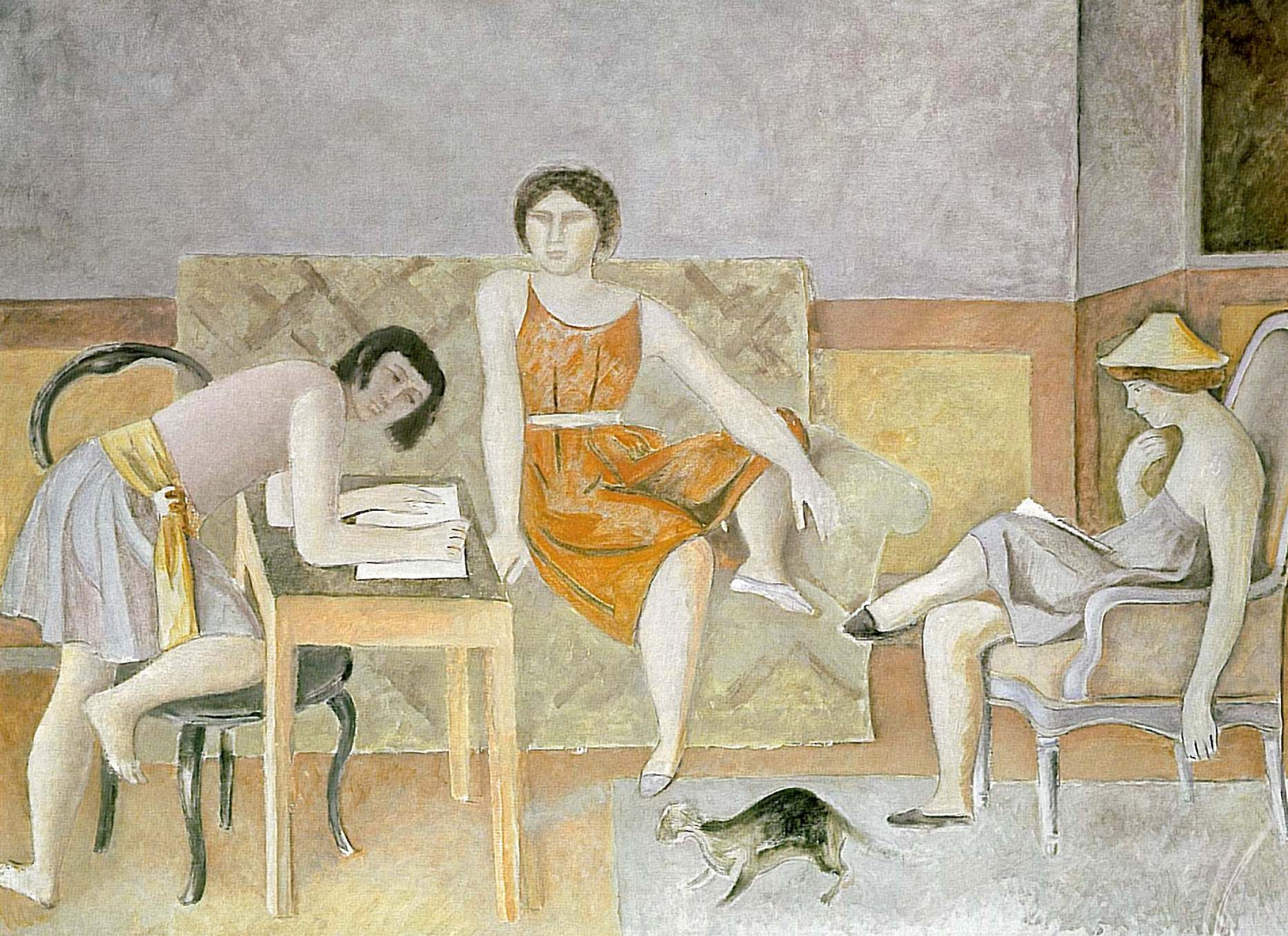
Balthus, Three Sisters and a Cat, 1965

Ok, now, finally and shortly, a couple of books that were awesome as well:

Marieke Lucas Rijneveld – The Discomfort of the Evening/Was man sät (T: Michele Hutchison/Helga van Beuningen)

Evelyn Waugh – Brideshead Revisited

Anne Weber – Annette, ein Heldinnenepos (English translation forthcoming later in 2022)

Margaret Atwood – The Blind Assassin

Patti Smith – Just Kids

Günter Grass – Der Butt/The Flounder (T: Ralph Manheim (I have read both the German original and the English translation and I can confirm that Manheim did a superb job!))

Kurt Vonnegut – Slaughterhouse Five

Maggie O’Farrell – Hamnet

I will probably not manage 175 books again this year (doing a master’s degree and all), but I hope I will still be able to discover new favorites. Keep on reading, folks.

And let’s hope Dorian keeps on giving us the chance to post these, so that I can put even more books on either my wish list or my tbr stack(s). [Ed. – I’ve already penciled you in for next year, Benita!]