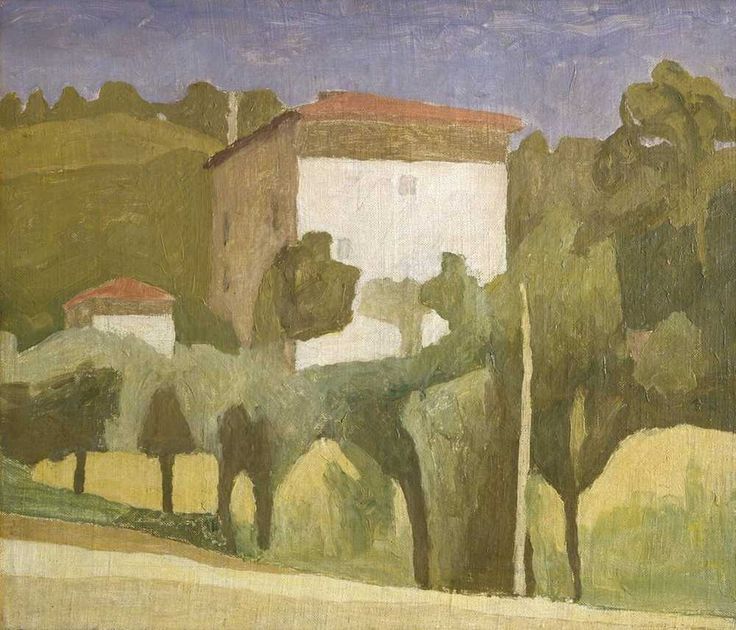
My Year in Reading, 2023

I wouldn’t say I had a great reading year. I was on my phone too much, I was being anguished or avoiding being anguished about the myriad injustices of the world, which I knew too much and could do too little about. I travelled—maybe not too much but an awful lot, for me—which was often energizing and enjoyable, but also got in the way of reading.

I felt, in other words, that I had frittered away my one wild and precious reading life. I bottomed out in the middle of the year, regularly tossing aside books unfinished after having spent more time with them than they deserved or that I could find patience for. A querulous reading year, you could say.

And yet some things stood out. Links to previous posts, if I managed to write about it.
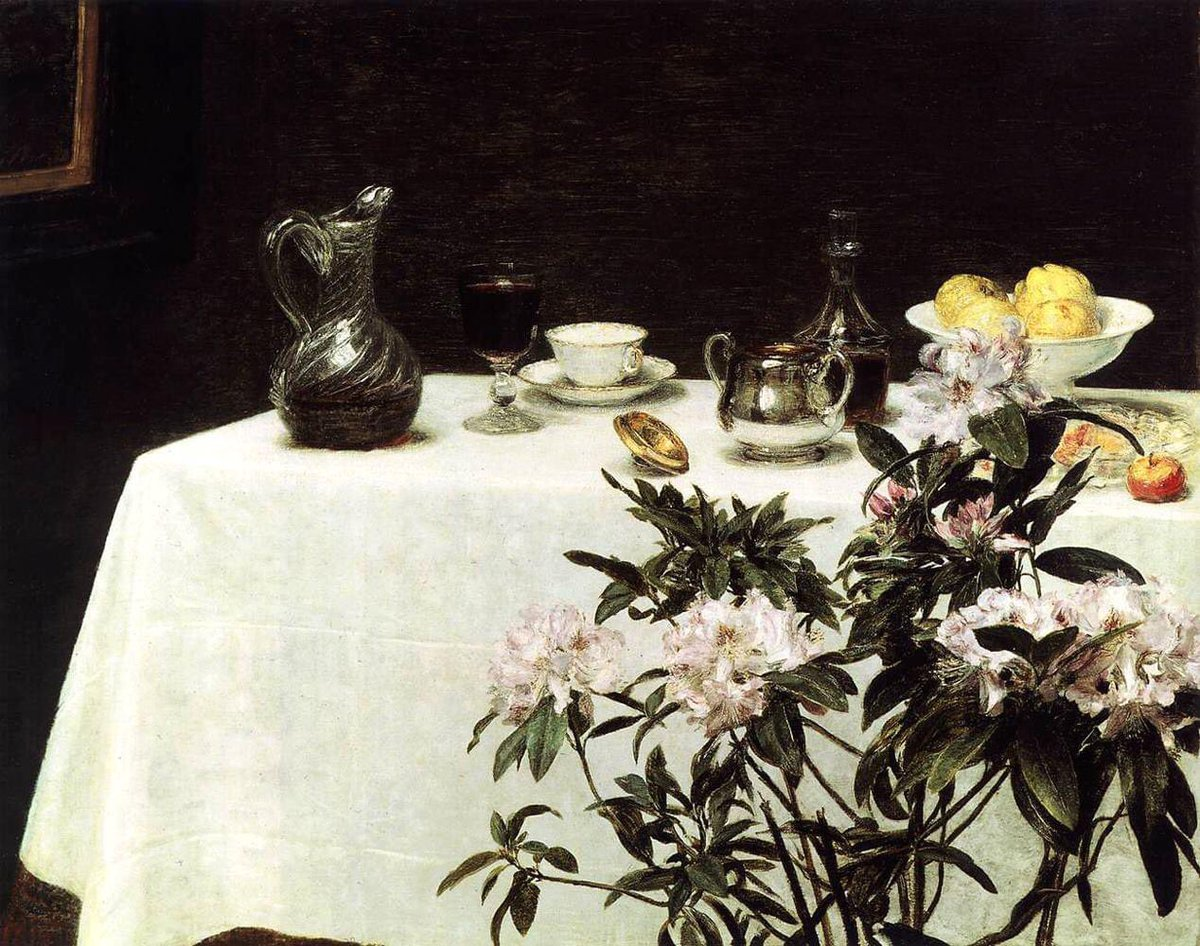
Henri Fantin-Latour, Le coin de la table (1872)

Dwyer Murphy, The Stolen Coast

A rare heist novel where the heist, though satisfying, isn’t the main attraction. I loved this stylish, smart, funny tale of a man who has put his Ivy League law degree to use in taking over the family business: giving new identities to guys on the run and getting them the hell over the border. A great book of off-season resort towns.

Simon Jimenez, The Vanished Birds

I’m still getting my bearing in contemporary sff so take these comments for what they’re worth, but it seems rare to me that a book takes as many swerves as this one: the narrative moves back and forward in time and all over the place, from a near-future nearly uninhabitable earth to a galaxy far-away in space and time. You get invested in a storyline and then it ends but sometimes it comes back. But even more than the structure I loved this book for its emotional seriousness: its many relationships are doomed to fail because of their constitutive circumstances. For example: a man ages fifteen years between each meeting with his beloved, while she, thanks to intricacies of stellar time travel, has only aged a few months. The emotions might be bigger than the ideas, but I was totally okay with that.

Two novels by Katherena Vermette

One of the greatest working Canadian writers. This year, fresh off the thrill of teaching The Break to smart, appreciative students, I read The Strangers and The Circle, a bleak and beautiful trilogy of indigenous life in the aftermath of the cultural trauma of the residential school system.

Four novels by Kent Haruf

It should tell you something that in early April, one of the worst times in the academic year, I read four novels by Kent Haruf in just over a week. I loved Plainsong the most but enjoyed Eventide, Benediction, and Ours Souls at Night almost as much. Easy reading, sure: plain syntax rising to gentle arias, nothing fancy, maybe a little sentimental. But these books are so warm and kind. Each is set in Holt, Colorado, out on the eastern plains, where the mountains are a smudge on the western horizon and it’s sometimes hot and sometimes cold but always dry. The people are ranchers and school teachers and social workers and hardware store owners and ne’er-do-wells and retirees. Everyone is white and no one thinks that’s worth noticing. The time is hard to pin down. Sometimes I thought the 70s or early 80s but we’re probably talking the 90s. Things were different before the internet. The characters’ lives are modest and they seem fine with that. They go about their business, do their work, make good choices and bad ones. People look out for each other, but they judge each other, too. Little kids get lost biking, but they come home again. It’s not all roses, though. High school boys bully girls into having sex, over in that abandoned house just down from where the math teacher lives. People get sick, go hungry, lose jobs. Some characters get what the preacher will call a good death, some die unreconciled to their kin, some without warning, too soon. Life just keeps happening, you know?

Some readers will call this hokum, but I ate it up. Haruf won my heart. I thought him especially good on second chances and unexpected turns of fate. Of all the stories that weave through these loosely connected novels, the best concerns two brothers, old bachelors, ranchers, who agree to take in a pregnant teenage girl and who, to everyone’s surprise, not least their own, form a new family with her. That scene where they take into the next town over to get things for the baby and insist on buying the best crib in the store? Magic.

Garth Greenwell, Cleanness

Smart, sexy, stylish books about how we relate to bodies privately and publically, and whether we can recast the narratives that have shaped aka deformed our understanding of what it is to live in those bodies. Greenwell’s Substack is worth subscribing too; he makes me curious about whatever he’s curious about. Can’t wait for the essay collection he’s writing.

Emeric Pressburger, The Glass Pearls

Yep, that Pressburger. Closer to Michael Powell’s Peeping Tom than any of the (indelible) films they made together. Karl Braun, a German émigré, arrives at a boarding house in Pimlico on a summer morning in 1965. A piano tuner who never misses a concert, a cultured man, a fine suitor for the English girl he meets through work. I’m not spoiling anything to say that Karl isn’t just quiet: he’s haunted—and hunted. For Karl Braun is really Otto Reitmüller, a former Nazi doctor who performed terrible experiments, a past he does not regret even as he mourns the death of his wife and child in the Hamburg air raids. Now the noose is tightening and Otto/Karl goes on the run… Suspenseful stuff; most interesting in this play with our sympathies. Not that we cheer for the man. But his present raises our blood pressure as much as his past.

Toni Morrison, A Mercy

A short book that covers as much ground as an epic; a historical novel that feels true to the differences of the past but that is clearly about the present; a classic modernist Morrison text, where the first page tells you everything that’s going to happen except that it makes no sense at the time and the rest of the reading experience clarifies, expands, revises. Such beauty and mystery in so few pages.

Roy Jacobsen’s Barrøy series (Translated by Don Bartlett and Don Shaw)

Cheating a bit since I read the first one in December 2022. I’m a huge fan of these novels about a family and the remote Norwegian island they call home from 1900 to 1950. I like books where people do things with their hands, maybe because I can’t do much with mine. The characters bring sheep into the upper field, fish with nets and line, salt cod, keep the stove burning all through the year, row through a storm, carry an unconscious man through sleet. It’s all a little nostalgic, a little sentimental, but not too much. Just how I like it.

Two Books by Walter Kempowski (Translated, respectively, by Michael Lipkin and Anthea Bell)

Fresh on my mind so it’s possible I’ve overvalued them but I don’t think so. All for Nothing, especially, is something special.

George Eliot, Middlemarch

Last read in college—under the expert tutelage of Rohan Maitzen, this can only be called one of the highlights of my undergraduate experience. This time I listened to Juliet Stevenson’s recording, which perfectly filled a semester’s commuting. True, Arkansas traffic is not the ideal venue for some of Eliot’s more complex formulations, but Stevenson (as much a genius as everyone says, she do the police in different voices, etc.) clarifies the novel’s elegant syntax and famous images. The book’s the same, but I’m not; a whole new experience this time around. Much funnier, especially its early sections. (Celia is a triumph.) More filled with surprising events: that whole Laure episode (a Wilkie Collins novel in miniature), it was as if I’d never read it. And more heartbreaking: in 1997, I hated Rosamond, and I admit I still felt for Lydgate this time around, but I had so much sympathy for her, a character I’d only been able to see as grasping and venal. Speaking of sympathy, one of the glories of English literature lies in watching Dorothea as she matures from excitable near-prig to wiser and sadder philanthropist. Amidst all this change, though, some things stayed the same. Mary Garth still won my heart; the suspense at the reading of Featherstone’s will gripped me just as much.

It’s good to read Middlemarch in college. It’s better to re-read Middlemarch in middle age. It’s best to read Middlemarch early and often.

Konstantin Paustovsky, The Story of a Life (translated by Douglas Smith)

Six-volume autobiography of Soviet writer and war correspondent Paustovsky, a Moscow-born, Ukrainian-raised enthusiast of the Revolution who somehow made it through Stalinism to become a feted figure of the 1960s. The new edition from NYRB Classics contains the first three volumes. I only read the first two, not because I didn’t enjoy them (I loved them) but because I set the book down to read something else and the next thing I knew it was a year later. Paustovsky had something of a charmed life. His childhood was largely downwardly mobile, and he lived through so much terror and upheaval. And yet he always seems to have landed on his feet. Maybe as a result—of maybe as a cause—he looks at the world with appreciation. He can sketch a memorable character in a few lines. He writes as well about ephemera (lilacs in bloom) as about terror (I won’t soon forget his time as an orderly on an undersupplied hospital train in WWI). He can do old-world extravagance (the opening scene is about a desperate carriage ride across a river raging in spate to the otherwise inaccessible island where his grandfather lies dying) and the brittle glamour of the modern (for a while he drives a tram in Moscow). Trevor Barrett, of Mookse & Gripes fame, said it best: Paustovsky is good company. I really ought to read that third book.

Félix Vallotton, Still Life with Flowers, 1925

A few other categories:

Didn’t quite make the top, but such pleasurable reading experiences: Adania Shibli, Minor Detail; Paulette Jiles, Chenneville; Abdulrazek Gurnah, By the Sea; Jamil Jan Kochai, The Haunting of Hajji Hotak and Other Stories (teaching “Return to Sender” was a revelation: fascinating how even students who had seemed immune to literature shook themselves awake for this one).

Read with dread and mounting desperation, don’t get me wrong it’s a banger, but couldn’t in good conscience call it a pleasure to read: Ann Petry, The Street. Barry Jenkins adaptation when?

Maybe not standouts, but totally enjoyable: Margaret Drabble, The Millstone; K Patrick, Mrs. S; Yiyun Li, The Vagrants; Elif Batuman, Either/Or

Best dip into the Can-con vaults: Margaret Laurence, The Stone Angel. Got more about of this now than I did in high school, lemme tell you.

Best book by a friend: James Morrison, Gibbons or One Bloody Thing After Another: Not damning by faint praise. It’s terrific!

Book the excellence of which is confirmed by having taught it: Bryan Washington, Lot. Maybe the great Houston book. I get that novels sell but I wish he’d write more stories.

Grim, do not recommend: Larry McMurtry, Horseman, Pass By; Girogio Bassani, The Heron

Not for me: Jenny Offill, Weather; Annie Ernaux, Happening; Yiyun Li, The Book of Goose

Planned on loving it, but couldn’t quite get there: Julia Armfield, Our Wives Under the Sea. Sold as metaphysical body horror, this novel about a woman who goes to pieces when her wife returns from an undersea voyage gone catastrophically wrong as a kind of sea creature didn’t give me enough of the metaphysics or the horror. I figured it would be perfect for my course Bodies in Trouble but I couldn’t find my way to assigning it. Possibly a mistake: teaching it might have revealed the things I’d missed. Gonna trust my instincts on this one, tho.

The year in crime (or adjacent) fiction:

Disappointments: new ones from Garry Disher, Walter Mosley, and S. A. Cosby (this last was decent, but not IMO the triumph so many others deemed it; he’s a force, but I prefer his earlier stuff).

Standouts: Celia Dale, A Helping Hand: evil and delightful, can’t wait to read more Dale; Lawrence Osborne, On Java Road: moody, underappreciated; Christine Mangan, The Continental Affair: moody, underappreciated; Allison Montclair, The Right Sort of Man: fun; Joseph Hansen: wonderful to have the Dave Brandsetter books back in print, hope to get to more in 2024; Richard Osman: as charming, funny, and moving as everyone says.

Maigrets: Of the six I read this year, I liked Maigret and the Tramp best. Unexpectedly humane.

Giants: Two Japanese crime novels towered above the rest this year. I didn’t write about volume 2 of Kaoru Takamura’s Lady Joker (translated by Marie Iida and Allison Markin Powell) but maybe my thoughts on volume 1 will give you a sense. Do you need a 1000+ page book in which a strip of tape on a telephone poll plays a key role? Yes, yes you do. (Also, it has one of the most satisfying endings of any crime novel I’ve ever read.) More on Hideo Yokoyama’s Six Four (translated by Jonathan Lloyd-Davies) here. Do you need an 800+ page book in which phone booths play a key role? Yes, yes you do.

The year in horror:

Victor LaValle, Lone Woman: horror Western with a Black female lead and not-so-metaphorical demon, enjoyable if a bit forgettable; Jessica Johns, Bad Cree: standout Indigenous tale, also with demons; Leigh Bardugo, Hell Bent: serious middle-volume-of-trilogy syndrome. Many demons, tho.

The year in sff:

In addition to Simon Jimenez, I liked Ann Leckie’s Translation State, Nick Harkaway’s Titanium Noir, and, above all, the three novels by Guy Gavriel Kay I read this summer, which gave me so much joy and which I still think about all the time.

The year in poetry:

Well, I read some, so that’s already a change. Only two collections, but both great: Wisława Szymborska’s Map: Collected and Last Poems (Translated by Clare Cavanaugh and Stanislaw Baranczak), filled with joy and sadness and wit, these poems made a big impression, and Ilya Kaminsky’s Deaf Republic (fortunate to have met him, a mensch; even more fortunate to have heard his indelible performance).

The year in German books: I read two, liked them both. Helga Schubert, Vom Aufstehen: Ein Leben in Geschichten (On Getting Up: A Life in Stories), vignettes by an octogenarian former East German psychotherapist who had fallen into oblivion until this book hit a nerve, most impressive for the depiction of her relationship to her mother, which reminded me of the one shared by Ruth Kluger in her memoir; Dana Vowinckel, Gewässer im Ziplock (Liquids go in a Ziplock Bag): buzzy novel from a young Jewish writer that flits between Berlin, Jerusalem, and Chicago. The American scenes failed to convince me, and the whole thing now feels like an artefact from another time, given November 7 and its aftermath. I gulped it down on the plan ride home, though. Could imagine it getting translated.

Everyone loved it; what’s wrong with me? (literary fiction edition):

Made it about 200 pages into Elsa Morante’s 800-page Lies and Sorcery, newly translated by Jenny McPhee. Some of those pages I read raptly. Others I pushed through exhaustedly. And then I just… stopped. The publisher says it’s a book “in the grand tradition of Stendhal, Tolstoy, and Proust,” and I love those writers. (Well, I’ve yet to read Stendahl, but based on my feelings for the other two I’m sure I’ll love him too.) Seemed like my social media feeds were filled with people losing it over this book. Increasingly, I see that—for me, no universal judgment here—such arias of praise do more harm than good; I experience them as exhortations, even demands that just make me feel bad or inadequate. Increasingly, too, I realize how little mental energy I have for even mildly demanding books during the semester. (A problem, since that’s ¾ of the year…) I might love this book in other circumstances —I plan to find out.

Everyone loved it; what’s wrong with me? (genre edition):

Billed as True Grit set on Mars in alternate version of the 1930s, Nathan Ballingrud’s The Strange indeed features a young female protagonist on a quest to avenge the destruction of her family, but Ballingrud is no Portis when it comes to voice. True, I was in the deepest, grumpiest depths of my slough of despondent reading when I gave this a try, so I wasn’t doing it any favours. But that’s a nope from me.

Other failures:

Mine, not the books. Once again, I read the first hundred or so pages of Anniversaries. It’s terrific. Why can’t I stick with it? I read even more hundreds of pages of Joseph and His Brothers, as part of a wonderful group of smart readers, most of whom made it to the end of Thomas Mann’s 1500-page tetralogy. I loved the beginning: fascinating to see Mann’s take on the stories of Genesis; interesting to speculate on why Mann would write about this subject at that time. (For me, Mann is in dialogue with Freud’s Moses and Monotheism, another oblique response to fascism through stories from Torah.) My friends tell me it got a lot more boring shortly after I left off (the end of volume 2), but that’s not why I gave up. Turns out, I don’t do well if I’m supposed to read something in regular, little bits. I need to tear into books—and I wasn’t willing to make the time for this chunkster. Sorry, guys.

Odds & Ends:

A few albums that stood out: Roy Brooks, Understanding (reissued in 2022, but I’m not over it: this quintet, man, unfuckingbelievable); Taylor Swift, Midnights (I love her, haters go away); Sitkovetsky Trio, Beethoven’s Piano Trios [volume 2] (a late addition, but pretty much listened to it nonstop in December and now January).

After a decade hiatus, I started watching movies again. Might do more of that this year!

I was lucky enough to travel to Germany in late spring with a wonderful set of students. While there, I met so many people from German Book Twitter who have become important to me, including the group chat that got me through covid and beyond. (Anja and Jules, y’all are the best.) All these folks were lovely and generous, but I want to give special thanks to Till Raether and his (extremely tolerant) family, who took me in and showed me around Hamburg. (Great town!) Have you ever met someone you hardly know only to realize they are in fact a soulmate? That’s Till for me. What a mensch. Cross fingers his books make it into English soon. In the meantime, follow him on the socials!

Reading plans for 2024? None! I need fewer plans. I can’t read that way, turns out, and maybe I’ll avoid disappointment by committing less. Gonna be plenty of other disappointments this year, I figure. No need to add any self-inflicted ones. At the end of last year, I joined a bunch of groups and readalongs, because I want to hang with all the cool kids, but I can already see I need to extricate myself from most of them. One good thing I did for myself in 2023, though, was to stop counting how many books I read. I was paying too much attention to that number. Fewer statistics in 2024!

Piet Mondrian, Oranges and Decorated Plate, 1900

Finally, to everyone who’s read the blog, left a comment or a like, and generally supported my little enterprise (which turns 10 in a week or two…), my heartfelt. I do not know many readers in real life. You all are a lifeline.

What I Read, October 2023

It might have been in the first week of October, after another spirited conversation in my Holocaust Literature class, that I had to marvel at how far along we were in the semester for the students to still be bringing it like that every day. A special group. Good thing the classroom was giving me joy, because not much else was. The horrific terrorist attack by Hamas, the nightmarish Israeli response. Nothing but suffering, rage, self-righteousness, and apologetics. I found myself alienated from many of my communities. And then embroiled in a frustrating situation on campus (triggered by events in the Middle East but ultimately having nothing to do with it). Given all the bullshit it’s a wonder I got anything read at all.

Tom Thompson, Silver Birches (1915 – 16)

Paulette Jiles, Chenneville (2023)

John Chenneville—scion of old French family whose estate, Temps Clair, lies north of St Louis in the fertile lands where the Missouri meets the Mississippi—returns from the Civil War after having spent nearly a year in hospital recovering from a terrible head wound. He finds his home in disarray: fields unplanted, animals untended, rooms empty. The only remaining servant gravely explains that Chenneville’s sister has been murdered along with her husband and their infant child at their home downriver at St Genevieve. From that moment, Chenneville devotes his life to avenging this loss (the subtitle states the case plainly: “A Novel of Murder, Loss, and Vengeance”).

The hero visits the scene of the crime (the bloodlands of the Missouri Ozarks that formed the setting of her novel Enemy Women), quickly learns who did it, and then chases the man, a sociopathic former sheriff named Dodd, across Arkansas, the Indian Territory, and into Texas. I know a lot of these landscapes, which was part of the book’s appeal for me, but I think Jiles’s descriptions are objectively lovely: evocative but spare. Nothing fancy, but clear as the sky on a frosty morning. Here’s Chenneville making camp after almost 24 hours on the go: 

The wind was becoming sharp and hard; it bit at his lips and ears, his hands. It was bringing rain. To the south of the road he saw a motte of post oaks, great thick-trunked trees, and what looked like a declination of the earth toward a streambed. On that side he could build a fire and the smoke would blow away south and not alert any traveler coming down the road. 

Remembering the advice of a sergeant, an older Mainer, he strips himself almost naked, putting the clothes under the blankets to keep them warm. Then come this lovely reflection: 

For a few moments he felt again that suspended, almost magical feeling of being out in the wilderness and the weather and yet safe against it. Here was rest and a respite against bereavement because the world was going on without him in its deep rhythms, deeper than he could see. 

I love this kind of thing. Chenneville has it all: a love story, a key subplot involving telegraphy, and a satisfyingly minor-key ending. (A final flurry of events, almost comically bathetic, renders vengeance unnecessary, and you can almost hear the protagonist sigh in relief.) The physical book is gorgeous, too, especially the stately maps on its endpapers. I almost regretted having checked it out of the library.

Wisława Szymborska, Map: Collected and Last Poems Trans. Claire Cavanaugh & Stanislaw Barańczak (2015)

So pleased I chose this as a selection for One Bright Book. I need to be encouraged to read poetry (too enslaved to the demon narrative); being accountable to Frances and Rebecca ensured I made my way through this collection of the Polish writer and Nobel laureate Wisława Syzmborska. To think what I would have missed out on otherwise!

Here’s some of what I said in my introduction to the episode:

Szymborska’s first poems were in the accepted socialist realist style; she later repudiated most of them, just as she rejected the doctrinaire communism she had espoused when younger. (From the 1960s on she was part of the Polish dissident movement.) Repudiation more generally was central to her artistic process: her published work runs only to about 350 poems. Asked about this, she said “It’s because I have a trash can.”

That dry, self-deprecating response seems typical of Szymborska’s personality—and indeed her poetry. A Polish friend tells me that her letters “fizz with joie de vivre” and I can see that quality in the poems too, even though they are often plenty melancholy. Despite that sadness, her poems are often funny, which makes me wonder what it’s like to read her work in Polish, since slyness or jokiness can be so hard to translate.

It’s said that the writer Czeslaw Miloz, himself a Nobel laureate (1980), was anxious when Szymborska won the prize, fearing she would experience it as a terrible burden, given her shy and retiring nature. Indeed, she didn’t publish any poetry for several years after the award. To me her later work is as strong as her middle period, so I certainly didn’t feel any loss in quality after the Nobel; I’m curious if you both agree.

Whether she felt the burden or not, I can’t say, but I can say that Szymborska’s Nobel Prize address is terrific: modest, humourous, but also totally on point. She writes, among other things, about how poets, like all people fortunate enough to do work they care about, are propelled by the phrase “I don’t know.” She adds, “I sometimes dream of situations that can’t possibly come true.” That made me laugh because she’s always doing that in her poems. Some of them even start with the word “if: if angels exist, would they care about human culture (she concludes they would only like early Hollywood slapstick). Some of them see the remarkable in ordinary situations, as in these lines:

A miracle that’s lost on us:

the hand actually has fewer than six fingers

but still it’s got more than four.

Or how with “a few minor changes” her parents might have married other people and then where would she be?

Other poems consider scenarios we don’t usually dwell upon—one imagines a baby photo of Hitler (“And who’s this little fellow in his itty-bitty robe?”); another speculates how many in a hundred people do or feel one thing or another, in the process humanizing the field of statistics; a third poem, called “Cat in an Empty Apartment,” concerns a cat whose owner has died. (Apparently, she told her partner, the writer Kornel Filipowicz, that “no living being has as good a life as the life your cat lives”—I suspect she wrote the poem in the aftermath of Filipowicz’s death in 1990. Heartbreaking lines: “someone was always, always here,/then suddenly disappeared/and stubbornly stays disappeared.”) The phrase “I don’t know” matters so much because it propels us to think and do more—specifically, to ask more questions. Szymborska adds, “any knowledge that doesn’t lead to new questions quickly dies out: it fails to maintain the temperature required for sustaining life.”

This phrasing too seems quintessential Szymborska. She was fascinated by life in its literal, biological sense: she writes about the specks of dust that make up meteors, about foraminifera, which, it turns out, are microscopic single celled organisms that build shells around themselves from the minerals in sea water, and about what she calls “our one-sided acquaintance” with plants: we think we know about them: our monologue with them is essential for us but never reciprocated; they don’t care about us.

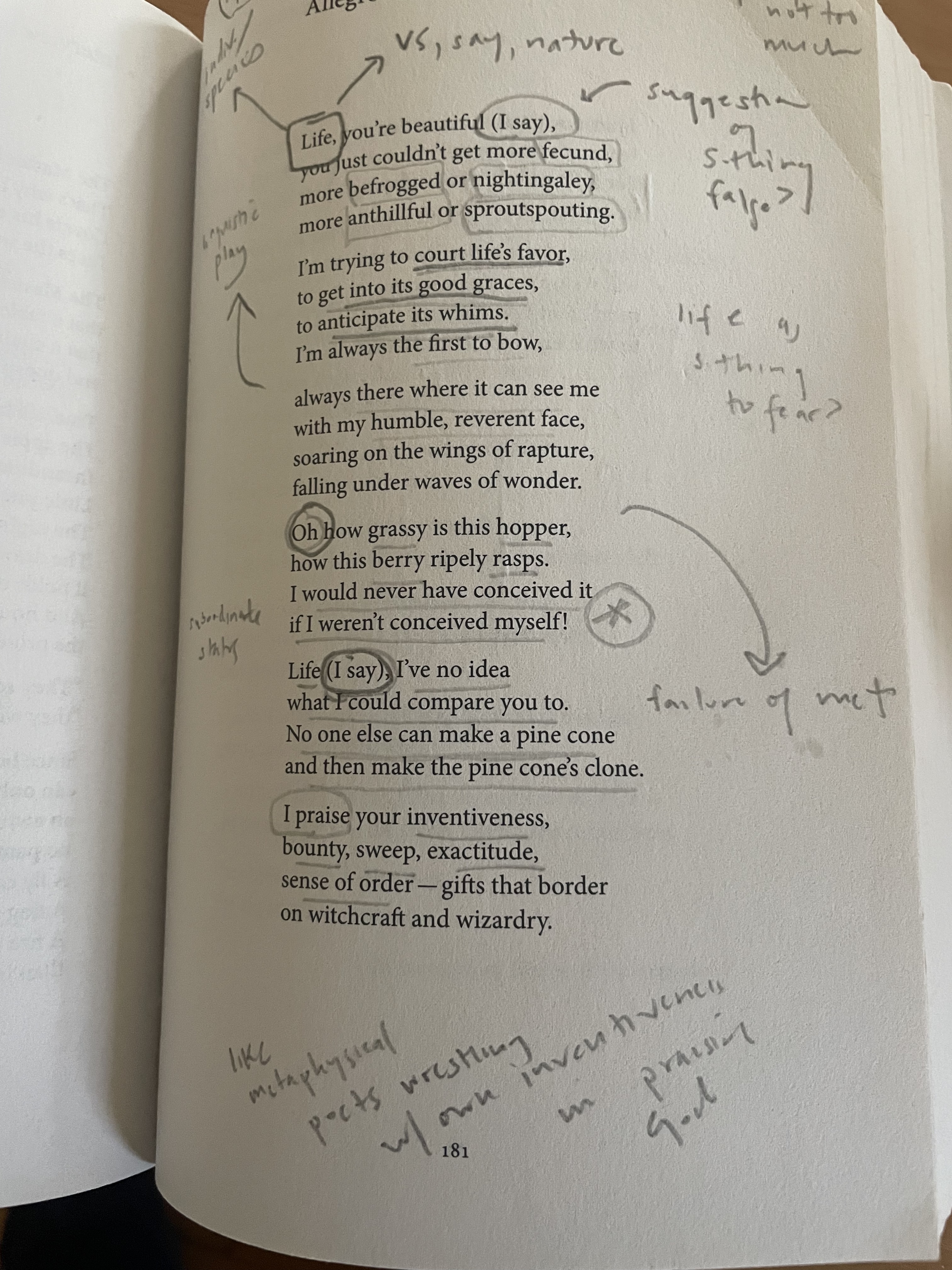
We each chose a poem to close read. Here are some of my notes on my choice, “Allegro ma Non Troppo” (1972).

Anyway, listen to our conversation here. Our best, IMO.

Allison Montclair, The Right Sort of Man (2019

Kay recommended this to me, and I can’t improve on her review, which chimes perfectly with my experience of the book. In brief: two women, Iris Sparks and Gwendolyn Bainbridge, set up a marriage agency in London in the immediate aftermath of WWII. They know each other only slightly, it turns out, and as Kay notes, Montclair uses the opposites-attract and slow-burn tropes of romance fiction to explore their growing friendship and business partnership. The book begins with the eventual victim arriving at their office in search of a husband. Next thing you know, the woman turns up dead and suspicion falls on the client Sparks and Bainbridge have set her up with. (It doesn’t help that the murder weapon is found under his mattress.) The women set out to prove his innocence—and save their suddenly cratering business. The actual mystery is a little slight; I bet Montclair gets better at suspense as the series goes on. (I plan to find out.) Besides, as Kay also explains, the real interest here lies in the book’s melding of crime and romance. In addition to the leads, Montclair fills her book with strong minor characters: a heavy who just wants to be a playwright, a mobster who falls for Sparks, and a working-class guy who upper-crust Bainbridge meets while undercover. Part of me really wants these guys to come back, but part of me worries the series might fall risk to the whole “it takes 300 pages just to keep up with the antics of the growing cast of recurring characters” problem. 

Prime light reading.

Giorgio Bassani, The Heron (1968) Trans. William Weaver (1970

Dour novel of postwar Italian life, centering on Edgardo Limentani, a Jewish landowner who, having married out of the tradition, finds himself alienated by a political landscape comprised of communists that threaten his privileges and old fascists that respond to his continued existence with servility that fails to conceal their hatred of his continued existence.

On a damp day in late fall, Limentani goes hunting for waterfowl in the Po marshes. He dithers about going at all, finds himself waylaid, arriving too late for any good shooting, even, in the final account, unable to shoot at all, leaving it to his guide to bring down a trunkful of birds, which he later passes off as his own. On the way back he stops for coffees in a bar where he wrestles with whether to call the cousin he’s been estranged from for years, eats a meal in the restaurant of a hotel owned by one of those unctuous fascists, sleeps heavily and unsoundly in one of the upstairs rooms, and puts off returning home until his wife, whom he can no longer stand, will be sure to have gone to bed. From the time he starts awake in the pre-dawn dark until the time he returns to the study he uses as a makeshift bedroom, the protagonist thinks dark thoughts that give him no satisfaction. He sees no good way out of this life.

Having only read The Garden of the Finzi-Continis—a sad book, yes, but not a despairing one—I was shocked by this novel’s grimness. I’ve no idea about Bassani’s state of mind at this stage in his life, but The Heron (the title refers to a bird shot along with the ducks, no good for eating, pure waste) reads like the book of an unhappy and discouraged man. Maybe Weaver’s translation, getting on now in years, contributes to the novel’s heaviness. There’s a newish translation: anyone read it?

Billy-Ray Belcourt, A Minor Chorus (2022) 

Score one for the “don’t give up on a book too soon” camp: I almost ditched poet and essayist Belcourt’s first novel after about twenty pages, annoyed at the clunky dialogue and risible self-righteousness (similar vibes to a book I really hated), but once the narrator leaves his graduate program in Edmonton and returns to his home community in way northern Alberta I started picking up what Belcourt was putting down. The narrator (an obvious stand-in for the writer) mines his community for stories to weave into the novel he’s writing: we hear from an older gay man, who unlike the narrator has chosen (or been made to choose) to stay closeted and both admires and disparages the narrator’s different decisions; an old friend who has disentangled herself from an abusive relationship; and his great-aunt, who worries over the fate of the boy she raised as her own, the narrator’s cousin, two boys who were once inseparable, but whose paths diverged (the cousin is in jail).  In other words, when the narrator stops wringing his hands over whether his academic work can be meaningful in a world where so much injustice needs to be redressed and starts telling the stories of others as his way of doing that work, the book becomes moving and interesting.

I loved Belcourt’s descriptions of my home province, even though the part he’s from is about as far away from mine as Little Rock is from St Louis). This bit hit home:

The farther one veered from Main Street, a single stretch of highway on which sat most of the town’s businesses, schools, and amenities, the older the infrastructure became. Behind the dilapidated building ran train tracks that were less like sutures and more like wounds. It all looked so ordinary and Canadian and, because of this, haunted.

That passage gets better—more pointed—as it goes along. The workmanlike first sentence, as unvarnished as the buildings it references, gives way to a metaphor that asks us to return to the seemingly bland and official term at the end of the previous one. Who is the infrastructure that makes this place possible—improbable that people could live anywhere, but especially so in that northern clime—for? The things that link some people might separate others. (Who lives on the other side of the tracks?) The things that give some people meaning might just hurt others. Everything here leads to that last sentence: the ordinariness that many Canadians take pride in (unspectacular, solid, self-avowedly decent) is built on a foundation of dispossession and expropriation. And what of those who don’t see themselves in the mirror of that self-description? Those who are showy, marginalized, far from the main drag, maybe queer or nonbinary or indigenous. Is their only role to haunt Main Street?

James Morrison, Gibbons or One Bloody Thing After Another (2023)

I’m always nervous reading books by friends, but here I needn’t have feared: the debut novel by James “Caustic Cover Critic” Morrison is smart and engaging. It tracks the history of the Gibbons family from the late 1800s to an apocalyptic near-future in a series of chapters that work as stand-alone stories but gain in heft when the lines of familial affiliation come through.

Along the way, Gibbons serves as an alternative history of Australia in the modern era, referencing institutions and events ranging from the Native Police Force to the Snapshots from Home program to the devastating 1974 cyclone that nearly destroyed Darwin. I say “alternative” not because these things are made up but because the novel demands that we consider fabulation and creation necessary to any attempt to document the past. The first line, “A shelf of eyes, polished and unblinking,” alludes to the ability to see and record, even as it undermines these faculties: these eyes are fake, made of glass. Throughout the novel. James values the power of artificiality: not only are the pages filled with photographers and pulp writers and pornographers, but the chapters are separated by his own charming illustrations (and one by his daughter!).

It’s a good book, is what I’m saying. Shawn Mooney and I interviewed James to launch the book.

Holly Watt, To the Lions (2019) 

The title of this engaging debut crime novel refers to the place journalists are willing to send anyone who comes in the path of a good story—and to the place they themselves are thrown when they go undercover. Cassie and her friend Miranda cover a specialized beat: the nexus of moral impropriety, tech bro/financial CEO untouchability, and third world suffering. Which makes a rumour that falls into their laps irresistible: somewhere someone is taking rich men to hunt people. Where? Like everything in the story, the location is obscure. A preserve, maybe. A prison. Or, as turns out to be the case, refugee camp. Through investigative reporting that Watt, a journalist herself, depicts plausibly and compellingly, the pair learn that the shadowy operation, though based in London, centers on a camp in lawless Libya, not too far across the border from a remote part of Algeria, where a private jet drops off the financiers, titled sons, and adventurers willing to pay a hell of a lot of money to do something whose repulsiveness makes them feel alive. To get the full story, though, the women need to catch someone in the act. A complicated undercover operation ensues, filled with menace (I’ve rarely been so scared for a character.) Watt plays with readers’ fascination with the lurid, which sometimes makes the book preachy, but mostly it’s just exciting. Not quite the usual thing, then, though it’s hard for me to see how Watt sustains her premise through the other books of the series. Just how many stories of this ilk can Cassie uncover?

Mary McCarthy, Memories of a Catholic Girlhood (1957) 

Rebecca’s choice for One Bright Book; you can hear our conversation here. I was glad to have read this once-but-perhaps-no-longer-famous memoir, though I can’t say I loved it. I found it a desperately sad book about a family filled with people unable to communicate with each other. So many silences, so much heartache, so much harmful propriety. To my surprise, Rebecca and Frances found it funny and biting, a book filled with readerly pleasures. We didn’t convince each other, but I appreciated the chance to articulate my response. Many readers have admired the sections between chapters in which McCarthy explains what she later learned about the family stories she tells, pointing out inconsistences or outright falsehoods. Such self-awareness might have felt innovative at the time, but to me they didn’t add much. I think none of us expects memoir to be complete truth. Anyway, I will never forget the story of an uncle by marriage who sets out to show nine or ten-year-old McCarthy in the worst possible light, just so he and his wife could beat her black and blue with a hairbrush. Terrible, terrible stuff.

Gabriele Münter, Green House (1912)

A wide-ranging reading month, with plenty to appreciate. Only Map really stood out for me, though. Any takes on these selections?

James Morrison’s Year in Reading, 2021

Today’s reflection on a year in reading is by James Morrison, an Australian reader and editor (sadly, not of books) who tweets at @unwise_trousers and blogs (increasingly infrequently) at http://causticcovercritic.blogspot.com.

Look for more reflections from a wonderful assortment of readers every day this week and into next. It’s a stellar lineup. Remember, you can always add your thoughts to the mix. Just let me know, either in the comments or on Twitter (@ds228).

Francesa Woodman, Untitled, Rome, Italy 1977 – 78

2021 was like much of the rest of my life: I didn’t accomplish much, but I did read a shitload of books. If you take as true the dubious proposition that literature makes us better people, then virtue must positively drip from my pores. Sadly, the behaviour of nearly every great writer shows instead that constant contact with great literature makes you absolutely repellent.

Reading a lot can mean that when you look back on what you’ve read over the course of a year there are a number of surprises. I read that this year? It feels like a lifetime ago. What book is that? I have no memory of it at all. I only gave that three stars on Goodreads? It’s really hung around in my brain, more so than some of the obvious winners.

Some people have reading plans they stick to. I have no plans, or at least none that last more than a day or two in the face of the constant deluge of new and old books that keep yelling out for attention. I’m also a sucker for pretty books—I will absolutely fall for a book with a clever or beautiful cover design, knowing nothing else about it. [Ed. – Hard same, I’ll often ignore a book with an ugly cover and then decide I have to have it if it’s released in a better design.] Despite this, I will pretend not to be shallow as I talk about some of the things I read last year, in loosely thematic clumps.

Magyars

One of my favourite literary sources is Hungary. Little Hungarian writing gets translated compared to that from most other European countries, but the main reason I like it is that the general quality of what does get translated into English is astonishingly high. Three books from Hungary particularly struck me this year.

Progressive Transylvanian aristocrat Count Miklós Bánffy is best remembered for his massive They Were Counted/Divided/Found Wanting trilogy, but was also excellent on a small scale; and two collections of his short stories came out at roughly the same time from two different publishers, with some overlap. Probably the better of the two is The Enchanted Night, translated by Len Rix, full of elusive stories that range from brutal military realism to strange and spooky Transylvanian folktales.

The selected short stories of Tibor Déry, who was imprisoned for political reasons both before and during the Communist regime, are collected in Love, translated by George Szirtes. Life in Budapest under the Nazis and the Stalinists is beautifully, if bleakly, rendered.

László Krasznahorkai is easily the best-known Hungarian writer on the world stage today, and his novella-with-music (each chapter has a QR code you can scan to summon the accompanying track) Chasing Homer is a compressed marvel of paranoia, pursuit and weapons-grade bile. Surely one day they’ll run out of overrated Sixties singers and lovers of war criminals and give him the Nobel. [Ed. – Could be a while though; spoilt for choice there.]

Egon Schiele, Seated Woman with Bent Knee, 1917

Poets

Speaking of the Nobel, I finally read Louise Glück for the first time, and her Averno is genuinely wonderful, so I suppose they don’t only give the prize to the undeserving. Even more marvellous and long-neglected by me was Inger Christensen’s Alphabet, translated from the Danish by Susanna Nied, a book in which the poetry really does attain the qualities of music, pure and wise and breathtaking.

Homecoming by Magda Isanos, translated from Romanian by Christina Tudor-Sideri, was another small revelation, full of the fog and ghosts and forests of interwar Central Europe. And then there was Notes on the Sonnets by Luke Kennard: if you’re not intrigued by a collection of funny/sad prose poems, each set at the same deranged house party and each taking as its launching point one of Shakespeare’s sonnets, then I can’t help you.

Novels in verse are one of my many obsessions, and there were two that stood out. Fighting Is Like a Wife by Eloisa Amezcua (due out in April) uses as raw material the life and marriage of a historical boxing champion and his wife in formally clever and emotionally moving ways. And then there is Deep Wheel Orcadia by Harry Josephine Giles. How a major publishing house was persuaded to take a gamble on a hard science-fiction verse novel written in the Scottish-Norse hybrid Orkney dialect is a mystery to me, but that it happened shows this is not yet an entirely fallen world.

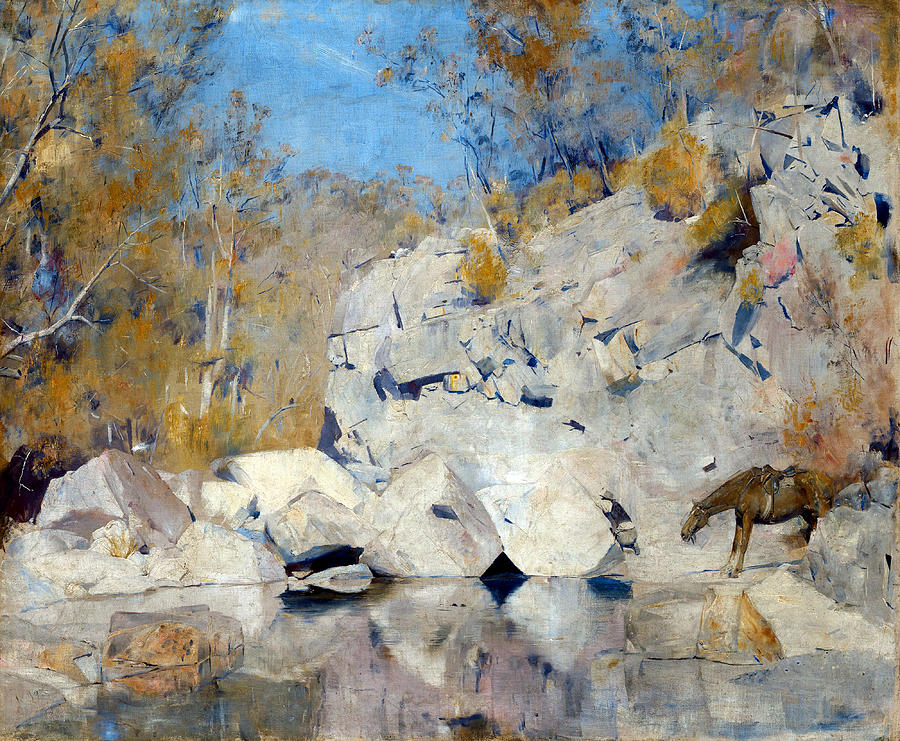
Tom Roberts, In a Corner on the Macintyre, 1895

Space

The host of this blog doesn’t give a shit about space [Ed. – correct], because he is Wrong [Ed. – possibly correct], but I’m going to talk about it a bit here anyway because Dorian made the mistake of giving me the microphone [Ed. – absolutely incorrect; no mistake was made]. Continuing the astro-poetry theme we have Ken Hunt’s The Lost Cosmonauts, a collection about the accidents and deaths of the Space Race, much of it constructed from the texts of official reports and radio transcripts. Then there’s Omon Ra by Victor Pelevin, a bleak black comedy about the Soviet space program.

Pushing further into the future was the story collection Terminal Boredom by Izumi Suzuki (multiple translators), a downbeat set of 1970s/1980s Japanese countercultural tales of sexual and pharmaceutical weirdness. Further still takes us to Olga Ravn’s The Employees, translated from Danish by Martin Aitken, a genuine little masterpiece of a “workplace novel” set on a Generation Starship.

Finally, the biggest thing I read in 2021 was XX by Rian Hughes, a 1000-page monster about first contact and artificial intelligence. It’s a beautifully designed book in which the spirit of the 19th Century talks in multi-typeface pamphlets and that of the 20th in Futurist broadsides, which includes an entire pulp SF novella serialised in magazines that never existed, and which is the first book I have ever seen with a reversible dustjacket designed to make it look like a shelf of the fictional publications contained within the text [Ed. — !].

World War Two

Dutch genius Willem Frederik Hermans is having something of a revival, and A Guardian Angel Recalls (translated by David Colmer) is a great book new to English: a public prosecutor, weak and lovelorn, races around Holland as the Nazis invade, wreaking inadvertent havoc as he tries to save himself, protected and frustrated in equal measure by his similarly flawed guardian angel.

The Passenger by Ulrich Alexander Boschwitz (translated from German by Philip Boehm) is from 1938: perhaps too late to be called prescient, but even years later people were denying its truths. Otto Silbermann is a Jewish German who fought for his country in World War One, too slow to realise that what is happening to other Jews will happen to him too. Finally he has to go on the run, trying to find a way to escape across the border to safety.

Marga Minco’s The Glass Bridge (translated by Stacey Knecht) is another Dutch novel, a tangential look at the Holocaust in fragments from the life of Stella, a Jewish artist hiding out under a dead woman’s name, moving from safe house to safe house, fending off the advances of a sexually predatory ‘protector’.

David Piper’s Trial by Battle (originally published in 1959 as by Peter Towry) is a deeply anti-triumphalist novel about Britain in Asia during World War Two, outclassed and outfought, living on a faltering diet of nationalistic smugness. Frances Faviell’s A Chelsea Concerto is a fascinating memoir of the first few months of the Blitz in London. Finally, Donald Henderson’s 1943 novel Mister Bowling Buys a Newspaper, despite its religiose ending, is a fine black comedy about a polite serial killer for people who have read all of Patrick Hamilton and now have a sad void in their lives.

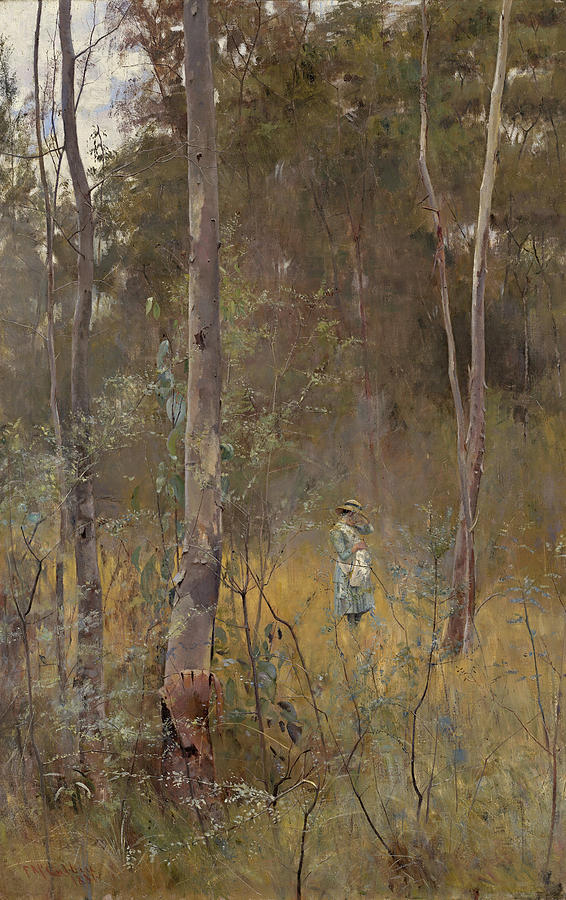
Frederick McCubbin, Lost, 1907

Random Others

Marian Engel’s Bear has no greater champion than the management of this blog, so I shall say nothing other than that Dorian is absolutely right about it in every way, despite the ludicrousness of the premise. [Ed. – THANK YOU! Another satisfied customer! You can watch James admit this truth to me here.] Another weirdly charged masterpiece is Denton Welch’s In Youth is Pleasure, a strange and astonishing novel about a boy helpless in the grip of his aesthetic and sensual needs.

I don’t even like boxing, yet Michael Winkler’s Grimmish is the second boxing novel on this list: a wonderful and weird book about masculinity and physical pain, full of great jokes which I have stolen: There are two types of people: those who can extrapolate from incomplete data. [Ed. – But that’s only one… ohhh…] Checkout 19 by Claire-Louise Bennett, which is sort of about the disparity between literature and life but also about everything else, is a genuine marvel. Minae Mizumura’s An I-Novel (translated by Juliet Winters Carpenter) is the story of two Japanese sisters transplanted to New York, a deep and rich and perceptive work enriched by numerous photographs. It’s not quite the equal of her A True Novel, but then what is?

Jeffrey Smart, Cahill Expressway, 1962

[DISTANT, MUFFLED NOISE]

The Surprise Party Complex by Ramona Stewart, criminally out of print for decades, is a beautiful and hilarious bit of work about a group of neglected and eccentric teenagers at a loose end in Hollywood. The deeply weird Mount Analogue: A Novel of Symbolically Authentic Non-Euclidean Adventures in Mountain Climbing by René Daumal (translated by Roger Shattuck) was never finished, but what we do have is a surrealist masterpiece. Flesh by Brigid Brophy is a near-as-damnit perfect novel about appetites, both sexual and gastronomic. And everybody who enjoys the atmosphere of a good grotty 1950s London boarding house needs to read Babel Itself by Sam Youd (better known as science-fiction writer John Christopher), another unjustly forgotten bit of comic brilliance about a group of lodgers running spiritualist experiments, having affairs and betraying each other.

[SOUND OF SECURITY FORCES BANGING ON DOOR, YELLS OF ‘YOUR TIME IS UP!’]

Then there’s the Patricia Lockwood’s No One is Talking About This, which really is as good as everyone says, and Jim Shepard’s Phase Six, an unfortunately timed global pandemic novel that’s also a splendidly moving look at female friendship, and Hilma Wolitzer’s career-summary story collection Today a Woman Went Mad in the Supermarket, and…

[DOOR BREAKS DOWN]

..and Nathalie Sarraute’s Tropisms, which I finally read years after everybody else, and Giorgio Bassani’s The Heron, the only book of his I’d never read, and…

[MUFFLED SHOUTING, SOUNDS OF SOMEONE BEING DRAGGED AWAY]

2017 Year in Reading

Although traumatic and anxious-making in so many ways, 2017 was a good year for reading. I read more books last year than in any year since I started keeping a list in 2014. I was freed of an onerous work responsibility halfway through the year, which helped, as did my decision to switch to audio books on my commute, once I realized that even my beloved NPR was raising my stress levels. (I don’t mind audio books, it turns out, though I learned what most of you probably already knew: the narrator matters a lot.)

Of the 115 books I completed, 50% were by women and 50% by men (one was co-authored). 37% were translated and 63% were originally written in English. (I read one book in German.) Only 13% were non-fiction. The glib explanation might be that reality is bad enough right now without reading about it; the better one is that we need fiction to understand reality.

I wrote about my books of the year in the final issue of Open Letters Monthly. If you don’t want to click the link, I’ll repeat what I said at the beginning of my reflection:

The books that meant the most to me this year recount the rise of—and resistance to—fascism in 1930s and 40s. These might be books from the past, but they feel all too timely.

Mihail Sebastian, For Two Thousand Years. Trans. Philip Ó Ceallaigh. My god, this book is good! I had a lot to say about it at OLM.

Hans Keilson, 1944 Diary. Trans. Damion Searls. Keilson was a mensch. I wrote about him for Numéro Cinq.

Girogio Bassani, The Garden of the Finzi-Continis. Trans. William Weaver. Together with Scott and Nat, I enjoyed this wistful but definitely not precious remembrance of pre-war Jewish life in Ferrara.

And best of all, the highlight of my reading year:

Vasily Grossman, Life and Fate. Trans. Robert Chandler. For several weeks I was consumed by this extraordinary book about the pivotal months of late 1942 and early 1943 in the Soviet Union. At OLM I said, “But Life and Fate isn’t just a work to respect. It’s also a book to love. What Life and Fate has in spades is flow, momentum, energy. It has life. Combining the warmth of Chekhov with the scope of Tolstoy, Grossman’s magnum opus is that paradoxical thing, an intimate epic.” I wrote several posts about it, too.

Other highlights:

Carl Seelig, Walks with Robert Walser. Trans. Anne Posten. I wrote about it here. This is a joyous book. Couldn’t you use some joy right about now?

Roger Lewinter, The Attraction of Things and Story of Love and Solitude. Trans. Rachel Careau. Thanks to Scott Esposito for giving me the chance to write about these enigmatic but indelible syntax-destroying books.

Liana Millu, Smoke Over Birkenau. Trans. Lynne Sharon Schwartz. This memoir of Holocaust survivor Millu was a revelation to me. We don’t hear enough about women’s experiences in the Shoah. So impressed that I added it to my course this coming semester.

Nathan Englander, Dinner at the Center of the Earth. Is it the lousy title that’s kept people from talking about this book? Or is it that Englander has written a smart, balanced, non-polemical/non-hysterical novel about Israel likely to alienate readers with entrenched opinions about the situation there? The best review I’ve read is shigekuni’s. Englander’s second novel is short and deceptively simple. I bet it took him ages to write. I’m looking forward to re-reading it soon.

Nina Allan, The Race and The Rift. Speaking of shigekuni, he turned me on to these wonderful SF novels. Both brilliant; I liked The Race best. For fans of Doris Lessing and David Mitchell, and especially people who think they don’t like SF.

Joseph Roth, The Emperor’s Tomb. Trans. Michael Hofmann. A nominal sequel to Roth’s famous Radetzky March (which I read so long ago that I can’t remember a thing about it), this is a fascinating example of that rare species, the modernist historical novel. I planned to write about it for German Literature Month but I left it too late and then I got the stomach flu… This book is amazing, though: it tempts us to wallow in Hapsburg nostalgia before pulling the rug out from under us, as it details first the hardscrabble aftermath of WWI and then finally taking an unexpected swerve into the even worse depredations of an incipient WWII. The philosophers Deleuze and Guattari were fond of the enigmatic term “line of flight.” I never understood what they meant, but Roth’s novel embodies what I think it might. The Emperor’s Tomb is a book on the run from itself, jumping forward temporally and stylistically in unexpected ways; it is a late work by an author who refuses to give readers what they have come to expect from him.

Daphne du Maurier, The Scapegoat, Rule Britannia and My Cousin Rachel. I wrote about these here and here. All wonderful, especially The Scapegoat.

Willa Cather, My Antonia. Late to that party! It’s amazing! More here.

Some bests:

Best comic with disagreeable characters: A surprisingly competitive field, including the first two volumes of Riad Sattouf’s The Arab of the Future, the first two volumes of Jason Lutes’s Berlin serial, and the winner, Manuele Fior’s 5,000 km per Second, which I wrote about here in what is surely the least-visited post in the history of this blog.

Best non-apocalyptic SF: Kim Stanley Robinson’s 2140. It’s too long and some of the characters are flat/embarrassing, but I was fascinated by Robinson’s carefully detailed vision of New York after a huge rise in sea levels. Maybe not plausible when it comes to climate (though I sure want it to be) but definitely when it comes to capitalism. “Wherever there’s a commons there’s enclosure. And enclosure always wins.”

Series that most kept my spirits up: Jacqueline Winspear’s Maisie Dobbs. I listened to or read the first eight this year, and I’m starting to worry what I’ll do when I’ve finished them all (at least she’s still writing them). Maisie calls herself a psychological investigator: she’s a former WWI nurse who is trained by a philosophical/medical/psychological/political éminence grise and social reformer to do PI work and, as the series develops, a whole lot more. (That sounds preposterous and it is a little preposterous, but not that much, or not enough to bother me, anyway.) The books aren’t particularly suspenseful, and sometimes Maisie is a little too good, but I love the period details, I’m willing to believe in the centrality of trauma (maybe the books’ abiding belief), and most of all I’m captivated by the way Maisie wrestles with the combination of ability, work, and good fortune that let her succeed at a time when so many equally deserving people did not.

Best unpretentious essayistic biography: Marie Darrieussecq, Being There: The Life of Paula Modersohn-Becker. I blogged about this terrific book here.

Book I most regret not posting about: Anita Brookner, A Start in Life. Seems like a lot of people are (re)discovering Brookner’s charms. And why wouldn’t readers be in love with a writer whose first book begins: “Dr. Weiss, at forty, knew that her life had been ruined by literature”? Maybe many of those readers share my fascination with the late 70s/early 80s, a period that still seems to me at least to be relatively recent but is actually closer to WWII than the present. Brookner has an old-fashioned gravitas and authorial certainty, yet she doesn’t read like a mid-century author. I plan to read more of her this year.

Best use of modernist literary style to tell a Victorian story: Sarah Moss, Bodies of Light. Read this early in the year: it stayed with me, and I look forward to reading the sequel.

Best first half of a book: Philip Pullman, The Book of Dust Volume I: La Belle Sauvage. I agree 100% with Michael Orthofer: the brilliant, insidious first half devolves into an overly long chase/pilgrimage sequence (I don’t care if it’s modeled on Spenser: still fundamentally boring). I’ll read the next one eagerly, though.

Best WWII spy story no one seems to know about: William Christie, A Single Spy. Double agents. Soviets and Nazis. Dramatic escapes. Strong writing. Perfect light reading.

Best romance novel: Jennifer Crusie, Bet Me. Admittedly, the only one I read, but Rohan steered me right here. Like Laurie Colwin, but hot. I’ll read more.

Funniest book of the year: Elif Batuman, The Idiot. Hoping to post about this before my copy is due back at the library. I laughed to the point of tears many times: “We learned about people who had lost the ability to combine morphemes, after having their brains perforated by iron poles. Apparently there were several such people, who got iron poles stuck in their heads and lived to tell the tale—albeit without morphemes.” If you went to college in the 90s, this book is for you. Don’t worry, it’s not really a college novel.

Reliable pleasures: The Cadfael series continues to delight; the Montalbano books are back in form after some mediocre episodes; three books by Maurizo de Giovanni impressed me (would have read a lot more if only my library carried them). I finally read the first three Bernie Guenther books by Philip Kerr: fantastic!

Not-so reliable pleasures: The latest Lahlum disappointed—the bloat that crept into the last one is in full force here; I read my first book by John Lawton, in the Inspector Troy series: unpleasant; the new Indridason series: the jury is still out.

Good but maybe overrated: Jane Harper, The Dry (I’ll read the next, but it faded fast in memory); Don Winslow, The Force (part of me adored this Richard Price/George Pelecanos/David Simon novel of New York corruption, but part of me thought it was getting away with validating the homophobia, misogyny, and racism of its main characters in the guise of being cool/anthropological).

*

I published a number of pieces in 2017, and I look forward to doing so again this year. (Apologies to any editors reading this—I am working on your piece, I promise.) Sadly, though, the two venues I have written for the most, Numéro Cinq and Open Letters Monthly shut down this year. Together with Tom’s change of pace at Wuthering Expectations, my reading and writing year ended up feeling somber and end-of-an-era-ish.

But I’ll end on a happy note: I was lucky to share reading and writing experiences with several friends. Jacqui and I read Elizabeth Bowen’s The Hotel. Scott and Nat and I read Bassani’s The Garden of the Finzi-Continis (as mentioned above). Marat helped me out with Grossman. Nat and I read L. P. Hartley’s The Boat, which was fun even if we didn’t much like it. Thanks to them, and to everyone who read what I had to say at this space, however erratically, especially those who commented either here or on social media. You make doing this worthwhile. Best wishes in 2018.

My plans for the year are to make very few plans. But if you want to read something with me, just drop me a note in the comments or on Twitter. And if you want to see my reflections on the last few years, you can read about 2014, 2015 & 2016.

Ten From My Shelves

I stole this idea from someone on Twitter, but now I can’t remember from whom. Let me know if it was you so that I can credit you! [Note: It was Simon from Stuck in a Book. Thanks, Simon!]

IMG_0581

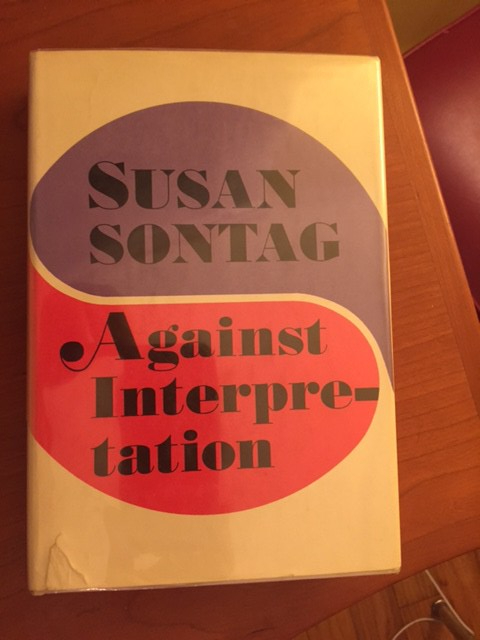
Susan Sontag, Against Interpretation

In my early to mid-twenties I was deeply infatuated with Sontag. Still am, really. I thrilled to her erudition—she’d read everything—and her elegant prose. Essays like hers are still the kind of writing I most admire. The title essay impressed me most of all, especially its famous, hortatory, gnomic last line: “In place of a hermeneutics we need an erotics of art.”

IMG_0582

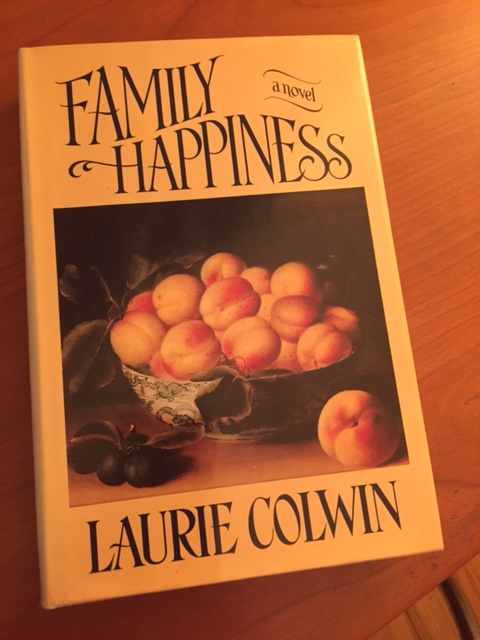
Laurie Colwin, Family Happiness

Another favourite from my twenties. I read all of Colwin’s books the summer between my Junior and Senior year; I was working as a bookseller then, and I hand-sold a ton of them. A few years ago I found this lovely hardcover at a library sale. I was a bit worried about re-reading it—would it hold up?—but I needn’t have. Not only was it as bittersweet as it had been then, but now I could see what at the time I couldn’t: I thought the book was about New Yorkers but it was really about (thoroughly assimilated) Jews. At the time I’d never have imagined that twenty years later I too would be Jewish, but I like to think my philo-Semitism was unconsciously at work. Colwin is so funny, but also so sad.

IMG_0583

David Bezmozgis, The Free World

Speaking of Jewishness, I’ve loved each of Bezmozgis’s three books, but I think this one might be the best. It’s about the Soviet Jews who were allowed to emigrate in the 1970s. Three generations of the Krasnansky family (like Bezmozgis, Latvian Jews) wait in Italy for visas to come through from Canada, the US, Australia, anywhere that will take them. Rather than focusing on the young children—that is, the characters who would have been the same age as he was when his family left the USSR for Canada—Bezmozgis focuses on their parents and grandparents. We see what the Soviet Union meant to each of them and how differently they experience even this tentative experience of the ironically named Free World. Smart, funny, no schmaltz.

IMG_0585

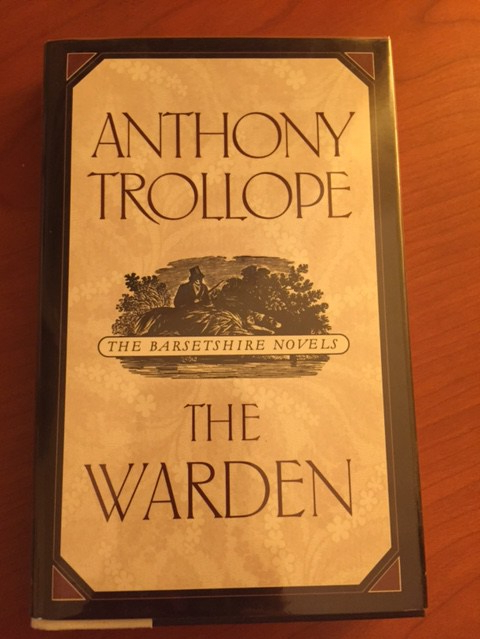
Anthony Trollope, The Warden

I read this in college and liked it well enough but I think I’d appreciate it a lot more now. Might have been a bit too subtle for me back then. I really want to tackle Trollope soon and the Barsetshire novels seem like a good place to begin.

IMG_0586

Olivia Manning, The Balkan Trilogy

Three wonderful novels, pretty closely based on Manning’s own experiences, about a British couple in Romania and Greece before and during WWII. The scenes of denuded, starving Athens haunt me still. Yaki is one of the great characters in 20th century literature.

IMG_0590

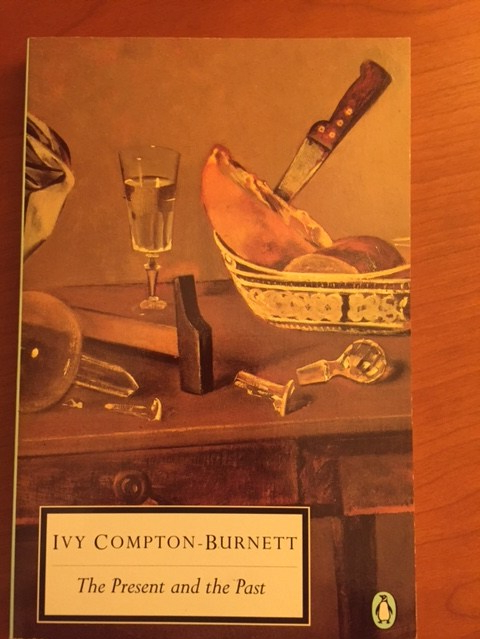
Ivy Compton-Burnett, The Present and the Past

Do you have writers you’re convinced you love but have never actually read? Probably you are less crazy than I am. But I have at least five or six books by Compton-Burnett around here and haven’t read a one.

Here’s what the publishers say about this one:

Nine years after her divorce from Cassius Clare, Catherine re-enters his life in order to re-establish contact with her children. Her arrival causes a dramatic upheaval in the Clare family, and its implications are analyzed and redefined not only in the drawing room but also in the children’s nursery and the servants’ quarters.

(Sounds like Henry Green!) Anyway, odd, uncanny women 20th Century British writers (Comyns, Rhys, Bowen, etc) are my thing, so I really ought to get around to reading Compton-Burnett soon.

IMG_0584

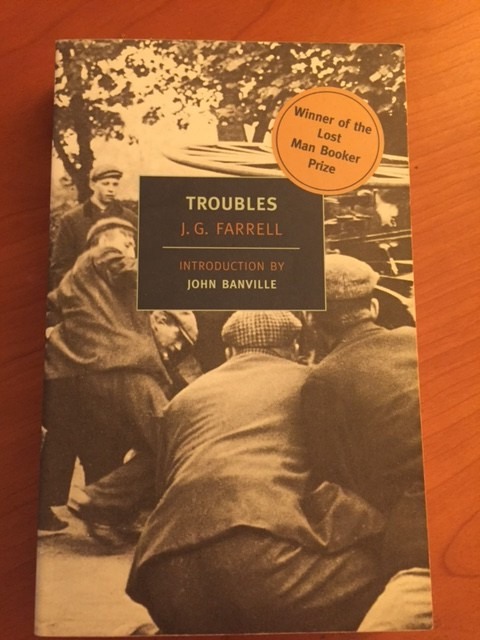
J. G. Farrell, Troubles

A great, great novel set during the Anglo-Irish war and featuring an English Major, Brendan Archer, who comes to Ireland to claim a bride he can’t quite remember proposing to. Angela Spencer is the eldest daughter of an Anglo-Irish family who lives with her family in a once glorious seaside hotel called, no longer quite appropriately, the Majestic. At once funny and macabre, Troubles sets itself the task of trying to figure out how to represent decline. I had a lot to say about this terrific, engrossing book here.
IMG_0587

Ben Aaronovitch, Midnight Riot

First in the Urban Fantasy Rivers of London series. Peter Grant is a rookie cop who can speak to the dead and stumbles into a little-known unit of the Met that deals with magic and the uncanny. Perfect light reading.

IMG_0589

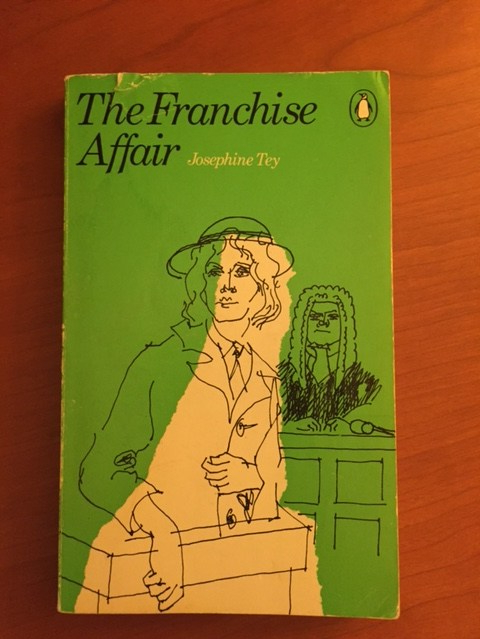
Josephine Tey, The Franchise Affair

My favourite Tey (though admittedly I have rationed them and kept a couple in reserve), an unsettling novel about a woman and her mother who are accused by a fifteen-year old schoolgirl of having locked her up in their attic for a month. Have they been falsely accused? If so, how will they be acquitted when all evidence points toward their guilt? Can justice be done without prejudice? Unconventional, suspenseful, and thought provoking.

IMG_0588

Giorgio Bassani, The Heron

Regular readers know that together with some fellow bloggers, I recently read Bassani’s The Garden of the Finzi-Continis. This, Bassani’s last novel, is the newest addition to my library. I started reading the first page just now and it was all I could do to stop. Elegant mournfulness really does it for me.

IMG_0591

There you have it, ten books plucked from the many thousands in this too-small house. Do you have thoughts about any of them? Let me know if you’re inspired to share some from your shelves.

Guest Post: Nathaniel Leach on The Garden of the Finzi-Continis

I’m so pleased that my friend Nathaniel Leach has written a guest post to accompany the Bassani readalong Scott & I have been hosting this week. Nathaniel teaches at Cape Breton University in Nova Scotia, Canada. He’s a brilliant reader and an eloquent writer. (Plus he’s a lovely person.) Sadly for the rest of us, Nat doesn’t have his own blog, but he agreed to let me post his thoughts on the novel here.

I’m sure he’d be delighted to talk with you further in the comments, so please let him know what you think.


ferrara03-1150x647

My initial interest in joining this group reading of The Garden of the Finzi-Continis came from having first seen the film many years ago and having a decidedly ambivalent reaction to it. It’s directed gorgeously by Vittorio De Sica, but it also rings some false notes for me, seeming just a bit too nostalgic and sentimental.

Bassani’s novel, however, seems to be doing something a bit more interesting than that; there is plenty of nostalgia here too, but it is much more self-aware and critical. Micol, for example, diagnoses both herself and the narrator: “the past counted more than the present, possession counted less than memory of it” and dismisses Perotti’s attempts to maintain the illusion created by the family carriage, which Micol calls a “pathetic relic.” She knows nostalgia is a problem even if she can’t avoid it.

While the narrator is less self-aware, the novel uses him to show the harmful effects of nostalgia, as he seeks to recreate a past moment that never was. Micol debunks his belief that if he had kissed her that moment in the carriage, she would have reciprocated his feelings, but he nevertheless attempts to kiss her every chance he gets, as if doing so would bring back that lost moment. If Dorian is right that we need to be suspicious of the narrator (and I think we do), we have to be suspicious of the aura of nostalgia that he casts over the whole novel.

There is a tension in both film and book between this nostalgic view of the Finzi-Continis and a more critical one. The first time I watched the film, I felt that the judgmental side was dominant, that the Finzi-Continis were being criticized for being themselves relics of the past, unable to adapt to the needs of the future by connecting with the community around them. And there is surely some of this in the book; the narrator’s father is the primary voice for this view, and in some ways he is clearly not wrong that they seem to think that the walls around them will protect them from every intrusion. This is proven false. But on the other hand, theirs is a more general fate; assimilated Jews (like the narrator’s father) were just as affected by racial laws and policies of extermination. Even Malnate, who is politically conscious and who does embrace the ideal future ends up just as dead as the Finzi-Continis. So, nostalgia is dangerous, but rejecting it is not necessarily helpful. Perhaps, then, there is no moral to the tale, and it is just to be taken as a memorial of those who are gone (but again, the narrator is the only one left to give his version of events).
What struck me upon watching the film a second time (after reading the novel) is how much De Sica in fact plays up the political angle. Virtually every incident pertaining to the racial laws is included in the film, and a few additional scenes are even added. When Giorgio (our poor nameless narrator gets a name in the film) visits his brother in Grenoble, one of Ernesto’s friends describes having been in Dachau, and the final 15 minutes of the film is devoted to an event that gets two sentences in Basssani’s Epilogue: the rounding up of the Finzi-Continis and the other Jews of Ferrara. De Sica puts the novel’s politics in the foreground in a way that gives the film a more pointed political message and a more elegiac tone than the book.

The film’s conclusion, then, is entirely different from the book; two more incidents bear further discussion (Spoiler alert for anyone who hasn’t seen the film). The film’s final lines are incredibly sentimental, and even more so for anyone who has read the novel; Micol and Giorgio’s father are being held in the same schoolroom; Micol asks with great concern about Giorgio and his father reassures her warmly that he left earlier that day and is hopefully on his way to safety. Although Micol has been separated from her own father, Giorgio’s father expresses the hope that they will at least keep all of the Jews of Ferrara together. De Sica deftly manipulates the complex emotional strands of the narrative into simplistic resolutions; Micol’s true affection for Giorgio is revealed, while the father’s resentment of the Finzi-Continis’ aloofness is resolved into a hope for community that we know is coming far too late.

But the most significant divergence between film and book comes in the final dramatic scene of the narrator/Giorgio approaching the Hutte. Dorian’s reading of Bassani’s version of this scene rightly questions the veracity of the narrator’s conclusion that Micol and Malnate are having a tryst in the Hutte. The narrator’s words, “What a fine novel” do seem to suggest his own awareness of the fiction he has constructed for himself (although they could, admittedly, also refer to his feeling of being himself a character within such a novel). However, in the film, this incident is presented in a thoroughly objective way. Alberto looks out the window to see Micol running across the garden before Giorgio arrives to look in the window. Micol even turns on the light to return Giorgio’s gaze. Again, De Sica’s treatment of Bassani’s material seems to simplify complex personal relationships in order to put the emphasis on the political implications of events.

It is futile to attempt to compare the merits of a book and its film adaptation, but putting them side by side in this way has at least enabled me to identify some of the sources of my discontent with the film, but also to some extent with the book. The frame that opens the novel seems to promise a historical awareness similar to that of the film, but this frame is never closed. The hasty glossing over of the fate of the Finzi-Continis clearly signals Bassani’s desire to tell a different story, but this means, in a way, leaving the story partially told.

fe7ff1e28185951c0c331895f11e039a

Which returns me to the beginning of the book: the epigraph from Alessandro Manzoni’s I Promessi Sposi: “The heart, to be sure, always has something to say about what is to come, to him who heeds it. But what does the heart know? Only a little of what has already happened.” The importance of this epigraph is underlined by its frequent echoing in the text; the narrator asks “What can we know, of ourselves, and what lies ahead of us?” The final line of the novel also alludes to “what little the heart has been able to remember”.

In the context of The Garden of the Finzi-Continis, this again suggests the importance of recognizing the narrator’s limitations; what lies between these two expressions of the heart’s lack of knowledge is a purely subjective account from the point of view of a heart that does not have access to the whole story. The epigraph also seems to obliquely allude to the Holocaust; the characters clearly do not know what lies ahead of them, and even if, from the point of view of hindsight, it is easy enough to say that the signs of what was to come were already there within Italy’s racial laws, it is not reasonable to suggest that they should have been able to see it from their own limited viewpoints.

In the context of I Promessi Sposi, the good priest, Father Cristoforo, is helping the young lovers, Renzo and Lucia escape from the grasp of the wicked Don Rodrigo who wants Lucia for himself. In order to save them, they must all separate, but Father Cristoforo reassures them that “my heart tells me that we shall meet again soon.” The epigraph quoted is the narrator’s response to this statement. And indeed, the three must go through numerous hardships before they are indeed reunited, and Father Cristoforo’s intuition proves to be wrong. The line thus suggests the naïveté of even the idealized Father Cristoforo. We want to believe and hope and trust that everything will work out for the best, and this is an understandable human desire, but not something that we can ever really be sure of.

Ferrara-1600

The epigraph, then, seems to encourage us not to pass judgment on the characters of the novel as their weaknesses and failings are inevitable human qualities and entirely understandable. But I can’t forebear to point out one additional reference to I Promessi Sposi; Alberto compares Professor Ermanno’s obedience towards the dictates of the authorities to that of Don Abbondio, who is the polar opposite of Father Cristoforo: the bad priest, cowardly and hypocritical, only interested in saving his own skin. This reference seems particularly harsh to me, as if the novel were indeed being highly critical of his (and others’) refusal to stand up to authorities.

So, perhaps Bassani is asking us to be tolerant of human weakness, but also to be aware of the real failings that it leads to. Ultimately, it seems to me that the real strength of the book lies precisely in its understanding of the human heart with all its warmth and vitality, but also its vicissitudes and bitterness. The epigraph is a call to recognize this complexity, as well as our own limitations in the face of it.

“Mysterious, Statuary Fatality”: A Conversation on The Garden of the Finzi-Continis

Wise-Writers-Tomb-of-Words-1200-630-15185458-1

A while ago I convinced Scott of seraillon to help me host a discussion of Giorgio Bassani’s The Garden of the Finzi-Continis (1962). I hope others will join in, and as they do I’ll link to their posts here:

Meredith at Dolce Bellezza

Jacqui at Jacquiwinejournal 

Grant at 1streading’s Blog

Nathaniel Leach

I’ve written up my thoughts on what for me are some of the key aspects of this fascinating and beautiful novel. Scott has responded and added some of the issues that most struck him. In a separate post at Scott’s blog we’ll reverse the roles.

Thanks, Dorian! Since you’ve divided your thoughts into discrete sections, I’ll respond in italics after each one.

First, a brief summary of the book:

On a Sunday in April 1957, the unnamed narrator is on a day trip from Rome with friends. They unexpectedly end up at some Etruscan tombs. A little girl in the party asks her father why ancient tombs are not as sad as new ones. With those who have been dead so long, he replies, it’s as if they never lived. To which the girl rather precociously (one of the book’s few false notes) responds:

‘But now, if you say that’, she ventured softly, ‘you remind me that the Etruscans were also alive once, and so I’m fond of them, like everyone else.’

He doesn’t say so directly, but the narrator seems to be moved by these remarks. We might even say that he is unsealed. The Etruscan tombs remind him of the grandiose tomb of the Finzi-Contini family in his native Ferrara. Perhaps emboldened by the girl’s insistence that everyone who is dead deserves to be remembered, the narrator thinks of the fate of Italy’s Jews during the war. He tells the story—a story it seems he has held inside for a long time: that’s what I mean by his coming unsealed—of his relationship to the Finzi-Contini family in the years before the war. (Interestingly, he only tells us, not his traveling companions. I’m not sure what to make of this, other than to suggest that, as befits this tightly wound character, even emotional catharsis is restrained.)

Beginning with the end, the narrator explains that the story of the Finzi-Continis is one of catastrophe. Of all the members of the family the narrator “had known and loved” only one had managed to find the eternal rest promised by the tomb:

In fact the only one buried there is Alberto, the older son, who died in 1942 of a lymphogranuloma. Whereas for Micòl, the second child, the daughter, and for her father, Professor Ermanno, and her mother, Signora Olga, and Signora Regina, Signora Olga’s ancient, paralytic mother, all deported to Germany in the autumn of ’43, who could say if they found any sort of burial at all?

The plot then shifts to the narrator’s childhood, highlighting his occasional encounters with the Finzi-Continis, before moving forward to 1938 and the promulgation of racial laws in Italy. When the wealthy Jews of Ferrara are forced out of the tennis club, Micòl and Alberto invite the younger set to play on the court on the estate surrounding the family home.

The narrator, who had always been drawn to the mysterious family, quickly falls in love with the Finzi-Continis and especially with Micòl, and over the following year they become increasingly close but never intimate. Micòl evades and eventually rejects the narrator. He is distraught and eventually forces himself or is forced to get over it. And then the war begins and this idyllic (if that’s the right word) time in the narrator’s life ends. That’s the story he wants to tell—the story of the days in the garden of the Finzi-Continis’ estate—not the story of what happened to them all later.

When I put it like this, the book might sound dull, but I found it completely riveting. Whoever chooses to read along with us in the coming days will help us build a picture of the novel. For now I want to talk about three things that struck me, and then mention a fourth.

I too found The Garden of the Finzi-Continis beautiful and riveting – so much so, in fact, that I’ve now read it twice since January, first in the Jamie McKendrick translation and now in the translation you read by William Weaver. I can well understand why this could be someone’s favorite novel; it is moving, exquisitely constructed and has a delicacy and sense of closeness to lived experience that few novels attain from one end to the other. Both times I’ve read it I came away unable to think about much of anything else for days.

 Bassani’s choice to place his “end” of the novel at the beginning, the revelation of the fate of the Finzi-Continis, signals to the reader that the author’s interest lies not in depicting the horrors of the Holocaust but elsewhere: in the world(s) that it destroyed. One might argue that the novel shouldn’t be categorized as “Holocaust literature” because it deals more directly with Italian Fascism, but I’d counter that Bassani is aiming precisely at overturning the sentiment that if Mussolini had not formed an alliance with Hitler, the country’s situation might have been tolerable. Something of this view gets conveyed in the intense political discussions the narrator has towards the end of the novel with his friend Malnate, one of the novel’s only non-Jews, but Bassani clearly wants to lay bare Italian culpability. For all of the peace that Bassani portrays within the walls of Edenic garden of the Finzi-Contini family, he also provides increasingly palpable glimpses of the hell that is growing beyond the garden walls, of the insidious, creeping intolerance and oppression that are alluded to subtly but frequently for much of the novel. For me this worked brilliantly – focusing on the bright lives at the center of an encroaching darkness rather than on the darkness itself. At the end one feels – but only afterwards, after the gentle impression of the final words have subsided – the colossal weight of all that has been pressing inward. The effect is devastating.

Hilltop at Evening 1928 by Giorgio Morandi 1890-1964

I. (Jewish) Outsiders

I really love books about outsiders who fall into (or maybe insinuate themselves into) worlds that are different—and, in their perception, better, richer, more enlivening, more satisfying—than their own. L. P. Hartley’s The Go-Between is a fine example. Alan Hollinghurst’s The Line of Beauty is another.

I think I’m drawn to this scenario because, as a child of immigrants, I was tasked with helping my parents find their way in a new place. At the same time, I wanted to escape that role by finding worlds or social situations that were just for me. Literature has of course been for me the most important and all encompassing of those worlds. But my decision to move to another country is another example as is, more pertinently to Bassani’s novel, my conversion to Judaism.

I fell in love with Judaism for many reasons, mostly generous and anything but self-serving, but certainly one reason was the sense I had of it as a kind of refined minority. I realize this way of thinking verges perilously close to anti-Semitic stereotypes of secret cabals. But I understood the narrator’s attraction to—what he calls his “deep solidarity” with—the Finzi-Continis. The comparison I’m making is inexact. The narrator isn’t a Gentile, drawn by some sort of philo-Semistism to this Jewish family. No, he’s Jewish too. So in what sense is he attracted to something other or foreign in the Finzi-Continis? The Jewish community in the Ferrara of the novel is small—a handful of families—but as in all Jewish communities (and the smaller they are the truer this seems to be) divisions are as important as similarities.

In his introduction to the Everyman Edition, Tim Parks notes, “One of the curiosities of Bassani’s writing is that, while deploring persecution, he actually seems to relish the phenomenon of social division, that fizz of incomprehension that occurs when people of different cultures, backgrounds, and pretensions are obliged to live side by side.” I agree, though “deploring” seems too unequivocal, too dutiful, too mildly liberal and progressive for Bassani’s narrator, who is a slippery figure.

At any rate, the narrator’s family prides itself on being modern. The father joined the Fascist Party already in 1919. That might sound crazy to us, but Italian fascism was not initially anti-Semitic and might never have been had Hitler not pushed Mussolini in that direction, leading to the Nuremberg-style racial laws of 1938 that I mentioned in my plot summary.

The Finzi-Continis, by contrast, are conservative; Professor Ermanno refuses to join the Fascists, not out of any anti-Fascist or progressive/communist/socialist conviction but because he doesn’t want to join anything, not least the modern world. (It’s interesting that Micòl more than anyone else in the family shares her father’s views, more than her brother, that’s for sure, who is all about his gramophone and modern design, though Micòl also avails herself of certain privilege of modernity, like taking a university degree for example.)

Yet the narrator’s family and the Finzi-Continis are united in their form of worship: they belong to the Italian rather than the German synagogue (these differing congregations meet on different floors of the same building, a wonderful example of what Freud called “the narcissism of small differences.”) I’m confused by Bassani’s distinction here: I think it might be something like Orthodox (Italian) versus Reform (German) (Reform Judaism started in Germany in the 19th Century), but I’m not sure. Later, the Finzi-Continis and one or two other families (but not the narrator’s) decide to worship at even more exclusive synagogue (they call it the Spanish). I wondered if the suggestion was that they were Sephardic rather than Ashkenazi. Can anyone shed light here?

This wonderful essay by Adam Kirsch is smart on the paradoxical function of Judaism in the novel. He doesn’t explain the different congregations, but he has a lot to say about how the Finzi-Continis are positioned as “the Jews of the Jews,” an elite within an elite. The narrator’s father is convinced that the Finzi-Continis are in fact anti-Semites, adducing as proof their rejection, or, more accurately, lack of interest in the rest of the Ferranese Jewish community, as symbolized by the walls that surround their estate.

And yet the narrator’s father also thinks it’s embarrassing, even wrong, to be too devoutly or overtly Jewish: he barely speaks Hebrew, knows only a little of the liturgy, thinks of himself more as a freethinker than anything else. And yet that doesn’t contradict his strong sense of being a Jew, and his conviction that all Jews share a kinship he faults the Finzi-Continis for rejecting.

This sort of complicated emotional response—veering between pride and self-loathing—manifests itself in the narrator too, as in the scene where he runs into a Jewish boy of his own age: “Rapidly, between him and me, there passed the inevitable glance of Jewish complicity that, with anxiety and disgust, I had already foreseen.” The complicity might be good, but the anxiety and disgust sure aren’t.

The narrator remembers how, as a child, he would gather with the rest of his family under his father’s talit (prayer shawl) for the benediction. Because the shawl, which had belonged to the narrator’s grandfather, is so old and full of holes, the narrator is able to look out from, perhaps even to plot his escape from, what in the words of the blessing is the loving embrace of the family.

And what he looks out at is of course the Finzi-Continis performing the same ritual. He is drawn to the father—a scholar, a mild man, perhaps ineffectual but, we learn, genuinely kind, someone who will eventually become almost a colleague to the narrator—but even more so to the children. Yet where Professor Ermanno is the emblem of everything the narrator wants (what he calls “culture and rank”), his children, Alberto and Micòl, are at once more appealing and more off-putting:

I looked up, with always renewed amazement and envy, at Professor Ermanno’s wrinkled, keen face, as if transfigured at that moment, I looked at his eyes, which behind his glasses, I would have said were filled with tears. His voice was faint and chanting, with perfect pitch his Hebrew pronunciation, frequently doubling the consonants, and with the z, the s, and the h much more Tuscan than Ferranese, could be heard, filtered through the double distinction of culture and rank…

I looked at him. Below him, for the entire duration of the blessing, Alberto and Micòl never stopped exploring, they too, the gaps in their tent [the prayer-shawl]. And they smiled at me and winked at me, both curiously inviting: especially Micòl. (Ellipsis in original)

The narrator always wants to penetrate the closed-off space that is the life of the Finzi-Continis (the children don’t go to school, for example, and when they do have to appear for the end-of-year exams they arrive in a coach from the last century). The family, especially Micòl, seems to encourage him in doing so. But in the end he is just there on sufferance. Of course the ultimately irony is that whatever distinctions Jews make among themselves will be leveled by the terrorizing hate of National Socialism.

I’m drawn to your personal response to the work and how it resonated with you as an outsider, an immigrant and as someone who chose Judaism. The outsider element resonated with me too, and probably with many readers. I love how Bassani constantly literalizes this sense of exclusion, from the narrator seeing the Finzi-Contini children’s eyes peeking out from beneath the talit, to his initial inability to penetrate the Finzi-Contini estate during the beautiful young adolescent scene at the garden wall, to the lengthy, almost To the Lighthouse–like postponement of his entry onto the grounds then only much later into the house, and the remoteness of Micòl’s own room, which he is forced to conjure through imagination until he finally, too late, gets to see it for himself. Incidentally, that slow attainment of this “inner sanctum” appears to have as its countermeasure the slow encroachment of Fascism into the garden.

Of course another element that drew me into the novel is one you mention here: “At the same time, I wanted to escape that role by finding worlds or social situations that were just for me. Literature has of course been for me the most important and all encompassing of those worlds.” On the second read through, I was astounded at all the literature in this novel, which in addition to providing something of a crash course in late 19th century Italian poetry alludes to an astonishing variety of works, from Ariosto, to Stendhal (and the narrator, if anything, is a Stendalian figure), to Dumas, to Melville (I can’t recall whether Enrique Vila-Matas makes use of the “Bartleby” discussion in his Bartleby and Co., but if not, he missed a stellar example) and even possibly invents – in a curious passage – a Jewish poetess of 17th century Venice. A central literary figure is the renowned poet Giosuè Carducci, some letters of whom have come into the possession of Professor Ermanno, and around whom literary discussion sometimes revolves, especially arguments over Carducci’s nationalist sentiments and Republicanism (putting aside for a moment the characters’ religion, there is also in the novel an examination of their Italian-ness as relates to a glorified past now threatened by Fascism). Both the narrator and Micòl are by choice literature scholars, he in Bologna, she in Venice, he writing a dissertation on Enrico Panzzachi, a poet in Carducci’s vein, and she on Emily Dickinson. It’s telling that Micòl prefers “real novels” like The Three Musketeers to contemporary works like Cocteau’s Les Enfants terribles. It’s also telling that so little of what was transpiring in literature during the explosive literary decade of the 1930’s Italy appears in the novel. For all their obsession with literature, the narrator and Micòl seem little aware of what is being written around them, at least until the narrator argues with his father, towards the end, that “the only living literature” is contemporary literature. But again he names no names. Another thing I appreciate about Bassani is his avoidance of “literariness” by cleverly making his characters literary scholars themselves, thus allowing him to bring in discussion of all kinds of literature without having to shoehorn it awkwardly into the narrative. I can think of few novels with more literature in them – okay, maybe Roberto Bolaño’s The Savage Detectives.

Your dissection of the Jewish inter-relationships is fascinating. I assumed that the Finzi-Continis were Sephardic because of their obvious Spanish roots – the two uncles Herrera from Venice who are Spanish, their tendency to speak “Finzi-Continian” as the narrator calls it, a hybrid of Ferrarese and Tuscan Italian peppered with Spanish words. I don’t really subscribe to Tim Parks’ notion that Bassani “seems to relish” the idea of social division. Rather, I think this is part and parcel of a style that pushes things apart so as to make them more distinct, to gain some clarity. The remarkable Chapter IV of the first part, for instance, that portrays the inside of the synagogue, possesses the same kind of clarity with regard to the divisions among Ferrara’s Jews that Bassani applies to spaces and interiors, which he almost treats like staging. In addition, the use of such distinctions helps underscore Bassani’s emphasis on the democratizing, leveling force of death. Ironically, I think he’s actually more interested in commonality than in division, since from the beginning, with the visit to the Etruscan tombs in the Prologue, he stresses the universality of death and of remembrance. One could write an entire essay on the description of the Finzi-Contini tomb, with its weirdly international Greek, Egyptian and Roman features and garish conglomeration of materials that seem to come from all over.

II. Telephones

Telephones are really important in this book. Why? One idea is that telephones are a way to combine intimacy with distance. In another novel, characters might write letters to each other. But here they call each other—at least until they know each other well enough to simply drop in. (Well, the narrator drops in on the Finzi-Continis; they never come to his family’s apartment. That would be unthinkable.)

Telephones also a sign of wealth and privilege. Malnate, for example, a friend of Alberto’s, an engineer, a Gentile, a communist, and a rival to the narrator in a way he doesn’t foresee, doesn’t have one; the narrator has to wait outside his rooms when he wants to see him. Maybe it’s important that only the Jewish characters have telephones (though admittedly, there aren’t very many non-Jews in this book). I seem to recall reading someone—maybe it was the philosopher Jacques Derrida—who argued that the telephone is a particularly Jewish mode of communication because it concerns the voice: Derrida or whoever connected it to the Jewish prohibition on representations of God. In the Torah, God speaks (to Moses, to Abraham, etc), but is never seen, indeed, is not to be seen.

These speculations aren’t meant to suggest that the telephone is some kind of divine technology—yes, it facilitates important narrative events (Micòl invites the narrator to the inaugural tennis party over the phone; later, after Micòl decamps for university, Alberto invites him over for what become regular evenings with Malnate and the family) but it can also foil them (as when the narrator misses Micòl’s call to tell him she is leaving town).

So telephones can keep people apart as much as bring them together. But perhaps their most important function is as yet another way that otherwise inaccessible spaces can be entered. But always in mediated form. The telephone is a form of intimacy that is never too intimate: talking on the phone is different than talking to someone in person. Yet talking on the phone, especially to Micòl, is surprisingly intimate, or at least promises intimacy, because the Finzi-Continis have separate extensions in their rooms, so that when the narrator talks to Micòl she is typically in bed. And the narrator wants badly to know what that room looks like. Micòl refuses to tell him. The narrator always wants—and assumes—more intimacy with the Finzi-Continis than he is given.

What a great element to zero in on! I’d of course noticed the phones, but frankly hadn’t given them much thought other than as appurtenances of a wealthy family that wants to be up with the latest technology. I especially like your observation of them as “yet another way that otherwise inaccessible spaces can be entered.” This novel is chock full of inaccessible spaces, and/or of spaces that seem enclosed yet endless, Piranesian tunnels and abysses (I’m thinking in particular of the strange mounds near the city walls that had served as munitions caches, into one of which the narrator enters, at Micòl’s insistence, in order to hide his bicycle, but also of the configuration of the Finzi-Contini house, which like something in a dream the reader can never quite puzzle out – I couldn’t anyway). I found it almost painful how Micòl, who nearly always answers the phone, later lets others answer when she is avoiding the narrator – even that tenuous line to her cut off.

Material objects in general inhabit a strange space in this novel. Some – like the American elevator in the house or the ancient but still meticulously maintained carosse in the garage, appear to stretch the Finzi-Continis mystical aura temporally similar to how the vastness of the house and estate stretches it spatially.

5d102a0b310d054f2b1db28229253f7e

III. The Narrator

For me, the narrator is the crux of this novel. The more I read, the more uncertain I became about him. I didn’t like or trust him. (So what could it mean that I identified so strongly with his desire to be accepted?) I couldn’t figure out what we’re supposed to make of him. He reminded me of the narrators of Kazuo Ishiguro’s novels—not showily or vertiginously unreliable (like Humbert Humbert in Lolita, say), but profoundly blind to himself, his emotions, and the world around him. Clueless, but with more menace.

Actually, by the end of the novel, I sensed we were supposed to think he’s been hard done by. But I couldn’t quite manage to sympathize with him, despite the one thing we learn about what happened to him during the war.

This piece of information comes at the end of an apparently heartwarming scene. The narrator has been kicked out of the public library (Jews are banned), and this is particularly humiliating because he’s completing a dissertation on 19th Century Italian literature. Once he learns the news, Professor Ermanno invites the narrator to use the family library. With its twenty thousand (!) volumes, the professor wryly notes, he should be able to make good progress. The narrator works in the library every morning, and he and the professor, whose study is next door, fall into a routine of checking in on each other:

Through the door, when it was open, we even exchanged a few sentences: ‘What time is it?’ ‘How’s the work progressing?’ and so on. A few years later, during the spring of ’43, the words I was to exchange with the unknown man in the next cell, shouting them towards the ceiling, towards the air vent, would be of that sort: uttered like that, chiefly through the need of hearing one’s own voice, of feeling alive.

The narrator, we learn here, becomes a member of the Resistance (perhaps by being jailed for that reason he avoids being deported as a Jew—that almost happened to Primo Levi, for example). And his political commitment to fighting fascism should make us admire him. But I’m unconvinced. Even here the language is typically solipsistic. It’s probably more a commentary on the nature of imprisonment and the tactics the fascists used to crush their opposition than a criticism of his personality, but notice how the narrator’s prison “conversation” is really a monologue, practiced for selfish, though admittedly important, reasons, “the need of hearing one’s own voice.”

I can feel myself being unjust to the narrator here. But I wonder why this is the only reference to the narrator’s wartime experiences. Why not make more of it? After all, in the years after the war, everyone in Italy, it seemed, claimed to have been in the Resistance. It seems an obvious way to make us feel more strongly for the narrator. To me, it’s suggestive that Bassani downplays the option he’s given himself. Instead, he chooses to portray the narrator much more ambiguously.

Here’s a passage that stood out to me as particularly hard to parse. The narrator is celebrating Passover at home with his family. It’s 1939, and life for Italy’s Jews is getting ever more restricted. So what should be a joyous occasion is somber. The irony of celebrating the Israelites’ journey to freedom in a climate of anti-Semitism isn’t lost on anyone. But these societal concerns are less important—less irritating—to the narrator than his reluctance to be there. He chafes at his family; he wants to be with the Finzi-Contins. (Later, on Alberto’s invitation, he steals over to the Finzi-Contini’s Seder and notes that the same pastries he’d eaten with reluctance at home now taste delicious.)

Looking over the family members who have gathered to celebrate the holiday, the narrator sees faces that are “sad and pensive like the dead”:

I looked at my father and mother, both aged considerably in the last few months; I looked at Fanny [his sister], who was now fifteen, but, as if an occult fear had arrested her development, she seemed no more than twelve; one by one, around me, I looked at uncles and cousins, most of whom, a few years later, would be swallowed up by German crematory ovens: they didn’t imagine, no, surely not, that they would end in that way, but all the same, already, that evening, even if they seemed so insignificant to me, their poor faces surmounted by their little bourgeois hats or framed by their bourgeois permanents, even if I knew how dull-witted they were, how incapable of evaluating the real significance of the present or of reading into the future, they seemed to me already surrounded by the same aura of mysterious, statuary fatality that surrounds them now, in my memory…. Why didn’t I evade, at once, that desperate and grotesque assembly of ghosts, or at least stop my ears so as to hear no more talk of ‘discrimination’ and ‘patriotic merits’ and ‘certificates of services,’ of ‘blood quotients,’ and so on, not to hear the petty lamenting, the monotonous, gray futile threnody that family and kin were softly intoning around me?

What are we supposed to make of this? Even though the passage is divided between past and present, even though the responses at the time are coloured by the knowledge of how things would turn out, I don’t sense much compassion for the past.

It’s a trope of Holocaust literature to juxtapose past innocence to present knowledge, and some writers are famous for their ruthless and judgmental hindsight (Elie Wiesel in Night and Aharon Appelfeld in almost all of his works are classic examples). The narrator is similarly callous here: “The same aura of mysterious, statuary fatality that surrounds them now” isn’t much of a compliment. In fact, the whole logic here is hard to fathom. The narrator is saying: Even though they were so ignorant of what was to come, they nonetheless already had the same kind of fatality that they now have for me in my memory of them. It’s not that they were once vital, nor that their obliviousness has been ennobled or mitigated by the horrors that befell them. It’s that they haven’t even changed.

Is the idea then that the narrator’s prolepses—his flash forwards to future events—don’t make any difference? (Here’s an example from early in the book when as a boy he wanders around the walls of Finzi-Contini estate: “I stopped under a tree: one of those ancient trees… that a dozen years later, in the icy winter of Stalingrad, would be sacrificed to make firewood, but which in ’29 still held high.”)

I don’t know about you but I can’t warm to someone who listens to his frightened relatives and hears only “petty lamenting.” What does he want from them? Is it to be as blithely uninterested in the future as the Finzi-Continis? Maybe so: the scorn at the little bourgeois hats and hairdos sounds like something the Finzi-Continis might think, though would never say. Or, actually, it sounds like something they wouldn’t even concern them with. If anything, this is the narrator seeking—and failing—to ape what he thinks of as his betters.

It’s hard for me to excuse the narrator because of his youth: rather than callow he seems callous. Or somehow emotionally deadened, almost a bit autistic, though I’m uneasy at applying that kind of anachronistic diagnostic label. The novel often compares the narrator to Perotti, the Finzi-Continis’ servant, who disparages modernity even more than the family he has spent his life working for. You’d think that the suggestion that he is only a retainer to the family he admires so much—and possibly so pointlessly? I’m not sure what the novel wants us to think about them—would make us sympathetic to him. But I don’t think it does.

Not even the final “revelation” of why Micòl has spurned his often clumsy, even violent advances doesn’t change my feelings—SPOILER ALERT: he thinks Micòl has been having an affair with her brother’s friend Malnate—especially because I don’t see any evidence that this outcome is anything other than a self-serving construction on the part of the narrator.

Please tell me what you make of the narrator. Why is it that he doesn’t seem to have any present-day (that is, post-war) existence? He’s just a ghost in that opening section, as if he lives only to tell this story of the past.

I’m a little surprised by the degree of your negative reaction to the narrator, as I found him more sympathetic than not. True, he displays a great deal of immaturity – it’s not at all difficult to understand Micòl’s rejection of his groveling, possessive behavior – but at the same time he seems to grow in ways that the other characters do not. Micòl seems to retreat further and further into her Finzi-Continism. Alberto fades almost literally, recusing himself from the intense political discussions the narrator and Malnate engage in together and then, of course, slipping into terminal illness. And Malnate adheres to a fairly strict and pat Communist party line (despite his unexpected appreciation of poetry as revealed near the end; one other minor reason to read Garden is that one gets a rare English translation of Milanese poet Carlo Porta!). The narrator, despite having changed his dissertation interest from Italian Renaissance painting to Panzacchi, in the end advocates for living, contemporary literature, pushes back against those who seem to be inhabiting the past and lacking in foresight as regards the dangers Fascism poses for the future. And yet I agree that it’s unclear how much of the narrator’s “awareness” of that danger is supplied through his backwards glance. Still, if one thinks of Garden as a Holocaust novel, then the narrator plays the essential role of witness, one for whom the question of reliability is almost beside the point. It’s not as though the Finzi-Continis’ fate or the ravages of the Racial Laws are in question. Bassani’s own father disappeared into the camps, and it’s significant – almost irresistible to a writer, I would think, a Jewish writer from Ferrara no less – that of the 183 Ferrarese Jews rounded up and deported to Germany, only one survived. The narrator is obviously not that one, but he plays a role one could imagine that person playing, of having alone survived to tell the tale.

While I also thought the Passover supper scene complicated and puzzling, the narrator’s attitude made some sense to me given the dark constellation of tensions under which he had fallen: the rupture with Micòl; the somber, empty celebration given the dinner talk of increasing restrictions; the abeyance in which he finds himself after completing his dissertation yet – partly because of those restrictions – having no clear option for his future; and perhaps above all his complicated attraction to the Finzi-Continis, who have appeared from the beginning to represent for him wealth, culture, education, beauty even, and perhaps most of all what he refers to early on – and I can’t find the quotation – to their isolation, an aloofness, an outsider quality, that he himself feels almost as a privilege. Though at this point of the novel, the Passover dinner, the narrator is in his mid-twenties, I almost see him as a rebellious teen just itching to get out of the house and go where he’s understood – or perhaps more accurately where he’s among people with whom he aspires to belong.

There’s another element to this behavior hinted at not very obliquely in the remarkable father/son scene near the end of the novel and given a significant clue in light of that scene’s mention of the incident with “Dr. Fadeghi,” which must strike some readers as puzzling since it’s never explained and seems gratuitous. This is a reference to Bassani’s The Gold-Rimmed Spectacles, and thus to the narrator’s possible, even probable homosexuality. His father is on the cusp of suggesting as much but can’t say it. Suddenly the narrator’s timid, aloof, unconsummated attraction to Micòl makes sense. I wondered about this too in relation to the prologue, where he’s traveling with “friends” from Rome as a lone man in a car with a family. There’s a second car of friends too, but who is in it? Why is the narrator stuck with the family? What’s his relation to them? They’re likely not Jewish, as we suspect from the father, laughing, telling his the daughter to ask the man in the back seat to answer a question she has about the Jews. I’m not sure that helps with your questions.

IV The Translation

William Weaver’s translation seemed to me excellent, but I don’t have any Italian, and I’m eager to hear your thoughts. I’m especially curious to hear how other translators have dealt with the text’s references to Hebrew and Yiddish, in particular, and Jewish custom and tradition in general.

I can only address the translations to the extent of my ability amateur opining, so I’ll only say that they struck me as quite different. McKendrick’s seems more precise, formal and elegant, which I suspect might be the right fit for Bassani. But Weaver’s seems warmer, more casual, closer to the blood that pulses through Bassani’s young characters. In the end, I could toss a coin and be content either way it landed, though I might hope slightly that it would land with McKendrick face-up. I took a look at the Hebrew/Yiddish language references in both translations, and while neither translator resorts to awkward English equivalents, McKendrick uses quite a bit more of the Hebrew/Yiddish terminology than does Weaver. I certainly get the sense that McKendrick is more careful than Weaver.

To summarize my main points: I’m really drawn to a novel narrated by a character I’m skeptical, even, it’s not too much to say, repulsed by. What’s especially weird about that is that I really sympathize with the narrator’s desire to be accepted by a family and a social world not his own. Maybe what I can’t take is the rejection of his background entailed by what at its best is not mere social climbing but rather a way to express who he most fully wants to be.

I did not get a sense of the narrator engaging in “social climbing” so much as wanting to escape from a relatively limiting environment – and in this regard the novel did have personal resonance, since I could not wait, as an adolescent, to escape the confines of a bourgeois home and find others interested in art, literature, travel, a wider view. So we have different takes – and therein lies the value of doing this sort of collaborative reading. I’d like to continue the discussion, and may send you a few meditations of my own about Bassani’s novel and ask for your responses. I’m eager now to go see what others have written.