My Year in Reading, 2024

If you’re reading this, you are faithful indeed. And I am grateful. Long silence here, I know. As my adopted country tumbles into authoritarianism, things have also been changing, though more positively, chez EMJ.

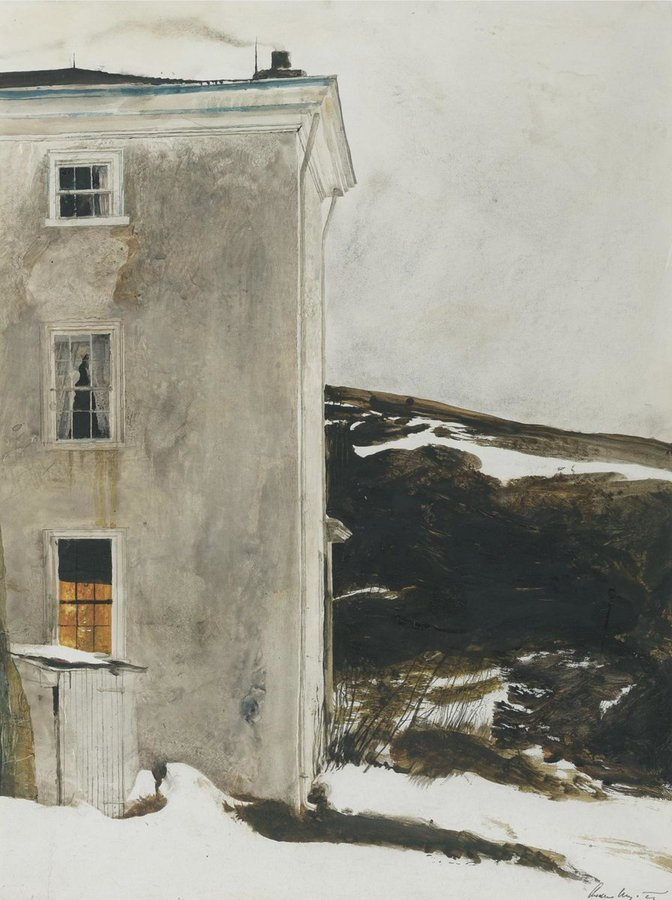
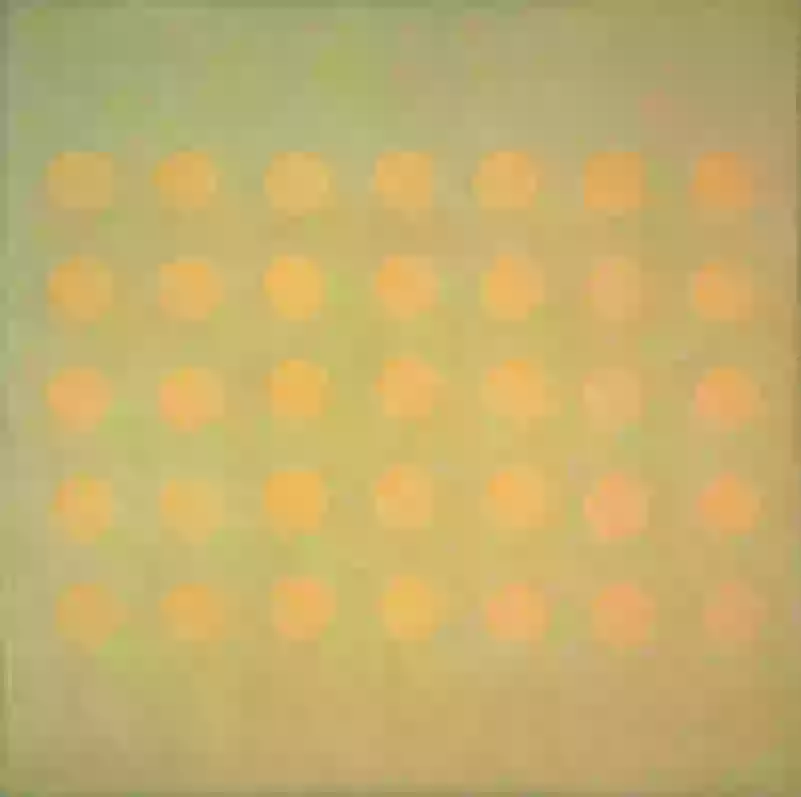
Igor Razdrogin, Book Bazar (1975)

My wife, daughter, and I are moving to St Louis in a month’s time! We’ve spent quite a bit of time there these past few years, and we like it a lot. We’ll have a little more space in our new home (which, combined with some collective efforts to tame my unruly library, might mean that our house will at least briefly not be overflowing with books), and, best of all, we’ll be living in a walkable neighbourhood with sidewalks, which is something we’ve been missing these past 18 years in Little Rock.

The other big transition concerns my career. I’m leaving my job at Hendrix, of course, but I’m also leaving academia in general. People keep asking how I’m feeling about this and I keep saying: Terrific! I was pretty burned out and starting to get a little Old Man Yells at Clouds about All the Changes that affected the classroom experience: the pervasiveness of AI and LLMs (something no one, as far as I know, ever asked for), and, more distressingly, the difficulty even the best-prepared students are having reading sustained works of literature, by which I mean, an entire book, no matter how straightforward the prose. This isn’t about their intelligence, or even their phones. It’s about the strictures placed on secondary school teachers. As instruction moves ever more toward preparing for testing centered on multiple choice reading comprehension questions about utterly decontextualized chunks of texts, teachers aren’t assigning much reading, which means students simply don’t have much practice at it.

(I also have a pet theory that for all its flaws Harry Potter (to be clear: it sucks) helped Millennials think of reading as both exciting and habitual, and Gen Z hasn’t had anything like that. The Harry Potter to Jane Austen to English Major pipeline kept our department afloat for a lot of years. These days, students dislike both Rowling and Austen…)

I still love many things about teaching, and it’s possible I’ll miss it so much that I’ll return to it in some fashion. (I’m never getting another job like this one, though. Those don’t exist anymore.) But for now, I feel relief, and curiosity—along with a lot of trepidation—about the chance to try something new. For now, it feels a bit unreal. Because the academic year is cyclical—summer is always a time of collapse and, if lucky, regeneration—I don’t yet feel as a though I’ve made much of a change. Talk to me in the fall, or next spring, or five years from now.

Luckily—and this is another reason for the silence around here—I’ve been working as a consultant for the Educator Programs arm of the William Levine Family Institute of Holocaust Education at the United States Holocaust Memorial Museum in DC. The people I work with are absolutely fabulous: smart, funny, kind, devoted to their work without having delusions of grandeur about it. It’s eye-opening—and fun—to work as part of a team, after decades of the isolation of academic life. I’ve helped them create resources for K – 12 English Language Arts classrooms, and have taken great satisfaction in the work.

I’ll need full-time work sooner rather than later, though, so if you have any ideas or leads, hit me up! Like, what are some jobs people do? What do y’all do all day? I need advice!

What I’m saying is, I had a lot going on these last months. But I did manage to keep reading. Maybe not as much as usual, but whenever I could make time. I get that it’s ridiculous to offer a 2024 reflection halfway through 2025, but FWIW here are the things that stuck with me last year.

Eight standouts

Francis Spufford, Cahokia Jazz (2023)

So much to love in this novel about an alternate 1920s in which a sizeable indigenous population thrives in a nation called Deseret centered on the bustling city of Cahokia. Spufford weaves his world-building throughout a procedural, in which our hero, a cop who moonlights as a jazz pianist, investigates a murder with vast political implications, to the point of threatening Deseret’s independence.

Cahokia Jazz is the most referenced title in the Year in 2024 Reading pieces I posted earlier this year, which means either that everybody loves this book, or that people like me love this book. Anyway, given my upcoming move to Missouri, it won’t surprise you to hear that the scene that most sticks in my mind is when Barrow pursues a lead in a village at the end of the Cahokia streetcar line, a fly-swept place he can’t wait to leave. Its name? St Louis…

I look forward to visiting the ruins of the actual Cahokia, once the biggest city north of Mexico City.

Katrina Carrasco, The Best Bad Things (2019)

Fabulous and underrated crime novel set in 1880s Port Townsend, where the most valuable commodity passing through the busy port is opium smuggled in from north of the border. Alma Rosales, who once worked for the now-shuttered Woman’s Bureau of the Pinkerton Detective Agency, has left San Francisco for Washington Territory to work for the seductive, brilliant, coolly calculating Delphine Beaumond, who runs most of the drug smuggling on the west coast.

When product goes missing, Delphine puts Alma on the case. Alma goes undercover as a dockworker—not a problem, because Alma is also Jack Camp, a slight yet wiry man who can hold their liquor and likes ladies and men equally. Did I mention that Alma and Delphine are lovers? Or that Jack starts a torrid affair with the man they’re investigating? Or that they’re also still working as a Pinkerton agent—in a desperate attempt to get their old job back?

Cue double-, triple-, even quadruple-crossing; witty repartee; and some pretty hot sex. Most crime novels are let down by their endings, but this one… let me tell you, friends, I literally gasped. A brilliant debut. I want everyone to read it.

Émile Zola, La Bête Humaine (1890, translated by Roger Pearson) and The Assommoir (1877) Trans Brian Nelson (2021)

Even by Zola’s lofty standards, these two are bangers. Push comes to shove, I guess I’d choose Bête over Assommoir, just because I love the crime story trappings, but the latter might be the more impressive accomplishment, especially if you could read it in French to see what Zola does with the argot of his lumpenprotelariat characters. They’re equally—which is to say, tremendously—depressing, but also viciously alive. Zola’s naturalist doom is regularly leavened by his prose, which zips from one brilliant set-piece to another. I’m talking about stuff like the bruising fight between two laundresses in front of an audience of delighted, shouting onlookers in the opening scene of The Assommoir, or the berserk vision of a driverless train, filled with drunk soldiers in full war frenzy heading to their doom at the hands of the Prussians, in the last pages of La Bête Humaine. Feels like a good time to study Zola’s fascinated descriptions of all things irrational.

Hernán Diaz, In the Distance (2017)

Quasi-Western in which the protagonist—a hulking, nearly mute Swede named Håkan whose only goal is to find the brother he was separated from on the voyage to the New World, and whose body and psyche seem to be able to take any amount of suffering—travels east, south, and north as much as west. This is a brainy book: Diaz riffs on Frankenstein, and probably a lot of other stuff I missed. But its allegories are always concrete. In this novel of a man stubbornly going against the westward direction of Manifest Destiny, I most remember the section in which, after suffering a terrible loss, Håkan literally burrows into the ground, eventually building a maze-like underground shelter where he lives in ambivalent isolation for years.

I read Diaz’s Trust last year too: also great. Probably not telling you anything you don’t know. But if like me you are late to Diaz, move him up your list. Smart guy and beautiful writer.

Leah Hagar Cohen, To & Fro (2024)

Last year I served as a judge for the US Republic of Consciousness Prize, which honors literature published by small presses. Yes, I tossed aside some duds and waded through many competent but unexceptional novels, but I also discovered some terrific stuff I wouldn’t have otherwise read. My favourite was this delightful and thoughtful literary experiment, a novel written in two halves that can be read in either order. You can start with “To” and flip the book over halfway through to read “Fro,” or do the reverse. You could call this a Jewish Alice in Wonderland (I love how deeply and unapologetically Jewish the book is: it takes such pleasure in asking questions), but that wouldn’t give you the sense of how the book is both realist and fantastic, a genre-bender that sometimes reads like a middle-grade book and sometimes like a historical “what if” novel, if those were written by someone whose lodestar was Maimonides. Magic!

Thanks to Lori Feathers, the genius behind this award, and to my fellow judges, who always brought it. Serving on this panel was time well spent.

Elizabeth Bowen, The House in Paris (1935)

A book of arrivals and departures, whether longed-for, dreaded, or uncertain. It feels both constricted and expansive: a neat trick. Bowen often gets called Jamesian. That is true not in style but only in a shared preoccupation with cruelty. Hard to say which fictional universe is meaner. Another thing I liked about The House in Paris is that it offers further evidence for my theory that British modernism is just another name for Gothic literature about children.  

Martin MacInnes, In Ascension (2023)

Here we have two sisters. One becomes a scientist who explores the depths of the ocean floor and the vastness of space (she develops nutrition-dense and fast-growing algae for interstellar travel); the other sets aside her career as an international lawyer to find out what happened to the first. I can’t remember everything that happened in the book, but I do remember being enthralled from start to finish. (This is another long book that never felt slow.) The final scene, set in the remotest place on earth, Ascension Island, foregrounds another kind of foreign place: our memories. “A family”, MacInnes writes, showcasing his epigrammatic mode, “is a group of strangers with a destructive desire for common nostalgia.” MacInnes’s big question, asked as much of a sibling relationship as of humanity’s ability to inhabit the stars, is whether the only way to get beyond the destructiveness of the human species is to destroy the individual self Beejay Silcox, one of my favourite critics, gets it right when she calls the book “a primer to marvel.”

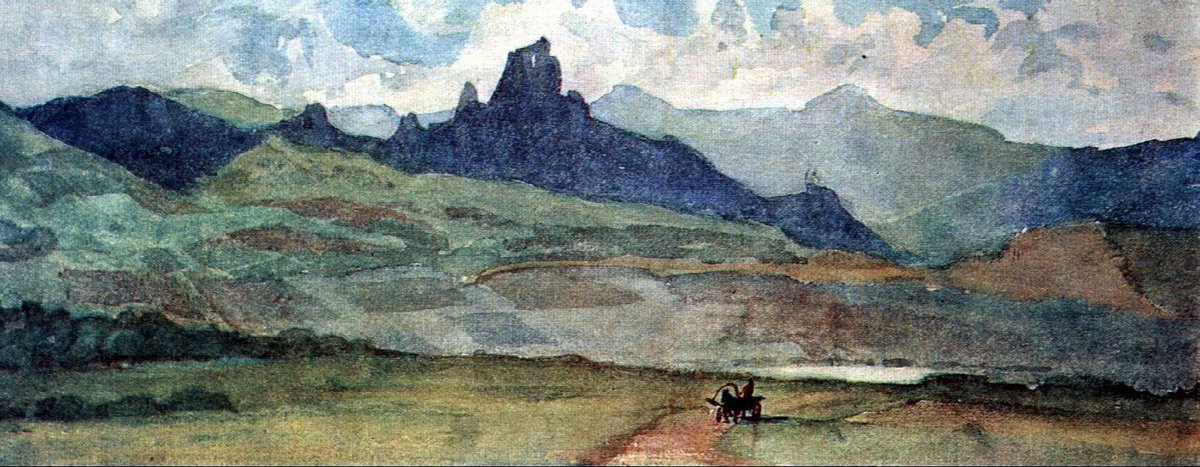
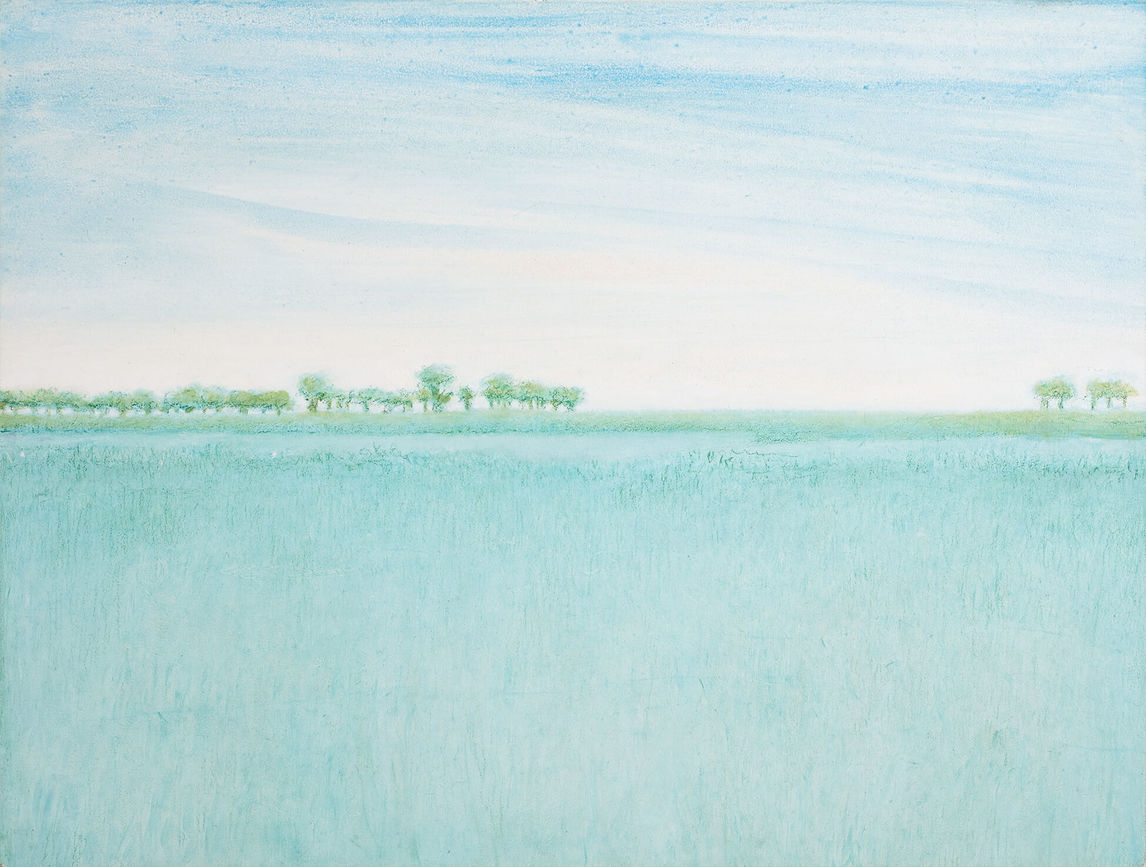
Sally Michel Avery, Father and Daughter, 1963

Thoughts on the rest

Ones I keep thinking about: Manjula Martin’s The Last Fire Season (2024): I still haven’t prepped a go-bag—how foolish is that? Catherine Leroux’s The Future (2020, translated by Susan Ouriou): What if the French had never lost Detroit? What if climate change and resultant socioeconomic crises meant that most of the trappings of a functioning state had fallen away? And what if bands of roving children built hardscrabble lives in overgrown parks? Peter Heller’s The Last Ranger (2023): Conventional but satisfying novel about a ranger in Yellowstone, filled with scenes in which the hero drinks early morning coffee on the porch of his cabin: Heller knows the landscape and describes it beautifully. (Given what the chuckleheads at DOGE did, this title resonates differently now…) Jill Ciment’s Consent (2024): Revelatory memoir in which the author reassesses her decades-long marriage to her now deceased husband, with whom she took a painting class when she was 17 and he was 47. Can the relationship really have been good given that they met when she was a child?

Best study of xenophobia, told in an atmosphere of creeping dread: Georges Simenon’s The Little Man from Archangel (1956, translated by Sian Reynolds).

A Russian Jew, brought to rural France as a child, French in every way, has his life turned upside down because of a casual remark. Chilling. Best Simenon I’ve read.

Best study of deprogramming: Emily Tesh, Some Desperate Glory (2023).

Maybe useful these days.

Best case of “it’s not you, it’s me”: Nisi Shawl’s Everfair (2016)

Steampunk set in an alternate late 19th century in which the Fabians buy tracts of land from King Leopold to protect refugees fleeting the horrors of Belgium’s rule in the Congo. At first, this new nation—Everfair—prospers. European benefactors and missionaries work with Africans to create trade networks based on clean airship technology. They develop intelligence networks to navigate the region’s politics. They promote or at least allow social experiments concerning family structure, marriage, and sexual politics. But the internal tensions become too much, and the utopia falls apart. Even as I’m writing this I’m thinking, Honestly this sounds pretty good, maybe I’ve misjudged the book. And at the level of idea it’s intriguing. The execution, though: that’s the problem. The prose is leaden, the relation between action and exposition awkward. Maybe the book actually needed to be longer? A strange thing to say since I felt like it was never going to end. This book is a darling to many (Jo Walton loves it, for example). Probably just the wrong time for me. Can’t imagine giving it another try, though.

Best (and most) coffee: Mark Haber’s Lesser Ruins (2024).

Things are not going well for the narrator of this Bernhardian novel, ever since his wife died and he lost his job. That’s a tough spot. And he tries to do the right thing, sometimes. He reaches out to his son, whose passion for house music means he will dilate on the perfect set list for as long as his father will hold the phone near his ear. Like so many of us (me, anyway), he struggles to surmount the gap between idea and execution, endlessly trying to write something good. You’d think we might like the guy. But… He’s a terrible snob. He lambastes his students, neglecting his work to the point of installing an espresso machine under the desk in classroom. (That an instructor at a community college would have a dedicated classroom is the book’s only false note.) His unfinished, maybe unfinshable, book on Montaigne is probably not really going to be all that. So he ain’t easy to like.

All of this is beside the point, though, because this novel is about the way sentences can mimic the swerves and circles of a mind endlessly thinking. One of the things our narrator thinks about most is coffee. He drinks a lot of coffee. Long sections concern the various roasts, the preparation, the anticipation, the enjoyment. I’m not a coffee snob on his level, but I found nothing to ironize or criticize in the man’s love for the perfectly pulled shot. Lesser Ruins is great for other reasons, too (it’s Haber’s best IMO), but if you like coffee at all, you gotta read this.

Most ingenious conceit: Kenneth Fearing’s The Big Clock (1946)

A drudge at a magazine publisher modelled on Time-Life is tasked with finding—for purposes of eliminating—a witness to a crime. Only thing is, he is that witness…

Dark and boozy. This is the good stuff.

Best crime fiction: Carrasco, obviously. Also obviously, the latest Tana French. (At least I can say I was alive while Tana French was writing novels that will be read in a hundred years…) The latest Garry Disher, Sanctuary (2023), is a satisfying standalone about theft and friendship. I read a couple of Gary Phillips’s books about a Black Korean-war vet turned crime-scene photographer: good stuff. (I learned a lot about Watts.) Start with One-Shot Harry (2022). Years ago I devoured Scandinavian crime novels: seemed like the most exciting thing in the genre. Bloom’s been off that rose for a while, but Cristoffer Carlsson’s Blaze Me a Sun (2021, translated by Rachel Wilson-Broyles) took me back. Marcie R. Rendon’s Where They Last Saw Her (2024) is her first book set in the present, and much as I love the Cash Blackbear series, probably her best. How nice to read a book about an indigenous woman who has a good man in her life. I regularly think about the scenes of women jogging through the snowy Minnesota woods.

Best sff: In addition to MacInnes and Tesh, I most enjoyed Ann Leckie’s Ancillary Justice (2013), Shelley Parker-Chan’s She Who Became the Sun (2021), and various works by Guy Gavriel Kay, who continues to be a source of reliable pleasure, even if no one would call his books cutting edge. (So humane, though! I need that right now.) Alas, I am not yet a dedicated enough sff reader to have figured out how to overcome the “stalling out in a series because I didn’t get to the next one right away and then forgetting what happened” problem.

Best poetry: Louise Glück’s The Wild Iris (1992). Ok, the only poetry collection I read, but I liked it enough to assign it this past semester and the students loved it. Teaching it made me both appreciate it more and notice its limitations (it hoes rather a narrow furrow). I ought to read some of her later stuff: I bet it’s even better.

Best book of the kind I could imagine myself writing and yet am mostly allergic to reading: A tie between Jakuta Alikavazovic’s Like a Sky Inside (published 2021 and translated by Daniel Levin Becker) and Chris Bachelder & Jennifer Habel’s Dayswork (2023).

The whole quasi-essay, quasi-memoir with novelistic elements thrown in for good measure—mostly that stuff leaves me cold. But these two won my heart. Alikavozovic describes a night she spent in the Louvre, a place that she often visited with her father, a ne’er-do-well from the former Yugoslavia. After each excursion, her father would ask, How would you go about stealing the Mona Lisa? This question, and the reflections on her father’s life of petty crime and her own experience growing up in a culture and language that he never perfected, lies at the heart of this beautiful little book.

Bachelder and Habel have done something remarkable: written a book together, about themselves as a couple, that feels written in a single voice. The text centers on the Habel character’s fascination with Herman Melville: it’s about his life, and their lives, and what it means to write a life, with copious references to the man they call The Biographer, Herschel Parker, who seems to have been really something. And by that I mean kind of a dogged genius, but also a pain in the ass.

Best literary fiction:

Laurie Colwin’s Shine On, Bright and Dangerous Object (1975) is sad and delightful, filled with loving anger. A splendid beginning to a marvelous though much too short career. William Maxwell’s So Long, See You Tomorrow (1980) is famous for good reason. Audacious structure and play with time, heartbreaking story, even a section told from the point of view of a dog. Joan Chase’s During the Reign of the Queen of Persia (1983) deserves its resurrection thanks to the good people at NYRB. Another story of childhood in the American Heartland, at once bucolic and traumatic.

You can see I am deep into the “my favourite artworks are the ones created while I was a child and too young to experience at the time” years. I read new things too, though, and the best of these was Kaliane Bradley’s The Ministry of Time (2024), which I finished in a cabin at the Grand Canyon during a thunderstorm that had the rain pounding on the metal roof. The book is as memorable as the setting of my reading: an experiment in time travel, in which a 19th century Arctic explorer is brought to a near-future UK and given to a handler from the titular government agency whose background happens to be Cambodian. In addition to its speculative elements, and a terrific love story, the novel considers differing cultural responses to trauma. More Bradley soon, please!  

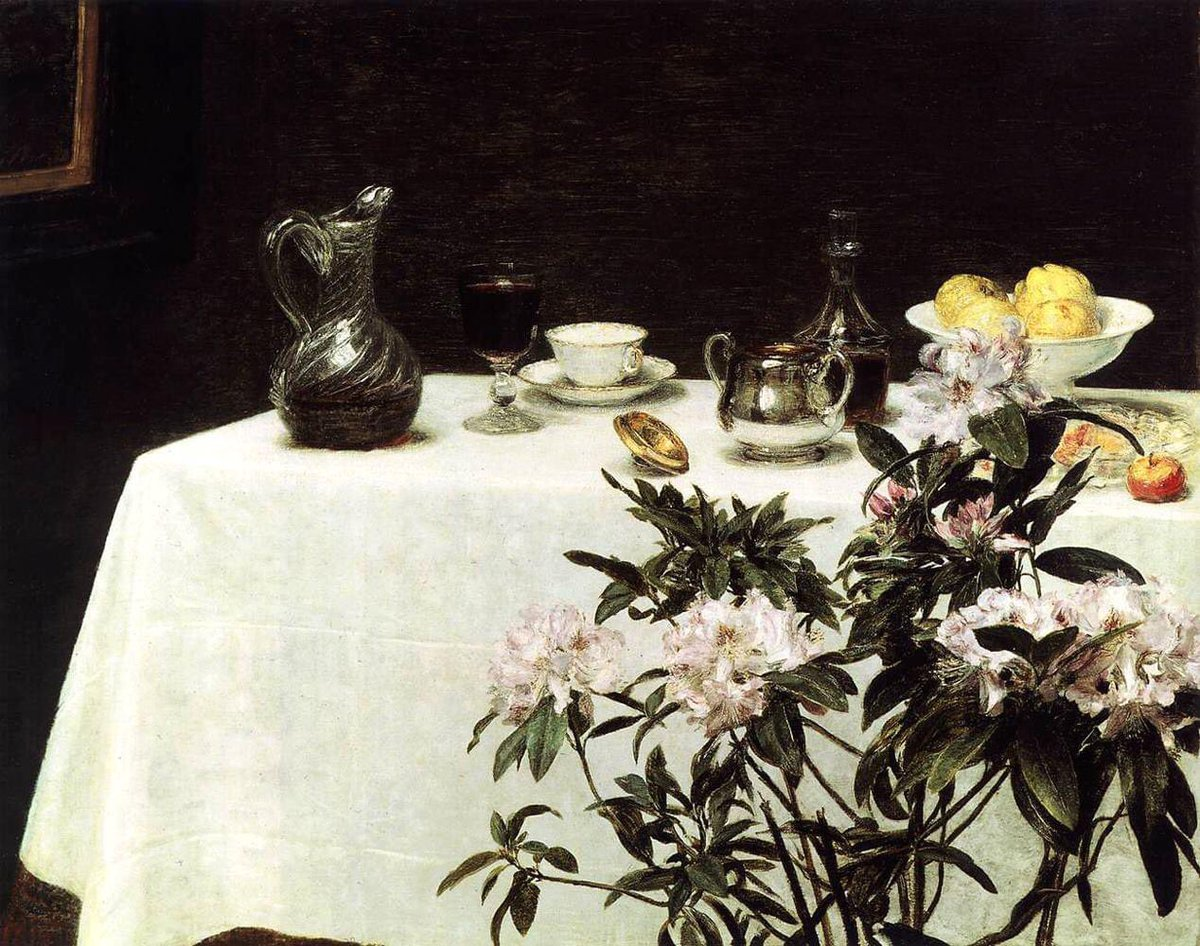
Henri Matisse, Woman Reading in a Violet Dress, 1898

Short story collection: Only read one, but it was a good one. I liked all the stories in Jamel Brinkley’s Witness (2023), but “At Barstow Station” is an all-timer. Even a class full of students who did not care much for reading agreed.

Most unexpected page-turner: Karl Ove Knausgaard’s The Morning Star (2020, translated by Martin Aitken) blends his signature interest in mundane middle-class life with some weird shit (a blazing star that no one can explain, a ritual murder, shenanigans at a mental institution). I raced through it and bee-lined for the bookstore to but the next one (in an expensive and gigantic hardcover edition), only to ignore it for the rest of the year. Honestly, the hardcover might be the problem. Most of the time I’m a “give me the paperback” guy. Anyway, will read the others in this series.

Most fun: The audiobook of Jesse Q. Sutanto’s Vera Wong’s Unsolicited Advice for Murderers (2023), read with obvious affection by Eunice Wong, made me laugh aloud. As I feared, the strains of keeping the conceit going already show in the second book, which I listened to a couple of months ago. But I’ll stick with Vera a while longer; she’s a treat.

Best sequel: Waubgeshig Rice’s Moon of the Turning Leaves (2023) is a big advance over its predecessor, Moon of the Crusted Snow. A rare case of a longer book being better. It’s ten years since the mysterious event down south that sent the grid down. The small indigenous community at the heart of the first book has been thriving, but its inhabitants realize they have reached the limit of the resources in their immediate area. After painful debate, they send a search party to find out if anyone else is out there—specifically, anyone indigenous. Exciting, well-drawn, and smart about the cost of giving up part of your identity to gain the benefits of joining something. (a community, a culture) larger.

Grimmest ending: Edith Wharton’s Summer (1917), really a hell of a book. Even if you haven’t read Wharton before you know things aren’t going to end well. But I at least did not anticipate them to end quite that dispiritingly. Thanks to Shawn Mooney and the rest of the Wharton gang for the invitation to read.

Hurts so good: Elliott Chaze, Black Wings Has My Angel (1953)

Liked at the time, but has now faded from memory:

Jean Giono’s Fragments of a Paradise (1944/48 and newly translated by Paul Éprile); Suzumi Suzuki’s Gifted (2022, translated by Allison Markham Powell); Ariane Koch’s Overstaying (2021, translated by Damion Searls);and Jón Kalman Stefansson’s Your Absence is Darkness (2020, translated by Philip Roughton). Don’t get me wrong: these are all good books (especially the Giono). I don’t regret reading any of them. Just not top-notch, for me.

Meh:

These did nothing for me, and even left me a little grumpy. Ari Richter’s Never Again Will I Visit Auschwitz: A Graphic Family Memoir of Trauma & Inheritance (2024): you’d think I’d be the perfect reader for this, but honestly I did not think this book was very smart. Dorothy West’s The Wedding (1995): I get it, she was old when she wrote this. Plus, the existence of a Black elite on Martha’s Vineyard was news to me: interesting stuff. But this felt wispy, and not in that good Belle and Sebastian way. Two crime novels by Arnaldur Indridason: sometimes you just want to turn pages and remember your Iceland vacation but at the same time you know you’ll never get these hours back.

Most ambivalent toward:

Tried to explain why I felt this way about Lily Tuck’s The Rest is Memory in The Washington Post.

It wouldn’t be an end-of-year list from me without some thoughts on Holocaust-related books, which I’ve divided into categories:

History: Dan Stone’s The Holocaust: An Unfinished History (2023). All due respect to Doris Bergen, this is the best single-volume history of the event I know, and it’s pretty short too. I went long on it for On the Seawall. Honorable mentions: Linda Kinstler’s Come to this Court and Cry: How the Holocaust Ends (2022), and Rebecca Donner’s All the Frequent Troubles of Our Days (2021). The latter admittedly not a Holocaust book, but rather a resistance to the Third Reich book. Pretty damn good tho.

Memoir: József Debreczeni’s Cold Crematorium: Reporting from the Land of Auschwitz (1950, translated by Paul Olchváry). If I could legislate that people had to read one Holocaust book, I’d choose this one. Indelible. You think the Holocaust was bad? You don’t know from. Honorable mention: Michael Frank’s One Hundred Saturdays: Stella Levi and the Search for a Lost World (2022), which I wrote about in 2023 but read again for a book group last fall. If anything, it was even better the second time. To read about Stella is to love her.

YA: Elana K. Arnold’s The Blood Years (2023). Gonna do what I can to see that this one gets more traction.

Comic: Emil Ferris’s My Favorite Thing is Monsters [Vol 1] (2017). What an accomplishment! Your heart will hurt but you won’t be able to stop turning the pages. Ten-year-old Karen Reyes lives in Chicago in the late 1960s. She adores her brother, who is sometimes a gentle artistic soul but sometimes a man pushed to violence by racism and poverty, almost as much as she loves monsters. (She draws herself as a werewolf.) She’s fallen in love with her best friend, Missy, who now shuns her at school while being drawn to her in private. Her mother is diagnosed with cancer, leaving the family’s fortunes ever more precarious. When Karen’s upstairs neighbour, Anka Silverberg, a married Holocaust survivor with whom her brother had been having an affair, is found dead under mysterious circumstances, Karen takes it upon herself to investigate. She stumbles on some cassette tapes, in which the woman tells her life story, a lurid and painful one: Anka was brought up in a brothel by her abusive mother, a sex worker, and then sold into a child prostitution ring from which she is “rescued” by a client who later abandons her when she gets too old for him. After the fall of the Weimar Republic and the rise to power of the Nazis, Anka is persecuted for her Jewishness and eventually deported to the camps. How she survived, how she made her way to America, and what led to her death—these questions are presumably answered in volume 2, which was released last fall. Volume 1 is 400 pages, with plenty of tiny lettering. It would be an effort to read it even without its distressing subject matter. But it’s damn good and deserves more attention than it’s got. Ferris uses dense cross-hatching to give her images texture: I don’t how else to say it other than the images seem tense. Amazingly the book is drawn almost entirely with Bic ballpoints. The whole story of its creation, which took six years, is remarkable, starting with Ferris’s partial paralysis after contracting West Nile disease.

Holocaust-adjacent text: Svetlana Alexievich”s Last Witnesses: An Oral History of the Children of World War II (1985, translated by Richard Peaver and Larissa Volokhonsky) impressed me with the pathos of its subject matter (children, many orphaned either permanently or temporarily when Germany invaded the USSR in 1941) and the success of its method (her now well-known quasi-anthropological style, in which witnesses speak for themselves, with seemingly little input or shaping from Alexievich herself, other than the ordering and structuring, not to mention the selecting of excerpts from what are presumably much longer testimonies: which is to say, thoroughly shaped…)

Book I Never Expected to Spend This Much Time With:

Lois Lowry’s Number the Stars (1989), the classic middle-grade novel about the (anomalous) experience of Danish Jews during the Holocaust. I created a lot of materials about this book for teachers. Yes, it has certain limitations, but I’m honestly impressed by how much richness I’ve found in this text. It seems to be fading a bit from the classroom—but not anymore, if I can help it!

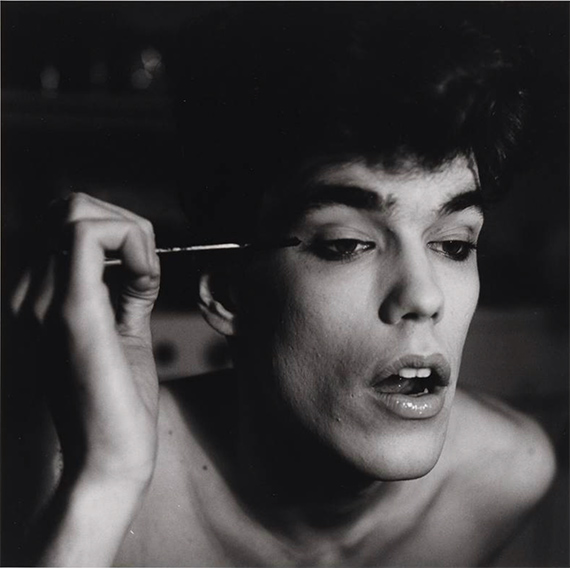
Edouard Vuillard, Madame Losse Hessel in Vuillard’s Studio (1915)

There you have it. I don’t know what my life is going to look like going forward—but I hope at least in the short term to have more time for this poor little blog. Thanks as always for reading! I would love to hear your thoughts on anything I wrote about here.

Matt Keeley’s Year in Reading, 2024

Friends, I am here to apologize to Matt Keeley, who wrote this great piece for me many months ago and has waited patiently (or maybe fumed silently) for me to publish it. I have no good excuse: I got busy and forgot. Terrible. Anyway, this really is a case of better late than never.

Matt is a freelance writer living in Boston.

Ilse Bing, East River with Boat, New York (1936)

Being a reader and working with books can, oddly enough, feel like mutually exclusive propositions. I spent most of 2024 underemployed, but what work I had before starting a new full-time job in October was mainly book-related. I copyedited and wrote pitches for a Dutch literary agency; I did brief manuscript reports for a literary scouting firm; I did occasional reviews for Reactor, The Washington Post, and The Boston Globe. I spent so much time on “professional” reading, including dozens of titles that I would normally have no interest in, that my personal reading suffered.

E.L. Doctorow’s Ragtime was not the book I expected it to be: one somehow doesn’t expect a book this strange to sell a million copies, end up on movie screens, and inspire a Broadway musical. This is an almost essayistic historical novel, with an intrusive and opinionated narrator, major characters who go titled (Father, Mother, Younger Brother) but unnamed, and plot lines that don’t tangle so much as split. Henry Ford and JP Morgan discuss reincarnation in front a stolen Egyptian mummy; Emma Goldman befriends a notorious “kept woman;” in the epilogue, we learn that one character gets killed in the Mexican Civil War, that another sinks with the Lusitania, and that a third creates the Little Rascals franchise. It’s a deeply weird book. [Ed. – Colour me intrigued…]

The movie, incidentally, is quite good, with James Cagney’s final performance, an uncredited appearance by a young Samuel L. Jackson, and Norman Mailer as an ill-fated libidinous architect. I wonder how many New York literati of the 1980s especially enjoyed watching his death scene? [Ed. – Probably still satisfying today.]

Ruth Scurr’s John Aubrey: My Own Life is an unusual biography that repurposes the words of the great antiquarian and his contemporaries to create a sort of hypothetical autobiography. There’s much that remains unknown about Aubrey’s life, and Scurr would rather leave open a gap than speculate. That means, for example, that we get more about the stones of Avebury than we do about Aubrey’s romantic life, more tossed-off preference than deeply felt emotion. This is an eccentric book about an eccentric man; most readers won’t much like it, but a few, like me, will love it. [Ed. – In the immortal slogan of Halifax’s Alexander Keith’s brewery: “Those who like it, like it a lot.”]

Gone: The Last Days of The New Yorker is Renata Adler’s score-settling memoir about the departure of William Shawn, the arrival of Robert Gottlieb, and the eventual appearance of Tina Brown. At one point, Adler compares Adam Gopnik to Anthony Powell’s Widmerpool. If you recognize the names in the last few sentences, you’ll likely enjoy this book, even if you don’t entirely trust it. Otherwise, you’d best avoid.

Rejection by Tony Tulathimutte is the dirtiest book I’ve read in ages. [Ed. — !] It seemed to come out of nowhere: I’d never heard of book or author until an editor asked me to review it. I invoked Philip Roth in my review, and I stand by that comparison:

Its heights, or depths, of exuberant filth reminded me of Philip Roth in Portnoy’s Complaint or Sabbath’s Theater. Like Roth, Tulathimutte knows desire can be as ludicrous as it is urgent; like Roth, he likes a good dirty joke.

Other highlights of 2024’s reading include:

  • Peter Straub’s Koko, a serial killer story with fine writing, memorable characters, and all too much exoticizing of the mysterious Orient [Ed. – It’s so mysterious tho]
  • Six of Georges Simenon’s Maigret novels — I really need to get back to the romans durs soon, but there’s something comforting about Maigret even when the plots are, in fact, quite harrowing
  • Amit Chaudhuri’s A Strange and Sublime Address, his first novel, as elegantly written and absorbingly plotless as later books like Friend of My Youth and Sojourn [Ed. – Read this last year as well: good stuff]
  • Paolo Bacigalupi’s Navola, the sequel to which cannot come soon enough. (Dorian — There’s a strong Guy Gavriel Kay influence here. I think you’d like) [Ed. – I appreciated this tip enough to check it out of the library—it indeed looks quite my thing—but not, apparently, enough to read it yet…]
  • M.T. Anderson’s Nicked, a fantastical medieval heist novel and queer romance [Ed. – Octavian Nothing was fantastic.]
  • Adam Roberts’s Lake of Darkness, a science fiction novel about Satan, post-scarcity, and what happens when you let AI do all your thinking
  • Howard Norman’s My Darling Detective, a thoroughly charming tale hampered only by the author’s difficulties with continuity and his editor’s failing to notice the innumerable discrepancies and inconsistencies. Read for the vibes, not the details. [Ed. – Yikes!]

Two that got away

One sad effect of all my book work was that I struggled to finish long and complicated books. I got maybe eighty pages into Oakley Hall’s classic Western Warlock before I gave up. The prose so fine, the type so small, the pages so numerous: I enjoyed and admired the book, but it took two weeks to traverse less than a hundred pages. [Ed. – Ha! Nicely put! It’s not easy, that one. Took me a while to fall under its spell.] I felt myself losing the thread, and put the book back on the shelf for a less fraught day.

Something similar happened with Iris Murdoch’s The Black Prince, which I’ve had on my shelves since 2007. In a burst of optimism, I’d bought three Murdoch paperbacks when I was a college student studying abroad in Dublin. I quickly read A Severed Head and hated it, and so The Sea, the Sea and The Black Prince sat unread for more than a decade. I knew, however, the problem was more with Matt than with Murdoch, so every year I vainly promised myself I’d give Murdoch another shot. When I finally took the plunge last June, I was thrilled to find that The Black Prince was smart, funny, and satirical, bursting with memorable images and sparkling with ideas. Except, once again, I found myself losing the thread and regretfully set the book aside.

I ended up reading The Bell, another Murdoch, in January of 2025. Perhaps I’ll get through The Black Prince later this year? [Ed. – Because it took me so damn long to get this up, maybe he has!]

John Constable, Cloud Study

Last year’s books, this year

Finally, there are a few 2024 books that I bought and fully intended to read, but haven’t quite gotten around to. First is Percival Everett’s James, a novel which sold a million copies and made nearly as many end-of-year lists. I’ve enjoyed Everett’s past novels and I’m sure I’ll tear through this one when I get around to it. Incidentally: I wonder when Everett’s next book will be? He usually seems to write about a book a year; I wonder if they’re holding off publication until James sales begin to taper off?

Next is Cahokia Jazz by Francis Spufford. I pitched it for review, but the pitch was declined. [Ed. – Boo!] I’m reading it now and am impressed: It’s simultaneously a murder mystery, a literary novel, and an alternate history. Spufford dedicates the book to “Prof. Kroeber’s daughter;” I wonder if Prof. Kroeber makes an appearance in the book. The period is right, Kroeber was an anthropologist interested in Native Americans, and there are lots of Native American characters in the book. [Ed. – SO good!]

Last is Ed Park’s Same Bed Different Dreams, which looks to be a polyphonic metafictional conspiratorial genre bender. I’ll probably turn to this once I finish Cahokia Jazz. [Ed. – Also good, with plenty of hockey. Thanks, Matt! Sorry again for dropping the ball!]

Scott Walters’s Year in Reading, 2024

Pleased to once again present reading reviews from some of my favourite readers. Today’s installment, his fourth, is by Scott Walters. Scott launched the much-lamented blog seraillon in 2010, and expects to return to it one of these days. He largely follows Primo Levi’s model of “occasional and erratic reading, reading out of curiosity, impulse or vice, and not by profession.” He lives with his partner in San Francisco.

Barring surprises, here ends the 2024 edition of the EMJ Year in Reading series: except, I hope, for my own. (Gotta write that…) Thanks to everyone who contributed–and all who read these engaging lists.

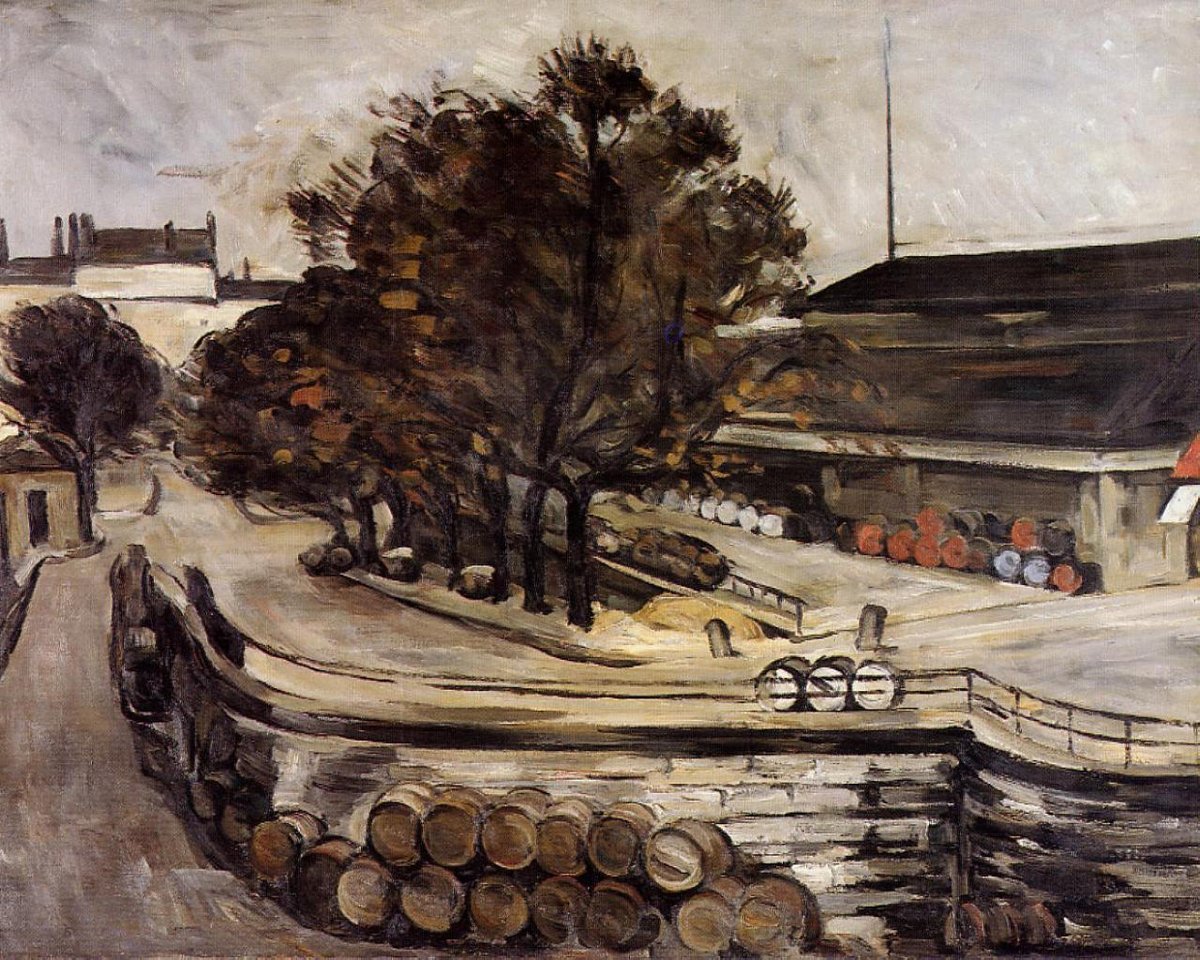
Balthus, The Passage of Commerce Saint-Andre (1954)

Thank you, Dorian, for inviting me again to participate in The Year in Reading. [Ed. – Pleasure all mine, Scott!] Mine meandered mostly pleasurably through some 60 books. I abandoned others, was surprised to have read fewer Italian works than in previous years, and experienced a number of unpremeditated pairings, reading two works each by a dozen authors plus more thematic linkages. I’ll get straight to 2024’s highlights:

The Woman in White, Wilkie Collins (1860)

I nearly lost my head when I interrupted my spouse’s reading of the final pages of The Woman in White, but her abrupt “Ssh!” made total sense as I plunged into the book myself the next day. Abstracted, the “detective-ish” book’s nutty plot—starting with its mysterious woman in white and moving to family secrets, confused identities, unlikely coincidences, shady interlopers, and convoluted inheritances—would hardly seem encouraging. But over 650 pages Collins never lets drop any of the knots of intrigue he has in the air, a master class in plotting with the ending so neatly and satisfyingly resolving the novel’s myriad conflicts that the book should have come tied up with a pretty bow. I found equally impressive his crafting of splendid characters, including the flamboyantly louche and unforgettable Count Fosco and Marian Holcombe, the novel’s moral center, surely one of the great characters in English literature. [Ed. – Now read No Name!]

[Paired with Collins’s The Moonstone].

The Purple Cloud, M. P. Shiel (1901)

If The Woman in White stands at the peak of the Victorian era, Shiel’s The Purple Cloud levels the period to the ground: an apocalyptic horror story, to be sure, with a body count beyond reckoning, but also an existential tale that takes Jules Verne’s brand of adventure in the direction of Lovecraft (and maybe even Kafka and Beckett). Into the tale of the sole-surviving member of a polar expedition returning to find worldwide catastrophe, Shiel mixes dazzling epic catalogues with itinerant wanderings—by dogsled, boat, rail, and on foot—that make Odysseus seem nearly an armchair tourist. A magnificently macabre tour of England unfolds from the coasts to the moors to the mines to the vacant house of Arthur Machen (to pay a literary debt) before the novel’s agonist traverses the infernal hellscape as far as Tokyo and San Francisco. Adding to the panorama of ghastliness is the misogynistic unpleasantness of the narrator himself, though having a murderer inherit such a lonely place is certainly a twist on the “last man” genre. Shiel lightens his grotesqueries by upscaling his inventiveness and gallows humor, even taking a few swipes at the Empire’s Victorian sensibilities. His idiosyncratic, nimble writing prompted me to mark down passages, though left me wondering whether the “purple” in his title may have referenced florid elements infecting his sheer writing bravura. Half-way through I wondered why the book didn’t regularly appear on English literature reading lists. Two-thirds of the way through, an abrupt turn sent the tone spiraling from Brueghel’s Triumph of Death into the schmalz of W. H. Hudson’s Green Mansions, underscoring a built-in problem of last man narratives: how to bring things to a close, what with destruction being so easy and rebuilding such a struggle. Shiel regained his footing towards the end but stumbled again on his way out the door. Maybe some goody-two-shoes editor had stuck their nose in. Still, The Purple Cloud’s grandiose conception and relentlessly ghastly anti-pleasures made it a singular reading experience—and fitting B-side to Collins.

Bel-Ami, Guy de Maupassant (1885)

At age 4, my French goddaughter presented me with a paper “cootie-catcher” featuring appealing green designs on three sides and a frightening mess of scribbled red and black on the fourth. I inquired. “This is a flower, and this is a tree, and this is grass, and this is a vampire.” [Ed. – Reasonable.] Now that she’s 21 I’ve come to expect this kind of thing regularly, but when she insisted that I read Guy de Maupassant’s Bel-Ami, I fell right into her trap. The story of a down-on-his-luck former soldier, Georges Duroy, whose life is transformed by a chance meeting with a war buddy who helps get him into journalism, is a superb depiction of the writing life; an existential examination of class, morality and gender relations; and one of the most sordid narratives I’ve come across. Duroy is a terrific antagonist, an arriviste with attractive qualities tinged by inexperience and raw ambition, not above prevarication and cruelty when it suits him. Maupassant manages the story so skillfully that I naively believed it to be heading towards a treatment of the subject of friendship between men and women, the source of Duroy’s “Bel-Ami” nickname—an ironic one, I was soon to realize, as what Maupassant does with Duroy makes Zola’s take on human debauchery look like a Sunday school picnic. [Ed. — !] The novel contains great set pieces, including a drawn-out death scene where a post-mortem odor drifts off the page like something out of D’Annunzio, and a party in a mansion on the Champs-Elysée that contrasts with the grim lives of Duroy’s rentier parents rotting away in Rennes. Maupassant levels the world of journalism too, its appetite for influencing public opinion, its writers seeking short-cuts to fame—a subject altogether too relevant today. Duroy’s talent, which emerges bit by bit, takes flight in social situations, where during one visit with a group of women he extemporizes on the writing of the French Academy. Maupassant, of course, was writing against the Academy grain, and few writers have woven a French of such sublime beauty from a tissue of such splendid decadence. [Ed. – Well, damn!]

[Paired with Manon Lescaut (1731), by the Abbé de Prevost].

Dark Back of Time, Javier Marías (1998) (Esther Allen, translator)

It would be unjust to pigeonhole Dark Back of Time –“a book of digressions”—as a campus novel, and equally unjust to separate it from its co-joined twin, All Souls (1992). But taken together as a campus novel, these two works, set at Oxford, slay all comers. Someone once quipped that the campus novel was about settling scores. Dark Back of Time seems aimed at undoing any barbs present in All Souls and even any notion of that book’s having been a roman à clef (this too, of course, may be a fiction). While the first part of Dark Back of Time engages weighty questions about fictional representation of real people, the joyousness of the novel’s explorations often had me in stitches, including a scene in which an academic negotiates with the narrator/author how he will be represented in the new novel, and another in which the narrator/author, timidly attempting to clarify for owners of an Oxford bookshop that what he’d written in All Souls was not about them, finds that the couple revel in their fame and petition to be included as themselves in a film version. It seems fitting in these books that Marías, Spain’s late greatest novelist, has evoked echoes of the most iconic of Spanish fictions, for, like the first and second books of Don Quixote, the two novels form an essential unit in which one could read only the first volume and miss out dramatically on what the second volume does with the first. (I’d love one day to see All Souls and Dark Back of Time boxed as a set; Cervantes would approve.) I don’t think it’s an exaggeration to suggest that these volumes, taken together, may be the finest contemporary literary work to address the question, “What is fiction?” Two other elements to recommend the book: The first is Marías’s inclusion of the fascinating story of Redonda, the “literary” nation of which Marías served as most recent and presumably final King (M. P. Shiel had been the first). [Ed. – Wait, that dude you just wrote about?? Is this real? Am I being punked??] The second is that Dark Back of Time contains some of Marías’s most exhilarating writing; I think immediately of a moving passage about the dawn crepuscule and streetlights that persist for a time into the day. Time having ever been one of Marías’s great preoccupations, I also winced at his narrator imagining life at age 85—a full 15 years past the premature end of Marías’s own. Unconscionably, The New York Times left Marías off of its recent list of the 100 Best Books of the 21st Century to date, but it is certain that the lamp of Marías’s work will live on to see its day.

[Paired with Marías’s short travel book, Venice: An Interior (2016)].

The Charwoman’s Shadow, Lord Dunsany (1926)

Fantasy is not among my favorite genres, but I’ve been fond of everything I’ve read by Edward Morton John Dax Plunkett, a.k.a. Lord Dunsany. Dunsany’s stories seem more like a new model of fairy tales, exploring interstices between reality and the imagination and dealing with moral issues without being moralizing. The Charwoman’s Shadow features a young Spaniard sent by his family to learn alchemy from a woodland magician, and exhibits Dunsany qualities in abundance: a deep gratitude for the richness of life, where nothing can be taken for granted; a genial wit and wordplay; a careful attention to nuance. The centerpiece of the novel is the value of one’s own shadow, the disappearance of which, through a Faustian bargain, produces unexpectedly dire consequences. Another Dunsany treasure is the lyrical quality of his writing, for example when he takes on that most magical of hours, l’heure bleue:

bright over the lingering twilight the first star appeared. It was the hour when Earth has most reverence, the hour when her mystery reaches out and touches the hearts of her children at such a time if at all one might guess her strange old story; such a time she might choose at which to show herself, in the splendour that decked her then, to passing comet or spirit, or whatever stranger would travel across the paths of the planets.

And then there is the book’s splendid ending, which I will not spoil other than to say that with no apparent thought of producing endless sequels like some contemporary writers of fantasy fiction, Dunsany gently places his chief protagonist off stage and sweeps into a realm of wistfulness drenched in the glow of a glorious sun setting at the height of Spain’s Golden Age.

[Paired with Dunsany’s The King of Elfland’s Daughter (1924)].

Fulgentius, César Aira (2017) (Christopher Andrews, translator)

At 163 pages, Aira’s Fulgentius straddles novella and novel, and not simply as matter of length. Aira’s intimate, vividly imagined tale of a Legate of the Roman Empire who also happens to be a playwright expands as it follows the aging Fulgentius and his 6,000 soldiers from Rome to reconquer Pannonia. Along the way, Fulgentius mounts performances of his sole work, a tragedy written when he was an adolescent, starring himself as tragic hero—and most important audience member. As Fulgentius has already written—or thinks he has already written—the tragic outcome of his own story, the plot tension is carried by a familiar Aira conceit around the entwining of fiction and reality. As a prime example one of Aira’s works that graft a fictional character onto history, Fulgentius offers a vivid sense of what such a march must have been like for the soldiers, the general, and the populations in their path. Deviating from the author’s more typical surrealist gymnastics, the language here takes on an unusually elegant lyrical register.

[Paired with Aira’s Alexandra Pizarnik (2001), an appreciation of the Argentine poet].

The Catherine Wheel, Jean Stafford (1952)

I found a copy of Jean Stafford’s The Catherine Wheel when I was 18. Had I read it then, I doubt I would have fully appreciated its adult nature—for it really is an adult book, dealing with adult things, things terrifying enough that I approached the novel’s final pages with a shudder of complete dread (completely vindicated). But in The Catherine Wheel Stafford also reckons with youth, entwining her two main characters, 38-year-old Katherine Congreve and her 12-year-old cousin Andrew Shipley. Devastated in love at an earlier age when Andrew’s father John married her sister Maeve, Katherine now occupies a position as the town’s most prominent unmarried curiosity, but also a magnet to John and Maeve’s children, left behind while the parents “summer” in Europe. Twin betrayals connected to this departure have set both cousins spinning: John’s surprise declaration of love for Katherine and determination to divorce Maeve while abroad, and the disappearance of Andrew’s playmate of previous summers, Victor, now entirely occupied with the post-war return of an older brother. Dually abandoned, the cousins shift focus to one another. Stafford thus sets up an unusual device in which youth attempts to divine the mysteries of adulthood while adulthood frets over the crises of youth, in a marriage story focused on impacts beyond the absent couple’s own strife. [Ed. – This feels like some Henry James-level melodrama!] A kind of third eye—that of the people of Hawthorne, who notice when Katherine’s light stays on into the wee hours—levies its own social pressure on the house’s inhabitants. Stafford’s densely poetic sentences frequently had me reading her aloud, relishing her words, marveling at the perfect limning of some little thing or creation of a resonance that rippled out towards subjects beyond the proximate ones. Though rooted in a realist, formalist literature that prioritized and exalted language, the novel still felt raw and new, bursting out of old molds, totally unsettling. Not a novel for the squeamish, but certainly one for any reader ready to appreciate some of the finest American writing of the period.

[Paired with Stafford’s The Mountain Lion (1947)].  

whose names are unknown, Sanora Babb (1936/2004)

Sanora Babb’s novel has been highlighted in recent articles recounting editor Bennett Cerf’s decision that two Dust Bowl novels in a single year would not stand. The other, of course, was The Grapes of Wrath, allegedly constructed in part on notes Babb had collected concerning hardscrabble farmers in her native Oklahoma, and which Cerf provided to Steinbeck. Though Babb published other well-received works, her Dust Bowl novel languished unpublished for nearly 70 years. whose names are unknown borrows its title from an eviction notice served on a family of Oklahoma farmers. What the novel may lack compared to Steinbeck’s elegant structure and majestic sweep, it makes up for in granularity of detail and visceral impact relating the farmers’ desperation and poverty, with particular attention to the lives of women, whose interactions give the work some of its strongest scenes. Babb’s direct, declarative sentences come across as hard as the land worked by her characters. She describes the knife-edge on which her people live, where even small luxuries—such as butter for the biscuits—must be used sparingly “so that it will last until the next churning.” Where Steinbeck set his novel on the back of hope for a better life in California, Babb spends a long time in Oklahoma before heading west, zeroing in on the encroachment of the Dust Bowl, poor farming practices colliding with a change in climate and the shifts within and without people as they try to wrestle with such environmental change. Babb’s powerful novel deserves at least to be taught alongside Steinbeck’s, or rather, as the debt is all his, the other way around. [Ed. – Pretty telling/damning that I’d never heard of it.]

Écoute, Boris Razon (2018)

It’s clear from which chapter of French journalist Boris Razon’s novel Écoute (“Listen”) Jacques Audiard plucked the seed for his film Emilia Perez, but Écoute differs almost entirely from the film. As the book’s title suggests, Razon focuses here on listening, various forms of which coalesce the book’s entwined stories and capture the complex, fraught texture of contemporary communications. Set mostly on a single block near Place d’Italie in Paris (with detours to Mexico City and Lisbon), and with the November 2015 terror attacks continuing to resonate, the novel touches on the surveillance state by encompassing listener, the listened-to, privacy, and identity (here’s where Emilia Perez came in, but so, to my surprise, did Fernando Pessoa). In conveying the rapid-fire chatter and laconic banality of so many electronic communications, Razon employs a good deal of verlan, texts and texting abbreviations, and emoticons, prompting one character to muse on the absence of a dictionary adequate to capture today’s modes of information sharing. Running beneath this surface noise is a current of desire to disappear from a world in which privacy has all but vanished. The stunning first chapter presents a scene of the Paris street that surely ranks among the richest in that city’s literature, an “audioscape” as experienced from the inside of a police surveillance van by an officer quietly being undone by his job of attempting to cull signal from the noise and by the uncanny valley between electronic input and what he perceives with his own senses. [Not yet available in English translation, though that may well change should Emilia Perez win the Oscar for best film].

Edward Hopper, Solitary Figure in a Theater (1903)

Oak Flat: A Fight for Sacred Land (2020) and Thunder and Lightning: Weather Past, Present and Future (2015), Lauren Redniss

2024 was the year I came late to Lauren Redniss’s party, pairing her powerful Oak Flat with her larger format Thunder and Lightning. The former explores the fight around the proposed Resolution mine on tribal lands in Arizona, while the latter treats weather phenomena both straightforwardly (i.e. Rain, Heat, Wind) and in more abstract terms (i.e. Chaos, Dominion, Profit, War). Using an anecdotal approach, Redniss displays in both books a knack for ferreting out the most interesting possible interviewees and unearthing fascinating hidden tales. But what makes the work of this MacArthur award winner stand out is its exploration of text and image. Using full page illustrations, Redniss skillfully advances her story through images of such impact that I found myself gasping at turning a page and being confronted with an image perfectly tuned to the tone she had set. The large format of Thunder and Lightning lends itself particularly well to her subject. In Fog, the text crawls along the bottom of pages of vast gray. Redniss’s deliberateness in matching image to text and letting the image carry the narrative feels like a new form of text/image interaction. In a section about cloud seeding, she describes a proposal to use weather balloons to heft a pipe with multiple nozzles to spray chemicals that could help cool the planet. I could not help see this as a metaphor for the way her illustrations lift her text in air. These images, easily mistaken for colored pencil washes, are in fact mostly acid etchings in black and white that Redniss has hand-colored (Thunder and Lightning includes a description of her processes). I read Redness not long after finishing James Elkins’s novel, Weak in Comparison to Dreams, another work that relies heavily on images, by a leading theorist of text/image interaction, no less, and now find myself dreaming of a Redniss/Elkins collaboration. Come on, you two. Make it so. [Ed. – Either way, I’m tracking down these Redniss books!]

Moonlight Elk, Christie Green (2024)

I know Christie Green but was wholly unprepared for her first book. Each time I put Moonlight Elk aside, I could not wait to get back out into it. That awkward prepositional formulation feels apt, as Moonlight Elk, a book framed around Green’s experiences in across New Mexico hunting wild game, largely for sustenance, takes one to wild spaces in an intensely intimate manner. Exploring the borders between interiority and exteriority, animal and human, life and death, the book’s dozen interlocking pieces, indexed to a hand-drawn map of the state, might well be the New Mexico state book of the year (if such a thing exists). With solid research behind her narrative, Green leverages her experience as hunter, mother, landscape architect, land use expert, designer, naturalist, activist, and writer to traverse territory of essay, short story, meditation, and what one might call an anthropology of relationship. Memoir might also come to mind, but resistant to definability, Moonlight Elk seems more like an exorcism, a courageous self-interrogation in quest of a “free range” existence that refutes facile answers, upends convention, moves into spaces predominantly occupied by men, and attempts to rid the cultural body of a toxic detachment from nature. Hunting—particularly as a woman alone—foregrounds the narrative, but Green is after larger game. She inhabits the lives of animals, their cycles and patterns, how they move, what they sense, how they see her. The mysterious, miraculous complexity of bodies, not least Green’s own, forms the beating heart of the book: details of muscular structure and bone, of blood and feathers and sex, the quickness of eyes, the sharp sense of smell. Her hunts force self-reckoning, as when she discovers a fetus moving within the abdomen of a cow elk she has shot, or when she ends the suffering of another cow that comes to her after being gruesomely wounded by poachers. Green, who grew up in Alaska, integrates into her experiences a wealth of issues impacting the American West, from private vs. public land and water use to tribal and border concerns (in the boot heel of New Mexico, a quail hunt collides with Border Patrol conducting their own kind of hunting). Only at the narrative’s end did I grasp the extent of the subjects Green had covered. More personally affecting, as she moves through forest, desert and chapparal, shadowed by cliffs and trees, illuminated by dreams and the changes of the moon, she offers, with keen animal sense and without escapism, an orthogonal, conscientious response to received ideas, convenient consumerism, and mediated experience. Hyper-alert, alive, intuitively creating her path, Green renders wilderness almost otherworldly. I emerged from Moonlight Elk seeing this world anew, as though a physical alteration had taken place. [Ed. – Sold! Might pair well with Joanna Pocock’s Surrender.]

Gallery of Clouds, Rachel Eisendrath (2024)

The title: irresistible. The cover too, a fresco of clouds at sunrise or sunset from the ceiling of the Rose Main Reading Room in the New York Public Library. And the opening especially, the author recounting a dream of carrying her manuscript through heaven and meeting: Virginia Woolf. Both ostensibly and in fact, the subject of Gallery of Clouds is Sir Philip Sidney’s 16th century, 900-page pastoral romance, Arcadia, about which I knew nothing and which overwhelms even Eisendrath, a Sidney scholar: “I find that my memory of the plot has already started to dim, to blur…I can no longer keep track of the basics…” I say “ostensibly” because Eisendrath uses the obstacle, Arcadia serving here as a nexus to send her fertile mind wandering down winding paths, from observations on the genre of Romance to the use of images, Shakespeare to Little Nemo, Poussin to Walter Benjamin, Montaigne to manicules (!), the marriage of hunting with desire to the cat dozing on Eisendrath’s bed.

But these seemingly inexhaustible spin-offs never seem gratuitous. Eisendrath subtly constructs an Arcadia of our own era, her black & white photos echoing the pastoral romance’s means of advancing its airy infinities through “images in words,” her “clouds” of thought (which she pointedly distinguishes from mere fragments) paralleling the episodic nature of the romance, her grounding her observations on Sidney in a relatable contemporary manner underscoring the genre as a response to grim realities. At the same time, Eisendrath engages proliferating modes in contemporary writing, such as the use of the fragmentary, the merging of the academic and the personal, the punctuation of text with images, the grappling, through a need to say, with an unraveling world. Though she is writing about a 16th century romance, her small, enthralling, sui generis book has volumes to say about how we read and write. And in Eisendrath’s few references to her own teaching, Gallery of Clouds, more than anything I have read in decades, has me wanting to be a student again.

The Waves, Virginia Woolf (1931)

Rereading The Waves 40+ years after I first read it and in the same copy I’d used then, my margin notes served to measure the distance between that young reader and this old one. I experienced pride regarding the young stranger’s underlining of particular lines; I noted too that he’d missed a lot. Passages of time of this sort span The Waves, entwined temporal arcs that longitudinally capture Woolf’s six characters through alternating interior soliloquies as they move from childhood to university [ed. – well, some of them get to go to university…] to the workplace to middle age and beyond, while brief impressionistic pieces preface each chapter and, over the course of the novel, trace the sun’s path across the sky during a single day at the shore. Here as in many of her works, Woolf, the great writer of immediacy, obsesses over capturing sensations, gestures, glances, discreet moments, the wave at the point of breaking, of ebbing. Rafts of glorious sentences ride Woolf’s exquisite phrasing, as she simultaneously questions the inadequacies of language, frustration with these limits reaching a crescendo as mortality nears for her characters, and a voice longs for:

some little language such as lovers use, broken words, inarticulate words, like the shuffling of feet on the pavement. I begin to seek some design more in accordance with those moments of humiliation and triumph that come now and then undeniably. Lying in a ditch on a stormy day, when it has been raining, then enormous clouds come marching over the sky, tattered clouds, wisps of cloud. What delights me then is the confusion, the height, the indifference and the fury. Great clouds always changing, and movement; something sulphurous and sinister, bowled up, helter-skelter; towering, trailing, broken off, lost, and I forgotten, minute, in a ditch. Of story, of design I do not see a trace then.

[Ed. – Is this Bernard? Sounds like Bernard.] Woolf described The Waves as a “playpoem,” but its approach to polyphony is unusual. In the first chapter, she goes inside the heads of her characters as young children while at the same time supplying them a vocabulary beyond their years, a device through which they speak both as themselves and as the writer, the latter’s presence made manifest when the children catch a glimpse through a window of a woman writing. Throughout the novel, her six characters’ voices float like spheres governed by gravity, now apart, now coalescing, as waves gather force and crash, exploding in spray and froth. But her characters also serve to question the nature of identity: clearly creations of the writer and facets of her circle (the roman à clef aspects interested me little), they are also beings in whom a “self” is merged inextricably with other selves. For all of its prose-poeminess, The Waves stands as a remarkable and grounded philosophical inquiry into what constitutes a self—and whether it even makes sense to speak of a “self.” [Ed. – Yes, the latter especially!]

In my first reading, I scarcely noticed the centrality to the novel of the death of Percival, a “seventh” character never given a voice. But in Paris shortly after finishing The Waves, I caught director Elise Vigneron’s theatrical adaptation of the novel, an extraordinary work employing both live actors and corresponding marionettes made of ice, such that as the play progressed, these figures melted, with much of the later action occurring in a resulting pool center stage. [Ed. — !] The physical presence of these characters and their doubles rendered Percival’s invisible presence powerful, a black center in Woolf’s “six-sided flower; made of six lives.” As with the shell-shocked Septimus Smith in Mrs. Dalloway, Percival represents a generation of young people damaged or lost to conflict and war. The cumulative effect of Woolf’s meditation on loss, whether through ordinary aging or via the injustice of an early death—and a palpable sense of darkness again descending upon Europe—left me overwhelmed by emotion at the story’s close.

What attracted me to Woolf at age 18 held firm: her sumptuous sentences; the tension between a love of people and aloof solitariness; the desperation of time passing fused with the fever to glean something lasting from the fleeting and ineffable. Also: recognition at last of Woolf’s lament for life lost at an early age, for the unshakable impact on those left behind, pushing The Waves into a work far greater than I’d registered the first time around. I’ve been thrilled, moved, and humbled by revisiting this extraordinary novel while the sun sinks toward a darkening horizon, so many years after I first read it, when the sun still mounted the sky. [Ed. – Beautifully put, Scott.]

[Paired with Woolf’s final novel, Between the Acts (1941)].

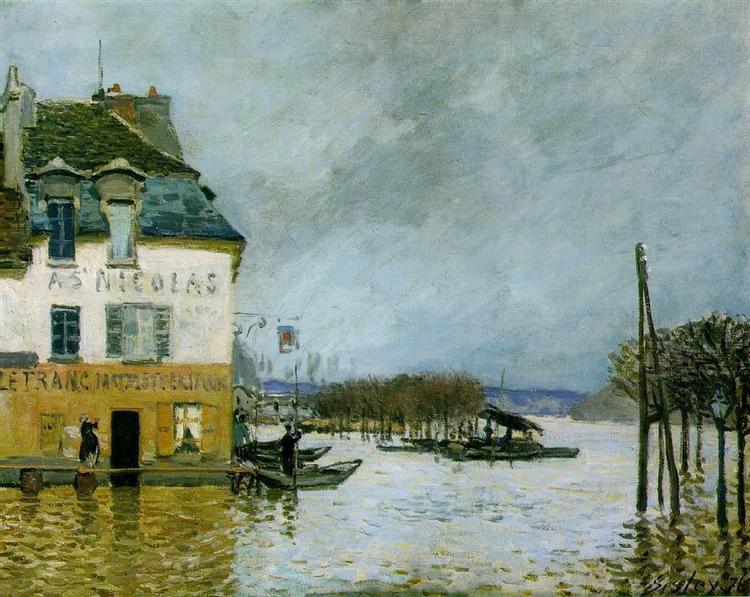
Felix Edouard Vallotton,The Sunny Street (1922)

Others works I could have included: D. H. Lawrence’s powerful Sons and Lovers [Ed. – Ph hell yeah]; Italian critic Cristina Campo’s The Unforgiveable;  the Strugatsky brothers’ The Snail on the Slope; Georges Simenon’s Arizona noir La Fond de la Bouteille; Shakespeare’s The Winter’s Tale; a pair of short books by Helen DeWitt (may she please complete her novel-in-progress set in Flin Flon, Manitoba) [Ed. – Wait what now]; Andrés Barba’s Two Small Hands and Andrés Neuman’s The Things We Don’t Do; poet Susan Nguyen’s second gen take on the American South in Dear Diaspora and other of her poems on-line; and, Most Unexpected Literary Object, the first volume of Ahmed Fāris Al-Shidyāq’s Leg Over Leg, a daring four-volume novel completed in 1885 with the modest ambition of catapulting the whole of Arabic language and literature into the modern age. In sum, a Year in Reading that elicited joy, snark, bon courage, resolve, humility, and defiance for challenging times ahead.

[Ed. – To which I can only summon both the raised fist and the thank you hand emojis: this is wonderful, Scott. May we draw on those good emotions in 2025!]

Keith Bresnahan’s Year in Reading, 2024

Pleased to once again present reading reviews from some of my favourite readers. Today’s installment, his third, is by my longtime friend Keith Bresnahan. He is a self-described harrumphing scrivener who lives and works in Toronto.

Roger Deakins, The Rail to Grants, New Mexico (2014)

2024 was a difficult year, marked by personal loss. In July, an old friend from graduate school, a brilliant and feisty scholar of the Horn of Africa, succumbed to the cancer that she had been living with on and off for the past decade. And then in October, another death. My oldest and closest friend, with whom I’d been friends since kindergarten, died of an aggressive cancer he’d been diagnosed with only 11 months earlier. I’d managed to get down to Atlanta, where he’d recently taken on a new academic position, a few times to see him—the last just weeks before his passing—but it still felt inadequate, and very sad.

Throughout all this, I was working on writing my own book, on architectural destruction and emotion in late-nineteenth century France. Despite spending the last half of the year on sabbatical from teaching, I didn’t manage to finish it, which was also difficult. But: I’m still here, and the work continues amid the usual teaching and service. I’m casting an envious eye on those colleagues leaving academia for greener or at least other pastures. But for now, this is where I’m at.

Apart from the reading I did for my own book project, which was substantial, my extracurricular reading this year was not insignificant: 65 books, if my list is correct.

I read a lot of mysteries, by French, Irish, English, Japanese authors. I read a lot of Georges Simenon, though not the Inspector Maigret series. (I read the last of these—75 novels and three short-story collections—a few years back. Would that there were more.) Unusually for me, I read quite a few Canadian authors, and a couple American ones, and one Sicilian. A bunch of French graphic novels/comics. And I finished my reading, begun many years ago, of Zola’s 20-voume Rougon-Macquart saga.

Here are the ones that stayed with me:

In the first days of 2024 (feels like a lifetime ago), I read Geoffrey Household’s Rogue Male, which was as great as everyone says. An Englishman, having attempted to assassinate an unnamed European dictator (Hitler, quite obviously) is now being pursued by agents across the continent. It’s a white-knuckle ride that in its second act switches pace to a two-person détente, in which our hero slowly plays out becoming-animal (the ‘rogue male’) in a kind of homemade burrow. Super-weird, I loved it. My only complaint is with the book’s end, which reveals a deeply personal rationale for the assassination attempt, practically undoing the whole perversely-unmotivated-action-begets-tragic-outcomes schema of all that had come before. Still, highly recommended.

Seicho Matsumoto, Point Zero. I had read his mystery A Quiet Place a couple years back and loved it. [Ed. – Agreed, so good.] Point Zero, like that one, is translated by Louise Heal Kawai for Bitter Lemon Press. As I progressed in the book, I started wondering: had I read this before? It all had a vaguely familiar ring. It turns out I had not; but I had watched Yoshitarō Nomura’s excellent 1961 film adaptation, Zero Focus. It’s an excellent, propulsive tale of a woman whose new husband has gone missing, and her search to find the truth. I figured out (or remembered?) who ‘did it’ about 2/3 of the way through, but it hardly mattered. Great, though A Quiet Place still has the edge for me. More Matsumoto in English, please!! [Ed. – I gather there’s a ton of him. Sort of like Simenon.]

Other Japanese books I read this year: Seishi Yokomizo, The Devil’s Flute Murders and The Little Sparrow Murders (fine, if workmanlike, mysteries); Jun’ichirō Tanizaki, Naomi (a striking tale of manic obsession and cuckoldry, but the main characters aggravated me to no end).

I also read Yoel Hoffmann’s edited anthology Japanese Death Poems, which I received as a tongue-in-cheek birthday gift (although they knew I’d also love it). It’s what it sounds like: a collection of short poems, mostly haiku, written over centuries by monks and poets and ordinary folks on the verge of death, or in anticipation of dying. Fascinating stuff. I read it in the fall, in the midst of grief. Good to meditate on, and dip in and out of.

Also in the mystery vein, I continued to work my way through Magdalen Nabb’s Marshal Guarnaccia books, set in Florence. I like every one of these I’ve read, and this year I went back to the beginning, to read (new to me) the first in the series, Death of an Englishman. Excellent and atmospheric, and I loved that Guarnaccia has the flu and only shows up at the very end for this first book in his own saga. [Ed. – Intriguing!]

My last read of the year was also a mystery (they really do seem to fit the winter holidays in a way I can’t explain): John Banville’s The Lock-Up. This is a late book in his Quirke series (originally published under the pseudonym ‘Benjamin Black’), but the first I’ve read. For whatever reason, I’ve never got on with Banville’s literary fiction (I know, shame on me). [Ed. – I dunno, I’m not sure he’s all that, actually.] But this hit the spot. Quirke, a weary alcoholic pathologist, investigates the murder of a young Jewish woman in 1950s Dublin. All sorts of side-narratives here: former Nazis escaping justice with the help of the Church, arms dealings in Israel, romantic entanglements, struggles with work colleagues. Yes, aspects of it are clichéd and feel dated, despite being published in 2023. What can I say? I liked it enough to immediately reserve four other books in the series at my local library branch, so watch this space for more in my 2025 round-up.

George Simenon: since finishing the Maigrets, I’ve been slowly working through some of his other output: these 300-odd standalone books are often gathered under the rubric of ‘romans durs’ (‘hard novels’). They’re hard looks at human nature, alright, though not always violent or murderous. I read 19 of these this year, including a bunch of the ones he wrote while living in the USA in the 1950s, and set there (for whatever reason these have never struck me with the same truth as his French-set novels). Some leitmotifs: voyeurism, small-town prejudice, frustrated men, philandering men, sensual women, penny-pinching women, family squabbles, and men who suddenly realize that their wives resemble their mothers. Nothing if not Freudian, this guy.

My favourites: The Krull House; The Venice Train; Account Unsettled; Striptease; The Little Saint; The Man with the Little Dog; The Little Man from Arcangel. For me, this last one was the best: A Russian-Jewish bookseller and philatelist, assimilated to France since arriving there as a young boy and living in a small town’s market district, marries a promiscuous younger woman from the town. She leaves one evening and does not return, and suspicion slowly falls on him. It’s a masterful study in the vicious closedness and rumor-mill of a community against a person they had superficially but never deeply accepted, driving to an inevitably sad conclusion. I’d put this up against any literary study of othering and alienation, any day of the week. [Ed. – 100: this one will be on my year in review list, too.]

I also read Pedigree, Simenon’s memoir of his life from birth to age 15 in Belgium (Liège, to be precise), focused mostly on his mother and her family. The basic elements of his other books seem to pretty much have their origins here, except the murders. A note about his mother, whom he felt never sufficiently loved him: from the 1930s to the early 1970s Simenon wrote fiction with compulsive mania, averaging 10-15 books a year. Then his mother died, and he never wrote another novel. Did I already mention Freud?

My Can-Lit year:

I like Canadian literature as much as the next guy, provided the next guy likes it but doesn’t make a habit of it. [Ed. – Handshake emoji.] But, I was a visiting fellow at Massey College at the University of Toronto this past year, where the spirit of Robertson Davies flows through the corridors, and where I had some interesting discussions of Canadian literature with my fellow fellows — including David Chariandy, whose very fine reflection on race and parenthood in Canada, I’ve Been Meaning to Tell You, I also read this year. All of which prompted me to pick up some books:

Helen Humphreys, Coventry: I really enjoyed this short novel set during the burning of Coventry Cathedral in November 1940, with intersecting stories of two women. Canadian author, if not Canadian content. Also a bit of a cheat, since I read it for another academic project on ruins. But everything counts!

Robertson Davies, The Deptford Trilogy. One of the landmarks of Can-Lit. I’d read Fifth Business (the first novel in the series) decades ago, but never the other two, The Manticore and World of Wonders. I read them all in quick succession in the depths of a Toronto winter. Fifth Business, set in small-town Ontario and then Toronto (with a side-swerve to WWI Europe) is seriously great. I would read it again right now. The Manticore: was I surprised that the next book in the series sees our hero undertaking Jungian analysis in Switzerland? Yes. Did I like it? Also yes, but decidedly less than the first book. The third, World of Wonders, picks up threads from the other two, and set in the world of circuses and magic. There is thus a lot here about stagecraft, circus life, and stage magicians, all of which are things that repel me, frankly. [Ed. – We are the same person, Keith.] So, not my bag. But still, a satisfying enough conclusion.

Marian Engel, The Tattooed Woman. Well, we know how we feel about a certain book by Engel, don’t we? [Ed. – We feel grrrrreat about it.] Bear has been featured here on occasion, including the last time I did one of these year-in-reviews. Here we have her last published work (from 1985), a collection of short stories featuring women at middle age, dealing with children and partners and aging. A mixed bag, with some standouts. Not a patch on Bear, but worth a look. [Ed. – Totally agree with this assessment.]

Helen Weinzweig, Basic Black with Pearls. Thanks to the folks at NYRB Classics for bringing this 1980 book back into print. [Ed. – Also available from the good folks at Anansi Press.] An unexpected treat. A woman, estranged from her husband and family, wanders through Toronto, maybe looking for her mysterious lover, who may be a spy (and who also may not exist) and then maybe goes home where another woman maybe now lives in her place. A psychological novel in the best sense. As a local, I loved the street-level view of my city. However, I feel compelled to add an editorial note: you can’t get to Dundas from Queen going south on McCaul, lady.

Following this, I read an earlier Weinzweig, her first: Passing Ceremony. An episodic, fragmentary exercise in which varied voices unfold in non-linear fashion a wedding and its reception. Everyone seems to have a past and beef with the bride, while the gay groom in it for the social beard pines for a lost love. Fine, but I liked it less.

Brian Moore, Catholics. A fine short novel of faith and orders and the world, set in a remote Irish abbey in the wake of Vatican II. The Abbot, no zealot, has in fact has lost his faith, serving as mere manager of a group of working monks. The interactions between him and the young American priest sent from Rome to compel him to conform to the changed rituals are excellent. It compelled me, let me tell you. And it didn’t stay a minute past its welcome. It was one of the last books I discussed with my very Catholic friend—himself a great reader—in his dying months. Again, there’s no mention of Canada in the book, though this was (Irish) Moore’s adopted country, so I’ll count it here.

Zola:

As I’ve mentioned, this was the year I finished in Zola’s monumental Rougon-Macquart series, following two branches of this family through the whole of Second Empire France (1852-1870; the novels themselves were written 1871–1893). The books themselves vary, but I would recommend these to anyone. One of the great reading experiences of my life. Look forward to revisiting it in, oh, 30 years or so. You in, Dorian? [Ed. – Your faith in my longevity is touching, Keith. I still need to finish my first go-round. But, yes, if I’m still here and able in my 80s, you got it.]

Here are the ones I read this year, in the order in which I read them.

Money. Took me a while to finish this: kept putting it down and then coming back to it. The rise and fall of a speculative bank in 1860s Paris and those who are brought up and laid low by it. Beneath it all, Zola’s usual interest in ambition, passion, crisis, and heredity.

Earth. More disagreeable people. Really disagreeable. Maybe the worst people in the whole series. Zola’s great novel of peasant life. The earth is the great character here (the title gives it away), but it’s often obscured by the endless wretched goings-on of these stingy and promiscuous bastards. Wears its King Lear heavily on its sleeve. There’s no redemption here, and I was glad to be done with its characters, but it’s undeniably impressive.

The Dream. An abrupt shift from Earth. [Ed. – Yeah, dreams and earth do not seem to go together, lately.] A childless couple engaged in the family business of embroidery in a northern cathedral town take in an abandoned young girl, eventually adopting her; she is prone to religious passions and flights of fantasy, which eventually coalesce in her idealized love for the rich son of a local lord (and bishop!). The religious background and hagiographic details, as well as the highly detailed particulars of embroidery (hey, you were the one who picked up a naturalist novel) made for an interesting contrast with all the recent scheming bastards. (R-M connection: Angélique, the girl, is the illegitimate daughter of Sidonie Rougon of La Curée, in a plot point not developed except to assert the link to the rest of the series). Brandon Taylor, in his much-discussed recent take on Les Rougon-Macquart, wrote that this was his least favourite, the one on which he got stuck. Not me.

That would be:

The Bright Side of Life. This took me forever, despite being relatively short. My least favorite R-M novel. Technically speaking, there’s nothing wrong with it! All the components of the series are there: the family drama, the scheming and obsession with money, the kind-hearted soul exploited by unscrupulous others, the hint of martyrdom, and the scientific explorations of the age. Lazare’s constant flitting from one new artistic or scientific enterprise to another made me think of Bouvard et Pécuchet. Pauline’s passivity drove me crazy. But overall, this tale of family and striving and love on the Normandy coast left me without a sense of life, bright or dark, that vitality that’s usually there in Zola even in the descriptions of weather or mechanical objects. (R-M connection: Pauline is the orphaned daughter of Lisa Quenu, née Macquart, in Belly of Paris—ironically maybe my favourite of all these books).

Germinal. The last of my years-long reading of the Rougon-Macquart. Did I save the best for last? Almost. I still prefer the Parisian masterpieces Belly of Paris and L’Assommoir, and even Au Bonheur des Dames, but for epic tragic scope you can’t match this tale of cruel life in a northern French mining town. Zola depicts the crushing poverty and squalid forms of barely-human life (there’s a lot of comparing people to animals here), of an uprising and strike and the inevitable(?) ‘retour à la normale’—albeit one that ends with a germ of revolutionary hope, rising from the soil, of a future world in which the workers have their day. Still waiting on that one. Anyway, it speeds the reader along with propulsive force, in which sense it reminded me more of La Bête humaine than its more obvious counterpart, Earth. Zola is at his best here. Déprimant, bien sûr; mais quelle grandeur!

I also read Zola’s standalone Therese Raquin. Enough with the miserableness, Émile! Just unrelenting, goddamn. It’s great, of course, but I would recommend reading it on a day when you can immediately go for a picnic in the sun and pet some kittens and eat a bag of marshmallows. [Ed. – Unrelenting is the word. Grim.]

Other things:

Kent Haruf, Benediction. My first Haruf. An elderly man in a small town dies from cancer. A moving read, especially in this year.

Frank Tuohy, The Ice Saints. Thank the gods for the Head of Apollo imprint: so many great forgotten books in this now-defunct series. In this one, a young English woman, Rose, visits communist Poland in 1964 to see her sister, her sister’s Polish husband, and their teenage son. Lots of sadness and disillusionment to go around, and some nice reflections on the outsider’s pitying gaze and well-meaning help being not without illusions of its own. Rose is not particularly likeable, but neither is anyone else. Highly recommended. [Ed. – Entirely new to me! I’m intrigued.]

Walker Percy, The Moviegoer. Folks online seem preoccupied with the fact that it, and not Catch-22, won the National Book Award in 1961. But I’ve never read Catch-22, and I have now read this, and I liked it a lot. [Ed. – Plus we know by now that the folks online don’t know shit.] A recommendation of my friend when I visited him in Atlanta last summer, I didn’t get around to reading it until after he’d died, but I thought of him the whole time I was in it. I read the Library of America edition, and I am a sucker for that series’ size, typesetting, and lovely thin pages, so perhaps I was already well-disposed to like it. [Ed. – I confess, that font size stresses me out.] At the same time, I was surprised by it. A man who does not feel a great deal of attachment to much, but is on some kind of secret undisclosed ‘quest’ that gives his life meaning, spends a week or so around Mardi Gras flirting with (and maybe sleeping with) women, arguing with his aunt, worrying over (and definitely sleeping with) his cousin-on-the-verge-of-a-breakdown, and spending time with his much younger step-siblings. There’s sex, death, driving, movies watched. And not much else, except that somewhere in there is also the whole of life. It reminded me strangely of memories of reading J.D. Salinger, but also less precious and more mature. Fragments of this one have returned to me often since finishing it.

Claire Keegan, Small Things Like These. An exceptional short read, but you all know that by now.

Henri Alain-Fournier, Le Grand Meaulnes. Finally got around to reading this, which I consumed in a single short burst. A magical fairy-tale of old France, caught just before the old ways gave way to automobiles and telephones. It’s all faintly ridiculous, but somehow also great?

Peter Matthiessen, Nine Headed Dragon River. I’ve had an on-again, mostly off-again, relationship to Zen Buddhism over the years, trying and failing to establish a regular meditation practice, but feeling a real connection to the culture and writings it has produced. I really enjoyed this memoir of the author’s engagements (and struggles) with Zen Buddhism in America, Nepal, and Japan from the late 1960s to the mid-1980s. Ymmv, but it spoke directly to some long-dormant yearnings in me.

Marguerite Duras, The Vice-Consul. A strange, enigmatic, hallucinatory book about foreigners in India. Who knows what is true? What happened in Lahore with the Vice-Consul? The whole thing here is about others’ stories being told by others, telling their own false stories, lies and fabulations replacing whatever might be conceived of as a ‘truth’ — ultimately inaccessible if it exists at all. Annoying, also somehow memorable? [Ed. – Sounds annoying, truth be told.]

Fran Ross, Oreo. First published in 1974 and recently rediscovered. Lots of clever wordplay in this recreation of Theseus’s journey through the eyes of a young Black Jewish woman. If Ulysses were a hip trip through 1970s Philly and NYC instead of 1904 Dublin, it might be something like this.

I read a bunch of French comics/bandes dessinées this year, both in translation and not. Among these, I recommend Riad Sattouf, Esther’s Notebooks. Folks might recall my love for his autobiographical series The Arab of the Future. Here, he follows a young girl, the daughter of his friends, through the vicissitudes of elementary and junior-high school. I laughed out loud, a lot, at a time when I especially needed it. Also recommended are Julie Delporte, This Woman’s Work and Portrait of a Body, autobiographical graphic memoirs of trauma, friendship, sexuality, Tove Jansson, Chantal Ackerman, and much besides. Her pencil-crayon drawings, both lush and hesitant, perfectly match the tone.

Maybe the best book I read this year, though, was a bonafide classic: Giuseppe Tomasi di Lampedusa, The Leopard. Holy shit. As good as everyone says. Better. Every word in this book is covered in a layer of dust. It evokes the overwhelming stillness of a class (the Sicilian aristocracy) in decline, while the world moves around them. The central characters here are as immobile as a daguerreotype or Walter Benjamin’s nineteenth-century inhabitants sunk into their own velvet compass-cases. Deserving of all the praise.

Edward Hopper, Yonkers (1916)

There were lots of other books I read this year: some fine, others bad, others I started but did not finish, that didn’t make this list. One can’t say everything.

Plans for next year: I’ve got an ambitious lineup of French literary classics to boost my woeful education: Flaubert, Stendhal, Hugo, Proust. I’d also like to read more works by 20th-century women writers: luckily, I’ve got a dozen or so Virago editions sitting on the shelf here. Others: Banine’s Parisian Days, Litvinoff’s The Lost Europeans, all those Charco Press books I bought years ago. Those Banville mysteries. More Simenon, probably. And whatever else provides intelligent fodder and distraction as our world continues its shockingly precipitous slide into fascism. [Ed. – We read, we resist, we read as resistance. Thank you, Keith!]

My Year in Reading, 2023

I wouldn’t say I had a great reading year. I was on my phone too much, I was being anguished or avoiding being anguished about the myriad injustices of the world, which I knew too much and could do too little about. I travelled—maybe not too much but an awful lot, for me—which was often energizing and enjoyable, but also got in the way of reading.

I felt, in other words, that I had frittered away my one wild and precious reading life. I bottomed out in the middle of the year, regularly tossing aside books unfinished after having spent more time with them than they deserved or that I could find patience for. A querulous reading year, you could say.

And yet some things stood out. Links to previous posts, if I managed to write about it.

Henri Fantin-Latour, Le coin de la table (1872)

Dwyer Murphy, The Stolen Coast

A rare heist novel where the heist, though satisfying, isn’t the main attraction. I loved this stylish, smart, funny tale of a man who has put his Ivy League law degree to use in taking over the family business: giving new identities to guys on the run and getting them the hell over the border. A great book of off-season resort towns.

Simon Jimenez, The Vanished Birds

I’m still getting my bearing in contemporary sff so take these comments for what they’re worth, but it seems rare to me that a book takes as many swerves as this one: the narrative moves back and forward in time and all over the place, from a near-future nearly uninhabitable earth to a galaxy far-away in space and time. You get invested in a storyline and then it ends but sometimes it comes back. But even more than the structure I loved this book for its emotional seriousness: its many relationships are doomed to fail because of their constitutive circumstances. For example: a man ages fifteen years between each meeting with his beloved, while she, thanks to intricacies of stellar time travel, has only aged a few months. The emotions might be bigger than the ideas, but I was totally okay with that.

Two novels by Katherena Vermette

One of the greatest working Canadian writers. This year, fresh off the thrill of teaching The Break to smart, appreciative students, I read The Strangers and The Circle, a bleak and beautiful trilogy of indigenous life in the aftermath of the cultural trauma of the residential school system.

Four novels by Kent Haruf

It should tell you something that in early April, one of the worst times in the academic year, I read four novels by Kent Haruf in just over a week. I loved Plainsong the most but enjoyed Eventide, Benediction, and Ours Souls at Night almost as much. Easy reading, sure: plain syntax rising to gentle arias, nothing fancy, maybe a little sentimental. But these books are so warm and kind. Each is set in Holt, Colorado, out on the eastern plains, where the mountains are a smudge on the western horizon and it’s sometimes hot and sometimes cold but always dry. The people are ranchers and school teachers and social workers and hardware store owners and ne’er-do-wells and retirees. Everyone is white and no one thinks that’s worth noticing. The time is hard to pin down. Sometimes I thought the 70s or early 80s but we’re probably talking the 90s. Things were different before the internet. The characters’ lives are modest and they seem fine with that. They go about their business, do their work, make good choices and bad ones. People look out for each other, but they judge each other, too. Little kids get lost biking, but they come home again. It’s not all roses, though. High school boys bully girls into having sex, over in that abandoned house just down from where the math teacher lives. People get sick, go hungry, lose jobs. Some characters get what the preacher will call a good death, some die unreconciled to their kin, some without warning, too soon. Life just keeps happening, you know?

Some readers will call this hokum, but I ate it up. Haruf won my heart. I thought him especially good on second chances and unexpected turns of fate. Of all the stories that weave through these loosely connected novels, the best concerns two brothers, old bachelors, ranchers, who agree to take in a pregnant teenage girl and who, to everyone’s surprise, not least their own, form a new family with her. That scene where they take into the next town over to get things for the baby and insist on buying the best crib in the store? Magic.

Garth Greenwell, Cleanness

Smart, sexy, stylish books about how we relate to bodies privately and publically, and whether we can recast the narratives that have shaped aka deformed our understanding of what it is to live in those bodies. Greenwell’s Substack is worth subscribing too; he makes me curious about whatever he’s curious about. Can’t wait for the essay collection he’s writing.

Emeric Pressburger, The Glass Pearls

Yep, that Pressburger. Closer to Michael Powell’s Peeping Tom than any of the (indelible) films they made together. Karl Braun, a German émigré, arrives at a boarding house in Pimlico on a summer morning in 1965. A piano tuner who never misses a concert, a cultured man, a fine suitor for the English girl he meets through work. I’m not spoiling anything to say that Karl isn’t just quiet: he’s haunted—and hunted. For Karl Braun is really Otto Reitmüller, a former Nazi doctor who performed terrible experiments, a past he does not regret even as he mourns the death of his wife and child in the Hamburg air raids. Now the noose is tightening and Otto/Karl goes on the run… Suspenseful stuff; most interesting in this play with our sympathies. Not that we cheer for the man. But his present raises our blood pressure as much as his past.

Toni Morrison, A Mercy

A short book that covers as much ground as an epic; a historical novel that feels true to the differences of the past but that is clearly about the present; a classic modernist Morrison text, where the first page tells you everything that’s going to happen except that it makes no sense at the time and the rest of the reading experience clarifies, expands, revises. Such beauty and mystery in so few pages.

Roy Jacobsen’s Barrøy series (Translated by Don Bartlett and Don Shaw)

Cheating a bit since I read the first one in December 2022. I’m a huge fan of these novels about a family and the remote Norwegian island they call home from 1900 to 1950. I like books where people do things with their hands, maybe because I can’t do much with mine. The characters bring sheep into the upper field, fish with nets and line, salt cod, keep the stove burning all through the year, row through a storm, carry an unconscious man through sleet. It’s all a little nostalgic, a little sentimental, but not too much. Just how I like it.

Two Books by Walter Kempowski (Translated, respectively, by Michael Lipkin and Anthea Bell)

Fresh on my mind so it’s possible I’ve overvalued them but I don’t think so. All for Nothing, especially, is something special.

George Eliot, Middlemarch

Last read in college—under the expert tutelage of Rohan Maitzen, this can only be called one of the highlights of my undergraduate experience. This time I listened to Juliet Stevenson’s recording, which perfectly filled a semester’s commuting. True, Arkansas traffic is not the ideal venue for some of Eliot’s more complex formulations, but Stevenson (as much a genius as everyone says, she do the police in different voices, etc.) clarifies the novel’s elegant syntax and famous images. The book’s the same, but I’m not; a whole new experience this time around. Much funnier, especially its early sections. (Celia is a triumph.) More filled with surprising events: that whole Laure episode (a Wilkie Collins novel in miniature), it was as if I’d never read it. And more heartbreaking: in 1997, I hated Rosamond, and I admit I still felt for Lydgate this time around, but I had so much sympathy for her, a character I’d only been able to see as grasping and venal. Speaking of sympathy, one of the glories of English literature lies in watching Dorothea as she matures from excitable near-prig to wiser and sadder philanthropist. Amidst all this change, though, some things stayed the same. Mary Garth still won my heart; the suspense at the reading of Featherstone’s will gripped me just as much.

It’s good to read Middlemarch in college. It’s better to re-read Middlemarch in middle age. It’s best to read Middlemarch early and often.

Konstantin Paustovsky, The Story of a Life (translated by Douglas Smith)

Six-volume autobiography of Soviet writer and war correspondent Paustovsky, a Moscow-born, Ukrainian-raised enthusiast of the Revolution who somehow made it through Stalinism to become a feted figure of the 1960s. The new edition from NYRB Classics contains the first three volumes. I only read the first two, not because I didn’t enjoy them (I loved them) but because I set the book down to read something else and the next thing I knew it was a year later. Paustovsky had something of a charmed life. His childhood was largely downwardly mobile, and he lived through so much terror and upheaval. And yet he always seems to have landed on his feet. Maybe as a result—of maybe as a cause—he looks at the world with appreciation. He can sketch a memorable character in a few lines. He writes as well about ephemera (lilacs in bloom) as about terror (I won’t soon forget his time as an orderly on an undersupplied hospital train in WWI). He can do old-world extravagance (the opening scene is about a desperate carriage ride across a river raging in spate to the otherwise inaccessible island where his grandfather lies dying) and the brittle glamour of the modern (for a while he drives a tram in Moscow). Trevor Barrett, of Mookse & Gripes fame, said it best: Paustovsky is good company. I really ought to read that third book.

Félix Vallotton, Still Life with Flowers, 1925

A few other categories:

Didn’t quite make the top, but such pleasurable reading experiences: Adania Shibli, Minor Detail; Paulette Jiles, Chenneville; Abdulrazek Gurnah, By the Sea; Jamil Jan Kochai, The Haunting of Hajji Hotak and Other Stories (teaching “Return to Sender” was a revelation: fascinating how even students who had seemed immune to literature shook themselves awake for this one).

Read with dread and mounting desperation, don’t get me wrong it’s a banger, but couldn’t in good conscience call it a pleasure to read: Ann Petry, The Street. Barry Jenkins adaptation when?

Maybe not standouts, but totally enjoyable: Margaret Drabble, The Millstone; K Patrick, Mrs. S; Yiyun Li, The Vagrants; Elif Batuman, Either/Or

Best dip into the Can-con vaults: Margaret Laurence, The Stone Angel. Got more about of this now than I did in high school, lemme tell you.

Best book by a friend: James Morrison, Gibbons or One Bloody Thing After Another: Not damning by faint praise. It’s terrific!

Book the excellence of which is confirmed by having taught it: Bryan Washington, Lot. Maybe the great Houston book. I get that novels sell but I wish he’d write more stories.

Grim, do not recommend: Larry McMurtry, Horseman, Pass By; Girogio Bassani, The Heron

Not for me: Jenny Offill, Weather; Annie Ernaux, Happening; Yiyun Li, The Book of Goose

Planned on loving it, but couldn’t quite get there: Julia Armfield, Our Wives Under the Sea. Sold as metaphysical body horror, this novel about a woman who goes to pieces when her wife returns from an undersea voyage gone catastrophically wrong as a kind of sea creature didn’t give me enough of the metaphysics or the horror. I figured it would be perfect for my course Bodies in Trouble but I couldn’t find my way to assigning it. Possibly a mistake: teaching it might have revealed the things I’d missed. Gonna trust my instincts on this one, tho.

The year in crime (or adjacent) fiction:

Disappointments: new ones from Garry Disher, Walter Mosley, and S. A. Cosby (this last was decent, but not IMO the triumph so many others deemed it; he’s a force, but I prefer his earlier stuff).

Standouts: Celia Dale, A Helping Hand: evil and delightful, can’t wait to read more Dale; Lawrence Osborne, On Java Road: moody, underappreciated; Christine Mangan, The Continental Affair: moody, underappreciated; Allison Montclair, The Right Sort of Man: fun; Joseph Hansen: wonderful to have the Dave Brandsetter books back in print, hope to get to more in 2024; Richard Osman: as charming, funny, and moving as everyone says.

Maigrets: Of the six I read this year, I liked Maigret and the Tramp best. Unexpectedly humane.

Giants: Two Japanese crime novels towered above the rest this year. I didn’t write about volume 2 of Kaoru Takamura’s Lady Joker (translated by Marie Iida and Allison Markin Powell) but maybe my thoughts on volume 1 will give you a sense. Do you need a 1000+ page book in which a strip of tape on a telephone poll plays a key role? Yes, yes you do. (Also, it has one of the most satisfying endings of any crime novel I’ve ever read.) More on Hideo Yokoyama’s Six Four (translated by Jonathan Lloyd-Davies) here. Do you need an 800+ page book in which phone booths play a key role? Yes, yes you do.

The year in horror:

Victor LaValle, Lone Woman: horror Western with a Black female lead and not-so-metaphorical demon, enjoyable if a bit forgettable; Jessica Johns, Bad Cree: standout Indigenous tale, also with demons; Leigh Bardugo, Hell Bent: serious middle-volume-of-trilogy syndrome. Many demons, tho.

The year in sff:

In addition to Simon Jimenez, I liked Ann Leckie’s Translation State, Nick Harkaway’s Titanium Noir, and, above all, the three novels by Guy Gavriel Kay I read this summer, which gave me so much joy and which I still think about all the time.

The year in poetry:

Well, I read some, so that’s already a change. Only two collections, but both great: Wisława Szymborska’s Map: Collected and Last Poems (Translated by Clare Cavanaugh and Stanislaw Baranczak), filled with joy and sadness and wit, these poems made a big impression, and Ilya Kaminsky’s Deaf Republic (fortunate to have met him, a mensch; even more fortunate to have heard his indelible performance).

The year in German books: I read two, liked them both. Helga Schubert, Vom Aufstehen: Ein Leben in Geschichten (On Getting Up: A Life in Stories), vignettes by an octogenarian former East German psychotherapist who had fallen into oblivion until this book hit a nerve, most impressive for the depiction of her relationship to her mother, which reminded me of the one shared by Ruth Kluger in her memoir; Dana Vowinckel, Gewässer im Ziplock (Liquids go in a Ziplock Bag): buzzy novel from a young Jewish writer that flits between Berlin, Jerusalem, and Chicago. The American scenes failed to convince me, and the whole thing now feels like an artefact from another time, given November 7 and its aftermath. I gulped it down on the plan ride home, though. Could imagine it getting translated.

Everyone loved it; what’s wrong with me? (literary fiction edition):

Made it about 200 pages into Elsa Morante’s 800-page Lies and Sorcery, newly translated by Jenny McPhee. Some of those pages I read raptly. Others I pushed through exhaustedly. And then I just… stopped. The publisher says it’s a book “in the grand tradition of Stendhal, Tolstoy, and Proust,” and I love those writers. (Well, I’ve yet to read Stendahl, but based on my feelings for the other two I’m sure I’ll love him too.) Seemed like my social media feeds were filled with people losing it over this book. Increasingly, I see that—for me, no universal judgment here—such arias of praise do more harm than good; I experience them as exhortations, even demands that just make me feel bad or inadequate. Increasingly, too, I realize how little mental energy I have for even mildly demanding books during the semester. (A problem, since that’s ¾ of the year…) I might love this book in other circumstances —I plan to find out.

Everyone loved it; what’s wrong with me? (genre edition):

Billed as True Grit set on Mars in alternate version of the 1930s, Nathan Ballingrud’s The Strange indeed features a young female protagonist on a quest to avenge the destruction of her family, but Ballingrud is no Portis when it comes to voice. True, I was in the deepest, grumpiest depths of my slough of despondent reading when I gave this a try, so I wasn’t doing it any favours. But that’s a nope from me.

Other failures:

Mine, not the books. Once again, I read the first hundred or so pages of Anniversaries. It’s terrific. Why can’t I stick with it? I read even more hundreds of pages of Joseph and His Brothers, as part of a wonderful group of smart readers, most of whom made it to the end of Thomas Mann’s 1500-page tetralogy. I loved the beginning: fascinating to see Mann’s take on the stories of Genesis; interesting to speculate on why Mann would write about this subject at that time. (For me, Mann is in dialogue with Freud’s Moses and Monotheism, another oblique response to fascism through stories from Torah.) My friends tell me it got a lot more boring shortly after I left off (the end of volume 2), but that’s not why I gave up. Turns out, I don’t do well if I’m supposed to read something in regular, little bits. I need to tear into books—and I wasn’t willing to make the time for this chunkster. Sorry, guys.

Odds & Ends:

A few albums that stood out: Roy Brooks, Understanding (reissued in 2022, but I’m not over it: this quintet, man, unfuckingbelievable); Taylor Swift, Midnights (I love her, haters go away); Sitkovetsky Trio, Beethoven’s Piano Trios [volume 2] (a late addition, but pretty much listened to it nonstop in December and now January).

After a decade hiatus, I started watching movies again. Might do more of that this year!

I was lucky enough to travel to Germany in late spring with a wonderful set of students. While there, I met so many people from German Book Twitter who have become important to me, including the group chat that got me through covid and beyond. (Anja and Jules, y’all are the best.) All these folks were lovely and generous, but I want to give special thanks to Till Raether and his (extremely tolerant) family, who took me in and showed me around Hamburg. (Great town!) Have you ever met someone you hardly know only to realize they are in fact a soulmate? That’s Till for me. What a mensch. Cross fingers his books make it into English soon. In the meantime, follow him on the socials!

Reading plans for 2024? None! I need fewer plans. I can’t read that way, turns out, and maybe I’ll avoid disappointment by committing less. Gonna be plenty of other disappointments this year, I figure. No need to add any self-inflicted ones. At the end of last year, I joined a bunch of groups and readalongs, because I want to hang with all the cool kids, but I can already see I need to extricate myself from most of them. One good thing I did for myself in 2023, though, was to stop counting how many books I read. I was paying too much attention to that number. Fewer statistics in 2024!

Piet Mondrian, Oranges and Decorated Plate, 1900

Finally, to everyone who’s read the blog, left a comment or a like, and generally supported my little enterprise (which turns 10 in a week or two…), my heartfelt. I do not know many readers in real life. You all are a lifeline.

What I Read, September 2023

Don’t ask me what happened in September, it was a long time ago. I’m amazed I’m even writing this post.

Alex Katz, Lake Light (1992)

Dwyer Murphy, The Stolen Coast (2023)

I liked Murphy’s debut, An Honest Living. But I liked the follow-up even more. So much so that I’d have to call this my most enjoyable reading experience of the year. Murphy seems to know stuff: how to use the law to do things that aren’t really kosher, how to order in a dive bar, how to post in a pickup game. Jack, our narrator, has a pedigreed law degree, but he lives in his hometown, an appealingly ramshackle Massachusetts coastal town that is for sure not the Cape. He works with his father in the family business: helping people shed their identities and giving them new ones so they can start over. People on the run from criminal outfits, companies they’ve stolen intellectual property from, pasts that got too hot. I loved this premise and wanted even more of it.

Here’s Jack reflecting on how you can’t start totally from scratch in creating a new identity—everyone’s been damaged and that’s important:

You want to preserve a little trace of that damage. From parents, boyfriends, husbands, estranged siblings, jilted nobodies, pissed-off bosses who put a credit check on you ten years back for no good reason except you were leaving with two weeks’ notice. A past is a string of resentments and grievances. Grudges that never amounted to anything but were felt for a time. I paid a kid in Iceland to handle the digital traces. It might have been a pack of kids for all I knew. Healthy wind-kissed boys in front of computers, Viking aggression moving through their blood and no lands left to pillage, but they wanted money to walk around with and this was the work they had chosen.

That old-fashioned reference to “walking around money” turns those wind-kissed boys into something from the Rat Pack. Love it.

The quote gives you get a sense of Jack’s voice (Murphy keeps on like he started, he’s gonna be our next Portis.) And he’s not the only great character, either. Jack’s father is a delight, a man who knows how to eat, and chat up the ladies, and perform spycraft: he may be suffering from an incurable illness, though, and maybe things are going to change in Jack’s life.

When an old flame/best friend/absolute pistol, herself a lawyer working at the edge of the law, comes home for the summer, things definitely change. Jack gets involved in an elaborate heist, the machinations of which are pure pleasure. Speaking of pleasure, the main appeal of the book is Dwyer’s prose, which snaps with epigrams (“sincerity unmans me”) and jokes that don’t try too hard:

I went inside for a while and sat at the bar. It was a long block of wood nailed into legs and looked like something you might build in your basement and then forget about for several years.

I read this book over Labour Day weekend and that was a nice thing I did for myself.

Yiyun Li, The Book of Goose (2022)

After getting along with Li’s first novel, I turned to her most recent. I disliked it! Rohan’s take mirrors mine. I really didn’t understand why this novel had to be set in France. On the one hand, Frenchness seems to matter to it a lot. On the other hand, not at all. Feels like Emperor’s New Clothes to me.

Christine Mangan, The Continental Affair (2023)

If “atmospheric” as a term of literary praise means “set in European locales, especially those off the beaten track,” then this is a highly atmospheric novel.

In other words, we get Paris, yes, but we get more of Belgrade. Still more unexpected are Grenada and the peripherally European spaces of Istanbul and Algiers. But Mangan’s latest is more Hitchcock than Bourne. The best literary comp might be Highsmith.

A woman enters a train compartment otherwise occupied only by a ruggedly handsome man. They exchange pleasantries, watch the countryside of 1960s Europe flash by from the windows of the dining car, and warily seek to move past each other’s defenses. Part meet cute, part slow burn. But they’re acting. They know each other already. In fact, the man has been following the woman across the continent, tasked with retrieving some stolen money—something he could have done ten times over already, but can’t find it in him to do.

Brainy thrillers with nice locales are catnip to me, even though Mangan freights her characters a little heavily: they share a dramatic past neither can let go of. But she nails the ending, and even if The Continental Affair is a mere diversion—the title is so generic it’s like a parody—it’s adeptly done. Can’t wait for Cate Blanchett to star in the inevitable adaptation. Get this for the dad in your life who fancies himself a man of taste: he won’t be able to resist.

Simon Jimenez, The Vanished Birds (2020)

I can’t remember who put me on to this remarkable space opera. Adam Roberts? (Google search drew a blank.) I do remember where I bought it: a little shop in Missoula a couple of years ago. (Not the Shakespeare one. The other one.) I don’t remember what made me take it off the shelf. (I went back and forth between the audio and the paper book. Good narrator.)

I can say that The Vanished Birds will be on my end of year list. It’s that moving, that smart, that surprising.

It’s a long, complicated book. (Though not a patch on his most recent, The Spear Cuts Through Water, which I had to give up listening to, it was just too hard for my commute, but that book too astonishes right from its kickass dedication, “This one’s for me.”) My summary won’t do it justice. But here goes. In a galaxy owned by a single company, a spaceship arrives every five years on a small “resource planet” to take the accumulated harvest to the galaxy’s central planet. At the festival celebrating the ship’s arrival, the captain, Nia, hooks up with a local. They meet each time she returns, but the thing is that, thanks to time manipulation technology, what’s five years to him is only 15 months to her. She barely changes while he leaps forward in age.

But this poignant story is only the beginning of Jimenez’s tale. One year, in between spaceship arrivals, an unknown ship crashes into the fields. The man who loves Nia takes in the only survivor, a mute young boy, before passing him on to her on her next visit (the last one the now elderly man will live to see). Nia names the boy Ahro. It takes years before he speaks, but his musical abilities suggest there’s something special about him. That quality is recognized by Fumiko Nakajima, the lead designer/engineer/physicist of the company that runs the galaxy. Thanks to cryogenic technology, Fumiko is thousands of years old; Jimenez diverts us to her story, which begins on a near-future earth that she escapes just before it collapses due to climate change, but not without leaving behind her lover, a woman determined to see the place through to its end. Fumiko suspects that Ahro has a talent that could undo her past mistakes—but she knows the company that owns everything, even her, would subject him to vivisectionist experiments if it knew what the boy is capable of. She hires Nia on a mission to keep the boy, now a young man, on the fringes of the galaxy, away from company patrols. In the process, Nia becomes his parent. When Ahro is captured despite her efforts, only she can save him…

That’s a lot, right? The Vanished Birds is a novel of found family, colonialism, ecological change, time the revelator. Big stuff. It’s bold and beautiful (the prose is a cut above) and too carefully constructed to be called sprawling. I think about it a lot, several months after having read it, not least the section set on a planet that has bought by the company and stripped of its people, populated now by dozens of feral dogs and one last man, left behind to man the radio tower. I shed a tear at the end, I tell ya.

Garth Greenwell, Cleanness (2020)

I first read Cleanness in March—I never wrote up that month, and I probably never will. I’m glad of the chance to say something here, because I love this book. I already thought it was great the first time, but having had the chance to teach it, I’m convinced it’s brilliant. Like “we will read this in a hundred years” brilliant.

A companion piece to his wonderful debut, What Belongs to You, Cleanness is also narrated by an American teaching in Bulgaria. But the new novel is richer, its power coming from the montage of its seemingly disparate, almost stand-alone sections. To my mind, it is also better in that its references to the narrator’s childhood are cut to the bone. The handful of references hit that much harder than the extended section in the previous book.

I read Cleanness as a novel about different ways bodies can come together. Readers are most often drawn to the scenes of anonymous BDSM sex, but several chapters feature the narrator’s more placid relationship with another foreigner, a student from the Azores. Others describe a writing retreat, two describe encounters with current and former students in which the narrator wrestles with what it means to be a gay role model in a country where LGBTQ life is harshly penalized. A particularly fascinating chapter describes a series of spontaneous street protests that convulse Sofia, and the narrator’s admiration and fear of the unpredictable power of masses of bodies in public space. Even when we try to reduce ourselves to pure flesh, Greenwell implies, we can’t escape identity. But identity isn’t fixed; the roles we’ve been given are just that, roles. They can change, we can push against them even when their forms are ossified and seemingly inescapable. (That’s what politics is for.) This idea comes across most clearly in a chapter called “The Little Saint,” whose titular character, a bottom who lets men bareback him, gently explains to the narrator that the violence he begs the narrator to unleash upon him, which brings the narrator to tears, since the sounds of the whipping he lays on the young man seem to have turned him into a version of his father, who was never shy with his belt, the violence that is demanded by one person of another, can never be the same as violence enacted in hate or rage.

The book ends with a beautiful scene involving an elderly dog who wanders the campus of the international school where the narrator teaches. The narrator, drunk and alone, having narrowly avoided making a mess of some important things, takes the dog into his rooms even though it’s strictly forbidden to bring her inside because she’s meant to have fleas. He makes up a bed for her and then lies down next to her. An indelible scene. Here I take Greenwell to be saying that we can’t take the cleanness granted by the Little Saint and wished for by the protestors who want to sweep a corrupt government out of power too seriously. Cleanness but not too much: it’s good to lie down with beings, human or not, that others think of as dirty.

Seriously, this book is something else. Greenwell has such intelligence and such beautiful prose. Thrilling.

Sadly, most of my students did not feel the same way, though some of them were big enough to admit that they were kink shaming. No matter, Imma teach it again!

Georges Simenon, Cécile is Dead (1942) Trans. Anthea Bell (2015)

Day after day Cécile Pardon waits for Maigret at police headquarters, unwilling to see anyone but the great man, and when she does she has nothing more definitive to report than a suspicion that someone has been in the apartment she shares with an elderly aunt. When he sees her in the waiting room (the lads call it “the aquarium”) on a day when he’s just not feeling it, he slips out the back. She’s gone when he gets back to the office. But then the aunt is reported dead, and Cécile is nowhere to be found. (You can guess the rest; the title is not a metaphor.) Plottier than the average Maigret, this early-ish installment is further enlivened by the presence of an American detective who comes to see how the big man does his thing. (Simenon liked this idea: there’s one where someone from Scotland Yard does the same thing.)

The investigation centers on the apartment building where Cécile lived with her aunt. You could read Cécile is Dead, with its depiction of the space and the people who inhabit it, as a slantwise homage to Zola’s Pot Luck.

Annie Ernaux, Happening (2000) Trans. Tanya Leslie (2001)

Having taught Happening this semester in a class called Bodies in Trouble, I was interested to go back and read what I had to say about it three years ago. I see that I was damning with faint praise already then; spending a lot more time with the book didn’t make me care for it more. As for my students, they seemed to like it well enough. Understandably they couldn’t help but read it in terms of their post Dobbs American life; more surprisingly, they were mostly worked up by what they perceived as Ernaux’s class striving: they saw her as both a victim of and complicit in the denigration of working class lives. Their end of semester feedback revealed that they could take it or leave it as a course text. Good to hear, since I’d already decided not to repeat the experiment. I get that Ernaux is doing a thing; I just don’t care much for the thing. And her prose, as shaped by her various no doubt able translators (here Tanya Leslie), does not lend itself to the kind of close reading that is my pedagogical bread-and-butter. Whatever, Ernaux will get along just fine without my reservations.

Joseph Hansen, Troublemaker (1975)

I thought I wrote about the first novel in the Dave Brandstetter series, Fade Out, when I read it a couple of years ago but now I can’t find it in the perhaps-not-reliable index of this blog. In this, the third book (they’re all being reissued but the store didn’t have the second one in stock), the owner of a local gay bar is found naked and dead. A local hustler is found next to him. An open and shut case. Not to insurance agent Brandstetter. Surprise, surprise, he’s right, and soon he’s neck-deep in a twisty plot that once again makes the 70s seem both shitty and terrific.

These books are great above and beyond any talk of “pioneering representation” (tho that matters), it’s great that they’re back in print, it sucks that my local library does not have them.

David Brintzenhofe Applying Makeup (II) (1982)

There you have it, friends. Have at me, Ernaux lovers, The Book of Goose partisans, and anyone who thinks all the books I liked are overrated…

What I Read, August 2023

We went east through southern Alberta and Saskatchewan, where the drought is bad, all the sloughs empty and cracked, the occasional cattle herds dazed under unrelenting sun. Farther south they’d had more rain; we crawled for an hour or so through a pelting storm near the South Dakota Iowa line. Towns that depress you from the highway reveal unexpected delights when you stop for a minute. The perfectly preserved 50s downtown of Swift Current. A hipster café in Fargo on market day. The sophistication of Omaha. (Love that town.) And then we were back home, where it hasn’t rained in weeks and the wet bulb readings have been frightening. The trees shed leaves by the minute. We probably lost the plum. I hope the cherry makes it.

Nothing for it but to stay inside and read.

Agnes Martin, Buds ca. 1959

Helen Dunmore, A Spell of Winter (1995)

This Gothic WWI-era novel about a girl and her brother raised in a crumbling manor house by their grandfather after their mother absconds and their father goes mad won the inaugural Orange Prize. As the siblings grow to adulthood, they live in dreamy/nightmarish seclusion, seeing only a governess they hate and eventually get rid of and the housemaid, a young Irish woman whose perspicacity fails only at one crucial moment. Some pretty heavy-duty and salaciously over-the-top things (I said it was Gothic, right?) make for gripping reading, but in the end, I don’t know that it amounts to much. It hasn’t stayed with me the way Dunmore’s Birdcage Walk and The Siege have; it’s not as brilliant as, say, Andrew Miller’s Now We Shall Be Entirely Free. But it’s plenty enjoyable, especially on a hot day when all you want to do is read about drafty English houses.

Elizabeth Jane Howard, Something in Disguise (1969)

Novel about a misguided second marriage and the couple’s adult children who mostly fail to find their way through life. I cannot improve on Jacqui’s deft summary of its busy events: do take a look. Like her, I was unpersuaded by the book, though to be fair the title drops what in retrospect should seem a glaring clue that things aren’t as they first seem. It’s impossible to say anything about this book without spoiling things, so look away friends if that sort of thing bothers you. I was certainly shocked by the ending—props to any reader who isn’t—and admired (but didn’t appreciate) the sudden swerve not just to the macabre but something closer to sadism. Quite the trick to turn a novel of manners into something like Cammell and Roeg’s Performance. Normally that kind of uncanny reversal would be just my thing. But Howard doesn’t play fair. Maybe if I read the book again I’d see the breadcrumbs, but on a first reading, anyway, I felt she’d pulled a bait and switch. Impressively so, maybe, but I still felt duped.

I gather the team at Backlisted likes the book a lot; if anyone can convince me to think better of the book it’s them. (Breaking news: apparently Jacqui reread it and liked it much more…) But for now the jury is out for me on this writer. I enjoyed the first Cazalet, but abandoned the second. Maybe Howard, despite being a midcentury British novelist named Elizabeth, isn’t for me.

Guy Gavriel Kay, The Children of Earth and Sky (2016)

The book that spawned the two prequels I loved so much last month. It won’t surprise you when I tell you I loved it too. Did I mention these books have maps? Goddamn I love maps.

Jessica Johns, Bad Cree (2023)

Mackenzie left her home in northern Alberta a couple of years ago after the sudden death of her beloved sister. She’s made a quiet life in Vancouver: a steady if soul-destroying job at Whole Foods, a close friend who looks out for her, the anonymity of the city after her small-town childhood. But lately she’s been having dreams. Bad dreams. And the boundaries between waking and dreaming are getting harder to parse. Why are all these crows outside her window all the time? Maybe because she woke up one morning with the severed head of a bird in her bed. There’s nothing for it: she’ll have to beg for time off and fly home to come to terms with everything there she ran away from.

The set-up for Johns’s debut novel is actually the weakest part. I almost it down about thirty pages in—despite its extreme events nothing about the book felt urgent. But when Mackenzie comes home the book gets going. I loved its depiction of the northern Alberta bush, the town where a trip to the Seven Eleven is a big deal, the lake where her family picnics, the silent oil rigs, abandoned when crude fell below $100 / barrel. Johns’s depiction of Mackenzie’s extended family is terrific: bring on the cups of tea, the card games, the pots of mac and cheese, the good dogs sighing under the table, I can’t get enough of that shit. And the story’s horror elements—Mackenzie is possessed by a windigo—make so much sense as an allegory for the depredations and violence of a resource extraction economy.

Pair with Kate Beaton’s Ducks, the white settler version of this story, or simply enjoy on its own.

K. Patrick, Mrs. S (2023)

As a dogsbody at a girls’ boarding school in England in the 90s, the narrator of K. Patrick’s smart and sensual debut novel does whatever she’s told. One of her jobs is to supervise prep, the two hours after dinner when the girls work on their homework. Sitting in a classroom, the day’s Latin lesson still on the board, she muses with her customary acuity on the relationship between bodies and language:

On the chalkboard behind, an exercise in a grammar of belonging, he or she or we or they, the types of bodies changing the next word. It looks difficult. Pointless.

That mingling of the staccato and the sinuous is characteristic of the narrator. She is known only as Miss, just as other characters are referred to by their function: the Housemistress, the Art Teacher, the Vicar. Only the headmaster and his wife have names, but even they are known only in abbreviation (Mr. and Mrs. S.), as if they’d stepped from one of Freud’s case studies. The narrator is unimportant to the life of the school—Miss is there only for a year, fresh from the Australian Outback—which means she goes everywhere, sees everything, is seen by no one, bolstered by the freedom of her insignificance.

Patrick pulls off a difficult trick: her narrator is often inarticulate to others, scrubbed and raw, at sea in this foreign place, yet also as nuanced in her observations and interpretations as a character from Henry James.

Maybe it’s this juxtaposition between empty surface and full interior that proves attractive to the woman who gives the book its title. Over the course of a dry, burning summer, the narrator sets herself to seducing Mrs. S. It won’t spoil much to say that she does; it spoils more to say that she does so not in the way Mrs. S does, governed as the older woman is by a love of transgression she is allowed thanks to her privilege, nor in the way of her friend, the Housemistress, a butch lesbian whose bravado must be kept closeted to keep the job she both needs and loves. The narrator instead is a queer Bartleby, though her preferring not to does not extend to her sex life, which is lusciously depicted. (The book is hot.) (Also, Bartleby was already queer.)

Patrick’s strategy of embedding dialogue within the interior monologue without attribution forces us to slow down, to go backward in the light of new information to re-read earlier sentences, to play a detective game: who speaks to whom? As Frances put it in our conversation about the novel on One Bright Book, Mrs. S is fascinated by scripts: what it means to follow one, what it means to live without one.

An impressive debut that can go in the pantheon of great summertime novels (Bear, The Go-Between, A Month in the Country).

Garry Disher, Day’s End (2022)

Regular readers will know that I’m a huge Hirsch fan, my favourite procedural series of the moment. But despite featuring some of the books’ regular pleasures—Hirsch himself of course, his morning walks around his south-central Australian town, and the long drives along fearsome backroads to check in on his far-flung community members—Disher tries to do too much here. True, this is the most effective use of life during covid I’ve seen in a crime novel (the cops actually put on masks!), and believe me I am alive to the dangers of authoritarianism, extremism, and illiberalism that our time is giving rise to, but the last third of the novel is too schematic. It’s a lot to show in just a couple hundred pages how online bullying, drug dealing, and alt-right militarism combine, to say nothing of how some ordinary people, a little bored and frightened and underemployed could be seduced by the new fascism. I’m a Disher fan for life but if you don’t know him yet don’t start here.

Ann Leckie, Translation State (2023)

Having done a little reading around I now realize that Leckie’s latest sf novel is set in a universe she has already detailed in earlier books. Possibly I would have had an even richer experience had I read them first. But I still thought this was terrific. It won me over even though it switches among three narrators (a structure that usually gets on my nerves).

Leckie’s universe is a place of many genders. As this smart review puts it:

Leckie uses both sie/hir/hirs and e/em/eir as pronouns for nonbinary genders in this setting, in contrast to they/them pronouns, which designate agendered or genderless identities.

We meet Enae (sie/hir) after the death of her grandmaman, a fearsome character who made Enae’s life difficult, not least when it is posthumously revealed that the old woman had sold her estate and title to an upstart years ago to save herself from financial ruin. Enae no longer has a home; sie does, however, have a new purpose. The person who displaced hir is required by the terms of the sale to provide for Enae, which she does by sending hir on what she imagines will be a fruitless investigation: to find someone who went missing 200 years ago. But Enae has more guts and abilities than anyone credits hir for; sie finds the offspring of the missing person, a man named Reet who grew up with three adopted parents (two of whom use female pronouns and one nonbinary), a likeable misfit who spends much of his time watching a serial called Pirate Exiles of the Death Moon, which helps him damp down an alarming desire to bite people. Reet, it turns out, is what’s called a Presger Translator, a version of the alien Presger bred to interact with humans. (The backdrop of the book is the re-negotiation of a longstanding peace treaty between humans and the Presger.) When Reet’s background is revealed, he falls prey to political machinations, the gist of which is that he is expected to “match” (biologically and psychologically meld with) another Presger Translator, Qven (they/them), who is recovering from an assault and struggling with their desire, encouraged by Reet, to self-dentify as human. As part of this process, they begin using e/em/eir pronouns: as the LARB essay notes, pronouns are a big deal in this book, misgendering being a form of violence. The plot hinges on whether Reet (who has never known any other life) and Qven will be granted their wish to be accepted as human, with grave consequences for the political situation of Leckie’s universe, and clear analogues to our own cultural moment, where a vicious backlash against trans and nonbinary people teeters on the edge of full-scale murderousness.

My sense is that Leckie is in line with a lot of the coolest stuff going on in sff these days (though she might be a bit brainier than some), but this sure isn’t the kind of thing the genre has historically been associated with. I hope readers who don’t read a lot of sff will give it a try. It’s also quite funny, I don’t think I made that clear!

I listened to the audiobook narrated by British actress Adjoah Andoh (Lady Danbury in Bridgerton), and if the book interests you at all, I recommend her rendition highly. Her accents, ranging from Scottish to gorgeous West African, are a delight.

Yiyun Li, The Vagrants (2009)

Li’s absorbing, despairing novel of post-Maoist China gripped me from the start. The setting is a provincial city hundreds of miles from Beijing, where the Democracy Wall Movement briefly promises change of the sort Li’s characters cannot imagine, caught up as they are in navigating the broken social structures left to them by the Maoist Revolution: families at odds with each other, domestic violence, hunger, fear. The Vagrants of the title are its central characters, more or less loosely connected, in large part because they live in an especially impoverished neighbourhood in the (fictional) city of Muddy River. Many of them are children, perhaps because Li, born in 1972, grew up in the China of the period, and perhaps because children are the ones least able to exert their own agency (under the tyranny of their parents and the indoctrination of their schools) but also the most free from strictures, in the way of a kid who can take the long way home from school without anyone asking where they’ve been.

We meet the schoolboy Tong, who loses his dog, his only companion, and inadvertently ruins his feckless but innocent father’s life. And twelve-year-old Nini, disabled from birth, perhaps because her mother was beaten by an apparatchik while pregnant (that very true believer is the woman who, having fallen from favour, has been condemned and whose execution is the occasion of the public holiday with which the book opens), Nini’s bleak life of toil and punishment seems to change when a privileged young man named Bashi takes an interest in her that is equal parts prurient, exploitative, and touching. The adult characters include Kai, a radio broadcaster who joins an underground movement at enormous cost to everyone around her, and the former teacher Gu, whose daughter is the condemned woman , and who retreats in pain and shame into memories of pre-revolutionary life even as his second wife, his former student, is radicalized by her child’s fate. Wonderful characters all, portrayed with the clarity of Chekov.

I don’t hear Li’s early work talked about much: based on the two of her more recent books I’ve read she now writes in a different vein, less realist, more first-person fabulist a la Lydia Davis or Sigrid Nunez. But when it was published The Vagrants got some thoughtful reviews. True, the framing of Pico Iyer’s New York Times review, for example, is preposterous in its vapid hymn to multiculturalism—” All the world’s stories are America’s stories now, and this is the current glory of our literature”: did we believe that stuff even then?—but he offers some impressive readings of the novel, noting how Li equates the moral failings of the nation with the violation of Gu Shan’s body, which is cut apart for reasons of punishment, graft, and perversion (vocal cords severed before execution so she cannot shout out, kidneys given to an aging military leader, breasts and genitals hacked out by the man hired to bury her). And I’m interested, if not fully convinced, by Iyer’s suggestion that The Vagrants is less a novel than a “counter-document of sorts, a private, unsanctioned portrait of those interiors (in every sense) that are always left out of the grand official picture.” I mean, yes, that’s true, but I don’t see why Iyer’s imagined genre of the “counter-document” would be at odds with the novel.

Anyway, the older I get the more I want fiction to teach me about times and places I don’t know, and The Vagrants succeeded brilliantly on this front. (I’d love to hear if readers who know more about 20th-century China than I do—all of you probably—feel similarly.) Even more than its historical realism, though, I appreciated its evenhandedness about the possibility of solidarity or connection under an oppressive regime. The bonds between society’s vagrants, the refuse left behind by the unrelenting violence of ideology, are built on the sandy foundation of fear but their buildings stand nonetheless. Li has what I take to be the novelist’s quintessential ability to ironize but not demonize. There’s no one to like in this book, but everyone to feel for.

Georges Simenon, The Judge’s House (1942) Trans. Howard Curtis (2015)

Maigret has been exiled to the Vendée because he pissed off his superiors in some unexplained fashion and now he’s bored. The smell of his colleague’s Brillantine is making him crazy and just how many mussels can he eat? (Quite a few, actually.) But then some local busy-bodies, husband and wife, come to him with a story about a dead body in the upper room of the manor house of the local grandee, a former judge, a room the married couple can see from a tree in their garden, a tree they just happened to be climbing.

Sure enough, there’s a body; Maigret catches the judge trying to dispose of it under cover of stormy night. The man claims to have no idea who it is, which preposterous right? turns out to be true. A complicated plot involving the judge’s adult children, his daughter’s lover, the judge’s own criminal past, and his ex-wife ensues. Maigret unravels it all, of course, and presumably gets back to Paris (I can’t even remember). Not my favourite Maigret, but it has its moments. Be warned, though, it’s at least a 6/10 on the misogyny scale.

Agnes Martin, Friendship, 1963

Fun reading month! See anything you like here?

What I Read, October 2022

October 2022 was months ago, I just remember we headed into the heart of semester, and it was still too hot a lot of the time, except at the end. I had a lot going on, but I managed to read quite a lot somehow. (A few of these had been on the go for a long time, though.) This is the last of these 2022 months I’ll complete. I’m missing July and August, which were good reading months, but some of those titles will appear on my Year in Review piece, which I’ll finally turn to now…

Robert Houle, Sandy Bay, 2007

Larry McMurtry, Streets of Laredo (1993)

After finishing Lonesome Dove a couple of years ago, I asked Twitter if the book McMurtry later wrote with many of the same characters were as purely enjoyable. The answer was a resounding no, with a few even warning me not to read them, as their joylessness would retrospectively taint my feelings about LD. That was a flag to a bull, of course, and a friend and I decided to start with the book McMurtry wrote as a sequel.

It is, predictably, grimmer and more valedictory. The mythic West, already shown to be faded and false at the end of Dove, is really no more in The Streets of Laredo. And any book without Gus McCrae is going to be more a downer than one with him in it. The former heroes are old and failing, the new young’uns are clueless or vicious. But characters who didn’t shine in that earlier world get their due here: who knew that Pea Eye would grow to have so much self-knowledge? And women are important in this book, Lorena in particular is magnificent. The primary indigenous character, though, well, less two-dimensional than in Dove, and intended, I suspect, as a tribute, is an embarrassment, there’s no way around it.

Laredo is a violent book, much more so than Dove, verging even at times on Blood Meridian levels. It’s not a nihilistic book, though, unlike McCarthy’s, and indeed in the end a peaceable, fallible one. I loved it, and didn’t regret reading it for a second, and will give the two prequels a try soon enough.

Keum Suk Gendry-Kim, The Waiting (2021) Trans. Janet Hong (2021)

Every year on Yom Kippur, in the hours between morning services and ne’ila, when I’m too hungry and headache-y to sleep, I pick up a book that has nothing to do with work. Bonus points if it’s not too taxing, but also on the somber side. The Waiting fit the bill: a beautifully drawn and told comic about a family separated during the Korean War, and the aftermath of that trauma. Every year hundreds of people in South Korea—all of them now old, most frail—apply to meet relatives who found themselves in what became North Korea after the freezing of hostilities in the 1950s. The exchange is tightly controlled by both sides; only a handful who apply are chosen. The meetings happen at special facilities on the border: people who haven’t seen loved ones in decades are given a few hours together, an opportunity that can be almost as painful as not being selected. I knew nothing of this, and would, I’m sure, have been overwhelmed by sadness even without the somberness of the day.

Michael Frank, One Hundred Saturdays: Stella Levi and the Search for a Lost World (2022) Illus. Maira Kalman

A wonderful book, that rare thing, a Holocaust text that is as much about the world that was destroyed as the events of the destruction. In Stella Levi’s case that world was fragile to begin with, though absolutely vibrant. Only two thousand Jews lived on the island of Rhodes in 1939, and, since the island had been controlled by Italy since the end of the last war, life for the community did not change much until the Germans took over in September 1943. (Which isn’t to say the Italians leveled no strictures on the Jewish population: in 1938, for example, Jews were expelled from the universities.) Almost the entire population, save a handful who could claim Turkish citizenship, were deported to Auschwitz-Birkenau in 1944. Only 150 returned. And most of those were unwilling to live in Rhodes again: a community that had flourished for over 2000 years, and in its final, Sephardic incarnation since the 16th century, was gone.

Stella Levi, born in 1923 as the youngest of seven children to a merchant family, is one of the last people alive who experienced life in the Juderia, the Jewish quarter of Rhodes, a place where people knew their Greek and Turkish neighbours, did business with them, lived in harmony, but mostly ignored them; it was inward-focused life, and, until the arrival of the Italians, resistant to modernity.

Michael Frank met Levi one evening in 2015 when, arriving late for a talk at the Italian cultural center in New York, he dropped into the only available seat. The elegant woman next to him asked him where he was coming from in such a rush. His weekly French lesson, Frank replied, to which Levi replied, Would you like to know how French saved my life?

The short answer was that in Auschwitz, where she and her entire family and community had been deported, no one had ever met Judaeo-Spanish speakers. They were met with consternation, from the perpetrators and other victims alike. Did she know Yiddish? Polish? German? No, no, no. French? Yes, French she knew—which meant that she was placed with women from France and Belgium, women who knew enough of those other languages to help themselves, and by extension, Levi, get by.

The full answer took longer to uncover. Over six years, Frank would arrive with pastries at Levi’s apartment most Saturday mornings and listen, with occasional questions, as Levi felt her way into telling her life story. Her many reservations about doing so are at the heart of the book: Levi, who had kept these experiences to herself, rightly feared being reduced to an Auschwitz survivor. In Frank she found the right teller: careful, receptive, deferential, but no pushover. Their pas-de-deux is a lovely love story. Levi herself, you might already have guessed, is a remarkable person, with plenty of wisdom but no life lessons, if you know what I mean.

As if this book weren’t awesome enough, it also has illustrations by the great Maira Kalman. They are of course stunning. I read this book from the library, and I may need to get my own copy, and I never say that. An end-of-year title, for sure.

Jessica Au, Cold Enough for Snow (2022)

Disquieting, beautiful novella about an Australian woman who takes her mother on a trip to Japan. They walk around Tokyo, have dinner, visit a bookshop, attend an art exhibition. It all sounds nice enough, and the narrator’s attentiveness makes the journey vivid but not fetishistic. Yet the more I read, the more uneasy I became. In the guise of being helpful, the narrator in fact bullies her mother, insists upon having things her own way, force-marches the old woman through a series of sites and visits she has no particular interest in. Riley’s My Phantoms is getting all the love, but in the Bad-Daughter sweepstakes, Au takes the crown. Her control is impressive and I’m excited for her next book. [Attention, spoiler alert! I know some readers say the mother has in fact already died, that the narrator is accompanying a ghost, and I see where they’re coming from. I suppose I just don’t want this reading to be true: it seems less interesting to me.]

Namwali Serpell, Stranger Faces (2020)

I read the first pages of Serpell’s book-length essay online last spring and impulsively ordered it for my composition class this fall, since I planned to do a unit on writing about photographs. Those pages were so good! Serpell brilliantly close-reads the sentence “Look at me”; I imagined working through these pages with my class, using it to confirm the practice we’d already have done in learning to paying attention. I couldn’t wait to read the rest of the book, which was bound to be just as good.

Well.

It’s fine. A little labored. I appreciate Serpell’s insistence that we value so-called strange or other faces—those faces, the ones we are inclined to turn away from, have more to tell us about what it means to be human than any others. She’s good on the various writers and filmmakers she writes about (Joseph Merrick, Hannah Crafts, Alfred Hitchcock, and Werner Herzog), though too inclined to use puns and riffs structure her analyses. She’s most interesting in her final chapter on non-artistic practices, especially emojis and gifs (which prompted a class discussion in which I learned that only olds use gifs). Stranger Faces is like one of those restaurants where only the appetizers and desserts are any good.

Less good, in fact, not at all good, was the class I read it with. Probably the most challenging group I’ve ever taught. The book, I realized, wasn’t really pitched right for the class (that’s on me): not enough about photography per se, and too difficult, despite its reasonably straightforward prose, for the group. Pretty sure some of them didn’t read it, or read it quickly (that’s on them).

In a different context I might feel differently about the book, but I still think I’d find it underwhelming.

Andrea Barrett, The Air We Breathe (2007)

Old-fashioned novel about a tuberculosis sanitarium in the Adirondacks during WWI. Wealthy patients live in what are called cure cottages run by private families. Poor patients, mostly recent immigrants from Europe, are sent as wards of the state to a public facility. Written mostly in the months after 9/11 (Barrett apparently started a fellowship at the NYPL on September 10th), the novel compares the war against tuberculosis with the patriotic fever whipped up as America prepared to enter the war, concerns that became newly relevant as she sat down to write. In each case, a “pure,” “healthy” body politic defined itself by ejecting an “impure” “unhealthy” other.

A wealthy man, manager of a munition factory, decides he will bring culture to the sanitarium’s residents by starting a weekly conversation group. What starts as a way for him to dilate on his passion for paleontology becomes something more inspiring—and dangerous. As the patients, many of whom have skills and knowledge unsuspected by the officials and orderlies who see them as unwashed immigrants, share the most important parts of themselves, larger passions intrude. All of this occurs against a backdrop of wartime jingoism, industrial production, and labour unrest. And of course, people fall in (almost always unrequited) love. The rich man loves a nurse who loves a patient who loves another nurse who is taken under the wing of a female scientist, the facility’s x-ray technician. The political and emotional tensions amp up; terrible things happen.

I loved this book. Sitting outside on the back steps in the mild weather on my Fall Break when I should have been doing other things, I delighted in its novelistic sweep, its warmth, its intelligence, and its deft use of narrative voice (Barrett’s choice to swerve between close third person and the first-person plural in which the patients speak as one impresses). I started by saying this is an old-fashioned book, but like a lot of old-fashioned books it offers a lot of surprises.

My first Barrett, but not my last.

Kate Zambreno, To Write as if Already Dead (2021)

Rebecca selected this for the October episode of One Bright Book. Not something I would have read otherwise; that’s one of the pleasures of the podcast. To Write as if Already Dead is Zambreno’s effort to write about Hervé Guibert’s To the Friend Who Did Not Save My Life, a roman-à-clef about the narrator’s AIDS diagnosis and friendship with Michel Foucault. My halfhearted plan to read the Guibert first came to naught, but I didn’t sense (and my cohosts confirmed) that having done so would have made much difference. Zambreno tells us enough of what we need to know about the writer and his most famous work, the one she circles around in her own book. She’s supposed to be writing an appreciation of Friend, but she struggles with the task, asking herself why she isn’t writing about David Wojnarowicz, whom she actually likes more than Guibert, but the bulk of the book, fortunately, isn’t about her inability to write her book. Instead it’s composed in two sections: one a “novella” about a first-person narrator who is surely Zambreno and the complicated, envious relationship she had with another female writer back in the days when blogging was a going concern (and not just something a few us old heads persist in doing), the other a set of notes written in response to (usually in the widest sense of the term) Guibert’s text. I could discern no tonal or stylistic differences between the two parts—which maybe is the point?—and in general rubbed against the book at every turn.

Reading Zambreno, hearing my cohosts’ quite different response to the book, feeling puzzled at my resistance to this book and others like it, I wondered not for the first time what it is about autofiction that doesn’t do much for me. I worry that I’m missing out—if this is the defining literature of the day, what would it mean to be, at best, ambivalent about it? My uncertainty sent me back to one of the passages that stayed with me, in which Zambreno writes, in the voice of a friend, a friend she can name, to whom she in fact dedicates the book, a friend different than the complicated, bad friend of the first part of the book, a friend who has indeed saved her (intellectual) life. The friend writes that

she has been reading contemporary autofiction in translation, Knausgaard, Éduoard Louis, Annie Ernaux. I’m making a study of coherence, she writes me. The extreme confidence of these writers, in the status of their art form, she writes. I’m obsessed with cracking the code of this security.

The cracked mirror of this passage feels like a key to Zambreno’s book, which enacts a struggle with coherence, offers itself as modest, the opposite of confident, unsure what her art form even is, or if it is art. Can a set of notes be art? Maybe the only time I cracked a smile while reading this book was when Zambreno, writing, I think, to the same friend, worries that Guibert and his coterie (Foucault in particular, who, after all, couldn’t stand Susan Sontag) would despise her. Who is she anyway? “I’m just a mom on a couch!” she wails, in not quite mock despair.

But that mom on the couch writes books that many of the best readers I know thrill to. Like other writers of autofiction, she seems to have taken up Barthes’s cry for books that offer “the novelistic without the novel” (throwing away the supposedly ungainly crutches of character and plot). Perhaps I am hopelessly devoted to what he calls “the readerly,” the classic text, replete to the point of self-satisfaction with meaning. (Viz my thoughts on Barrett.) Yet I can’t for the life of me see what the relation between the two parts of Zambreno’s book is supposed to be, or if it would matter if their order was reversed. The passage about autofiction seems implies that Zambreno, if her friend speaks for her, is similarly unsure. Or maybe the point is that it’s not Zambreno, but her friend, who feels this way. Is coherence—here a stand-in for the idea of aesthetic form—a plausible or laudable goal anymore? Or is it one of those things you can’t escape, in the way that Barthes, who haunts Zambreno’s book as much as he did Guibert’s life, put it in Writing Degree Zero: even the absence of style is a style?

The big questions might be insoluble, but thank god there’s always gossip, bitchiness, being catty. Guibert loved all of those things, and Zambreno traffics in them too, a little. Yet I found her anger more convincing than her snark. That anger is directed at economic life in America today: shitty insurance plans; he risks of pregnancy that are made more dangerous than they have to be by the forced precarity of so much work, like her adjunct teaching; the struggle for childcare and the way being a parent, especially a mother, in a society that pays lip-service to that labour without doing anything to make it bearable, saps the self and makes you hate everything and everyone. [As I revise these words, I read of a GoFundMe campaign to help Zambreno and her family escape an apartment where illegal levels of lead paint have harmed her young children. Heartbreaking. Infuriating.]

As much as I wish it were otherwise, I must confess that To Write as if Already Dead left me cold. Coming back to the book six weeks after reading it [when I first drafted this piece], I find I have things to say. But I’ve barely thought about it once since we recorded the podcast. Do you ever find yourself out of synch with other readers, including ones you respect a lot? What do you do then?

Jane Austen, Mansfield Park (1814)

The greatest books are the hardest to write about, especially months after the fact. What can I say? It’s Mansfield Park, it’s incredible! Honestly, despite the autumnal pleasures of Persuasion, I have to plump for MP as the Austen MVP. True, I’ve yet to read Northanger Abby but surely that’s not taking the award. I think it was Jenny Davidson who said that Mansfield is the great novel of graduate school, or the one that graduate students are most likely to identify with, being as it is about someone who lives on the sufferance of more powerful people. Fanny Price, c’est moi. (I’m no grad student anymore, but it’s taking me a lifetime to get out from under that mindset.)

Let me just rhapsodize/free associate a little. I’ll start with the characters. Tom Bertram, what a scoundrel, what else could he come to but a bad end? Maria and Julia, ugh. Edmund, oof, tough one, I mean he’s kindly, he really is, even when he can’t see what’s in front of him—but how can that relationship work? (Austen is nicely ambivalent about this in the last chapter.) Lady Bertram, greatest of all time. She leant Fanny Chapman! Pretty damn nice of her! Pug! Wonderful Pug! Sir Thomas, I kind of dug him even though I don’t think that shows me in much of a good light. Aunt Norris, what a piece of work, hiss boo! The Prices, bad fucking news, I knew it the moment they came on the scene.

The chapters in Portsmouth, in the crowded, absentmindedly loving, all at sixes-and-sevens house, such good stuff! The scene in the ha ha, tremendous suspense, perfect allegory for the perils of interpretation! All the stuff about theatre, preposterous and yet compelling: sometimes we get so into something that our passion becomes a problem. And Fanny, oh Fanny! What’s not to love?

Georges Simenon, Maigret and the Ghost (1964) Trans. Ros Schwartz (2018)

One of Maigret’s colleagues is shot dead. Turns out he’d been doing some off-the-books stakeout work. He’d been acting like a man who was on to something big. He’d never been a great cop, was always looking for a case that could really make him. Looks like he found it—but then it found him, as it were. Maigret investigates—as does Madame Maigret, who’s quite a presence here (they have a memorable lunch together), for she must console the dead cop’s widow, whom she doesn’t much like. There’s a lot more by-the-book police work than usual in a Maigret. Which I liked. I managed to sneak a few hours in the backyard with this book on a work day. I liked that even more.

Mark Haber, Saint Sebastian’s Abyss (2022)

Having had the chance to hang out with Mark a couple of times in the last months, I’d like to think of him as a friend, and so I can’t be objective here. But I’ll say that this story of two art historians, who start as comrades and end as enemies, after falling out over how to interpret the masterpiece of a (fictive) Flemish master, and indeed how to interpret at all, seems to start as a Bernhard or Albahari pastiche, but rises to become a moving depiction of mortality.

Lan Samantha Chang, The Family Chao (2022)

I don’t read much American literary fiction, a lot of it seems worthy and labored. And long! Takes ages to read those books, who has time for that? And who could be more at the center of American literary fiction today than Lan Samantha Chang? She directs the Iowa Writer’ Workshop, ferchissake! But this book, this book I loved. The Chaos have ended up in small town Wisconsin, where their restaurant has been embraced by all. Big success: hard work, enough money, three sons, what could be better? Well, a few things. The sons have been given expensive educations that they have variously squandered or made good on or are just setting out on. Dagou has become a chef and come back home. He’s a good chef, maybe a great chef, but that’s not what this restaurant needs. Ming works in finance in New York, cutting himself to the bone to be perfect. Baby James is a floundering pre-med who wants to make everyone happy. Winnie, the matriarch, has left her husband and moved into a monastery. And Leo, the patriarch, continues to dangle the prize of inheritance in front of his sons, especially his eldest, while relentlessly mocking them. He’s a shit, is Leo. When he gets locked into the old walk-in freezer that he has refused to get up to code and dies a cold, lonely death, everyone is shocked, but maybe also a little relieved. Except then Dagou is charged with murder. The family rallies around him even as the community recoils. A lot of secrets get spilled, especially a last-minute one that I didn’t see coming.

The Family Chao riffs on The Brothers Karamazov. I read the Dostoyevsky too long ago and with too little attention to be sure. But the comparison comes up in the novel itself, through salacious media interest, Chang thereby signaling that this shared structure shouldn’t be taken too seriously.

A fine novel about belonging with plenty of melodrama and narrative drive and some really mouthwatering dinner scenes—and one that is… not.

I had the pleasure of meeting Chang at the Six Bridges Literary Festival—she is brisk, smart, a little uninterested in others; this, her third novel, deserves its plaudits and more.

Elmore Leonard, Pronto (1993)

Since I’m doing this all out of order, check out my November review of its sequel to get a sense of what Pronto is like. This wasn’t bad—I most enjoyed how the main character shifts from likeable rogue to pain-in-the-ass loafer. Unusual.

Robert Houle, Red is Beautiful, 1970

Oscar Hokeah, Calling for a Blanket Dance (2022)

At a powwow in Oklahoma, the emcee calls for a blanket dance for his nephew, Ever, a single parent of three young children who has recently lost his job. Ever’s great-aunt watches with pride:

I’ve seen many blanket dances in my day, growing up Gkoi, but there was something especially heartbreaking about a single parent down on their luck. Many of us, most of us, could see ourselves in Ever, like we had either been where he was or feared we’d end up there. We were taught to give or else more would be taken. Streams of people walked into the arena, while drumbeats and voices filled Red Buffalo Hall. We crumpled bills in our hands and tossed them on to the blanket. We stood next to Ever and has three kids and danced alongside. Must have been a good thirty people out there. The line of people made a half circle around the drum. Ever and his kids stood to one side with the Pendleton blanket spread in front of them. Some gourd dancers moved through the arena, while the singers’ heavy and low voices carried through our bodies. We danced, the way Kiowas danced, when called by our people, by our ancestors, to help each other heal.

To help each other heal. That’s what Oscar Hokeah wrote in my copy of his book when he signed it for me, after the panel I moderated at the local literary festival. As with The Family Chao—Chang shared the bill with Hokeah—I wouldn’t have read Calling for a Blanket Dance if I hadn’t agreed to run the session. And that would have been a loss. This linked-story-collection-cum-novel is equally funny and full of hurt. Set in two towns in eastern Oklahoma, the book concerns the Geimausaddle family, part Cherokee, part Kiowa, part Mexican (all aspects of the writer’s own background). Hokeah, a real mensch, works for Indian Child Welfare in Oklahoma, experience that surely informed some of the most moving parts of the book. “Sometimes a blanket dance can fill up your spirit, and this was one of those moments,” the great-aunt concludes. I felt the same way about this debut.

Frédéric Dard, The Gravediggers’ Bread (1956) Trans. Melanie Florence (2018)

My memory of this is that it nods to Lost Illusions by way of Simenon, but I’ve basically forgotten all about it.

Good reading month, eh? McMurtry, Frank, Au, Barrett, Austen. And a bunch of others that were also worth reading. Talk me down on the autofiction thing, friends. Or do you agree?

What I Read, November 2022

Did you miss me? Been far too long. Tough semester—they’re all tough, but any semester with extra administrative duties is especially gross—and I couldn’t make time for blogging. I hope to catch up; I’ll start with last month since I can still remember a few things about it. The whole family was laid up with a nasty virus (not that one, apparently) for the first couple of weeks; thank goodness Thanksgiving was even more restorative than usual. Here’s what I read, mostly in moments carved out from the press of things.

Paul Cézanne, The Wine Market at Jussieu, 1872

Louise Welsh, The Second Cut (2022)

Twenty years ago I chanced on Welsh’s first novel, The Cutting Room. Its hero Rilke (first name, last name, who knows) trawls Glasgow and environs, clearing out houses for an auction house, looking for gold among the dross. The gold in that book was a cache of old pornography, including photos that seemed to show a terrible crime. Half unwittingly, half enthralled (in this regard, a figure for all readers of crime fiction), Rilke plays detective and gets in over his head. He’s saved not only by his eye, but by his equanimity, which takes the form of coldness, as much to himself as others. (This thoughtful Guardian review calls him “alternately steely and compassionate.”)

The Cutting Room could have been the start of a series, but Welsh admirably moved on to other things. Her interest in genre has always been interestingly glancing. (I enjoyed her Plague Trilogy.) But she must have kept Rilke in mind, because here he is, twenty years older, hanging on to the fringes of a city that’s changed a lot (the aging trannies of the first book have been replaced by self-aware, if, to Rilke’s eyes, alarmingly naïve non-binary and trans kids). Unsurprisingly, he stumbles into another crime, pleasingly complicated, almost but not quite preposterous. The Second Cut is a sadder book than its predecessor, especially in its depiction of gay sex in the age of Grindr. Middle-aged, Rilke isn’t as desirable as he was. In one scene, he arrives at a man’s flat, only to be turned away after a moment’s inspection with the heartrending assessment: “No, I don’t think so.”

A sad book, yes, but a good one. I was damn sick the whole time I was reading this book, but that didn’t make a whit of difference. Loved it.

Elmore Leonard, Riding the Rap (1995)

Last month I decided it would be fun to listen to some Elmore Leonard, a writer I’ve somehow never read before. The library didn’t have much to choose from, so I went with Pronto, which concerns Harry Arno, a Miami bookie who decides to retire in Italy, home of his ancestors and site of his WWII service. When I say “decides” I don’t mean he’s settling into his sunset years after long reflection. I mean he has to get the hell out of town because his mobster boss has discovered he’s been skimming for decades. Complications ensure, natch, some of which are centered on US Marshall Raylan Givens, a seeming hayseed who is in fact damn competent, except when it comes to Harry, who gave him the slip twice before. Raylan is still sore about it, and decides he’ll follow Harry to Italy to bring him back, despite having no jurisdiction there. Pronto was enough fun that I continued with the second book, in which the two men, having reached détente, are brought together again when Harry is kidnapped by an addled former client.

Riding the Rap is weaker: misogynist and tonally unstable (the previous book was too, but there Leonard swerved between violence and comedy with flair). Haven’t felt compelled to listen to the last book in what is known as the Raylan Givens trilogy. Leonard fans, what are some actually good books of his?

Julietta Singh, The Breaks (2021)

Dreadful, eye-rolling stuff that I hate-read with grim, perverse satisfaction. Singh, a Canadian academic who came to the US to study Comparative Literature and now teaches in the American South (huh, who does that sound like?), has written one of those essayistic-memoir-hybrid-type things that are so big now, and that I often like, in fact even aspire to write, sort of. My response is at least in part a bad case of envy. Narcissism of small differences much? But Singh is so self-righteousness that she ruins what is objectively interesting material: she grew up a mixed-race brown kid in Winnipeg at a time when that was even harder to do than it is today; her parents were social justice warriors who cared more for others than for kin (not quite Mrs. Jellybelly-level, but you get the idea); and she’s formed a queer family with the father of her child, with whom she lives in a modified duplex, together apart. (The father is white; Singh wrestles with her own ambivalence: as a child she wanted to be white; she doesn’t want that wanting for her daughter, etc.) As I say, lots to think about here. But the child—to whom the book is addressed, in awkward second-person—is too precious, too loving and kind and special. Or maybe she is all of these things, I’m ready to believe it, most six-year-olds are pretty great, but Singh is precious about her. Get a load of her rhapsodizing over a Thanksgiving art project (the kid has sculpted a Powhatan village out of fruit):

The Powhatan people are represented by banana slices, and apple skins make up their shelters. Off to the side of the village, you have crafted colonial ships by slicing kiwis in half, gutting their insides, and attaching the skins to the little fruit boats to serve as sails. You have created rough waters out of banana peels, and a wall of carved-apple manatees that surrounds the kiwi ships on three sides.

Colonial ships? Just wait. After the description comes the analysis:

I am blown away to witness this art-making against the state, this anticolonial fruit installation that is also a fantasy of organically reversing history. What I love most is that in your historical revisioning, you move us beyond the subjugated histories of Indigenous resistance to colonial force. Instead, you turn your attention to the sea, letting it emerge as an actor in the opposition to the colonial mission. Your artwork veers me away from the anthropocentric position, carefully and imaginatively invoking what the earth might itself desire.

Seriously??? I think she is, though. I see no irony here, nor anywhere else in the book. I should have laughed at that last paragraph—sounds like comments on a particularly precious undergraduate thesis—but instead I was infuriated. And that’s on me. Anyway, hard pass.

Minae Mizumura, Inheritance from Mother (2012) Trans. Janet Winters Carpenter (2016)

At the beginning of this wonderful novel, Mitsuki Katsura’s mother, the stylish and dramatic, but irresponsible, even hatefu Noriko, is fading fast. After several falls leading to broken bones she agrees to go into a nursing home. But even so the burden of care falls on Mitsuki, even though her sister, Natsuki, could help, too. The latter, a musician, is kind enough but unwilling or unable to do more than the minimum. Given the book’s title, it won’t spoil much to say that before long Noriko dies, leaving a medium sized inheritance that means nothing to Natsuki, who married into money, but everything to Mitsuki—especially since she discovers her husband has been having an affair, and she needs to make some decisions.

Deciding what her future will be like entails a lot of looking back for Mitsuki. Inheritance is, unsurprisingly, as much metaphorical as literal in this book. There’s a lot of unfaithfulness in the family—it runs through the generations as if it were hereditary. Mitsuki’s grandfather left her grandmother for another woman; her mother, Noriko, fell in love with a man deemed unsuitable and from whom she was separated by her family, only to later separate her own family when she left her husband, Mitsuki’s father, for her dance instructor. To what extent is Mitsuki bound by the tendencies of her family? To what degree is she her own person? Mizumura pursues these big questions through her eventful but never cluttered plot.

The book was published serially, and was written, Mizumura explains in a note at the beginning, in homage to late 19th/early 20th serialized novels, especially Ozaki Koyo’s The Golden Demon (1893), which I do not know at all, other than what I glean from Mizumura’s references. No surprise that Noriko, an Emma Bovary type, identifies strongly with the book. Mitsuki, who had the chance to translate Flaubert’s novel, but was discouraged by her husband, loves novels in more removed fashion, as befits someone who translates for a living. Is being removed the same as being measured? This is another of the book’s questions.

I’ve said this to a few people now, but Inheritance seems to me an extremely middle-aged book. And I don’t mean that as a criticism. Its concerns—how to care for aging parents while recognizing one’s anger, guilt, sadness and fear; how to maintain a standard of living through life changes and dwindling employment opportunities; how to grasp second chances when they arise—are those of many middle-aged people. I might have liked this book twenty-five years ago, but now, well, now I felt seen by it, as they say.

Mizumura’s A True Novel was my favourite book of 2021. Inheritance from Mother might not top this year’s list, which is pretty much sewn up by an earlier Japanese novel, one referenced here, in fact, Tanizaki’s The Makioka Sisters, but it’s up there. Mizumura really does it for me, and I’m a bit sad that I’ve got so little of her left to read.

E. C. R. Lorac, These Names Make Clues (1937)

They like the zany house parties in these golden age crime novels, don’t they? Here a publisher brings together friends and luminaries, gives them false identities and a series of cryptic crossword-type puzzles, and sets them against each other. His coup is getting his friend Inspector MacDonald to attend, despite much grumbling: the idea is to see who is cleverer, the writers (most of whom are mystery novelists) or the policeman. MacDonald knows a set up when he sees it, but good thing he came along, because in the middle of the evening the power cuts out and next thing you know one of the guests is dead. (Gasp!) Turns out plenty of folks had a motive. (Shocking!) The solution is overly-ingenious in that Dorothy Sayers way, but this was still good if forgettable fun.

Alejandro Zambra, The Private Lives of Trees (2007) Trans. Megan McDowell (2010)

Took this off the shelf because I’ve been going through my books, looking to see what I can purge, and I figured it was short enough that if I read a few pages I’d have a pretty good idea if I wanted to keep it. And then I just kept going, forgetting the book even as I was reading it. A man waits for his wife to come home one evening. As the hour gets later he remembers meeting her, tries to ignore his fear that she might be deceiving him, and imagines what life would be like if he had to raise her daughter from her first marriage, whom he has tucked into bed earlier that evening. (The precious title comes from a long-running bedtime story.) The relationship between the man and the little girl is the nicest bit of the book, which otherwise fails to hit either the ominous or whimsical notes it unaccountably aims to swing between. Not for me.

Kate Beaton, Ducks: Two Years in the Oil Sands (2022)

I chose this graphic memoir of a young woman’s time in the oil fields of northern Alberta in the early 2000s for the November episode of One Bright Books. Check it out, because we had a lot of smart things to say about it. I even added a few thoughts about how it resonated for me personally, as an Albertan who spent formative years in Nova Scotia (the reverse trip to Beaton’s, though I’m ten years older). I’d like my family members and friends who work in the oil patch (mostly in corporate jobs, or adjacent fields) to read this book, though I doubt they will. Beaton is even-handed but damning: the work of extracting resources from the earth on industrial scale destroys people and land equally. Damaged people don’t always hurt others, but they often do. Beaton was certainly hurt. She tells this story with humour, warmth, and matter-of-fact conviction. (She is everything Singh is not.) Fittingly, her artwork is restrained, even sober, but not afraid of being lyrical. Amazing how gorgeous her drawings are despite the absence of colour. It’s on all the end-of-year lists for a reason.

Tabitha Lasley, Sea State (2021)

“Sea state” is the condition of an ocean’s surface (roiling, calm); it creates coastal weather conditions that can ground the men who work the North Sea drilling platforms onshore (or worse, offshore, eating into their leave) for days at a time. In Tabitha Lasley’s memoir, sea state additionally refers to the emotional whiplash those men feel when they come back to their lives, to responsibilities in homes they’re strangers to, to wives and children who barely recognize them. The book started, Lasley explains, as a portrait of these men and the dangerous work they do. She talked to more than a hundred workers, mostly in Aberdeen, where she moved after her life down south went up in flames. Bits of these interviews appear in the book. But mostly the book is about what happened to Lasley shortly after she started the project: she fell into an affair with one of the riggers, a man she calls Caden, a relationship as thrilling and pointless and dreary as all affairs. Reviewers use the world “reckless” to describe Lasley—and she does a lot of things that put her at risk. Yet that she should even be at risk is an indictment of the stunted, even vicious emotional economy of the oil industry, which is primed to create toxic masculinity in its workers.

I’d had Sea State sitting around the house for a while, but wasn’t prompted to read it until finishing Ducks. Beaton’s is the better book—clearer on the work itself, more self-aware of its creator’s feelings—but they pair so interestingly. Even more than the oil sands of Alberta, which at least are surrounded by vast boreal forest, the North Sea rigs are isolated and claustrophobic. As one of Lasley’s interviewees puts it:

A platform, he said, was like a pressure cooker. There were quantities of oil and gas on board, a cache you could never forger, since the fumes hung over the platform, got sucked into the HVAC and pumped into the cabins, so you woke up with a sore head and a churning stomach. The calm, flat days were the worst, since there was no breeze to carry them away.

More than that, the human element felt explosive. A hundred men of varying temperaments, trapped together in a steel box, miles from land … The cabins were small. The bunks were narrow. The rec room was twenty foot by twenty foot. Your quality of life was contingent on everyone observing a few tiny courtesies: wipe your spit off the taps when you clean your teeth; mop your piss off the toilet seat; rinse your stubble away, don’t leave it in a grimy ring around the sink; check with your cellmate whether he wants the late or early shower, then give him an hour alone afterward … Grievances that simmered over two weeks would come to a rolling boil, given three.

I like the parallelism of that sentence describing the courtesies these men must try to observe, pleasing in itself and for the way the man’s voice rises up into Lasley’s. Worth reading.

Georges Simenon, Maigret Goes to School (1954) Trans. Linda Coverdale (2017)

Good one. As in The Saint-Fiacre Affair, the case leads Maigret to recall his childhood, as he descends on a village near La Rochelle not so different from the one he grew up in. The former postmistress has been murdered; she was a piece of work, filled with hate and other people’s secrets. (Shades of Le Corbeau.) Maigret is caught up in the case when the prime suspect, the local school teacher, importantly not a local, flees to Paris and installs himself in Maigret’s office until the detective agrees, despite himself, to help the man avoid the worst. Everything hinges on a schoolboy’s testimony, and as always Maigret is good with the kids.

Alfred Sisley, The Flood at Port-Marley, 1878

There you have it. When I write about my December reading I can tell you about the big book I spent most of the last week of November reading. Guesses welcome below! More soon.

What I Read, April 2022

Ah, April—beloved of American academics everywhere. Not.

I got through it, though, even managing to celebrate Passover and observe Yom HaShoah and embark on an unusual teaching exercise (more on that another day, maybe). Celebrated a big birthday at month’s end with a weekend in Fort Worth, a town full of great art and better steaks.

Making it through he days was the big accomplishment. For reading, there was little time. Here’s what I managed.

Agnes Martin, Friendship, 1963

Georges Simenon, The Saint-Fiacre Affair (1932) Trans. Shaun Whiteside (2014)

In which we learn about Maigret’s childhood. Nothing too revealing, no traumas from the past, nothing dramatic to motivate the man he became, just the incidental irony of investigating a murder at the chateau where he lived as a boy (his father was the estate manager). The ending, well, imagine a Poirot if it had been written by Zola. Pleasing subplot about a village kid, too.

Katherena Vermette, The Break (2016)

I’ve loved this book since first reading it, but now I love it even more because I just taught it for the first time. Always an unpredictable situation, but even more so in this case, as I included it in my course on the afterlife of the Holocaust. On the face of it, Vermette’s novel of three generations of an indigenous family in Winnipeg coming to terms with an act of violence (which resonates with similar events in their lives) has no business on my syllabus. Yet traumatic and genocidal events are more connected than we might like to think—something I’ve written about elsewhere—even setting aside the fact that many indigenous writers and academics have cited second-generation Holocaust memoirs (those by the children of survivors) in referring to the experience of living with elders who suffered in the residential school system.

Happily, my students loved The Break. We had wide-ranging conversations about the possibility of intersectional responses to cultural trauma (using Michael Rothberg’s idea of multidirectional memory), the current culture’s fascination with crime, both real and imagined, and the novel’s shrewd use of point of view to resist the fetishization of violence to women’s bodies. Students who have suffered abuse themselves—sadly, a not negligible number—particularly appreciated Vermette’s intelligence and compassion. Thanks to Liz for talking me through her teaching of the book: she gave me so many ideas that improved my classroom experience.

Becky Chambers, A Psalm for the Wild-Built (2021)

A joy. On Panga, as the earth has become known after the great Crisis, a tumultuous time precipitated by the sudden coming-to-self-awareness of the world’s robots, which led humans to decarbonize and limit themselves to half the earth’s surface, a tea monk—someone who peddles from town to town offering tisanes and words of comfort—lights out for the territory, heading into the Wild with the aim of reaching an abandoned monastery. On the way they meet a robot, something they know only from textbooks. The robot is on a quest of its own, determined to meet humans and learn why they do what they do. Funny, sweet, moving; a road movie, a buddy pic, the intersection of the Venn diagram of Rónán Hession’s Leonard and Hungry Paul and Kim Stanley Robinson’s The Ministry for the Future. I know, I know, who would even imagine such a thing?

Yūko Tsushima, Woman Running in the Mountains (1980) Trans. Geraldine Harcourt (1991)

Wonderful. Frances, Rebecca, and I had a lot to say on One Bright Book. Tl; dnl: single mother in 1970s Japan struggles through the first year of her son’s life and half seeks out, half falls into a job at a garden that satisfies her and opens up her life. Smart and satisfying, I liked it even more than Territory of Light, the other Tsushima I’ve read. Don’t sleep on this one.

Garry Disher, Under the Cold Bright Lights (2017)

My fourth Disher; I really like the guy. This one’s a standalone, although the appealing protagonist—a former homicide detective who comes out of early retirement to work cold cases—must have tempted Disher to write more. That would have been a terrible idea. This book barely but deftly circumvents the preposterous—a fate that would be unavoidable in future installments. (Read it, you’ll see what I mean.) Disher excels at keeping several plots running without needing to tie them together. Most interesting is his hero’s domestic situation: he inherited a rambling house in a hipster Melbourne neighbourhood and rents out or lends rooms to a rag-tag set of grad students, the temporarily homeless, his adult daughter, and even his wife, from whom he is sort of separated—she comes and goes as she pleases. All very unusual in the genre, seems to me.

Elisa Shua Dusapin, Winter in Sokcho (2016) Trans. Aneesa Abbas Higgins (2020)

Forgettable. I enjoyed the novella’s setting—the seaside town of the title, cold and forlorn—but I didn’t take to its story, about a young woman of mixed Korean-French ancestry who fixates on a guest at the hotel where she works. Lots of simple sentences, lots of fragments—it’s told from the young woman’s point of view, and the syntactic banality could be, I suppose, a reflection of her mindset, though I think we’re meant to find her enigmatic rather than empty. The best bits are about the fish market—plenty of food in these few pages, almost always offered as an incitement to disgust—but if I’m going to read a book set in Korea about body trouble, I’m going with The Vegetarian every time.

Andrew Miller, The Slowworm’s Song (2022)

Miller takes his unusual title from Basil Bunting—a slow worm’s a legless lizard, turns out—a decision that points to a technical conundrum: the narrator, Stephen Rose, ex-military, recovering alcoholic, failed father looking to make amends, liver of a small life in a small town in Somerset, is a closed man trying to open. Miller struggles to get the voice right, and mostly manages: sometimes flat, sometimes something more, almost poetic. (Sephen’s a bit of a reader, flourished in some open university literature courses, even if a paper on The Mill and the Floss remains unwritten (too tumultuous a book, maybe?), which gives Miller cover for the more high-flown moments.) I think close third person suits Miller better, though. The conceit is that the book is a manuscript addressed to Stephen’s adult daughter, who has cautiously entered his life after years of neglect and mistakes, a labour spurred by the arrival of a letter from Belfast. A commission is investigating events from the early 70s; Stephen’s not compelled to testify, but he is encouraged to, first gently and then much less so. Eventually he reveals the event in question, the one at the center of his life, the one that put it off the rails and forms the backdrop against which the construction of the rickety parallel rail of his life has taken place. (Wow, this metaphor went awry fast). There’s much to be said, no doubt, about the novel’s place in the current landscape of trauma narratives, as recently explored in an essay of Parul Seghal’s I still haven’t read out of a resistance I’ve yet to examine. At one point, a therapist says to Stephen:

We have to be careful not to get trapped by our stories. That’s one of the things we can learn. To tell the story differently, even to let go of it completely. To do that for a single minute and see what’s in the space we free.

Your enjoyment of this book will depend on how much that sentiment resonates with you. (For me, absolutely.) Even if it doesn’t, you might appreciate how Miller ironizes or complicates the possibility. (Remember the title?) A thoroughly satisfying novel, if less earth shattering than Now We Shall Be Entirely Free.

Imogen Reid, Text(ile)

Now that I am firmly middle-aged, well on the way to being old, in fact, I hope for the wisdom to make more time for reading. (The end of the semester should help.) And for the reading to be better. Even in this thin month, though, I can recommend Chambers and Disher for comfort, and Vermette, Tsushima, and Miller for complexity. How was your month? Come at me, BookTwitter, I know you all love the Dusapin…