A recent episode of The Mookse and the Gripes podcast got me thinking. Hosts Trevor and Paul were joined by John Williams of the Washington Post (mensches one and all). John had proposed a fascinating topic: starter libraries. The idea was to imagine your response to someone who asked you for ten titles they absolutely had to have in their collection. Probably this person is someone new to literature, a teenager or a student, but maybe they are someone who used to read more than they do now and are looking to get back to that part of their life. What would you recommend?
The important part of the assignment, as I understand it, is that the person is asking you. They know you well enough (parasocially or otherwise) to trust your taste. They respect you enough to be curious about anything you recommend. But they’re not asking for your ten favourite books. Presumably you like the titles on your list. But you’re not just offering them out of personal predilection. You think of them as representative for aspects of literature that matter to you.
Personal but not only personal, might be one way of putting it. Or, in the words of the episode’s subtitle, your choices could be thought of as a shelf full of promises.
Do listen to the episode, it’s terrific. Great lists, fascinating insights into the recommenders. And sure to get you thinking about your own answer. That’s what happened to me: I set aside the laundry I was folding and jotted some notes on my phone, which I’ve now expanded into this list, complete with categories (and alternate choices, because ten books is not many books).
Candida Höfer, Bibliothèque Nationale de France Paris XXI 1998
Books to grow into but also to love when you’re young:
George Eliot, Middlemarch
The only novel in English for adults, Virginia Woolf famously said. Not sure what she meant, but doesn’t it sound good? Having reread it recently, I think you need to be middle aged (and thus an adult… hmm well never mind) to get the most from this story of English provincial life around 1830. But having first read it in college, I can also attest that Middlemarch hits for young people. As with any rich text, what you pay attention to and who you sympathize with shifts each time you read it.
Eliot is known for moral seriousness (maybe that’s why as stylistically different a writer as D. H. Lawrence was a fan), but Middlemarch is also surprisingly funny. Mostly, it’s supremely moving. It covers so much of life, and asks the big questions. What makes a good life? How can we live with purpose? How can we think of ourselves in relation to everyone else? Where do we fit into the web of life?
[Alternate choice: Leo Tolstoy, War & Peace. Never read it until about five years ago, but feel confident it dazzles as much at 20 as at 50. You want novelistic sweep? This one’s as big as Russia… Freemasons and wolf hunts and returns from the dead and slow-burning love affairs lasting across the decades: everything, really.]
Books that master close third-person perspective
Nella Larsen, Passing
Set in Harlem and Chicago in the late 1920s among a set of well-to-do light-skinned Black women who can pass as white, Passing is a great novel of queer frenemies. It hews closely to the perspective of a single character, Irene, whose orderly life as the mother of two boys and wife to a (dissatisfied) doctor falls apart when she runs into a childhood friend, the brave and dangerous Clare. Unless we attend to how events are only offered through Irene’s perspective, we are likely to miss how much the book asks us to question the judgments it only seems to offer.
[Alternate choice: Henry James, What Maisie Knew. In book after book, James wrote about people behaving badly. Yet even among this vast canvas of cruelty, this novel stands out: the people doing the harm are parents who use their young child to hurt each other and, of course, the child. In the preface to the New York Edition James explained that he chose to narrate the book in third person but to limit the perspective to Maisie’s often baffled but also wondering sense of the world in order to offer readers the extra pathos of being able to understand what she could not. It’s quite a trick.]
Books about the Holocaust
Primo Levi, If This Is a Man
If someone is asking me what books they simply must own, they’re absolutely gonna get one about the Holocaust. Hell, I could make them a whole list. But knowing that not everyone shares my fascination, I’ll stick to one of the earliest and most famous instances of Holocaust literature. (Levi composed part of it already while in the camps.) Like all memoirs, If This is a Man (known in the US under the travesty title Survival in Auschwitz) details its author’s particular experience—which took the form it did by his having had “the great good fortune” to have been deported only in 1944, when the turning tide of the war and subsequent internal battle among top Nazis meant that more deportees were selected for slave labour. That phrasing gives you a sense of Levi’s matter-of-fact irony. But something that distinguishes If This Is a Man is Levi’s decision to use “we” even more than “I”: he aims to give a sense of the structure and meaning of the collective victim experience, at least within a subcamp of Auschwitz.
[Alternate choice: Ida Fink, A Scrap of Time and Other Stories. Too little known among English speakers, but, happily, available in a terrific translation by Madeline Levine and Francine Prose, Fink’s heartbreaking stories depict part of the Holocaust most people don’t know about: the mass murder performed by the Einsatzgruppen in Galicia in the summer and fall of 1941. Fink couldn’t find a publisher for these stories until the 1980s; they were deemed of no interest. Another devastating failure on the part of literary opinion. Fink has been called the Chekhov of the Holocaust. Grotesque as this sounds, it’s accurate. Quiet and heartbreaking.]
Members of YIVO New York examine crates of books rescued from the Vilna Ghetto
Books about how to read books:
Roland Barthes, S/Z
Barthes spent a year reading Balzac’s story “Sarrasine” with some students. (Oh to have been in that seminar!) That labour resulted in this extraordinary book, organized around line-by-line readings of the source text, not, as critics usually do, to figure out what it means, but rather how it means. To do so, Barthes offers five “codes”—fundamental elements of realist fiction, of which “Sarrasine” is considered only as a representative example—that readers unconsciously rely on (typically by having imbibed many examples of the genre) in making the text intelligible. The codes are things like references to historical events, people, and places, or attributes and actions that cohere into what we call characters and, in the case of realist literature, think of as if they were people. Barthes Intersperses his step-by-step redescription of the Balzac story with theoretical meditations on the operation of the codes, which readers can extrapolate to other texts.
S/Z is tough. I probably taught it five or six times before I felt I had a real handle on it. But as Barthes says, it’s valuable to be able to distinguish between real and superficial ideas of difference. We might think that the best way to know about books is to read a lot of them. But if we do so without thinking about what underlies their intelligibility (i.e. what we need to be able to read them), then we are mere consumers, doomed to reading the same thing over and over. Only by reading one text over and over can real difference, that is the difference within the text, show itself—which in turn will make our other reading more meaningful. All of which is to say, the effort of tackling Barthes’s analysis offers big rewards.
[No alternate choice. S/Z for everyone.]
Books with pictures:
Alison Bechdel, Fun Home
Comics, graphic novels, whatever you want to call them are important to me, and I think any reader needs at least one example in their library. Such a rich form, so many gorgeous and moving texts to choose from. As with my Holocaust choice, I resisted the temptation to go niche here. Bechdel’s memoir of her relationship with her closeted, self-destructive, talented father deserves its fame. Probably more than any book I regularly taught, Fun Home elicited the strongest positive reactions in the widest range of students. Family disfunction runs deep. A great book about how books can connect people who can’t otherwise open up to each other—and how they can further separate them too. Funny, ominous, bittersweet.
[Alternate choice: Nick Drnaso, Sabrina. Dark, powerful. Reading it gave me a bit of the ick. And yet its subject matter just seems more relevant. I guess this is about the manosphere, except no one was using that hideous term at the time.]
Books of ideas [fiction]
Thomas Mann, The Magic Mountain
Sometimes I want a book that dramatizes the back and forth of thinking. In The Magic Mountain, Mann literalizes this by surrounding his protagonist, the well-meaning, hearty Hans Castorp, with some of the most indefatigable talkers ever to appear in a novel. The whole intellectual landscape of pre-WWI Europe is here (liberal humanist, communist, militarist, hedonist, you name it), and everyone battles for Hans’s soul, even as the former engineer mostly wants to desire a woman from afar, a woman who reminds him of a boy from his schooldays…
The other great thing about this book is how well it depicts Davos and environs. I’m a sucker for mountains and mountains in books. Bring on the snow!
[Alternate choice: Proust. Honestly, if you can only put one book in your starter library, choose this one. I assume it’s already there, but if not then get stuck into this deeply philosophical book, which has so much to say about perception, time, cruelty, and control over others.]
Books of ideas [nonfiction]
W. E. B. DuBois, The Souls of Black Folk
Every American should read it. But non-Americans should too. The idea of double-consciousness—the way a minority must measure themselves by the tape of the majority, as DuBois so memorably puts it in his first pages—explains so much of our contemporary sense of identity.
In addition to its ideas, Souls is a fascinatingly hybrid book, presumably stranger in 1903 than today. Each chapter is prefaced by a bar of music, often from the sorrow songs. Most chapters are essayistic, but some are fictional. Each is written in resonant cadence. Hasn’t dated much. Alas.
[Alternate choice: Hannah Arendt’s The Origins of Totalitarianism. Explains how Nazism and Stalinism came to be so accepted and do so much harm. Especially interesting for (1) its “boomerang” theory of imperial violence, in which what the metropole does in the colony comes back to bite it at home, and (2) its argument that modern antisemitism arose from the waning of Empire and the rise of nationalism. Hasn’t dated much. Alas.]
Monomaniac books
The strand from writers like Kafka, Knut Hamsun, or Robert Walser to someone like Lydia Davis, via the high point of Thomas Bernhard, has been enormously influential in the Anglo-American sphere. At this point, annoyingly so. (And weird, too, given that none of the most important precursors wrote in English.) But I get it because literature excels at tracing the vagaries of a mind, especially one spinning through reversals, paradoxes, and hobby-horses. A starter library should have an example of this sort of thing, and Bernhard might be the best. When the only thing that stands between a psyche adrift or worse is the chance that someone might respond to its voice—that’s when you’re in Bernhard territory. I’ve chosen The Voice Imitator because the title says it all. Read these 104 short texts to get a sense of Bernhard’s bitter, misanthropic, and, oddly, funny vibe.
[Alternate choice: I just named like five other writers!]
Funny books
P. G. Wodehouse, The Code of the Woosters
As implied in what I said about Bernhard, voice-driven books don’t have to be grim. They can make us laugh, whether from the gap between what the narrator claims and what we know, or the sheer verve of their style. The fun only increases when those narrators get embroiled in elegant plots. Wodehouse is the master of this terrirtory and everyone’s library is the better for including him. (I feel like he’s fading a bit from memory? Sad.) You can jump in anywhere—my entry point was the distinctly not-famous-but oh-so-representatively-titled Eggs, Beans, and Crumpets which baffled and delighted me at age 12—but if you’re at a loss start with this wonderful episode in the Jeeves and Bertie series, which Tim Waltz would enjoy, since it’s an early example of the “I condemn the fascists by unflinchingly stating how weird they are” school of responding to authoritarianism. (As Bertie says, appalled by the realization that the Saviours of Britain are simply grown men marching in black shorts: “how perfectly foul!”)
[Alternate choice: for an American version of this phenomenon, reach for Charles Portis, especially the marvelous True Grit.]
Books about crime
Dolores Hitchens, Sleep with Strangers & Sleep with Slander
Since at least Oedipus Rex, literature has used crime to understand fundamental concerns like identity, political organization, and moral value. Crime fiction can be smart, is what I’m saying. And it can also carry us away by inciting our desire to have enigmas explained. (Interestingly, it often makes us realize how much more compelling it is to ask a question than to answer it.) Like any genre, then, crime fiction satisfies at both the intellectual and emotional level. Having stayed with well-known titles so far, I’m diving deep for this last category. Not enough readers, even lovers of crime fiction, have read the mid-century American writer Dolores Hitchens. She wrote a lot of books under a lot of names. But only two about a PI named Jim Spader. Which is sad—but also good because they’re even more special. These make for pretty despairing reading, even for noir. So be warned. But you won’t regret seeking them out.
[Alternate choice: Hundreds! Thousands! Sticking with mid-century American women writers, I’ll plump for Dorothy B. Hughes’s The Expendable Man. Don’t read anything about it beforehand!]
I tried not to think too long in coming up with my choices. Next month or next year I’d choose differently. And I’m aware of some big lapses. No poetry?? No plays?? No Torah?? (Everyone should read the Five Books of Moses.) But that’s ok. Gives you all the more room to think about how you’d create a starter library of your own. What would be on your shelf of promises?
Pleased to once again present reading reviews from some of my favourite readers. Today’s installment, his fourth, is byScott Walters. Scott launched the much-lamented blog seraillon in 2010, and expects to return to it one of these days. He largely follows Primo Levi’s model of “occasional and erratic reading, reading out of curiosity, impulse or vice, and not by profession.” He lives with his partner in San Francisco.
Barring surprises, here ends the 2024 edition of the EMJ Year in Reading series: except, I hope, for my own. (Gotta write that…) Thanks to everyone who contributed–and all who read these engaging lists.
Balthus, The Passage of Commerce Saint-Andre (1954)
Thank you, Dorian, for inviting me again to participate in The Year in Reading. [Ed. – Pleasure all mine, Scott!] Mine meandered mostly pleasurably through some 60 books. I abandoned others, was surprised to have read fewer Italian works than in previous years, and experienced a number of unpremeditated pairings, reading two works each by a dozen authors plus more thematic linkages. I’ll get straight to 2024’s highlights:
The Woman in White, Wilkie Collins (1860)
I nearly lost my head when I interrupted my spouse’s reading of the final pages of The Woman in White, but her abrupt “Ssh!” made total sense as I plunged into the book myself the next day. Abstracted, the “detective-ish” book’s nutty plot—starting with its mysterious woman in white and moving to family secrets, confused identities, unlikely coincidences, shady interlopers, and convoluted inheritances—would hardly seem encouraging. But over 650 pages Collins never lets drop any of the knots of intrigue he has in the air, a master class in plotting with the ending so neatly and satisfyingly resolving the novel’s myriad conflicts that the book should have come tied up with a pretty bow. I found equally impressive his crafting of splendid characters, including the flamboyantly louche and unforgettable Count Fosco and Marian Holcombe, the novel’s moral center, surely one of the great characters in English literature. [Ed. – Now read No Name!]
[Paired with Collins’s The Moonstone].
The Purple Cloud, M. P. Shiel (1901)
If The Woman in White stands at the peak of the Victorian era, Shiel’s The Purple Cloud levels the period to the ground: an apocalyptic horror story, to be sure, with a body count beyond reckoning, but also an existential tale that takes Jules Verne’s brand of adventure in the direction of Lovecraft (and maybe even Kafka and Beckett). Into the tale of the sole-surviving member of a polar expedition returning to find worldwide catastrophe, Shiel mixes dazzling epic catalogues with itinerant wanderings—by dogsled, boat, rail, and on foot—that make Odysseus seem nearly an armchair tourist. A magnificently macabre tour of England unfolds from the coasts to the moors to the mines to the vacant house of Arthur Machen (to pay a literary debt) before the novel’s agonist traverses the infernal hellscape as far as Tokyo and San Francisco. Adding to the panorama of ghastliness is the misogynistic unpleasantness of the narrator himself, though having a murderer inherit such a lonely place is certainly a twist on the “last man” genre. Shiel lightens his grotesqueries by upscaling his inventiveness and gallows humor, even taking a few swipes at the Empire’s Victorian sensibilities. His idiosyncratic, nimble writing prompted me to mark down passages, though left me wondering whether the “purple” in his title may have referenced florid elements infecting his sheer writing bravura. Half-way through I wondered why the book didn’t regularly appear on English literature reading lists. Two-thirds of the way through, an abrupt turn sent the tone spiraling from Brueghel’s Triumph of Death into the schmalz of W. H. Hudson’s Green Mansions, underscoring a built-in problem of last man narratives: how to bring things to a close, what with destruction being so easy and rebuilding such a struggle. Shiel regained his footing towards the end but stumbled again on his way out the door. Maybe some goody-two-shoes editor had stuck their nose in. Still, The Purple Cloud’s grandiose conception and relentlessly ghastly anti-pleasures made it a singular reading experience—and fitting B-side to Collins.
Bel-Ami, Guy de Maupassant (1885)
At age 4, my French goddaughter presented me with a paper “cootie-catcher” featuring appealing green designs on three sides and a frightening mess of scribbled red and black on the fourth. I inquired. “This is a flower, and this is a tree, and this is grass, and this is a vampire.” [Ed. – Reasonable.] Now that she’s 21 I’ve come to expect this kind of thing regularly, but when she insisted that I read Guy de Maupassant’s Bel-Ami, I fell right into her trap. The story of a down-on-his-luck former soldier, Georges Duroy, whose life is transformed by a chance meeting with a war buddy who helps get him into journalism, is a superb depiction of the writing life; an existential examination of class, morality and gender relations; and one of the most sordid narratives I’ve come across. Duroy is a terrific antagonist, an arriviste with attractive qualities tinged by inexperience and raw ambition, not above prevarication and cruelty when it suits him. Maupassant manages the story so skillfully that I naively believed it to be heading towards a treatment of the subject of friendship between men and women, the source of Duroy’s “Bel-Ami” nickname—an ironic one, I was soon to realize, as what Maupassant does with Duroy makes Zola’s take on human debauchery look like a Sunday school picnic. [Ed. — !] The novel contains great set pieces, including a drawn-out death scene where a post-mortem odor drifts off the page like something out of D’Annunzio, and a party in a mansion on the Champs-Elysée that contrasts with the grim lives of Duroy’s rentier parents rotting away in Rennes. Maupassant levels the world of journalism too, its appetite for influencing public opinion, its writers seeking short-cuts to fame—a subject altogether too relevant today. Duroy’s talent, which emerges bit by bit, takes flight in social situations, where during one visit with a group of women he extemporizes on the writing of the French Academy. Maupassant, of course, was writing against the Academy grain, and few writers have woven a French of such sublime beauty from a tissue of such splendid decadence. [Ed. – Well, damn!]
[Paired with Manon Lescaut (1731), by the Abbé de Prevost].
Dark Back of Time, Javier Marías (1998) (Esther Allen, translator)
It would be unjust to pigeonhole Dark Back of Time –“a book of digressions”—as a campus novel, and equally unjust to separate it from its co-joined twin, All Souls (1992). But taken together as a campus novel, these two works, set at Oxford, slay all comers. Someone once quipped that the campus novel was about settling scores. Dark Back of Time seems aimed at undoing any barbs present in All Souls and even any notion of that book’s having been a roman à clef (this too, of course, may be a fiction). While the first part of Dark Back of Time engages weighty questions about fictional representation of real people, the joyousness of the novel’s explorations often had me in stitches, including a scene in which an academic negotiates with the narrator/author how he will be represented in the new novel, and another in which the narrator/author, timidly attempting to clarify for owners of an Oxford bookshop that what he’d written in All Souls was not about them, finds that the couple revel in their fame and petition to be included as themselves in a film version. It seems fitting in these books that Marías, Spain’s late greatest novelist, has evoked echoes of the most iconic of Spanish fictions, for, like the first and second books of Don Quixote, the two novels form an essential unit in which one could read only the first volume and miss out dramatically on what the second volume does with the first. (I’d love one day to see All Souls and Dark Back of Time boxed as a set; Cervantes would approve.) I don’t think it’s an exaggeration to suggest that these volumes, taken together, may be the finest contemporary literary work to address the question, “What is fiction?” Two other elements to recommend the book: The first is Marías’s inclusion of the fascinating story of Redonda, the “literary” nation of which Marías served as most recent and presumably final King (M. P. Shiel had been the first). [Ed. – Wait, that dude you just wrote about?? Is this real? Am I being punked??] The second is that Dark Back of Time contains some of Marías’s most exhilarating writing; I think immediately of a moving passage about the dawn crepuscule and streetlights that persist for a time into the day. Time having ever been one of Marías’s great preoccupations, I also winced at his narrator imagining life at age 85—a full 15 years past the premature end of Marías’s own. Unconscionably, The New York Times left Marías off of its recent list of the 100 Best Books of the 21st Century to date, but it is certain that the lamp of Marías’s work will live on to see its day.
[Paired with Marías’s short travel book, Venice: An Interior (2016)].
The Charwoman’s Shadow, Lord Dunsany (1926)
Fantasy is not among my favorite genres, but I’ve been fond of everything I’ve read by Edward Morton John Dax Plunkett, a.k.a. Lord Dunsany. Dunsany’s stories seem more like a new model of fairy tales, exploring interstices between reality and the imagination and dealing with moral issues without being moralizing. The Charwoman’s Shadow features a young Spaniard sent by his family to learn alchemy from a woodland magician, and exhibits Dunsany qualities in abundance: a deep gratitude for the richness of life, where nothing can be taken for granted; a genial wit and wordplay; a careful attention to nuance. The centerpiece of the novel is the value of one’s own shadow, the disappearance of which, through a Faustian bargain, produces unexpectedly dire consequences. Another Dunsany treasure is the lyrical quality of his writing, for example when he takes on that most magical of hours, l’heure bleue:
bright over the lingering twilight the first star appeared. It was the hour when Earth has most reverence, the hour when her mystery reaches out and touches the hearts of her children at such a time if at all one might guess her strange old story; such a time she might choose at which to show herself, in the splendour that decked her then, to passing comet or spirit, or whatever stranger would travel across the paths of the planets.
And then there is the book’s splendid ending, which I will not spoil other than to say that with no apparent thought of producing endless sequels like some contemporary writers of fantasy fiction, Dunsany gently places his chief protagonist off stage and sweeps into a realm of wistfulness drenched in the glow of a glorious sun setting at the height of Spain’s Golden Age.
[Paired with Dunsany’s The King of Elfland’s Daughter (1924)].
At 163 pages, Aira’s Fulgentius straddles novella and novel, and not simply as matter of length. Aira’s intimate, vividly imagined tale of a Legate of the Roman Empire who also happens to be a playwright expands as it follows the aging Fulgentius and his 6,000 soldiers from Rome to reconquer Pannonia. Along the way, Fulgentius mounts performances of his sole work, a tragedy written when he was an adolescent, starring himself as tragic hero—and most important audience member. As Fulgentius has already written—or thinks he has already written—the tragic outcome of his own story, the plot tension is carried by a familiar Aira conceit around the entwining of fiction and reality. As a prime example one of Aira’s works that graft a fictional character onto history, Fulgentius offers a vivid sense of what such a march must have been like for the soldiers, the general, and the populations in their path. Deviating from the author’s more typical surrealist gymnastics, the language here takes on an unusually elegant lyrical register.
[Paired with Aira’s Alexandra Pizarnik (2001), an appreciation of the Argentine poet].
The Catherine Wheel, Jean Stafford (1952)
I found a copy of Jean Stafford’s The Catherine Wheel when I was 18. Had I read it then, I doubt I would have fully appreciated its adult nature—for it really is an adult book, dealing with adult things, things terrifying enough that I approached the novel’s final pages with a shudder of complete dread (completely vindicated). But in The Catherine Wheel Stafford also reckons with youth, entwining her two main characters, 38-year-old Katherine Congreve and her 12-year-old cousin Andrew Shipley. Devastated in love at an earlier age when Andrew’s father John married her sister Maeve, Katherine now occupies a position as the town’s most prominent unmarried curiosity, but also a magnet to John and Maeve’s children, left behind while the parents “summer” in Europe. Twin betrayals connected to this departure have set both cousins spinning: John’s surprise declaration of love for Katherine and determination to divorce Maeve while abroad, and the disappearance of Andrew’s playmate of previous summers, Victor, now entirely occupied with the post-war return of an older brother. Dually abandoned, the cousins shift focus to one another. Stafford thus sets up an unusual device in which youth attempts to divine the mysteries of adulthood while adulthood frets over the crises of youth, in a marriage story focused on impacts beyond the absent couple’s own strife. [Ed. – This feels like some Henry James-level melodrama!] A kind of third eye—that of the people of Hawthorne, who notice when Katherine’s light stays on into the wee hours—levies its own social pressure on the house’s inhabitants. Stafford’s densely poetic sentences frequently had me reading her aloud, relishing her words, marveling at the perfect limning of some little thing or creation of a resonance that rippled out towards subjects beyond the proximate ones. Though rooted in a realist, formalist literature that prioritized and exalted language, the novel still felt raw and new, bursting out of old molds, totally unsettling. Not a novel for the squeamish, but certainly one for any reader ready to appreciate some of the finest American writing of the period.
[Paired with Stafford’s The Mountain Lion (1947)].
whose names are unknown, Sanora Babb (1936/2004)
Sanora Babb’s novel has been highlighted in recent articles recounting editor Bennett Cerf’s decision that two Dust Bowl novels in a single year would not stand. The other, of course, was The Grapes of Wrath, allegedly constructed in part on notes Babb had collected concerning hardscrabble farmers in her native Oklahoma, and which Cerf provided to Steinbeck. Though Babb published other well-received works, her Dust Bowl novel languished unpublished for nearly 70 years. whose names are unknown borrows its title from an eviction notice served on a family of Oklahoma farmers. What the novel may lack compared to Steinbeck’s elegant structure and majestic sweep, it makes up for in granularity of detail and visceral impact relating the farmers’ desperation and poverty, with particular attention to the lives of women, whose interactions give the work some of its strongest scenes. Babb’s direct, declarative sentences come across as hard as the land worked by her characters. She describes the knife-edge on which her people live, where even small luxuries—such as butter for the biscuits—must be used sparingly “so that it will last until the next churning.” Where Steinbeck set his novel on the back of hope for a better life in California, Babb spends a long time in Oklahoma before heading west, zeroing in on the encroachment of the Dust Bowl, poor farming practices colliding with a change in climate and the shifts within and without people as they try to wrestle with such environmental change. Babb’s powerful novel deserves at least to be taught alongside Steinbeck’s, or rather, as the debt is all his, the other way around. [Ed. – Pretty telling/damning that I’d never heard of it.]
Écoute, Boris Razon (2018)
It’s clear from which chapter of French journalist Boris Razon’s novel Écoute (“Listen”) Jacques Audiard plucked the seed for his film Emilia Perez, but Écoute differs almost entirely from the film. As the book’s title suggests, Razon focuses here on listening, various forms of which coalesce the book’s entwined stories and capture the complex, fraught texture of contemporary communications. Set mostly on a single block near Place d’Italie in Paris (with detours to Mexico City and Lisbon), and with the November 2015 terror attacks continuing to resonate, the novel touches on the surveillance state by encompassing listener, the listened-to, privacy, and identity (here’s where Emilia Perez came in, but so, to my surprise, did Fernando Pessoa). In conveying the rapid-fire chatter and laconic banality of so many electronic communications, Razon employs a good deal of verlan, texts and texting abbreviations, and emoticons, prompting one character to muse on the absence of a dictionary adequate to capture today’s modes of information sharing. Running beneath this surface noise is a current of desire to disappear from a world in which privacy has all but vanished. The stunning first chapter presents a scene of the Paris street that surely ranks among the richest in that city’s literature, an “audioscape” as experienced from the inside of a police surveillance van by an officer quietly being undone by his job of attempting to cull signal from the noise and by the uncanny valley between electronic input and what he perceives with his own senses. [Not yet available in English translation, though that may well change should Emilia Perez win the Oscar for best film].
Edward Hopper, Solitary Figure in a Theater (1903)
Oak Flat: A Fight for Sacred Land (2020) and Thunder and Lightning: Weather Past, Present and Future (2015), Lauren Redniss
2024 was the year I came late to Lauren Redniss’s party, pairing her powerful Oak Flat with her larger format Thunder and Lightning. The former explores the fight around the proposed Resolution mine on tribal lands in Arizona, while the latter treats weather phenomena both straightforwardly (i.e. Rain, Heat, Wind) and in more abstract terms (i.e. Chaos, Dominion, Profit, War). Using an anecdotal approach, Redniss displays in both books a knack for ferreting out the most interesting possible interviewees and unearthing fascinating hidden tales. But what makes the work of this MacArthur award winner stand out is its exploration of text and image. Using full page illustrations, Redniss skillfully advances her story through images of such impact that I found myself gasping at turning a page and being confronted with an image perfectly tuned to the tone she had set. The large format of Thunder and Lightning lends itself particularly well to her subject. In Fog, the text crawls along the bottom of pages of vast gray. Redniss’s deliberateness in matching image to text and letting the image carry the narrative feels like a new form of text/image interaction. In a section about cloud seeding, she describes a proposal to use weather balloons to heft a pipe with multiple nozzles to spray chemicals that could help cool the planet. I could not help see this as a metaphor for the way her illustrations lift her text in air. These images, easily mistaken for colored pencil washes, are in fact mostly acid etchings in black and white that Redniss has hand-colored (Thunder and Lightning includes a description of her processes). I read Redness not long after finishing James Elkins’s novel, Weak in Comparison to Dreams, another work that relies heavily on images, by a leading theorist of text/image interaction, no less, and now find myself dreaming of a Redniss/Elkins collaboration. Come on, you two. Make it so. [Ed. – Either way, I’m tracking down these Redniss books!]
Moonlight Elk, Christie Green (2024)
I know Christie Green but was wholly unprepared for her first book. Each time I put Moonlight Elk aside, I could not waitto get back out into it. That awkward prepositional formulation feels apt, as Moonlight Elk, a book framed around Green’s experiences in across New Mexico hunting wild game, largely for sustenance, takes one to wild spaces in an intensely intimate manner. Exploring the borders between interiority and exteriority, animal and human, life and death, the book’s dozen interlocking pieces, indexed to a hand-drawn map of the state, might well be the New Mexico state book of the year (if such a thing exists). With solid research behind her narrative, Green leverages her experience as hunter, mother, landscape architect, land use expert, designer, naturalist, activist, and writer to traverse territory of essay, short story, meditation, and what one might call an anthropology of relationship. Memoir might also come to mind, but resistant to definability, Moonlight Elk seems more like an exorcism, a courageous self-interrogation in quest of a “free range” existence that refutes facile answers, upends convention, moves into spaces predominantly occupied by men, and attempts to rid the cultural body of a toxic detachment from nature. Hunting—particularly as a woman alone—foregrounds the narrative, but Green is after larger game. She inhabits the lives of animals, their cycles and patterns, how they move, what they sense, how they see her. The mysterious, miraculous complexity of bodies, not least Green’s own, forms the beating heart of the book: details of muscular structure and bone, of blood and feathers and sex, the quickness of eyes, the sharp sense of smell. Her hunts force self-reckoning, as when she discovers a fetus moving within the abdomen of a cow elk she has shot, or when she ends the suffering of another cow that comes to her after being gruesomely wounded by poachers. Green, who grew up in Alaska, integrates into her experiences a wealth of issues impacting the American West, from private vs. public land and water use to tribal and border concerns (in the boot heel of New Mexico, a quail hunt collides with Border Patrol conducting their own kind of hunting). Only at the narrative’s end did I grasp the extent of the subjects Green had covered. More personally affecting, as she moves through forest, desert and chapparal, shadowed by cliffs and trees, illuminated by dreams and the changes of the moon, she offers, with keen animal sense and without escapism, an orthogonal, conscientious response to received ideas, convenient consumerism, and mediated experience. Hyper-alert, alive, intuitively creating her path, Green renders wilderness almost otherworldly. I emerged from Moonlight Elk seeing this world anew, as though a physical alteration had taken place. [Ed. – Sold! Might pair well with Joanna Pocock’s Surrender.]
Gallery of Clouds, Rachel Eisendrath (2024)
The title: irresistible. The cover too, a fresco of clouds at sunrise or sunset from the ceiling of the Rose Main Reading Room in the New York Public Library. And the opening especially, the author recounting a dream of carrying her manuscript through heaven and meeting: Virginia Woolf. Both ostensibly and in fact, the subject of Gallery of Clouds is Sir Philip Sidney’s 16th century, 900-page pastoral romance, Arcadia, about which I knew nothing and which overwhelms even Eisendrath, a Sidney scholar: “I find that my memory of the plot has already started to dim, to blur…I can no longer keep track of the basics…” I say “ostensibly” because Eisendrath uses the obstacle, Arcadia serving here as a nexus to send her fertile mind wandering down winding paths, from observations on the genre of Romance to the use of images, Shakespeare to Little Nemo, Poussin to Walter Benjamin, Montaigne to manicules (!), the marriage of hunting with desire to the cat dozing on Eisendrath’s bed.
But these seemingly inexhaustible spin-offs never seem gratuitous. Eisendrath subtly constructs an Arcadia of our own era, her black & white photos echoing the pastoral romance’s means of advancing its airy infinities through “images in words,” her “clouds” of thought (which she pointedly distinguishes from mere fragments) paralleling the episodic nature of the romance, her grounding her observations on Sidney in a relatable contemporary manner underscoring the genre as a response to grim realities. At the same time, Eisendrath engages proliferating modes in contemporary writing, such as the use of the fragmentary, the merging of the academic and the personal, the punctuation of text with images, the grappling, through a need to say, with an unraveling world. Though she is writing about a 16th century romance, her small, enthralling, sui generis book has volumes to say about how we read and write. And in Eisendrath’s few references to her own teaching, Gallery of Clouds, more than anything I have read in decades, has me wanting to be a student again.
The Waves, Virginia Woolf (1931)
Rereading The Waves 40+ years after I first read it and in the same copy I’d used then, my margin notes served to measure the distance between that young reader and this old one. I experienced pride regarding the young stranger’s underlining of particular lines; I noted too that he’d missed a lot. Passages of time of this sort span The Waves, entwined temporal arcs that longitudinally capture Woolf’s six characters through alternating interior soliloquies as they move from childhood to university [ed. – well, some of them get to go to university…] to the workplace to middle age and beyond, while brief impressionistic pieces preface each chapter and, over the course of the novel, trace the sun’s path across the sky during a single day at the shore. Here as in many of her works, Woolf, the great writer of immediacy, obsesses over capturing sensations, gestures, glances, discreet moments, the wave at the point of breaking, of ebbing. Rafts of glorious sentences ride Woolf’s exquisite phrasing, as she simultaneously questions the inadequacies of language, frustration with these limits reaching a crescendo as mortality nears for her characters, and a voice longs for:
some little language such as lovers use, broken words, inarticulate words, like the shuffling of feet on the pavement. I begin to seek some design more in accordance with those moments of humiliation and triumph that come now and then undeniably. Lying in a ditch on a stormy day, when it has been raining, then enormous clouds come marching over the sky, tattered clouds, wisps of cloud. What delights me then is the confusion, the height, the indifference and the fury. Great clouds always changing, and movement; something sulphurous and sinister, bowled up, helter-skelter; towering, trailing, broken off, lost, and I forgotten, minute, in a ditch. Of story, of design I do not see a trace then.
[Ed. – Is this Bernard? Sounds like Bernard.] Woolf described The Waves as a “playpoem,” but its approach to polyphony is unusual. In the first chapter, she goes inside the heads of her characters as young children while at the same time supplying them a vocabulary beyond their years, a device through which they speak both as themselves and as the writer, the latter’s presence made manifest when the children catch a glimpse through a window of a woman writing. Throughout the novel, her six characters’ voices float like spheres governed by gravity, now apart, now coalescing, as waves gather force and crash, exploding in spray and froth. But her characters also serve to question the nature of identity: clearly creations of the writer and facets of her circle (the roman à clef aspects interested me little), they are also beings in whom a “self” is merged inextricably with other selves. For all of its prose-poeminess, The Waves stands as a remarkable and grounded philosophical inquiry into what constitutes a self—and whether it even makes sense to speak of a “self.” [Ed. – Yes, the latter especially!]
In my first reading, I scarcely noticed the centrality to the novel of the death of Percival, a “seventh” character never given a voice. But in Paris shortly after finishing The Waves, I caught director Elise Vigneron’s theatrical adaptation of the novel, an extraordinary work employing both live actors and corresponding marionettes made of ice, such that as the play progressed, these figures melted, with much of the later action occurring in a resulting pool center stage. [Ed. — !] The physical presence of these characters and their doubles rendered Percival’s invisible presence powerful, a black center in Woolf’s “six-sided flower; made of six lives.” As with the shell-shocked Septimus Smith in Mrs. Dalloway, Percival represents a generation of young people damaged or lost to conflict and war. The cumulative effect of Woolf’s meditation on loss, whether through ordinary aging or via the injustice of an early death—and a palpable sense of darkness again descending upon Europe—left me overwhelmed by emotion at the story’s close.
What attracted me to Woolf at age 18 held firm: her sumptuous sentences; the tension between a love of people and aloof solitariness; the desperation of time passing fused with the fever to glean something lasting from the fleeting and ineffable. Also: recognition at last of Woolf’s lament for life lost at an early age, for the unshakable impact on those left behind, pushing The Waves into a work far greater than I’d registered the first time around. I’ve been thrilled, moved, and humbled by revisiting this extraordinary novel while the sun sinks toward a darkening horizon, so many years after I first read it, when the sun still mounted the sky. [Ed. – Beautifully put, Scott.]
[Paired with Woolf’s final novel, Between the Acts (1941)].
Felix Edouard Vallotton,The Sunny Street (1922)
Others works I could have included: D. H. Lawrence’s powerful Sons and Lovers [Ed. – Ph hell yeah]; Italian critic Cristina Campo’s The Unforgiveable; the Strugatsky brothers’ The Snail on the Slope; Georges Simenon’s Arizona noir La Fond de la Bouteille; Shakespeare’s The Winter’s Tale; a pair of short books by Helen DeWitt (may she please complete her novel-in-progress set in Flin Flon, Manitoba) [Ed. – Wait what now]; Andrés Barba’s Two Small Hands and Andrés Neuman’s The Things We Don’t Do; poet Susan Nguyen’s second gen take on the American South in Dear Diaspora and other of her poems on-line; and, Most Unexpected Literary Object, the first volume of Ahmed Fāris Al-Shidyāq’s Leg Over Leg, a daring four-volume novel completed in 1885 with the modest ambition of catapulting the whole of Arabic language and literature into the modern age. In sum, a Year in Reading that elicited joy, snark, bon courage, resolve, humility, and defiance for challenging times ahead.
[Ed. – To which I can only summon both the raised fist and the thank you hand emojis: this is wonderful, Scott. May we draw on those good emotions in 2025!]
Excited to once again present reading reviews from some of my favourite readers. Kicking things off is the one and only James Morrison, back for his thirdinstallment. James lives and works in Adelaide, Australia, on unceded Kaurna Country. For many years he has written about book design as the Caustic Cover Critic. He has too many books. He’s online at @Unwise_Trousers (Twitter) or @causticcovercritic.bsky.social (Bluesky). His first novel, Gibbons, or One Bloody Thing After Another, was published in 2023 by Orbis Tertius Press.
‘Tonight too / does my woman’s pitch-black hair / trail upon the floor / where she sleeps without me?’ Masayuki Miyata
[We push through the crowded train station and step up into the carriage, compulsively checking you have your ticket several times in the process. You find a seat and open your mouth to speak, but I suddenly launch into a monologue.]
So, yes, it was a tremendously crappy year, both personally and globally, but at least I got some books read. Indeed, that’s pretty much all I did. I scythed through 296 books, and only a few of them were terrible, so that’s some sort of achievement right there. Right? Right??? [Ed. – Holy shit yes.]
DENSE SLICES OF TIME
Two of the most fascinating non-fiction books I read this year both took the same approach—densely researched group portraits of the lives of interconnected writers and artists over the period of a month or so—applied to two very different eras. Alethea Hayter’s A Sultry Month (1965) covers the world of literary London in June 1846, from Robert Browning and Elizabeth Barrett planning their elopement to Jane and Thomas Carlyle driving each other round the bend, all joined together by the last acts of now-forgotten artist Benjamin Robert Haydon as he prepares his suicide. Uwe Wittstock’s February 1933: The Winter of Literature, translated by Daniel Bowles (2021/23), uses the same close focus on the writers, filmmakers, dancers and actors of Germany in the first month of Hitler’s power, from Joseph Roth wisely fleeing, via Thomas Mann being unbelievably naïve, to Gottfried Benn enthusiastically Nazifying himself. It’s chilling and depressing in equal measures, what with [points helplessly at everything]. [Ed. – *nods glumly *]
As a pendant to the Wittstock, Lion Feuchtwanger’s The Oppermanns (1933), translated by James Cleugh, is hard to beat, detailing the rise of the Nazis through the story of a successful Jewish Berlin family. Written when the events it details were still ongoing, and with much worse to come, it is a perceptive and still timely book. [Ed. – Amen]
From ‘The adventures of Sindbad’ Leon Carre
AUSTRALIANS
It’s wonderful to have been one of the many readers who finally got hold of the books of Jen Craig this year, and fell in love with them. Intensely, almost claustrophobically, looping narratives of communication breakdowns, troublesome families, injuries, art, eating disorders, and the irritation of being named Jenny Craig when that’s the name of the country’s most famous dieting pyramid scheme. The experience of reading each book—Since the Accident (2013) and Panthers and the Museum of Fire (2015)—is something like peering closely at the back of an incredibly detailed tapestry, trying to guess at the structure, and then with the last few pages suddenly flipping it over to discover a masterpiece. I also read her third novel, Wall (2023), but that was earlier this month so just imagine me saying something similar in 12 months about that.
Susan McCreery’s All the Unloved (2023) is a wonderful novella about the inhabitants of a block of flats in 1990s beachside Sydney, centred on a teenaged girl’s coming of age. Amanda Lohrey’s Vertigo (2009) is another small gem, the story of a traumatised couple fleeing to a new home on the rural coast, and ending in bushfire and terror, told in an engagingly odd way. The two most recent collections of Greg Egan’s short stories, Instantiation (2020) and Sleep and the Soul (2023), demonstrate with impressive depth just why he is widely regarded as one of the world’s best science-fiction writers, especially at this length—story after story will use an amazing idea that a lesser writer would spend a 1200p trilogy on, and then move on to something else even more mind-boggling in just a couple of dozen pages.
Adam Ouston’s Waypoints (2022) is a splendid example of one of my favourite genres of book—an obsessive monologue by an unreliable narrator, in this case somewhat pinned to reality through the disappearance of airliner MH370 in 2014 and Harry Houdini’s attempts to be the first person to fly an airplane over Australia in 1910. Finally, Tommi Parrish’s newest graphic novel, Men I Trust (2023), is a drably beautiful exploration of parasitic friendship, and I really am trying to get over the fact that they mistakenly include a Walmart in an Australian setting. [Ed. – Oh I just picked this up—had no idea it was Australian!]
[The conductor passes down the corridor, bellowing in a monotone. “This train is about to depart, all visitors please leave! Ticketholders only!” A small, relieved smile passes over your face as I step down from the carriage onto the platform, still talking.]
HUNGARIANS
Anyone who has read one of my year-in-readings before knows how I go on about the Hungarians. And here I am doing it again. The best Hungarian literature I read this year was Magda Szabó’s The Fawn (1959/2023), translated by Len Rix, the story of the career and personal life of increasingly enraged actress through Hungary’s tumultuous mid-twentieth Century. Spadework for a Palace by László Krasznahorkai (2018/2022), translated by John Batki, is another tremendous example of the obsessive monologue/unreliable narrator mentioned above. And Ágota Kristóf’s Yesterday (1995/2019), translated by David Watson, was sadly the last book of hers I had left unread: an illegitimate small-town child flees his past by moving to the city, but the reappearance of his now-married childhood love throws everything into chaos.
‘Hare 2’ Jan Pypers
OUTER SPACE, INNER SPACE
Samantha Harvey’s Orbital was just my cup of tea, a quiet and thoughtful 24-hour slice of the lives of six people at work, where said work is in the International Space Station in its final days. In Ascension by Martin MacInnes goes further afield, from the ocean depths to the Oort Cloud, in search of First Contact, strange dreams, and the dawn of life. I loved it, but not unreservedly—there were occasional weird glitches, like MacInnes’s childlike idea that as you travel through the Solar System you pass the planets one by one in a neat line, the way they are drawn in a kids’ encyclopaedia. [Ed. – Wait, that’s not what they’re like???]
The This (2022) by the always interesting, and ludicrously underrated, Adam Roberts, is a hugely entertaining extrapolation from the near into the far future, taking us from the Next Big Thing in social media to humanity as a hive mind. And an end-of-year treat was the new collection Selected Nonfiction 1962-2007 (2023) by J. G. Ballard, a chunky and tremendously entertaining mix of reviews, articles, memoirs, lists and rants.
[The train begins to move, very slowly at first. I’m standing at your carriage window, still talking, and I begin to walk along the platform, keeping pace with the train. You glance at your fellow passengers, blushing.] [Ed. – Ugh shit like this is sooo embarrassing… What a weirdo right I don’t even know that guy!]
ENDS
There were lots of excellent cataclysms in this year’s reading. How I’d taken this long to read David Markson’s Wittgenstein’s Mistress is both mysterious and an indictment on me, but this beautiful book from the point of view of possibly the last woman on Earth is full of gorgeous writing and vivid images. [Ed. – Is she thrilled to be free of bros at long last?] I absolutely loved it. I also loved Oana Aristide’s Under the Blue, a particularly well-done plague-and-after novel, so I was very sad to get in a fight and end up blocking the author online because of her being an anti-trans bigot. Why are authors all so unpleasant?
Pink Slime (2020/2023) is an Uruguayan novel of toxic miasma and slow societal collapse by Fernanda Trías, translated by Heather Cleary, another weird case of a book being written pre-COVID that foreshadows and refracts the weirdness we all then went through. Rebecca Campbell’s Arboreality (2022) is a Canadian novel in stories that takes us further and further into our future of rising waters and collapsing ecosystems, offering no cheap false hope but still providing a glimpse of something worth being alive for. [Ed. – I keep hearing about this book. Gotta check that out.]
And turning from global to personal cataclysm, there was Lorrie Moore’s I Am Homeless If This Is Not My Home (2023), where one of the two main characters is very, very dead. But readers of Anagrams will know well that a character doesn’t have to exist for them to be vividly, hilariously rendered by Moore.
STORIES
There were so many resurrections and collections of great short story writers this year. Among the best were Rattlebone (1994) by Maxine Clair and Lover Man (1959) by Alston Anderson, both beautifully observed interconnected collections about Black American communities. No Love Lost (2023) collects the incredible novellas of Rachel Ingalls, and if there’s a richer, stranger book than this out there, send it to me now!
Jean Stafford’s Children Are Bored on Sunday (1945) is as brilliant as the title promises. [Ed. – Great fucking title.] I also read her novel The Mountain Lion (1947), and fucking hell could she write. Weird misfit children, unhappy loves, badly behaved artists. Have at it!
Tessa Yang’s The Runaway Restaurant (2022) and Madeline Cash’s Earth Angel (2023) were two of the best new story collections I came across this year. Both are peculiar and fizzing with ideas, completely happy to depart reality for the depths of weirdness at the drop of a hat, and very moving—imagine George Saunders if he was actually as good as everyone thinks he is. [Ed. – Heh, you’re not wrong, James…]
And then there was The Collected Works of Jo Ann Beard (2023), which was an absolute revelation. Stories, autofiction, memoir, reportage, not of it conventional, all of it astonishing in its quality and death-haunted eccentric brilliance.
[The train accelerates. You try to pretend the man running along at the window, now bellowing, has nothing to do with you. Not paying attention to where I’m going, I run full-tilt into a metal bin with a resounding clang.] [Ed. — *snort *]
‘Nature Takes Over’ Thomas Strogalski
RANDOM OTHERS
Some books you just can’t shoehorn awkwardly into a category, and there are still too many good ones left to mention. In brief:
Elspeth Barker’s O Caledonia (1991) pairs perfectly with The Mountain Lion, a black comedy about a strange and unloved daughter.
James Hannaham’s Didn’t Nobody Give a Shit What Happened to Carlotta (2022) is a delicious exercise in capturing a voice, in which a trans woman gets out of prison and tries to reconnect with her family and normal life.
Szilvia Molnar’s The Nursery (2023) is an unnerving and convincing novel of fear-of-everything from the point-of-view of a new mother.
Nigel Balchin’s Simple Life (1935) starts off like a mild comedy mocking get-back-to-the-land types, but quickly turns into a fascinating and alarming study of a fraught ménage à trois in a cottage in the middle of nowhere.
And finally, the complete Diaries of Franz Kafka, translated by Ross Benjamin (2023): a monolith of a book, a treasure trove, a heartbreaking testament.
From ‘L’Ange’ Patrick Bokanowski
[You glance back, caught between relief and embarrassment, as I leap to my feet and charge like a maniac after the repeating train, still yelling. Then I reach the end of the platform and plunge into the shrubbery, vanishing from sight. You exhale, and pull out your book to start reading in blessed peace.] [Ed. – Not true, I’d do almost anything to spend a train ride talking books with you, James!]
Today‘s reflection on a year in reading, his second for the blog, is by Scott Lambridis (@slambridis). Scott’s story “Blind Sticks” was nominated for a 2021 Pushcart award. Before completing his MFA, he earned a degree in neurobiology, and co-founded Omnibucket.com, through which he co-hosts the Action Fiction! performance series. Read more at scottlambridis.com.
Fantišek Kupka, The Guy, 1910
Every year I have a goal of reading 52 books. This year I read 111. Here’s the top 10, in the order I finished them.
1. Civilizations, by Laurent Binet (trans. Sam Taylor)
I finished Civilizations in the first week of 2022, on the heels of last year’s top 10 winner, HHhH, by the same author, wondering if his narrative magic would translate from a true story about an architect of the Holocaust to the boundlessness of invented history. Civilizations focuses on five key moments in Western civilization, and in particular the Spanish defeat of the Inca, and turns them on their heads. The Inca survive then defeat the Spanish, come to Europe, usurp the Holy Roman Empire and strip power from the Habsburgs, and became the dominant force of the Western world. The Incan leader Atahualpa worships Machiavelli, dismisses the Christian god as “not a serious being” (compared to the Incan sun god), bans the Inquisition, and leads Europe towards a more tolerant and agrarian society, only to be ultimately thwarted by the Aztec, who’ve made their way across the Atlantic too. In a coda tale, Quixote tilts at Aztec pyramids.
My favorite falsely remembered (as usual) moment is the Inca rejecting Luther’s nailed treatises; the actual scene is of Thomas More and Erasmus exchanging letters about the nailing of the “Ninety-Five Theses of the Sun” to the wooden doors of a German Incan temple instead of Luther’s. In either case, the Reformation is canceled, and Henry’s VIII decides to become a sun worshipper. It’s hilarious, deadly serious, and riveting. There’s something special about a well-done historical reimagining, like watching your favorite books turned into films that match the artistry. There’s a joy enough in recognition; but a secondary joy in watching a new artwork created before your eyes from the pieces of the old. I’m not great at retaining history, so it was hard for me to tell what was based on fact and what was made up, but it didn’t matter. It’s on the list because, like a friend once said of the timeless Borges, Binet’s non-fiction reads like a great tale, while the more implausible the fiction the more true it seems.
2. When We Cease To Understand the World, by Benjamín Labatut (trans. Adrian Nathan West)
In writing these reviews I discovered a theme: reimaginings! Lives, events, artworks reimagined, sometimes attempting to stick close to “fact,” sometimes not at all. When We Cease To Understand the World is the former (mostly), in which Labatut imagines critical scientific discoveries of the 20th century that had tragic effects on either society, or the discoverer. The opening essay/story (the line is blurry here) is the hook, a breakneck tracking of the invention of Prussian blue as a novel paint color prized by Van Gogh and a host of luminaries to the deaths wracked by industrialization of nitrogen-based fertilizers, and ultimately to the cyanide pills hoarded by Nazi soldiers. The remaining stories are more portraits than compressed timeline, but no less impressive, in particular the trials of Heisenberger (uncertainty!) and Schrödinger (the cat!), and the conflict of each’s mad grandeur at having faced, in their own way, the terrible ambiguity of the quantum lying at the void upon which all reality is said to stand. We stare, with these poor trifling geniuses, into the void not above, but within. There’s a Lovecraftian effect of the seers describing the indescribable horrors of mathematical infinity, but, as with W.G. Sebald, it is less these abstractions and more the nuts-and-bolts details of the mundane that captivate and disturb. Labatut takes his time to add flesh and blood to characters known principally through textbooks, and it doesn’t matter what is real or invented (as I’ve argued to my other book club members): truth remains.
3. Parable of the Blind, by Gert Hofmann (trans. Chritopher Middleton)
Some books shine just by making you giggle from start to finish. Here Hofmann dramatizes the famous painting of the blind leading the blind, following a group of sightless paupers who must make their way to the site where a mysterious artist awaits to paint them in the act of tumbling, one after another, into a ditch.
I read this on a ski trip with my dad and 7-year-old daughter, right at the point of maximum friction between my desire to make him proud of the daughter he rarely saw, and my desire to be free of needing his approval for how I was raising her. I welcomed Parable as pure absurdist comedy, which is all it would be in anyone’s else’s hands. In Hofmann’s hands though, our empathy is not so easily incited; we must wrestle, page after excruciating page, between pity and desire, with the question of whether we actually want this senseless gaggle to fulfill their humiliation, and only now do I see that it offered far more to me in those few days with my scowling father and crying child than simply escape—an exercise in compassion for all of us who walk the line between our pride and our shame. [Ed. – Nicely put!]
4. The Employees, by Olga Ravn (trans. Martin Aitken)
This, this is just what I want from science fiction—and yet it’s hard to explain why, or even what it is. Let’s list the facts. Novella-thin, tiny chapters, a collection of interviews, not necessarily in the correct order, with workers (both human and android) on a spaceship. Each chapter is such a strange jewel, it’s almost like a collection of connected flash fiction. The narrative thread that holds them together is as inscrutable as the objects the employees describe, those they’ve collected in their travels and are attempting to study. The objects are never described directly, only in relief, and mostly by their effects, creating a creeping unease as the objects begin to inspire profound emotional reactions. Everyone seems to slowly go mad, though why is unclear, particularly without even chronology to rely on. A lesser book would lose its way without clear trajectory, but The Employees creeps ever forward to existential disaster, held taut by the hope of uncovering the nature of its mysteries (objects, events, participants, interviewers). The sensation is of being an alien observer looking down through a microscope on a world we know we’ll never understand, without being able to look away. Is that enough to get you to read it? [Ed. – Yep.]
5. In the Time of the Butterflies, by Julia Álvarez
The first entry on this year’s list that’s part of my three-year literary globetrotting trek in which I’m reading a book by an author from every country of the world [Ed. – Hmm born in NY tho…], this dramatization of true events during Trujillo’s dictatorship in the Dominican Republic tells the story of the Mirabal Sisters, whose murders helped strengthen the resistance. The story is told through the Mirabals’ points of view: activist Minerva who joins the resistance, naive Maria Therese who follows without really knowing what she’s doing, tragically devout Patria who can’t escape her fate, and anxious homebody Dedé who ultimately carries the guilt of survival and the hollow responsibility of her prescience. Butterflies offers what I expected to find when setting off to read authors from countries whose voices I don’t usually hear: a glimpse into the mundane particulars of a culture’s life, and an authentic account of its myths and histories. What I should probably also have expected is that the literature beyond the US/European borders centers on the effects of colonialism, dictatorships, or both. Butterflies is no exception, but it is an exemplar. The narrative gives voice to each of the Mirabals as it advances across their lives, shifting deftly at moments of tension between their perspectives as they negotiate their obligations to survival, family, resistance, and each other. It is a rich telling of a heartbreaking story of a fascinating family suffering in the attempt to thrive under oppression: a story we seem to need to hear again and again. And the cherry on top is a film version with Salma Hayek and Edward James Olmos, which sticks to just one butterfly’s perspective, but is lovely and at least faithful enough to let you relive their story one more time.
6. Temporary People, by Deepak Unnikrishnan
In the inscription I wrote on the inside flap of this book, a Christmas gift to my dad’s girlfriend Valerie, a Jewish French-Moroccan who first won me over years ago by giving me the gift of a t-shirt featuring Camus’s The Stranger, I described this collection of linked short stories as what Kafka might have written if he’d been a blue-collar immigrant in the United Arab Emirates, and had a bit more humor. [Ed. – More humour?!?]
Unnikrishnan’s temporary people are the gig workers of the Arabian peninsula, making up the majority of the UAE’s population, imported with oil wealth to build the infrastructure of nouveau royal white-collar civilization, though without any hope of citizenship or reprieve from the fear of deportation, and Unnikrishnan explores their temporariness in all its literal forms and magical transmogrifications.
Observe: workers are literal tools tossed from construction sites when broken or unneeded or just by accident, while a young woman attempts to put what she can back together. A sultan harvests crops of perfect laborers, only to have them die off twelve years in. A tongue flees its body and verbs flee their sentences into lives of their own. There’s a sexually abusive elevator. My greedy dad must’ve stolen Valerie’s book since he texted me one night: “life of cockroaches, one decides 2 walk on 2 legs and talk… while boy sprays bug killer” and a string of ROTFLs. The invention never tapers: no clunkers here. Each story is a world of its own, full of sarcasm, playfulness, satire, anger, and love.
7. An African in Greenland, by Tete-Michel Kpomassie (trans. James Kirkup)
In April we sold our 40-acre olive farm in California [Ed. — !] and spent the summer homeless and traveling in the US and Europe, finally landing further north in the PNW in September. I read this bizarre memoir at the start of those travels, snapping pics of passages highlighting the delightfully absurd but endearing travels of the first African to arrive in Greenland and experience Inuit culture. As a child in Togo, Kpomassie encounters in a library a book on Greenland, and the idea of such a stark icy landscape so fascinates him in contrast with the oppressive heat and dust of his native Africa that he begins a lifelong mission to travel there, no matter how long or by what means it takes, and after making his way, year by year, from Northern Africa to Scandinavia, one odd job at a time, he finally steps off the boat on its shores, much to the shock of the locals.
What follows is not just a fascinating account of local culture, and history of (no surprise here) Arctic colonialism, or a collection of small town conflicts, hilariously endearing personalities, and environmental trials as Kpomassie floor-surfs from family to family while learning to ice fish, dogsled, navigate a featureless landscape, cook ice, survive on raw skin and fat, and avoid death by freezing in a much wider variety of forms than I expected (snapping a frozen spinal cord?!), but also a tense existential journey of an unlikely and joyful narrator absolutely in love with all of it and needing more, needing more cold (!!), even more cold, desiring nothing but to move ever northward, into deeper and deeper desolation, without any clear explanation of why. And all the while Kpomassie’s natural sense of rhythm and movement keeps the pages turning.
I enjoyed this book so much that after I turned its last page and tucked it into my suitcase I felt a growing longing to return to it that grew stronger with each temporary destination—not necessarily to the hilarious little social hierarchies enacted by the Danes and native Greenlanders, or to the phantasmagoria of ice survival techniques—but perhaps just to get a little bit closer to that single-minded calling of where home is, so that it might rub off and guide me too.
8. Saint Sebastian’s Abyss, by Mark Haber
“My job as a critic was to lay waste to the work and when the work survived, when the work was resurrected despite my attacks, when the work prevailed despite my many attempts on its life, then I had succeeded as a critic.”
I loved this book the moment I received that text-messaged quote from my friend who always discovers books before me. Abyss is at the nexus of two of my favorite micro-genres—hate lit, in which characters unleash a torrent of lushly articulated venom; and art fictions, in which we’re thoroughly convinced of the merits (or lack) of artworks that don’t exist.
The plot is simple: two academics are obsessed with a marginally famous painting, claiming it is the greatest artwork ever completed or conceived, only they differ—grossly—in their reasons why. What follows is a 200-page argument, tracking the divergence of their careers through an escalating rivalry, culminating in a deathbed scene that does everything you want it to, without offering even a little bit of what you wanted from it. [Ed. – Good way to put it.] The telling of it, though, is half the fun, a rhythmically hypnotic repetitive syntax that aids in the forgetting that this brilliantly divisive painting and its painter do not actually exist. It’s so convincing that I was fooled yet again when I started writing these reviews, thinking it was yet another historical reimagining, like the feuds in Janet Malcolm’s In the Freud Archives instead of a novel.
Their feud’s finale is, like all great endings, unexpected but inevitable, mysterious but complete. Haber strips away all semblance of dramatic irony, leaving the reading wondering alongside the narrator what was actually true in the life of his rival, and more importantly, what that truth means for his own hate, his love, his career, his entire life. By the end we’re as spun as that tragic narrator, but at least we can close the book. And in my case at least, instigate an argument with my own literary rival [Ed. – You… have a literary rival??] about its greatest merits that continues to this day.
Alla Horska, Taras Shevchenko, 1960
9. Trust, by Domenico Starnone (trans. Jhumpa Lahiri)
Trust tracks a pair of relationships: a couple make a pact to keep each other’s darkest secret, only to break up soon after; then he marries another, has a family, a career, etc., all while wondering if his secret has been kept and whether he should ask his ex-girlfriend about it.
I didn’t think Trust would make the top ten. It was the last one in, edging past new books by two favorite authors, Samanta Schweblin and Werner Herzog. How? Why?! There’s no literary fireworks here, and it’s not particularly weird or even unique. Yes, I couldn’t stop reading it, gobbling it down in 3 days, and was sad to finish, and yes, there’s plenty of narrative tension in finding out what our protagonist’s terrible secret is (spoiler: you don’t), wondering if he’ll confront her and potentially cause their agreement to unravel, and sure, there are a couple interesting shifts of point of view towards the end, but that’s not it.
It’s tempting to invoke relatability, that terrible term I try so hard to reject in fiction. I couldn’t help but recognize familiar patterns of dialogue, invocations and accusations that were eerily familiar in the long dark journey to reestablish harmony in my own marriage this past year, and I admit I wondered throughout whether I was only really enthralled because of how crisply he tracked the nuances of growing resentment in the relationships, and the erosion of, well, trust. It is not the relatability though, I promise (partially to myself), but the precision. Relatability is an excuse for liking something for the ease in which you can enter into the world. What’s rare and astonishing for books like Trust is how they unexpectedly linger in your mind, long after you finish them, and even enlarge. You can’t stop thinking about them because, as Peter Orner once described the best of fiction, these characters have so much flesh and blood it hurts to even call them characters, and when they’re gone it feels like something died.
10. Death of Somoza, by Claribel Alegría (trans. Darwin J. Flakoll)
Native Nicaraguan Alegría does the unthinkable in this thin volume by connecting (via fav Cortazar!) with a group of real-life assassins in order to tell a behind-the-scenes account of political revolt. Through interviews with the anonymized assassins, we’re handed a vivid thriller about the year-long planning and executing of the murder of brutal Nicaraguan dictator Anastasio Somoza Debayle after he flees to Asunción, Paraguay in 1980.
The group moves across South and Central American borders coordinating, training, supplying, surveilling, establishing temporary identities, and eventually, after bazooka-ing Somoza, escaping. It’s an insider view of the socio-political climate of the time, connecting the countries, dictatorships, revolutions and counter-revolutions, which also managed to enrich the effect of related South/Central American books on my around-the-world tour, adding context to all (special shout-out to the bizarrely accomplished Stroessner regime in Paraguay).
Reading Death of Somoza feels taboo, as if the CIA is about to knock on your door for possessing a how-to on political assassination. During the opening pages, moral questions arise of what rights this group had to “bring Somoza to justice,” acting, as they did, as judge, jury, and executioner, but as commando members’ personalities emerge alongside their humanity, those questions become insignificant. Instead, you take your place alongside Ramón and the rest of his crew feeling the same inescapable need to wipe Somoza off the earth, and the terrible anxiety of responsibility—each burdened to care more for success than survival.
I recently added my thoughts on twelve favourite short stories to The Personal Anthology. I thank Jonathan Gibbs, the editor of this valuable project, for the invitation to contribute. (Do browse the archives—you’ll find all kinds of things worth reading.) I made my choices based on my experience teaching short fiction. In doing so, I had to leave off many worthy candidates. So even though nobody asked for it, here’s a baker’s dozen more wonderful stories.
“Nervous” by Robert Walser, translated by Christopher Middleton
Walser’s little prose texts, scribbled on bits of paper, published in feuilletons across German-speaking Europe, are one of the glories of 20th century literature. Amazingly, they are finally getting their due in English. But thanks especially to the efforts of poet and translator Christopher Middleton, some of his work already appeared in English in the 1980s, including one of my favourites, “Nervous.” Walser’s writing is characterized by what I think of as a very Swiss mixture of sweetness and snark: its coziness soon goes off the rails. Here, in a text not coincidentally written in the middle of WWI, Walser is more anguished than gentle. But the reversals, hesitations, and self-cancellations of his prose are clearly evident.
I’ve often taught “Nervous” together with Jamaica Kincaid’s “Girl” (1983) another bravura exercise in narrative voice (in her case, in the imperative). Both texts undermine the coherence of the speaker, leading us to ask whether the very idea of identity is a fantasy of writing. Because both pieces are so short, they’re ideal for forcing students to linger over details. Students can even read them for the first time in class, which, in my experience, typically generates the best conversations.
First published in German in June 1916 in Neue Zürcher Zeitung. Published in English in Selected Stories Farrar, Straus & Giroux 1982. You can read an excerpt here and the German (with facing Dutch translation) here.
“The Demon Lover” by Elizabeth Bowen
It hurt to cut this from my original list, just as it hurt to cut it from my syllabus a few years ago. Students never loved it the way I do, and that disparity was getting me down. To be sure, it’s not straightforward. Bowen’s brilliant ghost story centers on Kathleen Drover, who has returned to London during the first Blitz to check on the house she and her children have left behind for shelter in the country. She finds a letter pushed under the door, a curt missive reminding her that the writer has not forgotten the troth she plighted, the promise she made. “Today is the day we said” it says, ominously. The letter takes her back to the Great War, and the man she fell in love with, the man she promised to marry, a cruel man, a man who returned to the front from leave and never returned. (The students have a hard time distinguishing between the two wars.) The letter sends Mrs. Drover into a panic, and she collects what she came to get as quickly as she can and runs away to hail a taxi. But you can’t outrun the past. This is a story of trauma, about physical and mental stains and strains. I can never shake the image of the weal on Kathleen’s hand when her fiancée presses it hard against the buttons of his uniform. One thing my students and I always agreed on, though: the editors of Bowen’s Collected Stories must have had a lot of fun when they made sure the story ended on p 666.
First published in The Demon Lover and Other Stories, Jonathan Cape, 1945. Available in The Collected Stories of Elizabeth Bowen, Ecco, 1989. Read the story here.
“The Bear Came over the Mountain” by Alice Munro
Maybe it’s because I’m Canadian, where we are All Munro All the Time—I remember reading “Boys and Girls” in middle school and having “the symbolism of the foxes” drilled into me—but I am lukewarm on our Nobelist. I mean, I recognize her greatness. But for me she’s so cold, and not just because that’s the emotional register of the largely Scottish and English WASPs that comprise a certain idea of “Old Canada,” fictional versions of which populate Munro’s stories. I find the stories themselves chilly, almost clinical in their attitudes to these figures. (No accident that so many of her editions have a reproduction of an Alex Colville painting on the cover.)
They do teach well, though. And this one in particular works for me. “The Bear Came over the Mountain” intertwines two couples: elegant Fiona, whose forgetfulness grows into dementia, and bien pensant Grant, who is not as nice as he thinks he is, on the one hand, and Aubrey, a former sweetheart of Fiona’s who she reconnects with in the facility Grant reluctantly moves her to, and Marian, Grant’s seemingly unsophisticated but in fact defiant and shrewd wife, on the other.
As the couples re-arrange, our suspicion grows that Fiona has orchestrated the events. The story asks: what is true, in the life of a couple and even in life itself? Epistemological uncertainty isn’t just something faced (with terror, stoicism, even grace) by the patients who lose their memories, but by readers as well.
First published in The New Yorker, December 27, 1999. Collected in Hateship, Friendship, Courtship, Loveship, Marriage McClelland & Stewart, 2001. You can read the story here.
“The Bad News” by Margaret Atwood
Atwood, by contrast, is another CanLit big shot whose work I do admire. (For whatever reason, her chilliness doesn’t bother me as much as Munro’s.) Although best known for her novels, Atwood’s written plenty of stories; the ones I’ve read are good. For a while I taught this story regularly, highlighting, in particular, its narrative structure and use of time. Like “The Bear Came over the Mountain,” “The Bad News” is about (the fear of) dementia. But I don’t think memory loss explains the story’s structure, which reminds me of a möbius strip. The narrator and her husband live in a dystopic near-future (if I were to read the story now, I’d probably just think it was set in the present) but part-way through the narrator remembers a trip they took to Glanum, the Roman ruins in the South of France. The memory sparks a fantasy that, at some point, becomes the present of the narrative itself. It ends with the couple, living in what to them is simply an outpost of Rome, nothing ancient at all, talking themselves out of worrying about the barbarian invasions (“They won’t be here for a long time. Not in our lifetime, perhaps. Glanum is in no danger, not yet”). We’re left wondering if the modern couple, similarly obsessed with but in denial about bad news, is perhaps a dream of the ancient one, rather than the other way ‘round. “We don’t like bad news, but we need it. We need to know about it in case it’s coming our way.”
First published in The Guardian, 2005. Collected in Moral Disorder and Other Stories, Nan A. Talese, 2006.
“Indian Giver” by Max Apple
Probably the least famous writer on this list, which is a damn shame. Especially as he is probably the nicest (admittedly, the only one I’ve met, but man what a mensch). Apple is a worthy heir to Malamud (which, if you’ve read my original list, you’ll know is high praise). Seymour Rubin owns an automotive junkyard, but the only person who can work the baler that keeps the place going, a man named Alonso Johnson, has just converted to Islam and needs to pray on his lunch hour every Friday. Seymour, incensed at what he sputteringly calls “once a week anti-Semitism,” fires Alonso, which leads to his near ruin. (“Indian Giver” is a take on Malamud’s “The First Seven Years.”) Everyone begs Seynour to take Alonso back, especially Seymour’s son, Chuckie, who calls from the reservation in the South West where he is working with indigenous people. When a rival Jewish recycling firm offers to buy him out, Seymour has no choice but to go back to Alonso. Who, Apple’s story asks, is a Jew? And what does that mean? Are the identities we live by enabling or disabling? Funny, too!
First published in Story and collected in The Jew of Home Depot and Other Stories, Johns Hopkins, 2007.
“The Night Rhonda Ferguson was Killed” by Edward P. Jones
Now that I think of it, I briefly met Edward P. Jones at a reading from his novel The Known World. And he too was lovely, so soft-spoken and introverted, clearly a man uninterested in platitudes or bullshit. I warmed to him immediately. Though I’ve yet to read that book, I love his early stories, especially this one, which I use in teaching literary realism. This is a beautiful and very sad story about an angry, vulnerable teenage girl, Cassandra G. Lewis, whose best friend, the Rhonda Ferguson of the title, is about to sign with a record label. Rhonda almost never appears in the story—instead we follow Cassandra and some of her other friends as they spend a flirty, chaste, emotional, ordinary Friday evening that is upended by tragedy. By the time we learn of Rhonda’s death, so much has happened we’ve forgotten all about it, and we’re shocked despite the title. I love how one of the girls, a quiet soul Cassandra hardly knew before the fateful night, becomes the story’s central focus. And its last line is heartbreaking: “She sang on into the night for herself alone, pushing back everything she did not yet understand.”
Collected in Lost in the City, William Morrow, 1992.
“Tapka” by David Bezmozgis
A bittersweet, funny, but ultimately rather ominous story about a family of Latvian Jews who emigrate to Canada in the early 1980s as part of the exodus of Soviet Jews. (In this sense clearly autobiographical.) Mark Berman is in first grade at George Best Elementary School in his new home of Toronto. Together with his slightly older sister, he is tasked with walking a neighbour’s dog every day at lunch. Tapka is spoiled; her owners, also Russian emigres, though of a lower social class than the Bermans, have no children. Tapka is their everything. While the adults struggle through English classes by day, the children learn through osmosis (the narrator likens his brain to a catchment basin, with rivulets of language steadily accumulating into a pool). Pride of place goes to schoolyard insults, like “shithead” and “gaylord” (how it pains me to remember that we used to say things like that). The children love Tapka. But they also hate her, for inscrutable reasons that have to do with their powerlessness and general sense of being lost in a new place. So they start calling her the names they’ve learned, maybe felt the lash of; Mark feels the thrill and shame at having violated something. One thing leads to another, and the kids let the dog off the leash, whereupon it dashes into traffic and is hit by a car. Everything ends okay, except nothing will ever be okay again.
I also use this story to teach my American students the correct pronunciation of Toronto and what a washroom is. I think of it as a duty.
First published in The New Yorker in 2003. Collected in Natasha and Other Stories, Harper Collins, 2004.
“The Knock at the Manor Gate” by Franz Kafka and translated by Willa and Edwin Muir
My favourite Kafka to teach is “A Hunger Artist” (though I confess I don’t love to teach Kafka—he is too hard, too much about the resistance to interpretation), but my favourite Kafka altogether might be this little text, which is perfectly Kafkan, but, more importantly, for me, comes unbidden to me every time we chant the v’ahavta in synagogue. That’s the prayer in which we name the ways we shall love G-d. Tell them to your children, think of them when you wake and when you sleep. And, finally, “bind them as a sign on your hand and let them serve as a symbol on your forehead; inscribe them on the doorposts of your house and on your gates.” Kafka would have known this prayer (it comes just after the sh’ma, Judaism’s affirmation of monotheism); every week I wonder if he had it in mind in writing this enigmatic work.
First published posthumously in Beim Bau der Chinesischen Mauer in 1931. Collected in English in The Complete Stories of Franz Kafka, edited by Nahum Glatzer, Schocken, 1971. You can read the story here.
“The Use of Force” by William Carlos Williams
Although only four pages long, this story is so rich, it’s easy to spend an hour talking about it and still have plenty to say. Based on Williams’s own experience as a doctor in Rutherford, NJ, it tells the story of a doctor summoned by a poor, terrified couple who suspect their daughter has diphtheria. To confirm his diagnosis—which will lead only to quarantine, there being nothing else the man can do: the story is from the 1930s; there are no antibiotics—the doctor needs her to open her mouth. Which the girl refuses to do. The result is a battle not just of wits but of strength. The title doesn’t just describe the doctor’s actions; it also poses a question: what is the use of force? What purpose does it serve? Can we diagnose a condition without causing harm? And if we think about the similarities between diagnosis and interpretation, we might extrapolate to ask, can we read a text without doing violence to it?
First published in 1933 in Blast and collected in Life Along the Passaic River, New Directions, 1938 and The Doctor Stories, New Directions, 1984. You can read the story here.
“A Family Supper” by Kazuo Ishiguro
Rohan Maitzen tipped me on to this story, one of only a few by Ishiguro. Although it would be terrific for any lesson on unreliable narrators, I always teach “A Family Supper” on the second day of the semester to help students begin the semester-long process of learning to support claims with textual evidence. For the central question demanded by this story of a young man who returns after the death of his mother to his home in Japan from a new life in America is whether his father has poisoned their supper of fish soup. (The first thing we learn is that the mother died from eating improperly prepared fugu.) Students always have strong opinions, but they’re not always sure why they think what they think. Ishiguro has a fine way with dread and unease. In addition to everything else, this is good ghost story.
First published in Firebird 2 in 1982. Collected in Malcolm’s Bradbury’s anthology The Penguin Book of Modern British Short Stories, Penguin, 1989. You can read the story here.
“Drown” by Junot Díaz
The narrator’s former best friend Beto is back in town, but the narrator doesn’t want to see him. We learn that Beto once gave him a blow job, which the narrator both liked and hated. “Drown” is a story of repression, confused masculinity, and growing up in a society that has no expectations for you (note the imperative of the title). My students and I often linger on this early passage, where we can already see the rivalrous relationship between the boys. Along with the rest of the kids in the neighbourhood, the boys have climbed the fence at the local pool:
I sit near the sign that runs the pool during the day. No Horse-Play, No Running, No Defecating, No Urinating, No Expectorating. At the bottom someone has scrawled in No Whites, No Fat Cbiks and someone else has provided the missing c. I laugh. Beto hadn’t known what expectorating meant though he was the one leaving for college. I told him, spitting a greener by the side of the pool.
At night the pool runs by other rules: the difference between no expectorating and a greener by the poolside. Nighttime pool has vitality, but what is that worth compared to the power of daytime rules?
First published in The New Yorker, January 29, 1996 and collected in Drown, Riverhead, 1996. Read the story here.
“The Marquise of O” by Heinrich von Kleist, translated by David Luke and Nigel Reeves
A crazy, long story about a woman, the Marquise of the title, who becomes pregnant after being raped during the Napoleonic wars. The scholar Mary Jacobus has a nice essay about how everyone sees the Marquise as an empty O just waiting to be filled (literally or figuratively). The story’s told with Kleist’s characteristic indirection, which means students have a hard time with it—it doesn’t help that the central event is elided in a dash—but they often get into rousing discussions of contemporary slut-shaming that makes them see things haven’t changed as much as they like to think. For me the big question is: can we read the Marquise as having any control over her circumstances? Does she have any agency?
First published in German in Phöbus in 1808. Available in English in The Marquise of O and Other Stories, Penguin 1978.
“Bartleby, the Scrivener: A Story of Wall-Street” by Herman Melville
What is there to say? A stone-cold masterpiece. “I would prefer not to” doesn’t mean no. It’s much more destabilizing (or insidious, depending on how much you side with the narrator). A wonderful story about men at work.
First published in Putnam’s Monthly Magazine in November and December 1853. Collected in The Piazza Tales, 1856. Read the story here.


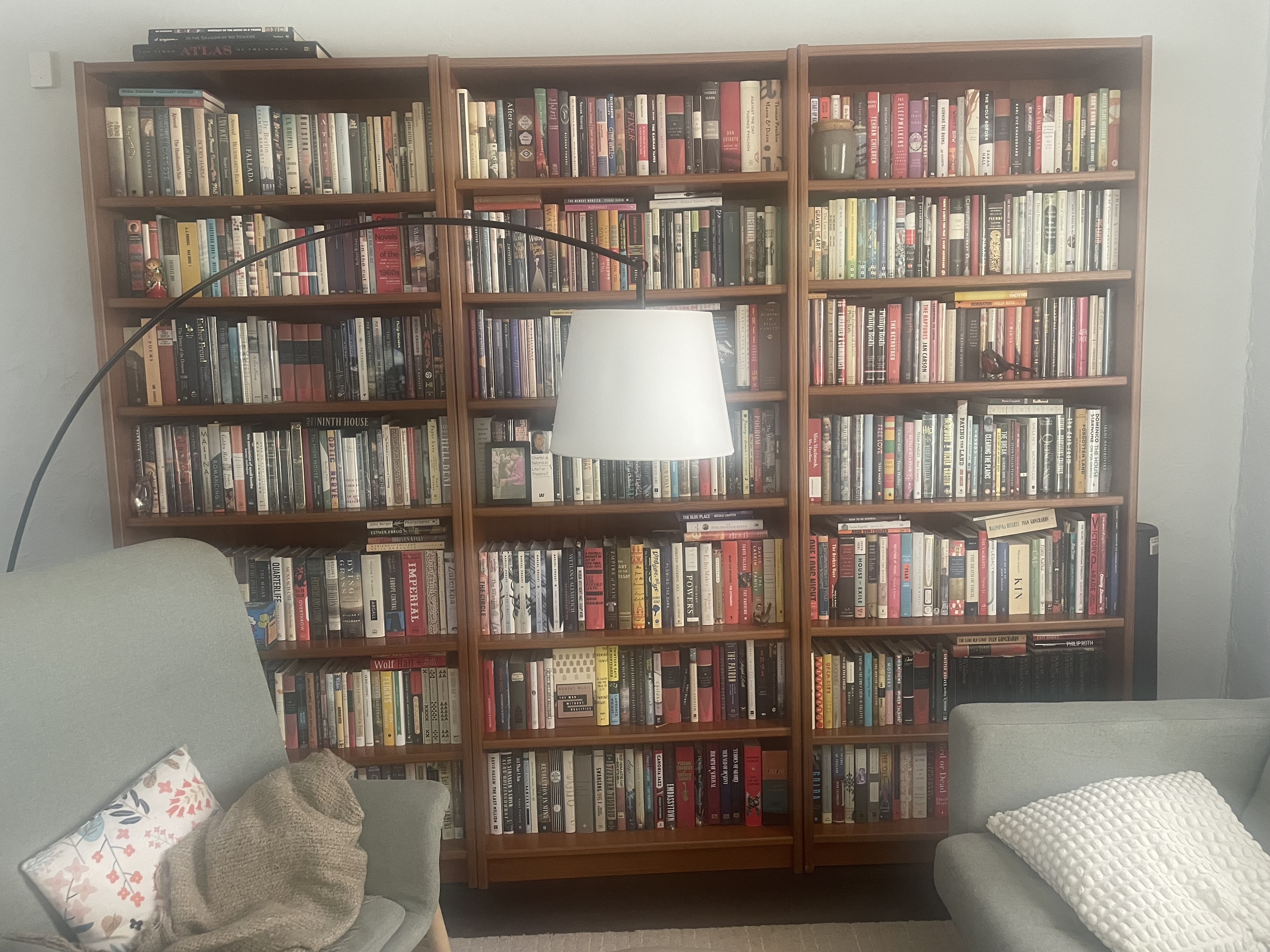


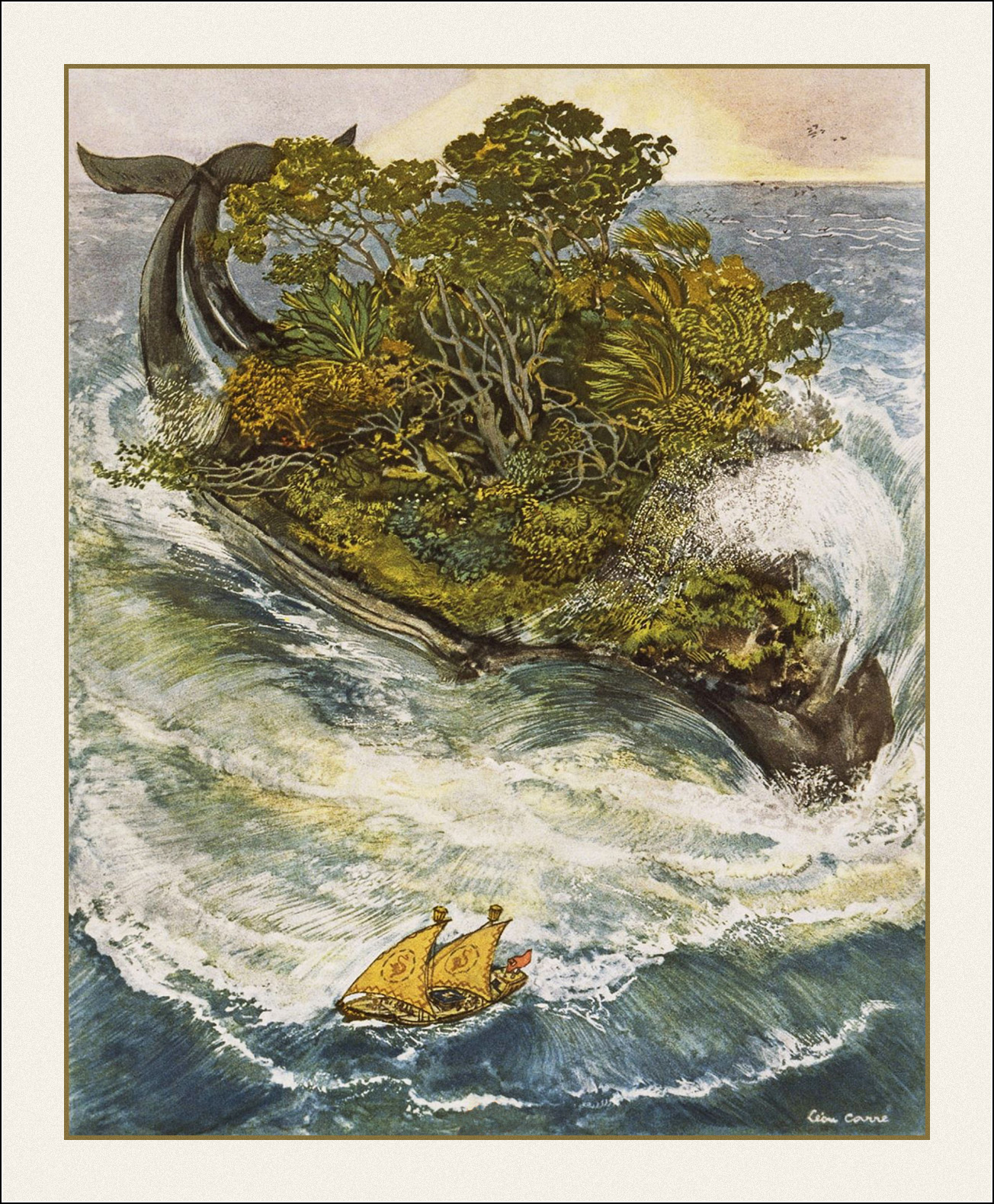


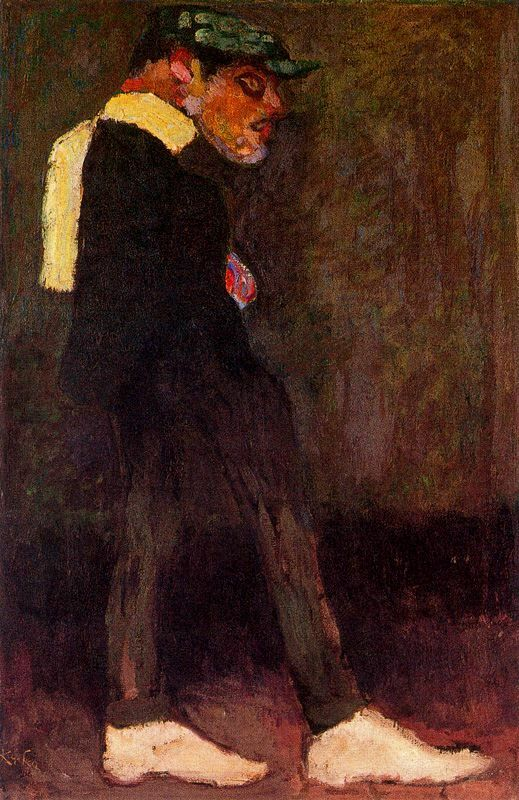


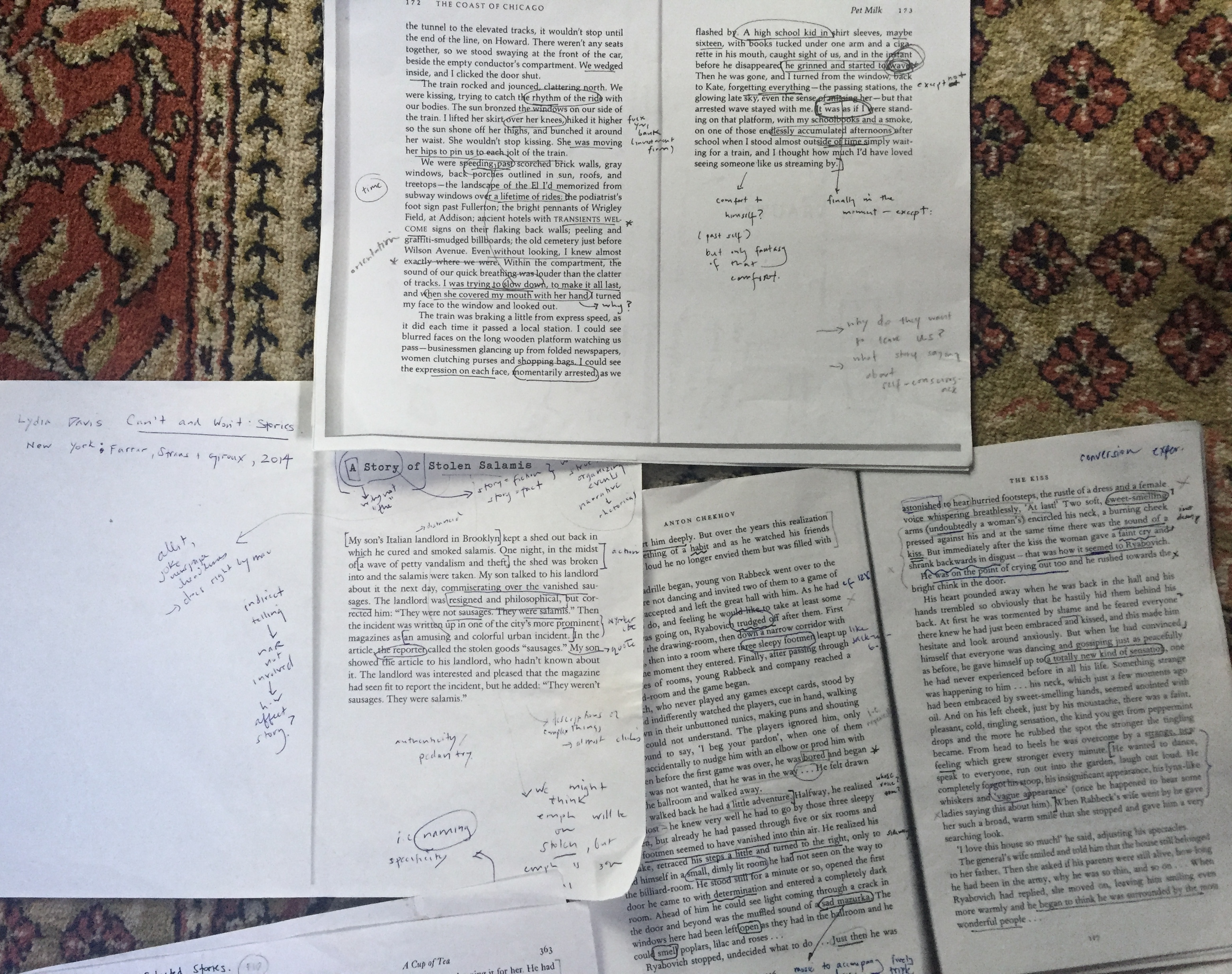
 Eiger, Mönch & Jungfrau