What I Read, December 2023

A great semester in the classroom; an even more irritating than usual semester for committee work. I am lucky to have a long winter break. Over the last years I’ve found that I either thrive in these short, dark weeks or succumb to bad anxiety. Happily, this was one of the good years. El Niño means colder weather in Arkansas, which makes me happy, not least because it’s so good for running. And for sitting on the couch reading.

Laurits Andersen Ring, Foggy Winter Day. To the Left a Yellow House. Deep Snow., 1910

Toni Morrison, A Mercy (2008)

An extraordinary book, maybe my favourite of the five or so by Morrison I’ve read. (Beloved is titanic, of course, but it’s been so long since I’ve read it that my memory of it has dimmed. Maybe I’ll redress that in 2024.) I chose A Mercy for One Bright Book; I thought we had a lot of interesting things to say. Fifteen years after its publication, the book only seems more pertinent to the task of understanding America. Which makes this review by Wyatt Mason, a critic I usually admire, feel badly dated.

Katherena Vermette, The Circle (2023)

Longtime readers will know of my love for Vermette. The Break is fast becoming canonical; I extolled its sequel, The Strangers, not long ago. And now we have a third volume featuring the same characters, with the addition of a few new ones, especially in the younger generation. My wife noted how much faster this book reads than the others. Partly that’s because of the knowledge we bring to the book (if you haven’t read Vermette yet, don’t start here): we’re mostly catching up, not getting to know. And partly it’s because of the short chapters that shift the point of view. But mostly, that sense of speed is a function of how much happens. Whereas The Break considered the repercussions of a single event (ripples from a stone sunk into a lake), and The Strangers thought about the pull of family (oceanic, seemingly inescapable, full of ebbs and flows), The Circle focuses on the pull to change, to get away, to break from the past (this book is a river, and one full of rapids at that.)

That compulsion sometimes—maybe even often—fails. But not always. Trauma never lets go, but change is possible. But always from collective bonds, not individual willpower. Yes, individuals make choices that affect their fate. But grit isn’t enough in the face of systemic inequalities and generations of abuse. Maybe that explains why Vermette has replaced the family trees of the earlier volumes with a diagram of overlapping circles, each with a character’s name. The closer the circles to each other, the closer the relationship. The bigger the circle, the more people that individual affects.

If Vermette decides she’s finished with these characters, she has ended her now-trilogy on a satisfying ambiguous, tentatively hopeful note. But I thought the endings of the previous volumes were just right, too. Who knows, maybe more is in store. I kind of feel like Vermette is as caught up by these characters as readers like me are.

Abdulrazek Gurnah, By the Sea (2001)

My third Gurnah: not a misfire yet. I’m a fan.

In his 60s, Omer Saleh leaves his world behind him and claims begrudgingly granted asylum in the UK. A harried lawyer assigned to his case tracks down the only person she can find who knows anything about Zanzibar, Saleh’s homeland. That man, now an academic who has himself made the journey to England, turns out to have known Saleh: he was a boy when the older man became entwined with his family, to complicated and in some ways ruinous ends.

Gurnah reminds me of Conrad not just because his novels also consider the relationship of England to parts of the world where people have “different complexion[s] and slightly flatter noses” but more so because they are similarly constructed through nested stories told at length in the quiet of evening between a teller and a silent audience. These stories concern all manner of things: the age-old trade routes between the Persian Gulf and the East African coast; the furniture business as practiced in a culture that prizes barter; the experience of African students during the Cold War in East Germany, where it turns out that not all communists were equal brothers; and the pain of incarceration at the whims of despotic regimes.

Of the latter, Saleh says:

I have taught myself not to speak of the years which followed, although I have forgotten little of them. The years were written in the language of the body, and it is not a language I can speak with words. Sometimes I see photographs of people in distress, and the image of their misery and pain echoes in my body and makes me ache with them. And the same image teaches me to suppress the memory of my oppression, because, after all, I am here and well while only God knows where some of them are.

The last line is the characteristic Gurnah touch: a passage that had been moving, even stately, if perhaps a little pat, turns more complex. We are so attuned to the suggestion that testimony is an unalloyed good, a force, even, for change, that we might be surprised to think of quiescence and repression as responses to past injustice and trauma.

By the Sea was longlisted for the Booker Prize. I’ve no beef with Peter Carey’s The True History of the Kelly Gang (haven’t read it), but it would have been nice to see Gurnah on the shortlist at least. No matter, he won another big prize and the novels are back in print and I still have five or six ahead of me, so it’s all good.

Roy Jacobsen, Eyes of the Rigel (2017) Trans. Don Bartlett and Don Shaw (2020)

Third in Jacobsen’s Barrøy series, which since the last part of the first has focused on Ingrid Barrøy, now the chatelaine of the Norwegian island that has given the family its name. Eyes of the Rigel follows hard on the events of its predecessor, The White Shadow, which I read in the spring but never wrote about. I like this summary from The Guardian:

The second installment, White Shadow, is set during the last year of the second world war: refugees from the northern province of Finnmark arrive, collaborators abuse their power, and Russian prisoner of war Alexander, having survived the sinking of the MS Rigel, lands on Barrøy. Ingrid falls in love with the young man and hides him from Nazis and collaborators until he is strong enough to embark on a trek to neutral Sweden. In Eyes of the Rigel Ingrid sets out across a postwar country in search of the father of her 10-month-old daughter. Ingrid’s only mementos of her lover are her daughter’s eyes, as black as Alexander’s, and a note in Russian, which a neighbour helps her decipher: it says, “I love you” nine times.

Ingrid’s epic quest—after hitching a boat ride up the coast, she makes the rest of the journey on foot with the world’s most saintly baby—is preposterous. Everyone she meets feels that way too. But with the determination and implacable work ethic that characterizes her family she follows a trail made fainter by the reluctance of many in the immediate postwar era to remember or cop to the events of the recent past.

Spoiler alert: her quest ends in frustration and heartbreak. She doesn’t find Alexander, and, maybe worse, she learns things about him she doesn’t want to. (In a brief passage, readers learn his tragic fate.) I wouldn’t say she’s happy to return home, but she does so with few regrets and no complaints. (Barrøyers don’t complain.) There’s that baby to raise, after all. And another fishing season to prepare for. And heaven knows what’s happened to the sheep over the summer.

I sensed Jacobsen enjoyed the wider canvas of this story (it’s not really any longer than the others, but it has much more narrative drive), but not as much as he enjoyed returning to the island in the final pages. That’s how I felt as a reader, anyway. As is characteristic of these books, we encounter much that is unhappy (a former Nazi concentration turned POW camp, for example). But much that is joyful, too, though always in a bittersweet way. I especially loved an idyll on a farm where Ingrid thinks about taking up with the owner, a member of the resistance, who had hidden Alexander for several months.

Ronán Hession thinks it’s the weakest of the series, but even though he wrote Leonard and Hungry Paul so definitely knows what’s what I can’t agree. Loved this one just as much as the others.

Roy Jacobsen, Just a Mother (2020) Trans. Don Bartlett and Don Shaw (2022)

I picked Jacobsen’s fourth Barrøy novel up the minute I finished the third. It feels as though the writer did the same: Ingrid’s story picks up where she left off, with her return home to the island. The novel covers the 1950s, and, as Tony puts it in his excellent post, it reworks some of the preoccupations and themes of The Unseen, the first book in the series. But Jacobsen isn’t treading the same ground. Yes, his characters continue to wrestle with the competing claims of isolation and community, but now they do so in the context of new technologies and ideologies. What happens when it’s not profitable to run the mail boat to the island? Would it be best to give up this almost laughably hand-to-mouth existence for life on the mainland? (Friends and family report on the pleasures and tribulations of life in centrally planned communities. It’s nice to have a machine to wash the linens, but of course you can only use it in your allocated hours.)

For Ingrid, Jacobsen’s main character, the matriarch of the island, the question of whether it will still be possible to live on Barrøy is practical, not abstract. Who will do all the work? Her great-aunt is aging. The girl she has brought up as her own daughter has grown up and moved away. The few menfolk who are left have bought a bigger boat so that their annual fishing expeditions take them away from the island longer than before. But new life arrives, in the form of a boy, the child of the skipper of the mail boat. The man asks Ingrid to watch his son while he goes on his weekly run, because his wife, the boy’s mother, has up and left. With foreboding in her heart, Ingrid accepts the charge; weeks pass, the skipper fails to return. Eventually his boat is found drifting aimlessly and unmanned. This trauma is met with resourcefulness and care, and the boy flourishes under the auspices of Ingrid and the other islanders, not least her daughter Kaja, the infant in the previous book, who is now five or six. The pair grow up as something more than siblings. Perhaps their relationship will be at the center of another book, should we be lucky enough to get one.

As always, Jacobsen pushes our emotional buttons, in the most satisfying way. One scene in particular hits like a blow. As Tony puts it, “One thing I can promise you is that anyone who has read the rest of the series will at some point feel the pain almost physically…”

Jim Thompson, A Hell of a Woman (1954)

Hadn’t read one of Thompson’s sordid, riveting noirs in a while. I’ll need to wait awhile before trying another, so dark was this one. Although it can’t top The Killer Inside Me (what can?), A Hell of a Woman also turns on the author’s masterly use of first-person narration. If you liked In a Lonely Place but found it a little decorous, this is the book for you.

Stephen Spotswood, Murder Crossed Her Mind (2023)

The latest Pentecost & Parker mystery ends on a dramatic note. (Cliffhanger alert!) Despite a solid enough mystery, the point of the book is to set up a longer narrative arc. I look forward to volume 5, and encourage you to read these books, but whatever you do, don’t start here.

Walter Kempowski, An Ordinary Youth (1971) Trans. Michael Lipkin (2023)

I once heard Parul Sehgal describe Svetlana Alexievich’s The Unwomanly Face of War as having “big first book energy,” which, she explained, is what happens when writers feel the need to stuff everything that matters to them into that first book, because who knows if there will ever be another. The result is undisciplined, maybe, but also exuberant and true.

I thought of Sehgal when reading An Ordinary Youth, the first book by Walter Kempowski, a phenomenon of (mostly West) German literature. (My friend Till Raether tells me he had something like a Warholian factory going to help him compose an epic series of collage texts, perhaps in the Dos Passos mode, I’m not sure, of German 20th century history; that’s in addition to his many novels.) The debut is patently autobiographical—its hero, Walter Kempowski, is nine years old when his family moves to a new apartment in the old Hanseatic port of Rostock in 1938. As the title suggests, he’s an ordinary kid who like movies and jazz music and this one girl in particular and school not so much. He gets used to bombing raids; he doesn’t mind that his father has been deployed (away from the front, luckily); he misses his older brother, Robert, who brought home all the good new records. As he becomes a teenager, Walter distinguishes himself mostly for being a bit of a badass: rowdy, impious, a petty troublemaker. He could seem to incarnate some of the worst attributes of his country at that time, but interestingly his natural nonconformity puts him at odds with the Party and all it stands for. He has little interest in the Hitler Youth, for example, ready to shirk its obligations as often as he can. (He forges a lot of sick notes.) But he’s no resister, no young version of that postwar chimera, “the good German.”

The genius of the book is the way it lets us read against Walter’s vision of the world, and indeed that of German society writ large. Here’s an example, which I chose by opening the book to one of the pages I’d dog-eared. The man Walter’s sister has married, a Dane, takes Walter’s side in an argument between the boy and his sister. Walter has said that in England people never open their windows and they drive on the left—something his friend has told him—which is all basically true and presented only as the mildest criticism. (An earlier conversation in which Walter’s mother has told her son-in-law to stop using English words feels much more freighted.) But Anna, Walter’s sister, takes offense at her younger sibling. Her husband, Sörenson, mildly objects. Germans, he says, forget that everyone should be able to express their own opinion:

And as an example of tolerance he mentioned modern music, the kind where the notes were all in a jumble, the kind we didn’t have any more in Germany. In Denmark, people did often laugh when they heard that kind of modern music, but they also clapped. He’d seen it happen many, many times.

We see conversation between adults presented through the view of the child protagonist, without judgment or comment or perhaps even full understanding of the stakes. But we learn more about the adults than the child here. For what kind of an example is this? Certainly not a full-throated defense of the art the Nazis deemed degenerate (those notes “all in a jumble”). His description of audiences laughing suggests his opinion is shared among his countrymen. But maybe laughing and clapping is the best kind of tolerance: amused, bemused, generous. Yet that last sentence, with its repeated, unnecessary, special pleading “many,” makes me question his attitude still further. Is he making it up? On every page, Kempowski plays tricks like this with tone.

An Ordinary Youth was a huge bestseller at the time. What were those first audiences responding to? It’s hard to imagine. Maybe it’s that Kempowski so straddles the line between nostalgia for and critique of the Nazi era that readers can take whatever they want from the book. My hunch is that many German readers responded to its depiction of the Volksgemeinschaft, that community “we” all shared and where we had some good old times, no matter what they want us to say now, a response that of course ignores the book’s challenge to that community, structured as it is around absences like the burned-out synagogue Walter passes on the way to school or that store old Herr so-and-so (I can’t find the reference) left behind when he disappeared. (It makes me wonder who lived in that new apartment before them.) The characters are basically uninterested in these absences—in this sense the novel accurately represents its time.

Kempowski’s debut has long been taken to be untranslatable. Its original title, Tadellöser & Wolff, refers to a Kempowski family saying, one of those weird family things, the kind of thing you repeat because everyone in the family says it and sometimes no one even knows why. In this case, Löser & Wolff is a cigar manufacturer (Aryanized by the regime in 1937, incidentally), a brand beloved of the father, who plays with the name. If something is tadellos it is perfect, without flaws, or blameless. (I’m reminded of an indelible moment in Vasily Grossman’s “The Hell of Treblinka” where he quotes an SS man who called the “grilling” system of the layering and burning of bodies in mass graves tadellos.) Walter takes up the phrase: on a visit to the country he trots it out to some country-bumpkin kids, blithely telling them that’s how everyone talks in the city.

The nonsensical phrase (which takes on a life of its own: Walter adapts other words so that they are also “löser & Wolff”ed) exists alongside dozens, even hundreds of lyrics interpolated into the text, almost all of them from popular songs or Lieder in the Schubert sense, and a few from poems. Translator Michael Lipkin has done something amazing in bringing the book into English. (I’m not sure I needed him to cite the source of every song lyric, though.) The publisher refers to this collage as the novel’s “echo chamber of voices,” without which Kempowski could not investigate the meaning of subjectivity in a mass popular society. I bet some smart folks have written about how An Ordinary Youth at once instantiates and challenges the very idea of the Bildungsroman.

Hats off to NYRB for making this translation happen. I hope more Kempowski is in their plans. (See below for more on the one they released first. They have a third title, which I have since read, too.)

Jenny Offill, Weather (2020)

Fragments from the life of an overeducated, underemployed New Yorker with the requisite terrific child and corresponding fears of climate change. A lot of it rang true—even the precious bits—but if I want to mourn the loss of the world as we know it in the company of a neurotic, bien pensant book lover, I’ll just have a little me time, you know?

Walter Kempowski, All for Nothing (2006) Trans. Anthea Bell (2015)

Some of my most memorable reading experiences have taken place in winter. Fallada’s Every Man Dies Alone, devoured over an unusually cold Arkansas Christmas just before our daughter was born. The never-to-be-matched-in-impact double-whammy of Absalom, Absalom and Barthes’s S/Z, in the snowiest Halifax January I can remember. And now, in another colder than average Arkansas winter (yes, it’s still climate change), Walter Kempowski’s magisterial late work, All for Nothing. Which is a bitterly cold book, in setting and to some extent tone. It’s late January 1945 in East Prussia and everyone knows the Russians are coming. But in a once-grand, now mostly shut-up manor house, life continues in a semblance of cultured normality. It’s like that scene with the French family in Indochina from the long cut of Apocalypse Now.

There’s the dreamy, beautiful woman of the house, who shuts herself in her quarters with tea and cigarettes and desultory reading, like a heroine from Turgenev; the absent husband, an officer in charge of requisitioning foodstuffs for the Reich, currently stationed in Italy; his aunt, who wishes she were still in the Silesia of her childhood but who keeps the place going and has no interest in taking down the portrait of Hitler in her room, despite suggestions from others that this might be wise; three Ostarbeiter, a Pole who tends the horses and does the heavy work, and two Ukrainian girls who cook and clean; and Peter, a mild, quiet, inquisitive boy whose regular illnesses keep him from Hitler Youth roughhousing, and who loves nothing more than examining bits of the world (a snowflake, a drop of blood, a crumb) under his new microscope, and who sometimes goes into the room that belonged to his younger sister, left as it was on the day she died of scarlet fever. Across from the manor is a working-class settlement built by the Party in the late 30s: its most officious inhabitant stares in grim resentment over at the manor house while he tends to his wife, lost in depression after their son was killed at the front.

To these wonderfully drawn characters come a series of visitors, all of them only too happy to share the warmth and food on offer in the manor house: a one-legged opportunist convinced that by buying up rare stamps on the cheap he is ensuring his future security; a young violinist, fanatically devoted to the Party; a Jew the woman of the house agrees to hide for an evening, seemingly for no other reason than her desire to have something happen.

The tone is quiet and anxious. How much can this episodic aimlessness last? (The question asked by characters and readers alike.) A convoy of refugees has been streaming west for days now. The carriage is packed, the horses fed and watered. But where are all those people going, this is their home, is there any need to leave now, just how close are those weapons booming now day and night? The family delays and then, abruptly, leaves. And the book becomes more eventful: the roving point of view centers on Peter, the tone becomes more muted, almost shell-shocked, a little naïve even as its events become extravagant and terrifying.

I kept waiting for the violence of the Red Army to erupt and overwhelm the characters. And, yes, this does happen. But so stealthily it’s hard to know how we got from the warmth of the manor house to overturned carts, dead animals, and bombed out refugees on the side of an icy road. Fascinatingly, the Soviets almost never appear in the book. (I was reminded of how seldom Germans factor in depictions of the camps, etc.) For me, All for Nothing is most brilliant in his suggestion that the apocalypse arrives gradually, almost banally.

I encourage you to read R. Nicht’s brilliant take on the book. (Just one clarification: although Kempowski often returns in his writing to the history of East Prussian, he did not grow up there (he was born in Hamburg and grew up in Rostock); All for Nothing is not strictly speaking autobiographical.)

The consensus seems to be that All for Nothing is Kempowski’s greatest work. (He wrote a ton, though, hardly any of it yet in English, so who knows.) Anthea Bell’s translation is gorgeous, somber and elegiac; I wonder how much of that is Kempowski’s “late style” and how much is Bell’s predilection. (I’m thinking of the way some of Sebald is more melancholy in English than in German.) It’s true though that the quotes in this book come mostly from Goethe and Schiller, unlike the pop music of An Ordinary Youth. It feels wise and resonant the way the classics do at their best. I once heard Edwin Frank, NYRB’s publisher, say he always read the last line of a novel first. (Insane!) I bet he nodded in satisfaction when he paged to the end of this book.

Tremendous stuff.

Margot Douaihy, Scorched Grace (2023)

Before Sister Holiday ran away to New Orleans and became a nun she played in an all-girl punk band, carried on a torrid, doomed affair with her married best friend (and bandmate), and made a bunch of other bad decisions. Now she’s teaching music to mostly disaffected kids in the Catholic school attached to her convent, covering her ink with gloves and a scarf, sparring with a sister who can’t stand her, and taking succor from the Mother Superior, the only woman in the country who would accept her when she came calling. But when a maintenance worker dies in a suspicious fire that also injures two of the students—and other fires follow thick on the first—Sister Holliday turns detective, (implausibly) tagging along with a painkiller-addicted fire investigator. Can you believe it—she solves the crime!!!

I heard about Scorched Grace from several UK readers, and I can see why the novel, heavy on atmospherics, might be popular with non-Americans. (As far as I can tell, the author isn’t from NOLA; to me it feels like she tries too hard to set the scene just so.) Just wait until it’s translated into German. They’re gonna eat this shit up. The subtitle (“A Sister Holiday Mystery”) implies Douaihy has plans for a series. More power to her, but I think this would have been better as a standalone.

Willem de Kooning, Door to the River, 1960

A find end to my reading year. Morrison, Vermette, Jacobsen, and, above all, Kempowski. See anything here to strike your fancy?


What I Read, September 2023

Don’t ask me what happened in September, it was a long time ago. I’m amazed I’m even writing this post.

Alex Katz, Lake Light (1992)

Dwyer Murphy, The Stolen Coast (2023)

I liked Murphy’s debut, An Honest Living. But I liked the follow-up even more. So much so that I’d have to call this my most enjoyable reading experience of the year. Murphy seems to know stuff: how to use the law to do things that aren’t really kosher, how to order in a dive bar, how to post in a pickup game. Jack, our narrator, has a pedigreed law degree, but he lives in his hometown, an appealingly ramshackle Massachusetts coastal town that is for sure not the Cape. He works with his father in the family business: helping people shed their identities and giving them new ones so they can start over. People on the run from criminal outfits, companies they’ve stolen intellectual property from, pasts that got too hot. I loved this premise and wanted even more of it.

Here’s Jack reflecting on how you can’t start totally from scratch in creating a new identity—everyone’s been damaged and that’s important:

You want to preserve a little trace of that damage. From parents, boyfriends, husbands, estranged siblings, jilted nobodies, pissed-off bosses who put a credit check on you ten years back for no good reason except you were leaving with two weeks’ notice. A past is a string of resentments and grievances. Grudges that never amounted to anything but were felt for a time. I paid a kid in Iceland to handle the digital traces. It might have been a pack of kids for all I knew. Healthy wind-kissed boys in front of computers, Viking aggression moving through their blood and no lands left to pillage, but they wanted money to walk around with and this was the work they had chosen.

That old-fashioned reference to “walking around money” turns those wind-kissed boys into something from the Rat Pack. Love it.

The quote gives you get a sense of Jack’s voice (Murphy keeps on like he started, he’s gonna be our next Portis.) And he’s not the only great character, either. Jack’s father is a delight, a man who knows how to eat, and chat up the ladies, and perform spycraft: he may be suffering from an incurable illness, though, and maybe things are going to change in Jack’s life.

When an old flame/best friend/absolute pistol, herself a lawyer working at the edge of the law, comes home for the summer, things definitely change. Jack gets involved in an elaborate heist, the machinations of which are pure pleasure. Speaking of pleasure, the main appeal of the book is Dwyer’s prose, which snaps with epigrams (“sincerity unmans me”) and jokes that don’t try too hard:

I went inside for a while and sat at the bar. It was a long block of wood nailed into legs and looked like something you might build in your basement and then forget about for several years.

I read this book over Labour Day weekend and that was a nice thing I did for myself.

Yiyun Li, The Book of Goose (2022)

After getting along with Li’s first novel, I turned to her most recent. I disliked it! Rohan’s take mirrors mine. I really didn’t understand why this novel had to be set in France. On the one hand, Frenchness seems to matter to it a lot. On the other hand, not at all. Feels like Emperor’s New Clothes to me.

Christine Mangan, The Continental Affair (2023)

If “atmospheric” as a term of literary praise means “set in European locales, especially those off the beaten track,” then this is a highly atmospheric novel.

In other words, we get Paris, yes, but we get more of Belgrade. Still more unexpected are Grenada and the peripherally European spaces of Istanbul and Algiers. But Mangan’s latest is more Hitchcock than Bourne. The best literary comp might be Highsmith.

A woman enters a train compartment otherwise occupied only by a ruggedly handsome man. They exchange pleasantries, watch the countryside of 1960s Europe flash by from the windows of the dining car, and warily seek to move past each other’s defenses. Part meet cute, part slow burn. But they’re acting. They know each other already. In fact, the man has been following the woman across the continent, tasked with retrieving some stolen money—something he could have done ten times over already, but can’t find it in him to do.

Brainy thrillers with nice locales are catnip to me, even though Mangan freights her characters a little heavily: they share a dramatic past neither can let go of. But she nails the ending, and even if The Continental Affair is a mere diversion—the title is so generic it’s like a parody—it’s adeptly done. Can’t wait for Cate Blanchett to star in the inevitable adaptation. Get this for the dad in your life who fancies himself a man of taste: he won’t be able to resist.

Simon Jimenez, The Vanished Birds (2020)

I can’t remember who put me on to this remarkable space opera. Adam Roberts? (Google search drew a blank.) I do remember where I bought it: a little shop in Missoula a couple of years ago. (Not the Shakespeare one. The other one.) I don’t remember what made me take it off the shelf. (I went back and forth between the audio and the paper book. Good narrator.)

I can say that The Vanished Birds will be on my end of year list. It’s that moving, that smart, that surprising.

It’s a long, complicated book. (Though not a patch on his most recent, The Spear Cuts Through Water, which I had to give up listening to, it was just too hard for my commute, but that book too astonishes right from its kickass dedication, “This one’s for me.”) My summary won’t do it justice. But here goes. In a galaxy owned by a single company, a spaceship arrives every five years on a small “resource planet” to take the accumulated harvest to the galaxy’s central planet. At the festival celebrating the ship’s arrival, the captain, Nia, hooks up with a local. They meet each time she returns, but the thing is that, thanks to time manipulation technology, what’s five years to him is only 15 months to her. She barely changes while he leaps forward in age.

But this poignant story is only the beginning of Jimenez’s tale. One year, in between spaceship arrivals, an unknown ship crashes into the fields. The man who loves Nia takes in the only survivor, a mute young boy, before passing him on to her on her next visit (the last one the now elderly man will live to see). Nia names the boy Ahro. It takes years before he speaks, but his musical abilities suggest there’s something special about him. That quality is recognized by Fumiko Nakajima, the lead designer/engineer/physicist of the company that runs the galaxy. Thanks to cryogenic technology, Fumiko is thousands of years old; Jimenez diverts us to her story, which begins on a near-future earth that she escapes just before it collapses due to climate change, but not without leaving behind her lover, a woman determined to see the place through to its end. Fumiko suspects that Ahro has a talent that could undo her past mistakes—but she knows the company that owns everything, even her, would subject him to vivisectionist experiments if it knew what the boy is capable of. She hires Nia on a mission to keep the boy, now a young man, on the fringes of the galaxy, away from company patrols. In the process, Nia becomes his parent. When Ahro is captured despite her efforts, only she can save him…

That’s a lot, right? The Vanished Birds is a novel of found family, colonialism, ecological change, time the revelator. Big stuff. It’s bold and beautiful (the prose is a cut above) and too carefully constructed to be called sprawling. I think about it a lot, several months after having read it, not least the section set on a planet that has bought by the company and stripped of its people, populated now by dozens of feral dogs and one last man, left behind to man the radio tower. I shed a tear at the end, I tell ya.

Garth Greenwell, Cleanness (2020)

I first read Cleanness in March—I never wrote up that month, and I probably never will. I’m glad of the chance to say something here, because I love this book. I already thought it was great the first time, but having had the chance to teach it, I’m convinced it’s brilliant. Like “we will read this in a hundred years” brilliant.

A companion piece to his wonderful debut, What Belongs to You, Cleanness is also narrated by an American teaching in Bulgaria. But the new novel is richer, its power coming from the montage of its seemingly disparate, almost stand-alone sections. To my mind, it is also better in that its references to the narrator’s childhood are cut to the bone. The handful of references hit that much harder than the extended section in the previous book.

I read Cleanness as a novel about different ways bodies can come together. Readers are most often drawn to the scenes of anonymous BDSM sex, but several chapters feature the narrator’s more placid relationship with another foreigner, a student from the Azores. Others describe a writing retreat, two describe encounters with current and former students in which the narrator wrestles with what it means to be a gay role model in a country where LGBTQ life is harshly penalized. A particularly fascinating chapter describes a series of spontaneous street protests that convulse Sofia, and the narrator’s admiration and fear of the unpredictable power of masses of bodies in public space. Even when we try to reduce ourselves to pure flesh, Greenwell implies, we can’t escape identity. But identity isn’t fixed; the roles we’ve been given are just that, roles. They can change, we can push against them even when their forms are ossified and seemingly inescapable. (That’s what politics is for.) This idea comes across most clearly in a chapter called “The Little Saint,” whose titular character, a bottom who lets men bareback him, gently explains to the narrator that the violence he begs the narrator to unleash upon him, which brings the narrator to tears, since the sounds of the whipping he lays on the young man seem to have turned him into a version of his father, who was never shy with his belt, the violence that is demanded by one person of another, can never be the same as violence enacted in hate or rage.

The book ends with a beautiful scene involving an elderly dog who wanders the campus of the international school where the narrator teaches. The narrator, drunk and alone, having narrowly avoided making a mess of some important things, takes the dog into his rooms even though it’s strictly forbidden to bring her inside because she’s meant to have fleas. He makes up a bed for her and then lies down next to her. An indelible scene. Here I take Greenwell to be saying that we can’t take the cleanness granted by the Little Saint and wished for by the protestors who want to sweep a corrupt government out of power too seriously. Cleanness but not too much: it’s good to lie down with beings, human or not, that others think of as dirty.

Seriously, this book is something else. Greenwell has such intelligence and such beautiful prose. Thrilling.

Sadly, most of my students did not feel the same way, though some of them were big enough to admit that they were kink shaming. No matter, Imma teach it again!

Georges Simenon, Cécile is Dead (1942) Trans. Anthea Bell (2015)

Day after day Cécile Pardon waits for Maigret at police headquarters, unwilling to see anyone but the great man, and when she does she has nothing more definitive to report than a suspicion that someone has been in the apartment she shares with an elderly aunt. When he sees her in the waiting room (the lads call it “the aquarium”) on a day when he’s just not feeling it, he slips out the back. She’s gone when he gets back to the office. But then the aunt is reported dead, and Cécile is nowhere to be found. (You can guess the rest; the title is not a metaphor.) Plottier than the average Maigret, this early-ish installment is further enlivened by the presence of an American detective who comes to see how the big man does his thing. (Simenon liked this idea: there’s one where someone from Scotland Yard does the same thing.)

The investigation centers on the apartment building where Cécile lived with her aunt. You could read Cécile is Dead, with its depiction of the space and the people who inhabit it, as a slantwise homage to Zola’s Pot Luck.

Annie Ernaux, Happening (2000) Trans. Tanya Leslie (2001)

Having taught Happening this semester in a class called Bodies in Trouble, I was interested to go back and read what I had to say about it three years ago. I see that I was damning with faint praise already then; spending a lot more time with the book didn’t make me care for it more. As for my students, they seemed to like it well enough. Understandably they couldn’t help but read it in terms of their post Dobbs American life; more surprisingly, they were mostly worked up by what they perceived as Ernaux’s class striving: they saw her as both a victim of and complicit in the denigration of working class lives. Their end of semester feedback revealed that they could take it or leave it as a course text. Good to hear, since I’d already decided not to repeat the experiment. I get that Ernaux is doing a thing; I just don’t care much for the thing. And her prose, as shaped by her various no doubt able translators (here Tanya Leslie), does not lend itself to the kind of close reading that is my pedagogical bread-and-butter. Whatever, Ernaux will get along just fine without my reservations.

Joseph Hansen, Troublemaker (1975)

I thought I wrote about the first novel in the Dave Brandstetter series, Fade Out, when I read it a couple of years ago but now I can’t find it in the perhaps-not-reliable index of this blog. In this, the third book (they’re all being reissued but the store didn’t have the second one in stock), the owner of a local gay bar is found naked and dead. A local hustler is found next to him. An open and shut case. Not to insurance agent Brandstetter. Surprise, surprise, he’s right, and soon he’s neck-deep in a twisty plot that once again makes the 70s seem both shitty and terrific.

These books are great above and beyond any talk of “pioneering representation” (tho that matters), it’s great that they’re back in print, it sucks that my local library does not have them.

David Brintzenhofe Applying Makeup (II) (1982)

There you have it, friends. Have at me, Ernaux lovers, The Book of Goose partisans, and anyone who thinks all the books I liked are overrated…

What I Read, October 2023

It might have been in the first week of October, after another spirited conversation in my Holocaust Literature class, that I had to marvel at how far along we were in the semester for the students to still be bringing it like that every day. A special group. Good thing the classroom was giving me joy, because not much else was. The horrific terrorist attack by Hamas, the nightmarish Israeli response. Nothing but suffering, rage, self-righteousness, and apologetics. I found myself alienated from many of my communities. And then embroiled in a frustrating situation on campus (triggered by events in the Middle East but ultimately having nothing to do with it). Given all the bullshit it’s a wonder I got anything read at all.

Tom Thompson, Silver Birches (1915 – 16)

Paulette Jiles, Chenneville (2023)

John Chenneville—scion of old French family whose estate, Temps Clair, lies north of St Louis in the fertile lands where the Missouri meets the Mississippi—returns from the Civil War after having spent nearly a year in hospital recovering from a terrible head wound. He finds his home in disarray: fields unplanted, animals untended, rooms empty. The only remaining servant gravely explains that Chenneville’s sister has been murdered along with her husband and their infant child at their home downriver at St Genevieve. From that moment, Chenneville devotes his life to avenging this loss (the subtitle states the case plainly: “A Novel of Murder, Loss, and Vengeance”).

The hero visits the scene of the crime (the bloodlands of the Missouri Ozarks that formed the setting of her novel Enemy Women), quickly learns who did it, and then chases the man, a sociopathic former sheriff named Dodd, across Arkansas, the Indian Territory, and into Texas. I know a lot of these landscapes, which was part of the book’s appeal for me, but I think Jiles’s descriptions are objectively lovely: evocative but spare. Nothing fancy, but clear as the sky on a frosty morning. Here’s Chenneville making camp after almost 24 hours on the go: 

The wind was becoming sharp and hard; it bit at his lips and ears, his hands. It was bringing rain. To the south of the road he saw a motte of post oaks, great thick-trunked trees, and what looked like a declination of the earth toward a streambed. On that side he could build a fire and the smoke would blow away south and not alert any traveler coming down the road. 

Remembering the advice of a sergeant, an older Mainer, he strips himself almost naked, putting the clothes under the blankets to keep them warm. Then come this lovely reflection: 

For a few moments he felt again that suspended, almost magical feeling of being out in the wilderness and the weather and yet safe against it. Here was rest and a respite against bereavement because the world was going on without him in its deep rhythms, deeper than he could see. 

I love this kind of thing. Chenneville has it all: a love story, a key subplot involving telegraphy, and a satisfyingly minor-key ending. (A final flurry of events, almost comically bathetic, renders vengeance unnecessary, and you can almost hear the protagonist sigh in relief.) The physical book is gorgeous, too, especially the stately maps on its endpapers. I almost regretted having checked it out of the library.

Wisława Szymborska, Map: Collected and Last Poems Trans. Claire Cavanaugh & Stanislaw Barańczak (2015)

So pleased I chose this as a selection for One Bright Book. I need to be encouraged to read poetry (too enslaved to the demon narrative); being accountable to Frances and Rebecca ensured I made my way through this collection of the Polish writer and Nobel laureate Wisława Syzmborska. To think what I would have missed out on otherwise!

Here’s some of what I said in my introduction to the episode:

Szymborska’s first poems were in the accepted socialist realist style; she later repudiated most of them, just as she rejected the doctrinaire communism she had espoused when younger. (From the 1960s on she was part of the Polish dissident movement.) Repudiation more generally was central to her artistic process: her published work runs only to about 350 poems. Asked about this, she said “It’s because I have a trash can.”

That dry, self-deprecating response seems typical of Szymborska’s personality—and indeed her poetry. A Polish friend tells me that her letters “fizz with joie de vivre” and I can see that quality in the poems too, even though they are often plenty melancholy. Despite that sadness, her poems are often funny, which makes me wonder what it’s like to read her work in Polish, since slyness or jokiness can be so hard to translate.

It’s said that the writer Czeslaw Miloz, himself a Nobel laureate (1980), was anxious when Szymborska won the prize, fearing she would experience it as a terrible burden, given her shy and retiring nature. Indeed, she didn’t publish any poetry for several years after the award. To me her later work is as strong as her middle period, so I certainly didn’t feel any loss in quality after the Nobel; I’m curious if you both agree.

Whether she felt the burden or not, I can’t say, but I can say that Szymborska’s Nobel Prize address is terrific: modest, humourous, but also totally on point. She writes, among other things, about how poets, like all people fortunate enough to do work they care about, are propelled by the phrase “I don’t know.” She adds, “I sometimes dream of situations that can’t possibly come true.” That made me laugh because she’s always doing that in her poems. Some of them even start with the word “if: if angels exist, would they care about human culture (she concludes they would only like early Hollywood slapstick). Some of them see the remarkable in ordinary situations, as in these lines:

A miracle that’s lost on us:

the hand actually has fewer than six fingers

but still it’s got more than four.

Or how with “a few minor changes” her parents might have married other people and then where would she be?

Other poems consider scenarios we don’t usually dwell upon—one imagines a baby photo of Hitler (“And who’s this little fellow in his itty-bitty robe?”); another speculates how many in a hundred people do or feel one thing or another, in the process humanizing the field of statistics; a third poem, called “Cat in an Empty Apartment,” concerns a cat whose owner has died. (Apparently, she told her partner, the writer Kornel Filipowicz, that “no living being has as good a life as the life your cat lives”—I suspect she wrote the poem in the aftermath of Filipowicz’s death in 1990. Heartbreaking lines: “someone was always, always here,/then suddenly disappeared/and stubbornly stays disappeared.”) The phrase “I don’t know” matters so much because it propels us to think and do more—specifically, to ask more questions. Szymborska adds, “any knowledge that doesn’t lead to new questions quickly dies out: it fails to maintain the temperature required for sustaining life.”

This phrasing too seems quintessential Szymborska. She was fascinated by life in its literal, biological sense: she writes about the specks of dust that make up meteors, about foraminifera, which, it turns out, are microscopic single celled organisms that build shells around themselves from the minerals in sea water, and about what she calls “our one-sided acquaintance” with plants: we think we know about them: our monologue with them is essential for us but never reciprocated; they don’t care about us.

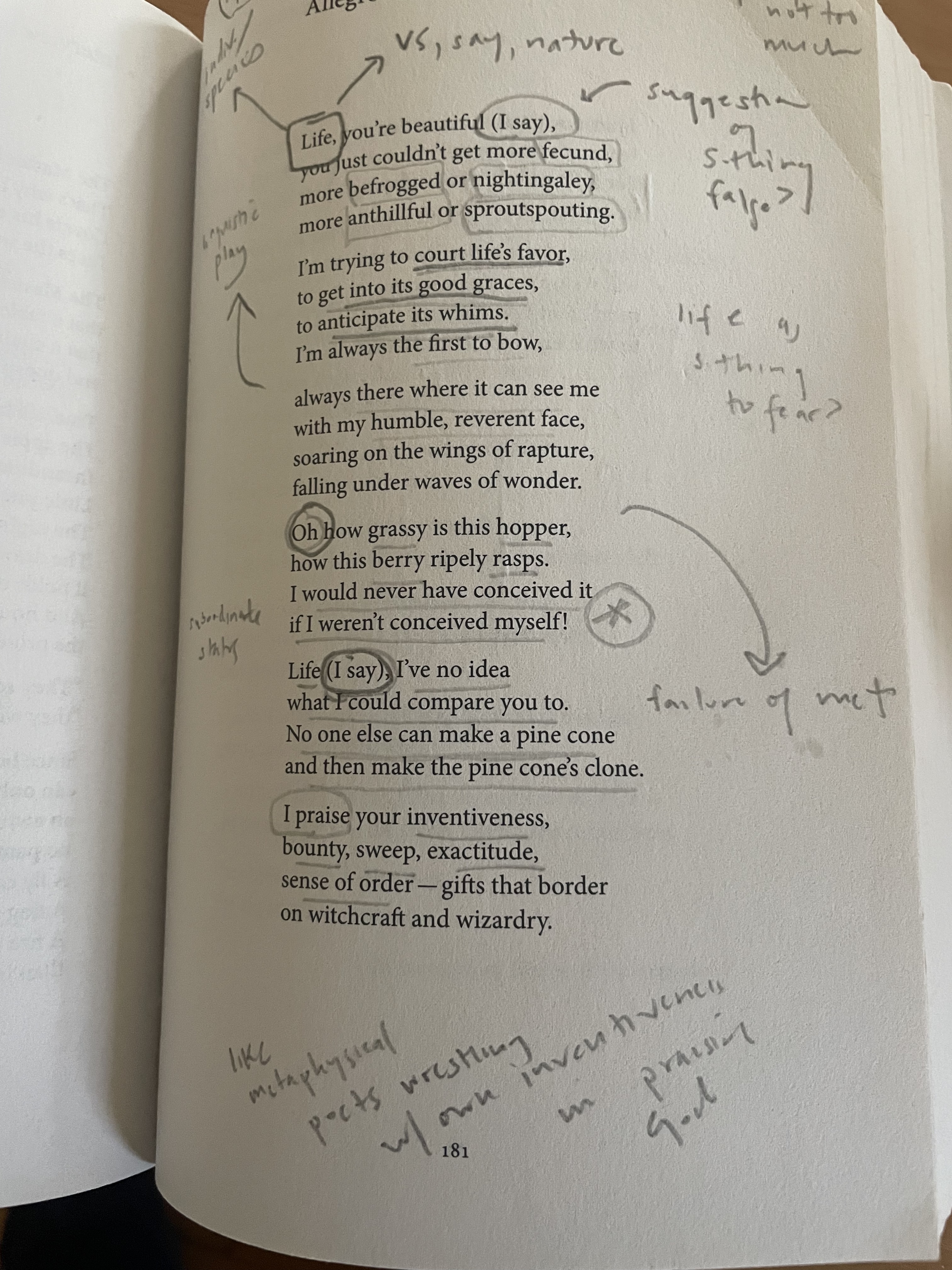
We each chose a poem to close read. Here are some of my notes on my choice, “Allegro ma Non Troppo” (1972).

Anyway, listen to our conversation here. Our best, IMO.

Allison Montclair, The Right Sort of Man (2019

Kay recommended this to me, and I can’t improve on her review, which chimes perfectly with my experience of the book. In brief: two women, Iris Sparks and Gwendolyn Bainbridge, set up a marriage agency in London in the immediate aftermath of WWII. They know each other only slightly, it turns out, and as Kay notes, Montclair uses the opposites-attract and slow-burn tropes of romance fiction to explore their growing friendship and business partnership. The book begins with the eventual victim arriving at their office in search of a husband. Next thing you know, the woman turns up dead and suspicion falls on the client Sparks and Bainbridge have set her up with. (It doesn’t help that the murder weapon is found under his mattress.) The women set out to prove his innocence—and save their suddenly cratering business. The actual mystery is a little slight; I bet Montclair gets better at suspense as the series goes on. (I plan to find out.) Besides, as Kay also explains, the real interest here lies in the book’s melding of crime and romance. In addition to the leads, Montclair fills her book with strong minor characters: a heavy who just wants to be a playwright, a mobster who falls for Sparks, and a working-class guy who upper-crust Bainbridge meets while undercover. Part of me really wants these guys to come back, but part of me worries the series might fall risk to the whole “it takes 300 pages just to keep up with the antics of the growing cast of recurring characters” problem. 

Prime light reading.

Giorgio Bassani, The Heron (1968) Trans. William Weaver (1970

Dour novel of postwar Italian life, centering on Edgardo Limentani, a Jewish landowner who, having married out of the tradition, finds himself alienated by a political landscape comprised of communists that threaten his privileges and old fascists that respond to his continued existence with servility that fails to conceal their hatred of his continued existence.

On a damp day in late fall, Limentani goes hunting for waterfowl in the Po marshes. He dithers about going at all, finds himself waylaid, arriving too late for any good shooting, even, in the final account, unable to shoot at all, leaving it to his guide to bring down a trunkful of birds, which he later passes off as his own. On the way back he stops for coffees in a bar where he wrestles with whether to call the cousin he’s been estranged from for years, eats a meal in the restaurant of a hotel owned by one of those unctuous fascists, sleeps heavily and unsoundly in one of the upstairs rooms, and puts off returning home until his wife, whom he can no longer stand, will be sure to have gone to bed. From the time he starts awake in the pre-dawn dark until the time he returns to the study he uses as a makeshift bedroom, the protagonist thinks dark thoughts that give him no satisfaction. He sees no good way out of this life.

Having only read The Garden of the Finzi-Continis—a sad book, yes, but not a despairing one—I was shocked by this novel’s grimness. I’ve no idea about Bassani’s state of mind at this stage in his life, but The Heron (the title refers to a bird shot along with the ducks, no good for eating, pure waste) reads like the book of an unhappy and discouraged man. Maybe Weaver’s translation, getting on now in years, contributes to the novel’s heaviness. There’s a newish translation: anyone read it?

Billy-Ray Belcourt, A Minor Chorus (2022) 

Score one for the “don’t give up on a book too soon” camp: I almost ditched poet and essayist Belcourt’s first novel after about twenty pages, annoyed at the clunky dialogue and risible self-righteousness (similar vibes to a book I really hated), but once the narrator leaves his graduate program in Edmonton and returns to his home community in way northern Alberta I started picking up what Belcourt was putting down. The narrator (an obvious stand-in for the writer) mines his community for stories to weave into the novel he’s writing: we hear from an older gay man, who unlike the narrator has chosen (or been made to choose) to stay closeted and both admires and disparages the narrator’s different decisions; an old friend who has disentangled herself from an abusive relationship; and his great-aunt, who worries over the fate of the boy she raised as her own, the narrator’s cousin, two boys who were once inseparable, but whose paths diverged (the cousin is in jail).  In other words, when the narrator stops wringing his hands over whether his academic work can be meaningful in a world where so much injustice needs to be redressed and starts telling the stories of others as his way of doing that work, the book becomes moving and interesting.

I loved Belcourt’s descriptions of my home province, even though the part he’s from is about as far away from mine as Little Rock is from St Louis). This bit hit home:

The farther one veered from Main Street, a single stretch of highway on which sat most of the town’s businesses, schools, and amenities, the older the infrastructure became. Behind the dilapidated building ran train tracks that were less like sutures and more like wounds. It all looked so ordinary and Canadian and, because of this, haunted.

That passage gets better—more pointed—as it goes along. The workmanlike first sentence, as unvarnished as the buildings it references, gives way to a metaphor that asks us to return to the seemingly bland and official term at the end of the previous one. Who is the infrastructure that makes this place possible—improbable that people could live anywhere, but especially so in that northern clime—for? The things that link some people might separate others. (Who lives on the other side of the tracks?) The things that give some people meaning might just hurt others. Everything here leads to that last sentence: the ordinariness that many Canadians take pride in (unspectacular, solid, self-avowedly decent) is built on a foundation of dispossession and expropriation. And what of those who don’t see themselves in the mirror of that self-description? Those who are showy, marginalized, far from the main drag, maybe queer or nonbinary or indigenous. Is their only role to haunt Main Street?

James Morrison, Gibbons or One Bloody Thing After Another (2023)

I’m always nervous reading books by friends, but here I needn’t have feared: the debut novel by James “Caustic Cover Critic” Morrison is smart and engaging. It tracks the history of the Gibbons family from the late 1800s to an apocalyptic near-future in a series of chapters that work as stand-alone stories but gain in heft when the lines of familial affiliation come through.

Along the way, Gibbons serves as an alternative history of Australia in the modern era, referencing institutions and events ranging from the Native Police Force to the Snapshots from Home program to the devastating 1974 cyclone that nearly destroyed Darwin. I say “alternative” not because these things are made up but because the novel demands that we consider fabulation and creation necessary to any attempt to document the past. The first line, “A shelf of eyes, polished and unblinking,” alludes to the ability to see and record, even as it undermines these faculties: these eyes are fake, made of glass. Throughout the novel. James values the power of artificiality: not only are the pages filled with photographers and pulp writers and pornographers, but the chapters are separated by his own charming illustrations (and one by his daughter!).

It’s a good book, is what I’m saying. Shawn Mooney and I interviewed James to launch the book.

Holly Watt, To the Lions (2019) 

The title of this engaging debut crime novel refers to the place journalists are willing to send anyone who comes in the path of a good story—and to the place they themselves are thrown when they go undercover. Cassie and her friend Miranda cover a specialized beat: the nexus of moral impropriety, tech bro/financial CEO untouchability, and third world suffering. Which makes a rumour that falls into their laps irresistible: somewhere someone is taking rich men to hunt people. Where? Like everything in the story, the location is obscure. A preserve, maybe. A prison. Or, as turns out to be the case, refugee camp. Through investigative reporting that Watt, a journalist herself, depicts plausibly and compellingly, the pair learn that the shadowy operation, though based in London, centers on a camp in lawless Libya, not too far across the border from a remote part of Algeria, where a private jet drops off the financiers, titled sons, and adventurers willing to pay a hell of a lot of money to do something whose repulsiveness makes them feel alive. To get the full story, though, the women need to catch someone in the act. A complicated undercover operation ensues, filled with menace (I’ve rarely been so scared for a character.) Watt plays with readers’ fascination with the lurid, which sometimes makes the book preachy, but mostly it’s just exciting. Not quite the usual thing, then, though it’s hard for me to see how Watt sustains her premise through the other books of the series. Just how many stories of this ilk can Cassie uncover?

Mary McCarthy, Memories of a Catholic Girlhood (1957) 

Rebecca’s choice for One Bright Book; you can hear our conversation here. I was glad to have read this once-but-perhaps-no-longer-famous memoir, though I can’t say I loved it. I found it a desperately sad book about a family filled with people unable to communicate with each other. So many silences, so much heartache, so much harmful propriety. To my surprise, Rebecca and Frances found it funny and biting, a book filled with readerly pleasures. We didn’t convince each other, but I appreciated the chance to articulate my response. Many readers have admired the sections between chapters in which McCarthy explains what she later learned about the family stories she tells, pointing out inconsistences or outright falsehoods. Such self-awareness might have felt innovative at the time, but to me they didn’t add much. I think none of us expects memoir to be complete truth. Anyway, I will never forget the story of an uncle by marriage who sets out to show nine or ten-year-old McCarthy in the worst possible light, just so he and his wife could beat her black and blue with a hairbrush. Terrible, terrible stuff.

Gabriele Münter, Green House (1912)

A wide-ranging reading month, with plenty to appreciate. Only Map really stood out for me, though. Any takes on these selections?