What I Read, October 2023

It might have been in the first week of October, after another spirited conversation in my Holocaust Literature class, that I had to marvel at how far along we were in the semester for the students to still be bringing it like that every day. A special group. Good thing the classroom was giving me joy, because not much else was. The horrific terrorist attack by Hamas, the nightmarish Israeli response. Nothing but suffering, rage, self-righteousness, and apologetics. I found myself alienated from many of my communities. And then embroiled in a frustrating situation on campus (triggered by events in the Middle East but ultimately having nothing to do with it). Given all the bullshit it’s a wonder I got anything read at all.

Tom Thompson, Silver Birches (1915 – 16)

Paulette Jiles, Chenneville (2023)

John Chenneville—scion of old French family whose estate, Temps Clair, lies north of St Louis in the fertile lands where the Missouri meets the Mississippi—returns from the Civil War after having spent nearly a year in hospital recovering from a terrible head wound. He finds his home in disarray: fields unplanted, animals untended, rooms empty. The only remaining servant gravely explains that Chenneville’s sister has been murdered along with her husband and their infant child at their home downriver at St Genevieve. From that moment, Chenneville devotes his life to avenging this loss (the subtitle states the case plainly: “A Novel of Murder, Loss, and Vengeance”).

The hero visits the scene of the crime (the bloodlands of the Missouri Ozarks that formed the setting of her novel Enemy Women), quickly learns who did it, and then chases the man, a sociopathic former sheriff named Dodd, across Arkansas, the Indian Territory, and into Texas. I know a lot of these landscapes, which was part of the book’s appeal for me, but I think Jiles’s descriptions are objectively lovely: evocative but spare. Nothing fancy, but clear as the sky on a frosty morning. Here’s Chenneville making camp after almost 24 hours on the go: 

The wind was becoming sharp and hard; it bit at his lips and ears, his hands. It was bringing rain. To the south of the road he saw a motte of post oaks, great thick-trunked trees, and what looked like a declination of the earth toward a streambed. On that side he could build a fire and the smoke would blow away south and not alert any traveler coming down the road. 

Remembering the advice of a sergeant, an older Mainer, he strips himself almost naked, putting the clothes under the blankets to keep them warm. Then come this lovely reflection: 

For a few moments he felt again that suspended, almost magical feeling of being out in the wilderness and the weather and yet safe against it. Here was rest and a respite against bereavement because the world was going on without him in its deep rhythms, deeper than he could see. 

I love this kind of thing. Chenneville has it all: a love story, a key subplot involving telegraphy, and a satisfyingly minor-key ending. (A final flurry of events, almost comically bathetic, renders vengeance unnecessary, and you can almost hear the protagonist sigh in relief.) The physical book is gorgeous, too, especially the stately maps on its endpapers. I almost regretted having checked it out of the library.

Wisława Szymborska, Map: Collected and Last Poems Trans. Claire Cavanaugh & Stanislaw Barańczak (2015)

So pleased I chose this as a selection for One Bright Book. I need to be encouraged to read poetry (too enslaved to the demon narrative); being accountable to Frances and Rebecca ensured I made my way through this collection of the Polish writer and Nobel laureate Wisława Syzmborska. To think what I would have missed out on otherwise!

Here’s some of what I said in my introduction to the episode:

Szymborska’s first poems were in the accepted socialist realist style; she later repudiated most of them, just as she rejected the doctrinaire communism she had espoused when younger. (From the 1960s on she was part of the Polish dissident movement.) Repudiation more generally was central to her artistic process: her published work runs only to about 350 poems. Asked about this, she said “It’s because I have a trash can.”

That dry, self-deprecating response seems typical of Szymborska’s personality—and indeed her poetry. A Polish friend tells me that her letters “fizz with joie de vivre” and I can see that quality in the poems too, even though they are often plenty melancholy. Despite that sadness, her poems are often funny, which makes me wonder what it’s like to read her work in Polish, since slyness or jokiness can be so hard to translate.

It’s said that the writer Czeslaw Miloz, himself a Nobel laureate (1980), was anxious when Szymborska won the prize, fearing she would experience it as a terrible burden, given her shy and retiring nature. Indeed, she didn’t publish any poetry for several years after the award. To me her later work is as strong as her middle period, so I certainly didn’t feel any loss in quality after the Nobel; I’m curious if you both agree.

Whether she felt the burden or not, I can’t say, but I can say that Szymborska’s Nobel Prize address is terrific: modest, humourous, but also totally on point. She writes, among other things, about how poets, like all people fortunate enough to do work they care about, are propelled by the phrase “I don’t know.” She adds, “I sometimes dream of situations that can’t possibly come true.” That made me laugh because she’s always doing that in her poems. Some of them even start with the word “if: if angels exist, would they care about human culture (she concludes they would only like early Hollywood slapstick). Some of them see the remarkable in ordinary situations, as in these lines:

A miracle that’s lost on us:

the hand actually has fewer than six fingers

but still it’s got more than four.

Or how with “a few minor changes” her parents might have married other people and then where would she be?

Other poems consider scenarios we don’t usually dwell upon—one imagines a baby photo of Hitler (“And who’s this little fellow in his itty-bitty robe?”); another speculates how many in a hundred people do or feel one thing or another, in the process humanizing the field of statistics; a third poem, called “Cat in an Empty Apartment,” concerns a cat whose owner has died. (Apparently, she told her partner, the writer Kornel Filipowicz, that “no living being has as good a life as the life your cat lives”—I suspect she wrote the poem in the aftermath of Filipowicz’s death in 1990. Heartbreaking lines: “someone was always, always here,/then suddenly disappeared/and stubbornly stays disappeared.”) The phrase “I don’t know” matters so much because it propels us to think and do more—specifically, to ask more questions. Szymborska adds, “any knowledge that doesn’t lead to new questions quickly dies out: it fails to maintain the temperature required for sustaining life.”

This phrasing too seems quintessential Szymborska. She was fascinated by life in its literal, biological sense: she writes about the specks of dust that make up meteors, about foraminifera, which, it turns out, are microscopic single celled organisms that build shells around themselves from the minerals in sea water, and about what she calls “our one-sided acquaintance” with plants: we think we know about them: our monologue with them is essential for us but never reciprocated; they don’t care about us.

We each chose a poem to close read. Here are some of my notes on my choice, “Allegro ma Non Troppo” (1972).
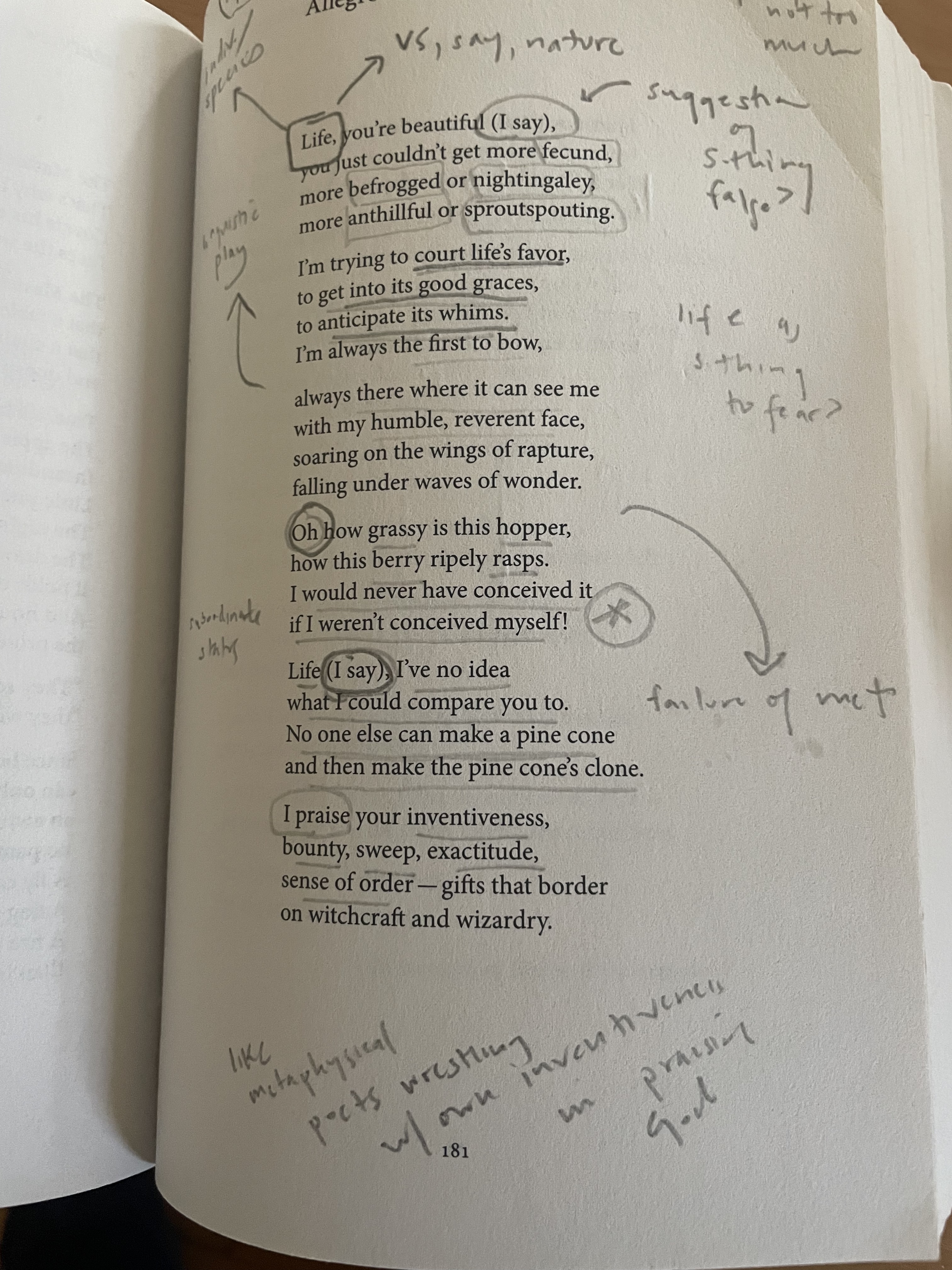
Anyway, listen to our conversation here. Our best, IMO.

Allison Montclair, The Right Sort of Man (2019

Kay recommended this to me, and I can’t improve on her review, which chimes perfectly with my experience of the book. In brief: two women, Iris Sparks and Gwendolyn Bainbridge, set up a marriage agency in London in the immediate aftermath of WWII. They know each other only slightly, it turns out, and as Kay notes, Montclair uses the opposites-attract and slow-burn tropes of romance fiction to explore their growing friendship and business partnership. The book begins with the eventual victim arriving at their office in search of a husband. Next thing you know, the woman turns up dead and suspicion falls on the client Sparks and Bainbridge have set her up with. (It doesn’t help that the murder weapon is found under his mattress.) The women set out to prove his innocence—and save their suddenly cratering business. The actual mystery is a little slight; I bet Montclair gets better at suspense as the series goes on. (I plan to find out.) Besides, as Kay also explains, the real interest here lies in the book’s melding of crime and romance. In addition to the leads, Montclair fills her book with strong minor characters: a heavy who just wants to be a playwright, a mobster who falls for Sparks, and a working-class guy who upper-crust Bainbridge meets while undercover. Part of me really wants these guys to come back, but part of me worries the series might fall risk to the whole “it takes 300 pages just to keep up with the antics of the growing cast of recurring characters” problem. 

Prime light reading.

Giorgio Bassani, The Heron (1968) Trans. William Weaver (1970

Dour novel of postwar Italian life, centering on Edgardo Limentani, a Jewish landowner who, having married out of the tradition, finds himself alienated by a political landscape comprised of communists that threaten his privileges and old fascists that respond to his continued existence with servility that fails to conceal their hatred of his continued existence.

On a damp day in late fall, Limentani goes hunting for waterfowl in the Po marshes. He dithers about going at all, finds himself waylaid, arriving too late for any good shooting, even, in the final account, unable to shoot at all, leaving it to his guide to bring down a trunkful of birds, which he later passes off as his own. On the way back he stops for coffees in a bar where he wrestles with whether to call the cousin he’s been estranged from for years, eats a meal in the restaurant of a hotel owned by one of those unctuous fascists, sleeps heavily and unsoundly in one of the upstairs rooms, and puts off returning home until his wife, whom he can no longer stand, will be sure to have gone to bed. From the time he starts awake in the pre-dawn dark until the time he returns to the study he uses as a makeshift bedroom, the protagonist thinks dark thoughts that give him no satisfaction. He sees no good way out of this life.

Having only read The Garden of the Finzi-Continis—a sad book, yes, but not a despairing one—I was shocked by this novel’s grimness. I’ve no idea about Bassani’s state of mind at this stage in his life, but The Heron (the title refers to a bird shot along with the ducks, no good for eating, pure waste) reads like the book of an unhappy and discouraged man. Maybe Weaver’s translation, getting on now in years, contributes to the novel’s heaviness. There’s a newish translation: anyone read it?

Billy-Ray Belcourt, A Minor Chorus (2022) 

Score one for the “don’t give up on a book too soon” camp: I almost ditched poet and essayist Belcourt’s first novel after about twenty pages, annoyed at the clunky dialogue and risible self-righteousness (similar vibes to a book I really hated), but once the narrator leaves his graduate program in Edmonton and returns to his home community in way northern Alberta I started picking up what Belcourt was putting down. The narrator (an obvious stand-in for the writer) mines his community for stories to weave into the novel he’s writing: we hear from an older gay man, who unlike the narrator has chosen (or been made to choose) to stay closeted and both admires and disparages the narrator’s different decisions; an old friend who has disentangled herself from an abusive relationship; and his great-aunt, who worries over the fate of the boy she raised as her own, the narrator’s cousin, two boys who were once inseparable, but whose paths diverged (the cousin is in jail).  In other words, when the narrator stops wringing his hands over whether his academic work can be meaningful in a world where so much injustice needs to be redressed and starts telling the stories of others as his way of doing that work, the book becomes moving and interesting.

I loved Belcourt’s descriptions of my home province, even though the part he’s from is about as far away from mine as Little Rock is from St Louis). This bit hit home:

The farther one veered from Main Street, a single stretch of highway on which sat most of the town’s businesses, schools, and amenities, the older the infrastructure became. Behind the dilapidated building ran train tracks that were less like sutures and more like wounds. It all looked so ordinary and Canadian and, because of this, haunted.

That passage gets better—more pointed—as it goes along. The workmanlike first sentence, as unvarnished as the buildings it references, gives way to a metaphor that asks us to return to the seemingly bland and official term at the end of the previous one. Who is the infrastructure that makes this place possible—improbable that people could live anywhere, but especially so in that northern clime—for? The things that link some people might separate others. (Who lives on the other side of the tracks?) The things that give some people meaning might just hurt others. Everything here leads to that last sentence: the ordinariness that many Canadians take pride in (unspectacular, solid, self-avowedly decent) is built on a foundation of dispossession and expropriation. And what of those who don’t see themselves in the mirror of that self-description? Those who are showy, marginalized, far from the main drag, maybe queer or nonbinary or indigenous. Is their only role to haunt Main Street?

James Morrison, Gibbons or One Bloody Thing After Another (2023)

I’m always nervous reading books by friends, but here I needn’t have feared: the debut novel by James “Caustic Cover Critic” Morrison is smart and engaging. It tracks the history of the Gibbons family from the late 1800s to an apocalyptic near-future in a series of chapters that work as stand-alone stories but gain in heft when the lines of familial affiliation come through.

Along the way, Gibbons serves as an alternative history of Australia in the modern era, referencing institutions and events ranging from the Native Police Force to the Snapshots from Home program to the devastating 1974 cyclone that nearly destroyed Darwin. I say “alternative” not because these things are made up but because the novel demands that we consider fabulation and creation necessary to any attempt to document the past. The first line, “A shelf of eyes, polished and unblinking,” alludes to the ability to see and record, even as it undermines these faculties: these eyes are fake, made of glass. Throughout the novel. James values the power of artificiality: not only are the pages filled with photographers and pulp writers and pornographers, but the chapters are separated by his own charming illustrations (and one by his daughter!).

It’s a good book, is what I’m saying. Shawn Mooney and I interviewed James to launch the book.

Holly Watt, To the Lions (2019) 

The title of this engaging debut crime novel refers to the place journalists are willing to send anyone who comes in the path of a good story—and to the place they themselves are thrown when they go undercover. Cassie and her friend Miranda cover a specialized beat: the nexus of moral impropriety, tech bro/financial CEO untouchability, and third world suffering. Which makes a rumour that falls into their laps irresistible: somewhere someone is taking rich men to hunt people. Where? Like everything in the story, the location is obscure. A preserve, maybe. A prison. Or, as turns out to be the case, refugee camp. Through investigative reporting that Watt, a journalist herself, depicts plausibly and compellingly, the pair learn that the shadowy operation, though based in London, centers on a camp in lawless Libya, not too far across the border from a remote part of Algeria, where a private jet drops off the financiers, titled sons, and adventurers willing to pay a hell of a lot of money to do something whose repulsiveness makes them feel alive. To get the full story, though, the women need to catch someone in the act. A complicated undercover operation ensues, filled with menace (I’ve rarely been so scared for a character.) Watt plays with readers’ fascination with the lurid, which sometimes makes the book preachy, but mostly it’s just exciting. Not quite the usual thing, then, though it’s hard for me to see how Watt sustains her premise through the other books of the series. Just how many stories of this ilk can Cassie uncover?

Mary McCarthy, Memories of a Catholic Girlhood (1957) 

Rebecca’s choice for One Bright Book; you can hear our conversation here. I was glad to have read this once-but-perhaps-no-longer-famous memoir, though I can’t say I loved it. I found it a desperately sad book about a family filled with people unable to communicate with each other. So many silences, so much heartache, so much harmful propriety. To my surprise, Rebecca and Frances found it funny and biting, a book filled with readerly pleasures. We didn’t convince each other, but I appreciated the chance to articulate my response. Many readers have admired the sections between chapters in which McCarthy explains what she later learned about the family stories she tells, pointing out inconsistences or outright falsehoods. Such self-awareness might have felt innovative at the time, but to me they didn’t add much. I think none of us expects memoir to be complete truth. Anyway, I will never forget the story of an uncle by marriage who sets out to show nine or ten-year-old McCarthy in the worst possible light, just so he and his wife could beat her black and blue with a hairbrush. Terrible, terrible stuff.

Gabriele Münter, Green House (1912)

A wide-ranging reading month, with plenty to appreciate. Only Map really stood out for me, though. Any takes on these selections?
Catherine Eaton’s Year in Reading, 2020

I’ll soon be writing up my reflections on my 2020 reading year. In the meantime, I’ve solicited guest posts from friends and fellow book lovers about their own literary highlights. I’m always looking for new contributors; let me know here or on Twitter (@ds228) if you have something you want to share.

The ninth post is by Catherine Eaton (@sparrowpost), who blogs at sparrowpost.com. Catherine Eaton is a writer and editor living near Chicago with her partner, two cats, and six houseplants..

Even now in January of 2021, it’s hard to make sense of everything that happened in March when it was finally recognized that COVID was here. Life suddenly became much stranger and far more difficult. Grocery shopping had always been my time to linger over and admire fresh fruits and vegetables, pick out a few that looked good, and then head on over to the soup aisle. Suddenly and without any sort of mental preparation, that old slow life was gone. It became intensely draining and plain difficult to navigate the store. Everyone who shopped was afraid and they tried to soothe this fear by buying everything in sight.

Small, little pieces of the old life kept dissolving: I was glad when my library closed to protect the patrons but at the same time, it meant no library. I hadn’t realized how much I depended on them, not only books, but for a safe and quiet place to relax and read.

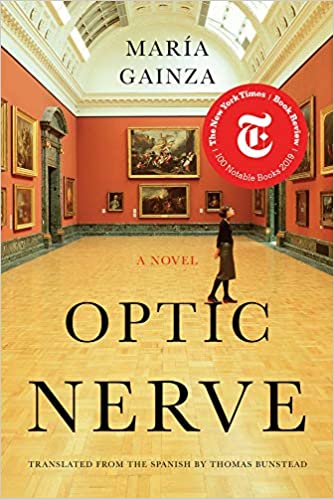
The library soon sent out an email, telling me not to return the books I had checked out, so I put them in a small stack in the living room. The three books became a symbol of life before the pandemic: The Wind in the Willows by Kenneth Grahame, Optic Nerve by María Gainza, and Isolde by Irina Odoevtseva. I read through the stack slowly and they became worlds where I could find space to breathe, places unaffected by the pandemic.

Books have always been a refuge for me, but in this last year my appreciation deepened. I read not just for entertainment but also to examine the craftsmanship in each book, and I was not let down. Studying story development, character arcs, and sentence structures became for me an act of sanity.

I read more books in 2020 than I have in other years; the list below includes some of my favorites.

I read The Wind in the Willows first. I had tried reading it a few times over the years without much luck but this time I reveled in it. My copy had the illustrations by Inga Moore, which are warm and homey. The story is set in the river and woods, and centers on three animals living there, Ratty, Mole, and Toad. They have adventures, get into messes, but everything works out in the end.

From that point on, I realized that reading children’s books let me find a small measure of peace during the pandemic. I joined a friend’s book club and we read The Secret Garden together. I had read it as a teenager, but now as an adult I was surprised to find how much I admired Frances Hodgson Burnett’s craft. She knew how to set a scene, weave an enticing mystery, and create bad-tempered yet sympathetic characters.

Later in the summer, I picked up another book I read as a teenager, Emily of New Moon by L.M. Montgomery. The novel chronicles the early life of Emily Murray, a budding author and fiercely independent soul. I highly recommend it and the next books that subsequently follow, Emily Climbs and Emily’s Quest. Emily’s fight to write and be true to herself has inspired many writers, including Carol Shields, Alice Munro, and Margaret Atwood.

The next library book I read was Optic Nerve by María Gainza, one of my favorite reads of the year. Each chapter is a complete story of its own and centers on a different painting. The narrator contemplates art and painters, her family and child, and the anxiety of living in the present day.

One of the great pleasures is how flawlessly Gainza weaves the narrator’s daily life with her contemplation on art. The moments set in art museums were especially poignant to me as the Art Institute in Chicago was closed and I was struggling with the deep desire to see artwork in-person, a source of delight and comfort that had suddenly been whisked away.

Another novel that struggles to make sense of an ever-changing world is Renee Gladman’s Event Factory. The narrator, a “linguist traveler,” visits city of Ravicka. She struggles to learn the local language and communicate with those around her. The city ebbs and flows around her, streets shifting while she walks, and a noxious yellow fog (that the citizens refuse to acknowledge) slowly envelops everything. Event Factory, bewildering yet familiar, felt like the diary of a fellow passenger during the early days of the pandemic. Another poignant similarity with the present is how Ravickan time does not move linearly which affects the art of narration:

To say that though—that I have not been on my own very long—would mean that I have been following a linear path…this linearity could only form if there had been no events in between. I am saying things have happened that have not been reported, and it is in virtue of those missing things that I was here. Had I spoken of them, at this point of the story, I would be elsewhere.

Czelaw Milosz’s autobiography, Native Realm, is another tale of rapidly shifting worlds, set during the first half of the 20th century. Beginning with his birth in present-day Lithuania, Milosz follows his family’s fortunes as they traveled through Russia, and then to Poland, arriving there shortly after WWI. He recounts learning Russian and Polish, the teachers and friends that influenced him as he came of age before WWII, and the writing endeavors that he undertook while somehow miraculously surviving WWII. His autobiography is not just a record of family, learning, and friends, but it is also a delicate tracing of the life of the mind and how he arrived to the ideas and thoughts that underpin his work.

I was unable to finish Native Realm before it was due back to the library, and after I returned it COVID hit. It wasn’t until months later that I was able to check it out again, and surprisingly enough, I hadn’t lost any of the threads. When I finished Native Realm and returned to Milosz’s poetry, his concepts shown clear and bright in a way they hadn’t before. I highly recommend this book to anyone who would like deeper insight into Milosz’s poetry and life.

The Book of Delights by Ross Gay was another library book I was separated from in the early days of the pandemic. Like Native Realm, I had read about half of it when it was due back. I returned it, COVID struck, and I did not see it again until June. I thought the long pause might affect my enjoyment of it but that wasn’t the case at all. The book is collection of essays on the small joys that Gay encounters over the course of a year, and when the book returned to me in the summer, I had a deeper appreciation of his insights into our difficult world.

In many ways, Gay’s deep belief in the beauty of a life well-observed became a touchstone during this last year. Watching a downy woodpecker climb the sugar maple outside my window became a way to enter the present when it was otherwise unendurable. Enjoying good food, connecting with friends, and reading excellent books became ways to go forward and with gratitude. Since then, I’ve been slowly reading Gay’s poetry in his Catalogue of Unabashed Gratitude and it feels like a continuation of the thoughts running through his essays. We are lucky to have Gay writing to us.

Another bright light in a grim year was Girl, Women, Other by Bernadine Evaristo. It won the Booker Prize back in 2019 and immediately sold out everywhere. I patiently waited until one day when my local bookstore had a stack of copies sitting on the front desk, and nabbed one. Looking back, I’m grateful I grabbed a copy before the pandemic hit because it was the read I needed later on. The novel concerns a large group of women, each section told from a different viewpoint. Their lives and years weave in and out of each other’s; each woman is splendidly alive and Evaristo’s playfulness with punctuation and sentence structure creates a vivacity and immediacy I hadn’t encountered before in a novel.

After Girl, Woman, Other, I picked up Three Summers by Margarita Liberaki. Set in Athens before WWII, it centers on three sisters’ lives over three summers. While their days seem quiet on the outside, the sisters live passionate and dramatic internal lives. They struggle to understand those around them (including animals and nature) and the direction their adult lives will take.

The lavender bloomed. It happened suddenly, one morning. The evening before we had stroked the buds, which were still green and hard. We had begged them to open that night, and the next day from the window we saw six bushy rows of purple playing with the sun and hundreds of white newborn butterflies fluttering around, chasing each other, making love, only to die the same night.

Maria began to cry. She went and embraced the stems, burying herself in their aroma.

The sisters find their way, each one in a way that suits only her. Some readers have struggled with this book, but I wish there were more novels like it. Liberaki’s lush descriptions of nature and the sisters’ inner lives left me wanting to read more of her work.

The True History of the First Mrs. Meredith and Other Lesser Lives by Diane Johnson is about a real woman who challenged her role in life and sought to carve out her own path as a British woman in the mid-1800’s. Mary Ellen Peacock Meredith was the first wife of the writer George Meredith; after eight years of marriage she left him for the painter Henry Wallis. Not much is known about her life (aside from Meredith’s massive grudge against her) but Johnson has taken what remains and woven it into a story, part factual and part fiction. Mary Ellen was a writer in her own right, an exhilarating conversationalist, and a gourmet cook. She was considered an outcast after fleeing her husband but of course she didn’t view herself that way. She had many plans for herself and her children but unfortunately died at age 40 from kidney disease. With sensitivity and sympathy, Johnson recreates her life and those that surrounded her; what emerges are living beings, forgotten by time but worthy of being considered. I first came across the book after listening to a delightful conversation between Diane Johnson and NYRB Classics editor Edwin Frank and I highly recommend their talk.

Isolde by Irina Odoyevtseva was the last library book from my small pre-pandemic stack. First published in 1929, I read the new Pushkin Press edition, translated by Brian Karentyck. At the heart of Isolde is the beautiful Liza, a young teenager and White émigré from Russia. She crosses path with Cromwell, a wealthy British boy, while vacationing in Biarritz. The pair might as well be protagonists from a F. Scott Fitzgerald novel as they race around in cars, bounce through dance halls, and swim out in the ocean. He names her Isolde after the doomed, legendary queen and from that moment on, there’s no doubt where the novel is headed.

Liza is a woman without a country and though she has a brother and mother, she is essentially abandoned due to their self-centeredness and desperation. As I read the book my sense of foreboding climbed higher and higher and when I finished the last page I heaved a heavy sigh. I won’t forget Isolde or Odoyevtseva for a long time. Odoyevtseva achieves a level of loneliness, separation, danger, and impending disaster that Fitzgerald’s writing aspired to.

A King Alone by Jean Giono will also stay with me for a while. I don’t want to give anything away but it’s one of the more shocking novels I’ve read in some time. The tale is set high up in the Alps and the opening description of a beech tree drew me in:

It’s on the side of the road, exactly at the hairpin bend. There’s a beech tree there; I’m sure there’s none more magnificent anywhere. It’s the Apollo Citharoedus of beech trees. There cannot possibly be another beech, anywhere at all, with skin so smooth and so beautiful a color, a more flawless build, more perfect proportions, with such nobility, grace, and eternal youth. Definitely ‘Apollo’ is what you say the instant you catch sight of it, and you say it again and again for as long as you look at it. What is extraordinary is that it’s both beautiful and so simple. No question about it: it knows itself and judges itself.

A series of puzzling and frightening disappearances occur in a nearby village, and a police captain is called in to sort out the mess. Langlois arrives in the dead of winter and begins the hunt. The narrative shifts between different viewpoints (though never Langlois’s) and the result is a tracking of Langlois himself as he travels through the mountain ranges, surrounding towns, and the village itself, searching for the abductor. Nature is a strong presence throughout, a main character watching and overshadowing the human dramas enacted within it. After reading A King Alone, I’m looking forward to reading more of Giono’s novels and discovering his poetics.

There’s no way I could go through my best reads of 2020 list without mentioning War and Peace. A Public Space announced their readalong of War and Peace in early March with Yiyun Li leading the daily discussion. I was drawn to the idea of reading an epic novel during an epic time and I picked up Anthony Briggs’s translation. I kept up with the daily readings for the first third of the novel but then fell behind. Tolstoy’s ruminations on the Napoleonic Wars and the causes of war in general slowed my speed but I was determined to see the book through. And I’m glad I did because while Tolstoy’s theories and beliefs about war have somewhat dimmed in my mind, the lives of Pierre, Natasha, and Andrei, along with a huge cast of family members and servants, have not. It’s a novel well worth reading during this time.

The final three books hold a special place in my heart: I read them in the fall and each created a sanctuary before and during the US elections (which was and is a terrifying time). It was hard to know which way my country would go and I needed the reassuring cadences of these master writers to help me through the nerve-wracking days.

The first is Maud Martha by Gwendolyn Brooks. I hadn’t known that Brooks wrote a novel until a friend mentioned it in a passing conversation and I knew I had to find this book. I ordered it from the library in early March before the pandemic struck and it eventually arrived in the fall. I was so happy to see it. It felt like the continuation of an earlier life.

The novel is broken into thirty-four vignettes, concerning the life of Maud Martha; they often read like prose poems. Each vignette follows Maud Martha as she deals with the difficulties of family, growing up, falling in love, contemplating beauty, raising a family, and racism.

One of my favorite chapters centers around her struggle over whether to kill a mouse that’s been invading her kitchen and taking off with morsels of food. She envisions the mouse’s huge family and its on-going struggle to feed so many children. In the end, she can’t set out poison and they go on living together. There is a special sweetness in the book that focuses on everyday joys despite the senseless cruelty of racism and other struggles in life. It’s a short read and I sighed deeply when I read the last page. I would have been happy to read more about Maud Martha’s daily life and her ongoing views of the world.

The Prime of Miss Jean Brodie by Muriel Spark came into my life a month before the election. A Public Space was doing another read along, this time on Spark’s book, and while I was reading through the book, I was working on a class assignment to map a novel. Since I was already half way through the novel and completely caught up in it, I decided to make a map of it. I was curious how Spark dealt with time, the revelation of mysteries, and different points of view.

While I was mapping, it became clear that Spark flashes forward in time only when she’s revealing important information. She divulges tragedies and betrayals early on but saves the “how” for the end. Her story centers on an Edinburgh schoolteacher, Miss Jean Brodie, and the student that eventually betrays her.

Spark in the New Yorker: “Well, suspense isn’t just holding it back from the reader. Suspense is created even more by telling people what’s going to happen. Because they want to know how. Wanting to know what happened is not so strong as wanting to know how.”

There’s a clean, crisp assertiveness to Sparks’ prose that I quickly became addicted to. It’s not surprising that she began her writing career as a poet. The New York Times critic Parul Seghal notes that, “[Spark] loves reminding us that every word—this phrase, that comma—was brought together by human hands, for your pleasure.”

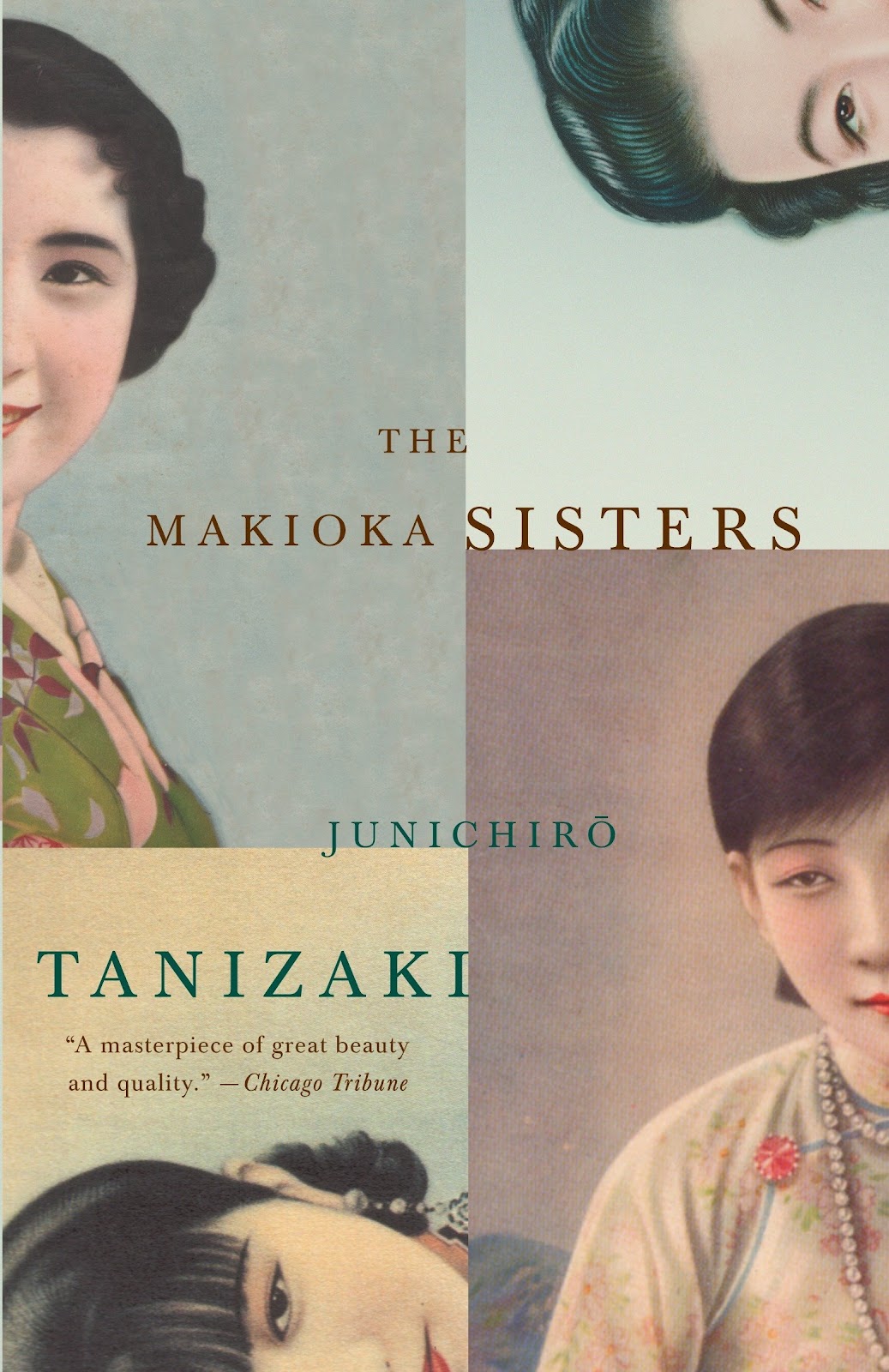
During the election itself, I turned to The Makioka Sisters by Jun’ichirō Tanizaki. The four sisters are from a well-to-do Osaka family, but by the time the novel opens, the family’s heyday has passed and their fortunes are in slow decay.

The original Japanese title, Sasameyuki (細雪), means lightly falling snow and is a poetical allusion to lightly falling cherry blossoms in the spring. It contains the word “yuki,” which refers to the third sister, Yukiko, and suggests that she is the focus of the novel. Much of the story revolves around the family’s quest to find her a suitable husband.

The novel spans 1936 to 1941 and throughout there’s a heavy contemplation of past. This isn’t surprising, as the past (along with decline and decay) is among of Tanizaki’s great themes and permeates his work.

The past lingers in the Makiokas’ clothes, homes, thoughts, and traditions but it performs a balancing act with Western culture that continues to encroach on more traditional lifestyles. The sisters wear light Western clothes on the hottest days of the summer and resume wearing kimonos when the heat passes. They watch Greta Garbo in a film one night and attend the Kabuki theater to see a favorite performer on the next. They learn French, practice the koto and shamisen, visit the cherry trees blooming in Kyoto and Nara, and get their hair done every week at the salon. Amid family squabbles and health issues, they survey and survive everything the decade throws at them which includes a great flood, typhoon winds, and a world war.

Newspaper installations of The Makioka Sisters began appearing during the height of WWII, but the censor board pulled it, denouncing it for its “feminine character.” That didn’t stop Tanizaki from continuing his novel and in 1944, he published the first section and gave copies to friends. The complete novel came out after the war, was heralded as a great achievement, and has been read ever since.

While I haven’t lived through a war, the current pandemic has given me a more immediate understanding of what can happen when everyone’s lives are drastically and suddenly changed. Tanizaki’s fortitude in writing about four sisters throughout WWII, not even stopping when the government forbade his work from being published, speaks to me deeply.

A few honorable mentions:

Most people read Madame Bovary in high school but since I missed high school (long story), I missed the book as well. Despite knowing the storyline, the novel drew me along and by the end, there was no doubt in my mind that, had she had lived today, Emma would have been a wildly popular Instagram influencer.

Mathilda by Mary Shelley is a typical Romantic novel, full of long passages about feelings and nature. There’s also the usual shocking subject matter–in this case, incest and suicide. Shelley wrote this after Frankenstein and as a former Goth, I enjoyed every moment of it.

The Maytrees by Annie Dillard follows the lives of Toby and Lou Maytree, from courtship to old age. They live in Provincetown, MA, and the sea and its moods permeates their lives. As always, Dillard’s writing on nature is both beautiful and brutal.

It’s been an extremely difficult year, but books have helped make it a little more bearable. Here’s to another year of good book reading, discovering new and old authors, and taking care of one another. May this new year be better than the last.