Hope Coulter’s Year in Reading, 2023

Excited to once again present reading reviews from some of my favourite readers. Today’s installment, her fourth, is by Hope Coulter, (@hopester99), whom I’m lucky to call a colleague. A fiction writer and poet, Hope directs the Hendrix-Murphy Foundation at Hendrix College.

Eveelyn Hofer, Girl with Bicycle, Dublin, 1966

2023 may have been my Year of the Binge. A quarter of the books I read were by a single author, Michael Connelly, as I continued a 2022 obsession and chowed through the rest of his Harry Bosch and Lincoln Lawyer series. Now I’m left with the dregs of the feast and plenty of questions. Has Bosch retired for good? Is cancer going to polish him off? And how am I going to get by without a steady intake of seedy murder scenes, sandwich shop tips, and Bosch’s saturnine musings floating over the lights of L.A. from his cantilevered deck? Sigh. No regrets for this gluttonous spree; I only wish I could find another such homicide cop to devour.

Speaking of, Robert Galbraith’s majorly enjoyable detective novels continued strong for me last year. I read The Ink-Black Heart via audiobook, parceling it to myself morsel by morsel so as not to rip through it too fast. Much of the novel unfolds through tweets, which are hard to follow either by ear or on the page, so that one wasn’t my favorite, but the series is overall terrific. If Strike and Robin settle into domestic tranquility and draw the curtain of privacy over their agency door (please no spoilers; I’m still finishing up Book Seven), I’ll be in a bad way indeed. [Ed. – I loved the first few of these books, but I must confess I had to give up on them, the author’s politics having so soured me…]

I went on a lesser bender with John Boyne, starting with The Heart’s Invisible Furies, which I happened to read while traveling in Dublin and southwest Ireland—moving through some of the very settings of the novel in a pleasurable kind of Binx Bolling-esque rotation. That sent me to a handful of other Boyne books. All the Broken Places, The House of Special Purpose, and The Absolutist were highlights, though none of them surpassed the dark, funny, moving experience of Furies.

Completing previous years’ jags, I knew I had to get hold of Paulette Jiles’s latest, Chenneville, reviewed here by Dorian late last year. All Jiles’s books have won me over. This one wrapped up too fast for my taste, but like her other works, it flares a light onto regional history with convincing detail and taut storytelling. [Ed. – Agree, especially re: the ending.]

Eh, maybe here my conceit ends. Although I regularly teach Zadie Smith’s “The Embassy of Cambodia” and have read several of her novels, I can’t really call that a tear. Even so, I was intrigued to hear that Smith had turned to historical fiction and couldn’t wait to check out The Fraud, which is based on a 19th-century trial, little known now but sensational in its time. The book gripped me in unexpected ways. Every character was so believable, so not-a-type, so idiosyncratically shaped by their history and personality—supremely so in the case of the main character, Eliza Touchet. Mrs Touchet’s epiphanies in the course of the novel involve -isms of race, class, and sex that quietly echo our own era. At the same time her keen intelligence, her self-understanding, her fierceness and restraint, and her willingness to examine the tangles within her own heart are quintessentially Victorian.

As I read I found myself marking passages the way I do in my old copy of Middlemarch, quotes with a similar sage quality. (Even though Dickens and Thackeray feature as characters in the book, the sensibility that saturates it is really Eliot’s.) Here Eliza considers her long, complicated relationship with her cousin: “Theirs was a fellowship in time, and this, in the view of Mrs Touchet, was among the closest relations possible in this fallen world. Bookended by two infinities of nothing, she and William had shared almost identical expanses of being. They had known each other such a long time. She still saw his young face. He still saw hers, thank God.” And here she ponders how women often can’t see their own beauty for what it is at the time, not appreciating their appearance until looking back on a younger stage after a lapse of years: “But it is the perverse business of mirrors never to inform women of their beauty in the present moment, preferring instead to operate on a system of cruel delay.” Introspective moments like these, combined with the unspooling action of the trial plot, place this book at the top of the literary heap for my year’s reading.

Other newish novels that I loved last year were Donal Ryan’s The Queen of Dirt Island—a multigenerational saga of tough Irish women, inspired by the kitchen storytelling of his mother and grandmother—and Gabrielle Zevin’s Tomorrow, and Tomorrow, and Tomorrow, about a love triangle that arises and devolves in unpredictable ways. I also enjoyed Jeanine Cummins’s American Dirt. I had steered clear after hearing critics call it appropriative, but when a friend told me it held up well for her I gave it a try. I found the story compelling and plausible. Cummins addresses the criticism directly in her afterword, and I’m persuaded by her account of the writing and her authentic connection to the material.

I also read, and loved, Viet Tranh Nguyen’s short story collection The Refugees, tales of Vietnamese migrants resettled in southern California: this is art on a level with Lahiri’s Interpreter of Maladies and Unaccustomed Earth. And I returned to some old favorites that thankfully not only proved to hold up over time but blew me away all over again: Gabriel García Marquez’s Love in the Time of Cholera; Willa Cather’s O Pioneers and A Lost Lady; Evan S. Connell’s Mrs. Bridge (which Donal Ryan mentioned as inspiration for the super-short chapters in The Queen of Dirt Island), and Robert Crichton’s The Secret of Santa Vittoria.

Then the nonfiction. Oh, the nonfiction. Fiction is great when it’s great, but it disappoints so often and in so many different ways—by trying too hard, being too earnest, too arch or too tough-guy, or showing something nobody would say or do (on the human level I mean, not that it’s surreal or fantastic), or just plain old getting on my nerves. For some reason nonfiction is less prey to these faults. More and more I find myself turning to nonfiction for that “ah” of relief when I can settle into a writer’s style and voice and relax into the story at hand, losing the awareness that I’m reading. Last year I took in some wonderful memoirs. There was Javier Zamora’s Solito, about his experiences as a nine-year-old traveling solo from El Salvador to the United States (it’s like the nonfiction version of American Dirt). There was Monica Potts’s The Forgotten Girls: A Memoir of Friendship and Lost Promise in Rural America, which looks at the deterioration of American small towns based on her growing-up in Clinton, Arkansas, not many miles from where I teach. [Ed. – Definitely on my list. Heard her read at the Lit Fest last year and I still remember the opening scene.] Tracing the divergent life stories of herself, her sister, and her close friend, Potts narrates a tale of narrowing prospects for many young women in this climate. There was Jane Ferguson’s No Ordinary Assignment, chronicling her life as a reporter in the war zones of the Middle East (no forgotten girl she, determined as she was to get out of Dodge after an emotionally deprived childhood in northern Ireland).

I’m chagrined that I had never read the slender Narrative of the Life of Frederick Douglass, an American Slave until this year. As many have said, it’s profound: unforgettable not only for its first-person testimony to the horrors of the slave system in its heyday but also the candor, economy, and precision of the writing. Acquiring even baseline literacy was a miracle in that context—and an interesting story within the story—but Douglass’s literary prowess vaults so far beyond that initial limit, and is so supremely suited to relaying his experiences, that it’s humbling to take in his words. 

A mid-year bookshelf cleanout led me to another, far different memoir that I’d somehow missed before, J.R. Moehringer’s The Tender Bar, about the New Jersey barflies who were his surrogate family growing up (and including one of the funniest sexual initiation scenes I’ve ever read). My enjoyment of that book sent me back to current times and a brand-new book that Moehringer ghost-wrote: Prince Harry’s memoir Spare. Come for the royals’ dirty laundry; stay for the Shakespeare allusions that, alas, are probably attributable to Moehringer rather than Harry.

In the realm of general nonfiction, meaning not memoir, there were three standouts this year, two by 30-something Irish writers whom I heard in person at the West Cork Literary Festival last summer (thank you, Hendrix College and the Hendrix-Murphy Foundation). In My Fourth Time, We Drowned: Seeking Refuge on the World’s Deadliest Migration Route, the Irish journalist Sally Hayden details the grim migration sagas happening in the seas north of Libya and makes a case for the EU’s complicity in perpetuating devastating outcomes. Cal Flyn turns to a different crisis, that of environmental havoc and habitat destruction, in Islands of Abandonment: Nature Rebounding in a Post-Human World. The book examines many sites around the globe that toxic damage of various kinds has rendered uninhabitable—or at least not prey to further human disturbance—and where, curiously, plant and animal forms are rapidly speciating. It’s probably too much to call the book hopeful; as Flyn says, it’s not like she’s advocating for toxic damage in order to foster speciation. Still, I can’t think of another environmental book in recent years that has left me with a flicker of optimism. [Ed. – Agreed!]

Edward Burtynsky, Sawmills #1, Lagos, Nigeria, 2016

Poets and poetry fans who have borne with me this far may be wondering, what about verse? I tend to read poetry less systematically and don’t track it as I do prose. With that said, a number of poetry books meant a lot to me as I spent time with them this year, including works by Garrett Hongo, Sharon Olds, Katie Farris, Ilya Kaminsky, A. Van Jordan, Phillip Howerton, and Ada Limón. Dorian’s comments on Wisława Szymborska here, as well as his fellow podcasters’ insights, sent me back to her work with pleasure. Individual poems sometimes linger with me for days.

My final read of 2023 was Claire Dederer’s Monsters: A Fan’s Dilemma. In it she takes up the question of what we as readers, moviegoers, concertgoers, and art audiences do with the knowledge that makers of works we love have committed terrible deeds. Starting with Roman Polanski, she touches on artist wrongdoers of many times and places, along the way considering art theory, cancel culture, liberalism, men, childcare, consumerism, celebrity and fandom, asshole-osity, motherhood, beauty, effort, and love. [Ed. – the asshole-osity is really going around these days.] She inventories her own aesthetic and emotional responses and reckons with the old biography-versus-art-alone conundrum. Dederer does not land in a simple place or tie this all up neatly. As much as her conclusion, I like her forthrightness, the searching quality of her mind, her unwillingness to rest with skewed or kneejerk reactions. Worthy of Eliza Touchet, you might say.
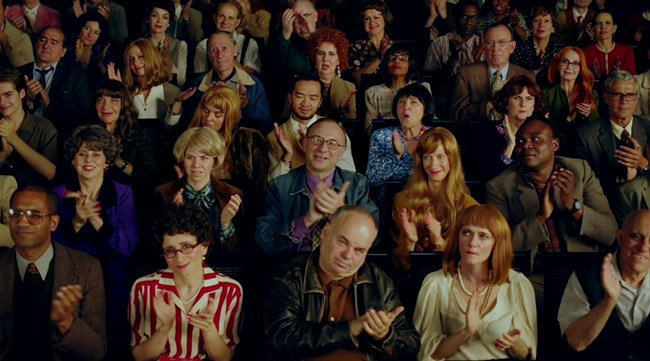
Alex Prager, Applause, 2016

Thank you for reading this—I welcome your opinions on any of these books and writers!—and to Dorian for inviting me to share. This virtual alp of books is something I enjoy throughout the year. [Ed. – Thnk you, Hope: always a pleasure to have you here.]
What I Read, September 2021

September. Up north, a great month. In Arkansas, as sticky and hot as August but with brown leaves. Having been back at work for several weeks, and having given the matter much thought, I can now conclude: sabbatical life is better. Returning to teaching has not been easy—I almost never see my colleagues; I miss the chattering clumps of students as they wait outside our offices for meetings, all now diverted to the screen; and I’m struggling to meet the freshmen where they are, which, as a wise, soon-to-be graduating student said, is sixteen rather than eighteen. The pandemic took its toll on us all, but on their cohort especially. The students and I had a breakthrough at the end of the month, though; maybe better times are ahead.

In addition to all that there were Jewish holidays to celebrate/squeeze into the demands of the non-Jewish world, scholarship deadlines to navigate, and home fires to keep burning. What there was not was much time for reading. Here’s what I squeezed in.

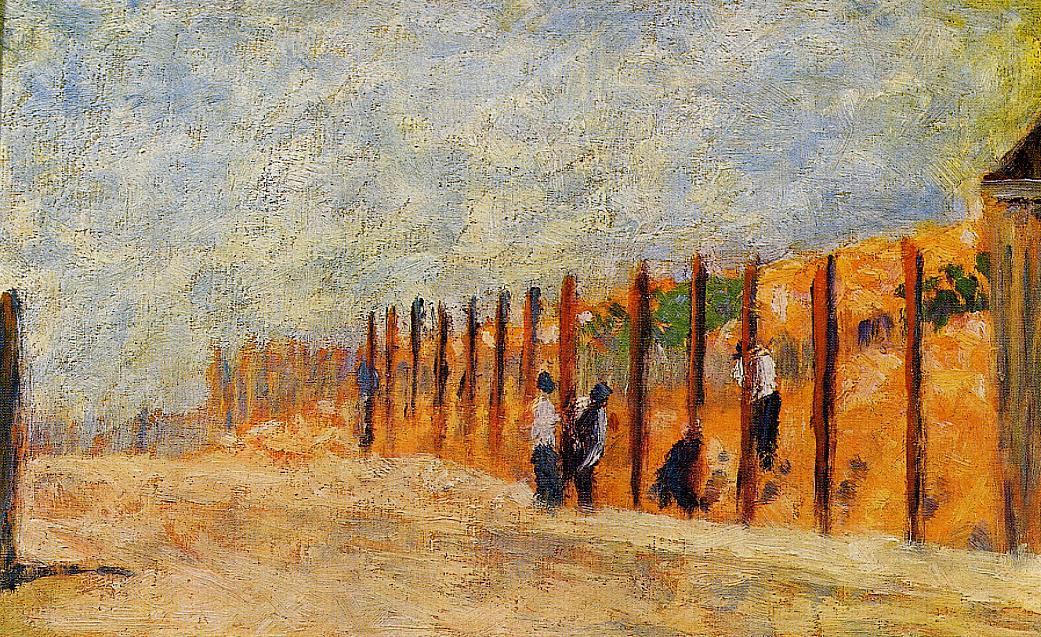
Georges Seurat, Workers Driving Piles, ca. 1882

Georges Simenon, The Grand Banks Café (1931) Trans. David Coward (2014)

Short, even for Simenon, and vicious, even for Simenon. I think this is the first one in which Madame Maigret appears. She’s pretty long-suffering, isn’t she?

Tomasz Jedrowski, Swimming in the Dark (2020)

Moving novel about a gay love affair in early 80s Poland. Ludwik meets Janusz at a summer agricultural camp for university students—they are bused from the capital to help with the sugar beet harvest. Ludwik brings with him a copy of Baldwin’s Giovanni’s Room, which he glues into the pages of a less incendiary book, and the knowledge that he’s gay, which he has rarely acted upon. He’s immediately drawn to Janusz’s beauty—he comes across Janusz swimming after a hot, dusty day in the fields—but convinces himself his feelings could never be reciprocated. Still, mustering his courage and giving in to the other man’s teasing, he lends Janusz the forbidden Baldwin. Days later Janusz returns it, saying only that he liked it and could see why the authorities had banned it. Then he suggests they take a camping holiday after the season is over. The trip is an idyll, intoxicatingly depicted by Jedrowski, who has a fine feeling for the landscapes of late-Communist Poland, a place that despite its repression feels quiet and simple. But Jedroski cuts any hint of nostalgia short. Things get complicated when the lovers return to Warsaw: Ludwik struggles to have his dissertation topic approved by the requisite state functionaries, and Janusz turns evasive, unwilling to risk his career prospects in a country where the intelligence service regularly blackmailed gay men, even as he is torn between his feelings for Ludwik and his commitment to the ideology that had allowed him to escape his rural working-class background. I won’t reveal the ending; suffice it to say that the novel takes the form of an unsent letter from Ludwik’s exile in New York.

Swimming in the Dark is modest, less gorgeous at the sentence level than, say, Garth Greenwell’s What Belongs to You, but satisfying anyway. There’s nothing unusual about its style or structure—though I’m now keen to re-read Giovanni’s Room to see just how much how much Jedrowski plays with it—but its story of two young men, each blind in his own way, has a pleasing inevitability. (I learned some things, too, not least that Michel Foucault was caught in a honey-trap in 1960s Poland.) I look forward to seeing what Jedrowski, who has written what for him is a historical novel in what must be his second or third language (he was born in West Germany in 1985 to Polish parents and educated at Cambridge and the Université de Paris), will write next.

Sarah Perry, After Me Comes the Flood (2014)

A real tolle lege situation: browsing in my local indie while my daughter collected an armful of dragon books, I came across Perry’s first novel, which I did not think had been published in the US. (It was not, until recently.) I picked it up and read the opening paragraph:

 I’m writing this in a stranger’s room on a broken chair and an old school desk. The chair creaks if I move, and so I must keep very still. The lid of the desk is scored with symbols that might well have been made by children or men, and at the bottom of the inkwell a beetle is lying on its back. Just now I thought I saw it move, but it’s as dry as a husk and must’ve died long before I came.

Part I Capture the Castle, part Molloy: I was hooked. I swallowed the book in a few short bursts, including the hot tired almost hallucinatory parts of Yom Kippur afternoon. A man, an antiquarian bookseller in London, is plagued by headache. It has not rained for more than a month. He must leave his cramped life, he sets out to stay with his brother on the coast of Norfolk. On the way, his car breaks down; when he ascends the steps of the first, solitary house he comes across, the door opens and he is greeted by name. He has been expected. It is all a mistake, but not one he finds himself willing to correct. So far, so satisfyingly Gothic—shades of Du Maurier’s masterly The Scapegoat. The house belongs to a solitary, ugly, motherly, sinister woman who has gathered a number of odd people around her: a former preacher who lost his faith; a pianist who practices endlessly in an adjoining room, breaking off only to berate herself; a young man convinced that only his nightly watch is keeping the adjoining reservoir from crumbling and flooding the property.

After Me Comes the Flood takes a surprising turn, though, in explaining its situation—how the household came to be, how the narrator could be mistaken for someone else—but in remaining no less puzzling and delightful. There’s an outing to the beach, a misunderstanding that leads to a crisis, and a final literal and metaphorical storm. And plenty of good writing—look again at that opening, with its fear and longing for movement, to the point of near-hallucination. And that strange line about symbols that might have been “made by children or men,” the addition of “children” making it unlikely that “men” means “human.” Do symbols made by women look different? Or are these scratchings of more unearthly origin?

Don’t sleep on this strange little book about interpretation.

Kristen Radtke, Seek You: A Journey Through American Loneliness (2021)

Radtke’s comic, drawn in shadowy, pained colours—even the reds and browns look green—is a hybrid essay/memoir about loneliness. A CQ call is what ham radio operators make when they are looking to see if anyone is listening. Radtke learns that her father, a forbidding, silent man she could never talk to, was obsessed with ham radio as a boy. Fitting, then, that his daughter would later experiment with the new technology of internet chat forums. Radtke describes a life spent looking for connection and fearing rejection, but her book is mostly not about her. The memoir elements are deftly handled—I especially liked a closing riff on the letters listeners would send to Casey Kasem’s Top 40 Countdown radio show in the 80s and 90s, in which they bared their souls about abandoned lovers, damaged friendships, family arguments, all of which they hoped to overcome by dedicating a song into the void—but they play second fiddle to her descriptions of a century’s worth of psychological and neurological research into loneliness. Radtke references the philosopher Hannah Arendt, the sociologist Robert Putnam (whose book Bowling Alone considers the drift away from civic engagement in late 20th early 21st century America), and the artist Yayoi Kusama, whose installations of mirrored balls respond to but perhaps also further human separation. She considers spinsters, cowboys, and so-called “lone gunmen.” She writes about how grief is processed on social media and how some nursing homes use robotic companions for lonely patients. But most fascinatingly she tells the story of Harry Harlow, a psychologist at the University of Wisconsin-Madison, near where Radtke grew up, whose research on rhesus monkeys challenged the early 20th century ideology that parents should be distant from their children lest they make them soft, weak, too easily attached.

But these humane conclusions stemmed from experiments that tortured his nonhuman animal subjects. Harlow separated infants from their mothers and reared them in isolation, offering them dummy substitute caregiver figures (the monkeys would cling to one made of cloth even though another one, which dispensed milk but was made of prickly wire, was their source of food). Later introduced into groups of ordinarily socialized monkeys, the formerly isolated subjects were shunned—the damage done to them was apparent—and abhorrent—to their fellows. In his most horrifying experiment, Harlow wanted to find out what would happen when the monkeys who had been so traumatically separated became parents. He strapped the females into a contraption he called a “rape rack” and let male monkeys loose on them. The mothers ignored their offspring, sometimes even attacking and killing them. Harlow—a depressive alcoholic who crushed the spirit of two brilliant wives—concluded that love is nothing but proximity. Touch and contact are central to primate flourishing. Perversely, the man who gave us these insights was unable to demonstrate closeness or kindness. Harlow’s life makes harrowing reading, but I won’t soon forget him—or Radtke’s telling in this smart and engaging work.

Walter Mosley, Charcoal Joe (2016)

My first Easy Rawlins PI novel—though I remember loving the movie version of Devil in a Blue Dress back in the day—and I see I’ve picked up the series deep into its baroque period. (The audio book was ready to hand at the library.) I struggled to get a handle on all the characters established earlier in the series, but the mystery occupied me and the character of Rawlins appealed. The book’s sexual politics are not great, though: both sentimental and a little prurient. And yet I enjoyed it enough—compelled by its portrait of the black counterculture of 1960s LA—to go back to the series’ beginning.

Cal Flyn, Islands of Abandonment: Nature Rebounding in the Post-Human Landscape (2021)

A forbidden area near Verdun where poisoned gas has been dumped into the soil. An abandoned research garden in Tanzania where the botanical specimens have invaded the surrounding forest. The green line running across the island of Cyprus. These are just some of the places Cal Flyn visits in her book about how nature reclaims and reinvents landscapes abandoned by people. There’s the zone of exclusion at Chernobyl, too, that’s almost a must for anyone thinking about this topic. But Fyn considers lesser-known places too, like the Scottish bings, mountains of stone chips—blaes, technically—formed from oil shale extraction perpetrated in the late 19th century. Or the abandoned fields of Estonia, where, since the collapse of the USSR, forests have sprung up, erasing the scars of collectivized agriculture. Or the Caribbean island of Montserrat, covered over by lava flows and ash in the mid 1990s. These are ruined but also vital places: despite having been harmed they contain much more biodiversity than the spaces humans inhabit. Flyn writes:

And yet everywhere I have looked, everywhere I have been—places bent and broken, despoiled and desolate, polluted and poisoned—I have found new life springing from the wreckage of the old, life all the stranger and more valuable for its resilience.

It seems that all the world needs is for people to get out of the way. Nature will do its thing, life will find a way. In this sense the book—written in accessible but not simple prose, Flyn writes a better sentence than most contemporary non-fiction writers—is a hymn to the possibilities of a world without us. But it rejects the consoling fantasy of human annihilation, rejecting terms like “pristine” or “untouched”—these are fantasy states, neither possible nor desirable. Flyn worries that her book is too sanguine, too suggestive of a future that will be good again despite our efforts to destroy the planet. She knows time is short if biological life as it currently exits is to persist. I can’t forget her description of the Salton Basin—a former lake created in the middle of California after the damning and diverting of the Colorado river, but which has evaporated leaving a desert of dust and toxic residue, now how to a population of loners, escapees, dropouts—as a denuded, yet not meaningless future. Flyn thinks of her book as a suggestion that all is not yet lost, and that if we can leave things alone, rather than always trying to intervene, the “natural world” will do what it does, namely, to persist, to adapt, to live.

I’d be curious what readers more familiar with what gets called nature writing today think, but I appreciated how Flyn consoled without flattering human self-satisfaction.

Denis Johnson, Train Dreams (2011)

As I wrote to reader, podcaster, and all-around good guy Paul Wilson, I had such a hard time leaving off the hilarious set-piece in which a man tells the story of how he was shot by his dog that I sat in the parking lot at school, in thrall to actor Will Patton’s delivery of Denis Johnson’s much-loved novella, until I was almost late for my first meeting. Which might make the book seem quirky, even feel-good—the misapprehension that this was some Coen Brothers-type mashup of violence and sentimentality had kept me from reading it sooner—but it is much stranger and lovelier than that. Robert Granier is a railroad labourer and logger in Idaho and Washington in the early part of the 20th century. His is a life of solitude, with the all-too brief exception of his marriage and fatherhood. It is an unexceptional but terribly dramatic life, which, despite extending into the era of television and Elvis Presley, is, as is true for most people, governed mostly by the mores and concerns of the horse-drawn years of his childhood and youth. Johnson structures his book around vivid scenes—a terrible forest fire, an encounter with wolves, a late explosion of almost overwhelming sexual desire—but the most vivid, the most terrible of them is the opening, in which Granier, for reasons he can never fathom, though racism and the instinct to join in with the actions of a group that the rest of his life is a reaction against are among them, helps some white workers throw a Chinese labourer accused of stealing from the company store of the Spokane International Railway off a railway bridge. The man gets away, but the specter of the violence and hatred unleashed in the scene colours the whole narrative. I feel like everyone loves this book—for once everyone is right.

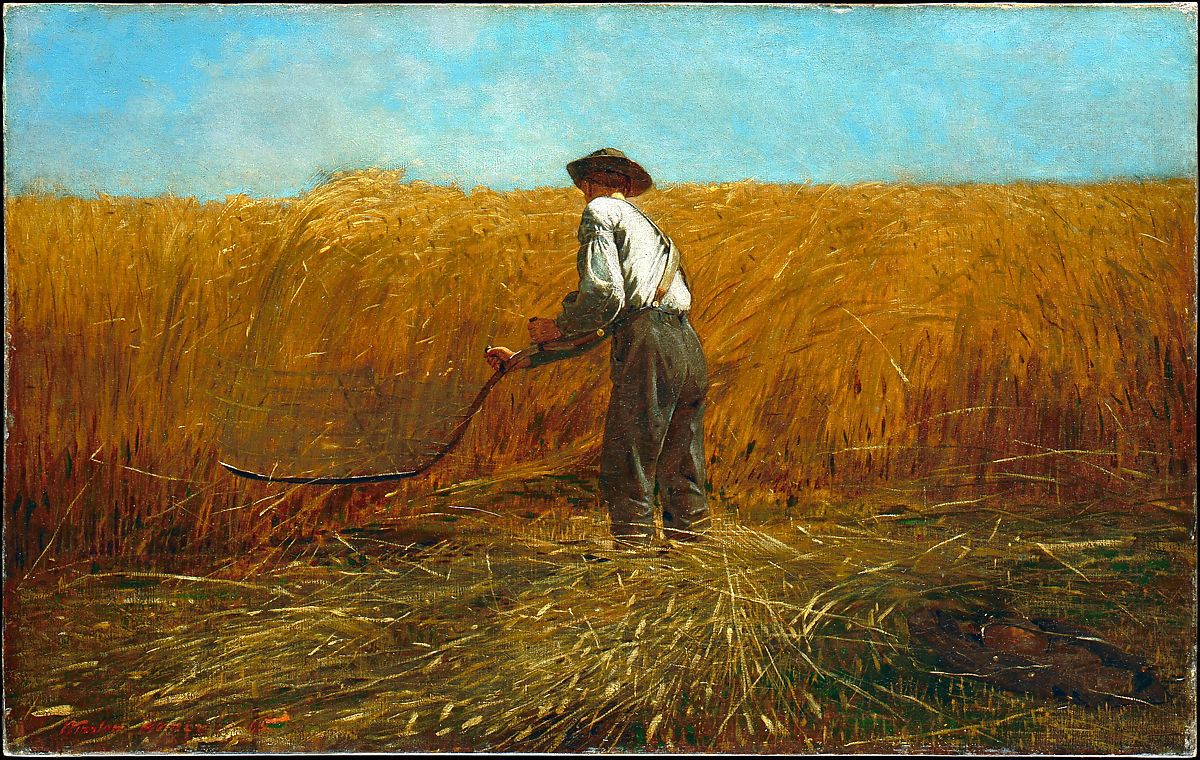
Winslow Homer, The Veteran in a New Field, 1865

Not a lot of books this month, but not a lot of duds, either. The Simenon and the Mosley were the weakest; the Perry and the Johnson the strongest. How about you? What were you up to last month?