A recent episode of The Mookse and the Gripes podcast got me thinking. Hosts Trevor and Paul were joined by John Williams of the Washington Post (mensches one and all). John had proposed a fascinating topic: starter libraries. The idea was to imagine your response to someone who asked you for ten titles they absolutely had to have in their collection. Probably this person is someone new to literature, a teenager or a student, but maybe they are someone who used to read more than they do now and are looking to get back to that part of their life. What would you recommend?
The important part of the assignment, as I understand it, is that the person is asking you. They know you well enough (parasocially or otherwise) to trust your taste. They respect you enough to be curious about anything you recommend. But they’re not asking for your ten favourite books. Presumably you like the titles on your list. But you’re not just offering them out of personal predilection. You think of them as representative for aspects of literature that matter to you.
Personal but not only personal, might be one way of putting it. Or, in the words of the episode’s subtitle, your choices could be thought of as a shelf full of promises.
Do listen to the episode, it’s terrific. Great lists, fascinating insights into the recommenders. And sure to get you thinking about your own answer. That’s what happened to me: I set aside the laundry I was folding and jotted some notes on my phone, which I’ve now expanded into this list, complete with categories (and alternate choices, because ten books is not many books).

Books to grow into but also to love when you’re young:
George Eliot, Middlemarch
The only novel in English for adults, Virginia Woolf famously said. Not sure what she meant, but doesn’t it sound good? Having reread it recently, I think you need to be middle aged (and thus an adult… hmm well never mind) to get the most from this story of English provincial life around 1830. But having first read it in college, I can also attest that Middlemarch hits for young people. As with any rich text, what you pay attention to and who you sympathize with shifts each time you read it.
Eliot is known for moral seriousness (maybe that’s why as stylistically different a writer as D. H. Lawrence was a fan), but Middlemarch is also surprisingly funny. Mostly, it’s supremely moving. It covers so much of life, and asks the big questions. What makes a good life? How can we live with purpose? How can we think of ourselves in relation to everyone else? Where do we fit into the web of life?
[Alternate choice: Leo Tolstoy, War & Peace. Never read it until about five years ago, but feel confident it dazzles as much at 20 as at 50. You want novelistic sweep? This one’s as big as Russia… Freemasons and wolf hunts and returns from the dead and slow-burning love affairs lasting across the decades: everything, really.]
Books that master close third-person perspective
Nella Larsen, Passing
Set in Harlem and Chicago in the late 1920s among a set of well-to-do light-skinned Black women who can pass as white, Passing is a great novel of queer frenemies. It hews closely to the perspective of a single character, Irene, whose orderly life as the mother of two boys and wife to a (dissatisfied) doctor falls apart when she runs into a childhood friend, the brave and dangerous Clare. Unless we attend to how events are only offered through Irene’s perspective, we are likely to miss how much the book asks us to question the judgments it only seems to offer.
[Alternate choice: Henry James, What Maisie Knew. In book after book, James wrote about people behaving badly. Yet even among this vast canvas of cruelty, this novel stands out: the people doing the harm are parents who use their young child to hurt each other and, of course, the child. In the preface to the New York Edition James explained that he chose to narrate the book in third person but to limit the perspective to Maisie’s often baffled but also wondering sense of the world in order to offer readers the extra pathos of being able to understand what she could not. It’s quite a trick.]
Books about the Holocaust
Primo Levi, If This Is a Man
If someone is asking me what books they simply must own, they’re absolutely gonna get one about the Holocaust. Hell, I could make them a whole list. But knowing that not everyone shares my fascination, I’ll stick to one of the earliest and most famous instances of Holocaust literature. (Levi composed part of it already while in the camps.) Like all memoirs, If This is a Man (known in the US under the travesty title Survival in Auschwitz) details its author’s particular experience—which took the form it did by his having had “the great good fortune” to have been deported only in 1944, when the turning tide of the war and subsequent internal battle among top Nazis meant that more deportees were selected for slave labour. That phrasing gives you a sense of Levi’s matter-of-fact irony. But something that distinguishes If This Is a Man is Levi’s decision to use “we” even more than “I”: he aims to give a sense of the structure and meaning of the collective victim experience, at least within a subcamp of Auschwitz.
[Alternate choice: Ida Fink, A Scrap of Time and Other Stories. Too little known among English speakers, but, happily, available in a terrific translation by Madeline Levine and Francine Prose, Fink’s heartbreaking stories depict part of the Holocaust most people don’t know about: the mass murder performed by the Einsatzgruppen in Galicia in the summer and fall of 1941. Fink couldn’t find a publisher for these stories until the 1980s; they were deemed of no interest. Another devastating failure on the part of literary opinion. Fink has been called the Chekhov of the Holocaust. Grotesque as this sounds, it’s accurate. Quiet and heartbreaking.]

Books about how to read books:
Roland Barthes, S/Z
Barthes spent a year reading Balzac’s story “Sarrasine” with some students. (Oh to have been in that seminar!) That labour resulted in this extraordinary book, organized around line-by-line readings of the source text, not, as critics usually do, to figure out what it means, but rather how it means. To do so, Barthes offers five “codes”—fundamental elements of realist fiction, of which “Sarrasine” is considered only as a representative example—that readers unconsciously rely on (typically by having imbibed many examples of the genre) in making the text intelligible. The codes are things like references to historical events, people, and places, or attributes and actions that cohere into what we call characters and, in the case of realist literature, think of as if they were people. Barthes Intersperses his step-by-step redescription of the Balzac story with theoretical meditations on the operation of the codes, which readers can extrapolate to other texts.
S/Z is tough. I probably taught it five or six times before I felt I had a real handle on it. But as Barthes says, it’s valuable to be able to distinguish between real and superficial ideas of difference. We might think that the best way to know about books is to read a lot of them. But if we do so without thinking about what underlies their intelligibility (i.e. what we need to be able to read them), then we are mere consumers, doomed to reading the same thing over and over. Only by reading one text over and over can real difference, that is the difference within the text, show itself—which in turn will make our other reading more meaningful. All of which is to say, the effort of tackling Barthes’s analysis offers big rewards.
[No alternate choice. S/Z for everyone.]
Books with pictures:
Alison Bechdel, Fun Home
Comics, graphic novels, whatever you want to call them are important to me, and I think any reader needs at least one example in their library. Such a rich form, so many gorgeous and moving texts to choose from. As with my Holocaust choice, I resisted the temptation to go niche here. Bechdel’s memoir of her relationship with her closeted, self-destructive, talented father deserves its fame. Probably more than any book I regularly taught, Fun Home elicited the strongest positive reactions in the widest range of students. Family disfunction runs deep. A great book about how books can connect people who can’t otherwise open up to each other—and how they can further separate them too. Funny, ominous, bittersweet.
[Alternate choice: Nick Drnaso, Sabrina. Dark, powerful. Reading it gave me a bit of the ick. And yet its subject matter just seems more relevant. I guess this is about the manosphere, except no one was using that hideous term at the time.]
Books of ideas [fiction]
Thomas Mann, The Magic Mountain
Sometimes I want a book that dramatizes the back and forth of thinking. In The Magic Mountain, Mann literalizes this by surrounding his protagonist, the well-meaning, hearty Hans Castorp, with some of the most indefatigable talkers ever to appear in a novel. The whole intellectual landscape of pre-WWI Europe is here (liberal humanist, communist, militarist, hedonist, you name it), and everyone battles for Hans’s soul, even as the former engineer mostly wants to desire a woman from afar, a woman who reminds him of a boy from his schooldays…
The other great thing about this book is how well it depicts Davos and environs. I’m a sucker for mountains and mountains in books. Bring on the snow!
[Alternate choice: Proust. Honestly, if you can only put one book in your starter library, choose this one. I assume it’s already there, but if not then get stuck into this deeply philosophical book, which has so much to say about perception, time, cruelty, and control over others.]
Books of ideas [nonfiction]
W. E. B. DuBois, The Souls of Black Folk
Every American should read it. But non-Americans should too. The idea of double-consciousness—the way a minority must measure themselves by the tape of the majority, as DuBois so memorably puts it in his first pages—explains so much of our contemporary sense of identity.
In addition to its ideas, Souls is a fascinatingly hybrid book, presumably stranger in 1903 than today. Each chapter is prefaced by a bar of music, often from the sorrow songs. Most chapters are essayistic, but some are fictional. Each is written in resonant cadence. Hasn’t dated much. Alas.
[Alternate choice: Hannah Arendt’s The Origins of Totalitarianism. Explains how Nazism and Stalinism came to be so accepted and do so much harm. Especially interesting for (1) its “boomerang” theory of imperial violence, in which what the metropole does in the colony comes back to bite it at home, and (2) its argument that modern antisemitism arose from the waning of Empire and the rise of nationalism. Hasn’t dated much. Alas.]
Monomaniac books
The strand from writers like Kafka, Knut Hamsun, or Robert Walser to someone like Lydia Davis, via the high point of Thomas Bernhard, has been enormously influential in the Anglo-American sphere. At this point, annoyingly so. (And weird, too, given that none of the most important precursors wrote in English.) But I get it because literature excels at tracing the vagaries of a mind, especially one spinning through reversals, paradoxes, and hobby-horses. A starter library should have an example of this sort of thing, and Bernhard might be the best. When the only thing that stands between a psyche adrift or worse is the chance that someone might respond to its voice—that’s when you’re in Bernhard territory. I’ve chosen The Voice Imitator because the title says it all. Read these 104 short texts to get a sense of Bernhard’s bitter, misanthropic, and, oddly, funny vibe.
[Alternate choice: I just named like five other writers!]
Funny books
P. G. Wodehouse, The Code of the Woosters
As implied in what I said about Bernhard, voice-driven books don’t have to be grim. They can make us laugh, whether from the gap between what the narrator claims and what we know, or the sheer verve of their style. The fun only increases when those narrators get embroiled in elegant plots. Wodehouse is the master of this terrirtory and everyone’s library is the better for including him. (I feel like he’s fading a bit from memory? Sad.) You can jump in anywhere—my entry point was the distinctly not-famous-but oh-so-representatively-titled Eggs, Beans, and Crumpets which baffled and delighted me at age 12—but if you’re at a loss start with this wonderful episode in the Jeeves and Bertie series, which Tim Waltz would enjoy, since it’s an early example of the “I condemn the fascists by unflinchingly stating how weird they are” school of responding to authoritarianism. (As Bertie says, appalled by the realization that the Saviours of Britain are simply grown men marching in black shorts: “how perfectly foul!”)
[Alternate choice: for an American version of this phenomenon, reach for Charles Portis, especially the marvelous True Grit.]
Books about crime
Dolores Hitchens, Sleep with Strangers & Sleep with Slander
Since at least Oedipus Rex, literature has used crime to understand fundamental concerns like identity, political organization, and moral value. Crime fiction can be smart, is what I’m saying. And it can also carry us away by inciting our desire to have enigmas explained. (Interestingly, it often makes us realize how much more compelling it is to ask a question than to answer it.) Like any genre, then, crime fiction satisfies at both the intellectual and emotional level. Having stayed with well-known titles so far, I’m diving deep for this last category. Not enough readers, even lovers of crime fiction, have read the mid-century American writer Dolores Hitchens. She wrote a lot of books under a lot of names. But only two about a PI named Jim Spader. Which is sad—but also good because they’re even more special. These make for pretty despairing reading, even for noir. So be warned. But you won’t regret seeking them out.
[Alternate choice: Hundreds! Thousands! Sticking with mid-century American women writers, I’ll plump for Dorothy B. Hughes’s The Expendable Man. Don’t read anything about it beforehand!]
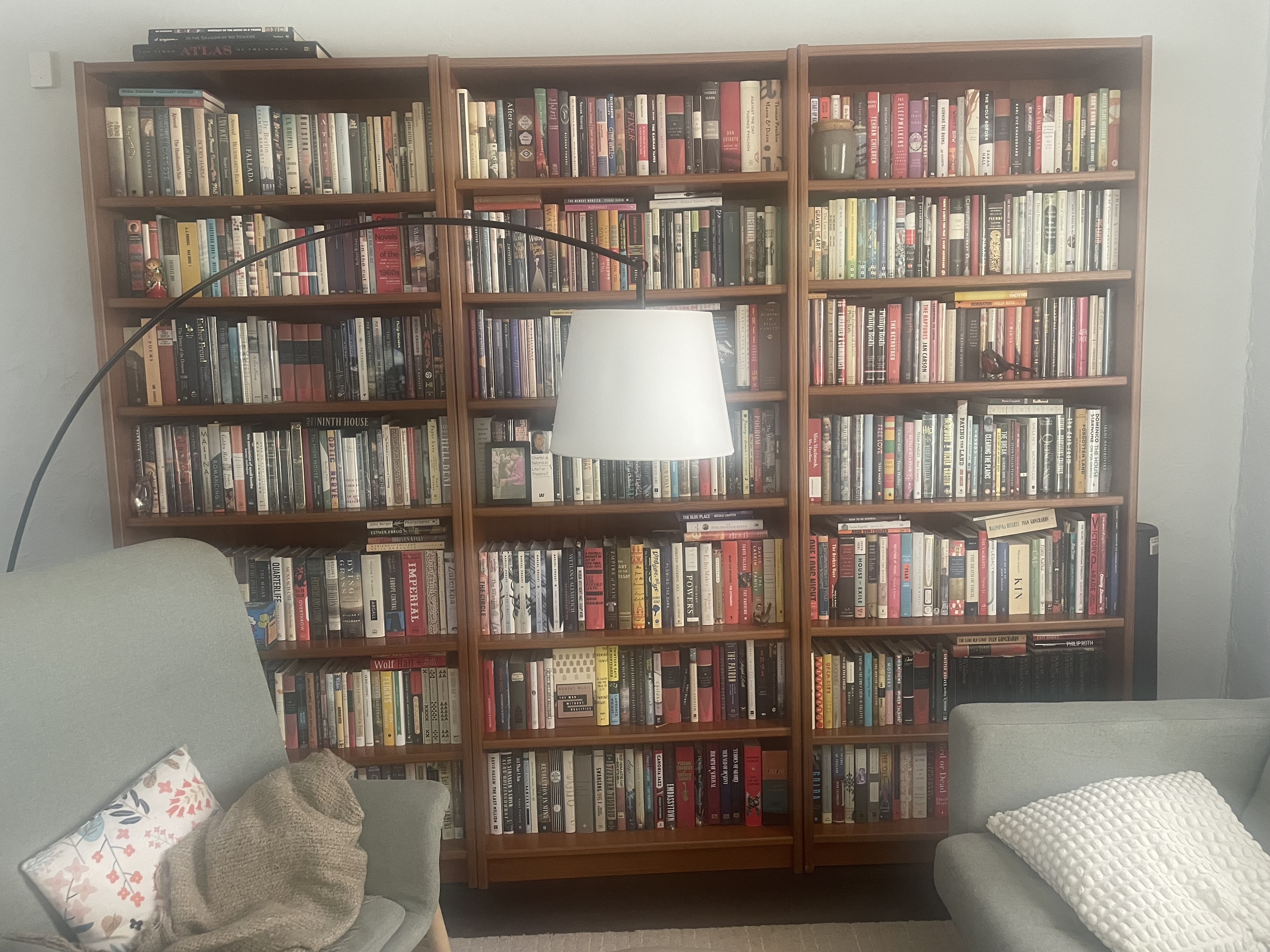
I tried not to think too long in coming up with my choices. Next month or next year I’d choose differently. And I’m aware of some big lapses. No poetry?? No plays?? No Torah?? (Everyone should read the Five Books of Moses.) But that’s ok. Gives you all the more room to think about how you’d create a starter library of your own. What would be on your shelf of promises?
 Eiger, Mönch & Jungfrau