What I Read, June 2024

Dropping this as something to keep you busy—and maybe even entertained—while I carve out the time to write my Year in Review piece. I won’t be catching up on the last half of the year—in fact, not sure I’m going to continue with the monthly pieces, might be time to try something new—but I’d already written most of this one and it seemed a shame to let it go to waste.

Joaquin Sorolla, San Sebastian Landscape (1911)

Shelley Parker-Chan, She Who Became the Sun (2021)

Fantasy novel set in 14th Century China (with the smallest bit of magic) about a young girl who fulfills the destiny foretold for her brother, who dies, along with the rest of her family and everyone else in her village, from a harrowingly described famine. Zhu Chomngba drags herself, starving and mute with fear, to the nearest monastery, where she is taken in because she has disguised herself as a boy, a deception she never disabuses anyone of, going to great lengths to keep the secret. Her bunkmate, and best friend, learns the truth, leading to an unexpectedly progressive outcome. The meat of the book concerns Zhu’s long, slow rise to power, as she consolidates the Han and prepares to do battle against the Mongols. I liked the idea of this book more than the actual reading experience. By the end, I was keen to learn what happens next, but I was also relieved to have finished the book. (It’s long.) Jury’s out whether I’ll read the sequel.  

William Maxwell, So Long, See You Tomorrow (1980)

Seems like everybody knows this book, but if you don’t, do yourself a favor and read it. But make sure you’re in a good head space first. So Long, See You Tomorrow, a novella about things people can’t bear, isn’t easy. A woman can’t bear to tell her son her estranged husband has ordered her to forbid the boy from visiting the farmstead where he, the former husband, is quietly cracking up, and, even more heartbreakingly, the boy’s dog is tearing itself apart in grief. Years later, another man, the story’s narrator, sits in a New York City analyst’s office and means to say that he “couldn’t bear” his mother’s decades-ago untimely death, but says, instead, he “can’t bear it,” a realization that sends him out of the office and into the streets, for only in the streets of NYC can one cry freely.

As these examples might suggest, the book consists of two strands. Interestingly, they intersect only glancingly. In one the first-person narrator, who seems an awful lot like Maxwell—today, the book might be marketed as autofiction—describes his mother’s death in the little town of Lincoln, Illinois in the 1918 flu pandemic. (The story that took up the whole of They Came Like Swallows is here compressed into a handful of anguished pages.) When the boy’s father remarries the couple decide to build a new house. The work-site, the house framed but without walls, and as such a metaphor for the book’s fascination with unfinished, maybe unfinishable structures, becomes the boy’s refuge after school. He bring his friend Cletus, and as the boys play amid the unfinished space, the narrator believes he “had found a way to get around the way things were.” But nothing gets around the way things are: that’s why life is so unbearable.

Cletus, whose experiences comprise the book’s other strand, also has much to mourn. His family, tenant farmers scrapping a life together, has fallen apart. He now lives in town with his mother, who has left her husband to be with the husband of the couple’s best friends, who work the next farm over. Cletus soon has even more to deal with: his father shoots his wife’s lover, his former best friend. (Not a spoiler: the novella opens with the rifle shot.) The boys drift apart. The narrator next sees Cletus years later in a high school hallway. The narrator sees Cletus, sees that Cletus sees him seeing—and ignores him. This unkindness haunts him all his life, getting tangled with the earlier loss of his mother. The book’s premise is that the narrator, now an old man in New York, the kind of person who visits MOMA regularly, where he is much taken with a Giacometti sculpture that reminds me of his father’s half-built house, a man, as I said earlier, like William Maxwell, excavates, through a mixture of research and imaginative reconstruction, what happened on those farms between those people.

Death, adultery, murder, cruelty: these are the things that can’t be borne in So Long, See You Tomorrow. Which makes the book sound lurid when in fact it’s heartbreakingly restrained. Or, more accurately, a strange blend of the two. The writer Antonya Nelson gets it exactly right:

I don’t know how William Maxwell manages to balance those two stories, one plotted like a melodrama, replete with murder and mayhem, and the other a quiet meditation that hinges on the tiniest non-gesture of passing strangers many years in the past. It’s a combination that oughtn’t work. And yet it does.

Even a three-page swerve into the mind of the abandoned dog works. Which it absolutely should not. Anyway, like I said, read it. It’ll tear your heart out, but in a good way.

I read a lot of Maxwell in my mid-twenties (somehow never this one, though). Now that I am old enough I want to revisit them all. And that’s just the novels. I haven’t even cracked the stories yet.

Manjula Martin, The Last Fire Season: A Personal and Pyronatural History (2024)

Manjula Martin lives in Sonoma County. She is not a winemaker (although she drives past the fields full of seasonal workers, most of them Latino/Latina, working through the night to pick the grapes at the time when they are at their most succulent). Nor is she especially wealthy (though she and her partner have jobs that pay enough and make a difference (union organizing, writing), plus the proceeds from an apartment she sold in San Francisco).

They live in a redwood cottage in the WUI, the wildland-urban interface, as do so many in the paradise of northern California. A paradise threatened by fire. As it always was. But now more than ever. The relentless impingement of human habitation into the forest, plus a century’s worth of misguided fire prevention strategy, plus climate change means the wildfire season is ever longer and ever more dangerous.

Martin’s memoir begins in July 2020, when terrible lightning storms set off hundreds of fires that burned hundreds of thousands of acres. It ends in November, with the delayed end of the season, though with the tendency of fires to smolder underground through the increasingly dry winters, every season is now fire season. In between, she, like everyone in California, learns to prepare a go bag, to speak knowledgeably about AQI levels, and, like many, to evacuate for a time when the fire comes within a couple of miles of the house.

She breaks up her descriptions of those months of the fire by looking back to her childhood growing up on a commune with hippie parents who left that life to become a master gardener and a professor in nearby Santa Cruz and forward to the actions she has taken since to prepare to live with fire.

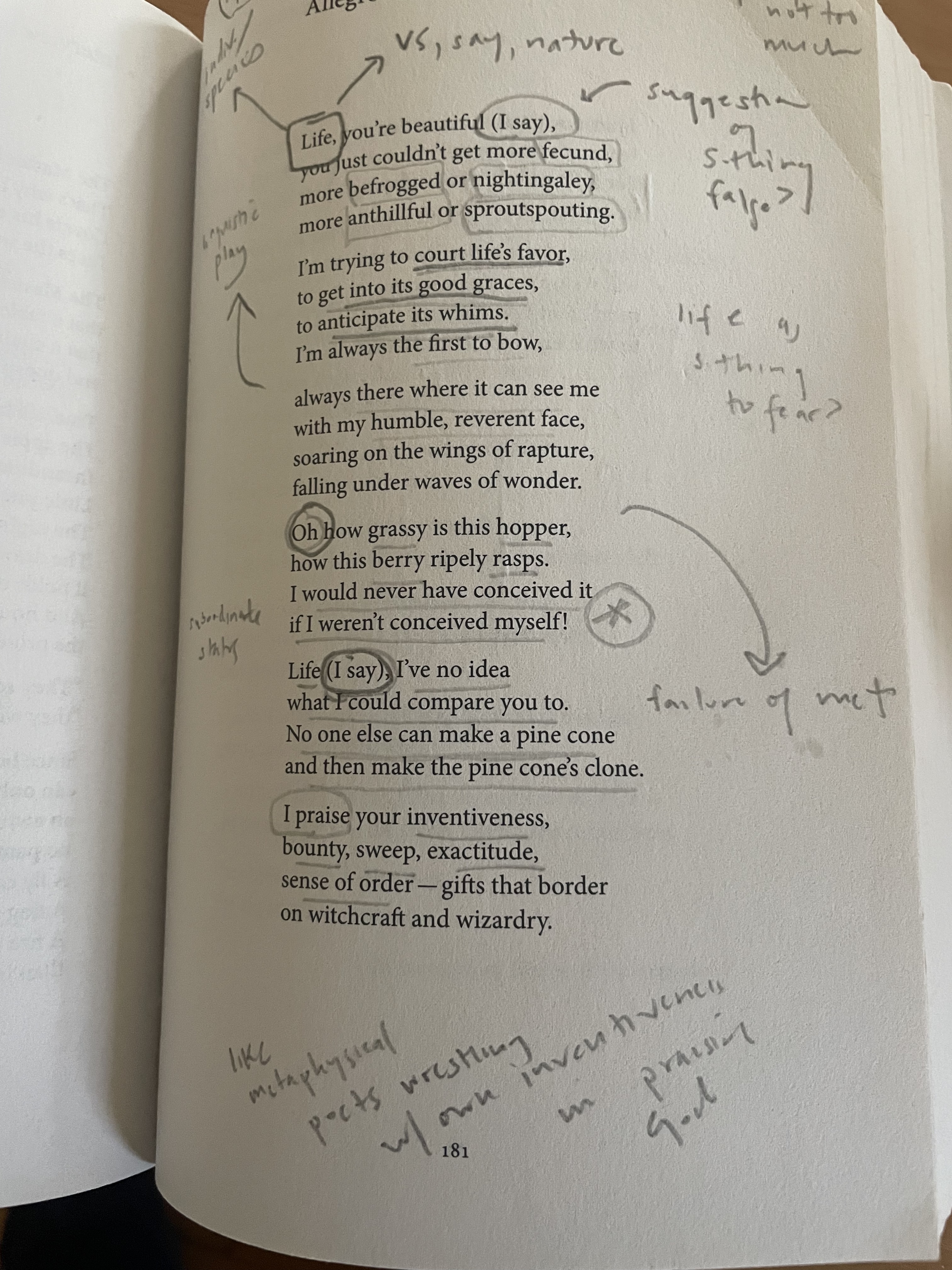
Martin is an expert at living with hard things; she suffers chronic pain from the operations required to free her from a broken IUD. As a woman who cannot and never wanted to bear children, Martin resists the tendency to think of nature in terms of fecundity and rebirth, even as she finds herself unwillingly returning to that language. Martin impressively blends the experience of living in a damaged body with that of living on a damaged planet.

Martin learns the key distinction between good fire and bad fire. Without the former we have no hope of combatting the latter, though we may have left things too late. She argues that there is no natural world outside its encounter with the human (just as there is no definition of the human that isn’t dependent on our reliance on nature, especially plants). Our fantasy of pristine or untouched nature is just the flip side of our rapacious consumption of natural resources. Thus she returns again and again to her garden, which not only distracts her from her pain but teaches her about the power of pruning, grafting, and weeding. “An intervention,” she writes, “was not inherently good or bad; it was part of a dialogue. The tending of a natural body required constant attention: the giving and receiving of nurture and discipline. Extraction and tourism were types of attention. So was gardening. It mattered how the relationship was structured, not just that there was one.”

At her best, Martin rejects easy thinking. The tendency to just get through to the end of the next fire season, for example, is strong, but Martin rejects this as blindness. We need, she argues, to think of ourselves as in a relationship with the world, to refuse to separate human from non-human life.

The Last Fire Season annoyed me sometimes: it’s too long, and its author is pretty self-righteous. I’m sympathetic to her politics and indeed her world view, but even I had to roll my eyes at her holier-than-thou attitudes. But even though I strongly suspect Martin and I would hate each other, I learned a lot from her book (not least the wonderful word “duff”), and I bet I’ll think about it for a long time to come.

Caleb Carr, The Alienist (1994)

In the Sherwood branch of the Central Arkansas Library System’s copy of Carr’s The Alienist, someone has written alongside a passage referring to the draft riots of 1863, “Oh Please! Too much B.S.” Telling that out of this entire 400+ page novel, only the passage describing the backstory of its sole African American character is singled out for such contempt. Who knows when some anonymous member of my community expressed this frustration. It looks like the book hasn’t been checked out for a while—but it also looks like it was checked out a lot, back in the day. And of course, The Alienst was a huge hit. I remember selling more than a few copies of it in my bookseller days. For whatever reason, I never thought of reading it then. But Carr’s recent death, and the story of his life as revealed in the Times obit, piqued my interest. And I knew the book has its fans. When I wondered on Bluesky about reading it, Anne Trubek said she’d spent years chasing the high of her first encounter with the book. How could I not see what the fuss was about?

In New York in 1898 someone is killing young boys. Not just killing them: maiming them horribly and leaving them on grisly display. These boys are orphans and runaways. They work in brothels, servicing a particular clientele: men who like boys dressed up as women. In the first chapter, the narrator, John Schuyler Moore, a crime reporter for the Times is summoned to the latest corpse by his former Harvard classmate, Laślo Kreisler. Kreisler is the alienist of the title, as psychologists were then known: they cared for or studied people “alienated” from society and their own, “true” natures. Under the guise of then police commissioner Theodore Roosevelt (another old pal), whose attempt to clean the force of corruption (same as it ever was…) threatens to founder if the killer isn’t caught, the pair methodically stalk the fiendish killer. They are joined by the first female police officer in NY, two Jewish cops ostracized for their identity and their passion for scientific methods of detection, and some devoted former cast-offs from Kreisler’s life’s work helping orphans. The band gets together, they make painstaking progress, but they’re always behind the killer. As the death toll rises, and nefarious elements seek to use the killings to foment reactionary unrest in the city, the case becomes a race against time…

The short verdict: it’s good! Not, in my opinion, great. But worth reading. I got a Name of the Rose vibe from it: a smart non-crime writer writing an investigation in a historical period they have researched to bits.

The long verdict: maybe what Carr was doing—spotlighting together historically marginalized figures and using historical figures like Jabob Riis and Teddy Roosevelt as more than just bit players—was more unusual at the time than now. Maybe the book is in that awkward in-between stage: a bit dated, not yet so old that it feels like a glimpse into another world.

What does feel of its time—the 1990s, not the 1890s—is the passionate defense of children, and the abhorrence of the violence (physical, psychological, sexual) done to them by adults. Based on what I read about him, this element seems to come pretty closely from Carr’s own life, with the desperate, authentic, slightly incoherent quality of not-fully-worked-through experience. In this, The Alienist reminded me of some otherwise completely different books, the crime novels of Andrew Vachss, all of which centered on the sexual abuse of children. Anyone remember those? Vintage published them in the 90s, they were kind of a thing, but I never see them anymore. Wonder what happened to him.

Ignore that anonymous Arkansas reader: no BS here. There’s plenty of fiction being written today that will look, if we are lucky, a little creaky in 30 years in its efforts to include marginalized experience. Worth a little awkwardness to kick open some doors.

Laurie Colwin, Shine On, Bright and Dangerous Object (1975)

Colwin’s first novel, which I think I maybe found a bit slight on my initial deep-dive thirty years ago and which I haven’t read since, but which impressed me greatly as a middle-aged reader. Crazy to think Colwin was only about 30 herself when she wrote it.

A Jewish woman marries into an old WASP family. He husband, a charismatic ne’er-do-well, dies in a sailing accident. In the grieving process, she must come to terms not only with her loss but her recognition of how little her husband had ever been able to know about himself. In the process, she becomes close to her husband’s brother, as serious as her husband was carefree. I won’t tell you what happens, but Colwin does something so interesting at the end: her book takes an unexpected swerve that makes everything so much more complex. Man, it sucks she died so young.

Francis Spufford, Cahokia Jazz (2023)

God, what a book! I’ll say more about it in my Year in Reading piece.

Elisa Gabbert, Any Person is the Only Self (2024)

Essays on mostly bookish topics written by the poet Elisa Gabbert. I was happy to start in on the first one, because I remembered it from its first appearance in the New York Times: a lovely piece on the “recently returned” shelf at the Denver Public Library, where no algorithm or even individual taste holds sway. Gabbert has revised the piece so that it has a wider focus, and I actually missed the minor-key aspect of the original. But I swallowed these pieces one after another, unable to give them the time they, like all good essays, deserve. I ought to revisit them from time to time. Here’s what stuck with me, though: the to-me breathtaking abruptness of their endings. Gabbert does this thing where she meanders in classic essayistic fashion, and then simply declares herself done. I experienced this as an attack on my sense that the ending of an essay should call back to its earlier moments, allowing readers to see in a new light something they’ve have already been told. But they really are more ways to do things than you’d think.

Jamel Brinkley, Witness (2023)

Strong collection of stories of unhappiness. I still think about “Blessed Deliverance,” about a group of friends coming up in a gentrifying neighbourhood (one sign of which is that some white folks set up a bunny rescue) who drift apart as they enter high school. And I was blown away by “Barstow Station,” the story of a UPS driver whose adult relationships founder because he’s too busy preserving himself from the memory of something bad that happened when he was a teenager. I immediately decided to teach it this fall—along with this lovely close reading by my secret boyfriend Garth Greenwell. (Secret to him, not all of you.) In the months since first writing this, I did indeed teach the story, and even though most days in that class were hard slogging, the story was a hit. Or at least what counted for one in one of the least curious groups of students I’ve ever taught.

Colin Walsh, Kala (2023)

Debut Irish crime novel that seems to have made basically no impact in the US market. Friends who were teenagers when one of their gang disappeared are brought back together when the body is found. As the crime is investigated, these now-adults learn how much they’ve lost over the years. I’m grateful to the friend who sent me a copy: I read Kala with pleasure over a summer weekend. Walsh reminds me a lot of Tana French: they’re both Irish, obviously, and dab hands at dialogue. Above all, Walsh concentrates as much on character as his more famous (and, let’s be real, talented) confederate.

Linda Kinstler, Come to this Court and Cry: How the Holocaust Ends (2022)

In her brilliant first book, Linda Kinstler asks this vexing question: what counts as proof that the Holocaust happened? She begins in Argentina in 1965 and the Mossad’s assassination of Herbert Cukurs, the Latvian Lindbergh (in politics and aviation alike), known during the Holocaust as the “butcher of Riga.” Next to the body, the killers left this text from a closing speech at the Nuremberg Trials: “Mankind itself… comes to this Court and cries: ‘These are our laws—let them prevail!” A strange choice, at least for anyone uncomfortable with the idea of taking the law into one’s own hands.

From this historical event—prompted by unwillingness on Israel’s part to have a sequel to the Eichmann trial and fear that the statute of limitations for perpetrators was about the expire in Germany—Kinstler’s text becomes at once more theoretical and personal. Theoretical because her main interest is in parsing the difference between law, history, and story, and how the evidentiary claims for the latter two are different than those affecting the first. And personal because in the background of Cukurs’s story—a member of the Arājs Kommando, Latvian auxiliaries who competed with the Germans for cruelty and zeal in murdering their Jewish former neighbors—was one Boris Kinstler, the author’s grandfather, who disappeared or died in mysterious circumstances in the late 1940s and may have been a KGB spy and thus acting as a mole within the fascist-aligned organization.

Central to Kinstler’s argument is a historical situation that was new to me. In 1958 a German jurist named Erwin Schüle, the lead prosecutor on a trial of perpetrators who had been stationed in Lithuania, made a consequential decision. Initially faced with only a single defendant—a man named Fischer-Schweder who had white-washed his SS record and, perversely, even ran a displaced persons camp after the war—Schüle ran up against the problem that German law required him to prove that defendants had initiated murder (in this case, mass shootings), rather than doing them on the orders of others. Witness testimony was inconclusive. So Schüle ordered his detectives to expand their investigation to uncover what he called “the crime complex” of the area on the German-Lithuanian border where Fischer-Schweder had served. As Kinstler explains, by crime complex Schüle meant “the entire constellation of actors and actions that allowed mass executions to take place.” In so doing, the prosecution charged nine more men. All ten were convicted.

The idea of the “crime complex” considered Holocaust crimes as structural rather than individual:

it treated entire swathes of the Nazi administration as criminal organizations and presumed the complicity of everyone involved, including secretaries and radio operators and cooks. It required investigators to begin with a place, or a name, or a date, and comb through vast amounts of information to fill in the blanks: who had been killed, and how, and by whom?  How many ‘Aktions’ were there, and on whose orders? How many Nazi personnel had been involved? Were they still alive and in Germany? If they were able to answer all these questions with certainty, then they could initiate criminal proceedings.

Perhaps because of its status as both victim and perpetrator, Latvia never pursued the “crime complex” idea. Which, Kinstler argues, made it hard for the country to come to terms with its responsibility in the miserable fate of its Jewish population. And then, more recently, to refuse to take up a case against (the memory of) Cukurs, despite the pleas of the remnants of its Jewish community. For in these same years, Cukurs has again become a folk hero in Latvia, a devoted patriot, a fighter of the Soviets, a victim of Israeli aggression, who not only didn’t kill Jews but helped several members of that community, even rescuing one young woman and taking her to safety in South America after the war. (Kinstler meets the woman’s daughter to learn more, though mostly what she learns is that the woman’s mother never talked about her wartime experiences, leaving her and Kinstler companions in confusion.) Kinstler tells us about a musical that, like something out of Mel Brooks, white-washed Cukurs’s reputation; she even reads a spy novel (recommended to her by the local prosecutor) in which her own grandfather figures as a Soviet spy and thus a traitor to the Latvian people.

Historically, it’s clear that Cukurs both saved a handful of people and was present at many deportations, requisitions, beatings, and mass shootings, notoriously in the Rumbula massacre, in which 25,000 Jews were murdered on two days in late November and early December 1941 in a forest near Riga. Eyewitnesses report him taking part in such events. But no one alive can testify to it.

In this sense, Come to this Court and Cry is a fascinating expansion of what Dan Stone argues in his new history, regarding the reactionary backlash that has shaped the latest iteration of Holocaust memory wars. At the annual Holocaust remembrance events, local politicians downplay the Arājs Kommando’s responsibility, saying that no simple conclusion can be made regarding its activities. Too hard to acknowledge complicity.

As Kinstler concludes, in the 21st century, to expand the reach of justice in reopening cases from the era of WWII is a double-edged sword: “a crime that can still be tried can also still be pardoned.” Her book explores how “remembering went from being an injunction to a knotted, nearly impossible question.”

And what about Boris Kinstler, the author’s grandfather? Was he a spy? At the end of her book, which I recommend unreservedly, Kinstler tells us about the report she requested from the Russian government. Did they have a file on her grandfather? A one-page letter returns: no information or materials pertaining to Boris Kinstler exists in the archive. No answers there either. Kinstler’s subtitle, she tells us, is a warning, not a prediction. The fight against the Holocaust’s misuses never ends; as the forces who propagate those varied distortions grow in number and power, it seems a fight less likely than ever that we will win.

Helen Garner, This House of Grief (2014)

September 4, 2005 was Father’s Day in Australia. A man named Robert Farquharson was driving his three children home to their mother, who had initiated divorce proceedings against him earlier that year. Father and sons had spent the day watching the football, visiting family, making a KFC run for dinner, even doing a little shopping. Night had fallen; Farquharson was on the highway, five minutes from home. He headed up a railway overpass, then down the other side. Suddenly, his car veered off the road and plunged into a reservoir. Farquharson survived; the boys drowned.

Garner’s work of narrative nonfiction tells the story of the aftermath of this terrible event. Although he was charged by the Crown with three counts of murder, his soon-to-be ex-wife supported him, saying he could not have set out to kill his beloved children. But Farquharson’s behaviour after the crash was odd, to say the least. Splashing out of the water into the spring evening, soaking wet, he flagged down a car and ordered its drivers to take him to his ex-wife’s house. Only there did he mention the children were still in the water. And only then were the authorities informed. When Farquharson and the boys’ mother were taken back to the site, by her new lover, Farquharson stood silently, asking only for a cigarette. It was the new man in Cindy’s life who went into the water to try to rescue the boys. That first night, when police questioned him, he insisted he hadn’t done anything wrong, asking only, over and over again, what would happen to him.

Who acts that way? Well, anyone maybe.

What is the right way to respond to a terrible situation? Is some grief more acceptable than others? Could Farquharson’s confused story—that he had blacked out during a violent coughing fit—have been true? Is cough syncope a thing? Some experts said no. Others said yes. What about the physical evidence, tire tracks and the like? According to the police, the signs pointed to voluntary movements on the slope, inconsistent with an out of control car. Farquharson, they allege, steered the car into the water. But they messed up some of the evidence, and failed to account for the road’s camber. What about the explosive testimony of one of Farquharson’s mates, who said he’d had a conversation with the man a few months before the event, outside the local fish and chippie on a Friday night: Farquharson was not just low and helpless, as others had testified he had been, but angry and vengeful. He said he was going to kill the boys, and he would do it on a day everyone would remember, Father’s Day. Did Farquharson really say such a thing? Why didn’t the mate come forward at the time?

Was this an accident or an act of vengeance? Garner followed the trial for months, attending court every day, and her book records the efforts of the Australian legal system to come to terms with this baffling case. She gets friendly with the other regulars—reporters, gawkers, court officials—and one day runs into the defense counsel, to whom she says, “Only one man knows what happened, and he’s not saying.” This seemingly benign statement of perplexity incenses the lawyer (he threatens to ban from the courtroom): the whole point, he thunders, is that Farquharson doesn’t know what happened. What is knowing? What is an act? Can we entangle our conscious decisions from our unconscious drives? These are the big questions Garner probes in this riveting book.

Garner doesn’t like Farquharson—her take seems to be that the only thing more impossible than his having killed the boys is the possibility that he didn’t—and her descriptions of the man are pitiless, though, I wouldn’t say, unfair. In one especially merciless moment, she calls him a “small stump of a man, with his low brow and puffy eyes, his slumped spine and man-boobs, his silent-movie grimaces and spasms of tears, his big clean ironed handkerchief.” It doesn’t help, from her perspective, nor, I suspect, from that of either the law or public opinion, that Farquharson is profoundly inarticulate. He responds with baffled indignation to his plight; he turns to sentimental clichés and watered-down therapy-speak. Behind the story of the crime is an argument about a certain kind of Australian masculinity and its helpless, toxic loneliness. As a North American reader, I no doubt don’t understand the full context but Farquharson is legible beyond his corner of Victoria.

I’ll let you look up the outcome for yourself: if you like Janet Malcolm (name-checked here in one of the epigraphs) you’ll enjoy This House of Grief. I read with avidity, but I also never quite get on with true crime. Throughout, Garner projects herself on to the jury, imagining her own responses (boredom, confusion, indignation, you name it) reflected in their posture and expression. By the end, I felt like Garner was trying to reason out her own compulsion. It can’t be good for you, attending to a sensational trial this closely when you don’t have to. I found her final pages, where she mediates on her grief for children she never knew—ending in a sanctimonious aria: “They are ours to mourn. They belong to all of us now”—mawkish and unconvincing.

Read this, sure, but read her fiction first.

Dorothy West, The Wedding (1995)

Set in 1953 in a black enclave on Martha’s Vineyard called The Oval, West’s novel—only her second, written over decades in collaboration with her editor, Jacqui Kennedy Onassis, and published when the author was 88—is set on the day leading up the wedding of the youngest daughter of the community’s richest and most prestigious family. This economy of space and time is contrasted with flashbacks that go back four generations on both sides of the family. Over and over, these family stories show whites and blacks mixing, often intimately. The characters, obsessed with color, police racial distinctions that can’t hold. Seemingly impermeable ways of living and thinking prove to be all too permeable. Most interesting to me as a (remembered) record of the last moments of legally segregated America—a world Henry Louis Gates, Jr. wrote about in his underappreciated memoir Colored People. Had I read it on my own, I would probably have forgotten it soon after reading. But I read it for One Bright Book, and Frances and Rebecca helped me think about it more carefully. They didn’t quite convince me the novel is as smart about class as it is about race, but they made me see it as more carefully composed then I’d thought. Give the episode a listen and see if you are enticed.

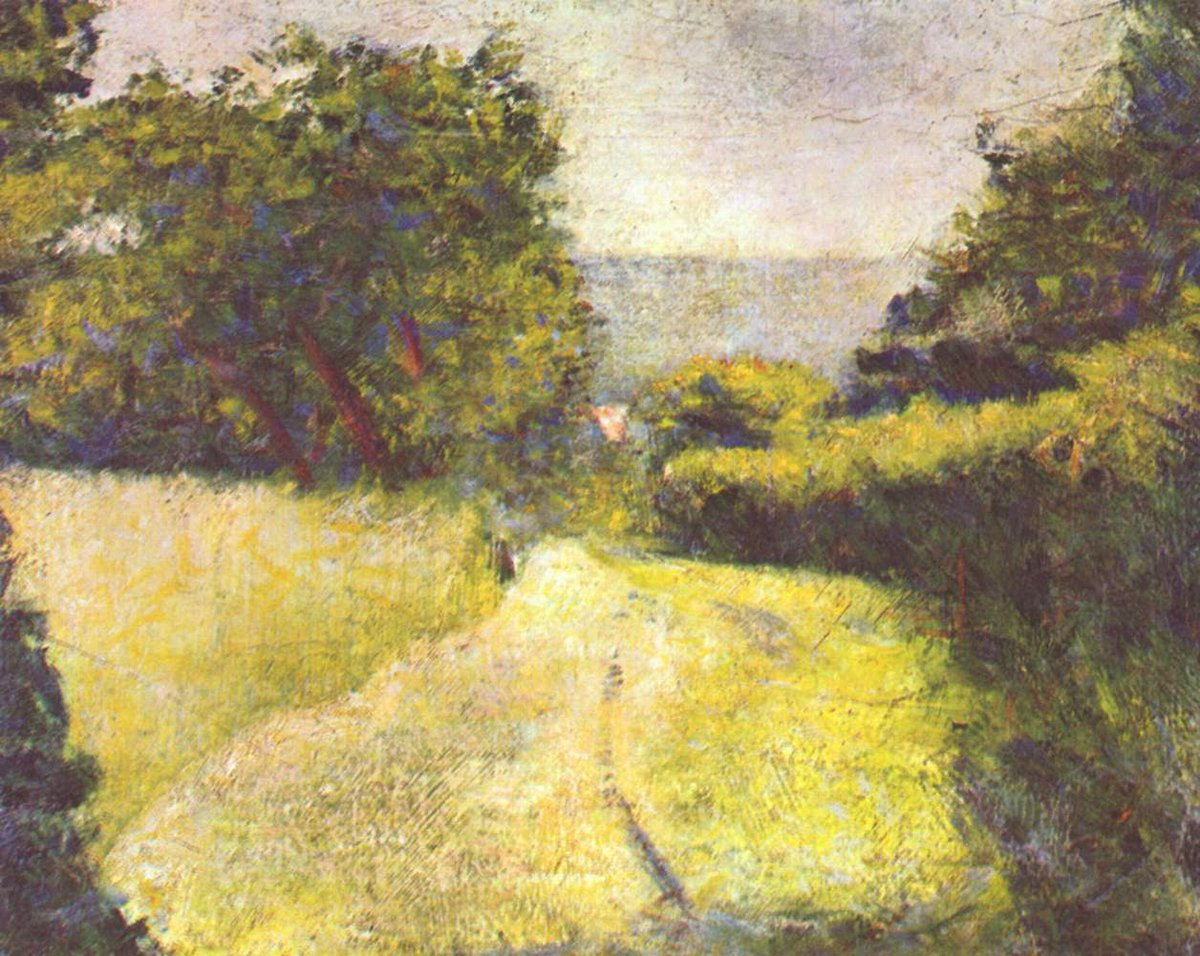
Georges Seurat, The Hollow Way (1882)

Tell me—have you read any of these? If I could only recommend one, it would be the Spufford. And then the Colwin. And don’t sleep on Brinkley. But a good month all round. Doesn’t last summer seem a lifetime ago?

What I Read, May 2024

What a terrific month! Yes, the first ten days were busy: bringing the semester to a close; dealing with the fallout of the lousy previous months; celebrating with our graduates. But then the pace shifted entirely. Amazing how much better I feel when I exercise regularly, eat better, sleep well, and sit on the back deck with a fantasy novel for an hour just because.

It occurred to me recently that in my moaning about last month I forgot something amazing. The eclipse! Little Rock in the totality for something like two and a half minutes, and the experience was as incredible as everyone said it would be. How lucky to simply walk down the block to an open space for an incredible view of the thing. How amazing that people in our neighbourhood (who normally never have anything to say to each other) were out and about, portable lawn chairs and to go cups in hand. Strong school’s out for summer vibes. 10/10, absolutely recommend.

Here are the books I read:

Franz Marc, Two Women on the Hillside, 1906

Arnaldur Indridason, The Darkness Knows (2017) Trans. Victoria Cribb (2021)

In wintery Iceland, retired cop Konrad is pulled into an ongoing investigation that to his surprise helps him learn more about the mysterious death of his father.

Arnaldur Indridason, The Girl by the Bridge (2018) Trans. Philip Roughton (2023)

In summery Iceland, retired cop Konrad is pulled into an ongoing investigation that to his surprise helps him learn more about the mysterious death of his father.

Look, sometimes you need to read something as undemanding as possible.

Guy Gavriel Kay, Lord of Emperors (2000)

Longer and even more satisfying sequel to Sailing to Sarantium, which I read a few months ago. This will sound weird, but I get the same feeling reading Kay as I do watching David Simon shows: intense investment on my part in the characters, sighs of bittersweet pleasure when things come to a close. Like its predecessor, Lord of Emperors is modelled on Byzantium under Justinian and Theodora. The mosaicist hero of the first volume—summoned to Sarantium to tile a version of the Hagia Sophia—is joined in this book by a doctor from lands to the east. Political upheaval leads to changing religious and artistic standards; the eventual fall of the Empire is hinted at. (Kay develops this unthinkable outcome in his more recent books.) There’s an exciting chariot race, too.

Christine Lai, Landscapes (2023)

Matt Keeley calls this the Sebaldian country house novel you didn’t know you needed. Which is a good description. Set in England in the near-future in an isolated house among desiccated fields and dead woods, Landscapes centers on an art historian who is first brought to the house by one of a pair of wealthy brothers only to flee from his violence into the arms of the other. Lai’s world-building won’t win any awards—it’s clearly not what she’s most interested in, though her description of literal zones of climate-controlled safety around city centers and other wealthy enclaves feels all-too plausible—and her characterization is uneven. (The only vivid character is the empty, preening, vain cruel brother.) But the book had me thinking anew about the role of art in an era of climate catastrophe and the Benjaminian claim that every document of culture is also a document of barbarism.

Megan Abbott, Beware the Woman (2023)

My first Abbott, unaccountably. But not my last.

Thriller with a side of body horror about a pregnant woman who accompanies her husband to his family’s summer place in Michigan’s upper peninsula for the first time. Plenty of Gothic accoutrements: kindly father, a former doctor still grieving his wife’s death decades ago, who might not be what he seems; mysterious housekeeper; isolated home. Abbott excels at creating menace, unease, and doubt. A story about what men will do to control women’s bodies: very much of our time.

Perfect reading for the first hot Sunday of the summer.

Émile Zola, La Bête Humaine (1890) Trans. Roger Pearson (1996)

“Too many trains, too many murders,” an early critic wrote, preposterously, of this terrific late novel in Zola’s Rougon-Macquart cycle. As if a book could have too much of either!

Although I still have plenty of Zola ahead of me—I’ve read about half of the RMs now—I’m willing to say that this is the most Zola-esque Zola of all. The train system, with its switches, branches, tunnels, wheelhouses, and miles of track, is the perfect metaphor for the books’ obsession with the interconnected systems and institutions of Second Empire France, especially because it affords new expressions of crime, sexual desire, and violence.

Reading La Bête Humaine, I was reminded of the opening of Peter Brooks’s argument that sight is the realist sense par excellence; of the many descriptive set pieces in this novel, Zola’s favourites seem to be the ones depicting the railyards of the Gare St Lazare as seen from the balcony of an apartment building inhabited by railway workers. In the opening scene a railyard supervisor named Roubaud awaits the return of his wife, Séverine, in a borrowed apartment in that building. She’s been shopping while he’s been getting a dressing down from his superior, a pickle he escapes thanks to the influence of a man named Grandmorin, a former judge who is on the board of the railway and has taken Roubaud on as a protégé because of his fondness for/guilt toward Séverine, whom he knew as a child. What promises to be a cozy tête-à-tête between newlyweds turns ugly, when a change remark by Séverine’s reveals that the judge had sexually abused her for years. Roubaud sees red and after nearly throttling his wife immediately plots to kill the judge, forcing Séverine to send the man a note asking him to meet her in a private car on the evening train to Rouen. This violence unfolds against a backdrop of gaiety and hilarity rising from the apartment below, where two sisters run a non-stop party of singing, dancing, and drinking.

Over the course of four-hundred increasingly intense pages—filled with one sensational, over-the-top scene after another—Zola builds to an indelible ending in which the strains of violence, misogyny, wounded male pride, hilarity, and excess that are already present in the beginning return in reconfigured form: a runaway train, its driver and fireman thrown off after a terrible fight, filled with drunken, bawling recruits headed to the front of what will be the disastrous Franco-Prussian War, hurtles unchecked and to certain disaster under a full head of steam.

I couldn’t get enough of the novel’s proto-Freudian and phrenological-criminological-eugenicist ways of thinking about human behavior. The other main character—the connection to the Rougon-Mcquart family—is the train driver Jacques Lantier (whose mother and brothers appear in The Assommoir, The Masterpiece, and Germinal, respectively), who literally sees red when he is aroused by a woman, wanting only to dismember her. (A long time ago I saw the Renoir film—though I remembered almost nothing; it must be so different from the book—and I could only picture Lantier as Jean Gabin, which is unfortunate because he’s much more like Peter Lorre.) And lest I make it sound like this is a book about men, that’s only partly true. In addition to Séverine, there are two other terrific female characters. The one who broke my heart was Flore, an operator at an isolated railway crossing, and whose unrequited love for her cousin Lantier leads to a disastrous outcome.

I could say a lot more about this book. Check out our conversation at One Bright Book to hear more. And speaking of more, I feel compelled to read more Rougon-Maquart before long. Summer of Zola, anyone?

Karl Ove Knausgaard, The Morning Star (2020) Trans. Martin Aitken (2021)

The reason I so seldom follow through on reading plans like the one I just suggested is that I just cannot stop from being distracted by unexpected things that come my way. I’d been paying even more attention than usual to Brandon Taylor’s reading because he’s been championing Zola lately. So when he tweeted repeatedly about this latest series from Knausgaard, I thought maybe I should investigate. I hadn’t paid any attention to this, other than to vaguely note Jeez, that Norwegian guy has another set of books. If I expected anything it was that the books would be autofiction in the vein of My Struggle. (I read the first two of those with great pleasure a long time ago and then… just didn’t keep up: now I want to close that loop, too.) But The Morning Star is a proper novel, in the sense that it is composed of long sections narrated by different first-person narrators, most of whom link up in sometimes unexpected ways. The action takes place in a hot summer in and around Bergen, in something like 2016. There is plenty of the deep ordinariness of middle-class Norwegian life that I found compelling in My Struggle (cabins to close for the season, impromptu dinner parties to arrange, elderly parents to look after, marriages to keep on life-support). But there’s also a lot of weird stuff: a priest conducts a funeral for a man who turns out to look identical to the one who asked her an impertinent question in the airport the night before; a creature, whether human or not is unclear, roams the forest, possibly in connection to the disappearance of a man from a mental institution and a shocking satanic cult murder; and, most powerfully of all, a dazzlingly bright star suddenly appears in the sky.

The novel seems to be about the relation between the mundane and the extraordinary: I say seems because for me Knausgaard incites a delicious reading fugue state, where undistinguished sentences roll on into compelling blocks of text and the pages keep turning as if by themselves. As soon as I reached the end of its 600+ pages I ordered the 800+-page sequel…

Berthe Morisot, In England (Eugène Manet on the Isle of Wight), 1875

Honestly I enjoyed all these books, even those Indridasons. See anything you fancy here?

What I Read, April 2024

April sucked shit. I’d had it with everything: the semester grind, how hard it’s become to teach these last few years, and a lot of my colleagues, especially the administrators of my place of employment. I didn’t sleep enough, saw the height of the Arkansas spring blooms only through windows, and drank too much coffee. Gotta make some changes in my life.

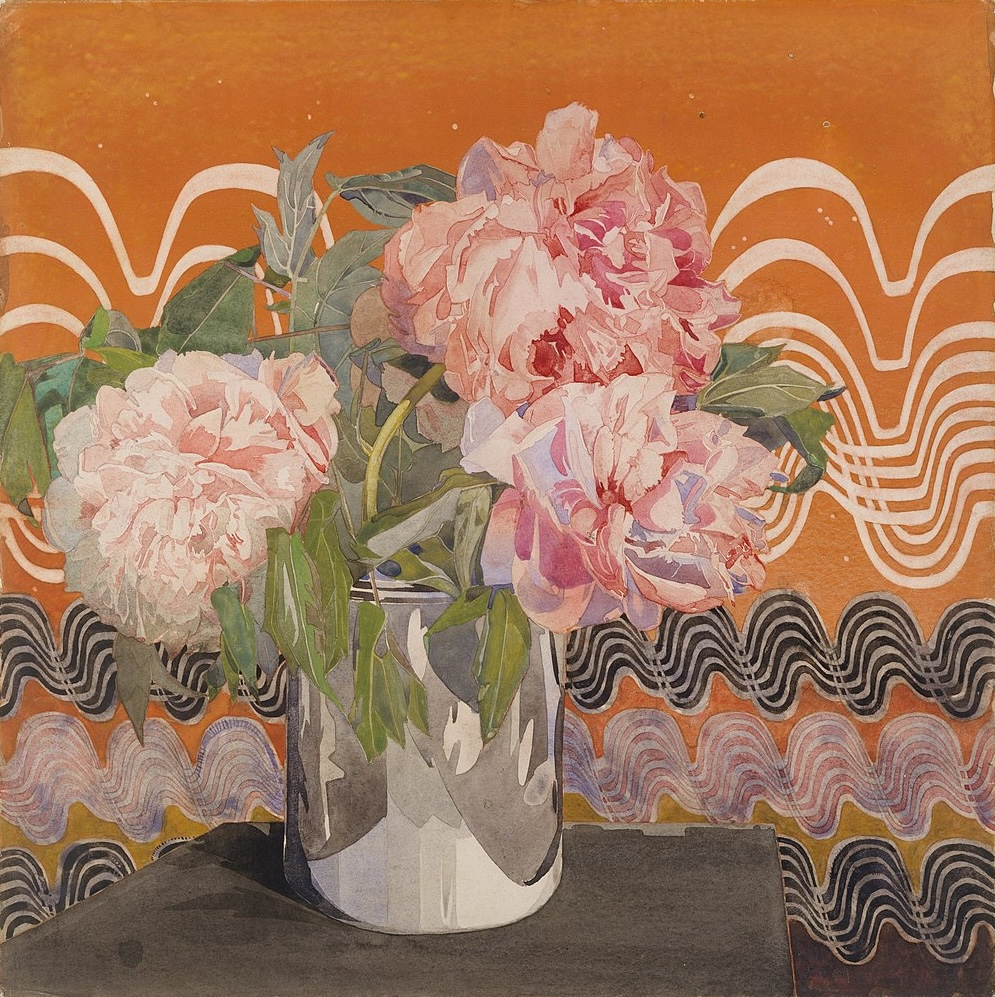
Charles Rennie Mackintosh, Peonies, ca. 1920

Edith Wharton, Summer (1917)

Wharton continues to be one of my happiest discoveries of the last few years. (A personal discovery: I know everybody else already knows her.) Shawn Mooney, host of the Shawn Breathes Books YouTube channel, asked a few of his many bookish friends to read this novella from the middle of Wharton’s career. What a terrific book! Charity Royall, the adopted daughter of a lawyer and his now-late wife, might be in the upper echelon of her New England village’s society, but that doesn’t mean much. She’s bored to death. When a young architect comes up from New York to summer with a relative—to sketch the local country houses, ostensibly, but mostly to loaf—Charity is smitten by the glimpse of another world he offers. And by him, too: the book is impressively sexually frank for its time. Before long, Charity and Lucius have made a love-nest out of an abandoned house halfway up a nearby mountain. When Charity gets pregnant, a lot of troubling and surprising things happen in a short time. I won’t spoil the ending, but oof what a gut punch. Recommended!

Folks who have read this novel (others, look away): do you think Royall might be Charity’s father? Am I crazy to think so??? The circumstances around Charity’s coming to the Royalls seem… murky.

Andrey Kurkov, The Silver Bone (2020) Trans. Boris Dralyuk (2024)

Kurkov, whose delightful Death and the Penguin I laboriously read in German way back in the day and whose subsequent many, many books I have failed to keep up with, has written the first of a series set in Kyiv in 1919. The Great War might be over, but peace is nowhere to be found in Ukraine. Various factions vie for control: unaffiliated war lords, the Bolsheviks, the Whites, and the embattled Ukrainian People’s Republic, one of the first nations in Eastern Europe to deem Jews a protected minority, which didn’t stop it from countenancing a wave of pogroms under its brief rule. (I’m slowly making my way through Jeffrey Veidlinger’s history of these events, In the Midst of Civilized Europe, which is retrospectively clearing up a lot of the context.)

On the novel’s first pages, Kurkov’s protagonist, Samson Kolechko, a would-be engineer, loses his ear in an attack by Cossacks. (His father, alas, is murdered.) Samson, an upside-down low-rent version of his biblical namesake, manages to keep the ear, which turns out to have fantastical powers, allowing him to hear things he otherwise couldn’t. This comes in handy when the two Red Army soldiers who have usurped his apartment plot to kill him. He goes to police to turn them in and in a pleasingly preposterous turn of events is taken on as a detective himself. Along the way, he relies on the help of a young woman employed by the newly-established department of statistics. Kurkov vividly evokes the danger, scarcity, and uncertainty of Kyiv in this period: atmosphere is the book’s strong suit.

As for the crime element, well, let’s say it’s on the shambolic side. Perhaps more generously: it’s about what it means to investigate crime in a place where the political situation is changing so fast that the law threatens to be even more nakedly a fig leaf for power than usual.

In Boris Dralyuk, Kurkov has found a translator who gets his goofy side—and, I suspect, has even improved the book a little. He tells me the second Samson novel will be out in English next year. Count me in.

József Debreczeni, Cold Crematorium: Reporting from the Land of Auschwitz (1950) Trans. Paul Olchváry (2023)

Extraordinary. I do read a fair few Holocaust memoirs, and even though I’m interested to see how similar they are, how much they trade in the same tropes, I’m usually caught short in horrified wonder by at least one scene or detail. Cold Crematorium—now translated into English for the first time, more than 70 years after its publication in communist Yugoslavia—gave me that feeling from start to finish.

Debreczeni, the penname of József Bruner, was born in Budapest but moved to the Vojvodina, the largely Hungarian-speaking part of what is now Serbia, after WWI, where he worked as a journalist and newspaper editor. Like most Hungarian Jews he was deported to Auschwitz in 1944. Having survived the initial selection, he volunteered to be transported further west in Silesia to a camp that was then under construction. Falkenberg, as the Germans named it, was part of the vast Gross-Rosen camp system. Conditions in that archipelago of suffering were so bad that far fewer victims survived its array of satellite camps than did Auschwitz; it is much less well known today than its role in the Holocaust would demand. (Menachem Kaiser’s excellent third-generation memoir Plunder also considers this lacunae.) From there he was sent to the work camp at Fürstenberg, and finally to Dörnhau, the “hospital” ward of which was known to inmates as the cold crematorium because so many died within its frigid walls. He was liberated in May 1945, barely alive. After a lengthy recuperation, he returned to Belgrade, where he lived and worked until his death in 1978.

Indulge me as I share some of this remarkable book with you. It is the most visceral, corporeal description of the Holocaust that I know:

Here’s a passage from Fürstenberg, where Debreczeni labored, under dire conditions, to build an underground tunnel system (the so-called Project Riese, the eventual purpose of which remains a source of debate among historians):

Dysentery takes hold me of me yet again. Swelling spreads frighteningly over my entire body. Over the course of these days I am lugging sacks of cement to the mixers, and I become hopelessly dirty. The cement dust swirling nonstop in the air forms a thick layer of sediment upon my clean-shaved head. It collects on my gums and seeps into my nose, my eyes, my ears. Not even Sani Róth [former mobster who takes Debreczeni under his wing] can get his hands on soap. I hang my rags on the nail above me. The pants and tunic are literally moving from the thousands of squirming lice. Destroying them is hopeless to begin with, so lately we haven’t even been trying.

Here’s one from the “hospital” unit at Dörnhau, where Debreczeni spent eight miserable months:

The November cold pours in through the broken windows, and yet the stench is unbearable all the same. A suffocating stink oozes from the walls. Rising between the rows of bunks, several centimeters high, is an odious yellow slurry of dung. Naked skeletons are sloshing through the putrid river.

At one point, that slurry was knee height (for the few who could still walk). I will never get that detail out of my mind. This is the kind of thing I mean when I say Cold Crematorium makes other Holocaust memoirs seem tame.

And here’s another one from Dörnhau, about a man named Miklós Nagy, who scrabbled to the position of chief functionary of the medics who “treated” the patients, some with good will and others with pure cynicism, in an environment completely lacking medical supplies that was also, as we have seen, utterly unhygienic.  

I once saw this lightweight man jump up and down on a patient’s chest like a rubber ball, stomping on him with bloodshot eyes until he was worn out. The victim’s crime: he’d tried conniving his way to a second helping of soup.

Remember, Nagy was a prisoner of the Nazis, too. The pitiless depiction of camp functionaries is just one of the things that makes this book such a valuable testimonial document.

I am seriously thinking about assigning this book instead of Primo Levi in my intro Holocaust Lit course. (Shouldn’t be one or the other, but syllabi are zero-sum games…) If you think you have the fortitude, I urge you to read this book.

Joan Chase, During the Reign of the Queen of Persia (1983)

I chose this novel by the hitherto unknown-to-me Joan Chase for the April episode of One Bright Book simply because it was reissued by NYRB in 2014 and I’ve had it on my shelf ever since. (I’m trying to use the podcast to get to some of the hundreds of unread books around here…) Reading it was a happy surprise: it’s excellent, although, in my opinion, awfully sad. Somehow Chase tells the well-worn story of a vanished childhood—shot through with depictions of women’s limited lives in this time and place—in a way that feels new.

During the Reign of the Queen of Persia tells the story of three generations of the Krauss family, who mostly live on a farm near an unnamed county seat in northern Ohio probably modelled on Wooster, where Chase was born. The family is made up almost entirely of women: its matriarch, Lil, known as Gram (the titular Queen, so named as a joke about her similarity to a family pony who loves to run wild), has five daughters, two of whom have two daughters each. These girls, all born within two years of each other, and now in their mid to late teens, think of themselves as a collective: their responses to the vicissitudes that life throws the family’s way make up the core of the novel’s events.

Listen to the episode for more about this terrific book. For now, I’ll just say that if you’re intrigued by a first-person plural narrator that never feels gimmicky, and you like domestic fiction that also dabbles in the Gothic, you’re going to love this.

Amy Pease, Northwoods (2024)

(Not to be confused with Daniel Mason’s North Woods; that must have annoyed Pease and her publisher…)

Set in Shaky Lake, WI (which the internet suggests is a real place???), Pease’s debut crime novel concerns a former fish and wildlife investigator, Eli North, who returns from Afghanistan with PTSD and is taken on as a charity case by his mother, the local sheriff. Eli is at the end of his rope: drinking too much, losing contact with his son (his wife threw him out of the house), scared and ashamed most of the time. When a teenage boy is found dead and the girl he’s been seeing disappears, Eli fights for the right to take on the case and maybe regain his footing. The most interesting thing about this book is that Pease has chosen to put the exasperated, anguished, loving relation between Eli and his mother at its center. How things work out between them is ultimately more compelling than the whodunit.

All told, Northwoods is totally satisfactory debut; I’ll keep an eye on Pease. I listened to the audio, and I was excited each day to catch the next installment, sometimes even forsaking my hockey podcasts. So that tells you something.

Willard Metcalf, May Pastoral, 1907

All I can say is: IT’S SUMMER BITCHES. A fuller reading slate returns in May.

What I Read, March 2024

March 2024 was a big month in our family: my daughter became a bat mitzvah on the 29th of Adar I. She worked hard for months beforehand to prepare, and even though the process wasn’t always easy, she did great. Like, better than great. Services were moving, lunch was a whirlwind (no time to eat much but we had delicious leftovers for days), and the party at our beloved local indie bookstore was a blast. (Including a Haftorah Smackdown, where guests who had ben bnai mitzvahed were encouraged to show off how much of their portion they could remember.) Celebrating with friends and family—including one of my oldest friends, who came all the way down from Ottawa, how about that??—was incredible. Suffice it to say, Marianne and I were kvelling big time. We were also very tired. For a couple of weeks afterward, the energy level in this house was low. Like, come home from work, lie down on the couch, wake up two hours later with a crease down your cheek kind of low. All the reading took place around the edges.

Henri Matisse, The Ballet Dancer, Harmony in Grey (1927)

Ann Leckie, Ancillary Justice (2013)

First volume in the already canonical space opera set in the Radch Empire (expansionist, like all empires). Breq is an ancillary, a human body that acts as an extension of the hive mind AI that controls the empire, or a bit of the consciousness of a starship (these amount to the same thing, I think: it’s confusing), and the only survivor of a starship destroyed twenty years earlier. The Wikipedia entry helpfully explains the plot; I found the reading experience pleasurably disorienting. Basically, the action moves between the present, in which Breq seeks revenge for the destruction of her ship, and the past, in which the treacherous circumstances of that destruction become clear.

James told me to read the next one right away so I didn’t forget everything, but I didn’t. Uh oh.

David Downing, Union Station (2024)

Downing knows his readers can’t get enough of his John Russell books, even though he wrote his way to the end of WWII. He first solved the problem by writing a prequel. Now he’s taken a page from Philip Kerr and continued the adventures of journalist and former reluctant spy Russell and his actress wife Effie Koenen into the postwar period. Union Station finds the couple in Los Angeles, where Effie is making a go in an American sitcom while Russell grits his teeth and interviews movie stars. One day he realizes he’s being tailed and life gets more interesting. (Downing has great fun taking Russell on routes all over the metropolis.) But who’s after him? The Soviets, reneging on the deal that released him from their services? The Americans, suspicious of his thinly-disguised hostility to McCarthyism? As in all spy novels, the answer can only be found by returning to Berlin. (The occasion is the third annual Berlin Film Festival, where Effie is honoured with a retrospective.) A bittersweet return for both husband and wife: a new war has spring up on what aren’t even the ashes of the old.

The John Russell books are often great and never less than serviceable. This isn’t the best of the bunch, but if Downing keeps writing them I’ll keep reading.

Tana French, The Hunter (2024)

As a helpless Tan French simp I had the release date for her latest circled on my calendar months ago. The Hunter came out the week of the bat mitzvah—perfect timing: I demolished it on my spring break the week after. A sequel to The Searcher, which I wrote about at length here, it offers more of that French good stuff. Pitch-perfect command of voice, slow burn, delicious uncertainty about who is playing what game and whether they know that others think they’re on to them. (Lotta pronouns there, I admit.) Honestly, the book could have been longer: the last 75 pages or so were too hurried for my taste. French is good with dogs. Gamboling across the fields after a scent, huffing the occasional dramatic sigh while lolling on the wood floor, barking at a strange car juddering down the drive. Gimme more!

Dan Stone, The Holocaust: An Unfinished History (2023)

I reviewed this for On the Seawall. What a terrific, impressive book. If you only have the appetite for one history of the Holocaust, this is the one. I especially loved how Stone shows the Holocaust to be an ongoing phenomenon, the meaning of which continues to be contested in the most unlikely ways.

Tessa Hadley, After the Funeral and Other Stories (2023)

Push comes to shove I prefer Hadley’s novels to her stories, but I like her stories a lot too. (I once wrote about one of my favourite early ones.) I read these in a rush, one after the other, which is a terrible way to read a collection. I’d read a couple before, in The New Yorker. They were still good on a second reading. Not quite Alice Munro-levels of shifting-narrative-times-to-narrate-striking-events-in-otherwise-ordinary-middle-class-lives, but close.

Louise Glück, The Wild Iris (1992)

Another book I wouldn’t have read were it not for One Bright Book. Huge thanks to Rebecca for choosing this terrific collection of poems addressed to and spoken by flowers and gardens and times of day. Listen to the pod for the details of our reactions, but I’ll just reiterate here that what delighted me most in these poems is their syntax. Glück’s punctuation is an arresting joy.

Turns out I’ll be teaching our intro to the English major course next year, and I’m thinking hard about assigning these.

Guy Gavriel Kay, Sailing to Sarantium (1998)

Kay is the homme moyen sensuel of fantasy writers, which makes him catnip to me.

Henri Matisse, Olga Merson (1911)

That’s it for now. See anything you like here?

What I Read, February 2024

Fell behind on these updates during the semester, as usual. Hard to remember that month beyond the usual—the semester taking hold, mostly warm days from the ever-earlier Arkansas spring—but I do know that mostly we were busy getting ready for my daughter’s bat mitzvah in early March. Along the way I squeezed in these books.

Richard Serra (2001)

Thien Pham, Family Style: Memories of an American from Vietnam (2023)

Autobiographical comic about Pham’s family’s journey from Vietnam to the US in the early 1980s via a Thai refugee camp. Each chapter is named after an important dish, ranging from the ball of rice and fish his mother saves for him on their flight from Vietnam to the baffling Salisbury steak of the school cafeteria to the co’m tâm dac biêt (a combo plate, as best I can tell) that he eats with his high school friends.

The palette is somber, mostly browns and greens, but the tone is lively: this is the classic story of American immigrant success, a story none of us can take for granted, which explains, I’d say, why the final chapter concerns the then-41-year-old author’s decision, in 2016, to finally take citizenship, prompted by Trump’s increasingly hostile anti-immigrant rhetoric. Thien and his family go through a lot of hard things: bureaucratic delays, poverty, language barriers, exhausting work that nearly tears the parents apart, and, most of all, at the very beginning of their journey, a harrowing attack by pirates on the way to Thailand, starkly presented by Pham in a series of black pages containing only the sentences his mother whispered into his ears, “It will be ok,” “I’m here,” “I’m right here with you.” But the Phams do more than survive; they thrive. I was delighted to see the haggard, exhausted, frightened yet determined young parents of the opening chapters settle into the gently bickering, food-pushing older couple of the last ones. Pham finishes with “end notes,” in which he answers questions readers are likely to have, like “What do you parents think of this story?”. In his answer, Pham draws his mother popping her head from another room into his studio and shouting (accurately) “I am the hero!”

Samantha Shannon, The Priory of the Orange Tree (2019)

Epic fantasy of two worlds, one based on medieval Europe, one on ancient China and Japan. In the former, dragons are abhorred; in the latter, they are venerated. Those dragons are beautiful and wise creatures of air and sea, nothing like the monsters that nearly destroyed civilization centuries ago before being bound into an endless chasm. The spell that cast the bad dragons there, however, is reaching its thousand-year-end, and they’re determined not to be defeated this time. Can our heroes convince the leaders of the kingdoms and free states and empires to band together to defeat the enemy? (Yes.)

Priory has a satisfying heft. The first 2/3 especially move with satisfying deliberateness; the end, alas, is rushed. I loved falling into the world of the book, though, and was grumpy any time I had to set it aside for anything else.

Herta Müller, The Passport (1986) Trans. Martin Chalmers (1989)

I enjoyed this angular little book about the German-speaking minority in Romanian under Ceausescu, but I hardly remember a thing about it. Does this happen to you? What I remember: 80s rural Romania is grim; men are bad to women; people who leave come home to lord it over those left behind, to compensate for how hard it is in the new land.

Jesse Q. Sutanto, Vera Wong’s Unsolicited Advice for Murderers (2023)

Vera Wong gets up early. Really early. She takes a brisk long walk, being sure to protect her skin from that harmful sun. She makes breakfast and texts her son to ask why he’s still in bed. (Tilly is a layer, very accomplished, but he doesn’t seem to understand how fast life passes you by.) Then, the day well advanced (it must be almost 8), she walks downstairs to open her business, Vera Wang’s World-Famous Teahouse. (She named it after the designer because people love a famous name—Vera is smart like that.) She tends to her sole regular customer, a man whose wife has Alzheimer’s, meaning he can never stay as long as Vera would like, and then settles into long, quiet hours that weigh on her, almost forcing her to recognize that the shop is failing.

Then one morning she comes down to find a man dead on the shop floor. He’s clutching a flash drive, which she takes (for safekeeping, what you think???) before outlining the body, just like on CSI. She uses a sharpie so it will be nice and clear. The police are oddly unhappy about this. Misadventure, the police declare. But Vera knows: this is murder. In the next days four people come by the tea house—very suspicious. Vera slyly gets into conversation with them and learns they all knew the victim, Marshall Chan, who turns out to have been a bad man. Through a combination of bullying, passive-aggressiveness, sheer chutzpah, and plying them with food, Vera gathers what she insists on calling her suspects, forming them into an unlikely friend group and insinuating herself into their lives. She hasn’t had so much fun in years. They are all so nice—but they really need her help getting their lives together. Still, that doesn’t stop Vera from being clear-sighted: one of them is killer!

Vera Wong’s Unsolicited Advice for Murderers is funny, sweet, moving, and even a bit suspenseful. Vera is your classic delightful piece of parental work. Sutanto lets her share her wisdom while also admitting she could be a bit less… intense. I loved this book. My daughter loved this book. Maybe my wife will love this book (she is reading it next). The audio, read by Eunice Wong, is a delight. Don’t sleep on this perfect piece of light reading.

The temptation for a series must be immense. Sutanto should resist, but I hope she doesn’t.

Elana K. Arnold, The Blood Years (2023)

Impressive YA Holocaust novel for young adults that I would recommend to readers of all ages.

What happened to the Jews of Romania is one of the most significant stories of the Holocaust, sadly still too seldom told. The Blood Years, based on the life of the author’s grandmother, begins to rectify that. This is a novel of Czernowitz, that former Austro-Hungarian center of Jewish life in Bukovina. Frederike Teitler and her older sister Astra live a cossetted life: yes, their father left them, plunging their mother into a deep depression that led their grandfather to take the women into his apartment, but things have since settled down. Although Astra increasingly gets up to things her sister knows nothing about, life for the young women still revolves around daily ballet lessons and evocatively rendered summer vacations in the Carpathians. But then comes the war. The antisemitism that had been mostly a hurtful annoyance turns virulent, especially after the interregnum of Soviet rule in 1940 – 41, when Jews were briefly given full rights. When the Germans take over the city in the first wave of Hitler’s war in the east, with the enthusiastic support of most of the locals, Jews suffer pogroms and dispossession. The family is briefly forced into a ghetto and narrowly avoids deportation to Transnistria—a territory across the Dniester that was a hellhole for Jews even by the standards of the Holocaust—only because Astra’s doctor husband, whom she has married against everyone’s will, is deemed an essential worker. Arnold vividly evokes the hunger, illness, and terror of the following years. She organizes the book, as her title implies, around differing instances of blood, from a first period to violence in the streets to tubercular coughing.

I read The Blood Years in a day: it’s well-written, dramatic, sensitive, and, perhaps most importantly, unwilling to sugarcoat its story of survival. The iconography of the Holocaust, which mostly comes from a reductive idea of what happened to the Jews of Poland and western Europe, doesn’t apply to the Romanian story. For this reason alone, I hope lots of people read this book. High school teachers, please consider assigning it!

Binjamin Wilkomirski, Fragments: Memories of a Wartime Childhood (1995) Trans. Carol Brown Janeway (1996)

Infamous text, unsurprisingly now out of print, purporting to be a memoir of the author’s experiences as a very young child during the Holocaust, primarily in Majdenk. Except that Binjamin Wilkomirski is really Bruno Grosjean, whose unwed mother was forced to give up her child to the Swiss foster system in the 1940s. Wilkomirski—that’s the name he’s taken, so I’ll use it too: we are dealing with something other than a pseudonym here—is not Jewish, never lived in Poland, did not survive the Holocaust. When the book was first published—by an imprint of the prestigious Suhrkamp Verlag and by Schocken, the most prominent Jewish American publisher—it received notices that can only be called rapturous. The NYT rave is typical: Wilkomirski “recalls the Holocaust with the powerful immediacy of innocence, injecting well-documented events with fresh terror and poignancy.”

A year or two after its release, Daniel Ganzfried, a Swiss journalist, read Fragments and felt something was amiss. Ganzfried interviewed friends and family of the author, trawled through Holocaust repositories and Swiss archives. He published his findings—a (self) righteous condemnation of Wilkomirski as a fraud—in a prominent Swiss weekly. The German publisher responded by hiring a researcher, Stefan Maechler, to follow up on Ganzfried’s discoveries. Two years later, Maechler, agreed with the allegations, adding even more proof to that already collected. The book was withdrawn; scholars and ordinary readers felt shame and disappointment; no one talked about it anymore.

I was one of those early readers. This was before my interest in the Holocaust turned into my livelihood. I followed the ruckus with interest—I read the flurry of pieces (an especially good one by Elena Lappin ran in Granta) that speculated on why someone would do such a thing—but I was perfectly willing to put the book out of my mind.

Come twenty-five years later to find one of my best students wanting to write her senior thesis on the book, after having read it in a class she took while studying abroad. The student was fascinated by the text, intrigued by the silence surrounding it, and curious about what we might learn from that silence and from reading the text, even knowing it to be fake. I knew I would be teaching a course on the afterlife of the Holocaust this semester, and we decided she should take the opportunity to teach the text. Abroad, her instructor had prefaced the reading by explaining the background. After much discussion, my student and I decided not to tell the students in my class the truth beforehand. This experiment proved fruitful, even if some of the students were rightly un-thrilled by our decision. (We explained the rationale, which allayed most concerns.) Fascinating to see how strongly the text resonated with students, and, concomitantly, how betrayed they felt when they learned the truth. The first day’s conversation about how Wilkomirski represented trauma pivoted, the second day, to an impassioned discussion of whether anyone should ever read this book, and, most importantly, to my mind, how neatly the text matches our expectations of what trauma means.

(On the course feedback forms I asked whether I should teach this again, and, if so, whether I should spill the beans beforehand. They all said I should and no I shouldn’t. Not what I expected.)

Jona Oberski, Childhood (1978) Trans. Ralph Mannheim (1983)

Moving and angry Holocaust story, presented as fiction but closely modeled on the author’s life. (I wrote about it here.) I was interested to compare Wilkomirski’s grotesque exaggerations of Oberski’s reality, and assigned it this semester for the first time, but less obsessed readers can appreciate it all on its own.

James Buchan, Heart’s Journey in Winter (1995)

Baffling, weird spy novel set in West Germany in 1983 amid the furor and fear incited by the decision to place Pershing missiles on German soil.

Buchan’s novel is as thorny in its syntax and structure as a poem. The interlingual pun of the title references Goethe’s “Harzreise im Winter” (A Journey through the Harz Mountains in Winter), playing on the near euphony of Harz and Herz, meaning heart. Readers who struggle to understand what’s going on are just following the lead of the characters. Secret meetings in secluded hunting lodges, cryptic conversations where people tell each other things without saying anything outright, lovers on the run, adultery as a metaphor for spycraft: Buchan uses many of the tropes of the genre, but slantwise, ruthlessly excising exposition. No heroes or resolution here. Imagine a Len Deighton novel, with its sympathy for cold war German seediness, but stripped of the belief that the rules of the game must be followed, however exhaustedly or ironically, and instead replaced with the feverishness of a lieder cycle.

I often forget plots soon after reading; in the case of Heart’s Journey in Winter I forgot it while reading. Like, I mostly had no clue what was going on. I remember instead the descriptions of trout fishing, and evenings at a country inn, where couples drive up from Bonn to sit in mismatched chairs in a newly mown field drinking cold local Riesling. Is this a good book? No idea! Should you read it? No clue!

Svetlana Alexievich, Last Witnesses: An Oral History of the Children of World War II (1985) Trans. Richard Peaver and Larissa Volokhonsky (2019)

Y’all, this book! Finally read Alexievich, and I get the hype. Last Witnesses is a series of vignettes: each chapter the story, told from the position of middle or late age and in their own words with only the lightest editorial commentary, of what the tellers experienced as children during the German invasion of the Soviet Union in WWII. Most begin with that quiet unassuming day in late June 1941 when the country found itself under attack. They begin with the essentials of their family: how many siblings, maybe their ages, sometimes a father (though these are often already away or soon to be called up), and almost always a mother. The mothers leave too, more often than not, whether through death or the choice to join the war effort. Last Witnesses is about loss: families broken apart, loved ones murdered by tank, by gun-shot, by bombs from the air, by hanging. To a lesser degree it’s about resilience: roles and responsibilities taken on much earlier than anyone would ever have expected. But above all it’s about trauma. Decades later, the story-tellers break down, or trail off, or acknowledge how much they suffered from the rupture of their world. The cumulative effect feels important to the project, but it’s not easy on the reader. So much heartbreak. For that reason, it would be weird to say I loved this book, but I sure was impressed. And I was fascinated by a recurring subplot, if you will: the events here narrated are also the story of the Holocaust in Belarus, but in the best Soviet tradition that’s never acknowledged.

Cristoffer Carlsson, Blaze Me a Sun (2021) Trans. Rachel Wilson-Broyles (2023)

Superior Swedish crime fiction. Time was I couldn’t get enough of that stuff: I remember some pleasant weeks in graduate school plowing through Mankell. (A few of those Wallander books are hard to beat for suspense.) But eventually the Scandi-noir boom became a glut: most things are mediocre, after all, and with seemingly every crime writer from Rejkavik to Helsinki available in English I oughtn’t to have been surprised that a lot of it wasn’t that great. But this one made Sarah Weinman’s best of 2023 list and the audiobook was available at the library, so I gave it a try. And I’m glad I did. The structure, pacing, and ambition of the book quickly won me over, and I looked forward to my commute each day. (The narrator seems to know Swedish—judging from his pronunciation of names and places anyway—which compensated for his decision to voice female characters in falsetto. That always makes me crazy.)

The still-unsolved assassination of Olaf Palme seems a trauma from which Sweden has not recovered, so often does it figure in the country’s crime fiction. Carlsson’s novel, set in rural western Sweden, far from Stockholm, concerns a violent crime that takes place on the night of the Palme killings. To his credit, Carlsson keeps the “what has happened to our decent country” hand-wringing/sociological soul searching to a minimum, emphasizing instead how the drive to understand can cascade through generations. Using three narrative levels, the outermost one about a writer who returns from the capital to his hometown in midlife and finds himself drawn to that unsolved crime from the mid 80s, Carlsson pays as much attention to the narration as the discourse. And I didn’t figure out who did it until right before the big reveal. Win all round.

Georgia O’Keeffe, Light Coming Over the Plains, No. II (1917)

Good month, right? (Wilkomirski aside—that’s a special case.) That Buchan tho. What the hell? Anyone ever read that? Other than John Self, I mean.

What I Read, January 2024

Chava Rosenfarb was born in Lodz in 1923 to parents enmeshed in the life of the Bund, a political and social justice movement that flourished in interwar Poland. In contrast to Zionists, Bundists believed that Europe could and should remain central to the future of Jewish life. Economically, they embraced socialism. (Bundism thrived in the highly Jewish, highly urbanized cities of Poland, especially Lodz, a center of textile manufacturing regularly compared to Manchester.) Linguistically, they championed Yiddish over Polish or the Hebrew that Zionists, aimed to resurrect. Spiritually, they turned Judaism’s emphasis on reparation (the messiah will not arrive until we have perfected the world) to social justice ends in their own community.

Like every other Jew her age in Poland, Rosenfarb’s education was interrupted when Germany invaded in September 1939. A few months later, she was interned with her family in Lodz’s sealed ghetto. Amazingly, she, her sister, and her parents remained together until the final liquidation of the ghetto in the late summer of 1944. Along with some friends, the family had prepared a hidden space in their apartment building; more than 20 people crammed into it in those final days. Although they escaped notice for more than three days, their luck eventually ran out and they were deported to Auschwitz. Rosenfarb’s father was separated from them at the ramp: they never saw him again; she would later learn that he died in an allied bombing raid in Germany in the last days of the war. The Rosenfarb women were sent to Sasel, a work site in a Hamburg suburb, where they rebuilt roads for several hard and cold months. Early in 1945 they were deported again, this time to Bergen-Belsen, where Rosenfarb, sick from the typhus infestation that swept that notoriously chaotic place (all camps were disaster zones in the last weeks of the war: the situation in Belsen was perhaps the most terrible of all), clung to life, more dead than alive, when the camp was liberated in April.

Remarkable experiences as a DP and an illegal alien in Belgium followed; by 1950 the Rosenfarbs, along with a man Chava had known in Lodz, reencountered in the ruins of postwar Germany, and later married, secured visas to Canada. (That man, Henry Morgenthaler would later champion the cause of legal abortion in Canada, becoming, in my 1980s childhood, a figure equally reviled and admired. My mind exploded when I learned this connection.) The refugees settled in Montreal, where Rosenfarb would spend most of the rest of her life. In this new world, along with caring for her mother and raising her children, Rosenfarb continued the writing she had begun in the Lodz ghetto. After poems came novels and short stories, her efforts culminating in her three-volume fictional chronicle of the Lodz Ghettto, The Tree of Life (1972, translated into English by her daughter, Goldie Morgenthaler).  

I learned all this and more in a wonderful course offered by the Yiddish Book Center, spurred by the publication of her collected short stories (excellent, especially the dramatic “Edgia’s Revenge,” which I immediately added to my syllabus). The Center offers courses and talks regularly; check them out if you have any interest in all things Yiddish.

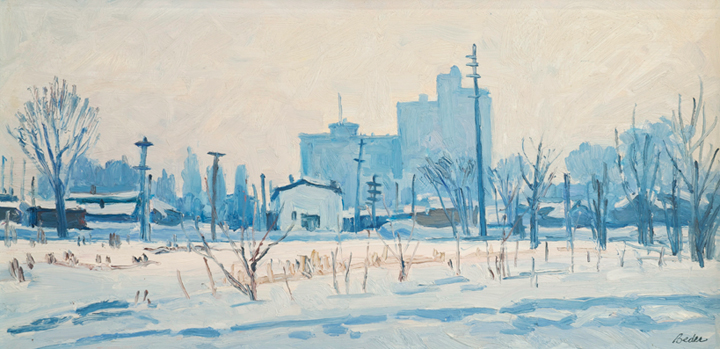
Jack Beder, Winter Morning, 1972

Rebecca Donner, All the Frequent Troubles of Our Days (2021)

Mildred Harnack née Fish grew up in Milwaukee to an intermittently employed father and a mother who was a stenographer. In the 1920s she attended the University of Wisconsin, where she met Arvid Harnack, an economist and jurist from Germany who could, unlike any man she had met before, match her as much in the seminar room as on the dance floor. By 1929 the young couple—they had married three years earlier—was living together in Berlin. Mildred would return home only a handful more times. Berlin was exciting, even for a poor couple like the Harnacks. All kinds of change seemed possible. But the rise of the Nazi party threatened all that. Mildred was fired from her position teaching American literature in 1932 because of her opposition to the party, even though it would not come to power until the following year. Needing to find work, Mildred took a job teaching working class students at night school. She loved her students, believed in their ability to transform their lives, and eventually recruited some of them as central figures in a resistance movement that she and her husband began building in the early years of the regime. The circle, as she called it, met to share ideas, often over book discussions, and distributed leaflets denouncing Nazi policies. It was loosely aligned with other resistance movements, including the one that included the pastor Dietrich Bonhoeffer, a cousin of Arvid’s, and the one led by Harro Schulze-Boysen and Libertas Haas-Heye, which eventually led Arvid to pass on military secrets he gained from his work in the Reich Ministry of Economics. Rebecca Donner, who happens to be Mildred’s great-great-nice, tells the story with flair and sympathy. 

I found it fascinating to compare Donner’s book to Norman Ohler’s Bohemians, in which Mildred is a bit player. Donner has much less sympathy with Haas-Heye than Ohler does—which makes sense since Haas-Heye ratted Harnack and the others in the so-called Red Chapel group out. It seems she was duped by a supposedly sympathetic secretary in the jail where she was held in custody—but duped rather easily, Donner implies.

Earlier in the 1930s, Mildred befriended Martha Dodd, daughter of the US ambassador. When Dodd was replaced, she became close to the wife of the new First Secretary, whose son, nine-year-old Don Heath, Jr., acted as a courier, carrying clips of paper in his backpack from his English lessons with Mildred (whom he adored) to his father. Typically, those messages consisted only of a time and place where Mildred or Arvid could meet with Heath to pass on information in person.

This work was dangerous, of course, and it some sense it was only a matter of time before she and Arvid were found out. Had the group’s Soviet handler not been so clumsy, they may have escaped detection. When they realized their cover had been blown in September 1942, the couple tried to get to Sweden, but they were arrested in East Prussia the day before they were to set sail. Mildred’s initial six-year prison sentence was overturned by Hitler himself. A new trial sentenced her to death; she was executed by guillotine in February 1943.

As its title implies, nothing is comforting about the subject matter of All the Frequent Troubles of Our Days. It’s a sad book. In her final days Harnack was miserable: eaten by lice, beaten by guards, almost unable to speak to the fellow prisoners who admired her. But grief and despair shadowed her long before her arrest; I was moved by the cost of Harnack’s convictions. Her commitment—compounded by her inability to say anything, lest it further endanger her—destroyed her relationships with almost everyone, especially her American family. By the end, Harnack has the remarkable but unenviable distance from the world of someone like Simone Weil. Donner admires her great-great-aunt, and makes us admire her, too. But she has the guts to admit that principled resistance to injustice can lead to the calcification of so much that is human. How painful to see the erosion of that Wisconsin college girl, wide-eyed and full of the desire to teach and to learn, in love with a man and the world. How loving and patient of Donner to have resurrected her.

[An aside: Donner relies heavily on William Shirer’s diaries. That surprised me: he seems so old-fashioned. Who reads The Rise and Fall of the Nazis anymore? But Donner knows what she’s doing: based these excerpts, he was a hell of a writer.]

Emily Tesh, Some Desperate Glory (2023)

The always reliable Adam Roberts tipped me on to this in his annual sff recap in The Guardian. Then Ian Mond praised it too. The Venn diagram of their tastes is close to being a circle, but everything in it is top-notch. Roberts calls Some Desperate Glory “a blend of space opera and military SF that refreshes both modes,” which sounds exactly right to me, even if I still don’t quite know what those terms mean.

Kyr has come of age on Gaea Station, the last redoubt of humanity after earth is destroyed by alien species who have decided that humans are irredeemably violent. (I mean, not wrong.) Her seventeen years have been marked by submission, dedication, and toughness, to others but above all to one’s self. Food is fuel; rest mandated so the machinery of the body and the station can keep going; families are split apart, the children, bred to emphasize traits necessary for survival, are raised in same-sex age cohorts after they leave the nursey.

Gaea, it becomes clear, is Sparta.

And Kyr loves it.

Along with her twin brother, she is the best of the best: fast, strong, smart, zealous, loyal to the cause. Yes, her “siblings” hate her—she’s always ratting them out and pushing them to exhausted, shameful tears—but such toughness is needed for humanity to enact its revenge. As the date of her cohort’s graduation approaches, Kyr can’t wait for her assignment. She knows she’ll be named to the warrior caste. And then she’ll be able to throw off her only black mark: a family history of treachery. Ten years earlier, her older sister fled the station with her infant child, probably for a planet where the aliens let humans live on sufferance, symbolically neutered, as pathetic as lap dogs. When Kyr’s assignment comes back all wrong—her shock compounded by the news that her brother has been selected for an even more prestigious, albeit suicidal mission—she hatches a plot to follow him. The journey will eventually revise her entire sense of the universe.

I admired Tesh’s accomplishment here: she lets us to read against Kyr (we know she’s more than insufferable: the perfect fascist, really) even as we can understand her zeal for her embattled mission. (I say “we” but a quick glance at Goodreads—I remembered why I never do that—shows me that Tesh’s skill with POV is lost on some readers…) In a brief afterword, Tesh lists some of the works she consulted in writing Some Desperate Glory: books on North Korea, Paxton’s classic study of fascism, and Lawrence’s Wright expose of the handful of people who have escaped scientology. All of which allows her to pull off her greatest trick: like Kyr, readers too are deprogrammed, the “facts” of the novel’s world cast into new light as we proceed. An unpredictable quest story follows, with plenty of plot twists and heart-in-mouth moments. (I was on the verge of tears by the end.) Queer love stories, found families, alternate realities: all the things contemporary sff is known for come into play. Good stuff.

Walter Kempowski, Marrow and Bone (1992) Trans. Charlotte Collins (2018)

I raved about this writer last month.

Marrow and Bone might be the least terrific of the three Kempowskis I’ve now read, but it’s still very good. (Don’t start here, though.) Jonathan Fabrizius is a freelance writer who, thanks to a small stipend from an uncle, lives in charming modesty in 1980s Hamburg, sharing one of those impossible German apartments (carved up willy-nilly from a grander space, bathrooms in the hall, no kitchen to speak of) with a girlfriend who has given up on him. Out of the blue, an invitation comes from, of all things, the organizers of a road rally across the former East Prussia: they want Jonathan to write about the sights attendees might enjoy as they follow the racers from east to west. Jonathan accepts with alacrity: he needs the money, but he also has ties to the region. His companions are a former racecar driver and a representative of the event organizers. Like all picaresques, Marrow and Bone shambles from one incident to another, most of which at first seem consequential, even dire, but prove to be irritants at worst, spurs to further discoveries at best. (When their car and luggage is stolen, for example, the company immediately sends another car, and the protagonists later find the luggage abandoned by the side of the road.) Jonathan, a bit of a schlemiel, need never worry about the consequences of his failures: in one moving scene, he promises to mail form the West some anxiety medication to the mother of a suffering young woman. Tragically, absurdly, he loses the address: he feels bad there’s no way to reach them, but he’s content to throw up his hands.

It’s clear that Kempowski is diagnosing the post-communist situation in this tale of the last days of divided Germany. How so and to what end are harder to say. Maybe that comes from the newness of the events (published only three years after the fall of the wall). Or maybe from Kempowski’s haziness, which can be hard to disentangle from Jonathan’s. Importantly, though, Kempowski does not think it would have been better had the Germans not lost East Prussia. He acknowledges that Poles have had opportunities and made a go of things—even if those things are sometimes muddled in the ordinary way of the world—that they might not have had under German hegemony. But he also laments a lost world—especially the mix of cultures that East Prussia, like all borderlands, once had. He’s similarly gentle with the 1980s leftist intellectual milieu to which Jonathan belongs. He pokes fun at their belief in the power of petitions and protests, but admires their conviction.

I guess I am writing myself into the position that it is not easy to tell what is mild (and therefore, possibly, generous) in the book and what is fuzzy (and therefore, possibly, lazy).

Oliver Burkeman, Four Thousand Weeks: Time Management for Mortals (2021)

If we’re lucky and live into our seventies, we spend about four thousand weeks in this life. To my numerically-hazy mind that seems lot, but it’s not. And when you’re in your 50s, you can’t help but conclude that you have hardly any weeks left at all. Burkeman’s self-help book for people who cringe at the idea of self-help gently asks us to recognize the fact that we all want to deny, the inescapable reality quantified in his title. Burkeman, a self-professed failed productivity expert, exhorts us to make those weeks count—but not by being more productive. (Some of the most amusing parts of the book concern the various productivity regimes to which he has pled fealty. As he wryly notes, work tends to beget work. Answering email is shit!) The point isn’t that we should spend our time only doing what we want—none of us have that freedom, especially those of us who aren’t independently wealthy. Rather, it’s simply that we should be intentional about our time. But what a huge “simply” that is! It means recognizing our mortality—something that I, for one, have had no interest in doing.

A short, well-written, often funny, and always accessible book (Burkeman makes even Heidegger intelligible), Four Thousand Weeks has kept its hold on me in the weeks since I read it. He demolishes the belief so many of us have that our real life will begin at some indefinite future time: as soon as I do x or figure out y, I’ll finally do z (clean the closets, commit to a relationship, write that book), when in fact our lives are nothing but the cluttered, half-hearted, scattered series of moments that we wrongly think of as garbage time before real meaning will arrive. He argues that our impatience, our “it would be funny if it weren’t so sad” drive to hurry through life, is really a sign of how strongly we deny our mortality. We feel time is wasted because we are reluctant to embrace discomfort and resistance. We don’t have to like traffic jams, checkout lines, or toddler games. But until we learn to experience them as time we will find them even more painful than they are.

Some of you might remember Emma Townsend from Twitter (I miss her). I raised an eye at her when she raved about Four Thousand Weeks; she gently encouraged me not to be so hasty. It took me a while to try the book for myself, but I’m so glad I did. Sorry for doubting you, Emma.

Rebecca West, Harriet Hume (1929)

A witchy book; I must confess, I am not much for witchy things.

West’s strange fantasia of a (non)-relationship over several decades is the subject of Episode 22 of One Bright Book—worth your time, in my opinion, especially if you want to hear smart readers wrestle with a book they don’t quite know what to make of. Fascinating for the contrast between West’s mode here and that of her gigantic Balkan travelogue, Black Lamb and Grey Falcon, which I spent some time with each day this month.

László Moholy-Nagy, 7 A.M. (New Year’s Morning) ca. 1930

I still have a few Rosenfarb stories to read, so I’ll save further comment on the collection for later other than to say how wonderful it is that these are now available in English. If I had more time—and, you know, didn’t spend my days teaching—I’d take classes like this one all the time.

And you? How did you spend January?

What I Read, December 2023

A great semester in the classroom; an even more irritating than usual semester for committee work. I am lucky to have a long winter break. Over the last years I’ve found that I either thrive in these short, dark weeks or succumb to bad anxiety. Happily, this was one of the good years. El Niño means colder weather in Arkansas, which makes me happy, not least because it’s so good for running. And for sitting on the couch reading.

Laurits Andersen Ring, Foggy Winter Day. To the Left a Yellow House. Deep Snow., 1910

Toni Morrison, A Mercy (2008)

An extraordinary book, maybe my favourite of the five or so by Morrison I’ve read. (Beloved is titanic, of course, but it’s been so long since I’ve read it that my memory of it has dimmed. Maybe I’ll redress that in 2024.) I chose A Mercy for One Bright Book; I thought we had a lot of interesting things to say. Fifteen years after its publication, the book only seems more pertinent to the task of understanding America. Which makes this review by Wyatt Mason, a critic I usually admire, feel badly dated.

Katherena Vermette, The Circle (2023)

Longtime readers will know of my love for Vermette. The Break is fast becoming canonical; I extolled its sequel, The Strangers, not long ago. And now we have a third volume featuring the same characters, with the addition of a few new ones, especially in the younger generation. My wife noted how much faster this book reads than the others. Partly that’s because of the knowledge we bring to the book (if you haven’t read Vermette yet, don’t start here): we’re mostly catching up, not getting to know. And partly it’s because of the short chapters that shift the point of view. But mostly, that sense of speed is a function of how much happens. Whereas The Break considered the repercussions of a single event (ripples from a stone sunk into a lake), and The Strangers thought about the pull of family (oceanic, seemingly inescapable, full of ebbs and flows), The Circle focuses on the pull to change, to get away, to break from the past (this book is a river, and one full of rapids at that.)

That compulsion sometimes—maybe even often—fails. But not always. Trauma never lets go, but change is possible. But always from collective bonds, not individual willpower. Yes, individuals make choices that affect their fate. But grit isn’t enough in the face of systemic inequalities and generations of abuse. Maybe that explains why Vermette has replaced the family trees of the earlier volumes with a diagram of overlapping circles, each with a character’s name. The closer the circles to each other, the closer the relationship. The bigger the circle, the more people that individual affects.

If Vermette decides she’s finished with these characters, she has ended her now-trilogy on a satisfying ambiguous, tentatively hopeful note. But I thought the endings of the previous volumes were just right, too. Who knows, maybe more is in store. I kind of feel like Vermette is as caught up by these characters as readers like me are.

Abdulrazek Gurnah, By the Sea (2001)

My third Gurnah: not a misfire yet. I’m a fan.

In his 60s, Omer Saleh leaves his world behind him and claims begrudgingly granted asylum in the UK. A harried lawyer assigned to his case tracks down the only person she can find who knows anything about Zanzibar, Saleh’s homeland. That man, now an academic who has himself made the journey to England, turns out to have known Saleh: he was a boy when the older man became entwined with his family, to complicated and in some ways ruinous ends.

Gurnah reminds me of Conrad not just because his novels also consider the relationship of England to parts of the world where people have “different complexion[s] and slightly flatter noses” but more so because they are similarly constructed through nested stories told at length in the quiet of evening between a teller and a silent audience. These stories concern all manner of things: the age-old trade routes between the Persian Gulf and the East African coast; the furniture business as practiced in a culture that prizes barter; the experience of African students during the Cold War in East Germany, where it turns out that not all communists were equal brothers; and the pain of incarceration at the whims of despotic regimes.

Of the latter, Saleh says:

I have taught myself not to speak of the years which followed, although I have forgotten little of them. The years were written in the language of the body, and it is not a language I can speak with words. Sometimes I see photographs of people in distress, and the image of their misery and pain echoes in my body and makes me ache with them. And the same image teaches me to suppress the memory of my oppression, because, after all, I am here and well while only God knows where some of them are.

The last line is the characteristic Gurnah touch: a passage that had been moving, even stately, if perhaps a little pat, turns more complex. We are so attuned to the suggestion that testimony is an unalloyed good, a force, even, for change, that we might be surprised to think of quiescence and repression as responses to past injustice and trauma.

By the Sea was longlisted for the Booker Prize. I’ve no beef with Peter Carey’s The True History of the Kelly Gang (haven’t read it), but it would have been nice to see Gurnah on the shortlist at least. No matter, he won another big prize and the novels are back in print and I still have five or six ahead of me, so it’s all good.

Roy Jacobsen, Eyes of the Rigel (2017) Trans. Don Bartlett and Don Shaw (2020)

Third in Jacobsen’s Barrøy series, which since the last part of the first has focused on Ingrid Barrøy, now the chatelaine of the Norwegian island that has given the family its name. Eyes of the Rigel follows hard on the events of its predecessor, The White Shadow, which I read in the spring but never wrote about. I like this summary from The Guardian:

The second installment, White Shadow, is set during the last year of the second world war: refugees from the northern province of Finnmark arrive, collaborators abuse their power, and Russian prisoner of war Alexander, having survived the sinking of the MS Rigel, lands on Barrøy. Ingrid falls in love with the young man and hides him from Nazis and collaborators until he is strong enough to embark on a trek to neutral Sweden. In Eyes of the Rigel Ingrid sets out across a postwar country in search of the father of her 10-month-old daughter. Ingrid’s only mementos of her lover are her daughter’s eyes, as black as Alexander’s, and a note in Russian, which a neighbour helps her decipher: it says, “I love you” nine times.

Ingrid’s epic quest—after hitching a boat ride up the coast, she makes the rest of the journey on foot with the world’s most saintly baby—is preposterous. Everyone she meets feels that way too. But with the determination and implacable work ethic that characterizes her family she follows a trail made fainter by the reluctance of many in the immediate postwar era to remember or cop to the events of the recent past.

Spoiler alert: her quest ends in frustration and heartbreak. She doesn’t find Alexander, and, maybe worse, she learns things about him she doesn’t want to. (In a brief passage, readers learn his tragic fate.) I wouldn’t say she’s happy to return home, but she does so with few regrets and no complaints. (Barrøyers don’t complain.) There’s that baby to raise, after all. And another fishing season to prepare for. And heaven knows what’s happened to the sheep over the summer.

I sensed Jacobsen enjoyed the wider canvas of this story (it’s not really any longer than the others, but it has much more narrative drive), but not as much as he enjoyed returning to the island in the final pages. That’s how I felt as a reader, anyway. As is characteristic of these books, we encounter much that is unhappy (a former Nazi concentration turned POW camp, for example). But much that is joyful, too, though always in a bittersweet way. I especially loved an idyll on a farm where Ingrid thinks about taking up with the owner, a member of the resistance, who had hidden Alexander for several months.

Ronán Hession thinks it’s the weakest of the series, but even though he wrote Leonard and Hungry Paul so definitely knows what’s what I can’t agree. Loved this one just as much as the others.

Roy Jacobsen, Just a Mother (2020) Trans. Don Bartlett and Don Shaw (2022)

I picked Jacobsen’s fourth Barrøy novel up the minute I finished the third. It feels as though the writer did the same: Ingrid’s story picks up where she left off, with her return home to the island. The novel covers the 1950s, and, as Tony puts it in his excellent post, it reworks some of the preoccupations and themes of The Unseen, the first book in the series. But Jacobsen isn’t treading the same ground. Yes, his characters continue to wrestle with the competing claims of isolation and community, but now they do so in the context of new technologies and ideologies. What happens when it’s not profitable to run the mail boat to the island? Would it be best to give up this almost laughably hand-to-mouth existence for life on the mainland? (Friends and family report on the pleasures and tribulations of life in centrally planned communities. It’s nice to have a machine to wash the linens, but of course you can only use it in your allocated hours.)

For Ingrid, Jacobsen’s main character, the matriarch of the island, the question of whether it will still be possible to live on Barrøy is practical, not abstract. Who will do all the work? Her great-aunt is aging. The girl she has brought up as her own daughter has grown up and moved away. The few menfolk who are left have bought a bigger boat so that their annual fishing expeditions take them away from the island longer than before. But new life arrives, in the form of a boy, the child of the skipper of the mail boat. The man asks Ingrid to watch his son while he goes on his weekly run, because his wife, the boy’s mother, has up and left. With foreboding in her heart, Ingrid accepts the charge; weeks pass, the skipper fails to return. Eventually his boat is found drifting aimlessly and unmanned. This trauma is met with resourcefulness and care, and the boy flourishes under the auspices of Ingrid and the other islanders, not least her daughter Kaja, the infant in the previous book, who is now five or six. The pair grow up as something more than siblings. Perhaps their relationship will be at the center of another book, should we be lucky enough to get one.

As always, Jacobsen pushes our emotional buttons, in the most satisfying way. One scene in particular hits like a blow. As Tony puts it, “One thing I can promise you is that anyone who has read the rest of the series will at some point feel the pain almost physically…”

Jim Thompson, A Hell of a Woman (1954)

Hadn’t read one of Thompson’s sordid, riveting noirs in a while. I’ll need to wait awhile before trying another, so dark was this one. Although it can’t top The Killer Inside Me (what can?), A Hell of a Woman also turns on the author’s masterly use of first-person narration. If you liked In a Lonely Place but found it a little decorous, this is the book for you.

Stephen Spotswood, Murder Crossed Her Mind (2023)

The latest Pentecost & Parker mystery ends on a dramatic note. (Cliffhanger alert!) Despite a solid enough mystery, the point of the book is to set up a longer narrative arc. I look forward to volume 5, and encourage you to read these books, but whatever you do, don’t start here.

Walter Kempowski, An Ordinary Youth (1971) Trans. Michael Lipkin (2023)

I once heard Parul Sehgal describe Svetlana Alexievich’s The Unwomanly Face of War as having “big first book energy,” which, she explained, is what happens when writers feel the need to stuff everything that matters to them into that first book, because who knows if there will ever be another. The result is undisciplined, maybe, but also exuberant and true.

I thought of Sehgal when reading An Ordinary Youth, the first book by Walter Kempowski, a phenomenon of (mostly West) German literature. (My friend Till Raether tells me he had something like a Warholian factory going to help him compose an epic series of collage texts, perhaps in the Dos Passos mode, I’m not sure, of German 20th century history; that’s in addition to his many novels.) The debut is patently autobiographical—its hero, Walter Kempowski, is nine years old when his family moves to a new apartment in the old Hanseatic port of Rostock in 1938. As the title suggests, he’s an ordinary kid who like movies and jazz music and this one girl in particular and school not so much. He gets used to bombing raids; he doesn’t mind that his father has been deployed (away from the front, luckily); he misses his older brother, Robert, who brought home all the good new records. As he becomes a teenager, Walter distinguishes himself mostly for being a bit of a badass: rowdy, impious, a petty troublemaker. He could seem to incarnate some of the worst attributes of his country at that time, but interestingly his natural nonconformity puts him at odds with the Party and all it stands for. He has little interest in the Hitler Youth, for example, ready to shirk its obligations as often as he can. (He forges a lot of sick notes.) But he’s no resister, no young version of that postwar chimera, “the good German.”

The genius of the book is the way it lets us read against Walter’s vision of the world, and indeed that of German society writ large. Here’s an example, which I chose by opening the book to one of the pages I’d dog-eared. The man Walter’s sister has married, a Dane, takes Walter’s side in an argument between the boy and his sister. Walter has said that in England people never open their windows and they drive on the left—something his friend has told him—which is all basically true and presented only as the mildest criticism. (An earlier conversation in which Walter’s mother has told her son-in-law to stop using English words feels much more freighted.) But Anna, Walter’s sister, takes offense at her younger sibling. Her husband, Sörenson, mildly objects. Germans, he says, forget that everyone should be able to express their own opinion:

And as an example of tolerance he mentioned modern music, the kind where the notes were all in a jumble, the kind we didn’t have any more in Germany. In Denmark, people did often laugh when they heard that kind of modern music, but they also clapped. He’d seen it happen many, many times.

We see conversation between adults presented through the view of the child protagonist, without judgment or comment or perhaps even full understanding of the stakes. But we learn more about the adults than the child here. For what kind of an example is this? Certainly not a full-throated defense of the art the Nazis deemed degenerate (those notes “all in a jumble”). His description of audiences laughing suggests his opinion is shared among his countrymen. But maybe laughing and clapping is the best kind of tolerance: amused, bemused, generous. Yet that last sentence, with its repeated, unnecessary, special pleading “many,” makes me question his attitude still further. Is he making it up? On every page, Kempowski plays tricks like this with tone.

An Ordinary Youth was a huge bestseller at the time. What were those first audiences responding to? It’s hard to imagine. Maybe it’s that Kempowski so straddles the line between nostalgia for and critique of the Nazi era that readers can take whatever they want from the book. My hunch is that many German readers responded to its depiction of the Volksgemeinschaft, that community “we” all shared and where we had some good old times, no matter what they want us to say now, a response that of course ignores the book’s challenge to that community, structured as it is around absences like the burned-out synagogue Walter passes on the way to school or that store old Herr so-and-so (I can’t find the reference) left behind when he disappeared. (It makes me wonder who lived in that new apartment before them.) The characters are basically uninterested in these absences—in this sense the novel accurately represents its time.

Kempowski’s debut has long been taken to be untranslatable. Its original title, Tadellöser & Wolff, refers to a Kempowski family saying, one of those weird family things, the kind of thing you repeat because everyone in the family says it and sometimes no one even knows why. In this case, Löser & Wolff is a cigar manufacturer (Aryanized by the regime in 1937, incidentally), a brand beloved of the father, who plays with the name. If something is tadellos it is perfect, without flaws, or blameless. (I’m reminded of an indelible moment in Vasily Grossman’s “The Hell of Treblinka” where he quotes an SS man who called the “grilling” system of the layering and burning of bodies in mass graves tadellos.) Walter takes up the phrase: on a visit to the country he trots it out to some country-bumpkin kids, blithely telling them that’s how everyone talks in the city.

The nonsensical phrase (which takes on a life of its own: Walter adapts other words so that they are also “löser & Wolff”ed) exists alongside dozens, even hundreds of lyrics interpolated into the text, almost all of them from popular songs or Lieder in the Schubert sense, and a few from poems. Translator Michael Lipkin has done something amazing in bringing the book into English. (I’m not sure I needed him to cite the source of every song lyric, though.) The publisher refers to this collage as the novel’s “echo chamber of voices,” without which Kempowski could not investigate the meaning of subjectivity in a mass popular society. I bet some smart folks have written about how An Ordinary Youth at once instantiates and challenges the very idea of the Bildungsroman.

Hats off to NYRB for making this translation happen. I hope more Kempowski is in their plans. (See below for more on the one they released first. They have a third title, which I have since read, too.)

Jenny Offill, Weather (2020)

Fragments from the life of an overeducated, underemployed New Yorker with the requisite terrific child and corresponding fears of climate change. A lot of it rang true—even the precious bits—but if I want to mourn the loss of the world as we know it in the company of a neurotic, bien pensant book lover, I’ll just have a little me time, you know?

Walter Kempowski, All for Nothing (2006) Trans. Anthea Bell (2015)

Some of my most memorable reading experiences have taken place in winter. Fallada’s Every Man Dies Alone, devoured over an unusually cold Arkansas Christmas just before our daughter was born. The never-to-be-matched-in-impact double-whammy of Absalom, Absalom and Barthes’s S/Z, in the snowiest Halifax January I can remember. And now, in another colder than average Arkansas winter (yes, it’s still climate change), Walter Kempowski’s magisterial late work, All for Nothing. Which is a bitterly cold book, in setting and to some extent tone. It’s late January 1945 in East Prussia and everyone knows the Russians are coming. But in a once-grand, now mostly shut-up manor house, life continues in a semblance of cultured normality. It’s like that scene with the French family in Indochina from the long cut of Apocalypse Now.

There’s the dreamy, beautiful woman of the house, who shuts herself in her quarters with tea and cigarettes and desultory reading, like a heroine from Turgenev; the absent husband, an officer in charge of requisitioning foodstuffs for the Reich, currently stationed in Italy; his aunt, who wishes she were still in the Silesia of her childhood but who keeps the place going and has no interest in taking down the portrait of Hitler in her room, despite suggestions from others that this might be wise; three Ostarbeiter, a Pole who tends the horses and does the heavy work, and two Ukrainian girls who cook and clean; and Peter, a mild, quiet, inquisitive boy whose regular illnesses keep him from Hitler Youth roughhousing, and who loves nothing more than examining bits of the world (a snowflake, a drop of blood, a crumb) under his new microscope, and who sometimes goes into the room that belonged to his younger sister, left as it was on the day she died of scarlet fever. Across from the manor is a working-class settlement built by the Party in the late 30s: its most officious inhabitant stares in grim resentment over at the manor house while he tends to his wife, lost in depression after their son was killed at the front.

To these wonderfully drawn characters come a series of visitors, all of them only too happy to share the warmth and food on offer in the manor house: a one-legged opportunist convinced that by buying up rare stamps on the cheap he is ensuring his future security; a young violinist, fanatically devoted to the Party; a Jew the woman of the house agrees to hide for an evening, seemingly for no other reason than her desire to have something happen.

The tone is quiet and anxious. How much can this episodic aimlessness last? (The question asked by characters and readers alike.) A convoy of refugees has been streaming west for days now. The carriage is packed, the horses fed and watered. But where are all those people going, this is their home, is there any need to leave now, just how close are those weapons booming now day and night? The family delays and then, abruptly, leaves. And the book becomes more eventful: the roving point of view centers on Peter, the tone becomes more muted, almost shell-shocked, a little naïve even as its events become extravagant and terrifying.

I kept waiting for the violence of the Red Army to erupt and overwhelm the characters. And, yes, this does happen. But so stealthily it’s hard to know how we got from the warmth of the manor house to overturned carts, dead animals, and bombed out refugees on the side of an icy road. Fascinatingly, the Soviets almost never appear in the book. (I was reminded of how seldom Germans factor in depictions of the camps, etc.) For me, All for Nothing is most brilliant in his suggestion that the apocalypse arrives gradually, almost banally.

I encourage you to read R. Nicht’s brilliant take on the book. (Just one clarification: although Kempowski often returns in his writing to the history of East Prussian, he did not grow up there (he was born in Hamburg and grew up in Rostock); All for Nothing is not strictly speaking autobiographical.)

The consensus seems to be that All for Nothing is Kempowski’s greatest work. (He wrote a ton, though, hardly any of it yet in English, so who knows.) Anthea Bell’s translation is gorgeous, somber and elegiac; I wonder how much of that is Kempowski’s “late style” and how much is Bell’s predilection. (I’m thinking of the way some of Sebald is more melancholy in English than in German.) It’s true though that the quotes in this book come mostly from Goethe and Schiller, unlike the pop music of An Ordinary Youth. It feels wise and resonant the way the classics do at their best. I once heard Edwin Frank, NYRB’s publisher, say he always read the last line of a novel first. (Insane!) I bet he nodded in satisfaction when he paged to the end of this book.

Tremendous stuff.

Margot Douaihy, Scorched Grace (2023)

Before Sister Holiday ran away to New Orleans and became a nun she played in an all-girl punk band, carried on a torrid, doomed affair with her married best friend (and bandmate), and made a bunch of other bad decisions. Now she’s teaching music to mostly disaffected kids in the Catholic school attached to her convent, covering her ink with gloves and a scarf, sparring with a sister who can’t stand her, and taking succor from the Mother Superior, the only woman in the country who would accept her when she came calling. But when a maintenance worker dies in a suspicious fire that also injures two of the students—and other fires follow thick on the first—Sister Holliday turns detective, (implausibly) tagging along with a painkiller-addicted fire investigator. Can you believe it—she solves the crime!!!

I heard about Scorched Grace from several UK readers, and I can see why the novel, heavy on atmospherics, might be popular with non-Americans. (As far as I can tell, the author isn’t from NOLA; to me it feels like she tries too hard to set the scene just so.) Just wait until it’s translated into German. They’re gonna eat this shit up. The subtitle (“A Sister Holiday Mystery”) implies Douaihy has plans for a series. More power to her, but I think this would have been better as a standalone.

Willem de Kooning, Door to the River, 1960

A find end to my reading year. Morrison, Vermette, Jacobsen, and, above all, Kempowski. See anything here to strike your fancy?

What I Read, September 2023

Don’t ask me what happened in September, it was a long time ago. I’m amazed I’m even writing this post.

Alex Katz, Lake Light (1992)

Dwyer Murphy, The Stolen Coast (2023)

I liked Murphy’s debut, An Honest Living. But I liked the follow-up even more. So much so that I’d have to call this my most enjoyable reading experience of the year. Murphy seems to know stuff: how to use the law to do things that aren’t really kosher, how to order in a dive bar, how to post in a pickup game. Jack, our narrator, has a pedigreed law degree, but he lives in his hometown, an appealingly ramshackle Massachusetts coastal town that is for sure not the Cape. He works with his father in the family business: helping people shed their identities and giving them new ones so they can start over. People on the run from criminal outfits, companies they’ve stolen intellectual property from, pasts that got too hot. I loved this premise and wanted even more of it.

Here’s Jack reflecting on how you can’t start totally from scratch in creating a new identity—everyone’s been damaged and that’s important:

You want to preserve a little trace of that damage. From parents, boyfriends, husbands, estranged siblings, jilted nobodies, pissed-off bosses who put a credit check on you ten years back for no good reason except you were leaving with two weeks’ notice. A past is a string of resentments and grievances. Grudges that never amounted to anything but were felt for a time. I paid a kid in Iceland to handle the digital traces. It might have been a pack of kids for all I knew. Healthy wind-kissed boys in front of computers, Viking aggression moving through their blood and no lands left to pillage, but they wanted money to walk around with and this was the work they had chosen.

That old-fashioned reference to “walking around money” turns those wind-kissed boys into something from the Rat Pack. Love it.

The quote gives you get a sense of Jack’s voice (Murphy keeps on like he started, he’s gonna be our next Portis.) And he’s not the only great character, either. Jack’s father is a delight, a man who knows how to eat, and chat up the ladies, and perform spycraft: he may be suffering from an incurable illness, though, and maybe things are going to change in Jack’s life.

When an old flame/best friend/absolute pistol, herself a lawyer working at the edge of the law, comes home for the summer, things definitely change. Jack gets involved in an elaborate heist, the machinations of which are pure pleasure. Speaking of pleasure, the main appeal of the book is Dwyer’s prose, which snaps with epigrams (“sincerity unmans me”) and jokes that don’t try too hard:

I went inside for a while and sat at the bar. It was a long block of wood nailed into legs and looked like something you might build in your basement and then forget about for several years.

I read this book over Labour Day weekend and that was a nice thing I did for myself.

Yiyun Li, The Book of Goose (2022)

After getting along with Li’s first novel, I turned to her most recent. I disliked it! Rohan’s take mirrors mine. I really didn’t understand why this novel had to be set in France. On the one hand, Frenchness seems to matter to it a lot. On the other hand, not at all. Feels like Emperor’s New Clothes to me.

Christine Mangan, The Continental Affair (2023)

If “atmospheric” as a term of literary praise means “set in European locales, especially those off the beaten track,” then this is a highly atmospheric novel.

In other words, we get Paris, yes, but we get more of Belgrade. Still more unexpected are Grenada and the peripherally European spaces of Istanbul and Algiers. But Mangan’s latest is more Hitchcock than Bourne. The best literary comp might be Highsmith.

A woman enters a train compartment otherwise occupied only by a ruggedly handsome man. They exchange pleasantries, watch the countryside of 1960s Europe flash by from the windows of the dining car, and warily seek to move past each other’s defenses. Part meet cute, part slow burn. But they’re acting. They know each other already. In fact, the man has been following the woman across the continent, tasked with retrieving some stolen money—something he could have done ten times over already, but can’t find it in him to do.

Brainy thrillers with nice locales are catnip to me, even though Mangan freights her characters a little heavily: they share a dramatic past neither can let go of. But she nails the ending, and even if The Continental Affair is a mere diversion—the title is so generic it’s like a parody—it’s adeptly done. Can’t wait for Cate Blanchett to star in the inevitable adaptation. Get this for the dad in your life who fancies himself a man of taste: he won’t be able to resist.

Simon Jimenez, The Vanished Birds (2020)

I can’t remember who put me on to this remarkable space opera. Adam Roberts? (Google search drew a blank.) I do remember where I bought it: a little shop in Missoula a couple of years ago. (Not the Shakespeare one. The other one.) I don’t remember what made me take it off the shelf. (I went back and forth between the audio and the paper book. Good narrator.)

I can say that The Vanished Birds will be on my end of year list. It’s that moving, that smart, that surprising.

It’s a long, complicated book. (Though not a patch on his most recent, The Spear Cuts Through Water, which I had to give up listening to, it was just too hard for my commute, but that book too astonishes right from its kickass dedication, “This one’s for me.”) My summary won’t do it justice. But here goes. In a galaxy owned by a single company, a spaceship arrives every five years on a small “resource planet” to take the accumulated harvest to the galaxy’s central planet. At the festival celebrating the ship’s arrival, the captain, Nia, hooks up with a local. They meet each time she returns, but the thing is that, thanks to time manipulation technology, what’s five years to him is only 15 months to her. She barely changes while he leaps forward in age.

But this poignant story is only the beginning of Jimenez’s tale. One year, in between spaceship arrivals, an unknown ship crashes into the fields. The man who loves Nia takes in the only survivor, a mute young boy, before passing him on to her on her next visit (the last one the now elderly man will live to see). Nia names the boy Ahro. It takes years before he speaks, but his musical abilities suggest there’s something special about him. That quality is recognized by Fumiko Nakajima, the lead designer/engineer/physicist of the company that runs the galaxy. Thanks to cryogenic technology, Fumiko is thousands of years old; Jimenez diverts us to her story, which begins on a near-future earth that she escapes just before it collapses due to climate change, but not without leaving behind her lover, a woman determined to see the place through to its end. Fumiko suspects that Ahro has a talent that could undo her past mistakes—but she knows the company that owns everything, even her, would subject him to vivisectionist experiments if it knew what the boy is capable of. She hires Nia on a mission to keep the boy, now a young man, on the fringes of the galaxy, away from company patrols. In the process, Nia becomes his parent. When Ahro is captured despite her efforts, only she can save him…

That’s a lot, right? The Vanished Birds is a novel of found family, colonialism, ecological change, time the revelator. Big stuff. It’s bold and beautiful (the prose is a cut above) and too carefully constructed to be called sprawling. I think about it a lot, several months after having read it, not least the section set on a planet that has bought by the company and stripped of its people, populated now by dozens of feral dogs and one last man, left behind to man the radio tower. I shed a tear at the end, I tell ya.

Garth Greenwell, Cleanness (2020)

I first read Cleanness in March—I never wrote up that month, and I probably never will. I’m glad of the chance to say something here, because I love this book. I already thought it was great the first time, but having had the chance to teach it, I’m convinced it’s brilliant. Like “we will read this in a hundred years” brilliant.

A companion piece to his wonderful debut, What Belongs to You, Cleanness is also narrated by an American teaching in Bulgaria. But the new novel is richer, its power coming from the montage of its seemingly disparate, almost stand-alone sections. To my mind, it is also better in that its references to the narrator’s childhood are cut to the bone. The handful of references hit that much harder than the extended section in the previous book.

I read Cleanness as a novel about different ways bodies can come together. Readers are most often drawn to the scenes of anonymous BDSM sex, but several chapters feature the narrator’s more placid relationship with another foreigner, a student from the Azores. Others describe a writing retreat, two describe encounters with current and former students in which the narrator wrestles with what it means to be a gay role model in a country where LGBTQ life is harshly penalized. A particularly fascinating chapter describes a series of spontaneous street protests that convulse Sofia, and the narrator’s admiration and fear of the unpredictable power of masses of bodies in public space. Even when we try to reduce ourselves to pure flesh, Greenwell implies, we can’t escape identity. But identity isn’t fixed; the roles we’ve been given are just that, roles. They can change, we can push against them even when their forms are ossified and seemingly inescapable. (That’s what politics is for.) This idea comes across most clearly in a chapter called “The Little Saint,” whose titular character, a bottom who lets men bareback him, gently explains to the narrator that the violence he begs the narrator to unleash upon him, which brings the narrator to tears, since the sounds of the whipping he lays on the young man seem to have turned him into a version of his father, who was never shy with his belt, the violence that is demanded by one person of another, can never be the same as violence enacted in hate or rage.

The book ends with a beautiful scene involving an elderly dog who wanders the campus of the international school where the narrator teaches. The narrator, drunk and alone, having narrowly avoided making a mess of some important things, takes the dog into his rooms even though it’s strictly forbidden to bring her inside because she’s meant to have fleas. He makes up a bed for her and then lies down next to her. An indelible scene. Here I take Greenwell to be saying that we can’t take the cleanness granted by the Little Saint and wished for by the protestors who want to sweep a corrupt government out of power too seriously. Cleanness but not too much: it’s good to lie down with beings, human or not, that others think of as dirty.

Seriously, this book is something else. Greenwell has such intelligence and such beautiful prose. Thrilling.

Sadly, most of my students did not feel the same way, though some of them were big enough to admit that they were kink shaming. No matter, Imma teach it again!

Georges Simenon, Cécile is Dead (1942) Trans. Anthea Bell (2015)

Day after day Cécile Pardon waits for Maigret at police headquarters, unwilling to see anyone but the great man, and when she does she has nothing more definitive to report than a suspicion that someone has been in the apartment she shares with an elderly aunt. When he sees her in the waiting room (the lads call it “the aquarium”) on a day when he’s just not feeling it, he slips out the back. She’s gone when he gets back to the office. But then the aunt is reported dead, and Cécile is nowhere to be found. (You can guess the rest; the title is not a metaphor.) Plottier than the average Maigret, this early-ish installment is further enlivened by the presence of an American detective who comes to see how the big man does his thing. (Simenon liked this idea: there’s one where someone from Scotland Yard does the same thing.)

The investigation centers on the apartment building where Cécile lived with her aunt. You could read Cécile is Dead, with its depiction of the space and the people who inhabit it, as a slantwise homage to Zola’s Pot Luck.

Annie Ernaux, Happening (2000) Trans. Tanya Leslie (2001)

Having taught Happening this semester in a class called Bodies in Trouble, I was interested to go back and read what I had to say about it three years ago. I see that I was damning with faint praise already then; spending a lot more time with the book didn’t make me care for it more. As for my students, they seemed to like it well enough. Understandably they couldn’t help but read it in terms of their post Dobbs American life; more surprisingly, they were mostly worked up by what they perceived as Ernaux’s class striving: they saw her as both a victim of and complicit in the denigration of working class lives. Their end of semester feedback revealed that they could take it or leave it as a course text. Good to hear, since I’d already decided not to repeat the experiment. I get that Ernaux is doing a thing; I just don’t care much for the thing. And her prose, as shaped by her various no doubt able translators (here Tanya Leslie), does not lend itself to the kind of close reading that is my pedagogical bread-and-butter. Whatever, Ernaux will get along just fine without my reservations.

Joseph Hansen, Troublemaker (1975)

I thought I wrote about the first novel in the Dave Brandstetter series, Fade Out, when I read it a couple of years ago but now I can’t find it in the perhaps-not-reliable index of this blog. In this, the third book (they’re all being reissued but the store didn’t have the second one in stock), the owner of a local gay bar is found naked and dead. A local hustler is found next to him. An open and shut case. Not to insurance agent Brandstetter. Surprise, surprise, he’s right, and soon he’s neck-deep in a twisty plot that once again makes the 70s seem both shitty and terrific.

These books are great above and beyond any talk of “pioneering representation” (tho that matters), it’s great that they’re back in print, it sucks that my local library does not have them.

David Brintzenhofe Applying Makeup (II) (1982)

There you have it, friends. Have at me, Ernaux lovers, The Book of Goose partisans, and anyone who thinks all the books I liked are overrated…

What I Read, October 2023

It might have been in the first week of October, after another spirited conversation in my Holocaust Literature class, that I had to marvel at how far along we were in the semester for the students to still be bringing it like that every day. A special group. Good thing the classroom was giving me joy, because not much else was. The horrific terrorist attack by Hamas, the nightmarish Israeli response. Nothing but suffering, rage, self-righteousness, and apologetics. I found myself alienated from many of my communities. And then embroiled in a frustrating situation on campus (triggered by events in the Middle East but ultimately having nothing to do with it). Given all the bullshit it’s a wonder I got anything read at all.

Tom Thompson, Silver Birches (1915 – 16)

Paulette Jiles, Chenneville (2023)

John Chenneville—scion of old French family whose estate, Temps Clair, lies north of St Louis in the fertile lands where the Missouri meets the Mississippi—returns from the Civil War after having spent nearly a year in hospital recovering from a terrible head wound. He finds his home in disarray: fields unplanted, animals untended, rooms empty. The only remaining servant gravely explains that Chenneville’s sister has been murdered along with her husband and their infant child at their home downriver at St Genevieve. From that moment, Chenneville devotes his life to avenging this loss (the subtitle states the case plainly: “A Novel of Murder, Loss, and Vengeance”).

The hero visits the scene of the crime (the bloodlands of the Missouri Ozarks that formed the setting of her novel Enemy Women), quickly learns who did it, and then chases the man, a sociopathic former sheriff named Dodd, across Arkansas, the Indian Territory, and into Texas. I know a lot of these landscapes, which was part of the book’s appeal for me, but I think Jiles’s descriptions are objectively lovely: evocative but spare. Nothing fancy, but clear as the sky on a frosty morning. Here’s Chenneville making camp after almost 24 hours on the go: 

The wind was becoming sharp and hard; it bit at his lips and ears, his hands. It was bringing rain. To the south of the road he saw a motte of post oaks, great thick-trunked trees, and what looked like a declination of the earth toward a streambed. On that side he could build a fire and the smoke would blow away south and not alert any traveler coming down the road. 

Remembering the advice of a sergeant, an older Mainer, he strips himself almost naked, putting the clothes under the blankets to keep them warm. Then come this lovely reflection: 

For a few moments he felt again that suspended, almost magical feeling of being out in the wilderness and the weather and yet safe against it. Here was rest and a respite against bereavement because the world was going on without him in its deep rhythms, deeper than he could see. 

I love this kind of thing. Chenneville has it all: a love story, a key subplot involving telegraphy, and a satisfyingly minor-key ending. (A final flurry of events, almost comically bathetic, renders vengeance unnecessary, and you can almost hear the protagonist sigh in relief.) The physical book is gorgeous, too, especially the stately maps on its endpapers. I almost regretted having checked it out of the library.

Wisława Szymborska, Map: Collected and Last Poems Trans. Claire Cavanaugh & Stanislaw Barańczak (2015)

So pleased I chose this as a selection for One Bright Book. I need to be encouraged to read poetry (too enslaved to the demon narrative); being accountable to Frances and Rebecca ensured I made my way through this collection of the Polish writer and Nobel laureate Wisława Syzmborska. To think what I would have missed out on otherwise!

Here’s some of what I said in my introduction to the episode:

Szymborska’s first poems were in the accepted socialist realist style; she later repudiated most of them, just as she rejected the doctrinaire communism she had espoused when younger. (From the 1960s on she was part of the Polish dissident movement.) Repudiation more generally was central to her artistic process: her published work runs only to about 350 poems. Asked about this, she said “It’s because I have a trash can.”

That dry, self-deprecating response seems typical of Szymborska’s personality—and indeed her poetry. A Polish friend tells me that her letters “fizz with joie de vivre” and I can see that quality in the poems too, even though they are often plenty melancholy. Despite that sadness, her poems are often funny, which makes me wonder what it’s like to read her work in Polish, since slyness or jokiness can be so hard to translate.

It’s said that the writer Czeslaw Miloz, himself a Nobel laureate (1980), was anxious when Szymborska won the prize, fearing she would experience it as a terrible burden, given her shy and retiring nature. Indeed, she didn’t publish any poetry for several years after the award. To me her later work is as strong as her middle period, so I certainly didn’t feel any loss in quality after the Nobel; I’m curious if you both agree.

Whether she felt the burden or not, I can’t say, but I can say that Szymborska’s Nobel Prize address is terrific: modest, humourous, but also totally on point. She writes, among other things, about how poets, like all people fortunate enough to do work they care about, are propelled by the phrase “I don’t know.” She adds, “I sometimes dream of situations that can’t possibly come true.” That made me laugh because she’s always doing that in her poems. Some of them even start with the word “if: if angels exist, would they care about human culture (she concludes they would only like early Hollywood slapstick). Some of them see the remarkable in ordinary situations, as in these lines:

A miracle that’s lost on us:

the hand actually has fewer than six fingers

but still it’s got more than four.

Or how with “a few minor changes” her parents might have married other people and then where would she be?

Other poems consider scenarios we don’t usually dwell upon—one imagines a baby photo of Hitler (“And who’s this little fellow in his itty-bitty robe?”); another speculates how many in a hundred people do or feel one thing or another, in the process humanizing the field of statistics; a third poem, called “Cat in an Empty Apartment,” concerns a cat whose owner has died. (Apparently, she told her partner, the writer Kornel Filipowicz, that “no living being has as good a life as the life your cat lives”—I suspect she wrote the poem in the aftermath of Filipowicz’s death in 1990. Heartbreaking lines: “someone was always, always here,/then suddenly disappeared/and stubbornly stays disappeared.”) The phrase “I don’t know” matters so much because it propels us to think and do more—specifically, to ask more questions. Szymborska adds, “any knowledge that doesn’t lead to new questions quickly dies out: it fails to maintain the temperature required for sustaining life.”

This phrasing too seems quintessential Szymborska. She was fascinated by life in its literal, biological sense: she writes about the specks of dust that make up meteors, about foraminifera, which, it turns out, are microscopic single celled organisms that build shells around themselves from the minerals in sea water, and about what she calls “our one-sided acquaintance” with plants: we think we know about them: our monologue with them is essential for us but never reciprocated; they don’t care about us.

We each chose a poem to close read. Here are some of my notes on my choice, “Allegro ma Non Troppo” (1972).

Anyway, listen to our conversation here. Our best, IMO.

Allison Montclair, The Right Sort of Man (2019

Kay recommended this to me, and I can’t improve on her review, which chimes perfectly with my experience of the book. In brief: two women, Iris Sparks and Gwendolyn Bainbridge, set up a marriage agency in London in the immediate aftermath of WWII. They know each other only slightly, it turns out, and as Kay notes, Montclair uses the opposites-attract and slow-burn tropes of romance fiction to explore their growing friendship and business partnership. The book begins with the eventual victim arriving at their office in search of a husband. Next thing you know, the woman turns up dead and suspicion falls on the client Sparks and Bainbridge have set her up with. (It doesn’t help that the murder weapon is found under his mattress.) The women set out to prove his innocence—and save their suddenly cratering business. The actual mystery is a little slight; I bet Montclair gets better at suspense as the series goes on. (I plan to find out.) Besides, as Kay also explains, the real interest here lies in the book’s melding of crime and romance. In addition to the leads, Montclair fills her book with strong minor characters: a heavy who just wants to be a playwright, a mobster who falls for Sparks, and a working-class guy who upper-crust Bainbridge meets while undercover. Part of me really wants these guys to come back, but part of me worries the series might fall risk to the whole “it takes 300 pages just to keep up with the antics of the growing cast of recurring characters” problem. 

Prime light reading.

Giorgio Bassani, The Heron (1968) Trans. William Weaver (1970

Dour novel of postwar Italian life, centering on Edgardo Limentani, a Jewish landowner who, having married out of the tradition, finds himself alienated by a political landscape comprised of communists that threaten his privileges and old fascists that respond to his continued existence with servility that fails to conceal their hatred of his continued existence.

On a damp day in late fall, Limentani goes hunting for waterfowl in the Po marshes. He dithers about going at all, finds himself waylaid, arriving too late for any good shooting, even, in the final account, unable to shoot at all, leaving it to his guide to bring down a trunkful of birds, which he later passes off as his own. On the way back he stops for coffees in a bar where he wrestles with whether to call the cousin he’s been estranged from for years, eats a meal in the restaurant of a hotel owned by one of those unctuous fascists, sleeps heavily and unsoundly in one of the upstairs rooms, and puts off returning home until his wife, whom he can no longer stand, will be sure to have gone to bed. From the time he starts awake in the pre-dawn dark until the time he returns to the study he uses as a makeshift bedroom, the protagonist thinks dark thoughts that give him no satisfaction. He sees no good way out of this life.

Having only read The Garden of the Finzi-Continis—a sad book, yes, but not a despairing one—I was shocked by this novel’s grimness. I’ve no idea about Bassani’s state of mind at this stage in his life, but The Heron (the title refers to a bird shot along with the ducks, no good for eating, pure waste) reads like the book of an unhappy and discouraged man. Maybe Weaver’s translation, getting on now in years, contributes to the novel’s heaviness. There’s a newish translation: anyone read it?

Billy-Ray Belcourt, A Minor Chorus (2022) 

Score one for the “don’t give up on a book too soon” camp: I almost ditched poet and essayist Belcourt’s first novel after about twenty pages, annoyed at the clunky dialogue and risible self-righteousness (similar vibes to a book I really hated), but once the narrator leaves his graduate program in Edmonton and returns to his home community in way northern Alberta I started picking up what Belcourt was putting down. The narrator (an obvious stand-in for the writer) mines his community for stories to weave into the novel he’s writing: we hear from an older gay man, who unlike the narrator has chosen (or been made to choose) to stay closeted and both admires and disparages the narrator’s different decisions; an old friend who has disentangled herself from an abusive relationship; and his great-aunt, who worries over the fate of the boy she raised as her own, the narrator’s cousin, two boys who were once inseparable, but whose paths diverged (the cousin is in jail).  In other words, when the narrator stops wringing his hands over whether his academic work can be meaningful in a world where so much injustice needs to be redressed and starts telling the stories of others as his way of doing that work, the book becomes moving and interesting.

I loved Belcourt’s descriptions of my home province, even though the part he’s from is about as far away from mine as Little Rock is from St Louis). This bit hit home:

The farther one veered from Main Street, a single stretch of highway on which sat most of the town’s businesses, schools, and amenities, the older the infrastructure became. Behind the dilapidated building ran train tracks that were less like sutures and more like wounds. It all looked so ordinary and Canadian and, because of this, haunted.

That passage gets better—more pointed—as it goes along. The workmanlike first sentence, as unvarnished as the buildings it references, gives way to a metaphor that asks us to return to the seemingly bland and official term at the end of the previous one. Who is the infrastructure that makes this place possible—improbable that people could live anywhere, but especially so in that northern clime—for? The things that link some people might separate others. (Who lives on the other side of the tracks?) The things that give some people meaning might just hurt others. Everything here leads to that last sentence: the ordinariness that many Canadians take pride in (unspectacular, solid, self-avowedly decent) is built on a foundation of dispossession and expropriation. And what of those who don’t see themselves in the mirror of that self-description? Those who are showy, marginalized, far from the main drag, maybe queer or nonbinary or indigenous. Is their only role to haunt Main Street?

James Morrison, Gibbons or One Bloody Thing After Another (2023)

I’m always nervous reading books by friends, but here I needn’t have feared: the debut novel by James “Caustic Cover Critic” Morrison is smart and engaging. It tracks the history of the Gibbons family from the late 1800s to an apocalyptic near-future in a series of chapters that work as stand-alone stories but gain in heft when the lines of familial affiliation come through.

Along the way, Gibbons serves as an alternative history of Australia in the modern era, referencing institutions and events ranging from the Native Police Force to the Snapshots from Home program to the devastating 1974 cyclone that nearly destroyed Darwin. I say “alternative” not because these things are made up but because the novel demands that we consider fabulation and creation necessary to any attempt to document the past. The first line, “A shelf of eyes, polished and unblinking,” alludes to the ability to see and record, even as it undermines these faculties: these eyes are fake, made of glass. Throughout the novel. James values the power of artificiality: not only are the pages filled with photographers and pulp writers and pornographers, but the chapters are separated by his own charming illustrations (and one by his daughter!).

It’s a good book, is what I’m saying. Shawn Mooney and I interviewed James to launch the book.

Holly Watt, To the Lions (2019) 

The title of this engaging debut crime novel refers to the place journalists are willing to send anyone who comes in the path of a good story—and to the place they themselves are thrown when they go undercover. Cassie and her friend Miranda cover a specialized beat: the nexus of moral impropriety, tech bro/financial CEO untouchability, and third world suffering. Which makes a rumour that falls into their laps irresistible: somewhere someone is taking rich men to hunt people. Where? Like everything in the story, the location is obscure. A preserve, maybe. A prison. Or, as turns out to be the case, refugee camp. Through investigative reporting that Watt, a journalist herself, depicts plausibly and compellingly, the pair learn that the shadowy operation, though based in London, centers on a camp in lawless Libya, not too far across the border from a remote part of Algeria, where a private jet drops off the financiers, titled sons, and adventurers willing to pay a hell of a lot of money to do something whose repulsiveness makes them feel alive. To get the full story, though, the women need to catch someone in the act. A complicated undercover operation ensues, filled with menace (I’ve rarely been so scared for a character.) Watt plays with readers’ fascination with the lurid, which sometimes makes the book preachy, but mostly it’s just exciting. Not quite the usual thing, then, though it’s hard for me to see how Watt sustains her premise through the other books of the series. Just how many stories of this ilk can Cassie uncover?

Mary McCarthy, Memories of a Catholic Girlhood (1957) 

Rebecca’s choice for One Bright Book; you can hear our conversation here. I was glad to have read this once-but-perhaps-no-longer-famous memoir, though I can’t say I loved it. I found it a desperately sad book about a family filled with people unable to communicate with each other. So many silences, so much heartache, so much harmful propriety. To my surprise, Rebecca and Frances found it funny and biting, a book filled with readerly pleasures. We didn’t convince each other, but I appreciated the chance to articulate my response. Many readers have admired the sections between chapters in which McCarthy explains what she later learned about the family stories she tells, pointing out inconsistences or outright falsehoods. Such self-awareness might have felt innovative at the time, but to me they didn’t add much. I think none of us expects memoir to be complete truth. Anyway, I will never forget the story of an uncle by marriage who sets out to show nine or ten-year-old McCarthy in the worst possible light, just so he and his wife could beat her black and blue with a hairbrush. Terrible, terrible stuff.

Gabriele Münter, Green House (1912)

A wide-ranging reading month, with plenty to appreciate. Only Map really stood out for me, though. Any takes on these selections?

What I Read, August 2023

We went east through southern Alberta and Saskatchewan, where the drought is bad, all the sloughs empty and cracked, the occasional cattle herds dazed under unrelenting sun. Farther south they’d had more rain; we crawled for an hour or so through a pelting storm near the South Dakota Iowa line. Towns that depress you from the highway reveal unexpected delights when you stop for a minute. The perfectly preserved 50s downtown of Swift Current. A hipster café in Fargo on market day. The sophistication of Omaha. (Love that town.) And then we were back home, where it hasn’t rained in weeks and the wet bulb readings have been frightening. The trees shed leaves by the minute. We probably lost the plum. I hope the cherry makes it.

Nothing for it but to stay inside and read.

Agnes Martin, Buds ca. 1959

Helen Dunmore, A Spell of Winter (1995)

This Gothic WWI-era novel about a girl and her brother raised in a crumbling manor house by their grandfather after their mother absconds and their father goes mad won the inaugural Orange Prize. As the siblings grow to adulthood, they live in dreamy/nightmarish seclusion, seeing only a governess they hate and eventually get rid of and the housemaid, a young Irish woman whose perspicacity fails only at one crucial moment. Some pretty heavy-duty and salaciously over-the-top things (I said it was Gothic, right?) make for gripping reading, but in the end, I don’t know that it amounts to much. It hasn’t stayed with me the way Dunmore’s Birdcage Walk and The Siege have; it’s not as brilliant as, say, Andrew Miller’s Now We Shall Be Entirely Free. But it’s plenty enjoyable, especially on a hot day when all you want to do is read about drafty English houses.

Elizabeth Jane Howard, Something in Disguise (1969)

Novel about a misguided second marriage and the couple’s adult children who mostly fail to find their way through life. I cannot improve on Jacqui’s deft summary of its busy events: do take a look. Like her, I was unpersuaded by the book, though to be fair the title drops what in retrospect should seem a glaring clue that things aren’t as they first seem. It’s impossible to say anything about this book without spoiling things, so look away friends if that sort of thing bothers you. I was certainly shocked by the ending—props to any reader who isn’t—and admired (but didn’t appreciate) the sudden swerve not just to the macabre but something closer to sadism. Quite the trick to turn a novel of manners into something like Cammell and Roeg’s Performance. Normally that kind of uncanny reversal would be just my thing. But Howard doesn’t play fair. Maybe if I read the book again I’d see the breadcrumbs, but on a first reading, anyway, I felt she’d pulled a bait and switch. Impressively so, maybe, but I still felt duped.

I gather the team at Backlisted likes the book a lot; if anyone can convince me to think better of the book it’s them. (Breaking news: apparently Jacqui reread it and liked it much more…) But for now the jury is out for me on this writer. I enjoyed the first Cazalet, but abandoned the second. Maybe Howard, despite being a midcentury British novelist named Elizabeth, isn’t for me.

Guy Gavriel Kay, The Children of Earth and Sky (2016)

The book that spawned the two prequels I loved so much last month. It won’t surprise you when I tell you I loved it too. Did I mention these books have maps? Goddamn I love maps.

Jessica Johns, Bad Cree (2023)

Mackenzie left her home in northern Alberta a couple of years ago after the sudden death of her beloved sister. She’s made a quiet life in Vancouver: a steady if soul-destroying job at Whole Foods, a close friend who looks out for her, the anonymity of the city after her small-town childhood. But lately she’s been having dreams. Bad dreams. And the boundaries between waking and dreaming are getting harder to parse. Why are all these crows outside her window all the time? Maybe because she woke up one morning with the severed head of a bird in her bed. There’s nothing for it: she’ll have to beg for time off and fly home to come to terms with everything there she ran away from.

The set-up for Johns’s debut novel is actually the weakest part. I almost it down about thirty pages in—despite its extreme events nothing about the book felt urgent. But when Mackenzie comes home the book gets going. I loved its depiction of the northern Alberta bush, the town where a trip to the Seven Eleven is a big deal, the lake where her family picnics, the silent oil rigs, abandoned when crude fell below $100 / barrel. Johns’s depiction of Mackenzie’s extended family is terrific: bring on the cups of tea, the card games, the pots of mac and cheese, the good dogs sighing under the table, I can’t get enough of that shit. And the story’s horror elements—Mackenzie is possessed by a windigo—make so much sense as an allegory for the depredations and violence of a resource extraction economy.

Pair with Kate Beaton’s Ducks, the white settler version of this story, or simply enjoy on its own.

K. Patrick, Mrs. S (2023)

As a dogsbody at a girls’ boarding school in England in the 90s, the narrator of K. Patrick’s smart and sensual debut novel does whatever she’s told. One of her jobs is to supervise prep, the two hours after dinner when the girls work on their homework. Sitting in a classroom, the day’s Latin lesson still on the board, she muses with her customary acuity on the relationship between bodies and language:

On the chalkboard behind, an exercise in a grammar of belonging, he or she or we or they, the types of bodies changing the next word. It looks difficult. Pointless.

That mingling of the staccato and the sinuous is characteristic of the narrator. She is known only as Miss, just as other characters are referred to by their function: the Housemistress, the Art Teacher, the Vicar. Only the headmaster and his wife have names, but even they are known only in abbreviation (Mr. and Mrs. S.), as if they’d stepped from one of Freud’s case studies. The narrator is unimportant to the life of the school—Miss is there only for a year, fresh from the Australian Outback—which means she goes everywhere, sees everything, is seen by no one, bolstered by the freedom of her insignificance.

Patrick pulls off a difficult trick: her narrator is often inarticulate to others, scrubbed and raw, at sea in this foreign place, yet also as nuanced in her observations and interpretations as a character from Henry James.

Maybe it’s this juxtaposition between empty surface and full interior that proves attractive to the woman who gives the book its title. Over the course of a dry, burning summer, the narrator sets herself to seducing Mrs. S. It won’t spoil much to say that she does; it spoils more to say that she does so not in the way Mrs. S does, governed as the older woman is by a love of transgression she is allowed thanks to her privilege, nor in the way of her friend, the Housemistress, a butch lesbian whose bravado must be kept closeted to keep the job she both needs and loves. The narrator instead is a queer Bartleby, though her preferring not to does not extend to her sex life, which is lusciously depicted. (The book is hot.) (Also, Bartleby was already queer.)

Patrick’s strategy of embedding dialogue within the interior monologue without attribution forces us to slow down, to go backward in the light of new information to re-read earlier sentences, to play a detective game: who speaks to whom? As Frances put it in our conversation about the novel on One Bright Book, Mrs. S is fascinated by scripts: what it means to follow one, what it means to live without one.

An impressive debut that can go in the pantheon of great summertime novels (Bear, The Go-Between, A Month in the Country).

Garry Disher, Day’s End (2022)

Regular readers will know that I’m a huge Hirsch fan, my favourite procedural series of the moment. But despite featuring some of the books’ regular pleasures—Hirsch himself of course, his morning walks around his south-central Australian town, and the long drives along fearsome backroads to check in on his far-flung community members—Disher tries to do too much here. True, this is the most effective use of life during covid I’ve seen in a crime novel (the cops actually put on masks!), and believe me I am alive to the dangers of authoritarianism, extremism, and illiberalism that our time is giving rise to, but the last third of the novel is too schematic. It’s a lot to show in just a couple hundred pages how online bullying, drug dealing, and alt-right militarism combine, to say nothing of how some ordinary people, a little bored and frightened and underemployed could be seduced by the new fascism. I’m a Disher fan for life but if you don’t know him yet don’t start here.

Ann Leckie, Translation State (2023)

Having done a little reading around I now realize that Leckie’s latest sf novel is set in a universe she has already detailed in earlier books. Possibly I would have had an even richer experience had I read them first. But I still thought this was terrific. It won me over even though it switches among three narrators (a structure that usually gets on my nerves).

Leckie’s universe is a place of many genders. As this smart review puts it:

Leckie uses both sie/hir/hirs and e/em/eir as pronouns for nonbinary genders in this setting, in contrast to they/them pronouns, which designate agendered or genderless identities.

We meet Enae (sie/hir) after the death of her grandmaman, a fearsome character who made Enae’s life difficult, not least when it is posthumously revealed that the old woman had sold her estate and title to an upstart years ago to save herself from financial ruin. Enae no longer has a home; sie does, however, have a new purpose. The person who displaced hir is required by the terms of the sale to provide for Enae, which she does by sending hir on what she imagines will be a fruitless investigation: to find someone who went missing 200 years ago. But Enae has more guts and abilities than anyone credits hir for; sie finds the offspring of the missing person, a man named Reet who grew up with three adopted parents (two of whom use female pronouns and one nonbinary), a likeable misfit who spends much of his time watching a serial called Pirate Exiles of the Death Moon, which helps him damp down an alarming desire to bite people. Reet, it turns out, is what’s called a Presger Translator, a version of the alien Presger bred to interact with humans. (The backdrop of the book is the re-negotiation of a longstanding peace treaty between humans and the Presger.) When Reet’s background is revealed, he falls prey to political machinations, the gist of which is that he is expected to “match” (biologically and psychologically meld with) another Presger Translator, Qven (they/them), who is recovering from an assault and struggling with their desire, encouraged by Reet, to self-dentify as human. As part of this process, they begin using e/em/eir pronouns: as the LARB essay notes, pronouns are a big deal in this book, misgendering being a form of violence. The plot hinges on whether Reet (who has never known any other life) and Qven will be granted their wish to be accepted as human, with grave consequences for the political situation of Leckie’s universe, and clear analogues to our own cultural moment, where a vicious backlash against trans and nonbinary people teeters on the edge of full-scale murderousness.

My sense is that Leckie is in line with a lot of the coolest stuff going on in sff these days (though she might be a bit brainier than some), but this sure isn’t the kind of thing the genre has historically been associated with. I hope readers who don’t read a lot of sff will give it a try. It’s also quite funny, I don’t think I made that clear!

I listened to the audiobook narrated by British actress Adjoah Andoh (Lady Danbury in Bridgerton), and if the book interests you at all, I recommend her rendition highly. Her accents, ranging from Scottish to gorgeous West African, are a delight.

Yiyun Li, The Vagrants (2009)

Li’s absorbing, despairing novel of post-Maoist China gripped me from the start. The setting is a provincial city hundreds of miles from Beijing, where the Democracy Wall Movement briefly promises change of the sort Li’s characters cannot imagine, caught up as they are in navigating the broken social structures left to them by the Maoist Revolution: families at odds with each other, domestic violence, hunger, fear. The Vagrants of the title are its central characters, more or less loosely connected, in large part because they live in an especially impoverished neighbourhood in the (fictional) city of Muddy River. Many of them are children, perhaps because Li, born in 1972, grew up in the China of the period, and perhaps because children are the ones least able to exert their own agency (under the tyranny of their parents and the indoctrination of their schools) but also the most free from strictures, in the way of a kid who can take the long way home from school without anyone asking where they’ve been.

We meet the schoolboy Tong, who loses his dog, his only companion, and inadvertently ruins his feckless but innocent father’s life. And twelve-year-old Nini, disabled from birth, perhaps because her mother was beaten by an apparatchik while pregnant (that very true believer is the woman who, having fallen from favour, has been condemned and whose execution is the occasion of the public holiday with which the book opens), Nini’s bleak life of toil and punishment seems to change when a privileged young man named Bashi takes an interest in her that is equal parts prurient, exploitative, and touching. The adult characters include Kai, a radio broadcaster who joins an underground movement at enormous cost to everyone around her, and the former teacher Gu, whose daughter is the condemned woman , and who retreats in pain and shame into memories of pre-revolutionary life even as his second wife, his former student, is radicalized by her child’s fate. Wonderful characters all, portrayed with the clarity of Chekov.

I don’t hear Li’s early work talked about much: based on the two of her more recent books I’ve read she now writes in a different vein, less realist, more first-person fabulist a la Lydia Davis or Sigrid Nunez. But when it was published The Vagrants got some thoughtful reviews. True, the framing of Pico Iyer’s New York Times review, for example, is preposterous in its vapid hymn to multiculturalism—” All the world’s stories are America’s stories now, and this is the current glory of our literature”: did we believe that stuff even then?—but he offers some impressive readings of the novel, noting how Li equates the moral failings of the nation with the violation of Gu Shan’s body, which is cut apart for reasons of punishment, graft, and perversion (vocal cords severed before execution so she cannot shout out, kidneys given to an aging military leader, breasts and genitals hacked out by the man hired to bury her). And I’m interested, if not fully convinced, by Iyer’s suggestion that The Vagrants is less a novel than a “counter-document of sorts, a private, unsanctioned portrait of those interiors (in every sense) that are always left out of the grand official picture.” I mean, yes, that’s true, but I don’t see why Iyer’s imagined genre of the “counter-document” would be at odds with the novel.

Anyway, the older I get the more I want fiction to teach me about times and places I don’t know, and The Vagrants succeeded brilliantly on this front. (I’d love to hear if readers who know more about 20th-century China than I do—all of you probably—feel similarly.) Even more than its historical realism, though, I appreciated its evenhandedness about the possibility of solidarity or connection under an oppressive regime. The bonds between society’s vagrants, the refuse left behind by the unrelenting violence of ideology, are built on the sandy foundation of fear but their buildings stand nonetheless. Li has what I take to be the novelist’s quintessential ability to ironize but not demonize. There’s no one to like in this book, but everyone to feel for.

Georges Simenon, The Judge’s House (1942) Trans. Howard Curtis (2015)

Maigret has been exiled to the Vendée because he pissed off his superiors in some unexplained fashion and now he’s bored. The smell of his colleague’s Brillantine is making him crazy and just how many mussels can he eat? (Quite a few, actually.) But then some local busy-bodies, husband and wife, come to him with a story about a dead body in the upper room of the manor house of the local grandee, a former judge, a room the married couple can see from a tree in their garden, a tree they just happened to be climbing.

Sure enough, there’s a body; Maigret catches the judge trying to dispose of it under cover of stormy night. The man claims to have no idea who it is, which preposterous right? turns out to be true. A complicated plot involving the judge’s adult children, his daughter’s lover, the judge’s own criminal past, and his ex-wife ensues. Maigret unravels it all, of course, and presumably gets back to Paris (I can’t even remember). Not my favourite Maigret, but it has its moments. Be warned, though, it’s at least a 6/10 on the misogyny scale.

Agnes Martin, Friendship, 1963

Fun reading month! See anything you like here?