“You really are a character,” Annie Marantz said. Annie was a wiry woman, barely five feet tall; at thirty, she was only four years older than Rhoda, but she was sinewy all over; she looked as though someone had chewed on her like an orange.
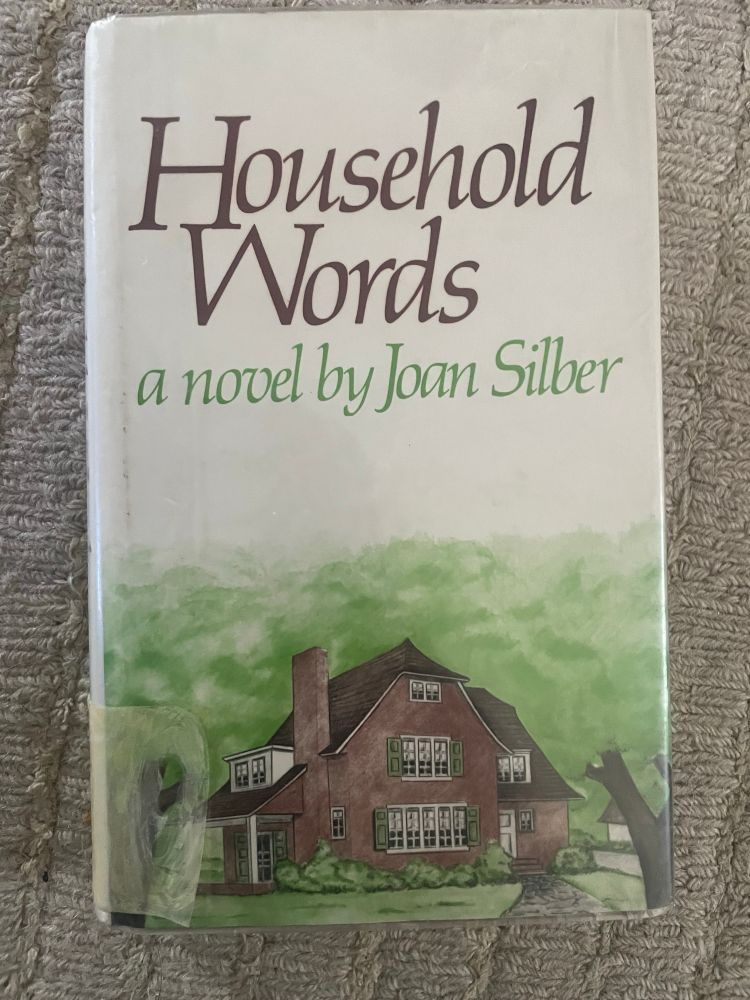
This passage from the beginning of Joan Silber’s debut novel, Household Words (1980), struck me as the kind of thing you don’t see much anymore. Feels like novels rooted in descriptions of the world, and told in third-person past tense (glorious past tense, how I miss it) have become rare, even old-fashioned. Of course, Silber might have had that sense herself: after all, she titled her first novel, as the jacket copy of the first edition puts it, after the magazine published by Charles Dickens.
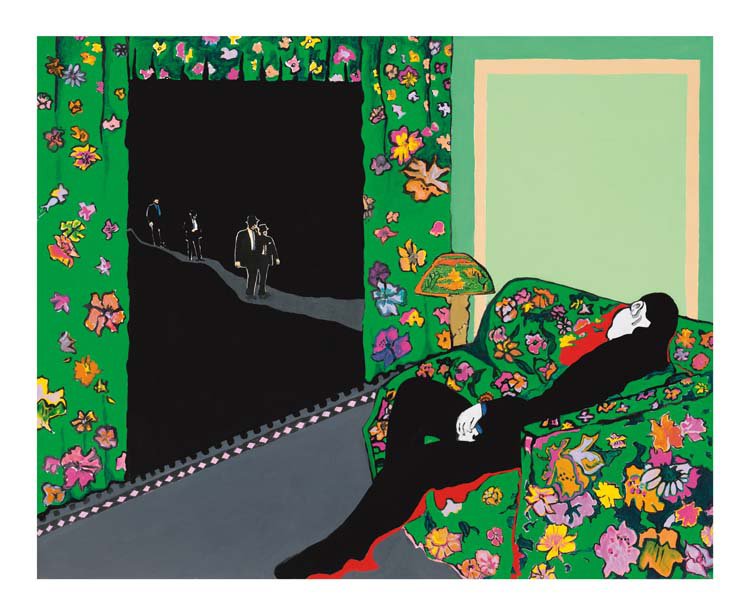
Rosalyn Drexler, Night Visitors (1988)
Silber, as I am starting to learn, having fallen into a deep dive of her works, is an unshowy and excellent writer. Look at what she does in these two sentences. She knows how to use a semi-colon, for one thing. The three clauses of the second sentence move briskly from description to judgment: “Annie was a wiry woman, barely five feet tall; at thirty, she was only four years older than Rhoda, but she was sinewy all over; she looked as though someone had chewed on her like an orange.” To be wiry is not necessarily to be small, but Silber implies that this is the case by mentioning Annie’s height, a seemingly unnecessary qualifier of the first independent clause. “Wiry” sometimes connotes toughness, but at this point in the sentence, we don’t yet have any indication that the adjective is meant to elucidate personality rather than merely describe physical appearance.
The second clause refines our thinking, though. From size we move to age (indirectly learning Rhoda’s). I kind of love the little storm of numbers in this sentence. Annie is thirty: not old by our lights today but older then than now. And older than Rhoda. But what matters to Silber is how the years show themselves on the body. Annie is “sinewy all over”: tough, indigestible. “Sinewy” made me return to “wiry,” forced me to think about the difference between these near synonyms. In this case, it seems worse to be sinewy than wiry. We’re not talking about Annie’s muscles. This isn’t a description of her fortitude. We’re talking about someone whose vitality has been squeezed out. Annie is pulp. She seems to have taken a licking from life already. This is all made clear in the third clause, the simile that compares the woman to a chewed-on orange. Juicy oranges don’t need much chewing. They go down easy. But when they dry out and their pith thickens, they’re harder to enjoy. I picture Annie with a bad tan: probably a fanciful association sparked by the colour orange.
Annie is a recurrent character, but not an especially important one. Even here she serves mostly to help us see Rhoda more clearly. Let’s not forget what Annie says before she’s described: “You really are a character.” It’s not just Annie who thinks so. The novel thinks about Rhoda this way. While Annie seems to speak half-admiringly, half-condescendingly, something like “Oh, Rhoda, you are just not like any of the women in our circle, and frankly that makes me a little uneasy,” the text offers the claim as a simple statement of fact. Rhoda really is a character—the character. We follow her through twenty eventful years, focusing on her experiences and responses, even as we never get fully inside her head. And yet the novel is being more than matter of fact here. Not just describing, but prescribing. It’s saying that Rhoda is worthy of being a character, of being the main character. Coming at the end of several decades of flourishing Jewish American literature, much of it written by men and famously invested in that point of view, Silber gives us something new. After Herzog and Augie March and Zuckerman and Alexander Portnoy Silber offers Rhoda Taber, a housewife living through the first stages of postwar American Jewish assimilation and suburban living.
Rhoda, who speaks Yiddish with her father and English with her social set and thoroughly Americanized daughters, is fascinatingly contradictory. She leaves her job as a schoolteacher when she has children, but her time as a teacher of French shapes her whole life, symbolizing her difference. [Careful, spoiler incoming!] After her husband’s untimely death, she returns to work, even though she doesn’t need the money. Nor does she remarry, even though friends fall over themselves to set her up, and even though she meets a man she enters a longish relationship with. She won’t sleep with him, though, because he’s not desirable to her. Not physically, but emotionally. She thinks of him as uncouth, even violent when she witnesses him doing business.
But this doesn’t mean Rhoda rejects conventions. She’s not like her friend Harriet, an unmarried no-fucks-to-give woman who encourages Rhoda to take art classes with her, even though she has no illusions about her abilities. (“Let’s face it,” Harriet says flatly, about her efforts to sculpt a dog, “it looks like a turd.”) Harriet and Rhoda vacation in the Catskills. Is Harriet gay? We never get the chance to find out. Despite her homophobia (she worries about her older daughter’s friendships in unpleasant ways) Rhoda feels queer to me. Don’t get me wrong, she’s conformist. But only superficially. In the things that matter, she’s out of step with everyone around her. Rhoda has an ugly side, for sure. She responds with disgust to the rumor that her neighbor has been having it off with a delivery boy: not because of the age discrepancy (though we don’t know how old he is) or the class difference, but because she cannot countenance the woman’s sexual desire. She struggles with her daughters, never abusing them outright, but picking fights or welcoming the fights they pick, despairing at the older one’s inability or unwillingness to follow Rhoda’s own life path and contemptuous of the younger’s need to make others like her. At the same time, she admires their independence, their unwillingness to be forced, by men in particular, into situations they don’t want to be in. The book I thought of most as I read Household Words was Vivian Gornick’s Fierce Attachments, another important Jewish book od the1980s. Silber’s novel feels like the fictional version of Gornick’s memoir of postwar American Jewish female rebellion, but in this case written from the mother’s side.
In the end, it’s not family life or economic success or cultural assimilation that Rhoda struggles most with but her own body: she spends the last years of the 1950s, and thus the last sections of the book, increasingly ill and at the mercy of the medical establishment. We leave her as she is leaving everything she knows. It’s a stark ending—and fitting. Rhoda Taber is not a nice woman. Nor a shrewish or disagreeable one. An interesting one. A real character.
At the beginning of A House of Dynamite, Kathryn Bigelow’s new film, now in theaters and on Netflix, an intercontinental ballistic missile shows up on the radar screens of a tracking station in Alaska. Is it a test? A malfunction? If, as it soon becomes clear, it’s real, who launched it? These questions are picked up by the team at the White House that monitors threats to the country. Soon the military command, the Department of Defense, FEMA, and other agencies are involved. They have less than twenty minutes to shoot the missile down before the ten million people in and around Chicago are incinerated. When the ground-based interceptors fail, a decision falls to the President (Idris Elba, known to the audience only as a voice until the last third of the film). Should he order a retaliatory strike (and if so, against whom)? Perhaps unsurprisingly, given its love of expertise, the film presents the President as a mediocrity doing his best but outmatched by the enormity of the situation.
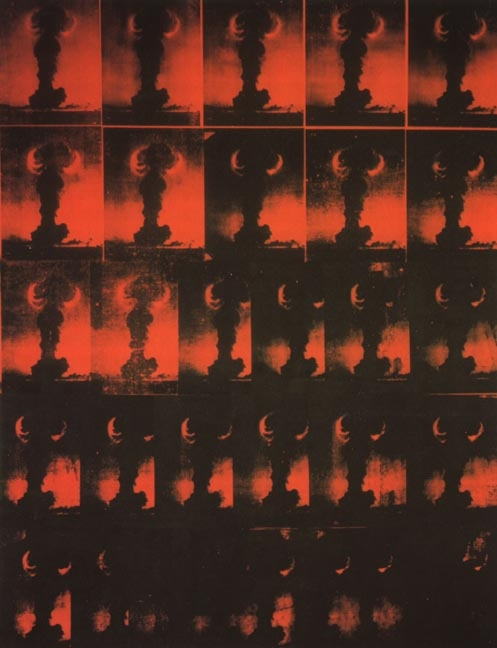
Andy Warhol, Atomic Bomb (1965)
The movie drives hard and fast. It’s suspenseful and frightening. But its real interest is in something seemingly much less exciting: expertise. On one level, A House of Dynamite is a paean to experts, people with specialized knowledge that guides informed yet decisive action. In the current moment our American oligarchic and fascistic kleptocracy, the days of the experts often seems to be over, a victim of a long-running war against education, perpetrated by privileged people who have benefitted from it. How thrilling, then, to see Captain Olivia Walker (Rebecca Ferguson), Deputy National Security Advisor Jake Bearington (Gabriel Basso), or even General Anthony Brady (Tracy Letts, he of recent Criterion Closet fame: “take your dissonance like a man) assert the value of reasoned protocol. Following procedure never seemed so exciting.
On another level, though, the film shows nothing but the failure of expertise. Characters struggle to communicate with each other, often in the most banal ways: someone important is out of the office; phone calls break up; conflicting video conferencing systems can’t be patched together. And they fail to see eye-to-eye. As their confidence in the country’s preparedness fades with every minute, they argue over the merits of a counterstrike. Will it stop further attacks? Or bring about the end of the world?
How does the film’s form relate to this content? To what extent is it an example of expertise? It’s certainly professional. A House of Dynamite moves quickly, even neatly, shifting between locations and institutions without ever leaving the audience confused. This clarity is the more impressive in that Bigelow has split the film into three chapters. Each tells the same story, but highlights different characters. There are a lot of off-screen voices in this film—people on conference calls, crackling out of microphones. We get the pleasure of putting faces to those names as we revisit earlier scenes from different perspectives.
Despite its looping, non-linear telling—a counterpoint to the relentless ticking of the clocks down to zero and annihilation—A House of Dynamite is efficient to a fault, offering minimum requisite humanizing beats to its characters. These moments often involve children. Captain Walker takes her son’s plastic dinosaur to work after he solemnly presents it to her on her way out the door; later she winces when slipping on her heels after passing through security outside her office before pausing, stork-like, to dig out the offending figurine which has must have fallen into a shoe when both were in her bag. A fighter pilot stationed in the Pacific stuffs the teddy bear he’s bought for his kid into his locker, only to fail to notice that it slides to the floor when his attention is distracted by the alarm that indicates a sudden mission. This tendency to use children as signifiers of the personal reaches its height when the Secretary of Defense (Jared Harris) kills himself after realizing that he will be unable to save his daughter, who lives in Chicago.
These decisions are mawkish (though the man’s last call with his daughter is affecting: he understandably sees no reason to tell her she is likely to die within minutes). But that’s not the problem. The problem is how calculating the film is in humanizing its characters, how minimal and cliché its sense of what the human means. I found this especially disheartening in a movie that claims to abhor the destruction of human life.
In terms of its form, well, there’s professional, and then there’s polished. In trying to depict what stands to be lost in the event of the unthinkable, A House of Dynamite is as instrumental as the failed way of thinking that reduces weighty decisions to options in an if-then chart. Hard to imagine a less shaggy movie. (No “few small beers” here.) I was left wishing for some loose ends.
That might seem crazy given that probably soon-to-be notorious open ending. We never learn what the President decides to do. Or if Chicago is obliterated (though it sure seems likely). Or We if the repeated claim that “sometimes these weapons malfunction or don’t detonate” is wishful thinking. Sitting in the theater, I felt a brief flare of frustration. But how is a film like this supposed to end? After all, it argues that building a house full of dynamite and then deciding to keep living in it is insane. To that end, the missile must remain anonymous, its source forever unknown. The Russians deny it. The Chinese deny it. The North Koreans are unreachable. Ana Park (Greta Lee), the expert on that country, lays out a convincing scenario in which the North Koreans might be motivated to launch a suicide attack. But nobody knows. The film argues that it doesn’t matter. The possibility of unmotivated mass destruction is simply built into a world with nuclear weapons.
This choice on the film’s part, however, means that politics is off the table. Despite a good scene in which the Deputy National Security Advisor has a tense, heartfelt, but ultimately inconclusive phone call with a Russian counterpart, geopolitical maneuvering or negotiating are rendered inoperative by the bomb’s anonymity. The attempt to game out—in less than twenty minutes—possible consequences of preemptively launching a return strike, or of choosing not to, turns into abstraction, a kind of amplified trolley problem that the film doesn’t have the chops or stomach to develop. (Clearly, though, the tough-minded hawk, sitting in a bunker somewhere in the South Pacific, isn’t to be trusted. He puts eight sugars in his enormous travel mug of coffee.) I’m not sure what Bigelow had in mind by putting the North Korea expert, who fields calls from frightened officials on her day off, at a reenactment of the Battle of Gettysburg with her pre-teen son. Is the idea that the Civil War was as senseless as a nuclear attack? Or, on the contrary, that however terrible that war, it was at least a fight with dignity, valor, etc.? Or that any terrible event will eventually be subsumed into nostalgia and/or the politics of commemoration?
I said before that this is a frightening movie. It induces feelings of panic, helplessness, sorrow, and rage. And that, more than any mourning of the utopia of expertise, makes A House of Dynamite a movie for America in 2025.
But only in the worst, paralyzing way. Admittedly, paralysis constitutes much of what I at least experience most often these days. But that’s not the only way we can respond just now. And not the one that we need to emphasize if we are going to change the mess we’re in rather than just experience it. What would this film be like if it valued thinking more than the compartmentalization of calm professionalism and abject terror?
What if Bigelow or her writer Noah Oppenheim had read Elaine Scarry’s Thinking in an Emergency (2011)? There Scarry argues that America has dangerously normalized the idea of emergency as exception, and therefore as something that requires citizens to set aside democratic participation for unchecked executive action. She offers examples from around the world where careful but decentralized emergency preparedness results in mutual aid among citizens, not force from the State.
Still from A House of Dynamite (2025). Lotta phones, lotta screens.
The protocols devised in the US to respond to nuclear attack—the nuclear codes; the handbook with its menu of increasingly drastic responses; the double-checking of identities; the sequestering of the chain of command, hell, the very idea of a chain of command—are designed to protect a few when the many die a terrible death. The film’s last scene shows buses of officials designated as indispensable arriving at a bunker in the Pennsylvania countryside. (It’s clear that what matters is position, not person: thus the inclusion in the film of a FEMA employee based in Chicago (Moses Ingram), responsible for disaster response; the woman has only been in the job a short time; her colleagues are actively hostile when they realize that she, not they, will be sent to supposed safety.) We get no sense of what will happen to those individuals should that bomb in fact land. The protocols of response to a nuclear attack, like the film that shows them to us, is governed by ruthlessness. The only challenge to that brute instrumentality—and the only thing that could count as a loose end in the movie—is that Park, the North Korea expert, stumbles off the bus with her son. It’s a hint of human possibility in this fascinating but inhuman film..
Here is my introduction to Episode 38 of the podcast I co-host with Rebecca Hussey and Frances Evangelista, One Bright Book.
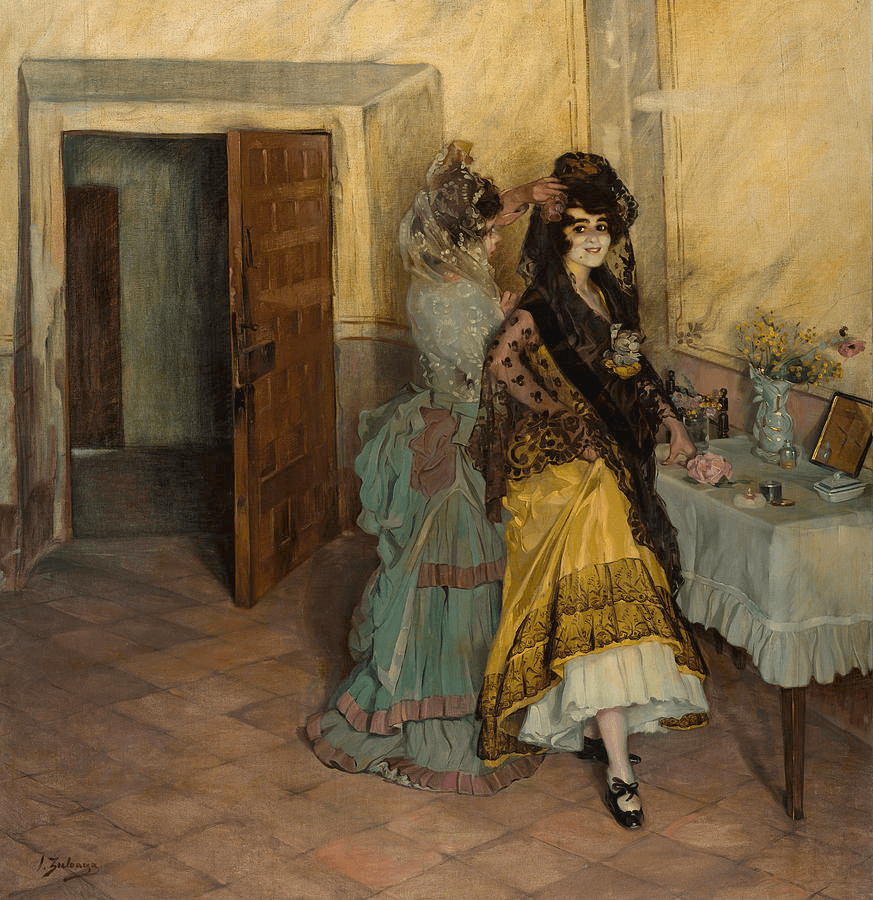
Ignacio Zuloaga y Zabaleta, Preparation for a Bullfight (1903)
Our book today is Miaow, written in 1888 by the great Spanish 19th-century realist Benito Pérez Galdós and recently published by NYRB Classics in a lively new translation by Margaret Jull Costa.
Galdós, whose long and productive life lasted from 1843 – 1920, was born in the Canary Islands, which perhaps gave him an outsider’s perspective on the Madrid society he scrutinized in more than 80 novels.
Miaow has a cast of, well, maybe not thousands but a lot of characters. Ramón Villaamil has served the state his whole life, but he’s lost his job in the tax office due to changing political fortunes just two months short of qualifying for his pension. He solicits possible patrons and haunts his old office, not just to get a job but also to escape his household, where he lives in an uneasy truce with his wife, Doña Pura, their adult daughter, Abelarda, and his sister-in-law Milagros. Completing the ménage is Luis, the son of a second daughter who died young. Luis’s father is a man named Victor, a bad penny who has never been in the picture, indeed whose name is never spoken in the home. The novel kicks into gear when Victor turns up and inveigles his way into the household, eventually sowing great unhappiness. (Victor is a breathtakingly bad guy—I hope we’ll talk about this.)
These are all interesting characters—so why isn’t the book named after any of them? That would be the usual 19th-century thing. (Jane Eyre, Daniel Deronda, Eline Vere, Anna Karenina,l etc., etc.) Why does it have such an odd title? Who or what does “miaow” refer to, anyway? Well, lots of things. It’s the nickname given by the local wags to the women of the Villaamil household, after their supposedly feline features. I think it’s important, though, that the book isn’t called The Miaows. For the title also extends to Ramón, the paterfamilias—not because of how he looks but of what he believes. MIAOW is an acronym for his mantra that Spain can only be saved by Morality, Income Tax, Additional Import Tariffs, Overhaul of the National Debt, and Work. So already “miaow” references both physiognomy and economy. But there’s more. In addition to being a noun, miaow is also a verb, a sound, an onomatopoeia, and a sarcastic, acidic, or bitchy commentary, as when we call someone out for being catty: Mee-ow! It’s this last meaning I thought of most as I considered the harsh disdain so often expressed by the characters toward each other and the gentle satire of the narrative voice toward all of them.
Once we see that “miaow” is something like a mood or attitude or state of mind, we’re able to recognize how unusually Galdós uses characterization. In my description of the book a minute ago, I made it sound like a family story. But it’s not, quite. The critic Fredric Jameson, who really loved Galdós and thought his unfamiliarity in the English-reading world a real travesty, says that Galdós offers “a deterioration of protagonicity,” an admittedly unlovely phrase that he glosses as “the movement of the putative heroes and heroines to the background, whose foreground is increasingly dominated by minor or secondary characters.” As a Marxist, Jameson attributes this not just to Galdós’s predilection or “genius” but to his position as a person living in late 19th century Spain and its strangely non-modern political landscape following the failed “Glorious Revolution” of 1867 (they deposed the monarchy and then brought it back, sort of). To depict the social reality of his society, Galdós had to “strike[ ] an uneasy compromise between the atomized individualism of more fully bourgeois societies with their nuclear families, and the more archaic traces of the older feudal class and castes.” To me, this explains why Galdós feels like an uncanny version or simulacrum of canonical realists like Balzac or Zola, with whom Galdós shares an interest in recurring characters and the desire to explore an entire society. Miaow reminded me of Père Goriot or La Bête Humaine. But also not. Jameson notes that Galdós’s novels are not organized around families, even extended families, but rather around households, an ambiguous term that includes servants, neighbours, and other families who circulate in and out of the story. (In Miaow, Doña Pura is always hosting friends, acquaintances, people who may or may not respect or like; Ramón is always trying to hide from them.) The household thus includes the Mendizábals, a couple who live downstairs and take pity on the much-neglected Luis; the Cabreras, the sister and brother-in-law of that cad Victor, who want to adopt Luis; as well as a whole series of characters at Don Ramón’s former office, some of whom are, to me at least, hard to keep track of, but to whom the novel devotes so much attention, in their various sympathy to or ridicule of Don Ramón, that it doesn’t make sense to just call them “minor.”
All of which is to say that Miaow, though not especially long (it’s like 300 pages) is very busy. To that end I was struck by a word that appears in the first sentence and reappears near the end. Here’s how the novel begins: “At four o’clock in the afternoon, the kids from the school on Plazuela del Limón erupted out of the classroom, making the very devil of a racket.” 250 pages later, a disconsolate, embittered Don Ramón observes a flood of civil servants clattering out of the workplaces at the tax office on payday: “The stairs were almost overwhelmed by this human torrent, which made a tremendous racket as it flowed on down, the sound of heavy footsteps mingling with all the cheerful, sparkling, payday chatter.”
The repetition of racket reminds us that bureaucrats are just overgrown schoolboys. Here we see Galdós’s satirical side. (And by the way, surely the opening scene of the schoolchildren, who, as they pile into the streets, tease little Luis with the nickname of his aunts and grandmother, miaow, miaow, miaow, refers to the opening of Madame Bovary, where a different set of schoolboys taunt a nice enough if also hapless pupil.) But more importantly the repetition of racket speaks to its modus operandi., maybe what we’d now call its vibe. This book too makes a tremendous racket, in the best possible way, with clever dogs, opera singers, officious bureaucrats, raw army recruits, shopkeepers, and a score of others contributing their two cents. Mee-ow indeed.
Have any of you read this book? Or anything else by Galdós? What do you think?
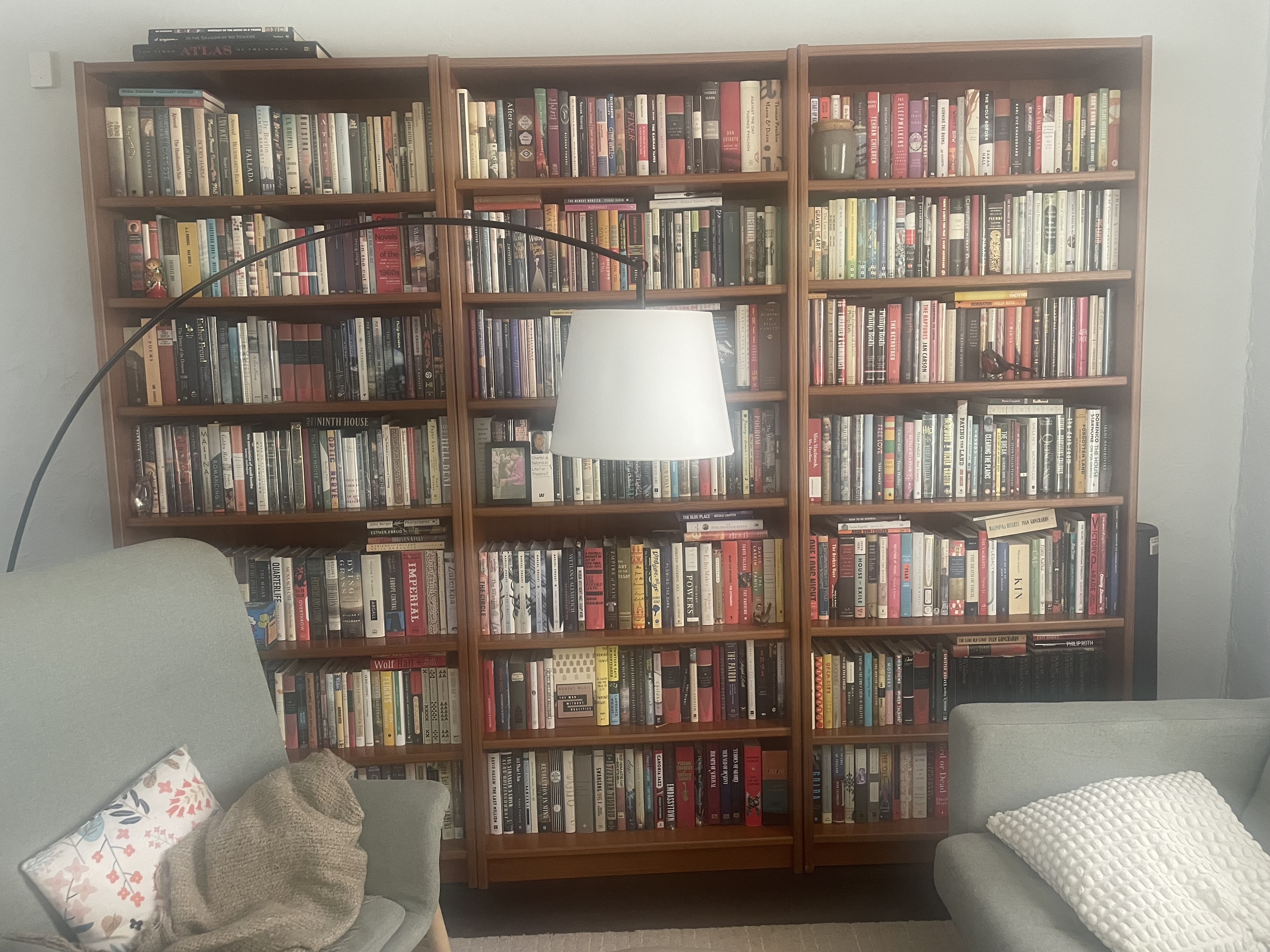
A recent episode of The Mookse and the Gripes podcast got me thinking. Hosts Trevor and Paul were joined by John Williams of the Washington Post (mensches one and all). John had proposed a fascinating topic: starter libraries. The idea was to imagine your response to someone who asked you for ten titles they absolutely had to have in their collection. Probably this person is someone new to literature, a teenager or a student, but maybe they are someone who used to read more than they do now and are looking to get back to that part of their life. What would you recommend?
The important part of the assignment, as I understand it, is that the person is asking you. They know you well enough (parasocially or otherwise) to trust your taste. They respect you enough to be curious about anything you recommend. But they’re not asking for your ten favourite books. Presumably you like the titles on your list. But you’re not just offering them out of personal predilection. You think of them as representative for aspects of literature that matter to you.
Personal but not only personal, might be one way of putting it. Or, in the words of the episode’s subtitle, your choices could be thought of as a shelf full of promises.
Do listen to the episode, it’s terrific. Great lists, fascinating insights into the recommenders. And sure to get you thinking about your own answer. That’s what happened to me: I set aside the laundry I was folding and jotted some notes on my phone, which I’ve now expanded into this list, complete with categories (and alternate choices, because ten books is not many books).
Candida Höfer, Bibliothèque Nationale de France Paris XXI 1998
Books to grow into but also to love when you’re young:
George Eliot, Middlemarch
The only novel in English for adults, Virginia Woolf famously said. Not sure what she meant, but doesn’t it sound good? Having reread it recently, I think you need to be middle aged (and thus an adult… hmm well never mind) to get the most from this story of English provincial life around 1830. But having first read it in college, I can also attest that Middlemarch hits for young people. As with any rich text, what you pay attention to and who you sympathize with shifts each time you read it.
Eliot is known for moral seriousness (maybe that’s why as stylistically different a writer as D. H. Lawrence was a fan), but Middlemarch is also surprisingly funny. Mostly, it’s supremely moving. It covers so much of life, and asks the big questions. What makes a good life? How can we live with purpose? How can we think of ourselves in relation to everyone else? Where do we fit into the web of life?
[Alternate choice: Leo Tolstoy, War & Peace. Never read it until about five years ago, but feel confident it dazzles as much at 20 as at 50. You want novelistic sweep? This one’s as big as Russia… Freemasons and wolf hunts and returns from the dead and slow-burning love affairs lasting across the decades: everything, really.]
Books that master close third-person perspective
Nella Larsen, Passing
Set in Harlem and Chicago in the late 1920s among a set of well-to-do light-skinned Black women who can pass as white, Passing is a great novel of queer frenemies. It hews closely to the perspective of a single character, Irene, whose orderly life as the mother of two boys and wife to a (dissatisfied) doctor falls apart when she runs into a childhood friend, the brave and dangerous Clare. Unless we attend to how events are only offered through Irene’s perspective, we are likely to miss how much the book asks us to question the judgments it only seems to offer.
[Alternate choice: Henry James, What Maisie Knew. In book after book, James wrote about people behaving badly. Yet even among this vast canvas of cruelty, this novel stands out: the people doing the harm are parents who use their young child to hurt each other and, of course, the child. In the preface to the New York Edition James explained that he chose to narrate the book in third person but to limit the perspective to Maisie’s often baffled but also wondering sense of the world in order to offer readers the extra pathos of being able to understand what she could not. It’s quite a trick.]
Books about the Holocaust
Primo Levi, If This Is a Man
If someone is asking me what books they simply must own, they’re absolutely gonna get one about the Holocaust. Hell, I could make them a whole list. But knowing that not everyone shares my fascination, I’ll stick to one of the earliest and most famous instances of Holocaust literature. (Levi composed part of it already while in the camps.) Like all memoirs, If This is a Man (known in the US under the travesty title Survival in Auschwitz) details its author’s particular experience—which took the form it did by his having had “the great good fortune” to have been deported only in 1944, when the turning tide of the war and subsequent internal battle among top Nazis meant that more deportees were selected for slave labour. That phrasing gives you a sense of Levi’s matter-of-fact irony. But something that distinguishes If This Is a Man is Levi’s decision to use “we” even more than “I”: he aims to give a sense of the structure and meaning of the collective victim experience, at least within a subcamp of Auschwitz.
[Alternate choice: Ida Fink, A Scrap of Time and Other Stories. Too little known among English speakers, but, happily, available in a terrific translation by Madeline Levine and Francine Prose, Fink’s heartbreaking stories depict part of the Holocaust most people don’t know about: the mass murder performed by the Einsatzgruppen in Galicia in the summer and fall of 1941. Fink couldn’t find a publisher for these stories until the 1980s; they were deemed of no interest. Another devastating failure on the part of literary opinion. Fink has been called the Chekhov of the Holocaust. Grotesque as this sounds, it’s accurate. Quiet and heartbreaking.]
Members of YIVO New York examine crates of books rescued from the Vilna Ghetto
Books about how to read books:
Roland Barthes, S/Z
Barthes spent a year reading Balzac’s story “Sarrasine” with some students. (Oh to have been in that seminar!) That labour resulted in this extraordinary book, organized around line-by-line readings of the source text, not, as critics usually do, to figure out what it means, but rather how it means. To do so, Barthes offers five “codes”—fundamental elements of realist fiction, of which “Sarrasine” is considered only as a representative example—that readers unconsciously rely on (typically by having imbibed many examples of the genre) in making the text intelligible. The codes are things like references to historical events, people, and places, or attributes and actions that cohere into what we call characters and, in the case of realist literature, think of as if they were people. Barthes Intersperses his step-by-step redescription of the Balzac story with theoretical meditations on the operation of the codes, which readers can extrapolate to other texts.
S/Z is tough. I probably taught it five or six times before I felt I had a real handle on it. But as Barthes says, it’s valuable to be able to distinguish between real and superficial ideas of difference. We might think that the best way to know about books is to read a lot of them. But if we do so without thinking about what underlies their intelligibility (i.e. what we need to be able to read them), then we are mere consumers, doomed to reading the same thing over and over. Only by reading one text over and over can real difference, that is the difference within the text, show itself—which in turn will make our other reading more meaningful. All of which is to say, the effort of tackling Barthes’s analysis offers big rewards.
[No alternate choice. S/Z for everyone.]
Books with pictures:
Alison Bechdel, Fun Home
Comics, graphic novels, whatever you want to call them are important to me, and I think any reader needs at least one example in their library. Such a rich form, so many gorgeous and moving texts to choose from. As with my Holocaust choice, I resisted the temptation to go niche here. Bechdel’s memoir of her relationship with her closeted, self-destructive, talented father deserves its fame. Probably more than any book I regularly taught, Fun Home elicited the strongest positive reactions in the widest range of students. Family disfunction runs deep. A great book about how books can connect people who can’t otherwise open up to each other—and how they can further separate them too. Funny, ominous, bittersweet.
[Alternate choice: Nick Drnaso, Sabrina. Dark, powerful. Reading it gave me a bit of the ick. And yet its subject matter just seems more relevant. I guess this is about the manosphere, except no one was using that hideous term at the time.]
Books of ideas [fiction]
Thomas Mann, The Magic Mountain
Sometimes I want a book that dramatizes the back and forth of thinking. In The Magic Mountain, Mann literalizes this by surrounding his protagonist, the well-meaning, hearty Hans Castorp, with some of the most indefatigable talkers ever to appear in a novel. The whole intellectual landscape of pre-WWI Europe is here (liberal humanist, communist, militarist, hedonist, you name it), and everyone battles for Hans’s soul, even as the former engineer mostly wants to desire a woman from afar, a woman who reminds him of a boy from his schooldays…
The other great thing about this book is how well it depicts Davos and environs. I’m a sucker for mountains and mountains in books. Bring on the snow!
[Alternate choice: Proust. Honestly, if you can only put one book in your starter library, choose this one. I assume it’s already there, but if not then get stuck into this deeply philosophical book, which has so much to say about perception, time, cruelty, and control over others.]
Books of ideas [nonfiction]
W. E. B. DuBois, The Souls of Black Folk
Every American should read it. But non-Americans should too. The idea of double-consciousness—the way a minority must measure themselves by the tape of the majority, as DuBois so memorably puts it in his first pages—explains so much of our contemporary sense of identity.
In addition to its ideas, Souls is a fascinatingly hybrid book, presumably stranger in 1903 than today. Each chapter is prefaced by a bar of music, often from the sorrow songs. Most chapters are essayistic, but some are fictional. Each is written in resonant cadence. Hasn’t dated much. Alas.
[Alternate choice: Hannah Arendt’s The Origins of Totalitarianism. Explains how Nazism and Stalinism came to be so accepted and do so much harm. Especially interesting for (1) its “boomerang” theory of imperial violence, in which what the metropole does in the colony comes back to bite it at home, and (2) its argument that modern antisemitism arose from the waning of Empire and the rise of nationalism. Hasn’t dated much. Alas.]
Monomaniac books
The strand from writers like Kafka, Knut Hamsun, or Robert Walser to someone like Lydia Davis, via the high point of Thomas Bernhard, has been enormously influential in the Anglo-American sphere. At this point, annoyingly so. (And weird, too, given that none of the most important precursors wrote in English.) But I get it because literature excels at tracing the vagaries of a mind, especially one spinning through reversals, paradoxes, and hobby-horses. A starter library should have an example of this sort of thing, and Bernhard might be the best. When the only thing that stands between a psyche adrift or worse is the chance that someone might respond to its voice—that’s when you’re in Bernhard territory. I’ve chosen The Voice Imitator because the title says it all. Read these 104 short texts to get a sense of Bernhard’s bitter, misanthropic, and, oddly, funny vibe.
[Alternate choice: I just named like five other writers!]
Funny books
P. G. Wodehouse, The Code of the Woosters
As implied in what I said about Bernhard, voice-driven books don’t have to be grim. They can make us laugh, whether from the gap between what the narrator claims and what we know, or the sheer verve of their style. The fun only increases when those narrators get embroiled in elegant plots. Wodehouse is the master of this terrirtory and everyone’s library is the better for including him. (I feel like he’s fading a bit from memory? Sad.) You can jump in anywhere—my entry point was the distinctly not-famous-but oh-so-representatively-titled Eggs, Beans, and Crumpets which baffled and delighted me at age 12—but if you’re at a loss start with this wonderful episode in the Jeeves and Bertie series, which Tim Waltz would enjoy, since it’s an early example of the “I condemn the fascists by unflinchingly stating how weird they are” school of responding to authoritarianism. (As Bertie says, appalled by the realization that the Saviours of Britain are simply grown men marching in black shorts: “how perfectly foul!”)
[Alternate choice: for an American version of this phenomenon, reach for Charles Portis, especially the marvelous True Grit.]
Books about crime
Dolores Hitchens, Sleep with Strangers & Sleep with Slander
Since at least Oedipus Rex, literature has used crime to understand fundamental concerns like identity, political organization, and moral value. Crime fiction can be smart, is what I’m saying. And it can also carry us away by inciting our desire to have enigmas explained. (Interestingly, it often makes us realize how much more compelling it is to ask a question than to answer it.) Like any genre, then, crime fiction satisfies at both the intellectual and emotional level. Having stayed with well-known titles so far, I’m diving deep for this last category. Not enough readers, even lovers of crime fiction, have read the mid-century American writer Dolores Hitchens. She wrote a lot of books under a lot of names. But only two about a PI named Jim Spader. Which is sad—but also good because they’re even more special. These make for pretty despairing reading, even for noir. So be warned. But you won’t regret seeking them out.
[Alternate choice: Hundreds! Thousands! Sticking with mid-century American women writers, I’ll plump for Dorothy B. Hughes’s The Expendable Man. Don’t read anything about it beforehand!]
I tried not to think too long in coming up with my choices. Next month or next year I’d choose differently. And I’m aware of some big lapses. No poetry?? No plays?? No Torah?? (Everyone should read the Five Books of Moses.) But that’s ok. Gives you all the more room to think about how you’d create a starter library of your own. What would be on your shelf of promises?
If you’re reading this, you are faithful indeed. And I am grateful. Long silence here, I know. As my adopted country tumbles into authoritarianism, things have also been changing, though more positively, chez EMJ.
Igor Razdrogin, Book Bazar (1975)
My wife, daughter, and I are moving to St Louis in a month’s time! We’ve spent quite a bit of time there these past few years, and we like it a lot. We’ll have a little more space in our new home (which, combined with some collective efforts to tame my unruly library, might mean that our house will at least briefly not be overflowing with books), and, best of all, we’ll be living in a walkable neighbourhood with sidewalks, which is something we’ve been missing these past 18 years in Little Rock.
The other big transition concerns my career. I’m leaving my job at Hendrix, of course, but I’m also leaving academia in general. People keep asking how I’m feeling about this and I keep saying: Terrific! I was pretty burned out and starting to get a little Old Man Yells at Clouds about All the Changes that affected the classroom experience: the pervasiveness of AI and LLMs (something no one, as far as I know, ever asked for), and, more distressingly, the difficulty even the best-prepared students are having reading sustained works of literature, by which I mean, an entire book, no matter how straightforward the prose. This isn’t about their intelligence, or even their phones. It’s about the strictures placed on secondary school teachers. As instruction moves ever more toward preparing for testing centered on multiple choice reading comprehension questions about utterly decontextualized chunks of texts, teachers aren’t assigning much reading, which means students simply don’t have much practice at it.
(I also have a pet theory that for all its flaws Harry Potter (to be clear: it sucks) helped Millennials think of reading as both exciting and habitual, and Gen Z hasn’t had anything like that. The Harry Potter to Jane Austen to English Major pipeline kept our department afloat for a lot of years. These days, students dislike both Rowling and Austen…)
I still love many things about teaching, and it’s possible I’ll miss it so much that I’ll return to it in some fashion. (I’m never getting another job like this one, though. Those don’t exist anymore.) But for now, I feel relief, and curiosity—along with a lot of trepidation—about the chance to try something new. For now, it feels a bit unreal. Because the academic year is cyclical—summer is always a time of collapse and, if lucky, regeneration—I don’t yet feel as a though I’ve made much of a change. Talk to me in the fall, or next spring, or five years from now.
Luckily—and this is another reason for the silence around here—I’ve been working as a consultant for the Educator Programs arm of the William Levine Family Institute of Holocaust Education at the United States Holocaust Memorial Museum in DC. The people I work with are absolutely fabulous: smart, funny, kind, devoted to their work without having delusions of grandeur about it. It’s eye-opening—and fun—to work as part of a team, after decades of the isolation of academic life. I’ve helped them create resources for K – 12 English Language Arts classrooms, and have taken great satisfaction in the work.
I’ll need full-time work sooner rather than later, though, so if you have any ideas or leads, hit me up! Like, what are some jobs people do? What do y’all do all day? I need advice!
What I’m saying is, I had a lot going on these last months. But I did manage to keep reading. Maybe not as much as usual, but whenever I could make time. I get that it’s ridiculous to offer a 2024 reflection halfway through 2025, but FWIW here are the things that stuck with me last year.
So much to love in this novel about an alternate 1920s in which a sizeable indigenous population thrives in a nation called Deseret centered on the bustling city of Cahokia. Spufford weaves his world-building throughout a procedural, in which our hero, a cop who moonlights as a jazz pianist, investigates a murder with vast political implications, to the point of threatening Deseret’s independence.
Cahokia Jazz is the most referenced title in the Year in 2024 Reading pieces I posted earlier this year, which means either that everybody loves this book, or that people like me love this book. Anyway, given my upcoming move to Missouri, it won’t surprise you to hear that the scene that most sticks in my mind is when Barrow pursues a lead in a village at the end of the Cahokia streetcar line, a fly-swept place he can’t wait to leave. Its name? St Louis…
I look forward to visiting the ruins of the actual Cahokia, once the biggest city north of Mexico City.
Katrina Carrasco, The Best Bad Things (2019)
Fabulous and underrated crime novel set in 1880s Port Townsend, where the most valuable commodity passing through the busy port is opium smuggled in from north of the border. Alma Rosales, who once worked for the now-shuttered Woman’s Bureau of the Pinkerton Detective Agency, has left San Francisco for Washington Territory to work for the seductive, brilliant, coolly calculating Delphine Beaumond, who runs most of the drug smuggling on the west coast.
When product goes missing, Delphine puts Alma on the case. Alma goes undercover as a dockworker—not a problem, because Alma is also Jack Camp, a slight yet wiry man who can hold their liquor and likes ladies and men equally. Did I mention that Alma and Delphine are lovers? Or that Jack starts a torrid affair with the man they’re investigating? Or that they’re also still working as a Pinkerton agent—in a desperate attempt to get their old job back?
Cue double-, triple-, even quadruple-crossing; witty repartee; and some pretty hot sex. Most crime novels are let down by their endings, but this one… let me tell you, friends, I literally gasped. A brilliant debut. I want everyone to read it.
Émile Zola, La Bête Humaine (1890, translated by Roger Pearson) and The Assommoir (1877) Trans Brian Nelson (2021)
Even by Zola’s lofty standards, these two are bangers. Push comes to shove, I guess I’d choose Bête over Assommoir, just because I love the crime story trappings, but the latter might be the more impressive accomplishment, especially if you could read it in French to see what Zola does with the argot of his lumpenprotelariat characters. They’re equally—which is to say, tremendously—depressing, but also viciously alive. Zola’s naturalist doom is regularly leavened by his prose, which zips from one brilliant set-piece to another. I’m talking about stuff like the bruising fight between two laundresses in front of an audience of delighted, shouting onlookers in the opening scene of The Assommoir, or the berserk vision of a driverless train, filled with drunk soldiers in full war frenzy heading to their doom at the hands of the Prussians, in the last pages of La Bête Humaine. Feels like a good time to study Zola’s fascinated descriptions of all things irrational.
Hernán Diaz, In the Distance (2017)
Quasi-Western in which the protagonist—a hulking, nearly mute Swede named Håkan whose only goal is to find the brother he was separated from on the voyage to the New World, and whose body and psyche seem to be able to take any amount of suffering—travels east, south, and north as much as west. This is a brainy book: Diaz riffs on Frankenstein, and probably a lot of other stuff I missed. But its allegories are always concrete. In this novel of a man stubbornly going against the westward direction of Manifest Destiny, I most remember the section in which, after suffering a terrible loss, Håkan literally burrows into the ground, eventually building a maze-like underground shelter where he lives in ambivalent isolation for years.
I read Diaz’s Trust last year too: also great. Probably not telling you anything you don’t know. But if like me you are late to Diaz, move him up your list. Smart guy and beautiful writer.
Leah Hagar Cohen, To & Fro (2024)
Last year I served as a judge for the US Republic of Consciousness Prize, which honors literature published by small presses. Yes, I tossed aside some duds and waded through many competent but unexceptional novels, but I also discovered some terrific stuff I wouldn’t have otherwise read. My favourite was this delightful and thoughtful literary experiment, a novel written in two halves that can be read in either order. You can start with “To” and flip the book over halfway through to read “Fro,” or do the reverse. You could call this a Jewish Alice in Wonderland (I love how deeply and unapologetically Jewish the book is: it takes such pleasure in asking questions), but that wouldn’t give you the sense of how the book is both realist and fantastic, a genre-bender that sometimes reads like a middle-grade book and sometimes like a historical “what if” novel, if those were written by someone whose lodestar was Maimonides. Magic!
Thanks to Lori Feathers, the genius behind this award, and to my fellow judges, who always brought it. Serving on this panel was time well spent.
A book of arrivals and departures, whether longed-for, dreaded, or uncertain. It feels both constricted and expansive: a neat trick. Bowen often gets called Jamesian. That is true not in style but only in a shared preoccupation with cruelty. Hard to say which fictional universe is meaner. Another thing I liked about The House in Paris is that it offers further evidence for my theory that British modernism is just another name for Gothic literature about children.
Martin MacInnes, In Ascension (2023)
Here we have two sisters. One becomes a scientist who explores the depths of the ocean floor and the vastness of space (she develops nutrition-dense and fast-growing algae for interstellar travel); the other sets aside her career as an international lawyer to find out what happened to the first. I can’t remember everything that happened in the book, but I do remember being enthralled from start to finish. (This is another long book that never felt slow.) The final scene, set in the remotest place on earth, Ascension Island, foregrounds another kind of foreign place: our memories. “A family”, MacInnes writes, showcasing his epigrammatic mode, “is a group of strangers with a destructive desire for common nostalgia.” MacInnes’s big question, asked as much of a sibling relationship as of humanity’s ability to inhabit the stars, is whether the only way to get beyond the destructiveness of the human species is to destroy the individual self Beejay Silcox, one of my favourite critics, gets it right when she calls the book “a primer to marvel.”
Sally Michel Avery, Father and Daughter, 1963
Thoughts on the rest
Ones I keep thinking about: Manjula Martin’s The Last Fire Season (2024): I still haven’t prepped a go-bag—how foolish is that? Catherine Leroux’s The Future (2020, translated by Susan Ouriou): What if the French had never lost Detroit? What if climate change and resultant socioeconomic crises meant that most of the trappings of a functioning state had fallen away? And what if bands of roving children built hardscrabble lives in overgrown parks? Peter Heller’s The Last Ranger (2023): Conventional but satisfying novel about a ranger in Yellowstone, filled with scenes in which the hero drinks early morning coffee on the porch of his cabin: Heller knows the landscape and describes it beautifully. (Given what the chuckleheads at DOGE did, this title resonates differently now…) Jill Ciment’s Consent (2024): Revelatory memoir in which the author reassesses her decades-long marriage to her now deceased husband, with whom she took a painting class when she was 17 and he was 47. Can the relationship really have been good given that they met when she was a child?
Best study of xenophobia, told in an atmosphere of creeping dread: Georges Simenon’s The Little Man from Archangel (1956, translated by Sian Reynolds).
A Russian Jew, brought to rural France as a child, French in every way, has his life turned upside down because of a casual remark. Chilling. Best Simenon I’ve read.
Best case of “it’s not you, it’s me”: Nisi Shawl’s Everfair (2016)
Steampunk set in an alternate late 19th century in which the Fabians buy tracts of land from King Leopold to protect refugees fleeting the horrors of Belgium’s rule in the Congo. At first, this new nation—Everfair—prospers. European benefactors and missionaries work with Africans to create trade networks based on clean airship technology. They develop intelligence networks to navigate the region’s politics. They promote or at least allow social experiments concerning family structure, marriage, and sexual politics. But the internal tensions become too much, and the utopia falls apart. Even as I’m writing this I’m thinking, Honestly this sounds pretty good, maybe I’ve misjudged the book. And at the level of idea it’s intriguing. The execution, though: that’s the problem. The prose is leaden, the relation between action and exposition awkward. Maybe the book actually needed to be longer? A strange thing to say since I felt like it was never going to end. This book is a darling to many (Jo Walton loves it, for example). Probably just the wrong time for me. Can’t imagine giving it another try, though.
Best (and most) coffee: Mark Haber’s Lesser Ruins (2024).
Things are not going well for the narrator of this Bernhardian novel, ever since his wife died and he lost his job. That’s a tough spot. And he tries to do the right thing, sometimes. He reaches out to his son, whose passion for house music means he will dilate on the perfect set list for as long as his father will hold the phone near his ear. Like so many of us (me, anyway), he struggles to surmount the gap between idea and execution, endlessly trying to write something good. You’d think we might like the guy. But… He’s a terrible snob. He lambastes his students, neglecting his work to the point of installing an espresso machine under the desk in classroom. (That an instructor at a community college would have a dedicated classroom is the book’s only false note.) His unfinished, maybe unfinshable, book on Montaigne is probably not really going to be all that. So he ain’t easy to like.
All of this is beside the point, though, because this novel is about the way sentences can mimic the swerves and circles of a mind endlessly thinking. One of the things our narrator thinks about most is coffee. He drinks a lot of coffee. Long sections concern the various roasts, the preparation, the anticipation, the enjoyment. I’m not a coffee snob on his level, but I found nothing to ironize or criticize in the man’s love for the perfectly pulled shot. Lesser Ruins is great for other reasons, too (it’s Haber’s best IMO), but if you like coffee at all, you gotta read this.
Most ingenious conceit: Kenneth Fearing’s The Big Clock (1946)
A drudge at a magazine publisher modelled on Time-Life is tasked with finding—for purposes of eliminating—a witness to a crime. Only thing is, he is that witness…
Dark and boozy. This is the good stuff.
Best crime fiction: Carrasco, obviously. Also obviously, the latest Tana French. (At least I can say I was alive while Tana French was writing novels that will be read in a hundred years…) The latest Garry Disher, Sanctuary (2023), is a satisfying standalone about theft and friendship. I read a couple of Gary Phillips’s books about a Black Korean-war vet turned crime-scene photographer: good stuff. (I learned a lot about Watts.) Start with One-Shot Harry (2022). Years ago I devoured Scandinavian crime novels: seemed like the most exciting thing in the genre. Bloom’s been off that rose for a while, but Cristoffer Carlsson’s Blaze Me a Sun(2021, translated by Rachel Wilson-Broyles) took me back. Marcie R. Rendon’s Where They Last Saw Her (2024) is her first book set in the present, and much as I love the Cash Blackbear series, probably her best. How nice to read a book about an indigenous woman who has a good man in her life. I regularly think about the scenes of women jogging through the snowy Minnesota woods.
Best sff: In addition to MacInnes and Tesh, I most enjoyed Ann Leckie’s Ancillary Justice (2013), Shelley Parker-Chan’s She Who Became the Sun (2021), and various works by Guy Gavriel Kay, who continues to be a source of reliable pleasure, even if no one would call his books cutting edge. (So humane, though! I need that right now.) Alas, I am not yet a dedicated enough sff reader to have figured out how to overcome the “stalling out in a series because I didn’t get to the next one right away and then forgetting what happened” problem.
Best poetry: Louise Glück’s The Wild Iris (1992). Ok, the only poetry collection I read, but I liked it enough to assign it this past semester and the students loved it. Teaching it made me both appreciate it more and notice its limitations (it hoes rather a narrow furrow). I ought to read some of her later stuff: I bet it’s even better.
Best book of the kind I could imagine myself writing and yet am mostly allergic to reading: A tie between Jakuta Alikavazovic’s Like a Sky Inside (published 2021 and translated by Daniel Levin Becker) and Chris Bachelder & Jennifer Habel’s Dayswork (2023).
The whole quasi-essay, quasi-memoir with novelistic elements thrown in for good measure—mostly that stuff leaves me cold. But these two won my heart. Alikavozovic describes a night she spent in the Louvre, a place that she often visited with her father, a ne’er-do-well from the former Yugoslavia. After each excursion, her father would ask, How would you go about stealing the Mona Lisa? This question, and the reflections on her father’s life of petty crime and her own experience growing up in a culture and language that he never perfected, lies at the heart of this beautiful little book.
Bachelder and Habel have done something remarkable: written a book together, about themselves as a couple, that feels written in a single voice. The text centers on the Habel character’s fascination with Herman Melville: it’s about his life, and their lives, and what it means to write a life, with copious references to the man they call The Biographer, Herschel Parker, who seems to have been really something. And by that I mean kind of a dogged genius, but also a pain in the ass.
You can see I am deep into the “my favourite artworks are the ones created while I was a child and too young to experience at the time” years. I read new things too, though, and the best of these was Kaliane Bradley’s The Ministry of Time (2024), which I finished in a cabin at the Grand Canyon during a thunderstorm that had the rain pounding on the metal roof. The book is as memorable as the setting of my reading: an experiment in time travel, in which a 19th century Arctic explorer is brought to a near-future UK and given to a handler from the titular government agency whose background happens to be Cambodian. In addition to its speculative elements, and a terrific love story, the novel considers differing cultural responses to trauma. More Bradley soon, please!
Henri Matisse, Woman Reading in a Violet Dress, 1898
Short story collection: Only read one, but it was a good one. I liked all the stories in Jamel Brinkley’s Witness (2023), but “At Barstow Station” is an all-timer. Even a class full of students who did not care much for reading agreed.
Most unexpected page-turner: Karl Ove Knausgaard’s The Morning Star (2020, translated by Martin Aitken) blends his signature interest in mundane middle-class life with some weird shit (a blazing star that no one can explain, a ritual murder, shenanigans at a mental institution). I raced through it and bee-lined for the bookstore to but the next one (in an expensive and gigantic hardcover edition), only to ignore it for the rest of the year. Honestly, the hardcover might be the problem. Most of the time I’m a “give me the paperback” guy. Anyway, will read the others in this series.
Most fun: The audiobook of Jesse Q. Sutanto’s Vera Wong’s Unsolicited Advice for Murderers(2023), read with obvious affection by Eunice Wong, made me laugh aloud. As I feared, the strains of keeping the conceit going already show in the second book, which I listened to a couple of months ago. But I’ll stick with Vera a while longer; she’s a treat.
Best sequel: Waubgeshig Rice’s Moon of the Turning Leaves (2023) is a big advance over its predecessor, Moon of the Crusted Snow. A rare case of a longer book being better. It’s ten years since the mysterious event down south that sent the grid down. The small indigenous community at the heart of the first book has been thriving, but its inhabitants realize they have reached the limit of the resources in their immediate area. After painful debate, they send a search party to find out if anyone else is out there—specifically, anyone indigenous. Exciting, well-drawn, and smart about the cost of giving up part of your identity to gain the benefits of joining something. (a community, a culture) larger.
Grimmest ending: Edith Wharton’s Summer (1917), really a hell of a book. Even if you haven’t read Wharton before you know things aren’t going to end well. But I at least did not anticipate them to end quite that dispiritingly. Thanks to Shawn Mooney and the rest of the Wharton gang for the invitation to read.
Hurts so good: Elliott Chaze, Black Wings Has My Angel (1953)
Liked at the time, but has now faded from memory:
Jean Giono’s Fragments of a Paradise (1944/48 and newly translated by Paul Éprile); Suzumi Suzuki’s Gifted (2022, translated by Allison Markham Powell); Ariane Koch’s Overstaying (2021, translated by Damion Searls);and Jón Kalman Stefansson’s Your Absence is Darkness (2020, translated by Philip Roughton). Don’t get me wrong: these are all good books (especially the Giono). I don’t regret reading any of them. Just not top-notch, for me.
Meh:
These did nothing for me, and even left me a little grumpy. Ari Richter’s Never Again Will I Visit Auschwitz: A Graphic Family Memoir of Trauma & Inheritance (2024): you’d think I’d be the perfect reader for this, but honestly I did not think this book was very smart. Dorothy West’s The Wedding(1995): I get it, she was old when she wrote this. Plus, the existence of a Black elite on Martha’s Vineyard was news to me: interesting stuff. But this felt wispy, and not in that good Belle and Sebastian way. Two crime novels by Arnaldur Indridason: sometimes you just want to turn pages and remember your Iceland vacation but at the same time you know you’ll never get these hours back.
Most ambivalent toward:
Tried to explain why I felt this way about Lily Tuck’s The Rest is Memory in The Washington Post.
It wouldn’t be an end-of-year list from me without some thoughts on Holocaust-related books, which I’ve divided into categories:
History: Dan Stone’s The Holocaust: An Unfinished History (2023). All due respect to Doris Bergen, this is the best single-volume history of the event I know, and it’s pretty short too. I went long on it for On the Seawall. Honorable mentions: Linda Kinstler’s Come to this Court and Cry: How the Holocaust Ends(2022), and Rebecca Donner’s All the Frequent Troubles of Our Days (2021). The latter admittedly not a Holocaust book, but rather a resistance to the Third Reich book. Pretty damn good tho.
Comic: Emil Ferris’s My Favorite Thing is Monsters [Vol 1] (2017). What an accomplishment! Your heart will hurt but you won’t be able to stop turning the pages. Ten-year-old Karen Reyes lives in Chicago in the late 1960s. She adores her brother, who is sometimes a gentle artistic soul but sometimes a man pushed to violence by racism and poverty, almost as much as she loves monsters. (She draws herself as a werewolf.) She’s fallen in love with her best friend, Missy, who now shuns her at school while being drawn to her in private. Her mother is diagnosed with cancer, leaving the family’s fortunes ever more precarious. When Karen’s upstairs neighbour, Anka Silverberg, a married Holocaust survivor with whom her brother had been having an affair, is found dead under mysterious circumstances, Karen takes it upon herself to investigate. She stumbles on some cassette tapes, in which the woman tells her life story, a lurid and painful one: Anka was brought up in a brothel by her abusive mother, a sex worker, and then sold into a child prostitution ring from which she is “rescued” by a client who later abandons her when she gets too old for him. After the fall of the Weimar Republic and the rise to power of the Nazis, Anka is persecuted for her Jewishness and eventually deported to the camps. How she survived, how she made her way to America, and what led to her death—these questions are presumably answered in volume 2, which was released last fall. Volume 1 is 400 pages, with plenty of tiny lettering. It would be an effort to read it even without its distressing subject matter. But it’s damn good and deserves more attention than it’s got. Ferris uses dense cross-hatching to give her images texture: I don’t how else to say it other than the images seem tense. Amazingly the book is drawn almost entirely with Bic ballpoints. The whole story of its creation, which took six years, is remarkable, starting with Ferris’s partial paralysis after contracting West Nile disease.
Holocaust-adjacent text: Svetlana Alexievich”s Last Witnesses: An Oral History of the Children of World War II(1985, translated by Richard Peaver and Larissa Volokhonsky) impressed me with the pathos of its subject matter (children, many orphaned either permanently or temporarily when Germany invaded the USSR in 1941) and the success of its method (her now well-known quasi-anthropological style, in which witnesses speak for themselves, with seemingly little input or shaping from Alexievich herself, other than the ordering and structuring, not to mention the selecting of excerpts from what are presumably much longer testimonies: which is to say, thoroughly shaped…)
Book I Never Expected to Spend This Much Time With:
Lois Lowry’s Number the Stars (1989), the classic middle-grade novel about the (anomalous) experience of Danish Jews during the Holocaust. I created a lot of materials about this book for teachers. Yes, it has certain limitations, but I’m honestly impressed by how much richness I’ve found in this text. It seems to be fading a bit from the classroom—but not anymore, if I can help it!
Edouard Vuillard, Madame Losse Hessel in Vuillard’s Studio (1915)
There you have it. I don’t know what my life is going to look like going forward—but I hope at least in the short term to have more time for this poor little blog. Thanks as always for reading! I would love to hear your thoughts on anything I wrote about here.
Friends, I am here to apologize to Matt Keeley, who wrote this great piece for me many months ago and has waited patiently (or maybe fumed silently) for me to publish it. I have no good excuse: I got busy and forgot. Terrible. Anyway, this really is a case of better late than never.
Matt is a freelance writer living in Boston.
Ilse Bing, East River with Boat, New York (1936)
Being a reader and working with books can, oddly enough, feel like mutually exclusive propositions. I spent most of 2024 underemployed, but what work I had before starting a new full-time job in October was mainly book-related. I copyedited and wrote pitches for a Dutch literary agency; I did brief manuscript reports for a literary scouting firm; I did occasional reviews for Reactor, The Washington Post, and The Boston Globe. I spent so much time on “professional” reading, including dozens of titles that I would normally have no interest in, that my personal reading suffered.
E.L. Doctorow’s Ragtime was not the book I expected it to be: one somehow doesn’t expect a book this strange to sell a million copies, end up on movie screens, and inspire a Broadway musical. This is an almost essayistic historical novel, with an intrusive and opinionated narrator, major characters who go titled (Father, Mother, Younger Brother) but unnamed, and plot lines that don’t tangle so much as split. Henry Ford and JP Morgan discuss reincarnation in front a stolen Egyptian mummy; Emma Goldman befriends a notorious “kept woman;” in the epilogue, we learn that one character gets killed in the Mexican Civil War, that another sinks with the Lusitania, and that a third creates the Little Rascals franchise. It’s a deeply weird book. [Ed. – Colour me intrigued…]
The movie, incidentally, is quite good, with James Cagney’s final performance, an uncredited appearance by a young Samuel L. Jackson, and Norman Mailer as an ill-fated libidinous architect. I wonder how many New York literati of the 1980s especially enjoyed watching his death scene? [Ed. – Probably still satisfying today.]
Ruth Scurr’s John Aubrey: My Own Life is an unusual biography that repurposes the words of the great antiquarian and his contemporaries to create a sort of hypothetical autobiography. There’s much that remains unknown about Aubrey’s life, and Scurr would rather leave open a gap than speculate. That means, for example, that we get more about the stones of Avebury than we do about Aubrey’s romantic life, more tossed-off preference than deeply felt emotion. This is an eccentric book about an eccentric man; most readers won’t much like it, but a few, like me, will love it. [Ed. – In the immortal slogan of Halifax’s Alexander Keith’s brewery: “Those who like it, like it a lot.”]
Gone: The Last Days of The New Yorker is Renata Adler’s score-settling memoir about the departure of William Shawn, the arrival of Robert Gottlieb, and the eventual appearance of Tina Brown. At one point, Adler compares Adam Gopnik to Anthony Powell’s Widmerpool. If you recognize the names in the last few sentences, you’ll likely enjoy this book, even if you don’t entirely trust it. Otherwise, you’d best avoid.
Rejection by Tony Tulathimutte is the dirtiest book I’ve read in ages. [Ed. — !] It seemed to come out of nowhere: I’d never heard of book or author until an editor asked me to review it. I invoked Philip Roth in my review, and I stand by that comparison:
Its heights, or depths, of exuberant filth reminded me of Philip Roth in Portnoy’s Complaint or Sabbath’s Theater. Like Roth, Tulathimutte knows desire can be as ludicrous as it is urgent; like Roth, he likes a good dirty joke.
Other highlights of 2024’s reading include:
Peter Straub’s Koko, a serial killer story with fine writing, memorable characters, and all too much exoticizing of the mysterious Orient [Ed. – It’s so mysterious tho]
Six of Georges Simenon’s Maigret novels — I really need to get back to the romans durs soon, but there’s something comforting about Maigret even when the plots are, in fact, quite harrowing
Amit Chaudhuri’s A Strange and Sublime Address, his first novel, as elegantly written and absorbingly plotless as later books like Friend of My Youth and Sojourn [Ed. – Read this last year as well: good stuff]
Paolo Bacigalupi’s Navola, the sequel to which cannot come soon enough. (Dorian — There’s a strong Guy Gavriel Kay influence here. I think you’d like) [Ed. – I appreciated this tip enough to check it out of the library—it indeed looks quite my thing—but not, apparently, enough to read it yet…]
M.T. Anderson’s Nicked, a fantastical medieval heist novel and queer romance [Ed. – Octavian Nothing was fantastic.]
Adam Roberts’s Lake of Darkness, a science fiction novel about Satan, post-scarcity, and what happens when you let AI do all your thinking
Howard Norman’s My Darling Detective, a thoroughly charming tale hampered only by the author’s difficulties with continuity and his editor’s failing to notice the innumerable discrepancies and inconsistencies. Read for the vibes, not the details. [Ed. – Yikes!]
Two that got away
One sad effect of all my book work was that I struggled to finish long and complicated books. I got maybe eighty pages into Oakley Hall’s classic Western Warlock before I gave up. The prose so fine, the type so small, the pages so numerous: I enjoyed and admired the book, but it took two weeks to traverse less than a hundred pages. [Ed. – Ha! Nicely put! It’s not easy, that one. Took me a while to fall under its spell.] I felt myself losing the thread, and put the book back on the shelf for a less fraught day.
Something similar happened with Iris Murdoch’s The Black Prince, which I’ve had on my shelves since 2007. In a burst of optimism, I’d bought three Murdoch paperbacks when I was a college student studying abroad in Dublin. I quickly read A Severed Head and hated it, and so The Sea, the Sea and The Black Prince sat unread for more than a decade. I knew, however, the problem was more with Matt than with Murdoch, so every year I vainly promised myself I’d give Murdoch another shot. When I finally took the plunge last June, I was thrilled to find that The Black Prince was smart, funny, and satirical, bursting with memorable images and sparkling with ideas. Except, once again, I found myself losing the thread and regretfully set the book aside.
I ended up reading The Bell, another Murdoch, in January of 2025. Perhaps I’ll get through The Black Prince later this year? [Ed. – Because it took me so damn long to get this up, maybe he has!]
John Constable, Cloud Study
Last year’s books, this year
Finally, there are a few 2024 books that I bought and fully intended to read, but haven’t quite gotten around to. First is Percival Everett’s James, a novel which sold a million copies and made nearly as many end-of-year lists. I’ve enjoyed Everett’s past novels and I’m sure I’ll tear through this one when I get around to it. Incidentally: I wonder when Everett’s next book will be? He usually seems to write about a book a year; I wonder if they’re holding off publication until James sales begin to taper off?
Next is Cahokia Jazz by Francis Spufford. I pitched it for review, but the pitch was declined. [Ed. – Boo!] I’m reading it now and am impressed: It’s simultaneously a murder mystery, a literary novel, and an alternate history. Spufford dedicates the book to “Prof. Kroeber’s daughter;” I wonder if Prof. Kroeber makes an appearance in the book. The period is right, Kroeber was an anthropologist interested in Native Americans, and there are lots of Native American characters in the book. [Ed. – SO good!]
Last is Ed Park’s Same Bed Different Dreams, which looks to be a polyphonic metafictional conspiratorial genre bender. I’ll probably turn to this once I finish Cahokia Jazz. [Ed. – Also good, with plenty of hockey. Thanks, Matt! Sorry again for dropping the ball!]
Here is my introduction to Episode 35 of the podcast I co-host with Rebecca Hussey and Frances Evangelista, One Bright Book.
Ben Sahm, “Child Labor” 1940 – 42. Part of the four-part mural The Meaning of Social Security (1940 – 42) Cohen Federal Building, Washington, D.C.
Our book today is Willa Cather’s O Pioneers!, first published in 1913.
O Pioneers! was Cather’s second novel, and her first big success. It’s a short book, episodic in structure, centered on Alexandra Bergson, a Swedish immigrant who lives on a struggling farm in southern Nebraska with her ailing father, her stoic mother, and her three brothers. On his deathbed, the father entrusts the farm to Alexandra, not only as the eldest child, but also and more importantly as the only one likely to make a success of it. By blending confidence, daring, and hard work, Alexandra does just that, becoming a successful landowner and a linchpin of the community of European immigrants forging new lives around the town of Hanover. Many of these new Americans are Scandinavian—some of the old timers still only speak Swedish—but others are French or Czech.
The title comes from one of Walt Whitman’s hymns to the glory of the American experiment. As its plural noun suggests, the novel is something of a group portrait. The first half centers on economic struggle and the fantasy of bending landscape and climate to human wishes. The second half foregrounds two love stories: the muted relationship between Alexandra and a childhood friend, Carl, who has gone away to seek his fortune and returns to visit years later., and the passionate, doomed affair between Emil, Alexandra’s youngest brother, and Marie, a married woman who lives on the neighboring farm.
This ending is already prefigured in the beginning, when Cather writes: “The history of every country begins in the heart of a man or a woman.” I might not have paid much attention to that sentence were it not for the circumstances in which I came across it. I happened to read the early chapters of O Pioneers! in the Little Rock Social Security office, where I had business earlier this week.
It turns out all kinds of people come to the Social Security office. I sat alongside new immigrants and elderly couples, family members with their adult disabled children and new parents with babies in tow. The room we occupied had the slightly sterile quality of many bureaucratic offices, yet it felt more functional than alienating. Most everyone’s attention was fixed on a large board which told us supplicants which window to visit when our number flashed up. But that didn’t stop us from doing other things too. People chatted with the people sitting next to them, and with the security officers who, despite the sign declaring that they were not to be bothered with official questions, easily and casually dispensed advice. They played on their phones, shuffled nervously through their paperwork, shushed their children, even read 20th century American novels.
I wished that the people who believe government is evil, maybe people like our current President and Vice President, whose photos glared malevolently from the wall of the hallway outside the waiting room, could see the place in action. Is it somewhere you would want to spend a lot of time? Certainly not. But is it a demoralizing vortex of inefficiency aimed at squandering the hard-won gains of “real” Americans? Absolutely not. It’s a place filled with people doing their best, a place dedicated to helping others, no matter how tattered the American social net might be.
I wondered what Willa Cather would think of that room. I thought of the communal spirit expressed by the Nebraska farmers who populate the pages of O Pioneers!, most of them either first or second generation Americans. I thought of the marginalized characters Alexandra protects—a man named Ivar prone to fits and unwilling to wear shoes but good with horses who she keeps on to her brothers’ dismay, a Swedish widow who loves to visit Alexandra’s farm because the younger woman listens to her stories and doesn’t demand that the old woman speak English. Would Cather be willing to shift the onus of care from individual to collective? Would she agree that a dignified life belonged to all citizens regardless of their beliefs or abilities, and that this opportunity should be given by the people to each other through the government rather than through the mercy of an individual? I remembered a counter tendency to Alexandra’s charity and large-mindedness, namely a tendency to judge behaviors deemed deviant or non-normative, as when Alexandra scours her body in the bath after indulging in sexual fantasy or denounces Emil and Marie’s illicit relationship.
Most of all, I looked at the faces in the room, many, perhaps most of which, were not white. I thought about who counts among the pioneers of the title, and which kinds of Americans did not seem to be imagined by the book. (Having finished the book, I’m especially struck by its absolute silence about indigenous people, who are not even present as frightening tales from the time before the frontier was settled.)
I hoped, and this is fanciful I know, that, despite the changes between then and now, Willa Cather would enjoy sitting in that room, would view its goings on with interest, would be curious about if not necessarily approving of the America present among its plastic chairs and scuffed linoleum flooring.
Robert Adams, “North of Keota, Colorado”
I’ll never know, of course, but I will know what my co-hosts thought of it, which is something I am even more curious about.
Friends, what did you make of O Pioneers! ?
Listen to the episode for their answers: but feel free to chime in below. We’re all friends here.
Dropping this as something to keep you busy—and maybe even entertained—while I carve out the time to write my Year in Review piece. I won’t be catching up on the last half of the year—in fact, not sure I’m going to continue with the monthly pieces, might be time to try something new—but I’d already written most of this one and it seemed a shame to let it go to waste.
Joaquin Sorolla, San Sebastian Landscape (1911)
Shelley Parker-Chan, She Who Became the Sun (2021)
Fantasy novel set in 14th Century China (with the smallest bit of magic) about a young girl who fulfills the destiny foretold for her brother, who dies, along with the rest of her family and everyone else in her village, from a harrowingly described famine. Zhu Chomngba drags herself, starving and mute with fear, to the nearest monastery, where she is taken in because she has disguised herself as a boy, a deception she never disabuses anyone of, going to great lengths to keep the secret. Her bunkmate, and best friend, learns the truth, leading to an unexpectedly progressive outcome. The meat of the book concerns Zhu’s long, slow rise to power, as she consolidates the Han and prepares to do battle against the Mongols. I liked the idea of this book more than the actual reading experience. By the end, I was keen to learn what happens next, but I was also relieved to have finished the book. (It’s long.) Jury’s out whether I’ll read the sequel.
William Maxwell, So Long, See You Tomorrow (1980)
Seems like everybody knows this book, but if you don’t, do yourself a favor and read it. But make sure you’re in a good head space first. So Long, See You Tomorrow, a novella about things people can’t bear, isn’t easy. A woman can’t bear to tell her son her estranged husband has ordered her to forbid the boy from visiting the farmstead where he, the former husband, is quietly cracking up, and, even more heartbreakingly, the boy’s dog is tearing itself apart in grief. Years later, another man, the story’s narrator, sits in a New York City analyst’s office and means to say that he “couldn’t bear” his mother’s decades-ago untimely death, but says, instead, he “can’t bear it,” a realization that sends him out of the office and into the streets, for only in the streets of NYC can one cry freely.
As these examples might suggest, the book consists of two strands. Interestingly, they intersect only glancingly. In one the first-person narrator, who seems an awful lot like Maxwell—today, the book might be marketed as autofiction—describes his mother’s death in the little town of Lincoln, Illinois in the 1918 flu pandemic. (The story that took up the whole of They Came Like Swallows is here compressed into a handful of anguished pages.) When the boy’s father remarries the couple decide to build a new house. The work-site, the house framed but without walls, and as such a metaphor for the book’s fascination with unfinished, maybe unfinishable structures, becomes the boy’s refuge after school. He bring his friend Cletus, and as the boys play amid the unfinished space, the narrator believes he “had found a way to get around the way things were.” But nothing gets around the way things are: that’s why life is so unbearable.
Cletus, whose experiences comprise the book’s other strand, also has much to mourn. His family, tenant farmers scrapping a life together, has fallen apart. He now lives in town with his mother, who has left her husband to be with the husband of the couple’s best friends, who work the next farm over. Cletus soon has even more to deal with: his father shoots his wife’s lover, his former best friend. (Not a spoiler: the novella opens with the rifle shot.) The boys drift apart. The narrator next sees Cletus years later in a high school hallway. The narrator sees Cletus, sees that Cletus sees him seeing—and ignores him. This unkindness haunts him all his life, getting tangled with the earlier loss of his mother. The book’s premise is that the narrator, now an old man in New York, the kind of person who visits MOMA regularly, where he is much taken with a Giacometti sculpture that reminds me of his father’s half-built house, a man, as I said earlier, like William Maxwell, excavates, through a mixture of research and imaginative reconstruction, what happened on those farms between those people.
Death, adultery, murder, cruelty: these are the things that can’t be borne in So Long, See You Tomorrow. Which makes the book sound lurid when in fact it’s heartbreakingly restrained. Or, more accurately, a strange blend of the two. The writer Antonya Nelson gets it exactly right:
I don’t know how William Maxwell manages to balance those two stories, one plotted like a melodrama, replete with murder and mayhem, and the other a quiet meditation that hinges on the tiniest non-gesture of passing strangers many years in the past. It’s a combination that oughtn’t work. And yet it does.
Even a three-page swerve into the mind of the abandoned dog works. Which it absolutely should not. Anyway, like I said, read it. It’ll tear your heart out, but in a good way.
I read a lot of Maxwell in my mid-twenties (somehow never this one, though). Now that I am old enough I want to revisit them all. And that’s just the novels. I haven’t even cracked the stories yet.
Manjula Martin, The Last Fire Season: A Personal and Pyronatural History (2024)
Manjula Martin lives in Sonoma County. She is not a winemaker (although she drives past the fields full of seasonal workers, most of them Latino/Latina, working through the night to pick the grapes at the time when they are at their most succulent). Nor is she especially wealthy (though she and her partner have jobs that pay enough and make a difference (union organizing, writing), plus the proceeds from an apartment she sold in San Francisco).
They live in a redwood cottage in the WUI, the wildland-urban interface, as do so many in the paradise of northern California. A paradise threatened by fire. As it always was. But now more than ever. The relentless impingement of human habitation into the forest, plus a century’s worth of misguided fire prevention strategy, plus climate change means the wildfire season is ever longer and ever more dangerous.
Martin’s memoir begins in July 2020, when terrible lightning storms set off hundreds of fires that burned hundreds of thousands of acres. It ends in November, with the delayed end of the season, though with the tendency of fires to smolder underground through the increasingly dry winters, every season is now fire season. In between, she, like everyone in California, learns to prepare a go bag, to speak knowledgeably about AQI levels, and, like many, to evacuate for a time when the fire comes within a couple of miles of the house.
She breaks up her descriptions of those months of the fire by looking back to her childhood growing up on a commune with hippie parents who left that life to become a master gardener and a professor in nearby Santa Cruz and forward to the actions she has taken since to prepare to live with fire.
Martin is an expert at living with hard things; she suffers chronic pain from the operations required to free her from a broken IUD. As a woman who cannot and never wanted to bear children, Martin resists the tendency to think of nature in terms of fecundity and rebirth, even as she finds herself unwillingly returning to that language. Martin impressively blends the experience of living in a damaged body with that of living on a damaged planet.
Martin learns the key distinction between good fire and bad fire. Without the former we have no hope of combatting the latter, though we may have left things too late. She argues that there is no natural world outside its encounter with the human (just as there is no definition of the human that isn’t dependent on our reliance on nature, especially plants). Our fantasy of pristine or untouched nature is just the flip side of our rapacious consumption of natural resources. Thus she returns again and again to her garden, which not only distracts her from her pain but teaches her about the power of pruning, grafting, and weeding. “An intervention,” she writes, “was not inherently good or bad; it was part of a dialogue. The tending of a natural body required constant attention: the giving and receiving of nurture and discipline. Extraction and tourism were types of attention. So was gardening. It mattered how the relationship was structured, not just that there was one.”
At her best, Martin rejects easy thinking. The tendency to just get through to the end of the next fire season, for example, is strong, but Martin rejects this as blindness. We need, she argues, to think of ourselves as in a relationship with the world, to refuse to separate human from non-human life.
The Last Fire Season annoyed me sometimes: it’s too long, and its author is pretty self-righteous. I’m sympathetic to her politics and indeed her world view, but even I had to roll my eyes at her holier-than-thou attitudes. But even though I strongly suspect Martin and I would hate each other, I learned a lot from her book (not least the wonderful word “duff”), and I bet I’ll think about it for a long time to come.
Caleb Carr, The Alienist (1994)
In the Sherwood branch of the Central Arkansas Library System’s copy of Carr’s The Alienist, someone has written alongside a passage referring to the draft riots of 1863, “Oh Please! Too much B.S.” Telling that out of this entire 400+ page novel, only the passage describing the backstory of its sole African American character is singled out for such contempt. Who knows when some anonymous member of my community expressed this frustration. It looks like the book hasn’t been checked out for a while—but it also looks like it was checked out a lot, back in the day. And of course, The Alienst was a huge hit. I remember selling more than a few copies of it in my bookseller days. For whatever reason, I never thought of reading it then. But Carr’s recent death, and the story of his life as revealed in the Times obit, piqued my interest. And I knew the book has its fans. When I wondered on Bluesky about reading it, Anne Trubek said she’d spent years chasing the high of her first encounter with the book. How could I not see what the fuss was about?
In New York in 1898 someone is killing young boys. Not just killing them: maiming them horribly and leaving them on grisly display. These boys are orphans and runaways. They work in brothels, servicing a particular clientele: men who like boys dressed up as women. In the first chapter, the narrator, John Schuyler Moore, a crime reporter for the Times is summoned to the latest corpse by his former Harvard classmate, Laślo Kreisler. Kreisler is the alienist of the title, as psychologists were then known: they cared for or studied people “alienated” from society and their own, “true” natures. Under the guise of then police commissioner Theodore Roosevelt (another old pal), whose attempt to clean the force of corruption (same as it ever was…) threatens to founder if the killer isn’t caught, the pair methodically stalk the fiendish killer. They are joined by the first female police officer in NY, two Jewish cops ostracized for their identity and their passion for scientific methods of detection, and some devoted former cast-offs from Kreisler’s life’s work helping orphans. The band gets together, they make painstaking progress, but they’re always behind the killer. As the death toll rises, and nefarious elements seek to use the killings to foment reactionary unrest in the city, the case becomes a race against time…
The short verdict: it’s good! Not, in my opinion, great. But worth reading. I got a Name of the Rose vibe from it: a smart non-crime writer writing an investigation in a historical period they have researched to bits.
The long verdict: maybe what Carr was doing—spotlighting together historically marginalized figures and using historical figures like Jabob Riis and Teddy Roosevelt as more than just bit players—was more unusual at the time than now. Maybe the book is in that awkward in-between stage: a bit dated, not yet so old that it feels like a glimpse into another world.
What does feel of its time—the 1990s, not the 1890s—is the passionate defense of children, and the abhorrence of the violence (physical, psychological, sexual) done to them by adults. Based on what I read about him, this element seems to come pretty closely from Carr’s own life, with the desperate, authentic, slightly incoherent quality of not-fully-worked-through experience. In this, The Alienist reminded me of some otherwise completely different books, the crime novels of Andrew Vachss, all of which centered on the sexual abuse of children. Anyone remember those? Vintage published them in the 90s, they were kind of a thing, but I never see them anymore. Wonder what happened to him.
Ignore that anonymous Arkansas reader: no BS here. There’s plenty of fiction being written today that will look, if we are lucky, a little creaky in 30 years in its efforts to include marginalized experience. Worth a little awkwardness to kick open some doors.
Laurie Colwin, Shine On, Bright and Dangerous Object (1975)
Colwin’s first novel, which I think I maybe found a bit slight on my initial deep-dive thirty years ago and which I haven’t read since, but which impressed me greatly as a middle-aged reader. Crazy to think Colwin was only about 30 herself when she wrote it.
A Jewish woman marries into an old WASP family. He husband, a charismatic ne’er-do-well, dies in a sailing accident. In the grieving process, she must come to terms not only with her loss but her recognition of how little her husband had ever been able to know about himself. In the process, she becomes close to her husband’s brother, as serious as her husband was carefree. I won’t tell you what happens, but Colwin does something so interesting at the end: her book takes an unexpected swerve that makes everything so much more complex. Man, it sucks she died so young.
Francis Spufford, Cahokia Jazz (2023)
God, what a book! I’ll say more about it in my Year in Reading piece.
Elisa Gabbert, Any Person is the Only Self (2024)
Essays on mostly bookish topics written by the poet Elisa Gabbert. I was happy to start in on the first one, because I remembered it from its first appearance in the New York Times: a lovely piece on the “recently returned” shelf at the Denver Public Library, where no algorithm or even individual taste holds sway. Gabbert has revised the piece so that it has a wider focus, and I actually missed the minor-key aspect of the original. But I swallowed these pieces one after another, unable to give them the time they, like all good essays, deserve. I ought to revisit them from time to time. Here’s what stuck with me, though: the to-me breathtaking abruptness of their endings. Gabbert does this thing where she meanders in classic essayistic fashion, and then simply declares herself done. I experienced this as an attack on my sense that the ending of an essay should call back to its earlier moments, allowing readers to see in a new light something they’ve have already been told. But they really are more ways to do things than you’d think.
Jamel Brinkley, Witness (2023)
Strong collection of stories of unhappiness. I still think about “Blessed Deliverance,” about a group of friends coming up in a gentrifying neighbourhood (one sign of which is that some white folks set up a bunny rescue) who drift apart as they enter high school. And I was blown away by “Barstow Station,” the story of a UPS driver whose adult relationships founder because he’s too busy preserving himself from the memory of something bad that happened when he was a teenager. I immediately decided to teach it this fall—along with this lovely close reading by my secret boyfriend Garth Greenwell. (Secret to him, not all of you.) In the months since first writing this, I did indeed teach the story, and even though most days in that class were hard slogging, the story was a hit. Or at least what counted for one in one of the least curious groups of students I’ve ever taught.
Colin Walsh, Kala (2023)
Debut Irish crime novel that seems to have made basically no impact in the US market. Friends who were teenagers when one of their gang disappeared are brought back together when the body is found. As the crime is investigated, these now-adults learn how much they’ve lost over the years. I’m grateful to the friend who sent me a copy: I read Kala with pleasure over a summer weekend. Walsh reminds me a lot of Tana French: they’re both Irish, obviously, and dab hands at dialogue. Above all, Walsh concentrates as much on character as his more famous (and, let’s be real, talented) confederate.
Linda Kinstler, Come to this Court and Cry: How the Holocaust Ends (2022)
In her brilliant first book, Linda Kinstler asks this vexing question: what counts as proof that the Holocaust happened? She begins in Argentina in 1965 and the Mossad’s assassination of Herbert Cukurs, the Latvian Lindbergh (in politics and aviation alike), known during the Holocaust as the “butcher of Riga.” Next to the body, the killers left this text from a closing speech at the Nuremberg Trials: “Mankind itself… comes to this Court and cries: ‘These are our laws—let them prevail!” A strange choice, at least for anyone uncomfortable with the idea of taking the law into one’s own hands.
From this historical event—prompted by unwillingness on Israel’s part to have a sequel to the Eichmann trial and fear that the statute of limitations for perpetrators was about the expire in Germany—Kinstler’s text becomes at once more theoretical and personal. Theoretical because her main interest is in parsing the difference between law, history, and story, and how the evidentiary claims for the latter two are different than those affecting the first. And personal because in the background of Cukurs’s story—a member of the Arājs Kommando, Latvian auxiliaries who competed with the Germans for cruelty and zeal in murdering their Jewish former neighbors—was one Boris Kinstler, the author’s grandfather, who disappeared or died in mysterious circumstances in the late 1940s and may have been a KGB spy and thus acting as a mole within the fascist-aligned organization.
Central to Kinstler’s argument is a historical situation that was new to me. In 1958 a German jurist named Erwin Schüle, the lead prosecutor on a trial of perpetrators who had been stationed in Lithuania, made a consequential decision. Initially faced with only a single defendant—a man named Fischer-Schweder who had white-washed his SS record and, perversely, even ran a displaced persons camp after the war—Schüle ran up against the problem that German law required him to prove that defendants had initiated murder (in this case, mass shootings), rather than doing them on the orders of others. Witness testimony was inconclusive. So Schüle ordered his detectives to expand their investigation to uncover what he called “the crime complex” of the area on the German-Lithuanian border where Fischer-Schweder had served. As Kinstler explains, by crime complex Schüle meant “the entire constellation of actors and actions that allowed mass executions to take place.” In so doing, the prosecution charged nine more men. All ten were convicted.
The idea of the “crime complex” considered Holocaust crimes as structural rather than individual:
it treated entire swathes of the Nazi administration as criminal organizations and presumed the complicity of everyone involved, including secretaries and radio operators and cooks. It required investigators to begin with a place, or a name, or a date, and comb through vast amounts of information to fill in the blanks: who had been killed, and how, and by whom? How many ‘Aktions’ were there, and on whose orders? How many Nazi personnel had been involved? Were they still alive and in Germany? If they were able to answer all these questions with certainty, then they could initiate criminal proceedings.
Perhaps because of its status as both victim and perpetrator, Latvia never pursued the “crime complex” idea. Which, Kinstler argues, made it hard for the country to come to terms with its responsibility in the miserable fate of its Jewish population. And then, more recently, to refuse to take up a case against (the memory of) Cukurs, despite the pleas of the remnants of its Jewish community. For in these same years, Cukurs has again become a folk hero in Latvia, a devoted patriot, a fighter of the Soviets, a victim of Israeli aggression, who not only didn’t kill Jews but helped several members of that community, even rescuing one young woman and taking her to safety in South America after the war. (Kinstler meets the woman’s daughter to learn more, though mostly what she learns is that the woman’s mother never talked about her wartime experiences, leaving her and Kinstler companions in confusion.) Kinstler tells us about a musical that, like something out of Mel Brooks, white-washed Cukurs’s reputation; she even reads a spy novel (recommended to her by the local prosecutor) in which her own grandfather figures as a Soviet spy and thus a traitor to the Latvian people.
Historically, it’s clear that Cukurs both saved a handful of people and was present at many deportations, requisitions, beatings, and mass shootings, notoriously in the Rumbula massacre, in which 25,000 Jews were murdered on two days in late November and early December 1941 in a forest near Riga. Eyewitnesses report him taking part in such events. But no one alive can testify to it.
In this sense, Come to this Court and Cry is a fascinating expansion of what Dan Stone argues in his new history, regarding the reactionary backlash that has shaped the latest iteration of Holocaust memory wars. At the annual Holocaust remembrance events, local politicians downplay the Arājs Kommando’s responsibility, saying that no simple conclusion can be made regarding its activities. Too hard to acknowledge complicity.
As Kinstler concludes, in the 21st century, to expand the reach of justice in reopening cases from the era of WWII is a double-edged sword: “a crime that can still be tried can also still be pardoned.” Her book explores how “remembering went from being an injunction to a knotted, nearly impossible question.”
And what about Boris Kinstler, the author’s grandfather? Was he a spy? At the end of her book, which I recommend unreservedly, Kinstler tells us about the report she requested from the Russian government. Did they have a file on her grandfather? A one-page letter returns: no information or materials pertaining to Boris Kinstler exists in the archive. No answers there either. Kinstler’s subtitle, she tells us, is a warning, not a prediction. The fight against the Holocaust’s misuses never ends; as the forces who propagate those varied distortions grow in number and power, it seems a fight less likely than ever that we will win.
Helen Garner, This House of Grief (2014)
September 4, 2005 was Father’s Day in Australia. A man named Robert Farquharson was driving his three children home to their mother, who had initiated divorce proceedings against him earlier that year. Father and sons had spent the day watching the football, visiting family, making a KFC run for dinner, even doing a little shopping. Night had fallen; Farquharson was on the highway, five minutes from home. He headed up a railway overpass, then down the other side. Suddenly, his car veered off the road and plunged into a reservoir. Farquharson survived; the boys drowned.
Garner’s work of narrative nonfiction tells the story of the aftermath of this terrible event. Although he was charged by the Crown with three counts of murder, his soon-to-be ex-wife supported him, saying he could not have set out to kill his beloved children. But Farquharson’s behaviour after the crash was odd, to say the least. Splashing out of the water into the spring evening, soaking wet, he flagged down a car and ordered its drivers to take him to his ex-wife’s house. Only there did he mention the children were still in the water. And only then were the authorities informed. When Farquharson and the boys’ mother were taken back to the site, by her new lover, Farquharson stood silently, asking only for a cigarette. It was the new man in Cindy’s life who went into the water to try to rescue the boys. That first night, when police questioned him, he insisted he hadn’t done anything wrong, asking only, over and over again, what would happen to him.
Who acts that way? Well, anyone maybe.
What is the right way to respond to a terrible situation? Is some grief more acceptable than others? Could Farquharson’s confused story—that he had blacked out during a violent coughing fit—have been true? Is cough syncope a thing? Some experts said no. Others said yes. What about the physical evidence, tire tracks and the like? According to the police, the signs pointed to voluntary movements on the slope, inconsistent with an out of control car. Farquharson, they allege, steered the car into the water. But they messed up some of the evidence, and failed to account for the road’s camber. What about the explosive testimony of one of Farquharson’s mates, who said he’d had a conversation with the man a few months before the event, outside the local fish and chippie on a Friday night: Farquharson was not just low and helpless, as others had testified he had been, but angry and vengeful. He said he was going to kill the boys, and he would do it on a day everyone would remember, Father’s Day. Did Farquharson really say such a thing? Why didn’t the mate come forward at the time?
Was this an accident or an act of vengeance? Garner followed the trial for months, attending court every day, and her book records the efforts of the Australian legal system to come to terms with this baffling case. She gets friendly with the other regulars—reporters, gawkers, court officials—and one day runs into the defense counsel, to whom she says, “Only one man knows what happened, and he’s not saying.” This seemingly benign statement of perplexity incenses the lawyer (he threatens to ban from the courtroom): the whole point, he thunders, is that Farquharson doesn’t know what happened. What is knowing? What is an act? Can we entangle our conscious decisions from our unconscious drives? These are the big questions Garner probes in this riveting book.
Garner doesn’t like Farquharson—her take seems to be that the only thing more impossible than his having killed the boys is the possibility that he didn’t—and her descriptions of the man are pitiless, though, I wouldn’t say, unfair. In one especially merciless moment, she calls him a “small stump of a man, with his low brow and puffy eyes, his slumped spine and man-boobs, his silent-movie grimaces and spasms of tears, his big clean ironed handkerchief.” It doesn’t help, from her perspective, nor, I suspect, from that of either the law or public opinion, that Farquharson is profoundly inarticulate. He responds with baffled indignation to his plight; he turns to sentimental clichés and watered-down therapy-speak. Behind the story of the crime is an argument about a certain kind of Australian masculinity and its helpless, toxic loneliness. As a North American reader, I no doubt don’t understand the full context but Farquharson is legible beyond his corner of Victoria.
I’ll let you look up the outcome for yourself: if you like Janet Malcolm (name-checked here in one of the epigraphs) you’ll enjoy This House of Grief. I read with avidity, but I also never quite get on with true crime. Throughout, Garner projects herself on to the jury, imagining her own responses (boredom, confusion, indignation, you name it) reflected in their posture and expression. By the end, I felt like Garner was trying to reason out her own compulsion. It can’t be good for you, attending to a sensational trial this closely when you don’t have to. I found her final pages, where she mediates on her grief for children she never knew—ending in a sanctimonious aria: “They are ours to mourn. They belong to all of us now”—mawkish and unconvincing.
Read this, sure, but read her fiction first.
Dorothy West, The Wedding (1995)
Set in 1953 in a black enclave on Martha’s Vineyard called The Oval, West’s novel—only her second, written over decades in collaboration with her editor, Jacqui Kennedy Onassis, and published when the author was 88—is set on the day leading up the wedding of the youngest daughter of the community’s richest and most prestigious family. This economy of space and time is contrasted with flashbacks that go back four generations on both sides of the family. Over and over, these family stories show whites and blacks mixing, often intimately. The characters, obsessed with color, police racial distinctions that can’t hold. Seemingly impermeable ways of living and thinking prove to be all too permeable. Most interesting to me as a (remembered) record of the last moments of legally segregated America—a world Henry Louis Gates, Jr. wrote about in his underappreciated memoir Colored People. Had I read it on my own, I would probably have forgotten it soon after reading. But I read it for One Bright Book, and Frances and Rebecca helped me think about it more carefully. They didn’t quite convince me the novel is as smart about class as it is about race, but they made me see it as more carefully composed then I’d thought. Give the episode a listen and see if you are enticed.
Georges Seurat, The Hollow Way (1882)
Tell me—have you read any of these? If I could only recommend one, it would be the Spufford. And then the Colwin. And don’t sleep on Brinkley. But a good month all round. Doesn’t last summer seem a lifetime ago?
Pleased to once again present reading reviews from some of my favourite readers. Today’s installment, his fourth, is byScott Walters. Scott launched the much-lamented blog seraillon in 2010, and expects to return to it one of these days. He largely follows Primo Levi’s model of “occasional and erratic reading, reading out of curiosity, impulse or vice, and not by profession.” He lives with his partner in San Francisco.
Barring surprises, here ends the 2024 edition of the EMJ Year in Reading series: except, I hope, for my own. (Gotta write that…) Thanks to everyone who contributed–and all who read these engaging lists.
Balthus, The Passage of Commerce Saint-Andre (1954)
Thank you, Dorian, for inviting me again to participate in The Year in Reading. [Ed. – Pleasure all mine, Scott!] Mine meandered mostly pleasurably through some 60 books. I abandoned others, was surprised to have read fewer Italian works than in previous years, and experienced a number of unpremeditated pairings, reading two works each by a dozen authors plus more thematic linkages. I’ll get straight to 2024’s highlights:
The Woman in White, Wilkie Collins (1860)
I nearly lost my head when I interrupted my spouse’s reading of the final pages of The Woman in White, but her abrupt “Ssh!” made total sense as I plunged into the book myself the next day. Abstracted, the “detective-ish” book’s nutty plot—starting with its mysterious woman in white and moving to family secrets, confused identities, unlikely coincidences, shady interlopers, and convoluted inheritances—would hardly seem encouraging. But over 650 pages Collins never lets drop any of the knots of intrigue he has in the air, a master class in plotting with the ending so neatly and satisfyingly resolving the novel’s myriad conflicts that the book should have come tied up with a pretty bow. I found equally impressive his crafting of splendid characters, including the flamboyantly louche and unforgettable Count Fosco and Marian Holcombe, the novel’s moral center, surely one of the great characters in English literature. [Ed. – Now read No Name!]
[Paired with Collins’s The Moonstone].
The Purple Cloud, M. P. Shiel (1901)
If The Woman in White stands at the peak of the Victorian era, Shiel’s The Purple Cloud levels the period to the ground: an apocalyptic horror story, to be sure, with a body count beyond reckoning, but also an existential tale that takes Jules Verne’s brand of adventure in the direction of Lovecraft (and maybe even Kafka and Beckett). Into the tale of the sole-surviving member of a polar expedition returning to find worldwide catastrophe, Shiel mixes dazzling epic catalogues with itinerant wanderings—by dogsled, boat, rail, and on foot—that make Odysseus seem nearly an armchair tourist. A magnificently macabre tour of England unfolds from the coasts to the moors to the mines to the vacant house of Arthur Machen (to pay a literary debt) before the novel’s agonist traverses the infernal hellscape as far as Tokyo and San Francisco. Adding to the panorama of ghastliness is the misogynistic unpleasantness of the narrator himself, though having a murderer inherit such a lonely place is certainly a twist on the “last man” genre. Shiel lightens his grotesqueries by upscaling his inventiveness and gallows humor, even taking a few swipes at the Empire’s Victorian sensibilities. His idiosyncratic, nimble writing prompted me to mark down passages, though left me wondering whether the “purple” in his title may have referenced florid elements infecting his sheer writing bravura. Half-way through I wondered why the book didn’t regularly appear on English literature reading lists. Two-thirds of the way through, an abrupt turn sent the tone spiraling from Brueghel’s Triumph of Death into the schmalz of W. H. Hudson’s Green Mansions, underscoring a built-in problem of last man narratives: how to bring things to a close, what with destruction being so easy and rebuilding such a struggle. Shiel regained his footing towards the end but stumbled again on his way out the door. Maybe some goody-two-shoes editor had stuck their nose in. Still, The Purple Cloud’s grandiose conception and relentlessly ghastly anti-pleasures made it a singular reading experience—and fitting B-side to Collins.
Bel-Ami, Guy de Maupassant (1885)
At age 4, my French goddaughter presented me with a paper “cootie-catcher” featuring appealing green designs on three sides and a frightening mess of scribbled red and black on the fourth. I inquired. “This is a flower, and this is a tree, and this is grass, and this is a vampire.” [Ed. – Reasonable.] Now that she’s 21 I’ve come to expect this kind of thing regularly, but when she insisted that I read Guy de Maupassant’s Bel-Ami, I fell right into her trap. The story of a down-on-his-luck former soldier, Georges Duroy, whose life is transformed by a chance meeting with a war buddy who helps get him into journalism, is a superb depiction of the writing life; an existential examination of class, morality and gender relations; and one of the most sordid narratives I’ve come across. Duroy is a terrific antagonist, an arriviste with attractive qualities tinged by inexperience and raw ambition, not above prevarication and cruelty when it suits him. Maupassant manages the story so skillfully that I naively believed it to be heading towards a treatment of the subject of friendship between men and women, the source of Duroy’s “Bel-Ami” nickname—an ironic one, I was soon to realize, as what Maupassant does with Duroy makes Zola’s take on human debauchery look like a Sunday school picnic. [Ed. — !] The novel contains great set pieces, including a drawn-out death scene where a post-mortem odor drifts off the page like something out of D’Annunzio, and a party in a mansion on the Champs-Elysée that contrasts with the grim lives of Duroy’s rentier parents rotting away in Rennes. Maupassant levels the world of journalism too, its appetite for influencing public opinion, its writers seeking short-cuts to fame—a subject altogether too relevant today. Duroy’s talent, which emerges bit by bit, takes flight in social situations, where during one visit with a group of women he extemporizes on the writing of the French Academy. Maupassant, of course, was writing against the Academy grain, and few writers have woven a French of such sublime beauty from a tissue of such splendid decadence. [Ed. – Well, damn!]
[Paired with Manon Lescaut (1731), by the Abbé de Prevost].
Dark Back of Time, Javier Marías (1998) (Esther Allen, translator)
It would be unjust to pigeonhole Dark Back of Time –“a book of digressions”—as a campus novel, and equally unjust to separate it from its co-joined twin, All Souls (1992). But taken together as a campus novel, these two works, set at Oxford, slay all comers. Someone once quipped that the campus novel was about settling scores. Dark Back of Time seems aimed at undoing any barbs present in All Souls and even any notion of that book’s having been a roman à clef (this too, of course, may be a fiction). While the first part of Dark Back of Time engages weighty questions about fictional representation of real people, the joyousness of the novel’s explorations often had me in stitches, including a scene in which an academic negotiates with the narrator/author how he will be represented in the new novel, and another in which the narrator/author, timidly attempting to clarify for owners of an Oxford bookshop that what he’d written in All Souls was not about them, finds that the couple revel in their fame and petition to be included as themselves in a film version. It seems fitting in these books that Marías, Spain’s late greatest novelist, has evoked echoes of the most iconic of Spanish fictions, for, like the first and second books of Don Quixote, the two novels form an essential unit in which one could read only the first volume and miss out dramatically on what the second volume does with the first. (I’d love one day to see All Souls and Dark Back of Time boxed as a set; Cervantes would approve.) I don’t think it’s an exaggeration to suggest that these volumes, taken together, may be the finest contemporary literary work to address the question, “What is fiction?” Two other elements to recommend the book: The first is Marías’s inclusion of the fascinating story of Redonda, the “literary” nation of which Marías served as most recent and presumably final King (M. P. Shiel had been the first). [Ed. – Wait, that dude you just wrote about?? Is this real? Am I being punked??] The second is that Dark Back of Time contains some of Marías’s most exhilarating writing; I think immediately of a moving passage about the dawn crepuscule and streetlights that persist for a time into the day. Time having ever been one of Marías’s great preoccupations, I also winced at his narrator imagining life at age 85—a full 15 years past the premature end of Marías’s own. Unconscionably, The New York Times left Marías off of its recent list of the 100 Best Books of the 21st Century to date, but it is certain that the lamp of Marías’s work will live on to see its day.
[Paired with Marías’s short travel book, Venice: An Interior (2016)].
The Charwoman’s Shadow, Lord Dunsany (1926)
Fantasy is not among my favorite genres, but I’ve been fond of everything I’ve read by Edward Morton John Dax Plunkett, a.k.a. Lord Dunsany. Dunsany’s stories seem more like a new model of fairy tales, exploring interstices between reality and the imagination and dealing with moral issues without being moralizing. The Charwoman’s Shadow features a young Spaniard sent by his family to learn alchemy from a woodland magician, and exhibits Dunsany qualities in abundance: a deep gratitude for the richness of life, where nothing can be taken for granted; a genial wit and wordplay; a careful attention to nuance. The centerpiece of the novel is the value of one’s own shadow, the disappearance of which, through a Faustian bargain, produces unexpectedly dire consequences. Another Dunsany treasure is the lyrical quality of his writing, for example when he takes on that most magical of hours, l’heure bleue:
bright over the lingering twilight the first star appeared. It was the hour when Earth has most reverence, the hour when her mystery reaches out and touches the hearts of her children at such a time if at all one might guess her strange old story; such a time she might choose at which to show herself, in the splendour that decked her then, to passing comet or spirit, or whatever stranger would travel across the paths of the planets.
And then there is the book’s splendid ending, which I will not spoil other than to say that with no apparent thought of producing endless sequels like some contemporary writers of fantasy fiction, Dunsany gently places his chief protagonist off stage and sweeps into a realm of wistfulness drenched in the glow of a glorious sun setting at the height of Spain’s Golden Age.
[Paired with Dunsany’s The King of Elfland’s Daughter (1924)].
At 163 pages, Aira’s Fulgentius straddles novella and novel, and not simply as matter of length. Aira’s intimate, vividly imagined tale of a Legate of the Roman Empire who also happens to be a playwright expands as it follows the aging Fulgentius and his 6,000 soldiers from Rome to reconquer Pannonia. Along the way, Fulgentius mounts performances of his sole work, a tragedy written when he was an adolescent, starring himself as tragic hero—and most important audience member. As Fulgentius has already written—or thinks he has already written—the tragic outcome of his own story, the plot tension is carried by a familiar Aira conceit around the entwining of fiction and reality. As a prime example one of Aira’s works that graft a fictional character onto history, Fulgentius offers a vivid sense of what such a march must have been like for the soldiers, the general, and the populations in their path. Deviating from the author’s more typical surrealist gymnastics, the language here takes on an unusually elegant lyrical register.
[Paired with Aira’s Alexandra Pizarnik (2001), an appreciation of the Argentine poet].
The Catherine Wheel, Jean Stafford (1952)
I found a copy of Jean Stafford’s The Catherine Wheel when I was 18. Had I read it then, I doubt I would have fully appreciated its adult nature—for it really is an adult book, dealing with adult things, things terrifying enough that I approached the novel’s final pages with a shudder of complete dread (completely vindicated). But in The Catherine Wheel Stafford also reckons with youth, entwining her two main characters, 38-year-old Katherine Congreve and her 12-year-old cousin Andrew Shipley. Devastated in love at an earlier age when Andrew’s father John married her sister Maeve, Katherine now occupies a position as the town’s most prominent unmarried curiosity, but also a magnet to John and Maeve’s children, left behind while the parents “summer” in Europe. Twin betrayals connected to this departure have set both cousins spinning: John’s surprise declaration of love for Katherine and determination to divorce Maeve while abroad, and the disappearance of Andrew’s playmate of previous summers, Victor, now entirely occupied with the post-war return of an older brother. Dually abandoned, the cousins shift focus to one another. Stafford thus sets up an unusual device in which youth attempts to divine the mysteries of adulthood while adulthood frets over the crises of youth, in a marriage story focused on impacts beyond the absent couple’s own strife. [Ed. – This feels like some Henry James-level melodrama!] A kind of third eye—that of the people of Hawthorne, who notice when Katherine’s light stays on into the wee hours—levies its own social pressure on the house’s inhabitants. Stafford’s densely poetic sentences frequently had me reading her aloud, relishing her words, marveling at the perfect limning of some little thing or creation of a resonance that rippled out towards subjects beyond the proximate ones. Though rooted in a realist, formalist literature that prioritized and exalted language, the novel still felt raw and new, bursting out of old molds, totally unsettling. Not a novel for the squeamish, but certainly one for any reader ready to appreciate some of the finest American writing of the period.
[Paired with Stafford’s The Mountain Lion (1947)].
whose names are unknown, Sanora Babb (1936/2004)
Sanora Babb’s novel has been highlighted in recent articles recounting editor Bennett Cerf’s decision that two Dust Bowl novels in a single year would not stand. The other, of course, was The Grapes of Wrath, allegedly constructed in part on notes Babb had collected concerning hardscrabble farmers in her native Oklahoma, and which Cerf provided to Steinbeck. Though Babb published other well-received works, her Dust Bowl novel languished unpublished for nearly 70 years. whose names are unknown borrows its title from an eviction notice served on a family of Oklahoma farmers. What the novel may lack compared to Steinbeck’s elegant structure and majestic sweep, it makes up for in granularity of detail and visceral impact relating the farmers’ desperation and poverty, with particular attention to the lives of women, whose interactions give the work some of its strongest scenes. Babb’s direct, declarative sentences come across as hard as the land worked by her characters. She describes the knife-edge on which her people live, where even small luxuries—such as butter for the biscuits—must be used sparingly “so that it will last until the next churning.” Where Steinbeck set his novel on the back of hope for a better life in California, Babb spends a long time in Oklahoma before heading west, zeroing in on the encroachment of the Dust Bowl, poor farming practices colliding with a change in climate and the shifts within and without people as they try to wrestle with such environmental change. Babb’s powerful novel deserves at least to be taught alongside Steinbeck’s, or rather, as the debt is all his, the other way around. [Ed. – Pretty telling/damning that I’d never heard of it.]
Écoute, Boris Razon (2018)
It’s clear from which chapter of French journalist Boris Razon’s novel Écoute (“Listen”) Jacques Audiard plucked the seed for his film Emilia Perez, but Écoute differs almost entirely from the film. As the book’s title suggests, Razon focuses here on listening, various forms of which coalesce the book’s entwined stories and capture the complex, fraught texture of contemporary communications. Set mostly on a single block near Place d’Italie in Paris (with detours to Mexico City and Lisbon), and with the November 2015 terror attacks continuing to resonate, the novel touches on the surveillance state by encompassing listener, the listened-to, privacy, and identity (here’s where Emilia Perez came in, but so, to my surprise, did Fernando Pessoa). In conveying the rapid-fire chatter and laconic banality of so many electronic communications, Razon employs a good deal of verlan, texts and texting abbreviations, and emoticons, prompting one character to muse on the absence of a dictionary adequate to capture today’s modes of information sharing. Running beneath this surface noise is a current of desire to disappear from a world in which privacy has all but vanished. The stunning first chapter presents a scene of the Paris street that surely ranks among the richest in that city’s literature, an “audioscape” as experienced from the inside of a police surveillance van by an officer quietly being undone by his job of attempting to cull signal from the noise and by the uncanny valley between electronic input and what he perceives with his own senses. [Not yet available in English translation, though that may well change should Emilia Perez win the Oscar for best film].
Edward Hopper, Solitary Figure in a Theater (1903)
Oak Flat: A Fight for Sacred Land (2020) and Thunder and Lightning: Weather Past, Present and Future (2015), Lauren Redniss
2024 was the year I came late to Lauren Redniss’s party, pairing her powerful Oak Flat with her larger format Thunder and Lightning. The former explores the fight around the proposed Resolution mine on tribal lands in Arizona, while the latter treats weather phenomena both straightforwardly (i.e. Rain, Heat, Wind) and in more abstract terms (i.e. Chaos, Dominion, Profit, War). Using an anecdotal approach, Redniss displays in both books a knack for ferreting out the most interesting possible interviewees and unearthing fascinating hidden tales. But what makes the work of this MacArthur award winner stand out is its exploration of text and image. Using full page illustrations, Redniss skillfully advances her story through images of such impact that I found myself gasping at turning a page and being confronted with an image perfectly tuned to the tone she had set. The large format of Thunder and Lightning lends itself particularly well to her subject. In Fog, the text crawls along the bottom of pages of vast gray. Redniss’s deliberateness in matching image to text and letting the image carry the narrative feels like a new form of text/image interaction. In a section about cloud seeding, she describes a proposal to use weather balloons to heft a pipe with multiple nozzles to spray chemicals that could help cool the planet. I could not help see this as a metaphor for the way her illustrations lift her text in air. These images, easily mistaken for colored pencil washes, are in fact mostly acid etchings in black and white that Redniss has hand-colored (Thunder and Lightning includes a description of her processes). I read Redness not long after finishing James Elkins’s novel, Weak in Comparison to Dreams, another work that relies heavily on images, by a leading theorist of text/image interaction, no less, and now find myself dreaming of a Redniss/Elkins collaboration. Come on, you two. Make it so. [Ed. – Either way, I’m tracking down these Redniss books!]
Moonlight Elk, Christie Green (2024)
I know Christie Green but was wholly unprepared for her first book. Each time I put Moonlight Elk aside, I could not waitto get back out into it. That awkward prepositional formulation feels apt, as Moonlight Elk, a book framed around Green’s experiences in across New Mexico hunting wild game, largely for sustenance, takes one to wild spaces in an intensely intimate manner. Exploring the borders between interiority and exteriority, animal and human, life and death, the book’s dozen interlocking pieces, indexed to a hand-drawn map of the state, might well be the New Mexico state book of the year (if such a thing exists). With solid research behind her narrative, Green leverages her experience as hunter, mother, landscape architect, land use expert, designer, naturalist, activist, and writer to traverse territory of essay, short story, meditation, and what one might call an anthropology of relationship. Memoir might also come to mind, but resistant to definability, Moonlight Elk seems more like an exorcism, a courageous self-interrogation in quest of a “free range” existence that refutes facile answers, upends convention, moves into spaces predominantly occupied by men, and attempts to rid the cultural body of a toxic detachment from nature. Hunting—particularly as a woman alone—foregrounds the narrative, but Green is after larger game. She inhabits the lives of animals, their cycles and patterns, how they move, what they sense, how they see her. The mysterious, miraculous complexity of bodies, not least Green’s own, forms the beating heart of the book: details of muscular structure and bone, of blood and feathers and sex, the quickness of eyes, the sharp sense of smell. Her hunts force self-reckoning, as when she discovers a fetus moving within the abdomen of a cow elk she has shot, or when she ends the suffering of another cow that comes to her after being gruesomely wounded by poachers. Green, who grew up in Alaska, integrates into her experiences a wealth of issues impacting the American West, from private vs. public land and water use to tribal and border concerns (in the boot heel of New Mexico, a quail hunt collides with Border Patrol conducting their own kind of hunting). Only at the narrative’s end did I grasp the extent of the subjects Green had covered. More personally affecting, as she moves through forest, desert and chapparal, shadowed by cliffs and trees, illuminated by dreams and the changes of the moon, she offers, with keen animal sense and without escapism, an orthogonal, conscientious response to received ideas, convenient consumerism, and mediated experience. Hyper-alert, alive, intuitively creating her path, Green renders wilderness almost otherworldly. I emerged from Moonlight Elk seeing this world anew, as though a physical alteration had taken place. [Ed. – Sold! Might pair well with Joanna Pocock’s Surrender.]
Gallery of Clouds, Rachel Eisendrath (2024)
The title: irresistible. The cover too, a fresco of clouds at sunrise or sunset from the ceiling of the Rose Main Reading Room in the New York Public Library. And the opening especially, the author recounting a dream of carrying her manuscript through heaven and meeting: Virginia Woolf. Both ostensibly and in fact, the subject of Gallery of Clouds is Sir Philip Sidney’s 16th century, 900-page pastoral romance, Arcadia, about which I knew nothing and which overwhelms even Eisendrath, a Sidney scholar: “I find that my memory of the plot has already started to dim, to blur…I can no longer keep track of the basics…” I say “ostensibly” because Eisendrath uses the obstacle, Arcadia serving here as a nexus to send her fertile mind wandering down winding paths, from observations on the genre of Romance to the use of images, Shakespeare to Little Nemo, Poussin to Walter Benjamin, Montaigne to manicules (!), the marriage of hunting with desire to the cat dozing on Eisendrath’s bed.
But these seemingly inexhaustible spin-offs never seem gratuitous. Eisendrath subtly constructs an Arcadia of our own era, her black & white photos echoing the pastoral romance’s means of advancing its airy infinities through “images in words,” her “clouds” of thought (which she pointedly distinguishes from mere fragments) paralleling the episodic nature of the romance, her grounding her observations on Sidney in a relatable contemporary manner underscoring the genre as a response to grim realities. At the same time, Eisendrath engages proliferating modes in contemporary writing, such as the use of the fragmentary, the merging of the academic and the personal, the punctuation of text with images, the grappling, through a need to say, with an unraveling world. Though she is writing about a 16th century romance, her small, enthralling, sui generis book has volumes to say about how we read and write. And in Eisendrath’s few references to her own teaching, Gallery of Clouds, more than anything I have read in decades, has me wanting to be a student again.
The Waves, Virginia Woolf (1931)
Rereading The Waves 40+ years after I first read it and in the same copy I’d used then, my margin notes served to measure the distance between that young reader and this old one. I experienced pride regarding the young stranger’s underlining of particular lines; I noted too that he’d missed a lot. Passages of time of this sort span The Waves, entwined temporal arcs that longitudinally capture Woolf’s six characters through alternating interior soliloquies as they move from childhood to university [ed. – well, some of them get to go to university…] to the workplace to middle age and beyond, while brief impressionistic pieces preface each chapter and, over the course of the novel, trace the sun’s path across the sky during a single day at the shore. Here as in many of her works, Woolf, the great writer of immediacy, obsesses over capturing sensations, gestures, glances, discreet moments, the wave at the point of breaking, of ebbing. Rafts of glorious sentences ride Woolf’s exquisite phrasing, as she simultaneously questions the inadequacies of language, frustration with these limits reaching a crescendo as mortality nears for her characters, and a voice longs for:
some little language such as lovers use, broken words, inarticulate words, like the shuffling of feet on the pavement. I begin to seek some design more in accordance with those moments of humiliation and triumph that come now and then undeniably. Lying in a ditch on a stormy day, when it has been raining, then enormous clouds come marching over the sky, tattered clouds, wisps of cloud. What delights me then is the confusion, the height, the indifference and the fury. Great clouds always changing, and movement; something sulphurous and sinister, bowled up, helter-skelter; towering, trailing, broken off, lost, and I forgotten, minute, in a ditch. Of story, of design I do not see a trace then.
[Ed. – Is this Bernard? Sounds like Bernard.] Woolf described The Waves as a “playpoem,” but its approach to polyphony is unusual. In the first chapter, she goes inside the heads of her characters as young children while at the same time supplying them a vocabulary beyond their years, a device through which they speak both as themselves and as the writer, the latter’s presence made manifest when the children catch a glimpse through a window of a woman writing. Throughout the novel, her six characters’ voices float like spheres governed by gravity, now apart, now coalescing, as waves gather force and crash, exploding in spray and froth. But her characters also serve to question the nature of identity: clearly creations of the writer and facets of her circle (the roman à clef aspects interested me little), they are also beings in whom a “self” is merged inextricably with other selves. For all of its prose-poeminess, The Waves stands as a remarkable and grounded philosophical inquiry into what constitutes a self—and whether it even makes sense to speak of a “self.” [Ed. – Yes, the latter especially!]
In my first reading, I scarcely noticed the centrality to the novel of the death of Percival, a “seventh” character never given a voice. But in Paris shortly after finishing The Waves, I caught director Elise Vigneron’s theatrical adaptation of the novel, an extraordinary work employing both live actors and corresponding marionettes made of ice, such that as the play progressed, these figures melted, with much of the later action occurring in a resulting pool center stage. [Ed. — !] The physical presence of these characters and their doubles rendered Percival’s invisible presence powerful, a black center in Woolf’s “six-sided flower; made of six lives.” As with the shell-shocked Septimus Smith in Mrs. Dalloway, Percival represents a generation of young people damaged or lost to conflict and war. The cumulative effect of Woolf’s meditation on loss, whether through ordinary aging or via the injustice of an early death—and a palpable sense of darkness again descending upon Europe—left me overwhelmed by emotion at the story’s close.
What attracted me to Woolf at age 18 held firm: her sumptuous sentences; the tension between a love of people and aloof solitariness; the desperation of time passing fused with the fever to glean something lasting from the fleeting and ineffable. Also: recognition at last of Woolf’s lament for life lost at an early age, for the unshakable impact on those left behind, pushing The Waves into a work far greater than I’d registered the first time around. I’ve been thrilled, moved, and humbled by revisiting this extraordinary novel while the sun sinks toward a darkening horizon, so many years after I first read it, when the sun still mounted the sky. [Ed. – Beautifully put, Scott.]
[Paired with Woolf’s final novel, Between the Acts (1941)].
Felix Edouard Vallotton,The Sunny Street (1922)
Others works I could have included: D. H. Lawrence’s powerful Sons and Lovers [Ed. – Ph hell yeah]; Italian critic Cristina Campo’s The Unforgiveable; the Strugatsky brothers’ The Snail on the Slope; Georges Simenon’s Arizona noir La Fond de la Bouteille; Shakespeare’s The Winter’s Tale; a pair of short books by Helen DeWitt (may she please complete her novel-in-progress set in Flin Flon, Manitoba) [Ed. – Wait what now]; Andrés Barba’s Two Small Hands and Andrés Neuman’s The Things We Don’t Do; poet Susan Nguyen’s second gen take on the American South in Dear Diaspora and other of her poems on-line; and, Most Unexpected Literary Object, the first volume of Ahmed Fāris Al-Shidyāq’s Leg Over Leg, a daring four-volume novel completed in 1885 with the modest ambition of catapulting the whole of Arabic language and literature into the modern age. In sum, a Year in Reading that elicited joy, snark, bon courage, resolve, humility, and defiance for challenging times ahead.
[Ed. – To which I can only summon both the raised fist and the thank you hand emojis: this is wonderful, Scott. May we draw on those good emotions in 2025!]
Pleased to once again present reading reviews from some of my favourite readers. Today’s installment, his fourth, is bythat titanic reader, the one and only James Morrison. James lives and works in Adelaide, on unceded Kaurna territory.
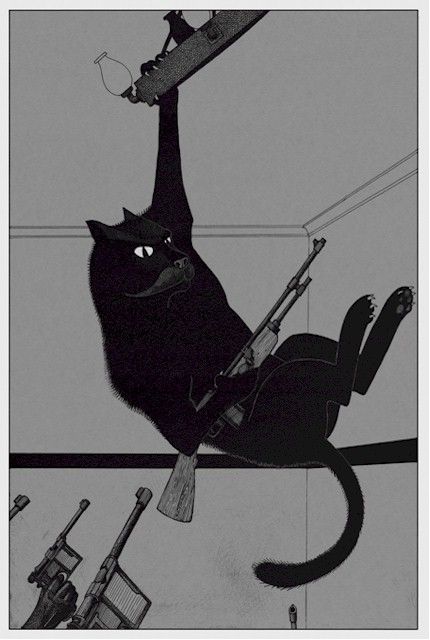
John H. Glenn Jr., “Fireflies Outside Friendship 7; First Human-Taken Color Photograph from Space”, 1962
BEST BOOKS READ IN 2024: An Annotated Index of Limited Utility
Books—there’s never any end to them, despite my attempts to read them all. Of the 280-odd I read in 2024 (no, you get a life!), these are the best of those that were new to me. In order to make this as useful(?) as possible, in in the endless quest for cheap novelty, they are presented as annotation to an index of themes. [Ed. – Sorry, missed that last bit. Still thinking about the 280…] Four writers appear twice (Kate Kruimink, Joseph Roth, Percival Everett and Walter Kempowski) and for what I think is the first time, both parties in an extant marriage also make the list (Everett again, with Danzy Senna).
Age, Coming of: Gwendolyn Brooks, Maud Martha & Diane Josefowicz, L’Air du Temps
Two opposing approaches to stories of young girls growing up. Brooks’s 1953 novel is a collage of vignettes stretching over years, the growing up of a Black girl in Chicago, unlucky but resilient, dreaming of a high-class life in the face of her own limited opportunities, Josefowicz’s novella covers just a short period of time in the life of a 13-year-old girl, when the shooting of a neighbour proves to be the catalyst for the peeling back of various local secrets. Brooks was primarily a poet and Josefowicz is a historian, but both of them show themselves to be tremendous fiction writers.
Art, Making of and Prehistory of: Maylis de Kerangal, Painting Time (translated by Jessica Moore)
De Kerangal is a personal favourite, and her best books usually involve a deep dive into some fascinating technical process (organ transplants, restaurant-level cooking, infrastructure engineering, or, in this case, both ancient cave art and trompe-l’œil painting), balanced with beautifully judged explorations of its human pressures and consequences. A compressed, deeply involving history of visual trickery and the impulse to make art.
Art, Making of from Deceased Father’s House: Jen Craig, Wall
In 2023 Craig’s two earlier novels were among my most loved discoveries, and I wasn’t wrong in thinking her third book would also be fantastic. A woman who is and isn’t Craig herself returns home to Australia to empty out her dead father’s house, with an eye to making the contents into an art exhibition. Multiple levels of consciousness rooted in different frames of time, deftly handled so as to be both convincing and presented with clarity, Craig’s prose is a wonder. I was lucky enough to be able to speak with her about one of her earlier books as part of the Wafer-Thin Books discussion series I co-hosted with Brad Bigelow of Neglected Books (neglectedbooks.com) through 2024—video here.
Biracialism, Literature of, Now an Award-Winning TV Series: Danzy Senna, Colored Television
Breezier in style than most of the books here, but far from shallow, Senna’s book features a protagonist obsessed with her own mixed-race nature, author of an undisciplined manuscript that’s becoming “the mulatto War and Peace.” She makes the mistake of getting involved with the Hollywood “prestige TV” world, and complications, as they say, ensue. Race, art, theft, infidelity; it’s all in there, making the sort of book that’s likely to be a big commercial success. Except this time it’s actually a good book. And yes, it does pain me to have to keep spelling the title the (wrong, but in this case “correct”) American way. [Ed. – They’re wrong, the Americans. And they will never admit it, James.]
George Hendrik Breitner, “Marie Jordan Nude, Seen from the Back”, 1889
Black Hole, Haunted by in Silicon Valley: Sarah Rose Etter, Ripe
A Silicon Valley satire—no, wait, come back! It’s well worth your time, and not just because the main character is haunted by her own personal tiny black hole, a physical manifestation of her depression. Things are not improved by her getting pregnant, nor by her various other ill-conceived life choices. A downbeat comedy of unforced errors.
Blitz: Francis Cottam, The Fire Fighter
Look, I have a weakness for Blitz fiction—people trying to go about their ordinary lives each day while having their world hammered each night by bombs is something I’m apparently able to read about endlessly. [Ed. – Same!] Cottam’s 2001 novel about a man given the task of protecting five specific London buildings from firebombs, without knowing why these sites are so important, is vividly convincing about the textures of daily life at the time, as well as exploring duty and treachery under ludicrously extreme circumstances. I’ve not read any of Cottam’s other books, which mostly seem to be supernatural fiction, but if they’re as strong as this they will not disappoint. (For more Blitz fiction, see Norah Hoult under Brains, below)
Boxing, Junior, Internal Thought Processes During: Rita Bullwinkel, Headshot
I enjoyed but didn’t love Bullwinkel’s story collection Belly Up, so if I hadn’t already bought Headshot I might have given it a miss. Yet again, incontinent book purchasing saves the day! [Ed. – As is so often the case!] Basically a series of internal monologues (though in the third person), from each of the teenaged girl contestants in an ill-attended second-rate female boxing tournament in a dusty gym over the course of one weekend, it’s a marvel. Kicks your Hemingway-style boxing crap out the door.
Brains, Decaying: Norah Hoult, There Were No Windows (also Cocktail Bar)
One of the Persephone Books rediscoveries that I can no longer afford due to most British people being dickheads and causing Brexit, thus making it prohibitively expensive to have British books sent to Australia, this 1944 novel by an Irish writer was both depressing and very funny, in the way that you can laugh afterwards about an awful relative, though their physical presence makes you squirm. It’s a pitch-perfect rendering of a deluded snob, hit with encroaching dementia and lowered circumstances, as the German bombs fall on London and servants become scarce. [Ed. – Oof, this sounds like something that might be called “unflinching”!] It was so good I immediately bought her story collection Cocktail Bar, from 1950, and it was similarly full of great things.
British People, Fucking Up Overseas in the Face of Imminent Implied Arachnid Apocalypse: Olivia Manning, The Rain Forest
Olivia Manning, man, such a great writer. Why isn’t all her stuff in print, instead of mainly just the (admittedly brilliant) two Fortunes of War trilogies? The Rain Forest, from 1974, is an intriguing twist on her common theme of a not entirely well-matched married couple doing duty for Britain overseas, in this case in a thinly disguised Madagascar (there are lemurs). Well-meaning ineptness in the face of political intrigue shades into an unexpected hint of global catastrophe to come from humans encroaching into a reservoir of toxic biology deep in an unexplored forest. Wonderful stuff. [Ed. – Wow! Sounds amazing! I, for one, welcome our imminent arachnid overlords.]
Johann August Ephraim Goeze, “Little Water Bear”, 1773
Century, Twentieth, Horrors and Absurdity of: Patrik Ouředník, Europeana (translated by Gerald Turner)
When spellcheck can’t cope with the author name or the title, you’re doing something right. Europeana is a brief but rambling survey of the Twentieth Century in all its ghastliness, where every fact, major or minor, is given equal weight, like a lecture by the most brilliant autistic raconteur in the world. If, like me, you buy the Dalkey Archive Essentials edition, you can also enjoy the brutally trimmed pages that slice off the outer edges of the marginalia.
Convicts, Female, Transcontinental Aquatic Journey of: Kate Kruimink, Astraea
The first of two Kruiminks on this list (see Grief, below), and the inaugural winner of the Weatherglass Novella Prize, this is the entirely shipbound story of a group of women being transported to New South Wales (not Tasmania, as every single review incorrectly states) in the early 1800s, to be servants and breeding stock in the new colony. Plagued by overbearing and/or predatory men in the shape of ship’s captain, crew, and minister, and haunted by their own miseries and guilts, their story is nevertheless a darkly funny one, full of unexpected insights and, for the reader, delights. [Ed. – Yep, getting this one for sure.]
Displacement, Linguistic, Psychological Aftereffects of: Antigone Kefala, The Island
Antigone Kefala is a (deep breath) ethnically Greek Romanian cum Australian via post-WWII refugee resettlement camps, writing in English, her fourth language. This 1984 book, being reprinted in North America this year, is, inevitably, out of print in Australia. It’s a subtle, destabilising, discursive meditation on place and belonging and language; very hard to pin down and quite unusual. [Ed. – Yep, getting this one for sure.]
Domestic Life, Oppressive Atmosphere Within: Fumiko Enchi, The Waiting Years (translated by John Bester)
A wife forced to choose and manage her husband’s concubine, who is still effectively a girl and not an adult, is the core of this disturbing but unsensationalised brief novel from 1957. Enchi was a distinguished, prizewinning novelist, and one of the great female writers of Japan. It’s criminal how little of her work is translated into English. [Ed. – Yep, getting this one for sure.]
Ineko Arima in Tokyo Twilight (Tôkyô boshoku) (Yasujirô Ozu, 1957)
Epics, Tiny and Incomplete: Joseph Roth, Perlefter (translated by Richard Panchyk)
This was the year that, despite pacing myself carefully, I ran out of Joseph Roth fiction. He was one of the greats, a genius and an alcoholic of astonishing powers, and the supreme chronicler of the Habsburg Empire, its collapse, and the darkness that followed. Perlefter is an incomplete novella, found in his papers and published posthumously, yet still substantial enough to hold its own. A wealthy Austrian, observed by an orphaned relative, enthusiastically grapples with the technological and social developments of the early Twentieth Century, all observed with Roth’s characteristically subtle and quirky eye and voice. See also Napoleon, below.
Failure, Artistic, Afterlives of: A. Valliard, The City of Lost Intentions: A Guide for the Artistically Waylaid
I can guarantee you’ve not read anything like this: a consistently inventive tourists’ guide to a netherworld of endless artistic failure and pretension, packed with more ideas per square inch than most books could even dream of, and written with a style recalling the sarcastically decadent fin-de-siècle classics. You’ll probably see yourself in it, and not be happy about it.
Grief, All-Enveloping Nature and Absurdity of: Kate Kruimink, Heartsease
Kruimink’s other novel of 2024 was the longer Heartsease, set in modern Tasmania [Ed. – Sure you don’t mean New South Wales???], and spikily hilarious even though it’s all about loss and grief and neglect. Wryly, unsentimentally Australian in the best way, and including a fine joke about musk sticks. [Ed. – Probably lands better if you know what that is.]
Lesbians, Ancient and Fragmented: Sappho, If Not, Winter: Fragments of Sappho (translated by Anne Carson)
As when trying to describe Ulysses in a previous one of these round-ups, sometimes there’s not a lot you can usefully say about a great book; you just have to point at it and marvel. I’ve read other translations of Sappho before, and loved them, but this really must be the ultimate take in English.
Life, Viewed Askew, in Small Portions: Jessica Westhead, And Also Sharks & Percival Everett, Half an Inch of Water
Two wide-ranging short story collections from the back catalogues of writers I deeply admire. Westhead is Canadian and belongs more to the George Saunders school of fiction (though better and more inventive), while Everett is much harder to pin down—if there’s any American writer working today with a broader, less predictable bibliography then I’ll eat any number of hats. Both books are full of gems, and are frequently genuinely funny.
Nanotechnology, Inadvertent Consequences of treating Cancer with: Anton Hur, Toward Eternity
An industrious and talented translator into and out of Korean, Hur’s first novel is cheeringly excellent: a full-on literary science-fiction exploration of nanotechnology, identity, social collapse, cloning, warfare, and the possibility of a human future, no matter how altered that definition of ‘human’ might be. It’s really enjoyable to see someone so talented engage with the genre in such a serious, productive way, though the results are often pretty bleak. [Ed. – Now I’m mad I had to return it to the library before I could read it.]
Napoleon: Joseph Roth, The Hundred Days (translated by Richard Panchyk)
The second Joseph Roth in this list, and something of an outlier in his work, being a fictional patchwork view of Napoleon through minor figures in his orbit, rather than being set in the Austro-Hungarian Empire. Roth was always great, though, and stepping outside his usual area doesn’t dim his powers one bit. That I now have no fiction by him left unread is a cause of great psychological pain for me. Financial donations to ease my distress will be accepted. [Ed. – Please contribute to James’s GoFundMe. He asks so little.]
Nazis, Fleeing From in Company of Unreliable Man: Helen Wolff, Background for Love (translated by Tristram Wolff)
How did a book this good end up sitting for decades in a drawer, unpublished? Imagine a lost Jean Rhys novel, only with a female protagonist who has agency (alright, so it’s not an exact match) [Ed. – genuine lol], beginning with a couple fleeing to the Côte d’Azur one hot summer to get away from the growing Nazi power at home in Germany. Wolff wrote this book in 1932, but never tried to publish it, even though she later went on to found Pantheon Books in America with her husband. What other masterpieces like this are out there, sitting unpublished in a world where Haruki Murakami and Dan Browns’ every fart gets the hardcover treatment? Truly we live in a fallen world.
Nazis, Revenge on Collaborators with: Martha Albrand, Remembered Anger
In many ways this is ‘just’ an above-average crime/espionage novel, about an American man imprisoned by the Nazis who gets out at the war’s end and tries to find out who sold him out. But what lifts it above that is the fact it was written just as the events it was describing were happening, in the early months of 1945, as Paris wobbled back to the start of normality, by an author (born Heidi Huberta Freybe Loewengard) who was herself politically active against and then a refugee from the Fascists, and it beautifully captures the numerous little details of its time and place to give it a real kick of verisimilitude. [Yep, I’ll be getting this one, and actually reading it!]
Nazis, Rise and Collapse of: Walter Kempowski, All for Nothing (translated by Anthea Bell) & An Ordinary Youth (translated by Michael Lipkin)
A pair of stone-cold masterpieces, looking at Germans in World War II from opposite ends, geographically and temporally. Youth is about boyhood under growing Fascist power and then war, sneaking jazz records and trying to get out of the Nazi Youth, not for political reasons but because you don’t like enforced physical activity. Nothing, on the other hand, is the tale of the slow destruction of a German household on the Eastern Front as the Russians draw closer and closer. Both are wonderfully written, and attempt no form of exculpation of the author or the characters. These are people who didn’t like the Nazis because they were not their social class of person, not because of any ethical qualms. Youth is apparently part of a whole series of books Kempowski wrote in German, and we need all the rest translated NOW. [Ed. – Amen]
Palestine, Staging Hamlet in: Isabella Hammad, Enter Ghost
Even at the best of times trying to stage Hamlet in with an all-Palestinian cast under Israeli rule seems like a logistical nightmare, and these are not the best of times. A Palestinian-born, London-based actress returns to her birthplace and her sister, and almost involuntarily gets caught up in the theatrical project of a distant acquaintance, as well as attempting to reckon with her family and its history. It made me immediately buy Hammad’s first novel, The Parisian, though I haven’t read it yet because it’s huge. [Ed. – I just bought this too, and it’s so huge!]
Sanatorium, Satire of Male Attitudes Within: Olga Tokarczuk, The Empusium (translated by Antonia Lloyd-Jones)
I get the feeling not everyone loved Tokarczuk’s latest book translated into English, but it was very much my kind of thing. A bunch of guys, self-deluded and not as smart as they think they are, discussing the issues of the day and their philosophies, while living in a tuberculosis sanatorium? A strange, supernatural observer/narrator? Sign me up!
Slavery, Literature Of, Remixed: Percival Everett, James
On the other hand, pretty much everyone seems to have loved this, and rightly so. As I mentioned above, Everett is one of the least predictable writers alive, and his take on Huckleberry Finn from Jim’s code-switching point of view is a gripping, funny masterclass in rewriting a classic without redundancy. This is an angry, exciting and surprising book that doesn’t always match the original’s plot. I hope this gets the author the huge audience he deserves, though it’ll also be funny to see this bigger audience attempt to process some of his earlier books.
Unknown photographer, Cat, Year unknown [Ed. — Spooky-ass cat]
Smallpox, Alternative History of World Due to: Francis Spufford, Cahokia Jazz
You know those stories where what begins with a couple of beat cops investigating a crime scene ends up being a whole-of-society-spanning investigation of conspiracy and political intrigue? Well, imagine one of those, written with the perfect mix of style, insight and originality. And it’s set in a version of history where it was the less virulent form of smallpox that was brought to the Americas by Europeans, meaning what has become the United States has done so in the face of much vaster, stronger First Nations. And imagine it’s a huge amount of fun. That’s Cahokia Jazz, baby. [Ed. – Look for this on my year-end list too!]
Troubles, The, Childhood During: Jennifer Johnston, Shadows on OurSkin
Jennifer Johnston is a writer who I idiotically ignored for years because her current UK publisher cursed her with the sort of soft-focus-photo-of-a-woman-in-a-fancy-dress-turned-away-from-the-camera-with-her-head-cropped-off cover photos more commonly found on flimsy commercial fiction. [Ed. – I prefer house-lit-from-within-against-a-nighttime-sky myself.] But then I came across a copy of How Many Miles to Babylon? with a good cover, read it, and was hooked. She’s phenomenally good, a brilliant and unsentimental Irish writer whose particular interest is the way the British occupation of Ireland leaks into and impacts upon the lives of ordinary people. Shadows is one of her best, following the life of a young boy in Derry in the 1970s, half in love with a school teacher who in turn is half in love with the boy’s older brother, who has come back home from England with big ideas and a gun in his back pocket. [Ed. – Damn, I just looked her up and she has so many books!]
Wildfire, Californian: George R Stewart, Fire
A Californian wilderness on fire, with the fire itself as the main character, and telling the story of all the people arrayed against or caught by it. Stewart, who also wrote Earth Abides (a wonderful novel and now a terrible TV series), describes everything with a dispassionate but not cruel eye, and the result, published in 1948, is all too horribly relevant now.
[Ed. — Ladies and gentlemen, give it up for James Morrison, always all too horribly relevant! Seriously, thanks James, this was amazing and budget-busting, as usual.]