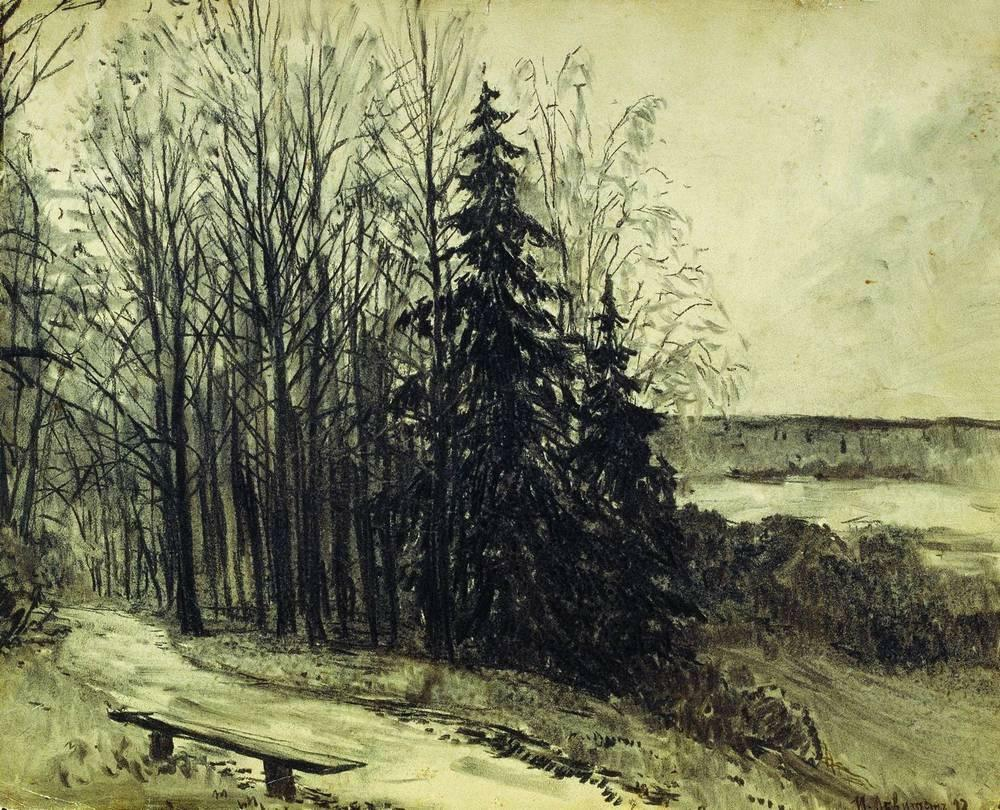
Thanksgiving is the best time at the farm. You can walk without fear of ticks. Down to the creek—entirely dry at the end of a year of terrible drought—then up Acorn Hill and along the ridge. Contour down past the old and new ponds to the cornfield and take the long flat path back to the creek. At Thanksgiving, you can see the bones of the land: the rolling hills, the sharp edges between scrub forest and fields, everything clear now that the leaves have fallen. This year a big pin oak was down over the Acorn Hill trail; my father- and brother-in-law cleared it, happily messing about with chainsaws. The days were more cold than warm with a sharp northwest wind: good weather for running the gravel road to the blacktop and back. At night you can see a heap of stars. If you leave the cozy house to crane your neck at the sky the barn cat sometimes comes out of his little house to check on you. He is a meeower, a winder through the legs; one day he’s going to kill someone. You can stay inside and read too. That’s what I did.

Marian Engel, The Tattooed Woman (1985)
Even more of a mixed bag than most story collections. Engel’s stories do not hit me the way her novels The Honeyman Festival and of course Bear do. But even though the latter is much the most interesting thing she ever wrote, I don’t think she’s a one-hit wonder.
I read The Tattooed Woman because I was meant to talk about it with James and Shawn in our continuing series of Engel conversations, but then we collectively decided we weren’t sure how much we liked the book and I was too exhausted from the semester to find out. I regret that now, though; I suspect we would have talked our way into liking it more than we did on our individual readings.
Engel died young of cancer (this collection was published shortly after her death) and some of the best stories here feature characters with that illness—or, in “Two Rosemary Road, Toronto,” the one I liked best, a man whose wife has died from it. The narrator writes a letter responding to one he’s recently received from a neighbor, a screed insisting that the narrator’s wife must have brought the illness on herself. The narrator reacts to this vitriol with understandable scorn but as he fulminates he gives in to his own loneliness and the suggestion of sexual intimacy hinted at by the letter writer, a possibility he is willing to explore, despite, or perhaps because of, the aggression he imagines such a relationship would involve.
Unsettling stuff.
I shivered pleasantly at “The Country Doctor,” a ghost story about a woman sent by a Toronto-based magazine to an unnamed but easily recognizable St John’s, Newfoundland, who is taken up by a doctor who might a Bluebeard. I liked “The Smell of Sulphur,” about a woman who returns to a faded resort on Lake Huron where she spent a summer as a solitary teenager.
What struck me most about the book is how foreign the 60s, 70s, and 80s Canadian settings felt to me, even though I lived through much of them. A function, I suppose, of Engel’s enmeshment in an adult world I wasn’t yet part of.
I’m not saying you need to run out and find this collection. Nor that Mavis Gallant or Alice Munro need worry about being dethroned as the champions of Canadian short fiction. I’m guessing Engel wrote these stories for money, writers could still do that back then, and too many feel, well, maybe not listless but a little pat. But when she gets her strange on, she’s good.
Celia Dale, A Helping Hand (1966)
Disquieting and gripping novel à la Highsmith or Rendell and just as good. A married couple holiday in Italy as a reward after the rigors of taking care of an elderly aunt. Josh ogles every woman he meets, especially one of the chambermaids at their pensione; Maisie ignores this, as she has other fish to fry and knows how to turn her husband’s roving eye to advantage. The pair fall in with a young woman and her elderly aunt by marriage, two more Brits squabbling their way through a holiday of piazzas, frescoes, and, to their sensitive tummies, too-greasy food. (Bowel movements and bedpans feature prominently.) I say “fall in” but “latch on” would be more accurate. The couple has its routine down: Josh courts the old woman with little attentions that remind her of her late husband, while Maisie commiserates with the niece, who feels her life wasting away with nights spent pouring out tea. Working together as ruthlessly as a pair of collies with a flock, they separate the women, leading to their final move: they offer to take in the old woman as a PG, a paying guest. It’s enough to make you wonder what happened to that other woman, the aunt who turns out to have been an “aunt”…
Dale wrote a lot of books, seems like, but went forgotten until Daunt started reissuing her books. (The valiant folks at Valancourt have brought some back into print in the US, but I’m ashamed to say I plumped for the Daunt because I liked the cover better.) If A Helping Hand, with its brilliantly ominous title, is any guide, that neglect is a scandal. Dale mixes a palpable atmosphere of menace—she savages suburban England even more than Rendell in, say, One Across, Two Down—with a hint of decency, just enough to keep our gorge down. But then comes a stunning ending, a real stinger, that reverses much of what we thought we knew.
A perfect book for a November weekend.
Ann Petry, The Street (1946)
The title of Petry’s debut—the first novel by an African-American woman to sell a million copies—refers to 116th Street in Harlem. The beautiful Lutie Johnson, separated from her husband after a job as maid to a rich couple in Connecticut put too much distance between them, moves into a dingy tenement with her young son, Bub. She hates the place, no amount of scrubbing ever gets anything clean. but it’s all she can afford, and she’ll do anything to save enough to move somewhere better.
Well, not anything. She rejects with frosty contempt the offer of a woman on the main floor—stocky, bewigged, inscrutable Mrs. Hedges, always at the window—to work at her brothel. But her desperate economies never get her ahead, and before long she’s spending too much of her energy fending off the incoherent, animalistic advances of the building’s super, Jones. (I wonder what Richard Wright made of that guy—did he see an homage to his own work there?) Meanwhile, Min, the woman who lives with Jones (I don’t know what to call her: not his lover: kept woman maybe; she is more a slave than anything else), seeks out a rootworker to keep her man. The cross and powder work on Jones, but even more on Min, who finds the strength to leave. She is the most fascinating character in what, as I hope my summary suggests, is a novel filled with vivid characters.
At the only bar on the street, run by an enigmatic white man named Junto who has a history with Mrs. Hedges, Lutie meets a jazz musician who offers her the chance to sing with his band. Finally, a different life lies within reach, the life promised by Lutie’s to-me surprising guiding star, Benjamin Franklin, in which hard work and talent will be rewarded. That’s good, because Bub is spending too much time with Jones. Trouble looms. And then things get a whole lot worse.
The Street is one of the more exciting works of social realism I’ve read. Picture the milieu of Bernard Malamud’s early stories—I’m thinking the likes of “The Bill” or “The Mourners”—but with more hopelessness and even less upward mobility and you’ll have a sense of this depressing, riveting novel.
I started Petry’s other well-known novel, The Narrows, a year or two back, but it wasn’t the right time and I couldn’t get on with it. Seems like it’s time to try again.
Nick Harkaway, Titanium Noir (2023)
Sf/noir mashup in which our dogged PI protagonist, Cal Sounder, is called in to investigate a murder. (He plumbs the depths, like.) The victim seems to have been a mild-mannered academic but two things suggest otherwise: he’s over seven feet tall and doesn’t look a day over 30, even though he’s actually 90.
That means he’s a Titan, and Titans don’t get murdered. These genetically modified humans basically live forever and grow each time they take one of the patented T7 infusions, operations that send their bodies into such paroxysms that are incapacitated for months afterward. To undergo more than two or three such procedures is beyond risky. Too bad that a side effect is a corresponding change in personality. Titan appetites are typically as gargantuan as their bodies. There are only a thousand or so Titans; the technology is carefully guarded by its developer. (Titanium Noir allegorizes the predations of our own global oligarchy.) Cal is a Titan expert: his ex is the developer’s daughter. Ex because he refused the chance to get the shot
Like Marlow, Spade, Archer, and dozens before him, Cal stirs up some shit: gigantic, immortal shit, to be precise. Good fun.
I’d tried Harkaway once before and it didn’t stick. But I might have to revise that opinion. Quality non-taxing stuff.
Ed Park, Same Bed Different Dreams (2023)
I devoured this epic, Pynchonesque novel over Thanksgiving. I can’t even remember all the multitudes it contains, but its central conceit imagines that the Korean Provisional Government (KPG), a real-life group founded in 1919 by exiles in China to protest Korea’s occupation by Japan, continued past the Japanese surrender in 1945. Its goal? A free, independent, reunited Korea. The KPG’s machinations—some real, many invented—are revealed in a series of enigmatic manuscripts that fall into the hands of a Korean American writer named Soon Sheen who works for a tech behemoth, half-Amazon, half-Google, known by its “acronym” GLOAT. The letters don’t stand for anything; much of Soon’s job is to create similar acronyms for company practices and products.
As in early Pynchon, the idea of meaning—something we need and will do anything to create even though doing so often leads us astray—lies at the heart of Park’s novel. Fascinatingly, many of the strands woven into the shape of this novel feature Park’s home town of Buffalo: the assassination of President McKinley at the Pan-American Exhibition at the hand of an anarchist in love with Emma Goldman; an African American fighter pilot who returns to the city after being shot down in MIG alley and imprisoned by the Communists, whereupon he works the family appliance repair shop and writes paranoia-infused science fiction that goes unnoticed in the mainstream but gains a cult following, not least by the KPG which sees in the lurid texts secrets to political change; the history of board games and how they contributed to the early development of AI; the downing of Korean Airlines flight 007 by the Soviets in 1983, an event I was sure would launch nuclear war; and, most delightful to me, the history of the Buffalo Sabres, including a close reading of the notorious Brett Hull goal that cost that often-luckless team the Stanley Cup in 1999. (He was in the blue paint!)
Who knows if this book will stay with me long term—but I relished its exuberant ride through painful 20th century history. The title refers to a Korean maxim about the projections foisted by foreigners on that peninsula for centuries. But it also reminds us that everything can be different than it is: we never dream in the same bed twice, that sort of thing.
Maybe that paean to dreaming and imaged futures is the reason the novel is filled with fathers who, no matter how feckless or absent, dote on their precocious daughters. (The number of precocious daughters in contemporary American fiction is all out of proportion, it seems to me. But as a father who dotes on a precocious daughter, I’m hardly one to complain.)
Thanks to Levi Stahl for repping this.
Adania Shibli, Minor Detail (2017) Trans. Elisabeth Jaquette (2020)
Many of you will know that Adania Shibli was due to receive a prize for this novel at this year’s Frankfurt Book Fair when organizers postponed it indefinitely due to the situation in Gaza. (If it walks like cancellation, talks like cancellation etc., etc.) Don’t get me started on the upside-down world of “memory culture” in Germany today, of which this ignominious decision is part. The only good news is that a lot of people went out and read the book (or bought it, anyway). I’d had it sitting on the shelf for a couple of years and was glad when a new book club I’m part of made it our first selection. Several in the group had read it before: I benefited enormously from their familiarity with the text and thoughtful interpretations. I’m grateful to them all. As the title suggests, in Minor Detail every little thing counts; it’s a book that invites re-reading—even as it points out the dangers of definitive interpretations (obsession, paranoia, the fantasy that constant vigilance can make ideology come true).
Precisely divided into two obliquely-connected halves, the novel tells two stories. The first, set in August 1949, concerns a squad of Israeli soldiers who happen upon a Bedouin family in a “mopping up” mission in the Negev. The encounter ends disastrously: the entire family is murdered, even its camels, except for a teenage girl, who is brought back to the soldiers’ camp, where she is raped and eventually murdered. The second centers on a woman in near-present day Ramallah whose obsession with the crime has everything to do with its having happened exactly 25 years before her birth. Her quest to uncover the details (which as readers we already know) leads her to undertake a dangerous journey outside the West Bank, one that ends in failure and tragedy.
Shibli’s book might be short, but the questions it provokes are not. Are representations of traumatic history (including this very novel) fundamentally different from official representations of a violently conquered space (maps and archives)? Can the past be told in a way that evades representation’s tendency toward reduction, circumscription, and closure? When we read can we avoid the fantasy of conclusiveness? (No accident that this so carefully shaped text opens and closes with references to the atmospheric phenomenon of the mirage.)
It’s too late for next semester, but I’ll teach this important book in my Literature after Auschwitz class going forward.
That was November. More on December soon.
 Eiger, Mönch & Jungfrau
As ever, thoughtful assessments, great variety and awesome art!
Thanks, Joe! Always appreciate your kind words. Thanks for reading.
It’s wonderful to see how much you enjoyed the Celia Dale! It’s horribly compelling, isn’t it? A masterclass in manipulation and coercive control, stealthily executed through carefully orchestrated conversations and ‘kindly’ cups of tea. Check out Sheep’s Clothing next – it’s just as good (and just as chilling). There’s a review at mine if you’re interested.
So good. Sheep’s Clothing is next on my Dale list, so I will save your review until I’ve read it.
I suspect Daunt is on to a good thing here… I see they have another lined up for the fall.
I read The Street when it was reissued a few years ago, and the Wright comparison is *very* interesting—I hadn’t read any of his work then, but read Native Son this year, and the sense of impending tragic doom and bestial men is very similar. Re. Nick Harkaway, have you tried Gnomon, or is that the one you bounced off? I recall that being immensely fun, too. And the Ed Park sounds so bananas, I can’t help wanting to try it.
I didn’t know Gnomon, but I just looked it up–sounds great and have placed a hold on it. I think the one I tied was Tigerman–but I’m not even sure!
Yeah, I wonder if Wright appreciated what Petry was up. To me the projects feel similar. But I wonder if he would have looked askance at Petry’s use of melodrama. Just spitballng.
And I’d love to know what you make of the Park. I think you’re younger than I am–for me, it’s a total Gen X novel. So take that into account…
Damn. More books I have to read. I have two complete shelves of books calling out for attention (which is a lot for me). Plus another dozen on my Kindle. Why am I reading book blogs? Thanks! (BTW, when my kids were little, we spent a week below the Eiger. One of my memories from that trip is a tiny graveyard where some of the mountain climbers who failed to climb the Eiger are buried.)
Pingback: My Year in Reading, 2023 | Eiger, Mönch & Jungfrau