Ricardo Chavira’s Year in Reading, 2023

Excited to once again present reading reviews from some of my favourite readers. Today’s installment, his first, is by Ricardo Chavira (@waryenthusiast). Ricardo is a reader, not a writer, but he thinks writers are cool. When he’s not reading, running, cooking for friends and family, building even more bookcases, or making maple syrup, he makes his living in sunny CT. Having done graduate work in philosophy, he, naturally, works in IT.

Edvard Munch, Kragero in Spring, 1929

A few years ago, I started keeping track of my reading with a detailed list. I wanted a handy list I could consult (likely on my phone) if and when a friend would ask what I’d been reading lately. Too often, my mind would freeze and I’d maybe utter one title from 3 months ago, only later kicking myself for not recalling the wonderful books I’d just read in the last few weeks. [Ed. – Relieved to know I’m not the only one. “Uh… books… I read some books.”] What started as a mental crutch has evolved into a comprehensive spreadsheet, tracking title, author name & gender, genre (fiction, non-fiction, poetry), date I finished the book (which also gets written on the last page of the book), where I finished the book (city, but often on a plane or train), whether it was an audio book, library book, read by my book group, etc.

In my non-book-reading profession, there is an adage that “what gets measured gets improved.” [Ed. – Hmm.] Perhaps that applies here as well. In recent years, I’ve sought to diversify my reading palate, reading more books written by women and persons of color, reading more non-fiction (left to my devices, it’s overwhelmingly fiction), borrowing more books from my local library, reading more from “the backlist” (as I tend to get excited by recent releases). Being aware of what I’m reading allows me to be more deliberate about what I read. It’s also fun to run the numbers each January, look for trends, chastise myself (for not reading enough poetry), feel good about myself (for reading more works in translation), and make plans for the coming year (which are never followed through completely).

My other book tradition is the annual reshelving that takes place shortly after New Year’s. Every year, I put the books I read on their own shelf. Audiobooks, library books, and books on loan are not there, of course, but it’s fun to watch that empty shelf slowly fill up and, eventually, spill over to the next. [Ed. – Wait, what did you say?? I drifted away when you said “empty shelf.”] And after the new year, the year’s reads get shelved into the general mix of the library. It’s an opportunity to reflect again on these books, but really an excuse to muck around with my library. For whatever reason, it’s a very satisfying activity and one I’ve come to look forward to. [Ed. – What a lovely tradition!]

<insert obligatory comment about how awful the year was> Yes, 2023 was a dumpster fire of a year in so many ways, but not a bad year for books and reading. The year began with anticipated titles from many of my favorite contemporary writers*, some of which are mentioned below.

(*a partial list of authors with 2023 releases that had me worked up: Nana Kwame Adjei-Brenyah, Colson Whitehead, Rebecca Makkai, Luis Alberto Urrea, Hilary Leichter, Matthew Desmond, Rebecca Solnit, Zadie Smith, Lauren Groff, Emily Wilson (trans.), Jesmyn Ward, Jhumpa Lahiri – whew!)

So let’s get on with it. Herewith, some rambling thoughts on many of the books I read. Enjoy and happy reading.

Some highlights – Loved these books, here’s why.

  • Chain-gang All-Stars, by Nana Kwame Adjei-Brenyah

A highlight of the year for me was Adjei-Brenyah’s follow up to Friday Black, his fantastic debut of short stories. Chain-gang is set in a near future where prisoners are given the option of joining “chain gangs,” teams that fight in gladiatorial hand-to-hand combat in exchange for a shot at freedom. These so-called “hard sports” have corporate sponsors, stadiums full of shrieking fans, and lucrative online steaming shows. Despite all this, we’re somehow given a story of love and humanity amidst the chaos. Calling it satire or dystopia only hints at Adjei-Brenyah’s brilliance, as he approaches his set-up as more than just a sendup of current society and the role of the carceral state. At a public reading, I asked him how he threads the line between plausibility and seemingly improbable exaggeration (a televised reality show with prisoners fighting to the death? no, but I can kinda see that …). [Ed. – Alas, I can totally see it.] As I recall, he said the trick is not just coming up with a dramatic story, it’s having a twist that makes it work. He’s not just stepping on the gas, exaggerating the status quo. Rather, he takes something away or adds to make the story stick. Here, the conceit is not that prisoners are being violently exploited for public/private profit. The conceit of the novel is that it’s happening out in the open, and we not only don’t care, we consume it. As terrifying as that sounds, there’s an urgency to this novel that can’t be ignored.

  • Crook Manifesto, by Colson Whitehead

We’re living in the age of Colson Whitehead, in case you’re wondering. A follow up to Harlem Shuffle, we get to revisit Ray Carney, the furniture store owner and erstwhile fence of stolen goods. Unable to score Jackson 5 tickets for his daughter, Ray calls in a few favors and one thing leads to another… The depiction of Harlem in the 70s is spot on; and Whitehead has such an ear for the rhythms of speech, music, and street noise that do so much to convey the bygone era. Whitehead is deft as ever in exploring matters of race and society. Musing on a performance in which a young Michael Jackson wants to talk about the blues, “Carney chuckled – the kid was ten.” But after a moment’s reflection, “Carney shouldn’t have laughed. What ten-year-old black child didn’t know about the blues?” This is the second in a projected trilogy and my arrangement with Whitehead is simple – you keep writing them, I’ll keep reading them. [Ed. – Ha, love that! Loved Shuffle; look forward to this one; excited to hear about the third.]

  • Lucky Jim, by Kingsley Amis

I love the campus novel and this is one of the best. I recently came across a copy of the NYRB edition, so took it as a sign to revisit an old favorite. Happily, it mostly holds up. The old school misogyny felt tired and dated (as it should). Margaret may be a manipulative drama queen (says so right there in the margins of my old copy), but it hardly justifies her treatment. Still, Amis is such a good writer, tossing off lines such as: “It was from this very bottle that Welch had, the previous evening, poured Dixon the smallest drink he’d ever been seriously offered.” On the whole, the novel still works and neither characters nor readers emerge unscathed. Coda: Happily, I received another copy for Christmas, as Hatchard’s, the venerable London bookseller, has issued a gorgeous limited edition of Lucky Jim. Anyone want an old paperback copy? [Ed. – Good offer, friends!]

  • Milkman, by Anna Burns

I was excited to read this book when it came out and finally got around to it (only 6 years later). I knew it was going to be good, but it’s always a thrill when a book so wildly exceeds your expectations. The psychological depth, the suffocating closeness of the tight-knit community, the deadly gossip, and the rapid-fire language make for a heady combination. So many passages were chock full twists, descriptors, and fulsome lists that I feared she’d run out of words. But she never did. So grateful.

  • The Netanyahus, by Joshua Cohen

On one level it’s a campus novel (and you know how I love a good campus novel), but also an incisive depiction of antisemitism, and a scathing indictment of the powers that be. It’s also a riot. Cohen guides us with such a steady hand through the myriad offenses endured by our humble protagonist, Ruben Blum, the only Jewish professor on a small upstate New York campus. Describing a note from Blum’s obtuse department chair: “’Rube,’ it read, in his characteristic mélange of the casual and turgid.” [Ed. – Heh] But Cohen also doesn’t hold back in depicting the flaws and hubris of his characters. The Jewish professor, and titular patriarch, whom Blum is asked to host is none other than the father of the current Israeli prime minister. This book should be read and appreciated despite, and because of, its association with current affairs.

  • The Monsters of Templeton, by Lauren Groff
  • The Vaster Wilds, by Lauren Groff

This is also the age of Lauren Groff. This year I read her first and latest novels to achieve my Groff completist status. [Ed. – Ooh, did you get the button??] I love how varied her writing is; she never writes the same book twice. A grad student trying to make her way in the world and learning you can’t come home again (except when you do). A young woman fleeing an early American colonial settlement and trying to survive in the wilderness. As with Whitehead, I will read everything she writes. Keep em coming. She’s also opening a bookstore! [Ed. — !]

  • Phantoms, by Christian Kiefer

By all accounts (viz., a scroll through his Twitter feed), Kiefer is a busy man, juggling teaching, a large family, and crazy rock & ice climbing expeditions. [Ed. – No joke, that climbing stuff is insane.] He also manages to write some wonderful novels. Phantoms tells the story of Japanese and American families torn apart by WWII and the shameful internment camps. Years later, the story is refracted by the memory of a young writer who is slowly uncovering the truth, while dealing with his own trauma as a Vietnam veteran. A story of secrets, lies, bigotry, war, and other American values, Phantoms is truthful without being cynical, and just hopeful enough without giving in to sentimentality. And Kiefer gets bonus points for having joined our book group discussion via zoom!

Found in Translation – I don’t know why translated literature is such a hard sell in this country. It’s the literary equivalent of yelling at children “eat your vegetables, they’re good for you!” With publishers such as NYRB, Europa, Charco (and many other wonderful indie presses), it’s so easy to find good translated lit. Try it, you’ll like it.

  • Translating Myself and Others, by Jhumpa Lahiri

I just can’t say enough good things about Lahiri, she’s the bee’s knees, the cat’s pajamas. I get giddy thinking about her work. [Ed. – Paging @bibliopaul!] Long story short for those not keeping track at home: In recent years, Jhumpa Lahiri has been writing in Italian and translating (herself and others). Never fully at home in English (the language of her upbringing) or Bengali (the language of her parents), she learns Italian in college. Years later, she returns to it by packing up the family and moving to Rome (as one does), where she immerses herself in language study. Before long, she’s hanging out with Italian writers and translating their work. And she stops writing in English as her primary language. These essays are both critical (such an ear for how other writers work) and personal (artfully exploring her technique and motivations behind her writing and translations).

  • Roman Stories, by Jhumpa Lahiri, translated by Jhumpa Lahiri and Todd Portnowitz

New short stories from Lahiri (her best form, in my opinion) is cause for celebration. These don’t disappoint. Set in a contemporary Rome and populated by people who look and speak differently from the locals, these stories remind us the beauty and coarseness of the human condition. And yes, she wrote them in Italian and later translated (all but two of them) into English.

  • Ties, by Domenico Starnone, translated by Jhumpa Lahiri

Starnone is a luminary in the Italian literary scene and not known well enough here in the States. And is translated by Lahiri. And published by Europa. What’s not to like?

  • The Door, by Magda Szabó, translated by Len Rix

I often saw this book cited as a favorite NYRB, so was thrilled when I found a used copy. And even more thrilled when I began to read it. Szabó gives us Emerence, a housekeeper, street sweeper, and eminence grise of a small Hungarian community. At first, Emerence seems aloof, secretive, even arrogant. She’s all of these things, but also insecure and vulnerable, as slowly emerges from her complicated relationship with Magda, her employer (and enabler). The depth of the characters and complexity of their relationships carries on to the end, giving us a stunning portrayal of people at their best, worst, and most human. [Ed. – Incredible book, now I want to read it all over again.]

  • A Mountain to the North, a Lake to the South, Paths to the West, a River to the East, by László Krasznahorkai, translated by Ottilie Mulzet

Krasznahorkai is a wizard. It would be too easy to say this story is like a dream. But there is an ethereal quality to this book that evokes so much thought and feeling, and yet remains just out of one’s grasp. Long, wonderful discursive passages on weather, architecture, and math that evoke sheer longing. There’s a short chapter on the wind and air that has passed through this temple that’s just a joy to read. A great way to end the year for me.

  • Fantastic Night, by Stefan Zweig, translated by Anthea Bell

These stories of reversals, betrayals, misunderstandings, and moral discoveries are a delight. To contemporary readers, he has a certain Old World charm, and it’s not surprising he’s come back into vogue recently as both literary and pleasure reading. I’ve been told that with Zweig’s unique voice, you’re either in or you’re out. Count me in.

  • At Night All Blood is Black, by David Diop, translated by Anna Moschovakis

Diop does so much in this short novel. In the trenches of World War I, our protagonist takes revenge on enemy troops after his best friend is killed. A grisly descent into madness ensues that terrifies even his fellow soldiers, making him an outcast in every way. The narrative feels like something out of Camus, but darker, and stayed with this reader for a long time.

Good Genre – Another absurdity of the reading community which I cannot abide are the knee-jerk slights often directed towards so-called genre fiction. [Ed. – We do not allow that sort of thing here at EMJ.] Here are some standouts in fantasy, sci-fi, and crime fiction.

  • Hell Bent, by Leigh Bardugo

In Bardugo’s world, magic is real and practiced by students at Yale University’s secret societies, such as Skull and Bones. (Campus novel alert!) A sequel to her blockbuster Ninth House, Hell Bent picks right up where the action left off and doesn’t stop. I’ll admit to a local bias that adds to my enjoyment of these books as I studied there, live nearby, and my wife is friends with the author (read the acknowledgments!). [Ed. – What?!?!?!] But even without any extraneous connections, it’s great fun. Alex Stern is part of an organization that is supposed to keep the secret societies in check, but she has a way of making things worse and/or better and pretty soon things are literally going to hell. Along the way, Bardugo gives us more esoteric history (some it speculative) and plenty of her trademark creativity in the magic, spells, and monsters that populate this world (demons and vampires, yes, but not exactly like what you’ve seen before). I always love the second part of a trilogy (what can I say, I’m a middle child), but I am eager for the next installment.

  • Babel: Or the Necessity of Violence: An Arcane History of the Oxford Translators’ Revolution, by R. F. Kuang

Another Yalie (along with Bardugo), Kuang has written 5 novels, is working on a PhD (to complement her Oxford and Cambridge degrees), and hasn’t bothered to turn 30 yet. Wunderkind bio aside, Babel is a lot of fun. We’re at Oxford in the 1830s, but in this version, magic is real and harnessed by scholars at the Royal Institute of Translation who manipulate silver bars inscribed with translation. The effects of this magic power the British empire and are the source of its global domination. Not all sits well with a group of young students, most of whom are foreign-born and recruited for their language skills. Plenty of action, intrigue, and wrestling with moral and political dilemmas make for an engaging read. And did I mention it’s a campus novel? [Ed. – I’m gonna give this one another try. I abandoned ship, but I think I missed something good.]

  • Bloodchild and Other Stories, by Octavia E. Butler

Who knew Butler also wrote short stories? Not many (stories, that is), but those collected in this volume are bangers. [Ed. – Such bangers.] Part of the fun of short stories is delivering a punch, a great insight, or deep emotion in just a few pages. And sci-fi is great at creating alternate worlds where the rules are different and you get to decode those new norms. Doing both of those things well at the same time is no small feat. Happily, Butler doesn’t skimp on her trademark thought-provoking imagination. More than once I felt equal parts excited and unsettled as I figured out the premise of each story. “Ah, so that’s what’s going on. Yikes, that’s what’s going on.” [Ed. – Well put, R]

  • Lessons in Birdwatching, by Honey Watson

I hadn’t read a solid sci-fi novel in a while and this one really satisfied that itch. At first, I felt out of practice, trying to decipher which way was up in this new world. “That can’t be right, is that really happening? I often said to myself. And oh, yes, it was happening. Whether it’s right or not is up to you, dear reader, to decide. In the meantime, Watson has a ball with political intrigue, war, sex, drugs, violence, resurrecting an ancient god, and giving us some really manipulative characters you can’t help feel guilty rooting for. A sequel is necessary, as I have a feeling it’s going to get worse before it gets better. And I can’t wait.

  • Small Mercies, by Dennis Lehane

Solid storytelling, plenty of violence, salty characters, and local color keep the pages turning. Is this a screenplay masquerading as a novel? Given Lehane’s novels’ track record, the adaptation can’t be far behind.

A Family Affair – Few things in life are more satisfying than enjoying books with your family, especially children. Scratch that, there’s nothing better.

  • The Handmaid’s Tale, by Margaret Atwood

This was at the top of my wife’s Leigh Bardugo’s friend’s “books I love that I can’t believe you haven’t read” list. Feel lucky to have such a great reading partner. [Ed. – Aww, love this.]

  • Slaughterhouse Five, by Kurt Vonnegut, Ryan North, Albert Monteys (graphic novel)

As my son continues to develop his literary tastes, his current go-to list includes Steinbeck, Murakami, and Vonnegut. He recently acquired this lovely graphic novel version of Slaughterhouse Five, one of his favorites. It’s a wonderful version with fantastic artwork, remains true to the novel, and made for great conversation.

  • Afterparties, by Anthony Veasna So

So was a wonderful writer whose life sadly ended far too soon. My niece loved these interconnected short stories of Cambodian Americans in California and wouldn’t rest until I read them. Loved the book and love having such passionate and discerning readers in the family. [Ed. – Lucky man!]

Kinda wacky, but good! – A very ad hoc collection of books that were unconventional in form and/or content.

  • The Memory Police, by Yoko Ogawa, translated by Stephen Snyder

Ogawa gives us a world where words are gradually erased from society, forbidden from use, after which their referents disappear from the world and, eventually, from memory. Birds are erased from language, then trees, then collective memory. Gradually, more and more of the world is removed from experience and memory, making even the most modest forms of resistance heroic. Haunting and imaginative in its use of language, I couldn’t stop thinking about it when I was done. It brought to mind the parts I most loved about Orwell’s 1984. More frightening than an oppressive, totalitarian government is the devious control and manipulation of language. If someone controls the words people can use, they’ve already won. Excited to hear there’s a movie adaptation in the works!

  • Pure Colour, by Sheila Heti

Heti gives us a world that is just a first draft, in which Mira’s love for Annie and her father give her different experiences and perspectives on being in the world. When her father dies, his spirit goes into Mira and they live as a leaf on a tree, until Mira remembers her other modes of existence. None of that really explains the novel, but that doesn’t matter, because Heti is not encumbered by conventional expectations of what a novel should do or be about. That alone is reason enough to read it. [Ed. – Plus, she spells “colour” correctly.]

  • Gibbons, or One Bloody Thing After Another, by James Morrison

Morrison, that irascible voice of reason on #BookTwitter, has given us a splendid book that hops across centuries and generations of a family, giving us one bloody thing after another. Such is life. Each chapter is a separate short story, all loosely interconnected and featuring glass eyes, a fake mermaid, and culminates in a Sydney Opera House set aflame. [Ed. – Indeed. So good!]

  • Memoirs of a Polar Bear, by Yoko Tawada, translated by Susan Bernofsky

Three generations of polar bears who are heroes of the revolution, dissidents, expats, and celebrities. These are their stories. As original as it is improbable, it was fun to let go and go along for the ride.

Make Way For Poets – Never enough poetry, but here are two I enjoyed.

  • Her Whole Bright Life, by Courtney LeBlanc

LeBlanc brings joy, anger, sorrow, and love into her work in ways that make you want to read, reflect, and read again. That is to say, she’s a wonderful poet. When she curses North Dakota for the difficult life it inflicted on her hard-working, dying father, her rage is palpable and as beautiful and terrifying as anything the Greeks knew. But she’s equally adept giving us tenderness, as when she describes her husband rescuing an injured bird:

He carried it to a tree at the edge of our

property, gentled it onto a branch

Love the verb “gentled”!

  • Poems [For, About, Because] My Friends, by Hattie Hayes

Hayes’ first collection of poems is, as the title suggests, centered around her friendships and is a wonderful evocation of the time of life when friends serve as a chosen family and are deeply pivotal to one’s life. Hayes matches those emotions with some lovely turns of phrase:

You sign every letter “yours,” as though I needed a reminder

and

I have all this faith I’d never dream of cashing in

I’m also grateful to her for introducing me to Hilary Leichter. Will keep an eye on Hayes’s work to come.

Good, But Didn’t Change My Life – These books were fine, well-written, and loved my many. I enjoyed them, but I wasn’t as overwhelmed as I’d hope to be.

  • Hamnet, by Maggie O’Farrell

Love the subject, the writing was great, but I somehow didn’t connect with the story for much of the book. It seemed too distant and diffuse, somehow. But the ending had such beauty and moral clarity, it seemed to make up for it.

  • Nocturnes, by Kazuo Ishiguro

Am working my way through Ishiguro. I enjoyed these short stories, but they didn’t bowl me over, as much of his work has done. Bonus points for the interconnected short stories. Always love that.

  • I Have Some Questions for You, by Rebecca Makkai

I loved The Great Believers, so was ready for more Makkai. And while it was a pleasant and enjoyable read, it just didn’t have the same depth as her previous work. To be fair, not every novel can (or should) be The Great Believers, but I was left wanting more. And yes, bonus points are awarded for another campus novel.

Didn’t Quite Work For Me – Some books that left me cold and a bit disappointed; didn’t hate them, they just didn’t work for me. These are three great writers who will continue to do just fine without my approbation, so let’s not lose any sleep here.

  • Birnam Wood, by Eleanor Catton

Catton is a great writer and weaves a wonderful story setting up a conflict between a scrappy, left-wing, environmental collective and a billionaire tycoon with shifty motives. The dialogue is tight and snappy, with some great bits on the shortcomings of liberalism, failures of capitalism, and dismal state of the environment. Loved those passages. The problem (ok, my problem) is that the villain is so rich and powerful, with unlimited resources, weapons, and technology, and utterly devoid of scruples, that it makes for an uneven conflict. Wait, maybe that’s the way of the world! Even so, it makes for a lopsided novel, and ultimately detracts from its enjoyment.

  • The Heaven & Earth Grocery Store, by James McBride

Love McBride. And there’s much to love in this novel. But it feels like three different stories, which ultimately don’t come together as a cohesive whole. The many colorful characters, the fascinating slices of history, and the clever plot twists are fun, but they seem more anecdotal and don’t really add up. Much preferred Deacon King Kong.

  • The Gathering, by Anne Enright

I’ve enjoyed other Enright books (esp. Yesterday’s Weather), so was glad when our book group chose this. Unfortunately, this book never took off for me. We’re introduced to a large Irish family mourning the loss of their son/brother by suicide, mostly from the perspective of a close sister. It made me feel a bit churlish, but I kept waiting for something to happen. And when the revelations were disclosed, they were late in coming and seemed so predictable as to have lost some of their moral weight. But hey, it won the Booker, so what do I know.

Quick, Fun Reads – Because sometimes you just want an easy, fun read.

  • Daisy Jones and the Six, by Taylor Jenkins Reid

The rise and fall of a fictional band (Fleetwood Mac, basically) is told as a series of interviews years after they collapsed at the peak of their fame and success. It’s a good rock and roll story, with the requisite amount of sex and drugs. The story breezes through the haze of the 70s and makes you care about the main characters without getting too nostalgic. The tv adaptation was also good fun, but as always, read the book first.

  • The Wife of Willesden, by Zadie Smith

Zadie Smith taking on a modern adaption of Chaucer’s The Wife of Bath? Yes, please! A raunchy playfulness comes through (how could it not?) and you know Smith is having fun updating the material to modern sensibilities while keep true to the source material. And the account she gives in the introduction about haphazardly falling into the assignment of writing a play is equally hilarious.

  • The Fraud, by Zadie Smith

OK, not quick (pretty long, actually), but since we’re talking about Smith, it was fun to read her 19th Century novel (she also narrates the audiobook). Her take on a sensational trial and its ensuing wild publicity was enjoyable. And I know she’s also making some comments on the state of the novel, but I don’t have the energy right now to unpack all that, let alone be upset by it.

Glad I Finally Got Around to Reading Them – I had heard so much about how great these books were (especially from some very ardent fans of Light) that I finally caved in and read them. Glad I did.

  • All the Light We Cannot See, by Anthony Doerr
  • Cloud Cuckoo Land, by Anthony Doerr

OK, I see what the fuss is all about. Doerr is a wonderful storyteller, especially adept at slowly weaving together seemingly disparate strands across time and place. So much fun to see him work. Also, I stupidly avoided Cloud Cuckoo Land because of the goofy title. Joke’s on me, because a novel featuring a long lost Greek story name-checked by Aristophanes is right up my alley!

Edward Hopper, Barn and Silo, Vermont, 1929

So that’s what I got. Not everything I read and not everything there is to say about what I read. But enough for now. And you? [Ed. – Thanks, Ricardo! Quite a year.]


Melanie Nicholls’s Year in Readng, 2022

Today’s reflection on a year in reading is by Melanie (Mel) Nicholls. Mel is a bookseller at Barnes and Noble from Georgia. You can follow her on Twitter @nichollsm86 where she often tweets about…books!

Rineke Dijkstra, Self portrait, Marnixbad, Amsterdam, 1991

I was pleased when Dorian asked to do a write up of my 2022 reading, as I enjoyed reading the entries from last year. My reading in 2022 was mainly fiction in translation and short stories. When choosing what to read I mostly pick up books I think I’ll enjoy. And this past year I definitely succeeded! Here are some of the standouts.

January started strong with two books that are new favorites. The haunting Ganbare! Workshops on Dying is by Katarzyna Boni (tr. Mark Ordon). Boni reports on the March 11, 2011 earthquake and tsunami in the Tōhoku region of Japan and its aftermath. She offers accounts of the effects on survivors such as learning to scuba dive to help find bodies, a gripping account of the Fukushima nuclear disaster, and stories of other devastating earthquakes in Japan’s history. A heartbreaking and timely work. I followed this with the NYRB Classics edition of Edith Wharton’s ghost stories, unsettling and eerily quiet hauntings. A book I could read every year. The novel Written on the Body by Jeanette Winterson and the stories in Cars on Fire by Mónica Ramón Ríos (tr. Robin Myers), continued my excellent streak of reading for the first month of the year. 

In February I began the readalong of Dorothy Richardson’s thirteen book sequence Pilgrimage. I really started to click with Miriam’s journey with book three and my top reading goal in 2023 is to finish the sequence. Other highlights include the classic Passing by Nella Larsen [Ed. – GOAT!] and the absolute gem Byobu by Ida Vitale (tr. Sean Manning), two books I’m sure I’ll find new meaning in each time I read them. 

In March I read another top book of 2022, Blood Feast: The Complete Short Stories of Malika Moustadraf. These stories about gender and class in society are expertly translated by Alice Guthrie. The outstanding translator’s notes make this a book I hope to study more and highly recommend. April was another strong month with the beautiful novel When I Sing, Mountains Dance by Irene Solà (tr. Mara Faye Lethem) and the terrific History of a Disappearance: The Forgotten Story of a Polish Town by Filip Springer (tr. Sean Gasper Bye). I ended this month with the masterpiece Woman Running in the Mountains by Yūko Tsushima (tr. Geraldine Harcourt) which I often think of with Lolly Willowes by Sylvia Townsend Warner. Both novels portray a woman’s yearning for freedom and Dorian’s podcast One Bright Pod has superb episodes for both books. [Ed. – Thank you! Of course, Frances and Rebecca are the really important members of the team.]

May and June were the months of absolute banger short books: 

Yesterday by Juan Emar (tr. Megan McDowell)

They by Kay Dick

Cold Enough for Snow by Jessica Au

Spear by Nicola Griffith [Ed. – Curious to check this one out.]

An Ideal Presence by Eduardo Berti (tr. Daniel Levin Becker)

Permafrost by Eva Baltasar (tr. Julia Sanches)

Violets by Kyung-Sook Shin (tr. Anton Hur)

Pollak’s Arm by Hans von Trotha (tr. Elisabeth Lauffer)

The Employees: A Workplace Novel of the 22nd Century by Olga Ravn. (tr. Martin Aitken)

July’s standout is A Month in the Country by J.L. Carr, a perfect novel. [Ed. – Absolutely agree.] August is one I look forward to every year because it is Women in Translation month. I continued this year with four writers whose translated work I am slowly making my way through: Annie Ernaux, Yoko Tawada, Natalia Ginzburg, and Banana Yoshimoto. Another highlight was the collection Panics by Barbara Molinard (tr. Emma Ramada). Molinard was a close friend of Marguerite Duras and would destroy most of her writing. [Ed. – Thanks, uh, “friend”…] These bizarre and grotesque stories are a must read. Two books translated from Croatian, Call Me Esteban by Lejla Kalamujic (tr. Jennifer Zoble) and Divine Child by Tatjana Gromača (tr. Will Firth) from the new small press of translated fiction Sandorf Passage, were also excellent. 

Gerty Simon, Renée Sintenis ca. 1929 – 32

The last few months of the year offered standouts in nonfiction. I love Elaine Castillo’s debut novel America is Not the Heart and she delivers again with the essays in How to Read Now. This book, along with A Ghost in the Throat by Doireann Ní Ghríofa, This Little Art by Kate Briggs, The Missing Pieces by Henri Lefebvre (tr. David L. Sweet), and Voice of the Fish by Lars Horn, left me with a new appreciation for reading, translation, writing, and art. All are books I will come back to often. Other wonders at the end of the year include some short-but-mighty translated novellas: Space Invaders by Nona Fernández (tr. Natasha Wilmer), Baron Bagge by Alexander Lernet-Holenia (trs. Richard and Clara Winston), A Woman’s Battles and Transformation by Édouard Louis (trs. Tash Aw) and Rogomelec by Leonor Fini (trs. William Kulik and Serena Shanken Skwersky). I’ll close with Nettleblack by Nat Reeves, a playful novel of queer awakening among strange crimes in a Victorian rural town.The most fun I had reading in a while, just a joy to read. [Ed. – Sounds great!] My reading has changed over the last couple of years as I have discovered more translated fiction, small press, and Book Twitter. I am excited to see where my 2023 reading will take me and to share the wonders. [Ed. – You’re welcome back next year, Mel!]

What I Read, March 2022

Mostly blocked March from my memory—it was as gruesome as always, ugh the Spring semester sucks so much—but I did take some time off over Spring Break (which meant I was even more fucked than usual afterward, all those “breaks” academics get are great as long as you don’t use them) and so I read a little more than I have been. Deets below.

But first, exciting news: Frances, Rebecca, and I launched our podcast! At One Bright Book we discuss one book an episode, and then fill you in on some of our current reading. Available wherever you get your podcasts, and on Twitter.

Elaine de Kooning, Italian Summer #28, 1970

Katrine Engberg, The Tenant (2016) Trans. Tara Chace (2020)

Competent Danish procedural, the details of which I’ve forgotten. Just what I needed to get out of a reading slump.

John Darnielle, Wolf in White Van (2014)

Darnielle’s first novel—or second, if you count his book about Black Sabbath—is pretty great, establishing his striking blend of menace and warmth. The narrator, disfigured after a suicide attempt gone wrong, is a recluse who lives modestly on an insurance payment which he supplements with the proceeds of a mail-order role-playing game set in a post-nuclear future. The details of the game—its interplay between choice and fate, constraint and freedom offering an allegory for the narrator’s own life—and the community it creates for the narrator with people he never meets moved and fascinated me. I still like Universal Harvester best (it has the most interesting female characters), but the guy’s got me for life, I’ll read whatever he writes. Maybe even that Sabbath book.

Seth Dickinson, The Traitor Baru Cormorant (2015)

Excellent fantasy novel that allegorizes the experience of the subaltern groomed for imperial service. (This situation is the basis of an otherwise different but also excellent sf novel by Arkady Martine that I read in January and have yet to write about.) Baru Cormorant is a child when her homeland of Taranoke is conquered by the Imperial Republic of Falcrest. The Falcresti bring wealth and technology (medicine, sanitation, etc.) but they subjugate Baru’s people both economically and violently. Their obsession with so-called sexual hygiene leads them to destroy Taranoke’s kinship structure (families have two fathers and one mother). Singled out by a high-ranking official, Baru develops her prowess in mathematics at an elite boarding school, as well as a life-long ambivalence: furious that her ostensible benefactors have murdered one of her fathers but also enchanted by their promise of power in Falcrest’s zealously meritocratic system. After graduation, Baru is sent to Ardwynne, thirteen squabbling provinces that threaten to unite in rebellion. As Imperial Accountant, Baru controls the purse-strings and establishes herself as the most important figure in the realm. So although the novel eventually details a military campaign (though even here Dickinson emphasizes politics over battle), it’s mostly about bureaucracy and monetary policy. Sound boring? Anything but! The ending actually made me gasp. Last book to do that was Sarah Waters’s Fingersmith. There are two more Baru books—better believe I’ll be reading them soon.

Menachem Kaiser, Plunder (2021)

As promised, I taught Kaiser’s memoir about his efforts to reclaim family property in Poland in my seminar on Holocaust postmemory. I liked the book even more when I had the chance to think it through with students. They mostly liked it, too; some were prompted to write about it, which generated several strong essays. In the best one, a student wrote about fighting with her father over his decision to keep a dagger adorned with Nazi insignia that his own grandfather, the student’s great-grandfather, brought home from the battlefields of Europe. (The great-grandfather fought through the Ardennes.) The student deepened her reflections about her familial conflict by juxtaposing her situation to Kaiser’s similar but definitely not analogous predicament,

My students and I were even more jazzed about the book after Kaiser visited the class (Zoom really is great sometimes). He was awesome, no surprise, articulate and funny. The students asked reasonably good questions, too. Take our word for it—read this book. And if you need more convincing, it just won the Sami Rohr Prize: that’s a big deal.

Susan Sontag, The Volcano Lover (1992)

The first One Bright Book selection—check out what Frances, Rebecca, and I had to say about it! I was into it, and I liked it more after talking about it. Poor time management meant I had to read the book in two days, worrisome given its length, but it engaged me more than I expected. Perhaps its blend of essayistic reflection and historical fiction reads less unusually today. Everyone says Sontag was no brilliant novelist, but based on this small sample she was far from terrible. Worth your time.

Eli Cranor, Don’t Know Tough (2022)

Cranor lives about an hour from Little Rock, and he definitely gets rural white Arkansas, especially the pleasures of its landscape and the ugliness of its insularity. Don’t Know Tough is about football, a sport I find excruciatingly boring (another reason I’ll never fit in here). But I do understand being passionate about a sport—far as I know, though, Canadians don’t attend hockey games played by children they don’t know, the way people here do with, say, middle school football games.

Anyway, Don’t Know Tough features some conventional narrative elements: a coach newly arrived from California (Cranor plays this fish-out-of-water set-up too broadly; folks here are not as hostile to Prius drivers as he suggests), a troubled star player whose anger issues are sensitively depicted, and the requisite budding romance. When the star’s abusive father is found dead, the trouble soon reaches Gothic levels of extravagance. I dunno, I didn’t love this book. I guess Southern Noir is a thing now—of the writers I can think of that fit that description I sure prefer S. A. Cosby.

Manda Collins, A Lady’s Guide to Mischief and Mayhem (2020)

Crime-romance hybrid set in late 19th century England featuring a journalist and a Scotland Yard detective. The meet cute isn’t so cute—she calls out his shoddy work; he’s pulled from a big case—but when they’re thrown together at a country house they start to understand each other (he was covering for someone else, plus she jeopardized the case with her reporting) and hoo boy if the sparks don’t fly! Soon they’re solving the case and having hot sex. The mystery is fine, but the sex is the thing, and the only problem with this enjoyable if forgettable novel is that there’s not enough of it.

Claudia Piñero, Elena Knows (2007) Trans. Frances Riddle (2021)

Elena, a 62-year-old woman living in Buenos Aires, has Parkinson’s. Her daughter, who had been her caretaker, has recently died. Her body was found in a church she frequented: officials declare it suicide, but Elena doesn’t believe it and sets out to find the truth, which requires a painstaking journey across the city to meet someone she thinks can help her. The journey is possible only because of the medication that briefly unlocks her limbs, so she must time her movements around dosages. That’s where the suspense of this novel—I gather Piñero is mostly known as a crime novelist—lies. Her descriptions of Elena’s physical condition are impressive: the woman’s frustration and her daughter’s fury at being as locked into a life as her mother is into a body that won’t respond are movingly depicted. Indeed, the novel turns out to be about bodily autonomy—a topic more relevant by the day here in the US. (Piñero was active in the movement to legalize abortion in Argentina.)

I appreciated Elena Knows more than I loved it. My reservations hinge on a lack of control in the narrative perspective: I couldn’t tell how much we were supposed to read against Elena, to see her as the antagonist. Rebecca and I chatted about this; she suggested that “the things that make [Elena] awful are what enable her to survive.” That makes total sense, and fits with the novel’s tragic sensibility. I guess I couldn’t help but think that Piñero couldn’t quite maintain the tragedy. The more I write about this, though, the more I think the failing is with me, not the book. Take a look and judge for yourself.

Chana Porter, The Seep (2020)

The Seep is an alien entity that gently but thoroughly infiltrates earth, with amazing results: human life becomes utopian. Everything that can be imagined becomes possible. Humans are cooperative and relaxed, attuned to pleasure and forsaking guilt. They solve the climate crisis and stop war. They redistribute wealth. Their art isn’t up to much, though. A few people persist in living off grid in something called The Compound, where, it is implied, they experience the authenticity of suffering. The protagonists, Trina and Deeba, live happily together, even if Trina is occasionally wistful about the Before Times. One day Deeba decides she wants to become a baby again and cannot be swayed from this course, despite Trina’s desperate pleas. Deeba’s death/rebirth sends Trina off the rails, a state from which she recovers only by setting off on a quest that Porter never seems to know what to do with. It’s about whether we need suffering to have a meaningful life, which is a question, for sure, but not one Porter has anything new to say about.

This queer sf novella diverted me for an afternoon but nothing about it will stay with me.

Yoko Tawada, Scattered All Over the Earth (2018) Trans. Margaret Mitsutani (2022)

Best book I read this month, doubtless one I’ll still be thinking about at the end of the year. Like Plunder, Scattered All Over the Earth is a story of dispossession. Tawada—who writes in both German and Japanese—presents loss, if not as gain, then as the beginning of something new. In that sense, despite being set in the near future, it is a book for today. Japan has sunk into the seas, and no one even remembers it other than as a vaguely defined “land of sushi.” Hiroku, a climate refugee who teaches immigrant children in Denmark and has invented her own language, Panska (Pan-Scandinavian), wants to find someone who can speak Japanese with her. This has shades of those heartbreaking stories we increasingly hear of the last of a species, doomed to lonely death in a zoo (I gather Tawada wrote a book about polar bears in a circus), but the accent here is not on what has vanished but what might come to be. Through circumstances I can’t remember anymore—it’s been a minute—Hiroku makes friends with a gaggle of sympathizers, each of whom narrates two sections of the novel. Most important of these is Tenzo, an Inuit from Greenland who has reinvented himself as Asian (white Europeans being unable to tell the difference) and become an expert in Japanese cuisine. His cooking is neither a form of cultural appropriation nor of fusion. He doesn’t prepare sushi “as well as” a Japanese; he just prepares sushi. At times Tawada reminded me of a writer who, stylistically at least, she couldn’t have less in common with: J. G. Ballard. He never seems fussed by loss or anguish either; like Tawada, his books are filled with incident yet uneventful.

It’s perverse, given the book’s rejection of authenticity, but I wish I could read it in Japanese. I wonder what her language is like, whether there are elements of richness and roughness to the prose that the translation smooths out. My only reservation about Scattered All Over the Earth is that the style feels a bit flat in that “this is amenable to English translation” way that writer/translator Tim Parks is always on about. In this case, to be sure, what might seem homogenous could in fact be a new form of creation, along the lines of Panska. If you’ve read the book in Japanese, I’d love to know your thoughts—or even if you haven’t but have thoughts on the translation. It’s taken me too long to read Tawada; good thing I have four or five other books to hand.

Anthony Horowitz, A Line to Kill (2021)

Third installment of the Hawthorne series (previous books reviewed here and here). After a dip in volume two, the PI Hawthorne and his hapless Boswell, writer Anthony Horowitz, are in fine form here, where they are sent by their publisher to a tragically underpowered literary festival on one of the Channel Islands. There’s a murder—who would have guessed! Often laugh out loud funny but also quite suspenseful, A Line to Kill shows that Horowitz learned plenty from the Holmes novels he wrote earlier in his career, ably employing the Watson character (i.e., himself) as a stand-in for readers, not just of this book but of crime fiction generally, a genre that gets extraordinary mileage out of making its audience feel stupid.

Richard Dienbenkorn, Berkeley #32, 1955

Read any of these? Care to tell me I’m wrong about Elena Knows? Anything to recommend? Have at it!

Olga Zilberbourg’s Year in Reading, 2021

Today‘s reflection on a year in reading is by Olga Zilberbourg (@bowlga). The author of Like Water and Other Stories (WTAW Press) and four Russian-language books, Olga co-hosts the San Francisco Writers Workshop; and together with Yelena Furman runs Punctured Lines, a feminist blog about post-Soviet and diaspora literature.

Look for more reflections from a wonderful assortment of readers every day this week. Remember, you can always add your thoughts to the mix. Just let me know, either in the comments or on Twitter (@ds228).

El Anatsui, Fading Cloth, 2005

My reading life this past year was dominated by my role as a juror for the 2022 Neustadt International Literary Prize. The first task we were given was to nominate an author based on the quality of their writing. After considering (and rereading) authors from Yoko Tawada to Jenny Erpenbeck to Polina Barskova, I finally settled on the writer, whose work had propelled me into adulthood back in the early 1990s and whose books played a foundational role in forming my outlook on contemporary literature: Liudmilla Petrushevksaya.

I chose to submit There Once Lived a Woman Who Tried to Kill Her Neighbor’s Baby: Scary Fairy Tales (Penguin), selected and translated by Keith Gessen and Anna Summers. This book rose to bestseller lists in 2009 and it delivers on its title: the tales she tells are indeed magical and very disturbing. In retrospect, I wish I would’ve let the jury members to discover that book for themselves, and nominated an earlier volume, The Time: Night translated into English by Sally Laird (Northwestern UP). This book is both naturalistic in its portrayal of life in late Perestroika Russia, with its total breakdown of all familial and social relationships, and it amplifies its naturalism with an ironic “what-if” scenario: what if a poet akin to Anna Akhmatova had been born half a century later? How would she fare? It’s a powerful short novel (that Anna Summers also translated and Penguin published in a follow-up volume There Once Lived a Mother Who Loved Her Children, Until They Moved Back In) and I love that it also features on Yelena Furman’s syllabus on contemporary Russian women writers. I strongly believe that this book (alongside Lydia Chukovskaya’s Sofia Petrovna) belongs on every syllabus dedicated to 20th Century Russian lit.

Jury members submitted nominations in March; in May we received a stack of nine books and a website to an electronic literature project by Jean-Pierre Balpe, for a total of ten works of literature, representative of their authors’ oeuvres. Having spent the summer with these books, the jury then gathered in October, via Zoom, during the Neustadt Literary Festival, to deliberate and choose the winner: Boubacar Boris Diop, who had been nominated by Jennifer Croft (@jenniferlcroft). I should add that though the process of selecting the winner was painful—the inevitable competitive nature of voting does seem inimical to the nature of literary achievement—Diop was chosen in the spirit of total admiration, not to say, awe.

Diop’s is a rich body of work. I began with Murambi: The Book of Bones, which Jenny had nominated. Translated from French by Fiona McLauchlin and published by Indiana UP, this book came with a blurb by Toni Morrison: “This novel is a miracle. Murambi, The Book of Bones verifies my conviction that art alone can handle the consequences of human destruction and translate these consequences into meaning.” Diop, a writer from Senegal, was a part of a group of writers invited to come to Rwanda in 1998 and to write about the genocide that had occurred four years prior. As an outsider, Diop has had to invent his own structure in order to approach his subject matter, which he does brilliantly. The novel contains separate, tentatively connected sections, centering both the point of view of a victim and the point of view of a perpetrator. Diop then adds to it a perspective of an observer, a man who returns home after a long absence from the country and who will have to live with the outcomes of the genocide, finding his way through social and personal trauma. Remarkably, this strategy allows Diop to capture the scope of the horrific events and their history in colonial politics, as well as to tell memorable stories of a few individuals.

In my public library, I was also able to locate a copy of Diop’s novel Kaveena, translated by Bhakti Shringarpure and Sara C. Hanaburgh, and published by Indiana UP, a gripping murder mystery that takes us on a tour of intricate relationships between the various parties involved in running a fictional francophone African state. This novel showcases some of the mechanisms in which imperial economic interests continue to hold sway in so many independent post-colonial nations.

Then, there’s Doomi Golo: The Hidden Notebooks, a novel that Diop wrote in Wolof, one of the languages of Senegal, and available in English in translation by Vera Wülfing-Leckie and El Hadji Moustapha Diop (Michigan State UP). My library didn’t carry it, and neither did any of the connected public libraries in the San Francisco Bay Area—which I tried to rectify by requesting that they purchase it. I didn’t get a chance to read it before the jury deliberations; it’s going right onto my 2022 reading list.

The full list of works nominated for the Neustadt Prize this year is available online. The authors included Kwame Dawes, Natalie Diaz, Michális Ganás, Micheline Aharonian Marcom, Naomi Shihab Nye, Cristina Rivera Garza, and Reina María Rodríguez. Writers: the most generous gift-givers. I should add that I enjoyed reading not only the books of the finalists, but also the books by my fellow nominating jurors, including Jennifer Croft’s book Homesick (Unnamed Press), a novelized memoir of a close sibling relationship, and Hamid Ismailov’s Gaia, Queen of Ants (Syracuse UP), translated by Shelley Fairweather-Vega, centering around a pair of transplants from Uzbekistan trying to make a life in Europe.

Outside of the reading I’ve done for and around the prize, I very much enjoyed participating in my first ever Twitter read-along, organized by the amazing @ReemK10. For me, this was a rereading of Bohumil Hrabal’s Too Loud a Solitude (Harcourt). I’d read it for the first time a decade ago, and had in the interim forgotten how much of a post-Holocaust story it is. This aspect struck me deeply during the reread. Alongside, I picked up a volume of essays by and about its translator, the famed Michael Henry Heim, The Man Between (Open Letter), edited by Esther Allen, Sean Cotter, and Russell Scott Valentino. It was fascinating to learn a little about the history of contemporary translation from Eastern European languages, and the central role Heim seemed to play in it.

And speaking of Eastern Europe, this year, I discovered the writer Vesna Maric, whose memoir of leaving Bosnia-Herzegovina during the war at the age of sixteen, The Bluebird (Granta), was as fascinating as it was strangely funny. I reviewed Maric’s first novel The President Shop for Ron Slate’s project On the Seawall, and I’m also keeping an eye on this book’s publisher, Sandorf Passage, who is bringing to English more fascinating East European titles.

Yanina Boldyreva, from Birch People, 2021

Looking over what I’ve just written I note that most of the books I talk about were published in English translation by independent or university press publishers. This was not intentional on my part, but I’m also not entirely surprised. It’s a vast, vibrant literary world out there, and translators and publishers of indie and university presses are a big part of what makes it so. Book Twitter friends are another big part—thank you all!

Daniel Syrovy’s Year in Reading, 2021

Today’s reflection on a year in reading is by Daniel Syrovy, his first for the blog. Daniel is Senior Lecturer in Comparative Literature at the University of Vienna, Austria; he tweets at @daniel_syrovy.

Look for more reflections from a wonderful assortment of readers every day this week and into next. Remember, you can always add your thoughts to the mix. Just let me know, either in the comments or on Twitter (@ds228).

Maria Lassnig, Necessary Understanding, 1998

The last book I finished in 2021 was Milo Dor’s Tote auf Urlaub (called Dead Men on Leave in an out-of-print 1962 translation; some used copies can be found). Despite a number of reprints after 1952, it’s not a well-known novel. Set mostly in Belgrade and the surrounding countryside (and, eventually, in Vienna), it focuses on the Serbian Resistance to Nazi Germany between 1941 and 1945. Its ostensible protagonist, with hints of autobiography, is Mladen Raikow, but a character list included in the 500-page book lists forty characters in addition to “communists, Trotskyists, dreamers, cowards, traitors, real and false heroes, fallen angels, idiots, bootlickers, liars, drunkards, gluttons, whores, blackmailers, and torturers.”

This is not light reading, and despite a good pinch of gallows humor, the novel offers a rather bleak view of humanity. There is not much by way of a plot, but the novel is crammed with short scenes that depict small gestures of solidarity as well as acts of depravity. Dor must have been compelled to put everything into his manuscript, sparing no-one, and it is telling that even my 1992 edition quotes reviews that question whether this should properly be called a novel at all. Of course it’s a novel—but it must have been uncomfortably close to lived experience just after the war.

In fact, I first learned about it in Evelyne Polt-Heinzl’s reassessment of Austrian postwar literature, Die grauen Jahre (2018), which I re-read this past year for a work-related project. One of her central theses is that Austrians in the 1950s mostly rejected realistic texts about the war, but that such texts did exist. I had already spent a summer with a number of books unearthed by this indefatigable scholar, but it turned out there were quite a few interesting titles I had overlooked (including Dor’s collaborations with Reinhard Federmann: a series of crime novels from the 1950s; Federmann’s own novels Das Himmelreich der Lügner and Chronik einer Nacht; books by Hertha Pauli, Dorothea Zeemann, Hans Flesch-Brunningen, Hans Weigel). I’m going to stop naming names in a minute. [Ed. – I hope not!]

With me, such reading projects seem to crop up unexpectedly from time to time, and for the most part they are neither completely work-related (I am a literary scholar and I teach at university) nor exactly spare-time reading. But I do enjoy filling gaps in my knowledge of different literatures, so I follow loose reading lists, for instance on the Celtic Revival: several plays by Yeats, Lady Gregory, Synge, and related material occupied me this past summer. Austrian literature often figures large, too. In 2021, I reread some Thomas Bernhard, and was surprised at the intermittent tenderness of the first half of Correction (1975). I also read Friederike Mayröcker, Helmut Zenker, Alexander Lernet-Holenia and Leo Perutz. Yet, much of this reading follows rather obvious patterns like stepping stones. In preparing these notes, I kept asking myself whether I couldn’t come up with some more interesting observations. [Ed. – Yeah, enough of this boring stuff filled with enticing, new-to-me names.]

It turns out, I loved reading some new old books (a series of newly rediscovered and partly very funny Proust manuscripts published as Les soixante-quinze feuillets in March) and some brand new ones (especially Lisa McInerney’s brilliant third volume of her Cork-based crime trilogy, The Rules of Revelation, Emine Sevgi Özdamar’s autofictional Ein von Schatten begrenzter Raum, and Shida Bazyar’s mindblowing Drei Kameradinnen, reviewed in English here); I also enjoyed some classics – which I would mostly read in bed chapter by chapter over longer stretches of time (from Olivia Manning’s Balkan and Levant Trilogies to Middlemarch to Samuel Butler’s The Way of All Flesh). I took my cues from friends and Twitter-friends [Ed. – Wait, so we’re not like your real friends?], from the LRB, from other books. I was happy to break open volumes I already owned (Yoko Tawada’s Memoirs of a Polar Bear; Susanna Clarke’s Piranesi; Bely’s Petersburg) and to pick up new ones (Pola Oloixarac’s Mona; Percival Everett’s Erasure). Hopping between languages and centuries was always something of a comparatist’s credo with me [Ed. — Comparatists 4eva!]. But I hesitate to call this a noteworthy pattern.

It does not escape my attention that despite buying new books at a steady rate, I picked up stacks of books from the library as well, often going there twice a week. A reduced social life will do that sometimes. And perhaps it is true that during the pandemic I was a more restless reader than usual. Unsurprisingly, there are quite a few books I did not finish. Looking at my rather disparate and unsystematic notes (I have neither a Goodreads account nor physical lists), I can’t come to any definitive conclusions. I know that I listened to an incredible amount of Grateful Dead live shows in 2021, something I had never done before. But to relate all of my reading habits to the state of the world and my own preoccupations? To quote from a recent read, Anna Wood’s book of short stories Yes Yes More More, “I kn[o]w better than to think for too long about my internal organs after taking acid.”

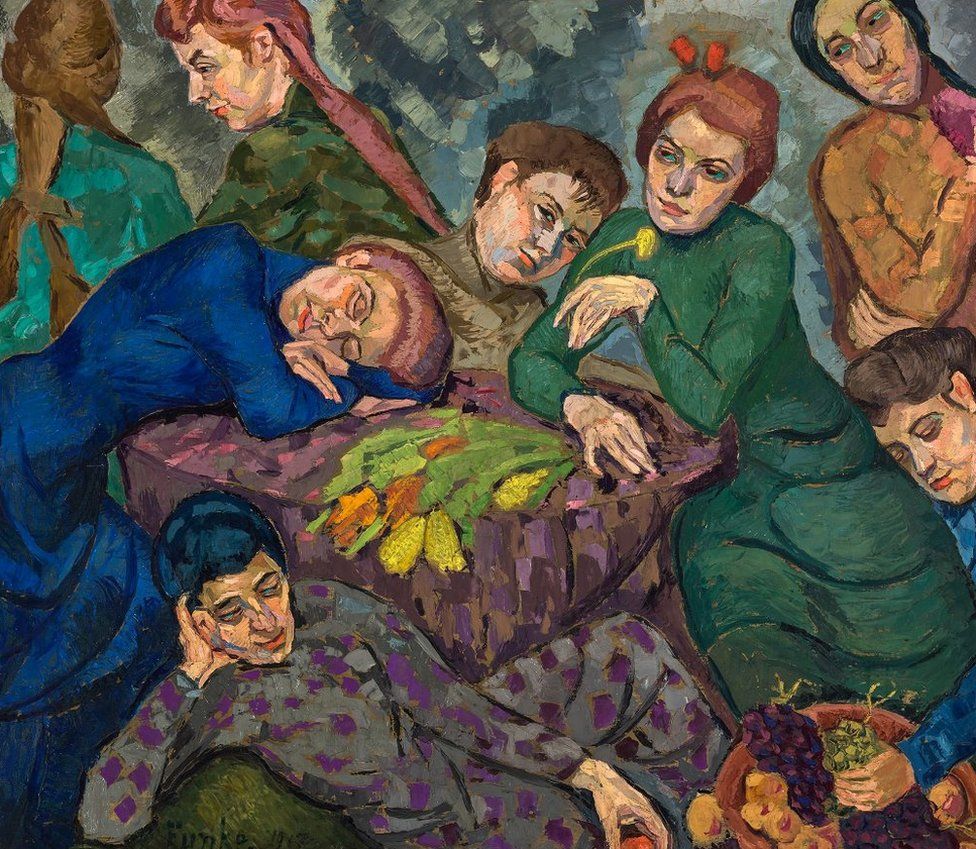
Helene Funke, Dreams, 1913

Maybe, one day such patterns will emerge more clearly, and I’ll be the wiser for it. In the meantime, I’d rather mention another discovery that is already turning into a reading project. I always liked concrete poetry (well-established in Austria with writers such as Ernst Jandl, seen here performing at the Royal Albert Hall in 1965), and between that interest and preparing an introductory lecture about poetry, I came across a recent volume by the Brooklyn-based publisher Primary Information, Women in Concrete Poetry 1959–1979. Since overlooked women writers are always a high priority, I couldn’t resist, and the volume doesn’t disappoint. It features 50 poets from all over the world (from Sonja Åkesson to Chima Sunada to Rosmarie Waldrop), with a selection that mostly follows a 1978 Venice Biennale exhibition curated by Mirella Bentivoglio. Accordingly, the volume looks very much like an exhibition catalogue, with thick glossy paper. The nature of the poetry lends itself to it, as well, written as it is in many languages, partly in color, with striking visual aspects and often presented as collages with repurposed images. Standing out for me were a few pages by the American Madeline Gins, in particular a page showing layers of text thickly typed over one another with a typewriter that I tweeted about in early December. The page ends with the lines “The body is composed 98% of water. This page contains every word in the book.” So I read on. The passage comes from Gins’s book Word Rain (1969) which is reproduced in full in the 2020 Madeline Gins Reader The Saddest Thing is That I Have Had To Use Words (Siglio Press; ed. Lucy Ives), which I have only skimmed so far. Some of this is not exactly concrete poetry, but it is very appealing, so who cares. And anyway, filling some gaps in my knowledge of the contemporary Austrian writer Ann Cotten (herself a poet, novelist, and translator of Rosmarie Waldrop), especially the wonderful lecture series Was geht (2018), I was alerted to Liesl Ujvary, a Viennese poet who started out with a very funny volume in 1977, Sicher & Gut,some of which would certainly be classified as concrete poetry. These converging patterns are what keep me going. Ideally, two or three of them at once.