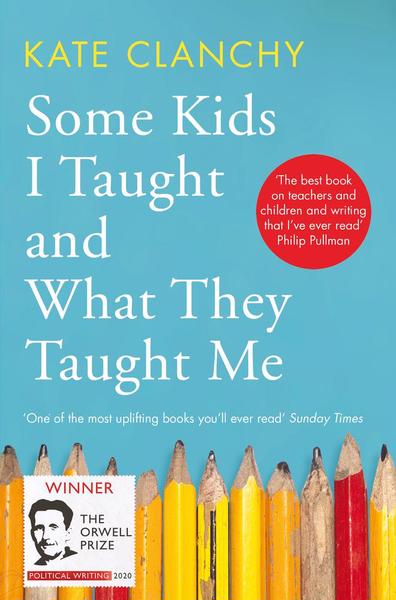
Going Beyond Ourselves: Kate Clanchy’s Some Kids I Taught and What They Taught Me

In the early 90s, Kate Clanchy was a young teacher in a decaying mining town in Scotland. Tasked with teaching her thirteen-year-olds about HIV, she soon realizes the children know nothing about sex. She has them write their questions anonymously and promises to answer them, no matter what. Never since in her thirty years in the classroom, Clancy avers in Some Kids I Taught and What They Taught Me, has she been so frightened. But the sex education class goes well: the children are interested, relieved, full of relieved laughter. What if you’re having sex and need to pee? Can you have sex while menstruating? Most of the questions, she explains in a characteristically deft phrase, are “not about juices, but about love: could anybody love; could gay people love; could you change later on. I only had to say the words aloud and say yes.”

As a prize-winning writer, Clanchy is in the classroom less often these days, but she can still silence a fractious room with a glance or chasten obnoxious teenagers on a bus. Yet despite these formidable qualities, she invariably appears in the book as the kind of teacher she was in that moment in Scotland: someone who makes things possible, someone who offers a model. I only had to say the words aloud and say yes.
Anker_Die_Dorfschule_von_1848_1896

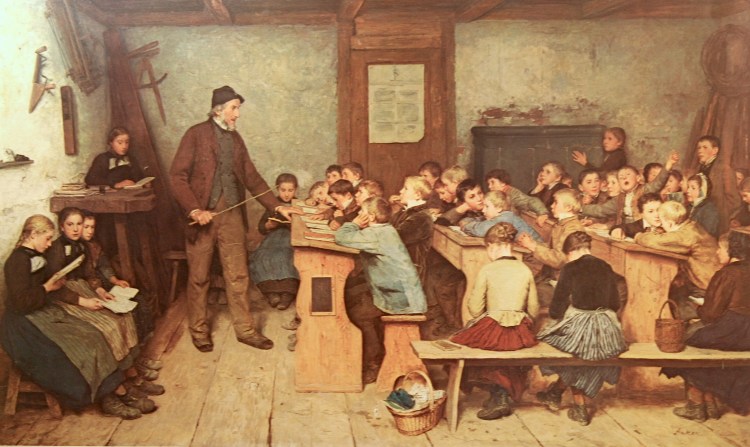
In the Scottish classroom, lesson completed, Callum sidles up to her. Callam, who, “in a class of undersized, undeveloped children,” is “by far the least tall, the least developed.” The boy asks:

‘Whit wis the name for men and men?’

‘That was homosexuality, Callum.’

‘Aye. And whit wis the name for women and men?’

‘That’s heterosexuality, Callum.’

‘Aye. Well, when I grow up, I’m no’ going to have either o’ them. Ah think Ah’ll just have a big dog.’

But Kids Say The Darndest Things is not, thank God, Clanchy’s modus operandi. Here’s what she says next:

No one said ‘fluid’ back then—gender fluid, fluid identity—but fluid is a good word for that afternoon. The room seemed liquid, lacking in barriers. And fluid was what those children were, behind their stern names and rigid codes. Changeable, molten, and warm as any child; waiting for a mould, hoping there would be space for the swelling, shrinking, and unknowable quantity of themselves. For Callum, that space needed to include the possibility of living on his own, and that was as important to him as the possibility, for surely one child in that class, and very probably more, of falling in love with someone of your own sex. So, I didn’t say that would be bestiality, Callum, though the thought flickered across my mind. I said yes, yes, Callum, you could do that. A dog would be very nice. That, Callum, would be grand.

The book is full of generous and smart reflections of this sort. It would have been easy (but wrong) to joke about this provincial child. And Clanchy is honest enough to suggest that she thought about it. Instead she gets a laugh without a joke, and a warm laugh at that. Plus, she shows us how important flexibility is to good teaching. Look how alive her prose is, studded with precise, mobile adjectives—students are “changeable, molten, and warm,” wanting their “swelling, shrinking, unknowable” selves to find a place in the world. We don’t create ourselves from nothing, no matter what bootstrap conservatives would have us believe, we need models, moulds to use Clanchy’s word. Family—especially extended family, especially that extended family of friends and mentors and people who wish us well we have if we are lucky, a topic Clanchy explores brilliantly in her earlier memoir, Antigona and Me—often provides such a mould. And so does school.

In addition to her narrative non-fiction, Clanchy has written a novel and a book of short stories. But she is best known as a poet; in addition to her own verse, she has complied anthologies of poetry written by her students, mostly from the multicultural school in Oxford where she teaches. Students speak dozens of languages at home; no ethnic/racial group makes up a minority. It is a truly diverse place, an exhilarating but also difficult reality, especially for someone trying to teach poetry. The landscapes Clanchy’s students have grown up in are not “ones with lakes and low hills and houses filled with grandmothers in aprons who baked sponge cakes”; thanks to unconsciously imbibed structural racism, the students don’t understand their experiences as proper subjects for poems. (She tells an anecdote about two girls from the subcontinent who write adventures stories together, stories set in American summer camps they have no experience with. The stories are awkward, misshapen. “‘The thing is,’” she gently points out, “‘canoes don’t have engines? Usually.’”)

So Clanchy brings to class examples from young poets, written by POC whenever possible. More than the subject matter, though, or the background of the writer, what matters is her method. She passes around a poem, asks the students to read it, then starts talking with them, not interpreting the poem so much as just seeing what conversation it sparks. Then she sets them to writing their own poems, maybe asking them to copy the structure of the example, or giving them a line to repeat. They write amazing poems.

Everything Clanchy does with students follows this credo, music to my ears:

We are learning to write by reading and to read by writing.

She adds:

We will know we are learning to read well when we recognize beauty and truth in our own writing and in others’ writing. We will know we are progressing in writing at those times when we go beyond ourselves; when we express what we did not even know we meant in a graceful synthesis of words and sounds that is both ours alone and part of the richness of our languages and literatures. We will know we have learned much about English at various points in the future, near and far, when we express ourselves confidently in writing, and when we find joy and humour and wisdom in reading.

I almost balked at “beauty and truth,” but this isn’t Keats or Arnold (not that I imagine Clanchy has any problem with them). And I love the “going beyond ourselves” formulation (not least because of that inclusive “our”—these words apply to Clanchy as much as her kids). I believe in this idea too, I chant it at my students, I’ve seen it happen. When you give students time, and encouragement, and good models, when you help them let go of the idea that writing is a mere transcription of some preexisting idea, and show them that writing is thinking, is creating, you get exciting results. Moreover, you don’t always know the full extent of what they will achieve. You plant the seeds and trust in the flower, though you’re not often around to see it.

Interestingly, Clanchy doesn’t follow the prevailing (in the US, anyway) wisdom that writing, especially creative writing, is self-expression. She is uninterested in using writing to process trauma, especially for students who are refugees or poor or both (as many of Clanchy’s students are) and who know trauma first-hand. She admits, though, that her philosophy has changed: she has come to see how expression matters inasmuch as it leads to detachment, distance, and control: “The writing of a poem does not open the writer to a desperate blurt… rather, it orders the experience it recounts and gives the writer a grip on it.” Even when they exaggerate or self-aggrandize, as her student poets often do, they are controlling their experience. And if they do more, “if they dig deep, and find effective images, and make a good poem out of the truths of their lives, then that is not just control, but power. It is different from being happy; it isn’t a cure for anything, but it is profoundly worth having.”

Clanchy’s insistence that feeling oneself a valid, meaningful person—being legible to others as a fellow human being, sadly much rarer than you’d think—lies at the root of the book’s most inspiring idea. She calls it “patrimony,” by which she means the abilities, interests, and dispositions a child brings to an educational situation. Instead of worrying—as middle-class parents in the US and UK routinely do—what school will give their kid, we should consider what their kid will bring to school. Writing about the decision she and many of her well-educated friends face—do we send our kid to the local school (more diverse, less highly ranked) or to the “better” one?—she concludes, “You are taking something away from the community when you withdraw your child.” Moreover, to do so is to destroy a virtuous circle. Because it isn’t just the community that gains; it’s also the child. Here’s the balance she draws up after she and a friend decide, inciting much neighbourhood consternation, to send their boys to the local school:

What they received at school: those grades [her son did just as well as he would have done at the “better” school], a special card from Faroq entitling them to free minicab rides in exchange for  all the help in Maths, the ability to knit, an acquaintanceship with kids from every corner of the globe, and the confidence that if they walked across any rough park in town, late at night, and were approached by a hooded gang, it would probably just be Mo and Izzat, saying hi. What they gave: their own oddity in the rich mix of the school, their Maths coaching, their articulate voices in class, their academic demands, their parents’ informed labour, their high grades to spike the stats, their evident wellness and cheer to act as advertisement for other parents… And one other thing they got: the knowledge that they had something to give—a patrimony—as well as something to take, from the communities they joined.

Clanchy disparages academic streaming: “the good done to the selected minority is always smaller than the bad done to the rejected majority.” By contrast, she values special classes for struggling students—what at least at the time of writing was called in the UK Inclusion Units (IU). These beliefs are contradictory only from the position of equality, rather than that of equity. Many, even in the education system, disparage the IU as holding lower performing kids to lower standards. But “higher standards” is almost always a code for “what rich, white, well-adjusted kids know how to do.” Standards in the IU, where Clanchy teaches poetry once a week, are in fact challenging. “It’s just that the IU acknowledged that for some kids, very simple things were challenging.”

I love how Clanchy’s mixes tartness (evident when she demolishes streaming) and generosity (evident in her writing about the IU). She’s always ready to counter received wisdom, always ready to imagine why people do what they do, even when those actions seem self-defeating or dismaying to middle-class norms. Writing about why so many girls in the IU got pregnant, for example, she concludes:

The IU girls did it to contribute to the family home, to be like their families, or because even six months in the council mother-and-baby unit as you waited for a flat was better than living in an unhappy home. [From a US perspective, it’s amazing how generous the UK benefits system seems. That is not a compliment to the UK.] They did it because they didn’t know anyone who had done it differently, and middle-class choices such as university seemed completely unreal. They did it because they weren’t willing to reject everything about their own upbringing, especially when people from different backgrounds had not been helpful to them. They did it because they wanted someone to love, and because they believed, as we all do, that they could make a better job of it than their own mothers. They did it because it was the only route to a bit of independence and status realistically available to them. They did it because they weren’t stupid, not because they were.

These analyses are even easier to take on board because Clanchy doesn’t spare herself. Take, for example, the story of Kristell, a girl in the IU who is bombarded with unwanted attention by boys (they snatch her papers, they read aloud over her shoulder, they harass her in all sorts of petty, maddening ways). One day Kristell plaintively asks why they do it. Because you’re so beautiful, Clanchy replies, because they want your attention, because they like you.

Kristell’s face crumples: You’ve got it all wrong, she says. They hate me. No, Clanchy tuts, that’s not right. But later she concedes that Kristell knew what’s what. And the problem wasn’t just the boys. She was right

to tell me that the boys’ attention was a form of hate; it was, and so was my attitude to her, so was the attitude of our entire society, the attitude that identifies disruption as coming from the young girl, not the gazing man, that attributes power to such a powerless person.

Clanchy’s writing pedagogy aims to chip against this structural disparity, to replace, even just a little, even for the kids as expert in self-sabotage as Kristell—that is, as resourceful in finding even this desperate and Pyrrhic strategy for responding to the impossible situations of their lives: Kristell writes poems about self-harm and rape—powerlessness with power.
original_400_600

Some Kids I Taught and What They Taught Me has many fine qualities. It’s often funny—a student at a debate tournament makes a long speech “about climate change, linked, as it so often is, to littering.” It’s often heartfelt—to a colleague who, having dedicated herself to the IU and done so much for so little recognition, despairs over the value of her work, Clanchy stoutly insists, “‘It was a great thing, what you did in the IU. One of the best things I’ve ever seen.’” And, as these and the many other examples I’ve been compelled to quote suggest, it’s always wise and generous.

I wish this book would be published in the US, but I bet it won’t. US publishers are parochial and the book’s necessarily specific to the UK education system: seldom have I so enjoyed a book I understood so little of. But Some Kids will speak even to readers who, like me, don’t know what GCSE stands for or what a comprehensive is. Not because growing up is the same everywhere (though some bits are) or because everyone could learn from Clanchy’s way of teaching (though many could). But because to write carefully about particular situations—to indulge our fascination about the details of our lives—is to write for wide appeal. Some Kids recently won the Orwell Prize for Political Writing. Maybe that will entice someone to give it a try over here.

struth_-_aquarium

Clanchy starts the book with a little hymn to September, “school’s New Year.” A time to start afresh, to meet new students, to see how old students have become new people over the summer. A time when it’s easy to remember the wonderful parts of teaching, perhaps most importantly, she suggests, how the classroom takes her out of herself.

This line resonated strongly with me—I’ve always found the classroom a way of both being and escaping myself. That’s how this introvert can thrive in that performance space; that’s why the crap of daily life can fall away for an hour. This September will be the first time in twenty years I won’t be in the classroom—given how fraught, how dangerous this fall is likely to be, I’m even more grateful for a fortunately timed sabbatical—and I know I’ll miss it. But I’ll be thinking about it. Instead of being in the classroom I’ll be writing about it—or trying to, anyway. It’s time to give myself the chance to write a long-imagined book on teaching the Holocaust. I’m frightened of this opportunity, at least half-convinced I’m not up to the task. I read Some Kids I Taught and What They Taught Me as an example of what I might write. Often I was daunted. How will I ever write anything this good? How will I capture my students so vividly? How will I blend narrative and analysis so elegantly? Then I thought about Clanchy’s idea of models. I remembered what she said about writing poems. First you read some, and then you try them on for size. You imitate them, you tinker, you improvise, you bring your inimitable self to the thing you’re copying.

Deep breath. Here goes.


Short Fiction 2015 Week 8: Pearlman

As I mentioned last time, after discussing Lawrence we launched into three days of writing workshops, in advance of the first paper, due yesterday. Of course this isn’t the first writing they’ve done: they’ve each turned in two (of four) two-page reading responses.

I use these writing workshops to force students to start writing earlier—and to recognize that writing means rewriting. Most Hendrix students did very well in high school, often with minimal effort. My students regularly admit—and this group is no different—that they typically wrote their high school papers the night before, and that worked out just fine for them. But it doesn’t work any more.

For this first paper, I’d given the students prompts to choose from. (The next one will be quite different.) Before the first workshop, I asked students to do two things. First, find five passages from the story they had chosen to write about that they thought they might use in the paper. Second, complete a timed writing exercise adapted from the writing guru Peter Elbow. The instructions were: write for fifteen minutes without stopping about whatever comes to mind about your topic. Then revise lightly for five minutes. Set the writing aside for a day. Read it over, open a new document, write again for fifteen minutes, and revise again for five.

Students emailed me the second document by midnight the day before class, and brought their quotes to class. I organized the class into pairs (putting stronger and weaker students together where possible) and instructed students to arrange their partner’s passages in different combinations to suggest different interpretations. In addition they had to choose one passage to close read (to mark up with suggestions about how the way something is said affects what it says). Even though we do nothing but close read in our class discussions, students still struggle with this task. I sat in with a couple of groups who seemed to be finished far too quickly and worked through a passage with them.

In the last third of the class, I passed out one of the fifteen-minute writing paragraphs students had sent me, one that seemed representative of where most students were at in their writing process (having removed the author’s name, of course). What advice would they give the writer about how to proceed? My first question in such exercises is always the same: What is the best moment in this piece of writing? Where is the writing most alive, most compelling? Students are usually pretty good at pointing that out. They just need help knowing what to do with it once they’ve found it. I teach students how to extract the kernel of their writing—the key idea, invariably confused and under-developed at this point—and make it the basis for their draft.

A draft is what they needed for the next class, which wasn’t a class, but an individual meeting with me. (That took most of one day and part of the next.) Those meetings are quite draining for me—although at least I’ve managed to train myself to read the draft in the meeting itself: I used to do all that beforehand—but the results are worth it. At a certain point, students need individual attention to their writing, and they’re not good enough yet to peer review each others’ drafts usefully.

All of this took us through the end of last week. On Monday we met as a group to talk about citation and line editing. I addressed a few recurring mistakes and stylistic issues before passing out a sheet with sample sentences from the writing they’d already done that semester. I asked students to revise these sentences for clarity. Some of the sentences had grammatical mistakes, but that wasn’t the real problem with most of them. These students don’t struggle with mechanics; they struggle with having something to say. The sample sentences either (a) didn’t say much of anything at all, which became clear when we cut the redundancies and wordiness or (b) weren’t sure what they wanted to say. Most problems in writing, I explained, are problems in thinking.

I’ll find out soon whether these workshops helped: I have the stack of papers in front of me. Even at first glance, though, they look better than the drafts. Undoubtedly many will still be mediocre. But I’ll be happy if none of them are terrible, and even happier if one or two of them are great.

Yesterday, then, was the first time in a while that we talked about a story. I knew the students wouldn’t be good for much: their papers were due that day, they had assignments or papers or exams in most of their other classes too, and it was the day before Fall Break. That’s why I had scheduled a very short story by Edith Pearlman called “Binocular Vision.”

106-EP-sitting

For some reason every semester I usually assign one text I’ve never read before. Mostly this habit is self defeating, forcing me to scramble madly to get up to speed on something I know little or nothing about. But sometimes it’s helpful: when my knowledge isn’t that much greater than my students’ I tend to be a more accepting teacher, and there’s also the thrill of pulling off a pedagogical high wire act.

So it was for me with “Binocular Vision.” I’d read about Pearlman when she broke through into mainstream critical acceptance a few years ago (she’d published a few collections with small presses before that, but interestingly didn’t begin publishing until quite late in life—she’s born in 1936, and I think the first published stories are from the 1980s). Learning that she was Jewish only made me more interested. But I still hadn’t read anything by her.

When I made the course syllabus I was drawn to this story because it was the title story of the collection, because it was short (five pages), and because it was in first person (something I wanted to focus on, and that I would compare to the unusual second person address of an upcoming story by Jhumpa Lahiri). My hunch paid off. “Binocular Vision” is terrific, and a good story to teach on a difficult “last class before break” day.

The story is told by an unnamed narrator, a ten-year-old child living with parents and sibling in Connecticut at an unspecified time that is probably the late 1950s, for we learn “There was no television, of course—only rich show-offs had televisions then.” In addition to giving us a clue about setting, that sentence also tells us that the time of the telling is later than the time of the events (“only rich show-offs had television then”). In a few weeks I’ll remind students of Pearlman’s use of a narrator who reflects on life, for this strategy will recur in our unit on the theme of childhood. For reasons that will become clear in a minute, Pearlman stays quite close to her narrator’s child perspective, seldom pointing out the disparity between then and now.

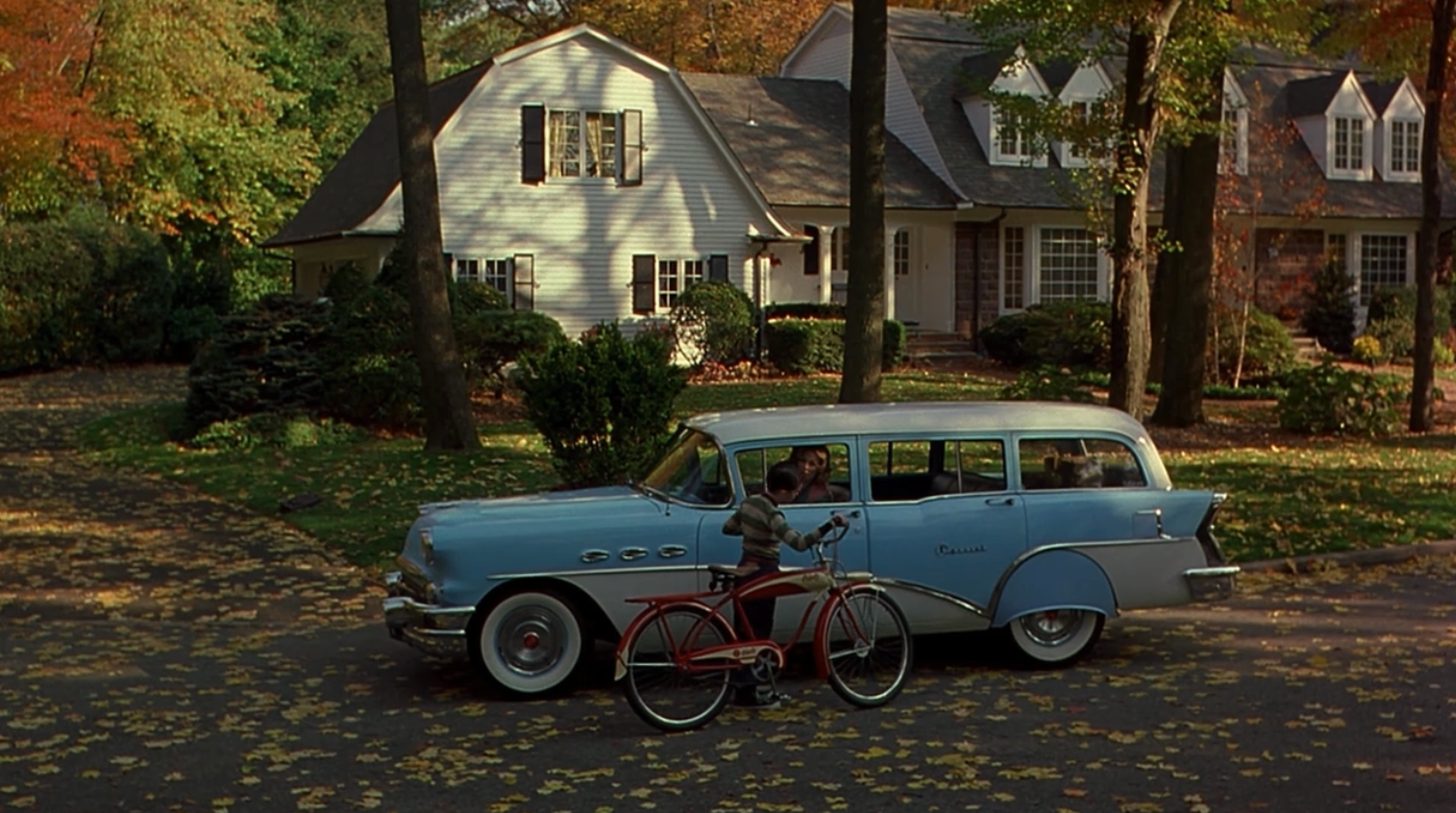
The story takes place in December over the school holidays. The narrator’s father, an ophthalmologist, has been given a pair of binoculars as a fortieth birthday present but he never uses them. One day the narrator idly takes them up and begins spying on the Simons, the neighbours in the apartment next door. Mrs. Simon is at home all day without much to do beyond tidying, running errands, and cooking supper. (“Serious cleaning was done once a week by a regal mulatto woman.”) The narrator sometimes runs across Mrs. Simon in the neighbourhood and shyly whispers a greeting but the elderly woman never replies. The most exciting part of Mrs. Simon’s day, and, before long, the narrator’s, is Mr. Simon’s return home from unspecified work. The narrator can’t see their greeting; the door is blocked from view. But after dinner, the child watches as Mr. Simon reads the newspaper with great deliberation and Mrs. Simon knits and talks and laughs without pause.

School starts again. The narrator has less time to watch the Simons, even starts to lose interest a little. But it comes as a shock when two policemen knock at the door one February morning to ask that the doctor accompany them next door. When he returns he explains to his wife and children that Mr. Simon has committed suicide in his car. Here’s the end of the story:

“Did he drive it off a cliff?”

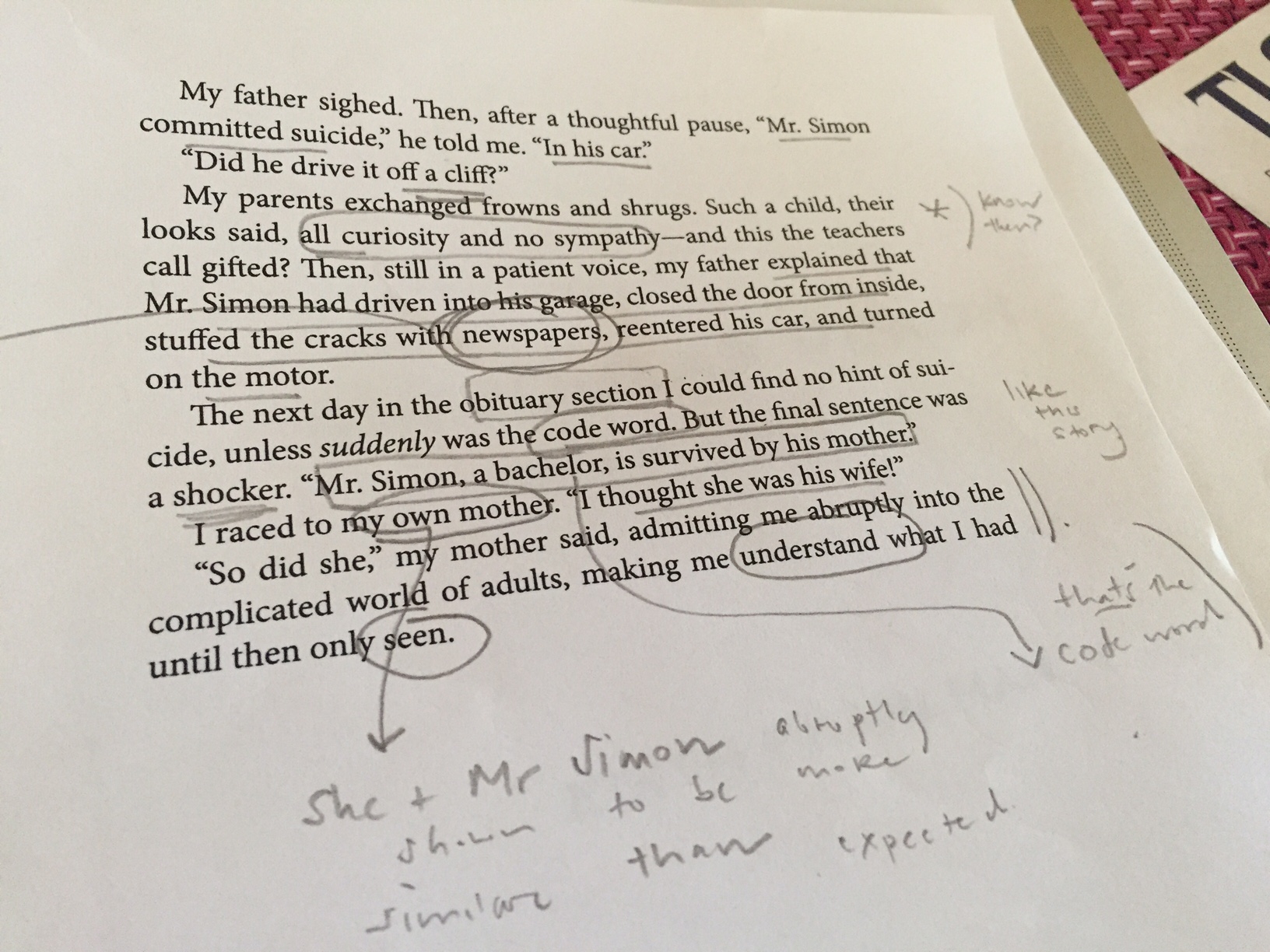
My parents exchanged frowns and shrugs. Such a child, their looks said, all curiosity and no sympathy—and this the teachers call gifted? Then, still in a patient voice, my father explained that Mr. Simon had driven into his garage, closed the door from inside, stuffed the cracks with newspapers, reentered his car, and turned on the motor.

The next day, in the obituary section, I could find no hint of suicide, unless suddenly was the code word. But the final sentence was a shocker. “Mr. Simon, a bachelor, is survived by his mother.”

I raced to my own mother. “I thought she was his wife!”

“So did she,” my mother said, admitting me abruptly into the complicated world of adults, making me understand what I had until then only seen.

I began class by making the students move to different seats (they always sit in exactly the same configuration). They couldn’t sit in the same place on the opposite side of the room, and they couldn’t sit next to someone they always sit next too. This went exactly as it always does: first it livened them up, but before long it quieted them down. I think it was worth doing because I’m hoping that what has happened in the past will happen again this time: some students will be bold enough to start sitting in different places, which means they are more comfortable in the room, which is good for group morale. We’ll see. Today I was able to add that the exercise was relevant to our impending discussion, since the story is about how we think differently about things depending on the position we see them from.

Once the students had shuffled, half-grumpily, half-excitedly, to new seats, I had them work with their new neighbours to find passages from the story that they understood differently now than they did when they first read them. There were plenty to choose from. One group pointed to the description of the Simons’ apartment. When the narrator sees “a double bed with an afghan at its foot, folded into a perfect right triangle” we assume the Simons sleep in it together—but that must not be the case, unless things are even stranger between mother and son than the story otherwise suggests.

Another group mentioned the narrator’s description of what happens when Mr. Simon comes home at night: “He’d pass a hand over his gray hair, raise the door of the garage, get back into the car, and drive it into the garage. He usually sat there for a while, giving me a chance to inspect his license plate.” (This scene brought back childhood memories of having to get out of the car, always, in my memory, in deepest winter, to open the garage door for my parents. I refrained from forcing this sepia-toned Canadiana on the class.) Once we know how Mr. Simon dies, his choosing to sit for a while in the car seems ominous.

That’s not the only ominous thing here. The narrator’s voyeurism gave the students pause. He’s just watching him doing nothing, one said, indignantly. Why do you say “he,” I asked? Is the narrator a boy or a girl? A boy, the class chorused, or, rather, mumbled. Why do you say that, I asked? Does the story ever tell us?

It’s because he’s staring at them all the time, one student said, a student whose work has improved recently and who I have great hopes for. Why, is staring something boys do? I asked. My little brother likes to do it… she said, before faltering amid general laughter. There’s a reason we say Peeping Tom, not Peeping Tina, said another student, valiantly keeping us on task. But we know she’s a girl, said a third student, the one who, I recently learned, had been planning to be an English major until he took a class he really disliked last year and who I am desperate to return to the fold. Aha! I said. How do you know? It says so, he answered, on the second last page.

We turned to the passage:

How I yearned to witness Mr. Simon’s return. Alas, it always took place in that inner hall. It must be like my father’s homecoming: the woman hurrying to the door; the man bringing in a gust of weather and excitement; the hug, affectionate and sometimes annoyingly long; and finally the separation, so that two little girls rushing downstairs could be caught in those overcoated arms.

I tried to keep the narrator’s gender a secret when I summarized the story, though my contorted phrasing probably gave it away. But the story seems to want to keep it a secret too. How strange, I observed to the class, that the narrator narrates this scene almost in third person. Only the possessive phrase “my father’s homecoming” tells us that this scene is reality rather than fantasy. (There is fantasy here: but it’s of something the narrator can’t see: Mr. Simon’s homecoming.) As a class, we didn’t decide why Pearlman makes this choice, although seeing how she plays with expectations in this story, I’m inclined to think she wants us to assume the narrator is a boy and then to have to reverse our expectation.

If I’m anything to go by, though, Pearlman might not succeed in this. I assumed the narrator was a boy, too, even after having read this passage. (I was taken in by its odd phrasing.) It wasn’t until I read an article that referenced the ten-year-old girl who narrates the story that I even imagined it could be otherwise. Perhaps I’d succumbed to sexism (assuming male as default gender). Or perhaps like my students I too unconsciously gender voyeurism male.

When I teach the story again next semester—and I will, it’s a keeper—I’ll try to make more sense of its reticence in this regard. What I concentrated on this time was the first part of the sentence describing the narrator’s father’s homecoming. “It must,” she says. Crucially, these words reveal the narrator’s assumption that other people’s lives must be like her own. If she thought about it for even a second, though, she’d know that couldn’t be right. After all, the Simons don’t have any children. They’re not even, she learns, the Simons.

I said before that the story doesn’t emphasize the difference between the time of the events and the time of the telling. I returned to this topic by turning us to the story’s final paragraphs. I’m not sure how to understand that description of the parents silently communing over their daughter’s head when she asks whether Mr. Simon drove his car off a cliff—“Such a child, their looks said, all curiosity and no sympathy—and this the teachers call gifted?” There is no indication here that the narrator is retrospectively making sense of that moment, bringing her adult experience to bear on a fleeting but meaningful moment. But how could the child get all that from a single look? She doesn’t seem preternaturally acute. The reference, however ironic, to her being gifted is the first we are invited to see her as particularly sensitive. I’m also interested in the ventriloquism of what the parents are imagined to have been thinking to each other—“and this the teachers call gifted?” The syntax and that idiomatic use of “this,” surely spoken with a rising emphasis and intonation, is the only place in the story that Jewishness makes itself felt. But I’m already worried the class is finding the class too Jewish, so I let these observations pass unspoken.

But the oddness of this moment—in which we can’t pin down whether the child or the adult narrator is speaking—might make more sense when we think about the story’s conclusion. I observed that in reading the obituary the child makes her own use of the newspaper, less devastatingly than Mr. Simon, perhaps, but no less dramatically. Suicide isn’t mentioned, unless through the code word “suddenly.” The reference to code reminds us that the child has been playing detective, and in this sense acts even more than any first person narrator would as a stand-in for readers. “But the final sentence was a shocker.” Pearlman’s joke is pretty neat: the same could be said for this story’s (almost) final sentence.

IMG_0244

“‘Mr. Simon, a bachelor, is survived by his mother.’” There’s another code word in this sentence, I said to the class, maybe the real code word. What’s a bachelor? An unmarried man, someone was kind enough to answer. I briefly sketched the difference between denotation and connotation. What does “bachelor” connote, I asked, convinced it would be obvious where I was going. I can’t even remember now how they answered, but nothing they said was remotely in line with what I was thinking. What about the way people might have said, “He’s a bachelor, wink wink, nudge nudge”? Blank stares. Exasperated, I said, People used to use “bachelor” as code for gay. Haven’t you ever heard that? They hadn’t. I told them I considered that a great victory but the difference between their experience and my own suddenly seemed dispiritingly vast. It made me doubt my reading. But for me this story takes place in Todd Haynes territory, tragically closeted life in the 50s.

screen-shot-2013-09-29-at-7-15-12-pm

Unnerved by the failure of this last gambit, I attempted to forge ahead. Look what she says next: “I raced to my own mother.” Note how that phrasing, that use of “own,” suggests how abruptly she has been shown to be like Mr. Simon in ways neither she nor we could have anticipated just moments before. Indeed, the word “abruptly” appears in the story’s final sentence, naming a mode, a change, an experience the story performs as much as describes.

Why, I wanted to know, is the story called “Binocular Vision”? Silence, that eternal silence of this class! I tried a left-field approach. I asked, Is anyone taking anatomy? Alas, the answer was no. So I explained what I had just learned the night before: binocular vision results from eyes with overlapping fields of view, which allows for depth perception. Prey animals have eyes on the sides of their heads, which means they have a wide field of vision (almost 360 degrees) but little depth of vision (their eyes’ visual fields barely overlap). Predator animals have eyes in the front of their heads. Their visual field is narrower, but their depth perception is much better.

How can you use that information to make sense of the story? More silence. I waited. But time was running short and I was losing faith in myself. Is the question too obvious, is that why you don’t want to answer? Amazingly, a student said yes. I’ve been thinking about her reply ever since. Maybe my problem with this class is that whenever I’ve been asking what I think are real questions they’ve been hearing nothing but rhetorical ones. Since I pride myself on asking good questions, I was hurt. And I wasn’t so sure the question was that obvious. Quietly I said, Tell me anyway. The student obliged: She learns how to see with depth. She learns what’s really going on.

Yes, I said, that’s right. But that’s only half the story. The title has another meaning too. Binocular vision also means the vision you get through binoculars. In principle that means better vision—I referred to a passage early describing the girl’s difficulty in getting objects into focus—but it also means narrow vision, blinkered vision. The narrator sees only what she wants to see, doesn’t see what the story allows us to recognize, that she is confusing real lives, presumably rather desperate ones, for a show. She has no television, but she has the Simons. After all, she calls the evenings in the living room—the man with his newspaper, the woman with her knitting, his silence, her talk—her favorite scene. The narrator marvels at how unceasingly the woman can talk, the same woman who won’t even greet her when they pass on the street. “Talking. Laughing. Talking again.” How desperate, even hysterical those actions seem once we re-read them in light of the story’s final events.

But before we condemn the narrator too quickly, before we judge her for projecting her own experiences on to others, before we conclude that the difference between understanding and seeing offered in the story’s final sentence is the difference between adults and children, and that this child has seen everything but understood nothing—before doing so, I warned, let’s think about ourselves. Let’s remember our experience of reading the text. Let’s be mindful that we too made assumptions and saw only what we wanted to see.

We’re adults. Yet we read the story, we saw everything, and we didn’t understand a damn thing.

Class dismissed. Enjoy your break.