My Year in Reading, 2024

If you’re reading this, you are faithful indeed. And I am grateful. Long silence here, I know. As my adopted country tumbles into authoritarianism, things have also been changing, though more positively, chez EMJ.

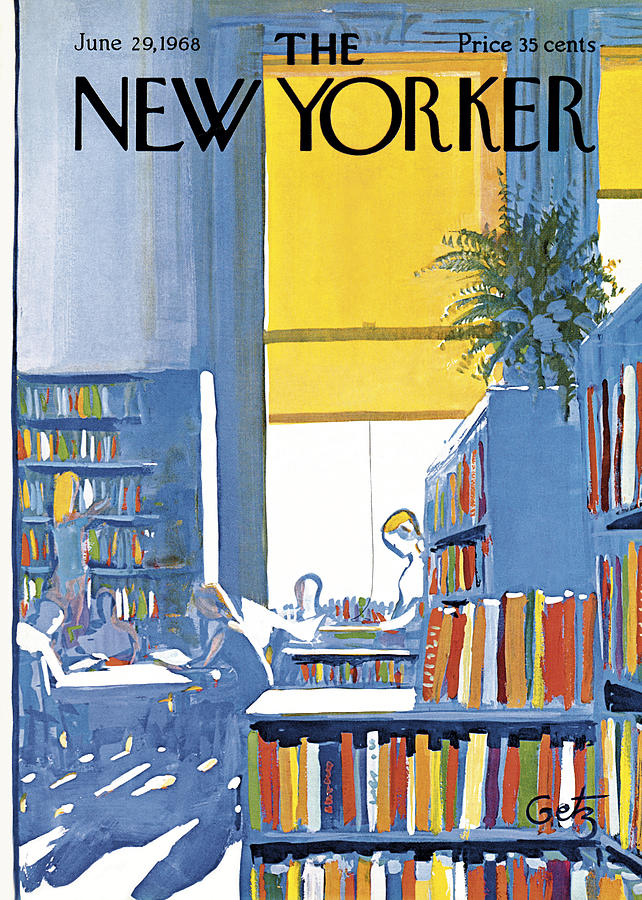
Igor Razdrogin, Book Bazar (1975)

My wife, daughter, and I are moving to St Louis in a month’s time! We’ve spent quite a bit of time there these past few years, and we like it a lot. We’ll have a little more space in our new home (which, combined with some collective efforts to tame my unruly library, might mean that our house will at least briefly not be overflowing with books), and, best of all, we’ll be living in a walkable neighbourhood with sidewalks, which is something we’ve been missing these past 18 years in Little Rock.

The other big transition concerns my career. I’m leaving my job at Hendrix, of course, but I’m also leaving academia in general. People keep asking how I’m feeling about this and I keep saying: Terrific! I was pretty burned out and starting to get a little Old Man Yells at Clouds about All the Changes that affected the classroom experience: the pervasiveness of AI and LLMs (something no one, as far as I know, ever asked for), and, more distressingly, the difficulty even the best-prepared students are having reading sustained works of literature, by which I mean, an entire book, no matter how straightforward the prose. This isn’t about their intelligence, or even their phones. It’s about the strictures placed on secondary school teachers. As instruction moves ever more toward preparing for testing centered on multiple choice reading comprehension questions about utterly decontextualized chunks of texts, teachers aren’t assigning much reading, which means students simply don’t have much practice at it.

(I also have a pet theory that for all its flaws Harry Potter (to be clear: it sucks) helped Millennials think of reading as both exciting and habitual, and Gen Z hasn’t had anything like that. The Harry Potter to Jane Austen to English Major pipeline kept our department afloat for a lot of years. These days, students dislike both Rowling and Austen…)

I still love many things about teaching, and it’s possible I’ll miss it so much that I’ll return to it in some fashion. (I’m never getting another job like this one, though. Those don’t exist anymore.) But for now, I feel relief, and curiosity—along with a lot of trepidation—about the chance to try something new. For now, it feels a bit unreal. Because the academic year is cyclical—summer is always a time of collapse and, if lucky, regeneration—I don’t yet feel as a though I’ve made much of a change. Talk to me in the fall, or next spring, or five years from now.

Luckily—and this is another reason for the silence around here—I’ve been working as a consultant for the Educator Programs arm of the William Levine Family Institute of Holocaust Education at the United States Holocaust Memorial Museum in DC. The people I work with are absolutely fabulous: smart, funny, kind, devoted to their work without having delusions of grandeur about it. It’s eye-opening—and fun—to work as part of a team, after decades of the isolation of academic life. I’ve helped them create resources for K – 12 English Language Arts classrooms, and have taken great satisfaction in the work.

I’ll need full-time work sooner rather than later, though, so if you have any ideas or leads, hit me up! Like, what are some jobs people do? What do y’all do all day? I need advice!

What I’m saying is, I had a lot going on these last months. But I did manage to keep reading. Maybe not as much as usual, but whenever I could make time. I get that it’s ridiculous to offer a 2024 reflection halfway through 2025, but FWIW here are the things that stuck with me last year.

Eight standouts

Francis Spufford, Cahokia Jazz (2023)

So much to love in this novel about an alternate 1920s in which a sizeable indigenous population thrives in a nation called Deseret centered on the bustling city of Cahokia. Spufford weaves his world-building throughout a procedural, in which our hero, a cop who moonlights as a jazz pianist, investigates a murder with vast political implications, to the point of threatening Deseret’s independence.

Cahokia Jazz is the most referenced title in the Year in 2024 Reading pieces I posted earlier this year, which means either that everybody loves this book, or that people like me love this book. Anyway, given my upcoming move to Missouri, it won’t surprise you to hear that the scene that most sticks in my mind is when Barrow pursues a lead in a village at the end of the Cahokia streetcar line, a fly-swept place he can’t wait to leave. Its name? St Louis…

I look forward to visiting the ruins of the actual Cahokia, once the biggest city north of Mexico City.

Katrina Carrasco, The Best Bad Things (2019)

Fabulous and underrated crime novel set in 1880s Port Townsend, where the most valuable commodity passing through the busy port is opium smuggled in from north of the border. Alma Rosales, who once worked for the now-shuttered Woman’s Bureau of the Pinkerton Detective Agency, has left San Francisco for Washington Territory to work for the seductive, brilliant, coolly calculating Delphine Beaumond, who runs most of the drug smuggling on the west coast.

When product goes missing, Delphine puts Alma on the case. Alma goes undercover as a dockworker—not a problem, because Alma is also Jack Camp, a slight yet wiry man who can hold their liquor and likes ladies and men equally. Did I mention that Alma and Delphine are lovers? Or that Jack starts a torrid affair with the man they’re investigating? Or that they’re also still working as a Pinkerton agent—in a desperate attempt to get their old job back?

Cue double-, triple-, even quadruple-crossing; witty repartee; and some pretty hot sex. Most crime novels are let down by their endings, but this one… let me tell you, friends, I literally gasped. A brilliant debut. I want everyone to read it.

Émile Zola, La Bête Humaine (1890, translated by Roger Pearson) and The Assommoir (1877) Trans Brian Nelson (2021)

Even by Zola’s lofty standards, these two are bangers. Push comes to shove, I guess I’d choose Bête over Assommoir, just because I love the crime story trappings, but the latter might be the more impressive accomplishment, especially if you could read it in French to see what Zola does with the argot of his lumpenprotelariat characters. They’re equally—which is to say, tremendously—depressing, but also viciously alive. Zola’s naturalist doom is regularly leavened by his prose, which zips from one brilliant set-piece to another. I’m talking about stuff like the bruising fight between two laundresses in front of an audience of delighted, shouting onlookers in the opening scene of The Assommoir, or the berserk vision of a driverless train, filled with drunk soldiers in full war frenzy heading to their doom at the hands of the Prussians, in the last pages of La Bête Humaine. Feels like a good time to study Zola’s fascinated descriptions of all things irrational.

Hernán Diaz, In the Distance (2017)

Quasi-Western in which the protagonist—a hulking, nearly mute Swede named Håkan whose only goal is to find the brother he was separated from on the voyage to the New World, and whose body and psyche seem to be able to take any amount of suffering—travels east, south, and north as much as west. This is a brainy book: Diaz riffs on Frankenstein, and probably a lot of other stuff I missed. But its allegories are always concrete. In this novel of a man stubbornly going against the westward direction of Manifest Destiny, I most remember the section in which, after suffering a terrible loss, Håkan literally burrows into the ground, eventually building a maze-like underground shelter where he lives in ambivalent isolation for years.

I read Diaz’s Trust last year too: also great. Probably not telling you anything you don’t know. But if like me you are late to Diaz, move him up your list. Smart guy and beautiful writer.

Leah Hagar Cohen, To & Fro (2024)

Last year I served as a judge for the US Republic of Consciousness Prize, which honors literature published by small presses. Yes, I tossed aside some duds and waded through many competent but unexceptional novels, but I also discovered some terrific stuff I wouldn’t have otherwise read. My favourite was this delightful and thoughtful literary experiment, a novel written in two halves that can be read in either order. You can start with “To” and flip the book over halfway through to read “Fro,” or do the reverse. You could call this a Jewish Alice in Wonderland (I love how deeply and unapologetically Jewish the book is: it takes such pleasure in asking questions), but that wouldn’t give you the sense of how the book is both realist and fantastic, a genre-bender that sometimes reads like a middle-grade book and sometimes like a historical “what if” novel, if those were written by someone whose lodestar was Maimonides. Magic!

Thanks to Lori Feathers, the genius behind this award, and to my fellow judges, who always brought it. Serving on this panel was time well spent.

Elizabeth Bowen, The House in Paris (1935)

A book of arrivals and departures, whether longed-for, dreaded, or uncertain. It feels both constricted and expansive: a neat trick. Bowen often gets called Jamesian. That is true not in style but only in a shared preoccupation with cruelty. Hard to say which fictional universe is meaner. Another thing I liked about The House in Paris is that it offers further evidence for my theory that British modernism is just another name for Gothic literature about children.  

Martin MacInnes, In Ascension (2023)

Here we have two sisters. One becomes a scientist who explores the depths of the ocean floor and the vastness of space (she develops nutrition-dense and fast-growing algae for interstellar travel); the other sets aside her career as an international lawyer to find out what happened to the first. I can’t remember everything that happened in the book, but I do remember being enthralled from start to finish. (This is another long book that never felt slow.) The final scene, set in the remotest place on earth, Ascension Island, foregrounds another kind of foreign place: our memories. “A family”, MacInnes writes, showcasing his epigrammatic mode, “is a group of strangers with a destructive desire for common nostalgia.” MacInnes’s big question, asked as much of a sibling relationship as of humanity’s ability to inhabit the stars, is whether the only way to get beyond the destructiveness of the human species is to destroy the individual self Beejay Silcox, one of my favourite critics, gets it right when she calls the book “a primer to marvel.”

Sally Michel Avery, Father and Daughter, 1963

Thoughts on the rest

Ones I keep thinking about: Manjula Martin’s The Last Fire Season (2024): I still haven’t prepped a go-bag—how foolish is that? Catherine Leroux’s The Future (2020, translated by Susan Ouriou): What if the French had never lost Detroit? What if climate change and resultant socioeconomic crises meant that most of the trappings of a functioning state had fallen away? And what if bands of roving children built hardscrabble lives in overgrown parks? Peter Heller’s The Last Ranger (2023): Conventional but satisfying novel about a ranger in Yellowstone, filled with scenes in which the hero drinks early morning coffee on the porch of his cabin: Heller knows the landscape and describes it beautifully. (Given what the chuckleheads at DOGE did, this title resonates differently now…) Jill Ciment’s Consent (2024): Revelatory memoir in which the author reassesses her decades-long marriage to her now deceased husband, with whom she took a painting class when she was 17 and he was 47. Can the relationship really have been good given that they met when she was a child?

Best study of xenophobia, told in an atmosphere of creeping dread: Georges Simenon’s The Little Man from Archangel (1956, translated by Sian Reynolds).

A Russian Jew, brought to rural France as a child, French in every way, has his life turned upside down because of a casual remark. Chilling. Best Simenon I’ve read.

Best study of deprogramming: Emily Tesh, Some Desperate Glory (2023).

Maybe useful these days.

Best case of “it’s not you, it’s me”: Nisi Shawl’s Everfair (2016)

Steampunk set in an alternate late 19th century in which the Fabians buy tracts of land from King Leopold to protect refugees fleeting the horrors of Belgium’s rule in the Congo. At first, this new nation—Everfair—prospers. European benefactors and missionaries work with Africans to create trade networks based on clean airship technology. They develop intelligence networks to navigate the region’s politics. They promote or at least allow social experiments concerning family structure, marriage, and sexual politics. But the internal tensions become too much, and the utopia falls apart. Even as I’m writing this I’m thinking, Honestly this sounds pretty good, maybe I’ve misjudged the book. And at the level of idea it’s intriguing. The execution, though: that’s the problem. The prose is leaden, the relation between action and exposition awkward. Maybe the book actually needed to be longer? A strange thing to say since I felt like it was never going to end. This book is a darling to many (Jo Walton loves it, for example). Probably just the wrong time for me. Can’t imagine giving it another try, though.

Best (and most) coffee: Mark Haber’s Lesser Ruins (2024).

Things are not going well for the narrator of this Bernhardian novel, ever since his wife died and he lost his job. That’s a tough spot. And he tries to do the right thing, sometimes. He reaches out to his son, whose passion for house music means he will dilate on the perfect set list for as long as his father will hold the phone near his ear. Like so many of us (me, anyway), he struggles to surmount the gap between idea and execution, endlessly trying to write something good. You’d think we might like the guy. But… He’s a terrible snob. He lambastes his students, neglecting his work to the point of installing an espresso machine under the desk in classroom. (That an instructor at a community college would have a dedicated classroom is the book’s only false note.) His unfinished, maybe unfinshable, book on Montaigne is probably not really going to be all that. So he ain’t easy to like.

All of this is beside the point, though, because this novel is about the way sentences can mimic the swerves and circles of a mind endlessly thinking. One of the things our narrator thinks about most is coffee. He drinks a lot of coffee. Long sections concern the various roasts, the preparation, the anticipation, the enjoyment. I’m not a coffee snob on his level, but I found nothing to ironize or criticize in the man’s love for the perfectly pulled shot. Lesser Ruins is great for other reasons, too (it’s Haber’s best IMO), but if you like coffee at all, you gotta read this.

Most ingenious conceit: Kenneth Fearing’s The Big Clock (1946)

A drudge at a magazine publisher modelled on Time-Life is tasked with finding—for purposes of eliminating—a witness to a crime. Only thing is, he is that witness…

Dark and boozy. This is the good stuff.

Best crime fiction: Carrasco, obviously. Also obviously, the latest Tana French. (At least I can say I was alive while Tana French was writing novels that will be read in a hundred years…) The latest Garry Disher, Sanctuary (2023), is a satisfying standalone about theft and friendship. I read a couple of Gary Phillips’s books about a Black Korean-war vet turned crime-scene photographer: good stuff. (I learned a lot about Watts.) Start with One-Shot Harry (2022). Years ago I devoured Scandinavian crime novels: seemed like the most exciting thing in the genre. Bloom’s been off that rose for a while, but Cristoffer Carlsson’s Blaze Me a Sun (2021, translated by Rachel Wilson-Broyles) took me back. Marcie R. Rendon’s Where They Last Saw Her (2024) is her first book set in the present, and much as I love the Cash Blackbear series, probably her best. How nice to read a book about an indigenous woman who has a good man in her life. I regularly think about the scenes of women jogging through the snowy Minnesota woods.

Best sff: In addition to MacInnes and Tesh, I most enjoyed Ann Leckie’s Ancillary Justice (2013), Shelley Parker-Chan’s She Who Became the Sun (2021), and various works by Guy Gavriel Kay, who continues to be a source of reliable pleasure, even if no one would call his books cutting edge. (So humane, though! I need that right now.) Alas, I am not yet a dedicated enough sff reader to have figured out how to overcome the “stalling out in a series because I didn’t get to the next one right away and then forgetting what happened” problem.

Best poetry: Louise Glück’s The Wild Iris (1992). Ok, the only poetry collection I read, but I liked it enough to assign it this past semester and the students loved it. Teaching it made me both appreciate it more and notice its limitations (it hoes rather a narrow furrow). I ought to read some of her later stuff: I bet it’s even better.

Best book of the kind I could imagine myself writing and yet am mostly allergic to reading: A tie between Jakuta Alikavazovic’s Like a Sky Inside (published 2021 and translated by Daniel Levin Becker) and Chris Bachelder & Jennifer Habel’s Dayswork (2023).

The whole quasi-essay, quasi-memoir with novelistic elements thrown in for good measure—mostly that stuff leaves me cold. But these two won my heart. Alikavozovic describes a night she spent in the Louvre, a place that she often visited with her father, a ne’er-do-well from the former Yugoslavia. After each excursion, her father would ask, How would you go about stealing the Mona Lisa? This question, and the reflections on her father’s life of petty crime and her own experience growing up in a culture and language that he never perfected, lies at the heart of this beautiful little book.

Bachelder and Habel have done something remarkable: written a book together, about themselves as a couple, that feels written in a single voice. The text centers on the Habel character’s fascination with Herman Melville: it’s about his life, and their lives, and what it means to write a life, with copious references to the man they call The Biographer, Herschel Parker, who seems to have been really something. And by that I mean kind of a dogged genius, but also a pain in the ass.

Best literary fiction:

Laurie Colwin’s Shine On, Bright and Dangerous Object (1975) is sad and delightful, filled with loving anger. A splendid beginning to a marvelous though much too short career. William Maxwell’s So Long, See You Tomorrow (1980) is famous for good reason. Audacious structure and play with time, heartbreaking story, even a section told from the point of view of a dog. Joan Chase’s During the Reign of the Queen of Persia (1983) deserves its resurrection thanks to the good people at NYRB. Another story of childhood in the American Heartland, at once bucolic and traumatic.

You can see I am deep into the “my favourite artworks are the ones created while I was a child and too young to experience at the time” years. I read new things too, though, and the best of these was Kaliane Bradley’s The Ministry of Time (2024), which I finished in a cabin at the Grand Canyon during a thunderstorm that had the rain pounding on the metal roof. The book is as memorable as the setting of my reading: an experiment in time travel, in which a 19th century Arctic explorer is brought to a near-future UK and given to a handler from the titular government agency whose background happens to be Cambodian. In addition to its speculative elements, and a terrific love story, the novel considers differing cultural responses to trauma. More Bradley soon, please!  

Henri Matisse, Woman Reading in a Violet Dress, 1898

Short story collection: Only read one, but it was a good one. I liked all the stories in Jamel Brinkley’s Witness (2023), but “At Barstow Station” is an all-timer. Even a class full of students who did not care much for reading agreed.

Most unexpected page-turner: Karl Ove Knausgaard’s The Morning Star (2020, translated by Martin Aitken) blends his signature interest in mundane middle-class life with some weird shit (a blazing star that no one can explain, a ritual murder, shenanigans at a mental institution). I raced through it and bee-lined for the bookstore to but the next one (in an expensive and gigantic hardcover edition), only to ignore it for the rest of the year. Honestly, the hardcover might be the problem. Most of the time I’m a “give me the paperback” guy. Anyway, will read the others in this series.

Most fun: The audiobook of Jesse Q. Sutanto’s Vera Wong’s Unsolicited Advice for Murderers (2023), read with obvious affection by Eunice Wong, made me laugh aloud. As I feared, the strains of keeping the conceit going already show in the second book, which I listened to a couple of months ago. But I’ll stick with Vera a while longer; she’s a treat.

Best sequel: Waubgeshig Rice’s Moon of the Turning Leaves (2023) is a big advance over its predecessor, Moon of the Crusted Snow. A rare case of a longer book being better. It’s ten years since the mysterious event down south that sent the grid down. The small indigenous community at the heart of the first book has been thriving, but its inhabitants realize they have reached the limit of the resources in their immediate area. After painful debate, they send a search party to find out if anyone else is out there—specifically, anyone indigenous. Exciting, well-drawn, and smart about the cost of giving up part of your identity to gain the benefits of joining something. (a community, a culture) larger.

Grimmest ending: Edith Wharton’s Summer (1917), really a hell of a book. Even if you haven’t read Wharton before you know things aren’t going to end well. But I at least did not anticipate them to end quite that dispiritingly. Thanks to Shawn Mooney and the rest of the Wharton gang for the invitation to read.

Hurts so good: Elliott Chaze, Black Wings Has My Angel (1953)

Liked at the time, but has now faded from memory:

Jean Giono’s Fragments of a Paradise (1944/48 and newly translated by Paul Éprile); Suzumi Suzuki’s Gifted (2022, translated by Allison Markham Powell); Ariane Koch’s Overstaying (2021, translated by Damion Searls);and Jón Kalman Stefansson’s Your Absence is Darkness (2020, translated by Philip Roughton). Don’t get me wrong: these are all good books (especially the Giono). I don’t regret reading any of them. Just not top-notch, for me.

Meh:

These did nothing for me, and even left me a little grumpy. Ari Richter’s Never Again Will I Visit Auschwitz: A Graphic Family Memoir of Trauma & Inheritance (2024): you’d think I’d be the perfect reader for this, but honestly I did not think this book was very smart. Dorothy West’s The Wedding (1995): I get it, she was old when she wrote this. Plus, the existence of a Black elite on Martha’s Vineyard was news to me: interesting stuff. But this felt wispy, and not in that good Belle and Sebastian way. Two crime novels by Arnaldur Indridason: sometimes you just want to turn pages and remember your Iceland vacation but at the same time you know you’ll never get these hours back.

Most ambivalent toward:

Tried to explain why I felt this way about Lily Tuck’s The Rest is Memory in The Washington Post.

It wouldn’t be an end-of-year list from me without some thoughts on Holocaust-related books, which I’ve divided into categories:

History: Dan Stone’s The Holocaust: An Unfinished History (2023). All due respect to Doris Bergen, this is the best single-volume history of the event I know, and it’s pretty short too. I went long on it for On the Seawall. Honorable mentions: Linda Kinstler’s Come to this Court and Cry: How the Holocaust Ends (2022), and Rebecca Donner’s All the Frequent Troubles of Our Days (2021). The latter admittedly not a Holocaust book, but rather a resistance to the Third Reich book. Pretty damn good tho.

Memoir: József Debreczeni’s Cold Crematorium: Reporting from the Land of Auschwitz (1950, translated by Paul Olchváry). If I could legislate that people had to read one Holocaust book, I’d choose this one. Indelible. You think the Holocaust was bad? You don’t know from. Honorable mention: Michael Frank’s One Hundred Saturdays: Stella Levi and the Search for a Lost World (2022), which I wrote about in 2023 but read again for a book group last fall. If anything, it was even better the second time. To read about Stella is to love her.

YA: Elana K. Arnold’s The Blood Years (2023). Gonna do what I can to see that this one gets more traction.

Comic: Emil Ferris’s My Favorite Thing is Monsters [Vol 1] (2017). What an accomplishment! Your heart will hurt but you won’t be able to stop turning the pages. Ten-year-old Karen Reyes lives in Chicago in the late 1960s. She adores her brother, who is sometimes a gentle artistic soul but sometimes a man pushed to violence by racism and poverty, almost as much as she loves monsters. (She draws herself as a werewolf.) She’s fallen in love with her best friend, Missy, who now shuns her at school while being drawn to her in private. Her mother is diagnosed with cancer, leaving the family’s fortunes ever more precarious. When Karen’s upstairs neighbour, Anka Silverberg, a married Holocaust survivor with whom her brother had been having an affair, is found dead under mysterious circumstances, Karen takes it upon herself to investigate. She stumbles on some cassette tapes, in which the woman tells her life story, a lurid and painful one: Anka was brought up in a brothel by her abusive mother, a sex worker, and then sold into a child prostitution ring from which she is “rescued” by a client who later abandons her when she gets too old for him. After the fall of the Weimar Republic and the rise to power of the Nazis, Anka is persecuted for her Jewishness and eventually deported to the camps. How she survived, how she made her way to America, and what led to her death—these questions are presumably answered in volume 2, which was released last fall. Volume 1 is 400 pages, with plenty of tiny lettering. It would be an effort to read it even without its distressing subject matter. But it’s damn good and deserves more attention than it’s got. Ferris uses dense cross-hatching to give her images texture: I don’t how else to say it other than the images seem tense. Amazingly the book is drawn almost entirely with Bic ballpoints. The whole story of its creation, which took six years, is remarkable, starting with Ferris’s partial paralysis after contracting West Nile disease.

Holocaust-adjacent text: Svetlana Alexievich”s Last Witnesses: An Oral History of the Children of World War II (1985, translated by Richard Peaver and Larissa Volokhonsky) impressed me with the pathos of its subject matter (children, many orphaned either permanently or temporarily when Germany invaded the USSR in 1941) and the success of its method (her now well-known quasi-anthropological style, in which witnesses speak for themselves, with seemingly little input or shaping from Alexievich herself, other than the ordering and structuring, not to mention the selecting of excerpts from what are presumably much longer testimonies: which is to say, thoroughly shaped…)

Book I Never Expected to Spend This Much Time With:

Lois Lowry’s Number the Stars (1989), the classic middle-grade novel about the (anomalous) experience of Danish Jews during the Holocaust. I created a lot of materials about this book for teachers. Yes, it has certain limitations, but I’m honestly impressed by how much richness I’ve found in this text. It seems to be fading a bit from the classroom—but not anymore, if I can help it!

Edouard Vuillard, Madame Losse Hessel in Vuillard’s Studio (1915)

There you have it. I don’t know what my life is going to look like going forward—but I hope at least in the short term to have more time for this poor little blog. Thanks as always for reading! I would love to hear your thoughts on anything I wrote about here.
What I Read, June 2024

Dropping this as something to keep you busy—and maybe even entertained—while I carve out the time to write my Year in Review piece. I won’t be catching up on the last half of the year—in fact, not sure I’m going to continue with the monthly pieces, might be time to try something new—but I’d already written most of this one and it seemed a shame to let it go to waste.

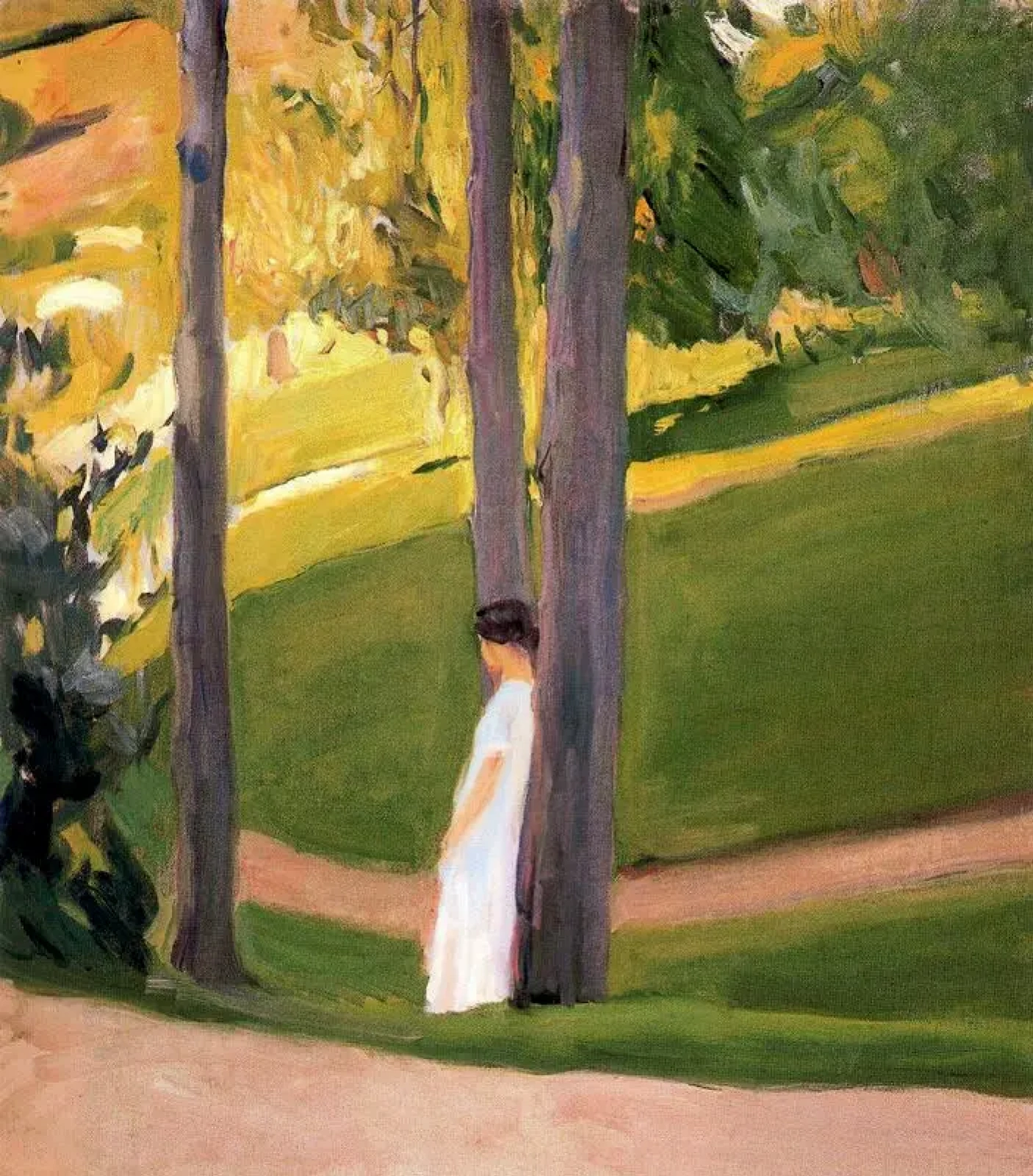
Joaquin Sorolla, San Sebastian Landscape (1911)

Shelley Parker-Chan, She Who Became the Sun (2021)

Fantasy novel set in 14th Century China (with the smallest bit of magic) about a young girl who fulfills the destiny foretold for her brother, who dies, along with the rest of her family and everyone else in her village, from a harrowingly described famine. Zhu Chomngba drags herself, starving and mute with fear, to the nearest monastery, where she is taken in because she has disguised herself as a boy, a deception she never disabuses anyone of, going to great lengths to keep the secret. Her bunkmate, and best friend, learns the truth, leading to an unexpectedly progressive outcome. The meat of the book concerns Zhu’s long, slow rise to power, as she consolidates the Han and prepares to do battle against the Mongols. I liked the idea of this book more than the actual reading experience. By the end, I was keen to learn what happens next, but I was also relieved to have finished the book. (It’s long.) Jury’s out whether I’ll read the sequel.  

William Maxwell, So Long, See You Tomorrow (1980)

Seems like everybody knows this book, but if you don’t, do yourself a favor and read it. But make sure you’re in a good head space first. So Long, See You Tomorrow, a novella about things people can’t bear, isn’t easy. A woman can’t bear to tell her son her estranged husband has ordered her to forbid the boy from visiting the farmstead where he, the former husband, is quietly cracking up, and, even more heartbreakingly, the boy’s dog is tearing itself apart in grief. Years later, another man, the story’s narrator, sits in a New York City analyst’s office and means to say that he “couldn’t bear” his mother’s decades-ago untimely death, but says, instead, he “can’t bear it,” a realization that sends him out of the office and into the streets, for only in the streets of NYC can one cry freely.

As these examples might suggest, the book consists of two strands. Interestingly, they intersect only glancingly. In one the first-person narrator, who seems an awful lot like Maxwell—today, the book might be marketed as autofiction—describes his mother’s death in the little town of Lincoln, Illinois in the 1918 flu pandemic. (The story that took up the whole of They Came Like Swallows is here compressed into a handful of anguished pages.) When the boy’s father remarries the couple decide to build a new house. The work-site, the house framed but without walls, and as such a metaphor for the book’s fascination with unfinished, maybe unfinishable structures, becomes the boy’s refuge after school. He bring his friend Cletus, and as the boys play amid the unfinished space, the narrator believes he “had found a way to get around the way things were.” But nothing gets around the way things are: that’s why life is so unbearable.

Cletus, whose experiences comprise the book’s other strand, also has much to mourn. His family, tenant farmers scrapping a life together, has fallen apart. He now lives in town with his mother, who has left her husband to be with the husband of the couple’s best friends, who work the next farm over. Cletus soon has even more to deal with: his father shoots his wife’s lover, his former best friend. (Not a spoiler: the novella opens with the rifle shot.) The boys drift apart. The narrator next sees Cletus years later in a high school hallway. The narrator sees Cletus, sees that Cletus sees him seeing—and ignores him. This unkindness haunts him all his life, getting tangled with the earlier loss of his mother. The book’s premise is that the narrator, now an old man in New York, the kind of person who visits MOMA regularly, where he is much taken with a Giacometti sculpture that reminds me of his father’s half-built house, a man, as I said earlier, like William Maxwell, excavates, through a mixture of research and imaginative reconstruction, what happened on those farms between those people.

Death, adultery, murder, cruelty: these are the things that can’t be borne in So Long, See You Tomorrow. Which makes the book sound lurid when in fact it’s heartbreakingly restrained. Or, more accurately, a strange blend of the two. The writer Antonya Nelson gets it exactly right:

I don’t know how William Maxwell manages to balance those two stories, one plotted like a melodrama, replete with murder and mayhem, and the other a quiet meditation that hinges on the tiniest non-gesture of passing strangers many years in the past. It’s a combination that oughtn’t work. And yet it does.

Even a three-page swerve into the mind of the abandoned dog works. Which it absolutely should not. Anyway, like I said, read it. It’ll tear your heart out, but in a good way.

I read a lot of Maxwell in my mid-twenties (somehow never this one, though). Now that I am old enough I want to revisit them all. And that’s just the novels. I haven’t even cracked the stories yet.

Manjula Martin, The Last Fire Season: A Personal and Pyronatural History (2024)

Manjula Martin lives in Sonoma County. She is not a winemaker (although she drives past the fields full of seasonal workers, most of them Latino/Latina, working through the night to pick the grapes at the time when they are at their most succulent). Nor is she especially wealthy (though she and her partner have jobs that pay enough and make a difference (union organizing, writing), plus the proceeds from an apartment she sold in San Francisco).

They live in a redwood cottage in the WUI, the wildland-urban interface, as do so many in the paradise of northern California. A paradise threatened by fire. As it always was. But now more than ever. The relentless impingement of human habitation into the forest, plus a century’s worth of misguided fire prevention strategy, plus climate change means the wildfire season is ever longer and ever more dangerous.

Martin’s memoir begins in July 2020, when terrible lightning storms set off hundreds of fires that burned hundreds of thousands of acres. It ends in November, with the delayed end of the season, though with the tendency of fires to smolder underground through the increasingly dry winters, every season is now fire season. In between, she, like everyone in California, learns to prepare a go bag, to speak knowledgeably about AQI levels, and, like many, to evacuate for a time when the fire comes within a couple of miles of the house.

She breaks up her descriptions of those months of the fire by looking back to her childhood growing up on a commune with hippie parents who left that life to become a master gardener and a professor in nearby Santa Cruz and forward to the actions she has taken since to prepare to live with fire.

Martin is an expert at living with hard things; she suffers chronic pain from the operations required to free her from a broken IUD. As a woman who cannot and never wanted to bear children, Martin resists the tendency to think of nature in terms of fecundity and rebirth, even as she finds herself unwillingly returning to that language. Martin impressively blends the experience of living in a damaged body with that of living on a damaged planet.

Martin learns the key distinction between good fire and bad fire. Without the former we have no hope of combatting the latter, though we may have left things too late. She argues that there is no natural world outside its encounter with the human (just as there is no definition of the human that isn’t dependent on our reliance on nature, especially plants). Our fantasy of pristine or untouched nature is just the flip side of our rapacious consumption of natural resources. Thus she returns again and again to her garden, which not only distracts her from her pain but teaches her about the power of pruning, grafting, and weeding. “An intervention,” she writes, “was not inherently good or bad; it was part of a dialogue. The tending of a natural body required constant attention: the giving and receiving of nurture and discipline. Extraction and tourism were types of attention. So was gardening. It mattered how the relationship was structured, not just that there was one.”

At her best, Martin rejects easy thinking. The tendency to just get through to the end of the next fire season, for example, is strong, but Martin rejects this as blindness. We need, she argues, to think of ourselves as in a relationship with the world, to refuse to separate human from non-human life.

The Last Fire Season annoyed me sometimes: it’s too long, and its author is pretty self-righteous. I’m sympathetic to her politics and indeed her world view, but even I had to roll my eyes at her holier-than-thou attitudes. But even though I strongly suspect Martin and I would hate each other, I learned a lot from her book (not least the wonderful word “duff”), and I bet I’ll think about it for a long time to come.

Caleb Carr, The Alienist (1994)

In the Sherwood branch of the Central Arkansas Library System’s copy of Carr’s The Alienist, someone has written alongside a passage referring to the draft riots of 1863, “Oh Please! Too much B.S.” Telling that out of this entire 400+ page novel, only the passage describing the backstory of its sole African American character is singled out for such contempt. Who knows when some anonymous member of my community expressed this frustration. It looks like the book hasn’t been checked out for a while—but it also looks like it was checked out a lot, back in the day. And of course, The Alienst was a huge hit. I remember selling more than a few copies of it in my bookseller days. For whatever reason, I never thought of reading it then. But Carr’s recent death, and the story of his life as revealed in the Times obit, piqued my interest. And I knew the book has its fans. When I wondered on Bluesky about reading it, Anne Trubek said she’d spent years chasing the high of her first encounter with the book. How could I not see what the fuss was about?

In New York in 1898 someone is killing young boys. Not just killing them: maiming them horribly and leaving them on grisly display. These boys are orphans and runaways. They work in brothels, servicing a particular clientele: men who like boys dressed up as women. In the first chapter, the narrator, John Schuyler Moore, a crime reporter for the Times is summoned to the latest corpse by his former Harvard classmate, Laślo Kreisler. Kreisler is the alienist of the title, as psychologists were then known: they cared for or studied people “alienated” from society and their own, “true” natures. Under the guise of then police commissioner Theodore Roosevelt (another old pal), whose attempt to clean the force of corruption (same as it ever was…) threatens to founder if the killer isn’t caught, the pair methodically stalk the fiendish killer. They are joined by the first female police officer in NY, two Jewish cops ostracized for their identity and their passion for scientific methods of detection, and some devoted former cast-offs from Kreisler’s life’s work helping orphans. The band gets together, they make painstaking progress, but they’re always behind the killer. As the death toll rises, and nefarious elements seek to use the killings to foment reactionary unrest in the city, the case becomes a race against time…

The short verdict: it’s good! Not, in my opinion, great. But worth reading. I got a Name of the Rose vibe from it: a smart non-crime writer writing an investigation in a historical period they have researched to bits.

The long verdict: maybe what Carr was doing—spotlighting together historically marginalized figures and using historical figures like Jabob Riis and Teddy Roosevelt as more than just bit players—was more unusual at the time than now. Maybe the book is in that awkward in-between stage: a bit dated, not yet so old that it feels like a glimpse into another world.

What does feel of its time—the 1990s, not the 1890s—is the passionate defense of children, and the abhorrence of the violence (physical, psychological, sexual) done to them by adults. Based on what I read about him, this element seems to come pretty closely from Carr’s own life, with the desperate, authentic, slightly incoherent quality of not-fully-worked-through experience. In this, The Alienist reminded me of some otherwise completely different books, the crime novels of Andrew Vachss, all of which centered on the sexual abuse of children. Anyone remember those? Vintage published them in the 90s, they were kind of a thing, but I never see them anymore. Wonder what happened to him.

Ignore that anonymous Arkansas reader: no BS here. There’s plenty of fiction being written today that will look, if we are lucky, a little creaky in 30 years in its efforts to include marginalized experience. Worth a little awkwardness to kick open some doors.

Laurie Colwin, Shine On, Bright and Dangerous Object (1975)

Colwin’s first novel, which I think I maybe found a bit slight on my initial deep-dive thirty years ago and which I haven’t read since, but which impressed me greatly as a middle-aged reader. Crazy to think Colwin was only about 30 herself when she wrote it.

A Jewish woman marries into an old WASP family. He husband, a charismatic ne’er-do-well, dies in a sailing accident. In the grieving process, she must come to terms not only with her loss but her recognition of how little her husband had ever been able to know about himself. In the process, she becomes close to her husband’s brother, as serious as her husband was carefree. I won’t tell you what happens, but Colwin does something so interesting at the end: her book takes an unexpected swerve that makes everything so much more complex. Man, it sucks she died so young.

Francis Spufford, Cahokia Jazz (2023)

God, what a book! I’ll say more about it in my Year in Reading piece.

Elisa Gabbert, Any Person is the Only Self (2024)

Essays on mostly bookish topics written by the poet Elisa Gabbert. I was happy to start in on the first one, because I remembered it from its first appearance in the New York Times: a lovely piece on the “recently returned” shelf at the Denver Public Library, where no algorithm or even individual taste holds sway. Gabbert has revised the piece so that it has a wider focus, and I actually missed the minor-key aspect of the original. But I swallowed these pieces one after another, unable to give them the time they, like all good essays, deserve. I ought to revisit them from time to time. Here’s what stuck with me, though: the to-me breathtaking abruptness of their endings. Gabbert does this thing where she meanders in classic essayistic fashion, and then simply declares herself done. I experienced this as an attack on my sense that the ending of an essay should call back to its earlier moments, allowing readers to see in a new light something they’ve have already been told. But they really are more ways to do things than you’d think.

Jamel Brinkley, Witness (2023)

Strong collection of stories of unhappiness. I still think about “Blessed Deliverance,” about a group of friends coming up in a gentrifying neighbourhood (one sign of which is that some white folks set up a bunny rescue) who drift apart as they enter high school. And I was blown away by “Barstow Station,” the story of a UPS driver whose adult relationships founder because he’s too busy preserving himself from the memory of something bad that happened when he was a teenager. I immediately decided to teach it this fall—along with this lovely close reading by my secret boyfriend Garth Greenwell. (Secret to him, not all of you.) In the months since first writing this, I did indeed teach the story, and even though most days in that class were hard slogging, the story was a hit. Or at least what counted for one in one of the least curious groups of students I’ve ever taught.

Colin Walsh, Kala (2023)

Debut Irish crime novel that seems to have made basically no impact in the US market. Friends who were teenagers when one of their gang disappeared are brought back together when the body is found. As the crime is investigated, these now-adults learn how much they’ve lost over the years. I’m grateful to the friend who sent me a copy: I read Kala with pleasure over a summer weekend. Walsh reminds me a lot of Tana French: they’re both Irish, obviously, and dab hands at dialogue. Above all, Walsh concentrates as much on character as his more famous (and, let’s be real, talented) confederate.

Linda Kinstler, Come to this Court and Cry: How the Holocaust Ends (2022)

In her brilliant first book, Linda Kinstler asks this vexing question: what counts as proof that the Holocaust happened? She begins in Argentina in 1965 and the Mossad’s assassination of Herbert Cukurs, the Latvian Lindbergh (in politics and aviation alike), known during the Holocaust as the “butcher of Riga.” Next to the body, the killers left this text from a closing speech at the Nuremberg Trials: “Mankind itself… comes to this Court and cries: ‘These are our laws—let them prevail!” A strange choice, at least for anyone uncomfortable with the idea of taking the law into one’s own hands.

From this historical event—prompted by unwillingness on Israel’s part to have a sequel to the Eichmann trial and fear that the statute of limitations for perpetrators was about the expire in Germany—Kinstler’s text becomes at once more theoretical and personal. Theoretical because her main interest is in parsing the difference between law, history, and story, and how the evidentiary claims for the latter two are different than those affecting the first. And personal because in the background of Cukurs’s story—a member of the Arājs Kommando, Latvian auxiliaries who competed with the Germans for cruelty and zeal in murdering their Jewish former neighbors—was one Boris Kinstler, the author’s grandfather, who disappeared or died in mysterious circumstances in the late 1940s and may have been a KGB spy and thus acting as a mole within the fascist-aligned organization.

Central to Kinstler’s argument is a historical situation that was new to me. In 1958 a German jurist named Erwin Schüle, the lead prosecutor on a trial of perpetrators who had been stationed in Lithuania, made a consequential decision. Initially faced with only a single defendant—a man named Fischer-Schweder who had white-washed his SS record and, perversely, even ran a displaced persons camp after the war—Schüle ran up against the problem that German law required him to prove that defendants had initiated murder (in this case, mass shootings), rather than doing them on the orders of others. Witness testimony was inconclusive. So Schüle ordered his detectives to expand their investigation to uncover what he called “the crime complex” of the area on the German-Lithuanian border where Fischer-Schweder had served. As Kinstler explains, by crime complex Schüle meant “the entire constellation of actors and actions that allowed mass executions to take place.” In so doing, the prosecution charged nine more men. All ten were convicted.

The idea of the “crime complex” considered Holocaust crimes as structural rather than individual:

it treated entire swathes of the Nazi administration as criminal organizations and presumed the complicity of everyone involved, including secretaries and radio operators and cooks. It required investigators to begin with a place, or a name, or a date, and comb through vast amounts of information to fill in the blanks: who had been killed, and how, and by whom?  How many ‘Aktions’ were there, and on whose orders? How many Nazi personnel had been involved? Were they still alive and in Germany? If they were able to answer all these questions with certainty, then they could initiate criminal proceedings.

Perhaps because of its status as both victim and perpetrator, Latvia never pursued the “crime complex” idea. Which, Kinstler argues, made it hard for the country to come to terms with its responsibility in the miserable fate of its Jewish population. And then, more recently, to refuse to take up a case against (the memory of) Cukurs, despite the pleas of the remnants of its Jewish community. For in these same years, Cukurs has again become a folk hero in Latvia, a devoted patriot, a fighter of the Soviets, a victim of Israeli aggression, who not only didn’t kill Jews but helped several members of that community, even rescuing one young woman and taking her to safety in South America after the war. (Kinstler meets the woman’s daughter to learn more, though mostly what she learns is that the woman’s mother never talked about her wartime experiences, leaving her and Kinstler companions in confusion.) Kinstler tells us about a musical that, like something out of Mel Brooks, white-washed Cukurs’s reputation; she even reads a spy novel (recommended to her by the local prosecutor) in which her own grandfather figures as a Soviet spy and thus a traitor to the Latvian people.

Historically, it’s clear that Cukurs both saved a handful of people and was present at many deportations, requisitions, beatings, and mass shootings, notoriously in the Rumbula massacre, in which 25,000 Jews were murdered on two days in late November and early December 1941 in a forest near Riga. Eyewitnesses report him taking part in such events. But no one alive can testify to it.

In this sense, Come to this Court and Cry is a fascinating expansion of what Dan Stone argues in his new history, regarding the reactionary backlash that has shaped the latest iteration of Holocaust memory wars. At the annual Holocaust remembrance events, local politicians downplay the Arājs Kommando’s responsibility, saying that no simple conclusion can be made regarding its activities. Too hard to acknowledge complicity.

As Kinstler concludes, in the 21st century, to expand the reach of justice in reopening cases from the era of WWII is a double-edged sword: “a crime that can still be tried can also still be pardoned.” Her book explores how “remembering went from being an injunction to a knotted, nearly impossible question.”

And what about Boris Kinstler, the author’s grandfather? Was he a spy? At the end of her book, which I recommend unreservedly, Kinstler tells us about the report she requested from the Russian government. Did they have a file on her grandfather? A one-page letter returns: no information or materials pertaining to Boris Kinstler exists in the archive. No answers there either. Kinstler’s subtitle, she tells us, is a warning, not a prediction. The fight against the Holocaust’s misuses never ends; as the forces who propagate those varied distortions grow in number and power, it seems a fight less likely than ever that we will win.

Helen Garner, This House of Grief (2014)

September 4, 2005 was Father’s Day in Australia. A man named Robert Farquharson was driving his three children home to their mother, who had initiated divorce proceedings against him earlier that year. Father and sons had spent the day watching the football, visiting family, making a KFC run for dinner, even doing a little shopping. Night had fallen; Farquharson was on the highway, five minutes from home. He headed up a railway overpass, then down the other side. Suddenly, his car veered off the road and plunged into a reservoir. Farquharson survived; the boys drowned.

Garner’s work of narrative nonfiction tells the story of the aftermath of this terrible event. Although he was charged by the Crown with three counts of murder, his soon-to-be ex-wife supported him, saying he could not have set out to kill his beloved children. But Farquharson’s behaviour after the crash was odd, to say the least. Splashing out of the water into the spring evening, soaking wet, he flagged down a car and ordered its drivers to take him to his ex-wife’s house. Only there did he mention the children were still in the water. And only then were the authorities informed. When Farquharson and the boys’ mother were taken back to the site, by her new lover, Farquharson stood silently, asking only for a cigarette. It was the new man in Cindy’s life who went into the water to try to rescue the boys. That first night, when police questioned him, he insisted he hadn’t done anything wrong, asking only, over and over again, what would happen to him.

Who acts that way? Well, anyone maybe.

What is the right way to respond to a terrible situation? Is some grief more acceptable than others? Could Farquharson’s confused story—that he had blacked out during a violent coughing fit—have been true? Is cough syncope a thing? Some experts said no. Others said yes. What about the physical evidence, tire tracks and the like? According to the police, the signs pointed to voluntary movements on the slope, inconsistent with an out of control car. Farquharson, they allege, steered the car into the water. But they messed up some of the evidence, and failed to account for the road’s camber. What about the explosive testimony of one of Farquharson’s mates, who said he’d had a conversation with the man a few months before the event, outside the local fish and chippie on a Friday night: Farquharson was not just low and helpless, as others had testified he had been, but angry and vengeful. He said he was going to kill the boys, and he would do it on a day everyone would remember, Father’s Day. Did Farquharson really say such a thing? Why didn’t the mate come forward at the time?

Was this an accident or an act of vengeance? Garner followed the trial for months, attending court every day, and her book records the efforts of the Australian legal system to come to terms with this baffling case. She gets friendly with the other regulars—reporters, gawkers, court officials—and one day runs into the defense counsel, to whom she says, “Only one man knows what happened, and he’s not saying.” This seemingly benign statement of perplexity incenses the lawyer (he threatens to ban from the courtroom): the whole point, he thunders, is that Farquharson doesn’t know what happened. What is knowing? What is an act? Can we entangle our conscious decisions from our unconscious drives? These are the big questions Garner probes in this riveting book.

Garner doesn’t like Farquharson—her take seems to be that the only thing more impossible than his having killed the boys is the possibility that he didn’t—and her descriptions of the man are pitiless, though, I wouldn’t say, unfair. In one especially merciless moment, she calls him a “small stump of a man, with his low brow and puffy eyes, his slumped spine and man-boobs, his silent-movie grimaces and spasms of tears, his big clean ironed handkerchief.” It doesn’t help, from her perspective, nor, I suspect, from that of either the law or public opinion, that Farquharson is profoundly inarticulate. He responds with baffled indignation to his plight; he turns to sentimental clichés and watered-down therapy-speak. Behind the story of the crime is an argument about a certain kind of Australian masculinity and its helpless, toxic loneliness. As a North American reader, I no doubt don’t understand the full context but Farquharson is legible beyond his corner of Victoria.

I’ll let you look up the outcome for yourself: if you like Janet Malcolm (name-checked here in one of the epigraphs) you’ll enjoy This House of Grief. I read with avidity, but I also never quite get on with true crime. Throughout, Garner projects herself on to the jury, imagining her own responses (boredom, confusion, indignation, you name it) reflected in their posture and expression. By the end, I felt like Garner was trying to reason out her own compulsion. It can’t be good for you, attending to a sensational trial this closely when you don’t have to. I found her final pages, where she mediates on her grief for children she never knew—ending in a sanctimonious aria: “They are ours to mourn. They belong to all of us now”—mawkish and unconvincing.

Read this, sure, but read her fiction first.

Dorothy West, The Wedding (1995)

Set in 1953 in a black enclave on Martha’s Vineyard called The Oval, West’s novel—only her second, written over decades in collaboration with her editor, Jacqui Kennedy Onassis, and published when the author was 88—is set on the day leading up the wedding of the youngest daughter of the community’s richest and most prestigious family. This economy of space and time is contrasted with flashbacks that go back four generations on both sides of the family. Over and over, these family stories show whites and blacks mixing, often intimately. The characters, obsessed with color, police racial distinctions that can’t hold. Seemingly impermeable ways of living and thinking prove to be all too permeable. Most interesting to me as a (remembered) record of the last moments of legally segregated America—a world Henry Louis Gates, Jr. wrote about in his underappreciated memoir Colored People. Had I read it on my own, I would probably have forgotten it soon after reading. But I read it for One Bright Book, and Frances and Rebecca helped me think about it more carefully. They didn’t quite convince me the novel is as smart about class as it is about race, but they made me see it as more carefully composed then I’d thought. Give the episode a listen and see if you are enticed.

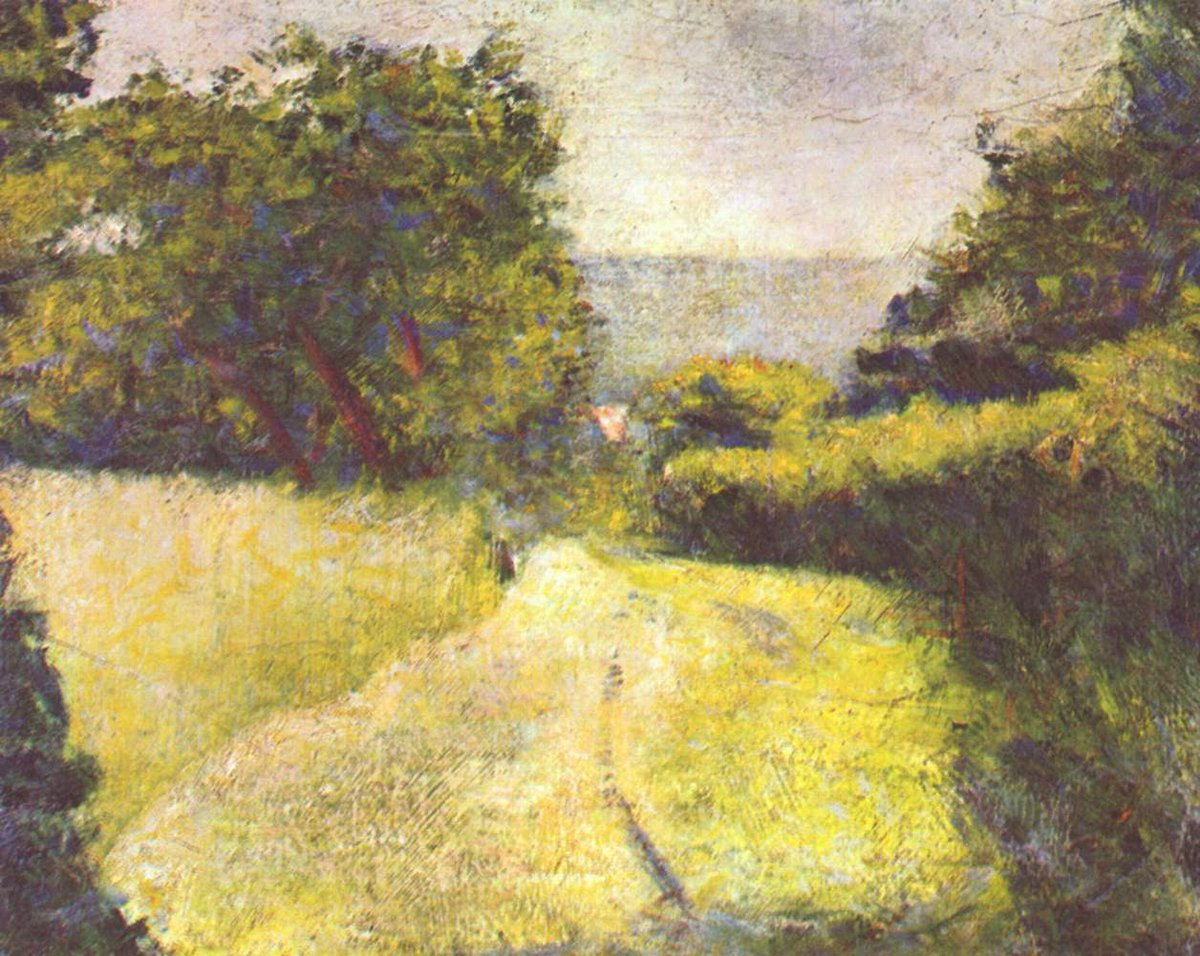
Georges Seurat, The Hollow Way (1882)

Tell me—have you read any of these? If I could only recommend one, it would be the Spufford. And then the Colwin. And don’t sleep on Brinkley. But a good month all round. Doesn’t last summer seem a lifetime ago?

Martin Schneider’s Year in Reading, 2021

Today’s reflection on a year in reading is by Martin Schneider, a freelance copyeditor (of books!) who lives in Cleveland, tweets at @wovenstrap, and used to write for Dangerous Minds. He’s part-Austrian and can occasionally can be found in that country.

Look for more reflections from a wonderful assortment of readers every day this week and next. Remember, you can always add your thoughts to the mix. Just let me know, either in the comments or on Twitter (@ds228).

Charles E. Martin

The global pandemic has been very good for my reading life.

I’ve read novels my entire adult life but the raw totals in any given year might not have been very high, maybe 30 per year. When COVID-19 arrived, I had an empty work patch in my freelance schedule and I responded by attempting to read one novel per day for 30 days (!) as a way of distracting myself from the fact that I might have a hard time finding freelance work. I made it to Day 19 but some work came in, thank god, and I didn’t get to Day 30. That stretch sparked a period of high novel consumption: I read 72 novels in 2020 and 70 novels in 2021. Those are very high totals for me.

I’m grateful for the particular cluster on Twitter that orbits around Caustic Cover Critic and Damian Kelleher and of course Dorian for improving my general experience on Twitter as well as giving me inspiration for new books and a community of like-minded people, etc. I should also say a word about the Backlisted podcast as additional inspiration (obviously that also overlaps with Twitter in some ways). I appreciate the monthly bookstack photographs and other visual ephemera that Book Twitter is always providing me with.

I’m a volume whore, by which I mean I favor reading short novels so that the raw book count stays as high as possible and I don’t get stuck for a month reading Moby-Dick or whatever. [Ed. — Ah, but what a month it would be!] 275 pages already begins to seem a high total to me, my sweet spot is about 191. ABC, always be churning. [Ed. – Hahaha!]

It goes without saying that 2021 was a very good reading year for me, cycling through 70 books in a calendar year is pretty close to an ideal way for me to spend my free time.

OK, here are about 20 books I wanted to say something about, listed in chronological order except where books are joined.

Michaela Roessner, Vanishing Point

The first read of the year for me, and one of the year’s finest. Vanishing Point is hard to track down but this exemplar of heady, sinuous ’80s sci-fi is worthwhile for those who like that kind of thing. The setup has much in common with Tom Perrotta’s The Leftovers — it also came first — which most likely is what drew me to seek it out. I don’t want to divulge too much about it, but I greatly enjoyed this intelligent, immersive book, and I think about it often.

Josephine Tey, The Franchise Affair

I’ve never been much enamored of The Daughter of Time, which has always seemed implausible and overbaked. This left me unprepared for the astonishing authorial control of The Franchise Affair. I think you’d be hard-pressed to find a better representation of midcentury England than this book; the sheer exuberance of the jolly/obliging/diffident/snappish voices — literally, speaking voices — is tough to top. What’s the cricket equivalent of “a home run”? [Ed. – Knocked it out of the oval here, my friend: such a good book.]

Gilbert Adair, Love and Death on Long Island

Quite simply, my #1 read of 2021. I adore thinking about this book. Every page is a treat. I would urge those who like their fiction subtle and incisive to consume this immediately. Adair’s performance — and it is definitely a performance — feels thoroughly under-heralded. I had seen bits of the movie years ago and had always found the central predicament original and delicious and rich. Who can fail to relate to the sorrows/joys of being a bookish hideaway in a world that produces, almost unthinkingly, Hotpants College II?? [Ed. – Admittedly, not a patch on Hotpants I.] The ways Giles and Ronnie fail to comprehend each other are a wellspring of comedy that will never stop nourishing me. I never reread books but will likely return to this “jewel-like” 1930s-type book set in the age of the vulgar teenage sex farce (rented from the local video shop, natch); those 1980s details are decisively additive, at least for me. I sorely crave books like this but alas, strong comps are surely thin on the ground…… [Ed. – Ooh, a challenge: do your best, Team. Whatcha got for Martin?]

Colson Whitehead, The Underground Railroad

I am a fan of Whitehead’s, but I was disappointed by The Underground Railroad. It seems unusually weak for a Pulitzer winner (then again, there is The Goldfinch, oof). I appreciated the comparative tour of antebellum contexts, but the failure to develop the literalized choo-choos nagged at me. Does that metaphor explain anything to anybody? I can’t see how. It’s such a great idea but also a massive missed opportunity. This is the rare case of a book that needs another 200 pages, I think. I also worry that Whitehead has bought into the hype surrounding him. Give me another John Henry Days, man — please!

C.S. Forester, The African Queen

In 2020 I read The Good Shepherd and found it utterly compelling. Then dang if the same thing didn’t happen all over again with The African Queen. I am a little leery of the Hornblower books — I prefer the 20th century, thanks — but Forester’s way of imparting information really does it for me.

Patricia Lockwood, No One Is Talking About This

Jonathan Lethem, The Arrest

No One Is Talking About This is a relatively celebrated recent novel that I cluster together with the works of Jenny Offill and Rachel Khong, and not in a positive way. I think of all of these books as jammed with clever, postmodern witticisms/jokes that you could rearrange in any order and it wouldn’t make much difference to the narrative. That’s a little unfair to No One Is Talking About This, which Lockwood does take pains to instill with an Act I/Act II structure, but I still found it a complete failure in terms of ordinary novel-building. Meanwhile, Lethem is not much in fashion lately, especially after The Feral Detective, which did not work. I suspect there was scant interest in his stab at Post-Apocalypse, but I still found The Arrest as intelligent, engaging, and sharp as much of his stuff — I admire Chronic City particularly. His books don’t always hang together, but on the paragraph and thematic levels, Lethem seems to me the equal of anyone out there right now and, as such, under-appreciated.

Arthur Getz

Margaret Drabble, The Millstone

Oh, boy. I was more than a little surprised how conventional and bourgeois (and therefore tiresome) I found this book, which in 1965 represented such a brave “new” perspective — or did it? From the perspective of 2021 it reads as so much more aligned to Drabble’s (presumably) hated predecessors than to us. To the reader of today, I submit, so many of Rosamund’s choices are unintelligible, particularly that of concealing the existence of her child from her parents. Rosamund’s whole setup (enormous apartment, rent-free) is so contrived and refuses to serve as the societal basis for anything (as I think was intended or at least was regarded). Jerusalem the Golden, a humble tale of growth about a woman from humble origins I read and esteemed decades ago, seems the antithesis of this. Drabble really leans into her privilege here, thus undoing the point. Next! [Ed. – *popcorn gif *]

Quentin Tarantino, Once Upon a Time in Hollywood

The last few years I have found myself increasingly disenchanted with the MFA-influenced “well-crafted” masterpieces that dominate (say) the Tournament of Books. The writing is frequently too tidy and pristine and there’s too much overlap/groupthink in the authors. In my mind, these books are not composed by individuals; too many of the nasty, idiosyncratic details have been sanded off. An antidote to this is Once Upon a Time in Hollywood, far from a great book but I found its termite-ish perambulations entirely refreshing and (am I crazy for believing this?) an explicit callback to the shaggy-dog ways of Dickens. I do suspect that Tarantino thought of this “novelization” (a favorite form of his) as an attack on all the bloodless hifalutin volumes that get adopted by reading groups. I’m ready to sign on to this agenda; modern fiction could surely stand to ingest the unkempt, untoward essence of this book.

Elena Ferrante, The Lost Daughter

I admire the guts it took to be so unflinching about the unvirtuous aspects of shirked motherhood. The Lost Daughter dares you to dislike its protagonist, which I did not — or not very much; Ferrante works in the class signifiers to make her readers side with her heroine over the swinish, unreaderly family that intrudes on her interlude — and then forces those same readers to think about that. It’s encouraging that a writer of Ferrante’s gifts has found such widespread success.

Susanna Clarke, Piranesi

Everybody’s favorite recent puzzle box, it seems. The first half of this book constituted one of the reading high points of the year for me. Nothing wrong with the second half, to be sure, but you just can’t top the sheer blazing WTF “where is this going?” quality of this book’s setup. [Ed. – Yeah, can’t argue with that.] As with Love and Death on Long Island, I desperately want to find books with this vibe, but I doubt that any are out there (I did think of David Mitchell’s Slade House, however).

Joseph Hansen, Fadeout

One of my top reads of 2021. I learn from the internet that Hansen was a pioneer of the gay detective novel. This book introduced Dave Brandstetter, Hansen’s recurring hero of a dozen or so mysteries. The gay angle functions as the lever that furnishes Hansen’s situation/solution with complexity, but it wasn’t just that; Hansen also had the ability and the interest to write textured, complex thrillers. That’s the kind of shit I live for! This was published in 1970, but I thought it stood up dazzlingly well today.

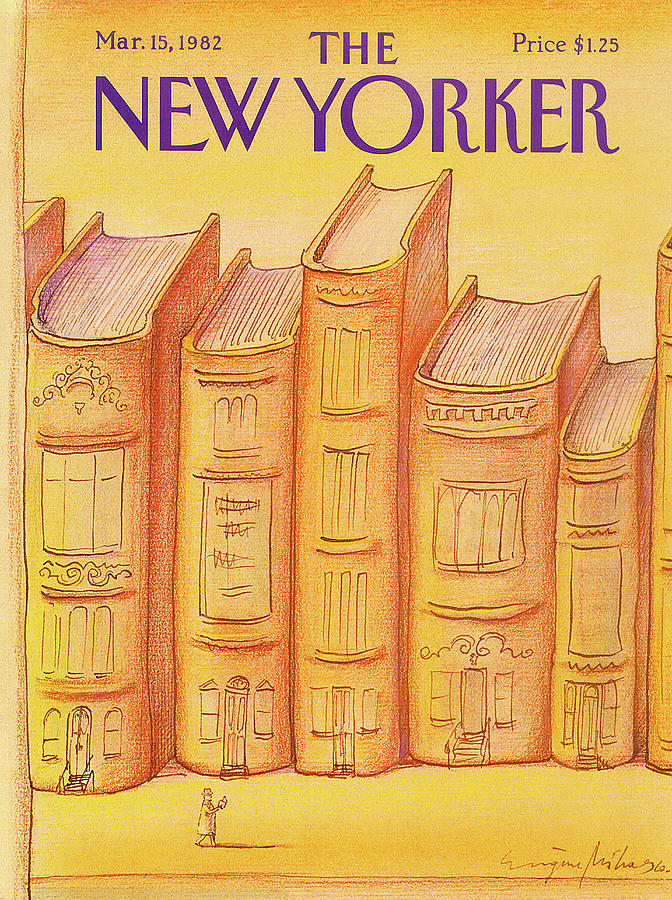
Eugene Mihaesco

Percival Everett, Cutting Lisa

This somehow pairs with The Lost Daughter in the author seeking out, nay, embracing unpleasantness to spectacular effect. This was on my shortlist of reading experiences for the year, a strikingly original work that forthrightly countenanced negativity while resisting the impulse to pin everything on a villain. Every character has corners; every situation is layered. My first Everett, Cutting Lisa has a chewiness I associate with the finest output of the 80s, and I can’t wait to read more by him.

William Maxwell, So Long, See You Tomorrow

Katherine Anne Porter, Noon Wine

So Long, See You Tomorrow is one of those “writerly” novellas that hit me entirely the wrong way. Maxwell was a smalltown escapee who later found tenure at The New Yorker and thereby invested himself of the power to imbue these “simple midwestern people” (yuck) with meaning. If ever a narrative should have dispensed with the pretentious framing device of the events filtered through the memories of a child, it’s this one. I guess I can see why people admire this book, but for me it was just a succession of false notes. [Ed. – Ooh, fighting words!] Noon Wine reveals the falsity of Maxwell’s methods; another short novel — Porter, it seems, detested the term novella — but in this case authentically empathetic towards its figures, in contrast to Maxwell’s self-serving projections/lies. Noon Wine has the guts to put real people on the page — and real stakes.

William Lindsay Gresham, Nightmare Alley

One of the much-mentioned texts of 2021, due to the Guillermo del Toro adaptation that landed late in the year. Later on, I found it significant that Gresham is not celebrated for any other work. This book is certainly adept and not devoid of virtues, but I found it labored and tiresome, every point underlined in every paragraph, nothing allowed to breathe, as a real novelist would do it. I resorted to a new strategy: just grind through 10 pages per day until done, just to get it behind me (while starting a different novel, I seldom double dip). I should go back and finish Geek Love as an antidote (not that Dunn let things breathe, either).

Louise Erdrich, The Sentence

Simply put, I cannot think of another novel as generous-minded as this.

Other books I enjoyed:

Powers of Attorney by Louis Auchincloss

Asylum by Patrick McGrath

Mrs. Caliban by Rachel Ingalls

Trustee from the Toolroom by Nevil Shute

The Mosquito Coast by Paul Theroux

Figures in a Landscape by Barry England

The Small Back Room by Nigel Balchin

The Blessing by Nancy Mitford

A Favourite of the Gods by Sybille Bedford

Excellent Women by Barbara Pym

After Leaving Mr. Mackenzie by Jean Rhys

Voyage in the Dark by Jean Rhys

The Easter Parade by Richard Yates

Two Serious Ladies by Jane Bowles

The Country Girls by Edna O’Brien

The Last Policeman by Ben H. Winters

Rose Under Glass by Elizabeth Berridge

The Quiet American by Graham Greene

On the Beach by Nevil Shute

An Unsuitable Job for a Woman by P.D. James

The Power of the Dog by Thomas Savage

Black Wings Has My Angel by Elliott Chaze

Amigo, Amigo by Francis Clifford

Something in Disguise by Elizabeth Jane Howard

Five Decembers by James Kestrel

A Disorder Peculiar to the Country by Ken Kalfus

What I Read, November 2020

November: as long as three regular months! Did the mood swings of the US election and the relative calm of Thanksgiving happen in one four-week stretch? The rest of the world might have been busy, but at my writing table all was at a standstill. I felt blocked, uninspired, guilty, anxious, ashamed. A late-month breakthrough—apparently this manuscript wants to be both about teaching the Holocaust and teaching writing?—made me feel a little better; here’s to more of that in December. On the reading front, though, things hummed along.

Philip Kerr, Metropolis (2019)

The last Bernie Guenther book, a prequel, is set at the end of the Weimar Republic when Bernie is first promoted to Detective. He solves a crime that gives Thea von Harbou—Fritz Lang’s sometime wife and collaborator—the plot for M. I’ll miss Bernie; he was all right.

Géraldine Schwarz, Those Who Forget: My Family’s Story in Nazi Europe—A Memoir, a History, a Warning (2017) Trans. Laura Marris (2020)

Journalist Schwarz grew up in France to a French mother and a German father. Summers were spent in Mannheim; the schoolyear in Paris. In the first part of this sort-of-memoir, she researches what her grandparents did during the war. She starts on her father’s side. In the mid 1930s, Karl Schwarz took over a petroleum company, which gave him not only his livelihood but protected his life. (He avoided being conscripted because his products were deemed essential to the war effort.) Karl’s wife Lydia, though no fanatical Nazi, was impressed by the Führer’s dedication and would later regularly mourn his absence. After the war, a letter arrived from an American lawyer representing Julius Löbmann, whose brother, Siegmund, had been forced to sell his company to Karl at a cut-rate price. Siegmund and his immediate family were later deported to Gurs, a camp in Vichy France, then later to the transit camp at Drancy, and from there, on April 15, 1944, to Auschwitz, where they were gassed on arrival.

Löbmann’s desire for reparation incensed Karl, but the fallout of the affair wasn’t just economic. Karl’s already stormy relationship with his son, Volker, Schwarz’s father, disintegrated, as Volker joined the student movements determined to call their elders to account. Seeking a “European” identity, Volker traveled to France, where he met Schwarz’s mother. Josiane grew up next to Drancy, site of the notorious transit camp from which so many, including the Löbmanns, were deported to the killing sites of the East, a fact that interested no one in her postwar childhood. As Schwarz investigates her maternal family she learns about France’s denial of its complicity in German crimes, which persisted at least into the 1980s and 90s, but really, she maintains, to this day. Schwarz argues Germany’s “memory work” has been superior to France’s: hardly contentious.

Inspired by the example of her family, Schwarz wants to understand those who after the war became known in Germany as die Mitläufer, people who went along with the regime. A worthy topic, to be sure, but instead of, for example, exploring the effort the Nazi regime put into generating such connivance and considering how that effort worked on her ancestors, Schwarz leaves us with op-ed caliber banalities:

By our opportunism, by our conformity to an all-powerful capitalism, which places money and consumption over education, intelligence, and culture, we are in danger of losing the democracy, peace, and freedom that so many of our predecessors have fought to preserve.

There’s plenty more armchair pontificating in the book—“We Europeans have come a long way”; “the most dangerous monster is a not a megalomaniacal and violent leader, but us, the people who make him possible, who give him the power to lead”—leading to a risible ending in which Schwarz makes a tour of European countries, dispatching the failure of memory work in Italy, Hungary, Britain, and Austria in a couple of pages each, often invoking as her evidence a friend’s statement or an experience she once had on vacation.

I learned a few things from this book, of course. I didn’t know, for example, that at the end of the war the French brought several hundred German scientists home with them: their work laid the foundation for the still-flourishing French aviation and weapons industries. Nor, still more fascinatingly, did I know about the prosecutor Fritz Bauer, a Jew who spent the war in exile in Denmark and Sweden after having his legal career destroyed by the Nazis, returned to Germany and, as the general prosecutor of Hesse, doggedly pursued cases against many mid-level perpetrators, leading to the Auschwitz trials in the 1960s. (I want to read a book about him.) But such moments are rare. Most of the stuff in Those Who Forget is introductory and uninspiring. Schwarz has neither the analytic chops of a historian or the panache of an essayist. Her title, referring to those who went along with atrocity, unwittingly describes her readers, who, if they are anything like me at least, will quickly forget this book and its nostrums.

Fleur Jaeggy, These Possible Lives (2015) Trans. Minna Zallman Procter (2017)

Everyone loves Jaeggy, but I’m not sure I get the fuss. I was led to this little book by Brian Dillon, but I think I prefer him on Jaeggy to Jaeggy herself. Three short essays—on De Quincy, Keats, and the French symbolist writer Marcel Schwob—emphasize unusual biographical details. Quirky and poetic, I guess, but not really my scene. I’ve forgotten almost everything about it.

Tana French, The Searcher (2020)

Still the champ.

Charles Dickens, Our Mutual Friend (1865)

What can I say, it’s a classic for a reason. I read it mostly with pleasure and always with interest, but not avidly or joyfully. Dickens is, in the end, not my guy. I’d rank Our Mutual Friend below Great Expectations and Bleak House in my own list (though I’ve only read 5). The story’s ambitious, maybe too ambitious, seems to have run away at the end, relying on hasty/convenient thread-tying. On further reflection, though, I feel something about the story does not want to—maybe even should not—end, because it’s a book about revenants and ghosts, about corpses that don’t stay hidden, about material (junk, trash, ordure, tidal gunk, or whatever the hell “dust” is supposed to be) that never comes to the end of its life, being neither waste nor useful, or, rather, both.

For this reason, Our Mutual Friend is best when describing in-between states: a famous example, which I’d read about years ago in an essay by the philosopher Gilles Deleuze and was delighted to finally encounter in the flesh, as it were, concerns the resuscitation of man no one likes, a river scavenger and a meddler, who has fallen overboard into the Thames in an accident. (Book III, Chapter 3.) A group of bystanders work diligently to restore the rogue to life: their attention is fixated on the unconscious man’s body, so much so that in addition to their CPR it’s as if the men were willing him to life. (The man’s daughter watches “with terrified interest”—the phrase describes the onlookers too.) When the man splutters to, when the “spark of life” rekindles, they are relieved, even briefly exultant. But then they return to disparaging him, and drift away. A brilliant, vivid scene–and a useful comment on the title. Just how much mutuality is there in this book?

I spoke above of in-between states. This concerns the novel’s form as much as its content. I liked best those bits where the novel threatens to become full-on Gothic. (Wilkie Collins’s influence? Or was their friendship over by then?) Any scene with Bradley Headstone (that name!) counts—that guy could be out of a novel from Hamsun or Dostoyevsky—but especially the one where he tries to kill Lightwood. Yowza!

Assorted other thoughts:

Appreciate the attempt to rehabilitate the Jews, Charles, but Riah did not do it for me. (Tip: next time, avoid having your Jewish character regularly cite the New Testament.)

Sloppy, on the other hand! Sometimes it is easier to thrash the mangle than to say what’s in your heart. What a dear.

Boffin, you had me worried there!

The Lammles, oof hard core, reminded me of bits of Collins’s No Name.

Pa and Bella—cute, but also creepy.

Mr. Venus, terrific, that first scene with him and Wegg is 10/10 Dickens. Must be a connection, though not sure how, between his taxidermy and Jenny Wren’s dolls. (Maybe also Sloppy’s newspaper-reading?) Model making, alternative modes of reproducing the world, etc.

Not the first person to say it, sorry for the banality, but sucks that Dickens didn’t write better women characters. Has anyone tried to argue against this? I’d like to see how—I guess Mrs. Lammle is the most interesting here—because this inability really stops me from liking him more.

Thanks to Alok Ranjan for prompting me to read this. Totally don’t regret it.

Inge Deutschkron, Outcast: A Jewish Girl in Wartime Berlin (1978) Trans. Jean Steinberg (1989)

Very good.

Ian Rankin, A Song for the Dark Times (2020)

Not good. Read the print version and wondered whether I’d enjoyed the previous Rebus novels more because of the audiobook narrator than because of the text. The narrator brings out a curt elegance in the writing that seems inert or clumsy on the page. Feels like a series at risk of losing its way.

Kim Stanley Robinson, The Ministry for the Future (2020)

At the beginning of Robinson latest novel, a terrible heatwave blankets India. Wet bulb temperatures reach 35 C; at this point, the body can no longer regulate its temperature by sweating and basically boils. Twenty million people die. Frank May, a young American aid worker, is almost one of them. Like everyone else in town, he seeks refuge in a nearby lake; many are burned alive even in the water, but rescue workers find Frank still alive, but barely conscious. He returns to health, but never returns to America, partly because he’s furious at his home country’s response to climate change, and partly because he gets panic attacks anywhere it’s warm. Eventually he settles in Zürich, which brings him into contact with the novel’s real hero, Mary Murphy, the Irish-born head of a UN subsidiary organization developed at the Paris climate talks, The Ministry for the Future.

Mary is a fitting hero for Robinson’s novel—capable, no-nonsense, politically savvy, but without extraordinary powers, charisma, or superhuman intelligence. She is instead a damn good bureaucrat. She knows experts need to be listened to without being allowed to run the show. Someone needs to intercede between them and politicians and power-brokers, especially the most powerful people on the planet, the unelected heads of the world’s central banks. Mary also knows that big problems are solved by plugging away at lots of small solutions. And the problem her ministry has been tasked with is the biggest one of all: lowering the amount of carbon dioxide in the atmosphere.

Starting from basically our own present (I think the first events are in 2025, though I’m not sure—it’s a big novel, I might well have missed something) and extending for thirty years or so, The Ministry for the Future imagines how this seemingly unimaginable task could be accomplished. The solution is to think 100 years out—the whole seven generations thing—but such thinking must be incentivized, both by carrot and stick. Mary presides over a team with various departments (legal, computing/AI, agriculture, etc.), all of which are needed to solve the problem, even though economics is first among equals: Mary’s world-saving legacy is to finally convince those central bankers to create a new currency, the Carboni, that has its eye on the long term (it pays out in hundred-year installments) and can only be earned by carbon sequestration, whether by leaving fossil fuels on the ground (as Saudi Arabia is eventually forced to do), or by offsetting emissions (planting trees, rethinking agriculture, etc.). Carbon quantitative easing, she calls it.

The bankers only get there, though, after many other changes have been made. India, furious at the mass death brought on by the heatwave, organizes a “double Pinatubo”—it fires enough sulfur dioxide into the air to equal two times the amount released by the volcanic explosion of Mount Pinatubo in the early 1990s, which lowered the world’s temperature by about a degree for a couple of years. India leaves the Paris Accords to do so, and begins detaching from the rest of the world, tired of providing its service workers. Various radical political movements—including the decisive rejection of the BJP, who presided over the wet bulb fiasco—and progressive social movements, especially in the realms of agriculture, make India a world leader.

These changes are spurred by terrorist acts (some of which may be orchestrated or even perpetrated by a rogue element within the Ministry of the Future; Mary doesn’t want to know, though she silently acknowledges that terrorism will be central to changing hearts and minds). The Children of Kali, for example, inject bioengineered parasites into the world’s beef supply and shoot down most of its commercial air traffic in a single day through massive coordinated drone attacks, which kill the meat and airline industries, respectively.

There’s also geoengineering (even though the scientists in the book scoff at it), notably, pumping out water from underneath the great Antarctic glaciers and ice shelves to slow their movement. It costs a fortune, but when looked at in terms of the survival of civilization, it’s cheap (and it works). The glaciologists and Antarctica heads want to help, but mostly they are just psyched that someone is paying them to work and play in the part of the world they’ve become addicted to. (Robinson plays a double game here—at once admiring scientists’ cynicism about their bureaucratic masters and critiquing their claims to disinterestedness.)

While all this is going on, the novel’s more personal plot grinds on, too. Frank and Mary meet up in Zürich, under circumstances I won’t get into, and a lifelong pas de deux ensues. Robinson doesn’t stint their relationship—it’s not romantic, it’s more interesting than that—but in the end he cares about other stuff more. Like setting. Zürich in particular and Switzerland in general serves as more than its typical role as an anonymous backdrop for espionage or banking. One way to read The Ministry for the Future is as a hymn to this little country’s biggest city, which might seem ridiculous—who cares about Zürich, for God’s sake—but it’s precisely Zürich’s dull practicality, its unshowy livable-ness, that the novel values. Robinson clearly knows Switzerland. He includes some exciting set pieces in the mountains (one of them invoking Frankenstein, natch), as well as lovely evocations of lake swimming and Zürich’s Fastnacht (carnival), but what he really loves is the Swiss insistence that when the world is secure, Switzerland is secure. If we help others, we help ourselves. That’s the kind of thinking we all need.

I could go on, but my basic point is: I loved this book. It’s a page-turner about extremely undramatic but highly consequential decisions. It’s also only sort of a novel: yes, it has central characters, but it also considers other beings, only some of which are human (short chapters are narrated from the POV of caribou, the sun, carbon atoms: not especially convincing, but the idea is good). It’s really an essay-novel hybrid, desperate to cram into its pages as many possible solutions to a lower carbon world as possible, like the 2000-Watt club (if you divided all the people in the world by the amount of energy we consume, you’d get 2000 watts per person per year—or 48 kilowatt-hours per day—which the club’s members demonstrate is really quite achievable and doesn’t require that many changes, at least in many parts of the world). Reducing inequality, learning to share, valuing security as a good that arises when everyone has enough—these goals will be needed to help us survive. Rewilding, the 50% project (grouping people into half the world’s territory), worker cooperatives based on the Mondragón model pioneered by the Basques, new technologies, new legal realities (in which nonhumans have rights), new economies—all are ways in which we can work to solving the climate crisis.

What’s amazing is that Robinson shows how it could happen. He is optimistic but not naïve. He heaps special scorn on economists, which I found satisfying, and points out that it’s when the shit hits the fan—like when water stops coming out of the taps—that’s when you need society. Neoliberalism has always been full of shit. The Ministry for the Future is at times an alarming book—I won’t soon forget that grim opening scene—but more often it’s a rousing one. It offers what we collectively need: “An earthquake in the head.” Since reading it I’ve felt more hopeful than I have in ages, and I’d love for it to get many, many readers.

Lissa Evans, V for Victory (2020)

The trilogy that started with Crooked Heart and continued through the marvelous Old Baggage comes to a satisfying close. Noel Sedgewick, the character who connects the books, now 15, struggles with his identity. To whom does he belong—the parents he never knew, or the women who raised him, in such different but mutually compatible ways? Evans takes tropes from WWII British literature—the female warden both hardened but given purpose by war—and ruffles them a little, making them fresh—the warden’s clueless socialite sister, who has written a surprise bestseller based on lurid fantasy, becomes her defender. Ne’er-do-wells prove at the last minute to have surprising self-knowledge or unexpected reasons for their actions. And as always Evans is drawn to the ridiculous aspects of life: a reporter, suddenly pressganged into running the tombola at a church fair with strict instructions to keep back some of the best prizes to the end lest people stop buying tickets, thinks of “the article he could squeeze from this (‘Fraud Allegation Shatters Methodist Merriment’).” The novel’s final vision, of a London just after VE day, when, for a brief moment at least, no one is waiting for anything, neither falling bombs nor barked orders, is beautiful in its swooping energy: the moment feels fully earned. Probably Evans has set these characters aside, but they’re so lovable, we can always hope for more. And if not, dayeinu, it would be enough.

Mark Roseman, A Past in Hiding: Memory and Survival in Nazi Germany (2000)

From 1989 – 1996, Mark Roseman spent much of his time in an “intimate, respectful, wary, guilty clinch” with Marianne Ellenbogen née Strauss, who, as a young woman in 1943, had slipped out of her family’s home as it was being searched by the Gestapo. Her parents, her younger brother, her uncle and his wife and her mother—among the last Jews left in the city of Essen at that time—were deported, first to Theresienstadt and later to Auschwitz. Marianne, the only person in her immediate family to survive, spent the rest of the war passing as Aryan, dodging both officials who would have seen through her flimsy false ID and the increasingly devastating Allied bombing raids. She was aided in this feat by members of a little-known organization called the Bund, whose members resisted what the Nazis had made of their beloved Germany.

I recently wrote about Lives Reclaimed, Roseman’s most recent book, which complements this, his first, by telling the story of the Bund. (Tl; dnr: brilliant.) The books overlap, of course, but I was surprised how little Roseman repeats himself. A Past in Hiding (note the subtle difference between this title and the more commonplace A Life in Hiding) provides background on the Bund and introduces some of its main players, but it’s only incidentally about that. Indeed, inasmuch as Marianne was convinced to work with Roseman only because she wanted the world to know about the Bund’s achievements, which extended beyond saving her life, then it’s really Lives Reclaimed that fulfills her desire.

Here Roseman concentrates on Marianne. And why not? Her story is amazing, and she herself is extraordinary. He freely admits that Marianne would have hated the result. She wouldn’t have wanted him to spend the years after her death in December 1996 interviewing with surviving friends, acquaintances, relatives, and lovers, and combing through her exhaustive archive of written documents. But she might have been surprised—not in a good way, maybe, but in an interested way, doubtless—by Roseman’s conclusion. Her own story, as told to Roseman in lengthy interviews, doesn’t quite align with the story told by these external sources, not because Marianne lied or even because memory is fallible, but because the life we life and the life we remember aren’t the same.

Specifically, in Marianne’s case, the guilt she felt about surviving distorted her memory in particular ways: she accentuated the suffering of her loved ones (claiming that her father was imprisoned in a concentration camp for six weeks after Kristallnacht when it was three, or that the love of her life, deported a year before she went into hiding, was blinded in a medical experiment rather than in an accident); she minimized her own suffering; and she dramatized the most traumatic moments of her life (claiming she accompanied her boyfriend to the station the day he was deported when in fact she said goodbye to him the evening before, or telling Roseman that she learned on her birthday, via a BBC broadcast, that her parents’ transport has been gassed, when in fact that terrible knowledge came to her some weeks later).

(How the fate of that particular transport came to be broadcast on the BBC—and how by amazing coincidence Marianne happened to be clandestinely listening to it—is a story in itself, having to do with the Czechoslovakian resistance within Auschwitz-Birkenau and the Nazis’ creation of the so-called “family camp” at Birkenau, where for six months in late 1943/early 44 families who had been at Theresienstadt were allowed to stay together, with their hair and clothes, and given better rations. The Nazis were worried that the Danish Red Cross, who had “inspected” Theresienstadt, would do the same at Auschwitz, and wanted these prisoners in case a “show camp” was going to be necessary: in the end it was not, and almost all of the prisoners in the family camp were gassed.)

In finding discrepancies in Marianne’s story, Roseman isn’t arraigning her or asking us to doubt her. He’s using painstaking research to prove that the stories we tell ourselves in order to live aren’t quite the stories we lived. Instead, we interpret the past through concepts developed only in hindsight. For example, Roseman thought of Marianne as a Jewish victim of the Holocaust, a position she herself espoused late in life, but at the time she thought of herself as a German victim of the war. He is aided in this revelation by some remarkable documents: a diary Marianne kept while on the run in 1944, and the correspondence between Marianne and her boyfriend from the time her was deported in April 1942 (to a camp-ghetto in Lublin province called Izbica) until his ominous silence that fall. Reading these documents Roseman notes differences between what Marianne said at the time and what she said later—even as he acknowledges that the primary documents themselves must be understood not as a record of unmediated truth but as traces of a fluid experience, in which Marianne was trying out ideas, changing her mindset, and struggling with the identity crisis brought on not only by being made into a Jew by the Nazis (true for so many victims) but in juggling different identities while on the run.

A Past in Hiding is thus both theoretical and particular. It both analyzes what it means to interpret the past and offers a portrait of an extraordinary person—capable, clever, charismatic—who was both amazingly fortunate and terribly unhappy. Highly recommended.

Clare Chambers, Small Pleasures (2020)

Satisfying novel that makes much of a preposterous scenario. In 1950s suburban England, The North Kent Echo receives a letter to the editor replying to an article about parthenogenesis. The writer admits she knows nothing about science, but she does know that her daughter was born without the involvement of a man. On a lark, the paper sends, Jean Swinney, its only female journalist, to interview the woman, Gretchen Tilbury. No one expects anything of the Virgin Birth lady, but Jean is captivated by Gretchen, amazed at the daughter (Margaret, ten, looks exactly like her mother), and is unable to find anything in her initial reporting to dispute the outlandish claim. Before long scientists get involved and Jean is on to a big story. But the novel veers into more interesting territory, becoming the tale of how Jean, lonely and tired of being saddled with her claustrophobic mother, is drawn into the Tilburys’ orbit, especially by kind Howard, the husband who came along when Gretchen was already pregnant. In this regard, Small Pleasures is a bit like Brookner’s Look at Me—retiring young woman drawn out of herself by another couple, to the dismay of everyone else in her life—except everyone is much nicer. You might say, well, then that’s no Brookner novel at all, to which I can only say, fair enough. Chambers’s is a more muted work, and not as brilliant. But I found it absolutely engaging, and was surprised at the directions it took, especially at the end. (Devastating!) A thoughtful novel about the ambivalent consequences of taking your pleasures, however small, wherever you can find them. Nina Stibbe put it on her best of 2020 list; if you won’t take my word for it, take hers.

Tessa Hadley, The Past (2016)

Reading Hadley’s backlist—only two more to go now—has been one of the year’s pleasures. Here, three sisters and a brother spend one last holiday at their grandparents’ former home, an increasingly dilapidated place in the English countryside. There’s some pretty serious drama—Hadley has a Gothic side she mostly but happily never quite fully keeps under wraps—but the manner of telling makes big events seem ordinary—which only amplifies the weight of the revelations on offer. (I was led to think about the difference between her mode of approach and, say, the early Ian McEwan; he’s so much more histrionic.) What is it like, Hadley asks, to spend a life with someone? And what is it like to spend one without the person we wanted? (She’s good at making us experience the passing of time.) As usual, Hadley is a master of roving omniscience, teasing us with free indirect discourse, so that we wonder how much of what we learn about the characters they themselves know. Consider this description of a nine-year-old discovering an abandoned cottage:

Ivy wasn’t brave, she was a coward when it came to sports or party games, the kind where you ran in a team and had to burst a balloon by sitting on it. But she also had a greedy curiosity which was like a hunger; she wanted to get clear, all by herself and without the shame of other people knowing she was doing it, the truth of what could happen.

So much psychological acuity in such a short space! And so much ambivalence. Are we to admire Ivy? That “greedy curiosity” feels so double-edged. “The truth of what could happen”—not just the world as it is, but the world as it might, secretly, desperately, be.

In a passage that seems more heartfelt, I appreciated this description of a couple’s reading habits:

Sophy and Graham devoured their books: reading was a freedom torn out of the day’s regulated fabric. Without ever having spoken of it, each knew that the other approved their habit of having the face of their alarm clock, set for seven, turned away from them, so that they couldn’t know how much time passed while they sat up awake and turning pages, couldn’t know how rash they were or how much they would pay for it next day.

But don’t be fooled. Hadley is no nice chronicler of middle-class moeurs (though, yeah, that too). Even the most bourgeois habit of all, reading, is offered in terms of rashness. Everyone pays for everything.

Daniel Mendelsohn, Three Rings: A Tale of Exile, Narrative, and Fate (2020)

When I think about the book I’m trying to write I keep coming back to Mendelsohn, not because he wrote maybe the best book about uncovering a family’s Holocaust history (I have no such history) but because he is so good at structuring nonfiction narratives. Indeed, structure is the subject matter of this little book, originally given as lectures at his alma mater, the University of Virginia. Mendelsohn begins with the acedia that overcame him after finishing The Lost (the Holocaust book) and his subsequent struggle to improve the manuscript of his next book, An Odyssey (about the time when his father, near the end of his life, enrolled in Mendelsohn’s Homer class), beyond his editor’s initial verdict: interesting in parts yet fundamentally dull. The solution, he eventually realized, lay in the source material itself, specifically in Homer’s use of “ring structure.”

The classic example of nested narration of this sort is the moment when Odysseus, returned to Ithaca but disguised, is found out by Eurycleia, his childhood nursemaid, who, in the process of washing the feet of a man she believes to be a traveling beggar, recognizes the hero because of a distinctive scar. Homer flashes back in time to tell us the story of how Odysseus got the scar (in a boar hunt), first explaining how he had been on the hunt in the first place, necessitating yet another digression about the man hosting the hunt, Odysseus’s grandfather, who had been enjoined by this very same Eurycleia to name the child; thus, after beginning with a seemingly insignificant moment Homer offers the in fact consequential history of the hero’s very identity, before looping back to the present moment, the scene of the foot washing. Recognition, Homer teaches, implies a toggling between past and present. (In this sense, his most skillful disciple was Proust.) Narratives similarly shuttle between the essential and the inessential, eventually compromising, even undoing that distinction: “In ring composition, the narrative appears the meander away into a digression… although the digression, the ostensible straying, turns out in the end to be a circle, since the narration will return to the precise point in the action from which it had strayed.”

The reason I called this scene the classic instance of anagnorisis—a moment of revelatory (self) recognition—is not because Homer is the “founder of Western literature” but because it was presented as such in a book of literary criticism written by a German Jewish refugee in Istanbul during WWII, famously without the benefit of the comprehensive library he had been used to having at his disposal. The man was Erich Auerbach; the book was Mimesis: The Representation of Reality in Western Literature. Its most famous chapter is the first, “Odysseus’s Scar,” in which Auerbach juxtaposes the Greek mode of telling to the Hebrew: the former offers transparency and clarity (the ring structure allows Homer to give us the backstory of the scar); the latter offers obscurity and uncertainty, privileging unknown—perhaps unknowable—psychological motivation. (The example Auerbach chooses is the Akedah—G-d’s (batshit-insane) demand that Abraham sacrifice his beloved son, Isaac.) The difference, Mendelsohn says, summarizing Auerbach, is between a story that leaves nothing out and a story that leaves almost everything out. And the philosophical debate underpinning this distinction is whether reality is knowable. And the stakes of that question concern nothing less than interpretation itself. What is it for? Are we constrained to its endless approximations?

In thinking about the oscillation between these two beliefs—reality is transparent; reality is obscure: events can be represented; events will always exceed being represented—Mendelsohn is led to think about an at-one-time influential 17th-century text, an early novel by a French archbishop named François Fénelon. The Adventures of Telemachus, a sequel to the Odyssey, made its author famous, but the book’s too-overt criticism of Louis XIV led its author to be banished to northern France. The book’s influence lived on, though, delighting readers across Europe and, later, America, including Thomas Jefferson, who would found the University of Virginia where Mendelsohn would centuries later begin his study of the classics.

Three Rings is a book about “that deep connectedness among things which, for the optimist at least, is detectable in history as well as literature.” Thus, Mendelsohn moves from discussing Proust’s work—his use of ring composition to create oppositions (bourgeois vs aristocrat, hetero vs. homo, Swann vs. Guermantes) that eventually undo themselves—to considering his life, specifically the revelation that the model for the character of Saint Loup in Proust’s epic work was a diplomat named Bertrand, posted, to Proust’s unrequited frustration, to Constantinople, whose ancestor happened to be none other than François Fénelon, the former archbishop of Combrai—a name Proust adapted as the town where his alter-ego spent his formative childhood summers.

How are we to understand such connections? Mendelsohn ends by reflecting on the work of W. G. Sebald, that great writer of inconclusive digressions. Mendelsohn considers some of Sebald’s monomaniacal solitaries—not least the figure of Sebald himself who, in The Rings of Saturn, wanders through abandoned landscapes picking up intimations of former grandeur—as in his encounter with a man obsessed by making a model of the Temple in Jerusalem, a lost, enigmatic structure: the more the model maker learns of it the less he understands; the same is true of Sebald in relation to the model maker. Mendelsohn is reminded of his own childhood obsession with model making, one he abandoned but later transformed into his writing practice, through which he has learned to make the most of insoluble dilemmas. Pondering Sebald’s melancholy digressions—in which every possible link seems to fall to pieces, and destruction is the fate of all creativity—Mendelsohn turns that failure into success, as in his final section where he considers the most influential book in the 19th-century Ottoman Empire, a translation of Fénelon’s sequel to the Odyssey by Yûsuf Kâmil Pasha, the Empire’s Grand Vizier, one of many examples in this short book of how “Western” literature would never have existed had it not been “returned” from the East. In the end, perhaps the greatest digression of all is that the “foundational” texts some like to laud as essential to the “western mind” required saving by its too-often maligned “other.” Made rich by the success of his translation, Kâmil Pasha gave part of his wealth to the university in Istanbul—in this way, imitating however unknowingly Jefferson’s gesture—a center of learning that decades later, in the middle of the 20th century, would welcome scholars fleeing yet another auto-da-fe in the heart of so-called civilization, among them a German Jewish literary scholar named Erich Auerbach.

Three Rings is brilliant essayistic narrative, which satisfies and surprises in its series of historical connections; it is also brilliant interpretation, as it shows every story of destruction to be one of creation, every moment of obscurity one of clarity, every Jewish moment to be Greek—provided, of course, we realize that Greek ways of storytelling always also need Jewish ways of storytelling. It is only through interpretation that we can imagine a literature that wouldn’t require it.

Three Rings didn’t solve my problem of how to structure my book, but it did remind me—exhilaratingly, dismayingly, vertiginously—of the accomplishment I can only hope to imitate.

Alison Lurie, Foreign Affairs (1984)

Read this just a few days before learning of Lurie’s death. Judging from Twitter reaction, her work is loved by many, this book especially. Must say, alas, I was not seduced. You know how for a long time everything associated with the 70s was reviled but is now cool as hell? Maybe we’ll get there for the 80s eventually but now it just feels dated. In her story about two American academics on sabbatical in London—they work at a not even thinly disguised version of Cornell, where Lurie taught for a long time; come to think of it, someone once pointed her out to me in Olin library, though I think she was emerita even then—Lurie quotes Eliot and riffs on Austen, not to mention children’s literature and John Gay (the subject of their respective projects) but I’m not sure why. What is the relation of this book to the English literary tradition?

One protagonist starts by hating England, swings to reveling in it (as he enters into a dalliance with a well-known actor), and finishes with a clear-eyed recognition that he doesn’t belong there. The other is Anglophilic to the extreme, convinced of the place’s superiority, but learns a chastening lesson when she falls in love with a countryman, a loud American businessman. Is Lurie arguing a version of Wilde’s line about America and England having everything in common but the language? Telling us that people belong where they come from? Or that you can only know what home means when you’ve left it? None of these suggestions are inspiring, but I’m out of ideas. Lurie lovers, help!

I admired Lurie’s willingness to make her female lead plain, crotchety, supercilious, and matter-of-fact in her sexual desires. She gets a comeuppance that doesn’t require her to change herself. (The story of the male lead is a lot less interesting.) But it’s not an especially kind book, and its meanness isn’t used to any particular purpose (it feels generalized and diffuse, not pointed or critical). And the portrayal of the American businessman—a lumpen aw shucks gee willikers giant from Oklahoma, much the nicest person in the book—is grating. Maybe from the novel’s preferred mid-Atlantic viewpoint, nothing could be more risible than being from Tulsa, but when it’s, say, four hours’ drive from where you live it’s just a town, no better or worse than anywhere else. I’m willing to give Lurie another chance, but she’s on a tight leash.

William Maxwell, They Came Like Swallows (1937)

Despite an intense Maxwell phase in my mid-twenties—I was as weird and twee then as now—I somehow missed this one. Maybe my unconscious knew to wait, certain it would resonate so much more strongly during a pandemic than in the glib 90s. They Came Like Swallows is set in the fall of 1918. The armistice might be signed in Europe, but in small-town Illinois what matters is the influenza outbreak, which in a few short weeks will utterly transform the Morrison family. Just as devastating illness plays with our sense of time, the novella’s structure shapes our understanding of events. Each of its three sections focuses on a different character: eight-year-old Bunny, sensitive, in love with his mother and in dread, in different ways, of his father and older brother; the brother, Robert, who suddenly appears to us in a quite different light, diffident at best to Bunny, yes, (I mean, the kid’s five years younger, how can you take him seriously?), but sympathetic for his drive to ignore his disability and his being so prey to feelings of responsibility he cannot be expected to take on; their father, James Morrison, distant, yes, and when uncertain inclined to turn to conventionality instead of kindness, but baffled and buffeted by terrible events. I thought it a missed opportunity that Maxwell never foregrounded any of the female characters—they are many: Elizabeth Morrison, the woman these men revolve around, but also her sisters and sister-in-law; and they are much the most interesting figures in the book—but then I realized it had to be that way. The book is about its absent center, about the uses men put women to, about their consequential bafflement toward women. That it makes its men as sympathetic as it does, and the women as vital as they are is the book’s art. The title, from Yeats’s “Coole Park, 1929,” is perfect:

They came like swallows and like swallows went,
And yet a woman’s powerful character
Could keep a swallow to its first intent;
And half a dozen in formation there,
That seemed to whirl upon a compass-point,
Found certainty upon the dreaming air

There’s more dreaming than certainty in the book—impressive how Maxwell doesn’t just depict illness but, more ambitiously, suffuses every page with the estranging, eye-opening quality illness sometimes offers—and we’re never allowed to forget that the woman’s powerful character, as Yeats has it, is a function of male fantasy. But both poem and novel are elegies, fascinated with the paradoxes of loss, how survivors have the power to recall the dead, but only because the dead have given them the power of recall.

Amazing how wise and good this is for a young man’s book (Maxwell was only 29 when it was published). Obviously time to read his novels again, and to tackle his stories.

Big month! More hits than misses! Death of American democracy staved off for at least two years! Dickens, Robinson, Hadley, Maxwell—all winners. Deutschkron, Roseman, Mendelsohn—inspiring! I hope you found even half as much to enjoy in your reading month. Leave a comment with your favourite.