Scott Walters’s Year in Reading, 2024

Pleased to once again present reading reviews from some of my favourite readers. Today’s installment, his fourth, is by Scott Walters. Scott launched the much-lamented blog seraillon in 2010, and expects to return to it one of these days. He largely follows Primo Levi’s model of “occasional and erratic reading, reading out of curiosity, impulse or vice, and not by profession.” He lives with his partner in San Francisco.

Barring surprises, here ends the 2024 edition of the EMJ Year in Reading series: except, I hope, for my own. (Gotta write that…) Thanks to everyone who contributed–and all who read these engaging lists.

Balthus, The Passage of Commerce Saint-Andre (1954)

Thank you, Dorian, for inviting me again to participate in The Year in Reading. [Ed. – Pleasure all mine, Scott!] Mine meandered mostly pleasurably through some 60 books. I abandoned others, was surprised to have read fewer Italian works than in previous years, and experienced a number of unpremeditated pairings, reading two works each by a dozen authors plus more thematic linkages. I’ll get straight to 2024’s highlights:

The Woman in White, Wilkie Collins (1860)

I nearly lost my head when I interrupted my spouse’s reading of the final pages of The Woman in White, but her abrupt “Ssh!” made total sense as I plunged into the book myself the next day. Abstracted, the “detective-ish” book’s nutty plot—starting with its mysterious woman in white and moving to family secrets, confused identities, unlikely coincidences, shady interlopers, and convoluted inheritances—would hardly seem encouraging. But over 650 pages Collins never lets drop any of the knots of intrigue he has in the air, a master class in plotting with the ending so neatly and satisfyingly resolving the novel’s myriad conflicts that the book should have come tied up with a pretty bow. I found equally impressive his crafting of splendid characters, including the flamboyantly louche and unforgettable Count Fosco and Marian Holcombe, the novel’s moral center, surely one of the great characters in English literature. [Ed. – Now read No Name!]

[Paired with Collins’s The Moonstone].

The Purple Cloud, M. P. Shiel (1901)

If The Woman in White stands at the peak of the Victorian era, Shiel’s The Purple Cloud levels the period to the ground: an apocalyptic horror story, to be sure, with a body count beyond reckoning, but also an existential tale that takes Jules Verne’s brand of adventure in the direction of Lovecraft (and maybe even Kafka and Beckett). Into the tale of the sole-surviving member of a polar expedition returning to find worldwide catastrophe, Shiel mixes dazzling epic catalogues with itinerant wanderings—by dogsled, boat, rail, and on foot—that make Odysseus seem nearly an armchair tourist. A magnificently macabre tour of England unfolds from the coasts to the moors to the mines to the vacant house of Arthur Machen (to pay a literary debt) before the novel’s agonist traverses the infernal hellscape as far as Tokyo and San Francisco. Adding to the panorama of ghastliness is the misogynistic unpleasantness of the narrator himself, though having a murderer inherit such a lonely place is certainly a twist on the “last man” genre. Shiel lightens his grotesqueries by upscaling his inventiveness and gallows humor, even taking a few swipes at the Empire’s Victorian sensibilities. His idiosyncratic, nimble writing prompted me to mark down passages, though left me wondering whether the “purple” in his title may have referenced florid elements infecting his sheer writing bravura. Half-way through I wondered why the book didn’t regularly appear on English literature reading lists. Two-thirds of the way through, an abrupt turn sent the tone spiraling from Brueghel’s Triumph of Death into the schmalz of W. H. Hudson’s Green Mansions, underscoring a built-in problem of last man narratives: how to bring things to a close, what with destruction being so easy and rebuilding such a struggle. Shiel regained his footing towards the end but stumbled again on his way out the door. Maybe some goody-two-shoes editor had stuck their nose in. Still, The Purple Cloud’s grandiose conception and relentlessly ghastly anti-pleasures made it a singular reading experience—and fitting B-side to Collins.

Bel-Ami, Guy de Maupassant (1885)

At age 4, my French goddaughter presented me with a paper “cootie-catcher” featuring appealing green designs on three sides and a frightening mess of scribbled red and black on the fourth. I inquired. “This is a flower, and this is a tree, and this is grass, and this is a vampire.” [Ed. – Reasonable.] Now that she’s 21 I’ve come to expect this kind of thing regularly, but when she insisted that I read Guy de Maupassant’s Bel-Ami, I fell right into her trap. The story of a down-on-his-luck former soldier, Georges Duroy, whose life is transformed by a chance meeting with a war buddy who helps get him into journalism, is a superb depiction of the writing life; an existential examination of class, morality and gender relations; and one of the most sordid narratives I’ve come across. Duroy is a terrific antagonist, an arriviste with attractive qualities tinged by inexperience and raw ambition, not above prevarication and cruelty when it suits him. Maupassant manages the story so skillfully that I naively believed it to be heading towards a treatment of the subject of friendship between men and women, the source of Duroy’s “Bel-Ami” nickname—an ironic one, I was soon to realize, as what Maupassant does with Duroy makes Zola’s take on human debauchery look like a Sunday school picnic. [Ed. — !] The novel contains great set pieces, including a drawn-out death scene where a post-mortem odor drifts off the page like something out of D’Annunzio, and a party in a mansion on the Champs-Elysée that contrasts with the grim lives of Duroy’s rentier parents rotting away in Rennes. Maupassant levels the world of journalism too, its appetite for influencing public opinion, its writers seeking short-cuts to fame—a subject altogether too relevant today. Duroy’s talent, which emerges bit by bit, takes flight in social situations, where during one visit with a group of women he extemporizes on the writing of the French Academy. Maupassant, of course, was writing against the Academy grain, and few writers have woven a French of such sublime beauty from a tissue of such splendid decadence. [Ed. – Well, damn!]

[Paired with Manon Lescaut (1731), by the Abbé de Prevost].

Dark Back of Time, Javier Marías (1998) (Esther Allen, translator)

It would be unjust to pigeonhole Dark Back of Time –“a book of digressions”—as a campus novel, and equally unjust to separate it from its co-joined twin, All Souls (1992). But taken together as a campus novel, these two works, set at Oxford, slay all comers. Someone once quipped that the campus novel was about settling scores. Dark Back of Time seems aimed at undoing any barbs present in All Souls and even any notion of that book’s having been a roman à clef (this too, of course, may be a fiction). While the first part of Dark Back of Time engages weighty questions about fictional representation of real people, the joyousness of the novel’s explorations often had me in stitches, including a scene in which an academic negotiates with the narrator/author how he will be represented in the new novel, and another in which the narrator/author, timidly attempting to clarify for owners of an Oxford bookshop that what he’d written in All Souls was not about them, finds that the couple revel in their fame and petition to be included as themselves in a film version. It seems fitting in these books that Marías, Spain’s late greatest novelist, has evoked echoes of the most iconic of Spanish fictions, for, like the first and second books of Don Quixote, the two novels form an essential unit in which one could read only the first volume and miss out dramatically on what the second volume does with the first. (I’d love one day to see All Souls and Dark Back of Time boxed as a set; Cervantes would approve.) I don’t think it’s an exaggeration to suggest that these volumes, taken together, may be the finest contemporary literary work to address the question, “What is fiction?” Two other elements to recommend the book: The first is Marías’s inclusion of the fascinating story of Redonda, the “literary” nation of which Marías served as most recent and presumably final King (M. P. Shiel had been the first). [Ed. – Wait, that dude you just wrote about?? Is this real? Am I being punked??] The second is that Dark Back of Time contains some of Marías’s most exhilarating writing; I think immediately of a moving passage about the dawn crepuscule and streetlights that persist for a time into the day. Time having ever been one of Marías’s great preoccupations, I also winced at his narrator imagining life at age 85—a full 15 years past the premature end of Marías’s own. Unconscionably, The New York Times left Marías off of its recent list of the 100 Best Books of the 21st Century to date, but it is certain that the lamp of Marías’s work will live on to see its day.

[Paired with Marías’s short travel book, Venice: An Interior (2016)].

The Charwoman’s Shadow, Lord Dunsany (1926)

Fantasy is not among my favorite genres, but I’ve been fond of everything I’ve read by Edward Morton John Dax Plunkett, a.k.a. Lord Dunsany. Dunsany’s stories seem more like a new model of fairy tales, exploring interstices between reality and the imagination and dealing with moral issues without being moralizing. The Charwoman’s Shadow features a young Spaniard sent by his family to learn alchemy from a woodland magician, and exhibits Dunsany qualities in abundance: a deep gratitude for the richness of life, where nothing can be taken for granted; a genial wit and wordplay; a careful attention to nuance. The centerpiece of the novel is the value of one’s own shadow, the disappearance of which, through a Faustian bargain, produces unexpectedly dire consequences. Another Dunsany treasure is the lyrical quality of his writing, for example when he takes on that most magical of hours, l’heure bleue:

bright over the lingering twilight the first star appeared. It was the hour when Earth has most reverence, the hour when her mystery reaches out and touches the hearts of her children at such a time if at all one might guess her strange old story; such a time she might choose at which to show herself, in the splendour that decked her then, to passing comet or spirit, or whatever stranger would travel across the paths of the planets.

And then there is the book’s splendid ending, which I will not spoil other than to say that with no apparent thought of producing endless sequels like some contemporary writers of fantasy fiction, Dunsany gently places his chief protagonist off stage and sweeps into a realm of wistfulness drenched in the glow of a glorious sun setting at the height of Spain’s Golden Age.

[Paired with Dunsany’s The King of Elfland’s Daughter (1924)].

Fulgentius, César Aira (2017) (Christopher Andrews, translator)

At 163 pages, Aira’s Fulgentius straddles novella and novel, and not simply as matter of length. Aira’s intimate, vividly imagined tale of a Legate of the Roman Empire who also happens to be a playwright expands as it follows the aging Fulgentius and his 6,000 soldiers from Rome to reconquer Pannonia. Along the way, Fulgentius mounts performances of his sole work, a tragedy written when he was an adolescent, starring himself as tragic hero—and most important audience member. As Fulgentius has already written—or thinks he has already written—the tragic outcome of his own story, the plot tension is carried by a familiar Aira conceit around the entwining of fiction and reality. As a prime example one of Aira’s works that graft a fictional character onto history, Fulgentius offers a vivid sense of what such a march must have been like for the soldiers, the general, and the populations in their path. Deviating from the author’s more typical surrealist gymnastics, the language here takes on an unusually elegant lyrical register.

[Paired with Aira’s Alexandra Pizarnik (2001), an appreciation of the Argentine poet].

The Catherine Wheel, Jean Stafford (1952)

I found a copy of Jean Stafford’s The Catherine Wheel when I was 18. Had I read it then, I doubt I would have fully appreciated its adult nature—for it really is an adult book, dealing with adult things, things terrifying enough that I approached the novel’s final pages with a shudder of complete dread (completely vindicated). But in The Catherine Wheel Stafford also reckons with youth, entwining her two main characters, 38-year-old Katherine Congreve and her 12-year-old cousin Andrew Shipley. Devastated in love at an earlier age when Andrew’s father John married her sister Maeve, Katherine now occupies a position as the town’s most prominent unmarried curiosity, but also a magnet to John and Maeve’s children, left behind while the parents “summer” in Europe. Twin betrayals connected to this departure have set both cousins spinning: John’s surprise declaration of love for Katherine and determination to divorce Maeve while abroad, and the disappearance of Andrew’s playmate of previous summers, Victor, now entirely occupied with the post-war return of an older brother. Dually abandoned, the cousins shift focus to one another. Stafford thus sets up an unusual device in which youth attempts to divine the mysteries of adulthood while adulthood frets over the crises of youth, in a marriage story focused on impacts beyond the absent couple’s own strife. [Ed. – This feels like some Henry James-level melodrama!] A kind of third eye—that of the people of Hawthorne, who notice when Katherine’s light stays on into the wee hours—levies its own social pressure on the house’s inhabitants. Stafford’s densely poetic sentences frequently had me reading her aloud, relishing her words, marveling at the perfect limning of some little thing or creation of a resonance that rippled out towards subjects beyond the proximate ones. Though rooted in a realist, formalist literature that prioritized and exalted language, the novel still felt raw and new, bursting out of old molds, totally unsettling. Not a novel for the squeamish, but certainly one for any reader ready to appreciate some of the finest American writing of the period.

[Paired with Stafford’s The Mountain Lion (1947)].  

whose names are unknown, Sanora Babb (1936/2004)

Sanora Babb’s novel has been highlighted in recent articles recounting editor Bennett Cerf’s decision that two Dust Bowl novels in a single year would not stand. The other, of course, was The Grapes of Wrath, allegedly constructed in part on notes Babb had collected concerning hardscrabble farmers in her native Oklahoma, and which Cerf provided to Steinbeck. Though Babb published other well-received works, her Dust Bowl novel languished unpublished for nearly 70 years. whose names are unknown borrows its title from an eviction notice served on a family of Oklahoma farmers. What the novel may lack compared to Steinbeck’s elegant structure and majestic sweep, it makes up for in granularity of detail and visceral impact relating the farmers’ desperation and poverty, with particular attention to the lives of women, whose interactions give the work some of its strongest scenes. Babb’s direct, declarative sentences come across as hard as the land worked by her characters. She describes the knife-edge on which her people live, where even small luxuries—such as butter for the biscuits—must be used sparingly “so that it will last until the next churning.” Where Steinbeck set his novel on the back of hope for a better life in California, Babb spends a long time in Oklahoma before heading west, zeroing in on the encroachment of the Dust Bowl, poor farming practices colliding with a change in climate and the shifts within and without people as they try to wrestle with such environmental change. Babb’s powerful novel deserves at least to be taught alongside Steinbeck’s, or rather, as the debt is all his, the other way around. [Ed. – Pretty telling/damning that I’d never heard of it.]

Écoute, Boris Razon (2018)

It’s clear from which chapter of French journalist Boris Razon’s novel Écoute (“Listen”) Jacques Audiard plucked the seed for his film Emilia Perez, but Écoute differs almost entirely from the film. As the book’s title suggests, Razon focuses here on listening, various forms of which coalesce the book’s entwined stories and capture the complex, fraught texture of contemporary communications. Set mostly on a single block near Place d’Italie in Paris (with detours to Mexico City and Lisbon), and with the November 2015 terror attacks continuing to resonate, the novel touches on the surveillance state by encompassing listener, the listened-to, privacy, and identity (here’s where Emilia Perez came in, but so, to my surprise, did Fernando Pessoa). In conveying the rapid-fire chatter and laconic banality of so many electronic communications, Razon employs a good deal of verlan, texts and texting abbreviations, and emoticons, prompting one character to muse on the absence of a dictionary adequate to capture today’s modes of information sharing. Running beneath this surface noise is a current of desire to disappear from a world in which privacy has all but vanished. The stunning first chapter presents a scene of the Paris street that surely ranks among the richest in that city’s literature, an “audioscape” as experienced from the inside of a police surveillance van by an officer quietly being undone by his job of attempting to cull signal from the noise and by the uncanny valley between electronic input and what he perceives with his own senses. [Not yet available in English translation, though that may well change should Emilia Perez win the Oscar for best film].

Edward Hopper, Solitary Figure in a Theater (1903)

Oak Flat: A Fight for Sacred Land (2020) and Thunder and Lightning: Weather Past, Present and Future (2015), Lauren Redniss

2024 was the year I came late to Lauren Redniss’s party, pairing her powerful Oak Flat with her larger format Thunder and Lightning. The former explores the fight around the proposed Resolution mine on tribal lands in Arizona, while the latter treats weather phenomena both straightforwardly (i.e. Rain, Heat, Wind) and in more abstract terms (i.e. Chaos, Dominion, Profit, War). Using an anecdotal approach, Redniss displays in both books a knack for ferreting out the most interesting possible interviewees and unearthing fascinating hidden tales. But what makes the work of this MacArthur award winner stand out is its exploration of text and image. Using full page illustrations, Redniss skillfully advances her story through images of such impact that I found myself gasping at turning a page and being confronted with an image perfectly tuned to the tone she had set. The large format of Thunder and Lightning lends itself particularly well to her subject. In Fog, the text crawls along the bottom of pages of vast gray. Redniss’s deliberateness in matching image to text and letting the image carry the narrative feels like a new form of text/image interaction. In a section about cloud seeding, she describes a proposal to use weather balloons to heft a pipe with multiple nozzles to spray chemicals that could help cool the planet. I could not help see this as a metaphor for the way her illustrations lift her text in air. These images, easily mistaken for colored pencil washes, are in fact mostly acid etchings in black and white that Redniss has hand-colored (Thunder and Lightning includes a description of her processes). I read Redness not long after finishing James Elkins’s novel, Weak in Comparison to Dreams, another work that relies heavily on images, by a leading theorist of text/image interaction, no less, and now find myself dreaming of a Redniss/Elkins collaboration. Come on, you two. Make it so. [Ed. – Either way, I’m tracking down these Redniss books!]

Moonlight Elk, Christie Green (2024)

I know Christie Green but was wholly unprepared for her first book. Each time I put Moonlight Elk aside, I could not wait to get back out into it. That awkward prepositional formulation feels apt, as Moonlight Elk, a book framed around Green’s experiences in across New Mexico hunting wild game, largely for sustenance, takes one to wild spaces in an intensely intimate manner. Exploring the borders between interiority and exteriority, animal and human, life and death, the book’s dozen interlocking pieces, indexed to a hand-drawn map of the state, might well be the New Mexico state book of the year (if such a thing exists). With solid research behind her narrative, Green leverages her experience as hunter, mother, landscape architect, land use expert, designer, naturalist, activist, and writer to traverse territory of essay, short story, meditation, and what one might call an anthropology of relationship. Memoir might also come to mind, but resistant to definability, Moonlight Elk seems more like an exorcism, a courageous self-interrogation in quest of a “free range” existence that refutes facile answers, upends convention, moves into spaces predominantly occupied by men, and attempts to rid the cultural body of a toxic detachment from nature. Hunting—particularly as a woman alone—foregrounds the narrative, but Green is after larger game. She inhabits the lives of animals, their cycles and patterns, how they move, what they sense, how they see her. The mysterious, miraculous complexity of bodies, not least Green’s own, forms the beating heart of the book: details of muscular structure and bone, of blood and feathers and sex, the quickness of eyes, the sharp sense of smell. Her hunts force self-reckoning, as when she discovers a fetus moving within the abdomen of a cow elk she has shot, or when she ends the suffering of another cow that comes to her after being gruesomely wounded by poachers. Green, who grew up in Alaska, integrates into her experiences a wealth of issues impacting the American West, from private vs. public land and water use to tribal and border concerns (in the boot heel of New Mexico, a quail hunt collides with Border Patrol conducting their own kind of hunting). Only at the narrative’s end did I grasp the extent of the subjects Green had covered. More personally affecting, as she moves through forest, desert and chapparal, shadowed by cliffs and trees, illuminated by dreams and the changes of the moon, she offers, with keen animal sense and without escapism, an orthogonal, conscientious response to received ideas, convenient consumerism, and mediated experience. Hyper-alert, alive, intuitively creating her path, Green renders wilderness almost otherworldly. I emerged from Moonlight Elk seeing this world anew, as though a physical alteration had taken place. [Ed. – Sold! Might pair well with Joanna Pocock’s Surrender.]

Gallery of Clouds, Rachel Eisendrath (2024)

The title: irresistible. The cover too, a fresco of clouds at sunrise or sunset from the ceiling of the Rose Main Reading Room in the New York Public Library. And the opening especially, the author recounting a dream of carrying her manuscript through heaven and meeting: Virginia Woolf. Both ostensibly and in fact, the subject of Gallery of Clouds is Sir Philip Sidney’s 16th century, 900-page pastoral romance, Arcadia, about which I knew nothing and which overwhelms even Eisendrath, a Sidney scholar: “I find that my memory of the plot has already started to dim, to blur…I can no longer keep track of the basics…” I say “ostensibly” because Eisendrath uses the obstacle, Arcadia serving here as a nexus to send her fertile mind wandering down winding paths, from observations on the genre of Romance to the use of images, Shakespeare to Little Nemo, Poussin to Walter Benjamin, Montaigne to manicules (!), the marriage of hunting with desire to the cat dozing on Eisendrath’s bed.

But these seemingly inexhaustible spin-offs never seem gratuitous. Eisendrath subtly constructs an Arcadia of our own era, her black & white photos echoing the pastoral romance’s means of advancing its airy infinities through “images in words,” her “clouds” of thought (which she pointedly distinguishes from mere fragments) paralleling the episodic nature of the romance, her grounding her observations on Sidney in a relatable contemporary manner underscoring the genre as a response to grim realities. At the same time, Eisendrath engages proliferating modes in contemporary writing, such as the use of the fragmentary, the merging of the academic and the personal, the punctuation of text with images, the grappling, through a need to say, with an unraveling world. Though she is writing about a 16th century romance, her small, enthralling, sui generis book has volumes to say about how we read and write. And in Eisendrath’s few references to her own teaching, Gallery of Clouds, more than anything I have read in decades, has me wanting to be a student again.

The Waves, Virginia Woolf (1931)

Rereading The Waves 40+ years after I first read it and in the same copy I’d used then, my margin notes served to measure the distance between that young reader and this old one. I experienced pride regarding the young stranger’s underlining of particular lines; I noted too that he’d missed a lot. Passages of time of this sort span The Waves, entwined temporal arcs that longitudinally capture Woolf’s six characters through alternating interior soliloquies as they move from childhood to university [ed. – well, some of them get to go to university…] to the workplace to middle age and beyond, while brief impressionistic pieces preface each chapter and, over the course of the novel, trace the sun’s path across the sky during a single day at the shore. Here as in many of her works, Woolf, the great writer of immediacy, obsesses over capturing sensations, gestures, glances, discreet moments, the wave at the point of breaking, of ebbing. Rafts of glorious sentences ride Woolf’s exquisite phrasing, as she simultaneously questions the inadequacies of language, frustration with these limits reaching a crescendo as mortality nears for her characters, and a voice longs for:

some little language such as lovers use, broken words, inarticulate words, like the shuffling of feet on the pavement. I begin to seek some design more in accordance with those moments of humiliation and triumph that come now and then undeniably. Lying in a ditch on a stormy day, when it has been raining, then enormous clouds come marching over the sky, tattered clouds, wisps of cloud. What delights me then is the confusion, the height, the indifference and the fury. Great clouds always changing, and movement; something sulphurous and sinister, bowled up, helter-skelter; towering, trailing, broken off, lost, and I forgotten, minute, in a ditch. Of story, of design I do not see a trace then.

[Ed. – Is this Bernard? Sounds like Bernard.] Woolf described The Waves as a “playpoem,” but its approach to polyphony is unusual. In the first chapter, she goes inside the heads of her characters as young children while at the same time supplying them a vocabulary beyond their years, a device through which they speak both as themselves and as the writer, the latter’s presence made manifest when the children catch a glimpse through a window of a woman writing. Throughout the novel, her six characters’ voices float like spheres governed by gravity, now apart, now coalescing, as waves gather force and crash, exploding in spray and froth. But her characters also serve to question the nature of identity: clearly creations of the writer and facets of her circle (the roman à clef aspects interested me little), they are also beings in whom a “self” is merged inextricably with other selves. For all of its prose-poeminess, The Waves stands as a remarkable and grounded philosophical inquiry into what constitutes a self—and whether it even makes sense to speak of a “self.” [Ed. – Yes, the latter especially!]

In my first reading, I scarcely noticed the centrality to the novel of the death of Percival, a “seventh” character never given a voice. But in Paris shortly after finishing The Waves, I caught director Elise Vigneron’s theatrical adaptation of the novel, an extraordinary work employing both live actors and corresponding marionettes made of ice, such that as the play progressed, these figures melted, with much of the later action occurring in a resulting pool center stage. [Ed. — !] The physical presence of these characters and their doubles rendered Percival’s invisible presence powerful, a black center in Woolf’s “six-sided flower; made of six lives.” As with the shell-shocked Septimus Smith in Mrs. Dalloway, Percival represents a generation of young people damaged or lost to conflict and war. The cumulative effect of Woolf’s meditation on loss, whether through ordinary aging or via the injustice of an early death—and a palpable sense of darkness again descending upon Europe—left me overwhelmed by emotion at the story’s close.

What attracted me to Woolf at age 18 held firm: her sumptuous sentences; the tension between a love of people and aloof solitariness; the desperation of time passing fused with the fever to glean something lasting from the fleeting and ineffable. Also: recognition at last of Woolf’s lament for life lost at an early age, for the unshakable impact on those left behind, pushing The Waves into a work far greater than I’d registered the first time around. I’ve been thrilled, moved, and humbled by revisiting this extraordinary novel while the sun sinks toward a darkening horizon, so many years after I first read it, when the sun still mounted the sky. [Ed. – Beautifully put, Scott.]

[Paired with Woolf’s final novel, Between the Acts (1941)].

Felix Edouard Vallotton,The Sunny Street (1922)

Others works I could have included: D. H. Lawrence’s powerful Sons and Lovers [Ed. – Ph hell yeah]; Italian critic Cristina Campo’s The Unforgiveable;  the Strugatsky brothers’ The Snail on the Slope; Georges Simenon’s Arizona noir La Fond de la Bouteille; Shakespeare’s The Winter’s Tale; a pair of short books by Helen DeWitt (may she please complete her novel-in-progress set in Flin Flon, Manitoba) [Ed. – Wait what now]; Andrés Barba’s Two Small Hands and Andrés Neuman’s The Things We Don’t Do; poet Susan Nguyen’s second gen take on the American South in Dear Diaspora and other of her poems on-line; and, Most Unexpected Literary Object, the first volume of Ahmed Fāris Al-Shidyāq’s Leg Over Leg, a daring four-volume novel completed in 1885 with the modest ambition of catapulting the whole of Arabic language and literature into the modern age. In sum, a Year in Reading that elicited joy, snark, bon courage, resolve, humility, and defiance for challenging times ahead.

[Ed. – To which I can only summon both the raised fist and the thank you hand emojis: this is wonderful, Scott. May we draw on those good emotions in 2025!]
My Year in Reading, 2023

I wouldn’t say I had a great reading year. I was on my phone too much, I was being anguished or avoiding being anguished about the myriad injustices of the world, which I knew too much and could do too little about. I travelled—maybe not too much but an awful lot, for me—which was often energizing and enjoyable, but also got in the way of reading.

I felt, in other words, that I had frittered away my one wild and precious reading life. I bottomed out in the middle of the year, regularly tossing aside books unfinished after having spent more time with them than they deserved or that I could find patience for. A querulous reading year, you could say.

And yet some things stood out. Links to previous posts, if I managed to write about it.

Henri Fantin-Latour, Le coin de la table (1872)

Dwyer Murphy, The Stolen Coast

A rare heist novel where the heist, though satisfying, isn’t the main attraction. I loved this stylish, smart, funny tale of a man who has put his Ivy League law degree to use in taking over the family business: giving new identities to guys on the run and getting them the hell over the border. A great book of off-season resort towns.

Simon Jimenez, The Vanished Birds

I’m still getting my bearing in contemporary sff so take these comments for what they’re worth, but it seems rare to me that a book takes as many swerves as this one: the narrative moves back and forward in time and all over the place, from a near-future nearly uninhabitable earth to a galaxy far-away in space and time. You get invested in a storyline and then it ends but sometimes it comes back. But even more than the structure I loved this book for its emotional seriousness: its many relationships are doomed to fail because of their constitutive circumstances. For example: a man ages fifteen years between each meeting with his beloved, while she, thanks to intricacies of stellar time travel, has only aged a few months. The emotions might be bigger than the ideas, but I was totally okay with that.

Two novels by Katherena Vermette

One of the greatest working Canadian writers. This year, fresh off the thrill of teaching The Break to smart, appreciative students, I read The Strangers and The Circle, a bleak and beautiful trilogy of indigenous life in the aftermath of the cultural trauma of the residential school system.

Four novels by Kent Haruf

It should tell you something that in early April, one of the worst times in the academic year, I read four novels by Kent Haruf in just over a week. I loved Plainsong the most but enjoyed Eventide, Benediction, and Ours Souls at Night almost as much. Easy reading, sure: plain syntax rising to gentle arias, nothing fancy, maybe a little sentimental. But these books are so warm and kind. Each is set in Holt, Colorado, out on the eastern plains, where the mountains are a smudge on the western horizon and it’s sometimes hot and sometimes cold but always dry. The people are ranchers and school teachers and social workers and hardware store owners and ne’er-do-wells and retirees. Everyone is white and no one thinks that’s worth noticing. The time is hard to pin down. Sometimes I thought the 70s or early 80s but we’re probably talking the 90s. Things were different before the internet. The characters’ lives are modest and they seem fine with that. They go about their business, do their work, make good choices and bad ones. People look out for each other, but they judge each other, too. Little kids get lost biking, but they come home again. It’s not all roses, though. High school boys bully girls into having sex, over in that abandoned house just down from where the math teacher lives. People get sick, go hungry, lose jobs. Some characters get what the preacher will call a good death, some die unreconciled to their kin, some without warning, too soon. Life just keeps happening, you know?

Some readers will call this hokum, but I ate it up. Haruf won my heart. I thought him especially good on second chances and unexpected turns of fate. Of all the stories that weave through these loosely connected novels, the best concerns two brothers, old bachelors, ranchers, who agree to take in a pregnant teenage girl and who, to everyone’s surprise, not least their own, form a new family with her. That scene where they take into the next town over to get things for the baby and insist on buying the best crib in the store? Magic.

Garth Greenwell, Cleanness

Smart, sexy, stylish books about how we relate to bodies privately and publically, and whether we can recast the narratives that have shaped aka deformed our understanding of what it is to live in those bodies. Greenwell’s Substack is worth subscribing too; he makes me curious about whatever he’s curious about. Can’t wait for the essay collection he’s writing.

Emeric Pressburger, The Glass Pearls

Yep, that Pressburger. Closer to Michael Powell’s Peeping Tom than any of the (indelible) films they made together. Karl Braun, a German émigré, arrives at a boarding house in Pimlico on a summer morning in 1965. A piano tuner who never misses a concert, a cultured man, a fine suitor for the English girl he meets through work. I’m not spoiling anything to say that Karl isn’t just quiet: he’s haunted—and hunted. For Karl Braun is really Otto Reitmüller, a former Nazi doctor who performed terrible experiments, a past he does not regret even as he mourns the death of his wife and child in the Hamburg air raids. Now the noose is tightening and Otto/Karl goes on the run… Suspenseful stuff; most interesting in this play with our sympathies. Not that we cheer for the man. But his present raises our blood pressure as much as his past.

Toni Morrison, A Mercy

A short book that covers as much ground as an epic; a historical novel that feels true to the differences of the past but that is clearly about the present; a classic modernist Morrison text, where the first page tells you everything that’s going to happen except that it makes no sense at the time and the rest of the reading experience clarifies, expands, revises. Such beauty and mystery in so few pages.

Roy Jacobsen’s Barrøy series (Translated by Don Bartlett and Don Shaw)

Cheating a bit since I read the first one in December 2022. I’m a huge fan of these novels about a family and the remote Norwegian island they call home from 1900 to 1950. I like books where people do things with their hands, maybe because I can’t do much with mine. The characters bring sheep into the upper field, fish with nets and line, salt cod, keep the stove burning all through the year, row through a storm, carry an unconscious man through sleet. It’s all a little nostalgic, a little sentimental, but not too much. Just how I like it.

Two Books by Walter Kempowski (Translated, respectively, by Michael Lipkin and Anthea Bell)

Fresh on my mind so it’s possible I’ve overvalued them but I don’t think so. All for Nothing, especially, is something special.

George Eliot, Middlemarch

Last read in college—under the expert tutelage of Rohan Maitzen, this can only be called one of the highlights of my undergraduate experience. This time I listened to Juliet Stevenson’s recording, which perfectly filled a semester’s commuting. True, Arkansas traffic is not the ideal venue for some of Eliot’s more complex formulations, but Stevenson (as much a genius as everyone says, she do the police in different voices, etc.) clarifies the novel’s elegant syntax and famous images. The book’s the same, but I’m not; a whole new experience this time around. Much funnier, especially its early sections. (Celia is a triumph.) More filled with surprising events: that whole Laure episode (a Wilkie Collins novel in miniature), it was as if I’d never read it. And more heartbreaking: in 1997, I hated Rosamond, and I admit I still felt for Lydgate this time around, but I had so much sympathy for her, a character I’d only been able to see as grasping and venal. Speaking of sympathy, one of the glories of English literature lies in watching Dorothea as she matures from excitable near-prig to wiser and sadder philanthropist. Amidst all this change, though, some things stayed the same. Mary Garth still won my heart; the suspense at the reading of Featherstone’s will gripped me just as much.

It’s good to read Middlemarch in college. It’s better to re-read Middlemarch in middle age. It’s best to read Middlemarch early and often.

Konstantin Paustovsky, The Story of a Life (translated by Douglas Smith)

Six-volume autobiography of Soviet writer and war correspondent Paustovsky, a Moscow-born, Ukrainian-raised enthusiast of the Revolution who somehow made it through Stalinism to become a feted figure of the 1960s. The new edition from NYRB Classics contains the first three volumes. I only read the first two, not because I didn’t enjoy them (I loved them) but because I set the book down to read something else and the next thing I knew it was a year later. Paustovsky had something of a charmed life. His childhood was largely downwardly mobile, and he lived through so much terror and upheaval. And yet he always seems to have landed on his feet. Maybe as a result—of maybe as a cause—he looks at the world with appreciation. He can sketch a memorable character in a few lines. He writes as well about ephemera (lilacs in bloom) as about terror (I won’t soon forget his time as an orderly on an undersupplied hospital train in WWI). He can do old-world extravagance (the opening scene is about a desperate carriage ride across a river raging in spate to the otherwise inaccessible island where his grandfather lies dying) and the brittle glamour of the modern (for a while he drives a tram in Moscow). Trevor Barrett, of Mookse & Gripes fame, said it best: Paustovsky is good company. I really ought to read that third book.

Félix Vallotton, Still Life with Flowers, 1925

A few other categories:

Didn’t quite make the top, but such pleasurable reading experiences: Adania Shibli, Minor Detail; Paulette Jiles, Chenneville; Abdulrazek Gurnah, By the Sea; Jamil Jan Kochai, The Haunting of Hajji Hotak and Other Stories (teaching “Return to Sender” was a revelation: fascinating how even students who had seemed immune to literature shook themselves awake for this one).

Read with dread and mounting desperation, don’t get me wrong it’s a banger, but couldn’t in good conscience call it a pleasure to read: Ann Petry, The Street. Barry Jenkins adaptation when?

Maybe not standouts, but totally enjoyable: Margaret Drabble, The Millstone; K Patrick, Mrs. S; Yiyun Li, The Vagrants; Elif Batuman, Either/Or

Best dip into the Can-con vaults: Margaret Laurence, The Stone Angel. Got more about of this now than I did in high school, lemme tell you.

Best book by a friend: James Morrison, Gibbons or One Bloody Thing After Another: Not damning by faint praise. It’s terrific!

Book the excellence of which is confirmed by having taught it: Bryan Washington, Lot. Maybe the great Houston book. I get that novels sell but I wish he’d write more stories.

Grim, do not recommend: Larry McMurtry, Horseman, Pass By; Girogio Bassani, The Heron

Not for me: Jenny Offill, Weather; Annie Ernaux, Happening; Yiyun Li, The Book of Goose

Planned on loving it, but couldn’t quite get there: Julia Armfield, Our Wives Under the Sea. Sold as metaphysical body horror, this novel about a woman who goes to pieces when her wife returns from an undersea voyage gone catastrophically wrong as a kind of sea creature didn’t give me enough of the metaphysics or the horror. I figured it would be perfect for my course Bodies in Trouble but I couldn’t find my way to assigning it. Possibly a mistake: teaching it might have revealed the things I’d missed. Gonna trust my instincts on this one, tho.

The year in crime (or adjacent) fiction:

Disappointments: new ones from Garry Disher, Walter Mosley, and S. A. Cosby (this last was decent, but not IMO the triumph so many others deemed it; he’s a force, but I prefer his earlier stuff).

Standouts: Celia Dale, A Helping Hand: evil and delightful, can’t wait to read more Dale; Lawrence Osborne, On Java Road: moody, underappreciated; Christine Mangan, The Continental Affair: moody, underappreciated; Allison Montclair, The Right Sort of Man: fun; Joseph Hansen: wonderful to have the Dave Brandsetter books back in print, hope to get to more in 2024; Richard Osman: as charming, funny, and moving as everyone says.

Maigrets: Of the six I read this year, I liked Maigret and the Tramp best. Unexpectedly humane.

Giants: Two Japanese crime novels towered above the rest this year. I didn’t write about volume 2 of Kaoru Takamura’s Lady Joker (translated by Marie Iida and Allison Markin Powell) but maybe my thoughts on volume 1 will give you a sense. Do you need a 1000+ page book in which a strip of tape on a telephone poll plays a key role? Yes, yes you do. (Also, it has one of the most satisfying endings of any crime novel I’ve ever read.) More on Hideo Yokoyama’s Six Four (translated by Jonathan Lloyd-Davies) here. Do you need an 800+ page book in which phone booths play a key role? Yes, yes you do.

The year in horror:

Victor LaValle, Lone Woman: horror Western with a Black female lead and not-so-metaphorical demon, enjoyable if a bit forgettable; Jessica Johns, Bad Cree: standout Indigenous tale, also with demons; Leigh Bardugo, Hell Bent: serious middle-volume-of-trilogy syndrome. Many demons, tho.

The year in sff:

In addition to Simon Jimenez, I liked Ann Leckie’s Translation State, Nick Harkaway’s Titanium Noir, and, above all, the three novels by Guy Gavriel Kay I read this summer, which gave me so much joy and which I still think about all the time.

The year in poetry:

Well, I read some, so that’s already a change. Only two collections, but both great: Wisława Szymborska’s Map: Collected and Last Poems (Translated by Clare Cavanaugh and Stanislaw Baranczak), filled with joy and sadness and wit, these poems made a big impression, and Ilya Kaminsky’s Deaf Republic (fortunate to have met him, a mensch; even more fortunate to have heard his indelible performance).

The year in German books: I read two, liked them both. Helga Schubert, Vom Aufstehen: Ein Leben in Geschichten (On Getting Up: A Life in Stories), vignettes by an octogenarian former East German psychotherapist who had fallen into oblivion until this book hit a nerve, most impressive for the depiction of her relationship to her mother, which reminded me of the one shared by Ruth Kluger in her memoir; Dana Vowinckel, Gewässer im Ziplock (Liquids go in a Ziplock Bag): buzzy novel from a young Jewish writer that flits between Berlin, Jerusalem, and Chicago. The American scenes failed to convince me, and the whole thing now feels like an artefact from another time, given November 7 and its aftermath. I gulped it down on the plan ride home, though. Could imagine it getting translated.

Everyone loved it; what’s wrong with me? (literary fiction edition):

Made it about 200 pages into Elsa Morante’s 800-page Lies and Sorcery, newly translated by Jenny McPhee. Some of those pages I read raptly. Others I pushed through exhaustedly. And then I just… stopped. The publisher says it’s a book “in the grand tradition of Stendhal, Tolstoy, and Proust,” and I love those writers. (Well, I’ve yet to read Stendahl, but based on my feelings for the other two I’m sure I’ll love him too.) Seemed like my social media feeds were filled with people losing it over this book. Increasingly, I see that—for me, no universal judgment here—such arias of praise do more harm than good; I experience them as exhortations, even demands that just make me feel bad or inadequate. Increasingly, too, I realize how little mental energy I have for even mildly demanding books during the semester. (A problem, since that’s ¾ of the year…) I might love this book in other circumstances —I plan to find out.

Everyone loved it; what’s wrong with me? (genre edition):

Billed as True Grit set on Mars in alternate version of the 1930s, Nathan Ballingrud’s The Strange indeed features a young female protagonist on a quest to avenge the destruction of her family, but Ballingrud is no Portis when it comes to voice. True, I was in the deepest, grumpiest depths of my slough of despondent reading when I gave this a try, so I wasn’t doing it any favours. But that’s a nope from me.

Other failures:

Mine, not the books. Once again, I read the first hundred or so pages of Anniversaries. It’s terrific. Why can’t I stick with it? I read even more hundreds of pages of Joseph and His Brothers, as part of a wonderful group of smart readers, most of whom made it to the end of Thomas Mann’s 1500-page tetralogy. I loved the beginning: fascinating to see Mann’s take on the stories of Genesis; interesting to speculate on why Mann would write about this subject at that time. (For me, Mann is in dialogue with Freud’s Moses and Monotheism, another oblique response to fascism through stories from Torah.) My friends tell me it got a lot more boring shortly after I left off (the end of volume 2), but that’s not why I gave up. Turns out, I don’t do well if I’m supposed to read something in regular, little bits. I need to tear into books—and I wasn’t willing to make the time for this chunkster. Sorry, guys.

Odds & Ends:

A few albums that stood out: Roy Brooks, Understanding (reissued in 2022, but I’m not over it: this quintet, man, unfuckingbelievable); Taylor Swift, Midnights (I love her, haters go away); Sitkovetsky Trio, Beethoven’s Piano Trios [volume 2] (a late addition, but pretty much listened to it nonstop in December and now January).

After a decade hiatus, I started watching movies again. Might do more of that this year!

I was lucky enough to travel to Germany in late spring with a wonderful set of students. While there, I met so many people from German Book Twitter who have become important to me, including the group chat that got me through covid and beyond. (Anja and Jules, y’all are the best.) All these folks were lovely and generous, but I want to give special thanks to Till Raether and his (extremely tolerant) family, who took me in and showed me around Hamburg. (Great town!) Have you ever met someone you hardly know only to realize they are in fact a soulmate? That’s Till for me. What a mensch. Cross fingers his books make it into English soon. In the meantime, follow him on the socials!

Reading plans for 2024? None! I need fewer plans. I can’t read that way, turns out, and maybe I’ll avoid disappointment by committing less. Gonna be plenty of other disappointments this year, I figure. No need to add any self-inflicted ones. At the end of last year, I joined a bunch of groups and readalongs, because I want to hang with all the cool kids, but I can already see I need to extricate myself from most of them. One good thing I did for myself in 2023, though, was to stop counting how many books I read. I was paying too much attention to that number. Fewer statistics in 2024!

Piet Mondrian, Oranges and Decorated Plate, 1900

Finally, to everyone who’s read the blog, left a comment or a like, and generally supported my little enterprise (which turns 10 in a week or two…), my heartfelt. I do not know many readers in real life. You all are a lifeline.

“No Aspirations”: Jezebel’s Daughter

I’m always berating myself for writing such long posts: just one of many ways I can second-guess myself. But I may have hit on a solution: all I need to do is write about something I read so long ago I can hardly remember it.

The book in question is Jezebel’s Daughter (1880), a rather creaky but pleasurable enough novel from Wilkie Collins’s last decade. Longtime readers will know I’m a Collins fan. I read the famous ones pre-blog, but wrote about two of his less well-known books last year. This one kept me amused on a longish flight earlier this year.

9780198703211


Jezebel’s Daughter is narrated by the now-elderly David Glenney, who reflects on some sensational events from his youth in the 1820s, some sixty years before the time of his telling. In this sense, it is much more conventional than the works of Collins’s prime, Woman in White, say, or the brilliant, underappreciated No Name.

Glenney works in the firm of Wagner, Keller, and Engelman. No idea what this firm does—maybe we’re told and I’ve forgotten, but I actually think Collins can’t be bothered to tell us. I’ve a vague idea they’re a bank. At any rate, they’ve offices in London and Frankfurt. The book begins with the death of Wagner; in his will he has appointed his widow, David’s aunt, as his sole successor. Mrs. Wagner has a shrewd head for business, but her real distinguishing characteristic is her love of socially progressive causes. She immediately hires women to work in the office—and demands the same happen in the much more conservative Frankfurt office. And she rescues a foundling, named Nicholas Grimm but called Jack Straw by the other characters, from a madhouse that she and her late husband had worked hard to reform. Straw becomes a kind of pet or devoted servant to her and affirms his benefactor’s conviction that all anyone needs is to feel useful and loved.

Glenney is sent from London to Frankfurt on a kind of exchange program. Keller, one of the German partners, has sent his son, Fritz, to London to get him away from a girl. Minna is sweet but insipid, of no real interest to anyone in this novel. The editor of this edition puts matters in the best possible light when he says that unlike in many of Collins’s earlier books, where spirited young women are at the center of the action, Jezebel’s Daughter concentrates on two mature women. That means the title is a misnomer: what matters in this book isn’t the daughter, but the mother, the Jezebel of the title, one Madame Fontaine, whose husband, an experimental chemist, bequeathed several vials of deadly and recherché poisons along with their antidotes to his not especially grieving widow.

But it’s not that Madame Fontaine is looking for a man for herself. All her attention is directed toward her daughter. She’s so desperate to marry her daughter into the Keller family that she insinuates herself into the firm by charming—and eventually humiliating—the good-natured bachelor partner, Engelman. Having gained access to Keller’s household, Madame Fontaine poisons him with one of her late husband’s concoctions, carefully measuring the dosage so that he hovers on the brink of death. Then she nurses him back to health (using the antidote), eventually becoming his housekeeper. Keller, grateful to the woman who in fact almost killed him, consents to the marriage between Fritz and Minna. The wedding date falls just before a large debt owed by Madame Fontaine falls due, which is important because Keller abhors debt and would stop the marriage if he found anything so disreputable in his future daughter-in-law’s family.

At the last minute, though, the wedding has to be postponed. The debt comes due; Madame Fontaine is desperate and she steals the money from Mrs. Wagner, who at some point in all this has arrived in Frankfurt—for the wedding, I think, but also because she is determined to force Keller to hire women in the office. The supposedly mad Jack Straw—who has suffered greatly at the hands of the Fontaine family, in a complicated and fairly preposterous back story I won’t go into here—discovers the theft and when Mrs. Wagner confronts Madame Fontaine she does the only thing a woman in her terrible position would do: she poisons the other woman. This all leads to the climactic scene in the Frankfurt mortuary, the Dead House, in which Mrs. Wagner is revived from the dead and replaced by Madame Fontaine who accidentally poisons herself.

Cue the happy ending. Minna is blonde and sweet enough that no one really minds that her mother is an attempted murderer. The wedding goes on as planned, Jack Straw remains devoted to his benefactor, and has the satisfaction of having proved himself more competent than most of the so-called sane characters, and Mrs. Wagner recovers enough to push through her egalitarian vision of the workplace.

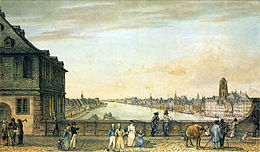
260px-Frankfurt_Am_Main-Carl_Morgenstern-Prospekt_von_Frankfurt_von_der_neuen_Brueckenmuehle_aus_gesehen-1828

Yes, I gave a few things away here, but unusually for Collins the book isn’t that suspenseful. And that’s a pity, because suspense is what Collins does best. It’s pretty clear what Madame Fontaine is up to. A different novel would have kept us unsure about whether she had actually poisoned Keller. So why should anyone read this book? Its interest is in the pairing of the two widows, both of them smart and determined, and more interesting than any of the men in the book. Because Mrs. Wagner’s drive is channeled in socially productive ways, we’re meant to sympathize with her rather than with her continental (read louche, untrustworthy) opposite number. But Mrs. Wagner is a bit too decent to hold too much of our interest (though she’s never saccharine, I will give Collins that—quite unlike any of the good female characters in Dickens, say.) At the same time, Madame Fontaine isn’t quite compelling enough to be a study in glamorous evil, the lurid reference to Jezebel in the title notwithstanding. Indeed, at its best the novel suggests she’s simply a mother who will do anything to see her daughter made happy. It seems as though Collins is suggesting that in the absence of the reforms desired by Mrs. Wagner a woman could be forced to the excesses of Madame Fontaine. Unlike someone like The Woman in White’s Count Fosco, who does evil for the hell of it, Madame Fontaine does evil for her daughter. She’s as exhausted as I expect today’s Tiger Moms are.

In the end, the only really engaging and sympathetic character is Engelman, the old bachelor. Here’s how Glenney introduces him:

Mr. Engelman, short and fat, devoted to the office during the hours of business, had never read a book in his life, and had no aspirations beyond the limits of his garden and his pipes. “In my leisure moments,” he used to say, “give me my flowers, my pipe, and my peace of mind—and I ask no more.”

The redundancy of the last sentence—it pretty much repeats the previous one—gives you a sense of Glenney’s prose. (He’s just prosy and complaisant enough that I’m willing to believe Collins is aiming for dullness here, rather than just being dull.) Sadly, Engelman’s peace of mind is ruined when Madame Fontaine ensnares him. The kindhearted Engelman is ready to throw over his tidy, careful, indolent bachelor life for the captivating widow but when he realizes she is only using him as part of a greater plan he withdraws to his hometown and dies of apoplexy aka shame. He’s a more tragic version of Joseph Buschmann from The Dead Secret. At least he had the wisdom not to fall in love. Does love ever work out in Collins? It’s enough to make me wonder if there isn’t something ominous (rather than, say, sickly sweet) in the tears which, filling Glenney’s eyes at the end of the book, oblige him to break off in his description of Minna and Fritz’s wedding. Wishful thinking on my part, no doubt, but even in a minor work Collins always leaves us a little uncertain.

Minor Collins, no doubt, but props to Oxford to putting this out in a decent, affordable, well-edited edition.

2015 Year in Reading

2015 was a good year in reading. Better than 2014, though nowhere near the annus mirabilis of 2013 (pre-blog, alas). I read 80+ books. Here are the ones that most stayed with me:

IMG_0288

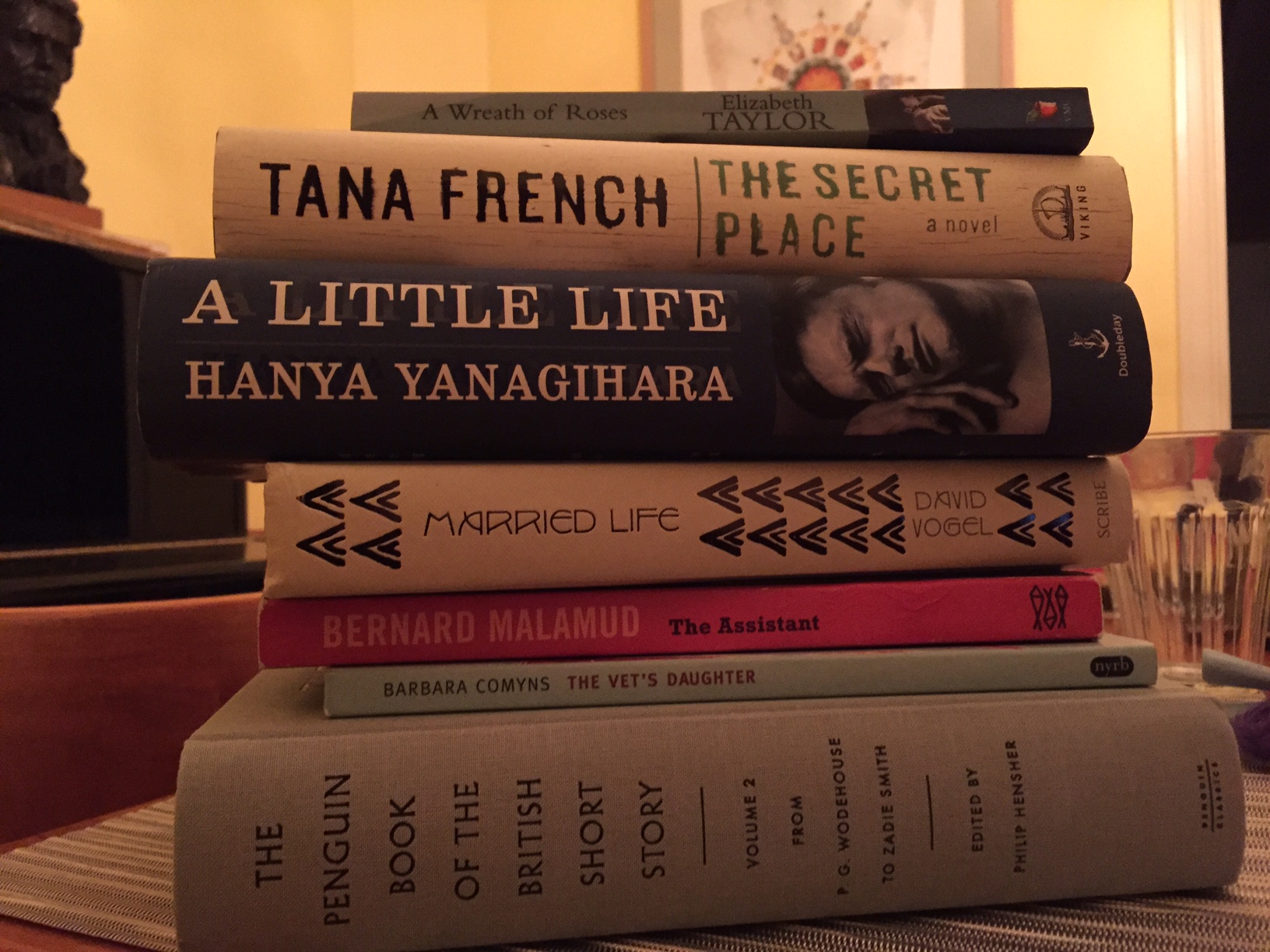
A Little Life—Hanya Yanigahara

The reading event of the year for me. Everyone has an opinion about it, and they’re mostly strong opinions. I understand the main objections—it’s too long, it’s indulgent, it gets off on abusing its main character and even maybe its readers, its prose is sometimes clunky, even embarrassing—but I don’t feel them. These days I struggle to keep my attention away from my phone, social media, hockey scores, you name it. Sometimes I worry I don’t have the reading stamina I used to. In this regard, A Little Life was a gift: an intense, immersive reading experience that captivated me not just for the week of the reading but throughout the whole year. I wrote about it here.

Married Life—David Vogel

Written in Hebrew and published in Vienna in 1930, this is an extraordinary book that expands our sense of what European modernism was all about.

If I read Hebrew, I would write Vogel’s biography. Born in the Pale of Settlement, Vogel made his way via Vilnius and a brief stint as a yeshiva student to Vienna just in time to be interned as a Russian citizen during WWI. After the war he loafed, nearly penniless, in Vienna’s cafes, finding a little translation work and writing his first poems and novellas. He immigrated briefly to Palestine in the late 20s but Zionism never held much appeal for him and he returned to Europe, eventually finding his way to Paris in the early 30s. Tragically he was interned in the next war, this time as an Austrian citizen, and was deported via the infamous transit camp at Drancy to Auschwitz where he was murdered in 1944.

In Married Life the poor but promising writer Rudolph Gurweil meets the impoverished and rapacious aristocrat Thea von Takov and falls immediately under her spell even though he’s not sure he likes her very much. The two marry after only kowing each other for a few weeks and things go badly from the start. Thea converts to Judaism to marry Gurweil but among other things she’s a terrible anti-Semite. The novel is a drawn-out depiction of a disastrous marriage, but it’s also a glorious depiction of shabby Jewish Vienna.

I started a review and got sidetracked. I’d really like to finish it. If it got this book even one more reader it would be worth it.

Heartfelt thanks to heroic translator Dalya Bilu and to Australian-based Scribe for publishing this masterpiece, not least in such a gorgeous edition.

The Vet’s Daughter—Barbara Comyns

Wonderful, heartbreaking novel about a young woman who levitates. I wrote about it at length here and my appreciation only increased when I taught it this fall. Happily, my students loved it too; I received several excellent papers about it. I’m about to write more about Comyns myself. More on that soon, I hope.

The Heat of the Day—Elizabeth Bowen

The same students who enjoyed Comyns did magnificently with this marvelous novel of the Blitz and its aftermath. The course is on Experimental 20th-Century British Fiction, and I hadn’t taught Bowen for a while (six years, in fact), after my previous attempt at teaching her failed spectacularly. I finally worked up the courage to try Heat again, and am so glad I did. It helped, of course, that this was a particularly strong group of students. It was really fun helping them work through Bowen’s famously thorny sentences. To the North might still be my favourite Bowen, but this novel about lying to one’s self and to others is one of her best. I often grumble about how teaching gets in the way of reading. But sometimes the chance to return to the same set of books is a joy. As Roland Barthes once said, those who don’t re-read are doomed to read the same text over and over again.

Bernard Malamud

Another one from the teaching files, at least in part. I taught an introductory level course on short fiction this fall. (For a while I blogged about it regularly—the first installment is here, if you’re interested—but eventually I capitulated to the semester’s demands and gave up.) The touchstone text was Malamud’s first collection, The Magic Barrel. I’d taught these marvelous stories before but it had been a while and found I liked them even more this time.

I’ve always loved their enigmatic qualities, and had long been curious whether his novels were like that too. So I read The Assistant over Thanksgiving (I started a post on that too which I also failed to complete). It tells the story of Morris Bober’s struggle to eke out a living from his small grocery store in a poor part of New York, a struggle that only deepens when he takes on a drifter as a de facto assistant. It is also one of the most depressing books I’ve ever read, with a scene that genuinely shocked me. Malamud’s stories are hardly heartwarming, but they have a lightness missing from this novel. Absolutely worth reading, though.

Various short stories

The Penguin Book of the British Short Story—Philip Hensher, Ed.

As I said, I taught a lot of short stories this fall, and in the process I remembered how much I love the form. Edith Pearlman, Katherine Mansfield, and D. H. Lawrence were particular favourites. I also want to tip my hat to this wonderful two-volume edition of short stories edited by Philip Hensher. I’ve got volume 2 (they’re only available in the UK and a bit pricey but the production values are amazing) and I’ve only read a handful of the stories. But the roster is exciting; not just the usual suspects. Hensher plowed through a ton of late-19th and early-20th century magazines and has found some amazing stuff. I especially like one by “Malachi” (Marjorie) Whitaker, called “Courage”: it’s going straight on to the Spring syllabus. Hensher’s introduction makes a fascinating case for why Britain produced such good short fiction in the years 1890-1940 and why economic and structural conditions make it unlikely for the form to flourish in the same way again (which isn’t the same as saying there are no good instances of the form today: volume 2 goes from P. G. Wodehouse to Zadie Smith). Please Penguin, bring this out in the US.

The Book of Aron—Jim Shepard
A Brief Stop on the Road from Auschwitz—Göran Rosenberg

Holocaust literature is central to my teaching, and so also to my reading. These two books impressed me this year, the first a novel of the Warsaw Ghetto that I wrote about at Open Letters Monthly and the second a second-generation memoir that I reviewed at Words without Borders.

Death of a Man—Kay Boyle

Thanks to Tyler Malone of The Scofield I learned a lot about Kay Boyle this year. The best thing I read by her was a heartbreaking early story about failed pedagogy called “Life Being the Best” (read it!), but the book I spent the most time with was this 1936 novel about an American heiress who falls in with fascist sympathizers in pre-Anschluss Austria. I can’t say I liked the book all that much, but I was utterly fascinated by it and I enjoyed wrestling with its slippery politics. You can read my essay, along with many other wonderful pieces, here.

A Wreath of Roses and Blaming—Elizabeth Taylor

These are two of the best books I read this year, but they’re wrapped up in guilt for me because I promised someone a piece about them and never delivered. (Not yet, anyway…. I still want to, though!) I’ve loved everything I’ve read by Taylor, but these are the best of the bunch. Blaming (1976), her last book, is about what happens to a middle-aged woman after the unexpected death of her husband. It manages to be both rueful and acerbic. A Wreath of Roses (1949) is a masterpiece and if it were in print in the US I would have taught it this semester for sure. Less histrionic than Bowen’s Heat of the Day but similarly a novel of what the war did to England, it’s also a story of female friendship that earns its epigraph from Woolf’s The Waves. Genuinely haunting: I read it in June and still think about it regularly.

The Secret Place—Tana French

French doesn’t need me to sing her praises. Everyone already knows she’s the best crime writer today. Some thought this latest book—for some unaccountable reason I held off reading it for almost a year—in the Dublin Murder Squad series a falling off, but I adored it. I especially loved the echoes of Josephine Tey’s Miss Pym Disposes. French is such a genius because she writes super suspenseful books that are ultimately about something quite different: they are fascinated to the point of obsession with the idea of friendship—interestingly, romance or sex features hardly at all—especially how friendship intersects with the partnership between detectives. Yet again French proves she writes vulnerable men better than anyone.

 *

Other good things: Vivian Gornick’s The Odd Woman and the City is a brilliant essay-memoir and I would have written more about it here but it’s late and I’m tired (the Open Letters piece is good, though); The Hare with Amber Eyes (again, everyone already knows it’s amazing—I most liked a surprising Arkansas connection!); Emma (enjoyed re-reading this and wrote about the experience here and here); bits of Balzac (the last 100 pp of Pere Goriot, which practically had me in tears; the scene in Eugenie Grandet when Eugenie wakes at night to see her father and his servant taking his gold downstairs: hallucinatory); Wilkie Collins (I liked both The Dead Secret and The Law and the Lady). Also, good light reading: Ben Aaronovitch’s Rivers of London (urban fantasy—smart and funny: read the first two this year and mean to finish the series in 2016); Hans Olav Lahlum’s K2 books (engaging Norwegian homage to Golden Age crimes, locked room mysteries and the like); Ellis Peter’s Cadfael books (read the first: surely the beginning of a beautiful friendship).

 *

Reading is a passionately solitary experience, but also a joyously communal one. That’s true (mostly) in my classroom and, increasingly, on social media and the Internet more generally. Sometimes I find the constant stream of books to read that come through my Twitter feed a little daunting, but mostly I’m thrilled to know that so much reading is going on, so vigorously and passionately.

Thanks to everyone who read this blog in 2015, especially those who encouraged me and prompted me to think harder or differently about the books. It is wonderfully strange for me to speak so much with people I haven’t for the most part even met about something so important to me.

Thanks too to those who published me this year, especially the wonderful people at Open Letters Monthly. Here’s to more writing next year, and of course to more reading.

The Dead Secret–Wilkie Collins (1857)

My (very slow) journey through the complete works of Wilkie Collins continued this weekend with The Dead Secret (1857). This was Collins’s fourth published novel, the one right before he hit the big time with The Woman in White. It’s really quite good, absolutely enjoyable if a bit soppy at times and a little baggy. But there are a number of wonderful characters and some genuinely creepy and atmospheric scenes.

In his preface to the one-volume edition of 1861, Collins describes the phrase of his title as if it were a familiar idiom (he mentions it couldn’t be translated into French). I’d never heard the phrase “a dead secret” before, but apparently it means an “absolute secret, not to be revealed under any circumstances.” In this sense, Collins’s title is ironic, since the secret the story revolves around is supposed to be revealed in the first chapter—and it sort of is, though not conclusively enough for readers, or at least this one, to be sure what it is—but the person who is supposed to reveal it chooses not to.

As I observed recently in regards to The Law and the Lady, Collins here too anticipates Freud’s belief that “no mortal can keep a secret. If his lips are silent, he chatters with his fingertips.” Collins is fascinated by the idea that whatever is buried will eventually come to light. The Dead Secret begins with the maid Sarah Leeson attending the deathbed of her mistress, Mrs. Treverton, in a remote and falling down Cornish mansion called Porthgenna. Mrs. Treverton writes a letter to husband revealing a secret only she and her maid have known about until now, and just before she breathes her last she is on the point of making Sarah swear that she will pass the letter to Captain Treverton. Instead Sarah—whose hair is shockingly gray even though she is still a young woman, a sign of some terrible thing in her past—hides the letter in a locked room in the disused wing of the house and runs away from the Captain and his five-year-old daughter.

Ben Nicholson--Wrong Century, Right Place

We pick up events fifteen years later when that little girl, Rosamond Treverton, marries a young man, Leonard Frankland. Frankland is blind, blindness being a motif, I gather, that reappears in later works, and of course fittingly literalizes the figurative state of most of Collins’s characters. Collins uses Leonard’s blindness as a way to mediate the telling of the story even in the midst of the action. In this sense it seems an even more sophisticated version of his preference for shifts from third or first person narration to epistolary, or amongst various narrators or between various interpolated texts. These shifts emphasize the telling of the story over the events that are told. So for example Rosamond must describe everything she is doing to Leonard, especially once they find themselves caught up in trying to find the mysterious letter in a place Leonard has never been. This has the effect of slowing down the action while also ratcheting up the suspense, even in instances where there shouldn’t be any. We know where the letter is hidden, after all.

Although the mystery—which concerns them more than anyone—couldn’t be solved without them, Rosamond and Leonard are the book’s least interesting characters. The most interesting is Sarah—certainly she gets the most extraordinary scenes. She’s not really the heroine—the book’s attention is too diffuse, too decentralized among so many characters to have a heroine, and besides it’s unclear for the longest time whether or not we’re even supposed to like her: she’s continually rubbing other characters the wrong way—but she is at the heart of its enigma. Collins loves disguises, and in the scenes that most stuck with me Sarah hides her identity without actually lying about who she is. In the first, under the name Mrs. Jazeph, she becomes the nurse to Rosamond when the latter’s journey back to Cornwall is interrupted by the early arrival of her first child. The nurse, who has been nervous and flighty all evening, keeping herself at an unnatural distance which makes her charge increasingly uneasy, finally approaches Rosamond—but now she comes too close:

[T]he nurse was stopping midway between the part of the room from which she had advanced , and the bedside. There was nothing wild or angry in her look. The agitation which her face expressed, was the agitation of perplexity and alarm. She stood rapidly clasping an unclasping her hands, the image of bewilderment and distress—stood so for nearly a minute—then came forward a few steps more, and said inquiringly, in a whisper: —

‘Not asleep? Not quite asleep, yet?’

Rosamond tried to speak in answer, but the quick beating of her heart seemed to rise up to her very lips, and to stifle the words on them.

The nurse came on, still with the same perplexity and distress in her face, to within a foot of the bedside—knelt down by the pillow, and looked earnestly at Rosamond—shuddered a little, and glanced all around her, as if to make sure the room was empty—bent forward—hesitated—bent nearer, and whispered into her ear these words: —

‘When you go to Porthgenna, keep out of the Myrtle Room!

The hot breath of the woman, as she spoke, beat on Rosamond’s cheek, and seemed to fly in one fever-throb through every vein of her body.

The creepiest part of this passage is the qualifying clause “as she spoke,” which seems initially redundant—did we think the breath came from anywhere else?—but which in the end focuses our attention on the almost animalistic quality of Sarah. Similarly disquieting is the ambiguous pronoun at the end, which makes it hard to distinguish Sarah from Rosamond. (Shrewd readers will guess already that this suggestion of symbiosis is fitting.)

The scene could easily have been risible—and depending on your appetite for sensation fiction maybe it is—if it weren’t so true to the proto-Freudian theory of the unconscious (later Sarah will marvel that she said the last thing she wanted to say, or at least the last thing she thought she wanted to say) and so well executed.

Similarly dramatic is the second scene with Sarah that impressed itself on me. Sarah and her uncle Joseph (more about him in a second) rush to Porthgenna in advance of Rosamond and Leonard and brazen their way into the house, but Sarah is unable to retrieve the secret letter because she is overwhelmed on the threshold of the nfamous Myrtle Room by guilt and anxiety and maybe a genuine ghost. I’m too pressed for time to cite the passage: suffice it to say Sarah confuses the flapping of loose wallpaper with the admonitions of her late mistress and collapses in a dead swoon. Collins shows his genius in making us feel anxious and upset even though we know the (ostensible) cause of the disturbing noises. You can see Collins figuring out how to unsettle readers, and two years later he’ll write a masterpiece in which the kind of scenes I’m talking about here, which here are scattered across the book, will be much more prominent.

But The Dead Secret isn’t just apprentice work. I was disappointed by Ira Nadel’s introduction to the Oxford edition (unusual for that estimable line). Nadel meanders through the novel’s motifs, content simply to point out similar instances in other books by Collins. He never tries to interpret this book on its own merits. I was especially let down because the blurb tells me Nadel is the author of a book called Joyce and the Jews. And my pet theory about this book is that Sarah’s uncle, Joseph Buschmann, is in fact Jewish. Collins never says so, and he never resorts to the typology of this and other periods (hooked nose, swarthy, lecherous, usurious, etc) that would telegraph to readers, even unconsciously, a character’s Jewishness. We do know that Joseph is German, though he proudly asserts that he is also a citizen of England. We know he loves music—his prized possession is a music box given to his elder brother by Mozart himself: this automaton is just part and parcel of the book’s fascination with the uncanny, the Gothic, etc. We know he’s not quite five feet tall. He’s endearing in his insistent guilelessness, and kind and loving to Sarah despite all her troubles. Basically he’s a total mensch and I really wanted him to be Jewish not just because he was my favourite but because he is so determinedly not characterized by negative stereotypes. But being musical and short and kind and a little schmaltzy isn’t enough to make someone Jewish—though it’s a pretty good start.

Can anyone who’s read this book help me out here, and support this fancy of mine?

Either way, The Dead Secret doesn’t deserve to be one. A great book for your vacation reading.

The Law and the Lady–Wilkie Collins (1875)

The critical consensus is that Collins’s great period is 1860-68, when he produced the four masterpieces Woman in White, No Name, Armadale, and The Moonstone. A couple of summers ago I devoured the first three, and loved them all, especially No Name, which I think about often. I was fortunate enough to have read the fourth in college under the expert guidance of Rohan, but I think it’s time to read it again.

At any rate, for once, the critical consensus seems to be right, at least judging from this later work. The Law and the Lady is very good but not quite top-shelf Collins. It hasn’t the seat-of-your-pants excitement of his best work, but it’s perfectly enjoyable and spry enough to keep readers guessing. Plus if you’ve any interest in Freud, you will enjoy the novel’s uncanny prefiguring of the theory of the unconscious.

The book opens with Valeria Brinton having just become Valeria Woodville—except that in a slip of the pen (paging Dr. Freud…) she signs her maiden name. The mistake isn’t just an indication of Valeria’s independent mindedness, although that will be amply demonstrated in the book’s events. It’s also an unconscious recognition that something isn’t right about the name she’s taking on.

It isn’t long before Valeria learns that her husband’s name isn’t Woodville. Her husband implores her not to look into the matter further. But that’s just what she does. Could we possibly be interested in a book about any woman who wouldn’t have? Before long she learns that her husband, whose real name is Macallan, was tried in Scotland for poisoning his wife. The Scottish part matters because Scots’ law apparently still to this today allows a verdict of Not Proven, which is somewhere between acquittal and guilt. The accused is free to go, but not free of suspicion or innuendo. Insisting that no one, not even his wife, could believe entirely in his innocence, Macallan leaves for the Continent. Yet Valeria is undaunted by this dereliction and sets out to prove Macallan wrong by proving him blameless

Valeria’s first step is to read the trial proceedings. Collins first published his works in serial form, and like other writers of the period, most notably his friend Dickens, he was a genius with suspenseful chapter endings. Here for example is Valeria launching her career as detective:

I drew down the blind, and lit the candles. In the quiet night—alone and unaided—I took my first step on the toilsome and terrible journey that lay before me. From the title-page to the end, without stopping to rest, and without missing a word, I read the Trial of my husband for the murder of his wife.

After a paragraph like that, who’s not going to turn the page/buy the next installment/watch the next episode? Indeed, Valeria’s description of her reading experience—at once breathless and assiduous—is a good description of our own. But although she might have taken her first step unaided, she gets a lot of help the rest of the way. A friend of her husband’s, Major Fitz-David, an aging ladies’ man, introduces her to some of the people who testified at the trial. Her late father’s law clerk, Mr. Benjamin, together with a Mr. Playfair, the lawyer who represented Eustace at trial, support her inquiries and eventually uncover the crucial piece of evidence. And even her new mother-in-law, who at first refuses to speak to her, begrudgingly comes to her side, even though she insists to the end that Valeria must not tell Eustace what she has found.

It is true, though, that Valeria is the force that keeps the investigation going, even when it seems to flag and even when she has to leave England to nurse Eustace back to health. He lies unconscious for weeks after having been wounded in Spain (for the life of me I can’t remember why he went there or what the fighting was about—I can’t seem to find it by flipping though the book, either). His actions exemplify his character: he’s supposed to be gallant but he’s always making a mess of things—indeed, we learn that the same ambivalent mixture of righteousness and weakness characterized his relationship with his first wife, Sarah, whom he married because he felt sorry for her. (We’re supposed to think her nasty and shrewish, but it’s hard not to feel sympathy for her. Collins could have done a lot more with Valeria’s feelings about her predecessor—the way Du Maurier did so successfully in Rebecca.) The vacillation and general pain-in-the-assedness of Eustace’s character is a weakness in a novel that depends on Valeria’s profound belief in him. Any time Valeria seems to question her motives—to wonder what it means that she’s undertaking all this effort and risk for someone who has treated her so badly, or to acknowledge that what really thrills her is the investigation itself more so than the eventual exoneration of her husband—she pulls back. I don’t see much evidence that Collins wants us to do anything but take her at her word.

At times, the book gets distracted from its protagonist and her husband. In those other books by Collins I admired his unusual narrative structures—his shifts in points of view or in media (from third person narration to letters, for example) all within a single book. That play with structure doesn’t work as well here. The trial, for example, is presented to us indirectly, through the report Valeria finds. But the book chooses to summarize it rather than transcribing it as a “found text”, presumably because that would be more interesting than a lengthy legal document, but the result is just the opposite: all the momentum the book had built up gets killed and it takes a while to recover. Similarly, a lot of the detective work is done by Playfair and Benjamin, but we hear about it through their letters to her instead of seeing it first hand.

But the real distraction doesn’t lie in the narration—it comes from the introduction of the character Misserimus Dexter, an old friend of Eustace’s and a house guest at the time of Sarah’s death. Dexter is supposed to be a menacing yet magnetic character of the kind that appears elsewhere in Collins—Count Fosco of The Woman in White might be the best example. But where Fosco genuinely is magnetic Dexter is more irritating. We hear a lot about his eccentricity, his genius, his mania. He lives in an isolated half-lavish, half-dilapidated mansion with a cousin who herself is a grotesque figure, a lumpen simpleton who is nonetheless devoted to him and, come to think of it, in this regard acts as a mirror for Valeria’s relation to Eustace. Dexter is a dandy, an elegant and beautiful man despite what the novel calls his “deformity”: he is a paraplegic who is mostly confined to a wheelchair except in some dramatic moments that Collins clearly relishes when he slips its chains and propels himself along by only the force of his arms. Valeria coaxes from Dexter his memory of the events around Sarah’s death—yet in doing so brings him closer and closer to madness until, having mentioned a letter written by Sarah on the day she died, a letter that promises to clear up the circumstances behind her death, he lapses completely into insanity.

The last part of the book concerns the search for this letter, which, we learn, is a suicide note from Sarah to Eustace that fully exonerates him. (That isn’t much of a spoiler, since we’re led to believe from pretty early on that Eustace didn’t do it. But this is a spoiler: Sarah kills herself by taking arsenic she had had Eustace purchase because she is convinced that in small doses it could remedy the kind of skin conditions that disfigure her—and she does so because Dexter, who had loved her before her marriage and is still furious that she rejected his proposal, shows her Eustace’s diary, in which he laments having married her and complains of her incessant wheedling and general poor character.) The letter leads us to the best part of the book: its fascination with the permanence of objects, especially those we think to be junk.

That fascination is already evident when Valeria first visits Dexter at what her mother-in-law satirically calls his palace:

We had got out of the carriage, and we were standing on a rough half-made gravel path. Right and left of me, in the dim light, I saw the half-completed foundations of new houses in their first stage of existence. Boards and bricks were scattered about us. At places, gaunt scaffolding-poles rose like the branchless trees of the brick-desert. Behind us, on the other side of the high road, stretched another plot of waste ground, as yet not built on. Over the surface of this second desert, the ghastly white figures of vagrant ducks gleamed at intervals in the mystic light. In front of us, at a distance of two hundred yards or so, as well as I could calculate, rose a black mass which gradually resolved itself, as my eyes became accustomed to the twilight, into a long, low, and ancient house, with a hedge of evergreens and a pitch-black paling in front of it. The footman led way towards the paling, through the boards and the bricks, the oyster-shells and the broken crockery, that strewed the ground.

I’m intrigued by the bathos of this would-be Gothic scene (the ancient house amidst abandoned construction sites: it’s unclear whether the new will even have the vigor needed to replace the old). It reminds me of something from Dickens, maybe Our Mutual Friend, probably because of all the waste, the oyster-shells and broken crockery (where’s that come from?). Waste is central to the resolution of the plot. Before being called to her husband’s bedside in Spain, Valeria visits his former country house, the place where Sarah died. Wandering the “wilderness of weeds” that is the garden of the shut-up house, something catches her eye:

Beyond the far end of the garden, divided from it by a low paling of wood [Collins will never say “fence” when he can say “paling”—though admittedly it has that fitting resonance of shock and suspense—turning pale, etc—though maybe I’m doing him an injustice and “fence” is just an Americanism], there stretched a piece of waste ground, sheltered on three sides by trees. In one lost corner of the ground, an object, common enough elsewhere, attracted my attention here. The object was a dust-heap. The great size of it, and the curious situation in which it was placed, roused a moment’s languid curiosity in me. I stopped, and looked at the dust and ashes, at the broken crockery and the old iron. Here, there was a torn hat; and there, some fragments of rotten old boots; and, scattered around, a small attendant litter of waste paper and frowsy rags.

Litter here of course means trash, but the word can also refer to a vehicle, and in The Law and the Lady this trash becomes the vehicle for Eustace’s exoneration and Valeria’s triumph. Biggest spoiler alert of all: the torn pieces of Sarah’s letter are exhumed from this pile and pieced together forensically. There’s nothing frowsy about this waste after all!

Here’s where the novel got spooky for me. For these descriptions of waste, on top of or beside which life goes on, and which never fully decay, reminded me uncannily of Freud’s descriptions of the unconscious. Already in “The Aetiology of Hysteria” from 1896 Freud compared the analyst to an explorer who excavates a ruined site and is able to uncover from its remains whole vanished way of life. He never wavered from the image of the unconscious as a wellspring to be excavated (lest its unhealthy manifestations—its symptoms—continue to debilitate the patient) but towards the end of his career he modified the image. In the great Civilization and its Discontents (which could be the motto for Gothic and Sensation fiction) from 1930, for example, he returns to the image of the mind as a ruined city, even the Eternal City, Rome, yet admits that the image doesn’t quite work because unlike in Rome, where the present day covers up the past, so that only hints of its past strata are apparent, in the mind nothing ever goes away. If we wanted to think of the unconscious as a city, we would need to conceive of every era of its history as coexisting so that we would, for example, need to imagine new buildings superimposed over the old ones they replaced.

In The Law and the Lady the future is only possible because the past persists. But what would that mean for a crime novel? Can we speak of solving a crime when any resolution comes from the fact that nothing is ever settled? What else from the past might surface to trouble this marriage that seems now to have been saved? Interestingly, Eustace elects not to learn what his first wife wrote in the letter, preferring only to know that it is enough to absolve him of blame. The novel’s resolution is thus appropriately qualified, and Collins gives us a powerful image of that uncertainty in the envelope containing Sarah’s letter, which Eustace elects to save for his soon-to-be-born child. That’s a potentially explosive inheritance, maybe not quite the bombshell that Pinkie leaves his progeny at the end of Greene’s Brighton Rock (which I read as a modernist Gothic/Sensation novel), but pretty strong stuff nonetheless.

It must be significant, too, that this all takes place in Scotland, one of those Gaelic Gothic dark undersides to English modernity—right after the passage I quoted in which the dust-heap makes its first appearance, Playfair ruefully says to Valeria that something like that wouldn’t be tolerated in the grounds of an English house—though of course the passage describing Dexter’s wasteland “palace” suggests he’s not entirely right.

At any rate, it’s that ending that makes me think The Law and the Lady is more than merely competent and engaging. The whole time I wanted Collins to leave us in doubt as to Eustace’s innocence, the way Du Maurier or Patricia Highsmith would have. Making Valeria protect a murderer would just be more interesting, though perhaps more sadistic. But in the end there’s enough unsettling about The Law and the Lady to make it a fitting depiction of the past’s similarly unsettling refusal to go away.