What I Read, December 2025

I came down from the high of my first months as a former professor. Not because I longed for my old job (though I do miss being around students and in the classroom), but because I had to face the uncertainty of how to keep body and soul together going forward. I kept hustling, buckled down to my various gigs, including, this month, a number of hours at a local bookstore. It felt so good to be back in that environment again. That excitement buoyed me as the days grew short; psychologically, I kept my head above water, which has not always been the case in Decembers past. And I read a few books, some of them excellent.
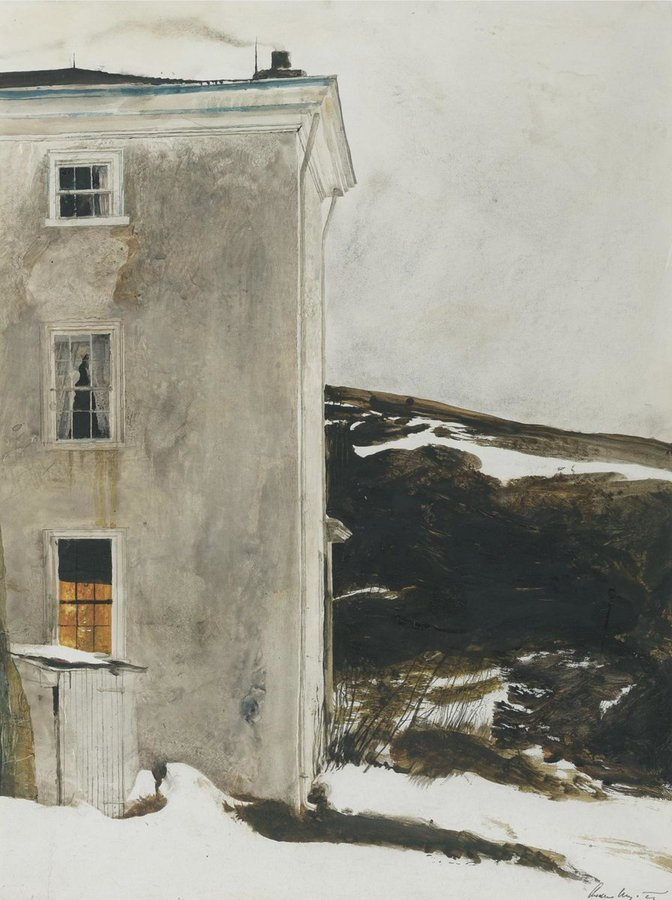
Andrew Wyeth, Dusk (1978)

Sarah Campion, Makeshift (1940)

Now this is interesting. A novel from the early part of WWII set in desperate early Weimar Germany; racially-divided South Africa; and puritan New Zealand, about a German Jewish woman who escapes the Nazis in body but not in mind, written by a non-Jewish British writer. Campion (the pen name of Mary Rose Alpers; no relation, as I briefly hoped, to Jane Campion) spent most of the 1930s teaching English in Berlin, where many of her students were Jews. She was forced out of the country in 1937 when she refused to identify those students—part of a long life of progressive political activism, including later protesting the Vietnam War.

Charlotte Herz, her protagonist—smart, funny, neurotic, judgmental, flinty when she needs to be—is not an easy character to like. (The novel is bracingly uninterested in this idea.) Charlotte does some things—one thing in particular—that are pretty terrible, but also maybe the things that needed to be done to survive. She casts aspersions on most of the people she meets. She is an ungrateful exile. These facts, combined with the disconnect between author and character, have led some to dismiss the book as appropriative. One such reader is Sarah Shieff, who wrote the afterword to this new reissue. I have to say, as a Jew, I don’t find this to be the case. In fact, I have beef with Shieff, who misreads the book badly, in my opinion, showing herself to be unable to distinguish Herz’s voicing of antisemitic views from her belief in them. And having read a lot about German Jews in the 1920s and 30s I found Makeshift thoroughly compelling and plausible, including its first-person voice. That said, the writer Campion most reminds me of is also non-Jewish, another woman who had a lot to say about the treatment of minorities in the British Empire: Doris Lessing. Campion shares Lessing’s frankness about female sexual desire and how psychologically damaging it was to express in a period when male domination was even more overt than today.

Brad Bigelow, of the Neglected Books account on Bluesky, rescued Makeshift from near-total oblivion (I think there were only a handful of copies left in the world when he found it), and has published it in his invaluable Recovered Books series. I’m grateful to him for sending me a copy. May it not sink without a trace this time around.

Rosalyn Drexler, To Smithereens (1972)

“I shout, ‘I’d do anything for you, you Glamazon!’ And she says, ‘Anything? Well then, suck my pussy.’ And I’d have to do it, because she’s the champ, the winner, the goddess, the diva who makes me dive.”

Do you want to read this 1970s novel about women wrestlers and the men who love them, written by the painter, sculptor, playwright, novelist, nightclub singer, and yes, wrestler Rosalyn Drexler, gloriously resurrected by the new reprint press Hagfish Books? Hell yeah you do!

Daniel Elkind, Dr Chizhevsky’s Chandelier: The Decline of the USSR and other Heresies of the Twentieth Century (2025)

My friend James, owner of the mighty Leviathan Books here in St Louis, lent me his copy of this Sebaldesque mediation on some of, in the author’s words, “the undesirables” of 20th century history. It’s a short book, sometimes funny, always engrossing. Yet ultimately a little thin. Maybe I read it too quickly, but sitting here now, just a few weeks later, I can’t remember what Elkind concludes about his cast of characters. The strongest parts of the book are the autobiographical sections on his coming of age as a newly arrived immigrant to the US after the collapse of the Soviet Union and, especially, his memories of his parents and grandparents. Like so many in his generation who grew up in the aftermath of the disappearance of a seemingly unshakable social, political, and cultural world—will this be my daughter???—Elkind has a keen sense for history’s inescapable contingency. There are always so many paths not taken.

Alexander Chizhevsky, by the way, was born in what is now Poland in the Russian Empire and died in the USSR. A biophysicist, he founded a discipline he called “heliobiology,” the study of the effect of the sun’s cycles on plant life and human activity alike. For example, he linked the ebb and flow of battle that he experienced on the Eastern Front in WWI to solar flares. Much later, in 1940, Stalin got wind of this theory (never a good thing) and demanded Chizhevsky recant (it being inimical to Marxist-Leninist theories of history). When Chizhevksy refused, he was sent to the gulag and, after eight terrible years, to a “rehabilitation” program in Kazakhstan. His “chandelier” is an ionizer—a tool still in use, even though no one can agree whether it promotes health.

Undesirables, it seems, stick around in unexpected ways—especially when they have someone like Elkind to memorialize them.

Joan Silber, Secrets of Happiness (2021)

Came home from the library; sat down to read the first page or two, as one does; next looked up to find that an hour had passed; realized I would have to set other reading aside until I finished, which I did the next morning. Like most of Silber’s recent work, Secrets of Happiness uses ring structure: each chapter follows a character referenced, however fleetingly, in the previous. It begins with a middle-aged woman who learns that her husband has children with a woman he met on his travels in Asia and that he’s helped bring them all to the US. She kicks him out, files for divorce, travels overseas, sends cryptic messages to her grown children, who reluctantly meet their half-siblings. Lots of drama, but no melodrama. Laurie Colwin vibes. I liked this a lot.

Martin Lemelman, Mendel’s Daughter: A Memoir (2006)

Illustration of the author’s mother’s experiences during the Nazi occupation of eastern Poland (today Ukraine), compiled from a video testimony he had her make when she suffered a broken foot in the late 1980s and needed to be occupied. It’s hard to compete with Art Spiegelman’s MAUS, and Lemelman doesn’t try. He keeps his interactions with his mother to a minimum, and draws in a beautiful, almost gentle pen and ink style that is decidedly not cartoonish or abstract. Despite these differences, Mendel’s Daughter had to have been overshadowed by the earlier book, since I hadn’t heard of it until recently, and I’ve read a lot of Holocaust graphic novels. That is a shame, because it’s absolutely worth reading. The story of how Gusta Lemelman (née Schaechter) survived the war is, as so often in such stories, remarkable, harrowing, miraculous. Together with three of her siblings, Gusta hid in “graves,” deep pits dug into the forests near their hometown of Germakivka. Of great interest is her description of prewar life, especially the mingling of Jews and non-Jews, and how this diversity both fell apart but also persisted during the Nazi occupation, as some of the locals were instrumental in keeping Gusta and her siblings alive during their time in hiding.

Joan Silber, Household Words (1980)

Wrote about this here. A blend of Vivian Gornick and Elaine Kraf. Satisfying and interesting. I want to write about Silber at length. (Like, for money and with the help of an editor.) Anyone interested? Where should I pitch?

Ulrich Alexander Boschwitz, Berlin Shuffle (1937/2019) Trans. Philip Boehm (2025)

If you haven’t read Boschwitz’s Passenger, start there. If you have, then you’ll also enjoy this, his first novel. I had more to say about it here. Tl; dr: solid end-of-Weimar novel, if at times unsure quite what it wants to do. Considering the conditions under which it was written, an accomplishment.

Mason Coile, Exiles (2025)

A locked-room mystery set on Mars, Exiles has the pacing of a thriller and the uncanniness of a horror novel alongside the fascination with otherness that characterizes sff. The first three humans to make it to Mars arrive to find their mission compromised from the start. The bots who have been sent ahead to build a research station have taken human names, genders, and personalities. Plus, they changed the door entry codes. Oh, and one of them is missing, and might have destroyed the station’s lab. Unless someone—or something—creepier did it… Coile’s absorbing novella proves that humans might be able to leave Earth, but they can never escape themselves.

Nicola Griffith, Stay (2002)

Earlier last year, I read The Blue Place (1998), the first of Griffith’s Aud Torvingen crime trilogy, recently reissued in attractive new editions. Aud (rhymes with “crowd”) was born in Norway, grew up at various embassy posts with her ice queen diplomat mother, and now lives in Atlanta. She was a cop for a while, but now she’s independently wealthy (seems good, why don’t more people do this?) and a sometime PI. Lee Child himself said that if Reacher had a sister, she’d by Aud. She is indeed utterly competent, both in creating (she renovates houses, builds furniture, cooks like a pro) and destroying (she beats up a lot of bad guys and enjoys it).

The Blue Place is terrific, despite its heartbreaking ending. Stay finds Aud licking her wounds in the mountains of North Carolina, able to get out of her head only because an old friend begs her to find his missing girlfriend. Aud reluctantly heads to New York, on what she assumes will be a day-long mission. And she does in fact find the girlfriend. But turns out there’s more at stake, which leads Aud on a chase that ends, much to my surprise, in Arkansas. The scenes there are pretty well handled. (I doubt Griffith has spent much time there.) Stay is baggier than its predecessor, and a final plot development suggests a new turn for the third and final book, the library copy of which is sitting on the desk beside me. As best I can tell, disability will factor in that book (Griffith has MS and is a prominent disability rights activist). I didn’t even mention that Aud is queer, a fact central to the series. Today she would probably overtly identify as neurodivergent, too. All of which makes me curious to see what will happen to Aud.

These books seem to have made no impact on first release, as judged by the fact that each book was published by a different press. It would be nice if these reissues brought more them more readers.
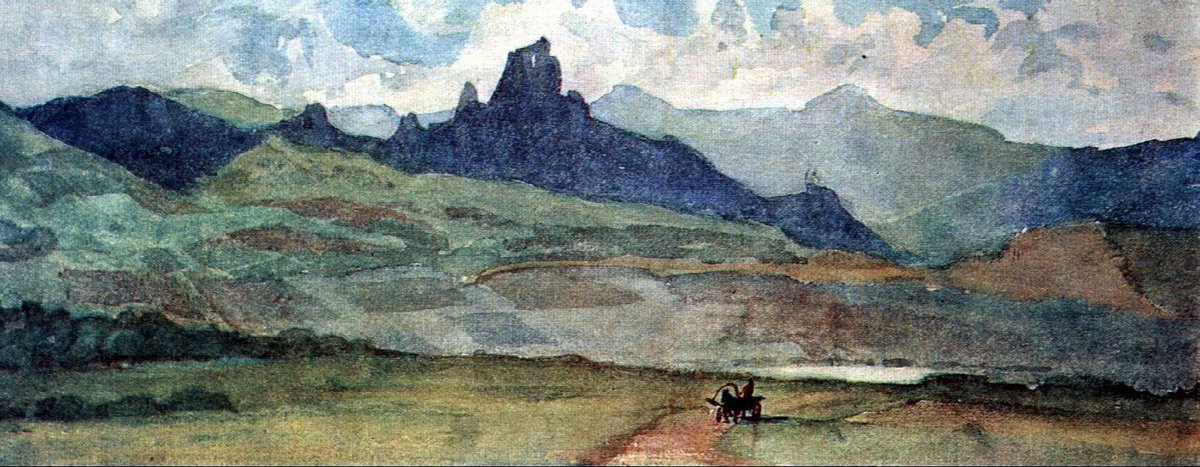
Vasily Surikov, Minusinsk steppe (1873)

Ken Liu, All That We See or Seem (2025)

Got this from the library after seeing it on some sort of best sff list. Maybe one by Lisa Tuttle? Could that be right? Anyway, this is the beginning of a new series about a hacker named Julia Z, whose back story is interesting. Her mother, an immigrant from China, was a famous activist determined to hold America to its ideals. But her parenting was a disaster—imagine a razor-focused Mrs. Jellyby—leading her daughter, our protagonist, into the hands of an anarchist group with its own ideas of keeping America accountable. That’s where Julia learned her tech prowess—but also experienced bitter disappointment when the group’s idea of retributive justice turns out to be a sham. At the beginning of All That We See or Seem, she’s been in hiding for a long time, until a lawyer digs her out and begs her to find his wife, a famous “oneirofex” or dream weaver who has gone missing. As best I understand it, these artists use AI to tap into and personalize mass longings to create updated 60s-type “happenings” that cater to people’s hunger to be together in person while still being isolated.

I didn’t know there was a genre called “tech-thriller” but all the reviews I looked at online use it, so I guess that’s a thing. Seems like readers are divided on the book—fair bit of love but also a lot of hate—which doesn’t surprise me, given the book’s inconsistencies, and supports my view that this is an interesting and flawed work. Liu apparently is or has been a lawyer and a software engineer in addition to a writer and translator, and these experiences are brought to bear in the confidence of the story’s tech and legal aspects. Too bad that much of this material—reflections on identity politics, political resistance, surveillance culture, and the ethics of AI—are awkwardly dumped into the text.  Even more obviously than most sf, this is a book about America today, and I’m not convinced a novel was the best way for Liu to say what he wanted to say. Still, I’ll give the next one a try. I hope that someone has sent a copy to David Cronenberg: he could do a lot with this material.

Paul Cornell, Witches of Lychford (2015)

Novella about a flyspeck English village that, unknown to most of its inhabitants, sits at the fault-lines of the ordinary world and magical realms, both good and evil. Even if the good people of Lychford knew the truth, they probably wouldn’t pay attention anyway, preoccupied as they are with a big decision. Should they allow a Walmart-type supermarket to open in town? Opinions are split; feelings run high. No matter what side they take, though, everyone admits there’s something about the guy the company has sent to convince the locals. He’s kind of… demonic. The joke being, of course, that he really is. Only an unlikely trio—a grumpy old woman who is in fact a witch; the new priest, posted to her childhood home, where no one knows that she’s lost her faith; and the priest’s former best friend, an atheist who has started a shop selling wiccan paraphernalia—can save the day.

Cornell has written several sequels, and I get the feeling the series might amount to something. And yet I haven’t checked them out of the library yet. Has anyone read these? Should I carry on?

Georges Simenon, The Dancer at the Gai-Moulin (1931) Trans. Siân Reynolds (2014)

Two kids in provincial Belgium—one spoiled and rich, one poor and susceptible—scheme to knock over the bar where they spend evenings pretending they’re adults and trying to make it with a female employee, the dancer of the title. But when they break in after closing time, they find a body on the floor. They freak out, do all the wrong things, eventually get arrested. But surely they’re not guilty. Right? And where is Maigret? This is the one where he doesn’t show up until about 2/3 of the way through, and the way Simenon pulls it off is ingenuous.

Miklós Bánffy, They Were Counted [The Transylvanian Trilogy: Volume I] (1934) Trans. Patrick Thursfield and Katalin Bánffy-Jelen (1999)

In my past life I lived on an estate at the foot of the Carpathians, shooting, attending balls, shaking my head at hotheaded fellows who love nothing more than a duel, checking in at the casino when in town during the winter season, watching the woman of my dreams ice-skating with a hated rival, tending to my peasants (sometimes assiduously, sometimes with dereliction), etc., etc. For this reason, I couldn’t get enough of Banffy’s novel, the first part of a trilogy that has been giving me the most reading pleasure I’ve had in a long while.

Although Bánffy wrote the books in the 1930s and 40s, in increasingly perilous financial and bodily straits, he set them in the first decade of the 20th century, the end days of the Austro-Hungarian Empire. (I’m taking part in a year-long reading of Musil’s The Man Without Qualities, and it is almost comical how different in style and ideology these texts are, even as both consider, one with regret, one with irony, the dissolution of the same state.)

There are many books about this time and place. In my experience, most focus on the Austrian part of the Dual Monarchy. One of the many interests of this book, then, is that it shows English-language readers a lesser-known world. Yet it is similar to other late 19th century novels. Like War and Peace, They Were Counted toggles between the personal and the political. The two main characters are cousins. One, having recently been elected to parliament, takes on the difficult task of reforming the family estates (bringing new scientific theories to the harvesting of timber, founding an agricultural cooperative), in part to distract himself from his seemingly hopeless love affair with a married woman. The other, a promising composer, slides into dissipation when he is unable to marry the woman of his dreams (another cousin—which sounds weird, but tbh pretty much all of the characters are related in some way). Some readers seem to find the details about the Hungarian parliament’s bitter, uneasy relationship to Vienna dull, but those people probably don’t like the historical excurses in Tolstoy either. As best I can tell—and I ought to know, given my past life, but, you know, details get hazy with the transmigration of a soul—Transylvania was at once the hinterland of Hungary and its beating, symbolic heart. Losing it to Romania in the Treaty of Trianon was a loss Hungarians never got over. Anyway, the novel is much interested in what it means to be part of a ruling elite that is both dominant (over the Romanian-speaking majority) and subordinate (to the Austrians) and part of a large, precarious multiethnic political entity. Its politics are as hard to pin down as you might expect from that description. (Imagine if the Anglo-Irish were part of the European Union, maybe.)

Did I mention there are also a lot of balls, duels, hunts, and love affairs in this book? SO GOOD.

BTW, this is neither here nor there, but I am reading these in the Everyman Library editions, which are lovely and even have that charming though in my opinion fairly useless sewn ribbon, but which include the most useless map I’ve ever encountered. Regular readers know that I love a map, and wish for them in every novel, regardless of subject matter. But this one includes none of the estates that form most of the locations and almost none of the towns. So frustrating!

There are many ways in which America under T***p II echoes 1930s Germany, but more and more I think that the self-immolation of Austro-Hungary is the better comparison. Which is to say that you can read these books (or at least this one: I’m not finished volume 2 yet) to get perspective on the present—and to escape it altogether.
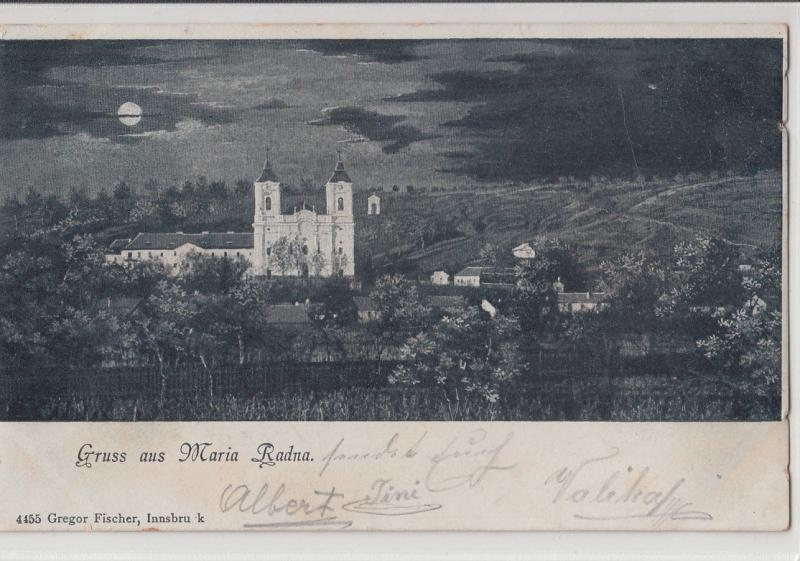
Monastery in Radna, Transylvania circa 1900

How about you? Where did you live in a past life? And have you read any of these books?

What I Read, December 2022

A difficult semester finally came to an end. After all the ends were tied up (always takes longer than I expect) I sort of collapsed, emotionally and bodily. Had some tough days there, but to my surprise a family trip to Houston put me on a better keel—not least by filling my belly with good food. Through it all I was reading, to whit:

Andrew Wyeth, Winter Corn Fields (1942)

Kaoru Takamura, Lady Joker [Vol 1] (1997) Trans. Marie Iida and Allison Markin Powell (2021)

A 600-page crime novel set in 90s Japan? A positively Tolstoyan character list, covering many different institutions and social classes?? A book willing to take its time, building terrific suspense through care and attention??? And it’s only volume one, there’s a whole other 600-page second part???? (Cue that meme of the guy, I don’t even know who he is, with his eyes bugging out in increasing ecstasy.) Hell to the yeah. I spent the last part of November and the first days of December with Takamura’s opus, time that was richly rewarded.

At the heart of Lady Joker are five regulars at a racetrack: an unappreciated cop, a Zainichi banker (a descendent of Koreans who came to Japan before WWII, and much denigrated, I learned), an asocial welder, a truck driver with a disabled daughter (her nickname gives the book its title), and the owner of a drugstore whose grandson has died in mysterious circumstances that involve a story of prejudice from the past, centering on the bukaru community (an ostracized caste whose members were once allowed to practice only “unclean” or “defiled” professions: see how much you’ll learn from this book?). The men come together to commit a crime: a perfect setup because other than their weekly pastime and their resentments they have nothing in common.

At its heart, Lady Joker is simple: a bunch of misfits who happen to have specialized skills and a lot of patience get together to enact revenge on a society that deems them expendable. Their plan succeeds—at least, it seems that way: like their creator, these guys are playing the long game—but it also seems inevitable they’ll get caught. Which is gonna suck. But so is the thought that they wouldn’t. Which is a testament to how evenhandedly Takamura depicts her characters.

Lady Joker isn’t an easy read. (I might not have persevered had I not been reading it with a friend.) Its challenges are many: the painstaking depictions of the processes that make organizations, whether a company, a newspaper, or the police (as another friend whom I had pressed the book on joked, “Now I can run a brewery in 1990s Japan); the cast of characters (I had to refer back to the list at the beginning all the time); the references to Japanese history and culture. It contains at once so much exposition and none at all. Central, dramatic events are told indirectly; the greatest suspense comes from details like a missing document in a company’s archive or a changed roster during a police investigation, which unexpectedly brings two characters together. Throughout, Takamura—who apparently has written many books; may the rest be translated soon—returns to the question of whether people can find meaning in working for an organization. On the face of it, the book indicts Japanese work culture. But it also believes that work is the most meaningful thing in life. There’s basically no domestic life in this book, no love interest, no hobbies or relaxation. (Even the horse races don’t seem to give anyone much pleasure.) Do the misfits want to overthrow the system? Or do they want in? Maybe all will be revealed in volume 2!

Props to translators Iida (perhaps best known to many of us as Marie Kondo’s translator on the Netflix show) and Powell for their heroic work, and to Soho for taking a risk in publishing this book. Make it worth their while, people!

Stephen Spotswood, Fortune Favors the Dead (2020)

Lilian Pentecost is the most famous PI in New York City in the late 1940s, taking on cases that baffle the police and always looking out for the oppressed. A mind like hers needs no help—but her body, well, that’s a different story. As much as she tries to hide it, her multiple sclerosis makes some parts of her job hard. Which explains why, when she runs into a young woman at a construction site in midtown late one night, she takes her on as an assistant. It doesn’t hurt that the woman, Willowjean (Will) Parker, has just saved her life by throwing a knife into the back of the crooked foreman who was about to kill her. Where would a slip of a girl like Parker have learned to throw a knife like that? In the circus, of course, where she picked up all kinds of skills to add to the ones need to survive life as a teen on the run from an abusive father. Parker, who was at the construction site moonlighting as a watchman, is ambivalent about leaving the circus life, but the chance to work with Pentecost is too good to pass up. She intimates that her passion for justice—no, not passion, zeal; it hounds rather than inspires—can be turned to better ends.

And thus the Pentecost and Parker duo is born. I gather Spotswood is paying homage to Rex Stout (unaccountably as-yet unknown to me), but he’s also doing his own thing: showing us an America in which women have been asked to take on bigger roles while the men are at war but quickly seeing that opportunity fade as the boys come home; and emphasizing queer and disabled characters without making a big deal about it. Of course, there’s also a case to solve—and solve it they do. But doing so leads to a bigger mystery; Spotswood is setting himself up for a long arc.

Having now read all three P & P titles in quick succession, I can say these books are the real deal. Zippy writing, clever plots, heartwarming but not cloying. Why isn’t there more buzz?

Lion Feuchtwanger, The Oppermanns (1933) Trans. James Cleugh (1933) revised by Joshua Cohen (2022)

Meat and drink to me. I fell into the story of the Oppermann brothers, their name known across Germany thanks to the chain of furniture stores founded by their grandfather in the aftermath of German unification. I marveled, too, at this artistic testament created in the teeth of persecution: Feuchtwanger wrote it in only nine months, from spring to fall 1933. (In this regard, if not otherwise, I was reminded of Alexander Boschwitz’s The Passenger.) By the time it was published he could no longer live in Germany.

Between them, the brothers command respect across German society. Martin runs the business, making bourgeois furnishings available to the petit-bourgeois masses. Edgar is a surgeon, the inventor of the Oppermann technique, which has the best success rate in the world at curing an unspecified condition. And Gustav is the intellectual, the lover of women and life, who has for years been working on a biography of Gotthold Lessing, though not especially diligently. The book begins when Gustav turns 50 at the end of 1932; although it moves between the siblings, he remains its focus. (There’s a sister, too, Klara, though she’s less important than her husband, a foreign Jew who avoids the fate of the others because he happens to have American citizenship; perhaps for that reason he is the most prescient character, warning that the Nazi fever will not break any time soon.) The most significant subplot concerns Martin’s son, Berthold, who blithely resists the bullies among his schoolfriends, but can’t do so when a strident Nazi is appointed as his teacher, with tragic results.

Feuchtwanger describes the many ways German Jews responded to the first year of Nazi rule: accommodation, dismissal, betrayal, fear, highminded but ineffective refusal, despair, suicide, and exile. The latter is the tactic pursued by Gustav, who after denying that anything could happen to someone as identified with German culture as himself, is brought to reality when the SA turns over his house, something that happened to Feuchtwanger himself.

Gustav escapes to Switzerland and the south of France, living the good life in Ticino and the simple life in Provence, but he is haunted by reports smuggled out of Germany exposing the concentration camp system (quite different from the extermination centers set up in the east starting in 1941 that American readers might be most familiar with). He makes a daring, preposterous decision and returns to Germany under false papers with the aim of joining the resistance he believes must exist. In some remarkable, if also rather artificial scenes (Feuchtwanger knew the least about this material) he is arrested and deported to a camp, which he survives, but not for long. [Oops, spoiler, sorry.] As Joshua Cohen puts it in his useful introduction to this modified translation, newly released in that lovely McNally Editions series, Gustav’s noble or ridiculous decision can be understood as his attempt to live out that saying from the Talmud that is the book’s primary leitmotif, “It is on us to begin the work. It is not upon us to complete it.”

My friend Marat Grinberg has a book coming out later this year on what he calls “the Soviet Jewish bookshelf”—the books that Jews in the Soviet Union, especially post WWII, relied on to give them a sense of identity. He’s told me that Feuchtwanger in general and this book in particular had pride of place on that shelf; I can’t wait to read more about this because I can’t figure out why Oppermanns would appeal so strongly to those readers. Because its social realism and antifascism were ways to smuggle affirmations of Jewishness into a society where religion was officially forbidden and Jewishness persecuted? And yet the Jewishness of Oppermanns is so much that of assimilated German Jewry that it’s hard to imagine Soviet readers identifying with it. Not to mention that Feuchtwanger’s almost existentialist insistence on individual ability doesn’t seem in keeping with Soviet values (though maybe that was the appeal). At any rate, Cohen ably suggests how the book might resonate with contemporary readers even as he rejects facile comparisons between the fascism of the present and that of the past.

Shelley Burr, Wake (2022)

Superior Australian Outback noir—I guess that’s a thing now—that left me wondering exactly what happened at the end (in a good way). Two storylines intersect—one about a woman whose twin sister disappeared one night from the family home, and whose case became a media circus; the other about a man who solves cold cases after having had to drop out of police academy to look after his sister when their abusive father was finally put in jail. The man wants to solve the woman’s case; his motives are more complex than he at first lets on. Damn good stuff from Burr in her debut, though I take the point the brilliant Beejay Silcox makes about the limitations of the genre Wake seems to be a part of. I’m glad this was published in the US, though, and I’ll read Burr’s next book.

Stephen Spotswood, Murder Under Her Skin (2021)

Pentecost and Parker are called to rural Virginia when Parker’s mentor from the circus—the man who taught her everything she knows about how to throw a knife and more besides—is accused of murder. Along the way, a delightful new character is introduced. Maybe not as perfect as Fortune, but still light reading manna.

Michelle Hart, We Do What We Do in the Dark (2022)

Good stuff, from the title onward. Mallory is a freshman at a college on Long Island whose mother has recently died (her oblique relationship with her sad and bewildered father, though only sketched out at the margins of the story, is one of the book’s many pleasures). Mallory is lonely, always has been, it seems. And yet she finds being with others difficult—until she meets a female professor, an adjunct who teaches children’s literature and a renowned writer of children’s books. The woman, who is German, is brusque, self-possessed, worldly: everything Mallory wants to be. Startlingly to Mallory, and possibly to the woman herself, the two embark on an affair, at once torrid and composed, which ends when the woman’s husband returns from a semester at a more prestigious university. The woman sees in Mallory a kindred spirit: someone who keeps things to herself. The woman is the one who speaks the phrase that gives the book it’s title, though weeks later I’m still wondering if “what we do in the dark” is the predicate of doing or if “in the dark” modifies the seeming pleonasm “we do what we do.”

Either way, the affair takes up only a small part of this small book, but it colours Mallory’s life, shaping many of her later personal and professional decisions. There’s a pained and painful denouement, but the most interesting material concerns Mallory’s childhood best friend, Hannah, with whom she becomes a little obsessed, and Hannah’s mother, who befriends Mallory when her daughter goes off to college—though that is a poor word for their excessive, intimate, and mutually exploitative relationship—only to drop her when Hannah comes home for the summer.

For more on this novel of female (over) identification and queer desire (complete with happy ending!), I recommend Scaachi Koul’s illuminating NYT review. I especially like Koul’s point that the erotic thriller has taken on new life in contemporary lit fiction: “less about the horror of sex and romance and more about the thrill of quiet despair and ruin.” She cites Sally Rooney; I’d add Naoise Dolan. Maybe you can name others.

I would never have read this—like all the new books it has one of those totally forgettable but apparently instagrammable covers; nothing would have made me pull it off the library’s new books shelf—had it not been for Lucy Scholes’s recommendation. It won’t be on my top-ten list, as it was hers, but I liked it plenty. Hart is one to keep an eye on.

Claire Keegan, Walk the Blue Fields (2007)

A let-down compared to the magic of Small Things Like These. Each of these tales of despair and anger in rural Ireland (excepting one unaccountably set in Texas: a misfire) offers something memorable. Yet each came up short for me. “The Long and Painful Death,” about a writer who arrives for a residency at the cottage Heinrich Böll made famous in his Irish Journal (1957) where she is accosted by a hostile scholar, might be the most completely satisfying, though it becomes too cheaply meta for me at the end. I loved the title story most—it has that real Alice Munro-William Trevor-whole-lifetime-in-a-few-pages vibe—though there’s an important Chinese character that I bet Keegan would write differently now. I often like stories that are a little messy, but these ones failed to win me over. If I hadn’t been looking for new material for a course I’m teaching next semester, I probably wouldn’t have finished.

Rose Macaulay, Dangerous Ages (1921)

Having read a grand total of two of her books, I hereby pronounce Rose Macaulay to be a weird and interesting writer. I use the last adjective advisedly, after the model of Gerda, a 20-year-old poet and, lately, social reformer, who, laid up for weeks with a sprained leg, lies on the sofa and reads. Poetry, of course. Works of economics too. Both are “about something real, something that really is so. … But most novels are so queer. They’re about people, but not people as they are. They’re not interesting.” Today, it’s Dangerous Ages that seem queer: a family saga that’s only 200 pages, confines itself to a mere year or so, and ignores its male characters. No saga at all, you might say. And yet I’m not sure what else to call it.

Focusing on the women in four generations of a family in 1920s England—Gerda is in her 20s, her mother Neville in her 40s, her mother, Mrs. Hilary, in her 60s, and her mother, known to all as Grandmama, in her 80s—the novel confirms what Mrs. Hilary’s psychoanalyst says: “All ages are dangerous to all people, in this dangerous life we live.” (So interesting that it’s the hidebound Mrs. Hilary, at a loss in her widowhood with her children grown and chafing against her neediness, who finds succor in analysis, even as she rejects its language of desire, thrilled to finally be seen as important.) I struggle to place Macaulay in the writers of her period—I welcome your comps—but at times, reading this book, I was reminded of Tessa Hadley: the dramas of relationships, at once ordinary and all-encompassing; the shifting alliances over time in a family. But Macaulay is a little archer and much cooler. A book I like more in retrospect than I did reading it.

Ramona Emerson, Shutter (2022)

Rita, the lead in Emerson’ debut, is a forensic photographer for the Albuquerque police, a job that puts her at odds with many in the Navajo nation, including her grandmother, an indominable and loving woman who raised Rita and bought her first camera. All of these things are true of Emerson herself (she worked with the Albuquerque PD for 16 years). No surprise then that the book started as a memoir. But it became a novel when Emerson introduced something presumably not from her own life: Rita sees dead people, always has. Which makes her job hard, especially when one of the ghosts, a woman whose death was ruled a suicide, violently demands that Rita investigate what she insists was a murder.

Shutter moves back and forth between past and present—each chapter is tagged with the camera most important to Rita at the time—and honestly is more interesting as a coming of age story than a crime novel. The perp is obvious (even I knew it, and I never get these things right). Wouldn’t surprise me if Emerson turned this into a series, and that would be ok, since her plotting will surely improve, but I wouldn’t mind reading that memoir.

Roy Jacobsen, The Unseen (2013) Trans. Don Bartlett and Don Shaw (2016)

God, I loved this book. And it’s only been sitting on my shelf for like five years. On a little island somewhere in the way north of Norway named Barrøy lives a family named after it (or maybe the island is named for them). The time is unspecified, probably the early twentieth century: there’s a reference to a distant conflict that I take to be WWI, but the point is that such things barely impinge on life on Barrøy, which is almost entirely concerned with survival. The family is made up of Hans and Maria, their daughter Ingrid (only three when the novel begins), Hans’s sister, Barbro, and their father, Martin. Barbro is known to be “simple” but that doesn’t stop her from raising a son she (with surprising lack of scandal) conceives with a visiting Swedish labourer.

Ironically, The Unseen is mostly about the tangible, endless work of living in a harsh climate. There’s so much to do: peat to cut, eiderdown to card, cows to milk, eggs to collect, and of course fish to be caught. (In addition to line-fishing in the lee of the island, Hans, who has a share in his brother’s fishing boat, spends the first three or four months of the year even farther north, risky work that provides most of the family’s income). I do love a book that teaches me how people do things—I learned a lot about fishing nets, and loved every minute of it.

The family is at once almost brutally isolated and connected to a local network: there are other islands nearby (Maria was born on one), and a town on the mainland with a store, the church, and the school Ingrid attends for a time. (The crossing from the island is lovely in fine weather; damn near impossible in bad.) This is one of those nothing happens/everything happens books, where the everything is life itself. The characters are not especially demonstrative with each other but so lovable to readers. I was invested in them, and gasped at a couple of especially dramatic moments. (I am a great gasper.) Modernity does begin to make itself felt as the book goes on—a little tug collects milk once a week and brings mail and other news. And I suppose the wider world will come calling in the three books Jacoben has since been compelled to write about this story, especially for Ingrid. If I’m right, then The Unseen will be like the first part of Lawrence’s The Rainbow, far and away my favourite part. I’m sentimental about “timeless, simple” remote worlds—though the book, I’ll note, is not. Or maybe only a little. Anyway, I’m all in for the rest of the series. And by the way, Bartlett and Shaw have done amazing work here. In addition to all the nautical terms, they’ve had to deal with the dialogue, which is in dialect. The translators have transformed it into a version of northern English or Scots. They make no claim to authenticity but they also don’t resort to pastiche. Interesting!

I already bitched about this on Twitter, but I started this book in an attempt to read what I already own and ended up ordering three more. Dammit!

Penelope Mortimer, Daddy’s Gone A-Hunting (1958)

Good but ghastly. Mortimer’s novel of a woman pushed into a terrible marriage that has left her adrift in the Home Counties now that her daughter has gone up to Oxford and her sons are at boarding school makes Jean Rhys look positively joyful. I had Rhys on the mind because the plot of Daddy centers on unwanted pregnancy. The only reason Ruth married her husband, a tyrannical, philandering, self-pitying dentist (mercifully in London during the week), is that she got pregnant. Now that child, her daughter Angela, first glimpsed in the novel clinging to an unknown boy on the back of a motorcycle as Ruth returns from the journey to London to take the boys to school, a fitting metaphor for their cross purposes, is herself pregnant, from the boy on the bike of course, a fellow student who imagines himself sensitive but is just a small version of Ruth’s husband. Angela wants to get rid of it, but she also doesn’t want or doesn’t know how to do anything about it. Ruth is desperate for her daughter to avoid her own fate, though she’s unwilling to tell her daughter about their shared situation. The mechanics of arranging an abortion—illegal at that time in Britain—are fascinating; this makes a fascinating comparison to Annie Ernaux’s story of her own experiences a decade later in France as told in her book Happening.

I mention Rhys because her absolutely brilliant novel Voyage in the Dark centers on abortion. Rhys’s masterpiece is a cruel and despairing book—but also an enlivening one, no doubt because of the (ineffectual) self-awareness of the first-person narration. Ruth is harder to access, since her story is told in (more or less close) third-person. Which means a better comparison might be to Doris Lessing, whose novels of women finding their way in a misogynist society were in full spate by 1958. Lessing is a more intellectual writer than Mortimer, but Angela is the kind of character Lessing would often center in her writing. Admittedly, I was having a bad time mentally in the last days of the year as I read this book, so the story of a woman ground down by hypocrisy, condescension, and lack of sympathy was hard-going. Even if my mood had been more even-keeled, though, I think I would have found this a cold, distressing book. I mean, listen to Ruth’s reflection, late in the novel:

It occurred to her that dishonesty had never been unconscious, accidental; it has always, as now, been deliberate, the only way of survival. The opportunity to speak the truth, to use the language taught you in childhood, never arose.

Note the omission of the possessive before “dishonesty”—not hers but everybody’s. Are Mortimer’s other books this unhappy?

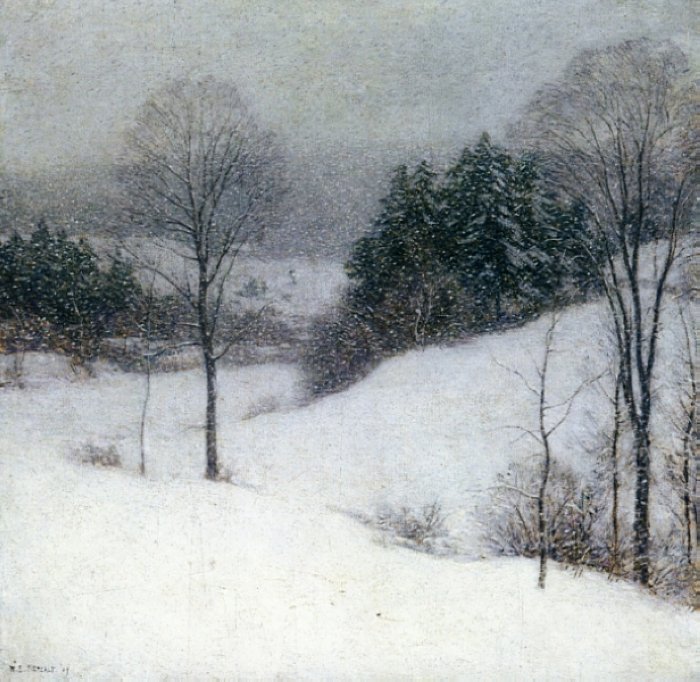
Willard Metcalf, The White Veil (1909)

Happy with what I read. Lady Joker is truly something. Feuchtwanger and Jacobsen were maybe the highlights. The Hart has really stuck with me. And those Spotswoods are good stuff. What about you all? How did your year end?

James Morrison’s Year in Reading, 2021

Today’s reflection on a year in reading is by James Morrison, an Australian reader and editor (sadly, not of books) who tweets at @unwise_trousers and blogs (increasingly infrequently) at http://causticcovercritic.blogspot.com.

Look for more reflections from a wonderful assortment of readers every day this week and into next. It’s a stellar lineup. Remember, you can always add your thoughts to the mix. Just let me know, either in the comments or on Twitter (@ds228).

Francesa Woodman, Untitled, Rome, Italy 1977 – 78

2021 was like much of the rest of my life: I didn’t accomplish much, but I did read a shitload of books. If you take as true the dubious proposition that literature makes us better people, then virtue must positively drip from my pores. Sadly, the behaviour of nearly every great writer shows instead that constant contact with great literature makes you absolutely repellent.

Reading a lot can mean that when you look back on what you’ve read over the course of a year there are a number of surprises. I read that this year? It feels like a lifetime ago. What book is that? I have no memory of it at all. I only gave that three stars on Goodreads? It’s really hung around in my brain, more so than some of the obvious winners.

Some people have reading plans they stick to. I have no plans, or at least none that last more than a day or two in the face of the constant deluge of new and old books that keep yelling out for attention. I’m also a sucker for pretty books—I will absolutely fall for a book with a clever or beautiful cover design, knowing nothing else about it. [Ed. – Hard same, I’ll often ignore a book with an ugly cover and then decide I have to have it if it’s released in a better design.] Despite this, I will pretend not to be shallow as I talk about some of the things I read last year, in loosely thematic clumps.

Magyars

One of my favourite literary sources is Hungary. Little Hungarian writing gets translated compared to that from most other European countries, but the main reason I like it is that the general quality of what does get translated into English is astonishingly high. Three books from Hungary particularly struck me this year.

Progressive Transylvanian aristocrat Count Miklós Bánffy is best remembered for his massive They Were Counted/Divided/Found Wanting trilogy, but was also excellent on a small scale; and two collections of his short stories came out at roughly the same time from two different publishers, with some overlap. Probably the better of the two is The Enchanted Night, translated by Len Rix, full of elusive stories that range from brutal military realism to strange and spooky Transylvanian folktales.

The selected short stories of Tibor Déry, who was imprisoned for political reasons both before and during the Communist regime, are collected in Love, translated by George Szirtes. Life in Budapest under the Nazis and the Stalinists is beautifully, if bleakly, rendered.

László Krasznahorkai is easily the best-known Hungarian writer on the world stage today, and his novella-with-music (each chapter has a QR code you can scan to summon the accompanying track) Chasing Homer is a compressed marvel of paranoia, pursuit and weapons-grade bile. Surely one day they’ll run out of overrated Sixties singers and lovers of war criminals and give him the Nobel. [Ed. – Could be a while though; spoilt for choice there.]

Egon Schiele, Seated Woman with Bent Knee, 1917

Poets

Speaking of the Nobel, I finally read Louise Glück for the first time, and her Averno is genuinely wonderful, so I suppose they don’t only give the prize to the undeserving. Even more marvellous and long-neglected by me was Inger Christensen’s Alphabet, translated from the Danish by Susanna Nied, a book in which the poetry really does attain the qualities of music, pure and wise and breathtaking.

Homecoming by Magda Isanos, translated from Romanian by Christina Tudor-Sideri, was another small revelation, full of the fog and ghosts and forests of interwar Central Europe. And then there was Notes on the Sonnets by Luke Kennard: if you’re not intrigued by a collection of funny/sad prose poems, each set at the same deranged house party and each taking as its launching point one of Shakespeare’s sonnets, then I can’t help you.

Novels in verse are one of my many obsessions, and there were two that stood out. Fighting Is Like a Wife by Eloisa Amezcua (due out in April) uses as raw material the life and marriage of a historical boxing champion and his wife in formally clever and emotionally moving ways. And then there is Deep Wheel Orcadia by Harry Josephine Giles. How a major publishing house was persuaded to take a gamble on a hard science-fiction verse novel written in the Scottish-Norse hybrid Orkney dialect is a mystery to me, but that it happened shows this is not yet an entirely fallen world.

Tom Roberts, In a Corner on the Macintyre, 1895

Space

The host of this blog doesn’t give a shit about space [Ed. – correct], because he is Wrong [Ed. – possibly correct], but I’m going to talk about it a bit here anyway because Dorian made the mistake of giving me the microphone [Ed. – absolutely incorrect; no mistake was made]. Continuing the astro-poetry theme we have Ken Hunt’s The Lost Cosmonauts, a collection about the accidents and deaths of the Space Race, much of it constructed from the texts of official reports and radio transcripts. Then there’s Omon Ra by Victor Pelevin, a bleak black comedy about the Soviet space program.

Pushing further into the future was the story collection Terminal Boredom by Izumi Suzuki (multiple translators), a downbeat set of 1970s/1980s Japanese countercultural tales of sexual and pharmaceutical weirdness. Further still takes us to Olga Ravn’s The Employees, translated from Danish by Martin Aitken, a genuine little masterpiece of a “workplace novel” set on a Generation Starship.

Finally, the biggest thing I read in 2021 was XX by Rian Hughes, a 1000-page monster about first contact and artificial intelligence. It’s a beautifully designed book in which the spirit of the 19th Century talks in multi-typeface pamphlets and that of the 20th in Futurist broadsides, which includes an entire pulp SF novella serialised in magazines that never existed, and which is the first book I have ever seen with a reversible dustjacket designed to make it look like a shelf of the fictional publications contained within the text [Ed. — !].

World War Two

Dutch genius Willem Frederik Hermans is having something of a revival, and A Guardian Angel Recalls (translated by David Colmer) is a great book new to English: a public prosecutor, weak and lovelorn, races around Holland as the Nazis invade, wreaking inadvertent havoc as he tries to save himself, protected and frustrated in equal measure by his similarly flawed guardian angel.

The Passenger by Ulrich Alexander Boschwitz (translated from German by Philip Boehm) is from 1938: perhaps too late to be called prescient, but even years later people were denying its truths. Otto Silbermann is a Jewish German who fought for his country in World War One, too slow to realise that what is happening to other Jews will happen to him too. Finally he has to go on the run, trying to find a way to escape across the border to safety.

Marga Minco’s The Glass Bridge (translated by Stacey Knecht) is another Dutch novel, a tangential look at the Holocaust in fragments from the life of Stella, a Jewish artist hiding out under a dead woman’s name, moving from safe house to safe house, fending off the advances of a sexually predatory ‘protector’.

David Piper’s Trial by Battle (originally published in 1959 as by Peter Towry) is a deeply anti-triumphalist novel about Britain in Asia during World War Two, outclassed and outfought, living on a faltering diet of nationalistic smugness. Frances Faviell’s A Chelsea Concerto is a fascinating memoir of the first few months of the Blitz in London. Finally, Donald Henderson’s 1943 novel Mister Bowling Buys a Newspaper, despite its religiose ending, is a fine black comedy about a polite serial killer for people who have read all of Patrick Hamilton and now have a sad void in their lives.

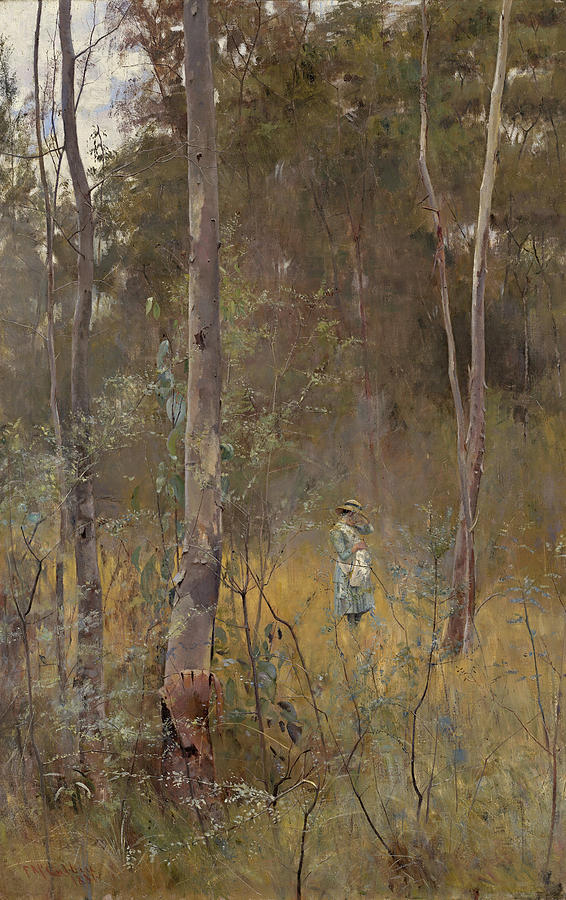
Frederick McCubbin, Lost, 1907

Random Others

Marian Engel’s Bear has no greater champion than the management of this blog, so I shall say nothing other than that Dorian is absolutely right about it in every way, despite the ludicrousness of the premise. [Ed. – THANK YOU! Another satisfied customer! You can watch James admit this truth to me here.] Another weirdly charged masterpiece is Denton Welch’s In Youth is Pleasure, a strange and astonishing novel about a boy helpless in the grip of his aesthetic and sensual needs.

I don’t even like boxing, yet Michael Winkler’s Grimmish is the second boxing novel on this list: a wonderful and weird book about masculinity and physical pain, full of great jokes which I have stolen: There are two types of people: those who can extrapolate from incomplete data. [Ed. – But that’s only one… ohhh…] Checkout 19 by Claire-Louise Bennett, which is sort of about the disparity between literature and life but also about everything else, is a genuine marvel. Minae Mizumura’s An I-Novel (translated by Juliet Winters Carpenter) is the story of two Japanese sisters transplanted to New York, a deep and rich and perceptive work enriched by numerous photographs. It’s not quite the equal of her A True Novel, but then what is?

Jeffrey Smart, Cahill Expressway, 1962

[DISTANT, MUFFLED NOISE]

The Surprise Party Complex by Ramona Stewart, criminally out of print for decades, is a beautiful and hilarious bit of work about a group of neglected and eccentric teenagers at a loose end in Hollywood. The deeply weird Mount Analogue: A Novel of Symbolically Authentic Non-Euclidean Adventures in Mountain Climbing by René Daumal (translated by Roger Shattuck) was never finished, but what we do have is a surrealist masterpiece. Flesh by Brigid Brophy is a near-as-damnit perfect novel about appetites, both sexual and gastronomic. And everybody who enjoys the atmosphere of a good grotty 1950s London boarding house needs to read Babel Itself by Sam Youd (better known as science-fiction writer John Christopher), another unjustly forgotten bit of comic brilliance about a group of lodgers running spiritualist experiments, having affairs and betraying each other.

[SOUND OF SECURITY FORCES BANGING ON DOOR, YELLS OF ‘YOUR TIME IS UP!’]

Then there’s the Patricia Lockwood’s No One is Talking About This, which really is as good as everyone says, and Jim Shepard’s Phase Six, an unfortunately timed global pandemic novel that’s also a splendidly moving look at female friendship, and Hilma Wolitzer’s career-summary story collection Today a Woman Went Mad in the Supermarket, and…

[DOOR BREAKS DOWN]

..and Nathalie Sarraute’s Tropisms, which I finally read years after everybody else, and Giorgio Bassani’s The Heron, the only book of his I’d never read, and…

[MUFFLED SHOUTING, SOUNDS OF SOMEONE BEING DRAGGED AWAY]