Scott Walters’s Year in Reading, 2023

Excited to once again present reading reviews from some of my favourite readers. Today’s installment, his third, is by Scott Walters. Scott launched a litblog, seraillon, in 2010, and expects to return to it one of these days. He largely follows Primo Levi’s model of “occasional and erratic reading, reading out of curiosity, impulse or vice, and not by profession.” He lives with his partner in San Francisco.

Barring a couple of possible late entries, here ends the 2023 edition of the EMJ Year in Reading series. Thanks to everyone who contributed–and all who read these engaging lists.
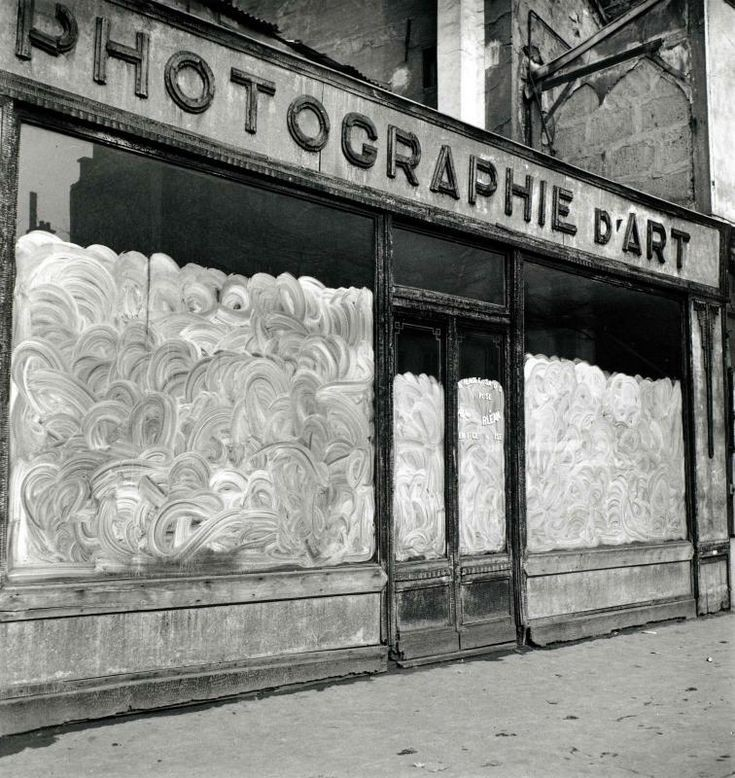
Édouard Boubat, Paris, 1949

Year in Reading 2023: 50 Books, Fat and Thin

Like several others who have already posted about 2023, I had a less than stellar reading year, finishing a little over half the number of books I did in 2022. On the other hand, several doubled as barbells for building up my muscles. On the third hand, some were slim. And on the fourth hand, some were slim pickings; I can’t recall ever reading so many works I didn’t especially like. I’m not sure to what to attribute that deflating phenomenon, but I hardly seem to be alone.

Best Quasi-Rereading

Michael Moore’s effervescent new translation marked my fourth time reading Alessandro Manzoni’s The Betrothed (1827/1842). As Moore explained at a reading I attended, he deliberately aimed his translation at an American audience lamentably unfamiliar with this 19th century masterpiece. An ingenious framing story cocoons this long tale of Renzo and Lucia, the affianced young couple whose wedding plans are dashed by the machinations of a lascivious warlord, forcing the couple to separate and flee into spiraling trials that challenge them (and several other characters) into becoming larger than themselves. Starting a beloved book in a new translation requires adjustment, but I was won over by Moore’s energetic, nimble, vivid and playful version, almost certainly the place to start for any American reader approaching this grand work for the first time. [Ed. – This book looks at me reproachfully from the shelf…]

Other Italian Explorations

Giovanni Boccaccio: The Decameron

G. W. McWilliams’ translation of Boccaccio’s 1353 classic accompanied me throughout the year as the perfect post-pandemic [Ed. – sic] companion. You know the framing story: five young women during the Florentine plague of 1348 abandon the city and invite along five male friends to an empty villa in the hills where, each day for ten days, each tells a story to entertain the others. The depiction of the plague in the book’s opening is terrific, and the 100 stories, splendidly diverse, are by turns tender, ribald, moving, pointed. So is the warm banter between the young people as they introduce their stories and encourage one another’s efforts, the whole serving as a kind of instruction manual on storytelling (and as a model for confronting calamity). Boccaccio has become a favorite; I also spent time this year with his Famous Women and Genealogy of the Pagan Gods, the latter especially highlighting Boccaccio’s talent as a great writer of prefaces. [Ed. – Ok, you sold me on this!]

Dominic Starnone: The House on the Via Gemita (2023)

The two short Starnone Neapolitan novels I’d read had impressed me, so I was excited to discover a fat new 500-page work also set in Naples. Starnone’s narrator recounts the history of his father, digging so thoroughly into strained father/son relationship that I can’t imagine The House on the Via Gemita not taking its place as a classic of the genre. To my surprise, the book also turned out to be an excellent novel about painting, in that the son must address both his father’s abusive personality and role as a peripheral figure in mid-century Italian art, a career layered on top of a day job as a railroad worker and the family responsibilities he largely leaves to others. Starnone gives us a brief history of postwar Italian art while exploring the qualities that make paintings great or mediocre and making personal an issue of our time: disentangling (or not) an artist from their art. I also noted the geographical precision employed by Starnone as a quality common to several contemporary Neapolitan novels; one can use a map to follow the narrative’s peregrinations around the city.

Maria Attanasio: Concetta et ses femmes

Concetta et ses femmes, written in 2021 when Attanasio was 80, sets out as a documentary rescue mission to obtain the story of Concetta la Ferla, organizer in the late 1960s, in Caltagirone, Sicily, of the first women’s branch of the Italian Communist Party (then the third largest in the world). Concetta’s grassroots project develops out of frustration with the municipality’s diversion of water to its wealthiest citizens, but runs into predictable obstacles in the form of chauvinistic attitudes in the city administration, in the Party, and at home. The story would be interesting enough simply as historical artifact. But Attanasio’s structuring of her novel, the first part narrated by Maria herself from the perspective of 20 years after the effort to preserve Concetta’s tale, and the second the tale itself in Concetta’s words, plays with questions of authorship and feminist solidarity, and emphasizes the continual nature of the struggle to gain legitimacy, to advance the advances of the past, to never go back.

Other Italian/Italy-related works included an Italian/French collection of short stories (Nouvelles italiennes contemporaines), with Tomas Landolfi, Massimo Bontempelli and especially Elisabetta Rasy’s contributions as standouts. Indian-American-now-Italian writer Jhumpa Lahiri’s Roman Stories (2023) revisits Alberto Moravia’s 1959 Roman Tales (Racconti Romani in the original Italian for both books), exchanging Moravia’s focus on Roman men in recognizable neighborhoods for immigrants, ex-pats, and tourists vaguely on the city’s periphery. Renato Serra’s Examination of Conscience of a Man of Letters (1915) presents a searing treatise on the relationship of literature and war, written three months before Serra perished in battle in World War I (read in French; while the essay has never gone out of print in Italy, it has not been translated into English). I devoured Janet Abramowicz’s monograph, Giorgio Morandi: The Art of Silence (1964), a deep appreciation of the Bolognese artist into whose family Abramowicz was essentially adopted. Despite this proximity, Abramowicz treats her former teacher judiciously and even unsparingly when it comes to Morandi’s blemishes, in particular his tacit involvement with fascism. German writer Esther Kinsky’s Rombo (2022), a polyphonic novel exploring the impact of a series of earthquakes on remote villages in the north of Italy, grew on me during my reading, with its Polaroid-like narrative approach in which the lives of the villagers gradually become more vivid and saturated. Finally, in Etruscan Places (posthumous publication 1932), D. H. Lawrence and a companion identified as “B” voyage through central Italy, exploring sites of the ancient Etruscan “12 cities.” Lawrence’s incisive, infectiously enthusiastic observations about Etruscan art and life turned me into a fan of this fascinating people whose culture was absorbed/obliterated by the Roman Empire. The narrative doubles as a travelogue through Mussolini’s Italy and, adding yet another layer, Lawrence’s views lay out an entire philosophy that has me determined to revisit his fiction this year. [Ed. – I support this plan!]

Stalingrad

I came away from Vasily Grossman’s Life and Fate convinced I’d encountered one of the essential literary documents of the 20th century’s experience of fascism. I did not know that the book was but a second volume in Grossman’s monumental effort to write the great World War II novel. The first, Stalingrad (1952), with still no definitive Russian edition, has only recently been translated into English by Robert and Elizabeth Chandler. As highly as I esteem Life and Fate, I believe Stalingrad may well be the superior novel [Ed. — !] in its immediacy and the sheer grandeur of its conception (but as the books were intended to form a whole, one need not set them against one another). Grossman, present at Stalingrad as a journalist, related some of his experiences in Life and Fate, but Stalingrad sets out to capture the whole story of the war’s most decisive battle, from August 23, 1942 to February 2, 1943. Grossman’s acute consciousness of his literary precursor, Leo Tolstoy, leads him to take his main character on two pilgrimages to Tolstoy’s house, Yasnya Polynka, and to muse on Tolstoy’s accomplishments: 

Krymov looked at the wounded who had fallen by the wayside, at their grim, tormented faces, and wondered if these men would ever enter the pages of books. This was not a sight for those who wanted to clothe the war in fine robes. He remembered a night-time conversation with an elderly soldier whose face he had been unable to see. They had been lying in a gully, with only a greatcoat to cover them. The writers of future books had better avoid listening to conversations like that. It was all very well for Tolstoy – he wrote his great and splendid books decades after 1812, when the pain felt in every heart had faded and only what was wise and bright was remembered.

With Life and Fate, Stalingrad now gives us one of the great documents of World War II – and one of the greatest works of fiction about war ever written.

An Essential Holocaust Novel

The Talmudic concept of the Lamed-Vov, the 36 righteous people on whom the continuity of the world depends, fascinated me when first I read about it. Only when I started André Schwarz-Bart’s 1956 Prix Goncourt-winning novel, The Last of the Just, did I realize that the Lamed-Vov were central to the book. Schwartz-Bart takes the reader though a thousand years of Lamed-Vov succession to arrive at Germany in the 1930s, where the narrative pace slows dramatically. His restrained, almost clinically factual language provides devastating testament as much as fiction. Some of its scenes are completely indelible, and Ernie Levy, Schwarz-Bart’s protagonist for this last half of the book, struck me one of the most remarkable characters I’ve encountered in a lifetime of reading. [Ed. – It feels like a professional failing that I have not read this book!]

José Revueltas: The Hole

A tiny but shockingly powerful novella, taut and tight with not a word out of place. [Ed. – Funny, that’s how people usually describe me!] The Mexican writer and activist Revueltas’s 1969 book, based on the author’s own 12-year experience as a political prisoner, resembles a Piranesi prison drawing in narrative form, an intensely concentrated exploration of incarceration. Everything in the narrative is compressed – time, space, hope, even the reader’s attention and the size of the book itself. An absolute masterpiece of prison literature.

Mariana Yampolsky, Estación Martell, 1988

Good King Xavier, Reino de Redonda

Spanish novelist Javier Marías died at age 70 on September 11, 2022. I encountered his work four times this past year, first in his final novel Tomás Nevinson (2022) which appeared last May in Margaret Jull Costa’s translation. I had come to anticipate each new Marías translation as nearly an annual tradition, so knowing that this his last novel made reading it deeply bittersweet. Tomás Nevinson follows up 2018’s Berta Isla, but also resurrects characters from Marías’s Your Face Tomorrow trilogy, most notably Bertram Tupra. Where Your Face Tomorrow engaged Spain’s experience of Franco and of the civil war, Tomás Nevinson takes as its starting point the Basque separatist terrorist attacks of the 1990s. As Nevinson is enlisted by Tupra to come out of retirement to track down a woman involved in the most heinous of these attacks, Marías uses the narrative to explore questions about our responsibility for seeking justice, how we deal with repentance and redemption, what justice seekers owe to their own loved ones, whether there may be some informal statute of limitations on bringing the guilty to account and how long justice should be sought – time being among the most prominent fixtures in Marías’s fiction. We are fortunate to have this novel; Marías’s time having run out seems completely unjust.

When I picked up Tomás Nevinson at Point Reyes Books, the literary mecca cultivated by Molly Parent and Stephen Sparks, Sparks asked if I’d read the new book about Redonda. I must have stared at him blankly, as, having not yet read Marías’s Oxford novels, I knew nothing. Thanks to Michael Hingston’s marvelously strange Try Not to Be Strange (2023), I now know quite a lot, including the fact that Marías had been, up until his untimely death, King Xavier I, monarch of this tiny nation, which, despite having no inhabitants, does have territory, a flag, its own currency and postage stamps, and a plethora of dukes and princesses, counts and ambassadors, and multitudes of other titles held by what seems a who’s-who of 20th century writers. This was by far my most fun book of the year, uncovering a great story, offering up a charming tale of obsession (including Hingston’s own), and digging a dizzying warren of rabbit holes for one to scurry down, which led to my filling quite a bit of empty shelf space with related works. [Ed. – Well, this all seems quite insane!]

One of those works, of course, was All Souls (1992), the Marías Oxford novel in which the author first mentions Redonda. I expect to have more to say about this book after I’ve read its sequel, Dark Back of Time, on deck for 2024.

Another addition, Cuentos únicos (1996), came from Reino de Redonda, Marías’s own Spanish-language imprint.This collection of 22 translated English language short stories selected by Marías presented a way to practice my poor Spanish and get to know some writers I didn’t know. Nugent Barker? Oswell Blakeston? Percival Landon? [Ed. – Are these imaginary???] My Spanish proved inadequate to the task, but I understood enough to have made the effort – to be continued this year – worthwhile.

The Ascent of Rum Doodle Mont Analogue

My next-to-most-fun book of the year, René Daumal’s Mont Analogue (1952), tells the story of Père Solgon’s organization of an expedition aboard the ship “Impossible” to find the rumored tallest peak on earth, mysteriously as yet undiscovered due to its isolation (guesstimated to be in the vast South Pacific) as well as certain tricks of light that keep it invisible except at a certain hour and from a certain approach. With a crew including such luminaries as an American painter of alpine scenes, one Judith Pancake, the voyage is half tongue-in-cheek, half mystical imponderables (Daumal had been a follower of Gurdjieff), half Jules Verne. Yes, I know that’s three halves, but that suggests the shape and character of this delightful novel, one of the rare “unfinished” works that actually ends mid-sent-….

(Note: for French readers: a lovely new hardcover illustrated edition of Mont Analogue comes with an introduction by musician Patti Smith).

Weak in Comparison to Dreams

I got to know art historian/theorist James Elkins’s work some 25 years ago while researching text and image for a conference paper. So it came as quite a shock to discover a 600-page novel by Elkins, especially as I’d recalled his having announced in an Amazon book review his intention to stop adding to an accretion of texts. Presumably Elkins only meant Amazon reviews, because Weak in Comparison to Dreams (2023) is a welcome contribution to contemporary literature and among the most unusual novels I’ve read in a long time.  In the book’s continuation of Elkins’s explorations of text/image interactions, I felt both that I was right back where I’d left off and in a whole new world. Incorporating scores of black and white images and increasingly nutty charts and graphs, the narrative follows its narrator, Samuel Emmer, a bacterial biologist for the city of Guelph, Ontario, on a series of visits to zoos around the world to evaluate mammalian behaviors and health protocols as Guelph plans its own zoo. [Ed. – The Guelph connection is… unexpected.] A dozen interchapters present Emmer’s dreams while on this mission, these too accompanied by images that suggest an intensifying fugue state. By turns sobering and hilarious, thematically touching on everything from animal welfare and incarceration to climate change and bureaucracy, from pseudo-science to contemporary experimental music, and playing in a space similar to that occupied by conceptual artist David Wilson’s Museum of Jurassic Technology, Elkins’s absorbing novel is… not at all what it seems. A 100-page final section entitled “Notes” delivers not so much “notes” as a surprising reframing of the first narrative, much in the way a caption might reframe an image. I can’t get the book out of my head, and shouldn’t, as Elkins has completed four other novels since 2008 that form a quintet of which Weak in Comparison to Dreams, though the first to be published, is volume three. I cannot wait to see what he does in the other four. [Ed. – How the hell do you find this stuff???]

The Queen of L.A. Noir

My familiarity with Dorothy Hughes’s In a Lonely Place (1947) had been limited to Nicholas Ray’s 1950 film starring Humphrey Bogart. Finally reading the novel left me incensed about the movie, a fairly egregious desecration of its source material. Fortunately, I felt no indignation in response to Hughes’s novel, which floored me as not just a masterpiece of Southern California noir, but perhaps the masterpiece of Southern California noir. I fell for it in the first pages, which captures the foggy, seeping chill of the California coast at night in a manner precise and true. She shies away from nothing in this penetrating psychological drama in which [Ed. – SPOILER INCOMING!] the narrator himself is the killer – presumably the quality that kept the studios from allowing Humphrey Bogart to be tarnished by such a role. Hughes covers the postwar L.A. noirscape exquisitely while managing to keep her narrator entirely human, a subtle literary feat that reads like one of Freud’s case studies. Raymond Chandler might be King of L.A. Noir, but if you asked me to pick a monarch, I’d go with Hughes on the basis of this novel alone.

Other mysteries included the marvelous Margaret Millar in Stranger in my Grave, a disappointing end to the Montalbano series in Andrea Camilleri’s Riccardino, and dismay as regards Mignon Eberhart, an author I’ve liked, whose Family Affair, in this year of too many books I did not like, marked the nadir.

Poetry

Aside from individual poems here and there, I read just three books of poetry. Reginald Dwayne Betts in Felon (2019) gives us a powerful collection of poems that go well beyond the experience of incarceration to address convict life beyond prison. I found Argentine poet Alexandra Piznarik’s Removing the Stone of Madness, Poems 1962-72 (Yvette Siegert, translator), relevatory. I did not know Piznarik, who, as the collection’s title suggests, fought a terrible battle with mental illness which she chronicled in short, sui generis poems as hard-edged and clean as crystals, powerful poem-objects one could almost hold in one’s hand. Finally, I loved Greg Hewitt’s intimate, resonant poems in Blindsight, structurally based on composer Olivier Messiaen’s prime-number system and which brought to mind Frank O’Hara’s personal poetic school of “Personism” (a mutual friend sent me Greg’s book).

Odds and Ends

The rest, an unorganized, mostly enjoyable mess, included Willa Cather, more Eve Babitz, Sándor Márai, Tatsuo Hori, Euripides, Chinua Achebe, Raphael Sánchez Ferlosio, more César Aira (an annual need), Daisy Hildyard and others. Larry McMurtry’s Lonesome Dove (1985) gave me exercise, as with Stalingrad in one hand, I built up my other bicep by hefting McMurtry’s 850-page narrative in late-night installments at approximately the same pace as the Texas border to northern Montana cattle drive the story depicts. I found it terrific fun, amplified by my subsequent reading of the story of a poor Texas legislator who made the mistake of trying to ban Texas’s national novel. No one should want to be that guy. A bit further south I ate up Charles Portis’s Gringos (1991), set in the Yucatan where rumpled ex-pat Americans are involved in archeological dealings and mis-dealings. Are all of Portis’s novels his best novel? I think so. I think so.  [Ed. – Well put!] Art historian Alexander Nemerov’s The Forest (2023), a collection of essays and corresponding plates, uses forests of the American frontier to cull idiosyncratic tales of 1830’s American art and culture, rescuing some fascinating figures from historical oblivion. I finally got around to reading Maggie Nelson, in Bluets (2009) and The Argonauts (2015) – respectively, musings on the color blue (with a towel snap at William Gass’s bare cheeks), and raw meditations on sex, gender and motherhood that I sent off to goddaughter pursuing gender studies. I’d been curious for some time about Michael McDowell six-volume Blackwater, and gorgeous and affordable new French paperback editions provided an opportunity to dive in. Blackwater 1: La Crue (1983) proved a Southern Gothic slow drip horror tale peeling away the veneer of Southern gentility. For the first time since high school, I revisited J. D. Salinger, in Raise High the Roof Beam, Carpenters (1955) and Seymour: An Introduction (1959). Salinger himself may not have aged well, but these two novels were far better than I expected them to be.  I found Tove Jansson’s The True Deceiver (1982) to be a stunningly good novella about truth, trust and deceit, not necessarily in that order, set in a fishing village on the Finnish coast. There seems to have been nothing Jansson couldn’t do right. While somewhat confined in a house in the mountains, I found appropriate companionship in Count Xavier de Maistre’s A Journey Round My Room (1795), a book born of boredom, a curious meditation on escaping it, created when, following a duel, de Maistre was put under house arrest for some six weeks. Alleviating boredom, Roy Lewis’s The Evolution Man, or How I Ate My Father (1960), though clearly dated, was still pretty damned funny as comedies about pre-history go. Finally, a couple of books with which I struggled still held enough of interest for me to get through them. Justin Torres’s Blackouts (2023) relies heavily on photographs, drawings, redacted text, dialogue as film script, and other novelties that I found a bit overcooked (in a way I did not with the Elkins novel). But the story Torres unearths of a 1942 study of homosexuality, and of the lesbian couple who helped drive the project and were betrayed by it, is remarkable. I had a tougher time with Gerald Reve’s The Evenings (1947) acclaimed by some as the great 20th century Dutch novel. A disaffected young man lives with his numbed parents in 1946 Amsterdam and battles his claustrophobic life with dark, acrid humor. I admired Reve’s allowing the war to drip into the narrative bit by bit, the horrors of the recent past seeping into normal life. But I couldn’t wait for the book to end.
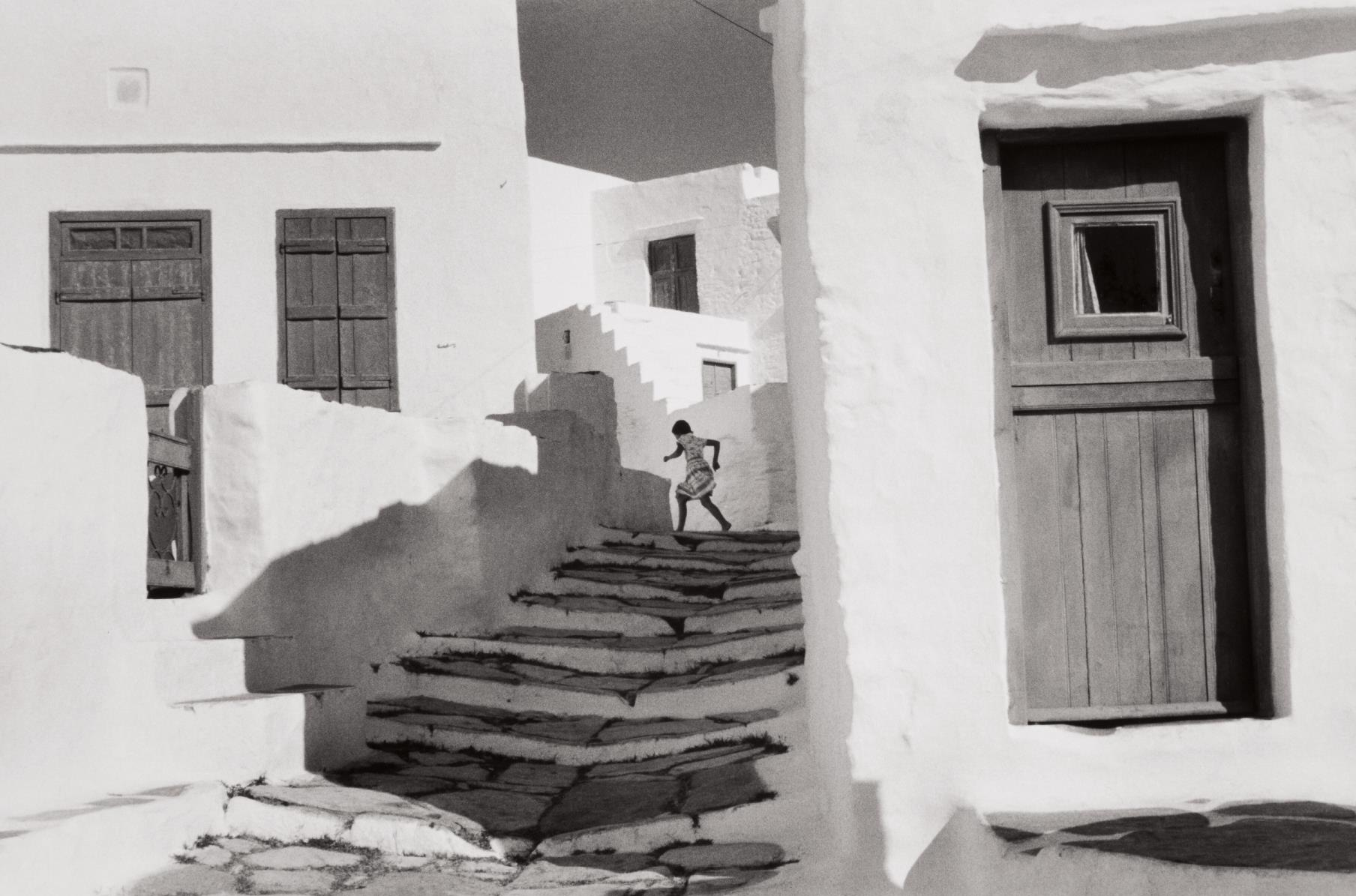
Henri Cartier-Bresson, Naples, 1960

I’ll conclude with a dream. In a cluttered bookshop, I found a tattered but astounding volume amended with striking collages, vivid watercolor sketches, and dense margin notes. The (dream) author’s name seemed familiar, so upon waking I looked up James Gould Cozzens and plunged down a trail that led me to Dwight MacDonald’s 1958 review of Cozzens’ late novel, By Love Possessed.  I did not read Cozzens. I’m not sure I will ever read Cozzens. But I’m grateful to odd dreams for having pointed me to MacDonald’s review, which takes to task a generation of critics who, with log-rolling fealty and conformity to one another’s uncritical opinions, lavished praise on the novel. Eviscerating, illuminating, even necessary, his review models close textual analysis with an eye towards criticism’s larger role, relevant today when writer-critics blurb one another’s books and award prizes to mediocre works.  A pretty good way to end the reading year, and a better way to start off a new one which, I am happy to say, as far as books go, is off to a tremendous start. Thank you for reading. [Ed. –Thanks for writing, Scott! A delight as always.]

Scott Lambridis’s Year in Reading, 2023

Excited to once again present reading reviews from some of my favourite readers. Today’s installment, his third, is by Scott Lambridis (@slambridis). Before completing his MFA, Scott earned a degree in neurobiology, and co-founded Omnibucket.com, through which he co-hosts the Action Fiction! performance series. Read more at scottlambridis.com.

Each year I have a reading goal of at least 52 books. This year I read 151, including 37 new countries. Out of those, here’s the top ten, in the order in which they were read.

Edward Hopper, Tramp Steamer, 1908

1. Still No Word from You / Peter Orner (US, non-fiction)

A mix of short (often very short) stories, many centered on growing up in Chicago in a Jewish family, but Orner’s biggest gift is his ever-present love of books and reading. His soliloquys on books he loves, and his skill at tying life memories to the books and stories that resonate with him still are the most captivating and infectious. At the prose level, Orner can shatter you in a sentence. [Ed. – Sounds painful!]  And yet if you listen to him talk about stories (his or others’), you’ll notice he’s laughing the entire time. How can you deny that delight?

2. The Ice Palace / Tarjei Vesaas (Norway, fiction)

A Norwegian child takes a walk in the woods after school to see a frozen waterfall, and never returns. Seems simple, but no book has immediately filled me with a sense of coldness and vague menace, and kept it going like this one. The prose is sparse and spare, the story distilled to the very essence of wonder, mystery, and heartbreak. In memory, the book feels like an ice crystal itself. [Ed. – I hear so many wonderful things about this book: keen to read it!] 

3. The Summer Book / Tove Jansson (Finland, fiction)

A girl spends a summer with her grandmother, sharing little moments of wonder and delight, in this collection of interconnected stories (technically a novel, but each story is self-contained). It’s hard to explain why I love Jansson so much, but everything she touches is strange and delightful. She’s most known as the creator of the Moomins, that blob-like cast of characters for children, first appearing as a comic strip that swept through Europe and inspired not just a series of wonderful children’s novels, but the Disney-like Moominland (which I must visit some day). There’s also a great documentary on her as a “failed” artist called, simply, Tove. Her magical children’s stories can surprise you with their adult-ish realism, and her “realistic” adult stories read like fairy tales. Start anywhere: you may fall in love.

4. People from Bloomington / Budi Darma (Indonesia, fiction)

A collection of short stories based on the author’s time at Indiana University for grad school. Ho hum, you say? They’re absolutely crazy though! The utter strangeness of them, the people, the absurd human interactions, the grotesque portrayals of common human nature — I’ve never read anything like it. A simple mundane event sets off a series of events leading to completely unpredictable endings. The narrators in particular (or maybe “the” narrator, since they have similar voices) observe and make note of the most unusual things. The narrator in one story falls and smashes a cake and when he opens the box he says “it looked worse than Mrs Ellison’s face,” a face never mentioned before or after. In another: “Good thing her big ears didn’t fall off.” Hilarious and bizarre! The friend who recommended it said it best: “The book is described as a realistic world portrayed through an absurdist frame, but I would add that even the way he achieves this is unique.” This is a weird book where weird things happen to weird people, revealing the deep strangeness waiting beneath seemingly tranquil suburban life. Beware though: you’ll probably never want to visit Bloomington.

5. Treasures of The Thunder Dragon: A Portrait of Bhutan / Ashi Dorji Wangmo Wangchuck (Bhutan, non-fiction)

Written by the current Queen Mother of Bhutan! [Ed. – Probably the only book from Bhutan ever mentioned on this site—and absolutely the only book from Bhutanese royalty.] Bhutan is fascinating in its own right, as a mostly isolated piece of protected land in the Himalayas most notable for prioritizing Gross National Happiness over Gross National Product. Why is this important to them, how did they come to it, how do they legislate and realize this drive towards happiness day to day, and what does that mean for the rest of us? The Queen Mother weaves the answers to these questions as takes you along her own tour of the country, its villages, its wonders, and its people. Her love of this unique country, at once more primitive and further evolved than our own (and a great many others) is so gently omnipresent that you’ll start looking for flights before you finish.

6. Death and the Penguin / Andrey Kurkov (Ukraine, fiction)

I picked this up on the recommendation of a Russian friend just after the war in the Ukraine began. I normally don’t rank my top 10s, but I will dub this one my favorite of the year without hesitation. An aspiring writer is offered a job writing obituaries for a newspaper, for people whom it turns out aren’t dead yet. Oh and he also lives with a melancholic penguin named Misha he’s adopted from the local zoo. It’s a noir mystery in flavor, full of dark humor as the two of them are thrown into a mafia intrigue the protagonist never fully understands or even appreciates. There’s a sequel too, but this one was so good I’m scared to read it. [Ed. – Agree, terrific book. I too have had the sequel sitting here for years, unread…]

7. The English Understand Wool / Helen DeWitt (US, fiction)

What was this book? Who is this author? [Ed. – A genius!] A novella from my favorite publisher, New Directions, coming in at barely 70 pages, and dubbed a fairy tale by Google (it is not a fairy tale), it’s the story of a sassy 17-year-old girl obsessed with extreme taste and avoiding mauvais ton in all situations, who loses her family, and all her money, and must weigh her wits single-handedly against the sharks of the New York publishing world who want to sign a deal with her and sell her story. Brutal, savage, artfully heartless, absolutely precise, and with an ending that’s pure genius.

8. The Royal Game / Stefan Zweig (Austria, fiction)

RIYL The Queen’s Gambit, Zweig’s classic chess story written 80 years earlier tells the tale of an unnamed narrator who discovers a Russian chess master is traveling in the same boat from New York to Buenos Aires in the midst of WWII, and attempts to lure him into a casual game the narrator is sure to lose. He begins receiving whispered advice from a watching businessman, and what unfolds over the course of three matches that challenge the pompous Russian master’s assumptions and abilities is the parallel tale of this Austrian’s businessman’s arrest, imprisonment, and torture by the Gestapo. Memorizing chess moves in solitary confinement is his only means of survival and, as Zweig deftly describes in only 100 pages, both his triumph and undoing.

9. Every Man For Himself and God Against All / Werner Herzog (Germany, non-fiction)

The south German drawl of this prolific director of both documentaries (Grizzly Man) and features (Aguirre the Wrath of God) is legendary, narrating his films with metered precision the wondrous horror of existence (“Even the stars up here in the sky look like a mess; there is no harmony in the universe” is a classic, but my fav is the YouTube of an interview with him in which he’s shot and when asked about it simply waves the question away and remarks, “It was not a significant bullet”), so I highly recommend listening to this autobiography with Herzog reading it. [Ed. – Agreed that’s a classic, but don’t sleep on his retellings of Curious George, also on YouTube.] His films are renowned for the unique point of view of his protagonists, and the singularity of his images, but it’s challenging to have a conversation about him without addressing or succumbing to the mystique of his deeds as a filmmaker. The shit this guy puts himself through for a shot! For “truth”! So when he describes episodes from his life (filming or not), you start to wonder how much he’s nurturing his own myth. My favorite moments: nearly killing himself on skis on a dare, reading dead letters sent to the town of Northpole (it exists), and meeting a pair of identical twin diagnosed nymphomaniacs who finish each other’s sentences and stare into each other’s eyes instead of a mirror to fix their hair and makeup. The book will make you want to see every film, and imagine the ones he hasn’t gotten to make, but even more you might just find yourself envying (kinda) such a superhuman life. Enjoy it as an autobiography of an artist with a singular vision, or as a larger-than-life caricature of a man who is probably fully aware of his own mythology and how to keep it alive.

Edward Burtynsky, Shipyard #12, Qili Port, Zhejiang Province, China (2005)

10. Maniac / Benjamín Labatut (Chile, non-fiction) [Ed. – Listed by many as a novel, FWIW]

Last year, this science-loving essayist made my top 10 with When We Cease To Understand the World, his series of vignettes on famous physicists and mathematicians staring into the abyss in the act of or as a consequence of their insights and creations, each which reads more like dramatization than documentary. In Maniac, he narrows his focus and dives into one of the most singularly brilliant minds of all time, Hungarian John von Neumann, the one-man think tank behind everything from the atomic bomb to the invention of computing, game theory, genetics, and artificial intelligence, a genius coveted by the US government for his necessity in national security even more than Oppenheimer, and a guy many have heard of (including myself; there are math constants named after him), but couldn’t say much about. Heavily researched, and told through a chorus of voices, Maniac recreates a man everyone should know of, and captures with propulsive momentum the ascent of modernity alongside the decline of a mind too ineffable to endure. The last section leaps away from von Neumann and dramatizes the moment when AI categorically shifts its capabilities from chessmaster to confounding the masters of the world’s most esoteric ancient game, Go, and becomes something beyond a simple calculating machine, something new, and beyond our comprehension. Whether you believe the hype and horror of those who believed a computer could never a master the art of a game so complex as Go, it’s Labatut’s primary interest in and his ability to render our human fear of science and technology that makes this book stand out [Ed. – Thanks, Scott!]

Nat Leach’s Year in Reading, 2022

still hope to write up my reflections on my 2022 reading year. (Though look how well that worked last year…) In the meantime, I’ve solicited guest posts from friends and fellow book lovers about their own literary highlights. Today’s post is from Nat Leach, who used to be a specialist in 19th century literature, but now writes exclusively for this blog (exactly once a year). [Ed. – Exclusive content, y’all!] He lives and works in Peterborough, Ontario, and tweets sporadically about literature and film @GnatLeech

Look for more reflections from a wonderful assortment of readers in the days to come. And remember, you can always add your thoughts to the comments.

Charley Harper, Red-tailed Hawk

            Regular readers of my yearly round-ups (if any such there be) [Ed. – hell yeah!] will recall that shortly after joining Twitter, my new year’s resolution in 2018 was to complete all the partially-read books on my shelves by proceeding through them in alphabetical order. At the time, I thought of this as a five-year plan, but exactly five years later, I find myself only about halfway through, as the plan has expanded to include a good many newly purchased books as well, though my original alphabetical progression continues. So my five-year plan is now a ten-year plan, but the main thing is that I’m still reading a lot of good books, and making headway through those books that have been staring reproachfully at me from the shelves for many long years. For those keeping score at home, I have now completed 158 of the 289 books currently on my list (but of course, the list keeps growing).

            Despite the arbitrariness of my system, each year gives me something to reflect on regarding my reading tendencies. In this case, my most significant reflection is simply that, when it comes to reading, I am who I thought I was: a reader of classics and obscure older texts who frequently struggles to get on with more contemporary fiction. My most inspiring reading experiences of the year were re-reads of The Iliad, The Odyssey and Moby-Dick, while, under the influence of the many good people of Book Twitter, I experimented with more contemporary fiction that I usually do, with mixed results. There were a couple of big winners (Ishiguro’s Never Let Me Go and Kertész’s Fatelessness) but I found that many other highly-recommended late-twentieth/early-twenty-first century books just didn’t do much for me. So, it’s not exactly a revelation, and I’m not complaining; after all, it’s not entirely a bad thing to have one’s choice of lane confirmed, and it’s probably too late to change myself anyway. Even so, I don’t see myself shying away from contemporary literature altogether; I do value my Twitter interactions, as there are many wonderful authors I probably wouldn’t have found on my own, although I may now take a closer look before plunging into anything written within the last 50 years or so. [Ed. – Honestly, this seems wise…]

            In terms of the bigger picture of my project, after two years of spending an entire year on a single letter (who knew that G and H would be so much work?), this year, I finished off H, flew through I and J (mercifully short shelves!) and got started on K. Here are synopses of what I read:

Hines, Barry – A Kestrel for a Knave (1968)

I picked up this book after watching Ken Loach’s film adaptation, Kes, for the fourth or fifth time and wondering why I had never read the source novel. I discovered, unsurprisingly, that the book is equally great, and that the film is quite a faithful adaptation. Both tell the story of Billy, a working-class Yorkshire youth with an abusive brother, an absentee father, and a neglectful mother, who captures and trains a young bird of prey. The one significant difference I would note between the novel and the film is that the protagonist has slightly more agency, resourcefulness, and expertise in the book than in the film. Loach’s intention seems to be to show that Billy’s victimization by the social structure—embodied especially in the bullying he suffers at school, both from other students and the teachers—is essentially an inescapable result of his class position, while Hines shows some very brief glimmers of hope for challenging the oppressions of the system. The book’s ending, which includes a somewhat surprising (given the gritty realism of the rest of the book) fantasy sequence, also differentiates it from the film.

Holcroft, Thomas – Hugh Trevor (1794-97)

I went on a bit about Holcroft last year, when I read his Anna St. Ives. Hugh Trevor is another didactic novel clearly intended to illustrate Holcroft’s theories about human perfectibility. The book is a bildungsroman that draws in parts on Holcroft’s own life and career, including his experience as a playwright and his imprisonment on charges of sedition. The protagonist goes through a series of adventures, incidentally touching on just about all the careers thought appropriate for a gentlemen at that time (the church, law, politics—only the military is missing, rejected from the start as too barbaric), each of which is exposed as corrupt. Trevor learns the necessity of controlling his passions and exerting his reason. One of the great scenes in the novel is a riff on the Gothic, as Trevor and his companion, wandering in a stormy night, believe themselves to have stumbled on a den of murderous bandits, only to discover they are very mistaken. Enjoyable for the most part, although Holcroft’s invention seems to fail him at times, as Trevor is coincidentally in the right place at the right time to come to the rescue of the heroine on three separate, but very similar occasions involving runaway horses and imperiled carriages.

Holtby, Winifred – Anderby Wold (1923)

Holtby’s first novel anticipates her posthumously published masterpiece, South Riding, in interesting ways. Most significantly, they are connected by her detached representations of social class; we see all her characters as rounded individuals, not as representatives of a particular class position. Mary Robson, the protagonist, is a farm-owner with a very maternal—and proprietary—attitude to the townsfolk, an attitude that some, like Michael O’Brien, whom she nursed in sickness, reciprocate with unthinking obedience, and others, like Coast, the schoolmaster, whose career growth she stunted, strongly resent. David Rossitur is a young socialist who strikes up a friendship with Mary but warns her that he will have to rouse the villagers against the values she represents, which he proceeds to do. Holtby invites us to like both characters, but also to see their flaws. Mary is dissatisfied at heart and using the love of the villagers as a crutch, while David is schooled in Marx, but lacks any concrete understanding of farming or the men whose minds he is trying to change. By the end of the novel, we get some hints of Holtby’s own sentiments, but we never feel that Holtby is didactically steering us towards a particular conclusion, which is perhaps why the book feels so satisfyingly ambiguous in the end. [Ed. – Well, this sounds good!]

Homer- The Iliad and The Odyssey (trans. Robert Fagles)

I hadn’t read Homer’s epics since I was a child, so I thought it was about time to revisit them. There’s not much I can add in terms of praise of The Iliad’s literary merits, classic as it is, but I sure did learn a great deal about the ancient arts of hand-to-hand combat, such as:

  • If you defeat your opponent, just stop in the middle of the battlefield and strip his armour from him; sure, there’s a really good chance you’re going to get picked off by a spear or arrow while you’re doing it, but you can’t just let the shiny bronze breastplate go. [Ed. – I mean, that shit doesn’t just grow on trees.]
  • Even if you’re carrying around powerful weapons specifically designed to optimize your attack on the enemy, sometimes you’ve just got to pick up a big honking boulder and throw it at someone. You wouldn’t think that would work very often, but apparently it does. [Ed. – BHB FTW!]
  • Before engaging in hand-to-hand combat with your enemy, be sure to tell him your entire life story. There’s absolutely no way something bad could happen to you while you’re doing that. [Ed. – Reasonable.]

The Odyssey, of course, presents its violence in a very different way; by the time I reached the inevitable bloodbath at the end, I was rooting for it to happen. Much of that has to do with the narrative brilliance of the work. While reading Bernard Knox’s impressive introduction to my edition, which touches on so many of the important events and themes of the poem, my main thought was: “how on earth is Homer going to cram all of those many, many events into a book that is actually 100 pages shorter than the Iliad?” But somehow, it does not feel rushed, the narrative switches smoothly between the parallel narratives of Odysseus and Telemachus, with multiple time frames and stories within stories all driving towards the necessary conclusion that we know is coming but is still so thoroughly satisfying. It’s just sheer narrative pleasure.

Hornby, Nick – About a Boy (1998)

Having read High Fidelity last year, I had a pretty good idea of what I was getting into: another book about a male protagonist approaching middle age without a clue about how to maintain a stable relationship. There’s even a cheeky Hornby-verse cross-over towards the beginning of the book when this book’s protagonist, Will, meets a woman in Championship Vinyl, the record shop owned by Rob, the protagonist of High Fidelity. In the end, I’m not sure if I enjoyed this book quite as much as the previous one; for one thing, Will comes off as less redeemable than Rob—the book’s premise is that he invents an imaginary child to help him pick up women at a single parents’ support group—and for another, the book’s third person narration distances us from Will in a way that makes it harder to root for the redemption of his flawed masculinity in the same way that Rob’s first-person narration does in the earlier book. In the end, though, Hornby has a wonderful, sardonic sense of humour, especially apparent in the dialogue sequences between Will and Marcus, the awkward 12-year-old boy who challenges Will’s world view.

Hugo, Victor – Hernani (1830) Trans. Camila Crossland

According to the introduction of my edition, every play that Hugo wrote has been adapted into an opera. Reading Hernani, it’s not hard to see why; every plot development, every emotion, is huge, theatrical, and melodramatic. The plot revolves around three men—a king, an outlaw, and an aged nobleman—who love the same woman. The plot twists and turns are endless, and the circulation of debts of honour and their transference, deferral, and repayment, culminating in suitably excessive climax, is quite dizzying. In short, it is all a wonderfully grand spectacle; not, perhaps, for everyone, but bound to satisfy lovers of opera, melodrama, and spectacle.

Ibsen, Henrik – Peer Gynt (1867), The Wild Duck (1884), The Master Builder (1892) Trans. Rolf Fjelde

It may be banal to say that a work of literature changed one’s life, but the performance of Peer Gynt that I attended at Brock University when I was a teenager was certainly one of the most influential artistic experiences I have ever had. [Ed. – Same thing happened to me with Glass Menagerie, though it’s surely the lesser work.] Possibly, I was just the right age for it, but even re-reading it now, there is something enduringly powerful about Ibsen’s attack on the Romantic cult of selfhood. So, maybe it’s not a coincidence that I have spent my academic career studying theories that challenge conventional ideas about how the “self” is understood and represented.

As for the other plays, the rather random selection I dipped into suggests something about the development of Ibsen’s dominant themes from the early Peer Gynt through to the later period of The Master Builder. In the earlier play, Ibsen satirizes the Romantic ego through a parable that connects this obsession with “being oneself” with destructive (troll-like) masculinity which both supports and struggles with the strictures of a repressively moralistic society. As Ibsen moves from parable to realism, in The Wild Duck, these themes become embodied in the titular animal, a wild creature that is shot, but not killed, because of the failing eyesight of the flawed patriarch, and cared for by the young daughter of the man who has been married off to the patriarch’s former mistress. Within the realist context of the play, virtually every character is at some point likened to this multi-layered symbol: victim of patriarchy, survivor of misfortune, helpless dependent, enabler of fantasy, et cet. Finally, The Master Builder, while not devoid of this level of metaphor and fantasy (the trolls make a comeback!) reads as a much more complex exploration of the abnormal psychology of its characters. Hilda, the woman who comes to visit the master builder and his family, comes across as almost an analyst figure, bringing the neuroses of the family to the fore and precipitating the final crisis of the play. It feels like a very Freudian play, written just before the rise of Freudianism.

Imlay, Gilbert – The Emigrants (1793)

This one had been on my shelf for a long time—I remember picking it up the year of my first real teaching gig—and I’m sure I was mostly attracted by Imlay’s notoriety as the American who fathered a child with Mary Wollstonecraft [Ed. — !], then abandoned her [Ed. — !!], causing her to attempt suicide twice [Ed. — !!!]. This is an epistolary novel with a clear ideological point; England, the “old country,” is a place of corrupted values while the settlers of America embody a utopian opportunity to reconstruct relationships and communities. England’s backwardness is especially seen in the near impossibility for women to obtain a divorce, and the double standards that bind women to worthless men. [Ed. – Sounds like dude knew what he was talking about.] The plot provides numerous examples of the injustice of England’s laws, as opposed to the freedom of America. The problem, though, is that the book really isn’t very good; the plot events are perfunctory, related with very little sense of dramatic action, and the epistolary structure feels very contrived—to the point where one letter-writer tells his story not all at once, but in a series of letters… not unlike the chapters of a novel. Moreover, even Imlay’s attempt at some kind of early feminist point falls flat; the women of his novel are still prizes to be won and objects to be rescued. I’m sure Wollstonecraft was not impressed. Still, it was interesting to read during a tumultuous year for women’s rights in the U.S.A., especially with much rhetoric flying about what the founding fathers intended in creating the country’s Constitution. Imlay’s point in this novel is that America represents the potential for change and freedom, and freedom is defined as not being ruled by the outdated laws of the past (i.e. those of England). Ironic, then, that many Americans are citing the very people who rejected the idea that the past should be allowed to impose laws upon the present in order to justify doing precisely that.

Ionesco, Eugene – The Killer (1957)

I read this as a student and loved it. Revisiting it, I found that it has not lost any of its power. The plot—such as it is—revolves around Berenger (Ionesco’s perpetual everyman figure) visiting a “radiant district” in the city, a wonder of modern urban planning, only to discover that a killer has been luring its inhabitants to their deaths and drowning them in a fountain. The play is both absurdist and grim, leading towards a harrowing, existential conclusion. The dystopian world of this play feels as relevant as when it was written—if not more so.

Ishiguro, Kazuo – Never Let Me Go (2005)

Having never read Ishiguro before, I was uncertain what to make of the science-fiction sounding plot synopsis of this book, but by the end of the book, I realized what a clever ruse it is; you keep turning the pages in hopes of understanding the thing, the sci-fi concept that finally explains the truth behind the characters’ lives, only to run aground on an explanation that is anti-climactic (to the characters as well) and even slightly ludicrous (our very curious protagonists spend years in the outside world without learning some very basic information about themselves that appears to be generally well known to the public). In short, it’s a textbook example of what Hitchcock would call a “MacGuffin.” Because then you realize that none of that actually matters very much; even the moral questions characteristic of the science fiction genre, while pertinent, are not the point. Rather, what you get is a finely crafted narrative about the nuances of human relationships and a low-key reflection on the human condition and the inevitability of mortality. In the end, probably my favourite book of the year.

Henry James – The Tragic Muse (1890)

I originally picked up this book at a time when every book I was reading seemed to have some variety of “tragedy” or “tragic” in the title. I realize it’s one of the lesser-read James novels, but given my ongoing interest in 19th century theatre, it continued to hold an interest for me. Picking it up again, I struggled to figure out exactly why it has been so maligned over the years; the rap against it is that it is “un-Jamesian,” and I’m not sufficiently familiar with his oeuvre to be a great judge of that, but I also wonder whether its lack of popularity has something to do with the way it treats art. For one thing, 19th century theatre was largely seen as a form of popular culture rather than art, and its practitioners were considered socially “low” (a problem that the novel itself engages with, but still could have prejudiced many contemporary readers). For another, characters in the book debate questions of art directly and at length; James even includes a character—Gabriel Nash—who comes off as a stand-in for Oscar Wilde, and who makes the case for a thoroughly aesthetic view of life. But for the most part, the life/art debate is played out amongst the novel’s three main characters: Nick Dormer is torn between wanting to be a painter and to follow in his father’s political footsteps. His cousin, Peter Sherringham, is a diplomat with a love of the theatre. Miriam Rooth is an aspiring actress who attracts both of them, and becomes the subject of the titular portrait, posing for Nick as the “tragic muse”. Each character is pulled between their artistic aspirations and their worldly realities and duties in ways that are not always tragic, but certainly involve the necessity of finding an appropriate compromise between them. Meanwhile, the discussion of “art” is further nuanced by the differences between Nick’s painting—a solitary, peaceful, but largely unprofitable pursuit—and Miriam’s acting—a communal, chaotic, and very public process that nevertheless brings her fame and money.

Jansson, Tove – The Summer Book (1972) trans. Thomas Teal

Perhaps the most unanimous opinion I have ever seen expressed on Book Twitter is a love for this book (although outrage over Bob Dylan’s Nobel Prize might run a close second). Superlatives abound, with nary a dissenting voice, which almost made me feel guilty that I didn’t like it more than I did. Which isn’t to say that I didn’t like it—I really did—just that for me it didn’t quite live up to the high bar of praise that it was given. And maybe I’m missing the point; part of what is great about the book is how unassuming it is in its simple vignettes about a young girl and her grandmother living on a small Scandinavian island. [Ed – Totally!] This scenario could produce a book that is excessively sweet and idyllic (and frankly, these days, the prospect of living on a remote Scandinavian island sounds pretty darn idyllic) but, as Kathryn Davis points out in her astute introduction to the NYRB Classics edition, the crucial fact, easily neglected as it is only mentioned once in passing, is that the girl’s mother has died. The book is very quietly about the act of mourning and working through, with the grandmother and the island itself both supporting and frustrating those efforts. There is always a darker side to the relationships described. [Ed. – Ok, I thought we were heading for a smashup in our friendship, but all is well now.]

Jerome, Jerome K. – Three Men in a Boat (1889)

By contrast, this is one of the most divisive books I’ve ever seen discussed on Book Twitter; some declare it the funniest thing they’ve ever read, others are unable to get past the first few chapters, and still others declare that it is good, but the sequel (Three Men on the Bummel) is even better. After reading it, I can understand the extreme variance of points of view; while I did find it very funny, I can see how the “shaggy dog” style of narrative could frustrate some readers. For one thing, Jerome seems unable to tell a joke just once. To wit: the narrator says, “I like work; it fascinates me. I can sit and look at it for hours.” This pithy, almost Wildean epigraph made me laugh, but the narrator proceeds to riff for three paragraphs, saying things like “And I am careful of my work, too. Why some of the work that I have by me now has been in possession for years and years, and there isn’t a finger-mark on it.” Still funny, but by the law of diminishing returns, it loses some of its impact. Nevertheless, there are some wonderful comic bits; the story about the fish on the wall of an inn that every local who comes in claims to have caught, is my favourite. I should also add that the book works quite well as travel literature too; even though my edition of the book did not have a map (boo!), I found myself compelled to get one out and trace the journey taken by the three men (and a dog) up the Thames from Kingston to Oxford. [Ed. – ALL books should have maps. God, I love a map.]

Jin, Ha – Waiting (1999)

This is another book that came highly recommended but got a very mixed reaction from me. The premise is engaging; a doctor in China’s revolutionary army is married to one woman (a loveless marriage driven by family obligation) but in love with another. His attempts to get a divorce are continually deferred (hence the title). I had no trouble getting into the book, and I found the characters convincingly drawn for the most part, although the good-natured long-suffering wife felt like a stereotype. But the deeper I got into it, the less convincing it felt, and the end was hugely disappointing. It seemed to me that there was much potential for the book to develop this basic situation in many different directions; for example, the opposition between the traditional wife from the protagonist’s rural village and the urban modern woman he loves seemed to be setting up some kind of reflection on China’s changing cultural landscape, but the book didn’t explore the topic. More significantly, I expected the book to reflect on the nature of human desire; how does the protagonists’ relationship alter over this extensive period of waiting? While it does show the answer to this question, the conclusions it comes to feel over-simplistic and inconsistent with what has come before. The ending left me feeling grumpy, and as time has gone by, the grumpiness has increased rather than decreased, which I think is a telling sign.

Jones, Lewis – We Live (1939)

As a graduate student, I read Jones’ Cwmardy, a semi-autobiographical novel about a youth, Len Roberts, growing up in a mining town in south Wales in the early 20th century. I liked it a lot, and was inspired to seek out its sequel, which tells of Len’s involvement in the labour struggles of the 1920’s and 1930’s. The book interestingly traces out the ideological complexity of these times; Len joins the Communist Party, and clashes with Ezra Jones, his wife’s father, a long-time leader of the miners, who nevertheless adopts a more conciliatory attitude towards the mining company. Like its predecessor, We Live interweaves the lives of the people with their political struggles in a way that drives home the point that these are inseparable facets of the workers’ lives. I only wish that I hadn’t waited 20 years between reading the two books.

Jones, Lloyd – Mister Pip (2006)

Although this is the most recent book I read this year, having been written only 15 years ago, it did make me think about how values have changed even in that short time. In particular, I can’t help wondering whether a book by a white man with a black, teenaged girl as the narrator and protagonist would be heralded as much as this book was if it had been written today, although I would also hasten to add that the possibilities and limitations of such imaginative engagements with an “other” are precisely the theme of the book. The narrator, Matilda, lives on Bougainville Island in the South Pacific, and details her encounters with the only white man on the island, Mr. Watts. When the island is cut off from the outside world by civil war, Mr. Watts takes charge of the school, but, not being a teacher by trade, mostly just reads Great Expectations to the children. [Ed. – I mean, could be worse…] Matilda’s attempt to understand Mr. Watts now expands to include an attempt to understand the protagonist of that novel, Pip, and the world of Victorian London in which he lives. The beginning interestingly explores Matilda’s fascination with Mr. Watts and with Pip, even as her efforts meet with limited success and lead to increased complications for all the inhabitants of her village. To my mind, though, subsequent developments are much less interesting, as Pip ceases to be a challenge for Matilda, and simply becomes a model for her own life story, which is a much less satisfying, over-simplistic flattening out of cultural differences.

Jonson, Ben – The Alchemist (1610) and Bartholomew Fair (1614)

Comparisons between Jonson and Shakespeare are as unfair as they are inevitable. Both can be very funny in their comedic works, but their scope is entirely different, with Jonson’s plays largely set in the time and place in which the author lived—London in the early 17th century—while Shakespeare’s comedies mostly based on source material from the past and set in other European countries. Because of this, Shakespeare’s plays have been attributed a “universal” applicability (but that’s a debate too long for this space) while Jonson’s world has been considered narrow. While it is true that a great deal of Jonson’s humour in these two plays hinges on in-jokes (in particular, the Puritans do not come off well) [Ed. – Do they ever?], but part of Jonson’s genius is the detailed range of characters he is able to accommodate within this narrow space. Sure, he’s not as readable today as Shakespeare is, but he’s worth the effort.

Keane, Molly – The Rising Tide (1937)

I liked my first Molly Keane book, Young Entry, enough to cheat and add another one to my list (having read Young Entry under “F” as it was published under the pseudonym of M.J. Farrell). While Young Entry was one of Keane’s early books, The Rising Tide demonstrates a more mature style and carefully crafted structure. And yet, in the end, I liked it less; the energy, chaos, and irreverence that appealed to me in the earlier book are more subdued here. The scope is grander, essentially focusing on the changes in lives and fashion in an Irish house, Garonlea, from 1900 to the 1930s, as it passes from its ancestral mistress, Lady Charlotte French-McGrath, to her free-spirited daughter-in-law Cynthia, to Cynthia’s disapproving son, Simon. Keane outlines the decline of the aristocracy and the decadence of the nouveau riche, but largely ignores the bigger political issues of Ireland at this time. In the end, the book felt somewhat limited and restrained, in much the same way that its protagonists themselves are unable to escape their narrow perspectives of the world.

Kenneally, Thomas – Schindler’s List (Schindler’s Ark) (1982)

In my past life, I wrote a critique of Spielberg’s film, and have since felt the need to finish reading the book on which it is based. The book’s largely objective, journalistic account of Oskar Schindler’s rescue of Jews from Nazi concentration camps presumably inspired Spielberg’s imitation of documentary representational strategies and careful replication of historical detail in the film. But where Spielberg uses this illusion of documentary realism to manipulate emotional reactions in his audience, Keneally shows quite directly how the facts he reports disable simplistic emotional responses and moral judgments. To confine myself to one example, I wrote about a scene in the film where melodramatic tension is wrought around the rescue from Auschwitz of a group of women who are specifically important to Schindler—and therefore to the viewer—even as it is clear that others will suffer in their place. [Ed. – That scene, ughhhh…] The rescue of a few specific individuals creates an emotional reaction that overshadows the destruction of the many. In the book, by contrast, Keneally frames this, and other incidents with an acknowledgment of the limited scope possible for Schindler’s actions. For example, he is referred to as a “minor god of rescue” at one point when he manages to rescue 30 Jewish prisoners from a death march that started out with 10 000. The point here is not to minimize Schindler’s actions—which were indeed remarkable—but to understand them within a wider context that complicates the simplistic emotional responses encouraged by Spielberg’s film.

Kertész, Imre – Fatelessness (trans. Tim Wilkinson) (1975)

By contrast, Kertész’s novel takes an opposite, highly subjective approach, presenting the first-person account of György, a Jewish teenager from Hungary who is deported to Auschwitz and then Buchenwald. This narrative approach emphasizes the contingency and singularity of his experience, which is not contextualized by more objective historical information that could be used to minimize the details of the experience in the name of some larger explanation. This, it seems to me, is the point of the book’s title, which alludes to the fact that none of what happens to him necessarily had to happen; it is the product of choices made by many people, and of sheer arbitrariness, and therefore cannot be made to conform to the rationalizations and justifications that the narrator meets with upon his return home. [Ed. – Exactly!] This idea of “fatelessness,” emphasizes both that the events of the Holocaust were the responsibility of individuals—perpetrators and bystanders who did nothing—and did not simply “come about” (a phrase that György finds in common use upon his return, and the hypocrisy of which he objects to) and that individual lives could be lost or saved by the slightest of causes, not controlled by some overarching plan or structure. I initially picked up this book after reading Dorian’s post about teaching it, which addresses all this far better than I can, especially that very interesting final chapter. [Ed. – Thank you, good sir!] It is notable that Kertész extends the narrative beyond the end of the war, demonstrating that release from the camps is not the end, and challenging conventional notions of “survival” or “liberation.” As with Keneally, there are no simple answers.

J M W Turner, Whalers (Boiling Blubber) Entangled in Flaw Ice, Endeavouring to Extricate Themselves (1846)

Melville, Herman – Moby-Dick (1851)

This was my one out-of-sequence read for the year, as I joined a Twitter group read of this book, which, like The Iliad and The Odyssey, I had not read since my precocious childhood. (I note also that, having read The Man Without Qualities, The Balkan Trilogy, and The Levant Trilogy in recent years, I have relieved some of the pressure that will inevitably brought to bear when I reach the M shelf.) I remembered the book as mostly the story of Ahab’s obsession with the white whale, but had forgotten that the book is a strange and wonderful mixture of psychological exploration of human nature, allegorical tale, shaggy dog story and detailed account of the workings and history of the whaling industry. The latter part, I must admit, I found strangely compelling; as abhorrent as the idea of the killing of whales may be, the intricacies of the process are quite astonishing, but no more so than the sheer scope of the book. As I said at the outset, I am a reader of the classics, but if the word “classic” has come to refer to a predictable and stable literary form, this book is a reminder that classics became classics not by following the rules, but by rewriting them. [Ed. – So well put! Thanks, Nat. Same place next year?]

Anne Cohen’s Year in Reading, 2021

Today’s reflection on a year in reading is by Anne Cohen (@aecnyc). Anne is a lifelong reader (preferably stretched out on couch or bed), retired lawyer, and former reporter. She lives in New York City with part of her family and two dogs and is firmly convinced that Book Twitter saved her from homicidal behavior in 2021.

Look for more reflections from a wonderful assortment of readers every day this week. Remember, you can always add your thoughts to the mix. Just let me know, either in the comments or on Twitter (@ds228).

Vanessa Bell, In the Other Room (late 1930s)

Most beautifully-written book: Transit of Venus by Shirley Hazzard was the most exquisitely-written novel I read in 2021 but also one of the most frustrating. It was as if the plot and the characters were unworthy of the prose. 

Am trying avoid spoilers, but the coyness of the last page infuriated me and even drove me to the internet for clarification.  “WTF” endings don’t bother me; reader and narrator of The Sense of an Ending share the same information and deluded memories and are equally gobsmacked at the conclusion, and Kate Atkinson, whose A God in Ruins had a similarly tricksy ending, is a master of showing but not telling. Although the language was gorgeous, the last paragraph of Transit felt cheap.

(You still should read it.)

Second most beautifully-written book: Daddy’s Gone A’Hunting written by Penelope Mortimer and published in 1958 was also the most frightening book I read this year. Daddy is the story of Ruth, an upper-middle-class woman in her late 30’s trying to navigate the potential termination of her college-age daughter’s pregnancy (whose pre-marital conception was the impetus for Ruth’s own marriage).

The scary part was not just the ordinary shivers of recognition present in most good novels about families. Perhaps it is a function of my age and gender—Daddy and I were both born in the middle of the baby boom—but I was horrified by the sight of Ruth, already feeling old at 38!, being shamed as she searched for a physician who might be willing to terminate the pregnancy on behalf of her clueless and nasty daughter. 

This year, I also read Mortimer’s biography of the Queen Mother, which is not scary, and her first volume of memoirs, About Time, which has as a central character her impious cleric father. (Maybe read it as a double feature with Priestdaddy.)  I recently located a copy of her second volume, About Time Too, and it’s on my TBR stack.

Other wonderful fiction: Cathedral, by Ben Hopkins, hasn’t gotten as much attention as it deserves.  I can’t get into The Constant Nymph, but Margaret Kennedy’s The Feast was enormous fun, beautifully written, and (spoiler alert) the right people survive; I also enjoyed her contemporaneous account of the early days of World War II, Where Stands a Winged Sentry, a country companion of sorts to a similar book about London read last year, Chelsea Concerto, by Frances FlavellDaisy and The Six made me laugh when I was sick.

Lolly Willowes entranced me [Ed. – Paging Frances Evangelista!], as did both Scenes From Childhood, Sylvia Townsend Warner’s memoir and her collected letters. (Have not yet finished The Corner that Held Them or Summer Will Show.)

Also read and liked Cassandra at the Wedding by Dorothy Baker, The Tortoise and the Hare by Elizabeth Jenkins, A Month in the Country, by J.L. Carr and several pieces of fiction by Tove Jansson. I was thrilled by parts of Gerard Reve’s The Evenings and wondered when other sections would end, which may have been the sensation the author intended.   

Molly Keane’s Good Behaviour offered an instructive counterpoint to Transit: annoying characters, obsessive conduct, and an ending that made me want to go back to the beginning, but without feeling as if I’d been snookered along the way.

Not fiction but an elegant presentation of how an interesting woman’s actual life was commandeered by fiction and biography: The True History of the First Mrs. Meredith by Diane Johnson.

Biggest project of the year: Diaries and letters have always fascinated me and taken up significant space shelf. Their proportion in my reading diet has increased over the last 22 months, as I’m comforted by the notion that their authors didn’t know what was going to happen to them any more than we do now. [Ed. – Nicely put!]

Someone who was often wrong about the future was Henry “Chips” Channon, an American-born writer, pal of the rich, royal and merely titled from his late teens onward, member of the British Parliament, and from 1938 to 1941 a senior cabinet aide in the Foreign Office. The first two volumes (total 2000+ pages) of his unexpurgated diaries were published in 2021 and edited brilliantly by Simon Hefner, whose dazzling footnotes include some tart asides and everyone’s courtesy titles.

“Chips” knew everyone, and everyone appears in the diaries. He was a wrong-headed bigot, a sniveling acolyte of Neville Chamberlain, a toady to almost anyone with a royal title, and a nasty, insecure, self-important snob, who occasionally recognized his reputation as a well-connected lightweight. 

What makes the diaries worth £35 each plus postage to the States is the astonishing range of Channon’s access and the detail of his descriptions— his failing marriage to a rich and titled woman, who left him for a horse dealer; events, including his dinner for Edward VIII, and Mrs. Simpson a month before the abdication; his crushes on a series of other well-connected men and his schemes to marry them off to “suitable” women; changes in society during the war, including his mother-in-law (“the richest woman in England”) doing without a cook; and the perfidy of his enemies of the moment. [Ed. – Ok, that sounds really good.]

My fascination with these books is more than historical. As someone who annually orders but doesn’t always use a big Smythson daybook, I’m reluctantly moved by dogged if not heroic maintenance of a diary for decades and even more by the willingness to write down so much of one’s deepest and often foolish feelings in real time. 

A year for letters: Love From Nancy: The Letters of Nancy Mitford; The Letters of Nancy Mitford and Evelyn Waugh; Letters from Tove [Jansson]; Letters of Sylvia Townsend Warner; Letters of E.B. White; and A Whole World: Letters From James Merrill.

Not surprisingly, there were many connections among Channon, Mitford and Waugh, who lived in a small world they thought was the whole.  

But other connections were less expected—the Merrill letters were terrific, and not just because his frequently-mentioned mother and daughter Connecticut neighbors were novelist Grace Zaring Stone and Eleanor Stone Perenyi, author of both More Was Lost [Ed. – A long-time EMJ favourite!] and Green Thoughts: A Writer in The Garden, which I’d consulted only days before about dahlias.

The best connection came when I was alternating books—Hermione Lee’s biography of Willa Cather and the E. B. White letters—and suddenly realized the same “character” appeared in both: Cather’s good friend Elizabeth Sargent was also White’s sister-in-law Elsie, older sister of New Yorker editor and garden writer Katherine White. [Ed. — !]

Mysteries: Spine for spine, I probably read mysteries more than other category and can inhale a whole series of 10-15 books in a week. (Hey, I’m retired and read fast.) [Ed. – Goals!] This year, in addition to rereading half a dozen of Simenon’s Maigret books and the first few chapters of Busman’s Honeymoon, and adding to my list of books by E. C. R. Lorac, John Rhode, and Patricia Wentworth, I was introduced to Jane Haddam’s Gregor Demarkian, Craig Rice’s John Malone and pals, Delano Ames’s Jane and Dagobert Brown, and Elizabeth Daly’s Henry Gamadge.

Of these my favorite was probably the last, not for the quality of the story or the story-telling, but for the flavor of New York City in the early 1940s and the depiction of people for whom the world had changed since the turn of the century. Part of my attraction to mysteries, and especially those of the “Golden Age,” is the way they incidentally reflect the details of their time, whether clothes, food, manners, or relationships.  

Vanessa Bell, Composition, ca. 1914

Audiobooks: I’m not snobbish about the idea of audiobooks but I’m picky about both the sound of the voice generally and the rightness of it for a specific work. These are obviously very subjective criteria; most people were probably thrilled by Patti Smith’s reading of Just Kids but I ripped off my headphones during the foreword. 

I read quickly, sometimes too quickly (see possible explanation for my reaction to Transit of Venus), and so have been fascinated by my reaction to hearing books I’ve previously read. Listening to The Age of Innocence made me much more aware of Wharton’s humor and devastating nuance.  

Some books—like The Thursday Murder Club—can be aural candy, perfect for walking the dogs; this is not a put down, at least from me. It’s also when I listen to the Backlisted podcast, whose fingerprints are all over this list. 

What I Didn’t/Haven’t Finished: There are mystery tropes I can’t abide (especially the protagonist as suspect), and if one of those sneaks by my “blurb” filter, I’ll let it go. [Ed. – Almost as bad as “investigator’s loved one in danger”…]  

Books not finished in 2021 but still open are Hamnet (and I loved I AM I AM I AM), as well as Klara and the Sun, Our Spoons Came From Woolworth’s, Shuggie Bain, and Mrs. Palfrey at the Claremont. I couldn’t get into Adam Thorpe’s 1921, which broke my heart, because his work is so varied and usually so very good. 

Best reading experience: Not the “best” book or the most interesting or important—but an almost out-of-body moment late one night propped up in bed with the five-book Percy Jackson series, which I’m reading along with an 11-year-old friend. 

The apartment was quiet. Maybe it was Percy’s adolescent demi-god angst, but for a sudden moment, I was in my childhood bedroom, trying not to wake up my sister and hearing my father’s voice at the door, telling me to go to sleep.  Sam died almost 25 years ago, and it was nice to have him back for that instant.

Bryce Sears’s Year in Reading, 2021

Today’s reflection on a year in reading is by Bryce Sears (@BryceSears5). Bryce, one of the nicest people on Book Twitter (which is saying something), is an avid reader and writer who lives in Oakland.

Look for more reflections from a wonderful assortment of readers every day this week and next. Remember, you can always add your thoughts to the mix. Just let me know, either in the comments or on Twitter (@ds228).

Paul Signac, Saint-Briac. La Garde Guérin. Opus 211, 1890

I kept up in 2021 a trend toward escapism in my reading. I’ve been on this kick about five years – a habit of reading a lot more fiction and a lot less non-fiction than I used to. I used to read a lot of history; the one piece of non-fiction I read last year was a travelogue – Kapka Kassabova’s Border. It was terrific, to my thinking, as you can see below. [Ed. – Straight up honest to God terrific, Bryce; it’s not just you!] Later, reading a few pages of its follow-up, To the Lake, I found it all a bit depressing, thinking about facts and history. It was this thing I’m dealing with. My view, I guess, is that the world is on fire. In a dozen different ways at least. So I’m voting to put it out. I’m volunteering and protesting. [Ed. – I admire you!] But also, for the sake of my own mental health, I might need more breaks from thinking about our predicament.      

Such a cheery opening! The other thing helping with my mental health is my homelife. Two years ago my wife and I bought a house in Oakland. So, we’re doing a lot of work digging up strange things in our back yard, etc. [Ed. – Uh, how strange? Like dead body strange???] We have a three-year-old son who is delightful. His interest in books has really taken off. I spend a lot of time reading with him when I’m not writing or reading books for myself.  

The Vet’s Daughter, and some other works by Barbara Comyns

Barbara Comyns is the writer I was most thrilled to discover this year. I was surprised. I tend to like best stories about people (to paraphrase Diane Williams in her recent interview with Merve Emre) dealing with the life we’re all stuck in. For a long time now, I haven’t tended to go in much for stories with magical or supernatural elements. If this sounds like you, too, don’t let it keep you from Comyns. Somehow, the supernatural in her stories isn’t startling (or at least I don’t find it so). It might be her prose, which is both cool and somehow scintillating. It might be the way she links the supernatural elements in her stories to the mental health of her protagonists. In The Vet’s Daughter, my favorite of the books of hers I’ve read, the supernatural in the story appears (at least as I read it) to come as a reaction the protagonist is having to a pervasive threat of violence. Which is to say it feels like a state of shock. It adds something to our sense of what the protagonist is feeling.

Or it could be my tastes are changing.

In any case, in addition to The Vet’s Daughter, the other books I read by Comyns this year are The Juniper Tree, Our Spoons Came from Woolworths, and Who Was Changed and Who Was Dead. They’re all quite different from one another. I liked The Juniper Tree best, but ask me again tomorrow. Saying I like this Comyns better than this other Comyns is almost no better than saying ‘I prefer apples to oranges’.       

The Remains of the Day, and some other works by Kazuo Ishiguro

I’m not sure when I would have read Ishiguro if not for Book Twitter. Somehow, years ago, I got it into my head that I’d find his work cinematic in some off-putting way. The Anthony Hopkins, Emma Thompson adaptation of The Remains of the Day was so famous. Before I got around to reading that one an adaptation of Never Let Me Go came out, and it also got a big hoopla. I got the sense Ishiguro’s work must be reductive, somehow. Well, as I’m sure everyone else knew, it isn’t. The books behind these two movies are so very much better than the movies. I should have had more faith in literature.  

My first Ishiguro, The Remains of the Day, was likely the first book I finished in 2021, going by my Twitter history. And what a revelation it was. Later in the year I read An Artist of the Floating World, and Never Let Me Go. Now I have five additional, as yet unread, Ishiguros in a stack on the shelves next to me. They make me feel rich.   

Happening, and some other works by Annie Ernaux

I was a bit obsessed with Annie Ernaux in 2021. I read Happening, A Man’s Place, A Woman’s Story, and I Remain in Darkness (all translated by Tanya Leslie). I read The Possession (tr. Anna Moschovakis). Over a period of months I reread Happening, A Girl’s Story (tr. Alison L. Strayer), and Simple Passion (tr. Tanya Leslie). These are all short, auto-fictional stories that feel like memoirs.       

The confessional quality of these books is one thing that draws me to them. Another is the skepticism Ernaux displays in her writing. She tries to make clear, as she writes about events in her past, how little she knows of the women she used to be, how false it would be to pretend to walk in the shoes of these younger selves. [Ed. – Nicely put!] She goes out of her way to avoid exaggeration. And I find this humility so refreshing.    

One last word on Ernaux. My favorite work of hers is Happening. It is quite harrowing – the story of an abortion Ernaux had in 1963, when she was 23 and abortion hadn’t yet been decriminalized in France. If I could I’d have everyone in the US read this book. It strikes me we could do worse here, where many women will likely face choices soon like the ones Ernaux faced, than encourage people to understand what it was like for this particular woman – a white woman, highly educated, in 1960s France. I’m not a teacher, but I think it’d make a nice class discussion, a group of close readers considering how the situation might vary in the US for people of color, for people with less access to information of the sort Ernaux had, etc.

Lonesome Dove, by Larry McMurtry

West Texas, where I grew up, is the part of Texas where all the worst Texas clichés come to life. The whitest, most reactionary part. I always wanted out of it. I might have become a reader in part to avoid it. Which is all by way of an excuse for not having read a western before last year. Still, I picked a great book to begin with.  

Lonesome Dove was the most absorbing book I read in 2021. It’s a big, twisty story, rich with joyful writing (I mean, it is often dark, but you can tell McMurtry enjoyed writing it). It struck me as escapist in the plainest sense of the word – it took me to a very different world from my own. The jokes worked for me. Consider the wry twist of this line that comes when Gus, the protagonist (I think, it could be Call), gives a junior partner money for a prostitute, then reminisces (in free indirect): “Best to help boys have their moment of fun, before life’s torments snatched them away.” Or this line, Gus again (he gets a lot of the best jokes), talking to Call, claiming he indulges in remorse for his mistakes so often that the pain on each indulgence isn’t “much worse than a dry shave.” Or these lines, near the climax of the story, when another character (called Pea Eye – his name is its own joke), is on the run: “His feet were swollen to twice their size, besides being cut here and there. Yet they were the only feet he had, and after dozing for an hour in the sun, he got up and hobbled on.” You can see McMurtry building out his characters with these jokes. You can see him building the world they live in, which he leans into the hardness of. One character lives with a leaky gunshot wound in his stomach. The book begins with two pigs “having a fine tug-of-war” with a rattlesnake they’ve found.

Slowly, drawn along by the humor and descriptive power of the writing, I think most readers of Lonesome Dove will find themselves hooked by its story. I did. It can worry me sometimes, the feeling I’ve been hooked. I’ve read a lot of bad writing in books after finding myself interested in a story (the writing was often bad in the beginning of these books, when I wasn’t hooked and should have given them up). Here, reading Lonesome Dove, I found myself wanting to know what would happen when the big cattle drive got underway. What would happen with Gus, who had seemed to have a pretty empty life in Lonesome Dove. I wanted to know if Newt would find out about his parentage. If Laurie would make it to San Francisco. It worried me, the sense I was getting hooked, letting my guard down. But I don’t think it should have. I read Lonesome Dove last summer. Time has passed, and now I’m flipping through it again. And already want to reread it. 

Other writers I enjoyed in 2021

Anita Brookner tops the list of writers I discovered last year, and loved, but am still just getting to know. I read Look at Me, Hotel du Lac, and Latecomers. They’re all terrific. [Ed. — “Hartmann, a voluptuary, lowered a spoonful of brown sugar crystals into his coffee cup, then placed a square of bitter chocolate on his tongue, and, while it was dissolving, lit his first cigarette.”]

Another writer I greatly enjoyed reading is Tove Jansson. I read The True Deceiver last year and The Summer Book the year before (I think). I’d really like to read Fair Play soon and her stories (and maybe the Moomin stories, too).

I reread Beckett’s Molloy last year. I read Clarice Lispector’s The Hour of the Star. Thinking of these books gave me pause in saying Lonesome Dove was the most absorbing book I read last year. I was locked into both from the start.     

I read The Copenhagen Trilogy, the three-part memoir by Tove Ditlevsen, which is devastating. I read Drive Your Plow Over the Bones of the Dead, my first Tokarczuk. And now I want to read everything she has written, or will write.

I read, as mentioned above, Kapka Kassabova’s Border last year. It is so good. I think I sold it short above calling it a travelogue. Border strikes me as meditative work. Its use of language is gorgeous. Dorian recommended this one, and I read it as a group read with Kim McNeill, Catherine Eaton, and Naguib Mechawar. I benefited greatly from their thoughts on it. The next Kassabova I’d like to read is To the Lake: a Balkan Journey of War and Peace. Just need to find the nerve. [Ed. – It’s worth it!]

I read Toni Morrison’s Jazz for the first time last year, and Arundhati Roy’s The God of Small Things. Both are phenomenal. NoViolet Bulawayo’s We Need New Names is so good, and I wanted live forever in the strange mysteries of The Taiga Syndrome (tr. Suzanne Jill Levine and Aviva Kana), by Christina Rivera Garza.   

Richard Diebenkorn, Ocean from a Window, 1959

I could go on – I haven’t mentioned Natalia Ginzburg’s Family Lexicon, or Grace Paley’s Enormous Changes at the Last Minute, or Layli Long Soldier’s Whereas, or Cynan Jones’s The Dig, or Andrea Bajani’s If You Kept a Record of Sins,  …, or … or …. But I have to make myself quit.

I’ve really enjoyed writing this. Thanks for reading.

A Year in Reading, 2014

Late on this, I know, but here are a few thoughts on my 2014 Year in Reading.

Thanks largely to my sabbatical I read a lot last year (96 books). Included in that list were many books that I liked, some that I liked a lot. But I’m left with the impression that it was a more muted year than the previous one. The spread between the best and the worst wasn’t as big. But I didn’t read as many indelible books, especially compared to 2013. Rebecca West, Olivia Manning, the last volume of Proust. Hilary Mantel—hard to compete with those.

But I read a number of good things. And although you wouldn’t know it from this list I made an effort to read more nonfiction this year. I especially liked Wright’s Thirteen Days in September, Shavit’s My Promised Land, and Bernard Wasserstein’s The Ambiguity of Virtue: Gertrude van Tijn and the Fate of the Dutch Jews, which I wrote about here.

David Bezmozgis—The Free World & The Betrayers

These were my books of the year, and I regret not making the time to write about them.

Part of the reason I didn’t is that Adam Kirsch has already said everything that needs to be said about them. He argues that Bezmozgis is a striking outlier in the current wave of literature being produced by the children of the Soviet Jews allowed to emigrate in the 1970s and 80s. Like Bezmozgis, many of these writers were born in the USSR but came to the US—or, in Bezmozgis’s case, Canada—as young children. But unlike them he is at least as interested in what the émigrés left behind in the old world as what they found in the new. The Free World is a beautiful, funny, and smart novel about one extended family’s experience leaving Latvia for the West. The title refers, of course, to America and its promises. But it also refers to the aimless freedom of Rome and its environs, where the family, along with dozens of other Soviet Jews, await visas to their final destination. As Kirsch points out, Bezmozgis doesn’t concentrate on the experiences of a child, that is, of someone close to the age he would been when he left the USSR. (He already did that in his first book, the wonderful linked story collection Natasha.) Instead, he focuses on his parents’ and grandparents’ generation, and the conflict between them as they negotiate a strange new world. Most impressive is Bezmozgis’s sympathetic portrait of Samuil Krasnansky, a true Communist and Soviet patriot to the end. As Kirsch says, Bezmozgis reminds us of a whole category of people and way of life that many readers would prefer to forget: “the generation of Jewish Communists who ardently believed that the Soviet Union was forging a path to Jewish and human liberation.”

Samuil’s past is told so vividly that we can’t help but contrast it to the more petty and aimless story of his sons, trying to provide, in however quasi-legal or illegal fashion, for their families in this Italian interregnum. Yet Bezmozgis isn’t nostalgic: his point isn’t that the past is better but that it has a value that shouldn’t be forgotten even when it has been apparently inevitably superseded.

At one point in The Free World a character recalls an absurd detail from the Sharansky trial. What is background material in the first novel–a sign of the larger political moment Bezmozgis is interested in–takes center stage in the second. Natan Sharansky is the obvious model for Baruch Kotler in The Betrayers. Sharansky—the most famous of the refuseniks–spent more than a decade in Soviet prison camps on trumped up charges while his wife campaigned publically and continuously for his release. When this was finally granted, in 1986, he moved to Israel and became an influential politician. Kotler’s life maps on to Sharansky’s in almost every detail, except that Sharkansky’s personal life remained above reproach, unlike Kotler’s. At the beginning of The Betrayers, he has arrived in Yalta, his boyhood home, with the young woman with whom he is having a suddenly very public affair. By a coincidence so bald and overt that the novel spends a lot of time thinking about its baldness and overtness, he ends up staying in the only room available in the city in high season, in the home of the man who all those years ago denounced him to the KGB. (As you can see, pretty much everyone in the book could be described by the title.) Tankilevich, the informer, is presented as sympathetically as Kotler, and the hardship of Jewish life in Crimea (only exacerbated by the events that happened between the time the book was written and published) is movingly presented. Kotler’s principled response to an imagined Israeli pullout from the West Bank, especially in relation to his reservist son’s very different, yet equally principled take, is also fascinating. My only wish is that the book had more time for its female characters. But the novel seeks to understand everyone, which is one of the reasons it complicates its talky, schematic structure. My sense from casual online browsing is that many find this structure a liability. But for me it shows again that Bezmozgis is the smartest and most surprising young (North) American Jewish writer today.

Josephine Tey—The Franchise Affair

This was one of the first books I read last year and it stayed with me to the end. Strange and unsettling, The Franchise Affair is about an unambitious lawyer in the English countryside who finds himself defending a mother and daughter against accusations that they kidnapped and abused a fifteen-year-old girl. The suspense of whether the couple is guilty is handled superbly, but what makes the book really interesting is its grim suggestion that aggression and vindictiveness lurk inside everybody, just waiting to come out. This philosophy really messes with our reading experience: just who are we supposed to sympathize with? As in all of Tey’s books, the expected romance founders, but her dispatching of the idea here is even more determined than usual. That failure is offered as yet another example of people’s inability to read each other. See Rohan Maitzen’s intelligent review for more about this terrific book.

Caleb Crain—Necessary Errors

Necessary Errors will always have a soft spot in my heart because it’s the first book I blogged about. But I also love it because it’s so smart and rueful and moving. A much better than average novels of innocents abroad. I can’t wait to see what Crain will write next.

Roz Chast—Can’t We Talk about Something More Pleasant?

Everybody says this about this book, but it’s true: reading it, you will both laugh out loud and feel very, very sad. Of course I’ve always loved Chast’s cartoons—what self-respecting neurotic person doesn’t? But this memoir of her parents’ very old age had a depth and power that surprised me. Made me think about all the conversations neither my parents nor I want to have.

Three Books by Tove Jansson

2014 was Tove Jansson’s centennial and the least I could do was read some of her books. I dispatched The Summer Book, The True Deceiver and Fair Play in the space of a week: they’re wonderful and wonderfully short. They pack a big punch, too. I want to read them again; I’ve a hunch they’ll only get better. (Surely there’s some class I can shoehorn them into?) I wanted to write about them, to force myself to articulate what makes them so great. But I never did. It didn’t help that the week I read them was the week before the semester started. Something else stopped me, too, though. I think it was my sense that they are more complicated than they seem and that delving into them would be a real project. For now, I’ll just say a few obvious things: they are marvelous books about Northern weather and the way it makes you feel—how summer up north makes you feel indomitable and reckless, coated in endless light, how winter makes you feel shriveled and curt, menacing in a different way; they are marvelous books about taking a break from ordinary life; they are marvelous books about friendship, how hard it is to attain and how much it can mean when you do; and above all they are marvelous books about artistic/intellectual work. In this regard, Fair Play is the pick of the litter, even though it was the one I liked least for most of my reading experience it. (An excursion to America seemed particularly infelicitous.) But the ending is so moving and lovely, you forgive everything and realize you’d been wrong in finding parts of it lame and clunky, on the contrary everything was just right.

Penelope Fitzgerald—The Bookshop

Another book I wanted to write more about and didn’t. Early Fitzgerald, but classic, the story simple to the point of nonexistent. A middle-aged woman decides to open a bookshop in a windy, damp Norfolk town in the late 1950s. It doesn’t work out. The Bookshop is devastating, mostly because Fitzgerald calmly underplays everything. We feel so sad at the end because the world didn’t end. Thinking about it now, I see surprising similarities to The Franchise Affair: both novels have a dark vision of English provincialism. Fitzgerald is funnier than Tey, though. Fitzgerald is always funny, in a desperate, almost daft English way. At long last, a book about books that doesn’t think books will save the world.

Sarah Kofman—Rue Ordener, Rue Labat

Last summer I wrote about re-reading this in preparation for a new course. I was surprised how my students took to the book—their energy and insights made me appreciate it even more. Professional bias, I know, but I still think teaching a book is the best test of its value.

Karl Ove Knausgaard—My Struggle (Books1 &2)

I don’t care what Stevereads says. This book, whether novel or memoir or whatever it is, is fascinating. Will it stand the test of time? Who knows? Not much does. But it stayed with me all of the past year, especially the first volume, especially those indelible scenes in which the narrator & his brother muck the filth out of their alcoholic father’s house.

Nathan Englander

This was a special part of my 2014 reading, because I got to hang out with the author for a few days this fall, and he’s totally hilarious and a total mensch. I like For the Relief of Unbearable Urges best as a collection, but think there are individual stories the stories in What We Talk About When We Talk about Anne Frank that are stronger (“Free Fruit for Young Widows” is amazing). The Ministry of Special Cases felt like an inspired misfire, but I gather the next novel will be set in Israel and I can’t wait.

Peter Higgins—Wolfhound Century & Truth and Fear

Another winning recommendation from Jenny Davidson. These were my favourite light reading this year. Is this steampunk? I think so. It’s an alternate history of 20th century Russia, it’s crime fiction and fantasy, it’s a totally compelling and carefully imagined world that owes so much to so many wonderful books. Look, for example, at this totally cool and endearing list of “books that shuffled and groaned and whispered on the shelves while Wolfhound Century was being written.” The sequel was just as wonderful and I await the third impatiently.