My Year in Reading, 2023

I wouldn’t say I had a great reading year. I was on my phone too much, I was being anguished or avoiding being anguished about the myriad injustices of the world, which I knew too much and could do too little about. I travelled—maybe not too much but an awful lot, for me—which was often energizing and enjoyable, but also got in the way of reading.

I felt, in other words, that I had frittered away my one wild and precious reading life. I bottomed out in the middle of the year, regularly tossing aside books unfinished after having spent more time with them than they deserved or that I could find patience for. A querulous reading year, you could say.

And yet some things stood out. Links to previous posts, if I managed to write about it.

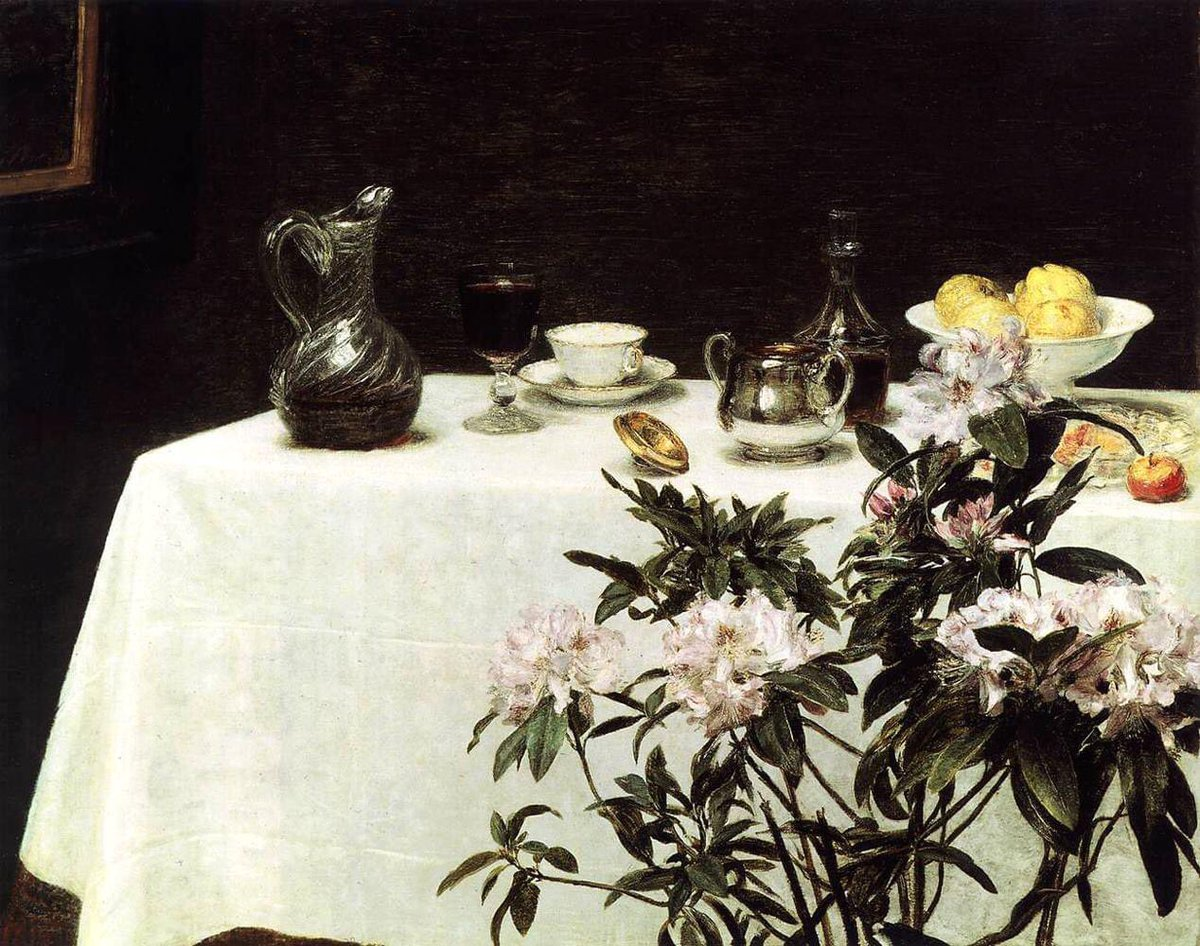
Henri Fantin-Latour, Le coin de la table (1872)

Dwyer Murphy, The Stolen Coast

A rare heist novel where the heist, though satisfying, isn’t the main attraction. I loved this stylish, smart, funny tale of a man who has put his Ivy League law degree to use in taking over the family business: giving new identities to guys on the run and getting them the hell over the border. A great book of off-season resort towns.

Simon Jimenez, The Vanished Birds

I’m still getting my bearing in contemporary sff so take these comments for what they’re worth, but it seems rare to me that a book takes as many swerves as this one: the narrative moves back and forward in time and all over the place, from a near-future nearly uninhabitable earth to a galaxy far-away in space and time. You get invested in a storyline and then it ends but sometimes it comes back. But even more than the structure I loved this book for its emotional seriousness: its many relationships are doomed to fail because of their constitutive circumstances. For example: a man ages fifteen years between each meeting with his beloved, while she, thanks to intricacies of stellar time travel, has only aged a few months. The emotions might be bigger than the ideas, but I was totally okay with that.

Two novels by Katherena Vermette

One of the greatest working Canadian writers. This year, fresh off the thrill of teaching The Break to smart, appreciative students, I read The Strangers and The Circle, a bleak and beautiful trilogy of indigenous life in the aftermath of the cultural trauma of the residential school system.

Four novels by Kent Haruf

It should tell you something that in early April, one of the worst times in the academic year, I read four novels by Kent Haruf in just over a week. I loved Plainsong the most but enjoyed Eventide, Benediction, and Ours Souls at Night almost as much. Easy reading, sure: plain syntax rising to gentle arias, nothing fancy, maybe a little sentimental. But these books are so warm and kind. Each is set in Holt, Colorado, out on the eastern plains, where the mountains are a smudge on the western horizon and it’s sometimes hot and sometimes cold but always dry. The people are ranchers and school teachers and social workers and hardware store owners and ne’er-do-wells and retirees. Everyone is white and no one thinks that’s worth noticing. The time is hard to pin down. Sometimes I thought the 70s or early 80s but we’re probably talking the 90s. Things were different before the internet. The characters’ lives are modest and they seem fine with that. They go about their business, do their work, make good choices and bad ones. People look out for each other, but they judge each other, too. Little kids get lost biking, but they come home again. It’s not all roses, though. High school boys bully girls into having sex, over in that abandoned house just down from where the math teacher lives. People get sick, go hungry, lose jobs. Some characters get what the preacher will call a good death, some die unreconciled to their kin, some without warning, too soon. Life just keeps happening, you know?

Some readers will call this hokum, but I ate it up. Haruf won my heart. I thought him especially good on second chances and unexpected turns of fate. Of all the stories that weave through these loosely connected novels, the best concerns two brothers, old bachelors, ranchers, who agree to take in a pregnant teenage girl and who, to everyone’s surprise, not least their own, form a new family with her. That scene where they take into the next town over to get things for the baby and insist on buying the best crib in the store? Magic.

Garth Greenwell, Cleanness

Smart, sexy, stylish books about how we relate to bodies privately and publically, and whether we can recast the narratives that have shaped aka deformed our understanding of what it is to live in those bodies. Greenwell’s Substack is worth subscribing too; he makes me curious about whatever he’s curious about. Can’t wait for the essay collection he’s writing.

Emeric Pressburger, The Glass Pearls

Yep, that Pressburger. Closer to Michael Powell’s Peeping Tom than any of the (indelible) films they made together. Karl Braun, a German émigré, arrives at a boarding house in Pimlico on a summer morning in 1965. A piano tuner who never misses a concert, a cultured man, a fine suitor for the English girl he meets through work. I’m not spoiling anything to say that Karl isn’t just quiet: he’s haunted—and hunted. For Karl Braun is really Otto Reitmüller, a former Nazi doctor who performed terrible experiments, a past he does not regret even as he mourns the death of his wife and child in the Hamburg air raids. Now the noose is tightening and Otto/Karl goes on the run… Suspenseful stuff; most interesting in this play with our sympathies. Not that we cheer for the man. But his present raises our blood pressure as much as his past.

Toni Morrison, A Mercy

A short book that covers as much ground as an epic; a historical novel that feels true to the differences of the past but that is clearly about the present; a classic modernist Morrison text, where the first page tells you everything that’s going to happen except that it makes no sense at the time and the rest of the reading experience clarifies, expands, revises. Such beauty and mystery in so few pages.

Roy Jacobsen’s Barrøy series (Translated by Don Bartlett and Don Shaw)

Cheating a bit since I read the first one in December 2022. I’m a huge fan of these novels about a family and the remote Norwegian island they call home from 1900 to 1950. I like books where people do things with their hands, maybe because I can’t do much with mine. The characters bring sheep into the upper field, fish with nets and line, salt cod, keep the stove burning all through the year, row through a storm, carry an unconscious man through sleet. It’s all a little nostalgic, a little sentimental, but not too much. Just how I like it.

Two Books by Walter Kempowski (Translated, respectively, by Michael Lipkin and Anthea Bell)

Fresh on my mind so it’s possible I’ve overvalued them but I don’t think so. All for Nothing, especially, is something special.

George Eliot, Middlemarch

Last read in college—under the expert tutelage of Rohan Maitzen, this can only be called one of the highlights of my undergraduate experience. This time I listened to Juliet Stevenson’s recording, which perfectly filled a semester’s commuting. True, Arkansas traffic is not the ideal venue for some of Eliot’s more complex formulations, but Stevenson (as much a genius as everyone says, she do the police in different voices, etc.) clarifies the novel’s elegant syntax and famous images. The book’s the same, but I’m not; a whole new experience this time around. Much funnier, especially its early sections. (Celia is a triumph.) More filled with surprising events: that whole Laure episode (a Wilkie Collins novel in miniature), it was as if I’d never read it. And more heartbreaking: in 1997, I hated Rosamond, and I admit I still felt for Lydgate this time around, but I had so much sympathy for her, a character I’d only been able to see as grasping and venal. Speaking of sympathy, one of the glories of English literature lies in watching Dorothea as she matures from excitable near-prig to wiser and sadder philanthropist. Amidst all this change, though, some things stayed the same. Mary Garth still won my heart; the suspense at the reading of Featherstone’s will gripped me just as much.

It’s good to read Middlemarch in college. It’s better to re-read Middlemarch in middle age. It’s best to read Middlemarch early and often.

Konstantin Paustovsky, The Story of a Life (translated by Douglas Smith)

Six-volume autobiography of Soviet writer and war correspondent Paustovsky, a Moscow-born, Ukrainian-raised enthusiast of the Revolution who somehow made it through Stalinism to become a feted figure of the 1960s. The new edition from NYRB Classics contains the first three volumes. I only read the first two, not because I didn’t enjoy them (I loved them) but because I set the book down to read something else and the next thing I knew it was a year later. Paustovsky had something of a charmed life. His childhood was largely downwardly mobile, and he lived through so much terror and upheaval. And yet he always seems to have landed on his feet. Maybe as a result—of maybe as a cause—he looks at the world with appreciation. He can sketch a memorable character in a few lines. He writes as well about ephemera (lilacs in bloom) as about terror (I won’t soon forget his time as an orderly on an undersupplied hospital train in WWI). He can do old-world extravagance (the opening scene is about a desperate carriage ride across a river raging in spate to the otherwise inaccessible island where his grandfather lies dying) and the brittle glamour of the modern (for a while he drives a tram in Moscow). Trevor Barrett, of Mookse & Gripes fame, said it best: Paustovsky is good company. I really ought to read that third book.

Félix Vallotton, Still Life with Flowers, 1925

A few other categories:

Didn’t quite make the top, but such pleasurable reading experiences: Adania Shibli, Minor Detail; Paulette Jiles, Chenneville; Abdulrazek Gurnah, By the Sea; Jamil Jan Kochai, The Haunting of Hajji Hotak and Other Stories (teaching “Return to Sender” was a revelation: fascinating how even students who had seemed immune to literature shook themselves awake for this one).

Read with dread and mounting desperation, don’t get me wrong it’s a banger, but couldn’t in good conscience call it a pleasure to read: Ann Petry, The Street. Barry Jenkins adaptation when?

Maybe not standouts, but totally enjoyable: Margaret Drabble, The Millstone; K Patrick, Mrs. S; Yiyun Li, The Vagrants; Elif Batuman, Either/Or

Best dip into the Can-con vaults: Margaret Laurence, The Stone Angel. Got more about of this now than I did in high school, lemme tell you.

Best book by a friend: James Morrison, Gibbons or One Bloody Thing After Another: Not damning by faint praise. It’s terrific!

Book the excellence of which is confirmed by having taught it: Bryan Washington, Lot. Maybe the great Houston book. I get that novels sell but I wish he’d write more stories.

Grim, do not recommend: Larry McMurtry, Horseman, Pass By; Girogio Bassani, The Heron

Not for me: Jenny Offill, Weather; Annie Ernaux, Happening; Yiyun Li, The Book of Goose

Planned on loving it, but couldn’t quite get there: Julia Armfield, Our Wives Under the Sea. Sold as metaphysical body horror, this novel about a woman who goes to pieces when her wife returns from an undersea voyage gone catastrophically wrong as a kind of sea creature didn’t give me enough of the metaphysics or the horror. I figured it would be perfect for my course Bodies in Trouble but I couldn’t find my way to assigning it. Possibly a mistake: teaching it might have revealed the things I’d missed. Gonna trust my instincts on this one, tho.

The year in crime (or adjacent) fiction:

Disappointments: new ones from Garry Disher, Walter Mosley, and S. A. Cosby (this last was decent, but not IMO the triumph so many others deemed it; he’s a force, but I prefer his earlier stuff).

Standouts: Celia Dale, A Helping Hand: evil and delightful, can’t wait to read more Dale; Lawrence Osborne, On Java Road: moody, underappreciated; Christine Mangan, The Continental Affair: moody, underappreciated; Allison Montclair, The Right Sort of Man: fun; Joseph Hansen: wonderful to have the Dave Brandsetter books back in print, hope to get to more in 2024; Richard Osman: as charming, funny, and moving as everyone says.

Maigrets: Of the six I read this year, I liked Maigret and the Tramp best. Unexpectedly humane.

Giants: Two Japanese crime novels towered above the rest this year. I didn’t write about volume 2 of Kaoru Takamura’s Lady Joker (translated by Marie Iida and Allison Markin Powell) but maybe my thoughts on volume 1 will give you a sense. Do you need a 1000+ page book in which a strip of tape on a telephone poll plays a key role? Yes, yes you do. (Also, it has one of the most satisfying endings of any crime novel I’ve ever read.) More on Hideo Yokoyama’s Six Four (translated by Jonathan Lloyd-Davies) here. Do you need an 800+ page book in which phone booths play a key role? Yes, yes you do.

The year in horror:

Victor LaValle, Lone Woman: horror Western with a Black female lead and not-so-metaphorical demon, enjoyable if a bit forgettable; Jessica Johns, Bad Cree: standout Indigenous tale, also with demons; Leigh Bardugo, Hell Bent: serious middle-volume-of-trilogy syndrome. Many demons, tho.

The year in sff:

In addition to Simon Jimenez, I liked Ann Leckie’s Translation State, Nick Harkaway’s Titanium Noir, and, above all, the three novels by Guy Gavriel Kay I read this summer, which gave me so much joy and which I still think about all the time.

The year in poetry:

Well, I read some, so that’s already a change. Only two collections, but both great: Wisława Szymborska’s Map: Collected and Last Poems (Translated by Clare Cavanaugh and Stanislaw Baranczak), filled with joy and sadness and wit, these poems made a big impression, and Ilya Kaminsky’s Deaf Republic (fortunate to have met him, a mensch; even more fortunate to have heard his indelible performance).

The year in German books: I read two, liked them both. Helga Schubert, Vom Aufstehen: Ein Leben in Geschichten (On Getting Up: A Life in Stories), vignettes by an octogenarian former East German psychotherapist who had fallen into oblivion until this book hit a nerve, most impressive for the depiction of her relationship to her mother, which reminded me of the one shared by Ruth Kluger in her memoir; Dana Vowinckel, Gewässer im Ziplock (Liquids go in a Ziplock Bag): buzzy novel from a young Jewish writer that flits between Berlin, Jerusalem, and Chicago. The American scenes failed to convince me, and the whole thing now feels like an artefact from another time, given November 7 and its aftermath. I gulped it down on the plan ride home, though. Could imagine it getting translated.

Everyone loved it; what’s wrong with me? (literary fiction edition):

Made it about 200 pages into Elsa Morante’s 800-page Lies and Sorcery, newly translated by Jenny McPhee. Some of those pages I read raptly. Others I pushed through exhaustedly. And then I just… stopped. The publisher says it’s a book “in the grand tradition of Stendhal, Tolstoy, and Proust,” and I love those writers. (Well, I’ve yet to read Stendahl, but based on my feelings for the other two I’m sure I’ll love him too.) Seemed like my social media feeds were filled with people losing it over this book. Increasingly, I see that—for me, no universal judgment here—such arias of praise do more harm than good; I experience them as exhortations, even demands that just make me feel bad or inadequate. Increasingly, too, I realize how little mental energy I have for even mildly demanding books during the semester. (A problem, since that’s ¾ of the year…) I might love this book in other circumstances —I plan to find out.

Everyone loved it; what’s wrong with me? (genre edition):

Billed as True Grit set on Mars in alternate version of the 1930s, Nathan Ballingrud’s The Strange indeed features a young female protagonist on a quest to avenge the destruction of her family, but Ballingrud is no Portis when it comes to voice. True, I was in the deepest, grumpiest depths of my slough of despondent reading when I gave this a try, so I wasn’t doing it any favours. But that’s a nope from me.

Other failures:

Mine, not the books. Once again, I read the first hundred or so pages of Anniversaries. It’s terrific. Why can’t I stick with it? I read even more hundreds of pages of Joseph and His Brothers, as part of a wonderful group of smart readers, most of whom made it to the end of Thomas Mann’s 1500-page tetralogy. I loved the beginning: fascinating to see Mann’s take on the stories of Genesis; interesting to speculate on why Mann would write about this subject at that time. (For me, Mann is in dialogue with Freud’s Moses and Monotheism, another oblique response to fascism through stories from Torah.) My friends tell me it got a lot more boring shortly after I left off (the end of volume 2), but that’s not why I gave up. Turns out, I don’t do well if I’m supposed to read something in regular, little bits. I need to tear into books—and I wasn’t willing to make the time for this chunkster. Sorry, guys.

Odds & Ends:

A few albums that stood out: Roy Brooks, Understanding (reissued in 2022, but I’m not over it: this quintet, man, unfuckingbelievable); Taylor Swift, Midnights (I love her, haters go away); Sitkovetsky Trio, Beethoven’s Piano Trios [volume 2] (a late addition, but pretty much listened to it nonstop in December and now January).

After a decade hiatus, I started watching movies again. Might do more of that this year!

I was lucky enough to travel to Germany in late spring with a wonderful set of students. While there, I met so many people from German Book Twitter who have become important to me, including the group chat that got me through covid and beyond. (Anja and Jules, y’all are the best.) All these folks were lovely and generous, but I want to give special thanks to Till Raether and his (extremely tolerant) family, who took me in and showed me around Hamburg. (Great town!) Have you ever met someone you hardly know only to realize they are in fact a soulmate? That’s Till for me. What a mensch. Cross fingers his books make it into English soon. In the meantime, follow him on the socials!

Reading plans for 2024? None! I need fewer plans. I can’t read that way, turns out, and maybe I’ll avoid disappointment by committing less. Gonna be plenty of other disappointments this year, I figure. No need to add any self-inflicted ones. At the end of last year, I joined a bunch of groups and readalongs, because I want to hang with all the cool kids, but I can already see I need to extricate myself from most of them. One good thing I did for myself in 2023, though, was to stop counting how many books I read. I was paying too much attention to that number. Fewer statistics in 2024!

Piet Mondrian, Oranges and Decorated Plate, 1900

Finally, to everyone who’s read the blog, left a comment or a like, and generally supported my little enterprise (which turns 10 in a week or two…), my heartfelt. I do not know many readers in real life. You all are a lifeline.

What I Read, December 2023

A great semester in the classroom; an even more irritating than usual semester for committee work. I am lucky to have a long winter break. Over the last years I’ve found that I either thrive in these short, dark weeks or succumb to bad anxiety. Happily, this was one of the good years. El Niño means colder weather in Arkansas, which makes me happy, not least because it’s so good for running. And for sitting on the couch reading.

Laurits Andersen Ring, Foggy Winter Day. To the Left a Yellow House. Deep Snow., 1910

Toni Morrison, A Mercy (2008)

An extraordinary book, maybe my favourite of the five or so by Morrison I’ve read. (Beloved is titanic, of course, but it’s been so long since I’ve read it that my memory of it has dimmed. Maybe I’ll redress that in 2024.) I chose A Mercy for One Bright Book; I thought we had a lot of interesting things to say. Fifteen years after its publication, the book only seems more pertinent to the task of understanding America. Which makes this review by Wyatt Mason, a critic I usually admire, feel badly dated.

Katherena Vermette, The Circle (2023)

Longtime readers will know of my love for Vermette. The Break is fast becoming canonical; I extolled its sequel, The Strangers, not long ago. And now we have a third volume featuring the same characters, with the addition of a few new ones, especially in the younger generation. My wife noted how much faster this book reads than the others. Partly that’s because of the knowledge we bring to the book (if you haven’t read Vermette yet, don’t start here): we’re mostly catching up, not getting to know. And partly it’s because of the short chapters that shift the point of view. But mostly, that sense of speed is a function of how much happens. Whereas The Break considered the repercussions of a single event (ripples from a stone sunk into a lake), and The Strangers thought about the pull of family (oceanic, seemingly inescapable, full of ebbs and flows), The Circle focuses on the pull to change, to get away, to break from the past (this book is a river, and one full of rapids at that.)

That compulsion sometimes—maybe even often—fails. But not always. Trauma never lets go, but change is possible. But always from collective bonds, not individual willpower. Yes, individuals make choices that affect their fate. But grit isn’t enough in the face of systemic inequalities and generations of abuse. Maybe that explains why Vermette has replaced the family trees of the earlier volumes with a diagram of overlapping circles, each with a character’s name. The closer the circles to each other, the closer the relationship. The bigger the circle, the more people that individual affects.

If Vermette decides she’s finished with these characters, she has ended her now-trilogy on a satisfying ambiguous, tentatively hopeful note. But I thought the endings of the previous volumes were just right, too. Who knows, maybe more is in store. I kind of feel like Vermette is as caught up by these characters as readers like me are.

Abdulrazek Gurnah, By the Sea (2001)

My third Gurnah: not a misfire yet. I’m a fan.

In his 60s, Omer Saleh leaves his world behind him and claims begrudgingly granted asylum in the UK. A harried lawyer assigned to his case tracks down the only person she can find who knows anything about Zanzibar, Saleh’s homeland. That man, now an academic who has himself made the journey to England, turns out to have known Saleh: he was a boy when the older man became entwined with his family, to complicated and in some ways ruinous ends.

Gurnah reminds me of Conrad not just because his novels also consider the relationship of England to parts of the world where people have “different complexion[s] and slightly flatter noses” but more so because they are similarly constructed through nested stories told at length in the quiet of evening between a teller and a silent audience. These stories concern all manner of things: the age-old trade routes between the Persian Gulf and the East African coast; the furniture business as practiced in a culture that prizes barter; the experience of African students during the Cold War in East Germany, where it turns out that not all communists were equal brothers; and the pain of incarceration at the whims of despotic regimes.

Of the latter, Saleh says:

I have taught myself not to speak of the years which followed, although I have forgotten little of them. The years were written in the language of the body, and it is not a language I can speak with words. Sometimes I see photographs of people in distress, and the image of their misery and pain echoes in my body and makes me ache with them. And the same image teaches me to suppress the memory of my oppression, because, after all, I am here and well while only God knows where some of them are.

The last line is the characteristic Gurnah touch: a passage that had been moving, even stately, if perhaps a little pat, turns more complex. We are so attuned to the suggestion that testimony is an unalloyed good, a force, even, for change, that we might be surprised to think of quiescence and repression as responses to past injustice and trauma.

By the Sea was longlisted for the Booker Prize. I’ve no beef with Peter Carey’s The True History of the Kelly Gang (haven’t read it), but it would have been nice to see Gurnah on the shortlist at least. No matter, he won another big prize and the novels are back in print and I still have five or six ahead of me, so it’s all good.

Roy Jacobsen, Eyes of the Rigel (2017) Trans. Don Bartlett and Don Shaw (2020)

Third in Jacobsen’s Barrøy series, which since the last part of the first has focused on Ingrid Barrøy, now the chatelaine of the Norwegian island that has given the family its name. Eyes of the Rigel follows hard on the events of its predecessor, The White Shadow, which I read in the spring but never wrote about. I like this summary from The Guardian:

The second installment, White Shadow, is set during the last year of the second world war: refugees from the northern province of Finnmark arrive, collaborators abuse their power, and Russian prisoner of war Alexander, having survived the sinking of the MS Rigel, lands on Barrøy. Ingrid falls in love with the young man and hides him from Nazis and collaborators until he is strong enough to embark on a trek to neutral Sweden. In Eyes of the Rigel Ingrid sets out across a postwar country in search of the father of her 10-month-old daughter. Ingrid’s only mementos of her lover are her daughter’s eyes, as black as Alexander’s, and a note in Russian, which a neighbour helps her decipher: it says, “I love you” nine times.

Ingrid’s epic quest—after hitching a boat ride up the coast, she makes the rest of the journey on foot with the world’s most saintly baby—is preposterous. Everyone she meets feels that way too. But with the determination and implacable work ethic that characterizes her family she follows a trail made fainter by the reluctance of many in the immediate postwar era to remember or cop to the events of the recent past.

Spoiler alert: her quest ends in frustration and heartbreak. She doesn’t find Alexander, and, maybe worse, she learns things about him she doesn’t want to. (In a brief passage, readers learn his tragic fate.) I wouldn’t say she’s happy to return home, but she does so with few regrets and no complaints. (Barrøyers don’t complain.) There’s that baby to raise, after all. And another fishing season to prepare for. And heaven knows what’s happened to the sheep over the summer.

I sensed Jacobsen enjoyed the wider canvas of this story (it’s not really any longer than the others, but it has much more narrative drive), but not as much as he enjoyed returning to the island in the final pages. That’s how I felt as a reader, anyway. As is characteristic of these books, we encounter much that is unhappy (a former Nazi concentration turned POW camp, for example). But much that is joyful, too, though always in a bittersweet way. I especially loved an idyll on a farm where Ingrid thinks about taking up with the owner, a member of the resistance, who had hidden Alexander for several months.

Ronán Hession thinks it’s the weakest of the series, but even though he wrote Leonard and Hungry Paul so definitely knows what’s what I can’t agree. Loved this one just as much as the others.

Roy Jacobsen, Just a Mother (2020) Trans. Don Bartlett and Don Shaw (2022)

I picked Jacobsen’s fourth Barrøy novel up the minute I finished the third. It feels as though the writer did the same: Ingrid’s story picks up where she left off, with her return home to the island. The novel covers the 1950s, and, as Tony puts it in his excellent post, it reworks some of the preoccupations and themes of The Unseen, the first book in the series. But Jacobsen isn’t treading the same ground. Yes, his characters continue to wrestle with the competing claims of isolation and community, but now they do so in the context of new technologies and ideologies. What happens when it’s not profitable to run the mail boat to the island? Would it be best to give up this almost laughably hand-to-mouth existence for life on the mainland? (Friends and family report on the pleasures and tribulations of life in centrally planned communities. It’s nice to have a machine to wash the linens, but of course you can only use it in your allocated hours.)

For Ingrid, Jacobsen’s main character, the matriarch of the island, the question of whether it will still be possible to live on Barrøy is practical, not abstract. Who will do all the work? Her great-aunt is aging. The girl she has brought up as her own daughter has grown up and moved away. The few menfolk who are left have bought a bigger boat so that their annual fishing expeditions take them away from the island longer than before. But new life arrives, in the form of a boy, the child of the skipper of the mail boat. The man asks Ingrid to watch his son while he goes on his weekly run, because his wife, the boy’s mother, has up and left. With foreboding in her heart, Ingrid accepts the charge; weeks pass, the skipper fails to return. Eventually his boat is found drifting aimlessly and unmanned. This trauma is met with resourcefulness and care, and the boy flourishes under the auspices of Ingrid and the other islanders, not least her daughter Kaja, the infant in the previous book, who is now five or six. The pair grow up as something more than siblings. Perhaps their relationship will be at the center of another book, should we be lucky enough to get one.

As always, Jacobsen pushes our emotional buttons, in the most satisfying way. One scene in particular hits like a blow. As Tony puts it, “One thing I can promise you is that anyone who has read the rest of the series will at some point feel the pain almost physically…”

Jim Thompson, A Hell of a Woman (1954)

Hadn’t read one of Thompson’s sordid, riveting noirs in a while. I’ll need to wait awhile before trying another, so dark was this one. Although it can’t top The Killer Inside Me (what can?), A Hell of a Woman also turns on the author’s masterly use of first-person narration. If you liked In a Lonely Place but found it a little decorous, this is the book for you.

Stephen Spotswood, Murder Crossed Her Mind (2023)

The latest Pentecost & Parker mystery ends on a dramatic note. (Cliffhanger alert!) Despite a solid enough mystery, the point of the book is to set up a longer narrative arc. I look forward to volume 5, and encourage you to read these books, but whatever you do, don’t start here.

Walter Kempowski, An Ordinary Youth (1971) Trans. Michael Lipkin (2023)

I once heard Parul Sehgal describe Svetlana Alexievich’s The Unwomanly Face of War as having “big first book energy,” which, she explained, is what happens when writers feel the need to stuff everything that matters to them into that first book, because who knows if there will ever be another. The result is undisciplined, maybe, but also exuberant and true.

I thought of Sehgal when reading An Ordinary Youth, the first book by Walter Kempowski, a phenomenon of (mostly West) German literature. (My friend Till Raether tells me he had something like a Warholian factory going to help him compose an epic series of collage texts, perhaps in the Dos Passos mode, I’m not sure, of German 20th century history; that’s in addition to his many novels.) The debut is patently autobiographical—its hero, Walter Kempowski, is nine years old when his family moves to a new apartment in the old Hanseatic port of Rostock in 1938. As the title suggests, he’s an ordinary kid who like movies and jazz music and this one girl in particular and school not so much. He gets used to bombing raids; he doesn’t mind that his father has been deployed (away from the front, luckily); he misses his older brother, Robert, who brought home all the good new records. As he becomes a teenager, Walter distinguishes himself mostly for being a bit of a badass: rowdy, impious, a petty troublemaker. He could seem to incarnate some of the worst attributes of his country at that time, but interestingly his natural nonconformity puts him at odds with the Party and all it stands for. He has little interest in the Hitler Youth, for example, ready to shirk its obligations as often as he can. (He forges a lot of sick notes.) But he’s no resister, no young version of that postwar chimera, “the good German.”

The genius of the book is the way it lets us read against Walter’s vision of the world, and indeed that of German society writ large. Here’s an example, which I chose by opening the book to one of the pages I’d dog-eared. The man Walter’s sister has married, a Dane, takes Walter’s side in an argument between the boy and his sister. Walter has said that in England people never open their windows and they drive on the left—something his friend has told him—which is all basically true and presented only as the mildest criticism. (An earlier conversation in which Walter’s mother has told her son-in-law to stop using English words feels much more freighted.) But Anna, Walter’s sister, takes offense at her younger sibling. Her husband, Sörenson, mildly objects. Germans, he says, forget that everyone should be able to express their own opinion:

And as an example of tolerance he mentioned modern music, the kind where the notes were all in a jumble, the kind we didn’t have any more in Germany. In Denmark, people did often laugh when they heard that kind of modern music, but they also clapped. He’d seen it happen many, many times.

We see conversation between adults presented through the view of the child protagonist, without judgment or comment or perhaps even full understanding of the stakes. But we learn more about the adults than the child here. For what kind of an example is this? Certainly not a full-throated defense of the art the Nazis deemed degenerate (those notes “all in a jumble”). His description of audiences laughing suggests his opinion is shared among his countrymen. But maybe laughing and clapping is the best kind of tolerance: amused, bemused, generous. Yet that last sentence, with its repeated, unnecessary, special pleading “many,” makes me question his attitude still further. Is he making it up? On every page, Kempowski plays tricks like this with tone.

An Ordinary Youth was a huge bestseller at the time. What were those first audiences responding to? It’s hard to imagine. Maybe it’s that Kempowski so straddles the line between nostalgia for and critique of the Nazi era that readers can take whatever they want from the book. My hunch is that many German readers responded to its depiction of the Volksgemeinschaft, that community “we” all shared and where we had some good old times, no matter what they want us to say now, a response that of course ignores the book’s challenge to that community, structured as it is around absences like the burned-out synagogue Walter passes on the way to school or that store old Herr so-and-so (I can’t find the reference) left behind when he disappeared. (It makes me wonder who lived in that new apartment before them.) The characters are basically uninterested in these absences—in this sense the novel accurately represents its time.

Kempowski’s debut has long been taken to be untranslatable. Its original title, Tadellöser & Wolff, refers to a Kempowski family saying, one of those weird family things, the kind of thing you repeat because everyone in the family says it and sometimes no one even knows why. In this case, Löser & Wolff is a cigar manufacturer (Aryanized by the regime in 1937, incidentally), a brand beloved of the father, who plays with the name. If something is tadellos it is perfect, without flaws, or blameless. (I’m reminded of an indelible moment in Vasily Grossman’s “The Hell of Treblinka” where he quotes an SS man who called the “grilling” system of the layering and burning of bodies in mass graves tadellos.) Walter takes up the phrase: on a visit to the country he trots it out to some country-bumpkin kids, blithely telling them that’s how everyone talks in the city.

The nonsensical phrase (which takes on a life of its own: Walter adapts other words so that they are also “löser & Wolff”ed) exists alongside dozens, even hundreds of lyrics interpolated into the text, almost all of them from popular songs or Lieder in the Schubert sense, and a few from poems. Translator Michael Lipkin has done something amazing in bringing the book into English. (I’m not sure I needed him to cite the source of every song lyric, though.) The publisher refers to this collage as the novel’s “echo chamber of voices,” without which Kempowski could not investigate the meaning of subjectivity in a mass popular society. I bet some smart folks have written about how An Ordinary Youth at once instantiates and challenges the very idea of the Bildungsroman.

Hats off to NYRB for making this translation happen. I hope more Kempowski is in their plans. (See below for more on the one they released first. They have a third title, which I have since read, too.)

Jenny Offill, Weather (2020)

Fragments from the life of an overeducated, underemployed New Yorker with the requisite terrific child and corresponding fears of climate change. A lot of it rang true—even the precious bits—but if I want to mourn the loss of the world as we know it in the company of a neurotic, bien pensant book lover, I’ll just have a little me time, you know?

Walter Kempowski, All for Nothing (2006) Trans. Anthea Bell (2015)

Some of my most memorable reading experiences have taken place in winter. Fallada’s Every Man Dies Alone, devoured over an unusually cold Arkansas Christmas just before our daughter was born. The never-to-be-matched-in-impact double-whammy of Absalom, Absalom and Barthes’s S/Z, in the snowiest Halifax January I can remember. And now, in another colder than average Arkansas winter (yes, it’s still climate change), Walter Kempowski’s magisterial late work, All for Nothing. Which is a bitterly cold book, in setting and to some extent tone. It’s late January 1945 in East Prussia and everyone knows the Russians are coming. But in a once-grand, now mostly shut-up manor house, life continues in a semblance of cultured normality. It’s like that scene with the French family in Indochina from the long cut of Apocalypse Now.

There’s the dreamy, beautiful woman of the house, who shuts herself in her quarters with tea and cigarettes and desultory reading, like a heroine from Turgenev; the absent husband, an officer in charge of requisitioning foodstuffs for the Reich, currently stationed in Italy; his aunt, who wishes she were still in the Silesia of her childhood but who keeps the place going and has no interest in taking down the portrait of Hitler in her room, despite suggestions from others that this might be wise; three Ostarbeiter, a Pole who tends the horses and does the heavy work, and two Ukrainian girls who cook and clean; and Peter, a mild, quiet, inquisitive boy whose regular illnesses keep him from Hitler Youth roughhousing, and who loves nothing more than examining bits of the world (a snowflake, a drop of blood, a crumb) under his new microscope, and who sometimes goes into the room that belonged to his younger sister, left as it was on the day she died of scarlet fever. Across from the manor is a working-class settlement built by the Party in the late 30s: its most officious inhabitant stares in grim resentment over at the manor house while he tends to his wife, lost in depression after their son was killed at the front.

To these wonderfully drawn characters come a series of visitors, all of them only too happy to share the warmth and food on offer in the manor house: a one-legged opportunist convinced that by buying up rare stamps on the cheap he is ensuring his future security; a young violinist, fanatically devoted to the Party; a Jew the woman of the house agrees to hide for an evening, seemingly for no other reason than her desire to have something happen.

The tone is quiet and anxious. How much can this episodic aimlessness last? (The question asked by characters and readers alike.) A convoy of refugees has been streaming west for days now. The carriage is packed, the horses fed and watered. But where are all those people going, this is their home, is there any need to leave now, just how close are those weapons booming now day and night? The family delays and then, abruptly, leaves. And the book becomes more eventful: the roving point of view centers on Peter, the tone becomes more muted, almost shell-shocked, a little naïve even as its events become extravagant and terrifying.

I kept waiting for the violence of the Red Army to erupt and overwhelm the characters. And, yes, this does happen. But so stealthily it’s hard to know how we got from the warmth of the manor house to overturned carts, dead animals, and bombed out refugees on the side of an icy road. Fascinatingly, the Soviets almost never appear in the book. (I was reminded of how seldom Germans factor in depictions of the camps, etc.) For me, All for Nothing is most brilliant in his suggestion that the apocalypse arrives gradually, almost banally.

I encourage you to read R. Nicht’s brilliant take on the book. (Just one clarification: although Kempowski often returns in his writing to the history of East Prussian, he did not grow up there (he was born in Hamburg and grew up in Rostock); All for Nothing is not strictly speaking autobiographical.)

The consensus seems to be that All for Nothing is Kempowski’s greatest work. (He wrote a ton, though, hardly any of it yet in English, so who knows.) Anthea Bell’s translation is gorgeous, somber and elegiac; I wonder how much of that is Kempowski’s “late style” and how much is Bell’s predilection. (I’m thinking of the way some of Sebald is more melancholy in English than in German.) It’s true though that the quotes in this book come mostly from Goethe and Schiller, unlike the pop music of An Ordinary Youth. It feels wise and resonant the way the classics do at their best. I once heard Edwin Frank, NYRB’s publisher, say he always read the last line of a novel first. (Insane!) I bet he nodded in satisfaction when he paged to the end of this book.

Tremendous stuff.

Margot Douaihy, Scorched Grace (2023)

Before Sister Holiday ran away to New Orleans and became a nun she played in an all-girl punk band, carried on a torrid, doomed affair with her married best friend (and bandmate), and made a bunch of other bad decisions. Now she’s teaching music to mostly disaffected kids in the Catholic school attached to her convent, covering her ink with gloves and a scarf, sparring with a sister who can’t stand her, and taking succor from the Mother Superior, the only woman in the country who would accept her when she came calling. But when a maintenance worker dies in a suspicious fire that also injures two of the students—and other fires follow thick on the first—Sister Holliday turns detective, (implausibly) tagging along with a painkiller-addicted fire investigator. Can you believe it—she solves the crime!!!

I heard about Scorched Grace from several UK readers, and I can see why the novel, heavy on atmospherics, might be popular with non-Americans. (As far as I can tell, the author isn’t from NOLA; to me it feels like she tries too hard to set the scene just so.) Just wait until it’s translated into German. They’re gonna eat this shit up. The subtitle (“A Sister Holiday Mystery”) implies Douaihy has plans for a series. More power to her, but I think this would have been better as a standalone.

Willem de Kooning, Door to the River, 1960

A find end to my reading year. Morrison, Vermette, Jacobsen, and, above all, Kempowski. See anything here to strike your fancy?

Olga Zilberbourg’s Year in Reading, 2021

Today‘s reflection on a year in reading is by Olga Zilberbourg (@bowlga). The author of Like Water and Other Stories (WTAW Press) and four Russian-language books, Olga co-hosts the San Francisco Writers Workshop; and together with Yelena Furman runs Punctured Lines, a feminist blog about post-Soviet and diaspora literature.

Look for more reflections from a wonderful assortment of readers every day this week. Remember, you can always add your thoughts to the mix. Just let me know, either in the comments or on Twitter (@ds228).

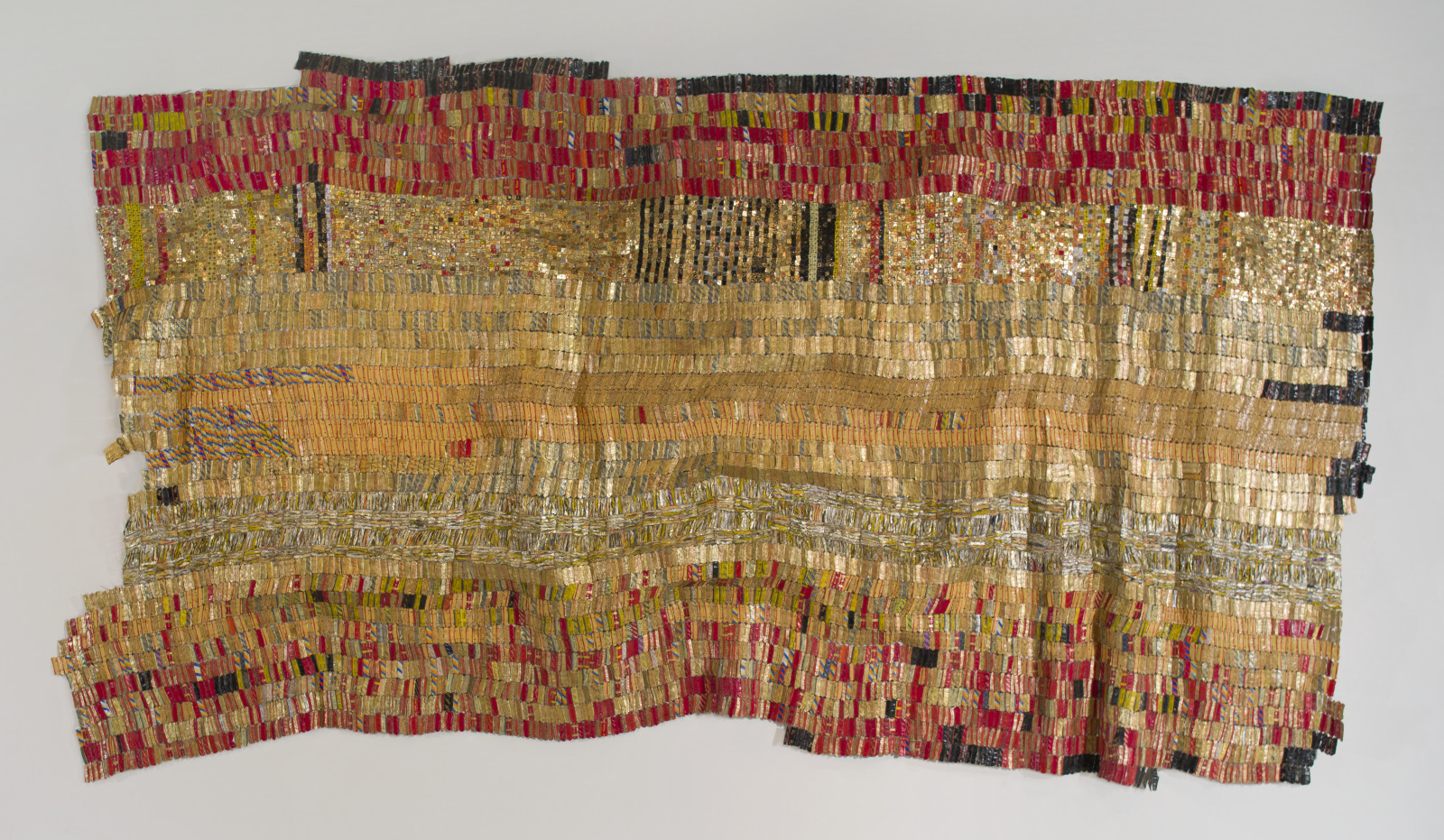
El Anatsui, Fading Cloth, 2005

My reading life this past year was dominated by my role as a juror for the 2022 Neustadt International Literary Prize. The first task we were given was to nominate an author based on the quality of their writing. After considering (and rereading) authors from Yoko Tawada to Jenny Erpenbeck to Polina Barskova, I finally settled on the writer, whose work had propelled me into adulthood back in the early 1990s and whose books played a foundational role in forming my outlook on contemporary literature: Liudmilla Petrushevksaya.

I chose to submit There Once Lived a Woman Who Tried to Kill Her Neighbor’s Baby: Scary Fairy Tales (Penguin), selected and translated by Keith Gessen and Anna Summers. This book rose to bestseller lists in 2009 and it delivers on its title: the tales she tells are indeed magical and very disturbing. In retrospect, I wish I would’ve let the jury members to discover that book for themselves, and nominated an earlier volume, The Time: Night translated into English by Sally Laird (Northwestern UP). This book is both naturalistic in its portrayal of life in late Perestroika Russia, with its total breakdown of all familial and social relationships, and it amplifies its naturalism with an ironic “what-if” scenario: what if a poet akin to Anna Akhmatova had been born half a century later? How would she fare? It’s a powerful short novel (that Anna Summers also translated and Penguin published in a follow-up volume There Once Lived a Mother Who Loved Her Children, Until They Moved Back In) and I love that it also features on Yelena Furman’s syllabus on contemporary Russian women writers. I strongly believe that this book (alongside Lydia Chukovskaya’s Sofia Petrovna) belongs on every syllabus dedicated to 20th Century Russian lit.

Jury members submitted nominations in March; in May we received a stack of nine books and a website to an electronic literature project by Jean-Pierre Balpe, for a total of ten works of literature, representative of their authors’ oeuvres. Having spent the summer with these books, the jury then gathered in October, via Zoom, during the Neustadt Literary Festival, to deliberate and choose the winner: Boubacar Boris Diop, who had been nominated by Jennifer Croft (@jenniferlcroft). I should add that though the process of selecting the winner was painful—the inevitable competitive nature of voting does seem inimical to the nature of literary achievement—Diop was chosen in the spirit of total admiration, not to say, awe.

Diop’s is a rich body of work. I began with Murambi: The Book of Bones, which Jenny had nominated. Translated from French by Fiona McLauchlin and published by Indiana UP, this book came with a blurb by Toni Morrison: “This novel is a miracle. Murambi, The Book of Bones verifies my conviction that art alone can handle the consequences of human destruction and translate these consequences into meaning.” Diop, a writer from Senegal, was a part of a group of writers invited to come to Rwanda in 1998 and to write about the genocide that had occurred four years prior. As an outsider, Diop has had to invent his own structure in order to approach his subject matter, which he does brilliantly. The novel contains separate, tentatively connected sections, centering both the point of view of a victim and the point of view of a perpetrator. Diop then adds to it a perspective of an observer, a man who returns home after a long absence from the country and who will have to live with the outcomes of the genocide, finding his way through social and personal trauma. Remarkably, this strategy allows Diop to capture the scope of the horrific events and their history in colonial politics, as well as to tell memorable stories of a few individuals.

In my public library, I was also able to locate a copy of Diop’s novel Kaveena, translated by Bhakti Shringarpure and Sara C. Hanaburgh, and published by Indiana UP, a gripping murder mystery that takes us on a tour of intricate relationships between the various parties involved in running a fictional francophone African state. This novel showcases some of the mechanisms in which imperial economic interests continue to hold sway in so many independent post-colonial nations.

Then, there’s Doomi Golo: The Hidden Notebooks, a novel that Diop wrote in Wolof, one of the languages of Senegal, and available in English in translation by Vera Wülfing-Leckie and El Hadji Moustapha Diop (Michigan State UP). My library didn’t carry it, and neither did any of the connected public libraries in the San Francisco Bay Area—which I tried to rectify by requesting that they purchase it. I didn’t get a chance to read it before the jury deliberations; it’s going right onto my 2022 reading list.

The full list of works nominated for the Neustadt Prize this year is available online. The authors included Kwame Dawes, Natalie Diaz, Michális Ganás, Micheline Aharonian Marcom, Naomi Shihab Nye, Cristina Rivera Garza, and Reina María Rodríguez. Writers: the most generous gift-givers. I should add that I enjoyed reading not only the books of the finalists, but also the books by my fellow nominating jurors, including Jennifer Croft’s book Homesick (Unnamed Press), a novelized memoir of a close sibling relationship, and Hamid Ismailov’s Gaia, Queen of Ants (Syracuse UP), translated by Shelley Fairweather-Vega, centering around a pair of transplants from Uzbekistan trying to make a life in Europe.

Outside of the reading I’ve done for and around the prize, I very much enjoyed participating in my first ever Twitter read-along, organized by the amazing @ReemK10. For me, this was a rereading of Bohumil Hrabal’s Too Loud a Solitude (Harcourt). I’d read it for the first time a decade ago, and had in the interim forgotten how much of a post-Holocaust story it is. This aspect struck me deeply during the reread. Alongside, I picked up a volume of essays by and about its translator, the famed Michael Henry Heim, The Man Between (Open Letter), edited by Esther Allen, Sean Cotter, and Russell Scott Valentino. It was fascinating to learn a little about the history of contemporary translation from Eastern European languages, and the central role Heim seemed to play in it.

And speaking of Eastern Europe, this year, I discovered the writer Vesna Maric, whose memoir of leaving Bosnia-Herzegovina during the war at the age of sixteen, The Bluebird (Granta), was as fascinating as it was strangely funny. I reviewed Maric’s first novel The President Shop for Ron Slate’s project On the Seawall, and I’m also keeping an eye on this book’s publisher, Sandorf Passage, who is bringing to English more fascinating East European titles.

Yanina Boldyreva, from Birch People, 2021

Looking over what I’ve just written I note that most of the books I talk about were published in English translation by independent or university press publishers. This was not intentional on my part, but I’m also not entirely surprised. It’s a vast, vibrant literary world out there, and translators and publishers of indie and university presses are a big part of what makes it so. Book Twitter friends are another big part—thank you all!

Bryce Sears’s Year in Reading, 2021

Today’s reflection on a year in reading is by Bryce Sears (@BryceSears5). Bryce, one of the nicest people on Book Twitter (which is saying something), is an avid reader and writer who lives in Oakland.

Look for more reflections from a wonderful assortment of readers every day this week and next. Remember, you can always add your thoughts to the mix. Just let me know, either in the comments or on Twitter (@ds228).

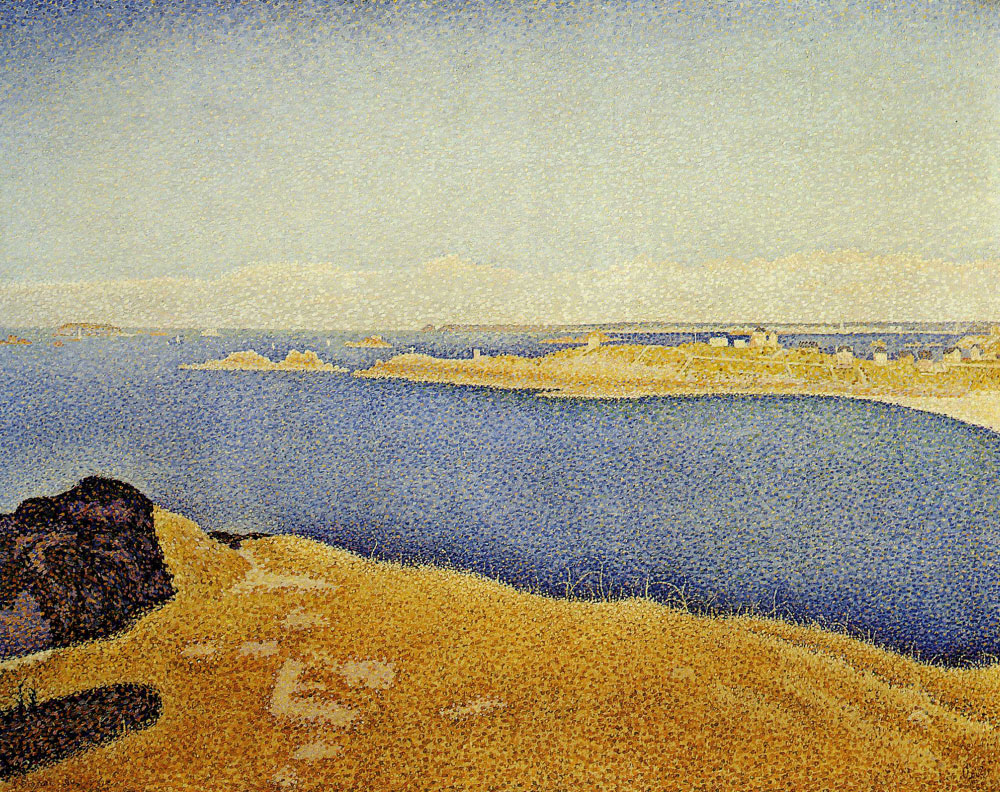
Paul Signac, Saint-Briac. La Garde Guérin. Opus 211, 1890

I kept up in 2021 a trend toward escapism in my reading. I’ve been on this kick about five years – a habit of reading a lot more fiction and a lot less non-fiction than I used to. I used to read a lot of history; the one piece of non-fiction I read last year was a travelogue – Kapka Kassabova’s Border. It was terrific, to my thinking, as you can see below. [Ed. – Straight up honest to God terrific, Bryce; it’s not just you!] Later, reading a few pages of its follow-up, To the Lake, I found it all a bit depressing, thinking about facts and history. It was this thing I’m dealing with. My view, I guess, is that the world is on fire. In a dozen different ways at least. So I’m voting to put it out. I’m volunteering and protesting. [Ed. – I admire you!] But also, for the sake of my own mental health, I might need more breaks from thinking about our predicament.      

Such a cheery opening! The other thing helping with my mental health is my homelife. Two years ago my wife and I bought a house in Oakland. So, we’re doing a lot of work digging up strange things in our back yard, etc. [Ed. – Uh, how strange? Like dead body strange???] We have a three-year-old son who is delightful. His interest in books has really taken off. I spend a lot of time reading with him when I’m not writing or reading books for myself.  

The Vet’s Daughter, and some other works by Barbara Comyns

Barbara Comyns is the writer I was most thrilled to discover this year. I was surprised. I tend to like best stories about people (to paraphrase Diane Williams in her recent interview with Merve Emre) dealing with the life we’re all stuck in. For a long time now, I haven’t tended to go in much for stories with magical or supernatural elements. If this sounds like you, too, don’t let it keep you from Comyns. Somehow, the supernatural in her stories isn’t startling (or at least I don’t find it so). It might be her prose, which is both cool and somehow scintillating. It might be the way she links the supernatural elements in her stories to the mental health of her protagonists. In The Vet’s Daughter, my favorite of the books of hers I’ve read, the supernatural in the story appears (at least as I read it) to come as a reaction the protagonist is having to a pervasive threat of violence. Which is to say it feels like a state of shock. It adds something to our sense of what the protagonist is feeling.

Or it could be my tastes are changing.

In any case, in addition to The Vet’s Daughter, the other books I read by Comyns this year are The Juniper Tree, Our Spoons Came from Woolworths, and Who Was Changed and Who Was Dead. They’re all quite different from one another. I liked The Juniper Tree best, but ask me again tomorrow. Saying I like this Comyns better than this other Comyns is almost no better than saying ‘I prefer apples to oranges’.       

The Remains of the Day, and some other works by Kazuo Ishiguro

I’m not sure when I would have read Ishiguro if not for Book Twitter. Somehow, years ago, I got it into my head that I’d find his work cinematic in some off-putting way. The Anthony Hopkins, Emma Thompson adaptation of The Remains of the Day was so famous. Before I got around to reading that one an adaptation of Never Let Me Go came out, and it also got a big hoopla. I got the sense Ishiguro’s work must be reductive, somehow. Well, as I’m sure everyone else knew, it isn’t. The books behind these two movies are so very much better than the movies. I should have had more faith in literature.  

My first Ishiguro, The Remains of the Day, was likely the first book I finished in 2021, going by my Twitter history. And what a revelation it was. Later in the year I read An Artist of the Floating World, and Never Let Me Go. Now I have five additional, as yet unread, Ishiguros in a stack on the shelves next to me. They make me feel rich.   

Happening, and some other works by Annie Ernaux

I was a bit obsessed with Annie Ernaux in 2021. I read Happening, A Man’s Place, A Woman’s Story, and I Remain in Darkness (all translated by Tanya Leslie). I read The Possession (tr. Anna Moschovakis). Over a period of months I reread Happening, A Girl’s Story (tr. Alison L. Strayer), and Simple Passion (tr. Tanya Leslie). These are all short, auto-fictional stories that feel like memoirs.       

The confessional quality of these books is one thing that draws me to them. Another is the skepticism Ernaux displays in her writing. She tries to make clear, as she writes about events in her past, how little she knows of the women she used to be, how false it would be to pretend to walk in the shoes of these younger selves. [Ed. – Nicely put!] She goes out of her way to avoid exaggeration. And I find this humility so refreshing.    

One last word on Ernaux. My favorite work of hers is Happening. It is quite harrowing – the story of an abortion Ernaux had in 1963, when she was 23 and abortion hadn’t yet been decriminalized in France. If I could I’d have everyone in the US read this book. It strikes me we could do worse here, where many women will likely face choices soon like the ones Ernaux faced, than encourage people to understand what it was like for this particular woman – a white woman, highly educated, in 1960s France. I’m not a teacher, but I think it’d make a nice class discussion, a group of close readers considering how the situation might vary in the US for people of color, for people with less access to information of the sort Ernaux had, etc.

Lonesome Dove, by Larry McMurtry

West Texas, where I grew up, is the part of Texas where all the worst Texas clichés come to life. The whitest, most reactionary part. I always wanted out of it. I might have become a reader in part to avoid it. Which is all by way of an excuse for not having read a western before last year. Still, I picked a great book to begin with.  

Lonesome Dove was the most absorbing book I read in 2021. It’s a big, twisty story, rich with joyful writing (I mean, it is often dark, but you can tell McMurtry enjoyed writing it). It struck me as escapist in the plainest sense of the word – it took me to a very different world from my own. The jokes worked for me. Consider the wry twist of this line that comes when Gus, the protagonist (I think, it could be Call), gives a junior partner money for a prostitute, then reminisces (in free indirect): “Best to help boys have their moment of fun, before life’s torments snatched them away.” Or this line, Gus again (he gets a lot of the best jokes), talking to Call, claiming he indulges in remorse for his mistakes so often that the pain on each indulgence isn’t “much worse than a dry shave.” Or these lines, near the climax of the story, when another character (called Pea Eye – his name is its own joke), is on the run: “His feet were swollen to twice their size, besides being cut here and there. Yet they were the only feet he had, and after dozing for an hour in the sun, he got up and hobbled on.” You can see McMurtry building out his characters with these jokes. You can see him building the world they live in, which he leans into the hardness of. One character lives with a leaky gunshot wound in his stomach. The book begins with two pigs “having a fine tug-of-war” with a rattlesnake they’ve found.

Slowly, drawn along by the humor and descriptive power of the writing, I think most readers of Lonesome Dove will find themselves hooked by its story. I did. It can worry me sometimes, the feeling I’ve been hooked. I’ve read a lot of bad writing in books after finding myself interested in a story (the writing was often bad in the beginning of these books, when I wasn’t hooked and should have given them up). Here, reading Lonesome Dove, I found myself wanting to know what would happen when the big cattle drive got underway. What would happen with Gus, who had seemed to have a pretty empty life in Lonesome Dove. I wanted to know if Newt would find out about his parentage. If Laurie would make it to San Francisco. It worried me, the sense I was getting hooked, letting my guard down. But I don’t think it should have. I read Lonesome Dove last summer. Time has passed, and now I’m flipping through it again. And already want to reread it. 

Other writers I enjoyed in 2021

Anita Brookner tops the list of writers I discovered last year, and loved, but am still just getting to know. I read Look at Me, Hotel du Lac, and Latecomers. They’re all terrific. [Ed. — “Hartmann, a voluptuary, lowered a spoonful of brown sugar crystals into his coffee cup, then placed a square of bitter chocolate on his tongue, and, while it was dissolving, lit his first cigarette.”]

Another writer I greatly enjoyed reading is Tove Jansson. I read The True Deceiver last year and The Summer Book the year before (I think). I’d really like to read Fair Play soon and her stories (and maybe the Moomin stories, too).

I reread Beckett’s Molloy last year. I read Clarice Lispector’s The Hour of the Star. Thinking of these books gave me pause in saying Lonesome Dove was the most absorbing book I read last year. I was locked into both from the start.     

I read The Copenhagen Trilogy, the three-part memoir by Tove Ditlevsen, which is devastating. I read Drive Your Plow Over the Bones of the Dead, my first Tokarczuk. And now I want to read everything she has written, or will write.

I read, as mentioned above, Kapka Kassabova’s Border last year. It is so good. I think I sold it short above calling it a travelogue. Border strikes me as meditative work. Its use of language is gorgeous. Dorian recommended this one, and I read it as a group read with Kim McNeill, Catherine Eaton, and Naguib Mechawar. I benefited greatly from their thoughts on it. The next Kassabova I’d like to read is To the Lake: a Balkan Journey of War and Peace. Just need to find the nerve. [Ed. – It’s worth it!]

I read Toni Morrison’s Jazz for the first time last year, and Arundhati Roy’s The God of Small Things. Both are phenomenal. NoViolet Bulawayo’s We Need New Names is so good, and I wanted live forever in the strange mysteries of The Taiga Syndrome (tr. Suzanne Jill Levine and Aviva Kana), by Christina Rivera Garza.   

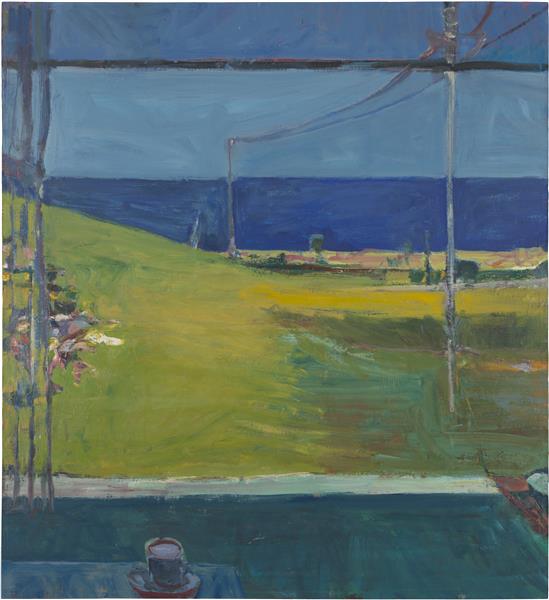
Richard Diebenkorn, Ocean from a Window, 1959

I could go on – I haven’t mentioned Natalia Ginzburg’s Family Lexicon, or Grace Paley’s Enormous Changes at the Last Minute, or Layli Long Soldier’s Whereas, or Cynan Jones’s The Dig, or Andrea Bajani’s If You Kept a Record of Sins,  …, or … or …. But I have to make myself quit.

I’ve really enjoyed writing this. Thanks for reading.

Anja Willner’s Year in Reading, 2020

In the next week or so I’ll be writing up my reflections on my 2020 reading year. In the meantime, I’ve solicited guest posts from friends and fellow book lovers about their own literary highlights. I’m always looking for new contributors; let me know here or on Twitter (@ds228) if you have something you want to share.

The fifth post is by Anja Willner (@WillnerAnja). Anja lives in Munich, where she has a running argument with herself about what she likes best: reading books, hunting after books, or talking about both.

In 2020, I read 70 books, which is quite a lot for me and certainly more than in recent years. Probably due to less work-related stress and more inspiration by Twitter folks (thank you, Book Twitter)! As I’m German, I’ve got quite a few German books or books translated into German on my list. I tried to provide the English title whenever possible, but some books unfortunately aren’t (yet?) available in English. I hope you’ll bear with me nonetheless!

•           Toni Morrison: Love

What is there to say about Toni Morrison you do not already know? Not much probably, so I’Il just say I’ve yet to pick up a Morrison novel that is not good.

•           Elizabeth Taylor: Blick auf den Hafen (translator: Bettina Ababarnell) [English original, A View of the Harbour]

Pretty much the same goes for Elizabeth Taylor: how in the world did she manage to write such impeccable novels? It is and probably will remain a mystery to me. Anyway, my plan for the years to come is to read all of her work.

           Angie Thomas: On the Come Up

Great writing here, especially the dialogues. Also, I learned a lot about hip hop and feel I appreciate this genre of music more now. Love her!

•           Marcelle Sauvageot: Fast ganz die Deine (translator: Claudia Kalscheuer; English title, Commentary)

Kudos to Asal Dardan (@asallime) for pointing me towards Marcelle Sauvageot! I’m always thankful for suggestions of female authors to rediscover. In case you are not familiar with this little gem (I hadn’t heard of it until a year ago), the backstory here is quite interesting. It’s Sauvageot’s only published literary work as she died very young. Fast ganz die Deine is a letter to a man that left her – the story goes that it circulated among friends who persuaded Sauvageot to have it published. No wonder everyone who read it was enchanted by this work, given its perfection. (Good book to start your reading year off, if you ask me. Far better than the Bely dungeon I’ve locked myself into this January. Got out recently and will brag about it for years, so there’s that.)

•           Annie Ernaux: Erinnerung eines Mädchens (translator: Sonja Finck; English title, A Girl’s Story)

Okay, no surprises here: everybody seems to read and love Ernaux and indulge in autobiographical/pseudo-autobiographical writing at the moment (the “moment” stretching back several years, I guess?), and I’m no exception.

The reason why I’ve long avoided Ernaux’s works is simply I’m so ashamed of my practically non-existent French that I haven’t read many (translated) French books recently. I remember struggling with French pronunciation and comprehension, but some part of me insists it might be the language of my heart. (Probably not true at all and sorry, Russian. We’re still dating, right?)

•           Chris Kraus: I Love Dick

Forever gender-confused here as there is a German (male, cis) filmmaker who goes by the same name. Similarly, I felt confused at times by I Love Dick, but largely liked it very much. Also, I made a lot of screenshots of the text I will probably never look at again.

•           Павел Санаев: Похороните меня за плинтусом (Pavel Sanaev: Bury me behind the baseboard)

There are some rules in my life. For example, I’ll read anything recommended by my lovely and witty Russian teacher, Rita. If you’re into Soviet culture, especially the films, this small novel will particularly interest you, for the author is the son of the actress Elena Sanaeva and the stepson of famous actor Rolan Bykov.

If you’re not into Soviet culture and the personal dramas between actors and actresses (I learned to care, it’s so interesting once you start), don’t worry: It’s sufficient to be a human being to care for this little book. Bury me behind the baseboard is as heartbreaking as it is autobiographical.

The author, Pavel Sanaev, spent most of his childhood with his grandparents–here comes the heartbreaking part—against his mother’s will. The grandparents simply refused for years to give him back to his mother, while persuading the child his mother, Elena, had abandoned and forgotten him. I really cannot describe the feelings I have about how his grandmother treated him, a then small child. I don’t have kids, but the sheer thought anybody could be like that to a kid makes me sick. (There is no physical abuse, though.)

Everything is told from the perspective of the child. Okay, we’re all familiar with this trick, I guess. And maybe we can agree that telling a story from a child’s perspective can either add strength to your story or make it extra cringy. Here, the former is the case. Have I already said how heartbreaking all this is? It is—but it’s also a very funny and sad and wise book.

•           George Eliot: Middlemarch

I know a thing or two about literature written in German and quite a lot less about 19th century Russian literature, but apart from that, my reading biography consists of gaps I sometimes find hard to forgive in myself. To catch up on classic English literature, one has to start somewhere, so I started here and did not regret it. What a rich book, and so funny! Huge thanks to author, translator, and literature lover Nicole Seifert (@nachtundtagblog) whose enthusiasm made me pick it up.

•           Marlen Haushofer: Die Wand (The Wall)

Should you really recommend a novel about near-total isolation in the wilderness to anyone in a pandemic? Not sure, but it worked for me. One of the greatest texts about nature and the question of what it means to be a human being I’ve come across so far. Also, finally a writer who really, really gets cats! But be warned, cat lovers, you will come across some gruesome scenes. 

•           Marlen Haushofer: Wir töten Stella (We Murder Stella)

Great novella by the same author which sadly doesn’t seem to have been translated yet. The casual seduction and destruction of a young girl is not a new motif in literature, but here it shows post-war Austria (could have taken place in Germany as well in my opinion) at its coldest. The non-communication of the family and the cool tone of the narrator were killing me.

•           Andy Miller: The Year of Reading Dangerously

I’m so thankful for book twitter and about twice as thankful for Andy Miller still/again being on Twitter, because I rely on “Backlisted Pod” recommendations so much. And well, I knew even before I picked it up that there was no way I wouldn’t love The Year of Reading Dangerously!

Personally, I’m a fan of tackling the classics no matter what. They are not being stored in some holy shrine, they are for everyone. Maybe not for everyone to enjoy, but, for me, that’s another matter: one has to learn to appreciate literature as an art. The more you read and think about what you read, the more you get out of your reading. And if you don’t understand everything, what’s the matter with that if you’re enjoying yourself? I’m all for critical debates on how a canon is established and how we can include works by women, people of Color and other marginalized groups better. At the same time, I enjoy discovering the classics and reading them (often this is a critical look back, but mostly it’s enjoyable).

Andy’s book was so much fun to read for me and inspired me to make even more lists of books I love to talk about reading someday. Great inspiration!

•           Theodor Fontane: Der Stechlin (The Stechlin; reread)

I come from Brandenburg, in Eastern Germany, the region Fontane wrote so often about; his works were always around when I was a kid (most households there own at least one book by him). I guess that makes Fontane the most admired and unread author of that part of Germany.

Fontane himself used to joke that in this novel, not much happens. It’s true, at least if you’re reading for the plot, of which there is not much. Der Stechlin really is a novel that for me is the perfect fit for the landscape of Brandenburg. Not much there to entertain the eye. Until you learn what to look out for.

           Olivia Wenzel: 1000 Serpentinen Angst (A Thousand Coils of Fear)

Really strong debut novel dealing with problems such as racism. I liked the novel’s experimental form: at first, the reader doesn’t always get who is talking und what’s going on, but it’s not an annoying l’art pour l’art thing. Just a very fresh approach. I noticed some parts (really not many!) I would have wanted edited in a slightly different way, but that is a matter of taste. Overall, I’d advise everyone interested in contemporary German literature to read this novel and follow the work of Olivia Wenzel closely. (I hope there will be a translation soon!)

           Deborah Levy: Was das Leben kostet (translator: Barbara Schaden; English title: The Cost of Living)

Another “late to the party” entry. I like Levy’s writing a lot; I’m not so sure about some of her political beliefs, but nothing I couldn’t live with. Will probably need to read a lot more by her!

•           Rachel Cusk: Lebenswerk (translator: Eva Bonné; English title: Motherhood)

Until a few years ago, I couldn’t be bothered reading new fiction. I was busy with the classics and my work schedule—at least this is my excuse for having never heard about Rachel Cusk until Asal Dardan recommended her works to me (maybe two years ago?). Since then, I have read nearly everything by Cusk. Yes, she is fashionable, but for good reasons.

I had circled around Motherhood for a while and 2020 was the year I finally got around to it. My hunger for books about having children has been irritating for me initially as I don’t have kids and don’t feel particularly drawn to them. (It’s such a difficult topic.) I just feel that these kinds of stories have been marginalized and silenced for so long I have some catching up to do.

What I loved about Motherhood was how honest it felt to me. I remember sending screenshots to my sister (mother to one of the few exceptions I make when it comes to engaging with children), who agreed with almost everything Cusk wrote, allowing us to share a few socially very-distanced chuckles. (We live more than 300 miles apart.)

•           Simone Hirth: Bananama

The author Saša Stanišić (@sasa_s) recommended this book on Twitter and I’m so happy I didn’t just make a screenshot of the book cover and then forget about it. Instead, I put the author’s name on a list of books of interest on my smartphone (I later discovered I took down her name and the novel’s title about three times), checked it out from my local library and – here it comes! – actually read it!

In the book, a small girl lives a super eco-friendly lifestyle with her parents, with the latter taking things clearly too far. I liked the topic, but what I liked even more is what is hardest to describe: what a writer Simone Hirth is! She builds a world you follow her into, even though you maybe don’t completely understand where she is heading, because understanding is just not what matters. Just stunning, sometimes funny.

•           Marlene Streeruwitz: Verführungen (Seductions)

There don’t seem to be any translations of Streeruwitz’s work into English which is a shame if true. Verführungen was her debut novel and it’s a strong one! At first, I struggled a bit with the “Streeruwitz sound”: she uses a lot of really short sentences. As an editor, I usually tell writers off for this sort of thing, but here it is art and it achieves something. Once you let the text lead you, it’s like a maelstrom and pulls and drags you with it, letting go only after you have turned the last page.

When it first came out, the novel was criticized by some as concentrating too much on “trivial” aspects of a woman’s live: caring for children, menstruation, and so on. One doesn’t have to be a genius to understand at least some of this criticism was fueled by underlying misogyny.

There is a very insightful interview with Streeruwitz (in German, sorry) on Nicole Seifert’s blog. If you read German and are interested in overlooked female authors, I would really advise you to follow Nicole on Twitter (@nachtundtagblog)! (I’m aware I mentioned her before, can’t stop, won’t stop.)

Oh, one more thing about Streeruwitz: she recently compared measures for containing Covid-19 with the “Nuremberg Laws” of the Nazis. It goes without saying I find this comparison as historically inaccurate as it is disgusting. Let’s hope she’ll recognize her mistake and apologize – it really hurts to lose a Feminist icon and brilliant writer to the Corona deniers.

•           Bernadine Evaristo: Girl, Woman, Other

Very late to the party, I know. But yet: a well written novel offering interesting perspectives – I’d recommend it to (not only) male white friends. Yep, multiperspective narration has been in fashion for ages, but you have to be a really good writer to give it a fresh feeling. Evaristo certainly delivers here.

•           Benjamin Quaderer: Für immer die Alpen (The Alps Forever)

I think this is one of the strongest first novels I’ve read in recent years. Daring and funny, with a narrator that plays around with you. Also, you’ll learn a lot about the tiny, tiny kingdom of Liechtenstein! Minor disadvantage: there are some graphic descriptions of violence I found hard to stomach, but you can easily omit those few pages.

More books I enjoyed a lot in 2020:

  • Franziska Gräfin zu Reventlow: Von Paul zu Pedro
  • Ruth Klüger: weiter leben (English title: Still Alive), unterwegs verloren, Frauen lesen anders
  • Brigitte Reimann: Franziska Linkerhand (reread)
  • Antonia White: Frost in May
  • Fran Ross: Oreo (translator: Pieke Biermann)
  • Marguerite Anderson: Ich, eine schlechte Mutter (translator: Patricia Klobusiczky; English title: A Bad Mother)
  • Candice Carty-Williams: Queenie
  • Inge Deutschkron: Ich trug den gelben Stern (English title: Outcast: A Jewish Girl in Wartime Berlin)
  • Sarah Moss: Ghost Wall
  • Sjón: Schattenfuchs (translator: Victoria Cribb; English title: The Blue Fox)
  • Marguerite Duras: Der Liebhaber (translator: Ilma Rakusa; English title: The Lover)
  • Virginia Woolf: To the Lighthouse
  • Mary Wesley: A Sensible Life