My Year in Reading, 2024

If you’re reading this, you are faithful indeed. And I am grateful. Long silence here, I know. As my adopted country tumbles into authoritarianism, things have also been changing, though more positively, chez EMJ.

Igor Razdrogin, Book Bazar (1975)

My wife, daughter, and I are moving to St Louis in a month’s time! We’ve spent quite a bit of time there these past few years, and we like it a lot. We’ll have a little more space in our new home (which, combined with some collective efforts to tame my unruly library, might mean that our house will at least briefly not be overflowing with books), and, best of all, we’ll be living in a walkable neighbourhood with sidewalks, which is something we’ve been missing these past 18 years in Little Rock.

The other big transition concerns my career. I’m leaving my job at Hendrix, of course, but I’m also leaving academia in general. People keep asking how I’m feeling about this and I keep saying: Terrific! I was pretty burned out and starting to get a little Old Man Yells at Clouds about All the Changes that affected the classroom experience: the pervasiveness of AI and LLMs (something no one, as far as I know, ever asked for), and, more distressingly, the difficulty even the best-prepared students are having reading sustained works of literature, by which I mean, an entire book, no matter how straightforward the prose. This isn’t about their intelligence, or even their phones. It’s about the strictures placed on secondary school teachers. As instruction moves ever more toward preparing for testing centered on multiple choice reading comprehension questions about utterly decontextualized chunks of texts, teachers aren’t assigning much reading, which means students simply don’t have much practice at it.

(I also have a pet theory that for all its flaws Harry Potter (to be clear: it sucks) helped Millennials think of reading as both exciting and habitual, and Gen Z hasn’t had anything like that. The Harry Potter to Jane Austen to English Major pipeline kept our department afloat for a lot of years. These days, students dislike both Rowling and Austen…)

I still love many things about teaching, and it’s possible I’ll miss it so much that I’ll return to it in some fashion. (I’m never getting another job like this one, though. Those don’t exist anymore.) But for now, I feel relief, and curiosity—along with a lot of trepidation—about the chance to try something new. For now, it feels a bit unreal. Because the academic year is cyclical—summer is always a time of collapse and, if lucky, regeneration—I don’t yet feel as a though I’ve made much of a change. Talk to me in the fall, or next spring, or five years from now.

Luckily—and this is another reason for the silence around here—I’ve been working as a consultant for the Educator Programs arm of the William Levine Family Institute of Holocaust Education at the United States Holocaust Memorial Museum in DC. The people I work with are absolutely fabulous: smart, funny, kind, devoted to their work without having delusions of grandeur about it. It’s eye-opening—and fun—to work as part of a team, after decades of the isolation of academic life. I’ve helped them create resources for K – 12 English Language Arts classrooms, and have taken great satisfaction in the work.

I’ll need full-time work sooner rather than later, though, so if you have any ideas or leads, hit me up! Like, what are some jobs people do? What do y’all do all day? I need advice!

What I’m saying is, I had a lot going on these last months. But I did manage to keep reading. Maybe not as much as usual, but whenever I could make time. I get that it’s ridiculous to offer a 2024 reflection halfway through 2025, but FWIW here are the things that stuck with me last year.

Eight standouts

Francis Spufford, Cahokia Jazz (2023)

So much to love in this novel about an alternate 1920s in which a sizeable indigenous population thrives in a nation called Deseret centered on the bustling city of Cahokia. Spufford weaves his world-building throughout a procedural, in which our hero, a cop who moonlights as a jazz pianist, investigates a murder with vast political implications, to the point of threatening Deseret’s independence.

Cahokia Jazz is the most referenced title in the Year in 2024 Reading pieces I posted earlier this year, which means either that everybody loves this book, or that people like me love this book. Anyway, given my upcoming move to Missouri, it won’t surprise you to hear that the scene that most sticks in my mind is when Barrow pursues a lead in a village at the end of the Cahokia streetcar line, a fly-swept place he can’t wait to leave. Its name? St Louis…

I look forward to visiting the ruins of the actual Cahokia, once the biggest city north of Mexico City.

Katrina Carrasco, The Best Bad Things (2019)

Fabulous and underrated crime novel set in 1880s Port Townsend, where the most valuable commodity passing through the busy port is opium smuggled in from north of the border. Alma Rosales, who once worked for the now-shuttered Woman’s Bureau of the Pinkerton Detective Agency, has left San Francisco for Washington Territory to work for the seductive, brilliant, coolly calculating Delphine Beaumond, who runs most of the drug smuggling on the west coast.

When product goes missing, Delphine puts Alma on the case. Alma goes undercover as a dockworker—not a problem, because Alma is also Jack Camp, a slight yet wiry man who can hold their liquor and likes ladies and men equally. Did I mention that Alma and Delphine are lovers? Or that Jack starts a torrid affair with the man they’re investigating? Or that they’re also still working as a Pinkerton agent—in a desperate attempt to get their old job back?

Cue double-, triple-, even quadruple-crossing; witty repartee; and some pretty hot sex. Most crime novels are let down by their endings, but this one… let me tell you, friends, I literally gasped. A brilliant debut. I want everyone to read it.

Émile Zola, La Bête Humaine (1890, translated by Roger Pearson) and The Assommoir (1877) Trans Brian Nelson (2021)

Even by Zola’s lofty standards, these two are bangers. Push comes to shove, I guess I’d choose Bête over Assommoir, just because I love the crime story trappings, but the latter might be the more impressive accomplishment, especially if you could read it in French to see what Zola does with the argot of his lumpenprotelariat characters. They’re equally—which is to say, tremendously—depressing, but also viciously alive. Zola’s naturalist doom is regularly leavened by his prose, which zips from one brilliant set-piece to another. I’m talking about stuff like the bruising fight between two laundresses in front of an audience of delighted, shouting onlookers in the opening scene of The Assommoir, or the berserk vision of a driverless train, filled with drunk soldiers in full war frenzy heading to their doom at the hands of the Prussians, in the last pages of La Bête Humaine. Feels like a good time to study Zola’s fascinated descriptions of all things irrational.

Hernán Diaz, In the Distance (2017)

Quasi-Western in which the protagonist—a hulking, nearly mute Swede named Håkan whose only goal is to find the brother he was separated from on the voyage to the New World, and whose body and psyche seem to be able to take any amount of suffering—travels east, south, and north as much as west. This is a brainy book: Diaz riffs on Frankenstein, and probably a lot of other stuff I missed. But its allegories are always concrete. In this novel of a man stubbornly going against the westward direction of Manifest Destiny, I most remember the section in which, after suffering a terrible loss, Håkan literally burrows into the ground, eventually building a maze-like underground shelter where he lives in ambivalent isolation for years.

I read Diaz’s Trust last year too: also great. Probably not telling you anything you don’t know. But if like me you are late to Diaz, move him up your list. Smart guy and beautiful writer.

Leah Hagar Cohen, To & Fro (2024)

Last year I served as a judge for the US Republic of Consciousness Prize, which honors literature published by small presses. Yes, I tossed aside some duds and waded through many competent but unexceptional novels, but I also discovered some terrific stuff I wouldn’t have otherwise read. My favourite was this delightful and thoughtful literary experiment, a novel written in two halves that can be read in either order. You can start with “To” and flip the book over halfway through to read “Fro,” or do the reverse. You could call this a Jewish Alice in Wonderland (I love how deeply and unapologetically Jewish the book is: it takes such pleasure in asking questions), but that wouldn’t give you the sense of how the book is both realist and fantastic, a genre-bender that sometimes reads like a middle-grade book and sometimes like a historical “what if” novel, if those were written by someone whose lodestar was Maimonides. Magic!

Thanks to Lori Feathers, the genius behind this award, and to my fellow judges, who always brought it. Serving on this panel was time well spent.

Elizabeth Bowen, The House in Paris (1935)

A book of arrivals and departures, whether longed-for, dreaded, or uncertain. It feels both constricted and expansive: a neat trick. Bowen often gets called Jamesian. That is true not in style but only in a shared preoccupation with cruelty. Hard to say which fictional universe is meaner. Another thing I liked about The House in Paris is that it offers further evidence for my theory that British modernism is just another name for Gothic literature about children.  

Martin MacInnes, In Ascension (2023)

Here we have two sisters. One becomes a scientist who explores the depths of the ocean floor and the vastness of space (she develops nutrition-dense and fast-growing algae for interstellar travel); the other sets aside her career as an international lawyer to find out what happened to the first. I can’t remember everything that happened in the book, but I do remember being enthralled from start to finish. (This is another long book that never felt slow.) The final scene, set in the remotest place on earth, Ascension Island, foregrounds another kind of foreign place: our memories. “A family”, MacInnes writes, showcasing his epigrammatic mode, “is a group of strangers with a destructive desire for common nostalgia.” MacInnes’s big question, asked as much of a sibling relationship as of humanity’s ability to inhabit the stars, is whether the only way to get beyond the destructiveness of the human species is to destroy the individual self Beejay Silcox, one of my favourite critics, gets it right when she calls the book “a primer to marvel.”

Sally Michel Avery, Father and Daughter, 1963

Thoughts on the rest

Ones I keep thinking about: Manjula Martin’s The Last Fire Season (2024): I still haven’t prepped a go-bag—how foolish is that? Catherine Leroux’s The Future (2020, translated by Susan Ouriou): What if the French had never lost Detroit? What if climate change and resultant socioeconomic crises meant that most of the trappings of a functioning state had fallen away? And what if bands of roving children built hardscrabble lives in overgrown parks? Peter Heller’s The Last Ranger (2023): Conventional but satisfying novel about a ranger in Yellowstone, filled with scenes in which the hero drinks early morning coffee on the porch of his cabin: Heller knows the landscape and describes it beautifully. (Given what the chuckleheads at DOGE did, this title resonates differently now…) Jill Ciment’s Consent (2024): Revelatory memoir in which the author reassesses her decades-long marriage to her now deceased husband, with whom she took a painting class when she was 17 and he was 47. Can the relationship really have been good given that they met when she was a child?

Best study of xenophobia, told in an atmosphere of creeping dread: Georges Simenon’s The Little Man from Archangel (1956, translated by Sian Reynolds).

A Russian Jew, brought to rural France as a child, French in every way, has his life turned upside down because of a casual remark. Chilling. Best Simenon I’ve read.

Best study of deprogramming: Emily Tesh, Some Desperate Glory (2023).

Maybe useful these days.

Best case of “it’s not you, it’s me”: Nisi Shawl’s Everfair (2016)

Steampunk set in an alternate late 19th century in which the Fabians buy tracts of land from King Leopold to protect refugees fleeting the horrors of Belgium’s rule in the Congo. At first, this new nation—Everfair—prospers. European benefactors and missionaries work with Africans to create trade networks based on clean airship technology. They develop intelligence networks to navigate the region’s politics. They promote or at least allow social experiments concerning family structure, marriage, and sexual politics. But the internal tensions become too much, and the utopia falls apart. Even as I’m writing this I’m thinking, Honestly this sounds pretty good, maybe I’ve misjudged the book. And at the level of idea it’s intriguing. The execution, though: that’s the problem. The prose is leaden, the relation between action and exposition awkward. Maybe the book actually needed to be longer? A strange thing to say since I felt like it was never going to end. This book is a darling to many (Jo Walton loves it, for example). Probably just the wrong time for me. Can’t imagine giving it another try, though.

Best (and most) coffee: Mark Haber’s Lesser Ruins (2024).

Things are not going well for the narrator of this Bernhardian novel, ever since his wife died and he lost his job. That’s a tough spot. And he tries to do the right thing, sometimes. He reaches out to his son, whose passion for house music means he will dilate on the perfect set list for as long as his father will hold the phone near his ear. Like so many of us (me, anyway), he struggles to surmount the gap between idea and execution, endlessly trying to write something good. You’d think we might like the guy. But… He’s a terrible snob. He lambastes his students, neglecting his work to the point of installing an espresso machine under the desk in classroom. (That an instructor at a community college would have a dedicated classroom is the book’s only false note.) His unfinished, maybe unfinshable, book on Montaigne is probably not really going to be all that. So he ain’t easy to like.

All of this is beside the point, though, because this novel is about the way sentences can mimic the swerves and circles of a mind endlessly thinking. One of the things our narrator thinks about most is coffee. He drinks a lot of coffee. Long sections concern the various roasts, the preparation, the anticipation, the enjoyment. I’m not a coffee snob on his level, but I found nothing to ironize or criticize in the man’s love for the perfectly pulled shot. Lesser Ruins is great for other reasons, too (it’s Haber’s best IMO), but if you like coffee at all, you gotta read this.

Most ingenious conceit: Kenneth Fearing’s The Big Clock (1946)

A drudge at a magazine publisher modelled on Time-Life is tasked with finding—for purposes of eliminating—a witness to a crime. Only thing is, he is that witness…

Dark and boozy. This is the good stuff.

Best crime fiction: Carrasco, obviously. Also obviously, the latest Tana French. (At least I can say I was alive while Tana French was writing novels that will be read in a hundred years…) The latest Garry Disher, Sanctuary (2023), is a satisfying standalone about theft and friendship. I read a couple of Gary Phillips’s books about a Black Korean-war vet turned crime-scene photographer: good stuff. (I learned a lot about Watts.) Start with One-Shot Harry (2022). Years ago I devoured Scandinavian crime novels: seemed like the most exciting thing in the genre. Bloom’s been off that rose for a while, but Cristoffer Carlsson’s Blaze Me a Sun (2021, translated by Rachel Wilson-Broyles) took me back. Marcie R. Rendon’s Where They Last Saw Her (2024) is her first book set in the present, and much as I love the Cash Blackbear series, probably her best. How nice to read a book about an indigenous woman who has a good man in her life. I regularly think about the scenes of women jogging through the snowy Minnesota woods.

Best sff: In addition to MacInnes and Tesh, I most enjoyed Ann Leckie’s Ancillary Justice (2013), Shelley Parker-Chan’s She Who Became the Sun (2021), and various works by Guy Gavriel Kay, who continues to be a source of reliable pleasure, even if no one would call his books cutting edge. (So humane, though! I need that right now.) Alas, I am not yet a dedicated enough sff reader to have figured out how to overcome the “stalling out in a series because I didn’t get to the next one right away and then forgetting what happened” problem.

Best poetry: Louise Glück’s The Wild Iris (1992). Ok, the only poetry collection I read, but I liked it enough to assign it this past semester and the students loved it. Teaching it made me both appreciate it more and notice its limitations (it hoes rather a narrow furrow). I ought to read some of her later stuff: I bet it’s even better.

Best book of the kind I could imagine myself writing and yet am mostly allergic to reading: A tie between Jakuta Alikavazovic’s Like a Sky Inside (published 2021 and translated by Daniel Levin Becker) and Chris Bachelder & Jennifer Habel’s Dayswork (2023).

The whole quasi-essay, quasi-memoir with novelistic elements thrown in for good measure—mostly that stuff leaves me cold. But these two won my heart. Alikavozovic describes a night she spent in the Louvre, a place that she often visited with her father, a ne’er-do-well from the former Yugoslavia. After each excursion, her father would ask, How would you go about stealing the Mona Lisa? This question, and the reflections on her father’s life of petty crime and her own experience growing up in a culture and language that he never perfected, lies at the heart of this beautiful little book.

Bachelder and Habel have done something remarkable: written a book together, about themselves as a couple, that feels written in a single voice. The text centers on the Habel character’s fascination with Herman Melville: it’s about his life, and their lives, and what it means to write a life, with copious references to the man they call The Biographer, Herschel Parker, who seems to have been really something. And by that I mean kind of a dogged genius, but also a pain in the ass.

Best literary fiction:

Laurie Colwin’s Shine On, Bright and Dangerous Object (1975) is sad and delightful, filled with loving anger. A splendid beginning to a marvelous though much too short career. William Maxwell’s So Long, See You Tomorrow (1980) is famous for good reason. Audacious structure and play with time, heartbreaking story, even a section told from the point of view of a dog. Joan Chase’s During the Reign of the Queen of Persia (1983) deserves its resurrection thanks to the good people at NYRB. Another story of childhood in the American Heartland, at once bucolic and traumatic.

You can see I am deep into the “my favourite artworks are the ones created while I was a child and too young to experience at the time” years. I read new things too, though, and the best of these was Kaliane Bradley’s The Ministry of Time (2024), which I finished in a cabin at the Grand Canyon during a thunderstorm that had the rain pounding on the metal roof. The book is as memorable as the setting of my reading: an experiment in time travel, in which a 19th century Arctic explorer is brought to a near-future UK and given to a handler from the titular government agency whose background happens to be Cambodian. In addition to its speculative elements, and a terrific love story, the novel considers differing cultural responses to trauma. More Bradley soon, please!  

Henri Matisse, Woman Reading in a Violet Dress, 1898

Short story collection: Only read one, but it was a good one. I liked all the stories in Jamel Brinkley’s Witness (2023), but “At Barstow Station” is an all-timer. Even a class full of students who did not care much for reading agreed.

Most unexpected page-turner: Karl Ove Knausgaard’s The Morning Star (2020, translated by Martin Aitken) blends his signature interest in mundane middle-class life with some weird shit (a blazing star that no one can explain, a ritual murder, shenanigans at a mental institution). I raced through it and bee-lined for the bookstore to but the next one (in an expensive and gigantic hardcover edition), only to ignore it for the rest of the year. Honestly, the hardcover might be the problem. Most of the time I’m a “give me the paperback” guy. Anyway, will read the others in this series.

Most fun: The audiobook of Jesse Q. Sutanto’s Vera Wong’s Unsolicited Advice for Murderers (2023), read with obvious affection by Eunice Wong, made me laugh aloud. As I feared, the strains of keeping the conceit going already show in the second book, which I listened to a couple of months ago. But I’ll stick with Vera a while longer; she’s a treat.

Best sequel: Waubgeshig Rice’s Moon of the Turning Leaves (2023) is a big advance over its predecessor, Moon of the Crusted Snow. A rare case of a longer book being better. It’s ten years since the mysterious event down south that sent the grid down. The small indigenous community at the heart of the first book has been thriving, but its inhabitants realize they have reached the limit of the resources in their immediate area. After painful debate, they send a search party to find out if anyone else is out there—specifically, anyone indigenous. Exciting, well-drawn, and smart about the cost of giving up part of your identity to gain the benefits of joining something. (a community, a culture) larger.

Grimmest ending: Edith Wharton’s Summer (1917), really a hell of a book. Even if you haven’t read Wharton before you know things aren’t going to end well. But I at least did not anticipate them to end quite that dispiritingly. Thanks to Shawn Mooney and the rest of the Wharton gang for the invitation to read.

Hurts so good: Elliott Chaze, Black Wings Has My Angel (1953)

Liked at the time, but has now faded from memory:

Jean Giono’s Fragments of a Paradise (1944/48 and newly translated by Paul Éprile); Suzumi Suzuki’s Gifted (2022, translated by Allison Markham Powell); Ariane Koch’s Overstaying (2021, translated by Damion Searls);and Jón Kalman Stefansson’s Your Absence is Darkness (2020, translated by Philip Roughton). Don’t get me wrong: these are all good books (especially the Giono). I don’t regret reading any of them. Just not top-notch, for me.

Meh:

These did nothing for me, and even left me a little grumpy. Ari Richter’s Never Again Will I Visit Auschwitz: A Graphic Family Memoir of Trauma & Inheritance (2024): you’d think I’d be the perfect reader for this, but honestly I did not think this book was very smart. Dorothy West’s The Wedding (1995): I get it, she was old when she wrote this. Plus, the existence of a Black elite on Martha’s Vineyard was news to me: interesting stuff. But this felt wispy, and not in that good Belle and Sebastian way. Two crime novels by Arnaldur Indridason: sometimes you just want to turn pages and remember your Iceland vacation but at the same time you know you’ll never get these hours back.

Most ambivalent toward:

Tried to explain why I felt this way about Lily Tuck’s The Rest is Memory in The Washington Post.

It wouldn’t be an end-of-year list from me without some thoughts on Holocaust-related books, which I’ve divided into categories:

History: Dan Stone’s The Holocaust: An Unfinished History (2023). All due respect to Doris Bergen, this is the best single-volume history of the event I know, and it’s pretty short too. I went long on it for On the Seawall. Honorable mentions: Linda Kinstler’s Come to this Court and Cry: How the Holocaust Ends (2022), and Rebecca Donner’s All the Frequent Troubles of Our Days (2021). The latter admittedly not a Holocaust book, but rather a resistance to the Third Reich book. Pretty damn good tho.

Memoir: József Debreczeni’s Cold Crematorium: Reporting from the Land of Auschwitz (1950, translated by Paul Olchváry). If I could legislate that people had to read one Holocaust book, I’d choose this one. Indelible. You think the Holocaust was bad? You don’t know from. Honorable mention: Michael Frank’s One Hundred Saturdays: Stella Levi and the Search for a Lost World (2022), which I wrote about in 2023 but read again for a book group last fall. If anything, it was even better the second time. To read about Stella is to love her.

YA: Elana K. Arnold’s The Blood Years (2023). Gonna do what I can to see that this one gets more traction.

Comic: Emil Ferris’s My Favorite Thing is Monsters [Vol 1] (2017). What an accomplishment! Your heart will hurt but you won’t be able to stop turning the pages. Ten-year-old Karen Reyes lives in Chicago in the late 1960s. She adores her brother, who is sometimes a gentle artistic soul but sometimes a man pushed to violence by racism and poverty, almost as much as she loves monsters. (She draws herself as a werewolf.) She’s fallen in love with her best friend, Missy, who now shuns her at school while being drawn to her in private. Her mother is diagnosed with cancer, leaving the family’s fortunes ever more precarious. When Karen’s upstairs neighbour, Anka Silverberg, a married Holocaust survivor with whom her brother had been having an affair, is found dead under mysterious circumstances, Karen takes it upon herself to investigate. She stumbles on some cassette tapes, in which the woman tells her life story, a lurid and painful one: Anka was brought up in a brothel by her abusive mother, a sex worker, and then sold into a child prostitution ring from which she is “rescued” by a client who later abandons her when she gets too old for him. After the fall of the Weimar Republic and the rise to power of the Nazis, Anka is persecuted for her Jewishness and eventually deported to the camps. How she survived, how she made her way to America, and what led to her death—these questions are presumably answered in volume 2, which was released last fall. Volume 1 is 400 pages, with plenty of tiny lettering. It would be an effort to read it even without its distressing subject matter. But it’s damn good and deserves more attention than it’s got. Ferris uses dense cross-hatching to give her images texture: I don’t how else to say it other than the images seem tense. Amazingly the book is drawn almost entirely with Bic ballpoints. The whole story of its creation, which took six years, is remarkable, starting with Ferris’s partial paralysis after contracting West Nile disease.

Holocaust-adjacent text: Svetlana Alexievich”s Last Witnesses: An Oral History of the Children of World War II (1985, translated by Richard Peaver and Larissa Volokhonsky) impressed me with the pathos of its subject matter (children, many orphaned either permanently or temporarily when Germany invaded the USSR in 1941) and the success of its method (her now well-known quasi-anthropological style, in which witnesses speak for themselves, with seemingly little input or shaping from Alexievich herself, other than the ordering and structuring, not to mention the selecting of excerpts from what are presumably much longer testimonies: which is to say, thoroughly shaped…)

Book I Never Expected to Spend This Much Time With:

Lois Lowry’s Number the Stars (1989), the classic middle-grade novel about the (anomalous) experience of Danish Jews during the Holocaust. I created a lot of materials about this book for teachers. Yes, it has certain limitations, but I’m honestly impressed by how much richness I’ve found in this text. It seems to be fading a bit from the classroom—but not anymore, if I can help it!

Edouard Vuillard, Madame Losse Hessel in Vuillard’s Studio (1915)

There you have it. I don’t know what my life is going to look like going forward—but I hope at least in the short term to have more time for this poor little blog. Thanks as always for reading! I would love to hear your thoughts on anything I wrote about here.
What I Read, June 2024

Dropping this as something to keep you busy—and maybe even entertained—while I carve out the time to write my Year in Review piece. I won’t be catching up on the last half of the year—in fact, not sure I’m going to continue with the monthly pieces, might be time to try something new—but I’d already written most of this one and it seemed a shame to let it go to waste.

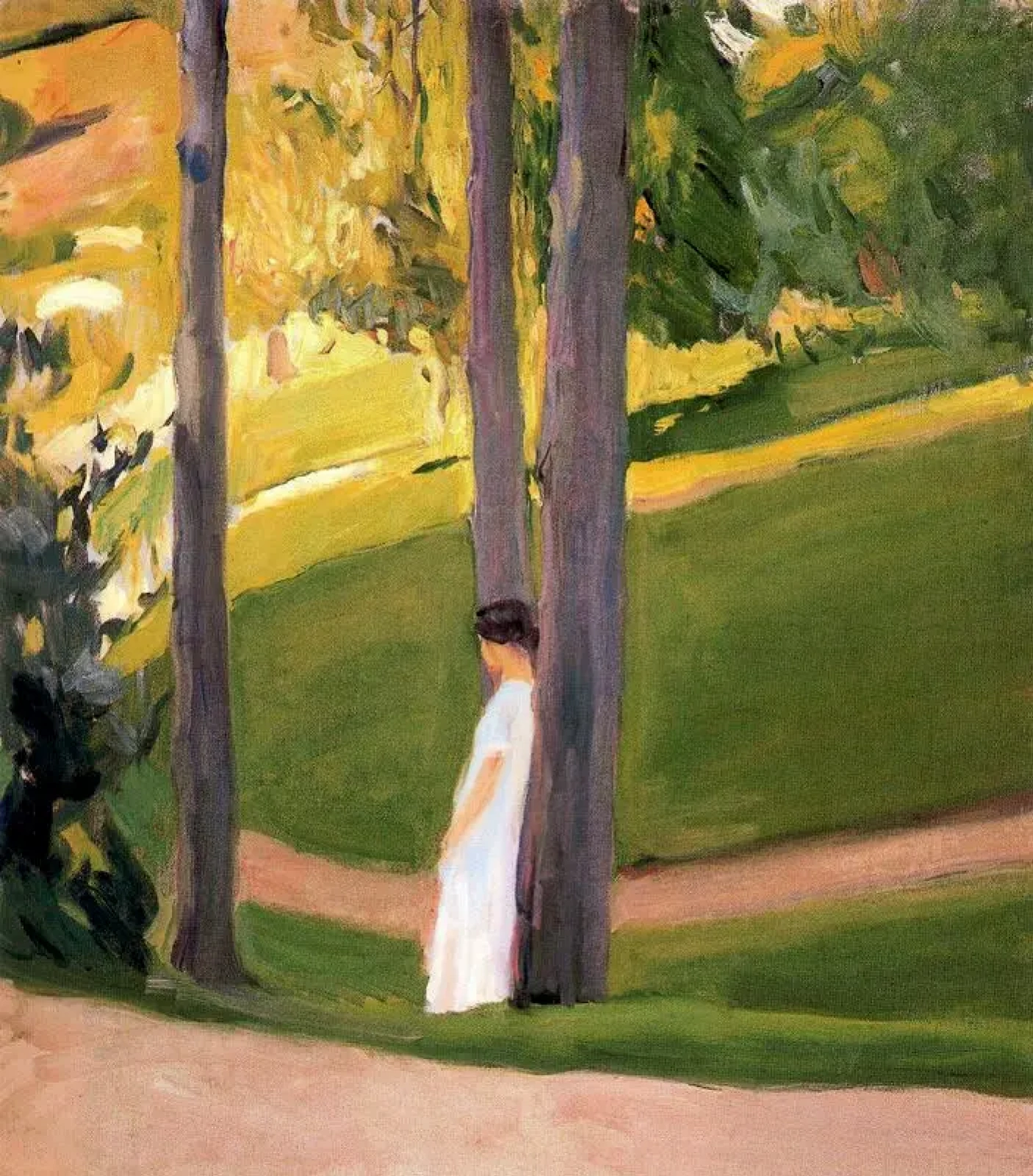
Joaquin Sorolla, San Sebastian Landscape (1911)

Shelley Parker-Chan, She Who Became the Sun (2021)

Fantasy novel set in 14th Century China (with the smallest bit of magic) about a young girl who fulfills the destiny foretold for her brother, who dies, along with the rest of her family and everyone else in her village, from a harrowingly described famine. Zhu Chomngba drags herself, starving and mute with fear, to the nearest monastery, where she is taken in because she has disguised herself as a boy, a deception she never disabuses anyone of, going to great lengths to keep the secret. Her bunkmate, and best friend, learns the truth, leading to an unexpectedly progressive outcome. The meat of the book concerns Zhu’s long, slow rise to power, as she consolidates the Han and prepares to do battle against the Mongols. I liked the idea of this book more than the actual reading experience. By the end, I was keen to learn what happens next, but I was also relieved to have finished the book. (It’s long.) Jury’s out whether I’ll read the sequel.  

William Maxwell, So Long, See You Tomorrow (1980)

Seems like everybody knows this book, but if you don’t, do yourself a favor and read it. But make sure you’re in a good head space first. So Long, See You Tomorrow, a novella about things people can’t bear, isn’t easy. A woman can’t bear to tell her son her estranged husband has ordered her to forbid the boy from visiting the farmstead where he, the former husband, is quietly cracking up, and, even more heartbreakingly, the boy’s dog is tearing itself apart in grief. Years later, another man, the story’s narrator, sits in a New York City analyst’s office and means to say that he “couldn’t bear” his mother’s decades-ago untimely death, but says, instead, he “can’t bear it,” a realization that sends him out of the office and into the streets, for only in the streets of NYC can one cry freely.

As these examples might suggest, the book consists of two strands. Interestingly, they intersect only glancingly. In one the first-person narrator, who seems an awful lot like Maxwell—today, the book might be marketed as autofiction—describes his mother’s death in the little town of Lincoln, Illinois in the 1918 flu pandemic. (The story that took up the whole of They Came Like Swallows is here compressed into a handful of anguished pages.) When the boy’s father remarries the couple decide to build a new house. The work-site, the house framed but without walls, and as such a metaphor for the book’s fascination with unfinished, maybe unfinishable structures, becomes the boy’s refuge after school. He bring his friend Cletus, and as the boys play amid the unfinished space, the narrator believes he “had found a way to get around the way things were.” But nothing gets around the way things are: that’s why life is so unbearable.

Cletus, whose experiences comprise the book’s other strand, also has much to mourn. His family, tenant farmers scrapping a life together, has fallen apart. He now lives in town with his mother, who has left her husband to be with the husband of the couple’s best friends, who work the next farm over. Cletus soon has even more to deal with: his father shoots his wife’s lover, his former best friend. (Not a spoiler: the novella opens with the rifle shot.) The boys drift apart. The narrator next sees Cletus years later in a high school hallway. The narrator sees Cletus, sees that Cletus sees him seeing—and ignores him. This unkindness haunts him all his life, getting tangled with the earlier loss of his mother. The book’s premise is that the narrator, now an old man in New York, the kind of person who visits MOMA regularly, where he is much taken with a Giacometti sculpture that reminds me of his father’s half-built house, a man, as I said earlier, like William Maxwell, excavates, through a mixture of research and imaginative reconstruction, what happened on those farms between those people.

Death, adultery, murder, cruelty: these are the things that can’t be borne in So Long, See You Tomorrow. Which makes the book sound lurid when in fact it’s heartbreakingly restrained. Or, more accurately, a strange blend of the two. The writer Antonya Nelson gets it exactly right:

I don’t know how William Maxwell manages to balance those two stories, one plotted like a melodrama, replete with murder and mayhem, and the other a quiet meditation that hinges on the tiniest non-gesture of passing strangers many years in the past. It’s a combination that oughtn’t work. And yet it does.

Even a three-page swerve into the mind of the abandoned dog works. Which it absolutely should not. Anyway, like I said, read it. It’ll tear your heart out, but in a good way.

I read a lot of Maxwell in my mid-twenties (somehow never this one, though). Now that I am old enough I want to revisit them all. And that’s just the novels. I haven’t even cracked the stories yet.

Manjula Martin, The Last Fire Season: A Personal and Pyronatural History (2024)

Manjula Martin lives in Sonoma County. She is not a winemaker (although she drives past the fields full of seasonal workers, most of them Latino/Latina, working through the night to pick the grapes at the time when they are at their most succulent). Nor is she especially wealthy (though she and her partner have jobs that pay enough and make a difference (union organizing, writing), plus the proceeds from an apartment she sold in San Francisco).

They live in a redwood cottage in the WUI, the wildland-urban interface, as do so many in the paradise of northern California. A paradise threatened by fire. As it always was. But now more than ever. The relentless impingement of human habitation into the forest, plus a century’s worth of misguided fire prevention strategy, plus climate change means the wildfire season is ever longer and ever more dangerous.

Martin’s memoir begins in July 2020, when terrible lightning storms set off hundreds of fires that burned hundreds of thousands of acres. It ends in November, with the delayed end of the season, though with the tendency of fires to smolder underground through the increasingly dry winters, every season is now fire season. In between, she, like everyone in California, learns to prepare a go bag, to speak knowledgeably about AQI levels, and, like many, to evacuate for a time when the fire comes within a couple of miles of the house.

She breaks up her descriptions of those months of the fire by looking back to her childhood growing up on a commune with hippie parents who left that life to become a master gardener and a professor in nearby Santa Cruz and forward to the actions she has taken since to prepare to live with fire.

Martin is an expert at living with hard things; she suffers chronic pain from the operations required to free her from a broken IUD. As a woman who cannot and never wanted to bear children, Martin resists the tendency to think of nature in terms of fecundity and rebirth, even as she finds herself unwillingly returning to that language. Martin impressively blends the experience of living in a damaged body with that of living on a damaged planet.

Martin learns the key distinction between good fire and bad fire. Without the former we have no hope of combatting the latter, though we may have left things too late. She argues that there is no natural world outside its encounter with the human (just as there is no definition of the human that isn’t dependent on our reliance on nature, especially plants). Our fantasy of pristine or untouched nature is just the flip side of our rapacious consumption of natural resources. Thus she returns again and again to her garden, which not only distracts her from her pain but teaches her about the power of pruning, grafting, and weeding. “An intervention,” she writes, “was not inherently good or bad; it was part of a dialogue. The tending of a natural body required constant attention: the giving and receiving of nurture and discipline. Extraction and tourism were types of attention. So was gardening. It mattered how the relationship was structured, not just that there was one.”

At her best, Martin rejects easy thinking. The tendency to just get through to the end of the next fire season, for example, is strong, but Martin rejects this as blindness. We need, she argues, to think of ourselves as in a relationship with the world, to refuse to separate human from non-human life.

The Last Fire Season annoyed me sometimes: it’s too long, and its author is pretty self-righteous. I’m sympathetic to her politics and indeed her world view, but even I had to roll my eyes at her holier-than-thou attitudes. But even though I strongly suspect Martin and I would hate each other, I learned a lot from her book (not least the wonderful word “duff”), and I bet I’ll think about it for a long time to come.

Caleb Carr, The Alienist (1994)

In the Sherwood branch of the Central Arkansas Library System’s copy of Carr’s The Alienist, someone has written alongside a passage referring to the draft riots of 1863, “Oh Please! Too much B.S.” Telling that out of this entire 400+ page novel, only the passage describing the backstory of its sole African American character is singled out for such contempt. Who knows when some anonymous member of my community expressed this frustration. It looks like the book hasn’t been checked out for a while—but it also looks like it was checked out a lot, back in the day. And of course, The Alienst was a huge hit. I remember selling more than a few copies of it in my bookseller days. For whatever reason, I never thought of reading it then. But Carr’s recent death, and the story of his life as revealed in the Times obit, piqued my interest. And I knew the book has its fans. When I wondered on Bluesky about reading it, Anne Trubek said she’d spent years chasing the high of her first encounter with the book. How could I not see what the fuss was about?

In New York in 1898 someone is killing young boys. Not just killing them: maiming them horribly and leaving them on grisly display. These boys are orphans and runaways. They work in brothels, servicing a particular clientele: men who like boys dressed up as women. In the first chapter, the narrator, John Schuyler Moore, a crime reporter for the Times is summoned to the latest corpse by his former Harvard classmate, Laślo Kreisler. Kreisler is the alienist of the title, as psychologists were then known: they cared for or studied people “alienated” from society and their own, “true” natures. Under the guise of then police commissioner Theodore Roosevelt (another old pal), whose attempt to clean the force of corruption (same as it ever was…) threatens to founder if the killer isn’t caught, the pair methodically stalk the fiendish killer. They are joined by the first female police officer in NY, two Jewish cops ostracized for their identity and their passion for scientific methods of detection, and some devoted former cast-offs from Kreisler’s life’s work helping orphans. The band gets together, they make painstaking progress, but they’re always behind the killer. As the death toll rises, and nefarious elements seek to use the killings to foment reactionary unrest in the city, the case becomes a race against time…

The short verdict: it’s good! Not, in my opinion, great. But worth reading. I got a Name of the Rose vibe from it: a smart non-crime writer writing an investigation in a historical period they have researched to bits.

The long verdict: maybe what Carr was doing—spotlighting together historically marginalized figures and using historical figures like Jabob Riis and Teddy Roosevelt as more than just bit players—was more unusual at the time than now. Maybe the book is in that awkward in-between stage: a bit dated, not yet so old that it feels like a glimpse into another world.

What does feel of its time—the 1990s, not the 1890s—is the passionate defense of children, and the abhorrence of the violence (physical, psychological, sexual) done to them by adults. Based on what I read about him, this element seems to come pretty closely from Carr’s own life, with the desperate, authentic, slightly incoherent quality of not-fully-worked-through experience. In this, The Alienist reminded me of some otherwise completely different books, the crime novels of Andrew Vachss, all of which centered on the sexual abuse of children. Anyone remember those? Vintage published them in the 90s, they were kind of a thing, but I never see them anymore. Wonder what happened to him.

Ignore that anonymous Arkansas reader: no BS here. There’s plenty of fiction being written today that will look, if we are lucky, a little creaky in 30 years in its efforts to include marginalized experience. Worth a little awkwardness to kick open some doors.

Laurie Colwin, Shine On, Bright and Dangerous Object (1975)

Colwin’s first novel, which I think I maybe found a bit slight on my initial deep-dive thirty years ago and which I haven’t read since, but which impressed me greatly as a middle-aged reader. Crazy to think Colwin was only about 30 herself when she wrote it.

A Jewish woman marries into an old WASP family. He husband, a charismatic ne’er-do-well, dies in a sailing accident. In the grieving process, she must come to terms not only with her loss but her recognition of how little her husband had ever been able to know about himself. In the process, she becomes close to her husband’s brother, as serious as her husband was carefree. I won’t tell you what happens, but Colwin does something so interesting at the end: her book takes an unexpected swerve that makes everything so much more complex. Man, it sucks she died so young.

Francis Spufford, Cahokia Jazz (2023)

God, what a book! I’ll say more about it in my Year in Reading piece.

Elisa Gabbert, Any Person is the Only Self (2024)

Essays on mostly bookish topics written by the poet Elisa Gabbert. I was happy to start in on the first one, because I remembered it from its first appearance in the New York Times: a lovely piece on the “recently returned” shelf at the Denver Public Library, where no algorithm or even individual taste holds sway. Gabbert has revised the piece so that it has a wider focus, and I actually missed the minor-key aspect of the original. But I swallowed these pieces one after another, unable to give them the time they, like all good essays, deserve. I ought to revisit them from time to time. Here’s what stuck with me, though: the to-me breathtaking abruptness of their endings. Gabbert does this thing where she meanders in classic essayistic fashion, and then simply declares herself done. I experienced this as an attack on my sense that the ending of an essay should call back to its earlier moments, allowing readers to see in a new light something they’ve have already been told. But they really are more ways to do things than you’d think.

Jamel Brinkley, Witness (2023)

Strong collection of stories of unhappiness. I still think about “Blessed Deliverance,” about a group of friends coming up in a gentrifying neighbourhood (one sign of which is that some white folks set up a bunny rescue) who drift apart as they enter high school. And I was blown away by “Barstow Station,” the story of a UPS driver whose adult relationships founder because he’s too busy preserving himself from the memory of something bad that happened when he was a teenager. I immediately decided to teach it this fall—along with this lovely close reading by my secret boyfriend Garth Greenwell. (Secret to him, not all of you.) In the months since first writing this, I did indeed teach the story, and even though most days in that class were hard slogging, the story was a hit. Or at least what counted for one in one of the least curious groups of students I’ve ever taught.

Colin Walsh, Kala (2023)

Debut Irish crime novel that seems to have made basically no impact in the US market. Friends who were teenagers when one of their gang disappeared are brought back together when the body is found. As the crime is investigated, these now-adults learn how much they’ve lost over the years. I’m grateful to the friend who sent me a copy: I read Kala with pleasure over a summer weekend. Walsh reminds me a lot of Tana French: they’re both Irish, obviously, and dab hands at dialogue. Above all, Walsh concentrates as much on character as his more famous (and, let’s be real, talented) confederate.

Linda Kinstler, Come to this Court and Cry: How the Holocaust Ends (2022)

In her brilliant first book, Linda Kinstler asks this vexing question: what counts as proof that the Holocaust happened? She begins in Argentina in 1965 and the Mossad’s assassination of Herbert Cukurs, the Latvian Lindbergh (in politics and aviation alike), known during the Holocaust as the “butcher of Riga.” Next to the body, the killers left this text from a closing speech at the Nuremberg Trials: “Mankind itself… comes to this Court and cries: ‘These are our laws—let them prevail!” A strange choice, at least for anyone uncomfortable with the idea of taking the law into one’s own hands.

From this historical event—prompted by unwillingness on Israel’s part to have a sequel to the Eichmann trial and fear that the statute of limitations for perpetrators was about the expire in Germany—Kinstler’s text becomes at once more theoretical and personal. Theoretical because her main interest is in parsing the difference between law, history, and story, and how the evidentiary claims for the latter two are different than those affecting the first. And personal because in the background of Cukurs’s story—a member of the Arājs Kommando, Latvian auxiliaries who competed with the Germans for cruelty and zeal in murdering their Jewish former neighbors—was one Boris Kinstler, the author’s grandfather, who disappeared or died in mysterious circumstances in the late 1940s and may have been a KGB spy and thus acting as a mole within the fascist-aligned organization.

Central to Kinstler’s argument is a historical situation that was new to me. In 1958 a German jurist named Erwin Schüle, the lead prosecutor on a trial of perpetrators who had been stationed in Lithuania, made a consequential decision. Initially faced with only a single defendant—a man named Fischer-Schweder who had white-washed his SS record and, perversely, even ran a displaced persons camp after the war—Schüle ran up against the problem that German law required him to prove that defendants had initiated murder (in this case, mass shootings), rather than doing them on the orders of others. Witness testimony was inconclusive. So Schüle ordered his detectives to expand their investigation to uncover what he called “the crime complex” of the area on the German-Lithuanian border where Fischer-Schweder had served. As Kinstler explains, by crime complex Schüle meant “the entire constellation of actors and actions that allowed mass executions to take place.” In so doing, the prosecution charged nine more men. All ten were convicted.

The idea of the “crime complex” considered Holocaust crimes as structural rather than individual:

it treated entire swathes of the Nazi administration as criminal organizations and presumed the complicity of everyone involved, including secretaries and radio operators and cooks. It required investigators to begin with a place, or a name, or a date, and comb through vast amounts of information to fill in the blanks: who had been killed, and how, and by whom?  How many ‘Aktions’ were there, and on whose orders? How many Nazi personnel had been involved? Were they still alive and in Germany? If they were able to answer all these questions with certainty, then they could initiate criminal proceedings.

Perhaps because of its status as both victim and perpetrator, Latvia never pursued the “crime complex” idea. Which, Kinstler argues, made it hard for the country to come to terms with its responsibility in the miserable fate of its Jewish population. And then, more recently, to refuse to take up a case against (the memory of) Cukurs, despite the pleas of the remnants of its Jewish community. For in these same years, Cukurs has again become a folk hero in Latvia, a devoted patriot, a fighter of the Soviets, a victim of Israeli aggression, who not only didn’t kill Jews but helped several members of that community, even rescuing one young woman and taking her to safety in South America after the war. (Kinstler meets the woman’s daughter to learn more, though mostly what she learns is that the woman’s mother never talked about her wartime experiences, leaving her and Kinstler companions in confusion.) Kinstler tells us about a musical that, like something out of Mel Brooks, white-washed Cukurs’s reputation; she even reads a spy novel (recommended to her by the local prosecutor) in which her own grandfather figures as a Soviet spy and thus a traitor to the Latvian people.

Historically, it’s clear that Cukurs both saved a handful of people and was present at many deportations, requisitions, beatings, and mass shootings, notoriously in the Rumbula massacre, in which 25,000 Jews were murdered on two days in late November and early December 1941 in a forest near Riga. Eyewitnesses report him taking part in such events. But no one alive can testify to it.

In this sense, Come to this Court and Cry is a fascinating expansion of what Dan Stone argues in his new history, regarding the reactionary backlash that has shaped the latest iteration of Holocaust memory wars. At the annual Holocaust remembrance events, local politicians downplay the Arājs Kommando’s responsibility, saying that no simple conclusion can be made regarding its activities. Too hard to acknowledge complicity.

As Kinstler concludes, in the 21st century, to expand the reach of justice in reopening cases from the era of WWII is a double-edged sword: “a crime that can still be tried can also still be pardoned.” Her book explores how “remembering went from being an injunction to a knotted, nearly impossible question.”

And what about Boris Kinstler, the author’s grandfather? Was he a spy? At the end of her book, which I recommend unreservedly, Kinstler tells us about the report she requested from the Russian government. Did they have a file on her grandfather? A one-page letter returns: no information or materials pertaining to Boris Kinstler exists in the archive. No answers there either. Kinstler’s subtitle, she tells us, is a warning, not a prediction. The fight against the Holocaust’s misuses never ends; as the forces who propagate those varied distortions grow in number and power, it seems a fight less likely than ever that we will win.

Helen Garner, This House of Grief (2014)

September 4, 2005 was Father’s Day in Australia. A man named Robert Farquharson was driving his three children home to their mother, who had initiated divorce proceedings against him earlier that year. Father and sons had spent the day watching the football, visiting family, making a KFC run for dinner, even doing a little shopping. Night had fallen; Farquharson was on the highway, five minutes from home. He headed up a railway overpass, then down the other side. Suddenly, his car veered off the road and plunged into a reservoir. Farquharson survived; the boys drowned.

Garner’s work of narrative nonfiction tells the story of the aftermath of this terrible event. Although he was charged by the Crown with three counts of murder, his soon-to-be ex-wife supported him, saying he could not have set out to kill his beloved children. But Farquharson’s behaviour after the crash was odd, to say the least. Splashing out of the water into the spring evening, soaking wet, he flagged down a car and ordered its drivers to take him to his ex-wife’s house. Only there did he mention the children were still in the water. And only then were the authorities informed. When Farquharson and the boys’ mother were taken back to the site, by her new lover, Farquharson stood silently, asking only for a cigarette. It was the new man in Cindy’s life who went into the water to try to rescue the boys. That first night, when police questioned him, he insisted he hadn’t done anything wrong, asking only, over and over again, what would happen to him.

Who acts that way? Well, anyone maybe.

What is the right way to respond to a terrible situation? Is some grief more acceptable than others? Could Farquharson’s confused story—that he had blacked out during a violent coughing fit—have been true? Is cough syncope a thing? Some experts said no. Others said yes. What about the physical evidence, tire tracks and the like? According to the police, the signs pointed to voluntary movements on the slope, inconsistent with an out of control car. Farquharson, they allege, steered the car into the water. But they messed up some of the evidence, and failed to account for the road’s camber. What about the explosive testimony of one of Farquharson’s mates, who said he’d had a conversation with the man a few months before the event, outside the local fish and chippie on a Friday night: Farquharson was not just low and helpless, as others had testified he had been, but angry and vengeful. He said he was going to kill the boys, and he would do it on a day everyone would remember, Father’s Day. Did Farquharson really say such a thing? Why didn’t the mate come forward at the time?

Was this an accident or an act of vengeance? Garner followed the trial for months, attending court every day, and her book records the efforts of the Australian legal system to come to terms with this baffling case. She gets friendly with the other regulars—reporters, gawkers, court officials—and one day runs into the defense counsel, to whom she says, “Only one man knows what happened, and he’s not saying.” This seemingly benign statement of perplexity incenses the lawyer (he threatens to ban from the courtroom): the whole point, he thunders, is that Farquharson doesn’t know what happened. What is knowing? What is an act? Can we entangle our conscious decisions from our unconscious drives? These are the big questions Garner probes in this riveting book.

Garner doesn’t like Farquharson—her take seems to be that the only thing more impossible than his having killed the boys is the possibility that he didn’t—and her descriptions of the man are pitiless, though, I wouldn’t say, unfair. In one especially merciless moment, she calls him a “small stump of a man, with his low brow and puffy eyes, his slumped spine and man-boobs, his silent-movie grimaces and spasms of tears, his big clean ironed handkerchief.” It doesn’t help, from her perspective, nor, I suspect, from that of either the law or public opinion, that Farquharson is profoundly inarticulate. He responds with baffled indignation to his plight; he turns to sentimental clichés and watered-down therapy-speak. Behind the story of the crime is an argument about a certain kind of Australian masculinity and its helpless, toxic loneliness. As a North American reader, I no doubt don’t understand the full context but Farquharson is legible beyond his corner of Victoria.

I’ll let you look up the outcome for yourself: if you like Janet Malcolm (name-checked here in one of the epigraphs) you’ll enjoy This House of Grief. I read with avidity, but I also never quite get on with true crime. Throughout, Garner projects herself on to the jury, imagining her own responses (boredom, confusion, indignation, you name it) reflected in their posture and expression. By the end, I felt like Garner was trying to reason out her own compulsion. It can’t be good for you, attending to a sensational trial this closely when you don’t have to. I found her final pages, where she mediates on her grief for children she never knew—ending in a sanctimonious aria: “They are ours to mourn. They belong to all of us now”—mawkish and unconvincing.

Read this, sure, but read her fiction first.

Dorothy West, The Wedding (1995)

Set in 1953 in a black enclave on Martha’s Vineyard called The Oval, West’s novel—only her second, written over decades in collaboration with her editor, Jacqui Kennedy Onassis, and published when the author was 88—is set on the day leading up the wedding of the youngest daughter of the community’s richest and most prestigious family. This economy of space and time is contrasted with flashbacks that go back four generations on both sides of the family. Over and over, these family stories show whites and blacks mixing, often intimately. The characters, obsessed with color, police racial distinctions that can’t hold. Seemingly impermeable ways of living and thinking prove to be all too permeable. Most interesting to me as a (remembered) record of the last moments of legally segregated America—a world Henry Louis Gates, Jr. wrote about in his underappreciated memoir Colored People. Had I read it on my own, I would probably have forgotten it soon after reading. But I read it for One Bright Book, and Frances and Rebecca helped me think about it more carefully. They didn’t quite convince me the novel is as smart about class as it is about race, but they made me see it as more carefully composed then I’d thought. Give the episode a listen and see if you are enticed.

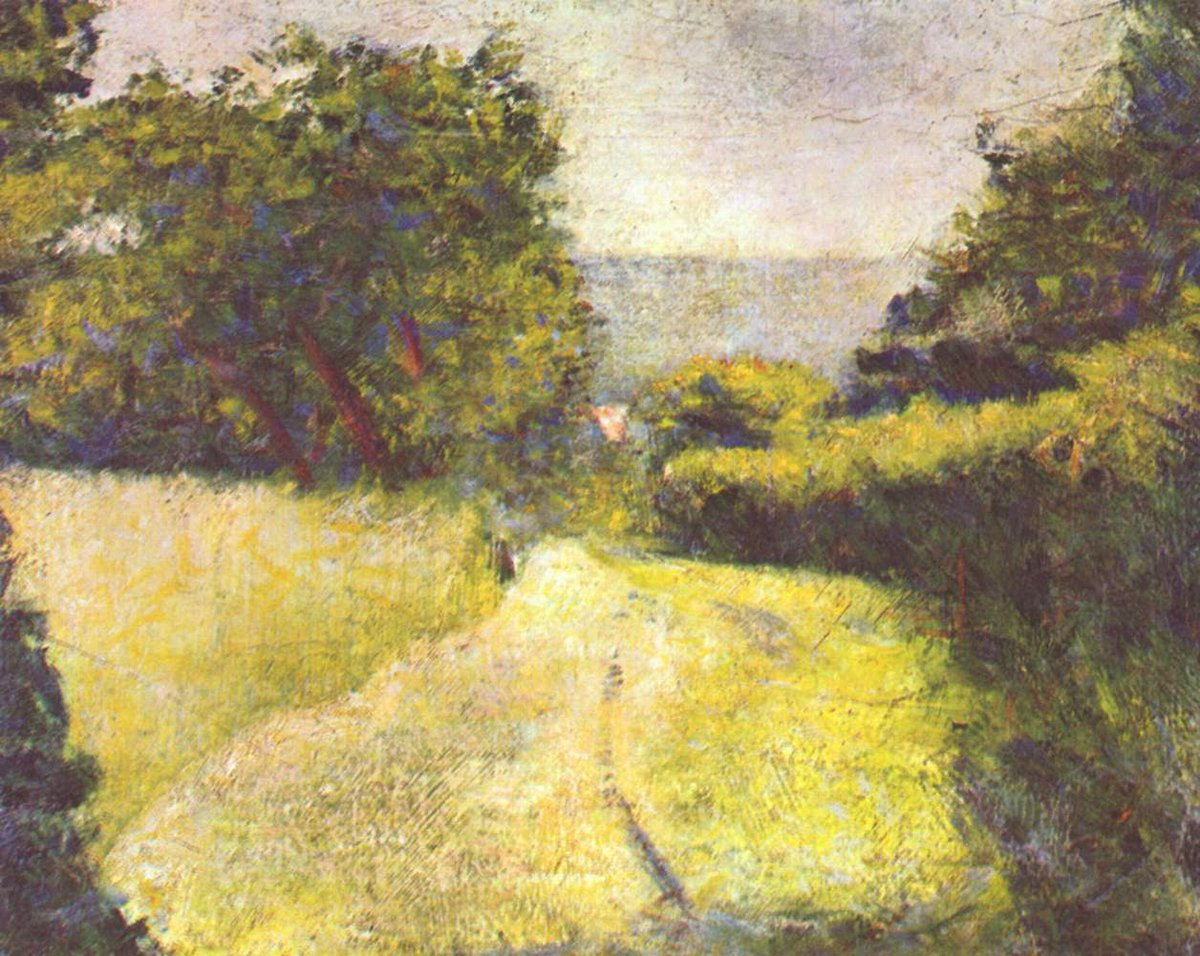
Georges Seurat, The Hollow Way (1882)

Tell me—have you read any of these? If I could only recommend one, it would be the Spufford. And then the Colwin. And don’t sleep on Brinkley. But a good month all round. Doesn’t last summer seem a lifetime ago?