Scott Walters’s Year in Reading, 2024

Pleased to once again present reading reviews from some of my favourite readers. Today’s installment, his fourth, is by Scott Walters. Scott launched the much-lamented blog seraillon in 2010, and expects to return to it one of these days. He largely follows Primo Levi’s model of “occasional and erratic reading, reading out of curiosity, impulse or vice, and not by profession.” He lives with his partner in San Francisco.

Barring surprises, here ends the 2024 edition of the EMJ Year in Reading series: except, I hope, for my own. (Gotta write that…) Thanks to everyone who contributed–and all who read these engaging lists.

Balthus, The Passage of Commerce Saint-Andre (1954)

Thank you, Dorian, for inviting me again to participate in The Year in Reading. [Ed. – Pleasure all mine, Scott!] Mine meandered mostly pleasurably through some 60 books. I abandoned others, was surprised to have read fewer Italian works than in previous years, and experienced a number of unpremeditated pairings, reading two works each by a dozen authors plus more thematic linkages. I’ll get straight to 2024’s highlights:

The Woman in White, Wilkie Collins (1860)

I nearly lost my head when I interrupted my spouse’s reading of the final pages of The Woman in White, but her abrupt “Ssh!” made total sense as I plunged into the book myself the next day. Abstracted, the “detective-ish” book’s nutty plot—starting with its mysterious woman in white and moving to family secrets, confused identities, unlikely coincidences, shady interlopers, and convoluted inheritances—would hardly seem encouraging. But over 650 pages Collins never lets drop any of the knots of intrigue he has in the air, a master class in plotting with the ending so neatly and satisfyingly resolving the novel’s myriad conflicts that the book should have come tied up with a pretty bow. I found equally impressive his crafting of splendid characters, including the flamboyantly louche and unforgettable Count Fosco and Marian Holcombe, the novel’s moral center, surely one of the great characters in English literature. [Ed. – Now read No Name!]

[Paired with Collins’s The Moonstone].

The Purple Cloud, M. P. Shiel (1901)

If The Woman in White stands at the peak of the Victorian era, Shiel’s The Purple Cloud levels the period to the ground: an apocalyptic horror story, to be sure, with a body count beyond reckoning, but also an existential tale that takes Jules Verne’s brand of adventure in the direction of Lovecraft (and maybe even Kafka and Beckett). Into the tale of the sole-surviving member of a polar expedition returning to find worldwide catastrophe, Shiel mixes dazzling epic catalogues with itinerant wanderings—by dogsled, boat, rail, and on foot—that make Odysseus seem nearly an armchair tourist. A magnificently macabre tour of England unfolds from the coasts to the moors to the mines to the vacant house of Arthur Machen (to pay a literary debt) before the novel’s agonist traverses the infernal hellscape as far as Tokyo and San Francisco. Adding to the panorama of ghastliness is the misogynistic unpleasantness of the narrator himself, though having a murderer inherit such a lonely place is certainly a twist on the “last man” genre. Shiel lightens his grotesqueries by upscaling his inventiveness and gallows humor, even taking a few swipes at the Empire’s Victorian sensibilities. His idiosyncratic, nimble writing prompted me to mark down passages, though left me wondering whether the “purple” in his title may have referenced florid elements infecting his sheer writing bravura. Half-way through I wondered why the book didn’t regularly appear on English literature reading lists. Two-thirds of the way through, an abrupt turn sent the tone spiraling from Brueghel’s Triumph of Death into the schmalz of W. H. Hudson’s Green Mansions, underscoring a built-in problem of last man narratives: how to bring things to a close, what with destruction being so easy and rebuilding such a struggle. Shiel regained his footing towards the end but stumbled again on his way out the door. Maybe some goody-two-shoes editor had stuck their nose in. Still, The Purple Cloud’s grandiose conception and relentlessly ghastly anti-pleasures made it a singular reading experience—and fitting B-side to Collins.

Bel-Ami, Guy de Maupassant (1885)

At age 4, my French goddaughter presented me with a paper “cootie-catcher” featuring appealing green designs on three sides and a frightening mess of scribbled red and black on the fourth. I inquired. “This is a flower, and this is a tree, and this is grass, and this is a vampire.” [Ed. – Reasonable.] Now that she’s 21 I’ve come to expect this kind of thing regularly, but when she insisted that I read Guy de Maupassant’s Bel-Ami, I fell right into her trap. The story of a down-on-his-luck former soldier, Georges Duroy, whose life is transformed by a chance meeting with a war buddy who helps get him into journalism, is a superb depiction of the writing life; an existential examination of class, morality and gender relations; and one of the most sordid narratives I’ve come across. Duroy is a terrific antagonist, an arriviste with attractive qualities tinged by inexperience and raw ambition, not above prevarication and cruelty when it suits him. Maupassant manages the story so skillfully that I naively believed it to be heading towards a treatment of the subject of friendship between men and women, the source of Duroy’s “Bel-Ami” nickname—an ironic one, I was soon to realize, as what Maupassant does with Duroy makes Zola’s take on human debauchery look like a Sunday school picnic. [Ed. — !] The novel contains great set pieces, including a drawn-out death scene where a post-mortem odor drifts off the page like something out of D’Annunzio, and a party in a mansion on the Champs-Elysée that contrasts with the grim lives of Duroy’s rentier parents rotting away in Rennes. Maupassant levels the world of journalism too, its appetite for influencing public opinion, its writers seeking short-cuts to fame—a subject altogether too relevant today. Duroy’s talent, which emerges bit by bit, takes flight in social situations, where during one visit with a group of women he extemporizes on the writing of the French Academy. Maupassant, of course, was writing against the Academy grain, and few writers have woven a French of such sublime beauty from a tissue of such splendid decadence. [Ed. – Well, damn!]

[Paired with Manon Lescaut (1731), by the Abbé de Prevost].

Dark Back of Time, Javier Marías (1998) (Esther Allen, translator)

It would be unjust to pigeonhole Dark Back of Time –“a book of digressions”—as a campus novel, and equally unjust to separate it from its co-joined twin, All Souls (1992). But taken together as a campus novel, these two works, set at Oxford, slay all comers. Someone once quipped that the campus novel was about settling scores. Dark Back of Time seems aimed at undoing any barbs present in All Souls and even any notion of that book’s having been a roman à clef (this too, of course, may be a fiction). While the first part of Dark Back of Time engages weighty questions about fictional representation of real people, the joyousness of the novel’s explorations often had me in stitches, including a scene in which an academic negotiates with the narrator/author how he will be represented in the new novel, and another in which the narrator/author, timidly attempting to clarify for owners of an Oxford bookshop that what he’d written in All Souls was not about them, finds that the couple revel in their fame and petition to be included as themselves in a film version. It seems fitting in these books that Marías, Spain’s late greatest novelist, has evoked echoes of the most iconic of Spanish fictions, for, like the first and second books of Don Quixote, the two novels form an essential unit in which one could read only the first volume and miss out dramatically on what the second volume does with the first. (I’d love one day to see All Souls and Dark Back of Time boxed as a set; Cervantes would approve.) I don’t think it’s an exaggeration to suggest that these volumes, taken together, may be the finest contemporary literary work to address the question, “What is fiction?” Two other elements to recommend the book: The first is Marías’s inclusion of the fascinating story of Redonda, the “literary” nation of which Marías served as most recent and presumably final King (M. P. Shiel had been the first). [Ed. – Wait, that dude you just wrote about?? Is this real? Am I being punked??] The second is that Dark Back of Time contains some of Marías’s most exhilarating writing; I think immediately of a moving passage about the dawn crepuscule and streetlights that persist for a time into the day. Time having ever been one of Marías’s great preoccupations, I also winced at his narrator imagining life at age 85—a full 15 years past the premature end of Marías’s own. Unconscionably, The New York Times left Marías off of its recent list of the 100 Best Books of the 21st Century to date, but it is certain that the lamp of Marías’s work will live on to see its day.

[Paired with Marías’s short travel book, Venice: An Interior (2016)].

The Charwoman’s Shadow, Lord Dunsany (1926)

Fantasy is not among my favorite genres, but I’ve been fond of everything I’ve read by Edward Morton John Dax Plunkett, a.k.a. Lord Dunsany. Dunsany’s stories seem more like a new model of fairy tales, exploring interstices between reality and the imagination and dealing with moral issues without being moralizing. The Charwoman’s Shadow features a young Spaniard sent by his family to learn alchemy from a woodland magician, and exhibits Dunsany qualities in abundance: a deep gratitude for the richness of life, where nothing can be taken for granted; a genial wit and wordplay; a careful attention to nuance. The centerpiece of the novel is the value of one’s own shadow, the disappearance of which, through a Faustian bargain, produces unexpectedly dire consequences. Another Dunsany treasure is the lyrical quality of his writing, for example when he takes on that most magical of hours, l’heure bleue:

bright over the lingering twilight the first star appeared. It was the hour when Earth has most reverence, the hour when her mystery reaches out and touches the hearts of her children at such a time if at all one might guess her strange old story; such a time she might choose at which to show herself, in the splendour that decked her then, to passing comet or spirit, or whatever stranger would travel across the paths of the planets.

And then there is the book’s splendid ending, which I will not spoil other than to say that with no apparent thought of producing endless sequels like some contemporary writers of fantasy fiction, Dunsany gently places his chief protagonist off stage and sweeps into a realm of wistfulness drenched in the glow of a glorious sun setting at the height of Spain’s Golden Age.

[Paired with Dunsany’s The King of Elfland’s Daughter (1924)].

Fulgentius, César Aira (2017) (Christopher Andrews, translator)

At 163 pages, Aira’s Fulgentius straddles novella and novel, and not simply as matter of length. Aira’s intimate, vividly imagined tale of a Legate of the Roman Empire who also happens to be a playwright expands as it follows the aging Fulgentius and his 6,000 soldiers from Rome to reconquer Pannonia. Along the way, Fulgentius mounts performances of his sole work, a tragedy written when he was an adolescent, starring himself as tragic hero—and most important audience member. As Fulgentius has already written—or thinks he has already written—the tragic outcome of his own story, the plot tension is carried by a familiar Aira conceit around the entwining of fiction and reality. As a prime example one of Aira’s works that graft a fictional character onto history, Fulgentius offers a vivid sense of what such a march must have been like for the soldiers, the general, and the populations in their path. Deviating from the author’s more typical surrealist gymnastics, the language here takes on an unusually elegant lyrical register.

[Paired with Aira’s Alexandra Pizarnik (2001), an appreciation of the Argentine poet].

The Catherine Wheel, Jean Stafford (1952)

I found a copy of Jean Stafford’s The Catherine Wheel when I was 18. Had I read it then, I doubt I would have fully appreciated its adult nature—for it really is an adult book, dealing with adult things, things terrifying enough that I approached the novel’s final pages with a shudder of complete dread (completely vindicated). But in The Catherine Wheel Stafford also reckons with youth, entwining her two main characters, 38-year-old Katherine Congreve and her 12-year-old cousin Andrew Shipley. Devastated in love at an earlier age when Andrew’s father John married her sister Maeve, Katherine now occupies a position as the town’s most prominent unmarried curiosity, but also a magnet to John and Maeve’s children, left behind while the parents “summer” in Europe. Twin betrayals connected to this departure have set both cousins spinning: John’s surprise declaration of love for Katherine and determination to divorce Maeve while abroad, and the disappearance of Andrew’s playmate of previous summers, Victor, now entirely occupied with the post-war return of an older brother. Dually abandoned, the cousins shift focus to one another. Stafford thus sets up an unusual device in which youth attempts to divine the mysteries of adulthood while adulthood frets over the crises of youth, in a marriage story focused on impacts beyond the absent couple’s own strife. [Ed. – This feels like some Henry James-level melodrama!] A kind of third eye—that of the people of Hawthorne, who notice when Katherine’s light stays on into the wee hours—levies its own social pressure on the house’s inhabitants. Stafford’s densely poetic sentences frequently had me reading her aloud, relishing her words, marveling at the perfect limning of some little thing or creation of a resonance that rippled out towards subjects beyond the proximate ones. Though rooted in a realist, formalist literature that prioritized and exalted language, the novel still felt raw and new, bursting out of old molds, totally unsettling. Not a novel for the squeamish, but certainly one for any reader ready to appreciate some of the finest American writing of the period.

[Paired with Stafford’s The Mountain Lion (1947)].  

whose names are unknown, Sanora Babb (1936/2004)

Sanora Babb’s novel has been highlighted in recent articles recounting editor Bennett Cerf’s decision that two Dust Bowl novels in a single year would not stand. The other, of course, was The Grapes of Wrath, allegedly constructed in part on notes Babb had collected concerning hardscrabble farmers in her native Oklahoma, and which Cerf provided to Steinbeck. Though Babb published other well-received works, her Dust Bowl novel languished unpublished for nearly 70 years. whose names are unknown borrows its title from an eviction notice served on a family of Oklahoma farmers. What the novel may lack compared to Steinbeck’s elegant structure and majestic sweep, it makes up for in granularity of detail and visceral impact relating the farmers’ desperation and poverty, with particular attention to the lives of women, whose interactions give the work some of its strongest scenes. Babb’s direct, declarative sentences come across as hard as the land worked by her characters. She describes the knife-edge on which her people live, where even small luxuries—such as butter for the biscuits—must be used sparingly “so that it will last until the next churning.” Where Steinbeck set his novel on the back of hope for a better life in California, Babb spends a long time in Oklahoma before heading west, zeroing in on the encroachment of the Dust Bowl, poor farming practices colliding with a change in climate and the shifts within and without people as they try to wrestle with such environmental change. Babb’s powerful novel deserves at least to be taught alongside Steinbeck’s, or rather, as the debt is all his, the other way around. [Ed. – Pretty telling/damning that I’d never heard of it.]

Écoute, Boris Razon (2018)

It’s clear from which chapter of French journalist Boris Razon’s novel Écoute (“Listen”) Jacques Audiard plucked the seed for his film Emilia Perez, but Écoute differs almost entirely from the film. As the book’s title suggests, Razon focuses here on listening, various forms of which coalesce the book’s entwined stories and capture the complex, fraught texture of contemporary communications. Set mostly on a single block near Place d’Italie in Paris (with detours to Mexico City and Lisbon), and with the November 2015 terror attacks continuing to resonate, the novel touches on the surveillance state by encompassing listener, the listened-to, privacy, and identity (here’s where Emilia Perez came in, but so, to my surprise, did Fernando Pessoa). In conveying the rapid-fire chatter and laconic banality of so many electronic communications, Razon employs a good deal of verlan, texts and texting abbreviations, and emoticons, prompting one character to muse on the absence of a dictionary adequate to capture today’s modes of information sharing. Running beneath this surface noise is a current of desire to disappear from a world in which privacy has all but vanished. The stunning first chapter presents a scene of the Paris street that surely ranks among the richest in that city’s literature, an “audioscape” as experienced from the inside of a police surveillance van by an officer quietly being undone by his job of attempting to cull signal from the noise and by the uncanny valley between electronic input and what he perceives with his own senses. [Not yet available in English translation, though that may well change should Emilia Perez win the Oscar for best film].

Edward Hopper, Solitary Figure in a Theater (1903)

Oak Flat: A Fight for Sacred Land (2020) and Thunder and Lightning: Weather Past, Present and Future (2015), Lauren Redniss

2024 was the year I came late to Lauren Redniss’s party, pairing her powerful Oak Flat with her larger format Thunder and Lightning. The former explores the fight around the proposed Resolution mine on tribal lands in Arizona, while the latter treats weather phenomena both straightforwardly (i.e. Rain, Heat, Wind) and in more abstract terms (i.e. Chaos, Dominion, Profit, War). Using an anecdotal approach, Redniss displays in both books a knack for ferreting out the most interesting possible interviewees and unearthing fascinating hidden tales. But what makes the work of this MacArthur award winner stand out is its exploration of text and image. Using full page illustrations, Redniss skillfully advances her story through images of such impact that I found myself gasping at turning a page and being confronted with an image perfectly tuned to the tone she had set. The large format of Thunder and Lightning lends itself particularly well to her subject. In Fog, the text crawls along the bottom of pages of vast gray. Redniss’s deliberateness in matching image to text and letting the image carry the narrative feels like a new form of text/image interaction. In a section about cloud seeding, she describes a proposal to use weather balloons to heft a pipe with multiple nozzles to spray chemicals that could help cool the planet. I could not help see this as a metaphor for the way her illustrations lift her text in air. These images, easily mistaken for colored pencil washes, are in fact mostly acid etchings in black and white that Redniss has hand-colored (Thunder and Lightning includes a description of her processes). I read Redness not long after finishing James Elkins’s novel, Weak in Comparison to Dreams, another work that relies heavily on images, by a leading theorist of text/image interaction, no less, and now find myself dreaming of a Redniss/Elkins collaboration. Come on, you two. Make it so. [Ed. – Either way, I’m tracking down these Redniss books!]

Moonlight Elk, Christie Green (2024)

I know Christie Green but was wholly unprepared for her first book. Each time I put Moonlight Elk aside, I could not wait to get back out into it. That awkward prepositional formulation feels apt, as Moonlight Elk, a book framed around Green’s experiences in across New Mexico hunting wild game, largely for sustenance, takes one to wild spaces in an intensely intimate manner. Exploring the borders between interiority and exteriority, animal and human, life and death, the book’s dozen interlocking pieces, indexed to a hand-drawn map of the state, might well be the New Mexico state book of the year (if such a thing exists). With solid research behind her narrative, Green leverages her experience as hunter, mother, landscape architect, land use expert, designer, naturalist, activist, and writer to traverse territory of essay, short story, meditation, and what one might call an anthropology of relationship. Memoir might also come to mind, but resistant to definability, Moonlight Elk seems more like an exorcism, a courageous self-interrogation in quest of a “free range” existence that refutes facile answers, upends convention, moves into spaces predominantly occupied by men, and attempts to rid the cultural body of a toxic detachment from nature. Hunting—particularly as a woman alone—foregrounds the narrative, but Green is after larger game. She inhabits the lives of animals, their cycles and patterns, how they move, what they sense, how they see her. The mysterious, miraculous complexity of bodies, not least Green’s own, forms the beating heart of the book: details of muscular structure and bone, of blood and feathers and sex, the quickness of eyes, the sharp sense of smell. Her hunts force self-reckoning, as when she discovers a fetus moving within the abdomen of a cow elk she has shot, or when she ends the suffering of another cow that comes to her after being gruesomely wounded by poachers. Green, who grew up in Alaska, integrates into her experiences a wealth of issues impacting the American West, from private vs. public land and water use to tribal and border concerns (in the boot heel of New Mexico, a quail hunt collides with Border Patrol conducting their own kind of hunting). Only at the narrative’s end did I grasp the extent of the subjects Green had covered. More personally affecting, as she moves through forest, desert and chapparal, shadowed by cliffs and trees, illuminated by dreams and the changes of the moon, she offers, with keen animal sense and without escapism, an orthogonal, conscientious response to received ideas, convenient consumerism, and mediated experience. Hyper-alert, alive, intuitively creating her path, Green renders wilderness almost otherworldly. I emerged from Moonlight Elk seeing this world anew, as though a physical alteration had taken place. [Ed. – Sold! Might pair well with Joanna Pocock’s Surrender.]

Gallery of Clouds, Rachel Eisendrath (2024)

The title: irresistible. The cover too, a fresco of clouds at sunrise or sunset from the ceiling of the Rose Main Reading Room in the New York Public Library. And the opening especially, the author recounting a dream of carrying her manuscript through heaven and meeting: Virginia Woolf. Both ostensibly and in fact, the subject of Gallery of Clouds is Sir Philip Sidney’s 16th century, 900-page pastoral romance, Arcadia, about which I knew nothing and which overwhelms even Eisendrath, a Sidney scholar: “I find that my memory of the plot has already started to dim, to blur…I can no longer keep track of the basics…” I say “ostensibly” because Eisendrath uses the obstacle, Arcadia serving here as a nexus to send her fertile mind wandering down winding paths, from observations on the genre of Romance to the use of images, Shakespeare to Little Nemo, Poussin to Walter Benjamin, Montaigne to manicules (!), the marriage of hunting with desire to the cat dozing on Eisendrath’s bed.

But these seemingly inexhaustible spin-offs never seem gratuitous. Eisendrath subtly constructs an Arcadia of our own era, her black & white photos echoing the pastoral romance’s means of advancing its airy infinities through “images in words,” her “clouds” of thought (which she pointedly distinguishes from mere fragments) paralleling the episodic nature of the romance, her grounding her observations on Sidney in a relatable contemporary manner underscoring the genre as a response to grim realities. At the same time, Eisendrath engages proliferating modes in contemporary writing, such as the use of the fragmentary, the merging of the academic and the personal, the punctuation of text with images, the grappling, through a need to say, with an unraveling world. Though she is writing about a 16th century romance, her small, enthralling, sui generis book has volumes to say about how we read and write. And in Eisendrath’s few references to her own teaching, Gallery of Clouds, more than anything I have read in decades, has me wanting to be a student again.

The Waves, Virginia Woolf (1931)

Rereading The Waves 40+ years after I first read it and in the same copy I’d used then, my margin notes served to measure the distance between that young reader and this old one. I experienced pride regarding the young stranger’s underlining of particular lines; I noted too that he’d missed a lot. Passages of time of this sort span The Waves, entwined temporal arcs that longitudinally capture Woolf’s six characters through alternating interior soliloquies as they move from childhood to university [ed. – well, some of them get to go to university…] to the workplace to middle age and beyond, while brief impressionistic pieces preface each chapter and, over the course of the novel, trace the sun’s path across the sky during a single day at the shore. Here as in many of her works, Woolf, the great writer of immediacy, obsesses over capturing sensations, gestures, glances, discreet moments, the wave at the point of breaking, of ebbing. Rafts of glorious sentences ride Woolf’s exquisite phrasing, as she simultaneously questions the inadequacies of language, frustration with these limits reaching a crescendo as mortality nears for her characters, and a voice longs for:

some little language such as lovers use, broken words, inarticulate words, like the shuffling of feet on the pavement. I begin to seek some design more in accordance with those moments of humiliation and triumph that come now and then undeniably. Lying in a ditch on a stormy day, when it has been raining, then enormous clouds come marching over the sky, tattered clouds, wisps of cloud. What delights me then is the confusion, the height, the indifference and the fury. Great clouds always changing, and movement; something sulphurous and sinister, bowled up, helter-skelter; towering, trailing, broken off, lost, and I forgotten, minute, in a ditch. Of story, of design I do not see a trace then.

[Ed. – Is this Bernard? Sounds like Bernard.] Woolf described The Waves as a “playpoem,” but its approach to polyphony is unusual. In the first chapter, she goes inside the heads of her characters as young children while at the same time supplying them a vocabulary beyond their years, a device through which they speak both as themselves and as the writer, the latter’s presence made manifest when the children catch a glimpse through a window of a woman writing. Throughout the novel, her six characters’ voices float like spheres governed by gravity, now apart, now coalescing, as waves gather force and crash, exploding in spray and froth. But her characters also serve to question the nature of identity: clearly creations of the writer and facets of her circle (the roman à clef aspects interested me little), they are also beings in whom a “self” is merged inextricably with other selves. For all of its prose-poeminess, The Waves stands as a remarkable and grounded philosophical inquiry into what constitutes a self—and whether it even makes sense to speak of a “self.” [Ed. – Yes, the latter especially!]

In my first reading, I scarcely noticed the centrality to the novel of the death of Percival, a “seventh” character never given a voice. But in Paris shortly after finishing The Waves, I caught director Elise Vigneron’s theatrical adaptation of the novel, an extraordinary work employing both live actors and corresponding marionettes made of ice, such that as the play progressed, these figures melted, with much of the later action occurring in a resulting pool center stage. [Ed. — !] The physical presence of these characters and their doubles rendered Percival’s invisible presence powerful, a black center in Woolf’s “six-sided flower; made of six lives.” As with the shell-shocked Septimus Smith in Mrs. Dalloway, Percival represents a generation of young people damaged or lost to conflict and war. The cumulative effect of Woolf’s meditation on loss, whether through ordinary aging or via the injustice of an early death—and a palpable sense of darkness again descending upon Europe—left me overwhelmed by emotion at the story’s close.

What attracted me to Woolf at age 18 held firm: her sumptuous sentences; the tension between a love of people and aloof solitariness; the desperation of time passing fused with the fever to glean something lasting from the fleeting and ineffable. Also: recognition at last of Woolf’s lament for life lost at an early age, for the unshakable impact on those left behind, pushing The Waves into a work far greater than I’d registered the first time around. I’ve been thrilled, moved, and humbled by revisiting this extraordinary novel while the sun sinks toward a darkening horizon, so many years after I first read it, when the sun still mounted the sky. [Ed. – Beautifully put, Scott.]

[Paired with Woolf’s final novel, Between the Acts (1941)].

Felix Edouard Vallotton,The Sunny Street (1922)

Others works I could have included: D. H. Lawrence’s powerful Sons and Lovers [Ed. – Ph hell yeah]; Italian critic Cristina Campo’s The Unforgiveable;  the Strugatsky brothers’ The Snail on the Slope; Georges Simenon’s Arizona noir La Fond de la Bouteille; Shakespeare’s The Winter’s Tale; a pair of short books by Helen DeWitt (may she please complete her novel-in-progress set in Flin Flon, Manitoba) [Ed. – Wait what now]; Andrés Barba’s Two Small Hands and Andrés Neuman’s The Things We Don’t Do; poet Susan Nguyen’s second gen take on the American South in Dear Diaspora and other of her poems on-line; and, Most Unexpected Literary Object, the first volume of Ahmed Fāris Al-Shidyāq’s Leg Over Leg, a daring four-volume novel completed in 1885 with the modest ambition of catapulting the whole of Arabic language and literature into the modern age. In sum, a Year in Reading that elicited joy, snark, bon courage, resolve, humility, and defiance for challenging times ahead.

[Ed. – To which I can only summon both the raised fist and the thank you hand emojis: this is wonderful, Scott. May we draw on those good emotions in 2025!]
Bryce Sears’s Year in Reading, 2021

Today’s reflection on a year in reading is by Bryce Sears (@BryceSears5). Bryce, one of the nicest people on Book Twitter (which is saying something), is an avid reader and writer who lives in Oakland.

Look for more reflections from a wonderful assortment of readers every day this week and next. Remember, you can always add your thoughts to the mix. Just let me know, either in the comments or on Twitter (@ds228).

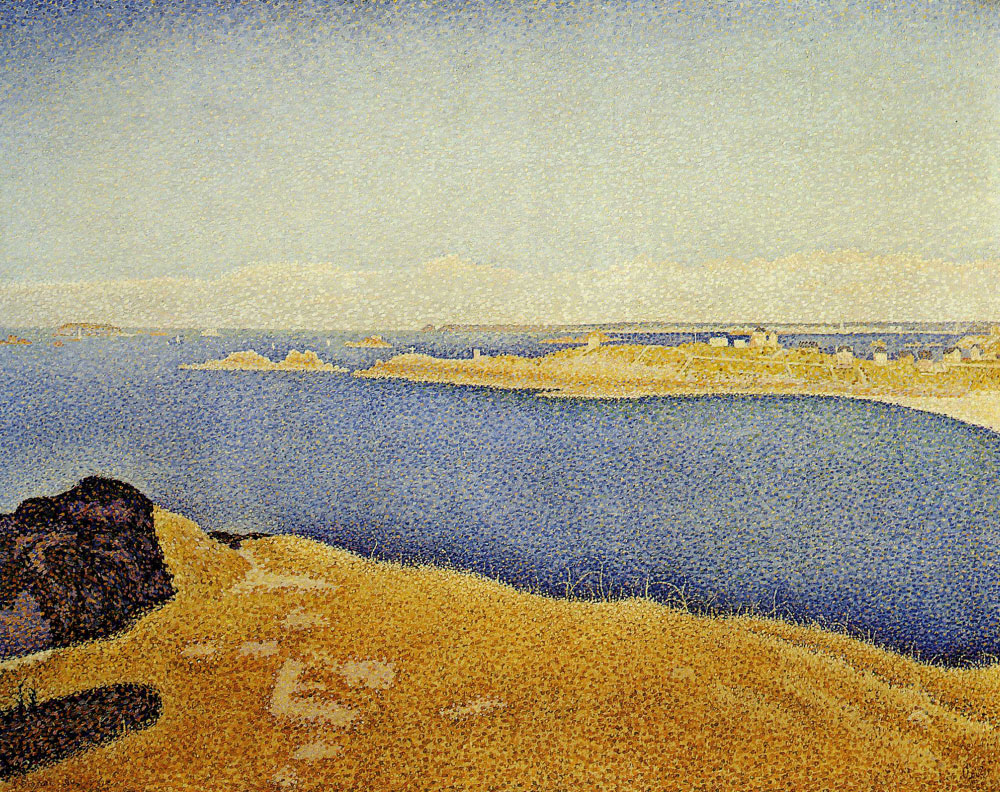
Paul Signac, Saint-Briac. La Garde Guérin. Opus 211, 1890

I kept up in 2021 a trend toward escapism in my reading. I’ve been on this kick about five years – a habit of reading a lot more fiction and a lot less non-fiction than I used to. I used to read a lot of history; the one piece of non-fiction I read last year was a travelogue – Kapka Kassabova’s Border. It was terrific, to my thinking, as you can see below. [Ed. – Straight up honest to God terrific, Bryce; it’s not just you!] Later, reading a few pages of its follow-up, To the Lake, I found it all a bit depressing, thinking about facts and history. It was this thing I’m dealing with. My view, I guess, is that the world is on fire. In a dozen different ways at least. So I’m voting to put it out. I’m volunteering and protesting. [Ed. – I admire you!] But also, for the sake of my own mental health, I might need more breaks from thinking about our predicament.      

Such a cheery opening! The other thing helping with my mental health is my homelife. Two years ago my wife and I bought a house in Oakland. So, we’re doing a lot of work digging up strange things in our back yard, etc. [Ed. – Uh, how strange? Like dead body strange???] We have a three-year-old son who is delightful. His interest in books has really taken off. I spend a lot of time reading with him when I’m not writing or reading books for myself.  

The Vet’s Daughter, and some other works by Barbara Comyns

Barbara Comyns is the writer I was most thrilled to discover this year. I was surprised. I tend to like best stories about people (to paraphrase Diane Williams in her recent interview with Merve Emre) dealing with the life we’re all stuck in. For a long time now, I haven’t tended to go in much for stories with magical or supernatural elements. If this sounds like you, too, don’t let it keep you from Comyns. Somehow, the supernatural in her stories isn’t startling (or at least I don’t find it so). It might be her prose, which is both cool and somehow scintillating. It might be the way she links the supernatural elements in her stories to the mental health of her protagonists. In The Vet’s Daughter, my favorite of the books of hers I’ve read, the supernatural in the story appears (at least as I read it) to come as a reaction the protagonist is having to a pervasive threat of violence. Which is to say it feels like a state of shock. It adds something to our sense of what the protagonist is feeling.

Or it could be my tastes are changing.

In any case, in addition to The Vet’s Daughter, the other books I read by Comyns this year are The Juniper Tree, Our Spoons Came from Woolworths, and Who Was Changed and Who Was Dead. They’re all quite different from one another. I liked The Juniper Tree best, but ask me again tomorrow. Saying I like this Comyns better than this other Comyns is almost no better than saying ‘I prefer apples to oranges’.       

The Remains of the Day, and some other works by Kazuo Ishiguro

I’m not sure when I would have read Ishiguro if not for Book Twitter. Somehow, years ago, I got it into my head that I’d find his work cinematic in some off-putting way. The Anthony Hopkins, Emma Thompson adaptation of The Remains of the Day was so famous. Before I got around to reading that one an adaptation of Never Let Me Go came out, and it also got a big hoopla. I got the sense Ishiguro’s work must be reductive, somehow. Well, as I’m sure everyone else knew, it isn’t. The books behind these two movies are so very much better than the movies. I should have had more faith in literature.  

My first Ishiguro, The Remains of the Day, was likely the first book I finished in 2021, going by my Twitter history. And what a revelation it was. Later in the year I read An Artist of the Floating World, and Never Let Me Go. Now I have five additional, as yet unread, Ishiguros in a stack on the shelves next to me. They make me feel rich.   

Happening, and some other works by Annie Ernaux

I was a bit obsessed with Annie Ernaux in 2021. I read Happening, A Man’s Place, A Woman’s Story, and I Remain in Darkness (all translated by Tanya Leslie). I read The Possession (tr. Anna Moschovakis). Over a period of months I reread Happening, A Girl’s Story (tr. Alison L. Strayer), and Simple Passion (tr. Tanya Leslie). These are all short, auto-fictional stories that feel like memoirs.       

The confessional quality of these books is one thing that draws me to them. Another is the skepticism Ernaux displays in her writing. She tries to make clear, as she writes about events in her past, how little she knows of the women she used to be, how false it would be to pretend to walk in the shoes of these younger selves. [Ed. – Nicely put!] She goes out of her way to avoid exaggeration. And I find this humility so refreshing.    

One last word on Ernaux. My favorite work of hers is Happening. It is quite harrowing – the story of an abortion Ernaux had in 1963, when she was 23 and abortion hadn’t yet been decriminalized in France. If I could I’d have everyone in the US read this book. It strikes me we could do worse here, where many women will likely face choices soon like the ones Ernaux faced, than encourage people to understand what it was like for this particular woman – a white woman, highly educated, in 1960s France. I’m not a teacher, but I think it’d make a nice class discussion, a group of close readers considering how the situation might vary in the US for people of color, for people with less access to information of the sort Ernaux had, etc.

Lonesome Dove, by Larry McMurtry

West Texas, where I grew up, is the part of Texas where all the worst Texas clichés come to life. The whitest, most reactionary part. I always wanted out of it. I might have become a reader in part to avoid it. Which is all by way of an excuse for not having read a western before last year. Still, I picked a great book to begin with.  

Lonesome Dove was the most absorbing book I read in 2021. It’s a big, twisty story, rich with joyful writing (I mean, it is often dark, but you can tell McMurtry enjoyed writing it). It struck me as escapist in the plainest sense of the word – it took me to a very different world from my own. The jokes worked for me. Consider the wry twist of this line that comes when Gus, the protagonist (I think, it could be Call), gives a junior partner money for a prostitute, then reminisces (in free indirect): “Best to help boys have their moment of fun, before life’s torments snatched them away.” Or this line, Gus again (he gets a lot of the best jokes), talking to Call, claiming he indulges in remorse for his mistakes so often that the pain on each indulgence isn’t “much worse than a dry shave.” Or these lines, near the climax of the story, when another character (called Pea Eye – his name is its own joke), is on the run: “His feet were swollen to twice their size, besides being cut here and there. Yet they were the only feet he had, and after dozing for an hour in the sun, he got up and hobbled on.” You can see McMurtry building out his characters with these jokes. You can see him building the world they live in, which he leans into the hardness of. One character lives with a leaky gunshot wound in his stomach. The book begins with two pigs “having a fine tug-of-war” with a rattlesnake they’ve found.

Slowly, drawn along by the humor and descriptive power of the writing, I think most readers of Lonesome Dove will find themselves hooked by its story. I did. It can worry me sometimes, the feeling I’ve been hooked. I’ve read a lot of bad writing in books after finding myself interested in a story (the writing was often bad in the beginning of these books, when I wasn’t hooked and should have given them up). Here, reading Lonesome Dove, I found myself wanting to know what would happen when the big cattle drive got underway. What would happen with Gus, who had seemed to have a pretty empty life in Lonesome Dove. I wanted to know if Newt would find out about his parentage. If Laurie would make it to San Francisco. It worried me, the sense I was getting hooked, letting my guard down. But I don’t think it should have. I read Lonesome Dove last summer. Time has passed, and now I’m flipping through it again. And already want to reread it. 

Other writers I enjoyed in 2021

Anita Brookner tops the list of writers I discovered last year, and loved, but am still just getting to know. I read Look at Me, Hotel du Lac, and Latecomers. They’re all terrific. [Ed. — “Hartmann, a voluptuary, lowered a spoonful of brown sugar crystals into his coffee cup, then placed a square of bitter chocolate on his tongue, and, while it was dissolving, lit his first cigarette.”]

Another writer I greatly enjoyed reading is Tove Jansson. I read The True Deceiver last year and The Summer Book the year before (I think). I’d really like to read Fair Play soon and her stories (and maybe the Moomin stories, too).

I reread Beckett’s Molloy last year. I read Clarice Lispector’s The Hour of the Star. Thinking of these books gave me pause in saying Lonesome Dove was the most absorbing book I read last year. I was locked into both from the start.     

I read The Copenhagen Trilogy, the three-part memoir by Tove Ditlevsen, which is devastating. I read Drive Your Plow Over the Bones of the Dead, my first Tokarczuk. And now I want to read everything she has written, or will write.

I read, as mentioned above, Kapka Kassabova’s Border last year. It is so good. I think I sold it short above calling it a travelogue. Border strikes me as meditative work. Its use of language is gorgeous. Dorian recommended this one, and I read it as a group read with Kim McNeill, Catherine Eaton, and Naguib Mechawar. I benefited greatly from their thoughts on it. The next Kassabova I’d like to read is To the Lake: a Balkan Journey of War and Peace. Just need to find the nerve. [Ed. – It’s worth it!]

I read Toni Morrison’s Jazz for the first time last year, and Arundhati Roy’s The God of Small Things. Both are phenomenal. NoViolet Bulawayo’s We Need New Names is so good, and I wanted live forever in the strange mysteries of The Taiga Syndrome (tr. Suzanne Jill Levine and Aviva Kana), by Christina Rivera Garza.   

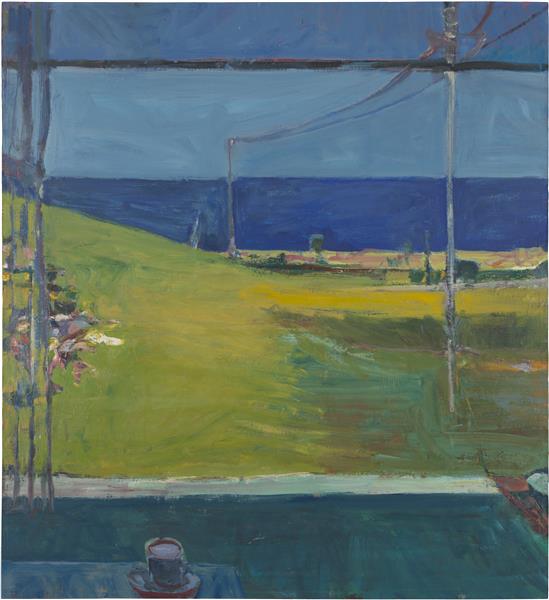
Richard Diebenkorn, Ocean from a Window, 1959

I could go on – I haven’t mentioned Natalia Ginzburg’s Family Lexicon, or Grace Paley’s Enormous Changes at the Last Minute, or Layli Long Soldier’s Whereas, or Cynan Jones’s The Dig, or Andrea Bajani’s If You Kept a Record of Sins,  …, or … or …. But I have to make myself quit.

I’ve really enjoyed writing this. Thanks for reading.

What I read, June 2021

In June I realized my sabbatical is in fact coming to an end. (Technically, it ended last week, but I have a few weeks’ grace until the school years grinds into gear.) Soon I will be back among people all the time; this knowledge made me anxious. The weight I gained over the pandemic made me depressed. The discoveries at two of the many former Residential Schools in Canada shocked but did not surprise me. (Similar mass graves will be found at others in the coming months, I have no doubt.) The extreme heat and firestorms in the West, including my home province terrified me; ironically, the weather in Arkansas was cooler than usual. (This too a function of climate of change, of course.) Everything seemed ominous. I was working hard, too, mostly on an essay I’m excited to share with you all in August. My daughter and I started taking one of the dogs for a walk each morning: that was a good thing. As to reading, the month started strong, then tailed off. Here’s what I finished.

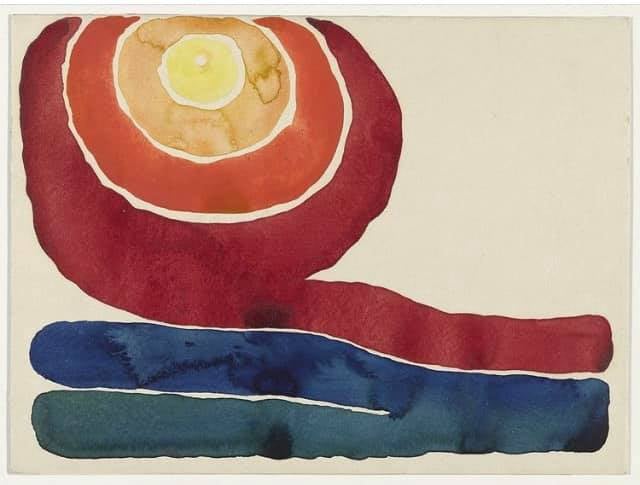
Georgia O’Keefe, Evening Star III, 1917

Madeleine Watts, The Inland Sea (2020)

Strong debut novel about a young woman, fresh out of university, who takes a job as an emergency dispatcher, eliciting from panicked callers where in Australia they are and which service to connect them to. Filled with wonderful place names and terrible events, The Inland Sea is a novel of emergencies: fires and petty crimes and surfing accidents, but also the narrator’s depression and despair, the violent settler colonialism of Australia’s past and present, and above all the changing climate. A wildfire from the early 90s, which the narrator’s family had to flee, is a primal moment the novel returns to again and again, presenting it as a harbinger of the terrible changes to come. The title refers to the 19th century settler belief that the continent’s rivers must have had a common source; the mythical inland sea stands in for all hubristic fantasies that aim to make reality fit ideology. (Patrick White, especially his novel Voss, about a megalomaniac explorer, is referenced repeatedly: the shittiest of the narrator’s shitty exes is writing a thesis about him.)

The Inland Sea captures the rage and despair that I’ve seen in younger people these past years, faced as they are with an increasingly uncertain future, and that I am myself enveloped in more every day. (It’s the same future; they just have, or should have, more of it.) Here the narrator reflects on her mother—whom she loves and is close to but can’t tell anything important to:

This was what my mother had never understood. The things she never would have done—moving out of the city, dropping out of the university system and into paid-by-the-hour work, reckless sex and drinking—they were not things I did because I didn’t know any better. I just didn’t think there was any point in trying to shelter myself. If working on the phones had taught me anything, it was that emergency could not be avoided. Emergency would come for you no matter what you did.

In this moment the dispatch center comes close to mere symbol. Fortunately it’s usually described more fully, though I wouldn’t have minded learning even more about it. (I loved the details, like the mid-morning lull when older women, mostly widows, call in with invariably false stories of burglaries or strange men in the back garden.)

The Inland Sea reminded me of some other recent novels—like Conversations with Friends, with its description of endometriosis—that present women’s bodies as a site of violence and harm, even when the women who live in those bodies try to take charge of them: here, a procedure to implant an IUD goes badly. As the narrator concludes, “My body could not be made to behave. It disdained all methods of prevention and protection.” Danger everywhere.

Last thought: I only know Australia from books, which means I know nothing, but I’ve always thought Melbourne was the cool place and Sydney beautiful but tedious, but Watts makes Sydney seem, not appealing, really, it’s mostly a terrifying landscape of drunk men lurching after women, but something other than the “world city” of the opera house and Bondi beach. The final image, of the narrator swimming in Gordon’s Bay, looking back at the “scum of waste… weeds and straws and band Aids and bottles” washed up after yet another 100-year storm, reminded me of the ambivalent swimming scene at the end of Cusk’s Kudos.

Doris Lessing would have liked this book.

Anakana Schofield, Bina (2019)

Bina—“Bye-na not Bee-na,” consider yourself warned—is 74. Who know how long she had left: she has a lot to say even if it’s not what you want to hear (“I’m here to warn you, not reassure you”), so she’s not going to waste any time. Empathy has been her undoing (interesting, given how empathetic this book is): it led her to invite a Bad Man into her home, who abused her and took advantage or her and whose return she daily fears; it got her involved in a secret organization that helps people end their lives which in turn led to her arrest. We let people into our lives, Bina says, it’s what we do. The trouble is getting them back out. Bina reminded me of Beckett’s Molloy, not just because it’s set in Ireland (though Schofield now lives in Canada) but because of its fascination with both the rhythms of spoken language and the frailty of the human body (there’s a relationship there I’m not able to articulate just now—or maybe I’m just following Bina’s quite Beckettian demand that “the explanation-hungry get over themselves”).

Bina is a fabulous character: self-aware (“I was a great woman for delivering the verdicts to others that I could neither conjure or conquer for myself”), wise (“I have noticed that it’s the decent people who are buried/While it’s the parasites and demolishers who endure”), scathing (“There are those reading and thinking, isn’t she daft, why didn’t she walk or why didn’t she do this or that. Well I am not worried about you, because maybe you’ve had the good fortune to be trained different and would not scupper yourself this way. And it’s it as well for you.”), and funny (women have to get up and pee at night because they are “widdling the confused strain of anger gathered up there all day”—why men have to pee at night is a mystery, “perhaps it’s God’s subtle way of tormenting them. He goes straight for the pipe does our Saviour”).

Schofield is a terrific writer (men like Eddy, the Bad Man, are “bullies in woolens”): I loved this book and can’t wait to read her others.

Bryan Washington, Lot (2019)

Many of the stories in this debut collection center feature versions of the same family: black father (sometimes absconded, sometimes just about to), Latina mother, daredevil older brother, sister looking to get the hell out, and at the center, the young gay narrator. Restaurant kitchens, johns, animals in the bayous—this isn’t the Houston of Rice, the Menil Collection, or even Minute Maid Park. That world is present only at the edges of the frame, mostly through the specter of gentrification. No surprise that a book called Lot is interested in real estate (not to mention one’s lot in life, having a lot to deal with and a lot to live for, and maybe even Lot of Genesis, who looked upon and fled Sodom). Much as I would miss Malamud’s The Magic Barrel, I’m thinking of replacing it with Lot as the centerpiece collection the next time I teach my course on the short story. My students—a good number of whom are from Houston, though rarely the parts described in the book—would like it, I suspect, and I’ll be able to decide if it’s as good as my first reading suggests.

Edith Wharton, The Age of Innocence (1920)

Fantastic. Read this in college, probably a year after the movie came out (I believe it was the first film I saw as a college student), and, I realize now, completely missed the point. Not only did the story seem slight, worse, I identified with Newland Archer, the ironic yet self-satisfied scion of a wealthy New York family in the 1860s whose imminent marriage to athletic, kind, incurious May is threatened by the return of her disgraced cousin, Ellen, on the run from a bad marriage to a Polish nobleman, with whom he falls in love. Wharton’s irony—her brilliant control of the narrative voice—passed me right by. I can’t think of a better advertisement for re-reading than my experience returning to this novel—though I now wonder how many other books I’ve misunderstood over the years.

Newland is such a carefully constructed character, his world-view so dominant, his criticisms of a world he loves and is much more enmeshed in than he ever realizes so easy to side with, that it is easy to miss that this is in fact a novel of two women, neither of whose interiority we ever access directly. Both May and Ellen are so much more interesting than Newland realizes. Ellen, in particular, fascinates as a figure who has suffered greatly from men, including from Archer, who is nowhere near as nice to her as he thinks he is, but who gains hard-won freedom—not least from us, the intrusive readers. (The bit players are wonderful too, from the titanic Mrs. Mingott to the ladies’ man Beaufort to the subdued Janey, Archer’s sister—I would have liked more of her.)

The novel is filled with rituals, rites, tutelary deities, and the like, the whole language of the ascendant anthropology of the 1920s. This motif is connected to Archer’s interest in the moeurs of New York society, which he studies as another scholar might the curious customs of some primitive tribe. He mostly has Ellen to thank for this—when he first visits her bohemian downtown apartment (unfashionable neighbourhood, artistic tchotchkes, and all), he decides the advice he wants to give her on how to behave in society is as useless in her bohemian world as warning someone bargaining in a Samarkand market about New York winters. Ellen, he thinks, has helped him see his native city clearly: “Viewed thus, as through the wrong end of a telescope, it looked disconcertingly small and distant; but then from Samarkand it would.” Archer fancies himself having transcended his world—now seeing it as curious as anywhere else—but you look foolish holding a telescope the wrong way ‘round, and Archer doesn’t have it in him to pursue the idea to its logical consequences. Maybe his privilege—his ability to imagine himself being rescued by Ellen from what no doubt feels genuinely and excruciatingly like a spiritual wasteland—isn’t as natural as he believes.

But before we get too comfortable at our own perspicaciousness in seeing through Archer, we might wonder at what we want from this novel. I read the new Penguin Classics edition (the cover of which was roundly pooh-poohed on Twitter, though I don’t mind it myself), and you should too, because the introduction by Sarah Blackwood is outstanding. (There’s also a Foreword by Elif Batuman—her name is on the cover—which is fine but nothing special.) Blackwood deftly summarizes the result of Wharton’s narrative decisions:

In keeping us in Archer’s perspective, Wharton allows us to experience the limited and impoverished viewpoint of a selfish young man, even as we are drawn to him and his desires, even as we relate to how deeply and ineffectually he wants.

[That’s what I missed as an undergraduate. I identified with his tragic position without seeing the harm it incited.]

Thus I read passages like this, in which Archer reflects on his mother and sister, as sympathetic:

Mother and daughter adored each other and revered their son and brother; and Archer loved them with a tenderness made compunctious [a word to warm the fussy heart of the lawyer in Melville’s “Bartleby, the Scrivener] and uncritical by the sense of their exaggerated admiration, and by his secret satisfaction in it. After all, he thought it a good thing for a man to have his authority respected in his own house, even if his sense of humour sometimes made him question the force of his mandate.

That it is anything but natural for him to have been granted such a mandate—and what it means for the organization of the world that he does—never intrudes on even his rueful thoughtfulness.

Blackwood continues by offering a startling and brilliant reading of what she rightly calls the novel’s “innovative’ ending:

By one metric, the fully realized novel [as opposed to drafts in which Wharton had Newland and Ellen get together, only to realize they had nothing in common] is a tragic story of two people trying to surmount the obstacles to their love. But in another… the published novel does have a happy ending. The Age of Innocence is one of the only stories Wharton ever wrote where everyone does, indeed, ‘get what [they] want.’ May gets to achieve the sentimental, sacrificial maternal and wifely status she desired. Newland gets to feel like an outsider while remaining an insider; he experiences no shortage of people to enlighten over the years. [Archer, Blackwood notes, is a preeminent mansplainer.] And Ellen? Well, Ellen gets to live a life that evades even our own prying eyes.

In this way, she finds a way to evade both the cruelty of impermanence—at the not-yet-fashionable Metropolitan Museum she regrets the way daily objects and implements, once so important to the people who made and used them, fade into obscurity until they are exhibited in a vitrine labelled “Use unknown”—and the cruelty of “the meanwhile,” of life as it is lived before time’s transience has done its work, a cruelty Archer fails to understand.

If you’re past your own age of innocence—though how can we ever know that we have reached this stage?—I urge you to read or reread this American masterpiece.

Mick Herron, Real Tigers (2016)

More adventures for the Slow Horses. Totally enjoyable. Not as good as the first, but better than the second. Since I love Standish the most, I both appreciated and was alarmed by the plot. Odd the way Herron frames these books with extended descriptions of Slough House from the perspective of a ghost or spirit stalking its floors, which I fancifully want to believe he has borrowed from the “Time Passes” section of To the Lighthouse.

Mick Herron, Spook Street (2017)

I mean, it’s a spy novel, but even so this one is a little preposterous. Still has its moments, but the bait-and-switch it pulls midway through annoyed me.

Judy Batalion, The Light of Days: The Untold Story of Women Resistance Fighters in Hitler’s Ghettos (2021)

Fascinating & detailed narrative history about female resistance fighters in Polish and Lithuanian ghettos. Smuggling information, living under false papers, shooting Nazis, stitching up partisans: these young women did exciting, dangerous, and important work. I have reservations about the book’s tone, structure, and narrativizing tendencies, but Light of Days is a valuable, accessible book that is well-sourced. So useful to have this experience brought to non-Yiddish speakers. Writing about it for another outlet, so more soon.

Jessica J. Lee, Two Trees Make a Forest (2020)

Memoir/nature writing by a Canadian writer of Taiwanese and British ancestry who now lives in Berlin (with all the other writers). The book tries to do a lot: relate walks and bike rides all over Taiwan, narrate the history of her mother’s family and their journey from mainland China to Canada via Taiwan, probe the family’s silences and antagonisms. All while giving us a potted history of the discovery of the island’s flora and fauna by mostly European scientist explorers. The weaving of these various strands isn’t always seamless. But each concerns the task of naming, defining, or fixing. Which explains Lee’s interest in mapmaking, language differences, and histories of classification. In each case these gaps—her difficulty, as a child in southern Ontario, in communicating with her Chinese Taiwanese grandparents, for example—prove to be both generative and debilitating, connecting even as they separate. That paradox leads to Lee’s final comparison, spurred by a trek through the Shanlinxi forest and its enormous cedars, of people to trees, connected through subterranean roots that make of these separate entities a forest. Language itself carries this affinity within it, Lee argues, noting that Carl Linneaus’s name is rendered in Chinese by characters meaning “someone related to the forest” or “someone who endures the forest” (the latter suggestion especially fraught and intriguing). To model human interrelatedness on the nonhuman natural world, Lee suggests, isn’t fanciful; it’s an expression of the truth of our own insignificance: “our fleeting human worlds are so easily swallowed up by nature, our fate fastened to its course. What we believe to be culture is only ever a fragment of natural world that we have sectioned off, enclosed, pearl-like, for posterity.”

I did not like Two Trees unreservedly—the writing is uneven: sometimes genuinely affecting, sometimes straining for lyricism—but I learned a lot. I recommend Nicie’s reflections on her own ambivalence.

Jeong You-Jeong, Seven Years of Darkness (2011) Trans. Kim Chi-Young (2020)

Compelling sort-of crime novel from Korea, a bit Gothic, a bit horror. Reminded me of Les Revenants (The Returned), that French show about ghosts—not least because both show and novel feature villages flooded by the construction of hydroelectric dams. If I knew more about Korean history I might suggest that Seven Years of Darkness is an allegory of the country’s rapid modernization. There’s that dam, of course, but also all kinds of sophisticated surveillance technologies A novel, then, about both 20th and 21st century technologies. Good stuff; I’ll definitely be reading more Jeong.

Sujata Massey, The Satapur Moonstone (2019)

Second in the Perveen Mistry books about a female solicitor in 1920s India. This time Perveen travels to a Himalayan princely state (once again to interview women in purdah). That world is interesting and compellingly presented. Perveen gains a possible love interest; that worked for me too. Massey is a plodding writer, though; suspense is not her forte. The third book has just been published but I’m not sure I’ll keep reading.

Hannah Arendt, The Human Condition (1958)

I enjoyed my online class with Samantha Rose Hill on The Origins of Totalitarianism so much that I signed up for one on Arendt’s follow-up, The Human Condition. Much shorter, but much more philosophical, harder to read. Sam is a great teacher, though, and the class was filled with smart people from literally all around the world. (Zoom doesn’t always suck.) Arendt and I don’t always see eye-to-eye, but the scope of her thinking and its anti-transcendence are inspiring.

We live, so Arendt, between the no-longer and the not-yet: there is no ideal society because there is no teleology to our lives or this universe. We have to rethink the human condition all the time based on experience, on what is. In her concern with what is, Arendt might seem like a materialist; she might seem, in other words, to be influenced by Marx. And indeed, the book began as a study of Marx, but became something else, especially as Arendt offers a (pretty idiosyncratic and, I am told, weak) reading of Marx. Marx believed labour to be the essence of human experience, Arendt argues, but he also wanted to liberate us from labour (and its alienation). Which would mean there would be no more human essence. Marx, Arendt continues, failed to distinguish between labour and work. Labour is necessary, but limited and limiting. It consumes itself because its task is consumption. Labour is endless, even circular: we need to feed and clothe ourselves, take care of our children and elders, etc. Almost all of the ways we spend our time and earn our living today are forms of labour. (Even the things we do in our spare time—our hobbies, which Arendt is hilariously scornful about—are just disguised labour.) Work, by contrast, is fabrication, it makes something that is durable, that is made of (some element of) the earth but exceeds the earth by the process of shaping and making. Work has dignity, though it barely exists anymore (says Arendt in the late 1950s), some scientists and, mostly, artists are the only ones lucky enough to work in this way.

In the process, Arendt, using Augustine’s concept of the love of the world, overturns the dualism present since Aristotle between the life of contemplation and the life of action. Philosophy has always valued the former and denigrated the second. Arendt flips this around. Because only in action can politics come into being. (Politics is when people come together to bring about a new beginning—always risky, always unstable, something like revolution; it is not the administration of the results of that action: that’s the political, bureaucracy, an all-around bad scene.) To love the world is to look at it for what it is, to face reality, to see all the good and evil in it. The Human Condition is a secular theodicy, a vindication of the world. We should not want to get outside ourselves—Arendt references Kafka’s parable of the man who found an Archimedean point but only because he was able to use it only against himself as a warning against the idea of transcendence—which explains why she is so fixated on the Sputnik rocket: it’s an image of science’s failed attempt to find that impossible place outside the world, impossible because what science has done with its Archimedean discovery is to use it against the human, to turn away from our experience in the world. We live in a world without much freedom (the world of consuming, of language deadened into cliché, of administrative rationality) but the possibility of freedom is always there. Things can always be different than they are. We know this because of what Arendt ominously/grandiosely calls “natality,” by which she simply means that we are born and we die. Every time someone is born something utterly new has come into the world. It is this principle of change—which is politics properly considered—that we must live by.

My summary surely misunderstands Arendt in some ways—please correct me. But it’s stirring stuff. I recommend Arendt, especially if you have someone to help you through it. I couldn’t help, however, but find her emphasis on the human overbearing and misguided in the time of the Anthropocene. I’m not sure the earth can take the world Arendt wants us to build. I so wish she were alive to help us think our current moment. But she’d probably tell me that’s for us to do…

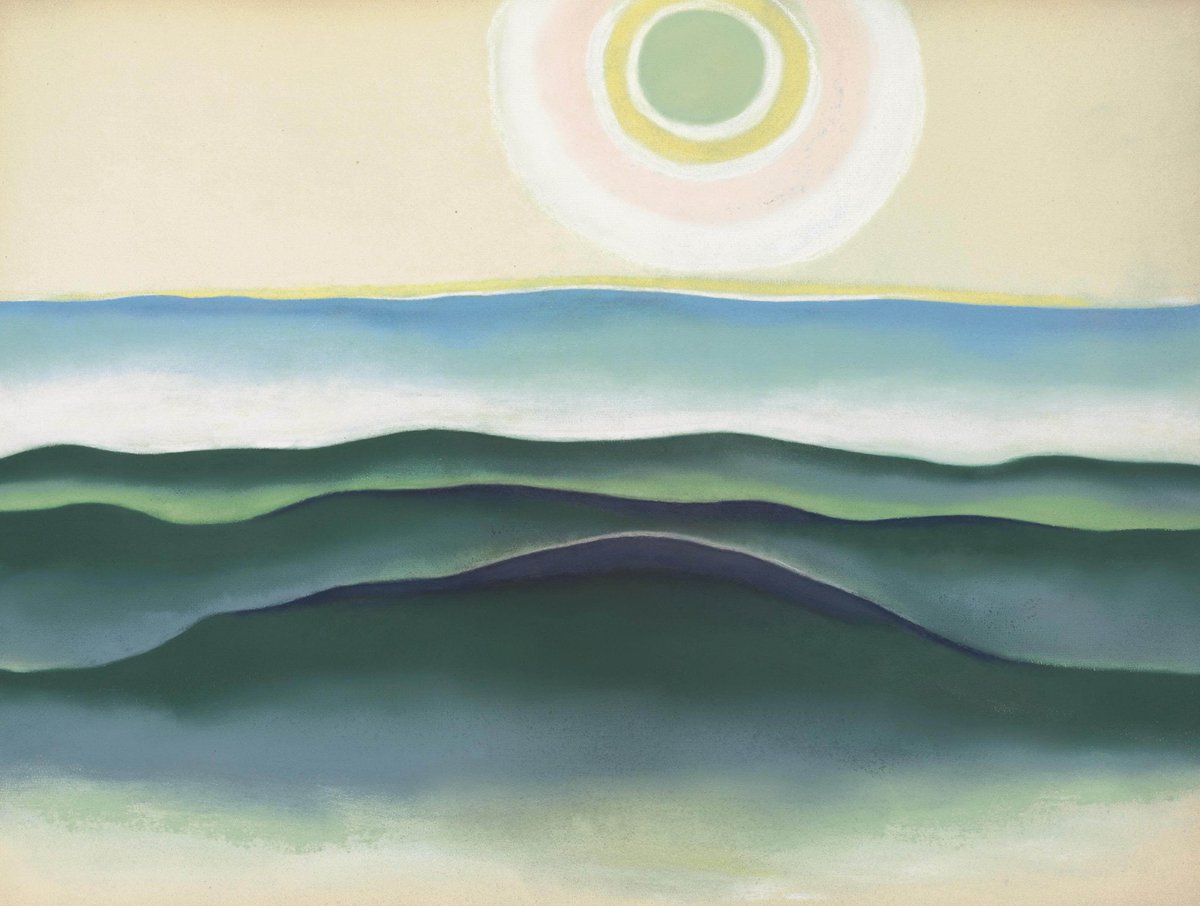
Georgia O’Keefe, Sun Water Maine, 1922

Lots to recommend here, I hope you’ll find something you like the sound of and that you’ll share your favourites of the month. Above all, (re) read The Age of Innocence: it’s really something.

“A Vast Invisible Web”: Tana French’s The Searcher

The Searcher is Tana French’s second stand-alone novel, and the first to be written in third person. Although I regularly mourn the waning of third-person narration, I was surprised by French’s choice, as so much of the magic of her previous seven books stems from their brilliant use of unreliable first-person.

I’m a huge fan of French’s; in my opinion, there’s no better writer in crime fiction today. I even love the books that most readers dislike, The Likeness (2008) and The Secret Place (2014). (No accident that these are the most female-centered of her novels.) I especially love The Secret Place, set largely in a girl’s school, with its dreamy terrors, though, if pressed, I’d choose Broken Harbour (2012), set in the Gothic ruins of the Celtic Tiger’s economic collapse, as my favourite French. (Or maybe The Trespasser. It’s hard!)

No surprise, then, I think French succeeds with close third-person narration as much as with first-person. But this isn’t just the fan in me talking. French has been careful in her decision. What sets her novels apart isn’t just her mastery of suspense—surprisingly rare in crime fiction—but her patient, intelligent consideration of friendship. Reading a French novel you are led to ask not only whodunnit but, more esoterically, why do you have the friends you have; what distinguishes relationships that are freely chosen from those mandated by expectations (family) or contingency (work); which comes first, selfhood or friendship; are you drawn to your friends, and they to you, because of who you are; or do you become who you are because of those friends?

To be sure many of French’s novels do center on work relationships, namely the ones formed between cops. (Her first six novels are set in the fictional Dublin Murder Squad.) But in French’s hands, these partnerships, even if they are initially formed arbitrarily (x gets assigned to work with y), take on an intense, hothouse quality. The characters spend as much time sussing out each other as they do the crime. French’s cops are more like friends—really, more like frenemies—than like colleagues.

Some people, I know, don’t care for French because her language, concerns, and structure all tend to excess. But I love how she queers the conventions of detective fiction. French is a particularly Irish writer, inhabiting that great tradition of writers who mimic only to destabilize English realism (Swift, Le Fanu, Wilde, Joyce, Bowen, Beckett, etc.). Like these illustrious compatriots, French is swoony, preposterous, Gothic; she is a burst of febrile invention in the stylistically staid world of crime writing, a genre that, however invested in social change, is realist to its bones. (I’m talking about how it describes the world, not whether it’s plausible, which, so often, it isn’t. Not a criticism, by the way.)

French’s previous novel, The Witch Elm (2018), wasn’t just French’s first stand-alone, it was literally about what it means to stand alone, a question it explored by considering vigilantism and by using the protagonist’s head trauma to question the very idea of a coherent self. Other crime novels have used concussed or neuro-challenged detectives—off the top of my head, I think of examples by Margery Allingham, Howard Engel, and Henning Mankell—but always to ask questions about reason (can the crime be solved by a detective who can’t think “normally”?) rather than about identity. Yet The Witch Elm’s narrator was still enmeshed in a social world; he had all sorts of people worrying about him (and worrying him: the people in his life choked him with their concern). As this description implies, the book was also written in first person, taking French’s genius for charming but dubious narrators to its greatest height. In this regard, The Witch Elm was of a piece with the rest of her books. Taken together they make a brilliant, paradoxical argument about narration: the best way to show someone’s connections to others is to tell their story in first-person.

The Searcher shows the reverse to be true as well: third-person shows isolation. Cal Hooper has retired, at age 48, from the Chicago police. (As someone of the same age, I was curious but also dubious about the financial logistics of this plan. But I digress.) Wanting to put the job behind him—or, rather, his mixed feelings about it; his inability to any longer believe the police are fundamentally useful (an idea more and more crime writers are understandably wrestling with these days; too bad this is the most cursory, least interesting part of the book)—not to mention his recent divorce, Cal has come to rural Ireland, where he’s bought a tumble-down cottage and devotes his days to restoring it.

Cal loves his new life—frying the good Irish bacon while blasting Steve Earle, feeling his body return from decades of sedentary work, marveling bemusedly at the changeable weather—but he also feels ill at ease. He doesn’t know the place, doesn’t know everyone’s back story, doesn’t understand what the locals are actually saying when they seem to be chatting pleasantly. A parliament of rooks watches skeptically over his yard. People stop talking when he enters the pub. More to the point, someone is watching him, he can just tell.

The someone turns out to be a thirteen-year-old named Trey Reddy, whose beloved older brother disappeared a few months back. Everyone knows the family is shiftless—father fucked off, mother overwhelmed, kids going to school only when they feel like it—so they assume Brendan lighted out for something better, maybe in the city. He’ll be back eventually, chastened no doubt. Trey knows differently, knows no one cares like Brendan does, knows this older brother wouldn’t leave without saying something or sending word. Trey wants Cal, the ex-cop to find his brother.

The ex-cop doesn’t want to, but gets pulled in against his better judgment. The truth turns out to be fairly simple, but also messy, leaving no one untouched, and it proves Cal’s early intuition about that his bucolic new home is a heaving mass of secrets. Like so many of French’s characters, he feels that the world as we know it only barely makes sense, its meaning a hair’s breadth from meaninglessness:

All of a sudden he has that sensation… an intense awareness of the spread of the dark countryside all around his house; a sense of being surrounded by a vast invisible web, where one wrong touch could shake things so far distant he hasn’t even spotted them.

Distant things—the syntax here can trip us up if we’re not careful—do get shaken, and people do get hurt (physically, not just emotionally: it’s a violent book). Their trust in each other, their ease with each other, their sense of being safe with each other—all are badly eroded. By the end French leaves us a glimmer of hope that some relationships might survive; that people need each other is never in doubt. That’s true even when the relationships on offer are harmful. One drunken night at the pub Cal thinks he might finally have been accepted by the locals, then realizes he’s being played in a way he can’t yet understand. But he so hungers for “the effortless rhythms of the talk snapping back and forth across the table” that he’s willing to take what he can get: “He may not know these men, but they know each other, and there’s comfort in being around that.”

Reading The Searcher I would occasionally stumble over Cal’s folksy, backwoods, aw shucks language: “So if I show up at your place and start visiting with your mama, you never saw me before.” Visiting, your mama—these Southernisms are explained away (he moved to Chicago from the Carolinas)—but that Cal would think of and to himself in the same way, as shown by the appearance of similar language in the free indirect discourse, seems a bit much. (“On his way out Cal has himself a nice long wander around the lane behind Francie Gannon’s fields.”) What I’m saying is that French has never written an American before, and it shows.

Or does it? As always, French is ahead of her readers. If we think she’s failed, then the joke’s on us. We’ve been too quick to reach for plausibility and realism. Cal’s southernisms, his whole good ol’ boy persona, are strategic, useful in lulling suspects into dismissing him. And they may not just be his disguise, they may be the novel’s too. Finishing the book, I got to thinking about the title, which of course has many possible referents: Cal, Trey, Brendan, the locals Cal finds himself among, and, not least, readers. So many searchers. But then why hasn’t French used the plural? I thought, of course, about a text that does, John Ford’s classic western, The Searchers (1956). And to be sure Cal is taken by the men down the pub as a kind of John Wayne, and fashions himself as one too. Cross-cultural encounters usually start with stereotypes: here, the locals make lots of hay about Americans as gun-toting zealots; in turn, they revel in their Irishness (“‘Sure, I’ve no need for that carry-on at my age,” Cal’s neighbour says when they banter over the fence, “‘What sins would I commit, an aul’ lad like me? I haven’t even got the broadband.’”) French, I think, is up to something here. She wrongfoots us with these clichés. What truths do they tell? What do they conceal? What happens when a Western is transplanted to western Ireland?

In Ford’s film, Wayne plays Ethan Edwards, a confederate soldier drifting across Texas in the wake of the Civil War. On a visit to his brother’s homestead, his relatives are murdered in a Comanche raid. All except Ethan’s nieces, whose fate—they have been taken hostage—is even worse in Ethan’s eyes. Along with his adopted nephew (already challenging the idea that family is primarily biological), Ethan launches a quest to release them—which also means to redeem them—thereby restoring the “civilizing” function of white settlers, as symbolized by the houses that bookend the film. Famously, however, Ethan is uneasy in both, always framed in doorways, coming in only to leave again. Domesticating walls can’t contain him, not because he is a free spirit but because the civilization The Searchers pretends to uphold is predicated on the ineradicable violence he symbolizes and, like some vigilante Ancient Mariner, is enjoined to enact.

I wouldn’t say French’s novel is an homage or even a reworking of Ford’s film. A riposte maybe. But I definitely think she has Westerns on her mind. When Lena, the novel’s neatly deflected love interest, explains that the problem with rural Ireland is that young women leave for better things because their families won’t give them land, which leaves a landscape of bachelors, men who lash out because they’ve no young people around to show them that a changing world isn’t terrible. When Cal suggests that having kids makes you want to fight things, too, Lena replies:

That’s different. If you’ve kids, you’re always looking out into the world to see if anything needs fighting, because that’s where they’re headed; you’re not barricading yourself indoors and listening for the Indians to attack.

Lena is the most sensible person in the novel; she voices French’s rejection of the ethos of the Western. But French can’t escape the questions about our bonds to other people the genre poses. The solution isn’t for everyone to settle down and have lots of children, or even for women to be able to work the land as much as men do. It’s to imagine different kinds of relationships between the generations that exceed the familial. Which is where French is different than Ford. In the film, the relationship between Ethan and his surviving niece isn’t close, isn’t parental, but still familial. She is kin. In the novel, Cal and Trey’s relationship can be generative because it’s unnecessary, and even not quite socially sanctioned. (Cal is warned that people will talk—and, it is intimated, do more than talk—if they learn how much time he is spending with the child.) If Cal is a father figure to Trey the novel emphasizes the figure rather than the father.

Even though it contains French’s signature unsettling undercurrents of strong negative emotions, The Searcher is sweeter than The Searchers. In the end, I’m not completely sold on it; disappointingly, its style is less luxurious than usual for French. But it’s plenty suspenseful, and plenty smart, a fine addition to a wonderful oeuvre. It’s a good book about dogs, too, valuing them for what they are rather than sentimentalizing them. Which is fitting, for the affect between dogs and people is also neither biological nor, for the most part, useful—it is unearned and thus free, a gift that is just as powerful as the one that arises between Cal and Trey, the novel’s differently burdened but equally capable protagonists. Solitude is a fantasy, this worthwhile new novel teaches, and bad for you too. But the relationships our society legitimates aren’t always the remedy for that harm. It’s for a new kind of relationship—a new version of friendship—that The Searcher searches.

“Abandoning myself entirely to the buzzing, hot stillness”: Marlen Haushofer’s The Wall

A woman accepts an invitation to stay with friends at their hunting lodge in the Alps. The lodge is actually a two-story wooden villa with some outbuildings, including a hut for the gamekeeper and his dog. Her hosts are unusual—he, Hugo, heir to a saucepan fortune and something of a hypochondriac, has stockpiled food and supplies in the house; she, Luise, is a passionate hunter. The two don’t seem to have much in common, but almost as soon as they arrive, Luise convinces her husband to accompany her to the nearest village for a drink at the inn. Afternoon turns to evening; the couple doesn’t return. The woman is restless, but succumbs to fatigue: she makes herself something to eat and goes to bed without waiting up for her hosts. The next morning, there’s still no sign of them, and so, calling the dog, Lynx, to accompany her, the woman sets out to see what’s happened. The dog is running ahead, and suddenly he cries out in pain. He’s hurt, bleeding from the mouth, and whining in fear. The woman can’t see what could have caused the injury; she gently pushes the dog aside and continues down the path—and immediately bangs her head on something she can’t see. Apparently, an invisible barrier has been thrown up in front of her. No matter how carefully she moves her hands along it, she find no end to it; she can’t pass it. In a distant field she sees a farmhouse and the figure of a man. She calls out to him, but he doesn’t move and as she looks more closely she sees that he isn’t breathing; he’s frozen in place. Everything on the other side of the invisible barrier is as though turned to stone. The woman and the dog give up and return to the lodge. Soon she has to face facts: somehow, she and a few animals in the surrounding woods, meadows, and mountains are the only beings still alive.

a681c081

So begins Marlen Haushofer’s The Wall, a sad, moving, and beautiful novel first published in Austria in 1962 and translated by Shaun Whiteside into English in 1990. Haushofer—about whom I know little: she was born in Upper Austria, went to school in Linz, university in Vienna and Graz, and spent most of her life in Steyr, where she married the same man twice and raised a family—had a short life (1920-1970) and didn’t write many books, but on the evidence of this one she was the real thing.

The Wall is filled with lovely low-key descriptions of the land from which the narrator struggles to rest a living. But these descriptions are always practical, always connected to the task of surviving; this narrator has no time for lyric effusions about the landscape. Here for example a storm is about to break:

It’s never entirely silent in the forest. You only imagine it’s silent, but there is always a whole host of noises. A woodpecker taps in the distance, a bird calls, the wind hisses through the grass in the forest, a big branch knocks against a tree-trunk, and the twigs rustle as little animals scurry around. Everything is alive, everything is working. But that evening it really almost was silent. The silencing of the many familiar noises frightened me. Even the splashing of the stream sounded restrained and muted, as if the water too was only moving lethargically and unwillingly. Lynx stood up, jumped miserably up on the bench beside me and nudged me gently, intimidated by the terrible silence.

Haushofer reminds me a bit of Lawrence. She shares his fondness for parataxis (though admittedly this is much more common and in fact grammatically sound in German than in English), as well as his willingness to repeat words and phrases, to the point of ungainliness. Also like Lawrence, she is brilliant on animals. The Wall is a great book about how much people need animals. (I realize people are animals; I mean non-human animals.) In addition to Lynx, probably my favourite character, the narrator becomes close to several cats and to her cow, lovely, patient, beautiful Bella, whose milk keeps all of them alive.

The Wall, then, is a book about living beings—about what it feels like to be alive, and what it takes to stay alive. Mostly it takes hard work. Here’s the narrator, having decided to take Bella and her calf to summer in an alpine meadow and painfully lugged everything she needs to keep herself whole up the mountain, clearing out the long-abandoned hut in which she will live:

The hut was thick with dirt, and that disturbed me a great deal. It was by now too late to start spring-cleaning. So I washed only the necessary pots with the wire brush and sand, and put a little pot of potatoes on the spirit stove. Then I dismantled the bed and carted the musty pallet to the meadow and beat it with a stick. A cloud of dust arose. I couldn’t do anything more for the time being, but resolved to lay the pallet outside to air on every fine day.

And here she is making hay for the winter (accompanied by Lynx, who, as always, is sharply attuned to her moods but not much help with the work):

The sun cast its full brilliance on the slope. The fresh-cut swathes of hay already lay wilted and dull. I stood up and began to turn them with the fork. The meadow was one great hum of startled insects. I worked slowly, almost drowsily, abandoning myself entirely to the buzzing, hot stillness. Lynx, who had checked that everything was all right with me, trotted to the stream and drank in long, lapping gulps, then lay down in the shade, his head on his paws, his mournfully wrinkled face entirely hidden by his long ears, and dozed away. I envied him.

Sometimes she gets something like rest, as when she discovers a stretch of raspberry bushes that have just ripened:

As I had no sugar and couldn’t make preserves, I had to eat the berries straight away. I went to the patch every other day. It was the purest joy; I was bathed in sweetness. The sun warmed the ripe berries, and a wild aroma of sun and maturing fruits enveloped and intoxicated me.

Ernst-Ludwig-Kirchner-Kuehe-bei-Sonnenuntergang_950

The edition of The Wall that I read comes with a blurb from Doris Lessing. It’s better than your average praise:

It is not often that you can say only a woman could have written this book, but women in particular will understand the heroine’s loving devotion to the details of making and keeping life, every day felt as a victory against everything that would like to undermine and destroy. It is as absorbing as Robinson Crusoe.

(I confess I have never read the Defoe, but I take it to be governed by a tendency to document and report, and The Wall has some of that, in its careful descriptions of how to chop wood and cut grass and never touch the seed potatoes, no matter how hungry you are.) Lessing is an important writer for me; I take her praise seriously. Indeed, reading it I was reminded of her near-contemporaneous Summer before the Dark (1973). Perhaps even closer in spirit to The Wall is a book even dearer to my heart, Marian Engel’s Bear (1976), a story about a woman sent to catalog a library in a fabulous house on a remote island in northern Ontario who finds a bear can make for good company.

Lessing and Engel’s books are stories of idylls. Is this one too? “A woman and her animals, alone at last.” Maybe. But if so, it’s a frightening idyll, one filled with hard work, and cold and hunger, the threat of death, and at the end of it all the realization that human beings might, with her, come to an end. Which isn’t to say that the narrator doesn’t experience something like positive transformation. But doing so requires that she shrug off her most human qualities. Loneliness, she writes, has led her, “in moments free of consciousness and memory, to see the brilliance of life again.” At Christmas time, depressed that in the forest it is nothing more than another snowy day, she consoles herself with the possibility of being able to forget the past: “something quite new lay waiting behind” the old ways of seeing. Imagining a real transformation means imagining something beyond herself:

One day I shall no longer exist, and no one will cut the meadow, the thickets will encroach upon it and later the forest will push as far as the wall and win back the land that man has stolen from it… The forest doesn’t want human beings to come back.

Here Haushofer reminds me of Woolf in the Time Passes section of To the Lighthouse. This passage could have come from the earlier novel:

I see the plants flourishing, green, well-fed and silent. And I hear the wind and all the noises from the dead cities; window-panes shattering on the pavement when their hinges have rusted through, the dripping of water from the burst pipes and the banging of thousands of doors in the wind. Sometimes, on stormy nights, a stone object that was once a human being tips from its chair at a desk and crashes with a boom to the parquet floor. For a while there must have been big fires as well. But they’re probably over now, and the plants are hurrying to cover up the remains. If I look at the ground behind the wall, I don’t see any ants, or beetles, not even the tiniest insects. But it won’t stay that way. With water from the streams life, tiny, simple life, will seep in and revivify the earth. I might have been quite indifferent to that, but strangely it fills me with secret satisfaction.

Given its interest in overcoming the human, it is less obvious in The Wall than in the other books I’ve referenced that the heroine’s self-discovery is a good thing. Plus—spoiler alert!—near the end something weird and terrible happens. A man comes out of nowhere and kills the bull and the dog before the narrator kills him. All of this happens so abruptly—here I was reminded of Beckett’s Molloy and its sudden, hallucinatory depictions of murder—that I’m not even sure whether it really happened. Actually, I think it does. But where this guy comes from and whether there are any more like him or if there are any repercussions or ripple-effects from this burst of violence are never explained.

That violence would seem to mitigate fully any notion of an idyll, and indeed ultimately there is no way out for the narrator. She runs out of paper, and simply ends her chronicle. Yet the book doesn’t feel hopeless. It ends on a note of what I can only call grace. Maybe today we would call it mindfulness. Over and over, the narrator is granted the peace of no longer having to think (prevented by exhaustion, by the need to keep on task, by the joy that comes from taking care of and being cared for by animals). But she doesn’t become wild. She doesn’t want to give up thought. She distinguishes herself from animals; despite the frailty of the human and the lure of its extinction, she accepts the tragedy of self-consciousness. For her, as for Leonard Cohen in his equally graceful “Famous Blue Raincoat,” that means she’s keeping some kind of record:

Over the last few days I have realized that I still hope someone will read this report. [Again, the language of documentation.] I don’t know why I wish that, it makes no difference, after all. But my heart beats faster when I imagine human eyes resting on these lines, and human hands turning the pages.

Where the book seems most feminist is in its depiction of the narrator as someone who, for whatever reason (though it is intimated that the reason is because she is a woman), needs to care for others: “There was something planted deep within me that made it impossible for me to abandon something that had been entrusted to me.” This despite the fact that care is always stymied. To love is to keep alive, but life is replaced by death, and so love is always tragic:

I often look forward to a time when there won’t be anything left to grow attached to. I’m tired of everything being taken away from me. Yet there’s no escape, for as long as there’s something for me to love in the forest, I shall love it; and if some day there is nothing, I shall stop living. If everyone had been like me, there wouldn’t have been a wall… but I understand why the others always had the upper hand. Loving and looking after another creature is a very troublesome business, and much harder than killing and destruction.

This is the most allegorical and “message-y” the book gets.

dorf-mit-kirche-im-bergell-1907.jpg!Large

Apparently, Haushofer took a long time to write this book. Not only did she have a household to run, even as she suffered from poor health, especially debilitating headaches, but she also wanted to make sure she got it right: that her descriptions of animals and plants were accurate and that the life she described for her heroine was plausible. I wonder if she was helped in her search for accuracy by her background: she grew up in the foothills of upper Austria, where her father was a forester. In one sense, nothing happens in this book. Yet it’s utterly compelling, partly because it has relentless forward momentum even as the telling ranges back and forth in time (only ever within the years after the incident, though—she almost never says anything about her life before the wall). The book is propelled by the changing of the seasons, of weather and climate, of life and death. It’s all very elemental, but never portentous. (Haushofer is the anti-Cormac McCarthy.)

I’m speaking a lot about feelings here. Something about this novel incites reflection on our experiencing of reading it. I felt shame, too. How could I, with a doctorate in comparative literature with particular emphasis on English and German-language 20th century literature, have never heard of Haushofer before? How could I have taken all those classes, sat through all those colloquia, and never come across this remarkable author? Maybe things would be different if I were still in graduate school today: maybe Haushofer is having a resurgence, dozens of academic teaching her works and writing assiduously about her. (I gather a film adaptation came out a few years ago; that can’t hurt.) But my shame quickly turned into something more generative. I’m thrilled with the discovery, and reassured to realize, yet again, how much literature remains to explore. Haushofer is a writer for everyone: careful, matter-of-fact, gentle, joyful—but not sweet. She’s more like the cranberries the narrator strains and jars to keep her through the winter than she is like the raspberries on which she gorges to the point of  surfeit.

I plucked The Wall from the bottom of a large stack of unread books in my study largely because I wanted to contribute to #WITMonth, the creation of Meytal Radzinski (@Biblibio), an event that has gratifyingly become a sensation in the book world. I like to think the sense of discovery that accompanied my reading of this remarkable book is in keeping with the spirit of this celebration of month-long event. Of course, now all I want to do is seek out Haushofer’s other books; every book read from the TBR pile only leads to two or three more…